EP2944477B1 - Mehrfarbiges wärmeaufzeichnungsmaterial und verfahren zur farbformung dieses mehrfarbigen wärmeaufzeichnungsmaterials - Google Patents
Mehrfarbiges wärmeaufzeichnungsmaterial und verfahren zur farbformung dieses mehrfarbigen wärmeaufzeichnungsmaterials Download PDFInfo
- Publication number
- EP2944477B1 EP2944477B1 EP13870449.9A EP13870449A EP2944477B1 EP 2944477 B1 EP2944477 B1 EP 2944477B1 EP 13870449 A EP13870449 A EP 13870449A EP 2944477 B1 EP2944477 B1 EP 2944477B1
- Authority
- EP
- European Patent Office
- Prior art keywords
- color
- developing
- thermal
- dye precursor
- layer
- Prior art date
- Legal status (The legal status is an assumption and is not a legal conclusion. Google has not performed a legal analysis and makes no representation as to the accuracy of the status listed.)
- Active
Links
Images


Classifications
-
- B—PERFORMING OPERATIONS; TRANSPORTING
- B41—PRINTING; LINING MACHINES; TYPEWRITERS; STAMPS
- B41M—PRINTING, DUPLICATING, MARKING, OR COPYING PROCESSES; COLOUR PRINTING
- B41M5/00—Duplicating or marking methods; Sheet materials for use therein
- B41M5/26—Thermography ; Marking by high energetic means, e.g. laser otherwise than by burning, and characterised by the material used
- B41M5/28—Thermography ; Marking by high energetic means, e.g. laser otherwise than by burning, and characterised by the material used using thermochromic compounds or layers containing liquid crystals, microcapsules, bleachable dyes or heat- decomposable compounds, e.g. gas- liberating
-
- B—PERFORMING OPERATIONS; TRANSPORTING
- B41—PRINTING; LINING MACHINES; TYPEWRITERS; STAMPS
- B41M—PRINTING, DUPLICATING, MARKING, OR COPYING PROCESSES; COLOUR PRINTING
- B41M5/00—Duplicating or marking methods; Sheet materials for use therein
- B41M5/26—Thermography ; Marking by high energetic means, e.g. laser otherwise than by burning, and characterised by the material used
- B41M5/30—Thermography ; Marking by high energetic means, e.g. laser otherwise than by burning, and characterised by the material used using chemical colour formers
-
- B—PERFORMING OPERATIONS; TRANSPORTING
- B41—PRINTING; LINING MACHINES; TYPEWRITERS; STAMPS
- B41J—TYPEWRITERS; SELECTIVE PRINTING MECHANISMS, i.e. MECHANISMS PRINTING OTHERWISE THAN FROM A FORME; CORRECTION OF TYPOGRAPHICAL ERRORS
- B41J2/00—Typewriters or selective printing mechanisms characterised by the printing or marking process for which they are designed
- B41J2/315—Typewriters or selective printing mechanisms characterised by the printing or marking process for which they are designed characterised by selective application of heat to a heat sensitive printing or impression-transfer material
- B41J2/32—Typewriters or selective printing mechanisms characterised by the printing or marking process for which they are designed characterised by selective application of heat to a heat sensitive printing or impression-transfer material using thermal heads
-
- B—PERFORMING OPERATIONS; TRANSPORTING
- B41—PRINTING; LINING MACHINES; TYPEWRITERS; STAMPS
- B41M—PRINTING, DUPLICATING, MARKING, OR COPYING PROCESSES; COLOUR PRINTING
- B41M5/00—Duplicating or marking methods; Sheet materials for use therein
- B41M5/26—Thermography ; Marking by high energetic means, e.g. laser otherwise than by burning, and characterised by the material used
- B41M5/30—Thermography ; Marking by high energetic means, e.g. laser otherwise than by burning, and characterised by the material used using chemical colour formers
- B41M5/323—Organic colour formers, e.g. leuco dyes
-
- B—PERFORMING OPERATIONS; TRANSPORTING
- B41—PRINTING; LINING MACHINES; TYPEWRITERS; STAMPS
- B41M—PRINTING, DUPLICATING, MARKING, OR COPYING PROCESSES; COLOUR PRINTING
- B41M5/00—Duplicating or marking methods; Sheet materials for use therein
- B41M5/26—Thermography ; Marking by high energetic means, e.g. laser otherwise than by burning, and characterised by the material used
- B41M5/34—Multicolour thermography
-
- B—PERFORMING OPERATIONS; TRANSPORTING
- B41—PRINTING; LINING MACHINES; TYPEWRITERS; STAMPS
- B41M—PRINTING, DUPLICATING, MARKING, OR COPYING PROCESSES; COLOUR PRINTING
- B41M2205/00—Printing methods or features related to printing methods; Location or type of the layers
- B41M2205/04—Direct thermal recording [DTR]
Definitions
- the present invention relates to a multicolor thermal recording material capable of developing different colors depending on differences in the conditions of applying heat from a thermal head, and to a method for developing color of the multicolor thermal recording material.
- thermal recording materials use a coloring reaction of a dye precursor and a color developer that develops the color of the dye precursor upon contact with the dye precursor under heating, both coloring substances being melted and brought into contact with each other by heating, thereby obtaining colored images.
- Such thermal recording materials are relatively inexpensive, and require compact recording devices and easily maintenance of recording devices; therefore, they are used in a wide range of fields as recording media for facsimiles, word processors, various calculators, and other applications.
- Multicolor thermal recording materials generally comprise a high-temperature color-developing layer and a low-temperature color-developing layer that are sequentially laminated on a support and develop different colors.
- Such multicolor thermal recording materials are broadly classified into two types: decoloring materials and color-adding materials.
- PTL 8 proposes developing multiple colors by dissolving coloring components that develop mutually different colors in solvents, and encapsulating the resulting mixtures separately in two or more microcapsules having different glass transition temperatures.
- PTL 11 proposes a method for developing multiple colors by providing color-developing layers with three or more colors.
- EP754564 discloses a multicolor thermal recording material comprising: a support; and in order from a side close to the support, a first thermal color-developing layer; an intermediate layer; a second thermal color-developing layer; an intermediate layer; and a third thermal color-developing layer.
- the present invention relates to a multicolor thermal recording material comprising:
- the composite fine particles contained in the second and third thermal color-developing layers are preferably each obtained by emulsifying and dispersing a liquid composition containing a polyvalent isocyanate compound and the second or third dye precursor in water, followed by polymerization of the polyvalent isocyanate compound.
- the first, second, and third thermal color-developing layers are preferably capable of developing mutually different colors, and each is capable of developing yellow, magenta, or cyan.
- the dye precursor contained in the layer capable of developing yellow preferably has a pyridine skeleton in its molecular structure.
- the present invention also relates to a method for developing color of the multicolor thermal recording material by application of heat from a thermal head.
- the first, second, and third thermal color-developing layers are preferably capable of developing mutually different colors, and each is capable of developing yellow, magenta, or cyan.
- the multicolor thermal recording material is capable of developing yellow, blue, red, or black.
- the color is preferably developed at a specific static color-development starting temperature adjusted by application of heat from the thermal head depending on one pulse width and pulse repeating frequency.
- the multicolor thermal recording material of the present invention allows multicolor printing in at least four colors depending on differences in the conditions of applying heat from a thermal head.
- the color of the first thermal color-developing layer can be singly developed by controlling the heating temperature of the thermal head, and can be separated from the color developed from the second thermal color-developing layer and/or the third thermal color-developing layer.
- the second and third thermal color-developing layers are adjacent to each other, a mixed color can be immediately developed from the second and third thermal color-developing layers.
- Fig. 1 schematically shows one embodiment of the multicolor thermal recording material of the present invention.
- the multicolor thermal recording material 1 of the present invention has a multilayer structure with at least three thermal color-developing layers, and comprises a support 2 and, in the order from the side close to the support 2, a first thermal color-developing layer 3, an intermediate layer 4, a second thermal color-developing layer 5, and a third thermal color-developing layer 6.
- the first thermal color-developing layer 3 contains a first dye precursor and a color-developing compound reactive with the first dye precursor under heating to develop the color of the first dye precursor;
- the second thermal color-developing layer 5 contains a particle component containing a second dye precursor, and a color-developing compound reactive with the second dye precursor under heating to develop the color of the second dye precursor;
- the third thermal color-developing layer 6 contains a particle component containing a third dye precursor, and a color-developing compound reactive with the third dye precursor under heating to develop the color of the third dye precursor.
- the static color-development starting temperature mentioned herein refers to a temperature at which coloring is started when a hot plate at a predetermined temperature is pressed to a monochromatic thermal recording material using a single dye precursor for a certain period of time at a constant pressure.
- the specific conditions of applying energy from the thermal head to develop the single color 1 can be suitably determined depending on the thickness of each layer constituting the multicolor thermal recording material, the type of component contained in each layer, etc.
- the head density of the thermal head is 203 dpi
- printing is performed under the following conditions: one-line recording time is preferably about 4.93 to 492.61 msec/line, more preferably about 8.21 to 49.26 msec/line, and even more preferably about 8.21 to 20.0 msec/line; the energy applied per dot is preferably about 4.0 to 8.0 ⁇ J/time, and more preferably about 4.8 to 7.8 ⁇ J/time;
- one pulse cycle is preferably about 95 to 100 ⁇ sec, and more preferably about 96 to 99 ⁇ sec; and the pulse repeating frequency is preferably 80 to 160 times, and more preferably 100 to 140 times.
- the conditions for applying energy from the thermal head are set so that the temperature is lower than the static color-development starting temperature of the third thermal color-developing layer and higher than the static color-development starting temperature of the second thermal color-developing layer.
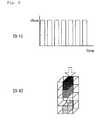
- a specific example of the conditions of applying energy from the thermal head is shown in B1 of Fig. 3 , in which energy of the thermal head is repeatedly applied at a constant applied voltage from the third thermal color-developing layer side with a pulse width longer than that for developing the color of the first thermal color-developing layer.
- the conditions for applying energy from the thermal head are set so that the temperature is higher than the static color-development starting temperature of the third thermal color-developing layer.
- a specific example of the conditions of applying energy from the thermal head is shown in D1 of Fig. 5 , in which energy of the thermal head is applied at a constant applied voltage from the third thermal color-developing layer side at a high temperature for a long period of time, while the pulse width is adjusted to be shorter than that for obtaining the mixed color 2, and the pulse repeating frequency is adjusted to be grater than that for obtaining the mixed color 2.
- the specific conditions of applying energy from the thermal head to develop the mixed color 3 can be suitably determined depending on the thickness of each layer constituting the multicolor thermal recording material, the type of component contained in each layer, etc.
- one-line recording time is preferably about 4.93 to 492.61 msec/line, more preferably about 8.21 to 49.26 msec/line, and even more preferably about 8.21 to 20.0 msec/line
- the energy applied per dot is preferably about 16.0 to 319.6 ⁇ J/time, more preferably about 32.0 to 255.7 ⁇ J/time, and even more preferably about 32.0 to 100.0 ⁇ J/time
- one pulse cycle is preferably about 40 to 800 ⁇ sec, more preferably about 80 to 640 ⁇ sec, and even more preferably about 80 to 300 ⁇ sec
- the pulse repeating frequency is preferably 20 to 50 times, and more preferably 20 to 30 times.
- the static color-development starting temperatures of the second and third thermal color-developing layers depend on the polymeric characteristics of the composite fine particles and the color-developing compounds, and can therefore be easily controlled. Moreover, the same control is also possible when a plurality of dye precursors are used in combination to obtain a desired color; therefore, the static color-development starting temperatures are not restricted by the type of dye precursors.
- the color-developing compound may be selected or the composite fine particles in the second thermal color-developing layer may be prepared so that the static color-development starting temperature of the second thermal color-developing layer is higher than the static color-development starting temperature of the first thermal color-developing layer and lower than the static color-development starting temperature of the third thermal color-developing layer.
- an intermediate layer is not required between the second and third thermal color-developing layers. Therefore, an excellent multicolor thermal recording material can be obtained in a few steps. Because these layers are adjacent to each other, the mixed color 2 can be immediately developed, and color separation can be facilitated.
- the color developed at a low temperature for a long period of time results from the reaction of the first dye precursor and a color-developing compound present in the first thermal color-developing layer.
- the color developed at a medium temperature for a long period of time is a mixture of a color resulting from the reaction of the first dye precursor and a color-developing compound in the first thermal color-developing layer, and a color resulting from the reaction of the second dye precursor present in the composite fine particles and a color-developing compound in the second thermal color-developing layer.
- Dye precursors described below can be used as the dye precursors that can be contained in the first, second, and third thermal color-developing layers of the present invention.
- Triaryl, diphenylmethane, thiazine, spiro, lactam, fluoran, and like leuco compounds can be preferably used.
- Such dye precursors provide their unique colors upon contact with color-developing compounds.
- the colors of the dye precursors cover a wide range, including black, red, magenta, blue, cyan, green, and yellow.
- dye precursors that develop mutually different colors may be selected.
- the first, second, and third thermal color-developing layers are capable of developing mutually different colors, and each is capable of developing yellow, magenta, or cyan. This results in a vivid color by mixing two or more colors.
- the one pulse width is adjusted to become shorter in order from the longest width for the mixed color 2 to the mixed color 3, mixed color 1, and single color 1, and the pulse repeating frequency is adjusted to be greater for the single color 1 and mixed color 1, and to be reduced in order of the mixed color 3 and mixed color 2.
- adjacent dots can be developed into different colors selected from at least four colors by one scanning of the thermal head.
- recording with excellent visibility can be performed by developing the color of letters and patterns to be emphasized, different from the color of other parts, without scanning of the thermal head several times for every time each color is obtained.
- the printer mechanism can be simplified, and the time required for recording can be shortened.
- plastics substrates comprising polyethylene terephthalate having a thickness of 100 ⁇ m or more, particularly foamed substrates, are preferably used in terms of thermal color-developing sensitivity.
- a laminate substrate of a foamed polyethylene terephthalate film and a non-foamed polyethylene terephthalate film can also be used.
- blue-developing dye precursors developing cyan that can be used as the first dye precursor include 3,3-bis(p-dimethylaminophenyl)-6-dimethylaminophthalide, 3-(4-diethylamino-2-methylphenyl)-3-(4-dimethylaminophenyl)-6-dimethylaminophthalide, 3-(4-diethylamino-2-ethoxyphenyl)-3-(1-ethyl-2-methylindol-3-yl)-4-azaphthalide, 3-(1-ethyl-2-methylindol-3-yl)-3-(4-diethylaminophenyl)phthalide, 3-(1-ethyl-2-methylindol-3-yl)-3-(2-methyl-4-diethylaminophenyl)-4-azaphthalide, 3-(1-ethyl-2-methylindol-3-yl)-3-(2-ethoxy-4-diethylaminoph
- dye precursors developing green that can be used as the first dye precursor include 3-(N-ethyl-N-n-hexylamino)-7-anilinofluoran, 3-diethylamino-7-dibenzylaminofluoran, 3,3-bis(4-diethylamino-2-ethoxyphenyl) -4-azaphthalide, 3-(N-ethyl-N-p-tolylamino)-7-(N-phenyl-N-methylamino)fluoran, 3-[p-(p-anilinoanilino)anilino]-6-methyl-7-chlorofluoran, 3,6-bis(dimethylamino)fluorene-9-spiro-3'-(6'-dimethylamino)phthalide, and the like.
- red-developing dye precursors developing magenta examples include 3,6-bis(diethylamino)fluoran- ⁇ -anilinolactam, 3,6-bis(diethylamino)fluoran- ⁇ -(p-nitro)anilinolactam, 3,6-bis(diethylamino)fluoran- ⁇ -(o-chloro)anilinolactam, 3-dimethylamino-7-bromofluoran, 3-diethylaminofluoran, 3-diethylamino-6-methylfluoran, 3-diethylamino-7-methylfluoran, 3-diethylamino-7-chlorofluoran, 3-diethylamino-7-bromofluoran, 3-diethylamino-7,8-benzofluoran, 3-diethylamino-6,8-dimethylfluoran, 3-diethylamino-6-methyl-7-chlorofluoran, 3-dimethylamino-7-ch
- dye precursors developing magenta include 3,3'-bis(1-ethyl-2-methylindol-3-yl)phthalide, 3,3'-bis(1-n-octyl-2-methylindol-3-yl)phthalide, 7-(N-ethyl-N-isoamylamino)-3-methyl-1-phenylspiro[(1,4-dihydrochromeno[2,3-c]pyrazole)-4,3'-phthalide], 7-(N-ethyl-N-isoamylamino)-3-methyl-1-p-methylphenylspiro[(1,4-dihydrochromeno[2,3-c]pyrazole)-4,3'-phthalide], 7-(N-ethyl-N-n-hexylamino)-3-methyl-1-phenylspiro[(1,4-dihydrochromeno[2,3-c]pyrazole)-4,3'-phthalide],
- dye precursors developing magenta examples include 3-(N-ethyl-N-isoamylamino)-7,8-benzofluoran, 3,3'-bis(1-n-butyl-2-methylindol-3-yl)phthalide, 3-(N-ethyl-N-isoamylamino)-7-phenoxyfluoran, and the like.
- dye precursors developing yellow that can be used as the first dye precursor include 4-[2-[2-(butoxy)phenyl]-6-phenyl-4-pyridinyl]-N,N-dimethylbenzeneamine, 4-[2-[2-(octyloxy)phenyl]-6-phenyl-4-pyridinyl]-N,N-dimethylbenzeneamine, 4-[2-[2-(ethoxy)phenyl]-6-phenyl-4-pyridinyl]-N,N-dimethylbenzeneamine, 4-[2,6-bis(2-ethoxyphenyl)-4-pyridinyl]-N,N-dimethylbenzeneamine, 4-(2,6-diphenyl-4-pyridinyl)-N,N-dimethylbenzeneamine, 4-[2,6-bis(2-butoxyphenyl)-4-pyridinyl]-N,N-dimethylbenzeneamine, 4-[2,6-bis(2-octyloxypheny
- yellow-developing dye precursors 4-[2-[2-(butoxy)phenyl]-6-phenyl-4-pyridinyl]-N,N-dimethylbenzeneamine, 4-[2-[2-(hexyloxy)phenyl]-6-phenyl-4-pyridinyl]-N,N-dimethylbenzeneamine, and 4-[2-[2-(octyloxy)phenyl]-6-phenyl-4-pyridinyl]-N,N-dimethylbenzeneamine, all of which have a pyridine skeleton in their molecular structure, develop vivid yellow; thus, they are more preferred as the dye precursor contained in the thermal color-developing layer capable of developing yellow in the present invention.
- the dye precursor contained in the first thermal color-developing layer can be used in the form of dispersed solid fine particles, or composite fine particles obtained by emulsifying and dispersing a liquid composition containing a polyvalent isocyanate compound and the first dye precursor in water, followed by polymerization of the polyvalent isocyanate compound.
- the static color-development starting temperature of the first thermal color-developing layer can be adjusted to be lower than the static color-development starting temperatures of the second and third thermal color-developing layers.
- the color-developing compound that can be used in the first thermal color-developing layer is selected from those that are liquefied or dissolved due to the temperature increase, and that develop the color of the first dye precursor upon contact with the first dye precursor.
- Typical examples thereof include phenolic compounds, aromatic carboxylic acids, polyvalent metal salts of these compounds, and like organic acid substances.
- the color-developing compound can generally be used in a form in which it is contained in composite fine particles or microcapsules, or in the form of dispersed solid fine particles.
- the amount of the color-developing compound used is not particularly limited, but is preferably about 30 to 2,000 parts by mass, and more preferably about 50 to 250 parts by mass, based on 100 parts by mass of the dye precursor.
- the first dye precursor contained in the first thermal color-developing layer is used in the form of dispersed solid fine particles
- the first dye precursor is pulverized with a wet grinding mill, such as a sand grinder, attritor, ball mill, or Cobot mill, using water as a dispersion medium.
- the pulverized product is dispersed in a dispersion medium, together with a water-soluble polymeric material, such as polyacrylamide, polyvinylpyrrolidone, polyvinyl alcohol, modified polyvinyl alcohol (e.g., sulfone-modified polyvinyl alcohol), methylcellulose, carboxymethylcellulose, styrene-maleic anhydride copolymer salt, or a derivative thereof, and optionally a surfactant, an antifoaming agent, etc., thereby forming a dispersion.
- a water-soluble polymeric material such as polyacrylamide, polyvinylpyrrolidone, polyvinyl alcohol, modified polyvinyl alcohol (e.g., sulfone-modified polyvinyl alcohol), methylcellulose, carboxymethylcellulose, styrene-maleic anhydride copolymer salt, or a derivative thereof, and optionally a surfactant, an antifoaming agent, etc.
- the resulting solution is emulsified and dispersed in water using a water-soluble polymeric material mentioned above as a stabilizing agent. Then, the organic solvent is evaporated from the emulsion, and the dye precursor can be used in the form of dispersed solid fine particles.
- the average particle diameter of the dispersed solid fine particles of the dye precursor used in the form of dispersed solid fine particles is preferably about 0.2 to 3.0 ⁇ m, and more preferably about 0.3 to 1.0 ⁇ m, so as to obtain suitable color-developing sensitivity.
- a dye precursor having the same color can be used in the form of dispersed solid fine particles, together with the composite fine particles.
- the color-developing compound, image stabilizer, sensitizer, and other components contained in the first thermal color-developing layer can be dispersed in water in the same manner as in the case where the dye precursor is used in the form of dispersed solid fine particles, and can be used as a dispersion in the preparation of the thermal color-developing layer-coating liquid. Further, these components can be dissolved in a solvent, and emulsified in water using a water-soluble polymeric material as an emulsifier. Moreover, the image stabilizer and sensitizer may be contained in composite fine particles containing a dye precursor.
- component materials that constitute the first thermal color-developing layer include an adhesive. Further, a pigment, crosslinking agent, wax, metal soap, oil-repellent agent, colored dye, colored pigment, ultraviolet absorber, fluorescent brightener, etc., can be used as auxiliaries, if necessary.
- adhesives include polyvinyl alcohol and derivatives thereof, starch and derivatives thereof; cellulose derivatives, such as hydroxymethylcellulose, hydroxyethylcellulose, hydroxypropylcellulose, methylcellulose, and ethylcellulose; water-soluble polymeric materials, such as sodium polyacrylate, polyvinylpyrrolidone, acrylamide-acrylic acid ester copolymer, acrylamide-acrylic acid ester-methacrylic acid ester copolymer, styrene-maleic anhydride copolymer, isobutylene-maleic anhydride copolymer, casein, gelatin, and derivatives thereof; emulsions, such as polyvinyl acetate, polyurethane, polyacrylic acid, polyacrylic acid ester, vinyl chloride-vinyl acetate copolymer, polybutyl methacrylate, and ethylene-vinyl acetate copolymer; water-insoluble polymers, such as styrene-buta
- pigments include inorganic pigments, such as calcium carbonate, magnesium carbonate, kaolin, clay, talc, calcined clay, silica, diatomaceous earth, synthetic aluminum silicate, zinc oxide, titanium oxide, aluminum hydroxide, barium sulfate, surface-treated calcium carbonate, and surface-treated silica; and organic pigments, such as urea-formalin resin, styrene-methacrylic acid copolymer resin, and polystyrene resin.
- inorganic pigments such as calcium carbonate, magnesium carbonate, kaolin, clay, talc, calcined clay, silica, diatomaceous earth, synthetic aluminum silicate, zinc oxide, titanium oxide, aluminum hydroxide, barium sulfate, surface-treated calcium carbonate, and surface-treated silica
- organic pigments such as urea-formalin resin, styrene-methacrylic acid copolymer resin, and polystyrene resin.
- crosslinking agents include aldehyde compounds such as glyoxal, polyamine compounds such as polyethyleneimine, epoxy compounds, polyamide resins, melamine resins, glyoxylic acid salts, dimethylolurea compounds, hydrazine compounds, aziridine compounds, and blocked isocyanate compounds; inorganic compounds, such as ammonium persulfate, ferric chloride, magnesium chloride, sodium tetraborate, and potassium tetraborate; or boric acid, boric acid triester, boron-based polymer; and the like. These may be used singly or in combination of two or more.
- the crosslinking agent content is not particularly limited, but is preferably within the range of about 1 to 10 mass% based on the total solids content of the first thermal color-developing layer, in terms of improving the water resistance of the thermal color-developing layer.
- waxes include paraffin wax, carnauba wax, microcrystalline wax, polyolefin wax, polyethylene wax, and like waxes; higher fatty acid amides, such as stearamide and ethylene bis-stearamide; and higher fatty acid esters, derivatives thereof, and the like.
- methylolated fatty acid amide can be preferably used because the sensitization effect can be obtained without deteriorating background fogging.
- light resistance can also be significantly improved by incorporating, into the first thermal color-developing layer, microcapsules encapsulating an ultraviolet absorber or dispersed solid fine particles of an ultraviolet absorber as an auxiliary.
- ultraviolet absorbers include salicylic acid-based ultraviolet absorbers, such as phenyl salicylate, p-tert-butylphenyl salicylate, and p-octylphenyl salicylate; and benzophenone-based ultraviolet absorbers, such as 2,4-dihydroxybenzophenone, 2-hydroxy-4-octyloxybenzophenone, 2-hydroxy-4-methoxybenzophenone, 2-hydroxy-4-dodecyloxybenzophenone, 2,2'-dihydroxy-4-methoxybenzophenone, 2,2'-dihydroxy-4,4'-dimethoxybenzophenone, and 2-hydroxy-4-methoxy-5-sulfobenzophenone.
- salicylic acid-based ultraviolet absorbers such as phenyl salicylate, p-tert-butylphenyl salicylate, and p-octylphenyl salicylate
- benzophenone-based ultraviolet absorbers such as 2,4-dihydroxybenzophen
- benzotriazole-based ultraviolet absorbers such as 2-(2'-hydroxy-5'-methylphenyl)benzotriazole, 2-(2'-hydroxy-5'-tert-butylphenyl)benzotriazole, 2-(2'-hydroxy-3',5'-di-tert-butylphenyl)benzotriazole, 2-(2'-hydroxy-3'-tert-butyl-5'-methylphenyl)-5-chlorobenzotriazole, 2-(2'-hydroxy-3',5'-di-tert-butylphenyl)-5-chlorobenzotriazole, 2-(2'-hydroxy-3',5'-di-tert-amylphenyl)benzotriazole, 2-[2'-hydroxy-3'-(3",4",5",6"-tetrahydrophtalimide-methyl)-5'-methylphenyl]benzotriazole, 2-(2'-hydroxy-5'-tert-octylphenylphen
- ultraviolet absorbers Preferred among these ultraviolet absorbers are benzotriazole ultraviolet absorbers.
- the ultraviolet absorber content is not particularly limited, but is preferably about 5 to 70 mass% based on the total solids content of the first thermal color-developing layer.
- the ultraviolet absorber content is preferably adjusted to be within the range of about 15 to 50 mass%.
- the ultraviolet absorber content is 5 mass% or more, light resistance can be further increased.
- the ultraviolet absorber content is 70 mass% or less, the recording sensitivity of the thermal color-developing layer can be improved. Light resistance can be more efficiently improved by incorporating microcapsules encapsulating an ultraviolet absorber or dispersed solid fine particles of an ultraviolet absorber into a protective layer, described later, rather than into the first thermal color-developing layer.
- Microcapsules encapsulating an ultraviolet absorber can be prepared by various known methods. In general, such microcapsules are prepared by a method comprising dissolving, if necessary, an ultraviolet absorber mentioned above that is solid or liquid at ordinary temperature in an organic solvent to obtain a core substance (oily liquid), emulsifying and dispersing the core substance in an aqueous medium, and forming a membrane wall composed of a polymeric material around the individual oily liquid drops.
- polymeric material that becomes the membrane wall of microcapsules include polyurethane resin, polyurea resin, polyamide resin, polyester resin, polycarbonate resin, amino aldehyde resin, melamine resin, polystyrene resin, styrene-methacrylate copolymer resin, styrene-acrylate resin, gelatin, polyvinyl alcohol, and the like.
- the use of a fluorescent brightener in the first thermal color-developing layer is also preferable because it is effective to improve light resistance.
- Fluorescent brighteners which absorb light in the ultraviolet region and emit light in the visible light range with a longer wavelength, are widely used as brighteners.
- the dye precursor contained in the composite fine particles used in the present invention is likely to be degraded by high-energy light in the ultraviolet region to turn yellow; however, when ultraviolet rays are converted to more harmless light in the long wavelength region using a fluorescent brightener, not only can yellowing be prevented, but also the effect on whiteness can be obtained.
- decoloring of printed parts can also be improved by incorporating a fluorescent brightener.
- fluorescent brighteners include derivatives of pyrene, coumarin, oxazole, imidazole, imidazolone, pyrazole, benzidine, diaminocarbazole, naphthalic acid, and diaminostilbenedisulfonic acid, and the like.
- More specific examples thereof include 1,2-bis(5-methyloxazol-2-yl)ethylene, ⁇ ,4-bis(5-methyloxazol-2-yl)-styrene, 3-ethyloxycarbonyl-7,8-benzocoumarin, N-methyl-4-methoxynaphthalene-1,8-dicarboximide, sodium 4-[3-(4-chlorophenyl)-5-phenyl-1-pyrazolin-1-yl]-benzenesulfonate, 1,2-bis[4-(phenylamino carbonylamino)-2-sodiumoxysulfonylphenyl]ethylene, 1,2-bis ⁇ (4-[2-(p-sodiumoxysulfonylanilino)-4-bis(2-hydroxyethyl)amino-1,3,5-triazin-6-yl]amino-2-sodiumoxysulfonylphenyl ⁇ ethylene, and the like.
- 1,2-bis ⁇ 4-[2-(p-sodiumoxysulfonylanilino)-4-bis(2-hydroxyethyl)amino-1,3,5-triazin-6-yl]amino-2-sodiumoxysulfonylphenyl ⁇ ethylene which is a diaminostilbenedisulfonic acid derivative, is preferred in terms of the ease of handling during the preparation of the coating liquid.
- the fluorescent brightener content is not particularly limited, but is preferably about 0.5 to 15 mass% based on the total solids content of the first thermal color-developing layer.
- the fluorescent brightener content is preferably adjusted to be within the range of about 1 to 10 mass%.
- the fluorescent brightener content is 0.5 mass% or more, light resistance can be further increased.
- the fluorescent brightener content is 10 mass% or less, coloring of the background due to the color of the fluorescent brightener itself can be prevented, and a thermal recording material having an excellent natural paper texture can be obtained.
- the first thermal color-developing layer is generally formed by, for example, mixing the first dye precursor and a color-developing compound, and optionally dispersions of an image stabilizer, a sensitizer, and the like, an adhesive, auxiliaries, and additives, using water as a dispersion medium to thereby prepare a first thermal color-developing layer-coating liquid, and applying the coating liquid to the support, followed by drying.
- additives include antifoaming agents, viscosity modifiers; fatty acid alkali metal salts, such as sodium dioctylsulfosuccinate, sodium dodecylbenzenesulfonate, sodium lauryl alcohol sulfonate, and sodium stearate; surfactants, such as fluorochemical surfactants; and the like.
- the coating amount of the first thermal color-developing layer-coating liquid is not particularly limited, the amount by dry weight is preferably about 2.0 to 10.0 g/m 2 , and more preferably about 3.0 to 7.0 g/m 2 .
- the intermediate layer provided between the first and second thermal color-developing layers may be a water-soluble polymeric material conventionally used for known thermal recording materials. Specific examples thereof include those used as adhesives mentioned in "(2) First thermal color-developing layer" above.
- the intermediate layer may contain, as auxiliaries, a highly-porous pigment, such as silica or calcined kaolin; a plastic pigment, hollow particles, a foamed body, polyethylene wax with a glass transition point or a melting point, and like organic compounds.
- the intermediate layer is generally formed by mixing, for example, a water-soluble polymeric material and optionally auxiliaries and various additives, such as surfactants, using water as a dispersion medium to thereby prepare an intermediate layer-coating liquid, and applying the coating liquid to the first thermal color-developing layer, followed by drying.
- the coating amount of the intermediate layer-coating liquid is not particularly limited, the amount by dry weight is preferably about 3.0 to 40.0 g/m 2 , and more preferably about 8.0 to 35.0 g/m 2 .
- the second thermal color-developing layer contains a particle component containing a second dye precursor, and a color-developing compound reactive with the second dye precursor under heating to develop the color of the second dye precursor.
- the second dye precursor is not limited to a single compound. Two or more dye precursors having different colors can be mixed to achieve a desired color.
- the second dye precursor-containing particle component comprises composite fine particles containing the second dye precursor and a polymeric compound.
- the composite fine particles contained in the second thermal color-developing layer are preferably obtained, for example, by emulsifying and dispersing a liquid composition containing a polyvalent isocyanate compound and the second dye precursor in water, followed by polymerization of the polyvalent isocyanate compound.
- a polyvalent isocyanate compound forms polyurea or polyurea-polyurethane by the reaction with water.
- a single polyvalent isocyanate compound may be used; alternatively usable is a mixture of a polyvalent isocyanate compound and a polyol or polyamine reactive with the polyvalent isocyanate compound, an adduct of a polyvalent isocyanate compound and a polyol, or a multimer of a polyvalent isocyanate compound, such as biuret or isocyanurate body.
- the second dye precursor is dissolved in such a polyvalent isocyanate compound, and the resulting solution is emulsified and dispersed in an aqueous medium containing a protective colloid substance (e.g., polyvinyl alcohol) in a dissolved state.
- a protective colloid substance e.g., polyvinyl alcohol
- the emulsified dispersion is heated to thereby polymerize the polyvalent isocyanate compound. This converts the polyvalent isocyanate compound into a polymeric compound, and composite fine particles containing the second dye precursor can be formed.
- the composite fine particles contained in the second thermal color-developing layer comprise a base material composed of at least one polymeric material (resin) selected from polyurea and polyurethane polyurea, and a second dye precursor contained in the base material.
- the second dye precursor and the polymeric material are considered to be present in a solid solution state. It is preferable that the composite fine particles do not contain liquid, such as an oily solvent, in terms of preventing pressure fogging.
- a coloring body of the second dye precursor contained in the composite fine particles has very superior storage properties, and particularly superior resistance to oil and plasticizers, compared to a coloring body color-developed in the form of dispersed solid fine particles. Although there is not always a clear reason for this, the coloring body and the polymeric material (base material) are considered to have a certain interaction to make them stable.
- the appearance of the composite fine particles used in the present invention is almost a spherical shape or a somewhat concave erythrocyte-like shape when observed with an electron microscope.
- the cross-sectional shape observed with an electron microscope is solid, porous, or hollow.
- the average particle diameter is preferably about 0.2 to 1.5 ⁇ m so as to obtain appropriate color-developing sensitivity.
- An average particle diameter of 0.2 ⁇ m or more is preferred because deterioration of the storage properties of colored parts against the oil, plasticizer, etc., can be prevented.
- the method for producing the composite fine particles used in the present invention for example, the method disclosed in JPH09-295457A can be used.
- dye precursors providing black, blue, cyan, green, red, magenta, and yellow, and dye precursors having absorption in the near-infrared region include the same dye precursors used as the first dye precursor, mentioned in "(2) First thermal color-developing layer" above.
- color-developing compound used in the second thermal color-developing layer include the same color-developing compounds reactive with the first dye precursor under heating to develop the color of the first dye precursor, mentioned in "(2) First thermal color-developing layer" above.
- a specific example of the combination of the second dye precursor and the color-developing compound is preferably a combination of 3-(N-ethyl-N-isoamylamino)-7,8-benzofluoran as the second dye precursor, and 2,4'-dihydroxydiphenylsulfone or 4-hydroxy-4'-isopropoxydiphenylsulfone as the color-developing compound.
- the composite fine particles used in the present invention may contain, if necessary, an ultraviolet absorber, an antioxidant, an oil-soluble fluorescent dye, and a mold-releasing agent, as well as a sensitizer, etc., known for thermal recording materials.
- an ultraviolet absorber an antioxidant, an oil-soluble fluorescent dye, and a mold-releasing agent, as well as a sensitizer, etc., known for thermal recording materials.
- Specific examples of such substances include those mentioned in "(2) First thermal color-developing layer" above.
- the second thermal color-developing layer of the present invention may contain an image stabilizer mainly for improving the storage properties of colored recording images, and a sensitizer for improving thermal recording color-developing sensitivity.
- image stabilizer mainly for improving the storage properties of colored recording images
- sensitizer for improving thermal recording color-developing sensitivity.
- Specific examples of these components and their contents include those mentioned in "(2) First thermal color-developing layer" above.
- the second thermal color-developing layer may contain, if necessary, an adhesive, auxiliaries, additives, and the like mentioned in "(2) First thermal color-developing layer" above.
- the ultraviolet absorber used as an auxiliary is preferably encapsulated in microcapsules.
- the ultraviolet absorber serves as a core substance in a liquid form, and is protected by a capsule wall material.
- Such microcapsules are completely different from composite fine particles containing a dye precursor in which the dye precursor and a polymeric material are presumably present in a solid solution state, in terms of the presence state, shape, and desired function.
- the second thermal color-developing layer is generally formed by, for example, mixing second dye precursor-containing composite fine particles and a color-developing compound, and optionally dispersions of an image stabilizer, a sensitizer, and the like, an adhesive, auxiliaries, and additives, using water as a dispersion medium to thereby prepare a second thermal color-developing layer-coating liquid, and applying the coating liquid to the intermediate layer, followed by drying.
- the coating amount of the second thermal color-developing layer is not particularly limited, the amount by dry weight is preferably about 2.0 to 10.0 g/m 2 , and more preferably about 3.0 to 7.0 g/m 2 .
- the third thermal color-developing layer contains a particle component containing a third dye precursor, and a color-developing compound reactive with the third dye precursor under heating to develop the color of the third dye precursor.
- the third dye precursor is not limited to a single compound. Two or more dye precursors having different colors can be mixed to achieve a desired color.
- the third dye precursor-containing particle component comprises composite fine particles containing the third dye precursor and a polymeric compound.
- the composite fine particles contained in the third thermal color-developing layer are obtained by emulsifying and dispersing a liquid composition containing a polyvalent isocyanate compound and the third dye precursor in water, followed by polymerization of the polyvalent isocyanate compound.
- the third dye precursor-containing composite fine particles obtained by the polymerization of a polyvalent isocyanate compound, and the production method thereof include those mentioned in "(4) Second thermal color-developing layer" above.
- dye precursors developing black, blue, cyan, green, red, magenta, and yellow, and dye precursors having absorption in the near-infrared region include the same dye precursors used as the first dye precursor, mentioned in "(2) First thermal color-developing layer" above.
- color-developing compound used in the third thermal color-developing layer include the same color-developing compounds reactive with the first dye precursor under heating to develop the color of the first dye precursor, mentioned in "(2) First thermal color-developing layer" above.
- the combination of the third thermal color-developing layer and the color-developing compound for example, when the third thermal color-developing layer is capable of developing cyan, a specific example of the combination of the third dye precursor and the color-developing compound is preferably a combination of 3-(1-ethyl-2-methylindol-3-yl)-3-(4-diethylamino-2-methylphenyl)-4-azaphthalide as the third dye precursor, and 4,4'-bis(3-tosylureido)diphenylmethane or a zinc salt of 3,5-di- ⁇ -methylbenzyl salicylic acid as the color-developing compound.
- the composite fine particles used in the present invention may contain, if necessary, an ultraviolet absorber, an antioxidant, an oil-soluble fluorescent dye, and a mold-releasing agent, as well as a sensitizer, etc., known for thermal recording materials.
- an ultraviolet absorber an antioxidant, an oil-soluble fluorescent dye, and a mold-releasing agent, as well as a sensitizer, etc., known for thermal recording materials.
- Specific examples of such substances include those mentioned in "(2) First Thermal Color-developing Layer" above.
- the second thermal color-developing layer of the present invention may contain an image stabilizer mainly for improving the storage properties of colored recording images, and a sensitizer for improving thermal recording color-developing sensitivity.
- image stabilizer mainly for improving the storage properties of colored recording images
- sensitizer for improving thermal recording color-developing sensitivity.
- Specific examples of these components and their contents include those mentioned in "(2) First thermal color-developing layer" above.
- the third thermal color-developing layer may contain, if necessary, an adhesive, auxiliaries, additives, and the like mentioned in "(2) First thermal color-developing layer" above.
- a pigment when used as an auxiliary, it is preferable to use a pigment having oil absorption of 50 ml/100 g or more so as to prevent adhesion of scum to the thermal head and sticking.
- the pigment content is not particularly limited, but is preferably an amount that does not reduce the coloring density, that it, 50 mass% or less based on the total solids content of the thermal color-developing layer.
- the ultraviolet absorber used as an auxiliary is preferably encapsulated in microcapsules.
- microcapsules having a membrane wall composed of a polyurethane-polyurea resin or amino aldehyde resin have excellent heat resistance, and thus exhibit an excellent accompanying effect of serving as an inorganic pigment added to the thermal color-developing layer or protective layer for the purpose of preventing sticking to the thermal head.
- they have a lower refractive index than general pigments and microcapsules with other membrane walls, and have a spherical shape; therefore, when the third thermal color-developing layer contains a large mount of the microcapsules, there is no possibility of causing density reduction due to scattered reflection of light.
- microcapsules are preferably used.
- the third thermal color-developing layer is generally formed by, for example, mixing third dye precursor-containing composite fine particles and a color-developing compound, and optionally dispersions of an image stabilizer and a sensitizer, an adhesive, auxiliaries, and other additives, using water as a dispersion medium to thereby prepare a third thermal color-developing layer-coating liquid, and applying the coating liquid to the second thermal color-developing layer, followed by drying.
- the coating amount of the third thermal color-developing layer-coating liquid is not particularly limited, the amount by dry weight is preferably about 2.0 to 10.0 g/m 2 , more preferably about 3.0 to 7.0 g/m 2 , and even more preferably about 3.5 to 7.0 g/m 2 .
- a protective layer containing a water-soluble polymeric material and a pigment conventionally used for known thermal recording materials examples include the materials mentioned in "(2) First thermal color-developing layer" above.
- a crosslinking agent as an auxiliary to impart water resistance to the protective layer.
- microcapsules encapsulating an ultraviolet absorber or dispersed solid fine particles of an ultraviolet absorber as an auxiliary.
- microcapsules having a membrane wall composed of a polyurethane-polyurea resin or amino aldehyde resin have excellent heat resistance, and thus exhibit an excellent accompanying effect of serving as an inorganic pigment added to the thermal color-developing layer or protective layer for the purpose of preventing sticking to the thermal head.
- microcapsules have a lower refractive index than general pigments and microcapsules with other membrane walls, and have a spherical shape; therefore, when the protective layer contains a large mount of the microcapsules, there is no possibility of causing density reduction due to scattered reflection of light.
- microcapsules are preferably used.
- a fluorescent brightener is preferably used because the effect of improving light resistance can be obtained by adding it to the protective layer.
- a pigment when a pigment is added, adhesion of scum to the thermal head and sticking can be prevented. It is preferable to use a pigment having oil absorption of 50 ml/100 g or more.
- the pigment content is preferably an amount that does not reduce the coloring density, that it, 50 mass% or less based on the total solids content of the protective layer.
- the protective layer is generally formed by, for example, mixing a water-soluble polymeric material, a pigment, a crosslinking agent, and auxiliaries (e.g., wax), and optionally various additives (e.g., surfactant), using water as a dispersion medium to thereby prepare a protective layer-coating liquid, and applying the coating liquid to the third thermal color-developing layer, followed by drying.
- auxiliaries e.g., wax
- additives e.g., surfactant
- the coating amount of the protective layer-coating liquid is not particularly limited, the amount by dry weight is preferably about 0.5 to 10 g/m 2 , and more preferably about 1 to 5 g/m 2 .
- a resin layer can also be formed on the thermal color-developing layer or protective layer by curing an electron-beam-curable resin or an ultraviolet-curable resin containing a photopolymerization initiator by irradiation with electron rays or ultraviolet rays.
- resins cured by electron rays are described in JPS58-177392A, JPS58-177392A, etc.
- Such a resin may suitably contain a non-electron-beam-curable resin, a pigment, an antifoaming agent, a leveling agent, a lubricant, a surfactant, a plasticizer, and other additives.
- pigments such as calcium carbonate and aluminum hydroxide, and lubricants, such as waxes and silicon, is preferable because it is useful to prevent sticking to the thermal head.
- the resin layer cured by electron rays or ultraviolet rays is preferably applied so that the coating amount after drying is about 0.5 to 10 g/m 2 , and more preferably about 1 to 5 g/m 2 .
- the multicolor thermal recording material can also be printed with UV ink, flexo ink, or the like.
- printing may be performed on the front and rear sides of the support, or the surface of the thermal color-developing layer, intermediate layer, protective layer, electron-beam-curable-resin layer, or ultraviolet-curable-resin layer. Printing may be performed on all or part of the surface.
- the multicolor thermal recording material in order to increase the added value of the multicolor thermal recording material, can be further processed to have higher functionality.
- the rear side can be coated with an adhesive, remoistening adhesive, or delayed-tack adhesive to thereby form adhesive paper, remoistening adhesive paper, or delayed-tack paper, respectively.
- a product obtained by subjecting the multicolor thermal recording material of the present invention to adhesion treatment is useful as a thermal label because of its excellent visibility.
- the rear side can be processed to have the function of thermal transfer paper, inkjet printing paper, no-carbon paper, dielectric-coated paper, and xerographic paper to thereby form recording paper that allows two-sided recording.
- a double-sided thermal recording material can also be formed.
- a back-layer can also be provided so as to prevent infiltration of the oil or plasticizer from the rear side of the recording material, or for curling control or charge prevention.
- a magnetic recording layer can also be provided on the surface of the support on which no thermal color-developing layer is provided, or between the support and the thermal color-developing layer.
- the magnetic recording layer may be one that is conventionally used for magnetic tickets, prepaid cards, magnetic season tickets, etc. It is preferable to form a magnetic recording layer before the step of applying a thermal color-developing layer, in terms of maintaining a high degree of whiteness of the thermal color-developing layer, not only when the magnetic recording layer is provided between the support and the thermal color-developing layer, but also when the magnetic recording layer is provided on the surface of the support on which no thermal color-developing layer is provided.
- an undercoat layer conventionally used for known thermal recording materials can also be used.
- the support is paper
- a highly porous pigment such as silica or calcined kaolin
- the color-developing sensitivity of the thermal color-developing layer can be increased.
- the incorporation of a plastic pigment, hollow particles, a foamed body, etc., to the undercoat layer is also effective to improve the color-developing sensitivity of the thermal color-developing layer formed on the undercoat layer.
- the thermal color-developing layers and the intermediate layer may be individually applied and dried using, for the thermal color-developing layers, thermal color-developing layer-coating liquids each containing a dye precursor and a color-developing compound, and using, for the intermediate layer, an intermediate layer-coating liquid containing a water-soluble polymeric material.
- simultaneous multilayer coating may be performed to apply two or more layers simultaneously.
- the simultaneous multilayer coating is a method for applying two or more layers, wherein upper and lower layers are simultaneously applied. This method includes a method for applying a lower layer, and then applying an upper layer without drying the lower layer.
- Examples of the method for forming each of the above layers on the support include air-knife coating, blade coating, gravure coating, roll coating, spray coating, dip coating, bar coating, curtain coating, slot-die coating, slide-die coating, extrusion coating, and other known coating methods.
- the present invention it is preferable to perform smoothing treatment by using a known smoothing method, such as super calender or soft calender, after each layer is formed, or in any stage after all layers are formed.
- This treatment can increase the color-developing sensitivity and improve the image quality and color separation properties.
- the surface on the thermal color-developing layer side may be treated by bringing it into contact with either of the metal roll and elastic roll of the calender.
- the coating amount of each layer after drying in the production of the multicolor thermal recording material may be the amount mentioned above.
- the total coating amount of the first, second, and third thermal color-developing layers is preferably about 6.0 to 30.0 g/m 2 , and more preferably about 9.0 to 21.0 g/m 2 .
- 3-(N-ethyl-N-isoamylamino)-7,8-benzofluoran (20 parts) was dissolved by heating (150°C) in a mixed solvent comprising 9.5 parts of dicyclohexylmethane-4,4'-diisocyanate (trade name: Desmodur (registered trademark) W, produced by Sumika Bayer Urethane Co., Ltd.) and 9.5 parts of m-tetramethylxylylene diisocyanate (trade name: TMXDI (registered trademark), produced by Nihon Cytec Industries).
- a mixed solvent comprising 9.5 parts of dicyclohexylmethane-4,4'-diisocyanate (trade name: Desmodur (registered trademark) W, produced by Sumika Bayer Urethane Co., Ltd.) and 9.5 parts of m-tetramethylxylylene diisocyanate (trade name: TMXDI (registered trademark), produced by Nihon
- the resulting solution was gradually added to 90 parts of aqueous solution containing 8.8 parts of polyvinyl alcohol (trade name: Poval (registered trademark) PVA-217EE, produced by Kuraray) and 2 parts of an ethylene oxide adduct of acetylene glycol (trade name: Olfine (registered trademark) E1010, produced by Nissin Chemical Industry Co., Ltd.) as a surfactant.
- the mixture was emulsified and dispersed by stirring using a homogenizer at a rotational frequency of 10,000 rpm.
- 3-(1-ethyl-2-methylindol-3-yl)-3-(4-diethylamino-2-methylphenyl)-4-azaphthalide (20 parts) was dissolved by heating (150°C) in a mixed solvent comprising 14 parts of dicyclohexylmethane-4,4'-diisocyanate (trade name: Desmodur (registered trademark) W, produced by Sumika Bayer Urethane Co., Ltd.) and 5 parts of m-tetramethylxylylene diisocyanate (trade name: TMXDI (registered trademark), produced by Nihon Cytec Industries).
- TMXDI registered trademark
- the resulting solution was gradually added to 90 parts of aqueous solution containing 8.8 parts of polyvinyl alcohol (trade name: Poval (registered trademark) PVA-217EE, produced by Kuraray) and 2 parts of ethylene oxide adduct of acetylene glycol (trade name: Olfine (registered trademark) E1010, produced by Nissin Chemical Industry Co., Ltd.) as a surfactant.
- the mixture was emulsified and dispersed by stirring using a homogenizer at a rotational frequency of 10,000 rpm.
- a composition comprising 40 parts of 4-hydroxy-4'-isopropoxydiphenylsulfone, 40 parts of 10% aqueous solution of polyvinyl alcohol (polymerization degree: 500, saponification degree: 88%), and 20 parts of water was pulverized with an Ultra Visco Mill until the volume average particle diameter reached 1.5 ⁇ m. Thus, a color-developing compound dispersion (D liquid) was obtained.
- a composition comprising 40 parts of 2,4'-dihydroxydiphenylsulfone, 40 parts of 10% aqueous solution of polyvinyl alcohol (polymerization degree: 500, saponification degree: 88%), and 20 parts of water was pulverized with an Ultra Visco Mill until the volume average particle diameter reached 0.80 ⁇ m. Thus, a color-developing compound dispersion (E liquid) was obtained.
- a composition comprising 40 parts of 4,4'-bis(3-tosylureido)diphenylmethane, 40 parts of 10% aqueous solution of polyvinyl alcohol (polymerization degree: 500, saponification degree: 88%), and 20 parts of water was pulverized with an Ultra Visco Mill until the volume average particle diameter reached 0.80 ⁇ m. Thus, a color-developing compound dispersion (F liquid) was obtained.
- 1,2-di(3-methylphenoxy)ethane 40 parts
- 40 parts of 10% aqueous solution of polyvinyl alcohol (polymerization degree: 500, saponification degree: 88%), 20 parts of water were mixed, and the mixture was pulverized and dispersed by using a vertical sand mill (Sand Grinder, produced by IMEX Co., Ltd.) so that the average particle diameter was 1.0 ⁇ m, thereby obtaining a sensitizer dispersion (G liquid).
- Sand Grinder produced by IMEX Co., Ltd.
- the following thermal color-developing layer-coating liquids were each applied to one side of synthetic paper (trade name: FPG-80, produced by Yupo Corporation; thickness: 80 ⁇ m) so that the coating amount after drying was 6 g/m 2 , followed by drying.
- synthetic paper trade name: FPG-80, produced by Yupo Corporation; thickness: 80 ⁇ m
- single-layer sheets for measuring static color-development starting temperature were prepared.
- the color of each of the obtained sheets was developed for every 10°C using a heat seal tester (produced by Toyo Seiki Seisaku-sho, Ltd.) under conditions in which a hot plate was pressed at 9.8 x 10 4 Pa, and the contact time was 5 seconds, at 50 to 220°C.
- the coloring densities of the yellow, cyan, and magenta components were measured with a densitometer (X-Lite580) .
- a linear interpolation was performed between temperatures at which the coloring densities were right at both sides of 0.2, and the temperature corresponding to
- a composition comprising 20 parts of A liquid, 5 parts of styrene-butadiene latex (trade name: L1571, produced by Asahi Kasei Corp.; solids content: 48%), 25 parts of 10% polyvinyl alcohol aqueous solution (trade name: Poval (registered trademark) PVA-110, produced by Kuraray), 23 parts of D liquid, 11 parts of G liquid, 2 parts of 5% surfactant aqueous solution (trade name: SN-Wet OT-70, produced by San Nopco Ltd.), and 17 parts of water were mixed and stirred, thereby obtaining a first thermal color-developing layer-coating liquid (I).
- the static color-development starting temperature was 73°C.
- a composition comprising 27 parts of B liquid, 5 parts of styrene-butadiene latex (trade name: L1571, produced by Asahi Kasei Corp.; solids content: 48%), 25 parts of 10% polyvinyl alcohol aqueous solution (trade name: Poval (registered trademark) PVA-110, produced by Kuraray), 30 parts of E liquid, 2 parts of 5% surfactant aqueous solution (trade name: SN-Wet OT-70, produced by San Nopco Ltd.), and 11 parts of water was mixed and stirred, thereby obtaining a second thermal color-developing layer-coating liquid (II).
- the static color-development starting temperature was 115°C.
- a composition comprising 27 parts of C liquid, 5 parts of styrene-butadiene latex (trade name: L1571, produced by Asahi Kasei Corp.; solids content: 48%), 25 parts of 10% polyvinyl alcohol aqueous solution (trade name: Poval (registered trademark) PVA-110, produced by Kuraray), 30 parts of F liquid, 2 parts of 5% surfactant aqueous solution (trade name: SN-Wet OT-70, produced by San Nopco Ltd.), and 11 parts of water was mixed and stirred, thereby obtaining a third thermal color-developing layer-coating liquid (III).
- the static color-development starting temperature was 185°C.
- Kaolin (trade name: UW-90 (registered trademark), produced by BASF; 80 parts), 1 part of 40% aqueous solution of sodium polyacrylate (trade name: Aron T-50, produced by Toagosei Co., Ltd.), and 53 parts of water were mixed, and the mixture was pulverized by using a sand mill until the volume average particle diameter reached 1.6 ⁇ m, thereby obtaining a kaolin dispersion (H liquid) .
- UW-90 registered trademark
- sodium polyacrylate trade name: Aron T-50, produced by Toagosei Co., Ltd.
- a composition comprising 25 parts of H liquid, 50 parts of 15% aqueous solution of acetoacetyl-modified polyvinyl alcohol (trade name: Gohsefimer (registered trademark) Z-200, produced by Nippon Synthetic Chemical Industry Co., Ltd.; polymerization degree: about 1,000, saponification degree: about 98 mol%), 7.5 parts of paraffin wax (trade name: Hidorin P-7, produced by Chukyo Yushi Co., Ltd.; solids content: 30%), 5 parts of 5% surfactant aqueous solution (trade name: SN-Wet OT-70, produced by San Nopco Ltd.), 0.3 parts of Glyoxal (produced by Nippon Synthetic Chemical Industry Co., Ltd.; solids content: 40%), and 12.5 parts of water was mixed and stirred, thereby obtaining a protective layer-coating liquid.
- acetoacetyl-modified polyvinyl alcohol trade name: Gohsefimer (registered trademark) Z
- the first thermal color-developing layer-coating liquid (I) was applied to one side of synthetic paper (trade name: FPG-80, produced by Yupo Corporation; thickness: 80 ⁇ m) using a Meyer bar so that the coating amount after drying was 6 g/m 2 , followed by drying to thereby provide a first thermal color-developing layer.
- the intermediate layer-coating liquid (1) was applied to the first thermal color-developing layer using a Meyer bar so that the coating amount after drying was 30 g/m 2 , followed by drying to thereby provide an intermediate layer.
- the second thermal color-developing layer-coating liquid (II) was applied to the intermediate layer using a Meyer bar so that the coating amount after drying was 5 g/m 2 , followed by drying to thereby provide a second thermal color-developing layer.
- the third thermal color-developing layer-coating liquid (III) was applied to the second thermal color-developing layer using a Meyer bar so that the coating amount after drying was 5 g/m 2 , followed by drying to thereby provide a third thermal color-developing layer.
- the protective layer-coating liquid was applied to the third thermal color-developing layer using a Meyer bar so that the coating amount after drying was 3 g/m 2 , followed by drying to thereby provide a protective layer.
- a thermal recording material 1 was obtained.
- a thermal recording material 2 was obtained in the same manner as in Example 1, except that the coating amount of the intermediate layer was changed from 30 g/m 2 to 20 g/m 2 in the production of the thermal recording material 1 of Example 1.
- a thermal recording material 3 was obtained in the same manner as in Example 1, except that the coating amount of the third thermal color-developing layer-coating liquid (III) was changed from 5 g/m 2 to 3 g/m 2 in the production of the thermal recording material 1 of Example 1.
- a composition comprising 27 parts of B liquid, 5 parts of styrene-butadiene latex (trade name: L1571, produced by Asahi Kasei Corp.; solids content: 48%), 25 parts of 10% polyvinyl alcohol aqueous solution (trade name: Poval (registered trademark) PVA-110, produced by Kuraray), 30 parts of D liquid, 2 parts of 5% surfactant aqueous solution (trade name: SN-Wet OT-70, produced by San Nopco Ltd.), and 11 parts of water was mixed and stirred, thereby obtaining a third thermal color-developing layer-coating liquid (IV).
- the static color-development starting temperature was 105°C.
- a composition comprising 40 parts of zinc salt of 3,5-di- ⁇ -methylbenzyl salicylic acid, 40 parts of 10% aqueous solution of polyvinyl alcohol (polymerization degree: 500, saponification degree: 88%), and 20 parts of water was pulverized by an Ultra Visco Mill until the volume average particle diameter reached 0.80 ⁇ m. Thus, a color-developing compound dispersion (I liquid) was obtained.
- a composition comprising 27 parts of C liquid, 5 parts of styrene-butadiene latex (trade name: L1571, produced by Asahi Kasei Corp.; solids content: 48%), 25 parts of 10% polyvinyl alcohol aqueous solution (trade name: Poval (registered trademark) PVA-110, produced by Kuraray), 30 parts of I liquid, 2 parts of 5% surfactant aqueous solution (trade name: SN-Wet OT-70, produced by San Nopco Ltd.), and 11 parts of water was mixed and stirred, thereby obtaining a third thermal color-developing layer-coating liquid (V).
- the static color-development starting temperature was 180°C.
- a thermal recording material 4 was obtained in the same manner as in Example 1, except that the second thermal color-developing layer-coating liquid (IV) was used in place of the second thermal color-developing layer-coating liquid (II), and the third thermal color-developing layer-coating liquid (V) was used in place of the third thermal color-developing layer-coating liquid (III), in the production of the thermal recording material 1 of Example 1.
- a 10% polyvinyl alcohol aqueous solution (trade name: Poval (registered trademark) PVA-110, produced by Kuraray; 60 parts), 10 parts of 40% polyethylene wax (trade name: SN Coat 289), and 1 part of 5% surfactant aqueous solution (trade name: SN-Wet OT-70, produced by San Nopco Ltd.) were mixed and stirred, thereby obtaining an intermediate layer-coating liquid (2).
- a thermal recording material 5 was obtained in the same manner as in Example 1, except that the intermediate layer-coating liquid (2) was used in place of the intermediate layer-coating liquid (1), and the coating amount was changed from 30 g/m 2 to 10 g/m 2 , in the production of the thermal recording material 1 of Example 1.
- a thermal recording material 6 was obtained in the same manner as in Example 1, except that an intermediate layer was not provided in the production of the thermal recording material 1 of Example 1.
- a composition comprising 27 parts of J liquid, 5 parts of styrene-butadiene latex (trade name: L1571, produced by Asahi Kasei Corp., solids content: 48%), 25 parts of 10% polyvinyl alcohol aqueous solution (trade name: Poval (registered trademark) PVA-110, produced by Kuraray), 30 parts of E liquid, 2 parts of 5% surfactant aqueous solution (trade name: SN Wet OT-70, produced by San Nopco Ltd.), and 11 parts of water was mixed and - stirred, thereby obtaining a second thermal color-developing layer-coating liquid (VI).
- the static color-development starting temperature was 95°C.
- a thermal recording material 7 was obtained in the same manner as in Example 1, except that the second thermal color-developing layer-coating liquid (VI) was used in place of the second thermal color-developing layer-coating liquid (II) in the production of the thermal recording material 1 of Example 1.
- the second thermal color-developing layer-coating liquid (VI) was used in place of the second thermal color-developing layer-coating liquid (II) in the production of the thermal recording material 1 of Example 1.
- a composition comprising 27 parts of K liquid, 5 parts of styrene-butadiene latex (trade name: L1571, produced by Asahi Kasei Corp., solids content: 48%), 25 parts of 10% aqueous solution of polyvinyl (trade name: Poval (registered trademark) PVA-110, produced by Kuraray), 30 parts of F liquid, 2 parts of 5% surfactant aqueous solution (trade name: SN Wet OT-70, produced by San Nopco Ltd.), and 11 parts of water was mixed and stirred, thereby obtaining a third thermal color-developing layer-coating liquid (VII).
- the static color-development starting temperature was 145°C.
- a thermal recording material 8 was obtained in the same manner as in Example 1, except that the third thermal color-developing layer-coating liquid (VII) was used in place of the third thermal color-developing layer-coating liquid (III) in the production of the thermal recording material 1 of Example 1.
- the third thermal color-developing layer-coating liquid (VII) was used in place of the third thermal color-developing layer-coating liquid (III) in the production of the thermal recording material 1 of Example 1.
- the eight thermal recording materials obtained above were subjected to smoothing treatment into a Bekk smoothness (JIS P 8119) of 1,200 to 1,500 seconds using a super calender by bringing the surface of each material on the thermal color-developing layer side into contact with the elastic roll.
- JIS P 8119 Bekk smoothness
- thermal head KPW-80-8TBB-1, produced by Kyocera Corporation; head resistance: 690 ⁇
- solid printing consisting of 256 lines was performed at a constant applied voltage of 24 V under conditions for recording the single color 1, i.e., one-line recording time: 12.33 msec/line, sub-scanning line density: 8 lines/mm, applied energy per dot: 6.4 ⁇ J/time, one pulse cycle: 98 ⁇ sec, and pulse repeating frequency: 109 to 124 times.
- one-line recording time 12.33 msec/line
- sub-scanning line density 8 lines/mm
- applied energy per dot 6.4 ⁇ J/time
- one pulse cycle 98 ⁇ sec
- pulse repeating frequency 109 to 124 times.
- the single applied energy per dot of one pulse is a value determined by the following formula: V x V/R x (pulse width).
- V represents the applied voltage (V)
- R represents the head resistance ( ⁇ )
- pulse width represents the time ( ⁇ sec) of voltage application.
- Solid printing consisting of 256 lines was performed at a constant applied voltage of 24 V under conditions for recording the mixed color 1, i.e., one-line recording time: 12.33 msec/line, sub-scanning line density: 8 lines/mm, applied energy per dot: 9.6 ⁇ J/time, one pulse cycle: 102 ⁇ sec, and pulse repeating frequency: 110 to 120 times.
- one-line recording time 12.33 msec/line
- sub-scanning line density 8 lines/mm
- applied energy per dot 9.6 ⁇ J/time
- one pulse cycle 102 ⁇ sec
- pulse repeating frequency 110 to 120 times.
- Solid printing consisting of 256 lines was performed at a constant applied voltage of 24 V under conditions for recording the mixed color 2, i.e., one-line recording time: 12.33 msec/line, sub-scanning line density: 8 lines/mm, applied energy per dot: 400.0 to 639.2 ⁇ J/time, and pulse repeating frequency: 1 time.
- one-line recording time 12.33 msec/line
- sub-scanning line density 8 lines/mm
- applied energy per dot 400.0 to 639.2 ⁇ J/time
- pulse repeating frequency 1 time.
- Solid printing consisting of 256 lines was performed at a constant applied voltage of 24 V under conditions for recording the mixed color 3, i.e., one-line recording time: 12.33 msec/line, sub-scanning line density: 8 lines/mm, applied energy per dot: 63.9 ⁇ J/time, one pulse cycle: 130 ⁇ sec, and pulse repeating frequency: 20 to 25 times.
- one-line recording time 12.33 msec/line
- sub-scanning line density 8 lines/mm
- applied energy per dot 63.9 ⁇ J/time
- one pulse cycle 130 ⁇ sec
- pulse repeating frequency 20 to 25 times.
- the colors of the colored recording parts of the thus-obtained thermal recording materials were visually evaluated, and the coloring density of the yellow component (Y density), the coloring density of the cyan component (C density), and the coloring density (M density) of the magenta component were measured with a densitometer (X-Lite580).
- Example 1 Yellow Red Blue Black C density: 0.06 C density: 0.45 C density: 0.74 C density: 1.45 M density: 0.13 M density: 1.87 M density: 0.67 M density: 1.44 Y density: 1.03 Y density: 1.71 Y density: 0.42 Y density: 1.50
- Example 2 Dark yellow Red Blue Black C density: 0.07 C density: 0.43 C density: 0.71 C density: 1.51 M density: 0.25 M density: 1.82 M density: 0.63 M density: 1.48 Y density: 1.27 Y density: 1.85 Y density: 0.54 Y density: 1.58
- Example 3 Yellow Red Reddish blue Black C density: 0.06 C density: 0.42 C density: 0.76 C density: 1.46 M density: 0.13 M density: 1.85 M density: 0.78 M density: 1.53 Y density: 1.09 Y density: 1.68 Y density: 0.45 Y density: 1.52
- Example 4 Dark yellow Red Dark blue Black C density: 0.07 C density: 0.35 C density: 1.10 C density: 1.10 C density: 1.10 C
- Table 1 reveals that in Examples 1 to 5 of the present invention, yellow was obtained as a single color from the layer capable of developing yellow in the single color 1, red was obtained as a mixed color from the layer capable of developing magenta and the layer capable of developing yellow in the mixed color 1, blue was obtained as a mixed color from the layer capable of developing cyan and the layer capable of developing magenta in the mixed color 2, and black was obtained as a mixed color from the layers capable of developing cyan, magenta, or yellow in the mixed color 3.
- color separation properties are inferior, development of at least four colors is not obtained, and the desired color of yellow, blue, red, or black is not obtained.
Landscapes
- Physics & Mathematics (AREA)
- Optics & Photonics (AREA)
- Chemical & Material Sciences (AREA)
- Chemical Kinetics & Catalysis (AREA)
- General Chemical & Material Sciences (AREA)
- Heat Sensitive Colour Forming Recording (AREA)
Claims (9)
- Mehrfarbiges thermisches Aufzeichnungsmaterial, umfassend:(1) einen Träger; und
in der Reihenfolge von einer Seite in der Nähe des Trägers,(2) eine erste thermische farbentwickelnde Schicht, enthaltend einen ersten Färbemittelvorläufer und eine farbentwickelnde Verbindung, reaktiv mit dem ersten Färbemittelvorläufer unter Erwärmen, zum Entwickeln der Farbe des ersten Färbemittelvorläufers;(3) eine Zwischenschicht;(4) eine zweite thermische farbentwickelnde Schicht, enthaltend eine Teilchenkomponente, enthaltend einen zweiten Färbemittelvorläufer und eine farbentwickelnde Verbindung, reaktiv mit dem zweiten Färbemittelvorläufer unter Erwärmen, zum Entwickeln der Farbe des zweiten Färbemittelvorläufers; und(5) eine dritte thermische farbentwickelnde Schicht, enthaltend eine Teilchenkomponente, enthaltend einen dritten Färbemittelvorläufer und eine farbentwickelnde Verbindung, reaktiv mit dem dritten Färbemittelvorläufer unter Erwärmen, zum Entwickeln der Farbe des dritten Färbemittelvorläufers;wobei die ersten, zweiten und dritten Färbemittelvorläufer dazu fähig sind, voneinander verschiedene Farben zu entwickeln,
die zweite Färbemittelvorläufer-enthaltende Teilchenkomponente, enthalten in der zweiten thermischen farbentwickelnden Schicht, Verbund-Feinteilchen, enthaltend den zweiten Färbemittelvorläufer und eine Polymerverbindung, umfasst,
die dritte Färbemittelvorläufer-enthaltende Teilchenkomponente, enthalten in der dritten thermischen farbentwickelnden Schicht, Verbund-Feinteilchen, enthaltend den dritten Färbemittelvorläufer und eine Polymerverbindung, umfasst und
die zweiten und dritten thermischen farbentwickelnden Schichten zueinander benachbart sind. - Mehrfarbiges thermisches Aufzeichnungsmaterial nach Anspruch 1, wobei die Verbund-Feinteilchen, enthalten in den zweiten und dritten thermischen farbentwickelnden Schichten, jeweils durch Emulgieren und Dispergieren einer flüssigen Zusammensetzung, enthaltend eine mehrwertige Isocyanatverbindung und den zweiten oder dritten Färbemittelvorläufer, in Wasser, gefolgt von Polymerisation der mehrwertigen Isocyanatverbindung, erhalten werden.
- Mehrfarbiges thermisches Aufzeichnungsmaterial nach Anspruch 1 oder 2, wobei die ersten, zweiten und dritten thermischen farbentwickelnden Schichten dazu fähig sind, voneinander verschiedene Farben zu entwickeln und jede dazu fähig ist, Gelb, Magenta oder Cyan zu entwickeln
- Mehrfarbiges thermisches Aufzeichnungsmaterial nach Anspruch 3, welches dazu fähig ist, Gelb, Blau, Rot oder Schwarz zu entwickeln.
- Mehrfarbiges thermisches Aufzeichnungsmaterial nach Anspruch 3 oder 4, wobei der Färbemittelvorläufer, enthalten in der Schicht, welche dazu fähig ist, Gelb zu entwickeln, ein Pyridinskelett in seiner Molekülstruktur aufweist.
- Verfahren zum Entwickeln von Farbe eines mehrfarbigen thermischen Aufzeichnungsmaterials, umfassend den Schritt des Anwendens von Wärme von einem Thermokopf auf ein mehrfarbiges thermisches Aufzeichnungsmaterial, umfassend:(1) einen Träger; und
in der Reihenfolge von einer Seite in der Nähe des Trägers,(2) eine erste thermische farbentwickelnde Schicht, enthaltend einen ersten Färbemittelvorläufer und eine farbentwickelnde Verbindung, reaktiv mit dem ersten Färbemittelvorläufer unter Erwärmen, zum Entwickeln der Farbe des ersten Färbemittelvorläufers;(3) eine Zwischenschicht;(4) eine zweite thermische farbentwickelnde Schicht, enthaltend eine Teilchenkomponente, enthaltend einen zweiten Färbemittelvorläufer und eine farbentwickelnde Verbindung, reaktiv mit dem zweiten Färbemittelvorläufer unter Erwärmen, zum Entwickeln der Farbe des zweiten Färbemittelvorläufers; und(5) eine dritte thermische farbentwickelnde Schicht, enthaltend eine Teilchenkomponente, enthaltend einen dritten Färbemittelvorläufer und eine farbentwickelnde Verbindung, reaktiv mit dem dritten Färbemittelvorläufer unter Erwärmen, zum Entwickeln der Farbe des dritten Färbemittelvorläufers;wobei die ersten, zweiten und dritten Färbemittelvorläufer dazu fähig sind, voneinander verschiedene Farben zu entwickeln,
die zweite Färbemittelvorläufer-enthaltende Teilchenkomponente, enthalten in der zweiten thermischen farbentwickelnden Schicht, Verbund-Feinteilchen, enthaltend den zweiten Färbemittelvorläufer und eine Polymerverbindung, umfasst,
die dritte Färbemittelvorläufer-enthaltende Teilchenkomponente, enthalten in der dritten thermischen farbentwickelnden Schicht, Verbund-Feinteilchen, enthaltend den dritten Färbemittelvorläufer und eine Polymerverbindung, umfasst und
die zweiten und dritten thermischen farbentwickelnden Schichten zueinander benachbart sind. - Verfahren zum Entwickeln von Farbe eines mehrfarbigen thermischen Aufzeichnungsmaterials nach Anspruch 6, wobei die ersten, zweiten und dritten thermischen farbentwickelnden Schichten dazu fähig sind, voneinander verschiedene Farben zu entwickeln und jede dazu fähig ist, Gelb, Magenta oder Cyan zu entwickeln.
- Verfahren zum Entwickeln von Farbe eines mehrfarbigen thermischen Aufzeichnungsmaterials nach Anspruch 6 oder 7, wobei das mehrfarbige thermische Aufzeichnungsmaterial Gelb, Blau, Rot oder Schwarz entwickelt.
- Verfahren zum Entwickeln von Farbe eines mehrfarbigen thermischen Aufzeichnungsmaterials nach einem der Ansprüche 6 bis 8, wobei die Farbe durch Anwenden von Wärme von dem Thermokopf in Abhängigkeit von einer Impulsbreite und Impulswiederholungsfrequenz entwickelt wird und
das Verfahren einschließt:(1) Anwenden einer Temperatur, niedriger als statische Farbentwicklungsstarttemperaturen der zweiten und dritten thermischen farbentwickelnden Schichten und höher als eine statische Farbentwicklungsstarttemperatur der ersten thermischen farbentwickelnden Schicht, wodurch die Farbe der ersten thermischen farbentwickelnden Schicht entwickelt wird;(2) Anwenden einer Temperatur, niedriger als die statische Farbentwicklungsstarttemperatur der dritten thermischen farbentwickelnden Schicht und höher als die statische Farbentwicklungsstarttemperatur der zweiten thermischen farbentwickelnden Schicht, wodurch Farben, entwickelt von den ersten und zweiten thermischen farbentwickelnden Schichten, gemischt werden;(3) Anwenden einer Temperatur, gleich oder höher als die statische Farbentwicklungsstarttemperatur der dritten thermischen farbentwickelnden Schicht und Vermeiden von Farbentwicklung der ersten thermischen farbentwickelnden Schicht, wodurch Farben, entwickelt von den zweiten und dritten thermischen farbentwickelnden Schichten, gemischt werden; oder(4) Anwenden einer Temperatur, gleich oder höher als die statische Farbentwicklungsstarttemperatur der dritten thermischen farbentwickelnden Schicht, wodurch die Farben der ersten, zweiten und dritten thermischen farbentwickelnden Schichten entwickelt werden,wobei die statische Farbentwicklungsstarttemperatur eine Temperatur ist, bei der Färbung beginnt, wenn eine heiße Platte bei einer vorbestimmten Temperatur für eine bestimmte Zeitdauer mit einem konstanten Druck aufgedrückt wird.
Applications Claiming Priority (2)
| Application Number | Priority Date | Filing Date | Title |
|---|---|---|---|
| JP2013002622A JP5954186B2 (ja) | 2013-01-10 | 2013-01-10 | 多色感熱記録材料及びその多色感熱記録材料の発色方法 |
| PCT/JP2013/084572 WO2014109227A1 (ja) | 2013-01-10 | 2013-12-25 | 多色感熱記録材料及びその多色感熱記録材料の発色方法 |
Publications (3)
| Publication Number | Publication Date |
|---|---|
| EP2944477A1 EP2944477A1 (de) | 2015-11-18 |
| EP2944477A4 EP2944477A4 (de) | 2017-01-25 |
| EP2944477B1 true EP2944477B1 (de) | 2019-04-10 |
Family
ID=51166884
Family Applications (1)
| Application Number | Title | Priority Date | Filing Date |
|---|---|---|---|
| EP13870449.9A Active EP2944477B1 (de) | 2013-01-10 | 2013-12-25 | Mehrfarbiges wärmeaufzeichnungsmaterial und verfahren zur farbformung dieses mehrfarbigen wärmeaufzeichnungsmaterials |
Country Status (4)
| Country | Link |
|---|---|
| US (1) | US9387714B2 (de) |
| EP (1) | EP2944477B1 (de) |
| JP (1) | JP5954186B2 (de) |
| WO (1) | WO2014109227A1 (de) |
Families Citing this family (9)
| Publication number | Priority date | Publication date | Assignee | Title |
|---|---|---|---|---|
| CA3026244A1 (en) * | 2016-06-01 | 2017-12-07 | View, Inc. | Sacrificial layer for electrochromic device fabrication |
| US11623433B2 (en) | 2016-06-17 | 2023-04-11 | View, Inc. | Mitigating defects in an electrochromic device under a bus bar |
| JP6789742B2 (ja) * | 2016-09-16 | 2020-11-25 | 株式会社東芝 | 情報記録媒体 |
| JP6885172B2 (ja) * | 2017-04-13 | 2021-06-09 | 凸版印刷株式会社 | 感熱転写記録媒体 |
| US10953664B2 (en) * | 2018-07-13 | 2021-03-23 | Canon Kabushiki Kaisha | Printing apparatus, printing method, and storage medium |
| JP7634941B2 (ja) * | 2019-02-28 | 2025-02-25 | キヤノン株式会社 | 感熱記録体及び画像形成方法 |
| JP2020142513A (ja) * | 2019-02-28 | 2020-09-10 | キヤノン株式会社 | 感熱記録体及び画像形成方法 |
| US20220169060A1 (en) * | 2020-11-27 | 2022-06-02 | Canon Kabushiki Kaisha | Thermosensitive recording medium and image-forming method |
| JP7596785B2 (ja) * | 2020-12-28 | 2024-12-10 | ブラザー工業株式会社 | 印刷装置及び印刷データ生成プログラム |
Family Cites Families (27)
| Publication number | Priority date | Publication date | Assignee | Title |
|---|---|---|---|---|
| JPS4927708B1 (de) | 1970-07-31 | 1974-07-19 | ||
| US3843384A (en) | 1971-06-14 | 1974-10-22 | Matsushita Electric Industrial Co Ltd | Heat-sensitive two color recording paper |
| JPS5017865B1 (de) | 1971-06-14 | 1975-06-24 | ||
| JPS5119989B2 (de) | 1972-02-17 | 1976-06-22 | ||
| CA987103A (en) | 1972-02-17 | 1976-04-13 | Kinichi Adachi | Dichromatic thermo-sensitive paper |
| JPS51146239A (en) | 1974-03-08 | 1976-12-15 | Matsushita Electric Ind Co Ltd | Heat sensitive recording process |
| JPS54139741A (en) | 1978-04-21 | 1979-10-30 | Ricoh Co Ltd | Multicolor thermographic material |
| JPS5699697A (en) | 1980-01-10 | 1981-08-11 | Ricoh Co Ltd | Two color type thermosensitive recording material |
| JPS60242093A (ja) | 1984-05-17 | 1985-12-02 | Fuji Photo Film Co Ltd | 多色発色型感熱記録材料 |
| GB2160671B (en) | 1984-05-02 | 1987-03-11 | Fuji Photo Film Co Ltd | Heat-sensitive recording material |
| JPH0280287A (ja) | 1988-09-16 | 1990-03-20 | Kanzaki Paper Mfg Co Ltd | 2色感熱記録体 |
| EP0659582B1 (de) | 1993-12-24 | 1998-05-13 | The Pilot Ink Co., Ltd. | Reversibele thermochromische Zusammensetzung |
| JPH08127768A (ja) * | 1994-10-28 | 1996-05-21 | Pilot Ink Co Ltd | 可逆熱変色性組成物 |
| JP3694795B2 (ja) * | 1994-07-01 | 2005-09-14 | パイロットインキ株式会社 | 熱変色性プロセス印刷物 |
| US5876898A (en) * | 1995-07-18 | 1999-03-02 | Mitsubishi Paper Mills Limited | Heat sensitive recording material and recording method using the same |
| JPH0976634A (ja) | 1995-09-13 | 1997-03-25 | Oji Paper Co Ltd | 多色感熱記録材料 |
| JPH09290565A (ja) | 1996-04-25 | 1997-11-11 | Oji Paper Co Ltd | 多色感熱記録材料 |
| US5804528A (en) | 1995-11-20 | 1998-09-08 | Oji Paper Co., Ltd. | Thermosensitive recording material with a high fog resistance |
| JP3402144B2 (ja) * | 1997-08-28 | 2003-04-28 | 王子製紙株式会社 | 多色感熱記録材料 |
| CA2446880C (en) * | 2001-05-30 | 2010-08-03 | Polaroid Corporation | Thermal imaging system |
| JP2003266951A (ja) * | 2002-03-20 | 2003-09-25 | Oji Paper Co Ltd | 感熱記録体 |
| WO2006064778A1 (ja) * | 2004-12-13 | 2006-06-22 | Oji Paper Co., Ltd. | 感熱記録体 |
| JP2006281475A (ja) * | 2005-03-31 | 2006-10-19 | Mitsubishi Paper Mills Ltd | 多色感熱記録材料 |
| JP2007296715A (ja) * | 2006-04-28 | 2007-11-15 | Ip Trading Japan Co Ltd | 感熱記録媒体 |
| JP2007296722A (ja) * | 2006-04-28 | 2007-11-15 | Alps Electric Co Ltd | 感熱記録媒体、画像形成装置およびその方法 |
| JP2007296718A (ja) * | 2006-04-28 | 2007-11-15 | Ip Trading Japan Co Ltd | 感熱記録媒体、画像形成装置およびその方法 |
| JP2012076312A (ja) * | 2010-09-30 | 2012-04-19 | Brother Industries Ltd | 多色感熱媒体と印刷装置 |
-
2013
- 2013-01-10 JP JP2013002622A patent/JP5954186B2/ja not_active Expired - Fee Related
- 2013-12-25 EP EP13870449.9A patent/EP2944477B1/de active Active
- 2013-12-25 WO PCT/JP2013/084572 patent/WO2014109227A1/ja not_active Ceased
- 2013-12-25 US US14/759,752 patent/US9387714B2/en not_active Expired - Fee Related
Also Published As
| Publication number | Publication date |
|---|---|
| EP2944477A1 (de) | 2015-11-18 |
| JP5954186B2 (ja) | 2016-07-20 |
| US9387714B2 (en) | 2016-07-12 |
| US20150343825A1 (en) | 2015-12-03 |
| EP2944477A4 (de) | 2017-01-25 |
| WO2014109227A1 (ja) | 2014-07-17 |
| JP2014133366A (ja) | 2014-07-24 |
Similar Documents
| Publication | Publication Date | Title |
|---|---|---|
| EP2944477B1 (de) | Mehrfarbiges wärmeaufzeichnungsmaterial und verfahren zur farbformung dieses mehrfarbigen wärmeaufzeichnungsmaterials | |
| US9751352B2 (en) | Heat-sensitive recording medium displaying gold metal tone, and/or heat-sensitive recording medium displaying two different color tones | |
| JP6589720B2 (ja) | 感熱記録体 | |
| CN204759917U (zh) | 伪造判定用标签 | |
| JP6718149B2 (ja) | 感熱記録体 | |
| US8003560B2 (en) | Heat-sensitive recording material and process for production thereof | |
| JP5772679B2 (ja) | 多色感熱記録材料 | |
| JPH1111024A (ja) | 多色感熱記録材料の記録方法 | |
| JPH1178246A (ja) | 染料前駆体を含有する複合微粒子およびその複合微粒子を用いた感熱記録材料 | |
| JPH1158983A (ja) | 多色感熱記録材料 | |
| JP3539084B2 (ja) | 感熱記録材料 | |
| JPH10236005A (ja) | 感熱記録材料 | |
| JP2010149291A (ja) | 感熱記録材料 | |
| JP5942924B2 (ja) | 2色感熱記録体 | |
| JP6011448B2 (ja) | 2色感熱記録体 | |
| JPH10217617A (ja) | 多色感熱記録材料 | |
| JP2000079766A (ja) | 感熱記録材料 | |
| JPH10100535A (ja) | 感熱記録材料 | |
| JPH11198544A (ja) | 多色感熱記録材料 | |
| JP2004276281A (ja) | 感熱記録体 | |
| JP2016135547A (ja) | 多色感熱記録材料 | |
| HK1140727B (en) | Heat-sensitive recording material and process for production thereof | |
| JPH11235875A (ja) | 感熱記録材料 | |
| JPH10203021A (ja) | 感熱記録材料 | |
| JP2000263940A (ja) | 感熱記録材料 |
Legal Events
| Date | Code | Title | Description |
|---|---|---|---|
| PUAI | Public reference made under article 153(3) epc to a published international application that has entered the european phase |
Free format text: ORIGINAL CODE: 0009012 |
|
| 17P | Request for examination filed |
Effective date: 20150709 |
|
| AK | Designated contracting states |
Kind code of ref document: A1 Designated state(s): AL AT BE BG CH CY CZ DE DK EE ES FI FR GB GR HR HU IE IS IT LI LT LU LV MC MK MT NL NO PL PT RO RS SE SI SK SM TR |
|
| AX | Request for extension of the european patent |
Extension state: BA ME |
|
| DAX | Request for extension of the european patent (deleted) | ||
| A4 | Supplementary search report drawn up and despatched |
Effective date: 20161223 |
|
| RIC1 | Information provided on ipc code assigned before grant |
Ipc: B41M 5/323 20060101ALI20161219BHEP Ipc: B41M 5/34 20060101AFI20161219BHEP Ipc: B41M 5/28 20060101ALI20161219BHEP Ipc: B41M 5/30 20060101ALI20161219BHEP |
|
| GRAP | Despatch of communication of intention to grant a patent |
Free format text: ORIGINAL CODE: EPIDOSNIGR1 |
|
| STAA | Information on the status of an ep patent application or granted ep patent |
Free format text: STATUS: GRANT OF PATENT IS INTENDED |
|
| INTG | Intention to grant announced |
Effective date: 20181212 |
|
| GRAS | Grant fee paid |
Free format text: ORIGINAL CODE: EPIDOSNIGR3 |
|
| GRAA | (expected) grant |
Free format text: ORIGINAL CODE: 0009210 |
|
| STAA | Information on the status of an ep patent application or granted ep patent |
Free format text: STATUS: THE PATENT HAS BEEN GRANTED |
|
| AK | Designated contracting states |
Kind code of ref document: B1 Designated state(s): AL AT BE BG CH CY CZ DE DK EE ES FI FR GB GR HR HU IE IS IT LI LT LU LV MC MK MT NL NO PL PT RO RS SE SI SK SM TR |
|
| REG | Reference to a national code |
Ref country code: GB Ref legal event code: FG4D |
|
| REG | Reference to a national code |
Ref country code: CH Ref legal event code: EP Ref country code: AT Ref legal event code: REF Ref document number: 1118122 Country of ref document: AT Kind code of ref document: T Effective date: 20190415 |
|
| REG | Reference to a national code |
Ref country code: IE Ref legal event code: FG4D |
|
| REG | Reference to a national code |
Ref country code: DE Ref legal event code: R096 Ref document number: 602013053872 Country of ref document: DE |
|
| REG | Reference to a national code |
Ref country code: NL Ref legal event code: MP Effective date: 20190410 |
|
| REG | Reference to a national code |
Ref country code: LT Ref legal event code: MG4D |
|
| REG | Reference to a national code |
Ref country code: AT Ref legal event code: MK05 Ref document number: 1118122 Country of ref document: AT Kind code of ref document: T Effective date: 20190410 |
|
| PG25 | Lapsed in a contracting state [announced via postgrant information from national office to epo] |
Ref country code: NL Free format text: LAPSE BECAUSE OF FAILURE TO SUBMIT A TRANSLATION OF THE DESCRIPTION OR TO PAY THE FEE WITHIN THE PRESCRIBED TIME-LIMIT Effective date: 20190410 |
|
| PG25 | Lapsed in a contracting state [announced via postgrant information from national office to epo] |
Ref country code: AL Free format text: LAPSE BECAUSE OF FAILURE TO SUBMIT A TRANSLATION OF THE DESCRIPTION OR TO PAY THE FEE WITHIN THE PRESCRIBED TIME-LIMIT Effective date: 20190410 Ref country code: ES Free format text: LAPSE BECAUSE OF FAILURE TO SUBMIT A TRANSLATION OF THE DESCRIPTION OR TO PAY THE FEE WITHIN THE PRESCRIBED TIME-LIMIT Effective date: 20190410 Ref country code: LT Free format text: LAPSE BECAUSE OF FAILURE TO SUBMIT A TRANSLATION OF THE DESCRIPTION OR TO PAY THE FEE WITHIN THE PRESCRIBED TIME-LIMIT Effective date: 20190410 Ref country code: NO Free format text: LAPSE BECAUSE OF FAILURE TO SUBMIT A TRANSLATION OF THE DESCRIPTION OR TO PAY THE FEE WITHIN THE PRESCRIBED TIME-LIMIT Effective date: 20190710 Ref country code: HR Free format text: LAPSE BECAUSE OF FAILURE TO SUBMIT A TRANSLATION OF THE DESCRIPTION OR TO PAY THE FEE WITHIN THE PRESCRIBED TIME-LIMIT Effective date: 20190410 Ref country code: PT Free format text: LAPSE BECAUSE OF FAILURE TO SUBMIT A TRANSLATION OF THE DESCRIPTION OR TO PAY THE FEE WITHIN THE PRESCRIBED TIME-LIMIT Effective date: 20190910 Ref country code: SE Free format text: LAPSE BECAUSE OF FAILURE TO SUBMIT A TRANSLATION OF THE DESCRIPTION OR TO PAY THE FEE WITHIN THE PRESCRIBED TIME-LIMIT Effective date: 20190410 Ref country code: FI Free format text: LAPSE BECAUSE OF FAILURE TO SUBMIT A TRANSLATION OF THE DESCRIPTION OR TO PAY THE FEE WITHIN THE PRESCRIBED TIME-LIMIT Effective date: 20190410 |
|
| PG25 | Lapsed in a contracting state [announced via postgrant information from national office to epo] |
Ref country code: PL Free format text: LAPSE BECAUSE OF FAILURE TO SUBMIT A TRANSLATION OF THE DESCRIPTION OR TO PAY THE FEE WITHIN THE PRESCRIBED TIME-LIMIT Effective date: 20190410 Ref country code: RS Free format text: LAPSE BECAUSE OF FAILURE TO SUBMIT A TRANSLATION OF THE DESCRIPTION OR TO PAY THE FEE WITHIN THE PRESCRIBED TIME-LIMIT Effective date: 20190410 Ref country code: GR Free format text: LAPSE BECAUSE OF FAILURE TO SUBMIT A TRANSLATION OF THE DESCRIPTION OR TO PAY THE FEE WITHIN THE PRESCRIBED TIME-LIMIT Effective date: 20190711 Ref country code: LV Free format text: LAPSE BECAUSE OF FAILURE TO SUBMIT A TRANSLATION OF THE DESCRIPTION OR TO PAY THE FEE WITHIN THE PRESCRIBED TIME-LIMIT Effective date: 20190410 Ref country code: BG Free format text: LAPSE BECAUSE OF FAILURE TO SUBMIT A TRANSLATION OF THE DESCRIPTION OR TO PAY THE FEE WITHIN THE PRESCRIBED TIME-LIMIT Effective date: 20190710 |
|
| PG25 | Lapsed in a contracting state [announced via postgrant information from national office to epo] |
Ref country code: IS Free format text: LAPSE BECAUSE OF FAILURE TO SUBMIT A TRANSLATION OF THE DESCRIPTION OR TO PAY THE FEE WITHIN THE PRESCRIBED TIME-LIMIT Effective date: 20190810 Ref country code: AT Free format text: LAPSE BECAUSE OF FAILURE TO SUBMIT A TRANSLATION OF THE DESCRIPTION OR TO PAY THE FEE WITHIN THE PRESCRIBED TIME-LIMIT Effective date: 20190410 |
|
| REG | Reference to a national code |
Ref country code: DE Ref legal event code: R097 Ref document number: 602013053872 Country of ref document: DE |
|
| PG25 | Lapsed in a contracting state [announced via postgrant information from national office to epo] |
Ref country code: SK Free format text: LAPSE BECAUSE OF FAILURE TO SUBMIT A TRANSLATION OF THE DESCRIPTION OR TO PAY THE FEE WITHIN THE PRESCRIBED TIME-LIMIT Effective date: 20190410 Ref country code: RO Free format text: LAPSE BECAUSE OF FAILURE TO SUBMIT A TRANSLATION OF THE DESCRIPTION OR TO PAY THE FEE WITHIN THE PRESCRIBED TIME-LIMIT Effective date: 20190410 Ref country code: CZ Free format text: LAPSE BECAUSE OF FAILURE TO SUBMIT A TRANSLATION OF THE DESCRIPTION OR TO PAY THE FEE WITHIN THE PRESCRIBED TIME-LIMIT Effective date: 20190410 Ref country code: DK Free format text: LAPSE BECAUSE OF FAILURE TO SUBMIT A TRANSLATION OF THE DESCRIPTION OR TO PAY THE FEE WITHIN THE PRESCRIBED TIME-LIMIT Effective date: 20190410 Ref country code: EE Free format text: LAPSE BECAUSE OF FAILURE TO SUBMIT A TRANSLATION OF THE DESCRIPTION OR TO PAY THE FEE WITHIN THE PRESCRIBED TIME-LIMIT Effective date: 20190410 |
|
| PLBE | No opposition filed within time limit |
Free format text: ORIGINAL CODE: 0009261 |
|
| STAA | Information on the status of an ep patent application or granted ep patent |
Free format text: STATUS: NO OPPOSITION FILED WITHIN TIME LIMIT |
|
| PG25 | Lapsed in a contracting state [announced via postgrant information from national office to epo] |
Ref country code: SM Free format text: LAPSE BECAUSE OF FAILURE TO SUBMIT A TRANSLATION OF THE DESCRIPTION OR TO PAY THE FEE WITHIN THE PRESCRIBED TIME-LIMIT Effective date: 20190410 Ref country code: IT Free format text: LAPSE BECAUSE OF FAILURE TO SUBMIT A TRANSLATION OF THE DESCRIPTION OR TO PAY THE FEE WITHIN THE PRESCRIBED TIME-LIMIT Effective date: 20190410 |
|
| 26N | No opposition filed |
Effective date: 20200113 |
|
| PG25 | Lapsed in a contracting state [announced via postgrant information from national office to epo] |
Ref country code: TR Free format text: LAPSE BECAUSE OF FAILURE TO SUBMIT A TRANSLATION OF THE DESCRIPTION OR TO PAY THE FEE WITHIN THE PRESCRIBED TIME-LIMIT Effective date: 20190410 |
|
| PG25 | Lapsed in a contracting state [announced via postgrant information from national office to epo] |
Ref country code: SI Free format text: LAPSE BECAUSE OF FAILURE TO SUBMIT A TRANSLATION OF THE DESCRIPTION OR TO PAY THE FEE WITHIN THE PRESCRIBED TIME-LIMIT Effective date: 20190410 |
|
| REG | Reference to a national code |
Ref country code: CH Ref legal event code: PL |
|
| REG | Reference to a national code |
Ref country code: BE Ref legal event code: MM Effective date: 20191231 |
|
| PG25 | Lapsed in a contracting state [announced via postgrant information from national office to epo] |
Ref country code: MC Free format text: LAPSE BECAUSE OF FAILURE TO SUBMIT A TRANSLATION OF THE DESCRIPTION OR TO PAY THE FEE WITHIN THE PRESCRIBED TIME-LIMIT Effective date: 20190410 |
|
| PG25 | Lapsed in a contracting state [announced via postgrant information from national office to epo] |
Ref country code: LU Free format text: LAPSE BECAUSE OF NON-PAYMENT OF DUE FEES Effective date: 20191225 Ref country code: IE Free format text: LAPSE BECAUSE OF NON-PAYMENT OF DUE FEES Effective date: 20191225 |
|
| PG25 | Lapsed in a contracting state [announced via postgrant information from national office to epo] |
Ref country code: LI Free format text: LAPSE BECAUSE OF NON-PAYMENT OF DUE FEES Effective date: 20191231 Ref country code: CH Free format text: LAPSE BECAUSE OF NON-PAYMENT OF DUE FEES Effective date: 20191231 Ref country code: BE Free format text: LAPSE BECAUSE OF NON-PAYMENT OF DUE FEES Effective date: 20191231 |
|
| PG25 | Lapsed in a contracting state [announced via postgrant information from national office to epo] |
Ref country code: CY Free format text: LAPSE BECAUSE OF FAILURE TO SUBMIT A TRANSLATION OF THE DESCRIPTION OR TO PAY THE FEE WITHIN THE PRESCRIBED TIME-LIMIT Effective date: 20190410 |
|
| PG25 | Lapsed in a contracting state [announced via postgrant information from national office to epo] |
Ref country code: HU Free format text: LAPSE BECAUSE OF FAILURE TO SUBMIT A TRANSLATION OF THE DESCRIPTION OR TO PAY THE FEE WITHIN THE PRESCRIBED TIME-LIMIT; INVALID AB INITIO Effective date: 20131225 Ref country code: MT Free format text: LAPSE BECAUSE OF FAILURE TO SUBMIT A TRANSLATION OF THE DESCRIPTION OR TO PAY THE FEE WITHIN THE PRESCRIBED TIME-LIMIT Effective date: 20190410 |
|
| PG25 | Lapsed in a contracting state [announced via postgrant information from national office to epo] |
Ref country code: MK Free format text: LAPSE BECAUSE OF FAILURE TO SUBMIT A TRANSLATION OF THE DESCRIPTION OR TO PAY THE FEE WITHIN THE PRESCRIBED TIME-LIMIT Effective date: 20190410 |
|
| P01 | Opt-out of the competence of the unified patent court (upc) registered |
Effective date: 20230413 |
|
| PGFP | Annual fee paid to national office [announced via postgrant information from national office to epo] |
Ref country code: DE Payment date: 20241029 Year of fee payment: 12 |
|
| PGFP | Annual fee paid to national office [announced via postgrant information from national office to epo] |
Ref country code: GB Payment date: 20241031 Year of fee payment: 12 |
|
| PGFP | Annual fee paid to national office [announced via postgrant information from national office to epo] |
Ref country code: FR Payment date: 20241111 Year of fee payment: 12 |