EP2907180B1 - Doped nickelate compounds - Google Patents
Doped nickelate compounds Download PDFInfo
- Publication number
- EP2907180B1 EP2907180B1 EP13789884.7A EP13789884A EP2907180B1 EP 2907180 B1 EP2907180 B1 EP 2907180B1 EP 13789884 A EP13789884 A EP 13789884A EP 2907180 B1 EP2907180 B1 EP 2907180B1
- Authority
- EP
- European Patent Office
- Prior art keywords
- metal
- oxidation state
- formula
- cell
- sodium
- Prior art date
- Legal status (The legal status is an assumption and is not a legal conclusion. Google has not performed a legal analysis and makes no representation as to the accuracy of the status listed.)
- Active
Links
Images



Classifications
-
- H—ELECTRICITY
- H01—ELECTRIC ELEMENTS
- H01M—PROCESSES OR MEANS, e.g. BATTERIES, FOR THE DIRECT CONVERSION OF CHEMICAL ENERGY INTO ELECTRICAL ENERGY
- H01M4/00—Electrodes
- H01M4/02—Electrodes composed of, or comprising, active material
- H01M4/36—Selection of substances as active materials, active masses, active liquids
- H01M4/48—Selection of substances as active materials, active masses, active liquids of inorganic oxides or hydroxides
- H01M4/52—Selection of substances as active materials, active masses, active liquids of inorganic oxides or hydroxides of nickel, cobalt or iron
- H01M4/525—Selection of substances as active materials, active masses, active liquids of inorganic oxides or hydroxides of nickel, cobalt or iron of mixed oxides or hydroxides containing iron, cobalt or nickel for inserting or intercalating light metals, e.g. LiNiO2, LiCoO2 or LiCoOxFy
-
- H—ELECTRICITY
- H01—ELECTRIC ELEMENTS
- H01M—PROCESSES OR MEANS, e.g. BATTERIES, FOR THE DIRECT CONVERSION OF CHEMICAL ENERGY INTO ELECTRICAL ENERGY
- H01M4/00—Electrodes
- H01M4/02—Electrodes composed of, or comprising, active material
- H01M4/36—Selection of substances as active materials, active masses, active liquids
- H01M4/48—Selection of substances as active materials, active masses, active liquids of inorganic oxides or hydroxides
-
- C—CHEMISTRY; METALLURGY
- C01—INORGANIC CHEMISTRY
- C01G—COMPOUNDS CONTAINING METALS NOT COVERED BY SUBCLASSES C01D OR C01F
- C01G53/00—Compounds of nickel
- C01G53/40—Complex oxides containing nickel and at least one other metal element
-
- C—CHEMISTRY; METALLURGY
- C01—INORGANIC CHEMISTRY
- C01G—COMPOUNDS CONTAINING METALS NOT COVERED BY SUBCLASSES C01D OR C01F
- C01G53/00—Compounds of nickel
- C01G53/40—Complex oxides containing nickel and at least one other metal element
- C01G53/42—Complex oxides containing nickel and at least one other metal element containing alkali metals, e.g. LiNiO2
- C01G53/44—Complex oxides containing nickel and at least one other metal element containing alkali metals, e.g. LiNiO2 containing manganese
- C01G53/50—Complex oxides containing nickel and at least one other metal element containing alkali metals, e.g. LiNiO2 containing manganese of the type (MnO2)n-, e.g. Li(NixMn1-x)O2 or Li(MyNixMn1-x-y)O2
-
- C—CHEMISTRY; METALLURGY
- C01—INORGANIC CHEMISTRY
- C01G—COMPOUNDS CONTAINING METALS NOT COVERED BY SUBCLASSES C01D OR C01F
- C01G53/00—Compounds of nickel
- C01G53/40—Complex oxides containing nickel and at least one other metal element
- C01G53/42—Complex oxides containing nickel and at least one other metal element containing alkali metals, e.g. LiNiO2
- C01G53/44—Complex oxides containing nickel and at least one other metal element containing alkali metals, e.g. LiNiO2 containing manganese
- C01G53/50—Complex oxides containing nickel and at least one other metal element containing alkali metals, e.g. LiNiO2 containing manganese of the type (MnO2)n-, e.g. Li(NixMn1-x)O2 or Li(MyNixMn1-x-y)O2
- C01G53/51—Complex oxides containing nickel and at least one other metal element containing alkali metals, e.g. LiNiO2 containing manganese of the type (MnO2)n-, e.g. Li(NixMn1-x)O2 or Li(MyNixMn1-x-y)O2 containing sodium
-
- C—CHEMISTRY; METALLURGY
- C01—INORGANIC CHEMISTRY
- C01G—COMPOUNDS CONTAINING METALS NOT COVERED BY SUBCLASSES C01D OR C01F
- C01G53/00—Compounds of nickel
- C01G53/40—Complex oxides containing nickel and at least one other metal element
- C01G53/66—Complex oxides containing nickel and at least one other metal element containing alkaline earth metals, e.g. SrNiO3 or SrNiO2
-
- C—CHEMISTRY; METALLURGY
- C01—INORGANIC CHEMISTRY
- C01G—COMPOUNDS CONTAINING METALS NOT COVERED BY SUBCLASSES C01D OR C01F
- C01G53/00—Compounds of nickel
- C01G53/80—Compounds containing nickel, with or without oxygen or hydrogen, and containing one or more other elements
- C01G53/82—Compounds containing nickel, with or without oxygen or hydrogen, and containing two or more other elements
-
- H—ELECTRICITY
- H01—ELECTRIC ELEMENTS
- H01M—PROCESSES OR MEANS, e.g. BATTERIES, FOR THE DIRECT CONVERSION OF CHEMICAL ENERGY INTO ELECTRICAL ENERGY
- H01M10/00—Secondary cells; Manufacture thereof
- H01M10/05—Accumulators with non-aqueous electrolyte
- H01M10/054—Accumulators with insertion or intercalation of metals other than lithium, e.g. with magnesium or aluminium
-
- H—ELECTRICITY
- H01—ELECTRIC ELEMENTS
- H01M—PROCESSES OR MEANS, e.g. BATTERIES, FOR THE DIRECT CONVERSION OF CHEMICAL ENERGY INTO ELECTRICAL ENERGY
- H01M4/00—Electrodes
- H01M4/02—Electrodes composed of, or comprising, active material
- H01M4/13—Electrodes for accumulators with non-aqueous electrolyte, e.g. for lithium-accumulators; Processes of manufacture thereof
- H01M4/131—Electrodes based on mixed oxides or hydroxides, or on mixtures of oxides or hydroxides, e.g. LiCoOx
-
- H—ELECTRICITY
- H01—ELECTRIC ELEMENTS
- H01M—PROCESSES OR MEANS, e.g. BATTERIES, FOR THE DIRECT CONVERSION OF CHEMICAL ENERGY INTO ELECTRICAL ENERGY
- H01M4/00—Electrodes
- H01M4/02—Electrodes composed of, or comprising, active material
- H01M4/36—Selection of substances as active materials, active masses, active liquids
-
- H—ELECTRICITY
- H01—ELECTRIC ELEMENTS
- H01M—PROCESSES OR MEANS, e.g. BATTERIES, FOR THE DIRECT CONVERSION OF CHEMICAL ENERGY INTO ELECTRICAL ENERGY
- H01M4/00—Electrodes
- H01M4/02—Electrodes composed of, or comprising, active material
- H01M4/36—Selection of substances as active materials, active masses, active liquids
- H01M4/48—Selection of substances as active materials, active masses, active liquids of inorganic oxides or hydroxides
- H01M4/50—Selection of substances as active materials, active masses, active liquids of inorganic oxides or hydroxides of manganese
- H01M4/505—Selection of substances as active materials, active masses, active liquids of inorganic oxides or hydroxides of manganese of mixed oxides or hydroxides containing manganese for inserting or intercalating light metals, e.g. LiMn2O4 or LiMn2OxFy
-
- C—CHEMISTRY; METALLURGY
- C01—INORGANIC CHEMISTRY
- C01P—INDEXING SCHEME RELATING TO STRUCTURAL AND PHYSICAL ASPECTS OF SOLID INORGANIC COMPOUNDS
- C01P2002/00—Crystal-structural characteristics
- C01P2002/50—Solid solutions
-
- C—CHEMISTRY; METALLURGY
- C01—INORGANIC CHEMISTRY
- C01P—INDEXING SCHEME RELATING TO STRUCTURAL AND PHYSICAL ASPECTS OF SOLID INORGANIC COMPOUNDS
- C01P2002/00—Crystal-structural characteristics
- C01P2002/70—Crystal-structural characteristics defined by measured X-ray, neutron or electron diffraction data
- C01P2002/72—Crystal-structural characteristics defined by measured X-ray, neutron or electron diffraction data by d-values or two theta-values, e.g. as X-ray diagram
-
- C—CHEMISTRY; METALLURGY
- C01—INORGANIC CHEMISTRY
- C01P—INDEXING SCHEME RELATING TO STRUCTURAL AND PHYSICAL ASPECTS OF SOLID INORGANIC COMPOUNDS
- C01P2006/00—Physical properties of inorganic compounds
- C01P2006/40—Electric properties
-
- H—ELECTRICITY
- H01—ELECTRIC ELEMENTS
- H01M—PROCESSES OR MEANS, e.g. BATTERIES, FOR THE DIRECT CONVERSION OF CHEMICAL ENERGY INTO ELECTRICAL ENERGY
- H01M4/00—Electrodes
- H01M4/02—Electrodes composed of, or comprising, active material
- H01M2004/026—Electrodes composed of, or comprising, active material characterised by the polarity
- H01M2004/028—Positive electrodes
-
- Y—GENERAL TAGGING OF NEW TECHNOLOGICAL DEVELOPMENTS; GENERAL TAGGING OF CROSS-SECTIONAL TECHNOLOGIES SPANNING OVER SEVERAL SECTIONS OF THE IPC; TECHNICAL SUBJECTS COVERED BY FORMER USPC CROSS-REFERENCE ART COLLECTIONS [XRACs] AND DIGESTS
- Y02—TECHNOLOGIES OR APPLICATIONS FOR MITIGATION OR ADAPTATION AGAINST CLIMATE CHANGE
- Y02E—REDUCTION OF GREENHOUSE GAS [GHG] EMISSIONS, RELATED TO ENERGY GENERATION, TRANSMISSION OR DISTRIBUTION
- Y02E60/00—Enabling technologies; Technologies with a potential or indirect contribution to GHG emissions mitigation
- Y02E60/10—Energy storage using batteries
-
- Y—GENERAL TAGGING OF NEW TECHNOLOGICAL DEVELOPMENTS; GENERAL TAGGING OF CROSS-SECTIONAL TECHNOLOGIES SPANNING OVER SEVERAL SECTIONS OF THE IPC; TECHNICAL SUBJECTS COVERED BY FORMER USPC CROSS-REFERENCE ART COLLECTIONS [XRACs] AND DIGESTS
- Y02—TECHNOLOGIES OR APPLICATIONS FOR MITIGATION OR ADAPTATION AGAINST CLIMATE CHANGE
- Y02P—CLIMATE CHANGE MITIGATION TECHNOLOGIES IN THE PRODUCTION OR PROCESSING OF GOODS
- Y02P70/00—Climate change mitigation technologies in the production process for final industrial or consumer products
- Y02P70/50—Manufacturing or production processes characterised by the final manufactured product
-
- Y—GENERAL TAGGING OF NEW TECHNOLOGICAL DEVELOPMENTS; GENERAL TAGGING OF CROSS-SECTIONAL TECHNOLOGIES SPANNING OVER SEVERAL SECTIONS OF THE IPC; TECHNICAL SUBJECTS COVERED BY FORMER USPC CROSS-REFERENCE ART COLLECTIONS [XRACs] AND DIGESTS
- Y10—TECHNICAL SUBJECTS COVERED BY FORMER USPC
- Y10T—TECHNICAL SUBJECTS COVERED BY FORMER US CLASSIFICATION
- Y10T29/00—Metal working
- Y10T29/49—Method of mechanical manufacture
- Y10T29/49002—Electrical device making
- Y10T29/49108—Electric battery cell making
Definitions
- the present invention relates to novel doped nickelate-containing compositions and their method of preparation, to electrodes containing the novel doped nickelate-containing compositions, and to the use of these electrodes, for example in energy storage devices.
- Sodium-ion batteries are analogous in many ways to the lithium-ion batteries that are in common use today; they are both reusable secondary batteries that comprise an anode (negative electrode), a cathode (positive electrode) and an electrolyte material, both are capable of storing energy, and they both charge and discharge via a similar reaction mechanism.
- Na + (or Li + ) ions de-intercalate from the cathode and insert into the anode.
- charge balancing electrons pass from the cathode through the external circuit containing the charger and into the anode of the battery. During discharge the same process occurs but in the opposite direction.
- Lithium-ion battery technology has enjoyed a lot of attention in recent years and provides the preferred portable battery for most electronic devices in use today; however lithium is not a cheap metal to source and is considered too expensive for use in large scale applications.
- sodium-ion battery technology is still in its relative infancy but is seen as advantageous; sodium is much more abundant than lithium and some researchers predict this will provide a cheaper and more durable way to store energy into the future, particularly for large scale applications such as storing energy on the electrical grid. Nevertheless a lot of work has yet to be done before sodium-ion batteries are a commercial reality.
- NaNi 0.5 Mn 0.5 O 2 is a known Na-ion material in which the nickel is present as Ni 2+ while the manganese is present as Mn 4+ . The material is ordered with the Na and Ni atoms residing in discrete sites within the structure.
- the nickel ions (Ni 2+ ) are a redox element which contributes to the reversible specific capacity and the manganese ions (Mn 4+ ) play the role of a structure stabilizer.
- Compound NaNi 0.5 Ti 0.5 O 2 is analogous to NaNi 0.5 Mn 0.5 O 2 in that the Ni 2+ ions provide the active redox centre and the Ti 4+ ions are present for structure stabilization.
- lithium cells where x ⁇ 1 ⁇ 2 are charged to higher voltages, e.g. between 4.5 and 4.7V, they exhibit a long plateau approximately corresponding to 1-2x and subsequent to this plateau, these materials reversibly cycle at capacities over 225mAh/g.
- lithium-containing compounds of the formula Li[Ni x Li (1/3-2x/3) Mn (2/3-x/3) ]O 2 where the amount of nickel is less than 0.5 exhibit a significantly higher charge capacity than would be expected from conventional theoretical calculation.
- Lu and Dahn demonstrated that their lithium materials undergo a non-reversible loss of oxygen when they are charged to higher voltages, and these oxygen deficient materials then react reversibly with lithium. Notwithstanding this, although this increased charge capacity is a potentially interesting discovery, the commercial utility of such compounds is hindered by the high cost of lithium, as discussed above.
- US2007/0218361 teaches a sodium ion secondary battery which comprises a positive electrode active material which includes a sodium-containing transition metal oxide Na a Li b M x O 2 ⁇ .
- the M includes at least two of manganese, iron, cobalt and nickel.
- the amount of sodium is neither too large (otherwise excess sodium oxide or sodium hydride is produced which causes the positive electrode to become highly moisture absorptive) nor too small.
- the amount of sodium ions that can be intercalated and de-intercalated is said to be reduced and this results in a high discharge capacity not being able to be obtained.
- This prior art describes that the optimum amount of sodium, i.e.
- the value of a is preferably 0.6 to 1.1, further preferably 0.9 to 1.1 and more preferably 1.
- the amount of oxygen is also described as critical to performance. Too much oxygen is said to occupy transition metal and/or alkaline metal sites, and presumably this will hinder re-intercalation of the sodium ions during charge/discharge. Too little oxygen is said to produce material with a crystal structure with lots of defects.
- the optimum range for ⁇ is from 0 to 0.1.
- Another feature of the specific examples described in US2007/0218361 is that they all contain manganese in oxidation state +3. This is to allow sodium extraction by a manganese oxidation process (Mn +3 ⁇ Mn 4+ ).
- the present invention aims to provide compounds which are capable of achieving a considerably higher specific charge capacity than would be expected from conventional theoretical calculations. Further, it is desirable for such active compounds to be straightforward to manufacture and easy to handle and store. Further still, the present invention aims to provide a cost effective electrode that comprises one or more of the compounds of the present invention, which is able to be recharged multiple times without significant loss in charge capacity. In particular the present invention will provide an energy storage device that utilises an electrode of the present invention for use in a sodium-ion cell or a sodium metal cell.
- the present invention provides a compound comprising: A a M 1 V M 2 W M 3 X M 4 y M 5 Z O 2-c (Formula 1) wherein
- Preferred compounds of the present invention comprise: A a M 1 V M 2 W M 3 X M 4 y M 5 Z O 2-c (Formula 1) wherein
- Particularly preferred compounds comprise: A a M 1 V M 2 W M 3 X M 4 y M 5 Z O 2-c (Formula 1) wherein
- Metals M 2 and M 4 may be the same or a different metal in oxidation state less than or equal to 4+. Moreover M 2 and M 4 are interchangeable with each other.
- Formula 1 may be written either as: A a M 1 V M 2 W M 3 X M 4 Y M 5 Z O 2-c , or A a M 1 V M 2 W+Y M 3 X M 5 Z O 2-c , or A a M 1 V M 3 X M 4 Y+W M 5 Z O 2-c , and all of these forms of the equation are to be regarded as equivalent.
- M 2 comprises a metal selected from one or more of manganese, titanium and zirconium
- M 3 comprises a metal selected from one or more of magnesium, calcium, copper, zinc and cobalt
- M 4 comprises a metal selected from one or more of manganese, titanium and zirconium
- M 5 comprises a metal selected from one or more of aluminium, iron, cobalt, molybdenum, chromium, vanadium, scandium and yttrium.
- the active compounds of Formula 1 are surprisingly capable of providing a specific charge capacity that is considerably higher than that predicted from conventional theoretical calculations.
- Especially preferred compounds comprise: A a M 1 V M 2 W M 3 X M 4 y M 5 Z O 2-c (Formula 1) wherein
- the active compounds of the present invention may be prepared using any known method. However, a particularly convenient method involves the step of causing a net loss of Na 2 O from one or more active cathode materials of Formula 2, where Formula 2 is defined as A' a' M 1' v' M 2' w' M 3' x' M 4' y' M 5' z' O 2 (Formula 2) wherein
- a highly efficient process of producing compounds of Formula 1 comprises:
- the active cathode materials of Formula 2 are disclosed in Applicant's patent applications GB1212263.6 , GB1212268.5 and GB1212261.0 .
- the process of overcharging involves charging the electrochemical cell containing the one or more active cathode materials to a specific capacity greater than 180mAh/g. Typically this means charging the Na-ion cell to at least 4.2V.
- the overcharging process is the first charge performed on the active materials although it may be possible to charge the active materials to their "normal" specific capacity first and follow this with a process in which the materials are overcharged.
- the present invention therefore provides a method of making an oxygen deficient oxide-containing cathode compound comprising nickel and at least one other metal in an oxidation state greater than 0 to less than or equal to 4+, for use in a Na-ion cell comprising:
- the present invention provides an oxygen deficient oxide-containing cathode compound, for example made using the above method.
- the present invention provides an electrode comprising one or more oxygen deficient oxide-containing cathode compounds, for example made using the above method.
- the mechanism by which oxygen is lost from the active cathode compound during the overcharging process operates most efficiently when the oxide-containing active cathode compound comprises a layered structure.
- Layered A x MO 2 materials are known to adopt several, very similar structural types, the most well-known of which have been categorised by Delmas et al. Physica B+C, 91, (1980), 81 , as "O3, P2 and P3". These notations describe the stacking of the layers; the letter refers to the way in which the oxygen ions are coordinated to the alkali ions, with the letter O denoting an octahedral coordination and the letter P denoting a prismatic coordination. The number refers to the number of MO 2 layers contained in the unit cell.
- the uncharged active cathode materials used in the electrodes of present invention it is preferred that they adopt a layered ⁇ -NaFeO 2 type structure (space group R-3m, no. 166), which has an 03 crystal structure. Following charging, these materials are thought to adopt 03, P2 or P3 or modified versions of these crystal structures, although it is also possible that other crystal structures may be adopted.
- layered active cathode materials for example of Formula 2
- they undergo a structural change which produces a reduction in the volume of the unit cell as compared with both the pristine precursor material, e.g. materials of Formula 2 before charging, and the precursor material after it has been charged to its conventional theoretical capacity, e.g. based on Ni 2+ to Ni 4+ .
- the unit cell volume reduction is consistent with the loss of alkali metal-ions and oxygen loss. This is discussed further below in the relation to the Specific Examples.
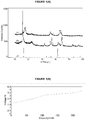
- Another characteristic of overcharged oxide-containing cathode compositions is that they appear to lose crystallinity (compared with to the uncharged material); this is shown by the FWHM of the 003 peak of the XRD pattern.
- a determination of when a material is said to be “overcharged” is made by observing the voltage curve for the particular material. At capacities less than or close to the conventional theoretical maximum charge capacity (i.e. the Ni 2+ /Ni 4+ redox couple) a first voltage feature is seen. However the curve continues to rise to a second voltage feature upon further or “over” charging. The materials are said to be “over-charged” from the beginning of this second voltage feature.
- the conventional theoretical maximum charge capacity i.e. the Ni 2+ /Ni 4+ redox couple
- the present invention provides a method of optimising the specific charge capacity of an oxide-containing cathode compound for use in a sodium-ion cell, comprising: charging the composition onto at least a portion of a voltage feature which is observed as a result of the oxide-containing cathode composition being charged above the conventional theoretical maximum charge capacity.
- the present invention also provides a method of optimising the specific charge capacity of an oxide-containing cathode compound according to Formula 1, in a sodium-ion cell comprising:
- discharging compounds of Formula 2 that have been "over-charged" results in producing materials of Formula 1 in which
- the metals M 2 and/or M 4 do not contribute anything to the initial overcharging process, upon discharge of the overcharged material it is found that at least one of the metals M 2 and/or M 4 is also reduced to an oxidation state less than 4+. This allows some or all of the sodium ions that were removed during the first "over-charge" to be reinserted into the material, and therefore produces a material with a higher discharge capacity. It is clear from this description that the role of the Mn 4+ (or Ti 4+ ) in the uncharged materials of the present invention is to allow for the reduction (Na insertion) process during cell discharge. This is in direct contrast to the role of the manganese in US2007/0218361 which is to allow Na extraction by the Mn oxidation process Mn 3+ ⁇ Mn 4+ during the first charge process.
- the role of the M 3 and M 5 metals is to reduce the amount of nickel in the doped nickelate materials of Formula 1, thereby allowing the "over charge” mechanism to take place as oxygen is released from the structure.
- the presence of the M 3 and M 5 metals also reduces the relative formula mass (formula weight) of these materials, thereby further improving the cost effectiveness of the electrode materials.
- oxide-containing cathode compounds When oxide-containing cathode compounds have undergone the over-charge/discharge process described, it is found that they may be cycled in the Na-ion cell between normal voltage limits for the Ni 2+ /Ni 4+ redox couple, typically this might be expected to be between 1 and 4V, and no further unconventional voltage plateaux are formed. Moreover, cycling the over-charged/discharged compositions at normal voltage limits maintains a higher specific capacity than would be expected from conventional theoretical calculations, i.e. the over-charged/discharged oxide-containing cathode compositions perform better than the pristine compounds when cycled using the same normal voltage limits.
- the present invention provides a method of using an oxide-containing cathode compound according to Formula 1 in a Na-ion cell comprising:
- the optimized oxide-containing cathode composition of the present invention may be prepared by a method that does not rely on overcharging a compound of Formula 2.
- the present invention includes an optimised oxide-containing cathode composition made by any route.
- the electrodes according to the present invention are suitable for use in many different applications, for example energy storage devices, rechargeable batteries, electrochemical devices and electrochromic devices.
- the electrodes according to the invention are used in conjunction with a counter electrode and one or more electrolyte materials.
- the electrolyte materials may be any conventional or known materials and may comprise either aqueous electrolyte(s) or non-aqueous electrolyte(s).
- the present invention also provides an energy storage device that utilises an electrode comprising the active oxide containing compounds according to the present invention as described above, and particularly an energy storage device for use as a sodium-ion cell and/or a cell in which sodium is the major mobile ion; a cell in which sodium is the major alkali metal-ion; either of which may be used in a non-aqueous or an aqueous electrolyte system.
- Typical ways to achieve Na to Li-ion exchange include:
- any convenient process may be used to make the precursor materials (Formula 2) described above.
- the following general method may be used:
- ii NaNi 0.40 Mn 0.40 Mg 0.10 Ti 0.10 O 2 Na 2 CO 3 1) Air/800°C, dwell time of 8 hours.
- iii NaNi 0.35 Mn 0.35 Mg 0.15 Ti 0.15 O 2 Na 2 CO 3 1) Air/900°C, dwell time of 8 hours.
- NiCO 3 MnO 2 Mg(OH) 2 TiO 2 2 2 2 2) Air/900°C, dwell time of 8 hours
- Example 1 The Preparation of Ni 0.25 Ti 0.25 Mg 0.25 Mn 0.25 O 1.75
- Active precursor doped nickelate material NaNi 0.25 Ti 0.25 Mg 0.25 Mn 0.25 O 2 (compound xi in Table 1), prepared using the general method described above, was made into a hard carbon anode//NaNi 0.25 Ti 0.25 Mg 0.25 Mn 0.25 O 2 cathode cell using an electrolyte comprising 0.5M NaClO 4 in propylene carbonate, see Figure 1(A)a) . Following a charge process to 230mAh/g, the cathode material was removed from the cell, washed several times in clean dimethyl carbonate and then dried at 70°C.
- Cathode material NaNi 0.25 Ti 0.25 Mg 0.25 Mn 0.25 O 2
- Active Mass of cathode in as-prepared cell 21.5 mg Following the charge process to 230 mAh/g, the cathode electrode disk was removed from the cell, washed several times in clean dimethyl carbonate to remove the electrolyte and then dried at 70°C.
- Example 2 The Preparation of Na a Ni 0.35 Mn 0.35 Mg 0.15 Ti 0.15 O 2-c
- the data shown in Figure 2A, 2B , 2C and 2D are derived from the constant current cycling data for a NaNi 0.35 Mn 0.35 Mg 0.15 Ti 0.15 O 2 (compound iii in Table 1) active precursor cathode material in a Na-ion cell where this cathode material is coupled with a Hard Carbon (Carbotron P/J) anode material.
- the electrolyte used is a 0.5 M solution of NaClO 4 in propylene carbonate.
- the constant current data are collected at an approximate current density of 0.10 mA/cm 2 between voltage limits of 1.50 and 4.20 V. To fully charge the Na-ion cell it, is potentiostatically held at 4.2 V at the end of the constant current charging process.
- the testing is carried out at room temperature.
- sodium-ions are extracted from the cathode active material, and inserted into the Hard Carbon anode.
- sodium-ions are extracted from the Hard Carbon and re-inserted into the cathode active material.
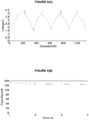
- Figure 2A shows the first four charge-discharge cycles (Na-ion Cell Voltage [V] versus Cumulative Cathode Specific Capacity [mAh/g]) for the Hard Carbon//NaNi 0.35 Mn 0.35 Mg 0.15 Ti 0.15 O 2 cell.
- V Charging Cell Voltage
- mAh/g Cumulative Cathode Specific Capacity
- Figure 2(B) shows the cycle life performance (Cathode Specific Capacity [mAh/g] versus Cycle Number) for a Hard Carbon//NaNi 0.35 Mn 0.35 Mg 0.15 Ti 0.15 O 2 cell.
- the cell shows good reversibility with the delivered cathode specific capacity reaching around 135 mAh/g after 4 cycles.
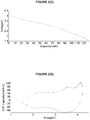
- Figure 2(C) shows the third cycle discharge voltage profile (Na-ion Cell Voltage [V] versus Cathode Specific Capacity [mAh/g]) for the Hard Carbon//NaNi 0.35 Mn 0.35 Mg 0.15 Ti 0.15 O 2 cell.
- the cathode specific capacity in this cycle corresponds to 130 mAh/g.
- Figure 2(D) shows the third cycle differential capacity profiles (Differential Capacity [mAh/g/V] versus Na-ion Cell Voltage [V]) for the Hard Carbon//NaNi 0.35 Mn 0.35 Mg 0.15 Ti 0.15 O 2 cell. These symmetrical data demonstrate the excellent reversibility of the ion-insertion reactions in this Na-ion cell.
- the data shown in Figures 3(A), 3(B) , 3(C) and 3(D) are derived from the constant current cycling data for a NaNi 0.35 Mn 0.35 Mg 0.15 Ti 0.15 O 2 (compound iii in Table 1)) active precursor material in a Na-ion cell where this cathode material is coupled with a Hard Carbon (Carbotron P/J) anode material.
- the electrolyte used is a 0.5 M solution of NaClO 4 in propylene carbonate.
- the constant current data are collected at an approximate current density of 0.10 mA/cm 2 between voltage limits of 1.50 V and 4.40 V.
- the Na-ion cell is potentiostatically held at 4.4 V at the end of the constant current charging process.
- the testing is carried out at room temperature.
- sodium ions are extracted from the cathode active material, and inserted into the Hard Carbon anode.
- sodium-ions are extracted from the Hard Carbon and re-inserted into the cathode active material.
- Figure 3(A) shows the first four charge-discharge cycles (Na-ion Cell Voltage [V] versus Cumulative Cathode Specific Capacity [mAh/g]) for the Hard Carbon//NaNi 0.35 Mn 0.35 MG 0.15 Ti 0.15 O 2 cell (Cell#204064).
- V Charging Cell Voltage
- mAh/g Cumulative Cathode Specific Capacity
- Figure 3(B) shows the cycle life performance (Cathode Specific Capacity [mAh/g] versus Cycle Number) for the Hard Carbon//NaNi 0.35 Mn 0.35 Mg 0.15 Ti 0.15 O 2 cell.
- the cell shows good reversibility with the delivered cathode specific capacity reaching around 130 mAh/g after 4 cycles.
- Figure 3(C) shows the third cycle discharge voltage profile (Na-ion Cell Voltage [V] versus Cathode Specific Capacity [mAh/g]) for the Hard Carbon//NaNi 0.35 Mn 0.35 Mg 0.15 Ti 0.15 O 2 cell.
- the cathode specific capacity in this cycle corresponds to 125 mAh/g.
- Figure 3(D) shows the third cycle differential capacity profiles (Differential Capacity [mAh/g/V] versus Na-ion Cell Voltage [V]) for the Hard Carbon//NaNi 0.35 Mn 0.35 Mg 0.15 Ti 0.15 O 2 cell. These symmetrical data demonstrate the excellent reversibility of the ion-insertion reactions in this Na-ion cell.
- the present invention has surprisingly demonstrated that when these sodium-based materials are overcharged, the 'labile' oxygen (which could contribute to thermal runaway) is caused to be removed from the structure; this yields the materials of the present invention which are highly thermodynamically stable and which are extremely effective and safe when used in reversible cathode materials.
- the XRD operating conditions used to analyse the precursor electrode materials are as follows:
- the XRD operating conditions used for ex-situ analysis of the electrodes are as follows:
- the target materials were tested either i) using a lithium metal anode test cell, or ii) using a Na-ion test cell using a hard carbon anode. It is also possible to test using a Li-ion cell with a graphite anode. Cells may be made using the following procedures:
- the positive electrode is prepared by solvent-casting a slurry of the active material, conductive carbon, binder and solvent.
- the conductive carbon used is Super P (Timcal).
- PVdF co-polymer e.g. Kynar Flex 2801, Elf Atochem Inc.
- acetone is employed as the solvent.
- the slurry is then cast onto glass and a free-standing electrode film is formed as the solvent evaporates.
- the electrode is then dried further at about 80°C.
- the electrode film contains the following components, expressed in percent by weight: 80% active material, 8% Super P carbon, and 12% Kynar 2801 binder.
- an aluminium current collector may be used to contact the positive electrode.
- the electrolyte comprises one of the following: (i) a 1 M solution of LiPF 6 in ethylene carbonate (EC) and dimethyl carbonate (DMC) in a weight ratio of 1:1; (ii) a 1 M solution of LiPF 6 in ethylene carbonate (EC) and diethyl carbonate (DEC) in a weight ratio of 1:1; or (iii) a 1 M solution of LiPF 6 in propylene carbonate (PC)
- a glass fibre separator (Whatman, GF/A) or a porous polypropylene separator (e.g. Celgard 2400) wetted by the electrolyte is interposed between the positive and negative electrodes.
- a Na-ion electrochemical test cell containing the active material is constructed as follows:
- the positive electrode is prepared by solvent-casting a slurry of the active material, conductive carbon, binder and solvent.
- the conductive carbon used is Super P (Timcal).
- PVdF co-polymer e.g. Kynar Flex 2801, Elf Atochem Inc.
- acetone is employed as the solvent.
- the slurry is then cast onto glass and a free-standing electrode film is formed as the solvent evaporates.
- the electrode is then dried further at about 80°C.
- the electrode film contains the following components, expressed in percent by weight: 80% active material, 8% Super P carbon, and 12% Kynar 2801 binder.
- an aluminium current collector may be used to contact the positive electrode.
- the negative electrode is prepared by solvent-casting a slurry of the hard carbon active material (Carbotron P/J, supplied by Kureha), conductive carbon, binder and solvent.
- the conductive carbon used is Super P (Timcal).
- PVdF co-polymer e.g. Kynar Flex 2801, Elf Atochem Inc.
- acetone is employed as the solvent.
- the slurry is then cast onto glass and a free-standing electrode film is formed as the solvent evaporates.
- the electrode is then dried further at about 80°C.
- the electrode film contains the following components, expressed in percent by weight: 84% active material, 4% Super P carbon, and 12% Kynar 2801 binder.
- a copper current collector may be used to contact the negative electrode.
- the positive electrode is prepared by solvent-casting a slurry of the active material, conductive carbon, binder and solvent.
- the conductive carbon used is Super P (Timcal).
- PVdF co-polymer e.g. Kynar Flex 2801, Elf Atochem Inc.
- acetone is employed as the solvent.
- the slurry is then cast onto glass and a free-standing electrode film is formed as the solvent evaporates.
- the electrode is then dried further at about 80°C.
- the electrode film contains the following components, expressed in percent by weight: 80% active material, 8% Super P carbon, and 12% Kynar 2801 binder.
- an aluminium current collector may be used to contact the positive electrode.
- the negative electrode is prepared by solvent-casting a slurry of the graphite active material (Crystalline Graphite, supplied by Conoco Inc.), conductive carbon, binder and solvent.
- the conductive carbon used is Super P (Timcal).
- PVdF co-polymer e.g. Kynar Flex 2801, Elf Atochem Inc.
- acetone is employed as the solvent.
- the slurry is then cast onto glass and a free-standing electrode film is formed as the solvent evaporates.
- the electrode is then dried further at about 80°C.
- the electrode film contains the following components, expressed in percent by weight: 92% active material, 2% Super P carbon, and 6% Kynar 2801 binder.
- a copper current collector may be used to contact the negative electrode.
- the cells are tested as follows, using Constant Current Cycling techniques.
- the cell is cycled at a given current density between pre-set voltage limits.
- a commercial battery cycler from Maccor Inc. (Tulsa, OK, USA) is used.
- On charge sodium (lithium)-ions are extracted from the cathode active material.
- During discharge sodium (lithium)-ions are re-inserted into the cathode active material.
- the c-parameter increases upon charging to 120 mAh/g, and this is due to an increase in repulsion between the electronegative oxygen-ions of adjacent layers, as the sodium-ions are removed.
Landscapes
- Chemical & Material Sciences (AREA)
- Organic Chemistry (AREA)
- Inorganic Chemistry (AREA)
- Chemical Kinetics & Catalysis (AREA)
- Electrochemistry (AREA)
- General Chemical & Material Sciences (AREA)
- Engineering & Computer Science (AREA)
- Materials Engineering (AREA)
- Life Sciences & Earth Sciences (AREA)
- General Life Sciences & Earth Sciences (AREA)
- Geology (AREA)
- Manufacturing & Machinery (AREA)
- Battery Electrode And Active Subsutance (AREA)
- Secondary Cells (AREA)
- Inorganic Compounds Of Heavy Metals (AREA)
Applications Claiming Priority (2)
| Application Number | Priority Date | Filing Date | Title |
|---|---|---|---|
| GB1218047.7A GB2506859A (en) | 2012-10-09 | 2012-10-09 | A nickel-containing mixed metal oxide active electrode material |
| PCT/GB2013/052620 WO2014057258A1 (en) | 2012-10-09 | 2013-10-08 | Doped nickelate compounds |
Publications (2)
| Publication Number | Publication Date |
|---|---|
| EP2907180A1 EP2907180A1 (en) | 2015-08-19 |
| EP2907180B1 true EP2907180B1 (en) | 2017-03-29 |
Family
ID=47294483
Family Applications (1)
| Application Number | Title | Priority Date | Filing Date |
|---|---|---|---|
| EP13789884.7A Active EP2907180B1 (en) | 2012-10-09 | 2013-10-08 | Doped nickelate compounds |
Country Status (8)
| Country | Link |
|---|---|
| US (1) | US9917307B2 (enExample) |
| EP (1) | EP2907180B1 (enExample) |
| JP (1) | JP6267208B2 (enExample) |
| KR (1) | KR102002101B1 (enExample) |
| CN (1) | CN104704654B (enExample) |
| GB (1) | GB2506859A (enExample) |
| HK (1) | HK1209903A1 (enExample) |
| WO (1) | WO2014057258A1 (enExample) |
Families Citing this family (22)
| Publication number | Priority date | Publication date | Assignee | Title |
|---|---|---|---|---|
| GB201400347D0 (en) | 2014-01-09 | 2014-02-26 | Faradion Ltd | Doped nickelate compounds |
| GB201409163D0 (en) * | 2014-05-22 | 2014-07-09 | Faradion Ltd | Compositions containing doped nickelate compounds |
| JP6353714B2 (ja) * | 2014-06-25 | 2018-07-04 | Fdk株式会社 | ナトリウム二次電池用正極活物質、及びナトリウム二次電池 |
| US9653731B2 (en) | 2014-12-23 | 2017-05-16 | Sharp Kabushiki Kaisha | Layered oxide materials for batteries |
| US9660263B2 (en) * | 2014-12-23 | 2017-05-23 | Sharp Kabushiki Kaisha | Layered oxide materials for batteries |
| GB2540625A (en) * | 2015-07-24 | 2017-01-25 | Sharp Kk | Tin-containing compounds |
| GB2543830A (en) * | 2015-10-30 | 2017-05-03 | Sharp Kk | Formation method for sodium ion cell or battery |
| GB2543831A (en) | 2015-10-30 | 2017-05-03 | Sharp Kk | Method of passive voltage control in a sodium-ion battery |
| JP6560635B2 (ja) * | 2016-03-01 | 2019-08-14 | 住友電気工業株式会社 | ナトリウムイオン二次電池用電極活物質およびその製造方法、並びにナトリウムイオン二次電池 |
| US11289700B2 (en) | 2016-06-28 | 2022-03-29 | The Research Foundation For The State University Of New York | KVOPO4 cathode for sodium ion batteries |
| GB201805884D0 (en) | 2018-04-09 | 2018-05-23 | Faradion Ltd | O3/P2 Mixed phase sodium-containing doped layered oxide materials |
| GB201820358D0 (en) * | 2018-12-13 | 2019-01-30 | Faradion Ltd | Sodium-ion batteries |
| JP7560939B2 (ja) * | 2019-03-12 | 2024-10-03 | 住友化学株式会社 | ナトリウム二次電池用正極活物質、ナトリウム二次電池用正極、ナトリウム二次電池 |
| JP2022549343A (ja) * | 2019-09-27 | 2022-11-24 | エナジャイザー ブランズ リミテッド ライアビリティ カンパニー | ニッケレートカソード材料 |
| CN111416116B (zh) * | 2020-03-27 | 2021-06-29 | 宁德新能源科技有限公司 | 正极活性材料及包含其的电化学装置 |
| CN112234201A (zh) * | 2020-09-18 | 2021-01-15 | 中南大学 | 一种o3型层状钠离子电池正极材料及其制备方法 |
| CN113809302B (zh) * | 2021-09-17 | 2023-03-28 | 中南大学 | 镁钙改性层状p2相镍锰基正极材料及其制备方法和应用 |
| CN115566182A (zh) * | 2022-10-13 | 2023-01-03 | 欣旺达电动汽车电池有限公司 | 一种正极活性材料及其制备方法、电池、用电装置 |
| WO2024092314A1 (en) * | 2022-11-04 | 2024-05-10 | University Of Technology Sydney | Cathode materials |
| CN117199339B (zh) * | 2023-11-06 | 2024-06-07 | 山东海化集团有限公司 | 一种氮元素稳定高熵氧化物氧空位的钠离子电池正极材料及其制备方法 |
| CN117747834B (zh) * | 2023-12-22 | 2024-12-03 | 湖北万润新能源科技股份有限公司 | 一种钠离子层状金属氧化物材料、其制备方法、正极材料和钠离子电池 |
| CN120727739A (zh) * | 2024-03-29 | 2025-09-30 | 比亚迪股份有限公司 | 正极活性材料、正极、钠离子电池、电池组件和用电系统 |
Family Cites Families (38)
| Publication number | Priority date | Publication date | Assignee | Title |
|---|---|---|---|---|
| US4246253A (en) | 1978-09-29 | 1981-01-20 | Union Carbide Corporation | MnO2 derived from LiMn2 O4 |
| US5135732A (en) | 1991-04-23 | 1992-08-04 | Bell Communications Research, Inc. | Method for preparation of LiMn2 O4 intercalation compounds and use thereof in secondary lithium batteries |
| JP2810013B2 (ja) * | 1996-03-14 | 1998-10-15 | 株式会社東芝 | 酸化物薄膜の形成方法および酸化物薄膜 |
| US6203946B1 (en) | 1998-12-03 | 2001-03-20 | Valence Technology, Inc. | Lithium-containing phosphates, method of preparation, and uses thereof |
| US8107223B2 (en) | 1999-06-11 | 2012-01-31 | U.S. Nanocorp, Inc. | Asymmetric electrochemical supercapacitor and method of manufacture thereof |
| JP3611189B2 (ja) * | 2000-03-03 | 2005-01-19 | 日産自動車株式会社 | 非水電解質二次電池用正極活物質および非水電解質二次電池 |
| US6387568B1 (en) | 2000-04-27 | 2002-05-14 | Valence Technology, Inc. | Lithium metal fluorophosphate materials and preparation thereof |
| JP3649996B2 (ja) * | 2000-05-24 | 2005-05-18 | 三洋電機株式会社 | 非水電解質二次電池用正極活物質 |
| KR100709205B1 (ko) | 2001-04-02 | 2007-04-18 | 삼성에스디아이 주식회사 | 리튬 이차 전지용 양극 활물질 조성물 |
| CA2750707A1 (en) * | 2001-04-06 | 2002-12-05 | Valence Technology, Inc. | Sodium ion batteries |
| KR100406816B1 (ko) | 2001-06-05 | 2003-11-21 | 삼성에스디아이 주식회사 | 리튬 이차 전지용 양극 활물질의 제조 방법 |
| US7358009B2 (en) | 2002-02-15 | 2008-04-15 | Uchicago Argonne, Llc | Layered electrodes for lithium cells and batteries |
| JP3974420B2 (ja) * | 2002-02-18 | 2007-09-12 | Agcセイミケミカル株式会社 | リチウム二次電池用正極活物質の製造方法 |
| JP2004002141A (ja) * | 2002-03-07 | 2004-01-08 | Tosoh Corp | リチウム−ニッケル−マンガン複合酸化物とその製造方法及びそれを用いるリチウムイオン二次電池 |
| KR101074956B1 (ko) * | 2002-04-05 | 2011-10-18 | 이 아이 듀폰 디 네모아 앤드 캄파니 | 가스 혼합물 분석 장치 |
| JP2004335223A (ja) | 2003-05-06 | 2004-11-25 | Japan Storage Battery Co Ltd | 非水電解質二次電池 |
| US20050130042A1 (en) | 2003-12-11 | 2005-06-16 | Byd America Corporation | Materials for positive electrodes of lithium ion batteries and their methods of fabrication |
| KR100578877B1 (ko) | 2004-03-12 | 2006-05-11 | 삼성에스디아이 주식회사 | 리튬 이차 전지 |
| JP2005353330A (ja) * | 2004-06-09 | 2005-12-22 | Japan Storage Battery Co Ltd | 非水電解質電気化学セル |
| KR101250136B1 (ko) * | 2004-11-26 | 2013-04-04 | 고쿠리쓰다이가쿠호진 규슈다이가쿠 | 비수 전해질 2 차 전지용 양극 활성 물질 |
| JP4839633B2 (ja) * | 2005-02-28 | 2011-12-21 | パナソニック株式会社 | 非水電解質二次電池および非水電解質二次電池用正極活物質の製造方法 |
| US20090087740A1 (en) * | 2005-07-07 | 2009-04-02 | Masaki Deguchi | Non-aqueous electrolyte secondary battery |
| JP5142544B2 (ja) * | 2006-03-20 | 2013-02-13 | 三洋電機株式会社 | 非水電解質二次電池 |
| JP4586991B2 (ja) * | 2006-03-24 | 2010-11-24 | ソニー株式会社 | 正極活物質およびその製造方法、並びに二次電池 |
| JP4823275B2 (ja) * | 2007-06-25 | 2011-11-24 | 三洋電機株式会社 | 非水電解質二次電池 |
| WO2009060752A1 (ja) * | 2007-11-05 | 2009-05-14 | Sumitomo Metal Mining Co., Ltd. | 固体酸化物形燃料電池用の酸化ニッケル粉末材料とその製造方法、並びにそれを用いた燃料極材料、燃料極、及び固体酸化物形燃料電池 |
| KR20100119760A (ko) | 2008-02-04 | 2010-11-10 | 스미또모 가가꾸 가부시키가이샤 | 복합 금속 산화물 및 나트륨 이차 전지 |
| JP2010080424A (ja) * | 2008-08-27 | 2010-04-08 | Sumitomo Chemical Co Ltd | 電極活物質およびその製造方法 |
| US20120028128A1 (en) | 2009-03-18 | 2012-02-02 | Santoku Corporation | All-solid-state lithium battery |
| JP5373889B2 (ja) | 2009-03-31 | 2013-12-18 | Jx日鉱日石金属株式会社 | リチウムイオン電池用正極活物質 |
| US20120292561A1 (en) | 2010-01-21 | 2012-11-22 | Panasonic Corporation | Positive electrode active material for non-aqueous electrolyte secondary battery, method for producing same and non-aqueous electrolyte secondary battery using same |
| WO2011102497A1 (ja) | 2010-02-22 | 2011-08-25 | 住友化学株式会社 | 電極合剤、電極およびリチウム二次電池 |
| KR101192355B1 (ko) * | 2010-08-31 | 2012-10-18 | 경상대학교산학협력단 | 나트륨 전지 및 그 제조 방법 |
| KR20120030774A (ko) | 2010-09-20 | 2012-03-29 | 삼성에스디아이 주식회사 | 양극 활물질, 이의 제조방법 및 이를 이용한 리튬 전지 |
| CN103119761B (zh) * | 2010-09-22 | 2016-04-13 | 株式会社杰士汤浅国际 | 锂二次电池用活性物质、锂二次电池用电极及锂二次电池 |
| JP2012142156A (ja) * | 2010-12-28 | 2012-07-26 | Sony Corp | リチウムイオン二次電池、正極活物質、正極、電動工具、電動車両および電力貯蔵システム |
| US8835041B2 (en) * | 2011-01-14 | 2014-09-16 | Uchicago Argonne, Llc | Electrode materials for sodium batteries |
| GB201205170D0 (en) * | 2012-03-23 | 2012-05-09 | Faradion Ltd | Metallate electrodes |
-
2012
- 2012-10-09 GB GB1218047.7A patent/GB2506859A/en not_active Withdrawn
-
2013
- 2013-10-08 KR KR1020157012110A patent/KR102002101B1/ko active Active
- 2013-10-08 CN CN201380052905.7A patent/CN104704654B/zh active Active
- 2013-10-08 HK HK15110500.5A patent/HK1209903A1/xx unknown
- 2013-10-08 WO PCT/GB2013/052620 patent/WO2014057258A1/en not_active Ceased
- 2013-10-08 EP EP13789884.7A patent/EP2907180B1/en active Active
- 2013-10-08 JP JP2015535116A patent/JP6267208B2/ja active Active
- 2013-10-08 US US14/430,000 patent/US9917307B2/en active Active
Non-Patent Citations (1)
| Title |
|---|
| None * |
Also Published As
| Publication number | Publication date |
|---|---|
| US9917307B2 (en) | 2018-03-13 |
| GB2506859A (en) | 2014-04-16 |
| CN104704654A (zh) | 2015-06-10 |
| HK1209903A1 (en) | 2016-04-08 |
| US20150243983A1 (en) | 2015-08-27 |
| JP6267208B2 (ja) | 2018-01-24 |
| GB201218047D0 (en) | 2012-11-21 |
| KR102002101B1 (ko) | 2019-07-19 |
| KR20150068458A (ko) | 2015-06-19 |
| EP2907180A1 (en) | 2015-08-19 |
| WO2014057258A1 (en) | 2014-04-17 |
| JP2015536890A (ja) | 2015-12-24 |
| CN104704654B (zh) | 2018-10-16 |
Similar Documents
| Publication | Publication Date | Title |
|---|---|---|
| US9917307B2 (en) | Doped nickelate compounds | |
| US9774035B2 (en) | Doped nickelate compounds | |
| KR100570616B1 (ko) | 리튬 이차 전지용 양극 활물질, 그의 제조 방법 및 그를포함하는 리튬 이차 전지 | |
| EP3145870B1 (en) | Doped nickelate materials | |
| US7608365B1 (en) | Positive active material composition for rechargeable lithium battery and method of preparing positive electrode using same | |
| EP3092199B1 (en) | Doped nickelate compounds | |
| TWI397205B (zh) | 用於高放電容量鋰離子電池之正電極材料 | |
| US9761863B2 (en) | Doped nickelate compounds | |
| EP2872452B1 (en) | Doped nickelate compounds | |
| KR20120099375A (ko) | 금속 산화물이 코팅된 리튬 기반 배터리용 양극 물질 | |
| US20170025678A1 (en) | Layered oxide materials for batteries | |
| KR20040075769A (ko) | 비수성 전해질 이차 전지에서의 양극용 활성 물질 | |
| HK1206706B (en) | Doped nickelate compounds |
Legal Events
| Date | Code | Title | Description |
|---|---|---|---|
| PUAI | Public reference made under article 153(3) epc to a published international application that has entered the european phase |
Free format text: ORIGINAL CODE: 0009012 |
|
| 17P | Request for examination filed |
Effective date: 20150310 |
|
| AK | Designated contracting states |
Kind code of ref document: A1 Designated state(s): AL AT BE BG CH CY CZ DE DK EE ES FI FR GB GR HR HU IE IS IT LI LT LU LV MC MK MT NL NO PL PT RO RS SE SI SK SM TR |
|
| AX | Request for extension of the european patent |
Extension state: BA ME |
|
| DAX | Request for extension of the european patent (deleted) | ||
| 17Q | First examination report despatched |
Effective date: 20160222 |
|
| REG | Reference to a national code |
Ref country code: HK Ref legal event code: DE Ref document number: 1209903 Country of ref document: HK |
|
| RIC1 | Information provided on ipc code assigned before grant |
Ipc: H01M 4/02 20060101ALI20160531BHEP Ipc: H01M 4/525 20100101ALI20160531BHEP Ipc: H01M 4/131 20100101AFI20160531BHEP Ipc: H01M 4/36 20060101ALI20160531BHEP Ipc: C01G 53/00 20060101ALI20160531BHEP Ipc: H01M 4/505 20100101ALI20160531BHEP Ipc: H01M 10/054 20100101ALI20160531BHEP |
|
| GRAP | Despatch of communication of intention to grant a patent |
Free format text: ORIGINAL CODE: EPIDOSNIGR1 |
|
| INTG | Intention to grant announced |
Effective date: 20161103 |
|
| GRAS | Grant fee paid |
Free format text: ORIGINAL CODE: EPIDOSNIGR3 |
|
| GRAJ | Information related to disapproval of communication of intention to grant by the applicant or resumption of examination proceedings by the epo deleted |
Free format text: ORIGINAL CODE: EPIDOSDIGR1 |
|
| GRAL | Information related to payment of fee for publishing/printing deleted |
Free format text: ORIGINAL CODE: EPIDOSDIGR3 |
|
| GRAR | Information related to intention to grant a patent recorded |
Free format text: ORIGINAL CODE: EPIDOSNIGR71 |
|
| GRAA | (expected) grant |
Free format text: ORIGINAL CODE: 0009210 |
|
| INTG | Intention to grant announced |
Effective date: 20170215 |
|
| AK | Designated contracting states |
Kind code of ref document: B1 Designated state(s): AL AT BE BG CH CY CZ DE DK EE ES FI FR GB GR HR HU IE IS IT LI LT LU LV MC MK MT NL NO PL PT RO RS SE SI SK SM TR |
|
| REG | Reference to a national code |
Ref country code: GB Ref legal event code: FG4D |
|
| REG | Reference to a national code |
Ref country code: CH Ref legal event code: EP |
|
| REG | Reference to a national code |
Ref country code: AT Ref legal event code: REF Ref document number: 880518 Country of ref document: AT Kind code of ref document: T Effective date: 20170415 |
|
| REG | Reference to a national code |
Ref country code: IE Ref legal event code: FG4D |
|
| REG | Reference to a national code |
Ref country code: DE Ref legal event code: R096 Ref document number: 602013019236 Country of ref document: DE |
|
| PG25 | Lapsed in a contracting state [announced via postgrant information from national office to epo] |
Ref country code: LT Free format text: LAPSE BECAUSE OF FAILURE TO SUBMIT A TRANSLATION OF THE DESCRIPTION OR TO PAY THE FEE WITHIN THE PRESCRIBED TIME-LIMIT Effective date: 20170329 Ref country code: NO Free format text: LAPSE BECAUSE OF FAILURE TO SUBMIT A TRANSLATION OF THE DESCRIPTION OR TO PAY THE FEE WITHIN THE PRESCRIBED TIME-LIMIT Effective date: 20170629 Ref country code: GR Free format text: LAPSE BECAUSE OF FAILURE TO SUBMIT A TRANSLATION OF THE DESCRIPTION OR TO PAY THE FEE WITHIN THE PRESCRIBED TIME-LIMIT Effective date: 20170630 Ref country code: HR Free format text: LAPSE BECAUSE OF FAILURE TO SUBMIT A TRANSLATION OF THE DESCRIPTION OR TO PAY THE FEE WITHIN THE PRESCRIBED TIME-LIMIT Effective date: 20170329 Ref country code: FI Free format text: LAPSE BECAUSE OF FAILURE TO SUBMIT A TRANSLATION OF THE DESCRIPTION OR TO PAY THE FEE WITHIN THE PRESCRIBED TIME-LIMIT Effective date: 20170329 |
|
| REG | Reference to a national code |
Ref country code: NL Ref legal event code: MP Effective date: 20170329 |
|
| REG | Reference to a national code |
Ref country code: AT Ref legal event code: MK05 Ref document number: 880518 Country of ref document: AT Kind code of ref document: T Effective date: 20170329 |
|
| PG25 | Lapsed in a contracting state [announced via postgrant information from national office to epo] |
Ref country code: RS Free format text: LAPSE BECAUSE OF FAILURE TO SUBMIT A TRANSLATION OF THE DESCRIPTION OR TO PAY THE FEE WITHIN THE PRESCRIBED TIME-LIMIT Effective date: 20170329 Ref country code: BG Free format text: LAPSE BECAUSE OF FAILURE TO SUBMIT A TRANSLATION OF THE DESCRIPTION OR TO PAY THE FEE WITHIN THE PRESCRIBED TIME-LIMIT Effective date: 20170629 Ref country code: SE Free format text: LAPSE BECAUSE OF FAILURE TO SUBMIT A TRANSLATION OF THE DESCRIPTION OR TO PAY THE FEE WITHIN THE PRESCRIBED TIME-LIMIT Effective date: 20170329 Ref country code: LV Free format text: LAPSE BECAUSE OF FAILURE TO SUBMIT A TRANSLATION OF THE DESCRIPTION OR TO PAY THE FEE WITHIN THE PRESCRIBED TIME-LIMIT Effective date: 20170329 |
|
| PG25 | Lapsed in a contracting state [announced via postgrant information from national office to epo] |
Ref country code: NL Free format text: LAPSE BECAUSE OF FAILURE TO SUBMIT A TRANSLATION OF THE DESCRIPTION OR TO PAY THE FEE WITHIN THE PRESCRIBED TIME-LIMIT Effective date: 20170329 |
|
| REG | Reference to a national code |
Ref country code: FR Ref legal event code: PLFP Year of fee payment: 5 |
|
| PG25 | Lapsed in a contracting state [announced via postgrant information from national office to epo] |
Ref country code: IT Free format text: LAPSE BECAUSE OF FAILURE TO SUBMIT A TRANSLATION OF THE DESCRIPTION OR TO PAY THE FEE WITHIN THE PRESCRIBED TIME-LIMIT Effective date: 20170329 Ref country code: SK Free format text: LAPSE BECAUSE OF FAILURE TO SUBMIT A TRANSLATION OF THE DESCRIPTION OR TO PAY THE FEE WITHIN THE PRESCRIBED TIME-LIMIT Effective date: 20170329 Ref country code: ES Free format text: LAPSE BECAUSE OF FAILURE TO SUBMIT A TRANSLATION OF THE DESCRIPTION OR TO PAY THE FEE WITHIN THE PRESCRIBED TIME-LIMIT Effective date: 20170329 Ref country code: EE Free format text: LAPSE BECAUSE OF FAILURE TO SUBMIT A TRANSLATION OF THE DESCRIPTION OR TO PAY THE FEE WITHIN THE PRESCRIBED TIME-LIMIT Effective date: 20170329 Ref country code: AT Free format text: LAPSE BECAUSE OF FAILURE TO SUBMIT A TRANSLATION OF THE DESCRIPTION OR TO PAY THE FEE WITHIN THE PRESCRIBED TIME-LIMIT Effective date: 20170329 Ref country code: RO Free format text: LAPSE BECAUSE OF FAILURE TO SUBMIT A TRANSLATION OF THE DESCRIPTION OR TO PAY THE FEE WITHIN THE PRESCRIBED TIME-LIMIT Effective date: 20170329 Ref country code: CZ Free format text: LAPSE BECAUSE OF FAILURE TO SUBMIT A TRANSLATION OF THE DESCRIPTION OR TO PAY THE FEE WITHIN THE PRESCRIBED TIME-LIMIT Effective date: 20170329 |
|
| PG25 | Lapsed in a contracting state [announced via postgrant information from national office to epo] |
Ref country code: PL Free format text: LAPSE BECAUSE OF FAILURE TO SUBMIT A TRANSLATION OF THE DESCRIPTION OR TO PAY THE FEE WITHIN THE PRESCRIBED TIME-LIMIT Effective date: 20170329 Ref country code: PT Free format text: LAPSE BECAUSE OF FAILURE TO SUBMIT A TRANSLATION OF THE DESCRIPTION OR TO PAY THE FEE WITHIN THE PRESCRIBED TIME-LIMIT Effective date: 20170731 Ref country code: IS Free format text: LAPSE BECAUSE OF FAILURE TO SUBMIT A TRANSLATION OF THE DESCRIPTION OR TO PAY THE FEE WITHIN THE PRESCRIBED TIME-LIMIT Effective date: 20170729 Ref country code: SM Free format text: LAPSE BECAUSE OF FAILURE TO SUBMIT A TRANSLATION OF THE DESCRIPTION OR TO PAY THE FEE WITHIN THE PRESCRIBED TIME-LIMIT Effective date: 20170329 |
|
| REG | Reference to a national code |
Ref country code: DE Ref legal event code: R097 Ref document number: 602013019236 Country of ref document: DE |
|
| PG25 | Lapsed in a contracting state [announced via postgrant information from national office to epo] |
Ref country code: DK Free format text: LAPSE BECAUSE OF FAILURE TO SUBMIT A TRANSLATION OF THE DESCRIPTION OR TO PAY THE FEE WITHIN THE PRESCRIBED TIME-LIMIT Effective date: 20170329 |
|
| PLBE | No opposition filed within time limit |
Free format text: ORIGINAL CODE: 0009261 |
|
| STAA | Information on the status of an ep patent application or granted ep patent |
Free format text: STATUS: NO OPPOSITION FILED WITHIN TIME LIMIT |
|
| 26N | No opposition filed |
Effective date: 20180103 |
|
| PG25 | Lapsed in a contracting state [announced via postgrant information from national office to epo] |
Ref country code: SI Free format text: LAPSE BECAUSE OF FAILURE TO SUBMIT A TRANSLATION OF THE DESCRIPTION OR TO PAY THE FEE WITHIN THE PRESCRIBED TIME-LIMIT Effective date: 20170329 Ref country code: MC Free format text: LAPSE BECAUSE OF FAILURE TO SUBMIT A TRANSLATION OF THE DESCRIPTION OR TO PAY THE FEE WITHIN THE PRESCRIBED TIME-LIMIT Effective date: 20170329 |
|
| REG | Reference to a national code |
Ref country code: CH Ref legal event code: PL |
|
| REG | Reference to a national code |
Ref country code: IE Ref legal event code: MM4A |
|
| PG25 | Lapsed in a contracting state [announced via postgrant information from national office to epo] |
Ref country code: LU Free format text: LAPSE BECAUSE OF NON-PAYMENT OF DUE FEES Effective date: 20171008 Ref country code: LI Free format text: LAPSE BECAUSE OF NON-PAYMENT OF DUE FEES Effective date: 20171031 Ref country code: CH Free format text: LAPSE BECAUSE OF NON-PAYMENT OF DUE FEES Effective date: 20171031 |
|
| REG | Reference to a national code |
Ref country code: BE Ref legal event code: MM Effective date: 20171031 |
|
| PG25 | Lapsed in a contracting state [announced via postgrant information from national office to epo] |
Ref country code: BE Free format text: LAPSE BECAUSE OF NON-PAYMENT OF DUE FEES Effective date: 20171031 |
|
| PG25 | Lapsed in a contracting state [announced via postgrant information from national office to epo] |
Ref country code: MT Free format text: LAPSE BECAUSE OF NON-PAYMENT OF DUE FEES Effective date: 20171008 |
|
| REG | Reference to a national code |
Ref country code: DE Ref legal event code: R082 Ref document number: 602013019236 Country of ref document: DE Representative=s name: SCHUHMANN, ALBRECHT, DE Ref country code: FR Ref legal event code: PLFP Year of fee payment: 6 |
|
| PG25 | Lapsed in a contracting state [announced via postgrant information from national office to epo] |
Ref country code: IE Free format text: LAPSE BECAUSE OF NON-PAYMENT OF DUE FEES Effective date: 20171008 |
|
| PG25 | Lapsed in a contracting state [announced via postgrant information from national office to epo] |
Ref country code: HU Free format text: LAPSE BECAUSE OF FAILURE TO SUBMIT A TRANSLATION OF THE DESCRIPTION OR TO PAY THE FEE WITHIN THE PRESCRIBED TIME-LIMIT; INVALID AB INITIO Effective date: 20131008 |
|
| PG25 | Lapsed in a contracting state [announced via postgrant information from national office to epo] |
Ref country code: CY Free format text: LAPSE BECAUSE OF FAILURE TO SUBMIT A TRANSLATION OF THE DESCRIPTION OR TO PAY THE FEE WITHIN THE PRESCRIBED TIME-LIMIT Effective date: 20170329 |
|
| PG25 | Lapsed in a contracting state [announced via postgrant information from national office to epo] |
Ref country code: MK Free format text: LAPSE BECAUSE OF FAILURE TO SUBMIT A TRANSLATION OF THE DESCRIPTION OR TO PAY THE FEE WITHIN THE PRESCRIBED TIME-LIMIT Effective date: 20170329 |
|
| PG25 | Lapsed in a contracting state [announced via postgrant information from national office to epo] |
Ref country code: TR Free format text: LAPSE BECAUSE OF FAILURE TO SUBMIT A TRANSLATION OF THE DESCRIPTION OR TO PAY THE FEE WITHIN THE PRESCRIBED TIME-LIMIT Effective date: 20170329 |
|
| PG25 | Lapsed in a contracting state [announced via postgrant information from national office to epo] |
Ref country code: AL Free format text: LAPSE BECAUSE OF FAILURE TO SUBMIT A TRANSLATION OF THE DESCRIPTION OR TO PAY THE FEE WITHIN THE PRESCRIBED TIME-LIMIT Effective date: 20170329 |
|
| REG | Reference to a national code |
Ref country code: HK Ref legal event code: WD Ref document number: 1209903 Country of ref document: HK |
|
| P01 | Opt-out of the competence of the unified patent court (upc) registered |
Effective date: 20230521 |
|
| PGFP | Annual fee paid to national office [announced via postgrant information from national office to epo] |
Ref country code: GB Payment date: 20250925 Year of fee payment: 13 |
|
| PGFP | Annual fee paid to national office [announced via postgrant information from national office to epo] |
Ref country code: FR Payment date: 20250930 Year of fee payment: 13 |
|
| PGFP | Annual fee paid to national office [announced via postgrant information from national office to epo] |
Ref country code: DE Payment date: 20250923 Year of fee payment: 13 |