EP2879145B1 - Elektrische Kontaktmaterialien und Verfahren zu ihrer Herstellung - Google Patents
Elektrische Kontaktmaterialien und Verfahren zu ihrer Herstellung Download PDFInfo
- Publication number
- EP2879145B1 EP2879145B1 EP14192982.8A EP14192982A EP2879145B1 EP 2879145 B1 EP2879145 B1 EP 2879145B1 EP 14192982 A EP14192982 A EP 14192982A EP 2879145 B1 EP2879145 B1 EP 2879145B1
- Authority
- EP
- European Patent Office
- Prior art keywords
- metal
- cnts
- electrical contact
- oxide
- contact material
- Prior art date
- Legal status (The legal status is an assumption and is not a legal conclusion. Google has not performed a legal analysis and makes no representation as to the accuracy of the status listed.)
- Active
Links
Images



Classifications
-
- H—ELECTRICITY
- H01—ELECTRIC ELEMENTS
- H01B—CABLES; CONDUCTORS; INSULATORS; SELECTION OF MATERIALS FOR THEIR CONDUCTIVE, INSULATING OR DIELECTRIC PROPERTIES
- H01B1/00—Conductors or conductive bodies characterised by the conductive materials; Selection of materials as conductors
- H01B1/02—Conductors or conductive bodies characterised by the conductive materials; Selection of materials as conductors mainly consisting of metals or alloys
-
- H—ELECTRICITY
- H01—ELECTRIC ELEMENTS
- H01H—ELECTRIC SWITCHES; RELAYS; SELECTORS; EMERGENCY PROTECTIVE DEVICES
- H01H1/00—Contacts
- H01H1/02—Contacts characterised by the material thereof
- H01H1/021—Composite material
-
- C—CHEMISTRY; METALLURGY
- C04—CEMENTS; CONCRETE; ARTIFICIAL STONE; CERAMICS; REFRACTORIES
- C04B—LIME, MAGNESIA; SLAG; CEMENTS; COMPOSITIONS THEREOF, e.g. MORTARS, CONCRETE OR LIKE BUILDING MATERIALS; ARTIFICIAL STONE; CERAMICS; REFRACTORIES; TREATMENT OF NATURAL STONE
- C04B35/00—Shaped ceramic products characterised by their composition; Ceramics compositions; Processing powders of inorganic compounds preparatory to the manufacturing of ceramic products
- C04B35/01—Shaped ceramic products characterised by their composition; Ceramics compositions; Processing powders of inorganic compounds preparatory to the manufacturing of ceramic products based on oxide ceramics
-
- C—CHEMISTRY; METALLURGY
- C04—CEMENTS; CONCRETE; ARTIFICIAL STONE; CERAMICS; REFRACTORIES
- C04B—LIME, MAGNESIA; SLAG; CEMENTS; COMPOSITIONS THEREOF, e.g. MORTARS, CONCRETE OR LIKE BUILDING MATERIALS; ARTIFICIAL STONE; CERAMICS; REFRACTORIES; TREATMENT OF NATURAL STONE
- C04B35/00—Shaped ceramic products characterised by their composition; Ceramics compositions; Processing powders of inorganic compounds preparatory to the manufacturing of ceramic products
- C04B35/01—Shaped ceramic products characterised by their composition; Ceramics compositions; Processing powders of inorganic compounds preparatory to the manufacturing of ceramic products based on oxide ceramics
- C04B35/03—Shaped ceramic products characterised by their composition; Ceramics compositions; Processing powders of inorganic compounds preparatory to the manufacturing of ceramic products based on oxide ceramics based on magnesium oxide, calcium oxide or oxide mixtures derived from dolomite
- C04B35/04—Shaped ceramic products characterised by their composition; Ceramics compositions; Processing powders of inorganic compounds preparatory to the manufacturing of ceramic products based on oxide ceramics based on magnesium oxide, calcium oxide or oxide mixtures derived from dolomite based on magnesium oxide
- C04B35/043—Refractories from grain sized mixtures
- C04B35/0435—Refractories from grain sized mixtures containing refractory metal compounds other than chromium oxide or chrome ore
-
- C—CHEMISTRY; METALLURGY
- C04—CEMENTS; CONCRETE; ARTIFICIAL STONE; CERAMICS; REFRACTORIES
- C04B—LIME, MAGNESIA; SLAG; CEMENTS; COMPOSITIONS THEREOF, e.g. MORTARS, CONCRETE OR LIKE BUILDING MATERIALS; ARTIFICIAL STONE; CERAMICS; REFRACTORIES; TREATMENT OF NATURAL STONE
- C04B35/00—Shaped ceramic products characterised by their composition; Ceramics compositions; Processing powders of inorganic compounds preparatory to the manufacturing of ceramic products
- C04B35/01—Shaped ceramic products characterised by their composition; Ceramics compositions; Processing powders of inorganic compounds preparatory to the manufacturing of ceramic products based on oxide ceramics
- C04B35/03—Shaped ceramic products characterised by their composition; Ceramics compositions; Processing powders of inorganic compounds preparatory to the manufacturing of ceramic products based on oxide ceramics based on magnesium oxide, calcium oxide or oxide mixtures derived from dolomite
- C04B35/04—Shaped ceramic products characterised by their composition; Ceramics compositions; Processing powders of inorganic compounds preparatory to the manufacturing of ceramic products based on oxide ceramics based on magnesium oxide, calcium oxide or oxide mixtures derived from dolomite based on magnesium oxide
- C04B35/043—Refractories from grain sized mixtures
- C04B35/047—Refractories from grain sized mixtures containing chromium oxide or chrome ore
-
- C—CHEMISTRY; METALLURGY
- C04—CEMENTS; CONCRETE; ARTIFICIAL STONE; CERAMICS; REFRACTORIES
- C04B—LIME, MAGNESIA; SLAG; CEMENTS; COMPOSITIONS THEREOF, e.g. MORTARS, CONCRETE OR LIKE BUILDING MATERIALS; ARTIFICIAL STONE; CERAMICS; REFRACTORIES; TREATMENT OF NATURAL STONE
- C04B35/00—Shaped ceramic products characterised by their composition; Ceramics compositions; Processing powders of inorganic compounds preparatory to the manufacturing of ceramic products
- C04B35/622—Forming processes; Processing powders of inorganic compounds preparatory to the manufacturing of ceramic products
- C04B35/626—Preparing or treating the powders individually or as batches ; preparing or treating macroscopic reinforcing agents for ceramic products, e.g. fibres; mechanical aspects section B
- C04B35/628—Coating the powders or the macroscopic reinforcing agents
- C04B35/62844—Coating fibres
- C04B35/62876—Coating fibres with metals
-
- C—CHEMISTRY; METALLURGY
- C04—CEMENTS; CONCRETE; ARTIFICIAL STONE; CERAMICS; REFRACTORIES
- C04B—LIME, MAGNESIA; SLAG; CEMENTS; COMPOSITIONS THEREOF, e.g. MORTARS, CONCRETE OR LIKE BUILDING MATERIALS; ARTIFICIAL STONE; CERAMICS; REFRACTORIES; TREATMENT OF NATURAL STONE
- C04B35/00—Shaped ceramic products characterised by their composition; Ceramics compositions; Processing powders of inorganic compounds preparatory to the manufacturing of ceramic products
- C04B35/622—Forming processes; Processing powders of inorganic compounds preparatory to the manufacturing of ceramic products
- C04B35/626—Preparing or treating the powders individually or as batches ; preparing or treating macroscopic reinforcing agents for ceramic products, e.g. fibres; mechanical aspects section B
- C04B35/628—Coating the powders or the macroscopic reinforcing agents
- C04B35/62889—Coating the powders or the macroscopic reinforcing agents with a discontinuous coating layer
-
- C—CHEMISTRY; METALLURGY
- C04—CEMENTS; CONCRETE; ARTIFICIAL STONE; CERAMICS; REFRACTORIES
- C04B—LIME, MAGNESIA; SLAG; CEMENTS; COMPOSITIONS THEREOF, e.g. MORTARS, CONCRETE OR LIKE BUILDING MATERIALS; ARTIFICIAL STONE; CERAMICS; REFRACTORIES; TREATMENT OF NATURAL STONE
- C04B35/00—Shaped ceramic products characterised by their composition; Ceramics compositions; Processing powders of inorganic compounds preparatory to the manufacturing of ceramic products
- C04B35/622—Forming processes; Processing powders of inorganic compounds preparatory to the manufacturing of ceramic products
- C04B35/626—Preparing or treating the powders individually or as batches ; preparing or treating macroscopic reinforcing agents for ceramic products, e.g. fibres; mechanical aspects section B
- C04B35/628—Coating the powders or the macroscopic reinforcing agents
- C04B35/62892—Coating the powders or the macroscopic reinforcing agents with a coating layer consisting of particles
-
- C—CHEMISTRY; METALLURGY
- C04—CEMENTS; CONCRETE; ARTIFICIAL STONE; CERAMICS; REFRACTORIES
- C04B—LIME, MAGNESIA; SLAG; CEMENTS; COMPOSITIONS THEREOF, e.g. MORTARS, CONCRETE OR LIKE BUILDING MATERIALS; ARTIFICIAL STONE; CERAMICS; REFRACTORIES; TREATMENT OF NATURAL STONE
- C04B35/00—Shaped ceramic products characterised by their composition; Ceramics compositions; Processing powders of inorganic compounds preparatory to the manufacturing of ceramic products
- C04B35/66—Monolithic refractories or refractory mortars, including those whether or not containing clay
-
- C—CHEMISTRY; METALLURGY
- C22—METALLURGY; FERROUS OR NON-FERROUS ALLOYS; TREATMENT OF ALLOYS OR NON-FERROUS METALS
- C22C—ALLOYS
- C22C19/00—Alloys based on nickel or cobalt
- C22C19/002—Alloys based on nickel or cobalt with copper as the next major constituent
-
- C—CHEMISTRY; METALLURGY
- C22—METALLURGY; FERROUS OR NON-FERROUS ALLOYS; TREATMENT OF ALLOYS OR NON-FERROUS METALS
- C22C—ALLOYS
- C22C19/00—Alloys based on nickel or cobalt
- C22C19/03—Alloys based on nickel or cobalt based on nickel
-
- C—CHEMISTRY; METALLURGY
- C22—METALLURGY; FERROUS OR NON-FERROUS ALLOYS; TREATMENT OF ALLOYS OR NON-FERROUS METALS
- C22C—ALLOYS
- C22C49/00—Alloys containing metallic or non-metallic fibres or filaments
- C22C49/02—Alloys containing metallic or non-metallic fibres or filaments characterised by the matrix material
- C22C49/08—Iron group metals
-
- C—CHEMISTRY; METALLURGY
- C22—METALLURGY; FERROUS OR NON-FERROUS ALLOYS; TREATMENT OF ALLOYS OR NON-FERROUS METALS
- C22C—ALLOYS
- C22C49/00—Alloys containing metallic or non-metallic fibres or filaments
- C22C49/14—Alloys containing metallic or non-metallic fibres or filaments characterised by the fibres or filaments
-
- C—CHEMISTRY; METALLURGY
- C22—METALLURGY; FERROUS OR NON-FERROUS ALLOYS; TREATMENT OF ALLOYS OR NON-FERROUS METALS
- C22C—ALLOYS
- C22C5/00—Alloys based on noble metals
- C22C5/02—Alloys based on gold
-
- C—CHEMISTRY; METALLURGY
- C22—METALLURGY; FERROUS OR NON-FERROUS ALLOYS; TREATMENT OF ALLOYS OR NON-FERROUS METALS
- C22C—ALLOYS
- C22C5/00—Alloys based on noble metals
- C22C5/06—Alloys based on silver
-
- C—CHEMISTRY; METALLURGY
- C22—METALLURGY; FERROUS OR NON-FERROUS ALLOYS; TREATMENT OF ALLOYS OR NON-FERROUS METALS
- C22C—ALLOYS
- C22C5/00—Alloys based on noble metals
- C22C5/06—Alloys based on silver
- C22C5/08—Alloys based on silver with copper as the next major constituent
-
- C—CHEMISTRY; METALLURGY
- C22—METALLURGY; FERROUS OR NON-FERROUS ALLOYS; TREATMENT OF ALLOYS OR NON-FERROUS METALS
- C22C—ALLOYS
- C22C9/00—Alloys based on copper
- C22C9/06—Alloys based on copper with nickel or cobalt as the next major constituent
-
- H—ELECTRICITY
- H01—ELECTRIC ELEMENTS
- H01B—CABLES; CONDUCTORS; INSULATORS; SELECTION OF MATERIALS FOR THEIR CONDUCTIVE, INSULATING OR DIELECTRIC PROPERTIES
- H01B1/00—Conductors or conductive bodies characterised by the conductive materials; Selection of materials as conductors
- H01B1/02—Conductors or conductive bodies characterised by the conductive materials; Selection of materials as conductors mainly consisting of metals or alloys
- H01B1/026—Alloys based on copper
-
- H—ELECTRICITY
- H01—ELECTRIC ELEMENTS
- H01B—CABLES; CONDUCTORS; INSULATORS; SELECTION OF MATERIALS FOR THEIR CONDUCTIVE, INSULATING OR DIELECTRIC PROPERTIES
- H01B1/00—Conductors or conductive bodies characterised by the conductive materials; Selection of materials as conductors
- H01B1/04—Conductors or conductive bodies characterised by the conductive materials; Selection of materials as conductors mainly consisting of carbon-silicon compounds, carbon or silicon
-
- H—ELECTRICITY
- H01—ELECTRIC ELEMENTS
- H01B—CABLES; CONDUCTORS; INSULATORS; SELECTION OF MATERIALS FOR THEIR CONDUCTIVE, INSULATING OR DIELECTRIC PROPERTIES
- H01B1/00—Conductors or conductive bodies characterised by the conductive materials; Selection of materials as conductors
- H01B1/06—Conductors or conductive bodies characterised by the conductive materials; Selection of materials as conductors mainly consisting of other non-metallic substances
- H01B1/08—Conductors or conductive bodies characterised by the conductive materials; Selection of materials as conductors mainly consisting of other non-metallic substances oxides
-
- H—ELECTRICITY
- H01—ELECTRIC ELEMENTS
- H01H—ELECTRIC SWITCHES; RELAYS; SELECTORS; EMERGENCY PROTECTIVE DEVICES
- H01H1/00—Contacts
- H01H1/02—Contacts characterised by the material thereof
- H01H1/021—Composite material
- H01H1/023—Composite material having a noble metal as the basic material
-
- H—ELECTRICITY
- H01—ELECTRIC ELEMENTS
- H01H—ELECTRIC SWITCHES; RELAYS; SELECTORS; EMERGENCY PROTECTIVE DEVICES
- H01H1/00—Contacts
- H01H1/02—Contacts characterised by the material thereof
- H01H1/021—Composite material
- H01H1/023—Composite material having a noble metal as the basic material
- H01H1/0237—Composite material having a noble metal as the basic material and containing oxides
-
- H—ELECTRICITY
- H01—ELECTRIC ELEMENTS
- H01H—ELECTRIC SWITCHES; RELAYS; SELECTORS; EMERGENCY PROTECTIVE DEVICES
- H01H1/00—Contacts
- H01H1/02—Contacts characterised by the material thereof
- H01H1/021—Composite material
- H01H1/025—Composite material having copper as the basic material
-
- H—ELECTRICITY
- H01—ELECTRIC ELEMENTS
- H01H—ELECTRIC SWITCHES; RELAYS; SELECTORS; EMERGENCY PROTECTIVE DEVICES
- H01H1/00—Contacts
- H01H1/02—Contacts characterised by the material thereof
- H01H1/021—Composite material
- H01H1/027—Composite material containing carbon particles or fibres
-
- B—PERFORMING OPERATIONS; TRANSPORTING
- B22—CASTING; POWDER METALLURGY
- B22F—WORKING METALLIC POWDER; MANUFACTURE OF ARTICLES FROM METALLIC POWDER; MAKING METALLIC POWDER; APPARATUS OR DEVICES SPECIALLY ADAPTED FOR METALLIC POWDER
- B22F3/00—Manufacture of workpieces or articles from metallic powder characterised by the manner of compacting or sintering; Apparatus specially adapted therefor ; Presses and furnaces
- B22F3/10—Sintering only
- B22F3/105—Sintering only by using electric current other than for infrared radiant energy, laser radiation or plasma ; by ultrasonic bonding
- B22F2003/1051—Sintering only by using electric current other than for infrared radiant energy, laser radiation or plasma ; by ultrasonic bonding by electric discharge
-
- B—PERFORMING OPERATIONS; TRANSPORTING
- B22—CASTING; POWDER METALLURGY
- B22F—WORKING METALLIC POWDER; MANUFACTURE OF ARTICLES FROM METALLIC POWDER; MAKING METALLIC POWDER; APPARATUS OR DEVICES SPECIALLY ADAPTED FOR METALLIC POWDER
- B22F2201/00—Treatment under specific atmosphere
- B22F2201/20—Use of vacuum
-
- B—PERFORMING OPERATIONS; TRANSPORTING
- B22—CASTING; POWDER METALLURGY
- B22F—WORKING METALLIC POWDER; MANUFACTURE OF ARTICLES FROM METALLIC POWDER; MAKING METALLIC POWDER; APPARATUS OR DEVICES SPECIALLY ADAPTED FOR METALLIC POWDER
- B22F2202/00—Treatment under specific physical conditions
- B22F2202/01—Use of vibrations
-
- C—CHEMISTRY; METALLURGY
- C04—CEMENTS; CONCRETE; ARTIFICIAL STONE; CERAMICS; REFRACTORIES
- C04B—LIME, MAGNESIA; SLAG; CEMENTS; COMPOSITIONS THEREOF, e.g. MORTARS, CONCRETE OR LIKE BUILDING MATERIALS; ARTIFICIAL STONE; CERAMICS; REFRACTORIES; TREATMENT OF NATURAL STONE
- C04B2235/00—Aspects relating to ceramic starting mixtures or sintered ceramic products
- C04B2235/02—Composition of constituents of the starting material or of secondary phases of the final product
- C04B2235/30—Constituents and secondary phases not being of a fibrous nature
- C04B2235/32—Metal oxides, mixed metal oxides, or oxide-forming salts thereof, e.g. carbonates, nitrates, (oxy)hydroxides, chlorides
- C04B2235/3217—Aluminum oxide or oxide forming salts thereof, e.g. bauxite, alpha-alumina
- C04B2235/3222—Aluminates other than alumino-silicates, e.g. spinel (MgAl2O4)
-
- C—CHEMISTRY; METALLURGY
- C04—CEMENTS; CONCRETE; ARTIFICIAL STONE; CERAMICS; REFRACTORIES
- C04B—LIME, MAGNESIA; SLAG; CEMENTS; COMPOSITIONS THEREOF, e.g. MORTARS, CONCRETE OR LIKE BUILDING MATERIALS; ARTIFICIAL STONE; CERAMICS; REFRACTORIES; TREATMENT OF NATURAL STONE
- C04B2235/00—Aspects relating to ceramic starting mixtures or sintered ceramic products
- C04B2235/02—Composition of constituents of the starting material or of secondary phases of the final product
- C04B2235/50—Constituents or additives of the starting mixture chosen for their shape or used because of their shape or their physical appearance
- C04B2235/54—Particle size related information
- C04B2235/5463—Particle size distributions
- C04B2235/5472—Bimodal, multi-modal or multi-fraction
-
- C—CHEMISTRY; METALLURGY
- C04—CEMENTS; CONCRETE; ARTIFICIAL STONE; CERAMICS; REFRACTORIES
- C04B—LIME, MAGNESIA; SLAG; CEMENTS; COMPOSITIONS THEREOF, e.g. MORTARS, CONCRETE OR LIKE BUILDING MATERIALS; ARTIFICIAL STONE; CERAMICS; REFRACTORIES; TREATMENT OF NATURAL STONE
- C04B2235/00—Aspects relating to ceramic starting mixtures or sintered ceramic products
- C04B2235/65—Aspects relating to heat treatments of ceramic bodies such as green ceramics or pre-sintered ceramics, e.g. burning, sintering or melting processes
- C04B2235/656—Aspects relating to heat treatments of ceramic bodies such as green ceramics or pre-sintered ceramics, e.g. burning, sintering or melting processes characterised by specific heating conditions during heat treatment
-
- C—CHEMISTRY; METALLURGY
- C04—CEMENTS; CONCRETE; ARTIFICIAL STONE; CERAMICS; REFRACTORIES
- C04B—LIME, MAGNESIA; SLAG; CEMENTS; COMPOSITIONS THEREOF, e.g. MORTARS, CONCRETE OR LIKE BUILDING MATERIALS; ARTIFICIAL STONE; CERAMICS; REFRACTORIES; TREATMENT OF NATURAL STONE
- C04B2235/00—Aspects relating to ceramic starting mixtures or sintered ceramic products
- C04B2235/70—Aspects relating to sintered or melt-casted ceramic products
- C04B2235/74—Physical characteristics
- C04B2235/77—Density
-
- C—CHEMISTRY; METALLURGY
- C04—CEMENTS; CONCRETE; ARTIFICIAL STONE; CERAMICS; REFRACTORIES
- C04B—LIME, MAGNESIA; SLAG; CEMENTS; COMPOSITIONS THEREOF, e.g. MORTARS, CONCRETE OR LIKE BUILDING MATERIALS; ARTIFICIAL STONE; CERAMICS; REFRACTORIES; TREATMENT OF NATURAL STONE
- C04B2235/00—Aspects relating to ceramic starting mixtures or sintered ceramic products
- C04B2235/70—Aspects relating to sintered or melt-casted ceramic products
- C04B2235/96—Properties of ceramic products, e.g. mechanical properties such as strength, toughness, wear resistance
-
- C—CHEMISTRY; METALLURGY
- C04—CEMENTS; CONCRETE; ARTIFICIAL STONE; CERAMICS; REFRACTORIES
- C04B—LIME, MAGNESIA; SLAG; CEMENTS; COMPOSITIONS THEREOF, e.g. MORTARS, CONCRETE OR LIKE BUILDING MATERIALS; ARTIFICIAL STONE; CERAMICS; REFRACTORIES; TREATMENT OF NATURAL STONE
- C04B2235/00—Aspects relating to ceramic starting mixtures or sintered ceramic products
- C04B2235/70—Aspects relating to sintered or melt-casted ceramic products
- C04B2235/96—Properties of ceramic products, e.g. mechanical properties such as strength, toughness, wear resistance
- C04B2235/9607—Thermal properties, e.g. thermal expansion coefficient
- C04B2235/9615—Linear firing shrinkage
Definitions
- the present disclosure relates to electrical contact materials having excellent electrical and mechanical properties, and a method for preparing the same.
- Electrical contact materials are contact elements for electrical conduction, used at a portion contacted when an electric circuit is opened/closed in an electric device such as a circuit breaker or switch.
- the electrical contact materials are applied to motor switches, switch gears, MCBs, compact motors and lamps, automobiles, electric home appliances, and the like.
- the electrical contact materials require physical properties of high melting point, excellent electrical conductivity and thermal conductivity, low contact resistance, excellent welding resistance, high hardness related to abrasion resistance, small deformation of a contact surface, and the like.
- the electrical contact materials may be divided into contact materials for low current (1A or less), contact materials for intermediate current (1 to 600A), and contact materials for high current (600A or more).
- materials having excellent electrical conductivity are used as the contact materials for low current.
- Materials having excellent electrical conductivity, high abrasion resistance, high melting point, and the like are used as the contact materials for intermediate current.
- Materials having high melting point are used as the contact materials for high current.
- the electrical contact materials may also divided into tungsten based contact materials, silver-oxide based contact materials, and precious metal based contact materials.
- Contact materials generally used among these contact materials are silver-cadmium oxide (Ag-CdO) based contact materials.
- Silver (Ag) has very excellent electrical conductivity and thermal conductivity, low contact resistance, and high corrosion resistance. Thus, the Ag is frequently used as a base material of electrical contacts. However, the Ag has weak abrasion resistance and impact resistance, and is expensive. Accordingly, when the Ag is used as an electrical contact material, the electrical contact material occupies about 30 to 60% of switch fabrication cost.
- an alloy of Ag and cadmium oxide (CdO) or an alloy of Ag and nickel (Ni) is used.
- an Ag-CdO alloy is widely used.
- the Ag-CdO alloy has excellent welding resistance and attrition resistance and has relatively small temperature increasing rate in opening/closing of an electrical contact, and low contact resistance.
- the Ag-CdO alloy has stable thermal and electrical properties.
- the Ag-CdO alloy is widely used as an electrical contact material.
- Ag-CdO based contact materials as oxidation progresses from the surface of the material to the interior of the material, oxide particles are coarsened, and an oxidation sparse layer is formed.
- CdO is a material having strong toxicity and has a problem of environmental pollution.
- the Ag increases the entire cost of the electrical contact material as the price of the Ag increases. Accordingly, it is possible to develop an electrical contact material capable of substituting for the Ag-CdO contact material.
- an electrical contact material prepared by adding a carbon based compound to a metal has been proposed in order to improve abrasion resistance, electrical property and the like of the electrical contact material.
- Chinese Patents Nos. 102324335 , 001624175 and 001256450 have disclosed electrical contact materials including Ag powder and carbon nano tubes (CNTs).
- the electrical contact materials described in these documents include CNTs, thereby improving electrical characteristics of contact points.
- the electrical contact materials still have high contents of silver (Ag). Therefore, preparation cost is high, preparation processes are complicated, and the like.
- Document WO 2011/021982 A1 relates to an integrated electrode architecture for energy generation and storage, wherein the electrical contact material of the electrodes comprises a metal, including a noble metal, a metal oxide, a metal alloy, an intermetallic, or mixtures of the aforementioned metals and a nanostructured material. It discloses plurality of material options for the noble metal, the metal oxide, the metal alloy, the intermetallic (also Ag-Ni), and the nanostructured material (paragraphs [0062] - [0070]). In addition, Ag nanoparticles (Ag-CNT) with Ag nanoparticle diameter of 4 nm is disclosed (paragraph [0023] and Fig. 16).
- a metal including a noble metal, a metal oxide, a metal alloy, an intermetallic, or mixtures of the aforementioned metals and a nanostructured material. It discloses plurality of material options for the noble metal, the metal oxide, the metal alloy, the intermetallic (also Ag-Ni), and the nanostructured material (
- Document US 2009/233086 A1 relates to transparent conductive films (sheet-shaped) which include metal oxide microparticles having a mean particle diameter of 2 nm to 1,000 nm and silver nanowires having a minor axis diameter of 2 nm to 100 nm and an aspect ratio of 10 to 200 , wherein the Ag nanoparticles have a mean particle diameter of 8 nm.
- Document XP002454712 relates to an electrical contact material using electroless plating of carbo nanotubes with silver. It discloses the use of graphite in the material to benefit from the physical and electrical properties of carbon nanotubes.
- the purpose of the invention is to provide electrical contact materials which can be easily prepared at low cost while having electrical and mechanical properties, and a method for preparing the electrical contact materials, which has no problem of environmental pollution.
- an electrical contact material including a metal alloy according to claim 1 is provided.
- a metal-metal oxide based electrical contact material according to claim 2 is provided.
- the Ag may be used as the metal.
- the cadmium oxide may be used as the metal oxide.
- the sintering may be spark plasma sintering.
- the contents of high-priced precious metals are decreased, so that it is possible to reduce preparation cost and to improve price competitiveness.
- the nAgCNTs coated with the Ag nanoparticles, the Ag plated CNTs or the Ag nanowires are added to the electrical contact material of the present invention.
- the nAgCNTs, the Ag plated CNTs or the Ag nanowires act as electrical bridges, so that it is possible to obtain excellent electrical properties and to improve mechanical properties and abrasion resistance.
- a high-density sample can be conveniently prepared for a short period of time, and gaps between particles in the sample are minimized, thereby preparing the electrical contact material with excellent hardness and electrical conductivity of the sample.
- the present disclosure provides an electrical contact material including: (i) an alloy of nickel (Ni) and one or more metals selected from the group consisting of silver (Ag), copper (Cu) and gold (Au); and (ii) carbon nano tubes (CNTs) coated with Ag nanoparticles, Ag plated CNTs or Ag nanowires, or an electrical contact material including: (i) one or more kinds of metals selected from the group consisting of Ag, Cu, Ni and Au; (ii) a metal oxide that is cadmium oxide, indium oxide, tin oxide, zinc oxide or mixture thereof; and (iii) CNTs coated with Ag nanoparticles, Ag plated CNTs or Ag nanowires.
- the electrical contact material according to the present disclosure includes a metal.
- the metal have a conductivity and may be selected from the group consisting of Ag, Cu, Ni and Au. Two or more kinds of metals may be selected.
- the Ag and Ni are used as the metals.
- the Ag has very excellent electrical conductivity and thermal conductivity and excellent low contact resistance.
- the Ag is frequently used as a base material of electrical contacts.
- the Ag has excellent corrosion resistance, but has weak impact resistance and high price.
- the electrical conductivity and thermal conductivity of the Ni are lower than those of the Ag, but the mechanical strength of the Ni is higher than that of the Ag.
- a composite material containing the Ag and metal oxide or the Ag and Ni is frequently used as a contact material.
- the Cu may be used as the metal.
- the Cu has excellent electrical conductivity and thermal conductivity, and hence is frequently used for low voltage and low current.
- the Cu has contact resistance similar to that of the Ag in a state in which the surface of the Cu is clean. However, if the Cu is left in the air, an oxide film is formed on the surface of the Cu, and therefore, the Cu may have high contact resistance.
- the Au may also be used as the metal.
- the Au has excellent electrical conductivity and thermal conductivity. However, like the Ag, the Au is high-priced.
- the particle size of the metal is preferably 1 to 10 ⁇ m.
- the content of the Ag, Cu or Au is not particularly limited, but is preferably 55 to 65wt%.
- the content of the metal is less than 55wt%, the electrical conductivity of the alloy is low, and therefore cannot be used as the electrical contact material.
- the content of the metal exceeds 65wt%, the abrasion resistance and attrition resistance of the alloy are deteriorated, and the preparation cost of the alloy remarkably increases. Accordingly, the content of the Ni is preferably 35 to 45wt%.
- the content of the Ag, Cu, Ni or Au is not particularly limited, but is preferably 75 to 85wt%.
- the content of the metal is less than 75wt%, the electrical conductivity of the alloy is low, and therefore cannot be used as the electrical contact material.
- the content of the metal exceeds 85wt%, the attrition resistance of the alloy is deteriorated, and the preparation cost of the alloy remarkably increases.
- the electrical contact material according to the present disclosure includes a metal oxide.
- the metal oxide improves abrasion resistance.
- a material which is well sintered and has excellent mechanical properties is preferably used as the metal oxide.
- Cadmium oxide, indium oxide, tin oxide, zinc oxide or mixture thereof may be used as the metal oxide.
- the cadmium oxide may be used as the metal oxide.
- the content of the metal oxide is not particularly limited, but is preferably 15 to 25wt%, based on the entire weight of a metal-metal oxide. When the content of the metal oxide is less than 15wt%, the welding resistance and attrition resistance of the electric contact material may be reduced. When the content of the metal oxide exceeds 25wt%, the workability of the electrical contact material is deteriorated, and the contact resistance between oxide particles is increased. Therefore, the electrical contact material cannot be used as an electrical contact, and the lifespan of the contact may be lowered.
- the electrical contact material of the present disclosure may include carbon nano tube (CNTs).
- the CNT is a new material in which carbon atoms are connected to one another through sp 2 bonding to form a hexagonal honeycomb structure and have a tubular shape.
- the diameter of the CNT may be changed depending on the number of layers constituting the carbon wall of the CNT, but is approximately in the range of a few to a few tens nanometers (nm).
- the CNT has excellent electrical, mechanical and thermal properties, and thus can be used as a reinforcing material of a composite material.
- the CNT acts as an electrical bridge, thereby improving electrical and mechanical properties of the electrical contact material.
- the content of the CNT is not particularly limited. However, when the CNT is used together with one or more kinds of metals selected from Ag, Cu and Au, and an alloy of Ni, the content of the CNT is preferably 0.1 to 5wt%, based the entire weight of these metal and alloy. When the CNT is used together with one or more kinds of metals selected from Ag, Cu, Ni and Au, and a metal oxide that is cadmium oxide, indium oxide, tin oxide, zinc oxide or mixture thereof, the content of the CNT is preferably 0.1 to 5wt%, based on the entire weight of the metal and metal oxide. When the content of the CNT is less than 0.1wt%, the mechanical strength of the electrical contact material may be increased.
- an electrical network cannot be formed, and therefore, the electrical conductivity of the electrical contact material cannot be increased.
- the content of the CNT exceeds 5wt%, the electrical conductivity of the electrical contact material may be reduced due to a dispersion problem.
- the CNT has problems including coupling to metal, difficulty in dispersion, and the like.
- CNTs coated with Ag nanoparticles (nAgCNTs) or Ag plated CNTs may be used rather than the CNTs.
- the reason for coating the CNTs with Ag nanoparticles or plating the CNTs with Ag is to effectively form the electrical network.
- the CNT and metal are different kinds of materials, and it is generally difficult to bond the CNT and metal to each other.
- the Ag nanoparticles coated on the CNTs or the Ag plated on the CNTs enable bonding between the CNTs and Ag particles with a micro size, thereby forming the electrical network. In the composite, it is important that the CNTs are uniformly dispersed in a metal matrix.
- the surfaces of the CNTs may be coated with Ag nanoparticles (nAgCNTs) or be plated with Ag (Ag plated CNTs).
- the particle size of the Ag nanoparticles is not particularly limited, but is preferably 3 to 5nm.
- the thickness of the plated Ag is preferably 20 to 300nm.
- FIG. 1A illustrates a transmission electron microscope (TEM) photograph of the nAgCNTs.
- TEM transmission electron microscope
- FIG. 1A the black spots shown on surfaces of multi-walled nano tubes (MWNTs) having a pipe shape with a diameter of 10 to 15nm are Ag nanoparticles coated.
- FIG. 1B illustrates Ag plated MWNTs in which MWNTs having a diameter 10 to 15nm are plated with Ag to 20 to 80nm.
- the aspect ratio of the CNT increases, the function of the CNT as the electrical bridge is improved, and the CNT has excellent mechanical and lubricating properties. Thus, the mechanical properties and abrasion resistance of the electrical contact material can be effectively improved.
- the aspect ratio of the CNT is 1000 to 10000.
- the electrical contact material of the present disclosure may include Ag nanowires. Since the aspect ratio of the Ag nanowires is large, the percolation threshold of the Ag nanowires occurs at low concentration. Thus, an electrical network is formed even with low Ag content, thereby reducing the preparation cost of an Ag-CdO based or Ag-Ni based alloy that is a conventional electrical contact material.
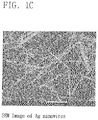
- the Ag nanowires preferably have a diameter of 10 to 300nm and a length of 10 to 70 ⁇ m.
- FIG. 1C illustrates a scanning electron microscope (SEM) photograph of the Ag nanowires.
- a method for preparing an electrical contact material includes: (a) preparing a powder mixture by mixing (i) one or more kinds of metal selected from the group consisting of Ag, Cu and Au, and an alloy of Ni, and (ii) CNTs coated with Ag nanoparticles, CNTs plated with Ag or Ag nanowires, or preparing a powder mixture by mixing (i) one or more kinds of metal selected from the group consisting of Ag, Cu, Ni and Au, (ii) a metal oxide that is cadmium oxide, indium oxide, tin oxide, zinc oxide or mixture thereof, and (iii) CNTs coated with Ag nanoparticles, CNTs plated with Ag or Ag nanowires; (b) dispersing the powered mixture, using ultra sonication, and vacuum drying the dispersed powder mixture; and (c) sintering the vacuum-dried powder mixture.
- FIG. 2 illustrates the method for preparing the electrical contact material.
- nAgCNTs Composites (nAgCNTs) of Ag nanoparticles and CNTs are prepared.
- the Ag nanoparticles are formed by melting AgNO 3 in ethanol and then adding a small amount of benzyl-mercaptan into the ethanol.
- the Ag nanoparticles bonded to the benzyl group provided from the benzyl-mercaptan are bonded to the CNTs within a few hours when bath sonication is performed. Therefore, the nAgCNTs are formed.
- Ag plated CNTs are prepared. First, CNTs immersed in an HNO 3 solution are subjected to ultrasonic dispersion and acid treatment for one minute and then dispersed using the bath sonication. The dispersed and acid-treated CNTs are washed with deionized water, using vacuum filtration. The acid-treated CNTs are sequentially immersed in a SnCl 2 +HCl mixed solution and a PdCl 2 +HCl mixed solution, and ultra sonication are applied to each of the SnCl 2 +HCl mixed solution and the PdCl 2 +HCl mixed solution for 30 minutes, thereby sequentially coupling Sn 2+ and Pd 2+ to surfaces of the CNTs. Subsequently, the CNTs are mixed with an AgNO 3 solution and an HCHO solution while adding an ammonia solution and adjusting their pH to pH 8.5, thereby obtaining Ag plated CNTs.
- a powder mixture is prepared by uniformly mixing nAgCNTs or Ag nanowires with metal and metal oxide.
- mixture powder and metal balls may be mixed at a ratio of 1:4 in a metal jar for 1 to 10 hours, using high energy ball milling.
- the mixed powder and the metal balls are uniformly mixed.
- metal particles are further miniaturized as compared with those in the early stage, and an inert gas is filled in the metal jar in order to prevent oxidation.
- the mixture powder is dispersed in a solvent such as ethanol, and the ultra sonication are applied to the mixture powder for 10 minutes, thereby uniformly mixing the mixture powder with the solvent.
- the mixed powder is separated from the solvent, using the vacuum filtration.
- the separated mixture powder is dried for 24 hours under a vacuum atmosphere of 1 ⁇ 10 -3 and then pulverized.
- the powder mixture is sintered while being maintained at a temperature of 750 to 830 °C for one minute.
- spark plasma sintering may be used as the sintering.
- SPS spark plasma sintering
- the SPS is a sintering technique in which pulse current is directly applied to raw material particles being compressed in a graphite mold, thereby using, as a main heat source, spark plasma generated in spaces between the particles.
- high energy of the spark plasma can be effectively applied to heat diffusion, action of electric fields, and the like.
- the SPS can control the growth of particles and obtain a dense composite for a short period of time, and easily sinter a material to be sintered with difficulty.
- the graphite mold containing the powder mixture is sintered while being compressed in one axial direction in a spark plasma sintering equipment, thereby preparing a high-density composite sample.
- the Ag-Ni based alloy is preferably sintered at 750 to 790°C for one minute, using the SPS, and the Ag-CdO based alloy is preferably maintained at 830°C for one minute, using the SPS. Both the alloys are sintered under a pressure of 80Mpa.
- the composite sample may be prepared using hot rolling or hot pressing, rather than the sintering.
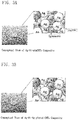
- the prepared electrical contact material may include Ag and Ni particles with a micrometer size, nAgCNTs coated with CdO and Ag particles ( FIG. 3A ), Ag plated CNTs ( FIG. 3B ), and Ag nanowires ( FIG. 3C ).
- Multi-walled Carbon Nanotubes are used as the CNTs in FIGS. 3A and 3B
- Ag nanowires are used as the CNTs in FIGS. 3C and 3D .
- the nAgCNTs are CNT structures in which Ag nanoparticles are self-assembled by coating surfaces of the CNTs with Ag nanoparticles.
- the Ag nanoparticles may be easily coalescent with adjacent Ag particles (conductive metal particles) with a micro size at a remarkably low temperature, as compared with Ag nanoparticles in a bulk state. Hence, it is possible to remarkably reduce contact resistance, thereby maintaining electrical properties of the electrical contact material.
- the Ag plated CNTs are CNT structures in which the surfaces of the CNTs are plated with Ag.
- the Ag plated CNTs are sintered with Ag particles with a micro size, so that it is possible to reduce contact resistance, thereby improving the electrical properties of the electrical contact material.
- the Ag nanowires shown in FIGS. 3C and 3D are sintered with Ag with a micro size at low temperature, and reaches the percolation threshold even when a small amount of the Ag is added. Thus, although the content of the Ag is reduced in the electrical contact material, the contact performance of the electrical contact material can be maintained.
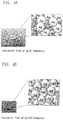
- FIGS. 4A and 4B respectively illustrate electrical contact materials made of an Ag-Ni alloy and an Ag-CdO alloy according to the conventional art.
- AgNO 3 was melted in ethanol for one hour by using a stirrer using a magnetic bar and then stirred for three days in a state in which a small amount of benzyl-mercaptan is added to the ethanol, thereby forming Ag nanoparticles.
- the Ag nanoparticles bonded to the benzyl group provided from the benzyl-mercaptan were bonded to the CNTs within a few hours when the bath sonication is performed.
- nAgCNTs (0.1wt%) composed with Ag powder (59.9wt%) having a micro size and Ni powder (40wt%) were immersed in ethanol, each of the nAgCNTs and the Ni powder was uniformly dispersed using the ultra sonication. After the dispersed solutions were combined, the combined solution was again dispersed using the ultra sonication. The dispersed mixture powder was separated from the solvent, using vacuum filtration, and then vacuum-dried. The dried powder was pulverized, thereby finally obtaining mixture powder.
- the mixture powder was filled in a graphite mold and then maintained at 790°C for one minute, using the SPS.
- a pressure of 80Mpa was applied to the mixture powder, thereby preparing an Ag-Ni-nAgCNTs composite.
- Ag plated CNTs (1wt%) was used rather than Ag particles (59wt%) with a micro size.
- a sintered body was prepared in the same manner as that of Embodiment 1, except that the sintering temperature was 750°C.
- the Ag plated CNTs had a diameter of 20 to 80nm.
- a sintered body was prepared by adding Ag nanowires (1wt%). The sintered body was maintained at a sintering temperature of 830°C for one minute, and a pressure of 80Mpa was applied to the sintered body.
- the Ag nanowires had a diameter of about 70nm and a length of about 70 ⁇ m.
- An Ag-Ni composite sample was prepared in the same manner as that of Embodiment 1, except that Ag powder (60wt%) with a micro size was used, and nAgCNTs were not used.
- An Ag-CdO composite sample was prepared in the same manner as that of Embodiment 3, except that Ag particles (60wt%) with a micro size were used, CdO (40wt%) that was a metal oxide was used, and Ag nanowires were not used.
- Hardnesses of five points of the sample were measured using a Vickers hardness tester, thereby obtaining an average value of the measured hardnesses.
- the electrical conductivity was measured using a 4 point probe in-line technique.
- the measured electrical conductivity was converted into IACS(%). When the converted value then exceeded 50%, the IACS was represented by 'excellence'. When the converted value was less than 50%, the IACS was represented by 'inferiority'.
Landscapes
- Chemical & Material Sciences (AREA)
- Engineering & Computer Science (AREA)
- Materials Engineering (AREA)
- Organic Chemistry (AREA)
- Ceramic Engineering (AREA)
- Mechanical Engineering (AREA)
- Metallurgy (AREA)
- Manufacturing & Machinery (AREA)
- Structural Engineering (AREA)
- Composite Materials (AREA)
- Inorganic Chemistry (AREA)
- Powder Metallurgy (AREA)
- Contacts (AREA)
- Conductive Materials (AREA)
- Manufacture Of Switches (AREA)
Claims (7)
- Elektrisches Kontaktmaterial, das eine Metalllegierung beinhaltet, wobei die Metalllegierung eine Legierung aus Nickel (Ni) und einer oder mehreren Arten von Metallen ausgewählt aus der Gruppe bestehend aus Silber (Ag), Kupfer (Cu) und Gold (Au) ist, und
wobei das elektrische Kontaktmaterial ferner CNTs beschichtet mit Ag-Nanopartikeln, Ag-plattierte CNTs oder Ag-Nanodrähte umfasst,
dadurch gekennzeichnet, dassdas elektrische Kontaktmaterial ferner Ag-Nanopartikel mit einer Partikelgröße im Bereich von 3 und 5 nm umfasst,wobei, basierend auf dem Gesamtgewicht der Legierung, der Gehalt des Metalls 55 bis 65 Gew.-% ist, wobei der Gehalt des Ni 35 bis 45 Gew.-% ist und der Gehalt der CNTs oder der Ag-Nanodrähte 0,1 bis 5 Gew.-% ist. - Metall-Metalloxid-basiertes elektrisches Kontaktmaterial,
wobei das Metall eines oder mehrere Arten von Metallen ausgewählt aus der Gruppe bestehend aus Ag, Cu, Ni und Au ist,wobei das Metalloxid Cadmiumoxid, Indiumoxid, Zinnoxid, Zinkoxid oder eine Mischung davon ist, undwobei das elektrische Kontaktmaterial ferner CNTs beschichtet mit Ag-Nanopartikeln, Ag-plattierte CNTs oder Ag-Nanodrähte umfasst,dadurch gekennzeichnet, dassdas Metall-Metalloxid-basierte elektrisches Kontaktmaterial ferner die Ag-Nanopartikel mit einer Partikelgröße im Bereich von 3 bis 5 nm umfasst,wobei, basierend auf dem Gesamtgewicht des Metalls und des Metalloxids, der Gehalt von dem Metall 75 bis 85 Gew.-% ist, der Gehalt von dem Metalloxid 15 bis 25 Gew.-% ist und der Gehalt von den CNTs oder den Ag-Nanodrähten 0,1 bis 5 Gew.-% ist. - Elektrisches Kontaktmaterial nach einem der Ansprüche 1 oder 2, wobei das Metall Ag ist.
- Elektrisches Kontaktmaterial nach einem der Ansprüche 2 oder 3, wobei das Metalloxid Cadmiumoxid ist.
- Verfahren zum Herstellen eines elektrischen Kontaktmaterials gemäß Anspruch 1 einschließlich einer Metalllegierung, wobei die Metalllegierung eine Legierung von Nickel (Ni) und einer oder mehreren Arten von Metallen ausgewählt aus der Gruppe bestehend aus Silber (Ag), Kupfer (Cu) und Gold (Au) ist und wobei das Verfahren umfasst:(a) Herstellen eine Pudermischung durch Mischen von (i) einer oder von mehreren Arten von Metallen ausgewählt aus der Gruppe bestehend aus Ag, Cu und Au, und (ii) CNTs beschichtet mit Ag-Nanopartikeln, Ag-plattierten CNTs oder Ag-Nanodrähten;(b) Dispergieren der Pudermischung, unter Verwendung von Ultrabeschallung und Vakuumtrocknen der dispergierten Pudermischung; und(c) Sintern der vakuumgetrockneten Pudermischung,dadurch gekennzeichnet, dass das Verfahren zum Herstellen des elektrischen Kontaktmaterials ferner umfasst, dass das Sintern der CNTs, die mit Ag-Nanopartikeln beschichtet sind, bei 790°C implementiert ist und dass das Sintern der Ag-plattierten CNTs bei 750°C implementiert ist, undwobei die Größe der Ag-Nanopartikel 3 bis 5 nm ist,wobei, basierend auf dem Gesamtgewicht der Legierung, der Gehalt von dem Metall 55 bis 65 Gew.-% ist, der Gehalt von den Nickel 35 bis 45 Gew.-% ist und der Gehalt von den CNTs oder den Ag-Nanodrähten 0,1 bis 5 Gew.-% ist.
- Verfahren zum Herstellen eines Metall-Metalloxid-basierten elektrischen Kontaktmaterials gemäß Anspruch 2, wobei das Metall eines oder mehrere Arten von Metallen ausgewählt aus der Gruppe bestehend aus Ag, Cu, Ni und Au ist und das Metalloxid Cadmiumoxid, Indiumoxid, Zinnoxid, Zinkoxid oder eine Mischung davon ist,
wobei das Verfahren umfasst:(a) Herstellen einer Pudermischung durch Mischen von (i) einer oder von mehreren Arten von Metallen ausgewählt aus der Gruppe bestehend aus Ag, Cu, Ni und Au, und (ii) eines Metalloxids, das Kadmiumoxid, Indiumoxid, Zinnoxid, Zinkoxid oder eine Mischung davon ist, und (iii) CNTs beschichtet mit Ag-Nanopartikeln, Ag-plattierten CNTs oder Ag-Nanodrähten;(b) Dispergieren der Pudermischung unter Verwendung von Ultrabeschallung und Vakuumtrocknen der dispergierten Pudermischung; und(c) Sintern der vakuumgetrockneten Pudermischung, wobei das Sintern der CNTs, die mit Ag-Nanopartikeln beschichtet sind, bei 790 °C implementiert ist und wobei das Sintern der AG-plattierten CNTs bei 750 °C implementiert ist,wobei die Größe der Ag-Nanopartikel 3 bis 5 nm ist,
wobei basierend auf dem Gesamtgewicht des Metalls und des Metalloxids der Gehalt des Metalls 75 bis 85 Gew.-% ist, der Gehalt des Metalloxids 15 bis 25 Gew.-% ist und der Gehalt der CNTs oder der Ag-Nanodrähte 0,1 bis 5 Gew.-% ist. - Verfahren nach Anspruch 5 oder 6, wobei das Sintern Plasmasintern mit Funken ist.
Applications Claiming Priority (1)
| Application Number | Priority Date | Filing Date | Title |
|---|---|---|---|
| KR1020130148042A KR101609028B1 (ko) | 2013-11-29 | 2013-11-29 | 전기접점재료 및 이의 제조방법 |
Publications (2)
| Publication Number | Publication Date |
|---|---|
| EP2879145A1 EP2879145A1 (de) | 2015-06-03 |
| EP2879145B1 true EP2879145B1 (de) | 2018-10-17 |
Family
ID=51870928
Family Applications (1)
| Application Number | Title | Priority Date | Filing Date |
|---|---|---|---|
| EP14192982.8A Active EP2879145B1 (de) | 2013-11-29 | 2014-11-13 | Elektrische Kontaktmaterialien und Verfahren zu ihrer Herstellung |
Country Status (7)
| Country | Link |
|---|---|
| US (1) | US9570207B2 (de) |
| EP (1) | EP2879145B1 (de) |
| JP (1) | JP6126066B2 (de) |
| KR (1) | KR101609028B1 (de) |
| CN (1) | CN104681312B (de) |
| BR (1) | BR102014029992B1 (de) |
| ES (1) | ES2706225T3 (de) |
Cited By (1)
| Publication number | Priority date | Publication date | Assignee | Title |
|---|---|---|---|---|
| EP4318516A4 (de) * | 2021-03-23 | 2025-02-12 | LS Electric Co., Ltd. | Verbundwerkstoff für elektrische kontakte und verfahren zu seiner herstellung |
Families Citing this family (24)
| Publication number | Priority date | Publication date | Assignee | Title |
|---|---|---|---|---|
| KR20160137178A (ko) | 2015-05-22 | 2016-11-30 | 성균관대학교산학협력단 | 은이 코팅된 탄소나노튜브가 함유된 전기접점재료의 제조방법 |
| DE102016201472A1 (de) * | 2016-02-01 | 2017-08-03 | Siemens Aktiengesellschaft | Kontaktelement für elektrische Schalter und Herstellungsverfahren dazu |
| KR101789300B1 (ko) * | 2016-09-28 | 2017-10-23 | 부경대학교 산학협력단 | 방전 플라즈마 소결 공정을 이용한 은-다이아몬드 복합 재료의 제조방법 및 이에 의해 제조된 은-다이아몬드 복합 재료 |
| RU176664U1 (ru) * | 2017-07-10 | 2018-01-25 | Общество с ограниченной ответственностью "Информационные технологии" (ООО "ИнфоТех") | Композитный электрический контакт |
| KR102004298B1 (ko) * | 2017-12-07 | 2019-07-26 | 한국생산기술연구원 | 전기 접점 부재용 Ta-Cu계 합금의 제조 방법 및 이에 의하여 제조된 전기 접점 부재용 Ta-Cu계 합금 |
| KR102311541B1 (ko) * | 2017-12-13 | 2021-10-13 | 엘티메탈 주식회사 | 은-카본 나노 복합 입자, 이의 제조방법 및 상기 은-카본 나노 복합 입자를 포함하는 전기 접점 재료 |
| KR102129656B1 (ko) * | 2017-12-13 | 2020-07-02 | 엘티메탈 주식회사 | 전기 접점 재료 및 이를 포함하는 전기 접점 |
| KR102311533B1 (ko) * | 2017-12-13 | 2021-10-13 | 엘티메탈 주식회사 | 은-카본-금속계 나노 복합입자 및 이의 제조방법, 상기 나노 복합입자를 포함하는 전기 접점재료 |
| CN110802224A (zh) * | 2018-08-06 | 2020-02-18 | 三菱电机株式会社 | 银镍氧化锡复合粉体及银镍氧化锡电接触材料的制备方法 |
| CN110016583B (zh) * | 2018-11-16 | 2021-07-09 | 贵研铂业股份有限公司 | 一种金-陶瓷电接触复合材料及其制备方法 |
| CN109500391A (zh) * | 2019-01-05 | 2019-03-22 | 桂林电器科学研究院有限公司 | 一种高延性银氧化锌触头材料的制备方法 |
| KR102169732B1 (ko) * | 2019-01-30 | 2020-10-26 | (주)대경산전 | 아크 저감 기능이 있는 수배전반용 단자 |
| CN112059168B (zh) * | 2020-08-08 | 2022-07-05 | 浙江福达合金材料科技有限公司 | 基于纳米银线改性和3d梯度打印制备银金属氧化物电接触材料的方法及其产品 |
| CN112095057B (zh) * | 2020-08-08 | 2021-09-17 | 福达合金材料股份有限公司 | 一种纳米银线改性银镍电接触材料及其制备方法 |
| CN111979444B (zh) * | 2020-08-26 | 2021-09-28 | 郑州机械研究所有限公司 | 一种银钎料及其制备方法和用途 |
| CN112831682A (zh) * | 2020-12-31 | 2021-05-25 | 四川艾尔法泰克科技有限公司 | 复合银基电接触材料及其制备方法 |
| CN113122755A (zh) * | 2021-04-16 | 2021-07-16 | 江西富鸿金属有限公司 | 一种医疗数据传输用镀锡合金线及其制备方法 |
| CN114032415A (zh) * | 2021-11-19 | 2022-02-11 | 国网河北能源技术服务有限公司 | 一种碳纳米管增强铜基层状复合材料的制备方法 |
| CN114540658B (zh) * | 2022-01-07 | 2022-08-12 | 西安理工大学 | 一种AgTiB2G触头材料及其制备方法 |
| CN114628179B (zh) * | 2022-04-12 | 2023-09-29 | 西安西电开关电气有限公司 | 一种铜钨合金与铜合金的连接方法 |
| CN115109962B (zh) * | 2022-06-24 | 2023-10-13 | 有研工程技术研究院有限公司 | 一种汇流环用耐磨高硬度金基合金材料及其制备方法 |
| CN115740436B (zh) * | 2022-11-21 | 2023-08-18 | 重庆邮电大学 | 一种一维核壳结构碳包覆铁磁纳米线、制备方法及其应用 |
| CN116005145B (zh) * | 2022-12-27 | 2024-04-09 | 昆明理工大学 | 一种绿色无污染的纳米银修饰碳纳米管的制备方法 |
| CN117127047B (zh) * | 2023-10-26 | 2024-01-05 | 烟台金晖铜业有限公司 | 一种基于热压烧结合金的接触线制备方法 |
Citations (2)
| Publication number | Priority date | Publication date | Assignee | Title |
|---|---|---|---|---|
| US20090233086A1 (en) * | 2008-03-17 | 2009-09-17 | Fujifilm Corporation | Metal oxide microparticles, transparent conductive film, and dispersion |
| WO2011021982A1 (en) * | 2009-08-20 | 2011-02-24 | Nanyang Technological University | Integrated electrode architectures for energy generation and storage |
Family Cites Families (20)
| Publication number | Priority date | Publication date | Assignee | Title |
|---|---|---|---|---|
| JPS58141351A (ja) | 1981-10-26 | 1983-08-22 | Nippon Tungsten Co Ltd | ノ−フユ−ズブレ−カ−用電気接点材料 |
| CN1256450A (zh) | 1998-12-04 | 2000-06-14 | 冯桂玉 | 7巧仿珠算图形编码 |
| JP2005120427A (ja) | 2003-10-16 | 2005-05-12 | Matsushita Electric Works Ltd | 電気接点用材料及び電気接点 |
| JP4412052B2 (ja) * | 2003-10-28 | 2010-02-10 | 富士ゼロックス株式会社 | 複合材およびその製造方法 |
| CN1311487C (zh) | 2003-10-28 | 2007-04-18 | 章景兴 | 以银氧化锌氧化铟为基础的电接触材料及其生产工艺 |
| CN1624175A (zh) | 2003-12-02 | 2005-06-08 | 上海电器科学研究所(集团)有限公司 | 碳纳米管银石墨电触头材料及其制备方法 |
| WO2008063148A2 (en) * | 2005-05-20 | 2008-05-29 | University Of Central Florida | Carbon nanotube reinforced metal composites |
| JP2007169701A (ja) | 2005-12-21 | 2007-07-05 | Mitsubishi Material Cmi Kk | 電気接点用材料及びその製造方法 |
| US7842274B2 (en) | 2006-03-31 | 2010-11-30 | Umicore, S.A. | Process for manufacture of silver-based particles and electrical contact materials |
| US7998367B2 (en) * | 2006-06-21 | 2011-08-16 | Stc.Unm | Metal-carbon nanotube composites for enhanced thermal conductivity for demanding or critical applications |
| WO2008089401A2 (en) * | 2007-01-18 | 2008-07-24 | Arizona Board Of Regents, Acting For And On Behalfof Arizona State University | Flexible transparent electrodes via nanowires and sacrificial conductive layer |
| KR100924766B1 (ko) * | 2007-06-22 | 2009-11-05 | 삼성전자주식회사 | 금속 나노입자를 포함하는 탄소 나노튜브(cnt) 박막 및그 제조방법 |
| JP2009030100A (ja) | 2007-07-26 | 2009-02-12 | Mitsubishi Material Cmi Kk | Ag−Ni系電気接点材料及びその製造方法 |
| KR20090047328A (ko) | 2007-11-07 | 2009-05-12 | 삼성전기주식회사 | 도전성 페이스트 및 이를 이용한 인쇄회로기판 |
| DE102008030988B4 (de) | 2008-06-27 | 2010-04-01 | Siemens Aktiengesellschaft | Bauteil mit einer Schicht, in die CNT (Carbon Nanotubes) eingebaut sind und Verfahren zu dessen Herstellung |
| CN101649401B (zh) | 2009-07-20 | 2011-03-16 | 温州宏丰电工合金股份有限公司 | Ag-Ni-氧化物电触头材料及其制备方法 |
| KR20110139588A (ko) | 2010-06-23 | 2011-12-29 | 한국과학기술연구원 | 나노카본과 금속 또는 세라믹 복합재료의 제조방법 |
| CN103298981A (zh) * | 2010-12-28 | 2013-09-11 | 独立行政法人产业技术综合研究所 | Cnt金属复合材料及其制造方法 |
| CN102324335B (zh) | 2011-06-07 | 2013-10-23 | 天津工业大学 | 一种复合电触头材料的制备方法 |
| CN102294485B (zh) | 2011-08-25 | 2013-01-30 | 哈尔滨东大高新材料股份有限公司 | 复合电接触材料及其制备方法 |
-
2013
- 2013-11-29 KR KR1020130148042A patent/KR101609028B1/ko active Active
-
2014
- 2014-11-06 US US14/535,060 patent/US9570207B2/en active Active
- 2014-11-13 EP EP14192982.8A patent/EP2879145B1/de active Active
- 2014-11-13 ES ES14192982T patent/ES2706225T3/es active Active
- 2014-11-17 JP JP2014232326A patent/JP6126066B2/ja active Active
- 2014-11-28 CN CN201410710471.1A patent/CN104681312B/zh active Active
- 2014-12-01 BR BR102014029992-0A patent/BR102014029992B1/pt active IP Right Grant
Patent Citations (2)
| Publication number | Priority date | Publication date | Assignee | Title |
|---|---|---|---|---|
| US20090233086A1 (en) * | 2008-03-17 | 2009-09-17 | Fujifilm Corporation | Metal oxide microparticles, transparent conductive film, and dispersion |
| WO2011021982A1 (en) * | 2009-08-20 | 2011-02-24 | Nanyang Technological University | Integrated electrode architectures for energy generation and storage |
Cited By (1)
| Publication number | Priority date | Publication date | Assignee | Title |
|---|---|---|---|---|
| EP4318516A4 (de) * | 2021-03-23 | 2025-02-12 | LS Electric Co., Ltd. | Verbundwerkstoff für elektrische kontakte und verfahren zu seiner herstellung |
Also Published As
| Publication number | Publication date |
|---|---|
| US20150155066A1 (en) | 2015-06-04 |
| KR101609028B1 (ko) | 2016-04-05 |
| JP2015105439A (ja) | 2015-06-08 |
| CN104681312B (zh) | 2017-09-22 |
| EP2879145A1 (de) | 2015-06-03 |
| KR20150063272A (ko) | 2015-06-09 |
| ES2706225T3 (es) | 2019-03-27 |
| BR102014029992B1 (pt) | 2021-12-14 |
| BR102014029992A2 (pt) | 2015-09-15 |
| JP6126066B2 (ja) | 2017-05-10 |
| CN104681312A (zh) | 2015-06-03 |
| US9570207B2 (en) | 2017-02-14 |
Similar Documents
| Publication | Publication Date | Title |
|---|---|---|
| US9570207B2 (en) | Electrical contact materials and method for preparing the same | |
| EP3096328B1 (de) | Verfahren zur herstellung elektrischer kontaktmaterialien mit ag-plattierten cnts | |
| CN101217226B (zh) | 弱电滑动接点材料 | |
| Yim et al. | Effect of silver-plated expanded graphite addition on thermal and electrical conductivities of epoxy composites in the presence of graphite and copper | |
| EP4218038B1 (de) | Elektrischer kontakt mit einer metall-graphen-verbundschicht | |
| JP5270632B2 (ja) | ナノカーボンと金属又はセラミックとの複合材料の生産方法 | |
| KR101705943B1 (ko) | 전기 폭발법을 이용한 다중층 그래핀이 코팅된 복합체 분말의 제조방법 | |
| KR101722582B1 (ko) | 카본나노튜브-알루미늄 복합분말을 이용한 송전용 복합선재의 제조방법 | |
| Li et al. | Effect of CNTs content on the mechanical and arc-erosion performance of Ag-CNTs composites | |
| CN104245976B (zh) | 触点材料 | |
| CN105742083A (zh) | 一种碳纳米管增强的复合电接触材料及其制备工艺 | |
| KR101850011B1 (ko) | 은-은 코팅 탄소나노튜브 복합소재를 이용한 고방열성 및 내아크성을 갖는 전기접점재료 및 이의 제조방법 | |
| CN106903325B (zh) | 银-氧化锡电接触材料的制备方法及其制成的电接触材料 | |
| Lee et al. | Enhanced electrical conductivity and hardness of silver-nickel composites by silver-coated multi-walled carbon nanotubes | |
| CN105821234A (zh) | 一种石墨烯增强银基滑动电接触材料的制备方法 | |
| KR102258336B1 (ko) | 은이 코팅된 탄소나노튜브가 함유된 전기접점재료의 제조방법 | |
| KR101738505B1 (ko) | 은-카본계 복합물질 및 그 제조방법 | |
| CN110603111B (zh) | 六方氮化硼纳米片/金属纳米复合粉末及其制备方法 | |
| JP4643714B2 (ja) | 放電表面処理用電極およびその製造方法 |
Legal Events
| Date | Code | Title | Description |
|---|---|---|---|
| PUAI | Public reference made under article 153(3) epc to a published international application that has entered the european phase |
Free format text: ORIGINAL CODE: 0009012 |
|
| 17P | Request for examination filed |
Effective date: 20141113 |
|
| AK | Designated contracting states |
Kind code of ref document: A1 Designated state(s): AL AT BE BG CH CY CZ DE DK EE ES FI FR GB GR HR HU IE IS IT LI LT LU LV MC MK MT NL NO PL PT RO RS SE SI SK SM TR |
|
| AX | Request for extension of the european patent |
Extension state: BA ME |
|
| R17P | Request for examination filed (corrected) |
Effective date: 20151203 |
|
| RBV | Designated contracting states (corrected) |
Designated state(s): AL AT BE BG CH CY CZ DE DK EE ES FI FR GB GR HR HU IE IS IT LI LT LU LV MC MK MT NL NO PL PT RO RS SE SI SK SM TR |
|
| 17Q | First examination report despatched |
Effective date: 20171102 |
|
| GRAP | Despatch of communication of intention to grant a patent |
Free format text: ORIGINAL CODE: EPIDOSNIGR1 |
|
| INTG | Intention to grant announced |
Effective date: 20180502 |
|
| GRAS | Grant fee paid |
Free format text: ORIGINAL CODE: EPIDOSNIGR3 |
|
| GRAA | (expected) grant |
Free format text: ORIGINAL CODE: 0009210 |
|
| AK | Designated contracting states |
Kind code of ref document: B1 Designated state(s): AL AT BE BG CH CY CZ DE DK EE ES FI FR GB GR HR HU IE IS IT LI LT LU LV MC MK MT NL NO PL PT RO RS SE SI SK SM TR |
|
| REG | Reference to a national code |
Ref country code: GB Ref legal event code: FG4D |
|
| REG | Reference to a national code |
Ref country code: CH Ref legal event code: EP |
|
| REG | Reference to a national code |
Ref country code: IE Ref legal event code: FG4D |
|
| REG | Reference to a national code |
Ref country code: DE Ref legal event code: R096 Ref document number: 602014034159 Country of ref document: DE Ref country code: AT Ref legal event code: REF Ref document number: 1054955 Country of ref document: AT Kind code of ref document: T Effective date: 20181115 |
|
| REG | Reference to a national code |
Ref country code: NL Ref legal event code: MP Effective date: 20181017 |
|
| REG | Reference to a national code |
Ref country code: LT Ref legal event code: MG4D |
|
| REG | Reference to a national code |
Ref country code: AT Ref legal event code: MK05 Ref document number: 1054955 Country of ref document: AT Kind code of ref document: T Effective date: 20181017 |
|
| REG | Reference to a national code |
Ref country code: ES Ref legal event code: FG2A Ref document number: 2706225 Country of ref document: ES Kind code of ref document: T3 Effective date: 20190327 |
|
| PG25 | Lapsed in a contracting state [announced via postgrant information from national office to epo] |
Ref country code: NL Free format text: LAPSE BECAUSE OF FAILURE TO SUBMIT A TRANSLATION OF THE DESCRIPTION OR TO PAY THE FEE WITHIN THE PRESCRIBED TIME-LIMIT Effective date: 20181017 |
|
| PG25 | Lapsed in a contracting state [announced via postgrant information from national office to epo] |
Ref country code: IS Free format text: LAPSE BECAUSE OF FAILURE TO SUBMIT A TRANSLATION OF THE DESCRIPTION OR TO PAY THE FEE WITHIN THE PRESCRIBED TIME-LIMIT Effective date: 20190217 Ref country code: LT Free format text: LAPSE BECAUSE OF FAILURE TO SUBMIT A TRANSLATION OF THE DESCRIPTION OR TO PAY THE FEE WITHIN THE PRESCRIBED TIME-LIMIT Effective date: 20181017 Ref country code: HR Free format text: LAPSE BECAUSE OF FAILURE TO SUBMIT A TRANSLATION OF THE DESCRIPTION OR TO PAY THE FEE WITHIN THE PRESCRIBED TIME-LIMIT Effective date: 20181017 Ref country code: PL Free format text: LAPSE BECAUSE OF FAILURE TO SUBMIT A TRANSLATION OF THE DESCRIPTION OR TO PAY THE FEE WITHIN THE PRESCRIBED TIME-LIMIT Effective date: 20181017 Ref country code: BG Free format text: LAPSE BECAUSE OF FAILURE TO SUBMIT A TRANSLATION OF THE DESCRIPTION OR TO PAY THE FEE WITHIN THE PRESCRIBED TIME-LIMIT Effective date: 20190117 Ref country code: LV Free format text: LAPSE BECAUSE OF FAILURE TO SUBMIT A TRANSLATION OF THE DESCRIPTION OR TO PAY THE FEE WITHIN THE PRESCRIBED TIME-LIMIT Effective date: 20181017 Ref country code: AT Free format text: LAPSE BECAUSE OF FAILURE TO SUBMIT A TRANSLATION OF THE DESCRIPTION OR TO PAY THE FEE WITHIN THE PRESCRIBED TIME-LIMIT Effective date: 20181017 Ref country code: NO Free format text: LAPSE BECAUSE OF FAILURE TO SUBMIT A TRANSLATION OF THE DESCRIPTION OR TO PAY THE FEE WITHIN THE PRESCRIBED TIME-LIMIT Effective date: 20190117 Ref country code: FI Free format text: LAPSE BECAUSE OF FAILURE TO SUBMIT A TRANSLATION OF THE DESCRIPTION OR TO PAY THE FEE WITHIN THE PRESCRIBED TIME-LIMIT Effective date: 20181017 |
|
| PG25 | Lapsed in a contracting state [announced via postgrant information from national office to epo] |
Ref country code: PT Free format text: LAPSE BECAUSE OF FAILURE TO SUBMIT A TRANSLATION OF THE DESCRIPTION OR TO PAY THE FEE WITHIN THE PRESCRIBED TIME-LIMIT Effective date: 20190217 Ref country code: AL Free format text: LAPSE BECAUSE OF FAILURE TO SUBMIT A TRANSLATION OF THE DESCRIPTION OR TO PAY THE FEE WITHIN THE PRESCRIBED TIME-LIMIT Effective date: 20181017 Ref country code: SE Free format text: LAPSE BECAUSE OF FAILURE TO SUBMIT A TRANSLATION OF THE DESCRIPTION OR TO PAY THE FEE WITHIN THE PRESCRIBED TIME-LIMIT Effective date: 20181017 Ref country code: RS Free format text: LAPSE BECAUSE OF FAILURE TO SUBMIT A TRANSLATION OF THE DESCRIPTION OR TO PAY THE FEE WITHIN THE PRESCRIBED TIME-LIMIT Effective date: 20181017 Ref country code: GR Free format text: LAPSE BECAUSE OF FAILURE TO SUBMIT A TRANSLATION OF THE DESCRIPTION OR TO PAY THE FEE WITHIN THE PRESCRIBED TIME-LIMIT Effective date: 20190118 |
|
| REG | Reference to a national code |
Ref country code: CH Ref legal event code: PL |
|
| REG | Reference to a national code |
Ref country code: DE Ref legal event code: R097 Ref document number: 602014034159 Country of ref document: DE |
|
| PG25 | Lapsed in a contracting state [announced via postgrant information from national office to epo] |
Ref country code: LU Free format text: LAPSE BECAUSE OF NON-PAYMENT OF DUE FEES Effective date: 20181113 Ref country code: CZ Free format text: LAPSE BECAUSE OF FAILURE TO SUBMIT A TRANSLATION OF THE DESCRIPTION OR TO PAY THE FEE WITHIN THE PRESCRIBED TIME-LIMIT Effective date: 20181017 Ref country code: DK Free format text: LAPSE BECAUSE OF FAILURE TO SUBMIT A TRANSLATION OF THE DESCRIPTION OR TO PAY THE FEE WITHIN THE PRESCRIBED TIME-LIMIT Effective date: 20181017 |
|
| REG | Reference to a national code |
Ref country code: BE Ref legal event code: MM Effective date: 20181130 |
|
| REG | Reference to a national code |
Ref country code: IE Ref legal event code: MM4A |
|
| PLBE | No opposition filed within time limit |
Free format text: ORIGINAL CODE: 0009261 |
|
| STAA | Information on the status of an ep patent application or granted ep patent |
Free format text: STATUS: NO OPPOSITION FILED WITHIN TIME LIMIT |
|
| PG25 | Lapsed in a contracting state [announced via postgrant information from national office to epo] |
Ref country code: MC Free format text: LAPSE BECAUSE OF FAILURE TO SUBMIT A TRANSLATION OF THE DESCRIPTION OR TO PAY THE FEE WITHIN THE PRESCRIBED TIME-LIMIT Effective date: 20181017 Ref country code: RO Free format text: LAPSE BECAUSE OF FAILURE TO SUBMIT A TRANSLATION OF THE DESCRIPTION OR TO PAY THE FEE WITHIN THE PRESCRIBED TIME-LIMIT Effective date: 20181017 Ref country code: CH Free format text: LAPSE BECAUSE OF NON-PAYMENT OF DUE FEES Effective date: 20181130 Ref country code: SK Free format text: LAPSE BECAUSE OF FAILURE TO SUBMIT A TRANSLATION OF THE DESCRIPTION OR TO PAY THE FEE WITHIN THE PRESCRIBED TIME-LIMIT Effective date: 20181017 Ref country code: SM Free format text: LAPSE BECAUSE OF FAILURE TO SUBMIT A TRANSLATION OF THE DESCRIPTION OR TO PAY THE FEE WITHIN THE PRESCRIBED TIME-LIMIT Effective date: 20181017 Ref country code: LI Free format text: LAPSE BECAUSE OF NON-PAYMENT OF DUE FEES Effective date: 20181130 Ref country code: EE Free format text: LAPSE BECAUSE OF FAILURE TO SUBMIT A TRANSLATION OF THE DESCRIPTION OR TO PAY THE FEE WITHIN THE PRESCRIBED TIME-LIMIT Effective date: 20181017 |
|
| 26N | No opposition filed |
Effective date: 20190718 |
|
| PG25 | Lapsed in a contracting state [announced via postgrant information from national office to epo] |
Ref country code: IE Free format text: LAPSE BECAUSE OF NON-PAYMENT OF DUE FEES Effective date: 20181113 Ref country code: SI Free format text: LAPSE BECAUSE OF FAILURE TO SUBMIT A TRANSLATION OF THE DESCRIPTION OR TO PAY THE FEE WITHIN THE PRESCRIBED TIME-LIMIT Effective date: 20181017 |
|
| PG25 | Lapsed in a contracting state [announced via postgrant information from national office to epo] |
Ref country code: BE Free format text: LAPSE BECAUSE OF NON-PAYMENT OF DUE FEES Effective date: 20181130 |
|
| PG25 | Lapsed in a contracting state [announced via postgrant information from national office to epo] |
Ref country code: MT Free format text: LAPSE BECAUSE OF NON-PAYMENT OF DUE FEES Effective date: 20181113 |
|
| PG25 | Lapsed in a contracting state [announced via postgrant information from national office to epo] |
Ref country code: TR Free format text: LAPSE BECAUSE OF FAILURE TO SUBMIT A TRANSLATION OF THE DESCRIPTION OR TO PAY THE FEE WITHIN THE PRESCRIBED TIME-LIMIT Effective date: 20181017 |
|
| PG25 | Lapsed in a contracting state [announced via postgrant information from national office to epo] |
Ref country code: HU Free format text: LAPSE BECAUSE OF FAILURE TO SUBMIT A TRANSLATION OF THE DESCRIPTION OR TO PAY THE FEE WITHIN THE PRESCRIBED TIME-LIMIT; INVALID AB INITIO Effective date: 20141113 Ref country code: CY Free format text: LAPSE BECAUSE OF FAILURE TO SUBMIT A TRANSLATION OF THE DESCRIPTION OR TO PAY THE FEE WITHIN THE PRESCRIBED TIME-LIMIT Effective date: 20181017 Ref country code: MK Free format text: LAPSE BECAUSE OF NON-PAYMENT OF DUE FEES Effective date: 20181017 |
|
| P01 | Opt-out of the competence of the unified patent court (upc) registered |
Effective date: 20230625 |
|
| PGFP | Annual fee paid to national office [announced via postgrant information from national office to epo] |
Ref country code: IT Payment date: 20250909 Year of fee payment: 12 |
|
| PGFP | Annual fee paid to national office [announced via postgrant information from national office to epo] |
Ref country code: GB Payment date: 20250909 Year of fee payment: 12 |
|
| PGFP | Annual fee paid to national office [announced via postgrant information from national office to epo] |
Ref country code: FR Payment date: 20250909 Year of fee payment: 12 |
|
| PGFP | Annual fee paid to national office [announced via postgrant information from national office to epo] |
Ref country code: DE Payment date: 20250908 Year of fee payment: 12 |
|
| PGFP | Annual fee paid to national office [announced via postgrant information from national office to epo] |
Ref country code: ES Payment date: 20251215 Year of fee payment: 12 |