EP2864489B1 - Ortsspezifische integration - Google Patents
Ortsspezifische integration Download PDFInfo
- Publication number
- EP2864489B1 EP2864489B1 EP13729962.4A EP13729962A EP2864489B1 EP 2864489 B1 EP2864489 B1 EP 2864489B1 EP 13729962 A EP13729962 A EP 13729962A EP 2864489 B1 EP2864489 B1 EP 2864489B1
- Authority
- EP
- European Patent Office
- Prior art keywords
- gene
- host cell
- interest
- cell
- nucleotide sequence
- Prior art date
- Legal status (The legal status is an assumption and is not a legal conclusion. Google has not performed a legal analysis and makes no representation as to the accuracy of the status listed.)
- Active
Links
Images




Classifications
-
- C—CHEMISTRY; METALLURGY
- C07—ORGANIC CHEMISTRY
- C07K—PEPTIDES
- C07K16/00—Immunoglobulins [IG], e.g. monoclonal or polyclonal antibodies
-
- C—CHEMISTRY; METALLURGY
- C12—BIOCHEMISTRY; BEER; SPIRITS; WINE; VINEGAR; MICROBIOLOGY; ENZYMOLOGY; MUTATION OR GENETIC ENGINEERING
- C12N—MICROORGANISMS OR ENZYMES; COMPOSITIONS THEREOF; PROPAGATING, PRESERVING, OR MAINTAINING MICROORGANISMS; MUTATION OR GENETIC ENGINEERING; CULTURE MEDIA
- C12N15/00—Mutation or genetic engineering; DNA or RNA concerning genetic engineering, vectors, e.g. plasmids, or their isolation, preparation or purification; Use of hosts therefor
- C12N15/09—Recombinant DNA-technology
- C12N15/10—Processes for the isolation, preparation or purification of DNA or RNA
-
- C—CHEMISTRY; METALLURGY
- C12—BIOCHEMISTRY; BEER; SPIRITS; WINE; VINEGAR; MICROBIOLOGY; ENZYMOLOGY; MUTATION OR GENETIC ENGINEERING
- C12N—MICROORGANISMS OR ENZYMES; COMPOSITIONS THEREOF; PROPAGATING, PRESERVING, OR MAINTAINING MICROORGANISMS; MUTATION OR GENETIC ENGINEERING; CULTURE MEDIA
- C12N15/00—Mutation or genetic engineering; DNA or RNA concerning genetic engineering, vectors, e.g. plasmids, or their isolation, preparation or purification; Use of hosts therefor
- C12N15/09—Recombinant DNA-technology
- C12N15/63—Introduction of foreign genetic material using vectors; Vectors; Use of hosts therefor; Regulation of expression
-
- C—CHEMISTRY; METALLURGY
- C12—BIOCHEMISTRY; BEER; SPIRITS; WINE; VINEGAR; MICROBIOLOGY; ENZYMOLOGY; MUTATION OR GENETIC ENGINEERING
- C12N—MICROORGANISMS OR ENZYMES; COMPOSITIONS THEREOF; PROPAGATING, PRESERVING, OR MAINTAINING MICROORGANISMS; MUTATION OR GENETIC ENGINEERING; CULTURE MEDIA
- C12N15/00—Mutation or genetic engineering; DNA or RNA concerning genetic engineering, vectors, e.g. plasmids, or their isolation, preparation or purification; Use of hosts therefor
- C12N15/09—Recombinant DNA-technology
- C12N15/63—Introduction of foreign genetic material using vectors; Vectors; Use of hosts therefor; Regulation of expression
- C12N15/79—Vectors or expression systems specially adapted for eukaryotic hosts
- C12N15/85—Vectors or expression systems specially adapted for eukaryotic hosts for animal cells
- C12N15/86—Viral vectors
- C12N15/861—Adenoviral vectors
-
- C—CHEMISTRY; METALLURGY
- C12—BIOCHEMISTRY; BEER; SPIRITS; WINE; VINEGAR; MICROBIOLOGY; ENZYMOLOGY; MUTATION OR GENETIC ENGINEERING
- C12N—MICROORGANISMS OR ENZYMES; COMPOSITIONS THEREOF; PROPAGATING, PRESERVING, OR MAINTAINING MICROORGANISMS; MUTATION OR GENETIC ENGINEERING; CULTURE MEDIA
- C12N15/00—Mutation or genetic engineering; DNA or RNA concerning genetic engineering, vectors, e.g. plasmids, or their isolation, preparation or purification; Use of hosts therefor
- C12N15/09—Recombinant DNA-technology
- C12N15/87—Introduction of foreign genetic material using processes not otherwise provided for, e.g. co-transformation
- C12N15/90—Stable introduction of foreign DNA into chromosome
-
- C—CHEMISTRY; METALLURGY
- C12—BIOCHEMISTRY; BEER; SPIRITS; WINE; VINEGAR; MICROBIOLOGY; ENZYMOLOGY; MUTATION OR GENETIC ENGINEERING
- C12N—MICROORGANISMS OR ENZYMES; COMPOSITIONS THEREOF; PROPAGATING, PRESERVING, OR MAINTAINING MICROORGANISMS; MUTATION OR GENETIC ENGINEERING; CULTURE MEDIA
- C12N15/00—Mutation or genetic engineering; DNA or RNA concerning genetic engineering, vectors, e.g. plasmids, or their isolation, preparation or purification; Use of hosts therefor
- C12N15/09—Recombinant DNA-technology
- C12N15/87—Introduction of foreign genetic material using processes not otherwise provided for, e.g. co-transformation
- C12N15/90—Stable introduction of foreign DNA into chromosome
- C12N15/902—Stable introduction of foreign DNA into chromosome using homologous recombination
- C12N15/907—Stable introduction of foreign DNA into chromosome using homologous recombination in mammalian cells
-
- C—CHEMISTRY; METALLURGY
- C12—BIOCHEMISTRY; BEER; SPIRITS; WINE; VINEGAR; MICROBIOLOGY; ENZYMOLOGY; MUTATION OR GENETIC ENGINEERING
- C12P—FERMENTATION OR ENZYME-USING PROCESSES TO SYNTHESISE A DESIRED CHEMICAL COMPOUND OR COMPOSITION OR TO SEPARATE OPTICAL ISOMERS FROM A RACEMIC MIXTURE
- C12P21/00—Preparation of peptides or proteins
-
- C—CHEMISTRY; METALLURGY
- C07—ORGANIC CHEMISTRY
- C07K—PEPTIDES
- C07K2317/00—Immunoglobulins specific features
- C07K2317/10—Immunoglobulins specific features characterized by their source of isolation or production
- C07K2317/14—Specific host cells or culture conditions, e.g. components, pH or temperature
-
- C—CHEMISTRY; METALLURGY
- C07—ORGANIC CHEMISTRY
- C07K—PEPTIDES
- C07K2317/00—Immunoglobulins specific features
- C07K2317/20—Immunoglobulins specific features characterized by taxonomic origin
- C07K2317/24—Immunoglobulins specific features characterized by taxonomic origin containing regions, domains or residues from different species, e.g. chimeric, humanized or veneered
-
- C—CHEMISTRY; METALLURGY
- C12—BIOCHEMISTRY; BEER; SPIRITS; WINE; VINEGAR; MICROBIOLOGY; ENZYMOLOGY; MUTATION OR GENETIC ENGINEERING
- C12N—MICROORGANISMS OR ENZYMES; COMPOSITIONS THEREOF; PROPAGATING, PRESERVING, OR MAINTAINING MICROORGANISMS; MUTATION OR GENETIC ENGINEERING; CULTURE MEDIA
- C12N2800/00—Nucleic acids vectors
- C12N2800/22—Vectors comprising a coding region that has been codon optimised for expression in a respective host
-
- C—CHEMISTRY; METALLURGY
- C12—BIOCHEMISTRY; BEER; SPIRITS; WINE; VINEGAR; MICROBIOLOGY; ENZYMOLOGY; MUTATION OR GENETIC ENGINEERING
- C12N—MICROORGANISMS OR ENZYMES; COMPOSITIONS THEREOF; PROPAGATING, PRESERVING, OR MAINTAINING MICROORGANISMS; MUTATION OR GENETIC ENGINEERING; CULTURE MEDIA
- C12N2800/00—Nucleic acids vectors
- C12N2800/30—Vector systems comprising sequences for excision in presence of a recombinase, e.g. loxP or FRT
Definitions
- the present invention relates to stable and high-producing site-specific integration (SSI) host cells, e. g. Chinese hamster ovary (CHO)-derived host cells, methods to produce and to use them.
- SSI site-specific integration
- the technical problem underlying the present invention is to overcome the above-identified disadvantages, in particular to provide, preferably in a simple and efficient manner, high producing cell lines with a high stability and positive growth and productivity characteristics, in particular cell lines which provide a consistent productivity over a long cultivation and production period.
- the present invention solves its underlying technical problem by the provision of the teaching according to the independent claims.
- the present invention solves its technical problem by the provision of a site-specific integration (SSI) host cell comprising an endogenous Fer1 L4 gene, wherein an exogenous nucleotide sequence is integrated in said Fer1 L4 gene and wherein the exogenous nucleotide sequence comprises at least two recombinant target sites.
- the exogenous nucleotide sequence comprises at least one gene coding sequence of interest.
- the recombination target sites flank at least one gene coding sequence of interest.
- the recombination target sites are adjacent to, and do not flank, at least one gene coding sequence of interest.
- the gene coding sequence of interest comprises at least one selection marker gene.
- the exogenous nucleotide sequences integrated in the endogenous Fer1 L4 gene are two recombination target sites flanking the at least one gene coding sequence of interest, preferably the at least one selection marker gene, that means one first recombination target site being located 5' upstream and one second recombination target site being located 3' downstream to the at least one gene coding sequence of interest, preferably the at least one selection marker gene.
- the gene coding sequence of interest may be a nucleotide sequence coding for a protein of interest, e. g. an antibody, an antigen, an enzyme, a detectable protein, e. g. a fluorescent protein such as green fluorescent protein, a hormone, a growth factor, a receptor, a fusion protein, or a protein with selective function.
- Said nucleotide sequence may be functionally linked to at least one regulatory element, such as a promoter.
- the gene coding sequence of interest is a selection marker gene.
- the present invention relates in a preferred embodiment to the SSI host cell according to the present invention, wherein the recombination target site is a FRT (FLP Recognition Target) site.
- the FRT site is a wild type FRT site, namely the F site.
- the FRT site is a mutant FRT site, preferably the F5 site, preferably such as disclosed in Schlacke and Bode (1994) Biochemistry 33:12746-12752 .
- the gene coding sequence of interest e. g. the selection marker gene
- the gene coding sequence of interest is flanked at its 5' end by the wild type FRT site and at its 3' end by a mutant FRT site.
- the term "recombination target sites flanking the at least one gene coding sequence of interest” means that the recombination target sites are located 5' and 3' to said gene coding sequence of interest, that means one target site is located 5' and the other target site is located 3' to the gene coding sequence of interest.
- the recombination target sites may be located directly adjacent or at a defined distance to the gene coding sequence of interest.
- flanking sequences in particular the flanking recombination target sites, are positioned in forward or reverse orientation, preferably both are in forward or preferably both are in reverse orientation.
- the recombinant target site is a lox site.
- the host cells need the presence and expression of FLP (FLP recombinase) in order to achieve a cross-over or recombination event.
- FLP FLP recombinase
- the host cells needs the presence and expression of the Cre recombinase.
- Both, the presence and expression of the FLP or Cre recombinase can be achieved, for example, by introduction of exogenous nucleotide sequences encoding the FLP or Cre recombinase into a host cell which nucleotide sequences are capable of being expressed in said host cell.
- the present invention thus, provides a host cell, preferably a host cell line, incorporating an exogenous nucleotide sequence, which are at least two recombination target sites, in particular FRT sites, and optionally at least one gene coding sequence of interest, into a predefined "hot-spot", namely a Fer1 L4 gene, that support positive combination of growth, productivity and stability.
- a gene coding sequence of interest in a SSI host cell provided herein is stable over at least 70, 100, 150, 200, or 300 generations. Expression is “stable” if it decreases by less than 30%, or is maintained at the same level or an increased level, over time.
- expression is stable if volumetric productivity decreases by less than 30%, or is maintained at the same level or is increased over time.
- a SSI host cell provided herein produces at least 1.5 g/L, 2 g/L, 3 g/L, 4 g/L, or 5 g/L of an expression product of a gene coding sequence of interest.
- SSI cells provided herein, in particular cell lines are so stable they can be maintained in culture without any selection, thus present cell lines have the potential to be more acceptable to the regulatory agencies. In terms of economics, the present invention enables rapid and resource-efficient cell line development as fewer cell lines need to be screened at different stages of the process owing to the highly predictable performance of the present cell lines.
- biopharmaceutical candidates e. g. monoclonal antibody (mAb) candidates
- mAb monoclonal antibody
- the term "hot-spot” means a position, that means a site, in the genome of a host cell which provides for a stable and highly expressionally-active, preferably transcriptionally-active, production of a product, i. e. protein of a gene coding sequence of interest, in particular provides for a strong and stable production of the protein encoded by the gene coding sequence of interest, preferably wherein the gene coding sequence of interest is integrated at said position after its transfection into the host cell.
- the term "site” refers to a nucleotide sequence, in particular a defined stretch of nucleotides, i. e. a defined length of a nucleotide sequence, preferably a defined stretch of nucleotides being part of a larger stretch of nucleotides.
- a site e. g. a site which is a "hot-spot"
- a site is introduced into a genome, e. g. a recombination target site.
- a "recombination target site” is a stretch of nucleotides being necessary for and allowing, together with a recombinase, a targeted recombination and defining the location of such a recombination.
- the term "host cell”, hereinafter also called “recipient cell” refers to a cell harboring an exogenous nucleotide sequence, preferably stably integrated, in its genome.
- a "cell” is preferably a mammalian cell, in particular a rodent cell, preferably a mouse cell, a hamster cell, preferably a Chinese hamster cell, preferably a Chinese hamster ovary (CHO) cell, preferably a CHOK1 cell, preferably a CHOK1SV cell.
- the cell is a human cell.
- the cell is a non-human cell.
- the term “cell” preferably means cell of a cell line.
- the term “cell line” refers to established immortalized cell lines.
- cell in one embodiment also means primary cell.
- SSI host cell means a host cell comprising exogenous nucleotide sequences.
- the exogenous nucleotide sequences include recombination target sites, enabling a site specific integration of exogenous nucleotide sequences, thus, enabling a predetermined localized and directed integration of desired nucleotide sequences at a desired place in a host cell's genome.
- a site specific integration host cell is capable of targeted integration of gene coding sequences of interest. More preferably, a site specific integration host cell is capable of targeted integration of a gene coding sequence of interest by recombination-mediated cassette exchange (RMCE).
- RMCE recombination-mediated cassette exchange
- such a process introduces just one functional copy of a gene coding sequence, preferably just one copy of a gene coding sequence of interest at a predetermined locus.
- the process does not co-introduce vector sequences, e. g. prokaryotic vector sequences, into the host cell.
- two functional copies of a gene coding sequence of interest are introduced into the SSI host cell.
- selection marker gene refers to a nucleotide sequence, in particular a gene coding sequence, that means a protein-coding nucleotide sequence, hereinafter also called region, under regulatory and functional control at least one regulatory element, in particular a promoter, wherein said protein-coding region encodes a protein allowing for selection of host cells expressing said protein.
- FRT means FLP Recognition Target.
- the FRT is a 34 base pair long nucleotide sequence which enables a site-directed recombination technology allowing the manipulation of an organism DNA under controlled conditions in vivo.
- the FRT is bound by the FLP recombinase (FLP) which subsequently cleaves said sequence and allows the recombination of nucleotide sequences integrated between two FRT sites.
- FLP FLP recombinase
- RMCE two cross-over events are required mediated by two flanking recombinase target sequences; one at the 5' and one at the 3' end of the cassette to be exchanged. A cross-over can occur between two identical FRT sites.
- FRT sites also requires the expression and presence of the FLP recombinase.
- the whole system, herein also called "FRT/FLP" is disclosed in Seibler and Bode, Biochemistry 36 (1997), pages 1740 to 1747 , and Seibler et al., Biochemistry 37 (1998), pages 6229 to 6234 .
- a Fer1 L4 gene is the Fer1 L4 wild type gene, all of its isoforms and all of its homologues, in particular as long as the homologues have a sequence homology of at least 40, at least 50, at least 60, at least 70, at least 80, at least 90, at least 95, at least 96, at least 97, at least 98, at least 99 or at least 99.5 % to the wild type Fer1 L4 gene, preferably over the full length of the wild type Fer1 L4 gene, preferably the wild type hamster Fer1 L4 gene, preferably having the coordinates 1176191 to 1781992 from NCBI accession number NW_003613833 or JH000254.1, preferably the wild type CHO Fer1 L4 gene or a shortened form thereof.
- the wild type Fer1 L4 gene present in the present SSI host cells is characterized by firstly, the 5' integration site of the 5' located flanking sequence is located between exon 39 and 40 and secondly, the 3' integration site of the 3' located flanking sequence is located between exon 28 and 29.
- the integration of the exogenous sequences involves parts of the endogenous Fer1 L4 gene, preferably the region spanning and including exons 28 to 40.
- at least a portion of the Fer1 L4 gene is deleted in an SSI host cell.
- homologues or “homologous sequences” are nucleotide sequences, which have the above identified sequence homology to the specifically given comparative sequence, e. g. to the wild type CHO Fer1 L4 gene or parts thereof, e. g. SEQ ID No. 7, 8 or 9.
- sequence homology refers to a measure of the degree of identity or similarity of two sequences based upon an alignment of the sequences which maximizes similarity between aligned nucleotides, and which is a function of the number of identical nucleotides, the number of total nucleotides, and the presence and length of gaps in the sequence alignment.
- sequence homology is measured using the BLASTn program for nucleic acid sequences, which is available through the National Center for Biotechnology Information (www.ncbi.nlm.nih.gov/), and is described in, for example, Altschul et al.
- the Fer1 L4 gene may thus be the CHO Fer1 L4 gene itself or may also be e. g. a human Fer1 L4 gene, for instance Dysferlin (Fer1L1), Otoferlin (Fer1 L2), Myoferlin (Fer1 L3), Fer1 L4, Fer1 L5, or Fer1 L6.
- the present Fer1 L4 gene may also be the C. elegans Fer1 gene (NCBI Gene ID: 172659, WormBase: WBGene00001414) or any other member of the ferlin family of which there are six members in mammalian cells. Ferlins facilitate vascular fusion, specifically membrane fusion events. C. elegans Fer1 is required for the fusion of organelles to plasma membrane and normal reproduction in worms ( Achanzar, W. E., and Ward, S., J. Cell Sci. 110 (1997), 1073-108 ; Washington, N. L., and Ward, S., J. Cell Sci. 119 (2006), 2552-2562 ).
- the mammalian ferlin family members also contain multiple (6 or 7) C2 domains ( Sutton RB et al. Cell 80 (1995), 929-38 ; Shao et al. Science 273 (1996), 248-251 ).
- genes encoding C2 domains are hereinafter also considered to be homologous to the present wild type Fer1 L4 gene.
- exogenous gene or “exogenous nucleotide sequence” refers to a nucleotide sequence introduced into a host cell, e. g. by conventional genetic engineering methods, preferably by means of transformation, electroporation or transfection, which was prior to said introduction not present in said host cell. Such sequences are also termed “transgenic”.
- endogenous gene or "endogenous nucleotide sequence” refers to a nucleotide sequence originating from and being present in a host cell and therefore is not being introduced therein from outside said host cell.
- nucleotide sequence or “polynucleotide” as used herein refers preferably to nucleic acids, preferably a DNA or RNA.
- a gene coding sequence of interest flanked by the at least two recombination target sites is a selection marker gene or a gene coding sequence encoding an antibody, e. g. a monoclonal antibody, an antibody derivative, a fusion protein, an enzyme or a biologically active protein, e. g. a growth factor or peptide hormone, G-CSF, GM-CSF, EPO, TPO, an interleukin, an interferon etc., in particular a pharmaceutically or nutritionally functional protein.
- the gene coding sequence of interest is exogenous to the host cell.
- the gene coding sequence of interest may also be a structurally or functionally defined part of a gene, for instance a fragment of an antibody, such as a heavy or light chain thereof or a part of a functional protein.
- a gene coding sequence of interest may encode an expression product comprising a structurally or functionally defined part of a polypeptide, e.g., a discrete domain, set of domains, or portion of a domain, such as a heavy or light chain of an antibody or a constant region of an antibody.
- the present invention relates in a preferred embodiment to the SSI host cell according to the present invention, wherein the selection marker is the GS selection marker, the hygromycin selection marker, the puromycin selection marker or the thymidine kinase selection marker.
- the GS selection marker encoded by a GS marker gene, operates in a GS marker system. Accordingly, in the absence of glutamine in the growth medium, the glutamine synthetase (GS) activity is essential for the survival of mammalian cells in culture. Some mammalian cell lines, such as mouse myeloma lines, do not express sufficient GS to survive without added glutamine. With these cell lines a transfected GS marker gene can function as a selectable marker by permitting growth in a glutamine-free medium. Other cell lines, such as Chinese hamster ovary cell lines, express sufficient GS to survive without exogenous glutamine. In these cases, the GS inhibitor methionine sulfoximine (MSX) can be used to inhibit endogenous GS activity such that only transfectants with additional GS activity can survive.
- MSX methionine sulfoximine
- the present invention relates in a preferred embodiment to the SSI host cell according to the present invention, wherein the host cell is a CHO host cell or a CHOK1 SV ( Porter, AJ et al. Biotechnol Prog. 26 (2010), 1455-1464 ) host cell.
- the host cell is a CHO host cell or a CHOK1 SV ( Porter, AJ et al. Biotechnol Prog. 26 (2010), 1455-1464 ) host cell.
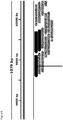
- the present invention also relates in a preferred embodiment to SSI host cells, wherein the exogenous sequences are integrated at a location spanning from position 1750049 (5' integration site) to 1760965 (3' integration site) (see figure 7 ).
- the flanking sequences are preferably located at scaffold coordinates 1750049 to 1750870 (5' end, SEQ ID No.9, 822 bp) and 1758964 to 1760965 (3' end, SEQ ID No. 7 and 8, 2000bp) (see figure 7 ).
- the present invention relates in a preferred embodiment to the SSI host cell of the present invention, wherein the nucleotide sequences of the Fer1 L4 gene flanking the integrated exogenous nucleotide sequences, namely the at least one gene coding sequence of interest which itself is flanked at its 5' and 3' end by one recombination target site each, are selected from the group consisting of SEQ ID No. 7, SEQ ID No. 8, SEQ ID No. 9 and a homologous sequence thereof with a homology of at least 40%.
- flanking sequences being homologous to the sequences given in SEQ ID No. 7, 8 or 9 have a sequence homology of at least 50, at least 60, at least 70, at least 80, at least 90, at least 95, at least 96, at least 97, at least 98, at least 99 or at least 99.5 % to these regions of the wild type Fer1 L4 gene, preferably over their full length.
- the SSI host cell of the present invention is characterized by the presence of exogenous nucleotide sequences, namely the at least one gene coding sequence of interest, which itself is flanked at its 5' and 3' end by one recombination target site each, and wherein at least one of the nucleotide sequences of SEQ ID No. 7 or 8 or a homologous sequence thereof with a homology of at least 40% is located at the 3' end of the exogenous nucleotide sequences integrated into the genome of the host cell.
- exogenous nucleotide sequences namely the at least one gene coding sequence of interest, which itself is flanked at its 5' and 3' end by one recombination target site each, and wherein at least one of the nucleotide sequences of SEQ ID No. 7 or 8 or a homologous sequence thereof with a homology of at least 40% is located at the 3' end of the exogenous nucleotide sequences integrated into the genome of the host cell.
- the SSI host cell of the present invention is characterized by the presence of exogenous nucleotide sequences, namely the at least one gene coding sequence of interest, which itself is flanked at its 5' and 3' end by one recombination target site each, and wherein at least one nucleotide sequence as given in SEQ ID No. 9 or a homologous sequence thereof with a homology of at least 40% is located at the 5' end of the exogenous nucleotide sequences integrated into the genome of the host cell.
- the SSI host cell comprises the exogenous nucleotide sequence, namely at least one gene coding sequence of interest which itself is flanked at the 5' and 3' end by one recombination target site each, which is flanked at its 3' end by at least one of the nucleotide sequences of SEQ ID No. 7, 8 or a homologous sequence thereof with a homology of at least 40% and at its 5' end by a nucleotide sequences given in SEQ ID No. 9 or a homologous sequence thereof with a homology of at least 40%.
- the given 5'- and/or 3'-flanking sequences of SEQ ID No. 7, 8, 9 or a homologous sequence thereof with a homology of at least 40% are located directly adjacent and without any intervening sequences to the 5' end or to the 3' end or to the 5' end and 3' end of the recombination target site(s) integrated in the Fer1L4 gene.
- an isolated nucleotide molecule preferably polynucleotide, comprising a portion of a Fer1 L4 gene, namely comprising at least one nucleotide sequence selected from the group consisting of the nucleotide sequences as given in SEQ ID No. 7, 8, 9 and a homologous sequence thereof with a homology of at least 40% for producing cell lines showing enhanced expression.
- an isolated nucleotide molecule preferably polynucleotide, consisting of at least one nucleotide sequence selected from the group consisting of the nucleotide sequences as given in SEQ ID No. 7, 8, 9 and a homologous sequence thereof with a homology of at least 40% for producing cell line showing enhanced expression.
- an isolated polynucleotide in a vector, preferably an expression vector, comprising the isolated nucleotide molecule of the present invention, namely SEQ ID No. 7, 8, 9 or homologues thereof with a homology of at least 40% for producing cell line showing enhanced expression.
- a transfected host cell comprising a polynucleotide molecule comprising at least one nucleotide sequence selected from the group consisting of nucleotide sequences as given in SEQ ID No. 7, 8, 9 and homologous sequences thereof with a homology of at least 40 %, or a vector containing said polynucleotide molecule and an exogenous gene coding sequence of interest within or adjacent to the polynucleotide molecule or a vector containing said polynucleotide.
- nucleic acid sequences defining the Fer1 L4 locus i. e. the nucleic acid sequence of the Fer1 L4 gene, i. e. the Fer1 L4 nucleotide sequence, in particular nucleotide sequences selected from the group consisting of nucleotide sequences as given in SEQ ID No. 7, 8, 9 and homologous sequences thereof, were herein empirically identified by sequences upstream and downstream of the integration site of a nucleic acid construct comprising an expression cassette of a cell line expressing a reporter protein at a high level.
- nucleic acid sequences of the invention provide sequences with a new functionality associated with enhanced and stable expression of a nucleic acid, for example, an exogenous nucleic acid comprising a gene coding sequence of interest that appear to function differently from that previously described for cis-acting elements such as promoters, enhancers, locus control regions, scaffold attachment regions or matrix attachment regions.
- the present nucleotide sequences do not appear to have any open reading frames (ORFs), making it unlikely that they encode transactivator proteins. Transfection experiments demonstrated that the present sequences display some characteristics of cis-acting elements. The present sequence activity is not detected in transient transfection assays; the present sequences also appear to be distinct from promoter and enhancer elements, which are detected with these methods.
- ORFs open reading frames
- the present invention also relates to the use of a Fer1 L4 nucleotide sequence, namely a nucleotide sequence selected from the group consisting of nucleotide sequences as given in SEQ ID No. 7, 8, 9 and homologous sequences thereof with a homology of at least 40%, in a vector, in particular an expression vector, in particular a non-RMCE expression vector comprising at least one gene coding sequence of interest, in particular for producing cell lines, preferably in a random process, in particular for producing cell lines showing enhanced expression, in particular for producing high producer cell lines, preferably in higher frequencies and which preferably provide greater productivity stability.
- a use fore foresees the transfection of cells with the above-identified Fer1 L4 nucleotide sequences, preferably vectors containing said nucleotide sequences and obtaining stably transfected cell lines therefrom.
- the present invention also relates to a method of producing cells or cell lines, preferably high producer cells or cell lines with high productivity stability, wherein Fer1 L4 nucleotide sequences, in particular nucleotide sequences selected from the group consisting of nucleotide sequences as given in SEQ ID No. 7, 8, 9 and homologous sequences thereof with a homology of at least 40%, integrated in a vector comprising at least one gene of interest, preferably an expression vector, preferably a non-RMCE expression vector, are transfected into cells or cell lines and the stably transfected cells or cell lines are selected and obtained.
- Fer1 L4 nucleotide sequences in particular nucleotide sequences selected from the group consisting of nucleotide sequences as given in SEQ ID No. 7, 8, 9 and homologous sequences thereof with a homology of at least 40%
- a vector comprising at least one gene of interest preferably an expression vector, preferably a non-RMCE expression vector
- the present invention preferably relates to a use of a Fer1 L4 nucleotide sequence in an expression vector for the production of a stable and highly transcriptional active cell line or cell, wherein the Fer1 L4 nucleotide sequence is selected from the group consisting of nucleotide sequences as given in SEQ ID No. 7, 8, 9 and homologous sequences thereof with a homology of at least 40%.
- the present invention preferably relates to a method for the production of a product of a gene coding sequence of interest comprising cultivating a host cell produced according to the present method for producing a cell or cell line in a suitable medium and recovering the product therefrom.
- the present invention relates in a preferred embodiment to an SSI host cell according to the present invention, wherein the exogenous nucleotide sequences include at least one wild type FRT site, preferably at least two wild type FRT sites, flanking at least one gene coding sequence of interest, or at least one mutant FRT site, preferably at least two mutant FRT sites flanking at least one gene coding sequence of interest. Most preferably, the exogenous nucleotide sequences are one wild type FRT site and one mutant FRT site flanking at least one gene coding sequence of interest.
- a gene coding sequence of interest preferably a selection marker gene
- a wild type FRT preferably located 5' to the gene coding sequence of interest, preferably the selection marker gene
- a mutant FRT site preferably located 3' to the gene coding sequence of interest, preferably the selection marker gene. This preferably ensures that recombination-mediated cassette exchange always occurs in the same orientation.
- the present invention relates in a preferred embodiment to a method for producing a SSI host cell according to the present invention comprising the steps of a) transfecting a cell, preferably comprising an endogenous Fer1 L4 gene, with a first vector comprising a first exchangeable cassette, the cassette comprising at least two recombination target sites, in particular FRT sites, flanking at least one first gene coding sequence of interest, preferably coding for a mAb, subsequently b) selecting transfected cells comprising the at least two recombination target sites, in particular FRT sites, flanking at least one first gene coding sequence of interest integrated in the endogenous Fer1 L4 gene and showing a high and stable production of the product of the first gene coding sequence of interest; subsequently c) transfecting the cells obtained in step b) with a second vector comprising a second exchangeable cassette, the cassette comprising at least two matching recombination target sites, in particular FRT sites, flanking at least one second gene coding sequence of interest
- the first and second gene coding sequence of interest is flanked at one of its ends by a first recombination target site and at its other end by a second recombination target site which is different to the first target site.
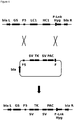
- the present invention provides for a method for producing a SSI host cell according to the present invention which method uses a recombinase-mediated cassette exchange and in the course of which a first exchangeable cassette comprising a first gene coding sequence of interest, preferably coding for a mAb, flanked by recombination target sites is transfected via a vector into a host cell, integrated into the host cell's genome, in particular a "hot-spot" thereof, and after selection of "hot-spot" transfectants a second exchangeable cassette, for instance being part of the circular exchange plasmid and being composed of at least one gene coding sequence of interest, in particular a second gene coding sequence of interest, preferably a selection marker gene, being flanked by matching recombination target sites is transfected into the host cell and allowed to recombine thereby exchanging the first gene coding sequence of interest by the second gene coding sequence of interest (see for instance figure 4 ).
- a first exchangeable cassette comprising a
- the present method for producing an SSI host cell is advantageous in so far as in steps a) and b) a "hot-spot" showing a high and stable production of a product of a gene coding sequence of interest can be identified using at least a first gene coding sequence of interest, for instance a gene encoding an antibody, e. g.
- a mAb or a part thereof and being a gene of industrial utility, for instance a biopharmaceutically relevant protein, and that in steps c), d) and e) said first gene coding sequence of interest being used to identify the interesting "hot-spot" is completely exchanged by a so-called null cassette, in particular by a second exchangeable cassette comprising at least one second gene coding sequence of interest, namely one selection marker gene.
- an SSI host cell free of pre-existing sequences of the first gene coding sequence of interest used for the identification of the "hot-spot" is created which allows a further recombinase-mediated cassette exchange to place at said "hot-spot" another gene coding sequence of interest, namely a third gene coding sequence of interest replacing the second gene coding sequence of interest, preferably the selection marker gene.
- the presently obtained SSI host cells can be used to effect a further recombinase-mediated cassette exchange to place a third gene coding sequence of interest into the genome of the host cell at the identified "hot-spot".
- matching recombination target sites means that a first site of said recombination target sites of an exchangeable cassette is identical to a first recombination target site of another exchangeable cassette and that a second recombination target site of the firstly mentioned exchangeable cassette is identical with the second recombination target site of the other exchangeable cassette thereby allowing an exchange of the nucleotide sequences in between the recombination target sites.
- the first recombination target site of both exchangeable cassettes is different to the second recombination target site of both exchangeable cassettes.
- the present invention relates in a preferred embodiment to a method for producing the product of a gene coding sequence of interest comprising the steps of i) transfecting an SSI host cell according to the present invention with a vector comprising at least one third exchangeable cassette, which cassette comprises at least two matching recombination target sites flanking at least one third gene coding sequence of interest and at least one selection marker, ii) effecting a site-directed recombination-mediated cassette exchange so as to obtain an SSI host cell comprising the third gene coding sequence of interest, iii) allowing the SSI host cell obtained in step ii) to express the third gene coding sequence of interest and iv) recovering the product of the third gene coding sequence of interest.
- One major advantage of the present invention is the provision of an intrinsic production stability which is inherited from the SSI host cell generated in step b) comprising the first gene coding sequence of interest in an identified "hot-spot", namely the Fer1 L4 gene, all the way through to an SSI host cell comprising the third gene coding sequence of interest.
- This stability is independent of selection and allows the conclusion that the "hot-spot" identified in steps a) and b) as features associated with sequences around the "hot-spot" or elsewhere in the genome. In a cell line construction based on random vector integration this is a very rare event and the effort prior to find such a site is immense.
- the present invention allows the elimination of elongated stability studies for the selection of suitable cell lines resulting in an overall shorter developmental cycle and resource reduction. Furthermore, the present invention allows to culture cells without selection after the recombination-mediated cassette exchange, meaning that the manufacture process is potentially more acceptable to regulatory agencies.
- the present "Fer1L4 hot spot" was defined and identified using a mAb, preferably not using a fluorescence marker.
- the present invention provides for a method of producing an SSI host cell in which an exogenous nucleotide sequence is introduced into an endogenous Fer1 L4 gene in a cell by targeted integration.
- Any of a variety of methods for directing a nucleotide sequence into a specified site of interest in the genome can be employed, and include homologous recombination, and nuclease mediated methods e. g. use of parvovirus-mediated homologous recombination, use of zinc finger nucleases, transcription activator-like effector nucleases, or engineered meganucleases (see, e. g. Russell and Hirata, Nat. Med. 18(4):325-30, 1998 ; US Pat. Pub. No.
- an exogenous nucleotide sequence introduced by such a method can include any of the features described herein.
- an exogenous nucleotide sequence can include at least one gene coding sequence of interest and/or at least two recombination target sites.
- the gene coding sequence of interest comprises at least one selection marker gene.
- the present invention relates to a method of producing an SSI host cell, the method comprising introducing an exogenous nucleotide sequence into an endogenous Fer1 L4 gene in a cell, wherein the exogenous nucleotide sequence comprises at least one gene coding sequence of interest and/or at least two recombination target sites.
- the exogenous nucleotide sequence is introduced by homologous recombination between the Fer1 L4 gene and a polynucleotide, wherein the polynucleotide comprises a) a first nucleotide sequence homologous to a first portion of the Fer1 L4 gene, b) the exogenous nucleotide sequence, and c) a second nucleotide sequence homologous to a second portion of the Fer1 L4 gene.
- the introduction of the exogenous nucleotide sequence is preferably facilitated using a viral vector e.g., an adeno-associated virus vector which mediates homologous recombination or an exogenous nuclease e.g., a zinc finger nuclease, a transcription activator-like effector nuclease, or an engineered meganuclease.
- a viral vector e.g., an adeno-associated virus vector which mediates homologous recombination or an exogenous nuclease e.g., a zinc finger nuclease, a transcription activator-like effector nuclease, or an engineered meganuclease.
- an adeno-associated virus vector is used.
- the exogenous nucleotide sequence is flanked by recombination target sites, preferably loxP sites.
- the present invention relates also to a method for producing an SSI host cell comprising the steps of a) providing a cell comprising an endogenous Fer1 L4 gene, wherein an exogenous nucleotide sequence is integrated in said Fer1 L4 gene, and wherein the exogenous nucleotide sequence comprises at least two recombination target sites, flanking at least one first gene coding sequence of interest; subsequently b) transfecting the cells provided in step a) with a vector comprising a first exchangeable cassette, the cassette comprising at least two matching recombinant target sites, flanking at least one second gene coding sequence of interest, namely a selection marker gene, subsequently c) effecting a site-directed recombination-mediated cassette exchange and subsequently d) selecting transfected cells expressing second gene coding sequence of interest, preferably the selection marker gene, so as to obtain the SSI host cell comprising the first exchangeable cassette stably integrated in its genome.
- the present invention also relates to the above-identified method further comprising i) transfecting the SSI host cell with a vector comprising at least one second exchangeable cassette, which cassette comprises at least two matching recombination target sites flanking at least one third gene coding sequence of interest and at least one selection marker, ii) effecting a site-directed recombination-mediated cassette exchange so as to obtain a SSI host cell comprising the third gene coding sequence of interest, iii) allowing the SSI host cell obtained in step ii) to express the third gene coding sequence of interest and iv) recovering the product of the third gene coding sequence of interest.
- the present invention also discloses the use of a cell, preferably a CHO cell, comprising an endogenous Fer1 L4 gene, preferably a CHO Fer1 L4 gene, for the production of a stable and highly transcriptionally-active cell line.
- the SV40 early promoters used (apart from the one associated with the GS transcription unit, which was derived from pCB72.3-GA-HC-LC), were obtained from the aforementioned Invitrogen vectors.
- Thymidine kinase (TK) and PAC gene sequences in pRY37 were derived from pWSTK6 (gb:EU530625) and pPUR (Clontech, gb:U07648), respectively.
- cells were seeded at 3 x 10 5 viable cells/mL in 125 mL shake flasks in 30 mL of CD CHO supplemented with various selective agents (as described later) and incubated at 37° C in a humidified 5% CO 2 in air (v/v) orbital shaking incubator at 140 rpm.
- Conditioned medium was harvested at day 7 of the culture and the antibody concentration in the conditioned medium was determined by Protein A HPLC.
- cells were seeded at 3 x 10 5 cells/mL in 500 mL shake flasks, each containing 100 mL of proprietary medium and incubated at 37° C in a humidified 5% CO 2 in air (v/v) orbital shaking incubator at 140 rpm. Cells were fed starting on day 3 of the culture with a proprietary feed consisting of mixture of amino acid and trace elements. Daily viabilities and viable cell concentrations were determined using a Vi-CELLTM automated cell viability analyzer. Antibody concentration in the medium was determined by Protein A HPLC starting on day 6 of the culture through to its harvest on day 14.
- Single-cell cloning was performed on a FACS Aria II cell sorter equipped with FACSDiva v6.0 software with an air-cooled laser emitting at 488 nm. Dead cells were excluded in a FSC vs. SSC dot plot, and the doublets were excluded in a FSC width vs. area dot plot.
- the sorting gate for the live cells was a combination of the two dot plots.
- Transfection of the parental pRY17-expressing cell line with the null vector, pRY37, comprising the second gene coding sequence of interest, namely the selection marker gene, was conducted using FreeStyleTM MAX CHO system (Invitrogen). To this end, 24 h before the re-transfection for RMCE, a selected pRY17-transfected cell line (11A7) was first seeded in FreeStyleTM CHO Expression Medium at 5 x 10 5 cells/mL in a 125 mL shake flask.
- RMCE experiments are divided into 3 distinct 'rounds', and are referred to both here and later in the results section below (rounds are defined in figure 6 ).
- transfection of the SSI host cell 10E9 with the SSI targeting vector, pRY21 was conducted using FreeStyleTM MAX CHO system (Invitrogen).
- 10E9 SSI host cells were first seeded at a concentration 5 x 10 5 cells/mL in a 125 mL shake flask containing FreeStyleTM CHO Expression Medium (Invitrogen) supplemented with 25 ⁇ M MSX and 1 ⁇ g/mL puromycin.
- the mAb concentration in medium from wells with visible cell growth was determined on a ForteBio Octect using a Protein A biosensor. Clones secreting mAb into the culture medium were expanded and maintained in shake flasks containing CD CHO supplemented with 200 ⁇ g/mL hygromycin and 25 ⁇ M MSX. These clones were further evaluated for antibody productivity in batch shake flask analysis (as described earlier). For the stability analysis, MSX was removed from the sub-culture for the conditions as specified in the figure 6 .
- Beta-lactamase (bla) gene-specific primers specific for bla in the 3' arm of the schematic of linearly-integrated pRY17 vector (bla R, figure 3 ) in GS-CHOK1SV cell line 11A7, TSP1fwd (SEQ ID No. 4), TSP2fwd (SEQ ID No. 5) and TSP3fwd (Seq ID No. 6) were used.
- 10E9 genomic DNA was fragmented and a paired-end library suitable for HiSeq platform sequencing was prepared using the TrueSeq DNA Sample Preparation kit, following manufacturer's instructions.
- the library generated was within the expected size range of 300bp to 500bp.
- QC analysis of the generated library using an Agilent 2100 Bioanalyzer (indicated that the library was of acceptable quality, containing the expected fragment size and yield, for continued sample processing.
- the library generated was used in the cBot System for cluster generation, following manufacturer's instructions.
- the flow cells containing amplified clusters were sequenced using 2x100 base pair paired-end sequencing on a Hi-Seq 2000.
- the reads are mapped to CHO-K1 contigs ( Xu X et al. 2011, Nature Biotechnol. 29:735-742 ) using the Burrows-Wheeler Aligner (BWA) (Li H. and Durbin R. 2009 25:1754-1760).
- BWA
- phase I was to generate a high-producing mAb-expressing GS-CHOK1 SV cell line, exhibiting favorable growth characteristics with stable productivity, containing only a single integration locus and the lowest possible number of vector integrants at this locus.
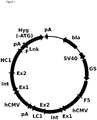
- pRY17 the 48 bp wild type F and mutant F5 recombination sequences flank the HC and LC transcription units of the mAb.
- the vector-derived GS gene was placed outside of exchangeable cassette so that it would be retained in the genome of resulting cell lines after RMCE. By doing so, any potential perturbation of glutamine metabolism in any derivative cell line was avoided; the parental GS-CHOK1 SV cell lines were selected in glutamine-free medium and 50 ⁇ M methionine sulfoximine (MSX), in the presence of both endogenous and vector-derived glutamine synthetase expression.
- MSX methionine sulfoximine
- a promoterless and translation initiation methionine-deficient (-ATG) hygromycin B phosphotransferase gene were placed in-between sequence encoding linker (Lnk) and the F recombination sequence ( figure 1 ).
- the vectors used for RMCE in the second phase of this study contain the SV40 early promoter and the initiation methionine (ATG) required to express hygromycin resistance.
- a fully-functional hygromycin resistance gene is only created when recombination occurs with the wild type F recombination sequence in the genome ( figure 1 ).
- the pRY17 vector containing FRT recombination sequences was introduced into CHOK1 SV cells by a conventional cell line development procedure, followed by an intensive screen conducted at key stages of the process to ensure that we isolated cell lines with the best combination of growth and productivity. Additionally, cB72.3 protein derived from the chosen cell lines has to exhibit similar product quality characteristics as a preparation derived from a previous GS-CHOK1 SV cell line ( Birch and Racher, 2006, Adv Drug Deliv Rev 58:671-685 ). The HC and LC gene copy numbers from candidate cell lines are preferred to be close to one for each. To this end, three independent electroporations were conducted and each with 50 ⁇ g of linearized pRY17 and 1 x 10 7 CHOK1 SV cells.
- Transfectants from all three electroporations were selected in medium containing 50 ⁇ M MSX and ⁇ 1500 surviving cell pools were screened for antibody production at 3 weeks post-transfection. Eventually a total of 79 clones were evaluated by the 7 day batch shake flask and cB72.3 mAb concentration of all 79 clones was determined. All RMCE derivative cell lines were maintained in medium containing 25 ⁇ M MSX, except where stated. From the 79 clones evaluated, 38 were selected for further analysis in fed-batch shake flask culture. The top 6 best-performing clones based on productivity and growth characteristics were selected (table 1) for genetic characterization (see methods).
- Cell Line Batch Fed-Batch Product Concentration (mg/L) - day 7 Estimate of IVCC (10 6 cells day/mL) Product Concentration (mg/L)-day 14 Specific Production Rate (pg/cell.day) Peak Cell Density (10 6 cells/mL) 1G11 637.73 73.55 3385 47.3 9.00 6B5 273.73 97.89 2029 21.2 13.40 8F10 427.41 125.46 2976 25.0 15.32 11A7 457.88 149.6 3570 25.1 19.13 14D11 378.83 86.32 3251 39.2 10.33 18C11 480.27 90.45 2953 35.0 11.05
- the gene copy numbers per cell for both the HC and LC were calculated as the ratio of averaged copies to averaged GAPDH copies. As shown in table 2, out of the 5 clones analyzed, 11A7 has the lowest HC and LC gene copy numbers. Southern blot analysis of the genomic DNA revealed that both HC and LC can be detected in all 5 clones and the intensity of bands reflects the qPCR-determined gene copy numbers (data not shown).
- Table 2 Gene copy analysis of the cB72.3 HC and LC in 5 of the 6 clonal cell lines using qPCR Cell Line HC average copies/cell LC average copies/cell 1G11 15.58 13.95 6B5 44.46 47.91 8F10 40.46 38.41 11A7 6.57 3.57 14D1 9.75 9.31
- 11A7 maintained similar productivity over 7 months (220 generations), whereas other clones showed gradual productivity loss during the first 3 months of the study (80 generations).
- 11A7 not only has one of the best combinations of good growth and productivity profiles, but also has the lowest gene copy number with a single integration site.
- 11A7 is the most stable clone out of the 6 in terms of productivity. Most importantly product quality was comparable after 220 generations.
- 11A7 was chosen as the parental clone for the first round of RMCE: Phase II.
- Table 3 Stability analyses of the top 5 SSI clonal cell lines.
- Antibody production at given generation number Cell line 10 40 80 100 120 140 160 180 200 220 1G11 2809.00 2977.00 2675.86 2553.18 2464.09 2047.00 - - - - 11A7 2946.00 2776.82 2546.47 2464.99 2395.90 2421.00 2425.00 2498.00 2496.00 2676.00 6B5 1548.00 1791.94 1580.33 - - - - - - 8F10 2433.00 2593.00 2760.20 - - - - - - 14D11 2629.00 2521.08 2358.44 - - - - - - - - - -
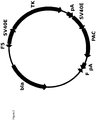
- pRY37 ( figure 2 ) was designed that does not encode mAb genes. Instead it encodes positive and negative selection markers, puromycin acetyl transferase (PAC) and thymidine kinase (TK), respectively, and these were flanked with F and F5 recombination sequences in the same orientation as pRY17 ( figure 1 ). After RMCE, these markers are expected to replace the original cB72.3 mAb in the same locus in the original 11A7 genome.
- PAC puromycin acetyl transferase
- TK thymidine kinase
- PAC is required to select for cell lines that have undergone RMCE with pRY37.
- TK converts the prodrug ganciclovir into a toxic, phosphorylated nucleotide analogue ( Wood and Crumpacker, 1996, New England Journal of Medicine 335, pages 721 to 729 ). This is important for the application of negative selection later in phase III: Ganciclovir selection enriches the RMCE pool for cells that have undergone legitimate RMCE, by killing those that have not.
- 136-A4 was chosen for further characterization by Southern blot analysis (data not shown). It confirmed the presence of TK in the 136-A4 genome. Restriction mapping indicated the presence of only two copies of pRY37 in the "hot-spot" and was confirmed by subsequent genome sequencing of the daughter clone 10E9. The copy number is substantially lower than pRY17 found in 11A7 (table 2). To obtain a homogenous SSI host, we single-cell cloned 136-A4 using FACS Aria II and obtained growth profiles of 26 clonal derivatives.
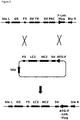
- pRY21 In order to demonstrate the utility of the new SSI host cell line 10E9, a targeting vector, pRY21 was designed ( figure 3 ).
- This vector contains HC and LC genes for the Myo mAb, flanked by F and F5 recombination sequences in the same orientation as found in both pRY17 (phase I) and pRY37 (phase II) vectors. It also contains a SV40 early promoter (SV40E) upstream of a methionine initiation codon fused in-frame to the F recombination sequence (ATG + F).
- SV40E SV40 early promoter
- the ATG + F sequence is placed in frame with the promoterless and translation initiation methionine-deficient (-ATG) hygromycin B phosphotransferase gene.
- Three rounds of co-transfection of 10E9 cells with pRY21 and pOG44 were performed. In the first two rounds cells were transfected with Free styleTM MAX CHO system, whereas in round 3 cells were transfected by electroporation.
- round 1 was co-selected with ganciclovir and hygromycin as pools; round 2 was sequentially selected first with 400 ⁇ g/mL of hygromycin followed by ganciclovir as pools and were then subsequently single-cell cloned using a FACS Aria II; round 3 was sequentially selected first with either 200 or 400 ⁇ g/mL of hygromycin followed by ganciclovir as pools and then were subsequently single-cell cloned using a FACS Aria II ( figure 6 ). In round 3, MSX was absent from the culture medium in two of the test conditions.
- GS-CHOK1V cell line 11A7
- This stability trait could be inherited in derivative cell lines generated by RMCE in phase III.
- 3 cell pools from round I from phase III were evaluated in an extended stability study under two different conditions (Table 4).
- 500 bp 3' flanking sequence (SEQ ID No. 7) sequence derived from Seegene DNA walking from bla R ( figure 3 ) was used to blast-search the contigs of a CHO-K1 genome sequencing project ( Xu X et al. 2011, Nature Biotechnol. 29:735-742 ), publically available in the NCBI databank.
- a unique region located on unplaced genomic scaffold, scaffold1492 (accession number, JH000254.1, identical to New_003613833.1) was found on the minus strand from 1760466-1760965.
- the 500 bp sequence (SEQ ID No. 7) was extendend to 2000 bp (Seq ID No. 8) based high coverage mapping of the 10E9 reads to the scaffold 1492 (data not shown).
- Illumina reads from 10E9 genomic DNA were mapped to pRY17 (SEQ ID No. 1) using the Burrows-Wheeler Aligner (BWA). Through inspection of the mapping, it was found that multiple unpaired reads (black arrows in the Figure 8 ) mapped to the 5' end of a 3' portion of the cB72.3 HC. This analsyis suggests at least one fragment of cB72.3 HC (with 214 bp deleted from the 5' end) remains in the 10E9 "hot-spot".
- BWA Burrows-Wheeler Aligner
- genomic DNA isolated from passages 2 and 4 of each clone and purified using Blood & Cell Culture DNA Maxi Kit from QIAGEN (Qiagen), was digested with restriction endonuclease(s) for 15 h at 37 °C.
- the digested DNA was extracted twice with an equal volume of a phenol:chloroform:isoamyl alcohol mixture, pH8.0 (1:1 v/v) followed by chloroform alone and ethanol-precipitated prior to electrophoresis on 0.7% (w/v) agarose gel run in either 0.5 x TBE (50 x TBE: Lonza) or 1 x TAE (40 mM Tris, pH 7.7, 2.5 mM EDTA) buffer.
- the gel was transferred onto Hybond-N membrane (Amersham) using a vacuum manifold essentially according to manufacturer's instructions (Appligene, Pharmacia).
- Hybond-N membranes were UV-fixed, pre-hybridized in either hybridization buffer containing 5 x Denhardt's prepared from 50 x stock solution (Sigma), 6 x SSC (1 x SSC: 0.15 M sodium chloride, 15 mM sodium citrate), and 10 % (w/v) SDS or Rapid-hyb Buffer (GE healthcare) alone.
- hybridization buffer containing 5 x Denhardt's prepared from 50 x stock solution (Sigma), 6 x SSC (1 x SSC: 0.15 M sodium chloride, 15 mM sodium citrate), and 10 % (w/v) SDS or Rapid-hyb Buffer (GE healthcare) alone.
- TK probes were generated in PCRs using the following primer sets:
- the paired end reads in FASTQ format are the input for mapping to genomics templates. Vector sequences and CHOK1 SV assembly are indexed as the templates to be mapped to.
- the paired end reads are aligned to the templates using Bowtie2 ( Langmead B, & Salzberg SL, 2012, Nature methods, 9 (4), 357-9 ) with the default parameters (-D 5 -R 1 -N 0 -L 25 -i S,1,2.00) for very fast local alignment. Coverage is normalized as the ⁇ raw coverage>*500M / ⁇ number of reads> in order to compare across different samples.
- landing pad exogenous sequences introduced into the hot-spot that contain recombination sites for the integration of expression cassettes of genes of interest by RMCE
- WGRS whole-genome re-sequencing
- RNA-seq sequencing reads were mapped to the template by BWA using default parameters.
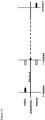
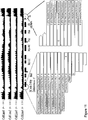
- a model of the structure of the landing pad within the Fer1 L4 hot-spot was inferred from the expected RMCE events occurring during the creation of cell line 10E9 from 11A7 using the null targeting vector pRY37 ( figure 4 ).
- This model is termed the 'single-copy' model and was consistent with the WGRS data from cell line 10E9 ( figure 9A ).
- the Southern blot data suggested that the model should actually contain two copies ( figure 9B ).
- This 'two-copy' model was refined on the basis of the data and was used to help interpret mAb-producing cell lines derived by RMCE in the 10E9 host.
- the 'two-copy' model allows us to explain why either one or two copies of antibody transcription units can be incorporated into the landing pad by RMCE with the targeting vector pRY21.
- the sequencing reads from each of their genomes were mapped to a model where one copy was integrated into the hot-spot.
- the number of Myo copies was derived from the mean average coverage on LC and HC region.
- the mean coverage for these four cell lines are 41, 34, 18, 27 on LC and 32, 27, 14, 19 on HC region, respectively.
- the coverage data indicate that for high producers, there may be at least one more copy of HC and LC (table 7).
- the coverage data is shown graphically in figure 11 .
- Table 7 Sequence read coverage and specific production rate (qP) of Myo producing RMCE cell lines. Copy number is indicated in brackets next to the coverage value.
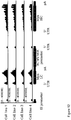
- RNA-Seq data was obtained from each cell line.
- the sequencing reads from RNA-Seq from RNA derived from each Myo cell line were mapped to one the original 'one-copy' model ( figure 12 ) using by BWA ( Li H. and Durbin R. 2009, Bioinformatics, 25:1754-60 ) run with default parameters.
- the number of Myo copies was derived by calculating RPKM values ( Mortazavi et al.(2008), Nature Methods 5, 621-628 ) for the LC and HC regions.
- RPKM values are 43135, 40059, 23204, 29334 in LC and 38572, 32384, 17878, 20751 in HC region, respectively. These data also confirm the 'two-copy' model proposed for high producers we derived from whole genome sequencing.
Landscapes
- Health & Medical Sciences (AREA)
- Life Sciences & Earth Sciences (AREA)
- Genetics & Genomics (AREA)
- Chemical & Material Sciences (AREA)
- Engineering & Computer Science (AREA)
- Organic Chemistry (AREA)
- Zoology (AREA)
- Wood Science & Technology (AREA)
- General Engineering & Computer Science (AREA)
- Bioinformatics & Cheminformatics (AREA)
- Biotechnology (AREA)
- Molecular Biology (AREA)
- Biomedical Technology (AREA)
- Biochemistry (AREA)
- General Health & Medical Sciences (AREA)
- Biophysics (AREA)
- Microbiology (AREA)
- Plant Pathology (AREA)
- Physics & Mathematics (AREA)
- Mycology (AREA)
- Proteomics, Peptides & Aminoacids (AREA)
- Immunology (AREA)
- Medicinal Chemistry (AREA)
- Cell Biology (AREA)
- Crystallography & Structural Chemistry (AREA)
- Chemical Kinetics & Catalysis (AREA)
- General Chemical & Material Sciences (AREA)
- Virology (AREA)
- Micro-Organisms Or Cultivation Processes Thereof (AREA)
- Preparation Of Compounds By Using Micro-Organisms (AREA)
Claims (22)
- SSI (site-specific integration)-Wirtszelle umfassend ein endogenes Fer1L4-Gen, wobei in das Fer1L4-Gen eine exogene Nukleotidsequenz integriert ist und wobei die exogene Nukleotidsequenz mindestens zwei Rekombinations-Zielstellen umfasst.
- SSI-Wirtszelle nach Anspruch 1, wobei die exogene Nukleotidsequenz eine Gen-kodierende Sequenz von Interesse umfasst.
- SSI-Wirtszelle nach Anspruch 2, wobei die mindestens zwei Rekombinations-Zielstellen die Gen-kodierende Sequenz von Interesse flankieren.
- SSI-Wirtszelle nach Anspruch 2 oder 3, wobei die Gen-kodierende Sequenz von Interesse ein oder mehrere Gen(e) umfasst, das/die für einen Selektionsmarker, ein nachweisbares Protein, einen Antikörper, ein Peptidantigen, ein Enzym, ein Hormon, einen Wachstumsfaktor, einen Rezeptor, ein Fusionsprotein oder sonstiges biologisch aktives Protein kodiert/kodieren.
- SSI-Wirtszelle nach Anspruch 1, wobei es sich bei der Rekombination-Zielstelle um eine SRT-Site oder eine lox-Site handelt.
- SSI-Wirtszelle nach Anspruch 4, wobei es sich bei dem Selektionsmarker um einen GS-Selektionsmarker, einen Hygromycin-Selektionsmarker, einen Puromycin-Selektionsmarker oder einen Thymidinkinase-Selektionsmarker handelt.
- SSI-Wirtszelle nach einem der vorangehenden Ansprüche, wobei es sich bei der Wirtszelle um eine Mauszelle, eine Humanzelle oder eine CHO-Wirtszelle, eine CHOK1-Wirtszelle oder eine CHOK1SV-Wirtszelle handelt.
- SSI-Wirtszelle nach einem der vorangehenden Ansprüche, wobei die Nukleotidsequenz des Fer1L4-Gens, die die integrierte exogene Nukleotidsequenz flankiert, ausgewählt ist aus der Gruppe bestehend aus SEQ ID Nr. 7, 8, 9 und dazu homologen Sequenzen mit einer Homologie von mindestens 40 %.
- SSI-Wirtszelle nach einem der vorangehenden Ansprüche, wobei die exogene Nukleotidsequenz einen Teil des Fer1L4-Gens ersetzt.
- SSI-Wirtszelle nach Anspruch 5, wobei die Wirtszelle eine FRT-Site umfasst, bei der es sich um eine Wildtyp-FRT-Site oder eine mutierte FRT-Site handelt.
- SSI-Wirtszelle nach Anspruch 1, wobei die Rekombinations-Zielstellen mindestens eine Wildtyp-FRT-Site und mindestens eine mutierte FRT-Site umfassen.
- Verfahren zur Herstellung einer SSI-Wirtszelle, umfassend die Schrittea) Bereitstellen einer Zelle umfassend ein endogenes Fer1L4-Gen, wobei in das Fer1L4-Gen eine exogene Nukleotidsequenz integriert ist und wobei die exogene Nukleotidsequenz mindestens zwei Rekombinations-Zielstellen umfasst, die mindestens eine erste Gen-kodierende Sequenz von Interesse flankieren, und anschließendb) Transfizieren der in Schritt a) bereitgestellten Zellen mit einem Vektor, der eine erste austauschbare Kassette umfasst, wobei die Kassette mindestens zwei zueinander passende Rekombinations-Zielstellen umfasst, die mindestens eine zweite Gen-kodierende Sequenz von Interesse flankieren, nämlich ein Selektionsmarkergen, und anschließendc) Bewirken eines ortsspezifischen rekombinationsvermittelten Kassettenaustausches, und anschließendd) Selektieren von transfizierten Zellen, welche die zweite Gen-kodierende Sequenz von Interesse exprimieren, bevorzugt das Selektionsmarkergen, um die SSI-Wirtszelle, die eine erste stabil in das Genom integrierte austauschbare Kassette enthält, zu erhalten.
- Verfahren nach Anspruch 12, darüber hinaus umfassend i) Transfizieren der SSI-Wirtszelle mit einem Vektor, der mindestens eine zweite austauschbare Kassette umfasst, wobei die Kassette mindestens zwei zueinander passende Rekombinations-Zielstellen umfasst, die mindestens eine dritte Gen-kodierende Sequenz von Interesse und mindestens einen Selektionsmarker flankieren, ii) Bewirken eines ortsspezifischen rekombinationsvermittelten Kassettenaustausches, um eine SSI-Wirtszelle zu erhalten, welche die dritte Gen-kodierende Sequenz von Interesse umfasst, iii) der in Schritt ii) erhaltenen SSI-Wirtszelle die Expression der dritten Gen-kodierende Sequenz von Interesse ermöglichen und iv) Erhalten des Produktes der dritten Gen-kodierende Sequenz von Interesse.
- Verwendung eines isolierten Polynukleotidmoleküls, das mindestens eine Nukleotidsequenz ausgewählt aus der Gruppe bestehend aus Nukleotidsequenzen entsprechend SEQ ID Nr. 7, 8, 9 und dazu homologen Sequenzen mit einer Homologie von mindestens 40 % umfasst, zur Produktion von Zelllinien mit verstärkter rekombinanter Expression.
- Verwendung nach Anspruch 14, wobei das Polynukleotid in einem Vektor enthalten ist.
- Wirtszelle, wobei die Wirtszelle ein Polynukleotidmolekül umfasst, das mindestens eine Nukleotidsequenz ausgewählt aus der Gruppe bestehend aus Nukleotidsequenzen entsprechend SEQ ID Nr. 7, 8, 9 und dazu homologen Sequenzen mit einer Homologie von mindestens 40 % umfasst, oder einen Vektor, der das Polynukleotidmolekül und eine exogene Gen-kodierende Sequenz von Interesse innerhalb des oder angrenzend an das Polynukleotidmolekül enthält oder den Vektor, der das Polynukleotid enthält.
- Verfahren zur Herstellung einer Zelle oder Zelllinie, insbesondere einer hoch produktiven Zelle oder Zelllinie mit einer hohen Produktivitätsstabilität, wobei eine Fer1L4-Nukleotidsequenz in einen Vektor integriert ist, der mindestens eine Gen-kodierende Sequenz von Interesse umfasst, wobei der Vektor anschließend stabil in eine Zelle oder Zelllinie transfiziert wird und wobei anschließend stabil transfizierte Zellen oder Zelllinien selektiert und erhalten werden.
- Verfahren nach Anspruch 17, wobei es sich bei der Fer1L4-Nukleotidsequenz um eine Nukleotidsequenz ausgewählt aus der Gruppe bestehend aus Nukleotidsequenzen entsprechend SEQ ID Nr. 7, 8, 9 und dazu homologen Sequenzen mit einer Homologie von mindestens 40 %, handelt.
- Verfahren zur Herstellung eines Produkts einer Gen-kodierenden Sequenz von Interesse, umfassend das Kultivieren einer nach dem Verfahren nach den Ansprüchen 12 oder 17 hergestellten Wirtszelle oder Zelllinie in einem geeigneten Medium und Erhalten des Produktes daraus.
- Verfahren zur Herstellung einer SSI-Wirtszelle, wobei das Verfahren das Einbringen einer exogenen Nukleotidsequenz in ein endogenes Fer1L4-Gen in einer Zelle umfasst, wobei die exogene Nukleotidsequenz mindestens eine Gen-kodierende Sequenz von Interesse und/oder mindestens zwei Rekombinations-Zielstellen umfasst.
- Verfahren nach Anspruch 20, wobei die exogene Nukleotidsequenz durch homologe Rekombination zwischen dem Fer1L4-Gen und einem Polynukleotid eingebracht wird, wobei das Polynukleotida) eine erste Nukleotidsequenz aufweist, die zu einem ersten Teil des Fer1L4-Gens homolog ist,b) die exogene Nukleotidsequenz aufweist undc) eine zweite Nukleotidsequenz aufweist, die zu einem zweiten Teil des Fer1L4-Gens homolog ist.
- Verfahren nach Anspruch 20, wobei das Einbringen der exogenen Nukleotidsequenz durch Verwendung eines viralen Vektors (zum Beispiel ein adenoassoziierter Virusvektor, der eine homologe Rekombination vermittelt) oder einer exogenen Nuklease (zum Beispiel eine Zinkfingernuklease, eine transkriptionsaktivatorähnliche Effektornuklease oder eine konstruierte Meganuklease) ermöglicht wird.
Priority Applications (1)
| Application Number | Priority Date | Filing Date | Title |
|---|---|---|---|
| EP13729962.4A EP2864489B1 (de) | 2012-06-22 | 2013-06-20 | Ortsspezifische integration |
Applications Claiming Priority (4)
| Application Number | Priority Date | Filing Date | Title |
|---|---|---|---|
| US201261663147P | 2012-06-22 | 2012-06-22 | |
| EP12185330.3A EP2711428A1 (de) | 2012-09-21 | 2012-09-21 | Ortsspezifische Integration |
| PCT/EP2013/062859 WO2013190032A1 (en) | 2012-06-22 | 2013-06-20 | Site-specific integration |
| EP13729962.4A EP2864489B1 (de) | 2012-06-22 | 2013-06-20 | Ortsspezifische integration |
Publications (2)
| Publication Number | Publication Date |
|---|---|
| EP2864489A1 EP2864489A1 (de) | 2015-04-29 |
| EP2864489B1 true EP2864489B1 (de) | 2017-03-29 |
Family
ID=46888327
Family Applications (2)
| Application Number | Title | Priority Date | Filing Date |
|---|---|---|---|
| EP12185330.3A Withdrawn EP2711428A1 (de) | 2012-06-22 | 2012-09-21 | Ortsspezifische Integration |
| EP13729962.4A Active EP2864489B1 (de) | 2012-06-22 | 2013-06-20 | Ortsspezifische integration |
Family Applications Before (1)
| Application Number | Title | Priority Date | Filing Date |
|---|---|---|---|
| EP12185330.3A Withdrawn EP2711428A1 (de) | 2012-06-22 | 2012-09-21 | Ortsspezifische Integration |
Country Status (18)
| Country | Link |
|---|---|
| US (2) | US10280436B2 (de) |
| EP (2) | EP2711428A1 (de) |
| JP (1) | JP6053923B2 (de) |
| KR (1) | KR101761709B1 (de) |
| CN (1) | CN104379753B (de) |
| AU (1) | AU2013279333C1 (de) |
| BR (1) | BR112014032299B1 (de) |
| CA (1) | CA2876280C (de) |
| DK (1) | DK2864489T3 (de) |
| EA (1) | EA034039B1 (de) |
| ES (1) | ES2629509T3 (de) |
| IL (1) | IL236347A0 (de) |
| IN (1) | IN2014MN02518A (de) |
| MX (1) | MX351727B (de) |
| PL (1) | PL2864489T3 (de) |
| SG (1) | SG11201408576QA (de) |
| TW (1) | TWI523946B (de) |
| WO (1) | WO2013190032A1 (de) |
Cited By (1)
| Publication number | Priority date | Publication date | Assignee | Title |
|---|---|---|---|---|
| US12529050B2 (en) | 2018-10-26 | 2026-01-20 | Hoffmann-La Roche Inc. | Multispecific antibody screening method using recombinase mediated cassette exchange |
Families Citing this family (23)
| Publication number | Priority date | Publication date | Assignee | Title |
|---|---|---|---|---|
| GB201407852D0 (en) | 2014-05-02 | 2014-06-18 | Iontas Ltd | Preparation of libraries od protein variants expressed in eukaryotic cells and use for selecting binding molecules |
| JP2018518985A (ja) | 2015-04-27 | 2018-07-19 | モメンタ ファーマシューティカルズ インコーポレイテッド | 治療用タンパク質の製造方法 |
| US11098310B2 (en) | 2016-01-27 | 2021-08-24 | Just-Evotec Biologics, Inc. | Expression from transposon-based vectors and uses |
| US11261462B2 (en) | 2016-01-27 | 2022-03-01 | Just-Evotec Biologics, Inc. | Inducible expression from transposon-based vectors and uses |
| JP6937309B2 (ja) | 2016-01-27 | 2021-09-22 | ジャスト−エヴォテック バイオロジックス、インコーポレイテッド | ハイブリッドプロモーターおよびその使用 |
| SG10202010156XA (en) | 2016-04-20 | 2020-11-27 | Regeneron Pharma | Compositions and methods for making antibodies based on use of an expression-enhancing locus |
| IL262266B2 (en) | 2016-04-20 | 2025-01-01 | Regeneron Pharma | Compositions and methods for preparing antibodies based on the use of LOCI enhancer expression |
| CN110914413A (zh) * | 2017-02-17 | 2020-03-24 | 隆萨有限公司 | 产生腺相关病毒的哺乳动物细胞 |
| US20200002727A1 (en) * | 2017-02-17 | 2020-01-02 | Lonza Ltd. | Multi-site specific integration cells for difficult to express proteins |
| GB201703418D0 (en) * | 2017-03-03 | 2017-04-19 | Ge Healthcare Bio Sciences Ab | Method for cell line development |
| JP7177076B2 (ja) | 2017-03-16 | 2022-11-22 | ファイザー・インク | チロシン原栄養性 |
| CN107557390A (zh) * | 2017-09-18 | 2018-01-09 | 江南大学 | 一种筛选cho细胞系高表达位点的方法 |
| IL275462B2 (en) * | 2017-12-22 | 2026-01-01 | Genentech Inc | Targeted integration of nucleic acids |
| JP7549582B2 (ja) * | 2018-10-01 | 2024-09-11 | ロンザ リミテッド | 予測可能かつ安定な導入遺伝子発現を有するssi細胞および形成の方法 |
| EP3980544A1 (de) * | 2018-12-21 | 2022-04-13 | F. Hoffmann-La Roche AG | Gezielte integration von nukleinsäuren |
| SG11202110076PA (en) * | 2019-04-02 | 2021-10-28 | Chugai Pharmaceutical Co Ltd | Method of introducing target-specific foreign gene |
| CN114746554A (zh) | 2019-11-14 | 2022-07-12 | 隆萨有限公司 | 细胞选择的方法 |
| KR102335242B1 (ko) | 2020-05-22 | 2021-12-02 | 인천대학교 산학협력단 | Fer1L4 유전자에 부위-특이적 통합된 RMCE 랜딩 패드를 포함하는 CHO 세포 |
| US20230287455A1 (en) | 2020-07-30 | 2023-09-14 | Pfizer Inc. | Cells Having Gene Duplications and Uses Thereof |
| US20240327496A1 (en) | 2021-08-02 | 2024-10-03 | Pfizer Inc. | Improved Expression Vectors and Uses Thereof |
| KR20240099288A (ko) | 2021-10-18 | 2024-06-28 | 리제너론 파마슈티칼스 인코포레이티드 | 아데노바이러스-연관 바이러스 폴리뉴클레오티드를 포함하는 진핵세포 |
| KR20240139082A (ko) | 2022-02-02 | 2024-09-20 | 화이자 인코포레이티드 | 시스테인 프로토트로피 |
| CN119955730A (zh) * | 2023-11-08 | 2025-05-09 | 深圳太力生物技术有限责任公司 | 一种细胞株及其制备方法与应用 |
Family Cites Families (5)
| Publication number | Priority date | Publication date | Assignee | Title |
|---|---|---|---|---|
| FR2646438B1 (fr) | 1989-03-20 | 2007-11-02 | Pasteur Institut | Procede de remplacement specifique d'une copie d'un gene present dans le genome receveur par l'integration d'un gene different de celui ou se fait l'integration |
| JP2001522244A (ja) | 1997-04-24 | 2001-11-13 | ユニバーシティ オブ ワシントン | パルボウイルスベクターによる標的化した遺伝子改変 |
| BRPI0513706A (pt) * | 2004-07-20 | 2008-05-13 | Symphogen As | anticorpo policlonal recombinante anti-rhesus d e métodos de produção |
| JP4665115B2 (ja) * | 2004-08-06 | 2011-04-06 | 独立行政法人理化学研究所 | 骨・関節疾患感受性遺伝子およびその用途 |
| CA2615532C (en) | 2005-07-26 | 2016-06-28 | Sangamo Biosciences, Inc. | Targeted integration and expression of exogenous nucleic acid sequences |
-
2012
- 2012-09-21 EP EP12185330.3A patent/EP2711428A1/de not_active Withdrawn
-
2013
- 2013-06-20 MX MX2014015612A patent/MX351727B/es active IP Right Grant
- 2013-06-20 EA EA201590068A patent/EA034039B1/ru not_active IP Right Cessation
- 2013-06-20 KR KR1020157000511A patent/KR101761709B1/ko active Active
- 2013-06-20 EP EP13729962.4A patent/EP2864489B1/de active Active
- 2013-06-20 CA CA2876280A patent/CA2876280C/en active Active
- 2013-06-20 IN IN2518MUN2014 patent/IN2014MN02518A/en unknown
- 2013-06-20 US US14/409,283 patent/US10280436B2/en active Active
- 2013-06-20 CN CN201380032837.8A patent/CN104379753B/zh active Active
- 2013-06-20 SG SG11201408576QA patent/SG11201408576QA/en unknown
- 2013-06-20 JP JP2015517758A patent/JP6053923B2/ja active Active
- 2013-06-20 BR BR112014032299-6A patent/BR112014032299B1/pt not_active IP Right Cessation
- 2013-06-20 AU AU2013279333A patent/AU2013279333C1/en not_active Ceased
- 2013-06-20 WO PCT/EP2013/062859 patent/WO2013190032A1/en not_active Ceased
- 2013-06-20 ES ES13729962.4T patent/ES2629509T3/es active Active
- 2013-06-20 PL PL13729962T patent/PL2864489T3/pl unknown
- 2013-06-20 DK DK13729962.4T patent/DK2864489T3/en active
- 2013-06-21 TW TW102122188A patent/TWI523946B/zh not_active IP Right Cessation
-
2014
- 2014-12-18 IL IL236347A patent/IL236347A0/en active IP Right Grant
-
2018
- 2018-10-31 US US16/176,525 patent/US11326185B2/en active Active
Non-Patent Citations (1)
| Title |
|---|
| None * |
Cited By (1)
| Publication number | Priority date | Publication date | Assignee | Title |
|---|---|---|---|---|
| US12529050B2 (en) | 2018-10-26 | 2026-01-20 | Hoffmann-La Roche Inc. | Multispecific antibody screening method using recombinase mediated cassette exchange |
Also Published As
Similar Documents
| Publication | Publication Date | Title |
|---|---|---|
| US11326185B2 (en) | Site-specific integration | |
| Zhang et al. | Recombinase‐mediated cassette exchange (RMCE) for monoclonal antibody expression in the commercially relevant CHOK1SV cell line | |
| JP4489424B2 (ja) | 染色体に基くプラットホーム | |
| EP3476865A1 (de) | Verfahren zur erstellung eines pd-1-gen-modifizierten humanisierten tiermodells und verwendung davon | |
| CN115989041A (zh) | 经工程化为表达adar1的细胞和非人动物及其用途 | |
| JP7096790B2 (ja) | 発現カセット | |
| WO2019096054A1 (zh) | 一种筛选谷氨酰胺合成酶缺陷型hek293细胞株的方法 | |
| JP4998814B2 (ja) | Dna構築物およびそれを用いた組み換えcho細胞の製造方法 | |
| Feary et al. | CHOK1SV GS‐KO SSI expression system: A combination of the Fer1L4 locus and glutamine synthetase selection | |
| KR20100097123A (ko) | 신규한 재조합 서열 | |
| JP4568378B2 (ja) | 遺伝子発現安定化エレメント | |
| HK1202580B (zh) | 位点特异性整合 | |
| KR101634244B1 (ko) | Talen을 이용하여 grk5 넉아웃 마우스를 제조하는 방법 | |
| WO2026017676A1 (en) | A novel genomic safe harbor site in the actb locus |
Legal Events
| Date | Code | Title | Description |
|---|---|---|---|
| PUAI | Public reference made under article 153(3) epc to a published international application that has entered the european phase |
Free format text: ORIGINAL CODE: 0009012 |
|
| 17P | Request for examination filed |
Effective date: 20150122 |
|
| AK | Designated contracting states |
Kind code of ref document: A1 Designated state(s): AL AT BE BG CH CY CZ DE DK EE ES FI FR GB GR HR HU IE IS IT LI LT LU LV MC MK MT NL NO PL PT RO RS SE SI SK SM TR |
|
| AX | Request for extension of the european patent |
Extension state: BA ME |
|
| RIN1 | Information on inventor provided before grant (corrected) |
Inventor name: ZHANG, LIN Inventor name: AGOSTINO, MICHAEL J. Inventor name: ZHANG, BAOHONG Inventor name: RANCE, JAMES Inventor name: YOUNG, ROBERT Inventor name: MOFFAT, MARK |
|
| DAX | Request for extension of the european patent (deleted) | ||
| 17Q | First examination report despatched |
Effective date: 20160314 |
|
| GRAP | Despatch of communication of intention to grant a patent |
Free format text: ORIGINAL CODE: EPIDOSNIGR1 |
|
| INTG | Intention to grant announced |
Effective date: 20161014 |
|
| GRAS | Grant fee paid |
Free format text: ORIGINAL CODE: EPIDOSNIGR3 |
|
| GRAA | (expected) grant |
Free format text: ORIGINAL CODE: 0009210 |
|
| AK | Designated contracting states |
Kind code of ref document: B1 Designated state(s): AL AT BE BG CH CY CZ DE DK EE ES FI FR GB GR HR HU IE IS IT LI LT LU LV MC MK MT NL NO PL PT RO RS SE SI SK SM TR |
|
| REG | Reference to a national code |
Ref country code: GB Ref legal event code: FG4D |
|
| REG | Reference to a national code |
Ref country code: CH Ref legal event code: EP |
|
| REG | Reference to a national code |
Ref country code: AT Ref legal event code: REF Ref document number: 879808 Country of ref document: AT Kind code of ref document: T Effective date: 20170415 |
|
| REG | Reference to a national code |
Ref country code: IE Ref legal event code: FG4D |
|
| REG | Reference to a national code |
Ref country code: DE Ref legal event code: R096 Ref document number: 602013019167 Country of ref document: DE |
|
| REG | Reference to a national code |
Ref country code: FR Ref legal event code: PLFP Year of fee payment: 5 |
|
| REG | Reference to a national code |
Ref country code: DK Ref legal event code: T3 Effective date: 20170706 |
|
| PG25 | Lapsed in a contracting state [announced via postgrant information from national office to epo] |
Ref country code: LT Free format text: LAPSE BECAUSE OF FAILURE TO SUBMIT A TRANSLATION OF THE DESCRIPTION OR TO PAY THE FEE WITHIN THE PRESCRIBED TIME-LIMIT Effective date: 20170329 Ref country code: GR Free format text: LAPSE BECAUSE OF FAILURE TO SUBMIT A TRANSLATION OF THE DESCRIPTION OR TO PAY THE FEE WITHIN THE PRESCRIBED TIME-LIMIT Effective date: 20170630 Ref country code: HR Free format text: LAPSE BECAUSE OF FAILURE TO SUBMIT A TRANSLATION OF THE DESCRIPTION OR TO PAY THE FEE WITHIN THE PRESCRIBED TIME-LIMIT Effective date: 20170329 |
|
| REG | Reference to a national code |
Ref country code: NO Ref legal event code: T2 Effective date: 20170329 |
|
| REG | Reference to a national code |
Ref country code: NL Ref legal event code: MP Effective date: 20170329 |
|
| REG | Reference to a national code |
Ref country code: ES Ref legal event code: FG2A Ref document number: 2629509 Country of ref document: ES Kind code of ref document: T3 Effective date: 20170810 |
|
| PG25 | Lapsed in a contracting state [announced via postgrant information from national office to epo] |
Ref country code: SE Free format text: LAPSE BECAUSE OF FAILURE TO SUBMIT A TRANSLATION OF THE DESCRIPTION OR TO PAY THE FEE WITHIN THE PRESCRIBED TIME-LIMIT Effective date: 20170329 Ref country code: LV Free format text: LAPSE BECAUSE OF FAILURE TO SUBMIT A TRANSLATION OF THE DESCRIPTION OR TO PAY THE FEE WITHIN THE PRESCRIBED TIME-LIMIT Effective date: 20170329 Ref country code: BG Free format text: LAPSE BECAUSE OF FAILURE TO SUBMIT A TRANSLATION OF THE DESCRIPTION OR TO PAY THE FEE WITHIN THE PRESCRIBED TIME-LIMIT Effective date: 20170629 Ref country code: RS Free format text: LAPSE BECAUSE OF FAILURE TO SUBMIT A TRANSLATION OF THE DESCRIPTION OR TO PAY THE FEE WITHIN THE PRESCRIBED TIME-LIMIT Effective date: 20170329 |
|
| PG25 | Lapsed in a contracting state [announced via postgrant information from national office to epo] |
Ref country code: NL Free format text: LAPSE BECAUSE OF FAILURE TO SUBMIT A TRANSLATION OF THE DESCRIPTION OR TO PAY THE FEE WITHIN THE PRESCRIBED TIME-LIMIT Effective date: 20170329 |
|
| PG25 | Lapsed in a contracting state [announced via postgrant information from national office to epo] |
Ref country code: SK Free format text: LAPSE BECAUSE OF FAILURE TO SUBMIT A TRANSLATION OF THE DESCRIPTION OR TO PAY THE FEE WITHIN THE PRESCRIBED TIME-LIMIT Effective date: 20170329 Ref country code: RO Free format text: LAPSE BECAUSE OF FAILURE TO SUBMIT A TRANSLATION OF THE DESCRIPTION OR TO PAY THE FEE WITHIN THE PRESCRIBED TIME-LIMIT Effective date: 20170329 Ref country code: EE Free format text: LAPSE BECAUSE OF FAILURE TO SUBMIT A TRANSLATION OF THE DESCRIPTION OR TO PAY THE FEE WITHIN THE PRESCRIBED TIME-LIMIT Effective date: 20170329 |
|
| PG25 | Lapsed in a contracting state [announced via postgrant information from national office to epo] |
Ref country code: IS Free format text: LAPSE BECAUSE OF FAILURE TO SUBMIT A TRANSLATION OF THE DESCRIPTION OR TO PAY THE FEE WITHIN THE PRESCRIBED TIME-LIMIT Effective date: 20170729 Ref country code: SM Free format text: LAPSE BECAUSE OF FAILURE TO SUBMIT A TRANSLATION OF THE DESCRIPTION OR TO PAY THE FEE WITHIN THE PRESCRIBED TIME-LIMIT Effective date: 20170329 Ref country code: PT Free format text: LAPSE BECAUSE OF FAILURE TO SUBMIT A TRANSLATION OF THE DESCRIPTION OR TO PAY THE FEE WITHIN THE PRESCRIBED TIME-LIMIT Effective date: 20170731 |
|
| REG | Reference to a national code |
Ref country code: DE Ref legal event code: R097 Ref document number: 602013019167 Country of ref document: DE |
|
| REG | Reference to a national code |
Ref country code: HU Ref legal event code: AG4A Ref document number: E033327 Country of ref document: HU |
|
| PG25 | Lapsed in a contracting state [announced via postgrant information from national office to epo] |
Ref country code: MC Free format text: LAPSE BECAUSE OF FAILURE TO SUBMIT A TRANSLATION OF THE DESCRIPTION OR TO PAY THE FEE WITHIN THE PRESCRIBED TIME-LIMIT Effective date: 20170329 |
|
| REG | Reference to a national code |
Ref country code: CH Ref legal event code: PL |
|
| PLBE | No opposition filed within time limit |
Free format text: ORIGINAL CODE: 0009261 |
|
| STAA | Information on the status of an ep patent application or granted ep patent |
Free format text: STATUS: NO OPPOSITION FILED WITHIN TIME LIMIT |
|
| REG | Reference to a national code |
Ref country code: HU Ref legal event code: HC9C |
|
| 26N | No opposition filed |
Effective date: 20180103 |
|
| PG25 | Lapsed in a contracting state [announced via postgrant information from national office to epo] |
Ref country code: CH Free format text: LAPSE BECAUSE OF NON-PAYMENT OF DUE FEES Effective date: 20170630 Ref country code: LI Free format text: LAPSE BECAUSE OF NON-PAYMENT OF DUE FEES Effective date: 20170630 Ref country code: LU Free format text: LAPSE BECAUSE OF NON-PAYMENT OF DUE FEES Effective date: 20170620 |
|
| REG | Reference to a national code |
Ref country code: FR Ref legal event code: PLFP Year of fee payment: 6 |
|
| PG25 | Lapsed in a contracting state [announced via postgrant information from national office to epo] |
Ref country code: SI Free format text: LAPSE BECAUSE OF FAILURE TO SUBMIT A TRANSLATION OF THE DESCRIPTION OR TO PAY THE FEE WITHIN THE PRESCRIBED TIME-LIMIT Effective date: 20170329 |
|
| PG25 | Lapsed in a contracting state [announced via postgrant information from national office to epo] |
Ref country code: MT Free format text: LAPSE BECAUSE OF NON-PAYMENT OF DUE FEES Effective date: 20170620 |
|
| PG25 | Lapsed in a contracting state [announced via postgrant information from national office to epo] |
Ref country code: CY Free format text: LAPSE BECAUSE OF FAILURE TO SUBMIT A TRANSLATION OF THE DESCRIPTION OR TO PAY THE FEE WITHIN THE PRESCRIBED TIME-LIMIT Effective date: 20170329 |
|
| PG25 | Lapsed in a contracting state [announced via postgrant information from national office to epo] |
Ref country code: MK Free format text: LAPSE BECAUSE OF FAILURE TO SUBMIT A TRANSLATION OF THE DESCRIPTION OR TO PAY THE FEE WITHIN THE PRESCRIBED TIME-LIMIT Effective date: 20170329 |
|
| REG | Reference to a national code |
Ref country code: AT Ref legal event code: UEP Ref document number: 879808 Country of ref document: AT Kind code of ref document: T Effective date: 20170329 |
|
| PG25 | Lapsed in a contracting state [announced via postgrant information from national office to epo] |
Ref country code: AL Free format text: LAPSE BECAUSE OF FAILURE TO SUBMIT A TRANSLATION OF THE DESCRIPTION OR TO PAY THE FEE WITHIN THE PRESCRIBED TIME-LIMIT Effective date: 20170329 |
|
| PGFP | Annual fee paid to national office [announced via postgrant information from national office to epo] |
Ref country code: NO Payment date: 20220617 Year of fee payment: 10 Ref country code: HU Payment date: 20220613 Year of fee payment: 10 Ref country code: DK Payment date: 20220627 Year of fee payment: 10 Ref country code: CZ Payment date: 20220616 Year of fee payment: 10 |
|
| PGFP | Annual fee paid to national office [announced via postgrant information from national office to epo] |
Ref country code: TR Payment date: 20220607 Year of fee payment: 10 Ref country code: PL Payment date: 20220607 Year of fee payment: 10 Ref country code: FI Payment date: 20220621 Year of fee payment: 10 Ref country code: BE Payment date: 20220627 Year of fee payment: 10 Ref country code: AT Payment date: 20220621 Year of fee payment: 10 |
|
| REG | Reference to a national code |
Ref country code: NO Ref legal event code: MMEP Ref country code: DK Ref legal event code: EBP Effective date: 20230630 |
|
| PG25 | Lapsed in a contracting state [announced via postgrant information from national office to epo] |
Ref country code: FI Free format text: LAPSE BECAUSE OF NON-PAYMENT OF DUE FEES Effective date: 20230620 Ref country code: CZ Free format text: LAPSE BECAUSE OF NON-PAYMENT OF DUE FEES Effective date: 20230620 |
|
| REG | Reference to a national code |
Ref country code: AT Ref legal event code: MM01 Ref document number: 879808 Country of ref document: AT Kind code of ref document: T Effective date: 20230620 |
|
| REG | Reference to a national code |
Ref country code: BE Ref legal event code: MM Effective date: 20230630 |
|
| PG25 | Lapsed in a contracting state [announced via postgrant information from national office to epo] |
Ref country code: AT Free format text: LAPSE BECAUSE OF NON-PAYMENT OF DUE FEES Effective date: 20230620 |
|
| PG25 | Lapsed in a contracting state [announced via postgrant information from national office to epo] |
Ref country code: HU Free format text: LAPSE BECAUSE OF NON-PAYMENT OF DUE FEES Effective date: 20230621 Ref country code: AT Free format text: LAPSE BECAUSE OF NON-PAYMENT OF DUE FEES Effective date: 20230620 |
|
| PG25 | Lapsed in a contracting state [announced via postgrant information from national office to epo] |
Ref country code: NO Free format text: LAPSE BECAUSE OF NON-PAYMENT OF DUE FEES Effective date: 20230630 Ref country code: BE Free format text: LAPSE BECAUSE OF NON-PAYMENT OF DUE FEES Effective date: 20230630 |
|
| PG25 | Lapsed in a contracting state [announced via postgrant information from national office to epo] |
Ref country code: DK Free format text: LAPSE BECAUSE OF NON-PAYMENT OF DUE FEES Effective date: 20230630 |
|
| PG25 | Lapsed in a contracting state [announced via postgrant information from national office to epo] |
Ref country code: DK Free format text: LAPSE BECAUSE OF NON-PAYMENT OF DUE FEES Effective date: 20230630 |
|
| PG25 | Lapsed in a contracting state [announced via postgrant information from national office to epo] |
Ref country code: PL Free format text: LAPSE BECAUSE OF NON-PAYMENT OF DUE FEES Effective date: 20230620 |
|
| PG25 | Lapsed in a contracting state [announced via postgrant information from national office to epo] |
Ref country code: PL Free format text: LAPSE BECAUSE OF NON-PAYMENT OF DUE FEES Effective date: 20230620 |
|
| PGFP | Annual fee paid to national office [announced via postgrant information from national office to epo] |
Ref country code: DE Payment date: 20250509 Year of fee payment: 13 |
|
| PGFP | Annual fee paid to national office [announced via postgrant information from national office to epo] |
Ref country code: GB Payment date: 20250508 Year of fee payment: 13 |
|
| PGFP | Annual fee paid to national office [announced via postgrant information from national office to epo] |
Ref country code: FR Payment date: 20250512 Year of fee payment: 13 |
|
| PGFP | Annual fee paid to national office [announced via postgrant information from national office to epo] |
Ref country code: IE Payment date: 20250617 Year of fee payment: 13 |
|
| PGFP | Annual fee paid to national office [announced via postgrant information from national office to epo] |
Ref country code: ES Payment date: 20250709 Year of fee payment: 13 |
|
| PGFP | Annual fee paid to national office [announced via postgrant information from national office to epo] |
Ref country code: IT Payment date: 20250610 Year of fee payment: 13 |