EP2818323B1 - Stempelseitenplattenhalter - Google Patents
Stempelseitenplattenhalter Download PDFInfo
- Publication number
- EP2818323B1 EP2818323B1 EP14173899.7A EP14173899A EP2818323B1 EP 2818323 B1 EP2818323 B1 EP 2818323B1 EP 14173899 A EP14173899 A EP 14173899A EP 2818323 B1 EP2818323 B1 EP 2818323B1
- Authority
- EP
- European Patent Office
- Prior art keywords
- stamping
- face plate
- plate holder
- paper board
- holder
- Prior art date
- Legal status (The legal status is an assumption and is not a legal conclusion. Google has not performed a legal analysis and makes no representation as to the accuracy of the status listed.)
- Active
Links
Images


Classifications
-
- B—PERFORMING OPERATIONS; TRANSPORTING
- B23—MACHINE TOOLS; METAL-WORKING NOT OTHERWISE PROVIDED FOR
- B23Q—DETAILS, COMPONENTS, OR ACCESSORIES FOR MACHINE TOOLS, e.g. ARRANGEMENTS FOR COPYING OR CONTROLLING; MACHINE TOOLS IN GENERAL CHARACTERISED BY THE CONSTRUCTION OF PARTICULAR DETAILS OR COMPONENTS; COMBINATIONS OR ASSOCIATIONS OF METAL-WORKING MACHINES, NOT DIRECTED TO A PARTICULAR RESULT
- B23Q3/00—Devices holding, supporting, or positioning work or tools, of a kind normally removable from the machine
- B23Q3/18—Devices holding, supporting, or positioning work or tools, of a kind normally removable from the machine for positioning only
-
- B—PERFORMING OPERATIONS; TRANSPORTING
- B41—PRINTING; LINING MACHINES; TYPEWRITERS; STAMPS
- B41D—APPARATUS FOR THE MECHANICAL REPRODUCTION OF PRINTING SURFACES FOR STEREOTYPE PRINTING; SHAPING ELASTIC OR DEFORMABLE MATERIAL TO FORM PRINTING SURFACES
- B41D7/00—Shaping elastic or deformable material, e.g. rubber, plastics material, to form printing surfaces
-
- B—PERFORMING OPERATIONS; TRANSPORTING
- B41—PRINTING; LINING MACHINES; TYPEWRITERS; STAMPS
- B41J—TYPEWRITERS; SELECTIVE PRINTING MECHANISMS, i.e. MECHANISMS PRINTING OTHERWISE THAN FROM A FORME; CORRECTION OF TYPOGRAPHICAL ERRORS
- B41J2/00—Typewriters or selective printing mechanisms characterised by the printing or marking process for which they are designed
- B41J2/315—Typewriters or selective printing mechanisms characterised by the printing or marking process for which they are designed characterised by selective application of heat to a heat sensitive printing or impression-transfer material
-
- B—PERFORMING OPERATIONS; TRANSPORTING
- B41—PRINTING; LINING MACHINES; TYPEWRITERS; STAMPS
- B41J—TYPEWRITERS; SELECTIVE PRINTING MECHANISMS, i.e. MECHANISMS PRINTING OTHERWISE THAN FROM A FORME; CORRECTION OF TYPOGRAPHICAL ERRORS
- B41J2/00—Typewriters or selective printing mechanisms characterised by the printing or marking process for which they are designed
- B41J2/315—Typewriters or selective printing mechanisms characterised by the printing or marking process for which they are designed characterised by selective application of heat to a heat sensitive printing or impression-transfer material
- B41J2/32—Typewriters or selective printing mechanisms characterised by the printing or marking process for which they are designed characterised by selective application of heat to a heat sensitive printing or impression-transfer material using thermal heads
-
- B—PERFORMING OPERATIONS; TRANSPORTING
- B41—PRINTING; LINING MACHINES; TYPEWRITERS; STAMPS
- B41K—STAMPS; STAMPING OR NUMBERING APPARATUS OR DEVICES
- B41K1/00—Portable hand-operated devices without means for supporting or locating the articles to be stamped, i.e. hand stamps; Inking devices or other accessories therefor
- B41K1/02—Portable hand-operated devices without means for supporting or locating the articles to be stamped, i.e. hand stamps; Inking devices or other accessories therefor with one or more flat stamping surfaces having fixed images
-
- B—PERFORMING OPERATIONS; TRANSPORTING
- B41—PRINTING; LINING MACHINES; TYPEWRITERS; STAMPS
- B41K—STAMPS; STAMPING OR NUMBERING APPARATUS OR DEVICES
- B41K1/00—Portable hand-operated devices without means for supporting or locating the articles to be stamped, i.e. hand stamps; Inking devices or other accessories therefor
- B41K1/36—Details
- B41K1/38—Inking devices; Stamping surfaces
- B41K1/50—Stamping surfaces impregnated with ink, or made of material leaving a mark after stamping contact
-
- B—PERFORMING OPERATIONS; TRANSPORTING
- B41—PRINTING; LINING MACHINES; TYPEWRITERS; STAMPS
- B41K—STAMPS; STAMPING OR NUMBERING APPARATUS OR DEVICES
- B41K3/00—Apparatus for stamping articles having integral means for supporting the articles to be stamped
- B41K3/62—Details or accessories
Definitions
- the present invention relates to a stamping-face plate holder not expensive in producing costs and simple in configuration, used for making a stamping- face plate of a stamp.
- Japanese Unexamined Patent Publication No. Hei 07-251558 proposes a method of producing a stamp.
- a thermal printer having a thermal head is used, and a cassette case which contains a roll of a tape of sponge material for making a stamp plate is installed on the thermal printer, and a printing image entered to the thermal printer is printed on the material pulled out from the cassette case with the thermal head to make a stamping-face plate of a stamp.
- the cassette case containing the sponge material for making a stamp plate is used, and when all the sponge material for making a stamp plate has been used up, the cassette case will be a waste product, inviting a trouble that such waste product will raise commodity expenses.
- the thermal printer using the cassette case containing the material for making a stamp plate will be complex in mechanism and large in scale for making stamps of various sizes of stamping-face plates.
- the maximum size of material for making a stamp plate is used to make stamps of various sizes of stamping-face plates, excess of the material will also increase and such excess material will raise commodity expenses.
- Japanese Unexamined Patent Publication No. Hei 10-100464 discloses a device for making a stamp whose stamping-face plate consisting of an ink permeable portion and an ink non-permeable portion.
- a thermal head of the device has plural needle-like heating elements and the heating elements are selectively pressed on a porous sheet and heated to make the ink permeable portion and ink non-permeable portion of the stamping-face plate.
- the device disclosed in Japanese Unexamined Patent Publication No. Hei 10-100464 has a large-scale driving mechanism using a carriage for carrying the thermal head, which is impossible to meet a recent market demand for downsizing.
- edge heads are expansive compared with normal thermal heads. They are about three times as expansive as the normal heads. Generally, the device using the edge head will receive limitation in freedom for design.
- JP-A-2009208294 relates to manufacturing equipment for porous stamps and discloses all of the features in the preamble of claim 1.
- WO 02/32668 A1 relates to a method and an apparatus for manufacturing of stamps from thermal-plastic microporous material. This document addresses the problem of deformation of stamp material in the direction of movement of a thermal head. This document suggests using a separating film between a thermal head and a stamp material, which is fastened in a way that friction force of sliding the thermal head along the surface of the stamp material is responded by the separating film and not the stamp material.
- the present invention has been made to solve the problems involved in the conventional techniques and provides a stamping-face plate holder not expensive in producing costs and simple in configuration, used for making a stamping-face plate of a stamp.
- a stamping-face plate holder as set forth in claim 1 which comprises a plate holding member that detachably holds a stamping-face plate, the stamping-face plate including a porous material impregnated with ink, and a film that covers at least a portion of the stamping-face plate held in the plate holding member.
- FIG. 1 is a block diagram of a system configuration of a thermal printer for making a plate, which uses a stamping-face plate holder according to the first embodiment of the present invention.
- the thermal printer 1 comprises a central controlling circuit 2, a thermal head 3, a power source circuit 4, a motor driver 5, a stepping motor 6, a displaying device 7, a displaying-image controlling circuit 8, a memory controlling circuit 9, a user/interface controlling circuit 10, a USB controlling circuit 11, and Bluetooth (Registered Trademark) module/wireless LAN module 12.
- a central controlling circuit 2 a thermal head 3
- a power source circuit 4 a motor driver 5, a stepping motor 6, a displaying device 7, a displaying-image controlling circuit 8, a memory controlling circuit 9, a user/interface controlling circuit 10, a USB controlling circuit 11, and Bluetooth (Registered Trademark) module/wireless LAN module 12.
- all the displaying device 7, the displaying-image controlling circuit 8, the user/interface controlling circuit 10, USB controlling circuit 11, and Bluetooth (Registered Trademark) module/wireless LAN module 12 are not essential elements of the thermal printer 1.
- the thermal printer has to be directly or wirelessly connected with a personal computer (PC) 13, since a user operates on GUI (Graphical User Interface) of the personal computer 13 or a cellular phone terminal (not shown), the displaying-image controlling circuit 8 and the displaying device 7 are not essential elements for the thermal printer 1.
- PC personal computer
- GUI Graphic User Interface
- the central controlling circuit 2 controls the operation of the whole system.
- all the elements are connected only to the central controlling circuit 2, but these elements are connected to each other through a bus (not shown) for effecting data communication.
- the memory controlling circuit 9 contains devices such as ROM (Read Only Memory) and RAM (Random Access Memory), and controls these devices .
- the displaying device 7 is a displaying device such as LCD (Liquid Crystal Display), and the displaying-image controlling circuit 8 serves to transfer data to the displaying device 7 and also to control turn-on/turn-of f of a back-light operation of the displaying device 7.
- the user/interface controlling circuit 10 serves to control displaying of a menu image in accordance with information entered through an input device such as a keyboard, a mouse, a remote control device, a button, and touch panel.
- the power source circuit 4 consists of a power source IC (Integrated Circuit) and the like, and serves to supply the circuits with a required power.
- the thermal head 3 receives data and a printing signal output from the central controlling circuit 2 to control a built-in driver IC, thereby performing energization of printing dots.
- a printing medium such as a material of porous ethylene-vinyl acetate copolymer (hereinafter, referred to as "EVA"), then printing is performed on same printing medium.
- EVA porous ethylene-vinyl acetate copolymer
- the thermal head 3 has a resolution of 200 dots/25 .4 mm and an effective printing width of 48 mm.
- the motor driver 5 receives a driving signal from output the central controlling circuit 2 to supply the stepping motor 6 with driving power. In practice, the motor driver 5 receives only an exciting signal from the central controlling circuit 2 and obtains actual power from the power source circuit 4.
- the central controlling circuit 2 counts the number of pulse signals supplied to the motor driver 5, thereby precisely confirming how much it has made the stepping motor 6 rotate, that is, how much or how long it has transported the printing medium.
- an one-two phase excitation driving system is employed for transporting the printing medium, and a gear ratio consists of 16 steps/line (0.125 mm). In other words, the printing medium is transported by 0.0078 mm/step.
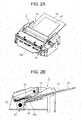
- FIG. 2 (a) is an external perspective view of the thermal printer 1 according the first embodiment of the invention.
- FIG. 2 (b) is a sectional side view of the thermal printer 1 according the first embodiment of the invention.
- the thermal printer 1 has a printing-medium insertion opening 14 and a printing-medium discharge opening 16.
- the thermal printer 1 is shown in FIG. 2(a) , with a stamping-face plate holder 15 inserted into the printing-medium insertion opening 14 and with the leading end 15a of the stamping-face plate holder 15 coming out from the printing-medium discharge opening 16.
- the stamping-face plate holder 15 holds a stamping-face plate 17.
- the thermal printer 1 is shown in FIG. 2(b) , with the leading end 15a of the stamping-face plate holder 15 inserted into the printing-medium insertion opening 14. As shown in FIG. 2(b) , the leading end 15a of the stamping-face plate holder 15 has been inserted as far as to the position of the thermal head 18. Along a transporting course of the stamping-face plate holder 15, there are provided a sensor 19 and a platen roller 21.
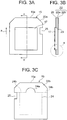
- FIG. 3(a) is a plane view of the stamping-face plate holder 15 holding the stamping-face plate 17.
- FIG. 3(b) is a cross-sectional view of the stamping-face plate holder 15 taken along the line A-A' of FIG. 3(a).
- FIG. 3(c) is a rear view of the stamping-face plate holder 15.
- the stamping-face plate holder 15 serving as a holder that firmly holds the stamping-face plate 17 fixed at its central position.
- an arrow "a" indicates a direction in which the stamping-face plate holder 15 is inserted into the thermal printer 1.
- the stamping-face plate holder 15 consists of two thick paper boards (coated boards) 22 (top paper board 22a, bottom paper board 22b) integrated by adhering, as shown in FIG. 3 (b) .
- the stamping-face plate holder 15 has a cutout 25 for a sensor in its one lateral part (on the right side as seen in FIG. 3 (a) ).
- the sensor 19 of the thermal printer 1 detects the cutout 25 of the stamping-face plate holder 15 to confirm a position for starting a printing operation and performing other controlling operations.
- a thermal printing operation for printing solid black data around on the leading end of the printing medium is performed based on the confirmation of the position for starting the printing operation.
- the thermal printing operation will be described in detail later. Since a controlling operation for confirming the position for starting the printing operation is not the substance of the present invention, and therefore further description thereof will not be made hereinafter.
- the top paper board 22a has a square recess 23 around at its central portion to receive the stamping-face plate 17 tightly therein.
- the stamping-face plate 17 is pressed into the recess 23 (hereinafter sometimes, referred to as the "positioning recess") to be held in position.
- the top paper board 22a has substantially the same thickness as the stamping-face plate 17 and is a little thinner than the stamping-face plate 17 within the range that no trouble is caused in the printing operation. This is because the printing operation is performed with the thermal head 18 pressed against onto the surface of the stamping-face plate 17 for enhancing the efficiency of heat conduction. It is also preferable that a difference in level between the top paper board 22a and the stamping-face plate 17 is not so large, to prevent the thermal head 18 from being caught by such difference during the printing operation.
- the stamping-face plate 17 is 1.5 mm in thickness and the top paper board 22a is 0.79 mm in thickness in the present embodiment.
- the bottom paper board 22b is made plain and also made to have the same external shape as the top paper board 22a.
- the bottom paper board 22b and the top paper board 22a are integrated together by adhering.
- the bottom paper board 22b supports the bottom surface of the stamping-face plate 17.
- the bottom paper board 22b is perforated (perforation 24) along the positioning recess 23 shown in FIG. 3(a) . At the top portion of the perforation 24 as seen in FIG.
- an arc-like cut in 24a is made and on the both sides of the cut in 24a, perforations 24b, 24b extending to the side edges of the bottom paper board 2 are made.
- the stamping-face plate 17 held in the stamping-face plate holder 15 is made of an ink-impregnated sponge body.
- the ethylene-vinyl acetate copolymer is used as a material of the sponge body.
- the surface of the top paper board 22a, and the top surface and sides of the stamping-face plate 17 exposing from the positioning recess 23 of the top paper board 22a are covered with a film 26.
- the film 26 is made of a base material such as PET (polyethylene terephthalate) and/or polyamide.
- the film 26 has a heat resistance, a heat conductivity and also a smoother surface.
- a material having a heat resistance to temperature higher than the melting point of the stamping-face plate 17 is used to make the film 26.
- FIG. 4 is an enlarged view showing the portion of the stamping-face plate holder 15 surrounded by the broken-line circle "a" in FIG. 3 (b) . As shown in FIG. 4 , the top paper board 22a and the bottom paper board 22b are bonded together with a both-side adhesive sheet 27b.
- the film 26 covers the surface of the top paper board 22a excluding the portion corresponding to the positioning recess 23 where the stamping-face plate holder 15 is pressed into, and is bonded to said surface with a both-side adhesive sheet 27a.
- the film 26 covers the surface 17a and the side 17b of the stamping-face plate 17 exposing from the positioning recess 23 of the top paper board 22a but does not adhere to them. Therefore, when a plate making of the stamping-face plate 17 finishes as will be described later, the stamping-face plate 17 can be easily taken out from the stamping-face plate holder 15 by removing the bottom paper board 22b along the perforation 24 shown in FIG. 3(c) .
- the porous EVA is used to compose the stamping-face plate 17, and the surface of the porous EVA is heated with the thermal head to make the stamping-face plate of a stamp. Since the porous EVA (hereinafter, simply referred to as the "EVA") contains countless numbers of air bubbles, it is possible to impregnate EVA with liquid such as ink, just like sponges.
- EVA porous EVA
- EVA has a physical property of heat plasticity, and therefore, when EVA is heated, for instance, to 70 to 120 degrees centigrade, the heated portion softens and the portion which has softened once will harden when cooled down. The hardened portion loses air bubbles, turning to a non-porous portion and prevents liquid such as ink from passing through.
- this physical property (heat plasticity) of EVA is used.
- an arbitrary part of the surface of EVA (composing the stamping face of a stamp) is heated about 1 to 5 milliseconds by the thermal head, the arbitrary part of the surface of EVA (composing the stamping face of a stamp) turns to a non-porous part, preventing the ink impregnated therein from passing through.
- data of the seal impression drawn by the user represents a seal impression of 30 mm X 30 mm
- a seal impression to be subjected to the heating treatment by the thermal head has a size of 30 mm X 30 mm.
- stamping data which contains the seal impression edited by the user and further solid-black area surrounding said seal-impression is prepared in the present embodiment and used as data for making a plate of a seal impression.
- the solid-black area in the stamping data serves as an area for preventing the ink from seeping out.
- the data of the seal impression edited and produced by the user is subjected to the "black-white inverting process” and the “mirror-image inverting process” , and then the solid-black data is added to the processed seal-impression data, whereby the final stamping data to be supplied to the thermal printer is completed.
- EVA used for composing the stamping face of a stamp
- EVA is a material having 1.5 mm in thickness, and has a high elasticity coefficient and a high friction coefficient.
- the above difficulty in transporting EVA is a phenomenon that is caused even when the thermal head does not generate heat.
- the temperature of the thermal head rises to about 200 degrees centigrade within several milliseconds after it has started generating heat, and the surface of EVA has softened at the time when heated, and therefore the thermal head will sink in the softened EVA, preventing the stamping-face plate holder 15 with EVA (composing the stamping-face plate 17) held from moving anymore.
- the present invention has been made to provide the stamping-face plate holder 15, shown in FIGs. 2(a) and 2(b) to FIG. 4 , which is used to make a stamping-face plate made of EVA.
- EVA is hard in transportation because of its flexibility and high friction coefficient.
- the thermal printer 1 provided with the normal thermal head, shown in FIG. 1 , FIG. 2(a) and FIG. 2(b) will be made small in size and cheap in manufacturing cost and uses the above stamping-face plate holder 15 to make a stamping-face plate made of EVA.
- stamping-face plate holder 15 in the first embodiment has been described with reference to FIGs. 3(a), 3(b), 3(c) and FIG. 4 in detail. Hereinafter, additional description of the stamping-face plate holder 15 will be given with respect to its functions and configuration.
- the stamping-face plate 17 is held in the positioning recess 23 of the top paper board 22a, supported from beneath by the bottom paper board 22b, and covered over with the film 26. Therefore, when held in the positioning recess 23 of the top paper board 22a, the stamping-face plate 17 is hard to be deformed even if it receives any external force.
- the stamping-face plate 17 can be transported as the user's intention and, also transported in the straight direction as user's intention.
- the film 26 has a heat-resisting property higher than the melting point of the stamping-face plate 17, that is, EVA.
- the film 26 covering over the plate 17 prevents the thermal head 18 from sinking into the plate 17, and allows the thermal head 18 to continue a heat-printing operation thereon smoothly, finishing making the stamping-face plate 17.
- FIG. 5 is a view showing a stamp consisting of a wood block with the stamping face attached, said stamping face being taken out from the stamping-face plate holder 15 after the making plate operation.
- the stamping-face plate 17 with the stamping face facing beneath is attached to the bottom of the wood block 30 with a both-side adhesive sheet 31.
- the wood block consists of a ball-like gripe 26 and a base block 29.
- the stamping-face portion of the stamp When the stamping-face portion of the stamp is dipped in ink for a given period of time, the ink impregnates into the stamping-face plate 17. After cleaning excessive ink on the stamping face, the user holds the ball-like gripe 26 to press the base block against the object. Then the ink seeps out from the stamping face to leave the seal impression on the object.
- the perforation 24 is made in the bottom paper board 22b along the positioning recess 23.
- the stamping-face plate 17 is taken out from the stamping-face plate holder 15, the user bends the bottom paper board 22b along the perforations 24b, 24b and grips the arc-like cut in 24a, striping off the portion surrounded by the perforation 24.
- both top paper board 22a and bottom paper board 22b in place of the perforation 24 of a four-sided figure.
- the user bends both the top and bottom paper boards 22a, 22b towards the top paper board side 22a.
- both the top and bottom paper boards 22a, 22b are cut and separated along the perforation 24b, but the film 26 still remains attached to the separated paper boards. Therefore, when the paper boards are further separated apart, the film 26 in the vicinity of the stamping-face plate 17 is peeled off from the top paper board 22a, allowing the user to take out the stamping-face plate 17 with the stamping face facing the user.
- the thick paper board (coated board) 22 from a single paper board instead of using two paper boards 22a, 22b and to provide at the center of the single paper board a concave portion for receiving and positioning the stamping-face plate 17.
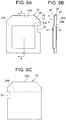
- FIG. 6(a) is a plane view of the stamping-face plate holder 32 holding the stamping-face plate 17.
- FIG. 6(b) is a cross-sectional view of the stamping-face plate holder 32 taken along the line B-B' of FIG. 6(a).
- FIG. 6(c) is a rear view of the stamping-face plate holder 32.
- the stamping-face plate holder 32 serves as a holder and consists of a single paper board 22 which is provided with the positioning concave portion 33.
- the concave portion 33 holds and positions the stamping-face plate 17.
- stamping-face plate holder 32 In the stamping-face plate holder 32, only a single straight-line perforation 24b is made in place of the perforation of a four-sided figure ( FIG. 3(c) ) in the paper board 22, as shown in FIG. 6(a) and FIG. 6(c) .
- the end portion 32a of the stamping-face plate holder 32 is bent in the forward direction as indicated by an arrow "b" in FIG. 6(b) , the end portion 32a is cut and separated from the body of the stamping-face plate holder 32 along the perforation 24b.
- the film 26 in the vicinity of the stamping-face plate 17 is also peeled off from the paper board 22 together with the film 26 attached to the end portion 32a, allowing the user to take out the stamping-face plate 17 from the concave portion 33 of the stamping-face plate holder 32.
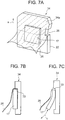
- FIGs. 7(a), 7(b) and 7(c) are views showing a configuration of a stamping-face plate holder in the third embodiment of the invention.
- the film 26 is bonded to the surface in the vicinity of the positioning recess 23 and/or the concave portion 33 with the both-side adhesive sheet 27b.
- the film 26 covers over the whole surface of the stamping-face plate holder 34, but the film 26 is bonded only to the surface of the front half portion 34a of the stamping-face plate holder 34 seen in the transport direction as indicated by an arrow "a" in FIG. 7(a) with the both-side adhesive sheet 27b.
- the film 26 covers over the surface of the rear half portion of the stamping-face plate holder 34 but does not adhere to the portion.
- the user simply picks up at the end of the film 26 as shown in FIG. 7(b) , and can easily take out the stamping-face plate 17 from the stamping-face plate holder 34.
- stamping-face plate 17 can be replaced with another new plate, as indicated by an arrow "c" in FIG. 7(c) , the elements other than the stamping-face plate 17 can be used any number of times, and the stamping-face plate holder 34 can be made economical.
- the stamping-face plate holder consisting of a single paper board is shown in FIGs. 7 (a), 7(b) and 7(c) , but it is possible to use paper boards 22a, 22b to make the stamping-face plate holder and to provide the positioning recess 23 in place of the positioning concave portion 33.
- the positioning of the stamping-face plate 17 is not limited to those described herein, and any element which can fix the stamping-face plate 17 in place can be used in place of the positioning recess and the positioning concave portion.
- a hook-like gripper can be used as the positioning elements. It will be possible to use an adhesive material to detachably fix the two or four corners of the rear surface of the stamping-face plate 17 to the stamping-face plate holder 15.
- the size and configuration of the stamping-face plate holder 15 (32 and 34), and also the size and configuration of the stamping-face plate 17 are not restricted to those described in the embodiments of the invention, but may be arranged.
- the size of the stamping-face plate holder 15 (32 and 34) and the size of the stamping-face plate 17 in the direction perpendicular to the transporting direction (as indicated by the arrow "a" in FIG. 3 ) of the stamping-face plate holder 15 (32 and 34) is determined based on the configuration of the thermal printer 1, but the size of the stamping-face plate holder 15 (32 and 34) in its transporting direction (as indicated by the arrow "a” in FIG. 3 ) is not limited. Accordingly, there is no limitation in the size of the stamping-face plate 17 in the transporting direction (as indicated by the arrow "a” in FIG. 3 ) of the stamping-face plate holder 15 (32 and 34).
- the quality of material used for the stamping-face plate holder 15 is not limited to the coated board described in the embodiments, but any material can be used, which can hold the stamping-face plate 17 in place and transports the same steadily during the plate making.
- the stamping- face plate holder 15 is repeatedly used many times, and therefore, the material used to make the stamping- face plate holder 15 is selected placing priority on durability rather than on cheapness, different in other embodiments.
- the base material of the film 26 is not limited to PET (polyethylene terephthalate) and/or polyamide used in the embodiments, but any material which has a heat resistance to temperature higher than the melting point of the stamping-face plate 17 and has a heat conductivity required for the plate making and surface smoothness required for transporting the stamping-face plate holder 15 can be used as the base material of the film 26.
Landscapes
- Engineering & Computer Science (AREA)
- Mechanical Engineering (AREA)
- Manufacturing & Machinery (AREA)
- Manufacture Or Reproduction Of Printing Formes (AREA)
- Printing Plates And Materials Therefor (AREA)
Claims (7)
- Stempelseitenplatten-Halter (15) umfassend:ein Plattenhalteelement (22), das eine Anordnungsaussparung (23) aufweist, die abnehmbar eine Stempelseitenplatte (17) hält, wobei die Stempelseitenplatte (17) ein poröses Material umfasst, das geeignet ist, mit Farbe getränkt zu werden,dadurch gekennzeichnet, dassdas Plattenhalteelement (22) eine obere Pappenplatte (22a) umfasst;die Oberfläche der oberen Pappenplatte (22a) und die Oberseite (17a) und Seiten (17b) der Stempelseitenplatte (17), die von der Anordnungsaussparung (23) der oberen Pappenplatte (22a) freiliegen, mit einem Film (26) bedeckt sind; undder Film (26) an die Oberfläche der oberen Pappenplatte (22a) mit einer Klebefolie (27a) geklebt ist.
- Stempelseitenplatten-Halter (15) nach Anspruch 1, wobei
das Plattenhalteelement (22) mit einer Perforation (24b) entlang wenigstens einer Seite der Anordnungsaussparung (23) und in Richtung beider Seiten des Plattenhalteelements (22) gebildet ist. - Stempelseitenplatten-Halter (15) nach Anspruch 1, wobei
das Plattenhalteelement 22) mit einer die Aussparung (23) umgebenen Perforation (24) gebildet ist. - Stempelseitenplatten-Halter (15) nach einem der Ansprüche 1 bis 3, wobei das Plattenhalteelement (22) aus einer beschichteten Platte besteht.
- Stempelseitenplatten-Halter (15) nach Anspruch 4, wobei
das Plattenhalteelement (22) wenigstens aus der oberen Pappenplatte (22a) und einer unteren Pappenplatte (22b) besteht, wobei beide Platten die gleiche Außenform aufweisen und durch Kleben verbunden sind; und
die Aussparung (23) in der oberen Pappenplatte (22a) gebildet ist. - Stempelseitenplatten-Halter (15) nach einem der Ansprüche 1 bis 5, wobei
der Film (26) an einer Oberfläche des die im Plattenhalteelement (22) gehaltenen Stampelseitenplatte (17) umgebenden Plattenhalteelements (22) haftet und ein Teil des die im Plattenhalteelement (22) gehaltenen Stampelseitenplatte (17) abdeckenden Films (26) nicht an der Stempelseitenplatte (17) haftet. - Stempelseitenplatten-Halter (15) nach einem der Ansprüche 1 bis 6, wobei
das poröse Material der Stempelseitenplatte (17) ein Ethylen-Vinylacetat-Copolymer ist.
Applications Claiming Priority (1)
| Application Number | Priority Date | Filing Date | Title |
|---|---|---|---|
| JP2013136947A JP5812044B2 (ja) | 2013-06-28 | 2013-06-28 | 印面版ホルダ |
Publications (2)
| Publication Number | Publication Date |
|---|---|
| EP2818323A1 EP2818323A1 (de) | 2014-12-31 |
| EP2818323B1 true EP2818323B1 (de) | 2019-12-04 |
Family
ID=51176074
Family Applications (1)
| Application Number | Title | Priority Date | Filing Date |
|---|---|---|---|
| EP14173899.7A Active EP2818323B1 (de) | 2013-06-28 | 2014-06-25 | Stempelseitenplattenhalter |
Country Status (4)
| Country | Link |
|---|---|
| US (1) | US9610665B2 (de) |
| EP (1) | EP2818323B1 (de) |
| JP (1) | JP5812044B2 (de) |
| CN (1) | CN104249575B (de) |
Families Citing this family (2)
| Publication number | Priority date | Publication date | Assignee | Title |
|---|---|---|---|---|
| JP5835294B2 (ja) * | 2013-09-24 | 2015-12-24 | カシオ計算機株式会社 | 印版ホルダ |
| JP5958447B2 (ja) * | 2013-11-06 | 2016-08-02 | カシオ計算機株式会社 | 印面形成装置、印面形成方法および印面形成システム |
Family Cites Families (18)
| Publication number | Priority date | Publication date | Assignee | Title |
|---|---|---|---|---|
| JP3212052B2 (ja) * | 1993-10-28 | 2001-09-25 | ブラザー工業株式会社 | 製版装置 |
| JP3020416B2 (ja) | 1993-12-28 | 2000-03-15 | 三菱鉛筆株式会社 | スタンプの製造法 |
| JP2005161865A (ja) * | 1995-08-10 | 2005-06-23 | Brother Ind Ltd | 印判の製造方法及びその装置 |
| JPH10119403A (ja) * | 1996-08-30 | 1998-05-12 | Seiko Epson Corp | スタンプ素材およびスタンプ素材のセット治具 |
| US6276272B1 (en) * | 1996-10-01 | 2001-08-21 | Brother Kogyo Kabushiki Kaisha | Stamp plate producing apparatus for producing stamp plate used in a stamp device |
| JPH10100464A (ja) | 1996-10-01 | 1998-04-21 | Brother Ind Ltd | 印版の製造装置 |
| JPH11138960A (ja) * | 1997-11-12 | 1999-05-25 | Takasu Hirobumi | インク浸透スタンプ用の印材およびその製造方法 |
| JP2000052631A (ja) * | 1998-08-06 | 2000-02-22 | Riso Kagaku Corp | 孔版印刷用原紙組立体 |
| JP4168213B2 (ja) | 1998-10-06 | 2008-10-22 | ブラザー工業株式会社 | スタンプ作成のための原稿シート |
| JP2000211226A (ja) * | 1999-01-20 | 2000-08-02 | Bando Chem Ind Ltd | スタンプ用印材及びそれを用いたスタンプ並びにその製造方法 |
| EE200000408A (et) | 2000-10-17 | 2001-04-16 | Humal Leo-Henn | Meetod ja seade termoplastsest mikropoorsest materjalist templite valmistamiseks, selles kasutatav termopea, abinõu eralduskile kinnitamiseks ning templitoorik. |
| JP4590725B2 (ja) | 2000-12-07 | 2010-12-01 | ブラザー工業株式会社 | 製版装置及び製版装置用アタッチメント |
| JP2003154743A (ja) * | 2001-11-19 | 2003-05-27 | Riso Kagaku Corp | 簡易スタンプにおける製版着版方法および簡易スタンプ |
| JP5201450B2 (ja) * | 2008-03-03 | 2013-06-05 | シヤチハタ株式会社 | 多孔質印判の製造装置 |
| US8777271B2 (en) * | 2008-12-18 | 2014-07-15 | Premier Print & Services Group, Inc. | Linerless packing and shipping label system |
| US9361811B2 (en) * | 2010-03-25 | 2016-06-07 | Emerald City Label, Inc. | Multi-layered label for a letter or package |
| JP5789909B2 (ja) * | 2011-01-28 | 2015-10-07 | シヤチハタ株式会社 | 多孔質印判の製造方法 |
| JP6131538B2 (ja) * | 2012-07-10 | 2017-05-24 | シヤチハタ株式会社 | 多孔質印材およびその製造方法およびスタンプ |
-
2013
- 2013-06-28 JP JP2013136947A patent/JP5812044B2/ja active Active
-
2014
- 2014-06-25 CN CN201410290120.XA patent/CN104249575B/zh active Active
- 2014-06-25 US US14/314,946 patent/US9610665B2/en active Active
- 2014-06-25 EP EP14173899.7A patent/EP2818323B1/de active Active
Non-Patent Citations (1)
| Title |
|---|
| None * |
Also Published As
| Publication number | Publication date |
|---|---|
| US20150001779A1 (en) | 2015-01-01 |
| JP5812044B2 (ja) | 2015-11-11 |
| EP2818323A1 (de) | 2014-12-31 |
| CN104249575A (zh) | 2014-12-31 |
| US9610665B2 (en) | 2017-04-04 |
| CN104249575B (zh) | 2017-04-12 |
| JP2015009468A (ja) | 2015-01-19 |
Similar Documents
| Publication | Publication Date | Title |
|---|---|---|
| CN104608500B (zh) | 印面形成装置及印面形成方法 | |
| EP2818323B1 (de) | Stempelseitenplattenhalter | |
| JP2026063260A (ja) | 印刷装置および印刷方法 | |
| EP0493965B1 (de) | Stempelvorrichtung mit einem wärmeempfindlichen, durch Hitze eines thermischen Schreibkopfs perforierbaren Schablonenpapier | |
| CN104441929B (zh) | 印面制版装置、介质保持件以及介质保持件制造方法 | |
| JP2015058688A (ja) | 印面製版装置、印面材寸法検出方法、媒体ホルダおよび媒体ホルダ製造方法 | |
| JP6044515B2 (ja) | 印面形成装置、印面材ホルダおよび印面形成方法 | |
| JP6044523B2 (ja) | 印面形成装置、印面材ホルダおよび印面形成方法 | |
| JP6330769B2 (ja) | 印面版ホルダ | |
| JP2988206B2 (ja) | 感熱製版装置 | |
| JP2007041195A (ja) | ラベル用印字媒体 | |
| CN104626757B (zh) | 印面形成装置、印面形成方法以及印面形成系统 | |
| JP5835294B2 (ja) | 印版ホルダ | |
| JP2016013620A (ja) | スタンプ、印面材、スタンプ台座及びスタンプの製造方法 | |
| JP6098558B2 (ja) | 多色スタンプ作製装置、多色スタンプ材、多色スタンプ作製方法及び多色スタンプ材の作製方法 | |
| JP2017056735A (ja) | 印面形成装置および印面形成方法 | |
| JP2016175296A (ja) | 製版媒体 | |
| JP6183488B2 (ja) | 印面製版装置、印面材寸法検出方法および媒体ホルダ | |
| JP2015178238A (ja) | 多面に印面を着脱可能なスタンプ台座 | |
| JP2016175351A (ja) | 画像形成装置、印刷装置、画像形成方法及び画像形成プログラム | |
| JP2010184362A (ja) | テープ印刷装置、ラベルの作成方法、ラベルの作成プログラムが記憶された記憶媒体 | |
| JP2001183979A (ja) | 台紙なしラベル | |
| JPH05330007A (ja) | スタンプ製版装置 | |
| JPH09300799A (ja) | スタンプ装置 |
Legal Events
| Date | Code | Title | Description |
|---|---|---|---|
| PUAI | Public reference made under article 153(3) epc to a published international application that has entered the european phase |
Free format text: ORIGINAL CODE: 0009012 |
|
| 17P | Request for examination filed |
Effective date: 20140625 |
|
| AK | Designated contracting states |
Kind code of ref document: A1 Designated state(s): AL AT BE BG CH CY CZ DE DK EE ES FI FR GB GR HR HU IE IS IT LI LT LU LV MC MK MT NL NO PL PT RO RS SE SI SK SM TR |
|
| AX | Request for extension of the european patent |
Extension state: BA ME |
|
| STAA | Information on the status of an ep patent application or granted ep patent |
Free format text: STATUS: EXAMINATION IS IN PROGRESS |
|
| 17Q | First examination report despatched |
Effective date: 20190117 |
|
| GRAP | Despatch of communication of intention to grant a patent |
Free format text: ORIGINAL CODE: EPIDOSNIGR1 |
|
| STAA | Information on the status of an ep patent application or granted ep patent |
Free format text: STATUS: GRANT OF PATENT IS INTENDED |
|
| INTG | Intention to grant announced |
Effective date: 20190625 |
|
| GRAS | Grant fee paid |
Free format text: ORIGINAL CODE: EPIDOSNIGR3 |
|
| GRAA | (expected) grant |
Free format text: ORIGINAL CODE: 0009210 |
|
| STAA | Information on the status of an ep patent application or granted ep patent |
Free format text: STATUS: THE PATENT HAS BEEN GRANTED |
|
| AK | Designated contracting states |
Kind code of ref document: B1 Designated state(s): AL AT BE BG CH CY CZ DE DK EE ES FI FR GB GR HR HU IE IS IT LI LT LU LV MC MK MT NL NO PL PT RO RS SE SI SK SM TR |
|
| REG | Reference to a national code |
Ref country code: GB Ref legal event code: FG4D |
|
| REG | Reference to a national code |
Ref country code: CH Ref legal event code: EP |
|
| REG | Reference to a national code |
Ref country code: AT Ref legal event code: REF Ref document number: 1208903 Country of ref document: AT Kind code of ref document: T Effective date: 20191215 |
|
| REG | Reference to a national code |
Ref country code: DE Ref legal event code: R096 Ref document number: 602014057712 Country of ref document: DE |
|
| REG | Reference to a national code |
Ref country code: IE Ref legal event code: FG4D |
|
| REG | Reference to a national code |
Ref country code: NL Ref legal event code: MP Effective date: 20191204 |
|
| REG | Reference to a national code |
Ref country code: LT Ref legal event code: MG4D |
|
| PG25 | Lapsed in a contracting state [announced via postgrant information from national office to epo] |
Ref country code: LV Free format text: LAPSE BECAUSE OF FAILURE TO SUBMIT A TRANSLATION OF THE DESCRIPTION OR TO PAY THE FEE WITHIN THE PRESCRIBED TIME-LIMIT Effective date: 20191204 Ref country code: SE Free format text: LAPSE BECAUSE OF FAILURE TO SUBMIT A TRANSLATION OF THE DESCRIPTION OR TO PAY THE FEE WITHIN THE PRESCRIBED TIME-LIMIT Effective date: 20191204 Ref country code: GR Free format text: LAPSE BECAUSE OF FAILURE TO SUBMIT A TRANSLATION OF THE DESCRIPTION OR TO PAY THE FEE WITHIN THE PRESCRIBED TIME-LIMIT Effective date: 20200305 Ref country code: ES Free format text: LAPSE BECAUSE OF FAILURE TO SUBMIT A TRANSLATION OF THE DESCRIPTION OR TO PAY THE FEE WITHIN THE PRESCRIBED TIME-LIMIT Effective date: 20191204 Ref country code: LT Free format text: LAPSE BECAUSE OF FAILURE TO SUBMIT A TRANSLATION OF THE DESCRIPTION OR TO PAY THE FEE WITHIN THE PRESCRIBED TIME-LIMIT Effective date: 20191204 Ref country code: NO Free format text: LAPSE BECAUSE OF FAILURE TO SUBMIT A TRANSLATION OF THE DESCRIPTION OR TO PAY THE FEE WITHIN THE PRESCRIBED TIME-LIMIT Effective date: 20200304 Ref country code: BG Free format text: LAPSE BECAUSE OF FAILURE TO SUBMIT A TRANSLATION OF THE DESCRIPTION OR TO PAY THE FEE WITHIN THE PRESCRIBED TIME-LIMIT Effective date: 20200304 Ref country code: FI Free format text: LAPSE BECAUSE OF FAILURE TO SUBMIT A TRANSLATION OF THE DESCRIPTION OR TO PAY THE FEE WITHIN THE PRESCRIBED TIME-LIMIT Effective date: 20191204 |
|
| PG25 | Lapsed in a contracting state [announced via postgrant information from national office to epo] |
Ref country code: HR Free format text: LAPSE BECAUSE OF FAILURE TO SUBMIT A TRANSLATION OF THE DESCRIPTION OR TO PAY THE FEE WITHIN THE PRESCRIBED TIME-LIMIT Effective date: 20191204 Ref country code: RS Free format text: LAPSE BECAUSE OF FAILURE TO SUBMIT A TRANSLATION OF THE DESCRIPTION OR TO PAY THE FEE WITHIN THE PRESCRIBED TIME-LIMIT Effective date: 20191204 |
|
| PG25 | Lapsed in a contracting state [announced via postgrant information from national office to epo] |
Ref country code: AL Free format text: LAPSE BECAUSE OF FAILURE TO SUBMIT A TRANSLATION OF THE DESCRIPTION OR TO PAY THE FEE WITHIN THE PRESCRIBED TIME-LIMIT Effective date: 20191204 |
|
| PG25 | Lapsed in a contracting state [announced via postgrant information from national office to epo] |
Ref country code: CZ Free format text: LAPSE BECAUSE OF FAILURE TO SUBMIT A TRANSLATION OF THE DESCRIPTION OR TO PAY THE FEE WITHIN THE PRESCRIBED TIME-LIMIT Effective date: 20191204 Ref country code: PT Free format text: LAPSE BECAUSE OF FAILURE TO SUBMIT A TRANSLATION OF THE DESCRIPTION OR TO PAY THE FEE WITHIN THE PRESCRIBED TIME-LIMIT Effective date: 20200429 Ref country code: NL Free format text: LAPSE BECAUSE OF FAILURE TO SUBMIT A TRANSLATION OF THE DESCRIPTION OR TO PAY THE FEE WITHIN THE PRESCRIBED TIME-LIMIT Effective date: 20191204 Ref country code: EE Free format text: LAPSE BECAUSE OF FAILURE TO SUBMIT A TRANSLATION OF THE DESCRIPTION OR TO PAY THE FEE WITHIN THE PRESCRIBED TIME-LIMIT Effective date: 20191204 Ref country code: RO Free format text: LAPSE BECAUSE OF FAILURE TO SUBMIT A TRANSLATION OF THE DESCRIPTION OR TO PAY THE FEE WITHIN THE PRESCRIBED TIME-LIMIT Effective date: 20191204 |
|
| PG25 | Lapsed in a contracting state [announced via postgrant information from national office to epo] |
Ref country code: IS Free format text: LAPSE BECAUSE OF FAILURE TO SUBMIT A TRANSLATION OF THE DESCRIPTION OR TO PAY THE FEE WITHIN THE PRESCRIBED TIME-LIMIT Effective date: 20200404 Ref country code: SK Free format text: LAPSE BECAUSE OF FAILURE TO SUBMIT A TRANSLATION OF THE DESCRIPTION OR TO PAY THE FEE WITHIN THE PRESCRIBED TIME-LIMIT Effective date: 20191204 Ref country code: SM Free format text: LAPSE BECAUSE OF FAILURE TO SUBMIT A TRANSLATION OF THE DESCRIPTION OR TO PAY THE FEE WITHIN THE PRESCRIBED TIME-LIMIT Effective date: 20191204 |
|
| REG | Reference to a national code |
Ref country code: DE Ref legal event code: R097 Ref document number: 602014057712 Country of ref document: DE |
|
| REG | Reference to a national code |
Ref country code: AT Ref legal event code: MK05 Ref document number: 1208903 Country of ref document: AT Kind code of ref document: T Effective date: 20191204 |
|
| PLBE | No opposition filed within time limit |
Free format text: ORIGINAL CODE: 0009261 |
|
| STAA | Information on the status of an ep patent application or granted ep patent |
Free format text: STATUS: NO OPPOSITION FILED WITHIN TIME LIMIT |
|
| PG25 | Lapsed in a contracting state [announced via postgrant information from national office to epo] |
Ref country code: DK Free format text: LAPSE BECAUSE OF FAILURE TO SUBMIT A TRANSLATION OF THE DESCRIPTION OR TO PAY THE FEE WITHIN THE PRESCRIBED TIME-LIMIT Effective date: 20191204 |
|
| 26N | No opposition filed |
Effective date: 20200907 |
|
| PG25 | Lapsed in a contracting state [announced via postgrant information from national office to epo] |
Ref country code: SI Free format text: LAPSE BECAUSE OF FAILURE TO SUBMIT A TRANSLATION OF THE DESCRIPTION OR TO PAY THE FEE WITHIN THE PRESCRIBED TIME-LIMIT Effective date: 20191204 Ref country code: PL Free format text: LAPSE BECAUSE OF FAILURE TO SUBMIT A TRANSLATION OF THE DESCRIPTION OR TO PAY THE FEE WITHIN THE PRESCRIBED TIME-LIMIT Effective date: 20191204 Ref country code: AT Free format text: LAPSE BECAUSE OF FAILURE TO SUBMIT A TRANSLATION OF THE DESCRIPTION OR TO PAY THE FEE WITHIN THE PRESCRIBED TIME-LIMIT Effective date: 20191204 |
|
| PG25 | Lapsed in a contracting state [announced via postgrant information from national office to epo] |
Ref country code: MC Free format text: LAPSE BECAUSE OF FAILURE TO SUBMIT A TRANSLATION OF THE DESCRIPTION OR TO PAY THE FEE WITHIN THE PRESCRIBED TIME-LIMIT Effective date: 20191204 Ref country code: IT Free format text: LAPSE BECAUSE OF FAILURE TO SUBMIT A TRANSLATION OF THE DESCRIPTION OR TO PAY THE FEE WITHIN THE PRESCRIBED TIME-LIMIT Effective date: 20191204 |
|
| REG | Reference to a national code |
Ref country code: CH Ref legal event code: PL |
|
| PG25 | Lapsed in a contracting state [announced via postgrant information from national office to epo] |
Ref country code: LU Free format text: LAPSE BECAUSE OF NON-PAYMENT OF DUE FEES Effective date: 20200625 |
|
| REG | Reference to a national code |
Ref country code: BE Ref legal event code: MM Effective date: 20200630 |
|
| PG25 | Lapsed in a contracting state [announced via postgrant information from national office to epo] |
Ref country code: LI Free format text: LAPSE BECAUSE OF NON-PAYMENT OF DUE FEES Effective date: 20200630 Ref country code: IE Free format text: LAPSE BECAUSE OF NON-PAYMENT OF DUE FEES Effective date: 20200625 Ref country code: CH Free format text: LAPSE BECAUSE OF NON-PAYMENT OF DUE FEES Effective date: 20200630 |
|
| PG25 | Lapsed in a contracting state [announced via postgrant information from national office to epo] |
Ref country code: BE Free format text: LAPSE BECAUSE OF NON-PAYMENT OF DUE FEES Effective date: 20200630 |
|
| PG25 | Lapsed in a contracting state [announced via postgrant information from national office to epo] |
Ref country code: TR Free format text: LAPSE BECAUSE OF FAILURE TO SUBMIT A TRANSLATION OF THE DESCRIPTION OR TO PAY THE FEE WITHIN THE PRESCRIBED TIME-LIMIT Effective date: 20191204 Ref country code: MT Free format text: LAPSE BECAUSE OF FAILURE TO SUBMIT A TRANSLATION OF THE DESCRIPTION OR TO PAY THE FEE WITHIN THE PRESCRIBED TIME-LIMIT Effective date: 20191204 Ref country code: CY Free format text: LAPSE BECAUSE OF FAILURE TO SUBMIT A TRANSLATION OF THE DESCRIPTION OR TO PAY THE FEE WITHIN THE PRESCRIBED TIME-LIMIT Effective date: 20191204 |
|
| PG25 | Lapsed in a contracting state [announced via postgrant information from national office to epo] |
Ref country code: MK Free format text: LAPSE BECAUSE OF FAILURE TO SUBMIT A TRANSLATION OF THE DESCRIPTION OR TO PAY THE FEE WITHIN THE PRESCRIBED TIME-LIMIT Effective date: 20191204 |
|
| PGFP | Annual fee paid to national office [announced via postgrant information from national office to epo] |
Ref country code: DE Payment date: 20250429 Year of fee payment: 12 |
|
| PGFP | Annual fee paid to national office [announced via postgrant information from national office to epo] |
Ref country code: GB Payment date: 20250501 Year of fee payment: 12 |
|
| PGFP | Annual fee paid to national office [announced via postgrant information from national office to epo] |
Ref country code: FR Payment date: 20250508 Year of fee payment: 12 |