EP2808296B1 - Lichtablenker, Verfahren zur Herstellung des Lichtablenkers und optische Abtastvorrichtung - Google Patents
Lichtablenker, Verfahren zur Herstellung des Lichtablenkers und optische Abtastvorrichtung Download PDFInfo
- Publication number
- EP2808296B1 EP2808296B1 EP14001863.1A EP14001863A EP2808296B1 EP 2808296 B1 EP2808296 B1 EP 2808296B1 EP 14001863 A EP14001863 A EP 14001863A EP 2808296 B1 EP2808296 B1 EP 2808296B1
- Authority
- EP
- European Patent Office
- Prior art keywords
- torsion bar
- light deflector
- supporting
- mirror
- supporting member
- Prior art date
- Legal status (The legal status is an assumption and is not a legal conclusion. Google has not performed a legal analysis and makes no representation as to the accuracy of the status listed.)
- Not-in-force
Links
- 230000003287 optical effect Effects 0.000 title claims description 15
- 238000004519 manufacturing process Methods 0.000 title claims description 12
- 238000000034 method Methods 0.000 claims description 14
- XUIMIQQOPSSXEZ-UHFFFAOYSA-N Silicon Chemical compound [Si] XUIMIQQOPSSXEZ-UHFFFAOYSA-N 0.000 claims description 12
- 229910052710 silicon Inorganic materials 0.000 claims description 12
- 239000010703 silicon Substances 0.000 claims description 12
- 239000012530 fluid Substances 0.000 claims description 10
- 239000000853 adhesive Substances 0.000 claims description 9
- 230000001070 adhesive effect Effects 0.000 claims description 9
- 239000000758 substrate Substances 0.000 claims description 6
- VYPSYNLAJGMNEJ-UHFFFAOYSA-N Silicium dioxide Chemical compound O=[Si]=O VYPSYNLAJGMNEJ-UHFFFAOYSA-N 0.000 claims description 5
- 229910052814 silicon oxide Inorganic materials 0.000 claims description 5
- 230000001678 irradiating effect Effects 0.000 claims description 3
- 230000003014 reinforcing effect Effects 0.000 claims description 3
- 238000012545 processing Methods 0.000 claims description 2
- 230000006870 function Effects 0.000 description 13
- 238000004891 communication Methods 0.000 description 8
- 238000010586 diagram Methods 0.000 description 8
- 239000010409 thin film Substances 0.000 description 7
- 230000008859 change Effects 0.000 description 6
- 230000005484 gravity Effects 0.000 description 4
- 230000002093 peripheral effect Effects 0.000 description 4
- 230000008569 process Effects 0.000 description 4
- 230000005540 biological transmission Effects 0.000 description 3
- 239000010408 film Substances 0.000 description 3
- 239000002245 particle Substances 0.000 description 3
- 230000008901 benefit Effects 0.000 description 2
- 230000008602 contraction Effects 0.000 description 2
- 238000005520 cutting process Methods 0.000 description 2
- 238000005530 etching Methods 0.000 description 2
- 238000012986 modification Methods 0.000 description 2
- 230000004048 modification Effects 0.000 description 2
- 238000012544 monitoring process Methods 0.000 description 2
- 230000004044 response Effects 0.000 description 2
- 238000012546 transfer Methods 0.000 description 2
- 239000000470 constituent Substances 0.000 description 1
- 230000007423 decrease Effects 0.000 description 1
- 238000000151 deposition Methods 0.000 description 1
- 238000013461 design Methods 0.000 description 1
- 238000007599 discharging Methods 0.000 description 1
- 230000000694 effects Effects 0.000 description 1
- 239000011521 glass Substances 0.000 description 1
- 239000012212 insulator Substances 0.000 description 1
- 239000007788 liquid Substances 0.000 description 1
- 238000005259 measurement Methods 0.000 description 1
- 239000012780 transparent material Substances 0.000 description 1
Images






Classifications
-
- G—PHYSICS
- G02—OPTICS
- G02B—OPTICAL ELEMENTS, SYSTEMS OR APPARATUS
- G02B26/00—Optical devices or arrangements for the control of light using movable or deformable optical elements
- G02B26/08—Optical devices or arrangements for the control of light using movable or deformable optical elements for controlling the direction of light
- G02B26/10—Scanning systems
- G02B26/105—Scanning systems with one or more pivoting mirrors or galvano-mirrors
-
- B—PERFORMING OPERATIONS; TRANSPORTING
- B81—MICROSTRUCTURAL TECHNOLOGY
- B81B—MICROSTRUCTURAL DEVICES OR SYSTEMS, e.g. MICROMECHANICAL DEVICES
- B81B3/00—Devices comprising flexible or deformable elements, e.g. comprising elastic tongues or membranes
- B81B3/0035—Constitution or structural means for controlling the movement of the flexible or deformable elements
- B81B3/004—Angular deflection
- B81B3/0045—Improve properties related to angular swinging, e.g. control resonance frequency
-
- G—PHYSICS
- G02—OPTICS
- G02B—OPTICAL ELEMENTS, SYSTEMS OR APPARATUS
- G02B26/00—Optical devices or arrangements for the control of light using movable or deformable optical elements
- G02B26/08—Optical devices or arrangements for the control of light using movable or deformable optical elements for controlling the direction of light
- G02B26/0816—Optical devices or arrangements for the control of light using movable or deformable optical elements for controlling the direction of light by means of one or more reflecting elements
- G02B26/0833—Optical devices or arrangements for the control of light using movable or deformable optical elements for controlling the direction of light by means of one or more reflecting elements the reflecting element being a micromechanical device, e.g. a MEMS mirror, DMD
- G02B26/0858—Optical devices or arrangements for the control of light using movable or deformable optical elements for controlling the direction of light by means of one or more reflecting elements the reflecting element being a micromechanical device, e.g. a MEMS mirror, DMD the reflecting means being moved or deformed by piezoelectric means
-
- B—PERFORMING OPERATIONS; TRANSPORTING
- B81—MICROSTRUCTURAL TECHNOLOGY
- B81B—MICROSTRUCTURAL DEVICES OR SYSTEMS, e.g. MICROMECHANICAL DEVICES
- B81B2201/00—Specific applications of microelectromechanical systems
- B81B2201/04—Optical MEMS
- B81B2201/042—Micromirrors, not used as optical switches
-
- B—PERFORMING OPERATIONS; TRANSPORTING
- B81—MICROSTRUCTURAL TECHNOLOGY
- B81B—MICROSTRUCTURAL DEVICES OR SYSTEMS, e.g. MICROMECHANICAL DEVICES
- B81B2203/00—Basic microelectromechanical structures
- B81B2203/01—Suspended structures, i.e. structures allowing a movement
- B81B2203/0109—Bridges
-
- B—PERFORMING OPERATIONS; TRANSPORTING
- B81—MICROSTRUCTURAL TECHNOLOGY
- B81B—MICROSTRUCTURAL DEVICES OR SYSTEMS, e.g. MICROMECHANICAL DEVICES
- B81B2203/00—Basic microelectromechanical structures
- B81B2203/01—Suspended structures, i.e. structures allowing a movement
- B81B2203/0145—Flexible holders
- B81B2203/0154—Torsion bars
Definitions
- the present disclosure relates to a light deflector used in forming an electrostatic latent image and the like, a light deflector manufacturing method and an optical scanning device with such a light deflector.
- a light beam modulated in accordance with image data is generated, reflected and deflected, whereby an image bearing member such as a photoconductive drum is scanned with the deflected light beam to form an electrostatic latent image.
- the light deflector is a device for reflecting and deflecting a light beam.
- a technique using MEMS (Micro Electro Mechanical Systems) mirrors as a light deflector instead of a polygon mirror has been proposed.
- the MEMS mirrors have an advantage of speeded-up scanning, low power consumption and the like.
- the light deflector using the MEMS mirrors includes a torsion bar, mirror portions swingable about an axis of the torsion bar and mirror drivers.
- the mirror drivers Upon the input of drive signals to the mirror drivers, the mirror drivers resonate (vibrate) movable portions of the MEMS mirrors to swing the mirror portions about the axis of the torsion bar and, in this state, a light beam incident on the mirror portions is reflected and deflected to scan the light beam.
- the movable portion of the MEMS mirror is, in other words, a vibration system of the MEMS mirror and configured by the mirror portion and the torsion bar.
- a resonant frequency of the movable portion of the MEMS mirror (hereinafter, merely referred to as a resonance frequency in some cases) needs to be adjusted for each MEMS mirror. This is because a maximum deflection angle of the mirror portion differs for each mirror if the resonant frequency differs.
- the resonant frequency is determined by a moment of inertia of the mirror portion, a spring constant of the torsion bar and the like.
- the resonant frequency changes if these physical quantities only slightly differ.
- dimensions of the mirror portion affect the moment of inertia of the mirror portion, and the resonant frequency changes if the dimensions of the mirror portion differ from design values by several microns. Since errors in the above physical quantities unavoidably occur in the manufacturing of the MEMS mirror, the resonant frequency needs to be adjusted.
- the former technique adjusts the resonant frequency by providing a first area and a second area, which are symmetrical with respect to a torsion bar, forming a plurality of mass bodies in advance in the respective areas, selectively cutting off the mass body by a laser beam to reduce the mass of the movable portion of the MEMS mirror.
- the latter technique adjusts the resonant frequency by making the mirror portion larger toward both left and right sides, providing a first area and a second area symmetrical with respect to a torsion bar, depositing and curing a liquid in each area to selectively form a mass body and increase the mass of the movable portion of the MEMS mirror.
- a moment of inertia is a value obtained by multiplying a square of a distance between the mass body and the axis of the torsion bar by a mass of the mass body.
- the mass body is located at a distance from the axis of the torsion bar.
- the present disclosure aims to provide a light deflector capable of improving accuracy in adjusting a resonant frequency of a movable portion of the light deflector, a light deflector manufacturing method and an optical scanning device with such a light deflector.
- a light deflector includes a fixing portion and a movable portion.
- the movable portion includes a mirror portion for deflecting light by swinging about a predetermined swing axis, a torsion bar fixedly supported on the fixing portion and having an axis serving as the swing axis, and a supporting body configured to support the mirror portion and fixed to the torsion bar.
- the supporting body includes a hole portion through which the axis passes.
- a mass body for adjusting a resonant frequency of the movable portion is arranged in the hole portion.
- a light deflector manufacturing method includes a first step, a second step and a third step.
- the mirror portion is swung by inputting a drive signal to the light deflector in a state where the mass body is not arranged in the hole portion.
- the mass body is supplied in a fluid state to the hole portion during the execution of the first step.
- the supply of the mass body is stopped when the resonant frequency of the movable portion reaches a predetermined value during the execution of the second step.
- An optical scanning device includes the above light deflector and a light source for irradiating a light beam to the mirror portion.
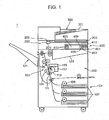
- FIG. 1 is a diagram schematically showing an internal structure of an image forming apparatus 1 to which a light deflector according to the embodiment is applied.
- the image forming apparatus 1 can be, for example, applied to a digital complex machine having copier, printer, scanner and facsimile functions.
- the image forming apparatus 1 includes an apparatus main body 100, a document reading unit 200 arranged atop the apparatus main body 100, a document feeding unit 300 arranged atop the document reading unit 200 and an operation unit 400 arranged on the front surface of an upper part of the apparatus main body 100.
- the document feeding unit 300 functions as an automatic document feeder and can successively feed a plurality of documents placed on a document placing portion 301 to the document reading unit 200.
- the document reading unit 200 includes a carriage 201 carrying an exposure lamp and the like, a document platen 203 made of a transparent material such as glass, an unillustrated CCD (Charge Coupled Device) sensor and a document reading slit 205.
- the CCD sensor In the case of reading a document placed on the document platen 203, the document is read by the CCD sensor while the carriage 201 is moved in a longitudinal direction of the document platen 203. Contrary to this, in the case of reading a document fed from the document feeding unit 300, the carriage 201 is moved to a position facing the document reading slit 205 and the document fed from the document feeding unit 300 is read by the CCD sensor through the document reading slit 205.
- the CCD sensor outputs an image of the read document as image data.
- the apparatus main body 100 includes a sheet storing unit 101, an image forming unit 103 and a fixing unit 105.
- the sheet storing unit 101 is arranged in a lowest part of the apparatus main body 100 and includes sheet cassettes 107 capable of storing a stack of sheets.
- the uppermost sheet of the stack of sheets stored in the sheet cassette 107 is fed to a sheet conveyance path 111 by driving a pickup roller 109.
- the sheet is conveyed to the image forming unit 103 through the sheet conveyance path 111.
- the image forming unit 103 forms a toner image on a sheet conveyed thereto.
- the image forming unit 103 includes a photoconductive drum 113, an optical scanning device 115, a developing unit 117 and a transfer unit 119.
- the optical scanning device 115 generates light modulated in accordance with image data (image data output from the document reading unit 200, image data transmitted from a personal computer, facsimile-received image data or the like) and irradiates the light to the peripheral surface of the uniformly charged photoconductive drum 113. This causes an electrostatic latent image corresponding to the image data to be formed on the peripheral surface of the photoconductive drum 113.
- toner is supplied from the developing unit 117 to the peripheral surface of the photoconductive drum 113, whereby a toner image corresponding to the image data is formed on the peripheral surface.
- This toner image is transferred to a sheet conveyed from the sheet storing unit 101 described above by the transfer unit 119.
- the sheet having the toner image transferred thereto is conveyed to the fixing unit 105.
- the fixing unit 105 heat and pressure are applied to the toner image and the sheet to fix the toner image to the sheet.
- the sheet is discharged to a stack tray 121 or a sheet discharge tray 123.
- the operation unit 400 includes an operation key unit 401 and a display unit 403.
- the display unit 403 has a touch panel function and displays a screen including soft keys. A user makes settings necessary to perform a function such as a copy function by operating the soft keys while viewing the screen.
- the operation key unit 401 includes operation keys which are hard keys, specifically a start key 405, a numerical keypad 407, a stop key 409, a reset key 411, function changeover keys 413 for switching the function among copier, printer, scanner and facsimile functions and the like.
- the start key 405 is a key for starting an operation such as copying or facsimile transmission.
- the numerical keypad 407 is a keypad for entering numbers such as the number of copies and facsimile numbers.
- the stop key 409 is a key for stopping a copying operation and the like on the way.
- the reset key 411 is a key for returning the set content to an initial setting state.
- the function changeover keys 413 are keys including a copy key, a transmit key and the like and configured to switch a copy function, a transmit function and the like from one to another. If the copy key is operated, an initial screen for copying is displayed on the display unit 403. If the transmit key is operated, an initial screen for facsimile transmission and mail transmission is displayed on the display unit 403.
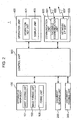
- FIG. 2 is a block diagram showing the configuration of the image forming apparatus 1 shown in FIG. 1 .
- the image forming apparatus 1 is so configured that the document reading unit 200, the document feeding unit 300, the operation unit 400, a control unit 500 and a communication unit 600 are connected to each other by a bus.
- the apparatus main body 100, the document reading unit 200, the document feeding unit 300 and the operation unit 400 are not described since being already described.
- the control unit 500 includes a CPU (Central Processing Unit), a ROM (Read Only Memory), a RAM (Random Access Memory), an image memory and the like.
- the CPU executes a control necessary to operate the image forming apparatus 1 on the above constituent elements of the image forming apparatus 1 such as the apparatus main body 100.
- the ROM stores software necessary to control the operation of the image forming apparatus 1.
- the RAM is used such as to temporarily store data generated during the execution of the software and store application software.
- the image memory temporarily stores image data (image data output from the document reading unit 200, image data transmitted from a personal computer, facsimile-received image data or the like).
- the communication unit 600 includes a facsimile communication unit 601 and a network I/F unit 603.
- the facsimile communication unit 601 includes an NCU (Network Control Unit) for controlling a telephone line connection with a destination facsimile machine and a modulation/demodulation circuit for modulating/demodulating a signal for facsimile communication.
- the facsimile communication unit 601 is connected to a telephone line 605
- the network I/F unit 603 is connected to a LAN (Local Area Network) 607.
- the network I/F unit 603 is a communication interface circuit for carrying out communication with terminal units such as personal computers connected to the LAN 607.
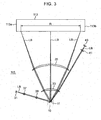
- FIG. 3 is a diagram showing an arrangement relationship of optical components constituting the optical scanning device 115.
- the optical scanning device 115 includes a light source 31, a light deflector 10, two scanning lenses 33, 35 and the like.
- the light source 31 is, for example, a laser diode and emits a light beam LB modulated in accordance with image data.
- a collimator lens 37 and a cylindrical lens 39 are arranged on an optical path between the light source 31 and the light deflector 10.
- the collimator lens 37 converts the light beam LB emitted from the light source 31 into a parallel beam.
- the cylindrical lens 39 linearly condenses the light beam LB converted into the parallel beam.
- the linearly condensed light beam LB is incident on the light deflector 10.
- the scanning lenses 33, 35 are arranged on an optical path between the light deflector 10 and the photoconductive drum 113.
- the light beam LB incident on a mirror portion 11 of the light deflector 10 is reflected and deflected by the mirror portion 11 and focused on the photoconductive drum 113 by the scanning lenses 33, 35. That is, by scanning the light beam LB across the photoconductive drum 113, an electrostatic latent image is formed on the photoconductive drum 113.
- the optical scanning device 115 further includes a BD lens 41 and a BD sensor 43.
- the light beam LB is scanned across the photoconductive drum 113 from one lateral part 113a to another lateral part 113b of the photoconductive drum 113, and the light beam LB beyond an effective scanning range is condensed by the BD lens 41 and received by the BD sensor 43.
- the BD (Beam Detect) sensor 43 generates a BD signal serving as a reference for the start of scanning (main scanning) on the photoconductive drum 113.
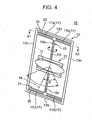
- FIG. 4 is a perspective view of the light deflector 10 according to the embodiment
- FIG. 5 is a sectional view cut along a line A1-A2 showing the light deflector shown in FIG. 4
- the light deflector 10 according to this embodiment is a piezoelectrically driven MEMS mirror.
- the MEMS mirror usable as the light deflector 10 is not limited to the piezoelectrically driven one.
- the light deflector 10 includes the mirror portion 11, a frame 13, a torsion bar 15, mirror drivers 17a, 17b, 17c and 17d, and a supporting body 31.
- the frame 13 has a rectangular shape.
- the frame 13 is composed of a pair of side portions 13c, 13d extending in a longitudinal direction, a pair of side portions 13a, 13b extending in a direction perpendicular to the longitudinal direction, and beams 19, 21 (fixing portion) connecting the side portions 13c, 13d.
- the mirror portion 11 is arranged in a central part of the frame 13.
- the mirror portion 11 has an elliptical shape whose minor axis direction matches the longitudinal direction of the frame 13.
- the torsion bar 15 has an axis AX extending in one direction and serving as a rotation axis (can be also referred to as a torsional rotation axis or a swing axis).
- the torsion bar 15 includes a first torsion bar 15a and a second torsion bar 15b extending along the common axis
- the first and second torsion bars 15a, 15b extend in the minor axis direction of the elliptical shape of the mirror portion 11.
- One end of the first torsion bar 15a is fixed and supported by the beam 19 and one end of the second torsion bar 15b is fixed and supported by the beam 21.
- a space 33 is formed between the beam 19 and the side portion 13a, and a space 35 is formed between the beam 21 and the side portion 13b.
- the supporting body 31 supporting the mirror portion 11 is fixed to the other ends of the first and second torsion bars 15a, 15b.
- the supporting body 31 is arranged in the frame 13.
- the supporting body 31 has a rectangular shape and a longitudinal direction thereof is perpendicular to that of the frame 13.
- the beams 19, 21 fix and support the torsion bar 15 in such a manner that the mirror portion 11 supported by the supporting body 31 is swingable about the axis AX of the torsion bar 15.
- the mirror portion 11 deflects light by swinging about a predetermined swing axis
- the torsion bar 15 is fixed and supported by the fixing portion (beams 19, 21) and has the axis AX serving as the swing axis
- the supporting body 31 supports the mirror portion 11 and is fixed to the torsion bar 15.
- the mirror driver 17a is formed on a side closer to the side portion 13c than the torsion bar 15 and the mirror driver 17b is formed on a side closer to the side portion 13d than the torsion bar 15.
- the mirror driver 17c is formed on a side closer to the side portion 13c than the torsion bar 15 and the mirror driver 17d is formed on a side closer to the side portion 13d than the torsion bar 15.
- the mirror driver 17a is composed of a lower electrode 23, a PZT thin film 25 and an upper electrode 27.
- the mirror drivers 17b, 17c and 17d have the same configuration as the mirror driver 17a.
- the mirror drivers 17a, 17b, 17c and 17d are written as the mirror drivers 17 below unless it is necessary to distinguish them.
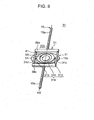
- FIG. 6 is a view showing a state where a drive voltage is applied to the mirror drivers 17 so that the PZT thin films 25 of the mirror drivers 17a, 17c extend and those of the mirror drivers 17b, 17d contract in the same cross-section as in FIG. 5 .
- the beams 19, 21 are bended, whereby the mirror portion 11 is inclined together with the torsion bar 15.
- the extension of the PZT thin films 25 of the mirror drivers 17a, 17c and the contraction of the PZT thin films 25 of the mirror drivers 17b, 17d are described as a first movement and the contraction of the PZT thin films 25 of the mirror drivers 17a, 17c and the extension of the PZT thin films 25 of the mirror drivers 17b, 17d are described as a second movement below.
- the mirror portion 11 supported by the supporting body 31 swings about the axis AX of the torsion bar 15 to vary a deflection angle ⁇ .
- NL in FIG. 4 denotes a normal to the mirror portion 11 when the mirror portion 11 is not swinging.
- the mirror portion 11 When a frequency of the drive voltage is caused to match a resonant frequency, the mirror portion 11 resonates and a maximum value of the deflection angle ⁇ (maximum deflection angle) can be increased. By reflecting and deflecting a light beam by the mirror portion 11 in a state where the mirror portion 11 is resonated, the light beam is scanned across the photoconductive drum 113.
- FIG. 7 is a perspective view showing the mirror portion 11, the torsion bar 15, the supporting body 31 and a movable portion 37 with a first rib 39a and a second rib 39b provided in the light deflector 10 when viewed from the side of a top surface 11a (light beam reflecting/deflecting surface) of the mirror portion 11.
- FIG. 8 is a perspective view showing this movable portion 37 viewed from the side of an under surface 11b of the mirror portion 11.
- the top surface 11a of the mirror portion 11 is on the side of one surface 32a (supporting surface) of the supporting body 31, and the under surface 11b of the mirror portion 11 is supported by the one surface 32a of the supporting body 31.
- the supporting body 31 has a rectangular frame-like shape and includes a first supporting member 31a, a second supporting member 31 b, a third supporting member 31c and a fourth supporting member 31d which serve as four sides forming a rectangle.
- the first and second supporting members 31a, 31b extend straight in a direction intersecting with an extending direction of the torsion bar 15 and are arranged to face each other.
- the third and fourth supporting members 31 c, 31 d extend straight in the same direction as the extending direction of the torsion bar 15 and are symmetrically arranged with respect to the torsion bar 15.
- a space 41 is defined by the first, second, third and fourth supporting members 31a, 31b, 31c and 31d.
- the supporting body 31 is made lighter by providing the space 41.
- the supporting body 31 includes the first supporting member 31a extending in the direction intersecting with the torsion bar 15, the second supporting member 31b arranged to face the first supporting member 31a and extending in the direction intersecting with the torsion bar 15, the third supporting member 31c connecting the first and second supporting members 31a, 31 b and the fourth supporting member 31d symmetrically arranged to the third supporting member 31 c with respect to the axis of the torsion bar 15 and connecting the first and second supporting members 31a, 31b.
- the supporting body 31 further includes a fifth supporting member 31e arranged in the space 41.
- the fifth supporting member 31e includes a main body portion 311, a first connecting portion 312 and a second connecting portion 313.
- the main body portion 311 is a main body of the fifth supporting member 31e and formed with a circular cavity which functions as a hole portion 53. This makes the supporting body 31 lighter.
- the mirror portion 11 is a plate-like member including a deflecting surface (top surface 11a) for deflecting light and a non-deflecting surface (under surface 11b) opposite to the deflecting surface.
- the non-deflecting surface (under surface 11b) forms the bottom of the hole portion 53.
- the first connecting portion 312 is arranged on a major axis of the main body portion 311 and connects one end part of the main body portion 311 and a center of the third supporting member 31c.
- the second connecting portion 313 is arranged on the major axis of the main body portion 311 and connects the other end part of the main body portion 311 and a center of the fourth supporting member 31d.
- the torsion bar 15 is composed of the first and second torsion bars 15a, 15b.
- the first and second torsion bars 15a, 15b extend in the same direction and are arranged with a spacing provided therebetween.
- the supporting body 31 is arranged in an area including this spacing.
- the first torsion bar 15a is fixed to the first supporting member 31a in a center of the first supporting member 31a.
- the second torsion bar 15b is fixed to the second supporting member 31 b in a center of the second supporting member 31b.
- each of the first, second, third, fourth and fifth supporting members 31a, 31b, 31c, 31 d and 31 e and the first and second torsion bars 15a, 15b includes a planar portion facing toward the side of the one surface 32a of the supporting body 31, and each planar portion is located on the same plane. These have the same height (i.e. same thickness).
- the mirror portion 11 is provided on the one surface 32a of the supporting body 31.
- the mirror portion 11 is bonded to the third, fourth and fifth supporting members 3 1 c, 31d and 31e using an adhesive or joined to the third, fourth and fifth supporting members 31c, 31d and 31e by anode junction.
- the first and second ribs 39a, 39b which are ribs extending in the direction intersecting with the torsion bar 15, are provided on the other surface 32b (opposite surface) of the supporting body 31.
- the first rib 39a is provided on the first supporting member 31a and the second rib 39b is provided on the second supporting member 31b.
- FIG. 9 is an enlarged sectional view cut along a line B1-B2 showing the movable portion 37 shown in FIG. 7 .
- FIG. 10 is an enlarged sectional view cut along a line C1-C2 showing the movable portion 37 shown in FIG. 7 .
- FIG. 11 is an enlarged sectional view cut along a line D1-D2 showing the movable portion 37 shown in FIG. 7 .
- the supporting members 31 first, second, third, fourth and fifth supporting members 31a, 31b, 31 c,31d and 31e
- the torsion bar 15 first and second torsion bars 15a, 15b
- the first rib 39a is a part formed to be continuous with the first supporting member 31a and projecting from the supporting body 31 on the other surface 32b of the supporting body 31.
- the second rib 39b is a part formed to be continuous with the second supporting member 31b and projecting from the supporting body 31 on the other surface 32b of the supporting body 31.
- the first rib 39a is provided on the first supporting member 31a, extends in the direction intersecting with the torsion bar 15 and projects on the side of the other surface 32b of the supporting body 31.
- the second rib 39b is provided on the second supporting member 31 b, extends in the direction intersecting with the torsion bar 15 and projects on the side of the other surface 32b of the supporting body 31.
- the supporting body 31 includes a contact surface to be held in contact with the mirror portion 11 and a non-contact surface opposite to the contact surface.
- the first rib 39a is so provided on the first supporting member 31a as to extend in the direction intersecting with the torsion bar 15 and project on the non-contact surface side.
- the second rib 39b is so provided on the second supporting member 31b as to extend in the direction intersecting with the torsion bar 15 and project on the non-contact surface side.
- the first and second supporting members 31a, 31b and the first and second ribs 39a, 39b have the same length. Further, these have the same width. A mass of the first rib 39a and that of the second rib 39b are equal. A total mass of the first and second ribs 39a, 39b is equal to a mass of the mirror portion 11.
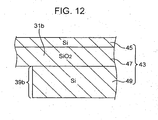
- FIG. 12 is a sectional view enlargedly showing a part indicated by E in FIG. 9 .
- An SOI (Silicon on Insulator) substrate 43 is structured such that a silicon oxide film 47 is sandwiched between silicon layers 45 and 49.
- the supporting body 31 and the torsion bar 15 are formed by the silicon layer 45 and the silicon oxide film 47.
- the first and second ribs 39a, 39b are formed by the silicon layer 49.
- the torsion bar 15, the supporting body 31 and the first and second ribs 39a, 39b are formed by selectively etching the SOI substrate 43.
- first and second ribs 39a, 39b may be respectively bonded to the first and second supporting members 31a, 31b by an adhesive or joined thereto by anode junction.
- the first and second ribs 39a, 39b are provided only on the other surface 32b out of the one surface 32a and the other surface 32b of the supporting body 31 and function as reinforcing members for reinforcing the supporting body 31 and adjusting a center of gravity of the movable portion 37 including the torsion bar 15, the supporting body 31 and the mirror portion 11 so that the center of gravity of the movable portion 37 is located on the axis AX.
- the hole portion 53 is provided in the main body portion 311 of the fifth supporting member 31e.
- the supporting body 31 is provided with the hole portion 53.
- the hole portion 53 has a depth in a direction intersecting with the one surface 32a (supporting surface) of the supporting body 31 and located on the axis AX of the torsion bar 15.
- the axis AX passes through the hole portion 53.
- the hole portion 53 penetrates through the supporting body 31 and the surface of the mirror portion 11 (under surface 11b of the mirror portion) opposite to the surface for reflecting light serves as a bottom part of the hole portion 53.
- the mass body 51 is arranged in the hole portion 53.
- the mass body 51 is located on the axis AX of the torsion bar 15.
- the resonant frequency of the movable portion 37 is adjusted by the mass body 51 arranged in the hole portion 53.
- the mass body 51 is a member formed by curing an adhesive fluid. Accordingly, an adhesive, putty or the like can be formed into the mass body 51. In this embodiment, an ultraviolet curing adhesive, which is one of photocurable adhesives, is formed into the mass body 51.
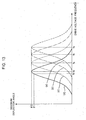
- FIG. 13 is a graph showing a relationship between a frequency of a drive voltage input to the light deflector 10 and the maximum deflection angle of the mirror portion 11.
- a horizontal axis of the graph represents the frequency of the drive voltage and a vertical axis thereof represents the maximum deflection angle.
- a curve (a) represents a case where the mass body 51 is not supplied to the hole portion 53 of the supporting body 31, and fa denotes the resonant frequency in this case.
- a curve (b) represents a case where the mass of the mass body 51 supplied to the hole portion 53 of the supporting body 31 has a first value, and fb denotes the resonant frequency in this case.
- a curve (c) represents a case where the mass of the mass body 51 supplied to the hole portion 53 of the supporting body 31 has a second value larger than the first value, and fc denotes the resonant frequency in this case.
- a curve (d) represents a case where the mass of the mass body 51 supplied to the hole portion 53 of the supporting body 31 has a third value larger than the second value, and fd denotes the resonant frequency in this case.
- the maximum deflection angle at the resonant frequency has the same value ( ⁇ 0).
- the resonant frequency decreases as the mass of the mass body 51 supplied to the hole portion 53 increases (curve (a) ⁇ curve (b) ⁇ curve (c) ⁇ curve (d)).
- the maximum deflection angle can be set at the target value ⁇ 1 at the frequency f1 of the drive voltage.
- FIG. 14 is a block diagram of an adjustment system 61 used in a process of adjusting the resonant frequency in a method for manufacturing the light deflector 10 according to this embodiment.
- the adjustment system 61 includes a light deflector control unit 63, a light source unit 65, a monitor unit 67 and a mass body supply unit 69.
- the light deflector control unit 63 swings the mirror portion 11 about the axis AX of the torsion bar 15 shown in FIG. 4 by inputting a drive voltage to the mirror drivers 17 of the light deflector 10.
- the light source unit 65 includes a laser diode 71 and controls the irradiation of a light beam LB from the laser diode 71 toward the mirror portion 11.
- the monitor unit 67 includes a photodiode 73 and a display unit 75, and computes the maximum deflection angle of the mirror portion 11 and causes the display unit 75 to display a measurement value, utilizing a time interval until the next light reception after the light beam LB reflected by the top surface 11a of the mirror portion 11 is received by the photodiode 73.
- the mass body supply unit 69 includes a nozzle 77 and supplies the mass body 51 to the hole portion 53 ( FIG. 8 ) of the supporting body 31 using the nozzle 77.
- a dispenser for discharging the ultraviolet curing adhesive from the nozzle 77 is used as the mass body supply unit 69.
- FIG. 15 shows a state where the mass body 51 is supplied to the hole portion 53 of the supporting body 31 using the nozzle 77 in the same cross-section as in FIG. 9 .
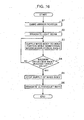
- FIG. 16 is a flow chart showing the process of adjusting the resonant frequency in the method for manufacturing the light deflector 10 according to this embodiment.
- the light deflector control unit 63 swings the mirror portion 11 by inputting a drive voltage having a predetermined voltage value and a frequency f1 to the light deflector 10, i.e. to the mirror drivers 17 in a state where the mass body 51 is not supplied to the hole portion 53 of the supporting body 31 yet (Step S1). Note that if the mirror portion 11 is electromagnetically driven instead of being piezoelectrically driven, the mirror portion 11 is swung by inputting a drive current having a predetermined current value and the frequency f1 to the light deflector 10.
- the light source unit 65 causes a light beam LB to be generated from the laser diode 71 and irradiates the light beam LB to the top surface 11a of the mirror portion 11 in a swinging state (Step S2).
- an adjuster of the resonant frequency operates the mass body supply unit 69 to supply the mass body 51 (ultraviolet curing adhesive) in a fluid state to the hole portion 53 of the supporting body 31 while monitoring the maximum deflection angle (in other words, resonant frequency) displayed on the display unit 75 of the monitor unit 67 (Step S3).
- the adjuster judges whether or not the maximum deflection angle displayed on the display unit 75 has reached the target value ⁇ 1 during Step S3 (Step S4).
- Step S4 If the maximum deflection angle has not reached the target value ⁇ 1 (No in Step S4), a return is made to Step S3.
- Step S4 If the maximum deflection angle reaches the target value ⁇ 1 (Yes in Step S4), the adjuster stops the supply of the mass body 51 to the hole portion 53 of the supporting body 31 from the mass body supply unit 69 (Step S5). Thereafter, the adjuster allows the mass body 51 to be cured by irradiating ultraviolet rays to the mass body 51 supplied to the hole portion 53 of the supporting body 31 using an ultraviolet irradiation device (Step S6).
- the resonant frequency can be finely adjusted in the case of adjusting the resonant frequency of the movable portion 37 of the light deflector 10 while adjusting the mass of the mass body 51, wherefore accuracy in adjusting the resonant frequency can be improved.
- the axis AX of the torsion bar 15 passes through the hole portion 53 in which the mass body 51 is to be arranged.
- the mass body 51 is easily arranged on the axis AX of the torsion bar 15 so as not to deviate from the axis AX of the torsion bar 15.
- a mirror portion is made larger toward both left and right sides, a first area and a second area symmetrical with respect to a torsion bar are respectively provided and a mass body is provided in each area, a lateral dimension of a light deflector becomes larger by the first and second areas. Since the hole portion 53 is arranged on the axis AX of the torsion bar 15 in this embodiment, the lateral dimension of the light deflector 10 does not become larger due to the provision of the hole portion 53.
- the hole portion 53 in which the mass body 51 is to be arranged is located on the axis AX of the torsion bar 15, the hole portion 53 is displaced only to a slight extent even if the mirror portion 11 is swung.
- the mass body 51 in a fluid state can be easily poured into the hole portion 53 while the mirror portion 11 is swung.
- the mass body 51 in the fluid state is supplied to the hole portion 53 ( FIG. 15 ) while the mirror portion 11 is swung and the maximum deflection angle of the mirror portion 11 is monitored.
- a time required for the adjustment of the resonant frequency can be shortened as compared with the case where a step of monitoring the maximum deflection angle of the mirror portion 11 and a step of supplying the mass body 51 in the fluid state to the hole portion 53 are separately performed.
- the mass body 51 is formed in the hole portion 53 by supplying the mass body 51 in the fluid state to the hole portion 53. Thus, particles are not produced, wherefore there is no problem of contaminating or damaging the top surface 11a of the mirror portion 11 due to particles.
- one hole portion 53 is provided and one mass body 51 is arranged in the hole portion 53.
- the adjustment of the resonant frequency can be speeded up as compared with a configuration in which the mass body 51 is arranged in each of a plurality of hole portions 53.
- the first supporting member 31a is fixed to the torsion bar 15a in the center thereof.
- a moment of inertia acting on the first supporting member 31a when the mirror portion 11 is swung about the axis AX of the torsion bar 15 increases with distance from the first torsion bar 15a.
- the second supporting member 31b is fixed to the torsion bar 15b in the center thereof, a moment of inertia acting on the second supporting member 31b when the mirror portion 11 is swung about the axis AX of the torsion bar 15 increases with distance from the second torsion bar 15b.
- the extending directions of the third and fourth supporting members 31c, 31d are the same as that of the torsion bar 15.
- the first and second supporting members 31 a, 31 b are more easily bended than the third and fourth supporting members 31 c, 31 d when the mirror portion 11 is swung.
- the supporting body 31 is bended if the first and second supporting members 31 a, 31b are bended, with the result that the mirror portion 11 is bended.
- the first rib 39a extending in the direction intersecting with the torsion bar 15 is provided on the first supporting member 31 a extending in the direction intersecting with the torsion bar 15 and the second rib 39b extending in the direction intersecting with the torsion bar 15 is provided on the second supporting member 31b extending in the direction intersecting with the torsion bar 15.
- the bend of the mirror portion 11 when the mirror portion 11 is swung can be suppressed while the supporting body 31 is made lighter.
- the mirror portion 11 is mounted on the third, fourth and fifth supporting members 31c, 31d and 31e without being mounted on the first and second supporting members 31a, 31b.
- first and second supporting members 31a, 31b are bended a little, such bend is not directly transmitted to the mirror portion 11. Therefore, the bend of the mirror portion 11 can be reduced.
- the mirror portion 11 is provided on the one surface 32a of the supporting body 31, the first and second ribs 39a, 39b are provided on the other surface 32b, and the total mass of the first and second ribs 39a, 39b is equal to the mass of the mirror portion 11. Since this makes a mass on the side of the one surface 32a of the supporting body 31 and that on the side of the other surface 32b equal, the center of gravity of the movable portion 37 configured by the torsion bar 15 and the like can be so adjusted as to be located on the axis AX of the torsion bar 15. Therefore, the moment of inertia can be balanced between the side of the one surface 32a of the supporting body 31 and the side of the other surface 32b.
- the center of gravity of the movable portion 37 configured by the mirror portion 11, the supporting body 31, the first rib 39a, the second rib 39b, the first torsion bar 15a and the second torsion bar 15b can be located on the axis AX as center axes of the first and second torsion bars 15a, 15b.
- the mirror portion 11 is swung about the axis AX of the torsion bar 15, movements of the mirror portion 11 other than swinging movements about the axis AX of the torsion bar 15 can be suppressed.
- the same mass mentioned here means that the total mass of the first and second ribs 39a, 39b is completely or substantially equal to the mass of the mirror portion 11.
- To be substantially equal means that a difference between the total mass and the mass of the mirror portion 11 is in a range capable of suppressing movements of the mirror portion 11 other than swinging movements about the axis AX of the torsion bar 15 when the mirror portion 11 is swung about the axis AX of the torsion bar 15.
- the ribs (first rib 39a, second rib 39b) are provided on the other surface 32b of the supporting body 31, but not on the one surface 32a as shown in FIGS. 7 and 8 .
- the surfaces of the first, second, third, fourth and fifth supporting members 31a, 31b, 31c, 31d and 31e and the first and second torsion bars 15a, 15b are located on the same plane on the side of the one surface 32a of the supporting body 31.
- the supporting body 31 and the torsion bar 15 are formed by the silicon layer 45 and the silicon oxide film 47 of the SOI substrate 43.
- the first and second ribs 39a, 39b are formed by the silicon layer 49 of the SOI substrate 43.
- the thickness of the first rib 39a and that of the second rib 39b can be set at that of the silicon layer 49, wherefore the accuracy of the thickness of the first rib 39a and that of the second rib 39b (i.e. the accuracy of the total mass of the first and second ribs 39a, 39b) can be enhanced.
- the rigidity of the first torsion bar 15a becomes higher, for example, if the thickness of the first torsion bar 15a is set at a total value of the thickness of the first supporting member 31a and that of the first rib 39a.
- the rigidity of the second torsion bar 15b becomes higher, for example, if the thickness of the second torsion bar 15b is set at a total value of the thickness of the second supporting member 31 b and that of the second rib 39b. In this way, a swinging angle (i.e. the maximum value of the deflection angle ⁇ shown in FIG. 4 ) of the mirror portion 11 becomes smaller.
- the thickness of the first torsion bar 15a is made smaller than the total value of the thickness of the first supporting member 31 a and that of the first rib 39a
- the thickness of the second torsion bar 15b is made smaller than the total value of the thickness of the second supporting member 31b and that of the second rib 39b. In this way, the swinging angle of the mirror portion 11 is made larger.
Landscapes
- Physics & Mathematics (AREA)
- Engineering & Computer Science (AREA)
- Computer Hardware Design (AREA)
- Microelectronics & Electronic Packaging (AREA)
- General Physics & Mathematics (AREA)
- Optics & Photonics (AREA)
- Micromachines (AREA)
- Mechanical Optical Scanning Systems (AREA)
- Mechanical Light Control Or Optical Switches (AREA)
Claims (12)
- Ein Lichtablenker (10), der Folgendes umfasst:einen Befestigungsabschnitt (19, 21); undeinen beweglicher Abschnitt (37), der einen Spiegelabschnitt (1) zur Ablenkung von Licht durch Schwenken um eine vorbestimmte Schwenkachse (AX) beinhaltet, eine Torsionsstange (15), die am Befestigungsabschnitt stationär gehalten wird und eine Achse aufweist, die als Schwenkachse dient, und einen stützenden Körper (31), der dazu konfiguriert ist, den Spiegelabschnitt zu stützen, und der an der Torsionsstange befestigt ist;wobeider stützende Körper einen Lochabschnitt (53) beinhaltet, durch den die Achse durchläuft; undein Massekörper (51) zur Anpassung einer Resonanzfrequenz des beweglichen Abschnitts im Lochabschnitt angeordnet wird.
- Ein Lichtablenker nach Anspruch 1, wobei:ein Lochabschnitt bereitgestellt wird und ein Massekörper im Lochabschnitt angeordnet wird.
- Ein Lichtablenker nach Anspruch 1 oder 2, wobei:der Spiegelabschnitt ein plattenförmiges Element ist, das eine ablenkende Oberfläche (11 a) beinhaltet, um Licht abzulenken, und eine nicht-ablenkende Oberfläche (11 b), die gegenüber der ablenkenden Oberfläche liegt;der Lochabschnitt den stützenden Körper durchquert; unddie nicht-ablenkende Oberfläche des Spiegelabschnitts einen Boden des Lochabschnitts bildet.
- Ein Lichtablenker nach einem der Ansprüche von 1 bis 3, wobei:der stützende Körper ein erstes stützendes Element (31 a) beinhaltet, das in eine Richtung verläuft, die sich mit der Torsionsstange kreuzt, ein zweites stützendes Element (31 b), das dazu angeordnet ist, dem ersten stützenden Element zugewandt zu sein, und das in eine Richtung verläuft, die sich mit der Torsionsstange kreuzt, ein drittes stützendes Element (31c), das die stützenden Elemente eins und zwei miteinander verbindet, ein viertes stützendes Element (31d), das bezüglich der Torsionsstange symmetrisch zum dritten stützenden Element angeordnet wird und das die stützenden Elemente eins und zwei miteinander verbindet, ein fünftes stützendes Element (31 e), das den Lochabschnitt beinhaltet, und einen Raum (41), der durch das erste, zweite, dritte und vierte stützende Element definiert wird und in dem das fünfte stützende Element angeordnet ist; unddie Torsionsstange eine erste Torsionsstange (15a) beinhaltet, die am ersten stützenden Element in einem Zentrum des ersten stützenden Elements befestigt ist, und eine zweite Torsionsstange (15b), die am zweiten stützenden Element in einem Zentrum des zweiten stützenden Elements befestigt ist.
- Ein Lichtablenker nach Anspruch 4, der des Weiteren eine erste Rippe (39a) und eine zweite Rippe (39b) zur Verstärkung des stützenden Körpers umfasst, wobei:der stützende Körper eine Kontaktoberfläche (32a) beinhaltet, die mit dem Spiegelabschnitt in Kontakt zu halten ist, und eine kontaktlose Oberfläche (32b), die der Kontaktoberfläche gegenüber liegt;die erste Rippe in eine Richtung verläuft, die sich mit der Torsionsstange kreuzt, und am ersten stützenden Element bereitgestellt wird, um auf die Seite der kontaktlosen Oberfläche vorzuspringen; unddie zweite Rippe in eine Richtung verläuft, die sich mit der Torsionsstange kreuzt, und am zweiten stützenden Element bereitgestellt wird, um auf die Seite der kontaktlosen Oberfläche vorzuspringen.
- Ein Lichtablenker nach Anspruch 5, wobei:eine Gesamtmasse der ersten und zweiten Rippe der Masse des Spiegelabschnitts entspricht.
- Ein Lichtablenker nach Anspruch 5 oder 6, wobei:der stützende Körper, die erste Torsionsstange, die zweite Torsionsstange, die erste Rippe und die zweite Rippe gebildet werden, indem ein Substrat (43) verarbeitet wird, das eine erste Siliziumschicht (45), eine zweite Siliziumschicht (49) und einen Siliziumoxidfilm (47) enthält, der sandwichartig zwischen der ersten und der zweiten Siliziumschicht eingebettet ist;der stützende Körper, die erste Torsionsstange, die zweite Torsionsstange durch die erste Siliziumschicht und den Siliziumoxidfilm gebildet werden; unddie erste Rippe und die zweite Rippe durch die zweite Siliziumschicht gebildet werden.
- Ein Lichtablenker nach irgendeinem der Ansprüche von 1 bis 7, der des Weiteren einen Spiegelantrieb (17) zur Erzeugung einer Antriebskraft umfasst, um den durch den stützenden Körper gestützten Spiegelabschnitt um die Achse der Torsionsstange unter Verwendung eines piezoelektrischen Elements zu schwenken.
- Ein Lichtablenker nach irgendeinem der Ansprüche von 1 bis 8, wobei der Massekörper ein Element ist, das durch Aushärten (curing) eines haftenden Fluids gebildet wird.
- Ein Verfahren zur Herstellung eines Lichtablenkers nach Anspruch 9, das Folgendes umfasst:einen ersten Schritt des Schwenkens des Spiegelabschnitts, indem in den Lichtablenker im Zustand, in dem der Massekörper nicht im Lochabschnitt angeordnet ist, ein Antriebssignal eingegeben wird;einen zweiten Schritt des Zuführens des Massekörpers im fluidischen Zustand zum Lochabschnitt während der Ausführung des ersten Schritts; undeinen dritten Schritt des Anhaltens der Zuführung von Massekörper, wenn die Resonanzfrequenz des beweglichen Abschnitts während der Ausführung des zweiten Schritts einen vorbestimmten Wert erreicht.
- Ein Verfahren zur Herstellung eines Lichtablenkers nach Anspruch 10, wobei:eine Frequenz des Antriebssignals eine vorbestimmte Frequenz im ersten Schritt ist;der Massekörper im fluidischen Zustand dem Lochabschnitt im zweiten Schritt zugeführt wird, während ein maximaler Ablenkungswinkel des Spiegelabschnitts überwacht wird; unddie Zufuhr von Massekörper im dritten Schritt gestoppt wird, wenn der maximale Ablenkungswinkel des Spiegelabschnitts den vorbestimmten Wert während der Ausführung des zweiten Schritts erreicht.
- Ein optisches Abtastgerät (115), das Folgendes umfasst:einen Lichtablenker nach einem der Ansprüche von 1 bis 9; undeine Lichtquelle (31) zur Bestrahlung des Spiegelabschnitts mit einem Lichtstrahl.
Applications Claiming Priority (1)
| Application Number | Priority Date | Filing Date | Title |
|---|---|---|---|
| JP2013115463A JP5873836B2 (ja) | 2013-05-31 | 2013-05-31 | 光偏向器、その製造方法及び光走査装置 |
Publications (3)
| Publication Number | Publication Date |
|---|---|
| EP2808296A2 EP2808296A2 (de) | 2014-12-03 |
| EP2808296A3 EP2808296A3 (de) | 2015-03-04 |
| EP2808296B1 true EP2808296B1 (de) | 2016-01-06 |
Family
ID=50846744
Family Applications (1)
| Application Number | Title | Priority Date | Filing Date |
|---|---|---|---|
| EP14001863.1A Not-in-force EP2808296B1 (de) | 2013-05-31 | 2014-05-28 | Lichtablenker, Verfahren zur Herstellung des Lichtablenkers und optische Abtastvorrichtung |
Country Status (4)
| Country | Link |
|---|---|
| US (1) | US9594244B2 (de) |
| EP (1) | EP2808296B1 (de) |
| JP (1) | JP5873836B2 (de) |
| CN (2) | CN107055453A (de) |
Families Citing this family (5)
| Publication number | Priority date | Publication date | Assignee | Title |
|---|---|---|---|---|
| US20070244968A1 (en) * | 2006-04-18 | 2007-10-18 | Sony Ericsson Mobile Communications Ab | Method and arrangement in a communications network |
| JP6384676B2 (ja) * | 2015-11-27 | 2018-09-05 | 京セラドキュメントソリューションズ株式会社 | 光偏向器及び該光偏向器を備えた画像形成装置 |
| JP6809018B2 (ja) * | 2016-07-26 | 2021-01-06 | 株式会社リコー | 光偏向器、光走査装置、画像形成装置及び画像投影装置 |
| IT201700043616A1 (it) * | 2017-04-20 | 2018-10-20 | St Microelectronics Srl | Struttura oscillante con ridotta deformazione dinamica, dispositivo ottico includente la struttura oscillante, e metodo di fabbricazione della struttura oscillante |
| JP7089157B2 (ja) * | 2018-03-02 | 2022-06-22 | ミツミ電機株式会社 | アクチュエータ及び光走査装置 |
Family Cites Families (27)
| Publication number | Priority date | Publication date | Assignee | Title |
|---|---|---|---|---|
| JPH0792409A (ja) * | 1993-09-27 | 1995-04-07 | Canon Inc | 光スキャナー |
| KR100446624B1 (ko) * | 2002-02-27 | 2004-09-04 | 삼성전자주식회사 | 양극접합 구조체 및 그 제조방법 |
| US6894823B2 (en) * | 2002-04-26 | 2005-05-17 | Corning Intellisense Llc | Magnetically actuated microelectromechanical devices and method of manufacture |
| DE10221799A1 (de) * | 2002-05-15 | 2003-11-27 | Fujitsu Ltd | Silicon-on-Insulator-Biosensor |
| JP3862623B2 (ja) * | 2002-07-05 | 2006-12-27 | キヤノン株式会社 | 光偏向器及びその製造方法 |
| US7259900B2 (en) * | 2002-11-08 | 2007-08-21 | Texas Instruments Incorporated | Multilayer torsional hinged mirror with a recessed drive/sensing permanent magnet |
| JP4409894B2 (ja) * | 2003-09-16 | 2010-02-03 | 株式会社リコー | 光走査装置、光書込装置および画像形成装置 |
| US20050280879A1 (en) * | 2004-02-09 | 2005-12-22 | Gibson Gregory T | Method and apparatus for scanning a beam of light |
| JP4641378B2 (ja) * | 2004-02-16 | 2011-03-02 | キヤノン株式会社 | 光走査装置及びそれを有する画像表示装置 |
| JP4562462B2 (ja) * | 2004-08-31 | 2010-10-13 | 日本信号株式会社 | プレーナ型アクチュエータ |
| JP2006239842A (ja) * | 2005-03-04 | 2006-09-14 | Seiko Epson Corp | アクチュエータの共振周波数の調整方法およびアクチュエータ |
| US20070064293A1 (en) * | 2005-09-16 | 2007-03-22 | Texas Instruments Incorporated | Method of adjusting the resonant frequency of an assembled torsional hinged device |
| US7557972B2 (en) | 2006-06-07 | 2009-07-07 | Canon Kabushiki Kaisha | Oscillator device, optical deflector and optical instrument using the same |
| US8284165B2 (en) | 2006-10-13 | 2012-10-09 | Sony Corporation | Information display apparatus with proximity detection performance and information display method using the same |
| TW201002607A (en) * | 2008-07-02 | 2010-01-16 | Touch Micro System Tech | Method of modulating resonant frequency of torsional MEMS device |
| CN101618848B (zh) * | 2008-07-04 | 2012-04-11 | 探微科技股份有限公司 | 扭转式微机电元件 |
| JP5146204B2 (ja) * | 2008-08-29 | 2013-02-20 | セイコーエプソン株式会社 | 光学デバイス、光スキャナ及び画像形成装置 |
| JP5168659B2 (ja) * | 2008-11-27 | 2013-03-21 | 株式会社リコー | 可動板構造体及び光走査装置 |
| JP5493735B2 (ja) * | 2009-01-30 | 2014-05-14 | 株式会社リコー | 偏向ミラー、光走査装置、画像形成装置、および画像投影装置 |
| DE102009026507A1 (de) * | 2009-05-27 | 2010-12-02 | Robert Bosch Gmbh | Mikromechanisches Bauteil und Herstellungsverfahren für ein mikromechanisches Bauteil |
| JP5257397B2 (ja) * | 2010-03-31 | 2013-08-07 | ブラザー工業株式会社 | 光走査装置の製造方法 |
| US9046643B2 (en) | 2010-06-02 | 2015-06-02 | Nec Corporation | Optical scanning element and image display device using the same |
| JP2012032678A (ja) * | 2010-08-02 | 2012-02-16 | Funai Electric Co Ltd | 振動ミラー素子および振動ミラー素子の製造方法 |
| JP2012083436A (ja) * | 2010-10-07 | 2012-04-26 | Brother Ind Ltd | 光走査装置及び同光走査装置を備えた画像形成装置、並びに、光走査装置の製造方法 |
| JP5736766B2 (ja) * | 2010-12-22 | 2015-06-17 | ミツミ電機株式会社 | 光走査装置 |
| JP5842369B2 (ja) * | 2011-04-11 | 2016-01-13 | セイコーエプソン株式会社 | アクチュエーターの製造方法、光スキャナーの製造方法および画像形成装置の製造方法、アクチュエーター、光スキャナーおよび画像形成装置 |
| JP2012242595A (ja) * | 2011-05-19 | 2012-12-10 | Nec Corp | 光走査装置、および、画像表示装置 |
-
2013
- 2013-05-31 JP JP2013115463A patent/JP5873836B2/ja not_active Expired - Fee Related
-
2014
- 2014-05-28 CN CN201710130500.0A patent/CN107055453A/zh active Pending
- 2014-05-28 EP EP14001863.1A patent/EP2808296B1/de not_active Not-in-force
- 2014-05-28 CN CN201410230681.0A patent/CN104216108B/zh not_active Expired - Fee Related
- 2014-05-29 US US14/289,807 patent/US9594244B2/en not_active Expired - Fee Related
Also Published As
| Publication number | Publication date |
|---|---|
| EP2808296A3 (de) | 2015-03-04 |
| US20140355090A1 (en) | 2014-12-04 |
| JP2014235244A (ja) | 2014-12-15 |
| CN104216108A (zh) | 2014-12-17 |
| CN104216108B (zh) | 2017-05-24 |
| JP5873836B2 (ja) | 2016-03-01 |
| EP2808296A2 (de) | 2014-12-03 |
| CN107055453A (zh) | 2017-08-18 |
| US9594244B2 (en) | 2017-03-14 |
Similar Documents
| Publication | Publication Date | Title |
|---|---|---|
| US9279981B2 (en) | Light deflector, optical scanning device and image forming apparatus | |
| EP2808296B1 (de) | Lichtablenker, Verfahren zur Herstellung des Lichtablenkers und optische Abtastvorrichtung | |
| US6972883B2 (en) | Vibration mirror, optical scanning device, and image forming using the same, method for making the same, and method for scanning image | |
| US9766450B2 (en) | Light deflector, two-dimensional image display apparatus, optical scanner, and image forming apparatus | |
| JP2007199682A (ja) | 光偏向器および光ビーム走査装置 | |
| JP2008216911A (ja) | 光走査装置・画像形成装置 | |
| JP5041835B2 (ja) | 光走査装置及び画像形成装置 | |
| JP2013140294A (ja) | 光走査装置及び画像形成装置 | |
| JP5447783B2 (ja) | 光走査装置、この光走査装置を備えた画像形成装置 | |
| JP6384676B2 (ja) | 光偏向器及び該光偏向器を備えた画像形成装置 | |
| JP2010204142A (ja) | 光偏向器、光走査装置及び画像形成装置 | |
| JP5240472B2 (ja) | 光源ユニット、光走査装置、画像形成装置 | |
| US8174554B2 (en) | Optical scanning device and printing apparatus using a threshold matrix to improve image quality | |
| JP5879175B2 (ja) | 画像形成装置 | |
| JP6062896B2 (ja) | 光走査装置 | |
| JP5505590B2 (ja) | 光走査装置及び画像形成装置 | |
| JP5806964B2 (ja) | 光走査装置及び画像形成装置 | |
| JP2021179458A (ja) | 光走査装置及びそれを備えた画像形成装置 | |
| JP2007025009A (ja) | 光スキャナユニット及びこれを備えた画像形成装置 | |
| JP6071914B2 (ja) | 光走査装置、画像形成装置 | |
| JP6016645B2 (ja) | 光走査装置、及びそれを備えた画像形成装置 | |
| JP2008076449A (ja) | 光走査装置及び画像形成装置 | |
| JP2009031364A (ja) | 光走査装置及びこれを搭載する画像形成装置 | |
| JP2015219353A (ja) | 光走査装置およびそれを備えた画像形成装置 | |
| JP2008009188A (ja) | 光走査装置及び画像形成装置 |
Legal Events
| Date | Code | Title | Description |
|---|---|---|---|
| PUAI | Public reference made under article 153(3) epc to a published international application that has entered the european phase |
Free format text: ORIGINAL CODE: 0009012 |
|
| 17P | Request for examination filed |
Effective date: 20140528 |
|
| AK | Designated contracting states |
Kind code of ref document: A2 Designated state(s): AL AT BE BG CH CY CZ DE DK EE ES FI FR GB GR HR HU IE IS IT LI LT LU LV MC MK MT NL NO PL PT RO RS SE SI SK SM TR |
|
| AX | Request for extension of the european patent |
Extension state: BA ME |
|
| PUAL | Search report despatched |
Free format text: ORIGINAL CODE: 0009013 |
|
| AK | Designated contracting states |
Kind code of ref document: A3 Designated state(s): AL AT BE BG CH CY CZ DE DK EE ES FI FR GB GR HR HU IE IS IT LI LT LU LV MC MK MT NL NO PL PT RO RS SE SI SK SM TR |
|
| AX | Request for extension of the european patent |
Extension state: BA ME |
|
| RIC1 | Information provided on ipc code assigned before grant |
Ipc: B81B 3/00 20060101AFI20150126BHEP |
|
| R17P | Request for examination filed (corrected) |
Effective date: 20150416 |
|
| RBV | Designated contracting states (corrected) |
Designated state(s): AL AT BE BG CH CY CZ DE DK EE ES FI FR GB GR HR HU IE IS IT LI LT LU LV MC MK MT NL NO PL PT RO RS SE SI SK SM TR |
|
| GRAP | Despatch of communication of intention to grant a patent |
Free format text: ORIGINAL CODE: EPIDOSNIGR1 |
|
| GRAJ | Information related to disapproval of communication of intention to grant by the applicant or resumption of examination proceedings by the epo deleted |
Free format text: ORIGINAL CODE: EPIDOSDIGR1 |
|
| GRAP | Despatch of communication of intention to grant a patent |
Free format text: ORIGINAL CODE: EPIDOSNIGR1 |
|
| INTG | Intention to grant announced |
Effective date: 20150701 |
|
| INTG | Intention to grant announced |
Effective date: 20150715 |
|
| GRAS | Grant fee paid |
Free format text: ORIGINAL CODE: EPIDOSNIGR3 |
|
| GRAA | (expected) grant |
Free format text: ORIGINAL CODE: 0009210 |
|
| AK | Designated contracting states |
Kind code of ref document: B1 Designated state(s): AL AT BE BG CH CY CZ DE DK EE ES FI FR GB GR HR HU IE IS IT LI LT LU LV MC MK MT NL NO PL PT RO RS SE SI SK SM TR |
|
| REG | Reference to a national code |
Ref country code: GB Ref legal event code: FG4D |
|
| REG | Reference to a national code |
Ref country code: CH Ref legal event code: EP |
|
| REG | Reference to a national code |
Ref country code: IE Ref legal event code: FG4D |
|
| REG | Reference to a national code |
Ref country code: AT Ref legal event code: REF Ref document number: 768677 Country of ref document: AT Kind code of ref document: T Effective date: 20160215 |
|
| REG | Reference to a national code |
Ref country code: DE Ref legal event code: R096 Ref document number: 602014000656 Country of ref document: DE |
|
| REG | Reference to a national code |
Ref country code: FR Ref legal event code: PLFP Year of fee payment: 3 |
|
| REG | Reference to a national code |
Ref country code: LT Ref legal event code: MG4D |
|
| REG | Reference to a national code |
Ref country code: NL Ref legal event code: MP Effective date: 20160106 |
|
| REG | Reference to a national code |
Ref country code: AT Ref legal event code: MK05 Ref document number: 768677 Country of ref document: AT Kind code of ref document: T Effective date: 20160106 |
|
| PG25 | Lapsed in a contracting state [announced via postgrant information from national office to epo] |
Ref country code: NL Free format text: LAPSE BECAUSE OF FAILURE TO SUBMIT A TRANSLATION OF THE DESCRIPTION OR TO PAY THE FEE WITHIN THE PRESCRIBED TIME-LIMIT Effective date: 20160106 |
|
| PG25 | Lapsed in a contracting state [announced via postgrant information from national office to epo] |
Ref country code: HR Free format text: LAPSE BECAUSE OF FAILURE TO SUBMIT A TRANSLATION OF THE DESCRIPTION OR TO PAY THE FEE WITHIN THE PRESCRIBED TIME-LIMIT Effective date: 20160106 Ref country code: ES Free format text: LAPSE BECAUSE OF FAILURE TO SUBMIT A TRANSLATION OF THE DESCRIPTION OR TO PAY THE FEE WITHIN THE PRESCRIBED TIME-LIMIT Effective date: 20160106 Ref country code: GR Free format text: LAPSE BECAUSE OF FAILURE TO SUBMIT A TRANSLATION OF THE DESCRIPTION OR TO PAY THE FEE WITHIN THE PRESCRIBED TIME-LIMIT Effective date: 20160407 Ref country code: IT Free format text: LAPSE BECAUSE OF FAILURE TO SUBMIT A TRANSLATION OF THE DESCRIPTION OR TO PAY THE FEE WITHIN THE PRESCRIBED TIME-LIMIT Effective date: 20160106 Ref country code: FI Free format text: LAPSE BECAUSE OF FAILURE TO SUBMIT A TRANSLATION OF THE DESCRIPTION OR TO PAY THE FEE WITHIN THE PRESCRIBED TIME-LIMIT Effective date: 20160106 Ref country code: NO Free format text: LAPSE BECAUSE OF FAILURE TO SUBMIT A TRANSLATION OF THE DESCRIPTION OR TO PAY THE FEE WITHIN THE PRESCRIBED TIME-LIMIT Effective date: 20160406 |
|
| PG25 | Lapsed in a contracting state [announced via postgrant information from national office to epo] |
Ref country code: PT Free format text: LAPSE BECAUSE OF FAILURE TO SUBMIT A TRANSLATION OF THE DESCRIPTION OR TO PAY THE FEE WITHIN THE PRESCRIBED TIME-LIMIT Effective date: 20160506 Ref country code: LT Free format text: LAPSE BECAUSE OF FAILURE TO SUBMIT A TRANSLATION OF THE DESCRIPTION OR TO PAY THE FEE WITHIN THE PRESCRIBED TIME-LIMIT Effective date: 20160106 Ref country code: PL Free format text: LAPSE BECAUSE OF FAILURE TO SUBMIT A TRANSLATION OF THE DESCRIPTION OR TO PAY THE FEE WITHIN THE PRESCRIBED TIME-LIMIT Effective date: 20160106 Ref country code: BE Free format text: LAPSE BECAUSE OF NON-PAYMENT OF DUE FEES Effective date: 20160531 Ref country code: IS Free format text: LAPSE BECAUSE OF FAILURE TO SUBMIT A TRANSLATION OF THE DESCRIPTION OR TO PAY THE FEE WITHIN THE PRESCRIBED TIME-LIMIT Effective date: 20160506 Ref country code: RS Free format text: LAPSE BECAUSE OF FAILURE TO SUBMIT A TRANSLATION OF THE DESCRIPTION OR TO PAY THE FEE WITHIN THE PRESCRIBED TIME-LIMIT Effective date: 20160106 Ref country code: LV Free format text: LAPSE BECAUSE OF FAILURE TO SUBMIT A TRANSLATION OF THE DESCRIPTION OR TO PAY THE FEE WITHIN THE PRESCRIBED TIME-LIMIT Effective date: 20160106 Ref country code: SE Free format text: LAPSE BECAUSE OF FAILURE TO SUBMIT A TRANSLATION OF THE DESCRIPTION OR TO PAY THE FEE WITHIN THE PRESCRIBED TIME-LIMIT Effective date: 20160106 Ref country code: AT Free format text: LAPSE BECAUSE OF FAILURE TO SUBMIT A TRANSLATION OF THE DESCRIPTION OR TO PAY THE FEE WITHIN THE PRESCRIBED TIME-LIMIT Effective date: 20160106 |
|
| REG | Reference to a national code |
Ref country code: DE Ref legal event code: R097 Ref document number: 602014000656 Country of ref document: DE |
|
| PG25 | Lapsed in a contracting state [announced via postgrant information from national office to epo] |
Ref country code: DK Free format text: LAPSE BECAUSE OF FAILURE TO SUBMIT A TRANSLATION OF THE DESCRIPTION OR TO PAY THE FEE WITHIN THE PRESCRIBED TIME-LIMIT Effective date: 20160106 Ref country code: EE Free format text: LAPSE BECAUSE OF FAILURE TO SUBMIT A TRANSLATION OF THE DESCRIPTION OR TO PAY THE FEE WITHIN THE PRESCRIBED TIME-LIMIT Effective date: 20160106 |
|
| PLBE | No opposition filed within time limit |
Free format text: ORIGINAL CODE: 0009261 |
|
| STAA | Information on the status of an ep patent application or granted ep patent |
Free format text: STATUS: NO OPPOSITION FILED WITHIN TIME LIMIT |
|
| PG25 | Lapsed in a contracting state [announced via postgrant information from national office to epo] |
Ref country code: SM Free format text: LAPSE BECAUSE OF FAILURE TO SUBMIT A TRANSLATION OF THE DESCRIPTION OR TO PAY THE FEE WITHIN THE PRESCRIBED TIME-LIMIT Effective date: 20160106 Ref country code: CZ Free format text: LAPSE BECAUSE OF FAILURE TO SUBMIT A TRANSLATION OF THE DESCRIPTION OR TO PAY THE FEE WITHIN THE PRESCRIBED TIME-LIMIT Effective date: 20160106 Ref country code: RO Free format text: LAPSE BECAUSE OF FAILURE TO SUBMIT A TRANSLATION OF THE DESCRIPTION OR TO PAY THE FEE WITHIN THE PRESCRIBED TIME-LIMIT Effective date: 20160106 Ref country code: SK Free format text: LAPSE BECAUSE OF FAILURE TO SUBMIT A TRANSLATION OF THE DESCRIPTION OR TO PAY THE FEE WITHIN THE PRESCRIBED TIME-LIMIT Effective date: 20160106 |
|
| 26N | No opposition filed |
Effective date: 20161007 |
|
| PG25 | Lapsed in a contracting state [announced via postgrant information from national office to epo] |
Ref country code: BE Free format text: LAPSE BECAUSE OF FAILURE TO SUBMIT A TRANSLATION OF THE DESCRIPTION OR TO PAY THE FEE WITHIN THE PRESCRIBED TIME-LIMIT Effective date: 20160106 Ref country code: LU Free format text: LAPSE BECAUSE OF FAILURE TO SUBMIT A TRANSLATION OF THE DESCRIPTION OR TO PAY THE FEE WITHIN THE PRESCRIBED TIME-LIMIT Effective date: 20160528 |
|
| REG | Reference to a national code |
Ref country code: IE Ref legal event code: MM4A |
|
| PG25 | Lapsed in a contracting state [announced via postgrant information from national office to epo] |
Ref country code: SI Free format text: LAPSE BECAUSE OF FAILURE TO SUBMIT A TRANSLATION OF THE DESCRIPTION OR TO PAY THE FEE WITHIN THE PRESCRIBED TIME-LIMIT Effective date: 20160106 Ref country code: BG Free format text: LAPSE BECAUSE OF FAILURE TO SUBMIT A TRANSLATION OF THE DESCRIPTION OR TO PAY THE FEE WITHIN THE PRESCRIBED TIME-LIMIT Effective date: 20160406 |
|
| REG | Reference to a national code |
Ref country code: FR Ref legal event code: PLFP Year of fee payment: 4 |
|
| PG25 | Lapsed in a contracting state [announced via postgrant information from national office to epo] |
Ref country code: IE Free format text: LAPSE BECAUSE OF NON-PAYMENT OF DUE FEES Effective date: 20160528 |
|
| REG | Reference to a national code |
Ref country code: CH Ref legal event code: PL |
|
| PG25 | Lapsed in a contracting state [announced via postgrant information from national office to epo] |
Ref country code: CH Free format text: LAPSE BECAUSE OF NON-PAYMENT OF DUE FEES Effective date: 20170531 Ref country code: LI Free format text: LAPSE BECAUSE OF NON-PAYMENT OF DUE FEES Effective date: 20170531 |
|
| REG | Reference to a national code |
Ref country code: FR Ref legal event code: PLFP Year of fee payment: 5 |
|
| PG25 | Lapsed in a contracting state [announced via postgrant information from national office to epo] |
Ref country code: HU Free format text: LAPSE BECAUSE OF FAILURE TO SUBMIT A TRANSLATION OF THE DESCRIPTION OR TO PAY THE FEE WITHIN THE PRESCRIBED TIME-LIMIT; INVALID AB INITIO Effective date: 20140528 |
|
| PG25 | Lapsed in a contracting state [announced via postgrant information from national office to epo] |
Ref country code: CY Free format text: LAPSE BECAUSE OF FAILURE TO SUBMIT A TRANSLATION OF THE DESCRIPTION OR TO PAY THE FEE WITHIN THE PRESCRIBED TIME-LIMIT Effective date: 20160106 Ref country code: MT Free format text: LAPSE BECAUSE OF NON-PAYMENT OF DUE FEES Effective date: 20160531 Ref country code: MK Free format text: LAPSE BECAUSE OF FAILURE TO SUBMIT A TRANSLATION OF THE DESCRIPTION OR TO PAY THE FEE WITHIN THE PRESCRIBED TIME-LIMIT Effective date: 20160106 Ref country code: MC Free format text: LAPSE BECAUSE OF FAILURE TO SUBMIT A TRANSLATION OF THE DESCRIPTION OR TO PAY THE FEE WITHIN THE PRESCRIBED TIME-LIMIT Effective date: 20160106 |
|
| PG25 | Lapsed in a contracting state [announced via postgrant information from national office to epo] |
Ref country code: TR Free format text: LAPSE BECAUSE OF FAILURE TO SUBMIT A TRANSLATION OF THE DESCRIPTION OR TO PAY THE FEE WITHIN THE PRESCRIBED TIME-LIMIT Effective date: 20160106 Ref country code: AL Free format text: LAPSE BECAUSE OF FAILURE TO SUBMIT A TRANSLATION OF THE DESCRIPTION OR TO PAY THE FEE WITHIN THE PRESCRIBED TIME-LIMIT Effective date: 20160106 |
|
| PGFP | Annual fee paid to national office [announced via postgrant information from national office to epo] |
Ref country code: GB Payment date: 20220407 Year of fee payment: 9 Ref country code: FR Payment date: 20220408 Year of fee payment: 9 Ref country code: DE Payment date: 20220406 Year of fee payment: 9 |
|
| P01 | Opt-out of the competence of the unified patent court (upc) registered |
Effective date: 20230420 |
|
| REG | Reference to a national code |
Ref country code: DE Ref legal event code: R119 Ref document number: 602014000656 Country of ref document: DE |
|
| GBPC | Gb: european patent ceased through non-payment of renewal fee |
Effective date: 20230528 |
|
| PG25 | Lapsed in a contracting state [announced via postgrant information from national office to epo] |
Ref country code: DE Free format text: LAPSE BECAUSE OF NON-PAYMENT OF DUE FEES Effective date: 20231201 Ref country code: GB Free format text: LAPSE BECAUSE OF NON-PAYMENT OF DUE FEES Effective date: 20230528 |
|
| PG25 | Lapsed in a contracting state [announced via postgrant information from national office to epo] |
Ref country code: FR Free format text: LAPSE BECAUSE OF NON-PAYMENT OF DUE FEES Effective date: 20230531 |