EP2668226B1 - Trennmedium, verfahren und anlage zum trennen von mehrschichtsystemen - Google Patents
Trennmedium, verfahren und anlage zum trennen von mehrschichtsystemen Download PDFInfo
- Publication number
- EP2668226B1 EP2668226B1 EP12703988.1A EP12703988A EP2668226B1 EP 2668226 B1 EP2668226 B1 EP 2668226B1 EP 12703988 A EP12703988 A EP 12703988A EP 2668226 B1 EP2668226 B1 EP 2668226B1
- Authority
- EP
- European Patent Office
- Prior art keywords
- separation
- separation medium
- surfactant
- separating
- layer
- Prior art date
- Legal status (The legal status is an assumption and is not a legal conclusion. Google has not performed a legal analysis and makes no representation as to the accuracy of the status listed.)
- Active
Links
- 238000000034 method Methods 0.000 title claims description 82
- 239000012530 fluid Substances 0.000 title 1
- 238000009434 installation Methods 0.000 title 1
- 238000000926 separation method Methods 0.000 claims description 131
- 239000000463 material Substances 0.000 claims description 67
- 239000006185 dispersion Substances 0.000 claims description 36
- 239000004094 surface-active agent Substances 0.000 claims description 24
- 238000004064 recycling Methods 0.000 claims description 19
- 239000002736 nonionic surfactant Substances 0.000 claims description 14
- 238000005406 washing Methods 0.000 claims description 14
- 239000003945 anionic surfactant Substances 0.000 claims description 13
- 239000002280 amphoteric surfactant Substances 0.000 claims description 11
- 239000003752 hydrotrope Substances 0.000 claims description 11
- 238000001914 filtration Methods 0.000 claims description 8
- QUCDWLYKDRVKMI-UHFFFAOYSA-M sodium;3,4-dimethylbenzenesulfonate Chemical compound [Na+].CC1=CC=C(S([O-])(=O)=O)C=C1C QUCDWLYKDRVKMI-UHFFFAOYSA-M 0.000 claims description 8
- 150000007524 organic acids Chemical class 0.000 claims description 7
- LFQSCWFLJHTTHZ-UHFFFAOYSA-N Ethanol Chemical compound CCO LFQSCWFLJHTTHZ-UHFFFAOYSA-N 0.000 claims description 2
- 150000003839 salts Chemical class 0.000 claims description 2
- 230000006641 stabilisation Effects 0.000 claims 1
- 239000011521 glass Substances 0.000 description 26
- 230000008569 process Effects 0.000 description 23
- XLYOFNOQVPJJNP-UHFFFAOYSA-N water Substances O XLYOFNOQVPJJNP-UHFFFAOYSA-N 0.000 description 16
- 239000000203 mixture Substances 0.000 description 13
- XEEYBQQBJWHFJM-UHFFFAOYSA-N Iron Chemical compound [Fe] XEEYBQQBJWHFJM-UHFFFAOYSA-N 0.000 description 12
- 239000012071 phase Substances 0.000 description 12
- 239000005038 ethylene vinyl acetate Substances 0.000 description 11
- 239000002245 particle Substances 0.000 description 11
- 239000002253 acid Substances 0.000 description 10
- 229920001200 poly(ethylene-vinyl acetate) Polymers 0.000 description 10
- 241000196324 Embryophyta Species 0.000 description 8
- 229910052782 aluminium Inorganic materials 0.000 description 8
- XAGFODPZIPBFFR-UHFFFAOYSA-N aluminium Chemical compound [Al] XAGFODPZIPBFFR-UHFFFAOYSA-N 0.000 description 8
- DQXBYHZEEUGOBF-UHFFFAOYSA-N but-3-enoic acid;ethene Chemical compound C=C.OC(=O)CC=C DQXBYHZEEUGOBF-UHFFFAOYSA-N 0.000 description 8
- 239000003795 chemical substances by application Substances 0.000 description 8
- 238000011084 recovery Methods 0.000 description 8
- 238000009736 wetting Methods 0.000 description 8
- 150000007513 acids Chemical class 0.000 description 7
- 239000004064 cosurfactant Substances 0.000 description 7
- 230000007547 defect Effects 0.000 description 7
- 239000010408 film Substances 0.000 description 7
- 238000004519 manufacturing process Methods 0.000 description 7
- 238000012216 screening Methods 0.000 description 7
- 239000000126 substance Substances 0.000 description 7
- 239000000758 substrate Substances 0.000 description 7
- HEMHJVSKTPXQMS-UHFFFAOYSA-M Sodium hydroxide Chemical compound [OH-].[Na+] HEMHJVSKTPXQMS-UHFFFAOYSA-M 0.000 description 6
- 238000012432 intermediate storage Methods 0.000 description 6
- 229910052742 iron Inorganic materials 0.000 description 6
- 230000008901 benefit Effects 0.000 description 5
- 238000000576 coating method Methods 0.000 description 5
- 239000007788 liquid Substances 0.000 description 5
- 239000002243 precursor Substances 0.000 description 5
- 239000004065 semiconductor Substances 0.000 description 5
- 239000000243 solution Substances 0.000 description 5
- 239000010409 thin film Substances 0.000 description 5
- IAYPIBMASNFSPL-UHFFFAOYSA-N Ethylene oxide Chemical group C1CO1 IAYPIBMASNFSPL-UHFFFAOYSA-N 0.000 description 4
- 239000002202 Polyethylene glycol Substances 0.000 description 4
- XUIMIQQOPSSXEZ-UHFFFAOYSA-N Silicon Chemical compound [Si] XUIMIQQOPSSXEZ-UHFFFAOYSA-N 0.000 description 4
- 238000005530 etching Methods 0.000 description 4
- 239000012634 fragment Substances 0.000 description 4
- ZXEKIIBDNHEJCQ-UHFFFAOYSA-N isobutanol Chemical compound CC(C)CO ZXEKIIBDNHEJCQ-UHFFFAOYSA-N 0.000 description 4
- 229910052751 metal Inorganic materials 0.000 description 4
- 239000002184 metal Substances 0.000 description 4
- 239000012074 organic phase Substances 0.000 description 4
- 229920003023 plastic Polymers 0.000 description 4
- 239000004033 plastic Substances 0.000 description 4
- 229920001223 polyethylene glycol Polymers 0.000 description 4
- 239000010970 precious metal Substances 0.000 description 4
- 229910052710 silicon Inorganic materials 0.000 description 4
- 239000010703 silicon Substances 0.000 description 4
- 239000002699 waste material Substances 0.000 description 4
- NMRPBPVERJPACX-UHFFFAOYSA-N (3S)-octan-3-ol Natural products CCCCCC(O)CC NMRPBPVERJPACX-UHFFFAOYSA-N 0.000 description 3
- CMCBDXRRFKYBDG-UHFFFAOYSA-N 1-dodecoxydodecane Chemical group CCCCCCCCCCCCOCCCCCCCCCCCC CMCBDXRRFKYBDG-UHFFFAOYSA-N 0.000 description 3
- HANWHVWXFQSQGJ-UHFFFAOYSA-N 1-tetradecoxytetradecane Chemical compound CCCCCCCCCCCCCCOCCCCCCCCCCCCCC HANWHVWXFQSQGJ-UHFFFAOYSA-N 0.000 description 3
- YIWUKEYIRIRTPP-UHFFFAOYSA-N 2-ethylhexan-1-ol Chemical compound CCCCC(CC)CO YIWUKEYIRIRTPP-UHFFFAOYSA-N 0.000 description 3
- OKTJSMMVPCPJKN-UHFFFAOYSA-N Carbon Chemical compound [C] OKTJSMMVPCPJKN-UHFFFAOYSA-N 0.000 description 3
- DGAQECJNVWCQMB-PUAWFVPOSA-M Ilexoside XXIX Chemical compound C[C@@H]1CC[C@@]2(CC[C@@]3(C(=CC[C@H]4[C@]3(CC[C@@H]5[C@@]4(CC[C@@H](C5(C)C)OS(=O)(=O)[O-])C)C)[C@@H]2[C@]1(C)O)C)C(=O)O[C@H]6[C@@H]([C@H]([C@@H]([C@H](O6)CO)O)O)O.[Na+] DGAQECJNVWCQMB-PUAWFVPOSA-M 0.000 description 3
- 230000009471 action Effects 0.000 description 3
- -1 alkali metal salts Chemical class 0.000 description 3
- 125000000129 anionic group Chemical group 0.000 description 3
- 239000007864 aqueous solution Substances 0.000 description 3
- BTANRVKWQNVYAZ-UHFFFAOYSA-N butan-2-ol Chemical compound CCC(C)O BTANRVKWQNVYAZ-UHFFFAOYSA-N 0.000 description 3
- KRKNYBCHXYNGOX-UHFFFAOYSA-N citric acid Chemical compound OC(=O)CC(O)(C(O)=O)CC(O)=O KRKNYBCHXYNGOX-UHFFFAOYSA-N 0.000 description 3
- 239000002131 composite material Substances 0.000 description 3
- 238000011161 development Methods 0.000 description 3
- 230000007613 environmental effect Effects 0.000 description 3
- 238000007654 immersion Methods 0.000 description 3
- 229910052500 inorganic mineral Inorganic materials 0.000 description 3
- 239000011707 mineral Substances 0.000 description 3
- 239000012188 paraffin wax Substances 0.000 description 3
- 230000000149 penetrating effect Effects 0.000 description 3
- 239000000047 product Substances 0.000 description 3
- 229910052708 sodium Inorganic materials 0.000 description 3
- 239000011734 sodium Substances 0.000 description 3
- 238000011144 upstream manufacturing Methods 0.000 description 3
- UICPWITXVBJEKQ-UHFFFAOYSA-N 1-[dimethyl(tetradecyl)azaniumyl]propane-1-sulfonate Chemical compound CCCCCCCCCCCCCC[N+](C)(C)C(CC)S([O-])(=O)=O UICPWITXVBJEKQ-UHFFFAOYSA-N 0.000 description 2
- RTZKZFJDLAIYFH-UHFFFAOYSA-N Diethyl ether Chemical compound CCOCC RTZKZFJDLAIYFH-UHFFFAOYSA-N 0.000 description 2
- MHAJPDPJQMAIIY-UHFFFAOYSA-N Hydrogen peroxide Chemical compound OO MHAJPDPJQMAIIY-UHFFFAOYSA-N 0.000 description 2
- 239000004721 Polyphenylene oxide Substances 0.000 description 2
- QAOWNCQODCNURD-UHFFFAOYSA-N Sulfuric acid Chemical compound OS(O)(=O)=O QAOWNCQODCNURD-UHFFFAOYSA-N 0.000 description 2
- 239000000853 adhesive Substances 0.000 description 2
- 230000001070 adhesive effect Effects 0.000 description 2
- 150000001298 alcohols Chemical class 0.000 description 2
- 239000012223 aqueous fraction Substances 0.000 description 2
- 230000015572 biosynthetic process Effects 0.000 description 2
- 229910052799 carbon Inorganic materials 0.000 description 2
- 239000011248 coating agent Substances 0.000 description 2
- 239000000470 constituent Substances 0.000 description 2
- 238000005520 cutting process Methods 0.000 description 2
- 238000000151 deposition Methods 0.000 description 2
- 230000008021 deposition Effects 0.000 description 2
- 238000010586 diagram Methods 0.000 description 2
- 230000002349 favourable effect Effects 0.000 description 2
- 239000011888 foil Substances 0.000 description 2
- 238000013467 fragmentation Methods 0.000 description 2
- 238000006062 fragmentation reaction Methods 0.000 description 2
- 238000009432 framing Methods 0.000 description 2
- 125000000524 functional group Chemical group 0.000 description 2
- 238000000227 grinding Methods 0.000 description 2
- 230000002209 hydrophobic effect Effects 0.000 description 2
- 230000003993 interaction Effects 0.000 description 2
- 239000005340 laminated glass Substances 0.000 description 2
- 238000003475 lamination Methods 0.000 description 2
- 239000006247 magnetic powder Substances 0.000 description 2
- 239000004530 micro-emulsion Substances 0.000 description 2
- 239000003960 organic solvent Substances 0.000 description 2
- 238000004806 packaging method and process Methods 0.000 description 2
- 229920000570 polyether Polymers 0.000 description 2
- 238000012545 processing Methods 0.000 description 2
- 238000000746 purification Methods 0.000 description 2
- 238000012958 reprocessing Methods 0.000 description 2
- 230000000087 stabilizing effect Effects 0.000 description 2
- 235000012431 wafers Nutrition 0.000 description 2
- 239000002888 zwitterionic surfactant Substances 0.000 description 2
- DURPTKYDGMDSBL-UHFFFAOYSA-N 1-butoxybutane Chemical class CCCCOCCCC DURPTKYDGMDSBL-UHFFFAOYSA-N 0.000 description 1
- YGUGZXZLWIADHU-UHFFFAOYSA-N 1-pentadecoxypentadecane Chemical compound CCCCCCCCCCCCCCCOCCCCCCCCCCCCCCC YGUGZXZLWIADHU-UHFFFAOYSA-N 0.000 description 1
- 125000000954 2-hydroxyethyl group Chemical group [H]C([*])([H])C([H])([H])O[H] 0.000 description 1
- MARUHZGHZWCEQU-UHFFFAOYSA-N 5-phenyl-2h-tetrazole Chemical compound C1=CC=CC=C1C1=NNN=N1 MARUHZGHZWCEQU-UHFFFAOYSA-N 0.000 description 1
- JBRZTFJDHDCESZ-UHFFFAOYSA-N AsGa Chemical compound [As]#[Ga] JBRZTFJDHDCESZ-UHFFFAOYSA-N 0.000 description 1
- 239000004215 Carbon black (E152) Substances 0.000 description 1
- 229910004613 CdTe Inorganic materials 0.000 description 1
- CWYNVVGOOAEACU-UHFFFAOYSA-N Fe2+ Chemical compound [Fe+2] CWYNVVGOOAEACU-UHFFFAOYSA-N 0.000 description 1
- 229910001218 Gallium arsenide Inorganic materials 0.000 description 1
- CTQNGGLPUBDAKN-UHFFFAOYSA-N O-Xylene Chemical compound CC1=CC=CC=C1C CTQNGGLPUBDAKN-UHFFFAOYSA-N 0.000 description 1
- 240000007594 Oryza sativa Species 0.000 description 1
- 235000007164 Oryza sativa Nutrition 0.000 description 1
- 229910019142 PO4 Inorganic materials 0.000 description 1
- 238000006124 Pilkington process Methods 0.000 description 1
- QAOWNCQODCNURD-UHFFFAOYSA-L Sulfate Chemical compound [O-]S([O-])(=O)=O QAOWNCQODCNURD-UHFFFAOYSA-L 0.000 description 1
- KTSFMFGEAAANTF-UHFFFAOYSA-N [Cu].[Se].[Se].[In] Chemical compound [Cu].[Se].[Se].[In] KTSFMFGEAAANTF-UHFFFAOYSA-N 0.000 description 1
- 230000002378 acidificating effect Effects 0.000 description 1
- 239000002318 adhesion promoter Substances 0.000 description 1
- 238000004026 adhesive bonding Methods 0.000 description 1
- 229910052783 alkali metal Inorganic materials 0.000 description 1
- 125000000217 alkyl group Chemical group 0.000 description 1
- 229910021417 amorphous silicon Inorganic materials 0.000 description 1
- 230000004888 barrier function Effects 0.000 description 1
- 230000009286 beneficial effect Effects 0.000 description 1
- 239000011230 binding agent Substances 0.000 description 1
- 230000003139 buffering effect Effects 0.000 description 1
- 125000004432 carbon atom Chemical group C* 0.000 description 1
- 150000007942 carboxylates Chemical class 0.000 description 1
- 230000015556 catabolic process Effects 0.000 description 1
- 125000002091 cationic group Chemical group 0.000 description 1
- 239000003093 cationic surfactant Substances 0.000 description 1
- 238000001311 chemical methods and process Methods 0.000 description 1
- 238000012993 chemical processing Methods 0.000 description 1
- 238000005229 chemical vapour deposition Methods 0.000 description 1
- 239000008139 complexing agent Substances 0.000 description 1
- 150000001875 compounds Chemical class 0.000 description 1
- 238000007796 conventional method Methods 0.000 description 1
- 229910021419 crystalline silicon Inorganic materials 0.000 description 1
- 230000006378 damage Effects 0.000 description 1
- 230000032798 delamination Effects 0.000 description 1
- 230000001419 dependent effect Effects 0.000 description 1
- 239000002283 diesel fuel Substances 0.000 description 1
- 238000007598 dipping method Methods 0.000 description 1
- 238000007599 discharging Methods 0.000 description 1
- 238000004090 dissolution Methods 0.000 description 1
- 238000011143 downstream manufacturing Methods 0.000 description 1
- 239000000428 dust Substances 0.000 description 1
- 230000000694 effects Effects 0.000 description 1
- 238000005868 electrolysis reaction Methods 0.000 description 1
- 238000009713 electroplating Methods 0.000 description 1
- 239000000835 fiber Substances 0.000 description 1
- 238000011049 filling Methods 0.000 description 1
- 239000005357 flat glass Substances 0.000 description 1
- 239000011494 foam glass Substances 0.000 description 1
- 239000010439 graphite Substances 0.000 description 1
- 229910002804 graphite Inorganic materials 0.000 description 1
- 230000005484 gravity Effects 0.000 description 1
- 229930195733 hydrocarbon Natural products 0.000 description 1
- 239000011810 insulating material Substances 0.000 description 1
- 230000002045 lasting effect Effects 0.000 description 1
- 239000006148 magnetic separator Substances 0.000 description 1
- AUHZEENZYGFFBQ-UHFFFAOYSA-N mesitylene Substances CC1=CC(C)=CC(C)=C1 AUHZEENZYGFFBQ-UHFFFAOYSA-N 0.000 description 1
- 125000001827 mesitylenyl group Chemical group [H]C1=C(C(*)=C(C([H])=C1C([H])([H])[H])C([H])([H])[H])C([H])([H])[H] 0.000 description 1
- 150000002739 metals Chemical class 0.000 description 1
- 229910021424 microcrystalline silicon Inorganic materials 0.000 description 1
- 238000004377 microelectronic Methods 0.000 description 1
- 125000001421 myristyl group Chemical group [H]C([*])([H])C([H])([H])C([H])([H])C([H])([H])C([H])([H])C([H])([H])C([H])([H])C([H])([H])C([H])([H])C([H])([H])C([H])([H])C([H])([H])C([H])([H])C([H])([H])[H] 0.000 description 1
- 230000007935 neutral effect Effects 0.000 description 1
- 229910000510 noble metal Inorganic materials 0.000 description 1
- 239000003921 oil Substances 0.000 description 1
- 210000000056 organ Anatomy 0.000 description 1
- 235000005985 organic acids Nutrition 0.000 description 1
- 235000021317 phosphate Nutrition 0.000 description 1
- PTMHPRAIXMAOOB-UHFFFAOYSA-N phosphoramidic acid Chemical class NP(O)(O)=O PTMHPRAIXMAOOB-UHFFFAOYSA-N 0.000 description 1
- 150000003013 phosphoric acid derivatives Chemical class 0.000 description 1
- 229920002120 photoresistant polymer Polymers 0.000 description 1
- 238000005240 physical vapour deposition Methods 0.000 description 1
- 238000002360 preparation method Methods 0.000 description 1
- 239000002994 raw material Substances 0.000 description 1
- 230000000717 retained effect Effects 0.000 description 1
- 235000009566 rice Nutrition 0.000 description 1
- 238000005488 sandblasting Methods 0.000 description 1
- 238000004062 sedimentation Methods 0.000 description 1
- 239000011265 semifinished product Substances 0.000 description 1
- 238000007873 sieving Methods 0.000 description 1
- 239000010802 sludge Substances 0.000 description 1
- 239000002002 slurry Substances 0.000 description 1
- 239000007787 solid Substances 0.000 description 1
- 238000003756 stirring Methods 0.000 description 1
- 125000001273 sulfonato group Chemical group [O-]S(*)(=O)=O 0.000 description 1
- 230000008961 swelling Effects 0.000 description 1
- JOXIMZWYDAKGHI-UHFFFAOYSA-N toluene-4-sulfonic acid Chemical compound CC1=CC=C(S(O)(=O)=O)C=C1 JOXIMZWYDAKGHI-UHFFFAOYSA-N 0.000 description 1
- 125000002889 tridecyl group Chemical group [H]C([*])([H])C([H])([H])C([H])([H])C([H])([H])C([H])([H])C([H])([H])C([H])([H])C([H])([H])C([H])([H])C([H])([H])C([H])([H])C([H])([H])C([H])([H])[H] 0.000 description 1
- 239000011882 ultra-fine particle Substances 0.000 description 1
- 239000003799 water insoluble solvent Substances 0.000 description 1
- 238000010626 work up procedure Methods 0.000 description 1
- 239000008096 xylene Substances 0.000 description 1
Images
Classifications
-
- B—PERFORMING OPERATIONS; TRANSPORTING
- B32—LAYERED PRODUCTS
- B32B—LAYERED PRODUCTS, i.e. PRODUCTS BUILT-UP OF STRATA OF FLAT OR NON-FLAT, e.g. CELLULAR OR HONEYCOMB, FORM
- B32B43/00—Operations specially adapted for layered products and not otherwise provided for, e.g. repairing; Apparatus therefor
- B32B43/006—Delaminating
-
- B—PERFORMING OPERATIONS; TRANSPORTING
- B01—PHYSICAL OR CHEMICAL PROCESSES OR APPARATUS IN GENERAL
- B01J—CHEMICAL OR PHYSICAL PROCESSES, e.g. CATALYSIS OR COLLOID CHEMISTRY; THEIR RELEVANT APPARATUS
- B01J8/00—Chemical or physical processes in general, conducted in the presence of fluids and solid particles; Apparatus for such processes
-
- B—PERFORMING OPERATIONS; TRANSPORTING
- B03—SEPARATION OF SOLID MATERIALS USING LIQUIDS OR USING PNEUMATIC TABLES OR JIGS; MAGNETIC OR ELECTROSTATIC SEPARATION OF SOLID MATERIALS FROM SOLID MATERIALS OR FLUIDS; SEPARATION BY HIGH-VOLTAGE ELECTRIC FIELDS
- B03B—SEPARATING SOLID MATERIALS USING LIQUIDS OR USING PNEUMATIC TABLES OR JIGS
- B03B9/00—General arrangement of separating plant, e.g. flow sheets
- B03B9/06—General arrangement of separating plant, e.g. flow sheets specially adapted for refuse
- B03B9/061—General arrangement of separating plant, e.g. flow sheets specially adapted for refuse the refuse being industrial
-
- C—CHEMISTRY; METALLURGY
- C08—ORGANIC MACROMOLECULAR COMPOUNDS; THEIR PREPARATION OR CHEMICAL WORKING-UP; COMPOSITIONS BASED THEREON
- C08J—WORKING-UP; GENERAL PROCESSES OF COMPOUNDING; AFTER-TREATMENT NOT COVERED BY SUBCLASSES C08B, C08C, C08F, C08G or C08H
- C08J11/00—Recovery or working-up of waste materials
- C08J11/04—Recovery or working-up of waste materials of polymers
- C08J11/06—Recovery or working-up of waste materials of polymers without chemical reactions
-
- C—CHEMISTRY; METALLURGY
- C08—ORGANIC MACROMOLECULAR COMPOUNDS; THEIR PREPARATION OR CHEMICAL WORKING-UP; COMPOSITIONS BASED THEREON
- C08J—WORKING-UP; GENERAL PROCESSES OF COMPOUNDING; AFTER-TREATMENT NOT COVERED BY SUBCLASSES C08B, C08C, C08F, C08G or C08H
- C08J11/00—Recovery or working-up of waste materials
- C08J11/04—Recovery or working-up of waste materials of polymers
- C08J11/06—Recovery or working-up of waste materials of polymers without chemical reactions
- C08J11/08—Recovery or working-up of waste materials of polymers without chemical reactions using selective solvents for polymer components
-
- C—CHEMISTRY; METALLURGY
- C09—DYES; PAINTS; POLISHES; NATURAL RESINS; ADHESIVES; COMPOSITIONS NOT OTHERWISE PROVIDED FOR; APPLICATIONS OF MATERIALS NOT OTHERWISE PROVIDED FOR
- C09K—MATERIALS FOR MISCELLANEOUS APPLICATIONS, NOT PROVIDED FOR ELSEWHERE
- C09K13/00—Etching, surface-brightening or pickling compositions
-
- C—CHEMISTRY; METALLURGY
- C09—DYES; PAINTS; POLISHES; NATURAL RESINS; ADHESIVES; COMPOSITIONS NOT OTHERWISE PROVIDED FOR; APPLICATIONS OF MATERIALS NOT OTHERWISE PROVIDED FOR
- C09K—MATERIALS FOR MISCELLANEOUS APPLICATIONS, NOT PROVIDED FOR ELSEWHERE
- C09K13/00—Etching, surface-brightening or pickling compositions
- C09K13/02—Etching, surface-brightening or pickling compositions containing an alkali metal hydroxide
-
- G—PHYSICS
- G03—PHOTOGRAPHY; CINEMATOGRAPHY; ANALOGOUS TECHNIQUES USING WAVES OTHER THAN OPTICAL WAVES; ELECTROGRAPHY; HOLOGRAPHY
- G03F—PHOTOMECHANICAL PRODUCTION OF TEXTURED OR PATTERNED SURFACES, e.g. FOR PRINTING, FOR PROCESSING OF SEMICONDUCTOR DEVICES; MATERIALS THEREFOR; ORIGINALS THEREFOR; APPARATUS SPECIALLY ADAPTED THEREFOR
- G03F7/00—Photomechanical, e.g. photolithographic, production of textured or patterned surfaces, e.g. printing surfaces; Materials therefor, e.g. comprising photoresists; Apparatus specially adapted therefor
- G03F7/26—Processing photosensitive materials; Apparatus therefor
- G03F7/42—Stripping or agents therefor
-
- H—ELECTRICITY
- H01—ELECTRIC ELEMENTS
- H01L—SEMICONDUCTOR DEVICES NOT COVERED BY CLASS H10
- H01L21/00—Processes or apparatus adapted for the manufacture or treatment of semiconductor or solid state devices or of parts thereof
- H01L21/02—Manufacture or treatment of semiconductor devices or of parts thereof
-
- H—ELECTRICITY
- H10—SEMICONDUCTOR DEVICES; ELECTRIC SOLID-STATE DEVICES NOT OTHERWISE PROVIDED FOR
- H10F—INORGANIC SEMICONDUCTOR DEVICES SENSITIVE TO INFRARED RADIATION, LIGHT, ELECTROMAGNETIC RADIATION OF SHORTER WAVELENGTH OR CORPUSCULAR RADIATION
- H10F19/00—Integrated devices, or assemblies of multiple devices, comprising at least one photovoltaic cell covered by group H10F10/00, e.g. photovoltaic modules
-
- B—PERFORMING OPERATIONS; TRANSPORTING
- B29—WORKING OF PLASTICS; WORKING OF SUBSTANCES IN A PLASTIC STATE IN GENERAL
- B29B—PREPARATION OR PRETREATMENT OF THE MATERIAL TO BE SHAPED; MAKING GRANULES OR PREFORMS; RECOVERY OF PLASTICS OR OTHER CONSTITUENTS OF WASTE MATERIAL CONTAINING PLASTICS
- B29B17/00—Recovery of plastics or other constituents of waste material containing plastics
- B29B17/02—Separating plastics from other materials
-
- B—PERFORMING OPERATIONS; TRANSPORTING
- B32—LAYERED PRODUCTS
- B32B—LAYERED PRODUCTS, i.e. PRODUCTS BUILT-UP OF STRATA OF FLAT OR NON-FLAT, e.g. CELLULAR OR HONEYCOMB, FORM
- B32B38/00—Ancillary operations in connection with laminating processes
- B32B38/10—Removing layers, or parts of layers, mechanically or chemically
-
- C—CHEMISTRY; METALLURGY
- C08—ORGANIC MACROMOLECULAR COMPOUNDS; THEIR PREPARATION OR CHEMICAL WORKING-UP; COMPOSITIONS BASED THEREON
- C08J—WORKING-UP; GENERAL PROCESSES OF COMPOUNDING; AFTER-TREATMENT NOT COVERED BY SUBCLASSES C08B, C08C, C08F, C08G or C08H
- C08J7/00—Chemical treatment or coating of shaped articles made of macromolecular substances
- C08J7/02—Chemical treatment or coating of shaped articles made of macromolecular substances with solvents, e.g. swelling agents
-
- Y—GENERAL TAGGING OF NEW TECHNOLOGICAL DEVELOPMENTS; GENERAL TAGGING OF CROSS-SECTIONAL TECHNOLOGIES SPANNING OVER SEVERAL SECTIONS OF THE IPC; TECHNICAL SUBJECTS COVERED BY FORMER USPC CROSS-REFERENCE ART COLLECTIONS [XRACs] AND DIGESTS
- Y02—TECHNOLOGIES OR APPLICATIONS FOR MITIGATION OR ADAPTATION AGAINST CLIMATE CHANGE
- Y02E—REDUCTION OF GREENHOUSE GAS [GHG] EMISSIONS, RELATED TO ENERGY GENERATION, TRANSMISSION OR DISTRIBUTION
- Y02E10/00—Energy generation through renewable energy sources
- Y02E10/50—Photovoltaic [PV] energy
-
- Y—GENERAL TAGGING OF NEW TECHNOLOGICAL DEVELOPMENTS; GENERAL TAGGING OF CROSS-SECTIONAL TECHNOLOGIES SPANNING OVER SEVERAL SECTIONS OF THE IPC; TECHNICAL SUBJECTS COVERED BY FORMER USPC CROSS-REFERENCE ART COLLECTIONS [XRACs] AND DIGESTS
- Y02—TECHNOLOGIES OR APPLICATIONS FOR MITIGATION OR ADAPTATION AGAINST CLIMATE CHANGE
- Y02W—CLIMATE CHANGE MITIGATION TECHNOLOGIES RELATED TO WASTEWATER TREATMENT OR WASTE MANAGEMENT
- Y02W30/00—Technologies for solid waste management
- Y02W30/20—Waste processing or separation
-
- Y—GENERAL TAGGING OF NEW TECHNOLOGICAL DEVELOPMENTS; GENERAL TAGGING OF CROSS-SECTIONAL TECHNOLOGIES SPANNING OVER SEVERAL SECTIONS OF THE IPC; TECHNICAL SUBJECTS COVERED BY FORMER USPC CROSS-REFERENCE ART COLLECTIONS [XRACs] AND DIGESTS
- Y02—TECHNOLOGIES OR APPLICATIONS FOR MITIGATION OR ADAPTATION AGAINST CLIMATE CHANGE
- Y02W—CLIMATE CHANGE MITIGATION TECHNOLOGIES RELATED TO WASTEWATER TREATMENT OR WASTE MANAGEMENT
- Y02W30/00—Technologies for solid waste management
- Y02W30/50—Reuse, recycling or recovery technologies
- Y02W30/62—Plastics recycling; Rubber recycling
-
- Y—GENERAL TAGGING OF NEW TECHNOLOGICAL DEVELOPMENTS; GENERAL TAGGING OF CROSS-SECTIONAL TECHNOLOGIES SPANNING OVER SEVERAL SECTIONS OF THE IPC; TECHNICAL SUBJECTS COVERED BY FORMER USPC CROSS-REFERENCE ART COLLECTIONS [XRACs] AND DIGESTS
- Y02—TECHNOLOGIES OR APPLICATIONS FOR MITIGATION OR ADAPTATION AGAINST CLIMATE CHANGE
- Y02W—CLIMATE CHANGE MITIGATION TECHNOLOGIES RELATED TO WASTEWATER TREATMENT OR WASTE MANAGEMENT
- Y02W30/00—Technologies for solid waste management
- Y02W30/50—Reuse, recycling or recovery technologies
- Y02W30/82—Recycling of waste of electrical or electronic equipment [WEEE]
-
- Y—GENERAL TAGGING OF NEW TECHNOLOGICAL DEVELOPMENTS; GENERAL TAGGING OF CROSS-SECTIONAL TECHNOLOGIES SPANNING OVER SEVERAL SECTIONS OF THE IPC; TECHNICAL SUBJECTS COVERED BY FORMER USPC CROSS-REFERENCE ART COLLECTIONS [XRACs] AND DIGESTS
- Y10—TECHNICAL SUBJECTS COVERED BY FORMER USPC
- Y10T—TECHNICAL SUBJECTS COVERED BY FORMER US CLASSIFICATION
- Y10T156/00—Adhesive bonding and miscellaneous chemical manufacture
- Y10T156/11—Methods of delaminating, per se; i.e., separating at bonding face
-
- Y—GENERAL TAGGING OF NEW TECHNOLOGICAL DEVELOPMENTS; GENERAL TAGGING OF CROSS-SECTIONAL TECHNOLOGIES SPANNING OVER SEVERAL SECTIONS OF THE IPC; TECHNICAL SUBJECTS COVERED BY FORMER USPC CROSS-REFERENCE ART COLLECTIONS [XRACs] AND DIGESTS
- Y10—TECHNICAL SUBJECTS COVERED BY FORMER USPC
- Y10T—TECHNICAL SUBJECTS COVERED BY FORMER US CLASSIFICATION
- Y10T156/00—Adhesive bonding and miscellaneous chemical manufacture
- Y10T156/11—Methods of delaminating, per se; i.e., separating at bonding face
- Y10T156/1111—Using solvent during delaminating [e.g., water dissolving adhesive at bonding face during delamination, etc.]
-
- Y—GENERAL TAGGING OF NEW TECHNOLOGICAL DEVELOPMENTS; GENERAL TAGGING OF CROSS-SECTIONAL TECHNOLOGIES SPANNING OVER SEVERAL SECTIONS OF THE IPC; TECHNICAL SUBJECTS COVERED BY FORMER USPC CROSS-REFERENCE ART COLLECTIONS [XRACs] AND DIGESTS
- Y10—TECHNICAL SUBJECTS COVERED BY FORMER USPC
- Y10T—TECHNICAL SUBJECTS COVERED BY FORMER US CLASSIFICATION
- Y10T156/00—Adhesive bonding and miscellaneous chemical manufacture
- Y10T156/11—Methods of delaminating, per se; i.e., separating at bonding face
- Y10T156/1111—Using solvent during delaminating [e.g., water dissolving adhesive at bonding face during delamination, etc.]
- Y10T156/1116—Using specified organic delamination solvent
-
- Y—GENERAL TAGGING OF NEW TECHNOLOGICAL DEVELOPMENTS; GENERAL TAGGING OF CROSS-SECTIONAL TECHNOLOGIES SPANNING OVER SEVERAL SECTIONS OF THE IPC; TECHNICAL SUBJECTS COVERED BY FORMER USPC CROSS-REFERENCE ART COLLECTIONS [XRACs] AND DIGESTS
- Y10—TECHNICAL SUBJECTS COVERED BY FORMER USPC
- Y10T—TECHNICAL SUBJECTS COVERED BY FORMER US CLASSIFICATION
- Y10T156/00—Adhesive bonding and miscellaneous chemical manufacture
- Y10T156/11—Methods of delaminating, per se; i.e., separating at bonding face
- Y10T156/1121—Using vibration during delaminating
-
- Y—GENERAL TAGGING OF NEW TECHNOLOGICAL DEVELOPMENTS; GENERAL TAGGING OF CROSS-SECTIONAL TECHNOLOGIES SPANNING OVER SEVERAL SECTIONS OF THE IPC; TECHNICAL SUBJECTS COVERED BY FORMER USPC CROSS-REFERENCE ART COLLECTIONS [XRACs] AND DIGESTS
- Y10—TECHNICAL SUBJECTS COVERED BY FORMER USPC
- Y10T—TECHNICAL SUBJECTS COVERED BY FORMER US CLASSIFICATION
- Y10T156/00—Adhesive bonding and miscellaneous chemical manufacture
- Y10T156/19—Delaminating means
-
- Y—GENERAL TAGGING OF NEW TECHNOLOGICAL DEVELOPMENTS; GENERAL TAGGING OF CROSS-SECTIONAL TECHNOLOGIES SPANNING OVER SEVERAL SECTIONS OF THE IPC; TECHNICAL SUBJECTS COVERED BY FORMER USPC CROSS-REFERENCE ART COLLECTIONS [XRACs] AND DIGESTS
- Y10—TECHNICAL SUBJECTS COVERED BY FORMER USPC
- Y10T—TECHNICAL SUBJECTS COVERED BY FORMER US CLASSIFICATION
- Y10T156/00—Adhesive bonding and miscellaneous chemical manufacture
- Y10T156/19—Delaminating means
- Y10T156/1922—Vibrating delaminating means
Definitions
- the present invention relates to a separation medium for separating multi-layer systems for the purpose of recycling.
- the present invention relates to a method for separating multi-layer systems for the purpose of recycling, comprising a washing with a separation medium.
- the present invention relates to a use of a separation medium for separating multi-layer systems for the purpose of recycling.
- the present invention relates to a system for carrying out the method of the type mentioned.
- the photovoltaic modules are based on silicon wafers, which are embedded by lamination of ethylene vinyl acetate (EVA) within two glass panes and provided with a suitable framing, so-called SI thick-film modules being produced.
- EVA ethylene vinyl acetate
- the other type of photovoltaic cells or photovoltaic modules are made using thin layers that are applied directly to glass sheets by physical and / or chemical vapor deposition techniques.
- thin-film cell variants on the market such as amorphous silicon, microcrystalline silicon, cadmium telluride, copper indium diselenide and gallium arsenide.
- the known methods are thus based on a thermal separation process, i. the destruction of the EVA bond, in conjunction with chemical processes for the purification of the obtained silicon wafer or of the crude silicon.
- the methods are disadvantageous energy-intensive and only partially suitable for thin-film modules.
- Another known method is based essentially on the fact that with sulfuric acid and hydrogen peroxide by an etching process, a separation of the multilayer system is caused.
- the disadvantage is that the use of such substances on the one hand polluting the environment and on the other hand, the separation and concentration of recyclables after the etching process can be complicated.
- EP 1 975 987 (ATMI ) relates to a composition comprising at least one etchant, at least one surfactant and at least one organic solvent or water.
- the composition is suitable for the removal of at least one material, such as barrier layers, photoresist layers and other coatings of a microelectronic device.
- the German patent application DE 44 07 900 (BASF ) relates to a method for recycling raw materials from chopped waste of magnetic recording media that are made of a polymeric substrate and a magnetic layer thereon.
- the magnetic powder and the substrate material are recovered by treatment in an alkaline medium at a temperature of 60-90 ° C.
- the chopped waste is treated in a solution.
- the solution comprises phosphates, surfactants and complexing agents thereof with one or more organic solvents and / or water.
- the detached magnetic powder is separated by washing and / or sedimentation or in a magnetic separator from the substrate.
- the object of the present invention is to disclose a separation medium, a method, a use and a plant of the type mentioned above, which in each case enable the separation of multilayer systems, in particular photovoltaic modules, in a comparatively simple manner and with minimum environmental impact to carry out with high recycling rate.
- a separation medium of the type mentioned which is a nanoscale dispersion, which is formed from an organic component, an aqueous component and at least one surfactant.
- nanoscale dispersion is used as an umbrella term which includes microemulsions as well as miniemulsions and refers to a stable, optically isotropic dispersion which contains two immiscible components and is stabilized by at least one amphiphilic component.
- the separation medium according to the invention can be used, for example, to achieve a separation of the glass-glass bond, which is frequently carried out using EVA or similar substances, or a separation of the noble metal coating and / or semiconductor coatings of thin-film modules.
- the separation medium according to the invention can also be used to separate photovoltaic modules in which a glass-glass connection by means of a PVB film similar to that of car glass front panels is present.
- nanoscale dispersions according to the invention can be produced inexpensively. In addition, they enable the most lossless separation and recovery of valuable substances in order to subsequently utilize them in a revenue-generating manner. After use, it is advantageously possible to work up and reuse the nanoscale dispersions according to the invention.
- the separation media in contrast to the known methods embossed by etching, in which the recyclables also go into solution, a separation of the valuable materials, which detach flatly, ie in macroscopic units, by simple filtration possible
- the use of the composition of the invention as a separation medium thus does not lead to the chemical dissolution, but for small-scale, such as leafy or streaky, detachment of the layers each at the composite surface.
- Both thin layers of metals or semiconductors or graphite can be detached from substrate support layers such as glass or metal. It is also possible that connected thin layers of two or more thin individual layers are separated into their individual layers. There are no practically significant material losses and the fractions of the different materials can be separated from the sludge or from the slurry in downstream separation stages.
- the organic component is used according to the invention to replace any existing binder in the multi-layer system, so as to support the separation.
- the use of organic liquids for the organic component can be very different. The choice of the organic liquid depends on the adhesive bonds in the solar modules and finally on the use of organic adhesion promoters in the applied thin semiconductor layers.
- aqueous component is understood as meaning the sum of water in pure form and of all aqueous fractions which are added by the addition of further constituents. Further aqueous fractions which increase the proportion of the aqueous component in the separating medium according to the invention could be contained in particular in aqueous solutions. The proportion of the aqueous component thus indicates the proportion of water in the total mixture. The water can therefore also be part of other addition components.
- the surfactant serves to occupy the free surfaces and to use the capillary active forces for the formation of other surfaces.
- an aqueous citric acid has proven to be suitable as an organic component in the context of the invention.
- the organic component contains water-insoluble oils and / or water-insoluble solvents.
- the aqueous component within the nanoscale dispersion has a concentration of at least 60% by weight, preferably about 70% by weight. In the context of the invention, concentrations of at least 60% by weight to max. 85% by weight proved to be particularly suitable.
- the surfactant is selected from the group formed by anionic surfactants, nonionic surfactants, amphoteric surfactants, or combinations thereof.
- surfactants have at least one hydrophilic and one hydrophobic functional group.
- Anionic surfactants as a functional group usually have carboxylate, sulfate or sulfonate groups.
- a nonionic surfactant may in particular be a polyether chain, preferably an alkyl-polyether chain.
- an amphoteric surfactant can contain both anionic and cationic groups and accordingly, depending on the pH, behave like an anionic or a cationic surfactant or, owing to its structure, remain zwitterionic.
- Zwitterionic surfactants usually behave independently of pH.
- any combination of nonionic, zwitterionic and anionic surfactants is basically suitable.
- each of the surfactants mentioned can also be used as the sole surfactant component.
- the creep rate of the separating medium according to the invention can be increased during the separation process in the interfacial layer between layers of the multilayer system to be separated by the addition of an anionic and / or amphoteric surfactant.
- the separation medium contains anionic surfactants, nonionic surfactants, amphoteric surfactants or combinations thereof.
- a preferred embodiment provides that the nonionic surfactant within the nanoscale dispersion has a concentration in the interval from 2% by weight to 12% by weight, in particular from 5% by weight to 9% by weight.
- the anionic surfactant and / or the amphoteric surfactant within the nanoscale dispersion has a concentration of at most 10% by weight, in particular about 6% by weight.
- the nonionic surfactant has an HLB value in the interval from 12 to 13.
- the HLB value indicates how pronounced the balance between the hydrophilic head groups and the hydrophobic hydrocarbon radicals is. It is defined by the product of factor 20 with the relative proportion of the molar mass of the hydrophilic moiety to the total molar mass.
- the nanoscale dispersion further contains a hydrotrope for stabilizing the dispersion.
- the hydrotrope serves to increase the capillary-active forces of the surfactants used and to stabilize the nanoscale dispersion.
- the hydrotrope thus serves according to the invention on the one hand to improve the solubility of organic substances.
- it can according to the invention by its good interaction with the surfactant or the surfactants at the interface to stimulate the capillary active forces of the surfactants, thereby achieving that the capacity of the nanoscale dispersion according to the invention is increased.
- the use concentration of the surfactants can be reduced while maintaining the same effect. This is beneficial for the Production costs of the separation medium according to the invention.
- Particularly suitable hydrotropes have been found within the scope of the invention amino-phosphonic acids or para-toluenesulfonic acid.
- the hydrotrope comprises a short-chain, polar organic molecule.
- chain lengths of up to six or up to five carbon atoms have proven particularly suitable. This can be arranged, for example, in border phases.
- it may interact favorably with the surfactants or possibly existing cosurfactants. The interaction of the surfactants with the hydrotrope leads to an increase in the capillary-active forces, which are usually responsible for the separation.
- the hydrotrope in an embodiment of the invention may comprise an organic acid or a salt of an organic acid.
- organic acid molecules which, when used as acids, produce a pH dependent on the organic acid. Because many separations of hard surfaces are favored by the acidic character of the microemulsion. If the separation process in the neutral or alkaline region is particularly favored, the corresponding alkali metal salts or amine salts can be used in the context of the invention.
- the amine salts preference is given to using the alkanolamines of the organic acids. The alkanolamines in this case are also to be regarded as hydrotropes in the context of the invention.
- the nanoscale dispersion contains a cosurfactant in a further development of the separation medium according to the invention.
- a cosurfactant in a further development of the separation medium according to the invention.
- isobutanol has proved suitable. In applications in which isobutanol is not suitable for industrialization because of the comparatively low flash point, it is equally possible according to the invention to use longer-chain alcohols or derivatives thereof.
- the cosurfactant contains a short-chain alcohol, preferably ethylhexanol and / or alkyl monoglycol ether.
- suitable alcohols have to be slightly soluble in water and at the same time be slightly soluble to well in the organic phase used. In addition, they must interact at the interface with the surfactants used and thus form a monomolecular liquid-crystalline layer at the interface together with the surfactants.
- the separation medium according to the invention may additionally contain a basic component, in particular NaOH, for increasing the pH.
- a basic component in particular NaOH
- the object directed to a method of the type mentioned above is achieved by such a method, in which by means of the separation medium at least portions of individual or more layers are detached from the multilayer system such that the material of the layers does not substantially dissolve.
- the separation medium is designed according to one of claims 1 to 7.
- the inventive method In contrast to known methods for separating in particular of photovoltaic modules, it is possible with the inventive method to selectively trigger only the adhesive between the layers, but at the same time not to solve the coating material itself.
- the further recovery of the components of the Multilayer system significantly simplified. Also, the recovery rate for this reason can be improved over the use of acid-based methods.
- the advantage of the invention is in this context, in particular over prior art methods in which mineral acids are used, since these can be omitted in the inventive method with advantage.
- a targeted delamination of the composite layers can be achieved when using suitable separation media.
- suitable separation media For this purpose, a wetting of the layers and in particular the edge and edge regions of the multi-layer systems is required so that the release agent can penetrate between the layers in order to separate them. Because according to the invention the layers are not dissolved but detached, the recovery of the layer material is particularly simple. The method according to the invention can therefore advantageously be used in particular for the cost-effective preparation of photovoltaic modules, battery cells or screens.
- washing is carried out in a container containing the separation medium, in particular dip tank, by the multi-layer systems to be separated are introduced into the container, wherein preferably a relative movement between the separation medium and the container is generated.
- This procedure advantageously leads to the fact that the separation medium is particularly well brought to the release layer to be dissolved in order to achieve there the desired separation due to capillary-active forces.
- several immersion baths with rotating drums can be used, as is known per se, for example in electroplating.
- washing falls within the scope of the invention, in particular wetting with separation medium or the Washing in separation medium.
- rotating containers can also be used within the scope of the invention.
- the washing can be carried out in the funnel.
- the container is rotated in order to generate the relative movement. It is advantageous in this way that the separating medium according to the invention comes into contact with the separating layer to be dissolved.
- the relative movement is generated by stirring and conveying the separation medium within the container.
- a funnel can be used, which includes a screw.
- the screw By means of the screw, on the one hand, the separating medium is set in motion.
- both the entry and the discharge of the multi-layer systems to be recycled can be effected by means of the screw.
- the container is set in vibration.
- a vibrating table with a counterflow can be used to allow the particle discharge.
- the washing can preferably be carried out according to the process of the invention in a countercurrent process.
- the process according to the invention is further improved if the multi-layer systems are mechanically comminuted before the wash and / or a size classification is carried out.
- the crushing mainly serves to improve the separation performance due an enlarged attack surface against the separation medium.
- the comminution also leads to a simplified handling of the multilayer systems to be processed.
- the multi-layer systems to be processed ie, in particular photovoltaic modules or production waste, are comminuted into approximately 10 to 30 cm 2 parts. In the context of the invention, however, other sizes of the parts are possible.
- the comminution can, as known to the skilled person taken by itself, by means of crushers such as shredder follow.
- the classification by size also simplifies the handling, since, for example, screws can be designed and dimensioned for a certain size class of multi-layer systems to be treated.
- the size classification can be carried out according to the invention in the simplest case by screening.
- one or more layers of the multi-layer system penetrate penetrating defect sites, one advantageously also obtains an enlargement of the attack surface for the separation medium.
- a defect may be formed in a sectional shape, hole-like or in any other manner interrupting the layer system.
- the creation of the defect sites can be carried out, for example, by scoring the multilayer system before or during the treatment with the separation medium. When scribing different numbers of layers can be interrupted.
- the creation of defects can be done with mechanical cutting means, with laser beams, by bombardment with sharp-edged particles-for example sandblasting-by means of buckling, breaking, shredding, grinding.
- a defect is generated in at least one layer of the multi-layer system into which the separation medium can preferably penetrate.
- the supporting substrate of the multi-layer system is also divided. It can be one-sided coated and not covered with glass or foil substrates are scratched.
- a separation in particular by means of a sink-float process, carried out under the action of the separation medium separated components of the multi-layer system of the separation medium loaded with these, preferably a separation to non-iron components, in particular Glass and / or aluminum, precious metals and / or plastic layer is made.
- the floating-sink method is possible because of the use according to the invention of a nanoscale dispersion. It is simpler and less expensive to carry out than the separation processes of conventional recycling processes based on thermal separation or the use of acid.
- the swimming-sink method which is only mentioned here by way of example, however, all other methods of separation known to the person skilled in the art can also be used in the context of the method according to the invention.
- the separation also the EVA foil can be recovered. Also an aluminum frame often used for fixing and stabilizing photovoltaic modules can be recovered. This is not possible, for example, in a thermal separation process, as conventionally used, since the thermal separation destroys the EVA bond.
- the separation may also comprise simple filtering in order to separate solid constituents in the simplest manner from the separation medium loaded with them.
- the separation is carried out by means of a filtering method by retaining separated components of the multilayer system, preferably mechanically become.
- the separated components can be retained by means of a filter element.
- an air bubble-floating method can be carried out for separation.
- the detached layer parts which are thin and light, due to their relatively large surface of air bubbles entrained and thereby suspended.
- the heavier, thicker walled particles settle to the bottom, resulting in separation.
- the use of a nanodispersion according to the invention is advantageous for the quality of the recyclables available.
- the glass fraction from conventional photovoltaic module processing for example, only the way has been left to foam glass or insulating material production.
- the inventive method based on a use of a release agent according to the invention in the form of a nanoscale dispersion can deliver glass in high quality.
- the environmental compatibility of the recycling process according to the invention is further improved if the separation medium is recovered and reused after the wash.
- the special advantageous properties of the separation medium according to the invention enable a separation of the multilayer systems such that the individual components can be separated in a simple manner and thus a reuse of the separation medium is made possible.
- the object directed to a use is achieved according to the invention by the use of a separation medium according to one of claims 1 to 7 for separating multilayer systems, in particular photovoltaic modules, for the purpose of recycling.
- This use of the separation medium in connection with the separation of multi-layer systems such as photovoltaic modules leads with advantage to a particularly environmentally friendly reprocessing of photovoltaic modules.
- a particularly high recycling rate can be achieved.
- the quality of the recycling products obtained is better than is the case with the use of, for example, acids, in particular mineral acids, for separation.
- Another use of the separation medium according to the invention is its use for separating battery modules and accumulators.
- the firmly bonded carbon layers advantageously separate directly from the metal layers, so that thin, flat fragments of the respective layers are obtained, which can easily be separated.
- the materials are essentially not chemically dissolved or otherwise changed.
- Another use of the separation medium according to the invention is its use for separating flat panel displays and similar displays.
- the separation of, in particular transparent, optically active and other, films, glasses, transparent semiconductors and other layers has the suitability the separation medium of the invention for the recovery of plastics, glasses, semiconductors proven.
- the system according to the invention may comprise at least one container, in particular immersion container.
- the container serves to receive the separation medium and the multilayer systems to be processed.
- the container has rotatable drums in order to improve the contacting of the separation medium with the multilayer system to be separated by rotation.
- conveying means are provided for generating the relative movement and / or for introducing and / or discharging the multilayer systems to be separated.
- the conveying means can be designed as one or more screws.
- the container has a plate-like plane with means for displacing into a vibratory movement, contacting of the separating medium with the multilayer systems to be separated can be achieved particularly favorably, particulate discharge in particular being possible with countercurrent flow.
- the implementation of the method according to the invention is favorable, if according to the invention initially a manual disassembly electronic components is made. Conveniently, this disassembly is preceded by all other process steps. In particular, the disassembly should be done before a crushing step.
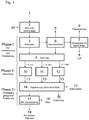
- FIG. 1 shows a flow diagram illustrating a preferred embodiment of a method according to the invention for separating multi-layer systems, in particular photovoltaic modules, for the purpose of recycling.
- input material 1 for the process are modules with EVA gluing in glass-glass composite / glass plastic, possibly with framing suitable.
- a disassembly of possibly existing electronic components such as junction boxes on the input material 1.
- the preceding process step 2 can be done on a manual disassembly workstation.
- step 3 a pre-crushing of the input material 1, the electronic components have been removed in the upstream process step 2.
- the pre-comminution in method step 3 results in an enlarged attack surface for the nanoscale dispersions according to the invention. Advantageous consequences are shorter process times.
- step 4 the material obtained after the crushing step 3 is subjected to classification by sieving.
- a set of modules without bonding can also be used as semifinished product. This is fed to a hammer mill 6 and crushed in this. In the crushing step 3 or in the hammer mill 6 resulting dust is preferably separated according to the suction step 7 with a HEPA filter (HEPA: high efficiency particulate air filter) in filtered air 8 and ultrafine particles 9.
- HEPA filter high efficiency particulate air filter
- the input material 1 comminuted in the comminution step 3 or the alternative input material 5 comminuted in the hammer mill 6 according to the exemplary embodiment described here are available in three different sizes.
- the screening according to step 4 has the advantage of separating coarse material and particles from one another, which have different separation properties in the baths 10, 11, 12.
- the advantage of screening according to the invention is that large particles can be washed off large particles which are easier to filter. On the other hand, small pieces of glass with even smaller particles lead to a high filtration / separation effort.
- step 4 is carried out according to the embodiment described here with a simple tumble screen. After Screening 4 can be done in the scheme according to FIG. 1 Not shown dosing be used for intermediate buffering, which then serve for the filling of the baths 10, 11, 12 in order to carry out the actual separation process.
- the baths 10, 11, 12 are filled up to a volume of about 40% with shards of the input material 1 and the alternative input material 5.
- the remaining about 60% of the volume of each bath 10, 11, 12 are filled with nanoscale dispersions according to the invention.
- the nanoscale dispersion can be specifically matched to the input material 1 or the alternative input material 5 in order to achieve an optimum process time at minimal cost.
- the nanoscale dispersions according to the invention are composed as disclosed in the introduction to the description. In particular, they are constructed according to one of the following compositions, in which each of the 100% missing part is filled up with water .
- phase 7.0 Xylene (technical) adding water 56,90 ges. aqueous component 70.1 Sum of water addition and contributions to aq. component component Wt .-% material Contribution to the aqueous component anionic surfactant 6.0 Leuna alkanesulfonate 95 (sodium alkanesulfonate mixture of average chain length C15 (C12-C18) based on n-paraffin) nonionic surfactant 6.0 Polyethylene glycol mono-n-dodecyl / tetradecyl ether as a mixture with 9 ethylene oxide units hydrotropically 2.0 Dimethylaminomethane-bisphosphonic cosurfactant 9.0 ethylhexanol organic phase 8.0 mesitylene adding water 69.0 ges. aqueous component 69.0 Sum of water addition and contributions to aq. component
- Example 3 component Wt.% material Contribution to the aqueous component amphoteric surfactant 5.0 N, N-dimethyl-N-tetradecylammoniopropanesulfonate nonionic surfactant 6.0 Polyethylene glycol mono-n-dodecyl / tetradecyl ether as a mixture with 9 ethylene oxide units hydrotropically 2.0 Dimethylaminomethane-bisphosphonic cosurfactant 9.0 ethylhexanol organic phase 7.0 Hydrosol P 180 EA adding water 71.0 ges. aqueous component 71.0 Sum of water addition and contributions to aq. component
- Example 3 unlike Examples 1 and 2, an amphoteric surfactant is used instead of an anionic surfactant.
- Example 4 component Wt .-% material Contribution to the aqueous component amphoteric surfactant 3.0 N, N-dimethyl-N-tetradecyl-ammoniopropanesulfonate anionic surfactant 4.0 Leuna alkanesulfonate 95 (sodium alkanesulfonate mixture of average chain length C15 (C12-C18) based on n-paraffin nonionic surfactant 6.0 Polyethylene glycol mono-n-dodecyl / tetradecyl ether as a mixture with 9 ethylene oxide units hydrotropically 2.0 Dimethylaminomethane-bisphosphonic cosurfactant 9.0 butyl ethers organic phase 5.0 Diesel fuel adding water 71 ges. aqueous component 71.0 Sum of water addition and contributions to aq. component
- Example 4 in addition to the nonionic surfactant, both an anionic surfactant and an amphoteric surfactant are used.
- One or more of said nanoscale dispersions act in the baths 10, 11, 12 for a certain exposure time, which depends on the properties of the input material 1 and the alternative input material 5, respectively.
- the action is carried out by comprehensive and a certain time lasting wetting at several attachment points at which the separation medium penetrate between the layers to be separated, migrate along the interface and there dissolve the adhesion. This need not necessarily be done in immersion tanks 11,12,13.
- the separating step 14 serves to separate the components of the input material 1 or of the alternative input material 5, which are present separately in the baths 10, 11, 12 after the washing process, and of the separating medium in the form of nanoscale dispersion.
- This step is in FIG. 1 shown only schematically.
- a floating-sink separation in conjunction with suitable filtering is sufficient.
- the light particles with high surface-to-volume ratio of the detached layers contained in the loaded separation medium can be separated from larger heavier particles such as glass fragments with a small surface volume ratio.
- the separation takes place using gravity, the flow behavior and / or the surface tension. Simple filtering can also be used according to the invention for the purpose of separation.
- EVA glass
- aluminum is processed in downstream process steps, which are also carried out in downstream plant sections can, separately.
- EVA can be separated by floating-sink separation, glass by settling in the same tank, aluminum by deposition of the non-iron components. These steps can be carried out in separate plant sections or in the same plant section.
- non-iron deposits 17 depositions of non-iron components, such as glass or aluminum, understood.
- the non-ferrous deposits 17 are in turn separated again after the valuable materials glass 18 and the aluminum frame 19.
- the said valuable materials, ie precious metals 15, EVA film 16, non-iron deposits 17, comprising glass 18 and aluminum frame 19, are not present after the treatment according to the invention with nanoscale dispersion according to the invention, as in the case of conventional processes, in a dissolved state. Therefore, the separation in the step 14 is technically easier.
- the quality of the recycled materials 15, 16, 17, 18, 19 obtained in terms of their recyclability is not limited by the recycling process itself.
- the electronic components 20 obtained in the preceding process step 2 in the disassembly of electronic components can also be supplied for recovery.
- the invention proposes a method, a system for carrying out the method, a separation medium and a use of the separation medium, which improved separation of multi-layer systems for the purpose of recycling, in particular with regard to a recovery rate and the quality of the obtained valuable materials 15, 16, 17 , 18, 19.
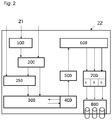
- FIG. 2 schematically shows another preferred embodiment of the method according to the invention for separating multilayer systems.
- multi-layer material 21 of a system 22 for separating multi-layer material is supplied.
- the multi-layer material 21 can optionally be initially supplied to a preliminary stage 100 for disassembly.
- precursor 100 parts to be treated separately, for example, parts that are not made of a multilayer material that is to be separated, are removed.
- 100 parts of the multi-layer material 21 to be separated may be separated in the precursor, which parts have to be subjected to a different treatment due to the nature of the multi-layer material than, for example, a main component of the multi-layer material.
- the part of the multi-layer material 21 remaining after dismantling is fed to another preliminary stage 200 for generating attack edges.
- the multi-layer material 21 can also directly the precursor 200 for generating attack edges within the system 1000 for separating Multilayer materials are supplied. This will be useful if disassembly is not required or desired.
- the attack edge generation precursor 200 one or more layers of the multi-layer system are created by penetrating defect sites to create an increase in the area of attack of the separation medium.
- the multi-layer material 21 to be processed is fed to an intermediate storage stage 250.
- the intermediate storage stage 250 it is also possible to ensure a suitable for the subsequent processing stage feed.
- a mixture of different feed material can be made.
- the multi-layer material 21 to be processed is fed to a wetting stage 300.
- the multi-layer material 21 to be separated is wetted with a release agent according to the invention. This is preferably carried out in a dipping bath containing the separating agent or in the form of a sprinkling line.
- a separating stage 400 is run through with the multi-layer material 21 to be separated.
- this is due to during the wetting stage 300 delaminated layer material separated from a substrate material as part of the multi-layer material 21 and, without going into solution, taken up by the release agent according to the invention.
- the process can be promoted by a circulation of the release agent according to the invention. This is indicated by the arrows between steps 300 and 400 in the FIG. 2 indicated.
- the separation stage 400 is followed by a separation stage 500.
- layer fragments taken up by the release agent according to the invention during the separation stage 400 are separated off by a suitable method. This is done, for example, by floating in air bubble stream according to a so-called floating method, by floating-sink separation or by filtration.
- a fragmentation stage 600 follows, in which the layer fragments separated off during the separation stage 400 and separated in the separation stage 500 from the liquid separating medium according to the invention are fragmented into different material fractions.
- the individual material fractions a, b, c are further refined in a post-treatment stage 700.
- the refinement of the individual material fractions a, b, c may for example consist of a breakdown, purification or in a physical or chemical processing.
- the material fractions a, b, c finished in the course of the aftertreatment stage 700 are fed to a packaging stage 800 and packaged separately for use.
Landscapes
- Chemical & Material Sciences (AREA)
- Organic Chemistry (AREA)
- Chemical Kinetics & Catalysis (AREA)
- Engineering & Computer Science (AREA)
- Life Sciences & Earth Sciences (AREA)
- Sustainable Development (AREA)
- Health & Medical Sciences (AREA)
- Medicinal Chemistry (AREA)
- Polymers & Plastics (AREA)
- Materials Engineering (AREA)
- Physics & Mathematics (AREA)
- General Physics & Mathematics (AREA)
- Environmental & Geological Engineering (AREA)
- Mechanical Engineering (AREA)
- Condensed Matter Physics & Semiconductors (AREA)
- Manufacturing & Machinery (AREA)
- Computer Hardware Design (AREA)
- Microelectronics & Electronic Packaging (AREA)
- Power Engineering (AREA)
- Processing Of Solid Wastes (AREA)
- Physical Or Chemical Processes And Apparatus (AREA)
- Separation, Recovery Or Treatment Of Waste Materials Containing Plastics (AREA)
Priority Applications (2)
| Application Number | Priority Date | Filing Date | Title |
|---|---|---|---|
| EP16202488.9A EP3170859A1 (de) | 2011-01-25 | 2012-01-25 | Trennmedium, verfahren und anlage zum trennen von mehrschichtsystemen |
| PL12703988T PL2668226T3 (pl) | 2011-01-25 | 2012-01-25 | Nośnik rozdzielający, sposób i urządzenie do rozdzielania systemów wielowarstwowych |
Applications Claiming Priority (2)
| Application Number | Priority Date | Filing Date | Title |
|---|---|---|---|
| DE201110000322 DE102011000322A1 (de) | 2011-01-25 | 2011-01-25 | Trennmedium, Verfahren und Anlage zum Trennen von Mehrschichtsystemen |
| PCT/EP2012/051172 WO2012101189A1 (de) | 2011-01-25 | 2012-01-25 | Trennmedium, verfahren und anlage zum trennen von mehrschichtsystemen |
Related Child Applications (1)
| Application Number | Title | Priority Date | Filing Date |
|---|---|---|---|
| EP16202488.9A Division EP3170859A1 (de) | 2011-01-25 | 2012-01-25 | Trennmedium, verfahren und anlage zum trennen von mehrschichtsystemen |
Publications (2)
| Publication Number | Publication Date |
|---|---|
| EP2668226A1 EP2668226A1 (de) | 2013-12-04 |
| EP2668226B1 true EP2668226B1 (de) | 2016-12-07 |
Family
ID=45607197
Family Applications (2)
| Application Number | Title | Priority Date | Filing Date |
|---|---|---|---|
| EP12703988.1A Active EP2668226B1 (de) | 2011-01-25 | 2012-01-25 | Trennmedium, verfahren und anlage zum trennen von mehrschichtsystemen |
| EP16202488.9A Withdrawn EP3170859A1 (de) | 2011-01-25 | 2012-01-25 | Trennmedium, verfahren und anlage zum trennen von mehrschichtsystemen |
Family Applications After (1)
| Application Number | Title | Priority Date | Filing Date |
|---|---|---|---|
| EP16202488.9A Withdrawn EP3170859A1 (de) | 2011-01-25 | 2012-01-25 | Trennmedium, verfahren und anlage zum trennen von mehrschichtsystemen |
Country Status (15)
| Country | Link |
|---|---|
| US (2) | US20130319618A1 (enExample) |
| EP (2) | EP2668226B1 (enExample) |
| JP (1) | JP2014507529A (enExample) |
| KR (1) | KR20140031194A (enExample) |
| CN (1) | CN103370366A (enExample) |
| AU (1) | AU2012210505B2 (enExample) |
| CA (1) | CA2825339A1 (enExample) |
| DE (1) | DE102011000322A1 (enExample) |
| DK (1) | DK2668226T3 (enExample) |
| EA (1) | EA201300852A1 (enExample) |
| ES (1) | ES2617984T3 (enExample) |
| PL (1) | PL2668226T3 (enExample) |
| PT (1) | PT2668226T (enExample) |
| TW (1) | TWI558744B (enExample) |
| WO (1) | WO2012101189A1 (enExample) |
Cited By (2)
| Publication number | Priority date | Publication date | Assignee | Title |
|---|---|---|---|---|
| EP3885095A1 (de) | 2020-03-23 | 2021-09-29 | Covestro Deutschland AG | Verwendung von mischungen aus wasser und ätherischen öl zur auftrennung von mehrschichtverbunden für das sortenreine recycling der polymer- bzw. metallfolien |
| EP3885404A1 (de) | 2020-03-23 | 2021-09-29 | Covestro Deutschland AG | Verwendung von mischungen ätherischer öle zur auftrennung von klebungen |
Families Citing this family (30)
| Publication number | Priority date | Publication date | Assignee | Title |
|---|---|---|---|---|
| DE102012018548B4 (de) * | 2012-09-20 | 2016-11-17 | Technische Universität Bergakademie Freiberg | Verfahren zur Verwertung von ausgedienten Solarmodulen und Solarzellen aus Silizium und siliziumhaltigen Bauelementen |
| JP6091863B2 (ja) * | 2012-11-27 | 2017-03-08 | 横浜油脂工業株式会社 | エチレン−酢酸ビニル共重合体の剥離剤 |
| JP6157904B2 (ja) * | 2013-04-09 | 2017-07-05 | Dowaエコシステム株式会社 | 太陽電池モジュール部材の構成部材回収方法およびそのシステム |
| ITRM20130286A1 (it) * | 2013-05-14 | 2014-11-15 | Eco Recycling S R L | Processo per il trattamento di pannelli fotovoltaici a fine vita |
| DE112014004689A5 (de) | 2013-10-10 | 2016-07-21 | Fraunhofer-Gesellschaft zur Förderung der angewandten Forschung e.V. | Verfahren zum separierenden Trennen von Schichten eines aus mindestens zwei Schichten gebildeten Verbundbauteils |
| ITBO20130701A1 (it) * | 2013-12-20 | 2015-06-21 | Mia En Scarl | Sistema di disassemblaggio di un pannello fotovoltaico per consentire il recupero delle materie prime |
| GB2525858A (en) * | 2014-05-05 | 2015-11-11 | saperatec GmbH | Method and apparatus for recycling packaging material |
| US12194659B2 (en) | 2014-05-05 | 2025-01-14 | saperatec GmbH | Method and apparatus for recylcing laminated glass |
| JP6671067B2 (ja) * | 2015-04-10 | 2020-03-25 | 国立研究開発法人産業技術総合研究所 | 架橋化evaの可溶化方法、可溶化方法を用いた使用済み太陽電池からの資源回収法 |
| FR3040704B1 (fr) | 2015-09-03 | 2021-09-10 | Centre Nat Rech Scient | Procede et dispositif de demontage de systemes multicouches comprenant au moins un composant organique |
| US10388812B2 (en) * | 2015-09-18 | 2019-08-20 | Toho Kasei Co., Ltd. | Method of recycling solar cell module |
| GB2557682A (en) * | 2016-12-15 | 2018-06-27 | saperatec GmbH | Method and apparatus for recycling packaging material |
| CN107020196A (zh) * | 2017-05-23 | 2017-08-08 | 青海万加环保新材料有限公司 | 一种亚微米粉体分级装置及分级方法 |
| CN109592886A (zh) * | 2017-09-30 | 2019-04-09 | 天津大学 | 基于晶体硅切割废料制备泡沫玻璃的方法 |
| DE102018205503A1 (de) | 2018-04-11 | 2019-10-17 | Fraunhofer-Gesellschaft zur Förderung der angewandten Forschung e. V. | Mehrlagiges Verbundsystem, Verfahren zu dessen Herstellung und Verwendung von Klebstoffen mit definierter Zersetzungstemperatur für die Herstellung von mehrlagigen Verbundsystem |
| GB2574260A (en) | 2018-06-01 | 2019-12-04 | saperatec GmbH | Separation fluid, method and apparatus for recycling multilayer material using a metal passivation agent |
| DE102018119835A1 (de) * | 2018-08-15 | 2020-02-20 | Chemische Fabrik Budenheim Kg | Polymerzusammensetzung mit Phosphonatflammschutzmittel |
| KR102112145B1 (ko) * | 2018-09-21 | 2020-06-04 | (주)대은 | 태양광 폐모듈 프레임제거장치 및 이를 포함하는 태양광 폐모듈 자원화 시스템 |
| FR3088579B1 (fr) | 2018-11-21 | 2022-08-26 | Commissariat Energie Atomique | Procede de delamination d’un dispositif multicouche |
| US20210009784A1 (en) * | 2019-07-10 | 2021-01-14 | Engineered Floors LLC | Recycling of composites containing layers unsuitable for recycling |
| WO2021018605A1 (en) * | 2019-07-26 | 2021-02-04 | Borealis Ag | Method for removing ink or other foreign materials from the surface of an article |
| JPWO2021090695A1 (enExample) * | 2019-11-06 | 2021-05-14 | ||
| JP6905103B1 (ja) * | 2020-01-24 | 2021-07-21 | Dowaエコシステム株式会社 | 金属回収方法 |
| WO2022065479A1 (ja) * | 2020-09-28 | 2022-03-31 | 新東工業株式会社 | ソーラーパネルのリサイクル方法およびソーラーパネルをリサイクルするための装置 |
| IT202000030176A1 (it) * | 2020-12-09 | 2022-06-09 | Eco Recycling S R L | Recupero di plastiche e vetro dai pannelli fotovoltaici a fine vita |
| DE102021109591B4 (de) | 2021-04-16 | 2023-01-19 | Wolfram Palitzsch | Verfahren und Vorrichtung zum Trennen von Multischichtverbundmaterialien |
| DE102021115384A1 (de) | 2021-06-14 | 2022-12-15 | Bachata Stiftung | Vorrichtung und Verfahren zum Recyceln von Verbundglasscheiben |
| IT202100018671A1 (it) * | 2021-07-15 | 2023-01-15 | Nuova Raecycle S R L | Metodo per il riciclaggio di rottame vetroso da pannelli fotovoltaici esausti |
| DE102022109249A1 (de) | 2022-04-14 | 2023-10-19 | Wolfram Palitzsch | Verfahren und Vorrichtung zum Trennen von Multischichtverbundmaterialien |
| JP7448756B2 (ja) * | 2022-06-01 | 2024-03-13 | artience株式会社 | 再生ポリエチレンの製造方法 |
Citations (1)
| Publication number | Priority date | Publication date | Assignee | Title |
|---|---|---|---|---|
| US6696399B1 (en) * | 2002-10-15 | 2004-02-24 | Cleaning Systems, Inc. | Cleaning composition |
Family Cites Families (62)
| Publication number | Priority date | Publication date | Assignee | Title |
|---|---|---|---|---|
| JPS5221085A (en) * | 1975-06-11 | 1977-02-17 | Mitsubishi Metal Corp | Process for separating metal from laminated board consisting of metal and thermoplastic synthetic resin |
| JPS5249281A (en) * | 1975-10-17 | 1977-04-20 | Mitsubishi Keikinzoku Kogyo | Process for separating metal from laminated bord consisting of metal and thermoplastic synthetic resin |
| JPS60223835A (ja) * | 1984-04-23 | 1985-11-08 | Iwata Kasei Sangyo Kk | 磁気記録材料からベ−ス材料および磁性体粉末を回収する方法 |
| GB8508010D0 (en) * | 1985-03-27 | 1985-05-01 | Unilever Plc | Liquid bleaching compositions |
| US5034150A (en) * | 1989-05-03 | 1991-07-23 | The Clorox Company | Thickened hypochlorite bleach solution and method of use |
| US5035826A (en) * | 1989-09-22 | 1991-07-30 | Colgate-Palmolive Company | Liquid crystal detergent composition |
| US5554320A (en) * | 1993-11-22 | 1996-09-10 | Yianakopoulos; Georges | Liquid cleaning compositions |
| DE4407900A1 (de) * | 1994-03-09 | 1995-09-14 | Basf Magnetics Gmbh | Verfahren zur Wiedergewinnung von Rohmaterialien aus magnetischen Aufzeichnungsträgern |
| US5912223A (en) * | 1994-12-15 | 1999-06-15 | Colgate Palmolive Company | Microemulsion light duty liquid cleaning compositions |
| US5698044A (en) * | 1995-03-24 | 1997-12-16 | E. I. Du Pont De Nemours And Company | Removal of adhesive from polyester film with criticality in surfactant use |
| US5628832A (en) * | 1995-03-24 | 1997-05-13 | E. I. Du Pont De Nemours And Company | Removal of adhesive from polyester film |
| BR9609495A (pt) * | 1995-07-18 | 1999-03-02 | Unilever Nv | Composição e processos de remoção de gordura cozida sobre uma superfície de metal e de limpeza de uma área para estacionamento |
| DE19531886A1 (de) * | 1995-08-30 | 1997-03-06 | Basf Magnetics Gmbh | Kontinuierlich ablaufendes Verfahren zur Wiedergewinnung von Rohmaterialien aus beschichteten Folien |
| WO1997018284A2 (en) * | 1995-11-16 | 1997-05-22 | Amway Corporation | Liquid dishwashing detergent |
| US5736496A (en) * | 1996-07-09 | 1998-04-07 | Colgate-Palmolive Co. | Liquid cleaning compositions comprising a negatively charged complex comprising an anionic surfactant and an alkylene carbonate |
| US5817183A (en) * | 1996-08-12 | 1998-10-06 | General Electric Company | Method for removing coatings from thermoplastic substrates |
| JP3986589B2 (ja) * | 1996-09-13 | 2007-10-03 | ヒューレット・パッカード・カンパニー | インクジェット用インク組成物 |
| US6129779A (en) | 1997-05-13 | 2000-10-10 | First Solar, Llc | Reclaiming metallic material from an article comprising a non-metallic friable substrate |
| DE69813368T2 (de) * | 1997-05-16 | 2004-02-26 | The Procter & Gamble Company, Cincinnati | Gelförmiges oder flüssiges, mildes Geschirrspülmittel auf der Basis von Mikroemulsionen mit vorteilhaftem Lösevermögen für fettige Speisereste und Schaumverhalten |
| US5952287A (en) | 1997-06-03 | 1999-09-14 | Henkel Corporation | Microemulsion composition for cleaning hard surfaces |
| US6224685B1 (en) | 1997-06-03 | 2001-05-01 | Henkel Corporation | Microemulsion composition for cleaning hard surfaces |
| WO1998055587A1 (en) * | 1997-06-06 | 1998-12-10 | Colgate-Palmolive Company | Microemulsion all purpose liquid cleaning compositions |
| GB9718139D0 (en) * | 1997-08-27 | 1997-10-29 | Zeneca Ltd | Agrochemical Formulation |
| CO5040174A1 (es) * | 1997-12-12 | 2001-05-29 | Colgate Palmolive Co | Composiciones antimicrobianas para multiples propositos en microemulsion que contienen un tensioactivo cationico |
| US5905064A (en) * | 1998-01-08 | 1999-05-18 | Colgate-Palmolive Co. | Microemulsion cleaning compositions |
| JP2000044724A (ja) * | 1998-05-27 | 2000-02-15 | Stylo Japan:Kk | プラスチックの溶剤、及びプラスチックの回収方法 |
| US6821937B2 (en) * | 1999-03-05 | 2004-11-23 | Cognis Corporation | Hard surface cleaning composition |
| EP1065262A1 (en) * | 1999-06-29 | 2001-01-03 | The Procter & Gamble Company | Bleaching compositions |
| JP2001164400A (ja) * | 1999-12-03 | 2001-06-19 | Nippon Hyomen Kagaku Kk | フェノール樹脂用電解剥離液及び電解剥離方法 |
| US6573230B1 (en) * | 2002-01-28 | 2003-06-03 | Colgate-Palmolive Company | Liquid cleaning composition containing an effective biodegradable chelating agent |
| US6455487B1 (en) * | 2002-03-21 | 2002-09-24 | Colgate Palmolive Company | Liquid cleaning composition containing a preservative and an effective chelating agent |
| US6444635B1 (en) * | 2002-03-21 | 2002-09-03 | Colgate-Palmolive Company | Liquid cleaning composition having an improved preservative system |
| JP2004042033A (ja) * | 2002-05-17 | 2004-02-12 | Kawatetsu Techno Res Corp | 太陽電池モジュールからのシリコンウエーハおよび強化ガラスの回収方法 |
| US6608020B1 (en) * | 2002-09-06 | 2003-08-19 | Colgate-Palmolive Company | Liquid cleaning compositions |
| US6605585B1 (en) * | 2002-09-06 | 2003-08-12 | Colgate-Palmolive Company | Liquid cleaning compositions |
| US6534469B1 (en) * | 2002-09-06 | 2003-03-18 | Colgate-Palmolive Company | Liquid cleaning compositions |
| EP1431384B2 (en) | 2002-12-19 | 2009-02-11 | The Procter & Gamble Company | Single compartment unit dose fabric treatment product comprising pouched compositions with non-cationic fabric softener actives |
| CN100481524C (zh) * | 2003-09-10 | 2009-04-22 | 大日本印刷株式会社 | 太阳能电池组件用填充材料层、太阳能电池组件 |
| WO2005065852A1 (ja) * | 2004-01-06 | 2005-07-21 | National Institute Of Advanced Industrial Science And Technology | 太陽電池モジュールの構成部材の分別方法 |
| PT1861349E (pt) | 2005-03-21 | 2009-11-13 | Bp Corp North America Inc | Recuperação melhorada de energia durante a produção de ácidos carboxílicos aromáticos |
| JP5025916B2 (ja) * | 2005-06-06 | 2012-09-12 | 日本板硝子株式会社 | ガラス及び中間膜を有する合わせガラスの分離用水溶液及び分離方法 |
| US7547670B2 (en) | 2005-10-25 | 2009-06-16 | Cognis Ip Management Gmbh | Low odor ester-based microemulsions for cleaning hard surfaces |
| WO2007111385A1 (ja) * | 2006-03-27 | 2007-10-04 | Nippon Sheet Glass Company, Limited | 中間膜分離液及び中間膜分離方法 |
| US20100056410A1 (en) * | 2006-09-25 | 2010-03-04 | Advanced Technology Materials, Inc. | Compositions and methods for the removal of photoresist for a wafer rework application |
| CN101681130A (zh) * | 2007-03-31 | 2010-03-24 | 高级技术材料公司 | 用于晶圆再生的材料剥除方法 |
| US20100112728A1 (en) * | 2007-03-31 | 2010-05-06 | Advanced Technology Materials, Inc. | Methods for stripping material for wafer reclamation |
| WO2008157345A2 (en) * | 2007-06-13 | 2008-12-24 | Advanced Technology Materials, Inc. | Wafer reclamation compositions and methods |
| DE102007034441B4 (de) * | 2007-07-20 | 2020-06-04 | Ulrich Loser | Technisches Verfahren zum Entfernen der Front- und Rückseitenkontakte von Solarzellen bei gleichzeitiger Gewinnung von Wertstoffen und Minimierung von Abfällen |
| EP2045320B1 (de) | 2007-09-19 | 2012-04-25 | Bubbles & Beyond Gmbh | Reinigungsmittel zur Entfernung von Farbschichten von Oberflächen, Verfahren zur Herstellung des Mittels und Verfahren zur Reinigung |
| US7974732B2 (en) | 2008-04-28 | 2011-07-05 | Spirit Aerosystems, Inc. | Reconfigurable numerical control for multi level modular machine |
| WO2009135102A2 (en) * | 2008-05-01 | 2009-11-05 | Advanced Technology Materials, Inc. | Low ph mixtures for the removal of high density implanted resist |
| CN102216854A (zh) * | 2008-08-04 | 2011-10-12 | 高级技术材料公司 | 环境友好型聚合物剥离组合物 |
| CN102217042A (zh) | 2008-10-02 | 2011-10-12 | 高级技术材料公司 | 表面活性剂/消泡剂混合物用于增强硅基板的金属负载及表面钝化的应用 |
| DE102008056311A1 (de) | 2008-11-07 | 2010-05-12 | Apk Aluminium Und Kunststoffe Ag | Verfahren zum Abtrennen einzelner Wertstoffe aus gemischtem, insbesondere zerkleinertem Kunststoffabfall |
| DE102008058530B4 (de) * | 2008-11-21 | 2012-10-31 | Ulrich Loser | Technisches Verfahren zum Recycling von Dünnschichtsolarmodulen |
| DE102009006185A1 (de) * | 2009-01-27 | 2010-07-29 | Osram Opto Semiconductors Gmbh | Leuchtmittel |
| DE102009013469B4 (de) | 2009-03-19 | 2014-04-17 | Bubbles And Beyond Gmbh | Zubereitung zur äußerlichen Anwendung |
| DE102009014380A1 (de) | 2009-03-26 | 2010-10-07 | Bubbles And Beyond Gmbh | Verfahren und Zusammensetzung zum Reinigen von Gegenständen |
| WO2011075416A1 (en) | 2009-12-18 | 2011-06-23 | First Solar, Inc. | Film removal |
| EP2516526A4 (en) | 2009-12-21 | 2015-08-12 | Ashutosh Mukhopadhyay | METHOD FOR DETRATIFYING A LAMINATED PACKAGING |
| JP2013079354A (ja) | 2011-10-05 | 2013-05-02 | Kanie Puropan Kk | 高分子積層体の処理方法 |
| US8863809B2 (en) | 2011-11-14 | 2014-10-21 | The Boeing Company | Methods and systems for recycling of laminated materials |
-
2011
- 2011-01-25 DE DE201110000322 patent/DE102011000322A1/de not_active Withdrawn
-
2012
- 2012-01-25 CA CA2825339A patent/CA2825339A1/en not_active Abandoned
- 2012-01-25 DK DK12703988.1T patent/DK2668226T3/en active
- 2012-01-25 CN CN2012800065166A patent/CN103370366A/zh active Pending
- 2012-01-25 EP EP12703988.1A patent/EP2668226B1/de active Active
- 2012-01-25 ES ES12703988.1T patent/ES2617984T3/es active Active
- 2012-01-25 KR KR1020137021561A patent/KR20140031194A/ko not_active Withdrawn
- 2012-01-25 PL PL12703988T patent/PL2668226T3/pl unknown
- 2012-01-25 PT PT127039881T patent/PT2668226T/pt unknown
- 2012-01-25 EA EA201300852A patent/EA201300852A1/ru unknown
- 2012-01-25 EP EP16202488.9A patent/EP3170859A1/de not_active Withdrawn
- 2012-01-25 JP JP2013550874A patent/JP2014507529A/ja active Pending
- 2012-01-25 WO PCT/EP2012/051172 patent/WO2012101189A1/de not_active Ceased
- 2012-01-25 AU AU2012210505A patent/AU2012210505B2/en not_active Ceased
- 2012-01-30 TW TW101102793A patent/TWI558744B/zh not_active IP Right Cessation
-
2013
- 2013-07-25 US US13/950,485 patent/US20130319618A1/en not_active Abandoned
-
2016
- 2016-03-22 US US15/077,210 patent/US10618268B2/en active Active
Patent Citations (1)
| Publication number | Priority date | Publication date | Assignee | Title |
|---|---|---|---|---|
| US6696399B1 (en) * | 2002-10-15 | 2004-02-24 | Cleaning Systems, Inc. | Cleaning composition |
Cited By (4)
| Publication number | Priority date | Publication date | Assignee | Title |
|---|---|---|---|---|
| EP3885095A1 (de) | 2020-03-23 | 2021-09-29 | Covestro Deutschland AG | Verwendung von mischungen aus wasser und ätherischen öl zur auftrennung von mehrschichtverbunden für das sortenreine recycling der polymer- bzw. metallfolien |
| EP3885404A1 (de) | 2020-03-23 | 2021-09-29 | Covestro Deutschland AG | Verwendung von mischungen ätherischer öle zur auftrennung von klebungen |
| WO2021191060A1 (de) | 2020-03-23 | 2021-09-30 | Covestro Deutschland Ag | Verwendung von ätherischen ölen zur auftrennung von klebungen |
| WO2021191059A1 (de) | 2020-03-23 | 2021-09-30 | Covestro Deutschland Ag | Verwendung von mischungen aus wasser und ätherischen öl zur auftrennung von mehrschichtverbunden für das sortenreine recycling der polymer- bzw. metallfolien |
Also Published As
| Publication number | Publication date |
|---|---|
| EP2668226A1 (de) | 2013-12-04 |
| AU2012210505A8 (en) | 2013-09-26 |
| US20130319618A1 (en) | 2013-12-05 |
| AU2012210505B2 (en) | 2016-08-04 |
| US10618268B2 (en) | 2020-04-14 |
| EA201300852A1 (ru) | 2014-03-31 |
| TW201231515A (en) | 2012-08-01 |
| TWI558744B (zh) | 2016-11-21 |
| DE102011000322A1 (de) | 2012-07-26 |
| WO2012101189A1 (de) | 2012-08-02 |
| US20160214368A1 (en) | 2016-07-28 |
| PT2668226T (pt) | 2017-03-10 |
| DK2668226T3 (en) | 2017-03-13 |
| KR20140031194A (ko) | 2014-03-12 |
| ES2617984T3 (es) | 2017-06-20 |
| EP3170859A1 (de) | 2017-05-24 |
| PL2668226T3 (pl) | 2017-07-31 |
| CA2825339A1 (en) | 2012-08-02 |
| AU2012210505A1 (en) | 2013-09-05 |
| JP2014507529A (ja) | 2014-03-27 |
| CN103370366A (zh) | 2013-10-23 |
Similar Documents
| Publication | Publication Date | Title |
|---|---|---|
| EP2668226B1 (de) | Trennmedium, verfahren und anlage zum trennen von mehrschichtsystemen | |
| Tao et al. | Review on feasible recycling pathways and technologies of solar photovoltaic modules | |
| RU2759556C2 (ru) | Способ и устройство переработки упаковочного материала | |
| DE102008058530B4 (de) | Technisches Verfahren zum Recycling von Dünnschichtsolarmodulen | |
| EP3344396B1 (de) | Verfahren zum recycling von kompositwerkstoffen | |
| IT202000030176A1 (it) | Recupero di plastiche e vetro dai pannelli fotovoltaici a fine vita | |
| CN104230086A (zh) | 一种水性涂料清洗剂废液再生利用的方法 | |
| US20200238679A1 (en) | Facility for separating layers in multilayer systems | |
| Palitzsch et al. | Economic PV waste recycling solutions—Results from R&D and practice | |
| EP4240532B1 (en) | Device for utilization of photovoltaic panels | |
| JP2011245379A (ja) | 液晶パネルの再資源化方法 | |
| EP2556893B1 (de) | Verfahren und Anlage zur Wiedergewinnung von Metallen aus Verbundmaterialien, insbesondere aus Siliciumsolarmodulen, Dünnschichtsolarmodulen, LCD-Displays od. dgl. | |
| ES2618071T3 (es) | Materiales biodegradables para el acolchado del suelo basados en mezclas acuosas de polisacáridos y fibras de desechos vegetales y procedimientos para su aplicación | |
| EP2546003B1 (de) | Verfahren und vorrichtung zum trennen von strassenbelag - asphalt oder ölsand gemischen | |
| EP1205513B1 (de) | Verfahren zum Entlackieren von mit Lackschichten versehenen Kunststoffkörpern | |
| EP3259080A1 (de) | Verfahren und vorrichtung zum trennen von verbundwerkstoffen und gemischen, insbesondere feststoffgemischen und schlacken | |
| DE102010027310A1 (de) | Verfahren zum Extrahieren wenigstens eines nicht magnetischen Wertstoffs aus Elektroschrott | |
| DE102022109249A1 (de) | Verfahren und Vorrichtung zum Trennen von Multischichtverbundmaterialien | |
| DE102020100243B4 (de) | Verfahren zur Aufarbeitung von Glas-Kunststoff-Metall-Verbundmaterialien | |
| DE102021109591A1 (de) | Verfahren und Vorrichtung zum Trennen von Multischichtverbundmaterialien | |
| SK1252025U1 (sk) | Získavanie kremíka kombináciou postupného oddeľovania vrstiev fotovoltických panelov a depomelyrizáciou EVA fólie | |
| Lv et al. | Efficient Decapsulation of Waste Pv Modules: Dissociation and Mechanism for Encapsulation Films by Tgm | |
| WO2025131935A1 (de) | Separieren von flächigen, glas- und kunststofflagen enthaltenen verbundelementen | |
| DE19847100A1 (de) | Verfahren und Vorrichtung zur Zerkleinerung von Halbleitermaterial | |
| CN106186454A (zh) | 一种汽车电泳漆含油废水的处理方法 |
Legal Events
| Date | Code | Title | Description |
|---|---|---|---|
| PUAI | Public reference made under article 153(3) epc to a published international application that has entered the european phase |
Free format text: ORIGINAL CODE: 0009012 |
|
| 17P | Request for examination filed |
Effective date: 20130826 |
|
| AK | Designated contracting states |
Kind code of ref document: A1 Designated state(s): AL AT BE BG CH CY CZ DE DK EE ES FI FR GB GR HR HU IE IS IT LI LT LU LV MC MK MT NL NO PL PT RO RS SE SI SK SM TR |
|
| DAX | Request for extension of the european patent (deleted) | ||
| 111L | Licence recorded |
Designated state(s): AL AT BE BG CH CY CZ DE DK EE ES FI FR GB GR HR HU IE IS IT LT LU LV MC MK MT NL NO PL PT RO RS SE SI SK SM TR Name of requester: SKLOPAN LIBEREC, A.S., CZ Effective date: 20150327 |
|
| 17Q | First examination report despatched |
Effective date: 20150603 |
|
| GRAP | Despatch of communication of intention to grant a patent |
Free format text: ORIGINAL CODE: EPIDOSNIGR1 |
|
| INTG | Intention to grant announced |
Effective date: 20160620 |
|
| GRAS | Grant fee paid |
Free format text: ORIGINAL CODE: EPIDOSNIGR3 |
|
| GRAA | (expected) grant |
Free format text: ORIGINAL CODE: 0009210 |
|
| 111L | Licence recorded |
Designated state(s): AL AT BE BG CH CY CZ DE DK EE ES FI FR GB GR HR HU IE IS IT LT LU LV MC MK MT NL NO PL PT RO RS SE SI SK SM TR Name of requester: SKLOPAN LIBEREC, A.S., CZ Effective date: 20150327 |
|
| AK | Designated contracting states |
Kind code of ref document: B1 Designated state(s): AL AT BE BG CH CY CZ DE DK EE ES FI FR GB GR HR HU IE IS IT LI LT LU LV MC MK MT NL NO PL PT RO RS SE SI SK SM TR |
|
| REG | Reference to a national code |
Ref country code: GB Ref legal event code: FG4D Free format text: NOT ENGLISH |
|
| REG | Reference to a national code |
Ref country code: CH Ref legal event code: EP Ref country code: CH Ref legal event code: PK Free format text: ERGAENZUNG LIZENZEINTRAG: NICHT AUSSCHLIESSLICHE LIZENZ Ref country code: AT Ref legal event code: REF Ref document number: 851674 Country of ref document: AT Kind code of ref document: T Effective date: 20161215 |
|
| REG | Reference to a national code |
Ref country code: IE Ref legal event code: FG4D Free format text: LANGUAGE OF EP DOCUMENT: GERMAN |
|
| REG | Reference to a national code |
Ref country code: FR Ref legal event code: PLFP Year of fee payment: 6 |
|
| REG | Reference to a national code |
Ref country code: DE Ref legal event code: R096 Ref document number: 502012008967 Country of ref document: DE |
|
| PG25 | Lapsed in a contracting state [announced via postgrant information from national office to epo] |
Ref country code: LV Free format text: LAPSE BECAUSE OF FAILURE TO SUBMIT A TRANSLATION OF THE DESCRIPTION OR TO PAY THE FEE WITHIN THE PRESCRIBED TIME-LIMIT Effective date: 20161207 |
|
| REG | Reference to a national code |
Ref country code: CH Ref legal event code: NV Representative=s name: 24IP LAW GROUP, CH |
|
| REG | Reference to a national code |
Ref country code: PT Ref legal event code: SC4A Ref document number: 2668226 Country of ref document: PT Date of ref document: 20170310 Kind code of ref document: T Free format text: AVAILABILITY OF NATIONAL TRANSLATION Effective date: 20170303 |
|
| REG | Reference to a national code |
Ref country code: DK Ref legal event code: T3 Effective date: 20170308 |
|
| REG | Reference to a national code |
Ref country code: NL Ref legal event code: FP |
|
| REG | Reference to a national code |
Ref country code: SE Ref legal event code: TRGR |
|
| REG | Reference to a national code |
Ref country code: LT Ref legal event code: MG4D |
|
| PG25 | Lapsed in a contracting state [announced via postgrant information from national office to epo] |
Ref country code: LT Free format text: LAPSE BECAUSE OF FAILURE TO SUBMIT A TRANSLATION OF THE DESCRIPTION OR TO PAY THE FEE WITHIN THE PRESCRIBED TIME-LIMIT Effective date: 20161207 Ref country code: GR Free format text: LAPSE BECAUSE OF FAILURE TO SUBMIT A TRANSLATION OF THE DESCRIPTION OR TO PAY THE FEE WITHIN THE PRESCRIBED TIME-LIMIT Effective date: 20170308 |
|
| REG | Reference to a national code |
Ref country code: NO Ref legal event code: T2 Effective date: 20161207 |
|
| PG25 | Lapsed in a contracting state [announced via postgrant information from national office to epo] |
Ref country code: HR Free format text: LAPSE BECAUSE OF FAILURE TO SUBMIT A TRANSLATION OF THE DESCRIPTION OR TO PAY THE FEE WITHIN THE PRESCRIBED TIME-LIMIT Effective date: 20161207 Ref country code: RS Free format text: LAPSE BECAUSE OF FAILURE TO SUBMIT A TRANSLATION OF THE DESCRIPTION OR TO PAY THE FEE WITHIN THE PRESCRIBED TIME-LIMIT Effective date: 20161207 |
|
| REG | Reference to a national code |
Ref country code: ES Ref legal event code: FG2A Ref document number: 2617984 Country of ref document: ES Kind code of ref document: T3 Effective date: 20170620 |
|
| PG25 | Lapsed in a contracting state [announced via postgrant information from national office to epo] |
Ref country code: EE Free format text: LAPSE BECAUSE OF FAILURE TO SUBMIT A TRANSLATION OF THE DESCRIPTION OR TO PAY THE FEE WITHIN THE PRESCRIBED TIME-LIMIT Effective date: 20161207 Ref country code: IS Free format text: LAPSE BECAUSE OF FAILURE TO SUBMIT A TRANSLATION OF THE DESCRIPTION OR TO PAY THE FEE WITHIN THE PRESCRIBED TIME-LIMIT Effective date: 20170407 Ref country code: SK Free format text: LAPSE BECAUSE OF FAILURE TO SUBMIT A TRANSLATION OF THE DESCRIPTION OR TO PAY THE FEE WITHIN THE PRESCRIBED TIME-LIMIT Effective date: 20161207 Ref country code: RO Free format text: LAPSE BECAUSE OF FAILURE TO SUBMIT A TRANSLATION OF THE DESCRIPTION OR TO PAY THE FEE WITHIN THE PRESCRIBED TIME-LIMIT Effective date: 20161207 |
|
| PG25 | Lapsed in a contracting state [announced via postgrant information from national office to epo] |
Ref country code: SM Free format text: LAPSE BECAUSE OF FAILURE TO SUBMIT A TRANSLATION OF THE DESCRIPTION OR TO PAY THE FEE WITHIN THE PRESCRIBED TIME-LIMIT Effective date: 20161207 Ref country code: BG Free format text: LAPSE BECAUSE OF FAILURE TO SUBMIT A TRANSLATION OF THE DESCRIPTION OR TO PAY THE FEE WITHIN THE PRESCRIBED TIME-LIMIT Effective date: 20170307 |
|
| REG | Reference to a national code |
Ref country code: DE Ref legal event code: R097 Ref document number: 502012008967 Country of ref document: DE |
|
| PG25 | Lapsed in a contracting state [announced via postgrant information from national office to epo] |
Ref country code: MC Free format text: LAPSE BECAUSE OF FAILURE TO SUBMIT A TRANSLATION OF THE DESCRIPTION OR TO PAY THE FEE WITHIN THE PRESCRIBED TIME-LIMIT Effective date: 20161207 |
|
| PLBE | No opposition filed within time limit |
Free format text: ORIGINAL CODE: 0009261 |
|
| STAA | Information on the status of an ep patent application or granted ep patent |
Free format text: STATUS: NO OPPOSITION FILED WITHIN TIME LIMIT |
|
| REG | Reference to a national code |
Ref country code: IE Ref legal event code: MM4A |
|
| 26N | No opposition filed |
Effective date: 20170908 |
|
| PG25 | Lapsed in a contracting state [announced via postgrant information from national office to epo] |
Ref country code: LU Free format text: LAPSE BECAUSE OF NON-PAYMENT OF DUE FEES Effective date: 20170125 Ref country code: SI Free format text: LAPSE BECAUSE OF FAILURE TO SUBMIT A TRANSLATION OF THE DESCRIPTION OR TO PAY THE FEE WITHIN THE PRESCRIBED TIME-LIMIT Effective date: 20161207 |
|
| REG | Reference to a national code |
Ref country code: FR Ref legal event code: PLFP Year of fee payment: 7 |
|
| PG25 | Lapsed in a contracting state [announced via postgrant information from national office to epo] |
Ref country code: IE Free format text: LAPSE BECAUSE OF NON-PAYMENT OF DUE FEES Effective date: 20170125 |
|
| PG25 | Lapsed in a contracting state [announced via postgrant information from national office to epo] |
Ref country code: MT Free format text: LAPSE BECAUSE OF FAILURE TO SUBMIT A TRANSLATION OF THE DESCRIPTION OR TO PAY THE FEE WITHIN THE PRESCRIBED TIME-LIMIT Effective date: 20161207 |
|
| PG25 | Lapsed in a contracting state [announced via postgrant information from national office to epo] |
Ref country code: HU Free format text: LAPSE BECAUSE OF FAILURE TO SUBMIT A TRANSLATION OF THE DESCRIPTION OR TO PAY THE FEE WITHIN THE PRESCRIBED TIME-LIMIT; INVALID AB INITIO Effective date: 20120125 |
|
| PG25 | Lapsed in a contracting state [announced via postgrant information from national office to epo] |
Ref country code: CY Free format text: LAPSE BECAUSE OF NON-PAYMENT OF DUE FEES Effective date: 20161207 |
|
| PG25 | Lapsed in a contracting state [announced via postgrant information from national office to epo] |
Ref country code: MK Free format text: LAPSE BECAUSE OF FAILURE TO SUBMIT A TRANSLATION OF THE DESCRIPTION OR TO PAY THE FEE WITHIN THE PRESCRIBED TIME-LIMIT Effective date: 20161207 |
|
| PG25 | Lapsed in a contracting state [announced via postgrant information from national office to epo] |
Ref country code: TR Free format text: LAPSE BECAUSE OF FAILURE TO SUBMIT A TRANSLATION OF THE DESCRIPTION OR TO PAY THE FEE WITHIN THE PRESCRIBED TIME-LIMIT Effective date: 20161207 |
|
| PG25 | Lapsed in a contracting state [announced via postgrant information from national office to epo] |
Ref country code: AL Free format text: LAPSE BECAUSE OF FAILURE TO SUBMIT A TRANSLATION OF THE DESCRIPTION OR TO PAY THE FEE WITHIN THE PRESCRIBED TIME-LIMIT Effective date: 20161207 |
|
| PGFP | Annual fee paid to national office [announced via postgrant information from national office to epo] |
Ref country code: CZ Payment date: 20210113 Year of fee payment: 10 Ref country code: CH Payment date: 20210122 Year of fee payment: 10 Ref country code: FI Payment date: 20210119 Year of fee payment: 10 Ref country code: NO Payment date: 20210120 Year of fee payment: 10 Ref country code: PT Payment date: 20210114 Year of fee payment: 10 Ref country code: NL Payment date: 20210120 Year of fee payment: 10 |
|
| PGFP | Annual fee paid to national office [announced via postgrant information from national office to epo] |
Ref country code: PL Payment date: 20210122 Year of fee payment: 10 Ref country code: AT Payment date: 20210119 Year of fee payment: 10 Ref country code: BE Payment date: 20210120 Year of fee payment: 10 Ref country code: SE Payment date: 20210122 Year of fee payment: 10 Ref country code: DK Payment date: 20210120 Year of fee payment: 10 |
|
| REG | Reference to a national code |
Ref country code: FI Ref legal event code: MAE |
|
| REG | Reference to a national code |
Ref country code: NO Ref legal event code: MMEP Ref country code: DK Ref legal event code: EBP Effective date: 20220131 |
|
| REG | Reference to a national code |
Ref country code: SE Ref legal event code: EUG |
|
| REG | Reference to a national code |
Ref country code: CH Ref legal event code: PL |
|
| REG | Reference to a national code |
Ref country code: NL Ref legal event code: MM Effective date: 20220201 |
|
| REG | Reference to a national code |
Ref country code: AT Ref legal event code: MM01 Ref document number: 851674 Country of ref document: AT Kind code of ref document: T Effective date: 20220125 |
|
| REG | Reference to a national code |
Ref country code: BE Ref legal event code: MM Effective date: 20220131 |
|
| PG25 | Lapsed in a contracting state [announced via postgrant information from national office to epo] |
Ref country code: SE Free format text: LAPSE BECAUSE OF NON-PAYMENT OF DUE FEES Effective date: 20220126 Ref country code: PT Free format text: LAPSE BECAUSE OF NON-PAYMENT OF DUE FEES Effective date: 20220725 Ref country code: NO Free format text: LAPSE BECAUSE OF NON-PAYMENT OF DUE FEES Effective date: 20220131 Ref country code: NL Free format text: LAPSE BECAUSE OF NON-PAYMENT OF DUE FEES Effective date: 20220201 Ref country code: FI Free format text: LAPSE BECAUSE OF NON-PAYMENT OF DUE FEES Effective date: 20220125 Ref country code: CZ Free format text: LAPSE BECAUSE OF NON-PAYMENT OF DUE FEES Effective date: 20220125 Ref country code: AT Free format text: LAPSE BECAUSE OF NON-PAYMENT OF DUE FEES Effective date: 20220125 |
|
| PG25 | Lapsed in a contracting state [announced via postgrant information from national office to epo] |
Ref country code: BE Free format text: LAPSE BECAUSE OF NON-PAYMENT OF DUE FEES Effective date: 20220131 |
|
| PG25 | Lapsed in a contracting state [announced via postgrant information from national office to epo] |
Ref country code: LI Free format text: LAPSE BECAUSE OF NON-PAYMENT OF DUE FEES Effective date: 20220131 Ref country code: CH Free format text: LAPSE BECAUSE OF NON-PAYMENT OF DUE FEES Effective date: 20220131 |
|
| PG25 | Lapsed in a contracting state [announced via postgrant information from national office to epo] |
Ref country code: DK Free format text: LAPSE BECAUSE OF NON-PAYMENT OF DUE FEES Effective date: 20220131 |
|
| PG25 | Lapsed in a contracting state [announced via postgrant information from national office to epo] |
Ref country code: PL Free format text: LAPSE BECAUSE OF NON-PAYMENT OF DUE FEES Effective date: 20220125 |
|
| PGFP | Annual fee paid to national office [announced via postgrant information from national office to epo] |
Ref country code: DE Payment date: 20250129 Year of fee payment: 14 |
|
| PGFP | Annual fee paid to national office [announced via postgrant information from national office to epo] |
Ref country code: ES Payment date: 20250214 Year of fee payment: 14 |
|
| PGFP | Annual fee paid to national office [announced via postgrant information from national office to epo] |
Ref country code: FR Payment date: 20250122 Year of fee payment: 14 |
|
| PGFP | Annual fee paid to national office [announced via postgrant information from national office to epo] |
Ref country code: IT Payment date: 20250131 Year of fee payment: 14 Ref country code: GB Payment date: 20250123 Year of fee payment: 14 |