EP2616520B1 - Two-part, cyanoacrylate/cationically curable adhesive systems - Google Patents
Two-part, cyanoacrylate/cationically curable adhesive systems Download PDFInfo
- Publication number
- EP2616520B1 EP2616520B1 EP11760754.9A EP11760754A EP2616520B1 EP 2616520 B1 EP2616520 B1 EP 2616520B1 EP 11760754 A EP11760754 A EP 11760754A EP 2616520 B1 EP2616520 B1 EP 2616520B1
- Authority
- EP
- European Patent Office
- Prior art keywords
- epoxy
- composition
- cyanoacrylate
- component
- salts
- Prior art date
- Legal status (The legal status is an assumption and is not a legal conclusion. Google has not performed a legal analysis and makes no representation as to the accuracy of the status listed.)
- Active
Links
- 0 C[N+](c(cc(*)cc1)c1ON(*=O)I=I)[I-] Chemical compound C[N+](c(cc(*)cc1)c1ON(*=O)I=I)[I-] 0.000 description 2
Images



Classifications
-
- C—CHEMISTRY; METALLURGY
- C09—DYES; PAINTS; POLISHES; NATURAL RESINS; ADHESIVES; COMPOSITIONS NOT OTHERWISE PROVIDED FOR; APPLICATIONS OF MATERIALS NOT OTHERWISE PROVIDED FOR
- C09J—ADHESIVES; NON-MECHANICAL ASPECTS OF ADHESIVE PROCESSES IN GENERAL; ADHESIVE PROCESSES NOT PROVIDED FOR ELSEWHERE; USE OF MATERIALS AS ADHESIVES
- C09J133/00—Adhesives based on homopolymers or copolymers of compounds having one or more unsaturated aliphatic radicals, each having only one carbon-to-carbon double bond, and at least one being terminated by only one carboxyl radical, or of salts, anhydrides, esters, amides, imides, or nitriles thereof; Adhesives based on derivatives of such polymers
- C09J133/18—Homopolymers or copolymers of nitriles
-
- C—CHEMISTRY; METALLURGY
- C08—ORGANIC MACROMOLECULAR COMPOUNDS; THEIR PREPARATION OR CHEMICAL WORKING-UP; COMPOSITIONS BASED THEREON
- C08K—Use of inorganic or non-macromolecular organic substances as compounding ingredients
- C08K3/00—Use of inorganic substances as compounding ingredients
- C08K3/38—Boron-containing compounds
-
- C—CHEMISTRY; METALLURGY
- C09—DYES; PAINTS; POLISHES; NATURAL RESINS; ADHESIVES; COMPOSITIONS NOT OTHERWISE PROVIDED FOR; APPLICATIONS OF MATERIALS NOT OTHERWISE PROVIDED FOR
- C09J—ADHESIVES; NON-MECHANICAL ASPECTS OF ADHESIVE PROCESSES IN GENERAL; ADHESIVE PROCESSES NOT PROVIDED FOR ELSEWHERE; USE OF MATERIALS AS ADHESIVES
- C09J11/00—Features of adhesives not provided for in group C09J9/00, e.g. additives
-
- C—CHEMISTRY; METALLURGY
- C08—ORGANIC MACROMOLECULAR COMPOUNDS; THEIR PREPARATION OR CHEMICAL WORKING-UP; COMPOSITIONS BASED THEREON
- C08F—MACROMOLECULAR COMPOUNDS OBTAINED BY REACTIONS ONLY INVOLVING CARBON-TO-CARBON UNSATURATED BONDS
- C08F122/00—Homopolymers of compounds having one or more unsaturated aliphatic radicals each having only one carbon-to-carbon double bond, and at least one being terminated by a carboxyl radical and containing at least one other carboxyl radical in the molecule; Salts, anhydrides, esters, amides, imides or nitriles thereof
- C08F122/30—Nitriles
- C08F122/32—Alpha-cyano-acrylic acid; Esters thereof
-
- C—CHEMISTRY; METALLURGY
- C08—ORGANIC MACROMOLECULAR COMPOUNDS; THEIR PREPARATION OR CHEMICAL WORKING-UP; COMPOSITIONS BASED THEREON
- C08G—MACROMOLECULAR COMPOUNDS OBTAINED OTHERWISE THAN BY REACTIONS ONLY INVOLVING UNSATURATED CARBON-TO-CARBON BONDS
- C08G59/00—Polycondensates containing more than one epoxy group per molecule; Macromolecules obtained by polymerising compounds containing more than one epoxy group per molecule using curing agents or catalysts which react with the epoxy groups
- C08G59/18—Macromolecules obtained by polymerising compounds containing more than one epoxy group per molecule using curing agents or catalysts which react with the epoxy groups ; e.g. general methods of curing
- C08G59/68—Macromolecules obtained by polymerising compounds containing more than one epoxy group per molecule using curing agents or catalysts which react with the epoxy groups ; e.g. general methods of curing characterised by the catalysts used
- C08G59/72—Complexes of boron halides
-
- C—CHEMISTRY; METALLURGY
- C09—DYES; PAINTS; POLISHES; NATURAL RESINS; ADHESIVES; COMPOSITIONS NOT OTHERWISE PROVIDED FOR; APPLICATIONS OF MATERIALS NOT OTHERWISE PROVIDED FOR
- C09J—ADHESIVES; NON-MECHANICAL ASPECTS OF ADHESIVE PROCESSES IN GENERAL; ADHESIVE PROCESSES NOT PROVIDED FOR ELSEWHERE; USE OF MATERIALS AS ADHESIVES
- C09J133/00—Adhesives based on homopolymers or copolymers of compounds having one or more unsaturated aliphatic radicals, each having only one carbon-to-carbon double bond, and at least one being terminated by only one carboxyl radical, or of salts, anhydrides, esters, amides, imides, or nitriles thereof; Adhesives based on derivatives of such polymers
- C09J133/04—Homopolymers or copolymers of esters
- C09J133/14—Homopolymers or copolymers of esters of esters containing halogen, nitrogen, sulfur or oxygen atoms in addition to the carboxy oxygen
-
- C—CHEMISTRY; METALLURGY
- C09—DYES; PAINTS; POLISHES; NATURAL RESINS; ADHESIVES; COMPOSITIONS NOT OTHERWISE PROVIDED FOR; APPLICATIONS OF MATERIALS NOT OTHERWISE PROVIDED FOR
- C09J—ADHESIVES; NON-MECHANICAL ASPECTS OF ADHESIVE PROCESSES IN GENERAL; ADHESIVE PROCESSES NOT PROVIDED FOR ELSEWHERE; USE OF MATERIALS AS ADHESIVES
- C09J133/00—Adhesives based on homopolymers or copolymers of compounds having one or more unsaturated aliphatic radicals, each having only one carbon-to-carbon double bond, and at least one being terminated by only one carboxyl radical, or of salts, anhydrides, esters, amides, imides, or nitriles thereof; Adhesives based on derivatives of such polymers
- C09J133/18—Homopolymers or copolymers of nitriles
- C09J133/22—Homopolymers or copolymers of nitriles containing four or more carbon atoms
-
- C—CHEMISTRY; METALLURGY
- C09—DYES; PAINTS; POLISHES; NATURAL RESINS; ADHESIVES; COMPOSITIONS NOT OTHERWISE PROVIDED FOR; APPLICATIONS OF MATERIALS NOT OTHERWISE PROVIDED FOR
- C09J—ADHESIVES; NON-MECHANICAL ASPECTS OF ADHESIVE PROCESSES IN GENERAL; ADHESIVE PROCESSES NOT PROVIDED FOR ELSEWHERE; USE OF MATERIALS AS ADHESIVES
- C09J135/00—Adhesives based on homopolymers or copolymers of compounds having one or more unsaturated aliphatic radicals, each having only one carbon-to-carbon double bond, and at least one being terminated by a carboxyl radical, and containing at least another carboxyl radical in the molecule, or of salts, anhydrides, esters, amides, imides or nitriles thereof; Adhesives based on derivatives of such polymers
- C09J135/04—Homopolymers or copolymers of nitriles
-
- C—CHEMISTRY; METALLURGY
- C09—DYES; PAINTS; POLISHES; NATURAL RESINS; ADHESIVES; COMPOSITIONS NOT OTHERWISE PROVIDED FOR; APPLICATIONS OF MATERIALS NOT OTHERWISE PROVIDED FOR
- C09J—ADHESIVES; NON-MECHANICAL ASPECTS OF ADHESIVE PROCESSES IN GENERAL; ADHESIVE PROCESSES NOT PROVIDED FOR ELSEWHERE; USE OF MATERIALS AS ADHESIVES
- C09J163/00—Adhesives based on epoxy resins; Adhesives based on derivatives of epoxy resins
-
- C—CHEMISTRY; METALLURGY
- C09—DYES; PAINTS; POLISHES; NATURAL RESINS; ADHESIVES; COMPOSITIONS NOT OTHERWISE PROVIDED FOR; APPLICATIONS OF MATERIALS NOT OTHERWISE PROVIDED FOR
- C09J—ADHESIVES; NON-MECHANICAL ASPECTS OF ADHESIVE PROCESSES IN GENERAL; ADHESIVE PROCESSES NOT PROVIDED FOR ELSEWHERE; USE OF MATERIALS AS ADHESIVES
- C09J4/00—Adhesives based on organic non-macromolecular compounds having at least one polymerisable carbon-to-carbon unsaturated bond ; adhesives, based on monomers of macromolecular compounds of groups C09J183/00 - C09J183/16
-
- C—CHEMISTRY; METALLURGY
- C09—DYES; PAINTS; POLISHES; NATURAL RESINS; ADHESIVES; COMPOSITIONS NOT OTHERWISE PROVIDED FOR; APPLICATIONS OF MATERIALS NOT OTHERWISE PROVIDED FOR
- C09J—ADHESIVES; NON-MECHANICAL ASPECTS OF ADHESIVE PROCESSES IN GENERAL; ADHESIVE PROCESSES NOT PROVIDED FOR ELSEWHERE; USE OF MATERIALS AS ADHESIVES
- C09J4/00—Adhesives based on organic non-macromolecular compounds having at least one polymerisable carbon-to-carbon unsaturated bond ; adhesives, based on monomers of macromolecular compounds of groups C09J183/00 - C09J183/16
- C09J4/06—Organic non-macromolecular compounds having at least one polymerisable carbon-to-carbon unsaturated bond in combination with a macromolecular compound other than an unsaturated polymer of groups C09J159/00 - C09J187/00
Definitions
- Two part cyanoacrylate/cationically curable adhesive systems are provided.
- Curable compositions such as cyanoacrylate adhesives are well recognized for their excellent ability to rapidly bond a wide range of substrates, generally in a number of minutes and depending on the particular substrate, often in a number of seconds.
- cyanoacrylates Polymerization of cyanoacrylates is initiated by nucleophiles found under normal atmospheric conditions on most surfaces. The initiation by surface chemistry means that sufficient initiating species are available when two surfaces are in close contact with a small layer of cyanoacrylate between the two surfaces. Under these conditions a strong bond is obtained in a short period of time. Thus, in essence the cyanoacrylate often functions as an instant adhesive.
- Cyanoacrylate adhesive performance particularly durability, oftentimes becomes suspect when exposed to elevated temperature conditions and/or high relative humidity conditions.
- a host of additives have been identified for inclusion in cyanoacrylate adhesive formulations. Improvements would still be seen as beneficial.
- Cationically curable compositions generally are well known, a chief example among them being epoxy compositions which are widely used. Epoxy compositions once cured are known to form robust bonds between substrates made from many different types of materials. However, epoxy compositions, whether in one part or two parts, do not have anywhere near the same rapid fixture time shown by cyanoacrylates, and may tend to show poor performance properties on substrates constructed from certain materials in particular plastic substrates, such as polycarbonate (“PC”), acrylonitrile-butadiene-styrene copolymer (“ABS”), polymethylmethacrylate (“PMMA”), and polyvinyl chloride (“PVC”), to name a few.
- PC polycarbonate
- ABS acrylonitrile-butadiene-styrene copolymer
- PMMA polymethylmethacrylate
- PVC polyvinyl chloride
- GB 2 228 943 discloses one-part cyanoacrylate adhesive compositions suitable for bonding porous or non-active surfaces containing a phase transfer catalyst.
- US 2003/0226472 discloses use of quaternary boron salts as initiators of polymerisation in adhesive compositions for bonding low surface energy substrates such as polyolefins.
- compositions which are room temperature curable, provide good performance across substrates constructed from a wide variety of materials and provide improved durability performance over conventional cyanoacrylate compositions and improved fixture time and improved plastics bonding over conventional cationically curable compositions.
- R is selected from C 1-15 alkyl, C 2-15 alkoxyalkyl, C 3-15 cycloalkyl, C 2-15 alkenyl, C 7-15 aralkyl, C 6-15 aryl, C 3-15 allyl and C 3-15 haloalkyl groups.
- the cyanoacrylate monomer is selected from methyl cyanoacrylate, ethyl-2-cyanoacrylate, propyl cyanoacrylates, butyl cyanoacrylates (such as n-butyl-2-cyanoacrylate), octyl cyanoacrylates, allyl cyanoacrylate, ⁇ -methoxyethyl cyanoacrylate and combinations thereof.
- ECA ethyl-2-cyanoacrylate
- the cyanoacrylate component should be included in the Part A composition in an amount within the range of from 50% to 99.98% by weight, such as 65% to 85% by weight being desirable, and 75% to 97% by weight of the total composition being particularly desirable.
- a hard cation non-nucleophilic anion catalyst should be used as the cationic catalyst to be included in the Part A composition of the two part adhesive system.
- a hard cation non-nucleophilic anion catalyst examples include salts of lithium and metals from Group II of the Periodic Table, and non-nucleophilic acids.
- non-nucleophilic acids have a pH of less than 1.0 when measured as a 10% by weight solution in water and the anion portion of such acids does readily participate in displacement reactions with organic halides.
- the Group II metal salts include calcium and magnesium.
- non-nucleophilic acids include perchloric, fluoroboric, fluoroarsenic, fluoroantimonic and fluorophosphoric acids.
- examples of hard cation non-nucleophilic anion salts include lithium tetrafluoroborate, calcium di-tetrafluoroborate, magnesium di-tetrafluoroborate, lithum hexaflourophosphate, calcium di-hexaflourophosphate, magnesium di-hexaflourophosphate, lithium hexaflouroantimonate and lithium hexaflouroarsenate.
- the cationic catalyst may also include lanthanide triflate salts, aryl iodonium salts, aryl sulfonium salts, lanthanum triflate, ytterbium triflate, trimethoxyboroxine, trimethoxyboroxine-aluminum acetyl acetonate, amine-boron trihalide complexes, quaternary ammonium salts, quaternary phosphonium salts, tri-aryl sulfonium salts, di-aryl iodonium salts, and diazonium salts.
- cationic catalyst suitable for use herein in the Part A composition of the adhesive system are trialkoxyboroxine curing agents, such as are described in U.S. Patent Nos. 4,336,367 and 6,617,400 . Of course, combinations of any two or more of these cationic catalysts may be used as well.
- boron triflouride boron trifluoride-etherate
- sulphur trioxide and hydrolyis products thereof
- methane sulfonic acid which are oftentimes used to stabilize cyanoacrylate monomers against anionic polymerization (see below), a known issue in shelf life stabilization.
- the amount of cationic catalyst will fall in the range of 0.001 weight percent up to 10.00 weight percent of the composition, desirably 0.01 weight percent up to 5.00 weight percent of the composition, such as 0.50 to 2.50 weight percent of the composition.
- Additives may be included in the Part A composition of the adhesive system to confer physical properties, such as improved fixture speed, improved shelf-life stability, flexibility, thixotropy, increased viscosity, color, and improved toughness.
- additives therefore may be selected from accelerators, free radical stabilizers, anionic stabilizers, gelling agents, thickeners [such as PMMAs], thixotropy conferring agents (such as fumed silica), dyes, toughening agents, plasticizers and combinations thereof.
- One or more accelerators may also be used in the adhesive system, particularly, in the Part A composition, to accelerate cure of the cyanoacrylate component.
- Such accelerators may be selected from calixarenes and oxacalixarenes, silacrowns, crown ethers, cyclodextrins, poly(ethyleneglycol) di(meth)acrylates, ethoxylated hydric compounds and combinations thereof.
- R 1 is alkyl, alkoxy, substituted alkyl or substituted alkoxy
- R 2 is H or alkyl
- n is 4, 6 or 8.
- calixarene is tetrabutyl tetra[2-ethoxy-2-oxoethoxy] calix-4-arene.
- crown ethers are known.
- examples which may be used herein either individually or in combination include 15-crown-5, 18-crown-6, dibenzo-18-crown-6, benzo-15-crown-5-dibenzo-24-crown-8, dibenzo-30-crown-10, tribenzo-18-crown-6, asym-dibenzo-22-crown-6, dibenzo-14-crown-4, dicyclohexyl-18-crown-6, dicyclohexyl-24-crown-8, cyclohexyl-12-crown-4, 1,2-decalyl-15-crown-5, 1,2-naphtho-15-crown-5, 3,4,5-naphtyl-16-crown-5, 1,2-methyl-benzo-18-crown-6, 1,2-methylbenzo-5, 6-methylbenzo-18-crown-6, 1,2-t-butyl-18-crown-6, 1,2-vinylbenzo-15-
- a typical silacrown may be represented within the structure below: where R 3 and R 4 are organo groups which do not themselves cause polymerization of the cyanoacrylate monomer, R 5 is H or CH 3 and n is an integer of between 1 and 4.
- suitable R 3 and R 4 groups are R groups, alkoxy groups, such as methoxy, and aryloxy groups, such as phenoxy.
- the R 3 and R 4 groups may contain halogen or other substituents, an example being trifluoropropyl.
- groups not suitable as R 4 and R 5 groups are basic groups, such as amino, substituted amino and alkylamino.
- silacrown compounds useful in the inventive compositions include: dimethylsila-11-crown-4; dimethylsila-14-crown-5; and dimethylsila-17-crown-6. See e.g. U.S. Patent No. 4,906,317 (Liu ).
- cyclodextrins may be used in connection with the present invention.
- those described and claimed in U.S. Patent No. 5,312,864 (Wenz ) as hydroxyl group derivatives of an ⁇ , ⁇ or ⁇ -cyclodextrin which is at least partly soluble in the cyanoacrylate would be appropriate choices for use herein as an accelerator component.
- poly(ethylene glycol) di(meth)acrylates suitable for use herein include those within the structure below: where n is greater than 3, such as within the range of 3 to 12, with n being 9 as particularly desirable. More specific examples include PEG 200 DMA, (where n is 4) PEG 400 DMA (where n is 9), PEG 600 DMA (where n is 14), and PEG 800 DMA (where n is 19), where the number ( e.g. , 400) represents the average molecular weight of the glycol portion of the molecule, excluding the two methacrylate groups, expressed as grams/mole ( i.e. , 400 g/mol).
- a particularly desirable PEG DMA is PEG 400 DMA.
- ethoxylated hydric compounds or ethoxylated fatty alcohols that may be employed
- appropriate ones may be chosen from those within the structure below: where C m can be a linear or branched alkyl or alkenyl chain, m is an integer between 1 to 30, such as from 5 to 20, n is an integer between 2 to 30, such as from 5 to 15, and R may be H or alkyl, such as C 1-6 alkyl.
- DEHYDOL 100 Commercially available examples of such materials include those offered under the DEHYDOL tradename from Cognis GmbH & Co. KGaA, Dusseldorf, Germany, such as DEHYDOL 100.
- accelerators embraced within the structure below where R is hydrogen, C 1-6 alkyl, C 1-6 alkyloxy, alkyl thioethers, haloalkyl, carboxylic acid and esters thereof, sulfinic, sulfonic and sulfurous acids and esters, phosphinic, phosphonic and phosphorous acids and esters thereof, Z is a polyether linkage, n is 1-12 and p is 1-3 are as defined above, and R' is the same as R, and g is the same as n.
- a particularly desirable chemical within this class as an accelerator component is where n and m combined are greater than or equal to 12.
- the accelerator should be included in the composition in an amount within the range of from 0.01% to 10% by weight, with the range of 0.1 to 0.5% by weight being desirable, and 0.4% by weight of the total composition being particularly desirable.
- Stabilizers useful in the Part A composition of the adhesive system include free-radical stabilizers, anionic stabilizers and stabilizer packages that include combinations thereof.
- the identity and amount of such stabilizers are well known to those of ordinary skill in the art. See e.g. U.S. Patent Nos. 5,530,037 and 6,607,632 .
- Commonly used free-radical stabilizers include hydroquinone, while commonly used anionic stabilizers include boron triflouride, boron trifluoride-etherate, sulphur trioxide (and hydrolyis products thereof) and methane sulfonic acid. These anionic stabilizers can also serve as the cationic catalyst or a portion thereof, as noted above.
- Cationically curable monomers for use in the Part B composition of the adhesive system include epoxy monomers, episulfide monomers, oxetane monomers, and combinations thereof.
- Epoxy monomers for use in Part B of the composition of the adhesive system include a host of epoxy monomers, with some of the epoxy monomers being aromatic, while others are aliphatic and still others are cycloaliphatic.
- Examples of such epoxy monomers include bisphenol F diglycidyl ethers (and hydrogenated versions thereof), bisphenol A diglycidyl ethers (and hydrogenated versions thereof), bisphenol S diglycidyl ethers (and hydrogenated versions thereof), bisphenol E diglycidyl ethers (and hydrogenated versions thereof), biphenyl diglycidyl ethers (and hydrogenated versions thereof), 4-vinyl-1-cyclohexene diepoxide, butanediol diglycidyl ether, neopentylglycol diglycidyl ether, 3,4-epoxycyclohexylmethyl-3,4-epoxycyclohexanecarboxylate, limonene diepoxide, hexanediol dig
- epoxy resins suitable for use are polyglycidyl derivatives of phenolic compounds, such as those available under the tradenames EPON 828, EPON 1001, EPON 1009, and EPON 1031, from Shell Chemical Co.; DER 331, DER 332, DER 334, and DER 542 from Dow Chemical Co.; GY285 from Ciba Specialty Chemicals, Tarrytown, New York; and BREN-S from Nippon Kayaku, Japan; epoxidized polybutadienes, such as those sold under the trade designation PolyBD from Sartomer, EPOLEAD PB 3600 from Daicel, JP-100 and JP-200 from Nippon Soda, epoxidised liquid isoprene rubbers such as KL-610, KL-613 and KL-630T from Kuraray; and epoxidised liquid polyisoprenes such as EPOXYPRENE 25 and EPOXYPRENE 50 from Sanyo Corporation.
- epoxy resins include polyepoxides prepared from polyols and polyglycidyl derivatives of phenol-formaldehyde novolacs, the latter of which are available commercially under the tradenames DEN 431, DEN 438, and DEN 439 from Dow Chemical Company. Cresol analogs are also available commercially ECN 1235, ECN 1273, and ECN 1299 from Ciba Specialty Chemicals.
- SU-8 is a bisphenol A-type epoxy novolac available from Resolution.
- cycloaliphatic epoxy resins such as those available under the CYRACURE tradename, and hydrogenated bisphenol and biphenyl type epoxy resins, as noted, such as those available under the EPALLOY tradename, are suitable for use herein.
- Cycloaliphatic epoxy resins contain at least one cycloaliphatic group and at least one oxirane group, oftentimes two oxirane groups.
- Representative cycloaliphatic epoxy resins include 2-(3,4-epoxy)cyclohexyl-5,5-spiro-(3,4-epoxy)cyclohexane-m-dioxane, 3,4-epoxycyclohexylmethyl-3,4-epoxycyclohexanecarboxylate,3,4-epoxy-6-methylcyclohexylmethyl-3,4-epoxy-6-methylcyclohexanecarboxylate, vinyl cyclohexanedioxide, bis(3,4-epoxycyclohexylmethyl)adipate, bis(3,4-epoxy-6-methylcyclohexylmethyl)adipate, exo-exo bis(2,3-epoxycyclopentyl) ether, endo-exo bis(2,3
- Siloxane functional epoxy resins may also be utilised such as 1,3-bis(3,4-epoxycyclohexyl-2-ethyl)-1,1,3,3-tetramethyldisiloxane and other epoxy functional linear/cyclic siloxanes such as those disclosed in U.S. Patent No. 7,777,064 .
- cycloaliphatic epoxy resins are 3,4-epoxycyclohexylmethyl-3,4-epoxycyclohexanecarboxylate and 3,4-epox-6-methylcyclohexylmethyl-3,4-epoxy-6-methylcyclohexanecarboxylate.
- Other examples of cycloaliphatic epoxies suitable for use herein include those disclosed and described in U.S. Patent No. 6,429,281 (Dershem .
- the episulfide monomer may simply be the full or partial sulphur-containing three-membered ring version of the base epoxy monomer.
- the oxetane monomers may be chosen from Oxetanes labeled A-C are available from Toa Gsei Co., Ltd., Japan.
- the vinyl ether monomer may be selected from a host of materials, such as those commercially available under the tradename VEctomer from Vertellus Performance Materials Inc., Greensboro, NC. Examples include VEctomer vinyl ether 4010 [Bis-(4-vinyl oxy butyl) isophthalate], VEctomer vinyl ether 4060 [Bis(4-vinyl oxy butyl) adipate], and VEctomer vinyl ether 5015 [Tris(4-vinyloxybutyl)trimellitate].
- the epoxy, episulfide, oxetane and/or vinyl ether monomer may be one that is functionalized with one or more alkoxy silane groups.
- alkoxy silane groups examples include those commercially available from Gelest Inc., Morrisville, PA.
- additives may be included in either or both of the Part A or the Part B compositions to influence a variety of performance properties.
- Fillers contemplated for optional use include, for example, aluminum nitride, boron nitride, silicon carbide, diamond, graphite, beryllium oxide, magnesia, silicas, such as fumed silica or fused silica, alumina, perfluorinated hydrocarbon polymers ( i.e. , TEFLON), thermoplastic polymers, thermoplastic elastomers, mica, glass powder.
- the particle size of these fillers will be about 20 microns or less.
- the silica may have a mean particle diameter on the nanoparticle size; that is, having a mean particle diameter on the order of 10-9 meters.
- the silica nanoparticles can be pre-dispersed in epoxy resins, and may be selected from those available under the tradename NANOPOX, from Nanoresins, Germany.
- NANOPOX is a tradename for a product family of silica nanoparticle reinforced epoxy resins showing an outstanding combination of material properties,
- the silica phase consists of surface-modified, synthetic SiO 2 nanospheres with less than 50 nm diameter and an extremely narrow particle size distribution.
- the SiO 2 nanospheres are agglomerate-free dispersions in the epoxy resin matrix resulting in a low viscosity for resins containing up to 50 wt% silica.
- NANOPOX A610 a 40 percent by weight dispersion in a cycloaliphatic epoxy resin matrix.
- the NANOPOX products are believed to have a particle size of 5 nm to 80 nm, though the manufacturer reports less than 50 nm.
- the silica component should be present in an amount in the range of 1 to 60 percent by weight, such as 3 to 30 percent by weight, desirably about 5 to about 20 percent by weight, based on the total weight of the composition.
- Flexibilizers also called plasticizers
- Such flexibilizers include, for example, polyethers, polyesters, polythiols, polysulfides, and the like. If used, flexibilizers typically are present in the range of 0.5 weight percent up to 30 weight percent of the composition.
- the flexibilizers may also be reactive; that is, they may be functionalized so as to react into the cured reaction product.
- hydroxyl-functionalized resins can be used, as they tend to co-react with cationically curable components, such as epoxy resins, and thus used can modify the mechanical properties of the cured products.
- hydroxy-functionalized aliphatic polyester diols provide improved flexibility to the cured composition.
- K-FLEX A307 which is from King Industries.
- K-FLEX A307 is reported by the manufacturer to be a low viscosity, 100% solids linear, saturated, aliphatic polyester diol with primary hydroxyl groups.
- K-FLEX A307 is promoted to have been designed as a flexibility modifier for acrylic/isocyanates and acrylic/melamine systems.
- Commercial applications are advertised as automotive OEM, automotive refinish, aerospace, industrial maintenance, and plastic coatings.
- PolyTHF 650/1400/2000/2900 sold under the trade name TERATHANE
- polycaprolactone diols and triols Aldrich
- polydimethylsiloxane-polycaprolactone diols such as WAX 350 OH D from Wacker
- K-PURE CDR-3441 CDR-3319 (King Industry)
- primary or secondary hydroxyl terminated polybutadienes/hydrogenated polybutadienes Cray Valley, such as PolyBd/Krasol materials
- hydrogenated castor oils such as THIXCIN R, THIXCIN E (Elementis Specialties), and the POLYCIN series (Vertellus Specialties Inc.).
- Tougheners contemplated for use particularly in the Part A composition include elastomeric polymers selected from elastomeric copolymers of a lower alkene monomer and (i) acrylic acid esters, (ii) methacrylic acid esters or (iii) vinyl acetate, such as acrylic rubbers; polyester urethanes; ethylene-vinyl acetates; fluorinated rubbers; isoprene-acrylonitrile polymers; chlorosulfinated polyethylenes; and homopolymers of polyvinyl acetate were found to be particularly useful. [ See U.S. Patent No. 4,440,910 (O'Connor )).
- the elastomeric polymers are described in the '910 patent as either homopolymers of alkyl esters of acrylic acid; copolymers of another polymerizable monomer, such as lower alkenes, with an alkyl or alkoxy ester of acrylic acid; and copolymers of alkyl or alkoxy esters of acrylic acid.
- Other unsaturated monomers which may be copolymerized with the alkyl and alkoxy esters of acrylic include dienes, reactive halogen-containing unsaturated compounds and other acrylic monomers such as acrylamides.
- one group of such elastomeric polymers are copolymers of methyl acrylate and ethylene, manufactured by DuPont, under the name of VAMAC, such as VAMAC N123 and VAMAC B-124.
- VAMAC N123 and VAMAC B-124 are reported by DuPont to be a master batch of ethylene/acrylic elastomer.
- the DuPont material VAMAC G is a similar copolymer, but contains no fillers to provide color or stabilizers.
- VAMAC VCS rubber appears to be the base rubber, from which the remaining members of the VAMAC product line are compounded.
- VAMAC VCS (also known as VAMAC MR) is a reaction product of the combination of ethylene, methyl acrylate and monomers having carboxylic acid cure sites, which once formed is then substantially free of processing aids such as the release agents octadecyl amine, complex organic phosphate esters and/or stearic acid, and anti-oxidants, such as substituted diphenyl amine.
- VAMAC VMX 1012 and VCD 6200 are rubbers made from ethylene and methyl acrylate. It is believed that the VAMAC VMX 1012 rubber possesses little to no carboxylic acid in the polymer backbone. Like the VAMAC VCS rubber, the VAMAC VMX 1012 and VCD 6200 rubbers are substantially free of processing aids such as the release agents octadecyl amine, complex organic phosphate esters and/or stearic acid, and anti-oxidants, such as substituted diphenyl amine, noted above. All of these VAMAC elastomeric polymers are useful herein.
- vinylidene chloride-acrylonitrile copolymers [see U.S. Patent No. 4,102,945 (Gleave )] and vinyl chloride/vinyl acetate copolymers [see U.S. Patent 4,444,933 (Columbus)] may be included in the Part A composition.
- vinylidene chloride-acrylonitrile copolymers see U.S. Patent No. 4,102,945 (Gleave )
- vinyl chloride/vinyl acetate copolymers see U.S. Patent 4,444,933 (Columbus)
- Copolymers of polyethylene and polyvinyl acetate available commercially under the tradename LEVAMELT by LANXESS Limited, are useful.
- LEVAMELT 400 comprises an ethylene-vinyl acetate copolymer comprising 40 wt% vinyl acetate.
- LEVAMELT-brand products are supplied in granular form. The granules are almost colourless and dusted with silica and talc.
- the LEVAMELT-brand products consist of methylene units forming a saturated main chain with pendant acetate groups. The presence of a fully saturated main chain is an indication that LEVAMELT is a particularly stable polymer. It does not contain any reactive double bonds which make conventional rubbers prone to aging reactions, ozone and UV light. The saturated backbone is reported to make it robust.
- the LEVAMELT elastomers are available in pellet form and are easier to formulate than other known elastomeric toughening agents.
- VINNOL brand surface coating resins available commercially from Wacker Chemie AG, Kunststoff, Germany represent a broad range of vinyl chloride-derived copolymers and terpolymers that are promoted for use in different industrial applications.
- the main constituents of these polymers are different compositions of vinyl chloride and vinyl acetate.
- the terpolymers of the VINNOL product line additionally contain carboxyl or hydroxyl groups. These vinyl chloride/vinyl acetate copolymers and terpolymers may also be used.
- VINNOL surface coating resins with carboxyl groups are terpolymers of vinyl chloride, vinyl acetate and dicarboxylic acids, varying in terms of their molar composition and degree and process of polymerization. These terpolymers are reported to show excellent adhesion, particularly on metallic substrates.
- VINNOL surface coating resins with hydroxyl groups are copolymers and terpolymers of vinyl chloride, hydroxyacrylate and dicarboxylate, varying in terms of their composition and degree of polymerization.
- VINNOL surface coating resins without functional groups are copolymers of vinyl chloride and vinyl acetate of variable molar composition and degree of polymerization.
- Rubber particles especially rubber particles that have relatively small average particle size (e.g. , less than 500 nm or less than 200 nm), may also be included, particularly in the Part B composition.
- the rubber particles may or may not have a shell common to known core-shell structures.
- such particles generally have a core comprised of a polymeric material having elastomeric or rubbery properties (i.e. , a glass transition temperature less than 0°C, e.g. , less than -30°C) surrounded by a shell comprised of a non-elastomeric polymeric material (i.e. , a thermoplastic or thermoset/crosslinked polymer having a glass transition temperature greater than ambient temperatures, e.g. , greater than 50°C).
- a polymeric material having elastomeric or rubbery properties i.e. , a glass transition temperature less than 0°C, e.g. , less than -30°C
- a non-elastomeric polymeric material i.e. , a thermoplastic or thermoset/crosslinked polymer having a glass transition temperature greater than ambient temperatures, e.g. , greater than 50°C.
- the core may be comprised of a diene homopolymer or copolymer (for example, a homopolymer of butadiene or isoprene, a copolymer of butadiene or isoprene with one or more ethylenically unsaturated monomers such as vinyl aromatic monomers, (meth)acrylonitrile, (meth)acrylates, or the like) while the shell may be comprised of a polymer or copolymer of one or more monomers such as (meth)acrylates (e.g. , methyl methacrylate), vinyl aromatic monomers ( e.g. , styrene), vinyl cyanides (e.g.
- a diene homopolymer or copolymer for example, a homopolymer of butadiene or isoprene, a copolymer of butadiene or isoprene with one or more ethylenically unsaturated monomers such as vinyl aromatic monomers, (
- acrylonitrile unsaturated acids and anhydrides
- unsaturated acids and anhydrides e.g. , acrylic acid
- unsaturated acids and anhydrides e.g. , acrylic acid
- unsaturated acids and anhydrides e.g. , acrylic acid
- unsaturated acids and anhydrides e.g. , acrylic acid
- (meth) acrylamides having a suitably high glass transition temperature.
- Other rubbery polymers may also be suitably be used for the core, including polybutylacrylate or polysiloxane elastomer (e.g. , polydimethylsiloxane, particularly crosslinked polydimethylsiloxane).
- the rubber particle may be comprised of more than two layers (e.g. , a central core of one rubbery material may be surrounded by a second core of a different rubbery material or the rubbery core may be surrounded by two shells of different composition or the rubber particle may have the structure soft core, hard shell, soft shell, hard shell).
- the rubber particles used are comprised of a core and at least two concentric shells having different chemical compositions and/or properties. Either the core or the shell or both the core and the shell may be crosslinked (e.g., ionically or covalently).
- the shell may be grafted onto the core.
- the polymer comprising the shell may bear one or more different types of functional groups (e.g. , epoxy groups) that are capable of interacting with other components of the compositions of the present invention.
- the core will comprise from 50 to 95 weight percent of the rubber particles while the shell will comprise from 5 to 50 weight percent of the rubber particles.
- the rubber particles are relatively small in size.
- the average particle size may be from 0.03 to 2 microns or from 0.05 to 1 micron.
- the rubber particles may have an average diameter of less than 500 nm, such as less than 200 nm.
- the core-shell rubber particles may have an average diameter within the range of from 25 to 200 nm.
- Rubber particles having a core-shell structure may be prepared as a masterbatch where the rubber particles are dispersed in one or more epoxy resins such as a diglycidyl ether of bisphenol A.
- the rubber particles typically are prepared as aqueous dispersions or emulsions. Such dispersions or emulsions may be combined with the desired epoxy resin or mixture of epoxy resins and the water and other volatile substances removed by distillation or the like.
- One method of preparing such masterbatches is described in more detail in International Patent Publication No. WO 2004/108825 .
- an aqueous latex of rubber particles may be brought into contact with an organic medium having partial solubility in water and then with another organic medium having lower partial solubility in water than the first organic medium to separate the water and to provide a dispersion of the rubber particles in the second organic medium.
- This dispersion may then be mixed with the desired epoxy resin(s) and volatile substances removed by distillation to provide the masterbatch.
- Particularly suitable dispersions of rubber particles having a core-shell structure in an epoxy resin matrix are available from Kaneka Corporation.
- the core may be formed predominantly from feed stocks of polybutadiene, polyacrylate, polybutadiene/acrylonitrile mixture, polyols and/or polysiloxanes or any other monomers that give a low glass transition temperature.
- the outer shells may be formed predominantly from feed stocks of polymethylmethacrylate, polystyrene or polyvinyl chloride or any other monomers that give a higher glass transition temperature.
- the core shell rubbers may have a particle size in the range of 0.07 to 10 um, such as 0.1 to 5 um.
- the core shell rubber made in this way may be dispersed in a thermosetting resin matrix, such as an epoxy matrix or a phenolic matrix.
- a thermosetting resin matrix such as an epoxy matrix or a phenolic matrix.
- epoxy matrices include the diglycidyl ethers of bisphenol A, F or S, or biphenol, novalac epoxies, and cycloaliphatic epoxies.
- phenolic resins include bisphenol-A based phenoxies.
- the matrix material ordinarily is liquid at room temperature.
- the core shell rubber dispersion may be present in an amount in the range of 5 to 50% by weight, with 15 to 25% by weight being desirable based on viscosity considerations.
- these core shell rubbers allow for toughening to occur in the composition and oftentimes in a predictable manner -- in terms of temperature neutrality toward cure -- because of the substantial uniform dispersion, which is ordinarily observed in the core shell rubbers as they are offered for sale commercially.
- core-shell rubber structures available from Kaneka such as those available under the KANEACE tradename, are believed to have a core made from a copolymer of (meth)acrylate-butadiene-styrene, where the butadiene is the primary component in the phase separated particles, dispersed in epoxy resins.
- Other commercially available masterbatches of core-shell rubber particles dispersed in epoxy resins include GENIOPERL M23A (a dispersion of 30 weight percent core-shell particles in an aromatic epoxy resin based on bisphenol A diglycidyl ether; the core-shell particles have an average diameter of ca. 100 nm and contain a crosslinked silicone elastomer core onto which an epoxy-functional acrylate copolymer has been grafted); the silicone elastomer core represents 65 weight percent of the core-shell particle), available from Wacker Chemie GmbH.
- the rubber particles may be based on the core of such structures.
- the rubber particles are relatively small in size.
- the average particle size may be from 0.03 to 2 ⁇ or from 0.05 to 1 ⁇ .
- the rubber particles have an average diameter of less than 500 nm.
- the average particle size is less than 200 nm.
- the rubber particles may have an average diameter within the range of from 25 to 200 nm or from 50 to 150 nm.
- the rubber particles generally are comprised of a polymeric material having elastomeric or rubbery properties (i.e., a glass transition temperature less than 0°C, e.g. , less than -30°C).
- the rubber particles may be comprised of a diene homopolymer or copolymer (for example, a homopolymer of butadiene or isoprene, a copolymer of butadiene or isoprene with one or more ethylenically unsaturated monomers such as vinyl aromatic monomers, (meth)acrylonitrile, (meth)acrylates) and polysiloxanes.
- the rubber particles may contain functional groups such as carboxylate groups, hydroxyl groups and may have a linear, branched, crosslinked, random copolymer or block copolymer structure.
- the rubber particles may be formed predominantly from feed stocks of dienes such as butadiene, (meth)acrylates, ethylenically unsaturated nitriles such as acrylonitrile, and/or any other monomers that when polymerized or copolymerized yield a polymer or copolymer having a low glass transition temperature.
- dienes such as butadiene, (meth)acrylates, ethylenically unsaturated nitriles such as acrylonitrile, and/or any other monomers that when polymerized or copolymerized yield a polymer or copolymer having a low glass transition temperature.
- the rubber particles may be used in a dry form or may be dispersed in a matrix, as noted above.
- the composition may contain from 5 to 35 weight percent (in one embodiment, from 15 to 30 weight percent) rubber particles.
- the rubber particles may differ, for example, in particle size, the glass transition temperatures of their respective materials, whether, to what extent and by what the materials are functionalized, and whether and how their surfaces are treated.
- a portion of the rubber particles may be supplied in the form of a masterbatch where the particles are stably dispersed in an epoxy resin matrix and another portion may be supplied to the adhesive composition in the form of a dry powder ( i.e. , without any epoxy resin or other matrix material).
- the adhesive composition may be prepared using both a first type of rubber particles in dry powder form having an average particle diameter of from 0.1 to 0.5 ⁇ and a second type of rubber particles stably dispersed in a matrix of liquid bisphenol A diglycidyl ether at a concentration of from 5 to 50 percent by weight having an average particle diameter of from 25 to 200 nm.
- the weight ratio of first type:second type rubber particles may be from 1.5:1 to 0.3:1, for example.
- the chemical composition of the rubber particles may be essentially uniform throughout each particle.
- the outer surface of the particle may be modified by reaction with a coupling agent, oxidizing agent so as to enhance the ability to disperse the rubber particles in the adhesive composition (e.g. , reduce agglomeration of the rubber particles, reduce the tendency of the rubber particles to settle out of the adhesive composition). Modification of the rubber particle surface may also enhance the adhesion of the epoxy resin matrix to the rubber particles when the adhesive is cured.
- the rubber particles may alternatively be irradiated so as to change the extent of crosslinking of the polymer(s) constituting the rubber particles in different regions of the particle. For example, the rubber particles may be treated with gamma radiation such that the rubber is more highly crosslinked near the surface of the particle than in the center of the particle.
- Rubber particles that are suitable for use in the present invention are available from commercial sources.
- rubber particles supplied by Eliokem, Inc. may be used, such as NEP R0401 and NEP R401S (both based on acrylonitrile/butadiene copolymer); NEP R0501 (based on carboxylated acrylonitrile/butadiene copolymer; CAS No. 9010-81-5 ); NEP R0601A (based on hydroxy-terminated polydimethylsiloxane; CAS No. 70131-67-8 ); and NEP R0701 and NEP 0701S (based on butadiene/styrene/2-vinylpyridine copolymer; CAS No. 25053-48-9 ).
- PARALOID tradename such as PARALOID 2314, PARALOID 2300, and PARALOID 2600, from Dow Chemical Co., Philadelphia, PA
- STAPHYLOID tradename such as STAPHYLOID AC-3832, from Ganz Chemical Co., Ltd., Osaka, Japan.
- Rubber particles that have been treated with a reactive gas or other reagent to modify the outer surfaces of the particles by, for instance, creating polar groups (e.g., hydroxyl groups, carboxylic acid groups) on the particle surface are also suitable for use in the present invention.
- Illustrative reactive gases include, for example, ozone, Cl 2 , F 2 , O 2 , SO 3 , and oxidative gases.
- Methods of surface modifying rubber particles using such reagents are known in the art and are described, for example, in U.S. Patent Nos. 5,382,635 ; 5,506,283 ; 5,693,714 ; and 5,969,053 .
- Suitable surface modified rubber particles are also available from commercial sources, such as the rubbers sold under the tradename VISTAMER by Exousia Corporation.
- the rubber particles are initially provided in dry form, it may be advantageous to ensure that such particles are well dispersed in the adhesive composition prior to curing the adhesive composition. That is, agglomerates of the rubber particles are preferably broken up so as to provide discrete individual rubber particles, which may be accomplished by intimate and thorough mixing of the dry rubber particles with other components of the adhesive composition.
- dry rubber particles may be blended with epoxy resin and milled or melt compounded for a length of time effective to essentially completely disperse the rubber particles and break up any agglomerations of the rubber particles.
- Nanoresins offers commercially products under the tradenames ALBIDUR (epoxy resins containing core shell silicone rubber particles; such as EP 2240, EP2240A, EP 5340); ALBIFLEX (epoxy-siloxane block copolymer resins); and ALBIPOX (epoxy resins containing epoxy-nitrile butadiene rubber adducts).
- ALBIDUR epoxy resins containing core shell silicone rubber particles; such as EP 2240, EP2240A, EP 5340
- ALBIFLEX epoxy-siloxane block copolymer resins
- ALBIPOX epoxy resins containing epoxy-nitrile butadiene rubber adducts
- Thickeners or viscosity modifiers are also useful.
- Useful materials in this regard include polyvinyl butyral resins sold under the tradename MOWITAL (Kuraray Ltd) such as Mowital B30T, B60T, B20H, B30H, B45H, B60H, B30HH and B60HH.
- phosphoric acid may be included in the Part A composition.
- phosphoric acid When included at levels in the range of 50 ppm to 1,000 ppm, such as 100 to 500 ppm, and applied to at least one aluminum substrate to be joined in a bonded assembly, improved strength and strength retention may be observed. More specifically, humidity, heat aging and solvent immersion testing show that the addition of phosphoric acid to the inventive two part cyanoacrylate/cationically curable adhesive systems, may lead to dramatic improvements adhesive with excellent properties on both metals and plastics, particularly on aluminum durability.
- each of the Part A and the Part B compositions are housed in separate containment vessels in a device prior to use, where in use the two parts are expressed from the vessels mixed and applied onto a substrate surface.
- the vessels may be chambers of a dual chambered cartridge, where the separate parts are advanced through the chambers with plungers through an orifice (which may be a common one or adjacent ones) and then through a mixing dispense nozzle.
- the vessels may be coaxial or side-by-side pouches, which may be cut or torn and the contents thereof mixed and applied onto a substrate surface.
- CA or cyanoacrylate in the Examples refers to ethyl-2-cyanoacrylate, unless otherwise noted.
- each of the four adhesive systems set forth in Table 1 was applied to the noted substrate which was mated in an overlapped, off-set manner with the adhesive system disposed between the substrates in the overlapped, off-set portion, and allowed to cure for 24 hours at room temperature. The lap shear strength was observed and recorded.
- Table 2 illustrates desirable physical properties (such as in terms of lap shear strength) across a variety of substrates for the two part cyanoacrylate epoxy hybrid adhesive system embodiment of the two-part, cyanoacrylate/cationic curable adhesive system, as compared with the other adhesive systems identified.
- the one part epoxy adhesive system is based on a latent epoxy curative and as such requires the application of heat in order for cure to take place. Such one part epoxy adhesives do not cure at room temperature.
- the cyanoacrylate and the two part epoxy adhesive systems are well known to undergo cure at room temperature.
- Cyanoacrylates are well known for their ability to bond quickly at room temperature to a wide range of substrates, such as metals and plastics.
- the two part epoxy products also bond metals very well at room temperature, but their ability to bond plastic substrates does not match that of cyanoacrylates.
- Two part epoxy adhesives on the other hand are known for their excellent durability on metal substrates when subjected to harsh environmental conditions such as high temperature, or high temperature plus high humidity. Under such conditions cyanoacrylates do not perform very well, particularly when compared to two part epoxy products.
- the two part cyanoacrylate epoxy hybrid adhesive system embodiment of the two-part, cyanoacrylate/cationic curable adhesive system cures at room temperature on a range of metal or plastic substrates, yet exhibits extreme durability under harsh environmental conditions.
- Table 3 illustrates desirable physical properties (such as in terms of durability testing, particularly under modest temperature elevation and high humidity conditions) across two metal substrates for the two part cyanoacrylate epoxy hybrid embodiment of the two-part, cyanoacrylate/cationic curable adhesive system, as compared with the other adhesive systems identified, particularly the cyanoacrylates.
- Cyanoacrylates are known to have poor thermal and humidity durability and two part epoxy adhesives have been observed to show poor performance under humid aging conditions, though excellent heat aging performance.
- the two part cyanoacrylate-epoxy hybrid formulation demonstrates improved durability relative to a cyanoacrylate, while also showing improved bonding across a variety of substrate types and improved humidity aging performance relative to the two part epoxy.
- Table 4 also demonstrates that the two part cyanoacrylate epoxy hybrid embodiment of the two-part, cyanoacrylate/cationic curable adhesive system has similar adhesion to a cyanoacrylate on the various substrates, but as shown the two part cyanoacrylate epoxy hybrid embodiment of the two-part, cyanoacrylate/cationic curable adhesive system has superior durability compared to a cyanoacrylate.
- the various adhesive systems were mixed, as appropriate, and applied to grit blasted mild steel substrates and cured at room temperature for 24 hours.
- the cured assemblies were exposed to elevated temperature conditions (here, 150°C) for the noted time periods to determine thermal durability and heat resistance. Heat aging measurements were observed and recorded at room temperature after aging for the noted time periods.
- LOCTITE 454 the data presented here 120°C aging as data at 150°C showed no measurable bond strength.
- HYSOL 3430 the data presented here is 150°C aging after a 7 day at room temperature cure.
- Table 5 illustrates that the two part cyanoacrylate epoxy hybrid embodiment of the two-part, cyanoacrylate/cationic curable adhesive system of the invention demonstrates good heat aging properties when aged at 150°C, showing performance similar to commercially available two part epoxy.
- Table 5 Adhesive System Time/Weeks Type Identity Initial 24 Hrs 1 2 3 4 5 6 CA* LOCTITE 454 20.68 - - 4.15 - - - 2K Epoxy* ARALDITE FUSION 17.28 29.56 26.35 27.57 - 22.83 - ARALDITE 2011 21.78 - - - - 21.17 PATTEX 5 Minute Pro Epoxy 20.06 30.00 - 28.03 - - 23.20 HYSOL 3430 22.27 28.72 - 34.9 - - 32.62 2K CA-Epoxy Hybrid** Sample No. 3 20.83 17.46 - 13.78 - 19.64 21.66
- Table 6 demonstrates the benefit of the two part cyanoacrylate epoxy hybrid embodiment of the two-part, cyanoacrylate/cationic curable adhesive system in that it provides superior shear strength values relative to cyanoacrylates and certain two part epoxy adhesives, when assembled bonds are immersed in water and aged at a temperature of 60°C.
- Table 7 indicates that two part epoxies demonstrate poor hot strength performance. More specifically, at temperatures of 120°C and 150°C, after curing at room temperature for 24 hours, two part epoxies showed virtually no hot strength.
- the two part cyanoacrylate epoxy hybrid embodiment of the two-part, cyanoacrylate/cationic curable adhesive system show excellent hot strength values when tested at 120°C, while also retaining some good hot strength performance when tested at 150°C.
- LOCTITE 454 also exhibits excellent hot strength performance at 120°C, but no measurable hot strength is observed at 150°C.
- Table 8 below shows Sample Nos. 1-7, in which the identity of the elastomeric component of the Part A composition has been varied (e.g. , VAMAC MR, LEVAMELT 900 and VINNOL 40/60).
- the Part B composition has also been varied, using different monomers/diluents/flexibilisers/core shell particles to show different performance in terms of adhesion to metals and plastics, thermal durability and humidity resistance.
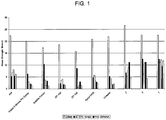
- Sample Nos. 1-7 were evaluated to determine their respective strengths when exposed to the noted cure schedules after application onto various metal and plastic substrates, such as grit blasted mild steel, aluminium, polycarbonate, ABS, PVC and PMMA. Table 9 also shows comparative adhesion data for Sample Nos. 1-7 as compared with cyanoacrylate and two part epoxy products. Table 9 Adhesive System Cure Schedule (Hours) Substrate Type/Tensile Shear Strength (N/mm 2 ) GBMS Al PC ABS PVC PMMA Type Identity 2K CA-Epoxy Hybrid** Sample No.
- Hours Substrate Type/Tensile Shear Strength
- N/mm 2 GBMS Al PC ABS PVC PMMA Type Identity 2K CA-Epoxy Hybrid** Sample No.
- Table 9 demonstrates the superior adhesion on a range of metal and plastic substrate types of the two part cyanoacrylate/epoxy hybrid composition embodiment of the two-part, cyanoacrylate/cationic curable adhesive system compared to two part epoxy compositions. See also FIG. 1 .
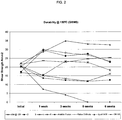
- Table 10 illustrates that the two part cyanoacrylate epoxy hybrid embodiment of the two-part, cyanoacrylate/cationic curable adhesive system demonstrates good heat aging properties when aged at 150°C with a performance similar to commercially available two part epoxy products. Table 10 also demonstrates the poor thermal durability of cyanoacrylates, even with LOCTITE 454 being heat aged at 120°C rather than 150°C. Table 10 Adhesive System Tensile Shear Strength (Nmm 2 ) After Aging @ 150°C Time/Weeks Type Identity Initial 1 week 3 weeks 5 weeks 6 weeks CA* LOCTITE 454 20.68 7.33 4.15 - - 2K CA-Epoxy Hybrid** Sample No. 2 20.13 13.71 12.42 11.81 12.57 Sample No.
- Table 10 The data presented in Table 10 is graphically illustrated in FIG. 2 .
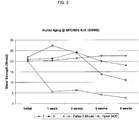
- Part A and Part B compositions of Sample Nos. 2, 3 and 4 were mixed together and applied to grit blasted mild steel substrates and cured at room temperature for 24 hours.
- the cured assemblies were exposed to heat and humidity aging conditions (here, 65°C/95% R.H.) for the noted time periods to determine heat and humidity resistance. Heat and humid aging performance was observed and recorded, and compared to the two part epoxy products as shown in Table 11.
- Table 11 Adhesive System Tensile Shear Strength [Nmm 2 ] After Aging @ 65°C195% RH Type Identity Initial 1 week 3 weeks 5 weeks 6 weeks 2K CA-Epoxy Hybrid** Sample No. 2 20.13 20.35 21.49 22.48 22.49 Sample No. 3 20.83 21.21 24.21 19.93 18.04 Sample No. 4 20.52 19.48 23.04 24.4 18.4 2K Epoxy* PATTEX 5 Minute Pro Epoxy 20.06 5.65 6.25 4.11 2.56 HYSOL 3430 21.96 27.38 23.92 13.84 11.04
- the adhesive systems were applied to GBMS and cured at room temperature for 24 hours.
- the cured assemblies were immersed in water heated to a temperature of 60°C for the noted time periods to determine moisture resistance.
- Moisture resistance measurements (in terms of tensile shear strengths at different time intervals) were recorded, and compared to the two part epoxy products as shown in Table 12.
- Table 12 Adhesive System Tensile Shear Strength [Nmm 2 ] After Immersion in Water @ 60°C Type Identity Initial 1 week 3 weeks 5 weeks 6 weeks 2K CA-Epoxy Hybrid** Sample No.
- Table 12 The data in Table 12 is shown graphically in FIG. 4 . This data illustrates the beneficial moisture resistance performance shown by the two part cyanoacrylate/epoxy hybrid adhesive system embodiment.
- Table 13 below provides formulations to show the beneficial effects of including phosphoric acid into the Part A composition.
- Table 13 Part A Component Sample No./Amt (wt%) 9 10 11 12 Phosphoric Acid (ppm) 0 600 750 900 Ethyl CA 73.0 72.94 72.925 72.91 VINNOL 40/60 20.0 20.0 20.0 20.0 BF 3 (ppm) 3.3 3.3 3.3 3.3 MSA (ppm) 2.7 2.7 2.7 2.7 Lithium TFB 1.0 1.0 1.0 1.0 Part B
- Component Sample No./Amt (wt%) 9 10 11 12 CYRACURE 6110 50 50 50 50 50 50 50 50 50 PARALOID 2314 10 10 10 10 10 K-FLEX A307 40 40 40 40 40 40 40 40 40
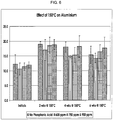
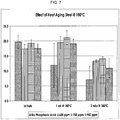
- Tables 13, 14 and 15 indicate the improved 150°C heat resistance of the formulations containing phosphoric acid on GBMS and particularly aluminum substrates. Additionally, the bonded assembles formed from Sample Nos. 9-12 were then exposed to heat aging conditions of a temperature of 180°C. Tables 16 and 17 below show the observed results, which are also depicted graphically with reference to FIGs. 7 and 8 .
- a formulation containing 450 ppm of phosphoric acid is shown in Table 18.
- Table 18 Part A Component Sample No./ Amt (wt%) 13 Phosphoric Acid (ppm) 450 Ethyl CA 73.0 VINNOL 40/60 20.0 BF 3 (ppm) 3.3 MSA (ppm) 2.7 Lithium TFB 1.0 Part B Component Sample No./ Amt (wt%) 13 CYRACURE 6110 50 PARALOID 2314 10 K FLEX A307 40
- Part A and Part B formulations of Sample No. 13 were mixed together and applied to steel or aluminum substrates to form bonded assemblies.
- Table 20 illustrates the benefit of phosphoric acid addition to the formulation in terms of the observed improvements in tensile strengths after aging for different time intervals at 65°C/98% RH.
- Table 21 illustrates the benefit of phosphoric acid addition to the formulation in terms of the observed improvements in tensile strengths after aging for different time intervals in water at a temperature of 60°C.
Landscapes
- Chemical & Material Sciences (AREA)
- Organic Chemistry (AREA)
- Health & Medical Sciences (AREA)
- Chemical Kinetics & Catalysis (AREA)
- Medicinal Chemistry (AREA)
- Polymers & Plastics (AREA)
- Adhesives Or Adhesive Processes (AREA)
- Compositions Of Macromolecular Compounds (AREA)
Priority Applications (1)
| Application Number | Priority Date | Filing Date | Title |
|---|---|---|---|
| PL11760754T PL2616520T3 (pl) | 2010-09-15 | 2011-09-15 | Dwuczęściowe, cyjanoakrylanowe/kationowo utwardzalne układy klejowe |
Applications Claiming Priority (2)
| Application Number | Priority Date | Filing Date | Title |
|---|---|---|---|
| US38316510P | 2010-09-15 | 2010-09-15 | |
| PCT/EP2011/066033 WO2012035112A1 (en) | 2010-09-15 | 2011-09-15 | Two-part, cyanoacrylate/cationically curable adhesive systems |
Publications (2)
| Publication Number | Publication Date |
|---|---|
| EP2616520A1 EP2616520A1 (en) | 2013-07-24 |
| EP2616520B1 true EP2616520B1 (en) | 2018-02-21 |
Family
ID=44675575
Family Applications (1)
| Application Number | Title | Priority Date | Filing Date |
|---|---|---|---|
| EP11760754.9A Active EP2616520B1 (en) | 2010-09-15 | 2011-09-15 | Two-part, cyanoacrylate/cationically curable adhesive systems |
Country Status (10)
| Country | Link |
|---|---|
| US (2) | US8580888B2 (OSRAM) |
| EP (1) | EP2616520B1 (OSRAM) |
| JP (1) | JP5629009B2 (OSRAM) |
| KR (1) | KR101496344B1 (OSRAM) |
| CN (1) | CN103228747B (OSRAM) |
| ES (1) | ES2663570T3 (OSRAM) |
| HU (1) | HUE037316T2 (OSRAM) |
| NO (1) | NO2616520T3 (OSRAM) |
| PL (1) | PL2616520T3 (OSRAM) |
| WO (1) | WO2012035112A1 (OSRAM) |
Families Citing this family (38)
| Publication number | Priority date | Publication date | Assignee | Title |
|---|---|---|---|---|
| WO2012041395A1 (en) * | 2010-10-01 | 2012-04-05 | Loctite (R & D) Limited | Alpha-cyanoacrylate ester synthesis |
| US8986073B2 (en) | 2011-08-30 | 2015-03-24 | Tyco Electronics Corporation | Methods and apparatus for preparing power transmission cables |
| EP2852646B1 (en) * | 2012-05-23 | 2017-07-12 | Henkel IP & Holding GmbH | An article comprising a film on a carrier or release substrate |
| CN103013370B (zh) * | 2012-12-14 | 2014-12-10 | 京东方科技集团股份有限公司 | 一种各向异性导电胶膜及电子装置 |
| GB2511818B (en) * | 2013-03-14 | 2015-09-02 | Henkel Ireland Ltd | Organoborane curable (meth) acrylate compositions |
| US8981027B2 (en) * | 2013-03-15 | 2015-03-17 | Henkel IP & Holding GmbH | Two-part, cyanoacrylate/cationically curable adhesive systems |
| WO2016028783A1 (en) | 2014-08-18 | 2016-02-25 | Lord Corporation | Method for low temperature bonding of elastomers |
| EP2995663A1 (en) * | 2014-09-12 | 2016-03-16 | Afinitica Technologies, S. L. | Fast and elastic adhesive |
| US20160126688A1 (en) * | 2014-11-05 | 2016-05-05 | Tyco Electronics Corporation | Methods and apparatus for preparing power transmission cables |
| TWI664224B (zh) | 2014-12-12 | 2019-07-01 | 日商東亞合成股份有限公司 | Two-liquid type hardening composition |
| US20160304749A1 (en) * | 2015-04-14 | 2016-10-20 | Toagosei America Inc. | Cyanoacrylate Adhesive Formulation And Method Of Making |
| EP3088326A1 (en) | 2015-04-28 | 2016-11-02 | Afinitica Technologies, S. L. | Display package for 2 component cyanoacrylate compositions |
| JP6571481B2 (ja) * | 2015-10-14 | 2019-09-04 | ピアス株式会社 | 2−シアノアクリレートモノマーの重合促進剤、及び、体毛に繊維を接着させる方法 |
| WO2017087242A1 (en) | 2015-11-19 | 2017-05-26 | Milliken & Company | Adduct of an amine and a cyclic siloxane compound |
| JP2018535979A (ja) | 2015-11-19 | 2018-12-06 | ミリケン・アンド・カンパニーMilliken & Company | 環状シロキサン化合物及びそれを含む組成物 |
| WO2018155801A1 (ko) * | 2017-02-22 | 2018-08-30 | 주식회사 엘지화학 | 접착제 조성물 |
| GB2567868B (en) * | 2017-10-27 | 2020-05-06 | Henkel IP & Holding GmbH | Toughened low odour cyanoacrylate compositions |
| CN108020444B (zh) * | 2017-11-17 | 2020-12-29 | 上海市城市排水监测站有限公司 | 一种水位随动采样系统 |
| CN108641606A (zh) * | 2018-05-16 | 2018-10-12 | 烟台长盈电子科技有限公司 | 一种双组份快干胶及其制备方法 |
| CN112752816B (zh) * | 2018-07-25 | 2022-10-18 | 汉高股份有限及两合公司 | 快速固化的环氧丙烯酸类液体垫片 |
| GB2576791B (en) * | 2018-08-13 | 2022-09-14 | Henkel Ag & Co Kgaa | A two-part cyanoacrylate curable adhesive system |
| GB2576792B (en) * | 2018-08-13 | 2022-09-14 | Henkel Ag & Co Kgaa | A two-part cyanoacrylate curable adhesive system |
| CN113195607B (zh) * | 2019-02-27 | 2024-01-23 | 汉高股份有限及两合公司 | 热界面材料 |
| GB2582537B (en) * | 2019-03-04 | 2022-02-23 | Henkel IP & Holding GmbH | Two-part, cyanoacrylate/cationically curable adhesive systems |
| EP3941988A1 (en) * | 2019-03-19 | 2022-01-26 | Bostik SA | Two-part curable composition |
| KR102295023B1 (ko) * | 2019-07-17 | 2021-08-26 | (주) 이에스은성산업 | 액세서리용 접착제 및 이 액세서리용 접착제를 이용한 스톤타입 액세서리 부재 접착방법 |
| CN114729230A (zh) * | 2019-10-01 | 2022-07-08 | 汉高股份有限及两合公司 | 两部分氰基丙烯酸酯/自由基可固化的粘合剂体系 |
| CN114729090B (zh) | 2019-11-18 | 2025-01-28 | 汉高股份有限及两合公司 | 双组分(2k)可固化组合物 |
| US20230061500A1 (en) * | 2019-12-27 | 2023-03-02 | Arthur Imparato | Adhesive Composition |
| CN111883697B (zh) * | 2020-07-17 | 2022-07-05 | 东莞华誉精密技术有限公司 | 一种电池盖多工位压合工艺 |
| CN111849363A (zh) * | 2020-07-24 | 2020-10-30 | 今程粘胶(惠州)有限公司 | 一种绿色环保环氧树脂胶水的配方及工艺 |
| CN112040387B (zh) * | 2020-09-01 | 2022-12-06 | 昆山联滔电子有限公司 | 受话器及其制备方法、扬声器及其制备方法 |
| JP7787205B2 (ja) * | 2021-05-21 | 2025-12-16 | ヘンケル・アクチェンゲゼルシャフト・ウント・コムパニー・コマンディットゲゼルシャフト・アウフ・アクチェン | 硬化性組成物およびその使用 |
| CN113789143B (zh) * | 2021-10-18 | 2022-12-27 | 东莞市雄驰电子有限公司 | 一种室温可固化有机硅改性环氧树脂灌封胶及其制备方法 |
| CN113881377B (zh) * | 2021-10-18 | 2022-12-20 | 东莞市雄驰电子有限公司 | 一种酸酐可固化有机硅改性环氧树脂灌封胶及其制备方法 |
| GB202209486D0 (en) * | 2022-06-28 | 2022-08-10 | Henkel Ag & Co Kgaa | Method of underwater bonding |
| EP4547727A1 (en) * | 2022-06-28 | 2025-05-07 | Henkel AG & Co. KGaA | Method of underwater bonding |
| CN115141343B (zh) * | 2022-09-05 | 2023-01-13 | 万华化学集团股份有限公司 | 组合物及其胶黏剂组合料、无醛添加人造板及其制备方法 |
Family Cites Families (52)
| Publication number | Priority date | Publication date | Assignee | Title |
|---|---|---|---|---|
| US4336367A (en) | 1969-05-15 | 1982-06-22 | The United States Of America As Represented By The Secretary Of The Navy | Epoxy adhesive composition |
| IE45626B1 (en) | 1976-07-14 | 1982-10-20 | Loctite Ltd | Filled cyanoacrylate adhesive compositions |
| US4101041A (en) | 1977-08-01 | 1978-07-18 | Becton, Dickinson And Company | Prefillable, hermetically sealed container adapted for use with a humidifier or nebulizer head |
| JPS5643377A (en) * | 1979-09-17 | 1981-04-22 | Toagosei Chem Ind Co Ltd | Two-pack type curable composition |
| US4379908A (en) * | 1982-03-05 | 1983-04-12 | Shell Oil Company | Rapid curing epoxy-unsaturated monomer compositions |
| US4396754A (en) * | 1981-12-14 | 1983-08-02 | Shell Oil Company | Rapid curing epoxy compositions |
| US4440910A (en) | 1982-01-18 | 1984-04-03 | Loctite Corporation | Toughened cyanoacrylates containing elastomeric rubbers |
| US4419496A (en) | 1982-02-22 | 1983-12-06 | The Dow Chemical Company | Particle agglomeration in rubber latices |
| US4444933A (en) | 1982-12-02 | 1984-04-24 | Borden, Inc. | Adhesive cyanoacrylate compositions with reduced adhesion to skin |
| US4906317A (en) | 1983-11-10 | 1990-03-06 | Loctite Corporation | Instant adhesive composition and bonding method employing same |
| US4622414A (en) | 1984-01-27 | 1986-11-11 | Loctite Limited | Novel calixarene compounds |
| US4636539A (en) | 1984-01-30 | 1987-01-13 | Loctite (Ireland) Limited | Instant adhesive composition utilizing calixarene accelerators |
| US4695615A (en) | 1984-11-21 | 1987-09-22 | Loctite (Ireland) Limited | Instant adhesive composition utilizing mixed functionality calixarenes as accelerators |
| US4556700A (en) | 1984-01-30 | 1985-12-03 | Loctite Limited | Instant adhesive composition utilizing calixarene accelerators |
| US4718966A (en) | 1984-01-30 | 1988-01-12 | Loctite (Ireland) Ltd. | Bonding method utilizing cyanoacrylate adhesive having calixarene accelerator |
| US4565837A (en) * | 1984-11-07 | 1986-01-21 | Loctite Corporation | Rapid curing epoxide composition employing stable carbenium salt catalyst |
| IE59509B1 (en) | 1987-01-21 | 1994-03-09 | Loctite Ireland Ltd | Functionalised oxacalixarenes, their preparation and use in instant adhesive compositions |
| WO1987000188A1 (en) | 1985-06-26 | 1987-01-15 | The Dow Chemical Company | Rubber-modified epoxy compounds |
| US4717440A (en) * | 1986-01-22 | 1988-01-05 | Loctite Corporation | Compositions curable by in situ generation of cations |
| US4837260A (en) | 1986-05-23 | 1989-06-06 | Toagosei Chemical Industry Co., Ltd. | Cyanoacrylate compositions |
| JPS63118387A (ja) * | 1987-08-11 | 1988-05-23 | Semedain Kk | 接着剤 |
| JPH0264183A (ja) * | 1988-08-30 | 1990-03-05 | Toagosei Chem Ind Co Ltd | 接着方法 |
| GB2228943A (en) * | 1989-03-06 | 1990-09-12 | Loctite | Cyanoacrylate compositions for bonding porous or non-active substrates |
| ES2056284T3 (es) * | 1989-04-19 | 1994-10-01 | Nat Starch Chem Invest | Composicion obturadora/adhesiva y procedimiento de aplicacion de la misma. |
| JPH03227384A (ja) * | 1990-01-31 | 1991-10-08 | Masaru Ibonai | エポキシ添加瞬間接着剤 |
| DE4009621A1 (de) | 1990-03-26 | 1991-10-02 | Henkel Kgaa | (alpha) -cyanacrylatklebstoffzusammensetzungen |
| US5969053A (en) | 1992-02-27 | 1999-10-19 | Composite Particles, Inc. | Higher modulus compositions incorporating particulate rubber |
| CA2090092C (en) | 1992-02-27 | 2000-01-11 | Edwin Lee Mcinnis | Higher modulus compositions incorporating particulate rubber |
| US5506283A (en) | 1992-02-27 | 1996-04-09 | Composite Particles, Inc. | Higher modulus compositions incorporating particulate rubber |
| US5693714A (en) | 1992-02-27 | 1997-12-02 | Composite Particles, Inc. | Higher modulus compositions incorporating particulate rubber |
| DE59310074D1 (de) | 1992-07-09 | 2000-08-17 | Ciba Sc Holding Ag | Härtbare Suspensionen auf Basis von Epoxidharzen |
| TW359683B (en) | 1993-12-23 | 1999-06-01 | Loctite Ireland Ltd | Sterilized cyanoacrylate adhesive composition, and a method of making such composition |
| JP3227384B2 (ja) | 1995-06-19 | 2001-11-12 | 住友ゴム工業株式会社 | 飛行球体の回転数測定装置 |
| DE19535824A1 (de) | 1995-09-26 | 1997-03-27 | Wacker Chemie Gmbh | Vorvernetzte Siliconelastomer-Partikel mit Organopolymerhülle als Formulierungsbestandteil in Pulverlacken |
| EP0776917B1 (de) | 1995-11-29 | 2002-05-29 | Vantico AG | Core/Shell-Partikel und diese enthaltende härtbare Epoxidharzzusammensetzungen |
| DE19617379A1 (de) | 1996-04-30 | 1997-11-06 | Wacker Chemie Gmbh | Vorvernetzte Siliconelastomer-Partikel mit Organopolymerhülle als Formulierungsbestandteil in wäßrigen Lackzubereitungen |
| BR9711198A (pt) | 1996-08-16 | 1999-08-17 | Loctite Ireland Ltd | Composi-{es adesivas de cianoacrilato para juncÆo de vidro |
| JP3397105B2 (ja) * | 1997-11-18 | 2003-04-14 | 松下電工株式会社 | 積層板用樹脂組成物 |
| IES990974A2 (en) * | 1998-11-23 | 2000-05-31 | Loctite R & D Ltd | Cyanoacrylate Compositions |
| JP3613321B2 (ja) * | 1999-04-07 | 2005-01-26 | 東亞合成株式会社 | 2−シアノアクリレート系組成物 |
| US6429281B1 (en) | 1999-07-01 | 2002-08-06 | Loctite | Hydrophobic, high Tg cycloaliphatic epoxy resins |
| JP5131506B2 (ja) * | 2001-06-27 | 2013-01-30 | 新日鉄住金化学株式会社 | エポキシ樹脂 |
| US6617400B2 (en) | 2001-08-23 | 2003-09-09 | General Electric Company | Composition of cycloaliphatic epoxy resin, anhydride curing agent and boron catalyst |
| WO2003089536A2 (en) * | 2002-04-19 | 2003-10-30 | Loctite (R & D) Limited | Polymerisation initiators based on ammonium tetraalkyl boranes, polymerisable compositions, and uses thereof for bonding low surface energy substrates |
| EP2481773A3 (en) | 2003-06-09 | 2012-09-05 | Kaneka Corporation | Process for producing modified epoxy resin |
| US20050009242A1 (en) | 2003-07-09 | 2005-01-13 | Jung-Chien Chang | Packaging method for thin integrated circuits |
| US7235593B2 (en) | 2003-08-04 | 2007-06-26 | Rensselaer Polytechnic Institute | Command-cure adhesives |
| US20070072146A1 (en) * | 2005-09-29 | 2007-03-29 | Dentsply Research And Development Corp. | Dispensing syringe having multiple barrels for discharging a dental composition |
| US20080139687A1 (en) * | 2005-11-10 | 2008-06-12 | Henkel Corporation | Vinyl Ether/Acrylate Block Resins, Compositions and Methods of Making Same |
| US7777064B2 (en) | 2006-03-02 | 2010-08-17 | Designer Molecules, Inc. | Adhesive compositions containing cyclic siloxanes and methods for use thereof |
| US8309633B2 (en) * | 2008-07-17 | 2012-11-13 | Henkel Ireland Ltd. | Low temperature, cationically curable compositions with improved cure speed and toughness |
| WO2010125195A1 (en) * | 2009-05-01 | 2010-11-04 | Loctite (R&D) Limited | Cyanoacrylate compositions |
-
2011
- 2011-09-15 EP EP11760754.9A patent/EP2616520B1/en active Active
- 2011-09-15 ES ES11760754.9T patent/ES2663570T3/es active Active
- 2011-09-15 NO NO11760754A patent/NO2616520T3/no unknown
- 2011-09-15 WO PCT/EP2011/066033 patent/WO2012035112A1/en not_active Ceased
- 2011-09-15 HU HUE11760754A patent/HUE037316T2/hu unknown
- 2011-09-15 CN CN201180044597.4A patent/CN103228747B/zh active Active
- 2011-09-15 KR KR1020137006559A patent/KR101496344B1/ko active Active
- 2011-09-15 PL PL11760754T patent/PL2616520T3/pl unknown
- 2011-09-15 JP JP2013528675A patent/JP5629009B2/ja active Active
-
2012
- 2012-08-23 US US13/593,101 patent/US8580888B2/en active Active
-
2013
- 2013-01-08 US US13/736,351 patent/US8742048B2/en active Active
Also Published As
| Publication number | Publication date |
|---|---|
| PL2616520T3 (pl) | 2018-08-31 |
| CN103228747A (zh) | 2013-07-31 |
| KR101496344B1 (ko) | 2015-03-12 |
| CN103228747B (zh) | 2016-05-18 |
| KR20140017482A (ko) | 2014-02-11 |
| US8580888B2 (en) | 2013-11-12 |
| JP2013540852A (ja) | 2013-11-07 |
| EP2616520A1 (en) | 2013-07-24 |
| WO2012035112A1 (en) | 2012-03-22 |
| US20130053497A1 (en) | 2013-02-28 |
| US8742048B2 (en) | 2014-06-03 |
| JP5629009B2 (ja) | 2014-11-19 |
| US20130178560A1 (en) | 2013-07-11 |
| NO2616520T3 (OSRAM) | 2018-07-21 |
| ES2663570T3 (es) | 2018-04-13 |
| HUE037316T2 (hu) | 2018-08-28 |
Similar Documents
| Publication | Publication Date | Title |
|---|---|---|
| EP2616520B1 (en) | Two-part, cyanoacrylate/cationically curable adhesive systems | |
| EP2970718B1 (en) | Two-part, cyanoacrylate/cationically curable adhesive systems | |
| US12030971B2 (en) | Two-part cyanoacrylate curable adhesive system | |
| US12103997B2 (en) | Two-part cyanoacrylate curable adhesive system | |
| US12203013B2 (en) | Two-part, cyanoacrylate/cationically curable adhesive systems | |
| US20250207001A1 (en) | Method of underwater bonding |
Legal Events
| Date | Code | Title | Description |
|---|---|---|---|
| PUAI | Public reference made under article 153(3) epc to a published international application that has entered the european phase |
Free format text: ORIGINAL CODE: 0009012 |
|
| 17P | Request for examination filed |
Effective date: 20130315 |
|
| AK | Designated contracting states |
Kind code of ref document: A1 Designated state(s): AL AT BE BG CH CY CZ DE DK EE ES FI FR GB GR HR HU IE IS IT LI LT LU LV MC MK MT NL NO PL PT RO RS SE SI SK SM TR |
|
| DAX | Request for extension of the european patent (deleted) | ||
| RAP1 | Party data changed (applicant data changed or rights of an application transferred) |
Owner name: HENKEL IP & HOLDING GMBH |
|
| GRAP | Despatch of communication of intention to grant a patent |
Free format text: ORIGINAL CODE: EPIDOSNIGR1 |
|
| INTG | Intention to grant announced |
Effective date: 20171017 |
|
| GRAS | Grant fee paid |
Free format text: ORIGINAL CODE: EPIDOSNIGR3 |
|
| GRAA | (expected) grant |
Free format text: ORIGINAL CODE: 0009210 |
|
| AK | Designated contracting states |
Kind code of ref document: B1 Designated state(s): AL AT BE BG CH CY CZ DE DK EE ES FI FR GB GR HR HU IE IS IT LI LT LU LV MC MK MT NL NO PL PT RO RS SE SI SK SM TR |
|
| REG | Reference to a national code |
Ref country code: GB Ref legal event code: FG4D |
|
| REG | Reference to a national code |
Ref country code: CH Ref legal event code: EP |
|
| REG | Reference to a national code |
Ref country code: AT Ref legal event code: REF Ref document number: 971700 Country of ref document: AT Kind code of ref document: T Effective date: 20180315 |
|
| REG | Reference to a national code |
Ref country code: IE Ref legal event code: FG4D |
|
| REG | Reference to a national code |
Ref country code: DE Ref legal event code: R096 Ref document number: 602011045798 Country of ref document: DE |
|
| REG | Reference to a national code |
Ref country code: ES Ref legal event code: FG2A Ref document number: 2663570 Country of ref document: ES Kind code of ref document: T3 Effective date: 20180413 |
|
| REG | Reference to a national code |
Ref country code: NL Ref legal event code: FP |
|
| REG | Reference to a national code |
Ref country code: SE Ref legal event code: TRGR |
|
| REG | Reference to a national code |
Ref country code: NO Ref legal event code: T2 Effective date: 20180221 |
|
| REG | Reference to a national code |
Ref country code: LT Ref legal event code: MG4D |
|
| PG25 | Lapsed in a contracting state [announced via postgrant information from national office to epo] |
Ref country code: HR Free format text: LAPSE BECAUSE OF FAILURE TO SUBMIT A TRANSLATION OF THE DESCRIPTION OR TO PAY THE FEE WITHIN THE PRESCRIBED TIME-LIMIT Effective date: 20180221 Ref country code: CY Free format text: LAPSE BECAUSE OF FAILURE TO SUBMIT A TRANSLATION OF THE DESCRIPTION OR TO PAY THE FEE WITHIN THE PRESCRIBED TIME-LIMIT Effective date: 20180221 Ref country code: LT Free format text: LAPSE BECAUSE OF FAILURE TO SUBMIT A TRANSLATION OF THE DESCRIPTION OR TO PAY THE FEE WITHIN THE PRESCRIBED TIME-LIMIT Effective date: 20180221 |
|
| REG | Reference to a national code |
Ref country code: HU Ref legal event code: AG4A Ref document number: E037316 Country of ref document: HU |
|
| PG25 | Lapsed in a contracting state [announced via postgrant information from national office to epo] |
Ref country code: RS Free format text: LAPSE BECAUSE OF FAILURE TO SUBMIT A TRANSLATION OF THE DESCRIPTION OR TO PAY THE FEE WITHIN THE PRESCRIBED TIME-LIMIT Effective date: 20180221 Ref country code: GR Free format text: LAPSE BECAUSE OF FAILURE TO SUBMIT A TRANSLATION OF THE DESCRIPTION OR TO PAY THE FEE WITHIN THE PRESCRIBED TIME-LIMIT Effective date: 20180522 Ref country code: BG Free format text: LAPSE BECAUSE OF FAILURE TO SUBMIT A TRANSLATION OF THE DESCRIPTION OR TO PAY THE FEE WITHIN THE PRESCRIBED TIME-LIMIT Effective date: 20180521 Ref country code: LV Free format text: LAPSE BECAUSE OF FAILURE TO SUBMIT A TRANSLATION OF THE DESCRIPTION OR TO PAY THE FEE WITHIN THE PRESCRIBED TIME-LIMIT Effective date: 20180221 |
|
| REG | Reference to a national code |
Ref country code: FR Ref legal event code: PLFP Year of fee payment: 8 |
|
| PG25 | Lapsed in a contracting state [announced via postgrant information from national office to epo] |
Ref country code: AL Free format text: LAPSE BECAUSE OF FAILURE TO SUBMIT A TRANSLATION OF THE DESCRIPTION OR TO PAY THE FEE WITHIN THE PRESCRIBED TIME-LIMIT Effective date: 20180221 Ref country code: EE Free format text: LAPSE BECAUSE OF FAILURE TO SUBMIT A TRANSLATION OF THE DESCRIPTION OR TO PAY THE FEE WITHIN THE PRESCRIBED TIME-LIMIT Effective date: 20180221 Ref country code: RO Free format text: LAPSE BECAUSE OF FAILURE TO SUBMIT A TRANSLATION OF THE DESCRIPTION OR TO PAY THE FEE WITHIN THE PRESCRIBED TIME-LIMIT Effective date: 20180221 |
|
| REG | Reference to a national code |
Ref country code: DE Ref legal event code: R097 Ref document number: 602011045798 Country of ref document: DE |
|
| PG25 | Lapsed in a contracting state [announced via postgrant information from national office to epo] |
Ref country code: SK Free format text: LAPSE BECAUSE OF FAILURE TO SUBMIT A TRANSLATION OF THE DESCRIPTION OR TO PAY THE FEE WITHIN THE PRESCRIBED TIME-LIMIT Effective date: 20180221 Ref country code: DK Free format text: LAPSE BECAUSE OF FAILURE TO SUBMIT A TRANSLATION OF THE DESCRIPTION OR TO PAY THE FEE WITHIN THE PRESCRIBED TIME-LIMIT Effective date: 20180221 Ref country code: SM Free format text: LAPSE BECAUSE OF FAILURE TO SUBMIT A TRANSLATION OF THE DESCRIPTION OR TO PAY THE FEE WITHIN THE PRESCRIBED TIME-LIMIT Effective date: 20180221 |
|
| PLBE | No opposition filed within time limit |
Free format text: ORIGINAL CODE: 0009261 |
|
| STAA | Information on the status of an ep patent application or granted ep patent |
Free format text: STATUS: NO OPPOSITION FILED WITHIN TIME LIMIT |
|
| 26N | No opposition filed |
Effective date: 20181122 |
|
| PG25 | Lapsed in a contracting state [announced via postgrant information from national office to epo] |
Ref country code: SI Free format text: LAPSE BECAUSE OF FAILURE TO SUBMIT A TRANSLATION OF THE DESCRIPTION OR TO PAY THE FEE WITHIN THE PRESCRIBED TIME-LIMIT Effective date: 20180221 |
|
| REG | Reference to a national code |
Ref country code: NO Ref legal event code: MMEP |
|
| PG25 | Lapsed in a contracting state [announced via postgrant information from national office to epo] |
Ref country code: FI Free format text: LAPSE BECAUSE OF NON-PAYMENT OF DUE FEES Effective date: 20180915 Ref country code: MC Free format text: LAPSE BECAUSE OF FAILURE TO SUBMIT A TRANSLATION OF THE DESCRIPTION OR TO PAY THE FEE WITHIN THE PRESCRIBED TIME-LIMIT Effective date: 20180221 |
|
| REG | Reference to a national code |
Ref country code: IE Ref legal event code: MM4A |
|
| PG25 | Lapsed in a contracting state [announced via postgrant information from national office to epo] |
Ref country code: LU Free format text: LAPSE BECAUSE OF NON-PAYMENT OF DUE FEES Effective date: 20180915 |
|
| PG25 | Lapsed in a contracting state [announced via postgrant information from national office to epo] |
Ref country code: IE Free format text: LAPSE BECAUSE OF NON-PAYMENT OF DUE FEES Effective date: 20180915 Ref country code: NO Free format text: LAPSE BECAUSE OF NON-PAYMENT OF DUE FEES Effective date: 20180930 |
|
| PG25 | Lapsed in a contracting state [announced via postgrant information from national office to epo] |
Ref country code: MT Free format text: LAPSE BECAUSE OF NON-PAYMENT OF DUE FEES Effective date: 20180915 |
|
| PG25 | Lapsed in a contracting state [announced via postgrant information from national office to epo] |
Ref country code: PT Free format text: LAPSE BECAUSE OF FAILURE TO SUBMIT A TRANSLATION OF THE DESCRIPTION OR TO PAY THE FEE WITHIN THE PRESCRIBED TIME-LIMIT Effective date: 20180221 |
|
| PG25 | Lapsed in a contracting state [announced via postgrant information from national office to epo] |
Ref country code: MK Free format text: LAPSE BECAUSE OF NON-PAYMENT OF DUE FEES Effective date: 20180221 |
|
| PG25 | Lapsed in a contracting state [announced via postgrant information from national office to epo] |
Ref country code: IS Free format text: LAPSE BECAUSE OF FAILURE TO SUBMIT A TRANSLATION OF THE DESCRIPTION OR TO PAY THE FEE WITHIN THE PRESCRIBED TIME-LIMIT Effective date: 20180621 |
|
| REG | Reference to a national code |
Ref country code: AT Ref legal event code: UEP Ref document number: 971700 Country of ref document: AT Kind code of ref document: T Effective date: 20180221 |
|
| REG | Reference to a national code |
Ref country code: NL Ref legal event code: PD Owner name: HENKEL AG & CO. KGAA; DE Free format text: DETAILS ASSIGNMENT: CHANGE OF OWNER(S), ASSIGNMENT; FORMER OWNER NAME: HENKEL IP & HOLDING GMBH Effective date: 20220722 |
|
| REG | Reference to a national code |
Ref country code: ES Ref legal event code: PC2A Owner name: HENKEL AG & CO. KGAA Effective date: 20220805 |
|
| REG | Reference to a national code |
Ref country code: DE Ref legal event code: R081 Ref document number: 602011045798 Country of ref document: DE Owner name: HENKEL AG & CO. KGAA, DE Free format text: FORMER OWNER: HENKEL IP & HOLDING GMBH, 40589 DUESSELDORF, DE |
|
| REG | Reference to a national code |
Ref country code: GB Ref legal event code: 732E Free format text: REGISTERED BETWEEN 20220811 AND 20220817 |
|
| REG | Reference to a national code |
Ref country code: HU Ref legal event code: GB9C Owner name: HENKEL AG & CO. KGAA, DE Free format text: FORMER OWNER(S): HENKEL IP & HOLDING GMBH, DE Ref country code: HU Ref legal event code: FH1C Free format text: FORMER REPRESENTATIVE(S): SBGK SZABADALMI UEGYVIVOEI IRODA, HU Representative=s name: SBGK SZABADALMI UEGYVIVOEI IRODA, HU |
|
| REG | Reference to a national code |
Ref country code: BE Ref legal event code: PD Owner name: HENKEL AG & CO. KGAA; DE Free format text: DETAILS ASSIGNMENT: CHANGE OF OWNER(S), ASSIGNMENT; FORMER OWNER NAME: HENKEL IP & HOLDING GMBH Effective date: 20220805 |
|
| REG | Reference to a national code |
Ref country code: AT Ref legal event code: PC Ref document number: 971700 Country of ref document: AT Kind code of ref document: T Owner name: HENKEL AG & CO.KGAA, DE Effective date: 20221003 |
|
| P01 | Opt-out of the competence of the unified patent court (upc) registered |
Effective date: 20230530 |
|
| PGFP | Annual fee paid to national office [announced via postgrant information from national office to epo] |
Ref country code: ES Payment date: 20241025 Year of fee payment: 14 |
|
| PGFP | Annual fee paid to national office [announced via postgrant information from national office to epo] |
Ref country code: CH Payment date: 20241001 Year of fee payment: 14 |
|
| REG | Reference to a national code |
Ref country code: CH Ref legal event code: U11 Free format text: ST27 STATUS EVENT CODE: U-0-0-U10-U11 (AS PROVIDED BY THE NATIONAL OFFICE) Effective date: 20251001 |
|
| PGFP | Annual fee paid to national office [announced via postgrant information from national office to epo] |
Ref country code: DE Payment date: 20250919 Year of fee payment: 15 |
|
| PGFP | Annual fee paid to national office [announced via postgrant information from national office to epo] |
Ref country code: PL Payment date: 20250904 Year of fee payment: 15 Ref country code: TR Payment date: 20250909 Year of fee payment: 15 Ref country code: IT Payment date: 20250923 Year of fee payment: 15 Ref country code: NL Payment date: 20250918 Year of fee payment: 15 |
|
| PGFP | Annual fee paid to national office [announced via postgrant information from national office to epo] |
Ref country code: HU Payment date: 20250922 Year of fee payment: 15 Ref country code: BE Payment date: 20250918 Year of fee payment: 15 Ref country code: GB Payment date: 20250918 Year of fee payment: 15 |
|
| PGFP | Annual fee paid to national office [announced via postgrant information from national office to epo] |
Ref country code: FR Payment date: 20250922 Year of fee payment: 15 Ref country code: AT Payment date: 20250919 Year of fee payment: 15 |
|
| PGFP | Annual fee paid to national office [announced via postgrant information from national office to epo] |
Ref country code: SE Payment date: 20250918 Year of fee payment: 15 |
|
| PGFP | Annual fee paid to national office [announced via postgrant information from national office to epo] |
Ref country code: CZ Payment date: 20250908 Year of fee payment: 15 |