EP2558538B1 - Zwitterionenhaltige polymere von hohem molekulargewicht - Google Patents
Zwitterionenhaltige polymere von hohem molekulargewicht Download PDFInfo
- Publication number
- EP2558538B1 EP2558538B1 EP11769715.1A EP11769715A EP2558538B1 EP 2558538 B1 EP2558538 B1 EP 2558538B1 EP 11769715 A EP11769715 A EP 11769715A EP 2558538 B1 EP2558538 B1 EP 2558538B1
- Authority
- EP
- European Patent Office
- Prior art keywords
- polymer
- group
- conjugate
- polymers
- antibody
- Prior art date
- Legal status (The legal status is an assumption and is not a legal conclusion. Google has not performed a legal analysis and makes no representation as to the accuracy of the status listed.)
- Active
Links
- 0 *C(C(N1*)=O)=CC1=O Chemical compound *C(C(N1*)=O)=CC1=O 0.000 description 10
- DXMSFLGDURTNCK-UHFFFAOYSA-N CC(C)(C(OCC(C)(COC(C(C)(C)Br)=O)C(OCCOCC(CO)O)=O)=O)Br Chemical compound CC(C)(C(OCC(C)(COC(C(C)(C)Br)=O)C(OCCOCC(CO)O)=O)=O)Br DXMSFLGDURTNCK-UHFFFAOYSA-N 0.000 description 2
- ILLIHZHZHAUOJG-UHFFFAOYSA-N C#CCOCCOCCOCCOCCNC(CBr)=O Chemical compound C#CCOCCOCCOCCOCCNC(CBr)=O ILLIHZHZHAUOJG-UHFFFAOYSA-N 0.000 description 1
- FQGZQIWVBRWEOR-UHFFFAOYSA-N C#CCOCCOCCOCCOCCNC(CI)=O Chemical compound C#CCOCCOCCOCCOCCNC(CI)=O FQGZQIWVBRWEOR-UHFFFAOYSA-N 0.000 description 1
- FLWMKNFWRHITCO-UHFFFAOYSA-N C=CCOCC(CN)(CN)CN Chemical compound C=CCOCC(CN)(CN)CN FLWMKNFWRHITCO-UHFFFAOYSA-N 0.000 description 1
- BHGYTHMDZNLLPD-UHFFFAOYSA-N CC(C)(C(NCC(CNC(C(C)(C)Br)=O)(CNC(C(C)(C)Br)=O)COCCOCCOCCOCCOCC=C)=O)Br Chemical compound CC(C)(C(NCC(CNC(C(C)(C)Br)=O)(CNC(C(C)(C)Br)=O)COCCOCCOCCOCCOCC=C)=O)Br BHGYTHMDZNLLPD-UHFFFAOYSA-N 0.000 description 1
- OWQGRWUKLJHEED-UHFFFAOYSA-N CC(C)(C(OCC(C)(COC(C(C)(C)Br)=O)C(NC(CCC(ON(C(CC1)=O)C1=O)=O)C(NCCC(ON(C(CC1)=O)C1=O)=O)=O)=O)=O)Br Chemical compound CC(C)(C(OCC(C)(COC(C(C)(C)Br)=O)C(NC(CCC(ON(C(CC1)=O)C1=O)=O)C(NCCC(ON(C(CC1)=O)C1=O)=O)=O)=O)=O)Br OWQGRWUKLJHEED-UHFFFAOYSA-N 0.000 description 1
- VRGXEOKVHBVQGO-UHFFFAOYSA-N CC(C)(C(OCC(C)(COC(C(C)(C)Br)=O)C(OCC(CO)O)=O)=O)Br Chemical compound CC(C)(C(OCC(C)(COC(C(C)(C)Br)=O)C(OCC(CO)O)=O)=O)Br VRGXEOKVHBVQGO-UHFFFAOYSA-N 0.000 description 1
- WPEPQPWAEVVKNY-ZMYVRHLSSA-N CC(C)(C(OCC(C)(COC(C(C)(C)Br)=O)C(OCCN(C([C@H]([C@@H]12)C3OC1C=C3)=O)C2=O)=O)=O)Br Chemical compound CC(C)(C(OCC(C)(COC(C(C)(C)Br)=O)C(OCCN(C([C@H]([C@@H]12)C3OC1C=C3)=O)C2=O)=O)=O)Br WPEPQPWAEVVKNY-ZMYVRHLSSA-N 0.000 description 1
- QQDGXNCYOWTZPC-UHFFFAOYSA-N CC(C)(C(OCC(C)(COC(C(C)(C)Br)=O)C(OCCOCCOCCOCCO)=O)=O)Br Chemical compound CC(C)(C(OCC(C)(COC(C(C)(C)Br)=O)C(OCCOCCOCCOCCO)=O)=O)Br QQDGXNCYOWTZPC-UHFFFAOYSA-N 0.000 description 1
- WZEWDEAIHCUMKY-UHFFFAOYSA-N CC(C)(OC1)OCC1(C)C(O)=O Chemical compound CC(C)(OC1)OCC1(C)C(O)=O WZEWDEAIHCUMKY-UHFFFAOYSA-N 0.000 description 1
- HIJWGTRLJRXZPR-UHFFFAOYSA-N O=C(CCCC(ON(C(CC1)=O)C1=O)=O)Oc(cccc1)c1P(c1ccccc1)c1ccccc1 Chemical compound O=C(CCCC(ON(C(CC1)=O)C1=O)=O)Oc(cccc1)c1P(c1ccccc1)c1ccccc1 HIJWGTRLJRXZPR-UHFFFAOYSA-N 0.000 description 1
- ISKZEUQQPPVQNW-HYNHDVCUSA-N OCCN(C([C@H]([C@@H]12)C3OC1C=C3)=O)C2=O Chemical compound OCCN(C([C@H]([C@@H]12)C3OC1C=C3)=O)C2=O ISKZEUQQPPVQNW-HYNHDVCUSA-N 0.000 description 1
Images


Classifications
-
- A—HUMAN NECESSITIES
- A61—MEDICAL OR VETERINARY SCIENCE; HYGIENE
- A61K—PREPARATIONS FOR MEDICAL, DENTAL OR TOILETRY PURPOSES
- A61K31/00—Medicinal preparations containing organic active ingredients
- A61K31/74—Synthetic polymeric materials
-
- A—HUMAN NECESSITIES
- A61—MEDICAL OR VETERINARY SCIENCE; HYGIENE
- A61K—PREPARATIONS FOR MEDICAL, DENTAL OR TOILETRY PURPOSES
- A61K51/00—Preparations containing radioactive substances for use in therapy or testing in vivo
- A61K51/02—Preparations containing radioactive substances for use in therapy or testing in vivo characterised by the carrier, i.e. characterised by the agent or material covalently linked or complexing the radioactive nucleus
- A61K51/04—Organic compounds
- A61K51/06—Macromolecular compounds, carriers being organic macromolecular compounds, i.e. organic oligomeric, polymeric, dendrimeric molecules
- A61K51/065—Macromolecular compounds, carriers being organic macromolecular compounds, i.e. organic oligomeric, polymeric, dendrimeric molecules conjugates with carriers being macromolecules
-
- C—CHEMISTRY; METALLURGY
- C08—ORGANIC MACROMOLECULAR COMPOUNDS; THEIR PREPARATION OR CHEMICAL WORKING-UP; COMPOSITIONS BASED THEREON
- C08F—MACROMOLECULAR COMPOUNDS OBTAINED BY REACTIONS ONLY INVOLVING CARBON-TO-CARBON UNSATURATED BONDS
- C08F230/00—Copolymers of compounds having one or more unsaturated aliphatic radicals, each having only one carbon-to-carbon double bond, and containing phosphorus, selenium, tellurium or a metal
- C08F230/02—Copolymers of compounds having one or more unsaturated aliphatic radicals, each having only one carbon-to-carbon double bond, and containing phosphorus, selenium, tellurium or a metal containing phosphorus
-
- A—HUMAN NECESSITIES
- A61—MEDICAL OR VETERINARY SCIENCE; HYGIENE
- A61K—PREPARATIONS FOR MEDICAL, DENTAL OR TOILETRY PURPOSES
- A61K47/00—Medicinal preparations characterised by the non-active ingredients used, e.g. carriers or inert additives; Targeting or modifying agents chemically bound to the active ingredient
- A61K47/50—Medicinal preparations characterised by the non-active ingredients used, e.g. carriers or inert additives; Targeting or modifying agents chemically bound to the active ingredient the non-active ingredient being chemically bound to the active ingredient, e.g. polymer-drug conjugates
- A61K47/51—Medicinal preparations characterised by the non-active ingredients used, e.g. carriers or inert additives; Targeting or modifying agents chemically bound to the active ingredient the non-active ingredient being chemically bound to the active ingredient, e.g. polymer-drug conjugates the non-active ingredient being a modifying agent
- A61K47/56—Medicinal preparations characterised by the non-active ingredients used, e.g. carriers or inert additives; Targeting or modifying agents chemically bound to the active ingredient the non-active ingredient being chemically bound to the active ingredient, e.g. polymer-drug conjugates the non-active ingredient being a modifying agent the modifying agent being an organic macromolecular compound, e.g. an oligomeric, polymeric or dendrimeric molecule
- A61K47/58—Medicinal preparations characterised by the non-active ingredients used, e.g. carriers or inert additives; Targeting or modifying agents chemically bound to the active ingredient the non-active ingredient being chemically bound to the active ingredient, e.g. polymer-drug conjugates the non-active ingredient being a modifying agent the modifying agent being an organic macromolecular compound, e.g. an oligomeric, polymeric or dendrimeric molecule obtained by reactions only involving carbon-to-carbon unsaturated bonds, e.g. poly[meth]acrylate, polyacrylamide, polystyrene, polyvinylpyrrolidone, polyvinylalcohol or polystyrene sulfonic acid resin
-
- A—HUMAN NECESSITIES
- A61—MEDICAL OR VETERINARY SCIENCE; HYGIENE
- A61K—PREPARATIONS FOR MEDICAL, DENTAL OR TOILETRY PURPOSES
- A61K47/00—Medicinal preparations characterised by the non-active ingredients used, e.g. carriers or inert additives; Targeting or modifying agents chemically bound to the active ingredient
- A61K47/50—Medicinal preparations characterised by the non-active ingredients used, e.g. carriers or inert additives; Targeting or modifying agents chemically bound to the active ingredient the non-active ingredient being chemically bound to the active ingredient, e.g. polymer-drug conjugates
- A61K47/51—Medicinal preparations characterised by the non-active ingredients used, e.g. carriers or inert additives; Targeting or modifying agents chemically bound to the active ingredient the non-active ingredient being chemically bound to the active ingredient, e.g. polymer-drug conjugates the non-active ingredient being a modifying agent
- A61K47/68—Medicinal preparations characterised by the non-active ingredients used, e.g. carriers or inert additives; Targeting or modifying agents chemically bound to the active ingredient the non-active ingredient being chemically bound to the active ingredient, e.g. polymer-drug conjugates the non-active ingredient being a modifying agent the modifying agent being an antibody, an immunoglobulin or a fragment thereof, e.g. an Fc-fragment
- A61K47/6835—Medicinal preparations characterised by the non-active ingredients used, e.g. carriers or inert additives; Targeting or modifying agents chemically bound to the active ingredient the non-active ingredient being chemically bound to the active ingredient, e.g. polymer-drug conjugates the non-active ingredient being a modifying agent the modifying agent being an antibody, an immunoglobulin or a fragment thereof, e.g. an Fc-fragment the modifying agent being an antibody or an immunoglobulin bearing at least one antigen-binding site
- A61K47/6881—Cluster-antibody conjugates, i.e. the modifying agent consists of a plurality of antibodies covalently linked to each other or of different antigen-binding fragments covalently linked to each other
-
- A—HUMAN NECESSITIES
- A61—MEDICAL OR VETERINARY SCIENCE; HYGIENE
- A61K—PREPARATIONS FOR MEDICAL, DENTAL OR TOILETRY PURPOSES
- A61K49/00—Preparations for testing in vivo
- A61K49/001—Preparation for luminescence or biological staining
- A61K49/0013—Luminescence
- A61K49/0017—Fluorescence in vivo
- A61K49/005—Fluorescence in vivo characterised by the carrier molecule carrying the fluorescent agent
- A61K49/0054—Macromolecular compounds, i.e. oligomers, polymers, dendrimers
-
- C—CHEMISTRY; METALLURGY
- C08—ORGANIC MACROMOLECULAR COMPOUNDS; THEIR PREPARATION OR CHEMICAL WORKING-UP; COMPOSITIONS BASED THEREON
- C08F—MACROMOLECULAR COMPOUNDS OBTAINED BY REACTIONS ONLY INVOLVING CARBON-TO-CARBON UNSATURATED BONDS
- C08F120/00—Homopolymers of compounds having one or more unsaturated aliphatic radicals, each having only one carbon-to-carbon double bond, and only one being terminated by only one carboxyl radical or a salt, anhydride, ester, amide, imide or nitrile thereof
- C08F120/02—Monocarboxylic acids having less than ten carbon atoms; Derivatives thereof
- C08F120/52—Amides or imides
- C08F120/54—Amides, e.g. N,N-dimethylacrylamide or N-isopropylacrylamide
-
- C—CHEMISTRY; METALLURGY
- C08—ORGANIC MACROMOLECULAR COMPOUNDS; THEIR PREPARATION OR CHEMICAL WORKING-UP; COMPOSITIONS BASED THEREON
- C08F—MACROMOLECULAR COMPOUNDS OBTAINED BY REACTIONS ONLY INVOLVING CARBON-TO-CARBON UNSATURATED BONDS
- C08F120/00—Homopolymers of compounds having one or more unsaturated aliphatic radicals, each having only one carbon-to-carbon double bond, and only one being terminated by only one carboxyl radical or a salt, anhydride, ester, amide, imide or nitrile thereof
- C08F120/02—Monocarboxylic acids having less than ten carbon atoms; Derivatives thereof
- C08F120/52—Amides or imides
- C08F120/54—Amides, e.g. N,N-dimethylacrylamide or N-isopropylacrylamide
- C08F120/56—Acrylamide; Methacrylamide
-
- C—CHEMISTRY; METALLURGY
- C08—ORGANIC MACROMOLECULAR COMPOUNDS; THEIR PREPARATION OR CHEMICAL WORKING-UP; COMPOSITIONS BASED THEREON
- C08F—MACROMOLECULAR COMPOUNDS OBTAINED BY REACTIONS ONLY INVOLVING CARBON-TO-CARBON UNSATURATED BONDS
- C08F130/00—Homopolymers of compounds having one or more unsaturated aliphatic radicals, each having only one carbon-to-carbon double bond, and containing phosphorus, selenium, tellurium or a metal
- C08F130/02—Homopolymers of compounds having one or more unsaturated aliphatic radicals, each having only one carbon-to-carbon double bond, and containing phosphorus, selenium, tellurium or a metal containing phosphorus
-
- C—CHEMISTRY; METALLURGY
- C08—ORGANIC MACROMOLECULAR COMPOUNDS; THEIR PREPARATION OR CHEMICAL WORKING-UP; COMPOSITIONS BASED THEREON
- C08F—MACROMOLECULAR COMPOUNDS OBTAINED BY REACTIONS ONLY INVOLVING CARBON-TO-CARBON UNSATURATED BONDS
- C08F2/00—Processes of polymerisation
- C08F2/04—Polymerisation in solution
-
- C—CHEMISTRY; METALLURGY
- C08—ORGANIC MACROMOLECULAR COMPOUNDS; THEIR PREPARATION OR CHEMICAL WORKING-UP; COMPOSITIONS BASED THEREON
- C08F—MACROMOLECULAR COMPOUNDS OBTAINED BY REACTIONS ONLY INVOLVING CARBON-TO-CARBON UNSATURATED BONDS
- C08F2/00—Processes of polymerisation
- C08F2/04—Polymerisation in solution
- C08F2/06—Organic solvent
-
- C—CHEMISTRY; METALLURGY
- C08—ORGANIC MACROMOLECULAR COMPOUNDS; THEIR PREPARATION OR CHEMICAL WORKING-UP; COMPOSITIONS BASED THEREON
- C08F—MACROMOLECULAR COMPOUNDS OBTAINED BY REACTIONS ONLY INVOLVING CARBON-TO-CARBON UNSATURATED BONDS
- C08F2/00—Processes of polymerisation
- C08F2/46—Polymerisation initiated by wave energy or particle radiation
- C08F2/48—Polymerisation initiated by wave energy or particle radiation by ultraviolet or visible light
- C08F2/50—Polymerisation initiated by wave energy or particle radiation by ultraviolet or visible light with sensitising agents
-
- C—CHEMISTRY; METALLURGY
- C08—ORGANIC MACROMOLECULAR COMPOUNDS; THEIR PREPARATION OR CHEMICAL WORKING-UP; COMPOSITIONS BASED THEREON
- C08F—MACROMOLECULAR COMPOUNDS OBTAINED BY REACTIONS ONLY INVOLVING CARBON-TO-CARBON UNSATURATED BONDS
- C08F20/00—Homopolymers and copolymers of compounds having one or more unsaturated aliphatic radicals, each having only one carbon-to-carbon double bond, and only one being terminated by only one carboxyl radical or a salt, anhydride, ester, amide, imide or nitrile thereof
- C08F20/02—Monocarboxylic acids having less than ten carbon atoms, Derivatives thereof
- C08F20/10—Esters
- C08F20/12—Esters of monohydric alcohols or phenols
- C08F20/16—Esters of monohydric alcohols or phenols of phenols or of alcohols containing two or more carbon atoms
- C08F20/18—Esters of monohydric alcohols or phenols of phenols or of alcohols containing two or more carbon atoms with acrylic or methacrylic acids
-
- C—CHEMISTRY; METALLURGY
- C08—ORGANIC MACROMOLECULAR COMPOUNDS; THEIR PREPARATION OR CHEMICAL WORKING-UP; COMPOSITIONS BASED THEREON
- C08F—MACROMOLECULAR COMPOUNDS OBTAINED BY REACTIONS ONLY INVOLVING CARBON-TO-CARBON UNSATURATED BONDS
- C08F20/00—Homopolymers and copolymers of compounds having one or more unsaturated aliphatic radicals, each having only one carbon-to-carbon double bond, and only one being terminated by only one carboxyl radical or a salt, anhydride, ester, amide, imide or nitrile thereof
- C08F20/02—Monocarboxylic acids having less than ten carbon atoms, Derivatives thereof
- C08F20/10—Esters
- C08F20/26—Esters containing oxygen in addition to the carboxy oxygen
-
- C—CHEMISTRY; METALLURGY
- C08—ORGANIC MACROMOLECULAR COMPOUNDS; THEIR PREPARATION OR CHEMICAL WORKING-UP; COMPOSITIONS BASED THEREON
- C08F—MACROMOLECULAR COMPOUNDS OBTAINED BY REACTIONS ONLY INVOLVING CARBON-TO-CARBON UNSATURATED BONDS
- C08F30/00—Homopolymers or copolymers of compounds having one or more unsaturated aliphatic radicals, each having only one carbon-to-carbon double bond, and containing phosphorus, selenium, tellurium or a metal
- C08F30/02—Homopolymers or copolymers of compounds having one or more unsaturated aliphatic radicals, each having only one carbon-to-carbon double bond, and containing phosphorus, selenium, tellurium or a metal containing phosphorus
-
- C—CHEMISTRY; METALLURGY
- C08—ORGANIC MACROMOLECULAR COMPOUNDS; THEIR PREPARATION OR CHEMICAL WORKING-UP; COMPOSITIONS BASED THEREON
- C08F—MACROMOLECULAR COMPOUNDS OBTAINED BY REACTIONS ONLY INVOLVING CARBON-TO-CARBON UNSATURATED BONDS
- C08F4/00—Polymerisation catalysts
- C08F4/06—Metallic compounds other than hydrides and other than metallo-organic compounds; Boron halide or aluminium halide complexes with organic compounds containing oxygen
- C08F4/10—Metallic compounds other than hydrides and other than metallo-organic compounds; Boron halide or aluminium halide complexes with organic compounds containing oxygen of alkaline earth metals, zinc, cadmium, mercury, copper or silver
-
- C—CHEMISTRY; METALLURGY
- C08—ORGANIC MACROMOLECULAR COMPOUNDS; THEIR PREPARATION OR CHEMICAL WORKING-UP; COMPOSITIONS BASED THEREON
- C08F—MACROMOLECULAR COMPOUNDS OBTAINED BY REACTIONS ONLY INVOLVING CARBON-TO-CARBON UNSATURATED BONDS
- C08F2438/00—Living radical polymerisation
- C08F2438/01—Atom Transfer Radical Polymerization [ATRP] or reverse ATRP
-
- C—CHEMISTRY; METALLURGY
- C08—ORGANIC MACROMOLECULAR COMPOUNDS; THEIR PREPARATION OR CHEMICAL WORKING-UP; COMPOSITIONS BASED THEREON
- C08F—MACROMOLECULAR COMPOUNDS OBTAINED BY REACTIONS ONLY INVOLVING CARBON-TO-CARBON UNSATURATED BONDS
- C08F2500/00—Characteristics or properties of obtained polyolefins; Use thereof
- C08F2500/03—Narrow molecular weight distribution, i.e. Mw/Mn < 3
Definitions
- the present invention relates to to a conjugate comprising (a) at least one polymer comprising at least two polymer arms each comprising a plurality of monomers as defined in claim 1, wherein each monomer comprises a phosphorylcholine (PC) moiety, an initiator fragment suitable for radical polymerization, linked to a proximal end of each polymer arm, and an end group linked to a distal end of each polymer arm, wherein the polymer has a molecular weight of 50 kDa to 1,500 kDa and a polydispersity index of less than 2; and (b) at least one functional agent comprising a bioactive agent or a diagnostic agent, both as defined in claim 1, linked to the initiator fragment or the end group.
- a conjugate comprising (a) at least one polymer comprising at least two polymer arms each comprising a plurality of monomers as defined in claim 1, wherein each monomer comprises a phosphorylcholine (PC) moiety, an initiator fragment suitable for radical polymerization, linked to
- Biopharmaceuticals are seen as a key vehicle. The belief is that differentiation will come not necessarily through target novelty but through novel drug formats. These formats will be flexible such that resulting drugs can be biology centric rather than format centric. This next wave of biopharmaceuticals will be modular, multifunctional, and targeted. These drugs will be designed with a view towards understanding the broader disease biology being targeted and applying that knowledge in a multifaceted drug. Antibodies are fantastic drugs, but despite a significant amount of antibody protein engineering they are and will continue to be a rigid and inflexible format.
- Whole antibodies have an elimination half life in vivo upwards of 250 hours, corresponding to more than one month of physical residency in the body. This makes them an excellent product format from a dosing point of view. Often they can achieve monthly or less frequent injection. The trajectory is also towards subcutaneous injection in smaller volumes (1mL, 0.8mL, 0.4mL), more stable liquid formulations (versus lyophilized formulations requiring physician reconstitution), storage at higher concentrations (50mg/mL, 100mg/mL, 200mg/mL) and at higher temperatures (-80 degrees, -20 degrees, 2 - 8 degrees, room temperature).
- Antibodies are a tough act to follow, especially with all of the activity in the broad antibody discovery and development ecosystem. But antibodies do leave much to be desired. They are ungainly, inflexible, large, single-target limited, manufactured in mammalian systems, overall poorly characterized and are central to many different in vivo biologies of which target binding, epithelial FcRn receptor recycling, antibody-dependent cell-mediated cytotoxicity (ADCC), complement dependent cytoxicity (CDC), avidity, higher order architectures, to name just a few.
- ADCC antibody-dependent cell-mediated cytotoxicity
- CDC complement dependent cytoxicity
- the smaller, modular formats can make a major contribution towards the development of safer, targeted, multifunctional, higher efficacy, well-characterized and cheaper therapeutics.
- there is a similar need to improve the serum residence time and associated physical properties of other types of drug agents such as recombinant proteins and peptides (either native or mutein) and oligonucleotides.
- the challenge is to devise a technical solution that dramatically increases in vivo residence time for these soluble biopharmaceuticals (the performance issue), does so without forcing compromises in other key parameters such as drug solubility, stability, viscosity, characterizability (the related physical properties issues), and employs an approach that allows predictability across target classes and across the drug development path from early animal studies through to manufacturing scale-up and late-stage human clinical trials (the portfolio planning issue).
- the first attempted class of solutions is biology-based and depends on fusing the protein agents to transferrin, albumin, immunoglobulin gamma (IgG), IgG constant region (IgG-Fc) and/or other serum proteins.
- IgG immunoglobulin gamma
- IgG-Fc IgG constant region
- the second attempted class of solutions is based broadly on a set of approaches that make use of polymers of different types which are attached to the drug. These polymers function largely on the basis of their ability to bind and structure water. The bound water decreases clearance by the myriad in vivo clearance mechanisms, both passive and active, while also improving physical properties of the polymer-drug conjugate such as solubility, stability, viscosity.
- This second class of solutions is subcategorized further in two ways: (1) by the water binding entity within the polymer, and (2) how the polymer is attached to the drug agent.
- one example is the addition of hydrophilic carbohydrate polymers to the surface of a translated protein through a cell-mediated glycosylation process by adding or modifying a glycosylation site at the level of the coding nucleotide sequence (e.g. Aranesp).
- Another example is the addition of a string of hydrophilic amino acids during protein translation by adding a series of repeating nucleotide units at the level of the open reading frame codons (i.e. Amunix's XTEN platform).
- the murine half-life should be over 150 hours (a 3x improvement) and preferably over 250 hours (a 4x improvement).
- PEGylation of a recombinant interferon alfa of approximately 19.5 kDa with a 40 kDa branched PEG results in a murine elimination half life after subcutaneous injection of approximately 50 hours and a human half life in the range of 80 hours. Pegasys is dosed weekly in humans.
- the properties driven by the PEG moiety are not sufficient to enable the full dose amount (400mg) to be formulated in a single vial for subcutaneous injection (limit 1mL, preferably 0.8mL or less). Rather, Cimzia is formulated preferably as a solid and in two vials for two separate injections each delivering 200mg of product. Furthermore, the PEG reagent is very expensive and constitutes up to twenty percent of the average wholesale price of the drug.
- the Cimzia product is not very competitive in the marketplace versus Humira (anti-TNF ⁇ antibody, in a liquid formulation, in a single use syringe, administered by single subcutaneous injection, twice monthly) and even less so versus Simponi (anti-TNFa antibody, in a liquid formulation, in a single use syringe, administered by single subcutaneous injection, once monthly).
- Interferon beta (approximately 20 kDa) was PEGylated with a 40 kDa linear PEG polymer.
- Avonex an unPEGylated form, demonstrates a mean terminal half life in monkeys after intravenous injection of 5.5 hours and a half-life of 10 hours after intramuscular injection.
- Conjugation of a 40 kDa linear PEG polymer can demonstrate a half life of approximately fifteen hours after intravenous administration and thirty hours after subcutaneous administration.
- Conjugation of a 40 kDa branched PEG polymer can demonstrate a half life of thirty hours after intravenous administration and sixty hours after subcutaneous administration.
- the projected dose frequency is twice monthly, so the ability to dose twice monthly with this molecule is enabled by a biological or pharmacodynamic effect whose duration exceeds the physical half-life and residence time of the drug itself.
- a once a month dose frequency is required.
- a polymer conjugate that was dosed twice monthly but with very flat, potentially zero order, kinetics could be ideal. This is obtainable with a highly biocompatible conjugate and dosed at a lower overall dose.
- interferon beta is an unstable and overall 'difficult' protein to work with and further improvement in solubility and stability is desired.
- UnPEGylated FVIII demonstrates a twelve to fourteen hour circulating half-life in humans. It is used acutely in response to a bleeding crisis. It is also being used for prophylaxis via three times weekly intravenous infusions. The murine mean terminal half-life is six hours in the unPEGylated form and eleven hours with a site-directed PEGylated form. In rabbits, with a full-length FVIII protein, an unPEGylated form showed a mean terminal half life of 6.7 hours.
- the Amunix XTEN technology fuses approximately 850 hydrophilic amino acids (approximately 80kDa in size) to the GLP-1 peptide. This boosts the half-life to sixty hours in a cynomolgus monkey which is slightly inferior to a GLP-1 equivalent conjugated to a 40kDa branched PEG polymer. So a polymer of 2x increased size delivers essentially the same performance benefit. A similar level of benefit was seen with XTEN attached to human growth hormone. In terms of trying to extend further the level of half life benefit, there are a number of challenges. First and foremost, the hydrophilic amino acids used to bind and structure the water are non-optimal in terms of their water binding characteristics.
- the requisite use of the ribosomal translation machinery to add the polymer limits the architecture to single arm, linear structures which have been shown in many PEGylation examples to be inferior to branched architectures when holding molecular weight constant and increasing the level of branching.
- a peptide bond used as a polymer backbone is sufficiently unstable such that it will demonstrate a polydispersity, which heterogeneity becomes limiting in practical terms such that the length of the hydrophilic polymer cannot be easily increased to achieve half lives superior to the 40kDa branched PEG (this on top of other complexity related to the use of multiple long repeating units in the encoding plasmid vector which itself becomes limiting).
- This technology then becomes niche in its application, for example, to allow a peptide formerly made synthetically via chemical synthesis to be made in a cell-based system which has some perceived advantages (as well as new disadvantages) but overall with similar in vivo performance as possible with other technologies, especially in vivo elimination half life.
- rhEPO is a 30.4 kDa protein with 165 amino acids and 3 N-linked plus 1 O-linked glycosylation site. 40% of the mass is carbohydrate.
- the carbohydrates are not necessary for activity in vitro, but absolutely necessary for activity in vivo.
- Aranesp is a form of human erythropoietin modified at the genetic level to contain 5 N-linked oligosaccharide chains versus the native form which contains 3 chains.
- the additional carbohydrates increase the approximate molecular weight of the glycoprotein from 30kDa to 37kDa. In humans, the change increases mean terminal half life after intravenous injection from 7 hours to 21 hours and after subcutaneous injection from 16 hours to 46 hours, which is an approximate threefold improvement in both cases.
- Mircera which is a PEGylated form of recombinant human erythropietin demonstrated in vivo half life after subcutaneous injection of approximately 140 hours but in chronic renal disease patients, where patients because of renal filtration of the drug show a more than 2x increase in half life as well as a decreased receptor affinity which decreases mechanistic clearance, meaning the actual physical half life is less than 70 hours and in line with Affymax's Hematide peptidomimetic (PEGylated with a 40kDa branched PEG).
- the HESylation technology employs a semi-synthetic conjugation of a maize derived starch polymer to a drug. Data shows that a 100kDa HESylation polymer is equivalent to a 30kDa linear PEG polymer on erythropoietin in mice (Mircera product equivalent). It is possible to use a bigger polymer, but the approach is fundamentally limited by the nature of the starch water binding.
- biologically active agents for delivery must deal with a variety of variables including the route of administration, the biological stability of the active agent and the solubility of the active agents in physiologically compatible media. Choices made in formulating biologically active agents and the selected routes of administration can affect the bioavailability of the active agents. For example, the choice of parenteral administration into the systemic circulation for biologically active proteins and polypeptides avoids the proteolytic environment found in the gastrointestinal tract. However, even where direct administration, such as by injection, of biologically active agents is possible, formulations may be unsatisfactory for a variety of reasons including the generation of an immune response to the administered agent and responses to any excipients including burning and stinging. Even if the active agent is not immunogenic and satisfactory excipients can be employed, biologically active agents can have a limited solubility and short biological half life that can require repeated administration or continuous infusion, which can be painful and/or inconvenient.
- a degree of success has been achieved in developing suitable formulations of functional agents by conjugating the agents to water soluble polymers.
- the conjugation of biologically active agents to water soluble polymers is generally viewed as providing a variety of benefits for the delivery of biologically active agents, and in particular, proteins and peptides.
- polyethylene glycol (PEG) has been most widely conjugated to a variety of biologically active agents including biologically active peptides.
- a reduction in immunogenicity or antigenicity, increased half-life, increased solubility, decreased clearance by the kidney and decreased enzymatic degradation have been attributed to conjugates of a variety of water soluble polymers and functional agents, including PEG conjugates.
- the polymer conjugates of biologically active agents require less frequent dosing and may permit the use of less of the active agent to achieve a therapeutic endpoint. Less frequent dosing reduces the overall number of injections, which can be painful and which require inconvenient visits to healthcare professionals.
- PEGylation of biologically active agents remains a challenge.
- drug developers progress beyond very potent agonistic proteins such as erythropoietin and the various interferons, the benefits of the PEG hydrophilic polymer are insufficient to drive (i) in vitro the increases in solubility, stability and the decreases in viscosity, and (ii) in vivo the increases in bioavailability, serum and/or tissue half-life and the decreases in immunogenicity that are necessary for a commercially successful product.
- Branched forms of PEG for use in conjugate preparation have been introduced to alleviate some of the difficulties and limitations encountered with the use of long straight PEG polymer chains.
- Experience to date demonstrates that branched forms of PEG deliver a "curve-shift" in performance benefit versus linear straight PEG polymers chains of same total molecular weight.
- branched polymers may overcome some of the limitations associated with conjugates formed with long linear PEG polymers, neither branched nor linear PEG polymer conjugates adequately resolve the issues associated with the use of conjugated functional agents, in particular, inhibitory agents.
- PEGylation does, though, represent the state of the art in conjugation of hydrophilic polymers to target agents.
- PEGylated compound products among them peginterferon alfa-2a (PEGASYS), pegfilgrastim (Neulasta), pegaptanib (Macugen), and certolizumab pegol (Cimzia), had over $6 billion in annual sales in 2009.
- Functionalized PEG (suitable for conjugation) is manufactured through a laborious process that involves polymerization of short linear polymers which are then multiply functionalized then attached as two conjugation reactions to a lysine residue which becomes a two-arm PEG reagent. Due to the number of synthetic steps and the need for high quality, multiple chromatography steps are required.
- Low polydispersity ( ⁇ 1.2) linear PEG polymers have a size restriction of approximately 20kDa, 30kDa or 40kDa with 20kDa being the economically feasible limit.
- the final reagent size is 40 kDa (2 x 20 kDa), 60 kDa (2 x 30 kDa), 80 kDa (2 x 40 kDa).
- the larger the size the more expensive to manufacture with low polydispersity.
- the larger the size the less optimal the solubility, stability, and viscosity of the polymer and the associated polymer-drug conjugate.
- PEG polymers work well with low-dose, high-potency agonistic molecules such as erythropoietin and interferon.
- PEGylated products have inadequate stability and solubility, the PEG reagent is expensive to manufacture and, most important, PEGylated products have limited further upside in terms of improving in vivo and in vitro performance.
- PEGylation does nonetheless point the way to a solution to the entire biocompatibility issue.
- PEG works because of the polymer's hydrophilic characteristics which shield the conjugated biological agent from the myriad non-specific in vivo clearance mechanisms in the body. The importance of water is generally recognized, but the special insight in this technology is to dig deeper to appreciate that it is how the water is bound and the associated water structure that is critical to the performance enhancement.
- PEG works because of its hydrophilic nature, but the water is not tightly bound to the polymer and thus the conjugated agent. Water molecules are in free exchange between the PEGylated compound and the surrounding bulk water, enabling clearance systems to recognize the protein.
- multi-armed architecture would be functionalized for high efficiency conjugation to the drug moiety, would be manufactured inexpensively with a minimal number of production steps, and would demonstrate very high quality as judged analytically and very high performance judged in functional in vivo (terminal half-life, immunogenicity, bioactivity) and in vitro (solubility, stability, viscosity, bioactivity) systems.
- a technology that allowed for the maximization of these elements would take the field to new levels of in vivo and in vitro performance.
- HEMA-PC phosphorylcholine derived 2-methacryloyloxyethyl phosphorylcholine
- Mp peak molecular weight
- the size of the polymer is of critical importance.
- the prior art teaches that there is a well-defined and described trade-off between the size of the polymer and its quality.
- the polydispersity index (a key proxy for quality) is particularly important as it speaks to the heterogeneity of the underlying statistical polymer which when conjugated to a pharmaceutical of interest imparts such heterogeneity to the drug itself which significantly complicates the reliable synthesis of the therapeutic protein required for consistent effectiveness. and which is undesirable from a manufacturing, regulatory, clinical, and patient point of view.
- the present invention describes very large polymers with very high quality and very low polydispersity index which are functionalized for chemical conjugation for example to a soluble drug.
- the polymers are not inert, nor are they destined for attachment to a surface or gelled as hydrogel. This is wholly new, surprising, very useful and has not been described previously.
- a well-defined drug substance is essential. This manifests itself at the level of the polymer, the pharmaceutical, and the conjugate.
- there is a body of work on polymers having been made using a variety of approaches and components with unfunctionalized polymers. That body of work is not directly relevant here where a required step is a specific conjugation.
- Ishihara et al 2004, Biomaterials 25, 71-76 ) utilized controlled radical polymerization to construct linear polymers of 2-methacryloyloxyethyl phosphorylcholine (HEMA-PC) up to a molecular weight of 37 kDa.
- HEMA-PC 2-methacryloyloxyethyl phosphorylcholine
- the PDI was 1.35, which is too high to be pharmaceutically relevant.
- Lewis et al (US Patent 2004/0063881 ) also describe homopolymerization of this monomer using controlled radical polymerization, and reported molecular weights up to 11 kDa with a PDI of 1.45.
- Haddleton et al 2004, JACS 126, 13220-13221 ) utilized controlled radical polymerization to construct small linear polymers of poly(methoxyPEG)methacrylates for use in conjugation with proteins and in a size range of 11,000 to 34,000 Daltons.
- the authors increased the reaction temperature and sought out catalysts that could drive a faster polymerization.
- Haddleton et al (2005, JACS 127, 2966-2973 ) again synthesized functionalized homopolymers of poly(methoxyPEG) methacrylates via controlled radical polymerization for protein conjugation in the size range of 4.1 to 35.4 kDa with PDI's ranging upwards of 1.25 even at this small and insufficient molecular weight distribution.
- Haddleton et al (2007, JACS 129, 15156-15163 ) again synthesized functionalized polymers via controlled radical polymerization for protein conjugation in the low size range of 8 to 30 kDA with PDI range of 1.20 - 1.28.
- Patent publication WO2007/100902 discloses acryloyloxyethylphosphorylcholine containing polymer conjugates and their preparation.
- Described herein are high molecular weight zwitterion-containing polymers (>50 kDa peak molecular weight measured using multi-angle light scattering) with concomitantly low PDIs. This is surprising in light of the foregoing summary of the current state of the art.
- the present invention provides a conjugate comprising: (a) at least one polymer comprising: at least two polymer arms each comprising a plurality of monomers each independently selected from the group consisting of methacrylate, acrylate, acrylamide, methacrylamide, styrene, vinyl-pyridine, vinyl-pyrrolidone and vinyl-ester, wherein each monomer comprises a phosphorylcholine moiety, an initiator fragment linked to a proximal end of each polymer arm, wherein the initiator moiety is suitable for radical polymerization, and an end group linked to a distal end of each polymer arm, wherein the at least one polymer has a molecular weight of 50 kDa to 1,500 kDa and a polydispersity index of less than 2; and (b) at least one functional agent comprising a bioactive agent or a diagnostic agent, linked to the initiator fragment or the end group, wherein the bioactive agent is selected from the group consisting of a protein, a drug, an
- the conjugate may for instance be represented by the following formula: wherein R 1 is L 3 -A 1 ; each M 1 and M 2 is independently selected from acrylate, methacrylate, acrylamide, methacrylamide, styrene, vinyl-pyridine, vinyl-pyrrolidone and vinyl-ester; each of G 1 and G 2 is a phosphorylcholine moiety; each I and I' is independently an initiator fragment, such that the combination of I-I' is an initiator, I 1 , for the polymerization of the at least one polymer via radical polymerization; alternatively, each I' is independently selected from H, halogen, nitrile, -SCN, and -NCS and C 1-6 alkyl; each of L 1 , L 2 and L 3 is independently a bond or a linker; each A 1 is a functional agent selected from a group consisting of a protein, a drug, an antibody, an antibody fragment, a single domain
- subscripts x and y 1 can each independently be an integer of from 1 to 1000; each subscript z is independently an integer of from 0 to 10; and subscript s is an integer of from 2 to 100.
- the present invention provides a conjugate comprising: (a) at least one polymer comprising: at least two polymer arms each comprising a plurality of monomers each independently selected from the group consisting of methacrylate, acrylate, acrylamide, methacrylamide, styrene, vinyl-pyridine, vinyl-pyrrolidone and vinyl-ester, wherein each monomer comprises a phosphorylcholine moiety, an initiator fragment linked to a proximal end of each polymer arm, wherein the initiator moiety is suitable for radical polymerization, and an end group linked to a distal end of each polymer arm, wherein the at least one polymer has a molecular weight of 50 kDa to 1,500 kDa and a polydispersity index of less than 2; and (b) at least one functional agent comprising a bioactive agent or a diagnostic agent, linked to the initiator fragment or the end group, wherein the bioactive agent is selected from the group consisting of a protein, a drug, an
- high MW polymers having hydrophilic groups or zwitterions, such as phosphorylcholine, and at least one functional agent (as defined herein).
- Phosphorylcholine as a highly biocompatible molecule drives fundamental biocompatibility. It also has chaperone type functions, in terms of protecting proteins under temperature or other stress. It also can allow other functions such as reversible cellular uptake.
- the functional agent can be a bioactive agent such as a drug, therapeutic protein or targeting agent, as well as a detection agent, imaging agent, labeling agent or diagnostic agent.
- the high MW polymers are useful for the treatment of a variety of conditions and disease states by selecting one or more appropriate functional agents.
- More than one bioactive agent can be linked to the high MW polymer, thus enabling treatment of not just a single disease symptom or mechanism, but rather the whole disease.
- the high MW polymers are useful for diagnostic and imaging purposes by attachment of suitable targeting agents and imaging agents.
- the high MW polymers can include both therapeutic and diagnostic agents in a single polymer, providing theranostic agents that treat the disease as well as detect and diagnose.
- the polymers can be linked to the bioactive agent(s) via stable or unstable linkages.
- the polymers can be prepared via a conventional free-radical polymerization or controlled/living radical polymerization, such as atom transfer radical polymerization (ATRP), using monomers that contain zwitterions, such as phosphorylcholine.
- ATRP atom transfer radical polymerization
- the initiators used for preparation of the high MW polymers can have multiple initiating sites such that multi-arm polymers, such as stars, can be prepared.
- the initiator can also contain either the bioactive agent, or linking groups that are able to link to the bioactive agent.
- branched polymer architectures on a bioactive surface.
- the concept is one of "branching points" or "proximal attachment points” on the target molecule such as to recreate an effective ⁇ 2 arm polymer with ⁇ 1 arm polymers attached to a localized site(s) on a target molecule.
- indiscriminate PEGylation of a protein with a non site-specific reagent would result in multiple PEG polymers conjugated to multiple amine groups scattered through the protein.
- the target agent is modified to locate two unique conjugation sites (for example, cysteine amino acids) such that once the tertiary structure of the protein or peptide or agent is formed, the two sites will be in proximity one to the other.
- this modified target agent is used in a conjugation reaction with a polymer containing the corresponding conjugation chemistry (for example, thiol reactive).
- a polymer containing the corresponding conjugation chemistry for example, thiol reactive
- the target agent would contain a single unique site, for example a free cysteine, and a tri(hetero)functional linking agent would be employed to attach ⁇ 2 linear polymers to this single site, again creating a "pseudo" branch.
- R', R" and R'" each independently refer to hydrogen, unsubstituted (C 1 -C 8 )alkyl and heteroalkyl, unsubstituted aryl, aryl substituted with 1-3 halogens, unsubstituted alkyl, alkoxy or thioalkoxy groups, or aryl-(C 1 -C 4 )alkyl groups.
- R' and R" are attached to the same nitrogen atom, they can be combined with the nitrogen atom to form a 5-, 6-, or 7-membered ring.
- -NR'R is meant to include 1-pyrrolidinyl and 4-morpholinyl.
- alkyl is meant to include groups such as haloalkyl (e.g., -CF 3 and -CH 2 CF 3 ) and acyl ( e.g., -C(O)CH 3 , -C(O)CF 3 and -C(O)CH 2 OCH 3 ).
- the substituted alkyl and heteroalkyl groups have from 1 to 4 substituents, more preferably 1, 2 or 3 substituents. Exceptions are those perhalo alkyl groups (e.g., pentafluoroethyl) which are also preferred and contemplated by the present invention.
- R', R", R''' and R''' each preferably independently refer to hydrogen, substituted or unsubstituted heteroalkyl, substituted or unsubstituted aryl, e.g., aryl substituted with 1-3 halogens, substituted or unsubstituted alkyl, alkoxy or thioalkoxy groups, or arylalkyl groups.
- each of the R groups is independently selected as are each R', R", R'" and R'''' groups when more than one of these groups is present.
- R' and R" are attached to the same nitrogen atom, they can be combined with the nitrogen atom to form a 5-, 6-, or 7-membered ring.
- -NR'R is meant to include, but not be limited to, 1-pyrrolidinyl and 4-morpholinyl.
- alkyl is meant to include groups including carbon atoms bound to groups other than hydrogen groups, such as haloalkyl ( e.g., -CF 3 and -CH 2 CF 3 ) and acyl ( e.g., -C(O)CH 3 , -C(O)CF 3 and -C(O)CH 2 OCH 3 ).
- Alkoxy refers to alkyl group having an oxygen atom that either connects the alkoxy group to the point of attachment or is linked to two carbons of the alkoxy group.
- Alkoxy groups include, for example, methoxy, ethoxy, propoxy, iso-propoxy, butoxy, 2-butoxy, iso-butoxy, sec-butoxy, tert-butoxy, pentoxy and hexoxy.
- the alkoxy groups can be further substituted with a variety of substituents described within. For example, the alkoxy groups can be substituted with halogens to form a "halo-alkoxy" group.
- Carboxyalkyl means an alkyl group (as defined herein) substituted with a carboxy group.
- carboxycycloalkyl means an cycloalkyl group (as defined herein) substituted with a carboxy group.
- alkoxyalkyl means an alkyl group (as defined herein) substituted with an alkoxy group.
- carboxy employed herein refers to carboxylic acids and their esters.
- Haloalkyl refers to alkyl as defined above where some or all of the hydrogen atoms are substituted with halogen atoms.
- Halogen preferably represents chloro or fluoro, but may also be bromo or iodo.
- haloalkyl includes trifluoromethyl, fluoromethyl and 1,2,3,4,5-pentafluoro-phenyl.
- perfluoro defines a compound or radical which has all available hydrogens that are replaced with fluorine.
- perfluorophenyl refers to 1,2,3,4,5-pentafluorophenyl
- perfluoromethyl refers to 1,1,1-trifluoromethyl
- perfluoromethoxy refers to 1,1,1 -trifluoromethoxy
- Fluoro-substituted alkyl refers to an alkyl group where one, some, or all hydrogen atoms have been replaced by fluorine.
- Cytokine in the context of this invention is a member of a group of protein signaling molecules that may participate in cell-cell communication in immune and inflammatory responses. Cytokines are typically small, water-soluble glycoproteins that have a mass of about 8-35 kDa.
- Cycloalkyl refers to a cyclic hydrocarbon group that contains from about 3 to 12, from 3 to 10, or from 3 to 7 endocyclic carbon atoms. Cycloalkyl groups include fused, bridged and spiro ring structures.
- Endocyclic refers to an atom or group of atoms which comprise part of a cyclic ring structure.
- Exocyclic refers to an atom or group of atoms which are attached but do not define the cyclic ring structure.
- Cyclic alkyl ether refers to a 4 or 5 member cyclic alkyl group having 3 or 4 endocyclic carbon atoms and 1 endocyclic oxygen or sulfur atom (e.g., oxetane, thietane, tetrahydrofuran, tetrahydrothiophene); or a 6 to 7 member cyclic alkyl group having 1 or 2 endocyclic oxygen or sulfur atoms (e.g ., tetrahydropyran, 1,3-dioxane, 1,4-dioxane, tetrahydrothiopyran, 1,3-dithiane, 1,4-dithiane, 1,4-oxathiane).
- alkenyl refers to either a straight chain or branched hydrocarbon of 2 to 6 carbon atoms, having at least one double bond.
- alkenyl groups include, but are not limited to, vinyl, propenyl, isopropenyl, 1-butenyl, 2-butenyl, isobutenyl, butadienyl, 1-pentenyl, 2-pentenyl, isopentenyl, 1,3-pentadienyl, 1,4-pentadienyl, 1-hexenyl, 2-hexenyl, 3-hexenyl, 1,3-hexadienyl, 1,4-hexadienyl, 1,5-hexadienyl, 2,4-hexadienyl, or 1,3,5-hexatrienyl.
- Alkenyl groups can also have from 2 to 3, 2 to 4, 2 to 5, 3 to 4, 3 to 5, 3 to 6, 4 to 5, 4 to 6 and 5 to 6 carbons.
- the alkenyl group is typically monovalent, but can be divalent, such as when the alkenyl group links two moieties together.
- Alkenylene refers to an alkenyl group, as defined above, linking at least two other groups, i.e., a divalent hydrocarbon radical.
- the two moieties linked to the alkenylene can be linked to the same atom or different atoms of the alkenylene.
- Alkenylene groups include, but are not limited to, ethenylene, propenylene, isopropenylene, butenylene, isobutenylene, sec-butenylene, pentenylene and hexenylene.
- Alkynyl refers to either a straight chain or branched hydrocarbon of 2 to 6 carbon atoms, having at least one triple bond.
- alkynyl groups include, but are not limited to, acetylenyl, propynyl, 1-butynyl, 2-butynyl, isobutynyl, sec-butynyl, butadiynyl, 1-pentynyl, 2-pentynyl, isopentynyl, 1,3-pentadiynyl, 1,4-pentadiynyl, 1-hexynyl, 2-hexynyl, 3-hexynyl, 1,3-hexadiynyl, 1,4-hexadiynyl, 1,5-hexadiynyl, 2,4-hexadiynyl, or 1,3,5-hexatriynyl.
- Alkynyl groups can also have from 2 to 3, 2 to 4, 2 to 5, 3 to 4, 3 to 5, 3 to 6, 4 to 5, 4 to 6 and 5 to 6 carbons.
- the alkynyl group is typically monovalent, but can be divalent, such as when the alkynyl group links two moieties together.
- Alkynylene refers to an alkynyl group, as defined above, linking at least two other groups, i.e., a divalent hydrocarbon radical.
- the two moieties linked to the alkynylene can be linked to the same atom or different atoms of the alkynylene.
- Alkynylene groups include, but are not limited to, ethynylene, propynylene, butynylene, sec-butynylene, pentynylene and hexynylene.
- Cycloalkyl refers to a saturated or partially unsaturated, monocyclic, fused bicyclic or bridged polycyclic ring assembly containing from 3 to 12 ring atoms, or the number of atoms indicated.
- Monocyclic rings include, for example, cyclopropyl, cyclobutyl, cyclopentyl, cyclohexyl, and cyclooctyl.
- Bicyclic and polycyclic rings include, for example, norbornane, decahydronaphthalene and adamantane.
- C 3-8 cycloalkyl includes cyclopropyl, cyclobutyl, cyclopentyl, cyclohexyl, cyclooctyl, and norbornane.
- Cycloalkylene refers to a cycloalkyl group, as defined above, linking at least two other groups, i.e., a divalent hydrocarbon radical.
- the two moieties linked to the cycloalkylene can be linked to the same atom or different atoms of the cycloalkylene.
- Cycloalkylene groups include, but are not limited to, cyclopropylene, cyclobutylene, cyclopentylene, cyclohexylene, and cyclooctylene.
- Heterocycloalkyl refers to a ring system having from 3 ring members to about 20 ring members and from 1 to about 5 heteroatoms such as N, O and S. Additional heteroatoms can also be useful, including, but not limited to, B, Al, Si and P. The heteroatoms can also be oxidized, such as, but not limited to, -S(O)- and -S(O) 2 -.
- heterocycle includes, but is not limited to, tetrahydrofuranyl, tetrahydrothiophenyl, morpholino, pyrrolidinyl, pyrrolinyl, imidazolidinyl, imidazolinyl, pyrazolidinyl, pyrazolinyl, piperazinyl, piperidinyl, indolinyl, quinuclidinyl and 1,4-dioxa-8-aza-spiro[4.5]dec-8-yl.
- Heterocycloalkylene refers to a heterocyclalkyl group, as defined above, linking at least two other groups.
- the two moieties linked to the heterocycloalkylene can be linked to the same atom or different atoms of the heterocycloalkylene.
- Aryl refers to a monocyclic or fused bicyclic, tricyclic or greater, aromatic ring assembly containing 6 to 16 ring carbon atoms.
- aryl may be phenyl, benzyl or naphthyl, preferably phenyl.
- Arylene means a divalent radical derived from an aryl group.
- Aryl groups can be mono-, di- or tri-substituted by one, two or three radicals selected from alkyl, alkoxy, aryl, hydroxy, halogen, cyano, amino, amino-alkyl, trifluoromethyl, alkylenedioxy and oxy-C 2 -C 3 -alkylene; all of which are optionally further substituted, for instance as hereinbefore defined; or 1- or 2-naphthyl; or 1- or 2-phenanthrenyl.
- Alkylenedioxy is a divalent substitute attached to two adjacent carbon atoms of phenyl, e.g. methylenedioxy or ethylenedioxy.
- Oxy-C 2 -C 3 -alkylene is also a divalent substituent attached to two adjacent carbon atoms of phenyl, e.g. oxyethylene or oxypropylene.
- phenyl e.g. oxyethylene or oxypropylene.
- An example for oxy- C 2 -C 3 -alkylene-phenyl is 2,3-dihydrobenzofuran-5-yl.
- aryl is naphthyl, phenyl or phenyl mono- or disubstituted by alkoxy, phenyl, halogen, alkyl or trifluoromethyl, especially phenyl or phenyl-mono- or disubstituted by alkoxy, halogen or trifluoromethyl, and in particular phenyl.
- substituted phenyl groups as R are, e.g. 4-chlorophen-1-yl, 3,4-dichlorophen-1-yl, 4-methoxyphen-1-yl, 4-methylphen-1-yl, 4-aminomethylphen-1-yl, 4-methoxyethylaminomethylphen-1-yl, 4-hydroxyethylaminomethylphen-1-yl, 4-hydroxyethyl-(methyl)-aminomethylphen-1-yl, 3-aminomethylphen-1-yl, 4-N-acetylaminomethylphen-1-yl, 4-aminophen-1-yl, 3-aminophen-1-yl, 2-aminophen-1-yl, 4-phenyl-phen-1-yl, 4-(imidazol-1-yl)-phen-yl, 4-(imidazol-1-ylmethyl)-phen-1-yl, 4-(morpholin-1-yl)-phen-1-yl, 4-(morpholin-1-ylmethyl)-phen-1
- Arylene refers to an aryl group, as defined above, linking at least two other groups. The two moieties linked to the arylene are linked to different atoms of the arylene. Arylene groups include, but are not limited to, phenylene.
- Arylene-oxy refers to an arylene group, as defined above, where one of the moieties linked to the arylene is linked through an oxygen atom. Arylene-oxy groups include, but are not limited to, phenylene-oxy.
- Two of the substituents on adjacent atoms of the aryl or heteroaryl ring may optionally be replaced with a substituent of the formula -T-C(O)-(CH 2 ) q -U-, wherein T and U are independently -NH-, -O-, -CH 2 - or a single bond, and q is an integer of from 0 to 2.
- two of the substituents on adjacent atoms of the aryl or heteroaryl ring may optionally be replaced with a substituent of the formula -A-(CH 2 ) r -B-, wherein A and B are independently -CH 2 -, -O-, -NH-, -S-, -S(O)-, -S(O) 2 -, -S(O) 2 NR'- or a single bond, and r is an integer of from 1 to 3.
- One of the single bonds of the new ring so formed may optionally be replaced with a double bond.
- two of the substituents on adjacent atoms of the aryl or heteroaryl ring may optionally be replaced with a substituent of the formula -(CH 2 ) s -X-(CH 2 ) t -, where s and t are independently integers of from 0 to 3, and X is -O-, -NR'-, -S-, -S(O)-, -S(O) 2 -, or -S(O) 2 NR'-.
- the substituent R' in -NR'- and -S(O) 2 NR'- is selected from hydrogen or unsubstituted (C 1 -C 6 )alkyl.
- Heteroaryl refers to a monocyclic or fused bicyclic or tricyclic aromatic ring assembly containing 5 to 16 ring atoms, where from 1 to 4 of the ring atoms are a heteroatom each N, O or S.
- heteroaryl includes pyridyl, indolyl, indazolyl, quinoxalinyl, quinolinyl, isoquinolinyl, benzothienyl, benzofuranyl, furanyl, pyrrolyl, thiazolyl, benzothiazolyl, oxazolyl, isoxazolyl, triazolyl, tetrazolyl, pyrazolyl, imidazolyl, thienyl, or any other radicals substituted, especially mono- or di-substituted, by e.g. alkyl, nitro or halogen.
- Pyridyl represents 2-, 3- or 4-pyridyl, advantageously 2- or 3-pyridyl.
- Thienyl represents 2- or 3-thienyl.
- Quinolinyl represents preferably 2-, 3- or 4-quinolinyl.
- Isoquinolinyl represents preferably 1-, 3- or 4-isoquinolinyl.
- Benzopyranyl, benzothiopyranyl represents preferably 3-benzopyranyl or 3-benzothiopyranyl, respectively.
- Thiazolyl represents preferably 2- or 4-thiazolyl, and most preferred, 4-thiazolyl.
- Triazolyl is preferably 1-, 2- or 5-(1,2,4-triazolyl).
- Tetrazolyl is preferably 5-tetrazolyl.
- heteroaryl is pyridyl, indolyl, quinolinyl, pyrrolyl, thiazolyl, isoxazolyl, triazolyl, tetrazolyl, pyrazolyl, imidazolyl, thienyl, furanyl, benzothiazolyl, benzofuranyl, isoquinolinyl, benzothienyl, oxazolyl, indazolyl, or any of the radicals substituted, especially mono- or di-substituted.
- heteroalkyl refers to an alkyl group having from 1 to 3 heteroatoms such as N, O and S. Additional heteroatoms can also be useful, including, but not limited to, B, Al, Si and P. The heteroatoms can also be oxidized, such as, but not limited to, -S(O)- and -S(O) 2 -.
- heteroalkyl can include ethers, thioethers, alkyl-amines and alkyl-thiols.
- heteroalkylene refers to a heteroalkyl group, as defined above, linking at least two other groups.
- the two moieties linked to the heteroalkylene can be linked to the same atom or different atoms of the heteroalkylene.
- Electrophile refers to an ion or atom or collection of atoms, which may be ionic, having an electrophilic center, i.e., a center that is electron seeking, capable of reacting with a nucleophile.
- An electrophile or electrophilic reagent is a reagent that forms a bond to its reaction partner (the nucleophile) by accepting both bonding electrons from that reaction partner.
- Nucleophile refers to an ion or atom or collection of atoms, which may be ionic, having a nucleophilic center, i.e., a center that is seeking an electrophilic center or capable of reacting with an electrophile.
- a nucleophile or nucleophilic reagent is a reagent that forms a bond to its reaction partner (the electrophile) by donating both bonding electrons.
- a “nucleophilic group” refers to a nucleophile after it has reacted with a reactive group. Non limiting examples include amino, hydroxyl, alkoxy, haloalkoxy and the like.
- Maleimido refers to a pyrrole-2,5-dione-1-yl group having the structure: which upon reaction with a sulfhydryl (e.g. , a thio alkyl) forms an -S-maleimido group having the structure where "•” indicates the point of attachment for the maleimido group and " " indicates the point of attachment of the sulfur atom the thiol to the remainder of the original sulfhydryl bearing group.
- a sulfhydryl e.g. , a thio alkyl
- Naturally occurring amino acids found in proteins and polypeptides are L-alanine, L-arginine, L-asparagine, L-aspartic acid, L-cysteine, L-glutamine, L-glutamic acid, L-glycine, L-histidine, L-isoleucine, L-leucine, L-lysine, L-methionine, L-phenylalanine, L-proline, L-serine, L-threonine, L-tryptophan, L-tyrosine, and or L-valine.
- Non-naturally occurring amino acids found in proteins are any amino acid other than those recited as naturally occurring amino acids.
- Non-naturally occurring amino acids include, without limitation, the D isomers of the naturally occurring amino acids, and mixtures of D and L isomers of the naturally occurring amino acids.
- Other amino acids such as 4-hydroxyproline, desmosine, isodesmosine, 5-hydroxylysine, epsilon-N-methyllysine, 3-methylhistidine, although found in naturally occurring proteins, are considered to be non-naturally occurring amino acids found in proteins for the purpose of this disclosure as they are generally introduced by means other than ribosomal translation of mRNA.
- Linear in reference to the geometry, architecture or overall structure of a polymer, refers to polymer having a single polymer arm.
- Branched in reference to the geometry, architecture or overall structure of a polymer, refers to polymer having 2 or more polymer “arms” extending from a core structure, such as an L group, that may be derived from an initiator employed in an atom transfer radical polymerization reaction.
- a branched polymer may possess 2 polymer arms, 3 polymer arms, 4 polymer arms, 5 polymer arms, 6 polymer arms, 7 polymer arms, 8 polymer arms, 9 polymer arms or more.
- compounds having three or more polymer arms extending from a single linear group are denoted as having a "comb” structure or "comb” architecture. Branched can also be achieved through “statistical" structures to create broader dendrimer-like architectures.
- the group linking the polymer arms can be a small molecule having multiple attachment points, such as glycerol, or more complex structures having 4 or more polymer attachment points, such as dendrimers and hyperbranched structures.
- the group can also be a nanoparticle appropriately functionalized to allow attachment of multiple polymer arms.
- “Pharmaceutically acceptable” composition or “pharmaceutical composition” refers to a composition comprising a compound of the invention and a pharmaceutically acceptable excipient or pharmaceutically acceptable excipients.
- “Pharmaceutically acceptable excipient” and “pharmaceutically acceptable carrier” refer to an excipient that can be included in the compositions of the invention and that causes no significant adverse toxicological effect on the patient.
- pharmaceutically acceptable excipients include water, NaCl, normal saline solutions, lactated Ringer's, normal sucrose and normal glucose.
- Patient or “subject in need thereof' refers to a living organism suffering from or prone to a condition that can be prevented or treated by administration of a pharmaceutical composition as provided herein.
- Non-limiting examples include humans, other mammals and other non-mammalian animals.
- “Therapeutically effective amount” refers to an amount of a conjugated functional agent or of a pharmaceutical composition useful for treating, ameliorating, or preventing an identified disease or condition, or for exhibiting a detectable therapeutic or inhibitory effect. The effect can be detected by any assay method known in the art.
- the "biological half-life" of a substance is a pharmacokinetic parameter which specifies the time required for one half of the substance to be removed from an organism following introduction of the substance into the organism.
- a high molecular weight polymer having hydrophilic groups and a functional group or linking group is also described. Also described is a polymer having at least two polymer arms each having a plurality of monomers each independently selected from acrylate, methacrylate, acrylamide, methacrylamide, styrene, vinyl-pyridine, vinyl-pyrrolidone or a vinyl ester such as vinyl acetate, wherein each monomer includes a hydrophilic group.
- the polymer also includes an initiator fragment linked to a proximal end of the polymer arm, wherein the initiator moiety is suitable for radical polymerization.
- the polymer also includes an end group linked to a distal end of the polymer arm. At least one of the initiator fragment and the end group of the polymer includes a functional agent or a linking group.
- the polymer also includes an initiator fragment linked to a proximal end of the polymer arm, wherein the initiator moiety is suitable for radical polymerization.
- the polymer also includes an end group linked to a distal end of the polymer arm. At least one of the initiator fragment and the end group of the polymer includes a functional agent or a linking group.
- the polymer has a peak molecular weight (Mp) of from 50 kDa to 1,500 kDa, as measured by multi-angle light scattering.
- the at least one polymer in the conjugate of the present invention has a molecular weight of 50 to 1,500 kilo-Daltons (kDa).
- the high MW polymer in the conjugate of the present invention has a molecular weight of about 50 kDa, about 100 kDa, about 200 kDa, about 250 kDa, about 300 kDa, about 350 kDa, about 400 kDa, about 450 kDa, about 500 kDa, about 750 kDa, about 1,000 kDa or about 1,500 kDa.
- the conjugate of the present invention may be of the formula: wherein R 1 is L 3 -A 1 ; each M 1 and M 2 is independently selected from acrylate, methacrylate, acrylamide, methacrylamide, styrene, vinyl-pyridine, vinyl-pyrrolidone and vinyl-ester; each of G 1 and G 2 is a phosphorylcholine moiety; each I and I' is independently an initiator fragment, such that the combination of I-I' is an initiator, I 1 , for the polymerization of the at least one polymer via radical polymerization; alternatively, each I' is independently selected from H, halogen, nitrile, -SCN, and -NCS and C 1-6 alkyl; each of L 1 , L 2 and L 3 is independently a bond or a linker; each A 1 is a functional agent selected from a group consisting of a protein, a drug, an antibody, an antibody fragment, a single domain antibody, an avimer, an adnectin
- subscripts x and y 1 can each independently be an integer of from 1 to 1000; each subscript z is independently an integer of from 0 to 10; and subscript s is an integer of from 2 to 100.
- R 1 of formula I can be H, L 3 -A 1 , LG 1 or L 3 -LG 1 .
- Each M 1 and M 2 of formula I can be independently selected from acrylate, methacrylate, acrylamide, methacrylamide, styrene, vinyl-pyridine, vinyl-pyrrolidone or vinyl-ester.
- Each of ZW and ZW 1 of formula I can be independently a zwitterionic moiety.
- Each I is an initiator fragment and I' a radical scavenger such that the combination of I-I' is an initiator, I 1 , for the polymerization of the polymer of formula I via radical polymerization.
- each I' can be independently selected from H, halogen or C 1-6 alkyl.
- Each L 1 , L 2 and L 3 of formula I can be a linker.
- Each A 1 of formula I can be a functional agent.
- Each LG 1 of formula I can be a linking group.
- Subscripts x and y 1 of formula I can each independently be an integer of from 1 to 1000.
- Each subscript z of formula I can be independently an integer of from 1 to 10.
- Subscript s of formula I can be an integer of from 1 to 100. The sum of s, x, y 1 and z can be such that the polymer of formula I has a peak molecular weight of from about 50kDa to about 1,500kDa, as measured by multi-angle light scattering.
- the conjugate of the invention can have the formula:
- the conjugate of the invention can have the formula: wherein R 2 is selected from H and C 1-6 alkyl, and O-PC is phosphorylcholine and n is an integer of from 1 to 12.
- the high MW polymers employed in the conjugate of the present invention can also have any suitable number of comonomers, M 2 .
- the number of comonomers, subscript z can be from 1 to 10, such as 1, 2, 3, 4, 5, 6, 7, 8, 9 or 10.
- the number of comonomers, subscript z can also be from 1 to 5, 1 to 4, 1 to 3, or 1 to 2.
- the high MW polymer can have two different monomers where subscript z is 1, such as in formula Ia: Additional comonomers M 2 can be present in the high MW polymer, such as M 2a , M 2b , M 2c , M 2d , M 2e , M 2f , M 2g , M 2h , etc., and are defined as above for M 2 , where each comonomer is present in a same or different y 1 value, and each comonomer having a corresponding ZW 1 group attached.
- M 2a , M 2b , M 2c , M 2d , M 2e , M 2f , M 2g , M 2h , etc. and are defined as above for M 2 , where each comonomer is present in a same or different y 1 value, and each comonomer having a corresponding ZW 1 group attached.
- the different monomers of the high MW polymers can also be present in any suitable ratio.
- the M 2 monomers collectively or individually, can be present relative to the M 1 monomer in a ratio of 100:1, 50:1, 40:1, 30:1, 20:1, 10:1, 9:1, 8:1, 7:1, 6:1, 5:1, 4:1, 3:1, 2:1, 1:1, 1:2, 1:3, 1:4, 1:5, 1:6, 1:7, 1:8, 1:9, 1:10, 1:20, 1:30, 1:40, 1:50 and 1:100.
- each M 2 monomer can be present in any suitable ratio relative to the M 1 or any other M 2 monomer, such as 100:1, 50:1, 40:1, 30:1, 20:1, 10:1, 9:1, 8:1, 7:1, 6:1, 5:1, 4:1, 3:1, 2:1, 1:1, 1:2, 1:3, 1:4, 1:5, 1:6, 1:7, 1:8, 1:9, 1:10, 1:20, 1:30, 1:40, 1:50 and 1:100.
- the high MW polymers employed in the conjugate of the present invention can have any suitable architecture.
- the high MW polymers can be linear or branched. When the high MW polymers are branched, they can have any suitable number of polymer arms, as defined by subscript s of formula I, such as 2, 3, 4, 5, 6, 7, 8, 9, 10, 20, 30, 40, 50, 60, 70, 80, 90 and up to 100 arms.
- the high MW polymers can adopt any suitable architecture.
- the high MW polymers can be linear, branched, stars, dendrimers, combs, etc.
- a functional agent of the high MW polymers can be linked to the initiator fragment I, or the radical scavenger I', or both.
- L 1 can be a branching linker such that two or more functional agents can be linked to the initiator fragment I.
- the high MW polymer can have formula Ib:
- functional agent A 1 can be a drug, therapeutic protein or a targeting agent.
- Linker L 1 can be a cleavable linker, such as when attached to a drug or therapeutic protein to facilitate release of the drug or therapeutic protein.
- linker L 1 can be a non-cleavable linker.
- each comonomer M 2 can have a different zwitterionic group attached.
- the high MW polymer can have formula Ic: wherein each of ZW 1a and ZW 1b are as defined above for ZW, and each of y 1a and y 1b are as defined above for y 1 .
- the high MW polymers can have linking groups LG linked to the initiator fragment I, such as shown in the structures below:
- the high MW polymers can be modified via a subsequent polymerization with one or more additional monomers.
- monomers M 1 and M 2a can be copolymerized in a first polymerization
- monomer M 2b can be polymerized in a second polymerization.
- a block copolymer would be formed having two blocks, the first block being a high MW polymer of M 1 and M 2a , and the second block a homopolymer of M 2b .
- monomer M 2b can be copolymerized with monomer M 2c , thus forming a block copolymer where the first block is a high MW polymer of M 1 and M 2a , and the second block is a high MW polymer of M 2b and M 2c .
- Additional polymer structures can be prepared by copolymerizing monomers M 1 , M 2a and M 2b in a first polymerization, followed by copolymerization of monomers M 2c , M 2d , and others, in a second copolymerization. Additional blocks can be prepared by yet a third polymerization using additional monomers. Such polymers provide blocks of copolymers that can have different properties, drugs and functional agents.
- the conjugate of the invention can be or wherein O-PC is phosphorylcholine.
- R 1 is L 3 -A 1 ;
- a 1 is a drug, an antibody, an antibody fragment, a single domain antibody, an avimer, an adnectin, diabodies, a vitamin, a cofactor, a polysaccharide, a carbohydrate, a steroid, a lipid, a fat, a protein, a peptide, a polypeptide, a nucleotide, an oligonucleotide, a polynucleotide, a nucleic acid, a radiolabel, a contrast agent, a fluorophore or a dye; and
- L 3 is -(CH 2 CH 2 O) 1-10 .
- the high MW polymers employed in the conjugate of the present invention are polymerized using any suitable initiator.
- Initiators useful in the present invention can be described by the formula: I-(I') m , where subscript m is an integer from 1 to 100.
- the initiator fragment I can be any group that initiates the polymerization.
- the radical scavenger I' can be any group that will reversibly terminate the growing polymer chain.
- the radical scavenger I' can be a halogen such as bromine, allowing the end of the polymer to be functionalized after polymerization.
- the radical scavenger I' can be referred to as an end group.
- the initiator fragment I can optionally be functionalized with an R 1 group that can include a variety of functional groups to tune the functionality of the high MW polymer.
- Initiators useful in the present invention can have a single radical scavenger I', or any suitable number of branches such that there are multiple radical scavengers I' each capable of reversibly terminating a growing polymer chain.
- subscript m is greater than one such that there are as many radical scavengers I' as there are growing polymer chains.
- the polymer employed in the conjugate of the present invention has a plurality of polymer arms.
- the polymer can have from 2 to about 100 polymer arms, or from about 2 to about 50 polymer arms, or from 2 to about 20 polymer arms, or from 2 to about 10 polymer arms, or from 2 to about 8 polymer arms, or from 2 to about 4 polymer arms.
- the polymer has a polydispersity index (PDI) of less than 2, preferably of less than 1.2.
- the initiator fragment can be linked to the proximal end of from 2 to about 100 polymer arms.
- the polymer can have a polydispersity index of less than 2.0.
- the initiator fragment can be linked to the proximal end of 2 polymer arms.
- the initiator fragment can be linked to the proximal end of 4 polymer arms.
- the initiator fragment can be linked to the proximal end of 2, 3, 4, 5, 6, 8, 9 or 12 polymer arms.
- Pseudo-branched polymers can also be obtained by linking multiple linear, unbranched, polymers as described herein to a single functional agent such that the polymers are in close proximity.
- the proximity can be obtained by linking the polymers to nearby points on the functional agent, cysteines on a protein, for example.
- the proximity can be afforded by the structure of the functional agent, a protein for example, such that polymers attached to disparate regions of the protein are brought into close proximity due to the folding and secondary and tertiary structure of the protein.
- the close proximity of the two polymers of the present invention on a single functional agent regardless of how the proximity is achieved, can impart properties similar to that of a polymer of the present invention having a plurality of polymer arms.
- initiator fragment I and radical scavenger I' are labile, such that during the polymerization process monomers M 1 and comonomers M 2 are inserted between initiator fragment I and radical scavenger I'.
- initiator fragment I and radical scavenger I' dissociate, as shown in Figure 1 , to form radicals of I and I'.
- the radical of initiator fragment I then reacts with the monomers in solution to grow the polymer and forms a propagating polymer radical (species A and species C of Figure 1 ).
- the radical of the radical scavenger I' will reversibly react with the propagating polymer radical to temporarily stop polymer growth.
- the bond between the monomer and the radical savenger I' is also labile, such that the bond can cleave and allow the propagating polymer radical to react with additional monomer to grow the polymer.
- the end result of the polymerization process is that initiator fragment I is at one end of the polymer chain and radical scavenger I' is at the opposite end of the polymer chain.
- the radical of initiator fragment I is typically on a secondary or tertiary carbon, and can be stabilized by an adjacent carbonyl carbon.
- the radical scavenger I' is typically a halogen, such as bromine, chlorine or iodine. Together, initiator fragment I and radical scavenger I' form the initiator I 1 useful in the preparation of the high MW polymers described herein.
- initiators can be used to prepare the high MW polymers described herein, including a number of initiators set forth in US 6,852,816 .
- the initiators employed for ATRP reactions to prepare high MW polymers as described herein are selected from alkanes, cycloalkanes, alkyl carboxylic acids or esters thereof, cycloalkylcarboxylic acids or esters thereof, ethers and cyclic alkyl ethers, alkyl aryl groups, alkyl amides, alkyl-aryl carboxylic acids and esters thereof, and also bearing one radical scavenger I' where unbranched high MW polymers are prepared, and more than one radical scavenger I' where branched molecules are prepared.
- the radical scavenger I' can be bromine.
- Initiators employed for ATRP reactions can be hydroxylated.
- the initiators employed for ATRP reactions to prepare high MW polymers as described herein are selected from alkanes, cycloalkanes, alkyl carboxylic acids or esters thereof, cycloalkylcarboxylic acids or esters thereof, ethers, cyclic alkyl ethers, alkyl aryl groups, alkyl amides, alkyl-aryl carboxylic acids and esters thereof, bearing a hydroxyl group, and also bearing one radical scavenger I' where unbranched high MW polymers are to be prepared, or alternatively, more than one radical scavenger I' where branched molecules are to be prepared.
- Initiators employed for ATRP reactions can bear one or more amine groups.
- the initiators employed for ATRP reactions to prepare high MW polymers described herein are alkanes, cycloalkanes, alkyl carboxylic acids or esters thereof, cycloalkylcarboxylic acids or esters thereof, ethers, cyclic alkyl ethers alkyl aryl groups, alkyl amides, alkyl-aryl carboxylic acids and esters thereof, bearing an amine group and also bearing one radical scavenger I' where unbranched high MW polymers are to be prepared, or alternatively, more than one radical scavenger I' where branched molecules are to be prepared.
- Alkylcarboxylic acids including alkyl dicarboxylic acids, having at least one radical scavenger I', and substituted with amino or hydroxy groups can also be employed as initiators.
- the initiators can be alkylcarboxylic acids bearing one or more halogens selected from chlorine and bromine.
- Alkanes substituted with two or more groups selected from -COOH, -OH and -NH 2 , and at least one radical scavenger I' can also be employed as initiators for the preparation of high MW polymers where ATRP is employed to prepare high MW polymers as described herein.
- Initiators can also contain one or more groups including -OH, amino, monoalkylamino, dialkylamino, -O-alkyl, -COOH, -COO-alkyl, or phosphate groups (or protected forms thereof).
- initiators are commercially available, for example bromoacetic acid N-hydroxysuccinimide ester available from Sigma-Aldrich (St. Louis, MO). Suitably protected forms of those initiators can be prepared using standard methods in the art as necessary.
- initiators include thermal, redox or photo initiators, including, for example, alkyl peroxide, substituted alkyl peroxides, aryl peroxides, substituted aryl peroxides, acyl peroxides, alkyl hydroperoxides, substituted aryl hydroperoxides, aryl hydroperoxides, substituted aryl hydroperoxides, heteroalkyl peroxides, substituted heteroalkyl peroxides, heteroalkyl hydroperoxides, substituted heteroalkyl hydroperoxides, heteroaryl peroxides, substituted heteroaryl peroxides, heteroaryl hydroperoxides, substituted heteroaryl hydroperoxides, alkyl peresters, substituted alkyl peresters, aryl peresters, substituted aryl peresters, substituted aryl peresters, azo compounds and halide compounds.
- Specific initiators include cumene hydroperoxide (CHP), tert-butyl hydroperoxide (TBHP), tert-butyl perbenzoate, (TBPB), sodium carbonateperoxide, benzoyl peroxide (BPO), lauroyl peroxide (LPO), methylethyl ketone 45%, potassium persulfate, ammonium persulfate, 2,2-azobis(2,4-dimethyl-valeronitrile), 1,1 -azobis(cyclo-hexanecarbonitrile), 2,2-azobis(N,N-dimethyleneisobutyramidine) dihydrochloride, and 2,2-azobis (2-amido-propane) dihydrochloride.
- Redox pairs such as persulfate/sulfite and Fe (2+) peroxide or ammonium persulfate and N,N,N'N'-tetramethylethylenediamine (TEMED).
- initiators having a single branch point include the following: where radical R can be any of the following:
- the initiator can be: which is a protected maleimide that can be deprotected after polymerization to form the maleimide for reaction with additional functional groups.
- Additional branched initiators include, but are not limited to, the following, where radical R is as defined above:
- the branched initiators include, but are not limited to, the following:
- Additional X groups can include the following: Still other initiators include, but are not limited to, the following:
- the initiator can have several branch points to afford a plurality of polymer arms, such as: where radical R is as defined above.
- the initiator can have the following structure:
- the initiator can have the following structures: or As described above, the initiator can be added to the polymerization mixture separately, or can be incorporated into another molecule, such as a monomer (hyperbranched structure) or a polymer fragment (such as graft copolymers). Initiation of the polymerization can be accomplished by heat, UV light, or other methods known to one of skill in the art.
- the initiator I-I' can have the formula: (F) r -Sp 1 -C-Sp 2 -I' where the initiator fragment I corresponds to F-Sp 1 -C-Sp 2 .
- Each radical F is a functional group for reaction with a functional agent or linking group of the present invention.
- Radical r is from 1 to 10.
- Radicals Sp 1 and Sp 2 are spacers and can be any suitable group for forming a covalent bond, such as C 1-6 alkyl, aryl or heteroaryl.
- Radical C can be any core providing one or a plurality of points for linking to one or more spacers, Sp 2 (which can be the same or different), and one or more radical scavengers, I', and providing one or a plurality of points for linking to one or more spacers, Sp 1 (which can be the same or different), and one or more functional groups, F (which can be the same or different).
- Core C can be any suitable structure, such as a branched structure, a crosslinked structure including heteroatoms, such as silsesquiloxanes, and a linear, short polymer with multiple pendant functional groups.
- core C can be attached to the one or more Sp 1 and Sp 2 spacers by any suitable group for forming a covalent bond including, but not limited to, esters, amides, ethers, and ketones.
- R 10 is an alkyl of from 1 to 20 carbon atoms or an alkyl of from 1 to 20 carbon atoms in which each of the hydrogen atoms may be replaced by a halide, alkenyl of from 2 to 20 carbon atoms, alkynyl of from 2 to 10 carbon atoms, phenyl, phenyl substituted with from 1 to 5 halogen atoms or alkyl groups with from 1 to 4 carbon atoms, aralkyl, aryl, aryl substituted alkyl, in which the aryl group is phenyl or substituted phenyl and the alkyl group is from 1 to 6 carbon atoms, and R 11 is aryl or a straight or branched C 1 -C 20 alkyl group or where an N(R 11 ) 2 group is present, the two R 11 groups may be joined to form a 5-, 6- or 7-member heterocyclic ring.
- Spacer Sp 1 covalently links functional group F and core C while spacer Sp 2
- the initiator can have the formula: LG 2 -L 5 -C-[-L 4 -I'] p wherein each I' is independently selected from halogen, -SCN, or -NCS.
- L 4 and L 5 are each independently a bond or a linker, such that one of L 4 and L 5 is a linker.
- C is a bond or a core group.
- LG 2 is a linking group.
- subscript p is from 1 to 100, wherein when subscript p is 1, C is a bond, and when subscript p is from 2 to 100, C is a core group.
- the initiator can have the formula: wherein each R 3 and R 4 is independently selected from H, CN and C 1-6 alkyl.
- Monomers useful for preparing the high MW polymers described herein include any monomer capable of radical polymerization. Typically, such monomers have a vinyl group. Suitable monomers include acrylate, methacrylate, acrylamide, methacrylamide, styrene, vinyl-pyridine, vinyl-pyrrolidone and vinyl esters such as vinyl acetate monomers. Useful monomers include a hydrophilic group.
- the hydrophilic group can be any suitable hydrophilic group.
- the hydrophilic group can include zwitterionic groups and hydrophilic polymers. Each hydrophilic group can include a zwitterionic group. Zwitterion groups include any compound having both a negative charge and a positive charge.
- Groups having a negative charge and suitable for use in the zwitterions include, but are not limited to, phosphate, sulfate, other oxoanions, etc. Groups having a positive charge and suitable for use in the zwitterions include, but are not limited to, ammonium ions.
- the zwitterion can be phosphorylcholine.
- Other useful zwitterions include those described in WO1994016748 and WO1994016749 .
- Useful hydrophilic polymers include polyethyleneoxide, polyoxazoline, cellulose, dextran, and other polysaccharide polymers. One of skill in the art will appreciate that other hydrophilic polymers are useful.
- hydrophilic groups include, but are not limited to, hydroxy, amine, carboxylic acid, amide, sulfonate and phosphonate.
- Monomers that include such hydrophilic groups include, but are not limited to, acrylamide, N-isopropylacrylamide (NiPAAM) and other substituted acrylamide and acrylic acid.
- Monomers, M 1 , containing the zwitterionic moiety, ZW include the following:
- Other monomers are well-known to one of skill in the art, and include vinyl acetate and derivatives thereof.
- the hydrophilic group can be a zwitterionic group.
- the monomer can be 2-(methacryloyloxyethyl)-2'-(trimethylammoniumethyl) phosphate (HEMA-PC).
- the monomer can be 2-(acryloyloxyethyl)-2'-(trimethylammoniumethyl) phosphate.
- the high MW polymers described herein can also incorporate any suitable linker L.
- the linkers L 3 provide for attachment of the functional agents to the initiator fragment I and the linkers L 1 and L 2 provide for attachment of the zwitterionic groups to the comonomers M 1 and M 2 .
- the linkers can be cleavable or non-cleavable, homobifunctional or heterobifunctional. Other linkers can be both heterobifunctional and cleavable, or homobifunctional and cleavable.
- Cleavable linkers include those that are hydrolyzable linkers, enzymatically cleavable linkers, pH sensitive linkers, disulfide linkers and photolabile linkers, among others.
- Hydrolyzable linkers include those that have an ester, carbonate or carbamate functional group in the linker such that reaction with water cleaves the linker.
- Enzymatically cleavable linkers include those that are cleaved by enzymes and can include an ester, amide, or carbamate functional group in the linker.
- pH sensitive linkers include those that are stable at one pH but are labile at another pH.
- the change in pH can be from acidic to basic conditions, from basic to acidic conditions, from mildly acidic to strongly acidic conditions, or from mildly basic to strongly basic conditions.
- Suitable pH sensitive linkers are known to one of skill in the art and include, but are not limited to, ketals, acetals, imines or imminiums, siloxanes, silazanes, silanes, maleamates-amide bonds, ortho esters, hydrazones, activated carboxylic acid derivatives and vinyl ethers.
- Disulfide linkers are characterized by having a disulfide bond in the linker and are cleaved under reducing conditions.
- Photolabile linkers include those that are cleaved upon exposure to light, such as visible, infrared, ultraviolet, or electromagnetic radiation at other wavelengths.
- linkers useful in the present invention include those described in U.S. Patent Application Nos. 2008/0241102 (assigned to Ascendis/Complex Biosystems) and 2008/0152661 (assigned to Mirus), and International Patent Application Nos. WO 2004/010957 and 2009/117531 (assigned to Seattle Genetics) and 01/24763 , 2009/134977 and 2010/126552 (assigned to Immunogen).
- Mirus linkers useful in the present invention include, but are not limited to, the following: Other linkers include those described in Bioconjugate Techniques, Greg T. Hermanson, Academic Press, 2d ed., 2008 , and those described in Angew. Chem. Int. Ed. 2009, 48, 6974-6998 (Bertozzi, C.R. and Sletten, E.M ).
- linkers L 1 , L 2 and L 3 can have a length of up to 30 atoms, each atom independently C, N, O, S, and P.
- the linkers L 1 and L 2 can be any of the following: -C 1-12 alkyl-, -C 3-12 cycloalkyl-, -(C 1-8 alkyl)-(C 3-12 cycloalkyl)-(C 0-8 alkyl)-, -(CH 2 ) 1-12 O-, (-(CH 2 ) 1-6 -O-(CH 2 ) 1-6 -) 1-12 -, (-(CH 2 ) 1-4 -NH-(CH 2 ) 1-4 ) 1-12 -, (-(CH 2 ) 1-4 -O-(CH 2 ) 1-4 ) 1-12 -O-, (-(CH 2 ) 1-4 -O-(CH 2 ) 1-4 -) 1-12 O-(CH 2 ) 1-12 -,
- linkers L 1 , L 2 and L 3 can be any of the following: -C 1 -C 12 alkyl-, -C 3 -C 12 cycloalkyl-, (-(CH 2 ) 1-6 -O-(CH 2 ) 1-6 -) 1-12 -, (-(CH 2 ) 1-4 -NH-(CH 2 ) 1-4 ) 1-12 -, -(CH 2 ) 1-12 O-, (-(CH 2 ) 1-4 -O-(CH 2 ) 1-4 ) 1-12 -O-, -(CH 2 ) 1-12 -(CO)-O-, -(CH 2 ) 1-12 -(CO)-NH-, -(CH 2 ) 1-12 -O-(CO)-, -(CH 2 ) 1-12 -NH-(CO)-, (-(CH 2 ) 1-4 -O-(CH 2 ) 1-4 ) 1-12 -O-(CH 2 ) 1-12 -NH-
- each of linkers L 1 , L 2 and L 3 is a cleavable linker independently selected from hydrolyzable linkers, enzymatically cleavable linkers, pH sensitive linkers, disulfide linkers and photolabile linkers.
- linkers useful in the present invention include self-immolative linkers.
- Useful self-immolative linkers are known to one of skill in the art, such as those useful for antibody drug conjugates. Exemplary self-immolative linkers are described in U.S. Patent No. 7,754,681 .
- the linkers and functional agents can react with a linking group on the initiator fragment I to form a bond.
- the linking groups LG can be any suitable functional group capable of forming a bond to another functional group, thereby linking the two groups together.
- linking groups LG useful in the present invention include those used in click chemistry, maleimide chemistry, and NHS-esters, among others.
- Linking groups involved in click chemistry include, but are not limited to, azides and alkynes that form a triazole ring via the Huisgen cycloaddition process (see U.S. Patent No. 7,375,234 ).
- the maleimide chemistry involves reaction of the maleimide olefin with a nucleophile, such as-OH, -SH or -NH 2 , to form a stable bond.
- a nucleophile such as-OH, -SH or -NH 2
- Other linking groups include those described in Bioconjugate Techniques, Greg T. Hermanson, Academic Press, 2d ed., 2008 .
- Functional agents useful in the high MW polymers described herein include any biological agent or synthetic compound capable of targeting a particular ligand, receptor, complex, organelle, cell, tissue, epithelial sheet, or organ, or of treating a particular condition or disease state.
- the bioactive agent is a drug, a therapeutic protein, a small molecule, a peptide, a peptoid, an oligonucleotide (aptamer, siRNA, microRNA), a nanoparticle, a carbohydrate, a lipid, a glycolipid, a phospholipid, or a targeting agent.
- Other functional agents useful in the high MW polymers described herein include radiolabels, contrast agents, fluorophores and dyes.
- the functional agents can be linked to the initiator fragment I or the radical scavenger I', or both, of the high MW polymers.
- the functional agents can be linked to the initiator fragment I or the radical scavenger I' either before or after polymerization via cleavable or non-cleavable linkers described above.
- the functional agent can also be physisorbed or ionically absorbed to the high MW polymer instead of covalently attached.
- the preparation of the high MW polymers as described hereinlinked to a functional agent can be conducted by first linking the functional agent to a linking group attached to an initiator fragment and subjecting the coupled functional agent to conditions suitable for synthesis of the high MW polymers.
- a suitable linking group can be an initiator (e.g., iodinated, brominated or chlorinated compound/group) for use in ATRP reactions.
- an initiator e.g., iodinated, brominated or chlorinated compound/group
- coupling of functional agents to preformed high MW polymers can be used where the functional agent is not compatible with conditions suitable for polymerization.
- coupling of functional agent to preformed high MW polymers as described herein can be employed.
- Bioactive agents, A can be broadly selected.
- the bioactive agents can be selected from one or more drugs, vaccines, aptamers, avimer scaffolds based on human A domain scaffolds, diabodies, camelids, shark IgNAR antibodies, fibronectin type III scaffolds with modified specificities, antibodies, antibody fragments, vitamins and cofactors, polysaccharides, carbohydrates, steroids, lipids, fats, proteins, peptides, polypeptides, nucleotides, oligonucleotides, polynucleotides, and nucleic acids ( e.g., mRNA, tRNA, snRNA, RNAi, microRNA, DNA, cDNA, antisense constructs, ribozymes, etc, and combinations thereof).
- nucleic acids e.g., mRNA, tRNA, snRNA, RNAi, microRNA, DNA, cDNA, antisense constructs, ribozymes, etc, and combinations thereof.
- the bioactive agents can be selected from proteins, peptides, polypeptides, soluble or cell-bound, extracellular or intracellular, kinesins, molecular motors, enzymes, extracellular matrix materials and combinations thereof.
- bioactive agents can be selected from nucleotides, oligonucleotides, polynucleotides, and nucleic acids (e.g., mRNA, tRNA, snRNA, RNAi, DNA, cDNA, antisense constructs, ribozymes etc and combinations thereof).
- bioactive agents can be selected from steroids, lipids, fats and combinations thereof.
- the bioactive agent can bind to the extracellular matrix, such as when the extracellular matrix is hyaluronic acid or heparin sulfate proteoglycan and the bioactive agent is a positively charged moiety such as choline for non-specific, electrostatic, Velcro type binding interactions.
- the bioactive agent can be a peptide sequence that binds non-specifically or specifically.
- Bioactive agents can be designed and/or selected to have a full activity (such as a high level of agonism or antagonism).
- a multifunctional bioactive agent can be selected to modulate one target protein's activity while impacting fully another.
- mosaic proteins contain extracellular binding domains or sub-domains (example, VEGF and Heparin Binding Epidermal Growth Factor), sequences from these binding sites can be replicated as a bioactive agent for polymer attachment. More broadly, mosaic proteins represent strings of domains of many functions (target binding, extracellular matrix binding, spacers, avidity increases, enzymatic). The set of bioactives chosen for a particular application can be assembled in similar fashion to replicate a set of desired functional activities.
- Other functional agents, A include charged species such as choline, lysine, aspartic acid, glutamic acid, and hyaluronic acid, among others.
- the charged species are useful for facilitating ionic attachment, to vitreous for example.
- the functional agent is a therapeutic protein.
- therapeutic proteins are disclosed throughout the application such as, and without limitation, erythropoietin, granulocyte colony stimulating factor (G-CSF), GM-CSF, interferon alpha, interferon beta, human growth hormone, imiglucerase, and RANK ligand.
- the functional agents can be selected from specifically identified polysaccharide, protein or peptide bioactive agents, including, but not limited to: A ⁇ , agalsidase, alefacept, alkaline phosphatase, aspariginase, amdoxovir (DAPD), antide, becaplermin, botulinum toxin including types A and B and lower molecular weight compounds with botulinum toxin activity, calcitonins, CD1d, cyanovirin, denileukin diftitox, erythropoietin (EPO), EPO agonists, dornase alpha, erythropoiesis stimulating protein
- a ⁇ agalsidase
- alefacept alkaline phosphatase
- aspariginase aspariginase
- amdoxovir (DAPD) amdoxovir
- antide amdoxovir
- becaplermin botulinum toxin including types A and B and
- N-Acetylgalactosamine-6-sulfate sulfatase collagen, cyclosporin, alpha defensins, beta defensins, desmopressin, exendin-4, cytokines, cytokine receptors, granulocyte colony stimulating factor (G-CSF), thrombopoietin (TPO), alpha-1 proteinase inhibitor, elcatonin, granulocyte macrophage colony stimulating factor (GM-CSF), fibrinogen, filgrastim, growth hormones human growth hormone (hGH), somatropin, growth hormone releasing hormone (
- Exemplary monoclonal antibodies include etanercept (a dimeric fusion protein consisting of the extracellular ligand-binding portion of the human 75 kD TNF receptor linked to the Fc portion of IgG1), abciximab, adalimumab, afelimomab, alemtuzumab, antibody to B-lymphocyte, atlizumab, basiliximab, bevacizumab, biciromab, bertilimumab, CDP-484, CDP-571, CDP-791, CDP-860, CDP-870, cetuximab, clenoliximab, daclizumab, eculizumab, edrecolomab, efalizumab, epratuzumab, fontolizumab, gavilimomab, gemtuzumab ozogamicin, ibritumomab tiuxetan
- the bioactive agent is a fusion protein.
- the bioactive component can be an immunoglobulin or portion of an immunoglobulin fused to one or more certain useful peptide sequences.
- the bioactive agent may contain an antibody Fc fragment.
- the bioactive agent is a CTLA4 fusion protein.
- the bioactive agent can be an Fc-CTLA4 fusion protein.
- the bioactive agent is a Factor VIII fusion protein.
- the bioactive agent can be an Fc-Factor VIII fusion protein.
- the bioactive agent is a human protein or human polypeptide, for example, a heterologously produced human protein or human polypeptide.
- a human protein or human polypeptide for example, a heterologously produced human protein or human polypeptide.
- Numerous proteins and polypeptides are disclosed herein for which there is a corresponding human form (i.e., the protein or peptide is normally produced in human cells in the human body). Therefore, in one embodiment, the bioactive agent is the human form of each of the proteins and polypeptides disclosed herein for which there is a human form.
- human proteins include, without limitation, human antibodies, human enzymes, human hormones and human cytokines such as granulocyte colony stimulation factor, granulocyte macrophage colony stimulation factor, interferons (e.g., alpha interferons and beta interferons), human growth hormone and erythropoietin.
- human antibodies include, without limitation, human antibodies, human enzymes, human hormones and human cytokines such as granulocyte colony stimulation factor, granulocyte macrophage colony stimulation factor, interferons (e.g., alpha interferons and beta interferons), human growth hormone and erythropoietin.
- human cytokines such as granulocyte colony stimulation factor, granulocyte macrophage colony stimulation factor, interferons (e.g., alpha interferons and beta interferons), human growth hormone and erythropoietin.
- therapeutic proteins which (themselves or as the target of an antibody or antibody fragment or non-antibody protein) may serve as bioactive agents include, without limitation, factor VIII, b-domain deleted factor VIII, factor VIIa, factor IX, factor X, anticoagulants; hirudin, alteplase, tpa, reteplase, tpa, tpa - 3 of 5 domains deleted, insulin, insulin lispro, insulin aspart, insulin glargine, long-acting insulin analogs, complement C5, hgh, glucagons, tsh, follitropin-beta, fsh, gm-csf, pdgh, ifn alpha2, ifn alpha2a, ifn alpha2b, inf-apha1, consensus ifn, ifn-beta, ifn-beta 1b, ifn-beta 1a, ifn-gamma (e.g.,
- any of these can be modified to have a site-specific conjugation point (a N-terminus, or C-terminus, or other location) using natural (for example, a serine to cysteine substitution) (for example, formylaldehyde per method of Redwood Biosciences) or non-natural amino acid.
- natural for example, a serine to cysteine substitution
- non-natural amino acid for example, formylaldehyde per method of Redwood Biosciences
- Non-natural amino acid residue(s) can be selected from the group consisting of: azidonorleucine, 3-(1-naphthyl)alanine, 3-(2-naphthyl)alanine, p-ethynyl-phenylalanine, p-propargly-oxy-phenylalanine, m-ethynyl-phenylalanine, 6-ethynyl-tryptophan, 5-ethynyl-tryptophan, (R)-2-amino-3-(4-ethynyl-1H-pyrol-3-yl)propanic acid, p-bromophenylalanine, p-iodophenylalanine, p-azidophenylalanine, p-acetylphenylalanine, 3-(6-chloroindolyl)alanine, 3-(6-bromoindolyl)alanine, 3-(5-bromoi
- therapeutic antibodies that may serve as bioactive agents (by themselves or fragments of such antibodies) include, but are not limited, to HERCEPTINTM (Trastuzumab) (Genentech, CA) which is a humanized anti-HER2 monoclonal antibody for the treatment of patients with metastatic breast cancer; REOPROTM (abciximab) (Centocor) which is an anti-glycoprotein IIb/IIIa receptor on the platelets for the prevention of clot formation; ZENAPAXTM (daclizumab) (Roche Pharmaceuticals, Switzerland) which is an immunosuppressive, humanized anti-CD25 monoclonal antibody for the prevention of acute renal allograft rejection; PANOREXTM which is a murine anti-17-IA cell surface antigen IgG2a antibody (Glaxo Wellcome/Centocor); BEC2 which is a murine anti-idiotype (GD3 epitope) IgG antibody (ImClone System); IMC-C225 which is HER
- a single domain antibody (sdAb, called Nanobody by Ablynx) is an antibody fragment consisting of a single monomeric variable antibody domain. Like a whole antibody, the sdAb is able to bind selectively to a specific antigen. With a molecular weight of only 12-15 kDa, single domain antibodies are much smaller than common antibodies (150-160 kDa).
- a single domain antibody is a peptide chain of about 110 amino acids in length, comprising one variable domain (VH) of a heavy chain antibody, or of a common IgG.
- sdAbs do not show complement system triggered cytotoxicity because they lack an Fc region.
- Camelid and fish derived sdAbs are able to bind to hidden antigens that are not accessible to whole antibodies, for example to the active sites of enzymes.
- a single domain antibody can be obtained by immunization of dromedaries, camels, llamas, alpacas or sharks with the desired antigen and subsequent isolation of the mRNA coding for heavy chain antibodies. Alternatively they can be made by screening synthetic libraries.
- Camelids are members of the biological family Camelidae, the only living family in the suborder Tylopoda. Camels, dromedaries, Bactrian Camels, llamas, alpacas, vicu ⁇ as, and guanacos are in this group.
- Proteins and peptides for use as bioactive agents as disclosed herein can be produced by any useful method including production by in vitro synthesis and by production in biological systems.
- Typical examples of in vitro synthesis methods which are well known in the art include solid-phase synthesis ("SPPS") and solid-phase fragment condensation ("SPFC”).
- SPPS solid-phase synthesis
- SPFC solid-phase fragment condensation
- Biological systems used for the production of proteins are also well known in the art.
- Bacteria e.g., E coli and Bacillus sp .
- yeast e.g., Saccharomyces cerevisiae and Pichia pastoris
- heterologous proteins e.g., E coli and Bacillus sp .
- yeast e.g., Saccharomyces cerevisiae and Pichia pastoris
- heterologous gene expression for the production of bioactive agents for use as disclosed herein can be accomplished using animal cell lines such as mammalian cell lines (e.g., CHO cells).
- animal cell lines such as mammalian cell lines (e.g., CHO cells).
- the bioactive agents are produced in transgenic or cloned animals such as cows, sheep, goats and birds (e.g., chicken, quail, ducks and turkey), each as is understood in the art. See, for example, US Patent No. 6,781,030, issued August 24, 2004 .
- Bioactive agents such as proteins produced in domesticated birds such as chickens can be referred to as "avian derived” bioactive agents (e.g., avian derived therapeutic proteins). Production of avian derived therapeutic proteins is known in the art and is described in, for example, US Patent No. 6,730,822, issued May 4, 2004 .
- bioactive agent is a protein or polypeptide
- functional groups present in the amino acids of the protein polypeptide sequence can be used to link the agent to the high MW polymer.
- Linkages to protein or polypeptide bioactive agents can be made to naturally occurring amino acids in their sequence or to naturally occurring amino acids that have either been added to the sequence or inserted in place of another amino acid, for example the replacement of a serine by a cysteine.
- Peptides useful in the present invention also include, but are not limited to, a macrocyclic peptide, a cyclotide, an aptamer, an LDL receptor A-domain, a protein scaffold (as discussed in US Patent Number 60/514,391 ), a soluble receptor, an enzyme, a peptide multimer, a domain multimer, an antibody fragment multimer, and a fusion protein.
- Protein or polypeptide bioactive agents may also comprise non-naturally occurring amino acids in addition to the common naturally occurring amino acids found in proteins and polypeptides.
- non-naturally occurring amino acids can be introduced to provide a functional group that can be used to link the protein or polypeptide directly to high MW polymer.
- naturally occurring amino acids e.g., cysteine, tyrosine, tryptophan can be used in this way.
- Non-naturally occurring amino acids can be introduced into proteins and peptides by a variety of means. Some of the techniques for the introduction of non-natural amino acids are discussed in US Patent No. 5,162,218 and US Patent No. 20080214439 .
- First, non-naturally occurring amino acids can be introduced by chemical modification of a polypeptide or protein on the amino acid side chain or at either the amino terminus or the carboxyl terminus.
- Non-limiting examples of chemical modification of a protein or peptide might be methylation by agents such as diazomethane, or the introduction of acetylation at an amino group present in lysine's side chain or at the amino terminus of a peptide or protein.
- protein/polypeptide amino group modification to prepare a non-natural amino acid is the use of methyl 3-mercaptopropionimidate ester or 2-iminothiolane to introduce a thiol (sulfhydryl, -SH) bearing functionality linked to positions in a protein or polypeptide bearing a primary amine. Once introduced, such groups can be employed to form a covalent linkage to the protein or polypeptide.
- non-naturally occurring amino acids can be introduced into proteins and polypeptides during chemical synthesis.
- Synthetic methods are typically utilized for preparing polypeptides having fewer than about 200 amino acids, usually having fewer than about 150 amino acids, and more usually having 100 or fewer amino acids.
- Shorter proteins or polypeptides having less than about 75 or less than about 50 amino acids can be prepared by chemical synthesis.
- Suitable synthetic polypeptide preparation methods can be based on Merrifield solid-phase synthesis methods where amino acids are sequentially added to a growing chain ( Merrifield (1963) J. Am. Chem. Soc. 85:2149-2156 ). Automated systems for synthesizing polypeptides by such techniques are now commercially available from suppliers such as Applied Biosystems, Inc., Foster City, Calif. 94404; New Brunswick Scientific, Edison, N.J. 08818; and Pharmacia, Inc., Biotechnology Group, Piscataway, N.J. 08854.
- non-naturally occurring amino acids that can be introduced during chemical synthesis of polypeptides include, but are not limited to: D-amino acids and mixtures of D and L-forms of the 20 naturally occurring amino acids, N-formyl glycine, ornithine, norleucine, hydroxyproline, beta-alanine, hydroxyvaline, norvaline, phenylglycine, cyclohexylalanine, t-butylglycine (t-leucine, 2-amino-3,3-dimethylbutanoic acid), hydroxy-t-butylglycine, amino butyric acid, cycloleucine, 4-hydroxyproline, pyroglutamic acid (5-oxoproline), azetidine carboxylic acid, pipecolinic acid, indoline-2-carboxylic acid, tetrahydro-3-isoquinoline carboxylic acid, 2,4-diaminobutyricacid, 2,6-dia
- non-naturally occurring amino acids can be introduced through biological synthesis in vivo or in vitro by insertion of a non-sense codon (e.g., an amber or ocher codon) in a DNA sequence ( e.g., the gene) encoding the polypeptide at the codon corresponding to the position where the non-natural amino acid is to be inserted.
- a non-sense codon e.g., an amber or ocher codon
- a DNA sequence e.g., the gene
- the altered sequence is subsequently transcribed and translated, in vivo or in vitro in a system which provides a suppressor tRNA, directed against the nonsense codon that has been chemically or enzymatically acylated with the desired non-naturally occurring amino acid.
- the synthetic amino acid will be inserted at the location corresponding to the nonsense codon.
- recombinant preparation techniques of this type are usually preferred.
- amino acids that can be introduced in this fashion are: formyl glycine, fluoroalanine, 2-Amino-3-mercapto-3-methylbutanoic acid, homocysteine, homoarginine and the like.
- Other similar approaches to obtain non-natural amino acids in a protein include methionine substitution methods.
- non-naturally occurring amino acids have a functionality that is susceptible to selective modification, they are particularly useful for forming a covalent linkage to the protein or polypeptide.
- Circumstances where a functionality is susceptible to selective modification include those where the functionality is unique or where other functionalities that might react under the conditions of interest are hindered either stereochemically or otherwise.
- a single domain antibody (sdAb, called Nanobody by Ablynx) is an antibody fragment consisting of a single monomeric variable antibody domain. Like a whole antibody, the sdAb is able to bind selectively to a specific antigen. With a molecular weight of only 12-15 kDa, single domain antibodies are much smaller than common whole antibodies (150-160 kDa).
- a single domain antibody is a peptide chain of about 110 amino acids in length, comprising one variable domain (VH) of a heavy chain antibody, or of a common IgG.
- sdAbs do not show complement system triggered cytotoxicity because they lack an Fc region.
- Camelid and fish derived sdAbs are able to bind to hidden antigens that are not accessible to whole antibodies, for example to the active sites of enzymes.
- a single domain antibody can be obtained by immunization of dromedaries, camels, llamas, alpacas or sharks with the desired antigen and subsequent isolation of the mRNA coding for heavy chain antibodies. Alternatively they can be made by screening synthetic libraries.
- Camelids are members of the biological family Camelidae, the only living family in the suborder Tylopoda. Camels, dromedaries, Bactrian Camels, llamas, alpacas, vicu ⁇ as, and guanacos are in this group.
- Peptides useful in the present invention also include, but are not limited to, a macrocyclic peptide, a cyclotide, an LDL receptor A-domain, a protein scaffold (as discussed in US Patent Number 60/514,391 ), a soluble receptor, an enzyme, a peptide multimer, a domain multimer, an antibody fragment multimer, and a fusion protein.
- branched polymer architectures on a bioactive surface.
- the concept is one of "branching points" or "proximal attachment points” on the target molecule such as to recreate an effective ⁇ 2 arm polymer with ⁇ 1 arm polymers attached to a localized site(s) on a target molecule.
- indiscriminate PEGylation of a protein with a non site-specific reagent would result in multiple PEG polymers conjugated to multiple amine groups scattered through the protein.
- the target agent is modified to locate two unique conjugation sites (for example, cysteine amino acids) such that once the tertiary structure of the protein or peptide or agent is formed, the two sites will be in proximity one to the other.
- this modified target agent is used in a conjugation reaction with a polymer containing the corresponding conjugation chemistry (for example, thiol reactive).
- a polymer containing the corresponding conjugation chemistry for example, thiol reactive
- the target agent would contain a single unique site, for example a free cysteine, and a tri(hetero)functional linking agent would be employed to attach ⁇ 2 linear polymers to this single site, again creating a "pseudo" branch.
- the bioactive agents can also be selected from specifically identified drug or therapeutic agents, including but not limited to: tacrine, memantine, rivastigmine, galantamine, donepezil, levetiracetam, repaglinide, atorvastatin, alefacept, tadalafil, vardenafil, sildenafil, fosamprenavir, oseltamivir, valacyclovir and valganciclovir, abarelix, adefovir, alfuzosin, alosetron, amifostine, amiodarone, aminocaproic acid, aminohippurate sodium, aminoglutethimide, aminolevulinic acid, aminosalicylic acid, amlodipine, amsacrine, anagrelide, anastrozole, aprepitant, aripiprazole, asparaginase, atazanavir, atomoxetine, anthracyclines, bexa
- Bioactive agents may also be selected from the group consisting of aminohippurate sodium, amphotericin B, doxorubicin, aminocaproic acid, aminolevulinic acid, aminosalicylic acid, metaraminol bitartrate, pamidronate disodium, daunorubicin, levothyroxine sodium, lisinopril, cilastatin sodium, mexiletine, cephalexin, deferoxamine, and amifostine in another embodiment.
- bioactive agents useful in the present invention include extracellular matrix targeting agents, functional transport moieties and labeling agents.
- Extracellular matrix targeting agents include, but are not limited to, heparin binding moieties, matrix metalloproteinase binding moieties, lysyl oxidase binding domains, negatively charged moieties or positively charged moieties and hyaluronic acid.
- Functional transport moieties include, but are not limited to, blood brain barrier transport moieties, intracellular transport moieties, organelle transport moieties, epithelial transport domains and tumor targeting moieties (folate, other).
- the targeting agents useful in the present invention target anti-TrkA, anti A-beta (peptide 1-40, peptide 1-42, monomeric form, oligomeric form), anti-IGF1-4, agonist RANK-L, anti-ApoE4 or anti-ApoAl, among others.
- Diagnostic agents useful in the high MW polymers described herein include imaging agents and detection agents such as radiolabels, fluorophores, dyes and contrast agents.
- Imaging agent refers to a label that is attached to the high MW polymer of the present invention for imaging a tumor, organ, or tissue in a subject.
- the imaging moiety can be covalently or non-covalently attached to the high MW polymer.
- imaging moieties suitable for use in the present invention include, without limitation, radionuclides, fluorophores such as fluorescein, rhodamine, Texas Red, Cy2, Cy3, Cy5, Cy5.5, Cy7 and the AlexaFluor (Invitrogen, Carlsbad, CA) range of fluorophores, antibodies, gadolinium, gold, nanomaterials, horseradish peroxidase, alkaline phosphatase, derivatives thereof, and mixtures thereof.
- Radiolabel refers to a nuclide that exhibits radioactivity.
- a “nuclide” refers to a type of atom specified by its atomic number, atomic mass, and energy state, such as carbon 14 ( 14 C).
- Radioactivity refers to the radiation, including alpha particles, beta particles, nucleons, electrons, positrons, neutrinos, and gamma rays, emitted by a radioactive substance.
- Radionuclides suitable for use in the present invention include, but are not limited to, fluorine 18 ( 18 F), phosphorus 32 ( 32 P), scandium 47 ( 47 Sc), cobalt 55 ( 55 Co), copper 60 ( 60 Cu), copper 61 ( 61 Cu), copper 62 ( 62 Cu), copper 64 ( 64 Cu), gallium 66 ( 66 Ga), copper 67 ( 67 Cu), gallium 67 ( 67 Ga), gallium 68 ( 68 Ga), rubidium 82 ( 82 Rb), yttrium 86 ( 86 Y), yttrium 87 ( 87 Y), strontium 89 ( 89 Sr), yttrium 90 ( 90 Y), rhodium 105 ( 105 Rh), silver 111 ( 111 Ag), indium 111 ( 111 In), iodine 124 ( 124 I), iodine 125 ( 125 I), iodine 131 ( 131 I), tin 117m ( 117m Sn), technetium
- the "m" in 117m Sn and 99m Tc stands for meta state.
- naturally occurring radioactive elements such as uranium, radium, and thorium, which typically represent mixtures of radioisotopes, are suitable examples of radionuclides.
- 67 Cu, 131 I, 177 Lu, and 186 Re are beta- and gamma-emitting radionuclides.
- 212 Bi is an alpha- and beta-emitting radionuclide.
- 211 At is an alpha-emitting radionuclide.
- 32 P, 47 Sc, 89 Sr, 90 Y, 105 Rh, 111 Ag, 117m Sn, 149 Pm, 153 Sm, 166 Ho, and 188 Re are examples of beta-emitting radionuclides.
- 67 Ga, 111 In, 99m Tc, and 201 T1 are examples of gamma-emitting radionuclides.
- 55 Co, 60 Cu, 61 Cu, 62 Cu, 66 Ga, 68 Ga, 82 Rb, and 86 Y are examples of positron-emitting radionuclides.
- 64 Cu is a beta- and positron-emitting radionuclide.
- Imaging and detection agents can also be designed into the polymers of the invention through the addition of naturally occurring isotopes such as deuterium, 13 C, or 15 N during the synthesis of the initiator, linkers, linking groups, comonomers.
- Contrast agents useful in the present invention include, but are not limited to, gadolinium based contrast agents, iron based contrast agents, iodine based contrast agents, barium sulfate, among others.
- gadolinium based contrast agents iron based contrast agents
- iodine based contrast agents iron based contrast agents
- barium sulfate barium sulfate
- the functional agents can also include nanoparticles.
- Nanoparticles useful in the present invention include particles having a size ranging from 1 to 1000 nm. Nanoparticles can be beads, metallic particles or can in some cases be micelles and in some other be liposomes. Other nanoparticles include carbon nanotubes, quantum dots and colloidal gold. Nanoparticles can be packed with diagnostic and/or therapeutic agents.
- the invention can be used to enable coincident detection of more than one agent of the same or different type.
- the use of flexible linker chemistries can also be used to witness the loss of one fluorescent label, for example as the molecule is taken up into the cell and into a low pH environment.
- the polymers described herein can be linked to a variety of functional agents described above to form a conjugate of the present invention.
- the present invention provides a conjugate comprising: (a) at least one polymer comprising: at least two polymer arms having a plurality of monomers each independently selected from the group consisting of acrylate, methacrylate, acrylamide, methacrylamide, styrene, vinyl-pyridine, vinyl-pyrrolidone and vinyl esters such as vinyl acetate, wherein each monomer includes a phosphorylchloline moiety, an initiator fragment linked to a proximal end of the polymer arm, wherein the initator moiety is suitable for radical polymerization, and an end group linked to a distal end of each polymer arm wherein the at least one polymer has a molecular weight of 50 kDa to 1,500 kDa and a polydispersity index of less than 2; and (b) at least one functional agent having a bioactive agent or a diagnostic agent
- the bioactive agent of the conjugate of the present invention is selected from the group consisting of a drug, an antibody, an antibody fragment, a single domain antibody, an avimer, an adnectin, diabodies, a vitamin, a cofactor, a polysaccharide, a carbohydrate, a steroid, a lipid, a fat, a protein, a peptide, a polypeptide, a nucleotide, an oligonucleotide, a polynucleotide, or a nucleic acid.
- the diagnostic agent of the conjugate is selected from the group consisting of a radiolabel, a contrast agent, a fluorophore or a dye.
- At least two polymers are linked to the functional agent. In some embodiments, at least two polymers are linked to the functional agent via proximal reactive groups on the functional agent to create a pseudo-branched structure. In other embodiments, the conjugate includes at least two functional agents attached to the polymer.
- the high MW polymers described herein can be prepared by any means known in the art.
- a process for preparing a high MW polymer described hereinin includes the step of contacting a mixture of a first monomer and a second monomer with an initiator, I 1 , under conditions sufficient to prepare a high MW polymer via free radical polymerization, wherein the first monomer comprises a phosphorylcholine, and each of the second monomer and initiator independently comprise at least one of a functional agent or a linking group for linking to the functional agent.
- the mixture for preparing the high MW polymers described herein can include a variety of other components.
- the mixture can also include catalyst, ligand, solvent, and other additives.
- the mixture also includes a catalyst and a ligand. Suitable catalysts and ligands are described in more detail below.
- Any suitable monomer can be used in the process of, such as those described above.
- the high MW polymers described herein can be prepared by any suitable polymerization method, such as by living radical polymerization.
- Living radical polymerization discussed by Odian, G. in Principles of Polymerization, 4th, Wiley-Interscience John Wiley & Sons: New York, 2004 , and applied to zwitterionic polymers for example in US 6,852,816 .
- living radical polymerization methodologies including Stable Free Radical Polymerization (SFRP), Radical Addition-Fragmentation Transfer (RAFT), and Nitroxide-Mediated Polymerization (NMP).
- SFRP Stable Free Radical Polymerization
- RAFT Radical Addition-Fragmentation Transfer
- NMP Nitroxide-Mediated Polymerization
- ARP Atom Transfer Radical Polymerization
- the preparation of polymers via ATRP involves the radical polymerization of monomers beginning with an initiator bearing one or more halogens.
- the halogenated initiator is activated by a catalyst (or a mixture of catalysts when CuBr 2 is employed) such as a transition metal salt (CuBr) that can be solubilized by a ligand (e.g., bipyridine or PMDETA).
- RAFT polymerization uses thiocarbonylthio compounds, such as dithioesters, dithiocarbamates, trithiocarbonates, and xanthates, to mediate the polymerization process via a reversible chain-transfer process.
- Other "living" or controlled radical processes useful in the preparation of the inventive random copolymers include NMP.
- Initiators useful for the preparation of the high MW polymers described herein include any initiator suitable for polymerization via radical polymerization.
- the initiators can be suitable for atom transfer radical polymerization (ATRP), such as those described above.
- Other useful initiators include those for nitroxide mediated radical polymerization (NMP), or reversible addition-fragmentation-termination (RAFT or MADIX) polymerization.
- NMP nitroxide mediated radical polymerization
- RAFT or MADIX reversible addition-fragmentation-termination
- Still other techniques to control a free-radical polymerization process can be used, such as the use of iniferters, degenerative transfer or telomerization process.
- the initiators useful in the present invention include those having at least one branch point, such as those described above. In other embodiments, the initiators are useful for controlled radical polymerization.
- Comb architectures can be achieved employing linear initiators bearing three or more halogen atoms, preferably the halogens are chlorine, bromine, or iodine atoms, more preferably the halogens are chlorine or bromine atoms.
- Star architectures can also be prepared employing compounds bearing multiple halogens on a single carbon atom or cyclic molecules bearing multiple halogens. In some embodiments compounds having star architecture have 3 polymer arms and in other embodiments they have 4 polymer arms. See initiators described above.
- Catalysts for use in ATRP or group radical transfer polymerizations may include suitable salts of Cu 1+ , Cu 2+ , Fe 2+ , Fe 3+ , Ru 2+ , Ru. 3+ , Cr 2+ , Cr 3+ , Mo 2+ , Mo. 3+ , W 2+ , W 3+ , Mn 2+ , Mn 2+ , Mn 4+ , Rh 3+ , Rh 4+ , Re 2+ , Re 3+ , Co 1+ , Co. 2+ , Co 3+ , V 2+ , V 3+ , Zn.
- Suitable salts include: halogen, C 1 - C 6 -alkoxy, sulfates, phosphate, triflate, hexafluorophosphate, methanesulphonate, arylsulphonate salts.
- the catalyst can be chloride or bromide salts of the above-recited metal ions.
- the catalyst can be CuBr, CuCl or RuCl 2 .
- ligands to solubilize transition metal catalysts are desirable. Suitable ligands are usefully used in combination with a variety of transition metal catalysts including where copper chloride or bromide, or ruthenium chloride transition metal salts are part of the catalyst.
- the choice of a ligand affects the function of catalyst as ligands not only aid in solubilizing transition metal catalysts in organic reaction media, but also adjust their redox potential. Selection of a ligand is also based upon the solubility and separability of the catalyst from the product mixture. Where polymerization is to be carried out in a liquid phase soluble ligands/catalyst are generally desirable although immobilized catalysts can be employed.
- Suitable ligands include those pyridyl groups (including alkyl pyridines e.g., 4.4. dialkyl-2,2' bipyridines) and pyridyl groups bearing an alkyl substituted imino group, where present, longer alkyl groups provide solubility in less polar monomer mixtures and solvent media.
- Triphenyl phosphines and other phosphorus ligands in addition to indanyl, or cyclopentadienyl ligands, can also be employed with transition metal catalysts (e.g., Ru +2 -halide or Fe +2 -halide complexes with triphenylphosphine, indanyl or cyclopentadienyl ligands).
- transition metal catalysts e.g., Ru +2 -halide or Fe +2 -halide complexes with triphenylphosphine, indanyl or cyclopentadienyl ligands.
- metal compound and ligand in the catalyst is employed in some embodiments.
- the ratio between metal compound and ligand may be in the range 1:(0.5 to 2) or in the range 1:(0.8 to 1.25).
- the catalyst is copper
- bidentate or multidentate nitrogen ligands produce more active catalysts.
- bridged or cyclic ligands and branched aliphatic polyamines provide more active catalysts than simple linear ligands.
- bromine is the counter ion
- bidentate or one-half tetradentate ligands are needed per Cu +1 .
- more complex counter ions such as triflate or hexafluorophosphate
- two bidentate or one tetradentate ligand can be employed.
- the addition of metallic copper can be advantageous particularly where faster polymerization is desired as metallic copper and Cu +2 may undergo redox reaction to form Cu +1 .
- the addition of some Cu +2 at the beginning of some ATRP reactions can be employed to decrease the amount of normal termination.
- the amount of catalyst employed in the polymerization reactions can be the molar equivalent of the initiator that is present. Since catalyst is not consumed in the reaction, however, it is not essential to include a quantity of catalyst as high as of initiator.
- the ratio of catalyst to each halogen contained in the initiator, based on transition metal compound in some embodiments is from about 1:(1 to 50), in other embodiments from about 1:(1 to 10), in other embodiments from about 1:(1 to 5), and in other embodiments from 1:1.
- the living radical polymerization process of the invention is preferably carried out to achieve a degree of polymerization in the range of 3 to about 2000, or from about 5 to about 500.
- the degree of polymerization can be in the range 10 to 100, or alternatively in the range of about 10 to about 50.
- the degree of polymerization in group or atom transfer radical polymerization technique is directly related to the initial ratio of initiator to monomer. Therefore, the initial ratios of initiator to monomer can be in the range of 1:(3 to about 2,000) or about 1:(5 to 500), or about 1:(10 to 100), or about 1:(10 to 50).
- Polymerization reactions are typically carried out in the liquid phase, employing a single homogeneous solution.
- the reaction may, however, be heterogeneous comprising a solid and a liquid phase (e.g., a suspension or aqueous emulsion).
- a non-polymerizable solvent employed, the solvent employed is selected taking into consideration the nature of the zwitterionic monomer, the initiator, the catalyst and its ligand; and in addition, any comonomer that can be employed.
- the solvent may comprise a single compound or a mixture of compounds.
- the solvent can be water. Water can be present in an amount from about 10% to about 100% by weight, based on the weight of the monomers present in the reaction. Where a water insoluble comonomer is to be polymerized with a zwitterionic monomer, it can be desirable to employ a solvent or co-solvent (in conjunction with water) that permits solubilization of all the monomers present.
- Suitable organic solvents include, without limitation, formamides (e.g., N,N'-dimethylformamide), ethers ( e.g., tetrahydrofuran), esters (ethyl acetate) and, most preferably, alcohols.
- C 1 -C 4 water miscible alkyl alcohols methanol, ethanol, propanol, isopropanol, butanol, isobutanol, and tertbutanol
- Water and methanol combinations are suitable for conducting polymerization reactions. The reaction may also be conducted in supercritical solvents such as CO 2 .
- the total non-polymerizable solvent can be from 1% to 500% by weight, based on the weight of the monomers present in the reaction mixture.
- the total non-polymerizable solvent can be from 10% to 500% by weight or alternatively from 20% to 400%, based on the weight of the monomers present in the reaction mixture. It is also desirable in some cases to manipulate the solubility of an input reagent, such as initiator or monomer, for example by modifying temperature or solvent or other method so as to modify the reaction conditions in a dynamic fashion.
- the polymerization reactions can be carried out at any suitable temperature.
- the temperature can be from ambient (room temperature) to 120° C.
- the polymerizations can be carried out at a temperature elevated from ambient temperature in the range of 60 ° to 80° C.
- the reaction may be carried out at ambient (room temperature).
- the compounds of the invention can have a polydispersity (of molecular weight) of less than 1.5, as judged by gel permeation chromatography.
- the polydispersities can be in the range of 1.2 to 1.4.
- the polydispersities can be less than 1.2.
- a number of workup procedures can be used to purify the polymer of interest such as precipitation, fractionation, reprecipitation, membrane separation and freeze-drying of the polymers.
- halogen can be replaced with another functionality.
- a variety of reactions can be employed for the conversion of the aliphatic halogen.
- the conversion of the aliphatic halogen can include reaction to prepare an alkyl, alkoxy, cycloalkyl, aryl, heteroaryl or hydroxy group.
- Halogens can also be subject to an elimination reaction to give rise to an alkene (double bond).
- Other methods of modifying the halogenated terminus are described in Matyjaszewski et al. Prog. Polym. Sci. 2001, 26, 337 .
- the coupling of functional agents to the high MW polymers described herein can be conducted employing chemical conditions and reagents applicable to the reactions being conducted. Exemplary methods are described in Bioconjugate Techniques, Greg T. Hermanson, Academic Press, 2d ed., 2008 (incorporated in its entirety herein). Other bioconjugation techniques are described in Bertozzi et al. Angewandte Chemie 2009, 48, 6974 , and Gauthier et al. Chem. Commun. 2008, 2591 .
- dehydration reactions between a carboxylic acid and an alcohol or amine may employ a dehydrating agent (e.g., a carbodiimide such as dicyclohexylcarbodimide, DCC, or the water soluble agent 1-ethyl-3-(3-dimethyllaminopropyl)carbodiimide hydrochloride, EDC).
- a dehydrating agent e.g., a carbodiimide such as dicyclohexylcarbodimide, DCC, or the water soluble agent 1-ethyl-3-(3-dimethyllaminopropyl)carbodiimide hydrochloride, EDC.
- NHS N-hydroxysuccinimide esters
- Reaction to prepare amides employing NHS esters are typically conducted near neutral pH in phosphate, bicarbonate, borate, HEPES or other non-amine containing buffers at 4° to 25° C.
- a pH of 4.5-7.5 can be employed or a pH of 4.5 to 5 can be employed.
- Morpholinoethanesulfonic acid, MES is an effective carbodiimide reaction buffer.
- Thiol groups can be reacted under a variety of conditions to prepare different products. Where a thiol is reacted with a maleimide to form a thioether bond, the reaction is typically carried out at a pH of 6.5-7.5. Excess maleimide groups can be quenched by adding free thiol reagents such as mercaptoethanol. Where disulfide bonds are present as a linkage, they can be prepared by thiol-disulfide interchange between a sulfhydryl present in the bioactive group and an X functionality which is a disulfide such as a pyridyl disulfide.
- Reactions involving pyridyl disulfides can be conducted at pH 4 - pH 5 and the reaction can be monitored at 343 nm to detect the released pyridine-2-thione.
- Thiol groups may also be reacted with epoxides in aqueous solution to yield hydroxy thioethers.
- a thiol may also be reacted at slightly alkaline pH with a haloacetate such as iodoacetae to form a thioether bond.
- the reaction of guanido groups e.g., those of an arginine in a protein or polypeptide of interest
- a glyoxal can be carried out at pH 7.0-8.0.
- the reaction typically proceeds at 25° C.
- the derivative which contains two phenylglyoxal moieties per guanido group, is more stable under mildly acidic conditions (below pH 4) than at neutral or alkaline pHs, and permits isolation of the linked materials. At neutral or alkaline pH values, the linkage decomposes slowly.
- Imidoester reactions with amines are typically conducted at pH of 8-10, and preferably at about pH 10.
- the amidine linkage formed from the reaction of an imidoester with an amine is reversible, particularly at high pH.
- Haloacetals can be reacted with sulfhydryl groups over a broad pH range. To avoid side reactions between histidine residues that can be present, particularly where the sulfhydryl group is present on a protein or polypeptide, the reaction can be conducted at about pH 8.3.
- Aldehydes can be reacted with amines under a variety of conditions to form imines. Where either the aldehyde or the amine is immediately adjacent to an aryl group the product is a Schiff base that tends to be more stable than where no aryl group is present.
- Conditions for the reaction of amines with aldehydes to form an imine bond include the use of a basic pH from about pH 9 to about pH 11 and a temperature from about 0° C to room temperature, over 1 to 24 hours. Alternatively, where preferential coupling to the N-terminal amine of a protein is desired, lower pHs from about 4-7 can be employed. Buffers including borohydride and tertiary amine containing buffers are often employed for the preparation of imines. Where it is desired imine conjugates, which are hydrolytically susceptible, can be reduced to form an amine bond which is not hydrolytically susceptible. Reduction can be conducted with a variety of suitable reducing agents including sodium borohydride or sodium cyanoborohydride.
- reaction conditions are intended to provide general guidance to the artisan.
- reaction conditions can be varied as necessary to promote the attachment of the functional agent to the high MW polymers described herein and that guidance for modification of the reactions can be obtained from standard texts in organic chemistry. Additional guidance can be obtained from texts such as Wong, S.S., “Chemistry of Protein Conjugation and Cross-Linking,” (CRC Press 1991 ), which discuss related chemical reactions.
- conjugate refers exclusively to protein or other therapeutic agents conjugated covalently to the polymers of the present invention.
- protein concentration should be much higher than the normally acceptable concentration of 1 - 2 mg/ml.
- concentration that can be achieved for any one particular protein used will depend on the stability and biophysical properties of that protein. Exemplary ranges include 5 - 10 mg/ml, 10 - 15 mg/ml, 15 - 20 mg/ml, 20 - 25 mg/ml, 25 - 30 mg/ml, 30 - 50 mg/ml, 50 - 100 mg/mL, >100 mg/ml.
- polymers described herein at the highest practical concentration are just a fraction of such a viscosity level and therefore render the resonant acoustic mixing technology particularly attractive. Additional advantages of such technology include non-invasive and fully concealable character as well as fast mixing time. These properties make it highly desirable for protein pharmaceutics generally and for combination with the technology of this invention specifically.
- the preferred polymers described herein are net charge neutral due to their zwitterionic nature. Therefore, they do not interact with anion or cation ion exchange resins under any chromatographic conditions including wide ranges of pH and ionic strength. In other words, the free polymer will flow through any ion exchanger irrespective of pH and ionic strength.
- the chromatographic behavior of the conjugate is dictated by the protein. Due to the presence of the polymer shielding effect and altered charge of the protein during the conjugation chemistry, the interaction of the conjugate with the ion exchange resin is weakened as compared to the native protein.
- the conjugation reaction is carried out at low ionic strength (e.g. 0-20mM NaCl) with buffer pH higher than the pI of the protein
- the contents of the conjugation reaction vessel can be applied directly over the anion exchanger resin (e.g. Q type IEX resin) where the unreacted free polymer will flow through the resin, the column can then be chased and washed with low ionic strength buffer at the same pH similar to the conjugation reaction.
- the bound fraction can then by eluted stepwise with increasing salt concentrations.
- the first protein fraction is the pure conjugate as it binds more weakly to the ion exchange resin as compared to the native protein and other contaminants such as aggregates and endotoxin.
- a step gradient is highly desirable as this minimizes the potential risk that the native protein will leach out from the column.
- a cytokine polymer conjugate will elute around 30-60mM NaCl at pH 7 while the native cytokine will not elute until 100mM or higher; under such conditions, the dimeric and aggregated form of the cytokine typically elutes at 200mM NaCl or higher; and finally the endotoxin elutes at an even higher salt concentration.
- the separation is accomplished using a cation exchanger (e.g. SP type IEX resin) at low ionic strength (e.g. 0-20mM NaCl) with buffer pH lower than the pI of the protein.
- a cation exchanger e.g. SP type IEX resin
- low ionic strength e.g. 0-20mM NaCl
- buffer pH lower than the pI of the protein.
- the unreacted free polymer will still be in the flow through fraction together with endotoxin and other negatively charged contaminants while the conjugate and free unreacted protein remain bound to the column.
- the first protein fraction eluted is the conjugate due to the weaker interaction with the IEX resin as compared to the native protein.
- a typical Fab' conjugate will elute at 30-60mM NaCl while the native Fab' will elute at 100-200mM NaCl.
- SDS-PAGE analysis has long been a ubiquitous and convenient method for protein analysis, in that it provides a fast, high resolution, high throughput and low cost method for semi-quantitative protein characterization.
- the net charge neutral property and also the large hydrodynamic radius of the polymer means that the polymer migrates poorly or (for very large size polymers) almost not at all into a polyacrylamide matrix even with as low as a 4% gel.
- the polymers described herein are not stainable by Coomassie Blue type stains, potentially due to their net charge neutral property which prevents the Coomassie Blue dye from interacting with the polymer.
- the conjugate becomes stainable.
- Another interesting property of the polymers described herein is that they do not have UV 280nm absorbance due to the absence of an aromatic group. However, they do absorb at 220nm. There is at least 10x lower absorbance for the polymer when compared with an equal mass concentration of protein solution. This is very useful when trying to identify the presence of conjugate in the conjugation reaction mixture using different chromatographic methods such as size exclusion or IEX analysis. By comparing the UV280/UV220 ratio, it is very easy to identify the presence of conjugate as the ratio increases dramatically. The same technique can be used for both analytical scale and production scale monitoring of product elution.
- compositions comprising one or more compounds of the disclosure and one or more pharmaceutically acceptable excipients.
- the compounds of the disclosure may be present as a pharmaceutically acceptable salt, prodrug, metabolite, analog or derivative thereof, in the pharmaceutical compositions of the disclosure.
- pharmaceutically acceptable excipient or “pharmaceutically acceptable carrier” is intended to include any and all solvents, dispersion media, coatings, antibacterial and antifungal agents, isotonic and absorption delaying agents, and the like, compatible with pharmaceutical administration.
- Pharmaceutically acceptable carriers for use in formulating the high MW polymers described herein include : solid carriers such as lactose, terra alba, sucrose, talc, gelatin, agar, pectin, acacia, magnesium stearate, stearic acid and the like; and liquid carriers such as syrups, saline, phosphate buffered saline, water and the like.
- Carriers may include any time-delay material known in the art, such as glyceryl monostearate or glyceryl distearate, alone or with a wax, ethylcellulose, hydroxypropylmethylcellulose, or methylmethacrylate.
- compositions may also be included in a pharmaceutical composition.
- suitable fillers, excipients, flavorants, and other additives such as are known in the art may also be included in a pharmaceutical composition.
- the use of such media and agents for pharmaceutically active substances is well known in the art. Except insofar as any conventional media or agent is incompatible with the active compound, use thereof in the compositions is contemplated. Supplementary active compounds can also be incorporated into the compositions.
- the pharmaceutical preparations encompass all types of formulations.
- they are parenteral (including subcutaneous, intramuscular, intravenous, intradermal, intraperitoneal, intrathecal, intraventricular, intracranial, intraspinal, intracapsular, and intraosseous) formulations suited for injection or infusion (e.g., powders or concentrated solutions that can be reconstituted or diluted as well as suspensions and solutions).
- parenteral including subcutaneous, intramuscular, intravenous, intradermal, intraperitoneal, intrathecal, intraventricular, intracranial, intraspinal, intracapsular, and intraosseous formulations suited for injection or infusion (e.g., powders or concentrated solutions that can be reconstituted or diluted as well as suspensions and solutions).
- any suitable liquid media may be employed.
- Preferred examples of liquid media include, but are not limited to, water, saline, phosphate buffered saline, Ringer's solution, Hank's solution, dextrose solution, and 5%
- a compound or pharmaceutical composition comprising a high MW polymer described herein is suitable for the treatment of cell proliferative disorders, including but not limited to cancers
- the compound or pharmaceutical composition can be administered to a subject through a variety of routes including injection directly into tumors, the blood stream, or body cavities.
- compositions may be liquid solutions, suspensions, or powders that can be reconstituted immediately prior to administration, they may also take other forms.
- the pharmaceutical compositions may be prepared as syrups, drenches, boluses, granules, pastes, suspensions, creams, ointments, tablets, capsules (hard or soft) sprays, emulsions, microemulsions, patches, suppositories, powders, and the like.
- the compositions may also be prepared for routes of administration other than parenteral administration including, but not limited to, topical (including buccal and sublingual), pulmonary, rectal, transdermal, transmucosal, oral, ocular, and so forth.
- Needle free injection devices can be used to achieve subdermal, subcutaneous and/or intramuscular administration . Such devices can be combined with the polymers and conjugates of this invention to administer low ( ⁇ 20 cP), medium (20 - 50 cP), and high (>100 cP) viscosity formulations.
- compositions may comprise one or more high MW polymers as described herein.
- compositions may comprise one or more high MW polymers described herein that function as biological ligands that are specific to an antigen or target molecule.
- Such compositions may comprise a high MW polymer as described herein, where the bioactive agent is a polypeptide that comprises the amino acid sequence of an antibody, or an antibody fragment such as a FAb 2 or FAb' fragment or an antibody variable region.
- the compound may be a high MW polymer and the polypeptide may comprise the antigen binding sequence of a single chain antibody.
- a bioactive agent present in a high MW polymer described herein functions as a ligand specific to an antigen or target molecule, those compounds may also be employed as diagnostic and/or imaging reagents and/or in diagnostic assays.
- the amount of a compound in a pharmaceutical composition will vary depending on a number of factors. It may be a therapeutically effective dose that is suitable for a single dose container (e.g., a vial). The amount of the compound may be an amount suitable for a single use syringe. I The amount may be suitable for multi-use dispensers ( e.g., containers suitable for delivery of drops of formulations when used to deliver topical formulations). A skilled artisan will be able to determine the amount a compound that produces a therapeutically effective dose experimentally by repeated administration of increasing amounts of a pharmaceutical composition to achieve a clinically desired endpoint.
- a pharmaceutically acceptable excipient will be present in the composition in an amount of about 0.01% to about 99.999% by weight, or about 1% to about 99% by weight.
- Pharmaceutical compositions may contain from about 5% to about 10%, or from about 10% to about 20%, or from about 20% to about 30%, or from about 30% to about 40%, or from about 40% to about 50%, or from about 50% to about 60%, or from about 60% to about 70%, or from about 70% to about 80%, or from about 80% to about 90% excipient by weight.
- Other suitable ranges of excipients include from about 5% to about 98%, from about from about 15 to about 95%, or from about 20% to about 80% by weight.
- compositions are described in a variety of well known sources, including but not limited to " Remington: The Science & Practice of Pharmacy", 19th ed., Williams & Williams, (1995 ) and Kibbe, A. H., Handbook of Pharmaceutical Excipients, 3rd Edition, American Pharmaceutical Association, Washington, D.C., 2000 .
- the high MW polymers as described herein are useful for treating any disease state or condition.
- the disease state or condition can be acute or chronic.
- Disease states and conditions that can be treated using the high MW polymers described herein include cancer, autoimmune disorders, genetic disorders, infections, inflammation, neurologic disorders, and metabolic disorders.
- Cancers that can be treated using the high MW polymers described herein include ovarian cancer, breast cancer, lung cancer, bladder cancer, thyroid cancer, liver cancer, pleural cancer, pancreatic cancer, cervical cancer, testicular cancer, colon cancer, anal cancer, bile duct cancer, gastrointestinal carcinoid tumors, esophageal cancer, gall bladder cancer, rectal cancer, appendix cancer, small intestine cancer, stomach (gastric) cancer, renal cancer, cancer of the central nervous system, skin cancer, choriocarcinomas; head and neck cancers, osteogenic sarcomas, fibrosarcoma, neuroblastoma, glioma, melanoma, leukemia, and lymphoma.
- Autoimmune diseases that can be treated using the high MW polymers described herein include, but are not limited to, multiple sclerosis, myasthenia gravis, Crohn's disease, ulcerative colitis, primary biliary cirrhosis, type 1 diabetes mellitus (insulin dependent diabetes mellitus or IDDM), Grave's disease, autoimmune hemolytic anemia, pernicious anemia, autoimmune thrombocytopenia, vasculitides such as Wegener's granulomatosis, Behcet's disease, rheumatoid arthritis, systemic lupus erythematosus (lupus), scleroderma, systemic sclerosis, Guillain-Barre syndromes, Hashimoto's thyroiditis spondyloarthropathies such as ankylosing spondylitis, psoriasis, dermatitis herpetiformis, inflammatory bowel diseases, pemphigus vulgaris and vitiligo.
- Some metabolic disorders treatable by the high MW polymers described herein include lysosomal storage disorders, such as mucopolysaccharidosis IV or Morquio Syndrome, Activator Deficiency/GM2 Gangliosidosis, Alpha-mannosidosis, Aspartylglucosaminuria, Cholesteryl ester storage disease, Chronic Hexosaminidase A Deficiency, Cystinosis, Danon disease, Fabry disease, Farber disease, Fucosidosis, Galactosialidosis, Gaucher Disease, GM1 gangliosidosis, hypophosphatasia, I-Cell disease/Mucolipidosis II, Infantile Free Sialic Acid Storage Disease/ISSD, Juvenile Hexosaminidase A Deficiency, Krabbe disease, Metachromatic Leukodystrophy, Mucopolysaccharidoses disorders such as Pseudo-Hurler polydystrophy/Mucolipidosis IIIA, Hur
- Conjugates of the invention and compositions (e.g., pharmaceutical compositions) containing conjugates of the invention can be used to treat a variety of conditions.
- the disclosure contemplates the treatment of a condition known to be treatable by a certain bioactive agent by treating the condition using the same certain bioactive agent conjugated to a phosphorylcholine containing polymer.
- Also described herein methods of treating a condition responsive to a biological agent comprising administering to a subject in need thereof a therapeutically effective amount of a compound of the invention or of a pharmaceutically acceptable composition of the invention as described above. Dosage and administration are adjusted to provide sufficient levels of the bioactive agent(s) to maintain the desired effect.
- the appropriate dosage and/or administration protocol for any given subject may vary depending on various factors including the severity of the disease state, general health of the subject, age, weight, and gender of the subject, diet, time and frequency of administration, drug combination(s), reaction sensitivities, and tolerance/response to therapy.
- Therapeutically effective amounts for a given situation can be determined by routine experimentation that is within the skill and judgment of the clinician.
- compositions described herein may be administered singly. Alternatively, two or more pharmaceutical compositions may be administered sequentially, or in a cocktail or combination containing two high MW polymers as described herein or one high MW polymer as described herein and another bioactive agent.
- bioactive agents set forth herein may be found in standard reference texts such as the Merck Manual of Diagnosis and Therapy, Merck & Co., Inc., Whitehouse Station, NJ and Goodman and Gilman's The Pharmacological Basis of Therapeutics, Pergamon Press, Inc., Elmsford, N.Y., (1990 ).
- hematology related proteins such as Factor VIII, Factor VII, Factor IX, Factor X and proteases such as serine proteases of native sequence or mutein sequence and of native function or altered (for example via phage display, reference Catalyst Biosciences of South San Francisco with technology to alter specificity of binding of an existing enzyme).
- proteases such as serine proteases of native sequence or mutein sequence and of native function or altered (for example via phage display, reference Catalyst Biosciences of South San Francisco with technology to alter specificity of binding of an existing enzyme).
- Modification of the enzyme to allow for site-specific conjugation of a functionalized polymer is disclosed.
- the use of flexible chemistries between the polymer and the enzyme is disclosed, such that the protein can be released in vivo in the proper setting, for example to enable close to a zero order release profile.
- a target product profile for a next generation Factor VIII could involve a covalent conjugate of recombinant FVIII or recombinant B-domain deleted FVIII to which an extended form, multi-arm zwitterion-containing polymer of greater than 50 kDa molecular weight is attached to a site-specific amino acid such as a cysteine.
- the clinical pharmacology of the conjugate would demonstrate unparalled water structuring to shield the conjugate from clearance and immune systems.
- the conjugate would demonstrate greater than a 50 hour elimination half life in humans (preferably greater than 80 hours).
- the conjugate would demonstrate a 2x (preferably 4x) increased half-life versus a 60 kDa PEG-BDD FVIII with the same bioactivity.
- the conjugate as used in patients would show clinically insignificant antibody formation.
- the biopharmaceutical conjugate would be used both prophylactically (once weekly or less frequent) and for on demand treatment of patients with Hemophilia. It would also be used as rescue therapy for patients with existing FVIII neutralizing antibodies, for example from prior FVIII biopharmaceutical therapy.
- the drug would enable a liquid formulation for IV and/or subcutaneous administration and with high stability, high concentration, and low viscosity. Active ingredient could be in the range of 250 to 2,000 IU composed of 30 to 250 microgram of polymer drug conjugate in a nominal volume ideally of 0.4ml.
- the cost of the polymer would be low, and the conjugation efficiency of the polymer to the FVIII or BDD FVIII protein would be very high, for example upwards of 75%.
- Such a product and product profile would make use of the extreme biocompatibility of the polymer and as transferred onto the protein. Specifically, the extreme biocompatibility would manifest itself with very tight water binding, extreme solubility, very high concentration, very low viscosity, and extreme stability. Technically, this translates into a >2x (or ideally >4x) increased elimination half-life versus PEGylation or its equivalent technologies, extremely low or no immunogenicity, high concentration, and room temperature stable liquid formulations.
- Product profile benefits include less frequent dosing, lower dose for same Area Under the Curve, effective safe treatment for naive patients, rescue therapy for patients with neutralizing antibodies, at home subcutaneous administration, pre-filled syringe/autoinjector with room temperature storage, higher gauge (lower diameter) syringe needles, lower injection volumes, and longer shelf lives.
- single pot synthesis very high polymer molecular weights, complex architectures, and low cost to manufacture are achievable. Furthermore, high efficiency conjugation of polymer to drug is possible. These manufacturing benefits can translate into cheaper, more available medicines and higher gross margins.
- avimers can be lysine depleted and then lysines and/or other amino acids added to the N- and/or C- termini for site-specific attachment of a functionalized polymer.
- An N-terminal lysine is preferably the second amino acid (after methionine) and can drive relative site specific conjugation of an amine-driven initiator such as a functionalized polymer containing an aldehyde or acetal group.
- avimer compositions with relatively hydrophilic amino acids and low pI and high stability such that pH can be driven very low in the conjugation reaction such as to preferentially conjugate to the amine of the lysine rather than multi-point attachments that also conjugate to N-terminal amine group or other amine groups present in the protein.
- the therapeutic can have one polymer conjugated to the N- terminus and another conjugated to the C- terminus via a C-terminal lysine (an effective branched structure).
- Such an avimer can also be made in mammalian systems with an extra N- or C- terminal cysteine added for site specific conjugation with a thiol-reacting functionalized polymer.
- the polymer's functional group can also contain tissue targeting elements.
- the chemistry attaching the polymer to the avimer can be flexible such that it breaks in vivo, for example in serum or in a pH responsive manner, etc.
- Monomers and multimers composed of other domains of interest used similarly include EGF domains, Notch/LNR domains, DSL domains, Anato domains, integrin beta domains or such other domains as described in the referenced patent family.
- Each module could also have a bit of structure ('constrained' peptide like) or each module could actually be a knotted peptide domain such as a cysteine knot or macrocyclic element.
- the key is they are made synthetically and can be strung together with a site specific moiety for polymer conjugation at N- terminal or C-terminal (or both) or with the polymer conjugation point in the middle, which attachment point can be a site specific amino acid that is a natural amino acid or a non-natural amino acid. In a sense, this is a synthetic avimer with preferential properties. All of the amino acids could be synthetic, as well.
- Such a peptide plus the polymers described herein describe a novel and powerful drug format of the future.
- a partial list of therapeutic modalities that can benefit from conjugation of such polymers consists of: avimer (LDL receptor A-domain scaffold), adnectin (fibronectin type III scaffold), Ablynx (camelid, llama-ids), NAR's (shark), one-arm and/or single domain antibodies from all species (rat, rabbit, shark, IIama, camel, other), diabodies, other multi-domain based proteins such as multimers of modified fibronectin domains, antibody fragments (scFv monomer, scFv dimers as agonists or antagonists), Fab's, Fab'-2's, soluble extracellular domains (sTNFR1, for example, or soluble cMet receptor fragment), combination with Amunix XTEN which comprises a hydrophilic amino acid string of up to 1,500 amino acids made as part of the open reading frame, oligonu
- conjugates for ophthalmic and preferentially intravitreal or subconjunctival administration that have an intravitreal mean terminal half live of greater than 10 days as measured by physical presence of active conjugate.
- the active conjugate can also contain two functional agents, covalently attached proximally at one end of the polymer.
- the two functional agents could be aptamers to VEGF and PDGF for the treatment of wet and dry age-related macular degeneration.
- polymers described herein for mediating cell-penetration.
- conjugation of the polymers described herein through their initiator structure or end termini to one or more protein-derived peptides and amphipathic peptides either secondary and primary either secondary and primary
- Those skilled in the art will also recognize the possibility to combine with the stapled peptide technology which adds hydrocarbon moieties to peptides to facilitate cell penetration.
- PLGA drug delivery technologies
- PEG's hydrophilic nature improved a number of PLGA properties
- the high MW polymer technology described herein should further improve this.
- increased drug loading as a percent of total mass current biopharmaceutical state of the art ⁇ 20% but generally less than 10%
- also generally burst % is >5%.
- Enhanced water binding of the polymers of the current invention drives the solubility and drives higher loading and better in vivo performance of PLGA loaded with biopharmaceutical-polymer conjugate.
- This disclosure contemplates conjugates that demonstrate lower immunogenicity for a particular drug-polymer conjugate (so lower new incidence of neutralizing antibodies). It also contemplates shielding, masking, or de-immunizing. Not that existing neutralizing antibodies are removed but that the drug-polymer conjugate can be given to patients who already have or have had an antibody response either natively or because the particular patient was previously treated with an immunogenic biopharmaceutical drug and developed antibodies. In this latter patient set, the present invention contemplates the ability to 'rescue' such patients and re-enable them to receive therapy. This is useful, for example, with Factor VIII because patients can be kept on Factor VIII therapy (rather than fail it and then they move to a Factor VII therapy, for example).
- immune system shielding aspects of the present technology also enable drugs to be formulated for subcutaneous or needle-free injection where local dendritic and other innate and adaptive immune cell populations increase the incidence of immunogenicity.
- drug-polymer conjugates of the present invention decrease de novo immunogenicity and hide existing neutralizing antibodies, then the technology enables subcutaneous dosing and avoids antibody interactions and therefore expands the eligible patient base and also will decrease incidence of injection related adverse events such as anaphylaxis.
- the present disclosure allows the possibility to include different populations of polymer conjugate to the same or different therapeutic moieties to be combined into a single formulation.
- the result is to carefully tailor the desired in vivo and in vitro properties. For example, take a single therapeutic moiety and conjugate to it either in a single pot or separate pots two polymers of different size, architecture.
- the two populations will behave differently in vivo. One population can be smaller or contain less branched polymers. The second population can be larger, more branched architectures. The conjugate with the smaller polymers will be cleared more quickly.
- Another example would be with insulin or other agonistic proteins where the goal is to have a single injection that has both bolus aspect (quick activity) and also a basal (prolonged) aspect.
- Factor VIII one population of conjugated Factor VIII can have hydrolyzable linker between the polymer and the enzyme and so the enzyme comes off quickly.
- the second population could have a stable linker and so provide for the longer duration (chronic, prophylaxis) aspect.
- the present disclosure can create conjugates such that after IV and/or SC injection, a zero order kinetics of release is achieved.
- the duration of release (1 month, 2 months, 3 months, 4 months, 6 months, 12 months) will depend on the size and architecture and linker chemistry of the polymer.
- This can be functionally equivalent to a medical device or pump that releases a constant amount of drug from a geographically localized reservoir.
- the drug will not be physically contained. Rather it will be in continuous circulation or by virtue of targeting be enriched in a particular tissue, but it is engineered such that onset is similar to or equivalent to zero order kinetics with linear release and minimal burst and equivalent of 100% loading.
- break points or weak points in the polymers and initiators such that larger polymer structures and/or conjugates will break down over time into smaller pieces that are readily and quickly cleared by the body.
- First order examples include a sensitive linker between initiator and drug, ester bonds anywhere (initiator, polymer backbone, monomers).
- Such weak points can break passively (for example by means of hydrolysis) or actively (by means of enzymes).
- Other approaches to drive breakdown or clearance can involve the use of protecting groups or prodrug chemistries such that over time, a change in exposed chemistry takes place which exposed chemistry drives destruction or targets the conjugate of released polymer to the kidney or liver or other site for destruction or clearance.
- a 100-ml round-bottom flask equipped with a stir bar was charged with 50 ml ethanol and 2.0 grams of exo-3,6-epoxy-1,2,3,6-tetrahydrophthalic anhydride.
- the stirring mixture was cooled with an ice water bath, and a solution of 0.73 grams of ethanolamine in 20 ml of ethanol was added drop wise over 10 minutes.
- the reaction was heated at reflux for 4 hours, then refrigerated overnight. Filtration and rinsing with ethanol yielded 0.73 grams of the desired product as a white crystalline solid.
- the filtrate was concentrated and chilled again to obtain a second crystal crop.
- a 100 ml round-bottom flask equipped with a stir bar was charged with 50 ml of acetone, 13.8 ml of 2,2-dimethoxypropane, 10 grams of 2,2-bis(hydroxymethyl)propionic acid, and 0.71 grams p-toluenesulfonic acid monohydrate.
- the mixture was stirred for two hours at ambient temperature, then neutralized with 1 ml of 2M ammonia in methanol.
- the solvent was evaporated and the mixture dissolved in dichloromethane, then extracted twice with 20 ml of water.
- the organic phase was dried over magnesium sulfate and evaporated to give 10.8 grams of the product as a white crystalline solid.
- a 100-ml round-bottom flask equipped with a stir bar was charged with 50 ml tetrahydrofuran, 2 grams of N-(2-hydroxyethyl)-exo-3,6-epoxy-1,2,3,6-tetrahydrophthalimide, and 2.0 ml triethylamine.
- the stirring mixture was cooled to 0 degrees, and a solution of 1.18 ml of 2-bromoisobutyryl bromide in 5 ml tetrahydrofuran was added drop wise over 30 minutes. The reaction was allowed to stir on ice for 3 hours followed by room temperature overnight.
- a 250 ml round-bottom flask equipped with a stir bar was charged with 100 ml methanol and 20 grams of exo-3,6-epoxy-1,2,3,6-tetrahydrophthalic anhydride.
- the stirring mixture was cooled to 0 degrees, and a solution of 0.73 grams 2-(2-aminoethoxy)ethanol in 40 ml of methanol was added drop wise over 45 minutes.
- the reaction was stirred at room temperature for 2 hours, then heated at gentle reflux overnight.
- the solution was concentrated and the product was dissolved in 100 ml of dichloromethane, then washed with 100 ml brine.
- a 500 ml round-bottom flask equipped with a stir bar was charged with 200 ml of dichloromethane, 8.0 grams of 2,2-bis(hydroxymethyl)propionic acid, and 33.5 ml of triethylamine.
- the stirring mixture was cooled to 0 degrees, and a solution of 14.7 ml of 2-bromoisobutyryl bromide in 30 ml of dichloromethane was added drop wise over 30 minutes.
- the reaction was allowed to stir on ice for 1.5 hours, then allowed to warm to room temperature overnight.
- the precipitate was brought into solution with additional dichloromethane and the mixture was washed with 400 ml of 0.5 N hydrochloric acid and dried over anhydrous sodium sulfate.
- a 100 ml round-bottom flask equipped with a stir bar was charged with 25 ml dichloromethane, 370 milligrams of ethylene glycol monovinyl ether, 432 milligrams of the dibromo acid from Example 7, and 590 grams of DPTS.
- the flask was flushed with nitrogen, and 681 ⁇ l of N,N'-diisopropylcarbodiimide was added slowly.
- the reaction was allowed to stir at room temperature overnight.
- the mixture was filtered and then dried onto silica gel for flash chromatography using 5-10% ethyl acetate in hexane, yielding the product as a colorless oil.
- a representative protocol to produce high molecular weight, tailor-made hydrophilic polymers of the zwitterionic monomer, 2-methacryloyloxyethyl phosphorylcholine (HEMA-PC), using a "living" controlled free radical process, atom transfer radical polymerization (ATRP), is as follows.
- the initiator and the ligand (2,2'-bipyridyl) were introduced into a Schlenk tube.
- Dimethyl formamide or dimethylsulfoxide was introduced drop wise so that the weight percent of initiator and ligand was approximately 20%.
- the resultant solution was cooled to -78°C using a dry ice/acetone mixture, and was degassed under vacuum for 10min.
- the tube was refilled under nitrogen and the catalyst (CuBr unless otherwise indicated), kept under nitrogen, was introduced into the Schlenck tube (the Molar ratio of bromine/catalyst/ligand was kept at 1/1/2).
- the solution became dark brown immediately.
- the Schlenk tube was sealed and kept at -78°C.
- the solution was purged by applying a vacuum/nitrogen cycle three times.
- a solution of HEMA-PC was prepared by mixing a defined quantity of monomer, kept under nitrogen, with 200proof degassed ethanol. The monomer solution was added drop wise into the Schlenk tube and homogenized by light stirring. The temperature was maintained at -78°C. A thorough vacuum was applied to the reaction mixture for at least 10 to 15 min. until bubbling from the solution ceased. The tube was then refilled with nitrogen and warmed to room temperature. The solution was stirred, and as the polymerization proceeded, the solution became viscous. After 3 to 8 hours, the reaction was quenched by direct exposure to air in order to oxidize Cu (I) to Cu (II), the mixture became blue-green in color, and was passed through a silica column in order to remove the copper catalyst. The collected solution was concentrated by rotary evaporation and the resulting mixture was either precipitated with tetrahydrofuran or dialyzed against water followed by freeze drying to yield a free-flowing white powder.
- the peak molecular weight (g/mol) and polydispersity (PDI) were determined by gel permeation chromatography (GPC) on a Shodex OHpak SB-806M HQ column calibrated with poly(ethylene oxide) standards.
- Polymers from Example 15 were dissolved in ethanol (20 to 50 % w/w) in a round bottom flask. Ethanol was slowly removed by rotary evaporation to make a thin film on the wall of the flask.
- the reaction vessel was placed in an oil bath at a temperature of at least 110°C for 90 min. under vacuum and then cooled to room temperature.
- IgG Whole human IgG was purchased from Alternative Research, Jackson Immunochem, and/or Rockland Laboratories for use in the production of F(ab')2 antibody fragments for conjugation to the functionalized polymers of Example 15.
- the IgG was digested using immobilized pepsin (Thermo Scientific) following pH adjustment to 4.5 with sodium acetate buffer either by dialysis or by using a PD-10 desalting column (GE Healthcare). Following pH adjustment, a 0.5 ml quantity of immobilized pepsin was washed three times with sodium acetate buffer, pH 4, and resuspended in a final volume of 0.5 ml.
- IgG 1 ml of IgG was added to the immobilized pepsin at a concentration of 10 mg/ml and placed on a rocker/shaker at 37°C. The digestion was allowed to proceed for four hours. After four hours, a 40 ⁇ L sample was removed and analyzed by HPLC using a Shodex Protein KW-802.5 column with a PBS mobile phase. The IgG peak was resolved from the F(ab')2 peak and the progression of the digestion was determined based on the percent digested.
- Immobilized pepsin is a proteolytic enzyme used to generate F(ab')2 antibody fragments by removing only the Fc domains beyond the hinge regions. This results in F(ab')2 fragments composed of two antibody-binding Fab' fragments connected by a covalent disulfide bond in the hinge region.
- the samples were centrifuged to separate the gel of the immobilized pepsin from the digested antibody fragments and the resin was washed three times. The rinses were combined with the original supernatant.
- the F(ab')2 antibody fragments were purified from the Fc fragments using a Superdex 200 HR 10/30 column (GE Healthcare) and PBS. The purified F(ab')2 eluted first followed by Fc fragments. The purified F(ab')2 was stored at 2-8°C.
- Fab' fragments were produced from the F(ab')2 preparation of Example 17 by reduction of the disulfide bonds using sodium borohydride at a final concentration of 15 mM in solution.
- the F(ab')2 preparation was diluted with PBS containing 4 mM EDTA and an equal volume of sodium borohydride in the same buffer was added and the mixture placed on a stir plate at room temperature. The reaction was allowed to proceed for 1-1.5 hours at room temperature and the progress of the reduction was monitored by HPLC using a Shodex Protein KW-802.5 column and PBS as the mobile phase. The reduction was considered complete when greater than 90% of the F(ab')2 had been consumed.
- the sample pH was adjusted down to approximately 4-5 with 0.1 N HCl. After adjusting the pH of the solution, the sample was mixed for an additional 10 minutes and then the pH was adjusted up to 6.5-7.5 using 0.1 N NaOH. While stirring, a 10-molar excess of a maleimide functionalized polymer from Example 16 was added to the mixture and incubated at room temperature. A sample was removed at time zero for analysis by HPLC and again at 1 and 2 hours in order to monitor the progress of the reaction.
- a Waters Alliance 2695 HPLC system 2695 was equipped with a Waters 2996 Photodiode Detector and a Shodex Protein KW-803 column with a PBS mobile phase.
- the conjugation efficiency was monitored at 220 nm and 280 nm. After 2 hours, the samples were purified using an AKTA Prime Plus (GE Healthcare) and a Superdex 200 HR 10/30 preparative size exclusion column. The elution buffer used was PBS. The polymer conjugated Fab' eluted first followed by the free polymer and unreacted Fab'. The fractions collected were analyzed using the Shodex Protein KW-803 column with PBS mobile phase. The fractions containing the purified Fab' conjugate were combined and concentrated using Vivaspin 2 (3000 MWCO) filters from Sartorius.
- Anti-VEGF aptamer (Agilent, Boulder, CO) containing a terminal amine was conjugated to the maleimide functionalized polymer of Example 15 (Sample 5) following deprotection according to Example 16.
- a 100 ⁇ l quantity of the 2-Iminothiolane HCl was added to the aptamer mixture and stirred at room temperature for one hour.
- the aptamer sample containing the Traut's reagent was passed over a PD-10 desalting column to remove any unreacted 2-Iminothiolane and the final buffer was exchanged to PBS containing 4 mM EDTA.
- a small portion of the aptamer sample containing the terminal thiol group was mixed at room temperature with a stir bar and 14.0 mg of maleimide functionalized polymer was added to the reaction, stirring constantly.
- a 60 ⁇ l sample was removed at time 0 for analysis by HPLC using a KW-803 column, PBS mobile phase and a flow rate of 1 ml/min. Samples were monitored at wavelengths of 220 and 280 nm as well as by refractive index detection. Aliquots were removed and tested after 2 hours and again after stirring at 4°C overnight.
- the aptamer conjugate was purified using an isocratic gradient on a Superdex 200 HR 10/30(GE Healthcare) with phosphate buffer as the eluent.
- the purified conjugate eluted first followed by the unreacted polymer and residual aptamer.
- Example 20 PLGA microsphere preparation using polymer-aptamer conjugate
- the polymer-aptamer conjugate from Example 19 was formulated into an oil-in-oil solvent mixture with poly(lactic-co-glycolic) acid (PLGA) microspheres.
- Polymer-aptamer conjugate (20 mg) was suspended in a solution of 100 mg/ml PLGA in 0.1% chloroform in dichloromethane at room temperature.
- the suspended conjugate was mixed with poly(diemethyl) siloxane to produce a homogeneous dispersion of the microspheres.
- the mixture was transferred to a flask containing heptane and stirred for 3 hours at room temperature.
- the resulting microspheres were isolated and collected using a 0.2 micron filter and dried under vacuum overnight.
- Example 21 Conjugation of mutein Factor VIII to 50, 100, and 200 kDa maleimide functionalized polymer (2-armed polymer) and to 100 and 200 kDa functionalized polymer (4-armed polymer)
- the reduced cysteine on BDD Factor VIII was treated with between a 1 and a10-fold molar excess of the maleimide functionalized polymers from Example 16 with molecular weights of 50-200 kDa (2-arm) or 100-200 kDa (4-arm) for up to 2 hours at room temperature or overnight at 4°C.
- the final conjugated BDD Factor VIII samples were purified using anion exchange chromatography using a sodium chloride gradient.
- the conjugated mutein was separated from the unreacted Factor VIII and free maleimide functionalized polymer. Fractionated samples were analyzed by SEC HPLC and SDS-PAGE for confirmation.
- Example 22 Conjugation of scFV to 50-200 kDa maleimide functionalized polymers
- scFv fragments modified with c-terminal protected cysteines were diluted with PBS containing 4 mM EDTA and an equal volume of sodium borohydride in the same buffer was added. The mixture was placed on a stir plate at room temperature. Alternately, the reduction was carried out using immobilized TCEP at a pH range of 6-7. The reaction was allowed to proceed for 0.5-2 hours at room temperature and the progress of the reduction was monitored by HPLC using a Shodex Protein KW-802.5 column and PBS as the mobile phase. Immediately following disulfide reduction, samples were reacted while stirring with a 10-molar excess of a maleimide functionalized polymer from Example 16 at room temperature.
- a sample was removed at time zero for analysis by HPLC and again at 1 and 2 hours in order to monitor the progress of the reaction.
- a Waters Alliance 2695 HPLC system 2695 was equipped with a Waters 2996 Photodiode Detector and a Shodex Protein KW-803 column with a PBS mobile phase. The conjugation efficiency was monitored at 220 nm and 280 nm. After 2 hours, the samples were purified using an AKTA Prime Plus (GE Healthcare) and a Superdex 200 HR 10/30 preparative size exclusion column. The elution buffer used was PBS. The polymer conjugated scFv eluted first followed by the free polymer and unreacted Fab'. The fractions collected were analyzed using the Shodex Protein KW-803 column with PBS mobile phase. The fractions containing the purified scFv conjugate were combined and concentrated using Vivaspin 2 (3000 MWCO) filters from Sartorius.
- reaction was filtered and concentrated, and the residue was subjected to flash column chromatography on silica gel with 30% ethyl acetate in hexanes to give 730 mg of the desired aldehyde product as a clear, colorless oil, which was protected from light and stored in the refrigerator under a nitrogen-filled glove box.
- a representative protocol to produce high molecular weight, tailor-made hydrophilic polymers of the zwitterionic monomer, 2-methacryloyloxyethyl phosphorylcholine (HEMA-PC), using a "living" controlled free radical process, atom transfer radical polymerization (ATRP), is as follows.
- the initiator and the ligand (2,2'-bipyridyl) were introduced into a Schlenk tube.
- Dimethyl formamide or dimethylsulfoxide was introduced drop wise so that the weight percent of initiator and ligand was approximately 20%.
- the resultant solution was cooled to -78°C using a dry ice/acetone mixture, and was degassed under vacuum for 10min.
- the tube was refilled under nitrogen and the catalyst (CuBr unless otherwise indicated), kept under nitrogen, was introduced into the Schlenck tube (the Molar ratio of bromine/catalyst/ligand was kept at 1/1/2).
- the solution became dark brown immediately.
- the Schlenk tube was sealed and kept at -78°C.
- the solution was purged by applying a vacuum/nitrogen cycle three times.
- a solution of HEMA-PC was prepared by mixing a defined quantity of monomer, kept under nitrogen, with 200proof degassed ethanol. The monomer solution was added drop wise into the Schlenk tube and homogenized by light stirring. The temperature was maintained at -78°C. A thorough vacuum was applied to the reaction mixture for at least 10 to 15 min. until bubbling from the solution ceased. The tube was then refilled with nitrogen and warmed to room temperature. The solution was stirred, and as the polymerization proceeded, the solution became viscous. After 3 to 8 hours, the reaction was quenched by direct exposure to air in order to oxidize Cu (I) to Cu (II), the mixture became blue-green in color, and was passed through a silica column in order to remove the copper catalyst. The collected solution was concentrated by rotary evaporation and the resulting mixture was either precipitated with tetrahydrofuran or dialyzed against water followed by freeze drying to yield a free-flowing white powder.
- Example 27 Conjugation of human growth hormone to 75 kDa aldehyde functionalized polymer
- hGH Human Growth Hormone
- the samples were purified using the AKTA Prime Plus (GE Healthcare) and the Superdex 200 HR 10/30 preparative size exclusion column.
- the elution buffer used was PBS.
- the conjugated hGH eluted first followed by the free aldehyde functionalized polymer and unreacted hGH.
- the fractions collected were analyzed by HPLC using a Shodex Protein KW-803 column with PBS mobile phase.
- the fractions containing the purified hGH conjugate were combined and concentrated using Vivaspin 2 (3000 MWCO) filters from Sartorius.
- a solution of Hematide at a concentration between 1-10 mg/ml was buffer exchanged to 0.1 M sodium borate buffer, pH9, using a PD-10 desalting column (GE Healthcare).
- the NHS ester functionalized polymer from Example 26 was added in 10 Molar excess to the constantly stirring samples of Hematide at room temperature. The reactions proceeded at room temperature for 2 hours or overnight at 4° C. Samples for determining the degree of conjugation were analyzed by HPLC using a Shodex KW-803 column and PBS mobile phase. Aliquots of samples were pulled at time zero and 1 and 2 hours after conjugation. At the end of two hours or after overnight, 1 M glycine was added to quench the reaction.
- the samples were purified using an AKTA Prime Plus (GE Healthcare) and a Superdex 200 HR 10/30 preparative size exclusion column.
- the elution buffer used was PBS.
- the NHS ester functionalized polymer conjugated to Hematide eluted first followed by free polymer, unreacted Hematide, and other small molecules.
- the fractions collected were analyzed by HPLC using a Shodex Protein KW-803 column with PBS mobile phase.
- the fractions containing the purified Hematide conjugate were combined and concentrated using Vivaspin 2 (3000 MWCO) filters from Sartorius.
- HEMA-PC monomer under high pressure was performed in a glass-lined, stainless steel pressure vessel.
- the pressure ranged from 1 bar to 6kbar.
- reaction mixture was then diluted with another 50 ml of dichloromethane, washed with 2 x 50 ml of water, and dried over sodium sulfate. Filtration and concentration gave an oil, which was subjected to flash column chromatography with 20 - 25% ethyl acetate in hexane. The appropriate fractions were combined and concentrated to give 730 mg of a white solid.
- reaction appeared to be complete by TLC (silica gel, 50% ethyl acetate in hexane), so the reaction was poured into 50 ml of water, then extracted with 100 ml of dichloromethane. The combined organics were dried over sodium sulfate, filtered and concentrated to give an oily residue, which was subjected to flash column chromatography on silica gel with 5% methanol in dichloromethane. The product containing fractions were combined and treated twice with two small spatulafuls of activated carbon, filtering between treatments.
- the triazaadamantane compound from the previous reaction was taken up in 20 ml of ethanol and 4 ml of ether, then treated with 2 ml of concentrated hydrochloric acid. The reaction was mixed and then left to stand at 4°C for 1.5 hours. Then 30 ml of ether were added and the mixture was cooled again for another 30 minutes. Then added 100 ml of ether and the solid product was recovered by filtration, washed with ether and dried under vacuum to give 564 mg of the product as a white solid.
- the triamine hydrochloride from the previous procedure was taken up in 25 ml of dichloromethane, the solution was cooled with and ice water bath, and treated with 1.35 ml of triethylamine, followed by the addition of 0.46 ml of 2-bromoisobutyryl bromide. The reaction was then stirred as it was allowed to warm to room temperature over 2 hours. The reaction mixture was then washed with 3 x 10 ml of IN HCl, 2 x 10 mL of sat NaHCO 3 , 10 ml of sat NaCl, and dried over magnesium sulfate.
- a solution of chromic acid (Jones reagent) was prepared by dissolving 2.55 grams of chromium trioxide in 2.2 ml of conc sulfuric acid, cooled with an ice bath, and carefully diluting the mixture to 10 ml with water. A 7 ml aliquot of this reagent was cooled with an ice water bath, and a solution of 3.67 grams of N-(2-bromo-2-methylpropionyl)-2,2-bis[N-(2-bromo-2-methylpropionyl)aminomethyl]-4-oxa-6-oxohexyl amine in 20 ml of acetone was added dropwise over 5 minutes.
- the reaction was stirred in the cold for 20 minutes, then partitioned between 200 ml of ethyl acetate and 200 ml of water.
- the aqueous layer was extracted with another 25 ml of ethyl acetate and the combined organics were washed with 25 ml of saturated NaCl and dried over sodium sulfate.
- the solution was filtered and concentrated to give a thick dark oil. This was subjected to flash column chromatography on silica gel with 2% methanol in dichloromethane containing 0.1% acetic acid. The appropriate fractions were combined and concentrated to give 3.58 grams of the desired product as a foam.
- the aqueous phase was extracted twice with 25 ml dichloromethane, and the combined organics (100 ml) were washed twice with 25 ml saturated sodium chloride.
- the organic phase was dried over anhydrous magnesium sulfate, filtered, and concentrated, and the residue subjected to silica gel flash chromatography with 10-50% ethyl acetate in hexane to separate two closely spaced spots. The final yield was 260 mg of clear, colorless oil.
- a round-bottomed flask equipped with a stirbar was charged with 15 ml water, 15 ml t-butanol, 456 mg of the allyl tetraethylene glycol triazole from the previous procedure, 198 mg potassium ferricyanide, 83 mg potassium carbonate, 19 mg methanesulfonamide, 1 mg quinuclidine, and 1 mg potassium osmate dihydrate and stirred overnight at room temperature.
- the reaction mixture was partitioned between 100 ml each of water and dichloromethane. The aqueous layer was extracted twice more with 25 ml dichloromethane, and the organic layers were combined, dried over anhydrous magnesium sulfate, filtered, and concentrated. The residue was subjected to silica gel flash chromatography using 5% methanol in dichloromethane to give the desired product.
- reaction mixture was concentrated to give a residue, which was taken up in dichloromethane and washed with IN HCl, followed by saturated sodium chloride, then dried over sodium sulfate. Filtration and concentration gave a residue, which was purified by flash chromatography on silica gel with mixtures of ethyl acetate in hexane to give the desired product.
- reaction mixture was then concentrated and the residue was dissolved in 100 ml of dichloromethane, and washed with 2 x 50 ml of IN HCl, followed by 50 ml of saturated sodium chloride. The organics were dried over sodium sulfate, filtered and concentrated to give a residue, which was subjected to flash chromatography on silica gel with ethyl acetate in hexane. The appropriate fractions were combined and concentrated to give the desired product.
- a representative protocol to produce high molecular weight, tailor-made hydrophilic polymers of the zwitterionic monomer, 2-methacryloyloxyethyl phosphorylcholine (HEMA-PC), using a "living" controlled free radical process, atom transfer radical polymerization (ATRP), is as follows.
- the initiator and ligand (2,2'-bipyridyl unless otherwise indicated) were introduced into a Schlenk tube.
- Dimethyl formamide or dimethylsulfoxide was introduced drop wise so that the total weight percent of both initiator and ligand did not exceed 20%.
- the reagents were introduced as solutions in dimethyl formamide (100 mg/ml). The resultant solution was cooled to -78°C using a dry ice/acetone mixture, and was degassed under vacuum until no further bubbling was seen. The mixture remained homogeneous at this temperature.
- the tube was refilled under nitrogen and the catalyst (CuBr unless otherwise indicated), kept under nitrogen, was introduced into the Schlenck tube. The solution became dark brown immediately.
- the Schlenk tube was sealed and kept at -78°C and the solution was purged immediately by applying a vacuum. Care was taken to ensure that the monomer, HEMA-PC, was kept as a dry solid under inert conditions at all times until ready for use.
- a solution of HEMA-PC was freshly prepared by mixing a defined quantity of monomer, under nitrogen, with 200proof degassed ethanol. The monomer solution was added drop wise into the Schlenk tube and homogenized by light stirring. Unless otherwise indicated, the ratio of monomer (g)/ethanol (ml) was 0.255. The temperature was maintained at -78°C.
- reaction mixture A thorough vacuum was applied to the reaction mixture for at least 10 to 15 min. until bubbling from the solution ceased. The mixture stayed homogeneous at this temperature, i.e. with no precipitation of any reaction ingredients (such as initiator or ligand) thus avoiding premature or unwanted polymerization.
- the tube was refilled with nitrogen, and the vacuum-nitrogen cycle was repeated twice. The tube was then refilled with nitrogen and warmed to room temperature (25°C). As the polymerization proceeded, the solution became viscous. After some time (defined in the table below), the reaction was quenched by direct exposure to air causing the mixture to become blue-green in color, and was passed through a silica column in order to remove the copper catalyst.
- the peak molecular weight (Mp), number molecular weight (Mn) and polydispersity (PDI) were determined/derived by multi-angle light scattering.
- Example 99 Further preparations of high molecular weight zwitterionic polymers
- HEMA-PC 2-methacryloyloxyethyl phosphorylcholine
- ATRP atom transfer radical polymerization
- the initiator and ligand (2,2'-bipyridyl unless otherwise indicated) were introduced into a Schlenk tube.
- Dimethyl formamide or dimethylsulfoxide was introduced drop wise so that the total weight percent of both initiator and ligand did not exceed 20%.
- the reagents were introduced as solutions in dimethyl formamide (100 mg/ml). The resultant solution was cooled to -78°C using a dry ice/acetone mixture, and was degassed under vacuum until no further bubbling was seen. The mixture remained homogeneous at this temperature.
- a degassed solution of CuBr 2 in dimethyl formamide (100 mg/ml) was added to the solution of HEMA-PC under nitrogen in the ratio of halide/CuBr/CuBr 2 of 1/0.9/0.1 for reaction times up to 24 hours and 1/0.75/0.25 for reaction times longer than 24 hours.
- the resulting solution was added drop wise into the Schlenk tube and homogenized by light stirring. Unless otherwise indicated, the ratio of monomer (g)/ethanol (ml) was 0.50.
- the temperature was maintained at -78°C. A thorough vacuum was applied to the reaction mixture for at least 10 to 15 min. until bubbling from the solution ceased. The mixture stayed homogeneous at this temperature, i.e.
- the tube was refilled with nitrogen, and the vacuum-nitrogen cycle was repeated twice. The tube was then refilled with nitrogen and warmed to room temperature (25°C). As the polymerization proceeded, the solution became viscous. After some time (defined in the table below), the reaction was quenched by direct exposure to air causing the mixture to become blue-green in color, and was passed through a silica column in order to remove the copper catalyst. The collected solution was concentrated by rotary evaporation and the resulting mixture was purified by careful precipitation into tetrahydrofuran followed by thorough washing with diethyl ether, or by dialysis against water. Polymer was collected as a white fluffy powder (following freeze drying if dialyzed against water) and placed under vacuum at room temperature.
- the peak molecular weight (Mp), number molecular weight (Mn) and polydispersity (PDI) were determined/derived by multi-angle light scattering.
- a representative protocol to produce high molecular weight, tailor-made hydrophilic polymers of the hydrophilic monomer, poly (ethylene glycol) methyl ether methacrylate, MW 475 (HEMA-PEG475), using a "living" controlled free radical process, atom transfer radical polymerization (ATRP), is essentially the same as the protocol outlined in Example 98 with the following differences.
- the monomer (HEMA-PEG 475) was dissolved in 200 proof and the solution degassed using the freeze-pump-thaw technique (3 cycles). The resulting degassed mixture was introduced under nitrogen at -78°C into a degassed solution of initiator, ligand and CuBr.
- a representative protocol to produce high molecular weight, tailor-made hydrophilic polymers of the hydrophilic monomers, N,N-dimethyl acrylamide (DMA), acrylamide (AM) or N-isopropylacrylamide (NIPAM), using a "living" controlled free radical process, atom transfer radical polymerization (ATRP), is essentially the same as the protocol outlined in Example 99 with the following differences.
- the ligand used was tris[2-dimethylamino)ethyl]amine (Me6TREN) and 3.3 molx10 -5 were added in Samples 1 and 2, and 1.5 molx10 -5 to all other Samples and the solvent was water.
- the ratio of halide/CuBr/CuBr 2 /Me6TREN was 1/0.75/0.25/1 in each case.
- the vessel was sealed and placed at 0°C.
- the vessel was sealed and the reaction allowed to proceed at 4°C. After some time, the reaction was quenched by direct exposure to air.
- the blue-green reaction mixture was passed through a short plug of silica gel to remove the copper catalyst.
- the collected solution was concentrated by lyophilization.
- Example 102 Generation of aldehyde functional groups from diol precursors following polymerization of diol functionalized initiators
- the reaction was quenched with an aqueous solution of glycerol (1.5X vs. NaIO 4 ) to remove any unreacted sodium periodate.
- the mixture was stirred at room temperature for 15 minutes and placed in a dialysis bag (MWCO 14 to 25 kDa) and purified by dialysis at room temperature for one day. Water was then removed by lyophilization and the polymer collected as a dry powder. Quantification of aldehyde functionality was by binding of Cy5.5 hydrazide fluorescent dye (GE Healthcare).
- Example 104 Conjugation of recombinant human monoclonal Fab' to maleimide functionalized polymers
- the final protein concentration was determined using OD280nm with a Fab' extinction coefficient of 1.46 (1mg/ml solution in a 10mm path length cuvette). The conjugate concentration was then calculated by including the MW of the polymer in addition to the Fab'.
- MW of the conjugate was analyzed using a Shodex 806MHQ column with a Waters 2695 HPLC system equipped with a 2996 Photodiode Array Detector and a Wyatt miniDAWN Treos multi angle light scattering detector.
- the PDI and Mp were calculated using the ASTRA Software that was associated with the Wyatt MALS detector and the data are presented in the table above.
- the stoichiometry of the conjugates was shown to be 1 to 1 between Fab' and polymer.
- Example 105 Conjugation of recombinant human cytokine to aldehyde functionalized polymers
- Conjugation of a 22 kDa recombinant human cytokine with a pI of 5.02 was performed in 10mM Hepes buffer at pH 7 containing 40mM sodium cyanoborohydride.
- the final protein concentration was 1-1.5mg/ml in the presence of 6-7 fold molar excess of polymer dissolved in the conjugation buffer.
- the reaction was carried out at room temperature or 4°C overnight in the dark with gentle mixing using a rocking table.
- the conjugation efficiency was monitored using two methods: (i) a semiquantitative method using SDS-PAGE analysis and (ii) a quantitative method using analytical size exclusion chromatography (SEC) with a ProPac SEC-10 column, 4x300mm from Dionex Corporation.
- SEC analytical size exclusion chromatography
- cytokine-polymer conjugates were carried out using an anion exchange Q Sepharose HP (QHP) column from GE Healthcare.
- the conjugation reaction (containing approx. 1 mg protein) was diluted at least 4 fold with QHP wash buffer containing 20 mM Tris pH 7.5 and loaded onto a 2ml QHP column by gravity flow.
- the column was washed with at least 10 column volumes (CV) of wash buffer. Elution of conjugate was achieved by eluting the column with wash buffer containing 40-50mM NaCl for at least 5 CV.
- the fractions collected were concentrated with an Amicon Ultrafree concentrator with a 10 kDa MW cutoff membrane, buffer exchanged into 1xPBS pH 7.4 and further concentrated to a final protein concentration of at least 1mg/ml.
- the final conjugates were sterile filtered with a 0.22 micron filter and stored at 4°C before use.
- the final protein concentration was determined using OD277nm with the cytokine extinction coefficient of 0.81 (1mg/ml solution in a 10mm pathlength cuvette). The conjugate concentration was then calculated by including the MW of the polymer in addition to the protein.
- cytokine-polymer conjugates Characterization of the cytokine-polymer conjugates was performed with the following assays: (i) MW of the conjugate was analyzed using a Shodex 806MHQ column with a Waters 2695 HPLC system equipped with a 2996 Photodiode Array Detector and a Wyatt miniDAWN Treos multi angle light scattering detector. The PDI and Mp were calculated using the ASTRA Software that was associated with the Wyatt MALS detector and the data are presented in the table above. In addition, in all cases the stoichiometry of the conjugates was shown to be 1 to 1 between protein and polymer; (ii) SDS-PAGE analysis using Coomassie Blue stain.
- Sample 3 was constructed from a polymer which was made using the DC1M2 initiator which has no spacer between the terminal functional group and the initiator core.
- Sample 4 was constructed from a polymer which was made using the DC1EOM2 initiator which has a single ethylene oxide spacer between the terminal functional group and the initiator core. Conjugation efficiency for Sample 4 was 5 times higher than for Sample 3 indicating the importance of spacer chemistry in influencing functional group reactivity.
- Example 106 Conjugation of recombinant human multi-domain protein to aldehyde functionalized polymers
- Conjugation of a 21 kDa recombinant human multi-domain protein with a pI of 4.77 was performed in 10mM Hepes buffer at pH 7 containing 40mM sodium cyanoborohydride.
- the final protein concentration was 1-1.5mg/ml in the presence of 6-7 fold molar excess of polymer dissolved in the conjugation buffer.
- the reaction was carried out at room temperature or 4°C overnight in the dark with gentle mixing using a rocking table.
- the conjugation efficiency was monitored using two methods: (i) a semiquantitative method using SDS-PAGE analysis and (ii) a quantitative method using analytical size exclusion chromatography (SEC) with a ProPac SEC-10 column, 4x300mm from Dionex Corporation.
- SEC analytical size exclusion chromatography
- the fractions collected were concentrated with an Amicon Ultrafree concentrator with a 10 kDa MW cutoff membrane, buffer exchanged into 1xPBS pH 7.4 and further concentrated to a final protein concentration of at least 1mg/ml.
- the final conjugates were sterile filtered with a 0.22 micron filter and stored at 4°C before use.
- the final protein concentration was determined using OD280nm with the domain protein extinction coefficient of 1.08 (1mg/ml solution in a 10mm pathlength cuvette). The conjugate concentration was then calculated by including the MW of the polymer in addition to the protein.
- Example 107 Conjugation of recombinant human cytokine and recombinant human multi-domain protein to aldehyde functionalized HEMA-PEG polymers
- a 6-arm azido functionalized HEMA-PEG475 polymer with a molecular weight of 312.9 kDa was made according to the procedure in Example 100.
- the aldehyde functional group was introduced by attaching 5-hexyn-1-al to the azido functional group according to the procedure in Example 103.
- This polymer was conjugated to the 22 kDa recombinant cytokine and the 21 kDa recombinant human multi-domain protein generally according to the procedures in Examples 105 and 106 respectively with the following differences.
- the salt gradient was maintained at 80% for 2 minutes before ramped down back to 100% buffer A for column regeneration.
- protein peak fractions detected by OD220nm, were manually collected for further analysis by SDS-PAGE .
- Three major peaks were collected. The first peak eluted at 1.8-3min during the initial isocratic wash, this fraction being equivalent to the unconjugated free polymer due to the fact that the polymer being charge neutral flowed through the column; the second peak was the weakly-bound conjugate fraction that eluted early in the salt gradient; and the last fraction which eluted later in the gradient corresponded to the unconjugated free protein.
- reaction was stirred at room temperature for 2 hours, at which time the reaction appeared to be complete by tlc (silica gel, 50% dichloromethane in hexane).
- tlc sica gel, 50% dichloromethane in hexane
- the reaction was filtered and concentrated to give an oil, which was subjected to flash chromatography on silica gel with 10-20% acetone in hexane to give the desired product as a viscous oil.
- Polymers prepared using this initiator may be used in coupling reactions with phenylboronic acid -containing conjugation reagents such as 3-maleimidophenylboronic acid moieties (see US 6,156,884 and references therein each of which are incorporated in their entirety herein). Below is depicted the structure of the product formed from the conjugation reaction between the polymer from the hydroxamic acid-containing initiator and 3-maleimidophenylboronic acid. This polymer is now ready to conjugate with biomolecules containing a free thiol.
- phenylboronic acid -containing conjugation reagents such as 3-maleimidophenylboronic acid moieties
- any functional group can be incorporated, and other example bioconjugation groups that can be employed in this strategy beside maleimide are bromoacetamide, iodoacetamide, hydrazide, carboxylic acid, dithiopyridyl, N-hydroxysuccinimidyl ester, imido ester, amino and thiol moieties (see table, US 6,156,884 ).
- R bromoacetamide, iodoacetamide, hydrazide, carboxylic acid, dithiopyridyl, N-hydroxysuccinimidyl ester, imido ester, amino and thiol moieties
- Macugen is an anti-angiogenic medicine for the treatment of neovascular (wet) age-related macular degeneration (AMD). It is a covalent conjugate of an oligonucleotide of twenty-eight nucleotides in length (aptamer) that terminates in a pentylamino linker, to which two 20 kDa monomethoxy polyethylene glycol (PEG) units are covalently attached via the two amino groups on a lysine residue.
- the Macugen aptamer with free amino group was used for conjugation to aldehyde functionalized polymers using the protocol outlined in Example 105 with the following differences. Conjugation to an aptamer with the polymers of this invention creates conjugates with high stability, low viscosity, and beneficial in vivo properties such as long residence time as well as being a base for exploring microRNA and RNAi delivery.
- the final molar excess ratio of polymer to aptamer was 2-2.5 fold and the final aptamer concentration was 4.4-8.9 mg/ml.
- the conjugation mixture was incubated in a 22-23°C water bath overnight, samples were analyzed using a Shodex DEAE-825 anion exchange column connected to a Waters 2695 solvent delivery system equipped with a 2669 PDA for wavelength monitoring of the elution profile.
- reaction mixture 2 ⁇ l was diluted 10x with 20mM Tris pH 7.5 (buffer A), then applied to the column and chased at a flow rate of 1 ml/min followed by a 5 min isocratic wash in buffer A followed by a linear gradient of 80% buffer (buffer A containing 0.5M NaCl) over a course of 9 min.
- the salt gradient was maintained at 80% for 2 minutes before ramping down to 100% buffer A for column regeneration.
- the first peak was eluted at 2.2 min during the initial isocratic wash, this fraction equivalent to the unconjugated free polymer (the polymer being charge neutral remains unbound to the column); the second peak was a weakly-bound conjugate fraction at 5.4 min that eluted early in the salt gradient; and the last peak eluted later in the gradient at 13.6 min and corresponded to the unconjugated free aptamer.
- Both the conjugate peak and free aptamer peak show OD254nm absorbance, indicating the presence of oligonucleotide.
- the 5.4 min peak was detected in all the polymer containing reactions at both 254nm and 220nm trace but not in the control reaction where no polymer was added, which further supports that this is indeed the conjugate peak.
Landscapes
- Health & Medical Sciences (AREA)
- Chemical & Material Sciences (AREA)
- Medicinal Chemistry (AREA)
- Life Sciences & Earth Sciences (AREA)
- Public Health (AREA)
- Epidemiology (AREA)
- Animal Behavior & Ethology (AREA)
- General Health & Medical Sciences (AREA)
- Veterinary Medicine (AREA)
- Chemical Kinetics & Catalysis (AREA)
- Organic Chemistry (AREA)
- Polymers & Plastics (AREA)
- Pharmacology & Pharmacy (AREA)
- Engineering & Computer Science (AREA)
- Bioinformatics & Cheminformatics (AREA)
- Immunology (AREA)
- Inorganic Chemistry (AREA)
- Proteomics, Peptides & Aminoacids (AREA)
- Optics & Photonics (AREA)
- Physics & Mathematics (AREA)
- Biomedical Technology (AREA)
- Materials Engineering (AREA)
- Medicinal Preparation (AREA)
- Addition Polymer Or Copolymer, Post-Treatments, Or Chemical Modifications (AREA)
- Medicines Containing Antibodies Or Antigens For Use As Internal Diagnostic Agents (AREA)
- Medicines That Contain Protein Lipid Enzymes And Other Medicines (AREA)
- Polymerization Catalysts (AREA)
- Polymerisation Methods In General (AREA)
- Peptides Or Proteins (AREA)
Claims (13)
- Konjugat, umfassend:(a) mindestens ein Polymer, umfassendmindestens zwei Polymerarme, von denen jeder eine Vielzahl von Monomeren umfasst, die jeweils unabhängig aus der Gruppe, bestehend aus Methacrylat, Acrylat, Acrylamid, Methacrylamid, Styrol, Vinylpyridin, Vinylpyrrolidin und Vinylester ausgewählt sind, wobei jedes Monomer eine Phosphorylcholineinheit umfasst,ein Initiatorfragment, das mit einem proximalen Ende jedes Polymerarms verbunden ist, wobei die Initiatoreinheit zur radikalischen Polymerisation geeignet ist, undeine Endgruppe, die mit einem distalen Ende jedes Polymerarms verbunden ist, wobei das mindestens eine Polymer ein Molekulargewicht von 50 kDa bis 1.500 kDa und einen Polydispersitätsindex von weniger als 2 hat; und(b) mindestens ein funktionales Mittel, umfassend ein bioaktives Mittel oder ein diagnostisches Mittel, verbunden mit dem Initiatorfragment oder der Endgruppe,
wobei das bioaktive Mittel aus der Gruppe, bestehend aus einem Protein, einem Arzneimittel, einem Antikörper, einem Antikörperfragment, einem Einzeldomänenantikörper, einem Avimer, einem Adnectin, Diabodys, einem Vitamin, einem Kofaktor, einem Polysaccharid, einem Kohlenhydrat, einem Steroid, einem Lipid, einem Fett, einem Peptid, einem Polypeptid, einem Nukleotid, einem Oligonukleotid, einem Polynukleotid und einer Nukleinsäure ausgewählt ist und das diagnostische Mittel aus der Gruppe, bestehend aus einer Radiomarkierung, einem Kontrastmittel, einem Fluorophor und einem Farbstoff ausgewählt ist. - Konjugat nach Anspruch 1, wobei das mindestens eine Polymer einen Polydispersitätsindex von weniger als 1,2 hat.
- Konjugat nach Anspruch 1, wobei das mindestens eine Polymer 9 oder 12 Polymerarme hat.
- Konjugat nach Anspruch 1, wobei das mindestens eine Polymer ein Molekulargewicht von 750 kDa hat.
- Konjugat nach Anspruch 1, wobei das Monomer 2-(Methacryloyloxyethyl)-2'-(trimethylammoniumethyl)phosphat (HEMA-PC) oder 2-(Acryloyloxyethyl)-2'-(trimethylammoniummethyl)phosphat umfasst.
- Konjugat nach Anspruch 1, wobei das Konjugat durch die folgende Formel dargestellt wird:
 R1 L3-A1 ist;jedes M1 und M2 unabhängig aus der Gruppe, bestehend aus Methacrylat, Acrylat, Acrylamid, Methacrylamid, Styrol, Vinylpyridin, Vinylpyrrolidin und Vinylester, ausgewählt ist;jedes von G1 und G2 eine Phosphorylcholineinheit ist;jedes I und I' unabhängig ein Initiatorfragment ist, sodass die Kombination von I-I' ein Initiator I1 ist zur Polymerisation des mindestens einen Polymers über radikalisch Polymerisation;alternativ jedes I' unabhängig aus der Gruppe, bestehend aus H, Halogen, Nitril, -SCN und -NCS und C1-6-Alkyl ausgewählt ist;jedes von L1, L2 und L3 unabhängig eine Bindung oder ein Linker ist;jedes A1 ein funktionales Mittel ist, das aus einer Gruppe, bestehend aus einem Protein, einem Arzneimittel, einem Antikörper, einem Antikörperfragment, einem Einzeldomänenantikörper, einem Avimer, einem Adnectin, Diabodys, einem Vitamin, einem Kofaktor, einem Polysaccharid, einem Kohlenhydrat, einem Steroid, einem Lipid, einem Fett, einem Peptid, einem Polypeptid, einem Nukleotid, einem Oligonukleotid, einem Polynukleotid, einer Nukleinsäure, einer Radiomarkierung, einem Kontrastmittel, einem Fluorophor und einem Farbstoff ausgewählt ist;Subskripte x und y1 jeweils unabhängig eine Ganzzahl von 1 bis 1000 sind;jedes Subskript z unabhängig eine Ganzzahl von 0 bis 10 ist; undSubskript s eine Ganzzahl von 2 bis 100 ist.
 - Konjugat nach Anspruch 6, wobei Subskript s 9 oder 12 ist.
- Konjugat nach Anspruch 6, wobei das Konjugat die folgende Formel hat:

- Konjugat nach Anspruch 8, wobei das Konjugat die folgende Formel hat:

- Konjugat nach Anspruch 6, wobei der Initiator I1 die folgende Formel hat:
 jedes I' unabhängig aus der Gruppe, bestehend aus Halogen, -SCN und -NCS ausgewählt ist;L4 und L5 jeweils unabhängig eine Bindung oder ein Linker sind, sodass eines von L4 und L5 ein Linker ist;C eine Kerngruppe ist, die aus der Gruppe, bestehend aus einer verzweigten Struktur, einer quervernetzten Struktur einschließlich Heteroatomen und einem linearen kurzen Polymer mit mehreren abhängigen funktionalen Gruppen ausgewählt ist;LG2 eine Verbindungsgruppe ist;wobei jedes R3 und R4 unabhängig aus der Gruppe, bestehend aus H, CN und C1-6-Alkyl ausgewählt ist; undSubskript p von 2 bis 20 ist.
 - Konjugat nach Anspruch 6, wobei der Initiator I1 unabhängig aus der Gruppe ausgewählt ist, die aus Folgendem besteht:


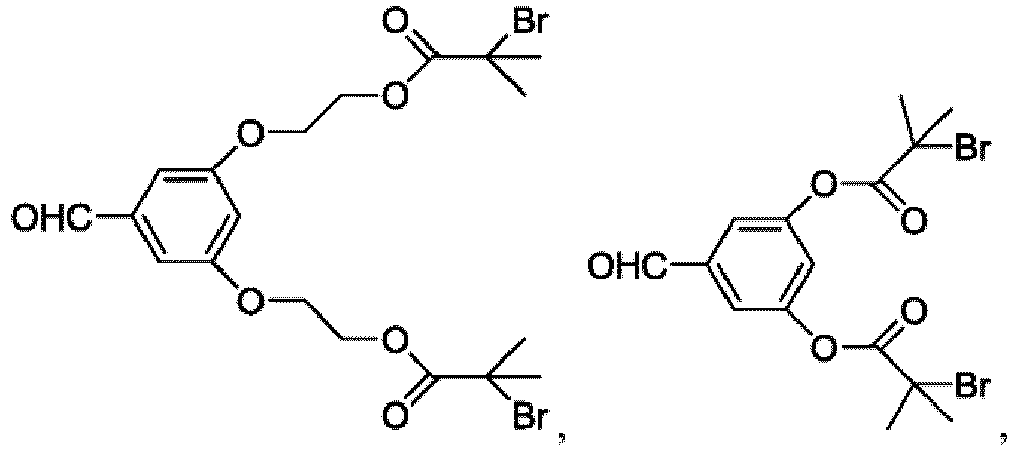


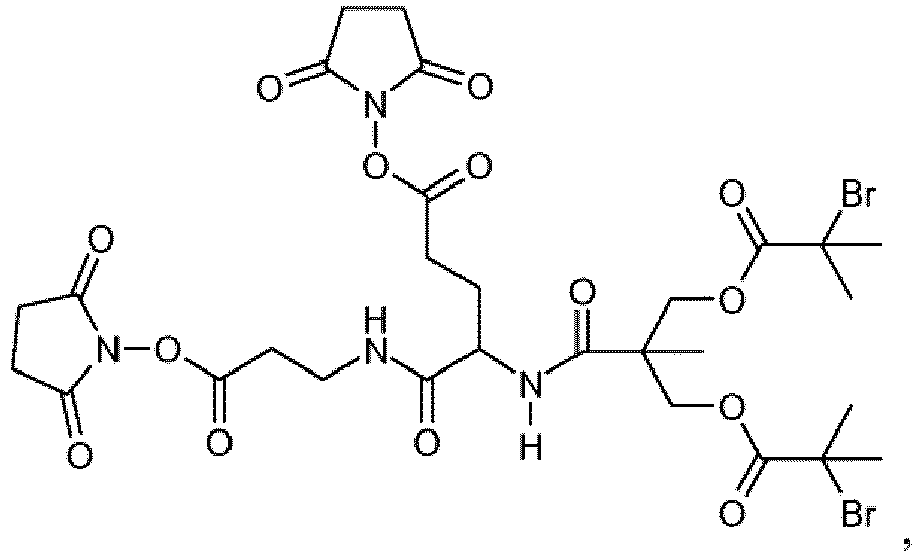


- Konjugat nach Anspruch 6, wobei das Konjugat eine Formel hat, die aus der Gruppe ausgewählt ist, die aus Folgendem besteht:


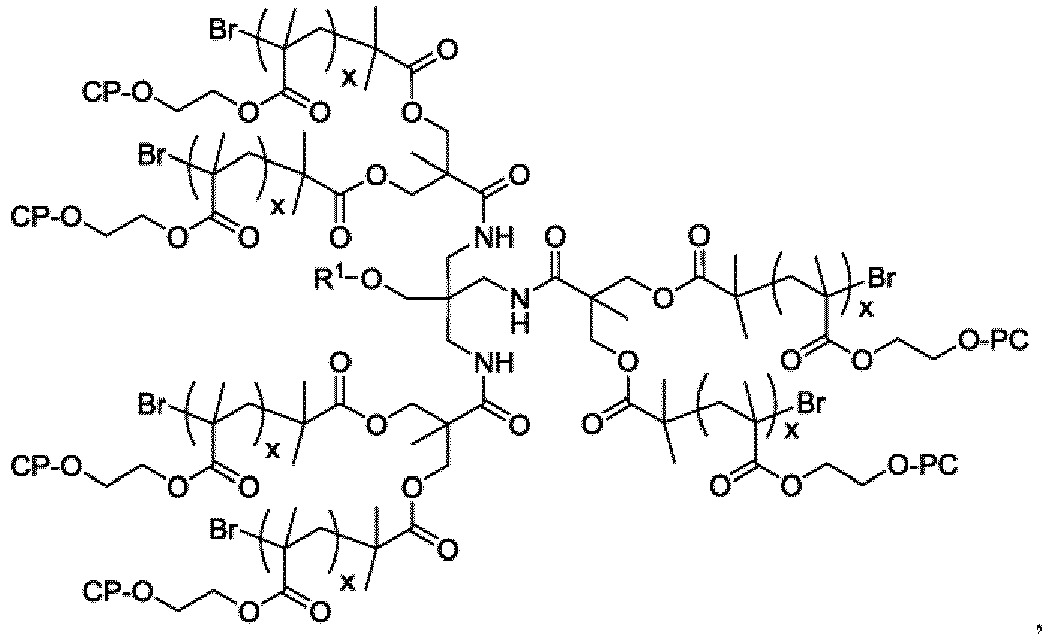
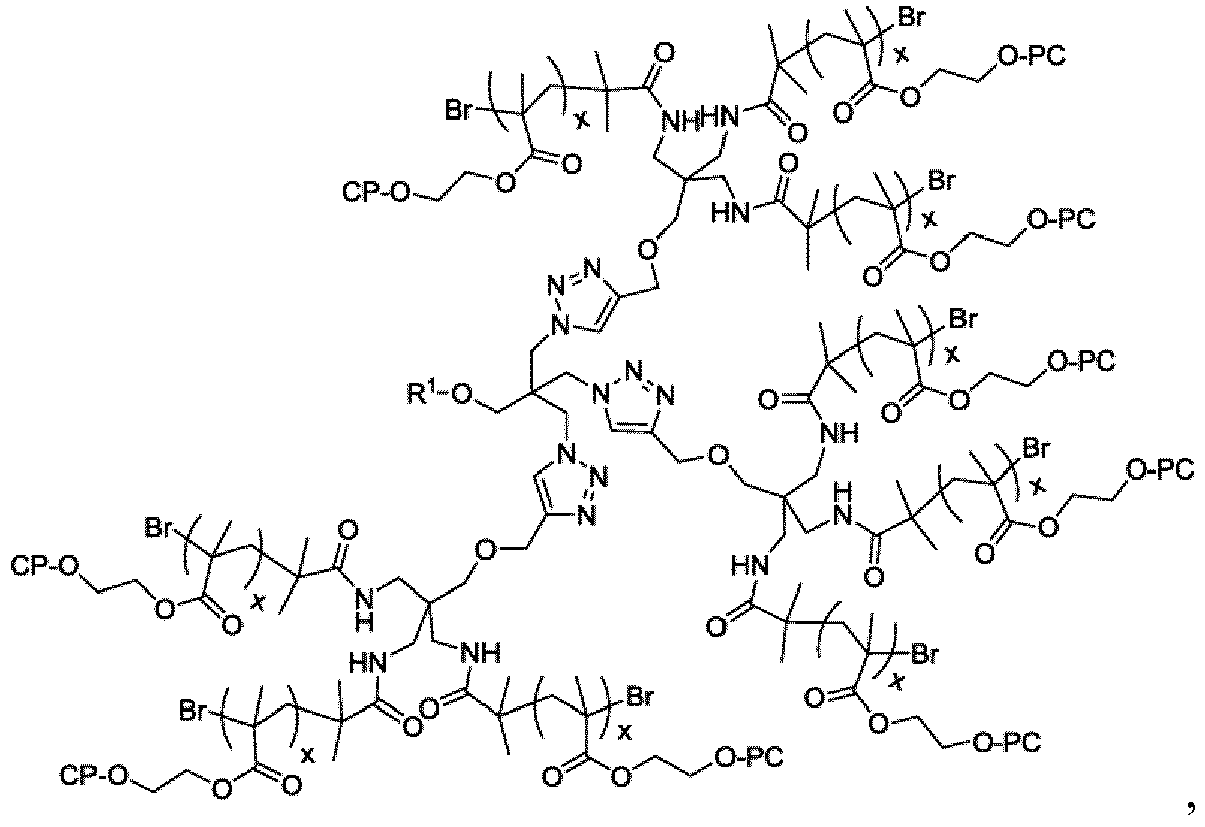

- Konjugat nach Anspruch 12, wobei:A1 ein Protein, ein Antikörper, ein Antikörperfragment oder ein Einzeldomänenantikörper ist; undL3 -(CH2CH2O)1-10 ist.
Priority Applications (4)
| Application Number | Priority Date | Filing Date | Title |
|---|---|---|---|
| SI201131761T SI2558538T1 (sl) | 2010-04-15 | 2011-04-15 | Polimeri z visoko relativno molekulsko maso, ki vsebujejo dipolarni ion |
| DK19175761.6T DK3549963T3 (da) | 2010-04-15 | 2011-04-15 | Zwitterionholdige polymerer med høj molekylvægt |
| EP19175761.6A EP3549963B1 (de) | 2010-04-15 | 2011-04-15 | Zwitterionenhaltige polymere von hohem molekulargewicht |
| EP21215256.5A EP4029510A1 (de) | 2010-04-15 | 2011-04-15 | Zwitterionenhaltige polymere von hohem molekulargewicht |
Applications Claiming Priority (2)
| Application Number | Priority Date | Filing Date | Title |
|---|---|---|---|
| US32441310P | 2010-04-15 | 2010-04-15 | |
| PCT/US2011/032768 WO2011130694A2 (en) | 2010-04-15 | 2011-04-15 | High molecular weight zwitterion-containing polymers |
Related Child Applications (3)
| Application Number | Title | Priority Date | Filing Date |
|---|---|---|---|
| EP21215256.5A Division EP4029510A1 (de) | 2010-04-15 | 2011-04-15 | Zwitterionenhaltige polymere von hohem molekulargewicht |
| EP19175761.6A Division EP3549963B1 (de) | 2010-04-15 | 2011-04-15 | Zwitterionenhaltige polymere von hohem molekulargewicht |
| EP19175761.6A Division-Into EP3549963B1 (de) | 2010-04-15 | 2011-04-15 | Zwitterionenhaltige polymere von hohem molekulargewicht |
Publications (3)
| Publication Number | Publication Date |
|---|---|
| EP2558538A2 EP2558538A2 (de) | 2013-02-20 |
| EP2558538A4 EP2558538A4 (de) | 2016-08-17 |
| EP2558538B1 true EP2558538B1 (de) | 2019-07-03 |
Family
ID=44799363
Family Applications (3)
| Application Number | Title | Priority Date | Filing Date |
|---|---|---|---|
| EP19175761.6A Active EP3549963B1 (de) | 2010-04-15 | 2011-04-15 | Zwitterionenhaltige polymere von hohem molekulargewicht |
| EP11769715.1A Active EP2558538B1 (de) | 2010-04-15 | 2011-04-15 | Zwitterionenhaltige polymere von hohem molekulargewicht |
| EP21215256.5A Withdrawn EP4029510A1 (de) | 2010-04-15 | 2011-04-15 | Zwitterionenhaltige polymere von hohem molekulargewicht |
Family Applications Before (1)
| Application Number | Title | Priority Date | Filing Date |
|---|---|---|---|
| EP19175761.6A Active EP3549963B1 (de) | 2010-04-15 | 2011-04-15 | Zwitterionenhaltige polymere von hohem molekulargewicht |
Family Applications After (1)
| Application Number | Title | Priority Date | Filing Date |
|---|---|---|---|
| EP21215256.5A Withdrawn EP4029510A1 (de) | 2010-04-15 | 2011-04-15 | Zwitterionenhaltige polymere von hohem molekulargewicht |
Country Status (18)
| Country | Link |
|---|---|
| US (5) | US20140024776A1 (de) |
| EP (3) | EP3549963B1 (de) |
| JP (5) | JP2013534931A (de) |
| KR (7) | KR20200067958A (de) |
| CN (2) | CN103492489A (de) |
| AU (3) | AU2011239434B2 (de) |
| BR (1) | BR112012026118B1 (de) |
| CA (1) | CA2795667C (de) |
| CL (1) | CL2012002881A1 (de) |
| CO (1) | CO6630186A2 (de) |
| DK (2) | DK2558538T3 (de) |
| ES (2) | ES2742216T3 (de) |
| IL (1) | IL222427A0 (de) |
| LT (2) | LT3549963T (de) |
| MX (1) | MX365521B (de) |
| PT (2) | PT3549963T (de) |
| SI (2) | SI3549963T1 (de) |
| WO (1) | WO2011130694A2 (de) |
Families Citing this family (35)
| Publication number | Priority date | Publication date | Assignee | Title |
|---|---|---|---|---|
| EP1988910B1 (de) | 2006-02-28 | 2017-12-06 | Kodiak Sciences Inc. | Acryloyloxyethylphosphorylcholin-haltige polymerkonjugate und ihre zubereitung |
| WO2011075185A1 (en) | 2009-12-18 | 2011-06-23 | Oligasis | Targeted drug phosphorylcholine polymer conjugates |
| ES2742216T3 (es) * | 2010-04-15 | 2020-02-13 | Kodiak Sciences Inc | Polímeros que contienen zwitteriones de alto peso molecular |
| US9033159B1 (en) * | 2011-06-07 | 2015-05-19 | Clemson University | Membrane surface modification |
| JP5907726B2 (ja) * | 2011-12-28 | 2016-04-26 | 東邦化学工業株式会社 | 星型ポリマー及び原子移動ラジカル重合開始剤 |
| US8802235B2 (en) | 2012-01-18 | 2014-08-12 | University Of Kansas | Drug and imaging agent delivery compositions and methods |
| JP6234064B2 (ja) * | 2012-05-23 | 2017-11-22 | キヤノン株式会社 | 重合体、前記重合体を用いた核磁気共鳴分析用または磁気共鳴イメージング用の造影剤、化合物、前記重合体を用いた核磁気共鳴分析方法および磁気共鳴イメージング方法 |
| US20140187501A1 (en) * | 2012-12-28 | 2014-07-03 | Blend Therapeutics, Inc. | Targeted Conjugates Encapsulated in Particles and Formulations Thereof |
| WO2015035342A2 (en) | 2013-09-08 | 2015-03-12 | Oligasis Llc | Factor viii zwitterionic polymer conjugates |
| US9840553B2 (en) | 2014-06-28 | 2017-12-12 | Kodiak Sciences Inc. | Dual PDGF/VEGF antagonists |
| KR20210013299A (ko) | 2014-10-17 | 2021-02-03 | 코디악 사이언시스 인코포레이티드 | 부티릴콜린에스테라제 양성이온성 중합체 컨쥬게이트 |
| US10398788B2 (en) * | 2014-10-24 | 2019-09-03 | Canon Kabushiki Kaisha | Polymer and contrast agent for photoacoustic imaging including the polymer |
| CN113876962A (zh) * | 2015-04-07 | 2022-01-04 | 纪念斯隆-凯特琳癌症中心 | 纳米粒子免疫偶联物 |
| CN104961853A (zh) * | 2015-06-03 | 2015-10-07 | 青岛农业大学 | 一种新型苯乙烯微球及其制备方法 |
| KR20250057128A (ko) | 2015-12-30 | 2025-04-28 | 코디악 사이언시스 인코포레이티드 | 항체 및 이의 접합체 |
| WO2017147240A1 (en) | 2016-02-23 | 2017-08-31 | Tarveda Therapeutics, Inc. | Hsp90 targeted conjugates and particles and formulations thereof |
| CN105837741B (zh) * | 2016-05-14 | 2018-01-02 | 上海大学 | 寡聚脯氨酸甲基丙烯酸酯/二甲氨乙基甲基丙烯酸酯共聚物及其制备方法 |
| CN106519147B (zh) * | 2016-06-08 | 2017-10-17 | 重庆博蓝鹰生物技术有限公司 | 微纳米材料、其表面用亲水物质共价修饰的产物及制备方法 |
| JP6870002B2 (ja) | 2016-06-08 | 2021-05-12 | 重慶博藍鷹生物技術有限公司Chongqing Bolanying (Bly) Biotechnology Co., Ltd., China | マイクロナノ材料、その表面を親水性物質で共有結合修飾した生成物及び製造方法 |
| AU2018250695A1 (en) | 2017-04-14 | 2019-11-07 | Kodiak Sciences Inc. | Complement factor D antagonist antibodies and conjugates thereof |
| WO2019036188A1 (en) | 2017-08-13 | 2019-02-21 | Applied Materials, Inc. | METHOD FOR ENHANCING SELECTIVE DEPOSITION BY CROSS-LINKING MOLECULES |
| WO2019143193A1 (ko) | 2018-01-19 | 2019-07-25 | 주식회사 펩진 | 재조합 폴리펩타이드 생산용 n-말단 융합 파트너 및 이를 이용하여 재조합 폴리 펩타이드를 생산하는방법 |
| US12071476B2 (en) | 2018-03-02 | 2024-08-27 | Kodiak Sciences Inc. | IL-6 antibodies and fusion constructs and conjugates thereof |
| CN109354637A (zh) * | 2018-10-13 | 2019-02-19 | 菏泽学院 | 聚n-异丙基丙烯酰胺油凝胶合成方法 |
| CN109880110B (zh) * | 2019-02-15 | 2021-07-27 | 华东师范大学 | 含聚(2-乙烯吡啶)聚肽嵌段共聚物及其制备方法和应用 |
| CN109912790A (zh) * | 2019-03-04 | 2019-06-21 | 西南交通大学 | 一种具有高抗凝血性的改性聚碳酸酯 |
| AU2020364071A1 (en) | 2019-10-10 | 2022-05-26 | Kodiak Sciences Inc. | Methods of treating an eye disorder |
| JP2023510089A (ja) * | 2019-12-13 | 2023-03-13 | フォリウムラボ インコーポレーティッド | 炭水化物ポリマー及び活性成分を備える錯体及びそれらを調製する方法 |
| CN110981810A (zh) * | 2019-12-19 | 2020-04-10 | 东莞市维琪科技有限公司 | 一种脱羧肌肽的合成方法 |
| CN111983067B (zh) * | 2020-08-05 | 2023-03-03 | 河北省药品医疗器械检验研究院(河北省化妆品检验研究中心) | 一种注射用拉氧头孢钠聚合物的检测方法及在线鉴定的检测方法 |
| WO2022065263A1 (ja) * | 2020-09-25 | 2022-03-31 | 日油株式会社 | マレイミドポリエチレングリコール脂質の製造方法 |
| JP7417227B2 (ja) * | 2021-01-28 | 2024-01-18 | 国立研究開発法人物質・材料研究機構 | 空気電池正極用の炭素多孔体の製造方法 |
| JP7656298B2 (ja) * | 2021-09-27 | 2025-04-03 | 大日精化工業株式会社 | 表面処理膜の製造方法 |
| CN116270255B (zh) * | 2023-02-14 | 2024-10-18 | 哈尔滨运美达生物科技有限公司 | 一种高贴合复合透明质酸钠修复贴及其制备方法 |
| CN117247534B (zh) * | 2023-10-20 | 2024-04-30 | 浙江恒翔新材料有限公司 | 一种切削液用改性超支化聚醚的制备方法及其应用 |
Family Cites Families (48)
| Publication number | Priority date | Publication date | Assignee | Title |
|---|---|---|---|---|
| US5162218A (en) | 1988-11-18 | 1992-11-10 | The Regents Of The University Of California | Conjugated polypeptides and methods for their preparation |
| GB9301701D0 (en) | 1993-01-28 | 1993-03-17 | Biocompatibles Ltd | New zwitterionic materials |
| GB9301702D0 (en) | 1993-01-28 | 1993-03-17 | Biocompatibles Ltd | New materials |
| US6156884A (en) | 1996-08-05 | 2000-12-05 | Prolinx, Inc. | Bifunctional boronic compound complexing reagents and complexes |
| ATE489461T1 (de) | 1997-10-16 | 2010-12-15 | Univ Georgia | Transgene vögel und proteinproduktion |
| JP4162284B2 (ja) * | 1998-02-04 | 2008-10-08 | 日油株式会社 | 洗浄剤組成物 |
| US6781030B1 (en) | 1998-11-02 | 2004-08-24 | Trustee Of Tufts College, Ballou Hall | Methods for cloning mammals using telophase oocytes |
| DE69941223D1 (de) | 1998-12-21 | 2009-09-17 | Billig Fritz | Chemisch modifizierte enzymen mit mehrfachgeladenen varianten |
| FR2794459B1 (fr) | 1999-05-19 | 2004-09-03 | Atofina | Polyalcoxyamines issues de nitroxydes beta-substitues |
| CA2385528C (en) | 1999-10-01 | 2013-12-10 | Immunogen, Inc. | Compositions and methods for treating cancer using immunoconjugates and chemotherapeutic agents |
| JP5049452B2 (ja) * | 2000-10-06 | 2012-10-17 | バイオコンパティブルズ ユーケー リミテッド | 両性イオン重合体 |
| US6780428B2 (en) * | 2001-06-08 | 2004-08-24 | Labopharm, Inc. | Unimolecular polymeric micelles with an ionizable inner core |
| JP2003064132A (ja) * | 2001-08-28 | 2003-03-05 | Nof Corp | 重合体、製造方法および乳化・分散剤 |
| US6964859B2 (en) | 2001-10-16 | 2005-11-15 | Massachusetts Institute Of Technology | Suppressor tRNA system |
| WO2003101972A1 (en) | 2002-05-30 | 2003-12-11 | The Scripps Research Institute | Copper-catalysed ligation of azides and acetylenes |
| ES2544527T3 (es) | 2002-07-31 | 2015-09-01 | Seattle Genetics, Inc. | Conjugados de fármacos y su uso para tratar el cáncer, una enfermedad autoinmune o una enfermedad infecciosa |
| GB0301014D0 (en) * | 2003-01-16 | 2003-02-19 | Biocompatibles Ltd | Conjugation reactions |
| EP2267049A1 (de) * | 2003-02-05 | 2010-12-29 | Biocompatibles UK Limited | Blockcopolymere |
| CN1208358C (zh) * | 2003-07-31 | 2005-06-29 | 上海交通大学 | 含多羟基官能团多臂星状超支化聚合物刷及其制备方法 |
| EP1718667B1 (de) | 2004-02-23 | 2013-01-09 | Genentech, Inc. | Heterocyclische, selbst-immolative linker und konjugate |
| JP4727938B2 (ja) * | 2004-02-24 | 2011-07-20 | 泰彦 岩崎 | リビングラジカル重合開始基を持つポリリン酸の製造方法および用途 |
| JP4727941B2 (ja) * | 2004-03-12 | 2011-07-20 | 泰彦 岩崎 | 生分解性重合体の製造方法および用途 |
| WO2005099768A2 (en) | 2004-03-23 | 2005-10-27 | Complex Biosystems Gmbh | Polymeric prodrug with a self-immolative linker |
| KR101468345B1 (ko) | 2004-11-12 | 2014-12-03 | 바이엘 헬스케어 엘엘씨 | Fviii의 부위 지향 변형 |
| DE102006009004A1 (de) * | 2006-02-23 | 2007-09-06 | Sustech Gmbh & Co. Kg | Multifunktionelle sternförmige Präpolymere, deren Herstellung und Verwendung |
| EP1988910B1 (de) * | 2006-02-28 | 2017-12-06 | Kodiak Sciences Inc. | Acryloyloxyethylphosphorylcholin-haltige polymerkonjugate und ihre zubereitung |
| JP2007263935A (ja) * | 2006-03-30 | 2007-10-11 | Canon Inc | 磁性マーカー及びその製造方法 |
| JP2009533519A (ja) * | 2006-04-14 | 2009-09-17 | インターフェース バイオロジクス,インコーポレーテッド | グラフトポリマーおよびその使用 |
| EP2581450B1 (de) | 2006-05-02 | 2018-08-15 | MedImmune Limited | Mit nichtnatürlichen Aminosäuren substituierte Polypeptide |
| EP2230264B1 (de) * | 2006-06-29 | 2019-10-09 | Life Technologies AS | Teilchen enthaltend multiblockcopolymere |
| BRPI0715375A2 (pt) | 2006-08-18 | 2013-06-18 | Hoffmann La Roche | policonjugados para distribuiÇço in vivo de polinucleotÍdeos |
| JP5111016B2 (ja) * | 2006-11-01 | 2012-12-26 | 三井化学株式会社 | 表面親水性ポリオレフィン成形体およびその製造方法 |
| WO2008064058A2 (en) * | 2006-11-21 | 2008-05-29 | Abbott Laboratories | Use of a terpolymer of tetrafluoroethylene, hexafluoropropylene, and vinylidene fluoride in drug eluting coatings |
| WO2008098930A1 (en) * | 2007-02-14 | 2008-08-21 | Biocompatibes Uk Limited | Derivatisation of biological molecules |
| CN101053681B (zh) * | 2007-04-10 | 2010-05-19 | 天津大学 | 用于血管栓塞材料的温敏性MPC-b-NIPAM二嵌段星型共聚物及制备方法和应用 |
| JP2009042617A (ja) * | 2007-08-10 | 2009-02-26 | Canon Inc | 静電荷像現像用トナー及びその製造方法 |
| US7943370B2 (en) * | 2007-08-23 | 2011-05-17 | Canon Kabushiki Kaisha | Structure, target substance detection element and target substance detection kit |
| EP2265283B1 (de) | 2008-03-18 | 2014-09-03 | Seattle Genetics, Inc. | Auristatin-arznei-linker-konjugate |
| EP2281006B1 (de) | 2008-04-30 | 2017-08-02 | Immunogen, Inc. | Vernetzer und ihre verwendung |
| US9732142B2 (en) * | 2008-05-15 | 2017-08-15 | Biocompatibles Uk Limited | Intracellular antibody delivery |
| JP5344420B2 (ja) * | 2008-05-15 | 2013-11-20 | 独立行政法人国立循環器病研究センター | 遺伝子導入剤及びその製造方法並びに核酸複合体 |
| WO2010126552A1 (en) | 2009-04-30 | 2010-11-04 | Immunogen, Inc. | Potent cell-binding agent drug conjugates |
| CN101575402B (zh) * | 2009-05-31 | 2012-06-27 | 中国科学院化学研究所 | 一种多臂星型聚合物及其制备方法 |
| DK2260873T3 (da) * | 2009-06-08 | 2019-09-16 | Biocompatibles Uk Ltd | Pcylering af proteiner |
| KR101159674B1 (ko) * | 2009-11-16 | 2012-06-25 | 주식회사 케이씨씨 | 모노실란의 정제방법 |
| WO2011075185A1 (en) * | 2009-12-18 | 2011-06-23 | Oligasis | Targeted drug phosphorylcholine polymer conjugates |
| ES2742216T3 (es) | 2010-04-15 | 2020-02-13 | Kodiak Sciences Inc | Polímeros que contienen zwitteriones de alto peso molecular |
| KR20250057128A (ko) * | 2015-12-30 | 2025-04-28 | 코디악 사이언시스 인코포레이티드 | 항체 및 이의 접합체 |
-
2011
- 2011-04-15 ES ES11769715T patent/ES2742216T3/es active Active
- 2011-04-15 CA CA2795667A patent/CA2795667C/en active Active
- 2011-04-15 MX MX2012011876A patent/MX365521B/es active IP Right Grant
- 2011-04-15 PT PT191757616T patent/PT3549963T/pt unknown
- 2011-04-15 KR KR1020207016413A patent/KR20200067958A/ko not_active Ceased
- 2011-04-15 CN CN201180028682.1A patent/CN103492489A/zh active Pending
- 2011-04-15 KR KR1020237025619A patent/KR20230113857A/ko not_active Withdrawn
- 2011-04-15 EP EP19175761.6A patent/EP3549963B1/de active Active
- 2011-04-15 KR KR1020127029878A patent/KR20130097636A/ko not_active Ceased
- 2011-04-15 LT LTEP19175761.6T patent/LT3549963T/lt unknown
- 2011-04-15 KR KR1020177034546A patent/KR20170137938A/ko not_active Ceased
- 2011-04-15 LT LTEP11769715.1T patent/LT2558538T/lt unknown
- 2011-04-15 DK DK11769715.1T patent/DK2558538T3/da active
- 2011-04-15 KR KR1020227009924A patent/KR102562175B1/ko active Active
- 2011-04-15 BR BR112012026118-5A patent/BR112012026118B1/pt active IP Right Grant
- 2011-04-15 EP EP11769715.1A patent/EP2558538B1/de active Active
- 2011-04-15 KR KR1020217020330A patent/KR102416359B1/ko active Active
- 2011-04-15 ES ES19175761T patent/ES2905690T3/es active Active
- 2011-04-15 PT PT117697151T patent/PT2558538T/pt unknown
- 2011-04-15 DK DK19175761.6T patent/DK3549963T3/da active
- 2011-04-15 SI SI201132042T patent/SI3549963T1/sl unknown
- 2011-04-15 KR KR1020187034569A patent/KR20180130008A/ko not_active Ceased
- 2011-04-15 JP JP2013505199A patent/JP2013534931A/ja active Pending
- 2011-04-15 AU AU2011239434A patent/AU2011239434B2/en active Active
- 2011-04-15 SI SI201131761T patent/SI2558538T1/sl unknown
- 2011-04-15 CN CN201610446624.5A patent/CN106432557A/zh active Pending
- 2011-04-15 WO PCT/US2011/032768 patent/WO2011130694A2/en not_active Ceased
- 2011-04-15 EP EP21215256.5A patent/EP4029510A1/de not_active Withdrawn
-
2012
- 2012-10-12 CL CL2012002881A patent/CL2012002881A1/es unknown
- 2012-10-14 IL IL222427A patent/IL222427A0/en unknown
- 2012-11-13 CO CO12203725A patent/CO6630186A2/es not_active Application Discontinuation
-
2013
- 2013-05-23 US US13/901,483 patent/US20140024776A1/en not_active Abandoned
-
2015
- 2015-07-30 AU AU2015207898A patent/AU2015207898A1/en not_active Abandoned
- 2015-08-24 JP JP2015165282A patent/JP6568748B2/ja active Active
-
2016
- 2016-12-02 US US15/368,376 patent/US20170143841A1/en not_active Abandoned
-
2017
- 2017-03-22 AU AU2017201930A patent/AU2017201930B2/en active Active
- 2017-12-01 JP JP2017231724A patent/JP6754749B2/ja active Active
-
2020
- 2020-01-31 US US16/779,102 patent/US20200171179A1/en not_active Abandoned
- 2020-04-24 JP JP2020077026A patent/JP7217245B2/ja active Active
-
2021
- 2021-08-23 US US17/409,578 patent/US20210402015A1/en not_active Abandoned
-
2022
- 2022-07-22 JP JP2022117091A patent/JP2022165998A/ja active Pending
-
2024
- 2024-04-17 US US18/638,556 patent/US20240293585A1/en active Pending
Non-Patent Citations (1)
| Title |
|---|
| None * |
Also Published As
Similar Documents
| Publication | Publication Date | Title |
|---|---|---|
| US20240293585A1 (en) | High molecular weight zwitterion-containing polymers | |
| EP3659591B1 (de) | Multifunktionelle zwitterionische polymerkonjugate | |
| WO2013059137A1 (en) | High molecular weight zwitterion-containing polymers | |
| HK40077471A (en) | High molecular weight zwitterion-containing polymers | |
| HK40015590A (en) | High molecular weight zwitterion-containing polymers | |
| HK40015590B (en) | High molecular weight zwitterion-containing polymers | |
| HK40030916B (en) | Multifunctional zwitterionic polymer conjugates | |
| HK40030916A (en) | Multifunctional zwitterionic polymer conjugates | |
| HK1247828B (en) | Multifunctional zwitterionic polymer conjugates | |
| HK1234761A1 (en) | High molecular weight zwitterion-containing polymers |
Legal Events
| Date | Code | Title | Description |
|---|---|---|---|
| PUAI | Public reference made under article 153(3) epc to a published international application that has entered the european phase |
Free format text: ORIGINAL CODE: 0009012 |
|
| 17P | Request for examination filed |
Effective date: 20121109 |
|
| AK | Designated contracting states |
Kind code of ref document: A2 Designated state(s): AL AT BE BG CH CY CZ DE DK EE ES FI FR GB GR HR HU IE IS IT LI LT LU LV MC MK MT NL NO PL PT RO RS SE SI SK SM TR |
|
| DAX | Request for extension of the european patent (deleted) | ||
| R17D | Deferred search report published (corrected) |
Effective date: 20140320 |
|
| RIC1 | Information provided on ipc code assigned before grant |
Ipc: A61K 31/74 20060101AFI20140930BHEP |
|
| RIC1 | Information provided on ipc code assigned before grant |
Ipc: A61K 47/48 20060101AFI20160322BHEP Ipc: A61K 31/74 20060101ALI20160322BHEP Ipc: C08F 230/02 20060101ALI20160322BHEP |
|
| RAP1 | Party data changed (applicant data changed or rights of an application transferred) |
Owner name: KODIAK SCIENCES INC. |
|
| A4 | Supplementary search report drawn up and despatched |
Effective date: 20160718 |
|
| RIC1 | Information provided on ipc code assigned before grant |
Ipc: C08F 230/02 20060101ALI20160712BHEP Ipc: A61K 47/48 20060101AFI20160712BHEP Ipc: A61K 31/74 20060101ALI20160712BHEP |
|
| STAA | Information on the status of an ep patent application or granted ep patent |
Free format text: STATUS: EXAMINATION IS IN PROGRESS |
|
| 17Q | First examination report despatched |
Effective date: 20171109 |
|
| REG | Reference to a national code |
Ref country code: DE Ref legal event code: R079 Ref document number: 602011060206 Country of ref document: DE Free format text: PREVIOUS MAIN CLASS: C08L0077020000 Ipc: A61K0031740000 |
|
| RIC1 | Information provided on ipc code assigned before grant |
Ipc: A61K 47/58 20170101ALI20181116BHEP Ipc: A61K 31/74 20060101AFI20181116BHEP Ipc: C08F 230/02 20060101ALI20181116BHEP Ipc: A61K 47/68 20170101ALI20181116BHEP |
|
| GRAP | Despatch of communication of intention to grant a patent |
Free format text: ORIGINAL CODE: EPIDOSNIGR1 |
|
| STAA | Information on the status of an ep patent application or granted ep patent |
Free format text: STATUS: GRANT OF PATENT IS INTENDED |
|
| INTG | Intention to grant announced |
Effective date: 20190107 |
|
| RIC1 | Information provided on ipc code assigned before grant |
Ipc: A61K 47/68 20170101ALI20181116BHEP Ipc: C08F 230/02 20060101ALI20181116BHEP Ipc: A61K 47/58 20170101ALI20181116BHEP Ipc: A61K 31/74 20060101AFI20181116BHEP |
|
| GRAS | Grant fee paid |
Free format text: ORIGINAL CODE: EPIDOSNIGR3 |
|
| GRAA | (expected) grant |
Free format text: ORIGINAL CODE: 0009210 |
|
| STAA | Information on the status of an ep patent application or granted ep patent |
Free format text: STATUS: THE PATENT HAS BEEN GRANTED |
|
| AK | Designated contracting states |
Kind code of ref document: B1 Designated state(s): AL AT BE BG CH CY CZ DE DK EE ES FI FR GB GR HR HU IE IS IT LI LT LU LV MC MK MT NL NO PL PT RO RS SE SI SK SM TR |
|
| REG | Reference to a national code |
Ref country code: GB Ref legal event code: FG4D |
|
| REG | Reference to a national code |
Ref country code: AT Ref legal event code: REF Ref document number: 1150147 Country of ref document: AT Kind code of ref document: T Effective date: 20190715 Ref country code: CH Ref legal event code: EP |
|
| REG | Reference to a national code |
Ref country code: IE Ref legal event code: FG4D |
|
| REG | Reference to a national code |
Ref country code: DE Ref legal event code: R096 Ref document number: 602011060206 Country of ref document: DE |
|
| REG | Reference to a national code |
Ref country code: DK Ref legal event code: T3 Effective date: 20190731 |
|
| REG | Reference to a national code |
Ref country code: SE Ref legal event code: TRGR |
|
| REG | Reference to a national code |
Ref country code: CH Ref legal event code: NV Representative=s name: VENI GMBH, CH |
|
| REG | Reference to a national code |
Ref country code: NL Ref legal event code: FP |
|
| REG | Reference to a national code |
Ref country code: PT Ref legal event code: SC4A Ref document number: 2558538 Country of ref document: PT Date of ref document: 20191010 Kind code of ref document: T Free format text: AVAILABILITY OF NATIONAL TRANSLATION Effective date: 20190919 |
|
| PG25 | Lapsed in a contracting state [announced via postgrant information from national office to epo] |
Ref country code: NO Free format text: LAPSE BECAUSE OF FAILURE TO SUBMIT A TRANSLATION OF THE DESCRIPTION OR TO PAY THE FEE WITHIN THE PRESCRIBED TIME-LIMIT Effective date: 20191003 Ref country code: BG Free format text: LAPSE BECAUSE OF FAILURE TO SUBMIT A TRANSLATION OF THE DESCRIPTION OR TO PAY THE FEE WITHIN THE PRESCRIBED TIME-LIMIT Effective date: 20191003 Ref country code: HR Free format text: LAPSE BECAUSE OF FAILURE TO SUBMIT A TRANSLATION OF THE DESCRIPTION OR TO PAY THE FEE WITHIN THE PRESCRIBED TIME-LIMIT Effective date: 20190703 |
|
| REG | Reference to a national code |
Ref country code: ES Ref legal event code: FG2A Ref document number: 2742216 Country of ref document: ES Kind code of ref document: T3 Effective date: 20200213 |
|
| PG25 | Lapsed in a contracting state [announced via postgrant information from national office to epo] |
Ref country code: AL Free format text: LAPSE BECAUSE OF FAILURE TO SUBMIT A TRANSLATION OF THE DESCRIPTION OR TO PAY THE FEE WITHIN THE PRESCRIBED TIME-LIMIT Effective date: 20190703 Ref country code: LV Free format text: LAPSE BECAUSE OF FAILURE TO SUBMIT A TRANSLATION OF THE DESCRIPTION OR TO PAY THE FEE WITHIN THE PRESCRIBED TIME-LIMIT Effective date: 20190703 Ref country code: RS Free format text: LAPSE BECAUSE OF FAILURE TO SUBMIT A TRANSLATION OF THE DESCRIPTION OR TO PAY THE FEE WITHIN THE PRESCRIBED TIME-LIMIT Effective date: 20190703 Ref country code: GR Free format text: LAPSE BECAUSE OF FAILURE TO SUBMIT A TRANSLATION OF THE DESCRIPTION OR TO PAY THE FEE WITHIN THE PRESCRIBED TIME-LIMIT Effective date: 20191004 |
|
| PG25 | Lapsed in a contracting state [announced via postgrant information from national office to epo] |
Ref country code: TR Free format text: LAPSE BECAUSE OF FAILURE TO SUBMIT A TRANSLATION OF THE DESCRIPTION OR TO PAY THE FEE WITHIN THE PRESCRIBED TIME-LIMIT Effective date: 20190703 |
|
| PG25 | Lapsed in a contracting state [announced via postgrant information from national office to epo] |
Ref country code: RO Free format text: LAPSE BECAUSE OF FAILURE TO SUBMIT A TRANSLATION OF THE DESCRIPTION OR TO PAY THE FEE WITHIN THE PRESCRIBED TIME-LIMIT Effective date: 20190703 Ref country code: PL Free format text: LAPSE BECAUSE OF FAILURE TO SUBMIT A TRANSLATION OF THE DESCRIPTION OR TO PAY THE FEE WITHIN THE PRESCRIBED TIME-LIMIT Effective date: 20190703 Ref country code: EE Free format text: LAPSE BECAUSE OF FAILURE TO SUBMIT A TRANSLATION OF THE DESCRIPTION OR TO PAY THE FEE WITHIN THE PRESCRIBED TIME-LIMIT Effective date: 20190703 |
|
| PG25 | Lapsed in a contracting state [announced via postgrant information from national office to epo] |
Ref country code: SM Free format text: LAPSE BECAUSE OF FAILURE TO SUBMIT A TRANSLATION OF THE DESCRIPTION OR TO PAY THE FEE WITHIN THE PRESCRIBED TIME-LIMIT Effective date: 20190703 Ref country code: SK Free format text: LAPSE BECAUSE OF FAILURE TO SUBMIT A TRANSLATION OF THE DESCRIPTION OR TO PAY THE FEE WITHIN THE PRESCRIBED TIME-LIMIT Effective date: 20190703 |
|
| REG | Reference to a national code |
Ref country code: DE Ref legal event code: R097 Ref document number: 602011060206 Country of ref document: DE |
|
| PLBE | No opposition filed within time limit |
Free format text: ORIGINAL CODE: 0009261 |
|
| STAA | Information on the status of an ep patent application or granted ep patent |
Free format text: STATUS: NO OPPOSITION FILED WITHIN TIME LIMIT |
|
| 26N | No opposition filed |
Effective date: 20200603 |
|
| REG | Reference to a national code |
Ref country code: AT Ref legal event code: UEP Ref document number: 1150147 Country of ref document: AT Kind code of ref document: T Effective date: 20190703 |
|
| PG25 | Lapsed in a contracting state [announced via postgrant information from national office to epo] |
Ref country code: MT Free format text: LAPSE BECAUSE OF FAILURE TO SUBMIT A TRANSLATION OF THE DESCRIPTION OR TO PAY THE FEE WITHIN THE PRESCRIBED TIME-LIMIT Effective date: 20190703 Ref country code: CY Free format text: LAPSE BECAUSE OF FAILURE TO SUBMIT A TRANSLATION OF THE DESCRIPTION OR TO PAY THE FEE WITHIN THE PRESCRIBED TIME-LIMIT Effective date: 20190703 |
|
| PG25 | Lapsed in a contracting state [announced via postgrant information from national office to epo] |
Ref country code: MK Free format text: LAPSE BECAUSE OF FAILURE TO SUBMIT A TRANSLATION OF THE DESCRIPTION OR TO PAY THE FEE WITHIN THE PRESCRIBED TIME-LIMIT Effective date: 20190703 |
|
| P01 | Opt-out of the competence of the unified patent court (upc) registered |
Effective date: 20230519 |
|
| PGFP | Annual fee paid to national office [announced via postgrant information from national office to epo] |
Ref country code: IS Payment date: 20250331 Year of fee payment: 15 |
|
| PGFP | Annual fee paid to national office [announced via postgrant information from national office to epo] |
Ref country code: DK Payment date: 20250314 Year of fee payment: 15 Ref country code: LT Payment date: 20250319 Year of fee payment: 15 |
|
| PGFP | Annual fee paid to national office [announced via postgrant information from national office to epo] |
Ref country code: CZ Payment date: 20250314 Year of fee payment: 15 |
|
| PGFP | Annual fee paid to national office [announced via postgrant information from national office to epo] |
Ref country code: IT Payment date: 20250317 Year of fee payment: 15 |
|
| PGFP | Annual fee paid to national office [announced via postgrant information from national office to epo] |
Ref country code: DE Payment date: 20250313 Year of fee payment: 15 |
|
| PGFP | Annual fee paid to national office [announced via postgrant information from national office to epo] |
Ref country code: ES Payment date: 20250528 Year of fee payment: 15 |
|
| PGFP | Annual fee paid to national office [announced via postgrant information from national office to epo] |
Ref country code: CH Payment date: 20250501 Year of fee payment: 15 |
|
| PGFP | Annual fee paid to national office [announced via postgrant information from national office to epo] |
Ref country code: AT Payment date: 20250312 Year of fee payment: 15 |
|
| PGFP | Annual fee paid to national office [announced via postgrant information from national office to epo] |
Ref country code: SE Payment date: 20260312 Year of fee payment: 16 |
|
| PGFP | Annual fee paid to national office [announced via postgrant information from national office to epo] |
Ref country code: GB Payment date: 20260311 Year of fee payment: 16 |
|
| PGFP | Annual fee paid to national office [announced via postgrant information from national office to epo] |
Ref country code: MC Payment date: 20260323 Year of fee payment: 16 |
|
| PGFP | Annual fee paid to national office [announced via postgrant information from national office to epo] |
Ref country code: IE Payment date: 20260313 Year of fee payment: 16 |
|
| PGFP | Annual fee paid to national office [announced via postgrant information from national office to epo] |
Ref country code: LU Payment date: 20260311 Year of fee payment: 16 Ref country code: BE Payment date: 20260324 Year of fee payment: 16 Ref country code: FI Payment date: 20260320 Year of fee payment: 16 |
|
| PGFP | Annual fee paid to national office [announced via postgrant information from national office to epo] |
Ref country code: NL Payment date: 20260312 Year of fee payment: 16 |
|
| PGFP | Annual fee paid to national office [announced via postgrant information from national office to epo] |
Ref country code: FR Payment date: 20260311 Year of fee payment: 16 |
|
| PGFP | Annual fee paid to national office [announced via postgrant information from national office to epo] |
Ref country code: PT Payment date: 20260327 Year of fee payment: 16 |
|
| PGFP | Annual fee paid to national office [announced via postgrant information from national office to epo] |
Ref country code: SI Payment date: 20260330 Year of fee payment: 16 |
|
| REG | Reference to a national code |
Ref country code: CH Ref legal event code: U11 Free format text: ST27 STATUS EVENT CODE: U-0-0-U10-U11 (AS PROVIDED BY THE NATIONAL OFFICE) Effective date: 20260501 |