EP2459226B1 - Glycopolysialylation of proteins other than blood coagulation proteins - Google Patents
Glycopolysialylation of proteins other than blood coagulation proteins Download PDFInfo
- Publication number
- EP2459226B1 EP2459226B1 EP10739386.0A EP10739386A EP2459226B1 EP 2459226 B1 EP2459226 B1 EP 2459226B1 EP 10739386 A EP10739386 A EP 10739386A EP 2459226 B1 EP2459226 B1 EP 2459226B1
- Authority
- EP
- European Patent Office
- Prior art keywords
- psa
- mpsa
- aminooxy
- glycoprotein
- oxidized
- Prior art date
- Legal status (The legal status is an assumption and is not a legal conclusion. Google has not performed a legal analysis and makes no representation as to the accuracy of the status listed.)
- Not-in-force
Links
Images

Classifications
-
- A—HUMAN NECESSITIES
- A61—MEDICAL OR VETERINARY SCIENCE; HYGIENE
- A61K—PREPARATIONS FOR MEDICAL, DENTAL OR TOILETRY PURPOSES
- A61K47/00—Medicinal preparations characterised by the non-active ingredients used, e.g. carriers or inert additives; Targeting or modifying agents chemically bound to the active ingredient
- A61K47/50—Medicinal preparations characterised by the non-active ingredients used, e.g. carriers or inert additives; Targeting or modifying agents chemically bound to the active ingredient the non-active ingredient being chemically bound to the active ingredient, e.g. polymer-drug conjugates
- A61K47/51—Medicinal preparations characterised by the non-active ingredients used, e.g. carriers or inert additives; Targeting or modifying agents chemically bound to the active ingredient the non-active ingredient being chemically bound to the active ingredient, e.g. polymer-drug conjugates the non-active ingredient being a modifying agent
- A61K47/62—Medicinal preparations characterised by the non-active ingredients used, e.g. carriers or inert additives; Targeting or modifying agents chemically bound to the active ingredient the non-active ingredient being chemically bound to the active ingredient, e.g. polymer-drug conjugates the non-active ingredient being a modifying agent the modifying agent being a protein, peptide or polyamino acid
- A61K47/64—Drug-peptide, drug-protein or drug-polyamino acid conjugates, i.e. the modifying agent being a peptide, protein or polyamino acid which is covalently bonded or complexed to a therapeutically active agent
- A61K47/645—Polycationic or polyanionic oligopeptides, polypeptides or polyamino acids, e.g. polylysine, polyarginine, polyglutamic acid or peptide TAT
- A61K47/6455—Polycationic oligopeptides, polypeptides or polyamino acids, e.g. for complexing nucleic acids
-
- A—HUMAN NECESSITIES
- A61—MEDICAL OR VETERINARY SCIENCE; HYGIENE
- A61K—PREPARATIONS FOR MEDICAL, DENTAL OR TOILETRY PURPOSES
- A61K38/00—Medicinal preparations containing peptides
- A61K38/16—Peptides having more than 20 amino acids; Gastrins; Somatostatins; Melanotropins; Derivatives thereof
- A61K38/17—Peptides having more than 20 amino acids; Gastrins; Somatostatins; Melanotropins; Derivatives thereof from animals; from humans
- A61K38/36—Blood coagulation or fibrinolysis factors
-
- A—HUMAN NECESSITIES
- A61—MEDICAL OR VETERINARY SCIENCE; HYGIENE
- A61K—PREPARATIONS FOR MEDICAL, DENTAL OR TOILETRY PURPOSES
- A61K31/00—Medicinal preparations containing organic active ingredients
- A61K31/70—Carbohydrates; Sugars; Derivatives thereof
-
- A—HUMAN NECESSITIES
- A61—MEDICAL OR VETERINARY SCIENCE; HYGIENE
- A61K—PREPARATIONS FOR MEDICAL, DENTAL OR TOILETRY PURPOSES
- A61K47/00—Medicinal preparations characterised by the non-active ingredients used, e.g. carriers or inert additives; Targeting or modifying agents chemically bound to the active ingredient
- A61K47/50—Medicinal preparations characterised by the non-active ingredients used, e.g. carriers or inert additives; Targeting or modifying agents chemically bound to the active ingredient the non-active ingredient being chemically bound to the active ingredient, e.g. polymer-drug conjugates
- A61K47/51—Medicinal preparations characterised by the non-active ingredients used, e.g. carriers or inert additives; Targeting or modifying agents chemically bound to the active ingredient the non-active ingredient being chemically bound to the active ingredient, e.g. polymer-drug conjugates the non-active ingredient being a modifying agent
- A61K47/56—Medicinal preparations characterised by the non-active ingredients used, e.g. carriers or inert additives; Targeting or modifying agents chemically bound to the active ingredient the non-active ingredient being chemically bound to the active ingredient, e.g. polymer-drug conjugates the non-active ingredient being a modifying agent the modifying agent being an organic macromolecular compound, e.g. an oligomeric, polymeric or dendrimeric molecule
- A61K47/59—Medicinal preparations characterised by the non-active ingredients used, e.g. carriers or inert additives; Targeting or modifying agents chemically bound to the active ingredient the non-active ingredient being chemically bound to the active ingredient, e.g. polymer-drug conjugates the non-active ingredient being a modifying agent the modifying agent being an organic macromolecular compound, e.g. an oligomeric, polymeric or dendrimeric molecule obtained otherwise than by reactions only involving carbon-to-carbon unsaturated bonds, e.g. polyureas or polyurethanes
- A61K47/60—Medicinal preparations characterised by the non-active ingredients used, e.g. carriers or inert additives; Targeting or modifying agents chemically bound to the active ingredient the non-active ingredient being chemically bound to the active ingredient, e.g. polymer-drug conjugates the non-active ingredient being a modifying agent the modifying agent being an organic macromolecular compound, e.g. an oligomeric, polymeric or dendrimeric molecule obtained otherwise than by reactions only involving carbon-to-carbon unsaturated bonds, e.g. polyureas or polyurethanes the organic macromolecular compound being a polyoxyalkylene oligomer, polymer or dendrimer, e.g. PEG, PPG, PEO or polyglycerol
-
- A—HUMAN NECESSITIES
- A61—MEDICAL OR VETERINARY SCIENCE; HYGIENE
- A61K—PREPARATIONS FOR MEDICAL, DENTAL OR TOILETRY PURPOSES
- A61K47/00—Medicinal preparations characterised by the non-active ingredients used, e.g. carriers or inert additives; Targeting or modifying agents chemically bound to the active ingredient
- A61K47/50—Medicinal preparations characterised by the non-active ingredients used, e.g. carriers or inert additives; Targeting or modifying agents chemically bound to the active ingredient the non-active ingredient being chemically bound to the active ingredient, e.g. polymer-drug conjugates
- A61K47/51—Medicinal preparations characterised by the non-active ingredients used, e.g. carriers or inert additives; Targeting or modifying agents chemically bound to the active ingredient the non-active ingredient being chemically bound to the active ingredient, e.g. polymer-drug conjugates the non-active ingredient being a modifying agent
- A61K47/56—Medicinal preparations characterised by the non-active ingredients used, e.g. carriers or inert additives; Targeting or modifying agents chemically bound to the active ingredient the non-active ingredient being chemically bound to the active ingredient, e.g. polymer-drug conjugates the non-active ingredient being a modifying agent the modifying agent being an organic macromolecular compound, e.g. an oligomeric, polymeric or dendrimeric molecule
- A61K47/61—Medicinal preparations characterised by the non-active ingredients used, e.g. carriers or inert additives; Targeting or modifying agents chemically bound to the active ingredient the non-active ingredient being chemically bound to the active ingredient, e.g. polymer-drug conjugates the non-active ingredient being a modifying agent the modifying agent being an organic macromolecular compound, e.g. an oligomeric, polymeric or dendrimeric molecule the organic macromolecular compound being a polysaccharide or a derivative thereof
-
- A—HUMAN NECESSITIES
- A61—MEDICAL OR VETERINARY SCIENCE; HYGIENE
- A61K—PREPARATIONS FOR MEDICAL, DENTAL OR TOILETRY PURPOSES
- A61K47/00—Medicinal preparations characterised by the non-active ingredients used, e.g. carriers or inert additives; Targeting or modifying agents chemically bound to the active ingredient
- A61K47/50—Medicinal preparations characterised by the non-active ingredients used, e.g. carriers or inert additives; Targeting or modifying agents chemically bound to the active ingredient the non-active ingredient being chemically bound to the active ingredient, e.g. polymer-drug conjugates
- A61K47/51—Medicinal preparations characterised by the non-active ingredients used, e.g. carriers or inert additives; Targeting or modifying agents chemically bound to the active ingredient the non-active ingredient being chemically bound to the active ingredient, e.g. polymer-drug conjugates the non-active ingredient being a modifying agent
- A61K47/62—Medicinal preparations characterised by the non-active ingredients used, e.g. carriers or inert additives; Targeting or modifying agents chemically bound to the active ingredient the non-active ingredient being chemically bound to the active ingredient, e.g. polymer-drug conjugates the non-active ingredient being a modifying agent the modifying agent being a protein, peptide or polyamino acid
- A61K47/65—Peptidic linkers, binders or spacers, e.g. peptidic enzyme-labile linkers
Definitions
- the present invention relates to materials and methods for conjugating polysialic acid, to carbohydrate-containing glycoproteins other than a blood coagulation proteins, and to the conjugates obtained.
- PEGylation Conjugation of polypeptide drugs such as by PEGylation or polysialylation protects them from degradation in the blood circulation and thus improves their pharmacodynamic and pharmacokinetic profiles ( Harris and Chess, Nat Rev Drug Discov. 2003;2:214-21 ; S. Jain, D. Hreczuk-Hirst, P. Laing and G. Gregoriadis, Drug Delivery Systems and Sciences, 4 (No 1): 3-9, 2004 .).
- the PEGylation process attaches repeating units of ethylene glycol (polyethylene glycol (PEG)) to a polypeptide drug.
- PEG molecules have a large hydrodynamic volume (5-10 times the size of globular proteins), are highly water soluble and hydrated, non-toxic, non-immunogenic and rapidly cleared from the body. PEGylation of molecules can lead to increased resistance of drugs to enzymatic degradation, increased half-life in vivo , reduced dosing frequency, decreased immunogenicity, increased physical and thermal stability, increased solubility, increased liquid stability, and reduced aggregation.
- the first PEGylated drugs were approved by the FDA in the early 1990s. Since then, the FDA has approved several PEGylated drugs for oral, injectable, and topical administration.
- Sialic acids also called N-acetyl neuraminic acids
- polysialic acids are found widely distributed in animal tissues and to a lesser extent in other species ranging from plants and fungi to yeasts and bacteria, mostly in glycoproteins and gangliosides.
- PSA polysialic acid
- mPSA modified polysialic acid
- PSAs consist of polymers (generally homopolymers) of N-acetylneuraminic acid.
- the secondary amino group normally bears an acetyl group, but it may instead bear a glycolyl group.
- Possible substituents on the hydroxyl groups include acetyl, lactyl, ethyl, sulfate, and phosphate groups.
- sialic acid N-acetylneuraminic acid
- PSAs and mPSAs generally comprise linear polymers consisting essentially of N-acetylneuraminic acid moieties linked by 2,8- or 2,9- glycosidic linkages or combinations of these (e.g. alternating 2,8- and 2,9- linkages).
- the glycosidic linkages are ⁇ -2,8.
- Such PSAs and mPSAs are conveniently derived from colominic acids, and are referred to herein as "CAs" and "mCAs".
- Typical PSAs and mPSAs comprise at least 2, preferably at least 5, more preferably at least 10 and most preferably at least 20 N-acetylneuraminic acid moieties.
- PSAs and CAs can be polymers comprising different sugar moieties. They can be copolymers. PSAs and CAs preferably are essentially free of sugar moieties other than N-acetylneuraminic acid. PSAs and CAs preferably comprise at least 90%, more preferably at least 95% and most preferably at least 98% N-acetylneuraminic acid moieties.
- PSAs and CAs comprise moieties other than N-acetylneuraminic acid (as, for example in mPSAs and mCAs) these are preferably located at one or both of the ends of the polymer chain.
- Such "other" moieties may, for example, be moieties derived from terminal N-acetylneuraminic acid moieties by oxidation or reduction.
- WO-A-0187922 describes such mPSAs and mCAs in which the non-reducing terminal N-acetylneuraminic acid unit is converted to an aldehyde group by reaction with sodium periodate.
- WO 2005/016974 describes such mPSAs and mCAs in which the reducing terminal N-acetylneuraminic acid unit is subjected to reduction to reductively open the ring at the reducing terminal N-acetylneuraminic acid unit, whereby a vicinal diol group is formed, followed by oxidation to convert the vicinal diol group to an aldehyde group.
- Sialic acid rich glycoproteins bind selectin in humans and other organisms. They play an important role in human influenza infections.
- sialic acid can hide mannose antigens on the surface of host cells or bacteria from mannose-binding lectin. This prevents activation of complement.
- Sialic acids also hide the penultimate galactose residue thus preventing rapid clearance of the glycoprotein by the galactose receptor on the hepatic parenchymal cells.
- CAs are produced, inter alia , by particular strains of Escherichia coli possessing the K1 antigen. CAs have many physiological functions. They are important as a raw material for drugs and cosmetics.
- the preparation of conjugates by forming a covalent linkage between the water soluble polymer and the therapeutic protein can be carried out by a variety of chemical methods.
- One approach for coupling PSA to therapeutic proteins is the conjugation of the polymers via the carbohydrate moieties of the protein.
- Vicinal hydroxyl (OH) groups of carbohydrates in proteins can be easily oxidized with sodium periodate (NaIO 4 ) to form active aldehyde groups ( Rothfus and Smith, J Biol Chem 1963; 238:1402-10 ; van Lenten and Ashwell, J Biol Chem 1971;246:1889-94 ).
- the polymer can be coupled to the aldehyde groups of the carbohydrate by use of reagents containing, for example, an active hydrazide group ( Wilchek M and Bayer EA, Methods Enzymol 1987;138:429-42 ).
- reagents containing, for example, an active hydrazide group Wilchek M and Bayer EA, Methods Enzymol 1987;138:429-42 .
- a more recent technology is the use of reagents containing aminooxy groups which react with aldehydes to form oxime linkages ( WO 96/40662 , WO2008/025856 ).
- the present invention provides materials and methods for conjugating a water soluble polymer to a carbohydrate-containing compound other than a blood coagulation protein that improve the compound's pharmacodynamic and/or pharmacokinetic properties while minimizing the costs associated with the various reagents.
- the invention provides a method of conjugating PSA or mPSA to an oxidized carbohydrate moiety of a glycoprotein other than a blood coagulation protein, comprising contacting the oxidized carbohydrate moiety with the PSA or mPSA under conditions that allow conjugation, wherein said PSA or mPSA contains an aminooxy group and an oxime linkage is formed between the oxidized carbohydrate moiety and the aminooxy group on the PSA or mPSA, wherein mPSA is PSA comprising a moiety derived from a terminal N-acetylneuraminic acid moiety by oxidation or reduction.
- the carbohydrate moiety may be oxidized using a sugar-specific oxidizing enzyme (e.g. galactose or glucose oxidase) or by incubation with a buffer comprising an oxidizing agent selected from sodium periodate (NaIO 4 ) lead tetraacetate (Pb(OAc) 4 ) and potassium perruthenate (KRuO 4 ).
- a sugar-specific oxidizing enzyme e.g. galactose or glucose oxidase
- a buffer comprising an oxidizing agent selected from sodium periodate (NaIO 4 ) lead tetraacetate (Pb(OAc) 4 ) and potassium perruthenate (KRuO 4 ).
- the carbohydrate moiety may be oxidized at a sialic acid, mannose, galactose or glucose residue.
- the water-soluble polymer used in the invention is PSA, mPSA, CA, or mCA.
- the water soluble polymer is PEG or branched PEG.
- the water soluble polymer is polysialic acid (PSA) or a modified PSA (mPSA).
- PSA or mPSA may have a molecular weight range of 350 Da to 120,000 Da, 500 Da to 100,000 Da,1000 Da to 80,000 Da, 1500 Da to 60,000 Da, 2,000 Da to 45,000 Da or 3,000 Da to 35,000 Da.
- the PSA or mPSA may be colominic acid or modified colominic acid.
- the PSA or mPSA is comprised of about 2-500 or 10 - 300 sialic acid units.
- the oxidizing agent is sodium periodate (NaIO 4 ).
- the method of the invention may comprise oxidizing the water soluble polymer to form an aldehyde group on a terminal sialic acid unit of the water soluble polymer, and reacting the oxidized water soluble polymer with an aminooxy linker.
- the aforementioned method is provided wherein the water soluble polymer is prepared by reacting an activated aminooxy linker with oxidized water soluble polymer wherein the linker is a homobifunctional or heterobifunctional linker.
- the linker may specifically be selected from:
- PSA or mPSA may be oxidized by incubation with an oxidizing agent to form a terminal aldehyde group at the non-reducing end of the PSA.
- the method may comprise oxidizing the water soluble polymer to form an aldehyde group on a terminal unit of the water soluble polymer, e.g. a terminal sialic acid unit of the PSA or mPSA, and reacting the oxidized water soluble polymer with an aminooxy linker.
- a terminal unit of the water soluble polymer e.g. a terminal sialic acid unit of the PSA or mPSA
- an aminooxy linker is 3-oxa-pentane-1,5-dioxyamine.
- the oxidizing agent is NaIO 4 .
- the aforementioned method wherein the contacting of the oxidized carbohydrate moiety with the activated water soluble polymer occurs in a buffer comprising a nucleophilic catalyst selected from the group consisting of aniline and aniline derivatives.
- a hydrazide group may be formed on the water soluble polymer by reacting oxidized water soluble polymer with a hydrazide linker.
- the hydrazide linker can suitably be adipic acid dihydrazide or hydrazine.
- an aforementioned method is provided further comprising the step of reducing an oxime linkage in the conjugated protein, for example by incubating the conjugated protein in a buffer comprising a reducing compound selected from the group consisting of sodium cyanoborohydride (NaCNBH 3 ) and ascorbic acid (vitamin C).
- a reducing compound selected from the group consisting of sodium cyanoborohydride (NaCNBH 3 ) and ascorbic acid (vitamin C).
- the reducing compound is sodium cyanoborohydride (NaCNBH 3 ).
- a conjugated glycoprotein produced by any aforementioned method comprises (a) the said glycoprotein; and (b) at least one aminooxy-PSA or -mPSA bound to the glycoprotein of (a), wherein said aminooxy-PSA or -mPSA is attached to the glycoprotein via one or more carbohydrate moieties, wherein mPSA is PSA comprising a moiety derived from a terminal N-acetylneuraminic acid moiety by oxidation or reduction.
- carbohydrate-containing compounds such as glycoproteins other than blood coagulations proteins
- water soluble polymer in particular PEG or PSA or mPSA.
- the properties of the resulting conjugates generally strongly depend on the structure and the size of the polymer. Thus, polymers with a defined and narrow size distribution are usually preferred.
- PSA and mPSA used in specific examples, can be purified in such a manner that results in a final PSA preparation with a narrow size distribution.
- glycoproteins other than blood coagulation proteins including, cytokines such as interleukins, alpha-, beta-, and gamma-interferons, colony stimulating factors including granulocyte colony stimulating factors, fibroblast growth factors, platelet derived growth factors, phospholipase-activating protein (PUP), insulin, plant proteins such as lectins and ricins, tumor necrosis factors and related alleles, soluble forms of tumor necrosis factor receptors, interleukin receptors and soluble forms of interleukin receptors, growth factors, tissue growth factors, transforming growth factors such as TGF ⁇ s or TGF ⁇ s and epidermal growth factors, hormones, somatomedins, pigmentary hormones, hypothalamic releasing factors, antidiuretic hormones, prolactin, chorionic gonadotropin, follicle-stimulating hormone, thyroid-stimulating hormone, tissue plasminogen activator, and immunoglobulins such as IgG,
- the glycoprotein is EPO. In a further embodiment the glycoprotein is a galactosidase. In a still further embodiment the glycoprotein is a DNAse. In a yet further embodiment the glycoprotein is fetuin. Lastly, in a still yet further embodiment the glycoprotein is a granulocyte colony stimulating factor.
- biologically active derivative or “biologically active variant” includes any derivative or variant of a molecule having substantially the same functional and/or biological properties of said molecule, such as binding properties, and/or the same structural basis, such as a peptidic backbone or a basic polymeric unit.
- polypeptide variant refers to a polypeptide sharing substantially similar structure and having the same biological activity as a reference polypeptide.
- Variants or analogs differ in the composition of their amino acid sequences compared to the naturally-occurring polypeptide from which the analog is derived, based on one or more mutations involving (i) deletion of one or more amino acid residues at one or more termini of the polypeptide and/or one or more internal regions of the naturally-occurring polypeptide sequence (e.g., fragments), (ii) insertion or addition of one or more amino acids at one or more termini (typically an "addition” or “fusion") of the polypeptide and/or one or more internal regions (typically an "insertion") of the naturally-occurring polypeptide sequence or (iii) substitution of one or more amino acids for other amino acids in the naturally-occurring polypeptide sequence.
- a “derivative” refers to a polypeptide sharing the same or substantially similar structure as a reference polypeptide that has been modified, e.g., chemically.
- Variant or analog polypeptides include insertion variants, wherein one or more amino acid residues are added to a protein amino acid sequence of the invention. Insertions may be located at either or both termini of the protein, and/or may be positioned within internal regions of the protein amino acid sequence. Insertion variants, with additional residues at either or both termini, include for example, fusion proteins and proteins including amino acid tags or other amino acid labels.
- the protein molecule optionally contains an N-terminal Met, especially when the molecule is expressed recombinantly in a bacterial cell such as E. coli.
- deletion variants one or more amino acid residues in a protein or polypeptide as described herein are removed.
- Deletions can be effected at one or both termini of the protein or polypeptide, and/or with removal of one or more residues within the protein amino acid sequence.
- Deletion variants therefore, include fragments of a protein or polypeptide sequence.
- substitution variants one or more amino acid residues of a protein or polypeptide are removed and replaced with alternative residues.
- the substitutions are conservative in nature and conservative substitutions of this type are well known in the art.
- the invention embraces substitutions that are also non-conservative. Exemplary conservative substitutions are described in Lehninger, [Biochemistry, 2nd Edition; Worth Publishers, Inc., New York (1975), pp.71-77 ] and are set out immediately below.
- a conjugated compound of the present invention may be administered by injection, such as intravenous, intramuscular, or intraperitoneal injection.
- injection such as intravenous, intramuscular, or intraperitoneal injection.
- the compositions may be useful as therapeutic, diagnostic and/or similar agents
- compositions comprising a conjugated compound of the present invention to human or test animals
- the compositions comprise one or more pharmaceutically acceptable carriers.
- pharmaceutically acceptable carriers include any and all clinically useful solvents, dispersion media, coatings, antibacterial and antifungal agents, isotonic and absorption delaying agents and the like, including those agents disclosed above.
- an effective amount includes a dose suitable for treating a mammal having a clinically defined disorder.
- compositions may be administered orally, topically, transdermally, parenterally, by inhalation spray, vaginally, rectally, or by intracranial injection.
- parenteral as used herein includes subcutaneous injections, intravenous, intramuscular, intracisternal injection, or infusion techniques. Administration by intravenous, intradermal, intramuscular, intramammary, intraperitoneal, intrathecal, retrobulbar, intrapulmonary injection and or surgical implantation at a particular site is contemplated as well.
- compositions are essentially free of pyrogens, as well as other impurities that could be harmful to the recipient.
- Single or multiple administrations of the compositions can be carried out with the dose levels and pattern being selected by the treating physician.
- the appropriate dosage will depend on the type of disease to be treated, as described above, the severity and course of the disease, whether drug is administered for preventive or therapeutic purposes, previous therapy, the patient's clinical history and response to the drug, and the discretion of the attending physician.
- the present invention also relates to a pharmaceutical composition
- a pharmaceutical composition comprising an effective amount of a conjugated compound or protein as defined herein.
- the pharmaceutical composition may further comprise a pharmaceutically acceptable carrier, diluent, salt, buffer, or excipient.
- the pharmaceutical composition can be used for treating clinically-defined disorders.
- the pharmaceutical composition of the invention may be a solution or a lyophilized product. Solutions of the pharmaceutical composition may be subjected to any suitable lyophilization process.
- kits which comprise a composition of the invention packaged in a manner which facilitates its use for administration to subjects.
- a kit includes a compound or composition described herein (e.g., a composition comprising a conjugated protein), packaged in a container such as a sealed bottle or vessel, with a label affixed to the container or included in the package that describes use of the compound or composition in practicing the method.
- the kit contains a first container having a composition comprising a conjugated protein and a second container having a physiologically acceptable reconstitution solution for the composition in the first container.
- the compound or composition is packaged in a unit dosage form.
- the kit may further include a device suitable for administering the composition according to a specific route of administration.
- the kit contains a label that describes use of the therapeutic protein or peptide composition.
- the derivative retains the full functional activity of native therapeutic compounds, and provides an extended half-life in vivo, as compared to native therapeutic compounds. In another embodiment, the derivative retains at least 20, 21, 22, 23, 24, 25, 26, 27, 28, 29, 30, 31, 32, 34, 35, 36, 37, 38, 39, 40, 41, 42, 43, 44.
- sialic acid moieties includes sialic acid monomers or polymers ("polysaccharides") which are soluble in an aqueous solution or suspension and have little or no negative impact, such as side effects, to mammals upon administration of the PSA-protein conjugate in a pharmaceutically effective amount.
- PSA and mPSA are characterized, in one aspect, as having 1, 2, 3, 4, 5, 10, 20, 30, 40, 50, 60, 70, 80, 90, 100, 200, 300, 400, or 500 sialic acid units. In certain aspects, different sialic acid units are combined in a chain.
- the sialic acid portion of the PSA or mPSA compound is highly hydrophilic, and in another embodiment the entire compound is highly hydrophilic. Hydrophilicity is conferred primarily by the pendant carboxyl groups of the sialic acid units, as well as the hydroxyl groups.
- the saccharide unit may contain other functional groups, such as, amine, hydroxyl or sulphate groups, or combinations thereof. These groups may be present on naturally-occurring saccharide compounds, or introduced into derivative polysaccharide compounds.
- the PSA and mPSA used in the methods and conjugates of the invention may be further characterized as described above in the Background of the Invention.
- the naturally occurring polymer PSA is available as a polydisperse preparation showing a broad size distribution (e.g. Sigma C-5762) and high polydispersity (PD). Because the polysaccharides are usually produced in bacteria carrying the inherent risk of copurifying endotoxins, the purification of long sialic acid polymer chains may raise the probability of increased endotoxin content. Short PSA molecules with 1-4 sialic acid units can also be synthetically prepared ( Kang SH et al., Chem Commun. 2000;227-8 ; Ress DK and Linhardt RJ, Current Organic Synthesis. 2004;1:31-46 ), thus minimizing the risk of high endotoxin levels.
- Polysaccharide compounds of particular use for the invention are, in one aspect, those produced by bacteria. Some of these naturally-occurring polysaccharides are known as glycolipids. In one embodiment, the polysaccharide compounds are substantially free of terminal galactose units.
- the compound is linked to or associated with the PSA or mPSA compound in stoichiometric amounts (e.g., 1:1, 1:2, 1:3, 1:4, 1:5, 1:6, 1:7, 1:7, 1:8, 1:9, or 1:10, etc.).
- stoichiometric amounts e.g., 1:1, 1:2, 1:3, 1:4, 1:5, 1:6, 1:7, 1:7, 1:8, 1:9, or 1:10, etc.
- 1-6, 7-12 or 13-20 PSA and/or mPSA units are linked to the compound.
- 1, 2, 3, 4, 5, 6, 7, 8, 9, 10, 11, 12, 13, 14, 15, 16, 17, 18, 19, 20 or more PSA and/or mPSA units are linked to the compound.
- the compound is modified to introduce glycosylation sites (i.e., sites other than the native glycosylation sites).
- glycosylation sites i.e., sites other than the native glycosylation sites.
- Such modification may be accomplished using standard molecular biological techniques known in the art.
- the compound, prior to conjugation via one or more carbohydrate moieties may be glycosylated in vivo or in vitro.
- the reaction of hydroxylamine or hydroxylamine derivatives with aldehydes e.g., on a carbohydrate moiety following oxidation by sodium periodate
- aldehydes e.g., on a carbohydrate moiety following oxidation by sodium periodate
- an oxime group is applied to the preparation of conjugates of compound.
- a glycoprotein is first oxidized with a oxidizing agent such as sodium periodate (NaIO 4 ) ( Rothfus JA et Smith EL., J Biol Chem 1963, 238, 1402-10 ; and Van Lenten L and Ashwell G., J Biol Chem 1971, 246, 1889-94 ).
- NaIO 4 sodium periodate
- Rothfus JA et Smith EL. J Biol Chem 1963, 238, 1402-10
- Van Lenten L and Ashwell G., J Biol Chem 1971, 246, 1889-94 The periodate oxidation of e.g.
- glycoproteins is based on the classical Malaprade reaction described in 1928, the oxidation of vicinal diols with periodate to form an active aldehyde group ( Malaprade L., Analytical application, Bull Soc Chim France, 1928, 43, 683-96 ).
- oxidizing agent a mild oxidizing compound which is capable of oxidizing vicinal diols in carbohydrates, thereby generating active aldehyde groups under physiological reaction conditions is meant.
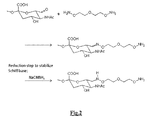
- the second step is the coupling of the polymer containing an aminooxy group to the oxidized carbohydrate moiety to form an oxime linkage.
- this step can be carried out in the presence of catalytic amounts of the nucleophilic catalyst aniline or aniline derivatives ( Dirksen A et Dawson PE, Bioconjugate Chem. 2008 ; Zeng Y et al., Nature Methods 2009;6:207-9 ).
- the aniline catalysis dramatically accelerates the oxime ligation allowing the use of very low concentrations of the reagents.
- the oxime linkage is stabilized by reduction with NaCNBH 3 to form an alkoxyamine linkage.
- reaction steps to conjugate PSA or mPSA to a protein are carried out separately and sequentially (i.e., starting materials (e.g., protein, polymer, etc), reagents (e.g., oxidizing agents, aniline, etc) and reaction products (e.g., oxidized carbohydrate on a protein, activated aminooxy polymer, etc) are separated between individual reaction steps).
- starting materials e.g., protein, polymer, etc
- reagents e.g., oxidizing agents, aniline, etc
- reaction products e.g., oxidized carbohydrate on a protein, activated aminooxy polymer, etc
- EP 1681303A1 HASylated erythropoietin
- WO 2005/014024 conjuggates of a polymer and a protein linked by an oxime linking group
- WO96/40662 aminooxy-containing linker compounds and their application in conjugates
- WO 2008/025856 Modified proteins
- Peri F et al. Tetrahedron 1998, 54, 12269-78
- Lees A et al., Vaccine 2006, 24(6), 716-29 and Heredia KL et al., Macromolecules 2007, 40(14), 4772-9 .
- Advantages of the invention include high recovery of conjugate, high retention of activity of the conjugated glycoprotein compared to unconjugated protein and high conjugation efficiency.
- the homobifunctional linker NH 2 [OCH 2 CH 2 ] 2 ONH 2 (3-oxa-pentane-1,5-dioxyamine) containing two active aminooxy groups was synthesized according to Boturyn et al. (Tetrahedron 1997;53:5485-92 ) in a two step organic reaction employing a modified Gabriel-Synthesis of primary amines.
- one molecule of 2,2-chlorodiethylether was reacted with two molecules of Endo-N-hydroxy-5-norbornene-2,3-dicarboximide in dimethylformamide (DMF).
- DMF dimethylformamide
- the desired homobifunctional product was prepared from the resulting intermediate by hydrazinolysis in ethanol. Except where otherwise specified, this is referred to as the diaminooxy linker in examples below.
- the homobifunctional linker NH 2 [OCH 2 CH 2 ] 4 ONH 2 (3,6,9-trioxa-undecane-1,11-dioxyamine) containing two active aminooxy groups was synthesized according to Boturyn et al. (Tetrahedron 1997;53:5485-92 ) in a two step organic reaction employing a modified Gabriel-Synthesis of primary amines.
- one molecule of Bis-(2-(2-chlorethoxy)-ethyl)-ether was reacted with two molecules of Endo-N-hydroxy-5-norbornene-2,3-dicarboximide in DMF.
- the desired homobifunctional product was prepared from the resulting intermediate by hydrazinolysis in ethanol.
- the excess PSA reagent was removed by hydrophobic interaction chromatography (HIC).
- HIC hydrophobic interaction chromatography
- the conductivity of the cooled reaction mixture was raised to 180mS/cm and loaded onto a 5ml HiTrap Butyl FF (GE Healthcare, Fairfield, CT) HIC column (1.6 x 2.5cm), pre-equilibrated with 50mM HEPES, 3M sodium chloride, 6.7mM calcium chloride, 0.01% Tween 80, pH 6.9.
- the conjugate was eluted within 2.4 column volumes (CV) with 50mM HEPES, 6.7mM calcium chloride, 0.005% Tween 80, pH 7.4 at a flow rate of 5ml/min.
- the conductivity of the cooled reaction mixture was raised to 180mS/cm and loaded onto a 5ml HiTrap Butyl FF (GE Healthcare, Fairfield, CT) HIC column (1.6 x 2.5cm), pre-equilibrated with 50mM HEPES, 3M sodium chloride, 6.7mM calcium chloride, 0.01% Tween 80, pH 6.9.
- the conjugate was eluted with a linear gradient to 50mM HEPES, 6.7mM calcium chloride, 0.005% Tween 80, pH 7.4 in 20CV with at a flow rate of 5ml/min.
- the excess PSA reagent was removed by means of HIC.
- the conductivity of the cooled reaction mixture was raised to 180mS/cm and loaded onto a 5ml HiTrap Butyl FF (GE Healthcare, Fairfield, CT) HIC column (1.6 x 2.5cm), pre-equilibrated with 50mM HEPES, 3M sodium chloride, 6.7mM calcium chloride, 0.01% Tween 80, pH 6.9.
- the conjugate was eluted within 2.4CV with 50mM HEPES, 6.7mM calcium chloride, 0.005% Tween 80, pH 7.4 at a flow rate of 5ml/min.
- the ionic strength was increased by adding a buffer containing 8M ammonium acetate (8M ammonium acetate, 50mM Hepes, 5mM CaCl 2 , 350mM NaCl, 0.01% Tween 80, pH 6.9) to get a final concentration of 2.5M ammonium acetate.
- a buffer containing 8M ammonium acetate 8M ammonium acetate, 50mM Hepes, 5mM CaCl 2 , 350mM NaCl, 0.01% Tween 80, pH 6.9
- equilibration buffer 2.5M ammonium acetate, 50mM Hepes, 5mM CaCl 2 , 350mM NaCl, 0.01% Tween 80, pH 6.9.
- the product was eluted with elution buffer (50mM Hepes, 5mM CaCl 2 , 0.01% Tween 80, pH 7.4), and the eluate was concentrated by centrifugal filtration using Vivaspin (Sartorius, Goettingen, Germany) devices with 30,000 MWCO.
- elution buffer 50mM Hepes, 5mM CaCl 2 , 0.01% Tween 80, pH 7.4
- the homobifunctional linker NH 2 [OCH 2 CH 2 ] 6 ONH 2 (3,6,9,12,15-penatoxa-heptadecane-1,17-dioxyamine) containing two active aminooxy groups was synthesized according to Boturyn et al. (Tetrahedron 1997;53:5485-92 ) in a two step organic reaction employing a modified Gabriel-Synthesis of primary amines. In the first step one molecule of hexaethylene glycol dichloride was reacted with two molecules of Endo-N-hydroxy-5-norbornene-2,3-dicarboximide in DMF. The desired homobifunctional product was prepared from the resulting intermediate by hydrazinolysis in ethanol.
- An Aminooxy-PSA reagent is prepared by use of a maleimido/aminooxy linker system ( Toyokuni et al., Bioconjugate Chem 2003; 14, 1253-9 ).
- PSA-SH (20kD) containing a free terminal SH - group is prepared using a two step procedure: a) Preparation of PSA-NH 2 by reductive amination of oxidized PSA with NH 4 Cl according to WO05016973A1 and b) introduction of a sulfhydryl group by reaction of the terminal primary amino group with 2-iminothiolane (Traut's reagent / Pierce, Rockford, IL) as described in US7645860 .
- PSA-SH is coupled to the maleimido-group of the linker at pH 7.5 in PBS - buffer using a 10-fold molar excess of the linker and a PSA-SH concentration of 50 mg/ml.
- the reaction mixture is incubated for 2 hours under gentle shaking at room temperature. Then the excess linker reagent is removed and the aminooxy-PSA is buffer exchanged into oxidation buffer (50mM sodium phosphate, pH 6.0) by diafiltration.
- the buffer is exchanged 25 times employing a Pellicon XL5kD regenerated cellulose membrane (Millipore, Billerica, MA).
- rFIX is oxidized in 50 mM sodium phosphate buffer, pH 6.0 employing 100 11M sodium periodate in the buffer. The mixture was shaken in the dark for 1h at 4°C and quenched for 15 min at room temperature by the addition of glycerol to a final concentration of 5mM. Low molecular weight contaminates were removed by means of size exclusion chromatography (SEC) employing PD-10 desalting columns (GE Healthcare, Fairfield, CT). Oxidized rFIX is then spiked with aniline to obtain a final concentration of 10mM and mixed with the aminooxy-PSA reagent to achieve a 5 fold molar excess of PSA. The reaction mixture was incubated for 2 hours under gentle shaking in the dark at room temperature.
- SEC size exclusion chromatography
- the excess of PSA reagent and free rFIX is removed by means of HIC.
- the conductivity of the reaction mixture is raised to 180 mS/cm and loaded onto a column filled with 48 ml Butyl - Sepharose FF (GE Healthcare, Fairfield, CT) pre-equilibrated with 50 mM Hepes, 3 M sodium chloride, 6.7 mM calcium chloride, 0.01% Tween 80, pH 6.9. Subsequently the conjugate is eluted with a linear gradient of 60% elution buffer (50mM Hepes, 6.7mM calcium chloride, pH 7.4) in 40 CV.
- 60% elution buffer 50mM Hepes, 6.7mM calcium chloride, pH 7.4
- PSA-rFIX containing fractions are collected and subjected to UF/DF by use of a 30 kD membrane made of regenerated cellulose (Millipore).
- the preparation is analytically characterized by measuring total protein (BCA) and FIX chromogenic activity.
- BCA total protein
- FIX chromogenic activity For the PSA-rFIX conjugates prepared with both variants a specific activity of > 50 % in comparison to native rFIX was determined.
- An aminooxy - PSA reagent was prepared according to Example 3. The final product was diafiltrated against buffer, pH 7.2 (50 mM Hepes) using a 5 kD membrane (regenerated cellulose, Millipore), frozen at -80°C and lyophilized. After lyophilization the reagent was dissolved in the appropriate volume of water and used for preparation of PSA-protein conjugates via carbohydrate modification.
- 3-oxa-pentane-1,5 dioxyamine was synthesized according to Botyryn et al (Tetrahedron 1997; 53:5485-92 ) in a two step organic synthesis as outlined in Example 1.
- the crude product was further purified by column chromatography (Silicagel 60; isocratic elution with Dichloromethane/Methanol mixture, 9+1) to yield 11.7 g of the pure final product 3-oxapentane -1,5-dioxyamine.
- oxidized colominic acid 23kDa was dissolved in 18ml of 50mM sodium acetate pH 5.5 ⁇ 0.02. 20 fold molar excess of 1, 11-diamino-3,6,9-trioxaundecane (also referred to as 3,6,9-trioxa-undecane-1,1-dioxyamine) was dissolved in minimum amount of 50mM sodium acetate (pH 5.5 ⁇ 0.02) and was added to the PSA solution. The final colominic acid concentration was 62.5mg/ml. This reaction mixture was incubated for 2 ⁇ 0.1hr at 22 ⁇ 1.0°C on a gentle mixer (22 oscillations per minute).
- ⁇ -Galactosidase For oxidation of ⁇ -Galactosidase ( ⁇ -Gal), different concentrations of NaIO 4 (ranging from 0.157 mM to 2 mM) were used. 0.5 mg of ⁇ -Gal was oxidized under acidic pH of 5.75 at 4° C for 30 minutes in the dark. Oxidation was stopped by adding NaHSO 3 to a final concentration of 5 mM. The conjugation reaction was carried out using the oxidized ⁇ -Gal with diaminooxy PSA polymer (22kDa). The final concentration of polymer in the reaction mixture was 1.25 mM whereas the concentration of ⁇ -Gal ranged from 0.125 mg/ml to 0.76 mg/ml. All the reactions were done at pH5.75.
- ⁇ -Gal was oxidized with 1.5 mM of NaIO 4 for 30 minutes at 4°C and then oxidation was stopped by adding NaHSO 3 to a final concentration of 5 mM.
- the conjugation reaction was carried out using the oxidized ⁇ -Gal with diaminooxy PSA polymer.
- the final concentrations of polymer and protein in the reaction mixture were 1.25 mM and 0.76 mg/ml respectively.
- the final pH of the reaction mixture was around 5.75.
- Sodium cyanoborohydride was added to the reaction mixture to a concentration of 50 mM or 3.17mg/ml. The reaction was carried out at 4°C for 2 hours.
- Fetuin was oxidized with 10mM NaIO 4 for 30 minutes at 4°C in dark and then oxidation was stopped by adding NaHSO 3 to a final concentration of 5mM.
- the conjugation reaction was carried out using the oxidized Fetuin with diaminooxy PSA polymer (23kDa). The final concentration of polymer in the reaction mixture was 1.25mM. The final pH of reaction mixture was 5.75. Sodium cyanoborohydride was added to the reaction mixture to a concentration of 50mM or 3.17mg/ml. The final protein concentration in the reaction was 0.125mg/ml. 84.21 ⁇ l of 200mM aniline solution was added to the 1.6ml of reaction mixture. The reaction was carried out at 4°C overnight.
- EPO 0.2 mg was oxidized with 10 mM of NaIO 4 for 30 minutes at 4°C. The oxidation was stopped by adding NaHSO 3 to a final concentration of 5 mM.
- the conjugation reaction was carried out using the oxidized EPO with diaminooxy polymer of 23kDa. The final concentration of polymer in the reaction mixture was 1.25 mM. The final concentration of EPO in the reaction mixture was 0.125 mg/ml. The final pH of the reaction mixture was around 5.75. Sodium cyanoborohydride was added to the reaction mixture to a concentration of 50mM or 3.17mg/ml. The reaction was carried out at 4°C for 24 hours. Unpurified conjugate was characterized using SDS PAGE. A shift in the band was seen for the conjugate in SDS PAGE.
- EPO 0.2mg of EPO was oxidized with 10mM NaIO 4 for 30 minutes at 4°C. The oxidation was stopped by adding NaHSO 3 to a final concentration of 5mM.
- the conjugation reaction was carried out using the oxidized EPO with diaminooxy PSA polymer (22kDa). The final concentration of polymer in the reaction mixture was 1.25mM. The final pH of the reaction mixture was around 5.75. Sodium cyanoborohydride was added to the reaction mixture to a concentration of 50mM or 3.17mg/ml. The final protein concentration in the reaction was 0.125mg/ml. 84.21 ⁇ l of 200mM aniline solution was added to the 1.6ml of reaction mixture. The reaction was carried out at 4°C for overnight. The conjugates were characterized using SDS PAGE. A shift in the band was seen in the conjugates. No adverse effect of aniline was observed on activity of the conjugates.
- bovine pancreas DNAse was used for conjugation reaction. This source of DNAse was supplied as lyophilized powder, which was stored at -20° C. Prior to the reaction, this lyophilized powder was dissolved in sodium acetate buffer (pH 5.75). The polymer used for glycopolysialylation had a weight in the range of 10 kDa to 22 kDa. For oxidation of glycon moiety of DNAse, NaIO 4 was used as oxidizing agent to a final concentration of 1 mM. DNAse was oxidized at acidic pH of 5.75 at 4° C for 30 minutes.
- the oxidation was stopped by adding NaHSO 3 to a final concentration of 2 mM.
- the conjugation reaction was carried out by addition of diaminooxy PSA polymer to a final concentration of 1.25 mM.
- NaCNBH 3 was added to the reaction mixture to a final concentration of 50 mM or 3.17 mg/ml and the polysialylation of the DNAse was preformed 4.0 ⁇ 1.0° C for at least 2 hours.
- the reactions were stopped with 25 molar excess of Tris over polymer.
- the conjugates were characterized using SDS PAGE and western blotting. A shift in the band was seen for the conjugate in SDS PAGE and positive result was obtained from western blotting. Activity was measured as 95% (compared with the less than 50% observed in comparable conjugates made using aldehyde linker chemistry).
- ⁇ -Galactosidase NaIO 4 was used at a concentration of 2 mM. 3 mg of ⁇ -Galactosidase was oxidized at acidic pH of 5.75 at 4° C for 30 minutes then oxidation was stopped by adding NaHSO 3 to a final concentration of 2 mM.
- the conjugation reaction was carried out using the oxidized ⁇ -Galactosidase with diaminooxy PSA polymer (23 kDa). The final concentration of polymer in the reaction mixture was 1.5 mM. The final concentration of ⁇ -Galactosidase in reaction mixture was 0.867 mg/ml. The final pH of reaction mixture was around 5.75.
- EPO erythropoietin
- NaIO 4 was used at a concentration of 10 mM.
- EPO (1 mg) was oxidized at pH 5.75 at 4°C for 30 minutes then oxidation was stopped by adding NaHSO 3 to a final concentration of 5 mM.
- the conjugation reaction was carried out using the oxidized EPO with hydrazide-PSA polymer.
- the molecular weight of the hydrazide-PSA used for conjugation was 24.34 kDa.
- the final concentration of hydrazide-PSA in the reaction mixture was 1.25 mM.
- the final concentration of EPO in the reaction mixture was 0.125 mg/ml.
- the final pH of the reaction mixture was around 5.75.
- ⁇ -Galactosidase (0.5 to 4.5 mg) was oxidized with 0.625 to 2 mM of NalO 4 for 30 minutes at 4°C. The oxidation was stopped by adding NaHSO 3 to a final concentration of 5 mM.
- the conjugation reaction was carried out using the oxidized ⁇ -galactosidase with hydrazide-PSA ranging from 24.34 kDa to 27.9 kDa.
- the final concentration of hydrazide-PSA in the reaction mixture was 1.25 mM.
- the final concentration of ⁇ -galactosidase in the reaction mixture was in a range from 0.125 mg/ml to 0.76 mg/ml.
- the final pH of reaction mixture should be around 5.75.
- Fetuin (0.25 mg) was oxidized with NaIO 4 (5 or 10 mM) for 30 or 60 minutes at 4°C. The oxidation was stopped by adding NaHSO 3 to a final concentration of 5 or 10 mM as appropriate to match the concentration of NaIO 4 used for oxidation.
- the conjugation reactions were carried out using the oxidized Fetuin with adipic acid dihydrazide-PSA polymer. The final concentration of the polymer in the reaction mixture was between 1.25 and 2.5 mM. The final pH of reaction mixture was around 5.75. Sodium cyanoborohydride was added to the reaction mixture to a concentration of 50 mM or 3.17 mg/ml. The reaction was carried out at 4°C for 1 hour to 4 hours.
- the conjugates were characterized using SDS PAGE and western blotting. A shift in the band was seen for the conjugate in SDS PAGE for each set of reaction conditions and a positive result was obtained from western blotting.
- a scaled-up reaction for 5 mg Fetuin followed by purification of the resulting conjugate was carried out.
- 5 mg Fetuin was oxidized with 10 mM NaIO 4 for 60 minutes at 4°C and then oxidation was stopped by adding NaHSO 3 to a final concentration of 10 mM.
- the conjugation reaction was carried out using the oxidized Fetuin with adipic acid dihydrazide-PSA polymer.
- the final concentration of polymer in the reaction mixture was 2.5 mM.
- the final pH of reaction mixture was around 5.75.
- Sodium cyanoborohydride was added to the reaction mixture to a concentration of 50 mM or 3.17 mg/ml.
- the reaction was carried out at 4°C and samples were collected at 2 hours.
- Purified and unpurified conjugate was characterized using SDS PAGE and western blotting. A shift in the band was seen for the conjugate in SDS PAGE and a positive result was obtained from western blotting.
- DNAse was oxidized with NaIO 4 to a final concentration ranging from 0.2 mM to 2 mM for 30 minutes at 4°C.
- the oxidation reaction was stopped by adding NaHSO 3 to a final concentration of between 2 and 5 mM depending upon the concentration of NaIO 4 used for oxidation.
- Glycopolysialylation of oxidized DNAse was carried out by addition of hydrazide-PSA polymer to a final concentration of 1.25 mM to the oxidized DNAse.
- ⁇ -Galactosidase (1 mg) was oxidized with 1.5 mM of NaIO 4 for 30 minutes at 4°C. The oxidation was stopped by adding NaHSO 3 to a final concentration of 1.5 mM.
- the conjugation reaction was carried out using the oxidized ⁇ -Galactosidase with diaminooxy-PEG polymer (20 kDa).
- the final concentration of the polymer in the reaction mixture was 1.25 mM.
- the final concentration of ⁇ -Galactosidase in the reaction mixture was 1 mg/ml.
- the final pH of reaction mixture should be around 5.75.
- Sodium cyanoborohydride was added to the reaction mixture to a concentration of 50 mM or 3.17 mg/ml.
- the reaction was carried out at 4°C for 2 hours. Unpurified conjugate was characterized using SDS PAGE and a shift in the band was seen for the conjugate in SDS PAGE. The activity was measured as 59%.
- Erythropoietin (EPO; 0.2 mg) was oxidised with 5 or 10 mM NaIO 4 in 50 mM sodium acetate at pH 5.75 for 45 minutes at 4°C and then oxidation was stopped by adding NaHSO 3 to a final concentration of 5 or 10 mM (to match the concentration of NaIO 4 used for oxidisation).
- the conjugation reaction was carried out using the oxidised EPO with diaminooxy PEG polymer (20 kDa). The final concentration of the polymer in the reaction mixture was 1.5 mM. The final pH of reaction mixture should be around 5.75. Sodium cyanoborohydride was added to the reaction mixture to a concentration of 50 mM or 3.17 mg/ml. The final protein concentration in the reaction was 0.4 mg/ml.
- the conjugation reaction was carried out overnight at 4°C.
- the invention thus provides conjugates of compounds other than blood coagulation proteins with water soluble polymers, in particular PSA and mPSA.
Landscapes
- Health & Medical Sciences (AREA)
- Life Sciences & Earth Sciences (AREA)
- Chemical & Material Sciences (AREA)
- Veterinary Medicine (AREA)
- Medicinal Chemistry (AREA)
- Pharmacology & Pharmacy (AREA)
- Epidemiology (AREA)
- Animal Behavior & Ethology (AREA)
- General Health & Medical Sciences (AREA)
- Public Health (AREA)
- Bioinformatics & Cheminformatics (AREA)
- Engineering & Computer Science (AREA)
- Proteomics, Peptides & Aminoacids (AREA)
- Molecular Biology (AREA)
- Zoology (AREA)
- Gastroenterology & Hepatology (AREA)
- Immunology (AREA)
- Hematology (AREA)
- Biochemistry (AREA)
- Medicinal Preparation (AREA)
- Medicines That Contain Protein Lipid Enzymes And Other Medicines (AREA)
- Peptides Or Proteins (AREA)
- Polysaccharides And Polysaccharide Derivatives (AREA)
- Saccharide Compounds (AREA)
- Medicines Containing Antibodies Or Antigens For Use As Internal Diagnostic Agents (AREA)
- Pharmaceuticals Containing Other Organic And Inorganic Compounds (AREA)
Priority Applications (1)
| Application Number | Priority Date | Filing Date | Title |
|---|---|---|---|
| EP16168473.3A EP3081233B1 (en) | 2009-07-27 | 2010-07-26 | Glycopolysialylation of proteins other than blood coagulation proteins |
Applications Claiming Priority (3)
| Application Number | Priority Date | Filing Date | Title |
|---|---|---|---|
| US22882809P | 2009-07-27 | 2009-07-27 | |
| US34713610P | 2010-05-21 | 2010-05-21 | |
| PCT/GB2010/001422 WO2011012850A2 (en) | 2009-07-27 | 2010-07-26 | Glycopolysialylation of non-blood coagulation proteins |
Related Child Applications (2)
| Application Number | Title | Priority Date | Filing Date |
|---|---|---|---|
| EP16168473.3A Division-Into EP3081233B1 (en) | 2009-07-27 | 2010-07-26 | Glycopolysialylation of proteins other than blood coagulation proteins |
| EP16168473.3A Division EP3081233B1 (en) | 2009-07-27 | 2010-07-26 | Glycopolysialylation of proteins other than blood coagulation proteins |
Publications (2)
| Publication Number | Publication Date |
|---|---|
| EP2459226A2 EP2459226A2 (en) | 2012-06-06 |
| EP2459226B1 true EP2459226B1 (en) | 2016-06-29 |
Family
ID=46582461
Family Applications (2)
| Application Number | Title | Priority Date | Filing Date |
|---|---|---|---|
| EP10739386.0A Not-in-force EP2459226B1 (en) | 2009-07-27 | 2010-07-26 | Glycopolysialylation of proteins other than blood coagulation proteins |
| EP16168473.3A Active EP3081233B1 (en) | 2009-07-27 | 2010-07-26 | Glycopolysialylation of proteins other than blood coagulation proteins |
Family Applications After (1)
| Application Number | Title | Priority Date | Filing Date |
|---|---|---|---|
| EP16168473.3A Active EP3081233B1 (en) | 2009-07-27 | 2010-07-26 | Glycopolysialylation of proteins other than blood coagulation proteins |
Country Status (12)
| Country | Link |
|---|---|
| US (1) | US9795683B2 (https=) |
| EP (2) | EP2459226B1 (https=) |
| JP (1) | JP5909755B2 (https=) |
| KR (1) | KR101912335B1 (https=) |
| CN (1) | CN102573920B (https=) |
| AU (3) | AU2010277438B2 (https=) |
| CA (1) | CA2769244A1 (https=) |
| ES (1) | ES2590679T3 (https=) |
| NZ (1) | NZ597600A (https=) |
| RU (1) | RU2533619C2 (https=) |
| SG (1) | SG178051A1 (https=) |
| WO (1) | WO2011012850A2 (https=) |
Families Citing this family (22)
| Publication number | Priority date | Publication date | Assignee | Title |
|---|---|---|---|---|
| PT2101821E (pt) | 2006-12-15 | 2014-10-03 | Baxter Int | Fator conjugado viia-ácido (poli)siálico com prolongamento do tempo de meia vida in vivo |
| ES2597954T3 (es) | 2009-07-27 | 2017-01-24 | Baxalta GmbH | Conjugados de proteína de la coagulación sanguínea |
| JP5909755B2 (ja) | 2009-07-27 | 2016-04-27 | リポクセン テクノロジーズ リミテッド | 非血液凝固タンパク質の糖ポリシアル酸化 |
| US8642737B2 (en) | 2010-07-26 | 2014-02-04 | Baxter International Inc. | Nucleophilic catalysts for oxime linkage |
| EP3093029A1 (en) * | 2009-07-27 | 2016-11-16 | Baxalta GmbH | Blood coagulation protein conjugates |
| US8809501B2 (en) | 2009-07-27 | 2014-08-19 | Baxter International Inc. | Nucleophilic catalysts for oxime linkage |
| AU2015275284C1 (en) * | 2010-07-30 | 2018-04-05 | Takeda Pharmaceutical Company Limited | Nucleophilic Catalysts for Oxime Linkage |
| TR201908836T4 (tr) * | 2010-07-30 | 2019-07-22 | Baxalta GmbH | Oksim bağına yönelik nükleofilik katalizörler. |
| US8785139B2 (en) | 2011-05-18 | 2014-07-22 | Baxter International Inc. | Modification-dependent activity assays |
| JP2014520094A (ja) | 2011-05-27 | 2014-08-21 | バクスター・インターナショナル・インコーポレイテッド | 増加した半減期を有する治療用タンパク質およびそれを調製する方法 |
| KR20130049671A (ko) | 2011-11-04 | 2013-05-14 | 한미사이언스 주식회사 | 생리활성 폴리펩타이드 결합체 제조 방법 |
| AR090281A1 (es) | 2012-03-08 | 2014-10-29 | Hanmi Science Co Ltd | Proceso mejorado para la preparacion de un complejo polipeptidico fisiologicamente activo |
| AU2013204754C1 (en) * | 2012-05-16 | 2018-10-11 | Takeda Pharmaceutical Company Limited | Nucleophilic Catalysts for Oxime Linkage |
| CN104661685A (zh) | 2012-10-15 | 2015-05-27 | 诺和诺德保健Ag(股份有限公司) | 因子vii缀合物 |
| CZ305153B6 (cs) * | 2014-03-11 | 2015-05-20 | Contipro Biotech S.R.O. | Konjugáty oligomeru kyseliny hyaluronové nebo její soli, způsob jejich přípravy a použití |
| MX387560B (es) * | 2014-03-31 | 2025-03-18 | Hanmi Pharmaceutical Co Ltd | Procedimiento para mejorar la solubilidad de proteínas y péptidos usando un enlace del fragmento fc de inmunoglobulina. |
| BR112018070459A2 (pt) | 2016-04-04 | 2019-02-12 | Shire Human Genetic Therapies, Inc. | inibidor da c1 esterase conjugado e usos do mesmo |
| JOP20190245A1 (ar) | 2017-04-20 | 2019-10-15 | Novartis Ag | أنظمة توصيل إطلاق مستدام تتضمن روابط بلا أثر لنقطة الربط |
| US11845989B2 (en) | 2019-01-23 | 2023-12-19 | Regeneron Pharmaceuticals, Inc. | Treatment of ophthalmic conditions with angiopoietin-like 7 (ANGPTL7) inhibitors |
| MX2021008797A (es) | 2019-01-23 | 2022-01-31 | Regeneron Pharma | Tratamiento de afecciones oftalmicas con inhibidores de proteinas relacionadas a angiopoyetina 7 (angptl7). |
| CN112129946A (zh) * | 2020-08-16 | 2020-12-25 | 陆修委 | 无糖链型惰性蛋白封闭剂的制备方法及应用 |
| US11865134B2 (en) | 2021-02-26 | 2024-01-09 | Regeneron Pharmaceuticals, Inc. | Treatment of inflammation with glucocorticoids and angiopoietin-like 7 (ANGPTL7) inhibitors |
Citations (1)
| Publication number | Priority date | Publication date | Assignee | Title |
|---|---|---|---|---|
| WO2008012540A1 (en) * | 2006-07-25 | 2008-01-31 | Lipoxen Technologies Limited | N-terminal polysialylation |
Family Cites Families (136)
| Publication number | Priority date | Publication date | Assignee | Title |
|---|---|---|---|---|
| US4179337A (en) * | 1973-07-20 | 1979-12-18 | Davis Frank F | Non-immunogenic polypeptides |
| JPS54113492A (en) | 1978-02-24 | 1979-09-05 | Sanyo Chem Ind Ltd | Preparation of glucoprotein derivative |
| US4757006A (en) | 1983-10-28 | 1988-07-12 | Genetics Institute, Inc. | Human factor VIII:C gene and recombinant methods for production |
| US4970300A (en) | 1985-02-01 | 1990-11-13 | New York University | Modified factor VIII |
| US5250421A (en) | 1986-01-03 | 1993-10-05 | Genetics Institute, Inc. | Method for producing factor VIII:C-type proteins |
| US5198349A (en) | 1986-01-03 | 1993-03-30 | Genetics Institute, Inc. | Method for producing factor VIII:C and analogs |
| JPH0387173A (ja) | 1987-09-10 | 1991-04-11 | Teijin Ltd | ヒト活性化天然型ファクター8cの製造方法及びそれに用いる形質転換体 |
| US4847325A (en) | 1988-01-20 | 1989-07-11 | Cetus Corporation | Conjugation of polymer to colony stimulating factor-1 |
| US5153265A (en) | 1988-01-20 | 1992-10-06 | Cetus Corporation | Conjugation of polymer to colony stimulating factor-1 |
| US4966999A (en) | 1988-06-07 | 1990-10-30 | Cytogen Corporation | Radiohalogenated compounds for site specific labeling |
| US5122614A (en) * | 1989-04-19 | 1992-06-16 | Enzon, Inc. | Active carbonates of polyalkylene oxides for modification of polypeptides |
| SE465222C5 (sv) | 1989-12-15 | 1998-02-10 | Pharmacia & Upjohn Ab | Ett rekombinant, humant faktor VIII-derivat och förfarande för dess framställning |
| SE466754B (sv) | 1990-09-13 | 1992-03-30 | Berol Nobel Ab | Saett att kovalent binda biopolymerer till hydrofila ytor |
| EP0513332A4 (en) | 1990-11-14 | 1993-03-17 | Cargill, Incorporated | Conjugates of poly(vinylsaccharide) with proteins for the stabilization of proteins |
| JPH06506217A (ja) * | 1991-03-18 | 1994-07-14 | エンゾン,インコーポレーテッド | ポリペプチドまたはグリコポリペプチドとポリマーとのヒドラジン含有結合体 |
| GB9112212D0 (en) | 1991-06-06 | 1991-07-24 | Gregoriadis Gregory | Pharmaceutical compositions |
| US6037452A (en) * | 1992-04-10 | 2000-03-14 | Alpha Therapeutic Corporation | Poly(alkylene oxide)-Factor VIII or Factor IX conjugate |
| WO1994005332A2 (en) | 1992-09-01 | 1994-03-17 | Berlex Laboratories, Inc. | Glycolation of glycosylated macromolecules |
| CA2124690C (en) | 1992-10-02 | 2007-09-11 | Thomas Osterberg | Composition comprising coagulation factor viii formulation, process for its preparation and use of a surfactant as stabilizer |
| FI935485L (fi) * | 1992-12-09 | 1994-06-10 | Ortho Pharma Corp | PEG-hydratsoni- ja PEG-oksiimisidoksen muodostavat reagenssit ja niiden proteiinijohdannaiset |
| NZ250375A (en) | 1992-12-09 | 1995-07-26 | Ortho Pharma Corp | Peg hydrazone and peg oxime linkage forming reagents and protein derivatives |
| US5298643A (en) * | 1992-12-22 | 1994-03-29 | Enzon, Inc. | Aryl imidate activated polyalkylene oxides |
| WO1994015625A1 (en) * | 1993-01-15 | 1994-07-21 | Enzon, Inc. | Factor viii - polymeric conjugates |
| SE516173C2 (sv) * | 1993-02-16 | 2001-11-26 | Ericsson Telefon Ab L M | Anordning för telekommunikation |
| WO1994028024A1 (en) * | 1993-06-01 | 1994-12-08 | Enzon, Inc. | Carbohydrate-modified polymer conjugates with erythropoietic activity |
| US5621039A (en) | 1993-06-08 | 1997-04-15 | Hallahan; Terrence W. | Factor IX- polymeric conjugates |
| SE504074C2 (sv) | 1993-07-05 | 1996-11-04 | Pharmacia Ab | Proteinberedning för subkutan, intramuskulär eller intradermal administrering |
| CA2204726A1 (en) | 1994-11-09 | 1996-12-27 | Robin E. Offord | Functionalized polymers for site-specific attachment |
| WO1996040662A2 (en) | 1995-06-07 | 1996-12-19 | Cellpro, Incorporated | Aminooxy-containing linker compounds and their application in conjugates |
| WO1996040731A1 (en) | 1995-06-07 | 1996-12-19 | Mount Sinai School Of Medicine Of The City University Of New York | Pegylated modified proteins |
| SE9503380D0 (sv) | 1995-09-29 | 1995-09-29 | Pharmacia Ab | Protein derivatives |
| EP0979102A4 (en) | 1997-04-30 | 2005-11-23 | Enzon Inc | DETAILED POLYPEPTIDE MODIFIED BY POLYALKYLENE OXIDE |
| US6183738B1 (en) | 1997-05-12 | 2001-02-06 | Phoenix Pharamacologics, Inc. | Modified arginine deiminase |
| US6852703B1 (en) | 1997-06-04 | 2005-02-08 | Oxford Biomedica (Uk) Limited | Tumor targeted vector |
| DK1036179T4 (da) | 1997-12-03 | 2014-03-31 | Roche Diagnostics Gmbh | Fremgangsmåde til fremstilling af polypeptider med egnet glycosilering |
| US5985263A (en) | 1997-12-19 | 1999-11-16 | Enzon, Inc. | Substantially pure histidine-linked protein polymer conjugates |
| EP1107998B1 (en) | 1998-08-28 | 2004-02-04 | Gryphon Sciences | Method for the preparation of polyamide chains of precise length, their conjugates with proteins |
| HU229888B1 (en) | 1998-10-16 | 2014-11-28 | Biogen Idec Ma Inc Cambridge | Polymer conjugates of interferon betha-1a and uses |
| DE19852729A1 (de) | 1998-11-16 | 2000-05-18 | Werner Reutter | Rekombinante Glycoproteine, Verfahren zu ihrer Herstellung, sie enthaltende Arzneimittel und ihre Verwendung |
| DK1820516T3 (da) | 1999-02-22 | 2013-10-28 | Univ Connecticut | Nye albuminfrie faktor VIII-præparater |
| US6531122B1 (en) | 1999-08-27 | 2003-03-11 | Maxygen Aps | Interferon-β variants and conjugates |
| CN1309423C (zh) | 1999-11-12 | 2007-04-11 | 马克西根控股公司 | 干扰素γ偶联物 |
| CA2739933A1 (en) | 2000-02-11 | 2001-08-16 | Bayer Healthcare Llc | Factor vii or viia-like molecules |
| US6586398B1 (en) | 2000-04-07 | 2003-07-01 | Amgen, Inc. | Chemically modified novel erythropoietin stimulating protein compositions and methods |
| EP1280548B1 (en) | 2000-05-03 | 2013-12-11 | Novo Nordisk Health Care AG | Subcutaneous administration of coagulation factor VII |
| JP4455802B2 (ja) | 2000-05-03 | 2010-04-21 | ノボ ノルディスク ヘルス ケア アクチェンゲゼルシャフト | ヒト第vii凝固因子変異型 |
| DE60116137T2 (de) | 2000-05-16 | 2006-08-24 | Lipoxen Technologies Ltd. | Derivatisierung von proteinen in wässrigem lösungsmittel |
| WO2001093914A2 (en) | 2000-06-08 | 2001-12-13 | La Jolla Pharmaceutical Company | Multivalent platform molecules comprising high molecular weight polyethylene oxide |
| US6423826B1 (en) | 2000-06-30 | 2002-07-23 | Regents Of The University Of Minnesota | High molecular weight derivatives of vitamin K-dependent polypeptides |
| US7118737B2 (en) | 2000-09-08 | 2006-10-10 | Amylin Pharmaceuticals, Inc. | Polymer-modified synthetic proteins |
| WO2002022776A2 (en) | 2000-09-13 | 2002-03-21 | Novo Nordisk A/S | Human coagulation factor vii variants |
| BR0114373A (pt) | 2000-10-02 | 2004-02-17 | Novo Nordisk As | Célula hospedeira eucariótica, métodos para a produção de fvii e de fviia ou de suas variantes, de uma proteìna dependente de vitamina k e de uma célula hospedeira eucariótica produtora de fvii ou de seu análogo, vetor recombinante, fvii e fviia recombinante ou suas variantes, e, proteìna dependente de vitamina k recombinante |
| US7001994B2 (en) | 2001-01-18 | 2006-02-21 | Genzyme Corporation | Methods for introducing mannose 6-phosphate and other oligosaccharides onto glycoproteins |
| CZ20032454A3 (en) | 2001-03-22 | 2004-03-17 | Novo Nordisk Health Care Ag | Coagulation factor vii derivative |
| US6913915B2 (en) | 2001-08-02 | 2005-07-05 | Phoenix Pharmacologics, Inc. | PEG-modified uricase |
| US7265085B2 (en) | 2001-10-10 | 2007-09-04 | Neose Technologies, Inc. | Glycoconjugation methods and proteins/peptides produced by the methods |
| US7157277B2 (en) | 2001-11-28 | 2007-01-02 | Neose Technologies, Inc. | Factor VIII remodeling and glycoconjugation of Factor VIII |
| US7795210B2 (en) | 2001-10-10 | 2010-09-14 | Novo Nordisk A/S | Protein remodeling methods and proteins/peptides produced by the methods |
| ES2411007T3 (es) | 2001-10-10 | 2013-07-04 | Novo Nordisk A/S | Remodelación y glicoconjugación de péptidos |
| US7214660B2 (en) | 2001-10-10 | 2007-05-08 | Neose Technologies, Inc. | Erythropoietin: remodeling and glycoconjugation of erythropoietin |
| EP1446438A2 (en) | 2001-11-07 | 2004-08-18 | Nektar Therapeutics Al, Corporation | Branched polymers and their conjugates |
| US7368108B2 (en) | 2001-11-28 | 2008-05-06 | Neose Technologies, Inc. | Glycopeptide remodeling using amidases |
| AU2002351199A1 (en) | 2001-11-28 | 2003-06-10 | Neose Technologies, Inc. | Glycoprotein remodeling using endoglycanases |
| UA86744C2 (en) | 2002-06-21 | 2009-05-25 | Ново Нордиск Хэлс Кеа Аг | Pegylated factor vii glycoforms |
| US7087229B2 (en) | 2003-05-30 | 2006-08-08 | Enzon Pharmaceuticals, Inc. | Releasable polymeric conjugates based on aliphatic biodegradable linkers |
| US7122189B2 (en) | 2002-08-13 | 2006-10-17 | Enzon, Inc. | Releasable polymeric conjugates based on aliphatic biodegradable linkers |
| BR0314227A (pt) * | 2002-09-11 | 2005-10-25 | Fresenius Kabi De Gmbh | Derivados de amido de hidroxialquila |
| EP1400533A1 (en) | 2002-09-11 | 2004-03-24 | Fresenius Kabi Deutschland GmbH | HASylated polypeptides, especially HASylated erythropoietin |
| US20040062748A1 (en) | 2002-09-30 | 2004-04-01 | Mountain View Pharmaceuticals, Inc. | Polymer conjugates with decreased antigenicity, methods of preparation and uses thereof |
| JP4490369B2 (ja) | 2002-12-31 | 2010-06-23 | ネクター セラピューティクス アラバマ,コーポレイション | マレアミド酸ポリマー誘導体及びこれらの生物学的複合体 |
| MXPA05007151A (es) | 2002-12-31 | 2005-09-21 | Nektar Therapeutics Al Corp | Polimeros terminados en maleimida hidroliticamente estables. |
| BRPI0407882B1 (pt) * | 2003-02-26 | 2021-07-27 | Nektar Therapeutics | Composição compreendendo conjugados de polímero-porção de fator viii e seu método de fabricação |
| PL1620118T3 (pl) | 2003-04-08 | 2014-11-28 | Yeda Res & Dev | Leki odwracalnie pegylowane |
| WO2005014655A2 (en) | 2003-08-08 | 2005-02-17 | Fresenius Kabi Deutschland Gmbh | Conjugates of hydroxyalkyl starch and a protein |
| BRPI0412671A (pt) * | 2003-08-08 | 2006-10-03 | Fresenius Kabi De Gmbh | conjugados de um polìmero e uma proteìna ligados por um grupo de ligação de oxima |
| WO2005014049A2 (en) * | 2003-08-08 | 2005-02-17 | Novo Nordisk A/S | Synthesis and application of new structural well defined branched polymers as conjugating agents for peptides |
| JP2007501870A (ja) * | 2003-08-08 | 2007-02-01 | フレゼニウス・カビ・ドイチュラント・ゲゼルシャフト・ミット・ベシュレンクテル・ハフツング | ヒドロキシアルキルデンプンとg−csfの複合体 |
| CN1863549A (zh) * | 2003-08-08 | 2006-11-15 | 费森尤斯卡比德国有限公司 | 通过肟连接基团进行连接的聚合物和蛋白质的缀合物 |
| EP1654290B1 (en) * | 2003-08-12 | 2019-03-13 | Lipoxen Technologies Limited | Sialic acid derivatives for protein derivatisation and conjugation |
| ES2294535T3 (es) * | 2003-08-12 | 2008-04-01 | Lipoxen Technologies Limited | Derivados del acido polisialico. |
| MXPA06006023A (es) | 2003-12-03 | 2006-08-23 | Neose Technologies Inc | Factor ix glicopegilado. |
| EP1694712A1 (en) * | 2003-12-04 | 2006-08-30 | University of Utah Research Foundation | Modified macromolecules and methods of making and using thereof |
| NZ548123A (en) | 2004-01-08 | 2010-05-28 | Novo Nordisk As | O-linked glycosylation of peptides |
| US20090292110A1 (en) | 2004-07-23 | 2009-11-26 | Defrees Shawn | Enzymatic modification of glycopeptides |
| US20090176967A1 (en) | 2004-08-02 | 2009-07-09 | Novo Nordisk Healthcare A/G | Conjugation of FVII |
| US8652334B2 (en) | 2004-08-12 | 2014-02-18 | Lipoxen Technologies Limited | Fractionation of charged polysaccharide |
| CN101039965A (zh) * | 2004-08-12 | 2007-09-19 | 利普生技术有限公司 | 唾液酸衍生物 |
| EP3184551A1 (en) * | 2004-08-12 | 2017-06-28 | Lipoxen Technologies Limited | Sialic acid derivatives |
| PT2363414T (pt) | 2004-11-12 | 2022-08-04 | Bayer Healthcare Llc | Modificação de fviii direcionada a sítio |
| CN101163506B (zh) | 2004-12-27 | 2012-09-26 | 巴克斯特国际公司 | 聚合物-von Willebrand因子偶联物 |
| JP2008526864A (ja) | 2005-01-06 | 2008-07-24 | ネオス テクノロジーズ インコーポレイテッド | 糖断片を用いる糖結合 |
| US8217154B2 (en) | 2005-02-23 | 2012-07-10 | Lipoxen Technologies Limited | Activated sialic acid derivatives for protein derivatisation and conjugation |
| EP2975135A1 (en) | 2005-05-25 | 2016-01-20 | Novo Nordisk A/S | Glycopegylated factor IX |
| ES2553160T3 (es) | 2005-06-17 | 2015-12-04 | Novo Nordisk Health Care Ag | Reducción y derivatización selectivas de proteínas Factor VII transformadas por ingeniería que comprenden al menos una cisteína no nativa |
| US20070105755A1 (en) | 2005-10-26 | 2007-05-10 | Neose Technologies, Inc. | One pot desialylation and glycopegylation of therapeutic peptides |
| US20090017007A1 (en) | 2005-08-26 | 2009-01-15 | Maxygen Holdings Ltd. | Liquid factor vii composition |
| BRPI0620316A2 (pt) | 2005-12-21 | 2011-11-08 | Wyeth Corp | formulações de proteìnas com viscosidades reduzida e seus usos |
| US7645860B2 (en) * | 2006-03-31 | 2010-01-12 | Baxter Healthcare S.A. | Factor VIII polymer conjugates |
| AU2007245190B2 (en) | 2006-03-31 | 2011-07-21 | Takeda Pharmaceutical Company Limited | Pegylated factor VIII |
| EP2089052A4 (en) | 2006-05-24 | 2011-02-16 | Peg Biosciences | POLYETHYLENE GLYCOL-BASED LINK COMPOUNDS AND BIOLOGICALLY ACTIVE CONJUGATES BASED ON SAID COMPOUNDS |
| US7939632B2 (en) | 2006-06-14 | 2011-05-10 | Csl Behring Gmbh | Proteolytically cleavable fusion proteins with high molar specific activity |
| DK2049692T3 (en) | 2006-07-13 | 2016-04-04 | Serum Inst India Ltd | Process for producing very high purity polysialic acid |
| WO2008025856A2 (en) * | 2006-09-01 | 2008-03-06 | Novo Nordisk Health Care Ag | Modified glycoproteins |
| EP2054521A4 (en) | 2006-10-03 | 2012-12-19 | Novo Nordisk As | PROCESS FOR CLEANING POLYPEPTIDE CONJUGATES |
| PT2101821E (pt) | 2006-12-15 | 2014-10-03 | Baxter Int | Fator conjugado viia-ácido (poli)siálico com prolongamento do tempo de meia vida in vivo |
| US20100143326A1 (en) | 2007-01-03 | 2010-06-10 | Novo Nordisk Healthcare A/G | SUBCUTANEOUS ADMINISTRATION OF COAGULATION FACTOR VIIa-RELATED POLYPEPTIDES |
| WO2008089403A2 (en) | 2007-01-18 | 2008-07-24 | Genzyme Corporation | Oligosaccharides comprising an aminooxy group and conjugates thereof |
| WO2008119815A1 (en) | 2007-04-02 | 2008-10-09 | Novo Nordisk A/S | Subcutaneous administration of coagulation factor ix |
| WO2008151258A2 (en) | 2007-06-04 | 2008-12-11 | Neose Technologies, Inc. | O-linked glycosylation using n-acetylglucosaminyl transferases |
| KR101654375B1 (ko) | 2007-06-26 | 2016-09-05 | 박스알타 인코퍼레이티드 | 가수분해성 중합체 fmoc-링커 |
| WO2009006620A1 (en) | 2007-07-03 | 2009-01-08 | Children's Hospital & Research Center At Oakland | Oligosialic acid derivatives, methods of manufacture, and immunological uses |
| CN101820920B (zh) | 2007-10-09 | 2014-08-06 | 宝力泰锐克斯有限公司 | 新的缀合蛋白质和肽 |
| CA2711503A1 (en) | 2008-01-08 | 2009-07-16 | Biogenerix Ag | Glycoconjugation of polypeptides using oligosaccharyltransferases |
| PL2257311T3 (pl) | 2008-02-27 | 2014-09-30 | Novo Nordisk As | Koniugaty cząsteczek czynnika VIII |
| DK2280734T3 (da) | 2008-04-24 | 2014-05-26 | Cantab Biopharmaceuticals Patents Ltd | Faktor-ix-konjugater med forlængede halveringstider |
| WO2009141418A1 (en) | 2008-05-23 | 2009-11-26 | Novo Nordisk A/S | Formulations of peg-functionalised serine proteases with high concentrations of an aromatic preservative |
| EP2285401A1 (en) | 2008-05-23 | 2011-02-23 | Novo Nordisk Health Care AG | Low viscosity compositions comprising a pegylated gla-domain containing protein |
| EP2297330A4 (en) | 2008-06-04 | 2012-03-14 | Bayer Healthcare Llc | FVII MUTINES FOR THE TREATMENT OF MORBUS WILLEBRAND |
| AU2009275358C1 (en) | 2008-07-21 | 2015-09-24 | Polytherics Limited | Novel reagents and method for conjugating biological molecules |
| KR20110093775A (ko) | 2008-11-03 | 2011-08-18 | 바이엘 헬스케어 엘엘씨 | 혈우병 치료 방법 |
| US20120121613A1 (en) | 2009-01-19 | 2012-05-17 | Bayer Healthcare Llc | Protein conjugate having an endopeptidase- cleavable bioprotective moiety |
| ES2401965T3 (es) | 2009-02-19 | 2013-04-25 | Novo Nordisk A/S | Modificación de Factor VIII |
| EP2403538B1 (en) | 2009-03-04 | 2017-10-04 | Polytherics Limited | Conjugated proteins and peptides |
| WO2010120365A2 (en) | 2009-04-16 | 2010-10-21 | Wu Nian | Protein-carrier conjugates |
| GB0908393D0 (en) | 2009-05-15 | 2009-06-24 | Almac Sciences Scotland Ltd | Labelling method |
| ES2597954T3 (es) | 2009-07-27 | 2017-01-24 | Baxalta GmbH | Conjugados de proteína de la coagulación sanguínea |
| JP5909755B2 (ja) | 2009-07-27 | 2016-04-27 | リポクセン テクノロジーズ リミテッド | 非血液凝固タンパク質の糖ポリシアル酸化 |
| JP2013500726A (ja) | 2009-07-31 | 2013-01-10 | バイエル・ヘルスケア・エルエルシー | 改変第ix因子ポリペプチドおよびその使用 |
| DE102009028526A1 (de) | 2009-08-13 | 2011-02-24 | Leibniz-Institut Für Polymerforschung Dresden E.V. | Verfahren zur Modifikation und Funktionalisierung von Sacchariden |
| EP2480578A4 (en) | 2009-09-25 | 2013-04-17 | Vybion Inc | MODIFICATION OF POLYPEPTIDE |
| US8697844B2 (en) | 2009-11-24 | 2014-04-15 | Novo Nordisk A/S | Method of purifying pegylated proteins |
| EP2536753B1 (en) | 2010-02-16 | 2017-12-20 | Novo Nordisk A/S | Factor viii molecules with reduced vwf binding |
| GB201007357D0 (en) | 2010-04-30 | 2010-06-16 | Leverton Licence Holdings Ltd | Conjugated factor VIII |
| GB201007356D0 (en) | 2010-04-30 | 2010-06-16 | Leverton Licence Holdings Ltd | Conjugated factor VIIa |
| WO2012068134A1 (en) | 2010-11-15 | 2012-05-24 | Biogen Idec Inc. | Enrichment and concentration of select product isoforms by overloaded bind and elute chromatography |
| PT3513804T (pt) | 2011-07-08 | 2022-06-02 | Bioverativ Therapeutics Inc | Polipéptidos fator viii híbridos e quiméricos, e métodos de utilização dos mesmos |
-
2010
- 2010-07-26 JP JP2012522241A patent/JP5909755B2/ja not_active Expired - Fee Related
- 2010-07-26 CN CN201080042343.4A patent/CN102573920B/zh not_active Expired - Fee Related
- 2010-07-26 EP EP10739386.0A patent/EP2459226B1/en not_active Not-in-force
- 2010-07-26 ES ES10739386.0T patent/ES2590679T3/es active Active
- 2010-07-26 AU AU2010277438A patent/AU2010277438B2/en not_active Ceased
- 2010-07-26 CA CA2769244A patent/CA2769244A1/en not_active Abandoned
- 2010-07-26 US US12/843,284 patent/US9795683B2/en not_active Expired - Fee Related
- 2010-07-26 NZ NZ597600A patent/NZ597600A/en not_active IP Right Cessation
- 2010-07-26 SG SG2012003653A patent/SG178051A1/en unknown
- 2010-07-26 EP EP16168473.3A patent/EP3081233B1/en active Active
- 2010-07-26 KR KR1020177019368A patent/KR101912335B1/ko not_active Expired - Fee Related
- 2010-07-26 RU RU2012106654/04A patent/RU2533619C2/ru active
- 2010-07-26 WO PCT/GB2010/001422 patent/WO2011012850A2/en not_active Ceased
-
2015
- 2015-10-13 AU AU2015242970A patent/AU2015242970B2/en not_active Ceased
-
2017
- 2017-11-21 AU AU2017265005A patent/AU2017265005A1/en not_active Abandoned
Patent Citations (1)
| Publication number | Priority date | Publication date | Assignee | Title |
|---|---|---|---|---|
| WO2008012540A1 (en) * | 2006-07-25 | 2008-01-31 | Lipoxen Technologies Limited | N-terminal polysialylation |
Also Published As
| Publication number | Publication date |
|---|---|
| AU2015242970B2 (en) | 2017-10-12 |
| AU2015242970A1 (en) | 2015-11-05 |
| AU2017265005A1 (en) | 2017-12-07 |
| RU2012106654A (ru) | 2013-09-10 |
| WO2011012850A2 (en) | 2011-02-03 |
| SG178051A1 (en) | 2012-03-29 |
| KR101912335B1 (ko) | 2018-10-26 |
| RU2533619C2 (ru) | 2014-11-20 |
| WO2011012850A9 (en) | 2011-05-12 |
| US20110027350A1 (en) | 2011-02-03 |
| JP2013500375A (ja) | 2013-01-07 |
| ES2590679T3 (es) | 2016-11-23 |
| AU2010277438A1 (en) | 2012-02-09 |
| US9795683B2 (en) | 2017-10-24 |
| JP5909755B2 (ja) | 2016-04-27 |
| CA2769244A1 (en) | 2011-02-03 |
| AU2010277438B2 (en) | 2015-08-20 |
| EP2459226A2 (en) | 2012-06-06 |
| CN102573920B (zh) | 2015-01-14 |
| EP3081233B1 (en) | 2020-12-23 |
| EP3081233A1 (en) | 2016-10-19 |
| WO2011012850A3 (en) | 2011-04-14 |
| CN102573920A (zh) | 2012-07-11 |
| KR20170085606A (ko) | 2017-07-24 |
| NZ597600A (en) | 2014-05-30 |
Similar Documents
| Publication | Publication Date | Title |
|---|---|---|
| EP2459226B1 (en) | Glycopolysialylation of proteins other than blood coagulation proteins | |
| KR101759300B1 (ko) | 비혈액 응고 단백질의 글리코폴리시알화 | |
| US10772968B2 (en) | Glycopolysialylation of non-blood coagulation proteins | |
| US5006333A (en) | Conjugates of superoxide dismutase coupled to high molecular weight polyalkylene glycols | |
| EP3505186B1 (en) | Nucleophilic catalysts for oxime linkage | |
| JP6711935B2 (ja) | オキシム連結のための求核触媒 | |
| US7846893B2 (en) | Drug-polymer conjugates coupled to a peptidic carrier | |
| EP2924053B1 (en) | Glycosylated linker, compound containing glycosylated linker moiety and physiologically active substance moiety or salt thereof, and methods for producing said compound or salt thereof | |
| US20060286657A1 (en) | Novel bioconjugation reactions for acylating polyethylene glycol reagents | |
| HK1171667B (en) | Glycopolysialylation of proteins other than blood coagulation proteins | |
| HK1230101A (en) | Glycopolysialylation of proteins other than blood coagulation proteins | |
| HK1230101A1 (en) | Glycopolysialylation of proteins other than blood coagulation proteins | |
| US20220023430A1 (en) | Glycopolysialylation of blinatumomab | |
| HK40009331B (en) | Nucleophilic catalysts for oxime linkage | |
| JPWO2003000278A1 (ja) | 軟膏剤 |
Legal Events
| Date | Code | Title | Description |
|---|---|---|---|
| PUAI | Public reference made under article 153(3) epc to a published international application that has entered the european phase |
Free format text: ORIGINAL CODE: 0009012 |
|
| 17P | Request for examination filed |
Effective date: 20120116 |
|
| AK | Designated contracting states |
Kind code of ref document: A2 Designated state(s): AL AT BE BG CH CY CZ DE DK EE ES FI FR GB GR HR HU IE IS IT LI LT LU LV MC MK MT NL NO PL PT RO SE SI SK SM TR |
|
| DAX | Request for extension of the european patent (deleted) | ||
| REG | Reference to a national code |
Ref country code: HK Ref legal event code: DE Ref document number: 1171667 Country of ref document: HK |
|
| 17Q | First examination report despatched |
Effective date: 20140703 |
|
| GRAP | Despatch of communication of intention to grant a patent |
Free format text: ORIGINAL CODE: EPIDOSNIGR1 |
|
| INTG | Intention to grant announced |
Effective date: 20151126 |
|
| INTG | Intention to grant announced |
Effective date: 20160121 |
|
| RAP1 | Party data changed (applicant data changed or rights of an application transferred) |
Owner name: BAXALTA INCORPORATED Owner name: LIPOXEN TECHNOLOGIES LIMITED Owner name: BAXALTA GMBH |
|
| GRAS | Grant fee paid |
Free format text: ORIGINAL CODE: EPIDOSNIGR3 |
|
| GRAA | (expected) grant |
Free format text: ORIGINAL CODE: 0009210 |
|
| AK | Designated contracting states |
Kind code of ref document: B1 Designated state(s): AL AT BE BG CH CY CZ DE DK EE ES FI FR GB GR HR HU IE IS IT LI LT LU LV MC MK MT NL NO PL PT RO SE SI SK SM TR |
|
| REG | Reference to a national code |
Ref country code: GB Ref legal event code: FG4D |
|
| REG | Reference to a national code |
Ref country code: CH Ref legal event code: EP |
|
| REG | Reference to a national code |
Ref country code: AT Ref legal event code: REF Ref document number: 808557 Country of ref document: AT Kind code of ref document: T Effective date: 20160715 |
|
| REG | Reference to a national code |
Ref country code: IE Ref legal event code: FG4D |
|
| REG | Reference to a national code |
Ref country code: DE Ref legal event code: R096 Ref document number: 602010034314 Country of ref document: DE |
|
| REG | Reference to a national code |
Ref country code: NL Ref legal event code: FP |
|
| REG | Reference to a national code |
Ref country code: SE Ref legal event code: TRGR Ref country code: FR Ref legal event code: PLFP Year of fee payment: 7 |
|
| REG | Reference to a national code |
Ref country code: CH Ref legal event code: NV Representative=s name: MICHELI AND CIE SA, CH |
|
| REG | Reference to a national code |
Ref country code: LT Ref legal event code: MG4D |
|
| PG25 | Lapsed in a contracting state [announced via postgrant information from national office to epo] |
Ref country code: NO Free format text: LAPSE BECAUSE OF FAILURE TO SUBMIT A TRANSLATION OF THE DESCRIPTION OR TO PAY THE FEE WITHIN THE PRESCRIBED TIME-LIMIT Effective date: 20160929 Ref country code: LT Free format text: LAPSE BECAUSE OF FAILURE TO SUBMIT A TRANSLATION OF THE DESCRIPTION OR TO PAY THE FEE WITHIN THE PRESCRIBED TIME-LIMIT Effective date: 20160629 |
|
| REG | Reference to a national code |
Ref country code: ES Ref legal event code: FG2A Ref document number: 2590679 Country of ref document: ES Kind code of ref document: T3 Effective date: 20161123 |
|
| REG | Reference to a national code |
Ref country code: DE Ref legal event code: R079 Ref document number: 602010034314 Country of ref document: DE Free format text: PREVIOUS MAIN CLASS: A61K0047480000 Ipc: A61K0047500000 |
|
| PG25 | Lapsed in a contracting state [announced via postgrant information from national office to epo] |
Ref country code: HR Free format text: LAPSE BECAUSE OF FAILURE TO SUBMIT A TRANSLATION OF THE DESCRIPTION OR TO PAY THE FEE WITHIN THE PRESCRIBED TIME-LIMIT Effective date: 20160629 Ref country code: GR Free format text: LAPSE BECAUSE OF FAILURE TO SUBMIT A TRANSLATION OF THE DESCRIPTION OR TO PAY THE FEE WITHIN THE PRESCRIBED TIME-LIMIT Effective date: 20160930 Ref country code: LV Free format text: LAPSE BECAUSE OF FAILURE TO SUBMIT A TRANSLATION OF THE DESCRIPTION OR TO PAY THE FEE WITHIN THE PRESCRIBED TIME-LIMIT Effective date: 20160629 |
|
| REG | Reference to a national code |
Ref country code: EE Ref legal event code: FG4A Ref document number: E012614 Country of ref document: EE Effective date: 20160908 |
|
| PG25 | Lapsed in a contracting state [announced via postgrant information from national office to epo] |
Ref country code: RO Free format text: LAPSE BECAUSE OF FAILURE TO SUBMIT A TRANSLATION OF THE DESCRIPTION OR TO PAY THE FEE WITHIN THE PRESCRIBED TIME-LIMIT Effective date: 20160629 Ref country code: IS Free format text: LAPSE BECAUSE OF FAILURE TO SUBMIT A TRANSLATION OF THE DESCRIPTION OR TO PAY THE FEE WITHIN THE PRESCRIBED TIME-LIMIT Effective date: 20161029 Ref country code: CZ Free format text: LAPSE BECAUSE OF FAILURE TO SUBMIT A TRANSLATION OF THE DESCRIPTION OR TO PAY THE FEE WITHIN THE PRESCRIBED TIME-LIMIT Effective date: 20160629 Ref country code: SK Free format text: LAPSE BECAUSE OF FAILURE TO SUBMIT A TRANSLATION OF THE DESCRIPTION OR TO PAY THE FEE WITHIN THE PRESCRIBED TIME-LIMIT Effective date: 20160629 |
|
| PG25 | Lapsed in a contracting state [announced via postgrant information from national office to epo] |
Ref country code: PL Free format text: LAPSE BECAUSE OF FAILURE TO SUBMIT A TRANSLATION OF THE DESCRIPTION OR TO PAY THE FEE WITHIN THE PRESCRIBED TIME-LIMIT Effective date: 20160629 Ref country code: SM Free format text: LAPSE BECAUSE OF FAILURE TO SUBMIT A TRANSLATION OF THE DESCRIPTION OR TO PAY THE FEE WITHIN THE PRESCRIBED TIME-LIMIT Effective date: 20160629 Ref country code: PT Free format text: LAPSE BECAUSE OF FAILURE TO SUBMIT A TRANSLATION OF THE DESCRIPTION OR TO PAY THE FEE WITHIN THE PRESCRIBED TIME-LIMIT Effective date: 20161031 |
|
| REG | Reference to a national code |
Ref country code: DE Ref legal event code: R097 Ref document number: 602010034314 Country of ref document: DE |
|
| PLBE | No opposition filed within time limit |
Free format text: ORIGINAL CODE: 0009261 |
|
| STAA | Information on the status of an ep patent application or granted ep patent |
Free format text: STATUS: NO OPPOSITION FILED WITHIN TIME LIMIT |
|
| PG25 | Lapsed in a contracting state [announced via postgrant information from national office to epo] |
Ref country code: DK Free format text: LAPSE BECAUSE OF FAILURE TO SUBMIT A TRANSLATION OF THE DESCRIPTION OR TO PAY THE FEE WITHIN THE PRESCRIBED TIME-LIMIT Effective date: 20160629 |
|
| 26N | No opposition filed |
Effective date: 20170330 |
|
| REG | Reference to a national code |
Ref country code: FR Ref legal event code: PLFP Year of fee payment: 8 |
|
| PG25 | Lapsed in a contracting state [announced via postgrant information from national office to epo] |
Ref country code: LU Free format text: LAPSE BECAUSE OF NON-PAYMENT OF DUE FEES Effective date: 20160726 Ref country code: BG Free format text: LAPSE BECAUSE OF FAILURE TO SUBMIT A TRANSLATION OF THE DESCRIPTION OR TO PAY THE FEE WITHIN THE PRESCRIBED TIME-LIMIT Effective date: 20160929 Ref country code: SI Free format text: LAPSE BECAUSE OF FAILURE TO SUBMIT A TRANSLATION OF THE DESCRIPTION OR TO PAY THE FEE WITHIN THE PRESCRIBED TIME-LIMIT Effective date: 20160629 |
|
| REG | Reference to a national code |
Ref country code: HK Ref legal event code: GR Ref document number: 1171667 Country of ref document: HK |
|
| PG25 | Lapsed in a contracting state [announced via postgrant information from national office to epo] |
Ref country code: CY Free format text: LAPSE BECAUSE OF FAILURE TO SUBMIT A TRANSLATION OF THE DESCRIPTION OR TO PAY THE FEE WITHIN THE PRESCRIBED TIME-LIMIT Effective date: 20160629 Ref country code: HU Free format text: LAPSE BECAUSE OF FAILURE TO SUBMIT A TRANSLATION OF THE DESCRIPTION OR TO PAY THE FEE WITHIN THE PRESCRIBED TIME-LIMIT; INVALID AB INITIO Effective date: 20100726 |
|
| PG25 | Lapsed in a contracting state [announced via postgrant information from national office to epo] |
Ref country code: MT Free format text: LAPSE BECAUSE OF NON-PAYMENT OF DUE FEES Effective date: 20160731 Ref country code: MC Free format text: LAPSE BECAUSE OF FAILURE TO SUBMIT A TRANSLATION OF THE DESCRIPTION OR TO PAY THE FEE WITHIN THE PRESCRIBED TIME-LIMIT Effective date: 20160629 Ref country code: TR Free format text: LAPSE BECAUSE OF FAILURE TO SUBMIT A TRANSLATION OF THE DESCRIPTION OR TO PAY THE FEE WITHIN THE PRESCRIBED TIME-LIMIT Effective date: 20160629 Ref country code: MK Free format text: LAPSE BECAUSE OF FAILURE TO SUBMIT A TRANSLATION OF THE DESCRIPTION OR TO PAY THE FEE WITHIN THE PRESCRIBED TIME-LIMIT Effective date: 20160629 |
|
| REG | Reference to a national code |
Ref country code: FR Ref legal event code: PLFP Year of fee payment: 9 |
|
| PG25 | Lapsed in a contracting state [announced via postgrant information from national office to epo] |
Ref country code: AL Free format text: LAPSE BECAUSE OF FAILURE TO SUBMIT A TRANSLATION OF THE DESCRIPTION OR TO PAY THE FEE WITHIN THE PRESCRIBED TIME-LIMIT Effective date: 20160629 |
|
| PGFP | Annual fee paid to national office [announced via postgrant information from national office to epo] |
Ref country code: IT Payment date: 20180625 Year of fee payment: 18 Ref country code: IE Payment date: 20180727 Year of fee payment: 9 Ref country code: NL Payment date: 20180727 Year of fee payment: 9 |
|
| PGFP | Annual fee paid to national office [announced via postgrant information from national office to epo] |
Ref country code: CH Payment date: 20180803 Year of fee payment: 9 Ref country code: AT Payment date: 20180727 Year of fee payment: 9 Ref country code: SE Payment date: 20180727 Year of fee payment: 9 Ref country code: FI Payment date: 20180727 Year of fee payment: 9 |
|
| REG | Reference to a national code |
Ref country code: AT Ref legal event code: UEP Ref document number: 808557 Country of ref document: AT Kind code of ref document: T Effective date: 20160629 |
|
| REG | Reference to a national code |
Ref country code: EE Ref legal event code: MM4A Ref document number: E012614 Country of ref document: EE Effective date: 20190731 |
|
| REG | Reference to a national code |
Ref country code: FI Ref legal event code: MAE |
|
| REG | Reference to a national code |
Ref country code: CH Ref legal event code: PL |
|
| REG | Reference to a national code |
Ref country code: SE Ref legal event code: EUG |
|
| REG | Reference to a national code |
Ref country code: AT Ref legal event code: MM01 Ref document number: 808557 Country of ref document: AT Kind code of ref document: T Effective date: 20190726 |
|
| REG | Reference to a national code |
Ref country code: BE Ref legal event code: MM Effective date: 20190731 |
|
| PG25 | Lapsed in a contracting state [announced via postgrant information from national office to epo] |
Ref country code: AT Free format text: LAPSE BECAUSE OF NON-PAYMENT OF DUE FEES Effective date: 20190726 Ref country code: NL Free format text: LAPSE BECAUSE OF NON-PAYMENT OF DUE FEES Effective date: 20190801 Ref country code: EE Free format text: LAPSE BECAUSE OF NON-PAYMENT OF DUE FEES Effective date: 20190731 Ref country code: FI Free format text: LAPSE BECAUSE OF NON-PAYMENT OF DUE FEES Effective date: 20190726 Ref country code: SE Free format text: LAPSE BECAUSE OF NON-PAYMENT OF DUE FEES Effective date: 20190727 |
|
| REG | Reference to a national code |
Ref country code: NL Ref legal event code: MM Effective date: 20190801 |
|
| PG25 | Lapsed in a contracting state [announced via postgrant information from national office to epo] |
Ref country code: BE Free format text: LAPSE BECAUSE OF NON-PAYMENT OF DUE FEES Effective date: 20190731 Ref country code: LI Free format text: LAPSE BECAUSE OF NON-PAYMENT OF DUE FEES Effective date: 20190731 Ref country code: CH Free format text: LAPSE BECAUSE OF NON-PAYMENT OF DUE FEES Effective date: 20190731 |
|
| PG25 | Lapsed in a contracting state [announced via postgrant information from national office to epo] |
Ref country code: IE Free format text: LAPSE BECAUSE OF NON-PAYMENT OF DUE FEES Effective date: 20190726 |
|
| PGFP | Annual fee paid to national office [announced via postgrant information from national office to epo] |
Ref country code: FR Payment date: 20200611 Year of fee payment: 11 |
|
| PGFP | Annual fee paid to national office [announced via postgrant information from national office to epo] |
Ref country code: GB Payment date: 20200716 Year of fee payment: 11 Ref country code: DE Payment date: 20200714 Year of fee payment: 11 Ref country code: ES Payment date: 20200803 Year of fee payment: 11 |
|
| REG | Reference to a national code |
Ref country code: DE Ref legal event code: R119 Ref document number: 602010034314 Country of ref document: DE |
|
| GBPC | Gb: european patent ceased through non-payment of renewal fee |
Effective date: 20210726 |
|
| PG25 | Lapsed in a contracting state [announced via postgrant information from national office to epo] |
Ref country code: GB Free format text: LAPSE BECAUSE OF NON-PAYMENT OF DUE FEES Effective date: 20210726 Ref country code: DE Free format text: LAPSE BECAUSE OF NON-PAYMENT OF DUE FEES Effective date: 20220201 |
|
| PG25 | Lapsed in a contracting state [announced via postgrant information from national office to epo] |
Ref country code: FR Free format text: LAPSE BECAUSE OF NON-PAYMENT OF DUE FEES Effective date: 20210731 |
|
| PG25 | Lapsed in a contracting state [announced via postgrant information from national office to epo] |
Ref country code: IT Free format text: LAPSE BECAUSE OF NON-PAYMENT OF DUE FEES Effective date: 20210726 |
|
| REG | Reference to a national code |
Ref country code: ES Ref legal event code: FD2A Effective date: 20220930 |
|
| PG25 | Lapsed in a contracting state [announced via postgrant information from national office to epo] |
Ref country code: ES Free format text: LAPSE BECAUSE OF NON-PAYMENT OF DUE FEES Effective date: 20210727 |