EP2305605B1 - Process for continuous modification of dihydrate gypsum - Google Patents
Process for continuous modification of dihydrate gypsum Download PDFInfo
- Publication number
- EP2305605B1 EP2305605B1 EP09803045.5A EP09803045A EP2305605B1 EP 2305605 B1 EP2305605 B1 EP 2305605B1 EP 09803045 A EP09803045 A EP 09803045A EP 2305605 B1 EP2305605 B1 EP 2305605B1
- Authority
- EP
- European Patent Office
- Prior art keywords
- gypsum
- recrystallization
- dihydrate gypsum
- slurry
- particle size
- Prior art date
- Legal status (The legal status is an assumption and is not a legal conclusion. Google has not performed a legal analysis and makes no representation as to the accuracy of the status listed.)
- Active
Links
Images


Classifications
-
- C—CHEMISTRY; METALLURGY
- C04—CEMENTS; CONCRETE; ARTIFICIAL STONE; CERAMICS; REFRACTORIES
- C04B—LIME, MAGNESIA; SLAG; CEMENTS; COMPOSITIONS THEREOF, e.g. MORTARS, CONCRETE OR LIKE BUILDING MATERIALS; ARTIFICIAL STONE; CERAMICS; REFRACTORIES; TREATMENT OF NATURAL STONE
- C04B11/00—Calcium sulfate cements
- C04B11/02—Methods and apparatus for dehydrating gypsum
-
- C—CHEMISTRY; METALLURGY
- C01—INORGANIC CHEMISTRY
- C01F—COMPOUNDS OF THE METALS BERYLLIUM, MAGNESIUM, ALUMINIUM, CALCIUM, STRONTIUM, BARIUM, RADIUM, THORIUM, OR OF THE RARE-EARTH METALS
- C01F11/00—Compounds of calcium, strontium, or barium
- C01F11/46—Sulfates
-
- C—CHEMISTRY; METALLURGY
- C01—INORGANIC CHEMISTRY
- C01F—COMPOUNDS OF THE METALS BERYLLIUM, MAGNESIUM, ALUMINIUM, CALCIUM, STRONTIUM, BARIUM, RADIUM, THORIUM, OR OF THE RARE-EARTH METALS
- C01F11/00—Compounds of calcium, strontium, or barium
- C01F11/46—Sulfates
- C01F11/466—Conversion of one form of calcium sulfate to another
-
- C—CHEMISTRY; METALLURGY
- C04—CEMENTS; CONCRETE; ARTIFICIAL STONE; CERAMICS; REFRACTORIES
- C04B—LIME, MAGNESIA; SLAG; CEMENTS; COMPOSITIONS THEREOF, e.g. MORTARS, CONCRETE OR LIKE BUILDING MATERIALS; ARTIFICIAL STONE; CERAMICS; REFRACTORIES; TREATMENT OF NATURAL STONE
- C04B11/00—Calcium sulfate cements
- C04B11/007—After-treatment of the dehydration products, e.g. aging, stabilisation
-
- C—CHEMISTRY; METALLURGY
- C01—INORGANIC CHEMISTRY
- C01P—INDEXING SCHEME RELATING TO STRUCTURAL AND PHYSICAL ASPECTS OF SOLID INORGANIC COMPOUNDS
- C01P2004/00—Particle morphology
- C01P2004/01—Particle morphology depicted by an image
- C01P2004/03—Particle morphology depicted by an image obtained by SEM
-
- C—CHEMISTRY; METALLURGY
- C01—INORGANIC CHEMISTRY
- C01P—INDEXING SCHEME RELATING TO STRUCTURAL AND PHYSICAL ASPECTS OF SOLID INORGANIC COMPOUNDS
- C01P2004/00—Particle morphology
- C01P2004/60—Particles characterised by their size
-
- C—CHEMISTRY; METALLURGY
- C01—INORGANIC CHEMISTRY
- C01P—INDEXING SCHEME RELATING TO STRUCTURAL AND PHYSICAL ASPECTS OF SOLID INORGANIC COMPOUNDS
- C01P2004/00—Particle morphology
- C01P2004/60—Particles characterised by their size
- C01P2004/61—Micrometer sized, i.e. from 1-100 micrometer
-
- C—CHEMISTRY; METALLURGY
- C01—INORGANIC CHEMISTRY
- C01P—INDEXING SCHEME RELATING TO STRUCTURAL AND PHYSICAL ASPECTS OF SOLID INORGANIC COMPOUNDS
- C01P2006/00—Physical properties of inorganic compounds
- C01P2006/11—Powder tap density
-
- C—CHEMISTRY; METALLURGY
- C01—INORGANIC CHEMISTRY
- C01P—INDEXING SCHEME RELATING TO STRUCTURAL AND PHYSICAL ASPECTS OF SOLID INORGANIC COMPOUNDS
- C01P2006/00—Physical properties of inorganic compounds
- C01P2006/80—Compositional purity
-
- Y—GENERAL TAGGING OF NEW TECHNOLOGICAL DEVELOPMENTS; GENERAL TAGGING OF CROSS-SECTIONAL TECHNOLOGIES SPANNING OVER SEVERAL SECTIONS OF THE IPC; TECHNICAL SUBJECTS COVERED BY FORMER USPC CROSS-REFERENCE ART COLLECTIONS [XRACs] AND DIGESTS
- Y10—TECHNICAL SUBJECTS COVERED BY FORMER USPC
- Y10T—TECHNICAL SUBJECTS COVERED BY FORMER US CLASSIFICATION
- Y10T428/00—Stock material or miscellaneous articles
- Y10T428/29—Coated or structually defined flake, particle, cell, strand, strand portion, rod, filament, macroscopic fiber or mass thereof
- Y10T428/2982—Particulate matter [e.g., sphere, flake, etc.]
Definitions
- By-product gypsum includes flue gas desulfurization gypsum by-produced in flue gas desulfurization processes, phosphogypsum produced by treatment of rock phosphate with sulfuric acid, neutralization gypsum obtained by neutralizing sulfuric acid occurred upon production of titanium oxide, polyaluminum chloride by-product gypsum by-produced upon production of polyaluminum chloride as a water treatment flocculent, and the like.
- Average particle sizes of these chemical gypsums generally range from 30 to 60 ⁇ m, and chemical gypsum of crystals greater than this particle size range is very rare. There are, however, applications for which dihydrate gypsum of crystals greater than 60 ⁇ m in average particle size are desired.
- modified dihydrate gypsum When modified dihydrate gypsum is white, it can be used as a raw material for preparing products such as dental gypsum, leading to an expansion in application fields.
- the brightness of gypsum the brightness that a human can feel "white", for example, on paper is considered to be 80 or so in terms of Hunter's brightness. It is to be noted that the greater this value is, the whiter it is.
- Patent Documents 2 to 4 described above do not contain any description about such a technical problem.
- JP H02 160620 A discloses hydration of gypsum hemihydrate.
- JP 2006 273599 Adiscloses a method for treating waste gypsum.
- an object of the present invention is to provide a process for converting dihydrate gypsum as a rawmaterial - such as natural gypsum, one of various by-product gypsums or waste gypsum - into modified dihydrate gypsum of a crystalline form different from the original crystalline form by once calcining the dihydrate gypsum into hemihydrate gypsum and then continuously recrystallizing the hemihydrate gypsum, and especially, a modification process for the gypsum material, which continuously modifies the gypsum material into dihydrate gypsum which is in the form of large crystals, said large crystals being unavailable in general and having an average particle size preferably of greater than 60 ⁇ m, more preferably of 64 ⁇ m or greater, which is uniform in particle size and which has a high purity of 95% or higher.
- Another object of the present invention is to provide a modification process for dihydrate gypsum, which makes it possible to obtain, by a simple continuous treatment method, modified dihydrate gypsum which is high in purity and large in crystal particle size, has a white color, and can prevent the occurrence of darkness or dark stains in or on a gypsum product such as a gypsum plaster when the gypsum product is produced, although such darkness or dark stains would otherwise occur due to impurities other than calcium sulfate contained in gypsum as a raw material such as natural gypsum, one of various by-product gypsums or waste gypsum.
- the present invention provides a process for continuously modifying dihydrate gypsum, said process including (a) a hemihydration step of subjecting the dihydrate gypsum as a starting raw material to wet calcination or dry calcination at a calcination temperature from 100°C to 250°C to convert the dihydrate gypsum into hemihydrate gypsum, (b) a charging step of feeding the hemihydrate gypsum to an aqueous slurry in a recrystallization reaction tank, (c) a recrystallization step of hydrating and recrystallizing the hemihydrate gypsum into modified dihydrate gypsum of a crystalline form different from the dihydrate gypsum as the raw material, and (d) a discharge step of discharging a portion of the modified dihydrate gypsum from the recrystallization reaction tank
- a surfactant and/or a defoaming agent is added in a range of from 0.01 to 0.2 wt% based on the dihydrate gypsum as the raw material to eliminate darkness components contained in the dihydrate gypsum as the raw material.
- a continuous modification process that can modify, through a simple continuous treatment, dihydrate gypsum as a raw material - such as natural gypsum, one of various by-product gypsums or waste gypsum - into modified dihydrate gypsum of a different crystalline form, for example, dihydrate gypsum having a crystallized average particle size of greater than 60 ⁇ m, more preferably an average particle size of 64 ⁇ m or greater.
- a continuous modification process that can modify raw dihydrate gypsum into modified dehydrate gypsum of a different crystalline form, for example, dihydrate gypsum, which has a crystallized average particle size of greater than 60 ⁇ m and moreover and a purity as high as, for example, 95% or higher and is uniform in particle size, by once calcining the raw dihydrate gypsum into hemihydrate gypsum and then continuously conducting stable recrystallization treatment.
- a continuous modification process for dihydrate gypsum which can modify dihydrate gypsum as a raw material - such as natural gypsum, one of various by-product gypsums or waste gypsum - into crystallized dihydrate gypsum having an average particle size of 64 ⁇ m or greater and/or an untamped density of 0.8 or greater.
- a modification process for a gypsum material which can continuously obtain modified dihydrate gypsum that is high in purity and large in crystal particle size, has a white color, and can prevent the occurrence of darkness or dark stains in or on a gypsum product such as a gypsum plaster when the gypsum product is produced, although such darkness or dark stains would otherwise occur due to impurities other than calcium sulfate contained in the gypsum material.
- dihydrate gypsum composed of such a raw material as mentioned above (hereinafter called "raw gypsum” is modified into dihydrate gypsum, which has such a large crystal size, high purity and uniform particle size as generally unavailable to date and can be used as an optimal gypsum material for various applications.
- the process according to the present invention includes at least a hemihydration step of calcining such raw gypsum as mentioned above into hemihydrate gypsum, a charging step of feeding the hemihydrate gypsum to an aqueous slurry in a recrystallization reaction tank, a recrystallization step of hydrating and recrystallizing the hemihydrate gypsum in the aqueous slurry to convert it into modified dihydrate gypsum (hereinafter called "modified dihydrate gypsum) of a crystalline form different from the raw gypsum, and a discharge step of discharging a portion of the modified dihydrate gypsum from the recrystallization reaction tank.
- modified dihydrate gypsum modified dihydrate gypsum
- the aqueous slurry in the recrystallization reaction tank is maintained at a constant temperature (preferably, a temperature of higher than 80°C) not higher than 90°C under stirring such that the aqueous slurry is uniformly dispersed without separation of a solid component and a liquid component from each other in the aqueous slurry.
- the feeding of the hemihydrate gypsum to the recrystallization reaction tank and the discharging of the recrystallized and modified dihydrate gypsum from the recrystallization reaction tank are conducted continuously or intermittently while controlling the feed rate of the hemihydrate gypsum and the discharge rate of the recrystallized and modified dihydrate gypsum such that they become substantially equal to each other such that the feed rate and discharge rate are each controlled at 20% or smaller of the total amount of gypsum in the recrystallization reaction tank, and by a continuous treatment, the hemihydrate gypsum is therefore hydrated and recrystallized into the modified dihydrate gypsum.
- a detailed description will hereinafter be made.
- raw gypsum the average particle size of which is 30 ⁇ m or smaller as mentioned above can be modified by a continuous treatment into dihydrate gypsum formed of large crystals of greater than 60 ⁇ m, especially 64 ⁇ m or greater and having high purity and uniform particle size although such dihydrate gypsum has heretofore been not available readily, such raw gypsum can be rendered widely usable for various applications, and therefore, becomes very useful from the industrial standpoint.
- hemihydration methods usable in the present invention for raw gypsum there are, for example, a method that uses a vertical calciner, rotary calciner, direct-fired calciner or indirectly-heated calciner or the like and conducts dry calcination to obtain ⁇ -hemihydrate gypsum and a method that conducts wet calcination (pressurized calcination) such as a pressurized aqueous-solution method that through a catalytic reaction with pressurized vaporized water or liquid water, the raw gypsum is transformed to obtain ⁇ -hemihydrate gypsum.
- wet calcination pressurized calcination
- either of the dry method and the wet method can be used.
- a carboxylic acid or a salt thereof as a crystal habit modifier.
- carboxylic acid or a salt thereof is also suitably usable in the present invention.
- Carboxylic acids and their salts which are usable upon conducting the transformation, include gluconic acid, succinic acid, maleic acid, tartaric acid, malic acid, acrylic acid and polycarboxylic acids, and their salts.
- the characteristics such as average particle size of modified dihydrate gypsum to be obtained finally are affected by the particle size and characteristics of hemihydrate gypsum as an intermediate via which the process according to the present invention is required to proceed. Described specifically, the average particle size of the resulting ⁇ -hemihydrate gypsum is 30 ⁇ m or greater according to the above-described pressurized aqueous-solution method.
- the recrystallized and modified dihydrate gypsum takes the form of crystals having a greater average particle size.
- the hemihydrate gypsum in this stage may preferably be one containing combined water at 8% or less. If the combined water is contained more than this level, the raw gypsum remains as it is, so that impurities as a cause of darkness or dark stains increase, and in addition, the average particle size of modified dihydrate gypsum to be obtained through recrystallization also tends to become smaller.
- dihydrate gypsum such as natural gypsum or by-product gypsum is surely converted into hemihydrate gypsum by such a method as described above, and the hemihydrate gypsum is recrystallized into modified dihydrate gypsum under conditions to be described subsequently herein.
- the hemihydrate gypsum or hemihydrate gypsum slurry obtained as described above is first introduced into a recrystallization reaction tank to conduct recrystallization, and while conducting stirring such that the slurry is made uniform to avoid separation of a solid component and a liquid component from each other, the slurry is maintained at a constant temperature to convert the hemihydrate gypsum into modified dihydrate gypsum.
- the stirring may be conducted by any method insofar as the slurry in the recrystallization reaction tank can be made as uniform as possible.
- a method that uses, for example, stirring blades can be mentioned, although the stirring method varies depending on the concentration of hemihydrate gypsum.
- the concentration (solid concentration) of the slurry, which contains hemihydrate gypsum and is used in the recrystallization step of the modification process of the present invention for dihydrate gypsum, is from 10 to 50 wt%, preferably at from 25 to 40 wt% on a weight basis.
- An excessively high slurry concentration is not preferred because the stirring to be conducted in the recrystallization step can hardly be conducted in a uniform state.
- an unduly low slurry concentration is not preferred either because no efficient and economical processing is feasible.
- the modified dihydrate gypsum it is also difficult to stably obtain the modified dihydrate gypsum as dense crystals having a large bulk specific density. If the solution temperature is set higher than 90°C, on the other hand, the time required for the recrystallization tends to become significantly longer. Accordingly, hemihydrate gypsum can hardly be converted in its entirety into modified dihydrate gypsum in a predetermined time, lots of the hemihydrate gypsum remain in the form of hemihydrate gypsum, and therefore, the modification cannot be conducted well economically. Such an excessively high temperature is hence not preferred either.
- the hemihydrate gypsum slurry is maintained at constant temperature while stirring the slurry to make it uniform such that it undergoes no solid-liquid separation.
- Such a residence time can be realized by controlling, at 20% or smaller per hour, the feed rate of hemihydrate gypsum and the discharge rate of dihydrate gypsum as specified in the present invention.
- dihydrate gypsum such as natural gypsum, by-product gypsum or waste gypsum can be stably and efficiently modified into dihydrate gypsum, which is large in particle size, high in purity and uniform in particle size and is in a different crystalline form, by a continuous treatment.
- dihydrate gypsum as seed crystals in a small amount to the recrystallization reaction tank.
- seed crystals in a range of not smaller than 0.01 wt% but smaller than5 wt%, more preferably in a range of from 0. 05 to 2.0 wt% based on the hemihydrate gypsum to be fed. In this manner, the above-described excellent dihydrate gypsum can be obtained more stably.
- a portion of the above-described hemihydrate gypsum slurry obtained in the hemihydration step as described above may be introduced into a reaction tank in a system different from the reaction tank in which recrystallization is conducted, and a slurry of dihydrate gypsum of small particle size obtained by conducting crystallization at a temperature of 70°C or lower in the reaction tank may be added to hemihydrate gypsum to be fed to the recrystallization reaction tank such that the slurry of dihydrate gypsum of small particle size is contained in the range of not smaller than 0.01 wt% but smaller than 5.0 wt% in terms of gypsum.
- modified dihydrate gypsum which is low in insoluble impurities, does not contain much darkness, has a large particle size of greater than 60 ⁇ m, especially 64 ⁇ m or greater, said large particle size having been not common conventionally, and is uniform in particle size.
- this separation method can be also used, independently from the modification technology of the present invention for dihydrate gypsum, as a technology for obtaining white gypsum from raw gypsum such as natural gypsum, one of various by-product gypsums, or waste gypsum.
- dihydrate gypsum - as a raw material such as natural gypsum, one of various by-product gypsums, or waste gypsum - is transformed into hemihydrate gypsum.
- the hemihydrate gypsum is obtained by the pressurized aqueous-solution method out of the above-mentioned methods, the hemihydrate gypsum is obtained as a slurry that contains the hemihydrate gypsum.
- a continuous treatment can, therefore, be conducted by introducing the hemihydrate gypsum slurry, as it is, into the recrystallization reaction tank and then conducting recrystallization under the conditions specified in the present invention.
- the hemihydrate gypsum can be converted into modified dihydrate gypsum by quantitatively introducing the hemihydrate gypsum directly into the recrystallization tank, adding a predetermined amount of warm water at the same time to form the hemihydrate gypsum into a slurry, and then conducting recrystallization under the conditions specified in the present invention.
- the amount to be added may be set in a range of preferably from 0.1 to 2.0 wt%, more preferably from 0.1 to 1.0 wt%, still more preferably from 0.1 to 0.7 wt% based on the hemihydrate gypsum. According to a yet further study by the present inventors, such a carboxylic acid or a salt thereof is considered to function as a crystal shape control agent. If such a carboxylic acid or a salt thereof is not added, one having a desired average particle size may not be stably obtained in some instances, especially when a modification operation is conducted continuously.
- such a carboxylic acid or a salt thereof can be added in a range of from 0.1 to 2.0 parts by weight per 100 parts by weight of raw gypsum to a pressurized calciner or the raw gypsum slurry before the pressurized calcination when the raw gypsum is subjected to pressurized calcination to obtain hemihydrate gypsum.
- a carboxylic acid or a salt can be added directly to the slurry in the recrystallization reaction tank when raw gypsum is subjected to dry ⁇ -calcination to obtain hemihydrate gypsum.
- sodium succinate and another compound of the polycarboxylic acid type may be used in combination in a range of from 0.05 to 0.2 wt% and in a range of from 0.01 to 0.1 wt%, respectively, based on the gyp sum as crystal shape control agents for inducing recrystallization in the solution.
- the above-described crystal shape control agent is added in the pressurized calcination step at the stage that the dihydrate gypsum contained in the gypsum material is transformed into ⁇ -hemihydrate gypsum through the catalytic reaction with vaporized water or liquid water, the transformation into ⁇ -hemihydrate gypsum is fully conducted, and moreover, by continuously treating the resulting ⁇ -hemihydrate gypsum slurry as it is in the recrystallization step, the hemihydrate gypsum can be converted into modified dihydrate gypsum in the form of large crystals of 64 ⁇ m or greater in average particle size.
- the pH of the hemihydrate gypsum slurry to be introduced into the reaction tank for its recrystallization treatment may be set preferably at 7.0 ⁇ 2.0, more preferably at 7.0 ⁇ 1.5.
- As one of physical properties required for gypsum products there is pH. Gypsum products of around neutral pH are desired in many instances.
- a carboxyl-containing compound as a crystal habit modifier, however, its effect as the crystal habit modifier can be readily brought about if the pH of the solution is adjusted to the alkaline side.
- one or more surfactants and/or defoaming agents may be incorporated in a range of from 0.01 to 0.2 wt% in total in the recrystallization reaction tank.
- Usable surfactants include alkylbenzene-sulfonate-based surfactants, alkyl-sulfate-based surfactants, alkyl-ether-sulfate-based surfactants, ligninsulfonate-based surfactants, naphthalene-sulfonate-based surfactants, bisphenol-based surfactants, and polycarboxylate-based surfactants.
- the modification process of the present invention for dihydrate gypsum may preferably be provided with an additional step to separate recrystallized dihydrate gypsum after such a recrystallization step as described above, and further to conduct a treatment as will be described below for further enhancing its value as a material for gypsum products.
- this separation method can also be used, as a technology for obtaining white gypsum, independently from the modification technology of the present invention for dihydrate gypsum. A description will hereinafter be made about this separation method.
- darkness components can be eliminated from the slurry, which contains modified dihydrate gypsum, by such an elutriation method as will be described below.
- the soluble or insoluble impurities contained in the raw gypsum are separated from modified dihydrate gypsum, and are in a state where they are mixed in the slurry.
- the insoluble impurities contained in the raw gypsum are 30 ⁇ m or smaller in average particle size and are very fine in many instances. They are, therefore, low in sedimentation rate in comparison with modified dihydrate gypsum. Accordingly, the use of the elutriation method makes it possible to separate such insoluble impurities in a convenient form from the slurry. By repeatedly conducting the elutriation method, modified dihydrate gypsum of still higher purity can be obtained.
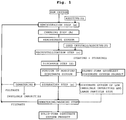
- the thus-obtained modified dihydrate gypsum can be provided with a still greater average particle size. It is also possible to design such that the supernatant water, which has been separated and discharged, is returned and reused as water for the hemihydration step and/or recrystallization step (see FIG. 1 ). When designed so, the modification treatment is conducted again so that the modified dihydrate gypsum of small average particle size is modified into modified dihydrate gypsum having a desired particle size suited as a material for a gypsum product.
- darkness components confined within crystals can be eliminated by calcining natural gypsum, one of various by-product gypsums, waste gypsum or the like into hemihydrate gypsum, and similar to the present invention, placing the hemihydrate gypsum in water, and recrystallizing the same.
- the hemihydrate gypsum is formed into a slurry in the presence of a surfactant and/or defoaming agent added to facilitate the separation of darkness components, and upon recrystallization of the hemihydrate gypsum, the darkness components adhered on the hemihydrate gypsum and the darkness components confined within the crystals of the hemihydrate gypsum are caused to separate. No particular limitation is imposed on the slurry temperature at this time, insofar as the hydration reaction is allowed to proceed. When the above-described separation method is carried out subsequently, these darkness components can be eliminated.
- the surfactant and/or defoaming agent used upon conducting the recrystallization it is preferred to incorporate one or more of such surfactants and/or defoaming agents as exemplified above in a range of from 0.01 to 0.2 wt% in total.
- good white gypsum can be obtained, for example, with a brightness of 80 or higher as measured by a colorimeter and expressed in terms of Hunter's brightness.
- natural gypsum one of various by-product gypsums or waste gypsum is used as a raw material, a product of high brightness cannot be readily obtained by any conventional method, and therefore, its applications have been limited.
- the above-described method can realize an expansion in applications, the above-described method also has significant benefits from the standpoints of recycling and environmental conservation.
- dihydrate gypsum in a raw gypsum such as natural gypsum or by-product gypsum is surely converted into hemihydrate gypsum in the hemihydration step, and in the subsequent recrystallization step, the hemihydrate gypsum is hydrated and recrystallized into modified dihydrate gypsum of large average particle size, and the modified dihydrate gypsum is then collected to provide it as a gypsum material suitable for gypsum products.
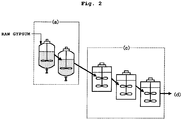
- This series of steps can be continuously conducted. An outline of an illustrative continuous system is shown in FIGS. 1 and 2 .
- the crystal habit modifier needed for the transformation into ⁇ -hemihydrate gypsum, the carboxylic acid or its salt needed upon recrystallization and the like are contained in the supernatant water. If the supernatant water is re-collected and used as slurry-forming water, it is possible to reduce the amounts of these agents to be used. Accordingly, the re-collecting and use of such supernatant water can reduce the running cost and is economical. If such supernatant water is repeatedly used as described above, it is also possible to avoid water contamination which would otherwise occur by discharged water. Such repeated use of supernatant water is, therefore, also beneficial from the aspect of environmental protection.
- modified dihydrate gypsum available from the recrystallization has an aspect ratio greater than 5, and extremely needle crystals are formed.
- the gypsum material is provided with a reduced bulk density.
- gypsum As the purity of gypsum, a sample was dried at 40°C, combined water was measured by an electronic moisture meter, and based on the theoretical value, its percentage was calculated to determine the purity. To test the degree of progress of recrystallization, a sample was dried at 40°C and then subjected to X-ray diffraction, and from the intensity of a peak of dihydrate gypsum and that of a peak of hemihydrate gypsum, the degree of progress of recrystallization was determined. The brightness of each gypsum was measured by a colorimeter, and the result was indicated in terms of Hunter's brightness.
- the slurry in the reaction tank was discharged such that the residence time of gypsum became about 5.
- the resultant dry product was analyzed by X-ray diffraction. As a result, it was confirmed that the dry product was composed of dihydrate gypsum in its entirety, and from combined water, it was also confirmed that its purity was 97. 5% andhadbeen extremely increased. The brightness was 71. Its average particle size was alsomeasured. As a result, it was found that the product had been modified to a large particle size of 86 ⁇ m as opposed to 28 ⁇ m before the treatment. In addition, the untapped bulk specific density was 0.9.
- flue gas desulfurization gypsum which had an average particle size of 32 ⁇ m and a purity of 98.5%.
- the raw material was first subjected to dry calcination over 2 hours or so in a dryer controlled at 150°C, whereby the raw material was converted into ⁇ -hemihydrate gypsum containing 6.3% of combined water.
- the slurry in the reaction tank was discharged such that the residence time of gypsum became about 5.4 hours (the discharge rate per hour: 18.5%) as determined by calculation. From the slurry so discharged, solid matter of high sedimentation rate was separated by the elutriation method, and the separated solid matter was dried at 40°C.
- phosphogypsum Provided as a raw material to be modified was phosphogypsum, which had an average particle size of 37 ⁇ m and a purity of 98.6%.
- the raw material was first subjected to dry calcination over 2 hours or so in a dryer controlled at 150°C, whereby the raw material was converted into ⁇ -hemihydrate gypsum containing 6.1% of combined water.
- the slurry in the reaction tank was discharged such that the residence time of gypsum became about 5. 4 hours (the discharge rate per hour: 18.5%) as determined by calculation. From the slurry so discharged, solid matter of high sedimentation rate was separated by the elutriation method, and the separated solid matter was dried at 40°C.
- neutralization gypsum Provided as a raw material to be modified was neutralization gypsum, which had an average particle size of 22 ⁇ m, a brightness of 72 and a purity of 99.1%, and a continuous treatment was conducted as will be described below.
- An optical micrograph of the neutralization gypsum provided as the raw material in this example is shown in FIG. 3 . No large crystals are observed.
- the raw material was first placed and mixed in a 0.5% solution of sodium succinate to prepare a slurry that contained the raw material at 35%.
- the slurry was next subjected to constant-rate feeding and constant-rate discharging to and from an autoclave, which was controlled at 130°C under pressure, for 24 hours such that its residence time became 2 hours.
- the ⁇ -hemihydrate gypsum slurry continuously obtained in the above-described step was next continuously fed at a constant rate to a reaction tank equipped with a heater and stirrer and controlled at 85.2°C, and in addition, a fresh supply of the neutralization gypsum as the raw material was continuously added such that the neutralization gypsum would amount to 0.6% based on the hemihydrate gypsum to be fed.
- recrystallization treatment was conducted by making control such that the residence time of the hemihydrate gypsum slurry so fed became 5. 5 hours (discharge rate per hour: 18.2%). After the constant-rate feeding was continued for 24 hours as described above, solid matter of high sedimentation rate was separated by the elutriation method from the slurry discharged from the reaction tank.
- the solid matter was dried at 40°C.
- the resultant dry product was analyzed by X-ray diffraction. As a result, it was confirmed that the dry product was composed of dihydrate gypsum in its entirety, and from combined water, it was also confirmed that its purity had increased to 99.2%.
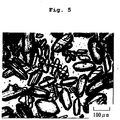
- the dry product was found to be crystallized with uniform and large particle size as shown in FIG. 5 . Its average particle size was also measured. As a result, it was found that the product had been modified to an extremely large particle size of 138 ⁇ m as opposed to 22 ⁇ m before the treatment.
- the untapped bulk specific density was also measured. As a result, the untapped bulk specific density was found to be 1.2 and therefore, the product was dense. Further, the aspect ratio was about 2, and the Hunter's brightness was 73.
- a raw material to be modified was neutralization gypsum having an average particle size of 23 ⁇ m, and in a similar manner as in Example 4, ⁇ -hemihydrate gypsum was obtained.
- the ⁇ -hemihydrate gypsum was then continuously fed at a constant rate to a reaction tank equipped with a heater and stirrer and controlled at 85.4°C, and in addition, a fresh supply of the same neutralization gypsum as the raw material was continuously added such that the neutralization gypsum would amount to 0.6% based on the hemihydrate gypsum to be fed.
- recrystallization treatment was conducted by making control such that the residence time of the hemihydrate gypsum slurry so fed became 8.0 hours (discharge rate per hour: 12.5%). After the constant-rate feeding was continued for 24 hours as described above, solidmatter of high sedimentation rate was separated by the elutriation method from the slurry discharged from the reaction tank.
- the solid matter was dried at 40°C.
- the resultant dry product was analyzed by X-ray diffraction. As a result, it was confirmed that the dry product was composed of dihydrate gypsum in its entirety, and from combined water, it was also confirmed that its purity was 99.6%. Its average particle size was also measured. As a result, it was found that the product had been modified to an extremely large particle size of 142 ⁇ m as opposed to 23 ⁇ m before the treatment. In addition, the untapped bulk specific density was also measured. As a result, the untapped bulk specific density was found to be 1.0 and therefore, the product was dense.
- polyaluminum chlorine by-product gypsum having a purity of 97.2% and an average particle size of 25 ⁇ m.
- a solution with sodium succinate and a polyalkylene-glycol-based polycarboxylate surfactant dissolved at 0.2% at 0.1%, respectively, therein was first added, followed by mixing to prepare a 35% slurry.
- a 0.4% solution of calcium hydroxide was next added to adjust the pH of the slurry to 9.5.
- the slurry was next subjected to constant-rate feeding and constant-rate discharging to and from an autoclave, which was controlled at 130°C, such that its residence time became 2 hours.
- the gypsum discharged from the autoclave was analyzed. It was confirmed that the gypsum was ⁇ -hemihydrate gypsum containing 6.2% of combined water and also that such hemihydrate gypsum was continuously obtained.
- the ⁇ -hemihydrate gypsum slurry of pH 6.9 continuously obtained in the above-described step was next introduced into a reaction tank equipped with a heater and stirrer and controlled at 85.1°C, and in addition, a fresh supply of the same polyaluminum chloride by-product gypsum as the raw material to be modified was continuously fed at a constant rate such that the polyaluminum chloride by-product gypsum would amount to 0.6% in terms of the weight percentage of gypsum.
- recrystallization treatment was conducted by making control such that the residence time of the slurry became 6 hours. After the constant-rate feeding was continued for 24 hours as described above, solid matter was separated by the elutriation method from the slurry discharged from the reaction tank.
- the solid matter was dried at 40°C.
- the resultant dry product was analyzed by X-ray diffraction. As a result, it was confirmed that the dry product was composed of dihydrate gypsum in its entirety, and from combined water, it was also confirmed that its purity extremely increased to 99.1%. Its average particle size was also measured. As a result, it was found that the product had been modified to an extremely large particle size of 132 ⁇ m as opposed to 25 ⁇ m before the treatment.
- the untapped bulk specific density was also measured. As a result, the untapped bulk specific density was found to be 1.2.
- the aspect ratio was about 3.
- the solid matter was dried at 40°C.
- the resultant dry product was analyzed by X-ray diffraction. As a result, it was confirmed that the dry product was composed of dihydrate gypsum in its entirety, and from combined water, it was also confirmed that its purity had increased to 99.2%. Its average particle size was also measured. As a result, it was found that the product had been modified to an extremely large particle size of 136 ⁇ m as opposed to 22 ⁇ m before the treatment.
- the untapped bulk specific density was also measured. As a result, the untapped bulk specific density was found to be 1.2. The aspect ratio was about 2, and the Hunter' s brightness was 90.
- the product was a material suited especially as white gypsum.
- Modification of neutralization gypsum having an average particle size of 22 ⁇ m was conducted in exactly the same manner and under exactly the same conditions as in Example 4 except that a commercial polyether-based defoaming agent was added at 0.1% concentration to the slurry before the calcination. Similar to Example 4, after the constant-rate feeding was continued for 24 hours, solid matter of high sedimentation rate was separated by the elutriation method from the slurry discharged from the reaction tank.
- the solid matter was dried at 40°C.
- the resultant dry product was analyzed by X-ray diffraction. As a result, it was confirmed that the dry product was composed of dihydrate gypsum in its entirety, and from combined water, it was also confirmed that its purity had increased to 99.3%. Its average particle size was also measured. As a result, it was found that the product had been modified to an extremely large particle size of 137 ⁇ m as opposed to 22 ⁇ m before the treatment.
- the untapped bulk specific density was also measured. As a result, the untapped bulk specific density was found to be 1.2. The aspect ratio was about 2, and the Hunter' s brightness was 91.
- the product was a material suited especially as white gypsum.
- the dry product was composed of dihydrate gypsum in its entirety, and from combined water, it was also confirmed that its purity had increased to 99.2%. Its average particle size was alsomeasured. As a result, it was found that the product had been modified to a large particle size of 87 ⁇ m as opposed to 22 ⁇ m before the treatment although the particle size was smaller compared with those in the other examples.
- the untapped bulk specific density was 1.1, and the aspect ratio was about 2.
- Modification of neutralization gypsum having an average particle size of 22 ⁇ m was conducted in exactly the same manner and under exactly the same conditions as in Example 4 except that the amount of the neutralization gypsum, which was the same as the raw material to be modified and was to be added as seed crystals upon recrystallization treatment, was changed to 4.8%. Similar to Example 4, after the constant-rate feeding was continued for 24 hours, solid matter of high sedimentation rate was separated by the elutriation method from the slurry discharged from the reaction tank. The separated solid matter was dried at 40°C. The resultant dry product was analyzed by X-ray diffraction.
- the dry product was composed of dihydrate gypsum in its entirety, and from combined water, it was also confirmed that its purity was 99.1%. Its average particle size was also measured. As a result, it was found that the average particle size was 64 ⁇ m as opposed to 22 ⁇ m before the treatment and that the product had been modified to one having the large particle size although the particle size was smaller compared with those of the other examples.
- the untapped bulk specific density was 1.0, and the aspect ratio was about 2.
- Modification of neutralization gypsum having an average particle size of 22 ⁇ m was conducted in exactly the same manner and under exactly the same conditions as in Example 4 except that the concentration of the solution of sodium succinate added upon preparation of the 35% slurry of the raw material was changed to 0.1%. Solid matter of high sedimentation rate was separated by the elutriation method, and the separated solid matter was dried at 40°C. The resultant dry product was analyzed by X-ray diffraction. As a result, it was confirmed that the dry product was composed of dihydrate gypsum in its entirety, and from combined water, it was also confirmed that its purity had increased to 99.2%. Its average particle size was also measured.
- Modification of phosphogypsum having an average particle size of 37 ⁇ m was conducted in exactly the same manner and under exactly the same conditions as in Example 3 except that the temperature of the slurry in the recrystallization reaction tank was maintained at 60.3°C. Solid matter of high sedimentation rate was separated by the elutriation method, and the separated solid matter was dried at 40°C. The resultant dry product was analyzed by X-ray diffraction. As a result, it was confirmed that the dry product was composed of dihydrate gypsum in its entirety. Its average particle size was 51 ⁇ m, and was small compared with the average particle sizes in the examples. Its untapped bulk specific density was 0.7 and was light.
- Modification of neutralization gypsum having an average particle size of 22 ⁇ m was conducted in exactly the same manner and under exactly the same conditions as in Example 4 except that recrystallization treatment was conducted by making control such that the residence time of the supplied hemihydrate gypsum slurry became 3.5 hours (discharge rate per hour: 28.6%). Similar to Example 4, after the constant-rate feeding was continued for 24 hours, solid matter of high sedimentation rate was separated by the elutriation method from the slurry discharged from the reaction tank. The separated solid matter was dried at 40°C. When analyzed by X-ray diffraction, it was confirmed that dihydrate gypsum and hemihydrate gypsum existed together and recrystallization was not completed.
Landscapes
- Chemical & Material Sciences (AREA)
- Organic Chemistry (AREA)
- Engineering & Computer Science (AREA)
- Ceramic Engineering (AREA)
- Life Sciences & Earth Sciences (AREA)
- Geology (AREA)
- Inorganic Chemistry (AREA)
- Materials Engineering (AREA)
- Structural Engineering (AREA)
- Compounds Of Alkaline-Earth Elements, Aluminum Or Rare-Earth Metals (AREA)
- Processing Of Solid Wastes (AREA)
- Degasification And Air Bubble Elimination (AREA)
Priority Applications (1)
| Application Number | Priority Date | Filing Date | Title |
|---|---|---|---|
| EP15152774.4A EP2891628B1 (en) | 2008-07-31 | 2009-07-31 | Process for continuous modification of dihydrate gypsum |
Applications Claiming Priority (2)
| Application Number | Priority Date | Filing Date | Title |
|---|---|---|---|
| JP2008197920 | 2008-07-31 | ||
| PCT/JP2009/063666 WO2010013807A1 (ja) | 2008-07-31 | 2009-07-31 | 二水石膏の連続式改質方法及び該方法で改質された改質二水石膏 |
Related Child Applications (2)
| Application Number | Title | Priority Date | Filing Date |
|---|---|---|---|
| EP15152774.4A Division EP2891628B1 (en) | 2008-07-31 | 2009-07-31 | Process for continuous modification of dihydrate gypsum |
| EP15152774.4A Division-Into EP2891628B1 (en) | 2008-07-31 | 2009-07-31 | Process for continuous modification of dihydrate gypsum |
Publications (3)
| Publication Number | Publication Date |
|---|---|
| EP2305605A1 EP2305605A1 (en) | 2011-04-06 |
| EP2305605A4 EP2305605A4 (en) | 2014-07-23 |
| EP2305605B1 true EP2305605B1 (en) | 2018-03-28 |
Family
ID=41610501
Family Applications (2)
| Application Number | Title | Priority Date | Filing Date |
|---|---|---|---|
| EP09803045.5A Active EP2305605B1 (en) | 2008-07-31 | 2009-07-31 | Process for continuous modification of dihydrate gypsum |
| EP15152774.4A Not-in-force EP2891628B1 (en) | 2008-07-31 | 2009-07-31 | Process for continuous modification of dihydrate gypsum |
Family Applications After (1)
| Application Number | Title | Priority Date | Filing Date |
|---|---|---|---|
| EP15152774.4A Not-in-force EP2891628B1 (en) | 2008-07-31 | 2009-07-31 | Process for continuous modification of dihydrate gypsum |
Country Status (12)
| Country | Link |
|---|---|
| US (2) | US8529863B2 (enExample) |
| EP (2) | EP2305605B1 (enExample) |
| JP (7) | JP5458013B2 (enExample) |
| KR (2) | KR101346493B1 (enExample) |
| CN (3) | CN102123950B (enExample) |
| AU (1) | AU2009277498B2 (enExample) |
| BR (1) | BRPI0916593B1 (enExample) |
| CA (2) | CA2852385C (enExample) |
| ES (2) | ES2665753T3 (enExample) |
| MX (1) | MX2011001116A (enExample) |
| RU (1) | RU2472706C2 (enExample) |
| WO (1) | WO2010013807A1 (enExample) |
Cited By (1)
| Publication number | Priority date | Publication date | Assignee | Title |
|---|---|---|---|---|
| EP3984977B1 (de) * | 2020-10-19 | 2022-11-09 | Lindner NORIT GmbH & Co. KG | Verfahren zum recycling von gipskartonmaterial |
Families Citing this family (30)
| Publication number | Priority date | Publication date | Assignee | Title |
|---|---|---|---|---|
| JP3460924B2 (ja) | 1986-08-21 | 2003-10-27 | 株式会社トプコン | 非接触式眼圧計 |
| CN102123950B (zh) * | 2008-07-31 | 2017-03-29 | 吉野石膏株式会社 | 二水石膏的连续式改性方法及用该方法改性了的改性二水石膏 |
| JP2012229152A (ja) * | 2011-04-13 | 2012-11-22 | Tokuyama Corp | 石膏ボード廃材からの石膏成形体用原料の石膏粉末の製造方法 |
| CN102659375A (zh) * | 2012-04-23 | 2012-09-12 | 湖南顶春新型建材科技有限公司 | 一种超强牙科模型石膏粉的生产方法 |
| JP6088277B2 (ja) * | 2013-02-07 | 2017-03-01 | 株式会社トクヤマ | 廃石膏ボードの利用方法 |
| WO2014141926A1 (ja) * | 2013-03-13 | 2014-09-18 | 株式会社トクヤマ | 石膏スラリーの連続的な製造方法 |
| JP6195238B2 (ja) * | 2013-05-29 | 2017-09-13 | 学校法人日本大学 | 石膏ボード廃材中の石膏を二水石膏として再生する方法 |
| US9896366B2 (en) * | 2014-02-26 | 2018-02-20 | Ecolab Usa Inc. | Alternative additives to enhance slurry dewatering |
| US9868647B2 (en) | 2014-04-02 | 2018-01-16 | Technion Research & Development Foundation Ltd. | System and methods for removing impurities from phosphogypsum and manufacturing gypsum binders and products |
| JP2016117617A (ja) * | 2014-12-22 | 2016-06-30 | 株式会社トクヤマ | 二水石膏製造装置 |
| JP6559551B2 (ja) * | 2015-11-18 | 2019-08-14 | 株式会社トクヤマ | フッ素溶出量を低減した二水石膏の製造方法 |
| CN106044826A (zh) * | 2016-05-26 | 2016-10-26 | 东南大学 | 一种用于生产α型高强石膏的转晶剂 |
| US10023496B1 (en) | 2017-06-16 | 2018-07-17 | United States Gypsum Company | No fiber calcination of gypsum for gypsum fiberboard |
| CN107324677A (zh) * | 2017-08-25 | 2017-11-07 | 四川屹科环保科技有限公司 | 高强半水石膏粉常压半干法制备方法、制备装置 |
| CN109292809A (zh) * | 2018-09-30 | 2019-02-01 | 攀钢集团攀枝花钢铁研究院有限公司 | 钛石膏的提纯方法、石膏和石膏的应用 |
| JP7121628B2 (ja) * | 2018-10-23 | 2022-08-18 | 株式会社トクヤマ | 廃石膏ボードからの二水石膏の回収方法 |
| JP7078512B2 (ja) * | 2018-10-25 | 2022-05-31 | 株式会社トクヤマ | 廃石膏ボードからの二水石膏の回収方法 |
| JP7284596B2 (ja) * | 2019-03-07 | 2023-05-31 | 株式会社トクヤマ | 二水石膏の製造方法 |
| CN110238158A (zh) * | 2019-05-28 | 2019-09-17 | 罗守训 | 垃圾处理系统 |
| JP7303729B2 (ja) * | 2019-11-14 | 2023-07-05 | 株式会社トクヤマ | 廃石膏ボードの処理方法 |
| CN111320446B (zh) * | 2020-02-29 | 2022-10-21 | 湖北省建筑工程质量监督检验测试中心 | 一种高强度自防水磷石膏路基材料及其制备方法 |
| CN111569526B (zh) * | 2020-05-25 | 2022-03-11 | 河北化工医药职业技术学院 | 一种二水石膏生产线的自动升降过滤产物系统 |
| EP4105178A1 (en) * | 2021-06-16 | 2022-12-21 | Saint-Gobain Placo | A process for the continuous preparation of alpha-calcium sulphate hemihydrate and an apparatus |
| CN113800868B (zh) * | 2021-08-26 | 2023-08-15 | 淮南北新建材有限公司 | 一种优化纸面石膏板性能的方法 |
| JP7713341B2 (ja) * | 2021-09-02 | 2025-07-25 | 株式会社トクヤマ | 石膏の晶析方法 |
| JP7790898B2 (ja) * | 2021-09-02 | 2025-12-23 | 株式会社トクヤマ | 廃石膏ボードからの石膏の回収方法 |
| CN115889409A (zh) * | 2022-11-11 | 2023-04-04 | 茌平信源环保建材有限公司 | 一种实现在线废石膏板回收利用的系统 |
| CN117843263B (zh) * | 2024-01-15 | 2024-07-05 | 泰山石膏(湖北)有限公司 | 基于复合碳材同步改性的阵列激光烧蚀磷石膏预处理方法 |
| CN119059750B (zh) * | 2024-11-06 | 2025-03-21 | 一夫科技股份有限公司 | 一种无水盐石膏快速水化的工艺 |
| CN119303931B (zh) * | 2024-12-17 | 2025-03-14 | 台州旭日环境科技有限公司 | 一种固体废弃物用于再生石膏生产装置及生产方法 |
Family Cites Families (35)
| Publication number | Priority date | Publication date | Assignee | Title |
|---|---|---|---|---|
| DE1238374B (de) * | 1965-04-24 | 1967-04-06 | Giulini Ges Mit Beschraenkter | Verfahren zur Herstellung von alpha-Calciumsulfat-Halbhydrat |
| JPS519714B1 (enExample) * | 1969-05-22 | 1976-03-29 | ||
| GB1557663A (en) * | 1975-08-01 | 1979-12-12 | Albright & Wilson | Process for preparing phosphore acid |
| JPS5248594A (en) * | 1975-10-17 | 1977-04-18 | Kureha Chem Ind Co Ltd | Method for producing type gypsum hemihydrate |
| JPS52147625A (en) * | 1976-06-02 | 1977-12-08 | Mitsubishi Heavy Ind Ltd | Method of treating gypsum byyproduced in desulfurizing exhaust gas |
| JPS5350092A (en) * | 1976-10-18 | 1978-05-08 | Sumitomo Chem Co Ltd | Production of alpha-type hemihydrate gypsum |
| JPS5547224A (en) * | 1978-09-28 | 1980-04-03 | Ishihara Sangyo Kaisha Ltd | Production of gypsum |
| JPS595527B2 (ja) * | 1980-06-20 | 1984-02-06 | セントラル硝子株式会社 | 二水石膏結晶の製造法 |
| US4424196A (en) * | 1982-06-29 | 1984-01-03 | United States Gypsum Company | Phosphohemihydrate process for purification of gypsum |
| US4722866A (en) * | 1985-04-09 | 1988-02-02 | Georgia-Pacific Corporation | Fire resistant gypsum board |
| UA26221A (uk) * | 1988-11-18 | 1999-07-19 | Юhайтед Стейтс Джіпсум Компаhі | Сировиhhа суміш для одержаhhя композиційhого матеріалу, композиційhий матеріал, спосіб приготуваhhя сировиhhої суміші для композиційhого матеріалу, спосіб виробhицтва гіпсоволокhистих плит |
| JPH02160620A (ja) * | 1988-12-15 | 1990-06-20 | Mitsui Toatsu Chem Inc | 半水石膏の水和方法 |
| US4994248A (en) * | 1989-06-05 | 1991-02-19 | Occidental Chemical Corporation | P2 O5 recovery and phosphoric acid purification |
| US5094716A (en) * | 1990-09-19 | 1992-03-10 | Betz Paperchem, Inc. | Use of anionic surfactant/dispersant blends for the deinking of groundwood newsprint |
| JP3336061B2 (ja) * | 1993-03-03 | 2002-10-21 | 千代田化工建設株式会社 | 高純度白色石膏の製造方法 |
| JP2614602B2 (ja) * | 1994-06-09 | 1997-05-28 | 小坂製錬株式会社 | 硫酸液からの板状二水石膏の連続製造法 |
| JP3007605B2 (ja) * | 1998-06-01 | 2000-02-07 | 株式会社テクノフロンティア | 飛灰から二水石膏を製造する方法及び装置 |
| JP4245819B2 (ja) * | 2000-05-12 | 2009-04-02 | 吉野石膏株式会社 | 高純度石膏の製造方法 |
| SG86468A1 (en) * | 2000-05-12 | 2002-02-19 | Yoshino Gypsum Co | Production process of high-purity gypsum |
| ATE313514T1 (de) * | 2001-08-24 | 2006-01-15 | Purac Biochem Bv | Verfahren zur herstellung von milchsäure und calciumsulfatdihydrat |
| JP2003128416A (ja) | 2001-10-19 | 2003-05-08 | Tokuyama Corp | 再生石膏の製造方法 |
| JP4213993B2 (ja) | 2003-05-22 | 2009-01-28 | 多木化学株式会社 | 塩素含有二水石膏の塩素低減方法 |
| JP2005014389A (ja) * | 2003-06-26 | 2005-01-20 | Taki Chem Co Ltd | インクジェット紙用石膏スラリー |
| CN1262511C (zh) * | 2003-08-19 | 2006-07-05 | 陈智丰 | 一种硅酸盐水泥改性的方法 |
| JP4382639B2 (ja) * | 2004-11-17 | 2009-12-16 | 日鉱金属株式会社 | 二水石膏の製造方法 |
| JP4960600B2 (ja) * | 2005-03-28 | 2012-06-27 | 株式会社トクヤマ | 廃石膏の処理方法 |
| US7875114B2 (en) * | 2005-06-14 | 2011-01-25 | United States Gypsum Company | Foamed slurry and building panel made therefrom |
| CN100425560C (zh) * | 2006-09-14 | 2008-10-15 | 山西北方石膏工业有限公司 | α型半水石膏的连续式生产方法及装置 |
| JP2008081329A (ja) | 2006-09-26 | 2008-04-10 | Taiheiyo Cement Corp | 粒径の大きな二水石膏の製造方法 |
| FI20070093A0 (fi) * | 2007-02-02 | 2007-02-02 | Kemira Oyj | Kipsituote ja menetelmä sen valmistamiseksi |
| CN101113084A (zh) * | 2007-07-06 | 2008-01-30 | 天津大学 | 用烟气脱硫石膏制备形貌可控的α-半水石膏的方法 |
| CN101182150A (zh) * | 2007-11-09 | 2008-05-21 | 浙江大学 | 一种脱硫石膏浆液直接制备α-半水石膏的工业结晶工艺 |
| JP5553491B2 (ja) * | 2008-07-02 | 2014-07-16 | 株式会社トクヤマ | 石膏ボード廃材から石膏を再生する方法 |
| CN101372404B (zh) * | 2008-07-24 | 2010-08-11 | 东南大学 | 一种用脱硫二水石膏制备高强α型半水石膏的方法 |
| CN102123950B (zh) * | 2008-07-31 | 2017-03-29 | 吉野石膏株式会社 | 二水石膏的连续式改性方法及用该方法改性了的改性二水石膏 |
-
2009
- 2009-07-31 CN CN200980129561.9A patent/CN102123950B/zh active Active
- 2009-07-31 CA CA2852385A patent/CA2852385C/en not_active Expired - Fee Related
- 2009-07-31 ES ES09803045.5T patent/ES2665753T3/es active Active
- 2009-07-31 JP JP2010522761A patent/JP5458013B2/ja active Active
- 2009-07-31 ES ES15152774.4T patent/ES2661439T3/es active Active
- 2009-07-31 US US13/055,891 patent/US8529863B2/en active Active
- 2009-07-31 CA CA2731836A patent/CA2731836C/en active Active
- 2009-07-31 KR KR1020137002867A patent/KR101346493B1/ko not_active Expired - Fee Related
- 2009-07-31 EP EP09803045.5A patent/EP2305605B1/en active Active
- 2009-07-31 CN CN201410412287.9A patent/CN104211102B/zh active Active
- 2009-07-31 AU AU2009277498A patent/AU2009277498B2/en active Active
- 2009-07-31 KR KR1020117004554A patent/KR101286336B1/ko active Active
- 2009-07-31 EP EP15152774.4A patent/EP2891628B1/en not_active Not-in-force
- 2009-07-31 WO PCT/JP2009/063666 patent/WO2010013807A1/ja not_active Ceased
- 2009-07-31 RU RU2011102297/05A patent/RU2472706C2/ru active
- 2009-07-31 CN CN201410412314.2A patent/CN104261453B/zh not_active Expired - Fee Related
- 2009-07-31 BR BRPI0916593A patent/BRPI0916593B1/pt not_active IP Right Cessation
- 2009-07-31 MX MX2011001116A patent/MX2011001116A/es active IP Right Grant
-
2012
- 2012-09-28 JP JP2012215847A patent/JP5193386B2/ja active Active
-
2013
- 2013-08-08 US US13/962,601 patent/US9458025B2/en active Active
- 2013-11-25 JP JP2013243103A patent/JP5689518B2/ja active Active
-
2014
- 2014-11-13 JP JP2014230513A patent/JP5834128B2/ja active Active
-
2015
- 2015-10-30 JP JP2015213801A patent/JP6072879B2/ja active Active
-
2016
- 2016-12-27 JP JP2016253577A patent/JP6232123B2/ja active Active
-
2017
- 2017-10-19 JP JP2017202315A patent/JP6391790B2/ja active Active
Non-Patent Citations (1)
| Title |
|---|
| None * |
Cited By (1)
| Publication number | Priority date | Publication date | Assignee | Title |
|---|---|---|---|---|
| EP3984977B1 (de) * | 2020-10-19 | 2022-11-09 | Lindner NORIT GmbH & Co. KG | Verfahren zum recycling von gipskartonmaterial |
Also Published As
Similar Documents
| Publication | Publication Date | Title |
|---|---|---|
| EP2305605B1 (en) | Process for continuous modification of dihydrate gypsum | |
| JP2014088312A5 (enExample) | ||
| AU2007297815B2 (en) | Process for manufacturing ultra low consistency alpha- and beta- blend stucco | |
| UA121684C2 (uk) | Спосіб виробництва фосфорної кислоти з одержанням як побічного продукту альфа-напівводного гіпсу мокрим способом | |
| AU2012241005B2 (en) | Process for continuous modification of dihydrate gypsum and modified dihydrate gypsum obtained by the process | |
| US4452770A (en) | Phosphoanhydrite process |
Legal Events
| Date | Code | Title | Description |
|---|---|---|---|
| PUAI | Public reference made under article 153(3) epc to a published international application that has entered the european phase |
Free format text: ORIGINAL CODE: 0009012 |
|
| 17P | Request for examination filed |
Effective date: 20110114 |
|
| AK | Designated contracting states |
Kind code of ref document: A1 Designated state(s): AT BE BG CH CY CZ DE DK EE ES FI FR GB GR HR HU IE IS IT LI LT LU LV MC MK MT NL NO PL PT RO SE SI SK SM TR |
|
| AX | Request for extension of the european patent |
Extension state: AL BA RS |
|
| DAX | Request for extension of the european patent (deleted) | ||
| TPAC | Observations filed by third parties |
Free format text: ORIGINAL CODE: EPIDOSNTIPA |
|
| A4 | Supplementary search report drawn up and despatched |
Effective date: 20140625 |
|
| RIC1 | Information provided on ipc code assigned before grant |
Ipc: C01F 11/46 20060101AFI20140618BHEP Ipc: C04B 11/00 20060101ALI20140618BHEP |
|
| 17Q | First examination report despatched |
Effective date: 20150323 |
|
| GRAP | Despatch of communication of intention to grant a patent |
Free format text: ORIGINAL CODE: EPIDOSNIGR1 |
|
| INTG | Intention to grant announced |
Effective date: 20170927 |
|
| GRAJ | Information related to disapproval of communication of intention to grant by the applicant or resumption of examination proceedings by the epo deleted |
Free format text: ORIGINAL CODE: EPIDOSDIGR1 |
|
| GRAR | Information related to intention to grant a patent recorded |
Free format text: ORIGINAL CODE: EPIDOSNIGR71 |
|
| GRAS | Grant fee paid |
Free format text: ORIGINAL CODE: EPIDOSNIGR3 |
|
| INTC | Intention to grant announced (deleted) | ||
| GRAA | (expected) grant |
Free format text: ORIGINAL CODE: 0009210 |
|
| INTG | Intention to grant announced |
Effective date: 20180215 |
|
| AK | Designated contracting states |
Kind code of ref document: B1 Designated state(s): AT BE BG CH CY CZ DE DK EE ES FI FR GB GR HR HU IE IS IT LI LT LU LV MC MK MT NL NO PL PT RO SE SI SK SM TR |
|
| REG | Reference to a national code |
Ref country code: GB Ref legal event code: FG4D |
|
| REG | Reference to a national code |
Ref country code: CH Ref legal event code: EP |
|
| REG | Reference to a national code |
Ref country code: AT Ref legal event code: REF Ref document number: 983250 Country of ref document: AT Kind code of ref document: T Effective date: 20180415 |
|
| REG | Reference to a national code |
Ref country code: IE Ref legal event code: FG4D |
|
| REG | Reference to a national code |
Ref country code: DE Ref legal event code: R096 Ref document number: 602009051531 Country of ref document: DE |
|
| REG | Reference to a national code |
Ref country code: ES Ref legal event code: FG2A Ref document number: 2665753 Country of ref document: ES Kind code of ref document: T3 Effective date: 20180427 |
|
| REG | Reference to a national code |
Ref country code: FR Ref legal event code: PLFP Year of fee payment: 10 |
|
| PG25 | Lapsed in a contracting state [announced via postgrant information from national office to epo] |
Ref country code: HR Free format text: LAPSE BECAUSE OF FAILURE TO SUBMIT A TRANSLATION OF THE DESCRIPTION OR TO PAY THE FEE WITHIN THE PRESCRIBED TIME-LIMIT Effective date: 20180328 Ref country code: LT Free format text: LAPSE BECAUSE OF FAILURE TO SUBMIT A TRANSLATION OF THE DESCRIPTION OR TO PAY THE FEE WITHIN THE PRESCRIBED TIME-LIMIT Effective date: 20180328 Ref country code: FI Free format text: LAPSE BECAUSE OF FAILURE TO SUBMIT A TRANSLATION OF THE DESCRIPTION OR TO PAY THE FEE WITHIN THE PRESCRIBED TIME-LIMIT Effective date: 20180328 Ref country code: NO Free format text: LAPSE BECAUSE OF FAILURE TO SUBMIT A TRANSLATION OF THE DESCRIPTION OR TO PAY THE FEE WITHIN THE PRESCRIBED TIME-LIMIT Effective date: 20180628 |
|
| REG | Reference to a national code |
Ref country code: NL Ref legal event code: MP Effective date: 20180328 |
|
| REG | Reference to a national code |
Ref country code: LT Ref legal event code: MG4D |
|
| PG25 | Lapsed in a contracting state [announced via postgrant information from national office to epo] |
Ref country code: GR Free format text: LAPSE BECAUSE OF FAILURE TO SUBMIT A TRANSLATION OF THE DESCRIPTION OR TO PAY THE FEE WITHIN THE PRESCRIBED TIME-LIMIT Effective date: 20180629 Ref country code: SE Free format text: LAPSE BECAUSE OF FAILURE TO SUBMIT A TRANSLATION OF THE DESCRIPTION OR TO PAY THE FEE WITHIN THE PRESCRIBED TIME-LIMIT Effective date: 20180328 Ref country code: LV Free format text: LAPSE BECAUSE OF FAILURE TO SUBMIT A TRANSLATION OF THE DESCRIPTION OR TO PAY THE FEE WITHIN THE PRESCRIBED TIME-LIMIT Effective date: 20180328 Ref country code: BG Free format text: LAPSE BECAUSE OF FAILURE TO SUBMIT A TRANSLATION OF THE DESCRIPTION OR TO PAY THE FEE WITHIN THE PRESCRIBED TIME-LIMIT Effective date: 20180628 |
|
| PG25 | Lapsed in a contracting state [announced via postgrant information from national office to epo] |
Ref country code: PL Free format text: LAPSE BECAUSE OF FAILURE TO SUBMIT A TRANSLATION OF THE DESCRIPTION OR TO PAY THE FEE WITHIN THE PRESCRIBED TIME-LIMIT Effective date: 20180328 Ref country code: EE Free format text: LAPSE BECAUSE OF FAILURE TO SUBMIT A TRANSLATION OF THE DESCRIPTION OR TO PAY THE FEE WITHIN THE PRESCRIBED TIME-LIMIT Effective date: 20180328 Ref country code: RO Free format text: LAPSE BECAUSE OF FAILURE TO SUBMIT A TRANSLATION OF THE DESCRIPTION OR TO PAY THE FEE WITHIN THE PRESCRIBED TIME-LIMIT Effective date: 20180328 Ref country code: NL Free format text: LAPSE BECAUSE OF FAILURE TO SUBMIT A TRANSLATION OF THE DESCRIPTION OR TO PAY THE FEE WITHIN THE PRESCRIBED TIME-LIMIT Effective date: 20180328 |
|
| PG25 | Lapsed in a contracting state [announced via postgrant information from national office to epo] |
Ref country code: SK Free format text: LAPSE BECAUSE OF FAILURE TO SUBMIT A TRANSLATION OF THE DESCRIPTION OR TO PAY THE FEE WITHIN THE PRESCRIBED TIME-LIMIT Effective date: 20180328 Ref country code: CZ Free format text: LAPSE BECAUSE OF FAILURE TO SUBMIT A TRANSLATION OF THE DESCRIPTION OR TO PAY THE FEE WITHIN THE PRESCRIBED TIME-LIMIT Effective date: 20180328 Ref country code: SM Free format text: LAPSE BECAUSE OF FAILURE TO SUBMIT A TRANSLATION OF THE DESCRIPTION OR TO PAY THE FEE WITHIN THE PRESCRIBED TIME-LIMIT Effective date: 20180328 |
|
| REG | Reference to a national code |
Ref country code: AT Ref legal event code: MK05 Ref document number: 983250 Country of ref document: AT Kind code of ref document: T Effective date: 20180328 |
|
| PG25 | Lapsed in a contracting state [announced via postgrant information from national office to epo] |
Ref country code: PT Free format text: LAPSE BECAUSE OF FAILURE TO SUBMIT A TRANSLATION OF THE DESCRIPTION OR TO PAY THE FEE WITHIN THE PRESCRIBED TIME-LIMIT Effective date: 20180730 |
|
| REG | Reference to a national code |
Ref country code: DE Ref legal event code: R097 Ref document number: 602009051531 Country of ref document: DE |
|
| PG25 | Lapsed in a contracting state [announced via postgrant information from national office to epo] |
Ref country code: AT Free format text: LAPSE BECAUSE OF FAILURE TO SUBMIT A TRANSLATION OF THE DESCRIPTION OR TO PAY THE FEE WITHIN THE PRESCRIBED TIME-LIMIT Effective date: 20180328 Ref country code: DK Free format text: LAPSE BECAUSE OF FAILURE TO SUBMIT A TRANSLATION OF THE DESCRIPTION OR TO PAY THE FEE WITHIN THE PRESCRIBED TIME-LIMIT Effective date: 20180328 |
|
| PLBE | No opposition filed within time limit |
Free format text: ORIGINAL CODE: 0009261 |
|
| STAA | Information on the status of an ep patent application or granted ep patent |
Free format text: STATUS: NO OPPOSITION FILED WITHIN TIME LIMIT |
|
| REG | Reference to a national code |
Ref country code: CH Ref legal event code: PL |
|
| 26N | No opposition filed |
Effective date: 20190103 |
|
| PG25 | Lapsed in a contracting state [announced via postgrant information from national office to epo] |
Ref country code: LU Free format text: LAPSE BECAUSE OF NON-PAYMENT OF DUE FEES Effective date: 20180731 Ref country code: MC Free format text: LAPSE BECAUSE OF FAILURE TO SUBMIT A TRANSLATION OF THE DESCRIPTION OR TO PAY THE FEE WITHIN THE PRESCRIBED TIME-LIMIT Effective date: 20180328 |
|
| REG | Reference to a national code |
Ref country code: BE Ref legal event code: MM Effective date: 20180731 |
|
| PG25 | Lapsed in a contracting state [announced via postgrant information from national office to epo] |
Ref country code: CH Free format text: LAPSE BECAUSE OF NON-PAYMENT OF DUE FEES Effective date: 20180731 Ref country code: LI Free format text: LAPSE BECAUSE OF NON-PAYMENT OF DUE FEES Effective date: 20180731 |
|
| REG | Reference to a national code |
Ref country code: IE Ref legal event code: MM4A |
|
| PG25 | Lapsed in a contracting state [announced via postgrant information from national office to epo] |
Ref country code: BE Free format text: LAPSE BECAUSE OF NON-PAYMENT OF DUE FEES Effective date: 20180731 Ref country code: SI Free format text: LAPSE BECAUSE OF FAILURE TO SUBMIT A TRANSLATION OF THE DESCRIPTION OR TO PAY THE FEE WITHIN THE PRESCRIBED TIME-LIMIT Effective date: 20180328 |
|
| PG25 | Lapsed in a contracting state [announced via postgrant information from national office to epo] |
Ref country code: IE Free format text: LAPSE BECAUSE OF NON-PAYMENT OF DUE FEES Effective date: 20180731 |
|
| PG25 | Lapsed in a contracting state [announced via postgrant information from national office to epo] |
Ref country code: MT Free format text: LAPSE BECAUSE OF NON-PAYMENT OF DUE FEES Effective date: 20180731 |
|
| PG25 | Lapsed in a contracting state [announced via postgrant information from national office to epo] |
Ref country code: TR Free format text: LAPSE BECAUSE OF FAILURE TO SUBMIT A TRANSLATION OF THE DESCRIPTION OR TO PAY THE FEE WITHIN THE PRESCRIBED TIME-LIMIT Effective date: 20180328 |
|
| PG25 | Lapsed in a contracting state [announced via postgrant information from national office to epo] |
Ref country code: HU Free format text: LAPSE BECAUSE OF FAILURE TO SUBMIT A TRANSLATION OF THE DESCRIPTION OR TO PAY THE FEE WITHIN THE PRESCRIBED TIME-LIMIT; INVALID AB INITIO Effective date: 20090731 |
|
| PG25 | Lapsed in a contracting state [announced via postgrant information from national office to epo] |
Ref country code: MK Free format text: LAPSE BECAUSE OF NON-PAYMENT OF DUE FEES Effective date: 20180328 Ref country code: CY Free format text: LAPSE BECAUSE OF FAILURE TO SUBMIT A TRANSLATION OF THE DESCRIPTION OR TO PAY THE FEE WITHIN THE PRESCRIBED TIME-LIMIT Effective date: 20180328 |
|
| PG25 | Lapsed in a contracting state [announced via postgrant information from national office to epo] |
Ref country code: IS Free format text: LAPSE BECAUSE OF FAILURE TO SUBMIT A TRANSLATION OF THE DESCRIPTION OR TO PAY THE FEE WITHIN THE PRESCRIBED TIME-LIMIT Effective date: 20180728 |
|
| P01 | Opt-out of the competence of the unified patent court (upc) registered |
Effective date: 20230512 |
|
| PGFP | Annual fee paid to national office [announced via postgrant information from national office to epo] |
Ref country code: GB Payment date: 20250612 Year of fee payment: 17 |
|
| PGFP | Annual fee paid to national office [announced via postgrant information from national office to epo] |
Ref country code: FR Payment date: 20250610 Year of fee payment: 17 |
|
| PGFP | Annual fee paid to national office [announced via postgrant information from national office to epo] |
Ref country code: ES Payment date: 20250801 Year of fee payment: 17 |
|
| PGFP | Annual fee paid to national office [announced via postgrant information from national office to epo] |
Ref country code: DE Payment date: 20250604 Year of fee payment: 17 |
|
| PGFP | Annual fee paid to national office [announced via postgrant information from national office to epo] |
Ref country code: IT Payment date: 20250623 Year of fee payment: 17 |