EP2223971B1 - Langwellige Thiolgruppenreaktive Fluorophore - Google Patents
Langwellige Thiolgruppenreaktive Fluorophore Download PDFInfo
- Publication number
- EP2223971B1 EP2223971B1 EP10163379A EP10163379A EP2223971B1 EP 2223971 B1 EP2223971 B1 EP 2223971B1 EP 10163379 A EP10163379 A EP 10163379A EP 10163379 A EP10163379 A EP 10163379A EP 2223971 B1 EP2223971 B1 EP 2223971B1
- Authority
- EP
- European Patent Office
- Prior art keywords
- cysteine
- binding protein
- serine
- analyte
- biosensor
- Prior art date
- Legal status (The legal status is an assumption and is not a legal conclusion. Google has not performed a legal analysis and makes no representation as to the accuracy of the status listed.)
- Expired - Lifetime
Links
- 0 C*(C(*1)=*(*)c2c1cccc2)=*(C)c(c1n[o]nc11)ccc1N(*)* Chemical compound C*(C(*1)=*(*)c2c1cccc2)=*(C)c(c1n[o]nc11)ccc1N(*)* 0.000 description 2
- CMRODNYBAJNVDL-UHFFFAOYSA-N BC(CC(N1C)=O)C1=O Chemical compound BC(CC(N1C)=O)C1=O CMRODNYBAJNVDL-UHFFFAOYSA-N 0.000 description 1
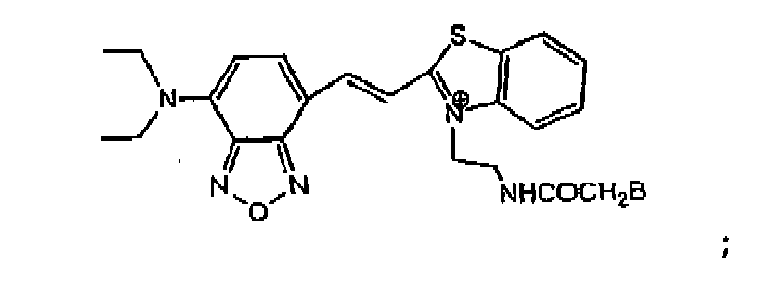
- USXRLNYROBVRJU-UHFFFAOYSA-N BCC(OCCCC[b]1c(/C=C/c(c2n[o]nc22)ccc2N(CC)CC)[s]c2c1cccc2)=O Chemical compound BCC(OCCCC[b]1c(/C=C/c(c2n[o]nc22)ccc2N(CC)CC)[s]c2c1cccc2)=O USXRLNYROBVRJU-UHFFFAOYSA-N 0.000 description 1
- VGZGAKWJUHRXCY-UHFFFAOYSA-N CN(C(CC1S)=O)C1=O Chemical compound CN(C(CC1S)=O)C1=O VGZGAKWJUHRXCY-UHFFFAOYSA-N 0.000 description 1
Classifications
-
- C—CHEMISTRY; METALLURGY
- C09—DYES; PAINTS; POLISHES; NATURAL RESINS; ADHESIVES; COMPOSITIONS NOT OTHERWISE PROVIDED FOR; APPLICATIONS OF MATERIALS NOT OTHERWISE PROVIDED FOR
- C09B—ORGANIC DYES OR CLOSELY-RELATED COMPOUNDS FOR PRODUCING DYES, e.g. PIGMENTS; MORDANTS; LAKES
- C09B23/00—Methine or polymethine dyes, e.g. cyanine dyes
- C09B23/10—The polymethine chain containing an even number of >CH- groups
-
- C—CHEMISTRY; METALLURGY
- C07—ORGANIC CHEMISTRY
- C07D—HETEROCYCLIC COMPOUNDS
- C07D207/00—Heterocyclic compounds containing five-membered rings not condensed with other rings, with one nitrogen atom as the only ring hetero atom
- C07D207/02—Heterocyclic compounds containing five-membered rings not condensed with other rings, with one nitrogen atom as the only ring hetero atom with only hydrogen or carbon atoms directly attached to the ring nitrogen atom
-
- C—CHEMISTRY; METALLURGY
- C09—DYES; PAINTS; POLISHES; NATURAL RESINS; ADHESIVES; COMPOSITIONS NOT OTHERWISE PROVIDED FOR; APPLICATIONS OF MATERIALS NOT OTHERWISE PROVIDED FOR
- C09B—ORGANIC DYES OR CLOSELY-RELATED COMPOUNDS FOR PRODUCING DYES, e.g. PIGMENTS; MORDANTS; LAKES
- C09B23/00—Methine or polymethine dyes, e.g. cyanine dyes
- C09B23/10—The polymethine chain containing an even number of >CH- groups
- C09B23/105—The polymethine chain containing an even number of >CH- groups two >CH- groups
-
- G—PHYSICS
- G01—MEASURING; TESTING
- G01N—INVESTIGATING OR ANALYSING MATERIALS BY DETERMINING THEIR CHEMICAL OR PHYSICAL PROPERTIES
- G01N33/00—Investigating or analysing materials by specific methods not covered by groups G01N1/00 - G01N31/00
- G01N33/48—Biological material, e.g. blood, urine; Haemocytometers
- G01N33/50—Chemical analysis of biological material, e.g. blood, urine; Testing involving biospecific ligand binding methods; Immunological testing
- G01N33/58—Chemical analysis of biological material, e.g. blood, urine; Testing involving biospecific ligand binding methods; Immunological testing involving labelled substances
- G01N33/582—Chemical analysis of biological material, e.g. blood, urine; Testing involving biospecific ligand binding methods; Immunological testing involving labelled substances with fluorescent label
-
- G—PHYSICS
- G01—MEASURING; TESTING
- G01N—INVESTIGATING OR ANALYSING MATERIALS BY DETERMINING THEIR CHEMICAL OR PHYSICAL PROPERTIES
- G01N33/00—Investigating or analysing materials by specific methods not covered by groups G01N1/00 - G01N31/00
- G01N33/48—Biological material, e.g. blood, urine; Haemocytometers
- G01N33/50—Chemical analysis of biological material, e.g. blood, urine; Testing involving biospecific ligand binding methods; Immunological testing
- G01N33/66—Chemical analysis of biological material, e.g. blood, urine; Testing involving biospecific ligand binding methods; Immunological testing involving blood sugars, e.g. galactose
Definitions
- the embodiments of the present invention are directed to long wavelength biosensors and their use in a method for the detection of an analyte.
- Fluorescent dyes or fluorophore compounds are suitable for use in various chemical and biological processes.
- Various embodiments are directed to fluorophores having a reactive group that can be used to couple or conjugate the fluorophore with another molecule such as a protein.
- Biosensors comprising fluorophores having a reactive group coupled or conjugated with a protein.
- Fluorophores have a reactive group and have an emission wavelength of not less than 575 nm, referred to as near-infrared dyes (NIR dyes). In one embodiment, the fluorophores have an emission at 650 nm.
- the fluorophore embodiments include a pendant reactive group capable of corijugating with a member of a specific binding pair.
- the fluorophores are suitable for coupling to receptors and to binding proteins having an affinity for a specific ligand or analyte.
- the receptor or binding protein undergoes conformational changes when coupled to the ligand or analyte.
- the fluorophores when coupled to the binding protein exhibit a detectable signal change as a result of binding of ligand.
- the fluorophore has a reactive moiety that can be covalently attached to an amino acid
- the fluorophores in one embodiment have a thiol-reactive group that can be conjugated to a cysteine residue of a protein amino acid.
- suitable thiol-reactive groups that can be introduced into the fluorophore include a haloacetyl and particularly an iodoacetyl group.
- Other thiol-reactive groups include iodoacetamide, bromoacetamide, iodoacetate or maleimide.
- the fluorophore has a thiol-reactive group and has an emission of at least 575 nm.
- the fluorophores in the embodiment of the invention are benzoxadiazoles.
- the invention is directed to derivatives of benzoxadiazole, hereinafter refered to interchangeably as benzoxadiazole nucleus or nuclei; or collectively as "fluorescent dye.”
- Derivatives of the benzoxadiazole nuclei nuclei include any reaction product of the derivative, for example, with a protein amino acid group. Derivative is meant to include any chemical modification, addition, deletion, or substitution to an aforementioned nucleus.
- nuclei of the aforementioned dyes that exhibit a fluorescence emission of at least 575 nm are included as embodiments.
- the benzoxadiazole nuclei contains a thiol-reactive group for binding to a protein.
- Another embodiment is also directed to a conjugate of a binding protein and a benzoxadiazole nucleus coupled to the binding protein through a cysteine residue on the binding protein.
- the cysteine residue of the protein can be naturally occurring or engineered into the protein.
- the binding protein is a glucose binding protein that has an affinity for glucose and reversibly binds glucose.
- the fluorophore produces a detectable change in a fluorescence property in response to binding.
- the detectable change in a fluorescent property can be a shift in the wavelength of emission, a change in intensity of the emitted energy, a change in fluorescence lifetime, a change in anisotropy, change in polarization, or a combination thereof.
- the binding protein is a maltose binding protein (MBP) that has an affinity for and binds maltose.
- the binding protein is altered so that it has an affinity for and binds non-native ligands.
- a biosensor compound selected from the group consisting of: where Y'-B is where n is an integer of 1 to 6, or where Y'-B is A'-CO-V-B, where A' is -R 2 O- or -R 2 N(R 3 )-, where R 2 is a C 1 to C 6 alkyl, R 3 is H or CH 3 , and V-B is -CH 2 -B or where m is an integer of 2 to 6, where r is an integer of 1 to 3, R 8 and R 9 are independently a C 1 to C 6 alkyl or (CH 2 ),CO 2 H, where s is an integer of 2 to 5, Z is S, O, or C(CH 3 ) 2 , W is H, CH 3 , SO 3 H, fused benzene, or fused sulfobenzene, and
- B is a receptor having a binding affinity for a ligand to be detected, and where said biosensor compound exhibits a detectable change in a fluorescence property as a result of changes in concentration of said ligand.
- the biosensor compound is subjected to an energy source to excite said fluorophore and to detect a fluorescence property as an indicator of a analyte concentration in the analyte-containing source.
- the present disclosure is directed to fluorescent dyes that are suitable for use as components of biosensors for detecting a ligand and particularly an analyte, and methods of use.
- One embodiment is directed to fluorescent dyes that can be conjugated to a receptor to detect, quantify, or detect and quantify the ligand.
- the fluorescent dyes are used to produce a biosensor where the fluorescent dye is covalently attached to a binding protein.
- biosensor and “biosensor compound” refers to a compound that undergoes a detectable change in specific response to a ligand or target analyte.
- the embodiments of the biosensor discussed herein include a binding protein that is capable of binding to an analyte.
- the biosensor of the invention is able to detect an analyte and to detect changes in the analyte concentration.
- the protein may be chosen from the group of periplasmic binding proteins that includes, but is not limited to, glucose/galactose binding protein, maltose binding protein, allose-binding protein, arabinose-binding protein, dipeptide-binding protein, glutamic acid/aspartic acid-binding protein, glutamine binding protein, Fe(III)-binding protein, histidine-binding protein, leucine-binding protein, leucine/isoleucine/valine-binding protein, lysine/arginine/ornithine-binding protein, molybdate-binding protein, oligopeptide-binding protein, phosphate-binding protein, ribose-binding protein, sulfata-binding protein, Zn(II)-binding protein, and vitamin B-12-binding protein.
- periplasmic binding proteins that includes, but is not limited to, glucose/galactose binding protein, maltose binding protein, allose-binding protein, arabi
- the biosensor is a fluorescent dye covalently attached to a binding protein, wherein the protein-dye conjugate exhibits a fluorescence emission of 575 nm or higher. In one embodiment, the fluorescent dye exhibits a fluorescence emission of not less than 575 nm.
- the binding protein is a glucose/galactose binding protein (GGBP) that is able to bind with glucose when in contact with a glucose-containing source. In another embodiment, the binding protein is a maltose binding protein (MBP). Not to be held by any theory, the binding protein is understood to undergo a conformational change upon binding of ligand. The percentage of binding protein binding sites occupied by ligand is dependent upon the concentration of ligand and the binding constant of the binding protein.
- the fluorescent dye embodiments that exhibit a fluorescence emission of at least about 575 nm avoid or minimize background interference from the biological system or other components in the glucose source.
- the fluorescent dyes exhibit a change in intensity of the fluorescence signal, a shift in the emission wavelength of the maximum fluorescence emission, a change in fluorescence lifetime, a change in anisotropy, a change in polarization, or a combination thereof, when the binding protein undergoes a conformational change as a result of changes in the glucose concentration.
- the biosensor contacts a sample containing analyte, for example glucose, to enable the analyte to bind with the binding protein, where the sample includes, but is not limited to, blood, saliva, interstitial fluid, etc.
- An energy source such as a laser or LED, is applied to the biosensor to excite the fluorescent dye, and a fluorescence property is detected. Due to either a conformational change in the binding protein, subsequent changes in the microenvironment of the dye, or both, the detected fluorescence property or change of the detected fluorescence property can be correlated to the presence of an analyte or a analyte concentration.
- the fluorescence and detection can be carried out continuously or inteimittently at predetermined times. Thus, episodic or continuous sensing of analyte, for example, glucose, is envisaged.
- the biosensor disclosed herein is adaptable for use in strips, implants, micro- and nano-particles, and the like.
- the fluorescent dye is covalently attached to the binding protein in a site-specific manner to obtain the desired change in the fluorescence.
- the fluorescent dye is attached at a site on the binding protein so that the conformational Change maximizes the change in fluorescence properties.
- the fluorescent dyes have a thiol-reactive group that can be coupled to the thiol group on a cysteine residue of the binding protein.
- the fluorescent dye includes the aforementioned derivatives of the benzoxadiazole nuclei.
- Y'B is where n is an integer of 1 to 6, or Y'-B is A'-CO-V-B, where A' is -R 2 O- or -R 2 N(R 3 )-.
- R 2 is a C 1 to C 6 alkyl. In one embodiment, R 2 is a C 2 to C 4 alkyl. R 3 is H or CH 3 . V-B is -CH 2 -B or where m is an integer of 2 to 6. In one embodiment, R 2 O is -CH 2 CH 2 O-. In another embodiment, R 2 N(R 3 ) is -CH 2 CH 2 NH-.
- the biosensor compound exhibits a detectable change in a fluorescence property as a result of changes in concentration of the ligand.
- B is a glucose/galactose binding protein that exhibits a detectable change in fluorescence emission as a result of changes in concentration of the ligand such as glucose. In another embodiment, B is a maltose binding protein.
- One embodiment includes benzoxadiazole nuclei having the formula or or or where r is an integer of 1 to 3, F 8 and R 9 are independently a C 1 to C 6 alkyl or (CH 2 ) s CO 2 H, where s is an integer of 2 to 5.
- Z is S, O, or C(CH 3 ) 2 .
- W is H, CH 3 , SO 3 H, fused benzene, or fused sulfobenzene.
- Y is as previously defined.
- the benzoxadiazole nucleus has the formula
- Scheme V can be modified to produce benzoxadiazole nucleus derivatives containing other ring systems, as shown below in Scheme VI.
- reaction scheme VIa An alternative procedure for producing benzoxadiazole nucleus derivatives is shown in reaction scheme VIa.
- the benzoxadiazole nucleus has a fluorescence emission.
- the specific fluorescent nuclei described above have fluorescent emission above 575 nm.
- the resulting thiol-reactive nucleus is reacted with a binding protein to produce fluorescent binding protein conjugates useful as the biosensors of the invention
- the resulting benzoxadiazole nucleus-binding protein conjugate has the Markush formulas: where Y'B is as previously defined and B is binding protein.
- binding proteins B include a thiol group, for example, a cysteine residue, that is able to react with the thiol-reactive fluorescent dye.
- binding proteins refers to proteins that interact with specific analytes in a manner capable of transducing or providing a detectable signal differentiable either from when analyte is not present, analyle is present in varying concentrations over time, or in a concentration-dependent manner, by means of the methods described.
- Capable of transducing or "provide a detectable signal” refers to the ability to recognize a change in a property of a reporter group in a manner that enables the detection of ligand-protein binding.
- the mutated GGBPs comprise a detectable reporter group whose detectable characteristics alter upon glucose binding.
- the change in the detectable characteristics may be due to an alteration in the environment of the label attached to the mutated GGBP or a conformational change of the protein resulting from binding.
- the transducing or providing a detectable signal may be reversible or non-reversable.
- the terms transducing and providing a detectable signal are used interchangeably.
- the transduction event includes continuous, programmed, and episodic means, including one-time or reusable applications. Reversible signal transduction may be instantaneous or may be time-depeudent, providing a correlation with the presence or concentration of analyte is established.
- Binding proteins mutated in such a manner to effect transduction are embodiments of the present invention.
- Binding proteins include, but are not limited to, glucose/galactose-binding protein, maltose-binding protein, allose-binding protein, arabinose-binding protein, dipeptide-binding protein, glutamic acid/aspartic acid-binding protein, glutamine-binding protein, Fe(III)-binding protein, histidine-binding protein, leucine-binding protein, leucine/isoleudne/valine-binding protein, lysine/arginine/amithine-binding protein, molybdate-binding protein, oligopeptide-binding protein, phosphate-binding protein, nbose-binding protein, sulfate-binding protein, Zn(II)-binding protein, and vitamin B-12-binding protein.
- GGBP glucose/galactose binding protein
- MBP maltose binding protein
- GGBP is a single chain protein consisting of two globular ⁇ / ⁇ domains that are connected by three strands to form a hinge. The binding site is located in the cleft between the two domains.
- GGBP When glucose enters the binding site, GGBP undergoes a conformational change, centered at the hinge, which brings the two domains together and entraps glucose in the binding site.
- the wild type E . coli GGBP DNA and amino acid sequence can be found at www.ncbi.nlm.nih.gov/entrez/accession number D90885 (genomic clone) and accession number 23052 (amino acid sequence).
- GGBP is from E . coli.
- “Mutated binding protein” (for example “mutated GGBP”) as used herein refers to binding proteins from bacteria wherein at least one amino acid has been substituted for, deleted from, or added to, the protein.
- Mutations of binding proteins include for example, the addition or substitution of cysteine groups, non-naturally occurring amino acids, and replacement of substantially nonreactive amino acids with reactive amino acids.
- Additional embodiments are mutations of the GGBP protein having a cysteine substituted for lysine at position 11 (K11C), a cysteine substituted for aspartic acid at position 14 (D14C), a cysteine substituted for valine at position 19 (V19C), a cysteine substituted for asparagine at position 43 (N43C), a cysteine substituted for glycine at position 74 (G74C), a cysteine substituted for tyrosine at position 107 (Y107C), a cysteine substituted for threonine at position 110 (T110C), a cysteine substituted for serine at position 112 (S 112C), a double mutant including a cysteine substituted for serine at position 112 and serine substituted for leucine at position 238 (S112C/L238S), a cysteine substituted for lysine at position 113 (K113C), a cysteine substituted for lysine at position
- Additional embodiments are mutations of the maltose binding protein including, for example, D95C, F92C, 1329C, S233C, and S337C.
- histidine binding protein including, for example, E167C, K229C, V163C, Y230C, F231C, and Y88C.
- Additional embodiments are mutations of the sulfate-binding protein including, for example, L65C, N70C, Q294C, R134C, W290C, and Y67C.
- arabinose-binding protein including, for example, D275C, F23C, K301C, L253C, and L298C.
- Additional embodiments are mutations of the dipeptide-binding protein including, for example, D450C, K394C, R141C, S111C, T44C, and W315C.
- Additional embodiments are mutations of the glutamic acid/aspartic acid-binding protein including, for example, A207C, A210C, E119C, F126C, F131C, F270C, G211C, K268C, Q123C, and T129C.
- Additional embodiments are mutations of the glutamine-binding protein including, for example, N160C, F221C, K219C, L162C, W220C, Y163C, and Y86C.
- Additional embodiments are mutations of the Fe(III)-binding protein including, for example, E203C, K202C, K85C, and V287C.
- Additional embodiments are mutations of the ribose-binding protein including, for example, T135C, D165C, E192C, A234C, L236C, and L265C.
- Additional embodiments are mutations of the phosphate-binding protein including, for example, A225C, N223C, N226C, S164C, S39C, and A197C.
- the mutation may serve one or more of several purposes.
- a naturally occurring protein may be mutated in order to change the long-term stability of the protein, to conjugate the protein to a particular encapsulation matrix or polymer, to provide binding sites for detectable reporter groups, to adjust its binding constant with respect to a particular analyte, or combinations thereof.
- Long-term stability is intended to include thermal stability.
- analyte and mutated protein act as binding partners.
- the term “associates” or “binds” as used herein refers to binding partners having a relative binding constant (Kd) sufficiently strong to allow detection of binding to the protein by a detection means.
- Kd may be calculated as the concentration of free analyte at which half the protein is bound, or vice versa.
- the Kd values for the binding partners are between 0.0001 mM and 50 mM.
- the fluorescent label can be attached to the mutated protein, for example a GGBP, by any conventional means known in the art.
- the reporter group may be attached via amines or carboxyl residues on the protein.
- Exemplary embodiments include covalent coupling via thiol groups on cysteine residues of the mutated or native protein.
- cysteines may be located at position 10, at position 11, position 14, at position 15, position 19, at position 26, at position 43, at position 74, at position 92, at position 93, position 107, position 110, position 112, at position 113, at position 137, at position 149, at position 152, at position 154, at position 182, at position 183, at position 186, at position 211, at position 213, at position 216, at position 238, at position 240, at position 242, at position 255, at position 257, at position 287, at position 292, at position 294, and at position 296.
- Any thiol-reactive group known in the art may be used for attaching reporter groups such as fluorophores to the cysteine in a natural or an engineered or mutated protein.
- reporter groups such as fluorophores
- iodoacetamide, bromoacetamide, or maleimide are well known thiol-reactive moieties that may be used for this purpose.
- Fluorophores that operate at long emission wavelengths are embodiments when the molecular sensor is to be used in vivo , for example, incorporated into an implantable biosensor device (the skin being opaque below 575 nm).
- Conjugates containing these fluorophores for example, attached at various cysteine mutants constructed in mutated GGBPs, can be screened to identify which ones result in the largest change in fluorescence upon glucose binding.
- Intermediate 6e Intermediate 6c (350 mg) was reacted with intermediate 6d (644 mg, prepared in the same manner as intermediate 2b ) in anhydrous methanol under reflux for 6 h in the presence of piperidine (50 mg) to form the parent dye 6e .
- the crystals that separated upon cooling were collected by filtration and then were purified by flash column chromatography over silica gel using a mixture of methanol (5%) and chloroform.
- the obtained dye 6e showed a polar sensitivity as in Table 1 below: Table 1 Solvent Relative Fluorescence Methylene Chloride 100 Acetonitrile 62 Ethanol 66 Methanol 50 Water 1
- Such solvent polarity sensitivity of a dye is indicative of its environmental-sensitivity when attached to protein.
- the parent intermediate benzoxadiazole nucleus 6e can be deprotected using Na 2 S and water to produce dye 6f and subsequently reacted with iodoacetic anhydride to form the target dye 6 .
- This example can be used to produce the iodoacetyl benzoxadiazole nucleus 7 ' according to reaction Scheme VIa.
- This example produces the iodoacetyl benzoxadiazole nucleus 8' according to reaction scheme VIIa.
Landscapes
- Health & Medical Sciences (AREA)
- Chemical & Material Sciences (AREA)
- Life Sciences & Earth Sciences (AREA)
- Engineering & Computer Science (AREA)
- Organic Chemistry (AREA)
- Hematology (AREA)
- Molecular Biology (AREA)
- Biomedical Technology (AREA)
- Urology & Nephrology (AREA)
- Immunology (AREA)
- Biotechnology (AREA)
- General Physics & Mathematics (AREA)
- Cell Biology (AREA)
- Food Science & Technology (AREA)
- Medicinal Chemistry (AREA)
- Physics & Mathematics (AREA)
- Analytical Chemistry (AREA)
- Biochemistry (AREA)
- General Health & Medical Sciences (AREA)
- Microbiology (AREA)
- Pathology (AREA)
- Diabetes (AREA)
- Investigating Or Analysing Materials By The Use Of Chemical Reactions (AREA)
- Investigating, Analyzing Materials By Fluorescence Or Luminescence (AREA)
- Investigating Or Analysing Biological Materials (AREA)
- Plural Heterocyclic Compounds (AREA)
- Medicines Containing Antibodies Or Antigens For Use As Internal Diagnostic Agents (AREA)
Claims (18)
- Biosensorverbindung, die aus der Gruppe ausgewählt ist, die aus Folgenden besteht:


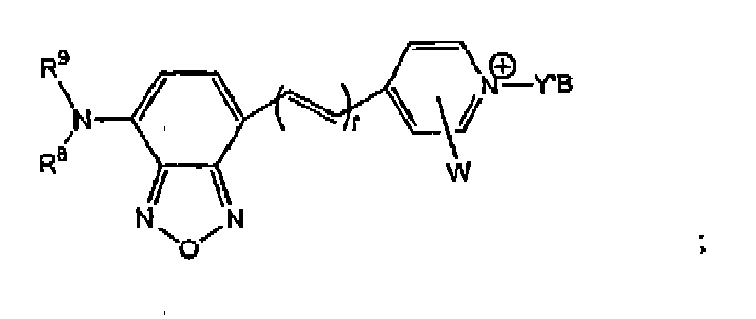


oder wobei Y'-B für A'-CO-V-B steht, wobei A' = -R2O- oder -R2N(R3)- ist, wobei R2 ein C1- bis C6-Alkyl ist, R3 = H oder CH3 ist und V-B = -CH2-B oder
wobei r eine ganze Zahl von 1 bis 3 ist, R8 und R9 unabhängig voneinander ein C1- bis C6-Alkyl oder (CH2)sCO2H sind, wobei s eine ganze Zahl von 2 bis 5 ist, Z = S, O oder C(CH3)2 ist, W = H, CH3, SO3H, anneliertes Benzol oder anneliertes Sulfobenzol ist; und
B ein Rezeptor mit einer Bindungsaffinität zu einem nachzuweisenden Liganden ist und wobei die Biosensorverbindung als Ergebnis von Veränderungen der Konzentration des Liganden eine nachweisbare Veränderung in einer Fluoreszenzeigenschaft zeigt. - Biosensorverbindung gemäß Anspruch 1, wobei die Biosensorverbindung aus der Gruppe ausgewählt ist, die aus


- Biosensorverbindung gemäß Anspruch 1 oder 2, wobei der Rezeptor ein Bindungsprotein ist.
- Biosensorverbindung gemäß Anspruch 1 oder 2, wobei B ein periplasmatisches Bindungsprotein ist.
- Biosensorverbindung gemäß Anspruch 1 oder 2, wobei die Biosensor-Fluoreszenzemission oberhalb von 575 nm liegt.
- Biosensorverbindung gemäß Anspruch 1 oder 2, wobei B ein Glucose/Galactose-bindendes Protein (GGBP) ist.
- Biosensor gemäß Anspruch 3, wobei das Bindungsprotein ein Glucose/Galactose-bindendes Protein ist, das wenigstens eine Aminosäuresubstitution umfasst, und wobei die wenigstens eine Aminosäuresubstitution aus der Gruppe ausgewählt ist, die aus einem Cystein auf Position 11, einem Cystein auf Position 14, einem Cystein auf Position 19, einem Cystein auf Position 43, einem Cystein auf Position 74, einem Cystein auf Position 107, einem Cystein auf Position 110, einem Cystein auf Position 112, einem Cystein auf Position 113, einem Cystein auf Position 137, einem Cystein auf Position 149, einem Cystein auf Position 213, einem Cystein auf Position 216, einem Cystein auf Position 238, einem Cystein auf Position 287, einem Cystein auf Position 292, einem Cystein auf Position 112 und einem Serin auf Position 238, einem Cystein auf Position 149 und einem Serin auf Position 238, einem Cystein auf Position 152 und einem Serin auf Position 213, einem Cystein auf Position 213 und einem Cystein auf Position 238, einem Cystein auf Position 149 und einem Arginin auf Position 213, einem Cystein auf Position 149 und einem Serin auf Position 213 und einem Serin auf Position 238 sowie einem Cystein auf Position 149 und einem Arginin auf Position 213 und einem Serin auf Position 238 besteht.
- Biosensorverbindung gemäß Anspruch 1, wobei R2O = -CH2CH2O- ist.
- Biosensorverbindung gemäß Anspruch 1, wobei R2N(R3)= -CH2CH2NH-ist.
- Verfahren zum Nachweisen eines Analyten, umfassend:Bereitstellen einer Biosensorverbindung, die wenigstens ein mutiertes Bindungsprotein aufweist, an das ein Fluorophor über eine Thiolgruppe des Bindungsproteins kovalent gebunden ist, wobei der Fluorophor eine Fluoreszenzemission von wenigstens 575 nm aufweist und aus der Gruppe ausgewählt ist, die aus Folgenden besteht:


oder wobei Y'-B für A'-CO-V-B steht, wobei A' = -R2O- oder -R2N(R3)- ist, wobei R2 ein C1- bis C6-Alkyl ist, R3 = H oder CH3 ist und V-B = -CH2-B oder
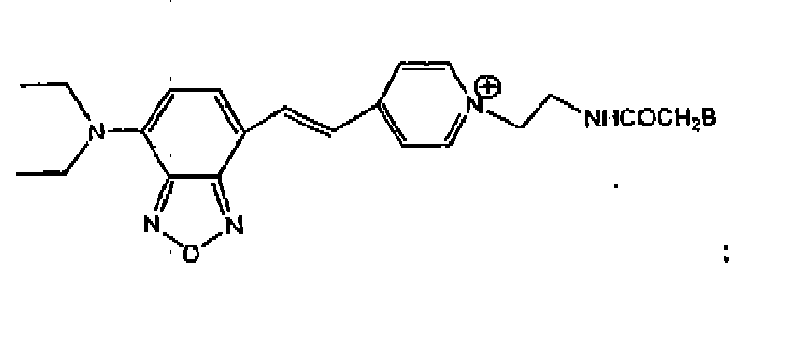
wobei r eine ganze Zahl von 1 bis 3 ist, R8 und R9 unabhängig voneinander ein C1- bis C6-Alkyl oder (CH2)5CO2H sind, wobei s eine ganze Zahl von 2 bis 5 ist, Z = S, O oder C(CH3)2 ist, W = H, CH3, SO3H, anneliertes Benzol oder anneliertes Sulfobenzol ist; undB ein Rezeptor mit einer Bindungsaffinität zu einem nachzuweisenden Liganden ist und wobei die Biosensorverbindung als Ergebnis von Veränderungen der Konzentration des Liganden eine nachweisbare Veränderung in einer Fluoreszenzeigenschaft zeigt;In-Kontakt-Bringen des Bindungsproteins mit einer Analytenquelle, um den Analyten an das Bindungsprotein zu binden; undEinwirkenlassen einer Energiequelle auf das Bindungsprotein, so dass der Fluorophor angeregt wird, und Nachweisen einer Fluoreszenzeigenschaft als Indikator für einen Analyten oder eine Analytenkonzentration in der Analytenquelle. - Verfahren gemäß Anspruch 10, wobei die Blosensorverbindung aus der Gruppe ausgewählt ist, die aus


- Verfahren gemäß Anspruch 10 oder 11, wobei das Bindungsprotein ein periplasmatisches Bindungsprotein ist.
- Verfahren gemäß Anspruch 10 oder 11, wobei das Verfahren das kontinuierliche In-Kontakt-Bringen des Bindungsproteins mit der Analytenquelle, das kontinuierliche Einwirkenlassen der Energiequelle auf das Bindungsprotein und das kontinuierliche Nachweisen der Fluoreszenzeigenschaft umfasst.
- Verfahren gemäß Anspruch 10 oder 11, wobei das mutierte Bindungsprotein als Ergebnis von Veränderungen der Analytenkonzentration in der Analytenquelle eine Konformationsänderung erfährt und wobei das Verfahren Veränderungen der Fluoreszenzeigenschaft als Ergebnis von Veränderungen der Analytenkonzentration nachweist.
- Verfahren gemäß Anspruch 10 oder 11, wobei das mutierte Bindungsprotein ein Glucose/Gälactose-bindendes Protein ist, das wenigstens eine Aminosäuresubstitution umfasst, und wobei die wenigstens eine Aminosäuresubstitution aus der Gruppe ausgewählt ist, die aus einem Cystein auf Position 11, einem Cystein auf Position 14, einem Cystein auf Position 19, einem Cystein auf Position 43, einem Cystein auf Position 74, einem Cystein auf Position 107, einem Cystein auf Position 110, einem Cystein auf Position 112, einem Cystein auf Position 113, einem Cystein auf Position 137, einem Cystein auf Position 149, einem Cystein auf Position 213, einem Cystein auf Position 216, einem Cystein auf Position 238, einem Cystein auf Position 287, einem Cystein auf Position 292, einem Cystein auf Position 112 und einem Serin auf Position 238, einem Cystein auf Position 149 und einem Serin auf Position 238, einem Cystein auf Position 152 und einem Serin auf Position 213, einem Cystein auf Position 213 und einem Cystein auf Position 238, einem Cystein auf Position 149 und einem Arginin auf Position 213, einem Cystein auf Position 149 und einem Serin auf Position 213 und einem Serin auf Position 238 sowie einem Cystein auf Position 149 und einem Arginin auf Position 213 und einem Serin auf Position 238 besteht.
- Verfahren gemäß Anspruch 10, wobei B ein Glucose/Galactose-bindendes Protein oder ein Maltose-bindendes Protein ist.
- Verfahren gemäß Anspruch 10, wobei R2O = -CH2CH2-O- ist.
- Verfahren gemäß Anspruch 10, wobei R2N(R3) = -CH2CH2NH- ist.
Applications Claiming Priority (4)
| Application Number | Priority Date | Filing Date | Title |
|---|---|---|---|
| US57394404P | 2004-05-21 | 2004-05-21 | |
| US59951404P | 2004-08-06 | 2004-08-06 | |
| EP08017855A EP2036953A3 (de) | 2004-05-21 | 2005-05-20 | Langwellige Thiol-reaktive Fluorophore |
| EP05812138A EP1751236A2 (de) | 2004-05-21 | 2005-05-20 | Langwellige thiol-reaktive fluorophorel |
Related Parent Applications (2)
| Application Number | Title | Priority Date | Filing Date |
|---|---|---|---|
| EP05812138.5 Division | 2005-05-20 | ||
| EP08017855.1 Division | 2008-10-11 |
Publications (2)
| Publication Number | Publication Date |
|---|---|
| EP2223971A1 EP2223971A1 (de) | 2010-09-01 |
| EP2223971B1 true EP2223971B1 (de) | 2011-11-09 |
Family
ID=35788237
Family Applications (3)
| Application Number | Title | Priority Date | Filing Date |
|---|---|---|---|
| EP08017855A Withdrawn EP2036953A3 (de) | 2004-05-21 | 2005-05-20 | Langwellige Thiol-reaktive Fluorophore |
| EP10163379A Expired - Lifetime EP2223971B1 (de) | 2004-05-21 | 2005-05-20 | Langwellige Thiolgruppenreaktive Fluorophore |
| EP05812138A Withdrawn EP1751236A2 (de) | 2004-05-21 | 2005-05-20 | Langwellige thiol-reaktive fluorophorel |
Family Applications Before (1)
| Application Number | Title | Priority Date | Filing Date |
|---|---|---|---|
| EP08017855A Withdrawn EP2036953A3 (de) | 2004-05-21 | 2005-05-20 | Langwellige Thiol-reaktive Fluorophore |
Family Applications After (1)
| Application Number | Title | Priority Date | Filing Date |
|---|---|---|---|
| EP05812138A Withdrawn EP1751236A2 (de) | 2004-05-21 | 2005-05-20 | Langwellige thiol-reaktive fluorophorel |
Country Status (7)
| Country | Link |
|---|---|
| US (4) | US7563891B2 (de) |
| EP (3) | EP2036953A3 (de) |
| JP (1) | JP2008500446A (de) |
| AT (1) | ATE532830T1 (de) |
| AU (1) | AU2005280581B9 (de) |
| CA (1) | CA2567387A1 (de) |
| WO (1) | WO2006025887A2 (de) |
Families Citing this family (24)
| Publication number | Priority date | Publication date | Assignee | Title |
|---|---|---|---|---|
| AU2007240316A1 (en) | 2006-04-20 | 2007-11-01 | Becton, Dickinson And Company | Thermostable proteins and methods of making and using thereof |
| US7553869B2 (en) | 2006-07-28 | 2009-06-30 | Pierce Biotechnology, Inc. | Protein probe compounds, compositions, and methods |
| WO2008013543A1 (en) * | 2006-07-28 | 2008-01-31 | Pierce Biotechnology, Inc. | Protein probe compounds, compositions, and methods |
| US8772047B2 (en) * | 2007-05-22 | 2014-07-08 | Becton, Dickinson And Company | Dyes having ratiometric fluorescence response for detecting metabolites |
| WO2008154332A1 (en) * | 2007-06-06 | 2008-12-18 | Becton, Dickinson And Company | Near-infrared dyes as surface enhanced raman scattering reporters |
| WO2009021039A1 (en) * | 2007-08-06 | 2009-02-12 | University Of Kentucky Research Foundation | Device for detection of molecules of interest |
| US9023661B2 (en) | 2007-10-18 | 2015-05-05 | Becton, Dickinson And Company | Visual glucose sensor and methods of use thereof |
| CN101177539B (zh) * | 2007-10-26 | 2010-10-27 | 淮海工学院 | 含香豆素的半菁染料 |
| US8389290B2 (en) | 2007-11-30 | 2013-03-05 | Becton, Dickinson And Company | Biosensor device for sensing amphipathic analytes |
| WO2009107448A1 (ja) * | 2008-02-29 | 2009-09-03 | 独立行政法人理化学研究所 | チオールの検出方法 |
| JP2009242379A (ja) * | 2008-03-11 | 2009-10-22 | Osaka Prefecture Univ | 共役化合物、該共役化合物を用いた光電変換素子及び光電気化学電池及び光電変換素子電解液 |
| US8741591B2 (en) | 2009-10-09 | 2014-06-03 | The Research Foundation For The State University Of New York | pH-insensitive glucose indicator protein |
| US8403332B2 (en) * | 2009-12-28 | 2013-03-26 | Nissan Kogyo Co., Ltd | Seal member |
| CN102183471A (zh) * | 2011-01-11 | 2011-09-14 | 山西大学 | 检测硫醇的方法和试剂盒 |
| WO2013035513A1 (ja) * | 2011-09-09 | 2013-03-14 | 株式会社島津製作所 | 親水性チオールプローブ |
| KR101508564B1 (ko) | 2011-12-09 | 2015-04-07 | 고려대학교 산학협력단 | 스쿠아레인 유도체, 염료감응 태양전지용 염료 및 염료감응 태양전지 |
| WO2013148957A1 (en) | 2012-03-28 | 2013-10-03 | Becton, Dickinson And Company | Hydrogel adhesion to molded polymers |
| CN102659775A (zh) * | 2012-04-28 | 2012-09-12 | 苏州大学 | 一种检测硫醇类化合物的荧光探针及其制备方法和用途 |
| US9791451B2 (en) * | 2013-08-30 | 2017-10-17 | Council Of Scientific & Industrial Research | Squaraine based fluorescent probe and a process for the preparation thereof |
| EP3126357A2 (de) * | 2014-04-04 | 2017-02-08 | Jawaharlal Nehru Centre For Advanced Scientific Research | Kleinmolekulare sonden, verfahren und deren verwendung |
| WO2017087051A1 (en) * | 2015-11-20 | 2017-05-26 | Duke University | Glucose biosensors and uses thereof |
| CN108727859B (zh) * | 2017-05-23 | 2019-12-17 | 福州大学 | 方酸染料及其在比色荧光双响应铜离子探针制备的应用 |
| KR102441852B1 (ko) * | 2018-02-28 | 2022-09-13 | 후지필름 가부시키가이샤 | 수지 조성물, 막, 광학 필터, 화상 표시 장치, 고체 촬상 소자, 및 화합물 |
| CN114524809B (zh) * | 2022-02-14 | 2023-06-13 | 五邑大学 | 一种香豆素衍生物及其制备方法和应用 |
Family Cites Families (35)
| Publication number | Priority date | Publication date | Assignee | Title |
|---|---|---|---|---|
| JPS5113035B2 (de) * | 1973-04-02 | 1976-04-24 | ||
| JPS57146771A (en) * | 1981-03-09 | 1982-09-10 | Mitsubishi Chem Ind Ltd | Coumarin derivative |
| JPS5855861A (ja) * | 1981-09-30 | 1983-04-02 | Toshihiko Namihisa | 新規な螢光標識抗体及びその製造方法 |
| US4507480A (en) | 1983-05-09 | 1985-03-26 | Xerox Corporation | Squaraines |
| JPS60169453A (ja) | 1984-02-13 | 1985-09-02 | Mitsubishi Chem Ind Ltd | 2,4−ビス(2′−モノ置換アミノ−4′−ジ置換アミノフエニル)シクロブテンジイリウム−1,3−ジオレ−ト類 |
| JPS60228448A (ja) | 1984-04-27 | 1985-11-13 | Mitsubishi Chem Ind Ltd | スクアリリウム化合物 |
| US5122602A (en) * | 1989-02-13 | 1992-06-16 | Miles Inc. | Chromogenic merocyanine enzyme substrates |
| CA2087413A1 (en) | 1992-01-17 | 1993-07-18 | Joseph R. Lakowicz | Fluorescent energy transfer immunoassay |
| GB9602265D0 (en) * | 1996-02-05 | 1996-04-03 | Amersham Int Plc | Benzophenoxazine dyes |
| CA2251985A1 (en) * | 1996-04-19 | 1997-10-30 | Alan Lewis Hamilton | Squarate dyes and their use in fluorescent sequencing method |
| US5696157A (en) * | 1996-11-15 | 1997-12-09 | Molecular Probes, Inc. | Sulfonated derivatives of 7-aminocoumarin |
| US5830912A (en) * | 1996-11-15 | 1998-11-03 | Molecular Probes, Inc. | Derivatives of 6,8-difluoro-7-hydroxycoumarin |
| WO1998038496A1 (en) | 1997-02-28 | 1998-09-03 | Lakowicz Joseph R | Measuring analytes with metal-ligand complex probes |
| JPH10330337A (ja) * | 1997-06-02 | 1998-12-15 | Aisin Seiki Co Ltd | 複環式アミド酸及び複環式マレイミド並びにこれらの製造方法 |
| ES2314996T3 (es) | 1997-12-31 | 2009-03-16 | Duke University | Biosensor de glucosa. |
| US6214628B1 (en) | 1998-01-14 | 2001-04-10 | Joseph R. Lakowicz | Method of conducting an assay of a sample containing an analyte of interest |
| US6538129B1 (en) | 1999-04-07 | 2003-03-25 | Ewald A. Terpetschnig | Luminescent compounds |
| AU759888B2 (en) | 1998-07-17 | 2003-05-01 | University Of Maryland At Baltimore | Engineered proteins for analyte sensing |
| US6395556B1 (en) | 1998-11-11 | 2002-05-28 | Joseph R. Lakowicz | Polarization based sensing |
| DE69909327T2 (de) | 1998-12-21 | 2004-04-22 | Sequella, Inc. | Verwendungsmethoden und zusammenstellungen enthaltend überwachungsystem |
| WO2000058405A2 (en) | 1999-03-31 | 2000-10-05 | Amersham Pharmacia Biotech Uk Limited | Squaraine dyes |
| DE19937024A1 (de) * | 1999-08-05 | 2001-02-08 | Bayer Ag | Verwendung von Acylsulfonamido substituierten Polymethin-Farbstoffen als Fluoreszenz-Farbstoffe und/oder Marker |
| US7566783B2 (en) | 2000-07-21 | 2009-07-28 | Joseph R Lakowicz | Long wavelength long lifetime luminophores |
| US6605459B2 (en) * | 2001-07-13 | 2003-08-12 | Paradigm Genetics, Inc. | Methods for measuring cysteine and determining cysteine synthase activity |
| US6977180B2 (en) | 2001-08-28 | 2005-12-20 | Duke University | Biosensor |
| DE10160524A1 (de) * | 2001-12-05 | 2003-06-26 | Dyomics Gmbh | Neue Fluoreszenzmarker mit großem Stokes-Shift |
| US7851593B2 (en) | 2002-01-04 | 2010-12-14 | Becton, Dickinson And Company | Binding proteins as biosensors |
| US6855556B2 (en) * | 2002-01-04 | 2005-02-15 | Becton, Dickinson And Company | Binding protein as biosensors |
| US20030153026A1 (en) | 2002-01-04 | 2003-08-14 | Javier Alarcon | Entrapped binding protein as biosensors |
| AU2003221788A1 (en) | 2002-04-30 | 2003-11-17 | University Of Maryland, Baltimore | Fluorescence sensing |
| US20040087842A1 (en) | 2002-05-30 | 2004-05-06 | Lakowicz Joseph R. | Fluorescent probes for saccharrides |
| DE60326256D1 (de) | 2002-10-16 | 2009-04-02 | Univ Duke | Biosensor zum nachweis von glukose |
| US20040234962A1 (en) | 2003-05-02 | 2004-11-25 | Javier Alarcon | Multicoated or multilayer entrapment matrix for protein biosensor |
| AU2004239208A1 (en) | 2003-05-09 | 2004-11-25 | University Of Maryland Baltimore County | Proteins, sensors, and methods of characterizing analytes using the same |
| US7304168B2 (en) * | 2003-08-14 | 2007-12-04 | Board Of Regents, University Of Texas System | Photo-caged fluorescent molecules |
-
2005
- 2005-05-18 US US11/131,283 patent/US7563891B2/en not_active Expired - Fee Related
- 2005-05-20 JP JP2007527456A patent/JP2008500446A/ja active Pending
- 2005-05-20 EP EP08017855A patent/EP2036953A3/de not_active Withdrawn
- 2005-05-20 AU AU2005280581A patent/AU2005280581B9/en not_active Ceased
- 2005-05-20 AT AT10163379T patent/ATE532830T1/de active
- 2005-05-20 WO PCT/US2005/017648 patent/WO2006025887A2/en not_active Ceased
- 2005-05-20 EP EP10163379A patent/EP2223971B1/de not_active Expired - Lifetime
- 2005-05-20 EP EP05812138A patent/EP1751236A2/de not_active Withdrawn
- 2005-05-20 CA CA002567387A patent/CA2567387A1/en not_active Abandoned
-
2009
- 2009-06-22 US US12/489,078 patent/US7767821B2/en not_active Expired - Fee Related
- 2009-06-22 US US12/489,121 patent/US8129525B2/en not_active Expired - Fee Related
- 2009-06-22 US US12/489,145 patent/US8071794B2/en not_active Expired - Fee Related
Also Published As
| Publication number | Publication date |
|---|---|
| EP2036953A3 (de) | 2010-07-14 |
| AU2005280581B2 (en) | 2011-09-08 |
| US8071794B2 (en) | 2011-12-06 |
| ATE532830T1 (de) | 2011-11-15 |
| JP2008500446A (ja) | 2008-01-10 |
| US20060280652A1 (en) | 2006-12-14 |
| WO2006025887A3 (en) | 2006-08-10 |
| US20110184168A1 (en) | 2011-07-28 |
| WO2006025887A2 (en) | 2006-03-09 |
| EP1751236A2 (de) | 2007-02-14 |
| US20100167417A1 (en) | 2010-07-01 |
| CA2567387A1 (en) | 2006-03-09 |
| US7767821B2 (en) | 2010-08-03 |
| EP2223971A1 (de) | 2010-09-01 |
| AU2005280581B9 (en) | 2012-02-02 |
| AU2005280581A1 (en) | 2006-03-09 |
| US20100003763A1 (en) | 2010-01-07 |
| US7563891B2 (en) | 2009-07-21 |
| US8129525B2 (en) | 2012-03-06 |
| EP2036953A2 (de) | 2009-03-18 |
Similar Documents
| Publication | Publication Date | Title |
|---|---|---|
| EP2223971B1 (de) | Langwellige Thiolgruppenreaktive Fluorophore | |
| JP7068191B2 (ja) | 蛍光または有色レポーター基を含むイオン性ポリマー | |
| JP7071286B2 (ja) | 超明色ダイマーまたはポリマー染料 | |
| JP7049113B2 (ja) | 超明色ダイマーまたはポリマー染料 | |
| KR102525252B1 (ko) | 강성 공간군을 갖는 매우 밝은 이량체성 또는 중합체성 염료 | |
| US20210095130A1 (en) | Ultra bright dimeric or polymeric dyes and methods for preparation of the same | |
| US8344158B2 (en) | Fluorescent polymethine cyanine dyes | |
| CN107454903A (zh) | 包含共轭基团的水溶性荧光或着色染料 | |
| JPWO2010126077A1 (ja) | 近赤外蛍光化合物 | |
| DE69624623T2 (de) | Versteifte Monomethin-Cyaninfarbstoffe | |
| JPH093343A (ja) | 新規なオキサジン染料およびその染料の蛍光マーカーとしての使用 | |
| JP4098839B2 (ja) | インドシアニン化合物 | |
| CN108299438A (zh) | pH响应性近红外荧光探针化合物及其制备方法和应用 | |
| US9127164B2 (en) | Fluorescent dyes and uses thereof | |
| JP2001002951A (ja) | 新規な蛍光色素およびその蛍光マーカーとしての使用 | |
| US5958673A (en) | Fluorescent dye | |
| JP5261718B2 (ja) | 蛍光プローブ | |
| KR101125057B1 (ko) | 물질 표지용 화합물 및 그 제조방법 | |
| CN102050813A (zh) | 荧光猝灭剂分子及其方法和用途 | |
| EP1163372A1 (de) | Chemisch reaktive in einer ebene erstarrte cyaninfarbstoffe sowie derivate | |
| WO2001002558A1 (en) | Probe for analysis of nucleic acids | |
| ZA200610260B (en) | Long wavelength thiol-reactive fluorophores | |
| JPWO2006054426A1 (ja) | 高蛍光量子収率型疎水性蛍光プローブ、それを用いる生体高分子検出法ならびに生体高分子間相互作用検出法 | |
| CN117143153A (zh) | 一种靶向线粒体的汞离子荧光探针及其制备和应用 | |
| JP2001163900A (ja) | 蛍光アビジン |
Legal Events
| Date | Code | Title | Description |
|---|---|---|---|
| PUAI | Public reference made under article 153(3) epc to a published international application that has entered the european phase |
Free format text: ORIGINAL CODE: 0009012 |
|
| AC | Divisional application: reference to earlier application |
Ref document number: 1751236 Country of ref document: EP Kind code of ref document: P Ref document number: 2036953 Country of ref document: EP Kind code of ref document: P |
|
| AK | Designated contracting states |
Kind code of ref document: A1 Designated state(s): AT BE BG CH CY CZ DE DK EE ES FI FR GB GR HU IE IS IT LI LT LU MC NL PL PT RO SE SI SK TR |
|
| 17P | Request for examination filed |
Effective date: 20110216 |
|
| GRAP | Despatch of communication of intention to grant a patent |
Free format text: ORIGINAL CODE: EPIDOSNIGR1 |
|
| RIC1 | Information provided on ipc code assigned before grant |
Ipc: G01N 33/58 20060101ALI20110406BHEP Ipc: C09B 57/00 20060101AFI20110406BHEP Ipc: C09B 23/10 20060101ALI20110406BHEP |
|
| GRAS | Grant fee paid |
Free format text: ORIGINAL CODE: EPIDOSNIGR3 |
|
| GRAA | (expected) grant |
Free format text: ORIGINAL CODE: 0009210 |
|
| AC | Divisional application: reference to earlier application |
Ref document number: 2036953 Country of ref document: EP Kind code of ref document: P Ref document number: 1751236 Country of ref document: EP Kind code of ref document: P |
|
| AK | Designated contracting states |
Kind code of ref document: B1 Designated state(s): AT BE BG CH CY CZ DE DK EE ES FI FR GB GR HU IE IS IT LI LT LU MC NL PL PT RO SE SI SK TR |
|
| REG | Reference to a national code |
Ref country code: GB Ref legal event code: FG4D |
|
| REG | Reference to a national code |
Ref country code: CH Ref legal event code: EP |
|
| REG | Reference to a national code |
Ref country code: IE Ref legal event code: FG4D |
|
| REG | Reference to a national code |
Ref country code: DE Ref legal event code: R096 Ref document number: 602005031180 Country of ref document: DE Effective date: 20120119 |
|
| REG | Reference to a national code |
Ref country code: NL Ref legal event code: VDEP Effective date: 20111109 |
|
| LTIE | Lt: invalidation of european patent or patent extension |
Effective date: 20111109 |
|
| PG25 | Lapsed in a contracting state [announced via postgrant information from national office to epo] |
Ref country code: IS Free format text: LAPSE BECAUSE OF FAILURE TO SUBMIT A TRANSLATION OF THE DESCRIPTION OR TO PAY THE FEE WITHIN THE PRESCRIBED TIME-LIMIT Effective date: 20120309 Ref country code: LT Free format text: LAPSE BECAUSE OF FAILURE TO SUBMIT A TRANSLATION OF THE DESCRIPTION OR TO PAY THE FEE WITHIN THE PRESCRIBED TIME-LIMIT Effective date: 20111109 |
|
| PG25 | Lapsed in a contracting state [announced via postgrant information from national office to epo] |
Ref country code: GR Free format text: LAPSE BECAUSE OF FAILURE TO SUBMIT A TRANSLATION OF THE DESCRIPTION OR TO PAY THE FEE WITHIN THE PRESCRIBED TIME-LIMIT Effective date: 20120210 Ref country code: BE Free format text: LAPSE BECAUSE OF FAILURE TO SUBMIT A TRANSLATION OF THE DESCRIPTION OR TO PAY THE FEE WITHIN THE PRESCRIBED TIME-LIMIT Effective date: 20111109 Ref country code: NL Free format text: LAPSE BECAUSE OF FAILURE TO SUBMIT A TRANSLATION OF THE DESCRIPTION OR TO PAY THE FEE WITHIN THE PRESCRIBED TIME-LIMIT Effective date: 20111109 Ref country code: SE Free format text: LAPSE BECAUSE OF FAILURE TO SUBMIT A TRANSLATION OF THE DESCRIPTION OR TO PAY THE FEE WITHIN THE PRESCRIBED TIME-LIMIT Effective date: 20111109 Ref country code: SI Free format text: LAPSE BECAUSE OF FAILURE TO SUBMIT A TRANSLATION OF THE DESCRIPTION OR TO PAY THE FEE WITHIN THE PRESCRIBED TIME-LIMIT Effective date: 20111109 Ref country code: PL Free format text: LAPSE BECAUSE OF FAILURE TO SUBMIT A TRANSLATION OF THE DESCRIPTION OR TO PAY THE FEE WITHIN THE PRESCRIBED TIME-LIMIT Effective date: 20111109 Ref country code: PT Free format text: LAPSE BECAUSE OF FAILURE TO SUBMIT A TRANSLATION OF THE DESCRIPTION OR TO PAY THE FEE WITHIN THE PRESCRIBED TIME-LIMIT Effective date: 20120309 |
|
| PG25 | Lapsed in a contracting state [announced via postgrant information from national office to epo] |
Ref country code: CY Free format text: LAPSE BECAUSE OF FAILURE TO SUBMIT A TRANSLATION OF THE DESCRIPTION OR TO PAY THE FEE WITHIN THE PRESCRIBED TIME-LIMIT Effective date: 20111109 |
|
| PG25 | Lapsed in a contracting state [announced via postgrant information from national office to epo] |
Ref country code: BG Free format text: LAPSE BECAUSE OF FAILURE TO SUBMIT A TRANSLATION OF THE DESCRIPTION OR TO PAY THE FEE WITHIN THE PRESCRIBED TIME-LIMIT Effective date: 20120209 Ref country code: EE Free format text: LAPSE BECAUSE OF FAILURE TO SUBMIT A TRANSLATION OF THE DESCRIPTION OR TO PAY THE FEE WITHIN THE PRESCRIBED TIME-LIMIT Effective date: 20111109 Ref country code: CZ Free format text: LAPSE BECAUSE OF FAILURE TO SUBMIT A TRANSLATION OF THE DESCRIPTION OR TO PAY THE FEE WITHIN THE PRESCRIBED TIME-LIMIT Effective date: 20111109 Ref country code: DK Free format text: LAPSE BECAUSE OF FAILURE TO SUBMIT A TRANSLATION OF THE DESCRIPTION OR TO PAY THE FEE WITHIN THE PRESCRIBED TIME-LIMIT Effective date: 20111109 Ref country code: SK Free format text: LAPSE BECAUSE OF FAILURE TO SUBMIT A TRANSLATION OF THE DESCRIPTION OR TO PAY THE FEE WITHIN THE PRESCRIBED TIME-LIMIT Effective date: 20111109 |
|
| PG25 | Lapsed in a contracting state [announced via postgrant information from national office to epo] |
Ref country code: RO Free format text: LAPSE BECAUSE OF FAILURE TO SUBMIT A TRANSLATION OF THE DESCRIPTION OR TO PAY THE FEE WITHIN THE PRESCRIBED TIME-LIMIT Effective date: 20111109 Ref country code: IT Free format text: LAPSE BECAUSE OF FAILURE TO SUBMIT A TRANSLATION OF THE DESCRIPTION OR TO PAY THE FEE WITHIN THE PRESCRIBED TIME-LIMIT Effective date: 20111109 |
|
| PLBE | No opposition filed within time limit |
Free format text: ORIGINAL CODE: 0009261 |
|
| STAA | Information on the status of an ep patent application or granted ep patent |
Free format text: STATUS: NO OPPOSITION FILED WITHIN TIME LIMIT |
|
| REG | Reference to a national code |
Ref country code: AT Ref legal event code: MK05 Ref document number: 532830 Country of ref document: AT Kind code of ref document: T Effective date: 20111109 |
|
| 26N | No opposition filed |
Effective date: 20120810 |
|
| REG | Reference to a national code |
Ref country code: DE Ref legal event code: R097 Ref document number: 602005031180 Country of ref document: DE Effective date: 20120810 |
|
| PG25 | Lapsed in a contracting state [announced via postgrant information from national office to epo] |
Ref country code: MC Free format text: LAPSE BECAUSE OF NON-PAYMENT OF DUE FEES Effective date: 20120531 |
|
| REG | Reference to a national code |
Ref country code: CH Ref legal event code: PL |
|
| PG25 | Lapsed in a contracting state [announced via postgrant information from national office to epo] |
Ref country code: LI Free format text: LAPSE BECAUSE OF NON-PAYMENT OF DUE FEES Effective date: 20120531 Ref country code: AT Free format text: LAPSE BECAUSE OF FAILURE TO SUBMIT A TRANSLATION OF THE DESCRIPTION OR TO PAY THE FEE WITHIN THE PRESCRIBED TIME-LIMIT Effective date: 20111109 Ref country code: CH Free format text: LAPSE BECAUSE OF NON-PAYMENT OF DUE FEES Effective date: 20120531 |
|
| REG | Reference to a national code |
Ref country code: IE Ref legal event code: MM4A |
|
| PG25 | Lapsed in a contracting state [announced via postgrant information from national office to epo] |
Ref country code: IE Free format text: LAPSE BECAUSE OF NON-PAYMENT OF DUE FEES Effective date: 20120520 Ref country code: ES Free format text: LAPSE BECAUSE OF FAILURE TO SUBMIT A TRANSLATION OF THE DESCRIPTION OR TO PAY THE FEE WITHIN THE PRESCRIBED TIME-LIMIT Effective date: 20120220 |
|
| PG25 | Lapsed in a contracting state [announced via postgrant information from national office to epo] |
Ref country code: FI Free format text: LAPSE BECAUSE OF FAILURE TO SUBMIT A TRANSLATION OF THE DESCRIPTION OR TO PAY THE FEE WITHIN THE PRESCRIBED TIME-LIMIT Effective date: 20111109 |
|
| PG25 | Lapsed in a contracting state [announced via postgrant information from national office to epo] |
Ref country code: TR Free format text: LAPSE BECAUSE OF FAILURE TO SUBMIT A TRANSLATION OF THE DESCRIPTION OR TO PAY THE FEE WITHIN THE PRESCRIBED TIME-LIMIT Effective date: 20111109 |
|
| PG25 | Lapsed in a contracting state [announced via postgrant information from national office to epo] |
Ref country code: LU Free format text: LAPSE BECAUSE OF NON-PAYMENT OF DUE FEES Effective date: 20120520 |
|
| PG25 | Lapsed in a contracting state [announced via postgrant information from national office to epo] |
Ref country code: HU Free format text: LAPSE BECAUSE OF FAILURE TO SUBMIT A TRANSLATION OF THE DESCRIPTION OR TO PAY THE FEE WITHIN THE PRESCRIBED TIME-LIMIT Effective date: 20050520 |
|
| REG | Reference to a national code |
Ref country code: FR Ref legal event code: PLFP Year of fee payment: 12 |
|
| REG | Reference to a national code |
Ref country code: FR Ref legal event code: PLFP Year of fee payment: 13 |
|
| REG | Reference to a national code |
Ref country code: FR Ref legal event code: PLFP Year of fee payment: 14 |
|
| PGFP | Annual fee paid to national office [announced via postgrant information from national office to epo] |
Ref country code: DE Payment date: 20180419 Year of fee payment: 14 |
|
| PGFP | Annual fee paid to national office [announced via postgrant information from national office to epo] |
Ref country code: FR Payment date: 20180423 Year of fee payment: 14 |
|
| PGFP | Annual fee paid to national office [announced via postgrant information from national office to epo] |
Ref country code: GB Payment date: 20180419 Year of fee payment: 14 |
|
| REG | Reference to a national code |
Ref country code: DE Ref legal event code: R119 Ref document number: 602005031180 Country of ref document: DE |
|
| GBPC | Gb: european patent ceased through non-payment of renewal fee |
Effective date: 20190520 |
|
| PG25 | Lapsed in a contracting state [announced via postgrant information from national office to epo] |
Ref country code: GB Free format text: LAPSE BECAUSE OF NON-PAYMENT OF DUE FEES Effective date: 20190520 Ref country code: DE Free format text: LAPSE BECAUSE OF NON-PAYMENT OF DUE FEES Effective date: 20191203 |
|
| PG25 | Lapsed in a contracting state [announced via postgrant information from national office to epo] |
Ref country code: FR Free format text: LAPSE BECAUSE OF NON-PAYMENT OF DUE FEES Effective date: 20190531 |