EP2136258A2 - Elektronisches Gerät, das zum globalen Umweltschutz beiträgt - Google Patents
Elektronisches Gerät, das zum globalen Umweltschutz beiträgt Download PDFInfo
- Publication number
- EP2136258A2 EP2136258A2 EP09162959A EP09162959A EP2136258A2 EP 2136258 A2 EP2136258 A2 EP 2136258A2 EP 09162959 A EP09162959 A EP 09162959A EP 09162959 A EP09162959 A EP 09162959A EP 2136258 A2 EP2136258 A2 EP 2136258A2
- Authority
- EP
- European Patent Office
- Prior art keywords
- electronic apparatus
- unit
- consumable goods
- identification information
- accorded
- Prior art date
- Legal status (The legal status is an assumption and is not a legal conclusion. Google has not performed a legal analysis and makes no representation as to the accuracy of the status listed.)
- Withdrawn
Links
Images






Classifications
-
- G—PHYSICS
- G03—PHOTOGRAPHY; CINEMATOGRAPHY; ANALOGOUS TECHNIQUES USING WAVES OTHER THAN OPTICAL WAVES; ELECTROGRAPHY; HOLOGRAPHY
- G03G—ELECTROGRAPHY; ELECTROPHOTOGRAPHY; MAGNETOGRAPHY
- G03G15/00—Apparatus for electrographic processes using a charge pattern
- G03G15/55—Self-diagnostics; Malfunction or lifetime display
-
- G—PHYSICS
- G03—PHOTOGRAPHY; CINEMATOGRAPHY; ANALOGOUS TECHNIQUES USING WAVES OTHER THAN OPTICAL WAVES; ELECTROGRAPHY; HOLOGRAPHY
- G03G—ELECTROGRAPHY; ELECTROPHOTOGRAPHY; MAGNETOGRAPHY
- G03G15/00—Apparatus for electrographic processes using a charge pattern
- G03G15/50—Machine control of apparatus for electrographic processes using a charge pattern, e.g. regulating differents parts of the machine, multimode copiers, microprocessor control
- G03G15/5016—User-machine interface; Display panels; Control console
- G03G15/502—User-machine interface; Display panels; Control console relating to the structure of the control menu, e.g. pop-up menus, help screens
-
- G—PHYSICS
- G03—PHOTOGRAPHY; CINEMATOGRAPHY; ANALOGOUS TECHNIQUES USING WAVES OTHER THAN OPTICAL WAVES; ELECTROGRAPHY; HOLOGRAPHY
- G03G—ELECTROGRAPHY; ELECTROPHOTOGRAPHY; MAGNETOGRAPHY
- G03G15/00—Apparatus for electrographic processes using a charge pattern
- G03G15/50—Machine control of apparatus for electrographic processes using a charge pattern, e.g. regulating differents parts of the machine, multimode copiers, microprocessor control
- G03G15/5075—Remote control machines, e.g. by a host
-
- G—PHYSICS
- G03—PHOTOGRAPHY; CINEMATOGRAPHY; ANALOGOUS TECHNIQUES USING WAVES OTHER THAN OPTICAL WAVES; ELECTROGRAPHY; HOLOGRAPHY
- G03G—ELECTROGRAPHY; ELECTROPHOTOGRAPHY; MAGNETOGRAPHY
- G03G15/00—Apparatus for electrographic processes using a charge pattern
- G03G15/55—Self-diagnostics; Malfunction or lifetime display
- G03G15/553—Monitoring or warning means for exhaustion or lifetime end of consumables, e.g. indication of insufficient copy sheet quantity for a job
-
- G—PHYSICS
- G03—PHOTOGRAPHY; CINEMATOGRAPHY; ANALOGOUS TECHNIQUES USING WAVES OTHER THAN OPTICAL WAVES; ELECTROGRAPHY; HOLOGRAPHY
- G03G—ELECTROGRAPHY; ELECTROPHOTOGRAPHY; MAGNETOGRAPHY
- G03G21/00—Arrangements not provided for by groups G03G13/00 - G03G19/00, e.g. cleaning, elimination of residual charge
- G03G21/16—Mechanical means for facilitating the maintenance of the apparatus, e.g. modular arrangements
- G03G21/18—Mechanical means for facilitating the maintenance of the apparatus, e.g. modular arrangements using a processing cartridge, whereby the process cartridge comprises at least two image processing means in a single unit
- G03G21/1875—Mechanical means for facilitating the maintenance of the apparatus, e.g. modular arrangements using a processing cartridge, whereby the process cartridge comprises at least two image processing means in a single unit provided with identifying means or means for storing process- or use parameters, e.g. lifetime of the cartridge
- G03G21/1878—Electronically readable memory
- G03G21/1889—Electronically readable memory for auto-setting of process parameters, lifetime, usage
-
- G—PHYSICS
- G03—PHOTOGRAPHY; CINEMATOGRAPHY; ANALOGOUS TECHNIQUES USING WAVES OTHER THAN OPTICAL WAVES; ELECTROGRAPHY; HOLOGRAPHY
- G03G—ELECTROGRAPHY; ELECTROPHOTOGRAPHY; MAGNETOGRAPHY
- G03G2215/00—Apparatus for electrophotographic processes
- G03G2215/00025—Machine control, e.g. regulating different parts of the machine
- G03G2215/00109—Remote control of apparatus, e.g. by a host
Definitions
- the present invention relates to an electronic apparatus, in which a refill cartridge (consumable goods) or a replacement part that is accorded a right to emit greenhouse gas (GHG) is used for global environmental concerns.
- a refill cartridge consumer goods
- GHG greenhouse gas
- Unexamined Japanese Patent Application KOKAI Publication No. 2007-249563 is an example invention of an information processing apparatus including a printer, which allows setting of a target value of its consumption of a resource such as sheets of paper, forecasts a future amount of its resource consumption based on the current status of its resource consumption, stops consuming the resource if it is impossible to attain the target and issues a report for the target to be accomplished.
- a printer which allows setting of a target value of its consumption of a resource such as sheets of paper, forecasts a future amount of its resource consumption based on the current status of its resource consumption, stops consuming the resource if it is impossible to attain the target and issues a report for the target to be accomplished.
- Unexamined Japanese Patent Application KOKAI Publication No. 2002-006696 is an example invention that translates an amount of power consumed during a certain period of time of use of an image forming apparatus and an amount of a refill cartridge consumed by the image forming apparatus during the same period of time into CO 2 , encourages a recommendable mode for reducing CO 2 emissions, and forecasts improvement in CO 2 emissions.
- each of which either outputs a report for reduction of resource consumption or forecasts improvement in CO 2 emissions can merely guide the user of the apparatus toward accomplishing the goal of tightening resource consumption by notifying the power consumption status, etc. to the user, or can merely notify a carbon dioxide emissions status corresponding to the use of the apparatus to the user to remind the user of a mode of use of the apparatus that will lead to reductions of emissions.
- these examples do not propose an electronic apparatus according to the present invention, which can use a refill cartridge or a replacement part that is sold with a right to emit greenhouse gas attached (by the manufacturer), recognizes that a cartridge or a replacement part with such an emission right is mounted thereon, and displays the degree of its eco (ecology (global environmental protection)) accomplishment and guidance or navigation about greenhouse gas.
- eco ecology (global environmental protection)
- the present invention provides a system for a manufacturer or a distributor of an electronic apparatus that emits greenhouse gas to share the expenses spent in contributing to carbon offset activities (including expenses for purchasing offset credits) with a user who purchases and uses the electronic apparatus, so that not only the manufacturer/distributor but the purchaser/user of the electronic apparatus may automatically participate in carbon offset activities and make cooperation and contribution to the global environmental protection.
- carbon offsetting is a global environmental protection activity that aims for bringing carbon dioxide (CO 2 ) generation substantially to zero by offsetting CO 2 that is unavoidably generated from living and business activities by carrying out activities such as tree plantation, forest protection, clean energy projects, etc. that aim for CO 2 reduction or absorption
- the system of the present invention seeks an activity of a manufacturer/distributor of an electronic apparatus for contributing part of proceeds from sales of refills or replacement parts to global environmental protection projects (including purchase of offset credits) and offsetting greenhouse gas emissions that amount to the power consumed by the electronic apparatus.
- GHG emissions amounting to the power consumed by the electronic apparatus are offset by acquisition of emission rights (Certified Emission Reductions (CERs)) that derive from greenhouse gas reduction projects (based on Clean Development Mechanism (CDM)) carried out all across the world.
- CERs Certified Emission Reductions
- CDM Clean Development Mechanism
- the expenses spent on the acquisition are partially reflected in the sales price of refills and replacement parts of the electronic apparatus, these refills and replacement parts (which reflect such expenses) are given a sign (tag/mark, etc.) that enables them to be identified as being accorded a right to emit greenhouse gas, and the electronic apparatus is equipped with a capability for recognizing that such a refill or replacement part with the right to emit GHG is used thereon, so that a user who cooperates in the environmental enhancement activity can obtain benefits and thus be encouraged to continuously cooperate in the global environmental protection activity.
- the present invention was made in view of the above circumstances, and an object of the present invention is to provide an electronic apparatus that enables its user to be convinced that he/she has committed to reducing greenhouse gas emission that accompanies power consumption by the electronic apparatus by letting the user him/herself select and use a refill or a replacement part with a greenhouse gas emission right, and leads the user to join and contribute to an activity for reducing greenhouse gas emissions.
- a refill or a replacement part with a greenhouse gas emission right is an article that is provided to a user in the form of an "emission right accorded", by a manufacturer or distributor of the refill or the replacement part or a manufacturer or distributor of an electronic apparatus that uses the refill or the replacement part, who has beforehand purchased on behalf of the user a quota of "Certified Emission Reductions (CERs)" for a "greenhouse gas reduction project” that is registered to the international Clean Development Mechanism (CDM) board of directors, with a view to calling for cooperation from a purchaser of the refill/replacement part of the electronic apparatus to let him/her shoulder part of the cost of CERs.)
- CERs Cosmetic Emission Reductions
- An electronic apparatus (1, 31, 35) is an electronic apparatus (1, 31, 35) that operates with a replaceable consumable goods (15, 30, 34) attached in a body of the electronic apparatus (1, 31, 35), and includes: a consumable goods attachment supporting unit (32) that supports the consumable goods (15, 30, 34) to the body in an attachable and detachable manner; a detecting unit (16) that detects identification information (sign) that indicates that a right to emit GHG is accorded to the consumable goods (15, 30, 34), from the consumable goods (15, 30, 34), which is attached in the body, an evaluating unit (S9) that evaluates a degree of contribution by the electronic apparatus (1, 31, 35) to an activity for reducing the GHG, in response to detection of the identification information; and a displaying unit (5, 33, 36) that displays an evaluation result obtained by the evaluating unit (S9).
- a consumable goods attachment supporting unit (32) that supports the consumable goods (15, 30, 34) to the body in an attachable and detachable manner
- the electronic apparatus (1, 31, 35) includes a memorizing unit (17) that memorizes a use status of a consumable goods (15, 30, 34) that is accorded an emission right, and the evaluating unit (S9) evaluates a frequency of use of the consumable goods (15, 30, 34) that is accorded the emission right.
- the electronic apparatus (1, 31, 35) includes a memorizing unit (17) that memorizes a use status of a consumable goods (15, 30, 34) that is accorded an emission right, and the evaluating unit (S9) evaluates a continuous use status of the consumable goods (15, 30, 34) that is accorded the emission right.
- the evaluating unit (S9) used by an electronic apparatus (1, 31, 35) obtains an evaluation result by incrementing or decrementing a predetermined point according to a frequency of use or a continuous use status of the consumable goods (15, 30, 34) that is accorded the emission right, and provides a benefit to a user of the electronic apparatus (1, 31, 35) according to a level of the point, which is finally obtained.
- the detecting unit (16) used by the electronic apparatus (1, 31, 35) is a reading unit that reads identification information stored in RFID that is pasted on the consumable goods (15, 30, 34), and the identification information is read by the reading unit when the consumable goods (15, 30, 34) is attached in the apparatus body while the RFID is left contactless with the apparatus body.
- the detecting unit (16) used by the electronic apparatus (1, 31, 35) is a reading unit that reads identification information contained in a barcode that is marked on the consumable goods (15, 30, 34), and the identification information is read by the reading unit when the consumable goods (15, 30, 34) is attached in the apparatus body while the barcode is left contactless with the apparatus body.
- the identification information used by the electronic apparatus (1, 31, 35) according to a seventh aspect of the present invention is stored in a storage unit that is built in the consumable goods (15, 30, 34), and the identification information is read when the consumable goods (15, 30, 34) is attached in the body, with the storage unit connected to a control unit of the body.
- the electronic apparatus (1, 31, 35) is the electronic apparatus (1, 31, 35) that can run on a battery, and the consumable goods (15, 30, 34) is a battery that is replaceable in the apparatus body and used as a driving power source of the electronic apparatus (1, 31, 35).
- the electronic apparatus (1, 31, 35) is a recording apparatus that requires replenishment of a consumable goods (15, 30, 34), with which the apparatus performs recording, according to consumption of the consumable goods (15, 30, 34).
- the consumable goods (15, 30, 34) used by the electronic apparatus (1, 31, 35) is a toner cartridge (15a) filled with toner used for recording performed by the electronic apparatus (1, 31, 35).
- the consumable goods (15, 30, 34) used by the electronic apparatus (1, 31, 35) is an ink ribbon cartridge (30), in which an ink ribbon used for recording of the electronic apparatus (1, 31, 35) is contained.
- the consumable goods (15, 30, 34) used by an electronic apparatus (1, 31, 35) is an ink cartridge (34) filled with ink used for recording of the electronic apparatus (1, 31, 35).
- the electronic apparatus (1, 31, 35) is a recording apparatus that requires replacement of a consumable goods (15, 30, 34), with which the apparatus performs recording, according to wastage of the consumable goods (15, 30, 34).
- the consumable goods (15, 30, 34) used by the electronic apparatus (1, 31, 35) is a drum set (15b), in which a photoconductive drum used for recording performed by the electronic apparatus (1, 31, 35) is contained.
- An electronic apparatus (1, 31, 35) is the electronic apparatus (1, 31, 35) that operates with a replaceable consumable goods (15, 30, 34) attached in a body of the electronic apparatus (1, 31, 35), and includes: a consumable goods attachment supporting unit (32) that supports the consumable goods (15, 30, 34) to the body in an attachable and detachable manner; a detecting unit (16) that detects identification information (sign) that indicates that a GHG emission right is accorded to the consumable goods (15, 30, 34), from the consumable goods (15, 30, 34), which is attached in the body; a global environment enhancing feature that leads to reduction of GHG emissions in global environment; and a goal setting unit that sets a goal for reduction of GHG emissions, and when the identification information is detected by the detecting unit (16), a use status of the global environment enhancing feature is evaluated by an evaluating unit (S9), and a result obtained by the evaluating unit (S9) is displayed by a displaying unit (5, 33, 36).
- a consumable goods attachment supporting unit (32) that supports the
- the global environment enhancing feature used by the electronic apparatus (1, 31, 35) according to a sixteenth aspect of the present invention is based on a batch printing manner (PJ printing), and the goal setting unit sets a power saving level of the electronic apparatus (1, 31, 35) by designating a degree of the batch printing manner.
- the global environment enhancing feature used by the electronic apparatus (1, 31, 35) according to a seventeenth aspect of the present invention is based on a paper saving manner (N-in-1 printing), and the goal setting unit sets a paper consumption saving level of the electronic apparatus (1, 31, 35) by designating a degree of the paper saving manner.
- the global environment enhancing feature used by the electronic apparatus (1, 31, 35) is a toner saving feature, and the goal setting unit sets a toner consumption saving level of the electronic apparatus (1, 31, 35) by designating a degree of the toner saving feature.
- the electronic apparatus (1, 31, 35) has a power saving button (20) on an operation panel, and plural kinds of saving levels, which are set by the goal setting unit, are simultaneously set to a predetermined condition in response to the power saving button (20) being operated.
- the evaluating unit (S9) used by the electronic apparatus (1, 31, 35) includes a feature to evaluate a status of accomplishment of a goal set by the goal setting unit, and further includes a navigation unit (S10) that gives a user guidance about a manner to use the apparatus for accomplishing a goal that is set beforehand.
- the electronic apparatus (1, 31, 35) is connected via a line to a superordinate apparatus (PC 1) that performs a summing process, and sends an evaluation result obtained by the evaluating unit (S9) to the superordinate apparatus (PC1).
- PC 1 superordinate apparatus
- the electronic apparatus (1, 31, 35) is connected via Internet line to a remote management center (2) facility that performs a process of summing eco achievement of each electronic apparatus (1,31, 35), and sends an evaluation result obtained by the evaluating unit (S9) to the management center (2).
- the electronic apparatus (1, 31, 35) according to a twenty-third aspect of the present invention prints an evaluation result obtained by the evaluating unit (S9) on a recording medium (19).
- the electronic apparatus (1) is an electronic apparatus (1) that operates with a replaceable replacement part (15b) attached in a body of the electronic apparatus (1), and includes: a replacement part attachment supporting unit that supports the replacement part (15b) to the body in an attachable and detachable manner; a detecting unit (16) that detects identification information that indicates that a right to emit GHG is accorded to the replacement part (15b), from the replacement part (15b), which is attached in the body; an evaluating unit (S9) that evaluates a degree of contribution by the electronic apparatus (1) to an activity for reducing the GHG, in response to detection of the identification information; and a displaying unit (5) that displays an evaluation result obtained by the evaluating unit (S9).
- the replacement part (15b) is a replacement part (15b) that is replaceable in a body of an apparatus, completes its life span by being used by the apparatus for a preset period of time while it is set inside the body, and as a result is replaced with a new replacement part (15b), thereby keeping the apparatus functioning, the replacement part (15b) is affixed with identification information that indicates that a right to emit GHG is accorded to the replacement part (15b), the identification information being detected by a detecting unit (16) possessed by the apparatus when the replacement part (15b) is attached in the body, and a degree of contribution to an activity for reducing the GHG is evaluated in the apparatus in response to detection of the identification information.
- the consumable goods (15, 30, 34) is a consumable goods (15, 30, 34) that is replaceable in a body of an apparatus and affixed with identification information that indicates that a GHG emission right is accorded to the consumable goods (15, 30, 34), the identification information being read by a reading unit possessed by the apparatus when the consumable goods (15, 30, 34) is attached in the body, the consumable goods (15, 30, 34), which is set inside the body, being consumed by the apparatus.
- a refill unit (15, 30, 34) that is sold with a greenhouse gas emission right accorded is used as a refill unit (15, 30, 34) that is attachable and detachable to/from an electronic apparatus (1, 31, 35), greenhouse gas reduction is evaluated based on a continuous use status of such refill units (15, 30, 34), and the evaluation result is displayed on an operation panel or the like (5, 33, 36), or the evaluation result is printed on a sheet (19), which makes a user more conscious of greenhouse gas reduction.
- a replacement part (15b) that is sold with an emission right accorded is used as a replacement part (15b) that is attachable and detachable to/from an electronic apparatus (1), greenhouse gas reduction is evaluated based on a repetitive use status of such replacement parts (15b), and the evaluation result is displayed on a display unit such as an operation panel (5) or printed on a sheet (19), which makes a user more conscious of greenhouse gas reduction.
- Fig. 1 is a configuration diagram of a computer system including a printer according to the present embodiment.
- the printer 1 is connected to a plurality of personal computers (PC 1, PC2, etc.) via a Local Area Network (LAN), and to a management center 2 via the Internet.
- the printer 1 is locally connected to a personal computer (PC3) via a Universal Serial Bus (USB).
- the printer 1 receives print data from the personal computers (PC1 to PC3, etc.) described above, which are host apparatuses.
- the printer 1 includes a controller unit 3, an engine control unit 4, an operation panel unit 5, a high-pressure unit 6, a motor control unit 7, and various mechanisms. Such mechanisms include a drive unit 8, a paper feed unit 9, a head 10, a double-side printing unit 11, a belt unit 12, a fixing unit 13, a paper discharge unit 14, a TC/DS 15, a reader/sensor 16, and a nonvolatile memory 17.
- the printer 1 includes a power unit 18, which is supplied with commercial power (AC 100V).
- the controller unit 3 receives print data supplied by a host apparatus (any of the personal computers (PC1 to PC3), etc.), converts the received print data into bitmap data, and sends it to the engine control unit 4.
- the controller unit 3 controls the driving of each of the mechanisms described above to print out the bitmap data.
- the nonvolatile memory 17 records information about the number of times eco TCs have been continuously used (count data by which it is discriminated whether eco TCs are repetitively purchased and used), and a calculation of eco points, which serve as the basis by which an eco use degree described later is evaluated.
- an "eco TC" is a toner cartridge 15a, which is sold with a greenhouse gas emission right attached.
- the TC/DS 15 represents a toner cartridge 15a and a drum set 15b.
- the toner cartridge 15a is a toner refill cartridge that includes a developer in which toner is stored and that is attachable and detachable to/from the printer 1.
- the drum set 15b is a cartridge that includes a photoconductive drum and is attachable and detachable to/from the printer 1 (for replacement).
- the reader/sensor 16 is provided near the TC/DS 15 to sense whether the toner cartridge 15a and the drum set 15b are attached or detached (to sense their presence or absence and the presence or absence of an identification sign) and detect identification information about a greenhouse gas emission right (about whether they are the cartridges accorded a greenhouse gas emission right).
- Fig. 2 is a perspective diagram of the toner cartridge 15a and the drum set 15b, when they are attached or detached to/from the printer 1.
- the reference numerals used in Fig. 2 indicate the positions at which the units explained in Fig. 1 are disposed.
- the toner cartridge 15a and the drum set 15b are sold with a greenhouse gas emission right attached. This emission right is provided to a purchaser of the toner cartridge 15a, etc.
- the printer 1 includes an identifying unit that identifies that the article attached to the printer 1 is the toner cartridge 15a or the drum set 15b with an emission right.
- the printer 1 confirms the number of times replacements of refill cartridges have been done, which is identified by the identifying unit, (based on use management information recorded in a nonvolatile storage unit such as an HD), displays an evaluation of an eco use degree (whether eco refills are frequently/continuously used), and displays advice or navigation about ecology.
- CER Certified Emission Reduction (CER) mentioned above is an emission quota (credit) earned in the framework of the Clean Development Mechanism (CDM), and issued for an amount of emission reduction achieved by a CDM project, which amount is determined by a designated institution of the United Nations and verified by the CDM board of directors.
- CDM Clean Development Mechanism
- the identification information about accordance of an emission right to the toner cartridge 15a, etc. is in the form of pasting of a barcode label or a QR code (TM) label, mounting of a memory IC, attaching of a Radio Frequency Identification (RFID) tag, or the like.
- RFID Radio Frequency Identification
- different types of identification information to be provided to the toner cartridge 15a, etc. require different configurations of the reader/sensor 16.
- a barcode label or a QR code label is pasted on the toner cartridge 15a, etc. as a means to provide identification information indicating that the toner cartridge 15a, etc. are accorded a GHG emission right
- a known label sensor reader
- a reader that reads out data from the memory IC (via a connector that, when the cartridge is attached, connects the printer body (or the controller in the printer body) to the memory IC in the cartridge in a manner that enables data to be send and received therebetween) is used.
- an RFID tag In a case where an RFID tag is used as a means to provide the toner cartridge 15a, etc. with identification information indicating that the toner cartridge 15a, etc. are accorded an GHG emission right, an RFID tag (RFID sheet) that emits recognition information is pasted on the toner cartridge 15a, etc.
- the RFID sheet is pasted at a position that will be at a predetermined (communicable) distance from an antenna on a printer control board mounted in the printer 1 when the toner cartridge 15a, etc. are attached to the printer 1.
- the RFID sheet (RFID tag) and the reader/sensor 16 (receiver), which is disposed on the printer control board, contactlessly communicate with each other via the antenna.
- Fig. 3 is a flowchart that explains the process operation of the present example.
- S attachment of a cartridge or replacement of cartridges
- an eco point P is decremented (S3).
- the eco point P is the basis of evaluating the degree of cooperation in reducing greenhouse gas, and greenhouse gas reduction is evaluated based on the eco point P in a way described later.
- the determination (S2) finds that the attached or replaced new toner cartridge 15a is a product with a greenhouse gas emission right (S2; YES), it is further determined whether the cartridge is an unused product or not (S4). In a case where the attached cartridge is not an unused product (S4; NO), the eco point P is incremented (S5). On the other hand, in a case where the attached cartridge is an unused product (S4; YES), the number of times N eco TCs have been continuously used, which is stored in the nonvolatile memory 17, is read out (S6), and NxP, which is a continuous use eco point, is added (S7). That is, the eco point P is multiplied by the number of times N, and the product NxP is added to the eco point. After this, the number of times N eco TCs have been continuously used is incremented to N+1 (S8).
- the evaluation of the eco use degree is performed according to the result of calculation of the eco point.
- the evaluation point will be high as can be understood from the above calculation manner, and in a case where not many toner cartridges 15a with an emission right have been used, the evaluation point will be low.
- the frequency of use of toner cartridges 15a with an emission right determines the evaluation of the eco use degree.
- the eco point calculation manner described above is an example, and any calculation manner may be used as long as it can evaluate the frequency of use of eco TCs.
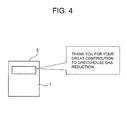
- Fig. 4 is a diagram showing a display example on the display device of the operation panel unit 5, which is an example of when the evaluation of the eco use degree is high, and indicates, for example, that "Thank you for your great contribution to green house gas reduction.”
- the evaluation of the eco use degree is low, for example, a message that "You are not cooperative to greenhouse gas reduction. We would strongly appreciate your cooperation to global environmental improvement based on eco product use" is displayed.
- the evaluation result of the eco use degree is sent to the personal computer (PC1), the host apparatus, via, for example, a LAN, so that the evaluation result may be summed (S11).
- Fig. 5 is a diagram that explains the summing process.
- the personal computer (PC1) siphons eco use mode logs from the printer 1 and displays them on the display. For example, in the example of Fig. 5 , an eco status tab is displayed, under which the current year's achievements of each printer are displayed as a cumulative amount of power, its equivalent translated into a CO 2 amount, a number of sheets printed, a rate of double-side printing use, a rate of multipage printing use, and a rate of toner saving use.
- the personal computer (PC1) manages sheets of paper not only in the eco use mode described above, but in an ordinary manner.
- the operation panel unit 5 of the printer 1 of the present example has a power saving button 20 by which the printer 1 is switched to a power saving mode operation. For example, by an operator giving a long press to the power saving button 20, a plurality of eco mode terms can be changed simultaneously by one operation to predetermined settings that are the most preferable, and the printer driver of the personal computers (PC1, PC2, etc.) that are connected to the printer 1 via the LAN is notified of the simultaneous eco mode setting.
- PC1, PC2, etc. the printer driver of the personal computers
- the printer of the present invention has a plurality of terms by which an eco mode is set, including, for example, a batch printing feature, a double-side printing feature, a multipage printing (2-in-1 printing, N-in-1 printing) feature, a toner saving feature, etc., and these terms are not set ready one by one. Instead, only one long press of the power saving button 20 enables the plurality of terms related to the eco mode of the printer driver to be forcibly set simultaneously.
- the evaluation result of the eco use degree is sent to the personal computer (PC 1), but it may be sent to the management center 2 via the Internet, so that the management center 2 may sum the eco achievements of the printer that exists on the net.
- the evaluation of the eco use degree is displayed on the operation panel unit 5, but it may be printed out as a printed output (sheet 19) as shown in Fig. 6 . Further, as shown in Fig. 7 , a young leaf mark may be printed. In a case where the evaluation of the eco use degree is high, many young leaf marks may be printed, with a special mark 19a printed on part of the young leaf marks to indicate that the evaluation of the eco use degree is high (that an eco product with an emission right has been used to perform this printing).
- the toner cartridge 15a that is sold with a greenhouse gas emission right accorded has been explained as a refill product that the user of the printer has to purchase after a certain period of time of use.
- a replacement part such as the drum set 15b, which the user will purchase and attach to the printer after a predetermined period of time elapses may be sold with a greenhouse gas emission right accorded, and an ecology contribution display may be output on the operation panel unit 5 based on the number of times such replacement parts have been replaced, i.e., the use of the drum set 15b.
- replacement parts with an emission right may be the structural parts in the printer that require regular replacement, for example, the belt unit, the fixing unit, the print head unit, etc., and may be anything as long as it is purchased by the user at his/her cost for using the printer.
- the present example aims for making the user more conscious of greenhouse gas reduction, by using the toner cartridge 15a and the drum set 15b with an emission right as refill cartridges (refill units), evaluating greenhouse gas emissions based on the use status of these cartridges, displaying the evaluation on the operation panel unit 5, and printing the evaluation on a sheet of paper.
- the printer used in the present example is not limited to the electrophotographic type described above, but may be an inkjet type, a thermal transfer type, etc.
- the objective refill cartridge may not necessarily be the toner cartridge 15a or the drum set 15b, but may be an ink ribbon, a receptacle cartridge for sheets of paper, etc.
- Fig. 8 is an example in which the present invention is applied to a thermal transfer type printer.
- a thermal ribbon 30 is attachable and detachable to/from the printer 31, and when the thermal ribbon 30, which is accorded an emission right, is attached to an attachment section 32 of the printer 31, an unillustrated reader/sensor provided in the printer 31 detects that the thermal ribbon 30 with an emission right is attached on the printer.
- the printer 31 performs printing operations, measures the number of times of replacements each time the thermal ribbon 30 with an emission right is replaced with a new one, displays an evaluation of an eco use degree on a display unit 33, and displays guidance or navigation about ecology.
- Fig. 9 is an example in which the present invention is applied to an inkjet type printer.
- an ink bottle cartridge (ink refill) 34 is attachable and detachable to/from the printer 35, when the ink bottle cartridge (ink refill) 34, which is accorded an emission right, is attached to an attachment section of the printer 35, a reader/sensor provided in the printer 35 detects the emission right.
- the printer 35 performs printing operations, measures the number of times of replacements each time the ink bottle cartridge 34 with an emission right is replaced with a new one, likewise displays an evaluation of an eco use degree on a display unit 36, and displays guidance or navigation about ecology.
- the replenishment sheet cartridge may be sold with an emission right.
- a cartridge may be attached to the paper feed section of a printer and the printer may measure the number of times such cartridges are attached. This enables the printer to display an evaluation of an eco use degree and guidance or navigation about ecology on its display unit.
- the objective electronic apparatus may not necessarily be a printer described above, but the present invention can be applied to OA apparatuses such as a facsimile apparatus, etc. that use a refill cartridge, and to a wide variety of industrial instruments.
- the present invention may be embodied in a mode that a battery for an electronic apparatus that runs on a battery is sold with an emission right and the electronic apparatus discriminates use of a battery with an emission right and displays an ecology contribution degree.
- a battery for an electronic apparatus that runs on a battery such as a cellular phone, a digital camera, a portable electronic apparatus, etc. may be sold with a greenhouse gas emission right accorded as in the embodiment described above, and a function for identifying that a battery is accorded a greenhouse gas emission right may be provided to the electronic apparatus as in the embodiment described above.
- the manner to accord may be printing a barcode label on the battery or pasting an RFID label on the battery.
- a reader that reads the identification information may be provided at the battery attachment portion of the electronic apparatus body.
- the electronic apparatus may present the user with a display of a degree of contribution to cooperation in a global environmental enhancement activity or a display of an acknowledging message by using a display device or the like or present the user with such information by audio and manage accumulation of eco cooperation points according to the features of the electronic apparatus.
- the user of an objective apparatus can receive various advantages, such as benefits according to the quantity of eco points, including a discount of the sales price of a replacement/refill product, free-of-charge pickup of a used-up refill product, etc., and can help the global environmental protection activity.
- the electronic apparatus is not limited to a printer, a copying machine, etc., or to portable electronic apparatuses. Needless to say, the present invention can also be applied to a vehicle that requires a refill product or a replacement part, and emits greenhouse gas (the relationship between an electric vehicle and a battery, etc.)
- the present invention may be embodied in a mode that a replaceable fuel cartridge for an apparatus that runs on a fuel is sold with an emission right accorded, and the apparatus identifies a fuel cartridge with an emission right and displays an ecology cooperation degree.
- the refill cartridge may be a product that requires regular replacement as described above, and the eco use status of each user may be managed and evaluated, so that an excellent user may receive benefits such as discount sales of a refill cartridge or a product that requires regular replacement, etc.
- a user of an electronic apparatus or a refill product/replacement product can greatly contribute to greenhouse gas reduction and hence to global environmental enhancement without participating in a special cooperation activity or shouldering a huge financial burden.
- a printer having global environmental enhancement features displays a degree of accomplishment of a greenhouse gas reduction goal according to the use status of these features on a display of an operation panel, and gives navigation that helps the operator accomplish the reduction goal by means of display on the operation panel.
- the global environmental enhancement features are a "power saving” feature, a “paper saving” feature, and a “toner saving” feature, which are to be described later.
- Fig. 10 is a diagram that shows an example of terms to which eco goal levels are set. The terms include a relative evaluation mode and an absolute evaluation mode, to each of which an eco goal level is set.
- the relative evaluation mode is a mode that is independent of the number of sheets of paper printed by the printer 1, and in which mode, the degree of how an eco activity is accomplished is visibly indicated based on, for example, a result of evaluation of execution of a use mode (global environmental enhancement feature 1) of the printer in which the printer performs a printing operation by saving power required to print a sheet, a use mode (global environmental enhancement feature 2) of the printer in which the printer performs a printing operation by saving sheets of paper, and a use mode (global environmental enhancement feature 3) of the printer in which the printer performs a printing operation by saving toner.
- the absolute evaluation mode is a mode that is dependent only on the number of sheets of paper printed, and in which mode, a degree of accomplishment of an eco activity, which is to save the absolute amount of use of the printer, is evaluated and displayed.
- Fig. 10 shows how eco goal levels are set for the absolute evaluation mode.
- the apparatus user sets beforehand a standard number of sheets used (for example, it is supposed here that 10,000 sheets per month is the normal amount of use). Based on this, the lowest goal level is set to "the set value - 10%" (i.e., a use of 9,000 sheets per month), the middle goal level is set to "the set value - 20%” (i.e., a use of 8,000 sheets per month), and the highest goal level is set to "the set value - 30%" (i.e., a use of 7,000 sheets per month) as the values of the reduction goal.
- the set value - 10% i.e., a use of 9,000 sheets per month
- the middle goal level is set to "the set value - 20%” (i.e., a use of 8,000 sheets per month)
- the highest goal level is set to "the set value - 30%" (i.e., a use of 7,000 sheets per month) as the values of the reduction goal.
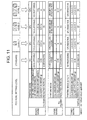
- Fig. 11 shows an example of terms to which an eco goal level (degree of accomplishment) is set in the relative evaluation mode.
- Fig. 11 shows an example setting of each goal level for eco mode use with respect to a predefined standard, about three factors for CO 2 reduction, namely "power saving", which is a global environmental enhancement feature 1, "paper saving”, which is a global environmental enhancement feature 2, and “toner saving”, which is a global environmental enhancement feature 3.
- power saving which is a global environmental enhancement feature 1
- paper saving which is a global environmental enhancement feature 2
- toner saving which is a global environmental enhancement feature 3
- a batch printing manner is used to buffer a plurality of print jobs that are entered at random intervals to process the jobs simultaneously and thereby to reduce the power consumed by the printer, which leads to GHG emissions reduction.
- an N-in-1 printing manner by which the contents of N pages are printed collectively in one page, is used to reduce the amount of sheets used and thereby to reduce the power required to fabricate sheets, which leads to GHG emissions reduction.
- a toner saving mode in which the printing darkness is reduced, is used to reduce the amount of toner used and to reduce the power required to fabricate toner, which leads to GHG emissions reduction.
- an eco level is set based on the number of sheets that are to be printed simultaneously in a batch, and based on a standard case in which the number of sheets to be printed simultaneously in a batch is one (1PJ), a case in which the number of sheets to be printed simultaneously in a batch is three (3PJ) is set as "level 1", and a case in which the number of sheets to be printed simultaneously in a batch is five (5PJ) is set as "level 2”, and a case in which the number of sheets to be printed simultaneously in a batch is ten (10PJ) is set as "level 3".
- * PJ indicates the batching degree of the batch printing mode, which indicates how many printing jobs that occur in the sequential order of page numbers are batched for each printing operation (batch printing can widen the interval between the batch jobs and lengthen the sleep period of the printer and thereby can reduce the power consumed by the printer).
- the value * indicates the number of sheets that are to be printed in a batch. That is, normally, when print data is entered and even if the print data contains only one page, a printing operation is performed for that entered one page (which is 1PJ).
- nPJ is a power saving mode in which a printing operation is not started until print data that are entered pile up to n pages.
- 1PJ is a mode in which power is not saved (restriction on CO 2 emissions is low.)
- n is a positive integer.
- the printer of the present example is supposed to consume 200Wh power for printing 100 sheets, if the printing operation is performed in the 1PJ printing mode that is set as the standard.
- the answer i.e., CO 2 emission amount, which is to be used as a standard value
- 2Whxa where a indicates the amount of CO 2 emitted per 1Wh power
- the amount of CO 2 emitted per sheet to be printed is (1.7Whxa)g.
- the amount of CO 2 emitted per sheet to be printed is (1.5Wh ⁇ a)g.
- the amount of CO 2 emitted per sheet to be printed is (1.0Whxa)g.
- the amount of CO 2 reduction in each case is (0.3Whxa)g in the case of "level 1", (0.5Whxa)g in the case of "level 2”, and (1.0Whxa)g in the case of "level 3”, which are translated to a reduction rate of 15% in the case of "level 1", 25% in the case of "level 2", and 50% in the case of "level 3", as can be seen from Fig. 11 .
- Fig. 11 tells similar things about the "paper saving” factor (eco by N-in-1 printing by which the contents of N pages are printed collectively in one page).
- the printing modes of this factor include a standard mode, a "level 1" mode, a "level 2" mode and a "level 3" mode.
- the standard mode one page data is printed on only one side of a sheet and the back side is left unprinted (no saving is accomplished).
- the "level 1" mode one page data is printed on each side of a sheet, so data is printed on both sides of a sheet, thereby two page data is printed on one sheet (consumption of one sheet is saved with respect to the standard).
- the "level 2" mode two page data is multi-printed on only one side of a sheet and the back side is left unprinted (consumption of one sheet is saved with respect to the standard).
- the "level 3” mode two page data is multi-printed on each side of a sheet (consumption of three sheets is saved with respect to the standard). Supposing that the amount of CO 2 emitted per sheet for its fabrication is b gram, by saving the amount of sheets consumed, the "level 1" mode and the "level 2" mode reduce CO 2 emissions by b gram, which corresponds to saving of one sheet, and the "level 3" mode reduces CO 2 emissions by 3xb gram, which corresponds to saving of three sheets.
- the "level 1" mode and the “level 2” mode reduce CO 2 that is generated when a sheet is fabricated by 50%, and the "level 3" mode reduces CO 2 by 75%, as is explained in Fig. 11 .
- Fig. 11 also tells similar things about the "toner saving” factor (eco by a printing operation that uses a toner saving mode).
- "level 1" is set as a 15% toner saving mode (a mode in which printing is performed at a printing darkness that is 15% less than the standard to save toner)
- "level 2” is set as a 30% toner saving mode (a mode in which printing is performed at a printing darkness that is 30% less than the standard to save toner)
- level 3 is set as a 50% toner saving mode (a mode in which printing is performed at a printing darkness that is 50% less than the standard to save toner).
- a standard printing operation that does not employ a toner saving mode generates cxd gram of CO 2
- a "level 1" mode operation can prevent 15% of that amount, i.e., cxdx0.15 gram of CO 2 from being generated
- a "level 2" mode operation can prevent 30% of that amount, i.e., cxdx0.3 gram of CO 2 from being generated
- a "level 3" mode operation can prevent 50% of that amount, i.e., c ⁇ d ⁇ 0.5 gram of CO 2 from being generated, as is explained in Fig. 11 .
- the invention of the Embodiment 2 is to evaluate the user's manner of using the printer in terms of whether the user uses the printer in eco-conscious manner based on the above-described three features (power saving, paper saving, toner saving) of the printer that will lead to GHG emissions reduction, and to show the user by display etc. what degree the user has accomplished of the eco level that the user has beforehand selected and set as the goal and what are preferred as steps to take according to the accomplishment status.
- the eco level goal is divided into three stages, namely "level 1" to "level 3", and the user can freely select a goal.
- an eco use degree (a contribution degree that indicates the level of use of the printer with an eco-cooperative action) is evaluated in the subsequent printing operations.
- Fig. 12 is a flowchart that explains the process of the present example, and the process is performed on the basis that the eco level set by the user is the default status.
- step (hereinafter, "ST") 1; YES, ST2; NO, and ST4; NO) if no change is made to the set eco level (step (hereinafter, "ST") 1; YES, ST2; NO, and ST4; NO), and if the print job is not an urgent one (that cannot take batch operation) (ST6; NO), the PJ value that indicates the number of sheets to be batched for batch printing is checked. If print jobs have not piled up to the set PJ value, data indicating the number of sheets to be printed is written into an unillustrated nonvolatile memory such as a hard disk (HD) (ST7; NO, ST8). If print jobs have piled up to the set PJ value, corresponding print data are read out from the nonvolatile memory such as a hard disk (HD) and a printing operation is performed (ST7
- a printing operation is performed upon change of the above default status.
- the paper setting is changed (ST2; YES, ST3)
- the toner setting is changed (ST4; YES, ST5)
- urgent printing is selected (ST6)
- a printing operation is performed (ST10).
- a printing operation is performed (ST10) with urgent printing selected (ST6) and with the paper setting, etc. unchanged.
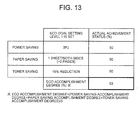
- Fig. 13 shows a case in which printing operations have been performed according to the process described above while the eco goal level is set to "level 1", but the achievements resulting from the actual uses reveal that the user has used the intended manner at only 50% of the printing occasions as regards the "power saving” factor, likewise the user has used the intended manner at only 50% of the printing occasions as regards the “paper saving” factor, and the user has used the intended mode at only 60% of the printing occasions as regards the “toner saving” factor, and hence the total accomplishment degree is 53%.
- Fig. 13 shows one example, and the eco accomplishment degree of 53% is a value obtained by dividing by 3 the total sum of the power saving accomplishment degree, the paper saving accomplishment degree, and the toner saving accomplishment degree shown in Fig. 13 (average value).
- Fig. 14 is an example of the above calculation result being displayed on the display device of the operation panel unit 5.
- the symbol as shown in Fig. 14 points to a display corresponding to the relative evaluation mode and the symbol b shown in Fig. 14 points to an example display corresponding to the absolute evaluation mode.
- the display shows a young leaf mark that is made incomplete according to the actual accomplishment degree, and the user can visually recognize the eco accomplishment degree of the printer 1.
- young leaf marks may be printed out.
- many young leaf marks may be printed and a special mark may be printed on part of the young leaf marks.
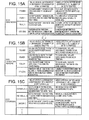
- Fig. 15 shows examples in which a diagnosis and advice are given for each of the factors described above.
- the evaluations displayed in the relative evaluation mode show that "the accomplishment degree (rate) is 60%" as the evaluation of the "power saving” factor and that "you have used 1PJ mode (1PJ printing) many times", etc.
- the evaluations displayed in the absolute evaluation mode which considers only the number of sheets printed, show that "you have used (consumed) many sheets", etc.
- a display corresponding to the accomplishment degree is given as shown in Fig. 15A .
- the ecology navigation feature shown in Fig. 15B is to display guidance about in what way the goal can be accomplished with respect to the above evaluations given for the relative evaluation mode and the absolute evaluation mode. For example, in a case where the evaluation on "power saving" is that "you have used 1PJ printing many times", the navigation to be displayed may be that "you are encouraged to print at 2PJ or higher power saving setting (you are encouraged to print at 2PJ or higher power setting)". As regards other factors too, a corresponding display can be given.
- the eco diagnosis shown in Fig. 15C is to give a diagnosis on an individual basis and on a group basis separately, and a display corresponding to the accomplishment degree is given for the relative evaluation mode and the absolute evaluation mode.
- the goal accomplishment status display and the navigation described in the Embodiment 2 be given under a state in which it is recognized that the refill product/replacement part or the like according to the Embodiment 1 (to which a greenhouse gas emission right is accorded) is attached on the printer body.
- CO 2 has been the example of greenhouse gas.
- CH 4 methane
- N 2 O nitrous oxide
- HFCs hydrofluorocarbon series
- PFCs perfluorocarbon series
- SF6 sulfur hexafluoride
Landscapes
- Physics & Mathematics (AREA)
- General Physics & Mathematics (AREA)
- Engineering & Computer Science (AREA)
- Microelectronics & Electronic Packaging (AREA)
- Computer Vision & Pattern Recognition (AREA)
- Human Computer Interaction (AREA)
- Accessory Devices And Overall Control Thereof (AREA)
- Control Or Security For Electrophotography (AREA)
- Dry Development In Electrophotography (AREA)
- Printers Characterized By Their Purpose (AREA)
Applications Claiming Priority (1)
| Application Number | Priority Date | Filing Date | Title |
|---|---|---|---|
| JP2008158730A JP4650523B2 (ja) | 2008-06-18 | 2008-06-18 | 電子装置、消耗品カートリッジ、交換部品、及び利用度合を報知する方法 |
Publications (2)
| Publication Number | Publication Date |
|---|---|
| EP2136258A2 true EP2136258A2 (de) | 2009-12-23 |
| EP2136258A3 EP2136258A3 (de) | 2010-06-09 |
Family
ID=40974403
Family Applications (1)
| Application Number | Title | Priority Date | Filing Date |
|---|---|---|---|
| EP09162959A Withdrawn EP2136258A3 (de) | 2008-06-18 | 2009-06-17 | Elektronisches Gerät, das zum globalen Umweltschutz beiträgt |
Country Status (4)
| Country | Link |
|---|---|
| US (1) | US8915432B2 (de) |
| EP (1) | EP2136258A3 (de) |
| JP (1) | JP4650523B2 (de) |
| CN (1) | CN101607489B (de) |
Cited By (2)
| Publication number | Priority date | Publication date | Assignee | Title |
|---|---|---|---|---|
| JP2013007897A (ja) * | 2011-06-24 | 2013-01-10 | Sharp Corp | オフセットクレジット認証情報表示システムとこれを用いる画像形成装置及びオフセットクレジット認証情報表示方法並びにオフセットクレジット認証情報表示システムに用いる表示装置 |
| EP2575031A2 (de) * | 2011-09-28 | 2013-04-03 | Seiko Epson Corporation | Druckvorrichtung, Drucksteuerungsvorrichtung, Drucksteuerungsverfahren und Drucksteuerungsprogramm |
Families Citing this family (32)
| Publication number | Priority date | Publication date | Assignee | Title |
|---|---|---|---|---|
| JP2009220459A (ja) * | 2008-03-17 | 2009-10-01 | Ricoh Co Ltd | 機器の制御装置、画像形成装置、プログラム |
| JP2010176184A (ja) * | 2009-01-27 | 2010-08-12 | Sharp Corp | 印刷システム、情報処理装置 |
| US20120059766A1 (en) * | 2009-05-11 | 2012-03-08 | Mahindra Reva Electric Vehicles Pvt. Ltd. | Method and System for Revenue Generation Using Energy System |
| JP2011025427A (ja) * | 2009-07-22 | 2011-02-10 | Casio Electronics Co Ltd | 印刷装置 |
| US8405862B2 (en) * | 2009-10-30 | 2013-03-26 | Kabushiki Kaisha Toshiba | Printing managing apparatus, image forming apparatus, and printing managing method |
| JP5712486B2 (ja) * | 2010-02-09 | 2015-05-07 | カシオ電子工業株式会社 | 印刷システム |
| JP5531677B2 (ja) * | 2010-03-03 | 2014-06-25 | 株式会社リコー | 画像形成装置 |
| US8760713B2 (en) * | 2010-06-30 | 2014-06-24 | Konica Minolta Laboratory U.S.A., Inc. | Controlling printer energy consumption |
| US8400661B2 (en) * | 2010-08-06 | 2013-03-19 | Xerox Corporation | Virtual printing currency for promoting environmental behavior of device users |
| JP5614162B2 (ja) * | 2010-08-12 | 2014-10-29 | 富士ゼロックス株式会社 | 情報処理装置及び情報処理プログラム |
| JP5665427B2 (ja) * | 2010-08-31 | 2015-02-04 | キヤノン株式会社 | 情報処理装置及びその方法 |
| JP5172939B2 (ja) * | 2010-12-24 | 2013-03-27 | シャープ株式会社 | 画像形成装置、画像形成装置のオプション装置発注システム、画像形成装置のオプション装置発注方法、プログラムおよび記録媒体 |
| JP2012135957A (ja) * | 2010-12-27 | 2012-07-19 | Sharp Corp | 表示装置及びこれを用いる画像形成装置 |
| JP2012146140A (ja) * | 2011-01-12 | 2012-08-02 | Sharp Corp | 消耗品発注システムとこれを用いる画像形成装置及び消耗品発注方法 |
| JP5162680B2 (ja) * | 2011-01-13 | 2013-03-13 | シャープ株式会社 | 通信システム、画像形成装置および通信方法 |
| JP5298184B2 (ja) * | 2011-01-13 | 2013-09-25 | シャープ株式会社 | 画像形成装置、表示システム、温室効果ガス排出権売買システムおよび温室効果ガス排出権売買方法 |
| JP5256308B2 (ja) | 2011-01-13 | 2013-08-07 | シャープ株式会社 | 画像形成装置、消耗品発注システムおよび消耗品発注方法 |
| JP5818447B2 (ja) * | 2011-02-02 | 2015-11-18 | キヤノン株式会社 | 画像処理装置、画像処理装置の制御方法及びプログラム |
| JP2012189778A (ja) * | 2011-03-10 | 2012-10-04 | Sharp Corp | 温室効果ガス排出枠取得システムとこれを用いる画像形成装置及び温室効果ガス排出枠取得方法 |
| JP5746902B2 (ja) * | 2011-04-18 | 2015-07-08 | シャープ株式会社 | 温室効果ガス排出枠購入システム |
| CN102857663B (zh) * | 2011-06-27 | 2015-08-26 | 株式会社东芝 | 图像处理系统、信息提供装置、信息提供方法 |
| US8836977B2 (en) * | 2011-12-08 | 2014-09-16 | Ricoh Company, Ltd. | Managing a resource conservation mode and printing quota |
| US9176688B2 (en) | 2012-06-26 | 2015-11-03 | Hewlett-Packard Development Company, L.P. | Environmental watermarking a print request |
| CN103685074B (zh) * | 2012-09-11 | 2016-09-28 | 英业达科技有限公司 | 机架式服务器系统及自动管理机架配置信息的方法 |
| JP5957350B2 (ja) * | 2012-09-27 | 2016-07-27 | 株式会社東芝 | 情報処理装置および情報処理方法 |
| US9357102B2 (en) * | 2013-09-25 | 2016-05-31 | Lexmark International, Inc. | Systems and methods of securing operational information associated with an imaging device |
| US9964891B2 (en) * | 2014-12-17 | 2018-05-08 | Lexmark International, Inc. | Systems for optical communication between an image forming device and a replaceable unit of the image forming device |
| JP6056893B2 (ja) * | 2015-03-06 | 2017-01-11 | カシオ計算機株式会社 | 印刷システム |
| JP5869163B2 (ja) * | 2015-03-12 | 2016-02-24 | シャープ株式会社 | 画像形成装置 |
| US10775548B2 (en) | 2016-12-07 | 2020-09-15 | Central Glass Company, Limited | Light guide plate, surface light emitting apparatus, and method for manufacturing light guide plate |
| CN106993044B (zh) * | 2017-04-10 | 2023-11-07 | 生迪智慧科技有限公司 | 终端、基于灯的碳补偿处理系统和方法 |
| JP7444475B2 (ja) * | 2020-12-28 | 2024-03-06 | 忠男 西川 | 情報処理システム |
Citations (2)
| Publication number | Priority date | Publication date | Assignee | Title |
|---|---|---|---|---|
| JP2002006696A (ja) | 2000-06-20 | 2002-01-11 | Minolta Co Ltd | 画像形成装置使用によるco2排出量算出方法とco2排出量管理システム、及び画像形成装置 |
| JP2007249563A (ja) | 2006-03-15 | 2007-09-27 | Ricoh Co Ltd | 情報処理装置及び情報処理システム |
Family Cites Families (10)
| Publication number | Priority date | Publication date | Assignee | Title |
|---|---|---|---|---|
| DE59002056D1 (de) * | 1989-03-08 | 1993-09-02 | Buettner Ag Franz | Nachladbare farbbandkassette. |
| JPH09288415A (ja) * | 1996-02-20 | 1997-11-04 | Ricoh Co Ltd | 電子写真装置のトナー容器 |
| JP2003150695A (ja) | 2001-11-12 | 2003-05-23 | Konica Corp | 情報処理装置、画像処理装置、環境負荷値算出方法、情報処理方法、環境負荷値算出方法及び情報処理方法実行のためのプログラム、及び、プログラムを記録した記録媒体 |
| US20050154669A1 (en) * | 2004-01-08 | 2005-07-14 | Foy Streetman | Carbon credit marketing system |
| WO2005077023A2 (en) * | 2004-02-06 | 2005-08-25 | Releaf | Systems and methods relating to paper and printer cartridge usage |
| US8355965B2 (en) * | 2005-02-22 | 2013-01-15 | Sharp Kabushiki Kaisha | Battery exchange service system and charging method therefor, and portable device |
| US20070092976A1 (en) * | 2005-10-06 | 2007-04-26 | Board Of Regents Of The University And College Systems Of Nevada | Continuous emissions monitoring |
| JP5039980B2 (ja) * | 2005-11-14 | 2012-10-03 | 日立ビークルエナジー株式会社 | 二次電池モジュール |
| JP2007329610A (ja) | 2006-06-07 | 2007-12-20 | Ricoh Co Ltd | 画像形成装置 |
| JP4781916B2 (ja) * | 2006-06-21 | 2011-09-28 | 株式会社沖データ | 画像形成装置及び画像形成装置における適合部品の判別方法 |
-
2008
- 2008-06-18 JP JP2008158730A patent/JP4650523B2/ja not_active Expired - Fee Related
-
2009
- 2009-06-16 US US12/485,211 patent/US8915432B2/en not_active Expired - Fee Related
- 2009-06-17 EP EP09162959A patent/EP2136258A3/de not_active Withdrawn
- 2009-06-18 CN CN2009101475420A patent/CN101607489B/zh not_active Expired - Fee Related
Patent Citations (2)
| Publication number | Priority date | Publication date | Assignee | Title |
|---|---|---|---|---|
| JP2002006696A (ja) | 2000-06-20 | 2002-01-11 | Minolta Co Ltd | 画像形成装置使用によるco2排出量算出方法とco2排出量管理システム、及び画像形成装置 |
| JP2007249563A (ja) | 2006-03-15 | 2007-09-27 | Ricoh Co Ltd | 情報処理装置及び情報処理システム |
Cited By (2)
| Publication number | Priority date | Publication date | Assignee | Title |
|---|---|---|---|---|
| JP2013007897A (ja) * | 2011-06-24 | 2013-01-10 | Sharp Corp | オフセットクレジット認証情報表示システムとこれを用いる画像形成装置及びオフセットクレジット認証情報表示方法並びにオフセットクレジット認証情報表示システムに用いる表示装置 |
| EP2575031A2 (de) * | 2011-09-28 | 2013-04-03 | Seiko Epson Corporation | Druckvorrichtung, Drucksteuerungsvorrichtung, Drucksteuerungsverfahren und Drucksteuerungsprogramm |
Also Published As
| Publication number | Publication date |
|---|---|
| CN101607489B (zh) | 2012-09-05 |
| EP2136258A3 (de) | 2010-06-09 |
| US20090314837A1 (en) | 2009-12-24 |
| HK1139107A1 (en) | 2010-09-10 |
| CN101607489A (zh) | 2009-12-23 |
| US8915432B2 (en) | 2014-12-23 |
| JP4650523B2 (ja) | 2011-03-16 |
| JP2010002442A (ja) | 2010-01-07 |
Similar Documents
| Publication | Publication Date | Title |
|---|---|---|
| US8915432B2 (en) | Electronic apparatus contributing to global environmental conservation | |
| JP4998487B2 (ja) | 印刷装置 | |
| US8400661B2 (en) | Virtual printing currency for promoting environmental behavior of device users | |
| US8112006B2 (en) | Image forming apparatus and method for distinguishing suitable parts in the same | |
| US20050030554A1 (en) | Recyclable printing mechanism and related method | |
| US20040070642A1 (en) | Output method and apparatus therefor | |
| CN1262964C (zh) | 出具收据并提供广告的系统、装置和方法 | |
| JP2005515092A (ja) | プリンタで使用される消耗品に付される無線周波数idタグ及び関連装置 | |
| JP4872951B2 (ja) | 携帯型端末機、携帯型端末機の制御方法、及び携帯型端末機の制御プログラム | |
| US20120179579A1 (en) | Consumable supply-ordering system and image forming apparatus and consumable supply-ordering method using the same | |
| JP2022006784A (ja) | プリンタ及び通信システム | |
| JP2002215368A (ja) | 課金を行なうプリンタシステムおよび料金の見積を行なう印刷制御装置 | |
| JP2009211644A (ja) | カートリッジ回収用システム及びカートリッジ回収用システムの制御方法 | |
| JP5217801B2 (ja) | 画像形成装置及び部品交換管理システム | |
| US6913195B2 (en) | Discounting system, discounting device, discounting method, discounting program, record medium, cartridge, print controller, print control method, and print control program | |
| US8855991B2 (en) | Method and system for assessing environmental impact of a processing device | |
| JP2002092745A (ja) | Pos端末装置における印刷装置の消耗部品の管理システム、その管理方法、コンピュータプログラム・プロダクト及び情報記録媒体 | |
| JP4453508B2 (ja) | ロール状印刷媒体の印刷管理方法及びロール状印刷媒体の印刷管理システム | |
| EP3904106B1 (de) | Drucker, programm und informationsverarbeitungssystem | |
| JP2004035206A (ja) | 在庫管理方法、在庫管理プログラム、印刷装置制御プログラム、在庫管理装置及び印刷装置 | |
| HK1139107B (en) | Electronic apparatus | |
| JP2005018493A (ja) | 情報処理装置および印刷装置および消耗ユニットの購入処理方法およびコンピュータが読み取り可能な記憶媒体およびプログラム | |
| JP2023066871A (ja) | 印刷装置、画像形成システム、通知方法 | |
| US20230388434A1 (en) | Information management system and printing apparatus | |
| JP2003196068A (ja) | 消耗品管理システム及び消耗品管理方法と印刷制御装置 |
Legal Events
| Date | Code | Title | Description |
|---|---|---|---|
| PUAI | Public reference made under article 153(3) epc to a published international application that has entered the european phase |
Free format text: ORIGINAL CODE: 0009012 |
|
| 17P | Request for examination filed |
Effective date: 20090617 |
|
| AK | Designated contracting states |
Kind code of ref document: A2 Designated state(s): AT BE BG CH CY CZ DE DK EE ES FI FR GB GR HR HU IE IS IT LI LT LU LV MC MK MT NL NO PL PT RO SE SI SK TR |
|
| RAP1 | Party data changed (applicant data changed or rights of an application transferred) |
Owner name: CASIO COMPUTER CO., LTD. Owner name: CASIO ELECTRONICS MANUFACTURING CO., LTD. |
|
| PUAL | Search report despatched |
Free format text: ORIGINAL CODE: 0009013 |
|
| RIC1 | Information provided on ipc code assigned before grant |
Ipc: G03G 15/00 20060101AFI20090825BHEP Ipc: G03G 21/18 20060101ALI20100429BHEP Ipc: H01M 10/48 20060101ALI20100429BHEP |
|
| AK | Designated contracting states |
Kind code of ref document: A3 Designated state(s): AT BE BG CH CY CZ DE DK EE ES FI FR GB GR HR HU IE IS IT LI LT LU LV MC MK MT NL NO PL PT RO SE SI SK TR |
|
| AX | Request for extension of the european patent |
Extension state: AL BA RS |
|
| STAA | Information on the status of an ep patent application or granted ep patent |
Free format text: STATUS: THE APPLICATION HAS BEEN WITHDRAWN |
|
| 18W | Application withdrawn |
Effective date: 20170712 |