EP2117185B1 - System and method for avoiding stall using timer for high-speed downlink packet access system - Google Patents
System and method for avoiding stall using timer for high-speed downlink packet access system Download PDFInfo
- Publication number
- EP2117185B1 EP2117185B1 EP20090167074 EP09167074A EP2117185B1 EP 2117185 B1 EP2117185 B1 EP 2117185B1 EP 20090167074 EP20090167074 EP 20090167074 EP 09167074 A EP09167074 A EP 09167074A EP 2117185 B1 EP2117185 B1 EP 2117185B1
- Authority
- EP
- European Patent Office
- Prior art keywords
- data block
- data blocks
- timer
- received
- layer
- Prior art date
- Legal status (The legal status is an assumption and is not a legal conclusion. Google has not performed a legal analysis and makes no representation as to the accuracy of the status listed.)
- Expired - Lifetime
Links
- 238000000034 method Methods 0.000 title claims abstract description 126
- 238000010295 mobile communication Methods 0.000 claims abstract description 10
- 239000000872 buffer Substances 0.000 description 148
- 230000005540 biological transmission Effects 0.000 description 120
- 230000008569 process Effects 0.000 description 54
- 230000006870 function Effects 0.000 description 36
- 238000004891 communication Methods 0.000 description 11
- 238000005516 engineering process Methods 0.000 description 6
- 238000004590 computer program Methods 0.000 description 4
- 238000010586 diagram Methods 0.000 description 4
- 230000015654 memory Effects 0.000 description 4
- 238000012986 modification Methods 0.000 description 4
- 230000004048 modification Effects 0.000 description 4
- 125000004122 cyclic group Chemical group 0.000 description 2
- 238000005562 fading Methods 0.000 description 2
- 238000007726 management method Methods 0.000 description 2
- 238000012546 transfer Methods 0.000 description 2
- 108700026140 MAC combination Proteins 0.000 description 1
- 230000006978 adaptation Effects 0.000 description 1
- 238000013459 approach Methods 0.000 description 1
- 230000006399 behavior Effects 0.000 description 1
- 230000015572 biosynthetic process Effects 0.000 description 1
- 235000021170 buffet Nutrition 0.000 description 1
- 230000006835 compression Effects 0.000 description 1
- 238000007906 compression Methods 0.000 description 1
- 238000012217 deletion Methods 0.000 description 1
- 230000037430 deletion Effects 0.000 description 1
- 230000003292 diminished effect Effects 0.000 description 1
- 238000011156 evaluation Methods 0.000 description 1
- 238000012423 maintenance Methods 0.000 description 1
- 238000013507 mapping Methods 0.000 description 1
- 238000013404 process transfer Methods 0.000 description 1
- 230000000644 propagated effect Effects 0.000 description 1
- 238000011160 research Methods 0.000 description 1
- 230000004044 response Effects 0.000 description 1
- 230000011218 segmentation Effects 0.000 description 1
- 230000011664 signaling Effects 0.000 description 1
- 230000005477 standard model Effects 0.000 description 1
- 239000013589 supplement Substances 0.000 description 1
Images







Classifications
-
- H—ELECTRICITY
- H04—ELECTRIC COMMUNICATION TECHNIQUE
- H04W—WIRELESS COMMUNICATION NETWORKS
- H04W72/00—Local resource management
- H04W72/20—Control channels or signalling for resource management
- H04W72/23—Control channels or signalling for resource management in the downlink direction of a wireless link, i.e. towards a terminal
-
- H—ELECTRICITY
- H04—ELECTRIC COMMUNICATION TECHNIQUE
- H04W—WIRELESS COMMUNICATION NETWORKS
- H04W28/00—Network traffic management; Network resource management
- H04W28/02—Traffic management, e.g. flow control or congestion control
- H04W28/10—Flow control between communication endpoints
- H04W28/14—Flow control between communication endpoints using intermediate storage
-
- H—ELECTRICITY
- H04—ELECTRIC COMMUNICATION TECHNIQUE
- H04B—TRANSMISSION
- H04B7/00—Radio transmission systems, i.e. using radiation field
- H04B7/02—Diversity systems; Multi-antenna system, i.e. transmission or reception using multiple antennas
- H04B7/04—Diversity systems; Multi-antenna system, i.e. transmission or reception using multiple antennas using two or more spaced independent antennas
- H04B7/06—Diversity systems; Multi-antenna system, i.e. transmission or reception using multiple antennas using two or more spaced independent antennas at the transmitting station
- H04B7/0602—Diversity systems; Multi-antenna system, i.e. transmission or reception using multiple antennas using two or more spaced independent antennas at the transmitting station using antenna switching
- H04B7/0604—Diversity systems; Multi-antenna system, i.e. transmission or reception using multiple antennas using two or more spaced independent antennas at the transmitting station using antenna switching with predefined switching scheme
-
- H—ELECTRICITY
- H04—ELECTRIC COMMUNICATION TECHNIQUE
- H04B—TRANSMISSION
- H04B7/00—Radio transmission systems, i.e. using radiation field
- H04B7/14—Relay systems
- H04B7/15—Active relay systems
- H04B7/155—Ground-based stations
- H04B7/15528—Control of operation parameters of a relay station to exploit the physical medium
- H04B7/15535—Control of relay amplifier gain
-
- H—ELECTRICITY
- H04—ELECTRIC COMMUNICATION TECHNIQUE
- H04L—TRANSMISSION OF DIGITAL INFORMATION, e.g. TELEGRAPHIC COMMUNICATION
- H04L1/00—Arrangements for detecting or preventing errors in the information received
- H04L1/004—Arrangements for detecting or preventing errors in the information received by using forward error control
- H04L1/0056—Systems characterized by the type of code used
- H04L1/0071—Use of interleaving
-
- H—ELECTRICITY
- H04—ELECTRIC COMMUNICATION TECHNIQUE
- H04L—TRANSMISSION OF DIGITAL INFORMATION, e.g. TELEGRAPHIC COMMUNICATION
- H04L1/00—Arrangements for detecting or preventing errors in the information received
- H04L1/02—Arrangements for detecting or preventing errors in the information received by diversity reception
- H04L1/06—Arrangements for detecting or preventing errors in the information received by diversity reception using space diversity
-
- H—ELECTRICITY
- H04—ELECTRIC COMMUNICATION TECHNIQUE
- H04L—TRANSMISSION OF DIGITAL INFORMATION, e.g. TELEGRAPHIC COMMUNICATION
- H04L1/00—Arrangements for detecting or preventing errors in the information received
- H04L1/08—Arrangements for detecting or preventing errors in the information received by repeating transmission, e.g. Verdan system
-
- H—ELECTRICITY
- H04—ELECTRIC COMMUNICATION TECHNIQUE
- H04L—TRANSMISSION OF DIGITAL INFORMATION, e.g. TELEGRAPHIC COMMUNICATION
- H04L1/00—Arrangements for detecting or preventing errors in the information received
- H04L1/12—Arrangements for detecting or preventing errors in the information received by using return channel
- H04L1/16—Arrangements for detecting or preventing errors in the information received by using return channel in which the return channel carries supervisory signals, e.g. repetition request signals
- H04L1/18—Automatic repetition systems, e.g. Van Duuren systems
- H04L1/1829—Arrangements specially adapted for the receiver end
- H04L1/1835—Buffer management
- H04L1/1841—Resequencing
-
- H—ELECTRICITY
- H04—ELECTRIC COMMUNICATION TECHNIQUE
- H04L—TRANSMISSION OF DIGITAL INFORMATION, e.g. TELEGRAPHIC COMMUNICATION
- H04L1/00—Arrangements for detecting or preventing errors in the information received
- H04L1/12—Arrangements for detecting or preventing errors in the information received by using return channel
- H04L1/16—Arrangements for detecting or preventing errors in the information received by using return channel in which the return channel carries supervisory signals, e.g. repetition request signals
- H04L1/18—Automatic repetition systems, e.g. Van Duuren systems
- H04L1/1829—Arrangements specially adapted for the receiver end
- H04L1/1848—Time-out mechanisms
-
- H—ELECTRICITY
- H04—ELECTRIC COMMUNICATION TECHNIQUE
- H04L—TRANSMISSION OF DIGITAL INFORMATION, e.g. TELEGRAPHIC COMMUNICATION
- H04L47/00—Traffic control in data switching networks
- H04L47/10—Flow control; Congestion control
-
- H—ELECTRICITY
- H04—ELECTRIC COMMUNICATION TECHNIQUE
- H04L—TRANSMISSION OF DIGITAL INFORMATION, e.g. TELEGRAPHIC COMMUNICATION
- H04L47/00—Traffic control in data switching networks
- H04L47/10—Flow control; Congestion control
- H04L47/28—Flow control; Congestion control in relation to timing considerations
-
- H—ELECTRICITY
- H04—ELECTRIC COMMUNICATION TECHNIQUE
- H04L—TRANSMISSION OF DIGITAL INFORMATION, e.g. TELEGRAPHIC COMMUNICATION
- H04L47/00—Traffic control in data switching networks
- H04L47/10—Flow control; Congestion control
- H04L47/34—Flow control; Congestion control ensuring sequence integrity, e.g. using sequence numbers
-
- H—ELECTRICITY
- H04—ELECTRIC COMMUNICATION TECHNIQUE
- H04L—TRANSMISSION OF DIGITAL INFORMATION, e.g. TELEGRAPHIC COMMUNICATION
- H04L5/00—Arrangements affording multiple use of the transmission path
- H04L5/0001—Arrangements for dividing the transmission path
- H04L5/0014—Three-dimensional division
- H04L5/0023—Time-frequency-space
-
- H—ELECTRICITY
- H04—ELECTRIC COMMUNICATION TECHNIQUE
- H04L—TRANSMISSION OF DIGITAL INFORMATION, e.g. TELEGRAPHIC COMMUNICATION
- H04L5/00—Arrangements affording multiple use of the transmission path
- H04L5/003—Arrangements for allocating sub-channels of the transmission path
- H04L5/0042—Intra-user or intra-terminal allocation
-
- H—ELECTRICITY
- H04—ELECTRIC COMMUNICATION TECHNIQUE
- H04L—TRANSMISSION OF DIGITAL INFORMATION, e.g. TELEGRAPHIC COMMUNICATION
- H04L5/00—Arrangements affording multiple use of the transmission path
- H04L5/003—Arrangements for allocating sub-channels of the transmission path
- H04L5/0044—Allocation of payload; Allocation of data channels, e.g. PDSCH or PUSCH
-
- H—ELECTRICITY
- H04—ELECTRIC COMMUNICATION TECHNIQUE
- H04L—TRANSMISSION OF DIGITAL INFORMATION, e.g. TELEGRAPHIC COMMUNICATION
- H04L5/00—Arrangements affording multiple use of the transmission path
- H04L5/003—Arrangements for allocating sub-channels of the transmission path
- H04L5/0078—Timing of allocation
- H04L5/0082—Timing of allocation at predetermined intervals
- H04L5/0083—Timing of allocation at predetermined intervals symbol-by-symbol
-
- H—ELECTRICITY
- H04—ELECTRIC COMMUNICATION TECHNIQUE
- H04L—TRANSMISSION OF DIGITAL INFORMATION, e.g. TELEGRAPHIC COMMUNICATION
- H04L69/00—Network arrangements, protocols or services independent of the application payload and not provided for in the other groups of this subclass
- H04L69/28—Timers or timing mechanisms used in protocols
-
- H—ELECTRICITY
- H04—ELECTRIC COMMUNICATION TECHNIQUE
- H04W—WIRELESS COMMUNICATION NETWORKS
- H04W24/00—Supervisory, monitoring or testing arrangements
- H04W24/02—Arrangements for optimising operational condition
-
- H—ELECTRICITY
- H04—ELECTRIC COMMUNICATION TECHNIQUE
- H04W—WIRELESS COMMUNICATION NETWORKS
- H04W28/00—Network traffic management; Network resource management
- H04W28/02—Traffic management, e.g. flow control or congestion control
-
- H—ELECTRICITY
- H04—ELECTRIC COMMUNICATION TECHNIQUE
- H04W—WIRELESS COMMUNICATION NETWORKS
- H04W52/00—Power management, e.g. Transmission Power Control [TPC] or power classes
- H04W52/04—Transmission power control [TPC]
- H04W52/06—TPC algorithms
- H04W52/14—Separate analysis of uplink or downlink
- H04W52/143—Downlink power control
-
- H—ELECTRICITY
- H04—ELECTRIC COMMUNICATION TECHNIQUE
- H04W—WIRELESS COMMUNICATION NETWORKS
- H04W52/00—Power management, e.g. Transmission Power Control [TPC] or power classes
- H04W52/04—Transmission power control [TPC]
- H04W52/18—TPC being performed according to specific parameters
- H04W52/24—TPC being performed according to specific parameters using SIR [Signal to Interference Ratio] or other wireless path parameters
-
- H—ELECTRICITY
- H04—ELECTRIC COMMUNICATION TECHNIQUE
- H04W—WIRELESS COMMUNICATION NETWORKS
- H04W52/00—Power management, e.g. Transmission Power Control [TPC] or power classes
- H04W52/04—Transmission power control [TPC]
- H04W52/18—TPC being performed according to specific parameters
- H04W52/24—TPC being performed according to specific parameters using SIR [Signal to Interference Ratio] or other wireless path parameters
- H04W52/245—TPC being performed according to specific parameters using SIR [Signal to Interference Ratio] or other wireless path parameters taking into account received signal strength
-
- H—ELECTRICITY
- H04—ELECTRIC COMMUNICATION TECHNIQUE
- H04W—WIRELESS COMMUNICATION NETWORKS
- H04W52/00—Power management, e.g. Transmission Power Control [TPC] or power classes
- H04W52/04—Transmission power control [TPC]
- H04W52/38—TPC being performed in particular situations
- H04W52/46—TPC being performed in particular situations in multi-hop networks, e.g. wireless relay networks
-
- H—ELECTRICITY
- H04—ELECTRIC COMMUNICATION TECHNIQUE
- H04W—WIRELESS COMMUNICATION NETWORKS
- H04W72/00—Local resource management
- H04W72/04—Wireless resource allocation
- H04W72/044—Wireless resource allocation based on the type of the allocated resource
- H04W72/0446—Resources in time domain, e.g. slots or frames
-
- H—ELECTRICITY
- H04—ELECTRIC COMMUNICATION TECHNIQUE
- H04W—WIRELESS COMMUNICATION NETWORKS
- H04W76/00—Connection management
- H04W76/30—Connection release
- H04W76/38—Connection release triggered by timers
-
- H—ELECTRICITY
- H04—ELECTRIC COMMUNICATION TECHNIQUE
- H04W—WIRELESS COMMUNICATION NETWORKS
- H04W8/00—Network data management
- H04W8/02—Processing of mobility data, e.g. registration information at HLR [Home Location Register] or VLR [Visitor Location Register]; Transfer of mobility data, e.g. between HLR, VLR or external networks
- H04W8/04—Registration at HLR or HSS [Home Subscriber Server]
-
- H—ELECTRICITY
- H04—ELECTRIC COMMUNICATION TECHNIQUE
- H04B—TRANSMISSION
- H04B7/00—Radio transmission systems, i.e. using radiation field
- H04B7/14—Relay systems
- H04B7/15—Active relay systems
- H04B7/155—Ground-based stations
- H04B7/15507—Relay station based processing for cell extension or control of coverage area
-
- H—ELECTRICITY
- H04—ELECTRIC COMMUNICATION TECHNIQUE
- H04L—TRANSMISSION OF DIGITAL INFORMATION, e.g. TELEGRAPHIC COMMUNICATION
- H04L1/00—Arrangements for detecting or preventing errors in the information received
- H04L1/12—Arrangements for detecting or preventing errors in the information received by using return channel
- H04L1/16—Arrangements for detecting or preventing errors in the information received by using return channel in which the return channel carries supervisory signals, e.g. repetition request signals
- H04L1/18—Automatic repetition systems, e.g. Van Duuren systems
- H04L1/1829—Arrangements specially adapted for the receiver end
- H04L1/1835—Buffer management
- H04L1/1845—Combining techniques, e.g. code combining
-
- H—ELECTRICITY
- H04—ELECTRIC COMMUNICATION TECHNIQUE
- H04L—TRANSMISSION OF DIGITAL INFORMATION, e.g. TELEGRAPHIC COMMUNICATION
- H04L1/00—Arrangements for detecting or preventing errors in the information received
- H04L2001/0092—Error control systems characterised by the topology of the transmission link
- H04L2001/0096—Channel splitting in point-to-point links
-
- H—ELECTRICITY
- H04—ELECTRIC COMMUNICATION TECHNIQUE
- H04W—WIRELESS COMMUNICATION NETWORKS
- H04W52/00—Power management, e.g. Transmission Power Control [TPC] or power classes
- H04W52/04—Transmission power control [TPC]
- H04W52/18—TPC being performed according to specific parameters
- H04W52/22—TPC being performed according to specific parameters taking into account previous information or commands
- H04W52/225—Calculation of statistics, e.g. average or variance
-
- H—ELECTRICITY
- H04—ELECTRIC COMMUNICATION TECHNIQUE
- H04W—WIRELESS COMMUNICATION NETWORKS
- H04W52/00—Power management, e.g. Transmission Power Control [TPC] or power classes
- H04W52/04—Transmission power control [TPC]
- H04W52/18—TPC being performed according to specific parameters
- H04W52/24—TPC being performed according to specific parameters using SIR [Signal to Interference Ratio] or other wireless path parameters
- H04W52/241—TPC being performed according to specific parameters using SIR [Signal to Interference Ratio] or other wireless path parameters taking into account channel quality metrics, e.g. SIR, SNR, CIR or Eb/lo
-
- H—ELECTRICITY
- H04—ELECTRIC COMMUNICATION TECHNIQUE
- H04W—WIRELESS COMMUNICATION NETWORKS
- H04W52/00—Power management, e.g. Transmission Power Control [TPC] or power classes
- H04W52/04—Transmission power control [TPC]
- H04W52/18—TPC being performed according to specific parameters
- H04W52/24—TPC being performed according to specific parameters using SIR [Signal to Interference Ratio] or other wireless path parameters
- H04W52/242—TPC being performed according to specific parameters using SIR [Signal to Interference Ratio] or other wireless path parameters taking into account path loss
Definitions
- This invention generally relates to wireless communications, and more particularly to a system and method for improving the transmission efficiency of packet data received by a receiver in a mobile radio communications system.
- a universal mobile telecommunications system is a third generation mobile communication system that has evolved from a standard known as Global System for Mobile communications (GSM).
- GSM Global System for Mobile communications
- This standard is a European standard which aims to provide an improved mobile communication service based on a GSM core network and wideband code division multiple access (W-CDMA) technology.
- W-CDMA wideband code division multiple access
- 3GPP Third Generation Partnership Project
- TSG technical specification groups
- RAN radio access network
- UTRAN UMTS terrestrial radio access network
- the TSG-RAN group includes a plenary group and four working groups.
- Working group 1 develops a specification for a physical layer (a first layer).
- Working group 2 specifies the functions of a data link layer (a second layer) and a network layer (a third layer).
- Working group 3 defines a specification for an interface among a base station in the UTRAN, a radio network controller (RNC), and a core network.
- RNC radio network controller
- WG4 discusses requirements desired for evaluation of radio link performance and items desired for radio resource management.
- FIG. 1 shows a structure of a 3GPP UTRAN.
- This UTRAN 110 includes one or more radio network sub-systems (RNS) 120 and 130.
- RNS 120 and 130 includes a RNC 121 and 131 and one or more Nodes B 122 and 123 and 132 and 133 (e.g., a base station) managed by the RNCs.
- RNCs 121 and 131 are connected to a mobile switching center (MSC) 141 which performs circuit switched communications with the GSM network.
- the RNCs are also connected to a serving general packet radio service support node (SGSN) 142 which performs packet switched communications with a general packet radio service (GPRS) network.
- SGSN serving general packet radio service support node
- GPRS general packet radio service
- Nodes B are managed by the RNCs, receive information sent by the physical layer of a terminal 150 (e.g., mobile station, user equipment and/or subscriber unit) through an uplink, and transmit data to a terminal 150 through a downlink. Nodes B, thus, operate as access points of the UTRAN for terminal 150.
- a terminal 150 e.g., mobile station, user equipment and/or subscriber unit
- the RNCs perform functions which include assigning and managing radio resources.
- An RNC that directly manages a Node B is referred to as a control RNC (CRNC).
- the CRNC manages common radio resources.
- a serving RNC (SRNC) on the other hand, manages dedicated radio resources assigned to the respective terminals.
- the CRNC can be the same as the SRNC. However, when the terminal deviates from the region of the SRNC and moves to the region of another RNC, the CRNC can be different from the SRNC. Because the physical positions of various elements in the UMTS network can vary, an interface for connecting the elements is necessary.
- Nodes B and the RNCs are connected to each other by an lub interface.
- Two RNCs are connected to each other by an lur interface.
- An interface between the RNC and a core network is referred to as lu.
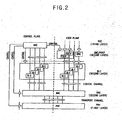
- FIG. 2 shows a structure of a radio access interface protocol between a terminal which operates based on a 3GPP RAN specification and a UTRAN.
- the radio access interface protocol is horizontally formed of a physical layer (PHY), a data link layer, and a network layer and is vertically divided into a control plane for transmitting a control information and a user plane for transmitting data information.
- the user plane is a region to which traffic information of a user such as voice or an IP packet is transmitted.
- the control plane is a region to which control information such as an interface of a network or maintenance and management of a call is transmitted.
- protocol layers can be divided into a first layer (L1), a second layer (L2), and a third layer (L3) based on three lower layers of an open system interconnection (OSI) standard model well known in a communication system.
- OSI open system interconnection
- the first layer (L) operates as a physical layer (PHY) for a radio interface and is connected to an upper medium access control (MAC) layer through one or more transport channels.
- the physical layer transmits data delivered to the physical layer (PHY) through a transport channel to a receiver using various coding and modulating methods suitable for radio circumstances.
- the transport channel between the physical layer (PHY) and the MAC layer is divided into a dedicated transport channel and a common transport channel based on whether it is exclusively used by a single terminal or shared by several terminals.
- the second layer L2 operates as a data link layer and lets various terminals share the radio resources of a WCDMA network.
- the second layer L2 is divided into the MAC layer, a radio link control (RLC) layer, a packet data convergence protocol (PDCP) layer, and a broadcast/multicast control (BMC) layer.
- the MAC layer delivers data through an appropriate mapping relationship between a logical channel and a transport channel.
- the logical channels connect an upper layer to the MAC layer.
- Various logical channels are provided acoording to the kind of transmitted information. In general, when information of the control plane is transmitted, a control channel is used. When information of the user plane is transmitted, a traffic channel is used.
- the MAC layer is divided two sub-layers according to performed functions. The two sub-layers are a MAC-d sub-layer that is positioned in the SRNC and manages the dedicated transport channel and a MAC-c/sh sub-layer that is positioned in the CRNC and manages
- the RLC layer forms an appropriate RLC protocol data unit (PDU) suitable for transmission by the segmentation and concatenation functions of an RLC service data unit (SDU) received from an upper layer.
- the RLC layer also performs an automatic repeat request (ARQ) function by which an RLC PDU lost during transmission is retransmitted.
- the RLC layer operates in three modes, a transparent mode (TM), an unacknowledged mode (UM), and an acknowledged mode (AM). The mode selected depends upon the method used to process the RLC SDU received from the upper layer.
- An RLC buffer stores the RLC SDUs or the RLC PDUs received from the upper layer exists in the RLC layer.
- the packet data convergence protocol (PDCP) layer is an upper layer of the RLC layer which allows data items to be transmitted through a network protocol such as the IPv4 or the IPv6.
- a header compression technique for compressing and transmitting the header information in a packet can be used for effective transmission of the IP packet.
- the broadcast/multicast control (BMC) layer allows a message to be transmitted from a cell broadcast center (CBC) through the radio interface.
- the main function of the BMC layer is scheduling and transmitting a cell broadcast message to a terminal.
- data is transmitted through the RLC layer operating in the unacknowledged mode.
- the PDCP layer and the BMC layer are connected to the SGSN because a packet switching method is used, and are located only in the user plane because they transmit only user data.
- the RLC layer can be included in the user plane and the control plane according to a layer connected to the upper layer.
- RRC radio resource control
- the RLC layer belongs to the user plane.
- the transmission service of user data provided from the user plane to the upper layer by the second layer (L2) is referred to as a radio bearer (RB).
- the transmission service of control information provided from the control plane to the upper layer by the second layer (L2) is referred to as a signaling radio bearer (SRB).
- SRB signaling radio bearer
- a plurality of entities can exist in the RLC and PDCP layers. This is because a terminal has a plurality of RBs, and one or two RLC entities and only one PDCP entity are generally used for one RB.
- the entities of the RLC layer and the PDCP layer can perform an independent function in each layer.
- the RRC layer positioned in the lowest portion of the third layer (L3) is defined only in the control plane and controls the logical channels, the transport channels, and the physical channels in relation to the setup, the reconfiguration, and the release of the RBs.
- setting up the RB means processes of stipulating the characteristics of a protocol layer and a channel, which are required for providing a specific service, and setting the respective detailed parameters and operation methods. It is possible to transmit control messages received from the upper layer through a RRC message.
- the aforementioned W-CDMA system attempts to achieve a transmission speed of 2 Mbps indoors and in a pico-cell circumstance, and a transmission speed of 384 kbps in a general radio condition.
- a transmission speed of 2 Mbps indoors and in a pico-cell circumstance and a transmission speed of 384 kbps in a general radio condition.
- the wireless Internet becomes more widespread and the number of subscribers increases, more diverse services will be provided. In order to support these services, it is expected that higher transmission speeds will be necessary.
- HSDPA high-speed downlink packet access
- the HSDPA system is based on WCDMA. It supports a maximum speed of 10 Mbps to the downlink and is expected to provide shorter delay time and an improved capacity than existing systems.
- the following technologies have been applied to the HSDPA system in order to provide higher transmission speed and enlarged capacity: link adaptation (LA), hybrid automatic repeat request (HARQ), fast cell selection (FCS), and multiple input, multiple output (MIMO) antenna.
- LA link adaptation
- HARQ hybrid automatic repeat request
- FCS fast cell selection
- MIMO multiple input, multiple output
- the LA uses a modulation and coding scheme (MCS) suitable for the condition of a channel.
- MCS modulation and coding scheme
- the channel condition is good, high degree modulation such as 16QAM or 64QAM is used.
- low degree modulation such as QPSK is used.
- low degree modulation methods support a lesser amount of transmission traffic than high degree modulation methods.
- a transmission success ratio is high when a channel condition is not desirable and therefore, it is advantageous to use this form of modulation when the influences of fading or interference is large.
- frequency efficiency is better in high degree modulation methods than in low degree modulation methods.
- high degree modulation methods it is possible, for example, to achieve a transmission speed of 10 Mbps using the 5 MHz bandwidth of W-CDMA.
- high degree modulation methods are very sensitive to noise and interference. Therefore, when a user terminal is located dose to a Node B, it is possible to improve transmission efficiency using 16QAM or 64QAM. And, when the terminal is located on the boundary of the cell or when the influence of fading is large, low modulation method such as QPSK is useful.
- the HARO method is a re-transmission method which differs from existing re-transmission methods used in the RLC layer.
- the HARQ method is used in connection with the physical layer, and a higher decoding success ratio is guaranteed by combining retransmitted data with previously received data. That is, a packet that is not successfully transmitted is not discarded but stored. The stored packet is combined with a re-transmitted packet in a step before decoding and is decoded. Therefore, when the HARQ method is used together with the LA, it is possible to significantly increase the transmission efficiency of the packet.
- the FCS method is similar to a related art soft handover. That is, the terminal can receive data from various cells. However, in consideration of the channel condition of each cell, the terminal receives data from a single cell which has the' best channel condition.
- the related art soft handover methods increase the transmission success ratio using diversity, and more specifically, by receiving data from various cells. However, in the FCS method, data is received from a specific cell in order to reduce interference between cells.
- the MIMO antenna system the transmission speed of data is increased using various independent radio waves propagated in the dispersive channel condition.
- the MIMO antenna system usually consists of several transmission antennas and several reception antennas, so that diversity gain is obtained by reducing correlation between radio waves received by each antenna.
- the HSDPA system thus, to adopt a new technology based on a WCDMA network.
- modification is unavoidable.
- the function of Node B is improved. That is, though most control functions are located in the RNC In a WCDMA network, new technologies for the HSDPA system are managed by the Node B in order to achieve faster adjustment to the channel conditions and to reduce a delay time in the RNC.
- the enhanced function of the Node B is not meant to replace the functions of the RNC but rather is intended to supplement these functions for high speed data transmission, from a point of view of the RNC.
- the Nodes B are modified to perform.some of the MAC functions unlike in the WCDMA system.
- a modified layer which performs some of the MAC function is referred to as a MAC-hs sub-layer.
- the MAC-hs sub-layer is positioned above the physical layer and can perform packet scheduling and LA functions.
- the MAC-hs sub-layer also manages a new transport channel known as HS-DSCH (High Speed-Downlink Shared Channel) which is used for HSDPA data transmission.
- the HS-DSCH channel is used when data is exchanged between the MAC-hs sub-layer and the physical layer.
- FIG. 3 shows a radio interface protocol structure for supporting the HSDPA system.
- the MAC layer is divided into a MAC-d sub-layer, a MAC-c/sh sub-layer, and a MAC-hs sub-layer.
- the MAC-hs sub-layer is positioned above the physical layer (PHY) of a Node B.
- the MAC-c/sh and MAC-d sub-layers are located in the CRNC and the SRNC.
- a new transmission protocol referred to the HS-DSCH frame protocol (FP) is used between the RNC and the Node B of among the RNCs for the delivery of HSDPA data.
- FP HS-DSCH frame protocol
- the MAC-c/sh sub-layer, the MAC-d sub-layer, and the RLC layer positioned above the MAC-hs sub-layer perform the same functions as the current system. Therefore, a slight modification of the current RNC can fully support the HSDPA system.
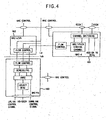
- FIG. 4 shows the structure of a MAC layer used in the HSDPA system.
- the MAC layer is divided into a MAC-d sub-layer 161, a MAC-c/sh sub-layer 162, and a MAC-hs sub-layer 163.
- the MAC-d sub layer in the SRNC manages dedicated transport channels for a specific terminal:
- the MAC-c/sh sub-layer in the CRNC manages the common transport channels.
- the MAC-hs sub-layer in the Node B manages the HS-DSdH. In this arrangement, the functions performed by the MAC-c/sh sub-layer 162 in the HSDPA system are reduced.
- the MAC-c/sh sub-layer assigns common resources shared by various terminals in the conventional system and processes the common resources.
- the MAC-c/sh sub-layer simply performs a flow control function of the data delivery between the MAC-d sub-layer 161 and the MAC-hs sub-layer 163.
- the path of the RLC PDU delivered from the RLC layer through the dedicated logical channel is determined by a channel switching function in the MAC-d layer.
- a dedicated traffic channel DTCH
- DCCH dedicated control channel
- the RLC PDU When the HS-DSCH channel of the HSDPA system is used, the RLC PDU is delivered to the MAC-c/s h sub-layer 162 by a channel switching function. When a plurality of logical channels use one transport channel, the RLC PDU passes through a transport channel multiplexing block. The identification information (control/traffic (C/T) field) of the logical channel, to which each RLC PDU belongs, is added during this process. Also, each logical channel has a priority. Data of a logical channel has the same priority.
- C/T control/traffic
- the MAC-d sub-layer 161 transmits the priority of a MAC-d PDU when the MAC-d PDU is transmitted.
- the MAC-c/sh sub-layer 162 that received the MAC-d PDU simply passes the data received from the MAC-d sub-layer 161 to the MAC-hs sub-layer 163.
- the MAC-d PDU delivered to the MAC-hs sub-layer 163 is stored in the transmission buffer in the scheduling block.
- Each MAC-hs SDU (MAC-d PDU) is sequentially stored in the transmission buffer corresponding to its priority.
- An appropriate data block size is selected by the scheduling function depending on the channel condition. Accordingly, a data block is formed by one or more MAC-hs SDUs.
- a priority class identifier and a transmission sequence number are added to each data block and each data block is delivered to the HARQ block.
- the data block received from the scheduling block is delivered to an appropriate HARQ process.
- Each HARQ process operates in a stop and wait (SAW) ARQ.
- SAW stop and wait
- the next data block is not transmitted until a current data block ls successfully transmitted.
- Another HARQ processes waits until its turn.
- Each HARQ process has a HARQ process identifier.
- a corresponding HARQ process identifier is previously known to the terminal through a downlink control signal, so that a specific data block passes through the same HARQ process in the transmitter (the UTRAN) and the receiver (the terminal).
- the HARQ process that transmitted the data block also stores the data block to provision the future re-transmission.
- the HARQ process re-transmits the data block when NonACKnowledge (NACK) is received from the terminal..
- NACK NonACKnowledge
- the HARQ process When ACK is received from the terminal, the HARQ process deletes the corresponding data block and prepares the transmission of a new data block.
- a transport format and resource combination (TFRC) block selects an appropriate TFC for the HS-DSCH.
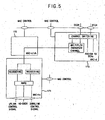
- FIG. 5 shows a structure of the MAC layer of the terminal used in the HSDPA system.
- This MAC layer is divided into a MAC-d sub-layer 173, a MAC-c/sh sub-layer 172, and a MAC-hs sub-layer 171.
- the above three layers are located in the same place.
- the MAC-d sub-layer and the MAC-c/sh sub-layer in the terminal are almost same as those in the UTRAN, but the MAC-hs sub-layer 171 is slightly different because the MAC-hs sub-layer in the UTRAN performs only transmission and the MAC-hs sub-layer in the terminal performs only reception.
- the manner in which the MAC layer receives the data from the physical layer and delivers it to the RLC layer will now be described.
- the data block delivered to the MAC-hs sub-layer 171 through the HS-DSCH is first stored in one of the HARQ processes in the HARQ block. In which process the data block is stored can be known from the HARQ process identifier included in the downlink control signal.
- the HARQ process in which the data block is stored, transmits the NACK information to the UTRAN when there are errors in the data block and requests the re-transmission of the data block.
- the HARQ process delivers the data block to a reordering buffer and transmits the ACK information to the UTRAN.
- a reordering buffer has a priority like the transmission buffer in the UTRAN.
- the HARQ process delivers the data block to the corresponding reordering buffer with the aid of a priority class identifier included in the data block.
- a significant characteristic of the reordering buffer is that it supports in-sequence delivery of data.
- Data blocks are sequentially delivered to an upper layer based on a transmission sequence number (TSN). More specifically, when a data block is received while one or more previous data blocks are missing, the.data block is stored in the reordering buffer and is not delivered to the upper layer. Rather, the stored data block is delivered to the upper layer only when all previous data blocks are received and delivered to the upper layer. Because several HARQ processes operate, a reordering buffer may receive data blocks out of sequence. Therefore, an in-sequence delivery function is used for the reordering buffer so that the data blocks can be delivered to the upperiayer sequentially.
- TSN transmission sequence number
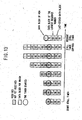
- FIG. 6 shows processes for transmitting and receiving a data block in an HSDPA system.
- the sizes of the respective data blocks can vary. However, the sizes are shown to be the same because the data blocks for illustrative purposes. Also, it is assumed that eight HARQ processes 181 through 188 exist.
- a data block with a lower TSN is served first to an empty HARQ process.
- the HARQ process When the HARQ process receives an arbitrary data block, the HARQ process transmits the data block to the receiver in a specific TTI and stores the data block for re-transmission that might be performed later. Only one data block can be transmitted in a certain TTI. Accordingly, only one HARQ process is activated in a single TTI.
- the HARQ process that transmitted the data block informs the receiver of its process number through a downlink control signal which is transmitted through a different channel than that of the data block.
- TTI transmission time interval
- the data blocks are delivered to the upper layer, they are disassembled in units of MAC-d PDUs and are delivered as described above.
- the transmission efficiency of the HSDPA system deteriorates. More specifically, when a large number of data blocks are stored in the buffer of the MAC-hs for a long time due to a single missing data block, the entire data transmission efficiency of the system is reduced. This undermines many of the advantages of the HSDPA system, such as its ability to provide high-speed data communications.
- a data block may not be received permanently because of one of the following two reasons:
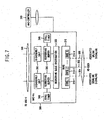
- the reordering queue distribution unit routes the data blocks to the correct reordering buffer based on queue identification (ID) information in the header of each block.
- ID queue identification
- This information provides, for example, an indication of the reordering queue that may be used to support independent buffer handling of data belonging to different reordering queues.
- the reordering buffers reorder data blocks from the reordering queue distribution unit based on transmission sequence numbers (TSNs) in headers of the blocks.
- TSNs transmission sequence numbers
- the buffers then deliver those blocks in sequence to an upper layer. Delivery of the blocks may be performed as follows. In each buffer, data blocks with consecutive TSNs are delivered to an associated disassembly unit upon reception. A'data block, however, is not immediately delivered to a disassembly function if one or more preceding data blocks (e.g., ones having lower transmission sequence numbers) were not received. In this case, the data blocks are temporarily stored in the reordering buffer and then output under control of the stall timer of the present invention, discussed in greater detail below.
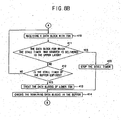
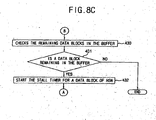
- FIGS. 8A-8C show steps included in a method for avoiding a stall condition in a reordering buffer of a protocol layer of a receiver in accordance with one embodiment of the present invention.
- the method includes as an initial step receiving a data block with a sequence number SN from a peer entity of the transmitter via lower layers such as a physical layer through an HS-DSCH channel. (Block 400).
- a second step includes determining whether or not the received data block can be delivered to the upper layer. (Block 401). This step is performed based on whether one or more previous data blocks was not received. If at least one data block having a transmission sequence number that precedes the transmission sequence number of the received data block has not been received, the received data block (with a transmission sequence number of TSN) is not delivered to the upper layer but stored in the reordering buffer. (Block 402).
- the missing data block(s) may be detected, for example, by comparing the transmission sequence number in the header of the newly received data block with the transmission sequence number of a last-delivered data block. If these numbers are not sequential, then a missing data block may be determined to exist and the number of missing blocks may be determined based on the difference between these numbers. These functions may be performed under control of the MAC controller in conjunction with, for example, the reordering queue distribution and HARQ units.
- data block TSN was correctly received, it may not be immediately delivered to an upper layer because data block TSN-1 is missing.
- data block SN is temporarily stored in the reordering buffer. If all data blocks having preceding transmission sequence numbers have been delivered within the time frame under consideration, then data block SN is not stored in the buffer but rather is automatically delivered to the upper layer. (Block 403).
- the data block of HSN or the data block in the buffer having the highest transmission sequence number may correspond to the last data block of a part of a circulation of the transmission sequence number.
- the behavior of the reordering buffer for the re-started stall timer is the same for the previous stall timer.
- all data blocks preceding data block HSN may be received and delivered to the upper layer. If so, the data block HSN is delivered to the upper layer (Block 411) and the stall timer is stopped (Block 420).
- the stall timer After delivering all possible data blocks, if one or more data blocks still remain in the reordering buffer, the stall timer restarts for the data block of new HSN, and the control procedure begins again. If no data blocks are left in the buffer, the stall timer becomes inactive and the reordering buffer waits for the next data block, i.e., the whose procedure begins again.
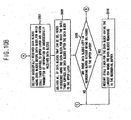
- FIGS. 10A and 10B show another embodiment of the method of the present invention for avoiding a stall condition in an HSDPA system.
- data block DB is defined as the data block for which the stall timer is started and "data block M" as the data block that is received during the stall timer period.
- this method includes as an initial step determining whether a data block DB has been received from the physical layer in a medium access control layer of the user equipment (Block 501).
- the data block may be received through an HS-DSCH channel connected to one of a plurality of HARQ processes included in the MAC layer.
- Data blocks may be determined to be missing based on a comparison of the transmission sequence number of the received data block DB and, for example, a transmission sequence number of a last-delivered data block. If the two sequence numbers are not in succession, then the difference between the sequence numbers may be used as a basis for determining how many missing data blocks exist (i.e., were not received) before the received data block DB.
- all remaining data blocks stored in the reordering buffer have consecutively successive transmission sequence numbers.
- all remaining data blocks in the reordering buffer are delivered to the upper layer with data block DB upon timer expiration, and the stall timer becomes inactive.
- the stall timer is re-started for the data block with the highest transmission sequence number among the remaining data blocks in the reordering buffer. This will be further described in a next step.
- Block 522 After delivering all possible data blocks to the upper layer, a check is performed to determine whether data block DB (which started the stall timer) has been delivered to an upper layer (Block 522). If so, the stall timer may be stopped and re-set for later use (Block 523). If the conditions in Block 522 are not met, then the method continues to wait until the stall timer expires, whereupon the options stemming from step S106. are performed as previously discusses.
- the stall timer may be controlled by one or more upper layers of the protocol such as an upper radio resource control (RRC) layer.
- RRC radio resource control
- This layer preferably sets the timer to a period that will ensure that wrap-around in the reordering buffer will not occur. This condition occurs when the period of the stall timer is set too long, so that different data blocks having the same or redundant transmission sequence numbers are stored in the buffer.
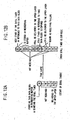
- Data blocks 22, 23, and 25 are not delivered when the stall timer expires because data block 21 was not received. Instead, the data block of HSN stored in the reordering buffer at the time the stall timer expired is detected.
- the data block of HSN 25 corresponds to the one having the highest transmission number in the reordering buffer. This may not always be the case however. Since there is only a finite range of transmission sequence number that can be assigned to data blocks, it may be the case that a succession of data blocks 63, 0, 1, and 2 a re stored in the reordering buffer. In this case, the data block of HSN would not correspond to the data block having the largest transmission sequence number. This case is illustratively shown in FIG. 13 . The present invention is therefore preferably performed to re-start the stall timer to coincide with the data block of HSN in the buffer and not necessarily the data block having the highest transmission sequence number.
- the stall timer is re-started. During this time, additional data blocks are received, some of which may include missing data blocks 21 and 24.
- data block 21 is received during the stall timer period
- the data blocks 21, 22, and 23 are sequentially delivered to the upper layer.
- data block 24 is also received during the stall timer period
- the data blocks 24, 25, and the consecutively successive data blocks are delivered to the upper layer and the stall timer stops. But, if data blocks 21 and 24 are not received during the stall timer period, the data blocks 22, 23, and 25 and the consecutively successive data blocks are delivered to the upper layer only after the stall timer expires. The delivered blocks are then discarded from the buffer and the process continues.
- a reordering buffer may be controlled by only one stall timer.
- a stall timer controls a reordering buffer in the MAC layer, and more specifically the MAC-hs sub-layer, of the user terminal.
- the stall timer period may be controlled by upper layers to avoid the wrap-around condition previously discussed.
- the stall timer T1 will be stopped if the MAC-hs PDU for which the timer was started can be delivered to the disassembly function before the stall timer T1 expires:
- All received MAC-has PDUs having consecutive transmission sequence numbers (TSNs) from Next_expected_TSN up to the first not received MAC-has PDU are delivered to the disassembly entity.
- TSNs transmission sequence numbers
- the TSN of the first not received MAC-hs PDU becomes the Next_expec!ed_TSN.
- the present invention is also a computer program having respective code sections which perform steps included in any of the embodiments of the method of the present invention discussed herein.
- the computer program may be written in any computer language supportable within a user terminal, and may be stored on a permanent or removable computer readable medium within or interfaced to the terminal.
- Permanent computer-readable mediums include but are not limited to read-only memories and random-access memories.
- Removable mediums include but are not limited to EPROMs, EEPROMs, any one of a number of so-called memory sticks or cards, or any other type of removable storage medium: Flash memories may also be used to store the computer program of the invention.
Landscapes
- Engineering & Computer Science (AREA)
- Signal Processing (AREA)
- Computer Networks & Wireless Communication (AREA)
- Computer Security & Cryptography (AREA)
- Databases & Information Systems (AREA)
- Mobile Radio Communication Systems (AREA)
- Communication Control (AREA)
- Data Exchanges In Wide-Area Networks (AREA)
- Maintenance And Management Of Digital Transmission (AREA)
Applications Claiming Priority (2)
| Application Number | Priority Date | Filing Date | Title |
|---|---|---|---|
| KR20020000632A KR100747464B1 (ko) | 2002-01-05 | 2002-01-05 | 고속하향링크패킷접속(hsdpa)시스템을 위한타이머를 이용한 교착상황 회피방법 |
| EP20030000116 EP1326388B1 (en) | 2002-01-05 | 2003-01-02 | System and method for avoiding stall using timer for high-speed downlink packet access system |
Related Parent Applications (1)
| Application Number | Title | Priority Date | Filing Date |
|---|---|---|---|
| EP20030000116 Division EP1326388B1 (en) | 2002-01-05 | 2003-01-02 | System and method for avoiding stall using timer for high-speed downlink packet access system |
Publications (2)
| Publication Number | Publication Date |
|---|---|
| EP2117185A1 EP2117185A1 (en) | 2009-11-11 |
| EP2117185B1 true EP2117185B1 (en) | 2015-03-18 |
Family
ID=19718209
Family Applications (5)
| Application Number | Title | Priority Date | Filing Date |
|---|---|---|---|
| EP20090167074 Expired - Lifetime EP2117185B1 (en) | 2002-01-05 | 2003-01-02 | System and method for avoiding stall using timer for high-speed downlink packet access system |
| EP08169464.8A Expired - Lifetime EP2023556B1 (en) | 2002-01-05 | 2003-01-02 | System and method for avoiding stall using timer for high speed downlink packet access system |
| EP20030000116 Expired - Lifetime EP1326388B1 (en) | 2002-01-05 | 2003-01-02 | System and method for avoiding stall using timer for high-speed downlink packet access system |
| EP20090167069 Expired - Lifetime EP2107739B1 (en) | 2002-01-05 | 2003-01-02 | System and method for avoiding stall using timer for high-speed downlink packet access system |
| EP20090167067 Expired - Lifetime EP2107738B1 (en) | 2002-01-05 | 2003-01-02 | System and method for avoiding stall using timer for high-speed downlink packet access system |
Family Applications After (4)
| Application Number | Title | Priority Date | Filing Date |
|---|---|---|---|
| EP08169464.8A Expired - Lifetime EP2023556B1 (en) | 2002-01-05 | 2003-01-02 | System and method for avoiding stall using timer for high speed downlink packet access system |
| EP20030000116 Expired - Lifetime EP1326388B1 (en) | 2002-01-05 | 2003-01-02 | System and method for avoiding stall using timer for high-speed downlink packet access system |
| EP20090167069 Expired - Lifetime EP2107739B1 (en) | 2002-01-05 | 2003-01-02 | System and method for avoiding stall using timer for high-speed downlink packet access system |
| EP20090167067 Expired - Lifetime EP2107738B1 (en) | 2002-01-05 | 2003-01-02 | System and method for avoiding stall using timer for high-speed downlink packet access system |
Country Status (15)
| Country | Link |
|---|---|
| US (15) | US7522526B2 (enExample) |
| EP (5) | EP2117185B1 (enExample) |
| JP (1) | JP4020199B2 (enExample) |
| KR (1) | KR100747464B1 (enExample) |
| CN (2) | CN100466495C (enExample) |
| AT (1) | ATE470292T1 (enExample) |
| AU (1) | AU2002359085B2 (enExample) |
| DE (1) | DE60332782D1 (enExample) |
| ES (2) | ES2421559T3 (enExample) |
| MX (1) | MXPA04006546A (enExample) |
| PT (1) | PT2107739E (enExample) |
| RU (1) | RU2287220C2 (enExample) |
| UA (1) | UA77228C2 (enExample) |
| WO (1) | WO2003058852A1 (enExample) |
| ZA (1) | ZA200404972B (enExample) |
Families Citing this family (149)
| Publication number | Priority date | Publication date | Assignee | Title |
|---|---|---|---|---|
| US7936664B2 (en) * | 1991-03-26 | 2011-05-03 | Nokia Corporation | Multi-carrier radio link protocol supervision in a radio communication system |
| US7376879B2 (en) | 2001-10-19 | 2008-05-20 | Interdigital Technology Corporation | MAC architecture in wireless communication systems supporting H-ARQ |
| KR100747464B1 (ko) * | 2002-01-05 | 2007-08-09 | 엘지전자 주식회사 | 고속하향링크패킷접속(hsdpa)시스템을 위한타이머를 이용한 교착상황 회피방법 |
| WO2003096567A1 (en) * | 2002-05-10 | 2003-11-20 | Interdigital Technology Corporation | Method for monitoring transmission sequence numbers assigned to protocol data units to detect and correct transmission errors |
| KR100442368B1 (ko) * | 2002-05-15 | 2004-07-30 | 엘지전자 주식회사 | Gprs의 rlc/mac 데이터 전송방법 |
| JP4172207B2 (ja) * | 2002-05-29 | 2008-10-29 | 日本電気株式会社 | 無線アクセスネットワーク装置及びそれを用いた移動通信システム |
| CN1523797B (zh) * | 2003-02-17 | 2012-07-04 | 北京三星通信技术研究有限公司 | Wcdma系统增强型上行专用信道harq的重排序方法 |
| JP2004282652A (ja) * | 2003-03-19 | 2004-10-07 | Nec Corp | 移動通信システム、基地局制御装置及びそれに用いるデータ転送方法 |
| EP1610575A4 (en) * | 2003-03-31 | 2010-07-21 | Fujitsu Ltd | RADIO COMMUNICATION NETWORK AND METHOD FOR FLOW CONTROL |
| US7349400B2 (en) | 2003-04-29 | 2008-03-25 | Narus, Inc. | Method and system for transport protocol reconstruction and timer synchronization for non-intrusive capturing and analysis of packets on a high-speed distributed network |
| US20040228313A1 (en) * | 2003-05-16 | 2004-11-18 | Fang-Chen Cheng | Method of mapping data for uplink transmission in communication systems |
| KR100689543B1 (ko) * | 2003-08-26 | 2007-03-02 | 삼성전자주식회사 | 이동통신 시스템에서 상향링크 패킷 전송을 위한 스케쥴링 요청 방법 및 장치 |
| US8908496B2 (en) * | 2003-09-09 | 2014-12-09 | Qualcomm Incorporated | Incremental redundancy transmission in a MIMO communication system |
| US7668125B2 (en) | 2003-09-09 | 2010-02-23 | Qualcomm Incorporated | Incremental redundancy transmission for multiple parallel channels in a MIMO communication system |
| RU2369021C2 (ru) * | 2003-09-09 | 2009-09-27 | Квэлкомм, Инкорпорейтед | Передача с инкрементной избыточностью в системе связи mimo |
| US7616698B2 (en) | 2003-11-04 | 2009-11-10 | Atheros Communications, Inc. | Multiple-input multiple output system and method |
| US7206581B2 (en) * | 2003-11-05 | 2007-04-17 | Interdigital Technology Corporation | Method and apparatus for processing data blocks during soft handover |
| EP1530395A2 (en) * | 2003-11-07 | 2005-05-11 | Lg Electronics Inc. | Paging technique to support point-to-multipoint (P-T-M) data transmissions |
| EP1683282B1 (en) * | 2003-11-10 | 2010-12-29 | LG Electronics, Inc. | Updating next-expected tsn and receiver window to avoid stall conditions |
| US20050100038A1 (en) * | 2003-11-12 | 2005-05-12 | Interdigital Technology Corporation | Wireless communication method and apparatus for efficiently providing channel quality information to a Node-B downlink scheduler |
| KR100906176B1 (ko) * | 2003-11-25 | 2009-07-03 | 인터내셔널 비지네스 머신즈 코포레이션 | 모바일 허브 및 모바일 허브에서의 이벤트 관리 방법 |
| US20050185609A1 (en) * | 2004-02-16 | 2005-08-25 | Esa Malkamaki | Communication method, user terminal, network element and computer program |
| FI20040243A0 (fi) * | 2004-02-16 | 2004-02-16 | Nokia Corp | Tiedonsiirtomenetelmä, päätelaite, verkkoelementti ja tietokoneohjelma |
| CN100337418C (zh) * | 2004-03-12 | 2007-09-12 | 华为技术有限公司 | 一种触发状态信息发送的方法 |
| US7957389B2 (en) * | 2004-03-31 | 2011-06-07 | Alcatel-Lucent Usa Inc. | Method of stall identification and recovery |
| KR101000699B1 (ko) * | 2004-04-19 | 2010-12-10 | 엘지전자 주식회사 | 무선링크 제어계층에서의 데이터 처리방법 |
| US8018945B2 (en) * | 2004-04-29 | 2011-09-13 | Interdigital Technology Corporation | Method and apparatus for forwarding non-consecutive data blocks in enhanced uplink transmissions |
| JP2005318429A (ja) * | 2004-04-30 | 2005-11-10 | Sony Ericsson Mobilecommunications Japan Inc | 再送制御方法及び無線通信端末 |
| KR100735346B1 (ko) | 2004-05-04 | 2007-07-04 | 삼성전자주식회사 | 향상된 상향 링크 전용 채널에서 harq 동작을 고려한tti 변경 방법 및 장치 |
| US7643419B2 (en) | 2004-05-07 | 2010-01-05 | Interdigital Technology Corporation | Method and apparatus for implementing a data lifespan timer for enhanced dedicated channel transmissions |
| US7584397B2 (en) | 2004-06-10 | 2009-09-01 | Interdigital Technology Corporation | Method and apparatus for dynamically adjusting data transmission parameters and controlling H-ARQ processes |
| KR20050118591A (ko) * | 2004-06-14 | 2005-12-19 | 엘지전자 주식회사 | 무선통신 시스템에서의 무선링크제어(rlc) 데이터처리방법 |
| KR100921241B1 (ko) * | 2004-06-16 | 2009-10-12 | 엘지전자 주식회사 | 통신 시스템의 데이터 유닛 처리 시스템 |
| KR100713394B1 (ko) * | 2004-06-16 | 2007-05-04 | 삼성전자주식회사 | 이동통신 시스템에서 전송일련번호와 타임스탬프를 이용한 상향링크 데이터 패킷들의 재정렬 방법 및 장치 |
| US7197692B2 (en) | 2004-06-18 | 2007-03-27 | Qualcomm Incorporated | Robust erasure detection and erasure-rate-based closed loop power control |
| US8452316B2 (en) | 2004-06-18 | 2013-05-28 | Qualcomm Incorporated | Power control for a wireless communication system utilizing orthogonal multiplexing |
| WO2006000900A1 (en) | 2004-06-29 | 2006-01-05 | Nokia Corporation | Internet high speed packet access |
| JP4379800B2 (ja) * | 2004-07-12 | 2009-12-09 | ソニー・エリクソン・モバイルコミュニケーションズ株式会社 | 受信装置およびそのメモリ解放方法 |
| US7885245B2 (en) | 2004-07-19 | 2011-02-08 | Interdigital Technology Corporation | Method and apparatus for enhanced uplink multiplexing |
| US7940663B2 (en) * | 2004-07-20 | 2011-05-10 | Qualcomm Incorporated | Mitigating ACK/NACK errors in MIMO/SIC/HARQ |
| US7474642B1 (en) * | 2004-09-15 | 2009-01-06 | Nortel Networks Limited | Signaling reliability in using high-speed shared packet data channel |
| JP2006128871A (ja) * | 2004-10-27 | 2006-05-18 | Matsushita Electric Ind Co Ltd | 制御局装置、基地局装置及びパケットデータ廃棄方法 |
| US8848574B2 (en) * | 2005-03-15 | 2014-09-30 | Qualcomm Incorporated | Interference control in a wireless communication system |
| US8942639B2 (en) | 2005-03-15 | 2015-01-27 | Qualcomm Incorporated | Interference control in a wireless communication system |
| JP4906844B2 (ja) * | 2005-03-29 | 2012-03-28 | エルジー エレクトロニクス インコーポレイティド | 無線移動通信システムで下位階層データブロックを生成する方法 |
| EP1867138B1 (en) | 2005-03-29 | 2018-01-10 | Koninklijke Philips N.V. | Receiver apparatus and method for receiving data units over a channel |
| JP4572718B2 (ja) * | 2005-03-30 | 2010-11-04 | 日本電気株式会社 | 伝送路資源制御システム及びその方法並びにそれに用いる無線回線制御装置 |
| US7768961B2 (en) * | 2005-05-03 | 2010-08-03 | Interdigital Technology Corporation | Wireless communication method and apparatus for reliably transmitting data |
| ZA200709594B (en) * | 2005-05-04 | 2009-09-30 | Ericsson Telefon Ab L M | Method and arrangement in real-time data bi-casting mobile system |
| US8804626B2 (en) * | 2005-05-10 | 2014-08-12 | Ntt Docomo, Inc. | Transmission rate control method, mobile station, radio network controller, and radio base station |
| CN100431374C (zh) * | 2005-06-28 | 2008-11-05 | 上海原动力通信科技有限公司 | 高速下行分组接入业务用户终端在多载波小区的工作方法 |
| KR100648926B1 (ko) * | 2005-07-11 | 2006-11-27 | 삼성전자주식회사 | 사용자 식별 정보 부가기능을 갖는 복합기 및 그 방법 |
| EP1911312B8 (en) * | 2005-07-25 | 2016-07-13 | Telefonaktiebolaget LM Ericsson (publ) | Means and methods for improving the handover characteristics of radio access networks |
| US8325768B2 (en) | 2005-08-24 | 2012-12-04 | Intel Corporation | Interleaving data packets in a packet-based communication system |
| DE602005010252D1 (de) * | 2005-09-20 | 2008-11-20 | Matsushita Electric Industrial Co Ltd | Vefahren und Vorrichtung zur Packetsegmentierung und Verknüpfungssignalisierung in einem Kommunikationssystem |
| TWI310911B (en) * | 2005-09-29 | 2009-06-11 | Innovative Sonic Ltd | Method and apparatus for initiating a storage window in a periodic packet retransmission wireless communications system operated in unacknowledged mode |
| EP3136671A1 (en) * | 2005-10-21 | 2017-03-01 | Apple Inc. | Multiplexing schemes for ofdma |
| IN2013MN00252A (enExample) | 2005-10-27 | 2015-06-05 | Qualcomm Inc | |
| US20070127467A1 (en) * | 2005-12-01 | 2007-06-07 | Via Telecom Co., Ltd. | Segmentation and reassembly receiver operation |
| KR101139989B1 (ko) * | 2006-01-20 | 2012-05-02 | 삼성전자주식회사 | 비동기식 고속 패킷 데이터 시스템에서 단말내 매체 접근제어 메모리 할당 방법 및 장치 |
| EP2461491A1 (en) | 2006-02-28 | 2012-06-06 | Rotani Inc. | Methods and apparatus for overlapping MIMO antenna physical sectors |
| ATE492100T1 (de) * | 2006-03-03 | 2011-01-15 | Huawei Tech Co Ltd | Verfahren zur neuzusammenstellung von daten in einem drahtlosen kommunikationssystem und vorrichtung dafür |
| KR100987263B1 (ko) * | 2006-03-08 | 2010-10-12 | 닛본 덴끼 가부시끼가이샤 | 무선 제어 장치, 그 동작 제어 방법 및 컴퓨터 판독가능 기록매체 |
| CN100438445C (zh) * | 2006-05-22 | 2008-11-26 | 华为技术有限公司 | 用于WiMAX网络的无线网络管理系统和方法 |
| US8379646B2 (en) * | 2006-07-31 | 2013-02-19 | Lg Electronics Inc. | Method of processing control information in a mobile communication system |
| CN101087171A (zh) * | 2006-08-26 | 2007-12-12 | 华为技术有限公司 | 一种无线链路控制传输的方法及系统 |
| US8442572B2 (en) * | 2006-09-08 | 2013-05-14 | Qualcomm Incorporated | Method and apparatus for adjustments for delta-based power control in wireless communication systems |
| US8670777B2 (en) | 2006-09-08 | 2014-03-11 | Qualcomm Incorporated | Method and apparatus for fast other sector interference (OSI) adjustment |
| CN100502327C (zh) * | 2006-09-29 | 2009-06-17 | Ut斯达康通讯有限公司 | 检测基于IP传输的lub FP帧丢帧情况的方法、设备及系统 |
| EP2078368B1 (en) | 2006-10-31 | 2015-05-06 | Telefonaktiebolaget LM Ericsson (publ) | Harq in spatial multiplexing mimo system |
| WO2008085842A1 (en) * | 2007-01-04 | 2008-07-17 | Interdigital Technology Corporation | Node b based segmentation/concatenation |
| MY147663A (en) * | 2007-01-08 | 2012-12-31 | Interdigital Tech Corp | Method and apparatus for multicasting with feedback information |
| US8006122B2 (en) * | 2007-01-10 | 2011-08-23 | International Business Machines Corporation | Methods, systems, and computer products for detection of and policy directed resolution of signaling sympathy sickness in a multisystem cluster |
| EP2127403B1 (en) | 2007-02-02 | 2019-04-03 | InterDigital Technology Corporation | Method and apparatus for controlling a handover between utra r6 cells and r7 cells |
| RU2448437C2 (ru) * | 2007-02-02 | 2012-04-20 | Интердиджитал Текнолоджи Корпорейшн | Способ и устройство для управления передачей обслуживания между сотами utra r6 и сотами r7 |
| CA2681049C (en) | 2007-03-15 | 2013-02-05 | Interdigital Technology Corporation | Method and apparatus for reordering data in an evolved high speed packet access system |
| CN103024833B (zh) | 2007-03-16 | 2015-11-25 | 交互数字技术公司 | 用于支持无线电链路控制参数重新配置的无线通信方法和设备 |
| KR101435832B1 (ko) | 2007-03-19 | 2014-08-29 | 엘지전자 주식회사 | 이동통신 시스템에서의 무선 프로토콜 처리방법 및이동통신 송신기 |
| JPWO2008126822A1 (ja) * | 2007-04-06 | 2010-07-22 | 株式会社エヌ・ティ・ティ・ドコモ | パケット通信方法及び受信側装置 |
| BRPI0811252A2 (pt) * | 2007-04-06 | 2014-11-04 | Ntt Docomo Inc | Método de transmissão de solicitação de retransmissão e aparelho do lado de recebimento. |
| JP4805386B2 (ja) * | 2007-04-26 | 2011-11-02 | 富士通株式会社 | 基地局、移動局、通信システム、送信方法及びリオーダリング方法 |
| US8274939B2 (en) | 2007-04-30 | 2012-09-25 | Lg Electronics Inc. | Method of transmitting data block in wireless communication system |
| EP2140631B1 (en) * | 2007-05-02 | 2018-06-20 | Nokia Technologies Oy | System and method for improving reordering functionality in radio communications |
| US9288015B2 (en) | 2007-06-15 | 2016-03-15 | Telefonaktiebolaget L M Ericsson (Publ) | Sequence number update |
| JP5080644B2 (ja) * | 2007-06-18 | 2012-11-21 | エルジー エレクトロニクス インコーポレイティド | ハンドオーバ中のダウンリンクパケットデータコンバージェンスプロトコル動作 |
| KR101404256B1 (ko) * | 2007-08-10 | 2014-06-05 | 후지쯔 가부시끼가이샤 | 무선 기지국 및 이동국 |
| WO2009023746A2 (en) * | 2007-08-13 | 2009-02-19 | Qualcomm Incorporated | Optimizing in-order delivery of data packets during wireless communication handover |
| CN101127587B (zh) | 2007-09-25 | 2011-12-28 | 中兴通讯股份有限公司 | 一种自动重传请求状态报告触发方法 |
| US8553624B2 (en) | 2007-10-10 | 2013-10-08 | Samsung Electronics Co., Ltd. | Asynchronous hybrid ARQ process indication in a MIMO wireless communication system |
| KR101394784B1 (ko) * | 2007-10-16 | 2014-05-15 | 엘지전자 주식회사 | 고속데이터 전송을 위한 arq 과정의 수행방법 |
| US20090168723A1 (en) * | 2007-11-27 | 2009-07-02 | Qualcomm Incorporated | Method and apparatus for handling out-of-order packets during handover in a wireless communication system |
| EP2234432B1 (en) * | 2007-12-20 | 2014-04-16 | NTT DoCoMo, Inc. | Mobile station, base station device, communication control method, and mobile communication system |
| WO2009088342A1 (en) * | 2008-01-07 | 2009-07-16 | Telefonaktiebolaget L M Ericsson (Publ) | Reordering timer for a retransmission protocol |
| US7849243B2 (en) * | 2008-01-23 | 2010-12-07 | Intel Corporation | Enabling flexibility of packet length in a communication protocol |
| KR101375936B1 (ko) * | 2008-02-01 | 2014-03-18 | 엘지전자 주식회사 | 시간동기 타이머의 만료 시 하향링크 harq의 동작 방법 |
| CA2692649C (en) | 2008-02-01 | 2015-07-07 | Lg Electronics Inc. | Method for sending rlc pdu and allocating radio resource in mobile communications system and rlc entity of mobile communications |
| KR101531419B1 (ko) | 2008-02-01 | 2015-06-24 | 엘지전자 주식회사 | 시간동기 타이머의 만료 시 상향링크 harq의 동작 방법 |
| US8634763B2 (en) * | 2008-04-22 | 2014-01-21 | Intel Corporation | Cooperative communications techniques |
| US8626162B2 (en) * | 2008-06-06 | 2014-01-07 | Qualcomm Incorporated | Registration and access control in femto cell deployments |
| EP2136501B1 (en) | 2008-06-20 | 2019-12-04 | LG Electronics Inc. | Method of delivering a PDCP data unit to an upper layer |
| KR100954925B1 (ko) * | 2008-06-20 | 2010-04-27 | 엘지전자 주식회사 | 상위로 PDCP 데이터 유닛(data unit)을 전달하는 방법 |
| BRPI0911022A2 (pt) | 2008-08-01 | 2015-12-29 | Nec Corp | sistema de comunicação móvel, dispositivo de controle, dispositivo de estação base, método de controle de comunicação e método de controle de dispositivo |
| KR100937433B1 (ko) * | 2008-09-17 | 2010-01-18 | 엘지전자 주식회사 | 최대 전송 회수를 고려한 harq 동작 방법 |
| US8228938B2 (en) | 2009-02-02 | 2012-07-24 | Samsung Electronics Co., Ltd. | Method and apparatus for preventing a miss-detection of duplicated packets and an out-of-sequence delivery to the higher layer in unacknowledged mode operation |
| KR20100094924A (ko) * | 2009-02-19 | 2010-08-27 | 삼성전자주식회사 | 무선 이동 통신 시스템에서 복합 자동 재전송 요구 동작 방법 |
| EP2222011A3 (en) | 2009-02-19 | 2014-10-29 | Samsung Electronics Co., Ltd. | Method for performing hybrid automatic repeat request operation in a wireless mobile communication system |
| US9124448B2 (en) * | 2009-04-04 | 2015-09-01 | Oracle International Corporation | Method and system for implementing a best efforts resequencer |
| BRPI1013944B1 (pt) | 2009-05-04 | 2021-01-12 | Apple Inc. | método, artigo e dispositivo sem fio para utilizar um temporizador variável para enviar uma indicação de erro |
| KR101534865B1 (ko) | 2009-06-23 | 2015-07-27 | 엘지전자 주식회사 | 링크 적응 절차 수행 방법 |
| US8416784B2 (en) * | 2009-09-03 | 2013-04-09 | Samsung Electronics Co., Ltd. | Apparatus and method for receiving packet data in wireless communication system |
| KR101578047B1 (ko) * | 2010-01-13 | 2015-12-17 | 삼성전자 주식회사 | 통신 시스템에서 데이터 패킷 재정렬 장치 및 방법 |
| US9729350B1 (en) * | 2010-05-07 | 2017-08-08 | Amazon Technologies, Inc. | Maintaining packet order in network flows over an autonomous network |
| US8891356B2 (en) * | 2010-06-28 | 2014-11-18 | Qualcomm Incorporated | System and method for multi-point HSDPA communication utilizing a multi-link RLC sublayer |
| US8989140B2 (en) | 2010-06-28 | 2015-03-24 | Qualcomm Incorporated | System and method for mobility in a multi-point HSDPA communication network |
| EP2622774B1 (en) * | 2010-10-01 | 2023-12-13 | InterDigital Patent Holdings, Inc. | Mac and rlc architecture and procedures to enable reception from multiple transmission points |
| US8989004B2 (en) | 2010-11-08 | 2015-03-24 | Qualcomm Incorporated | System and method for multi-point HSDPA communication utilizing a multi-link PDCP sublayer |
| US9503223B2 (en) * | 2011-03-04 | 2016-11-22 | Blackberry Limited | Controlling network device behavior |
| CN102905310A (zh) * | 2011-07-25 | 2013-01-30 | 中兴通讯股份有限公司 | 一种数据处理方法、装置及分组数据汇聚协议层模块 |
| US9125098B2 (en) | 2011-08-03 | 2015-09-01 | Qualcomm Incorporated | Method and apparatus for flow congestion control in multiflow networks |
| US8737211B2 (en) | 2011-08-03 | 2014-05-27 | Qualcomm Incorporated | Methods and apparatuses for network configuration of user equipment communication modes in multiflow systems |
| US20130088960A1 (en) | 2011-10-07 | 2013-04-11 | Futurewei Technologies, Inc. | System and Method for Information Delivery with Multiple Point Transmission |
| US9838089B2 (en) | 2011-10-07 | 2017-12-05 | Futurewei Technologies, Inc. | System and method for multiple point transmission in a communications system |
| WO2013066252A1 (en) * | 2011-11-04 | 2013-05-10 | Telefonaktiebolaget L M Ericsson (Publ) | Handling redundant data in a communication system |
| US9461782B2 (en) | 2011-11-04 | 2016-10-04 | Telefonaktiebolaget L M Ericsson | Handling redundant data in a communication system |
| JP5940353B2 (ja) * | 2012-04-11 | 2016-06-29 | オリンパス株式会社 | 無線通信装置、メモリ装置、無線通信システム、無線通信方法、およびプログラム |
| US8611213B1 (en) * | 2012-06-01 | 2013-12-17 | At&T Intelletual Property I, L.P. | Transmitting delay-tolerant data with other network traffic |
| US9626294B2 (en) * | 2012-10-03 | 2017-04-18 | International Business Machines Corporation | Performance-driven cache line memory access |
| CA2905607C (en) | 2013-03-15 | 2017-06-06 | Synaptive Medical (Barbados) Inc. | System and method for reliable messaging between application sessions across volatile networking conditions |
| US20140301188A1 (en) * | 2013-04-04 | 2014-10-09 | Nokia Siemens Networks Oy | Delivery of protocol data units |
| WO2015072905A1 (en) * | 2013-11-12 | 2015-05-21 | Telefonaktiebolaget L M Ericsson (Publ) | Devices and methods for handling blind (re)transmissions in a network |
| EP3105961B1 (en) * | 2014-02-14 | 2019-12-11 | Telefonaktiebolaget LM Ericsson (publ) | Rbs, rnc and respective methods performed thereby for transmitting data to a ue |
| US9614567B2 (en) | 2015-03-19 | 2017-04-04 | Qualcomm Incorporated | Systems and methods for recovering from stalls on a mobile device |
| US9955802B2 (en) | 2015-04-08 | 2018-05-01 | Fasteners For Retail, Inc. | Divider with selectively securable track assembly |
| WO2017037687A1 (en) * | 2015-09-06 | 2017-03-09 | Mariana Goldhamer | Virtualization and central coordination in wireless networks |
| CN107370692B (zh) * | 2016-05-11 | 2020-03-17 | 中国移动通信有限公司研究院 | 数据传输方法、无线链路控制实体及系统 |
| CN105978742A (zh) * | 2016-07-19 | 2016-09-28 | 成都之达科技有限公司 | 车载图像数据传输方法 |
| CN107872842B (zh) * | 2016-09-27 | 2021-01-15 | 中国移动通信有限公司研究院 | 一种数据接收方法及装置 |
| CN108234550B (zh) * | 2016-12-14 | 2020-06-12 | 中国移动通信有限公司研究院 | 一种信息发送方法、信息接收方法及pdcp实体 |
| CN108282282B (zh) * | 2017-01-05 | 2020-03-10 | 华为技术有限公司 | 传输数据的方法和装置 |
| US10484146B2 (en) * | 2017-03-23 | 2019-11-19 | Qualcomm Incorporated | Downlink retransmission under unreliable code block group (CBG) level ACK/NACK feedback |
| CN109474651B (zh) * | 2017-09-08 | 2020-08-25 | 华为技术有限公司 | 处理数据的方法和设备 |
| CN109488886B (zh) * | 2017-09-11 | 2024-01-23 | 清华大学 | 油气管道内检测器数据集线系统及时序控制方法 |
| US10992603B2 (en) | 2017-09-27 | 2021-04-27 | Apple Inc. | Block acknowledgement with out-of-order packets |
| US11082882B2 (en) * | 2019-01-18 | 2021-08-03 | Lg Electronics Inc. | Method for transmitting quality of service state report by wireless node in wireless communication system and apparatus therefor |
| US11540195B2 (en) * | 2019-05-31 | 2022-12-27 | Apple Inc. | Cellular enhancements for application mobility |
| EP4233229B1 (en) | 2020-10-21 | 2024-08-07 | Nokia Technologies Oy | Jitter control with hybrid automatic repeat request process |
| WO2022139656A1 (en) * | 2020-12-22 | 2022-06-30 | Telefonaktiebolaget Lm Ericsson (Publ) | Packet ordering function for tsn/detnet networks |
| CN115395988B (zh) * | 2021-05-25 | 2024-08-23 | 瑞昱半导体股份有限公司 | 蓝牙通信装置与数据传输方法 |
| TWI757221B (zh) * | 2021-08-12 | 2022-03-01 | 瑞昱半導體股份有限公司 | 無線通訊裝置與資料處理方法 |
Family Cites Families (44)
| Publication number | Priority date | Publication date | Assignee | Title |
|---|---|---|---|---|
| JPS6179344A (ja) | 1984-09-27 | 1986-04-22 | Fujitsu Ltd | 再送制御方式 |
| JPH02133849A (ja) | 1988-11-15 | 1990-05-23 | Pfu Ltd | 受信データ転送処理方式 |
| JPH04305741A (ja) * | 1991-04-02 | 1992-10-28 | Nec Corp | データベース入出力制御方式 |
| JPH05122278A (ja) | 1991-10-30 | 1993-05-18 | Nec Corp | 交換機の端末制御方式 |
| GB2266641B (en) | 1992-04-24 | 1995-09-27 | Nokia Mobile Phones Ltd | Digital mobile telephone control system |
| JP2871322B2 (ja) | 1992-08-11 | 1999-03-17 | 日本電気株式会社 | 通信管理装置 |
| DE69225592T2 (de) * | 1992-09-18 | 1998-09-10 | Alsthom Cge Alcatel | System zur Wiederherstellung der Zellenreihenfolge für ein Telekommunikationsnetzwerk |
| JP3277948B2 (ja) | 1992-09-24 | 2002-04-22 | 横河電機株式会社 | ディジタル信号受信装置 |
| JPH0730543A (ja) | 1993-06-24 | 1995-01-31 | Nec Corp | フレーム再送方法 |
| JPH08204707A (ja) | 1995-01-27 | 1996-08-09 | Hitachi Ltd | 通信管理システム |
| JPH0983541A (ja) * | 1995-09-19 | 1997-03-28 | Fujitsu Ltd | エラー処理方法および装置 |
| KR0181152B1 (ko) * | 1996-03-27 | 1999-05-15 | 김광호 | 관리프로세서를 이용한 응용프로세서 관리방법 및 장치 |
| JP3315588B2 (ja) | 1996-05-16 | 2002-08-19 | 株式会社日立製作所 | トラヒック流量制御を行うatm交換機 |
| JPH10229428A (ja) | 1997-02-14 | 1998-08-25 | Hitachi Ltd | 通信制御方式 |
| CN1254465A (zh) * | 1997-05-22 | 2000-05-24 | 特尔科迪亚技术股份有限公司 | 对动态分组交换网中的延迟进行均衡的系统和方法 |
| KR19990005008A (ko) * | 1997-06-30 | 1999-01-25 | 김영귀 | 자동차 도어의 실 러버 취부구조 |
| US6219343B1 (en) * | 1997-07-29 | 2001-04-17 | Nokia Mobile Phones Ltd. | Rate control techniques for efficient high speed data services |
| KR100253138B1 (ko) | 1997-08-14 | 2000-04-15 | 윤종용 | 개인 휴대 통신 서비스 시스템에서 위치 등록 처리 개선방법 |
| KR100290679B1 (ko) | 1998-02-14 | 2001-05-15 | 윤종용 | 전용제어채널을 구비하는 이동통신 시스템의 데이타 통신장치 |
| DE69923898T2 (de) | 1998-03-14 | 2006-04-27 | Samsung Electronics Co., Ltd., Suwon | Vorrichtung und Verfahren zum Austauschen von Rahmen-Nachrichten unterschiedlicher Längen in einem CDMA-Kommunikationssystem |
| JP3597051B2 (ja) * | 1998-07-31 | 2004-12-02 | 株式会社ソニー・コンピュータエンタテインメント | データ処理システム及び方法、並びにデータ処理装置及び方法 |
| KR100330241B1 (ko) | 1998-08-26 | 2002-10-04 | 삼성전자 주식회사 | 무선패킷음성데이터통신장치및방법 |
| RU2149513C1 (ru) | 1999-01-15 | 2000-05-20 | Военный университет связи | Устройство для управления передачей данных по радиоканалу |
| US6621796B1 (en) * | 1999-03-22 | 2003-09-16 | Telefonaktiebolaget Lm Ericsson (Publ) | Discard mechanism for selective repeat automatic repeat request |
| US6731623B2 (en) * | 2000-04-10 | 2004-05-04 | Hyundai Electronics Industries Co., Ltd. | Data transmission method for hybrid ARQ type II/III downlink of a wide-band radio communication system |
| US6574770B1 (en) * | 2000-06-29 | 2003-06-03 | Lucent Technologies Inc. | Error-correcting communication method for transmitting data packets in a network communication system |
| GB2369003A (en) | 2000-11-07 | 2002-05-15 | Ericsson Telefon Ab L M | Channel switching in UMTS |
| US6687248B2 (en) * | 2001-01-10 | 2004-02-03 | Asustek Computer Inc. | Sequence number ordering in a wireless communications system |
| KR100736484B1 (ko) * | 2001-04-21 | 2007-07-06 | 엘지전자 주식회사 | 이동통신의 hsdpa시스템 지원을 위한 버퍼 관리 방법 |
| GB2375691B (en) | 2001-05-17 | 2004-06-09 | Nec Corp | Updating method for use in a mobile communication system |
| US6961349B2 (en) * | 2001-05-30 | 2005-11-01 | Telefonaktiebolaget Lm Ericsson (Publ) | Handling TCP protocol for connections transmitted in parallel over radio link |
| US7420002B2 (en) * | 2001-06-11 | 2008-09-02 | Xenoport | Amino acid conjugates providing for sustained systemic concentrations of GABA analogues |
| KR100446502B1 (ko) * | 2001-06-11 | 2004-09-04 | 삼성전자주식회사 | 이동 통신 시스템의 데이터 재전송 장치 및 방법 |
| SE0103506D0 (sv) | 2001-10-19 | 2001-10-19 | Ericsson Telefon Ab L M | HARQ stall avoidance |
| CN1141848C (zh) | 2001-10-22 | 2004-03-10 | 信息产业部电信传输研究所 | Aal2公共部分子层发送端装置 |
| KR100547871B1 (ko) * | 2001-11-08 | 2006-02-01 | 삼성전자주식회사 | 이동 통신시스템의 기지국 제어기와 기지국간 패킷 데이터재전송 방법 및 장치 |
| US7254143B2 (en) * | 2001-11-19 | 2007-08-07 | Innovative Sonic Limited | Local suspend scheme for wireless communication systems |
| EP1326397B1 (en) * | 2002-01-03 | 2010-03-10 | Innovative Sonic Limited | Timer based stall avoidance mechanism for high speed wireless communication system |
| DE60236138D1 (de) * | 2002-01-03 | 2010-06-10 | Innovative Sonic Ltd | Fenster-basierende Blockadevermeidung für ein drahtloses Hochgeschwindigkeits-Kommunikationssystem |
| KR100747464B1 (ko) * | 2002-01-05 | 2007-08-09 | 엘지전자 주식회사 | 고속하향링크패킷접속(hsdpa)시스템을 위한타이머를 이용한 교착상황 회피방법 |
| KR100541015B1 (ko) * | 2002-02-04 | 2006-01-10 | 아스텍 컴퓨터 인코퍼레이티드 | 무선 통신 시스템에 있어서의 데이터 폐기 신호 절차 |
| US6901063B2 (en) * | 2002-05-13 | 2005-05-31 | Qualcomm, Incorporated | Data delivery in conjunction with a hybrid automatic retransmission mechanism in CDMA communication systems |
| US20060062223A1 (en) | 2004-09-17 | 2006-03-23 | Nokia Corporation | Delay-reduced stall avoidance mechanism for reordering a transport block |
| ATE538554T1 (de) | 2005-08-16 | 2012-01-15 | Panasonic Corp | Verfahren und vorrichtungen für das zurücksetzen einer sendesequenznummer (tsn) |
-
2002
- 2002-01-05 KR KR20020000632A patent/KR100747464B1/ko not_active Expired - Lifetime
- 2002-12-31 WO PCT/KR2002/002510 patent/WO2003058852A1/en not_active Ceased
- 2002-12-31 UA UA20040604995A patent/UA77228C2/uk unknown
- 2002-12-31 CN CNB028281594A patent/CN100466495C/zh not_active Expired - Lifetime
- 2002-12-31 RU RU2004123965A patent/RU2287220C2/ru active
- 2002-12-31 CN CN2008101704177A patent/CN101420719B/zh not_active Expired - Lifetime
- 2002-12-31 US US10/331,631 patent/US7522526B2/en not_active Expired - Lifetime
- 2002-12-31 MX MXPA04006546A patent/MXPA04006546A/es active IP Right Grant
- 2002-12-31 AU AU2002359085A patent/AU2002359085B2/en not_active Ceased
-
2003
- 2003-01-02 EP EP20090167074 patent/EP2117185B1/en not_active Expired - Lifetime
- 2003-01-02 EP EP08169464.8A patent/EP2023556B1/en not_active Expired - Lifetime
- 2003-01-02 PT PT91670695T patent/PT2107739E/pt unknown
- 2003-01-02 EP EP20030000116 patent/EP1326388B1/en not_active Expired - Lifetime
- 2003-01-02 ES ES09167069T patent/ES2421559T3/es not_active Expired - Lifetime
- 2003-01-02 ES ES03000116T patent/ES2343947T3/es not_active Expired - Lifetime
- 2003-01-02 EP EP20090167069 patent/EP2107739B1/en not_active Expired - Lifetime
- 2003-01-02 DE DE60332782T patent/DE60332782D1/de not_active Expired - Lifetime
- 2003-01-02 AT AT03000116T patent/ATE470292T1/de not_active IP Right Cessation
- 2003-01-02 EP EP20090167067 patent/EP2107738B1/en not_active Expired - Lifetime
- 2003-01-06 JP JP2003000735A patent/JP4020199B2/ja not_active Expired - Lifetime
-
2004
- 2004-06-23 ZA ZA200404972A patent/ZA200404972B/en unknown
-
2008
- 2008-04-17 US US12/104,542 patent/US8050178B2/en not_active Expired - Fee Related
-
2009
- 2009-03-05 US US12/398,814 patent/US8254259B2/en not_active Expired - Lifetime
- 2009-03-12 US US12/402,750 patent/US8036129B2/en not_active Expired - Fee Related
- 2009-03-12 US US12/402,687 patent/US7978608B2/en not_active Expired - Fee Related
- 2009-09-10 US US12/556,998 patent/US8355321B2/en not_active Expired - Fee Related
- 2009-11-18 US US12/621,129 patent/US8400922B2/en not_active Expired - Fee Related
-
2013
- 2013-02-14 US US13/767,295 patent/US8724480B2/en not_active Expired - Lifetime
-
2014
- 2014-03-24 US US14/223,541 patent/US9049610B2/en not_active Expired - Lifetime
-
2015
- 2015-04-24 US US14/695,163 patent/US9231880B2/en not_active Expired - Fee Related
- 2015-11-27 US US14/953,265 patent/US9479966B2/en not_active Expired - Fee Related
-
2016
- 2016-09-29 US US15/280,855 patent/US10021598B2/en not_active Expired - Lifetime
-
2018
- 2018-06-12 US US16/006,272 patent/US10750408B2/en not_active Expired - Fee Related
-
2020
- 2020-07-06 US US16/921,003 patent/US10849021B2/en not_active Expired - Fee Related
- 2020-10-15 US US17/071,270 patent/US10972940B2/en not_active Expired - Fee Related
Also Published As
Similar Documents
| Publication | Publication Date | Title |
|---|---|---|
| US10972940B2 (en) | Method and apparatus for operating a timer for processing data blocks | |
| HK1077425B (en) | System and method for avoiding stall using timer for high-speed downlink packet access system |
Legal Events
| Date | Code | Title | Description |
|---|---|---|---|
| PUAI | Public reference made under article 153(3) epc to a published international application that has entered the european phase |
Free format text: ORIGINAL CODE: 0009012 |
|
| 17P | Request for examination filed |
Effective date: 20090803 |
|
| AC | Divisional application: reference to earlier application |
Ref document number: 1326388 Country of ref document: EP Kind code of ref document: P |
|
| AK | Designated contracting states |
Kind code of ref document: A1 Designated state(s): AT BE BG CH CY CZ DE DK EE ES FI FR GB GR HU IE IT LI LU MC NL PT SE SI SK TR |
|
| 17Q | First examination report despatched |
Effective date: 20091111 |
|
| RAP1 | Party data changed (applicant data changed or rights of an application transferred) |
Owner name: LG ELECTRONICS INC. |
|
| RIC1 | Information provided on ipc code assigned before grant |
Ipc: H04W 24/02 20090101ALI20140124BHEP Ipc: H04L 1/18 20060101AFI20140124BHEP Ipc: H04L 12/841 20130101ALI20140124BHEP Ipc: H04W 28/14 20090101ALI20140124BHEP Ipc: H04L 12/801 20130101ALI20140124BHEP Ipc: H04L 1/00 20060101ALI20140124BHEP |
|
| GRAP | Despatch of communication of intention to grant a patent |
Free format text: ORIGINAL CODE: EPIDOSNIGR1 |
|
| GRAJ | Information related to disapproval of communication of intention to grant by the applicant or resumption of examination proceedings by the epo deleted |
Free format text: ORIGINAL CODE: EPIDOSDIGR1 |
|
| GRAP | Despatch of communication of intention to grant a patent |
Free format text: ORIGINAL CODE: EPIDOSNIGR1 |
|
| INTG | Intention to grant announced |
Effective date: 20140507 |
|
| INTG | Intention to grant announced |
Effective date: 20140602 |
|
| GRAS | Grant fee paid |
Free format text: ORIGINAL CODE: EPIDOSNIGR3 |
|
| REG | Reference to a national code |
Ref country code: DE Ref legal event code: R079 Ref document number: 60347422 Country of ref document: DE Free format text: PREVIOUS MAIN CLASS: H04L0012560000 Ipc: H04B0007155000 |
|
| GRAP | Despatch of communication of intention to grant a patent |
Free format text: ORIGINAL CODE: EPIDOSNIGR1 |
|
| RIC1 | Information provided on ipc code assigned before grant |
Ipc: H04L 1/18 20060101ALI20141120BHEP Ipc: H04L 27/26 20060101ALI20141120BHEP Ipc: H04L 12/801 20130101ALI20141120BHEP Ipc: H04W 24/02 20090101ALI20141120BHEP Ipc: H04B 7/155 20060101AFI20141120BHEP Ipc: H04L 12/841 20130101ALI20141120BHEP Ipc: H04L 5/00 20060101ALI20141120BHEP Ipc: H04B 7/06 20060101ALI20141120BHEP Ipc: H04W 52/24 20090101ALI20141120BHEP Ipc: H04L 1/08 20060101ALI20141120BHEP Ipc: H04W 52/22 20090101ALI20141120BHEP Ipc: H04L 1/00 20060101ALI20141120BHEP Ipc: H04L 1/06 20060101ALI20141120BHEP Ipc: H04W 52/46 20090101ALI20141120BHEP Ipc: H04W 28/14 20090101ALI20141120BHEP Ipc: H04W 52/14 20090101ALI20141120BHEP |
|
| INTG | Intention to grant announced |
Effective date: 20141210 |
|
| GRAP | Despatch of communication of intention to grant a patent |
Free format text: ORIGINAL CODE: EPIDOSNIGR1 |
|
| GRAA | (expected) grant |
Free format text: ORIGINAL CODE: 0009210 |
|
| INTG | Intention to grant announced |
Effective date: 20150129 |
|
| AC | Divisional application: reference to earlier application |
Ref document number: 1326388 Country of ref document: EP Kind code of ref document: P |
|
| AK | Designated contracting states |
Kind code of ref document: B1 Designated state(s): AT BE BG CH CY CZ DE DK EE ES FI FR GB GR HU IE IT LI LU MC NL PT SE SI SK TR |
|
| REG | Reference to a national code |
Ref country code: GB Ref legal event code: FG4D |
|
| REG | Reference to a national code |
Ref country code: CH Ref legal event code: EP |
|
| REG | Reference to a national code |
Ref country code: IE Ref legal event code: FG4D |
|
| REG | Reference to a national code |
Ref country code: AT Ref legal event code: REF Ref document number: 717146 Country of ref document: AT Kind code of ref document: T Effective date: 20150415 |
|
| REG | Reference to a national code |
Ref country code: DE Ref legal event code: R096 Ref document number: 60347422 Country of ref document: DE Effective date: 20150430 |
|
| REG | Reference to a national code |
Ref country code: NL Ref legal event code: VDEP Effective date: 20150318 |
|
| REG | Reference to a national code |
Ref country code: NL Ref legal event code: VDEP Effective date: 20150318 |
|
| PG25 | Lapsed in a contracting state [announced via postgrant information from national office to epo] |
Ref country code: FI Free format text: LAPSE BECAUSE OF FAILURE TO SUBMIT A TRANSLATION OF THE DESCRIPTION OR TO PAY THE FEE WITHIN THE PRESCRIBED TIME-LIMIT Effective date: 20150318 Ref country code: SE Free format text: LAPSE BECAUSE OF FAILURE TO SUBMIT A TRANSLATION OF THE DESCRIPTION OR TO PAY THE FEE WITHIN THE PRESCRIBED TIME-LIMIT Effective date: 20150318 |
|
| REG | Reference to a national code |
Ref country code: AT Ref legal event code: MK05 Ref document number: 717146 Country of ref document: AT Kind code of ref document: T Effective date: 20150318 |
|
| PG25 | Lapsed in a contracting state [announced via postgrant information from national office to epo] |
Ref country code: GR Free format text: LAPSE BECAUSE OF FAILURE TO SUBMIT A TRANSLATION OF THE DESCRIPTION OR TO PAY THE FEE WITHIN THE PRESCRIBED TIME-LIMIT Effective date: 20150619 |
|
| PG25 | Lapsed in a contracting state [announced via postgrant information from national office to epo] |
Ref country code: NL Free format text: LAPSE BECAUSE OF FAILURE TO SUBMIT A TRANSLATION OF THE DESCRIPTION OR TO PAY THE FEE WITHIN THE PRESCRIBED TIME-LIMIT Effective date: 20150318 |
|
| PG25 | Lapsed in a contracting state [announced via postgrant information from national office to epo] |
Ref country code: SK Free format text: LAPSE BECAUSE OF FAILURE TO SUBMIT A TRANSLATION OF THE DESCRIPTION OR TO PAY THE FEE WITHIN THE PRESCRIBED TIME-LIMIT Effective date: 20150318 Ref country code: EE Free format text: LAPSE BECAUSE OF FAILURE TO SUBMIT A TRANSLATION OF THE DESCRIPTION OR TO PAY THE FEE WITHIN THE PRESCRIBED TIME-LIMIT Effective date: 20150318 Ref country code: ES Free format text: LAPSE BECAUSE OF FAILURE TO SUBMIT A TRANSLATION OF THE DESCRIPTION OR TO PAY THE FEE WITHIN THE PRESCRIBED TIME-LIMIT Effective date: 20150318 Ref country code: CZ Free format text: LAPSE BECAUSE OF FAILURE TO SUBMIT A TRANSLATION OF THE DESCRIPTION OR TO PAY THE FEE WITHIN THE PRESCRIBED TIME-LIMIT Effective date: 20150318 Ref country code: PT Free format text: LAPSE BECAUSE OF FAILURE TO SUBMIT A TRANSLATION OF THE DESCRIPTION OR TO PAY THE FEE WITHIN THE PRESCRIBED TIME-LIMIT Effective date: 20150720 |
|
| PG25 | Lapsed in a contracting state [announced via postgrant information from national office to epo] |
Ref country code: AT Free format text: LAPSE BECAUSE OF FAILURE TO SUBMIT A TRANSLATION OF THE DESCRIPTION OR TO PAY THE FEE WITHIN THE PRESCRIBED TIME-LIMIT Effective date: 20150318 |
|
| REG | Reference to a national code |
Ref country code: FR Ref legal event code: PLFP Year of fee payment: 14 |
|
| REG | Reference to a national code |
Ref country code: DE Ref legal event code: R097 Ref document number: 60347422 Country of ref document: DE |
|
| PG25 | Lapsed in a contracting state [announced via postgrant information from national office to epo] |
Ref country code: IT Free format text: LAPSE BECAUSE OF FAILURE TO SUBMIT A TRANSLATION OF THE DESCRIPTION OR TO PAY THE FEE WITHIN THE PRESCRIBED TIME-LIMIT Effective date: 20150318 |
|
| PLBE | No opposition filed within time limit |
Free format text: ORIGINAL CODE: 0009261 |
|
| STAA | Information on the status of an ep patent application or granted ep patent |
Free format text: STATUS: NO OPPOSITION FILED WITHIN TIME LIMIT |
|
| PG25 | Lapsed in a contracting state [announced via postgrant information from national office to epo] |
Ref country code: DK Free format text: LAPSE BECAUSE OF FAILURE TO SUBMIT A TRANSLATION OF THE DESCRIPTION OR TO PAY THE FEE WITHIN THE PRESCRIBED TIME-LIMIT Effective date: 20150318 |
|
| 26N | No opposition filed |
Effective date: 20151221 |
|
| PG25 | Lapsed in a contracting state [announced via postgrant information from national office to epo] |
Ref country code: SI Free format text: LAPSE BECAUSE OF FAILURE TO SUBMIT A TRANSLATION OF THE DESCRIPTION OR TO PAY THE FEE WITHIN THE PRESCRIBED TIME-LIMIT Effective date: 20150318 |
|
| PG25 | Lapsed in a contracting state [announced via postgrant information from national office to epo] |
Ref country code: BE Free format text: LAPSE BECAUSE OF NON-PAYMENT OF DUE FEES Effective date: 20160131 |
|
| PG25 | Lapsed in a contracting state [announced via postgrant information from national office to epo] |
Ref country code: BE Free format text: LAPSE BECAUSE OF FAILURE TO SUBMIT A TRANSLATION OF THE DESCRIPTION OR TO PAY THE FEE WITHIN THE PRESCRIBED TIME-LIMIT Effective date: 20150318 Ref country code: LU Free format text: LAPSE BECAUSE OF FAILURE TO SUBMIT A TRANSLATION OF THE DESCRIPTION OR TO PAY THE FEE WITHIN THE PRESCRIBED TIME-LIMIT Effective date: 20160102 |
|
| REG | Reference to a national code |
Ref country code: CH Ref legal event code: PL |
|
| PG25 | Lapsed in a contracting state [announced via postgrant information from national office to epo] |
Ref country code: MC Free format text: LAPSE BECAUSE OF FAILURE TO SUBMIT A TRANSLATION OF THE DESCRIPTION OR TO PAY THE FEE WITHIN THE PRESCRIBED TIME-LIMIT Effective date: 20150318 |
|
| PG25 | Lapsed in a contracting state [announced via postgrant information from national office to epo] |
Ref country code: LI Free format text: LAPSE BECAUSE OF NON-PAYMENT OF DUE FEES Effective date: 20160131 Ref country code: CH Free format text: LAPSE BECAUSE OF NON-PAYMENT OF DUE FEES Effective date: 20160131 |
|
| REG | Reference to a national code |
Ref country code: IE Ref legal event code: MM4A |
|
| REG | Reference to a national code |
Ref country code: FR Ref legal event code: PLFP Year of fee payment: 15 |
|
| PG25 | Lapsed in a contracting state [announced via postgrant information from national office to epo] |
Ref country code: IE Free format text: LAPSE BECAUSE OF NON-PAYMENT OF DUE FEES Effective date: 20160102 |
|
| REG | Reference to a national code |
Ref country code: FR Ref legal event code: PLFP Year of fee payment: 16 |
|
| PG25 | Lapsed in a contracting state [announced via postgrant information from national office to epo] |
Ref country code: CY Free format text: LAPSE BECAUSE OF FAILURE TO SUBMIT A TRANSLATION OF THE DESCRIPTION OR TO PAY THE FEE WITHIN THE PRESCRIBED TIME-LIMIT Effective date: 20150318 Ref country code: HU Free format text: LAPSE BECAUSE OF FAILURE TO SUBMIT A TRANSLATION OF THE DESCRIPTION OR TO PAY THE FEE WITHIN THE PRESCRIBED TIME-LIMIT; INVALID AB INITIO Effective date: 20030102 |
|
| PG25 | Lapsed in a contracting state [announced via postgrant information from national office to epo] |
Ref country code: TR Free format text: LAPSE BECAUSE OF FAILURE TO SUBMIT A TRANSLATION OF THE DESCRIPTION OR TO PAY THE FEE WITHIN THE PRESCRIBED TIME-LIMIT Effective date: 20150318 |
|
| PG25 | Lapsed in a contracting state [announced via postgrant information from national office to epo] |
Ref country code: BG Free format text: LAPSE BECAUSE OF FAILURE TO SUBMIT A TRANSLATION OF THE DESCRIPTION OR TO PAY THE FEE WITHIN THE PRESCRIBED TIME-LIMIT Effective date: 20150318 |
|
| PGFP | Annual fee paid to national office [announced via postgrant information from national office to epo] |
Ref country code: FR Payment date: 20211208 Year of fee payment: 20 Ref country code: GB Payment date: 20211206 Year of fee payment: 20 |
|
| PGFP | Annual fee paid to national office [announced via postgrant information from national office to epo] |
Ref country code: DE Payment date: 20211206 Year of fee payment: 20 |
|
| REG | Reference to a national code |
Ref country code: DE Ref legal event code: R071 Ref document number: 60347422 Country of ref document: DE |
|
| REG | Reference to a national code |
Ref country code: GB Ref legal event code: PE20 Expiry date: 20230101 |
|
| PG25 | Lapsed in a contracting state [announced via postgrant information from national office to epo] |
Ref country code: GB Free format text: LAPSE BECAUSE OF EXPIRATION OF PROTECTION Effective date: 20230101 |