EP2091925B1 - Bicyclische heterocyclen, diese verbindungen enthaltende arzneimittel, deren verwendung und verfahren zu ihrer herstellung - Google Patents
Bicyclische heterocyclen, diese verbindungen enthaltende arzneimittel, deren verwendung und verfahren zu ihrer herstellung Download PDFInfo
- Publication number
- EP2091925B1 EP2091925B1 EP07822171A EP07822171A EP2091925B1 EP 2091925 B1 EP2091925 B1 EP 2091925B1 EP 07822171 A EP07822171 A EP 07822171A EP 07822171 A EP07822171 A EP 07822171A EP 2091925 B1 EP2091925 B1 EP 2091925B1
- Authority
- EP
- European Patent Office
- Prior art keywords
- cyclohexyl
- amino
- methyl
- cis
- trans
- Prior art date
- Legal status (The legal status is an assumption and is not a legal conclusion. Google has not performed a legal analysis and makes no representation as to the accuracy of the status listed.)
- Active
Links
- 0 C*(C1CCC(COc(cc(C(*(Cc2ccccc2)C=*2)=O)c2c2)c2OC)CC1)C(C)=O Chemical compound C*(C1CCC(COc(cc(C(*(Cc2ccccc2)C=*2)=O)c2c2)c2OC)CC1)C(C)=O 0.000 description 2
- AJXUXSHKCBKLFD-UHFFFAOYSA-N CC(C)(C)OC(N(C)C(CC1)CCC1OS(c1ccc(C)cc1)(=O)=O)=O Chemical compound CC(C)(C)OC(N(C)C(CC1)CCC1OS(c1ccc(C)cc1)(=O)=O)=O AJXUXSHKCBKLFD-UHFFFAOYSA-N 0.000 description 1
- WGZPDGDHDHULRW-UHFFFAOYSA-N CC(C1)(C([O]=C(CC2)CCC2NC)=CC2=C1N=CNC2=O)OC Chemical compound CC(C1)(C([O]=C(CC2)CCC2NC)=CC2=C1N=CNC2=O)OC WGZPDGDHDHULRW-UHFFFAOYSA-N 0.000 description 1
- RLDPXJCQASTKFL-UHFFFAOYSA-N CCOC(N(C)C(CC1)CCC1O)=O Chemical compound CCOC(N(C)C(CC1)CCC1O)=O RLDPXJCQASTKFL-UHFFFAOYSA-N 0.000 description 1
- WABCARBGHKFJCK-HAQNSBGRSA-N CCOC(N(C)[C@H](CC1)CC[C@@H]1Oc(cc(c(N=[I]N1)c2)C1=O)c2OC)=O Chemical compound CCOC(N(C)[C@H](CC1)CC[C@@H]1Oc(cc(c(N=[I]N1)c2)C1=O)c2OC)=O WABCARBGHKFJCK-HAQNSBGRSA-N 0.000 description 1
- ROSMKPUSJVAKAP-UHFFFAOYSA-N CN(C(CC1)CCC1Oc(c(OC)c1)cc2c1ncnc2Nc(cccc1Cl)c1F)C(N1CCNCC1)=O Chemical compound CN(C(CC1)CCC1Oc(c(OC)c1)cc2c1ncnc2Nc(cccc1Cl)c1F)C(N1CCNCC1)=O ROSMKPUSJVAKAP-UHFFFAOYSA-N 0.000 description 1
- QFVVNKRTSXGMRF-HBUVDCARSA-N CN([C@H](CC1)CC[C@@H]1Oc(c(OC)c1)cc2c1N=CN(Cc1ccccc1)C2=[U])S(C)(=O)=O Chemical compound CN([C@H](CC1)CC[C@@H]1Oc(c(OC)c1)cc2c1N=CN(Cc1ccccc1)C2=[U])S(C)(=O)=O QFVVNKRTSXGMRF-HBUVDCARSA-N 0.000 description 1
- OGVAANSZAOKDTQ-UHFFFAOYSA-N COc(c(OC1CCC(CN(C(c2c3cccc2)=O)C3=O)CC1)c1)cc2c1c(Nc(cccc1Cl)c1F)ncn2 Chemical compound COc(c(OC1CCC(CN(C(c2c3cccc2)=O)C3=O)CC1)c1)cc2c1c(Nc(cccc1Cl)c1F)ncn2 OGVAANSZAOKDTQ-UHFFFAOYSA-N 0.000 description 1
Classifications
-
- C—CHEMISTRY; METALLURGY
- C07—ORGANIC CHEMISTRY
- C07D—HETEROCYCLIC COMPOUNDS
- C07D239/00—Heterocyclic compounds containing 1,3-diazine or hydrogenated 1,3-diazine rings
- C07D239/70—Heterocyclic compounds containing 1,3-diazine or hydrogenated 1,3-diazine rings condensed with carbocyclic rings or ring systems
- C07D239/72—Quinazolines; Hydrogenated quinazolines
- C07D239/86—Quinazolines; Hydrogenated quinazolines with hetero atoms directly attached in position 4
- C07D239/94—Nitrogen atoms
-
- A—HUMAN NECESSITIES
- A61—MEDICAL OR VETERINARY SCIENCE; HYGIENE
- A61P—SPECIFIC THERAPEUTIC ACTIVITY OF CHEMICAL COMPOUNDS OR MEDICINAL PREPARATIONS
- A61P1/00—Drugs for disorders of the alimentary tract or the digestive system
-
- A—HUMAN NECESSITIES
- A61—MEDICAL OR VETERINARY SCIENCE; HYGIENE
- A61P—SPECIFIC THERAPEUTIC ACTIVITY OF CHEMICAL COMPOUNDS OR MEDICINAL PREPARATIONS
- A61P11/00—Drugs for disorders of the respiratory system
-
- A—HUMAN NECESSITIES
- A61—MEDICAL OR VETERINARY SCIENCE; HYGIENE
- A61P—SPECIFIC THERAPEUTIC ACTIVITY OF CHEMICAL COMPOUNDS OR MEDICINAL PREPARATIONS
- A61P35/00—Antineoplastic agents
Definitions
- the present invention relates to bicyclic heterocycles of the general formula their tautomers, their stereoisomers, their mixtures and their salts, in particular their physiologically acceptable salts with inorganic or organic acids, which have valuable pharmacological properties, in particular an inhibitory effect on tyrosine kinase-mediated signal transduction, their use for the treatment of diseases, especially of tumor diseases and benign prostatic hyperplasia (BPH), lung and respiratory diseases and their production.
- BPH benign prostatic hyperplasia
- WO-A-2005/028469 and WO-A-2005/028470 disclose quinazoline derivatives as inhibitors of tyrosine kinases or for the treatment of tumor diseases.
- R is a radical selected from the group consisting of cis-4-aminocyclohexyl, trans-4-amino-cyclohexyl, cis-4-methylamino-cyclohexyl, trans-4-methylamino-cyclohexyl, cis-4- (methoxycarbonylamino) -cyclohexyl, trans-4- (methoxycarbonylamino) -cyclohexyl, cis-4- (N-methoxycarbonyl-N-methyl-amino) -cyclohexyl, trans-4- (N-methoxycarbonyl-N-methyl-amino) -cyclohexyl, cis-4- (ethyloxycarbonylamino) -cyclohexyl, trans-4- (ethyloxycarbonylamino) -cyclohexyl, trans-4- (ethyloxycarbonylamino) -cyclohexyl
- R is a radical selected from the group consisting of cis-4- (methoxycarbonylamino) -cyclohexyl, trans-4- (methoxycarbonylamino) -cyclohexyl, cis-4- (N-methoxycarbonyl-N-methyl-amino) -cyclohexyl, trans-4- (N-methoxycarbonyl-N-methyl-amino) -cyclohexyl, cis-4- (ethyloxycarbonylamino) -cyclohexyl, trans-4- (ethyloxycarbonylamino) -cyclohexyl, cis -4- (N -ethyloxycarbonyl-N-methyl-amino) -cyclohexyl, trans-4- (N -ethyloxycarbonyl-N-methyl-amino) -cyclohexyl, cis-4- (tert
- the reaction is conveniently carried out in a solvent such as acetic acid, acetonitrile, toluene, tetrahydrofuran, dioxane, dimethylformamide, dimethyl sulfoxide or N-methylpyrrolidinone, preferably in acetic acid, optionally in the presence of a base such as potassium carbonate or N-ethyl-diisopropylamine, in a temperature range of 60 ° C to 160 ° C, preferably from 80 ° C to 120 ° C.
- the reaction is carried out in acetic acid at temperatures between 80 ° C to 120 ° C.
- optionally present reactive groups such as amino, alkylamino or imino groups can be protected during the reaction by conventional protecting groups, which are cleaved again after the reaction.
- Protective radicals for an amino, alkylamino or imino group are, for example, the formyl, acetyl, trifluoroacetyl, methoxycarbonyl, ethoxycarbonyl, tert-butoxycarbonyl, benzyloxycarbonyl, benzyl, methoxybenzyl or 2,4-dimethoxybenzyl groups ,
- the optional subsequent cleavage of a protective moiety used is carried out, for example, hydrolytically in an aqueous solvent, e.g. in water, isopropanol / water, acetic acid / water, tetrahydrofuran / water or dioxane / water, in the presence of an acid such as trifluoroacetic acid, hydrochloric acid or sulfuric acid or in the presence of an alkali base such as sodium hydroxide or potassium hydroxide or aprotic, e.g. in the presence of iodotrimethylsilane, at temperatures between 0 and 120 ° C, preferably at temperatures between 10 and 100 ° C.
- an aqueous solvent e.g. in water, isopropanol / water, acetic acid / water, tetrahydrofuran / water or dioxane / water
- an acid such as trifluoroacetic acid, hydrochloric acid or sulfuric acid
- cleavage of a benzyl, methoxybenzyl or Benzyloxycarbonylrestes example, hydrogenolytically, for example with hydrogen in the presence of a catalyst such as palladium / carbon in a suitable solvent such as methanol, ethanol, ethyl acetate or glacial acetic acid optionally with the addition of an acid such as hydrochloric acid at temperatures between 0 and 100 ° C, but preferably at room temperatures between 20 and 60 ° C, and at a hydrogen pressure of 1 to 7 bar, but preferably from 3 to 5 bar.
- cleavage of a 2,4-dimethoxybenzyl radical is preferably carried out in trifluoroacetic acid in the presence of anisole.
- a tert-butyl or tert-Butyloxycarbonylrestes is preferably carried out by treatment with an acid such as trifluoroacetic acid or hydrochloric acid or by treatment with iodotrimethylsilane optionally using a solvent such as methylene chloride, dioxane, methanol, ethanol, isopropanol or diethyl ether.
- an acid such as trifluoroacetic acid or hydrochloric acid
- iodotrimethylsilane optionally using a solvent such as methylene chloride, dioxane, methanol, ethanol, isopropanol or diethyl ether.
- Trifluoracetylrestes preferably takes place by treatment with an acid such as hydrochloric acid optionally in the presence of a solvent such as acetic acid at temperatures between 50 and 120 ° C or by treatment with sodium hydroxide, optionally in the presence of a solvent such as tetrahydrofuran or methanol at temperatures between 0 and 50 ° C. ,
- the cleavage of a methoxycarbonyl or ethoxycarbonyl radical is preferably carried out by treatment with sodium hydroxide, if appropriate in the presence of a solvent such as tetrahydrofuran or methanol at temperatures between 0 and 50 ° C.
- the compounds of general formula I obtained can be separated into their diastereomers.
- cis / trans mixtures can be separated by chromatography or crystallization into their cis and trans isomers.
- the compounds of the formula (I) obtained can be converted into their salts, in particular for the pharmaceutical application, into their physiologically tolerated salts with inorganic or organic acids.
- suitable acids are hydrochloric acid, hydrobromic acid, sulfuric acid, methanesulfonic acid, phosphoric acid, fumaric acid, succinic acid, lactic acid, citric acid, tartaric acid or maleic acid.
- the compounds of the general formula (I) according to the invention and their physiologically tolerated salts have valuable pharmacological properties, in particular an inhibitory effect on the signal transduction mediated by the epidermal growth factor receptor (EGF-R), which is inhibited, for example, by inhibition of ligand binding Receptor dimerization or the tyrosine kinase itself can be effected.
- EGF-R epidermal growth factor receptor
- the inhibition of human EGF receptor kinase was assessed using the cytoplasmic tyrosine kinase domain (methionine 664 to alanine 1186 based on the in vitro Nature 309 (1984), 418 published sequence).
- the protein was expressed in Sf9 insect cells as a GST fusion protein using the baculovirus expression system.
- the measurement of enzyme activity was carried out in the presence or absence of the test compounds in serial dilutions.
- the polymer pEY (4: 1) from SIGMA was used as a substrate.
- Biotinylated pEY (bio-pEY) was added as a tracer substrate.
- Each 100 ⁇ l reaction solution contained 10 ⁇ l of the inhibitor in 50% DMSO, 20 ⁇ l of the substrate solution (200 mM HEPES pH 7.4, 50 mM magnesium acetate, 2.5 mg / ml poly (EY), 5 ⁇ g / ml bio-pEY) and 20 ⁇ l enzyme preparation.
- the enzyme reaction was started by adding 50 ⁇ l of a 100 ⁇ M ATP solution in 10 mM magnesium chloride.
- the dilution of the enzyme preparation was adjusted so that the phosphate incorporation into the bio-pEY was linear with respect to time and amount of enzyme.
- the enzyme preparation was in 20 mM HEPES pH 7.4, 1mM EDTA, 130mM saline, 0.05% Triton X-100, 1mM DTT and 10% glycerol.
- the enzyme assays were performed at room temperature for a period of 30 minutes and terminated by addition of 50 ⁇ l of a stop solution (250 mM EDTA in 20 mM HEPES pH 7.4). 100 ⁇ l was placed on a streptavidin-coated microtiter plate and incubated for 60 minutes at room temperature. Thereafter, the plate was washed with 200 ⁇ l of a washing solution (50 mM Tris, 0.05% Tween 20). After addition of 100 ⁇ l of an HRPO-labeled anti-PY antibody (PY20H anti-PTyr: HRP from Transduction Laboratories, 250 ng / ml) was incubated for 60 minutes.
- a stop solution 250 mM EDTA in 20 mM HEPES pH 7.4
- 100 ⁇ l was placed on a streptavidin-coated microtiter plate and incubated for 60 minutes at room temperature. Thereafter, the plate was washed with 200 ⁇ l of a washing solution (
- microtiter plate was washed three times with 200 ul of washing solution.
- the data were fit by means of an iterative calculation using a sigmoid curve analysis program (Graph Pad Prism Version 3.0) with variable hill slope. All shared iteration data showed a correlation coefficient of about 0.9 and the upper and lower values of the curves showed a spread of at least a factor of 5. From the curves, the concentration of active substance has been derived, which inhibits the activity of EGF receptor kinase by 50% (IC 50 ).
- the compounds according to the invention have IC 50 values of less than 100 ⁇ M.
- the compounds according to the invention preferably have IC 50 values of less than 1 ⁇ M.
- the compounds of general formula I according to the invention thus inhibit the signal transduction by tyrosine kinases, as shown by the example of the human EGF receptor, and are therefore useful for the treatment of pathophysiological processes that are caused by hyperfunction of tyrosine kinases.
- tyrosine kinases as shown by the example of the human EGF receptor
- pathophysiological processes that are caused by hyperfunction of tyrosine kinases.
- pathophysiological processes that are caused by hyperfunction of tyrosine kinases.
- These are, for example, benign or malignant tumors, in particular tumors of epithelial and neuroepithelial origin, metastasis and the abnormal proliferation of vascular endothelial cells (neoangiogenesis).
- the compounds of the invention are also useful for the prevention and treatment of respiratory and pulmonary diseases associated with increased or altered mucus production caused by stimulation of tyrosine kinases, e.g. in respiratory diseases of the respiratory tract such as acute bronchitis, chronic bronchitis, chronic obstructive bronchitis (COPD), asthma, bronchiectasis, allergic or non-allergic rhinitis or sinusitis, cystic fibrosis, ⁇ 1-antitrypsin deficiency, or in cough, pulmonary emphysema, pulmonary fibrosis and hyperreactive Respiratory, acute and chronic diseases of the nasal mucosa and paranasal sinuses, such as acute and chronic rhinitis, sinusitis and nasal polyps.
- respiratory diseases of the respiratory tract such as acute bronchitis, chronic bronchitis, chronic obstructive bronchitis (COPD), asthma, bronchiectasis, allergic
- the compounds are also useful in the treatment of inflammatory diseases of the gastrointestinal tract and the bile ducts and bladder associated with impaired activity of the tyrosine kinases, e.g. in acute or chronic inflammatory changes, such as cholecystitis, Crohn's disease, ulcerative colitis, and ulcers or polyposis in the gastrointestinal tract or as they occur in diseases of the gastrointestinal tract, which are associated with increased secretion such as M. Ménétrier, secreting adenomas and protein loss syndromes,
- inflammatory diseases of the joints such as rheumatoid arthritis
- inflammatory diseases of the skin, eyes in inflammatory pseudopolyps, in colitis cystica profunda or in pneumatosis cystoides intestinales.
- the compounds are also contemplated for the treatment of CNS and spinal cord injuries.
- Preferred areas of application include inflammatory diseases of the respiratory organs or of the intestine, such as chronic bronchitis (COPD), chronic sinusitis, asthma, Crohn's disease, ulcerative colitis or polyposis of the intestine.
- COPD chronic bronchitis
- Particularly preferred indications are inflammatory diseases of the respiratory tract or the lungs, such as chronic bronchitis (COPD) or asthma, or the nasal mucosa and the sinus mucosa and nasal polyps.
- the compounds of general formula (I) and their physiologically acceptable salts may be used for the treatment of other diseases caused by aberrant function of tyrosine kinases, e.g. epidermal hyperproliferation (psoriasis), benign prostatic hyperplasia (BPH), inflammatory processes, diseases of the immune system, hyperproliferation of hematopoietic cells, the treatment of nasal polyps, etc ..
- tyrosine kinases e.g. epidermal hyperproliferation (psoriasis), benign prostatic hyperplasia (BPH), inflammatory processes, diseases of the immune system, hyperproliferation of hematopoietic cells, the treatment of nasal polyps, etc .
- the compounds of the invention can be used alone or in combination with other pharmacologically active compounds, for example in tumor therapy in monotherapy or in combination with other anti-tumor therapeutics, for example in combination with topoisomerase inhibitors (eg etoposide), mitotic inhibitors (eg, vinblastine), nucleic acid-interacting compounds (eg, cisplatin, cyclophosphamide, adriamycin), hormone antagonists (eg, tamoxifen), inhibitors of metabolic processes (eg, 5-FU, etc.), cytokines (eg, interferons), antibodies, etc.
- topoisomerase inhibitors eg etoposide
- mitotic inhibitors eg, vinblastine
- nucleic acid-interacting compounds eg, cisplatin, cyclophosphamide, adriamycin
- hormone antagonists eg, tamoxifen
- inhibitors of metabolic processes eg, 5-FU, etc.
- these compounds can also be given alone or in combination with motility or secretion-influencing substances. These combinations can be administered either simultaneously or sequentially.
- these compounds may be used alone or in combination with other respiratory therapeutics such as secretolytic (eg ambroxol, N-acetylcysteine), broncholytic (eg tiotropium or ipratropium or fenoterol, salmeterol, salbutamol) and / or anti-inflammatory (eg theophylline or glucocorticoids ) effective substances are used.
- secretolytic eg ambroxol, N-acetylcysteine
- broncholytic eg tiotropium or ipratropium or fenoterol, salmeterol, salbutamol
- anti-inflammatory eg theophylline or glucocorticoids
- the compounds of Formula 1 may also be used in combination with W , wherein W represents a pharmacologically active agent and is (for example) selected from the group consisting of betamimetics, anticholinergics, corticosteroids, PDE4 inhibitors, LTD4 receptor (CysLT1 .
- W represents a pharmacologically active agent and is (for example) selected from the group consisting of betamimetics, anticholinergics, corticosteroids, PDE4 inhibitors, LTD4 receptor (CysLT1 .
- CysLT2, CysLT3) antagonists EGFR inhibitors, dopamine agonists, H1 antihistamines, PAF antagonists, SYK inhibitors, PDE3 inhibitors, lipoxin A4 derivatives, FPRL1 modulators, LTB4 receptor (BLT1, BLT2) antagonists, histamine H1 receptor antagonists , Histamine H4 receptor antagonists, PI3 kinase inhibitors, inhibitors of non-receptor tyrosine kinases such as LYN, LCK, SYK, ZAP-70, FYN, BTK or ITK, inhibitors of MAP kinases such as p38, ERK1, ERK2, JNK1 , JNK2, JNK3 or SAP, inhibitors of the NF- ⁇ B signaling pathway such as IKK kinase inhibitors, iNOS inhibitors, MRP4 inhibitors, leukotriene biosynthesis inhibitors such as 5-lipoxygenase (5-LO) inhibitors, cPLA
- W represents a betamimetic combined with an anticholinergic, corticosteroid, PDE4 inhibitor, EGFR inhibitor or LTD4 receptor antagonist
- W represents an anticholinergic agent combined with a betamimetic, corticosteroid, PDE4 inhibitor, EGFR inhibitor or LTD4 receptor antagonist
- W represents a corticosteroid combined with a PDE4 inhibitor, EGFR inhibitor or anticholinergic
- W represents a PDE4 inhibitor combined with an EGFR inhibitor or anticholinergic
- W represents an EGFR inhibitor, combined with anticholinergics.
- Preferred betamimetics for this purpose are compounds selected from the group consisting of albuterol, arformoterol, bambuterol, bitolterol, broxaterol, carbuterol, clenbuterol, fenoterol, formoterol, hexoprenaline, ibuterol, isoetharines, isoprenaline, levosalbutamol, mabuterol, meluadrine, metaproterenol , Orciprenaline, Pirbuterol, Procaterol, Reproterol, Rimiterol, Ritodrine, Salmefamol, Salmeterol, Soterenol, Sulphone terol, Terbutaline, Tiaramide, Tolubuterol, Zinterol, CHF-1035, HOKU-81, KUL-1248 and 3- (4- ⁇ 6- [2-Hydroxy-2- (4-hydroxy-3-hydroxymethyl-phenyl) -ethylamino] -he
- the acid addition salts of the betamimetics are selected from the group consisting of hydrochloride, hydrobromide, hydroiodide, hydrosulfate, hydrophosphate, hydromethanesulfonate, hydronitrate, hydromaleate, hydroacetate, hydrocitrate, hydrofumarate, hydrotartrate, hydroxalate, hydrosuccinate, hydrobenzoate and hydro-p-toluenesulfonate.
- Preferred anticholinergic compounds are compounds which are selected from the group consisting of: GSK233705B, GSK573719, AD-237, ALKS-27, LAS-34273, LAS-35201, CHF-5407, QAT-370 and tiotropium salts, preferably the Bromide salt, oxitropium salts, preferably the bromide salt, flutropium salts, preferably the bromide salt, ipratropium salts, preferably the bromide salt, glycopyrronium salts, preferably the bromide salt, trospium salts, preferably the chloride salt, tolterodine.
- the cations are the pharmacologically active ingredients.
- the abovementioned salts may preferably contain chloride, bromide, iodide, sulfate, phosphate, methanesulfonate, nitrate, maleate, acetate, citrate, Fumarate, tartrate, oxalate, succinate, benzoate or p-toluenesulfonate, with chloride, bromide, iodide, sulfate, methanesulfonate or p-toluenesulfonate are preferred as counterions.
- the chlorides, bromides, iodides and methanesulfonates are particularly preferred.
- X- is a single negatively charged anion, preferably an anion selected from the group consisting of fluoride, chloride, bromide, iodide, sulfate, phosphate, methanesulfonate, nitrate, maleate, acetate, citrate, fumarate, tartrate, oxalate, succinate, benzoate and p-toluenesulfonate, preferably a singly negatively charged anion, more preferably an anion selected from the group consisting of fluoride, chloride, bromide, methanesulfonate and p-toluenesulfonate, most preferably bromide, optionally in the form of their racemates, enantiomers or hydrates.
- anion selected from the group consisting of fluoride, chloride, bromide, iodide, sulfate, phosphate, methanesulfonate, nitrate, maleate, acetate, cit
- Preferred corticosteroids are compounds selected from the group consisting of: beclomethasone, betamethasone, budesonide, butixocort, ciclesonide, deflazacort, dexamethasone, etiprednol, flunisolide, fluticasone, loteprednol, mometasone, prednisolone, prednisone, rofleponide, triamcinolone, RPR-106541, NS-126, CP-4112, NCX-1020, NCX-1024, NS-126, PLD-177, PL-2146, QAE-397 and 6,9-Difluoro-17 - [(2-furanylcarbonyl) oxy] -11-hydroxy-16-methyl-3-oxo-androsta-1,4-diene-17-carbothionic acid (S) -fluoromethyl ester 6,9-Difluoro-11-hydroxy-16-methyl-3-oxo-17-propiony
- any reference to steroids includes reference to their optional salts or derivatives, hydrates or solvates.
- Examples of possible salts and derivatives of steroids may be: alkali metal salts, such as, for example, sodium or potassium salts, sulfobenzoates, phosphates, isonicotinates, acetates, dichloroacetates, propionates, dihydrogen phosphates, palmitates, pivalates or even furoates.
- Preferred PDE4 inhibitors are compounds selected from the group consisting of enprofylline, theophylline, roflumilast, ariflo (cilomilast), tofimilast, pumafentrin, lirimilast, apremilast, arofylline, atizoram, oglemilastum, tetomilast, D-4418, Bay-198004, BY343, CP-325,366, D-4396 (Sch-351591), AWD-12-281 (GW-842470), NCS-613, CDP-840, D-4418, PD-168787, T-440, T-2585, V-11294A, CI-1018, CDC-801, CDC-3052, D-22888, YM-58997, Z-15370, GSK256066, ELB-353, ELB-526, GRC-4039, HT-0712, L-826141 and N- (3,5-dichloro-1-oxo
- Acid addition salts selected from the group consisting of hydrochloride, hydrobromide, hydroiodide, hydrosulfate, hydrophosphate, hydromethanesulfonate, hydronitrate, hydromaleate, hydroacetate, hydrocitrate, hydrofumarate, hydrotartrate, hydroxalate, hydrosuccinate, hydrobenzoate and hydro-p-toluenesulfonate are preferred according to the invention.
- Preferred EGFR inhibitors are compounds selected from the group consisting of cetuximab, trastuzumab, ABX-EGF, Mab ICR-62 and 4 - [(3-chloro-4-fluorophenyl) amino] -6 - [[4- (morpholin-4-yl) -1-oxo-2-buten-1-yl] amino ⁇ -7-cyclopropylmethoxy-quinazole in 4 - [(3-chloro-4-fluorophenyl) amino] -6 - ([4- (N, N-diethylamino) -1-oxo-2-buten-1-yl] amino) -7-cyclopropylmethoxy-quinazoline 4 - [(3-chloro-4-fluorophenyl) amino] -6 - ⁇ [4- (N, N-dimethylamino) -1-oxo-2-buten-1-yl] amino ⁇ -7-cyclopropy
- acid addition salts selected from the group consisting of hydrochloride, hydrobromide, hydroiodide, hydrosulfate, hydrophosphate, hydromethanesulfonate, hydronitrate, hydromaleate, Hydroacetate, hydrocitrate, hydrofumarate, hydrotartrate, hydrooxalate, hydrosuccinate, hydrobenzoate and hydro-p-toluenesulfonate.
- Preferred dopamine receptor agonists are compounds selected from the group consisting of bromocriptine, cabergoline, alpha-dihydroergocryptine, lisuride, pergolide, pramipexole, roxindole, ropinirole, talipexole, terguride and viozan, optionally in the form of their racemates, Enantiomers, diastereomers and optionally in the form of their pharmacologically acceptable acid addition salts, solvates or hydrates.
- Acid addition salts selected from the group consisting of hydrochloride, hydrobromide, hydroiodide, hydrosulfate, hydrophosphate, hydromethanesulfonate, hydronitrate, hydromaleate, hydroacetate, hydrocitrate, hydrofumarate, hydrotartrate, hydroxalate, hydrosuccinate, hydrobenzoate and hydro-p-toluenesulfonate are preferred according to the invention.
- Preferred PAF antagonists here are compounds which are selected from the group consisting of lexipafant and 4- (2-chlorophenyl) -9-methyl-2- [3 (4-morpholinyl) -3-propanone-1-yl ] -6H-thieno [3,2-f] - [1,2,4] triazolo [4,3-a] [1,4] diazepin 6- (2-chlorophenyl) -8,9-dihydro-1-methyl-8 - [(4-morpholinyl) carbonyl] -4H, 7H-cyclo-penta [4,5] thieno [3,2-f ] [1,2,4] triazolo [4,3-a] [1,4] diazepin optionally in the form of their racemates, enantiomers, diastereomers and optionally in the form of their pharmacologically acceptable acid addition salts, solvates or hydrates.
- acid addition salts selected from the group consisting of hydrochloride, hydrobromide, hydroiodide, hydrosulfate, hydrophosphate, hydromethanesulfonate, hydronitrate, hydromaleate, hydroacetate, hydrocitrate, hydrofumarate, hydrotartrate, hydroxalate, hydrosuccinate, hydrobenzoate and hydro-p-toluenesulfonate.
- Preferred LTB4 receptor antagonists are compounds which are selected from the group consisting of AM-103, BIIL 284 and BIIL260, optionally in the form of their racemates, enantiomers, diastereomers and optionally in the form of their pharmacologically acceptable Acid addition salts, solvates, prodrugs or hydrates.
- Acid addition salts selected from the group consisting of hydrochloride, hydrobromide, hydroiodide, hydrosulfate, hydrophosphate, hydromethanesulfonate, hydronitrate, hydromaleate, hydroacetate, hydrocitrate, hydrofumarate, hydrotartrate, hydroxalate, hydrosuccinate, hydrobenzoate and hydro-p-toluenesulfonate are preferred according to the invention.
- Preferred LTD4 receptor antagonists here are compounds selected from the group consisting of montelukast, pranlukast, zafirlukast, MCC-847 (ZD-3523), MN-001, MEN-91507 (LM-1507), VUF- 5078, VUF-K-8707, CR-3465, ONO-RS-531, L-733321, BAY-u9773 and 1 - (((R) - (3- (2- (6,7-Difluoro-2-quinolinyl ) ethenyl) phenyl) -3- (2- (2-hydroxy-2-propyl) phenyl) thio) methylcyclopropane-acetic acid, 1 - (((1 (R) -3 (3- (2- (2- (2,3-) Dichlorothieno [3,2-b] pyridin-5-yl) - (E) -ethenyl) phenyl) -3- (2- (1-hydroxy
- alkali metal salts such as, for example, sodium or potassium salts, alkaline earth salts, sulfobenzoates, phosphates, isonicotinates, acetates, propionates, dihydrogen phosphates, palmitates, pivalates or else furoate.
- the histamine H1 receptor antagonists used are preferably compounds selected from the group consisting of epinastine, cetirizine, azelastine, fexofenadine, levocabastine, loratadine, mizolastine, ketotifen, emedastine, dimetindene, clemastine, bamipine, cexchlorpheniramine, pheniramine, doxylamine, Chlorphenoxamine, dimenhydrinate, diphenhydramine, promethazine, ebastine, olopatadine, desloratidine and meclozin, optionally in Form of their racemates, enantiomers, diastereomers and optionally in the form of their pharmacologically acceptable acid addition salts, solvates or hydrates.
- the acid addition salts are selected from the group consisting of hydrochloride, hydrobromide, hydroiodide, hydrosulfate, hydrophosphate, hydromethanesulfonate, hydronitrate, hydromaleate, hydroacetate, hydrocitrate, hydrofumarate, hydrotartrate, hydroxalate, hydrosuccinate, hydrobenzoate and hydro-p-toluenesulfonate.
- Preferred histamine H4 receptor antagonists are compounds which are selected from the group consisting of: JNJ-7777120, optionally in the form of their racemates, enantiomers, diastereomers and optionally in the form of their pharmacologically acceptable acid addition salts, solvates or hydrates.
- Acid addition salts selected from the group consisting of hydrochloride, hydrobromide, hydroiodide, hydrosulfate, hydrophosphate, hydromethanesulfonate, hydronitrate, hydromaleate, hydroacetate, hydrocitrate, hydrofumarate, hydrotartrate, hydroxalate, hydrosuccinate, hydrobenzoate and hydro-p-toluenesulfonate are preferred according to the invention
- non-receptor tyrosine kinases such as LYN, LCK, SYK, ZAP-70, FYN, BTK or ITK
- compounds are preferably used which are selected from the group consisting of 2 - [(2-aminoethyl) amino] -4 - [(3-bromophenyl) amino] -5-Pyrimidinecarboxamid; 2 - [[7- (3,4-dimethoxyphenyl) imidazo [1,2-c] pyrimidin-5-yl] amino] -3-Pyridinecarboxamid; 6 - [[5-fluoro-2- [3,4,5-trimethoxyphenyl) amino] -4-pyrimidinyl] amino] -2,2-dimethyl-2H-pyrido [3,2-b] -1,4- oxazin-3 (4H) -one; N- [3-bromo-7- (4-methoxyphenyl) -1,6-nap
- the acid addition salts are selected from the group consisting of hydrochloride, hydrobromide, hydroiodide, hydrosulfate, hydrophosphate, hydromethanesulfonate, hydronitrate, hydromaleate, hydroacetate, hydrocitrate, hydrofumarate, hydrotartrate, hydroxalate, hydrosuccinate, hydrobenzoate and hydro-p-toluenesulfonate
- MAP kinase inhibitors preferably compounds are used, which are selected from the group consisting of: SCIO-323, SX-011, SD-282, SD-169, N PC-037282, SX-004, VX-702, GSK -681323, GSK-856553, ARRY-438162, ARRY-p38-002, ARRY-371797, AS-602801, AS-601245, AS-602183, CEP-1347, KC706, TA-5493, RO-6226, Ro-1487 , SC-409 and BIRB-796 optionally in the form of their racemates, enantiomers, diastereomers and optionally in the form of their pharmacologically acceptable acid addition salts, prodrugs, solvates or hydrates.
- Preferred inhibitors of the NF- ⁇ B signaling pathway or of the IKK kinases are compounds which are selected from the group consisting of: MD-1041, MLN-041 and AVE-0547, optionally in the form of their racemates, enantiomers, diastereomers and optionally Form of their pharmacologically acceptable acid addition salts, prodrugs, solvates or hydrates.
- Preferred iNOS inhibitors are compounds which are selected from the group consisting of: S- (2-aminoethyl) isothiourea, aminoguanidine, 2-aminomethylpyridine, AMT, L-canavanine, 2-iminopiperidine, S-isopropylisothiourea, S -Methylisothiourea, S-ethylisothiourea, S-methyltiocitrulline, S-ethylthiocitrulline, L-NA (N ⁇ -nitro-L-arginine), L-NAME (N ⁇ -nitro-L-arginine methyl ester), L-NMMA (N ⁇ - Monomethyl-L-arginine), L-NIO- (N ⁇ - iminoethyl-L-ornithine), L-NIL (N ⁇ - iminoethyl lysine), (S) -6-acetimidoylamino
- Antisense oligonucleotides in particular those antisense oligonucleotides which bind iNOS-encoding nucleic acids, can furthermore be used as iNOS inhibitors in the context of the present invention.
- iNOS inhibitors in the context of the present invention.
- Preferred MRP4 inhibitors are compounds selected from the group consisting of N- acetyl-dinitrophenyl cysteines, cGMP, cholates, diclofenac, dehydroepiandrosterones 3-glucuronides, dehydroepiandrosterones 3-sulphates, dilazep, dinitrophenyl S- glutathiones , Estradiol 17- ⁇ -glucuronide, estradiol 3,17-disulphate, estradiol 3-glucuronide, estradiol 3-sulphate, estrone 3-sulphate, flurbiprofen, folate, N5-formyltetrahydrofolate, glycocholate, glycolithocholic acid sulphate, ibuprofen, indomethacin, Indoprofen, Ketoprofen, Lithocholic acid sulphate, Methotrexate, MK571 (( E ) -3 - [[[3- [2- (7-ch
- leukotriene biosynthesis inhibitors such as from the group of 5-lipoxygenase (5-LO) inhibitors, cPLA2 inhibitors, leukotrienes A4 hydrolase inhibitors or FLAP inhibitors
- compounds which are selected from the group consisting of zileuton, tipelukast , licofelone, darapladib, TA-270, IDEA-033, IDEA-070, NIK-639, ABT-761, fenleuton, tepoxaline, Abbott-79175, Abbott-85761, PLT-3514, CMI-903, PEP-03, CMI -977, MLN-977, CMI-947, LDP-977, efipladib, PLA-695, veliflapone, MK-591, MK-886 and BAYx1005 optionally in the form of their racemates, enantiomers, diastereomers and optionally in the form of their pharma
- NSAIDs non-steroidal anti-inflammatory agents
- piroxicam diclofenac, naproxen, flurbiprofen, fenoprofen, ketoprofen and ibuprofen, nimesulide, indomethacin, sulindac, azapropazone, phenylbutazone, aspirin; Meloxicam, celecoxib, rofecoxib, valdecoxib, lumarocoxib, parecoxib, tenoxicam and etoricoxib, optionally in the form of their racemates, enantiomers, diastereomers and optionally in the form of their pharmacologically acceptable acid addition salts, prodrugs, solvates or hydrates.
- Preferred CRTH2 antagonists are compounds selected from the group consisting of ramatroban, AP-761, ODC-9101, SAR-398171, SAR-389644, laropiprant, TM-30642, TM-30643 and TM-30089, if appropriate in the form of their racemates, enantiomers, diastereomers and optionally in the form of their pharmacologically acceptable acid addition salts, prodrugs, solvates or hydrates.
- Preferred DP1 receptor modulators are compounds which are selected from the group consisting of S-5751, laropiprant, SAR-389644 and TS-002 optionally in the form of their racemates, enantiomers, diastereomers and optionally in the form of their pharmacologically acceptable acid addition salts , Prodrugs, solvates or hydrates.
- the thromboxane receptor antagonist used here are preferably compounds which are selected from the group consisting of seratrodast, BM-573, (+/-) - sodium [2- (4-chlorophenylsulfonylaminomethyl) -indan-5-yl] acetate monohydrate ( Z-335) and KP-496 optionally in the form of their racemates, enantiomers, diastereomers and optionally in the form of their pharmacologically acceptable acid addition salts, prodrugs, solvates or hydrates.
- Preferred chemokine receptor antagonists here are compounds which are selected from the group consisting of BX-471, SH-T-04268-H, MLN-3701, MLN-3897; MLX-010, MLX-025, MLX-011, MLX-031, MLX-045, AVE-0545, CP-481715, INCB-003284, INCB-8696, INCB-15050, INCB-9471, JNJ-27553292, Sch 417690, CCX-282, SB-656933, SCH-527123, SB-656933 and AMD-3100 optionally in the form of their racemates, enantiomers, diastereomers and optionally in the form of their pharmacologically acceptable acid addition salts, prodrugs, solvates or hydrates.
- Preferred neurokinin (NK1 or NK2) antagonists are compounds which are selected from the group consisting of: saredutant, neepadutant, PRX-96026 and Figopitant, optionally in the form of their racemates, enantiomers, diastereomers and optionally in the form of their pharmacologically acceptable acid addition salts , Prodrugs, solvates or hydrates.
- Preferred sphingosine1-phosphate receptor modulators are compounds which are selected from the group consisting of: c-6448 and FTY720 optionally in the form of their racemates, enantiomers, diastereomers and optionally in the form of their pharmacologically acceptable acid addition salts, prodrugs, solvates or hydrates ,
- mucoregulators here are preferably compounds used, which are selected from the group consisting of: MSI-2216, Erdosteine, Fluorovent, Talniflumate, INO-4995, BIO-11006, VR-496, fudosteine and ENAC blocker 552617 optionally in the form of their racemates , Enantiomers, Diastereomers and optionally in the form of their pharmacologically acceptable acid addition salts, prodrugs, solvates or hydrates.
- Preferred PPAR gamma agonists are compounds selected from the group consisting of: rosiglitazones, ciglitazones, pioglitazones and SMP-028 optionally in the form of their racemates, enantiomers, diastereomers and optionally in the form of their pharmacologically acceptable acid addition salts, prodrugs, solvates or hydrates.
- Rho kinase inhibitors are compounds which are selected from the group consisting of: fasudil, optionally in the form of its racemates, enantiomers, diastereomers and optionally in the form of its pharmacologically acceptable acid addition salts, prodrugs, solvates or hydrates.
- Preferred adenosine receptor modulators here are compounds selected from the group consisting of CGH-2466, CVT-6883, MRS-1754, UK-432097 and L-971, optionally in the form of their racemates, enantiomers, diastereomers and optionally Form of their pharmacologically acceptable acid addition salts, prodrugs, solvates or hydrates
- Preferred bradykinin (BK2 or BK1) antagonists are compounds which are selected from the group consisting of icatibant and MEN-16132, optionally in the form of their racemates, enantiomers, diastereomers and optionally in the form of their pharmacologically acceptable acid addition salts, prodrugs, solvates or hydrates
- Preferred endothelin antagonists here are compounds which are selected from the group consisting of Actelion-1, ambrisentan, sitaxsentan, TBC-3711, TBC-3214 and bosentan, optionally in the form of their racemates, enantiomers, diastereomers and optionally in the form of their pharmacological compatible acid addition salts, prodrugs, solvates or hydrates
- Preferred interleukin 1-beta converting enzyme (ICE) inhibitors are compounds selected from the group consisting of pralnacasan, VRT-18858, RU-36384, VX-765 and VRT-43198, optionally in the form of their racemates, enantiomers , Diastereomers and optionally in the form of their pharmacologically acceptable acid addition salts, prodrugs, solvates or hydrates.
- ICE interleukin 1-beta converting enzyme
- Toll-like receptor (TLR) modulators are preferably compounds which are selected from the group consisting of Resiquimod, PF-3512676, AVE-0675, Heplisav, IMO-2055, CpG-28, TAK-242, SAR- 21609, RC-52743198 and 852A optionally in the form of their racemates, enantiomers, diastereomers and optionally in the form of their pharmacologically acceptable acid addition salts, prodrugs, solvates or hydrates.
- Preferred HMG-CoA reductase inhibitors are compounds which are selected from the group consisting of lovastatin, simvastatin, pravastatin, fluvastatin and avorvastatin, optionally in the form of their racemates, enantiomers, diastereomers and optionally in the form of their pharmacologically acceptable acid addition salts, prodrugs, Solvates or hydrates.
- VLA-4 antagonists are compounds which are selected from the group consisting of natalizumab, valategrast, TBC-4746, CDP-323 and TL-1102 optionally in the form of their racemates, enantiomers, diastereomers and optionally in the form of their pharmacological compatible acid addition salts, prodrugs, solvates or hydrates.
- ICAM-1 inhibitors preferably compounds are used which are selected from the group consisting of BIRT-2584 optionally in the form of their racemates, enantiomers, diastereomers and optionally in the form of their pharmacologically acceptable acid addition salts, prodrugs, solvates or hydrates.
- Preferred SHIP agonists are compounds which are selected from the group consisting of AQX-MN100 and MN-106, optionally in the form of their racemates, enantiomers, diastereomers and optionally in the form of their pharmacologically acceptable acid addition salts, prodrugs, solvates or hydrates.
- Preferred TNF ⁇ antagonists are compounds which are selected from the group consisting of infliximab, adalimumab, golimumab. CytoFab and etanercept optionally in the form of their racemates, enantiomers, diastereomers and optionally in the form of their pharmacologically acceptable acid addition salts, prodrugs, solvates or hydrates.
- Substances used against coughing are preferably compounds which are selected from the group consisting of hydrocodone, caramiphen, carbetapentane and dextramethorphan, optionally in the form of their racemates, enantiomers, diastereomers and optionally in the form of their pharmacologically acceptable acid addition salts, prodrugs, solvates or hydrates.
- the compounds of the invention are generally used in warm-blooded vertebrates, in particular in People, used at dosages of 0.001-100 mg / kg body weight, preferably at 0.1-15 mg / kg.
- these are with one or more conventional inert carriers and / or diluents, for example with corn starch, lactose, cane sugar, microcrystalline cellulose, magnesium stearate, polyvinylpyrrolidone, citric acid, tartaric acid, water, water / ethanol, water / glycerol, water / sorbitol, water / Polyethylene glycol, propylene glycol, stearyl alcohol, carboxymethyl cellulose or fatty substances such as hard fat or their suitable mixtures in common pharmaceutical preparations such as tablets, dragees, capsules, powders, suspensions, solutions, sprays or suppositories incorporated.
- Example IV Analogously to Example IV can be obtained: example structure IV (1) IV (2) IV (3) IV (4) IV (5) IV (6) IV (7) IV (8) IV (9) IV (10) IV (11) IV (12) IV (13) IV (14) IV (15) IV (16)
- Example V Analogously to Example V can be obtained: example structure V (1) V (2) V (3) V (4) V (5) V (6) V (7) V (8) V (9) V (10) V (11) V (12) V (13)
- Example VI Analogously to Example VI can be obtained: example structure VI (1) VI (2) VI (3) VI (4) VI (5) VI (6) VI (7) VI (8) VI (9) VI (10) VI (11) VI (12) VI (13) VI (14) VI (15) VI (16) VI (17)
- Example VII Analogously to Example VII can be obtained: example structure VII (1) VII (2) VII (3) VII (4) VII (5) VII (6) VII (7) VII (8) VII (9) VII (10) VII (11) VII (12) VII (13) VII (14) VII (15)
- Example VIII Analogously to Example VIII can be obtained: example structure VIII (1) VIII (2) VIII (3) VIII (4) VIII (5) VIII (6) VIII (7) VIII (8) VIII (9)
- Example IX Analogously to Example IX can be obtained: example structure IX (1) IX (2) IX (3)
- Example X Analogously to Example X can be obtained: example structure X (1) X (2) X (3) X (4) X (5) X (6) X (7) X (8) X (9) X (10) X (11) X (12) X (13) X (14) X (15)
- Dragéekern contains: active substance 75.0 mg calcium phosphate 93.0 mg corn starch 35.5 mg polyvinylpyrrolidone 10.0 mg hydroxypropyl methylcellulose 15.0 mg magnesium stearate 1.5 mg 230.0 mg
- the active substance is mixed with calcium phosphate, corn starch, polyvinylpyrrolidone, hydroxypropylmethylcellulose and half of the stated amount of magnesium stearate.
- a tableting machine compacts are produced with a diameter of about 13 mm, these are ground on a suitable machine through a sieve with 1.5 mm mesh size and mixed with the remaining amount of magnesium stearate. This granulate is pressed on a tabletting machine into tablets of the desired shape.
- Weight of core 230 mg Stamp: 9 mm, arched
- the thus prepared dragee cores are coated with a film consisting essentially of hydroxypropylmethylcellulose.
- the finished Filmdragées are shined with beeswax.
- Weight of coated tablet 245 mg.
- Active ingredient, lactose and starch are mixed and uniformly moistened with an aqueous solution of polyvinylpyrrolidone. After sieving the moist mass (2.0 mm mesh size) and drying in a tray drying oven at 50 ° C is again sieved (1.5 mm mesh) and the lubricant mixed. The ready-to-use mixture is processed into tablets. Tablet weight: 220 mg Diameter: 10 mm, biplan with double-sided facet and one-sided part notch.
- 1 Tablet contains: active substance 150.0 mg Milk sugar powder. 89.0 mg corn starch 40.0 mg Colloidal silicic acid 10.0 mg polyvinylpyrrolidone 10.0 mg magnesium stearate 1.0 mg 300.0 mg
- the active substance mixed with milk sugar, corn starch and silica is moistened with a 20% strength aqueous solution of polyvinylpyrrolidone and beaten through a sieve with a mesh size of 1.5 mm.
- the granules dried at 45 ° C are again rubbed through the same sieve and mixed with the stated amount of magnesium stearate. From the mixture tablets are pressed. Tablet weight: 300 mg Stamp: 10 mm, flat
- Capsule contains: active substance 150.0 mg Corn starch drink. approximately 180.0 mg Milk sugar powder approx. 87.0 mg magnesium stearate 3.0 mg approximately 420.0 mg
- the active ingredient is mixed with the excipients, passed through a sieve of 0.75 mm mesh size and mixed homogeneously in a suitable device.
- the final mixture is filled into size 1 hard gelatin capsules.
- Capsule filling about 320 mg
- Capsule shell Hard gelatin capsule size 1.
- 1 Suppository contains: active substance 150.0 mg Polyethylene glycol 1500 550.0 mg Polyethylene glycol 6000 460.0 mg Polyoxyäthylensorbitanmonostearat 840.0 mg 2000.0 mg
- the active ingredient is distributed homogeneously therein and the melt is poured into pre-cooled molds.
- Suspension contain: active substance 1.00 g Carboxymethylcellulose-Na-salt 0.10 g p-hydroxybenzoate 0.05g p-hydroxybenzoate 0.01g cane sugar 10.00 g glycerin 5.00 g Sorbitol solution 70% 20.00 g Aroma 0.30 g Water dest.ad 100.00 ml
- the active ingredient is dissolved in the required amount of 0.01 N HCl, isotonic with saline, sterile filtered and filled into 2 ml ampoules.
- the active ingredient is dissolved in the required amount 0.01 N HCl, made isotonic with sodium chloride, sterile filtered and filled into 10 ml ampoules.
- 1 capsule contains:
- the active substance is mixed with lactose for inhalation purposes.
- the mixture is filled into capsules on a capsule machine (weight of the empty capsule approx. 50 mg).
- 1 hub contains:
- the active substance and benzalkonium chloride are dissolved in ethanol / water (50/50).
- the pH of the solution is adjusted with 1N hydrochloric acid.
- the adjusted solution is filtered and filled into containers suitable for the hand nebulizer (cartridges). Fill weight of the container: 4.5 g
Landscapes
- Organic Chemistry (AREA)
- Chemical & Material Sciences (AREA)
- Health & Medical Sciences (AREA)
- Life Sciences & Earth Sciences (AREA)
- General Health & Medical Sciences (AREA)
- Nuclear Medicine, Radiotherapy & Molecular Imaging (AREA)
- General Chemical & Material Sciences (AREA)
- Pharmacology & Pharmacy (AREA)
- Chemical Kinetics & Catalysis (AREA)
- Animal Behavior & Ethology (AREA)
- Medicinal Chemistry (AREA)
- Public Health (AREA)
- Veterinary Medicine (AREA)
- Engineering & Computer Science (AREA)
- Bioinformatics & Cheminformatics (AREA)
- Pulmonology (AREA)
- Pharmaceuticals Containing Other Organic And Inorganic Compounds (AREA)
- Plural Heterocyclic Compounds (AREA)
- Medicines That Contain Protein Lipid Enzymes And Other Medicines (AREA)
Abstract
Description
- Gegenstand der vorliegenden Erfindung sind bicyclische Heterocyclen der allgemeinen Formel

-
WO-A-2005/028469 undWO-A-2005/028470 offenbaren Quinazolinderivate als Inhibitoren von Tyrosinkinasen bzw. zur Behandlung von Tumorekrankungen. - In der obigen allgemeinen Formel (I) bedeutet
R ein Rest ausgewählt aus der Gruppe bestehend aus
cis-4-Amino-cyclohexyl, trans-4-Amino-cyclohexyl,
cis-4-Methylamino-cyclohexyl, trans-4-Methylamino-cyclohexyl,
cis-4-(Methoxycarbonylamino)-cyclohexyl, trans-4-(Methoxycarbonylamino)-cyclohexyl,
cis-4-(N-Methoxycarbonyl-N-methyl-amino)-cyclohexyl, trans-4-(N-Methoxycarbonyl-N-methyl-amino)-cyclohexyl,
cis-4-(Ethyloxycarbonylamino)-cyclohexyl, trans-4-(Ethyloxycarbonylamino)-cyclohexyl,
cis-4-(N-Ethyloxycarbonyl-N-methyl-amino)-cyclohexyl, trans-4-(N-Ethyloxycarbonyl-N-methyl-amino)-cyclohexyl,
cis-4-(tert.-Butoxycarbonylamino)-cyclohexyl, trans-4-(tert.-Butoxycarbonylamino)-cyclohexyl,
cis-4-(N-tert.-Butoxycarbonyl-N-methyl-amino)-cyclohexyl, trans-4-(N-tert.-Butoxycarbonyl-N-methyl-amino)-cyclohexyl,
cis-4-(Acetylamino)-cyclohexyl, trans-4-(Acetylamino)-cyclohexyl,
cis-4-(N-Acetyl-N-methyl-amino)-cyclohexyl, trans-4-(N-Acetyl-N-methyl-amino)-cyclohexyl,
cis-4-(Methoxyacetyl-amino)-cyclohexyl, trans-4-(Methoxyacetyl-amino)-cyclohexyl,
cis-4-(N-Methoxyacetyl-N-methyl-amino)-cyclohexyl, trans-4-(N-Methoxyacetyl-N-methyl-amino)-cyclohexyl,
cis-4-(Dimethylaminocarbonyl-amino)-cyclohexyl, trans-4-(Dimethylaminocarbonyl-amino)-cyclohexyl,
cis-4-(N-Dimethylaminocarbonyl-N-methyl-amino)-cyclohexyl, trans-4-(N-Dimethylaminocarbonyl-N-methyl-amino)-cyclohexyl,
cis-4-(Morpholinocarbonyl-amino)-cyclohexyl, trans-4-(Morpholinocarbonyl-amino)-cyclohexyl,
cis-4-(N-Morpholinocarbonyl-N-methyl-amino)-cyclohexyl, trans-4-(N-Morpholinocarbonyl-N-methyl-amino)-cyclohexyl,
cis-4-(Piperazin-1--ylcarbonyl-amino)-cyclohexyl, trans-4-(Piperazin-1-ylcarbonyl-amino)-cyclohexyl,
cis-4-(N-Piperazin-1-ylcarbonyl-N-methyl-amino)-cyclohexyl, trans-4-(N-Piperazin-1-ylcarbonyl-N-methyl-amino)-cyclohexyl,
cis-4-[(4-Methyl-piperazin-1-ylcarbonyl)-amino]-cyclohexyl, trans-4-[(4-Methylpiperazin-1-ylcarbonyl)-amino]-cyclohexyl,
cis-4-[N-(4-Methyl-piperazin-1-ylcarbonyl)-N-methyl-amino]-cyclohexyl, trans-4-[N-(4-Methyl-piperazin-1-ylcarbonyl)-N-methyl-amino]-cyclohexyl,
cis-4-(Methansulfonylamino)-cyclohexyl, trans-4-(Methansulfonylamino)-cyclohexyl,
cis-4-(N-Methansulfonyl-N-methyl-amino)-cyclohexyl, trans-4-(N-Methansulfonyl-N-methyl-amino)-cyclohexyl,
cis-4-Phthalimido-cyclohexyl und trans-4-Phthalimido-cyclohexyl,
gegebenenfalls in Form ihrer Tautomeren und ihrer Gemische, sowie gegebenenfalls ihrer pharmakologisch unbedenklichen Säureadditionssalze, Solvate und Hydrate. - Bevorzugt sind Verbindungen, in denen
R ein Rest ausgewählt aus der Gruppe bestehend aus
cis-4-(Methoxycarbonylamino)-cyclohexyl, trans-4-(Methoxycarbonylamino)-cyclohexyl,
cis-4-(N-Methoxycarbonyl-N-methyl-amino)-cyclohexyl-, trans-4-(N-Methoxycarbonyl-N-methyl-amino)-cyclohexyl,
cis-4-(Ethyloxycarbonylamino)-cyclohexyl, trans-4-(Ethyloxycarbonylamino)-cyclohexyl,
cis-4-(N-Ethyloxycarbonyl-N-methyl-amino)-cyclohexyl, trans-4-(N-Ethyloxycarbonyl-N-methyl-amino)-cyclohexyl,
cis-4-(tert.-Butoxycarbonylamino)-cyclohexyl, trans-4-(tert.-Butoxycarbonylamino)-cyclohexyl,
cis-4-(N-tert.-Butoxycarbonyl-N-methyl-amino)-cyclohexyl, trans-4-(N-tert.-Butoxycarbonyl-N-methyl-amino)-cyclohexyl,
cis-4-(Methoxyacetyl-amino)-cyclohexyl, trans-4-(Methoxyacetyl-amino)-cyclohexyl,
cis-4-(N-Methoxyacetyl-N-methyl-amino)-cyclohexyl, trans-4-(N-Methoxyacetyl-N-methyl-amino)-cyclohexyl,
cis-4-(Dimethylaminocarbonyl-amino)-cyclohexyl, trans-4-(Dimethylaminocarbonyl-amino)-cyclohexyl,
cis-4-(N-Dimethylaminocarbonyl-N-methyl-amino)-cyclohexyl, trans-4-(N-Dimethylaminocarbonyl-N-methyl-amino)-cyclohexyl,
cis-4-(Morpholinocarbonyl-amino)-cyclohexyl, trans-4-(Morpholinocarbonyl-amino)-cyclohexyl,
cis-4-(N-Morpholinocarbonyl-N-methyl-amino)-cyclohexyl, trans-4-(N-Morpholinocarbonyl-N-methyl-amino)-cyclohexyl,
cis-4-(Piperazin-1-ylcarbonyl-amino)-cyclohexyl, trans-4-(Piperazin-1-ylcarbonyl-amino)-cyclohexyl,
cis-4-(N-Piperazin-1-ylcarbonyl-N-methyl-amino)-cyclohexyl, trans-4-(N-Piperazin-1-ylcarbonyl-N-methyl-amino)-cyclohexyl,
cis-4-[(4-Methyl-piperazin-1-ylcarbonyl)-amino]-cyclohexyl, trans-4-[(4-Methylpiperazin-1-ylcarbonyl)-amino]-cyclohexyl,
cis-4-[N-(4-Methyl-piperazin-1-ylcarbonyl)-N-methyl-amino]-cyclohexyl, trans-4-[N-(4-Methyl-piperazin-1-ylcarbonyl)-N-methyl-amino]-cyclohexyl,
cis-4-(Methansulfonylamino)-cyclohexyl, trans-4-(Methansulfonylamino)-cyclohexyl,
cis-4-(N-Methansulfonyl-N-methyl-amino)-cyclohexyl, trans-4-(N-Methansulfonyl-N-methyl-amino)-cyclohexyl, cis-4-Phthalimido-cyclohexyl und trans-4-Phthalimidocyclohexyl, bedeutet. - Die Verbindungen der allgemeinen Formel (I) lassen sich beispielsweise nach folgenden Verfahren herstellen:
- a) Umsetzung einer Verbindung der Formel

Z1 - R (III),
in der
R wie eingangs erwähnt definiert ist und Z1 eine Austrittsgruppe wie ein Halogenatom, z.B. ein Chlor- oder Bromatom, eine Sulfonyloxygruppe wie eine Methansulfonyloxy- oder p-Toluolsulfonyloxygruppe oder eine Hydroxygruppe darstellt.
Die Umsetzung erfolgt zweckmäßigerweise in einem Lösungsmittel wie Ethanol, Isopropanol, Acetonitril, Toluol, Tetrahydrofuran, Dioxan, Dimethylformamid, Dimethylsulfoxid oder N-Methylpyrrolidinon, gegebenfalls in Gegenwart einer Base wie Kaliumcarbonat oder N-Ethyl-diisopropylamin, bei Temperaturen im Bereich von 20°C bis 160°C, vorzugsweise bei Temperaturen im Bereich von 80°C bis 140°C. Mit einer Verbindung der allgemeinen Formel (III), in der Z1 eine Hydroxygruppe darstellt, wird die Umsetzung in Gegenwart eines wasserentziehenden Mittels, vorzugsweise in Gegenwart eines Phosphins und eines Azodicarbonsäurederivates wie z.B. Triphenylphosphin/Azodicarbonsäurediethylester, zweckmäßigerweise in einem Lösungsmittel wie Methylenchlorid, Acetonitril, Tetrahydrofuran, Dioxan, Toluol oder Ethylenglycoldiethylether bei Temperaturen im Bereich von -50 bis 150°C, vorzugsweise jedoch bei Temperaturen im Bereich von -20 bis 80°C, durchgeführt. - b) Umsetzung einer Verbindung der allgemeinen Formel (IV)


und anschließender Umsetzung mit 3-Chlor-2-fluor-anilin oder dessen Salzen.
Die Umsetzung mit dem Halogenierungsmittel wird gegebenenfalls in einem Lösungsmittel wie Methylenchlorid, Chloroform, Acetonitril oder Toluol und gegebenfalls in Gegenwart einer Base wie N,N-Diethylanilin oder N-Ethyl-diisopropylamin bei Temperaturen im Bereich von 20°C bis 160°C, vorzugsweise von 40°C bis 120°C durchgeführt. Vorzugsweise wird die Reaktion jedoch mit Thionylchlorid und katalytischen Mengen an Dimethylformamid bei der Siedetemperatur des Reaktionsgemisches durchgeführt.
Die Umsetzung der Verbindung der allgemeinen Formel (V) mit 3-Chlor-2-fluor-anilin oder dessen Salzen erfolgt zweckmäßigerweise in einem Lösungsmittel wie Ethanol, Isopropanol, Acetonitril, Dioxan oder Dimethylformamid, gegebenfalls in Gegenwart einer Base wie Kaliumcarbonat oder N-Ethyl-diisopropylamin, bei Temperaturen im Bereich von 20°C und 160°C, vorzugsweise von 60°C bis 120°C. Vorzugsweise wird die Reaktion jedoch in Isopropanol bei der Siedetemperatur des Reaktionsgemisches durchgeführt. - c) Zur Herstellung von Verbindungen der allgemeinen Formel (I), in der R ein Rest ausgewählt aus der Gruppe bestehend aus cis-4-(Methoxycarbonylamino)-cyclohexyl, trans-4-(Methoxycarbonylamino)-cyclohexyl, cis-4-(N-Methoxycarbonyl-N-methyl-amino)-cyclohexyl-, trans-4-(N-Methoxycarbonyl-N-methyl-amino)-cyclohexyl, cis-4-(Ethyloxycarbonylamino)-cyclohexyl, trans-4-(Ethyloxycarbonylamino)-cyclohexyl, cis-4-(N-Ethyloxycarbonyl-N-methyl-amino)-cyclohexyl, trans-4-(N-Ethyloxycarbonyl-N-methyl-amino)-cyclohexyl, cis-4-(tert.-Butoxycarbonylamino)-cyclohexyl, trans-4-(tert.-Butoxycarbonylamino)-cyclohexyl, cis-4-(N-tert.-Butoxycarbonyl-N-methyl-amino)-cyclohexyl, trans-4-(N-tert.-Butoxycarbonyl-N-methyl-amino)-cyclohexyl, cis-4-(Acetylamino)-cyclohexyl, trans-4-(Acetylamino)-cyclohexyl,cis-4-(N-Acetyl-N-methyl-amino)-cyclohexyl, trans-4-(N-Acetyl-N-methyl-amino)-cyclohexyl, cis-4-(Methoxyacetyl-amino)-cyclohexyl, trans-4-(Methoxyacetyl-amino)-cyclohexyl,cis-4-(N-Methoxyacetyl-N-methyl-amino)-cyclohexyl, trans-4-(N-Methoxyacetyl-N-methyl-amino)-cyclohexyl, cis-4-(Dimethylaminocarbonyl-amino)-cyclohexyl, trans-4-(Dimethylaminocarbonyl-amino)-cyclohexyl,cis-4-(N-Dimethylaminocarbonyl-N-methyl-amino)-cyclohexyl, trans-4-(N-Dimethylaminocarbonyl-N-methyl-amino)-cyclohexyl, cis-4-(Morpholinocarbonyl-amino)-cyclohexyl, trans-4-(Morpholinocarbonyl-amino)-cyclohexyl,cis-4-(N-Morpholinocarbonyl-N-methyl-amino)-cyclohexyl, trans-4-(N-Morpholinocarbonyl-N-methyl-amino)-cyclohexyl, cis-4-(Piperazin-1-ylcarbonyl-amino)-cyclohexyl, trans-4-(Piperazin-1-ylcarbonyl-amino)-cyclohexyl, cis-4-(N-Piperazin-1-ylcarbonyl-N-methyl-amino)-cyclohexyl, trans-4-(N-Piperazin-1-ylcarbonyl-N-methyl-amino)-cyclohexyl, cis-4-[(4-Methylpiperazin-1-ylcarbonyl)-amino]-cyclohexyl, trans-4-[(4-Methyl-piperazin-1-ylcarbonyl)-amino]-cyclohexyl, cis-4-[N-(4-Methyl-piperazin-1-ylcarbonyl)-N-methyl-amino]-cyclohexyl, trans-4-[N-(4-Methyl-piperazin-1-ylcarbonyl)-N-methyl-amino]-cyclohexyl, cis-4-(Methansulfonylamino)-cyclohexyl, trans-4-(Methansulfonylamino)-cyclohexyl, cis-4-(N-Methansulfonyl-N-methyl-amino)-cyclohexyl und trans-4-(N-Methansulfonyl-N-methyl-amino)-cyclohexyl bedeutet,
Umsetzung einer Verbindung der allgemeinen Formel (VI)
mit einem entsprechenden Acylierungsmittel wie Chlorameiserisäure-methylester, Chlorameisensäure-ethylester, Pyrokohlensäure-dimethylester, Pyrokohlensäurediethylester, Acetanhydrid, Methoxyacetylchlorid, Dimethylcarbamoylchlorid, Morpholin-4-carbonylchlorid, 4-Methyl-piperazin-1-yl-carbonylchlorid, 4-(tert-Butyloxycarbonyl)-piperazin-1-yl-carbonylchlorid oder Methansulfonylchlorid.
Die Umsetzung erfolgt zweckmäßigerweise in einem Lösungsmittel wie Methylenchlorid, Acetonitril, Toluol, Tetrahydrofuran, Dioxan, Dimethylformamid, Dimethylsulfoxid oder N-Methylpyrrolidinon, vorzugsweise in Tetrahydrofuran oder Dioxan, gegebenfalls in Gegenwart einer Base wie Kaliumcarbonat, Natronlauge oder N-Ethyl-diisopropylamin, bei Temperaturen im Bereich von -20°C bis 80°C, vorzugsweise von 0°C bis 40°C. - d) Zur Herstellung von Verbindungen der allgemeinen Formel (I), in der R eine cis-4-Phthalimido-cyclohex-1-yl- oder trans-4-Phthalimido-cyclohex-1-yl-Gruppe bedeutet, Umsetzung einer Verbindung der allgemeinen Formel (VII)

mit Phthalsäureanhydrid oder einem anderen reaktiven Derivat der Phthalsäure. - Die Umsetzung erfolgt zweckmäßigerweise in einem Lösungsmittel wie Essigsäure, Acetonitril, Toluol, Tetrahydrofuran, Dioxan, Dimethylformamid, Dimethylsulfoxid oder N-Methylpyrrolidinon, vorzugsweise in Essigsäure, gegebenfalls in Gegenwart einer Base wie Kaliumcarbonat oder N-Ethyl-diisopropylamin, in einem Temperaturbereich von 60°C bis 160°C, vorzugsweise von 80°C bis 120°C.
Vorzugsweise wird die Reaktion jedoch in Essigsäure bei Temperaturen zwischen 80°C bis 120°C durchgeführt. - Bei den vorstehend beschriebenen Umsetzungen können gegebenenfalls vorhandene reaktive Gruppen wie Amino-, Alkylamino- oder Iminogruppen während der Umsetzung durch übliche Schutzgruppen geschützt werden, welche nach der Umsetzung wieder abgespalten werden.
- Als Schutzreste für eine Amino-, Alkylamino- oder Iminogruppe kommen beispielsweise die Formyl-, Acetyl-, Trifluoracetyl-, Methoxycarbonyl, Ethoxycarbonyl- , tert.-Butoxycarbonyl-, Benzyloxycarbonyl-, Benzyl-, Methoxybenzyl- oder 2,4-Dimethoxybenzylgruppe in Betracht.
- Die gegebenenfalls anschließende Abspaltung eines verwendeten Schutzrestes erfolgt beispielsweise hydrolytisch in einem wässrigen Lösungsmittel, z.B. in Wasser, Isopropanol/Wasser, Essigsäure/Wasser, Tetrahydrofuran/Wasser oder Dioxan/Wasser, in Gegenwart einer Säure wie Trifluoressigsäure, Salzsäure oder Schwefelsäure oder in Gegenwart einer Alkalibase wie Natriumhydroxid oder Kaliumhydroxid oder aprotisch, z.B. in Gegenwart von Jodtrimethylsilan, bei Temperaturen zwischen 0 und 120°C, vorzugsweise bei Temperaturen zwischen 10 und 100°C.
- Die Abspaltung eines Benzyl-, Methoxybenzyl- oder Benzyloxycarbonylrestes erfolgt jedoch beispielsweise hydrogenolytisch, z.B. mit Wasserstoff in Gegenwart eines Katalysators wie Palladium/Kohle in einem geeigneten Lösungsmittel wie Methanol, Ethanol, Essigsäureethylester oder Eisessig gegebenenfalls unter Zusatz einer Säure wie Salzsäure bei Temperaturen zwischen 0 und 100°C, vorzugsweise jedoch bei Raumtemperaturen zwischen 20 und 60°C, und bei einem Wasserstoffdruck von 1 bis 7 bar, vorzugsweise jedoch von 3 bis 5 bar. Die Abspaltung eines 2,4-Dimethoxybenzylrestes erfolgt jedoch vorzugsweise in Trifluoressigsäure in Gegenwart von Anisol.
- Die Abspaltung eines tert.-Butyl- oder tert.-Butyloxycarbonylrestes erfolgt vorzugsweise durch Behandlung mit einer Säure wie Trifluoressigsäure oder Salzsäure oder durch Behandlung mit Jodtrimethylsilan gegebenenfalls unter Verwendung eines Lösungsmittels wie Methylenchlorid, Dioxan, Methanol, Ethanol, Isopropanol oder Diethylether.
- Die Abspaltung eines Trifluoracetylrestes erfolgt vorzugsweise durch Behandlung mit einer Säure wie Salzsäure gegebenenfalls in Gegenwart eines Lösungsmittels wie Essigsäure bei Temperaturen zwischen 50 und 120°C oder durch Behandlung mit Natronlauge gegebenenfalls in Gegenwart eines Lösungsmittels wie Tetrahydrofuran oder Methanol bei Temperaturen zwischen 0 und 50°C.
- Die Abspaltung eines Methoxycarbonyl- oder Ethoxycarbonylrestes erfolgt vorzugsweise durch Behandlung mit Natronlauge, gegebenenfalls in Gegenwart eines Lösungsmittels wie Tetrahydrofuran oder Methanol bei Temperaturen zwischen 0 und 50°C.
- Ferner können die erhaltenen Verbindungen der allgemeinen Formel I, wie bereits eingangs erwähnt wurde, in ihre Diastereomeren aufgetrennt werden. So können beispielsweise cis-/trans-Gemische durch Chromatographie oder Kristallisation in ihre cis- und trans-Isomere aufgetrennt werden.
- Desweiteren können die erhaltenen Verbindungen der Formel (I) in ihre Salze, insbesondere für die pharmazeutische Anwendung in ihre physiologisch verträglichen Salze mit anorganischen oder organischen Säuren, übergeführt werden. Als Säuren kommen hierfür beispielsweise Salzsäure, Bromwasserstoffsäure, Schwefelsäure, Methansulfonsäure, Phosphorsäure, Fumarsäure, Bernsteinsäure, Milchsäure, Zitronensäure, Weinsäure oder Maleinsäure in Betracht.
- Die als Ausgangsstoffe verwendeten Verbindungen der allgemeinen Formeln (II) bis (VII) sind teilweise literaturbekannt (z.B. aus
WO 03/82290 WO 03/082831 - Die erfindungsgemäßen Verbindungen der allgemeinen Formel (I) und ihre physiologisch verträglichen Salze weisen wertvolle pharmakologische Eigenschaften auf, insbesondere eine Hemmwirkung auf die durch den Epidermal Growth Factor-Rezeptor (EGF-R) vermittelte Signaltransduktion, wobei diese beispielsweise durch eine Inhibition der Ligandenbindung, der Rezeptordimerisierung oder der Tyrosinkinase selbst bewirkt werden kann. Außerdem ist es möglich, daß die Signalübertragung an weiter abwärtsliegenden Komponenten blockiert wird.
- Die biologischen Eigenschaften der neuen Verbindungen werden wie folgt geprüft:
- Die Hemmung der humanen EGF-Rezeptorkinase wurde mit Hilfe der cytoplasmatischen Tyrosinkinase-Domäne (Methionin 664 bis Alanin 1186 basierend auf der in Nature 309 (1984), 418 publizierten Sequenz) bestimmt. Hierzu wurde das Protein in Sf9 Insektenzellen als GST-Fusionsprotein unter Verwendung des Baculovirus-Expressionssystems exprimiert.
- Die Messung der Enzymaktivität wurde in Gegenwart oder Abwesenheit der Testverbindungen in seriellen Verdünnungen durchgeführt. Das Polymer pEY (4:1) von SIGMA wurde als Substrat verwendet. Biotinyliertes pEY (bio-pEY) wurde als Tracer-Substrat zugesetzt. Jede 100 µl Reaktionslösung enthielt 10 µl des Inhibitors in 50% DMSO, 20 µl der Substrat-Lösung (200 mM HEPES pH 7.4, 50 mM Magnesiumacetat, 2.5 mg/ml poly(EY), 5 µg/ml bio-pEY) und 20 µl Enzympräparation. Die Enzymreaktion wurde durch Zugabe von 50µl einer 100 µM ATP Lösung in 10 mM Magnesiumchlorid gestartet. Die Verdünnung der Enzympräparation wurde so eingestellt, daß der Phosphat-Einbau in das bio-pEY hinsichtlich Zeit und Enzymmenge linear war. Die Enzympräparation wurde in 20 mM HEPES pH 7.4, 1 mM EDTA, 130 mM Kochsalz, 0.05% Triton X-100, 1 mM DTT und 10% Glycerin verdünnt.
- Die Enzymassays wurden bei Raumtemperatur über einen Zeitraum von 30 Minuten ausgeführt und durch Zugabe von 50 µl einer Stopplösung (250 mM EDTA in 20 mM HEPES pH 7.4) beendet. 100 µl wurden auf eine Streptavidin-beschichtete Mikrotiterplatte gebracht und 60 Minuten bei Raumtemperatur inkubiert. Danach wurde die Platte mit 200 µl einer Waschlösung (50 mM Tris, 0.05% Tween 20) gewaschen. Nach Zugabe von 100 µl eines HRPO-gelabelten anti-PY Antikörpers (PY20H Anti-PTyr:HRP von Transduction Laboratories, 250 ng/ml) wurde 60 Minuten inkubiert. Danach wurde die Mikrotiterplatte dreimal mit je 200 µl Waschlösung gewaschen. Die Proben wurden dann mit 100 µl einer TMB-Peroxidase-Lösung (A:B = 1:1, Kirkegaard Perry Laboratories) versetzt. Nach 10 Minuten wurde die Reaktion gestoppt. Die Extinktion wurde bei OD450nm mit einem ELISA-Leser gemessen. Alle Datenpunkte wurden als Triplikate bestimmt.
- Die Daten wurden mittels einer iterativen Rechnung unter Verwendung eines Analysenprogrammes für sigmoidale Kurven (Graph Pad Prism Version 3.0) mit variabler Hill-Steigung angepaßt. Alle freigegebenen Iterationsdaten wiesen einen Korrelationskoeffizienten von über 0.9 auf und die Ober- und Unterwerte der Kurven zeigten eine Spreizung von mindestens einem Faktor von 5. Aus den Kurven wurde die Wirkstoffkonzentration abgeleitet, die die Aktivität der EGF-Rezeptorkinase zu 50% hemmt (IC50). Die erfindungsgemäßen Verbindungen weisen IC50-Werte von unter 100 µM auf. Vorzugsweise weisen die erfindungsgemäßen Verbindungen IC50-Werte von unter 1 µM auf.
- Die erfindungsgemäßen Verbindungen der allgemeinen Formel I hemmen somit die Signaltransduktion durch Tyrosinkinasen, wie am Beispiel des humanen EGF-Rezeptors gezeigt wurde, und sind daher nützlich zur Behandlung pathophysiologischer Prozesse, die durch Überfunktion von Tyrosinkinasen hervorgerufen werden. Das sind z.B. benigne oder maligne Tumoren, insbesondere Tumoren epithelialen und neuroepithelialen Ursprungs, Metastasierung sowie die abnorme Proliferation vaskulärer Endothelzellen (Neoangiogenese).
- Die erfindungsgemäßen Verbindungen sind auch nützlich zur Vorbeugung und Behandlung von Erkrankungen der Atemwege und der Lunge, die mit einer vermehrten oder veränderten Schleimproduktion einhergehen, die durch Stimulation von Tyrosinkinasen hervorgerufen wird, wie z.B. bei entzündlichen Erkrankungen der Atemwege wie akute Bronchitis, chronische Bronchitis, chronisch obstruktive Bronchitis (COPD), Asthma, Bronchiektasien, allergische oder nicht-allergische Rhinitis oder Sinusitis, zystische Fibrose, α1-Antitrypsin-Mangel, oder bei Husten, Lungenemphysem, Lungenfibrose und hyperreaktiven Atemwegen, sowie akute und chronische Erkrankungen der Nasenschleimhaut und Nasennebenhöhlen, wie akute und chronische Rhinitis, Sinusitis sowie Nasenpolypen.
- Die Verbindungen sind auch geeignet für die Behandlung entzündlicher Erkrankungen des Magen-Darm-Traktes und der Gallengänge und -blase, die mit einer gestörten Aktivität der Tyrosinkinasen einhergehen, wie sie z.B. bei akuten oder chronisch entzündlichen Veränderungen zu finden sind, wie Cholezystitis, M. Crohn, Colitis ulcerosa, und Geschwüren oder Polyposis im Magen-Darm-Trakt oder wie sie bei Erkrankungen des Magen-Darm-Traktes, die mit einer vermehrten Sekretion einhergehen, vorkommen, wie M. Ménétrier, sezernierende Adenome und Proteinverlustsyndrome,
- desweiteren zur Behandlung von entzündlichen Erkrankungen der Gelenke, wie rheumatoider Arthritis, von entzündlichen Erkrankungen der Haut, der Augen, bei entzündlichen Pseudopolypen, bei Colitis cystica profunda oder bei Pneumatosis cystoides intestinales. Die Verbindungen kommen auch zur Behandlung von ZNS- und Rückenmarksverletzungen in Betracht.
- Als bevorzugte Anwendungsgebiete seien entzündliche Erkrankungen der Atemwegsorgane oder des Darmes genannt, wie chronische Bronchitis (COPD), chronische Sinusitis, Asthma, M. Crohn, Colitis ulcerosa oder Polyposis des Darmes. Besonders bevorzugte Anwendungsgebiete sind entzündliche Erkrankungen der Atemwege oder der Lunge wie chronische Bronchitis (COPD) oder Asthma, oder der Nasenschleimhaut und der Nebenhöhlenschleimhaut sowie Nasenpolypen.
- Außerdem können die Verbindungen der allgemeinen Formel (I) und deren physiologisch verträglichen Salze zur Behandlung anderer Krankheiten verwendet werden, die durch aberrante Funktion von Tyrosinkinasen verursacht werden, wie z.B. epidermaler Hyperproliferation (Psoriasis), benigner Prostatahyperplasie (BPH), inflammatorischer Prozesse, Erkrankungen des Immunsystems, Hyperproliferation hämatopoetischer Zellen, der Behandlung von Nasenpolypen, etc..
- Auf Grund ihrer biologischen Eigenschaften können die erfindungsgemäßen Verbindungen allein oder in Kombination mit anderen pharmakologisch wirksamen Verbindungen angewendet werden, beispielsweise in der Tumortherapie in Monotherapie oder in Kombination mit anderen Anti-Tumor Therapeutika, beispielsweise in Kombination mit Topoisomerase-Inhibitoren (z.B. Etoposide), Mitoseinhibitoren (z.B. Vinblastin), mit Nukleinsäuren interagierenden Verbindungen (z.B. cis-Platin, Cyclophosphamid, Adriamycin), Hormon-Antagonisten (z.B. Tamoxifen), Inhibitoren metabolischer Prozesse (z.B. 5-FU etc.), Zytokinen (z.B. Interferonen), Antikörpern etc. Für die Behandlung von Erkrankungen im Bereich des Magen-Darm-Traktes können diese Verbindungen ebenfalls alleine oder in Kombination mit Motilitäts- oder Sekretions-beeinflussenden Substanzen gegeben werden. Diese Kombinationen können entweder simultan oder sequentiell verabreicht werden.
Für die Behandlung von Atemwegserkrankungen können diese Verbindungen allein oder in Kombination mit anderen Atemwegstherapeutika, wie z.B. sekretolytisch (z.B. Ambroxol, N-Acetylcystein), broncholytisch (z.B. Tiotropium oder Ipratropium oder Fenoterol, Salmeterol, Salbutamol) und/oder entzündungshemmend (z.B. Theophylline oder Glucocorticoide) wirksamen Substanzen angewendet werden. Gegebenenfalls können die Verbindungen der Formel 1 auch in Kombination mit W eingesetzt werden, worin W einen pharmakologisch, aktiven Wirkstoff darstellt und (beispielsweise) ausgewählt ist, aus der Gruppe bestehend aus Betamimetika, Anticholinergika, Corticosteroiden, PDE4-Inhibitoren, LTD4-Rezeptor (CysLT1, CysLT2, CysLT3) Antagonisten, EGFR-Hemmern, Dopamin-Agonisten, H1-Antihistaminika, PAF-Antagonisten, SYK-Inhibitoren, PDE3 Inhibitoren, Lipoxin A4 Derivate, FPRL1 Modulatoren, LTB4-Rezeptor (BLT1, BLT2) Antagonisten, Histamin H1 Rezeptor Antagonisten, Histamin H4 Rezeptor Antagonisten, PI3 Kinase Inhibitoren, Inhibitoren von Nicht-Rezeptor Tyrosine Kinasen wie zum Beispiel LYN, LCK, SYK, ZAP-70, FYN, BTK oder ITK, Inhibitoren von MAP Kinasen wie zum Beispiel p38, ERK1, ERK2, JNK1, JNK2, JNK3 oder SAP, Inhibitoren des NF-κB Signalwegs wie zum Beispiel IKK Kinase Inhibitoren, iNOS Inhibitoren, MRP4 Inhibitoren, Leukotriene Biosynthese Inhibitoren wie zum Beispiel 5-Lipoxygenase (5-LO) Inhibitoren, cPLA2 Inhibitoren, Leukotriene A4 Hydrolase Inhibitoren oder FLAP Inhibitoren, Nicht-steroidale antientzündliche Agenzien (NSAIDs), CRTH2 Antagonisten, DP1-Rezeptor Modulatoren, Thromboxane Rezeptor Antagonisten, Chemokine Rezeptor Antagonisten von CCR1, CCR2, CCR2A, CCR2B, CCR4, CCR5, CCR6, CCR7, CCR8, CCR9, CCR10, CCR11, CXCR1, CXCR2, CXCR3, CXCR4, CXCR5, CXCR6, CX3CR1, Neurokinin (NK1, NK2, NK3) Antagonisten, Sphingosine 1-Phosphat Rezeptor Modulatoren, Modulatoren von Adenosine Rezeptoren, Modulatoren von purinergen Rezeptoren wie zum Beispiel P2X7, Histone Deacetylase (HDAC) Aktivatoren, Bradykinin (BK1, BK2) Antagonisten, Modulatoren von Calcitonin Gene Related Peptide (CGRP) wie z.B. CGRP Antagonisten, TACE Inhibitoren, Mucoregulatoren, PPAR gamma Agonisten, Rho Kinase Inhibitoren, interleukin 1-beta converting enzyme (ICE) Inhibitoren, Toll-Like Rezeptor (TLR) Modulatoren, HMG-CoA Reductase Inhibitoren, VLA-4 Antagonisten, ICAM-1 Inhibitoren, SHIP Agonisten, TNFα Antagonisten, GABAa Rezeptor Antagonisten, Immunotherapeutika, Modulatoren des epithelialen Na+-Kanals (ENaC) wie ENaC Inhibitoren, Substanzen gegen Schwellungen der Atemwege und Substanzen gegen Husten. - Weiterhin können zwei- oder dreifach Kombinationen von W mit den Verbindungen der Formel 1 kombiniert werden. Beispielhaft genannte Kombinationen von W wären: W stellt ein Betamimetikum dar, kombiniert mit einem Anticholinergikum, Corticosteroid, PDE4-Inhibitor, EGFR-Hemmer oder LTD4-Rezeptor Antagonisten, W stellt ein Anticholinergikum dar, kombiniert mit einem Betamimetikum, Corticosteroid, PDE4-Inhibitor, EGFR-Hemmer oder LTD4-Rezeptor Antagonisten, W stellt ein Corticosteroid dar, kombiniert mit einem PDE4-Inhibitor, EGFR-Hemmer oder Anticholinergikum,
W stellt einen PDE4-Inhibitor dar, kombiniert mit einem EGFR-Hemmer oder Anticholinergikum
W stellt einen EGFR-Hemmer dar, kombiniert mit Anticholinergika. - Als Betamimetika gelangen hierbei vorzugsweise Verbindungen zur Anwendung, die ausgewählt sind aus der Gruppe bestehend aus Albuterol, Arformoterol, Bambuterol, Bitolterol, Broxaterol, Carbuterol, Clenbuterol, Fenoterol, Formoterol, Hexoprenaline, Ibuterol, Isoetharine, Isoprenaline, Levosalbutamol, Mabuterol, Meluadrine, Metaproterenol, Orciprenaline, Pirbuterol, Procaterol, Reproterol, Rimiterol, Ritodrine, Salmefamol, Salmeterol, Soterenol, Sulphonterol, Terbutaline, Tiaramide, Tolubuterol, Zinterol, CHF-1035, HOKU-81, KUL-1248 und
3-(4-{6-[2-Hydroxy-2-(4-hydroxy-3-hydroxymethyl-phenyl)-ethylamino]-hexyloxy}-butyl)-benzyl-sulfonamid
5-[2-(5,6-Diethyl-indan-2-ylamino)-1-hydroxy-ethyl]-8-hydroxy-1H-quinolin-2-on 4-Hydroxy-7-[2-{[2-{[3-(2-phenylethoxy)propyl]sulfonyl}ethyl]-amino}ethyl]-2(3H)-benzoth iazolon
1-(2-Fluor-4-hydroxyphenyl)-2-[4-(1-benzimidazolyl)-2-methyl-2-butylamino]ethanol
1-[3-(4-Methoxybenzyl-amino)-4-hydroxyphenyl]-2-[4-(1-benzimidazolyl)-2-methyl-2-butylamino]ethanol
1-[2H-5-hydroxy-3-oxo-4H-1,4-benzoxazin-8-yl]-2-[3-(4-N,N-dimethylaminophenyl)-2-methyl-2-propylamino]ethanol
1-[2H-5-hydroxy-3-oxo-4H-1,4-benzoxazin-8-yl]-2-[3-(4-methoxyphenyl)-2-methyl-2-propylamino]ethanol
1-[2H-5-hydroxy-3-oxo-4H-1,4-benzoxazin-8-yl]-2-[3-(4-n-butyloxyphenyl)-2-methyl-2-propylamino]ethanol
1-[2H-5-hydroxy-3-oxo-4H-1,4-benzoxazin-8-yl]-2-{4-[3-(4-methoxyphenyl)-1,2,4-triazol-3-yl]-2-methyl-2-butylamino}ethanol
5-Hydroxy-8-(1-hydroxy-2-isopropylaminobutyl)-2H-1,4-benzoxazin-3-(4H)-on 1-(4-Amino-3-chlor-5-trifluormethylphenyl)-2-tert.-butylamino)ethanol
6-Hydroxy-8-{1-hydroxy-2-[2-(4-methoxy-phenyl)-1,1-dimethyl-ethylamino]-ethyl}-4H-benzo[1,4]oxazin-3-on
6-Hydroxy-8-{1-hydroxy-2-[2-(4-phenoxy-essigsäureethylester)-1,1-dimethyl-ethylamino]-ethyl}-4H-benzo[1,4]oxazin-3-on
6-Hydroxy-8-{1-hydroxy-2-[2-(4-phenoxy-essigsäure)-1,1-dimethyl-ethylamino]-ethyl}-4H-benzo[1,4]oxazin-3-on
8-{2-[1,1-Dimethyl-2-(2,4,6-trimethylphenyl)-ethylamino]-1-hydroxy-ethyl)-6-hydroxy-4H-benzo[1,4]oxazin-3-on
6-Hydroxy-8-{1-hydroxy-2-[2-(4-hydroxy-phenyl)-1,1-dimethyl-ethylamino]-ethyl}-4H-benzo[1,4]oxazin-3-on
6-Hydroxy-8-{1-hydroxy-2-[2-(4-isopropyl-phenyl)-1,1-dimethyl-ethylamino]-ethyl}-4H-benzo[1,4]oxazin-3-<on
8-{2-[2-(4-Ethyl-phenyl)-1,1-dimethyl-ethylamino]-1-hydroxy-ethyl}-6-hydroxy-4H-benzo[1,4]oxazin-3-on
8-{2-[2-(4-Ethoxy-phenyl)-1,1-dimethyl-ethylamino]-1-hydroxy-ethyl}-6-hydroxy-4H-benzo[1,4]oxazin-3-on
4-(4-{2-[2-Hydroxy-2-(6-hydroxy-3-oxo-3,4-dihydro-2H-benzo[1,4]oxazin-8-yl)-ethylamino]-2-methyl-propyl}-phenoxy)-buttersäure
8-{2-[2-(3,4-Difluor-phenyl)-1,1-dimethyl-ethylamino]-1-hydroxy-ethyl}-6-hydroxy-4H-benzo[1,4]oxazin-3-on
1-(4-Ethoxy-carbonylamino-3-cyano-5-fluorophenyl)-2-(tert-butylamino)ethanol
2-Hydroxy-5-(1-hydroxy-2-{2-[4-(2-hydroxy-2-phenyl-ethylamino)-phenyl]-ethylamino}-ethyl)-benzaldehyd
N-[2-Hydroxy-5-(1-hydroxy-2-{2-[4-(2-hydroxy-2-phenyl-ethylamino)-phenyl]-ethylamino}-ethyl)-phenyl]-formamid
8-Hydroxy-5-(1-hydroxy-2-{2-[4-(6-methoxy-biphenyl-3-ylamino)-phenyl]-ethylaminol-ethyl}-1H-quinolin-2-on
8-Hydroxy-5-[1-hydroxy-2-(6-phenethylamino-hexylamino)-ethyl]-1H-quinolin-2-one
5-[2-(2-{4-[4-(2-Amino-2-methyl-propoxy)-phenylamino]-phenyl}-ethylamino)-1-hydroxy-ethyl]-8-hydroxy-1H-quinolin-2-on
[3-(4-{6-[2-Hydroxy-2-(4-hydroxy-3-hydroxymethyl-phenyl)-ethylamino]-hexyloxy}-butyl)-5-methyl-phenyl]-hamstoff
4-(2-{6-[2-(2,6-Dichloro-benzyloxy)-ethoxy]-hexylaminol-1-hydroxy-ethyl)-2-hydroxymethyl-phenol
3-(4-{6-[2-Hydroxy-2-(4-hydroxy-3-hydroxymethyl-phenyl)-ethylamino]-hexyloxy}-butyl)-benzenesulfonamid
3-(3-{7-[2-Hydroxy-2-(4-hydroxy-3-hydroxymethyl-phenyl)-ethylamino]-heptyloxy}-propyl)-benzenesulfonamid
4-(2-{6-[4-(3-Cyclopentanesulfonyl-phenyl)-butoxy]-hexylamino}-1-hydroxy-ethyl)-2-hydroxymethyl-phenol
N-Adamantan-2-yl-2-(3-{2-[2-hydroxy-2-(4-hydroxy-3-hydroxymethyl-phenyl)-ethylamino]-propyl}-phenyl)-acetamid
(R,S)-4-(2-{[6-(2,2-Difluoro-4-phenylbutoxy)hexyl]amino}-1-hydroxy-ethyl)-2-(hydroxymethyl)phenol
(R,S)-4-(2-{[6-(2,2-Difluoro-2-phenylethoxy)hexyl]amino}-1-hydroxy-ethyl)-2-(hydroxymethyl)phenol
(R,S)-4-(2-{[4,4-Difluoro-6-(4-phenylbutoxy)hexyl]amino}-1-hydroxy-ethyl)-2-(hydroxymethyl)phenol
(R,S)-4-(2-{[6-(4,4-Difluoro-4-phenylbutoxy)hexyl]amino}-1-hydroxy-ethyl)-2-(hydroxymethyl)phenol
(R,S)-5-(2-([6-(2,2-Difluoro-2-phenylethoxy)hexyl]amino}-1-hydroxy-ethyl)-8-hydroxyquinolin-2(1H)-on
(R,S)-[2-({6-[2,2-Difluoro-2-(3-methylphenyl)ethoxy]hexyl}amino)-1-hydroxyethyl]-2-(hydroxymethyl)phenol
4-(1R)-2-{[6-(2,2-Difluoro-2-phenylethoxy)hexyl]amino}-1-hydroxyethyl)-2-(hydroxymethyl)phenol
(R,S)-2-(Hydroxymethyl)-4-(1-hydroxy-2-{[4,4,515-tetrafluoro-6-(3-phenylpropoxy)hexyl]amino}ethyl)phenol
(R,S)-[5-(2-{[6-(2,2-Difluoro-2-phenylethoxy)hexyl]amino}-1-hydroxy-ethyl)-2-hydroxyphenyl]formamid
(R,S)-4-[2-({6-[2-(3-Bromophenyl)-2,2-difluoroethoxy]hexyl}amino)-1-hydroxyethyl]- 2-(hydroxymethyl)phenol
(R, S)-N-[3-(1,1-Difluoro-2-{[6-({2-hydroxy-2-[4-hydroxy-3-(hydroxymethyl)phenyl]-ethyl}amino)hexyl]oxy}ethyl)phenyl]harnstoff
3-[3-(1,1-difluoro-2-{[6-({2-hydroxy-2-[4-hydroxy-3-(hydroxymethyl)phenyl]ethyl}-amino)hexyl]oxy}ethyl)phenyl]imidazolidine-2,4-dion
(R,S)-4-[2-({6-[2,2-difluoro-2-(3-methoxyphenyl)ethoxy]hexyl}amino)-1- hydroxyethyl]-2-(hydroxymethyl)phenol
5-((1R)-2-{[6-(2,2-difluoro-2-phenylethoxy)hexyl]amino}-1-hydroxyethyl)-8-hydroxyquinolin-2(1H)-on
4-((1R)-2-{[4,4-Difluoro-6-(4-phenylbutoxy)hexyl]amino}-1-hydroxy-ethyl)-2-(hydroxymethyl)phenol
(R,S)-4-(2-{[6-(3,3-Difluoro-3-phenylpropoxy)hexyl]amino}-1-hydroxy ethyl)-2-(hydroxymethyl)phenol
(R,S)-(2-{[6-(2,2-Difluoro-2-phenylethoxy)-4,4-difluorohexyl]amino}-1-hydroxyethyl)-2-(hydroxymethyl)phenol
(R,S)-4-(2-{[6-(2,2-difluoro-3-phenylpropoxy)hexyl]amino}-1-hydroxy-ethyl)-2-(hydroxymethyl)phenol
gegebenenfalls in Form ihrer Racemate, Enantiomere, Diastereomere und gegebenenfalls in Form ihrer pharmakologisch verträglichen Säureadditionssalze, Solvate oder Hydrate. Erfindungsgemäß bevorzugt sind die Säureadditionssalze der Betamimetika ausgewählt aus der Gruppe bestehend aus Hydrochlorid, Hydrobromid, Hydroiodid, Hydrosulfat, Hydrophosphat, Hydromethansulfonat, Hydronitrat, Hydromaleat, Hydroacetat, Hydrocitrat, Hydrofumarat, Hydrotartrat, Hydrooxalat, Hydrosuccinat, Hydrobenzoat und Hydro-p-toluolsulfonat. - Als Anticholinergika gelangen hierbei vorzugsweise Verbindungen zur Anwendung, die ausgewählt sind aus der Gruppe bestehend aus: GSK233705B, GSK573719, AD-237, ALKS-27, LAS-34273, LAS-35201, CHF-5407, QAT-370 und Tiotropiumsalzen, bevorzugt das Bromidsalz, Oxitropiumsalzen, bevorzugt das Bromidsalz, Flutropiumsalzen, bevorzugt das Bromidsalz, Ipratropiumsalzen, bevorzugt das Bromidsalz, Glycopyrroniumsalzen, bevorzugt das Bromidsalz, Trospiumsalzen, bevorzugt das Chloridsalz, Tolterodin. In den vorstehend genannten Salzen stellen die Kationen die pharmakologisch aktiven Bestandteile dar. Als Anionen können die vorstehend genannten Salze bevorzugt enthalten Chlorid, Bromid, Iodid, Sulfat, Phosphat, Methansulfonat, Nitrat, Maleat, Acetat, Citrat, Fumarat, Tartrat, Oxalat, Succinat, Benzoat oder p-Toluolsulfonat, wobei Chlorid, Bromid, Iodid, Sulfat, Methansulfonat oder p-Toluolsulfonat als Gegenionen bevorzugt sind. Von allen Salzen sind die Chloride, Bromide, Iodide und Methansulfonate besonders bevorzugt.
- Ebenfalls bevorzugte Anticholinergika sind ausgewählt aus den Salzen der Formel AC-1


- Weiterhin genannte Verbindungen sind:
- 2,2-Diphenylpropionsäuretropenolester-Methobromid
- 2,2-Diphenylpropionsäurescopinester-Methobromid
- 2-Fluor-2,2-Diphenylessigsäurescopinester-Methobromid
- 2-Fluor-2,2-Diphenylessigsäuretropenolester-Methobromid
- 3,3',4,4'-Tetrafluorbenzilsäuretropenolester-Methobromid
- 3,3',4,4'-Tetrafluorbenzilsäurescopinester-Methobromid
- 4,4'-Difluorbenzilsäuretropenolester-Methobromid
- 4,4'-Difluorbenzilsäurescopinester-Methobrom id
- 3,3'-Difluorbenzilsäuretropenolester-Methobromid
- 3,3'-Difluorbenzilsäurescopinester-Methobromid
- 9-Hydroxy-fluoren-9-carbonsäuretropenolester-Methobromid
- 9-Fluor-fluoren-9-carbonsäuretropenolester-Methobromid
- 9-Hydroxy-fluoren-9-carbonsäurescopinester-Methobromid
- 9-Fluor-fluoren-9-carbonsäurescopinester-Methobromid
- 9-Methyl-fluoren-9-carbonsäuretropenolester-Methobromid
- 9-Methyl-fluoren-9-carbonsäurescopinester-Methobromid
- Benzilsäurecyclopropyltropinester-Methobromid
- 2,2-Diphenylpropionsäurecyclopropyltropinester-Methobromid
- 9-Hydroxy-xanthen-9-carbonsäurecyclopropyltropinester-Methobromid
- 9-Methyl-fluoren-9-carbonsäurecyclopropyltropinester-Methobromid
- 9-Methyl-xanthen-9-carbonsäurecyclopropyltropinester-Methobromid
- 9-Hydroxy-fluoren-9-carbonsäurecyclopropyltropinester-Methobromid
- 4,4'-Difluorbenzilsäuremethylestercyclopropyltropinester-Methobromid
- 9-Hydroxy-xanthen-9-carbonsäuretropenolester-Methobromid
- 9-Hydroxy-xanthen-9-carbonsäurescopinester-Methobromid
- 9-Methyl-xanthen-9-carbonsäuretropenolester-Methobromid
- 9-Methyl-xanthen-9-carbonsäurescopinester-Methobromid
- 9-Ethyl-xanthen-9-carbonsäuretropenolester-Methobromid
- 9-Difluormethyl-xanthen-9-carbonsäuretropenolester-Methobromid
- 9-Hydroxymethyl-xanthen-9-carbonsäurescopinester-Methobromid
- Die vorstehend genannten Verbindungen sind im Rahmen der vorliegenden Erfindung auch als Salze einsetzbar, in denen statt des Methobromids, die Salze Metho-X zur Anwendung gelangen, wobei X die vorstehend für X- genannten Bedeutungen haben kann.
- Als Corticosteroide gelangen hierbei vorzugsweise Verbindungen zur Anwendung, die ausgewählt sind aus der Gruppe bestehend aus: Beclomethason, Betamethason, Budesonid, Butixocort, Ciclesonid, Deflazacort, Dexamethason, Etiprednol, Flunisolid, Fluticason, Loteprednol, Mometason, Prednisolon, Prednison, Rofleponid, Triamcinolon, RPR-106541, NS-126, CP-4112, NCX-1020, NCX-1024, NS-126, PLD-177, PL-2146 QAE-397 und
6,9-Difluor-17-[(2-furanylcarbonyl)oxy]-11-hydroxy-16-methyl-3-oxo-androsta-1,4-dien-17-carbothionsäure (S)-fluoromethylester
6,9-Difluor-11-hydroxy-16-methyl-3-oxo-17-propionyloxy-androsta-1,4-dien-17-carbothionsäure (S)-(2-oxo-tetrahydro-furan-3S-yl)ester,
6α,9α-difluoro-11β-hydroxy-16α-methyl-3-oxo-17α-(2,2,3,3-tertamethylcyclopropylcarbonyl)oxy-androsta-1,4-diene-17β-carbonsäure cyanomethyl ester gegebenenfalls in Form ihrer Racemate, Enantiomere oder Diastereomere und gegebenenfalls in Form ihrer Salze und Derivate, ihrer Solvate und/oder Hydrate. Jede Bezugnahme auf Steroide schließt eine Bezugnahme auf deren gegebenenfalls existierende Salze oder Derivate, Hydrate oder Solvate mit ein. Beispiele möglicher Salze und Derivate der Steroide können sein: Alkalisalze, wie beispielsweise Natrium- oder Kaliumsalze, Sulfobenzoate, Phosphate, Isonicotinate, Acetate, Dichloroacetate, Propionate, Dihydrogenphosphate, Palmitate, Pivalate oder auch Furoate. - Als PDE4-Inhibitoren gelangen hierbei vorzugsweise Verbindungen zur Anwendung, die ausgewählt sind aus der Gruppe bestehend aus Enprofyllin, Theophyllin, Roflumilast, Ariflo (Cilomilast), Tofimilast, Pumafentrin, Lirimilast, Apremilast, Arofyllin, Atizoram, Oglemilastum, Tetomilast, D-4418, Bay-198004, BY343, CP-325,366, D-4396 (Sch-351591), AWD-12-281 (GW-842470), NCS-613, CDP-840, D-4418, PD-168787, T-440, T-2585, V-11294A, CI-1018, CDC-801, CDC-3052, D-22888, YM-58997, Z-15370, GSK256066, ELB-353, ELB-526, GRC-4039, HT-0712, L-826141 und
N-(3,5-Dichloro-1-oxo-pyridin-4-yl)-4-difluormethoxy-3-cyclopropylmethoxybenzamid (-)p-[(4aR*,10bS*)-9-Ethoxy-1,2,3,4,4a,10b-hexahydro-8-methoxy-2-methylbenzo[s][1,6]naphthyridin-6-yl]-N,N-diisopropylbenzamid
(R)-(+)-1-(4-Brombenzyl)-4-[(3-cyclopentyloxy)-4-methoxyphenyl]-2-pyrrolidon 3-(Cyclopentyloxy-4-methoxyphenyl)-1-(4-N'-[N-2-cyano-S-methyl-isothioureido]benzyl)-2-pyrrolidon
cis[4-Cyano-4-(3-cyclopentyloxy-4-methoxyphenyl)cyclohexan-1-carbonsäure]
2-carbomethoxy-4-cyano-4-(3-cyclopropylmethoxy-4-difluoromethoxyphenyl)cyclohexan-1-on
cis[4-Cyano-4-(3-cyclopropylmethoxy-4-difluormethoxyphenyl)cyclohexan-1-ol]
(R)-(+)-Ethyl[4-(3-cyclopentyloxy-4-methoxyphenyl)pyrrolidin-2-yliden]acetat (S)-(-)-Ethyl[4-(3-cyclopentyloxy-4-methoxyphenyl)pyrrolidin-2-yliden]acetat
9-Cyclopentyl-5,6-dihydro-7-ethyl-3-(2-thienyl)-9H-pyrazolo[3,4-c]-1,2,4-triazolo[4,3-a]pyridin
9-Cyclopentyl-5,6-dihydro-7-ethyl-3-(tert-butyl)-9H-pyrazolo[3,4-c]-1,2,4-triazolo[4,3-a]pyridin
gegebenenfalls in Form ihrer Racemate, Enantiomere, Diastereomere und gegebenenfalls in Form ihrer pharmakologisch verträglichen Säureadditionssalze, Solvate oder Hydrate. Erfindungsgemäß bevorzugt sind Säureadditionssalze ausgewählt aus der Gruppe bestehend aus Hydrochlorid, Hydrobromid, Hydroiodid, Hydrosulfat, Hydrophosphat, Hydromethansulfonat, Hydronitrat, Hydromaleat, Hydroacetat, Hydrocitrat, Hydrofumarat, Hydrotartrat, Hydrooxalat, Hydrosuccinat, Hydrobenzoat und Hydro-p-toluolsulfonat. - Als EGFR-Hemmer gelangen hierbei vorzugsweise Verbindungen zur Anwendung, die ausgewählt sind aus der Gruppe bestehend aus Cetuximab, Trastuzumab, ABX-EGF, Mab ICR-62 und
4-[(3-Chlor-4-fluorphenyl)amino]-6-([4-(morpholin-4-yl)-1-oxo-2-buten-1-yl]amino}-7-cyclopropylmethoxy-chinazol in
4-[(3-Chlor-4-fluorphenyl)amino]-6-([4-(N,N-diethylamino)-1-oxo-2-buten-1-yl]amino)-7-cyclopropylmethoxy-chinazolin
4-[(3-Chlor-4-fluorphenyl)amino]-6-{[4-(N,N-dimethylamino)-1-oxo-2-buten-1-yl]amino}-7-cyclopropylmethoxy-chinazolin
4-[(R)-(1-Phenyl-ethyl)amino]-6-{[4-(morpholin-4-yl)-1-oxo-2-buten-1-yl]amino}-7-cyclopentyloxy-chinazolin
4-[(3-Chlor-4-fluor-phenyl)amino]-6-{[4-((R)-6-methyl-2-oxo-morpholin-4-yl)-1-oxo-2-buten-1-yl]amino}-7-cyclopropylmethoxy-chinazolin
4-[(3-Chlor-4-fluor-phenyl)amino]-6-{[4-((R)-6-methyl-2-oxo-morpholin-4-yl)-1-oxo-2-buten-1-yl]amino}-7-[(S)-(tetrahydrofuran-3-yl)oxy]-chinazolin
4-[(3-Chlor-4-fluor-phenyl)amino]-6-{[4-((R)-2-methoxymethyl-6-oxo-morpholin-4-yl)-1-oxo-2-buten-1-yl]amino}-7-cyclopropylmethoxy-chinazolin
4-[(3-Chlor-4-fluor-phenyl)amino]-6-[2-((S)-6-methyl-2-oxo-morpholin-4-yl)-ethoxy]-7-methoxy-chinazol in
4-[(3-Chlor-4-fluorphenyl)amino]-6-({4-[N-(2-methoxy-ethyl)-N-methyl-amino]-1-oxo-2-buten-1-yl}amino)-7-cyclopropylmethoxy-chinazolin
4-[(3-Chlor-4-fluorphenyl)amino]-6-{[4-(N,N-dimethylamino)-1-oxo-2-buten-1-yl]amino}-7-cyclopentyloxy-chinazolin
4-[(R)-(1-Phenyl-ethyl)amino]-6-{[4-(N,N-bis-(2-methoxy-ethyl)-amino)-1-oxo-2-buten-1-yl]amino}-7-cyclopropylmethoxy-chinazolin
4-[(R)-(1-Phenyl-ethyl)amino]-6-({4-[N-(2-methoxy-ethyl)-N-ethyl-amino]-1-oxo-2-buten-1-yl}amino)-7-cyclopropylmethoxy-chinazolin
4-[(R)-(1-Phenyl-ethyl)amino]-6-({4-[N-(2-methoxy-ethyl)-N-methyl-amino]-1-oxo-2-buten-1-yl}amino)-7-cyclopropylmethoxy-chinazolin
4-[(R)-(1-Phenyl-ethyl)amino]-6-({4-[N-(tetrahydropyran-4-yl)-N-methyl-amino]-1-oxo-2-buten-1-yl}amino)-7-cyclopropylmethoxy-chinazolin
4-[(3-Chlor-4-fluorphenyl)amino]-6-{[4-(N,N-dimethylamino)-1-oxo-2-buten-1-yl]amino}-7-((R)-tetrahydrofuran-3-yloxy)-chinazolin
4-[(3-Chlor-4-fluorphenyl)amino]-6-{[4-(N,N-dimethylamino)-1-oxo-2-buten-1-yl]amino}-7-((S)-tetrahydrofuran-3-yloxy)-chinazolin
4-[(3-Chlor-4-fluorphenyl)amino]-6-({4-[N-(2-methoxy-ethyl)-N-methyl-amino]-1-oxo-2-buten-1-yl}amino)-7-cyclopentyloxy-chinazolin
4-[(3-Chlor-4-fluorphenyl)amino]-6-{[4-(N-cyclopropyl-N-methyl-amino)-1-oxo-2-buten-1-yl]amino}-7-cyclopentyloxy-chinazolin
4-[(3-Chlor-4-fluorphenyl)amino]-6-{[4-(N,N-dimethylamino)-1-oxo-2-buten-1-yl]amino}-7-[(R)-(tetrahydrofuran-2-yl)methoxy]-chinazolin
4-[(3-Chlor-4-fluorphenyl)amino]-6-{[4-(N,N-dimethylamino)-1-oxo-2-buten-1-yl]amino}-7-[(S)-(tetrahydrofuran-2-yl)methoxy]-chinazolin
4-[(3-Ethinyl-phenyl)amino]-6,7-bis-(2-methoxy-ethoxy)-chinazolin
4-[(3-Chlor-4-fluorphenyl)amino]-7-[3-(morpholin-4-yl)-propyloxy]-6-[(vinylcarbonyl)amino]-chinazolin
4-[(R)-(1-Phenyl-ethyl)amino]-6-(4-hydroxy-phenyl)-7H-pyrrolo[2,3-d]pyrimidin 3-Cyano-4-[(3-chlor-4-fluorphenyl)amino]-6-{[4-(N,N-dimethylamino)-1-oxo-2-buten-1-yl]amino}-7-ethoxy-chinolin
4-{[3-Chlor-4-(3-fluor-benzyloxy)-phenyl]amino}-6-(5-{[(2-methansulfonyl-ethyl)amino]methyl}-furan-2-yl)chinazolin
4-[(R)-(1-Phenyl-ethyl)amino]-6-{[4-((R)-6-methyl-2-oxo-morpholin-4-yl)-1-oxo-2-buten-1-yl]amino}-7-methoxy-chinazolin
4-[(3-Chlor-4-fluorphenyl)amino]-6-{[4-(morpholin-4-yl)-1-oxo-2-buten-1-yl]amino}-7-[(tetrahydrofuran-2-yl)methoxy]-chinazolin
4-[(3-Chlor-4-fluorphenyl)amino]-6-({4-[N,N-bis-(2-methoxy-ethyl)-amino]-1-oxo-2-buten-1-yl}amino)-7-[(tetrahydrofuran-2-yl)methoxy]-chinazolin
4-[(3-Ethinyl-phenyl)amino]-6-{[4-(5,5-dimethyl-2-oxo-morpholin-4-yl)-1-oxo-2-buten-1-yl]amino}-chinazolin
4-[(3-Chlor-4-fluor-phenyl)amino]-6-[2-(2,2-dimethyl-6-oxo-morpholin-4-yl)-ethoxy]-7-methoxy-chinazolin
4-[(3-Chlor-4-fluor-phenyl)amino]-6-[2-(2,2-dimethyl-6-oxo-morpholin-4-yl)-ethoxy]-7-[(R)-(tetrahydrofuran-2-yl)methoxy]-chinazolin
4-[(3-Chlor-4-fluor-phenyl)amino]-7-[2-(2,2-dimethyl-6-oxo-morpholin-4-yl)-ethoxy]-6-[(S)-(tetrahydrofuran-2-yl)methoxy]-chinazolin
4-[(3-Chlor-4-fluor-phenyl)amino]-6-{2-[4-(2-oxo-morpholin-4-yl)-piperidin-1-yl]-ethoxy}-7-methoxy-chinazolin
4-[(3-Chlor-4-fluor-phenyl)amino]-6-[1-(tert.-butyloxycarbonyl)-piperidin-4-yloxy]-7-methoxy-chinazolin
4-[(3-Chlor-4-fluor-phenyl)amino]-6-(trans-4-amino-cyclohexan-1-yloxy)-7-methoxy-chinazolin
4-[(3-Chlor-4-fluor-phenyl)amino]-6-(trans-4-methansulfonylamino-cyclohexan-1-yloxy)-7-methoxy-chinazolin
4-[(3-Chlor-4-fluor-phenyl)amino]-6-(tetrahydropyran-3-yloxy)-7-methoxy-chinazolin
4-[(3-Chlor-4-fluor-phenyl)amino]-6-(1-methyl-piperidin-4-yloxy)-7-methoxy-chinazolin
4-[(3-Chlor-4-fluor-phenyl)amino]-6-{1-[(morpholin-4-yl)carbonyl]-piperidin-4-yloxy}-7-methoxy-chinazolin
4-[(3-Chlor-4-fluor-phenyl)amino]-6-{1-[(methoxymethyl)carbonyl]-piperidin-4-yloxy}-7-methoxy-chinazolin
4-[(3-Chlor-4-fluor-phenyl)amino]-6-(piperidin-3-yloxy)-7-methoxy-chinazolin
4-[(3-Chlor-4-fluor-phenyl)amino]-6-[1-(2-acetylamino-ethyl)-piperidin-4-yloxy]-7-methoxy-chinazolin
4-[(3-Chlor-4-fluor-phenyl)amino]-6-(tetrahydropyran-4-yloxy)-7-ethoxy-chinazolin
4-[(3-Chlor-4-fluor-phenyl)amino]-6-((S)-tetrahydrofuran-3-yloxy)-7-hydroxy-chinazolin
4-[(3-Chlor-4-fluor-phenyl)amino]-6-(tetrahydropyran-4-yloxy)-7-(2-methoxy-ethoxy)-chinazolin
4-[(3-Chlor-4-fluor-phenyl)amino]-6-{trans-4-[(dimethylamino)sulfonylamino]-cyclohexan-1-yloxy}-7-methoxy-chinazolin
4-[(3-Chlor-4-fluor-phenyl)amino,]-6-{trans-4-[(morpholin-4-yl)carbonylamino]-cyclohexan-1-yloxyl-7-methoxy-chinazolin
4-[(3-Chlor-4-fluor-phenyl)amino]-6-{trans-4-[(morpholin-4-yl)sulfonylamino]-cyclohexan-1-yloxy}-7-methoxy-chinazolin
4-[(3-Chlor-4-fluor-phenyl)amino]-6-(tetrahydropyran-4-yloxy)-7-(2-acetylamino-ethoxy)-chinazolin
4-[(3-Chlor-4-fluor-phenyl)amino]-6-(tetrahydropyran-4-yloxy)-7-(2-methansulfonylamino-ethoxy)-chinazolin
4-[(3-Chlor-4-fluor-phenyl)amino]-6-{1-[(piperidin-1-yl)carbonyl]-piperidin-4-yloxy}-7-methoxy-chinazolin
4-[(3-Chlor-4-fluor-phenyl)amino]-6-(1-aminocarbonylmethyl-piperidin-4-yloxy)-7-methoxy-chinazolin
4-[(3-Chlor-4-fluor-phenyl)amino]-6-(cis-4-{N-[(tetrahydropyran-4-yl)carbonyl]-N-methyl-amino}-cyclohexan-1-yloxy)-7-methoxy-chinazolin
4-[(3-Chlor-4-fluor-phenyl)amino]-6-(cis-4-{N-[(morpholin-4-yl)carbonyl]-N-methyl-amino}-cyclohexan-1-yloxy)-7-methoxy-chinazolin
4-[(3-Chlor-4-fluor-phenyl)amino]-6-(cis-4-{N-[(morpholin-4-yl)sulfonyl]-N-methyl-amino}-cyclohexan-1-yloxy)-7-methoxy- chinazolin
4-[(3-Chlor-4-fluor-phenyl)amino]-6-(trans-4-ethansulfonylamino-cyclohexan-1-yloxy)-7-methoxy-chinazolin
4-[(3-Chlor-4-fluor-phenyl)amino]-6-(1-methansulfonyl-piperidin-4-yloxy)-7-ethoxy-chinazolin
4-[(3-Chlor-4-fluor-phenyl)amino]-6-(1-methansulfonyl-piperidin-4-yloxy)-7-(2-methoxy-ethoxy)-chinazolin
4-[(3-Chlor-4-fluor-phenyl)amino]-6-[1-(2-methoxy-acetyl)-piperidin-4-yloxy]-7-(2-methoxy-ethoxy)-chinazolin
4-[(3-Chlor-4-fluor-phenyl)amino]-6-(cis-4-acetylamino-cyclohexan-1-yloxy)-7-methoxy-chinazolin
4-[(3-Ethinyl-phenyl)amino]-6-[1-(tert.-butyloxycarbonyl)-piperidin-4-yloxy]-7-methoxy-ch inazol in
4-[(3-Ethinyl-phenyl)amino]-6-(tetrahydropyran-4-yloxy]-7-methoxy-chinazolin
4-[(3-Chlor-4-fluor-phenyl)amino]-6-(cis-4-{N-[(piperidin-1-yl)carbonyl]-N-methyl-amino}-cyclohexan-1-yloxy)-7-methoxy-chinazolin
4-[(3-Chlor-4-fluor-phenyl)amino]-6-(cis-4-{N-[(4-methyl-piperazin-1-yl)carbonyl]-N-methyl-amino}-cyclohexan-1-yloxy)-7-methoxy-chinazolin
4-[(3-Chlor-4-fluor-phenyl)amino]-6-{cis-4-[(morpholin-4-yl)carbonylamino]-cyclohexan-1-yloxy}-7-methoxy-chinazolin
4-[(3-Chlor-4-fluor-phenyl)amino]-6-{1-[2-(2-oxopyrrolidin-1-yl)ethyl]-piperidin-4-yloxy}-7-methoxy-chinazolin
4-[(3-Chlor-4-fluor-phenyl)amino]-6-{1-[(morpholin-4-yl)carbonyl]-piperidin-4-yloxy}-7-(2-methoxy-ethoxy)-chinazol in
4-[(3-Ethinyl-phenyl)amino]-6-(1-acetyl-piperidin-4-yloxy)-7-methoxy-chinazolin
4-[(3-Ethinyl-phenyl)amino]-6-(1-methyl-piperidin-4-yloxy)-7-methoxy-chinazol in
4-[(3-Ethinyl-phenyl)amino]-6-(1-methansulfonyl-piperidin-4-yloxy)-7-methoxy-chinazolin
4-[(3-Chlor-4-fluor-phenyl)amino]-6-(1-methyl-piperidin-4-yloxy)-7(2-methoxy-ethoxy)-chinazolin
4-[(3-Chlor-4-fluor-phenyl)amino]-6-(1-isopropyloxycarbonyl-piperidin-4-yloxy)-7-methoxy-chinazolin
4-[(3-Chlor-4-fluor-phenyl)amino]-6-(cis-4-methylamino-cyclohexan-1-yloxy)-7-methoxy-chinazolin
4-[(3-Chlor-4-fluor-phenyl)amino]-6-{cis-4-[N-(2-methoxy-acetyl)-N-methyl-amino]-cyclohexan-1-yloxy}-7-methoxy-chinazolin
4-[(3-Ethinyl-phenyl)amino]-6-(piperidin-4-yloxy)-7-methoxy-chinazolin 4-[(3-Ethinyl-phenyt)amino]-6-[1-(2-methoxy-acetyl)-piperidin-4-yloxy]-7-methoxy-chinazolin
4-[(3-Ethinyl-phenyl)amino]-6-{1-[(morpholin-4-yl)carbonyl]-piperidin-4-yloxy}-7-methoxy-chinazolin
4-[(3-Chlor-4-fluor-phenyl)amino]-6-{1-[(cis-2,6-dimethyl-morpholin-4-yl)carbonyl]-piperidin-4-yloxy}-7-methoxy-chinazolin
4-[(3-Chlor-4-fluor-phenyl)amino]-6-{1-[(2-methyl-morpholin-4-yl)carbonyl]-piperidin-4-yloxy}-7-methoxy-chinazolin
4-[(3-Chlor-4-fluor-phenyl)amino]-6-{1-[(S,S)-(2-oxa-5-aza-bicyclo[2.2.1]hept-5-yl)carbonyl]-piperidin-4-yloxy}-7-methoxy-chinazolin
4-[(3-Chlor-4-fluor-phenyl)amino]-6-{1-[(N-methyl-N-2-methoxyethyl-amino)carbonyl]-piperidin-4-yloxy}-7-methoxy-chinazolin
4-[(3-Chlor-4-fluor-phenyl)amino]-6-(1-ethyl-piperidin-4-yloxy)-7-methoxy-chinazolin 4-[(3-Chlor-4-fluor-phenyl)amino]-6-{1-[(2-methoxyethyl)carbonyl]-piperidin-4-yloxy}-7-methoxy-chinazolin
4-[(3-Chlor-4-fluor-phenyl)amino]-6-{1-[(3-methoxypropyl-amino)-carbonyl]-piperidin-4-yloxy}-7-methoxy-chinazolin
4-[(3-Chlor-4-fluor-phenyl)amino]-6-[cis-4-(N-methansulfonyl-N-methyl-amino)-cyclohexan-1-yloxy]-7-methoxy-chinazolin
4-[(3-Chlor-4-fluor-phenyl)amino]-6-[cis-4-(N-acetyl-N-methyl-amino)-cyclohexan-1-yloxy]-7-methoxy-chinazolin
4-[(3-Chlor-4-fluor-phenyl)amino]-6-(trans-4-methylamino-cyclohexan-1-yloxy)-7-methoxy-chinazolin
4-[(3-Chlor-4-fluor-phenyl)amino]-6-[trans-4-(N-methansulfonyl-N-methyl-amino)-cyclohexan-1-yloxy]-7-methoxy-chinazolin
4-[(3-Chlor-4-fluor-phenyl)amino]-6-(trans-4-dimethylamino-cyclohexan-1-yloxy)-7-methoxy-chinazolin
4-[(3-Chlor-4-fluor-phenyl)amino]-6-(trans-4-{N-[(morpholin-4-yl)carbonyl]-N-methyl-amino}-cyclohexan-1-yloxy)-7-methoxy-chinazol in
4-[(3-Chlor-4-fluor-phenyl)amino]-6-[2-(2,2-dimethyl-6-oxo-morpholin-4-yl)-ethoxy]-7-[(S)-(tetrahydrofuran-2-yl)methoxy]-chinazolin
4-[(3-Chlor-4-fluor-phenyl)amino]-6-(1-methansulfonyl-piperidin-4-yloxy)-7-methoxy-chinazolin
4-[(3-Chlor-4-fluor-phenyl)amino]-6-(1-cyano-piperidin-4-yloxy)-7-methoxy-chinazolin gegebenenfalls in Form ihrer Racemate, Enantiomere, Diastereomere und gegebenenfalls in Form ihrer pharmakologisch verträglichen Säureadditionssalze, Solvate oder Hydrate. Erfindungsgemäß bevorzugt sind Säureadditionssalze ausgewählt aus der Gruppe bestehend aus Hydrochlorid, Hydrobromid, Hydroiodid, Hydrosulfat, Hydrophosphat, Hydromethansulfonat, Hydronitrat, Hydromaleat, Hydroacetat, Hydrocitrat, Hydrofumarat, Hydrotartrat, Hydrooxalat, Hydrosuccinat, Hydrobenzoat und Hydro-p-toluolsulfonat. - Als Dopamin-Rezeptor Agonisten gelangen hierbei vorzugsweise Verbindungen zur Anwendung, die ausgewählt sind aus der Gruppe bestehend aus Bromocriptin, Cabergolin, Alpha-Dihydroergocryptin, Lisurid, Pergolid, Pramipexol, Roxindol, Ropinirol, Talipexol, Tergurid und Viozan, gegebenenfalls in Form ihrer Racemate, Enantiomere, Diastereomere und gegebenenfalls in Form ihrer pharmakologisch verträglichen Säureadditionssalze, Solvate oder Hydrate. Erfindungsgemäß bevorzugt sind Säureadditionssalze ausgewählt aus der Gruppe bestehend aus Hydrochlorid, Hydrobromid, Hydroiodid, Hydrosulfat, Hydrophosphat, Hydromethansulfonat, Hydronitrat, Hydromaleat, Hydroacetat, Hydrocitrat, Hydrofumarat, Hydrotartrat, Hydrooxalat, Hydrosuccinat, Hydrobenzoat und Hydro-p-toluolsulfonat.
- Als PAF-Antagonisten gelangen hierbei vorzugsweise Verbindungen zur Anwendung, die ausgewählt sind aus der Gruppe bestehend aus lexipafant und 4-(2-Chlorphenyl)-9-methyl-2-[3(4-morpholinyl)-3-propanon-1-yl]-6H-thieno-[3,2-f]-[1,2,4]triazolo[4,3-a][1,4]diazepin
6-(2-Chlorphenyl)-8,9-dihydro-1-methyl-8-[(4-morpholinyl)carbonyl]-4H,7H-cyclo-penta-[4,5]thieno-[3,2-f][1,2,4]triazolo[4,3-a][1,4]diazepin
gegebenenfalls in Form ihrer Racemate, Enantiomere, Diastereomere und gegebenenfalls in Form ihrer pharmakologisch verträglichen Säureadditionssalze, Solvate oder Hydrate. Erfindungsgemäß, bevorzugt sind Säureadditionssalze ausgewählt aus der Gruppe bestehend aus Hydrochlorid, Hydrobromid, Hydroiodid, Hydrosulfat, Hydrophosphat, Hydromethansulfonat, Hydronitrat, Hydromaleat, Hydroacetat, Hydrocitrat, Hydrofumarat, Hydrotartrat, Hydrooxalat, Hydrosuccinat, Hydrobenzoat und Hydro-p-toluolsulfonat. - Als LTB4-Rezeptor Antagonisten gelangen hierbei vorzugsweise Verbindungen zur Anwendung, die ausgewählt sind aus der Gruppe bestehend aus AM-103, BIIL 284 und BIIL260 gegebenenfalls in Form ihrer Racemate, Enantiomere, Diastereomere und gegebenenfalls in Form ihrer pharmakologisch verträglichen Säureadditionssalze, Solvate, Prodrugs oder Hydrate. Erfindungsgemäß bevorzugt sind Säureadditionssalze ausgewählt aus der Gruppe bestehend aus Hydrochlorid, Hydrobromid, Hydroiodid, Hydrosulfat, Hydrophosphat, Hydromethansulfonat, Hydronitrat, Hydromaleat, Hydroacetat, Hydrocitrat, Hydrofumarat, Hydrotartrat, Hydrooxalat, Hydrosuccinat, Hydrobenzoat und Hydro-p-toluolsulfonat.
- Als LTD4-Rezeptor Antagonisten gelangen hierbei vorzugsweise Verbindungen zur Anwendung, die ausgewählt sind aus der Gruppe bestehend aus Montelukast, Pranlukast, Zafirlukast, MCC-847 (ZD-3523), MN-001, MEN-91507 (LM-1507), VUF-5078, VUF-K-8707, CR-3465, ONO-RS-531, L-733321, BAY-u9773 und 1-(((R)-(3-(2-(6,7-Difluor-2-quinolinyl)ethenyl)phenyl)-3-(2-(2-hydroxy-2-propyl)phenyl)thio)methylcyclopropan-essigsäure, 1-(((1 (R)-3(3-(2-(2,3-Dichlorthieno[3,2-b]pyridin-5-yl)-(E)-ethenyl)phenyl)-3-(2-(1-hydroxy-1-methylethyl)phenyl)propyl)thio)methyl)cyclopropanessigsäure [2-[[2-(4-tert-Butyl-2-thiazolyl)-5-benzofuranyl]oxymethyl]phenyl]essigsäure gegebenenfalls in Form ihrer Racemate, Enantiomere, Diastereomere und gegebenenfalls in-Form ihrer pharmakologisch verträglichen Säureadditionssalze, Solvate oder Hydrate. Erfindungsgemäß bevorzugt sind Säureadditionssalze ausgewählt aus der Gruppe bestehend aus Hydrochlorid, Hydrobromid, Hydroiodid, Hydrosulfat, Hydrophosphat, Hydromethansulfonat, Hydronitrat, Hydromaleat, Hydroacetat, Hydrocitrat, Hydrofumarat, Hydrotartrat, Hydrooxalat, Hydrosuccinat, Hydrobenzoat und Hydro-p-toluolsulfonat. Unter Salzen oder Derivaten zu deren Bildung die LTD4-Rezeptor Antagonisten gegebenenfalls in der Lage sind, werden beispielsweise verstanden: Alkalisalze, wie beispielsweise Natrium- oder Kaliumsalze, Erdalkalisalze, Sulfobenzoate, Phosphate, Isonicotinate, Acetate, Propionate, Dihydrogenphosphate, Palmitate, Pivalate oder auch Furoate.
- Als Histamin H1 Rezeptor Antagonisten gelangen hierbei vorzugsweise Verbindungen zur Anwendung, die ausgewählt sind aus der Gruppe bestehend aus Epinastin, Cetirizin, Azelastin, Fexofenadin, Levocabastin, Loratadin, Mizolastin, Ketotifen, Emedastin, Dimetinden, Clemastin, Bamipin, Cexchlorpheniramin, Pheniramin, Doxylamin, Chlorphenoxamin, Dimenhydrinat, Diphenhydramin, Promethazin, Ebastin, Olopatadine, Desloratidin und Meclozin, gegebenenfalls in Form ihrer Racemate, Enantiomere, Diastereomere und gegebenenfalls in Form ihrer pharmakologisch verträglichen Säureadditionssalze, Solvate oder Hydrate. Erfindungsgemäß bevorzugt sind die Säureadditionssalze ausgewählt aus der Gruppe bestehend aus Hydrochlorid, Hydrobromid, Hydroiodid, Hydrosulfat, Hydrophosphat, Hydromethansulfonat, Hydronitrat, Hydromaleat, Hydroacetat, Hydrocitrat, Hydrofumarat, Hydrotartrat, Hydrooxalat, Hydrosuccinat, Hydrobenzoat und Hydro-p-toluolsulfonat.
- Als Histamin H4 Rezeptor Antagonisten gelangen hierbei vorzugsweise Verbindungen zur Anwendung, die ausgewählt sind aus der Gruppe bestehend aus: JNJ-7777120 gegebenenfalls in Form ihrer Racemate, Enantiomere, Diastereomere und gegebenenfalls in Form ihrer pharmakologisch verträglichen Säureadditionssalze, Solvate oder Hydrate. Erfindungsgemäß bevorzugt sind Säureadditionssalze ausgewählt aus der Gruppe bestehend aus Hydrochlorid, Hydrobromid, Hydroiodid, Hydrosulfat, Hydrophosphat, Hydromethansulfonat, Hydronitrat, Hydromaleat, Hydroacetat, Hydrocitrat, Hydrofumarat, Hydrotartrat, Hydrooxalat, Hydrosuccinat, Hydrobenzoat und Hydro-p-toluolsulfonat
- Als Inhibitoren von Nicht-Rezeptor Tyrosine Kinasen wie zum Beispiel LYN, LCK, SYK, ZAP-70, FYN, BTK oder ITK gelangen hierbei vorzugsweise Verbindungen zur Anwendung, die ausgewählt sind aus der Gruppe bestehend aus
2-[(2-aminoethyl)amino]-4-[(3-bromophenyl)amino]-5-Pyrimidinecarboxamid;
2-[[7-(3,4-dimethoxyphenyl)imidazo[1,2-c]pyrimidin-5-yl]amino]-3-Pyridinecarboxamid;
6-[[5-fluoro-2-[3,4,5-trimethoxyphenyl)amino]-4-pyrimidinyl]amino]-2,2-dimethyl-2H-Pyrido[3,2-b]-1,4-oxazin-3(4H)-on;
N-[3-bromo-7-(4-methoxyphenyl)-1,6-naphthyridin-5-yl]-1,3-Propanediamin
7-(4-methoxyphenyl)-N-methyl-1,6-Naphthyridin-5-amin;
N-[7-(4-methoxyphenyl)-1,6-naphthyridin-5-yl]-1,3-Propanediamin;
N-[7-(2-thienyl)-1,6-naphthyridin-5-yl-1,3-Propanediamin;
N-[7-[4-(dimethylamino)phenyl]-1,6-naphthyridin-5-yl]-1,2-Ethanediamin;
N-[7-(4-methoxyphenyl)-2-(trifluoromethyl)-1,6-naphthyridin-5-yl]- 1,3-Propanediamin;
N-[7-(4-methoxyphenyl)-3-phenyl-1,6-naphthyridin-5-yl]-1,3-Propanediamin;
N-(7-phenyl-1,6-naphthyridin-5-yl)-1,3-Propanediamin;
N-[7-(3-fluorophenyl)-1,6-naphthyridin-5-yl]-1,3-Propanediamin;
N-[7-(3-chlorophenyl)-1,6-naphthyridin-5-yl]-1,3-Propanediamin;
N-[7-[3-(trifluoromethoxy)phenyl]-1,6-naphthyridin-5yl]-1,3-Propanediamin;
N-[7-(4-fluorophenyl)-1,6-naphthyridin-5-yl]-1,3-Propanediamin;
N-[7-(4-fluorophenyl)-1,6-naphthyridin-5-yl]-1,3-Propanediamin;
N-[7-(4-chlorophenyl)-1,6-naphthyridin-5-yl]-1,3-Propanediamin;
N-[7-(4'-methyl[1,1'-biphenyl]-4-yl)-1,6-naphthyridin-1,3-Propanediamin;
N-[7-[4-(dimethylamino)phenyl]-1,6-naphthyridin-5-yl]-1,3-Propanediamin;
N-[7-[4-(diethylamino)phenyl]-1,6-naphthyridin-5-yl]-1,3-Propanediamin;
N-[7-[4-(4-morpholinyl)phenyl]-1,6-naphthyridin-5-yl]-1,3-Propanediamin;
N-[7-[4-[[2-(dimethylamino)ethyl]methylamino]phenyl]-1,6-naphthyridin-5-yl]-1,3-Propanediamin;
N-[7-(4-bromophenyl)-1,6-naphthyridin-5-yl]-1,3-Propanediamin;
N-[7-(4-methylphenyl)-1,6-naphthyridin-5-yl]-1,3-Propanediamin;
N-[7-[4-(methylthio)phenyl]-1,6-naphthyridin-5-yl]-1,3-Propanediamin;
N-[7-[4-(1-methylethyl)phenyl]-1,6-naphthyridin-5-yl]-1,3-Propanediamin;
7-[4-(dimethylamino)phenyl]-N-methyl-1,6-Naphthyridin-5-amin;
7-[4-(dimethylamino)phenyl]-N,N-dimethyl-1,6-Naphthyridin-5-amin;
N-[7-[4-(dimethylamino)phenyl]-1,6-naphthyridin-5-yl]-1,4-Butanediamin;
N-[7-[4-(dimethylamino)phenyl]-1,6-naphthyridin-5-yl]-1,5-Pentanediamin;
3-[[7-[4-(dimethylamino)phenyl]-1,6-naphthyridin-5-yl]oxy]-1-Propanol;
4-[5-(4-aminobutoxy)-1,6-naphthyridin-7-yl]-N,N-dimethyl-Benzenamin;
4-[[7-[4-(dimethylamino)phenyl]-1,6-naphthyridin-5-yl]amino]-1-Butanol;
N-[7-[4-(dimethylamino)phenyl]-1,6-naphthyridin-5-yl]-N-methyl-1,3-Propanediamin;
N-[7-[4-(dimethylamino)phenyl]-1,6-naphthyridin-5-yl]-N'-methyl-1,3-Propanediamin;
N-[7-[4-(dimethylamino)phenyl]-1,6-naphthyridin-5-yl]-N,N'-dimethyl-1,3-Propanediamin;
1-amino-3-[[7-[4-(dimethylamino)phenyl]-1,6-naphthyridin-5-yl]amino]-2-Propanol;
N-[7-[4-(dimethylamino)phenyl]-1,6-naphthyridin-5-yl]-2,2-dimethyl-1,3-Propanediamin;
7-[4-(dimethylamino)phenyl]-N-(3-pyridinylmethyl)-1,6-Naphthyridin-5-amin;
N-[(2-aminophenyl)methyl]-7-[4-(dimethylamino)phenyl]-1,6-Naphthyridin-5-amin;
N-[7-[6-(dimethylamino)[1,1'-biphenyl]-3-yl]-1,6-naphthyridin-5-yl]-1,3-Propanediamin;
N-[7-[3-chloro-4-(diethylamino)phenyl]-1,6-naphthyridin-5-yl]-1,3-Propanediamin ;
N-[7-[4-(dimethylamino)-3-methoxyphenyl]-1,6-naphthyridin-5-yl]-1,3-Propänediamin;
N-[7-[4-(diethylamino)phenyl]-3-methyl-1,6-naphthyridin-5-yl]-1,3-Propanediamin;
N-[7-(3'-fluoro[1,1'-biphenyl]-3-yl)-1,6-naphthyridin-5-yl]-1,2-Ethanediamin,
N-[7-(4-methoxyphenyl)-1,6-naphthyridin-5-yl]-1,6-Naphthyridine-1,3-Propanediamin;
N,N'-bis(3-aminopropyl)-7-(4-methoxyphenyl)-2,5-diamin;
N-[7-(4-methoxyphenyl)-2-(phenylmethoxy)-1,6-naphthyridin-5-yl]-1,6-Naphthyridine-1,3-Propanediamin;
N5-(3-aminopropyl)-7-(4-methoxyphenyl)-N2-(phenylmethyl)-2,5-diamin;
N-[7-(2-naphthalenyl)-1,6-naphthyridin-5-yl]-1,3-Propanediamin;
N-[7-(2'-fluoro[1,1'-biphenyl]-4-yl)-1,6-naphthyridin-5-yl]-1,3-Propanediamin;
N-[7-(3,4,5-trimethoxyphenyl)-1,6-naphthyridin-5-yl]-1,3-Propanediamin;
N-[7-(3,4-dimethylphenyl)-1,6-naphthyridin-5-yl]-1,3-Propanediamin;
1-amino-3-[[7-(2-naphthalenyl)-1,6-naphthyridin-5-yl]amino]-2-Propanol;
1-amino-3-[[7-(2'-fluoro[1,1'-biphenyl]-4-yl)-1,6-naphthyridin-5-yl]amino]-2-Propanol;
1-amino-3-[[7-(4'-methoxy[1,1'-biphenyl]-4-yl)-1,6-naphthyridin-5-yl]amino]-2-Propanol;
1-amino-3-[[7-(3,4,5-trimethoxyphenyl)-1,6-naphthyridin-5-yl]amino]-2-Propanol;
1-amino-3-[[7-(4-bromophenyl)-1,6-naphthyridin-5-yl]amino]-2-Propanol;
N-[7-(4'-methoxy[1,1'-biphenyl]-4-yl)-1,6-naphthyridin-5-yl]-2,2-dimethyl-1,3-Propanediamin;
1-[[7-[4-(dimethylamino)phenyl]-1,6-naphthyridin-5-yl]amino]-2-Propanol;
2-[[2-[[7-[4-(dimethylamino)phenyl]-1,6-naphthyridin-5-yl]amino]ethyl]thio]-Ethanol;
7-[4-(dimethylamino)phenyl]-N-(3-methyl-5-isoxazolyl)-1,6-Naphthyridin-5-amin;
7-[4-(dimethylamino)phenyl]-N-4-pyrimidinyl-1,6-Naphthyridin-5-amin;
N-[7-[4-(dimethylamino)phenyl]-1,6-naphthyridin-5-yl]-1,3-Cyclohexanediamin;
N,N-dimethyl-4-[5-(1-piperazinyl)-1,6-naphthyridin-7-yl]-Benzenamin;
4-[5-(2-methoxyethoxy)-1,6-naphthyridin-7-yl]-N,N-dimethyl-Benzenamin;
1-[7-[4-(dimethylamino)phenyl]-1,6-naphthyridin-5-yl]-4-Piperidinol;
1-[7-[4-(dimethylamino)phenyl]-1,6-naphthyridin-5-yl]-3-Pyrrolidinol;
7-[4-(dimethylamino)phenyl]-N-(2-furanylmethyl)-1,6-Naphthyridin-5-amin;
7-[4-(dimethylamino)phenyl]-N-[3-(1H-imidazol-1-yl)propyl]-1,6-Naphthyridin-5-amin;
1-[7-[4-(dimethylamino)phenyl]-1,6-naphthyridin-5-yl]-4-Piperidinecarboxamid;
1-[3-[[7-[4-(dimethylamino)phenyl]-1,6-naphthyridin-5-yl]amino]propyl]-2-Pyrrol idinon;
N-[3'-[5-[(3-aminopropyl)amino]-1,6-naphthyridin-7-yl][1,1'-biphenyl]-3-yl]-Acetamid;
N-[7-(4'-fluoro[1,1'-biphenyl]-4-yl)-1,6-naphthyridin-5-yl]-1,3-Propanediamin;
N-[4'-[5-[(3-aminopropyl)amino]-1,6-naphthyridin-7-yl][1,1'-biphenyl]-3-yl]-Acetamid;
N-[7-[4-(1,3-benzodioxol-5-yl)phenyl]-1,6-naphthyridin-5-yl]-1,3-Propanediamin;
N-[7-[4-(2-thienyl)phenyl]-1,6-naphthyridin-5-yl]-1,3-Propanediamin;
N-[7-[4-fluoro-3-(trifluoromethyl)phenyl]-1,6-naphthyridin-5-yl]-1,3-Propanediamin;
N-[7-[4-(3-pyridinyl)phenyl]-1,6-naphthyridin-5-yl]-1,3-Propanediamin;
N-[7-(1,3-benzodioxol-5-yl)-1,6-naphthyridin-5-yl]-1,3-Propanediamin;
N-[7-(6-methoxy-2-naphthalenyl)-1,6-naphthyridin-5-yl]-1,3-Propanediamin;
7-[4-(dimethylamino)phenyl]-N-(4-pyridinylmethyl)-1,6-Naphthyridin-5-amin;
3-[[7-[4-(dimethylamino)phenyl]-1,6-naphthyridin-5-yl]methylamino]-Propanenitril;
7-[4-(dimethylamino)phenyl]-N-[1-(phenylmethyl)-4-piperidinyl]-1,6-Naphthyridin-5-amin;
N-[7-[4-(dimethylamino)phenyl]-1,6-naphthyridin-5-yl]-1,2-Cyclohexanediamin. gegebenenfalls in Form ihrer Racemate, Enantiomere, Diastereomere und gegebenenfalls in Form ihrer pharmakologisch verträglichen Säureadditionssalze, Solvate oder Hydrate. Erfindungsgemäß bevorzugt sind die Säureadditionssalze ausgewählt aus der Gruppe bestehend aus Hydrochlorid, Hydrobromid, Hydroiodid, Hydrosulfat, Hydrophosphat, Hydromethansulfonat, Hydronitrat, Hydromaleat, Hydroacetat, Hydrocitrat, Hydrofumarat, Hydrotartrat, Hydrooxalat, Hydrosuccinat, Hydrobenzoat und Hydro-p-toluolsulfonat - Als MAP Kinase Inhibitoren gelangen hierbei vorzugsweise Verbindungen zur Anwendung, die ausgewählt sind aus der Gruppe bestehend aus: SCIO-323, SX-011, SD-282, SD-169, N PC-037282, SX-004, VX-702, GSK-681323, GSK-856553, ARRY-438162, ARRY-p38-002, ARRY-371797, AS-602801, AS-601245, AS-602183, CEP-1347, KC706, TA-5493, RO-6226, Ro-1487, SC-409 und BIRB-796 gegebenenfalls in Form ihrer Racemate, Enantiomere, Diastereomere und gegebenenfalls in Form ihrer pharmakologisch verträglichen Säureadditionssalze, Prodrugs, Solvate oder Hydrate.
- Als Inhibitoren des NF-κB Signalwegs oder der IKK Kinasen gelangen hierbei vorzugsweise Verbindungen zur Anwendung, die ausgewählt sind aus der Gruppe bestehend aus: MD-1041, MLN-041 und AVE-0547 gegebenenfalls in Form ihrer Racemate, Enantiomere, Diastereomere und gegebenenfalls in Form ihrer pharmakologisch verträglichen Säureadditionssalze, Prodrugs, Solvate oder Hydrate.
- Als iNOS-Inhibitoren gelangen hierbei vorzugsweise Verbindungen zur Anwendung, die ausgewählt sind aus der Gruppe bestehend aus: S-(2-Aminoethyl)isothioharnstoff, Aminoguanidin, 2-Aminomethylpyridin, AMT, L-Canavanin, 2-lminopiperidin, S-Isopropylisothioharnstoff, S-Methylisothioharnstoff, S-Ethylisothioharnstoff, S-Methyltiocitrullin, S-Ethylthiocitrullin, L-NA (Nω-Nitro-L-arginin), L-NAME (Nω-Nitro-L-argininmethylester), L-NMMA (Nω-Monomethyl-L-arginin), L-NIO-(Nω-Iminoethyl-L-ornithin), L-NIL (Nω-Iminoethyl-lysin), (S)-6-Acetimidoylamino-2-amino-hexanoic acid (1H-tetrazol-5-yl)-amid (SC-51), 1400W, (S)-4-(2-Acetimidoylamino-ethylsulfanyl)-2-amino-buttersäure (GW274150), 2-[2-(4-Methoxy-pyridin-2-yl)-ethyl]-3H-imidazo[4,5-b]pyridin (BYK191023), 2-((R)-3-Amino-1-phenyl-propoxy)-4-chlor-5-fluorbenzonitril, 2-((1 R,3S)-3-Amino-4-hydroxy-1-thiazol-5-yl-butylsulfanyl)-6-trifluoromethyl-nicotinonitril, 2-((1R,3S)-3-Amino-4-hydroxy-1-thiazol-5-yl-butylsulfanyl)-4-chlor-benzonitril, 2-((1 R,3S)-3-Amino-4-hydroxy-1-thiazol-5-yl-butylsulfanyl)-5-chlor-benzonitril, (2S,4R)-2-Amino-4-(2-chlor-5-trifluoromethyl-phenylsulfanyl)-4-thiazol-5-yl-butan-1-ol, 2-((1R,3S)-3-Amino-4-hydroxy-1-thiazol-5-yl-butylsulfanyl)-5-chlor-nicotinonitril, 4-((S)-3-Amino-4-hydroxy-1-phenyl-butylsulfanyl)-6-methoxy-nicotinonitril, substituierte 3-Phenyl-3,4-dihydro-1-isoquinolinamin wie z.B. AR-C102222, (1S,5S,6R)-7-Chlor-5-methyl-2-aza-bicyclo[4.1.0]hept-2-en-3-ylamin (ONO-1714), (4R,5R)-5-Ethyl-4-methyl-thiazolidin-2-ylideneamin, (4R,5R)-5-Ethyl-4-methyl-selenazolidin-2-ylideneamin, 4-Aminotetrahydrobiopterin, (E)-3-(4-Chlor-phenyl)-N-(1-{2-oxo-2-[4-(6-trifluormethyl-pyrimidin-4-yloxy)-piperidin-1-yl]-ethylcarbamoyl}-2-pyridin-2-yl-ethyl)-acrylamid (FR260330), 3-(2,4-Difluor-phenyl)-6-[2-(4-imidazol-1-ylmethyl-phenoxy)-ethoxy]-2-phenyl-pyridin (PPA250), 3-{[(Benzo[1,3]dioxol-5-ylmethyl)-carbamoyl]-methyl}-4-(2-imidazol-1-yl-pyrimidin-4-yl)-piperazin-1-carbonsäuremethylester (BBS-1), (R)-1-(2-Imidazol-1-yl-6-methyl-pyrimidin-4-yl)-pyrrolidin-2-carbonsäure (2-benzo[1,3]dioxol-5-yl-ethyl)-amid (BBS-2) und deren pharmazeutischen Salze, Prodrugs oder Solvate. Als iNOS-Inhibitoren im Rahmen der vorliegenden Erfindung können weiterhin antisense-Oligonucleotide, insbesondere solche antisense-Oligonucleotide, die iNOS-kodierende Nukleinsäuren binden, eingesetzt werden. Z.B. werden in
WO 01/52902 - Als MRP4-Inhibitoren gelangen hierbei vorzugsweise Verbindungen zur Anwendung, die ausgewählt sind aus der Gruppe bestehend aus N-Acetyl-dinitrophenyl-Cysteine, cGMP, Cholate, Diclofenac, Dehydroepiandrosterone 3-glucuronide, Dehydroepiandrosterone 3-sulphate, Dilazep, Dinitrophenyl-S-glutathione, Estradiol 17-β-glucuronide, Estradiol 3,17-disulphate, Estradiol 3-glucuronide, Estradiol 3-sulphate, Estrone 3-sulphate, Flurbiprofen, Folate, N5-formyl-tetrahydrofolate, Glycocholate, Glycolithocholic acid sulphate, Ibuprofen, Indomethacin, Indoprofen, Ketoprofen, Lithocholic acid sulphate, Methotrexate, MK571 ((E)-3-[[[3-[2-(7-Chloro-2-quinolinyl)ethenyl]phenyl]-[[3-dimethylamino)-3-oxopropyl]thio]methyl]thio]-propanoic acid), α-Naphthyl-β-D-glucuronide, Nitrobenzyl mercaptopurine riboside, Probenecid, PSC833, Sildenafil, Sulfinpyrazone, Taurochenodeoxycholate, Taurocholate, Taurodeoxycholate, Taurolithocholate, Taurolithocholic acid sulphate, Topotecan, Trequinsin und Zaprinast, Dipyridamol, gegebenenfalls in Form ihrer Racemate, Enantiomere, Diastereomere und ihrer pharmakologisch verträglichen Säure-Additionssalze und Hydrate.
Besonders bevorzugt sind N-Acetyl-dinitrophenyl-Cysteine, Dehydroepiandrosterone 3-sulphate, Dilazep, Dinitrophenyl-S-glutathione, Estradiol 3,17-disulphate, Flurbiprofen, Glycocholate, Glycolithocholic acid sulphate, Ibuprofen, Indomethacin, Indoprofen, Lithocholic acid sulphate, MK571, PSC833, Sildenafil, Taurochenodeoxycholate, Taurocholate, Taurolithocholate, Taurolithocholic acid sulphate, Trequinsin und Zaprinast, Dipyridamol, gegebenenfalls in Form ihrer Racemate, Enantiomere, Diastereomere und ihrer pharmakologisch verträglichen Säure-Additionssalze und Hydrate. - Als Leukotriene Biosynthese Inhibitoren wie zum Beispiel aus der Gruppe der 5-Lipoxygenase (5-LO) Inhibitoren, cPLA2 Inhibitoren, Leukotriene A4 hydrolase Inhibitoren oder FLAP Inhibitoren, gelangen hierbei vorzugsweise Verbindungen zur Anwendung, die ausgewählt sind aus der Gruppe bestehend aus zileuton, tipelukast, licofelone, darapladib, TA-270, IDEA-033, IDEA-070, NIK-639, ABT-761, fenleuton, tepoxalin, Abbott-79175, Abbott-85761, PLT-3514, CMI-903, PEP-03, CMI-977, MLN-977, CMI-947, LDP-977, efipladib, PLA-695, veliflapon, MK-591, MK-886 und BAYx1005 gegebenenfalls in Form ihrer Racemate, Enantiomere, Diastereomere und gegebenenfalls in Form ihrer pharmakologisch verträglichen Säureadditionssalze, Prodrugs, Solvate oder Hydrate.
- Als Nicht-steroidale antientzündliche Agenzien (NSAIDs) gelangen hierbei vorzugsweise Verbindungen zur Anwendung, die ausgewählt sind aus der Gruppe bestehend aus Piroxicam, Diclofenac, Naproxen, Flurbiprofen, Fenoprofen, Ketoprofen And Ibuprofen, Nimesulide, Indomethacin, Sulindac, Azapropazone, Phenylbutazone, Aspirin; Meloxicam, Celecoxib, Rofecoxib, Valdecoxib, Lumarocoxib, Parecoxib, Tenoxicam und Etoricoxib, gegebenenfalls in Form ihrer Racemate, Enantiomere, Diastereomere und gegebenenfalls in Form ihrer pharmakologisch verträglichen Säureadditionssalze, Prodrugs, Solvate oder Hydrate.
- Als CRTH2 Antagonisten gelangen hierbei vorzugsweise Verbindungen zur Anwendung, die ausgewählt sind aus der Gruppe bestehend aus Ramatroban, AP-761, ODC-9101, SAR-398171, SAR-389644, Laropiprant, TM-30642, TM-30643 und TM-30089 gegebenenfalls in Form ihrer Racemate, Enantiomere, Diastereomere und gegebenenfalls in Form ihrer pharmakologisch verträglichen Säureadditionssalze, Prodrugs, Solvate oder Hydrate.
- Als DP1-Rezeptor Modulatoren gelangen hierbei vorzugsweise Verbindungen zur Anwendung, die ausgewählt sind aus der Gruppe bestehend aus S-5751, laropiprant, SAR-389644 und TS-002 gegebenenfalls in Form ihrer Racemate, Enantiomere, Diastereomere und gegebenenfalls in Form ihrer pharmakologisch verträglichen Säureadditionssalze, Prodrugs, Solvate oder Hydrate.
- Als Thromboxane Rezeptor Antagonist gelangen hierbei vorzugsweise Verbindungen zur Anwendung, die ausgewählt sind aus der Gruppe bestehend aus Seratrodast, BM-573, (+/-)-sodium[2-(4-chlorophenylsulfonylaminomethyl)- indan-5-yl]acetate monohydrate (Z-335) und KP-496 gegebenenfalls in Form ihrer Racemate, Enantiomere, Diastereomere und gegebenenfalls in Form ihrer pharmakologisch verträglichen Säureadditionssalze, Prodrugs, Solvate oder Hydrate.
- Als Chemokine Rezeptor Antagonisten gelangen hierbei vorzugsweise Verbindungen zur Anwendung, die ausgewählt sind aus der Gruppe bestehend aus BX-471, SH-T-04268-H, MLN-3701, MLN-3897; MLX-010, MLX-025, MLX-011, MLX-031, MLX-045, AVE-0545, CP-481715, INCB-003284, INCB-8696, INCB-15050, INCB-9471, JNJ-27553292, Sch-417690, CCX-282, SB-656933, SCH-527123, SB-656933 und AMD-3100 gegebenenfalls in Form ihrer Racemate, Enantiomere, Diastereomere und gegebenenfalls in Form ihrer pharmakologisch verträglichen Säureadditionssalze, Prodrugs, Solvate oder Hydrate.
- Als Neurokinin (NK1 oder NK2) Antagonisten gelangen hierbei vorzugsweise Verbindungen zur Anwendung, die ausgewählt sind aus der Gruppe bestehend aus: saredutant, Nepadutant, PRX-96026 und Figopitant gegebenenfalls in Form ihrer Racemate, Enantiomere, Diastereomere und gegebenenfalls in Form ihrer pharmakologisch verträglichen Säureadditionssalze, Prodrugs, Solvate oder Hydrate.
- Als Sphingosine1-phosphat Rezeptor Modulatoren gelangen hierbei vorzugsweise Verbindungen zur Anwendung, die ausgewählt sind aus der Gruppe bestehend aus: c-6448 und FTY720 gegebenenfalls in Form ihrer Racemate, Enantiomere, Diastereomere und gegebenenfalls in Form ihrer pharmakologisch verträglichen Säureadditionssalze, Prodrugs, Solvate oder Hydrate.
- Als Mucoregulatoren gelangen hierbei vorzugsweise Verbindungen zur Anwendung, die ausgewählt sind aus der Gruppe bestehend aus: MSI-2216, Erdosteine, Fluorovent, Talniflumate, INO-4995, BIO-11006, VR-496, fudosteine und ENAC blocker 552617 gegebenenfalls in Form ihrer Racemate, Enantiomere, Diastereomere und gegebenenfalls in Form ihrer pharmakologisch verträglichen Säureadditionssalze, Prodrugs, Solvate oder Hydrate.
- Als PPAR gamma Agonist gelangen hierbei vorzugsweise Verbindungen zur Anwendung, die ausgewählt sind aus der Gruppe bestehend aus: Rosiglitazone, Ciglitazone, Pioglitazone und SMP-028 gegebenenfalls in Form ihrer Racemate, Enantiomere, Diastereomere und gegebenenfalls in Form ihrer pharmakologisch verträglichen Säureadditionssalze, Prodrugs, Solvate oder Hydrate.
- Als Rho Kinase Inhibitoren gelangen hierbei vorzugsweise Verbindungen zur Anwendung, die ausgewählt sind aus der Gruppe bestehend aus: Fasudil gegebenenfalls in Form seiner Racemate, Enantiomere, Diastereomere und gegebenenfalls in Form seiner pharmakologisch verträglichen Säureadditionssalze, Prodrugs, Solvate oder Hydrate.
- Als Adenosine Rezeptor Modulatoren gelangen hierbei vorzugsweise Verbindungen zur Anwendung, die ausgewählt sind aus der Gruppe bestehend aus CGH-2466, CVT-6883, MRS-1754, UK-432097 und L-971 gegebenenfalls in Form ihrer Racemate, Enantiomere, Diastereomere und gegebenenfalls in Form ihrer pharmakologisch verträglichen Säureadditionssalze, Prodrugs, Solvate oder Hydrate
- Als Bradykinin (BK2 oder BK1) Antagonisten gelangen hierbei vorzugsweise Verbindungen zur Anwendung, die ausgewählt sind aus der Gruppe bestehend aus Icatibant und MEN-16132 gegebenenfalls in Form ihrer Racemate, Enantiomere, Diastereomere und gegebenenfalls in Form ihrer pharmakologisch verträglichen Säureadditionssalze, Prodrugs, Solvate oder Hydrate
- Als Endothelin Antagonisten gelangen hierbei vorzugsweise Verbindungen zur Anwendung, die ausgewählt sind aus der Gruppe bestehend aus Actelion-1, Ambrisentan, Sitaxsentan, TBC-3711, TBC-3214 und Bosentan gegebenenfalls in Form ihrer Racemate, Enantiomere, Diastereomere und gegebenenfalls in Form ihrer pharmakologisch verträglichen Säureadditionssalze, Prodrugs, Solvate oder Hydrate Als Interleukin 1-beta converting enzyme (ICE) Inhibitoren gelangen hierbei vorzugsweise Verbindungen zur Anwendung, die ausgewählt sind aus der Gruppe bestehend aus Pralnacasan, VRT-18858, RU-36384, VX-765 und VRT-43198 gegebenenfalls in Form ihrer Racemate, Enantiomere, Diastereomere und gegebenenfalls in Form ihrer pharmakologisch verträglichen Säureadditionssalze, Prodrugs, Solvate oder Hydrate.
- Als Toll-like Rezeptor (TLR) Modulatoren gelangen hierbei vorzugsweise Verbindungen zur Anwendung, die ausgewählt sind aus der Gruppe bestehend aus Resiquimod, PF-3512676, AVE-0675, Heplisav, IMO-2055, CpG-28, TAK-242, SAR-21609, RC-52743198 und 852A gegebenenfalls in Form ihrer Racemate, Enantiomere, Diastereomere und gegebenenfalls in Form ihrer pharmakologisch verträglichen Säureadditionssalze, Prodrugs, Solvate oder Hydrate.
- Als HMG-CoA Reductase Inhibitoren gelangen hierbei vorzugsweise Verbindungen zur Anwendung, die ausgewählt sind aus der Gruppe bestehend aus Lovastatin, Simvastatin, Pravastatin, Fluvastatin und Avorvastatin gegebenenfalls in Form ihrer Racemate, Enantiomere, Diastereomere und gegebenenfalls in Form ihrer pharmakologisch verträglichen Säureadditionssalze, Prodrugs, Solvate oder Hydrate.
- Als VLA-4 Antagonisten gelangen hierbei vorzugsweise Verbindungen zur Anwendung, die ausgewählt sind aus der Gruppe bestehend aus Natalizumab, valategrast, TBC-4746, CDP-323 und TL-1102 gegebenenfalls in Form ihrer Racemate, Enantiomere, Diastereomere und gegebenenfalls in Form ihrer pharmakologisch verträglichen Säureadditionssalze, Prodrugs, Solvate oder Hydrate.
- Als ICAM-1 Inhibitoren gelangen hierbei vorzugsweise Verbindungen zur Anwendung, die ausgewählt sind aus der Gruppe bestehend aus BIRT-2584 gegebenenfalls in Form ihrer Racemate, Enantiomere, Diastereomere und gegebenenfalls in Form ihrer pharmakologisch verträglichen Säureadditionssalze, Prodrugs, Solvate oder Hydrate.
- Als SHIP Agonisten gelangen hierbei vorzugsweise Verbindungen zur Anwendung, die ausgewählt sind aus der Gruppe bestehend aus AQX-MN100 und MN-106 gegebenenfalls in Form ihrer Racemate, Enantiomere, Diastereomere und gegebenenfalls in Form ihrer pharmakologisch verträglichen Säureadditionssalze, Prodrugs, Solvate oder Hydrate.
- Als TNFα Antagonisten gelangen hierbei vorzugsweise Verbindungen zur Anwendung, die ausgewählt sind aus der Gruppe bestehend aus Infliximab, Adalimumab, Golimumab. CytoFab und Etanercept gegebenenfalls in Form ihrer Racemate, Enantiomere, Diastereomere und gegebenenfalls in Form ihrer pharmakologisch verträglichen Säureadditionssalze, Prodrugs, Solvate oder Hydrate.
- Als Substanzen gegen Schwellungen der Atemwege gelangen hierbei vorzugsweise Verbindungen zur Anwendung, die ausgewählt sind aus der Gruppe bestehend aus Phenylephrine, Phenylpropanolamine, Pseudophedrine, Oxymetazoline, Epinephrine, Naphazoline, Xylometazoline, Propylhexedrine und Llevodesoxyephedrine gegebenenfalls in Form ihrer Racemate, Enantiomere, Diastereomere und gegebenenfalls in Form ihrer pharmakologisch verträglichen Säureadditionssalze, Prodrugs, Solvate oder Hydrate.
- Als Substanzen gegen Husten gelangen hierbei vorzugsweise Verbindungen zur Anwendung, die ausgewählt sind aus der Gruppe bestehend aus Hydrocodone, Caramiphen, Carbetapentane und Dextramethorphan gegebenenfalls in Form ihrer Racemate, Enantiomere, Diastereomere und gegebenenfalls in Form ihrer pharmakologisch verträglichen Säureadditionssalze, Prodrugs, Solvate oder Hydrate.
- Die Anwendung dieser Verbindungen entweder alleine oder in Kombination mit anderen Wirkstoffen kann intravenös, subkutan, intramuskulär, intraperitoneal, intranasal, durch Inhalation oder transdermal oder oral erfolgen, wobei zur Inhalation insbesondere Aerosolformulierungen geeignet sind.
- Bei der pharmazeutischen Anwendung werden die erfindungsgemäßen Verbindungen in der Regel bei warmblütigen Wirbeltieren, insbesondere beim Menschen, in Dosierungen von 0.001-100 mg/kg Körpergewicht, vorzugsweise bei 0.1-15 mg/kg verwendet. Zur Verabreichung werden diese mit einem oder mehreren üblichen inerten Trägerstoffen und/oder Verdünnungsmitteln, z.B. mit Maisstärke, Milchzucker, Rohrzucker, mikrokristalliner Zellulose, Magnesiumstearat, Polyvinylpyrrolidon, Zitronensäure, Weinsäure, Wasser, Wasser/Ethanol, Wasser/Glycerin, Wasser/Sorbit, Wasser/Polyethylenglykol, Propylenglykol, Stearylalkohol, Carboxymethylcellulose oder fetthaltigen Substanzen wie Hartfett oder deren geeigneten Gemischen in übliche galenische Zubereitungen wie Tabletten, Dragees, Kapseln, Pulver, Suspensionen, Lösungen, Sprays oder Zäpfchen eingearbeitet.
- Die nachfolgenden Beispiele sollen die vorliegende Erfindung näher erläutern ohne diese zu beschränken:
-

- 169 g 3,4-Dihydro-4-oxo-6-acetyloxy-7-methoxy-chinazolin, 118.8 ml Benzylbromid und 138,2 g Kaliumcarbonat werden in 1600 ml Aceton für 8 Stunden auf 35-40°C erwärmt. Die Mischung wird 15 Stunden bei Raumtemperatur gerührt und anschließend mit 2000 ml Wasser versetzt. Die Suspension wird auf 0°C abgekühlt, der Niederschlag wird abgesaugt, mit 400 ml Wasser und 400 ml tert.-Butylmethylether gewaschen und bei 50°C getrocknet. Der Feststoff wird in 4000 ml Methylenchlorid gelöst, filtriert und eingeengt. Der Rückstand wird in tert.-Butylmethylether suspendiert, abgesaugt und bei 50°C getrocknet. Ausbeute: 203 g (86% der Theorie)
Rf-Wert: 0.80 (Kieselgel, Methylenchlorid/Ethanol = 9:1)
Massenspektrum (ESI+): m/z = 325 [M+H]+ -

- 168.5 g 6-Hydroxy-7-methoxy-benzo[d][1,3]oxazin-4-on werden in 1200 ml Toluol gelöst und 74.7 ml Benzylamin werden zugegeben. Die Mischung wird 15 Stunden unter Rückfluss erhitzt und danach auf Raumtemperatur abgekühlt. Der Niederschlag wird abfiltriert und mit tert.-Butylmethylether gewaschen.
Ausbeute 124 g (72% der Theorie) - 200 g 3-Benzyl-3,4-dihydro-4-oxo-6-acetyloxy-7-methoxy-chinazolin werden in 200 ml Wasser und 1000 ml Ethanol suspendiert. 300 ml 10N Natriumhydroxid Lösung werden bei Raumtemperatur zugegeben und die Mischung 1 Stunde auf 30°C erwärmt. Nach Zugabe von 172 ml Essigsäure und 2000 ml Wasser wird die Mischung 20 Stunden bei Raumtemperatur gerührt. Der Niederschlag wird abgesaugt, mit Wasser und Aceton gewaschen und bei 60°C getrocknet.
Ausbeute: 172,2 g (98% der Theorie)
Rf-Wert: 0.25 (Kieselgel, Methylenchlorid/Ethanol = 19:1)
Massenspektrum (ESI+): m/z = 283 [M+H]+ -

- 1 g 2-Amino-5-hydroxy-4-methoxy-benzoesäure (hergestellt durch Umsetzung von 2-Nitro-4,5-dimethoxy-benzoesäure-methylester mit Kalilauge zu 2-Nitro-5-hydroxy-4-methoxy-benzoesäure-Kaliumsalz und anschließender katalytischer Hydrierung in Gegenwart von Palladium auf Aktivkohle) und 20 ml Orthoameisensäure-triethylester werden für 2.5 Stunden auf 100°C erhitzt. Nach Abkühlen auf Raumtemperatur wird der Niederschlag abgesaugt und mit Diethylether gewaschen.
Ausbeute: 0.97 g (93% der Theorie)
Rf-Wert: 0.86 (Kieselgel, Methylenchlorid/Methanol/Essigsäure = 90:10:1)
Massenspektrum (ESI+): m/z = 194 [M+H]+ -

- Hergestellt durch Umsetzung von cis-1-Hydroxy-4-methylamino-cyclohexan mit Methansulfonsäurechlorid in Tetrahydrofuran in Gegenwart von Triethylamin.
Massenspektrum (ESI+): m/z = 286 [M+H]+ - Analog Beispiel IV können erhalten werden:
Beispiel Struktur IV(1) 
IV(2) 
IV(3) 
IV(4) 
IV(5) 
IV(6) 
IV(7) 
IV(8) 
IV(9) 
IV(10) 
IV(11) 
IV(12) 
IV(13) 
IV(14) 
IV(15) 
IV(16) 
-

- Hergestellt durch Umsetzung von 4 g 3-Benzyl-3,4-dihydro-4-oxo-6-hydroxy-7-methoxy-chinazolin und 8.77 g cis-1-Methansulfonyloxy-4-[N-(tert-butyloxycarbonyl)-N-methyl-amino]-cyclohexan in Gegenwart von 4.33 g Kaliumcarbonat in 32 ml N-Methyl-pyrrolidinon bei 100-120°C.
Rf-Wert: 0.78 (Kieselgel; Essigester/Methanol = 95:5)
Massenspektrum (ESI+): m/z = 494 [M+H]+ - Analog Beispiel V können erhalten werden:
Beispiel Struktur V(1) 
V(2) 
V(3) 
V(4) 
V(5) 
V(6) 
V(7) 
V(8) 
V(9) 
V(10) 
V(11) 
V(12) 
V(13) 
-

- Eine Mischung aus 1.4 g 3-Benzyl-3,4-dihydro-4-oxo-6-[cis-4-(N-morpholinocarbonyl-N-methyl-amino)-cyclohexyl-oxy]-7-methoxy-chinazolin und 20 ml Eisessig werden in Gegenwart von 0.3 g Palladium auf Aktivkohle (10% Pd) bei 80°C und einem Wasserstoffdruck von 50 psi bis zur vollständigen Umsetzung hydriert. Der Katalysator wird abgesaugt, das Filtrat zur Trockene eingeengt und mit 15 ml Essigester versetzt. Der Niederschlag wird abgesaugt, mit 5 ml Essigester nachgewaschen und getrocknet. Ausbeute: 0.8 g (70% der Theorie)
Rf-Wert: 0.40 (Kieselgel, Methylenchlorid/Methanol = 9:1)
Massenspektrum (ESI+): m/z = 417 [M+H]+ - Analog Beispiel VI können erhalten werden:
Beispiel Struktur VI(1) 
VI(2) 
VI(3) 
VI(4) 
VI(5) 
VI(6) 
VI(7) 
VI(8) 
VI(9) 
VI(10) 
VI(11) 
VI(12) 
VI(13) 
VI(14) 
VI(15) 
VI(16) 
VI(17) 
-

- 800 mg 3,4-Dihydro-4-oxo-6-[cis-4-(N-morpholinocarbonyl-N-methyl-amino)-cyclohexyl-oxy]-7-methoxy-chinazolin, 7 ml Thionylchlorid und 0.1 ml Dimethylformamid werden für 3 Stunden unter Rückfluss erhitzt. Die flüchtigen Anteile des Reaktionsgemisches werden am Rotationsverdampfer abgezogen, der Rückstand mit Toluol versetzt und es wird erneut einrotiert.
Massenspektrum (ESI+): m/z = 435, 437 [M+H]+
Durch alkalische Aufarbeitung kann auch die freie Base erhalten werden. - Analog Beispiel VII können erhalten werden:
Beispiel Struktur VII(1) 
VII(2) 
VII(3) 
VII(4) 
VII(5) 
VII(6) 
VII(7) 
VII(8) 
VII(9) 
VII(10) 
VII(11) 
VII(12) 
VII(13) 
VII(14) 
VII(15) 
- Durch alkalische Aufarbeitung können auch die freien Basen der vorstehend erwähnten Verbindungen erhalten werden.
-

- Hergestellt durch Umsetzung von cis-1-Hydroxy-4-methylamino-cyclohexan mit Pyrokohlensäure-di-tert-butylester in Essigester bei Raumtemperatur.
Massenspektrum (ESI+): m/z = 230 [M+H]+ - Analog Beispiel VIII können erhalten werden:
Beispiel Struktur VIII(1) 
VIII(2) VIII(3) 
VIII(4) 
VIII(5) 
VIII(6) 
VIII(7) 
VIII(8) 
VIII(9) 
-

- Hergestellt durch Behandlung von 3-Benzyl-3,4-dihydro-4-oxo-6-{cis-4-[N-(tert-butyloxycarbonyl)-N-methyl-amino]-cyclohexyl-oxy}-7-methoxy-chinazolin mit isopropanolischer Salzsäure in Ethanol bei 40°C.
Massenspektrum (ESI+): m/z = 394 [M+H]+ - Analog Beispiel IX können erhalten werden:
Beispiel Struktur IX(1) 
IX(2) 
IX(3) 
-

- Zu einem Gemisch aus 3 g 3-Benzyl-3,4-dihydro-4-oxo-6-(cis-4-methylamino-cyclohexyl-oxy)-7-methoxy-chinazolin-Hydrochlorid, 2.67 ml N-Ethyl-diisopropylamin und 25 ml Acetonitril werden unter Kühlung im Eisbad 1.18 ml Morpholinocarbonylchlorid gelöst in 5 ml Acetonitril zugetropft. Nach Rühren bei Raumtemperatur über Nacht wird das Reaktionsgemisch zwischen 50 ml Wasser und 30 ml Essigester verteilt. Die Wasserphase wird mit 50 ml Essigester extrahiert und die vereinigten organischen Phasen mit 20 ml Wasser und gesättigter Kochsalzlösung gewaschen, getrocknet und eingeengt. Der Rückstand wird durch Chromatographie über eine Kieselgelsäule mit Methylenchlorid/Methanol (97:3 bis 95:5) gereinigt.
Ausbeute: 1.5 g (42% der Theorie)
Rf-Wert: 0.60 (Kieselgel; Methylenchlorid/Methanol = 9:1)
Massenspektrum (ESI+): m/z = 507 [M+H]+ - Analog Beispiel X können erhalten werden:
Beispiel Struktur X(1) 
X(2) 
X(3) 
X(4) 
X(5) 
X(6) 
X(7) 
X(8) 
X(9) 
X(10) 
X(11) 
X(12) 
X(13) 
X(14) 
X(15) 
-

- 800 mg 3,4-Dihydro-4-oxo-6-[cis-4-(N-morpholinocarbonyl-N-methyl-amino)-cyclohexyl-oxy]-7-methoxy-chinazolin, 7 ml Thionylchlorid und 0.1 ml Dimethylformamid werden für 3 Stunden unter Rückfluss erhitzt. Die flüchtigen Anteile des Reaktionsgemisches werden am Rotationsverdampfer abgezogen, der Rückstand mit Toluol versetzt und es wird erneut einrotiert. Der Rückstand wird mit 30 ml Isopropanol und 643 mg 3-Chlor-2-fluor-anilin versetzt. Die Mischung wird 1.5 Stunden unter Rückfluss erhitzt. Danach wird zur Trockene eingeengt und der Rückstand zwischen 70 ml Essigester und 30 ml 10%iger wässriger Kaliumcarbonatlösung verteilt. Die organische Phase wird mit Wasser und Kochsalzlösung gewaschen, getrocknet und eingeengt. Der Rückstand wird durch Chromatographie über eine Kieselgelsäule mit Methylenchlorid/Methanol (95:5 bis 70:30) gereinigt.
Ausbeute: 580 mg (56% der Theorie)
Rf-Wert: 0.55-(Kieselgel; Methylenchlorid/Methanol = 7:1)
Massenspektrum (ESI+): m/z = 544, 546 [M+H]+ - Analog Beispiel 1 können erhalten werden:
Beispiel 1 Struktur (1) 
Massenspektrum (ESI+): m/z = 544, 546 [M+H]+ (2) 
(3) 
(4) 
(5) 
(6) 
(7) 
(8) 
(9) 
(10) 
(11) 
(12) 
(13) 
(14) 
(15) 
- Analog den vorstehend genannten Beispielen und anderen literaturbekannten Verfahren können auch folgende Verbindungen hergestellt werden:
Beispiel 1 Struktur (16) 
(17) 
(18) 
(19) 
(20) 
(21) 
(22) 
(23) 
Massenspektrum (ESI+): m/z = 530, 532 [M+H]+ (24) 
(25) 
(26) 
(27) 
(28) 
(29) 
(30) 
(31) 
(32) 
(33) 
(34) 
(35) 
(36) 
Massenspektrum (ESI+): m/z = 530, 532 [M+H]+ (37) 
(38) 
(39) 
(40) 
(41) 
-

- 2600 mg 4-[(3-Chlor-2-fluor-phenyl)amino]-6-[trans-4-(methylamino)-cyclohexyl-oxy]-7-methoxy-chinazolin-hydrochlorid werden in 20 ml Acetonitril suspendiert, dann werden 3.1 ml Triethylamin zugesetzt und 0.723 ml Morpholin-N-carbonylchlorid, gelöst in 5 ml Acetonitril, bei < 8°C zugetropft. Nach Rühren bei Raumtemperatur über Nacht wird das Reaktionsgemisch mit Essigester verdünnt und die organische Phase mit Wasser und Kochsalzlösung ausgeschüttelt. Die organische Phase wird getrocknet und eingeengt. Der Rückstand wird mit Acetonitril ausgerührt, der Feststoff abgesaugt und getrocknet.
Massenspektrum (ESI+): m/z = 544, 546 [M+H]+ - Analog Beispiel 2 werden erhalten:
Beispiel 2 Struktur (1) 
Massenspektrum (ESI+): m/z = 530, 532 [M+H]+ (2) 
Massenspektrum (ESI+): m/z = 530, 532 [M+H]+ -

- Hergestellt durch Umsetzung von 5 g 4-[(3-Chlor-2-fluor-phenyl)amino]-6-hydroxy-7-methoxy-chinazolin und 8.7 g der Verbindung des Beispiels IV(16) in Gegenwart von 4.3 g Kaliumcarbonat in 40 ml N,N-Dimethylformamid bei 80°C.
Massenspektrum (ESI+): m/z = 517, 519 [M+H]+ - Analog Beispiel 3 werden erhalten:
Beispiel 3 Struktur (1) 
Massenspektrum (ESI+): m/z = 517, 519 [M+H]+ (2) 
Massenspektrum (ESI+): m/z = 531, 533 [M+H]+ (3) 
Massenspektrum (ESI+): m/z = 531, 533 [M+H]+ -

- Hergestellt durch Behandlung von 843 mg der Verbindung des Beispiels 3 mit 3.3 ml isopropanolischer Salzsäure (5-6 M) in 8 ml Dichlormethan bei Raumtemperatur.
Massenspektrum (ESI+): m/z = 417, 419 [M+H]+ - Analog Beispiel 4 werden folgende Verbindungen erhalten:
Beispiel 4 Beispiel 4 Struktur (1) 
Massenspektrum (ESI+): m/z = 417, 419 [M+H]+ (2) 
Massenspektrum (ESI+): m/z = 431, 433 [M+H]+ (3) 
Massenspektrum (ESI+): m/z = 431, 433 [M+H]+ -
1 Dragéekern enthält: Wirksubstanz 75.0 mg Calciumphosphat 93.0 mg Maisstärke 35.5 mg Polyvinylpyrrolidon 10.0 mg Hydroxypropylmethylcellulose 15.0 mg Magnesiumstearat 1.5 mg 230.0 mg - Die Wirksubstanz wird mit Calciumphosphat, Maisstärke, Polyvinylpyrrolidon, Hydroxypropylmethylcellulose und der Hälfte der angegebenen Menge Magnesiumstearat gemischt. Auf einer Tablettiermaschine werden Preßlinge mit einem Durchmesser von ca. 13 mm hergestellt, diese werden auf einer geeigneten Maschine durch ein Sieb mit 1.5 mm-Maschenweite gerieben und mit der restlichen Menge Magnesiumstearat vermischt. Dieses Granulat wird auf einer Tablettiermaschine zu Tabletten mit der gewünschten Form gepreßt.
Kerngewicht: 230 mg Stempel: 9 mm, gewölbt - Die so hergestellten Dragéekerne werden mit einem Film überzogen, der im wesentlichen aus Hydroxypropylmethylcellulose besteht. Die fertigen Filmdragées werden mit Bienenwachs geglänzt.
Dragéegewicht: 245 mg. -
1 Tablette enthält: Wirksubstanz 100.0 mg Milchzucker 80.0 mg Maisstärke 34.0 mg Polyvinylpyrrolidon 4.0 mg Magnesiumstearat 2.0 mg 220.0 mg - Wirkstoff, Milchzucker und Stärke werden gemischt und mit einer wäßrigen Lösung des Polyvinylpyrrolidons gleichmäßig befeuchtet. Nach Siebung der feuchten Masse (2.0 mm-Maschenweite) und Trocknen im Hordentrockenschrank bei 50°C wird erneut gesiebt (1.5 mm-Maschenweite) und das Schmiermittel zugemischt. Die preßfertige Mischung wird zu Tabletten verarbeitet.
Tablettengewicht: 220 mg Durchmesser: 10 mm, biplan mit beidseitiger Facette und einseitiger Teilkerbe. -
1 Tablette enthält: Wirksubstanz 150.0 mg Milchzucker pulv. 89.0 mg Maisstärke 40.0 mg Kolloide Kieselgelsäure 10.0 mg Polyvinylpyrrolidon 10.0 mg Magnesiumstearat 1.0 mg 300.0 mg - Die mit Milchzucker, Maisstärke und Kieselsäure gemischte Wirksubstanz wird mit einer 20%igen wäßrigen Polyvinylpyrrolidonlösung befeuchtet und durch ein Sieb mit 1.5 mm-Maschenweite geschlagen.
Das bei 45°C getrocknete Granulat wird nochmals durch dasselbe Sieb gerieben und mit der angegebenen Menge Magnesiumstearat gemischt. Aus der Mischung werden Tabletten gepreßt.Tablettengewicht: 300 mg Stempel: 10 mm, flach -
1 Kapsel enthält: Wirkstoff 150.0 mg Maisstärke getr. ca. 180.0 mg Milchzucker pulv. ca. 87.0 mg Magnesiumstearat 3.0 mg ca. 420.0 mg - Der Wirkstoff wird mit den Hilfsstoffen vermengt, durch ein Sieb von 0.75 mm-Maschenweite gegeben und in einem geeigneten Gerät homogen gemischt. Die Endmischung wird in Hartgelatine-Kapseln der Größe 1 abgefüllt.
Kapselfüllung: ca. 320 mg Kapselhülle: Hartgelatine-Kapsel Größe 1. -
1 Zäpfchen enthält: Wirkstoff 150.0 mg Polyäthylenglykol 1500 550.0 mg Polyäthylenglykol 6000 460.0 mg Polyoxyäthylensorbitanmonostearat 840.0 mg 2000.0 mg - Nach dem Aufschmelzen der Suppositorienmasse wird der Wirkstoff darin homogen verteilt und die Schmelze in vorgekühlte Formen gegossen.
-
100 ml Suspension enthalten: Wirkstoff 1.00 g Carboxymethylcellulose-Na-Salz 0.10 g p-Hydroxybenzoesäuremethylester 0.05 g p-Hydroxybenzoesäurepropylester 0.01 g Rohrzucker 10.00 g Glycerin 5.00 g Sorbitlösung 70%ig 20.00 g Aroma 0.30 g Wasser dest.ad 100.00 ml - Destilliertes Wasser wird auf 70°C erhitzt. Hierin wird unter Rühren p-Hydroxybenzoesäuremethylester und -propylester sowie Glycerin und Carboxymethylcellulose-Natriumsalz gelöst. Es wird auf Raumtemperatur abgekühlt und unter Rühren der Wirkstoff zugegeben und homogen dispergiert. Nach Zugabe und Lösen des Zuckers, der Sorbitlösung und des Aromas wird die Suspension zur Entlüftung unter Rühren evakuiert.
- 5 ml Suspension enthalten 50 mg Wirkstoff.
-
Wirkstoff 10.0 mg 0.01 n Salzsäure s.q. Aqua bidest ad 2.0 ml - Die Wirksubstanz wird in der erforderlichen Menge 0.01 n HCl gelöst, mit Kochsalz isotonisch gestellt, sterilfiltriert und in 2 ml Ampullen abgefüllt.
-
Wirkstoff 50.0 mg 0.01 n Salzsäure s.q. Aqua bidest ad 10.0 ml - Die Wirksubstanz wird in der erforderlichen Menge 0.01 n HCl gelöst, mit Kochsalz isotonisch gestellt, sterilfiltriert und in 10 ml Ampullen abgefüllt.
-
Wirksubstanz 5.0 mg Lactose für Inhalationszwecke 15.0 mg 20.0 mg - Die Wirksubstanz wird mit Lactose für Inhalationszwecke gemischt. Die Mischung wird auf einer Kapselmaschine in Kapseln (Gewicht der Leerkapsel ca. 50 mg) abgefüllt.
Kapselgewicht: 70.0 mg
Kapselgröße: 3 -
Wirksubstanz 2.500 mg Benzalkoniumchlorid 0.001 mg 1 N-Salzsäure q.s. Ethanol/Wasser (50/50) ad 15.000 mg - Die Wirksubstanz und Benzalkoniumchlorid werden in Ethanol/Wasser (50/50) gelöst. Der pH-Wert der Lösung wird mit 1N-Salzsäure eingestellt. Die eingestellte Lösung wird filtriert und in für den Handvernebler geeignete Behälter (Kartuschen) abgefüllt.
Füllmasse des Behälters: 4.5 g
Claims (9)
- Bicyclische Heterocyclen der allgemeinen Formel (I)

R ein Rest ausgewählt aus der Gruppe bestehend aus
cis-4-Amino-cyclohexyl, trans-4-Amino-cyclohexyl,
cis-4-Methylamino-cyclohexyl, trans-4-Methylamino-cyclohexyl,
cis-4-(Methoxycarbonylamino)-cyclohexyl, trans-4-(Methoxycarbonylamino)-cyclohexyl,
cis-4-(N-Methoxycarbonyl-N-methyl-amino)-cyclohexyl-, trans-4-(N-Methoxycarbonyl-N-methyl-amino)-cyclohexyl,
cis-4-(Ethyloxycarbonylamino)-cyclohexyl, trans-4-(Ethyloxycarbonylamino)-cyclohexyl,
cis-4-(N-Ethyloxycarbonyl-N-methyl-amino)-cyclohexyl, trans-4-(N-Ethyloxycarbonyl-N-methyl-amino)-cyclohexyl,
cis-4-(tert.-Butoxycarbonylamino)-cyclohexyl, trans-4-(tert.-Butoxycarbonylamino)-cyclohexyl,
cis-4-(N-tert.-Butoxycarbonyl-N-methyl-amino)-cyclohexyl, trans-4-(N-tert.-Butoxycarbonyl-N-methyl-amino)-cyclohexyl,
cis-4-(Acetylamino)-cyclohexyl, trans-4-(Acetylamino)-cyclohexyl,
cis-4-(N-Acetyl-N-methyl-amino)-cyclohexyl, trans-4-(N-Acetyl-N-methyl-amino)-cyclohexyl,
cis-4-(Methoxyacetyl-amino)-cyclohexyl, trans-4-(Methoxyacetyl-amino)-cyclohexyl,
cis-4-(N-Methoxyacetyl-N-methyl-amino)-cyclohexyl, trans-4-(N-Methoxyacetyl-N-methyl-amino)-cyclohexyl,
cis-4-(Dimethylaminocarbonyl-amino)-cyclohexyl, trans-4-(Dimethylaminocarbonyl-amino)-cyclohexyl,
cis-4-(N-Dimethylaminocarbonyl-N-methyl-amino)-cyclohexyl, trans-4-(N-Dimethylaminocarbonyl-N-methyl-amino)-cyclohexyl,
cis-4-(Morpholinocarbonyl-amino)-cyclohexyl, trans-4-(Morpholinocarbonyl-amino)-cyclohexyl,
cis-4-(N-Morpholinocarbonyl-N-methyl-amino)-cyclohexyl, trans-4-(N-Morpholinocarbonyl-N-methyl-amino)-cyclohexyl,
cis-4-(Piperazin-1-ylcarbonyl-amino)-cyclohexyl, trans-4-(Piperazin-1-ylcarbonyl-amino)-cyclohexyl,
cis-4-(N-Piperazin-1-ylcarbonyl-N-methyl-amino)-cyclohexyl, trans-4-(N-Piperazin-1-ylcarbonyl-N-methyl-amino)-cyclohexyl,
cis-4-[(4-Methyl-piperazin-1-ylcarbonyl)-amino]-cyclohexyl, trans-4-[(4-Methylpiperazin-1-ylcarbonyl)-amino]-cyclohexyl,
cis-4-[N-(4-Methyl-piperazin-1-ylcarbonyl)-N-methyl-amino]-cyclohexyl, trans-4-[N-(4-Methyl-piperazin-1-ylcarbonyl)-N-methyl-amino]-cyclohexyl,
cis-4-(Methansulfonylamino)-cyclohexyl, trans-4-(Methansulfonylamino)-cyctohexyl,
cis-4-(N-Methansulfonyl-N-methyl-amino)-cyclohexyl, trans-4-(N-Methansulfonyl-N-methyl-amino)-cyclohexyl, cis-4-Phthalimido-cyclohexyl und trans-4-Phthalimido-cyclohexyl,
gegebenenfalls in Form ihrer Tautomeren und ihrer Gemische, sowie gegebenenfalls ihrer pharmakologisch unbedenklichen Säureadditionssalze, Solvate und Hydrate,
bedeutet. - Verbindungen nach Anspruch 1,
R ein Rest ausgewählt aus der Gruppe bestehend aus
cis-4-(Methoxycarbonylamino)-cyclohexyl, trans-4-(Methoxycarbonylamino)-cyclohexyl,
cis-4-(N-Methoxycarbonyl-N-methyl-amino)-cyclohexyl-, trans-4-(N-Methoxycarbonyl-N-methyl-amino)-cyclohexyl,
cis-4-(Ethyloxycarbonylamino)-cyclohexyl, trans-4-(Ethyloxycarbonylamino)-cyclohexyl,
cis-4-(N-Ethyloxycarbonyl-N-methyl-amino)-cyclohexyl, trans-4-(N-Ethyloxycarbonyl-N-methyl-amino)-cyclohexyl,
cis-4-(tert.-Butoxycarbonylamino)-cyclohexyl, trans-4-(tert.-Butoxycarbonylamino)-cyclohexyl,
cis-4-(N-tert.-Butoxycarbonyl-N-methyl-amino)-cyclohexyl, trans-4-(N-tert.-Butoxycarbonyl-N-methyl-amino)-cyclohexyl,
cis-4-(Methoxyacetyl-amino)-cyclohexyl, trans-4-(Methoxyacetyl-amino)-cyclohexyl,
cis-4-(N-Methoxyacetyl-N-methyl-amino)-cyclohexyl, trans-4-(N-Methoxyacetyl-N-methyl-amino)-cyclohexyl,
cis-4-(Dimethylaminocarbonyl-amino)-cyclohexyl, trans-4-(Dimethylaminocarbonyl-amino)-cyclohexyl,
cis-4-(N-Dimethylaminocarbonyl-N-methyl-amino)-cyclohexyl, trans-4-(N-Dimethylaminocarbonyl-N-methyl-amino)-cyclohexyl,
cis-4-(Morpholinocarbonyl-amino)-cyclohexyl, trans-4-(Morpholinocarbonyl-amino)-cyclohexyl,
cis-4-(N-Morpholinocarbonyl-N-methyl-amino)-cyclohexyl, trans-4-(N-Morpholinocarbonyl-N-methyl-amino)-cyclohexyl,
cis-4-(Piperazin-1-ylcarbonyl-amino)-cyclohexyl, trans-4-(Piperazin-1-ylcarbonyl-amino)-cyclohexyl,
cis-4-(N-Piperazin-1-ylcarbonyl-N-methyl-amino)-cyclohexyl, trans-4-(N-Piperazin-1-ylcarbonyl-N-methyl-amino)-cyclohexyl,
cis-4-[(4-Methyl-piperazin-1-ylcarbonyl)-amino]-cyclohexyl, trans-4-[(4-Methylpiperazin-1-ylcarbonyl)-amino]-cyclohexyl,
cis-4-[N-(4-Methyl-piperazin-1-ylcarbonyl)-N-methyl-amino]-cyclohexyl, trans-4-[N-(4-Methyl-piperazin-1-ylcarbonyl)-N-methyl-amino]-cyclohexyl,
cis-4-(Methansulfonylamino)-cyclohexyl, trans-4-(Methansulfonylamino)-cyclohexyl,
cis-4-(N-Methansulfonyl-N-methyl-amino)-cyclohexyl, trans-4-(N-Methansulfonyl-N-methyl-amino)-cyclohexyl, cis-4-Phthalimido-cyclohexyl und trans-4-Phthalimido-cyclohexyl,
gegebenenfalls in Form ihrer Tautomeren und ihrer Gemische, sowie gegebenenfalls ihrer pharmakologisch unbedenklichen Säureadditionssalze, Solvate und Hydrate,
bedeutet. - Physiologisch verträgliche Salze der Verbindungen gemäß Anspruch 1 mit anorganischen oder organischen Säuren.
- Arzneimittel, enthaltend eine Verbindung gemäß Anspruch 1 oder ein physiologisch verträgliches Salz gemäß Anspruch 2 neben gegebenenfalls einem oder mehreren inerten Trägerstoffen und/oder Verdünnungsmitteln.
- Verwendung einer Verbindung gemäß mindestens einem der Ansprüche 1 bis 2 zur Herstellung eines Arzneimittels, das zur Behandlung von benignen oder malignen Tumoren, zur Vorbeugung und Behandlung von Erkrankungen der Atemwege und der Lunge sowie zur Behandlung von Erkrankungen des Magen-Darm-Traktes und der Gallengänge und -blase geeignet ist.
- Verfahren zur Herstellung der Verbindungen der allgemeinen Formel I gemäß Anspruch 1, dadurch gekennzeichnet, dassa) eine Verbindung der Formel (II)

Z1 - R (III),
worin,
R wie im Anspruch 1 definiert ist, und
Z1 eine Austrittsgruppe oder Hydroxygruppe darstellt, umgesetzt wird, oderb) eine Verbindung der allgemeinen Formel (IV)
mit einem Halogenierungsmittel zu einer Zwischenverbindung der allgemeinen Formel (V),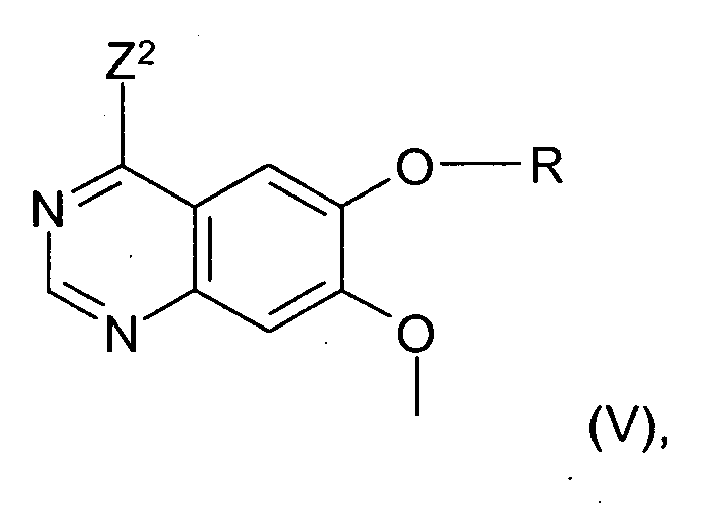
- Verfahren zur Herstellung der Verbindungen der allgemeinen Formel (I) gemäß Anspruch 1, dadurch gekennzeichnet, dass
R ein Rest ausgewählt aus der Gruppe bestehend aus cis-4-(Methoxycarbonylamino)-cyclohexyl, trans-4-(Methoxycarbonylamino)-cyclohexyl, cis-4-(N-Methoxycarbonyl-N-methyl-amino)-cyclohexyl-, trans-4-(N-Methoxycarbonyl-N-methyl-amino)-cyclohexyl, cis-4-(Ethyloxycarbonylamino)-cyclohexyl, trans-4-(Ethyloxycarbonylamino)-cyclohexyl, cis-4-(N-Ethyloxycarbonyl-N-methyl-amino)-cyclohexyl, trans-4-(N-Ethyloxycarbonyl-N-methyl-amino)-cyclohexyl, cis-4-(tert.-Butoxycarbonylamino)-cyclohexyl, trans-4-(tert.-Butoxycarbonylamino)-cyclohexyl, cis-4-(N-tert.-Butoxycarbonyl-N-methyl-amino)-cyclohexyl, trans-4-(N-tert.-Butoxycarbonyl-N-methyl-amino)-cyclohexyl,
cis-4-(Acetylamino)-cyclohexyl, trans-4-(Acetylamino)-cyclohexyl,cis-4-(N-Acetyl-N-methyl-amino)-cyclohexyl, trans-4-(N-Acetyl-N-methyl-amino)-cyclohexyl, cis-4-(Methoxyacetyl-amino)-cyclohexyl, trans-4-(Methoxyacetyl-amino)-cyclohexyl,cis-4-(N-Methoxyacetyl-N-methyl-amino)-cyclohexyl, trans-4-(N-Methoxyacetyl-N-methyl-amino)-cyclohexyl, cis-4-(Dimethylaminocarbonyl-amino)-cyclohexyl, trans-4-(Dimethylaminocarbonyl-amino)-cyclohexyl,cis-4-(N-Dimethylaminocarbonyl-N-methyl-amino)-cyclohexyl, trans-4-(N-Dimethylaminocarbonyl-N-methyl-amino)-cyclohexyl, cis-4-(Morpholinocarbonyl-amino)-cyclohexyl, trans-4-(Morpholinocarbonyl-amino)-cyclohexyl,cis-4-(N-Morpholinocarbonyl-N-methyl-amino)-cyclohexyl, trans-4-(N-Morpholinocarbonyl-N-methyl-amino)-cyclohexyl, cis-4-(Piperazin-1-ylcarbonyl-amino)-cyclohexyl, trans-4-(Piperazin-1-ylcarbonyl-amino)-cyclohexyl,
cis-4-(N-Piperazin-1-ylcarbonyl-N-methyl-amino)-cyclohexyl, trans-4-(N-Piperazin-1-ylcarbonyl-N-methyl-amino)-cyclohexyl, cis-4-[(4-Methyl-piperazin-1-ylcarbonyl)-amino]-cyclohexyl, trans-4-[(4-Methyl-piperazin-1-ylcarbonyl)-amino]-cyclohexyl, cis-4-[N-(4-Methyl-piperazin-1-ylcarbonyl)-N-methyl-amino]-cyclohexyl, trans-4-[N-(4-Methyl-piperazin-1-ylcarbonyl)-N-methyl-amino]-cyclohexyl, cis-4-(Methansulfonylamino)-cyclohexyl, trans-4-(Methansulfonylamino)-cyclohexyl, cis-4-(N-Methansulfonyl-N-methyl-amino)-cyclohexyl und trans-4-(N-Methansulfonyl-N-methyl-amino)-cyclohexyl,
bedeutet,
eine Verbindung der allgemeinen Formel (VI) R' ein Rest ausgewählt aus der Gruppe bestehend aus cis-4-Amino-cyclohex-1- yl, trans-4-Amino-cyclohex-1-yl, cis-4-(Methylamino)-cyclohex-1-yl und trans- 4-(Methylamino)-cyclohex-1-yl, darstellt,
mit einem entsprechenden Acylierungsmittel umgesetzt wird. - Verfahren zur Herstellung der Verbindungen der allgemeinen Formel (I) gemäß Anspruch 1 , dadurch gekennzeichnet, dassR eine cis-4-Phthalimido-cyclohex-1-yl- oder trans-4-Phthalimido-cyclohex-1-yl- Gruppe bedeutet, undeine Verbindung der allgemeinen Formel (VII)
 R" eine cis-4-Amino-cyclohex-1-yl- oder trans-4-Amino-cyclohex-1-yl-Gruppe darstellt,mit Phthalsäureanhydrid oder einem anderen reaktiven Derivat der Phthalsäure ungesetzt wird.
 - Arzneimittelkombinationen, die neben einer oder mehrerer Verbindungen der Formel 1 gemäß einem der Ansprüche 1 oder 2 als weiteren Wirkstoff einen oder mehrere Verbindungen enthalten, die ausgewählt sind aus den Klassen der Betamimetika, Anticholinergika, Corticosteroiden, weitere PDE4-Inhibitoren, LTD4-Antagonisten, EGFR-Hemmern, Dopamin-Agonisten, H1-Antihistaminika, PAF-Antagonisten, P13-Kinase Inhibitoren, MPR4-Inhibitoren, iNOS-Inhibitoren und SYK-Inhibitoren oder zwei- oder dreifach Kombinationen davon.
Priority Applications (1)
| Application Number | Priority Date | Filing Date | Title |
|---|---|---|---|
| EP07822171A EP2091925B1 (de) | 2006-11-10 | 2007-11-03 | Bicyclische heterocyclen, diese verbindungen enthaltende arzneimittel, deren verwendung und verfahren zu ihrer herstellung |
Applications Claiming Priority (3)
| Application Number | Priority Date | Filing Date | Title |
|---|---|---|---|
| EP06123820A EP1921070A1 (de) | 2006-11-10 | 2006-11-10 | Bicyclische Heterocyclen, diese Verbindungen enthaltende Arzneimittel, deren Verwendung und Verfahren zu ihrer Herstelllung |
| PCT/EP2007/061842 WO2008055854A1 (de) | 2006-11-10 | 2007-11-03 | Bicyclische heterocyclen, diese verbindungen enthaltende arzneimittel, deren verwendung und verfahren zu ihrer herstellung |
| EP07822171A EP2091925B1 (de) | 2006-11-10 | 2007-11-03 | Bicyclische heterocyclen, diese verbindungen enthaltende arzneimittel, deren verwendung und verfahren zu ihrer herstellung |
Publications (2)
| Publication Number | Publication Date |
|---|---|
| EP2091925A1 EP2091925A1 (de) | 2009-08-26 |
| EP2091925B1 true EP2091925B1 (de) | 2011-04-06 |
Family
ID=38015389
Family Applications (2)
| Application Number | Title | Priority Date | Filing Date |
|---|---|---|---|
| EP06123820A Ceased EP1921070A1 (de) | 2006-11-10 | 2006-11-10 | Bicyclische Heterocyclen, diese Verbindungen enthaltende Arzneimittel, deren Verwendung und Verfahren zu ihrer Herstelllung |
| EP07822171A Active EP2091925B1 (de) | 2006-11-10 | 2007-11-03 | Bicyclische heterocyclen, diese verbindungen enthaltende arzneimittel, deren verwendung und verfahren zu ihrer herstellung |
Family Applications Before (1)
| Application Number | Title | Priority Date | Filing Date |
|---|---|---|---|
| EP06123820A Ceased EP1921070A1 (de) | 2006-11-10 | 2006-11-10 | Bicyclische Heterocyclen, diese Verbindungen enthaltende Arzneimittel, deren Verwendung und Verfahren zu ihrer Herstelllung |
Country Status (11)
| Country | Link |
|---|---|
| US (1) | US8399461B2 (de) |
| EP (2) | EP1921070A1 (de) |
| JP (1) | JP5787481B2 (de) |
| AR (1) | AR063781A1 (de) |
| AT (1) | ATE504575T1 (de) |
| CA (1) | CA2669187C (de) |
| CL (1) | CL2007003252A1 (de) |
| DE (1) | DE502007006901D1 (de) |
| ES (1) | ES2364200T3 (de) |
| TW (1) | TW200831470A (de) |
| WO (1) | WO2008055854A1 (de) |
Families Citing this family (10)
| Publication number | Priority date | Publication date | Assignee | Title |
|---|---|---|---|---|
| EP1921070A1 (de) | 2006-11-10 | 2008-05-14 | Boehringer Ingelheim Pharma GmbH & Co. KG | Bicyclische Heterocyclen, diese Verbindungen enthaltende Arzneimittel, deren Verwendung und Verfahren zu ihrer Herstelllung |
| JP5377332B2 (ja) | 2007-02-06 | 2013-12-25 | ベーリンガー インゲルハイム インターナショナル ゲゼルシャフト ミット ベシュレンクテル ハフツング | 二環式へテロ環、それらの化合物を含む薬剤、その使用及びその製法 |
| WO2009098061A1 (de) | 2008-02-07 | 2009-08-13 | Boehringer Ingelheim International Gmbh | Spirocyclische heterocyclen, diese verbindungen enthaltende arzneimittel, deren verwendung und verfahren zu ihrer herstellung |
| CA2731895C (en) * | 2008-08-08 | 2016-11-08 | Boehringer Ingelheim International Gmbh | Process for the stereoselective preparation of bicyclic heterocycles |
| US8372855B2 (en) | 2008-08-08 | 2013-02-12 | Boehringer Ingelheim International Gmbh | Cyclohexyloxy-substituted heterocyclics, medicines containing these compounds and method for the production thereof |
| EP2313397B1 (de) | 2008-08-08 | 2016-04-20 | Boehringer Ingelheim International GmbH | Cyclohexyloxy-substituierte heterocyclen, diese verbindungen enthaltende arzneimittel, deren verwendung und verfahren zu ihrer herstellung |
| JP2012512883A (ja) * | 2008-12-19 | 2012-06-07 | ザ リージェンツ オブ ザ ユニバーシティ オブ カリフォルニア | ウイルス感染の治療における上皮成長因子阻害剤の使用 |
| US10377775B2 (en) | 2014-12-04 | 2019-08-13 | Shin-Etsu Chemical Co., Ltd. | Method for producing polyalkylene glycol derivative having amino group at end |
| JP6460937B2 (ja) * | 2014-12-04 | 2019-01-30 | 信越化学工業株式会社 | 末端にアミノ基を有するポリアルキレングリコール誘導体の製造方法 |
| US9708350B2 (en) | 2014-12-04 | 2017-07-18 | Shin-Etsu Chemical Co., Ltd. | Method for producing polyalkylene glycol derivative having amino group at end, polymerization initiator for use in the same, and alcohol compound as raw material for the polymerization initiator |
Family Cites Families (184)
| Publication number | Priority date | Publication date | Assignee | Title |
|---|---|---|---|---|
| US3985749A (en) | 1975-12-22 | 1976-10-12 | Eastman Kodak Company | Process for preparation of 4-aminoquinazoline |
| JPS5538325A (en) | 1978-09-11 | 1980-03-17 | Sankyo Co Ltd | 4-anilinoquinazoline derivative and its preparation |
| US4335127A (en) | 1979-01-08 | 1982-06-15 | Janssen Pharmaceutica, N.V. | Piperidinylalkyl quinazoline compounds, composition and method of use |
| GB2160201B (en) | 1984-06-14 | 1988-05-11 | Wyeth John & Brother Ltd | Quinazoline and cinnoline derivatives |
| US4845629A (en) | 1985-07-18 | 1989-07-04 | General De Investigacion Y Desarrollo S.A. | Airport surveillance systems |
| KR910006138B1 (ko) | 1986-09-30 | 1991-08-16 | 에자이 가부시끼가이샤 | 환상아민 유도체 |
| US4921863A (en) | 1988-02-17 | 1990-05-01 | Eisai Co., Ltd. | Cyclic amine derivatives |
| GB8910722D0 (en) | 1989-05-10 | 1989-06-28 | Smithkline Beckman Intercredit | Compounds |
| US5252586A (en) | 1990-09-28 | 1993-10-12 | The Du Pont Merck Pharmaceutical Company | Ether derivatives of alkyl piperidines and pyrrolidines as antipsychotic agents |
| DE4105503A1 (de) | 1991-02-19 | 1992-08-20 | Jenapharm Gmbh | Ausgangsverbindungen zur herstellung von calcitriol sowie dessen abkoemmlingen, verfahren zur herstellung dieser ausgangsverbindungen sowie zwischenprodukte fuer dieses verfahren |
| DE69222637T2 (de) | 1991-05-10 | 1998-02-26 | Rhone Poulenc Rorer Int | Bis mono- und bicyclische aryl- und heteroarylderivate mit inhibierender wirkung auf die egf und/oder pdgf-rezeptor tyrosinkinase |
| US5721237A (en) | 1991-05-10 | 1998-02-24 | Rhone-Poulenc Rorer Pharmaceuticals Inc. | Protein tyrosine kinase aryl and heteroaryl quinazoline compounds having selective inhibition of HER-2 autophosphorylation properties |
| US6645969B1 (en) | 1991-05-10 | 2003-11-11 | Aventis Pharmaceuticals Inc. | Aryl and heteroaryl quinazoline compounds which inhibit CSF-1R receptor tyrosine kinase |
| US5710158A (en) | 1991-05-10 | 1998-01-20 | Rhone-Poulenc Rorer Pharmaceuticals Inc. | Aryl and heteroaryl quinazoline compounds which inhibit EGF and/or PDGF receptor tyrosine kinase |
| US5187168A (en) | 1991-10-24 | 1993-02-16 | American Home Products Corporation | Substituted quinazolines as angiotensin II antagonists |
| AU661533B2 (en) | 1992-01-20 | 1995-07-27 | Astrazeneca Ab | Quinazoline derivatives |
| WO1993017682A1 (en) | 1992-03-04 | 1993-09-16 | Abbott Laboratories | Angiotensin ii receptor antagonists |
| DE69413535T2 (de) | 1993-05-26 | 1999-02-11 | Syntex (U.S.A.) Inc., Palo Alto, Calif. | 1-phenylalkanone als 5-ht4 rezeptor ligande |
| US5395846A (en) | 1993-06-25 | 1995-03-07 | Rhone-Poulenc Rorer Pharmaceuticals Inc. | Amino Bi- and tri-carbocyclic aklane bis-aryl squalene synthase inhibitors |
| GB9314893D0 (en) | 1993-07-19 | 1993-09-01 | Zeneca Ltd | Quinazoline derivatives |
| US5700823A (en) | 1994-01-07 | 1997-12-23 | Sugen, Inc. | Treatment of platelet derived growth factor related disorders such as cancers |
| WO1995024190A2 (en) | 1994-03-07 | 1995-09-14 | Sugen, Inc. | Receptor tyrosine kinase inhibitors for inhibiting cell proliferative disorders and compositions thereof |
| GB9510757D0 (en) | 1994-09-19 | 1995-07-19 | Wellcome Found | Therapeuticaly active compounds |
| TW321649B (de) | 1994-11-12 | 1997-12-01 | Zeneca Ltd | |
| GB2295387A (en) | 1994-11-23 | 1996-05-29 | Glaxo Inc | Quinazoline antagonists of alpha 1c adrenergic receptors |
| GB9424233D0 (en) | 1994-11-30 | 1995-01-18 | Zeneca Ltd | Quinazoline derivatives |
| US5642285A (en) | 1995-01-31 | 1997-06-24 | Trimble Navigation Limited | Outdoor movie camera GPS-position and time code data-logging for special effects production |
| ATE446955T1 (de) | 1995-03-30 | 2009-11-15 | Pfizer Prod Inc | Chinazolinone derivate |
| GB9508565D0 (en) | 1995-04-27 | 1995-06-14 | Zeneca Ltd | Quiazoline derivative |
| GB9508535D0 (en) | 1995-04-27 | 1995-06-14 | Zeneca Ltd | Quinazoline derivative |
| EP0824525B1 (de) | 1995-04-27 | 2001-06-13 | AstraZeneca AB | Chinazolin derivate |
| GB9508538D0 (en) | 1995-04-27 | 1995-06-14 | Zeneca Ltd | Quinazoline derivatives |
| GB9508537D0 (en) | 1995-04-27 | 1995-06-14 | Zeneca Ltd | Quinazoline derivatives |
| US5747498A (en) | 1996-05-28 | 1998-05-05 | Pfizer Inc. | Alkynyl and azido-substituted 4-anilinoquinazolines |
| US6046206A (en) | 1995-06-07 | 2000-04-04 | Cell Pathways, Inc. | Method of treating a patient having a precancerous lesions with amide quinazoline derivatives |
| GB9514265D0 (en) | 1995-07-13 | 1995-09-13 | Wellcome Found | Hetrocyclic compounds |
| CA2231509C (en) | 1995-09-11 | 2008-07-08 | Osteoarthritis Sciences, Inc. | Protein tyrosine kinase inhibitors for treating osteoarthritis |
| CA2238081A1 (en) | 1995-11-22 | 1997-05-29 | S. Jane Desolms | Inhibitors of farnesyl-protein transferase |
| GB9624482D0 (en) | 1995-12-18 | 1997-01-15 | Zeneca Phaema S A | Chemical compounds |
| ID18666A (id) | 1996-01-31 | 1998-04-30 | Gist Brocades Bv | Penggunaan komposisi komposisi yang terdiri dari senyawa senyawa stabil yang efektif secara biologi |
| US5760041A (en) | 1996-02-05 | 1998-06-02 | American Cyanamid Company | 4-aminoquinazoline EGFR Inhibitors |
| CA2242425C (en) | 1996-02-13 | 2006-07-18 | Zeneca Limited | Quinazoline derivatives as vegf inhibitors |
| GB9603097D0 (en) | 1996-02-14 | 1996-04-10 | Zeneca Ltd | Quinazoline compounds |
| GB9603095D0 (en) | 1996-02-14 | 1996-04-10 | Zeneca Ltd | Quinazoline derivatives |
| NZ331191A (en) | 1996-03-05 | 2000-03-27 | Zeneca Ltd | 4-anilinoquinazoline derivatives and pharmaceutical compositions thereof |
| CN100503580C (zh) | 1996-04-12 | 2009-06-24 | 沃尼尔·朗伯公司 | 酪氨酸激酶的不可逆抑制剂 |
| GB9607729D0 (en) | 1996-04-13 | 1996-06-19 | Zeneca Ltd | Quinazoline derivatives |
| GB9707800D0 (en) | 1996-05-06 | 1997-06-04 | Zeneca Ltd | Chemical compounds |
| US5938706A (en) | 1996-07-08 | 1999-08-17 | Feldman; Yasha I. | Multi element security system |
| US6391874B1 (en) | 1996-07-13 | 2002-05-21 | Smithkline Beecham Corporation | Fused heterocyclic compounds as protein tyrosine kinase inhibitors |
| US6004967A (en) | 1996-09-13 | 1999-12-21 | Sugen, Inc. | Psoriasis treatment with quinazoline compounds |
| GB9718972D0 (en) | 1996-09-25 | 1997-11-12 | Zeneca Ltd | Chemical compounds |
| US6225318B1 (en) | 1996-10-17 | 2001-05-01 | Pfizer Inc | 4-aminoquinazolone derivatives |
| EP1920773B1 (de) | 1996-11-05 | 2011-01-05 | The Children's Medical Center Corporation | Thalidomide und Dexamethason für die Behandlung von Tumors |
| EP1014953B1 (de) | 1997-03-05 | 2012-04-25 | Sugen, Inc. | Hydrophobe pharmazeutische wirkstoffe enthaltende zubereitungen |
| UA73073C2 (uk) | 1997-04-03 | 2005-06-15 | Уайт Холдінгз Корпорейшн | Заміщені 3-ціанохіноліни, спосіб їх одержання та фармацевтична композиція |
| AR012634A1 (es) | 1997-05-02 | 2000-11-08 | Sugen Inc | Compuesto basado en quinazolina, composicion famaceutica que lo comprende, metodo para sintetizarlo, su uso, metodos de modulacion de la funcion deserina/treonina proteinaquinasa con dicho compuesto y metodo in vitro para identificar compuestos que modulan dicha funcion |
| AU7165698A (en) | 1997-05-06 | 1998-11-27 | American Cyanamid Company | Use of quinazoline compounds for the treatment of polycystic kidney disease |
| US5929080A (en) | 1997-05-06 | 1999-07-27 | American Cyanamid Company | Method of treating polycystic kidney disease |
| JP2000513380A (ja) | 1997-06-30 | 2000-10-10 | グラクソ、グループ、リミテッド | 化合物 |
| ZA986729B (en) | 1997-07-29 | 1999-02-02 | Warner Lambert Co | Irreversible inhibitors of tyrosine kinases |
| ZA986732B (en) | 1997-07-29 | 1999-02-02 | Warner Lambert Co | Irreversible inhibitiors of tyrosine kinases |
| TW436485B (en) | 1997-08-01 | 2001-05-28 | American Cyanamid Co | Substituted quinazoline derivatives |
| DE69838172T2 (de) | 1997-08-22 | 2008-04-10 | Astrazeneca Ab | Oxindolylchinazolinderivate als angiogenesehemmer |
| AU1308799A (en) | 1997-11-06 | 1999-05-31 | American Cyanamid Company | Use of quinazoline derivatives as tyrosine kinase inhibitors for treating colonic polyps |
| GB9800575D0 (en) | 1998-01-12 | 1998-03-11 | Glaxo Group Ltd | Heterocyclic compounds |
| HUP0102793A3 (en) | 1998-05-28 | 2002-07-29 | Parker Hughes Inst St Paul | Quinazolines for treating brain tumor and medicaments containing them |
| JP2004504259A (ja) | 1998-06-30 | 2004-02-12 | パーカー ヒューズ インスティテュート | Jak−3インヒビターを用いたc−jun発現の阻害方法 |
| AU5391099A (en) | 1998-07-30 | 2000-02-21 | American Home Products Corporation | Substituted quinazoline derivatives |
| US6384223B1 (en) | 1998-07-30 | 2002-05-07 | American Home Products Corporation | Substituted quinazoline derivatives |
| WO2000009481A1 (en) | 1998-08-11 | 2000-02-24 | Takeda Chemical Industries, Ltd. | Cyclic amide compounds, process for producing the same, intermediates thereof and herbicides |
| US7354894B2 (en) | 1998-08-18 | 2008-04-08 | The Regents Of The University Of California | Preventing airway mucus production by administration of EGF-R antagonists |
| EP1119349B1 (de) | 1998-08-18 | 2008-07-02 | The Regents Of The University Of California | Epidermale wachstumsfaktor rezeptor antagonisten zur behandlung stark vermehrter schleimsekretion in der lunge |
| US6846799B1 (en) | 1998-08-18 | 2005-01-25 | The Regents Of The University Of California | Preventing airway mucus production by administration of EGF-R antagonists |
| AU5682799A (en) | 1998-08-21 | 2000-03-14 | Parker Hughes Institute | Quinazoline derivatives |
| US6184226B1 (en) | 1998-08-28 | 2001-02-06 | Scios Inc. | Quinazoline derivatives as inhibitors of P-38 α |
| US6297258B1 (en) | 1998-09-29 | 2001-10-02 | American Cyanamid Company | Substituted 3-cyanoquinolines |
| HU230728B1 (hu) | 1998-09-29 | 2017-12-28 | Wyeth Holdings Llc | Szubsztituált 3-cianokinolinok mint protein tirozin kinázok inhibitorai |
| CN1158266C (zh) | 1998-10-01 | 2004-07-21 | 阿斯特拉曾尼卡有限公司 | 化合物 |
| TW575567B (en) | 1998-10-23 | 2004-02-11 | Akzo Nobel Nv | Serine protease inhibitor |
| UA71945C2 (en) | 1999-01-27 | 2005-01-17 | Pfizer Prod Inc | Substituted bicyclic derivatives being used as anticancer agents |
| EE05345B1 (et) | 1999-02-10 | 2010-10-15 | Astrazeneca Ab | Kinasoliini derivaadid angiogeneesi inhibiitoritena |
| TR200102505T2 (tr) | 1999-02-27 | 2003-01-21 | Boehringer Ingelheim Pharma Kg | 4-amino-kinazolin ve kinolin türevleri. |
| US6080747A (en) | 1999-03-05 | 2000-06-27 | Hughes Institute | JAK-3 inhibitors for treating allergic disorders |
| DE19911510A1 (de) | 1999-03-15 | 2000-09-21 | Boehringer Ingelheim Pharma | Bicyclische Heterocyclen, diese Verbindungen enthaltende Arzneimittel, deren Verwendung und Verfahren zu ihrer Herstellung |
| DE19911509A1 (de) | 1999-03-15 | 2000-09-21 | Boehringer Ingelheim Pharma | Bicyclische Heterocyclen, diese Verbindungen enthaltende Arzneimittel, deren Verwendung und Verfahren zu ihrer Herstellung |
| US6258820B1 (en) | 1999-03-19 | 2001-07-10 | Parker Hughes Institute | Synthesis and anti-tumor activity of 6,7-dialkoxy-4-phenylamino-quinazolines |
| JP2002539262A (ja) | 1999-03-19 | 2002-11-19 | パーカー ヒューズ インスティテュート | キナゾリン化合物製剤および治療におけるその使用 |
| CA2373073A1 (en) | 1999-05-07 | 2000-11-16 | Takeda Chemical Industries, Ltd. | Cyclic compounds and uses thereof |
| GB9910577D0 (en) | 1999-05-08 | 1999-07-07 | Zeneca Ltd | Chemical compounds |
| US6518283B1 (en) | 1999-05-28 | 2003-02-11 | Celltech R&D Limited | Squaric acid derivatives |
| US6126917A (en) | 1999-06-01 | 2000-10-03 | Hadasit Medical Research Services And Development Ltd. | Epidermal growth factor receptor binding compounds for positron emission tomography |
| NZ516633A (en) | 1999-06-21 | 2004-09-24 | Boehringer Ingelheim Pharma | Bicyclic heterocycles, medicaments containing these compounds, their use and methods for the production thereof |
| KR20020029419A (ko) | 1999-07-07 | 2002-04-18 | 다비드 에 질레스 | 퀴나졸린 유도체 |
| GB9917408D0 (en) | 1999-07-23 | 1999-09-22 | Smithkline Beecham Plc | Compounds |
| ES2272305T3 (es) | 1999-08-12 | 2007-05-01 | Wyeth Holdings Corporation | Composicion de contine un nsaid y un inhibidor de efgr cinasa para el tratamiento o la inhibicion de los polipos de colon y del cancer colorrectal. |
| GB9922173D0 (en) | 1999-09-21 | 1999-11-17 | Zeneca Ltd | Chemical compounds |
| HK1046688A1 (zh) | 1999-09-21 | 2003-01-24 | Astrazeneca Ab | 喹唑啉化合物和含有喹唑啉化合物的藥物組合物 |
| EE200200119A (et) | 1999-09-21 | 2003-04-15 | Astrazeneca Ab | Kinasoliini derivaadid ja nende kasutamine ravimitena |
| GB9922171D0 (en) | 1999-09-21 | 1999-11-17 | Zeneca Ltd | Chemical compounds |
| SV2002000205A (es) | 1999-11-01 | 2002-06-07 | Lilly Co Eli | Compuestos farmaceuticos ref. x-01095 |
| PT1244647E (pt) | 1999-11-05 | 2006-10-31 | Astrazeneca Ab | Derivados de quinazolina como inibidores de vegf |
| AU4903201A (en) | 1999-11-30 | 2001-07-03 | Parker Hughes Institute | Inhibitors of thrombin induced platelet aggregation |
| AU2001235804A1 (en) | 2000-03-06 | 2001-09-17 | Astrazeneca Ab | Therapy |
| US20060063752A1 (en) | 2000-03-14 | 2006-03-23 | Boehringer Ingelheim Pharma Gmbh & Co. Kg | Bicyclic heterocycles, pharmaceutical compositions containing them, their use, and processes for preparing them |
| GB0008368D0 (en) | 2000-04-06 | 2000-05-24 | Astrazeneca Ab | Combination product |
| IL151626A0 (en) | 2000-04-07 | 2003-04-10 | Astrazeneca Ab | Quinazoline compounds |
| DE50111799D1 (de) | 2000-04-08 | 2007-02-15 | Boehringer Ingelheim Pharma | Bicyclische heterocyclen, diese verbindungen enthaltende arzneimittel, deren verwendung und verfahren zu ihrer herstellung |
| US6627634B2 (en) | 2000-04-08 | 2003-09-30 | Boehringer Ingelheim Pharma Kg | Bicyclic heterocycles, pharmaceutical compositions containing them, their use, and processes for preparing them |
| AU2001258771A1 (en) | 2000-05-19 | 2001-11-26 | Takeda Chemical Industries Ltd. | -secretase inhibitors |
| UA73993C2 (uk) | 2000-06-06 | 2005-10-17 | Астразенека Аб | Хіназолінові похідні для лікування пухлин та фармацевтична композиція |
| CN1437594A (zh) | 2000-06-22 | 2003-08-20 | 辉瑞产品公司 | 用于治疗异常细胞生长的取代的双环衍生物 |
| AU2001278609B2 (en) | 2000-08-21 | 2005-04-14 | Astrazeneca Ab | Quinazoline derivatives |
| DE10042058A1 (de) | 2000-08-26 | 2002-03-07 | Boehringer Ingelheim Pharma | Bicyclische Heterocyclen, diese Verbindungen enthaltende Arzneimittel, deren Verwendung und Verfahren zu ihrer Herstellung |
| US20020082270A1 (en) | 2000-08-26 | 2002-06-27 | Frank Himmelsbach | Aminoquinazolines which inhibit signal transduction mediated by tyrosine kinases |
| DE10042059A1 (de) | 2000-08-26 | 2002-03-07 | Boehringer Ingelheim Pharma | Bicyclische Heterocyclen, diese Verbindungen enthaltende Arzneimittel, deren Verwendung und Verfahren zu ihrer Herstellung |
| US6617329B2 (en) | 2000-08-26 | 2003-09-09 | Boehringer Ingelheim Pharma Kg | Aminoquinazolines and their use as medicaments |
| US6653305B2 (en) | 2000-08-26 | 2003-11-25 | Boehringer Ingelheim Pharma Kg | Bicyclic heterocycles, pharmaceutical compositions containing them, their use, and processes for preparing them |
| DE10042061A1 (de) | 2000-08-26 | 2002-03-07 | Boehringer Ingelheim Pharma | Bicyclische Heterocyclen,diese Verbindungen enthaltende Arzneimittel, deren Verwendung und Verfahren zu ihrer Herstellung |
| US6740651B2 (en) | 2000-08-26 | 2004-05-25 | Boehringer Ingelheim Pharma Kg | Aminoquinazolines which inhibit signal transduction mediated by tyrosine kinases |
| US6656946B2 (en) | 2000-08-26 | 2003-12-02 | Boehringer Ingelheim Pharma Kg | Aminoquinazolines which inhibit signal transduction mediated by tyrosine kinases |
| DE10042060A1 (de) | 2000-08-26 | 2002-03-07 | Boehringer Ingelheim Pharma | Bicyclische Heterocyclen, diese Verbindungen enthaltende Arzneimittel, deren Verwendung und Verfahren zu ihrer Herstellung |
| DE10042062A1 (de) | 2000-08-26 | 2002-03-07 | Boehringer Ingelheim Pharma | Bicyclische Heterocyclen, diese Verbindungen enthaltende Arzneimittel, deren Verwendung und Verfahren zu ihrer Hertellung |
| US6403580B1 (en) | 2000-08-26 | 2002-06-11 | Boehringer Ingelheim Pharma Kg | Quinazolines, pharmaceutical compositions containing these compounds, their use and processes for preparing them |
| EP1719770A3 (de) | 2000-09-21 | 2008-03-05 | Smithkline Beecham Plc | Chinolinderivate als antibakterielle Mittel |
| WO2002030924A1 (en) | 2000-10-13 | 2002-04-18 | Astrazeneca Ab | Quinazoline derivatives with anti-tumour activity |
| CA2426430C (en) | 2000-10-20 | 2014-10-07 | Biocryst Pharmaceuticals, Inc. | Biaryl compounds as serine protease inhibitors |
| US20040063733A1 (en) | 2000-10-25 | 2004-04-01 | Lambert Christine Marie Paul | Quinazoline derivatives |
| US20030158196A1 (en) | 2002-02-16 | 2003-08-21 | Boehringer Ingelheim Pharma Gmbh Co. Kg | Pharmaceutical compositions based on anticholinergics and EGFR kinase inhibitors |
| US7067532B2 (en) | 2000-11-02 | 2006-06-27 | Astrazeneca | Substituted quinolines as antitumor agents |
| AU2002223684A1 (en) | 2000-11-22 | 2002-06-03 | Novartis Pharma Gmbh | Combination comprising an agent decreasing vegf activity and an agent decreasing egf activity |
| AUPR201600A0 (en) | 2000-12-11 | 2001-01-11 | Fujisawa Pharmaceutical Co., Ltd. | Quinazolinone derivative |
| US7019012B2 (en) | 2000-12-20 | 2006-03-28 | Boehringer Ingelheim International Pharma Gmbh & Co. Kg | Quinazoline derivatives and pharmaceutical compositions containing them |
| DE10063435A1 (de) | 2000-12-20 | 2002-07-04 | Boehringer Ingelheim Pharma | Chinazolinderviate,diese Verbindungen enthaltende Arzneimittel, deren Verwendung und Verfahren zu ihrer Herstellung |
| GB0101577D0 (en) | 2001-01-22 | 2001-03-07 | Smithkline Beecham Plc | Compounds |
| WO2002062767A1 (en) | 2001-02-07 | 2002-08-15 | Sumitomo Pharmaceuticals Company, Limited | Novel quinazoline derivatives |
| NZ516873A (en) | 2001-02-12 | 2003-11-28 | Warner Lambert Co | Compositions containing retinoids and erb inhibitors and their use in inhibiting retinoid skin damage |
| JP4285996B2 (ja) | 2001-02-21 | 2009-06-24 | 田辺三菱製薬株式会社 | キナゾリン誘導体 |
| MXPA03007621A (es) | 2001-02-23 | 2003-12-04 | Merck & Co Inc | Antagonistas nr2b de n-metil-d-aspartato no arilheterociclicos n-sustituidos. |
| US6562319B2 (en) | 2001-03-12 | 2003-05-13 | Yissum Research Development Company Of The Hebrew University Of Jerusalem | Radiolabeled irreversible inhibitors of epidermal growth factor receptor tyrosine kinase and their use in radioimaging and radiotherapy |
| HN2002000067A (es) | 2001-03-23 | 2003-10-24 | Bayer Healthcare Llc | Inhibidores de la rho - quinasa. |
| WO2002092579A1 (en) | 2001-05-14 | 2002-11-21 | Astrazeneca Ab | 4-anilinoquinazoline derivatives |
| WO2002092577A1 (en) | 2001-05-14 | 2002-11-21 | Astrazeneca Ab | Quinazoline derivatives |
| WO2002092578A1 (en) | 2001-05-14 | 2002-11-21 | Astrazeneca Ab | Quinazoline derivatives |
| AR033765A1 (es) | 2001-05-22 | 2004-01-07 | Syngenta Participations Ag | Procedimiento para la preparacion de derivados 3-alquil-3h-isobenzofuran-1-ona 7-sustituidos. |
| US20040176361A1 (en) | 2001-05-23 | 2004-09-09 | Masakazu Fujio | Fused heterocyclic compound and medicinal use thereof |
| US7132427B2 (en) | 2001-06-21 | 2006-11-07 | Ariad Pharmaceuticals, Inc. | Quinazolines and uses thereof |
| GB0126433D0 (en) | 2001-11-03 | 2002-01-02 | Astrazeneca Ab | Compounds |
| RU2004116911A (ru) | 2001-11-03 | 2005-11-10 | Астразенека Аб (Se) | Производные хиназолина в качестве противоопухолевых средств |
| GB0128108D0 (en) | 2001-11-23 | 2002-01-16 | Astrazeneca Ab | Therapeutic use |
| GB0128109D0 (en) | 2001-11-23 | 2002-01-16 | Astrazeneca Ab | Therapeutic use |
| IL161908A0 (en) | 2001-12-12 | 2005-11-20 | Pfizer Prod Inc | Quinazoline derivatives for the treatment of abnormal cell growth |
| DE10204462A1 (de) | 2002-02-05 | 2003-08-07 | Boehringer Ingelheim Pharma | Verwendung von Tyrosinkinase-Inhibitoren zur Behandlung inflammatorischer Prozesse |
| GB0204719D0 (en) | 2002-02-28 | 2002-04-17 | Glaxo Group Ltd | Medicinal compounds |
| TW200813014A (en) | 2002-03-28 | 2008-03-16 | Astrazeneca Ab | Quinazoline derivatives |
| NZ536114A (en) * | 2002-03-30 | 2007-11-30 | Boehringer Ingelheim Pharma | 4-(N-phenylamino)-quinazolines / quinolines as tyrosine kinase inhibitors |
| US6924285B2 (en) * | 2002-03-30 | 2005-08-02 | Boehringer Ingelheim Pharma Gmbh & Co. | Bicyclic heterocyclic compounds, pharmaceutical compositions containing these compounds, their use and process for preparing them |
| US20040044014A1 (en) | 2002-04-19 | 2004-03-04 | Boehringer Ingelheim Pharma Gmbh & Co. Kg | Bicyclic heterocycles, pharmaceutical compositions containing these compounds, their use and processes for the preparation thereof |
| JP2006515871A (ja) | 2003-01-23 | 2006-06-08 | ティー.ケイ. シグナル リミテッド | 上皮増殖因子受容体チロシンキナーゼの不可逆阻害剤ならびにその使用 |
| GB0309009D0 (en) | 2003-04-22 | 2003-05-28 | Astrazeneca Ab | Quinazoline derivatives |
| DE10326186A1 (de) | 2003-06-06 | 2004-12-23 | Boehringer Ingelheim Pharma Gmbh & Co. Kg | Bicyclische Heterocyclen, diese Verbindungen enthaltende Arzneimittel, deren Verwendung und Verfahren zu ihrer Herstellung |
| US20050059661A1 (en) | 2003-07-28 | 2005-03-17 | Boehringer Ingelheim International Gmbh | Use of tyrosine kinase inhibitors for the treatment of inflammatory processes |
| CA2533345A1 (en) | 2003-07-29 | 2005-02-10 | Astrazeneca Ab | Piperidyl-quinazoline derivatives as tyrosine kinase inhibitors |
| GB0317665D0 (en) | 2003-07-29 | 2003-09-03 | Astrazeneca Ab | Qinazoline derivatives |
| MXPA06002963A (es) | 2003-09-16 | 2006-06-14 | Astrazeneca Ab | Derivados de quinazolina como inhibidores de cinasa de tirosina. |
| GB0321648D0 (en) | 2003-09-16 | 2003-10-15 | Astrazeneca Ab | Quinazoline derivatives |
| BRPI0414532B1 (pt) * | 2003-09-19 | 2018-06-05 | Astrazeneca Ab | Composto derivado de quinazolina, processo para preparar 0 mesmo, composição farmaceutica, e, uso de um composto derivado de quinazolina |
| DE602004004811T2 (de) * | 2003-09-19 | 2007-11-22 | Astrazeneca Ab | Chinazolinderivate |
| GB0322409D0 (en) | 2003-09-25 | 2003-10-29 | Astrazeneca Ab | Quinazoline derivatives |
| MXPA06003341A (es) | 2003-09-25 | 2006-06-08 | Astrazeneca Ab | Derivados de quinazolina. |
| US7456189B2 (en) | 2003-09-30 | 2008-11-25 | Boehringer Ingelheim International Gmbh | Bicyclic heterocycles, medicaments containing these compounds, their use and processes for their preparation |
| DE10350717A1 (de) | 2003-10-30 | 2005-06-02 | Boehringer Ingelheim Pharma Gmbh & Co. Kg | Verwendung von Tyrosinkinase-Inhibitoren zur Behandlung inflammatorischer Prozesse |
| WO2005048928A2 (en) | 2003-11-12 | 2005-06-02 | George Mason Intellectual Property | Methods for treating viral infection |
| EP1781298B1 (de) | 2004-04-22 | 2012-01-04 | Boehringer Ingelheim International GmbH | Arzneinmittelkombinationen enthaltend benzoxazine zur behandlung von atemwegserkrankungen |
| GB0416397D0 (en) | 2004-07-22 | 2004-08-25 | Glaxo Group Ltd | Pharmaceutical formulations |
| CA2581150A1 (en) | 2004-09-17 | 2006-03-30 | Osi Pharmaceuticals, Inc. | (spirocyclylamido) aminothiophene compounds as c-kit proto- oncogene inhibitors |
| US20100234371A1 (en) | 2005-08-22 | 2010-09-16 | Frank Himmelsbach | Bicyclic heterocycles, pharmaceutical compositions containing these compounds, the use thereof and processes for the preparation thereof |
| EP1764957A1 (de) | 2005-09-15 | 2007-03-21 | Research In Motion Limited | System und Verfahren zur Bewertung der Verlässlichkeit unterer Schichten unter Verwendung des Protokolls einer höheren Schicht in einem Kommunikationsnetzwerk |
| EP1966189A1 (de) | 2005-12-12 | 2008-09-10 | Boehringer Ingelheim International Gmbh | Bicyclische heterocyclen, diese verbindungen enthaltende arzneimittel, deren verwendung und verfahren zu ihrer herstellung |
| US20090306105A1 (en) | 2006-03-09 | 2009-12-10 | Boehringer Ingelheim International Gmbh | Bicyclic heterocycles, medicaments containing these compounds, their use and process for preparing them |
| EP1921070A1 (de) | 2006-11-10 | 2008-05-14 | Boehringer Ingelheim Pharma GmbH & Co. KG | Bicyclische Heterocyclen, diese Verbindungen enthaltende Arzneimittel, deren Verwendung und Verfahren zu ihrer Herstelllung |
| JP5377332B2 (ja) | 2007-02-06 | 2013-12-25 | ベーリンガー インゲルハイム インターナショナル ゲゼルシャフト ミット ベシュレンクテル ハフツング | 二環式へテロ環、それらの化合物を含む薬剤、その使用及びその製法 |
| WO2009098061A1 (de) | 2008-02-07 | 2009-08-13 | Boehringer Ingelheim International Gmbh | Spirocyclische heterocyclen, diese verbindungen enthaltende arzneimittel, deren verwendung und verfahren zu ihrer herstellung |
| EP2313397B1 (de) | 2008-08-08 | 2016-04-20 | Boehringer Ingelheim International GmbH | Cyclohexyloxy-substituierte heterocyclen, diese verbindungen enthaltende arzneimittel, deren verwendung und verfahren zu ihrer herstellung |
-
2006
- 2006-11-10 EP EP06123820A patent/EP1921070A1/de not_active Ceased
-
2007
- 2007-11-03 JP JP2009535692A patent/JP5787481B2/ja active Active
- 2007-11-03 CA CA2669187A patent/CA2669187C/en active Active
- 2007-11-03 US US12/513,731 patent/US8399461B2/en active Active
- 2007-11-03 EP EP07822171A patent/EP2091925B1/de active Active
- 2007-11-03 WO PCT/EP2007/061842 patent/WO2008055854A1/de not_active Ceased
- 2007-11-03 AT AT07822171T patent/ATE504575T1/de active
- 2007-11-03 DE DE502007006901T patent/DE502007006901D1/de active Active
- 2007-11-03 ES ES07822171T patent/ES2364200T3/es active Active
- 2007-11-09 CL CL200703252A patent/CL2007003252A1/es unknown
- 2007-11-09 TW TW096142575A patent/TW200831470A/zh unknown
- 2007-11-09 AR ARP070105020A patent/AR063781A1/es unknown
Also Published As
| Publication number | Publication date |
|---|---|
| CL2007003252A1 (es) | 2008-07-04 |
| AR063781A1 (es) | 2009-02-18 |
| CA2669187C (en) | 2015-01-13 |
| TW200831470A (en) | 2008-08-01 |
| US8399461B2 (en) | 2013-03-19 |
| EP1921070A1 (de) | 2008-05-14 |
| US20110136805A1 (en) | 2011-06-09 |
| ATE504575T1 (de) | 2011-04-15 |
| JP5787481B2 (ja) | 2015-09-30 |
| CA2669187A1 (en) | 2008-05-15 |
| EP2091925A1 (de) | 2009-08-26 |
| JP2010509268A (ja) | 2010-03-25 |
| ES2364200T3 (es) | 2011-08-26 |
| DE502007006901D1 (de) | 2011-05-19 |
| WO2008055854A1 (de) | 2008-05-15 |
Similar Documents
| Publication | Publication Date | Title |
|---|---|---|
| EP2245026B1 (de) | Spirocyclische heterocyclen, diese verbindungen enthaltende arzneimittel, deren verwendung und verfahren zu ihrer herstellung | |
| CA2669187C (en) | Bicyclic heterocycles, drugs containing said compounds, the use thereof and methods for preparing same | |
| US8372855B2 (en) | Cyclohexyloxy-substituted heterocyclics, medicines containing these compounds and method for the production thereof | |
| EP2606042B1 (de) | Disubstituierte tetrahydofuranyl-verbindungen als antagonisten des bradykinin-b1-rezeptors | |
| EP2313397B1 (de) | Cyclohexyloxy-substituierte heterocyclen, diese verbindungen enthaltende arzneimittel, deren verwendung und verfahren zu ihrer herstellung | |
| EP2606043B1 (de) | Pyridazinderivative als bradykinin b1 rezeptor antagonsiten | |
| HK1147097B (en) | Spirocyclic heterocycles, medicaments containing said compounds, use thereof and method for their production |
Legal Events
| Date | Code | Title | Description |
|---|---|---|---|
| PUAI | Public reference made under article 153(3) epc to a published international application that has entered the european phase |
Free format text: ORIGINAL CODE: 0009012 |
|
| 17P | Request for examination filed |
Effective date: 20090610 |
|
| AK | Designated contracting states |
Kind code of ref document: A1 Designated state(s): AT BE BG CH CY CZ DE DK EE ES FI FR GB GR HU IE IS IT LI LT LU LV MC MT NL PL PT RO SE SI SK TR |
|
| DAX | Request for extension of the european patent (deleted) | ||
| GRAP | Despatch of communication of intention to grant a patent |
Free format text: ORIGINAL CODE: EPIDOSNIGR1 |
|
| GRAS | Grant fee paid |
Free format text: ORIGINAL CODE: EPIDOSNIGR3 |
|
| GRAA | (expected) grant |
Free format text: ORIGINAL CODE: 0009210 |
|
| AK | Designated contracting states |
Kind code of ref document: B1 Designated state(s): AT BE BG CH CY CZ DE DK EE ES FI FR GB GR HU IE IS IT LI LT LU LV MC MT NL PL PT RO SE SI SK TR |
|
| REG | Reference to a national code |
Ref country code: GB Ref legal event code: FG4D Free format text: NOT ENGLISH |
|
| REG | Reference to a national code |
Ref country code: CH Ref legal event code: EP |
|
| REG | Reference to a national code |
Ref country code: IE Ref legal event code: FG4D |
|
| REF | Corresponds to: |
Ref document number: 502007006901 Country of ref document: DE Date of ref document: 20110519 Kind code of ref document: P |
|
| REG | Reference to a national code |
Ref country code: DE Ref legal event code: R096 Ref document number: 502007006901 Country of ref document: DE Effective date: 20110519 |
|
| REG | Reference to a national code |
Ref country code: NL Ref legal event code: VDEP Effective date: 20110406 |
|
| REG | Reference to a national code |
Ref country code: ES Ref legal event code: FG2A Ref document number: 2364200 Country of ref document: ES Kind code of ref document: T3 Effective date: 20110826 |
|
| PG25 | Lapsed in a contracting state [announced via postgrant information from national office to epo] |
Ref country code: SI Free format text: LAPSE BECAUSE OF FAILURE TO SUBMIT A TRANSLATION OF THE DESCRIPTION OR TO PAY THE FEE WITHIN THE PRESCRIBED TIME-LIMIT Effective date: 20110406 |
|
| LTIE | Lt: invalidation of european patent or patent extension |
Effective date: 20110406 |
|
| REG | Reference to a national code |
Ref country code: IE Ref legal event code: FD4D |
|
| PG25 | Lapsed in a contracting state [announced via postgrant information from national office to epo] |
Ref country code: LT Free format text: LAPSE BECAUSE OF FAILURE TO SUBMIT A TRANSLATION OF THE DESCRIPTION OR TO PAY THE FEE WITHIN THE PRESCRIBED TIME-LIMIT Effective date: 20110406 Ref country code: PT Free format text: LAPSE BECAUSE OF FAILURE TO SUBMIT A TRANSLATION OF THE DESCRIPTION OR TO PAY THE FEE WITHIN THE PRESCRIBED TIME-LIMIT Effective date: 20110808 Ref country code: SE Free format text: LAPSE BECAUSE OF FAILURE TO SUBMIT A TRANSLATION OF THE DESCRIPTION OR TO PAY THE FEE WITHIN THE PRESCRIBED TIME-LIMIT Effective date: 20110406 |
|
| PG25 | Lapsed in a contracting state [announced via postgrant information from national office to epo] |
Ref country code: LV Free format text: LAPSE BECAUSE OF FAILURE TO SUBMIT A TRANSLATION OF THE DESCRIPTION OR TO PAY THE FEE WITHIN THE PRESCRIBED TIME-LIMIT Effective date: 20110406 Ref country code: FI Free format text: LAPSE BECAUSE OF FAILURE TO SUBMIT A TRANSLATION OF THE DESCRIPTION OR TO PAY THE FEE WITHIN THE PRESCRIBED TIME-LIMIT Effective date: 20110406 Ref country code: IS Free format text: LAPSE BECAUSE OF FAILURE TO SUBMIT A TRANSLATION OF THE DESCRIPTION OR TO PAY THE FEE WITHIN THE PRESCRIBED TIME-LIMIT Effective date: 20110806 Ref country code: CY Free format text: LAPSE BECAUSE OF FAILURE TO SUBMIT A TRANSLATION OF THE DESCRIPTION OR TO PAY THE FEE WITHIN THE PRESCRIBED TIME-LIMIT Effective date: 20110406 Ref country code: GR Free format text: LAPSE BECAUSE OF FAILURE TO SUBMIT A TRANSLATION OF THE DESCRIPTION OR TO PAY THE FEE WITHIN THE PRESCRIBED TIME-LIMIT Effective date: 20110707 |
|
| PG25 | Lapsed in a contracting state [announced via postgrant information from national office to epo] |
Ref country code: NL Free format text: LAPSE BECAUSE OF FAILURE TO SUBMIT A TRANSLATION OF THE DESCRIPTION OR TO PAY THE FEE WITHIN THE PRESCRIBED TIME-LIMIT Effective date: 20110406 |
|
| PG25 | Lapsed in a contracting state [announced via postgrant information from national office to epo] |
Ref country code: EE Free format text: LAPSE BECAUSE OF FAILURE TO SUBMIT A TRANSLATION OF THE DESCRIPTION OR TO PAY THE FEE WITHIN THE PRESCRIBED TIME-LIMIT Effective date: 20110406 Ref country code: IE Free format text: LAPSE BECAUSE OF FAILURE TO SUBMIT A TRANSLATION OF THE DESCRIPTION OR TO PAY THE FEE WITHIN THE PRESCRIBED TIME-LIMIT Effective date: 20110406 Ref country code: CZ Free format text: LAPSE BECAUSE OF FAILURE TO SUBMIT A TRANSLATION OF THE DESCRIPTION OR TO PAY THE FEE WITHIN THE PRESCRIBED TIME-LIMIT Effective date: 20110406 |
|
| PLBE | No opposition filed within time limit |
Free format text: ORIGINAL CODE: 0009261 |
|
| STAA | Information on the status of an ep patent application or granted ep patent |
Free format text: STATUS: NO OPPOSITION FILED WITHIN TIME LIMIT |
|
| PG25 | Lapsed in a contracting state [announced via postgrant information from national office to epo] |
Ref country code: SK Free format text: LAPSE BECAUSE OF FAILURE TO SUBMIT A TRANSLATION OF THE DESCRIPTION OR TO PAY THE FEE WITHIN THE PRESCRIBED TIME-LIMIT Effective date: 20110406 Ref country code: PL Free format text: LAPSE BECAUSE OF FAILURE TO SUBMIT A TRANSLATION OF THE DESCRIPTION OR TO PAY THE FEE WITHIN THE PRESCRIBED TIME-LIMIT Effective date: 20110406 Ref country code: DK Free format text: LAPSE BECAUSE OF FAILURE TO SUBMIT A TRANSLATION OF THE DESCRIPTION OR TO PAY THE FEE WITHIN THE PRESCRIBED TIME-LIMIT Effective date: 20110406 Ref country code: RO Free format text: LAPSE BECAUSE OF FAILURE TO SUBMIT A TRANSLATION OF THE DESCRIPTION OR TO PAY THE FEE WITHIN THE PRESCRIBED TIME-LIMIT Effective date: 20110406 |
|
| 26N | No opposition filed |
Effective date: 20120110 |
|
| REG | Reference to a national code |
Ref country code: DE Ref legal event code: R097 Ref document number: 502007006901 Country of ref document: DE Effective date: 20120110 |
|
| BERE | Be: lapsed |
Owner name: BOEHRINGER INGELHEIM PHARMA G.M.B.H. & CO.KG Effective date: 20111130 Owner name: BOEHRINGER INGELHEIM INTERNATIONAL G.M.B.H. Effective date: 20111130 |
|
| PG25 | Lapsed in a contracting state [announced via postgrant information from national office to epo] |
Ref country code: MC Free format text: LAPSE BECAUSE OF NON-PAYMENT OF DUE FEES Effective date: 20111130 |
|
| PG25 | Lapsed in a contracting state [announced via postgrant information from national office to epo] |
Ref country code: BE Free format text: LAPSE BECAUSE OF NON-PAYMENT OF DUE FEES Effective date: 20111130 |
|
| PG25 | Lapsed in a contracting state [announced via postgrant information from national office to epo] |
Ref country code: MT Free format text: LAPSE BECAUSE OF FAILURE TO SUBMIT A TRANSLATION OF THE DESCRIPTION OR TO PAY THE FEE WITHIN THE PRESCRIBED TIME-LIMIT Effective date: 20110406 |
|
| PG25 | Lapsed in a contracting state [announced via postgrant information from national office to epo] |
Ref country code: LU Free format text: LAPSE BECAUSE OF NON-PAYMENT OF DUE FEES Effective date: 20111103 |
|
| PG25 | Lapsed in a contracting state [announced via postgrant information from national office to epo] |
Ref country code: BG Free format text: LAPSE BECAUSE OF FAILURE TO SUBMIT A TRANSLATION OF THE DESCRIPTION OR TO PAY THE FEE WITHIN THE PRESCRIBED TIME-LIMIT Effective date: 20110706 |
|
| PG25 | Lapsed in a contracting state [announced via postgrant information from national office to epo] |
Ref country code: TR Free format text: LAPSE BECAUSE OF FAILURE TO SUBMIT A TRANSLATION OF THE DESCRIPTION OR TO PAY THE FEE WITHIN THE PRESCRIBED TIME-LIMIT Effective date: 20110406 |
|
| PG25 | Lapsed in a contracting state [announced via postgrant information from national office to epo] |
Ref country code: HU Free format text: LAPSE BECAUSE OF FAILURE TO SUBMIT A TRANSLATION OF THE DESCRIPTION OR TO PAY THE FEE WITHIN THE PRESCRIBED TIME-LIMIT Effective date: 20110406 |
|
| REG | Reference to a national code |
Ref country code: FR Ref legal event code: PLFP Year of fee payment: 9 |
|
| REG | Reference to a national code |
Ref country code: FR Ref legal event code: PLFP Year of fee payment: 10 |
|
| REG | Reference to a national code |
Ref country code: FR Ref legal event code: PLFP Year of fee payment: 11 |
|
| PGFP | Annual fee paid to national office [announced via postgrant information from national office to epo] |
Ref country code: IT Payment date: 20201124 Year of fee payment: 14 |
|
| PG25 | Lapsed in a contracting state [announced via postgrant information from national office to epo] |
Ref country code: IT Free format text: LAPSE BECAUSE OF NON-PAYMENT OF DUE FEES Effective date: 20211130 |
|
| REG | Reference to a national code |
Ref country code: CH Ref legal event code: U11 Free format text: ST27 STATUS EVENT CODE: U-0-0-U10-U11 (AS PROVIDED BY THE NATIONAL OFFICE) Effective date: 20251201 |
|
| PGFP | Annual fee paid to national office [announced via postgrant information from national office to epo] |
Ref country code: DE Payment date: 20251119 Year of fee payment: 19 |
|
| PGFP | Annual fee paid to national office [announced via postgrant information from national office to epo] |
Ref country code: GB Payment date: 20251121 Year of fee payment: 19 |
|
| PGFP | Annual fee paid to national office [announced via postgrant information from national office to epo] |
Ref country code: AT Payment date: 20251120 Year of fee payment: 19 |
|
| PGFP | Annual fee paid to national office [announced via postgrant information from national office to epo] |
Ref country code: FR Payment date: 20251121 Year of fee payment: 19 |
|
| PGFP | Annual fee paid to national office [announced via postgrant information from national office to epo] |
Ref country code: CH Payment date: 20251201 Year of fee payment: 19 |
|
| PGFP | Annual fee paid to national office [announced via postgrant information from national office to epo] |
Ref country code: ES Payment date: 20251229 Year of fee payment: 19 |