EP2313397B1 - Cyclohexyloxy-substituierte heterocyclen, diese verbindungen enthaltende arzneimittel, deren verwendung und verfahren zu ihrer herstellung - Google Patents
Cyclohexyloxy-substituierte heterocyclen, diese verbindungen enthaltende arzneimittel, deren verwendung und verfahren zu ihrer herstellung Download PDFInfo
- Publication number
- EP2313397B1 EP2313397B1 EP09780993.3A EP09780993A EP2313397B1 EP 2313397 B1 EP2313397 B1 EP 2313397B1 EP 09780993 A EP09780993 A EP 09780993A EP 2313397 B1 EP2313397 B1 EP 2313397B1
- Authority
- EP
- European Patent Office
- Prior art keywords
- amino
- phenyl
- methoxy
- alkyl
- hydroxy
- Prior art date
- Legal status (The legal status is an assumption and is not a legal conclusion. Google has not performed a legal analysis and makes no representation as to the accuracy of the status listed.)
- Active
Links
- 0 *C1=CC2=NC=*CC(N*)=C2CC1OC(CC1)CCC1C1N(*)CN*N(*)C1O Chemical compound *C1=CC2=NC=*CC(N*)=C2CC1OC(CC1)CCC1C1N(*)CN*N(*)C1O 0.000 description 1
- IOIJDTZFTHOVFR-PHQOBFFQSA-N COC(/C(/NCCN)=C(\CC1)/CC[C@H]1Oc(c(OC)c1)cc2c1ncnc2Nc1cccc(Cl)c1F)=O Chemical compound COC(/C(/NCCN)=C(\CC1)/CC[C@H]1Oc(c(OC)c1)cc2c1ncnc2Nc1cccc(Cl)c1F)=O IOIJDTZFTHOVFR-PHQOBFFQSA-N 0.000 description 1
- AYHGXKSVERHDIL-XDEPDNQISA-N COC([C@@H]([C@H](CC1)CC[C@@H]1Oc(c(OC)c1)cc2c1ncnc2Nc(cccc1Cl)c1F)N)=O Chemical compound COC([C@@H]([C@H](CC1)CC[C@@H]1Oc(c(OC)c1)cc2c1ncnc2Nc(cccc1Cl)c1F)N)=O AYHGXKSVERHDIL-XDEPDNQISA-N 0.000 description 1
Classifications
-
- C—CHEMISTRY; METALLURGY
- C07—ORGANIC CHEMISTRY
- C07D—HETEROCYCLIC COMPOUNDS
- C07D403/00—Heterocyclic compounds containing two or more hetero rings, having nitrogen atoms as the only ring hetero atoms, not provided for by group C07D401/00
- C07D403/02—Heterocyclic compounds containing two or more hetero rings, having nitrogen atoms as the only ring hetero atoms, not provided for by group C07D401/00 containing two hetero rings
- C07D403/12—Heterocyclic compounds containing two or more hetero rings, having nitrogen atoms as the only ring hetero atoms, not provided for by group C07D401/00 containing two hetero rings linked by a chain containing hetero atoms as chain links
-
- A—HUMAN NECESSITIES
- A61—MEDICAL OR VETERINARY SCIENCE; HYGIENE
- A61P—SPECIFIC THERAPEUTIC ACTIVITY OF CHEMICAL COMPOUNDS OR MEDICINAL PREPARATIONS
- A61P11/00—Drugs for disorders of the respiratory system
-
- A—HUMAN NECESSITIES
- A61—MEDICAL OR VETERINARY SCIENCE; HYGIENE
- A61P—SPECIFIC THERAPEUTIC ACTIVITY OF CHEMICAL COMPOUNDS OR MEDICINAL PREPARATIONS
- A61P11/00—Drugs for disorders of the respiratory system
- A61P11/02—Nasal agents, e.g. decongestants
-
- A—HUMAN NECESSITIES
- A61—MEDICAL OR VETERINARY SCIENCE; HYGIENE
- A61P—SPECIFIC THERAPEUTIC ACTIVITY OF CHEMICAL COMPOUNDS OR MEDICINAL PREPARATIONS
- A61P11/00—Drugs for disorders of the respiratory system
- A61P11/06—Antiasthmatics
-
- A—HUMAN NECESSITIES
- A61—MEDICAL OR VETERINARY SCIENCE; HYGIENE
- A61P—SPECIFIC THERAPEUTIC ACTIVITY OF CHEMICAL COMPOUNDS OR MEDICINAL PREPARATIONS
- A61P11/00—Drugs for disorders of the respiratory system
- A61P11/08—Bronchodilators
-
- A—HUMAN NECESSITIES
- A61—MEDICAL OR VETERINARY SCIENCE; HYGIENE
- A61P—SPECIFIC THERAPEUTIC ACTIVITY OF CHEMICAL COMPOUNDS OR MEDICINAL PREPARATIONS
- A61P11/00—Drugs for disorders of the respiratory system
- A61P11/10—Expectorants
-
- A—HUMAN NECESSITIES
- A61—MEDICAL OR VETERINARY SCIENCE; HYGIENE
- A61P—SPECIFIC THERAPEUTIC ACTIVITY OF CHEMICAL COMPOUNDS OR MEDICINAL PREPARATIONS
- A61P11/00—Drugs for disorders of the respiratory system
- A61P11/14—Antitussive agents
-
- A—HUMAN NECESSITIES
- A61—MEDICAL OR VETERINARY SCIENCE; HYGIENE
- A61P—SPECIFIC THERAPEUTIC ACTIVITY OF CHEMICAL COMPOUNDS OR MEDICINAL PREPARATIONS
- A61P17/00—Drugs for dermatological disorders
-
- A—HUMAN NECESSITIES
- A61—MEDICAL OR VETERINARY SCIENCE; HYGIENE
- A61P—SPECIFIC THERAPEUTIC ACTIVITY OF CHEMICAL COMPOUNDS OR MEDICINAL PREPARATIONS
- A61P29/00—Non-central analgesic, antipyretic or antiinflammatory agents, e.g. antirheumatic agents; Non-steroidal antiinflammatory drugs [NSAID]
-
- A—HUMAN NECESSITIES
- A61—MEDICAL OR VETERINARY SCIENCE; HYGIENE
- A61P—SPECIFIC THERAPEUTIC ACTIVITY OF CHEMICAL COMPOUNDS OR MEDICINAL PREPARATIONS
- A61P35/00—Antineoplastic agents
-
- A—HUMAN NECESSITIES
- A61—MEDICAL OR VETERINARY SCIENCE; HYGIENE
- A61P—SPECIFIC THERAPEUTIC ACTIVITY OF CHEMICAL COMPOUNDS OR MEDICINAL PREPARATIONS
- A61P37/00—Drugs for immunological or allergic disorders
- A61P37/02—Immunomodulators
-
- A—HUMAN NECESSITIES
- A61—MEDICAL OR VETERINARY SCIENCE; HYGIENE
- A61P—SPECIFIC THERAPEUTIC ACTIVITY OF CHEMICAL COMPOUNDS OR MEDICINAL PREPARATIONS
- A61P37/00—Drugs for immunological or allergic disorders
- A61P37/02—Immunomodulators
- A61P37/06—Immunosuppressants, e.g. drugs for graft rejection
-
- A—HUMAN NECESSITIES
- A61—MEDICAL OR VETERINARY SCIENCE; HYGIENE
- A61P—SPECIFIC THERAPEUTIC ACTIVITY OF CHEMICAL COMPOUNDS OR MEDICINAL PREPARATIONS
- A61P37/00—Drugs for immunological or allergic disorders
- A61P37/08—Antiallergic agents
Definitions
- the present invention relates to cyclohexyloxy-substituted heterocycles of the general formula their tautomers, their stereoisomers, their mixtures and their salts, in particular their physiologically acceptable salts with inorganic or organic acids, which have valuable pharmacological properties, in particular an inhibitory effect on tyrosine kinase-mediated signal transduction, their use for the treatment of diseases, especially of tumor diseases and benign prostatic hyperplasia (BPH), lung and respiratory diseases and their production.
- BPH benign prostatic hyperplasia
- the object of the present invention is to provide novel compounds which, because of their pharmaceutical activity as tyrosine kinase inhibitors, have therapeutic uses in the art, e.g. to treat pathophysiological processes caused by hyperfunction of tyrosine kinases.
- Another object of the invention are compounds of formula (I) for use as medicaments.
- the compounds of formula (I) which is a disease selected from the group consisting of chronic bronchitis, acute bronchitis, bronchitis due to bacterial or viral infection, or fungi or helminths, allergic bronchitis, toxic Bronchitis, chronic obstructive pulmonary disease (COPD), asthma (intrinsic or allergic), pediatric asthma, bronchiectasis, allergic alveolitis, allergic or non-allergic rhinitis, chronic sinusitis, cystic fibrosis or cystic fibrosis, alpha-1-antitrypsin deficiency, cough, emphysema , interstitial lung diseases, alveolitis, hyperreactive airways, nasal polyps, pulmonary edema, pneumonitis due to different causes such as radiation-induced or by aspiration or infectious, collagenoses such as lupus eryth, systemic scleroderma, sarcoidosis and M.
- COPD chronic
- Another object of the invention is a pharmaceutical formulation containing a compound of formula (I).
- Another object of the invention is a drug combination containing in addition to one or more compounds of formula (I) as another active ingredient one or more compounds selected from the classes of betamimetics, anticholinergics, corticosteroids, other PDE4 inhibitors, LTD4 antagonists , EGFR inhibitors, dopamine agonists, H1 antihistamines, PAF antagonists and PI3 kinase inhibitors, or two or three combinations thereof.
- Preferred dopamine receptor agonists are compounds selected from the group consisting of bromocriptine, cabergoline, alpha-dihydroergocryptine, lisuride, pergolide, pramipexole, roxindole, ropinirole, talipexole, terguride and viozan, optionally in the form of their racemates, Enantiomers, diastereomers and optionally in the form of their pharmacologically acceptable acid addition salts, solvates or hydrates.
- Acid addition salts selected from the group consisting of hydrochloride, hydrobromide, hydroiodide, hydrosulfate, hydrophosphate, hydromethanesulfonate, hydronitrate, hydromaleate, hydroacetate, hydrocitrate, hydrofumarate, hydrotartrate, hydroxalate, hydrosuccinate, hydrobenzoate and hydro-p-toluenesulfonate are preferred according to the invention
- the term "optionally substituted” is understood to mean the abovementioned group which is optionally substituted by a lower-molecular radical.
- Low-molecular radicals are understood to be chemically meaningful groups consisting of 1-25 atoms. Preferably, such groups have no negative effect on the pharmacological activity of the compounds.
- the compounds of the invention including their salts, in which one or more hydrogen atoms, for example one, two, three, four or five hydrogen atoms, are replaced by deuterium.
- Compounds of the general formula (I) may have acid groups, mainly carboxyl groups, and / or basic groups such as amino functions.
- Compounds of general formula (I) can therefore be used as internal salts, as salts with pharmaceutically acceptable inorganic acids such as hydrochloric acid, sulfuric acid, phosphoric acid, sulfonic acid or organic acids (such as maleic acid, fumaric acid, citric acid, tartaric acid or acetic acid) or as salts with pharmaceutically acceptable Bases such as alkali or alkaline earth metal hydroxides or carbonates, zinc or ammonium hydroxides or organic amines such as diethylamine, triethylamine, triethanolamine, inter alia.
- pharmaceutically acceptable inorganic acids such as hydrochloric acid, sulfuric acid, phosphoric acid, sulfonic acid or organic acids (such as maleic acid, fumaric acid, citric acid, tartaric acid or acetic acid)
- Bases such as alkali or alkaline
- the alkali metal hydroxides and alkaline earth hydroxides and hydrides preference is given to the alkali metal hydroxides and alkaline earth hydroxides and hydrides, the hydroxides and hydrides of the alkali metals, especially of sodium and potassium being preferred, sodium and potassium hydroxide being particularly preferred , (see also Pharmaceutical salts, Birge, SM et al., J. Pharm. Sci., (1977), 66, 1-19 )
- the compounds of the general formula (I) can be converted into their salts, in particular for the pharmaceutical application, into their pharmacologically acceptable acid addition salts with an inorganic or organic acid.
- Suitable acids are succinic acid, hydrobromic acid, acetic acid, fumaric acid, maleic acid, methanesulfonic acid, lactic acid, phosphoric acid, hydrochloric acid, sulfuric acid, tartaric acid or citric acid. Furthermore, mixtures of the abovementioned acids can be used.
- the invention relates to the respective compounds, optionally in the form of the individual diastereomers, mixtures of the individual diastereomers and / or the individual enantiomers, mixtures of the individual enantiomers or racemates, in the form of tautomers and in the form of the free bases or the corresponding acid addition salts with pharmacologically acceptable acids -
- acid addition salts with hydrohalic acids - for example, hydrochloric or hydrobromic acid - or organic acids - such as tartaric acid, fumaric acid, citric acid or methanesulfonic acid.
- Protecting groups in the meaning of the present invention are to be understood as a collective term for such organic radicals with which certain functional groups of a molecule containing several active sites can be temporarily protected against the attack of reagents so that reactions take place only at the desired (unprotected) sites occur.
- the protecting groups should be selectively introduced under mild conditions. They must be stable for the duration of the protection under all conditions of the reactions and cleaning operations to be performed; Racemizations and epimerizations must be suppressed. Protective groups should again be cleavable under mild conditions selectively and ideally with high yield.
- diastereomerically pure in the context of the present invention describes compounds of the formula (I) which are present in a diastereomeric purity of at least 85% de, preferably of at least 90% de, particularly preferably> 95% de.
- de diastereomeric excess
- de optical purity of diastereomeric compounds.
- enantiomerically pure in the context of the present invention describes compounds of the formula (I) which are present in an enantiomeric purity of at least 85% ee, preferably of at least 90% ee, particularly preferably of> 95% ee.
- ee enantiomeric excess
- C 1-6 -alkyl (including those which are part of other groups) is understood to mean branched and unbranched alkyl groups having 1 to 6 carbon atoms and branched and unbranched alkyl groups having 1 to 10 by the term "C 1-4 -alkyl” 4 carbon atoms understood. Preference is given to alkyl groups having 1 to 4 carbon atoms, particularly preferably alkyl groups having 1 to 2 carbon atoms.
- Examples include: methyl, ethyl, n- propyl, iso- propyl, n- butyl, iso- butyl, sec- butyl, tert- butyl, n- pentyl, iso- pentyl, neo- pentyl or hexyl.
- the abbreviations Me, Et, n-Pr, i Pr, n-Bu, i-Bu, t-Bu, etc. may be used.
- the definitions of propyl, butyl, pentyl and hexyl include all conceivable isomeric forms of the respective radicals.
- propyl includes n- propyl and iso- propyl
- butyl includes iso -butyl, sec -butyl and tert -butyl, etc.
- C 1-3 -alkylene (even if they are part of other radicals) is understood to mean branched and unbranched alkylene groups having 1 to 3 carbon atoms. Preferred are alkylene groups having 1 to 2 carbon atoms. For example: methylene, ethylene, propylene and 1-methylethylene. Unless otherwise stated, the definition "propylene” includes all conceivable isomeric forms of the respective radicals of equal carbon number. For example, propylene also includes 1-methylethylene.
- C 2-3 -alkenyl (including those which are part of other groups) are alkenyl groups having 2 to 3 carbon atoms, provided they have at least one double bond. For example: ethenyl or vinyl. Unless otherwise described, the definition "C 2-3 alkenyl” includes all conceivable isomeric forms of the respective radicals of equal carbon number. For example, propenyl includes 1-propen-1-yl, 1-propen-2-yl and 2-propen-1-yl.
- C 2-3 -alkynyl (including those which are part of other radicals) is understood as meaning alkynyl groups having 2 to 3 carbon atoms, provided they have at least one triple bond. For example: ethynyl or propynyl. Unless otherwise described, the definition "C 2-3 alkynyl” includes all conceivable isomeric forms of the respective radicals of equal carbon number. For example, propynyl includes 1-propyn-1-yl and 2-propyn-1-yl.
- C 3-7 -cycloalkyl means cyclic alkyl groups having 3 to 7 carbon atoms. Examples include: cyclopropyl, cyclobutyl, cyclopentyl, cyclohexyl or cycloheptyl. Unless otherwise stated, the cyclic alkyl groups may be substituted with one or more groups selected from the group consisting of methyl, ethyl, iso -propyl, tert- butyl, hydroxy and fluoro.
- aryl (even if they are part of other radicals) are understood as meaning aromatic ring systems having 6, 10 or 14 carbon atoms. Examples include: phenyl, naphthyl, anthracenyl or phenanthrenyl, more preferably aryl is phenyl. Unless otherwise stated, the aromatics may be substituted with one or more R 5 radicals .
- heteroaryl denotes 5-10-membered mono- or bicyclic heteroaryl rings in which up to three C atoms can be replaced by one or more heteroatoms selected from the group consisting of oxygen, nitrogen or sulfur, which conjugates so many Double bonds contain an aromatic system.
- heterocycles may optionally be further fused to a benzene ring.
- the heteroaryl rings may carry, for example, one or more substituents.
- the ring may be linked to the molecule via a carbon atom or, if present, via a nitrogen atom.
- five- or six-membered heterocyclic aromatic compounds there are mentioned:
- Examples of 5-10 membered bicyclic heteroaryl rings include pyrrolizine, indole, indolizine, isoindole, indazole, purine, quinoline, isoquinoline, quinoxaline, benzimidazole, benzofuran, benzothiophene, benzothiazole, benzoisothiazole, pyridopyrimidine, pteridine, pyrimidopyrimidine.
- heteroaryl to understand a pyridinyl, pyridazinyl, pyrimidinyl or pyrazinyl group, these are each mono- or disubstituted by the radical R 5 , wherein the substituents R 5 may be the same or different and R 5 is defined as mentioned above.
- Halogen in the context of the present invention is fluorine, chlorine, bromine or iodine. Unless otherwise indicated, fluorine, chlorine and bromine are preferred halogens. , Most preferably, the substituent R a is a 3-chloro-2-fluoro-phenyl group.
- the substituent R b may be hydrogen, or a group optionally substituted selected from the group consisting of C 1-6 alkyl, C 3-6 cycloalkyl, and C 3-6 cycloalkyl-C 1-3 alkyl, preferably Hydrogen and C 1-3 alkyl, particularly preferably hydrogen and methyl.
- the substituent R c may be hydrogen, or a radical optionally substituted, selected from the group consisting of C 1-6 alkyl, C 3-6 cycloalkyl and C 3-6 cycloalkyl C 1-3 alkyl, C 1-6 alkyl CO, C 3-6 cycloalkyl CO and C 3-6 cycloalkyl C 1-3 alkyl CO, C 1-6 alkyl SO 2 -, C 3- 6 cycloalkyl-SO 2 - and C 3-6 cycloalkyl-C 1-3 alkyl-SO 2 -, phenyl-CO- and phenyl-SO 2 -, preferably hydrogen and C 1-3 -alkyl, especially preferably hydrogen and methyl.
- the substituent R d may particularly preferably mean CH 3 -O-.
- a particularly preferred meaning for A is -CH 2 CH 2 -.
- the reaction is carried out in the presence of a dehydrating agent such as N, N'-carbonyldiimidazole, N, N'-dicyclohexylcarbodiimide, O- (benzotriazol-1-yl) -N, N, N'N'-tetramethyluronium tetrafluoroborate (TBTU) or O- (7-azabenzotriazol-1-yl) -N, N, N ', N'-tetramethyluronium hexafluorophosphate (HATU), conveniently in a solvent such as methylene chloride, N, N-dimethylformamide, acetonitrile, tetrahydrofuran, dioxane or Ethylenglycoldiethylether at temperatures between -50 ° C and 100 ° C, but preferably at temperatures between -20 ° C and 60 ° C carried out.
- a dehydrating agent such as N, N'-carbonyldiimid
- the reaction is preferably carried out in the presence of a base such as triethylamine or N-ethyl-diisopropylamine conveniently in a solvent such as methylene chloride, N, N-dimethylformamide, acetonitrile, tetrahydrofuran, dioxane or ethylene glycol diethyl ether at temperatures between -50 ° C and 100 ° C, but preferably at temperatures between -20 ° C and 60 ° C performed.
- a base such as triethylamine or N-ethyl-diisopropylamine
- a solvent such as methylene chloride, N, N-dimethylformamide, acetonitrile, tetrahydrofuran, dioxane or ethylene glycol diethyl ether at temperatures between -50 ° C and 100 ° C, but preferably at temperatures between -20 ° C and 60 ° C performed.
- the reaction is carried out, if appropriate, in the presence of a base such as potassium carbonate, sodium hydroxide, triethylamine or N-ethyldiisopropylamine, expediently in a solvent such as methanol, ethanol, isopropanol, methylene chloride, N, N-dimethylformamide, Acetonitrile, tetrahydrofuran, dioxane or Ethylenglycoldiethylether at temperatures between -50 ° C and 120 ° C, but preferably at temperatures between 0 ° C and 80 ° C, carried out.
- a base such as potassium carbonate, sodium hydroxide, triethylamine or N-ethyldiisopropylamine
- a solvent such as methanol, ethanol, isopropanol, methylene chloride, N, N-dimethylformamide, Acetonitrile, tetrahydrofuran, dioxane or Ethy
- a compound of the general formula I which contains an amino, Contains alkylamino or imino group so this can be converted by acylation or sulfonylation in a corresponding acyl or sulfonyl compound of general formula I, wherein as acylating agent, for example, carboxylic acid halides, carboxylic anhydrides and carboxylic acids with activating agents such as N, N'-carbonyldiimidazole, N, N ' Dicyclohexylcarbodiimide or O- (benzotriazol-1-yl) -N, N, N'N'-tetramethyluronium tetrafluoroborate and sulfonylating agents as sulfonyl halides, and / or a compound of the general formula I which contains an amino, alkylamino or imino group, this can be converted by means of alkylation or reductive alkylation into a corresponding alky
- optionally present reactive groups such as hydroxyl, amino, alkylamino or imino groups can be protected during the reaction by conventional protecting groups, which are cleaved again after the reaction.
- Protective radicals for an amino, alkylamino or imino group are, for example, the formyl, acetyl, trifluoroacetyl, ethoxycarbonyl, tert-butoxycarbonyl, benzyloxycarbonyl, benzyl, methoxybenzyl or 2,4-dimethoxybenzyl groups.
- the subsequent optional cleavage of a protective moiety used is carried out, for example hydrolytically in an aqueous solvent, for example in water, isopropanol / water, acetic acid / water, tetrahydrofuran / water or dioxane / water, in Presence of an acid such as trifluoroacetic acid, hydrochloric acid or sulfuric acid or in the presence of an alkali metal base such as sodium hydroxide or potassium hydroxide or aprotic, for example in the presence of iodotrimethylsilane, at temperatures between 0 and 120 ° C, preferably at temperatures between 10 and 100 ° C.
- an aqueous solvent for example in water, isopropanol / water, acetic acid / water, tetrahydrofuran / water or dioxane / water, in Presence of an acid such as trifluoroacetic acid, hydrochloric acid or sulfuric acid or in the presence of an alkali
- cleavage of a benzyl, methoxybenzyl or benzyloxycarbonyl radical is for example effected by hydrogenolysis, e.g. with hydrogen in the presence of a catalyst such as palladium / carbon in a suitable solvent such as methanol, ethanol, ethyl acetate or glacial acetic acid optionally with the addition of an acid such as hydrochloric acid at temperatures between 0 and 100 ° C, but preferably at room temperatures between 20 and 60 ° C, and at a hydrogen pressure of 1 to 7 bar, but preferably from 3 to 5 bar.
- a catalyst such as palladium / carbon
- a suitable solvent such as methanol, ethanol, ethyl acetate or glacial acetic acid
- an acid such as hydrochloric acid
- the cleavage of a 2,4-dimethoxybenzyl radical is preferably carried out in trifluoroacetic acid in the presence of anisole, thioanisole, pentamethylbenzene or triethylsilane.
- tert-butyl or tert-Butyloxycarbonylrestes is preferably carried out by treatment with an acid such as trifluoroacetic acid or hydrochloric acid or by treatment with iodotrimethylsilane optionally with the use of a solvent such as methylene chloride, dioxane, methanol or diethyl ether.
- an acid such as trifluoroacetic acid or hydrochloric acid
- iodotrimethylsilane optionally with the use of a solvent such as methylene chloride, dioxane, methanol or diethyl ether.
- Trifluoracetylrestes preferably takes place by treatment with an acid such as hydrochloric acid optionally in the presence of a solvent such as acetic acid at temperatures between 50 and 120 ° C or by treatment with sodium hydroxide, optionally in the presence of a solvent such as tetrahydrofuran or methanol at temperatures between 0 and 50 ° C. ,
- the compounds of general formula I obtained can be separated into their enantiomers and / or diastereomers.
- cis / trans mixtures can be separated into their cis and trans isomers, and compounds having at least one optically active carbon atom can be separated into their enantiomers.
- the cis- / trans mixtures obtained can be purified by chromatography in their cis and trans isomers, the resulting compounds of the general formula I, which occur in racemates, according to methods known per se (see Allinger NL and Eliel EL in "Topics in Stereochemistry", Vol. 6, Wiley Interscience, 1971 )) in their optical antipodes and compounds of general formula I with at least 2 asymmetric carbon atoms due to their physicochemical differences according to known methods, for example by chromatography and / or fractional crystallization, in their diastereomers, which, if they are in racemic Form can then be separated as mentioned above into the enantiomers.
- the enantiomer separation is preferably carried out by column separation on chiral phases or by recrystallization from an optically active solvent or by reacting with a, with the racemic compound, salts or derivatives such.
- Particularly common optically active acids are e.g.
- optically active alcohols are (+) - or (-) - menthol and, for example, (+) - or (-) - menthyloxycarbonyl as the optically active acyl radical in amides.
- the resulting compounds of the formula I can be converted into their salts, in particular for the pharmaceutical application in their physiologically acceptable salts with inorganic or organic acids or bases.
- suitable acids are hydrochloric, hydrobromic, sulfuric, methanesulfonic, ethanesulfonic, benzenesulfonic, p-toluenesulfonic, phosphoric, fumaric, succinic, benzoic, salicylic, mandelic, lactic, malonic, citric, L-malic, L-tartaric or maleic acid
- Suitable bases for this example, sodium hydroxide, potassium hydroxide, calcium hydroxide, diethanolamine or N-methyl-D-glucamine into consideration.
- the cleavage of the protecting group, if PG is 4-methoxybenzyl or 2,4-dimethoxybenzyl may also be oxidatively (eg with cerium (IV) ammonium nitrate or with 2,3-dichloro-5,6-dicyano-1,4-benzoquinone) or with acids (eg with trifluoroacetic acid in the presence of anisole, thioanisole, pentamethylbenzene or triethylsilane).
- a compound of general formula (V) may then be converted into a compound of general formula (VI) as described in method c) above.
- the meanings for R b , R c , R d , A, Z 1 and Z 2 in the compounds of Scheme 1 are defined as mentioned above.
- PG ' represents a protecting group, for example, formyl, acetyl, trifluoroacetyl, ethoxycarbonyl, tert-butoxycarbonyl or benzyloxycarbonyl and R' represents a C 1-4 alkyl group, for example methyl or ethyl.
- the compounds of the general formula (I) according to the invention and their physiologically tolerated salts have valuable pharmacological properties, in particular an inhibitory effect on the signal transduction mediated by the epidermal growth factor receptor (EGF-R) Inhibition of ligand binding, the receptor dimerization or the tyrosine kinase itself can be effected. In addition, it is possible that the signal transmission to further downstream components is blocked.
- EGF-R epidermal growth factor receptor
- reaction mixture is stirred overnight at 80 ° C, then 3.50 g of cis / trans- (S) -tert.-Butoxycarbonylamino- (4-methanesulfonyloxy-cyclohexyl) -acetic acid methyl ester and 2.60 g of potassium carbonate are added.
- the relative cell count is measured with the Cell Titer 96TM AQueous Non-Radioactive Cell Proliferation Assay (Promega) in OD units.
- the relative cell count is calculated as a percentage of the control and the drug concentration, which inhibits the proliferation of the cells to 50% (IC50) derived.
- the compounds of the general formula (I) according to the invention exhibit, for example, IC50 values of ⁇ 10 micromolar, preferably ⁇ 1 micromolar.
- Connection (example no.) Inhibition of EGFR-dependent proliferation IC 50 [nM] 1 1.0 1 (1a) 10 1 (1b) 1.4 1 (2) 1.0 1 (3) 1.0 1 (4) 12.5 1 (5) 1.6
- the compounds of formula (I) are characterized by a variety of therapeutic applications. To emphasize are those applications for which the compounds of the formula (I) according to the invention can preferably be used as a tyrosine kinase inhibitor due to their pharmaceutical activity.
- the compounds of the general formula (I) according to the invention thus inhibit the signal transduction by tyrosine kinases, as shown by the example of the human EGF receptor, and are therefore useful for the treatment of pathophysiological processes that are caused by hyperfunction of tyrosine kinases.
- tyrosine kinases as shown by the example of the human EGF receptor
- pathophysiological processes that are caused by hyperfunction of tyrosine kinases.
- pathophysiological processes that are caused by hyperfunction of tyrosine kinases.
- These are e.g. benign or malignant tumors, in particular tumors of epithelial and neuro-epithelial origin, metastasis and the abnormal proliferation of vascular endothelial cells (neoangiogenesis).
- the compounds of the invention are also useful for the prevention and treatment of respiratory and pulmonary diseases associated with increased or altered mucus production caused by stimulation of tyrosine kinases, such as inflammatory diseases of the respiratory tract such as chronic bronchitis, chronic obstructive bronchitis, asthma, bronchiectasis, allergic or non-allergic rhinitis or sinusitis, cystic fibrosis, ⁇ 1-antitrypsin deficiency, or for cough, pulmonary emphysema, pulmonary fibrosis and hyper-reactive airways.
- inflammatory diseases of the respiratory tract such as chronic bronchitis, chronic obstructive bronchitis, asthma, bronchiectasis, allergic or non-allergic rhinitis or sinusitis, cystic fibrosis, ⁇ 1-antitrypsin deficiency, or for cough, pulmonary emphysema, pulmonary fibrosis and hyper-reactive air
- the compounds are also useful in the treatment of diseases of the gastrointestinal tract and bile ducts and bladder associated with impaired activity of the tyrosine kinases, e.g. in chronic inflammatory disorders, such as cholecystitis, Crohn's disease, ulcerative colitis, and ulcers in the gastrointestinal tract or as they occur in disorders of the gastrointestinal tract associated with increased secretion, such as M. Menetrier, secreting adenomas and protein loss syndromes.
- chronic inflammatory disorders such as cholecystitis, Crohn's disease, ulcerative colitis, and ulcers in the gastrointestinal tract or as they occur in disorders of the gastrointestinal tract associated with increased secretion, such as M. Menetrier, secreting adenomas and protein loss syndromes.
- the compounds of general formula (I) and their physiologically acceptable salts may be used for the treatment of other diseases caused by aberrant function of tyrosine kinases, e.g. epidermal hyperproliferation (psoriasis), benign prostatic hyperplasia (BPH), inflammatory processes, diseases of the immune system, hyperproliferation of hematopoietic cells, the treatment of nasal polyps, etc ..
- tyrosine kinases e.g. epidermal hyperproliferation (psoriasis), benign prostatic hyperplasia (BPH), inflammatory processes, diseases of the immune system, hyperproliferation of hematopoietic cells, the treatment of nasal polyps, etc .
- the compounds of the invention can be used alone or in combination with other pharmacologically active compounds, for example in tumor therapy in monotherapy or in combination with other anti-tumor therapeutics, for example in combination with topoisomerase inhibitors (eg etoposide), mitotic inhibitors (eg, vinblastine), nucleic acid-interacting compounds (eg, cisplatin, cyclophosphamide, adriamycin), hormone antagonists (eg, tamoxifen), inhibitors of metabolic processes (eg, 5-FU, etc.), cytokines (eg, interferons), antibodies, etc.
- topoisomerase inhibitors eg etoposide
- mitotic inhibitors eg, vinblastine
- nucleic acid-interacting compounds eg, cisplatin, cyclophosphamide, adriamycin
- hormone antagonists eg, tamoxifen
- inhibitors of metabolic processes eg, 5-FU, etc.
- these compounds alone or in combination with other respiratory therapies, such as secretolytically (e.g., ambroxol, N-acetylcysteine), broncholytically (e.g., tiotropium or ipratropium or fenoterol, salmeterol, salbutamol) and / or anti-inflammatory (e.g., theophylline or glucocorticoids) substances.
- secretolytically e.g., ambroxol, N-acetylcysteine
- broncholytically e.g., tiotropium or ipratropium or fenoterol, salmeterol, salbutamol
- anti-inflammatory e.g., theophylline or glucocorticoids
- the compounds according to the invention can be administered orally, transdermally, by inhalation, parenterally or sublingually.
- the compounds of the invention are present as active ingredients in conventional dosage forms, for example in compositions consisting essentially of an inert pharmaceutical carrier and an effective dose of the active ingredient, such as tablets, dragees, capsules, wafers, powders, solutions, suspensions, emulsions , Syrups, suppositories, transdermal systems etc.
- An effective dose of the compounds according to the invention is between 0.1 and 5000, preferably between 1 and 500, more preferably between 5-300 mg / dose when administered orally, for intravenous, subcutaneous or intramuscular administration 0.001 and 50, preferably between 0.1 and 10 mg / dose.
- solutions suitable for inhalation are those which contain 0.01 to 1.0, preferably 0.1 to 0.5% of active ingredient.
- inhalative administration the use of powders, ethanolic or aqueous solutions is preferred. It is likewise possible to use the compounds according to the invention as infusion solution, preferably in a physiological saline solution or nutrient salt solution.
- the compounds according to the invention can be used alone or in combination with other active compounds according to the invention, if appropriate also in combination with other pharmacologically active substances.
- Suitable application forms are, for example, tablets, capsules, suppositories, solutions, juices, emulsions or dispersible powders.
- Corresponding tablets can be prepared, for example, by mixing the active substance (s) with known excipients, for example inert diluents such as calcium carbonate, calcium phosphate or lactose, disintegrants such as corn starch or alginic acid, binders such as starch or gelatin, lubricants such as magnesium stearate or talc, and / or agents to obtain the depot effect, such as carboxymethyl cellulose, cellulose acetate phthalate, or polyvinyl acetate.
- excipients for example inert diluents such as calcium carbonate, calcium phosphate or lactose, disintegrants such as corn starch or alginic acid, binders such as starch or gelatin, lubricants such as magnesium stearate or talc, and / or agents to obtain the depot effect, such as carboxymethyl cellulose, cellulose acetate phthalate, or polyvinyl acetate.
- excipients for example iner
- Coated tablets can accordingly be produced by coating cores produced analogously to the tablets with agents customarily used in tablet coatings, for example collidone or shellac, gum arabic, talc, titanium dioxide or sugar.
- the core can also consist of several layers.
- the dragee sheath to achieve a depot effect of several layers may consist of the above mentioned in the tablets excipients can be used.
- Juices of the active compounds or active compound combinations according to the invention can additionally a sweetener such as saccharin, cyclamate, glycerol or sugar and a taste-improving agent, such as flavorings such as vanillin or orange extract included. They may also contain suspending aids or thickening agents, such as sodium carboxymethylcellulose, wetting agents, for example condensation products of fatty alcohols with ethylene oxide, or protective agents, such as p-hydroxybenzoates.
- a sweetener such as saccharin, cyclamate, glycerol or sugar
- a taste-improving agent such as flavorings such as vanillin or orange extract included.
- They may also contain suspending aids or thickening agents, such as sodium carboxymethylcellulose, wetting agents, for example condensation products of fatty alcohols with ethylene oxide, or protective agents, such as p-hydroxybenzoates.
- Injection solutions are prepared in a conventional manner, e.g. prepared with the addition of preservatives, such as p-hydroxybenzoates, or stabilizers, such as alkali metal salts of ethylenediaminetetraacetic acid and filled into injection bottles or ampoules.
- preservatives such as p-hydroxybenzoates, or stabilizers, such as alkali metal salts of ethylenediaminetetraacetic acid
- the capsules containing one or more active ingredients or combinations of active substances can be prepared, for example, by mixing the active ingredients with inert carriers, such as lactose or sorbitol, and encapsulating them in gelatine capsules.
- inert carriers such as lactose or sorbitol
- Suitable suppositories can be prepared, for example, by mixing with suitable carriers, such as neutral fats or polyethylene glycol or its derivatives.
- the compounds according to the invention are generally used in warm-blooded vertebrates, in particular in humans, in dosages of 0.01-100 mg / kg body weight, preferably at 0.1-15 mg / kg.
- these may be administered, for example, with one or more conventional inert carriers and / or diluents, e.g.
- lactose cane sugar, microcrystalline cellulose, magnesium stearate, polyvinylpyrrolidone, citric acid, tartaric acid, water, water / ethanol, water / glycerine, water / sorbitol, water / polyethylene glycol, propylene glycol, stearyl alcohol, carboxymethyl cellulose or fatty substances such as hard fat or their suitable mixtures in usual galenic preparations such as tablets, dragees, capsules, powders, suspensions, solutions, sprays or suppositories are incorporated.
- 1 drag core contains: active substance 75.0 mg calcium phosphate 93.0 mg corn starch 35.5 mg polyvinylpyrrolidone 10.0 mg hydroxypropyl methylcellulose 15.0 mg magnesium stearate 1.5 mg 230.0 mg
- the active substance is mixed with calcium phosphate, corn starch, polyvinylpyrrolidone, hydroxypropylmethylcellulose and half of the stated amount of magnesium stearate.
- a tableting machine compacts are produced with a diameter of about 13 mm, these are ground on a suitable machine through a sieve with 1.5 mm mesh size and mixed with the remaining amount of magnesium stearate. This granulate is pressed on a tabletting machine into tablets of the desired shape.
- Weight of core 230 mg Stamp: 9 mm, arched
- coated dragee cores are coated with a film consisting essentially of hydroxypropylmethylcellulose.
- the finished film dragees are shined with beeswax.
- Weight of coated tablet 245 mg.
- 1 tablet contains: active substance 100.0 mg lactose 80.0 mg corn starch 34.0 mg polyvinylpyrrolidone 4.0 mg magnesium stearate 2.0 mg 220.0 mg
- Active ingredient, lactose and starch are mixed and uniformly moistened with an aqueous solution of polyvinylpyrrolidone. After sieving the moist mass (2.0 mm mesh size) and drying in a tray drying oven at 50 ° C is again sieved (1.5 mm mesh) and the lubricant mixed. The ready-to-use mixture is processed into tablets. Tablet weight: 220 mg Diameter: 10 mm, biplan with double-sided facet and one-sided part notch.
- 1 tablet contains: active substance 150.0 mg Milk sugar powder. 89.0 mg corn starch 40.0 mg Colloidal silicic acid 10.0 mg polyvinylpyrrolidone 10.0 mg magnesium stearate 1.0 mg 300.0 mg
- the active substance mixed with milk sugar, corn starch and silica is moistened with a 20% strength aqueous solution of polyvinylpyrrolidone and beaten through a sieve with a mesh size of 1.5 mm.
- 1 capsule contains: active substance 150.0 mg Corn starch drink. approximately 180.0 mg Milk sugar powder. approximately 87.0 mg magnesium stearate 3.0 mg approximately 420.0 mg
- the active ingredient is mixed with the excipients, passed through a sieve of 0.75 mm mesh size and mixed homogeneously in a suitable device.
- 1 suppository contains: active substance 150.0 mg Polyethylene glycol 1500 550.0 mg Polyethylene glycol 6000 460.0 mg Polyoxyäthylensorbitanmonostearat 840.0 mg 2000.0 mg
- the active ingredient is distributed homogeneously therein and the melt is poured into pre-cooled molds.
- 100 ml suspension contain: active substance 1.00 g Carboxymethylcellulose-Na-salt 0.10 g p-hydroxybenzoate 0.05g p-hydroxybenzoate 0.01g cane sugar 10.00 g glycerin 5.00 g Sorbitol solution 70% 20.00 g Aroma 0.30 g Water dist. ad 100.00 ml
- the active ingredient is dissolved in the required amount of 0.01 N HCl, isotonic with saline, sterile filtered and filled into 2 ml ampoules.
- the active ingredient is dissolved in the required amount 0.01 N HCl, made isotonic with sodium chloride, sterile filtered and filled into 10 ml ampoules.
- 1 capsule contains: active substance 5.0 mg Lactose for inhalation purposes 15.0 mg 20.0 mg
- 1 hub contains: active substance 2,500 mg benzalkonium chloride 0.001 mg 1N hydrochloric acid q.s. Ethanol / water (50/50) ad 15,000 mg
- the active substance and benzalkonium chloride are dissolved in ethanol / water (50/50).
- the pH of the solution is adjusted with 1N hydrochloric acid.
- the adjusted solution is filtered and filled into containers suitable for the hand nebulizer (cartridges). Fill weight of the container: 4.5 g
Landscapes
- Health & Medical Sciences (AREA)
- Chemical & Material Sciences (AREA)
- Organic Chemistry (AREA)
- Life Sciences & Earth Sciences (AREA)
- General Health & Medical Sciences (AREA)
- Veterinary Medicine (AREA)
- Chemical Kinetics & Catalysis (AREA)
- General Chemical & Material Sciences (AREA)
- Medicinal Chemistry (AREA)
- Nuclear Medicine, Radiotherapy & Molecular Imaging (AREA)
- Public Health (AREA)
- Pharmacology & Pharmacy (AREA)
- Animal Behavior & Ethology (AREA)
- Engineering & Computer Science (AREA)
- Bioinformatics & Cheminformatics (AREA)
- Pulmonology (AREA)
- Immunology (AREA)
- Transplantation (AREA)
- Pain & Pain Management (AREA)
- Rheumatology (AREA)
- Dermatology (AREA)
- Otolaryngology (AREA)
- Pharmaceuticals Containing Other Organic And Inorganic Compounds (AREA)
- Plural Heterocyclic Compounds (AREA)
Description
- Gegenstand der vorliegenden Erfindung sind Cyclohexyloxy-substituierte Heterocyclen der allgemeinen Formel

- Aufgabe der vorliegenden Erfindung ist es, neue Verbindungen bereitzustellen, die aufgrund ihrer pharmazeutischen Wirksamkeit als Tyrosin-Kinase Hemmer zur Anwendung auf therapeutischem Gebiet, d.h. zur Behandlung von pathophysiologischen Prozessen, die durch Überfunktion von Tyrosinkinasen hervorgerufen werden, gelangen können.
- Überraschenderweise wurde gefunden, dass die vorstehend genannte Aufgabe durch Verbindungen der Formel (I), worin die Reste R a bis R d und A die nachstehend genannten Bedeutungen haben, gelöst wird.
- Die vorliegende Erfindung betrifft daher Verbindungen der allgemeinen Formel (I),

- Ra
- 3-Chlor-2-Fluor-phenyl-
- Rb
- Wasserstoff, oder einen Rest, gegebenenfalls substituiert, ausgewählt aus der Gruppe bestehend aus C1-6-Alkyl, C3-6-Cycloalkyl- und C3-6-Cycloalkyl-C1-3-alkyl-,
- Rc
- Wasserstoff, oder einen Rest, gegebenenfalls substituiert, ausgewählt aus der Gruppe bestehend aus C1-6-Alkyl, C3-6-Cycloalkyl-, C3-6-Cycloalkyl-C1-3-alkyl, C1-6-Alkyl-CO-, C3-6-Cycloalkyl-CO-, C3-6-Cycloalkyl-C1-3-alkyl-CO-, C1-6-Alkyl-SO2-, C3-6-Cycloalkyl-SO2-, C3-6-Cycloalkyl-C1-3-alkyl-SO2-, Phenyl-CO- und Phenyl-SO2-,
- Rd
- , -O-Me
- A
- , -CH2-CH2-
- Bevorzugt sind Verbindungen der Formel (I), worin
- Rb und Rc
- gleich oder verschieden, Wasserstoff oder C1-3-Alkyl,
- Ein weiterer Gegenstand der Erfindung sind Verbindungen der Formel (I) zur Verwendung als Arzneimittel.
- Bevorzugt ist die Verwendung der Verbindungen der Formel (I), wobei es sich um entzündliche oder allergische Erkrankungen der Atemwege handelt.
- Besonders bevorzugt ist die Verwendung der Verbindungen der Formel (I), wobei es sich um eine Erkrankung handelt, die ausgewählt ist aus der Gruppe bestehend aus Chronischer Bronchitis, akuter Bronchitis, Bronchitis aufgrund bakterieller oder viraler Infektion oder Pilzen oder Helminthen, allergischer Bronchitis, toxischer Bronchitis, chronisch obstruktiver Bronchitis (COPD), Asthma (intrinsisch oder allergisch), pediatrischem Asthma, Bronchiektasien, allergischer Alveolitis, allergischer oder nicht-allergischer Rhinitis, chronischer Sinusitis, zystischer Fibrose oder Mukoviszidose, alpha-1-Antitrypsin-Mangel, Husten, Lungenemphysem, interstitieller Lungenerkrankungen, Alveolitis, hyperreaktiver Atemwege, Nasenpolypen, Lungenödemen, Pneumonitis aufgrund unterschiedlicher Genese wie Strahlen-induziert oder durch Aspiration oder infektiöse, Kollagenosen wie Lupus eryth, systemische Sklerodermie, Sarkoidose und M. Boeck.
- Weiterhin bevorzugt ist die Verwendung der Verbindungen der Formel (I), wobei es sich um entzündliche oder allergische Krankheitszustände handelt, bei denen Autoimmun-Reaktionen beteiligt sind.
- Weiterhin bevorzugt ist die Verwendung der Verbindungen der Formel (I), wobei es sich um eine Erkrankung in Form von benignen oder malignen Tumoren handelt.
- Ein weiterer Gegenstand der Erfindung ist eine pharmazeutische Formulierung enthaltend eine Verbindung der Formel (I).
- Bevorzugt ist eine oral applizierbare pharmazeutische Formulierung enthaltend eine Verbindung der Formel (I).
- Ein weiterer Gegenstand der Erfindung ist eine Arzneimittelkombinationen, die neben einer oder mehrerer Verbindungen der Formel (I) als weiteren Wirkstoff einen oder mehrere Verbindungen enthalten, die ausgewählt sind aus den Klassen der Betamimetika, Anticholinergika, Corticosteroiden, weitere PDE4-Inhibitoren, LTD4-Antagonisten, EGFR-Hemmern, Dopamin-Agonisten, H1-Antihistaminika, PAF-Antagonisten und PI3-Kinase Inhibitoren oder zwei- oder dreifach Kombinationen davon.
- Als Betamimetika gelangen hierbei vorzugsweise Verbindungen zur Anwendung, die ausgewählt sind aus der Gruppe bestehend aus Arformoterol, Carmoterol, Formoterol, Indacaterol, Salmeterol, Albuterole, Bambuterol, Bitolterol, Broxaterol, Carbuterol, Clenbuterol, Fenoterol, Hexoprenalin, Ibuterol, Isoetharin, Isoprenalin, Levosalbutamol, Mabuterol, Meluadrin, Metaproterenol, Milveterol, Orciprenalin, Pirbuterol, Procaterol, Reproterol, Rimiterol, Ritodrin, Salmefamol, Soterenol, Sulphonterol, Terbutalin, Tiaramid, Tolubuterol, Zinterol und
- 6-Hydroxy-8-{1-hydroxy-2-[2-(4-methoxy-phenyl)-1,1-dimethyl-ethylamino]-ethyl}-4H-benzo[1,4]oxazin-3-on
- 8-{2-[2-(2,4-Difluor-phenyl)-1,1-dimethyl-ethylamino]-1-hydroxy-ethyl}-6-hydroxy-4H-benzo[1,4]oxazin-3-on
- 8-{2-[2-(3,5-Difluor-phenyl)-1,1-dimethyl-ethylamino]-1-hydroxy-ethyl}-6-hydroxy-4H-benzo[1,4]oxazin-3-on
- 8-{2-[2-(4-Ethoxy-phenyl)-1,1-dimethyl-ethylamino]-1-hydroxy-ethyl}-6-hydroxy-4H-benzo[1,4]oxazin-3-on
- 8-{2-[2-(4-Fluor-phenyl)-1,1-dimethyl-ethylamino]-1-hydroxy-ethyl}-6-hydroxy-4H-benzo[1,4]oxazin-3-on
- N-(5-{2-[3-(4,4-Diethyl-2-oxo-4H-benzo[d][1,3]oxazin-1-yl)-1,1-dimethyl-propylamino]-1-hydroxy-ethyl}-2-hydroxy-phenyl)-methansulfonamid
- N-(5-{2-[3-(4,4-Diethyl-6-fluoro-2-oxo-4H-benzo[d][1,3]oxazin-1-yl)-1,1-dimethyl-propylamino]-1-hydroxy-ethyl}-2-hydroxy-phenyl)-methansulfonamid
- N-(5-{2-[3-(4,4-Diethyl-6-methoxy-2-oxo-4H-benzo[d][1,3]oxazin-1-yl)-1,1-dimethyl-propylamino]-1-hydroxy-ethyl}-2-hydroxy-phenyl)-methansulfonamid
- N-(5-{2-[1,1-Dimethyl-3-(2-oxo-4,4-dipropyl-4H-benzo[d][1,3]oxazin-1-yl)-propylamino]-1-hydroxy-ethyl}-2-hydroxy-phenyl)-methansulfonamid
- 8-{2-[1,1-Dimethyl-3-(2-oxo-2,3-dihydro-benzoimidazol-1-yl)-propylamino]-1-hydroxy-ethyl}-6-hydroxy-4H-benzo[1,4]oxazin-3-on
- 8-{2-[1,1-Dimethyl-3-(6-methyl-2-oxo-2,3-dihydro-benzoimidazol-1-yl)-propylamino]-1-hydroxy-ethyl}-6-hydroxy-4H-benzo[1,4]oxazin-3-on
- 8-{2-[1,1-Dimethyl-3-(2-oxo-5-trifluormethyl-2,3-dihydro-benzoimidazol-1-yl)-propylamino]-1-hydroxy-ethyl}-6-hydroxy-4H-benzo[1,4]oxazin-3-on
- 8-{2-[1,1-Dimethyl-3-(3-methyl-2-oxo-2,3-dihydro-benzoimidazol-1-yl)-propylamino]-1-hydroxy-ethyl}-6-hydroxy-4H-benzo[1,4]oxazin-3-on
- N-[2-Hydroxy-5-((1R)-1-hydroxy-2-{2-[4-(2-hydroxy-2-phenyl-ethylamino)-phenyl]-ethylamino}-ethyl)-phenyl]-formamid
- 8-Hydroxy-5-((1R)-1-hydroxy-2-{2-[4-(6-methoxy-biphenyl-3-ylamino)-phenyl]-ethylamino}-ethyl)-1 H-chinolin-2-on
- 8-Hydroxy-5-[(1R)-1-hydroxy-2-(6-phenethylamino-hexylamino)-ethyl]-1H-chinolin-2-on
- 5-[(1R)-2-(2-{4-[4-(2-Amino-2-methyl-propoxy)-phenylamino]-phenyl}-ethylamino)-1-hydroxy-ethyl]-8-hydroxy-1 H-chinolin-2-on
- [3-(4-{6-[(2R)-2-Hydroxy-2-(4-hydroxy-3-hydroxymethyl-phenyl)-ethylamino]-hexyloxy}-butyl)-5-methyl-phenyl]-harnstoff
- 4-((1R)-2-{6-[2-(2,6-Dichlor-benzyloxy)-ethoxy]-hexylamino}-1-hydroxy-ethyl)-2-hydroxymethyl-phenol
- 3-(4-{6-[(2R)-2-Hydroxy-2-(4-hydroxy-3-hydroxymethyl-phenyl)-ethylamino]-hexyloxy}-butyl)-benzenesulfonamid
- 3-(3-{7-[(2R)-2-Hydroxy-2-(4-hydroxy-3-hydroxymethyl-phenyl)-ethylamino]-heptyloxy}-propyl)-benzenesulfonamid
- 4-((1R)-2-{6-[4-(3-Cyclopentanesulfonyl-phenyl)-butoxy]-hexylamino}-1-hydroxy-ethyl)-2-hydroxymethyl-phenol
- N-1-Adamantanyl-2-{3-[(2R)-2-({(2R)-2-hydroxy-2-[4-hydroxy-3-(hydroxymethyl)phenyl]ethyl}amino)propyl]phenyl}acetamid
- (1R)-5-{2-[6-(2,2-Difluor-2-phenyl-ethoxy)-hexylamino]-1-hydroxy-ethyl}-8-hydroxy-1H-chinolin-2-on
- (R,S)-4-(2-{[6-(2,2-Difluor-4-phenylbutoxy)hexyl]amino}-1-hydroxy-ethyl)-2-(hydroxymethyl)phenol
- (R,S)-4-(2-{[6-(2,2-Difluor-2-phenylethoxy)hexyl]amino}-1-hydroxy-ethyl)-2-(hydroxymethyl)phenol
- (R,S)-4-(2-{[4,4-Difluor-6-(4-phenylbutoxy)hexyl]amino}-1-hydroxy-ethyl)-2-(hydroxymethyl)phenol
- (R,S)-4-(2-{[6-(4,4-Difluor-4-phenylbutoxy)hexyl]amino}-1-hydroxy-ethyl)-2-(hydroxymethyl)phenol
- (R,S)-5-(2-{[6-(2,2-Difluor-2-phenylethoxy)hexyl]amino}-1-hydroxy-ethyl)-8-hydroxychinolin-2(1 H)-on
- (R,S)-[2-({6-[2,2-Difluor-2-(3-methylphenyl)ethoxy]hexyl}amino)-1-hydroxyethyl]-2-(hydroxymethyl)phenol
- 4-(1R)-2-{[6-(2,2-Difluor-2-phenylethoxy)hexyl]amino}-1-hydroxyethyl)-2-(hydroxymethyl)phenol
- (R,S)-2-(Hydroxymethyl)-4-(1-hydroxy-2-{[4,4,5I5-tetrafluor-6-(3-phenylpropoxy)-hexyl]amino}ethyl)phenol
- (R,S)-[5-(2-{[6-(2,2-Difluor-2-phenylethoxy)hexyl]amino}-1-hydroxy-ethyl)-2-hydroxyphenyl]formamid
- (R,S)-4-[2-({6-[2-(3-Bromophenyl)-2,2-difluoroethoxy]hexyl}amino)-1-hydroxyethyl]-2-(hydroxymethyl)phenol
- (R, S)-N-[3-(1,1-Difluor-2-{[6-({2-hydroxy-2-[4-hydroxy-3-(hydroxymethyl)phenyl]-ethyl}amino)hexyl]oxy}ethyl)phenyl]-harnstoff
- 3-[3-(1,1-Difluor-2-{[6-({2-hydroxy-2-[4-hydroxy-3-(hydroxymethyl)phenyl]ethyl}-amino)hexyl]oxy}ethyl)phenyl]imidazolidin-2,4-dion
- (R,S)-4-[2-({6-[2,2-Difluor-2-(3-methoxyphenyl)ethoxy]hexyl}amino)-1-hydroxyethyl]-2-(hydroxymethyl)phenol
- 5-((1R)-2-{[6-(2,2-Difluor-2-phenylethoxy)hexyl]amino}-1-hydroxyethyl)-8-hydroxychinolin-2(1 H)-on
- 4-((1R)-2-{[4,4-Difluor-6-(4-phenylbutoxy)hexyl]amino}-1-hydroxy-ethyl)-2-(hydroxymethyl)phenol
- (R,S)-4-(2-{[6-(3,3-Difluor-3-phenylpropoxy)hexyl]amino}-1-hydroxy-ethyl)-2-(hydroxymethyl)phenol
- (R,S)-(2-{[6-(2,2-Difluor-2-phenylethoxy)-4,4-difluorohexyl]amino}-1-hydroxyethyl)-2-(hydroxymethyl)phenol
- (R,S)-4-(2-{[6-(2,2-Difluor-3-phenylpropoxy)hexyl]amino}-1-hydroxy ethyl)-2-(hydroxymethyl)phenol
- 3-[2-(3-Chlor-phenyl)-ethoxy]-N-(2-diethylamino-ethyl)-N-{2-[2-(4-hydroxy-2-oxo-2,3-dihydro-benzothiazol-7-yl)-ethylamino]-ethyl}-propionamid
- N-(2-Diethylamino-ethyl)-N-{2-[2-(4-hydroxy-2-oxo-2,3-dihydro-benzothiazol-7-yl)-ethylamino]-ethyl}-3-(2-naphthalen-1-yl-ethoxy)-propionamid
- 7-[2-(2-{3-[2-(2-Chlor-phenyl)-ethylamino]-propylsulfanyl}-ethylamino)-1-hydroxy-ethyl]-4-hydroxy-3H-benzothiazol-2-on
- Als Anticholinergika gelangen hierbei vorzugsweise Verbindungen zur Anwendung, die ausgewählt sind aus der Gruppe bestehend aus: Tiotropiumsalzen, bevorzugt das Bromidsalz, Oxitropiumsalzen, bevorzugt das Bromidsalz, Flutropiumsalzen, bevorzugt das Bromidsalz, Ipratropiumsalzen, bevorzugt das Bromidsalz, Aclidiniumsalze, bevorzugt das Bromidsalz, Glycopyrroniumsalzen, bevorzugt das Bromidsalz, Trospiumsalzen, bevorzugt das Chloridsalz, Tolterodin, (3R)-1-Phenethyl-3-(9H-xanthen-9-carbonyloxy)-1-azoniabicyclo[2.2.2]octan-Salze . In den vorstehend genannten Salzen stellen die Kationen die pharmakologisch aktiven Bestandteile dar. Als Anionen X- können die vorstehend genannten Salze bevorzugt enthalten Chlorid, Bromid, Iodid, Sulfat, Phosphat, Methansulfonat, Nitrat, Maleat, Acetat, Citrat, Fumarat, Tartrat, Oxalat, Succinat, Benzoat oder p-Toluolsulfonat, wobei Chlorid, Bromid, Iodid, Sulfat, Methansulfonat oder p-Toluolsulfonat als Gegenionen bevorzugt sind. Von allen Salzen sind die Chloride, Bromide, Iodide und Methansulfonate besonders bevorzugt. Weiterhin genannte Verbindungen sind:
- 2,2-Diphenylpropionsäuretropenolester-Methobromid
- 2,2-Diphenylpropionsäurescopinester-Methobromid
- 2-Fluor-2,2-Diphenylessigsäurescopinester-Methobromid
- 2-Fluor-2,2-Diphenylessigsäuretropenolester-Methobromid
- 3,3',4,4'-Tetrafluorbenzilsäuretropenolester-Methobromid
- 3,3',4,4'-Tetrafluorbenzilsäurescopinester-Methobromid
- 4,4'-Difluorbenzilsäuretropenolester-Methobromid
- 4,4'-Difluorbenzilsäurescopinester-Methobromid
- 3,3'-Difluorbenzilsäuretropenolester-Methobromid
- 3,3'-Difluorbenzilsäurescopinester-Methobromid
- 9-Hydroxy-fluoren-9-carbonsäuretropenolester-Methobromid
- 9-Fluor-fluoren-9-carbonsäuretropenolester-Methobromid
- 9-Hydroxy-fluoren-9-carbonsäurescopinester-Methobromid
- 9-Fluor-fluoren-9-carbonsäurescopinester-Methobromid
- 9-Methyl-fluoren-9-carbonsäuretropenolester-Methobromid
- 9-Methyl-fluoren-9-carbonsäurescopinester-Methobromid
- Benzilsäurecyclopropyltropinester-Methobromid
- 2,2-Diphenylpropionsäurecyclopropyltropinester-Methobromid
- 9-Hydroxy-xanthen-9-carbonsäurecyclopropyltropinester-Methobromid
- 9-Methyl-fluoren-9-carbonsäurecyclopropyltropinester-Methobromid
- 9-Methyl-xanthen-9-carbonsäurecyclopropyltropinester-Methobromid
- 9-Hydroxy-fluoren-9-carbonsäurecyclopropyltropinester-Methobromid
- 4,4'-Difluorbenzilsäuremethylestercyclopropyltropinester-Methobromid
- 9-Hydroxy-xanthen-9-carbonsäuretropenolester-Methobromid
- 9-Hydroxy-xanthen-9-carbonsäurescopinester-Methobromid
- 9-Methyl-xanthen-9-carbonsäuretropenolester-Methobromid
- 9-Methyl-xanthen-9-carbonsäurescopinester-Methobromid
- 9-Ethyl-xanthen-9-carbonsäuretropenolester-Methobromid
- 9-Difluormethyl-xanthen-9-carbonsäuretropenolester-Methobromid
- 9-Hydroxymethyl-xanthen-9-carbonsäurescopinester-Methobromid
- Die vorstehend genannten Verbindungen sind im Rahmen der vorliegenden Erfindung auch als Salze einsetzbar, in denen statt des Methobromids, die Salze Metho-X zur Anwendung gelangen, wobei X die vorstehend für X- genannten Bedeutungen haben kann.
- Als Corticosteroide gelangen hierbei vorzugsweise Verbindungen zur Anwendung, die ausgewählt sind aus der Gruppe bestehend aus: Beclomethason, Betamethason, Budesonid, Butixocort, Ciclesonid, Deflazacort, Dexamethason, Etiprednol, Flunisolid, Fluticason, Loteprednol, Mometason, Prednisolon, Prednison, Rofleponid, Triamcinolon, Tipredane und Pregna-1,4-diene-3,20-dione, 6-fluoro-11-hydroxy-16,17-[(1-methylethylidene) bis(oxy)]-21-[[4-[(nitrooxy)methyl]benzoyl]oxy]-, (6-alpha,11-beta,16-alpha)- (9CI) (NCX-1024)
- 16,17-butylidenedioxy-6,9-difluoro-11-hydroxy-17-(methylthio)androst-4-en-3-one (RPR-106541),
- 6,9-Difluor-17-[(2-furanylcarbonyl)oxy]-11-hydroxy-16-methyl-3-oxo-androsta-1,4-dien-17-carbothionsäure (S)-fluoromethylester
- 6,9-Difluor-11-hydroxy-16-methyl-3-oxo-17-propionyloxy-androsta-1,4-dien-17-carbothionsäure (S)-(2-oxo-tetrahydro-furan-3S-yl)ester,
- 6-alpha,9-alpha-difluoro-11-beta-hydroxy-16alpha-methyl-3-oxo-17alpha-(2,2,3,3-tetramethylcyclopropylcarbonyl)oxy-androsta-1,4-diene-17beta-carbonsäure cyanomethyl ester,
- Als PDE4-Inhibitoren gelangen hierbei vorzugsweise Verbindungen zur Anwendung, die ausgewählt sind aus der Gruppe bestehend aus Enprofyllin, Theophyllin, Roflumilast, Ariflo (Cilomilast), Tofimilast Pumafentrin , Lirimilast , Apremilast, Arofyllin, Atizoram, Oglemilast, Tetomilast, und
- 5-[(N-(2,5-dichloro-3-pyridinyl)-carboxamid]-8-methoxy-Chinolin (D-4418),
- N-(3,5-dichloro-1-oxido-4-pyridinyl)-carboxamid]-8-methoxy-2-(trifluoromethyl)-Chinolin (D-4396 (Sch-351591)),N-(3,5-dichloropyrid-4-yl)-[1-(4-fluorobenzyl)-5-hydroxy-indol-3-yl]glyoxylsäureamid (AWD-12-281 (GW-842470)), 9-[(2-fluorophenyl)methyl]-N-methyl-2-(trifluoromethyl)-9H-Purin-6-amine (NCS-613),
- 4-[(2R)-2-[3-(cyclopentyloxy)-4-methoxyphenyl]-2-phenylethyl]-Pyridine (CDP-840),
- N-[(3R)-3,4,6,7-tetrahydro-9-methyl-4-oxo-1-phenylpyrrolo[3,2,1-jk][1,4]benzodiazepin-3-yl]-4-Pyridinecarboxamide (PD-168787),
- 4-[6,7-diethoxy-2,3-bis(hydroxymethyl)-1-naphthalenyl]-1-(2-methoxyethyl)-2(1H)-Pyridinone (T-440),
- 2-[4-[6,7-diethoxy-2,3-bis(hydroxymethyl)-1-naphthalenyl]-2-pyridinyl]-4-(3-pyridinyl)-1(2H)-Phthalazinone (T-2585),
- (3-(3-cyclopenyloxy-4-methoxybenzyl)-6-ethylamino-8-isopropyl-3H-purine (V-11294A),
- beta-[3-(cyclopentyloxy)-4-methoxyphenyl]-1,3-dihydro-1,3-dioxo-2H-Isoindole-2-propanamid (CDC-801),
- Imidazo[1,5-a]pyrido[3,2-e]pyrazin-6(5H)-one, 9-ethyl-2-methoxy-7-methyl-5-propyl- (D-22888)
- 5-[3-(cyclopentyloxy)-4-methoxyphenyl]-3-[(3-methylphenyl)methyl]-, (3S,5S)-2-Piperidinon (HT-0712),
- 4-[1-[3,4-bis(difluoromethoxy)phenyl]-2-(3-methyl-1-oxido-4-pyridinyl)ethyl]-alpha,alpha-bis(trifluoromethyl)-Benzenemethanol (L-826141)
- N-(3,5-Dichloro-1-oxo-pyridin-4-yl)-4-difluormethoxy-3-cyclopropylmethoxybenzamid
- (-)p-[(4aR*,10bS*)-9-Ethoxy-1,2,3,4,4a,10b-hexahydro-8-methoxy-2-methylbenzo[s][1,6]naphthyridin-6-yl]-N,N-diisopropylbenzamid
- (R)-(+)-1-(4-Brombenzyl)-4-[(3-cyclopentyloxy)-4-methoxyphenyl]-2-pyrrolidon
- 3-(Cyclopentyloxy-4-methoxyphenyl)-1-(4-N'-[N-2-cyano-S-methyl-isothioureido]benzyl)-2-pyrrolidon
- cis[4-Cyano-4-(3-cyclopentyloxy-4-methoxyphenyl)cyclohexan-1-carbonsäure]
- 2-carbomethoxy-4-cyano-4-(3-cyclopropylmethoxy-4-difluoromethoxyphenyl)cyclohexan-1-on
- cis[4-Cyano-4-(3-cyclopropylmethoxy-4-difluormethoxyphenyl)cyclohexan-1-ol]
- (R)-(+)-Ethyl[4-(3-cyclopentyloxy-4-methoxyphenyl)pyrrolidin-2-yliden]acetat
- (S)-(-)-Ethyl[4-(3-cyclopentyloxy-4-methoxyphenyl)pyrrolidin-2-yliden]acetat
- 9-Cyclopentyl-5,6-dihydro-7-ethyl-3-(2-thienyl)-9H-pyrazolo[3,4-c]-1,2,4-triazolo[4,3-a]pyridin
- 9-Cyclopentyl-5,6-dihydro-7-ethyl-3-(tert-butyl)-9H-pyrazolo[3,4-c]-1,2,4-triazolo[4,3-a]pyridin,
- Als EGFR-Hemmer gelangen hierbei vorzugsweise Verbindungen zur Anwendung, die ausgewählt sind aus der Gruppe bestehend aus Cetuximab, Trastuzumab, Panitumumab ( = ABX-EGF), Mab ICR-62, Gefitinib, Canertinib, Erlotinib, und
- 4-[(3-Chlor-4-fluorphenyl)amino]-6-{[4-(morpholin-4-yl)-1-oxo-2-buten-1-yl]amino}-7-cyclopropylmethoxy-chinazolin,
- 4-[(3-Chlor-4-fluorphenyl)amino]-6-{[4-(N,N-diethylamino)-1-oxo-2-buten-1-yl]amino}-7-cyclopropylmethoxy-chinazolin,
- 4-[(3-Chlor-4-fluorphenyl)amino]-6-{[4-(N,N-dimethylamino)-1-oxo-2-buten-1-yl]amino}-7-cyclopropylmethoxy-chinazolin,
- 4-[(R)-(1-Phenyl-ethyl)amino]-6-{[4-(morpholin-4-yl)-1-oxo-2-buten-1-yl]amino}-7-cyclopentyloxy-chinazolin,
- 4-[(3-Chlor-4-fluor-phenyl)amino]-6-{[4-((R)-6-methyl-2-oxo-morpholin-4-yl)-1-oxo-2-buten-1-yl]amino}-7-cyclopropylmethoxy-chinazolin
- 4-[(3-Chlor-4-fluor-phenyl)amino]-6-{[4-((R)-6-methyl-2-oxo-morpholin-4-yl)-1-oxo-2-buten-1-yl]amino}-7-[(S)-(tetrahydrofuran-3-yl)oxy]-chinazolin
- 4-[(3-Chlor-4-fluor-phenyl)amino]-6-{[4-((R)-2-methoxymethyl-6-oxo-morpholin-4-yl)-1-oxo-2-buten-1-yl]amino}-7-cyclopropylmethoxy-chinazolin
- 4-[(3-Chlor-4-fluor-phenyl)amino]-6-[2-((S)-6-methyl-2-oxo-morpholin-4-yl)-ethoxy]-7-methoxy-chinazolin
- 4-[(3-Chlor-4-fluorphenyl)amino]-6-({4-[N-(2-methoxy-ethyl)-N-methyl-amino]-1-oxo-2-buten-1-yl}amino)-7-cyclopropylmethoxy-chinazolin,
- 4-[(3-Chlor-4-fluorphenyl)amino]-6-{[4-(N,N-dimethylamino)-1-oxo-2-buten-1-yl]amino}-7-cyclopentyloxy-chinazolin,
- 4-[(R)-(1-Phenyl-ethyl)amino]-6-{[4-(N,N-bis-(2-methoxy-ethyl)-amino)-1-oxo-2-buten-1-yl]amino}-7-cyclopropylmethoxy-chinazolin,
- 4-[(R)-(1-Phenyl-ethyl)amino]-6-({4-[N-(2-methoxy-ethyl)-N-ethyl-amino]-1-oxo-2-buten-1-yl}amino)-7-cyclopropylmethoxy-chinazolin,
- 4-[(R)-(1-Phenyl-ethyl)amino]-6-({4-[N-(2-methoxy-ethyl)-N-methyl-amino]-1-oxo-2-buten-1-yl}amino)-7-cyclopropylmethoxy-chinazolin,
- 4-[(R)-(1-Phenyl-ethyl)amino]-6-({4-[N-(tetrahydropyran-4-yl)-N-methyl-amino]-1-oxo-2-buten-1-yl}amino)-7-cyclopropylmethoxy-chinazolin,
- 4-[(3-Chlor-4-fluorphenyl)amino]-6-{[4-(N,N-dimethylamino)-1-oxo-2-buten-1-yl]amino}-7-((R)-tetrahydrofuran-3-yloxy)-chinazolin,
- 4-[(3-Chlor-4-fluorphenyl)amino]-6-{[4-(N,N-dimethylamino)-1-oxo-2-buten-1-yl]amino}-7-((S)-tetrahydrofuran-3-yloxy)-chinazolin
- 4-[(3-Chlor-4-fluorphenyl)amino]-6-({4-[N-(2-methoxy-ethyl)-N-methyl-amino]-1-oxo-2-buten-1-yl}amino)-7-cyclopentyloxy-chinazolin,
- 4-[(3-Chlor-4-fluorphenyl)amino]-6-{[4-(N-cyclopropyl-N-methyl-amino)-1-oxo-2-buten-1-yl]amino}-7-cyclopentyloxy-chinazolin,
- 4-[(3-Chlor-4-fluorphenyl)amino]-6-{[4-(N,N-dimethylamino)-1-oxo-2-buten-1-yl]amino}-7-[(R)-(tetrahydrofuran-2-yl)methoxy]-chinazolin,
- 4-[(3-Chlor-4-fluorphenyl)amino]-6-{[4-(N,N-dimethylamino)-1-oxo-2-buten-1-yl]amino}-7-[(S)-(tetrahydrofuran-2-yl)methoxy]-chinazolin,
- 4-[(3-Ethinyl-phenyl)amino]-6,7-bis-(2-methoxy-ethoxy)-chinazolin,
- 4-[(3-Chlor-4-fluorphenyl)amino]-7-[3-(morpholin-4-yl)-propyloxy]-6-[(vinylcarbonyl)amino]-chinazolin,
- 4-[(R)-(1-Phenyl-ethyl)amino]-6-(4-hydroxy-phenyl)-7H-pyrrolo[2,3-d]pyrimidin,
- 3-Cyano-4-[(3-chlor-4-fluorphenyl)amino]-6-{[4-(N,N-dimethylamino)-1-oxo-2-buten-1-yl]amino}-7-ethoxy-chinolin,
- 4-{[3-Chlor-4-(3-fluor-benzyloxy)-phenyl]amino}-6-(5-{[(2-methansulfonyl-ethyl)amino]methyl}-furan-2-yl)chinazolin,
- 4-[(R)-(1-Phenyl-ethyl)amino]-6-{[4-((R)-6-methyl-2-oxo-morpholin-4-yl)-1-oxo-2-buten-1-yl]amino}-7-methoxy-chinazolin,
- 4-[(3-Chlor-4-fluorphenyl)amino]-6-{[4-(morpholin-4-yl)-1-oxo-2-buten-1-yl]amino}-7-[(tetrahydrofuran-2-yl)methoxy]-chinazolin,
- 4-[(3-Chlor-4-fluorphenyl)amino]-6-({4-[N,N-bis-(2-methoxy-ethyl)-amino]-1-oxo-2-buten-1-yl}amino)-7-[(tetrahydrofuran-2-yl)methoxy]-chinazolin,
- 4-[(3-Ethinyl-phenyl)amino]-6-{[4-(5,5-dimethyl-2-oxo-morpholin-4-yl)-1-oxo-2-buten-1-yl]amino}-chinazolin,
- 4-[(3-Chlor-4-fluor-phenyl)amino]-6-[2-(2,2-dimethyl-6-oxo-morpholin-4-yl)-ethoxy]-7-methoxy-chinazolin,
- 4-[(3-Chlor-4-fluor-phenyl)amino]-6-[2-(2,2-dimethyl-6-oxo-morpholin-4-yl)-ethoxy]-7-[(R)-(tetrahydrofuran-2-yl)methoxy]-chinazolin,
- 4-[(3-Chlor-4-fluor-phenyl)amino]-7-[2-(2,2-dimethyl-6-oxo-morpholin-4-yl)-ethoxy]-6-[(S)-(tetrahydrofuran-2-yl)methoxy]-chinazolin,
- 4-[(3-Chlor-4-fluor-phenyl)amino]-6-{2-[4-(2-oxo-morpholin-4-yl)-piperidin-1-yl]-ethoxy}-7-methoxy-chinazolin,
- 4-[(3-Chlor-4-fluor-phenyl)amino]-6-[1-(tert.-butyloxycarbonyl)-piperidin-4-yloxy]-7-methoxy-chinazolin,
- 4-[(3-Chlor-4-fluor-phenyl)amino]-6-(trans-4-amino-cyclohexan-1-yloxy)-7-methoxy-chinazolin,
- 4-[(3-Chlor-4-fluor-phenyl)amino]-6-(trans-4-methansulfonylamino-cyclohexan-1-yloxy)-7-methoxy-chinazolin,
- 4-[(3-Chlor-4-fluor-phenyl)amino]-6-(tetrahydropyran-3-yloxy)-7-methoxy-chinazolin,
- 4-[(3-Chlor-4-fluor-phenyl)amino]-6-(1-methyl-piperidin-4-yloxy)-7-methoxy-chinazolin,
- 4-[(3-Chlor-4-fluor-phenyl)amino]-6-{1-[(morpholin-4-yl)carbonyl]-piperidin-4-yloxy}-7-methoxy-chinazolin,
- 4-[(3-Chlor-4-fluor-phenyl)amino]-6-{1-[(methoxymethyl)carbonyl]-piperidin-4-yloxy}-7-methoxy-chinazolin,
- 4-[(3-Chlor-4-fluor-phenyl)amino]-6-(piperidin-3-yloxy)-7-methoxy-chinazolin,
- 4-[(3-Chlor-4-fluor-phenyl)amino]-6-[1-(2-acetylamino-ethyl)-piperidin-4-yloxy]-7-methoxy-chinazolin,
- 4-[(3-Chlor-4-fluor-phenyl)amino]-6-(tetrahydropyran-4-yloxy)-7-ethoxy-chinazolin,
- 4-[(3-Chlor-4-fluor-phenyl)amino]-6-((S)-tetrahydrofuran-3-yloxy)-7-hydroxy-chinazolin,
- 4-[(3-Chlor-4-fluor-phenyl)amino]-6-(tetrahydropyran-4-yloxy)-7-(2-methoxy-ethoxy)-chinazolin,
- 4-[(3-Chlor-4-fluor-phenyl)amino]-6-{trans-4-[(dimethylamino)sulfonylamino]-cyclohexan-1-yloxy}-7-methoxy-chinazolin,
- 4-[(3-Chlor-4-fluor-phenyl)amino]-6-{trans-4-[(morpholin-4-yl)carbonylamino]-cyclohexan-1-yloxy}-7-methoxy-chinazolin,
- 4-[(3-Chlor-4-fluor-phenyl)amino]-6-{trans-4-[(morpholin-4-yl)sulfonylamino]-cyclohexan-1-yloxy}-7-methoxy-chinazolin,
- 4-[(3-Chlor-4-fluor-phenyl)amino]-6-(tetrahydropyran-4-yloxy)-7-(2-acetylamino-ethoxy)-chinazolin,
- 4-[(3-Chlor-4-fluor-phenyl)amino]-6-(tetrahydropyran-4-yloxy)-7-(2-methansulfonylamino-ethoxy)-chinazolin,
- 4-[(3-Chlor-4-fluor-phenyl)amino]-6-{1-[(piperidin-1-yl)carbonyl]-piperidin-4-yloxy}-7-methoxy-chinazolin,
- 4-[(3-Chlor-4-fluor-phenyl)amino]-6-(1-aminocarbonylmethyl-piperidin-4-yloxy)-7-methoxy-chinazolin,
- 4-[(3-Chlor-4-fluor-phenyl)amino]-6-(cis-4-{N-[(tetrahydropyran-4-yl)carbonyl]-N-methyl-amino}-cyclohexan-1-yloxy)-7-methoxy-chinazolin,
- 4-[(3-Chlor-4-fluor-phenyl)amino]-6-(cis-4-{N-[(morpholin-4-yl)carbonyl]-N-methyl-amino}-cyclohexan-1-yloxy)-7-methoxy-chinazolin ,
- 4-[(3-Chlor-4-fluor-phenyl)amino]-6-(cis-4-{N-[(morpholin-4-yl)sulfonyl]-N-methyl-amino}-cyclohexan-1-yloxy)-7-methoxy- chinazolin,
- 4-[(3-Chlor-4-fluor-phenyl)amino]-6-(trans-4-ethansulfonylamino-cyclohexan-1-yloxy)-7-methoxy-chinazolin,
- 4-[(3-Chlor-4-fluor-phenyl)amino]-6-(1-methansulfonyl-piperidin-4-yloxy)-7-ethoxy-chinazolin,
- 4-[(3-Chlor-4-fluor-phenyl)amino]-6-(1-methansulfonyl-piperidin-4-yloxy)-7-(2-methoxy-ethoxy)-chinazolin,
- 4-[(3-Chlor-4-fluor-phenyl)amino]-6-[1-(2-methoxy-acetyl)-piperidin-4-yloxy]-7-(2-methoxy-ethoxy)-chinazolin,
- 4-[(3-Chlor-4-fluor-phenyl)amino]-6-(cis-4-acetylamino-cyclohexan-1-yloxy)-7-methoxy-chinazolin,
- 4-[(3-Ethinyl-phenyl)amino]-6-[1-(tert.-butyloxycarbonyl)-piperidin-4-yloxy]-7-methoxy-chinazolin,
- 4-[(3-Ethinyl-phenyl)amino]-6-(tetrahydropyran-4-yloxy]-7-methoxy-chinazolin,
- 4-[(3-Chlor-4-fluor-phenyl)amino]-6-(cis-4-{N-[(piperidin-1-yl)carbonyl]-N-methyl-amino}-cyclohexan-1-yloxy)-7-methoxy-chinazolin,
- 4-[(3-Chlor-4-fluor-phenyl)amino]-6-(cis-4-{N-[(4-methyl-piperazin-1-yl)carbonyl]-N-methyl-amino}-cyclohexan-1-yloxy)-7-methoxy-chinazolin,
- 4-[(3-Chlor-4-fluor-phenyl)amino]-6-{cis-4-[(morpholin-4-yl)carbonylamino]-cyclohexan-1-yloxy}-7-methoxy-chinazolin,
- 4-[(3-Chlor-4-fluor-phenyl)amino]-6-{1-[2-(2-oxopyrrolidin-1-yl)ethyl]-piperidin-4-yloxy}-7-methoxy-chinazolin,
- 4-[(3-Chlor-4-fluor-phenyl)amino]-6-{1-[(morpholin-4-yl)carbonyl]-piperidin-4-yloxy}-7-(2-methoxy-ethoxy)-chinazolin,
- 4-[(3-Ethinyl-phenyl)amino]-6-(1-acetyl-piperidin-4-yloxy)-7-methoxy-chinazolin,
- 4-[(3-Ethinyl-phenyl)amino]-6-(1-methyl-piperidin-4-yloxy)-7-methoxy-chinazolin,
- 4-[(3-Ethinyl-phenyl)amino]-6-(1-methansulfonyl-piperidin-4-yloxy)-7-methoxy-chinazolin,
- 4-[(3-Chlor-4-fluor-phenyl)amino]-6-(1-methyl-piperidin-4-yloxy)-7(2-methoxy-ethoxy)-chinazolin,
- 4-[(3-Chlor-4-fluor-phenyl)amino]-6-(1-isopropyloxycarbonyl-piperidin-4-yloxy)-7-methoxy-chinazolin,
- 4-[(3-Chlor-4-fluor-phenyl)amino]-6-(cis-4-methylamino-cyclohexan-1-yloxy)-7-methoxy-chinazolin,
- 4-[(3-Chlor-4-fluor-phenyl)amino]-6-{cis-4-[N-(2-methoxy-acetyl)-N-methyl-amino]-cyclohexan-1-yloxy}-7-methoxy-chinazolin,
- 4-[(3-Ethinyl-phenyl)amino]-6-(piperidin-4-yloxy)-7-methoxy-chinazolin,
- 4-[(3-Ethinyl-phenyl)amino]-6-[1-(2-methoxy-acetyl)-piperidin-4-yloxy]-7-methoxy-chinazolin,
- 4-[(3-Ethinyl-phenyl)amino]-6-{1-[(morpholin-4-yl)carbonyl]-piperidin-4-yloxy}-7-methoxy-chinazolin,
- 4-[(3-Chlor-4-fluor-phenyl)amino]-6-{1-[(cis-2,6-dimethyl-morpholin-4-yl)carbonyl]-piperidin-4-yloxy}-7-methoxy-chinazolin,
- 4-[(3-Chlor-4-fluor-phenyl)amino]-6-{1-[(2-methyl-morpholin-4-yl)carbonyl]-piperidin-4-yloxy}-7-methoxy-chinazolin,
- 4-[(3-Chlor-4-fluor-phenyl)amino]-6-{1-[(S,S)-(2-oxa-5-aza-bicyclo[2.2.1]hept-5-yl)carbonyl]-piperidin-4-yloxy}-7-methoxy-chinazolin,
- 4-[(3-Chlor-4-fluor-phenyl)amino]-6-{1-[(N-methyl-N-2-methoxyethyl-amino)carbonyl]-piperidin-4-yloxy}-7-methoxy-chinazolin,
- 4-[(3-Chlor-4-fluor-phenyl)amino]-6-(1-ethyl-piperidin-4-yloxy)-7-methoxy-chinazolin,
- 4-[(3-Chlor-4-fluor-phenyl)amino]-6-{1-[(2-methoxyethyl)carbonyl]-piperidin-4-yloxy}-7-methoxy-chinazolin,
- 4-[(3-Chlor-4-fluor-phenyl)amino]-6-{1-[(3-methoxypropyl-amino)-carbonyl]-piperidin-4-yloxy}-7-methoxy-chinazolin,
- 4-[(3-Chlor-4-fluor-phenyl)amino]-6-[cis-4-(N-methansulfonyl-N-methyl-amino)-cyclohexan-1-yloxy]-7-methoxy-chinazolin,
- 4-[(3-Chlor-4-fluor-phenyl)amino]-6-[cis-4-(N-acetyl-N-methyl-amino)-cyclohexan-1-yloxy]-7-methoxy-chinazolin,
- 4-[(3-Chlor-4-fluor-phenyl)amino]-6-(trans-4-methylamino-cyclohexan-1-yloxy)-7-methoxy-chinazolin,
- 4-[(3-Chlor-4-fluor-phenyl)amino]-6-[trans-4-(N-methansulfonyl-N-methyl-amino)-cyclohexan-1-yloxy]-7-methoxy-chinazolin,
- 4-[(3-Chlor-4-fluor-phenyl)amino]-6-(trans-4-dimethylamino-cyclohexan-1-yloxy)-7-methoxy-chinazolin,
- 4-[(3-Chlor-4-fluor-phenyl)amino]-6-(trans-4-{N-[(morpholin-4-yl)carbonyl]-N-methyl-amino}-cyclohexan-1-yloxy)-7-methoxy-chinazolin,
- 4-[(3-Chlor-4-fluor-phenyl)amino]-6-[2-(2,2-dimethyl-6-oxo-morpholin-4-yl)-ethoxy]-7-[(S)-(tetrahydrofuran-2-yl)methoxy]-chinazolin,
- 4-[(3-Chlor-4-fluor-phenyl)amino]-6-(1-methansulfonyl-piperidin-4-yloxy)-7-methoxy-chinazolin,
- 4-[(3-Chlor-4-fluor-phenyl)amino]-6-(1-cyano-piperidin-4-yloxy)-7-methoxy-chinazolin,
- 3-Cyano-4-[(3-chlor-4-fluorphenyl)amino]-6-{[4-(N,N-dimethylamino)-1-oxo-2-buten-1-yl]amino}-7-ethoxy-chinolin ;
- [4-[(3-chloro-4-fluoro-phenyl)amino]-6-{[4-(homomorpholin-4-yl)-1-oxo-2-buten-1-yl]amino}-7-[(S)-(tetrahydrofuran-3-yl)oxy]-quinazoline ,
- 4-[(3-Chlor-4-fluor-phenyl)amino]-7-(2-{4-[(S)-(2-oxo-tetrahydrofuran-5-yl)carbonyl]-piperazin-1-yl}-ethoxy)-6-[(vinylcarbonyl)amino]-chinazolin,
- 4-[(3-Chlor-4-fluor-phenyl)amino]-7-[2-((S)-6-methyl-2-oxo-morpholin-4-yl)-ethoxy]-6-[(vinylcarbonyl)amino]-chinazolin,
- 4-[(3-Chlor-4-fluor-phenyl)amino]-7-[4-((R)-6-methyl-2-oxo-morpholin-4-yl)-butyloxy]-6-[(vinylcarbonyl)amino]-chinazolin,
- 4-[(3-Chlor-4-fluor-phenyl)amino]-7-[4-((S)-6-methyl-2-oxo-morpholin-4-yl)-butyloxy]-6-[(vinylcarbonyl)amino]-chinazolin, und
- 4-[(3-Chlor-4-fluorphenyl)amino]-6-[(4-{N-[2-(ethoxycarbonyl)-ethyl]-N-[(ethoxycarbonyl)methyl]amino}-1-oxo-2-buten-1-yl)amino]-7-cyclopropylmethoxy-chinazolin,
- Als LTD4-Rezeptor Antagonisten gelangen hierbei vorzugsweise Verbindungen zur Anwendung, die ausgewählt sind aus der Gruppe bestehend aus Montelukast, Pranlukast, Zafirlukast, und (E)-8-[2-[4-[4-(4-Fluorophenyl)butoxy]phenyl]ethenyl]-2-(1H-tetrazol-5-yl)-4H-1-benzopyran-4-one (MEN-91507)
- 4-[6-Acetyl-3-[3-(4-acetyl-3-hydroxy-2-propylphenylthio)propoxy]-2-propylphenoxy]-buttersäure (MN-001)
- 1-(((R)-(3-(2-(6,7-Difluor-2-chinolinyl)ethenyl)phenyl)-3-(2-(2-hydroxy-2-propyl)phenyl)thio)methylcyclopropan-essigsäure,
- 1-(((1(R)-3(3-(2-(2,3-Dichlorthieno[3,2-b]pyridin-5-yl)-(E)-ethenyl)phenyl)-3-(2-(1-hydroxy-1-methylethyl)phenyl)propyl)thio)methyl)cyclopropanessigsäure
- [2-[[2-(4-tert-Butyl-2-thiazolyl)-5-benzofuranyl]oxymethyl]phenyl]essigsäure
- Als Histamin H1 Rezeptor Antagonisten gelangen hierbei vorzugsweise Verbindungen zur Anwendung, die ausgewählt sind aus der Gruppe bestehend aus Epinastin, Cetirizin, Azelastin, Fexofenadin, Levocabastin, Loratadin, Mizolastin, Ketotifen, Emedastin, Dimetinden, Clemastin, Bamipin, Cexchlorpheniramin, Pheniramin, Doxylamin, Chlorphenoxamin, Dimenhydrinat, Diphenhydramin, Promethazin, Ebastin, Olopatadine, Desloratidin und Meclozin, gegebenenfalls in Form ihrer Racemate, Enantiomere, Diastereomere und gegebenenfalls in Form ihrer pharmakologisch verträglichen Säureadditionssalze, Solvate oder Hydrate. Erfindungsgemäß bevorzugt sind die Säureadditionssalze ausgewählt aus der Gruppe bestehend aus Hydrochlorid, Hydrobromid, Hydroiodid, Hydrosulfat, Hydrophosphat, Hydromethansulfonat, Hydronitrat, Hydromaleat, Hydroacetat, Hydrocitrat, Hydrofumarat, Hydrotartrat, Hydrooxalat, Hydrosuccinat, Hydrobenzoat und Hydro-p-toluolsulfonat.
- Als PAF-Antagonisten gelangen hierbei vorzugsweise Verbindungen zur Anwendung, die ausgewählt sind aus der Gruppe bestehend aus Lexipafant und 4-(2-Chlorphenyl)-9-methyl-2-[3(4-morpholinyl)-3-propanon-1-yl]-6H-thieno-[3,2-f]-[1,2,4]triazolo[4,3-a][1,4]diazepin
- 6-(2-Chlorphenyl)-8,9-dihydro-1-methyl-8-[(4-morpholinyl)carbonyl]-4H,7H-cyclo-penta-[4,5]thieno-[3,2-f][1,2,4]triazolo[4,3-a][1,4]diazepin,
- Als Dopamin-Rezeptor Agonisten gelangen hierbei vorzugsweise Verbindungen zur Anwendung, die ausgewählt sind aus der Gruppe bestehend aus Bromocriptin, Cabergolin, Alpha-Dihydroergocryptin, Lisurid, Pergolid, Pramipexol, Roxindol, Ropinirol, Talipexol, Tergurid und Viozan, gegebenenfalls in Form ihrer Racemate, Enantiomere, Diastereomere und gegebenenfalls in Form ihrer pharmakologisch verträglichen Säureadditionssalze, Solvate oder Hydrate. Erfindungsgemäß bevorzugt sind Säureadditionssalze ausgewählt aus der Gruppe bestehend aus Hydrochlorid, Hydrobromid, Hydroiodid, Hydrosulfat, Hydrophosphat, Hydromethansulfonat, Hydronitrat, Hydromaleat, Hydroacetat, Hydrocitrat, Hydrofumarat, Hydrotartrat, Hydrooxalat, Hydrosuccinat, Hydrobenzoat und Hydro-p-toluolsulfonat
- Als Substanzen bevorzugter PI3 Kinase Antagonisten gelangen hierbei vorzugsweise Verbindungen zur Anwendung, die ausgewählt sind aus der Gruppe bestehend aus
- 5-(Quinoxalin-6-ylmethylene)thiazolidine-2,4-dione (AS-605240),
- 2-[(6-amino-9H-purin-9-yl)methyl]-5-methyl-3-(2-methylphenyl)-4(3H)-Quinazolinone (C-87114),
- 2-Methyl-2-[4-[3-methyl-2-oxo-8-(chinolin-3-yl)-2,3-dihydroimidazo[4,5-c]chinolin-1-yl]phenyl]propionitrile (BEZ-235),
- Unter dem Begriff "gegebenenfalls substituiert" wird im Rahmen der Erfindung die genannte Gruppe verstanden, die gegebenenfalls mit einem niedermolekularen Rest substituiert ist. Als niedermolekulare Reste werden als chemisch sinnvoll anzusehende Gruppen verstanden, bestehend aus 1-25 Atomen. Bevorzugt haben solche Gruppen keinen negativen Effekt auf die pharmakologische Wirksamkeit der Verbindungen.
- Beispielsweise können die Gruppen umfassen:
- Gerade oder verzweigte Kohlenstoffketten, gegebenenfalls unterbrochen durch Heteroatome, gegebenenfalls substituiert mit Ringen, Heteroatomen oder anderen gängigen funktionellen Gruppen.
- Aromatische oder nicht-aromatische Ringsysteme bestehend aus Kohlenstoffatomen und gegebenenfalls Heteroatomen, die wiederum substituiert sein können mit funktionellen Gruppen.
- Mehrere aromatische oder nicht-aromatische Ringsysteme bestehend aus Kohlenstoffatomen und gegebenenfalls Heteroatomen, die durch eine oder mehrere Kohlenstoffketten, gegebenenfalls unterbrochen durch Heteroatome, gegebenenfalls substituiert mit Heteroatomen oder anderen gängigen funktionellen Gruppen verknüpft sein können.
- Ebenfalls mit vom Gegenstand dieser Erfindung umfasst sind die erfindungsgemäßen Verbindungen, einschließlich deren Salze, in denen ein oder mehrere Wasserstoffatome, beispielsweise ein, zwei, drei, vier oder fünf Wasserstoffatome, durch Deuterium ausgetauscht sind.
- Sofern in der Strukturformel eines Substituenten ein einseitig offener Bindestrich "-" verwendet wird, ist dieser Bindestrich als Verknüpfungspunkt zum Rest des Moleküls zu verstehen. Der Substituent tritt an die Stelle der entsprechenden Reste Ra, Rb, etc.. Sofern in der Bezeichnung oder Strukturformel eines Substituenten kein einseitig offener Bindestrich verwendet wird, ergibt sich der Verknüpfungspunkt zum Rest des Moleküls eindeutig aus der Bezeichnung oder Strukturformel selbst.
- Verbindungen der allgemeinen Formel (I) können Säuregruppen besitzen, hauptsächlich Carboxylgruppen, und/oder basische Gruppen wie z.B. Aminofunktionen. Verbindungen der allgemeinen Formel (I) können deshalb als innere Salze, als Salze mit pharmazeutisch verwendbaren anorganischen Säuren wie Salzsäure, Schwefelsäure, Phosphorsäure, Sulfonsäure oder organischen Säuren (wie beispielsweise Maleinsäure, Fumarsäure, Zitronensäure, Weinsäure oder Essigsäure) oder als Salze mit pharmazeutisch verwendbaren Basen wie Alkali- oder Erdalkalimetallhydroxiden oder Carbonaten, Zink- oder Ammoniumhydroxiden oder organischen Aminen wie z.B. Diethylamin, Triethylamin, Triethanolamin u.a. vorliegen. Zur Darstellung der Alkali- und Erdalkalimetallsalze der Verbindung der Formel (I), kommen vorzugsweise die Alkali- und Erdalkalihydroxide und - hydride in Betracht, wobei die Hydroxide und Hydride der Alkalimetalle, besonders des Natriums und Kaliums bevorzugt, Natrium- und Kaliumhydroxid besonders bevorzugt sind. (siehe auch Pharmaceutical salts, Birge, S.M. et al., J. Pharm. Sci., (1977), 66, 1-19) Wie vorstehend genannt, können die Verbindungen der allgemeinen Formel (I) in ihre Salze, insbesondere für die pharmazeutische Anwendung, in ihre pharmakologisch unbedenklichen Säureadditionssalze mit einer anorganischen oder organischen Säure, überführt werden. Als Säuren kommen hierfür beispielsweise Bernsteinsäure, Bromwasserstoffsäure, Essigsäure, Fumarsäure, Maleinsäure, Methansulfonsäure, Milchsäure, Phosphorsäure, Salzsäure, Schwefelsäure, Weinsäure oder Zitronensäure in Betracht. Ferner können Mischungen der vorgenannten Säuren eingesetzt werden.
- Gegenstand der Erfindung sind die jeweiligen Verbindungen gegebenenfalls in Form der einzelnen Diastereomeren, Mischungen der einzelnen Diastereomeren und/oder der einzelnen Enantiomeren, Mischungen der einzelnen Enantiomeren oder Racemate, in Form der Tautomere sowie in Form der freien Basen oder der entsprechenden Säureadditionssalze mit pharmakologisch unbedenklichen Säuren - wie beispielsweise Säureadditionssalze mit Halogenwasserstoffsäuren - beispielsweise Chlor- oder Bromwasserstoffsäure - oder organischen Säuren - wie beispielsweise Weinsäure, Fumarsäure, Zitronensäure oder Methansulfonsäure.
- "Schutzgruppen" in Sinne der vorliegenden Erfindung sind als Sammelbezeichnung für solche organische Reste zu verstehen, mit denen bestimmte funktionelle Gruppen eines mehrere aktive Zentren enthaltenden Moleküls vorübergehend gegen den Angriff von Reagenzien geschützt werden können, so dass Reaktionen nur an den gewünschten (ungeschützten) Stellen stattfinden. Die Schutzgruppen sollen unter milden Bedingungen selektiv einzuführen sein. Sie müssen für die Dauer des Schutzes unter allen Bedingungen der durchzuführenden Reaktionen und Reinigungsoperationen stabil sein; Racemisierungen und Epimerisierungen müssen unterdrückt werden. Schutzgruppen sollen wieder unter milden Bedingungen selektiv und idealerweise mit hoher Ausbeute abspaltbar sein. Die Wahl einer geeigneten Schutzgruppe, die Bedingungen zur Umsetzung (Lösungsmittel, Temperatur, Dauer, etc.) aber auch die Möglichkeiten eine Schutzgruppe wieder zu entfernen sind im Stand der Technik bekannt (z.B. Philip Kocienski, Protecting Groups, 3rd ed. 2004, THIEME, Stuttgart, ISBN: 3131370033).
- Unter einem "organischen Lösungsmittel" wird im Rahmen der Erfindung ein organsicher, niedermolekularer Stoff verstanden, der andere organische Stoffe auf physikalischem Wege zur Lösung bringen kann. Voraussetzung für die Eignung als Lösungsmittel ist, dass sich beim Lösungsvorgang weder der lösende noch der gelöste Stoff chemisch verändern, dass also die Komponenten der Lösung durch physikalische Trennverfahren wie Destillation, Kristallisation, Sublimation, Verdunstung, Adsorption in der Originalgestalt wieder gewonnen werden können. Aus verschiedenen Gründen können nicht nur die reinen Lösungsmittel, sondern Gemische, die die Lösungseigenschaften vereinigen verwendet werden. Beispielsweise seinen genannt:
- Alkohole, bevorzugt Methanol, Ethanol, Propanol, Butanol, Octanol, Cyclohexanol;
- Glykole, bevorzugt Ethylenglykol, Diethylenglykol;
- Ether / Glykolether, bevorzugt Diethylether, tert-Butylmethylether, Dibutylether, Anisol, Dioxan, Tetrahydrofuran, Mono-, Di-, Tri-, Polyethylenglykolether;
- Ketone, bevorzugt Aceton, Butanon, Cyclohexanon;
- Ester, bevorzugt Essigsäureester, Glykolester;
- Amide u.a. Stickstoff-Verbindungen, bevorzugt Dimethylformamid, Pyridin, N-Methylpyrrolidon, Acetonitril;
- Schwefel-Verbindungen, bevorzugt Schwefelkohlenstoff, Dimethylsulfoxid, Sulfolan;
- Nitro-Verbindungen bevorzugt Nitrobenzol;
- Halogenkohlenwasserstoffe, bevorzugt Dichlormethan, Chloroform, Tetrachlormethan, Tri-, Tetrachlorethen, 1,2-Dichlorethan, Chlorfluorkohlenstoffe;
- aliphatische oder alicyclische Kohlenwasserstoffe, bevorzugt Benzine, Petrolether, Cyclohexan, Methylcyclohexan, Decalin, Terpen-L.; oder
- aromatische Kohlenwasserstoffe, bevorzugt Benzol, Toluol, o-Xylol, m-Xylol, p-Xylol;
- Die Bezeichnung diastereomerenrein beschreibt im Rahmen der vorliegenden Erfindung Verbindungen der Formel (I), die in einer Diastereomerenreinheit von wenigstens 85%de, bevorzugt von wenigstens 90%de, besonders bevorzugt von > 95%de vorliegen. Die Bezeichnung de (diastereomeric excess) ist im Stand der Technik bekannt und beschreibt den optischen Reinheitsgrad diastereomerer Verbindungen.
- Die Bezeichnung enantiomerenrein beschreibt im Rahmen der vorliegenden Erfindung Verbindungen der Formel (I), die in einer Enantiomerenreinheit von wenigstens 85%ee, bevorzugt von wenigstens 90%ee, besonders bevorzugt von > 95%ee vorliegen. Die Bezeichnung ee (enantiomeric excess) ist im Stand der Technik bekannt und beschreibt den optischen Reinheitsgrad chiraler Verbindungen.
- Unter dem Begriff "C1-6-Alkyl" (auch soweit sie Bestandteil anderer Reste sind) werden verzweigte und unverzweigte Alkylgruppen mit 1 bis 6 Kohlenstoffatomen verstanden und unter dem Begriff "C1-4-Alkyl" verzweigte und unverzweigte Alkylgruppen mit 1 bis 4 Kohlenstoffatomen verstanden. Bevorzugt sind Alkylgruppen mit 1 bis 4 Kohlenstoffatomen, besonders bevorzugt Alkylgruppen mit 1 bis 2 Kohlenstoffatomen. Beispielsweise werden hierfür genannt: Methyl, Ethyl, n-Propyl, iso-Propyl, n-Butyl, iso-Butyl, sec-Butyl, tert-Butyl, n-Pentyl, iso-Pentyl, neo-Pentyl oder Hexyl. Gegebenenfalls werden für die vorstehend genannten Gruppen auch die Abkürzungen Me, Et, n-Pr, i-Pr, n-Bu, i-Bu, t-Bu, etc. verwendet. Sofern nicht anders beschrieben, umfassen die Definitionen Propyl, Butyl, Pentyl und Hexyl alle denkbaren isomeren Formen der jeweiligen Reste. So umfasst beispielsweise Propyl n-Propyl und iso-Propyl, Butyl umfasst iso-Butyl, sec-Butyl und tert-Butyl etc.
- Unter dem Begriff "C1-3-Alkylen" (auch soweit sie Bestandteil anderer Reste sind) werden verzweigte und unverzweigte Alkylengruppen mit 1 bis 3 Kohlenstoffatomen verstanden. Bevorzugt sind Alkylengruppen mit 1 bis 2 Kohlenstoffatomen. Beispielsweise werden hierfür genannt: Methylen, Ethylen, Propylen und 1-Methylethylen. Sofern nicht anders beschrieben, umfasst die Definition "Propylen" alle denkbaren isomeren Formen der jeweiligen Reste gleicher Kohlenstoffanzahl. So umfasst beispielsweise Propylen auch 1-Methylethylen.
- Unter dem Begriff "C2-3-Alkenyl" (auch soweit sie Bestandteil anderer Reste sind) werden Alkenylgruppen mit 2 bis 3 Kohlenstoffatomen verstanden, soweit sie mindestens eine Doppelbindung aufweisen. Beispielsweise werden hierfür genannt: Ethenyl bzw. Vinyl. Sofern nicht anders beschrieben, umfasst die Definition "C2-3-Alkenyl" alle denkbaren isomeren Formen der jeweiligen Reste gleicher Kohlenstoffanzahl. So umfasst beispielsweise Propenyl 1-Propen-1-yl, 1-Propen-2-yl und 2-Propen-1-yl.
- Unter dem Begriff "C2-3-Alkinyl" (auch soweit sie Bestandteil anderer Reste sind) werden Alkinylgruppen mit 2 bis 3 Kohlenstoffatomen verstanden, soweit sie mindestens eine Dreifachbindung aufweisen. Beispielsweise werden hierfür genannt: Ethinyl oder Propinyl. Sofern nicht anders beschrieben, umfasst die Definition "C2-3-Alkinyl" alle denkbaren isomeren Formen der jeweiligen Reste gleicher Kohlenstoffanzahl. So umfasst beispielsweise Propinyl 1-Propin-1-yl und 2-Propin-1-yl.
- Unter dem Begriff "C3-7-Cycloalkyl" (auch soweit sie Bestandteil anderer Reste sind) werden cyclische Alkylgruppen mit 3 bis 7 Kohlenstoffatomen verstanden. Beispielsweise werden hierfür genannt: Cyclopropyl, Cyclobutyl, Cyclopentyl, Cyclohexyl oder Cycloheptyl. Soweit nicht anders beschrieben, können die cyclischen Alkylgruppen substituiert sein mit einem oder mehreren Resten ausgewählt aus der Gruppe bestehend aus Methyl, Ethyl, iso-Propyl, tert-Butyl, Hydroxy und Fluor.
- Unter dem Begriff "Aryl" (auch soweit sie Bestandteil anderer Reste sind) werden aromatische Ringsysteme mit 6, 10 oder 14 Kohlenstoffatomen verstanden. Beispielsweise werden hierfür genannt: Phenyl, Naphthyl, Anthracenyl oder Phenanthrenyl, bevorzugter Arylrest ist Phenyl. Soweit nicht anders beschrieben, können die Aromaten substituiert sein mit einem oder mehreren Resten R5.
- Insbesondere bevorzugt ist unter dem Begriff "Aryl" jeweils eine Phenylgruppe zu verstehen, die durch R5 mono- oder disubstituiert ist, wobei die Substituenten R5 gleich oder verschieden sein können und
- R5
- Wasserstoff, oder einen Rest, gleich oder verschieden, ausgewählt aus der Gruppe bestehend aus F, Cl, Br, I, OH, CN, C1-3-Alkyl-, C1-3-Alkyl-O-, CHF2, CF3, -O-CHF2 und -O-CF3, bedeutet.
- Unter dem Begriff "Heteroaryl" werden 5-10-gliedrige mono- oder bicyclische Heteroarylringe, in denen bis zu drei C-Atome durch ein oder mehrere Heteroatome ausgewählt aus der Gruppe Sauerstoff, Stickstoff oder Schwefel ersetzt sein können bezeichnet, wobei diese so viele konjugierte Doppelbindungen enthalten, dass ein aromatisches System gebildet wird. Jeder der vorstehend genannten Heterocyclen kann gegebenenfalls ferner an einen Benzolring anneliert sein. Die Heteroarylringe können, soweit nicht anders beschrieben, beispielsweise einen oder mehrere Substituenten tragen.
- Der Ring kann über ein Kohlenstoffatom oder falls vorhanden über ein Stickstoffatom mit dem Molekül verknüpft sein. Als Beispiele für fünf- oder sechsgliedrige heterocyclische Aromaten, werden genannt:


- Als Beispiel für 5-10-gliedrige bicyclische Heteroarylringe werden genannt Pyrrolizin, Indol, Indolizin, Isoindol, Indazol, Purin, Chinolin, Isochinolin, Chinoxalin, Benzimidazol, Benzofuran, Benzothiophen, Benzothiazol, Benzoisothiazol, Pyridopyrimidin, Pteridin, Pyrimidopyrimidin. Insbesondere bevorzugt ist unter dem Begriff "Heteroaryl"
eine Pyridinyl-, Pyridazinyl-, Pyrimidinyl- oder Pyrazinyl-gruppe zu verstehen, wobei diese jeweils durch den Rest R5 mono- oder disubstituiert sind, wobei die Substituenten R5 gleich oder verschieden sein können und R5 wie vorstehend erwähnt definiert ist. - "Halogen" steht im Rahmen der vorliegenden Erfindung für Fluor, Chlor, Brom oder Iod. Sofern nicht gegenteilig angegeben, gelten Fluor, Chlor und Brom als bevorzugte Halogene. . Ganz besonders bevorzugt bedeutet der Substituent Ra eine 3-Chlor-2-fluor-phenyl-Gruppe.
- Der Substituent Rb kann Wasserstoff, oder einen Rest, gegebenenfalls substituiert, ausgewählt aus der Gruppe bestehend aus C1-6-Alkyl, C3-6-Cycloalkyl- und C3-6-Cycloalkyl-C1-3-alkyl, vorzugsweise Wasserstoff und C1-3-Alkyl, insbesondere bevorzugt Wasserstoff und Methyl, bedeuten.
- Der Substituent Rc kann Wasserstoff, oder einen Rest, gegebenenfalls substituiert, ausgewählt aus der Gruppe bestehend aus C1-6-Alkyl, C3-6-Cycloalkyl- und C3-6-Cycloalkyl-C1-3-alkyl, C1-6-Alkyl-CO-, C3-6-Cycloalkyl-CO- und C3-6-Cycloalkyl-C1-3-alkyl-CO-, C1-6-Alkyl-SO2-, C3-6-Cycloalkyl-SO2- und C3-6-Cycloalkyl-C1-3-alkyl-SO2-, Phenyl-CO- und Phenyl-SO2-, vorzugsweise Wasserstoff und C1-3-Alkyl, insbesondere bevorzugt Wasserstoff und Methyl, bedeuten.
- Der Substituent Rd kann insbesondere bevorzugt CH3-O- bedeuten.
- Eine besonders bevorzugte Bedeutung für A ist -CH2CH2-.
- Zur Herstellung von Verbindungen der allgemeinen Formel (I) sind beispielsweise folgende Verfahren geeignet:
- a) Umsetzung einer Verbindung der allgemeinen Formel

Ra und Rd wie eingangs erwähnt definiert sind, mit einer Verbindung der allgemeinen Formel
Rb, Rc und A wie eingangs erwähnt definiert ist und Z1 eine Austrittsgruppe wie ein Halogenatom, z.B. ein Chlor- oder Bromatom, eine Sulfonyloxygruppe wie eine Methansulfonyloxy- oder p-Toluolsulfonyloxygruppe oder eine Hydroxygruppe darstellt.
Mit einer Verbindung der allgemeinen Formel (III), in der Z1 ein Halogenatom oder eine Sulfonyloxygruppe darstellt, erfolgt die Umsetzung zweckmäßigerweise in einem Lösungsmittel wie Ethanol, Isopropanol, Acetonitril, Toluol, Tetrahydrofuran, Dioxan, Dimethylformamid, Dimethylsulfoxid oder N-Methylpyrrolidinon, vorzugsweise in Gegenwart einer Base wie Kaliumcarbonat, Kalium-tert-butylat, Natriumhydrid oder N-Ethyl-diisopropylamin, bei Temperaturen im Bereich von 20°C bis 160°C, beispielsweise bei Temperaturen im Bereich von 60°C bis 140°C.
Mit einer Verbindung der allgemeinen Formel III, in der Z1 eine Hydroxygruppe darstellt, wird die Umsetzung in Gegenwart eines wasserentziehenden Mittels, vorzugsweise in Gegenwart eines Phosphins und eines Azodicarbonsäurederivates wie z.B. Triphenylphosphin/Azodicarbonsäurediethylester, zweckmäßigerweise in einem Lösungsmittel wie Methylenchlorid, Acetonitril, Tetrahydrofuran, Dioxan, Toluol oder Ethylenglycoldiethylether bei Temperaturen zwischen -50 und 150°C, vorzugsweise jedoch bei Temperaturen zwischen -20 und 80°C, durchgeführt. - b) Zur Herstellung von Verbindungen der allgemeinen Formel I, in der Rb und Rc jeweils ein Wasserstoffatom und A eine -CO- Gruppe bedeuten, Umsetzung einer Verbindung der allgemeinen Formel

Ra und Rd wie eingangs erwähnt definiert sind, mit einem Alkalimetallcyanid und Ammoniumcarbonat.
Die Reaktion wird beispielsweise in einem Lösemittel oder Lösemittelgemisch wie Methanol, Ethanol, Ethanol/Wasser oder Isopropanol bei Temperaturen zwischen Raumtemperatur und 120°C durchgeführt. Weitere Hinweise zur Synthese von Hydantoinen finden sich beispielsweise in der folgenden Publikation:- Meusel, M.; Guetschow, M., Organic Preparations and Procedures International (2004), 36(5), 391-443.
- c) Umsetzung einer Verbindung der allgemeinen Formel (V)


und anschließender Umsetzung mit einer Verbindung der allgemeinen Formel (VII),
Ra -NH2 (VII), in der Ra wie eingangs erwähnt definiert ist, oder dessen Salzen.
Die Umsetzung mit dem Halogenierungsmittel wird gegebenenfalls in einem Lösungsmittel wie Methylenchlorid, Chloroform, Acetonitril oder Toluol und gegebenfalls in Gegenwart einer Base wie N,N-Diethylanilin, Triethylamin oder N-Ethyl-diisopropylamin bei Temperaturen im Bereich von 20°C bis 160°C, vorzugsweise von 40°C bis 120°C durchgeführt. Vorzugsweise wird die Reaktion jedoch mit Thionylchlorid und katalytischen Mengen an Dimethylformamid bei der Siedetemperatur des Reaktionsgemisches oder mit Phosphoroxychlorid in Acetonitril in Gegenwart von Triethylamin bei der Siedetemperatur des Reaktionsgemisches oder mit Triphenylphosphin/Tetrachlorkohlenstoff oder mit Triphenylphosphin/N-Chlorsuccinimid in Acetonitril durchgeführt.
Die Umsetzung der Verbindung der allgemeinen Formel (VI) mit der Verbindung der allgemeinen Formel (VII) oder deren Salzen erfolgt zweckmäßigerweise in einem Lösungsmittel wie Ethanol, Isopropanol, Acetonitril, Dioxan oder Dimethylformamid, gegebenfalls in Gegenwart einer Base wie Kaliumcarbonat, Triethylamin oder N-Ethyl-diisopropylamin, bei Temperaturen im Bereich von 20°C und 160°C, vorzugsweise von 60°C bis 120°C. Vorzugsweise wird die Reaktion jedoch in Isopropanol bei der Siedetemperatur des Reaktionsgemisches durchgeführt.
Die Umsetzung einer Verbindung der allgemeinen Formel (V) zu einer Verbindung der allgemeinen Formel (I) kann auch als Eintopfreaktion, beispielsweise in Acetonitril in Gegenwart von Triethylamin, durchgeführt werden. - d) Zur Herstellung von Verbindungen der allgemeinen Formel I, in der Rd eine der eingangs erwähnten, gegebenenfalls substituierten Alkyloxygruppen darstellt:
- Umsetzung einer Verbindung der allgemeinen Formel

Z3 - Rd', (IX)
in der Rd' einen Rest bedeutet ausgewählt aus der Gruppe bestehend aus C1-4-Alkyl, mit 1 bis 3 Fluoratomen substituiertes C1-2-Alkyl-, C3-7-Cycloalkyl-, C3-7-Cycloalkyl-C1-4-alkyl-, Tetrahydrofuran-3-yl-, Tetrahydropyran-3-yl-, Tetrahydro-pyran-4-yl-, Tetrahydrofuranyl-C1-4-alkyl- und Tetrahydropyranyl-C1-4-alkyl-,
oder
R4-C2-4-alkyl-, wobei der Rest R4 durch mindestens 2 C-Atome von Z3 getrennt ist,
oder
einen Rest bedeutet ausgewählt aus der Gruppe bestehend aus Pyrrolidin-2-yl-C1-4-alkyl-, Pyrrolidin-3-yl-C1-4-alkyl-, Piperidin-2-yl-C1-4-alkyl-, Piperidin-3-yl-C1-4-alkyl-, Piperidin-4-yl-C1-4-alkyl-, Azepan-2-yl-C1-4-alkyl-, Azepan-3-yl-C1-4-alkyl-, Azepan-4-yl-C1-4-alkyl-, Morpholin-2-yl-C1-4-alkyl-, Morpholin-3-yl-C1-4-alkyl-, 1-(C1-3-Alkyl)-pyrrolidin-2-yl-C1-4-alkyl-, 1-(C1-3-Alkyl)-pyrrolidin-3-yl-C1-4-alkyl-, 1-(C1-3-Alkyl)-piperidin-2-yl-C1-4-alkyl-, 1-(C1-3-Alkyl)-piperidin-3-yl-C1-4-alkyl-, 1-(C1-3-Alkyl)-piperidin-4-yl-C1-4-alkyl-, 1-(C1-3-Alkyl)-azepan-2-yl-C1-4-alkyl-, 1-(C1-3-Alkyl)-azepan-3-yl-C1-4-alkyl-, 1-(C1-3-Alkyl)-azepan-4-yl-C1-4-alkyl-, 4-(C1-3-Alkyl)-morpholin-2-yl-C1-4-alkyl-, 4-(C1-3-Alkyl)-morpholin-3-yl-C1-4-alkyl-,
und
Z3 eine Austrittsgruppe wie ein Halogenatom, eine Alkylsulfonyloxy-, Arylsulfonyloxy- oder eine Hydroxygruppe darstellt.
Handelt es sich bei der Austrittsgruppe um ein Halogenatom wie ein Chlor-, Brom- oder lodatom oder um eine Alkylsulfonyloxy- oder Arylsulfonyloxygruppe wie die die Methansulfonyloxy oder p-Toluolsulfonyloxygruppe, wird die Reaktion vorzugsweise in Gegenwart einer organischen oder anorganischen Base wie Kaliumcarbonat, Natriumhydrid oder N-Ethyl-diisopropylamin durchgeführt. Handelt es sich bei der Austrittsgruppe um eine Hydroxygruppe, so wird die Umsetzung in Gegenwart eines wasserentziehenden Mittels, vorzugsweise in Gegenwart eines Phosphins und eines Azodicarbonsäurederivates wie z.B. Triphenylphosphin/Azodicarbonsäurediethylester durchgeführt.
- Umsetzung einer Verbindung der allgemeinen Formel
- e) Zur Herstellung von Verbindungen der allgemeinen Formel I, in der Rd eine R4'-C2-4-alkyl-O- Gruppe darstellt, wobei der Rest R4' durch mindestens 2 C-Atome von dem Sauerstoffatom getrennt ist, und R4' einen Rest bedeutet ausgewählt aus der Gruppe bestehend aus NH2, C1-3-Alkyl-NH-, (C1-3-Alkyl)2N-, (2-Methoxyethyl)2N-, Pyrrolidin-1-yl-, Piperidin-1-yl-, Azepan-1-yl-, Morpholin-4-yl-, 1,4-Oxazepan-4-yl-, 2-Oxa-5-aza-bicyclo[2.2.1]hept-5-yl-, 3-Oxa 8-aza-bicyclo[3.2.1]oct-8-yl-, 8-Oxa-3-aza-bicyclo[3.2.1]oct-3-yl-, Piperazin-1-yl-, 4-(C1-3-Alkyl) piperazin-1-yl-, 1,4-Diazepan-1-yl-, 4-(C1-3-Alkyl)-1,4-diazepan-1-yl:
- Umsetzung einer Verbindung der allgemeinen Formel

H - R4', (XI)
wobei R4 wie vorstehend erwähnt definiert ist.
- Umsetzung einer Verbindung der allgemeinen Formel
- f) Zur Herstellung von Verbindungen der allgemeinen Formel I, in der Rb ein Wasserstoffatom bedeutet:
- Abspaltung eines Schutzrestes von einer Verbindung der allgemeinen Formel

Die Abspaltung einer gegebenenfalls substituierten Benzyl-Gruppe erfolgt beispielsweise hydrogenolytisch, z.B. mit Wasserstoff in Gegenwart eines Katalysators wie Palladium/Kohle in einem geeigneten Lösungsmittel wie Methanol, Ethanol, Essigsäureethylester oder Eisessig gegebenenfalls unter Zusatz einer Säure wie Salzsäure bei Temperaturen zwischen 0 und 100°C, vorzugsweise jedoch bei Raumtemperaturen zwischen 20 und 60°C, und bei einem Wasserstoffdruck von 1 bis 7 bar, vorzugsweise jedoch von 3 bis 5 bar. Die Abspaltung eines 2,4-Dimethoxybenzylrestes erfolgt jedoch vorzugsweise in Trifluoressigsäure in Gegenwart von Anisol, Thioanisol, Pentamethylbenzol oder Triethylsilan.
Die Abspaltung eines gegebenenfalls substituierten Benzyl-Restes oder eines tert.-Butyl-Restes kann beispielsweise auch durch Behandlung mit einer Säure wie Trifluoressigsäure, Salzsäure oder Bromwasserstoffsäure, gegebenenfalls unter Verwendung eines Lösungsmittels wie Methylenchlorid oder Toluol, gegebenenfalls in Gegenwart von Anisol, Thioanisol, Pentamethylbenzol oder Triethylsilan erfolgen.
Die Spaltung einer 2-(Trimethylsilyl)ethyl-Gruppe erfolgt beispielsweise durch Behandlung mit Fluoriden wie Tetrabutylammoniumfluorid gegebenenfalls unter Verwendung eines Lösungsmittels wie Tetrahydrofuran oder Dioxan.
Weitere geeignete Schutzgruppen und Möglichkeiten zu ihrer Einführung und Abspaltung sind beispielsweise in "Protective Groups in Organic Synthesis" von Theodora W. Greene und Peter G. M. Wuts , Wiley-VCH, oder Philip Kocienski, Protecting Groups, 3rd ed. 2004, THIEME beschrieben. - Abspaltung eines Schutzrestes von einer Verbindung der allgemeinen Formel
- g) Zur Herstellung von Verbindungen der allgemeinen Formel I, in der Rc ein Wasserstoffatom bedeutet:
- Abspaltung eines Schutzrestes von einer Verbindung der allgemeinen Formel

Die Abspaltung des Schutzrestes erfolgt beispielsweise hydrolytisch in einem wässrigen Lösungsmittel, z.B. in Wasser, Isopropanol/Wasser, Essigsäure/Wasser, Tetrahydrofuran/Wasser oder Dioxan/Wasser, in Gegenwart einer Säure wie Trifluoressigsäure, Salzsäure oder Schwefelsäure oder in Gegenwart einer Alkalibase wie Natriumhydroxid oder Kaliumhydroxid oder aprotisch, z.B. in Gegenwart von lodtrimethylsilan, bei Temperaturen zwischen 0 und 120°C, vorzugsweise bei Temperaturen zwischen 10 und 100°C.
Die Abspaltung einer gegebenenfalls substituierten Benzyl-Gruppe, oder eines Benzyloxycarbonylrestes erfolgt jedoch beispielsweise hydrogenolytisch, z.B. mit Wasserstoff in Gegenwart eines Katalysators wie Palladium/Kohle in einem geeigneten Lösungsmittel wie Methanol, Ethanol, Essigsäureethylester oder Eisessig gegebenenfalls unter Zusatz einer Säure wie Salzsäure bei Temperaturen zwischen 0 und 100°C, vorzugsweise jedoch bei Raumtemperaturen zwischen 20 und 60°C, und bei einem Wasserstoffdruck von 1 bis 7 bar, vorzugsweise jedoch von 3 bis 5 bar.
Die Abspaltung eines tert.-Butyloxycarbonylrestes erfolgt vorzugsweise durch Behandlung mit einer Säure wie Trifluoressigsäure oder Salzsäure gegebenenfalls unter Verwendung eines Lösungsmittels wie Methylenchlorid, Dioxan, Methanol oder Diethylether.
Die Abspaltung eines Trifluoracetylrestes erfolgt vorzugsweise durch Behandlung mit einer Säure wie Salzsäure gegebenenfalls in Gegenwart eines Lösungsmittels wie Essigsäure bei Temperaturen zwischen 50 und 120°C oder durch Behandlung mit Natronlauge gegebenenfalls in Gegenwart eines Lösungsmittels wie Tetrahydrofuran bei Temperaturen zwischen 0 und 50°C.
Weitere geeignete Schutzgruppen und Möglichkeiten zu ihrer Einführung und Abspaltung sind beispielsweise in "Protective Groups in Organic Synthesis" von Theodora W. Greene und Peter G. M. Wuts , Wiley-VCH, oder Philip Kocienski, Protecting Groups, 3rd ed. 2004, THIEME beschrieben. - Abspaltung eines Schutzrestes von einer Verbindung der allgemeinen Formel
- h) Zur Herstellung von Verbindungen der allgemeinen Formel I, in der A eine -C2-C3-Alkylen-Gruppe bedeutet:
- Cyclisierung einer Verbindung der allgemeinen Formel

- Cyclisierung einer Verbindung der allgemeinen Formel
- Handelt es sich bei der Austrittsgruppe um eine Hydroxygruppe, so wird die Umsetzung in Gegenwart eines wasserentziehenden Mittels wie N,N'-Carbonyldiimidazol, N,N'-Dicyclohexyl-carbodiimid, O-(Benzotriazol-1-yl)-N,N,N'N'-tetramethyluronium-tetrafluoroborat (TBTU) oder O-(7-Azabenzotriazol-1-yl)-N,N,N',N'-tetramethyluronium-hexafluorophosphat (HATU), zweckmäßigerweise in einem Lösungsmittel wie Methylenchlorid,N,N-Dimethylformamid, Acetonitril, Tetrahydrofuran, Dioxan oder Ethylenglycoldiethylether bei Temperaturen zwischen -50°C und 100°C, vorzugsweise jedoch bei Temperaturen zwischen -20°C und 60°C, durchgeführt.
- Handelt es sich bei der Austrittsgruppe um ein Halogenatom, so wird die Umsetzung vorzugsweise in Gegenwart einer Base wie Triethylamin oder N-Ethyl-diisopropylamin zweckmäßigerweise in einem Lösungsmittel wie Methylenchlorid, N,N-Dimethylformamid, Acetonitril, Tetrahydrofuran, Dioxan oder Ethylenglycoldiethylether bei Temperaturen zwischen -50°C und 100°C, vorzugsweise jedoch bei Temperaturen zwischen -20°C und 60°C, durchgeführt.
- Handelt es sich bei der Austrittsgruppe um ein Alkyloxygruppe, so wird die Umsetzung gegebenenfalls in Gegenwart einer Base wie Kaliumcarbonat, Natriumhydroxid, Triethylamin oder N-Ethyl-diisopropylamin zweckmäßigerweise in einem Lösungsmittel wie Methanol, Ethanol, Isopropanol, Methylenchlorid, N,N-Dimethylformamid, Acetonitril, Tetrahydrofuran, Dioxan oder Ethylenglycoldiethylether bei Temperaturen zwischen -50°C und 120°C, vorzugsweise jedoch bei Temperaturen zwischen 0°C und 80°C, durchgeführt.
- Erhält man erfindungsgemäß eine Verbindung der allgemeinen Formel I, die eine Amino-, Alkylamino- oder Iminogruppe enthält, so kann diese mittels Acylierung oder Sulfonylierung in eine entsprechende Acyl- oder Sulfonylverbindung der allgemeinen Formel I übergeführt werden, wobei als Acylierungsmittel beispielsweise Carbonsäurehalogenide, Carbonsäureanhydride und Carbonsäuren mit Aktivierungsmitteln wie N,N'-Carbonyldiimidazol, N,N'-Dicyclohexylcarbodiimid oder O-(Benzotriazol-1-yl)-N,N,N'N'-tetramethyluroniumtetrafluoroborat und als Sulfonylierungsmittel Sulfonylhalogenide in Frage kommen, und/oder
eine Verbindung der allgemeinen Formel I, die eine Amino-, Alkylamino- oder Iminogruppe enthält, so kann diese mittels Alkylierung oder reduktiver Alkylierung in eine entsprechende Alkylverbindung der allgemeinen Formel I übergeführt werden und/oder
eine Verbindung der allgemeinen Formel I, die eine Alkoxycarbonylgruppe enthält, so kann diese durch Esterspaltung in eine Carbonsäure übergeführt werden und/oder
eine Verbindung der allgemeinen Formel I, die eine Alkoxycarbonylgruppe enthält, so kann diese durch Umsetzung mit einem Amin in ein Carbonsäureamid-Derivat übergeführt werden und/oder
eine Verbindung der allgemeinen Formel I, die eine Carboxy-Gruppe enthält, so kann diese durch Umsetzung mit einem Amin in ein Carbonsäureamid-Derivat übergeführt werden. - Bei den vorstehend beschriebenen Umsetzungen können gegebenenfalls vorhandene reaktive Gruppen wie Hydroxy-, Amino-, Alkylamino- oder Iminogruppen während der Umsetzung durch übliche Schutzgruppen geschützt werden, welche nach der Umsetzung wieder abgespalten werden.
- Beispielsweise kommen als Schutzrest für eine Hydroxygruppe die Trimethylsilyl-, Acetyl-, Trityl-, Benzyl- oder Tetrahydropyranylgruppe in Betracht.
- Als Schutzreste für eine Amino-, Alkylamino- oder Iminogruppe kommen beispielsweise die Formyl-, Acetyl-, Trifluoracetyl-, Ethoxycarbonyl-, tert.-Butoxycarbonyl-, Benzyloxycarbonyl-, Benzyl-, Methoxybenzyl- oder 2,4-Dimethoxybenzylgruppe in Betracht.
- Die gegebenenfalls anschließende Abspaltung eines verwendeten Schutzrestes erfolgt beispielsweise hydrolytisch in einem wässrigen Lösungsmittel, z.B. in Wasser, Isopropanol/Wasser, Essigsäure/Wasser, Tetrahydrofuran/Wasser oder Dioxan/Wasser, in Gegenwart einer Säure wie Trifluoressigsäure, Salzsäure oder Schwefelsäure oder in Gegenwart einer Alkalibase wie Natriumhydroxid oder Kaliumhydroxid oder aprotisch, z.B. in Gegenwart von lodtrimethylsilan, bei Temperaturen zwischen 0 und 120°C, vorzugsweise bei Temperaturen zwischen 10 und 100°C.
- Die Abspaltung eines Benzyl-, Methoxybenzyl- oder Benzyloxycarbonylrestes erfolgt jedoch beispielsweise hydrogenolytisch, z.B. mit Wasserstoff in Gegenwart eines Katalysators wie Palladium/Kohle in einem geeigneten Lösungsmittel wie Methanol, Ethanol, Essigsäureethylester oder Eisessig gegebenenfalls unter Zusatz einer Säure wie Salzsäure bei Temperaturen zwischen 0 und 100°C, vorzugsweise jedoch bei Raumtemperaturen zwischen 20 und 60°C, und bei einem Wasserstoffdruck von 1 bis 7 bar, vorzugsweise jedoch von 3 bis 5 bar. Die Abspaltung eines 2,4-Dimethoxybenzylrestes erfolgt jedoch vorzugsweise in Trifluoressigsäure in Gegenwart von Anisol, Thioanisol, Pentamethylbenzol oder Triethylsilan.
- Die Abspaltung eines tert.-Butyl- oder tert.-Butyloxycarbonylrestes erfolgt vorzugsweise durch Behandlung mit einer Säure wie Trifluoressigsäure oder Salzsäure oder durch Behandlung mit Jodtrimethylsilan gegebenenfalls unter Verwendung eines Lösungsmittels wie Methylenchlorid, Dioxan, Methanol oder Diethylether.
- Die Abspaltung eines Trifluoracetylrestes erfolgt vorzugsweise durch Behandlung mit einer Säure wie Salzsäure gegebenenfalls in Gegenwart eines Lösungsmittels wie Essigsäure bei Temperaturen zwischen 50 und 120°C oder durch Behandlung mit Natronlauge gegebenenfalls in Gegenwart eines Lösungsmittels wie Tetrahydrofuran oder Methanol bei Temperaturen zwischen 0 und 50°C.
- Weitere geeignete Schutzgruppen und Möglichkeiten zu ihrer Einführung und Abspaltung sind beispielsweise in "Protective Groups in Organic Synthesis" von Theodora W. Greene und Peter G. M. Wuts , Wiley-VCH, oder Philip Kocienski, Protecting Groups, 3rd ed. 2004, THIEME beschrieben.
- Ferner können die erhaltenen Verbindungen der allgemeinen Formel I, wie bereits eingangs erwähnt wurde, in ihre Enantiomeren und/oder Diastereomeren aufgetrennt werden. So können beispielsweise cis-/trans-Gemische in ihre cis- und trans-Isomere, und Verbindungen mit mindestens einem optisch aktiven Kohlenstoffatom in ihre Enantiomeren aufgetrennt werden.
- So lassen sich beispielsweise die erhaltenen cis-/trans-Gemische durch Chromatographie in ihre cis- und trans-Isomeren, die erhaltenen Verbindungen der allgemeinen Formel I, welche in Racematen auftreten, nach an sich bekannten Methoden (siehe Allinger N. L. und Eliel E. L. in "Topics in Stereochemistry", Vol. 6, Wiley Interscience, 1971)) in ihre optischen Antipoden und Verbindungen der allgemeinen Formel I mit mindestens 2 asymmetrischen Kohlenstoffatomen auf Grund ihrer physikalisch-chemischen Unterschiede nach an sich bekannten Methoden, z.B. durch Chromatographie und/oder fraktionierte Kristallisation, in ihre Diastereomeren auftrennen, die, falls sie in racemischer Form anfallen, anschließend wie oben erwähnt in die Enantiomeren getrennt werden können.
- Die Enantiomerentrennung erfolgt vorzugsweise durch Säulentrennung an chiralen Phasen oder durch Umkristallisieren aus einem optisch aktiven Lösungsmittel oder durch Umsetzen mit einer, mit der racemischen Verbindung Salze oder Derivate wie z.B. Ester oder Amide bildenden optisch aktiven Substanz, insbesondere Säuren und ihre aktivierten Derivate oder Alkohole, und Trennen des auf diese Weise erhaltenen diastereomeren Salzgemisches oder Derivates, z.B. auf Grund von verschiedenen Löslichkeiten, wobei aus den reinen diastereomeren Salzen oder Derivaten die freien Antipoden durch Einwirkung geeigneter Mittel freigesetzt werden können. Besonders gebräuchliche, optisch aktive Säuren sind z.B. die D- und L-Formen von Weinsäure oder Dibenzoylweinsäure, Di-o-Tolylweinsäure, Äpfelsäure, Mandelsäure, Camphersulfonsäure, Glutaminsäure, Asparaginsäure oder Chinasäure. Als optisch aktiver Alkohol kommt beispielsweise (+)- oder (-)-Menthol und als optisch aktiver Acylrest in Amiden beispielsweise (+)-oder (-)-Menthyloxycarbonyl in Betracht.
- Desweiteren können die erhaltenen Verbindungen der Formel I in ihre Salze, insbesondere für die pharmazeutische Anwendung in ihre physiologisch verträglichen Salze mit anorganischen oder organischen Säuren oder Basen übergeführt werden. Als Säuren kommen hierfür beispielsweise Salzsäure, Bromwasserstoffsäure, Schwefelsäure, Methansulfonsäure, Ethansulfonsäure, Benzolsulfonsäure, p-Toluolsulfonsäure, Phosphorsäure, Fumarsäure, Bernsteinsäure, Benzoesäure, Salicylsäure, Mandelsäure, Milchsäure, Malonsäure, Zitronensäure, L-Äpfelsäure, L-Weinsäure oder Maleinsäure in Betracht. Als Basen kommen hierfür beispielsweise Natronlauge, Kalilauge, Calciumhydroxid, Diethanolamin oder N-Methyl-D-glucamine in Betracht.
- Die als Ausgangsstoffe verwendeten Verbindungen der allgemeinen Formeln II bis XXIII sind teilweise literaturbekannt oder können nach an sich literaturbekannten Verfahren (siehe Beispiele I bis V) oder den vorstehend beschriebenen Verfahren, gegebenenfalls unter zusätzlicher Einführung von Schutzresten erhalten werden.
- Standardverfahren zur Herstellung der Ausgangsmaterialien sind beispielsweise in "March's Advanced Organic Chemistry" von Michael B. Smith and Jerry March, Wiley-VCH oder in "Science of Synthesis/Houben-Weyl", Thieme, beschrieben.
- Eine beispielhafte Möglichkeit, Verbindungen der allgemeinen Formel (V) und (VI) zu erhalten, ist wie folgt:

- Ausgehend von einer Verbindung der allgemeinen Formel (XV), in der PG eine Schutzgruppe wie beispielsweise Benzyl, 4-Methoxybenzyl oder 2,4-Dimethoxybenzyl bedeutet, erfolgt die Umsetzung mit einer Verbindung der allgemeinen Formel (III) analog des vorstehend beschriebenen Verfahrens a) zu einer Verbindung der allgemeinen Formel (XVI). Die Verbindungen der allgemeinen Formel (XV) sind literaturbekannt (siehe z. B.
WO 2004/108664 oderWO 2007/003486 ) oder können nach an sich literaturbekannten Verfahren erhalten werden. - Die Abspaltung des Schutzrestes aus einer Verbindung der allgemeinen Formel (XVI) zu einer Verbindung der allgemeinen Formel (V) erfolgt, falls PG Benzyl bedeutet, beispielsweise mit Wasserstoff in Gegenwart eines Katalysators wie Palladium/Kohle. Die Abspaltung des Schutzrestes, falls PG 4-Methoxybenzyl oder 2,4-Dimethoxybenzyl bedeutet, kann auch oxidativ (z.B. mit Cer(IV)-ammoniumnitrat oder mit 2,3-Dichlor-5,6-dicyano-1,4-benzochinon) oder mit Säuren (z.B. mit Trifluoressigssäure in Gegenwart von Anisol, Thioanisol, Pentamethylbenzol oder Triethylsilan) erfolgen.
- Eine Verbindung der allgemeinen Formel (V) kann dann, wie im vorstehenden Verfahren c) beschrieben, in eine Verbindung der allgemeinen Formel (VI) übergeführt werden. Die Bedeutungen für Rb, Rc, Rd, A, Z1 und Z2 in den Verbindungen des Schema 1 sind wie vorstehend erwähnt definiert.
- Eine weitere beispielhafte Möglichkeit, Verbindungen der allgemeinen Formel (XVI) zu erhalten, ist wie folgt:


- Ausgehend von einer Verbindung der allgemeinen Formel (XV), in der PG eine Schutzgruppe wie beispielsweise Benzyl, 4-Methoxybenzyl oder 2,4-Dimethoxybenzyl bedeutet, erfolgt die Umsetzung mit einer Verbindung der allgemeinen Formel (XVII) analog des vorstehend beschriebenen Verfahrens a) zu einer Verbindung der allgemeinen Formel (XVIII). Nach Spaltung des Ketals zum Keton erfolgt die Umsetzung zu einer Verbindung der allgemeinen Formel (XX) (analog z.B.
WO 2008/079735 ). Nach Reduktion der Doppelbindung (analog z.B.WO 2008/079735 ) erfolgt Abspaltung des Schutzrestes PG' zu einer Verbindung der allgemeinen Formel (XXII). Die weiteren Schritte zu einer Verbindung der allgemeinen Formel (XVI) erfolgen beispielsweise analog zu den Beispielen III, II, I, und 1. Die Bedeutungen für Rb, Rc, Rd, A und Z1 in den Verbindungen des Schema 2 sind wie vorstehend erwähnt definiert. PG' bedeutet eine Schutzgruppe, beispielsweise Formyl, Acetyl, Trifluoracetyl, Ethoxycarbonyl, tert.-Butoxycarbonyl oder Benzyloxycarbonyl und R' bedeutet eine C1-4-Alkyl-Gruppe, beispielsweise Methyl oder Ethyl. - Eine weitere beispielhafte Möglichkeit, Verbindungen der allgemeinen Formel (XXI) zu erhalten, ist wie folgt:

- Ausgehend von einer Verbindung der allgemeinen Formel (XV), in der PG eine Schutzgruppe wie beispielsweise Benzyl, 4-Methoxybenzyl oder 2,4-Dimethoxybenzyl bedeutet, erfolgt die Umsetzung mit einer Verbindung der allgemeinen Formel (XXIII) analog des vorstehend beschriebenen Verfahrens a) zu einer Verbindung der allgemeinen Formel (XXI).
- Die Bedeutungen für Rd, PG, PG', R' und Z1 in den Verbindungen des Schema 3 sind wie vorstehend erwähnt definiert.
- Wie bereits eingangs erwähnt, weisen die erfindungsgemäßen Verbindungen der allgemeinen Formel (I) und ihre physiologisch verträglichen Salze wertvolle pharmakologische Eigenschaften auf, insbesondere eine Hemmwirkung auf die durch den Epidermal Growth Factor-Rezeptor (EGF-R) vermittelte Signaltransduktion, wobei diese beispielsweise durch eine Inhibition der Ligandenbindung, der Rezeptordimerisierung oder der Tyrosinkinase selbst bewirkt werden kann. Außerdem ist es möglich, dass die Signalübertragung an weiter abwärtsliegenden Komponenten blockiert wird.
- Die nachfolgenden Beispiele sollen die vorliegende Erfindung näher erläutern ohne diese zu beschränken:
-

- Ein Gemisch aus 970 mg cis/trans-(S)-[(2-tert.-Butoxycarbonylamino-ethyl)-methyl-amino]-{4-[4-(3-chlor-2-fluor-phenylamino)-7-methoxy-chinazolin-6-yloxy]-cyclohexyl}-essigsäure-methylester, 2 ml Trifluoressigsäure und 8 ml Methylenchlorid wird über Nacht bei Raumtemperatur gerührt. Anschließend wird Reaktionsgemisch im Vakuum eingeengt, wobei ein bräunlicher Feststoff zurückbleibt, welcher ohne weitere Reinigung weiter umgesetzt wird.
- Ausbeute: 700 mg (85 % der Theorie)
- Massenspektrum (ESI+): m/z = 546, 548 [M+H]+
- Analog Beispiel I werden folgende Verbindungen erhalten:
- (1) cis/trans-(S)-Amino-{4-[4-(3-chlor-2-fluor-phenylamino)-7-methoxy-chinazolin-6-yloxy]-cyclohexyl}-essigsäure-methylester

Massenspektrum (ESI+): m/z = 489, 491 [M+H]+ - (2) cis/trans-(S)-(2-Amino-ethylamino)-{4-[4-(3-chlor-2-fluor-phenylamino)-7-methoxy-chinazolin-6-yloxy]-cyclohexyl}-essigsäure-methylester

- (3) cis/trans-(S)-{4-[4-(3-Chlor-2-fluor-phenylamino)-7-methoxy-chinazolin-6-yloxy]-cyclohexyl}-(2-methylamino-ethylamino)-essigsäure-methylester

- (4) cis/trans-(S)-{4-[4-(3-Chlor-2-fluor-phenylamino)-7-methoxy-chinazolin-6-yloxy]-cyclohexyl}-[methyl-(2-methylamino-ethyl)-amino]-essigsäure-methylester

- (5) cis-(R)-(2-Amino-ethylamino)-{4-[4-(3-chlor-2-fluor-phenylamino)-7-methoxy-chinazolin-6-yloxy]-cyclohexyl}-essigsäure-methylester

- (6) cis-(R)-Amino-{4-[4-(3-chlor-2-fluor-phenylamino)-7-methoxy-chinazolin-6-yloxy]-cyclohexyl}-essigsäure-methylester

- (7) trans-(R)-(2-Amino-ethylamino)-{4-[4-(3-chlor-2-fluor-phenylamino)-7-methoxy-chinazolin-6-yloxy]-cyclohexyl}-essigsäure-methylester

- (8) trans-(R)-Amino-{4-[4-(3-chlor-2-fluor-phenylamino)-7-methoxy-chinazolin-6-yloxy]-cyclohexyl}-essigsäure-methylester

-

- Zu 1.00 g cis/trans-(S)-(2-tert.-Butoxycarbonylamino-ethylamino)-{4-[4-(3-chlor-2-fluor-phenylamino)-7-methoxy-chinazolin-6-yloxy]-cyclohexyl}-essigsäure-methylester in 30 ml Tetrahydrofuran werden 240 µl einer 37 %igen wässrigen Formaldehyd-Lösung, 100 µl Eisessig und 500 mg Natriumtriacetoxyborhydrid gegeben. Das Reaktionsgemisch wird über Nacht bei Raumtemperatur gerührt, mit Essigester verdünnt, mit 10%iger Kaliumcarbonat-Lösung versetzt und kräftig gerührt. Die organische Phase wird abgetrennt, mit Wasser und gesättigter Natriumchlorid-Lösung gewaschen, über Magnesiumsulfat getrocknet und eingeengt.
- Ausbeute: 970 mg (95 % der Theorie)
- Massenspektrum (ESI+): m/z = 646, 648 [M+H]+
- Analog Beispiel II wird folgende Verbindung erhalten:
- (1) cis/trans-(S)-{[2-(tert.-Butoxycarbonyl-methyl-amino)-ethyl]-methyl-amino}-{4-[4-(3-chlor-2-fluor-phenylamino)-7-methoxy-chazolin-6-yloxy]-cyclohexyl}-essigsäure-methylester

-

- Zu 1.50 g cis/trans-(S)-Amino-{4-[4-(3-chlor-2-fluor-phenylamino)-7-methoxy-chinazolin-6-yloxy]-cyclohexyl}-essigsäure-methylester in 40 ml Tetrahydrofuran werden 490 mg (2-Oxo-ethyl)-carbaminsäure-tert.-butylester gefolgt von 180 µl Eisessig und 150 mg Natriumtriacetoxyborhydrid gegeben.
- Das Reaktionsgemisch wird über Nacht bei Raumtemperatur gerührt, dann werden nochmals 70 mg (2-Oxo-ethyl)-carbaminsäure-tert.-butylester und 150 mg Natriumtriacetoxyborhydrid zugegeben und weitere vier Stunden bei Raumtemperatur gerührt. Zu Aufarbeitung wird das Reaktionsgemisch mit 20 ml Essigester verdünnt, mit 10 ml 10%iger Kaliumcarbonat-Lösung versetzt und gründlich verrührt. Die wässrige Phase wird abgetrennt und mit Essigester extrahiert. Die vereinigten organischen Phasen werden mit gesättigter Natriumchlorid-Lösung gewaschen, über Magnesiumsulfat getrocknet und eingeengt. Das Rohprodukt wird ohne weitere Reinigung weiter umgesetzt.
Massenspektrum (ESI+): m/z = 632, 634 [M+H]+ - Analog Beispiel III werden folgende Verbindungen erhalten:
- (1) cis/trans-(S)-[2-(tert.-Butoxycarbonyl-methyl-amino)-ethylamino]-{4-[4-(3-chlor-2-fluor-phenylamino)-7-methoxy-chinazolin-6-yloxy]-cyclohexyl}-essigsäure-methylester

- Rf-Wert: 0.16 (Kieselgel, Methylenchlorid/Methanol/konz. Ammoniak = 95:5:0.1)
- Massenspektrum (ESI+): m/z = 646, 648 [M+H]+
- (2) cis-(R)-(2-tert.-Butoxycarbonylamino-ethylamino)-{4-[4-(3-chlor-2-fluor-phenylamino)-7-methoxy-chinazolin-6-yloxy]-cyclohexyl}-essigsäure-methylester

- (3) trans-(R)-(2-tert.-Butoxycarbonylamino-ethylamino)-{4-[4-(3-chlor-2-fluor-phenylamino)-7-methoxy-chinazolin-6-yloxy]-cyclohexyl}-essigsäure-methylester

-

- 10.00 g 4-(3-Chlor-2-fluor-phenylamino)-7-methoxy-chinazolin-6-ol in 70 ml N,N-Dimethylformamid werden auf 50 °C erwärmt, mit 7.00 g Kaliumcarbonat sowie 14.00 g cis/trans-(S)-tert.-Butoxycarbonylamino-(4-methansulfonyloxy-cyclohexyl)-essigsäure-methylester versetzt und auf 80 °C erhitzt. Das Reaktionsgemisch wird über Nacht bei 80 °C gerührt, dann werden nochmals 3.50 g cis/trans-(S)-tert.-Butoxycarbonylamino-(4-methansulfonyloxy-cyclohexyl)-essigsäure-methylester und 2.60 g Kaliumcarbonat zugegeben.
- Nach weiteren vier Stunden bei 80 °C wird das Reaktionsgemisch abgekühlt und mit Essigester und Wasser verdünnt. Die wässrige Phase wird abgetrennt und mit Essigester extrahiert. Die vereinigten organischen Phasen werden über Magnesiumsulfat getrocknet und eingeengt. Das Rohprodukt wird chromatographisch über eine Kieselgelsäule mit Methylenchlorid/Methanol/konz. Ammoniak (99/1/0.1 auf 8/2/0.1) als Laufmittel gereinigt.
- Ausbeute: 5.90 g (32 % der Theorie)
- Massenspektrum (ESI+): m/z = 589, 591 [M+H]+
- Analog Beispiel IV werden folgende Verbindungen erhalten:
- (1) cis-(R)-tert.-Butoxycarbonylamino-{4-[4-(3-chlor-2-fluor-phenylamino)-7-methoxy-chinazolin-6-yloxy]-cyclohexyl}-essigsäure-methylester

- (2) trans-(R)-tert.-Butoxycarbonylamino-{4-[4-(3-chlor-2-fluor-phenylamino)-7-methoxy-chinazolin-6-yloxy]-cyclohexyl}-essigsäure-methylester

-

- Zu 17.55 g cis/trans-(S)-tert.-Butoxycarbonylamino-(4-hydroxy-cyclohexyl)-essigsäure-methylester (s.
WO2004/110436 ) und 10.50 ml Triethylamin in 170 ml Methylenchlorid werden unter Eisbad-Kühlung langsam 5.20 ml Methansulfonsäurechlorid getropft, wobei Temperatur unter 10°C gehalten wird. Anschließend wird das Reaktionsgemisch auf Raumtemperatur erwärmt und über Nacht gerührt. - Zur Aufarbeitung werden 50 ml gesättigte Natriumhydrogencarbonat-Lösung zugegeben. Die wässrige Phase wird abgetrennt und mit Methylenchlorid extrahiert. Die vereinigten organischen Phasen werden mit gesättigter Natriumchlorid-Lösung gewaschen, über Magnesiumsulfat getrocknet und eingeengt. Es bleibt ein zähes Öl zurück, welches ohne weitere Reinigung weiter umgesetzt wird.
- Ausbeute: 21.70 g (97 % der Theorie)
- Massenspektrum (ESI+): m/z = 383 [M+NH4]+
- Analog Beispiel V werden folgende Verbindungen erhalten:
- (1) cis-(R)-tert.-Butoxycarbonylamino-(4-methansulfonyloxy-cyclohexyl)-essigsäure-methylester

WO2004/110436 erhalten.
Massenspektrum (ESI+): m/z = 366 [M+H]+ - (2) trans-(R)-tert.-Butoxycarbonylamino-(4-methansulfonyloxy-cyclohexyl)-essigsäure-methylester

WO2004/110436 erhalten.
Massenspektrum (ESI+): m/z = 366 [M+H]+ -

- Ein Gemisch aus 700 mg [(2-Amino-ethyl)-methyl-amino]-{4-[4-(3-chlor-2-fluor-phenylamino)-7-methoxy-chinazolin-6-yloxy]-cyclohexyl}-essigsäure-methylester, Methanol 7 ml und 0.65 ml 4N Natronlauge wird drei Stunden bei Raumtemperatur gerührt. Anschließend wird das Reaktionsgemisch eingeengt und mit Essigester extrahiert. Die organische Phase wird über Magnesiumsulfat getrocknet und eingeengt. Der Kolbenrückstand wird chromatographisch über eine Kieselgelsäule mit Methylenchlorid/Methanol/konz. Ammoniak (98/2/0.1 auf 8/2/0.1) als Laufmittel gereinigt. Das Rohprodukt wird mit Diisopropylether verrührt, abgesaugt und getrocknet.
- Ausbeute: 300 mg (46 % der Theorie)
- Massenspektrum (ESI+): m/z = 514, 516 [M+H]+
- Analog Beispiel 1 werden folgende Verbindungen erhalten:
- (1) cis/trans-(S)-3-{4-[4-(3-Chlor-2-fluor-phenylamino)-7-methoxy-chinazolin-6-yloxy]-cyclohexyl}-piperazin-2-on

Massenspektrum (ESI+): m/z = 500, 502 [M+H]+
Das cis/trans-Gemisch wird durch überkritische Flüssigkeitschromatographie unter den folgenden Bedingungen getrennt:- Säule: Daicel ASH 20x250 mm
- Eluent: CO2/Methanol (+ 0.2% Diethylamin) (60:40)
- Fluss: 70 ml/min
- Injektionsvolumen: 450 µl
- Probenkonzentration: 100mg/ml
Die Zuordnung der Isomeren erfolgt über 1H-NMR Spektroskopie (400MHz, Dimethylsulfoxid-d6)- a) cis-(S)-3-{4-[4-(3-Chlor-2-fluor-phenylamino)-7-methoxy-chinazolin-6-yloxy]-cyclohexyl}-piperazin-2-on

- b) trans-(S)-3-{4-[4-(3-Chlor-2-fluor-phenylamino)-7-methoxy-chinazolin-6-yloxy]-cyclohexyl}-piperazin-2-on

- (2) trans-(S)-3-{4-[4-(3-Chlor-2-fluor-phenylamino)-7-methoxy-chinazolin-6-yloxy]-cyclohexyl}-1-methyl-piperazin-2-on

Massenspektrum (ESI+): m/z = 514, 516 [M+H]+ - (3) cis/trans-(S)-3-{4-[4-(3-Chlor-2-fluor-phenylamino)-7-methoxy-chinazolin-6-yloxy]-cyclohexyl}-1,4-dimethyl-piperazin-2-on

Massenspektrum (ESI+): m/z = 528, 530 [M+H]+ - (4) cis-(R)-3-{4-[4-(3-Chlor-2-fluor-phenylamino)-7-methoxy-chinazolin-6-yloxy]-cyclohexyl}-piperazin-2-on

Massenspektrum (ESI+): m/z = 500, 502 [M+H]+ - (5) trans-(R)-3-{4-[4-(3-Chlor-2-fluor-phenylamino)-7-methoxy-chinazolin-6-yloxy]-cyclohexyl}-piperazin-2-on

Massenspektrum (ESI+): m/z = 500, 502 [M+H]+ - Die biologischen Eigenschaften der neuen Verbindungen werden beispielsweise wie folgt geprüft:
- Die Hemmung der EGF-R vermittelten Signalübertragung kann z.B. mit Zellen nachgewiesen werden, die humanen EGF-R exprimieren und deren Überleben und Proliferation von Stimulierung durch EGF bzw. TGF-alpha abhängt. Eine murine hämatopoetische Zelllinie wird derart genetisch verändert, dass sie funktionellen humanen EGF-R exprimiert. Die Proliferation dieser Zelllinie kann daher durch EGF stimuliert werden.
- Der Test wird wie folgt durchgeführt:
- Die Zellen werden in RPMI/1640 Medium kultiviert. Die Proliferation wird mit 20 ng/ml humanem EGF (Promega) stimuliert. Zur Untersuchung der inhibitorischen Aktivität der erfindungsgemäßen Verbindungen werden diese Verbindungen in 100% Dimethylsulfoxid (DMSO) gelöst und in verschiedenen Verdünnungen den Kulturen zugefügt, wobei die maximale DMSO Konzentration 1 % beträgt. Die Kulturen werden für 48 Stunden bei 37°C inkubiert.
- Zur Bestimmung der inhibitorischen Aktivität der erfindungsgemäßen Verbindungen wird die relative Zellzahl mit dem Cell Titer 96TM AQueous Non-Radioactive Cell Proliferation Assay (Promega) in O.D. Einheiten gemessen. Die relative Zellzahl wird in Prozent der Kontrolle berechnet und die Wirkstoffkonzentration, die die Proliferation der Zellen zu 50% hemmt (IC50), abgeleitet.
- Die erfindungsgemäßen Verbindungen der allgemeinen Formel (I) zeigen beispielsweise IC50-Werte von < 10 micromolar, vorzugsweise von < 1 micromolar.
Verbindung (Beispiel Nr.) Hemmung der EGFR-abhängigen Proliferation IC50 [nM] 1 1.0 1(1a) 10 1(1b) 1.4 1(2) 1.0 1(3) 1.0 1(4) 12.5 1(5) 1.6 - Wie gefunden wurde, zeichnen sich die Verbindungen der Formel (I) durch vielfältige Anwendungsmöglichkeiten auf therapeutischem Gebiet aus. Hervorzuheben sind solche Anwendungsmöglichkeiten, für welche die erfindungsgemäßen Verbindungen der Formel (I) aufgrund ihrer pharmazeutischen Wirksamkeit als Tyrosinkinase-Hemmer bevorzugt zur Anwendung gelangen können.
- Die erfindungsgemäßen Verbindungen der allgemeinen Formel (I) hemmen somit die Signaltransduktion durch Tyrosinkinasen, wie am Beispiel des humanen EGF-Rezeptors gezeigt wurde, und sind daher nützlich zur Behandlung pathophysiologischer Prozesse, die durch Überfunktion von Tyrosinkinasen hervorgerufen werden. Das sind z.B. benigne oder maligne Tumoren, insbesondere Tumoren epithelialen und neuro-epithelialen Ursprungs, Metastasierung sowie die abnorme Proliferation vaskulärer Endothelzellen (Neoangiogenese).
- Die erfindungsgemäßen Verbindungen sind auch nützlich zur Vorbeugung und Behandlung von Erkrankungen der Atemwege und der Lunge, die mit einer vermehrten oder veränderten Schleimproduktion einhergehen, die durch Stimulation von Tyrosinkinasen hervorgerufen wird, wie z.B. bei entzündlichen Erkrankungen der Atemwege wie chronische Bronchitis, chronisch obstruktive Bronchitis, Asthma, Bronchiektasien, allergische oder nicht-allergische Rhinitis oder Sinusitis, zystische Fibrose, α1-Antitrypsin-Mangel, oder bei Husten, Lungenemphysem, Lungenfibrose und hyperreaktiven Atemwegen.
- Die Verbindungen sind auch geeignet für die Behandlung von Erkrankungen des Magen-Darm-Traktes und der Gallengänge und -blase, die mit einer gestörten Aktivität der Tyrosinkinasen einhergehen, wie sie z.B. bei chronisch entzündlichen Veränderungen zu finden sind, wie Cholezystitis, M. Crohn, Colitis ulcerosa, und Geschwüren im Magen-Darm-Trakt oder wie sie bei Erkrankungen des Magen-Darm-Traktes, die mit einer vermehrten Sekretion einhergehen, vorkommen, wie M. Menetrier, sezernierende Adenome und Proteinverlustsyndrome.
- Außerdem können die Verbindungen der allgemeinen Formel (I) und deren physiologisch verträglichen Salze zur Behandlung anderer Krankheiten verwendet werden, die durch aberrante Funktion von Tyrosinkinasen verursacht werden, wie z.B. epidermaler Hyperproliferation (Psoriasis), benigner Prostatahyperplasie (BPH), inflammatorischer Prozesse, Erkrankungen des Immunsystems, Hyperproliferation hämatopoetischer Zellen, der Behandlung von Nasenpolypen, etc..
- Auf Grund ihrer biologischen Eigenschaften können die erfindungsgemäßen Verbindungen allein oder in Kombination mit anderen pharmakologisch wirksamen Verbindungen angewendet werden, beispielsweise in der Tumortherapie in Monotherapie oder in Kombination mit anderen Anti-Tumor Therapeutika, beispielsweise in Kombination mit Topoisomerase-Inhibitoren (z.B. Etoposide), Mitoseinhibitoren (z.B. Vinblastin), mit Nukleinsäuren interagierenden Verbindungen (z.B. cis-Platin, Cyclophosphamid, Adriamycin), Hormon-Antagonisten (z.B. Tamoxifen), Inhibitoren metabolischer Prozesse (z.B. 5-FU etc.), Zytokinen (z.B. Interferonen), Antikörpern etc. Für die Behandlung von Atemwegserkrankungen können diese Verbindungen allein oder in Kombination mit anderen Atemwegstherapeutika, wie z.B. sekretolytisch (z.B. Ambroxol, N-acetylcystein), broncholytisch (z.B. Tiotropium oder Ipratropium oder Fenoterol, Salmeterol, Salbutamol) und/oder entzündungshemmend (z.B. Theophylline oder Glucocorticoide) wirksamen Substanzen angewendet werden. Für die Behandlung von Erkrankungen im Bereich des Magen-Darm-Traktes können diese Verbindungen ebenfalls alleine oder in Kombination mit Motilitäts- oder Sekretions-beeinflussenden Substanzen gegeben werden. Diese Kombinationen können entweder simultan oder sequentiell verabreicht werden.
- Die erfindungsgemäßen Verbindungen können oral, transdermal, inhalativ, parenteral oder sublingual verabreicht werden. Die erfindungsgemäßen Verbindungen liegen hierbei als aktive Bestandteile in üblichen Darreichungsformen vor, beispielsweise in Zusammensetzungen, die im wesentlichen aus einem inerten pharmazeutischen Träger und einer effektiven Dosis des Wirkstoffs bestehen, wie beispielsweise Tabletten, Dragees, Kapseln, Oblaten, Pulver, Lösungen, Suspensionen, Emulsionen, Sirupe, Suppositorien, transdermale Systeme etc.. Eine wirksame Dosis der erfindungsgemäßen Verbindungen liegt bei einer oralen Anwendung zwischen 0.1 und 5000, vorzugsweise zwischen 1 und 500, besonders bevorzugt zwischen 5-300 mg/Dosis, bei intravenöser, subkutaner oder intramuskulärer Anwendung zwischen 0,001 und 50, vorzugsweise zwischen 0,1 und 10 mg/Dosis. Für die Inhalation sind erfindungsgemäß Lösungen geeignet, die 0,01 bis 1,0, vorzugsweise 0,1 bis 0,5 % Wirkstoff enthalten. Für die inhalative Applikation ist die Verwendung von Pulvern, ethanolischen oder wässrigen Lösungen bevorzugt. Gleichfalls ist es möglich, die erfindungsgemäßen Verbindungen als Infusionslösung, vorzugsweise in einer physiologischen Kochsalzlösung oder Nährsalzlösung einzusetzen.
- Die erfindungsgemäßen Verbindungen können allein oder in Kombination mit anderen erfindungsgemäßen Wirkstoffen, gegebenenfalls auch in Kombination mit weiteren pharmakologisch aktiven Wirkstoffen, zur Anwendung gelangen. Geeignete Anwendungsformen sind beispielsweise Tabletten, Kapseln, Zäpfchen, Lösungen, Säfte, Emulsionen oder dispersible Pulver. Entsprechende Tabletten können beispielsweise durch Mischen des oder der Wirkstoffe mit bekannten Hilfsstoffen, beispielsweise inerten Verdünnungsmitteln, wie Calciumcarbonat, Calciumphosphat oder Milchzucker, Sprengmitteln, wie Maisstärke oder Alginsäure, Bindemitteln, wie Stärke oder Gelatine, Schmiermitteln, wie Magnesiumstearat oder Talk, und/oder Mitteln zur Erzielung des Depoteffektes, wie Carboxymethylcellulose, Celluloseacetatphthalat, oder Polyvinylacetat erhalten werden. Die Tabletten können auch aus mehreren Schichten bestehen.
- Entsprechend können Dragees durch Überziehen von analog den Tabletten hergestellten Kernen mit üblicherweise in Drageeüberzügen verwendeten Mitteln, beispielsweise Kollidon oder Schellack, Gummi arabicum, Talk, Titandioxid oder Zucker, hergestellt werden. Zur Erzielung eines Depoteffektes oder zur Vermeidung von Inkompatibilitäten kann der Kern auch aus mehreren Schichten bestehen. Desgleichen kann auch die Drageehülle zur Erzielung eines Depoteffektes aus mehreren Schichten bestehen wobei die oben bei den Tabletten erwähnten Hilfsstoffe verwendet werden können.
- Säfte der erfindungsgemäßen Wirkstoffe beziehungsweise Wirkstoffkombinationen können zusätzlich noch ein Süßungsmittel, wie Saccharin, Cyclamat, Glycerin oder Zucker sowie ein geschmacksverbesserndes Mittel, z.B. Aromastoffe, wie Vanillin oder Orangenextrakt, enthalten. Sie können außerdem Suspendierhilfsstoffe oder Dickungsmittel, wie Natriumcarboxymethylcellulose, Netzmittel, beispielsweise Kondensationsprodukte von Fettalkoholen mit Ethylenoxid, oder Schutzstoffe, wie p-Hydroxybenzoate, enthalten.
- Injektionslösungen werden in üblicher Weise, z.B. unter Zusatz von Konservierungsmitteln, wie p-Hydroxybenzoaten, oder Stabilisatoren, wie Alkalisalzen der Ethylendiamintetraessigsäure hergestellt und in Injektionsflaschen oder Ampullen abgefüllt.
- Die eine oder mehrere Wirkstoffe beziehungsweise Wirkstoffkombinationen enthaltenden Kapseln können beispielsweise hergestellt werden, indem man die Wirkstoffe mit inerten Trägern, wie Milchzucker oder Sorbit, mischt und in Gelatinekapseln einkapselt.
- Geeignete Zäpfchen lassen sich beispielsweise durch Vermischen mit dafür vorgesehenen Trägermitteln, wie Neutralfetten oder Polyäthylenglykol beziehungsweise dessen Derivaten, herstellen.
- Bei der pharmazeutischen Anwendung werden die erfindungsgemäßen Verbindungen in der Regel bei warmblütigen Wirbeltieren, insbesondere beim Menschen, in Dosierungen von 0.01-100 mg/kg Körpergewicht, vorzugsweise bei 0.1-15 mg/kg verwendet. Zur Verabreichung können diese beispielsweise mit einem oder mehreren üblichen inerten Trägerstoffen und/oder Verdünnungsmitteln, z.B. mit Maisstärke, Milchzucker, Rohrzucker, mikrokristalliner Zellulose, Magnesiumstearat, Polyvinylpyrrolidon, Zitronensäure, Weinsäure, Wasser, Wasser/Ethanol, Wasser/Glycerin, Wasser/Sorbit, Wasser/Polyethylenglykol, Propylenglykol, Stearylalkohol, Carboxymethylcellulose oder fetthaltigen Substanzen wie Hartfett oder deren geeigneten Gemischen in übliche galenische Zubereitungen wie Tabletten, Dragees, Kapseln, Pulver, Suspensionen, Lösungen, Sprays oder Zäpfchen eingearbeitet werden.
- Die nachfolgenden Beispiele illustrieren die vorliegende Erfindung ohne sie jedoch in ihrem Umfang zu beschränken:
-
1 Drageekern enthält: Wirksubstanz 75.0 mg Calciumphosphat 93.0 mg Maisstärke 35.5 mg Polyvinylpyrrolidon 10.0 mg Hydroxypropylmethylcellulose 15.0 mg Magnesiumstearat 1.5 mg 230.0 mg - Die Wirksubstanz wird mit Calciumphosphat, Maisstärke, Polyvinylpyrrolidon, Hydroxypropylmethylcellulose und der Hälfte der angegebenen Menge Magnesiumstearat gemischt. Auf einer Tablettiermaschine werden Preßlinge mit einem Durchmesser von ca. 13 mm hergestellt, diese werden auf einer geeigneten Maschine durch ein Sieb mit 1.5 mm-Maschenweite gerieben und mit der restlichen Menge Magnesiumstearat vermischt. Dieses Granulat wird auf einer Tablettiermaschine zu Tabletten mit der gewünschten Form gepreßt.
Kerngewicht: 230 mg Stempel: 9 mm, gewölbt - Die so hergestellten Drageekerne werden mit einem Film überzogen, der im wesentlichen aus Hydroxypropylmethylcellulose besteht. Die fertigen Filmdragees werden mit Bienenwachs geglänzt.
Drageegewicht: 245 mg. -
1 Tablette enthält: Wirksubstanz 100.0 mg Milchzucker 80.0 mg Maisstärke 34.0 mg Polyvinylpyrrolidon 4.0 mg Magnesiumstearat 2.0 mg 220.0 mg - Wirkstoff, Milchzucker und Stärke werden gemischt und mit einer wäßrigen Lösung des Polyvinylpyrrolidons gleichmäßig befeuchtet. Nach Siebung der feuchten Masse (2.0 mm-Maschenweite) und Trocknen im Hordentrockenschrank bei 50°C wird erneut gesiebt (1.5 mm-Maschenweite) und das Schmiermittel zugemischt. Die preßfertige Mischung wird zu Tabletten verarbeitet.
Tablettengewicht: 220 mg Durchmesser: 10 mm, biplan mit beidseitiger Facette und einseitiger Teilkerbe. -
1 Tablette enthält: Wirksubstanz 150.0 mg Milchzucker pulv. 89.0 mg Maisstärke 40.0 mg Kolloide Kieselgelsäure 10.0 mg Polyvinylpyrrolidon 10.0 mg Magnesiumstearat 1.0 mg 300.0 mg - Die mit Milchzucker, Maisstärke und Kieselsäure gemischte Wirksubstanz wird mit einer 20%igen wäßrigen Polyvinylpyrrolidonlösung befeuchtet und durch ein Sieb mit 1.5 mm-Maschenweite geschlagen.
- Das bei 45°C getrocknete Granulat wird nochmals durch dasselbe Sieb gerieben und mit der angegebenen Menge Magnesiumstearat gemischt. Aus der Mischung werden Tabletten gepreßt.
Tablettengewicht: 300 mg Stempel: 10 mm, flach -
1 Kapsel enthält: Wirkstoff 150.0 mg Maisstärke getr. ca. 180.0 mg Milchzucker pulv. ca. 87.0 mg Magnesiumstearat 3.0 mg ca. 420.0 mg - Der Wirkstoff wird mit den Hilfsstoffen vermengt, durch ein Sieb von 0.75 mm-Maschenweite gegeben und in einem geeigneten Gerät homogen gemischt.
- Die Endmischung wird in Hartgelatine-Kapseln der Größe 1 abgefüllt.
- Kapselfüllung: ca. 320 mg
- Kapselhülle: Hartgelatine-Kapsel Größe 1.
-
1 Zäpfchen enthält: Wirkstoff 150.0 mg Polyäthylenglykol 1500 550.0 mg Polyäthylenglykol 6000 460.0 mg Polyoxyäthylensorbitanmonostearat 840.0 mg 2000.0 mg - Nach dem Aufschmelzen der Suppositorienmasse wird der Wirkstoff darin homogen verteilt und die Schmelze in vorgekühlte Formen gegossen.
-
100 ml Suspension enthalten: Wirkstoff 1.00 g Carboxymethylcellulose-Na-Salz 0.10 g p-Hydroxybenzoesäuremethylester 0.05 g p-Hydroxybenzoesäurepropylester 0.01 g Rohrzucker 10.00 g Glycerin 5.00 g Sorbitlösung 70%ig 20.00 g Aroma 0.30 g Wasser dest. ad 100.00 ml - Destilliertes Wasser wird auf 70°C erhitzt. Hierin wird unter Rühren p-Hydroxybenzoesäuremethylester und -propylester sowie Glycerin und Carboxymethylcellulose-Natriumsalz gelöst. Es wird auf Raumtemperatur abgekühlt und unter Rühren der Wirkstoff zugegeben und homogen dispergiert. Nach Zugabe und Lösen des Zuckers, der Sorbitlösung und des Aromas wird die Suspension zur Entlüftung unter Rühren evakuiert.
- 5 ml Suspension enthalten 50 mg Wirkstoff.
-
Wirkstoff 10.0 mg 0.01 n Salzsäure s.q. Aqua bidest ad 2.0 ml - Die Wirksubstanz wird in der erforderlichen Menge 0.01 n HCl gelöst, mit Kochsalz isotonisch gestellt, sterilfiltriert und in 2 ml Ampullen abgefüllt.
-
Wirkstoff 50.0 mg 0.01 n Salzsäure s.q. Aqua bidest ad 10.0 ml - Die Wirksubstanz wird in der erforderlichen Menge 0.01 n HCl gelöst, mit Kochsalz isotonisch gestellt, sterilfiltriert und in 10 ml Ampullen abgefüllt.
-
1 Kapsel enthält: Wirksubstanz 5.0 mg Lactose für Inhalationszwecke 15.0 mg 20.0 mg - Die Wirksubstanz wird mit Lactose für Inhalationszwecke gemischt. Die Mischung wird auf einer Kapselmaschine in Kapseln (Gewicht der Leerkapsel ca. 50 mg) abgefüllt.
- Kapselgewicht: 70.0 mg
- Kapselgröße: 3
-
1 Hub enthält: Wirksubstanz 2.500 mg Benzalkoniumchlorid 0.001 mg 1N-Salzsäure q.s. Ethanol/Wasser (50/50) ad 15.000 mg - Die Wirksubstanz und Benzalkoniumchlorid werden in Ethanol/Wasser (50/50) gelöst. Der pH-Wert der Lösung wird mit 1N-Salzsäure eingestellt. Die eingestellte Lösung wird filtriert und in für den Handvernebler geeignete Behälter (Kartuschen) abgefüllt.
Füllmasse des Behälters: 4.5 g
bedeuten.
bedeuten.
Claims (10)
- Verbindungen der allgemeinen Formel (I)
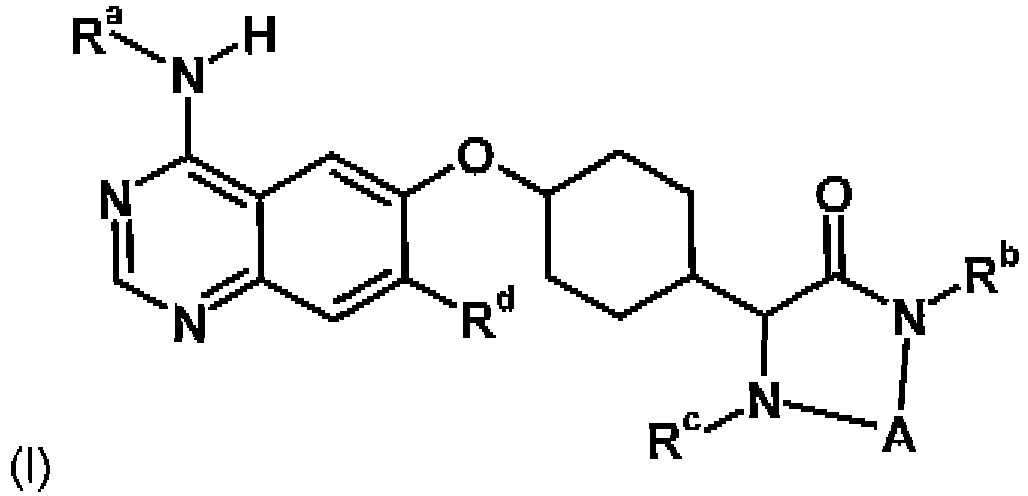 Ra 3-Chlor-2-fluor-phenyl-Rb Wasserstoff, oder einen Rest, gegebenenfalls substituiert, ausgewählt aus der Gruppe bestehend aus C1-6-Alkyl, C3-6-Cycloalkyl- und C3-6-Cycloalkyl-C1-3-alkyl,Rc Wasserstoff, oder einen Rest, gegebenenfalls substituiert, ausgewählt aus der Gruppe bestehend aus C1-6-Alkyl, C3-6-Cycloalkyl-, C3-6-Cycloalkyl-C1-3-alkyl, C1-6-Alkyl-CO-, C3-6-Cycloalkyl-CO-, C3-6-Cycloalkyl-C1-3-alkyl-CO-, C1-6-Alkyl-SO2-, C3-8-Cycloalkyl-SO2-, C3-6-Cycloalkyl-C1-3-alkyl-SO2-, Phenyl-CO- und Phenyl-SO2-,Rd -O-MeA -CH2-CH2-gegebenenfalls in Form ihrer Tautomeren, ihrer Racemate, ihrer Enantiomere, ihrer Diastereomere und ihrer Gemische, sowie gegebenenfalls ihrer pharmakologisch unbedenklichen Säureadditionssalze,
bedeuten. - Verbindungen nach Anspruch 1,
dadurch gekennzeichnet, dassRb und Rc gleich oder verschieden, Wasserstoff oder C1-3-Alkyl,gegebenenfalls in Form ihrer Tautomeren, ihrer Racemate, ihrer Enantiomere, ihrer Diastereomere und ihrer Gemische, sowie gegebenenfalls ihrer pharmakologisch unbedenklichen Säureadditionssalze,
bedeuten. - Verbindungen der Formel (I) nach einem der Ansprüche 1 bis 2 zur Verwendung als Arzneimittel.
- Verbindungen der Formel (I) nach Anspruch 3 zur Anwendung in der Behandlung entzündlicher oder allergischer Erkrankungen der Atemwege.
- Verbindungen der Formel (I) nach Anspruch 3 zur Anwendung in der Behandlung einer Erkrankung, die ausgewählt ist aus der Gruppe bestehend aus Chronischer Bronchitis, akuter Bronchitis, Bronchitis aufgrund bakterieller oder viraler Infektion oder Pilzen oder Helminthen, allergischer Bronchitis, toxischer Bronchitis, chronisch obstruktiver Bronchitis (COPD), Asthma (intrinsisch oder allergisch), pediatrischem Asthma, Bronchiektasien, allergischer Alveolitis, allergischer oder nicht-allergischer Rhinitis, chronischer Sinusitis, zystischer Fibrose oder Mukoviszidose, alpha-1-Antitrypsin-Mangel, Husten, Lungenemphysem, interstitieller Lungenerkrankungen, Alveolitis, hyperreaktiver Atemwege, Nasenpolypen, Lungenödemen, Pneumonitis aufgrund unterschiedlicher Genese wie Strahlen-induziert oder durch Aspiration oder infektiöse, Kollagenosen wie Lupus eryth, systemische Sklerodermie, Sarkoidose und M. Boeck.
- Verbindungen der Formel (I) nach Anspruch 3 zur Anwendung in der Behandlung entzündlicher oder allergischer Krankheitszustände bei denen Autoimmun-Reaktionen beteiligt sind.
- Verbindungen der Formel (I) nach Anspruch 3 zur Anwendung in der Behandlung einer Erkrankung in Form von benignen oder malignen Tumoren.
- Pharmazeutische Formulierung enthaltend eine Verbindung der Formel (I) gemäß einem der Ansprüche 1 oder 2.
- Oral applizierbare pharmazeutische Formulierung nach Anspruch 8 enthaltend eine Verbindung der Formel (1) gemäß Anspruch 1 oder 2.
- Arzneimittelkombinationen, die neben einer oder mehrerer Verbindungen der Formel (I) gemäß einem der Ansprüche 1 oder 2 als weiteren Wirkstoff einen oder mehrere Verbindungen enthalten, die ausgewählt sind aus den Klassen der Betamimetika, Anticholinergika, Corticosteroiden, weitere PDE4-Inhibitoren, LTD4-Antagonisten, EGFR-Hemmern, Dopamin-Agonisten, H1-Antihistaminika, PAF-Antagonisten und PI3-Kinase Inhibitoren oder zwei- oder dreifach Kombinationen davon.
Priority Applications (1)
| Application Number | Priority Date | Filing Date | Title |
|---|---|---|---|
| EP09780993.3A EP2313397B1 (de) | 2008-08-08 | 2009-07-23 | Cyclohexyloxy-substituierte heterocyclen, diese verbindungen enthaltende arzneimittel, deren verwendung und verfahren zu ihrer herstellung |
Applications Claiming Priority (3)
| Application Number | Priority Date | Filing Date | Title |
|---|---|---|---|
| EP08104995 | 2008-08-08 | ||
| PCT/EP2009/059510 WO2010015522A1 (de) | 2008-08-08 | 2009-07-23 | Cyclohexyloxy-substituierte heterocyclen, diese verbindungen enthaltende arzneimittel, deren verwendung und verfahren zu ihrer herstellung |
| EP09780993.3A EP2313397B1 (de) | 2008-08-08 | 2009-07-23 | Cyclohexyloxy-substituierte heterocyclen, diese verbindungen enthaltende arzneimittel, deren verwendung und verfahren zu ihrer herstellung |
Publications (2)
| Publication Number | Publication Date |
|---|---|
| EP2313397A1 EP2313397A1 (de) | 2011-04-27 |
| EP2313397B1 true EP2313397B1 (de) | 2016-04-20 |
Family
ID=40010805
Family Applications (1)
| Application Number | Title | Priority Date | Filing Date |
|---|---|---|---|
| EP09780993.3A Active EP2313397B1 (de) | 2008-08-08 | 2009-07-23 | Cyclohexyloxy-substituierte heterocyclen, diese verbindungen enthaltende arzneimittel, deren verwendung und verfahren zu ihrer herstellung |
Country Status (7)
| Country | Link |
|---|---|
| US (1) | US8648191B2 (de) |
| EP (1) | EP2313397B1 (de) |
| JP (1) | JP5539351B2 (de) |
| AR (1) | AR072998A1 (de) |
| CA (1) | CA2733153C (de) |
| TW (1) | TW201012813A (de) |
| WO (1) | WO2010015522A1 (de) |
Families Citing this family (4)
| Publication number | Priority date | Publication date | Assignee | Title |
|---|---|---|---|---|
| EP1921070A1 (de) | 2006-11-10 | 2008-05-14 | Boehringer Ingelheim Pharma GmbH & Co. KG | Bicyclische Heterocyclen, diese Verbindungen enthaltende Arzneimittel, deren Verwendung und Verfahren zu ihrer Herstelllung |
| US8497369B2 (en) | 2008-02-07 | 2013-07-30 | Boehringer Ingelheim International Gmbh | Spirocyclic heterocycles medicaments containing said compounds, use thereof and method for their production |
| EP2313397B1 (de) | 2008-08-08 | 2016-04-20 | Boehringer Ingelheim International GmbH | Cyclohexyloxy-substituierte heterocyclen, diese verbindungen enthaltende arzneimittel, deren verwendung und verfahren zu ihrer herstellung |
| EP2875020B1 (de) | 2012-07-19 | 2017-09-06 | Boehringer Ingelheim International GmbH | Verfahren zur herstellung von einem fumarsäuresalz von 9- [4- (3-chlor-2-fluor-phenylamino)-7-methoxy-chinazolin-6-yloxy]-1,4-diaza-spiro[5.5]undecan-5-on |
Family Cites Families (184)
| Publication number | Priority date | Publication date | Assignee | Title |
|---|---|---|---|---|
| US3985749A (en) * | 1975-12-22 | 1976-10-12 | Eastman Kodak Company | Process for preparation of 4-aminoquinazoline |
| JPS5538325A (en) | 1978-09-11 | 1980-03-17 | Sankyo Co Ltd | 4-anilinoquinazoline derivative and its preparation |
| US4335127A (en) * | 1979-01-08 | 1982-06-15 | Janssen Pharmaceutica, N.V. | Piperidinylalkyl quinazoline compounds, composition and method of use |
| GB2160201B (en) * | 1984-06-14 | 1988-05-11 | Wyeth John & Brother Ltd | Quinazoline and cinnoline derivatives |
| US4845629A (en) * | 1985-07-18 | 1989-07-04 | General De Investigacion Y Desarrollo S.A. | Airport surveillance systems |
| KR910006138B1 (ko) | 1986-09-30 | 1991-08-16 | 에자이 가부시끼가이샤 | 환상아민 유도체 |
| US4921863A (en) * | 1988-02-17 | 1990-05-01 | Eisai Co., Ltd. | Cyclic amine derivatives |
| GB8910722D0 (en) * | 1989-05-10 | 1989-06-28 | Smithkline Beckman Intercredit | Compounds |
| US5252586A (en) * | 1990-09-28 | 1993-10-12 | The Du Pont Merck Pharmaceutical Company | Ether derivatives of alkyl piperidines and pyrrolidines as antipsychotic agents |
| DE4105503A1 (de) | 1991-02-19 | 1992-08-20 | Jenapharm Gmbh | Ausgangsverbindungen zur herstellung von calcitriol sowie dessen abkoemmlingen, verfahren zur herstellung dieser ausgangsverbindungen sowie zwischenprodukte fuer dieses verfahren |
| US6645969B1 (en) * | 1991-05-10 | 2003-11-11 | Aventis Pharmaceuticals Inc. | Aryl and heteroaryl quinazoline compounds which inhibit CSF-1R receptor tyrosine kinase |
| US5710158A (en) | 1991-05-10 | 1998-01-20 | Rhone-Poulenc Rorer Pharmaceuticals Inc. | Aryl and heteroaryl quinazoline compounds which inhibit EGF and/or PDGF receptor tyrosine kinase |
| CA2102780C (en) | 1991-05-10 | 2007-01-09 | Alfred P. Spada | Bis mono-and bicyclic aryl and heteroaryl compounds which inhibit egf and/or pdgf receptor tyrosine kinase |
| US5721237A (en) * | 1991-05-10 | 1998-02-24 | Rhone-Poulenc Rorer Pharmaceuticals Inc. | Protein tyrosine kinase aryl and heteroaryl quinazoline compounds having selective inhibition of HER-2 autophosphorylation properties |
| US5187168A (en) | 1991-10-24 | 1993-02-16 | American Home Products Corporation | Substituted quinazolines as angiotensin II antagonists |
| GB9300059D0 (en) * | 1992-01-20 | 1993-03-03 | Zeneca Ltd | Quinazoline derivatives |
| WO1993017682A1 (en) | 1992-03-04 | 1993-09-16 | Abbott Laboratories | Angiotensin ii receptor antagonists |
| HUT74870A (en) | 1993-05-26 | 1997-02-28 | Syntex Inc | Process for producing 1-phenylalkanone 5-ht4 receptor ligands and pharmaceutical compositions containing them |
| US5395846A (en) | 1993-06-25 | 1995-03-07 | Rhone-Poulenc Rorer Pharmaceuticals Inc. | Amino Bi- and tri-carbocyclic aklane bis-aryl squalene synthase inhibitors |
| GB9314893D0 (en) | 1993-07-19 | 1993-09-01 | Zeneca Ltd | Quinazoline derivatives |
| US5700823A (en) | 1994-01-07 | 1997-12-23 | Sugen, Inc. | Treatment of platelet derived growth factor related disorders such as cancers |
| WO1995024190A2 (en) | 1994-03-07 | 1995-09-14 | Sugen, Inc. | Receptor tyrosine kinase inhibitors for inhibiting cell proliferative disorders and compositions thereof |
| GB9510757D0 (en) | 1994-09-19 | 1995-07-19 | Wellcome Found | Therapeuticaly active compounds |
| TW321649B (de) * | 1994-11-12 | 1997-12-01 | Zeneca Ltd | |
| GB2295387A (en) | 1994-11-23 | 1996-05-29 | Glaxo Inc | Quinazoline antagonists of alpha 1c adrenergic receptors |
| GB9424233D0 (en) | 1994-11-30 | 1995-01-18 | Zeneca Ltd | Quinazoline derivatives |
| US5642285A (en) * | 1995-01-31 | 1997-06-24 | Trimble Navigation Limited | Outdoor movie camera GPS-position and time code data-logging for special effects production |
| DE69536015D1 (de) | 1995-03-30 | 2009-12-10 | Pfizer Prod Inc | Chinazolinone Derivate |
| GB9508565D0 (en) | 1995-04-27 | 1995-06-14 | Zeneca Ltd | Quiazoline derivative |
| GB9508538D0 (en) | 1995-04-27 | 1995-06-14 | Zeneca Ltd | Quinazoline derivatives |
| GB9508535D0 (en) | 1995-04-27 | 1995-06-14 | Zeneca Ltd | Quinazoline derivative |
| EP0824525B1 (de) | 1995-04-27 | 2001-06-13 | AstraZeneca AB | Chinazolin derivate |
| GB9508537D0 (en) | 1995-04-27 | 1995-06-14 | Zeneca Ltd | Quinazoline derivatives |
| US5747498A (en) * | 1996-05-28 | 1998-05-05 | Pfizer Inc. | Alkynyl and azido-substituted 4-anilinoquinazolines |
| US6046206A (en) * | 1995-06-07 | 2000-04-04 | Cell Pathways, Inc. | Method of treating a patient having a precancerous lesions with amide quinazoline derivatives |
| GB9514265D0 (en) | 1995-07-13 | 1995-09-13 | Wellcome Found | Hetrocyclic compounds |
| WO1997011692A2 (en) | 1995-09-11 | 1997-04-03 | Osteoarthritis Sciences, Inc. | Protein tyrosine kinase inhibitors for treating osteoarthritis |
| JP2000500502A (ja) | 1995-11-22 | 2000-01-18 | メルク エンド カンパニー インコーポレーテッド | ファルネシル―タンパク質トランスフェラーゼ阻害剤 |
| GB9624482D0 (en) * | 1995-12-18 | 1997-01-15 | Zeneca Phaema S A | Chemical compounds |
| BR9702049B1 (pt) * | 1996-01-31 | 2010-08-10 | sistema distribuidor contendo dois compartimentos para a dosagem simultánea de duas composições aquosas. | |
| US5760041A (en) | 1996-02-05 | 1998-06-02 | American Cyanamid Company | 4-aminoquinazoline EGFR Inhibitors |
| WO1997030035A1 (en) | 1996-02-13 | 1997-08-21 | Zeneca Limited | Quinazoline derivatives as vegf inhibitors |
| GB9603095D0 (en) * | 1996-02-14 | 1996-04-10 | Zeneca Ltd | Quinazoline derivatives |
| GB9603097D0 (en) | 1996-02-14 | 1996-04-10 | Zeneca Ltd | Quinazoline compounds |
| ES2169355T3 (es) | 1996-03-05 | 2002-07-01 | Astrazeneca Ab | Derivados de 4-anilinoquinazolina. |
| JP3370340B2 (ja) | 1996-04-12 | 2003-01-27 | ワーナー―ランバート・コンパニー | チロシンキナーゼの不可逆的阻害剤 |
| GB9607729D0 (en) * | 1996-04-13 | 1996-06-19 | Zeneca Ltd | Quinazoline derivatives |
| GB9707800D0 (en) | 1996-05-06 | 1997-06-04 | Zeneca Ltd | Chemical compounds |
| US5938706A (en) * | 1996-07-08 | 1999-08-17 | Feldman; Yasha I. | Multi element security system |
| DE69716916T2 (de) | 1996-07-13 | 2003-07-03 | Glaxo Group Ltd., Greenford | Kondensierte heterozyklische verbindungen als protein kinase inhibitoren |
| US6004967A (en) * | 1996-09-13 | 1999-12-21 | Sugen, Inc. | Psoriasis treatment with quinazoline compounds |
| GB9718972D0 (en) | 1996-09-25 | 1997-11-12 | Zeneca Ltd | Chemical compounds |
| US6225318B1 (en) * | 1996-10-17 | 2001-05-01 | Pfizer Inc | 4-aminoquinazolone derivatives |
| DE69734290T2 (de) | 1996-11-05 | 2006-07-06 | The Children's Medical Center Corp., Boston | Mittel zur hemmung von angiogenese enthaltend thalodomid und einen nsaid |
| NZ510991A (en) | 1997-03-05 | 2002-11-26 | Sugen Inc | Use of formulations for hydrophobic pharmaceutical agents in treatment or prevention of cell proliferative disorders |
| UA73073C2 (uk) | 1997-04-03 | 2005-06-15 | Уайт Холдінгз Корпорейшн | Заміщені 3-ціанохіноліни, спосіб їх одержання та фармацевтична композиція |
| AR012634A1 (es) | 1997-05-02 | 2000-11-08 | Sugen Inc | Compuesto basado en quinazolina, composicion famaceutica que lo comprende, metodo para sintetizarlo, su uso, metodos de modulacion de la funcion deserina/treonina proteinaquinasa con dicho compuesto y metodo in vitro para identificar compuestos que modulan dicha funcion |
| ES2201484T3 (es) | 1997-05-06 | 2004-03-16 | Wyeth Holdings Corporation | Utilizacion de compuestos de quinazolina para el tratamiento de la enfermedad de la poliquistosis renal. |
| US5929080A (en) * | 1997-05-06 | 1999-07-27 | American Cyanamid Company | Method of treating polycystic kidney disease |
| DE69822164T2 (de) | 1997-06-30 | 2005-04-14 | Glaxo Group Ltd., Greenford | Verfahren zur identifizierung von verbindungen mit verminderter systemischer aktivität |
| ZA986729B (en) | 1997-07-29 | 1999-02-02 | Warner Lambert Co | Irreversible inhibitors of tyrosine kinases |
| ZA986732B (en) | 1997-07-29 | 1999-02-02 | Warner Lambert Co | Irreversible inhibitiors of tyrosine kinases |
| TW436485B (en) | 1997-08-01 | 2001-05-28 | American Cyanamid Co | Substituted quinazoline derivatives |
| ATE368665T1 (de) | 1997-08-22 | 2007-08-15 | Astrazeneca Ab | Oxindolylchinazolinderivate als angiogenesehemmer |
| NZ503991A (en) | 1997-11-06 | 2001-11-30 | American Cyanamid Co | Use of quinazoline derivatives as tyrosine kinase inhibitors for treating colonic polyps |
| GB9800575D0 (en) | 1998-01-12 | 1998-03-11 | Glaxo Group Ltd | Heterocyclic compounds |
| AU4317399A (en) | 1998-05-28 | 1999-12-13 | Parker Hughes Institute | Quinazolines for treating brain tumor |
| EP1091739A1 (de) | 1998-06-30 | 2001-04-18 | Parker Hughes Institute | Verfahren zum hemmen der c-jun expression mittels verwendung von jak-3 hemmern |
| US6384223B1 (en) * | 1998-07-30 | 2002-05-07 | American Home Products Corporation | Substituted quinazoline derivatives |
| WO2000006555A1 (en) | 1998-07-30 | 2000-02-10 | American Home Products Corporation | Substituted quinazoline derivatives |
| AU5195999A (en) | 1998-08-11 | 2000-03-06 | Takeda Chemical Industries Ltd. | Cyclic amide compounds, process for producing the same, intermediates thereof and herbicides |
| US7354894B2 (en) * | 1998-08-18 | 2008-04-08 | The Regents Of The University Of California | Preventing airway mucus production by administration of EGF-R antagonists |
| ID27345A (id) * | 1998-08-18 | 2001-04-05 | Univ California | Pencegahan produksi lendir jalan udara dengan antagonis egf-r |
| US6846799B1 (en) * | 1998-08-18 | 2005-01-25 | The Regents Of The University Of California | Preventing airway mucus production by administration of EGF-R antagonists |
| EP1105378B1 (de) | 1998-08-21 | 2005-03-30 | Parker Hughes Institute | Chinazolinderivate |
| US6184226B1 (en) | 1998-08-28 | 2001-02-06 | Scios Inc. | Quinazoline derivatives as inhibitors of P-38 α |
| AU6159499A (en) | 1998-09-29 | 2000-04-17 | Wyeth Holdings Corporation | Substituted 3-cyanoquinolines as protein tyrosine kinases inhibitors |
| US6297258B1 (en) * | 1998-09-29 | 2001-10-02 | American Cyanamid Company | Substituted 3-cyanoquinolines |
| DK1117653T3 (da) | 1998-10-01 | 2003-05-26 | Astrazeneca Ab | Quinolin- og quinazolinderivater og deres anvendelse som inhibitorer af cykokin-merierede sygdomme |
| TW575567B (en) | 1998-10-23 | 2004-02-11 | Akzo Nobel Nv | Serine protease inhibitor |
| UA71945C2 (en) | 1999-01-27 | 2005-01-17 | Pfizer Prod Inc | Substituted bicyclic derivatives being used as anticancer agents |
| BRPI0017548B8 (pt) | 1999-02-10 | 2023-05-02 | Astrazeneca Ab | Composto |
| SK12112001A3 (sk) | 1999-02-27 | 2001-12-03 | Boehringer Ingelheim Pharma Kg | 4-amino-chinazolínové a chinolínové deriváty, spôsob ich prípravy, farmaceutický prostriedok s ich obsahom a ich použitie |
| US6080747A (en) * | 1999-03-05 | 2000-06-27 | Hughes Institute | JAK-3 inhibitors for treating allergic disorders |
| DE19911509A1 (de) | 1999-03-15 | 2000-09-21 | Boehringer Ingelheim Pharma | Bicyclische Heterocyclen, diese Verbindungen enthaltende Arzneimittel, deren Verwendung und Verfahren zu ihrer Herstellung |
| DE19911510A1 (de) | 1999-03-15 | 2000-09-21 | Boehringer Ingelheim Pharma | Bicyclische Heterocyclen, diese Verbindungen enthaltende Arzneimittel, deren Verwendung und Verfahren zu ihrer Herstellung |
| US6258820B1 (en) | 1999-03-19 | 2001-07-10 | Parker Hughes Institute | Synthesis and anti-tumor activity of 6,7-dialkoxy-4-phenylamino-quinazolines |
| AU3630100A (en) | 1999-03-19 | 2000-10-09 | Parker Hughes Institute | Quinazoline formulations and therapeutic use thereof |
| US6627651B1 (en) | 1999-05-07 | 2003-09-30 | Takeda Chemical Industries, Ltd. | Cyclic compounds and uses thereof |
| GB9910577D0 (en) | 1999-05-08 | 1999-07-07 | Zeneca Ltd | Chemical compounds |
| US6518283B1 (en) | 1999-05-28 | 2003-02-11 | Celltech R&D Limited | Squaric acid derivatives |
| US6126917A (en) * | 1999-06-01 | 2000-10-03 | Hadasit Medical Research Services And Development Ltd. | Epidermal growth factor receptor binding compounds for positron emission tomography |
| YU90901A (sh) | 1999-06-21 | 2004-07-15 | Boehringer Ingelheim Pharma Gmbh. & Co.Kg. | Biciklični heterocikli, lekovi koji sadrže ta jedinjenja, njihova primena i postupci za njihovo pripremanje |
| BR0012157A (pt) | 1999-07-07 | 2002-04-02 | Astrazeneca Uk Ltd | Derivado de quinazolina, derivado de pirimidina, processo para a preparação de um derivado de quinazolina, composição farmacêutica, uso de um derivado de quinazolina, e, método para a prevenção ou tratamento de doenças ou condições médicas pela célula t um em animal de sangue quente em necessidade de tal tratamento |
| GB9917408D0 (en) | 1999-07-23 | 1999-09-22 | Smithkline Beecham Plc | Compounds |
| DK1202746T3 (da) | 1999-08-12 | 2007-01-02 | Wyeth Corp | NSAID- og EGFR-kinaseinhibitorerholdigt præparat til behandling eller inhibering af colonpolypper og colorektal cancer |
| GB9922173D0 (en) | 1999-09-21 | 1999-11-17 | Zeneca Ltd | Chemical compounds |
| JP2003509497A (ja) * | 1999-09-21 | 2003-03-11 | アストラゼネカ アクチボラグ | キナゾリン化合物とそれらを含有する医薬組成物 |
| GB9922171D0 (en) | 1999-09-21 | 1999-11-17 | Zeneca Ltd | Chemical compounds |
| SK3822002A3 (en) | 1999-09-21 | 2002-10-08 | Astrazeneca Ab | Quinazoline derivatives, process for the preparation thereof and their use |
| AU1071301A (en) | 1999-11-01 | 2001-05-14 | Eli Lilly And Company | Pharmaceutical compounds |
| CN100376567C (zh) | 1999-11-05 | 2008-03-26 | 阿斯特拉曾尼卡有限公司 | 作为vegf抑制剂的喹唑啉衍生物 |
| WO2001045641A2 (en) | 1999-11-30 | 2001-06-28 | Parker Hughes Institute | Inhibitors of thrombin induced platelet aggregation |
| ATE300303T1 (de) | 2000-03-06 | 2005-08-15 | Astrazeneca Ab | Verwendung von quinazolinderivate als inhibitoren der angiogenese |
| US20060063752A1 (en) * | 2000-03-14 | 2006-03-23 | Boehringer Ingelheim Pharma Gmbh & Co. Kg | Bicyclic heterocycles, pharmaceutical compositions containing them, their use, and processes for preparing them |
| GB0008368D0 (en) | 2000-04-06 | 2000-05-24 | Astrazeneca Ab | Combination product |
| US7160889B2 (en) | 2000-04-07 | 2007-01-09 | Astrazeneca Ab | Quinazoline compounds |
| US6627634B2 (en) * | 2000-04-08 | 2003-09-30 | Boehringer Ingelheim Pharma Kg | Bicyclic heterocycles, pharmaceutical compositions containing them, their use, and processes for preparing them |
| CA2403152C (en) | 2000-04-08 | 2008-10-28 | Boehringer Ingelheim Pharma Kg | Bicyclic heterocycles, pharmaceutical compositions containing these compounds, their use and processes for preparing them |
| EP1283039A4 (de) | 2000-05-19 | 2007-05-30 | Takeda Pharmaceutical | Inhibitoren von -secretase |
| UA73993C2 (uk) | 2000-06-06 | 2005-10-17 | Астразенека Аб | Хіназолінові похідні для лікування пухлин та фармацевтична композиція |
| NZ522568A (en) | 2000-06-22 | 2004-12-24 | Pfizer Prod Inc | Substituted bicyclic derivatives for the treatment of abnormal cell growth |
| US7115615B2 (en) | 2000-08-21 | 2006-10-03 | Astrazeneca | Quinazoline derivatives |
| DE10042060A1 (de) | 2000-08-26 | 2002-03-07 | Boehringer Ingelheim Pharma | Bicyclische Heterocyclen, diese Verbindungen enthaltende Arzneimittel, deren Verwendung und Verfahren zu ihrer Herstellung |
| DE10042062A1 (de) | 2000-08-26 | 2002-03-07 | Boehringer Ingelheim Pharma | Bicyclische Heterocyclen, diese Verbindungen enthaltende Arzneimittel, deren Verwendung und Verfahren zu ihrer Hertellung |
| DE10042058A1 (de) | 2000-08-26 | 2002-03-07 | Boehringer Ingelheim Pharma | Bicyclische Heterocyclen, diese Verbindungen enthaltende Arzneimittel, deren Verwendung und Verfahren zu ihrer Herstellung |
| US6617329B2 (en) * | 2000-08-26 | 2003-09-09 | Boehringer Ingelheim Pharma Kg | Aminoquinazolines and their use as medicaments |
| US6403580B1 (en) * | 2000-08-26 | 2002-06-11 | Boehringer Ingelheim Pharma Kg | Quinazolines, pharmaceutical compositions containing these compounds, their use and processes for preparing them |
| DE10042059A1 (de) | 2000-08-26 | 2002-03-07 | Boehringer Ingelheim Pharma | Bicyclische Heterocyclen, diese Verbindungen enthaltende Arzneimittel, deren Verwendung und Verfahren zu ihrer Herstellung |
| US20020082270A1 (en) * | 2000-08-26 | 2002-06-27 | Frank Himmelsbach | Aminoquinazolines which inhibit signal transduction mediated by tyrosine kinases |
| DE10042061A1 (de) | 2000-08-26 | 2002-03-07 | Boehringer Ingelheim Pharma | Bicyclische Heterocyclen,diese Verbindungen enthaltende Arzneimittel, deren Verwendung und Verfahren zu ihrer Herstellung |
| US6653305B2 (en) * | 2000-08-26 | 2003-11-25 | Boehringer Ingelheim Pharma Kg | Bicyclic heterocycles, pharmaceutical compositions containing them, their use, and processes for preparing them |
| US6656946B2 (en) * | 2000-08-26 | 2003-12-02 | Boehringer Ingelheim Pharma Kg | Aminoquinazolines which inhibit signal transduction mediated by tyrosine kinases |
| US6740651B2 (en) * | 2000-08-26 | 2004-05-25 | Boehringer Ingelheim Pharma Kg | Aminoquinazolines which inhibit signal transduction mediated by tyrosine kinases |
| EP1719770A3 (de) | 2000-09-21 | 2008-03-05 | Smithkline Beecham Plc | Chinolinderivate als antibakterielle Mittel |
| AU2001292138A1 (en) | 2000-10-13 | 2002-04-22 | Astrazeneca Ab | Quinazoline derivatives with anti-tumour activity |
| WO2002034711A1 (en) | 2000-10-20 | 2002-05-02 | Biocryst Pharmaceuticals, Inc. | Biaryl compounds as serine protease inhibitors |
| US20040063733A1 (en) | 2000-10-25 | 2004-04-01 | Lambert Christine Marie Paul | Quinazoline derivatives |
| US20030158196A1 (en) * | 2002-02-16 | 2003-08-21 | Boehringer Ingelheim Pharma Gmbh Co. Kg | Pharmaceutical compositions based on anticholinergics and EGFR kinase inhibitors |
| AU2002210714A1 (en) | 2000-11-02 | 2002-06-11 | Astrazeneca Ab | Substituted quinolines as antitumor agents |
| AU2002223684A1 (en) | 2000-11-22 | 2002-06-03 | Novartis Pharma Gmbh | Combination comprising an agent decreasing vegf activity and an agent decreasing egf activity |
| AUPR201600A0 (en) | 2000-12-11 | 2001-01-11 | Fujisawa Pharmaceutical Co., Ltd. | Quinazolinone derivative |
| US7019012B2 (en) * | 2000-12-20 | 2006-03-28 | Boehringer Ingelheim International Pharma Gmbh & Co. Kg | Quinazoline derivatives and pharmaceutical compositions containing them |
| DE10063435A1 (de) | 2000-12-20 | 2002-07-04 | Boehringer Ingelheim Pharma | Chinazolinderviate,diese Verbindungen enthaltende Arzneimittel, deren Verwendung und Verfahren zu ihrer Herstellung |
| GB0101577D0 (en) | 2001-01-22 | 2001-03-07 | Smithkline Beecham Plc | Compounds |
| WO2002062767A1 (en) | 2001-02-07 | 2002-08-15 | Sumitomo Pharmaceuticals Company, Limited | Novel quinazoline derivatives |
| NZ516873A (en) | 2001-02-12 | 2003-11-28 | Warner Lambert Co | Compositions containing retinoids and erb inhibitors and their use in inhibiting retinoid skin damage |
| WO2002066445A1 (en) | 2001-02-21 | 2002-08-29 | Mitsubishi Pharma Corporation | Quinazoline derivatives |
| WO2002068409A1 (en) | 2001-02-23 | 2002-09-06 | Merck & Co., Inc. | N-substituted nonaryl-heterocyclic nmda/nr2b antagonists |
| US6562319B2 (en) * | 2001-03-12 | 2003-05-13 | Yissum Research Development Company Of The Hebrew University Of Jerusalem | Radiolabeled irreversible inhibitors of epidermal growth factor receptor tyrosine kinase and their use in radioimaging and radiotherapy |
| JP4329003B2 (ja) | 2001-03-23 | 2009-09-09 | バイエル コーポレイション | Rhoキナーゼ阻害剤 |
| WO2002092577A1 (en) | 2001-05-14 | 2002-11-21 | Astrazeneca Ab | Quinazoline derivatives |
| WO2002092578A1 (en) | 2001-05-14 | 2002-11-21 | Astrazeneca Ab | Quinazoline derivatives |
| WO2002092579A1 (en) | 2001-05-14 | 2002-11-21 | Astrazeneca Ab | 4-anilinoquinazoline derivatives |
| AR033765A1 (es) | 2001-05-22 | 2004-01-07 | Syngenta Participations Ag | Procedimiento para la preparacion de derivados 3-alquil-3h-isobenzofuran-1-ona 7-sustituidos. |
| EP1396488A1 (de) * | 2001-05-23 | 2004-03-10 | Mitsubishi Pharma Corporation | Kondensierte heterocyclische verbindung und deren medizinische verwendung |
| WO2003000188A2 (en) | 2001-06-21 | 2003-01-03 | Ariad Pharmaceuticals, Inc. | Novel quinazolines and uses thereof |
| JP2005515176A (ja) | 2001-11-03 | 2005-05-26 | アストラゼネカ アクチボラグ | 抗腫瘍剤としてのキナゾリン誘導体 |
| GB0126433D0 (en) | 2001-11-03 | 2002-01-02 | Astrazeneca Ab | Compounds |
| GB0128108D0 (en) | 2001-11-23 | 2002-01-16 | Astrazeneca Ab | Therapeutic use |
| GB0128109D0 (en) | 2001-11-23 | 2002-01-16 | Astrazeneca Ab | Therapeutic use |
| IL161908A0 (en) | 2001-12-12 | 2005-11-20 | Pfizer Prod Inc | Quinazoline derivatives for the treatment of abnormal cell growth |
| DE10204462A1 (de) * | 2002-02-05 | 2003-08-07 | Boehringer Ingelheim Pharma | Verwendung von Tyrosinkinase-Inhibitoren zur Behandlung inflammatorischer Prozesse |
| GB0204719D0 (en) | 2002-02-28 | 2002-04-17 | Glaxo Group Ltd | Medicinal compounds |
| TWI324597B (en) * | 2002-03-28 | 2010-05-11 | Astrazeneca Ab | Quinazoline derivatives |
| US6924285B2 (en) * | 2002-03-30 | 2005-08-02 | Boehringer Ingelheim Pharma Gmbh & Co. | Bicyclic heterocyclic compounds, pharmaceutical compositions containing these compounds, their use and process for preparing them |
| EP1492536B1 (de) * | 2002-03-30 | 2012-05-09 | Boehringer Ingelheim Pharma GmbH & Co.KG | 4- ( n-phenylamino ) -chinazoline/chinoline als tyrosinkinaseinhibitoren |
| US20040044014A1 (en) * | 2002-04-19 | 2004-03-04 | Boehringer Ingelheim Pharma Gmbh & Co. Kg | Bicyclic heterocycles, pharmaceutical compositions containing these compounds, their use and processes for the preparation thereof |
| KR20050122199A (ko) | 2003-01-23 | 2005-12-28 | 티.케이. 시그널 리미티드 | 표피성장인자 수용체 티로신 키나제의 비가역성 억제제 및 그의 용도 |
| GB0309009D0 (en) | 2003-04-22 | 2003-05-28 | Astrazeneca Ab | Quinazoline derivatives |
| DE10326186A1 (de) * | 2003-06-06 | 2004-12-23 | Boehringer Ingelheim Pharma Gmbh & Co. Kg | Bicyclische Heterocyclen, diese Verbindungen enthaltende Arzneimittel, deren Verwendung und Verfahren zu ihrer Herstellung |
| US20050059661A1 (en) * | 2003-07-28 | 2005-03-17 | Boehringer Ingelheim International Gmbh | Use of tyrosine kinase inhibitors for the treatment of inflammatory processes |
| JP2007500177A (ja) | 2003-07-29 | 2007-01-11 | アストラゼネカ アクチボラグ | チロシンキナーゼ阻害剤としてのピペリジルキナゾリン誘導体 |
| GB0317665D0 (en) * | 2003-07-29 | 2003-09-03 | Astrazeneca Ab | Qinazoline derivatives |
| JP2007505873A (ja) | 2003-09-16 | 2007-03-15 | アストラゼネカ アクチボラグ | チロシンキナーゼ阻害剤としてのキナゾリン誘導体 |
| GB0321648D0 (en) | 2003-09-16 | 2003-10-15 | Astrazeneca Ab | Quinazoline derivatives |
| CN1882570B (zh) | 2003-09-19 | 2010-12-08 | 阿斯利康(瑞典)有限公司 | 喹唑啉衍生物 |
| MXPA06003113A (es) | 2003-09-19 | 2006-06-20 | Astrazeneca Ab | Derivados de quinazolina. |
| GB0322409D0 (en) | 2003-09-25 | 2003-10-29 | Astrazeneca Ab | Quinazoline derivatives |
| MXPA06003341A (es) | 2003-09-25 | 2006-06-08 | Astrazeneca Ab | Derivados de quinazolina. |
| US7456189B2 (en) * | 2003-09-30 | 2008-11-25 | Boehringer Ingelheim International Gmbh | Bicyclic heterocycles, medicaments containing these compounds, their use and processes for their preparation |
| DE10350717A1 (de) | 2003-10-30 | 2005-06-02 | Boehringer Ingelheim Pharma Gmbh & Co. Kg | Verwendung von Tyrosinkinase-Inhibitoren zur Behandlung inflammatorischer Prozesse |
| WO2005048928A2 (en) | 2003-11-12 | 2005-06-02 | George Mason Intellectual Property | Methods for treating viral infection |
| WO2005102349A1 (de) | 2004-04-22 | 2005-11-03 | Boehringer Ingelheim International Gmbh | Arzneinmittelkombinationen enthaltend benzoxazine zur behandlung von atemwegserkrankungen |
| GB0416397D0 (en) | 2004-07-22 | 2004-08-25 | Glaxo Group Ltd | Pharmaceutical formulations |
| WO2006034110A1 (en) | 2004-09-17 | 2006-03-30 | Osi Pharmaceuticals, Inc. | (arylamidoaryl) cyanoguanidine compounds as inhibitors of c-kit proto-oncogene |
| EP1919900A2 (de) * | 2005-08-22 | 2008-05-14 | Boehringer Ingelheim International Gmbh | Bicyclische heterocyclen, diese verbindungen enthaltende arzneimittel, deren verwendung und verfahren zu ihrer herstellung |
| EP1764957A1 (de) | 2005-09-15 | 2007-03-21 | Research In Motion Limited | System und Verfahren zur Bewertung der Verlässlichkeit unterer Schichten unter Verwendung des Protokolls einer höheren Schicht in einem Kommunikationsnetzwerk |
| JP2009518450A (ja) * | 2005-12-12 | 2009-05-07 | ベーリンガー インゲルハイム インターナショナル ゲゼルシャフト ミット ベシュレンクテル ハフツング | 二環式複素環化合物、その化合物を含む薬剤、その使用及び製造方法 |
| WO2007101782A1 (de) * | 2006-03-09 | 2007-09-13 | Boehringer Ingelheim International Gmbh | Bicyclische heterocyclen, diese verbindungen enthaltende arzneimittel, deren verwendung und verfahren zu ihrer herstellung |
| EP1921070A1 (de) * | 2006-11-10 | 2008-05-14 | Boehringer Ingelheim Pharma GmbH & Co. KG | Bicyclische Heterocyclen, diese Verbindungen enthaltende Arzneimittel, deren Verwendung und Verfahren zu ihrer Herstelllung |
| WO2008095847A1 (de) * | 2007-02-06 | 2008-08-14 | Boehringer Ingelheim International Gmbh | Bicyclische heterocyclen, diese verbindungen enthaltende arzneimittel, deren verwendung und verfahren zu ihrer herstellung |
| US8497369B2 (en) * | 2008-02-07 | 2013-07-30 | Boehringer Ingelheim International Gmbh | Spirocyclic heterocycles medicaments containing said compounds, use thereof and method for their production |
| EP2313397B1 (de) | 2008-08-08 | 2016-04-20 | Boehringer Ingelheim International GmbH | Cyclohexyloxy-substituierte heterocyclen, diese verbindungen enthaltende arzneimittel, deren verwendung und verfahren zu ihrer herstellung |
-
2009
- 2009-07-23 EP EP09780993.3A patent/EP2313397B1/de active Active
- 2009-07-23 WO PCT/EP2009/059510 patent/WO2010015522A1/de not_active Ceased
- 2009-07-23 JP JP2011521517A patent/JP5539351B2/ja active Active
- 2009-07-23 CA CA2733153A patent/CA2733153C/en active Active
- 2009-07-23 US US13/057,872 patent/US8648191B2/en active Active
- 2009-08-07 AR ARP090103059A patent/AR072998A1/es unknown
- 2009-08-10 TW TW098126783A patent/TW201012813A/zh unknown
Also Published As
| Publication number | Publication date |
|---|---|
| AR072998A1 (es) | 2010-10-06 |
| EP2313397A1 (de) | 2011-04-27 |
| CA2733153A1 (en) | 2010-02-11 |
| JP5539351B2 (ja) | 2014-07-02 |
| JP2011530492A (ja) | 2011-12-22 |
| US8648191B2 (en) | 2014-02-11 |
| TW201012813A (en) | 2010-04-01 |
| WO2010015522A1 (de) | 2010-02-11 |
| CA2733153C (en) | 2016-11-08 |
| US20110190248A1 (en) | 2011-08-04 |
Similar Documents
| Publication | Publication Date | Title |
|---|---|---|
| EP2245026B1 (de) | Spirocyclische heterocyclen, diese verbindungen enthaltende arzneimittel, deren verwendung und verfahren zu ihrer herstellung | |
| EP2313398A1 (de) | Cyclohexyloxy-substituierte heterocyclen, diese verbindungen enthaltende arzneimittel, deren verwendung und verfahren zu ihrer herstellung | |
| EP2539323B3 (de) | Verbindungen als Bradykinin-B1-Antagonisten | |
| EP2670736B1 (de) | 9-[4-(3-chlor-2-fluor-phenylamino)-7-methoxy-chinazolin-6- yloxy]-1,4-diaza-spiro[5.5]undecan-5-on dimaleat, dessen verwendung als arzneimittel und dessen herstellung | |
| EP2606042B1 (de) | Disubstituierte tetrahydofuranyl-verbindungen als antagonisten des bradykinin-b1-rezeptors | |
| EP2091925B1 (de) | Bicyclische heterocyclen, diese verbindungen enthaltende arzneimittel, deren verwendung und verfahren zu ihrer herstellung | |
| WO2010015522A1 (de) | Cyclohexyloxy-substituierte heterocyclen, diese verbindungen enthaltende arzneimittel, deren verwendung und verfahren zu ihrer herstellung | |
| EP2606043B1 (de) | Pyridazinderivative als bradykinin b1 rezeptor antagonsiten | |
| EP2414338A1 (de) | Salze und hydrate des 4 -[(3-chlor-4-fluor-phenyl)amino]-6-(cis-4-{n-[(morph-1-olin-4-yl)carbonyl]-n-methyl-amino}-cyclohexan-1-yloxy)-7-methoxy-chinazolins, deren verwendung als arzneimittel und deren herstellung | |
| DE102005023207A1 (de) | Neue Verbindungen zur Behandlung von entzündlichen Erkrankungen |
Legal Events
| Date | Code | Title | Description |
|---|---|---|---|
| PUAI | Public reference made under article 153(3) epc to a published international application that has entered the european phase |
Free format text: ORIGINAL CODE: 0009012 |
|
| 17P | Request for examination filed |
Effective date: 20110308 |
|
| AK | Designated contracting states |
Kind code of ref document: A1 Designated state(s): AT BE BG CH CY CZ DE DK EE ES FI FR GB GR HR HU IE IS IT LI LT LU LV MC MK MT NL NO PL PT RO SE SI SK SM TR |
|
| AX | Request for extension of the european patent |
Extension state: AL BA RS |
|
| DAX | Request for extension of the european patent (deleted) | ||
| 17Q | First examination report despatched |
Effective date: 20121221 |
|
| GRAP | Despatch of communication of intention to grant a patent |
Free format text: ORIGINAL CODE: EPIDOSNIGR1 |
|
| INTG | Intention to grant announced |
Effective date: 20151109 |
|
| GRAS | Grant fee paid |
Free format text: ORIGINAL CODE: EPIDOSNIGR3 |
|
| GRAA | (expected) grant |
Free format text: ORIGINAL CODE: 0009210 |
|
| AK | Designated contracting states |
Kind code of ref document: B1 Designated state(s): AT BE BG CH CY CZ DE DK EE ES FI FR GB GR HR HU IE IS IT LI LT LU LV MC MK MT NL NO PL PT RO SE SI SK SM TR |
|
| REG | Reference to a national code |
Ref country code: GB Ref legal event code: FG4D Free format text: NOT ENGLISH |
|
| REG | Reference to a national code |
Ref country code: CH Ref legal event code: EP |
|
| REG | Reference to a national code |
Ref country code: AT Ref legal event code: REF Ref document number: 792324 Country of ref document: AT Kind code of ref document: T Effective date: 20160515 |
|
| REG | Reference to a national code |
Ref country code: IE Ref legal event code: FG4D Free format text: LANGUAGE OF EP DOCUMENT: GERMAN |
|
| REG | Reference to a national code |
Ref country code: DE Ref legal event code: R096 Ref document number: 502009012468 Country of ref document: DE |
|
| REG | Reference to a national code |
Ref country code: FR Ref legal event code: PLFP Year of fee payment: 8 |
|
| REG | Reference to a national code |
Ref country code: LT Ref legal event code: MG4D |
|
| REG | Reference to a national code |
Ref country code: NL Ref legal event code: MP Effective date: 20160420 |
|
| PG25 | Lapsed in a contracting state [announced via postgrant information from national office to epo] |
Ref country code: FI Free format text: LAPSE BECAUSE OF FAILURE TO SUBMIT A TRANSLATION OF THE DESCRIPTION OR TO PAY THE FEE WITHIN THE PRESCRIBED TIME-LIMIT Effective date: 20160420 Ref country code: NL Free format text: LAPSE BECAUSE OF FAILURE TO SUBMIT A TRANSLATION OF THE DESCRIPTION OR TO PAY THE FEE WITHIN THE PRESCRIBED TIME-LIMIT Effective date: 20160420 Ref country code: PL Free format text: LAPSE BECAUSE OF FAILURE TO SUBMIT A TRANSLATION OF THE DESCRIPTION OR TO PAY THE FEE WITHIN THE PRESCRIBED TIME-LIMIT Effective date: 20160420 Ref country code: NO Free format text: LAPSE BECAUSE OF FAILURE TO SUBMIT A TRANSLATION OF THE DESCRIPTION OR TO PAY THE FEE WITHIN THE PRESCRIBED TIME-LIMIT Effective date: 20160720 Ref country code: LT Free format text: LAPSE BECAUSE OF FAILURE TO SUBMIT A TRANSLATION OF THE DESCRIPTION OR TO PAY THE FEE WITHIN THE PRESCRIBED TIME-LIMIT Effective date: 20160420 |
|
| PG25 | Lapsed in a contracting state [announced via postgrant information from national office to epo] |
Ref country code: LV Free format text: LAPSE BECAUSE OF FAILURE TO SUBMIT A TRANSLATION OF THE DESCRIPTION OR TO PAY THE FEE WITHIN THE PRESCRIBED TIME-LIMIT Effective date: 20160420 Ref country code: ES Free format text: LAPSE BECAUSE OF FAILURE TO SUBMIT A TRANSLATION OF THE DESCRIPTION OR TO PAY THE FEE WITHIN THE PRESCRIBED TIME-LIMIT Effective date: 20160420 Ref country code: HR Free format text: LAPSE BECAUSE OF FAILURE TO SUBMIT A TRANSLATION OF THE DESCRIPTION OR TO PAY THE FEE WITHIN THE PRESCRIBED TIME-LIMIT Effective date: 20160420 Ref country code: GR Free format text: LAPSE BECAUSE OF FAILURE TO SUBMIT A TRANSLATION OF THE DESCRIPTION OR TO PAY THE FEE WITHIN THE PRESCRIBED TIME-LIMIT Effective date: 20160721 Ref country code: PT Free format text: LAPSE BECAUSE OF FAILURE TO SUBMIT A TRANSLATION OF THE DESCRIPTION OR TO PAY THE FEE WITHIN THE PRESCRIBED TIME-LIMIT Effective date: 20160822 Ref country code: SE Free format text: LAPSE BECAUSE OF FAILURE TO SUBMIT A TRANSLATION OF THE DESCRIPTION OR TO PAY THE FEE WITHIN THE PRESCRIBED TIME-LIMIT Effective date: 20160420 |
|
| PG25 | Lapsed in a contracting state [announced via postgrant information from national office to epo] |
Ref country code: BE Free format text: LAPSE BECAUSE OF NON-PAYMENT OF DUE FEES Effective date: 20160731 Ref country code: IT Free format text: LAPSE BECAUSE OF FAILURE TO SUBMIT A TRANSLATION OF THE DESCRIPTION OR TO PAY THE FEE WITHIN THE PRESCRIBED TIME-LIMIT Effective date: 20160420 |
|
| REG | Reference to a national code |
Ref country code: DE Ref legal event code: R097 Ref document number: 502009012468 Country of ref document: DE |
|
| PG25 | Lapsed in a contracting state [announced via postgrant information from national office to epo] |
Ref country code: EE Free format text: LAPSE BECAUSE OF FAILURE TO SUBMIT A TRANSLATION OF THE DESCRIPTION OR TO PAY THE FEE WITHIN THE PRESCRIBED TIME-LIMIT Effective date: 20160420 Ref country code: RO Free format text: LAPSE BECAUSE OF FAILURE TO SUBMIT A TRANSLATION OF THE DESCRIPTION OR TO PAY THE FEE WITHIN THE PRESCRIBED TIME-LIMIT Effective date: 20160420 Ref country code: CZ Free format text: LAPSE BECAUSE OF FAILURE TO SUBMIT A TRANSLATION OF THE DESCRIPTION OR TO PAY THE FEE WITHIN THE PRESCRIBED TIME-LIMIT Effective date: 20160420 Ref country code: SK Free format text: LAPSE BECAUSE OF FAILURE TO SUBMIT A TRANSLATION OF THE DESCRIPTION OR TO PAY THE FEE WITHIN THE PRESCRIBED TIME-LIMIT Effective date: 20160420 Ref country code: DK Free format text: LAPSE BECAUSE OF FAILURE TO SUBMIT A TRANSLATION OF THE DESCRIPTION OR TO PAY THE FEE WITHIN THE PRESCRIBED TIME-LIMIT Effective date: 20160420 |
|
| PLBE | No opposition filed within time limit |
Free format text: ORIGINAL CODE: 0009261 |
|
| STAA | Information on the status of an ep patent application or granted ep patent |
Free format text: STATUS: NO OPPOSITION FILED WITHIN TIME LIMIT |
|
| PG25 | Lapsed in a contracting state [announced via postgrant information from national office to epo] |
Ref country code: SM Free format text: LAPSE BECAUSE OF FAILURE TO SUBMIT A TRANSLATION OF THE DESCRIPTION OR TO PAY THE FEE WITHIN THE PRESCRIBED TIME-LIMIT Effective date: 20160420 |
|
| REG | Reference to a national code |
Ref country code: CH Ref legal event code: PL |
|
| 26N | No opposition filed |
Effective date: 20170123 |
|
| PG25 | Lapsed in a contracting state [announced via postgrant information from national office to epo] |
Ref country code: MC Free format text: LAPSE BECAUSE OF FAILURE TO SUBMIT A TRANSLATION OF THE DESCRIPTION OR TO PAY THE FEE WITHIN THE PRESCRIBED TIME-LIMIT Effective date: 20160420 |
|
| PG25 | Lapsed in a contracting state [announced via postgrant information from national office to epo] |
Ref country code: LI Free format text: LAPSE BECAUSE OF NON-PAYMENT OF DUE FEES Effective date: 20160731 Ref country code: CH Free format text: LAPSE BECAUSE OF NON-PAYMENT OF DUE FEES Effective date: 20160731 |
|
| REG | Reference to a national code |
Ref country code: IE Ref legal event code: MM4A |
|
| PG25 | Lapsed in a contracting state [announced via postgrant information from national office to epo] |
Ref country code: SI Free format text: LAPSE BECAUSE OF FAILURE TO SUBMIT A TRANSLATION OF THE DESCRIPTION OR TO PAY THE FEE WITHIN THE PRESCRIBED TIME-LIMIT Effective date: 20160420 |
|
| REG | Reference to a national code |
Ref country code: FR Ref legal event code: PLFP Year of fee payment: 9 |
|
| PG25 | Lapsed in a contracting state [announced via postgrant information from national office to epo] |
Ref country code: IE Free format text: LAPSE BECAUSE OF NON-PAYMENT OF DUE FEES Effective date: 20160723 |
|
| PG25 | Lapsed in a contracting state [announced via postgrant information from national office to epo] |
Ref country code: LU Free format text: LAPSE BECAUSE OF NON-PAYMENT OF DUE FEES Effective date: 20160723 |
|
| REG | Reference to a national code |
Ref country code: AT Ref legal event code: MM01 Ref document number: 792324 Country of ref document: AT Kind code of ref document: T Effective date: 20160723 |
|
| PG25 | Lapsed in a contracting state [announced via postgrant information from national office to epo] |
Ref country code: AT Free format text: LAPSE BECAUSE OF NON-PAYMENT OF DUE FEES Effective date: 20160723 |
|
| PG25 | Lapsed in a contracting state [announced via postgrant information from national office to epo] |
Ref country code: CY Free format text: LAPSE BECAUSE OF FAILURE TO SUBMIT A TRANSLATION OF THE DESCRIPTION OR TO PAY THE FEE WITHIN THE PRESCRIBED TIME-LIMIT Effective date: 20160420 Ref country code: HU Free format text: LAPSE BECAUSE OF FAILURE TO SUBMIT A TRANSLATION OF THE DESCRIPTION OR TO PAY THE FEE WITHIN THE PRESCRIBED TIME-LIMIT; INVALID AB INITIO Effective date: 20090723 |
|
| PG25 | Lapsed in a contracting state [announced via postgrant information from national office to epo] |
Ref country code: MT Free format text: LAPSE BECAUSE OF FAILURE TO SUBMIT A TRANSLATION OF THE DESCRIPTION OR TO PAY THE FEE WITHIN THE PRESCRIBED TIME-LIMIT Effective date: 20160420 Ref country code: TR Free format text: LAPSE BECAUSE OF FAILURE TO SUBMIT A TRANSLATION OF THE DESCRIPTION OR TO PAY THE FEE WITHIN THE PRESCRIBED TIME-LIMIT Effective date: 20160420 Ref country code: MK Free format text: LAPSE BECAUSE OF FAILURE TO SUBMIT A TRANSLATION OF THE DESCRIPTION OR TO PAY THE FEE WITHIN THE PRESCRIBED TIME-LIMIT Effective date: 20160420 Ref country code: IS Free format text: LAPSE BECAUSE OF FAILURE TO SUBMIT A TRANSLATION OF THE DESCRIPTION OR TO PAY THE FEE WITHIN THE PRESCRIBED TIME-LIMIT Effective date: 20160420 |
|
| REG | Reference to a national code |
Ref country code: FR Ref legal event code: PLFP Year of fee payment: 10 |
|
| PG25 | Lapsed in a contracting state [announced via postgrant information from national office to epo] |
Ref country code: BG Free format text: LAPSE BECAUSE OF FAILURE TO SUBMIT A TRANSLATION OF THE DESCRIPTION OR TO PAY THE FEE WITHIN THE PRESCRIBED TIME-LIMIT Effective date: 20160420 |
|
| PGFP | Annual fee paid to national office [announced via postgrant information from national office to epo] |
Ref country code: DE Payment date: 20250722 Year of fee payment: 17 |
|
| PGFP | Annual fee paid to national office [announced via postgrant information from national office to epo] |
Ref country code: GB Payment date: 20250722 Year of fee payment: 17 |
|
| PGFP | Annual fee paid to national office [announced via postgrant information from national office to epo] |
Ref country code: FR Payment date: 20250725 Year of fee payment: 17 |