EP2036882A1 - Zwitterionische Verbindungen und deren Verwendung - Google Patents
Zwitterionische Verbindungen und deren Verwendung Download PDFInfo
- Publication number
- EP2036882A1 EP2036882A1 EP08158822A EP08158822A EP2036882A1 EP 2036882 A1 EP2036882 A1 EP 2036882A1 EP 08158822 A EP08158822 A EP 08158822A EP 08158822 A EP08158822 A EP 08158822A EP 2036882 A1 EP2036882 A1 EP 2036882A1
- Authority
- EP
- European Patent Office
- Prior art keywords
- formula
- compounds
- hydroxypropyl
- compounds according
- acid
- Prior art date
- Legal status (The legal status is an assumption and is not a legal conclusion. Google has not performed a legal analysis and makes no representation as to the accuracy of the status listed.)
- Granted
Links
Images


Classifications
-
- C—CHEMISTRY; METALLURGY
- C07—ORGANIC CHEMISTRY
- C07C—ACYCLIC OR CARBOCYCLIC COMPOUNDS
- C07C235/00—Carboxylic acid amides, the carbon skeleton of the acid part being further substituted by oxygen atoms
- C07C235/02—Carboxylic acid amides, the carbon skeleton of the acid part being further substituted by oxygen atoms having carbon atoms of carboxamide groups bound to acyclic carbon atoms and singly-bound oxygen atoms bound to the same carbon skeleton
- C07C235/04—Carboxylic acid amides, the carbon skeleton of the acid part being further substituted by oxygen atoms having carbon atoms of carboxamide groups bound to acyclic carbon atoms and singly-bound oxygen atoms bound to the same carbon skeleton the carbon skeleton being acyclic and saturated
- C07C235/10—Carboxylic acid amides, the carbon skeleton of the acid part being further substituted by oxygen atoms having carbon atoms of carboxamide groups bound to acyclic carbon atoms and singly-bound oxygen atoms bound to the same carbon skeleton the carbon skeleton being acyclic and saturated having the nitrogen atom of at least one of the carboxamide groups bound to an acyclic carbon atom of a hydrocarbon radical substituted by nitrogen atoms not being part of nitro or nitroso groups
-
- A—HUMAN NECESSITIES
- A61—MEDICAL OR VETERINARY SCIENCE; HYGIENE
- A61P—SPECIFIC THERAPEUTIC ACTIVITY OF CHEMICAL COMPOUNDS OR MEDICINAL PREPARATIONS
- A61P11/00—Drugs for disorders of the respiratory system
-
- A—HUMAN NECESSITIES
- A61—MEDICAL OR VETERINARY SCIENCE; HYGIENE
- A61P—SPECIFIC THERAPEUTIC ACTIVITY OF CHEMICAL COMPOUNDS OR MEDICINAL PREPARATIONS
- A61P17/00—Drugs for dermatological disorders
-
- A—HUMAN NECESSITIES
- A61—MEDICAL OR VETERINARY SCIENCE; HYGIENE
- A61P—SPECIFIC THERAPEUTIC ACTIVITY OF CHEMICAL COMPOUNDS OR MEDICINAL PREPARATIONS
- A61P17/00—Drugs for dermatological disorders
- A61P17/02—Drugs for dermatological disorders for treating wounds, ulcers, burns, scars, keloids, or the like
-
- A—HUMAN NECESSITIES
- A61—MEDICAL OR VETERINARY SCIENCE; HYGIENE
- A61P—SPECIFIC THERAPEUTIC ACTIVITY OF CHEMICAL COMPOUNDS OR MEDICINAL PREPARATIONS
- A61P17/00—Drugs for dermatological disorders
- A61P17/04—Antipruritics
-
- A—HUMAN NECESSITIES
- A61—MEDICAL OR VETERINARY SCIENCE; HYGIENE
- A61P—SPECIFIC THERAPEUTIC ACTIVITY OF CHEMICAL COMPOUNDS OR MEDICINAL PREPARATIONS
- A61P17/00—Drugs for dermatological disorders
- A61P17/06—Antipsoriatics
-
- A—HUMAN NECESSITIES
- A61—MEDICAL OR VETERINARY SCIENCE; HYGIENE
- A61P—SPECIFIC THERAPEUTIC ACTIVITY OF CHEMICAL COMPOUNDS OR MEDICINAL PREPARATIONS
- A61P17/00—Drugs for dermatological disorders
- A61P17/14—Drugs for dermatological disorders for baldness or alopecia
-
- A—HUMAN NECESSITIES
- A61—MEDICAL OR VETERINARY SCIENCE; HYGIENE
- A61P—SPECIFIC THERAPEUTIC ACTIVITY OF CHEMICAL COMPOUNDS OR MEDICINAL PREPARATIONS
- A61P17/00—Drugs for dermatological disorders
- A61P17/18—Antioxidants, e.g. antiradicals
-
- A—HUMAN NECESSITIES
- A61—MEDICAL OR VETERINARY SCIENCE; HYGIENE
- A61P—SPECIFIC THERAPEUTIC ACTIVITY OF CHEMICAL COMPOUNDS OR MEDICINAL PREPARATIONS
- A61P29/00—Non-central analgesic, antipyretic or antiinflammatory agents, e.g. antirheumatic agents; Non-steroidal antiinflammatory drugs [NSAID]
-
- A—HUMAN NECESSITIES
- A61—MEDICAL OR VETERINARY SCIENCE; HYGIENE
- A61P—SPECIFIC THERAPEUTIC ACTIVITY OF CHEMICAL COMPOUNDS OR MEDICINAL PREPARATIONS
- A61P37/00—Drugs for immunological or allergic disorders
- A61P37/02—Immunomodulators
- A61P37/06—Immunosuppressants, e.g. drugs for graft rejection
-
- A—HUMAN NECESSITIES
- A61—MEDICAL OR VETERINARY SCIENCE; HYGIENE
- A61P—SPECIFIC THERAPEUTIC ACTIVITY OF CHEMICAL COMPOUNDS OR MEDICINAL PREPARATIONS
- A61P37/00—Drugs for immunological or allergic disorders
- A61P37/08—Antiallergic agents
-
- C—CHEMISTRY; METALLURGY
- C07—ORGANIC CHEMISTRY
- C07C—ACYCLIC OR CARBOCYCLIC COMPOUNDS
- C07C233/00—Carboxylic acid amides
- C07C233/01—Carboxylic acid amides having carbon atoms of carboxamide groups bound to hydrogen atoms or to acyclic carbon atoms
- C07C233/34—Carboxylic acid amides having carbon atoms of carboxamide groups bound to hydrogen atoms or to acyclic carbon atoms having the nitrogen atom of at least one of the carboxamide groups bound to a carbon atom of a hydrocarbon radical substituted by amino groups
- C07C233/35—Carboxylic acid amides having carbon atoms of carboxamide groups bound to hydrogen atoms or to acyclic carbon atoms having the nitrogen atom of at least one of the carboxamide groups bound to a carbon atom of a hydrocarbon radical substituted by amino groups with the substituted hydrocarbon radical bound to the nitrogen atom of the carboxamide group by an acyclic carbon atom
- C07C233/36—Carboxylic acid amides having carbon atoms of carboxamide groups bound to hydrogen atoms or to acyclic carbon atoms having the nitrogen atom of at least one of the carboxamide groups bound to a carbon atom of a hydrocarbon radical substituted by amino groups with the substituted hydrocarbon radical bound to the nitrogen atom of the carboxamide group by an acyclic carbon atom having the carbon atom of the carboxamide group bound to a hydrogen atom or to a carbon atom of an acyclic saturated carbon skeleton
-
- C—CHEMISTRY; METALLURGY
- C07—ORGANIC CHEMISTRY
- C07C—ACYCLIC OR CARBOCYCLIC COMPOUNDS
- C07C271/00—Derivatives of carbamic acids, i.e. compounds containing any of the groups, the nitrogen atom not being part of nitro or nitroso groups
- C07C271/02—Carbamic acids; Salts of carbamic acids
Definitions
- the present invention relates to zwitterionic compounds and their preparation, which can be obtained by carboxyalkylation of short-chain dialkylaminoalkylamides.
- Glycinate compounds as obtained by carboxymethylation of the dimethylaminopropylamides of fatty acids have long been known. They are named " Amidopropylbetaine "as surfactants widely used (see, for example, perfumery and cosmetics, 1996, 77 (4), 244-248 ).
- Known compounds of this class of substances are, for example, derived from coconut fatty acids, hydrogenated coconut fatty acids or coconut fatty acid fractions (for example cocoamidopropylbetaine). They find wide application, e.g. as secondary surfactants in cosmetic preparations (e.g., shower gels, shampoos, liquid soaps) and in dishwashing detergents.
- amidopropyl betaines are their surfactant behavior, ie the property of reducing the surface tension of aqueous systems. This property is caused by the molecular structure, namely by the hydrophobic, long-chain fatty acid residue on the one hand, and the hydrophilic, zwitterionic Dimethylammoniumglycinat group on the other hand.
- the common fatty acid residues include, in particular, those which occur in natural fats, in particular coconut fat or hydrogenated coconut fat, ie saturated and unsaturated C 8 -C 18 fatty acids.
- Amidopropyl betaines of caproic acid (C6) have also been described.
- zwitterionic substances such as e.g. Amine oxides, proline, ectoine or trimethylglycine are so-called cosmotropes, i. H. they increase the structure or order of aqueous systems. Many of these substances are known to be osmolytes, d. H. They control the water content of cells and thus have a stabilizing effect.
- Amidopropyldimethylglycinate is lower than, for example, that of the alkyl sulfates or alkyl ether sulfates, but they are not completely free of possible irritant effects.
- the object of the invention was therefore to provide novel compounds which, although having the zwitterionic, hydrophilic head group, but no cell-damaging effect as surfactants according to the prior art, thus no surfactant structures, and thus preferably do not irritate the skin and eyes. Most preferably, these zwitterionic compounds should be able to be prepared by methods which permit large-scale production.
- the compounds according to the invention have no cell-damaging activity and are non-irritating, which is presumably attributable to the lack of surfactant properties.
- the present invention therefore zwitterionic compounds as described in claim 1 to 9, for use as various therapeutic agents as described in claims 10 to 12 and a process for their preparation as described in claim 13.
- Another advantage of the compounds according to the invention lies in their small molecular weight compared to conventionally used compounds, whereby a higher concentration of ionic or zwitterionic structures can be achieved.
- An advantage of the method according to the invention is the possibility of producing the compounds according to the invention in high concentrations without gelling and thus without viscosity problems.
- Another object of the invention is a drug consisting of an effective amount of at least one of the compounds of the invention as well as the use of the compounds of the invention as a medicament.
- compounds of the invention act on reconstituted human epidermis both cell-protective and anti-inflammatory.
- compounds of the invention for use as therapeutic agents are the subject of the invention.
- a preferred use of the compounds according to the invention is for the treatment of dermatological diseases, particularly preferably for the treatment of inflammatory skin diseases.
- Examples include: psoriasis vulgaris, pyoderma gangrenosum, subcorneal pustulosis Sneddon Wilkinson, atopic dermatitis, granuloma annulare, pemphigus vulgaris, vitiligo, atopic eczema, psoriasis, neurodermatitis, urticaria, allergic vasculitis, allergic alveolitis, contact dermatitis, seborrhoeic dermatitis, dishidrotic eczema, Antisepsis, general allergic skin diseases, alopecia areata, alopecia totalis, alopecia subtotalis, alopecia cialis, alopecia diffusa, lupus erythematosus of the skin, lichen planus, dermatomyostis of the skin, morphea, scleroderma, psoriasis capitis, psoriasis gut
- the pharmaceutical composition of the invention may be administered by any route of administration known to those skilled in the art, such as intranasal, intravenous, intramuscular, topical and local, with topical and local administration being preferred in skin diseases.
- the therapy of skin diseases can in a conventional manner, for. B. by dressings, plasters, compresses, reconstructible lyophilizates, as a plaster or paste or gels containing the compounds of the invention, but the compounds of the invention can also be administered in the form of liposome complexes or gold particle complexes topically and locally in the area of the diseased skin area.
- Topical administrations can be carried out, for example, in the form of a solution, an emulsion, a cream, an ointment, a foam, an aerosol spray, a gel matrix, a sponge as a reconstitutable lyophilisate, as a plaster or as a paste, drop or wash.
- the compounds of formula I according to the invention can e.g. be prepared with the method according to the invention described below.
- carboxylic acids in process step A preferably oxalic acid (HOOC-COOH), tartronic acid (HOOC-CH 2 (OH) -COOH), malic acid (HOOC-CH 2 (OH) - CH 2 -COOH) and tartaric acid (HOOC-CH 2 (OH) -CH 2 (OH) -COOH), especially preferably malonic acid (HOOC-CH 2 -COOH) are used.
- amine component it is possible to use all suitable amine compounds which satisfy the conditions of the formula III. Preference is given to using 3- (diethylamino) propylamine, 2- (diethylamino) ethylamine or 2- (dimethylamino) ethylamine. Particularly preferred as the amine component is dimethylaminopropylamine (DMAPA).
- DMAPA dimethylaminopropylamine
- step A of the process according to the invention preference is given to reacting an acid component according to formula II with an amine component according to formula III at a temperature of 90 ° C. to 220 ° C., particularly preferably at a temperature of about 180 ° C., to give an amidamine according to formula IV.
- Process step A of the process according to the invention is particularly preferably carried out using a suitable catalyst.
- suitable catalysts are strong base catalysts such as e.g. Alcoholates are used, particularly preferred are sodium, potassium, sodium and potassium.
- the resulting water in the reaction can be removed from the product.
- the water is distilled off under the reaction conditions and so removed from the product mixture.
- the application of a negative pressure is advantageous to accelerate the removal of water by distilling off.
- the amidamines of relatively long chain fatty acids known from the state of the art should be taken into account in the salt formation between amine according to formula III and acid according to formula II due to the low molecular weights and thus higher Substance concentration is conditional.
- specially adapted process parameters may be used in such a way that the addition of the carboxylic acid component to the amine component is so slow that the temperature of the reaction mixture during the addition is 130.degree. C., preferably 100.degree. does not exceed.
- Process B can be carried out in the presence of a suitable solvent in an amount which ensures the stirring and pumpability of the reaction mixture at any point in the process.
- the reaction preferably takes place in the presence of water as solvent.
- the process step B is preferably carried out at a temperature of about 70-100 ° C.
- the obtained as a byproduct halide Z can from the Reactive solution are removed or remain in this. If the halide is to be removed, precipitation with a suitable solvent or dialysis can be used, for example.
- the preferred solvent for precipitation is ethanol.
- the halide Z remains in the solution.
- monohalogencarboxylic acid or monohalogen carboxylic acid salt having an acid radical according to formula V it is possible to use all halocarboxylic acids whose acid radicals satisfy the conditions mentioned for formula V.
- Particularly preferred as the monohalocarboxylic acid salt according to formula V is the monochloroacetate.
- the process step B should also take into account the exothermic effect which, due to the low molecular weight of the short-chain amidine amine component, is greatly increased, in contrast to the processes of the prior art. Therefore, in process step B of the process according to the invention, the reaction is preferably carried out in such a way that the reaction temperature is maintained at a maximum of about 70 ° C. during and after complete addition of the halocarboxylic acid component to the amide amine component until the evolution of heat has subsided, it being possible to countercold if necessary.
- the subsequent reaction is preferably carried out slightly below the boiling point of the solvent, wherein preferably temperatures in the range of 95-99 ° C are used when using water as a solvent.
- the reaction of amidamines of the formula IV to the corresponding compounds of the formula I is carried out as described, preferably in a solvent.
- the amidamines are preferably used in concentrations of 3 to 75%, preferably 5 to 50%.
- the solution of compounds according to formula I obtained in this process step can be used with or without further concentration or desalting steps, e.g. for the preparation of cosmetic preparations.
- compound of the formula I is desalted by precipitation of the halide component with a suitable solvent or by dialysis or concentrated by distillation of all or part of the solvent.
- the solutions obtained by process step B are preferably used without further work-up steps.
- the amine II used in excess in process step A is removed before the reaction with the halocarboxylic acid component in process step B. This can be done for example by distilling off at reduced pressure.
- the LDH concentration was determined using a commercially available test kit (LDH test kit, Roche Diagnostics, Mannheim, Germany).
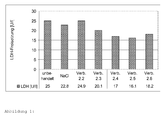
- test formulation was applied twice on the skin models 24 hours apart. Illustration 1 releases the LDH release 24h after the last application.
- Test Formulation 3.1 A 4% strength aqueous solution of the compounds according to the invention was applied. Since the zwitterionic, non-surfactant compounds contain about 0.3% saline per 1% of active substance, in addition, the corresponding saline concentration was tested.
- the LDH release from the cells was not changed or even slightly smaller compared to the untreated skin model. This means that the compounds according to the invention do not attack the cell membrane and do not have cell-damaging effects, but on the contrary even support the cells and their proliferation.
- SDS Sodium dodecyl sulfate
- Figure 2 returns the total LDH concentration after 24 and 48 hours.
- IL1- ⁇ is a messenger substance that plays a central role in inflammatory reactions in the body.
- Sodium lauryl sulfate (SDS) is a skin-irritating surfactant that can cause irritant contact dermatitis in humans, is used as a model irritant in volunteer studies and induces, inter alia, the release of IL-1 ⁇ .
- SDS Sodium lauryl sulfate
- the determination of the IL-1 ⁇ concentration was carried out using a commercially available test kit (Human IL-1 ⁇ Immunoassay, R & D Systems GmbH, Wiesbaden, Germany).
- test formulation a 4% aqueous solution of the short chain zwitterionic compounds, was applied to the skin models. 24 h after the application was damaged for 40 min with 0.25% SDS solution. Subsequently, the test formulation was applied a second time. After a further incubation period of 24 h, the determination of the released cytokine IL-1 ⁇ was carried out.
- test solutions contain about 0.3% NaCl per 1% active substance, a correspondingly concentrated saline solution was also investigated.
- Figure 3 shows the measurements of IL-1 ⁇ concentration 24h after injury.
- Figure 4 returns the summed IL-1 ⁇ concentration after 24 and 48 h.
Landscapes
- Health & Medical Sciences (AREA)
- Chemical & Material Sciences (AREA)
- Organic Chemistry (AREA)
- Life Sciences & Earth Sciences (AREA)
- Chemical Kinetics & Catalysis (AREA)
- Animal Behavior & Ethology (AREA)
- Veterinary Medicine (AREA)
- General Chemical & Material Sciences (AREA)
- Medicinal Chemistry (AREA)
- Nuclear Medicine, Radiotherapy & Molecular Imaging (AREA)
- Bioinformatics & Cheminformatics (AREA)
- Pharmacology & Pharmacy (AREA)
- Engineering & Computer Science (AREA)
- Public Health (AREA)
- General Health & Medical Sciences (AREA)
- Dermatology (AREA)
- Immunology (AREA)
- Pulmonology (AREA)
- Transplantation (AREA)
- Pain & Pain Management (AREA)
- Rheumatology (AREA)
- Biochemistry (AREA)
- Organic Low-Molecular-Weight Compounds And Preparation Thereof (AREA)
- Acyclic And Carbocyclic Compounds In Medicinal Compositions (AREA)
Abstract
Description
- Die vorliegende Erfindung betrifft zwitterionische Verbindungen und deren Herstellung, welche durch Carboxyalkylierung kurzkettiger Dialkylaminoalkylamide erhalten werden können.
- Glycinatverbindungen, wie sie durch Carboxymethylierung der Dimethylaminopropylamide von Fettsäuren erhalten werden, sind seit langem bekannt. Sie sind unter der Bezeichnung "Amidopropylbetaine" als Tenside weit verbreitet (siehe z.B. Parfümerie und Kosmetik, 1996, 77(4), 244-248).
- Bekannte Verbindungen dieser Stoffklasse sind bspw. von Cocosfettsäuren, hydrierten Cocosfettsäuren oder Cocosfettsäurefraktionen abgeleitet (z.B. Cocoamidopropylbetain). Sie finden breite Anwendung z.B. als Sekundärtenside in kosmetischen Präparaten (z.B. Duschgele, Shampoos, Flüssigseifen) sowie in Geschirrspülmitteln.
- Charakteristisches Merkmal bekannter Amidopropylbetaine ist ihr tensidisches Verhalten, d. h. die Eigenschaft, die Oberflächenspannung wässriger Systeme zu verringern. Diese Eigenschaft wird durch die molekulare Struktur verursacht, nämlich durch den hydrophoben, langkettigen Fettsäurerest einerseits, und die hydrophile, zwitterionische Dimethylammoniumglycinat-Gruppe andererseits. Die gängigen Fettsäurereste umfassen insbesondere solche, die in natürlichen Fetten, insbesondere Cocosfett oder hydriertem Cocosfett vorkommen, also gesättigte und ungesättigte C8-C18 Fettsäuren. Beschrieben wurden auch Amidopropylbetaine von Capronsäure (C6).
- Viele zwitterionische Substanzen wie z.B. Aminoxide, Prolin, Ectoin oder Trimethylglycin sind sogenannte Kosmotrope, d. h. sie erhöhen die Struktur bzw. Ordnung von wässrigen Systemen. Viele dieser Stoffe sind bekannterweise Osmolyte, d. h. sie kontrollieren den Wassergehalt von Zellen und wirken sich dadurch stabilisierend aus.
- Eine nachteilige Wirkung vieler Tenside ist die Reizung von Haut und Augen. Zwar ist das Reizpotential der Amidopropyldimethylglycinate geringer als bspw. das der Alkylsulfate oder Alkylethersulfate, jedoch sind auch sie nicht vollständig frei von möglichen Reizwirkungen.
- Aufgabe der Erfindung war es daher, neue Verbindungen zur Verfügung zu stellen, die zwar die zwitterionische, hydrophile Kopfgruppe, aber keine zellschädigende Wirkung wie Tenside gemäß dem Stand der Technik, somit keine tensidischen Strukturen aufweisen und vorzugsweise somit Haut und Augen nicht reizen. Bevorzugst sollen diese zwitterionischen Verbindungen mit Verfahren hergestellt werden können, die eine großtechnische Produktion ermöglichen.
- Überraschenderweise wurde gefunden, dass im Gegensatz zu den bekannten, oben beschriebenen Amidopropyldimethylglycinaten auf Basis langkettiger Fettsäuren die erfindungsgemäßen Verbindungen keine zellschädigende Wirkung aufweisen und nicht reizend sind, was vermutlich auf die fehlenden tensidischen Eigenschaften zurückzuführen ist.
- Besonders überraschend wurde gefunden, dass erfindungsgemäße Verbindungen eine anti-inflammatorische Wirkung in Hautmodellen hervorrufen.
- Gegenstand der vorliegenden Erfindung sind deshalb zwitterionische Verbindungen wie in Anspruch 1 bis 9 beschrieben, zur Verwendung als verschiedene Therapeutika wie in Ansprüchen 10 bis 12 beschrieben und ein Verfahren zu ihrer Herstellung wie in Anspruch 13 beschrieben.
- Ein weiterer Vorteil der erfindungsgemäßen Verbindungen liegt in ihrem im Vergleich zu herkömmlich verwendeten Verbindungen kleinen Molekulargewicht, wodurch eine höhere Konzentration von ionischen bzw. zwitterionischen Strukturen erreicht werden kann.
- Ein Vorteil des erfindungsgemäßen Verfahrens besteht in der Möglichkeit, die erfindungsgemäßen Verbindungen in hohen Konzentrationen ohne Gelbildung und somit ohne Viskositätsprobleme herzustellen.
- Die erfindungsgemäßen Verbindungen und das Verfahren zur Herstellung dieser werden nachfolgend beispielhaft beschrieben, ohne dass die Erfindung auf diese beispielhaften Ausführungsformen beschränkt sein soll. Sind nachfolgend Bereiche, allgemeine Formeln oder Verbindungsklassen angegeben, so sollen diese nicht nur die entsprechenden Bereiche oder Gruppen von Verbindungen umfassen, die explizit erwähnt sind, sondern auch alle Teilbereiche und Teilgruppen von Verbindungen, die durch Herausnahme von einzelnen Werten (Bereichen) oder Verbindungen erhalten werden können. Werden im Rahmen der vorliegenden Beschreibung Dokumente zitiert, so soll deren Inhalt vollständig zum Offenbarungsgehalt der vorliegenden Erfindung gehören. Als "kurzkettige", zwitterionische, nicht tensidische Verbindungen sind im Folgenden solche zu verstehen, die gemäß Formel I ein X mit ≤ 5 Kohlenstoffatomen aufweisen. Als "länger- bzw. langkettige" zwitterionische, nicht tensidische Verbindungen sollen solche verstanden werden, die ein X mit > 5 Kohlenstoffatomen aufweisen. Alle angegebenen Prozent (%) sind wenn nicht anders angegeben Massenprozent.
- Die vorliegende Erfindung beinhaltet Verbindungen der allgemeinen Formel I

- n = 1 bis 6, vorzugsweise 1 bis 3, bevorzugt 3 und m = 1 bis 4, vorzugsweise 1 oder 2 ist, und R1 und R2 unabhängig voneinander gleiche oder verschiedene, aliphatische Kohlenwasserstoffreste mit 1 bis 6 Kohlenstoffatomen, vorzugsweise C1- bis C3-Kohlenwasserstoffreste und bevorzugt CH3-Reste sind, und Y ein zweibindiger Kohlenwasserstoffrest, vorzugsweise -CH2- ist, und X ein m-bindiger Rest oder eine kovalente Bindung ist, mit: für m=1 X = H, Ethyl, Hydroxymethyl, 1-Hydroxyethyl, 2-Hydroxyethyl, 1-Hydroxypropyl, 2-Hydroxypropyl oder 3-Hydroxypropyl sowie für m=2 X = direkte Bindung, -CH2-, - CH(OH)-, -CH2CH(OH)- oder -CH(OH)CH(OH)- und X für m=2 eine direkte Bindung oder ein mit mindestens einer OH-Gruppe substituierter oder unsubstituierter, 2-bindiger C1- bis C5-Kohlenwasserstoffrest und X für m>2 ein mit mindestens einer OH-Gruppe substituierter oder unsubstituierter, m-bindiger C1- bis C5-Kohlenwasserstoffrest ist.
- In einer bevorzugten Ausführungsform der erfindungsgemäßen Verbindungen der Formel I ist m = 2 und X eine direkte kovalente Bindung, CH2, CH(OH), CH2CH(OH) oder CH(OH)CH(OH), vorzugsweise X = CH2. Eine besonders bevorzugte Verbindung ist die Ausführungsform der Formel I, bei der n=3, m=2, R1 = R2 = CH3, Y = CH2 und X = CH2 ist.
- In einer weiteren bevorzugten Ausführungsform der erfindungsgemäßen Verbindungen der Formel I ist m = 1 und X = H. Eine besonders bevorzugte Verbindung ist die Ausführungsform der Formel I, bei der n=3, m=1, R1 = R2 = CH3, Y = CH2 und X = H ist.
- Ein weiterer Gegenstand der Erfindung ist ein Arzneimittel bestehend aus einer wirksamen Menge mindestens einer der erfindungsgemäßen Verbindungen so wie die Verwendung der erfindungsgemäßen Verbindungen als Arzneimittel.
- Wie in Beispielen 3.1 bis 3.4 gezeigt wirken erfindungsgemäße Verbindungen auf rekonstituierte humane Epidermis sowohl zell-protektiv als auch antiinflammatorisch. Somit sind erfindungsgemäße Verbindungen zur Verwendung als therapeutische Wirkstoffe Gegenstand der Erfindung.
- Da der zellschützende und anti-apoptotische Effekt sich besonders gut auf Hautzellen darstellen lassen kann, ist eine bevorzugte Verwendung der erfindungsgemäßen Verbindungen eine zur Behandlung dermatologischer Erkrankungen, besonders bevorzugt zur Behandlung von inflammatorischer Hauterkrankungen.
- Beispielhaft seien hier erwähnt: Psoriasis vulgaris, Pyoderma gangraenosum, Subkorneale Pustulose Sneddon Wilkinson, Atopische Dermatitis, Granuloma anulare, Pemphigus vulgaris, Vitiligo, Atopische Ekzem, Psoriasis, Neurodermitis, Urtikaria, Vaskulitis allergica, allergische Alveolitis, Kontaktekzem, seborrhöisches Ekzem, dishidrotisches Ekzem, Arzneiekzem, generelle allergische Hauterkrankungen, Alopecia areata, Alopecia totalis, Alopecia subtotalis, Alope cia universalis, Alopecia diffusa, Lupus erythematodes der Haut, Lichen planus, Dermatomyostis der Haut, Morphea, Sklerodermie, Psoriasis capitis, Psoriasis guttata, Psoriasis inversa, Alopecia areata Ophi- asis-Typ, androgenetische Alopezie, allergisches Kontaktekzem, irritatives Kontaktekzem, Kontaktekzem, Pemphigus foliaceus, Pemphigus vegetans, vernarbendes Schleimhautpemphigoid, bullöses Pemphgoid, Schleimhautpemphigoid, Dermatitis, Dermatitis herpetiformis duhring, Necrobiosis lipoidica, Erythema nodosum, Lichen vidal, Prurigo simplex, Prurigo nodularis, Prurigo acuta, lineare IgA Dermatose, polymorphe Lichtdermatose, Erythema solaris, Lichen sclerosus, eriorale Dermatitis, Exanthem der Haut, Arzneimittelexanthem, Purpura chronica progressiva, dihidrotisches Ekzem, Ekzem, fixes Arzneiexanthem, photoallergische Hautreaktion, Lichen simplex oder Graft versus Host-Disease.
- Das erfindungsgemäße Arzneimittel kann durch jeden dem Fachmann bekannten Verabreichungsweg verabreicht werden, wie bspw. Intranasal, intravenös, intramuskulär, topisch und lokal, wobei bei Hauterkrankungen die topische und lokale Verabreichung bevorzugt ist. Die Therapie der Hauterkrankungen kann auf herkömmliche Weise, z. B. durch Verbände, Pflaster, Kompressen, rekonstruierbare Lyophilisate, als Pflaster oder Paste oder Gele erfolgen, die die erfindungsgemäßen Verbindungen enthalten, die erfindungsgemäßen Verbindungen können aber auch in Form von Liposomenkomplexen bzw. Goldpartikelkomplexe topisch und lokal im Bereich der erkrankten Hautfläche verabreicht werden. Weitere topische Darreichungen können beispielsweise in Form einer Lösung, einer Emulsion, einer Creme, einer Salbe, eines Schaums, eines Aerosol-Sprays, einer Gelmatrix, eines Schwamms als rekonstruierbares Lyophilisat, als Pflaster oder als Paste, Tropfen oder Waschungen erfolgen.
- Die erfindungsgemäßen Verbindungen gemäß Formel I können z.B. mit dem nachfolgend beschriebenen, erfindungsgemäßen Verfahren hergestellt werden.
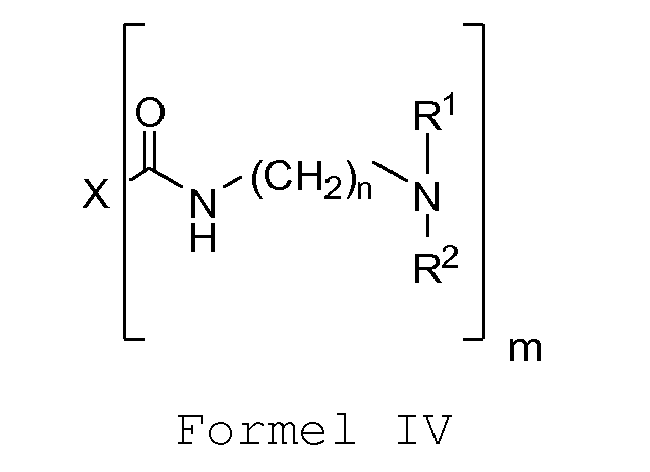
- Dieses Verfahren zeichnet sich dadurch aus, dass in einem ersten Verfahrensschritt A eine Carbonsäure nach Formel II



- Als Aminkomomponente können alle geeigneten Aminverbindungen, die die Bedingungen der Formel III erfüllen, eingesetzt werden. Vorzugsweise werden 3-(Diethylamino)propylamin, 2-(Diethylamino)ethylamin oder 2-(Dimethylamino)ethylamin eingesetzt. Besonders bevorzugt als Aminkomponente ist Dimethylaminopropylamin (DMAPA).
- Bevorzugt wird im Schritt A des erfindungsgemäßen Verfahrens eine Säurekomponente gemäß Formel II mit einer Aminkomomponente gemäß Formel III bei einer Temperatur von 90 °C bis 220 °C, besonders bevorzugt bei einer Temperatur von ca. 180 °C zu einem Amidamin gemäß Formel IV umgesetzt. Besonders bevorzugt wird Verfahrensschritt A des erfindungsgemäßen Verfahrens unter Einsatz eines geeigneten Katalysators durchgeführt. Vorzugsweise werden als geeignete Katalysatoren starke Basenkatalysatoren wie z.B. Alkoholate eingesetzt, besonders bevorzugt werden Natriumethylat, Kaliumethylat, Natriummethylat und Kaliummethylat.
- Das bei der Reaktion entstehende Wasser kann aus dem Produkt entfernt werden. Vorzugsweise wird das Wasser unter den Reaktionsbedingungen abdestilliert und so aus dem Produktgemisch entfernt. Insbesondere bei Temperaturen unterhalb ca. 130 °C ist das Anlegen eines Unterdruckes vorteilhaft, um die Wasserentfernung durch Abdestillieren zu beschleunigen.
- Das nachfolgende Reaktionsschema zeigt einen möglichen Reaktionsverlauf des Verfahrensschrittes A.

- Da die in Verfahrensschritt A entstehenden Salzgemische zu Anfang der Reaktion fest sind, wird vorzugsweise in umgekehrter Reihenfolge verglichen zum Stand der Technik die Säurekomponente gemäß Formel II bei dem erfindungsgemäßen Verfahren zu der vorgelegten Aminkomponente gemäß Formel III zugegeben.
- Bei der Herstellung kurzkettiger Amidamine gemäß Formel IV sollte der im Vergleich zu aus dem Stand der Technik bekannten Amidaminen längerkettiger Fettsäuren stark erhöhten Exothermie bei der Salzbildung zwischen Amin gemäß Formel III und Säure gemäß Formel II Rechnung getragen werden, die durch die niedrigen Molgewichte und dadurch höheren Stoffmengenkonzentrationen bedingt ist. Dazu können in einer bevorzugten Ausführungsform des erfindungsgemäßen Verfahrens in Verfahrensschritt A speziell angepasste Prozessparameter in der Form zur Anwendung kommen, dass die Zugabe der Carbonsäurekomponente zur Aminkomponente so langsam erfolgt, dass die Temperatur des Reaktionsgemisches während der Zugabe 130 °C, vorzugsweise 100 °C, nicht überschreitet. Bei höheren Temperaturen könnten durch das entstehende Wasser größere Mengen der Aminkomponente ausgetrieben werden, was sich negativ auf die Stöchiometrie der Einsatzkomponenten auswirken kann. Bevorzugt wird zur Einhaltung der genannten Temperaturbereiche gegengekühlt, um eine ökonomisch sinnvolle Dosiergeschwindigkeit zu erreichen.
- Der Verfahrensschritt B kann in Gegenwart eines geeigneten Lösungsmittels in einer Menge, die die Rühr- und Pumpbarkeit des Reaktionsgemisches zu jedem Zeitpunkt des Verfahrens gewährleistet, erfolgen. Vorzugsweise erfolgt die Umsetzung in Gegenwart von Wasser als Lösungsmittel. Der Verfahrensschritt B wird vorzugsweise bei einer Temperatur von ca. 70-100 °C durchgeführt. Das als Nebenprodukt anfallende Halogenid Z kann aus der Reaktionslösung entfernt werden oder in dieser verbleiben. Soll das Halogenid entfernt werden, können z.B. Ausfällung mit einem geeigneten Lösungsmittel oder Dialyse zum Einsatz kommen. Bevorzugtes Lösungsmittel zur Fällung ist Ethanol.
- In bevorzugten Ausführungsformen des erfindungsgemäßen Verfahrens verbleibt das Halogenid Z in der Lösung.
- Als Monohalogencarbonsäure oder Monohalogencarbonsäuresalz mit einem Säurerest gemäß Formel V können alle Halogencarbonsäuren eingesetzt werden, deren Säurerest die für Formel V genannten Bedingungen erfüllen. Besonders bevorzugt als Monohalogencarbonsäuresalz gemäß Formel V ist das Monochloracetat.
- Wie bereits in Verfahrensschritt A sollte auch im Verfahrensschritt B der durch die geringe Molmasse der kurzkettigen Amidaminkomponente bedingte, im Gegensatz zu den Verfahren des Standes der Technik stark erhöhte Exothermie Rechnung getragen werden. Daher erfolgt in Verfahrensschritt B des erfindungsgemäßen Verfahrens die Reaktion vorzugsweise in der Form, dass während und nach vollständiger Zugabe der Halogencarbonsäurekomponente zur Amidaminkomponente bis zum Abklingen der Wärmetönung die Reaktionstemperatur auf maximal ca. 70 °C gehalten wird, wobei ggf. gegengekühlt werden kann. Die nachfolgende Reaktion erfolgt vorzugsweise wenig unterhalb des Siedepunktes des Lösungsmittels, wobei bei Verwendung von Wasser als Lösungsmittels vorzugsweise Temperaturen im Bereich von 95-99 °C verwendet werden.
- Das nachfolgende Reaktionsschema zeigt einen möglichen Reaktionsverlauf des Verfahrensschrittes B.

- Die Umsetzung von Amidaminen gemäß Formel IV zu den entsprechenden Verbindungen gemäß Formel I erfolgt wie beschrieben vorzugsweise in einem Lösungsmittel. Die Amidamine werden bevorzugt in Konzentrationen von 3 bis 75 %, bevorzugt 5 bis 50% eingesetzt. Die in diesem Verfahrensschritt anfallende Lösung von Verbindungen gemäß Formel I kann mit oder ohne weitere Konzentrierungs- oder Entsalzungsschritte verwendet werden, z.B. zur Herstellung kosmetischer Präparate. In einer weiteren bevorzugten Ausführungsform des erfindungsgemäßen Verfahrens wird erfindungsgemäße Verbindung der Formel I durch Fällung der Halogenidkomponente mit einem geeigneten Lösungsmittel oder durch Dialyse entsalzt oder durch Destillation des gesamten oder eines Teiles des Lösungsmittels konzentriert. Bevorzugt werden die nach Verfahrensschritt B anfallenden Lösungen ohne weitere Aufarbeitungsschritte verwendet.
- In bevorzugten Ausführungsformen erfindungsgemäßen Verfahrens wird das im Verfahrensschritt A im Überschuss eingesetzte Amin II vor der Umsetzung mit der Halogencarbonsäurekomponente in Verfahrensschritt B entfernt. Dies kann z.B. durch Abdestillieren bei vermindertem Druck erfolgen.
- In den nachfolgend aufgeführten Beispielen wird die vorliegende Erfindung beispielhaft beschrieben, ohne dass die Erfindung, deren Anwendungsbreite sich aus der gesamten Beschreibung und den Ansprüchen ergibt, auf die in den Beispielen genannten Ausführungsformen beschränkt sein soll.
- In einer 500 ml Rührapparatur mit Rückflusskühler und Stickstoffeinleitung wurden 100 g Ameisensäure vorgelegt und mit Stickstoff ca. 10 Minuten inertisiert. Dann wurden 225 ml 3-Dimethylaminopropylamin unter Rühren und fortlaufender Inertisierung mit Stickstoff zugegeben. Die Salzbildung war exotherm und das Gemisch heizte sich auf ca. 175 °C auf und wurde etwa 4 - 5 h bei dieser Temperatur gehalten. Während dieser Zeit wurde bei der Reaktion entstehendes Wasser über eine Kolonne aus dem Gemisch entfernt. Wenn anhand der Säurezahl ein Umsetzungsgrad von ca. 98% erreicht war, wurde überschüssiges DMAPA mittels Vakuumdestillation entfernt. Der Gehalt an tertiärem Stickstoff betrug im gereinigten Endprodukt 10,4%.
- In einer 500 ml Rührapparatur mit Rückflusskühler und Stickstoffeinleitung wurden 133 g Milchsäure vorgelegt und mit Stickstoff ca. 10 Minuten inertisiert. Dann wurden 188 ml 3-Dimethylaminopropylamin unter Rühren und fortlaufender Inertisierung mit Stickstoff zugegeben. Die Salzbildung war exotherm und das Gemisch heizt sich auf ca. 150 °C auf und wurde etwa 4 - 5 h bei einer Temperatur von 175 °C gehalten. Während dieser Zeit wurde bei der Reaktion entstehendes Wasser über eine Kolonne aus dem Gemisch entfernt. Wenn anhand der Säurezahl ein Umsetzungsgrad von ca. 98% erreicht war, wurde überschüssiges DMAPA mittels Vakuumdestillation entfernt. Der Gehalt an tertiärem Stickstoff betrug im gereinigten Endprodukt 8,14%.
- In einer 500 ml Rührapparatur mit Rückflusskühler und Stickstoffeinleitung wurden 148 g Propionsäure vorgelegt und mit Stickstoff ca. 10 Minuten inertisiert. Dann wurden 280 ml 3-Dimethylaminopropylamin unter Rühren und fortlaufender Inertisierung mit Stickstoff zugegeben. Die Salzbildung war exotherm und das Gemisch heizt sich auf ca. 150 °C auf und wurde etwa 4 - 5 h bei einer Temperatur von 175 °C gehalten. Während dieser Zeit wurde bei der Reaktion entstehendes Wasser über eine Kolonne aus dem Gemisch entfernt. Wenn anhand der Säurezahl ein Umsetzungsgrad von ca. 98% erreicht war, wurde überschüssiges DMAPA mittels Vakuumdestillation entfernt. Der Gehalt an tertiärem Stickstoff betrug im gereinigten Endprodukt 8,91%.
- In einer 500 ml Rührapparatur mit Rückflusskühler und Stickstoffeinleitung wurden 90 g Oxalsäure vorgelegt. Dann wurden 328 ml 3-Dimethylaminopropylamin unter Rühren und fortlaufender Inertisierung mit Stickstoff zugegeben. Nach dem Schmelzen des entstandenen Feststoffes war die Salzbildung exotherm und das Gemisch heizt sich auf ca. 150 °C auf und wurde etwa 4 - 5 h bei einer Temperatur von 175 °C unter Stickstoff gehalten. Während dieser Zeit wurde bei der Reaktion entstehendes Wasser über eine Kolonne aus dem Gemisch entfernt. Wenn anhand der Säurezahl ein Umsetzungsgrad von ca. 98% erreicht war, wurde überschüssiges DMAPA mittels Vakuumdestillation entfernt. Der Gehalt an tertiärem Stickstoff betrug im gereinigten Endprodukt 12,5%.
- In einer 500 ml Rührapparatur mit Rückflusskühler und Stickstoffeinleitung wurden 104 g Malonsäure vorgelegt. Dann wurden 280 ml 3-Dimethylaminopropylamin unter Rühren und fortlaufender Inertisierung mit Stickstoff zugegeben. Nach dem Schmelzen des entstandenen Feststoffes war die Salzbildung exotherm und das Gemisch heizt sich auf ca. 140 °C auf und wurde etwa 4 - 5 h bei einer Temperatur von 175 °C unter Stickstoff gehalten. Während dieser Zeit wurde bei der Reaktion entstehendes Wasser über eine Kolonne aus dem Gemisch entfernt. Wenn anhand der Säurezahl ein Umsetzungsgrad von ca. 98% erreicht war, wurde überschüssiges DMAPA mittels Vakuumdestillation entfernt. Der Gehalt an tertiärem Stickstoff betrug im gereinigten Endprodukt 9,84%.
- In einer 500 ml Rührapparatur mit Rückflusskühler und Stickstoffeinleitung wurden 76 g Glycolsäure vorgelegt. Dann wurden 135 ml 3-Dimethylaminopropylamin unter Rühren und fortlaufender Inertisierung mit Stickstoff zugegeben. Nach dem Schmelzen des entstandenen Feststoffes war die Salzbildung exotherm und das Gemisch heizt sich auf ca. 140 °C auf und wurde etwa 4 - 5 h bei einer Temperatur von 175 °C unter Stickstoff gehalten. Während dieser Zeit wurde bei der Reaktion entstehendes Wasser über eine Kolonne aus dem Gemisch entfernt. Wenn anhand der Säurezahl ein Umsetzungsgrad von ca. 98% erreicht war, wurde überschüssiges DMAPA mittels Vakuumdestillation entfernt. Der Gehalt an tertiärem Stickstoff betrug im gereinigten Endprodukt 8,96%.
- In einem 500 ml Vierhalskolben, ausgerüstet mit Rührer, Thermometer, Rückflusskühler und Tropftrichter wurden 91 g Na-Monochloracetat und 191 g Wasser eingewogen und auf 40 °C erwärmt. Es wurden 100 g des Amidamins aus Beispiel 1.1 zugegeben und das Reaktionsgemisch bis zum Abklingen der Wärmetönung bei einer Temperatur von 70 °C gehalten. Dann erhitzte man auf 98 °C. Nach ca. 7 h lag der Gehalt an restlichem Amidamin unter 0,5%.
Es wurden 382 g einer wässrigen Lösung der folgenden Zusammensetzung erhalten:Verbindung 2.1 38,1% NaCl: 11,9% Wasser: 50 % Aussehen: flüssig, klar - In einem 500 ml Vierhalskolben, ausgerüstet mit Rührer, Thermometer, Rückflusskühler und Tropftrichter wurden 70 g Na-Monochloracetat und 170 g Wasser eingewogen und auf 40 °C erwärmt. Es wurden 100 g des Amidamins aus Beispiel 1.2 zugegeben. Dann erwärmte man das Reaktionsgemisch auf 70 °C und hält die Temperatur bis zum Abklingen der Wärmetönung. Anschließend erhitzte man auf 98 °C. Nach ca. 7h lag der Gehalt an restlichem Amidamin unter 0,5%. Es wurden 340 g einer wässrigen Lösung der folgenden Zusammensetzung erhalten:
Verbindung 2.2: 39,7% NaCl: 10,3% Wasser: 50 % Aussehen: flüssig, klar - In einem 1000 ml Vierhalskolben, ausgerüstet mit Rührer, Thermometer, Rückflusskühler und Tropftrichter wurden 153 g Na-Monochloracetat und 353 g Wasser eingewogen und auf 40 °C erwärmt. Es wurden 200 g des Amidamins aus Beispiel 1.3 zugegeben. Dann erwärmte man das Reaktionsgemisch auf 70 °C und hält die Temperatur bis zum Abklingen der Wärmetönung. Anschließend erhitzte man auf 98 °C. Nach ca. 7h lag der Gehalt an restlichem Amidamin unter 0,5%. Es wurden 706 g einer wässrigen Lösung der folgenden Zusammensetzung erhalten:
Verbindung 2.3: 39,2% NaCl: 10,8% Wasser: 50 % Aussehen: flüssig, klar - In einem 500 ml Vierhalskolben, ausgerüstet mit Rührer, Thermometer, Rückflusskühler und Tropftrichter wurden 107 g Na-Monochloracetat und 207 g Wasser eingewogen und auf 40 °C erwärmt. Es wurden 100 g des Amidamins aus Beispiel 1.4 zugegeben. Dann erwärmte man das Reaktionsgemisch auf 70 °C und hält die Temperatur bis zum abklingen der Wärmetönung. Anschließend erhitzte man auf 98 °C. Nach ca. 7h lag der Gehalt an restlichem Amidamin unter 0,5%. Es wurden 414 g einer wässrigen Lösung der folgenden Zusammensetzung erhalten:
Verbindung 2.4: 35,9% NaCl: 14,1% Wasser: 50 % Aussehen: flüssig, klar - In einem 500 ml Vierhalskolben, ausgerüstet mit Rührer, Thermometer, Rückflusskühler und Tropftrichter wurden 85 g Na-Monochloracetat und 185 g Wasser eingewogen und auf 40 °C erwärmt. Es wurden 100 g des Amidamins aus Beispiel 1.5 zugegeben. Dann erwärmte man das Reaktionsgemisch auf 70 °C und hält die Temperatur bis zum Abklingen der Wärmetönung. Anschließend erhitzte man auf 98 °C. Nach ca. 7h lag der Gehalt an restlichem Amidamin unter 0,5%. Es wurden 370 g einer wässrigen Lösung der folgenden Zusammensetzung erhalten:
Verbindung 2.5: 38,5% NaCl: 11,5% Wasser: 50 % Aussehen: flüssig, klar - In einem 1000 ml Vierhalskolben, ausgerüstet mit Rührer, Thermometer, Rückflusskühler und Tropftrichter wurden 115 g Na-Monochloracetat und 265 g Wasser eingewogen und auf 40 °C erwärmt. Es wurden 150 g des Amidamins aus Beispiel 1.6 zugegeben. Dann erwärmte man das Reaktionsgemisch auf 70 °C und hält die Temperatur bis zum Abklingen der Wärmetönung. Anschließend erhitzte man auf 98 °C. Nach ca. 7h lag der Gehalt an restlichem Amidamin unter 0,5%. Es wurden 530 g einer wässrigen Lösung der folgenden Zusammensetzung erhalten:
Verbindung 2.6: 38,5% NaCl: 11,5% Wasser: 50 % Aussehen: flüssig, klar - Um die therapeutischen und hautpflegenden Eigenschaften der Verbindungen 2.1 bis 2.6 charakterisieren zu können, wurden verschiedene in-vitro-Tests an Hautmodellen (rekonstituierte humane Epidermis, Firma: SkinEthic) durchgeführt.
- Beispiel 3.1 Laktatdehydrogenase-Freisetzung (LDH-Freisetzung)
- Das Auftreten von LDH im Zellkulturmedium ist ein sicheres Anzeichen für die Schädigung der zytoplasmatischen Membran der Zellen und damit einer Schädigung der epidermalen Zellschicht. Weiterhin ist bekannt, dass ein Austritt dieses Enzyms für die Zelle den "point of no return" darstellt, also eine Irreversibilität der Schädigung anzeigt.
- Die Bestimmung der LDH-Konzentration erfolgte mit einem kommerziell erhältlichen Testkit (LDH-Testkit, Roche Diagnostics, Mannheim, Deutschland).
- Die Testformulierung wurde zweimal im Abstand von 24h auf die Hautmodelle appliziert.
Abbildung 1 gibt die LDH-Freisetzung 24h nach der letzten Applikation wieder. - Testformulierung 3.1: Es wurde eine 4%ige wässrige Lösung der erfindungsgemäßen Verbindungen appliziert. Da die Zwitterionische, nicht tensidische Verbindungen je 1% Aktivsubstanz ca. 0,3% Kochsalz enthalten, wurde zusätzlich die entsprechende Kochsalzkonzentration getestet.
- Durch die Applikation der zwitterionische Verbindungen wurde die LDH-Freisetzung aus den Zellen nicht verändert oder sogar im Vergleich zum unbehandelten Hautmodell geringfügig kleiner. Das bedeutet, dass die erfindungsgemäßen Verbindungen die Zellmembran nicht angreifen und nicht zellschädigend wirken sondern ganz im Gegenteil sogar die Zellen und ihre Proliferation unterstützen.
- Beispiel 3.2 LDH-Freisetzung nach Schädigung der Zellen mit SDS:
- Sodiumdodecylsulfat (SDS) ist bekannt dafür, dass es die Zellmembran angreift und zu einer erhöhten LDH-Freisetzung führt. Mit dem im Folgenden beschriebenen Versuch sollte untersucht werden, inwieweit Verbindung 2.1 die Zellen nach einer Schädigung mit SDS schützen kann.
Die Hautmodelle wurden 40 min mit SDS geschädigt. Anschließend wurde die Testformulierung, eine O/W-Creme mit 1 oder 4 % Verbindung 2.1, aufgetragen. Die LDH-Freisetzung wurde 24 und 48h nach Applikation der Testformulierung gemessen. -
Polyglyceryl-3 Methylglucose Distearat 3,0 % Glyceryl Stearate 2,0 % Stearyl Alcohol 1,0 % Cetearyl Ethylhexanoate 5,0 % Mineral Oil 14,0 % Verbindung 2.1 1,0/4,0% Wasser ad 100,0% -
Abbildung 2 gibt die Gesamtkonzentration LDH nach 24 und 48h wieder. - Durch die Schädigung mit SDS stieg die LDH-Freisetzung wie erwartet stark an. Dieser Anstieg wurde deutlich reduziert, wenn direkt nach der Schädigung die Testformulierung appliziert wurde. Ein positiver Effekt war bereits beim Vehikel erkennbar, er verstärkte sich aber nochmal deutlich, wenn die Formulierung Verbindung 2.1 enthielt.
- Dabei scheint bereits 1% der erfindungsgemäßen Verbindung ausreichend zu sein, da mit 4% keine deutliche Steigerung der Wirksamkeit erkennbar war.
- IL1-α ist ein Botenstoff, der bei entzündlichen Reaktionen im Körper eine zentrale Rolle spielt. Natrium Laurylsulfat (SDS) ist ein hautreizendes Tensid, welches eine irritative Kontaktdermatitis beim Menschen hervorrufen kann, als Modellreizstoff bei Probandenstudien verwendet wird und unter anderem die Freisetzung von IL-1α induziert. Die Bestimmung der IL-1 α-Konzentration erfolgte mit einem kommerziell erhältlichen Test-Kit (Human IL-1α Immunoassay, R&D Systems GmbH, Wiesbaden, Deutschland).
- Die Testformulierung, eine 4%ige wässrige Lösung der kurzkettigen, zwitterionischen Verbindungen, wurde auf die Hautmodelle appliziert. 24h nach der Applikation wurde 40 min mit 0,25%iger SDS-Lösung geschädigt. Anschließend wurde die Testformulierung ein zweites Mal appliziert. Nach weiteren 24h Inkubationszeit erfolgte die Bestimmung des freigesetzten Cytokins IL-1α.
- Da die Testlösungen je 1% Aktivsubstanz ca. 0,3% NaCl enthalten, wurde auch eine entsprechend konzentrierte Kochsalzlösung untersucht.
-
Abbildung 3 zeigt die Messwerte der IL-1α-Konzentration 24h nach Schädigung. - Alle getesteten zwitterionischen, nicht tensidischen Verbindungen reduzierten die Freisetzung des Entzündungsmarkers IL-1α, d.h. man kann davon ausgehen, dass die kurzkettigen, zwitterionischen Verbindungen entzündungshemmende Eigenschaften besitzen.
- Beispiel 3.4 Entzündungshemmende Wirkung einer O/W-Creme mit Verbindung 2.1:
- Es sollte untersucht werden, ob sich der entzündungshemmende Effekt der erfindungsgemäßen Verbindungen auch bei Anwendung aus einer kosmetischen Formulierung zeigt. Dazu wurden Hautmodelle mit SDS geschädigt. Anschließend wurde die Testformulierung appliziert. 24 und 48h nach der Applikation wurde die IL-1α-Konzentration ermittelt.
-
Polyglyceryl-3 Methylglucose Distearat 3,0 % Glyceryl Stearate 2,0 % Stearyl Alcohol 1,0 % Cetearyl Ethylhexanoate 5,0 % Mineral Oil 14,0 % Verbindung 2.1 1,0/4,0% Wasser ad 100,0% -
Abbildung 4 gibt die summierte IL-1α-Konzentration nach 24 und 48h wieder. - Wie erwartet stieg durch die Schädigung mit SDS die Bildung des Cytokins IL-1α stark an. Dieser Anstieg wurde konzentrationsabhänigig durch Zugabe von Verbindung 2.1 stärker reduziert, so dass sich auch bei Anwendung der erfindungsgemäßen Verbindungen aus einer O/W-Emulsion eine deutlich entzündungshemmende Wirkung zeigt.
Claims (13)
- Verbindungen der allgemeinen Formel I
 n = 1 bis 6 undm = 1 bis 4 undR1 und R2 unabhängig voneinander gleiche oder verschiedene, aliphatische Kohlenwasserstoffreste mit 1 bis 6 Kohlenstoffatomen sind undY ein zweibindiger Kohlenwasserstoffrest undX ein m-bindiger Rest oder eine kovalente Bindung ist, mitX für m = 1 ein H, Ethyl, Hydroxymethyl, 1-Hydroxyethyl, 2-Hydroxyethyl, 1-Hydroxypropyl, 2-Hydroxypropyl oder 3-Hydroxypropyl undX für m = 2 eine direkte kovalente Bindung oder ein mit mindestens einer OH-Gruppe substituierter oder unsubstituierter, 2-bindiger C1 bis C5-Kohlenwasserstoffrest undX für m > 2 ein mit mindestens einer OH-Gruppe substituierter oder unsubstituierter, m-bindiger C1 bis C5-Kohlenwasserstoffrest, ist.
 - Verbindungen gemäß Anspruch 1, dadurch gekennzeichnet, dass m = 2 und X eine direkte kovalente Bindung, CH2, CH(OH), CH2CH(OH) oder CH(OH)CH(OH) ist.
- Verbindungen gemäß Anspruch 2, dadurch gekennzeichnet, dass X = CH2 ist.
- Verbindungen gemäß Anspruch 1, dadurch gekennzeichnet, dass m = 1 und X = H ist.
- Verbindungen gemäß mindestens einem der Ansprüche 1 bis 4, dadurch gekennzeichnet, dass n = 3 ist.
- Verbindungen gemäß mindestens einem der Ansprüche 1 bis 5, dadurch gekennzeichnet, dass R1 = R2 = CH3 ist.
- Verbindungen gemäß mindestens einem der Ansprüche 1 bis 6, dadurch gekennzeichnet, dass Y = CH2 ist.
- Verbindung gemäß Anspruch 1, dadurch gekennzeichnet, dass n = 3, m = 2, R1 = R2 = CH3, Y = CH2 und X = CH2 ist.
- Verbindung gemäß Anspruch 1, dadurch gekennzeichnet, dass n = 3, m = 1, R1 = R2 = CH3, Y = CH2 und X = H ist.
- Verbindungen gemäß mindestens einem der Ansprüche 1 bis 9 zur Verwendung als therapeutische Wirkstoffe.
- Verbindungen gemäß mindestens einem der Ansprüche 1 bis 10 zur Behandlung dermatologischer Erkrankungen.
- Verbindungen gemäß mindestens einem der Ansprüche 1 bis 11 zur Behandlung inflammatorischer Hauterkrankungen.
- Verfahren zur Herstellung von Verbindungen gemäß mindestens einem der Ansprüche 1 bis 12, gekennzeichnet durch die SchritteA. Umsetzen einer Carbonsäure nach Formel II


 n = 1 bis 6 undm = 1 bis 4 undR1 und R2 unabhängig voneinander gleiche oder verschiedene, aliphatische Kohlenwasserstoffreste mit 1 bis 6 Kohlenstoffatomen sind undX ein m-bindiger Rest oder eine kovalente Bindung ist, mitX für m = 1 ein H, Ethyl, Hydroxymethyl, 1-Hydroxyethyl, 2-Hydroxyethyl, 1-Hydroxypropyl, 2-Hydroxypropyl oder 3-Hydroxypropyl undX für m = 2 eine direkte Bindung oder ein mit mindestens einer OH-Gruppe substituierter oder unsubstituierter, 2-bindiger C1 bis C5-Kohlenwasserstoffrest undX für m > 2 ein mit mindestens einer OH-Gruppe substituierter oder unsubstituierter, m-bindiger C1 bis C5-Kohlenwasserstoffrest ist undB. Umsetzen des in A erhaltenen Amidamins der Formel IV mit einer ω-Halogencarbonsäure oder ihrem Salz, die einen Säurerest gemäß Formel V aufweist
wobeiZ = ein Halogen undY ein zweibindiger Kohlenwasserstoffrest ist.
Priority Applications (1)
| Application Number | Priority Date | Filing Date | Title |
|---|---|---|---|
| PL08158822T PL2036882T3 (pl) | 2007-08-23 | 2008-06-24 | Związki o jonach obojnaczych i ich zastosowanie |
Applications Claiming Priority (1)
| Application Number | Priority Date | Filing Date | Title |
|---|---|---|---|
| DE102007040000A DE102007040000A1 (de) | 2007-08-23 | 2007-08-23 | Zwitterionische Verbindungen und deren Verwendung |
Publications (2)
| Publication Number | Publication Date |
|---|---|
| EP2036882A1 true EP2036882A1 (de) | 2009-03-18 |
| EP2036882B1 EP2036882B1 (de) | 2014-09-03 |
Family
ID=40254497
Family Applications (1)
| Application Number | Title | Priority Date | Filing Date |
|---|---|---|---|
| EP08158822.0A Active EP2036882B1 (de) | 2007-08-23 | 2008-06-24 | Zwitterionische Verbindungen und deren Verwendung |
Country Status (7)
| Country | Link |
|---|---|
| US (1) | US8138372B2 (de) |
| EP (1) | EP2036882B1 (de) |
| JP (1) | JP5436807B2 (de) |
| CN (1) | CN101372459A (de) |
| CA (1) | CA2639780C (de) |
| DE (1) | DE102007040000A1 (de) |
| PL (1) | PL2036882T3 (de) |
Families Citing this family (25)
| Publication number | Priority date | Publication date | Assignee | Title |
|---|---|---|---|---|
| DE10120927A1 (de) * | 2001-04-30 | 2002-10-31 | Stockhausen Chem Fab Gmbh | Verwendung von multiplen Emulsionen als Hautschutzprodukte |
| US7199090B2 (en) | 2003-09-29 | 2007-04-03 | Ethena Healthcare Inc. | High alcohol content gel-like and foaming compositions comprising an alcohol and fluorosurfactant |
| DE102004026684A1 (de) * | 2004-05-28 | 2005-12-29 | Stockhausen Gmbh | Hautreinigungsmittel, insbesondere zur Entfernung von Druckfarben und/oder Tintenverschmutzungen |
| DE102004062775A1 (de) * | 2004-12-21 | 2006-06-29 | Stockhausen Gmbh | Alkoholischer Pumpschaum |
| EP3292757B1 (de) | 2005-03-07 | 2025-09-03 | Deb IP Limited | Schäumungszusammensetzungen mit hohem alkoholgehalt mit silikonbasierten tensiden |
| US20070148101A1 (en) * | 2005-12-28 | 2007-06-28 | Marcia Snyder | Foamable alcoholic composition |
| DE102006053360A1 (de) * | 2006-11-10 | 2008-05-15 | Evonik Stockhausen Gmbh | Hautreinigungsmittel, insbesondere Kälteschutzcreme |
| DE102007022693A1 (de) * | 2007-05-11 | 2009-01-15 | Evonik Stockhausen Gmbh | Haut- und Händereinigungsmittel mit hydrophilen Emollients |
| DE102007040001A1 (de) * | 2007-08-23 | 2009-02-26 | Evonik Goldschmidt Gmbh | Neue zwitterionische Verbindungen enthaltende Formulierungen und deren Verwendung |
| DE102007049612A1 (de) * | 2007-10-17 | 2009-06-10 | Evonik Goldschmidt Gmbh | Bioaktive Zusammensetzung für kosmetische Anwendungen |
| DE102008026051A1 (de) * | 2008-05-30 | 2009-12-03 | Evonik Stockhausen Gmbh | Haut- und Handreinigungsmittel |
| DE102008040986A1 (de) * | 2008-08-05 | 2010-02-11 | Evonik Goldschmidt Gmbh | Hydrophobierung von Bauelementen aus Mineralfasern |
| DE102008041020A1 (de) * | 2008-08-06 | 2010-02-11 | Evonik Goldschmidt Gmbh | Verwendung von Polysiloxanen mit quaternären Ammoniumgruppen zum Schutz von tierischen oder menschlichen Haaren vor Hitzeschädigung |
| DE102009028156A1 (de) | 2009-07-31 | 2011-02-03 | Evonik Stockhausen Gmbh | Schäumbare O/W-Emulsion |
| DE102009028143A1 (de) | 2009-07-31 | 2011-02-03 | Evonik Stockhausen Gmbh | Hautschutzmittel, insbesondere gegen hydrophobe (lipophile) als auch gegen hydrophile (lipophobe) Schadstoffe |
| DE102010000993A1 (de) | 2010-01-19 | 2011-07-21 | Evonik Goldschmidt GmbH, 45127 | Neuartige Polysiloxane mit quatären Ammoniumgruppen, Verfahren zu deren Herstellung und deren Verwendung in reinigenden und pflegenden Formulierungen |
| DE102010062156A1 (de) | 2010-10-25 | 2012-04-26 | Evonik Goldschmidt Gmbh | Polysiloxane mit stickstoffhaltigen Gruppen |
| DE102011004815A1 (de) | 2011-02-28 | 2012-08-30 | Evonik Stockhausen Gmbh | Haut- und Handreinigungsmittel enthaltend superabsorbierende Partikel |
| US20140050687A1 (en) | 2011-04-28 | 2014-02-20 | Estman Chemical Company | Betaine esters and process for making and using |
| EP2997959B1 (de) | 2014-09-22 | 2019-12-25 | Evonik Operations GmbH | Formulierung enthaltend esterquats basierend auf isopropanolamin und tetrahydroxypropylethylenediamin |
| EP3050946A1 (de) | 2015-01-30 | 2016-08-03 | Evonik Degussa GmbH | Betaine mit spezieller fettsäurekettenverteilung |
| WO2018001680A1 (de) | 2016-06-29 | 2018-01-04 | Evonik Degussa Gmbh | Verfahren zur herstellung von tensiden |
| EP3487945B1 (de) | 2016-07-19 | 2020-05-13 | Evonik Operations GmbH | Verwendung von polyolestern zur herstellung poröser kunststoffbeschichtungen |
| EP3467052B1 (de) | 2017-10-06 | 2022-04-13 | Evonik Operations GmbH | Wässrige dispersion enthaltend siliziumdioxid und trimethyl 1,6-hexamethylendiamin |
| EP3954743A1 (de) | 2020-08-12 | 2022-02-16 | Evonik Operations GmbH | Verwendung von siliziumdioxid zur verbesserung der leitfähigkeit von beschichtungen |
Citations (5)
| Publication number | Priority date | Publication date | Assignee | Title |
|---|---|---|---|---|
| JPS62275250A (ja) | 1986-01-30 | 1987-11-30 | Fuji Photo Film Co Ltd | カラ−画像形成法 |
| EP0418697A1 (de) | 1989-09-15 | 1991-03-27 | ESSETI s.a.s. LABORATORIO CHIMICO FARMACO BIOLOGICO DI A. IEVOLI & C. | Calcitonin enthaltende pharmazeutische Zusammensetzungen |
| JPH06228070A (ja) * | 1993-02-02 | 1994-08-16 | Kao Corp | 新規カルボキシベタイン、その製造方法及びその用途 |
| EP0656346A1 (de) * | 1993-12-02 | 1995-06-07 | Witco Surfactants GmbH | Verfahren zur Herstellung hochkonzentrierter fliessfähiger wässriger Lösungen von Betainen |
| WO1997001528A1 (de) * | 1995-06-28 | 1997-01-16 | Henkel Kommanditgesellschaft Auf Aktien | Verfahren zur herstellung wässriger, niedrigviskoser betainkonzentrate |
Family Cites Families (20)
| Publication number | Priority date | Publication date | Assignee | Title |
|---|---|---|---|---|
| JPS6047576B2 (ja) * | 1980-05-07 | 1985-10-22 | 富士写真フイルム株式会社 | ハロゲン化銀写真感光材料 |
| FR2604622B1 (fr) * | 1986-10-06 | 1990-12-14 | Applied Chemical Research Corp | Composition liquide pour mousse a raser utilisable sans gaz propulseur dans un flacon en matiere plastique compressible |
| DE3820030C1 (de) | 1988-06-13 | 1989-07-27 | Th. Goldschmidt Ag, 4300 Essen, De | |
| DE3820029A1 (de) | 1988-06-13 | 1989-12-14 | Goldschmidt Ag Th | Betaingruppen enthaltende derivate der carboxymethylcellulose, deren herstellung und deren verwendung in kosmetischen zubereitungen |
| DE3820031A1 (de) | 1988-06-13 | 1989-12-14 | Goldschmidt Ag Th | Stickstoff enthaltende derivate der carboxymethylcellulose, deren herstellung und deren verwendung in kosmetischen zubereitungen |
| DE4205880A1 (de) | 1992-02-26 | 1993-09-02 | Goldschmidt Ag Th | Verfahren zur herstellung von betainen |
| DE4207386C2 (de) | 1992-03-09 | 1997-02-13 | Goldschmidt Ag Th | Wäßrige flüssige Lösung eines Betains mit mindestens 40 Gew.-% Festkörpergehalt |
| JPH0680987A (ja) * | 1992-09-02 | 1994-03-22 | Nippon Oil & Fats Co Ltd | 洗浄剤組成物 |
| ES2114993T3 (es) | 1992-10-31 | 1998-06-16 | Goldschmidt Ag Th | Preparaciones cosmeticas o farmaceuticas. |
| DE4309900C1 (de) | 1993-03-26 | 1994-06-30 | Goldschmidt Ag Th | Verfahren zur Herstellung von amphoteren Tensiden |
| US5792737A (en) | 1994-11-07 | 1998-08-11 | Th. Goldschmidt Ag | Mild, aqueous, surfactant preparation for cosmetic purposes and as detergent |
| FR2778405B1 (fr) * | 1998-05-07 | 2000-09-08 | Ceca Sa | N-(dialkylamino) alkyl alpha carboxamides, compositions les contenant, procedes de preparation et utilisations |
| JP4619478B2 (ja) * | 2000-03-07 | 2011-01-26 | 花王株式会社 | 増泡剤及び洗浄剤組成物 |
| DE10327871A1 (de) | 2003-06-18 | 2005-01-05 | Goldschmidt Ag | Verwendung von Alkylguanidin-Verbindungen zur Behandlung und Nachbehandlung von Haaren |
| DE102004018510A1 (de) | 2004-04-14 | 2005-11-03 | Goldschmidt Gmbh | Verbesserte Lösungsvermittler/Lösungsmittel für organische UV-Filter |
| DE102004055549A1 (de) | 2004-11-17 | 2006-05-18 | Goldschmidt Gmbh | Verfahren zur Herstellung hochkonzentrierter fließfähiger wässriger Lösungen von Betainen |
| DE102005004706A1 (de) | 2005-02-02 | 2006-08-10 | Goldschmidt Gmbh | UV-Licht absorbierende quaternäre Polysiloxane |
| DE102006015753A1 (de) | 2006-04-04 | 2007-10-11 | Goldschmidt Gmbh | Verwendung von Esterquats in Zusammensetzungen als sandabweisende Substanzen |
| DE102006035511A1 (de) | 2006-07-31 | 2008-02-07 | Evonik Goldschmidt Gmbh | Neuartige Polysiloxane mit quaternären Ammoniumgruppen, Verfahren zu deren Herstellung und deren Verwendung als Textilweichmacher |
| DE102006047247A1 (de) | 2006-10-06 | 2008-04-10 | Evonik Goldschmidt Gmbh | Kaltherstellbare, niedrigviskose und langzeitstabile kosmetische Emulsionen mit kationische Gruppen enthaltenden Coemulgatoren |
-
2007
- 2007-08-23 DE DE102007040000A patent/DE102007040000A1/de not_active Withdrawn
-
2008
- 2008-06-12 US US12/138,097 patent/US8138372B2/en active Active
- 2008-06-24 PL PL08158822T patent/PL2036882T3/pl unknown
- 2008-06-24 EP EP08158822.0A patent/EP2036882B1/de active Active
- 2008-07-22 JP JP2008188293A patent/JP5436807B2/ja not_active Expired - Fee Related
- 2008-08-22 CN CNA2008101459902A patent/CN101372459A/zh active Pending
- 2008-08-22 CA CA2639780A patent/CA2639780C/en not_active Expired - Fee Related
Patent Citations (5)
| Publication number | Priority date | Publication date | Assignee | Title |
|---|---|---|---|---|
| JPS62275250A (ja) | 1986-01-30 | 1987-11-30 | Fuji Photo Film Co Ltd | カラ−画像形成法 |
| EP0418697A1 (de) | 1989-09-15 | 1991-03-27 | ESSETI s.a.s. LABORATORIO CHIMICO FARMACO BIOLOGICO DI A. IEVOLI & C. | Calcitonin enthaltende pharmazeutische Zusammensetzungen |
| JPH06228070A (ja) * | 1993-02-02 | 1994-08-16 | Kao Corp | 新規カルボキシベタイン、その製造方法及びその用途 |
| EP0656346A1 (de) * | 1993-12-02 | 1995-06-07 | Witco Surfactants GmbH | Verfahren zur Herstellung hochkonzentrierter fliessfähiger wässriger Lösungen von Betainen |
| WO1997001528A1 (de) * | 1995-06-28 | 1997-01-16 | Henkel Kommanditgesellschaft Auf Aktien | Verfahren zur herstellung wässriger, niedrigviskoser betainkonzentrate |
Non-Patent Citations (2)
| Title |
|---|
| DATABASE WPI Week 198802, Derwent World Patents Index; AN 1988-011516, XP002511605 * |
| DATABASE WPI Week 199437, Derwent World Patents Index; AN 1994-299740, XP002511604 * |
Also Published As
| Publication number | Publication date |
|---|---|
| JP5436807B2 (ja) | 2014-03-05 |
| JP2009051823A (ja) | 2009-03-12 |
| US8138372B2 (en) | 2012-03-20 |
| CA2639780A1 (en) | 2009-02-23 |
| CA2639780C (en) | 2015-11-24 |
| EP2036882B1 (de) | 2014-09-03 |
| PL2036882T3 (pl) | 2015-02-27 |
| CN101372459A (zh) | 2009-02-25 |
| US20090054521A1 (en) | 2009-02-26 |
| DE102007040000A1 (de) | 2009-02-26 |
Similar Documents
| Publication | Publication Date | Title |
|---|---|---|
| EP2036882B1 (de) | Zwitterionische Verbindungen und deren Verwendung | |
| EP2854951B1 (de) | Zusammensetzung enthaltend aminosäuretenside, betaine und n-methyl-n-acylglucamine mit verbesserter schaumqualität und höherer viskosität | |
| EP0623587B1 (de) | Verfahren zur Herstellung von amphoteren Tensiden | |
| DE69516584T2 (de) | Verfahren zur Herstellung von Amidoethercarbonsäure oder deren Salz und diese enthaltende oberflächenaktive Mischung | |
| EP2637637B1 (de) | Zusammensetzung enthaltend mischungen von isostearinsäureamid, glycerinester und wasser | |
| LU83945A1 (de) | Ammoniumsalz einer substituierten carbonsaeure,verfahren zu seiner herstellung,seine verwendung und pharmazeutische praeparate | |
| DE2703185A1 (de) | Kosmetische mittel mit einem gehalt an haut-feuchthaltemitteln | |
| DE4424533A1 (de) | Oligohydroxydicarbonsäurederivate | |
| DE10126252A1 (de) | Neiartig konfektionierte quaternäre Ammoniumverbindungen | |
| DE69001515T2 (de) | Urethan-derivate, ihre herstellung und verwendung als hautbefeuchtendes mittel in kosmetischen und pharmazeutischen zubereitungen zur behandlung trockener haut. | |
| DE69733778T2 (de) | Langkettige alkohole, alkane, fettsäuren und amide als vireninhibitoren | |
| DE4443645C2 (de) | Seifenfreie kosmetische und/oder pharmazeutische Zubereitungen | |
| DE69738570T2 (de) | Konzentrierte wässerige tensidzusammensetzungen von betaintyp und verfahren zu deren herstellung | |
| DE2624293A1 (de) | Kosmetische mittel mit einem gehalt an haut-feuchthaltemitteln | |
| DE1793841B1 (de) | trans-4-Aminomethylcyclohexan-1-carbonsaeure und Verfahren zur Herstellung | |
| DE69503724T2 (de) | L-Carnitin-Salz, dieses enthaltende kosmetische und pharmazeutische Zusammensetzungen zur Behandlung von Dermatosen | |
| EP0467116B1 (de) | Dermatologische Zusammensetzungen mit einem Gehalt an cis-Urocaninsäure | |
| DE69402409T2 (de) | Vismia extrakt enthaltende kosmetische oder pharmazeutische zubereitung insbesonders dermatologisch. | |
| DE3500972A1 (de) | Sebosuppressive kosmetische mittel, enthaltend alkoxy- oder alkylbenzyloxy-benzoesaeuren oder deren salze | |
| DE69008762T2 (de) | Retinsäureester von l-Cladinos, Verfahren zu deren Herstellung und ihre Verwendung in der Human- oder Veterinärmedizin und in der Kosmetik. | |
| DE3228842A1 (de) | Sebosuppressive kosmetische mittel, enthaltend aryloxobutensaeurederivate sowie neue aryloxobutensaeurederivate | |
| DE60001186T2 (de) | Benzylaminodiacetamidderivate, Zusammensetzungen, die diese enthalten, Verfahren zu ihrer Herstellung und Anwendungen | |
| DE3121072A1 (de) | "aryl- und heteroarylmercapto-alkansaeure-derivate als antiseborrhoische zusaetze fuer kosmetische mittel" | |
| EP0843659B1 (de) | Polyhydroxyalkyl-amidaminoxide | |
| EP2095807A1 (de) | Creme gegen Cellulite und Sommersprossen |
Legal Events
| Date | Code | Title | Description |
|---|---|---|---|
| PUAI | Public reference made under article 153(3) epc to a published international application that has entered the european phase |
Free format text: ORIGINAL CODE: 0009012 |
|
| 17P | Request for examination filed |
Effective date: 20080624 |
|
| AK | Designated contracting states |
Kind code of ref document: A1 Designated state(s): AT BE BG CH CY CZ DE DK EE ES FI FR GB GR HR HU IE IS IT LI LT LU LV MC MT NL NO PL PT RO SE SI SK TR |
|
| AX | Request for extension of the european patent |
Extension state: AL BA MK RS |
|
| AKX | Designation fees paid |
Designated state(s): AT BE BG CH CY CZ DE DK EE ES FI FR GB GR HR HU IE IS IT LI LT LU LV MC MT NL NO PL PT RO SE SI SK TR |
|
| RAP1 | Party data changed (applicant data changed or rights of an application transferred) |
Owner name: EVONIK DEGUSSA GMBH |
|
| 17Q | First examination report despatched |
Effective date: 20130916 |
|
| REG | Reference to a national code |
Ref country code: DE Ref legal event code: R079 Ref document number: 502008012163 Country of ref document: DE Free format text: PREVIOUS MAIN CLASS: C07C0233340000 Ipc: C07C0233360000 |
|
| RIC1 | Information provided on ipc code assigned before grant |
Ipc: A61K 31/164 20060101ALI20140319BHEP Ipc: A61P 17/00 20060101ALI20140319BHEP Ipc: C07C 233/36 20060101AFI20140319BHEP Ipc: C07C 235/10 20060101ALI20140319BHEP Ipc: C07C 271/02 20060101ALI20140319BHEP Ipc: A61K 31/205 20060101ALI20140319BHEP |
|
| GRAP | Despatch of communication of intention to grant a patent |
Free format text: ORIGINAL CODE: EPIDOSNIGR1 |
|
| INTG | Intention to grant announced |
Effective date: 20140428 |
|
| GRAS | Grant fee paid |
Free format text: ORIGINAL CODE: EPIDOSNIGR3 |
|
| GRAP | Despatch of communication of intention to grant a patent |
Free format text: ORIGINAL CODE: EPIDOSNIGR1 |
|
| INTG | Intention to grant announced |
Effective date: 20140626 |
|
| GRAA | (expected) grant |
Free format text: ORIGINAL CODE: 0009210 |
|
| AK | Designated contracting states |
Kind code of ref document: B1 Designated state(s): AT BE BG CH CY CZ DE DK EE ES FI FR GB GR HR HU IE IS IT LI LT LU LV MC MT NL NO PL PT RO SE SI SK TR |
|
| REG | Reference to a national code |
Ref country code: GB Ref legal event code: FG4D Free format text: NOT ENGLISH |
|
| REG | Reference to a national code |
Ref country code: AT Ref legal event code: REF Ref document number: 685504 Country of ref document: AT Kind code of ref document: T Effective date: 20140915 Ref country code: CH Ref legal event code: EP |
|
| REG | Reference to a national code |
Ref country code: IE Ref legal event code: FG4D Free format text: LANGUAGE OF EP DOCUMENT: GERMAN |
|
| REG | Reference to a national code |
Ref country code: DE Ref legal event code: R096 Ref document number: 502008012163 Country of ref document: DE Effective date: 20141016 |
|
| PG25 | Lapsed in a contracting state [announced via postgrant information from national office to epo] |
Ref country code: LT Free format text: LAPSE BECAUSE OF FAILURE TO SUBMIT A TRANSLATION OF THE DESCRIPTION OR TO PAY THE FEE WITHIN THE PRESCRIBED TIME-LIMIT Effective date: 20140903 Ref country code: FI Free format text: LAPSE BECAUSE OF FAILURE TO SUBMIT A TRANSLATION OF THE DESCRIPTION OR TO PAY THE FEE WITHIN THE PRESCRIBED TIME-LIMIT Effective date: 20140903 Ref country code: NO Free format text: LAPSE BECAUSE OF FAILURE TO SUBMIT A TRANSLATION OF THE DESCRIPTION OR TO PAY THE FEE WITHIN THE PRESCRIBED TIME-LIMIT Effective date: 20141203 Ref country code: ES Free format text: LAPSE BECAUSE OF FAILURE TO SUBMIT A TRANSLATION OF THE DESCRIPTION OR TO PAY THE FEE WITHIN THE PRESCRIBED TIME-LIMIT Effective date: 20140903 Ref country code: GR Free format text: LAPSE BECAUSE OF FAILURE TO SUBMIT A TRANSLATION OF THE DESCRIPTION OR TO PAY THE FEE WITHIN THE PRESCRIBED TIME-LIMIT Effective date: 20141204 Ref country code: SE Free format text: LAPSE BECAUSE OF FAILURE TO SUBMIT A TRANSLATION OF THE DESCRIPTION OR TO PAY THE FEE WITHIN THE PRESCRIBED TIME-LIMIT Effective date: 20140903 |
|
| REG | Reference to a national code |
Ref country code: NL Ref legal event code: VDEP Effective date: 20140903 |
|
| REG | Reference to a national code |
Ref country code: LT Ref legal event code: MG4D |
|
| PG25 | Lapsed in a contracting state [announced via postgrant information from national office to epo] |
Ref country code: CY Free format text: LAPSE BECAUSE OF FAILURE TO SUBMIT A TRANSLATION OF THE DESCRIPTION OR TO PAY THE FEE WITHIN THE PRESCRIBED TIME-LIMIT Effective date: 20140903 Ref country code: LV Free format text: LAPSE BECAUSE OF FAILURE TO SUBMIT A TRANSLATION OF THE DESCRIPTION OR TO PAY THE FEE WITHIN THE PRESCRIBED TIME-LIMIT Effective date: 20140903 Ref country code: HR Free format text: LAPSE BECAUSE OF FAILURE TO SUBMIT A TRANSLATION OF THE DESCRIPTION OR TO PAY THE FEE WITHIN THE PRESCRIBED TIME-LIMIT Effective date: 20140903 |
|
| REG | Reference to a national code |
Ref country code: PL Ref legal event code: T3 |
|
| PG25 | Lapsed in a contracting state [announced via postgrant information from national office to epo] |
Ref country code: NL Free format text: LAPSE BECAUSE OF FAILURE TO SUBMIT A TRANSLATION OF THE DESCRIPTION OR TO PAY THE FEE WITHIN THE PRESCRIBED TIME-LIMIT Effective date: 20140903 |
|
| PG25 | Lapsed in a contracting state [announced via postgrant information from national office to epo] |
Ref country code: EE Free format text: LAPSE BECAUSE OF FAILURE TO SUBMIT A TRANSLATION OF THE DESCRIPTION OR TO PAY THE FEE WITHIN THE PRESCRIBED TIME-LIMIT Effective date: 20140903 Ref country code: PT Free format text: LAPSE BECAUSE OF FAILURE TO SUBMIT A TRANSLATION OF THE DESCRIPTION OR TO PAY THE FEE WITHIN THE PRESCRIBED TIME-LIMIT Effective date: 20150105 Ref country code: SK Free format text: LAPSE BECAUSE OF FAILURE TO SUBMIT A TRANSLATION OF THE DESCRIPTION OR TO PAY THE FEE WITHIN THE PRESCRIBED TIME-LIMIT Effective date: 20140903 Ref country code: CZ Free format text: LAPSE BECAUSE OF FAILURE TO SUBMIT A TRANSLATION OF THE DESCRIPTION OR TO PAY THE FEE WITHIN THE PRESCRIBED TIME-LIMIT Effective date: 20140903 Ref country code: RO Free format text: LAPSE BECAUSE OF FAILURE TO SUBMIT A TRANSLATION OF THE DESCRIPTION OR TO PAY THE FEE WITHIN THE PRESCRIBED TIME-LIMIT Effective date: 20140903 Ref country code: IS Free format text: LAPSE BECAUSE OF FAILURE TO SUBMIT A TRANSLATION OF THE DESCRIPTION OR TO PAY THE FEE WITHIN THE PRESCRIBED TIME-LIMIT Effective date: 20150103 |
|
| REG | Reference to a national code |
Ref country code: DE Ref legal event code: R097 Ref document number: 502008012163 Country of ref document: DE |
|
| PLBE | No opposition filed within time limit |
Free format text: ORIGINAL CODE: 0009261 |
|
| STAA | Information on the status of an ep patent application or granted ep patent |
Free format text: STATUS: NO OPPOSITION FILED WITHIN TIME LIMIT |
|
| PG25 | Lapsed in a contracting state [announced via postgrant information from national office to epo] |
Ref country code: DK Free format text: LAPSE BECAUSE OF FAILURE TO SUBMIT A TRANSLATION OF THE DESCRIPTION OR TO PAY THE FEE WITHIN THE PRESCRIBED TIME-LIMIT Effective date: 20140903 |
|
| 26N | No opposition filed |
Effective date: 20150604 |
|
| PGFP | Annual fee paid to national office [announced via postgrant information from national office to epo] |
Ref country code: PL Payment date: 20150525 Year of fee payment: 8 Ref country code: IT Payment date: 20150622 Year of fee payment: 8 |
|
| PG25 | Lapsed in a contracting state [announced via postgrant information from national office to epo] |
Ref country code: SI Free format text: LAPSE BECAUSE OF FAILURE TO SUBMIT A TRANSLATION OF THE DESCRIPTION OR TO PAY THE FEE WITHIN THE PRESCRIBED TIME-LIMIT Effective date: 20140903 |
|
| PG25 | Lapsed in a contracting state [announced via postgrant information from national office to epo] |
Ref country code: MC Free format text: LAPSE BECAUSE OF FAILURE TO SUBMIT A TRANSLATION OF THE DESCRIPTION OR TO PAY THE FEE WITHIN THE PRESCRIBED TIME-LIMIT Effective date: 20140903 |
|
| REG | Reference to a national code |
Ref country code: CH Ref legal event code: PL |
|
| PG25 | Lapsed in a contracting state [announced via postgrant information from national office to epo] |
Ref country code: LU Free format text: LAPSE BECAUSE OF FAILURE TO SUBMIT A TRANSLATION OF THE DESCRIPTION OR TO PAY THE FEE WITHIN THE PRESCRIBED TIME-LIMIT Effective date: 20150624 |
|
| REG | Reference to a national code |
Ref country code: IE Ref legal event code: MM4A |
|
| PG25 | Lapsed in a contracting state [announced via postgrant information from national office to epo] |
Ref country code: CH Free format text: LAPSE BECAUSE OF NON-PAYMENT OF DUE FEES Effective date: 20150630 Ref country code: IE Free format text: LAPSE BECAUSE OF NON-PAYMENT OF DUE FEES Effective date: 20150624 Ref country code: LI Free format text: LAPSE BECAUSE OF NON-PAYMENT OF DUE FEES Effective date: 20150630 |
|
| REG | Reference to a national code |
Ref country code: FR Ref legal event code: PLFP Year of fee payment: 9 |
|
| REG | Reference to a national code |
Ref country code: AT Ref legal event code: MM01 Ref document number: 685504 Country of ref document: AT Kind code of ref document: T Effective date: 20150624 |
|
| PG25 | Lapsed in a contracting state [announced via postgrant information from national office to epo] |
Ref country code: AT Free format text: LAPSE BECAUSE OF NON-PAYMENT OF DUE FEES Effective date: 20150624 |
|
| PG25 | Lapsed in a contracting state [announced via postgrant information from national office to epo] |
Ref country code: MT Free format text: LAPSE BECAUSE OF FAILURE TO SUBMIT A TRANSLATION OF THE DESCRIPTION OR TO PAY THE FEE WITHIN THE PRESCRIBED TIME-LIMIT Effective date: 20140903 |
|
| PG25 | Lapsed in a contracting state [announced via postgrant information from national office to epo] |
Ref country code: BG Free format text: LAPSE BECAUSE OF FAILURE TO SUBMIT A TRANSLATION OF THE DESCRIPTION OR TO PAY THE FEE WITHIN THE PRESCRIBED TIME-LIMIT Effective date: 20140903 Ref country code: HU Free format text: LAPSE BECAUSE OF FAILURE TO SUBMIT A TRANSLATION OF THE DESCRIPTION OR TO PAY THE FEE WITHIN THE PRESCRIBED TIME-LIMIT; INVALID AB INITIO Effective date: 20080624 |
|
| REG | Reference to a national code |
Ref country code: FR Ref legal event code: PLFP Year of fee payment: 10 |
|
| PG25 | Lapsed in a contracting state [announced via postgrant information from national office to epo] |
Ref country code: IT Free format text: LAPSE BECAUSE OF NON-PAYMENT OF DUE FEES Effective date: 20160624 |
|
| PG25 | Lapsed in a contracting state [announced via postgrant information from national office to epo] |
Ref country code: TR Free format text: LAPSE BECAUSE OF FAILURE TO SUBMIT A TRANSLATION OF THE DESCRIPTION OR TO PAY THE FEE WITHIN THE PRESCRIBED TIME-LIMIT Effective date: 20140903 |
|
| PG25 | Lapsed in a contracting state [announced via postgrant information from national office to epo] |
Ref country code: PL Free format text: LAPSE BECAUSE OF NON-PAYMENT OF DUE FEES Effective date: 20160624 |
|
| REG | Reference to a national code |
Ref country code: FR Ref legal event code: PLFP Year of fee payment: 11 |
|
| REG | Reference to a national code |
Ref country code: DE Ref legal event code: R081 Ref document number: 502008012163 Country of ref document: DE Owner name: EVONIK OPERATIONS GMBH, DE Free format text: FORMER OWNER: EVONIK DEGUSSA GMBH, 45128 ESSEN, DE |
|
| REG | Reference to a national code |
Ref country code: BE Ref legal event code: HC Owner name: EVONIK OPERATIONS GMBH; DE Free format text: DETAILS ASSIGNMENT: CHANGE OF OWNER(S), CHANGEMENT DE NOM DU PROPRIETAIRE Effective date: 20200403 |
|
| P01 | Opt-out of the competence of the unified patent court (upc) registered |
Effective date: 20230526 |
|
| PGFP | Annual fee paid to national office [announced via postgrant information from national office to epo] |
Ref country code: DE Payment date: 20250618 Year of fee payment: 18 |
|
| PGFP | Annual fee paid to national office [announced via postgrant information from national office to epo] |
Ref country code: GB Payment date: 20250618 Year of fee payment: 18 |
|
| PGFP | Annual fee paid to national office [announced via postgrant information from national office to epo] |
Ref country code: BE Payment date: 20250618 Year of fee payment: 18 |
|
| PGFP | Annual fee paid to national office [announced via postgrant information from national office to epo] |
Ref country code: FR Payment date: 20250620 Year of fee payment: 18 |