EP2010548B1 - Verfahren zum kondensieren von silyleinheiten mit einem carbenkatalysator - Google Patents
Verfahren zum kondensieren von silyleinheiten mit einem carbenkatalysator Download PDFInfo
- Publication number
- EP2010548B1 EP2010548B1 EP07731328.6A EP07731328A EP2010548B1 EP 2010548 B1 EP2010548 B1 EP 2010548B1 EP 07731328 A EP07731328 A EP 07731328A EP 2010548 B1 EP2010548 B1 EP 2010548B1
- Authority
- EP
- European Patent Office
- Prior art keywords
- group
- alkyl
- organo
- formula
- silicon compound
- Prior art date
- Legal status (The legal status is an assumption and is not a legal conclusion. Google has not performed a legal analysis and makes no representation as to the accuracy of the status listed.)
- Not-in-force
Links
Classifications
-
- C—CHEMISTRY; METALLURGY
- C08—ORGANIC MACROMOLECULAR COMPOUNDS; THEIR PREPARATION OR CHEMICAL WORKING-UP; COMPOSITIONS BASED THEREON
- C08G—MACROMOLECULAR COMPOUNDS OBTAINED OTHERWISE THAN BY REACTIONS ONLY INVOLVING UNSATURATED CARBON-TO-CARBON BONDS
- C08G77/00—Macromolecular compounds obtained by reactions forming a linkage containing silicon with or without sulfur, nitrogen, oxygen or carbon in the main chain of the macromolecule
- C08G77/04—Polysiloxanes
- C08G77/06—Preparatory processes
- C08G77/08—Preparatory processes characterised by the catalysts used
-
- C—CHEMISTRY; METALLURGY
- C07—ORGANIC CHEMISTRY
- C07F—ACYCLIC, CARBOCYCLIC OR HETEROCYCLIC COMPOUNDS CONTAINING ELEMENTS OTHER THAN CARBON, HYDROGEN, HALOGEN, OXYGEN, NITROGEN, SULFUR, SELENIUM OR TELLURIUM
- C07F7/00—Compounds containing elements of Groups 4 or 14 of the Periodic Table
- C07F7/02—Silicon compounds
- C07F7/08—Compounds having one or more C—Si linkages
- C07F7/18—Compounds having one or more C—Si linkages as well as one or more C—O—Si linkages
-
- B—PERFORMING OPERATIONS; TRANSPORTING
- B01—PHYSICAL OR CHEMICAL PROCESSES OR APPARATUS IN GENERAL
- B01J—CHEMICAL OR PHYSICAL PROCESSES, e.g. CATALYSIS OR COLLOID CHEMISTRY; THEIR RELEVANT APPARATUS
- B01J31/00—Catalysts comprising hydrides, coordination complexes or organic compounds
- B01J31/02—Catalysts comprising hydrides, coordination complexes or organic compounds containing organic compounds or metal hydrides
-
- B—PERFORMING OPERATIONS; TRANSPORTING
- B01—PHYSICAL OR CHEMICAL PROCESSES OR APPARATUS IN GENERAL
- B01J—CHEMICAL OR PHYSICAL PROCESSES, e.g. CATALYSIS OR COLLOID CHEMISTRY; THEIR RELEVANT APPARATUS
- B01J31/00—Catalysts comprising hydrides, coordination complexes or organic compounds
- B01J31/16—Catalysts comprising hydrides, coordination complexes or organic compounds containing coordination complexes
- B01J31/24—Phosphines, i.e. phosphorus bonded to only carbon atoms, or to both carbon and hydrogen atoms, including e.g. sp2-hybridised phosphorus compounds such as phosphabenzene, phosphole or anionic phospholide ligands
-
- C—CHEMISTRY; METALLURGY
- C07—ORGANIC CHEMISTRY
- C07F—ACYCLIC, CARBOCYCLIC OR HETEROCYCLIC COMPOUNDS CONTAINING ELEMENTS OTHER THAN CARBON, HYDROGEN, HALOGEN, OXYGEN, NITROGEN, SULFUR, SELENIUM OR TELLURIUM
- C07F7/00—Compounds containing elements of Groups 4 or 14 of the Periodic Table
- C07F7/02—Silicon compounds
- C07F7/08—Compounds having one or more C—Si linkages
Definitions
- the field of the present invention is that of condensation or polycondensation processes in the silicone field.
- silanols, silanediols and polysiloxanediols can be polycondensed in the presence of various compounds which accelerate the polycondensation by acting as a dehydrating agent or a catalyst (see for example Walter NOLL's treatise: Chemistry and Technology of Silicones; 1968 edition p. 211 to 218 ).
- dehydrating agents mention may be made, on the one hand, of acidic compounds such as sulfuric and phosphoric acids, acid chlorides and, on the other hand, nonacidic compounds such as isocyanates and boric esters. All these compounds must be used in a stoichiometric proportion.
- the catalysts include halogenated acids, basic catalysts such as alkali hydroxides, and amines such as triethylamine.
- the polycondensation reaction can also be activated using organometallic compounds of metals such as lead, tin, zirconium, aluminum, calcium, sodium, potassium.
- the condensation processes in the silicone field may also involve, on the one hand, ⁇ , ⁇ -dihydroxy polydiorganosiloxanes and, on the other hand, silicon compounds of the di-, tri- or tetraalkoxysilane type.
- catalysts which are also called functionalization catalysts. Non-limiting mention may be made of: amines, inorganic oxides, organic titanium derivatives, titanium / amine combinations, hydroxylamines, aluminum chelates, carbamates, and oximes.
- Potassium acetate functionalization catalysts are also known (patent US 3,504,051 ) or sodium ( US Patent 3,563,241 ); as well as carboxylic acid amine mixtures, as taught by the FR 2,604,713 .
- Such catalysts suffer from being relatively corrosive and therefore difficult to handle. In addition, they do not significantly improve the kinetics of crosslinking.
- the U.S. Patent 5,026,811 describes the crosslinking of silicone resins of the polymethylphenylsiloxane type by using an organometallic catalyst consisting of a mixture of alkali metal carboxylates, an alkali metal carbonate or bicarbonate, and optionally an ammonium carboxylate .
- the alkali metal selected may be, for example, lithium and carboxylates, acetates or 2-ethylhexanoates.
- the European patent application No. 0 564 253 discloses the use of a catalyst consisting of a lithium-based organometallic compound and not requiring the use of a solvent polar or aprotic. More specifically, the catalysts disclosed are lithium silanolates or lithium alkyls such as tert or n-butyl lithium. It turns out that these known catalysts are always likely to lead to hot degradations of reagents and products. This teaching is an extension of the general trend of improving the catalysis of SiOH / SiOR reactions by abandoning the carboxylate route. It is clear that the improvements obtained remain unsatisfactory, as to the stability or even the kinetics obtained.
- Metals are therefore good catalysts of the condensation reaction, even at room temperature. Their effectiveness obviously depends on the temperature, but these conditions can then promote secondary reactions of degradation such as demethylation. Tin, for example in the form of tin dibutyldilaurate, is commonly used for its ability to catalyze these reactions at low temperatures, especially in the case of network preparation. This metal unfortunately has a high toxicity and will eventually have to be replaced.
- the hydrosilylation is neither a condensation reaction nor polycondensation.
- the carbene only plays the role of platinum ligand and therefore does not act as a catalyst.
- the carbenes useful as catalytic metal ligands are also exploited in other fields than that of silicones.
- the patent EP-B-0 971 941 describes catalysts based on ruthenium and osmium / carbene complexes, for the thermal metathesis of cycloolefins.
- N-heterocyclic carbenes can be used as a cyclic ester polymerization catalyst. More specifically, 1,3-bis- (2,4,6-trimethylphenyl) imidazol-2-ylidene has been tested as a catalyst for the polymerization of L-lactide, ⁇ -caprolactone and ⁇ -butyrolactone, in the presence of an alcohol used as an initiator.
- a more recent and more complete article (cf. JACS 125, n ° 10 p 3046-3056, 2003 ) describes the carbene preparation in situ to avoid hydrolysis problems.
- the promoters used are of the thiazolium, imidazolium and imidazolinium type, respectively giving thioazole carbene, imidazol-2-ylidene carbene and imidazolin-2-ylidene carbene catalysts, when they are placed in the presence of potassium tert-butoxide. Polymerization tests show that the first family of catalysts does not make it possible to profitably and selectively obtain high molecular weights.
- Another object of the invention is to provide a condensation process in which the catalyst used is not corrosive or aggressive vis-à-vis the reagents and products, which is economical and which, finally, is efficient in terms of reaction kinetics achieved.
- Another object of the invention is to provide a condensation process involving a catalyst, directly and easily soluble in silicone medium.
- Another essential objective of the invention is to provide catalysts having the above-mentioned specifications.
- Another essential objective of the invention is to provide crosslinkable silicone compositions, optionally in the presence of water, and which make it possible to obtain elastomers or resins in an economical, fast and simple manner.
- Another essential object of the invention is to provide applications of the above-mentioned compositions comprising the condensation catalyst referred to above, as a component of putty, non-stick coating, adhesive or else binder of fibrous composite material or not.
- Alkyl means a linear or branched saturated hydrocarbon-based chain, optionally substituted (eg with one or more alkyls), preferably from 1 to 10 carbon atoms, for example from 1 to 8 carbon atoms, more preferably from 1 to 7 carbon atoms.
- alkyl groups include methyl, ethyl, isopropyl, n-propyl, tert-butyl, isobutyl, n-butyl, n-pentyl, isoamyl and 1,1-dimethylpropyl.
- the alkyl part of the alkoxy group is as defined above.
- the perfluoroalkyl group or optionally substituted by a perfluoroalkyl group preferably corresponds to the formula: - (CH 2 ) p -C q F 2q + 1 wherein p is 0, 1, 2, 3 or 4; q is an integer of 1 to 10; and CqF 2q + 1 is linear or branched.
- Preferred examples of this group are: - (CH 2 ) 2 - (CF 2 ) 5 -CF 3 and - (CF 2 ) 7 -CF 3 .
- aryl denotes an aromatic hydrocarbon group having from 6 to 18 carbon atoms, monocyclic or polycyclic and preferably monocyclic or bicyclic. It should be understood that, in the context of the invention, a polycyclic aromatic group means a group having two or more aromatic rings, condensed (Orthocondensed or ortho and peri-condensed) to each other, that is to say presenting, two by two, at least two carbons in common.
- Said aromatic hydrocarbon group (“aryl”) is optionally substituted for example by one or more C 1 -C 3 alkyls, one or more halogenated hydrocarbon groups (eg CF 3 ), one or more alkoxies (eg CH 3 O) or a or more hydrocarbon groups comprising one or more ketone units (eg CH 3 CO-).
- aryl mention may be made of phenyl, naphthyl, anthryl and phenanthryl radicals.
- arylalkyl denotes an alkyl group as defined above, substituted with one or more aryl groups on its hydrocarbon chain, the aryl group being as defined above. Examples are benzyl and triphenylmethyl.
- Cycloalkyl means a mono- or polycyclic saturated hydrocarbon group, preferably mono- or bicyclic, preferably having from 3 to 10 carbon atoms, more preferably from 3 to 8.
- Polycyclic saturated hydrocarbon group means a group having two or more cyclic rings attached to each other by ⁇ or / and fused two by two. Examples of polycyclic cycloalkyl groups are adamantane and norbornane. Examples of monocyclic cycloalkyl groups are cyclopropyl, cyclobutyl, cyclopentyl, cyclohexyl, cycloheptyl and cyclooctyl.
- alkenyl is meant a linear or branched unsaturated hydrocarbon chain, substituted or unsubstituted, having at least one olefinic double bond, and more preferably a single double bond.
- the alkenyl group has from 2 to 8 carbon atoms, more preferably from 2 to 6.
- Preferred examples of alkenyl groups are allyl and homoallyl groups.
- alkynyl is meant according to the invention, a unsaturated hydrocarbon chain, linear or branched, substituted or unsubstituted, having at least one acetylenic triple bond, and more preferably a single triple bond.
- the alkynyl group has from 2 to 8 carbon atoms, more preferably from 2 to 6 carbon atoms.
- silyl is meant according to the invention, a linear or branched group containing at least one silicon atom.
- Polydimethylsiloxane chains are examples of silyl groups.
- the carbenes of formula (II) and (II ') can have at least two fused rings, that is to say that two groups at least from T 1 , T 2 , T 3 , T 3' , T 4 and T 4 ' located on two adjacent vertices, together form a saturated or unsaturated hydrocarbon chain, preferably having from 3 to 6 carbon atoms.
- saturated or unsaturated hydrocarbon-based chain means a linear or branched hydrocarbon-based chain which may or may not have one or more olefinic double bond or acetylenic triple bond unsaturations.
- T 3 and T 4 both correspond to hydrogen or together form an aryl, and more preferably a phenyl.
- the precursor (s) is (are) a salt (s) corresponding to (s) carbene (s), which is (are) reacted with at least one base, so as to generate in situ the (or) carbene (s).
- the anion Z 1 - is the anion derived from an organic or inorganic Brönsted acid (protic acid).
- the anion Z 1 - is derived from an acid having a pKa of less than 6.
- Z 1 - is derived from an acid of pKa less than 4, more preferably less than 2.
- the pKa in question here are the pKa acids as measured in water.
- acids are the carboxylic acids of formula: G o -COOH, in which G o represents alkyl, and for example (C 1 -C 22 ) alkyl; or aryl, and for example (C 6 -C 18 ) aryl optionally substituted with one or more alkyl, preferably one or more (C 1 -C 6 ) alkyl; sulfonic acids of formula: G o -SO 3 H, wherein G o is as defined above; and phosphonic acids of formula: G o -PO 3 H wherein G o is as defined above; other acids are HF, HCl, HBr, HI, H 2 SO 4 , H 3 PO 4 , HClO 4 and HBF 4 .
- carboxylic acids are acetic acid, benzoic acid, and stearic acid.
- sulfonic acid mention will be made of benzenesulphonic acid and, as the preferred phosphonic acid, mention will be made of phenylphosphonic acid.
- Z 1 - anions derived from HCl, HI and HBF 4 and HPF 6 acids are more particularly preferred.
- especially preferred Z 1 - anions according to the invention are halide anions and tetrafluoroborate and hexafluorophosphate.
- the nature of the Z 1 anion in the salts of formula ( III ) depends on the acid used at this stage.
- the usable acids are, for example, those listed above and those from which Z1 is derived.
- Other methods for preparing the salts of formula (III) are proposed in Chem. Eur. J. 1996, 2, No. 12, pages 1627-1636 and Angew. Chem. Int. Ed. Engl. 1997, 36, 2162-2187 .
- the carbenes according to the invention can also be generated in situ by thermal activation of a precursor prepared by condensation of a diamine and an aldehyde via acid catalysis.
- This type of precursor called N-heterocyclic carbene, or NHC, is described in Chem. Eur. J. 2004, 10, pages 4073-4079 .
- the carbene precursors described in Table 1, page 4076 are included by reference in this specification.
- the use is carried out, in homogeneous catalysis, in a liquid reaction medium in which the catalyst C based on carbene (s) and / or its precursor (s) are at least partially solubilized. ) and the (organo) silicon compounds P, and optionally at least one base.
- the solubility of the catalyst C based on carbene (s) and / or its precursor (s) is monitored using at least one solubilization aid and / or using a (or carbene (s) substituted with at least one appropriate group.
- solubilization auxiliaries mention may be made of solvents such as tetrahydrofuran (THF), toluene, and the like.
- solubilization groups mention may be made of alkyls, aryls, fluorinated groups, silyls, siloxanes such as poly-methyl-siloxane chains, and the like.
- T a temperature such that: T ⁇ 200 preferably 100 ⁇ T ⁇ 150 and more preferably still T ⁇ 100.
- this may be the ambient temperature, which is particularly economical and easy to implement, on the industrial level. But, to reduce the viscosity of the silicone phase, it is also possible to work at a higher temperature.
- the use according to the invention offers a lot of flexibility in this regard.
- the catalyst concentration C (mol per 100 g of compound (organo) silicon from P, in the reaction medium is such that: [C] ⁇ 1 preferably 10 -5 ⁇ [C] ⁇ 10 -1 and more preferably still 10 -5 ⁇ [C] ⁇ 10 -3 .
- the viscosity of oils of formula (A 1 ) is generally between 10 and 10 6 mPa.s at 25 ° C.
- radicals R 6 include alkyl radicals having 1 to 8 carbon atoms such as methyl, ethyl, propyl, butyl, hexyl and octyl, vinyl radicals, phenyl radicals.
- substituted R 6 radicals include 3,3,3-trifluoropropyl, chlorophenyl and ⁇ -cyanoethyl radicals.
- R 6 radicals are methyl radicals, the other radicals generally being phenyl and / or vinyl radicals.
- hydrolyzable groups Y include hydroxyl, aminoxy, cetiminoxy, iminoxy, alkoxy, alkoxyalkyleneoxy.
- alkoxy groups mention may be made of groups having from 1 to 8 carbon atoms, for example methoxy, ethoxy, propoxy, isopropoxy, butoxy, hexyloxy and octyloxy groups, such as the alkoxy-alkyleneoxy group Y: methoxyethylene group oxy.
- R 6 can comprise at least one reactive function of polymerization and / or crosslinking, advantageously constituted by an unsaturated unit, preferably ethylenically unsaturated (eg vinyl, (meth) acrylic), or epoxidized (eg : ⁇ -3,4-epoxycyclohexylethyl or glycidoxypropyl).
- unsaturated unit preferably ethylenically unsaturated (eg vinyl, (meth) acrylic), or epoxidized (eg : ⁇ -3,4-epoxycyclohexylethyl or glycidoxypropyl).
- ethylenically unsaturated eg vinyl, (meth) acrylic
- epoxidized eg : ⁇ -3,4-epoxycyclohexylethyl or glycidoxypropyl.
- the reactivity also provided may give rise to functionalization or crosslinking other than that by condensation and which may, for example,
- ⁇ - ⁇ -dihydroxy organopolyorganosiloxanes of formula (A 1 ) are generally oils whose viscosity at 25 ° C. varies from 500 mPa.s to 500,000 mPa.s, preferably 800 mPa.s to 400,000 mPa.s. They are linear polymers consisting essentially of diorganosiloxyl units of formula (R 6 ) 2 SiO 2/2 and terminated by structural units (R 6 ) 3 SiO 1/2 . However, the presence of other units generally present as impurities such as R 6 SiO 3/2 , and SiO 4/2 is not excluded in the proportion of at most 1% relative to the number of diorganosiloxyl units .
- the organic radicals bonded to the silicon atoms of the base oils is represented by the symbols R 6 , may advantageously be chosen from alkyl radicals having from 1 to 3 carbon atoms, such as the methyl, ethyl and n-propyl radicals.
- the vinyl radical, the phenyl radical, the trifluoro-3,3,3-propyl radical and the ⁇ cyanoethyl radical Preferably, at least 60% of all R 6 radicals are methyl radicals, at most 1% are vinyl radicals.
- organo-silicon compound P mention may be made of polyorganosiloxanes of cyclic structure comprising from 3 to 15 siloxane units, preferably from 3 to 6, at least one of said units bearing at least one Y functionality. as defined above.
- a 2 is linear, it advantageously comprises such a silyl or siloxyl unit at at least one of its ends, preferably both.
- the linear hydrocarbon backbone can, for example, be a (co) polymer, preferably of the polyurethane, polyamide, polyether type ...
- the (organo) silicon compound P is a polyorganosiloxane resin D, functionalized by at least one radical Y ', as defined above, having, in its structure, at least two different siloxyl units selected among those of formulas (R 12 ) 3 SiO 1/2 (unit M), (R 12 ) 2SiO 2/2 (unit D), R 12 SiO 3/2 (unit T) and SiO 4/2 (unit Q) at least one of these units being a T or Q unit, the radicals R 12, which may be identical or different, each represent a substituted or unsubstituted, aliphatic, cyclanic or aromatic, saturated or unsaturated C 1 -C 13 hydrocarbon monovalent radical; .
- silicone resins are well-known branched polyorganosiloxane polymers whose methods of preparation are described in numerous patents.
- resins MQ, MDQ, TD and MDT functionalized with groups Y 'as defined above.
- the functional groups Y 'of the resins may be borne by the M, D and / or T units.
- the condensation reaction is carried out between at least one silicon compound A and / or B and / or D as defined above.
- the first family consists of single-component systems or a single stable storage package protected from moisture from the air.
- the elastomeric hardening is carried out by thermal activation of the carbene precursor, for example (NHC) as described above.
- the second family consists of multicomponent systems or multiple packages, preferably 2, in which the catalyst C is separated from the species capable of crosslinking.
- compositions or systems according to the invention may comprise fillers and / or plasticizers, preferably having a neutral or slightly basic character and which have no adverse impact on the catalyst C.
- the possible fillers are reinforcing or semi-reinforcing fillers or stuffing. They are preferably chosen from siliceous, neutral or basic fillers of the diatomaceous earth silica type or from carbonates. These silicas have a specific surface area, measured according to the BET methods, of at least 50 m 2 / g, preferably greater than 70 m 2 / g, a mean primary particle size of less than 0.1 ⁇ m (micrometer) and a apparent density less than 200 g / liter.
- silicas can be incorporated, preferably as is, or after being treated with organosilicon compounds usually used for this purpose.
- organosilicon compounds usually used for this purpose.
- these compounds there are methylpolysiloxanes such as hexamethyldisiloxane, octamethylcyclotetrasiloxane, methylpolysiloxanes such as hexamethylsilazane, hexamethylcyclotrisilazane, chlorosilanes such as dimethyldichlorosilane, trimethylchlorosilane, methylvinyldichlorosilane, dimethylvinylchlorosilane, alkoxysilanes such as dimethyldimethoxysilane, dimethylvinylethoxysilane, trimethylmethoxysilane.
- the Silicone composition bases defined generally above are well known to those skilled in the art. They are described in detail in the literature especially in many patents and most are commercially available.
- the carbene C used is dicyclohexyldiaminocarbene obtained by deprotonation from the corresponding imidazolium triflate: according to the operating procedure according to the following procedure:
- the mixture is stirred and heated at 80 ° C for 16h.
Landscapes
- Chemical & Material Sciences (AREA)
- Organic Chemistry (AREA)
- Chemical Kinetics & Catalysis (AREA)
- Engineering & Computer Science (AREA)
- Materials Engineering (AREA)
- Health & Medical Sciences (AREA)
- Medicinal Chemistry (AREA)
- Polymers & Plastics (AREA)
- Inorganic Chemistry (AREA)
- Silicon Polymers (AREA)
- Paints Or Removers (AREA)
- Treatments For Attaching Organic Compounds To Fibrous Goods (AREA)
Claims (9)
- Verwendung mindestens eines Katalysators C, bei dem es sich um ein Carben der Formel (II) oder (II') handelt:
 - die Symbole A und B unabhängig für C oder N stehen, mit den Maßgaben, dass:• in der Formel (II) dann, wenn A für N steht, T4 nicht vorhanden ist, und dann, wenn B für N steht, T3 nicht vorhanden ist; und• in der Formel (II') dann, wenn A für N steht, T4 oder T4' nicht vorhanden ist, und dann, wenn B für N steht, T3 oder T3' nicht vorhanden ist;- T3, T3', T4 und T4' unabhängig für ein Wasserstoffatom, eine Alkylgruppe, eine Cycloalkylgruppe, die gegebenenfalls durch Alkyl oder Alkoxy substituiert ist, eine Arylgruppe, die gegebenenfalls durch Alkyl oder Alkoxy substituiert ist, eine Alkenylgruppe, eine Alkinylgruppe oder eine Arylalkylgruppe, in der der Arylteil gegebenenfalls durch Alkyl oder Alkoxy substituiert ist, stehen;- T3 und T4 zusammen und mit A und B, wenn diese jeweils für ein Kohlenstoffatom stehen, ein Aryl bilden können, mit der Maßgabe, dass in diesem Fall T3' und T4' nicht vorhanden sind;- T1 und T2 unabhängig für eine Alkylgruppe, eine Alkylgruppe, die gegebenenfalls durch Alkyl substituiert ist, eine Alkylgruppe, die perfluoriert oder gegebenenfalls durch eine Perfluoralkylgruppe substituiert ist, eine Cycloalkylgruppe, die gegebenenfalls durch Alkyl oder ⁅Alkoxy substituiert ist, eine Arylgruppe, die gegebenenfalls durch Alkyl oder Alkoxy substituiert ist, eine Alkenylgruppe, eine Alkinylgruppe oder eine Arylalkylgruppe, in der der Arylteil gegebenenfalls durch Alkyl oder Alkoxy substituiert ist, stehen; oder auch T1 und T2 unabhängig für einen einwertigen Rest der folgenden Formel (V) stehen:
-V1-V2 (V)
worin:• V1 für eine gesättigte oder ungesättigte zweiwertige Kohlenwasserstoffgruppe, vorzugsweise ein lineares oder verzweigtes C1-C10-Alkylen, das gegebenenfalls substituiert ist, steht und• V2 für eine einwertige Gruppe steht, die aus der Gruppe bestehend aus den folgenden Substituenten ausgewählt ist:◆ Alkoxy, -ORa, wobei Ra Wasserstoff, Alkyl oder Aryl entspricht;◆ Silyl, -Si(ORb)x(Rc)3-x, wobei Rb Wasserstoff, Alkyl, Silyl oder Siloxanyl entspricht, Rc Alkyl oder Aryl entspricht und x eine ganze Zahl mit einem Wert zwischen 0 und 3 ist; und◆ Amin; oder auch- die Substituenten T1, T2, T3, T3', T4 und T4' dann, wenn sie sich in den Formeln (II) und (II') an zwei benachbarten Spitzen befinden, paarweise eine gesättigte oder ungesättigte Kohlenwasserstoffkette bilden können,
zur Durchführung einer Kondensationsreaktion zwischen mindestens einer ≡SiOH-Einheit und mindestens einer ≡SiOR-Einheit, wobei R = Wasserstoff oder eine C1-C20-Kohlenwasserstoffgruppe, die gegebenenfalls ein oder mehrere Heteroatome umfasst, dadurch gekennzeichnet, dass die Kondensationsreaktion zwischen:• mindestens einer (Organo)Siliciumverbindung A1 und mindestens einer (Organo)Siliciumverbindung B,• mindestens einer (Organo)Siliciumverbindung A1 und mindestens einer (Organo)Siliciumverbindung D, und• mindestens einer (Organo)Siliciumverbindung A1 und mindestens einer (Organo)Siliciumverbindung B und mindestens einer (Organo)Siliciumverbindung Ddurchgeführt wird,
wobei:• die (Organo)Siliciumverbindung A1 die Formel - x = 1, 2 oder 3;- n eine ganze Zahl größer gleich 1 ist;- die Reste R6 gleich oder voneinander verschieden sind und Wasserstoff oder C1-C20-Kohlenwasserstoffgruppen entsprechen,- Y für gleiche oder verschiedene Gruppen -OR' steht, wobei R' die gleiche Definition wie R6 gemäß obigen Angaben hat,- mindestens ein Teil der Reste R6 gegebenenfalls Y entsprechen kann und- in der Struktur des Polyorganosiloxans A1 mindestens zwei Gruppen Y vorliegen;• es sich bei der (Organo)Siliciumverbindung B um ein Silan der folgenden allgemeinen Formel (B) handelt:
R7 4-aSiY'a (B)
wobei:- die Reste R7 gleich oder voneinander verschieden sind und Wasserstoff oder C1-C12-Kohlenwasserstoffgruppen entsprechen,- Y' für gleiche oder verschiedene Gruppen -OR' steht, wobei R' die gleiche Definition wie R7 gemäß obigen Angaben hat und außerdem C1-C20-Kohlenwasserstoffgruppen entsprechen kann, die gegebenenfalls ein oder mehrere Heteroatome umfassen und insbesondere Folgendes umfassen:- einen Oximrest der Formel:
(R8)2C=N-O-
wobei die Reste R8 unabhängig für ein lineares oder verzweigtes C1- bis C8-Alkyl, ein C3- bis C8-Cycloalkyl oder ein C2-C8-Alkenyl stehen,- einen Alkoxyrest der Formel:
OR9 (CH2CH2O)b-
wobei R9 unabhängig für ein lineares oder verzweigtes C1- bis C8-Alkyl oder ein C3- bis C8-Cycloalkyl steht und b = 0 oder 1;- einen Acylrest der Formel: - einen Enoxyrest der Formel:
R11R11C=CR11-O-
wobei die Reste R11 gleich oder verschieden sind und für Wasserstoff oder einen aliphatischen, cyclanischen oder aromatischen, substituierten oder unsubstituierten, verzweigten oder unverzweigten, gesättigten oder ungesättigten einwertigen C1- bis C13-Kohlenwasserstoffrest stehen, und- a gleich 3 oder 4 ist, und• es sich bei der(Organo)Siliciumverbindung D um ein Polyorganosiloxanharz handelt, das durch mindestens einen Rest Y' gemäß obiger Definition funktionalisiert ist und in seiner Struktur mindestens zwei verschiedene, aus Einheiten der Formeln (R12)3SiO1/2 (M-Einheit), (R12)2SiO2/2 (D-Einheit), R12SiO3/2 (T-Einheit) und SiO4/2 (Q-Einheit) ausgewählte Siloxyl-Einheiten aufweist, wobei es sich bei mindestens einer dieser Einheiten um eine T- oder Q-Einheit handelt, die Reste R12 gleich oder verschieden sind und jeweils für einen aliphatischen, cyclanischen oder aromatischen, substituierten oder unsubstituierten, gesättigten oder ungesättigten einwertigen C1- bis C13-Kohlenwasserstoffrest stehen. - Verwendung nach Anspruch 1, dadurch gekennzeichnet, dass der Katalysator C:• separat hergestellt wird bzw. werden und/oder• aus mindestens einer Vorstufe in situ erzeugt wird bzw. werden.
- Verwendung nach Anspruch 2, dadurch gekennzeichnet, dass es sich bei der Vorstufe bzw. den Vorstufen um ein Salz bzw. Salze, das bzw. die dem Carben bzw. den Carbenen entspricht bzw. entsprechen, das bzw. die zur Erzeugung des Katalysators C in situ mit mindestens einer Base umgesetzt wird bzw. werden, handelt.
- Verwendung nach Anspruch 3, dadurch µgekennzeichnet, dass es sich bei dem entsprechenden Salz bzw. den entsprechenden Salzen um ein entsprechendes heterocyclisches Salz bzw. entsprechende heterocyclische Salze der allgemeinen Formeln (III) oder (III') handelt:
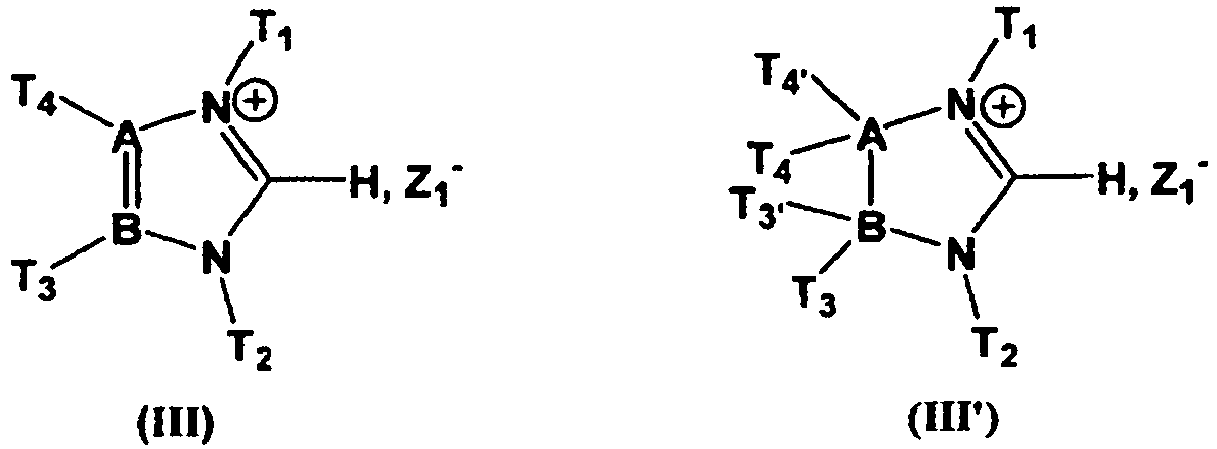 - A, B, T1, T2, T3, T3', T4 und T4' wie in Anspruch 6 definiert sind;- Z1 unabhängig für ein Anion, das sich von einer Brönsted-Säure (Protonensäure) ableitet, steht.
 - Verwendung nach einem der vorhergehenden Ansprüche, dadurch gekennzeichnet, dass sie durch homogene Katalyse in einem flüssigen Reaktionsmedium, in dem der Katalysator C und/oder seine Vorstufe bzw. seine Vorstufen und die Organosilicium-Ausgangsverbindung bzw. die Organosilicium-Ausgangsverbindungen und gegebenenfalls mindestens eine Base zumindest teilweise gelöst sind, durchgeführt wird.
- Verwendung nach einem der vorhergehenden Ansprüche, dadurch gekennzeichnet, dass die Löslichkeit des Katalysators C und/oder seiner Vorstufe bzw. seiner Vorstufen mit Hilfe mindestens eines Solubilisierunghilfsmittels und/oder durch Verwendung eines oder mehrerer Carbene, das bzw. die durch mindestens eine entsprechende Gruppe substituiert ist bzw. sind, gesteuert wird.
- Verwendung nach einem der vorhergehenden Ansprüche, dadurch gekennzeichnet, dass sie im Wesentlichen bei einer solchen Temperatur T (°C) durchgeführt wird, dass T ≤ 200.
- Verwendung einer gegebenenfalls in Gegenwart von Wasser vernetzbaren Silikonzusammensetzung bei einem Kondensationsverfahren gemäß Anspruch 1, dadurch gekennzeichnet, dass sie Folgendes umfasst:- mindestens eine (Organo)Siliciumverbindung A1 und (B und/oder D) gemäß Anspruch 1 und- mindestens einen Katalysator C gemäß einem der Ansprüche 1 bis 4.
- Verwendung einer Zusammensetzung gemäß Anspruch 8:- zur Herstellung von Beschichtungen, insbesondere Antihaftbeschichtungen, festen Trägern verschiedenartiger Beschaffenheit, vorteilhafterweise aus Stein, Beton, Metall, Holz, Glas, Keramik, Papier oder Pappe;- zur Beschichtung von gewebten oder nicht gewebten Faserstoffen,- als Bindemittel, insbesondere wasserabweisendes Bindemittel, für faserförmige oder nicht faserförmige Verbundwerkstoffe, wobei die fakultativen Fasern anorganisch oder organisch sind, oder- als Kitt oder Abdichtungsmaterial.
Applications Claiming Priority (2)
| Application Number | Priority Date | Filing Date | Title |
|---|---|---|---|
| FR0603563A FR2900153B1 (fr) | 2006-04-21 | 2006-04-21 | Procede de condensation de motifs silyles a l'aide d'un catalyseur de type carbene |
| PCT/FR2007/000665 WO2007122325A1 (fr) | 2006-04-21 | 2007-04-20 | Procede de condensation de motifs silyles a l'aide d'un catalyseur de type carbene |
Publications (2)
| Publication Number | Publication Date |
|---|---|
| EP2010548A1 EP2010548A1 (de) | 2009-01-07 |
| EP2010548B1 true EP2010548B1 (de) | 2016-08-24 |
Family
ID=37574913
Family Applications (1)
| Application Number | Title | Priority Date | Filing Date |
|---|---|---|---|
| EP07731328.6A Not-in-force EP2010548B1 (de) | 2006-04-21 | 2007-04-20 | Verfahren zum kondensieren von silyleinheiten mit einem carbenkatalysator |
Country Status (7)
| Country | Link |
|---|---|
| US (1) | US8779078B2 (de) |
| EP (1) | EP2010548B1 (de) |
| JP (1) | JP5466938B2 (de) |
| KR (1) | KR101021824B1 (de) |
| CN (1) | CN101563354B (de) |
| FR (1) | FR2900153B1 (de) |
| WO (1) | WO2007122325A1 (de) |
Families Citing this family (18)
| Publication number | Priority date | Publication date | Assignee | Title |
|---|---|---|---|---|
| CN102238954A (zh) | 2008-11-04 | 2011-11-09 | 肯塔基大学研究基金会 | 基于d-塔格糖的组合物以及用于预防和治疗动脉粥样硬化、代谢综合征及其症状的方法 |
| JP5702403B2 (ja) | 2010-01-08 | 2015-04-15 | ブルースター・シリコーンズ・フランス・エスアエス | 溶液状のカルベンの製造方法、特に該方法によって得られる新規な安定な形のカルベン、及び触媒反応におけるその使用 |
| CN102344747B (zh) * | 2010-07-30 | 2013-12-04 | 雍飞 | 有机硅低表面能涂料组合物及其制备方法、更新方法和应用 |
| EP2492323A1 (de) | 2011-02-23 | 2012-08-29 | Akzo Nobel Coatings International B.V. | Biofäulebeständige Zusammensetzungen |
| AU2012271948B2 (en) | 2011-06-21 | 2015-10-15 | Akzo Nobel Coatings International B.V. | Biocidal foul release coating systems |
| US9157009B2 (en) | 2011-07-07 | 2015-10-13 | Bluestar Silicones France Sas | Uses of carbenes in solution as organopolysiloxane polycondensation catalysts |
| ES2602815T3 (es) * | 2011-07-07 | 2017-02-22 | Bluestar Silicones France | Composición de silicona reticulable por deshidrogenocondensación en presencia de un catalizador de tipo carbeno |
| JP5860536B2 (ja) | 2011-08-18 | 2016-02-16 | アクゾ ノーベル コーティングス インターナショナル ビー ヴィ | ステロール及び/又はその誘導体を含む汚損耐性組成物 |
| EP2838935A1 (de) | 2011-12-29 | 2015-02-25 | 3M Innovative Properties Company | Härtbare polysiloxanbeschichtungszusammensetzung |
| EP2961805B1 (de) | 2013-02-26 | 2016-12-21 | Akzo Nobel Coatings International B.V. | Bewuchsschutzzusammensetzungen mit einem fluorinierten oxyalkylenhaltigen polymer oder oligomer |
| CN103145753B (zh) * | 2013-04-02 | 2016-04-20 | 南开大学 | 一种用卡宾催化硅烷水解制备硅氧烷的方法 |
| KR102354241B1 (ko) | 2013-12-03 | 2022-01-21 | 아크조노벨코팅스인터내셔널비.브이. | 기판 상에 에이징된 코팅층의 코팅 방법, 및 이 방법에 사용하기에 적합한 코팅 조성물 |
| WO2017019426A1 (en) * | 2015-07-27 | 2017-02-02 | Dow Corning Corporation | Polyorganosiloxane compositions with metal based n-heterocyclic carbene condensation reaction catalysts and methods for the preparation thereof |
| CA3049632A1 (en) | 2017-01-17 | 2018-07-26 | Akzo Nobel Coatings International B.V. | Foul release coating composition, substrate coated with such coating composition, and use of such coating composition |
| CN111448267B (zh) | 2017-12-14 | 2022-11-04 | 阿克佐诺贝尔国际涂料股份有限公司 | 污损脱附涂料组合物、涂有此涂料组合物的基材及此涂料组合物的用途 |
| SG11202100108SA (en) | 2018-07-13 | 2021-02-25 | Akzo Nobel Coatings Int Bv | Tie-coat composition |
| CN114763413A (zh) * | 2021-01-14 | 2022-07-19 | 万华化学集团股份有限公司 | 一种制备烷基甲氧基硅油方法 |
| WO2022207681A1 (en) | 2021-03-30 | 2022-10-06 | Akzo Nobel Coatings International B.V. | Fouling control coating composition |
Family Cites Families (22)
| Publication number | Priority date | Publication date | Assignee | Title |
|---|---|---|---|---|
| DE1287918B (de) | 1958-03-26 | 1900-01-01 | ||
| US3583241A (en) * | 1966-05-18 | 1971-06-08 | Motorola Inc | Pushbutton radio |
| US3504051A (en) | 1967-07-24 | 1970-03-31 | Dow Corning | Castable siloxane block copolymers |
| US3563241A (en) | 1968-11-14 | 1971-02-16 | Du Pont | Water-dispersible nonwoven fabric |
| CA1284544C (en) | 1986-08-22 | 1991-05-28 | General Electric Company | Preparation of high strength, high application rate silicone rtv rubber |
| FR2638752B1 (fr) | 1988-11-04 | 1992-07-24 | Rhone Poulenc Chimie | Procede de preparation de diorganopolysiloxanes a groupements terminaux alcoxy |
| FR2661680B1 (fr) | 1990-05-02 | 1992-07-24 | Rhone Poulenc Chimie | Procede de preparation de diorganopolysiloxanes a groupements terminaux alcoxy. |
| US5026811A (en) | 1990-02-16 | 1991-06-25 | Dow Corning Corporation | Silicone resin thermoset molding compositions |
| DE4022661A1 (de) | 1990-07-17 | 1992-01-23 | Bayer Ag | Verfahren zur hertellung von poly(diorganosiloxanen) mit alkoxyendgruppen |
| US5300608A (en) | 1992-03-31 | 1994-04-05 | Loctite Corporation | Process for preparing alkoxy-terminated organosiloxane fluids using organo-lithium reagents |
| CA2280268C (en) | 1997-03-06 | 2007-11-20 | Ciba Specialty Chemicals Holding Inc. | New catalysts |
| JP3430014B2 (ja) * | 1997-06-04 | 2003-07-28 | 信越化学工業株式会社 | 水性シリコーン組成物 |
| CN1213032C (zh) * | 1999-05-24 | 2005-08-03 | 加州理工学院 | 咪唑烷基金属卡宾易位催化剂 |
| JP3978566B2 (ja) * | 1999-09-09 | 2007-09-19 | 信越化学工業株式会社 | 分岐状オルガノポリシロキサンエマルジョンの製造方法 |
| FR2801887B1 (fr) * | 1999-12-07 | 2002-10-11 | Rhodia Chimie Sa | Complexes metalliques appropries a la catalyse de reactions d'hydrosilylation, composition catalytique les contenant et leur utilisation |
| FR2813081B1 (fr) * | 2000-08-17 | 2005-12-23 | Rhodia Chimie Sa | Procede de preparation d'huiles silicones par hydrosilylation de synthons contenant au moins un cycle hydrocarbone dans lequel est inclus un atome d'oxygene en presence d'un complexe metallique catalytique |
| US6455029B1 (en) * | 2000-10-17 | 2002-09-24 | Kerr Corporation | Dental impression material utilizing ruthenium catalyst |
| FR2825709B1 (fr) * | 2001-06-07 | 2005-07-01 | Rhodia Chimie Sa | Composition silicone reticulable en elastomere par hydrosilylation, en presence de catalyseurs metalliques a base de carbenes, et catalyseurs de ce type |
| WO2003099909A1 (en) * | 2002-05-23 | 2003-12-04 | Rhodia Chimie | Silicone composition which can be crosslinked into an elastomer by hydrosilylation in the presence of carbene-based metal catalysts, and catalysts of this type |
| FR2856690B1 (fr) * | 2003-06-30 | 2005-09-16 | Rhodia Chimie Sa | Composition silicone reticulable par desydrogenocondensation en presence d'un catalyseur metallique |
| JP4045439B2 (ja) * | 2003-09-22 | 2008-02-13 | 信越化学工業株式会社 | 室温硬化性オルガノポリシロキサン組成物 |
| FR2864543B1 (fr) | 2003-12-30 | 2006-03-03 | Rhodia Chimie Sa | Procede de preparation de polyorganosiloxanes (pos) par polymerisation par ouverture de cycle(s) et/ou redistribution de pos, en presence de carbene(s) et compositions de pos mises en oeuvre dans ce procede |
-
2006
- 2006-04-21 FR FR0603563A patent/FR2900153B1/fr not_active Expired - Fee Related
-
2007
- 2007-04-20 US US12/297,754 patent/US8779078B2/en not_active Expired - Fee Related
- 2007-04-20 EP EP07731328.6A patent/EP2010548B1/de not_active Not-in-force
- 2007-04-20 JP JP2009505933A patent/JP5466938B2/ja not_active Expired - Fee Related
- 2007-04-20 CN CN200780020777.2A patent/CN101563354B/zh not_active Expired - Fee Related
- 2007-04-20 KR KR1020087025750A patent/KR101021824B1/ko not_active Expired - Fee Related
- 2007-04-20 WO PCT/FR2007/000665 patent/WO2007122325A1/fr not_active Ceased
Also Published As
| Publication number | Publication date |
|---|---|
| KR101021824B1 (ko) | 2011-03-17 |
| KR20090048542A (ko) | 2009-05-14 |
| US20090299024A1 (en) | 2009-12-03 |
| EP2010548A1 (de) | 2009-01-07 |
| JP5466938B2 (ja) | 2014-04-09 |
| JP2009534497A (ja) | 2009-09-24 |
| CN101563354B (zh) | 2015-10-14 |
| US8779078B2 (en) | 2014-07-15 |
| WO2007122325A1 (fr) | 2007-11-01 |
| FR2900153B1 (fr) | 2008-07-18 |
| CN101563354A (zh) | 2009-10-21 |
| FR2900153A1 (fr) | 2007-10-26 |
Similar Documents
| Publication | Publication Date | Title |
|---|---|---|
| EP2010548A1 (de) | Verfahren zum kondensieren von silyleinheiten mit einem carbenkatalysator | |
| EP2443178B1 (de) | Silikonzusammensetzung für vernetzung mittels dehydrokondensation in gegenwart eines metallkatalysators | |
| EP2443179B1 (de) | Silikonzusammensetzung zur vernetzung mittels dehydrokondensation in gegenwart eines metallkatalysators | |
| CA2744667C (fr) | Composes a structure guanidine et leurs utilisations comme catalyseurs de polycondensation d'organopolysiloxanes | |
| EP2268743B1 (de) | Verbindungen mit einer guanidinstruktur und ihre verwendung als organopolysiloxan-polykondensationskatalysatoren | |
| EP2222688B1 (de) | Verbindungen mit einer guanidinstruktur und ihre verwendung als organopolysiloxan-polykondensationskatalysatoren | |
| EP1701992B1 (de) | Verfahren zur herstellung eines polyorganosiloxans (pos) durch ringöffnende polymerisation und/oder pos-umlagerung in gegenwart von carben(en) und danach hergestellte pos-verbindungen | |
| EP1641871A1 (de) | Einkomponentige polyorganosiloxanzusammensetzungen (pos-zusammensetzungen), die durch polykondensationsreaktionen bei umgebungstemperatur und in gegenwart von wasser zu elastomeren vernetzen, und so erhaltene elastomere | |
| EP0367696A1 (de) | Verfahren zur Herstellung von Diorganopolysiloxanen mit endständigen Alkoxygruppen | |
| EP2748231B1 (de) | Silikonzusammensetzung zur vernetzung mittels dehydrogenierter kondensation unter verwendung eines carben-katalysators | |
| FR2882760A1 (fr) | Compositions organopolysiloxanes durcissant en elastomeres des la temperature ambiante en presence d'humidite | |
| WO2014096567A1 (fr) | Composition organopolysiloxanique vulcanisable a température ambiante en élastomère et nouveaux catalyseurs de polycondensation d'organopolysiloxanes | |
| FR2802540A1 (fr) | Procede de preparation de polyorganosiloxanes par polymerisation catalysee par un systeme catalytique a base d'acide triflique ou de derives de l'acide triflique | |
| CA2185823A1 (fr) | Complexes du platine et catalyseurs d'hydrosilylation photoactivables les contenant | |
| EP2729533B1 (de) | Verwendung von carbenen in einer lösung als organopolysiloxan-polykondensationskatalysatoren | |
| FR2597875A1 (fr) | Procede de preparation de diorganopolysiloxanes a groupements terminaux alcoxy | |
| FR2729395A1 (fr) | Procede de condensation de motifs silyles de type sioh et sih ou sior a l'aide d'un catalyseur organometallique, catalyseur ainsi mis en oeuvre et compositions silicones obtenues par ce procede |
Legal Events
| Date | Code | Title | Description |
|---|---|---|---|
| PUAI | Public reference made under article 153(3) epc to a published international application that has entered the european phase |
Free format text: ORIGINAL CODE: 0009012 |
|
| 17P | Request for examination filed |
Effective date: 20081010 |
|
| AK | Designated contracting states |
Kind code of ref document: A1 Designated state(s): AT BE BG CH CY CZ DE DK EE ES FI FR GB GR HU IE IS IT LI LT LU LV MC MT NL PL PT RO SE SI SK TR |
|
| AX | Request for extension of the european patent |
Extension state: AL BA HR MK RS |
|
| 17Q | First examination report despatched |
Effective date: 20090204 |
|
| DAX | Request for extension of the european patent (deleted) | ||
| GRAP | Despatch of communication of intention to grant a patent |
Free format text: ORIGINAL CODE: EPIDOSNIGR1 |
|
| INTG | Intention to grant announced |
Effective date: 20160414 |
|
| GRAS | Grant fee paid |
Free format text: ORIGINAL CODE: EPIDOSNIGR3 |
|
| GRAA | (expected) grant |
Free format text: ORIGINAL CODE: 0009210 |
|
| AK | Designated contracting states |
Kind code of ref document: B1 Designated state(s): AT BE BG CH CY CZ DE DK EE ES FI FR GB GR HU IE IS IT LI LT LU LV MC MT NL PL PT RO SE SI SK TR |
|
| REG | Reference to a national code |
Ref country code: GB Ref legal event code: FG4D Free format text: NOT ENGLISH |
|
| REG | Reference to a national code |
Ref country code: CH Ref legal event code: EP |
|
| REG | Reference to a national code |
Ref country code: AT Ref legal event code: REF Ref document number: 822985 Country of ref document: AT Kind code of ref document: T Effective date: 20160915 |
|
| REG | Reference to a national code |
Ref country code: IE Ref legal event code: FG4D Free format text: LANGUAGE OF EP DOCUMENT: FRENCH |
|
| REG | Reference to a national code |
Ref country code: DE Ref legal event code: R096 Ref document number: 602007047598 Country of ref document: DE |
|
| REG | Reference to a national code |
Ref country code: LT Ref legal event code: MG4D |
|
| REG | Reference to a national code |
Ref country code: NL Ref legal event code: MP Effective date: 20160824 |
|
| REG | Reference to a national code |
Ref country code: AT Ref legal event code: MK05 Ref document number: 822985 Country of ref document: AT Kind code of ref document: T Effective date: 20160824 |
|
| PG25 | Lapsed in a contracting state [announced via postgrant information from national office to epo] |
Ref country code: FI Free format text: LAPSE BECAUSE OF FAILURE TO SUBMIT A TRANSLATION OF THE DESCRIPTION OR TO PAY THE FEE WITHIN THE PRESCRIBED TIME-LIMIT Effective date: 20160824 Ref country code: NL Free format text: LAPSE BECAUSE OF FAILURE TO SUBMIT A TRANSLATION OF THE DESCRIPTION OR TO PAY THE FEE WITHIN THE PRESCRIBED TIME-LIMIT Effective date: 20160824 Ref country code: LT Free format text: LAPSE BECAUSE OF FAILURE TO SUBMIT A TRANSLATION OF THE DESCRIPTION OR TO PAY THE FEE WITHIN THE PRESCRIBED TIME-LIMIT Effective date: 20160824 |
|
| PG25 | Lapsed in a contracting state [announced via postgrant information from national office to epo] |
Ref country code: GR Free format text: LAPSE BECAUSE OF FAILURE TO SUBMIT A TRANSLATION OF THE DESCRIPTION OR TO PAY THE FEE WITHIN THE PRESCRIBED TIME-LIMIT Effective date: 20161125 Ref country code: LV Free format text: LAPSE BECAUSE OF FAILURE TO SUBMIT A TRANSLATION OF THE DESCRIPTION OR TO PAY THE FEE WITHIN THE PRESCRIBED TIME-LIMIT Effective date: 20160824 Ref country code: SE Free format text: LAPSE BECAUSE OF FAILURE TO SUBMIT A TRANSLATION OF THE DESCRIPTION OR TO PAY THE FEE WITHIN THE PRESCRIBED TIME-LIMIT Effective date: 20160824 Ref country code: PT Free format text: LAPSE BECAUSE OF FAILURE TO SUBMIT A TRANSLATION OF THE DESCRIPTION OR TO PAY THE FEE WITHIN THE PRESCRIBED TIME-LIMIT Effective date: 20161226 Ref country code: AT Free format text: LAPSE BECAUSE OF FAILURE TO SUBMIT A TRANSLATION OF THE DESCRIPTION OR TO PAY THE FEE WITHIN THE PRESCRIBED TIME-LIMIT Effective date: 20160824 Ref country code: ES Free format text: LAPSE BECAUSE OF FAILURE TO SUBMIT A TRANSLATION OF THE DESCRIPTION OR TO PAY THE FEE WITHIN THE PRESCRIBED TIME-LIMIT Effective date: 20160824 |
|
| REG | Reference to a national code |
Ref country code: FR Ref legal event code: PLFP Year of fee payment: 11 |
|
| PG25 | Lapsed in a contracting state [announced via postgrant information from national office to epo] |
Ref country code: RO Free format text: LAPSE BECAUSE OF FAILURE TO SUBMIT A TRANSLATION OF THE DESCRIPTION OR TO PAY THE FEE WITHIN THE PRESCRIBED TIME-LIMIT Effective date: 20160824 Ref country code: EE Free format text: LAPSE BECAUSE OF FAILURE TO SUBMIT A TRANSLATION OF THE DESCRIPTION OR TO PAY THE FEE WITHIN THE PRESCRIBED TIME-LIMIT Effective date: 20160824 |
|
| REG | Reference to a national code |
Ref country code: DE Ref legal event code: R097 Ref document number: 602007047598 Country of ref document: DE |
|
| PG25 | Lapsed in a contracting state [announced via postgrant information from national office to epo] |
Ref country code: DK Free format text: LAPSE BECAUSE OF FAILURE TO SUBMIT A TRANSLATION OF THE DESCRIPTION OR TO PAY THE FEE WITHIN THE PRESCRIBED TIME-LIMIT Effective date: 20160824 Ref country code: PL Free format text: LAPSE BECAUSE OF FAILURE TO SUBMIT A TRANSLATION OF THE DESCRIPTION OR TO PAY THE FEE WITHIN THE PRESCRIBED TIME-LIMIT Effective date: 20160824 Ref country code: SK Free format text: LAPSE BECAUSE OF FAILURE TO SUBMIT A TRANSLATION OF THE DESCRIPTION OR TO PAY THE FEE WITHIN THE PRESCRIBED TIME-LIMIT Effective date: 20160824 Ref country code: BG Free format text: LAPSE BECAUSE OF FAILURE TO SUBMIT A TRANSLATION OF THE DESCRIPTION OR TO PAY THE FEE WITHIN THE PRESCRIBED TIME-LIMIT Effective date: 20161124 Ref country code: CZ Free format text: LAPSE BECAUSE OF FAILURE TO SUBMIT A TRANSLATION OF THE DESCRIPTION OR TO PAY THE FEE WITHIN THE PRESCRIBED TIME-LIMIT Effective date: 20160824 |
|
| PLBE | No opposition filed within time limit |
Free format text: ORIGINAL CODE: 0009261 |
|
| STAA | Information on the status of an ep patent application or granted ep patent |
Free format text: STATUS: NO OPPOSITION FILED WITHIN TIME LIMIT |
|
| 26N | No opposition filed |
Effective date: 20170526 |
|
| PG25 | Lapsed in a contracting state [announced via postgrant information from national office to epo] |
Ref country code: SI Free format text: LAPSE BECAUSE OF FAILURE TO SUBMIT A TRANSLATION OF THE DESCRIPTION OR TO PAY THE FEE WITHIN THE PRESCRIBED TIME-LIMIT Effective date: 20160824 |
|
| REG | Reference to a national code |
Ref country code: CH Ref legal event code: PL |
|
| REG | Reference to a national code |
Ref country code: IE Ref legal event code: MM4A |
|
| PG25 | Lapsed in a contracting state [announced via postgrant information from national office to epo] |
Ref country code: MC Free format text: LAPSE BECAUSE OF FAILURE TO SUBMIT A TRANSLATION OF THE DESCRIPTION OR TO PAY THE FEE WITHIN THE PRESCRIBED TIME-LIMIT Effective date: 20160824 |
|
| PG25 | Lapsed in a contracting state [announced via postgrant information from national office to epo] |
Ref country code: CH Free format text: LAPSE BECAUSE OF NON-PAYMENT OF DUE FEES Effective date: 20170430 Ref country code: LU Free format text: LAPSE BECAUSE OF NON-PAYMENT OF DUE FEES Effective date: 20170420 Ref country code: LI Free format text: LAPSE BECAUSE OF NON-PAYMENT OF DUE FEES Effective date: 20170430 |
|
| REG | Reference to a national code |
Ref country code: FR Ref legal event code: PLFP Year of fee payment: 12 |
|
| REG | Reference to a national code |
Ref country code: BE Ref legal event code: MM Effective date: 20170430 |
|
| PG25 | Lapsed in a contracting state [announced via postgrant information from national office to epo] |
Ref country code: IE Free format text: LAPSE BECAUSE OF NON-PAYMENT OF DUE FEES Effective date: 20170420 |
|
| PG25 | Lapsed in a contracting state [announced via postgrant information from national office to epo] |
Ref country code: BE Free format text: LAPSE BECAUSE OF NON-PAYMENT OF DUE FEES Effective date: 20170430 |
|
| PG25 | Lapsed in a contracting state [announced via postgrant information from national office to epo] |
Ref country code: MT Free format text: LAPSE BECAUSE OF FAILURE TO SUBMIT A TRANSLATION OF THE DESCRIPTION OR TO PAY THE FEE WITHIN THE PRESCRIBED TIME-LIMIT Effective date: 20160824 |
|
| PG25 | Lapsed in a contracting state [announced via postgrant information from national office to epo] |
Ref country code: HU Free format text: LAPSE BECAUSE OF FAILURE TO SUBMIT A TRANSLATION OF THE DESCRIPTION OR TO PAY THE FEE WITHIN THE PRESCRIBED TIME-LIMIT; INVALID AB INITIO Effective date: 20070420 |
|
| PG25 | Lapsed in a contracting state [announced via postgrant information from national office to epo] |
Ref country code: CY Free format text: LAPSE BECAUSE OF NON-PAYMENT OF DUE FEES Effective date: 20160824 |
|
| PG25 | Lapsed in a contracting state [announced via postgrant information from national office to epo] |
Ref country code: TR Free format text: LAPSE BECAUSE OF FAILURE TO SUBMIT A TRANSLATION OF THE DESCRIPTION OR TO PAY THE FEE WITHIN THE PRESCRIBED TIME-LIMIT Effective date: 20160824 |
|
| PG25 | Lapsed in a contracting state [announced via postgrant information from national office to epo] |
Ref country code: IS Free format text: LAPSE BECAUSE OF FAILURE TO SUBMIT A TRANSLATION OF THE DESCRIPTION OR TO PAY THE FEE WITHIN THE PRESCRIBED TIME-LIMIT Effective date: 20161224 |
|
| PGFP | Annual fee paid to national office [announced via postgrant information from national office to epo] |
Ref country code: FR Payment date: 20210310 Year of fee payment: 15 Ref country code: IT Payment date: 20210310 Year of fee payment: 15 |
|
| PGFP | Annual fee paid to national office [announced via postgrant information from national office to epo] |
Ref country code: GB Payment date: 20210324 Year of fee payment: 15 |
|
| PGFP | Annual fee paid to national office [announced via postgrant information from national office to epo] |
Ref country code: DE Payment date: 20210323 Year of fee payment: 15 |
|
| REG | Reference to a national code |
Ref country code: DE Ref legal event code: R119 Ref document number: 602007047598 Country of ref document: DE |
|
| GBPC | Gb: european patent ceased through non-payment of renewal fee |
Effective date: 20220420 |
|
| PG25 | Lapsed in a contracting state [announced via postgrant information from national office to epo] |
Ref country code: GB Free format text: LAPSE BECAUSE OF NON-PAYMENT OF DUE FEES Effective date: 20220420 Ref country code: FR Free format text: LAPSE BECAUSE OF NON-PAYMENT OF DUE FEES Effective date: 20220430 Ref country code: DE Free format text: LAPSE BECAUSE OF NON-PAYMENT OF DUE FEES Effective date: 20221103 |
|
| PG25 | Lapsed in a contracting state [announced via postgrant information from national office to epo] |
Ref country code: IT Free format text: LAPSE BECAUSE OF NON-PAYMENT OF DUE FEES Effective date: 20220420 |