EP1966108B1 - Controlled pore size distribution porous ceramic honeycomb filter - Google Patents
Controlled pore size distribution porous ceramic honeycomb filter Download PDFInfo
- Publication number
- EP1966108B1 EP1966108B1 EP06844303A EP06844303A EP1966108B1 EP 1966108 B1 EP1966108 B1 EP 1966108B1 EP 06844303 A EP06844303 A EP 06844303A EP 06844303 A EP06844303 A EP 06844303A EP 1966108 B1 EP1966108 B1 EP 1966108B1
- Authority
- EP
- European Patent Office
- Prior art keywords
- pore
- porous ceramic
- pore size
- starch
- ceramic honeycomb
- Prior art date
- Legal status (The legal status is an assumption and is not a legal conclusion. Google has not performed a legal analysis and makes no representation as to the accuracy of the status listed.)
- Active
Links
Images






Classifications
-
- C—CHEMISTRY; METALLURGY
- C04—CEMENTS; CONCRETE; ARTIFICIAL STONE; CERAMICS; REFRACTORIES
- C04B—LIME, MAGNESIA; SLAG; CEMENTS; COMPOSITIONS THEREOF, e.g. MORTARS, CONCRETE OR LIKE BUILDING MATERIALS; ARTIFICIAL STONE; CERAMICS; REFRACTORIES; TREATMENT OF NATURAL STONE
- C04B38/00—Porous mortars, concrete, artificial stone or ceramic ware; Preparation thereof
- C04B38/0006—Honeycomb structures
-
- B—PERFORMING OPERATIONS; TRANSPORTING
- B01—PHYSICAL OR CHEMICAL PROCESSES OR APPARATUS IN GENERAL
- B01D—SEPARATION
- B01D39/00—Filtering material for liquid or gaseous fluids
- B01D39/14—Other self-supporting filtering material ; Other filtering material
- B01D39/20—Other self-supporting filtering material ; Other filtering material of inorganic material, e.g. asbestos paper, metallic filtering material of non-woven wires
- B01D39/2068—Other inorganic materials, e.g. ceramics
-
- C—CHEMISTRY; METALLURGY
- C04—CEMENTS; CONCRETE; ARTIFICIAL STONE; CERAMICS; REFRACTORIES
- C04B—LIME, MAGNESIA; SLAG; CEMENTS; COMPOSITIONS THEREOF, e.g. MORTARS, CONCRETE OR LIKE BUILDING MATERIALS; ARTIFICIAL STONE; CERAMICS; REFRACTORIES; TREATMENT OF NATURAL STONE
- C04B35/00—Shaped ceramic products characterised by their composition; Ceramics compositions; Processing powders of inorganic compounds preparatory to the manufacturing of ceramic products
- C04B35/01—Shaped ceramic products characterised by their composition; Ceramics compositions; Processing powders of inorganic compounds preparatory to the manufacturing of ceramic products based on oxide ceramics
- C04B35/16—Shaped ceramic products characterised by their composition; Ceramics compositions; Processing powders of inorganic compounds preparatory to the manufacturing of ceramic products based on oxide ceramics based on silicates other than clay
- C04B35/18—Shaped ceramic products characterised by their composition; Ceramics compositions; Processing powders of inorganic compounds preparatory to the manufacturing of ceramic products based on oxide ceramics based on silicates other than clay rich in aluminium oxide
- C04B35/195—Alkaline earth aluminosilicates, e.g. cordierite or anorthite
-
- C—CHEMISTRY; METALLURGY
- C04—CEMENTS; CONCRETE; ARTIFICIAL STONE; CERAMICS; REFRACTORIES
- C04B—LIME, MAGNESIA; SLAG; CEMENTS; COMPOSITIONS THEREOF, e.g. MORTARS, CONCRETE OR LIKE BUILDING MATERIALS; ARTIFICIAL STONE; CERAMICS; REFRACTORIES; TREATMENT OF NATURAL STONE
- C04B35/00—Shaped ceramic products characterised by their composition; Ceramics compositions; Processing powders of inorganic compounds preparatory to the manufacturing of ceramic products
- C04B35/01—Shaped ceramic products characterised by their composition; Ceramics compositions; Processing powders of inorganic compounds preparatory to the manufacturing of ceramic products based on oxide ceramics
- C04B35/46—Shaped ceramic products characterised by their composition; Ceramics compositions; Processing powders of inorganic compounds preparatory to the manufacturing of ceramic products based on oxide ceramics based on titanium oxides or titanates
- C04B35/462—Shaped ceramic products characterised by their composition; Ceramics compositions; Processing powders of inorganic compounds preparatory to the manufacturing of ceramic products based on oxide ceramics based on titanium oxides or titanates based on titanates
- C04B35/478—Shaped ceramic products characterised by their composition; Ceramics compositions; Processing powders of inorganic compounds preparatory to the manufacturing of ceramic products based on oxide ceramics based on titanium oxides or titanates based on titanates based on aluminium titanates
-
- C—CHEMISTRY; METALLURGY
- C04—CEMENTS; CONCRETE; ARTIFICIAL STONE; CERAMICS; REFRACTORIES
- C04B—LIME, MAGNESIA; SLAG; CEMENTS; COMPOSITIONS THEREOF, e.g. MORTARS, CONCRETE OR LIKE BUILDING MATERIALS; ARTIFICIAL STONE; CERAMICS; REFRACTORIES; TREATMENT OF NATURAL STONE
- C04B38/00—Porous mortars, concrete, artificial stone or ceramic ware; Preparation thereof
- C04B38/0006—Honeycomb structures
- C04B38/0012—Honeycomb structures characterised by the material used for sealing or plugging (some of) the channels of the honeycombs
-
- B—PERFORMING OPERATIONS; TRANSPORTING
- B01—PHYSICAL OR CHEMICAL PROCESSES OR APPARATUS IN GENERAL
- B01D—SEPARATION
- B01D2239/00—Aspects relating to filtering material for liquid or gaseous fluids
- B01D2239/10—Filtering material manufacturing
-
- C—CHEMISTRY; METALLURGY
- C04—CEMENTS; CONCRETE; ARTIFICIAL STONE; CERAMICS; REFRACTORIES
- C04B—LIME, MAGNESIA; SLAG; CEMENTS; COMPOSITIONS THEREOF, e.g. MORTARS, CONCRETE OR LIKE BUILDING MATERIALS; ARTIFICIAL STONE; CERAMICS; REFRACTORIES; TREATMENT OF NATURAL STONE
- C04B2111/00—Mortars, concrete or artificial stone or mixtures to prepare them, characterised by specific function, property or use
- C04B2111/00034—Physico-chemical characteristics of the mixtures
- C04B2111/00129—Extrudable mixtures
-
- C—CHEMISTRY; METALLURGY
- C04—CEMENTS; CONCRETE; ARTIFICIAL STONE; CERAMICS; REFRACTORIES
- C04B—LIME, MAGNESIA; SLAG; CEMENTS; COMPOSITIONS THEREOF, e.g. MORTARS, CONCRETE OR LIKE BUILDING MATERIALS; ARTIFICIAL STONE; CERAMICS; REFRACTORIES; TREATMENT OF NATURAL STONE
- C04B2111/00—Mortars, concrete or artificial stone or mixtures to prepare them, characterised by specific function, property or use
- C04B2111/00474—Uses not provided for elsewhere in C04B2111/00
- C04B2111/00793—Uses not provided for elsewhere in C04B2111/00 as filters or diaphragms
-
- C—CHEMISTRY; METALLURGY
- C04—CEMENTS; CONCRETE; ARTIFICIAL STONE; CERAMICS; REFRACTORIES
- C04B—LIME, MAGNESIA; SLAG; CEMENTS; COMPOSITIONS THEREOF, e.g. MORTARS, CONCRETE OR LIKE BUILDING MATERIALS; ARTIFICIAL STONE; CERAMICS; REFRACTORIES; TREATMENT OF NATURAL STONE
- C04B2111/00—Mortars, concrete or artificial stone or mixtures to prepare them, characterised by specific function, property or use
- C04B2111/00474—Uses not provided for elsewhere in C04B2111/00
- C04B2111/0081—Uses not provided for elsewhere in C04B2111/00 as catalysts or catalyst carriers
-
- C—CHEMISTRY; METALLURGY
- C04—CEMENTS; CONCRETE; ARTIFICIAL STONE; CERAMICS; REFRACTORIES
- C04B—LIME, MAGNESIA; SLAG; CEMENTS; COMPOSITIONS THEREOF, e.g. MORTARS, CONCRETE OR LIKE BUILDING MATERIALS; ARTIFICIAL STONE; CERAMICS; REFRACTORIES; TREATMENT OF NATURAL STONE
- C04B2111/00—Mortars, concrete or artificial stone or mixtures to prepare them, characterised by specific function, property or use
- C04B2111/20—Resistance against chemical, physical or biological attack
- C04B2111/2084—Thermal shock resistance
-
- C—CHEMISTRY; METALLURGY
- C04—CEMENTS; CONCRETE; ARTIFICIAL STONE; CERAMICS; REFRACTORIES
- C04B—LIME, MAGNESIA; SLAG; CEMENTS; COMPOSITIONS THEREOF, e.g. MORTARS, CONCRETE OR LIKE BUILDING MATERIALS; ARTIFICIAL STONE; CERAMICS; REFRACTORIES; TREATMENT OF NATURAL STONE
- C04B2111/00—Mortars, concrete or artificial stone or mixtures to prepare them, characterised by specific function, property or use
- C04B2111/34—Non-shrinking or non-cracking materials
- C04B2111/343—Crack resistant materials
Definitions
- the present invention relates to a porous ceramic honeycomb article and honeycomb green body, batch mixture and method of manufacturing therefor. More particularly, the present invention relates to porous ceramic honeycomb filters exhibiting controlled pore size distribution and manufacture thereof.
- diesel engines due to their inherent fuel efficiency and durability.
- diesel emissions have come under attack both in the United States and Europe, as being generally undesirable.
- stricter environmental regulations will require diesel engines to meet higher emissions standards. Therefore, diesel engine manufacturers and emission-control companies are working to achieve diesel engines that are cleaner and meet the most stringent emission requirements under all operating conditions with minimal cost to the consumer.
- Diesel particulates are mainly composed of carbon soot.
- One way of removing such soot from diesel exhausts is through use of diesel filters.
- the most widely-used diesel filter is a diesel particulate filter (sometimes referred to as a "wall flow filter") which filters the diesel exhaust by capturing the soot on or in its porous walls.
- the diesel particulate filter is designed to provide excellent soot filtration without significantly hindering the exhaust flow, i.e., without creating significant unwanted back pressure.
- SiC Silicon Carbide
- CTE coefficient of thermal expansion
- diesel particulate filters include alternate cell channels plugged on opposite faces to force the engine exhaust gas to pass through the porous walls of the filter.
- Such filters typically include a catalyst coating, such as an oxidation catalyst, on their surface.
- a catalyst coating such as an oxidation catalyst
- the lower permeability of the soot layer causes a gradual rise in the back pressure of the filter against the engine (soot loaded back pressure), causing the engine to work harder.
- the soot in the filter has accumulated to some level, the filter must be regenerated by burning out the soot, thereby restoring the back pressure again to lower levels.
- the coated filter sets the floor for how "low" the back pressure can be made to be.
- the present invention is a porous ceramic honeycomb filter manufactured of an oxide-based ceramic material which exhibits a very small amount of small pores.
- the porous ceramic honeycomb filter preferably comprises an oxide-based material selected from a group of cordierite and aluminum titanate. More particularly, the oxide-based material has many pores with a pore size distribution wherein d 1 ⁇ 7.0 ⁇ m.
- d 1 is defined herein as a pore diameter wherein 1 % of a total pore volume of the pore size distribution has a smaller diameter (as measured by a mercury porosimetry method).
- the porous ceramic honeycomb filter comprises a diesel particulate filter.
- the oxide-based material contains cordierite, preferably with a cordierite phase approximating a stoichiometry of Mg 2 Al 4 Si 5 O 18 .
- the oxide-based material is an aluminum titanate material.
- d 1 ⁇ 8.0 ⁇ m, or even d 1 ⁇ 9.0 ⁇ m thereby further minimizing the relative amount of small pores.
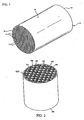
- FIG. 1 illustrates a perspective view of a honeycomb green body according to embodiments of the invention.
- FIG. 2 illustrates a perspective view of a porous ceramic honeycomb filter according to further embodiments of the invention.
- FIGS. 3-6 show micrographs of the relative size and shape of various starch pore formers according to further aspects of the invention.
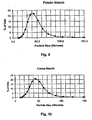
- FIGS. 7-10 illustrate graphs of Particle Size vs. % of Distribution for the pore formers according to aspects of the invention.
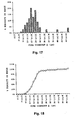
- FIGS. 11-19 illustrate graphs of pore size distributions for several exemplary porous ceramic honeycomb filters according to embodiments of the invention.
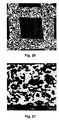
- FIGS. 20-23 illustrate various micrographs of the internal pore structure of the porous wall of the filters according to embodiments of the invention.
- the present invention relates to a porous ceramic honeycomb filter article which exhibits a very small amount of small pores. More preferably, the porous ceramic honeycomb filter article includes both a very small amount of small pores and also a narrow pore size distribution.
- the invention relates to a porous ceramic honeycomb filter, most useful as a diesel particulate filter. Particulate filters are useful, as described above, for filtering particulate soot from exhaust streams, for example.
- controlling the size of the pores below d 1 is an important factor in terms of being able to minimize the wash-coated pressure drop.
- controlling the size of the pores below d 1 was discovered to have a dominant contribution to reducing the percentage of wash-coated pressure drop increase (i.e., the delta in back pressure between an uncoated and wash coated filter, referred to herein as " ⁇ P c %.")
- the increase attributable to d 1 is much more dominant than that due to d 3 , d 6 or d 10 , for example.
- the porous ceramic honeycomb filter preferably has walls made up of an oxide-based material having a pore size distribution exhibiting d 1 ⁇ 7.0 microns.
- d 1 as used herein is defined as the pore diameter where 1% of the volume of the pore distribution of total volume of pores have a smaller pore diameter (as measured by mercury porosimetry).
- 1% of the volume of pores have a pore diameter of less than or equal to 7.0 ⁇ m. This has the direct advantage of minimizing ⁇ Pc % in that the only a small amount of small pores exist in the uncoated honeycomb filter's walls.
- Small pores have a propensity to be clogged by the wash coating which is applied to the filter as part of its normal processing to add a catalyst to the filter, such as a diesel oxidation catalyst.
- a catalyst such as a diesel oxidation catalyst.
- this aspect of the invention has the most applicability to oxide-based ceramic materials, such as materials selected from the group of cordierite and aluminum titanate. Examples of these materials are shown in Tables 2-5 below. Other cordierite-containing embodiments of the invention, as best described in Tables 2 and 3 below, achieve d 1 of greater than or equal to 8.0 ⁇ m, or even greater than or equal to 9.0 ⁇ m, for example. Thus, such materials have even less propensity to have clogged pores upon wash coating and, therefore, lower wash-coated pressure increase, ⁇ P c %.
- ⁇ P c % P coated - P uncoated / P uncoated x 100
- the overall breadth, d b of the pore size distribution should also be controlled to be relatively narrow.
- an exceedingly narrow pore size distribution is provided.
- the pore distribution breadth, d b is used herein to measure and characterize the overall breadth, i.e., the overall narrowness of the pore size distribution of the filter's wall material.
- even the smaller sized portion of the pore size distribution (that portion of the distribution equal to and below d 50 ) is preferably also controlled to be relatively narrow.
- the so-called "d-factor,” d f is utilized herein to measure and characterize the narrowness of the smaller pore size portion of the pore size distribution.
- cordierite-containing embodiments described herein also exhibit a d-factor, d f , wherein d f ⁇ 0.38 (see Ex. 1-7, and 9-14). Such narrow pore size distribution may lower the overall pressure drop when the material is utilized to form the walls in a particulate filter (both coated and uncoated); an example filter being shown and described with reference to Fig. 2 . Still further embodiments of the invention exhibit d f ⁇ 0.35 (see Ex. 1-6, 9-14), or even d f ⁇ 0.30 (see Ex. 4-6, 10 and 14). Examples 4-6, 10 and 14 of Tables 2 and 3 exhibit d f ⁇ 0.28. One particularly narrow embodiment (Ex. 4) exhibits d f ⁇ 0.26.
- the mean pore size of the oxide-based porous material forming the cell walls of the ceramic honeycomb filter is preferably between 13 and 33 microns; more preferably between 15-30 microns; and in many embodiments, between 15-25 microns.
- the oxide-based filter material preferably also includes a total volume percent porosity, P, as measured by mercury porosimetry, characterized by P ⁇ 40%; more preferably P ⁇ 65%; and most preferably 40% ⁇ P ⁇ 65%, or even 40% ⁇ P ⁇ 55%. This level of porosity provides good soot filtration and provides adequate heat capacity for most exhaust filtration applications.
- the walls of the honeycomb filter article are manufactured from an oxide-based material which contains a predominantly cordierite. More preferably yet, the phase preferably approximates a stoichiometry approximating Mg 2 Al 4 Si 5 O 18 . In other embodiments, the structure contains a predominately aluminum titanate (see example in Tables 4-5 below).
- the oxide-based material comprises a predominantly cordierite phase
- other constituents such as Fe (iron), Co (cobalt), Ni (nickel), and Mg (manganese) for the Mg (magnesium), Ga (gallium) for the Al (aluminum), and Ge (germanium) for the Si (silicon) is acceptable.
- the cordierite phase may contain up to three atoms of an alkali (Group IA) metal, two atoms of an alkaline earth metal (Group IIA), or one atom of a rare earth metal (scandium, yttrium, or a lanthanide metal) per 54 oxygens.
- cordierite materials are employed which exhibit narrow pore size distribution and pore sizes within a defined range.
- the pore size distributions for the inventive filter materials preferably includes a pore structure having d 10 ⁇ 10 ⁇ m; more preferably d 10 ⁇ 12 ⁇ m.
- the pore structure is preferably such that d 90 ⁇ 45 ⁇ m; more preferably d 90 ⁇ 35 ⁇ m.
- the mean pore diameter, d 50 for these materials is preferably at least 10 ⁇ m and less than 40 ⁇ m; more preferably between 13 ⁇ m and 33 ⁇ m. Many embodiments exhibit mean pore size of between 15 ⁇ m and 30 ⁇ m; or even between 15 ⁇ m and 25 ⁇ m. Further embodiments may exhibit a narrow pore size distribution wherein porosity attributable to pores having a pore size less than 10 ⁇ m is less than 6 %, and the porosity being attributable to pores having a pore size larger than 50 ⁇ m is less than 8%.
- the porous ceramic honeycomb filter preferably exhibits a narrow pore size distribution; several examples of the pore size distribution being shown in Figs. 11-19 .
- Figs. 11-13 relate to Example No. 1 including 13% sago palm starch
- Figs. 14-16 relate to Example No. 2 including 13% canna starch
- Figs. 17-19 relate to Example No. 3 including 13% single-mode potato starch.
- Figs. 11 , 14 and 17 for example illustrate the pore diameter distribution thereby illustrating the percentage of the pore volume within each pore diameter range.
- the tallest bar is positioned at between >16 ⁇ m and ⁇ 18 ⁇ m and constitutes greater than 15% of the pore volume.
- Fig. 12 illustrates the cumulative % porosity in the range and that less than about 90% of the pore volume has a pore diameter of less than 28.5 ⁇ m.
- Fig. 13 illustrates the pore diameter for d 1 , d 10 , d 50 and d 90 , for example, and is drawn to scale.
- This combination of relatively lower porosity and narrow pore size distribution provides a filter with low back pressure, excellent heat capacity, and good filtration efficiency.
- These examples may also provide the combination of small amount of small pores (d 1 ⁇ 8.0 ⁇ m) and relatively lower porosity (P ⁇ 55%). When achieved, this provides both low wash-coated pressure increase and improved thermal shock characteristics for the filter.
- the honeycomb filter of the present invention preferably exhibits, as shown in Table 3, a mean coefficient of thermal expansion (CTE) from 22°C to 800°C, as measured by dilatometry, in the inventive cordierite article of less than 10.0 x 10 -7 /°C; or even less than or equal to 7.0 x 10 -7 /°C, and in some embodiments, less than or equal to 5 x 10 -7 /°C. In certain embodiments, CTE of less than or equal to 4.0x 10 -7 /°C, or even less than or equal to 3.0 x 10 -7 /°C is achieved.
- CTE mean coefficient of thermal expansion
- the honeycomb article is configured as a porous ceramic honeycomb filter 100 as shown in Fig. 2 and includes a body of material in the form of a honeycomb structure 101.
- the material includes the controlled pore structure and is formed, preferably by extrusion, into a plurality of parallel cell channels (inlet cell channels 108 and outlet cell channels 110) separated by porous cell walls 106.
- At least some of the cell channels include preferably porous end plugs 112.
- a portion of the cell channels at the inlet end 102 are plugged with a paste having same or similar composition to that of the filter, for example as described in U.S. Pat. No. 4,329,162 .
- the plugs 112 are preferably only located at the ends of the cell channels 108, 110 and typically have a depth of about 5 to 20 mm from the end, although this can vary.
- the plugs may be formed in a process as described in US 4,557,773 , for example.
- a portion of the inlet cell channels 108 are plugged on the outlet end 104, and a portion of the outlet channels 110 are plugged on the inlet end 102.
- the respective plugged inlet channels 108 are arranged adjacent to the plugged outlet channels 110 such that wall flow through the cell walls 106 is accomplished in use. Therefore, preferably each cell channel is plugged only at one end.
- the preferred arrangement is to have every other cell on a given face plugged as in a checkered pattern as shown in Fig. 2 , although any other suitable plug arrangement may be employed.
- the inventive filters preferably have cellular densities from about 100 cells/in 2 (15.5 cells/cm 2 ) to about 400 cells/in 2 (62 cells/cm 2 ) and wall thicknesses (in between about 100 ⁇ m and 750 ⁇ m, more preferably between 100 ⁇ m and 500 ⁇ m.
- the total pore volume listed therein is measured by mercury porosimetry and is in units of cm 3 /gm.
- the total pore volume comprised of pores of below a certain diameter is calculated from the mercury porosimetry data by computing the difference between the cumulative mercury intrusion at a particular micrometer measure, dividing by the total mercury intrusion, and multiplying the result by 100.
- the pore size distribution is provided.
- the pore size distribution is narrow for all embodiments, and exceedingly narrow for some exemplary embodiments. This narrowness may be achieved, for example, by the selection and use of specific starches described below, or by otherwise manipulating the particle size distribution of the pore former.
- diesel particulate filters having a low was-coated pressure drop across the length of the fitter and lower overall back pressure against the engine have been achieved than was possible with cordierite' filters in the prior art.
- the method for manufacturing a porous ceramic honeycomb article comprises mixing a batch of inorganic raw materials with a pore former and forming aids.
- the pore former is preferably composed of a particular class of pore former. More particularly, the preferred pore former exhibits a narrow particle size distribution.
- Pore former as used herein is defined as a fugitive particulate material which evaporates or undergoes vaporization by combustion during drying or heating of the green body to obtain a desired, usually larger porosity and/or coarser median pore diameter than would be obtained otherwise without the pore former.
- the pore former used includes even a narrower particle size distribution characterized by d ps ⁇ 0.85, or even d ps ⁇ 0.80.
- the pore former is single-moded, and preferably a starch.
- the term "single-moded,” as used herein, means the starch particle distribution data (the plot the differential of accumulate volume via. Logarithm of particles size), measured from the "microtrac" measurement when computer fit with a Gaussian function has a correlation function of 0.98 or above.
- the starch preferably exhibits a median particle size, dp 50 , of between 15 and 60 ⁇ m; and in some exemplary embodiments, between 20 and 50 ⁇ m.
- the starch pore former preferably constitutes between 1-50 wt. %; more preferably between 5-30 wt. % of the inorganic raw materials. Preferred implementations include between 5-20 wt %.; and more preferably yet between 5-15 wt. %.
- the starch pore former utilized in the batch mixture is selected from a group consisting of canna starch, sago palm starch, green mung bean starch, and single-mode potato starch. Each of these starches is a single-moded starch. However, any starch or pore former having a narrow particle size distribution as described above may be substituted therefor. For cordierite batches, canna and single-mode starches are most preferred.
- the pore size distribution of the pore former may be manipulated to achieve the desired breadth as described herein.
- the small sized particles may be sieved, sifted or otherwise separated out and removed from the distribution.
- the large particle sizes in the distribution may be sieved, sifted or otherwise separated out and removed.
- both are removed to provide the particle size breadth as described herein.
- the pore former is burned out during firing to form pores in the filter walls.
- Canna starch exhibits a narrow pore size distribution, an example of which is shown in Fig. 10 , and includes a mean particle size, dp 50 , of between about 40-55 ⁇ m, and d ps ⁇ 0.90.
- Canna ( Canna edulis Ker-Gawler ) is a starchy root crop that is generally grown in tropical highlands, such as the Andean range, as well as in other parts of the developing world such as Vietnam, southern China, Taiwan, and Indonesia.
- Canna starch has large grains (see Fig. 6 ) that settle quickly out of a suspension of grated tuber tissue.
- the starch is high in amylose and functionally similar to mung bean starch, the traditional raw material for transparent noodles.
- Canna starch is very inexpensive to produce and is an outstandingly versatile and robust crop.
- Sago palm starch also exhibits a narrow pore size distribution, an example of which is shown in Fig. 4 , and includes a mean particle size, dp 50 , of between about 25-35 ⁇ m, and d ps ⁇ 0.8.
- Sago palm starch is prepared from the pith of several genera of palms, Metroxylon, Borassus, and Arenga, and from cycads of the genus Cycas, native to the East Indies. Sago palm starch takes on the form of small whitish, pinkish, or brownish grains (see Fig. 4 ).
- Green mung bean starch also exhibits a narrow pore size distribution, an example of which is shown in Fig. 3 , and includes a mean particle size, d p50 , of between about 15-30 ⁇ m, and d ps ⁇ 88.
- Green mung bean starch is sometimes referred to as mung bean flour or green pea flour, both of which are misnomers for the fine white starch of the green mung bean. Grown in many parts of Asia, the tiny bean with olive green skin (Phaseolus aureus, Vigna radiata) is also sometimes referred to as green pea.
- the starch is available in its natural (white) state or tinted pink or green, the color only showing when water is added. In China, the green mung bean is referred to as "lue dau fen.”
- Single-mode potato starch also exhibits a narrow pore size distribution, an example of which is shown in Fig. 9 , and includes a mean particle size, dp 50 , of between about 30-60 ⁇ m, and d ps ⁇ 0.88.
- Single-mode potato starch is a product of a potato grown in Japan in the northern island of Hokkaido. Single-mode potato starch takes on the form of small whitish, pinkish, or brownish grains (see Fig. 5 ). Single-mode potato starch is available under the tradename Shirakiku, for example.
- the batch used for forming the ceramic honeycomb article comprises a mixture of sources of inorganic materials, and a pore former selected from a group consisting of canna starch, sago palm starch, green mung bean starch, and single-mode potato starch, as described above.
- the inorganic source materials include at least two selected from a group of forming sources consisting of magnesia, alumina, silica, and titania.
- the inorganic source materials include magnesia-, alumina-, and silica-forming sources. Most preferably, the source materials are as described below.
- the batch preferably also includes forming aids that may include a plasticizer, lubricant, binder, and solvent vehicle. Methocel is the preferred binder. Water is the preferred solvent vehicle.
- the inorganic raw materials are blended together with organic forming aids (and the solvent vehicle) to form a homogeneous plastic batch mixture.
- the plastic batch mixture is then preferably formed into a honeycomb green body, optionally dried, and then fired in a furnace to form the final porous honeycomb article.
- the forming is preferably accomplished by an extrusion process by extruding the plastic mixture from a twin screw or ram extruder through an extrusion die, as taught in US Pat. No. 6,080,348 , for example.
- the extruded honeycomb green body 10 has a honeycomb structure as shown in Fig. 1 .
- the honeycomb green body article 10 includes the pore former with narrow pore size distribution as described above, i.e., with d ps ⁇ 0.9.
- the preferred pore former is a starch; most preferably a single-moded starch as described above.
- the raw inorganic source materials preferably include one or more talc sources, one or more alumina-forming sources, and one or more silica-forming sources.
- the raw material mixture also contains kaolin clay.
- the cordierite-forming inorganic source materials include talc, kaolin clay, a silica source such as quartz, and multiple alumina sources.
- the median particle sizes of the inorganic raw materials, as described below, are measured in micrometers, and are derived from the volumetric distribution of particle sizes, as measured by a laser diffraction technique.
- the preferred talc a magnesium silicate source
- the talc source may also include a calcined talc.
- the talc is preferably provided in a amount of between 35 and 45 wt. % of the total inorganic'materials.
- the mixture preferably contains a clay, an aluminum silicate source, such as kaolin clay. If present, the weight percentage of kaolin should be in the range of between 12 and 20 wt. %. Weight percents of kaolin greater than this value will result in higher pressure drops for the filter.
- the silica-forming source includes, but is not limited to, quartz, cristobalite, non-crystalline silica such as fused silica or a sol-gel silica, zeolite, and diatomaceous silica, and combinations thereof. Quartz is most preferred.
- the average of the median particle sizes of the silica source is preferably greater than 10 ⁇ m, and is preferably between 10 and 35 ⁇ m.
- the alumina-forming source is preferably a powder which, when heated to a sufficiently high temperature in the absence of other raw materials, yields substantially pure aluminum oxide.
- the alumina-forming source may be an alpha-alumina, a transition alumina such a gamma-alumina or rho-alumina, boehmite, aluminum hydroxide (aluminum trihydiate), or mixtures thereof.
- the alumina-forming source comprises a combination of ⁇ -alumina (Al 2 O 3 ) and aluminum trihydrate.
- the weighted average of the median particle sizes of the alumina-forming sources have a median particle size of less than 10 ⁇ m; more preferably less than 5 ⁇ m.
- One additional advantage of the present invention is the elimination of the pore-forming agent graphite from the raw material mixture.
- Graphite when included in the green body, may be detrimental to the drying process, in that arcing may occur during drying. Additionally, graphite may produce large exothermic reactions during firing that may require longer firing cycle times or which may contribute to cracking of honeycomb articles.
- Use of the starch pore formers in accordance with embodiments of the present invention eliminates the need for graphite. Additionally, sufficient levels of porosity (greater than 40%) can be readily achieved with a lower weight percentage of pore former. This also has the propensity to reduce cracking during firing. Moreover, relatively high levels of porosity may be achieved with much less pore former. Alternatively, shorter firing cycles may be achieved.
- inventive examples of cordierite green bodies 10 were prepared by weighing out the dry ingredients including various examples of the inventive pore formers listed in Table 2 and forming aids such as a cellulosic material, for example methyl cellulose, and sodium stearate.
- the dry ingredients are then mixed with a solvent vehicle, such as with water, and kneaded in a preferably stainless steel muller to form an extrudable plastic mass.
- the plastic mass is then formed, preferably extruded, into a green body, as described in US 5,205,991 , for example.
- the cellular honeycomb green bodies are cut to a log length.
- the extruded green body 10 includes a honeycomb structure having a plurality of generally parallel cell channels 11 formed, at least partially defined by intersecting cell walls 14 (otherwise referred to as "webs") that extend from a first end 12 to a second end 13.
- the green body 10 also includes an extruded smooth skin 15 formed about the honeycomb structure, although this is optional and may be formed in later processing.
- the wall thickness of each cell wall 14 is preferably about 0.01 to 0.03 inches (about 254 to 762 ⁇ m). All examples manufactured herein were 0.021 inch (533 ⁇ m).
- the cellular honeycomb structure consists of multiplicity of parallel cell channels 11 of generally square cross section formed into a honeycomb structure.
- honeycomb structure as used herein is defined as a connected structure of longitudinally-extending cells formed of thin cell walls, having a generally repeating pattern therein.
- the green body is preferably dried using a conventional microwave or RF drier as is known to those persons of ordinary skill in the art. After drying, the parts are fired in a furnace at an average heating rate of between 1 and 100 °C/hour, more preferably between 20 and 70 °C/hour, and most preferably between 25 and 50 °C/hour, to a maximum (top) temperature of 1400 °C to 1440 °C, more preferably 1410 °C to 1440 °C, and more preferably yet between 1410 °C to 1435 °C and held at this top temperature for 1 to 30 hours, more preferably 5 to 25 hours, and most preferably 10 to 20 hours.
- a maximum (top) temperature of 1400 °C to 1440 °C, more preferably 1410 °C to 1440 °C, and more preferably yet between 1410 °C to 1435 °C and held at this top temperature for 1 to 30 hours, more preferably 5 to 25 hours, and most preferably 10 to 20 hours.
- the cell channels are plugged, for example, as is described in US 4,557,773 to Bonzo .
- the plugs are provided in a checkerboard pattern on each respective end; wherein inlet channels are plugged at the second end and outlet channels are plugged at the first end. The plugged filter may then be re-fired.
- the pore size distribution of the present invention porous ceramic honeycomb filter may be desirably manipulated and made to be relatively narrow.
- cordierite honeycomb articles such as porous ceramic honeycomb filters, exhibiting a narrow pore size distribution may be manufactured.
- Such narrow pore size distribution provides relatively lower clean pressure drop in such porous ceramic filters, as well as excellent filtration efficiency.
- Certain exemplary cordierite-containing embodiments exhibit d b ⁇ 0.90 (Ex. 2-6, 14).
- Other cordierite-containing embodiments exhibit exceedingly low d b , such as where d b ⁇ 0.85 (Ex. 3-5), or even d b ⁇ 0.75 (Ex. 4).
- such narrow pore size may be achieved white also providing low coefficient of thermal expansion (between 25-800°C) of less than 10.0 x10 -7 /°C.
- coefficient of thermal expansion (25-800°C) of less than or equal to 7.0 x10 -7 /°C, or even 5.0 x10 -7 /°C or less are provided.
- Certain exemplary embodiments exhibit CTE of less than or equal to 4.0 x10 -7 /°C, or even less than or equal to 3.0 x10 -7 /°C.
- excellent thermal shock resistance is provided.
- such ceramic filter articles may be made to also have few small pores in addition to a relatively narrow pore size distribution.
- the lack of small pores in such porous ceramic filter articles is characterized in that d 1 is made small.
- such porous ceramic filters are characterized by pore size distributions which exhibit the relation: d 1 ⁇ 7.0 ⁇ m wherein
- starches described herein e.g., canna, sago, green mung bean, and single-mode potato
- these starches exhibit very narrow particle distributions (as characterized by low Dfp and/or low Dps, see Table 1 below) and, thus, contribute to the relative narrowness of the cordierite ceramic material's pore size distribution.
- Figs. 3-6 provide information about the particle size distributions of the preferred starch materials according to embodiments of the present invention.
- the raw material particle sizes given below are measured by a laser diffraction technique.
- they are measured by a Microtrac FRA9200 Series particle size analyzer.
- Example Aluminum Titanate Composition Example No. 15 Starch Type Sago Starch Wt. % (%) 16 Inorganic Raw Materials Titania (Ti-Pure) 29.95 Al 2 O 3 (Alcoa-A10 - 325) 46.57 Al(OH) 3 AC 714 3.71 Silica 10.19 SrCO 3 8.00 CaCO 3 1.38 La 2 O 3 0.20 Organic Materials Methylcellulose Binder 4.5 Emulsia "T" 9.0
- Tables 4 and 5 above illustrate an example of the present invention wherein the oxide-based material forming the walls of the filter is an aluminum titanate material. As can be seen, d 1 ⁇ 7.0 ⁇ m for this example. Further, a narrow pore size distribution was achieved by utilizing sago starch as the pore former. The porosity may be controlled by controlling its amount between 1 and 50 wt. %; more preferably between 5 and 30 wt. %; more preferably yet between 10 and 20%. Additionally, the example filter article containing aluminum titanate includes a narrow small-sized portion of the distribution characterized by d f ⁇ 0.25; more preferably d f ⁇ 0.23; or even d f ⁇ 0.22.
- the filter article includes narrow overall pore size distribution, as exemplified by d b ⁇ 0.9; more preferably d b ⁇ 0.8; or even d b ⁇ 0.75.
- the filter article containing aluminum titanate includes controlled porosity, P, wherein P % ⁇ 55%.
- the article includes d 90 ⁇ 30 ⁇ m.
- d 50 is preferably between 10 and 20 ⁇ m for filters containing aluminum titanate material.
- CTE for the article containing aluminum titanate is less than 15x 10 -7 /°C; preferably less than 10x 10 -7 /°C, or even less than 6 x 10 -7 /°C, all as measured between room temperature and 1000°C.
Landscapes
- Chemical & Material Sciences (AREA)
- Engineering & Computer Science (AREA)
- Ceramic Engineering (AREA)
- Organic Chemistry (AREA)
- Materials Engineering (AREA)
- Structural Engineering (AREA)
- Manufacturing & Machinery (AREA)
- Inorganic Chemistry (AREA)
- Life Sciences & Earth Sciences (AREA)
- Geology (AREA)
- Chemical Kinetics & Catalysis (AREA)
- Filtering Materials (AREA)
- Porous Artificial Stone Or Porous Ceramic Products (AREA)
Applications Claiming Priority (2)
| Application Number | Priority Date | Filing Date | Title |
|---|---|---|---|
| US74135505P | 2005-11-30 | 2005-11-30 | |
| PCT/US2006/043619 WO2007064454A2 (en) | 2005-11-30 | 2006-11-09 | Controlled pore size distribution porous ceramic honeycomb filter, honeycomb green body, batch mixture and manufacturing method therefor |
Publications (2)
| Publication Number | Publication Date |
|---|---|
| EP1966108A2 EP1966108A2 (en) | 2008-09-10 |
| EP1966108B1 true EP1966108B1 (en) | 2012-01-11 |
Family
ID=37969786
Family Applications (1)
| Application Number | Title | Priority Date | Filing Date |
|---|---|---|---|
| EP06844303A Active EP1966108B1 (en) | 2005-11-30 | 2006-11-09 | Controlled pore size distribution porous ceramic honeycomb filter |
Country Status (6)
| Country | Link |
|---|---|
| US (1) | US7744670B2 (enExample) |
| EP (1) | EP1966108B1 (enExample) |
| JP (1) | JP4824769B2 (enExample) |
| CN (1) | CN101316804B (enExample) |
| AT (1) | ATE540907T1 (enExample) |
| WO (1) | WO2007064454A2 (enExample) |
Families Citing this family (70)
| Publication number | Priority date | Publication date | Assignee | Title |
|---|---|---|---|---|
| US20050050870A1 (en) * | 2003-03-03 | 2005-03-10 | Cheng Shi-Wai S. | Method and apparatus for filtering exhaust particulates |
| US10501375B2 (en) | 2006-06-30 | 2019-12-10 | Corning Incorporated | Cordierite aluminum magnesium titanate compositions and ceramic articles comprising same |
| US8956436B2 (en) | 2006-06-30 | 2015-02-17 | Corning Incorporated | Cordierite aluminum magnesium titanate compositions and ceramic articles comprising same |
| US8298311B2 (en) * | 2006-11-15 | 2012-10-30 | Corning Incorporated | Filters with controlled submicron porosity |
| CN101522281B (zh) * | 2006-11-30 | 2012-06-27 | 日立金属株式会社 | 陶瓷蜂窝过滤器及其制造方法 |
| US20080138569A1 (en) * | 2006-12-11 | 2008-06-12 | Adam Kent Collier | Alpha-alumina inorganic membrane support and method of making the same |
| ATE504346T1 (de) * | 2007-01-31 | 2011-04-15 | Basf Corp | Gaskatalysator mit waben mit porösen wänden |
| JP2010522106A (ja) * | 2007-03-20 | 2010-07-01 | コーニング インコーポレイテッド | セラミック・フィルタのための低収縮率施栓用混合物、栓を施されたハニカム・フィルタおよびその製造方法 |
| DE102007024871A1 (de) * | 2007-05-29 | 2008-12-04 | Robert Bosch Gmbh | Keramisches Filterelement mit geringem Tiefenfiltrationsanteil |
| US8709577B2 (en) * | 2007-06-28 | 2014-04-29 | Corning Incorporated | High porosity ceramic honeycomb article containing rare earth oxide and method of manufacturing same |
| US8814974B2 (en) * | 2007-08-24 | 2014-08-26 | Corning Incorporated | Thin-walled porous ceramic wall-flow filter |
| US8187525B2 (en) * | 2007-08-31 | 2012-05-29 | Corning Incorporated | Method of firing green bodies into porous ceramic articles |
| CN101939271B (zh) | 2007-08-31 | 2014-08-13 | 康宁股份有限公司 | 堇青石蜂窝体制品及其制造方法 |
| US8500840B2 (en) * | 2007-10-12 | 2013-08-06 | Hitachi Metals, Ltd. | Cordierite-based ceramic honeycomb filter and its production method |
| US8114354B2 (en) * | 2007-12-18 | 2012-02-14 | Basf Corporation | Catalyzed soot filter manufacture and systems |
| US8038954B2 (en) * | 2008-02-14 | 2011-10-18 | Basf Corporation | CSF with low platinum/palladium ratios |
| JP2011515309A (ja) * | 2008-02-29 | 2011-05-19 | コーニング インコーポレイテッド | 粉砕された堅果の殻を用いたハニカム製造方法および該方法により生成されたハニカム体 |
| WO2009110978A2 (en) * | 2008-02-29 | 2009-09-11 | Corning Incorporated | Method for porous ceramic honeycomb shrinkage reduction |
| CN101977871B (zh) * | 2008-03-26 | 2013-06-19 | 京瓷株式会社 | 多孔质陶瓷部件及其制法以及过滤器 |
| EP2260921A4 (en) * | 2008-03-31 | 2011-11-30 | Ibiden Co Ltd | hONEYCOMB STRUCTURE |
| EP2258459B1 (en) | 2008-03-31 | 2016-03-23 | Ibiden Co., Ltd. | Honeycomb structure |
| DE102008001125A1 (de) * | 2008-04-11 | 2009-10-15 | Evonik Degussa Gmbh | Copolyamidpulver als Porenbildner in regenerierbaren keramischen Partikelfiltern |
| US20090298670A1 (en) * | 2008-05-27 | 2009-12-03 | Martin Joseph Murtagh | Method for removing graphite from cordierite bodies |
| US8894917B2 (en) * | 2008-05-30 | 2014-11-25 | Corning Incorporated | High porosity cordierite honeycomb articles |
| US9314727B2 (en) | 2008-11-26 | 2016-04-19 | Corning Incorporated | Cordierite forming batch compositions and cordierite bodies manufactured therefrom |
| US8530029B2 (en) * | 2008-11-26 | 2013-09-10 | Corning Incorporated | Low thermal mass cordierite bodies and methods for making same |
| EP2386530A4 (en) * | 2009-01-07 | 2012-07-25 | Sumitomo Chemical Co | POROUS CERAMIC FORMING AND METHOD FOR THE PRODUCTION THEREOF |
| US8231701B2 (en) * | 2009-01-21 | 2012-07-31 | Corning Incorporated | Particulate filters and methods for regenerating particulate filters |
| US8138108B2 (en) * | 2009-02-27 | 2012-03-20 | Corning Incorporated | Aluminum titanate-containing ceramic-forming batch materials and methods using the same |
| JP5630437B2 (ja) * | 2009-09-04 | 2014-11-26 | 日立金属株式会社 | セラミックハニカム構造体 |
| US20110124486A1 (en) * | 2009-11-24 | 2011-05-26 | Bonham Christine Gallaher | Aluminum Titanate-Containing Ceramic-Forming Batch Materials And Methods Using The Same |
| US8148297B2 (en) * | 2009-11-30 | 2012-04-03 | Corning Incorporated | Reticular cordierite composition, article and manufacture thereof |
| US20130062275A1 (en) * | 2010-03-19 | 2013-03-14 | Sumitomo Chemical Company, Limited | Process for production of honeycomb structure, honeycomb structure, and particulate filter |
| WO2011125797A1 (ja) * | 2010-04-01 | 2011-10-13 | 日立金属株式会社 | セラミックハニカムフィルタ及びその製造方法 |
| US8450227B2 (en) | 2011-02-28 | 2013-05-28 | Corning Incorporated | Ceramic-body-forming batch materials comprising silica, methods using the same and ceramic bodies made therefrom |
| JP2012206079A (ja) * | 2011-03-30 | 2012-10-25 | Ngk Insulators Ltd | ハニカムフィルタ |
| JP5937381B2 (ja) * | 2012-03-06 | 2016-06-22 | 日本碍子株式会社 | ハニカム構造体 |
| JPWO2013146499A1 (ja) * | 2012-03-30 | 2015-12-14 | 日本碍子株式会社 | 多孔質体,ハニカムフィルタ及び多孔質体の製造方法 |
| US9126871B2 (en) | 2012-05-31 | 2015-09-08 | Corning Incorporated | Carbonates as relic pore formers in aluminum titanate |
| WO2014028048A1 (en) | 2012-08-16 | 2014-02-20 | Dow Global Technologies Llc | Method of preparing high porosity ceramic material |
| US10526249B2 (en) * | 2012-11-30 | 2020-01-07 | Corning Incorporated | Cordierite aluminum magnesium titanate compositions and ceramic articles comprising same |
| DK2981513T3 (en) * | 2013-04-03 | 2019-04-29 | Dinex As | HONEY BOARD UNIT |
| US9908260B2 (en) | 2013-05-20 | 2018-03-06 | Corning Incorporated | Porous ceramic article and method of manufacturing the same |
| US9623360B2 (en) | 2013-05-20 | 2017-04-18 | Corning Incorporated | Porous ceramic article and method of manufacturing the same |
| US9376347B2 (en) | 2013-05-20 | 2016-06-28 | Corning Incorporated | Porous ceramic article and method of manufacturing the same |
| JP6239303B2 (ja) | 2013-07-31 | 2017-11-29 | イビデン株式会社 | ハニカムフィルタ |
| JP6239304B2 (ja) * | 2013-07-31 | 2017-11-29 | イビデン株式会社 | ハニカムフィルタ |
| US10472291B2 (en) | 2013-10-15 | 2019-11-12 | Corning Incorporated | Crosslinked starches for pore forming in ceramics |
| DE102013019582A1 (de) * | 2013-11-21 | 2015-05-21 | Karlsruher Institut für Technologie | Verfahren zur Herstellung poröser Sinterkörper |
| EP3386606B1 (en) | 2015-12-09 | 2024-08-21 | Corning Incorporated | Particulate filter |
| JP6715647B2 (ja) * | 2016-03-31 | 2020-07-01 | 日本碍子株式会社 | 微構造解析方法,そのプログラム及び微構造解析装置 |
| MX2018014812A (es) | 2016-05-31 | 2019-03-14 | Corning Inc | Articulo poroso y metodo para la fabricacion del mismo. |
| US20190177232A1 (en) * | 2016-06-13 | 2019-06-13 | Corning Incorporated | Aluminum titanate compositions, aluminum titanate articles, and methods of making same |
| JP6845645B2 (ja) * | 2016-09-26 | 2021-03-24 | タテホ化学工業株式会社 | 酸化マグネシウム含有スピネル粉末及びその製造方法 |
| JP6802096B2 (ja) * | 2017-03-14 | 2020-12-16 | 日本碍子株式会社 | 目封止ハニカム構造体 |
| EP3704077B1 (en) | 2017-10-31 | 2024-10-09 | Corning Incorporated | Batch composition comprising spheroidal pre-reacted inorganic particles and method of manufacture of honeycomb body therefrom |
| JP6982530B2 (ja) * | 2018-03-23 | 2021-12-17 | 日本碍子株式会社 | ハニカム構造体 |
| US11891339B2 (en) | 2018-08-31 | 2024-02-06 | Corning Incorporated | Cordierite-indialite-pseudobrookite structured ceramic bodies, batch composition mixtures, and methods of manufacturing ceramic bodies therefrom |
| EP3880342B1 (en) | 2018-11-16 | 2024-06-12 | Corning Incorporated | Cordierite-containing ceramic bodies, batch composition mixtures, and methods of manufacturing cordierite-containing ceramic bodies |
| US11691137B2 (en) | 2019-03-28 | 2023-07-04 | Ngk Insulators, Ltd. | Ceramic porous body and method for producing the same, and dust collecting filter |
| US11505503B2 (en) | 2019-04-18 | 2022-11-22 | Corning Incorporated | Ceramic honeycomb bodies and manufacture |
| JP7127606B2 (ja) | 2019-04-24 | 2022-08-30 | 株式会社デンソー | 排ガス浄化フィルタ |
| JP6947200B2 (ja) | 2019-05-15 | 2021-10-13 | 株式会社デンソー | 排ガス浄化フィルタ |
| JP7202324B2 (ja) * | 2020-03-02 | 2023-01-11 | 日本碍子株式会社 | ハニカムフィルタの製造方法 |
| JP7198789B2 (ja) * | 2020-03-02 | 2023-01-04 | 日本碍子株式会社 | ハニカムフィルタの製造方法 |
| CN114311232B (zh) * | 2020-09-29 | 2023-02-10 | 三达膜科技(厦门)有限公司 | 一种大直径组合式蜂窝陶瓷过滤膜的制备方法 |
| JP7178432B2 (ja) * | 2021-01-18 | 2022-11-25 | 本田技研工業株式会社 | 排気浄化フィルタ |
| CN114634354B (zh) * | 2022-03-15 | 2023-04-25 | 深圳市基克纳科技有限公司 | 一种提升多孔陶瓷雾化芯综合性能稳定性的方法 |
| JP7792286B2 (ja) * | 2022-03-30 | 2025-12-25 | 日本碍子株式会社 | ハニカムフィルタ |
| TWI897791B (zh) * | 2025-01-09 | 2025-09-11 | 富利康科技股份有限公司 | 具觸媒之陶瓷纖維濾材一體化製造方法 |
Family Cites Families (33)
| Publication number | Priority date | Publication date | Assignee | Title |
|---|---|---|---|---|
| US2185859A (en) * | 1938-11-14 | 1940-01-02 | Massey Peter Jay | Method of coating paper |
| US4329162A (en) * | 1980-07-03 | 1982-05-11 | Corning Glass Works | Diesel particulate trap |
| US4557773A (en) * | 1981-07-15 | 1985-12-10 | Corning Glass Works | Method for selectively manifolding honeycomb structures |
| US4390355A (en) * | 1982-02-02 | 1983-06-28 | General Motors Corporation | Wall-flow monolith filter |
| US4416676A (en) * | 1982-02-22 | 1983-11-22 | Corning Glass Works | Honeycomb filter and method of making it |
| US4414337A (en) * | 1982-05-19 | 1983-11-08 | Westinghouse Electric Corp. | Shaped ceramics |
| US4509966A (en) * | 1983-05-18 | 1985-04-09 | General Motors Corporation | Wall-flow monolith filter with porous plugs |
| JPH07183Y2 (ja) * | 1987-03-16 | 1995-01-11 | 日本碍子株式会社 | セラミックハニカム構造体 |
| JP2578176B2 (ja) * | 1988-08-12 | 1997-02-05 | 日本碍子株式会社 | 多孔質セラミックハニカムフィルターおよびその製法 |
| JPH0738930B2 (ja) * | 1990-03-30 | 1995-05-01 | 日本碍子株式会社 | 多孔質セラミックフィルタの製法 |
| US5258150A (en) * | 1991-12-06 | 1993-11-02 | Corning Incorporated | Fabrication of low thermal expansion, high porosity cordierite body |
| JP2726616B2 (ja) * | 1993-12-15 | 1998-03-11 | 日本碍子株式会社 | 多孔質セラミックハニカムフィルタ |
| DE4419243A1 (de) * | 1994-06-01 | 1995-12-07 | Kempten Elektroschmelz Gmbh | Gleitwerkstoff aus porösem SiC mit trimodaler Porenzusammensetzung |
| KR20010015742A (ko) * | 1997-10-17 | 2001-02-26 | 알프레드 엘. 미첼슨 | 변형된 슬롯을 가진 압출다이 |
| JP2002530175A (ja) * | 1998-11-20 | 2002-09-17 | コーニンクレッカ フィリップス エレクトロニクス エヌ ヴィ | コードレス走査ヘッドの充電器を備える超音波診断イメージングシステム |
| JP2003511331A (ja) * | 1999-10-05 | 2003-03-25 | コーニング インコーポレイテッド | 耐火性nzp型構造体並びにその作成及び使用方法 |
| JP2001269522A (ja) * | 2000-03-27 | 2001-10-02 | Ngk Insulators Ltd | 多孔質セラミックス焼結体製フィルター |
| KR20030036205A (ko) * | 2000-06-01 | 2003-05-09 | 코닝 인코포레이티드 | 코디어라이트 몸체 |
| JP4094830B2 (ja) * | 2000-11-24 | 2008-06-04 | 日本碍子株式会社 | 多孔質ハニカムフィルター及びその製造方法 |
| JP3925225B2 (ja) * | 2001-03-28 | 2007-06-06 | 株式会社デンソー | 排ガス浄化フィルタ及びその製造方法 |
| JP4007058B2 (ja) * | 2001-08-06 | 2007-11-14 | 株式会社デンソー | 排ガス浄化フィルタ |
| US6897175B2 (en) * | 2001-10-09 | 2005-05-24 | General Electric | Catalyst and method for the alkylation of hydroxyaromatic compounds |
| JP2003277162A (ja) * | 2002-01-21 | 2003-10-02 | Ngk Insulators Ltd | 多孔質ハニカム構造体、その用途及びその製造方法 |
| EP1515787A4 (en) * | 2002-06-26 | 2006-11-29 | Corning Inc | ALUMINUM AND MAGNESIUM SILICATE TYPE STRUCTURES FOR DPF APPLICATIONS |
| US20040152593A1 (en) * | 2003-01-30 | 2004-08-05 | Cutler Willard A. | Catalyst support |
| US6864198B2 (en) * | 2003-01-30 | 2005-03-08 | Corning Incorporated | Cordierite ceramic body and method |
| US7179316B2 (en) * | 2003-06-25 | 2007-02-20 | Corning Incorporated | Cordierite filters with reduced pressure drop |
| JP4420655B2 (ja) * | 2003-11-25 | 2010-02-24 | 株式会社キャタラー | パティキュレートフィルタ触媒及びその製造方法 |
| US20060021308A1 (en) * | 2004-07-29 | 2006-02-02 | Merkel Gregory A | Mullite-aluminum titanate body and method for making same |
| KR100865101B1 (ko) | 2004-09-14 | 2008-10-24 | 니뽄 가이시 가부시키가이샤 | 다공질 허니컴 필터 |
| KR100820619B1 (ko) * | 2004-12-28 | 2008-04-08 | 이비덴 가부시키가이샤 | 필터 및 필터 집합체 |
| CN101213156B (zh) * | 2005-05-31 | 2014-07-16 | 康宁股份有限公司 | 包含成孔剂组合的形成钛酸铝陶瓷的批料混合物和生坯,以及它们的制造和烧制方法 |
| US7520911B2 (en) * | 2005-11-30 | 2009-04-21 | Corning Incorporated | Porous cordierite ceramic honeycomb article with improved strength and method of manufacturing same |
-
2006
- 2006-11-09 EP EP06844303A patent/EP1966108B1/en active Active
- 2006-11-09 WO PCT/US2006/043619 patent/WO2007064454A2/en not_active Ceased
- 2006-11-09 AT AT06844303T patent/ATE540907T1/de active
- 2006-11-09 CN CN200680044636XA patent/CN101316804B/zh active Active
- 2006-11-09 JP JP2008543301A patent/JP4824769B2/ja not_active Expired - Fee Related
- 2006-11-30 US US11/606,797 patent/US7744670B2/en active Active
Also Published As
| Publication number | Publication date |
|---|---|
| CN101316804B (zh) | 2012-09-19 |
| WO2007064454A3 (en) | 2007-07-19 |
| EP1966108A2 (en) | 2008-09-10 |
| CN101316804A (zh) | 2008-12-03 |
| US20070119135A1 (en) | 2007-05-31 |
| ATE540907T1 (de) | 2012-01-15 |
| JP4824769B2 (ja) | 2011-11-30 |
| WO2007064454A2 (en) | 2007-06-07 |
| US7744670B2 (en) | 2010-06-29 |
| JP2009517211A (ja) | 2009-04-30 |
Similar Documents
| Publication | Publication Date | Title |
|---|---|---|
| US7744670B2 (en) | Controlled pore size distribution porous ceramic honeycomb filter, honeycomb green body, batch mixture and manufacturing method therefor | |
| US7981188B2 (en) | Controlled pore size distribution porous ceramic honeycomb filter, honeycomb green body, batch mixture and manufacturing method therefor | |
| EP2188228B1 (en) | Cordierite honeycomb article and method of manufacture | |
| EP2016033B1 (en) | High porosity cordierite composition | |
| EP1968913B1 (en) | Narrow pore size distribution cordierite ceramic honeycomb articles and methods for manufacturing same | |
| EP2254678B1 (en) | Honeycomb manufacturing method using ground nut shells | |
| CN100341816C (zh) | 堇青石陶瓷体和方法 | |
| EP1515787A4 (en) | ALUMINUM AND MAGNESIUM SILICATE TYPE STRUCTURES FOR DPF APPLICATIONS | |
| CN101506124A (zh) | 低背压多孔堇青石陶瓷蜂窝制品及其生产方法 | |
| CN103249692B (zh) | 形成陶瓷蜂窝体制品的方法 | |
| US20240116819A1 (en) | Cordierite-indialite-pseudobrookite structured ceramic bodies, batch composition mixtures, and methods of manufacturing ceramic bodies therefrom | |
| EP3880342B1 (en) | Cordierite-containing ceramic bodies, batch composition mixtures, and methods of manufacturing cordierite-containing ceramic bodies |
Legal Events
| Date | Code | Title | Description |
|---|---|---|---|
| PUAI | Public reference made under article 153(3) epc to a published international application that has entered the european phase |
Free format text: ORIGINAL CODE: 0009012 |
|
| 17P | Request for examination filed |
Effective date: 20080618 |
|
| AK | Designated contracting states |
Kind code of ref document: A2 Designated state(s): AT BE BG CH CY CZ DE DK EE ES FI FR GB GR HU IE IS IT LI LT LU LV MC NL PL PT RO SE SI SK TR |
|
| RIN1 | Information on inventor provided before grant (corrected) |
Inventor name: WANG, JIANGUO Inventor name: SKOLNY, JENNIFER L Inventor name: XIE, YUMING Inventor name: MIAO, WEIGUO Inventor name: SHUSTACK, PAUL J |
|
| 17Q | First examination report despatched |
Effective date: 20100317 |
|
| RTI1 | Title (correction) |
Free format text: CONTROLLED PORE SIZE DISTRIBUTION POROUS CERAMIC HONEYCOMB FILTER |
|
| GRAP | Despatch of communication of intention to grant a patent |
Free format text: ORIGINAL CODE: EPIDOSNIGR1 |
|
| GRAS | Grant fee paid |
Free format text: ORIGINAL CODE: EPIDOSNIGR3 |
|
| GRAA | (expected) grant |
Free format text: ORIGINAL CODE: 0009210 |
|
| AK | Designated contracting states |
Kind code of ref document: B1 Designated state(s): AT BE BG CH CY CZ DE DK EE ES FI FR GB GR HU IE IS IT LI LT LU LV MC NL PL PT RO SE SI SK TR |
|
| DAX | Request for extension of the european patent (deleted) | ||
| REG | Reference to a national code |
Ref country code: GB Ref legal event code: FG4D |
|
| REG | Reference to a national code |
Ref country code: CH Ref legal event code: EP |
|
| REG | Reference to a national code |
Ref country code: AT Ref legal event code: REF Ref document number: 540907 Country of ref document: AT Kind code of ref document: T Effective date: 20120115 |
|
| REG | Reference to a national code |
Ref country code: IE Ref legal event code: FG4D |
|
| REG | Reference to a national code |
Ref country code: DE Ref legal event code: R096 Ref document number: 602006027105 Country of ref document: DE Effective date: 20120308 |
|
| REG | Reference to a national code |
Ref country code: NL Ref legal event code: VDEP Effective date: 20120111 |
|
| PG25 | Lapsed in a contracting state [announced via postgrant information from national office to epo] |
Ref country code: SI Free format text: LAPSE BECAUSE OF FAILURE TO SUBMIT A TRANSLATION OF THE DESCRIPTION OR TO PAY THE FEE WITHIN THE PRESCRIBED TIME-LIMIT Effective date: 20120111 |
|
| LTIE | Lt: invalidation of european patent or patent extension |
Effective date: 20120111 |
|
| PG25 | Lapsed in a contracting state [announced via postgrant information from national office to epo] |
Ref country code: LT Free format text: LAPSE BECAUSE OF FAILURE TO SUBMIT A TRANSLATION OF THE DESCRIPTION OR TO PAY THE FEE WITHIN THE PRESCRIBED TIME-LIMIT Effective date: 20120111 Ref country code: BG Free format text: LAPSE BECAUSE OF FAILURE TO SUBMIT A TRANSLATION OF THE DESCRIPTION OR TO PAY THE FEE WITHIN THE PRESCRIBED TIME-LIMIT Effective date: 20120411 Ref country code: IS Free format text: LAPSE BECAUSE OF FAILURE TO SUBMIT A TRANSLATION OF THE DESCRIPTION OR TO PAY THE FEE WITHIN THE PRESCRIBED TIME-LIMIT Effective date: 20120511 Ref country code: NL Free format text: LAPSE BECAUSE OF FAILURE TO SUBMIT A TRANSLATION OF THE DESCRIPTION OR TO PAY THE FEE WITHIN THE PRESCRIBED TIME-LIMIT Effective date: 20120111 Ref country code: BE Free format text: LAPSE BECAUSE OF FAILURE TO SUBMIT A TRANSLATION OF THE DESCRIPTION OR TO PAY THE FEE WITHIN THE PRESCRIBED TIME-LIMIT Effective date: 20120111 |
|
| PG25 | Lapsed in a contracting state [announced via postgrant information from national office to epo] |
Ref country code: PT Free format text: LAPSE BECAUSE OF FAILURE TO SUBMIT A TRANSLATION OF THE DESCRIPTION OR TO PAY THE FEE WITHIN THE PRESCRIBED TIME-LIMIT Effective date: 20120511 Ref country code: PL Free format text: LAPSE BECAUSE OF FAILURE TO SUBMIT A TRANSLATION OF THE DESCRIPTION OR TO PAY THE FEE WITHIN THE PRESCRIBED TIME-LIMIT Effective date: 20120111 Ref country code: LV Free format text: LAPSE BECAUSE OF FAILURE TO SUBMIT A TRANSLATION OF THE DESCRIPTION OR TO PAY THE FEE WITHIN THE PRESCRIBED TIME-LIMIT Effective date: 20120111 Ref country code: GR Free format text: LAPSE BECAUSE OF FAILURE TO SUBMIT A TRANSLATION OF THE DESCRIPTION OR TO PAY THE FEE WITHIN THE PRESCRIBED TIME-LIMIT Effective date: 20120412 Ref country code: FI Free format text: LAPSE BECAUSE OF FAILURE TO SUBMIT A TRANSLATION OF THE DESCRIPTION OR TO PAY THE FEE WITHIN THE PRESCRIBED TIME-LIMIT Effective date: 20120111 |
|
| REG | Reference to a national code |
Ref country code: AT Ref legal event code: MK05 Ref document number: 540907 Country of ref document: AT Kind code of ref document: T Effective date: 20120111 |
|
| PG25 | Lapsed in a contracting state [announced via postgrant information from national office to epo] |
Ref country code: CY Free format text: LAPSE BECAUSE OF FAILURE TO SUBMIT A TRANSLATION OF THE DESCRIPTION OR TO PAY THE FEE WITHIN THE PRESCRIBED TIME-LIMIT Effective date: 20120111 |
|
| PG25 | Lapsed in a contracting state [announced via postgrant information from national office to epo] |
Ref country code: EE Free format text: LAPSE BECAUSE OF FAILURE TO SUBMIT A TRANSLATION OF THE DESCRIPTION OR TO PAY THE FEE WITHIN THE PRESCRIBED TIME-LIMIT Effective date: 20120111 Ref country code: RO Free format text: LAPSE BECAUSE OF FAILURE TO SUBMIT A TRANSLATION OF THE DESCRIPTION OR TO PAY THE FEE WITHIN THE PRESCRIBED TIME-LIMIT Effective date: 20120111 Ref country code: DK Free format text: LAPSE BECAUSE OF FAILURE TO SUBMIT A TRANSLATION OF THE DESCRIPTION OR TO PAY THE FEE WITHIN THE PRESCRIBED TIME-LIMIT Effective date: 20120111 Ref country code: SE Free format text: LAPSE BECAUSE OF FAILURE TO SUBMIT A TRANSLATION OF THE DESCRIPTION OR TO PAY THE FEE WITHIN THE PRESCRIBED TIME-LIMIT Effective date: 20120111 Ref country code: CZ Free format text: LAPSE BECAUSE OF FAILURE TO SUBMIT A TRANSLATION OF THE DESCRIPTION OR TO PAY THE FEE WITHIN THE PRESCRIBED TIME-LIMIT Effective date: 20120111 |
|
| PLBE | No opposition filed within time limit |
Free format text: ORIGINAL CODE: 0009261 |
|
| STAA | Information on the status of an ep patent application or granted ep patent |
Free format text: STATUS: NO OPPOSITION FILED WITHIN TIME LIMIT |
|
| PG25 | Lapsed in a contracting state [announced via postgrant information from national office to epo] |
Ref country code: SK Free format text: LAPSE BECAUSE OF FAILURE TO SUBMIT A TRANSLATION OF THE DESCRIPTION OR TO PAY THE FEE WITHIN THE PRESCRIBED TIME-LIMIT Effective date: 20120111 |
|
| 26N | No opposition filed |
Effective date: 20121012 |
|
| PG25 | Lapsed in a contracting state [announced via postgrant information from national office to epo] |
Ref country code: AT Free format text: LAPSE BECAUSE OF FAILURE TO SUBMIT A TRANSLATION OF THE DESCRIPTION OR TO PAY THE FEE WITHIN THE PRESCRIBED TIME-LIMIT Effective date: 20120111 |
|
| REG | Reference to a national code |
Ref country code: DE Ref legal event code: R097 Ref document number: 602006027105 Country of ref document: DE Effective date: 20121012 |
|
| PG25 | Lapsed in a contracting state [announced via postgrant information from national office to epo] |
Ref country code: ES Free format text: LAPSE BECAUSE OF FAILURE TO SUBMIT A TRANSLATION OF THE DESCRIPTION OR TO PAY THE FEE WITHIN THE PRESCRIBED TIME-LIMIT Effective date: 20120422 |
|
| REG | Reference to a national code |
Ref country code: CH Ref legal event code: PL |
|
| GBPC | Gb: european patent ceased through non-payment of renewal fee |
Effective date: 20121109 |
|
| PG25 | Lapsed in a contracting state [announced via postgrant information from national office to epo] |
Ref country code: CH Free format text: LAPSE BECAUSE OF NON-PAYMENT OF DUE FEES Effective date: 20121130 Ref country code: LI Free format text: LAPSE BECAUSE OF NON-PAYMENT OF DUE FEES Effective date: 20121130 |
|
| REG | Reference to a national code |
Ref country code: IE Ref legal event code: MM4A |
|
| PG25 | Lapsed in a contracting state [announced via postgrant information from national office to epo] |
Ref country code: IE Free format text: LAPSE BECAUSE OF NON-PAYMENT OF DUE FEES Effective date: 20121109 |
|
| PG25 | Lapsed in a contracting state [announced via postgrant information from national office to epo] |
Ref country code: GB Free format text: LAPSE BECAUSE OF NON-PAYMENT OF DUE FEES Effective date: 20121109 |
|
| PG25 | Lapsed in a contracting state [announced via postgrant information from national office to epo] |
Ref country code: TR Free format text: LAPSE BECAUSE OF FAILURE TO SUBMIT A TRANSLATION OF THE DESCRIPTION OR TO PAY THE FEE WITHIN THE PRESCRIBED TIME-LIMIT Effective date: 20120111 Ref country code: MC Free format text: LAPSE BECAUSE OF NON-PAYMENT OF DUE FEES Effective date: 20121130 |
|
| PG25 | Lapsed in a contracting state [announced via postgrant information from national office to epo] |
Ref country code: LU Free format text: LAPSE BECAUSE OF NON-PAYMENT OF DUE FEES Effective date: 20121109 |
|
| PG25 | Lapsed in a contracting state [announced via postgrant information from national office to epo] |
Ref country code: HU Free format text: LAPSE BECAUSE OF FAILURE TO SUBMIT A TRANSLATION OF THE DESCRIPTION OR TO PAY THE FEE WITHIN THE PRESCRIBED TIME-LIMIT Effective date: 20061109 |
|
| REG | Reference to a national code |
Ref country code: FR Ref legal event code: PLFP Year of fee payment: 10 |
|
| REG | Reference to a national code |
Ref country code: FR Ref legal event code: PLFP Year of fee payment: 11 |
|
| REG | Reference to a national code |
Ref country code: FR Ref legal event code: PLFP Year of fee payment: 12 |
|
| REG | Reference to a national code |
Ref country code: FR Ref legal event code: PLFP Year of fee payment: 13 |
|
| PGFP | Annual fee paid to national office [announced via postgrant information from national office to epo] |
Ref country code: FR Payment date: 20191029 Year of fee payment: 14 Ref country code: IT Payment date: 20191113 Year of fee payment: 14 |
|
| PG25 | Lapsed in a contracting state [announced via postgrant information from national office to epo] |
Ref country code: IT Free format text: LAPSE BECAUSE OF NON-PAYMENT OF DUE FEES Effective date: 20201109 Ref country code: FR Free format text: LAPSE BECAUSE OF NON-PAYMENT OF DUE FEES Effective date: 20201130 |
|
| P01 | Opt-out of the competence of the unified patent court (upc) registered |
Effective date: 20230527 |
|
| PGFP | Annual fee paid to national office [announced via postgrant information from national office to epo] |
Ref country code: DE Payment date: 20251013 Year of fee payment: 20 |