EP1962277A2 - Musikwiedergabesystem zur Zusammenarbeit, Programmwiedergabegerät, Musikdatenverteiler und Programmerzeuger - Google Patents
Musikwiedergabesystem zur Zusammenarbeit, Programmwiedergabegerät, Musikdatenverteiler und Programmerzeuger Download PDFInfo
- Publication number
- EP1962277A2 EP1962277A2 EP07024992A EP07024992A EP1962277A2 EP 1962277 A2 EP1962277 A2 EP 1962277A2 EP 07024992 A EP07024992 A EP 07024992A EP 07024992 A EP07024992 A EP 07024992A EP 1962277 A2 EP1962277 A2 EP 1962277A2
- Authority
- EP
- European Patent Office
- Prior art keywords
- data
- music
- program
- file
- pieces
- Prior art date
- Legal status (The legal status is an assumption and is not a legal conclusion. Google has not performed a legal analysis and makes no representation as to the accuracy of the status listed.)
- Withdrawn
Links
Images


















Classifications
-
- G—PHYSICS
- G10—MUSICAL INSTRUMENTS; ACOUSTICS
- G10H—ELECTROPHONIC MUSICAL INSTRUMENTS; INSTRUMENTS IN WHICH THE TONES ARE GENERATED BY ELECTROMECHANICAL MEANS OR ELECTRONIC GENERATORS, OR IN WHICH THE TONES ARE SYNTHESISED FROM A DATA STORE
- G10H1/00—Details of electrophonic musical instruments
- G10H1/36—Accompaniment arrangements
- G10H1/40—Rhythm
-
- G—PHYSICS
- G11—INFORMATION STORAGE
- G11B—INFORMATION STORAGE BASED ON RELATIVE MOVEMENT BETWEEN RECORD CARRIER AND TRANSDUCER
- G11B20/00—Signal processing not specific to the method of recording or reproducing; Circuits therefor
- G11B20/10—Digital recording or reproducing
-
- G—PHYSICS
- G06—COMPUTING OR CALCULATING; COUNTING
- G06Q—INFORMATION AND COMMUNICATION TECHNOLOGY [ICT] SPECIALLY ADAPTED FOR ADMINISTRATIVE, COMMERCIAL, FINANCIAL, MANAGERIAL OR SUPERVISORY PURPOSES; SYSTEMS OR METHODS SPECIALLY ADAPTED FOR ADMINISTRATIVE, COMMERCIAL, FINANCIAL, MANAGERIAL OR SUPERVISORY PURPOSES, NOT OTHERWISE PROVIDED FOR
- G06Q20/00—Payment architectures, schemes or protocols
- G06Q20/08—Payment architectures
- G06Q20/10—Payment architectures specially adapted for electronic funds transfer [EFT] systems; specially adapted for home banking systems
- G06Q20/102—Bill distribution or payments
-
- G—PHYSICS
- G10—MUSICAL INSTRUMENTS; ACOUSTICS
- G10H—ELECTROPHONIC MUSICAL INSTRUMENTS; INSTRUMENTS IN WHICH THE TONES ARE GENERATED BY ELECTROMECHANICAL MEANS OR ELECTRONIC GENERATORS, OR IN WHICH THE TONES ARE SYNTHESISED FROM A DATA STORE
- G10H1/00—Details of electrophonic musical instruments
- G10H1/0033—Recording/reproducing or transmission of music for electrophonic musical instruments
- G10H1/0041—Recording/reproducing or transmission of music for electrophonic musical instruments in coded form
- G10H1/0058—Transmission between separate instruments or between individual components of a musical system
- G10H1/0066—Transmission between separate instruments or between individual components of a musical system using a MIDI interface
-
- G—PHYSICS
- G10—MUSICAL INSTRUMENTS; ACOUSTICS
- G10K—SOUND-PRODUCING DEVICES; METHODS OR DEVICES FOR PROTECTING AGAINST, OR FOR DAMPING, NOISE OR OTHER ACOUSTIC WAVES IN GENERAL; ACOUSTICS NOT OTHERWISE PROVIDED FOR
- G10K15/00—Acoustics not otherwise provided for
-
- G—PHYSICS
- G10—MUSICAL INSTRUMENTS; ACOUSTICS
- G10K—SOUND-PRODUCING DEVICES; METHODS OR DEVICES FOR PROTECTING AGAINST, OR FOR DAMPING, NOISE OR OTHER ACOUSTIC WAVES IN GENERAL; ACOUSTICS NOT OTHERWISE PROVIDED FOR
- G10K15/00—Acoustics not otherwise provided for
- G10K15/04—Sound-producing devices
-
- G—PHYSICS
- G10—MUSICAL INSTRUMENTS; ACOUSTICS
- G10H—ELECTROPHONIC MUSICAL INSTRUMENTS; INSTRUMENTS IN WHICH THE TONES ARE GENERATED BY ELECTROMECHANICAL MEANS OR ELECTRONIC GENERATORS, OR IN WHICH THE TONES ARE SYNTHESISED FROM A DATA STORE
- G10H2240/00—Data organisation or data communication aspects, specifically adapted for electrophonic musical tools or instruments
- G10H2240/011—Files or data streams containing coded musical information, e.g. for transmission
-
- G—PHYSICS
- G10—MUSICAL INSTRUMENTS; ACOUSTICS
- G10H—ELECTROPHONIC MUSICAL INSTRUMENTS; INSTRUMENTS IN WHICH THE TONES ARE GENERATED BY ELECTROMECHANICAL MEANS OR ELECTRONIC GENERATORS, OR IN WHICH THE TONES ARE SYNTHESISED FROM A DATA STORE
- G10H2240/00—Data organisation or data communication aspects, specifically adapted for electrophonic musical tools or instruments
- G10H2240/095—Identification code, e.g. ISWC for musical works; Identification dataset
- G10H2240/101—User identification
-
- G—PHYSICS
- G10—MUSICAL INSTRUMENTS; ACOUSTICS
- G10H—ELECTROPHONIC MUSICAL INSTRUMENTS; INSTRUMENTS IN WHICH THE TONES ARE GENERATED BY ELECTROMECHANICAL MEANS OR ELECTRONIC GENERATORS, OR IN WHICH THE TONES ARE SYNTHESISED FROM A DATA STORE
- G10H2240/00—Data organisation or data communication aspects, specifically adapted for electrophonic musical tools or instruments
- G10H2240/171—Transmission of musical instrument data, control or status information; Transmission, remote access or control of music data for electrophonic musical instruments
- G10H2240/281—Protocol or standard connector for transmission of analog or digital data to or from an electrophonic musical instrument
- G10H2240/295—Packet switched network, e.g. token ring
- G10H2240/305—Internet or TCP/IP protocol use for any electrophonic musical instrument data or musical parameter transmission purposes
-
- G—PHYSICS
- G10—MUSICAL INSTRUMENTS; ACOUSTICS
- G10H—ELECTROPHONIC MUSICAL INSTRUMENTS; INSTRUMENTS IN WHICH THE TONES ARE GENERATED BY ELECTROMECHANICAL MEANS OR ELECTRONIC GENERATORS, OR IN WHICH THE TONES ARE SYNTHESISED FROM A DATA STORE
- G10H2240/00—Data organisation or data communication aspects, specifically adapted for electrophonic musical tools or instruments
- G10H2240/325—Synchronizing two or more audio tracks or files according to musical features or musical timings
Definitions
- This invention relates to a music reproducing system and, more particularly, to a music reproducing system for producing a program in collaboration between sound reproducing apparatus reproducing tones on the basis of different sorts of music data codes, a program reproducer incorporated in the program reproducer, a music data distributor for distributing music data to the program reproducer and a program producer.
- a compact disc player is an example of the sound reproducing system.
- a set of audio data codes which expresses the discrete values on the waveform of an analog audio signal, is stored in a compact disc. While the compact disc is rotating in the compact disc player, the audio data codes are sequentially read out from the compact disc, and are converted back to the analog audio signal. The analog audio signal is transferred to a sound system, and the tones are reproduced from the analog audio signal along the music tune.
- An automatic player musical instrument such as, for example, an automatic player piano is another sort of the sound reproducing system.
- the automatic player piano is a combination of an acoustic piano and an automatic playing system, and the automatic playing system includes an information processing system and solenoid-operated key actuators respectively assigned to the keys of acoustic piano.
- a set of music data codes which expresses the note numbers assigned to the keys to be depressed and released, the key velocity or the loudness of the tones and the time intervals between the depressed/ released keys and so forth, is supplied to the information processing system.
- the event in which a key is depressed is referred to as a "note-on key event”
- the event in which a key is released is referred to as a “note-off key event”
- term "key event” is used for both of the note-on key event and note-off key event.
- the music data codes are sequentially processed in the information processing system, and the keys to be depressed, keys to be released and the velocity to be imparted to the keys are determined on the basis of the music data codes.
- the solenoid-operated key actuators associated with the depressed keys are energized with driving signals, and the driving signals are removed from the solenoid-operated key actuators associated with the released keys.
- the keys of acoustic piano are sequentially driven to produce the tones along the music tune.
- the audio data codes and music data codes express the discrete values on the waveform of analog audio signal and the key events, respectively, the audio data codes and music data codes are not compatible with one another.
- the automatic playing system can not drive the keys of acoustic piano on the basis of the audio data codes, and the compact disc player does not produce the tones from the music data codes along the music tune. In this situation, it is difficult to reproduce a music tune in collaboration between the compact disc player and the automatic player piano.
- a prior art synchronization technique between the compact disc player and the automatic player piano is proposed in Japan Patent Application laid-open No. 2003-271138 .
- the prior art synchronization technique makes the compact disc player synchronized with the automatic player piano by using time management data codes expressing the time at which the analog audio signal exceeds a threshold.
- the time management data codes are contained in the set of music data codes, and the prior art synchronization system monitors the audio signal to see whether or not the audio signal exceeds the threshold at the time specified by the time management data codes. If a time lag takes place, the prior art synchronization system changes the time at which the key event takes place.
- the part assigned to the compact disc player is not reproduced through the automatic player piano, and the part assigned to the automatic player piano is not reproduced by means of the compact disc player. In other words, it is difficult to make the compact disc player and automatic player piano collaborate with one another in reproduction of a program.
- a music reproducing system for reproducing a music program, comprising: a communication network; a music data distributor including a first data storage for storing the music program containing at least one musical content and at least one non-musical content, a data file containing pieces of audio data and pieces of a sort of time data expressing a time from a first viewpoint and another data file containing pieces of music data and pieces of another sort of time data expressing a time from a second view point different from the first viewpoint, a first communication module connected to the communication network for receiving requests and delivering the music program, the data file and the aforesaid another data file to the communication network, and a first information processing apparatus connected to the first data storage and the first communication module and having an information processing capability so as to manage the first data storage, interpret the requests and transfer the music program, the data file and the aforesaid another data file between the first data storage and the first communication module; and a program reproducer connected to the communication network, and including
- a program reproducer for reproducing a music program containing a musical content and a non-musical content comprising: a first data-to-sound converter following the music program for reproducing the non-musical content from pieces of audio data stored in a data file on a schedule defined by pieces of a sort of time data stored in the data file and expressing a time from a first viewpoint; a second data-to-sound converter following the music program for reproducing the musical content on the basis of pieces of music data stored in another data file on another schedule defined by pieces of the aforesaid another sort of time data stored in the aforesaid another data file and expressing a time from a second viewpoint different from the first viewpoint; a data storage storing the music program, the data file and the aforesaid another data file; a communication module connected to a communication network so as to receive at least the music program from a music data distributor; and an information processing apparatus connected to the first data-to-sound converter,
- a music data distributor connected to a communication network, comprising: a data storage for storing a music program containing at least one musical content and at least one non-musical content, a data file containing pieces of audio data expressing the aforesaid at least one non-musical content and pieces of a sort of time data expressing a time from a first viewpoint and another data file containing pieces of music data expressing the aforesaid at least one musical content and pieces of another sort of time data expressing a time from a second view point different from the first viewpoint; a communication module connected to the communication network for receiving requests of user and delivering the music program, the data file and the aforesaid another data file to the communication network; and an information processing apparatus connected to the data storage and the communication module, and having an information processing capability so as to manage the data storage, interpret the requests user and transfer at least one of the music program, the data file and the aforesaid another data file between the data storage and
- a program producer for producing a music program containing at least one musical content and at least one non-musical content, comprising: a first data storage for storing an audio data list where plural non-musical contents are found; a second data storage for storing a music data list where plural musical contents are found; an editor selecting the aforesaid at least one musical content and the aforesaid at least one non-musical content from the music data list and the audio list; a scheduler determining a playback schedule on which the aforesaid at least one non-musical content and the aforesaid at least one musical content are to be reproduced; and a program manager labeling the music program with a program identifier and put the program identifier on a program management table together with other program identifier of other music programs.
- an information storage medium storing a computer program
- the computer program expresses a method of preparing a music program comprising the steps of: a) designating at least one musical content expressed by pieces of music data and at least one non-musical content expressing pieces of audio data; b) arranging the aforesaid at least one musical content and the aforesaid at least one non-musical content in the order of playback so as to determine a music program; c) determining a playback schedule where at least a start time is defined for each of the contents of the music program; d) forming a composite audio file wherein the pieces of audio data expressing the non-musical content are put together with other pieces of audio data expressing another non-musical content replaceable with the pieces of music data expressing the musical content; e) labeling the music program with a program identifier; and f) registering the program identifier together with a file identifier in a program management table
- a music reproducing system embodying the present invention aims at reproducing a music program, which contains at least one musical content and at least one non-musical content.
- Pieces of audio data express the at least one non-musical content such as, for example, narration on a music tune, and are stored in a data file together with pieces of a sort of time data.
- the pieces of the sort of time data express a time from a first viewpoint such as, for example, measurement of the lapse of time from the initiation of reproduction, and define a schedule for the reproduction of non-musical content.
- pieces of music data express at least one musical content such as, for example, the music tune, and are stored in another data file together with pieces of another sort of time data.
- the pieces of another sort of time data express a time from a second viewpoint such as, for example, a time interval between a production/ decay of a tone and the next production/ decay of a tone, and defines a schedule for the reproduction of the musical content.
- the music performance system comprises a communication network, a music data distributor and a program reproducer, and the music data distributor and program reproducer are connected to the communication network. Although other program reproducers are further connected to the communication network, the other program reproducers are ignored for the sake of simplicity.
- the music data distributor includes a first data storage, a first communication module and a first information processing apparatus.
- the first information processing apparatus is connected to the first data storage and first communication module so as to manage the first data storage and the communication through the first communication module.
- the music program, data file and the aforesaid another data file are stored in the first data storage.
- the first communication module is connected to the communication network so as to receive requests of users and deliver the music program, the data file and the aforesaid another data file to the communication network.
- the first information processing apparatus has an information processing capability so as further to interpret the requests and transfer the music program, the data file and the aforesaid another data file between the data storage and the first communication module.
- the program reproducer includes a first data-to-sound converter, a second data-to-sound converter, a second data storage, a second communication module and a second information processing apparatus.
- the second information processing apparatus is connected to the first data-to-sound converter, second data-to-sound converter, second data storage and second communication module so as to manage the second data storage, communication through the second communication module and conversion from the data to sound through the first data-to-sound converter and second data-to-sound converter.
- the pieces of audio data are converted to sound for the non-musical content by means of the first data-to-sound converter, and the pieces of music data are converted to sound or tones for the musical content by means of the second data-to-sound converter.
- the second information processing apparatus makes the conversion of first data-to-sound converter synchronized the conversion of second data-to-sound converter on the basis of the pieces of the sort of time data and the pieces of the aforesaid another sort of time data so that the first data-to-sound converter and second data-to-sound converter follow the music program.
- the music program, data file and the aforesaid another data file are stored in the second data storage for reproduction of the music program.
- the second communication module is connected to the communication network.
- the second communication module transmits the requests of users to the music data distributor through the communication network, and receives the music program, data file and aforesaid another data file from the music data distributor through the communication module.
- the transmission and reception are controlled by the second information processing apparatus as described hereinbefore.
- the second information processing apparatus has an information processing capability so as further to interpret the music program so as selectively to transfer the pieces of audio data and the pieces of music data to the first data-to-sound converter and the second data-to-sound converter in accordance with the schedules for the reproduction of non-musical content and musical content.
- the second information processing apparatus makes both of the first and second data-to-sound converters follow the music program in synchronism between the conversion to sound for the non-musical content and the conversion to sound for the musical content, and the listeners feels the reproduction of music program natural. Moreover, the listeners feel the music tune close to the live performance by virtue of the pieces of music data.
- the music reproducing system may further comprise a program producer. Users can produce their new music programs by means of the music producer.
- the program producer comprises a first data storage, a second data storage, an editor, a scheduler and a program manager.
- the first data storage stores an audio data list, and plural non-musical contents are found in the audio data file.
- the second data storage stores a music data list, and plural musical contents are found in the music data list.
- the editor selects at least one musical content from the music data list and at least one non-musical content from the audio list.
- the aforesaid at least one musical content and aforesaid at least one non-musical content form parts of a music program.
- the scheduler determines a playback schedule on which the aforesaid at least one non-musical content and aforesaid at least one musical content are to be reproduced.
- the program manager labels the music program with a program identifier, and puts the program identifier on a program management table together with other program identifier of other music programs.
- the program identifier is registered in the program management table, the user and other authorized users can download the music program from the music data distributor. If the data file and/ or another data file in the music program are required for the playback, the user transmits the request for transmitting the data file and/ or another data file to the music reproducer for reproducing the music program.
- the behavior of program producer may be expressed as a method expressed by a computer program.
- the method may comprise the steps of: a) designating at least one musical content expressed by pieces of music data and at least one non-musical content expressing pieces of audio data; b) arranging the aforesaid at least one musical content and the aforesaid at least one non-musical content in the order of playback so as to determine a music program; c) determining a playback schedule where at least a start time is defined for each of the contents of the music program; d) forming a composite audio file wherein the pieces of audio data expressing the non-musical content are put together with other pieces of audio data expressing another non-musical content replaceable with the pieces of music data expressing the musical content; e) labeling the music program with a program identifier; and f) registering the program identifier together with a file identifier in a program management table.
- a music reproducing system 100 embodying the present invention largely comprises a sound reproducer 10, an automatic player musical instrument 20, a music data distribution server computer 30 and a communication network 40.
- the sound reproducer 10, automatic player musical instrument 20 and music data distribution server computer 30 are connected to the communication network 40 through a wire communication channel or a radio communication channel 40a/ 40b, and communicate with one another through the communication network 40.
- the sound reproducer 10 is further connected to the automatic player musical instrument 20 through a wire communication channel or a radio communication channel 40c so that the sound reproducer 10 and automatic player musical instrument 20 are directly communicable with one another through the wire communication channel/ radio communication channel 40c.
- the sound reproducer 10 is, by way of example, implemented by a personal computer system, and an audio playback computer program is installed in the personal computer system so as to convert pieces of audio data or audio data codes to tones and/ or sound.
- the audio data codes express discrete values on the waveform of an audio signal representative of the tones and/ or sound.
- the automatic player musical instrument 20 is a combination of an acoustic piano, an automatic playing system and an electronic tone producer, and the automatic playing system performs a music tune on the acoustic piano without any fingering of a human player.
- a set of music data codes expresses the music tune, and the formats of music data codes are defined in the MIDI (Musical Instrument Digital Interface) protocols.
- a set of music data codes includes key event data codes, effect data codes and duration data codes.
- Pieces of music data stored in the key event data code express a note-on event or a note-off event, a note number indicative of the pitch of tone to be produced or decayed and a key velocity indicative of the loudness of the tone.
- the note-on key event and note-off key event are simply referred to as "key events”.
- term "key event” means any one of the note-on key event and note-off key event.
- Pieces of effect data are stored in the effect data codes, and artificial expressions are imparted to the tones on the basis of the pieces of effect data.
- a piece of duration data is stored in each of the duration data codes, and expresses a lapse of time between a key event and the next key event.
- Term " ⁇ time” and term “duration” are synonyms of the term "lapse of time”.
- the music data codes are a sort of music data different from the audio data codes.
- the music data distribution server computer 30 is put on the WWW (World Wide Web) together with the sound reproducer 10 and automatic player musical instrument 20.
- the music data distribution server computer 30, sound reproducer 10 and automatic player musical instrument 20 form a client-server system through the communication network 40.
- a set of music data codes and a set of audio data codes form a MIDI file and an audio file, respectively, and plural MIDI files and plural audio files are stored in the music data distribution server computer 30.
- the MIDI files are assigned addresses expressed in accordance with the URL (Uniform Resource Locator). These addresses are hereinafter referred to as "URL addresses".
- URL addresses Uniform Resource Locator
- the service provider can specify the MIDI files in the data storage 14 by using only the MIDI files names, the URL addresses are useful in case where plural server computers bear the MIDI files.
- the communication network 40 includes various sorts of networks such as the internet, telephone networks and so forth.
- the MIDI files, programs and audio files are distributed from the music data distribution server computer 30 to the sound reproducer 10 and automatic player musical instrument 20 through the communication network 40.
- the programs are prepared for reproduction through the sound reproducer 10 and automatic player musical instrument 20 in collaboration with one another. At least one music tune is contained in the program together with narration and/ or talk.
- the user gives the instruction to reproduce the music tune together with the narration and/ or talk, and the MIDI file, which expresses the music tune, is downloaded to the automatic player musical instrument in the absence of the MIDI file in the automatic player musical instrument 20.
- the sound reproducer 10 and automatic player musical instrument 20 get ready to reproduce the music tune and narration and/ or talk, the user instructs the sound reproducer 10 and automatic player musical instrument 20 to reproduce the music tune and narration and/ or talk.
- the sound reproducer 10 starts to produce an audio signal from the audio data codes expressing the narration/ talk and music tune, and the automatic player musical instrument 20 starts to measure the lapse of time by means of an internal clock.
- the audio signal and duration data codes are supplied from the sound reproducer 10 to the automatic player musical instrument 20. While the audio signal is expressing the narration and/ or talk, the audio signal is converted to electric voice through a built-in sound system of the automatic player musical instrument.
- the automatic player musical instrument 20 starts to playback the music tune on the basis of the music data codes, and blocks the built-in sound system from the audio signal.
- the automatic player musical instrument performs the music tune.
- the time interval between the key events is measured with reference to the internal clock so that the key event data codes are processed in synchronism with the conversion from the audio data codes to the audio signal.
- the built-in sound system produces the electric voice for the next narration and/ or talk.
- the sound reproducer 10 and automatic player musical instrument collaborate with one another for reproducing the music tune and narration/ talk.
- the music data distribution server computer 30 is hereinafter described with reference to figure 2A .
- the automatic player musical instrument 20 will be described with reference to figure 2A , and the sound producer 10 will be described in detail after the description on the automatic player musical instrument 20.
- FIG. 2A illustrates the circuit configuration of the data distribution server computer 30.
- the data distribution server computer 30 includes a controller 31, a communication module 32 and a data storage 33, and the controller 31, communication module 32 and data storage 33 are connected to one another through an internal bus system 34.
- the controller 31 includes a central processing unit, peripheral processors, a program memory and a working memory, and a computer program 33c runs on the controller 31 so as to achieve various tasks such as a data management, analysis of requests of clients, a file transmission and so forth.
- the communication module 32 is connected to the communication network 40.
- the client requests are received at the communication module 32, and programs, audio files and MIDI files are transmitted from the communication module 32 to the sound reproducer 10 and automatic player musical instrument 20.
- the data storage 33 is, by way of example, implemented by a hard disk unit or hard disk units, and the storage space in the hard disk or disks are assigned to a program management table 33a, programs 33b, a computer program 33c, audio files 33d and MIDI files 33e.
- a job sequence is expressed by the computer program for distributing the audio files 33d and MIDI files 33e to clients, and pieces of visual image data are further stored in the memory subspace assigned to the computer program.
- Various pictures to be produced in client's display panels are expressed by the pieces of visual image data.
- File identifiers for the audio files are correlated with programs in the program management table 33a, and the MIDI files and URL addresses are correlated with the program identifiers in the program 33b.
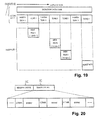
- Figure 3 shows the data structure of an audio file and MIDI files to be reproduced in a program.
- the audio file contains the audio data codes and duration data codes.
- the duration data codes express a lapse of time from the first audio data code at the head of the audio file.
- discrete values are sampled from the waveform of an analog audio signal at 44.1 kilo-hertz, and are stored in the audio data codes.
- the series of audio data codes in the audio file expresses plural contents such as, for example, narration and tunes.
- the tune 1 is explained in the narration 1
- the tunes 2 and 3 are explained in the narration 2
- the tune 3 is explained in the narration 3.
- the audio data codes for the narration 1 are firstly converted to voice
- the audio data codes for the tune 1 are converted to tones
- the audio data codes for the narration 2 are converted to voice
- the audio data codes for the narration 3 are converted to voice
- the audio data codes for the tune 4 are converted to tones.
- the narration 1, 2 and 3 and tunes 1, 2, 3 and 4 form a program.
- Plural MIDI files are correlated with the audio file. Tones are reproduced on the basis of the music data codes in the MIDI file 1 instead of the playback of the tune 1 recorded in the audio file, the tones are reproduced on the basis of the music data codes in the MIDI files 2 and 3 in synchronism with the playback of the tunes 2 and 3, and the tones are reproduced on the basis of the music data codes in the MIDI file 4 in synchronism with the playback of the tune 4. While the program is being reproduced in collaboration between the sound reproducer 10 and automatic player musical instrument 20, the narration 1, 2 and 3 is reproduced from the audio signal produced in the sound reproducer 10, and the music tunes 1 to 4 are reproduced through the automatic player musical instrument 20A on the basis of the music data codes.
- the program is reproduced in collaboration between the sound reproducer 10 and the automatic player musical instrument 20.
- the conversion of audio data is well synchronized with the data processing on the music data codes, and the electric tones for the music tunes 1, 2, 3 and 4 are muted in the playback through the automatic player musical instrument 20.
- the narration may be replaced with dialogue, talk, silence or natural sound such as, for example the sound of waves.
- a MIDI file is called as an "SMF (Standard MIDI File)", and is broken down into a header chunk HC and a track chunk TC. Pieces of attribute data are stored in the header chunk for the MIDI file, and the event data codes and duration data codes are stored in the track chunk TC.
- the duration data codes of audio file express a lapse of time from the audio data code at the head of audio file, each of the duration data codes of MIDI file expresses a lapse of time between a key event and the next key event.
- Figure 5 illustrates the contents of the file identifier together with the program management table 33a.
- the file identifier is broken down into an audio file name, a file size and a creation date.
- the audio file is identified with the audio file name.
- the file size expresses the number of bytes occupied by the audio file, and the creation date is indicative of the year, month and day at which the audio file is created.
- an audio file is labeled with the audio file name "piano-fan. wab”. 41.5 mega-bytes are required for the audio file named as "piano-fan. wab", and the audio file is created in January 25, 2006.
- the audio file named as "piano-fan. wab" is correlated with the program labeled with the program identifier "CID 001".
- the revised date is written as the creation date.
- One of the file size and creation date may be omitted from the file identifier.
- the file identifiers shown in figure 5 do not set any limit to the technical scope of the present invention. Any format is available for the file identifier in so far as the audio file is designable with the file identifier. For example, numerals may be simply assigned to the audio files.
- the controller searches the program management table 33a for the audio file by using the fine identifier as a key, and determines the program identifier correlated with the file identifier.
- Figure 6 illustrates the contents of the program labeled with the program identifier "CID 001".
- the program identifier "CID 001" is correlated with a playback schedule, URL addresses of MIDI files and MIDI file names in the program. Start time at which the playback starts and termination time at which the playback is completed are written in the playback schedule for each of the MIDI files. For example, the playback of a tune in the MIDI file "piano-fan001. mid” starts at 1 min. and 16 sec, and the playback is completed at 5 min. and 48 sec, and the MIDI file is stored at the memory location assigned the URL address "http://www.abc.Co.jp/ CID001/ pianofan001.mid".
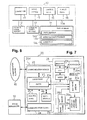
- the automatic player musical instrument 20 largely comprises an acoustic piano 20a, a code generating system 20b, an automatic playing system 20c, communication modules 20d and an electronic tone producer 26.
- the music data codes which express the tones in accordance with the MIDI protocols, i.e., MIDI data codes, are produced by means of the code generating system 20b.
- the automatic playing system 20c is responsive to MIDI data codes so as to perform a music tune on the acoustic piano 20a without any fingering of the human player.
- the electronic tone producer 26 is also responsive to the music data codes and an audio signal supplied from the outside thereof.so as to produce electric tones along the music passage expressed by the music data codes and electric voice expressed by the audio signal.
- the acoustic piano 20a includes a keyboard 20e, i.e., an array of black keys 20f and white keys 20h, action units 20j, hammers 20k, strings 20m, dampers 20n, a pedal mechanism 20p and a piano cabinet 20q.
- the keyboard 20a is mounted on a key bed, which forms a bottom part of the piano cabinet 20q, and the black keys 20f and white keys 20h are linked with the action units 20j at the intermediate portions thereof and dampers 20n at the rear portions thereof.
- the action units 20j are further linked with the hammers 20k, and the hammers 20k are opposed to the strings 20m.
- the dampers 20n are spaced from and brought into contact with the strings 20m depending upon the key positions on loci of keys 20f/ 20h.
- the pedal mechanism 20p is linked with the keyboard 20e and dampers 20n, and the human player and automatic playing system 20c directly change the keyboard 20e and dampers 20n for artificial expressions.
- the depressed key 20f/ 20h starts to travel on the locus. While the depressed key 20f/ 20h is traveling on the locus, the depressed key 20f/ 20h causes the dampers 20n to be spaced from the strings 20m, and actuates the associated action unit 20j.
- the actuated action unit 20j makes the hammer 20k driven for rotation toward the string 20m. The hammer 20k is brought into collision with the string 20m at the end of rotation, and gives rise to vibrations of the string 20m.
- the vibrating string 20m in turn gives rise to the vibrations of a sound board, which forms a part of the piano cabinet 20q, and an acoustic piano tone is radiated from the acoustic piano 20a.
- the hammer 20k rebounds on the string 20m, and is captured by the action unit 20j.
- the released key 20f/ 20h starts backwardly to travel on the locus.
- the released key 20f/ 20h permits the damper 20n to move toward the string 20m, and is brought into contact with the string 20m so as to decay the vibrations of string 20m.
- the released key 20f/ 20h permits the action unit 20j to return to the rest position shown in figure 2B .
- the human player When the human player gives the artificial expression to the tones, the human player steps on the pedal of the pedal mechanism 20p, and makes the acoustic piano tone prolonged or lessened in loudness.
- the code generating system 20b includes key sensors 26b, hammer sensors 20s and a music data producer 20t.
- the key sensors 26b monitor the associated black and white keys 20f/ 20h, and supply key position signals S 1 indicative of current key positions to the music data producer 20t.
- the hammer sensors 20s monitors the associated hammers 20k, and supply hammer position signals S2 indicative of current hammer positions to the music data producer 20t.
- the key position signals S 1 and hammer position signals S2 are analyzed in the music data producer 20t, and the music data codes are output from the music data producer 20t.
- the music data codes are supplied from the music data producer 20t to the electronic tone producer 26, and electronic tones are produced through the electronic tone producer 26 on the basis of the music data codes. Otherwise, the music data codes form a MIDI file, and the MIDI file is stored in a data storage of the code generating system 20b.
- the automatic playing system 20c includes solenoid-operated actuators 26a, the key sensors 26b, pedal sensors 26c and an electronic system 26d.
- the solenoid-operated actuators 26a are provided for the black keys 20f, white keys 20h and pedal mechanism 20p, and are selectively energized by the electronic system 20d so as to give rise to the movements of the black keys 20f, white keys 20h and pedal mechanism 20p.
- the electronic system 26d is connected to the communication modules 20d and electronic tone producer 26.
- a MIDI file and an audio file are supplied from the communication modules 20d to the electronic system 26d, and the audio file is transferred from the electronic system 26d to the electronic tone producer 26.
- the electronic system 26d selectively drives the black keys 20f, white key 20h and pedal mechanism 20p on the basis of the music data codes stored in the received MIDI file.
- the electronic system 26d includes an information processor and current driving circuits (not shown) such as, for example, pulse width modulators.
- a computer program for an automatic playing runs on the information processor so as to realize functions referred to as a "preliminary data processor 20v", a “motion controller 20w” and a “servo controller 20x". Since the key event data codes and effect data codes are produced on the assumption that they are applied to an ideal MIDI musical instrument, the pieces of event data and pieces of effect data are to be individualized to the automatic player musical instrument 20.
- the preliminary data processor 20v makes the music data codes in the received MIDI file individualized to the automatic player musical instrument 20.
- preliminary data processor 20v measures the lapse of time from the previous key event and previous pedal event on the basis of the duration data codes. The time to process a note-on event data code is assumed to come.
- the motion controller 20w analyzes the piece of event data, and determines a reference forward key trajectory.
- the reference forward key trajectory is a series of values of target key position varied together with time. If the black key 20f or white key 20h travels on the reference forward key trajectory, the hammer 20k is brought into collision with the string 20m at a target time at which the acoustic piano tone is to be produced, and the acoustic piano tone is generated through the vibrations of string 20m at a target value of loudness.
- the values of target key position are periodically supplied from the motion controller 20w to the servo controller 20x.
- the key sensors 26b supply the key position signals S1 indicative of the actual key position to the servo controller 20x.
- the servo controller 20x calculates a value of target key velocity from a series of values of target key velocity and a value of actual key velocity from a series of values of actual key position, and compares the value of target key position and value of target key velocity with a value of actual key position and a value of actual key velocity so as to determine the difference between the target key position and the actual key position and the difference between the target key velocity and the actual key velocity.
- the servo controller 20x increases or decreases a target value of mean current of a driving signal S4 in such a manner as to minimize the different of key position and difference of key velocity, and the current driving circuit (not shown) adjusts the driving signal S4 to the target value of means current.
- the above-described jobs are periodically repeated for the black/ white key 20f/ 20h.
- the solenoid-operated actuators 26a for the black and white keys 20f/ 20h, key sensors 26b, servo controller 20x and current driving circuits (not shown) form a servo control loop, and the black keys 20f and white keys 20h are forced to travel on the reference forward key trajectories through the servo control loop.
- the motion controller 20w determines a reference backward key trajectory on the basis of the piece of note-off event data.
- the reference backward key trajectory is a series of values of target key position toward the rest position. If the black key 20f or white key 20h travels on the reference backward key trajectory, the released key 20f/ 20h permits the damper 20n to be brought into contact with the vibrating string 20m at the time to make the note-off event occur, and the acoustic piano tone is decayed.
- the values of target key position are periodically supplied from the motion controller 20w to the servo controller 20x, and the servo controller 20x forces the released key 20f/ 20h to travel on the reference backward key trajectory.
- the motion controller 20w determines a reference pedal trajectory on the basis of the piece of effect data.
- the reference pedal trajectory is a series of values of target pedal position, and the values of target pedal position are periodically supplied from the motion controller 20w to the servo controller 20x.
- the pedal sensors 26c monitor the pedals of the pedal mechanism 20p, and supply a pedal position signal S3 indicative of an actual pedal position to the servo controller 20x.
- the servo controller 20x calculates a target pedal velocity and an actual pedal velocity, and determines the mean current of a driving signal S5 in such a manner as to minimize the difference between the target pedal position and the actual pedal position and the difference between the target pedal velocity and the actual pedal velocity.
- the current driving circuit (not shown) adjusts the driving signal S5 to the value of mean current, and the driving signal S5 is supplied from the current driving circuit (not shown) to the solenoid-operated actuator 26a provided for the pedal.
- the above-described jobs are periodically repeated, and the pedal is forced to travel on the reference pedal trajectory.
- the communication modules 20d include a controller 21, a clock 21 a, a data storage 22, a communication module 23, a communication module 24 and a control panel 25.
- the communication network 40 is connected to the communication module 23, and the automatic player musical instrument 20 communicates with the music data distribution server computer 30 through the communication module 23 under the supervision of the controller 21.
- the other communication module 24 is implemented by an USB (Universal Serial Bus) interface or a radio transmitter and receiver, and is used for communication with the sound reproducer 10.
- USB Universal Serial Bus
- the controller 21 is implemented by an information processor, and a central processing unit, peripheral processors, a program memory and a working memory are incorporated in the information processing system.
- the information processor is shared between the controller 21 and the electronic system 26d.
- a computer program for the communication with external apparatus is stored in the program memory, and runs on the central processing unit so as to achieve the communication with the music data distribution server computer 30, reception of MIDI files from the music data distribution server computer 30, communication with the sound reproducer 10 and reception of duration data codes and audio signal from the sound reproducer 10 as will be hereinlater described in detail.
- the clock 21 a has an oscillator, which is implemented by a quartz oscillator and an amplifier, and a frequency demultiplier connected to the oscillator for producing various clock signals, and counts the clock signal so as to measure a lapse of time.
- the controller 21 periodically sets the clock 21 a with the duration data codes of an audio file so that the lapse of time on the clock 21 a is equal to the lapse of time from the audio data code at the head of the audio file.
- the duration data codes of audio file are supplied from the sound reproducer 10 to the communication module 24, and are transferred from the communication module 24 to the controller 21.
- the data storage 22 is, by way of example, implemented by a hard disk unit.
- the controller 21 transfers the program and MIDI files to the data storage 22, and the program and MIDI files are stored in the data storage 22.
- the controller 21 While the automatic playing system 20c is performing a music tune on the acoustic piano 20a on the basis of the MIDI file already stored in the data storage 22, the controller 21 periodically checks the clock 21a to see whether or not the time period expressed by the duration data code is expired. When the controller 21 finds that the time period is expired, the controller 21 supplies the next event data code or codes to the electronic system 26d, and the electronic system 26d selectively supplies the driving signals S4 and S5 to the solenoid-operated actuators 26a so as to depress and release the black keys 20f, white keys 20h and pedal mechanism 20p. Thus, the time intervals are measured with reference to the clock 21a so as to drive the acoustic piano 20a well in synchronism with the conversion from the audio data codes in the audio file to the audio signal.
- the electronic tone producer 26 includes an electronic tone generator 26e, a mixer 26f, an amplifier 26g and loud speakers 26h.
- the code generating system 20b produces the music data codes expressing the acoustic piano tones in a real time fashion, and supplies the music data codes to the electronic tone producer 26.
- An audio signal is produced in the electronic tone generator 26e on the basis of the music data codes, and is supplied from the electronic tone generator 26e to the mixer 26f. If another audio signal is supplied from the controller 21 to the mixer 21, the audio signals are mixed with one another, and are amplified through the amplifier 26g.
- the audio signal passes through the mixer 26f, and is amplified through the amplifier 26g. After the amplification, the audio signal is supplied to the loud speakers 26h, and is converted to the electronic tones through the loud speakers 26h.
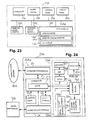
- Figure 8 shows the system configuration of sound reproducer 10.
- the sound reproducer includes a controller 11, communication modules 12 and 13, a data storage 14, a control panel 15, a display panel 16 and a sound system 17.
- the controller 11, communication modules 12 and 13, data storage 14, control panel 15, display panel 16 and sound system 17 are connected to an internal bus system 10a so that the controller 11 is communicable with the other system components 12, 13, 14, 15, 16 and 17 through the internal bus system 10a.
- the controller 11 is implemented by an information processor, and a central processing unit, peripheral processors, a program memory and a working memory are incorporated in the information processor.
- Application programs such as www browser 14a and an audio playback program 14b are stored in the data storage together with audio files 14c and an FTA (File Allocation Table). The application programs selectively run on the central processing unit.
- the communication module 12 is connected to the communication network 40. While the www browser is running on the central processing unit, the sound reproducer 10 communicates with the music data distribution server computer 30, and the audio files are downloaded to the data storage 14.
- the other communication module 13 is implemented by an USB interface or a radio transmitter and receiver, and is connected to the communication interface 24 of the automatic player musical instrument 20 through a wired channel or a radio channel.
- the controller 11 transfers the audio signal and duration data codes in an audio file through the communication module 13 to the communication module 24.
- the control panel 15 includes a computer keyboard and a mouse. A user gives his or her instruction to the sound reproducer 10 through the control panel 15.
- the display panel 16 is, by way of example, implemented by a liquid crystal display panel, and controller 11 produces visual images on the display panel 16. The user has dialogues with the controller 11 through the control panel 15 and display panel 16.
- the sound system 17 includes amplifiers, loud speakers and a headphone.
- the audio data codes are transferred from the audio file in the data storage 14 to the sound system 17, and an audio signal is retrieved from the audio data codes.
- the audio signal is converted to the electric tones through the amplifiers and loud speakers.
- the audio signal is transferred through the communication module 13 to the communication module 24 of automatic player musical instrument 20, and the duration data codes are further transferred to the communication module 24 of automatic player musical instrument 20 for the synchronization between playback and conversion from the audio data codes to the audio signal.
- the audio signal is relayed through the controller 21 to the mixer 26f, and the electric voice is produced through the loud speakers 26h.
- Figure 9 shows a communication sequence between the sound reproducer 10 and the music data distribution server computer 30.
- the computer program 33c for music data distribution has been already running on the controller 31 of the music data distribution server computer 30.
- a user is assumed to wish to download an audio file for a program.
- the user gives an instruction to communicate with the data distribution server computer 30 to the sound reproducer 10 through the control panel 15.
- the controller 11 acknowledges user's instruction as indicated by S1, and makes the www browser to run on the controller 11.
- the controller 11 designates the URL address indicative of the memory location assigned a menu or a list of programs, and sends a request for downloading the menu, i.e., an http request from the communication module 12 to the communication module 32 of the data distribution server computer 30 as indicated by S2.
- the music data distribution server computer 30 Upon reception of the request, the music data distribution server computer 30 reads out the visual data expressing the menu from the data storage 33 as indicated by S3, and transmits the visual data as an http response to the sound reproducer 10 as indicated by S4.
- the visual data expressing the menu arrives at the communication module 12. Then, the controller 11 produces the visual image of menu on the display panel 16 as indicated by S5.
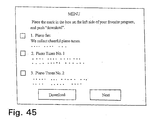
- Figure 10 shows the visual image of menu produced on the display panel 16.
- Program names "Piano fan”, “Piano tunes No. 1” and “Piano tunes No.2” take place under a prompt message "Place the mark in the box on the left side of your favorite program, and push "download””.
- the programs are followed by recommendation to users.
- the URL addresses are added to the program names by means of the anchor tag of HTML (Hyper Text Markup Language).
- the user selects a program from the menu, and places the mark in the box on the left side of the program name by means of a pointer.
- the controller 11 acknowledges the user's selection of program as indicated by S6, and transmits the request, which contains the URL address, from the communication module 12 to the communication module 32 of the music data distribution server computer 30 as by S7.
- the user does not find any favorite program, he or she clicks the image of button "Next”. Then, other programs are displayed.
- the controller 31 Upon reception of the request, the controller 31 accesses the audio file at the URL address, and reads out the audio file corresponding to the program name from the data storage 33 as indicated by S8. The controller 31 transmits the audio file from the communication module 32 to the communication module 12 as indicated by S8.
- the audio file arrives at the communication module 12. Then, the controller 11 transfers the audio file to the data storage 14, and stores the audio file in the data storage 14 as indicated by S10. Thus, the download is accomplished.
- the user is assumed to instruct the controller 11 the playback through the sound system 17. In other words, any collaboration is not requested.
- the audio playback program starts to run on the controller 11.
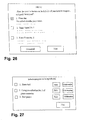
- the controller 11 reads out the program names of audio files already stored in the data storage 14, and produces a list of program name on the display panel 16 together with a prompt message "Select a program to be reproduced" as shown in figure 11 .
- the audio file "Piano fan!” is labeled with the program identifier "CID 001 ", and contains "narration 1", “music tune 1", “narration 2", “music tune 2, "music tune 3", “narration 3” and “music tune 4" as shown in figure 3 . Therefore, the audio signal is converted to the narration and music tunes in the order shown in figure 3 .
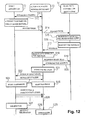
- Figure 12 shows a communication sequence among the sound reproducer 10, automatic player musical instrument 20 and music data distribution server computer 30.
- the user establishes a communication channel between the communication module 13 of sound reproducer 10 and the communication module 24 of automatic player musical instrument as indicated by S11, and gives the sound reproducer 10 an instruction for playback.
- the audio playback program starts to run on the controller 11, and produces the picture shown in figure 11 on the display panel 16.
- the controller 11 acknowledges the user's instruction for playback as indicated by S12.
- the controller 11 accesses the FAT, and reads out the file identifier, which includes the pieces of data information expressing the file name "piano-fan. wab", file size "41.5 mega-bytes” and creation date "2006/ 1/ 25" from the FAT.
- the controller 11 transmits the file identifier from the communication module 13 to the communication module 24 of the automatic player musical instrument 20 as indicated by S 13.
- the controller 21 Upon reception of the file identifier, the controller 21 transmits the file identifier from the communication module 23 to the music data distribution sever computer 30 as indicated by S 14.
- the controller 31 accesses the program management table 33a shown in figure 5 , and determines the program identifier "CID001" as indicated by S15.
- the controller 31 searches the data storage 33 for the program labeled with the program identifier "CID001", and reads out the program from the data storage 33 as indicated by S16.
- the controller 31 transmits the read-out program from the communication module 32 to the communication module 23 of the automatic player musical instrument 20 as indicated by S 17.
- the program arrives at the communication module 23. Then, the controller 21 searches the data storage 22 for the program labeled with the program name to see whether or not the MIDI files of the program have been already stored in the data storage 22 as indicated by S 18. As shown in figure 6 , the program contains the MIDI files "piano-fan001.mid”, “piano-fan002.mid”, “piano-fan003.mid” and “piano-fan004.mid”. Only the MIDI files “piano-fan002.mid” and “piano-fan003.mid” are assumed to be stored in the data storage 22. In other words, the MIDI files "piano-fan001.mid” and “piano-fan004.mid” are not found in the data storage 22.
- the controller 21 transmits a http request, which contains the URL addresses "http://www.abc. co.jp/ CID001/ piano-fan001.mid” and "http://www.abc.co.jp/ CID001/ piano-fan004.mid", from the communication module 23 to the communication module 32 as indicated by S 19.
- the hppt request is received by the communication module 32.
- the controller 31 reads out the MIDI file "piano-fan001.mid”, which is labeled with the URL address "http://www.abc.co.jp/ CID001/ piano-fan001.mid”, from the data storage 33, and transmits the MIDI file from the communication module 32 to the communication module 23 as an http response.
- the controller 31 further reads out the MIDI file, which is labeled with the URL address "http://www.abc.co.jp/ CID001/ piano-fan004.mid", from the data storage 33, and transmits the MIDI file from the communication module 32 to the communication module 23.
- the MIDI files are downloaded to the automatic player musical instrument 20 as indicated by S20.
- the controller 21 transfers the MIDI files from the communication module 23 to the data storage 22, and stores the MIDI files in the data storage 22 as indicated by S21.
- the controller 21 gets ready to perform the music tunes 1 to 4.
- the controller 21 sends a notice of ready-state from the communication module 24 to the communication module 13 of sound reproducer 10 as indicated by S22.
- the controller 11 Upon reception of the notice of ready-state, the controller 11 produces a picture shown in figure 13 on the display panel 16 so as to inform the user of the ready-state and ask for permission. The user is assumed to click the box "Yes”. Then, the controller 11 sends a notice of initiation from the communication module 13 to the communication module 24 as indicated by S23.
- the sound reproducer 10 starts the conversion from the audio data codes to the audio signal as indicated by S24.
- the automatic player musical instrument 20 starts the playback on the basis of the music data codes of MIDI file as indicated by S25, and starts to measure the lapse of time with the clock 21a.
- the audio signal and duration data codes are transmitted from the communication module 13 to the communication module 24 as indicated by S26.
- Figure 14 shows a job sequence realized through execution of the computer program installed in the controller 21 and electronic system 26d.
- the program contains the playback schedule.
- the first music tune starts at 1' 16", and is terminated at 5' 48", and the second music tune starts at 6' 29", and is terminated at 14' 00".
- “Narration 1” is to be reproduced until 1' 16", and "narration 2" is inserted between the first music tune and the second music tune as shown in figure 3 .
- the controller 21 checks the clock 21a to see whether or not the time to playback the first music tune comes as by step S101.
- the answer at step S101 is given negative "No" from the initiation of playback to 1' 16", and the controller 21 transfers the audio signal from the communication module 24 to the mixer 26f so as to reproduce the narration 1.
- step S101 The answer at step S101 is changed to affirmative "Yes" at 1' 16". Then the controller 21 supplies the first key event data code or codes from the data storage 22 to the electronic system 26d, and mutes the electric tones to be produced from the audio signal as by step S103. Thus, the controller 21 blocks the mixer 26f from the audio signal converted from the audio data codes. Any electric tone is not reproduced from the audio signal.
- the user has two options, i.e., the automatic playing system 20c and electronic tone producer 26. If the user selects the automatic playing system 20c, the black keys 20f, white keys 20h and pedal mechanism 20p are selectively driven by the solenoid-operated actuators 26a as described hereinbefore, and the acoustic piano tones are produced through the acoustic piano 20a.
- the electronic tone producer 26 the music data code or codes are transferred to the electronic tone generator 26e.
- the audio signal is produced on the basis of the music data code or codes, and is supplied through the mixer 26f and amplifier 26g to the loudspeakers 26h.
- the audio signal is converted to the electric tones along the music passage of the first music tune.
- the controller 21 checks the clock 21 a to see whether or not the time to terminate the playback comes as by step S104.
- the answer at step S104 is given negative "No" until 5' 48", and the controller returns to step S 103.
- the controller checks the clock 21a to see whether or not the time period between the key event and the next key event is expired. While the answer is being given negative "No", the controller 21 continuously sets the clock 21a with the duration data codes of the audio file. When the time period is expired, the controller 21 transfers the next event data code or codes to the electronic system 26d for producing the acoustic piano tone or electronic tone.
- the controller 21 reiterates the loop consisting of steps S101 to step S 104 until 5' 48".
- the controller 21 restarts to supply the audio signal to the mixer 26f, and the narration 2 is reproduced.
- the audio signal is changed to the event data codes at 6' 29", and the second music tune is reproduced through the automatic player musical instrument 20 until 14' 00".
- the third music tune starts at 14' 13"without any narration, and is terminated at 24' 13".
- the third music tune is followed by the narration 3 reproduced from the audio signal, and the fourth music tune is reproduced through the automatic player musical instrument 20 between 25' 20" to 31' 23".
- the program proceeds in the order shown in figure 6 , and the narration and music tunes are selectively reproduced on the basis of the audio files and MIDI files.
- the sound reproducer 10 terminates the data processing as indicated by S27, and sends a notice of termination to the automatic playing musical instrument 20 as indicated by S28. Upon reception of the notice of termination, the automatic playing musical instrument 20 also terminates the data processing.
- the clock 21 a which is periodically set with the duration data codes of the audio file, makes the sound reproducer 10 synchronized with the automatic player musical instrument 20 in spite of the difference in format between the duration data codes in the audio file and the duration data codes in the MIDI file, and the program makes it possible to reproduce the music tunes and narration/ talk in collaboration between the sound producer 10 and the automatic playing musical instrument 20.
- the automatic player musical instrument 30 is available for the playback of music tunes so that the music reproducing system gives the music tunes with convert-hall presence.
- the computer programs may be installed in the controllers 11, 21 and 31 from a magnetic tape cassette, a magnetic disk, a flexible disk, an optical disk, an opto-magnetic disk, a compact disc, a DVD (Digital Versatile Disk) or a RAM stick.
- the first modification of the music reproducing system is different from the first embodiment in the communication from S 14 to S21.
- the first embodiment only the MIDI files not found in the data storage 22 are downloaded from the music data distribution server computer 30. This feature is desirable from the viewpoint of reduction of load in downloading work.
- the automatic player musical instrument 20 transmits the file identifier to the music data distribution server computer 30, all of the MIDI music data files and program are concurrently downloaded from the music data distribution server computer 30 to the automatic player musical instrument 20.
- the communication is made simplified rather than the communication in the first embodiment.
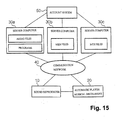
- Figure 15 illustrates the system configuration of the second modification of the first embodiment.
- the audio files, programs and MIDI files are stored in the music data distribution server computer 30, the audio files and programs are stored in a server computer 30a different from the server computers 30b and 30c where the MIDI files are stored.
- the program and audio files are firstly downloaded from the server computer 30a to the sound reproducer 10, and makes the automatic player musical instrument 20 to transmit a request for downloading the MIDI files at the URL addresses in the program from the server computer 30b and/ or 30c to the automatic player musical instrument 20.
- FIG 16 there is shown the third modification of the music reproducing system of the present invention.
- the third modification includes a composite musical instrument 10x, another composite musical instrument 20x, the music data distribution server computer 30 and the communication network 40.
- the sound reproducer 10 is physically separated from the automatic player musical instrument 20 in the first embodiment shown in figure 1
- a built-in computer system 10y and an automatic player piano 20z have a unitary structure in the composite musical instrument 10x
- a built-in computer system 10y and an electronic keyboard 20y also have a unitary structure in the composite musical instrument 20x.
- the built-in computer systems 10y are similar in system configuration to the personal computer system 10.
- the audio signal which is produced from audio data codes in an audio file, is converted to the electric voice and electric tones through the sound system 17, and the acoustic piano tones are produced through the acoustic piano on the basis of the music data codes in MIDI files.
- the audio signal is also converted to the electric voice and electric tones through the sound system 17 in the composite musical instrument 20x
- the electronic tones are produced through an electronic tone producer, which is similar to the electronic tone producer 26, of the electronic keyboard 20y on the basis of the music data codes in MIDI files.
- the automatic player piano 20z is not equipped with the electronic tone producer 26, and the electronic keyboard 20y is much simpler than the automatic player musical instrument 20.
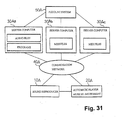
- the fourth modification of the music reproducing system has an accounting system 50.
- the accounting system 50 is, by way of example, implemented by various accounting networks such as the Japan Bank Network and/ or CAFIS (Credit And Finance Information System), and is connected to the server computers 30a, 30b and 30c.
- CAFIS Clear And Finance Information System
- the audio files and MIDI files are priced, and are accompanied with price lists in the data storages 33 of the server computers 30a, 30b and 30c.
- a user list is further stored in the data storages 33, and the users have been registered in the user list.
- the name, address, birthday, user identifier, bank account number and credit card number are written in the user list for each of the registered users.
- the controller 31 When a user requests the server computer 30a, 30b or 30c for the download of an audio file, a program or a MIDI file, the controller 31 requests the user to send the user identifier to the server computer 30a, 30b or 30c, and transmits the program or file to the sound reproducer or automatic player musical instrument 20 after the confirmation of the user.
- the controller 31 accesses the price list so as to write out a bill, and sends the bill to the account system 50 for the settlement. If the user requests the service providers to settle the accounts through the credit card system, the service providers put the bill in the credit account. Thus, the bills are automatically settled at the user's account number through the accounting system 50.
- the fifth modification of music reproducing system is different from the music reproducing system 100 in that the automatic player musical instrument 20 can reproduce music tunes through in-stream playback on the basis of MIDI files.
- the music data codes are transmitted from the music data distribution server computer 30 through the communication network 40, and the music tune is reproduced on the basis of the music data codes in a real time fashion. Otherwise, the MIDI file is stored in the random access memory, and is erased after the playback. For this reason, it is difficult to reuse the music data codes after the in-stream playback.
- a user can choose the playback method between the standard playback after the download and the in-stream playback. If the user chooses the standard playback, the automatic player musical instrument 20 behaves as similar to that shown in figure 12 .
- the music data codes are transmitted from the music data distribution server computer 30 to automatic player musical instrument 20, and are temporarily stored in the random access memory of the controller 21. The music data codes are timely transferred to the electronic system 26d so as to produce the acoustic piano tones or electronic tones on the basis of the event data codes.
- the in-stream playback is beneficial to users, because the price of MIDI files for the in-stream playback is lower than the price of MIDI files for the standard playback. Users may choose the standard playback for music tunes out of the copyright, and choose the in-stream playback for the copyrighted music tunes.
- the MIDI files are broken down into two groups, the copyrighted music tunes, i.e., the first group and the music tunes out of the copyright, i.e., the second group, and a tag indicative of the first group is added to the MIDI files in the first group, and another tag indicative of the second group is added to the MIDI files in the second group.
- a user is assumed to reproduce the contents of a program.
- the program contains copyrighted music tunes and music tunes out of the copyright.
- the MIDI files in the second group are downloaded into the data storage 22.
- the MIDI files in the first groups are not downloaded.
- the music tunes out of the copyright are reproduced on the basis of the music data codes in the MIDI files stored in the data storage 22 between the start time and the termination time designated in the program, and the controller 21 requests the music data distribution server computer 30 to transmit the music data codes expressing the copyrighted music tunes to the communication module 23 before the start time so as to permit the electronic system 26d to start the playback at the start time.
- the music data codes in the random access memory are erased.
- the service provider can restrict the reuse of the MIDI file through the in-stream playback, and offer the program contents at low price.
- the sixth modification of music reproducing system is different from the music reproducing system 100 in that only one of the sound reproducer 10 and automatic player musical instrument 20 has the communication capability with the music data distribution server computer 30.
- the automatic player musical instrument 20 acquires a program and MIDI files from the music data distribution server computer 30 through the sound reproducer 10.
- the automatic player musical instrument 20 requests the sound reproducer 10 for the acquisition of program and MIDI files through the communication channel 40c, and the program and MIDI files are downloaded from the communication module 32 to the communication module 12.
- the controller 11 transfers the program and MIDI files from the communication module 13 to the communication module 24 through the communication channel 40c.
- the automatic player musical instrument 20 or sound reproducer 10 of the sixth modification is simpler than that of the music reproducing system 100.
- the seventh modification is different from the music reproducing system 100 in that the playback on the basis of the MIDI file is made synchronous with the conversion from the audio data codes to the audio signal through the synchronization technique disclosed in Japan Patent Application laid-open No. 2003-271138 or the synchronization technique disclosed in Japan Patent Application laid-open No. 2006-47761 .
- the synchronization technique disclosed in the former laid-open is that unique peaks of an audio signal are correlated with music data codes in a table.
- the controller checks the table to see whether or not the music data codes are processed concurrently with the unique peaks. When the answer is given negative, the controller advances the internal clock or puts the internal clock slow. Since the time intervals between the key events are measured with the internal clock, the two apparatus are synchronized with one another.
- the synchronization technique disclosed in the latter laid-open is that the synchronization control is assigned to one of the plural channels between two apparatus. While the audio data codes are being converted to the audio signal, the controller of sound reproducer assigns the pieces of audio data to the channel L and LTC, which is a time code defined in the SMTPE (Society of Motion Picture and Television Engineers) and contains the pieces of time data and file identifier, to the channel R, and transmits the pieces of audio data and LTC to the automatic player musical instrument through the channels L and R.
- the controller of automatic player musical instrument makes the internal clock set with the pieces of time data contained in the LTC.
- the eighth modification is different from the music reproducing system 100 in that the controller 21 does not block the mixer 26f from the audio signal, which is produced from the audio data codes in the sound reproducer 10.
- the electric tones are produced from the audio signal concurrently with the acoustic piano tones or electronic tones.
- the electric tones may be produced through the sound system 17 or both of the loudspeakers 26h and sound system 17. In case where the electric tones are produced through the sound system 17, the audio signal is not transmitted to the communication module 24, and only the duration data codes are supplied through the communication module 24 to the controller 21.
- the ninth modification is different from the music reproducing system 100 in that either audio files, program or MIDI files are read out from a portable information storage medium such as, for example, a compact disc, a flexible disc, an MD, an audio cassette tape or a record disc.
- a portable information storage medium such as, for example, a compact disc, a flexible disc, an MD, an audio cassette tape or a record disc.
- the other materials are downloaded from the music data distribution server computer 30 through the communication network 40.
- the tenth modification is different from the music reproducing system 100 in that the MIDI file or files are downloaded after the initiation of reproduction of a program. Of course, each MIDI file is required before the start time.
- the eleventh modification is different from the music reproducing system 100 in that another sort of electronic device serves as the sound reproducer 10.
- the personal computer may be replaced with a mobile telephone, a PHS (Personal Handy phone System) terminal, a PDA (Personal Digital Assistants) or a portable music player.
- PHS Personal Handy phone System
- PDA Personal Digital Assistants
- FIG 17 shows the system configuration of another music reproducing system 100A of the present invention.
- the music reproducing system 100A comprises a sound reproducer 10A, an automatic player musical instrument 20A, a music data distribution server computer 30A and a communication network 40A.
- the system configuration of music reproducing system 100A is analogous to the music reproducing system 100.
- the music reproducing system 100A is different from the music reproducing system in that the sound reproducer 10A and automatic player musical instrument 20A reproduce the contents of a program in collaboration therebetween in the absence of a MIDI file expressing a music tune contained in the program.
- the sound reproducer 10A, automatic player musical instrument 20A and music data distribution server computer 30A are connected to the communication network 40A through a wire communication channel or a radio communication channel, and communicate with one another through the communication network 40A.
- the sound reproducer 10A is further connected to the automatic player musical instrument 20A through a wire communication channel or a radio communication channel 40c so that the sound reproducer 10A and automatic player musical instrument 20A are directly communicable with one another through the wire communication channel/ radio communication channel 40c.
- the sound reproducer 10A is, by way of example, implemented by a personal computer system, and an audio playback computer program is installed in the personal computer system so as to convert pieces of audio data or audio data codes to tones and/ or sound.
- the audio data codes express discrete values on the waveform of an audio signal representative of the tones and/ or sound.
- the automatic player musical instrument 20A is a combination of an acoustic piano and an automatic playing system, and the automatic playing system performs a music tune on the acoustic piano without any fingering of a human player.
- the automatic player musical instrument 20A further includes an electronic tone producer, and electronic tones are produced on the basis of the music data codes by means of the electronic tone producer.
- users have a choice between the acoustic piano tones and the electronic tones.
- the music data distribution server computer 30A is put on the WWW together with the sound reproducer 10A and automatic player musical instrument 20A.
- the music data distribution server computer 30A, sound reproducer 10A and automatic player musical instrument 20A form a client-server system through the communication network 40A.
- the communication network 40A includes various sorts of networks such as the internet, telephone networks and so forth.
- the MIDI files, programs and audio files are distributed from the music data distribution server computer 30A to the sound reproducer 10A and automatic player musical instrument 20A through the communication network 40A.
- Programs are prepared for reproduction through the sound reproducer 10A and automatic player musical instrument 20A in collaboration with one another.
- At least one music tune is contained in the program together with narration and/ or talk, and is expressed by the audio data codes in an audio file as well as the music data codes in a MIDI file.
- the user When a user wishes to reproduce the program, the user gives the instruction to reproduce the music tune and narration.
- the audio file and MIDI file are downloaded to the sound reproducer 10A and automatic player musical instrument 20A, respectively, and the narration and music tune are reproduced through the sound reproducer 10A and automatic player musical instrument 20A, respectively, as similar to the music reproducing system 100.
- all the MIDI files in a program are not always stored in the music data distribution server computer 30A.
- the MIDI files, which are stored in the music data distribution server computer 30A are downloaded to the automatic player musical instrument 20A, the automatic player musical instrument 20A can not acquire the remaining MIDI file or files.
- the automatic player musical instrument 20A reproduces the music tunes on the basis of the acquired MIDI files, and the sound reproducer 10A reproduces the other music tune or tunes from the audio file or files instead of the MIDI file or files as well as the narration.
- the music reproducing system 100A can reproduce all the music tunes in the program in spite of the absence of MIDI file or files.
- Figure 18 illustrates the circuit configuration of the data distribution server computer 30A.
- the data distribution server computer 30A includes a controller 31A, a communication module 32A and a data storage 33A, and the controller 31A, communication module 32A and data storage 33A are connected to one another through an internal bus system 34A.
- the controller 31 A includes a central processing unit, peripheral processors, a program memory and a working memory, and a computer program 33Ac runs on the controller 31A so as to achieve various tasks such as a data management, analysis of requests of clients, a file transmission and so forth.
- the communication module 32A is connected to the communication network 40A.
- the client requests are received at the communication module 32A, and programs, audio files and MIDI files are transmitted from the communication module 32A to the sound reproducer 10A and automatic player musical instrument 20A.
- the data storage 33A is, by way of example, implemented by a hard disk unit or hard disk units, and the storage space in the hard disk or disks are assigned to a program management table 33a, programs 33Ab, a computer program 33Ac, audio files 33d and MIDI files 33e.
- a job sequence is expressed by the computer program 33Ac for distributing the audio files 33d and MIDI files 33e to clients, and pieces of visual image data are further stored in the memory subspace assigned to the computer program 33Ac.
- Various pictures to be produced in client's display panels are expressed by the pieces of visual image data.
- File identifiers for the audio files are correlated with programs in the program management table 33a, and the MIDI files and URL addresses are correlated with the program identifiers in the programs 33Ab.
- Figure 19 shows the data structure of an audio file and MIDI files to be reproduced in a program.
- the audio file contains the audio data codes and duration data codes.
- the duration data codes express a lapse of time from the first audio data code at the head of the audio file.
- discrete values are sampled from the waveform of an analog audio signal at 44.1 kilo-hertz, and are stored in the audio data codes.
- the series of audio data codes in the audio file expresses plural contents such as, for example, narration and tunes.
- the tune 1 is explained in the narration 1, the tunes 2 and 3 are explained in the narration 2, and the tune 3 is explained in the narration 3.
- the audio data codes for the narration 1 are firstly converted to voice, the audio data codes for the tune 1 are converted to tones, subsequently, the audio data codes for the narration 2 are converted to voice, and is followed by the conversion of audio data codes for the tones of tunes 2 and 3, thereafter, the audio data codes for the narration 3 are converted to voice, and, finally, the audio data codes for the tune 4 are converted to tones.
- the narration 1, 2 and 3 and tunes 1, 2, 3 and 4 form a program. Thus, a single music tune or plural music tunes are to be reproduced in each program.
- MIDI files are correlated with the audio file. Tones are reproduced on the basis of the music data codes in the MIDI file 1 instead of the playback of the tune 1 recorded in the audio file, and the tones are reproduced on the basis of the music data codes in the MIDI files 2 and 3 instead of the playback of the tunes 2 and 3. However, any MIDI file, which expresses the tune 4, is not stored in the data storage 33A.
- the music tunes 1, 2 and 3 are reproduced by means of the automatic player musical instrument 20A, and the narration 1, 2 and 3 and music tune 4 are reproduced from the audio signal produced in the sound reproducer 10A.
- the program is completely reproduced through the sound reproducer 10A and automatic player musical instrument 20A in spite of the absence of MIDI file for the music tune 4.
- a MIDI file is broken down into a header chunk HC and a track chunk TC.
- Pieces of attribute data are stored in the header chunk for the MIDI file, and the event data codes and duration data codes are stored in the track chunk TC.
- the duration data codes of audio file express a lapse of time from the audio data code at the head of audio file
- each of the duration data codes of MIDI file expresses a lapse of time between a key event and the next key event.
- Figure 21 illustrates the contents of the program management table 33a.
- the file identifier is broken down into an audio file name, a file size and a creation date.
- the audio file is identified with the audio file name.
- the file size expresses the number of bytes occupied by the audio file, and the creation date is indicative of the year, month and day at which the audio file is created.
- an audio file is labeled with the audio file name "piano-fan. wab”. 41.5 mega-bytes are required for the audio file named as "piano-fan. wab”, and the audio file is created in January 25, 2006.
- the audio file named as "piano-fan. wab" is correlated with the program labeled with the program identifier "CID 001".
- the revised date is written as the creation date.
- One of the file size and creation date may be omitted from the file identifier.
- the file identifiers shown in figure 21 do not set any limit to the technical scope of the present invention. Any format is available for the file identifier in so far as the audio file is designable with the file identifier. For example, numerals may be simply assigned to the audio files.
- the controller searches the program management table 33a for the audio file by using the fine identifier as a key, and determines the program identifier correlated with the file identifier.
- Figure.22 illustrates the contents of the program labeled with the program identifier "CID 001".
- the program labeled with the program identifier "CID 001" is correlated with a playback schedule, URL addresses of MIDI files and MIDI file names in the program. Start time at which the playback starts and termination time at which the playback is completed are written in the playback schedule for each of the MIDI files. For example, the playback from the MIDI file "piano-fan001. mid” starts at 1 min. and 16 sec, and the playback is completed at 5 min. and 48 sec, and the MIDI file is stored at the memory location assigned the URL address "http://www.abc.Co.jp/ CID001/ piano-fan001.mid".
- the MIDI file for the music tune 4 is not stored in the music data distribution server computer 30A, neither URL address nor file name is written in the fourth row as shown.
- Figure 23 shows the system configuration of sound reproducer 10A.
- the sound reproducer 10A includes a controller 11A, communication modules 12A and 13A, a data storage 14A, a control panel 15A, a display panel 16A and a sound system 17A.
- the controller 11 A, communication modules 12A and 13A, data storage 14A, control panel 15A, display panel 16A and sound system 17A are connected to an internal bus system 10Aa so that the controller 11A is communicable with the other system components 12A, 13A, 14A, 15A, 16A and 17A through the internal bus system 10Aa.
- the controller 11A is implemented by an information processor, and a central processing unit, peripheral processors, a program memory and a working memory are incorporated in the information processor.
- Application programs such as www browser 14a and an audio playback program 14b are stored in the data storage 14A together with audio files 14c and an FTA (File Allocation Table). The application programs selectively run on the central processing unit.
- the communication module 12A is connected to the communication network 40A. While the www browser is running on the central processing unit, the sound reproducer 10A communicates with the music data distribution server computer 30A, and the audio files are downloaded to the data storage 14A.
- the other communication module 13A is implemented by an USB interface or a radio transmitter and receiver, and is connected to the automatic player musical instrument 20A through a wired channel or a radio channel.
- the controller 11 A transfers the audio signal and duration data codes in an audio file through the communication module 13A to the automatic player musical instrument 20A.
- the control panel 15A includes a computer keyboard and a mouse. A user gives his or her instruction to the sound reproducer 10A through the control panel 15A.
- the display panel 16A is, by way of example, implemented by a liquid crystal display panel, and controller 11A produces visual images on the display panel 16A. The user has dialogues with the controller 11A through the control panel 15A and display panel 16A.
- the sound system 17A includes amplifiers, loud speakers and a headphone.
- the audio data codes are transferred from the audio file in the data storage 14A to the sound system 17A, and an audio signal is retrieved from the audio data codes.
- the audio signal is converted to the electric tones through the amplifiers and loud speakers.
- the audio signal is transferred through the communication module 13A to the automatic player musical instrument 20A, and the duration data codes are further transferred to the automatic player musical instrument 20A for the synchronization between playback and conversion from the audio data codes to the audio signal.
- the automatic player musical instrument 20A largely comprises an acoustic piano (not shown), a code generating system (not shown), an automatic playing system 20Ac, communication modules 20Ad and an electronic tone producer 26A.
- the acoustic piano and code generating system are omitted from figure 24
- the structure of acoustic piano and the system configuration of code generating system are similar to those shown in figure 2B .
- the components of automatic playing system 20Ac are similar to those of the automatic playing system 20c. For this reason, the components of automatic playing system 20Ac are labeled with references designating the corresponding components of automatic playing system 20c without detailed description.
- the communication modules 20Ad include a controller 21, a clock 21a, a data storage 22, a communication module 23, a communication module 24 and a control panel 25.
- the communication network 40A is connected to the communication module 23, and the automatic player musical instrument 20A communicates with the music data distribution server computer 30A through the communication module 23 under the supervision of the controller 21.
- the other communication module 24 is implemented by an USB interface or a radio transmitter and receiver, and is connected to the communication module 13A of sound reproducer 10A.
- the controller 21 is implemented by an information processor, and a central processing unit, peripheral processors, a program memory and a working memory are incorporated in the information processing system.
- the information processor is shared between the controller 21 and the electronic system 26d.
- a computer program for the communication with external apparatus is stored in the program memory, and runs on the central processing unit so as to achieve the communication with the music data distribution server computer 30A, reception of MIDI files from the music data distribution server computer 30A, communication with the sound reproducer 10A and reception of duration data codes and audio signal from the sound reproducer 10A as will be hereinlater described in detail.
- the clock 21a is similar in circuit configuration to that of the communication modules 20d, and a lapse of time is measured with the clock 21 a.
- the controller 21 periodically sets the clock 21 a with the duration data codes of an audio file so that the lapse of time on the clock 2 1 a is equal to the lapse of time from the audio data code at the head of the audio file.
- the duration data codes of audio file are supplied from the communication module 13A of sound reproducer 10A to the communication module 24, and are transferred from the communication module 24 to the controller 21.
- the data storage 22 is, by way of example, implemented by a hard disk unit.
- the controller 21 transfers the program and MIDI files to the data storage 22, and the program and MIDI files are stored in the data storage 22.
- the controller 21 While the automatic playing system 20Ac is performing a music tune on the acoustic piano (not shown) on the basis of the MIDI file already stored in the data storage 22, the controller 21 periodically checks the clock 21a to see whether or not the time period expressed by the duration data code is expired. When the controller 21 finds that the time period is expired, the controller 21 supplies the next event data code or codes to the electronic system 26d, and the electronic system 26d selectively supplies the driving signals to the solenoid-operated actuators 26a so as to depress and release the black keys, white keys and pedal mechanism. Thus, the time intervals are measured with reference to the clock 21a so as to drive the acoustic piano (not shown) well in synchronism with the conversion from the audio data codes in the audio file to the audio signal.
- the electronic tone producer 26A includes an electronic tone generator 26e, a mixer 26f, an amplifier 26g and loudspeakers 26h.
- the electronic tone generator 26e, mixer 26f, amplifier 26g and loudspeakers 26h are same as those of the electronic tone producer 26. For this reason, no further description on those components 26e, 26f, 26g and 26h is not incorporated for the sake of simplicity.
- the controller 21 is connected to the mixer 26f, and the audio signal, which is produced from the audio data codes in an audio file, is transferred to the mixer 26f on the condition that neither audio signal nor driving signals is supplied from the tone generator 26e and electronic system 26d to the mixer 26f and solenoid-operated actuators 26a.
- the controller 21 interrupts the audio signal during the playback of a music tune on the basis of the music data codes in a MIDI file.
- Figure 25 shows a communication sequence between the sound reproducer 10A and the music data distribution server computer 30A.
- the computer program 33Ac for music data distribution has been already running on the controller 31A of the music data distribution server computer 30A.
- a user is assumed to wish to download an audio file for a program.
- the user gives an instruction to communicate with the data distribution server computer 30A to the sound reproducer 10A through the control panel 15A.
- the controller 11A acknowledges user's instruction as indicated by S1A, and makes the www browser to run on the controller 11 A.
- the controller 11A designates the URL address indicative of the memory location assigned a menu, i.e., a list of programs, and sends a request for downloading the menu, i.e., an http request from the communication module 12A to the communication module 32A of the data distribution server computer 30A as indicated by S2A.
- the music data distribution server computer 30A Upon reception of the request, the music data distribution server computer 30A reads out the visual data expressing the menu from the data storage 33A as indicated by S3A, and transmits the visual data as an http response to the sound reproducer 10A as indicated by S4A.
- the visual data expressing the menu arrives at the communication module 12A. Then, the controller 11 A produces the visual image of menu on the display panel 16A as indicated by S5A.
- Figure 26 shows the visual image of menu produced on the display panel 16A.
- Program names "Piano fan”, “Piano tunes No. 1” and “Piano tunes No.2” take place under a prompt message "Place the mark in the box on the left side of your favorite program, and push "download””.
- the programs are followed by recommendation to users.
- the URL addresses are added to the program names by means of the anchor tag of HTML.
- the user selects a program from the menu, and places the mark in the box on the left side of the program name by means of a pointer.
- the controller 11A acknowledges the user's selection of program as indicated by S6A, and transmits the request, which contains the URL address, from the communication module 12A to the communication module 32A of the music data distribution server computer 30A as by S7A.
- the user does not find any favorite program, he or she clicks the image of button "Next". Then, other programs are displayed.
- the controller 31A Upon reception of the request, the controller 31A accesses the audio file at the URL address, and reads out the audio file corresponding to the program name from the data storage 33A as indicated by S8A. The controller 31A transmits the audio file from the communication module 32A to the communication module 12A as indicated by S8A.
- the audio file arrives at the communication module 12A. Then, the controller 11A transfers the audio file to the data storage 14A, and stores the audio file in the data storage 14A as indicated by S10A. Thus, the download is accomplished.
- the user is assumed to instruct the controller 11A the playback through the sound system 17A. In other words, any collaboration is not requested.
- the audio playback program starts to run on the controller 11A.
- the controller 11A reads out the program names of audio files already stored in the data storage 14A, and produces a list of program name on the display panel 16A together with a prompt message "Select a program to be reproduced" as shown in figure 27 .
- the audio file "Piano fan!” is labeled with the program identifier "CID 001", and contains "narration 1", “music tune 1", “narration 2", “music tune 2, "music tune 3", “narration 3” and “music tune 4" as shown in figure 19 . Therefore, the audio signal is converted to the narration and music tunes in the order shown in figure 19 regardless of the absence of MIDI file for the music tune 4.
- Figure 28 shows a communication sequence among the sound reproducer 10A, automatic player musical instrument 20A and music data distribution server computer 30A.
- the user establishes a communication channel between the communication module 13A of sound reproducer 10A and the communication module 24 of automatic player musical instrument 20A as indicated by S 11A, and gives the sound reproducer 10A an instruction for playback.
- the audio playback program starts to run on the controller 11A, and produces the picture shown in figure 26 on display panel 16A.
- the controller 11A acknowledges the user's instruction for playback as indicated by S12A.
- the controller 11A accesses the FAT, and reads out the file identifier, which includes the pieces of data information expressing the file name "piano-fan. wab", file size "41.5 mega-bytes” and creation date "2006/ 1/ 25" from the FAT.
- the controller 11A transmits the file identifier from the communication module 13A to the communication module 24 of the automatic player musical instrument 20A as indicated by S13A.
- the controller 21 Upon reception of the file identifier, the controller 21 transmits the file identifier from the communication module 23 to the music data distribution sever computer 30A as indicated by S14A.
- the controller 31A accesses the program management table 33a shown in figure 21 , and determines the program identifier "CID001" as indicated by S15A.
- the controller 31A searches the data storage 33A for the program labeled with the program identifier "CID001", and reads out the program from the data storage 33A as indicated by S16A.
- the controller 31A transmits the read-out program 33b from the communication module 32A to the communication module 23 of the automatic player musical instrument 20A as indicated by S17A.
- the program 33b arrives at the communication module 23.
- the controller 21 searches the data storage 22 for the program labeled with the program name to see whether or not the MIDI files of the program 33b have been already stored in the data storage 22 as indicated by S18A.
- the program contains the MIDI files "piano-fan001.mid”, “piano-fan002.mid” and “piano-fan003.mid”. Only the MIDI files “piano-fan002.mid” and “piano-fan003.mid” are assumed to be stored in the data storage 22. In other words, the MIDI file "piano-fan001.mid” is not found in the data storage 22.
- the controller 21 transmits a http request, which contains the URL address "http://www.abc.co.jp/ CID001/ piano-fan001.mid", from the communication module 23 to the communication module 32A as indicated by S19A.
- the hppt request is received by the communication module 32A.
- the controller 31A reads out the MIDI file "piano-fan001.mid", which is labeled with the URL address "http://www.abc.co.jp/ CID001/ piano-fan001.mid", from the data storage 33A, and transmits the MIDI file from the communication module 32A to the communication module 23 as an http response.
- the MIDI files are downloaded to the automatic player musical instrument 20A as indicated by S20A.
- the controller 21 may ask the user whether or not the user wish to download the MIDI file "piano-fan001.mid” through the display panel 16A. In this instance, when the user instructs the controller 21 to download the MIDI file "piano-fan001.mid”, the controller 21 requests the music data distribution server computer 30A to transmit the MIDI file "piano-fan001.mid”. On the other hand, if the user gives the negative answer to the controller 21, the controller 21 does not transmits the request to the music data distribution server computer 30A, and transmits the notice of ready-state to the sound reproducer 10A as will be hereinlater described in conjunction with a job at S22A.
- the controller 21 transfers the MIDI file from the communication module 23 to the data storage 22, and stores the MIDI files in the data storage 22 as indicated by S21A.
- the controller 21 gets ready to perform the music tunes 1 to 3.
- the controller 21 sends a notice of ready-state from the communication module 24 to the communication module 13A of sound reproducer 10A as indicated by S22A.
- the controller 11A Upon reception of the notice of ready-state, the controller 11A produces a picture shown in figure 29 on the display panel 16A so as to inform the user of the ready-state, and asks for permission. The user is assumed to click the button of mouse at box "Yes”. Then, the controller 11A sends a notice of initiation from the communication module 13A to the communication module 24 as indicated by S23S.
- the sound reproducer 10 starts the conversion from the audio data codes to the audio signal as indicated by S24A.
- the automatic player musical instrument 20A starts the playback on the basis of the music data codes of MIDI file as indicated by S25A, and starts to measure the lapse of time with the clock 21a.
- the audio signal and duration data codes are transmitted from the communication module 13A to the communication module 24 as indicated by S26A.
- Figure 30 shows a job sequence realized through execution of the computer program installed in the controller 21 and electronic system 26d.
- the program contains the playback schedule.
- the first music tune starts at 1' 16", and is terminated at 5' 48".
- the second music tune starts at 6' 29", and is terminated at 14' 00".
- "Narration 1" is to be reproduced before the first music tune, and "narration 2" is inserted between the first music tune and the second music tune as shown in figure 19 .
- the controller 21 checks the clock 21 a to see whether or not the time to playback the first music tune comes as by step S101A.
- the answer at step S101 is given negative "No" from the initiation of playback to 1' 16", and the controller 21 transfers the audio signal from the communication module 24 to the mixer 26f as by step S102A. For this reason, the narration 1 is reproduced.
- step S101A The answer at step S101A is changed to affirmative "Yes" at 1' 16". Then, the controller 21 checks the data storage 22 to see whether or not the MIDI file has been prepared for the music tune to be reproduced as by step S103A.
- the MIDI file for the music tune 1 has bee downloaded from the music data distribution server computer 30A as indicated by S20A in figure 28 . For this reason, the answer at step S 103A is given affirmative "Yes”.
- the controller 21 supplies the first key event data code or codes from the data storage 22 to the electronic system 26d, and mutes the electric tones to be produced from the audio signal as by step S104A. Thus, the controller 21 blocks the mixer 26f from the audio signal converted from the audio data codes. Any electric tone is not reproduced from the audio signal.
- the user has two options, i.e., the automatic playing system 20Ac and electronic tone producer 26A. If the user selects the automatic playing system 20Ac, the black keys, white keys and pedal mechanism are selectively driven by the solenoid-operated actuators 26a, and the acoustic piano tones are produced through the acoustic piano (not shown).
- the electronic tone producer 26A the music data code or codes are transferred to the electronic tone generator 26e.
- the audio signal is produced on the basis of the music data code or codes, and is supplied through the mixer 26f and amplifier 26g to the loudspeakers 26h.
- the audio signal is converted to the electric tones along the music passage of the first music tune.
- the controller 21 checks the clock 21a to see whether or not the time to terminate the playback comes as by step S105A.
- the answer at step S105A is given negative "No" until 5' 48", and the controller returns to step S104A.
- the controller 21 checks the clock 21a to see whether or not the time period between the key event and the next key event is expired. While the answer is being given negative "No", the controller 21 continuously sets the clock 21a with the duration data codes of the audio file. When the time period is expired, the controller 21 transfers the next event data code or codes to the electronic system 26d for producing the acoustic piano tone or electronic tone.
- the controller 21 reiterates the loop consisting of steps S104A to step S105A until 5,' 48".
- the controller 21 restarts to supply the audio signal to the mixer 26f, and the narration 2 is reproduced.
- the audio signal is changed to the supply of event data codes at 6' 29", and the second music tune is reproduced through the automatic player musical instrument 20 until 14' 00".
- the third music tune starts at 14' 13"without any narration, and is terminated at 24' 13".
- the third music tune is followed by the narration 3 reproduced from the audio signal.
- the controller 21 checks the data storage 22 to see whether or not the MIDI file has been prepared for the fourth music tune at S103A.
- the music data distribution server computer 30A does not have the MIDI file "piano-fan004.mid” in the data storage 33A, and, accordingly, the MIDI file "piano-fan004.mid” is not prepared for the playback.
- the answer at step S103A is given negative "No"
- the controller 21 supplies the audio signal to the mixer 26f.
- the electric tones are reproduced from the audio signal as similar to the narration 1, 2 and 3.
- the sound reproducer 10A terminates the data processing as indicated by S27A, and sends a notice of termination to the automatic playing musical instrument 20A as indicated by S28A.
- the automatic playing musical instrument 20A Upon reception of the notice of termination, the automatic playing musical instrument 20A also terminates the data processing as indicated by S29A.
- the programs are reproduced in collaboration between the sound reproducer 10A and the automatic player musical instrument 20A as similar to those in the description on the first embodiment.
- the audience feels the reproduction of program in collaboration between the sound reproducer 10A and automatic player musical instrument 20A close to the performance in a live concert.
- the music tune or tunes are reproduced from the audio data codes in the audio file instead of the music data codes in the MIDI file.
- all the contents of program are reproduced regardless of the absence of a MIDI file or files expressing a music tune or tunes in the program.
- the first modification of music reproducing system 100A is different from the second embodiment in that only the start time is specified in the program 33Ab. This is because of the fact that the time period for the play-back, i.e., the amount of music data is defined in the MIDI file. In other words, the termination time is determinable through the addition of the playback time period to the start time.
- the second modification of music reproducing system 100A is different from the second embodiment in that the electric voice and electric tones are produced through the sound system 17A.
- the audio signal is not supplied to the automatic player musical instrument 20A, the duration time codes in the audio file are transmitted from the communication module 13A to the communication module 24.
- the controller 21 makes the data transfer to the electronic system 26d synchronized with the conversion of audio data codes to the audio signal as described hereinbefore.
- the audio signal may be converted to the electric tones and electric voice through both of the sound system 17A and electronic tone producer 26A.
- the third modification of music reproducing system 100A is different from the second embodiment in that the music data codes of a MIDI file expresses tones in one of the plural parts of a piece of music tune expressed by the audio data codes in an audio file.
- the music tune is assumed to be constituted by a vocal part, a guitar part and a piano part.
- the audio data codes of the MIDI file express only the tones of piano part. While the piano part is being reproduced through the automatic player musical instrument 20A, the electric tones of piano part are muted, and the audio signal expresses the other parts, i.e., the vocal part and guitar part.
- the playback through the automatic player piano 20A is synchronized with the conversion from the audio data codes to the audio signal so that the music tune is reproduced in good ensemble between the sound reproducer 10A and the automatic player musical instrument 20A.
- the fourth modification of music reproducing system 100A is different from the second embodiment in that the sound reproducer 10A stops the audio signal.
- controller 21 when controller 21 finds that the internal clock 21a points the start time to reproduce the music tune on the basis of the music data codes, the controller 21 starts to transmit the request for muting or minimizing the volume to zero from the communication module 24 to the communication module 13A, and starts to transfer the music data codes from the data storage 22 to the electronic system 26d.
- the controller 21 continuously transmits the request to the sound reproducer 10A during the playback on the basis of the music data codes, and the sound reproducer 10A does not permit the audio signal to arrive the communication module 13. Otherwise, the sound reproducer minimizes the volume to zero. As a result, the electric tones are not radiated from the loudspeakers 26h.
- the controller 21 causes the program 33Ab to be transmitted from the communication module 24 to the communication module 13A, and the program 33Ab is stored in the data storage 14A. While the contents of program 33Ab are sequentially being reproduced, the controller 11A checks the playback schedule to see whether or not a music tune is to be reproduced through the automatic player musical instrument 20A. When the start time comes, the controller 11A blocks the communication module 13A from the audio signal, or minimizes the volume to zero. The controller 11A keeps the muting or minimization until the termination time.
- the fifth modification of music reproducing system 100A is different from the second embodiment in that the controller 11A checks the device identification code to see whether or not the automatic player musical instrument 20A is connected to the communication module 13A.
- the device identification codes are exchanged between the sound reproducer 10A and the external device when the external device is connected to the communication module 13A.
- the controller 11A confirms that the automatic player musical instrument 20A is connected to the communication module 13A, the controller 11A does not transmit the audio signal to the automatic player musical instrument 20A during the playback on the basis of the MIDI files.
- the controller 11A permits the audio signal to be transmitted to the external device.
- the sixth modification of music reproducing system 100A is different from the second embodiment in that the controller 21 keeps the electronic tone producer 26A or sound system 17A silent prior to the playback on the basis of the MIDI files.
- the controller 21 prohibits the electronic tone producer 26A or sound system 17A from conversion to the electric voice or electric sound in a short time period before entry into the playback on the basis of the MIDI files.
- the short time period may be 0.5 second. Even if the time period for reproducing the audio signal from the audio data codes is partially overlapped with the time period for the playback on the basis of the MIDI file, the electronic tones or acoustic piano tones are not produced concurrently with the electric voice or electric sound in so far as the overlapped time period is fallen within the short time period.
- the seventh modification is different from the music reproducing system 100A in that the playback on the basis of the MIDI file is made synchronous with the conversion from the audio data codes to the audio signal through the synchronization technique disclosed in Japan Patent Application laid-open No. 2003-271138 or the synchronization technique disclosed in Japan Patent Application laid-open No. 2006-47761 .
- the synchronization technique disclosed in the former laid-open is that unique peaks of an audio signal are correlated with music data codes in a table.
- the controller checks the table to see whether or not the music data codes are processed concurrently with the unique peaks. When the answer is given negative, the controller advances the internal clock or puts the internal clock slow. Since the time intervals between the key events are measured with the internal clock, the two apparatus are synchronized with one another.
- the synchronization technique disclosed in the latter laid-open is that the synchronization control is assigned to one of the plural channels between two apparatus. While the audio data codes are being converted to the audio signal, the controller of sound reproducer assigns the pieces of audio data to the channel L and LTC, which is a time code defined in the SMTPE (Society of Motion Picture and Television Engineers) and contains the pieces of time data and file identifier, to the channel R, and transmits the pieces of audio data and LTC to the automatic player musical instrument through the channels L and R.
- the controller of automatic player musical instrument makes the internal clock set with the pieces of time data contained in the LTC.
- the eighth modification of the music reproducing system 100A is different from the second embodiment in the communication from S 14 to S21.
- the second embodiment only the MIDI files not found in the data storage 22 are downloaded from the music data distribution server computer 30A. This feature is desirable from the viewpoint of reduction of load in downloading work.
- the automatic player musical instrument 20A transmits the file identifier to the music data distribution server computer 30A, all of the MIDI music data files and program are concurrently downloaded from the music data distribution server computer 30A to the automatic player musical instrument 20A.
- the communication is made simplified rather than the communication in the first embodiment.
- Figure 31 illustrates the system configuration of the ninth modification of the second embodiment.
- the audio files, programs and MIDI files are stored in the single music data distribution server computer 30A in the second embodiment
- the audio files and programs are stored in a server computer 30Aa different from the server computers 30Ab and 30Ac where the MIDI files are stored.
- the program and audio files are firstly downloaded from the server computer 30Aa to the sound reproducer 10A, and makes the automatic player musical instrument 20A to transmit a request for downloading the MIDI files at the URL addresses in the program from the server computer 30Ab and/ or 30Ac to the automatic player musical instrument 20A.
- the sound reproducer 10A and automatic player musical instrument 20A may have a unitary structure.
- the accounting system 50A is, by way of example, implemented by various accounting networks such as the Japan Bank Network and/ or CAFIS (Credit And Finance Information System), and is connected to the server computers 30Aa, 30Ab and 30Ac.
- CAFIS Clear And Finance Information System
- the audio files and MIDI files are priced, and are accompanied with price lists in the data storages 33A of the server computers 30Aa, 30Ab and 30Ac.
- a user list is further stored in the data storages 33A, and the users have been registered in the user list.
- the name, address, birthday, user identifier, bank account number and credit card number are written in the user list for each of the registered users.
- the controller 31 A When a user requests the server computer 30Aa, 30Ab or 30Ac for the download of an audio file, a program or a MIDI file, the controller 31 A requests the user to send the user identifier to the server computer 30Aa, 30Ab or 30Ac, and transmits the program or file to the sound reproducer or automatic player musical instrument 20A after the confirmation of the user.
- the controller 31A accesses the price list so as to write out a bill, and sends the bill to the account system 50A for the settlement. If the user requests the service providers to settle the accounts through the credit card system, the service providers put the bill in the credit account. Thus, the bills are automatically settled at the user's account number through the accounting system 50A.
- the eleventh modification of music reproducing system 100A is different from the second embodiment in that the automatic player musical instrument 20A can reproduce music tunes through in-stream playback on the basis of MIDI files.
- the music data codes are transmitted from the music data distribution server computer 30A through the communication network 40A, and the music tune is reproduced on the basis of the music data codes in a real time fashion. Otherwise, the MIDI file is stored in the random access memory, and is erased after the playback. For this reason, it is difficult to reuse the music data codes after the in-stream playback.
- a user can choose the playback method between the standard playback after the download and the in-stream playback. If the user chooses the standard playback, the automatic player musical instrument 20A behaves as similar to that shown in figure 28 .
- the music data codes are transmitted from the music data distribution server computer 30A to automatic player musical instrument 20A, and are temporarily stored in the random access memory of the controller 21. The music data codes are timely transferred to the electronic system 26d so as to produce the acoustic piano tones or electronic tones on the basis of the event data codes.
- the in-stream playback is beneficial to users, because the price of MIDI files for the in-stream playback is lower than the price of MIDI files for the standard playback. Users may choose the standard playback for music tunes out of the copyright, and choose the in-stream playback for the copyrighted music tunes.
- the MIDI files are broken down into two groups, the copyrighted music tunes, i.e., the first group and the music tunes out of the copyright, i.e., the second group, and a tag indicative of the first group is added to the MIDI files in the first group, and another tag indicative of the second group is added to the MIDI files in the second group.
- a user is assumed to reproduce the contents of a program.
- the program contains copyrighted music tunes and music tunes out of the copyright.
- the MIDI files in the second group are downloaded into the data storage 22.
- the MIDI files in the first groups are not downloaded.
- the music tunes out of the copyright are reproduced on the basis of the music data codes in the MIDI files stored in the data storage 22 between the start time and the termination time designated in the program, and the controller 21 requests the music data distribution server computer 30A to transmit the music data codes expressing the copyrighted music tunes to the communication module 23 before the start time so as to permit the electronic system 26d to start the playback at the start time.
- the music data codes in the random access memory are erased.
- the service provider can restrict the reuse of the MIDI file through the in-stream playback, and offer the program contents at low price.
- the twelfth modification of music reproducing system 100A is different from the second embodiment in that only one of the sound reproducer 10A and automatic player musical instrument 20A has the communication capability with the music data distribution server computer 30A.
- the automatic player musical instrument 20A acquires a program and MIDI files from the music data distribution server computer 30A through the sound reproducer 10A.
- the automatic player musical instrument 20A requests the sound reproducer 10A for the acquisition of program and MIDI files through the communication channel 40c, and the program and MIDI files are downloaded from the communication module 32A to the communication module 12A.
- the controller 11A transfers the program and MIDI files from the communication module 13A to the communication module 24 through the communication channel 40c.
- the automatic player musical instrument 20A or sound reproducer 10A of the twelfth modification is simpler than that of the music reproducing system 100A.
- the thirteenth modification of music reproducing system 100A is different from the second embodiment in that either file size or creation date is omitted from the file identifier.
- the data structure of file identifier shown in figure 21 does not set any limit to the technical scope of the present invention.
- a serial number may serve as another file identifier.
- the fourteenth modification of music reproducing system 100A is different from the second embodiment in that either audio files, program or MIDI files are read out from a portable information storage medium such as, for example, a compact disc, a flexible disc, an MD, an audio cassette tape or a record disc.
- a portable information storage medium such as, for example, a compact disc, a flexible disc, an MD, an audio cassette tape or a record disc.
- the other materials are downloaded from the music data distribution server computer 30A through the communication network 40A.
- the fifteenth modification of music reproducing system 100A is different from the second embodiment in that the MIDI file or files are downloaded after the initiation of reproduction of a program.
- each MIDI file is required for the automatic player musical instrument 20A before the start time.
- the audio file shown in figure 19 does not set any limit to the technical scope of the present invention.
- An audio file may contain only music tunes.
- the sixteenth modification of music reproducing system 100A is different from the second embodiment in that another sort of electronic device serves as the sound reproducer 10A.
- the personal computer may be replaced with a mobile telephone, a PHS (Personal Handy phone System) terminal, a PDA (Personal Digital Assistants) or a portable music player.
- PHS Personal Handy phone System
- PDA Personal Digital Assistants
- the computer programs for the controllers 11A, 21 and 31A may be offered to users independently of the hardware.
- One or two of the computer programs or all of the computer programs may be stored in a magnetic tape cassette, a magnetic disc, a flexible disc, an optical information storage medium, an opto-magnetic information storage medium, a compact disc, a DVD disc or a RAM stick.
- the playback follows the programs already prepared for the sound reproducer 10/ 10A and automatic player musical instrument 20/ 20A.
- a program producer is incorporated in the music reproducing system of the third embodiment, and users prepare programs through the program producer.
- yet another music reproducing system 100B embodying the present invention largely comprises sound reproducers 10B and 10C, automatic player musical instruments 20B and 20C, a music data distribution server computer 30B and a communication network 40B. Although two sound reproducers 10B/ 10C and two automatic player musical instruments 20B/ 20C are shown in figure 32 , other sound reproducers and other automatic player musical instruments are further incorporated in the music reproducing system 100B.
- the sound reproducers 10B and 10C, automatic player musical instruments 20B and 20C and music data distribution server computer 30B are connected to the communication network 40B through wire communication channels or a radio communication channels, and communicate with one another through the communication network 40B.
- the sound reproducers 10B and 10C are respectively associated with the automatic player musical instruments 20B and 20C, and are further connected to the automatic player musical instruments 20B and 20C through wire communication channel or radio communication channels 40Bb and 40Bc.
- the sound reproducers 10B and 10C are directly communicable with the automatic player musical instruments 20B and 20C through the wire communication channel/ radio communication channels 40Bb and 40Bc, respectively.
- the sound reproducers 10B/ 10C collaborate with the associated automatic player musical instruments 20B/ 20C for reproducing programs.
- Each of the sound reproducers 10B and 10C is, by way of example, implemented by a personal computer system, and an audio playback computer program is installed in the personal computer system so as to convert pieces of audio data or audio data codes to electric tones, electric voice and/ or electric sound.
- the audio data codes express discrete values on the waveform of an audio signal representative of the tones, voice and/ or sound.
- An editorial picture is downloaded from the music data distribution server computer 30B to the sound producer 10B/ 10C for preparing new programs. While the editorial picture is being reproduced, users prepare new programs such as new music programs as will be hereinlater described in detail. The new programs are uploaded to the music data distribution server computer 30B through the communication network 40B.
- Each of the automatic player musical instruments 20B and 20C is a combination between an acoustic piano an automatic playing system, and the automatic playing system performs a music tune on the acoustic piano without any fingering of a human player.
- the automatic player musical instrument 20B/ 20C further includes an electronic tone producer, and electronic tones are produced on the basis of the music data codes by means of the electronic tone producer.
- users have a choice between the acoustic piano tones and the electronic tones.
- the music data distribution server computer 30B is put on the WWW together with the sound reproducers 10B/ 10C and automatic player musical instruments 20B/ 20C.
- the music data distribution server computer 30B, sound reproducers 10B/ 10C and automatic player musical instruments 20B/ 20C form a client-server system through the communication network 40B.
- the communication network 40B includes various sorts of networks such as the internet, telephone networks and so forth.
- the MIDI files, programs and audio files are distributed from the music data distribution server computer 30B to the sound reproducers 10B/ 10C and automatic player musical instruments 20B/ 20C through the communication network 40B.
- the programs are prepared for reproduction through the sound reproducer 10B/ 10C and associated automatic player musical instrument 20B/ 20C in collaboration with one another.
- At least one music tune is contained in the program together with narration and/ or talk, and is expressed by the audio data codes in an audio file as well as the music data codes in a MIDI file.
- Figure 33 illustrates the circuit configuration of the data distribution server computer 30B.
- the data distribution server computer 30B includes a controller 31B, a communication module 32B and a data storage 33B, and the controller 31B, communication module 32B and data storage 33B are connected to one another through an internal bus system 34B.
- the controller 31 B includes a central processing unit, peripheral processors, a program memory and a working memory, and computer programs 33Bc selectively run on the central processing unit of controller 31B so as to achieve various tasks such as a data management, analysis of requests of clients, a file transmission, completion of new programs and so forth.
- the communication module 32B is connected to the communication network 40B.
- the client requests are received at the communication module 32B, and programs, audio files and MIDI files are transmitted from the communication module 32B to the sound reproducers 10B/ 10C and automatic player musical instruments 20B/ 20C.
- the data storage 33B is, by way of example, implemented by a hard disk unit or hard disk units, and the storage space in the hard disk or disks are assigned to a program management table 33a, programs 33Bb, computer programs 33Bc, audio files 33Bd, MIDI files 33e and authentication data.
- An editorial computer program and a communication computer program are examples of the computer programs 33Bc, and composite audio files and individual audio files are referred to as "audio files 33Bd".
- Each of the individual audio files expresses a music tune.
- each of the composite audio files contains plural parts expressing silence and narration, talk and/ or sound as will be described hereinlater in detail.
- the contents of composite audio file and associated MIDI files are reproduced in collaboration between the sound reproducer 10B/ 10C and the associated automatic player musical instrument 20B/ 20C.
- Each piece of authentication data expresses a user who has already gotten an onerous contract with the service provider, and the service provider assigns a character string to the user.
- An identification code and a password may be expressed by the character string, and the user has determined the password.
- certain composite audio files and certain MIDI files are copyrighted, and such copyrighted works are distributed to the users under the onerous contract.
- Relation between file identifiers and composite audio files is defined in the program management table 33a, and relation between the contents of a composite audio file and playback schedule is defiled in the program.
- Figure 34 shows the data structure of a composite audio file and relation between the composite audio file and the MIDI files to be reproduced in a program.
- the composite audio file contains the audio data codes and duration data codes.
- the duration data codes express a lapse of time from the first audio data code at the head of the composite audio file.
- discrete values are sampled from the waveform of an analog audio signal at 44.1 kilo-hertz, and are stored in the audio data codes.
- the series of audio data codes in the composite audio file expresses plural contents such as, for example, narration and silence.
- a narrator may give his or her impression of music tunes 1, 2, 3 and 4 before the playback of music tunes as “narration 1", “narration 2” and “narration 3".
- the narration is followed by the playback on the basis of MIDI files expressing the music tunes.
- the narration is split into three parts "narration 1", “narration 2" and "narration 3", and the audio data codes expressing the silence are inserted between the narration 1 and the narration 2, between the narration 2 and the narration 3 and after the narration 3. While the music tunes are being reproduced, the audio data codes express the silence.
- a user is assumed to instruct the sound reproducer 10B/ 10C and associated automatic player musical instrument 20B/ 20C to reproduce the program shown in figure 34 .
- the audio data codes are continuously converted to the audio signal through the sound reproducer 10B/ 10C, and the music tunes 1, 2, 3 and 4 are reproduced on the basis of the MIDI files 1, 2, 3 and 4 through the automatic player musical instrument 20B/ 20C between the narration 1 and the narration 2, between the narration 2 and the narration 3 and after the narration 3.
- the contents of program are reproduced in the order of the narration 1, music tune 1, narration 2, music tunes 2 and 3, narration 3 and music tune 4.
- the duration data codes are supplied from the sound reproducer 10B/ 10C to the associated automatic player musical instrument 20B/ 20C as will be described hereinlater in detail.
- a MIDI file is broken down into a header chunk HC and a track chunk TC.
- Pieces of attribute data are stored in the header chunk for the MIDI file, and the event data codes and duration data codes are stored in the track chunk TC.
- the duration data codes of audio file express a lapse of time from the audio data code at the head of audio file
- each of the duration data codes of MIDI file expresses a lapse of time between a key event and the next key event.
- Figure 36 illustrates the contents of the program management table 33a.
- the file identifier is broken down into an audio file name, a file size and a creation date.
- the composite audio file is identified with the audio file name.
- the file size expresses the number of bytes occupied by the composite audio file, and the creation date is indicative of the year, month and day at which the audio file is created.
- an audio file is labeled with the audio file name "piano-fan. wab”. 41.5 mega-bytes are required for the audio file named as "piano-fan. wab", and the audio file is created in January 25, 2006.
- the audio file named as "piano-fan. wab" is correlated with the program labeled with the program identifier "CID 001".
- Figure.37 illustrates the contents of the program labeled with the program identifier "CID 001".
- the program labeled with the program identifier "CID 001" is correlated with a playback schedule, URL addresses of MIDI files and MIDI file names in the program. Start time at which the playback starts and termination time at which the playback is completed are written in the playback schedule for each of the MIDI files. For example, the playback from the MIDI file "piano-fan001. mid” starts at 1 min. and 16 sec, and the playback is completed at 5 min. and 48 sec, and the MIDI file is stored at the memory location assigned the URL address "http:// www.abc.Co.jp/ CID001/ piano-fan001.mid".
- Figure 38 shows the system configuration of sound reproducer 10B/ 10C.
- the sound reproducer 10B/ 10C includes a controller 11 B, communication modules 12B and 13B, a data storage 14B, a control panel 15B, a display panel 16B and a sound system 17B.
- the controller 11B, communication modules 12B and 13B, data storage 14B, control panel 15B, display panel 16B and sound system 17B are connected to an internal bus system 10Ba so that the controller 11B is communicable with the other system components 12B, 13B, 14B, 15B, 16B and 17B through the internal bus system 10Ba.
- the controller 11B is implemented by an information processor, and a central processing unit, peripheral processors, a program memory and a working memory are incorporated in the information processor.
- Application programs such as www browser 14a, an audio playback program 14b and a supporting computer program for editorial works 14Bb are stored in the data storage 14B together with an FTA and the audio files 14Bc, i.e., the composite audio files and individual audio files.
- the application programs selectively run on the central processing unit.
- the user prepares a new program with the assistance of the supporting computer program.
- the editorial computer program, controller 31B, supporting computer program, www browser and controller 11B as a whole constitute the program producer.
- the individual audio files are transferred from a portable information storage medium such as, for example, a magnetic tape cassette, a magnetic disk, a flexible disk, a compact disc or a DVD disc by the user.
- a portable information storage medium such as, for example, a magnetic tape cassette, a magnetic disk, a flexible disk, a compact disc or a DVD disc by the user.
- the communication module 12B is connected to the communication network 40B. While the www browser is running on the central processing unit, the sound reproducer 10B/ 10C communicates with the music data distribution server computer 30B. The composite program is uploaded to the music data distribution server computer 30B, and the programs and composite audio files are downloaded to the data storage 14B.
- the other communication module 13B is implemented by an USB interface or a radio transmitter and receiver, and is connected to the associated automatic player musical instrument 20B/ 20C through a wired channel or a radio channel.
- the controller 11B transfers the audio signal and duration data codes in a composite audio file through the communication module 13B to the associated automatic player musical instrument 20B/ 20C.
- the control panel 15B includes a computer keyboard and a mouse. A user gives his or her instruction to the sound reproducer 10B through the control panel 15B.
- the display panel 16B is, by way of example, implemented by a liquid crystal display panel, and controller 11B produces visual images on the display panel 16B. The user has dialogues with the controller 11B through the control panel 15B and display panel 16B.
- the sound system 17B includes amplifiers, loud speakers and a headphone.
- the audio data codes are transferred from the audio file in the data storage 14B to the sound system 17B, and an audio signal is retrieved from the audio data codes.
- the audio signal is converted to the electric tones through the amplifiers and loud speakers.
- the audio signal is transferred through the communication module 13B to the automatic player musical instrument 20B/ 20C, and the duration data codes are further transferred to the automatic player musical instrument 20B/ 20C for the synchronization between playback and conversion from the audio data codes to the audio signal.
- the automatic player musical instrument 20B/ 20C largely comprises an acoustic piano (not shown), a code generating system (not shown), an automatic playing system 20Bc, communication modules 20Bd and an electronic tone producer 26B.
- the acoustic piano and code generating system are omitted from figure 39 , the structure of acoustic piano and the system configuration of code generating system are similar to those shown in figure 2B .
- the components of automatic playing system 20Bc are similar to those of the automatic playing system 20c. For this reason, the components of automatic playing system 20Bc are labeled with references designating the corresponding components of automatic playing system 20c without detailed description.
- the communication modules 20Bd include a controller 21, a clock 21a, a data storage 22B, a communication module 23, a communication module 24 and a control panel 25.
- the communication network 40B is connected to the communication module 23, and the automatic player musical instrument 20B/ 20C communicates with the music data distribution server computer 30B through the communication module 23 under the supervision of the controller 21.
- the other communication module 24 is implemented by an USB interface or a radio transmitter and receiver, and is connected to the communication module 13B of sound reproducer 10B/ 10C.
- the controller 21 is implemented by an information processor, and a central processing unit, peripheral processors, a program memory and a working memory are incorporated in the information processing system.
- the information processor is shared between the controller 21 and the electronic system 26d.
- a computer program for the communication with external apparatus is stored in the program memory, and runs on the central processing unit so as to achieve the communication with the music data distribution server computer 30B, reception of MIDI files from the music data distribution server computer 30B, communication with the sound reproducer 10B/ 10C and reception of duration data codes and audio signal from the sound reproducer 10B/ 10C as will be hereinlater described in detail.
- the clock 21a is similar in circuit configuration to that of the communication modules 20d, and a lapse of time is measured with the clock 21 a.
- the controller 21 periodically sets the clock 21a with the duration data codes of an audio file so that the lapse of time on the clock 21a is equal to the lapse of time from the audio data code at the head of the audio file.
- the duration data codes of audio file are supplied from the communication module 13B of sound reproducer 10B/ 10C to the communication module 24, and are transferred from the communication module 24 to the controller 21.
- the data storage 22B is, by way of example, implemented by a hard disk unit.
- the controller 21 transfers the program and MIDI files to the data storage 22, and the program and MIDI files are stored in the data storage 22B.
- the controller 21 While the automatic playing system 20Bc is performing a music tune on the acoustic piano (not shown) on the basis of the MIDI file already stored in the data storage 22B, the controller 21 periodically checks the clock 21a to see whether or not the time period expressed by the duration data code is expired. When the controller 21 finds that the time period is expired, the controller 21 supplies the next event data code or codes to the electronic system 26d, and the electronic system 26d selectively supplies the driving signals to the solenoid-operated actuators 26a so as to depress and release the black keys, white keys and pedal mechanism. Thus, the time intervals are measured with reference to the clock 21 a so as to drive the acoustic piano (not shown) well in synchronism with the conversion from the audio data codes in the audio file to the audio signal.
- the electronic tone producer 26B includes an electronic tone generator 26e, a mixer 26f, an amplifier 26g and loudspeakers 26h.
- the electronic tone generator 26e, mixer 26f, amplifier 26g and loudspeakers 26h are same as those of the electronic tone producer 26. For this reason, no further description on those components 26e, 26f, 26g and 26h is not incorporated for the sake of simplicity.
- the controller 21a is connected to the mixer 26f, and the audio signal, which is produced from the audio data codes in an audio file, is transferred to the mixer 26f.
- the audio signal is converted to electric voice through the electronic tone producer 26B as well as through the sound system 17B.
- Figure 40 illustrates a communication sequence for preparation of a new program.
- a user is assumed to wish to prepare a new program on the sound reproducer 10B.
- the user gives an instruction to the controller 11B through the computer program and/ or mouse 15B.
- the controller 11B acknowledges user's instruction for communication with the music data distribution server computer 30B as indicated by S1B, and makes the www browser start.
- the controller 11B transmits a request, which contains an URL address assigned to the visual image data for producing an authentication picture, to the music data distribution server computer 30B as indicated by S2B.
- the controller 31 B reads out the piece of visual image data from the data storage 33B, and transmits the piece of visual image data from the communication module 32B to the communication module 12B of the sound reproducer 10B as indicated by S3B.
- the piece of visual image data arrives at the communication module 12B, and the controller 11B produces the authentication picture on the display panel 16B.
- the user inputs user's identification code and password into the control panel 15B so that the controller 11B transmits the user's identification code and password from the communication module 12B to the communication module 32B as indicated by S4B.
- the controller 31B Upon reception of user's identification code and password, the controller 31B reads out the piece of authentication data 33f of user from the data storage 33B, and compares the received user's identification code and password with the registered user's identification code and registered password to see whether or not the user has been under the onerous contract. If at least one of the user's identification code and password is different from the registered one, the controller 31 B transmits the visual image data expressing the inconsistency from the communication module 32B to the communication module 12B. On the other hand, when both of the user's identification code and passwords are consistent with the registered user's identification code and password, the controller 31B admits the right to access, and authenticates the user as indicated by S5B. The controller 31B reads out a piece of visual image data expressing a picture for editorial work from the data storage 33B, and transmits the piece of visual image data from the communication module 32B to the communication module 12B as indicated by S6B.
- the controller 11B Upon reception of the piece of visual image data, the controller 11B produces the picture for editorial work on the display panel 15B as indicated by S7B.
- the user selects an individual audio file or plural individual audio files and MIDI file or MIDI files on the picture for editorial work, and determines the order of contents in a new program with the assistance of supporting program running on the controller 11B as indicated by S8B.
- Figure 41 shows the picture for editorial work produced on the panel display 16B.
- the picture contains several windows “PROGRAM NAME” b1, "AUDIO FILE LIST” b2, “MIDI FILE LIST” b3, “LOCAL AUDIO FILELIST” b4, “LOCAL MIDI FILE LIST” b5 and “CONTENTS OF PROGRAM” b6 and images of boxes b7, b8, b9 and b10.
- the boxes are labeled with "ADD TO PROGRAM”, “DELETE FROM PROGRAM”, “REARRANGE” and "REGISTER”.
- the individual audio files, which are stored in the data storage 33B of music data distribution server computer 30B, are listed in the window "AUDIO FILE LIST” b2, and the MIDI files, which are also stored in the data storage 33B, are listed in the window “MIDI FILE LIST” b3.
- the individual audio files, which are stored in the data storage 14B of sound reproducer 10B, are listed in the window "LOCAL AUDIO FILE LIST” b4
- the MIDI files, which are also stored in the data storage 14B are listed in the window "LOCAL AUDIO FILE LIST” b5.
- the user is assumed to input the file name "piano-fan” through the control panel 15B, and the characters “piano-fan” are produced in the window b1.
- the user moves the cursor to an audio file name "narration 1. wav” in the window b4 by sliding the mouse, and clicks the button of mouse for designating the audio file "narration 1.wav”.
- the user moves the cursor into the box "ADD TO PROGRAM” by means of the mouse, and clicks the button.
- the audio file "narration 1.wav” is selected by the user, and the fine name "narration 1. wav” is written in the first row of the window b6.
- the user repeats the above described operations so that the rows in the window b6 are successively filled with the fine names "pianofan001. mid”, “narration 2. wav”, “pianofan002. mid”, “pianofan003. mid”, “narration 3.wav” and “pianofan004. mid”.
- the user moves the cursor to the file name in the window b6, clicks the button for designating the audio file or MIDI file to be deleted, moves the cursor into the box "DELETE FROM PROGRAM” for designating the operation, and clicks the button so as to delete the audio file or MIDI file from the program.
- the user can rearrange the order of contents by using the box "REARRANGE". Though not shown in figure 41 , another window is provided in the picture, and the user inputs introductory remarks through the control panel 15B, if desired so as to write the introductory remarks in the window.
- the controller 11B determines pieces of program data expressing the program name, contents of program and order of contents to be reproduced, and transmits the pieces of program data and pieces of audio data expressing the audio files selected from the local audio file list from the communication module 12B to the communication module 32B as a request for registration as indicated by S9B.
- the pieces of music data expressing the MIDI files and pieces of introductory data expressing the introductory remarks are added to the pieces of program data and pieces of audio data, and form other parts of the request for registration.
- the controller 31B Upon reception of the request for registration, the controller 31B transfers the request for registration, i.e., the pieces of program data and pieces of audio data from the communication module 32B to the data storage 33B, and stores the request for registration in the data storage 33B.
- the request for registration i.e., the pieces of program data and pieces of audio data from the communication module 32B to the data storage 33B.
- the controller 31B transfers the request for registration, i.e., the pieces of program data and pieces of audio data from the communication module 32B to the data storage 33B, and stores the request for registration in the data storage 33B.
- the controller 31B transfers the request for registration, i.e., the pieces of program data and pieces of audio data from the communication module 32B to the data storage 33B, and stores the request for registration in the data storage 33B.
- the controller 31 B selects the individual audio files and MIDI files from the data storage 33B as indicated by S10B, and determines the order of files to be reproduced as indicated by S11B.
- the controller 31 B further determines the playback time period for each of the contents of program on the basis of the file size of selected individual audio files and file size of MIDI files, and accumulates the playback time periods so as to determine the start time and termination time of each content of program. In short, the controller 31 B determines the playback schedule as indicated by S13B.
- Figure 42 shows the playback schedule of the program.
- the file names are correlated with the playback schedule.
- the time periods to be consumed by the contents are 1 minute and 16 seconds, 4 minutes and 32 seconds, 41 seconds, 7 minutes and 31 seconds, 10 minutes and 13 seconds, 1 minute and 7 seconds and 6 minutes and 3 seconds.
- the controller 31B accumulates the playback time periods so as to determine the start time at 0 minute and 0 second, 1 minute and 16 seconds, 5 minutes and 48 seconds, 6 minutes and 29 seconds, 14 minutes and 0 second, 24 minutes and 13 seconds and 25 minutes and 20 seconds.
- the termination time is equal to the start time of the next content, and the seventh content of the MIDI file "piano-fan004.mid" is terminated at 31 minutes and 23 seconds.
- the playback schedule is memorized in the data storage 33B.
- the controller 3 1 B spaces the second to seventh contents from the first to sixth contents by the time periods equal to the playback time of the first to sixth contents, and inserts the audio data codes expressing the silence.
- the composite audio file for the program "piano-fan. wab" is prepared, and is stored in the data storage 33B as indicated by S14B.
- Figure 43 shows the composite audio file "piano-fan. wab” and MIDI files to be inserted among the narration.
- the content “narration 2.wab” is spaced from the content “narration 1.wab” by the playback time of music tune recorded in the MIDI file “pianofan001.mid”, and the audio codes expressing the silence are inserted between the content “narration 1.wab” and the content “narration 2.wab”.
- the content “narration 2.wab” is spaced from the content “narration 3.wab” by the total playback time of the music tunes recorded in the MIDI files “pianofan002.mid” and “pianofan003.mid”, and the audio data codes expressing the silence are inserted between the content "narration 2.wab” and the content "narration 3.wab”.
- the content “narration 3.wab” is followed by the music tune recorded in the MIDI file “piano-fan004. mid”, and the time period consumed by the audio data codes expressing the silence is equal to the playback time of music tune recorded in the MIDI file "painofan004.mid”.
- the controller 31B issues the program identifier "CID001" on the program “piano-fan.wab”, and assigns the URL addresses to the contents of programs, respectively.
- the program "piano-fan.wab” is completed as shown in figure 37 .
- controller 31 B adds the file size and creation date to the composite audio file "piano-fan.wab", and registers the file identifier and program identifier in the program management table (see figure 36 ) as indicated by S15B.
- the controller 31B transmits a notice of registration from the communication module 32B to the communication module 12B.
- the controller 11B reproduces characters expressing the completion of registration on the display panel 16B, and terminates the data processing for the editorial work at the producing the characters.
- Figure 44 shows a communication sequence between the sound reproducer 10B and the music data distribution server computer 30B.
- a user is assumed to wish to download a composite audio for reproducing a program.
- the user gives an instruction to communicate with the music data distribution server computer 30B to the sound reproducer 10B through the control panel 15B.
- the controller 11B acknowledges user's instruction as indicated by S21, and makes the www browser to run on the controller 11B.
- the controller 11B designates the URL address indicative of the memory location assigned a menu, and sends a request for downloading the menu or a list of programs, i.e., an http request from the communication module 12B to the communication module 32B of the data distribution server computer 30B as indicated by S22.
- the music data distribution server computer 30 Upon reception of the request, the music data distribution server computer 30 reads out the visual data expressing a picture for authentication, and transmits the visual data from the communication module 32B to the communication module 12B as indicated by S23.
- the controller 11B produces the picture for authentication on the display panel 16B. Two windows are defined in the picture for authentication, and are respectively assigned to the user's identification code and password.
- the user inputs the user's identification code and password through the control panel 15B so as to produce the characters expressing the user's identification code and password in the windows.
- the user confirms the user's identification code and password on the display panel 16B, and instructs the controller 11B to transmit the user's identification code and password from the communication module 12B to the communication module 32B as indicated by S24.
- the controller 31B Upon reception of the user's identification code and password, the controller 31B reads out the piece of authentication data expressing the user's identification code and password from the data storage 33B, and compares the received identification code and password with the read-out identification code and password to see whether or not the user is permitted to communicate with the service provider.
- the controller 31B transmits a piece of visual data expressing the inconsistency from the communication module 32B to the communication module 12B.
- the controller 11B produces the visual image of inconsistency on the display panel 16B.
- the narration 1, 2 and 3 are reproduced from the audio signal converted from the audio data codes in the composite audio file at irregular intervals, because the composite audio file has been stored in the date storage 14B.
- any music tune is not produced.
- only the authenticated users can reproduce the narration in the composite audio file together with the music tunes stored in the MIDI files.
- the controller 31B authenticates the user as indicated by S25, and reads out a piece of visual data expressing a menu or a list of program from the data storage 33B as indicated by S26.
- the controller 31B transmits the piece of visual data expressing the menu from the communication module 32B to the communication module 12B as indicated by S27.
- the piece of visual data expressing the menu arrives at the communication module 12B. Then, the controller 11B produces the visual image of menu on the display panel 16B as indicated by S28.
- Figure 45 shows the visual image of menu produced on the display panel 16B.
- Program names “Piano fan”, “Piano tunes No. 1", “Piano tunes No.2” take place under a prompt message “Place the mark in the box on the left side of your favorite program, and push "download””.
- the programs are followed by recommendation to users.
- the URL addresses are added to the program names by means of the anchor tag of HTML.
- the user selects a program from the menu, and places the mark in the box on the left side of the program name by means of a pointer.
- the controller 11 B acknowledges the user's selection of program as indicated by S29, and transmits the request, which contains the URL address, from the communication module 12B to the communication module 32B of the music data distribution server computer 30B as by S30.
- the user does not find any favorite program, he or she clicks the image of button "Next". Then, other programs are displayed.
- the controller 31B Upon reception of the request, the controller 31B accesses the composite audio file at the URL address, and reads out the composite audio file corresponding to the program name from the data storage 33B as indicated by S31. The controller 31B transmits the composite audio file from the communication module 32B to the communication module 12B as indicated by S32.
- the composite audio file arrives at the communication module 12B. Then, the controller 11B transfers the composite audio file to the data storage 14B, and stores the composite audio file in the data storage 14B as indicated by S33. Thus, the download is accomplished.
- Figure 46 shows a communication sequence among the sound reproducer 10B, automatic player musical instrument 20B and music data distribution server computer 30B.
- the user establishes a communication channel between the communication module 13B of sound reproducer 10B and the communication module 24B of automatic player musical instrument 20B as indicated by S41, and gives the sound reproducer 10B an instruction for playback of a program.
- the audio playback program starts to run on the controller 11B, and produces the picture shown in figure 47 on the display panel 16B.
- the program names "Piano fan!, "Complete collection No. 1 of piano concertos" and “Best pianos" are displayed on the display panel 16B together with the images of boxes respectively labeled with "PLAYBACK” and "Next".
- the controller 11B acknowledges the user's instruction for playback as indicated by S42. Then, the controller 11B produces a picture for authentication on the display panel 16B, and prompts the user to input the user identification code and password. The user inputs the user identification code and password through the control panel 15B as indicated by S43. A piece of the visual data expressing the picture for authentication has been already stored in the data storage 14B. Otherwise, the piece of visual data may be downloaded from the music data distribution server computer 30B.
- the controller 11B accesses the FAT, and reads out the file identifier, which includes the pieces of data information expressing the file name "piano-fan. wab", file size "41.5 mega-bytes” and creation date "2006/ 1/ 25" from the FAT.
- the controller 11B transmits the file identifier from the communication module 13B to the communication module 24B of the automatic player musical instrument 20B as indicated by S44.
- the controller 21 Upon reception of the file identifier, the controller 21 transmits the file identifier, user identification code and password from the communication module 23 to the communication module 32B of the music data distribution sever computer 30B as indicated by S45.
- the controller 31B When the file identifier, user identification code and password arrive at the communication module 32B, the controller 31B reads out the piece of authentication data 33f expressing the user's identification code and password from the data storage 33B, and compares the received identification code and password with the read-out identification code and password to see whether or not the user is permitted to communicate with the service provider. If the comparison results in inconsistency, the controller 31 B transmits a piece of visual data expressing the inconsistency from the communication module 32B through the communication modules 23 and 24B to the communication module 13B. The controller 11B produces the visual image of inconsistency on the display panel 16B.
- the controller 31 B authenticates the user as indicated by S46, and accesses the program management table 33a shown in figure 36 so as to determine the program identifier "CID001" as indicated by S47.
- the controller 31A searches the data storage 33B for the program labeled with the program identifier "CID001", and reads out the program from the data storage 33B as indicated by S48.
- the controller 31A transmits the read-out program 33Bb (see figure 37 ) from the communication module 32B to the communication module 23 of the automatic player musical instrument 20B as indicated by S49.
- the program 33Bb arrives at the communication module 23. Then, the controller 21 searches the data storage 22B for the program labeled with the program name to see whether or not the MIDI files of the program 33Bb have been already stored in the data storage 22B as indicated by S50. As shown in figure 37 , the program contains the MIDI files "piano-fan001.mid”, “piano-fan002.mid”, “piano-fan003.mid” and “piano-fan004.mid”. All of the MIDI files "piano-fan001.mid”, “piano-fan002.mid”, “piano-fan003.mid” and “piano-fan004.mid” are assumed to be not stored in the data storage 22B.
- the controller 21 transmits an http request, which contains the URL address "http://www.abc.co.jp/ CID001/ piano-fan001.mid", from the communication module 23 to the communication module 32B as indicated by S51. Then, the controller 31B reads out the MIDI file from the URL address, and transmits the MIDI file from the communication module 32B to the communication module 23 as indicated by S52. The controller 21 transfers the received MIDI file from the communication module 23 to the data storage 22B, and stores it in the data storage 22B as indicated by S53. The request and response are repeated for the other MIDI files "piano-fan002.mid”, “piano-fan003.mid” and “piano-fan004.mid”. As a result, all the MIDI files "piano-fan001.mid”, “piano-fan002.mid”, “piano-fan003.mid” and “piano-fan004.mid” are prepared in the data storage 22B.
- the controller 21 gets ready to perform the music tunes 1 to 4.
- the controller 21 sends a notice of ready-state from the communication module 24B to the communication module 13B of sound reproducer 10B as indicated by S54.
- the controller 11B Upon reception of the notice of ready-state, the controller 11B produces a picture shown in figure 48 on the display panel 16B so as to inform the user of the ready-state, and asks for permission. The user is assumed to click the button of mouse at the box "Yes”. Then, the controller 11B sends a notice of initiation from the communication module 13B to the communication module 24B as indicated by S55.
- the sound reproducer 10B starts the conversion from the audio data codes of the composite audio file to the audio signal as indicated by S56.
- the automatic player musical instrument 20B starts the playback on the basis of the music data codes of MIDI file as indicated by S57, and starts to measure the lapse of time with the clock 21a.
- the audio signal and duration data codes are transmitted from the communication module 13B to the communication module 24B as indicated by S58.
- Figure 49 shows a job sequence realized through execution of the computer program installed in the controller 21 and electronic system 26d of the automatic player musical instrument 20B.
- the program CID001 contains the playback schedule.
- the first music tune starts at 1' 16", and is terminated at 5' 48".
- the second music tune starts at 6' 29", and is terminated at 14' 00".
- "Narration 1" is to be reproduce before the first music tune, and "narration 2" is inserted between the first music tune and the second music tune as shown in figure 34 .
- the third music tune starts at 14' 13", and is terminated at 24' 13".
- the fourth music tune starts at 25' 20", and is terminated at 31' 23".
- “Narration 3" is inserted between the third music tune and the fourth music tune.
- the controller 21 checks the clock 21 a to see whether or not the time to playback the first music tune comes as by step S101B.
- the answer at step S101B is given negative "No" from the initiation of playback to 1' 16", and the controller 21 transfers the audio signal from the communication module 24B to the mixer 26f as by step S102B. For this reason, the narration 1 is reproduced.
- step S101B The answer at step S101B is changed to affirmative "Yes" at 1' 16". Then, the controller 21 starts to supply the key event data code or codes from the data storage 22B to the electronic system 26d for the playback of the first music tune as by step S103B.
- the user has two options, i.e., the automatic playing system 20Bc and electronic tone producer 26B. If the user selects the automatic playing system 20Bc, the black keys, white keys and pedal mechanism are selectively driven by the solenoid-operated actuators 26a, and the acoustic piano tones are produced through the acoustic piano (not shown).
- the electronic tone producer 26B the music data code or codes are transferred to the electronic tone generator 26e.
- the audio signal is produced on the basis of the music data code or codes, and is supplied through the mixer 26f and amplifier 26g to the loudspeakers 26h.
- the audio signal is converted to the electronic tones along the music passage of the first music tune.
- the controller 21 checks the clock 21a to see whether or not the time to terminate the playback comes as by step S104B.
- the answer at step S105B is given negative "No" until 5' 48", and the controller 21 returns to step S103B.
- the controller 21 checks the clock 21a to see whether or not the time period between the key event and the next key event is expired. While the answer is being given negative "No", the controller 21 continuously sets the clock 21a with the duration data codes of the audio file. When the time period is expired, the controller 21 transfers the next event data code or codes to the electronic system 26d for producing the acoustic piano tone or electronic tone.
- the controller 21A reiterates the loop consisting of steps S103B and step S104B until 5' 48".
- the controller 21 restarts to supply the audio signal to the mixer 26f, and the narration 2 is reproduced.
- the audio signal is changed to the supply of event data codes at 6' 29", and the second music tune is reproduced through the automatic player musical instrument 20B until 14' 00".
- the third music tune starts at 14' 13 "without any narration, and is terminated at 24' 13".
- the third music tune is followed by the narration 3 reproduced from the audio signal.
- the fourth music tune is reproduced on the basis of the MIDI file.
- the sound reproducer 10B terminates the data processing as indicated by S59 (see figure 46 ), and sends a notice of termination to the automatic playing musical instrument 20B as indicated by S60. Upon reception of the notice of termination, the automatic playing musical instrument 20B also terminates the data processing as indicated by S61.
- an authenticated user who is under the onerous contract with the service provider, can prepare a unique program by combining the composite audio files with MIDI files, and deposit the unique program in the data storage 33B of the music distribution server computer 30B.
- Other authenticated users can download the composite audio file together with the MIDI files from the music data distribution server computer, and reproduce the narration and music tunes along the program.
- the programs are reproduced in collaboration between the sound reproducer 10B/ 10C and the associated automatic player musical instrument 20B/ 20C as similar to those in the description on the first embodiment.
- the audience feels the reproduction of program in collaboration between the sound reproducer 10B/ 10C and automatic player musical instrument 20B/ 20C close to the performance in a live concert.
- the first modification of music reproducing system 100B is different from the third embodiment in the communication from S47 to S53.
- the third embodiment only the MIDI files not found in the data storage 22 are downloaded from the music data distribution server computer 30B. This feature is desirable from the viewpoint of reduction of load in downloading work.
- the automatic player musical instrument 20B transmits the file identifier to the music data distribution server computer 30B, all of the MIDI music data files and program are concurrently downloaded from the music data distribution server computer 30B to the automatic player musical instrument 20B in the first modification.
- the communication is made simplified rather than the communication in the third embodiment.
- Figure 50 illustrates the system configuration of the second modification of the third embodiment.
- the audio files, programs and MIDI files are stored in the single music data distribution server computer 30B in the second embodiment
- the composite audio files, individual audio files and programs are stored in a server computer 30Ba different from the server computers 30Bb and 30Bc where the MIDI files are stored.
- the user When a user prepare a composite audio file, the user combines an individual audio file with the MIDI files, which have been already stored in the data storage 14B or are stored in the server computer 30Bb and/ or 30Bc, and transmits the composite audio file to the server computer 30Ba so as to deposit the composite audio file in the server computer 30Ba.
- the program and composite audio file are firstly downloaded from the server computer 30Ba to the sound reproducer (not shown), and makes the automatic player musical instrument (not shown) to transmit a request for downloading the MIDI files at the URL addresses in the program from the server computer 30Bb and/ or 30Bc to the automatic player musical instrument (not shown).
- the URL addresses may be deleted from the programs, because the controller can search the data storage by the MIDI file names.
- the MIDI files are stored in plural server computers. The URL addresses are desirable.
- the sound reproducer 10B and automatic player musical instrument 20B may have a unitary structure.
- the third modification of the music reproducing system 100B has an accounting system 50B.
- the accounting system 50B is, by way of example, implemented by various accounting networks such as the Japan Bank Net-work and/ or CAFIS (Credit And Finance Information System), and is connected to the server computers 30Ba, 30Bb and 30Bc.
- CAFIS Clear And Finance Information System
- the composite audio files, individual audio files and MIDI files are priced, and are accompanied with price lists in the data storages of the server computers 30Ba, 30Bb and 30Bc.
- a user list is further stored in the data storages, and the users have been registered in the user list.
- the name, address, birthday, user identifier, bank account number and credit card number are written in the user list for each of the registered users.
- the controller of the server computer requests the user to send the user identifier to the server computer 30Ba, 30Bb or 30Bc, and transmits the program or file to the sound reproducer 10B and/ or automatic player musical instrument 20B after the confirmation of the user.
- the controller of server computer accesses the price list so as to write out a bill, and sends the bill to the account system 50B for the settlement. If the user requests the service providers to settle the accounts through the credit card system, the service providers put the bill in the credit account. Thus, the bills are automatically settled at the user's account number through the accounting system 50B. The service provider pays the royalty to the copyright holder after the settlement.
- the fourth modification of music reproducing system 100B is different from the third embodiment in that the automatic player musical instrument 20B can reproduce music tunes through in-stream playback on the basis of MIDI files.
- the music data codes are transmitted from the music data distribution server computer 30B through the communication network 40B, and the music tune is reproduced on the basis of the music data codes in a real time fashion. Otherwise, the MIDI file is stored in the random access memory, and is erased after the playback. For this reason, it is difficult to reuse the music data codes after the in-stream playback.
- a user can choose the playback method between the standard playback after the download and the in-stream playback. If the user chooses the standard playback, the automatic player musical instrument 20B behaves as similar to that shown in figure 46 .
- the music data codes are transmitted from the music data distribution server computer 30B to automatic player musical instrument 20B, and are temporarily stored in the random access memory of the controller 21. The music data codes are timely transferred to the electronic system 26d so as to produce the acoustic piano tones or electronic tones on the basis of the event data codes.
- the in-stream playback is beneficial to users, because the price of MIDI files for the in-stream playback is lower than the price of MIDI files for the standard playback. Users may choose the standard playback for music tunes out of the copyright, and choose the in-stream playback for the copyrighted music tunes.
- the MIDI files are broken down into two groups, the copyrighted music tunes, i.e., the first group and the music tunes out of the copyright, i.e., the second group, and a tag indicative of the first group is added to the MIDI files in the first group, and another tag indicative of the second group is added to the MIDI files in the second group.
- a user is assumed to reproduce the contents of a program.
- the program contains copyrighted music tunes and music tunes out of the copyright.
- the MIDI files in the second group are downloaded into the data storage 22.
- the MIDI files in the first groups are not downloaded.
- the music tunes out of the copyright are reproduced on the basis of the music data codes in the MIDI files stored in the data storage 22 between the start time and the termination time designated in the program, and the controller 21 requests the music data distribution server computer 30B to transmit the music data codes expressing the copyrighted music tunes to the communication module 23 before the start time so as to permit the electronic system 26d to start the playback at the start time.
- the music data codes in the random access memory are erased.
- the service provider can restrict the reuse of the MIDI file through the in-stream playback, and offer the program contents at low price.
- the fifth modification of music reproducing system 100B is different from the third embodiment in that only one of the sound reproducer 10B/ 10C and automatic player musical instrument 20B/ 20C has the communication capability with the music data distribution server computer 30B.
- the automatic player musical instrument 20B/ 20C acquires a program and MIDI files from the music data distribution server computer 30B through the sound reproducer 10B.
- the automatic player musical instrument 20B/ 20C requests the sound reproducer 10B/ 10C for the acquisition of program and MIDI files through the communication channel 40c, and the program and MIDI files are downloaded from the communication module 32B to the communication module 12B.
- the controller 11B transfers the program and MIDI files from the communication module 13A to the communication module 24 through the communication channel 40c.
- the automatic player musical instrument 20B/ 20C or sound reproducer 10B/ 10C of the fifth modification is simpler than that of the music reproducing system 100B.
- the sixth modification is different from the music reproducing system 100B in that the playback on the basis of the MIDI file is made synchronous with the conversion from the audio data codes to the audio signal through the synchronization technique disclosed in Japan Patent Application laid-open No. 2003-271138 or the synchronization technique disclosed in Japan Patent Application laid-open No. 2006-47761 .
- the synchronization technique disclosed in the former laid-open is that unique peaks of an audio signal are correlated with music data codes in a table.
- the controller checks the table to see whether or not the music data codes are processed concurrently with the unique peaks. When the answer is given negative, the controller advances the internal clock or puts the internal clock slow. Since the time intervals between the key events are measured with the internal clock, the two apparatus are synchronized with one another.
- the synchronization technique disclosed in the latter laid-open is that the synchronization control is assigned to one of the plural channels between two apparatus. While the audio data codes are being converted to the audio signal, the controller of sound reproducer assigns the pieces of audio data to the channel L and LTC, which is a time code defined in the SMTPE (Society of Motion Picture and Television Engineers) and contains the pieces of time data and file identifier, to the channel R, and transmits the pieces of audio data and LTC to the automatic player musical instrument through the channels L and R.
- the controller of automatic player musical instrument makes the internal clock set with the pieces of time data contained in the LTC.
- the seventh modification of music reproducing system 100B is different from the third embodiment in that either file size or creation date is omitted from the file identifier.
- the data structure of file identifier shown in figure 36 does not set any limit to the technical scope of the present invention.
- a serial number may serve as another file identifier.
- the eighth modification of music reproducing system 100B is different from the third embodiment in that the electric voice is produced through the sound system 17B.
- the audio signal is not supplied to the automatic player musical instrument 20B, the duration time codes in the audio file are transmitted from the communication module 13A to the communication module 24.
- the controller 21 makes the data transfer to the electronic system 26d synchronized with the conversion of audio data codes to the audio signal as described hereinbefore.
- the audio signal may be converted to the electric tones and electric voice through both of the sound system 17B and electronic tone producer 26B.
- the ninth modification of music reproducing system 100B is different from the third embodiment in that the MIDI file or files are downloaded after the initiation of reproduction of a program.
- each MIDI file is required for the automatic player musical instrument 20B before the start time.
- the tenth modification of music reproducing system 100B is different from the third embodiment in that certain programs contain only music tunes. In other words, any narration does not form in the certain programs.
- the eleventh modification of music reproducing system 100B is different from the third embodiment in that the picture for authentication is produced on a display panel (not shown) of the automatic player musical instrument 20B/ 20C.
- the piece of visual data expressing the picture for authentication is stored in the data storage 22B, and the controller 21 produces the picture for authentication from the piece of visual data on the display panel.
- the controller 21 transmits the user identification code and password together with the file identifier from the communication module 23 to the communication module 32B.
- the controller 31 B starts the comparison work between the received identification code and received password and the read-out identification code and read-out password to see whether or not the user has the right to access the data storage 33B.
- the twelfth modification of music reproducing system 100B is different from the third embodiment in that another sort of electronic device serves as the sound reproducer 10B/ 10C.
- the personal computer may be replaced with a mobile telephone, a PHS (Personal Handy phone System) terminal, a PDA (Personal Digital Assistants) or a portable music player.
- PHS Personal Handy phone System
- PDA Personal Digital Assistants
- the computer programs for the controllers 11B, 21 and 31B may be offered to users independently of the hardware.
- One or two of the computer programs or all of the computer programs may be stored in a magnetic tape cassette, a magnetic disc, a flexible disc, an optical information storage medium, an opto-magnetic information storage medium, a compact disc, a DVD disc or a RAM stick.
- a mute system may be provided inside of the automatic player musical instrument 20, 20A, 20B or 20C.
- the mute system includes a hammer stopper and a driving system for the hammer stopper.
- a human pianist wishes to practice the fingering on the acoustic piano 20a, he or she moves the hammer stopper into the trajectories of hammers.
- the hammers rebound on the hammer stopper before collision with the strings.
- the hammer stopper prohibits the strings from vibrations.
- An automatic player musical instrument may be a combination between an automatic player and another sort of keyboard musical instrument such as, for example, an organ or a harpsichord or another combination between an automatic player and another sort of acoustic musical instrument such as, for example, a percussion instrument, a stringed musical instrument or a wind musical instrument.
- the electronic tone producer 26, 26A and 26B are not indispensable feature of the present invention.
- An automatic player musical instrument without any electronic tone producer may be connected to the sound reproducer 10, 10A, 10B or 10C.
- the system components circuit components and jobs are correlated with claim languages as follows.
- the program labeled with the program identifier "CID001" is an example of "music program”, and the narration 1, 2 and 3 and music tunes 1, 2, 3 and 4 are corresponding to a "non-musical content” and a “musical content”, respectively.
- the communication network 40, 40A or 40B is corresponding to a "communication network”.
- the music data distributing server computer 30, 30A or 30B or server computers 30a/ 30b/ 30c, 30Aa/ 30Ab/ 30Ac or 30Ba/ 30Bb/ 30Bc serve as a "music data distributor”.
- the data storage 33, 33A or 33B and communication module 32, 32A or 32B serve as a "first data storage” and a "first communication module”, respectively, and the controller 31, 31A or 31B and computer program 33c as a whole constitute a "first information processing apparatus".
- the lapse of time from the head of audio file is a "first view-point, and the time period between an event to the next event is a "second viewpoint".
- the sound reproducer 10, 10A, 10B or 10C, automatic player musical instrument 20, 20A, 20B or 20C and communication channel 40c form in combination a "program reproducer".
- the sound system 17, 17A or 17B and the mixer 26x, amplifier 26g and loudspeakers 26h of electronic tone producer 26, 26A or 26B as a whole constitute a "first data-to-sound converter", and the acoustic piano 20a, automatic playing system 20c and electronic tone producer 26, 26A or 26B as a whole constitute a "second data-to-sound converter".
- the data storage 14, 14A or 14B and data storage 22 or 22B form in combination a "second data storage", and the communication module 12, 12A or 12B, communication module 13, 13A or 13B, communication module 23, communication module 24 or 24B and communication channel 40c form in combination a "second communication module”.
- the controller 11, 11A, 11B or 11C, computer programs 14a, 14b, controller 21 and computer programs running on the controller 21 as a whole constitute a "second information processing apparatus".
- the music tune 4 in the second embodiment serves as "anther musical content", and the account system 50, 50A or 50B serves as an "account system”.
- the loudspeakers 26h serve as a "signal-to-sound converter”.
- the audio file list in the window b2 and local audio file list in the window b4 form in combination an "audio data list", and the MIDI file list in the window b3 and local MIDI file list in the window b5 serve as a "music data list”, and the controller 11, 11A, 11B or 11C, computer program for communication between the music data distribution server computer and sound reproducer, computer program for editorial work 33Bc and computer program 14Bb for supporting editorial work are essential parts of "editor and scheduler".
Landscapes
- Business, Economics & Management (AREA)
- Engineering & Computer Science (AREA)
- Accounting & Taxation (AREA)
- Physics & Mathematics (AREA)
- Acoustics & Sound (AREA)
- Multimedia (AREA)
- Finance (AREA)
- Development Economics (AREA)
- Economics (AREA)
- Strategic Management (AREA)
- General Business, Economics & Management (AREA)
- General Physics & Mathematics (AREA)
- Theoretical Computer Science (AREA)
- Signal Processing (AREA)
- Electrophonic Musical Instruments (AREA)
Applications Claiming Priority (3)
| Application Number | Priority Date | Filing Date | Title |
|---|---|---|---|
| JP2007045271A JP5040356B2 (ja) | 2007-02-26 | 2007-02-26 | 自動演奏装置、再生システム、配信システム及びプログラム |
| JP2007069323A JP4872734B2 (ja) | 2007-03-16 | 2007-03-16 | 配信装置及びプログラム |
| JP2007077104A JP4905207B2 (ja) | 2007-03-23 | 2007-03-23 | 再生装置及びプログラム |
Publications (1)
| Publication Number | Publication Date |
|---|---|
| EP1962277A2 true EP1962277A2 (de) | 2008-08-27 |
Family
ID=39494368
Family Applications (1)
| Application Number | Title | Priority Date | Filing Date |
|---|---|---|---|
| EP07024992A Withdrawn EP1962277A2 (de) | 2007-02-26 | 2007-12-21 | Musikwiedergabesystem zur Zusammenarbeit, Programmwiedergabegerät, Musikdatenverteiler und Programmerzeuger |
Country Status (4)
| Country | Link |
|---|---|
| US (2) | US7649136B2 (de) |
| EP (1) | EP1962277A2 (de) |
| KR (1) | KR100919454B1 (de) |
| CN (1) | CN102664001B (de) |
Cited By (4)
| Publication number | Priority date | Publication date | Assignee | Title |
|---|---|---|---|---|
| CN102456347A (zh) * | 2010-11-01 | 2012-05-16 | 喜讯无限(北京)科技有限责任公司 | 基于无线传输技术的多媒体文件分体式多声道同步播放实现系统及方法 |
| RU2544749C1 (ru) * | 2011-01-07 | 2015-03-20 | Ямаха Корпорейшн | Устройство автоматического музыкального исполнения |
| CN109792553A (zh) * | 2016-08-07 | 2019-05-21 | 多特区块链音乐有限公司 | 用于管理媒体的分布式数据存储器 |
| FR3130436A1 (fr) * | 2021-12-15 | 2023-06-16 | Meije | Piano numérique à stockage distant |
Families Citing this family (25)
| Publication number | Priority date | Publication date | Assignee | Title |
|---|---|---|---|---|
| IL165817A0 (en) * | 2004-12-16 | 2006-01-15 | Samsung Electronics U K Ltd | Electronic music on hand portable and communication enabled devices |
| US7968787B2 (en) * | 2007-01-09 | 2011-06-28 | Yamaha Corporation | Electronic musical instrument and storage medium |
| JP2010518428A (ja) | 2007-02-01 | 2010-05-27 | ミューズアミ, インコーポレイテッド | 音楽転写 |
| WO2008101126A1 (en) * | 2007-02-14 | 2008-08-21 | Museami, Inc. | Web portal for distributed audio file editing |
| US7649136B2 (en) * | 2007-02-26 | 2010-01-19 | Yamaha Corporation | Music reproducing system for collaboration, program reproducer, music data distributor and program producer |
| JP4998033B2 (ja) * | 2007-03-23 | 2012-08-15 | ヤマハ株式会社 | 鍵駆動装置付き電子鍵盤楽器 |
| JP5168968B2 (ja) * | 2007-03-23 | 2013-03-27 | ヤマハ株式会社 | 鍵駆動装置付き電子鍵盤楽器 |
| JP5103980B2 (ja) * | 2007-03-28 | 2012-12-19 | ヤマハ株式会社 | 処理システム、音声再生装置及びプログラム |
| JP4404130B2 (ja) | 2007-10-22 | 2010-01-27 | ソニー株式会社 | 情報処理端末装置、情報処理装置、情報処理方法、プログラム |
| JP4424410B2 (ja) * | 2007-11-07 | 2010-03-03 | ソニー株式会社 | 情報処理システム、情報処理方法 |
| JP2009139715A (ja) * | 2007-12-07 | 2009-06-25 | Yamaha Corp | 電子音楽システムおよび該電子音楽システムに含まれる電子音楽装置を制御する制御方法を実現するためのプログラム |
| US8494257B2 (en) | 2008-02-13 | 2013-07-23 | Museami, Inc. | Music score deconstruction |
| US8962964B2 (en) * | 2009-06-30 | 2015-02-24 | Parker M. D. Emmerson | Methods for online collaborative composition |
| US10007893B2 (en) * | 2008-06-30 | 2018-06-26 | Blog Band, Llc | Methods for online collaboration |
| US8487173B2 (en) * | 2009-06-30 | 2013-07-16 | Parker M. D. Emmerson | Methods for online collaborative music composition |
| US20100319518A1 (en) * | 2009-06-23 | 2010-12-23 | Virendra Kumar Mehta | Systems and methods for collaborative music generation |
| US8653349B1 (en) * | 2010-02-22 | 2014-02-18 | Podscape Holdings Limited | System and method for musical collaboration in virtual space |
| TWI486781B (zh) * | 2011-11-10 | 2015-06-01 | 鴻海精密工業股份有限公司 | 檔案相容性判斷方法及系統 |
| US10403252B2 (en) * | 2012-07-31 | 2019-09-03 | Fender Musical Instruments Corporation | System and method for connecting and controlling musical related instruments over communication network |
| US9373313B2 (en) * | 2012-10-04 | 2016-06-21 | Fender Musical Instruments Corporation | System and method of storing and accessing musical performance on remote server |
| US10091555B1 (en) * | 2014-06-27 | 2018-10-02 | ThinkAnalytics | Linear programming consumption learning system |
| KR20160017461A (ko) * | 2014-08-06 | 2016-02-16 | 삼성전자주식회사 | 악기 연주 제어 장치 및 그 방법 |
| JP6690589B2 (ja) * | 2017-03-22 | 2020-04-28 | ヤマハ株式会社 | 電子楽器制御端末、電子楽器制御システム、電子楽器制御プログラムおよび電子楽器制御方法 |
| JP7343268B2 (ja) * | 2018-04-24 | 2023-09-12 | 培雄 唐沢 | 任意信号挿入方法及び任意信号挿入システム |
| US11687904B2 (en) | 2019-11-04 | 2023-06-27 | International Business Machines Corporation | Downstream tracking of content consumption |
Family Cites Families (14)
| Publication number | Priority date | Publication date | Assignee | Title |
|---|---|---|---|---|
| JP3632523B2 (ja) * | 1999-09-24 | 2005-03-23 | ヤマハ株式会社 | 演奏データ編集装置、方法及び記録媒体 |
| JP2001356764A (ja) * | 2000-06-14 | 2001-12-26 | Web Logic:Kk | 音声情報配信方法及び携帯通信機器を使用した合奏方法 |
| DE10196456T5 (de) * | 2000-07-24 | 2004-04-29 | Intel Corp. (N.D.Ges.D. Staates Delaware), Santa Clara | Persönliches Discjockeysystem |
| JP3864808B2 (ja) * | 2002-02-28 | 2007-01-10 | ヤマハ株式会社 | 端末装置及びそのプログラム |
| JP3823855B2 (ja) | 2002-03-18 | 2006-09-20 | ヤマハ株式会社 | 記録装置、再生装置、記録方法、再生方法及び同期再生システム |
| JP3867596B2 (ja) * | 2002-03-19 | 2007-01-10 | ヤマハ株式会社 | 演奏音提供装置、通信端末、演奏音提供方法、プログラムおよび記録媒体 |
| JP2003330473A (ja) * | 2002-05-14 | 2003-11-19 | Yamaha Corp | 携帯楽曲データ配信装置および携帯楽曲データ再生方法 |
| JP3938015B2 (ja) * | 2002-11-19 | 2007-06-27 | ヤマハ株式会社 | 音声再生装置 |
| JP4001091B2 (ja) * | 2003-09-11 | 2007-10-31 | ヤマハ株式会社 | 演奏システム及び楽音映像再生装置 |
| JP4453393B2 (ja) * | 2004-02-26 | 2010-04-21 | ヤマハ株式会社 | 音楽コンテンツを再生し得る電子音楽装置及びそのプログラム |
| US7297858B2 (en) * | 2004-11-30 | 2007-11-20 | Andreas Paepcke | MIDIWan: a system to enable geographically remote musicians to collaborate |
| JP4940956B2 (ja) * | 2007-01-10 | 2012-05-30 | ヤマハ株式会社 | 音声伝送システム |
| US7649136B2 (en) * | 2007-02-26 | 2010-01-19 | Yamaha Corporation | Music reproducing system for collaboration, program reproducer, music data distributor and program producer |
| US7902449B2 (en) * | 2007-10-19 | 2011-03-08 | Yamaha Corporation | Music performance system for music session and component musical instruments |
-
2007
- 2007-12-19 US US11/959,969 patent/US7649136B2/en active Active
- 2007-12-21 EP EP07024992A patent/EP1962277A2/de not_active Withdrawn
-
2008
- 2008-01-22 KR KR1020080006843A patent/KR100919454B1/ko not_active Expired - Fee Related
- 2008-02-18 CN CN201210130447.1A patent/CN102664001B/zh not_active Expired - Fee Related
-
2009
- 2009-11-17 US US12/620,058 patent/US8008567B2/en active Active
Cited By (13)
| Publication number | Priority date | Publication date | Assignee | Title |
|---|---|---|---|---|
| CN102456347A (zh) * | 2010-11-01 | 2012-05-16 | 喜讯无限(北京)科技有限责任公司 | 基于无线传输技术的多媒体文件分体式多声道同步播放实现系统及方法 |
| CN102456347B (zh) * | 2010-11-01 | 2013-11-20 | 喜讯无限(北京)科技有限责任公司 | 基于无线传输技术的多媒体文件分体式多声道同步播放实现系统及方法 |
| RU2544749C1 (ru) * | 2011-01-07 | 2015-03-20 | Ямаха Корпорейшн | Устройство автоматического музыкального исполнения |
| CN109792553A (zh) * | 2016-08-07 | 2019-05-21 | 多特区块链音乐有限公司 | 用于管理媒体的分布式数据存储器 |
| EP3494705A4 (de) * | 2016-08-07 | 2019-12-25 | Dot Blockchain Music, Inc. | Verteilter datenspeicher zur verwaltung von medien |
| CN109792553B (zh) * | 2016-08-07 | 2021-06-15 | 委瑞法传播有限公司 | 用于管理媒体的分布式数据存储器 |
| US11276038B2 (en) | 2016-08-07 | 2022-03-15 | Verifi Media, Inc. | Distributed data store for managing media |
| US11544670B2 (en) | 2016-08-07 | 2023-01-03 | Verifi Media, Inc. | Distributed data store for managing media |
| US11593761B2 (en) | 2016-08-07 | 2023-02-28 | Verifi Media, Inc. | Distributed data store for managing media |
| FR3130436A1 (fr) * | 2021-12-15 | 2023-06-16 | Meije | Piano numérique à stockage distant |
| WO2023111427A1 (fr) * | 2021-12-15 | 2023-06-22 | Meije | Piano numerique a stockage distant |
| US20250054475A1 (en) * | 2021-12-15 | 2025-02-13 | Meije | Digital piano with remote storage |
| US12300204B2 (en) * | 2021-12-15 | 2025-05-13 | Meije | Digital piano with remote storage |
Also Published As
| Publication number | Publication date |
|---|---|
| KR100919454B1 (ko) | 2009-09-28 |
| CN102664001A (zh) | 2012-09-12 |
| CN102664001B (zh) | 2015-06-17 |
| US8008567B2 (en) | 2011-08-30 |
| US20080208740A1 (en) | 2008-08-28 |
| US7649136B2 (en) | 2010-01-19 |
| KR20080079182A (ko) | 2008-08-29 |
| US20100058920A1 (en) | 2010-03-11 |
Similar Documents
| Publication | Publication Date | Title |
|---|---|---|
| US7649136B2 (en) | Music reproducing system for collaboration, program reproducer, music data distributor and program producer | |
| US8273977B2 (en) | Audio system, signal producing apparatus and sound producing apparatus | |
| US6975995B2 (en) | Network based music playing/song accompanying service system and method | |
| US6936758B2 (en) | Player information-providing method, server, program for controlling the server, and storage medium storing the program | |
| EP1324311B1 (de) | Musikaufnahmegerät und Musikwiedergabegerät auf Basis von verschiedenen Musikdatensorten | |
| CN102867526A (zh) | 用于分布式音频文件编辑的门户网站 | |
| KR100582154B1 (ko) | 시퀀스 데이터의 데이터 교환 포맷, 음성 재생 장치 및서버 장치 | |
| CN101657816A (zh) | 用于分布式音频文件编辑的门户网站 | |
| EP1246081A2 (de) | Apparat und Methode zum Hinzufügen von musikalischem Inhalt zu visuellem Inhalt über ein Kommunikationsnetzwerk | |
| EP1349167B1 (de) | Audiosystem zur Wiedergabe von verschiedenen Musikpartien in perfektem Ensemle | |
| CN101256821B (zh) | 再现系统、节目再现器、音乐数据分发器和节目产生器 | |
| US20030174796A1 (en) | Data synchronizing apparatus, synchronization information transmitting apparatus, data synchronizing method, synchronization information transmitting method, and program | |
| JP3964335B2 (ja) | リクエストした人がそのリクエスト曲を歌った回数の履歴に基づいてガイドメロディの音量を自動調整するカラオケ装置 | |
| KR20010111126A (ko) | 인터넷을 이용한 공동작곡방법 및 시스템과, 이를 이용한사업방법 | |
| JP3970664B2 (ja) | 利用者のオリジナル楽曲を携帯電話機より受信して演奏することができるカラオケ装置 | |
| JP4905207B2 (ja) | 再生装置及びプログラム | |
| KR100726756B1 (ko) | 퍼블릭 가수양성 방법 및 시스템 | |
| KR20250156489A (ko) | 고객 맞춤 음악 제작 서비스 시스템 | |
| JP2003050587A (ja) | 楽曲情報配信装置及び楽曲情報配信プログラム | |
| JP3651428B2 (ja) | 演奏信号処理装置及び方法並びにプログラム | |
| CN119400136A (zh) | 一种实时伴奏调音方法、设备、存储介质及程序产品 | |
| JP2024054051A (ja) | 音響モデルの訓練システム及び方法 | |
| JP2008233247A (ja) | 配信装置及びプログラム | |
| Garavaglia | Raising awareness about complete automation of live-electronics: A historical perspective | |
| JP2006313562A (ja) | コンテンツ受信可能な携帯通信端末及びそのためのプログラム |
Legal Events
| Date | Code | Title | Description |
|---|---|---|---|
| PUAI | Public reference made under article 153(3) epc to a published international application that has entered the european phase |
Free format text: ORIGINAL CODE: 0009012 |
|
| AK | Designated contracting states |
Kind code of ref document: A2 Designated state(s): AT BE BG CH CY CZ DE DK EE ES FI FR GB GR HU IE IS IT LI LT LU LV MC MT NL PL PT RO SE SI SK TR |
|
| AX | Request for extension of the european patent |
Extension state: AL BA HR MK RS |
|
| STAA | Information on the status of an ep patent application or granted ep patent |
Free format text: STATUS: THE APPLICATION HAS BEEN WITHDRAWN |
|
| RIC1 | Information provided on ipc code assigned before grant |
Ipc: G10H 1/00 20060101ALI20151001BHEP Ipc: G10H 1/40 20060101AFI20151001BHEP |
|
| 18W | Application withdrawn |
Effective date: 20151015 |