EP1803554B1 - Developing method, and printing machine for executing the developing method - Google Patents
Developing method, and printing machine for executing the developing method Download PDFInfo
- Publication number
- EP1803554B1 EP1803554B1 EP06025144A EP06025144A EP1803554B1 EP 1803554 B1 EP1803554 B1 EP 1803554B1 EP 06025144 A EP06025144 A EP 06025144A EP 06025144 A EP06025144 A EP 06025144A EP 1803554 B1 EP1803554 B1 EP 1803554B1
- Authority
- EP
- European Patent Office
- Prior art keywords
- ink
- printing plate
- dampening water
- feeding
- printing
- Prior art date
- Legal status (The legal status is an assumption and is not a legal conclusion. Google has not performed a legal analysis and makes no representation as to the accuracy of the status listed.)
- Not-in-force
Links
- 238000000034 method Methods 0.000 title claims abstract description 48
- XLYOFNOQVPJJNP-UHFFFAOYSA-N water Substances O XLYOFNOQVPJJNP-UHFFFAOYSA-N 0.000 claims abstract description 148
- 239000000976 ink Substances 0.000 description 218
- 230000008569 process Effects 0.000 description 21
- 238000011161 development Methods 0.000 description 12
- 230000018109 developmental process Effects 0.000 description 12
- 230000007246 mechanism Effects 0.000 description 8
- 238000010276 construction Methods 0.000 description 5
- 230000002093 peripheral effect Effects 0.000 description 5
- 239000003086 colorant Substances 0.000 description 4
- 239000000203 mixture Substances 0.000 description 3
- 238000010586 diagram Methods 0.000 description 2
- 241001479434 Agfa Species 0.000 description 1
- 238000002679 ablation Methods 0.000 description 1
- 238000004140 cleaning Methods 0.000 description 1
- 230000008878 coupling Effects 0.000 description 1
- 238000010168 coupling process Methods 0.000 description 1
- 238000005859 coupling reaction Methods 0.000 description 1
- 238000007599 discharging Methods 0.000 description 1
- 230000000694 effects Effects 0.000 description 1
- 238000002474 experimental method Methods 0.000 description 1
- 238000003825 pressing Methods 0.000 description 1
- 230000004044 response Effects 0.000 description 1
- -1 tack value Substances 0.000 description 1
Images




Classifications
-
- B—PERFORMING OPERATIONS; TRANSPORTING
- B41—PRINTING; LINING MACHINES; TYPEWRITERS; STAMPS
- B41M—PRINTING, DUPLICATING, MARKING, OR COPYING PROCESSES; COLOUR PRINTING
- B41M1/00—Inking and printing with a printer's forme
- B41M1/06—Lithographic printing
-
- B—PERFORMING OPERATIONS; TRANSPORTING
- B41—PRINTING; LINING MACHINES; TYPEWRITERS; STAMPS
- B41C—PROCESSES FOR THE MANUFACTURE OR REPRODUCTION OF PRINTING SURFACES
- B41C1/00—Forme preparation
- B41C1/10—Forme preparation for lithographic printing; Master sheets for transferring a lithographic image to the forme
- B41C1/1075—Mechanical aspects of on-press plate preparation
-
- G—PHYSICS
- G03—PHOTOGRAPHY; CINEMATOGRAPHY; ANALOGOUS TECHNIQUES USING WAVES OTHER THAN OPTICAL WAVES; ELECTROGRAPHY; HOLOGRAPHY
- G03F—PHOTOMECHANICAL PRODUCTION OF TEXTURED OR PATTERNED SURFACES, e.g. FOR PRINTING, FOR PROCESSING OF SEMICONDUCTOR DEVICES; MATERIALS THEREFOR; ORIGINALS THEREFOR; APPARATUS SPECIALLY ADAPTED THEREFOR
- G03F7/00—Photomechanical, e.g. photolithographic, production of textured or patterned surfaces, e.g. printing surfaces; Materials therefor, e.g. comprising photoresists; Apparatus specially adapted therefor
- G03F7/26—Processing photosensitive materials; Apparatus therefor
- G03F7/30—Imagewise removal using liquid means
- G03F7/3035—Imagewise removal using liquid means from printing plates fixed on a cylinder or on a curved surface; from printing cylinders
-
- B—PERFORMING OPERATIONS; TRANSPORTING
- B41—PRINTING; LINING MACHINES; TYPEWRITERS; STAMPS
- B41P—INDEXING SCHEME RELATING TO PRINTING, LINING MACHINES, TYPEWRITERS, AND TO STAMPS
- B41P2227/00—Mounting or handling printing plates; Forming printing surfaces in situ
- B41P2227/70—Forming the printing surface directly on the form cylinder
Definitions
- This invention relates to a developing method and a printing machine for executing this developing method.
- a printing machine which includes a platemaking mechanism so that the single printing machine performs from a prepress process to a printing process.
- a printing machine has a developing device mounted therein.
- printing plates of the type generally called chemicalless printing plates have been proposed in recent years, which are developed, without using a developer, by removing non-image areas from the printing plates having images recorded thereon, using dampening water and ink.
- a developing process may be carried out using the dampening water feeders and ink feeders which are intrinsic parts of a printing machine, without requiring a dedicated developing device.
- a dampening water feed roller is placed in contact with the printing plate to soften non-image areas with dampening water, and thereafter an ink roller is placed in contact to remove the non-image areas.
- a printing machine includes an ink feeder having ink rollers for feeding ink to the surface of a printing plate.
- the ink feeder has a plurality of ink keys arranged axially of one of the ink rollers. These ink keys are divided in the direction of width of printing paper, and arranged to correspond to a plurality of regions.
- Each ink key has an adjustable degree of opening relative to the peripheral surface of the ink roller.
- each ink key is set in proportion to an image percentage of a corresponding region. That is, the larger the image percentage is, to the greater degree the ink key is opened.
- each ink key is made the same as that in time of printing, or all the ink keys are opened to the same degree.
- printing conditions e.g. the type of ink
- non-image areas remain in regions of small image percentage, and it takes time to remove such areas.
- the developing process is not performed with sufficient accuracy.
- the object of this invention is to provide a developing method and a printing machine capable of performing a developing process with increased accuracy when developing printing plates by using dampening water and ink.
- a printing plate developing method for removing non-image areas from a printing plate having an image recorded thereon, by using a printing machine having an image recorder for recording the image on the printing plate, ink rollers for feeding ink to a surface of the printing plate, and dampening water rollers for feeding dampening water to the surface of the printing plate
- the developing method comprising an image recording step for recording the image on the printing plate with the image recorder; an ink key opening degree setting step for setting opening degrees of ink keys for feeding the ink to the ink rollers, such that the larger opening degree is set for the smaller image percentage in regions, corresponding to the respective ink keys, on the printing plate having the image recorded thereon; a preliminary ink feeding step for feeding the ink to the ink rollers; an ink transfer step for transferring the ink from the ink rollers to the dampening water rollers; a dampening water feeding step for feeding the dampening water to the printing plate with the dampening water rollers
- a developing process may be carried out with increased accuracy when the printing plate is developed by using dampening water and ink.
- a printing machine having an ink roller for feeding ink to a surface of a printing plate, ink keys capable of feeding desired quantities of ink to a plurality of regions on the ink roller, and a dampening water feeding device for feeding dampening water to the surface of the printing plate
- the printing machine comprising an input device for inputting information indicating whether the printing plate is a first printing plate that permits non-image areas to be removed therefrom with the ink, or a second printing plate that prohibits non-image areas from being removed with the ink; an ink key opening degree setting device for setting the larger opening degree of the ink keys for the smaller image percentage of an image recorded on the printing plate when the printing plate set to the printing machine is the first printing plate, and setting the larger opening degree of the ink keys for the larger image percentage of the image recorded on the printing plate when the printing plate set to the printing machine is the second printing plate; and a pre-inking operation executing device for executing a pre-inking operation for feeding the ink to the
- a developing process may be carried out with increased accuracy when a chemicalless printing plate is used as printing plate.
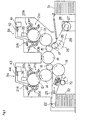
- Fig. 1 is a schematic view of the printing machine according to this invention.
- This printing machine records images on blank plates mounted on first and second plate cylinders 11 and 12 in a prepress process, feeds inks to the plates having the images recorded thereon, and transfers the inks from the plates through first and second blanket cylinders 13 and 14 to printing paper held on first and second impression cylinders 15 and 16, thereby printing the images in four colors on the printing paper.
- the printing machine has the first plate cylinder 11, the second plate cylinder 12, the first blanket cylinder 13 contactable with the first plate cylinder 11, the second blanket cylinder 14 contactable with the second plate cylinder 12, the first impression cylinder 15 contactable with the first blanket cylinder 13, and the second impression cylinder 16 contactable with the second blanket cylinder 14.
- the printing machine further includes a paper feed cylinder 17 for transferring printing paper fed from a paper storage station 31 to the first impression cylinder 15, a transfer cylinder 18 for transferring the printing paper from the first impression cylinder 15 to the second impression cylinder 16, a paper discharge cylinder 19 with chains 23 wound thereon and extending to and wound on sprockets 22 for discharging printed paper from the second impression cylinder 16 to a paper discharge station 32, and an image pickup station 60 for reading images and measuring densities of detecting patches printed on the printing paper passing over a suction roller 70.
- Each of the first and second plate cylinders 11 and 12 is what is called a two-segmented cylinder for holding two printing plates peripherally thereof for printing in two different colors.
- the first and second blanket cylinders 13 and 14 have the same diameter as the first and second plate cylinders 11 and 12, and each has blanket surfaces for transferring images in two colors.
- the first and second impression cylinders 15 and 16 have grippers, not shown, for holding and transporting the forward end of printing paper.
- the paper feed cylinder 17 disposed adjacent the impression cylinder 15 has the same diameter as the first and second impression cylinders 15 and 16.
- the paper feed cylinder 17 has a gripper, not shown, for holding and transporting, with each intermittent rotation of the feed cylinder 17, the forward end of each sheet of printing paper fed from the paper storage station 31.
- the gripper of the first impression cylinder 15 holds the forward end of the printing paper which has been held by the gripper of the feed cylinder 17.
- the transfer cylinder 18 disposed between the first impression cylinder 15 and second impression cylinder 16 has the same diameter as the first and second plate cylinders 11 and 12 and the first and second blanket cylinders 13 and 14.
- the transfer cylinder 18 has a gripper, not shown, for holding and transporting the forward end of the printing paper received from the first impression cylinder 15, and transferring the forward end of the printing paper to the gripper of the second impression cylinder 16.
- the paper discharge cylinder 19 disposed adjacent the second impression cylinder 16 has the same diameter as the first and second plate cylinders 11 and 12 and the first and second blanket cylinders 13 and 14.
- the discharge cylinder 19 has a pair of chains 23 wound around opposite ends thereof.
- the chains 23 are interconnected by coupling members, not shown, having grippers.
- the paper feed cylinder 17 has a gear attached to an end thereof and connected to a gear 26 disposed coaxially with a driven pulley 25.
- a belt 29 is wound around and extends between the driven pulley 25 and a drive pulley 28 rotatable by a drive motor 27.
- the paper feed cylinder 17 is rotatable by drive of the motor 27.
- the first and second plate cylinders 11 and 12, first and second blanket cylinders 13 and 14, first and second impression cylinders 15 and 16, paper feed cylinder 17, transfer cylinder 18 and paper discharge cylinder 19 are coupled to one another by gears attached to ends thereof, respectively.
- the first plate cylinder 11 is surrounded by an ink feeder 20a for feeding an ink of black (K), for example, to a plate, an ink feeder 20b for feeding an ink of cyan (C), for example, to a plate, and dampening water feeders 21a and 21b for feeding dampening water to the plates.
- the second plate cylinder 12 is surrounded by an ink feeder 20c for feeding an ink of magenta (M), for example, to a plate, an ink feeder 20d for feeding an ink of yellow (Y), for example, to a plate, and dampening water feeders 21c and 21d for feeding dampening water to the plates.
- a plate feeder 33 for feeding plates to the peripheral surface of the first plate cylinder 11
- a plate feeder 34 for feeding plates to the peripheral surface of the second plate cylinder 12
- an image recorder 35 for recording images on the plates mounted peripherally of the first plate cylinder 11
- an image recorder 36 for recording images on the plates mounted peripherally of the second plate cylinder 12.
- Fig. 2 is a schematic side view showing a principal portion of the ink feeder 20d among the above ink feeders 20a, 20b, 20c and 20d (which may be referred to collectively as "ink feeder 20").
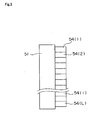
- Fig. 3 is a plan view thereof. Ink 50 is omitted from Fig. 3 .
- the ink feeder 20d includes an ink fountain roller 51 having an axis thereof extending in a direction of width of prints (i.e. perpendicular to a printing direction of the printing machine), a plurality of ink carrier rollers 52 (only one being shown in Fig. 2 ), an ink transfer roller 53 that vibrates between the ink fountain roller 51 and a foremost one of the ink carrier rollers 52, and ink applicator rollers 59 described hereinafter.
- the ink feeder 20d further includes ink keys 54 (1), 54 (2) ... 54 (L) (which may be referred to collectively as "ink keys 54") arranged in the direction of width of the prints.
- the ink fountain roller 51 and ink keys 54 define an ink well for storing ink 50.
- ink rollers In this specification, the ink fountain roller 51, ink carrier rollers 52, ink transfer roller 53 and ink applicator rollers 59 are referred to collectively as "ink rollers”.
- Eccentric cams 55, L in number, are arranged under the respective ink keys 54 for pressing the ink keys 54 toward the surface of ink fountain roller 51 to vary the opening degree of each ink key 54 with respect to the ink fountain roller 51.
- the eccentric cams 55 are connected through shafts 56 to pulse motors 57, L in number, for rotating the eccentric cams 55, respectively.
- Each pulse motor 57 in response to an ink key drive pulse applied thereto, rotates the eccentric cam 55 about the shaft 56 to vary a pressure applied to the ink key 54.
- the opening degree of the ink key 54 with respect to the ink fountain roller 51 is thereby varied to vary the rate of ink fed to the printing plate.
- the other ink feeders 20a, 20b and 20c have the same construction as this ink feeder 20d.
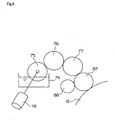
- Fig. 4 is a schematic side view showing the dampening water feeder 21d among the above dampening water feeders 21a, 21b, 21c and 21d (which may be referred to collectively as "dampening water feeder 21").
- the dampening water feeder 21d includes a water source having a water vessel 74 for storing dampening water and a water fountain roller 75 rotatable by a motor 78, a metering roller 76, an intermediate roller 77, a water applicator roller 87 for transferring the dampening water fed from the water vessel 74 via the fountain roller 75, metering roller 76 and intermediate roller 77 to the surface of one of the plates mounted peripherally of the second plate cylinder 12, and a bridge roller 88 acting as a rider roller for leveling the dampening water on the water applicator roller 87, and capable of bridging the ink applicator rollers 59 described hereinafter and the water applicator roller 87.
- This dampening water feeder 21d is capable of adjusting the feed rate of dampening water to the surface of the plate by varying the rotating rate of fountain roller 75. Further, this dampening water feeder 21d is capable of moving the water applicator roller 87 into and out of contact with the intermediate roller 77, moving the water applicator roller 87 into and out of contact with the printing plate, and moving the bridge roller 88, while contacting the water applicator roller 87, into and out of contact with one of the ink applicator rollers 59. (These operations will be described hereinafter with reference to Figs. 5 through 7 .)
- the fountain roller 75, metering roller 76, intermediate roller 77, water applicator roller 87 and bridge roller 88 are referred to collectively as "dampening water rollers".
- Figs. 5 through 7 are perspective views showing a roller drive mechanism of the dampening water feeder 21d described above. These figures are perspective views of one end of each roller seen from different angles. The other end of each roller has the same construction.
- an offset mechanism 101 is disposed at the end of the water applicator roller 87.
- An air cylinder 102 ( Fig. 5 ) is connected to the offset mechanism 101.
- the applicator roller 87 is driven by the air cylinder 102 to move between a position for contacting the intermediate roller 77 and a position separated from the intermediate roller 77.
- the water applicator roller 87 is supported by a support plate 103 rockable about the axis of intermediate roller 77.
- the support plate 103 has a cam follower 104 ( Fig. 6 ) which can contact a cam disposed laterally of the second plate cylinder 12. With rotation of the second plate cylinder 12, the cam follower 104 contacts the cam disposed laterally of the second plate cylinder 12, whereby the water applicator roller 87 is movable between a position for contacting both the intermediate roller 77 and the printing plate mounted on the second plate cylinder 12, and a position in contact with the intermediate roller 77 but separated from the second plate cylinder 12.
- a lock mechanism is provided for fixing the water applicator roller 87 to the position in contact with the intermediate roller 77 but separated from the second plate cylinder 12. That is, an air cylinder 105 is disposed laterally of the water applicator roller 87, and the air cylinder 105 has a cylinder rod 108 with a rocking arm 106 connected to a forward end thereof. As shown in Figs. 5 and 6 , when the cylinder rod 108 of air cylinder 105 is extended, the rocking arm 106 contacts a cam follower 107 connected to the cam follower 104 through an arm 109. In this state, rocking of the arm 109 is restricted, and the water applicator roller 87 is fixed to the position in contact with the intermediate roller 77 but separated from the second plate cylinder 12.
- the bridge roller 88 is supported by a rocking arm 111 shown in Fig. 7 .
- the rocking arm 111 is rockable about the axis of water applicator roller 87.
- the rocking arm 111 is connected to a cylinder rod 113 of an air cylinder 112.
- the bridge roller 88 is placed in a position for contacting one of the ink applicator rollers 59 described hereinafter, and supplying dampening water on the water applicator roller 87 to the ink feeder 20d.
- the bridge roller 88 moves to a position separated from the ink applicator roller 59.
- the three other dampening water feeders 21a, 21b and 21c have compositions similar to this dampening water feeder 21d.
- the dampening water feeders 21a and 21c have no metering roller 76. This is because the dampening water feeders 21a and 21c are arranged below the rotary shafts of plate cylinders 11 and 12, and dampening water can be transmitted only with the three rollers.
- the dampening water feeders 21a-21d include three or four dampening water rollers according to their locations, the basic construction and operation are the same.
- Fig. 8 is a block diagram showing a principal electrical structure of the printing machine.
- This printing machine includes a control unit 80 having a ROM 81 for storing operating programs necessary for controlling the machine, a RAM 82 for temporarily storing data and the like during a control operation, and a CPU 83 for performing logic operations.
- the control unit 80 has a driving circuit 85 connected thereto through an interface 84, for generating driving signals for driving the ink feeders 20, dampening water feeders 21, image recorders 35 and 36 and so on.
- the motor 57 of each ink feeder 20 and the motor 78 of each dampening water feeder 21 described hereinbefore are connected to the driving circuit 85.
- the control unit 80 is connected also to the image pickup station 60 and the input unit 79 through the interface 84.
- control unit 80 is connected to an image data source 86 storing image data for use in platemaking and printing.
- the printing machine under control of this control unit 80 performs a prepress operation and a printing operation including ink and dampening water feeding to be described hereinafter.
- the control unit 80 determines, based on the data received from the image data source 86, whether non-image areas can be removed, with ink, from the printing plates set to the printing machine. When non-image areas are found removable in this way, the control unit 80 sets the larger opening degree to the ink keys 54 for the smaller image percentage of the images recorded on the printing plates. When non-image areas are found irremovable with ink, the control unit 80 sets the larger opening degree to the ink keys 54 for the larger image percentage of the images recorded on the printing plates. Thus, the control unit 80 acts as the ink key opening degree setting device according to this invention.
- the control unit 80 executes a pre-inking operation for feeding ink to the printing plates based on a predetermined quantity of ink.
- the control unit 80 acts as the pre-inking operation executing device according to this invention.
- a printing plate stock drawn from a supply cassette 41 of the plate feeder 33 is cut to a predetermined size by a cutter 42.
- the forward end of each plate in cut sheet form is guided by guide rollers and guide members, not shown, and is clamped by clamps of the first plate cylinder 11.
- the first plate cylinder 11 is driven by a motor, not shown, to rotate at low speed, whereby the plate is wrapped around the peripheral surface of the first plate cylinder 11.
- the rear end of the plate is clamped by other clamps of the first plate cylinder 11.
- the image recorder 35 irradiates the surface of the plate mounted peripherally of the first plate cylinder 11 with a modulated laser beam for recording an image thereon.
- a printing plate stock drawn from a supply cassette 43 of the plate feeder 34 is cut to the predetermined size by a cutter 44.
- the forward end of each plate in cut sheet form is guided by guide rollers and guide members, not shown, and is clamped by clamps of the second plate cylinder 12.
- the second plate cylinder 12 is driven by a motor, not shown, to rotate at low speed, whereby the plate is wrapped around the peripheral surface of the second plate cylinder 12.
- the rear end of the plate is clamped by other clamps of the second plate cylinder 12.
- the image recorder 36 irradiates the surface of the plate mounted peripherally of the second plate cylinder 12 with a modulated laser beam for recording an image thereon.
- the first plate cylinder 11 has, mounted peripherally thereof, a plate for printing in black ink and a plate for printing in cyan ink.
- the two plates are arranged in evenly separated positions (i.e. in positions separated from each other by 180 degrees).
- the image recorder 35 records images on these plates.
- the second plate cylinder 12 has, mounted peripherally thereof, a plate for printing in magenta ink and a plate for printing in yellow ink.
- the two plates also are arranged in evenly separated positions, and the image recorder 36 records images on these plates.
- This printing machine employs a developing method for removing non-image areas with the inks after placing the dampening water feed rollers in contact with the printing plates to soften the non-image areas with dampening water. This developing process will be described in detail hereinafter.
- the prepress process is followed by a printing process for printing the printing paper with the plates mounted on the first and second plate cylinders 11 and 12.
- This printing process is carried out as follows.
- each dampening water feeder 21 and each ink feeder 20 are placed in contact with only a corresponding one of the plates mounted on the first and second plate cylinders 11 and 12. Consequently, dampening water and inks are fed to the plates from the corresponding water feeders 21 and ink feeders 20, respectively. These inks are transferred from the plates to the corresponding regions of the first and second blanket cylinders 13 and 14, respectively.
- the printing paper is fed to the paper feed cylinder 17.
- the printing paper is subsequently passed from the paper feed cylinder 17 to the first impression cylinder 15.
- the impression cylinder 15 having received the printing paper continues to rotate. Since the first impression cylinder 15 has half the diameter of the first plate cylinder 11 and the first blanket cylinder 13, the black ink is transferred to the printing paper wrapped around the first impression cylinder 15 in its first rotation, and the cyan ink in its second rotation.
- the printing paper is passed from the first impression cylinder 15 to the second impression cylinder 16 through the transfer cylinder 18.
- the second impression cylinder 16 having received the printing paper continues to rotate. Since the second impression cylinder 16 has half the diameter of the second plate cylinder 12 and the second blanket cylinder 14, the magenta ink is transferred to the printing paper wrapped around the second impression cylinder 16 in its first rotation, and the yellow ink in its second rotation.
- the forward end of the printing paper printed in the four colors in this way is passed from the second impression cylinder 16 to the paper discharge cylinder 19.
- the printing paper is transported by the pair of chains 23 toward the paper discharge station 32 to be discharged thereon.
- the plates used for printing is discharged.
- the first and second blanket cylinders 13 and 14 are cleaned by a blanket cylinder cleaning device, not shown, to complete the printing process.
- FIG. 9 is a flow chart showing a procedure of performing the developing method according to this invention as a pre-inking process before a printing operation.
- This printing machine first records images in the prepress process as described above (step S1). This image recording is carried out by the image recorders 35 and 36 noted hereinbefore.
- step S2 the developing method according to this invention is carried out (step S3) and then printing is carried out (step S4).
- the plates having the image recorded thereon are not chemicalless printing plates, but ordinary printing plates (what are called PS plates or the like) or printing plates not needing development (e.g. ablation type printing plates) (step S2), an ordinary pre-inking suited for the plates is carried out, and then printing is performed (step S4).
- the larger ink key opening degree is set for the larger image percentage (conventional setting of ink key opening) before a printing process, i.e. before feeding printing paper, and in the state the inks are supplied to the ink rollers to ink the surfaces of the plates beforehand.
- step S2 the operator inputs the type of printing plates to be used as data to the control unit 80 beforehand.
- the control unit 80 acts as a determining device for determining the type of printing plates set to the printing machine from the data inputted through an input unit 79.
- the type of printing plates may be determined by detecting the type of supply cassettes 41 and 43 storing the printing plate stocks.
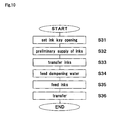
- FIG. 10 is a flow chart showing the developing method according to this invention.
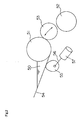
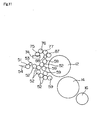
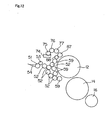
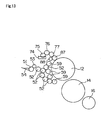
- Figs. 11 through 14 are schematic views showing a developing operation according to this invention.
- the developing operation uses the ink feeder 20d and dampening water feeder 21d.
- Developing operations using the other ink feeders 20a, 20b and 20c and dampening water feeders 21a, 21b and 21c are the same.
- an ink key opening degree setting step is executed first for setting opening degrees of the ink keys 54 in each ink feeder 20 (step S31). At this time, the larger opening degree is set to each ink key 54 in each ink feeder 20 for the smaller image percentage in the region of the printing plate corresponding to that ink key.
- Figs. 15 and 16 are graphs showing a relationship between image percentage and opening degree of each ink key.
- Fig. 15A shows the case of cyan ink
- Fig. 15B magenta ink Fig. 16A yellow ink
- Fig. 16B black ink Fig. 16B black ink.
- the horizontal axis represents the image percentages (%), and the vertical axis the opening degrees (%) of ink keys 54.
- the larger opening degree is set to each ink key 54 for the smaller image percentage.
- the relationship between image percentage and opening degree of ink keys 54 is different for each color ink because each color ink is different in composition, tack value, water content and so on.
- these graphs differ from ink to ink.
- development is carried out experimentally while gradually changing ink key opening degrees, for example. After a predetermined developing operation, the operator visually checks non-image areas that remain, thereby to determine required ink key opening degrees.
- Such data are stored beforehand in the RAM 82 of the control unit 80 shown in Fig. 8 , for the different inks to be used.
- the larger opening degree is set to each ink key 54 for the smaller image percentage for the following reason.
- time of printing the larger opening degree is set to each ink key 54 for the region of the larger image percentage.
- the opening degree of each ink key is the same as in time of printing, or development is carried out with the same opening degree for all ink keys.
- time of development non-image areas are removed as eluted or mixed with ink, and the larger non-image area requires the larger quantity of ink to be used for removal. It is therefore necessary to set the larger opening degree to each ink key 54 for the larger non-image area. To put this conversely, the larger opening degree is set to ink key 54 for the smaller image percentage.
- a predetermined quantity of ink is supplied according to an image percentage, to each of the regions, L in number, corresponding to the ink keys 54, L in number, of each ink feeder 20.
- a preliminary ink supplying step is executed for supplying the inks to the ink rollers (step S32).
- each ink applicator roller 59 is placed in a position separated from the printing plate on the first plate cylinder 11 or second plate cylinder 12.
- the ink transfer roller 53 performs an ink fetching operation to reciprocate between the ink source roller 51 and ink carrier rollers 52.
- the ink is supplied to the ink rollers as a preliminary step.
- the ink is supplied at this time in the larger quantity to the region of the smaller image percentage.
- an ink transfer step is executed for transferring the ink from the ink rollers to the dampening water rollers.
- the bridge roller 88 of the dampening water feeder 21 is moved to the position for contacting one ink applicator roller 59 of the ink feeder, and is rotated a predetermined number of times. Dampening water has been supplied to the water applicator roller 87 in advance.
- the water applicator roller 87 is separated from the intermediate roller 77, and no new dampening water is supplied to the water applicator roller 87.
- a dampening water feeding step is executed for causing the dampening water rollers to feed dampening water to the printing plate (step S34). Specifically, as shown in Fig. 13 , with the water fountain roller 75, metering roller 76, intermediate roller 77, water applicator roller 87 and bridge roller 88 placed in contact with each other, the water applicator roller 87 is moved into contact with the surface of the printing plate mounted on the first or second plate cylinder 11 or 12 to supply the dampening water on the dampening water rollers to the printing plate.
- This dampening water feeding step includes a first dampening water feeding step for feeding a larger quantity of dampening water than an ordinary quantity of dampening water, and a second dampening water feeding step for feeding a smaller quantity of dampening water than the first dampening water feeding step.
- the water fountain roller 75 is first rotated at about twice a usual speed of rotation by the motor 78 shown in Fig. 4 , to feed a large quantity of dampening water to the dampening water rollers, and on to the printing plate. Subsequently, the water fountain roller 75 is rotated at the usual speed to feed dampening water in a quantity similar to the proper quantity in time of printing, to the printing plate through the dampening water rollers.
- the ink supplied to the water applicator roller 87 in the previous ink transfer step and now super-emulsified, and a large quantity of dampening water are effectively supplied to the printing plate not supplied with dampening water yet.
- an ink feeding step is executed for feeding ink to the printing plate with the ink rollers (step S35).
- each ink applicator roller 59 is placed in contact with the printing plate mounted peripherally of the first or second plate cylinder 11 or 12 to supply ink to the plate surface.
- regions to form non-image areas on the printing plate are removed from the plate surface with the ink, and are partly transferred back to the ink rollers.
- the ink transfer roller 53 is suspended from the ink fetching operation at this time.
- a transfer step is executed for transferring the ink from the printing plate to printing paper (step S36). Specifically, as shown in Fig. 14 , the second plate cylinder 12, second blanket cylinder 14 and second impression cylinder 16 are moved into contact with one another. Similarly, the first plate cylinder 11, first blanket cylinder 13 and first impression cylinder 15 are moved into contact. Printing paper to be wasted is fed from the paper storage station 31, and unwanted ink used in removing the non-image areas from the printing plate is transferred to the printing paper. This completes the development of the printing plate.
- the opening degrees of the ink keys 54 in each ink feeder 20 are changed to the usual state where the larger opening degree is set to the ink key for the region of the larger image percentage, to be ready for the printing process that follows.
- the opening degrees of the ink keys may be returned to the usual state before step S35 or step S36. That is, the opening degrees of the ink keys may be returned to the usual state after the ink profile for developments is once formed in step S32.
- this invention is applied to the printing machine that performs a printing operation after recording images on printing plates.
- This invention may be applied to a printing machine that performs a printing operation only.
- the invention is applied to the printing machine that uses both usual printing plates and chemicalless printing plates.
- This invention may be applied to a printing machine that uses only chemicalless printing plates.
Landscapes
- Engineering & Computer Science (AREA)
- Mechanical Engineering (AREA)
- Manufacturing & Machinery (AREA)
- Physics & Mathematics (AREA)
- General Physics & Mathematics (AREA)
- Inking, Control Or Cleaning Of Printing Machines (AREA)
- Rotary Presses (AREA)
- Manufacture Or Reproduction Of Printing Formes (AREA)
- Photosensitive Polymer And Photoresist Processing (AREA)
- Non-Silver Salt Photosensitive Materials And Non-Silver Salt Photography (AREA)
Applications Claiming Priority (1)
| Application Number | Priority Date | Filing Date | Title |
|---|---|---|---|
| JP2005374730A JP4698414B2 (ja) | 2005-12-27 | 2005-12-27 | 現像処理方法および印刷機 |
Publications (2)
| Publication Number | Publication Date |
|---|---|
| EP1803554A1 EP1803554A1 (en) | 2007-07-04 |
| EP1803554B1 true EP1803554B1 (en) | 2009-04-22 |
Family
ID=37882220
Family Applications (1)
| Application Number | Title | Priority Date | Filing Date |
|---|---|---|---|
| EP06025144A Not-in-force EP1803554B1 (en) | 2005-12-27 | 2006-12-05 | Developing method, and printing machine for executing the developing method |
Country Status (6)
| Country | Link |
|---|---|
| US (1) | US20070144379A1 (enExample) |
| EP (1) | EP1803554B1 (enExample) |
| JP (1) | JP4698414B2 (enExample) |
| CN (1) | CN100493905C (enExample) |
| AT (1) | ATE429331T1 (enExample) |
| DE (1) | DE602006006404D1 (enExample) |
Families Citing this family (5)
| Publication number | Priority date | Publication date | Assignee | Title |
|---|---|---|---|---|
| US20090199730A1 (en) * | 2006-09-22 | 2009-08-13 | Mitsubishi Heavy Industries, Ltd. | Apparatus and method for driving a printing press |
| DE102007034880A1 (de) * | 2007-07-24 | 2009-01-29 | Heidelberger Druckmaschinen Ag | Entwicklung von Druckplatten in Offsetdruckmaschinen |
| DE102007042458A1 (de) * | 2007-09-06 | 2009-03-12 | Manroland Ag | Druckwerk einer Druckmaschine |
| DE102011102425A1 (de) | 2011-05-24 | 2012-11-29 | Heidelberger Druckmaschinen Ag | Simultanes Softwareupdate |
| CN118163463B (zh) * | 2024-04-11 | 2025-12-26 | 昆山市秦峰印刷有限公司 | 一种印刷版定位开孔设备及其应用方法 |
Family Cites Families (29)
| Publication number | Priority date | Publication date | Assignee | Title |
|---|---|---|---|---|
| US3673959A (en) * | 1970-04-22 | 1972-07-04 | North American Rockwell | Dampening system for lithographic printing press |
| JPH07227958A (ja) * | 1994-02-17 | 1995-08-29 | Komori Corp | 印刷機のインキ供給量制御方法および装置 |
| US6436176B1 (en) * | 1995-07-18 | 2002-08-20 | Agfa-Gevaert | Concentrated dampening solution with an improved anti-staining activity for printing with a lithographic printing plate obtained according to the silver salt diffusion transfer process |
| US6874420B2 (en) * | 1999-10-22 | 2005-04-05 | Cc1, Inc. | System and method for register mark recognition |
| JP2001142230A (ja) * | 1999-11-11 | 2001-05-25 | Fuji Photo Film Co Ltd | 平版印刷版の製版方法、加熱装置、及び記録媒体 |
| EP1232859B1 (en) * | 2001-02-16 | 2003-11-26 | Agfa-Gevaert | On-press exposure and on-press processing of a lithographic material |
| JP2003103951A (ja) * | 2001-04-03 | 2003-04-09 | Fuji Photo Film Co Ltd | 平版印刷版用支持体および平版印刷版原版 |
| DE10232110B4 (de) * | 2001-09-07 | 2015-06-03 | Heidelberger Druckmaschinen Ag | Verfahren zur Einstellung der Feuchtmittelzuführung einer Offset-Druckmaschine |
| US6792863B2 (en) * | 2001-10-15 | 2004-09-21 | Dainippon Screen Mfg Co., Ltd. | Printing apparatus for automatically controlling ink supply device |
| JP4216001B2 (ja) * | 2002-05-21 | 2009-01-28 | 大日本スクリーン製造株式会社 | 印刷機のインキ供給方法および印刷機のインキ供給装置 |
| US6840175B2 (en) * | 2002-11-20 | 2005-01-11 | Flint Ink Corporation | Lithographic printing method using a single fluid ink |
| US7063017B2 (en) * | 2002-12-19 | 2006-06-20 | Panasonic Communications Co., Ltd. | Printing plate and plate making method |
| JP4040968B2 (ja) * | 2002-12-26 | 2008-01-30 | 株式会社小森コーポレーション | 印刷機のインキ供給量制御方法および装置 |
| JP4047202B2 (ja) * | 2003-03-14 | 2008-02-13 | 大日本スクリーン製造株式会社 | インキ供給量制御方法および印刷機用のデータ補正方法 |
| JP4073345B2 (ja) * | 2003-03-24 | 2008-04-09 | 富士フイルム株式会社 | 平版印刷方法および印刷装置 |
| JP2004314530A (ja) * | 2003-04-18 | 2004-11-11 | Konica Minolta Medical & Graphic Inc | 平版印刷版材料の印刷機上現像方法及び印刷方法 |
| EP1618223A2 (en) * | 2003-04-28 | 2006-01-25 | Nanosys, Inc. | Super-hydrophobic surfaces, methods of their construction and uses therefor |
| JP4646541B2 (ja) * | 2003-05-15 | 2011-03-09 | 大日本スクリーン製造株式会社 | オフセット印刷機における湿し水の供給量制御方法 |
| JP2005007575A (ja) * | 2003-06-16 | 2005-01-13 | Konica Minolta Medical & Graphic Inc | 印刷版材料および印刷方法 |
| JP2005059511A (ja) * | 2003-08-19 | 2005-03-10 | Fuji Photo Film Co Ltd | 平版印刷方法および平版印刷原版 |
| JP2005111973A (ja) * | 2003-09-18 | 2005-04-28 | Konica Minolta Medical & Graphic Inc | 印刷版材料、印刷版原反、印刷版の作製方法、印刷方法及び印刷版材料の製造方法 |
| JP4437392B2 (ja) * | 2003-09-22 | 2010-03-24 | 大日本スクリーン製造株式会社 | インキ供給方法およびインキ供給装置 |
| JP2005103805A (ja) * | 2003-09-29 | 2005-04-21 | Fuji Photo Film Co Ltd | 平版印刷版原版の印刷機上現像方法 |
| JP4220350B2 (ja) * | 2003-10-27 | 2009-02-04 | 大日本スクリーン製造株式会社 | 湿し水供給方法 |
| DE602005007070D1 (de) * | 2004-01-09 | 2008-07-10 | Fujifilm Corp | Blindplattenvorläufer für Flachdruck |
| JP4484541B2 (ja) * | 2004-02-20 | 2010-06-16 | 大日本スクリーン製造株式会社 | 印刷機のインキ供給方法 |
| JP4505242B2 (ja) * | 2004-03-17 | 2010-07-21 | 富士フイルム株式会社 | 平版印刷方法 |
| JP2005262636A (ja) * | 2004-03-18 | 2005-09-29 | Fuji Photo Film Co Ltd | 平版印刷方法 |
| JP2005262605A (ja) * | 2004-03-18 | 2005-09-29 | Fuji Photo Film Co Ltd | 平版印刷方法 |
-
2005
- 2005-12-27 JP JP2005374730A patent/JP4698414B2/ja not_active Expired - Fee Related
-
2006
- 2006-12-05 DE DE602006006404T patent/DE602006006404D1/de active Active
- 2006-12-05 EP EP06025144A patent/EP1803554B1/en not_active Not-in-force
- 2006-12-05 AT AT06025144T patent/ATE429331T1/de not_active IP Right Cessation
- 2006-12-20 US US11/641,823 patent/US20070144379A1/en not_active Abandoned
- 2006-12-27 CN CNB2006101724222A patent/CN100493905C/zh not_active Expired - Fee Related
Also Published As
| Publication number | Publication date |
|---|---|
| EP1803554A1 (en) | 2007-07-04 |
| JP2007175927A (ja) | 2007-07-12 |
| US20070144379A1 (en) | 2007-06-28 |
| DE602006006404D1 (de) | 2009-06-04 |
| CN100493905C (zh) | 2009-06-03 |
| CN1990232A (zh) | 2007-07-04 |
| ATE429331T1 (de) | 2009-05-15 |
| JP4698414B2 (ja) | 2011-06-08 |
Similar Documents
| Publication | Publication Date | Title |
|---|---|---|
| US7394564B2 (en) | Printing machine with a control unit that displays a plurality of key operation switches to control ink keys | |
| US7216946B2 (en) | Ink feeding rate control method and data correcting method for a printing machine | |
| US6422141B2 (en) | Multi-color offset printing method and apparatus | |
| EP1803554A1 (en) | Developing method, and printing machine for executing the developing method | |
| EP1364786B1 (en) | Dampening water feeding method for a printing machine, and the printing machine | |
| EP1733881A2 (en) | Printing control scale, printing system and printing method | |
| JP2007175927A5 (enExample) | ||
| EP1364785B1 (en) | Printing method | |
| JP3466905B2 (ja) | 印刷機の咥え装置 | |
| EP1527875B1 (en) | Dampening water feeding method and printing machine | |
| US20080092761A1 (en) | Printing machine control method and printing machine | |
| EP1378349A2 (en) | Tripping device for the blanket cylinders of a printing machine | |
| EP1832421B1 (en) | Ink feeding rates control method and representative point determining apparatus | |
| US6739250B2 (en) | Device for controlling rotation of rotating drum | |
| US7836826B2 (en) | Dampening water regulating scale, and dampening water control method | |
| JP3396606B2 (ja) | 印刷装置 | |
| JP2003053935A (ja) | 印刷方法および印刷管理システム | |
| JP2003159781A (ja) | 印刷装置 | |
| JPH11105260A (ja) | インキ供給装置 | |
| JP2005254650A (ja) | オフセット印刷機 | |
| JP2003154635A (ja) | 印刷装置 | |
| JPH1199616A (ja) | 湿し水供給装置 | |
| JP2003205590A (ja) | 多色オフセット印刷機 | |
| JPH1199631A (ja) | インキ供給装置 | |
| JP2006175791A (ja) | インキ供給量制御方法および多色印刷機 |
Legal Events
| Date | Code | Title | Description |
|---|---|---|---|
| PUAI | Public reference made under article 153(3) epc to a published international application that has entered the european phase |
Free format text: ORIGINAL CODE: 0009012 |
|
| AK | Designated contracting states |
Kind code of ref document: A1 Designated state(s): AT BE BG CH CY CZ DE DK EE ES FI FR GB GR HU IE IS IT LI LT LU LV MC NL PL PT RO SE SI SK TR |
|
| AX | Request for extension of the european patent |
Extension state: AL BA HR MK YU |
|
| 17P | Request for examination filed |
Effective date: 20071004 |
|
| 17Q | First examination report despatched |
Effective date: 20071112 |
|
| AKX | Designation fees paid |
Designated state(s): AT BE BG CH CY CZ DE DK EE ES FI FR GB GR HU IE IS IT LI LT LU LV MC NL PL PT RO SE SI SK TR |
|
| GRAP | Despatch of communication of intention to grant a patent |
Free format text: ORIGINAL CODE: EPIDOSNIGR1 |
|
| GRAS | Grant fee paid |
Free format text: ORIGINAL CODE: EPIDOSNIGR3 |
|
| GRAA | (expected) grant |
Free format text: ORIGINAL CODE: 0009210 |
|
| AK | Designated contracting states |
Kind code of ref document: B1 Designated state(s): AT BE BG CH CY CZ DE DK EE ES FI FR GB GR HU IE IS IT LI LT LU LV MC NL PL PT RO SE SI SK TR |
|
| REG | Reference to a national code |
Ref country code: GB Ref legal event code: FG4D |
|
| REG | Reference to a national code |
Ref country code: CH Ref legal event code: EP |
|
| REG | Reference to a national code |
Ref country code: IE Ref legal event code: FG4D |
|
| REF | Corresponds to: |
Ref document number: 602006006404 Country of ref document: DE Date of ref document: 20090604 Kind code of ref document: P |
|
| NLV1 | Nl: lapsed or annulled due to failure to fulfill the requirements of art. 29p and 29m of the patents act | ||
| PG25 | Lapsed in a contracting state [announced via postgrant information from national office to epo] |
Ref country code: AT Free format text: LAPSE BECAUSE OF FAILURE TO SUBMIT A TRANSLATION OF THE DESCRIPTION OR TO PAY THE FEE WITHIN THE PRESCRIBED TIME-LIMIT Effective date: 20090422 Ref country code: LT Free format text: LAPSE BECAUSE OF FAILURE TO SUBMIT A TRANSLATION OF THE DESCRIPTION OR TO PAY THE FEE WITHIN THE PRESCRIBED TIME-LIMIT Effective date: 20090422 Ref country code: FI Free format text: LAPSE BECAUSE OF FAILURE TO SUBMIT A TRANSLATION OF THE DESCRIPTION OR TO PAY THE FEE WITHIN THE PRESCRIBED TIME-LIMIT Effective date: 20090422 Ref country code: PT Free format text: LAPSE BECAUSE OF FAILURE TO SUBMIT A TRANSLATION OF THE DESCRIPTION OR TO PAY THE FEE WITHIN THE PRESCRIBED TIME-LIMIT Effective date: 20090822 Ref country code: ES Free format text: LAPSE BECAUSE OF FAILURE TO SUBMIT A TRANSLATION OF THE DESCRIPTION OR TO PAY THE FEE WITHIN THE PRESCRIBED TIME-LIMIT Effective date: 20090802 |
|
| PG25 | Lapsed in a contracting state [announced via postgrant information from national office to epo] |
Ref country code: PL Free format text: LAPSE BECAUSE OF FAILURE TO SUBMIT A TRANSLATION OF THE DESCRIPTION OR TO PAY THE FEE WITHIN THE PRESCRIBED TIME-LIMIT Effective date: 20090422 Ref country code: NL Free format text: LAPSE BECAUSE OF FAILURE TO SUBMIT A TRANSLATION OF THE DESCRIPTION OR TO PAY THE FEE WITHIN THE PRESCRIBED TIME-LIMIT Effective date: 20090422 Ref country code: IS Free format text: LAPSE BECAUSE OF FAILURE TO SUBMIT A TRANSLATION OF THE DESCRIPTION OR TO PAY THE FEE WITHIN THE PRESCRIBED TIME-LIMIT Effective date: 20090822 Ref country code: SE Free format text: LAPSE BECAUSE OF FAILURE TO SUBMIT A TRANSLATION OF THE DESCRIPTION OR TO PAY THE FEE WITHIN THE PRESCRIBED TIME-LIMIT Effective date: 20090722 Ref country code: LV Free format text: LAPSE BECAUSE OF FAILURE TO SUBMIT A TRANSLATION OF THE DESCRIPTION OR TO PAY THE FEE WITHIN THE PRESCRIBED TIME-LIMIT Effective date: 20090422 Ref country code: SI Free format text: LAPSE BECAUSE OF FAILURE TO SUBMIT A TRANSLATION OF THE DESCRIPTION OR TO PAY THE FEE WITHIN THE PRESCRIBED TIME-LIMIT Effective date: 20090422 |
|
| PG25 | Lapsed in a contracting state [announced via postgrant information from national office to epo] |
Ref country code: DK Free format text: LAPSE BECAUSE OF FAILURE TO SUBMIT A TRANSLATION OF THE DESCRIPTION OR TO PAY THE FEE WITHIN THE PRESCRIBED TIME-LIMIT Effective date: 20090422 Ref country code: CZ Free format text: LAPSE BECAUSE OF FAILURE TO SUBMIT A TRANSLATION OF THE DESCRIPTION OR TO PAY THE FEE WITHIN THE PRESCRIBED TIME-LIMIT Effective date: 20090422 Ref country code: RO Free format text: LAPSE BECAUSE OF FAILURE TO SUBMIT A TRANSLATION OF THE DESCRIPTION OR TO PAY THE FEE WITHIN THE PRESCRIBED TIME-LIMIT Effective date: 20090422 Ref country code: EE Free format text: LAPSE BECAUSE OF FAILURE TO SUBMIT A TRANSLATION OF THE DESCRIPTION OR TO PAY THE FEE WITHIN THE PRESCRIBED TIME-LIMIT Effective date: 20090422 |
|
| PG25 | Lapsed in a contracting state [announced via postgrant information from national office to epo] |
Ref country code: BE Free format text: LAPSE BECAUSE OF FAILURE TO SUBMIT A TRANSLATION OF THE DESCRIPTION OR TO PAY THE FEE WITHIN THE PRESCRIBED TIME-LIMIT Effective date: 20090422 Ref country code: SK Free format text: LAPSE BECAUSE OF FAILURE TO SUBMIT A TRANSLATION OF THE DESCRIPTION OR TO PAY THE FEE WITHIN THE PRESCRIBED TIME-LIMIT Effective date: 20090422 |
|
| PLBE | No opposition filed within time limit |
Free format text: ORIGINAL CODE: 0009261 |
|
| STAA | Information on the status of an ep patent application or granted ep patent |
Free format text: STATUS: NO OPPOSITION FILED WITHIN TIME LIMIT |
|
| 26N | No opposition filed |
Effective date: 20100125 |
|
| PG25 | Lapsed in a contracting state [announced via postgrant information from national office to epo] |
Ref country code: BG Free format text: LAPSE BECAUSE OF FAILURE TO SUBMIT A TRANSLATION OF THE DESCRIPTION OR TO PAY THE FEE WITHIN THE PRESCRIBED TIME-LIMIT Effective date: 20090722 |
|
| PG25 | Lapsed in a contracting state [announced via postgrant information from national office to epo] |
Ref country code: MC Free format text: LAPSE BECAUSE OF NON-PAYMENT OF DUE FEES Effective date: 20100701 |
|
| PG25 | Lapsed in a contracting state [announced via postgrant information from national office to epo] |
Ref country code: GR Free format text: LAPSE BECAUSE OF FAILURE TO SUBMIT A TRANSLATION OF THE DESCRIPTION OR TO PAY THE FEE WITHIN THE PRESCRIBED TIME-LIMIT Effective date: 20090723 Ref country code: IE Free format text: LAPSE BECAUSE OF NON-PAYMENT OF DUE FEES Effective date: 20091205 |
|
| PG25 | Lapsed in a contracting state [announced via postgrant information from national office to epo] |
Ref country code: IT Free format text: LAPSE BECAUSE OF FAILURE TO SUBMIT A TRANSLATION OF THE DESCRIPTION OR TO PAY THE FEE WITHIN THE PRESCRIBED TIME-LIMIT Effective date: 20090422 |
|
| PG25 | Lapsed in a contracting state [announced via postgrant information from national office to epo] |
Ref country code: LU Free format text: LAPSE BECAUSE OF NON-PAYMENT OF DUE FEES Effective date: 20091205 |
|
| PG25 | Lapsed in a contracting state [announced via postgrant information from national office to epo] |
Ref country code: HU Free format text: LAPSE BECAUSE OF FAILURE TO SUBMIT A TRANSLATION OF THE DESCRIPTION OR TO PAY THE FEE WITHIN THE PRESCRIBED TIME-LIMIT Effective date: 20091023 |
|
| REG | Reference to a national code |
Ref country code: CH Ref legal event code: PL |
|
| PG25 | Lapsed in a contracting state [announced via postgrant information from national office to epo] |
Ref country code: TR Free format text: LAPSE BECAUSE OF FAILURE TO SUBMIT A TRANSLATION OF THE DESCRIPTION OR TO PAY THE FEE WITHIN THE PRESCRIBED TIME-LIMIT Effective date: 20090422 |
|
| PG25 | Lapsed in a contracting state [announced via postgrant information from national office to epo] |
Ref country code: CY Free format text: LAPSE BECAUSE OF FAILURE TO SUBMIT A TRANSLATION OF THE DESCRIPTION OR TO PAY THE FEE WITHIN THE PRESCRIBED TIME-LIMIT Effective date: 20090422 |
|
| PG25 | Lapsed in a contracting state [announced via postgrant information from national office to epo] |
Ref country code: LI Free format text: LAPSE BECAUSE OF NON-PAYMENT OF DUE FEES Effective date: 20101231 Ref country code: CH Free format text: LAPSE BECAUSE OF NON-PAYMENT OF DUE FEES Effective date: 20101231 |
|
| REG | Reference to a national code |
Ref country code: DE Ref legal event code: R082 Ref document number: 602006006404 Country of ref document: DE Representative=s name: KILIAN KILIAN & PARTNER, DE |
|
| PGFP | Annual fee paid to national office [announced via postgrant information from national office to epo] |
Ref country code: GB Payment date: 20141203 Year of fee payment: 9 Ref country code: DE Payment date: 20141202 Year of fee payment: 9 |
|
| PGFP | Annual fee paid to national office [announced via postgrant information from national office to epo] |
Ref country code: FR Payment date: 20141208 Year of fee payment: 9 |
|
| REG | Reference to a national code |
Ref country code: DE Ref legal event code: R082 Ref document number: 602006006404 Country of ref document: DE Representative=s name: KILIAN KILIAN & PARTNER, DE |
|
| REG | Reference to a national code |
Ref country code: DE Ref legal event code: R082 Ref document number: 602006006404 Country of ref document: DE Representative=s name: KILIAN KILIAN & PARTNER, DE Effective date: 20150317 Ref country code: DE Ref legal event code: R082 Ref document number: 602006006404 Country of ref document: DE Representative=s name: KILIAN KILIAN & PARTNER, DE Effective date: 20130130 Ref country code: DE Ref legal event code: R081 Ref document number: 602006006404 Country of ref document: DE Owner name: SCREEN HOLDINGS CO., LTD., JP Free format text: FORMER OWNER: DAINIPPON SCREEN MFG. CO., LTD., KYOTO, JP Effective date: 20150317 |
|
| REG | Reference to a national code |
Ref country code: FR Ref legal event code: CD Owner name: SCREEN HOLDINGS CO., LTD. Effective date: 20150622 |
|
| REG | Reference to a national code |
Ref country code: DE Ref legal event code: R119 Ref document number: 602006006404 Country of ref document: DE |
|
| GBPC | Gb: european patent ceased through non-payment of renewal fee |
Effective date: 20151205 |
|
| REG | Reference to a national code |
Ref country code: FR Ref legal event code: ST Effective date: 20160831 |
|
| PG25 | Lapsed in a contracting state [announced via postgrant information from national office to epo] |
Ref country code: GB Free format text: LAPSE BECAUSE OF NON-PAYMENT OF DUE FEES Effective date: 20151205 Ref country code: DE Free format text: LAPSE BECAUSE OF NON-PAYMENT OF DUE FEES Effective date: 20160701 |
|
| PG25 | Lapsed in a contracting state [announced via postgrant information from national office to epo] |
Ref country code: FR Free format text: LAPSE BECAUSE OF NON-PAYMENT OF DUE FEES Effective date: 20151231 |