EP1741995A2 - Vorrichtung zum Aufwärmen einer Flüssigkeit - Google Patents
Vorrichtung zum Aufwärmen einer Flüssigkeit Download PDFInfo
- Publication number
- EP1741995A2 EP1741995A2 EP06014160A EP06014160A EP1741995A2 EP 1741995 A2 EP1741995 A2 EP 1741995A2 EP 06014160 A EP06014160 A EP 06014160A EP 06014160 A EP06014160 A EP 06014160A EP 1741995 A2 EP1741995 A2 EP 1741995A2
- Authority
- EP
- European Patent Office
- Prior art keywords
- fluid
- heating apparatus
- tubular structure
- lamp
- pipe
- Prior art date
- Legal status (The legal status is an assumption and is not a legal conclusion. Google has not performed a legal analysis and makes no representation as to the accuracy of the status listed.)
- Withdrawn
Links
Images


Classifications
-
- F—MECHANICAL ENGINEERING; LIGHTING; HEATING; WEAPONS; BLASTING
- F28—HEAT EXCHANGE IN GENERAL
- F28D—HEAT-EXCHANGE APPARATUS, NOT PROVIDED FOR IN ANOTHER SUBCLASS, IN WHICH THE HEAT-EXCHANGE MEDIA DO NOT COME INTO DIRECT CONTACT
- F28D7/00—Heat-exchange apparatus having stationary tubular conduit assemblies for both heat-exchange media, the media being in contact with different sides of a conduit wall
- F28D7/10—Heat-exchange apparatus having stationary tubular conduit assemblies for both heat-exchange media, the media being in contact with different sides of a conduit wall the conduits being arranged one within the other, e.g. concentrically
-
- F—MECHANICAL ENGINEERING; LIGHTING; HEATING; WEAPONS; BLASTING
- F24—HEATING; RANGES; VENTILATING
- F24H—FLUID HEATERS, e.g. WATER OR AIR HEATERS, HAVING HEAT-GENERATING MEANS, e.g. HEAT PUMPS, IN GENERAL
- F24H1/00—Water heaters, e.g. boilers, continuous-flow heaters or water-storage heaters
- F24H1/10—Continuous-flow heaters, i.e. heaters in which heat is generated only while the water is flowing, e.g. with direct contact of the water with the heating medium
- F24H1/101—Continuous-flow heaters, i.e. heaters in which heat is generated only while the water is flowing, e.g. with direct contact of the water with the heating medium using electric energy supply
-
- F—MECHANICAL ENGINEERING; LIGHTING; HEATING; WEAPONS; BLASTING
- F24—HEATING; RANGES; VENTILATING
- F24H—FLUID HEATERS, e.g. WATER OR AIR HEATERS, HAVING HEAT-GENERATING MEANS, e.g. HEAT PUMPS, IN GENERAL
- F24H1/00—Water heaters, e.g. boilers, continuous-flow heaters or water-storage heaters
- F24H1/10—Continuous-flow heaters, i.e. heaters in which heat is generated only while the water is flowing, e.g. with direct contact of the water with the heating medium
- F24H1/12—Continuous-flow heaters, i.e. heaters in which heat is generated only while the water is flowing, e.g. with direct contact of the water with the heating medium in which the water is kept separate from the heating medium
- F24H1/14—Continuous-flow heaters, i.e. heaters in which heat is generated only while the water is flowing, e.g. with direct contact of the water with the heating medium in which the water is kept separate from the heating medium by tubes, e.g. bent in serpentine form
- F24H1/16—Continuous-flow heaters, i.e. heaters in which heat is generated only while the water is flowing, e.g. with direct contact of the water with the heating medium in which the water is kept separate from the heating medium by tubes, e.g. bent in serpentine form helically or spirally coiled
- F24H1/162—Continuous-flow heaters, i.e. heaters in which heat is generated only while the water is flowing, e.g. with direct contact of the water with the heating medium in which the water is kept separate from the heating medium by tubes, e.g. bent in serpentine form helically or spirally coiled using electrical energy supply
-
- F—MECHANICAL ENGINEERING; LIGHTING; HEATING; WEAPONS; BLASTING
- F28—HEAT EXCHANGE IN GENERAL
- F28D—HEAT-EXCHANGE APPARATUS, NOT PROVIDED FOR IN ANOTHER SUBCLASS, IN WHICH THE HEAT-EXCHANGE MEDIA DO NOT COME INTO DIRECT CONTACT
- F28D7/00—Heat-exchange apparatus having stationary tubular conduit assemblies for both heat-exchange media, the media being in contact with different sides of a conduit wall
-
- F—MECHANICAL ENGINEERING; LIGHTING; HEATING; WEAPONS; BLASTING
- F28—HEAT EXCHANGE IN GENERAL
- F28D—HEAT-EXCHANGE APPARATUS, NOT PROVIDED FOR IN ANOTHER SUBCLASS, IN WHICH THE HEAT-EXCHANGE MEDIA DO NOT COME INTO DIRECT CONTACT
- F28D7/00—Heat-exchange apparatus having stationary tubular conduit assemblies for both heat-exchange media, the media being in contact with different sides of a conduit wall
- F28D7/02—Heat-exchange apparatus having stationary tubular conduit assemblies for both heat-exchange media, the media being in contact with different sides of a conduit wall the conduits being helically coiled
-
- F—MECHANICAL ENGINEERING; LIGHTING; HEATING; WEAPONS; BLASTING
- F28—HEAT EXCHANGE IN GENERAL
- F28F—DETAILS OF HEAT-EXCHANGE AND HEAT-TRANSFER APPARATUS, OF GENERAL APPLICATION
- F28F2245/00—Coatings; Surface treatments
- F28F2245/06—Coatings; Surface treatments having particular radiating, reflecting or absorbing features, e.g. for improving heat transfer by radiation
Definitions
- the present invention relates to a fluid heating apparatus, and more specifically to a fluid heating apparatus that heats a flowing fluid by thermal radiation emitted from a heating lamp.
- a semiconductor device fabricating process includes a fluid treatment that brings a process object, such as a semiconductor wafer, into contact with a processing fluid to treat the process object.
- a processing fluid such as diluted hydrofluoric acid (DHF) or a rinse liquid
- DHF diluted hydrofluoric acid
- a mixed gaseous fluid of vaporized isopropyl alcohol (IPA) and nitrogen gas (N 2 gas) is supplied to a process object to dry the same.
- IPA isopropyl alcohol
- N 2 gas nitrogen gas
- the temperature of the processing fluid must be regulated at a designated target temperature in order to achieve the desired process result.
- a fluid heating apparatus for regulating the temperature of the processing fluid is employed.
- JP09-210577A discloses such a fluid heating apparatus.
- the fluid heating apparatus includes a heating lamp, a transparent quartz tube surrounding the heating lamp, and a tubular container surrounding the transparent quartz tube to define a fluid-flowing space between the transparent quartz tube and the tubular container.
- the fluid supplied into the fluid-flowing space through a fluid inlet flows through the fluid-flowing space, where the fluid is heated by the thermal radiation emitted from the heating lamp, and flows out of the fluid-flowing space through a fluid outlet.
- the fluid is exposed to the thermal radiation emitted from the heating lamp and transmitted through the transparent quartz tube so that the fluid absorbs the energy of the thermal radiation to be heated. To put it briefly, the fluid is "directly" heated by the thermal radiation.
- a fluid heating apparatus of the foregoing direct-heating type has some problems.
- the fluid is a flammable or volatile organic solvent such as IPA, the fluid must be heated with particular attention on the temperature control.
- the fluid heating apparatus of JP09-210577A is further provided with plural metallic fins for heating a fluid of low thermal-radiation absorption.
- the metallic fins are circumferentially arrayed in the fluid-flowing space and extend in the fluid-flowing direction. If the thermal-radiation absorption of the fluid is low, the thermal radiation emitted from the heating lamp falls on the metallic fins to heat the same. The fluid is heated by the heat transfer from the metallic fins to the fluid.
- the fin structure is complicated, and thus costly.
- the transparent tube surrounding the heating lamp is typically made of quartz. If the fluid to be heated is DHF, the quartz material contacting with the fluid will be dissolved therein, and thus cannot be used.
- the present invention has been made in view of the forgoing problems, and therefore the main object of the present invention is to provide a fluid heating apparatus which is capable of effectively and uniformly heating a fluid, and which can be fabricated at a reasonable cost.
- the fluid heating apparatus can heat any sort of fluid.
- the present invention provides a fluid heating apparatus, which includes: a heating lamp; and a tubular structure having a fluid inlet allowing the fluid to be heated to flow into the tubular structure and a fluid outlet allowing the fluid having been heated to flow out of the tubular structure, wherein the tubular structure comprises at least one pipe arranged in a form of a tube surrounding the heating lamp, and at least a surface, facing the heating lamp, of the tubular structure is coated with a radiant-light-absorbing paint.
- the radiant-light-absorbing paint efficiently absorbs thermal radiation emitted from the heating lamp, the pipe is heated efficiently, and thus the fluid flowing through the pipe is heated efficiently through the heat transfer from the pipe to the fluid.
- the fluid is thus efficiently heated regardless of the sort of the fluid, or the thermal-radiation absorption of the fluid.
- Each of said at least one pipe may have an inner surface formed of a chemical-resistant synthetic resin.
- each of said at least one pipe may have a heat-conductive layer formed of a heat-conductive material, and the radiant-light-absorbing paint may be coated on the heat-conductive layer.
- a corrosive fluid can be heated without damaging the pipe. If the heat-conductive layer is provided, the heat generated in the radiant-light-absorbing paint due to the absorption of the thermal radiation is uniformly transferred to and distributed over the inner surface formed of the chemical-resistant synthetic resin through the heat-conductive layer, and thus the fluid can be heated uniformly, even if the inner surface is formed of the chemical-resistant synthetic resin having relatively low heat conductivity.
- the tubular structure may comprise a plurality of straight pipes circumferentially arrayed around the heating lamp. In another preferable embodiment, the tubular structure may comprise a single pipe wound in a spiral configuration around the heating lamp.
- the fluid heating apparatus may further include a tubular container accommodating the heating lamp and the tubular structure.
- the tubular container may have a light-reflective inner surface.
- the tubular container Due to the provision of the tubular container, dissipation of the thermal energy generated by the heating lamp can be suppressed, improving the heating efficiency. As the radiant light emitted from the heating lamp and leaked through gaps (if any) in the tubular structure is reflected by the light-reflective inner surface of the tubular container to fall on the outer surface of the tubular structure, the fluid can be heated more efficiently.
- the fluid heating apparatus may further include an inert gas supply adapted to supply an inert gas into an interior of the tubular container. This configuration prevents penetration of external atmosphere into the tubular container, and achieves safer operation of the fluid heating apparatus.
- the fluid heating apparatus may further include: a temperature sensor adapted to detect temperature of a fluid flowing through the tubular structure; a power supply adapted to regulate electric power to be supplied to the heating lamp, thereby to control calorific power generated by the heating lamp; a controller configured to generate a control signal based on the temperature detected by the temperature sensor and send the control signal to the power supply so that the temperature of the fluid coincides with a target value.
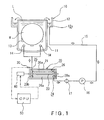
- a fluid heating apparatus in a first embodiment of the present invention and a cleaning system equipped with the fluid heating apparatus will be described with reference to Figs. 1, 2, 3A and 3B.
- the cleaning system includes: a cleaning tank 10 having an inner tank 11 that holds a cleaning liquid L, such as diluted hydrofluoric acid (DHF) or a rinse liquid (e.g., deionized water), and an outer tank 12 surrounding the upper opening of the inner tank 11 to receive the cleaning liquid overflowing from the inner tank 11; cleaning liquid supply nozzles 14 arranged at a lower area of the interior of the inner tank 11; a circulation passage 15 having a first end connected to the cleaning liquid supply nozzles 14 and a second end connected to a drain port 12a arranged at a bottom of the outer tank 12.
- a circulation pump 16, a filter 17 and a fluid heating apparatus 20 are arranged in the circulation passage 15 in that order from the drain-port 12a side.
- a wafer boat 13 is arranged in the inner tank 11 to hold a plurality of (e.g., 50pcs.) semiconductor wafers W (hereinafter simply referred to as "wafer").
- a drain pipe (not shown) provided thereon with a drain valve (not shown) is connected to a bottom of the inner tank 11.
- a cleaning liquid source (not shown) is arranged to supply a cleaning liquid L to the outer tank 12.
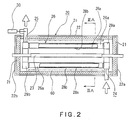
- the fluid heating apparatus 20 includes a tubular container 22, which may be formed of a stainless steel.
- a heat-insulating material is arranged on inner surfaces of the tubular container 22.
- a heating lamp typically a halogen lamp 23 is arranged in the tubular container 22 and extends along the longitudinal axis of the tubular container 22.
- a tubular structure 26 is arranged in the tubular container 22 to surround the halogen lamp 23 with an annular gap being formed between the halogen lamp 23 and the tubular structure 26.
- the tubular structure 26 has a fluid inlet 24 and a fluid outlet 25.
- the end openings of the tubular container 22 are respectively covered with end caps 22a and 22b each provided thereon with a heat-insulating material.
- the tubular structure 26 comprises a plurality of straight pipes 26a circumferentially arrayed around the halogen lamp 23 to be in a form of a tube.
- Each of the straight pipes 26a extends parallel to the halogen lamp 23.
- circumferentially adjacent pipes 26a are preferably in close contact with each other, but may be in close proximity while remaining a slight gap therebetween as long as leakage of radiant light (thermal radiation) emitted from the halogen lamp 23 to the exterior of the tubular structure 26 can be prevented or suppressed to a negligible level.
- At least a portion, facing the halogen lamp 23, of each pipe 26a is coated with a radiant-light-absorbing paint, typically a black paint 27. In the illustrated embodiment, the whole surface of each pipe 26a is coated with the black paint 27.
- each pipe 26a has a two-layer structure and thus includes an inner layer 28a and an outer layer 28b.
- the inner layer 28a is formed of a chemical -resistant material, specifically a synthetic resin such as polytetrafluoroethylene, which is not dissolved in hydrofluoric acid.
- the pipe 26a has an inner surface of a chemical-resistant synthetic resin.
- the outer layer 28b is formed of a heat-conductive material such as a metallic material (e.g., aluminum or a stainless steel).
- the black paint 27 is coated on the heat-conductive outer layer 28b.
- the black paint 27 efficiently absorbs radiant light (thermal radiation) emitted from the halogen lamp 23, so that the black paint 27 is heated efficiently.
- the heat is transferred from the black paint 27 to the inner layer 28a through the heat-conductive outer layer 28b uniformly.
- the fluid flowing through each pipe 26a can be heated uniformly and efficiently.
- each pipe 26a is respectively connected to ring-shaped manifolds 29a and 29b.
- the tubular structure 26 is composed of the pipes 26a and the manifolds 29a and 29b.
- the manifold 29a has a fluid inlet 24 serving as the fluid inlet of the tubular structure 26; and the manifold 29b has a fluid outlet 25 serving as the fluid outlet of the tubular structure 26.
- a part of the circulation passage 15 upstream of the tubular structure 26 connected to the filter 17 passes through one end of the tubular container 22 and is connected to the fluid inlet 24 of the manifold 29a; while a part of the circulation passage 15 downstream of the tubular structure 26 connected to the cleaning liquid nozzle 14 passes through the other end of the tubular container 22 and is connected to the fluid outlet 25 of the manifold 29b.
- a temperature sensor 30 Arranged near the fluid outlet 25 of the tubular structure 26 is a temperature sensor 30, which measures temperature of a cleaning liquid L flowing out of the fluid outlet 25.
- a power regulator 40 is electrically connected to the halogen lamp 23 to control calorific power generated by the halogen lamp 23.
- the temperature sensor 30 and the power regulator 40 are electrically connected to a central processing unit (CPU) 50. Temperature measured by the temperature sensor 30 is sent to the CPU 50, and the CPU 50 send a control signal to the power regulator 50, so that the temperature of the cleaning liquid L is controlled to coincide with a target temperature such as 80°C.
- a light-reflective member 60 may be arranged on the inner surface of the tubular container 22, as shown by chain-dotted lines in Fig. 2. Thus, radiant light emitted from the halogen light 23 and passed through gaps (if any) between adjacent pipes 26a is reflected by the light-reflective member 60 to fall on the outer surface of the tubular structure 26, so that the tubular structure 26 is more efficiently heated.
- the circulation pump 15 is driven, so that a cleaning liquid L overflowing from the inner tank 11 flows through the circulation passage 15 to be supplied into the tubular structure 26 through the fluid inlet 24.
- Radiant light emitted by the halogen lamp 23 is absorbed by the black paint 27 coated on each straight pipe 26a of the tubular structure 26, and the absorbed heat is transmitted to the whole inner surface of each straight pipe 26a uniformly.
- the cleaning liquid L flowing through each straight pipe 26a is heated up to a designated temperature such as 80 °C.
- the temperature of the cleaning liquid L is controlled by means of the temperature sensor 30, the power regulator 40 and the CPU 50 in the foregoing manner.
- the heated cleaning liquid L flows out of the tubular structure 26 through the fluid outlet 25, and is supplied to the cleaning liquid supply nozzles 14 to be jetted therefrom toward the wafers W held in the inner tank 11.
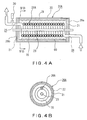
- the tubular structure 26A comprises a single pipe 70, which is wound in a spiral configuration around the heating lamp 23 to be in a form of a tube.
- the tubular structure 26A surrounds the halogen lamp 23 with an annular gap being formed between the halogen lamp 23 and the tubular structure 26A.
- the spiral axis of the pipe 70 coincides with the longitudinal axis of the halogen lamp 23.
- adjacent portions of the pipe 70 with respect to the spiral-axis direction are preferably in close contact with each other, but may be in close proximity while remaining a slight gap therebetween as long as leakage of radiant light emitted from the halogen lamp 23 to the exterior of the tubular structure 26A can be prevented or suppressed to a negligible level.
- the pipe 70 has one end portion thereof serving as a fluid inlet 24 of the tubular structure 26A and extending straightly through the end cap 22a, and the other end portion thereof serving as a fluid outlet 25 of the tubular structure 26A and extending straightly through the end cap 22b.
- the cross-sectional structure of the spiral pipe 70 is essentially the same as that of the straight pipe 26a in the first embodiment, and thus the description thereof is omitted.
- the cleaning liquid L flown into the tubular structure 26A through the fluid inlet 24 is heated by the radiant light emitted from the halogen lamp in a manner essentially the same as that in the first embodiment, and flows out of the tubular structure 26A through the fluid outlet 25.
- the elements designated by the same reference numerals in Figs. 1, 2, 3A and 3B are the same as those in Figs. 1, 2, 3A and 3B, and thus the description thereof is omitted.
- the fluid heating apparatus may be applied to a cleaning system for cleaning a process object other than a semiconductor wafer, such as a glass substrate for an LCD (liquid crystal display).
- the fluid to be heated by the fluid heating apparatus is not limited to DHF, or a fluid in liquid state.
- the fluid may be a gaseous fluid or a misty fluid.
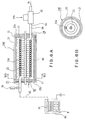
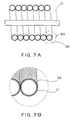
- Figs. 6A, 6B, 7A and 7B show an IPA drying system for drying semiconductor wafers by using a mixed gas of IPA vapor and N 2 gas, which is equipped with a fluid heating apparatus 20B in the third embodiment of the present invention.
- the IPA drying system includes: a process container 80 adapted to accommodate semiconductor wafers W (i.e., process objects) therein; a fluid supply nozzle 81 for jetting a mixed gas of IPA vapor and N 2 gas toward the semiconductor wafers W accommodated in the process container 80; a fluid heating apparatus 20B in a third embodiment according to the present invention; and a two-fluid nozzle 82 for atomizing IPA liquid by using N 2 gas.
- the fluid heating apparatus 20B in the third embodiment differs from the fluid heating apparatus 20A in the second embodiment only in the following respects.
- the cross-sectional structure of the spiral pipe 70A of the fluid heating apparatus 20B is different from that of the spiral pipe 70 of the fluid heating apparatus 20A.
- the spiral pipe 70A has a single-layer structure, and comprises a stainless pipe which itself has a good thermal conductivity. As IPA is not corrosive, the provision of an inner layer made of a chemical resistant synthetic resin is not necessary (but may be provided).
- the black paint 27 is coated on the stainless pipe (see Fig. 7B).
- One end of the spiral pipe 70A serving as a fluid inlet 24 of the tubular structure is connected to an outlet port 83 of the two-fluid nozzle 82.
- the tubular container 21 of the fluid heating apparatus 20B is further provided at the end cap thereof with a purge gas supply port 86.
- N 2 gas i.e., inert gas
- N 2 gas is supplied into the tubular container 21 through the purge gas supply port 86, whereby the interior of the tubular container 21 can be purged, preventing a flammable or volatile fluid (such as IPA vapor) from penetrating into the interior of the tubular container 21, achieving a safer operation of the fluid heating apparatus 20B.
- a mixed fluid of atomized IPA and N 2 gas flows into the spiral pipe 70A of the fluid heating apparatus 20B, where the atomized IPA is vaporized, and thus a mixed gaseous fluid of IPA vapor and N 2 gas flows out of the fluid heating apparatus 20B.
- the mixed gaseous fluid of IPA vapor and N 2 gas is supplied to the fluid supply nozzle 81 and is jetted thereform toward the semiconductor wafers W to dry the same.
- the fluid heating apparatus 20B is capable of heating a fluid efficiently.
- Figs. 6A, 6B, 7A and 7B the elements designated by the same reference numerals in Figs. 4A, 4B, 5A and 5B are the same as those in Figs. 4A, 4B, 5A and 5B, and thus the description thereof is omitted.
- the third embodiment may be modified by substituting the tubing structure comprising plural straight pipes 20a of the first embodiment with the spiral pipe 70A of the tubing structure 20B.
- Two or more fluid heating apparatuses 20B may be connected in series.
- the upstream-side fluid heating apparatus 20B may heat the fluid to vaporize the same, and the downstream-side fluid heating apparatus 20B may heat the vaporized fluid to a designated process temperature.
- the halogen lamp 23 may be replaced with another sort of thermal-radiating lamp, such as an infrared lamp.
Landscapes
- Engineering & Computer Science (AREA)
- Physics & Mathematics (AREA)
- Thermal Sciences (AREA)
- Mechanical Engineering (AREA)
- General Engineering & Computer Science (AREA)
- Chemical & Material Sciences (AREA)
- Combustion & Propulsion (AREA)
- Cleaning Or Drying Semiconductors (AREA)
- Instantaneous Water Boilers, Portable Hot-Water Supply Apparatuses, And Control Of Portable Hot-Water Supply Apparatuses (AREA)
- Weting (AREA)
- Exposure Of Semiconductors, Excluding Electron Or Ion Beam Exposure (AREA)
- Resistance Heating (AREA)
Applications Claiming Priority (1)
| Application Number | Priority Date | Filing Date | Title |
|---|---|---|---|
| JP2005199899A JP4743495B2 (ja) | 2005-07-08 | 2005-07-08 | 流体加熱装置 |
Publications (2)
| Publication Number | Publication Date |
|---|---|
| EP1741995A2 true EP1741995A2 (de) | 2007-01-10 |
| EP1741995A3 EP1741995A3 (de) | 2007-08-01 |
Family
ID=37124282
Family Applications (1)
| Application Number | Title | Priority Date | Filing Date |
|---|---|---|---|
| EP06014160A Withdrawn EP1741995A3 (de) | 2005-07-08 | 2006-07-07 | Vorrichtung zum Aufwärmen einer Flüssigkeit |
Country Status (6)
| Country | Link |
|---|---|
| US (1) | US7593625B2 (de) |
| EP (1) | EP1741995A3 (de) |
| JP (1) | JP4743495B2 (de) |
| KR (1) | KR101123994B1 (de) |
| CN (1) | CN100554760C (de) |
| TW (1) | TW200716923A (de) |
Cited By (2)
| Publication number | Priority date | Publication date | Assignee | Title |
|---|---|---|---|---|
| EP2112438A3 (de) * | 2008-04-24 | 2012-06-13 | D.H.E. S.R.L. | Wärmetauscher für Flüssigkeiten |
| IT202200005471A1 (it) * | 2022-03-21 | 2023-09-21 | Rudi Foini | Dispositivo di nebulizzazione e metodo di scambio termico abbreviato per vaporizzazione sostanza liquida |
Families Citing this family (37)
| Publication number | Priority date | Publication date | Assignee | Title |
|---|---|---|---|---|
| JP2008244318A (ja) * | 2007-03-28 | 2008-10-09 | Tokyo Electron Ltd | 基板搬送部材の洗浄方法、基板搬送装置及び基板処理システム |
| US8701308B2 (en) | 2008-06-02 | 2014-04-22 | Tokyo Electron Limited | Fluid heater, manufacturing method thereof, substrate processing apparatus including fluid heater, and substrate processing method |
| JP5138515B2 (ja) * | 2008-09-05 | 2013-02-06 | 東京エレクトロン株式会社 | 蒸気発生器、蒸気発生方法および基板処理装置 |
| JP5415797B2 (ja) * | 2009-03-24 | 2014-02-12 | 株式会社Kelk | 流体加熱装置 |
| JP2011075145A (ja) * | 2009-09-29 | 2011-04-14 | Fuji Heavy Ind Ltd | 流体加熱装置およびこれを用いた循環式加熱処理システム |
| DE102010011702A1 (de) | 2010-03-10 | 2011-09-15 | E.G.O. Elektro-Gerätebau GmbH | Einrichtung zum Erhitzen von Wasser bzw. Dampf |
| CN201839457U (zh) * | 2010-05-24 | 2011-05-18 | 小田(中山)实业有限公司 | 发热器以及即热式电热水机 |
| JP5307780B2 (ja) * | 2010-09-13 | 2013-10-02 | 東京エレクトロン株式会社 | 液体加熱ユニット、これを備える液処理装置、および液処理方法 |
| KR101036509B1 (ko) * | 2010-09-30 | 2011-05-24 | 정광호 | 탄소히터를 이용한 온수생성장치 |
| JP2012087983A (ja) * | 2010-10-19 | 2012-05-10 | Tokyo Electron Ltd | 流体加熱装置及び基板処理装置 |
| JP2012189385A (ja) * | 2011-03-09 | 2012-10-04 | Fujifilm Corp | 放射線画像検出装置の保守方法 |
| DE102011013810B4 (de) * | 2011-03-14 | 2022-03-03 | Stiebel Eltron Gmbh & Co. Kg | Elektronisch geregelter Durchlauferhitzer und Verfahren zum Betrieb eines elektronisch geregelten Durchlauferhitzers |
| US10222091B2 (en) | 2012-07-17 | 2019-03-05 | Eemax, Inc. | Next generation modular heating system |
| US9140466B2 (en) | 2012-07-17 | 2015-09-22 | Eemax, Inc. | Fluid heating system and instant fluid heating device |
| US9234674B2 (en) * | 2012-12-21 | 2016-01-12 | Eemax, Inc. | Next generation bare wire water heater |
| JP6244529B2 (ja) * | 2013-03-05 | 2017-12-13 | 国立研究開発法人農業・食品産業技術総合研究機構 | 加熱媒体発生装置及び該加熱媒体発生装置を含む加熱処理装置 |
| US10264629B2 (en) * | 2013-05-30 | 2019-04-16 | Osram Sylvania Inc. | Infrared heat lamp assembly |
| JP6021767B2 (ja) * | 2013-09-04 | 2016-11-09 | 日本サーモスタット株式会社 | 液化ガス加温用ヒータ装置 |
| KR101522714B1 (ko) * | 2014-01-14 | 2015-06-17 | 주식회사 미니맥스 | 반도체 및 엘씨디 제조 설비용 감압 장치 |
| US9451792B1 (en) * | 2014-09-05 | 2016-09-27 | Atmos Nation, LLC | Systems and methods for vaporizing assembly |
| US9702585B2 (en) | 2014-12-17 | 2017-07-11 | Eemax, Inc. | Tankless electric water heater |
| US10462950B2 (en) * | 2015-05-22 | 2019-10-29 | Fuji Corporation | Electronic component bonding device and electronic component mounter |
| CN106288332B (zh) * | 2015-06-08 | 2019-03-22 | 福建斯狄渢电开水器有限公司 | 一种即热式加热器 |
| TW201829961A (zh) * | 2016-10-25 | 2018-08-16 | 伊馬德 馬哈維利 | 蒸汽產生器及反應器 |
| KR101837891B1 (ko) * | 2017-02-22 | 2018-03-13 | 이우주 | 액체 순환형 이중관 램프 |
| KR101846509B1 (ko) * | 2017-03-29 | 2018-04-09 | (주)앤피에스 | 열원 장치 및 이를 구비하는 기판 처리 장치 |
| JP6961211B2 (ja) * | 2017-07-20 | 2021-11-05 | メトロ電気工業株式会社 | 流体加熱器 |
| JP2020009628A (ja) * | 2018-07-09 | 2020-01-16 | 有限会社フィンテック | 光加熱式ヒータ |
| JP2020064764A (ja) * | 2018-10-17 | 2020-04-23 | シャープ株式会社 | 流体加熱装置、加熱調理器 |
| JP7190888B2 (ja) * | 2018-12-06 | 2022-12-16 | 東京エレクトロン株式会社 | 配管加熱装置及び基板処理装置 |
| WO2021108263A1 (en) * | 2019-11-26 | 2021-06-03 | Nxstage Medical, Inc. | Heater devices, methods, and systems |
| KR102089228B1 (ko) * | 2019-12-05 | 2020-03-13 | 신영현 | 조명 온수기 |
| US11705345B2 (en) | 2020-04-30 | 2023-07-18 | Edwards Vacuum Llc | Semiconductor system with steam generator and reactor |
| WO2023183190A1 (en) * | 2022-03-24 | 2023-09-28 | White Knight Fluid Handling Inc. | Fluid heater |
| CN115440626B (zh) * | 2022-08-30 | 2024-11-26 | 浙江大学 | 一种高效、高精度红外石英加热器 |
| WO2025057806A1 (ja) * | 2023-09-15 | 2025-03-20 | 東京エレクトロン株式会社 | 流体供給システム、基板処理装置及び基板処理方法 |
| WO2025207004A1 (en) * | 2024-03-25 | 2025-10-02 | Kanthal Ab | Fluid guiding module fluid heater and fluid heating apparatus |
Family Cites Families (23)
| Publication number | Priority date | Publication date | Assignee | Title |
|---|---|---|---|---|
| US1767122A (en) * | 1929-07-03 | 1930-06-24 | Charles G Dean | Portable electric water heater |
| US3546431A (en) * | 1969-04-25 | 1970-12-08 | Erich L Gibbs | Immersion heater and method of making the same |
| US5054107A (en) * | 1989-05-19 | 1991-10-01 | Geoffrey Batchelder | Radiating lamp fluid heating system |
| GB8919700D0 (en) | 1989-08-31 | 1989-10-11 | Electricity Council | Infra-red radiation emission arrangement |
| JPH0342637U (de) * | 1989-09-01 | 1991-04-23 | ||
| US5127465A (en) * | 1990-12-28 | 1992-07-07 | Fischer Industries, Inc. | Heat exchanger |
| JP2583159B2 (ja) * | 1991-02-08 | 1997-02-19 | 株式会社小松製作所 | 流体加熱器 |
| JPH06221677A (ja) * | 1993-01-22 | 1994-08-12 | Nishibori Minoru | ガス加熱装置 |
| JP3501887B2 (ja) * | 1995-09-29 | 2004-03-02 | 小松エレクトロニクス株式会社 | 流体加熱装置 |
| JP3033047B2 (ja) * | 1995-11-30 | 2000-04-17 | 株式会社小松製作所 | 流体の温度制御装置 |
| JPH1024102A (ja) * | 1996-07-15 | 1998-01-27 | Meteku:Kk | 透析液加温ヒーター |
| JPH10220909A (ja) * | 1996-12-03 | 1998-08-21 | Komatsu Ltd | 流体温度制御装置 |
| JP2000111155A (ja) * | 1998-10-02 | 2000-04-18 | Komatsu Electronics Kk | 液体加熱装置 |
| JP3847469B2 (ja) * | 1998-10-02 | 2006-11-22 | 小松エレクトロニクス株式会社 | 流体加熱装置 |
| JP2000146298A (ja) * | 1998-11-13 | 2000-05-26 | Matsushita Electric Ind Co Ltd | 触媒燃焼装置 |
| JP3963610B2 (ja) * | 1999-04-20 | 2007-08-22 | 三益半導体工業株式会社 | 液体加熱装置 |
| JP3587249B2 (ja) * | 2000-03-30 | 2004-11-10 | 東芝セラミックス株式会社 | 流体加熱装置 |
| JP2002162113A (ja) * | 2000-11-24 | 2002-06-07 | Ses Co Ltd | 恒温液用昇温装置 |
| US6621984B2 (en) * | 2001-08-03 | 2003-09-16 | Integrated Circuit Development Corp. | In-line fluid heating system |
| JP2003090613A (ja) * | 2001-09-18 | 2003-03-28 | Komatsu Electronics Inc | 流体加熱装置 |
| JP2003097849A (ja) * | 2001-09-25 | 2003-04-03 | Orion Mach Co Ltd | 流体加熱装置 |
| JP3936644B2 (ja) * | 2002-08-29 | 2007-06-27 | ニチアス株式会社 | 流体加熱装置 |
| WO2004053400A1 (en) * | 2002-12-11 | 2004-06-24 | Thomas Johnston | Method device for heating fluids |
-
2005
- 2005-07-08 JP JP2005199899A patent/JP4743495B2/ja not_active Expired - Lifetime
-
2006
- 2006-06-29 KR KR1020060059168A patent/KR101123994B1/ko active Active
- 2006-07-06 US US11/481,253 patent/US7593625B2/en active Active
- 2006-07-07 TW TW095124856A patent/TW200716923A/zh unknown
- 2006-07-07 EP EP06014160A patent/EP1741995A3/de not_active Withdrawn
- 2006-07-07 CN CNB2006101054930A patent/CN100554760C/zh active Active
Cited By (2)
| Publication number | Priority date | Publication date | Assignee | Title |
|---|---|---|---|---|
| EP2112438A3 (de) * | 2008-04-24 | 2012-06-13 | D.H.E. S.R.L. | Wärmetauscher für Flüssigkeiten |
| IT202200005471A1 (it) * | 2022-03-21 | 2023-09-21 | Rudi Foini | Dispositivo di nebulizzazione e metodo di scambio termico abbreviato per vaporizzazione sostanza liquida |
Also Published As
| Publication number | Publication date |
|---|---|
| TW200716923A (en) | 2007-05-01 |
| EP1741995A3 (de) | 2007-08-01 |
| TWI297762B (de) | 2008-06-11 |
| JP4743495B2 (ja) | 2011-08-10 |
| KR20070006558A (ko) | 2007-01-11 |
| KR101123994B1 (ko) | 2012-03-23 |
| US20070017502A1 (en) | 2007-01-25 |
| JP2007017098A (ja) | 2007-01-25 |
| US7593625B2 (en) | 2009-09-22 |
| CN1892094A (zh) | 2007-01-10 |
| CN100554760C (zh) | 2009-10-28 |
Similar Documents
| Publication | Publication Date | Title |
|---|---|---|
| US7593625B2 (en) | Fluid heating apparatus | |
| KR101357056B1 (ko) | 유체 가열 장치 | |
| US9485807B2 (en) | Liquid heating apparatus and liquid heating method | |
| EP0570586A1 (de) | Heizvorrichtung für fluid | |
| TWI506673B (zh) | 汽化裝置、基板處理裝置、塗佈顯影裝置及基板處理方法 | |
| US6621984B2 (en) | In-line fluid heating system | |
| CN113130357B (zh) | 一种晶圆干燥系统及晶圆干燥方法 | |
| US7637029B2 (en) | Vapor drying method, apparatus and recording medium for use in the method | |
| CN110023689A (zh) | 蒸汽发生器和反应器 | |
| CN1911489B (zh) | 蒸汽干燥方法以及装置 | |
| JP2008096057A (ja) | 液体加熱装置 | |
| KR102346370B1 (ko) | 약액 가열 장치와 약액 가열 방법 | |
| CN211904476U (zh) | 温度检测装置 | |
| JP7323674B1 (ja) | 薬液ヒーティング装置およびそれを備える基板処理システム | |
| JPH1183172A (ja) | 流体加熱装置 | |
| KR102918399B1 (ko) | 가열된 유체를 배관 시스템으로 도입하기 위한 가열 배관 장치 | |
| KR20220063518A (ko) | 약액 히팅 장치 및 이를 구비하는 기판 처리 시스템 | |
| JP2008082571A (ja) | 液体加熱装置 | |
| US20250273441A1 (en) | Liquid-cooled optical window for semiconductor processing chamber | |
| JP3043543U (ja) | 液体加熱装置 | |
| JP3253176B2 (ja) | クリーンガス加熱装置 | |
| KR20240047324A (ko) | 가열된 유체를 배관 시스템으로 도입하기 위한 가열 배관 장치 | |
| KR20190070130A (ko) | 초임계유체 공급장치 | |
| JP2006019509A (ja) | ガス加熱装置およびこれを有する反応副生成物防止装置 | |
| KR20000027415A (ko) | 반도체소자의 제조공정에 이용되는 연소장치 |
Legal Events
| Date | Code | Title | Description |
|---|---|---|---|
| PUAI | Public reference made under article 153(3) epc to a published international application that has entered the european phase |
Free format text: ORIGINAL CODE: 0009012 |
|
| AK | Designated contracting states |
Kind code of ref document: A2 Designated state(s): AT BE BG CH CY CZ DE DK EE ES FI FR GB GR HU IE IS IT LI LT LU LV MC NL PL PT RO SE SI SK TR |
|
| AX | Request for extension of the european patent |
Extension state: AL BA HR MK YU |
|
| PUAL | Search report despatched |
Free format text: ORIGINAL CODE: 0009013 |
|
| AK | Designated contracting states |
Kind code of ref document: A3 Designated state(s): AT BE BG CH CY CZ DE DK EE ES FI FR GB GR HU IE IS IT LI LT LU LV MC NL PL PT RO SE SI SK TR |
|
| AX | Request for extension of the european patent |
Extension state: AL BA HR MK YU |
|
| 17P | Request for examination filed |
Effective date: 20071227 |
|
| 17Q | First examination report despatched |
Effective date: 20080201 |
|
| AKX | Designation fees paid |
Designated state(s): DE NL |
|
| STAA | Information on the status of an ep patent application or granted ep patent |
Free format text: STATUS: THE APPLICATION IS DEEMED TO BE WITHDRAWN |
|
| 18D | Application deemed to be withdrawn |
Effective date: 20150324 |