EP1663940B1 - Verbesserungen von bzw. im zusammenhang mit phthalatweichmacherestern - Google Patents
Verbesserungen von bzw. im zusammenhang mit phthalatweichmacherestern Download PDFInfo
- Publication number
- EP1663940B1 EP1663940B1 EP04764340A EP04764340A EP1663940B1 EP 1663940 B1 EP1663940 B1 EP 1663940B1 EP 04764340 A EP04764340 A EP 04764340A EP 04764340 A EP04764340 A EP 04764340A EP 1663940 B1 EP1663940 B1 EP 1663940B1
- Authority
- EP
- European Patent Office
- Prior art keywords
- process according
- adsorbent
- filter aid
- plasticiser
- ester
- Prior art date
- Legal status (The legal status is an assumption and is not a legal conclusion. Google has not performed a legal analysis and makes no representation as to the accuracy of the status listed.)
- Expired - Lifetime
Links
- 239000004014 plasticizer Substances 0.000 title claims abstract description 81
- 150000002148 esters Chemical class 0.000 title claims abstract description 71
- XNGIFLGASWRNHJ-UHFFFAOYSA-L phthalate(2-) Chemical compound [O-]C(=O)C1=CC=CC=C1C([O-])=O XNGIFLGASWRNHJ-UHFFFAOYSA-L 0.000 title claims description 3
- 230000006872 improvement Effects 0.000 title description 7
- 239000003463 adsorbent Substances 0.000 claims abstract description 52
- 239000000203 mixture Substances 0.000 claims abstract description 52
- 238000001914 filtration Methods 0.000 claims abstract description 16
- OKTJSMMVPCPJKN-UHFFFAOYSA-N Carbon Chemical compound [C] OKTJSMMVPCPJKN-UHFFFAOYSA-N 0.000 claims description 65
- 238000000034 method Methods 0.000 claims description 41
- 230000008569 process Effects 0.000 claims description 35
- LFQSCWFLJHTTHZ-UHFFFAOYSA-N Ethanol Chemical compound CCO LFQSCWFLJHTTHZ-UHFFFAOYSA-N 0.000 claims description 26
- HEMHJVSKTPXQMS-UHFFFAOYSA-M Sodium hydroxide Chemical group [OH-].[Na+] HEMHJVSKTPXQMS-UHFFFAOYSA-M 0.000 claims description 24
- -1 alkali metal salt Chemical class 0.000 claims description 23
- 239000002253 acid Substances 0.000 claims description 20
- 239000000463 material Substances 0.000 claims description 20
- XLYOFNOQVPJJNP-UHFFFAOYSA-N water Substances O XLYOFNOQVPJJNP-UHFFFAOYSA-N 0.000 claims description 18
- 239000000047 product Substances 0.000 claims description 16
- 229910052799 carbon Inorganic materials 0.000 claims description 14
- 150000008064 anhydrides Chemical class 0.000 claims description 12
- 239000004927 clay Substances 0.000 claims description 12
- CDBYLPFSWZWCQE-UHFFFAOYSA-L sodium carbonate Substances [Na+].[Na+].[O-]C([O-])=O CDBYLPFSWZWCQE-UHFFFAOYSA-L 0.000 claims description 12
- 239000002585 base Substances 0.000 claims description 9
- 238000004519 manufacturing process Methods 0.000 claims description 9
- 229910000029 sodium carbonate Inorganic materials 0.000 claims description 6
- WPYMKLBDIGXBTP-UHFFFAOYSA-N benzoic acid Chemical compound OC(=O)C1=CC=CC=C1 WPYMKLBDIGXBTP-UHFFFAOYSA-N 0.000 claims description 5
- 239000012263 liquid product Substances 0.000 claims description 4
- LGRFSURHDFAFJT-UHFFFAOYSA-N Phthalic anhydride Natural products C1=CC=C2C(=O)OC(=O)C2=C1 LGRFSURHDFAFJT-UHFFFAOYSA-N 0.000 claims description 3
- JHIWVOJDXOSYLW-UHFFFAOYSA-N butyl 2,2-difluorocyclopropane-1-carboxylate Chemical group CCCCOC(=O)C1CC1(F)F JHIWVOJDXOSYLW-UHFFFAOYSA-N 0.000 claims description 3
- 239000002250 absorbent Substances 0.000 claims description 2
- 230000002745 absorbent Effects 0.000 claims description 2
- 229910052783 alkali metal Inorganic materials 0.000 claims description 2
- 125000004432 carbon atom Chemical group C* 0.000 claims description 2
- KJIOQYGWTQBHNH-UHFFFAOYSA-N undecanol Chemical compound CCCCCCCCCCCO KJIOQYGWTQBHNH-UHFFFAOYSA-N 0.000 claims 2
- MWKFXSUHUHTGQN-UHFFFAOYSA-N decan-1-ol Chemical compound CCCCCCCCCCO MWKFXSUHUHTGQN-UHFFFAOYSA-N 0.000 claims 1
- 125000002915 carbonyl group Chemical group [*:2]C([*:1])=O 0.000 abstract description 21
- 239000007788 liquid Substances 0.000 abstract description 13
- 239000000543 intermediate Substances 0.000 description 31
- 210000002741 palatine tonsil Anatomy 0.000 description 18
- 238000000746 purification Methods 0.000 description 18
- 239000003795 chemical substances by application Substances 0.000 description 17
- 239000003054 catalyst Substances 0.000 description 14
- 150000001298 alcohols Chemical class 0.000 description 13
- HBGGXOJOCNVPFY-UHFFFAOYSA-N diisononyl phthalate Chemical compound CC(C)CCCCCCOC(=O)C1=CC=CC=C1C(=O)OCCCCCCC(C)C HBGGXOJOCNVPFY-UHFFFAOYSA-N 0.000 description 13
- ZVFDTKUVRCTHQE-UHFFFAOYSA-N Diisodecyl phthalate Chemical compound CC(C)CCCCCCCOC(=O)C1=CC=CC=C1C(=O)OCCCCCCCC(C)C ZVFDTKUVRCTHQE-UHFFFAOYSA-N 0.000 description 11
- VYPSYNLAJGMNEJ-UHFFFAOYSA-N Silicium dioxide Chemical compound O=[Si]=O VYPSYNLAJGMNEJ-UHFFFAOYSA-N 0.000 description 10
- 238000005886 esterification reaction Methods 0.000 description 9
- 239000002245 particle Substances 0.000 description 9
- 239000007787 solid Substances 0.000 description 9
- 238000001228 spectrum Methods 0.000 description 9
- DCAYPVUWAIABOU-UHFFFAOYSA-N hexadecane Chemical compound CCCCCCCCCCCCCCCC DCAYPVUWAIABOU-UHFFFAOYSA-N 0.000 description 8
- XNGIFLGASWRNHJ-UHFFFAOYSA-N phthalic acid Chemical class OC(=O)C1=CC=CC=C1C(O)=O XNGIFLGASWRNHJ-UHFFFAOYSA-N 0.000 description 8
- 239000000243 solution Substances 0.000 description 8
- 239000003513 alkali Substances 0.000 description 7
- PNEYBMLMFCGWSK-UHFFFAOYSA-N aluminium oxide Inorganic materials [O-2].[O-2].[O-2].[Al+3].[Al+3] PNEYBMLMFCGWSK-UHFFFAOYSA-N 0.000 description 7
- SVPXDRXYRYOSEX-UHFFFAOYSA-N bentoquatam Chemical compound O.O=[Si]=O.O=[Al]O[Al]=O SVPXDRXYRYOSEX-UHFFFAOYSA-N 0.000 description 7
- 238000006243 chemical reaction Methods 0.000 description 7
- 229920000915 polyvinyl chloride Polymers 0.000 description 7
- 239000004800 polyvinyl chloride Substances 0.000 description 7
- IJGRMHOSHXDMSA-UHFFFAOYSA-N Atomic nitrogen Chemical compound N#N IJGRMHOSHXDMSA-UHFFFAOYSA-N 0.000 description 6
- CURLTUGMZLYLDI-UHFFFAOYSA-N Carbon dioxide Chemical compound O=C=O CURLTUGMZLYLDI-UHFFFAOYSA-N 0.000 description 6
- BJQHLKABXJIVAM-UHFFFAOYSA-N bis(2-ethylhexyl) phthalate Chemical compound CCCCC(CC)COC(=O)C1=CC=CC=C1C(=O)OCC(CC)CCCC BJQHLKABXJIVAM-UHFFFAOYSA-N 0.000 description 6
- 238000004061 bleaching Methods 0.000 description 6
- KRKNYBCHXYNGOX-UHFFFAOYSA-N citric acid Chemical compound OC(=O)CC(O)(C(O)=O)CC(O)=O KRKNYBCHXYNGOX-UHFFFAOYSA-N 0.000 description 6
- 230000000694 effects Effects 0.000 description 6
- 230000007062 hydrolysis Effects 0.000 description 6
- 238000006460 hydrolysis reaction Methods 0.000 description 6
- 238000005259 measurement Methods 0.000 description 6
- 238000006386 neutralization reaction Methods 0.000 description 6
- 230000009467 reduction Effects 0.000 description 6
- 239000003981 vehicle Substances 0.000 description 6
- 230000002378 acidificating effect Effects 0.000 description 5
- 150000001336 alkenes Chemical class 0.000 description 5
- 239000000356 contaminant Substances 0.000 description 5
- 239000012535 impurity Substances 0.000 description 5
- 125000005498 phthalate group Chemical class 0.000 description 5
- 230000002829 reductive effect Effects 0.000 description 5
- 238000003756 stirring Methods 0.000 description 5
- GWEVSGVZZGPLCZ-UHFFFAOYSA-N Titan oxide Chemical compound O=[Ti]=O GWEVSGVZZGPLCZ-UHFFFAOYSA-N 0.000 description 4
- 150000007513 acids Chemical class 0.000 description 4
- 238000001994 activation Methods 0.000 description 4
- 230000004913 activation Effects 0.000 description 4
- WNLRTRBMVRJNCN-UHFFFAOYSA-N adipic acid Chemical compound OC(=O)CCCCC(O)=O WNLRTRBMVRJNCN-UHFFFAOYSA-N 0.000 description 4
- 235000012216 bentonite Nutrition 0.000 description 4
- 230000015572 biosynthetic process Effects 0.000 description 4
- 239000006227 byproduct Substances 0.000 description 4
- 229910000281 calcium bentonite Inorganic materials 0.000 description 4
- 230000000052 comparative effect Effects 0.000 description 4
- 150000001875 compounds Chemical class 0.000 description 4
- SHFGJEQAOUMGJM-UHFFFAOYSA-N dialuminum dipotassium disodium dioxosilane iron(3+) oxocalcium oxomagnesium oxygen(2-) Chemical compound [O--].[O--].[O--].[O--].[O--].[O--].[O--].[O--].[Na+].[Na+].[Al+3].[Al+3].[K+].[K+].[Fe+3].[Fe+3].O=[Mg].O=[Ca].O=[Si]=O SHFGJEQAOUMGJM-UHFFFAOYSA-N 0.000 description 4
- 238000009826 distribution Methods 0.000 description 4
- 230000032050 esterification Effects 0.000 description 4
- 150000002170 ethers Chemical class 0.000 description 4
- 239000007789 gas Substances 0.000 description 4
- 239000011521 glass Substances 0.000 description 4
- 238000007037 hydroformylation reaction Methods 0.000 description 4
- 238000005984 hydrogenation reaction Methods 0.000 description 4
- WTDHULULXKLSOZ-UHFFFAOYSA-N hydroxylamine hydrochloride Substances Cl.ON WTDHULULXKLSOZ-UHFFFAOYSA-N 0.000 description 4
- WCYJQVALWQMJGE-UHFFFAOYSA-M hydroxylammonium chloride Chemical compound [Cl-].O[NH3+] WCYJQVALWQMJGE-UHFFFAOYSA-M 0.000 description 4
- 238000009413 insulation Methods 0.000 description 4
- CPLXHLVBOLITMK-UHFFFAOYSA-N magnesium oxide Inorganic materials [Mg]=O CPLXHLVBOLITMK-UHFFFAOYSA-N 0.000 description 4
- 125000005575 polycyclic aromatic hydrocarbon group Chemical group 0.000 description 4
- 239000011148 porous material Substances 0.000 description 4
- 239000007858 starting material Substances 0.000 description 4
- VDZOOKBUILJEDG-UHFFFAOYSA-M tetrabutylammonium hydroxide Chemical compound [OH-].CCCC[N+](CCCC)(CCCC)CCCC VDZOOKBUILJEDG-UHFFFAOYSA-M 0.000 description 4
- ARCGXLSVLAOJQL-UHFFFAOYSA-N trimellitic acid Chemical compound OC(=O)C1=CC=C(C(O)=O)C(C(O)=O)=C1 ARCGXLSVLAOJQL-UHFFFAOYSA-N 0.000 description 4
- YIWUKEYIRIRTPP-UHFFFAOYSA-N 2-ethylhexan-1-ol Chemical compound CCCCC(CC)CO YIWUKEYIRIRTPP-UHFFFAOYSA-N 0.000 description 3
- BVKZGUZCCUSVTD-UHFFFAOYSA-L Carbonate Chemical compound [O-]C([O-])=O BVKZGUZCCUSVTD-UHFFFAOYSA-L 0.000 description 3
- 239000004803 Di-2ethylhexylphthalate Substances 0.000 description 3
- LYCAIKOWRPUZTN-UHFFFAOYSA-N Ethylene glycol Chemical compound OCCO LYCAIKOWRPUZTN-UHFFFAOYSA-N 0.000 description 3
- KFZMGEQAYNKOFK-UHFFFAOYSA-N Isopropanol Chemical compound CC(C)O KFZMGEQAYNKOFK-UHFFFAOYSA-N 0.000 description 3
- OKKJLVBELUTLKV-UHFFFAOYSA-N Methanol Chemical compound OC OKKJLVBELUTLKV-UHFFFAOYSA-N 0.000 description 3
- DNIAPMSPPWPWGF-UHFFFAOYSA-N Propylene glycol Chemical compound CC(O)CO DNIAPMSPPWPWGF-UHFFFAOYSA-N 0.000 description 3
- QAOWNCQODCNURD-UHFFFAOYSA-N Sulfuric acid Chemical compound OS(O)(=O)=O QAOWNCQODCNURD-UHFFFAOYSA-N 0.000 description 3
- 239000001569 carbon dioxide Substances 0.000 description 3
- 229910002092 carbon dioxide Inorganic materials 0.000 description 3
- 239000008367 deionised water Substances 0.000 description 3
- GUJOJGAPFQRJSV-UHFFFAOYSA-N dialuminum;dioxosilane;oxygen(2-);hydrate Chemical compound O.[O-2].[O-2].[O-2].[Al+3].[Al+3].O=[Si]=O.O=[Si]=O.O=[Si]=O.O=[Si]=O GUJOJGAPFQRJSV-UHFFFAOYSA-N 0.000 description 3
- 238000010438 heat treatment Methods 0.000 description 3
- 239000001307 helium Substances 0.000 description 3
- 229910052734 helium Inorganic materials 0.000 description 3
- SWQJXJOGLNCZEY-UHFFFAOYSA-N helium atom Chemical compound [He] SWQJXJOGLNCZEY-UHFFFAOYSA-N 0.000 description 3
- 238000002347 injection Methods 0.000 description 3
- 239000007924 injection Substances 0.000 description 3
- 229910052500 inorganic mineral Inorganic materials 0.000 description 3
- NLYAJNPCOHFWQQ-UHFFFAOYSA-N kaolin Chemical class O.O.O=[Al]O[Si](=O)O[Si](=O)O[Al]=O NLYAJNPCOHFWQQ-UHFFFAOYSA-N 0.000 description 3
- 239000000395 magnesium oxide Substances 0.000 description 3
- 239000011707 mineral Substances 0.000 description 3
- 235000010755 mineral Nutrition 0.000 description 3
- 238000002156 mixing Methods 0.000 description 3
- 229910052901 montmorillonite Inorganic materials 0.000 description 3
- 229910052757 nitrogen Inorganic materials 0.000 description 3
- 239000010451 perlite Substances 0.000 description 3
- 235000019362 perlite Nutrition 0.000 description 3
- 238000010992 reflux Methods 0.000 description 3
- 150000003839 salts Chemical class 0.000 description 3
- 239000002002 slurry Substances 0.000 description 3
- 238000001179 sorption measurement Methods 0.000 description 3
- 239000000126 substance Substances 0.000 description 3
- WNZQDUSMALZDQF-UHFFFAOYSA-N 2-benzofuran-1(3H)-one Chemical compound C1=CC=C2C(=O)OCC2=C1 WNZQDUSMALZDQF-UHFFFAOYSA-N 0.000 description 2
- QDTDKYHPHANITQ-UHFFFAOYSA-N 7-methyloctan-1-ol Chemical compound CC(C)CCCCCCO QDTDKYHPHANITQ-UHFFFAOYSA-N 0.000 description 2
- ZCYVEMRRCGMTRW-UHFFFAOYSA-N 7553-56-2 Chemical compound [I] ZCYVEMRRCGMTRW-UHFFFAOYSA-N 0.000 description 2
- 239000005711 Benzoic acid Substances 0.000 description 2
- VZCYOOQTPOCHFL-OWOJBTEDSA-N Fumaric acid Chemical compound OC(=O)\C=C\C(O)=O VZCYOOQTPOCHFL-OWOJBTEDSA-N 0.000 description 2
- VEXZGXHMUGYJMC-UHFFFAOYSA-N Hydrochloric acid Chemical compound Cl VEXZGXHMUGYJMC-UHFFFAOYSA-N 0.000 description 2
- DGAQECJNVWCQMB-PUAWFVPOSA-M Ilexoside XXIX Chemical compound C[C@@H]1CC[C@@]2(CC[C@@]3(C(=CC[C@H]4[C@]3(CC[C@@H]5[C@@]4(CC[C@@H](C5(C)C)OS(=O)(=O)[O-])C)C)[C@@H]2[C@]1(C)O)C)C(=O)O[C@H]6[C@@H]([C@H]([C@@H]([C@H](O6)CO)O)O)O.[Na+] DGAQECJNVWCQMB-PUAWFVPOSA-M 0.000 description 2
- 239000004439 Isononyl alcohol Substances 0.000 description 2
- KKEYFWRCBNTPAC-UHFFFAOYSA-N Terephthalic acid Chemical compound OC(=O)C1=CC=C(C(O)=O)C=C1 KKEYFWRCBNTPAC-UHFFFAOYSA-N 0.000 description 2
- 150000008065 acid anhydrides Chemical class 0.000 description 2
- 239000001361 adipic acid Substances 0.000 description 2
- 235000011037 adipic acid Nutrition 0.000 description 2
- 150000001299 aldehydes Chemical class 0.000 description 2
- 150000007933 aliphatic carboxylic acids Chemical class 0.000 description 2
- 239000012298 atmosphere Substances 0.000 description 2
- 229960000892 attapulgite Drugs 0.000 description 2
- 239000000440 bentonite Substances 0.000 description 2
- 229910000278 bentonite Inorganic materials 0.000 description 2
- QMKYBPDZANOJGF-UHFFFAOYSA-N benzene-1,3,5-tricarboxylic acid Chemical compound OC(=O)C1=CC(C(O)=O)=CC(C(O)=O)=C1 QMKYBPDZANOJGF-UHFFFAOYSA-N 0.000 description 2
- 235000010233 benzoic acid Nutrition 0.000 description 2
- 150000001558 benzoic acid derivatives Chemical class 0.000 description 2
- 239000007844 bleaching agent Substances 0.000 description 2
- 238000007664 blowing Methods 0.000 description 2
- 230000008859 change Effects 0.000 description 2
- 239000012153 distilled water Substances 0.000 description 2
- 238000010292 electrical insulation Methods 0.000 description 2
- OMSUIQOIVADKIM-UHFFFAOYSA-N ethyl 3-hydroxybutyrate Chemical compound CCOC(=O)CC(C)O OMSUIQOIVADKIM-UHFFFAOYSA-N 0.000 description 2
- 238000002474 experimental method Methods 0.000 description 2
- 239000000706 filtrate Substances 0.000 description 2
- OVBPIULPVIDEAO-LBPRGKRZSA-N folic acid Chemical compound C=1N=C2NC(N)=NC(=O)C2=NC=1CNC1=CC=C(C(=O)N[C@@H](CCC(O)=O)C(O)=O)C=C1 OVBPIULPVIDEAO-LBPRGKRZSA-N 0.000 description 2
- 238000004817 gas chromatography Methods 0.000 description 2
- 239000011810 insulating material Substances 0.000 description 2
- 239000011630 iodine Substances 0.000 description 2
- 229910052740 iodine Inorganic materials 0.000 description 2
- 239000003456 ion exchange resin Substances 0.000 description 2
- 229920003303 ion-exchange polymer Polymers 0.000 description 2
- QQVIHTHCMHWDBS-UHFFFAOYSA-N isophthalic acid Chemical compound OC(=O)C1=CC=CC(C(O)=O)=C1 QQVIHTHCMHWDBS-UHFFFAOYSA-N 0.000 description 2
- 229910052622 kaolinite Inorganic materials 0.000 description 2
- 239000000391 magnesium silicate Substances 0.000 description 2
- AXZKOIWUVFPNLO-UHFFFAOYSA-N magnesium;oxygen(2-) Chemical compound [O-2].[Mg+2] AXZKOIWUVFPNLO-UHFFFAOYSA-N 0.000 description 2
- 230000014759 maintenance of location Effects 0.000 description 2
- 229910052751 metal Inorganic materials 0.000 description 2
- 239000002184 metal Substances 0.000 description 2
- 150000002736 metal compounds Chemical class 0.000 description 2
- 230000007935 neutral effect Effects 0.000 description 2
- BDJRBEYXGGNYIS-UHFFFAOYSA-N nonanedioic acid Chemical compound OC(=O)CCCCCCCC(O)=O BDJRBEYXGGNYIS-UHFFFAOYSA-N 0.000 description 2
- JRZJOMJEPLMPRA-UHFFFAOYSA-N olefin Natural products CCCCCCCC=C JRZJOMJEPLMPRA-UHFFFAOYSA-N 0.000 description 2
- 150000007524 organic acids Chemical class 0.000 description 2
- 229910052625 palygorskite Inorganic materials 0.000 description 2
- 229920003023 plastic Polymers 0.000 description 2
- 239000004033 plastic Substances 0.000 description 2
- BASFCYQUMIYNBI-UHFFFAOYSA-N platinum Chemical compound [Pt] BASFCYQUMIYNBI-UHFFFAOYSA-N 0.000 description 2
- 238000003918 potentiometric titration Methods 0.000 description 2
- CYIDZMCFTVVTJO-UHFFFAOYSA-N pyromellitic acid Chemical compound OC(=O)C1=CC(C(O)=O)=C(C(O)=O)C=C1C(O)=O CYIDZMCFTVVTJO-UHFFFAOYSA-N 0.000 description 2
- 239000011541 reaction mixture Substances 0.000 description 2
- CXMXRPHRNRROMY-UHFFFAOYSA-N sebacic acid Chemical compound OC(=O)CCCCCCCCC(O)=O CXMXRPHRNRROMY-UHFFFAOYSA-N 0.000 description 2
- 239000000377 silicon dioxide Substances 0.000 description 2
- 235000012239 silicon dioxide Nutrition 0.000 description 2
- 239000011734 sodium Substances 0.000 description 2
- 229910052708 sodium Inorganic materials 0.000 description 2
- 238000012360 testing method Methods 0.000 description 2
- VZCYOOQTPOCHFL-UHFFFAOYSA-N trans-butenedioic acid Natural products OC(=O)C=CC(O)=O VZCYOOQTPOCHFL-UHFFFAOYSA-N 0.000 description 2
- SRPWOOOHEPICQU-UHFFFAOYSA-N trimellitic anhydride Chemical compound OC(=O)C1=CC=C2C(=O)OC(=O)C2=C1 SRPWOOOHEPICQU-UHFFFAOYSA-N 0.000 description 2
- 239000013638 trimer Substances 0.000 description 2
- 238000005406 washing Methods 0.000 description 2
- WRIDQFICGBMAFQ-UHFFFAOYSA-N (E)-8-Octadecenoic acid Natural products CCCCCCCCCC=CCCCCCCC(O)=O WRIDQFICGBMAFQ-UHFFFAOYSA-N 0.000 description 1
- NWUYHJFMYQTDRP-UHFFFAOYSA-N 1,2-bis(ethenyl)benzene;1-ethenyl-2-ethylbenzene;styrene Chemical compound C=CC1=CC=CC=C1.CCC1=CC=CC=C1C=C.C=CC1=CC=CC=C1C=C NWUYHJFMYQTDRP-UHFFFAOYSA-N 0.000 description 1
- NGCDGPPKVSZGRR-UHFFFAOYSA-J 1,4,6,9-tetraoxa-5-stannaspiro[4.4]nonane-2,3,7,8-tetrone Chemical compound [Sn+4].[O-]C(=O)C([O-])=O.[O-]C(=O)C([O-])=O NGCDGPPKVSZGRR-UHFFFAOYSA-J 0.000 description 1
- XUJLWPFSUCHPQL-UHFFFAOYSA-N 11-methyldodecan-1-ol Chemical compound CC(C)CCCCCCCCCCO XUJLWPFSUCHPQL-UHFFFAOYSA-N 0.000 description 1
- LQJBNNIYVWPHFW-UHFFFAOYSA-N 20:1omega9c fatty acid Natural products CCCCCCCCCCC=CCCCCCCCC(O)=O LQJBNNIYVWPHFW-UHFFFAOYSA-N 0.000 description 1
- UITKHKNFVCYWNG-UHFFFAOYSA-N 4-(3,4-dicarboxybenzoyl)phthalic acid Chemical compound C1=C(C(O)=O)C(C(=O)O)=CC=C1C(=O)C1=CC=C(C(O)=O)C(C(O)=O)=C1 UITKHKNFVCYWNG-UHFFFAOYSA-N 0.000 description 1
- PCWGTDULNUVNBN-UHFFFAOYSA-N 4-methylpentan-1-ol Chemical compound CC(C)CCCO PCWGTDULNUVNBN-UHFFFAOYSA-N 0.000 description 1
- VQVIHDPBMFABCQ-UHFFFAOYSA-N 5-(1,3-dioxo-2-benzofuran-5-carbonyl)-2-benzofuran-1,3-dione Chemical compound C1=C2C(=O)OC(=O)C2=CC(C(C=2C=C3C(=O)OC(=O)C3=CC=2)=O)=C1 VQVIHDPBMFABCQ-UHFFFAOYSA-N 0.000 description 1
- ZVHAANQOQZVVFD-UHFFFAOYSA-N 5-methylhexan-1-ol Chemical compound CC(C)CCCCO ZVHAANQOQZVVFD-UHFFFAOYSA-N 0.000 description 1
- DMIMWGHYIPFAIF-UHFFFAOYSA-N 5-nitro-2-piperidin-1-ylaniline Chemical compound NC1=CC([N+]([O-])=O)=CC=C1N1CCCCC1 DMIMWGHYIPFAIF-UHFFFAOYSA-N 0.000 description 1
- BWDBEAQIHAEVLV-UHFFFAOYSA-N 6-methylheptan-1-ol Chemical compound CC(C)CCCCCO BWDBEAQIHAEVLV-UHFFFAOYSA-N 0.000 description 1
- PLLBRTOLHQQAQQ-UHFFFAOYSA-N 8-methylnonan-1-ol Chemical compound CC(C)CCCCCCCO PLLBRTOLHQQAQQ-UHFFFAOYSA-N 0.000 description 1
- QSBYPNXLFMSGKH-UHFFFAOYSA-N 9-Heptadecensaeure Natural products CCCCCCCC=CCCCCCCCC(O)=O QSBYPNXLFMSGKH-UHFFFAOYSA-N 0.000 description 1
- JTKHUJNVHQWSAY-UHFFFAOYSA-N 9-methyldecan-1-ol Chemical compound CC(C)CCCCCCCCO JTKHUJNVHQWSAY-UHFFFAOYSA-N 0.000 description 1
- BVKZGUZCCUSVTD-UHFFFAOYSA-M Bicarbonate Chemical compound OC([O-])=O BVKZGUZCCUSVTD-UHFFFAOYSA-M 0.000 description 1
- OYPRJOBELJOOCE-UHFFFAOYSA-N Calcium Chemical compound [Ca] OYPRJOBELJOOCE-UHFFFAOYSA-N 0.000 description 1
- 239000004215 Carbon black (E152) Substances 0.000 description 1
- VEXZGXHMUGYJMC-UHFFFAOYSA-M Chloride anion Chemical compound [Cl-] VEXZGXHMUGYJMC-UHFFFAOYSA-M 0.000 description 1
- 244000060011 Cocos nucifera Species 0.000 description 1
- MQIUGAXCHLFZKX-UHFFFAOYSA-N Di-n-octyl phthalate Chemical compound CCCCCCCCOC(=O)C1=CC=CC=C1C(=O)OCCCCCCCC MQIUGAXCHLFZKX-UHFFFAOYSA-N 0.000 description 1
- 239000005909 Kieselgur Substances 0.000 description 1
- AFVFQIVMOAPDHO-UHFFFAOYSA-N Methanesulfonic acid Chemical compound CS(O)(=O)=O AFVFQIVMOAPDHO-UHFFFAOYSA-N 0.000 description 1
- OVBPIULPVIDEAO-UHFFFAOYSA-N N-Pteroyl-L-glutaminsaeure Natural products C=1N=C2NC(N)=NC(=O)C2=NC=1CNC1=CC=C(C(=O)NC(CCC(O)=O)C(O)=O)C=C1 OVBPIULPVIDEAO-UHFFFAOYSA-N 0.000 description 1
- KKCBUQHMOMHUOY-UHFFFAOYSA-N Na2O Inorganic materials [O-2].[Na+].[Na+] KKCBUQHMOMHUOY-UHFFFAOYSA-N 0.000 description 1
- 239000005642 Oleic acid Substances 0.000 description 1
- ZQPPMHVWECSIRJ-UHFFFAOYSA-N Oleic acid Natural products CCCCCCCCC=CCCCCCCCC(O)=O ZQPPMHVWECSIRJ-UHFFFAOYSA-N 0.000 description 1
- MURWRBWZIMXKGC-UHFFFAOYSA-N Phthalsaeure-butylester-octylester Natural products CCCCCCCCOC(=O)C1=CC=CC=C1C(=O)OCCCC MURWRBWZIMXKGC-UHFFFAOYSA-N 0.000 description 1
- OFOBLEOULBTSOW-UHFFFAOYSA-N Propanedioic acid Natural products OC(=O)CC(O)=O OFOBLEOULBTSOW-UHFFFAOYSA-N 0.000 description 1
- 229910021607 Silver chloride Inorganic materials 0.000 description 1
- 235000021355 Stearic acid Nutrition 0.000 description 1
- 235000019486 Sunflower oil Nutrition 0.000 description 1
- ATJFFYVFTNAWJD-UHFFFAOYSA-N Tin Chemical compound [Sn] ATJFFYVFTNAWJD-UHFFFAOYSA-N 0.000 description 1
- RTAQQCXQSZGOHL-UHFFFAOYSA-N Titanium Chemical compound [Ti] RTAQQCXQSZGOHL-UHFFFAOYSA-N 0.000 description 1
- QYKIQEUNHZKYBP-UHFFFAOYSA-N Vinyl ether Chemical class C=COC=C QYKIQEUNHZKYBP-UHFFFAOYSA-N 0.000 description 1
- AJDTZVRPEPFODZ-PAMPIZDHSA-J [Sn+4].[O-]C(=O)\C=C/C([O-])=O.[O-]C(=O)\C=C/C([O-])=O Chemical compound [Sn+4].[O-]C(=O)\C=C/C([O-])=O.[O-]C(=O)\C=C/C([O-])=O AJDTZVRPEPFODZ-PAMPIZDHSA-J 0.000 description 1
- 150000001241 acetals Chemical class 0.000 description 1
- 230000002411 adverse Effects 0.000 description 1
- 230000001476 alcoholic effect Effects 0.000 description 1
- 238000005882 aldol condensation reaction Methods 0.000 description 1
- 150000008044 alkali metal hydroxides Chemical class 0.000 description 1
- 229910000272 alkali metal oxide Inorganic materials 0.000 description 1
- 150000001340 alkali metals Chemical class 0.000 description 1
- 150000001447 alkali salts Chemical class 0.000 description 1
- 229910001860 alkaline earth metal hydroxide Inorganic materials 0.000 description 1
- 239000004411 aluminium Substances 0.000 description 1
- 229910052782 aluminium Inorganic materials 0.000 description 1
- XAGFODPZIPBFFR-UHFFFAOYSA-N aluminium Chemical compound [Al] XAGFODPZIPBFFR-UHFFFAOYSA-N 0.000 description 1
- 238000004458 analytical method Methods 0.000 description 1
- 238000000149 argon plasma sintering Methods 0.000 description 1
- 235000013405 beer Nutrition 0.000 description 1
- 230000008901 benefit Effects 0.000 description 1
- LGBAGUMSAPUZPU-UHFFFAOYSA-N bis(9-methyldecyl) benzene-1,2-dicarboxylate Chemical compound CC(C)CCCCCCCCOC(=O)C1=CC=CC=C1C(=O)OCCCCCCCCC(C)C LGBAGUMSAPUZPU-UHFFFAOYSA-N 0.000 description 1
- 239000007853 buffer solution Substances 0.000 description 1
- 229910052791 calcium Inorganic materials 0.000 description 1
- 239000011575 calcium Substances 0.000 description 1
- 238000004364 calculation method Methods 0.000 description 1
- 239000002775 capsule Substances 0.000 description 1
- 150000004649 carbonic acid derivatives Chemical class 0.000 description 1
- 239000012159 carrier gas Substances 0.000 description 1
- 230000003197 catalytic effect Effects 0.000 description 1
- 238000006555 catalytic reaction Methods 0.000 description 1
- 238000005341 cation exchange Methods 0.000 description 1
- 235000013339 cereals Nutrition 0.000 description 1
- 239000003153 chemical reaction reagent Substances 0.000 description 1
- 239000011248 coating agent Substances 0.000 description 1
- 238000000576 coating method Methods 0.000 description 1
- 239000003240 coconut oil Substances 0.000 description 1
- 235000019864 coconut oil Nutrition 0.000 description 1
- 229910052681 coesite Inorganic materials 0.000 description 1
- 238000006482 condensation reaction Methods 0.000 description 1
- 239000000470 constituent Substances 0.000 description 1
- 238000010924 continuous production Methods 0.000 description 1
- 238000004320 controlled atmosphere Methods 0.000 description 1
- 238000012937 correction Methods 0.000 description 1
- 229910052593 corundum Inorganic materials 0.000 description 1
- 229910052906 cristobalite Inorganic materials 0.000 description 1
- 230000003247 decreasing effect Effects 0.000 description 1
- 230000001419 dependent effect Effects 0.000 description 1
- 230000006866 deterioration Effects 0.000 description 1
- 238000011161 development Methods 0.000 description 1
- 150000001983 dialkylethers Chemical class 0.000 description 1
- 150000005690 diesters Chemical class 0.000 description 1
- 239000000539 dimer Substances 0.000 description 1
- DROMNWUQASBTFM-UHFFFAOYSA-N dinonyl benzene-1,2-dicarboxylate Chemical compound CCCCCCCCCOC(=O)C1=CC=CC=C1C(=O)OCCCCCCCCC DROMNWUQASBTFM-UHFFFAOYSA-N 0.000 description 1
- HNPSIPDUKPIQMN-UHFFFAOYSA-N dioxosilane;oxo(oxoalumanyloxy)alumane Chemical compound O=[Si]=O.O=[Al]O[Al]=O HNPSIPDUKPIQMN-UHFFFAOYSA-N 0.000 description 1
- YGANSGVIUGARFR-UHFFFAOYSA-N dipotassium dioxosilane oxo(oxoalumanyloxy)alumane oxygen(2-) Chemical compound [O--].[K+].[K+].O=[Si]=O.O=[Al]O[Al]=O YGANSGVIUGARFR-UHFFFAOYSA-N 0.000 description 1
- 238000004821 distillation Methods 0.000 description 1
- QQVHEQUEHCEAKS-UHFFFAOYSA-N diundecyl benzene-1,2-dicarboxylate Chemical compound CCCCCCCCCCCOC(=O)C1=CC=CC=C1C(=O)OCCCCCCCCCCC QQVHEQUEHCEAKS-UHFFFAOYSA-N 0.000 description 1
- 239000008157 edible vegetable oil Substances 0.000 description 1
- 230000005684 electric field Effects 0.000 description 1
- 238000010828 elution Methods 0.000 description 1
- 239000004744 fabric Substances 0.000 description 1
- 239000010433 feldspar Substances 0.000 description 1
- 239000012467 final product Substances 0.000 description 1
- 235000013312 flour Nutrition 0.000 description 1
- 239000011724 folic acid Substances 0.000 description 1
- 229960000304 folic acid Drugs 0.000 description 1
- 235000019152 folic acid Nutrition 0.000 description 1
- 150000004675 formic acid derivatives Chemical class 0.000 description 1
- 238000009472 formulation Methods 0.000 description 1
- 238000004508 fractional distillation Methods 0.000 description 1
- 239000001530 fumaric acid Substances 0.000 description 1
- ANSXAPJVJOKRDJ-UHFFFAOYSA-N furo[3,4-f][2]benzofuran-1,3,5,7-tetrone Chemical compound C1=C2C(=O)OC(=O)C2=CC2=C1C(=O)OC2=O ANSXAPJVJOKRDJ-UHFFFAOYSA-N 0.000 description 1
- QUSSPXNPULRXKG-UHFFFAOYSA-N galleon Natural products O1C(=CC=2)C(OC)=CC=2CCCCC(=O)CCC2=CC=C(O)C1=C2 QUSSPXNPULRXKG-UHFFFAOYSA-N 0.000 description 1
- 150000002373 hemiacetals Chemical class 0.000 description 1
- 229930195733 hydrocarbon Natural products 0.000 description 1
- 150000002430 hydrocarbons Chemical class 0.000 description 1
- XLYOFNOQVPJJNP-UHFFFAOYSA-M hydroxide Chemical compound [OH-] XLYOFNOQVPJJNP-UHFFFAOYSA-M 0.000 description 1
- 239000011261 inert gas Substances 0.000 description 1
- 230000010354 integration Effects 0.000 description 1
- JEIPFZHSYJVQDO-UHFFFAOYSA-N iron(III) oxide Inorganic materials O=[Fe]O[Fe]=O JEIPFZHSYJVQDO-UHFFFAOYSA-N 0.000 description 1
- QXJSBBXBKPUZAA-UHFFFAOYSA-N isooleic acid Natural products CCCCCCCC=CCCCCCCCCC(O)=O QXJSBBXBKPUZAA-UHFFFAOYSA-N 0.000 description 1
- 229910000836 magnesium aluminium oxide Inorganic materials 0.000 description 1
- VZCYOOQTPOCHFL-UPHRSURJSA-N maleic acid Chemical compound OC(=O)\C=C/C(O)=O VZCYOOQTPOCHFL-UPHRSURJSA-N 0.000 description 1
- 239000011976 maleic acid Substances 0.000 description 1
- FPYJFEHAWHCUMM-UHFFFAOYSA-N maleic anhydride Chemical compound O=C1OC(=O)C=C1 FPYJFEHAWHCUMM-UHFFFAOYSA-N 0.000 description 1
- 125000002496 methyl group Chemical group [H]C([H])([H])* 0.000 description 1
- CXKWCBBOMKCUKX-UHFFFAOYSA-M methylene blue Chemical compound [Cl-].C1=CC(N(C)C)=CC2=[S+]C3=CC(N(C)C)=CC=C3N=C21 CXKWCBBOMKCUKX-UHFFFAOYSA-M 0.000 description 1
- 229960000907 methylthioninium chloride Drugs 0.000 description 1
- 235000013379 molasses Nutrition 0.000 description 1
- 229910052627 muscovite Inorganic materials 0.000 description 1
- QIQXTHQIDYTFRH-UHFFFAOYSA-N octadecanoic acid Chemical compound CCCCCCCCCCCCCCCCCC(O)=O QIQXTHQIDYTFRH-UHFFFAOYSA-N 0.000 description 1
- OQCDKBAXFALNLD-UHFFFAOYSA-N octadecanoic acid Natural products CCCCCCCC(C)CCCCCCCCC(O)=O OQCDKBAXFALNLD-UHFFFAOYSA-N 0.000 description 1
- XZZXKVYTWCYOQX-UHFFFAOYSA-J octanoate;tin(4+) Chemical compound [Sn+4].CCCCCCCC([O-])=O.CCCCCCCC([O-])=O.CCCCCCCC([O-])=O.CCCCCCCC([O-])=O XZZXKVYTWCYOQX-UHFFFAOYSA-J 0.000 description 1
- 239000003921 oil Substances 0.000 description 1
- 235000019198 oils Nutrition 0.000 description 1
- 235000014593 oils and fats Nutrition 0.000 description 1
- ZQPPMHVWECSIRJ-KTKRTIGZSA-N oleic acid Chemical compound CCCCCCCC\C=C/CCCCCCCC(O)=O ZQPPMHVWECSIRJ-KTKRTIGZSA-N 0.000 description 1
- 239000004006 olive oil Substances 0.000 description 1
- 230000003287 optical effect Effects 0.000 description 1
- 125000002524 organometallic group Chemical group 0.000 description 1
- 150000002923 oximes Chemical class 0.000 description 1
- 150000003022 phthalic acids Chemical class 0.000 description 1
- 229910052697 platinum Inorganic materials 0.000 description 1
- 238000005498 polishing Methods 0.000 description 1
- 229920001296 polysiloxane Polymers 0.000 description 1
- 238000012545 processing Methods 0.000 description 1
- RLJWTAURUFQFJP-UHFFFAOYSA-N propan-2-ol;titanium Chemical compound [Ti].CC(C)O.CC(C)O.CC(C)O.CC(C)O RLJWTAURUFQFJP-UHFFFAOYSA-N 0.000 description 1
- QQONPFPTGQHPMA-UHFFFAOYSA-N propylene Natural products CC=C QQONPFPTGQHPMA-UHFFFAOYSA-N 0.000 description 1
- 125000004805 propylene group Chemical group [H]C([H])([H])C([H])([*:1])C([H])([H])[*:2] 0.000 description 1
- YLQLIQIAXYRMDL-UHFFFAOYSA-N propylheptyl alcohol Chemical compound CCCCCC(CO)CCC YLQLIQIAXYRMDL-UHFFFAOYSA-N 0.000 description 1
- 238000011002 quantification Methods 0.000 description 1
- 239000010453 quartz Substances 0.000 description 1
- 239000002994 raw material Substances 0.000 description 1
- 230000035484 reaction time Effects 0.000 description 1
- 230000004044 response Effects 0.000 description 1
- 230000000717 retained effect Effects 0.000 description 1
- 238000001223 reverse osmosis Methods 0.000 description 1
- 238000005070 sampling Methods 0.000 description 1
- 229920006395 saturated elastomer Polymers 0.000 description 1
- RMAQACBXLXPBSY-UHFFFAOYSA-N silicic acid Chemical compound O[Si](O)(O)O RMAQACBXLXPBSY-UHFFFAOYSA-N 0.000 description 1
- 229910052814 silicon oxide Inorganic materials 0.000 description 1
- HKZLPVFGJNLROG-UHFFFAOYSA-M silver monochloride Chemical compound [Cl-].[Ag+] HKZLPVFGJNLROG-UHFFFAOYSA-M 0.000 description 1
- UIIMBOGNXHQVGW-UHFFFAOYSA-M sodium bicarbonate Substances [Na+].OC([O-])=O UIIMBOGNXHQVGW-UHFFFAOYSA-M 0.000 description 1
- 229910000030 sodium bicarbonate Inorganic materials 0.000 description 1
- 235000017557 sodium bicarbonate Nutrition 0.000 description 1
- 159000000000 sodium salts Chemical class 0.000 description 1
- IZUPJOYPPLEPGM-UHFFFAOYSA-M sodium;hydron;phthalate Chemical compound [Na+].OC(=O)C1=CC=CC=C1C([O-])=O IZUPJOYPPLEPGM-UHFFFAOYSA-M 0.000 description 1
- 241000894007 species Species 0.000 description 1
- 238000010183 spectrum analysis Methods 0.000 description 1
- 239000008117 stearic acid Substances 0.000 description 1
- 229910052682 stishovite Inorganic materials 0.000 description 1
- 238000003860 storage Methods 0.000 description 1
- 239000001117 sulphuric acid Substances 0.000 description 1
- 235000011149 sulphuric acid Nutrition 0.000 description 1
- 239000002600 sunflower oil Substances 0.000 description 1
- 230000008961 swelling Effects 0.000 description 1
- VXUYXOFXAQZZMF-UHFFFAOYSA-N tetraisopropyl titanate Substances CC(C)O[Ti](OC(C)C)(OC(C)C)OC(C)C VXUYXOFXAQZZMF-UHFFFAOYSA-N 0.000 description 1
- 238000007725 thermal activation Methods 0.000 description 1
- 150000003606 tin compounds Chemical class 0.000 description 1
- XOLBLPGZBRYERU-UHFFFAOYSA-N tin dioxide Chemical compound O=[Sn]=O XOLBLPGZBRYERU-UHFFFAOYSA-N 0.000 description 1
- 229910001887 tin oxide Inorganic materials 0.000 description 1
- LLZRNZOLAXHGLL-UHFFFAOYSA-J titanic acid Chemical compound O[Ti](O)(O)O LLZRNZOLAXHGLL-UHFFFAOYSA-J 0.000 description 1
- 239000010936 titanium Substances 0.000 description 1
- 229910052719 titanium Inorganic materials 0.000 description 1
- 239000004408 titanium dioxide Substances 0.000 description 1
- 238000004448 titration Methods 0.000 description 1
- JOXIMZWYDAKGHI-UHFFFAOYSA-N toluene-4-sulfonic acid Chemical compound CC1=CC=C(S(O)(=O)=O)C=C1 JOXIMZWYDAKGHI-UHFFFAOYSA-N 0.000 description 1
- 229910052905 tridymite Inorganic materials 0.000 description 1
- 238000009423 ventilation Methods 0.000 description 1
- 239000003039 volatile agent Substances 0.000 description 1
- 235000014101 wine Nutrition 0.000 description 1
- 239000002023 wood Substances 0.000 description 1
- 229910001845 yogo sapphire Inorganic materials 0.000 description 1
Images
Classifications
-
- C—CHEMISTRY; METALLURGY
- C07—ORGANIC CHEMISTRY
- C07C—ACYCLIC OR CARBOCYCLIC COMPOUNDS
- C07C67/00—Preparation of carboxylic acid esters
- C07C67/08—Preparation of carboxylic acid esters by reacting carboxylic acids or symmetrical anhydrides with the hydroxy or O-metal group of organic compounds
-
- C—CHEMISTRY; METALLURGY
- C07—ORGANIC CHEMISTRY
- C07C—ACYCLIC OR CARBOCYCLIC COMPOUNDS
- C07C67/00—Preparation of carboxylic acid esters
- C07C67/48—Separation; Purification; Stabilisation; Use of additives
-
- C—CHEMISTRY; METALLURGY
- C07—ORGANIC CHEMISTRY
- C07C—ACYCLIC OR CARBOCYCLIC COMPOUNDS
- C07C67/00—Preparation of carboxylic acid esters
- C07C67/48—Separation; Purification; Stabilisation; Use of additives
- C07C67/56—Separation; Purification; Stabilisation; Use of additives by solid-liquid treatment; by chemisorption
-
- C—CHEMISTRY; METALLURGY
- C07—ORGANIC CHEMISTRY
- C07C—ACYCLIC OR CARBOCYCLIC COMPOUNDS
- C07C67/00—Preparation of carboxylic acid esters
- C07C67/48—Separation; Purification; Stabilisation; Use of additives
- C07C67/60—Separation; Purification; Stabilisation; Use of additives by treatment giving rise to chemical modification
-
- H—ELECTRICITY
- H01—ELECTRIC ELEMENTS
- H01B—CABLES; CONDUCTORS; INSULATORS; SELECTION OF MATERIALS FOR THEIR CONDUCTIVE, INSULATING OR DIELECTRIC PROPERTIES
- H01B3/00—Insulators or insulating bodies characterised by the insulating materials; Selection of materials for their insulating or dielectric properties
- H01B3/18—Insulators or insulating bodies characterised by the insulating materials; Selection of materials for their insulating or dielectric properties mainly consisting of organic substances
- H01B3/30—Insulators or insulating bodies characterised by the insulating materials; Selection of materials for their insulating or dielectric properties mainly consisting of organic substances plastics; resins; waxes
- H01B3/44—Insulators or insulating bodies characterised by the insulating materials; Selection of materials for their insulating or dielectric properties mainly consisting of organic substances plastics; resins; waxes vinyl resins; acrylic resins
- H01B3/443—Insulators or insulating bodies characterised by the insulating materials; Selection of materials for their insulating or dielectric properties mainly consisting of organic substances plastics; resins; waxes vinyl resins; acrylic resins from vinylhalogenides or other halogenoethylenic compounds
-
- C—CHEMISTRY; METALLURGY
- C08—ORGANIC MACROMOLECULAR COMPOUNDS; THEIR PREPARATION OR CHEMICAL WORKING-UP; COMPOSITIONS BASED THEREON
- C08K—Use of inorganic or non-macromolecular organic substances as compounding ingredients
- C08K5/00—Use of organic ingredients
- C08K5/04—Oxygen-containing compounds
- C08K5/10—Esters; Ether-esters
- C08K5/12—Esters; Ether-esters of cyclic polycarboxylic acids
Definitions
- the present invention relates to a process for production of plasticiser esters and in particular to phthalate ester plasticisers useful in polyvinyl chloride compositions.
- plasticisers depend upon the use to which the plasticiser is to be put.
- One important property of a plasticiser is its electrical resistivity, particularly when it is to be used in electrical applications such as for wire and cable insulation.
- the present invention relates to a process for producing a high quality plasticiser ester suitable for use with polyvinyl chloride which is to be employed in a composition useful for wire and cable insulation and for other electrical insulating materials.
- Plasticised polyvinyl chloride is widely used for insulation in the electric and electronic industries and these uses require a high-quality plasticiser ester.
- a plasticiser having high volume resistivity is required in the electrical field.
- the resistivity of a plasticised polyvinyl chloride composition may be measured as the Pad Volume Resistivity (PVR).
- PVR Pad Volume Resistivity
- LVR liquid volume resistivity
- plasticisers are preferred to have a high LVR, and a low amount of lights, especially those compounds that contribute to odour and automotive interior fog problems.
- Plasticisers should therefore have an acceptable odour, and should not cause fogging or the creation of a light scattering film on the innerside of car windshields. They should also be resistant to ultra violet light. The plasticiser should contain a minimal amount of volatiles or light ends to have a low odour level both during its processing and in its final application.
- Plasticiser esters are typically made by esterification of C 6 to C 13 alcohols with acid or anhydride.
- the alcohols themselves are in many instances made by hydroformylation of olefins.
- the process may involve olefin oligomerisation followed by hydroformylation and hydrogenation, or olefin hydroformylation followed by aldol condensation and hydrogenation.
- the starting material for the production of di-2-ethyl-hexyl phthalate is generally chemical grade propylene. However, for other alcohols the starting materials are commonly mixtures of olefins.
- the hydroformylation, hydrogenation and condensation reactions are all catalysed. Accordingly, in many of the steps of the processes complex reaction mixtures tend to be formed.
- the final alcohol therefore requires extensive purification to remove unreacted raw materials, undesirable byproducts and catalyst residues.
- Purification typically involves washing, further hydrogenation or hydrofinishing and fractional distillation.
- the purified alcohols invariably contain small amounts of impurities.
- the plasticiser esters are then produced by reaction of the appropriate alcohol with an acid anhydride, frequently phthalic anhydride, trimellitic anhydride, or maleic anhydride, or with an acid. Acids frequently used are adipic acid, trimellitic acid, cyclohexanoic mono- and dibasic acids, benzoic acid, citric acid and the like.
- the esterification is typically performed using an organometallic catalyst, particularly a titanium or tin based catalyst, but many other esterification catalysts like sulfuric acid, methyl sulfonic acid and paratoluene sulfonic acid are also known. After esterification the crude ester will contain contaminants and requires purification.
- the crude esters may also contain byproducts, such as alcohol (di-alkyl) ethers, benzoate esters, mono-esters from dibasic acids, alcohol oxo acid esters, hemiacetals and vinyl ethers (these are so-called dimeric components and are often collectively called “ethers” or “intermediates” due to their elution in the plasticiser Gas Chromatogram or GC-spectrum between the monomeric light ends and the "trimeric” diesters). Many of these dimeric materials, as well as acetals which are "trimeric” compounds, may become hydrolysed during later stages in the process to form odour formers such as aldehydes and/or other light ends.
- Purification involves contacting the crude ester with aqueous alkali.
- the addition of the alkali hydrolyses catalyst residues and neutralises any undesirable alkyl hydrogen phthalate mono-ester that may be present.
- the products of these hydrolysis and/or neutralisation reactions may show up either as solids or as dissolved in a separate free water phase, possibly partially in one of the mentioned forms.
- the free water phase may then be removed, e.g. by flashing or distillation, and the amount of solids present may be increased.
- the free water phase may be removed by decanting, preferably preceded by an additional washing step for additional purification.
- the neutralised ester is then typically contacted with a filter aid and filtered for the removal of salts such as the alkali salts of alkyl hydrogen phthalate mono-esters, the hydroxide of the organo-metal catalyst such as titanium hydroxide, the oxide of the organo-metal catalyst such as titanium dioxide or tin oxide, and sodium (bi-) carbonate.
- the alkali is preferably sodium carbonate or in some instances it may be sodium hydroxide, preferably in an aqueous form, and the treatment with alkali may be followed by injection of carbon dioxide to convert any remaining sodium hydroxide into water and sodium (bi-) carbonate.
- any excess alcohol and water may be removed e.g. by flashing or stripping with a vapour, e.g. with steam or nitrogen, or by a combination thereof.
- plasticiser esters having the properties required for their various applications.
- the presence of the contaminants as discussed above can have adverse effects on the properties of the plasticiser, in particular on the liquid volume resistivity and the odour.
- the light ends can contribute to the formation of a stronger odour of the plasticiser itself or of the final product comprising it.
- phthalates like di-nonylphthalate (LNP), di-isononylphthalate (DINP), di-isodecylphthalate (DIDP), di-undecylphthalate (DUP), di-isoundecylphthalate (DIUP), undecyl-dodecylphthalate (UDP), and di-(iso)tridecylphthalate (DTDP)
- LNP di-nonylphthalate
- DINP di-isononylphthalate
- DIDP di-isodecylphthalate
- DUP di-undecylphthalate
- DIUP di-isoundecylphthalate
- UDP undecyl-dodecylphthalate
- DTDP di-(iso)tridecylphthalate
- the present invention is concerned with overcoming this problem.
- United States Patent 5,880,310 is concerned with producing plasticiser esters with high liquid volume resistivity as measured by Japanese Industry Standard JIS K-6751.
- United States Patent 5,880,310 obtains high volume resistivity of a plasticiser ester by blowing carbon dioxide into the crude ester that has been treated with sodium hydroxide, to convert residual alkali into a (bi-) carbonate, recovering any excess alcohol, typically by steam stripping, and then subjecting the stripped ester to a combination of fine filtration, using a filter aid, and adsorption treatment. Accordingly, the stripping is performed in the presence of solids such as sodium carbonate which are then removed during the fine filtration. Stripping with steam in the presence of alkali can cause hydrolysis of the ester, which would be expected to increase light ends. Furthermore, stripping in the presence of solids is difficult to perform in a tower-like configuration due to fouling or plugging of tower internals.
- filter aids that may be used according to United States Patent 5,880,310 are a filter aid produced from diatomaceous earth which is generally available on the market [for example, Radiolite (made by Showa Kagaku Kogyo K. K.) and Celite (made by Johns Manville Sales Corp.)], and a filter aid produced from perlite [for example, Topco Perlite (made by Showa Kagaku K. K.) and Dicalite Perlite (made by Dicalite Orient K. K.)]. At least 20% of the filter aid must have a particle size of 5 microns or less.
- Examples of adsorbents that may be used according to United States Patent 5,880,310 are activated alumina, activated china clay, activated carbon, magnesium oxide, aluminium oxide and silicon oxide. These may be used either singly or in combination. It is said that the amount of the adsorbent used should be between 0.1 and 1 % by weight based on the weight of the crude ester.
- the Examples of United States Patent 5,880,310 show, however, that the use of activated carbon as the adsorbent has no effect on the volume resistivity of the ester based on 2 ethylhexyl alcohol (see Examples 1 to 13) or on the ester based on isononyl alcohol (see Examples 14 to 22).
- the adsorbents that improve the volume resistivity when used in combination with the fine filter aid are Sekado KW (alumina silica), activated alumina and magnesium oxide.
- United States Patent 6,310,235 produces esters by first reacting an acid or acid anhydride with an alcohol at from 100 to 160°C while removing water and completing the reaction by addition of a catalyst and increasing the reaction temperature to about 250°C. The reaction mixture is then neutralised with aqueous alkali metal or alkaline earth metal hydroxide. The excess alcohol is separated and the ester is dried and filtered. United States Patent 6,310,235 suggests that esters with low conductivity may be obtained by complete removal of any mono-ester, catalyst and the reagents used for neutralisation. There is however no indication of what is meant by extremely low conductivity and there is no recognition of the importance of the removal of light ends, let alone the use of purification of conditions which deter the formation of light ends and odour formers.
- the filter aid and/or the adsorbent is too strongly acidic the treatment results in an increase in the light ends and a reduction of the ethers or intermediates, present in the plasticiser.
- the light ends and the intermediates present in the plasticiser ester may be determined by Gas Chromatography as described later. It is believed that this change in intermediates and light ends may be due to acid catalysed hydrolysis of certain impurities in the plasticiser ester.
- filter aids and/or adsorbents that are too acidic are used, there is a tendency for the treated plasticiser to have an undesirable odour.
- Iso-C 13 phthalates are particularly useful in environments of higher temperature, such as under-the-hood wiring and cabling of vehicles.
- di-alkyl phthalate characterised by a carbonyl number below 0.2 mg KOH/g, a light ends content of less than 1000 ppm wt, and a liquid volume resistivity that is:
- di-2-ethyl-hexyl phthalate having:
- the LVR of the di-2-ethyl-hexyl phthalate is greater than 0.5, more preferably greater than 0.8, especially greater than 1.0 and particularly preferred to be greater than 1.1 (x 10 12 ohm.cm).
- di-isononyl phthalate having:
- the LVR of the di-isononyl phthalate is greater than 0.7, more preferably greater than 1.0, especially greater than 1.5 and particularly preferred to be greater than 2.0 (x 10 12 ohm.cm).
- di-isodecyl phthalate having:
- the LVR of the di-isodecyl phthalate is greater than 1.4, more preferably greater than 2.0, especially greater than 2.5 and particularly preferred to be greater than 3.0 (x 10 12 ohm.cm)
- phthalates are products that have not hitherto been known or attainable in the commercial field of phthalate plasticiser production.
- Carbonyl Number is above 0.2 mg KOH/g it is believed this will have an undesirable effect on odour no matter what the light ends content.
- the Carbonyl Number is well below 0.2, e.g. 0.1 or below, and most preferably approaching zero.
- the phthalate esters preferably have a light ends content below 600 ppm, more preferably below 500 ppm and most preferably below 200 ppm, for example from 20 to 170 ppm such as from 30 to 150 ppm. It is also independently preferred that the esters have a level of intermediates below 750 ppm, more preferably below 500 ppm and most preferably below 300 ppm, such as below 250 ppm. Preferably the esters have a combined light ends and intermediates content below 1000 ppm. All the ppm values expressed herein are by weight. The basis for the ppm wt values given is the total weight of the phthalate ester and the contaminants (light ends and/or intermediates) to which the ppm value relates.
- light ends and “intermediates” are well understood by those skilled in the art, and refer to groups of peaks in the Gas Chromatograph spectrum of a "target ester” that are quite distinct from each other and from the peak(s) corresponding to the target ester itself.
- the light ends are represented by the group of peaks showing in the region where the parent alcohols of the ester elute.
- the target ester is represented by the peak or peaks characteristic of the target ester, including any smaller peaks that may be showing on the shoulder of the main peak or peaks.
- the intermediates are represented by the group of peaks in the region between those of the light ends and the target ester.
- n-hexadecane As such internal standard, we choose to incorporate an internal standard, and have selected n-hexadecane as such internal standard. It conveniently delineates the light ends (or “monomeric") peak region from the intermediates (or “dimeric”) region and permits accurate quantification of levels of light ends and intermediates. This convenience applies to most of the commercially important phthalate ester plasticiser spectra. For significantly lower or higher molecular weight phthalates than DIDP, a different internal standard may be used for convenience if needed. However, for all molecular weight plasticizer esters that are the subject of the invention, the distinctions between the light ends, the intermediates and the target ester are clear.
- the present invention provides a process for the production of plasticiser esters comprising:
- the present invention provides a method for purifying a plasticiser ester which comprises forming a mixture of the ester and the adsorbent and subsequently filtering the mixture.
- the pH is measured by preparing a slurry of 30 grams of the treating agent in 300 grams of deionised water and mixing for 15 minutes at room temperature.
- the water was deionised using reverse osmosis followed by polishing with an H + ion exchange resin and an OH - ion exchange resin, to a conductivity in the range 8 to 11 microSiemens per cm.
- the mixture is then filtered twice with two Macherey & Nagel MN 616 filter papers.
- the pH of the filtrate is then determined using a Metrohm 691 pH meter with a Metrohm 6.0202 100 electrode that has been calibrated with buffer solutions of pH 4.00; 7.00 and 10.00.
- the adsorbent comprises activated carbon and the mixture also comprises a filter aid having a pH in the range 6 to 11.
- the pH of the filter aid is also measured using a 10 wt % slurry of the filter aid in deionised water, as described for the adsorbent.
- the present process uses a mixture of activated carbon and a filter aid in the purification by filtration of a plasticiser ester, said activated carbon and filter aid each having a pH in the range 6 to 11.
- plasticiser has optical clarity and this can be affected by the presence of impurities which can cause the plasticiser to become hazy over time.
- one cause of haze can be the formation of salts of acids present during catalyst neutralisation with alkali.
- sodium hydrogen phthalate can be formed as a result of the neutralisation of a phthalate ester containing small amounts of phthalic acid with sodium carbonate or bicarbonate or sodium hydroxide, or from the hydrolysis of the monoester or of its salt.
- These compounds being polar and capable of dissociating into ionic species, can also lead to a reduction in the LVR of the plasticiser.
- the purification process of the present invention can therefore also reduce the likelihood of the plasticiser forming haze during longer term storage.
- the acid or anhydride employed in the process of the invention is preferably organic.
- the organic acid or its anhydride that may be used in the esterification reaction include aromatic monocarboxylic acids typified by benzoic acid, and folic acid; polybasic aromatic carboxylic acids or anhydrides thereof, such as phthalic acid, phthalic anhydride, isophthalic acid, terephthalic acid, trimesic acid, trimellitic acid, trimellitic anhydride, pyromellitic acid, pyromellitic anhydride, benzophenonetetracarboxylic acid and benzophenonetetracarboxylic anhydride; polybasic aliphatic carboxylic acids such as adipic acid, sebacic acid and azelaic acid and citric acid; polybasic unsaturated aliphatic carboxylic acids such as maleic acid and fumaric acid; and aliphatic monocarboxylic acids such as oleic acid and stearic acid.
- Examples of the alcohol that may be used in the esterification reaction include saturated monohydric aliphatic alcohols such as normal- and iso-hexanol, normal- and iso-heptanol, normal- and iso-octanol, 2-ethylhexanol, normal- and iso-nonyl alcohol, normal- and iso-decanol, 2-propyl heptanol, normal- and iso-undecanol or -dodecanol and normal- and iso-tridecanol; and polyhydric aliphatic alcohols such as the trimers and tetramers of, and ethylene glycol, and the dimers, trimers and tetramers of propylene glycol.
- saturated monohydric aliphatic alcohols such as normal- and iso-hexanol, normal- and iso-heptanol, normal- and iso-octanol, 2-ethylhexanol, normal
- the alcohols may also be used in combination as required.
- C 6 to C 13 alcohols are employed and the C 9 to C 11 alcohols, especially the C 10 and C 11 alcohols are preferred especially in the production of plasticiser esters that are used in polyvinyl chloride compositions that are used in electrical applications such as wire and cable coating.
- the esterification reaction preferably employs an organic metal compound catalyst.
- organic metal compound catalyst examples include an alkyl titanate such as tetra-isopropyl titanate, tetra-n-butyl titanate or tetra-iso-octyl titanate, or an organic tin compound such as tin oxalate, tin octanoate or tin maleate that exhibit a catalytic activity at an esterification reaction temperature.
- the esterification reaction is conducted by adding an alcohol to an organic acid or its anhydride, and reacting the mixture, preferably at from 150°C to 220°C and preferably for from 1 to 4 hours, in the presence of an organic metal compound catalyst in an inert gas atmosphere while removing water formed.
- the reaction time is preferably at the lower end of the range, e.g. from 1.5 to 2 hours, and optimally even less than 1.5 hours.
- a base and water preferably in the form of an aqueous base, is added to the resulting reaction solution to neutralise any unreacted acid and/or mono-ester and to hydrolyse the catalyst.
- Preferred bases include alkali metal salts, particularly sodium salts, like sodium carbonate, and alkali metal hydroxides, like sodium hydroxide, e.g. aqueous sodium hydroxide. Any excess alcohol is recovered typically by stripping (which advantageously removes alcohol, water and other light materials) and the resulting ester product is then purified to obtain a plasticiser.
- the purification to produce the esters of the purity of the present invention involves use of the adsorbent according to claim 1 which removes at least some of the light ends and/or intermediates but does not catalyse the hydrolysis of byproducts to produce light ends and undesirable odour to any great extent.
- This treatment with adsorbent is then followed by filtration in the presence of a filter aid to remove the adsorbent.
- the adsorbent is also the filter aid. That is, a single material is employed to treat the stripped material and this also facilitates the final filtration step.
- the invention involves the addition to the plasticiser ester of a combination of a filter aid and an adsorbent, in this instance the filter aid may also have an adsorbing effect.
- the purification is typically accomplished by the addition of the adsorbent and the filter aid (where the adsorbent is not also the filter aid) to the plasticiser ester in a stirred drum from which the plasticiser containing the adsorbent and optionally the (different) filter aid is passed to the filter, preferably a candle filter optionally equipped with a filter cloth which may be precoated with a suitable precoating material like e.g. wood flour or perlite, where the adsorbent and optionally the filter aid are retained on the filter and the purified ester is obtained as the filtrate.
- the adsorbent will also act as a filter aid.
- the correct selection of the adsorbent and, where used, the filter aid, and the purification conditions are important in achieving the purification necessary to obtain the desired high LVR and to avoid the formation of undesirable light ends, odour formers and undesirable carbonyl containing compounds.
- the tendency of the plasticiser to form haze is reduced.
- One important criterion is the pH of the filter aid and the adsorbent.
- the pH of both materials should be between 6 and 11, preferably between 6 and 9 more preferably between 6.5 and 8.5 as measured on a 5 - 20 wt%, preferably 10 wt % slurry of the materials in dionised water.
- the particle size of the filter aid, when used, also contributes to performance results. Generally the smaller the particle size the better.
- Other criteria that have to be taken into account include the particle size distribution, internal surface area, pore size and pore volume of the adsorbent.
- Examples of materials that have been found to be useful as filter aids include bleaching earths, bentonites or activated clays, comprising attapulgite or Fuller's Earth, montmorillonite, kaolinite and muskovite minerals.
- Some of the clay properties that may impact on performance include mineralogy, particle size distribution, surface acidity and degree of heat activation. Heat activation determines the surface area, pore volume, moisture content, and cation exchange capacity.
- TERRANA® 510 is a natural bleaching earth manufactured by the thermal activation of calcium bentonite. Both Terrana 510 and frieTON frieBE are montmorillonites.
- activated carbon as an adsorbent and we prefer to use the material that is commercially available as Norit SA 4G which is a steam activated carbon having the following typical properties.
- Alternative grades are Norit SA 4 PAH and SA 4 PAH-HF, which are similar activated carbons but differing in filtration properties.
- adsorbent for example from 0.01 to 5 wt %
- the filter aid and the adsorbent eg activated carbon are different materials
- these may be separately added to the ester in steps (v) and (vi) of the process.
- the mixture may contain, for example, from 90 to 30 parts by weight of the filter aid and from 10 to 70 parts by weight of the adsorbent.
- the mixture contains from 70 to 30 parts by weight of the filter aid and from 30 to 70 parts by weight of the adsorbent.
- the mixture contains from 60 to 40 parts by weight of the filter aid and from 40 to 60 parts by weight of the absorbent.
- Our most preferred mixture contains from 45 to 55 parts by weight of the adsorbent and correspondingly from 55 to 45 parts by weight of filter aid.
- a lower content of adsorbent is preferred, but as the level of adsorbent is reduced, also its effect is reduced.
- the adsorbent eg active carbon may also be reduced to as low as, for example, 10, 15 or 20 parts by weight of the mixture, with correspondingly 90, 85 or 80 parts by weight of the filter aid.
- the mixture has the additional benefit that it improves the stability of the plasticiser to ultra violet light, which is particularly important for plasticisers that are used in polyvinyl chloride formulations that are to provide electrical insulation in areas that are heavily exposed to daylight and particularly to direct sunlight.
- Low concentrations of light ends and odour formers are also important when the products are to be used in a confined space such as a space capsule, an aeroplane or truck cabin, a car interior or a green house.
- the filter aid and the adsorbent may be added separately to the plasticiser ester although we prefer that they be added as a mixture as this enables the use of a single injection position in the purification vessel.
- the adsorbent and/or the filter aid are preferably added continuously to the plasticiser flowing through a stirred vessel which is optionally provided with baffles to enhance mixing.
- the preferred treatment with adsorbent depends upon the nature of the plasticiser ester and the nature of the adsorbent and/or the filter aid. However, we prefer that the treatment be performed at a temperature in the range 20 to 180°C, more preferably 50 to 150°C, most preferably 80 to 120°C e.g. 80 to 115°C and in particular 90 or 100 to 110°C. In particular we have found that a temperature in the range 80 to 120°C e.g. 80 to 115°C is especially useful in the treatment of C 8 to C 13 dialkyl phthalates. It is preferred that the treatment be a continuous process with the plasticiser having a residence time of at least one hour, for example from one to eight hours, preferably from one to two hours in the treatment drum.
- the LVR values were measured with a Pilot cell for liquid insulating materials Type 2905 from Tettex Instruments and using a Hewlett Packard High Resistance meter HP 4329A.
- the cell and the samples to be measured were stored overnight in the room where the measurement took place, and which had a controlled atmosphere, so that samples and cell had the same temperature.
- To carry out the measurement the cell was rinsed at least twice with the product to be measured, and then filled again.
- the cell was then charged with a DC tension of 500V for 120 seconds after which the resistivity was measured.
- a thermometer was inserted into the sample bottle to determine the plasticiser temperature with an accuracy of +/- 0.1 °C.
- the cell was then discharged, emptied and refilled for a second measurement.
- the carbonyl numbers were determined by reaction of the carbonyl functions in the sample with hydroxylammoniumchloride to form an oxime, followed by the potentiometric titration of the liberated hydrochloric acid with an alcoholic solution of tetra-n-butyl ammonium hydroxide, a method that is based on ISO 1843. The detailed procedure was as follows:
- a hydroxylammoniumchloride solution was prepared by dissolving 20.00 g of hydroxylammoniumchoride [Merck 4616] into 100 g of distilled water and further diluted with ethanol p.a. grade [Merck 983] to a volume of 1000.0 ml.
- a sample of about 30 grams of plasticiser was weighed, with an accuracy of +/-0.1 mg, into a flat bottom flask containing 10.00 ml of this hydroxylammoniumchloride solution.
- a blank flask was prepared containing only 10.00 ml of hydroxylammoniumchloride solution. Then 25 ml of a solution made of 200 ml distilled water and 800 ml ethanol p.a.
- the light ends and intermediates content were measured by Gas Chromatography as follows: about 3 g of plasticiser sample, measured with 0.1 mg accuracy, was placed into a 10 ml vial and, using a 10 ⁇ l GC syringe, 5.0 ⁇ l of n-C16 hydrocarbon was added as an internal standard (density: 0.773). The vial was then closed with a snapcap. The mixture in the vial was then shaken vigorously to homogenize it, while contact was avoided between the liquid in the vial and the septum of the snapcap. The concentration of internal standard is then the weight of the added standard (3.865 mg) divided by the weight of the plasticizer sample.
- the analytical instrument used was a HP6890 Series gaschromatograph with direct injection.
- the column was a HP-1 (crosslinked methyl silicone gum, internal diameter 0.53 mm, length 30 m and a film thickness of 0.88 ⁇ m).
- the conditions for the analytical test were as follows:
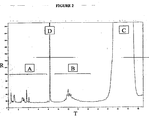
- Figure 2 shows a typical DIDP GC spectrum having a horizontal axis T indicating time in minutes (span 27 minutes); and a vertical axis R indicating response in millivolts (span 250 mv).
- the spectrum shows, besides the plasticiser fingerprint itself (indicated as C) and the normal hexadecane (C16) internal standard peak (indicated as D), two more groups of peaks:
- the concentration of the intermediates is obtained in a similar way by the integration of the area under the peaks in the region indicated as B in Figure 2 .
- the products as indicated in Table 1 were each separately placed in a glass beaker with a magnetic stirrer and heated to 100°C while stirring. When that temperature was reached, the treating agent or mixture as indicated in Table 1 was added into the beaker. The amount of treating agent or mixture used was always about 5% by weight relative to the amount of liquid in the beaker. After one minute, the treatment time as indicated in Table 1 was started. After the treatment, the stirring was stopped and the content of the beaker was filtered immediately. The samples were filtered twice, each time using 2 layers of filter paper (Machery & Nagel MN 616) placed in a Büchner funnel. The filtration was assisted by pulling vacuum on the filter flask on which the filter funnel was placed.
- 2 layers of filter paper Machery & Nagel MN 616
- Tonsil 314 is Tonsil standard 314 FF highly active bleaching earth, a clay marketed by Süd-Chemie AG and made by acid activation of natural calcium bentonite.
- Ton 02/B is Galleon Earth, an acid activated clay available from Ashapura Volclay Limited and made by treating high purity montmorillonite clay (bentonite) with sulphuric acid.
- DINP di-isononyl phthalate.
- DOP di-octyl phthalate (where di-octyl is di-2-ethylhexyl).
- Odour designations are:
- DIDP di-isodecyl phthalate
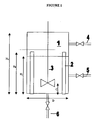
- the vessel is a vertical cylinder 1 with a diameter D of 300 mm and a height Hv of 400 mm.
- baffles 2 each 25 mm wide are positioned every 90 degrees around the vertical wall of the vessel, perpendicular to the wall and leaving a 5 mm gap from the inner wall of the vessel.
- the baffles have a height H B of 300 mm.
- the height of the liquid H L used was always 295 mm, so the liquid volume in the vessel was typically 20.85 litre.
- the motor for driving the impeller was a Heidolph Type 743.00, with 30 W power.
- the impeller speed as measured was around 335 rpm.
- the vessel is equipped with three electrical heating jackets, and the temperature is controlled via a control box.
- the vessel has a connection 4 for inlet of blanketing nitrogen, a sampling line 5, and a drain connection 6 for draining the vessel.
- the vessel was filled with the stripped DIDP and a constant flow of nitrogen was established for blanketing. Stirring was established at a speed of 335 rpm.
Landscapes
- Chemical & Material Sciences (AREA)
- Organic Chemistry (AREA)
- Chemical Kinetics & Catalysis (AREA)
- General Chemical & Material Sciences (AREA)
- Physics & Mathematics (AREA)
- Spectroscopy & Molecular Physics (AREA)
- Organic Low-Molecular-Weight Compounds And Preparation Thereof (AREA)
- Compositions Of Macromolecular Compounds (AREA)
- Organic Insulating Materials (AREA)
Claims (23)
- Verfahren zur Herstellung eines Weichmacheresters, bei dem(i) eine Säure oder ein Anhydrid mit einem 6 bis 13 Kohlenstoffatome enthaltenden Alkohol unter Bildung eines Rohesters verestert wird,(ii) der Rohester mit einer Base behandelt wird um einen behandelten Ester zu bilden,(iii) der behandelte Ester filtriert wird, um ein flüssiges Produkt abzutrennen,(iv) das flüssige Produkt gestrippt wird, um ein gestripptes Material zu bilden,(v) das gestrippte Material mit einem Adsorbens mit einem pH im Bereich von 6 bis 11 behandelt wird, wobei das Adsorbens Aktivkohle umfasst, und(vi) das Produkt aus Stufe (v), gegebenenfalls in Gegenwart eines Filterhilfsmittels, filtriert wird, um das Adsorbens von d e m Weichmacherester abzutrennen.
- Verfahren nach Anspruch 1, bei dem die Base ein Alkalimetallsalz ist.
- Verfahren nach Anspruch 1, bei dem die Base Natriumhydroxid oder Natriumcarbonat ist.
- Verfahren nach einem der vorangehenden Ansprüche, bei dem das Wasser aus dem behandelten Ester vor der Filtrierstufe (iii) entfernt wird.
- Verfahren nach Anspruch 4, bei dem das Wasser durch Flashen oder Dampfstrippen entfernt wird.
- Verfahren nach einem der vorangehenden Ansprüche, bei dem die Säure oder das Anhydrid eine aromatische Monocarbonsäure oder -anhydrid oder eine polybasische aromatische Carbonsäure oder -anhydrid ist.
- Verfahren nach Anspruch 6, bei dem das Anhydrid Phthalsäureanhydrid ist.
- Verfahren nach einem der vorangehenden Ansprüche, bei dem der Alkhol ein C9-C11-Alkohol ist.
- Verfahren nach Anspruch 8, bei dem der Alkohol ein C10-Alkhol oder ein C11-Alkhol ist.
- Verfahren nach einem der vorangehenden Ansprüche, bei dem die kombinierte Menge an Adsorbens und verwendetem Filterhilfsmittel 0,01 bis 5 Gew.% bezogen auf das Gewicht des Weichmacheresters beträgt.
- Verfahren nach Anspruch 10, bei dem die kombinierte Menge 0,02 bis 2 Gew.% beträgt.
- Verfahren nach Anspruch 11, bei dem die kombinierte Menge 0,03 bis 1 Gew.% beträgt.
- Verfahren nach Anspruch 12, bei dem die kombinierte Menge 0,04 bis 0,3 Gew.% beträgt.
- Verfahren nach einem der vorangehenden Ansprüche, bei dem die Stufen (v) und (vi) durchgeführt werden, indem in Stufe (v) eine Mischung aus Filterhilfsmittel und Adsorbens verwendet wird.
- Verfahren nach Anspruch 14, bei dem die Mischung 90 bis 30 Gewichtsteile Filterhilfsmittel und 10 bis 70 Gewichtsteile Adsorbens enthält.
- Verfahren nach Anspruch 15, bei dem die Mischung 60 bis 40 Gewichtsteile des Filterhilfsmittels und 40 bis 60 Gewichtsteile des Adsorbens enthält.
- Verfahren nach einem der vorangehenden Ansprüche, bei dem das Filterhilfsmittel Ton ist.
- Verfahren nach einem der vorangehenden Ansprüche, bei dem das Filterhilfsmittel vorhanden und Ton ist und das Adsorbens Aktivkohle ist.
- Verfahren nach einem der vorangehenden Ansprüche, bei dem das Adsorbens außerdem als Filterhilfsmittel fungiert.
- Verfahren nach einem der vorangehenden Ansprüche, bei dem die Behandlungsstufe (v) bei einer Temperatur im Bereich von 20 bis 180°C, vorzugsweise 50 bis 150°C, noch bevorzugter 80 bis 120°C und insbesondere 100 bis 110°C durchgeführt wird.
- Verfahren nach Anspruch 20, bei dem die Behandlungsstufe (v) bei einer Temperatur im Bereich von 80 bis 120°C durchgeführt wird und der Weichmacher ein C8-C13-Dialkylphthalat ist.
- Verfahren nach einem der vorangehenden Ansprüche, bei dem das Adsorbens Aktivkohle umfasst und das Filterhilfsmittel einen pH im Bereich von 6 bis 11 aufweist.
- Verfahren nach Anspruch 22, bei dem der pH des Adsorbens und des Filterhilfsmittels im Bereich von 6 bis 9 liegt.
Priority Applications (1)
| Application Number | Priority Date | Filing Date | Title |
|---|---|---|---|
| EP20100189204 EP2338870A1 (de) | 2003-08-29 | 2004-08-20 | Verbesserungen von bzw. im Zusammenhang mit Phthalatweichmacherestern |
Applications Claiming Priority (2)
| Application Number | Priority Date | Filing Date | Title |
|---|---|---|---|
| GBGB0320206.6A GB0320206D0 (en) | 2003-08-29 | 2003-08-29 | Improvements in or relating to plasticiser |
| PCT/EP2004/009357 WO2005021482A1 (en) | 2003-08-29 | 2004-08-20 | Improvements in or relating to phthalate plasticiser esters |
Related Child Applications (1)
| Application Number | Title | Priority Date | Filing Date |
|---|---|---|---|
| EP10189204.0 Division-Into | 2010-10-28 |
Publications (2)
| Publication Number | Publication Date |
|---|---|
| EP1663940A1 EP1663940A1 (de) | 2006-06-07 |
| EP1663940B1 true EP1663940B1 (de) | 2012-06-20 |
Family
ID=28686514
Family Applications (2)
| Application Number | Title | Priority Date | Filing Date |
|---|---|---|---|
| EP04764340A Expired - Lifetime EP1663940B1 (de) | 2003-08-29 | 2004-08-20 | Verbesserungen von bzw. im zusammenhang mit phthalatweichmacherestern |
| EP20100189204 Withdrawn EP2338870A1 (de) | 2003-08-29 | 2004-08-20 | Verbesserungen von bzw. im Zusammenhang mit Phthalatweichmacherestern |
Family Applications After (1)
| Application Number | Title | Priority Date | Filing Date |
|---|---|---|---|
| EP20100189204 Withdrawn EP2338870A1 (de) | 2003-08-29 | 2004-08-20 | Verbesserungen von bzw. im Zusammenhang mit Phthalatweichmacherestern |
Country Status (8)
| Country | Link |
|---|---|
| US (2) | US20070105999A1 (de) |
| EP (2) | EP1663940B1 (de) |
| JP (2) | JP4777248B2 (de) |
| KR (1) | KR101170185B1 (de) |
| CN (1) | CN1835908B (de) |
| GB (1) | GB0320206D0 (de) |
| TW (1) | TWI338682B (de) |
| WO (1) | WO2005021482A1 (de) |
Families Citing this family (26)
| Publication number | Priority date | Publication date | Assignee | Title |
|---|---|---|---|---|
| US7919649B2 (en) | 2005-05-27 | 2011-04-05 | Exxonmobile Chemical Patents Inc. | Plasticiser esters |
| EP1951807B1 (de) * | 2005-11-23 | 2012-01-04 | PolyOne Corporation | Verwendung einer mischung aus phthalat-weichmachern in poly(vinyl-halid)-verbindungen |
| US8884048B2 (en) | 2007-03-13 | 2014-11-11 | Exxonmobil Chemical Patents Inc. | Process for producing esters |
| CA2679869C (en) * | 2007-03-13 | 2015-04-28 | Exxonmobil Chemical Patents Inc. | Improvements in and relating to the production of different ester products |
| WO2010079018A1 (en) * | 2009-01-08 | 2010-07-15 | Exxonmobil Chemical Patents Inc. | Improvements in or relating to alcohols |
| CN101591454B (zh) * | 2009-04-24 | 2012-01-11 | 淄博蓝帆化工有限公司 | 增塑剂生产中的高温中和方法 |
| CN102448922B (zh) * | 2009-06-03 | 2014-12-24 | 埃克森美孚化学专利公司 | 增塑剂醇及其生产改进 |
| US8729278B2 (en) | 2009-10-26 | 2014-05-20 | Exxonmobil Chemical Patents Inc. | Phthalic anhydride process |
| WO2011072992A1 (en) | 2009-12-15 | 2011-06-23 | Exxonmobil Chemical Patents Inc. | Temperature control of an oligomerisation process and reactor |
| DE102009060851A1 (de) * | 2009-12-30 | 2011-07-07 | Emery Oleochemicals GmbH, 40589 | Esterherstellung mit Nachbehandlung |
| WO2012025308A1 (en) | 2010-08-25 | 2012-03-01 | Exxonmobil Chemical Patents Inc. | Processes for the production of esters |
| BRPI1005582A2 (pt) * | 2010-12-30 | 2013-04-16 | 3M Do Brasil Ltda | fita de vinil de proteÇço anti-corrosiva e mecÂnica |
| WO2013025277A1 (en) | 2011-08-15 | 2013-02-21 | Exxonmobil Chemical Patents Inc. | Esters and their preparation and use |
| DE102012018207A1 (de) | 2012-09-14 | 2014-03-20 | Oxea Gmbh | Verfahren zur Herstelluna von Polyolestern |
| EP2784113B1 (de) * | 2012-10-10 | 2017-11-29 | LG Chem, Ltd. | Weichmacher, weichmacherzusammensetzung, wärmefeste harzzusammensetzung und verfahren zu ihrer herstellung |
| US9085670B2 (en) | 2012-10-10 | 2015-07-21 | Lg Chem, Ltd. | Plasticizer, plasticizer composition, heat-resistant resin composition and method for preparing the same |
| CN103012150A (zh) * | 2012-12-27 | 2013-04-03 | 江南大学 | 一种增塑剂偏苯三酸三(2-丙基庚)酯的制备方法 |
| US9944582B2 (en) | 2013-05-20 | 2018-04-17 | Saudi Basic Industries Corporation | Method for the purification of acetic acid and acrylic acid |
| CA2911253A1 (en) * | 2013-06-07 | 2014-12-11 | Saudi Basic Industries Corporation | Method for purifying dioctyl phthalate |
| WO2016076969A1 (en) * | 2014-11-12 | 2016-05-19 | Exxonmobil Chemical Patents Inc. | Purification of plasticizer and use thereof in a polymer production process and plant |
| KR101833982B1 (ko) | 2014-12-18 | 2018-04-13 | 한화케미칼 주식회사 | 스트리핑 방법 |
| CN105859554A (zh) * | 2016-05-27 | 2016-08-17 | 张玲 | 一种吸附提纯邻苯二甲酸二正庚酯的方法 |
| JP2019529362A (ja) | 2016-09-09 | 2019-10-17 | エクソンモービル ケミカル パテンツ インコーポレイテッド | フタル酸エステルの水素化方法 |
| CN110760139B (zh) * | 2018-07-27 | 2021-10-22 | 中国石油化工股份有限公司 | 高电阻率阻燃聚氯乙烯电缆料组合物 |
| CN112888732B (zh) * | 2018-10-12 | 2022-10-18 | Dic株式会社 | 氯乙烯树脂用增塑剂、氯乙烯树脂组合物、电线和车辆内装材料 |
| KR20210059399A (ko) * | 2019-11-15 | 2021-05-25 | 한화솔루션 주식회사 | 프탈레이트계 화합물의 수소화 방법 |
Family Cites Families (16)
| Publication number | Priority date | Publication date | Assignee | Title |
|---|---|---|---|---|
| GB1096917A (en) * | 1965-07-30 | 1967-12-29 | Ici Ltd | Improvements in and relating to the treatment of phthalate plasticiser esters |
| JPS6054945B2 (ja) * | 1977-11-30 | 1985-12-03 | チッソ株式会社 | 可塑剤の製造方法 |
| US4543420A (en) * | 1984-10-15 | 1985-09-24 | Exxon Research & Engineering Co. | Pyromellitate plasticizers and vinyl chloride |
| JPS62267341A (ja) * | 1986-05-16 | 1987-11-20 | Mitsubishi Kasei Vinyl Co | 可塑剤の製造法 |
| US5324853A (en) * | 1993-01-19 | 1994-06-28 | Exxon Chemical Patents Inc. | Process for the production of plasticizer and polyolesters |
| US5798319A (en) * | 1996-01-16 | 1998-08-25 | Exxon Chemical Patents Inc. | High stability and low metals esters based on 3,5,5-trimethyl-1-hexanol |
| JPH1036319A (ja) * | 1996-05-22 | 1998-02-10 | Sekisui Chem Co Ltd | エステルの製造方法 |
| JP3861945B2 (ja) * | 1997-05-21 | 2006-12-27 | 三菱瓦斯化学株式会社 | エステル可塑剤の製造法 |
| US5880310A (en) * | 1997-05-21 | 1999-03-09 | Mitsubishi Gas Chemical Company, Inc. | Process for producing plasticizer esters |
| JP3861946B2 (ja) * | 1997-05-21 | 2006-12-27 | 三菱瓦斯化学株式会社 | エステル可塑剤の製造方法 |
| DE19721347B9 (de) * | 1997-05-22 | 2005-09-29 | Celanese Chemicals Europe Gmbh | Verfahren zur Herstellung von Esterweichmachern |
| KR100697162B1 (ko) * | 1999-04-21 | 2007-03-21 | 바스프 악티엔게젤샤프트 | 아디프산 또는 프탈산의 이성질체 노난올 디에스테르의혼합물 |
| JP4120123B2 (ja) * | 2000-01-26 | 2008-07-16 | 三菱化学株式会社 | エステルの製造方法 |
| DE10043545A1 (de) * | 2000-09-05 | 2002-03-14 | Oxeno Olefinchemie Gmbh | Verfahren zur Herstellung von Carbonsäureestern |
| DE60001755T2 (de) * | 2000-11-30 | 2004-02-19 | La Chemial Spa, Cavaglia | Verfahren zur Veresterung in einem chromatographischen Reaktor |
| DE10236279A1 (de) * | 2002-08-08 | 2004-02-19 | Basf Ag | Verfahren zur Abtrennung von Veresterungskatalysator |
-
2003
- 2003-08-29 GB GBGB0320206.6A patent/GB0320206D0/en not_active Ceased
-
2004
- 2004-08-16 TW TW093124568A patent/TWI338682B/zh not_active IP Right Cessation
- 2004-08-20 KR KR1020067004243A patent/KR101170185B1/ko not_active Expired - Fee Related
- 2004-08-20 JP JP2006524308A patent/JP4777248B2/ja not_active Expired - Fee Related
- 2004-08-20 WO PCT/EP2004/009357 patent/WO2005021482A1/en not_active Ceased
- 2004-08-20 EP EP04764340A patent/EP1663940B1/de not_active Expired - Lifetime
- 2004-08-20 EP EP20100189204 patent/EP2338870A1/de not_active Withdrawn
- 2004-08-20 CN CN2004800234422A patent/CN1835908B/zh not_active Expired - Fee Related
- 2004-08-20 US US10/568,699 patent/US20070105999A1/en not_active Abandoned
-
2011
- 2011-04-08 JP JP2011086258A patent/JP5654937B2/ja not_active Expired - Fee Related
-
2012
- 2012-10-03 US US13/644,205 patent/US20130225851A1/en not_active Abandoned
Also Published As
| Publication number | Publication date |
|---|---|
| JP2011168791A (ja) | 2011-09-01 |
| EP1663940A1 (de) | 2006-06-07 |
| KR20060118423A (ko) | 2006-11-23 |
| US20070105999A1 (en) | 2007-05-10 |
| TWI338682B (en) | 2011-03-11 |
| US20130225851A1 (en) | 2013-08-29 |
| KR101170185B1 (ko) | 2012-07-31 |
| JP2007504105A (ja) | 2007-03-01 |
| GB0320206D0 (en) | 2003-10-01 |
| JP5654937B2 (ja) | 2015-01-14 |
| TW200513457A (en) | 2005-04-16 |
| WO2005021482A1 (en) | 2005-03-10 |
| JP4777248B2 (ja) | 2011-09-21 |
| CN1835908A (zh) | 2006-09-20 |
| CN1835908B (zh) | 2011-04-13 |
| EP2338870A1 (de) | 2011-06-29 |
Similar Documents
| Publication | Publication Date | Title |
|---|---|---|
| EP1663940B1 (de) | Verbesserungen von bzw. im zusammenhang mit phthalatweichmacherestern | |
| US8987499B2 (en) | Compositions produced from plasticiser esters | |
| CN1160305C (zh) | 己二酸或苯二甲酸的异构壬醇二酯的混合物 | |
| AU752777B2 (en) | High performance plasticizers from branched oxo alcohols | |
| TWI487693B (zh) | 多元醇酯類之製造方法 | |
| WO2010057847A1 (en) | Improved method for the manufacture of long chain phthalate dialkyl ester compositions | |
| JP2004502662A (ja) | フタル酸とデカノールおよびトリデカノールとのジエステル混合物を製造するための方法 | |
| EP2376415B1 (de) | Verbesserungen in oder im Zusammenhang mit Alkoholen | |
| US5571938A (en) | Esterification process using a catalyst consisting of sand, stannous tin and aluminate | |
| EP3684747B1 (de) | Verfahren zur herstellung von glykolestern mit niedrigem farb- und peroxidgehalt | |
| MXPA00010266A (en) | High performance plasticizers from branched oxo alcohols | |
| HK1152520A1 (en) | Process for preparing polyol esters | |
| HK1152520B (en) | Process for preparing polyol esters | |
| HK1152521A1 (en) | Process for preparing polyol esters |
Legal Events
| Date | Code | Title | Description |
|---|---|---|---|
| PUAI | Public reference made under article 153(3) epc to a published international application that has entered the european phase |
Free format text: ORIGINAL CODE: 0009012 |
|
| 17P | Request for examination filed |
Effective date: 20060324 |
|
| AK | Designated contracting states |
Kind code of ref document: A1 Designated state(s): AT BE BG CH CY CZ DE DK EE ES FI FR GB GR HU IE IT LI LU MC NL PL PT RO SE SI SK TR |
|
| RIN1 | Information on inventor provided before grant (corrected) |
Inventor name: CAERS, RAPHAEL, F. Inventor name: GOSSE, CLAUDIUS Inventor name: DE MUNCK, NICOLAAS, A. |
|
| DAX | Request for extension of the european patent (deleted) | ||
| 17Q | First examination report despatched |
Effective date: 20070720 |
|
| GRAP | Despatch of communication of intention to grant a patent |
Free format text: ORIGINAL CODE: EPIDOSNIGR1 |
|
| GRAS | Grant fee paid |
Free format text: ORIGINAL CODE: EPIDOSNIGR3 |
|
| GRAA | (expected) grant |
Free format text: ORIGINAL CODE: 0009210 |
|
| AK | Designated contracting states |
Kind code of ref document: B1 Designated state(s): AT BE BG CH CY CZ DE DK EE ES FI FR GB GR HU IE IT LI LU MC NL PL PT RO SE SI SK TR |
|
| REG | Reference to a national code |
Ref country code: GB Ref legal event code: FG4D |
|
| REG | Reference to a national code |
Ref country code: CH Ref legal event code: EP |
|
| REG | Reference to a national code |
Ref country code: AT Ref legal event code: REF Ref document number: 562994 Country of ref document: AT Kind code of ref document: T Effective date: 20120715 |
|
| REG | Reference to a national code |
Ref country code: IE Ref legal event code: FG4D |
|
| REG | Reference to a national code |
Ref country code: DE Ref legal event code: R096 Ref document number: 602004038305 Country of ref document: DE Effective date: 20120816 |
|
| PG25 | Lapsed in a contracting state [announced via postgrant information from national office to epo] |
Ref country code: SE Free format text: LAPSE BECAUSE OF FAILURE TO SUBMIT A TRANSLATION OF THE DESCRIPTION OR TO PAY THE FEE WITHIN THE PRESCRIBED TIME-LIMIT Effective date: 20120620 Ref country code: FI Free format text: LAPSE BECAUSE OF FAILURE TO SUBMIT A TRANSLATION OF THE DESCRIPTION OR TO PAY THE FEE WITHIN THE PRESCRIBED TIME-LIMIT Effective date: 20120620 |
|
| REG | Reference to a national code |
Ref country code: NL Ref legal event code: VDEP Effective date: 20120620 |
|
| REG | Reference to a national code |
Ref country code: AT Ref legal event code: MK05 Ref document number: 562994 Country of ref document: AT Kind code of ref document: T Effective date: 20120620 |
|
| PG25 | Lapsed in a contracting state [announced via postgrant information from national office to epo] |
Ref country code: GR Free format text: LAPSE BECAUSE OF FAILURE TO SUBMIT A TRANSLATION OF THE DESCRIPTION OR TO PAY THE FEE WITHIN THE PRESCRIBED TIME-LIMIT Effective date: 20120921 Ref country code: SI Free format text: LAPSE BECAUSE OF FAILURE TO SUBMIT A TRANSLATION OF THE DESCRIPTION OR TO PAY THE FEE WITHIN THE PRESCRIBED TIME-LIMIT Effective date: 20120620 |
|
| PG25 | Lapsed in a contracting state [announced via postgrant information from national office to epo] |
Ref country code: CZ Free format text: LAPSE BECAUSE OF FAILURE TO SUBMIT A TRANSLATION OF THE DESCRIPTION OR TO PAY THE FEE WITHIN THE PRESCRIBED TIME-LIMIT Effective date: 20120620 Ref country code: SK Free format text: LAPSE BECAUSE OF FAILURE TO SUBMIT A TRANSLATION OF THE DESCRIPTION OR TO PAY THE FEE WITHIN THE PRESCRIBED TIME-LIMIT Effective date: 20120620 Ref country code: AT Free format text: LAPSE BECAUSE OF FAILURE TO SUBMIT A TRANSLATION OF THE DESCRIPTION OR TO PAY THE FEE WITHIN THE PRESCRIBED TIME-LIMIT Effective date: 20120620 Ref country code: BE Free format text: LAPSE BECAUSE OF FAILURE TO SUBMIT A TRANSLATION OF THE DESCRIPTION OR TO PAY THE FEE WITHIN THE PRESCRIBED TIME-LIMIT Effective date: 20120620 Ref country code: EE Free format text: LAPSE BECAUSE OF FAILURE TO SUBMIT A TRANSLATION OF THE DESCRIPTION OR TO PAY THE FEE WITHIN THE PRESCRIBED TIME-LIMIT Effective date: 20120620 Ref country code: RO Free format text: LAPSE BECAUSE OF FAILURE TO SUBMIT A TRANSLATION OF THE DESCRIPTION OR TO PAY THE FEE WITHIN THE PRESCRIBED TIME-LIMIT Effective date: 20120620 Ref country code: CY Free format text: LAPSE BECAUSE OF FAILURE TO SUBMIT A TRANSLATION OF THE DESCRIPTION OR TO PAY THE FEE WITHIN THE PRESCRIBED TIME-LIMIT Effective date: 20120620 |
|
| PG25 | Lapsed in a contracting state [announced via postgrant information from national office to epo] |
Ref country code: PT Free format text: LAPSE BECAUSE OF FAILURE TO SUBMIT A TRANSLATION OF THE DESCRIPTION OR TO PAY THE FEE WITHIN THE PRESCRIBED TIME-LIMIT Effective date: 20121022 Ref country code: PL Free format text: LAPSE BECAUSE OF FAILURE TO SUBMIT A TRANSLATION OF THE DESCRIPTION OR TO PAY THE FEE WITHIN THE PRESCRIBED TIME-LIMIT Effective date: 20120620 Ref country code: IT Free format text: LAPSE BECAUSE OF FAILURE TO SUBMIT A TRANSLATION OF THE DESCRIPTION OR TO PAY THE FEE WITHIN THE PRESCRIBED TIME-LIMIT Effective date: 20120620 |
|
| REG | Reference to a national code |
Ref country code: CH Ref legal event code: PL |
|
| PG25 | Lapsed in a contracting state [announced via postgrant information from national office to epo] |
Ref country code: MC Free format text: LAPSE BECAUSE OF NON-PAYMENT OF DUE FEES Effective date: 20120831 Ref country code: NL Free format text: LAPSE BECAUSE OF FAILURE TO SUBMIT A TRANSLATION OF THE DESCRIPTION OR TO PAY THE FEE WITHIN THE PRESCRIBED TIME-LIMIT Effective date: 20120620 |
|
| PLBE | No opposition filed within time limit |
Free format text: ORIGINAL CODE: 0009261 |
|
| STAA | Information on the status of an ep patent application or granted ep patent |
Free format text: STATUS: NO OPPOSITION FILED WITHIN TIME LIMIT |
|
| PG25 | Lapsed in a contracting state [announced via postgrant information from national office to epo] |
Ref country code: DK Free format text: LAPSE BECAUSE OF FAILURE TO SUBMIT A TRANSLATION OF THE DESCRIPTION OR TO PAY THE FEE WITHIN THE PRESCRIBED TIME-LIMIT Effective date: 20120620 Ref country code: CH Free format text: LAPSE BECAUSE OF NON-PAYMENT OF DUE FEES Effective date: 20120831 Ref country code: LI Free format text: LAPSE BECAUSE OF NON-PAYMENT OF DUE FEES Effective date: 20120831 Ref country code: ES Free format text: LAPSE BECAUSE OF FAILURE TO SUBMIT A TRANSLATION OF THE DESCRIPTION OR TO PAY THE FEE WITHIN THE PRESCRIBED TIME-LIMIT Effective date: 20121001 |
|
| REG | Reference to a national code |
Ref country code: FR Ref legal event code: ST Effective date: 20130430 |
|
| REG | Reference to a national code |
Ref country code: IE Ref legal event code: MM4A |
|
| 26N | No opposition filed |
Effective date: 20130321 |
|
| GBPC | Gb: european patent ceased through non-payment of renewal fee |
Effective date: 20120920 |
|
| REG | Reference to a national code |
Ref country code: DE Ref legal event code: R097 Ref document number: 602004038305 Country of ref document: DE Effective date: 20130321 |
|
| PG25 | Lapsed in a contracting state [announced via postgrant information from national office to epo] |
Ref country code: IE Free format text: LAPSE BECAUSE OF NON-PAYMENT OF DUE FEES Effective date: 20120820 Ref country code: BG Free format text: LAPSE BECAUSE OF FAILURE TO SUBMIT A TRANSLATION OF THE DESCRIPTION OR TO PAY THE FEE WITHIN THE PRESCRIBED TIME-LIMIT Effective date: 20120920 Ref country code: GB Free format text: LAPSE BECAUSE OF NON-PAYMENT OF DUE FEES Effective date: 20120920 |
|
| PG25 | Lapsed in a contracting state [announced via postgrant information from national office to epo] |
Ref country code: FR Free format text: LAPSE BECAUSE OF NON-PAYMENT OF DUE FEES Effective date: 20120831 |
|
| PG25 | Lapsed in a contracting state [announced via postgrant information from national office to epo] |
Ref country code: TR Free format text: LAPSE BECAUSE OF FAILURE TO SUBMIT A TRANSLATION OF THE DESCRIPTION OR TO PAY THE FEE WITHIN THE PRESCRIBED TIME-LIMIT Effective date: 20120620 |
|
| PG25 | Lapsed in a contracting state [announced via postgrant information from national office to epo] |
Ref country code: LU Free format text: LAPSE BECAUSE OF NON-PAYMENT OF DUE FEES Effective date: 20120820 |
|
| PG25 | Lapsed in a contracting state [announced via postgrant information from national office to epo] |
Ref country code: HU Free format text: LAPSE BECAUSE OF FAILURE TO SUBMIT A TRANSLATION OF THE DESCRIPTION OR TO PAY THE FEE WITHIN THE PRESCRIBED TIME-LIMIT Effective date: 20040820 |
|
| PGFP | Annual fee paid to national office [announced via postgrant information from national office to epo] |
Ref country code: DE Payment date: 20140901 Year of fee payment: 11 |
|
| REG | Reference to a national code |
Ref country code: DE Ref legal event code: R119 Ref document number: 602004038305 Country of ref document: DE |
|
| PG25 | Lapsed in a contracting state [announced via postgrant information from national office to epo] |
Ref country code: DE Free format text: LAPSE BECAUSE OF NON-PAYMENT OF DUE FEES Effective date: 20160301 |