EP1650185B1 - Verfahren zur herstellung von optisch aktiven beta-hydroxy-alpha-aminocarbonsäurederivaten - Google Patents
Verfahren zur herstellung von optisch aktiven beta-hydroxy-alpha-aminocarbonsäurederivaten Download PDFInfo
- Publication number
- EP1650185B1 EP1650185B1 EP04747297.2A EP04747297A EP1650185B1 EP 1650185 B1 EP1650185 B1 EP 1650185B1 EP 04747297 A EP04747297 A EP 04747297A EP 1650185 B1 EP1650185 B1 EP 1650185B1
- Authority
- EP
- European Patent Office
- Prior art keywords
- group
- optically active
- binap
- methyl
- hydroxy
- Prior art date
- Legal status (The legal status is an assumption and is not a legal conclusion. Google has not performed a legal analysis and makes no representation as to the accuracy of the status listed.)
- Expired - Lifetime
Links
- VWSJOSOCUALHLK-UHFFFAOYSA-N COC(C(C(C1CCCCC1)=O)N1CC1)=O Chemical compound COC(C(C(C1CCCCC1)=O)N1CC1)=O VWSJOSOCUALHLK-UHFFFAOYSA-N 0.000 description 1
- LUXOGRPJMFCERM-UHFFFAOYSA-N COC(c1c(C2CCCCC2)[o]cn1)=O Chemical compound COC(c1c(C2CCCCC2)[o]cn1)=O LUXOGRPJMFCERM-UHFFFAOYSA-N 0.000 description 1
- 0 [*+]C(*)[C@@](C(O*)=O)N Chemical compound [*+]C(*)[C@@](C(O*)=O)N 0.000 description 1
Classifications
-
- C—CHEMISTRY; METALLURGY
- C07—ORGANIC CHEMISTRY
- C07C—ACYCLIC OR CARBOCYCLIC COMPOUNDS
- C07C227/00—Preparation of compounds containing amino and carboxyl groups bound to the same carbon skeleton
- C07C227/30—Preparation of optical isomers
- C07C227/32—Preparation of optical isomers by stereospecific synthesis
-
- B—PERFORMING OPERATIONS; TRANSPORTING
- B01—PHYSICAL OR CHEMICAL PROCESSES OR APPARATUS IN GENERAL
- B01J—CHEMICAL OR PHYSICAL PROCESSES, e.g. CATALYSIS OR COLLOID CHEMISTRY; THEIR RELEVANT APPARATUS
- B01J31/00—Catalysts comprising hydrides, coordination complexes or organic compounds
- B01J31/16—Catalysts comprising hydrides, coordination complexes or organic compounds containing coordination complexes
- B01J31/24—Phosphines, i.e. phosphorus bonded to only carbon atoms, or to both carbon and hydrogen atoms, including e.g. sp2-hybridised phosphorus compounds such as phosphabenzene, phosphole or anionic phospholide ligands
- B01J31/2404—Cyclic ligands, including e.g. non-condensed polycyclic ligands, the phosphine-P atom being a ring member or a substituent on the ring
-
- B—PERFORMING OPERATIONS; TRANSPORTING
- B01—PHYSICAL OR CHEMICAL PROCESSES OR APPARATUS IN GENERAL
- B01J—CHEMICAL OR PHYSICAL PROCESSES, e.g. CATALYSIS OR COLLOID CHEMISTRY; THEIR RELEVANT APPARATUS
- B01J2531/00—Additional information regarding catalytic systems classified in B01J31/00
- B01J2531/80—Complexes comprising metals of Group VIII as the central metal
- B01J2531/82—Metals of the platinum group
- B01J2531/821—Ruthenium
-
- C—CHEMISTRY; METALLURGY
- C07—ORGANIC CHEMISTRY
- C07B—GENERAL METHODS OF ORGANIC CHEMISTRY; APPARATUS THEREFOR
- C07B2200/00—Indexing scheme relating to specific properties of organic compounds
- C07B2200/07—Optical isomers
Definitions
- the present invention relates to a process for producing optically active ⁇ -hydroxy- ⁇ -aminocarboxylic acid derivative that is useful as an intermediate for pharmaceuticals and agrochemicals.
- Optically active ⁇ -hydroxy- ⁇ -aminocarboxylic acid derivatives are important intermediates for compounds useful as several fine chemical materials represented by physiologically active substances such as pharmaceuticals and agrochemicals, etc.
- Non-patent Document 3 a process for producing optically active ⁇ -hydroxy- ⁇ -aminocarboxylic acid through the reduction of a keto-amino acid derivative wherein the stereoselective reduction is carried out through the action of a metallic catalyst such as [RhCl(COD)] 2 is described (Patent Document 2).
- Non-patent Documents 1 and 2 and Patent Document 1 are excellent as processes for selectively producing the syn form of optically active ⁇ -hydroxy- ⁇ -aminocarboxylic acid derivative.
- the present inventors eagerly investigated as to processes for directly producing the anti form of optically active ⁇ -hydroxy- ⁇ -aminocarboxylic acid derivative.
- the anti form of optically active ⁇ -hydroxy- ⁇ -aminocarboxylic acid derivative can be easily obtained in a selective manner by subjecting an ⁇ -aminoacyl acetic acid ester compound that the amino group is unsubstituted to hydrogenation by catalytic asymmetric hydrogenation in the presence of an acid, and they completed the present invention.
- the present invention pertains to the followings:
- n means normal, "i” means iso, “s” means secondary, “t” means tertiary, “c” means cyclo, “o” means ortho, "m” means meta, “p” means para, "Me” means methyl group, “Et” means ethyl group, “Pr” means propyl group, “Bu” means butyl group, “Pen” means pentyl group, “Hex” means hexyl group, “Hep” means heptyl group, “Ph” means phenyl group, “Bn” means benzyl group, “Bz” means benzoyl group, “Ac” means acetyl group, “Ts” means paratoluenesulfonyl group and "Boc” means tertiary butoxy carbonyl group in this specification.
- Halogen atom includes fluorine atom, chlorine atom, bromine atom and iodine atom.
- C 1-6 alkyl group may be a straight-chain alkyl group or branched alkyl group, or contain C 3-6 cycloalkyl group, and includes for example methyl group, ethyl group, n-propyl group, i-propyl group, c-propyl group, n-butyl group, i-butyl group, s-butyl group, t-butyl group, c-butyl group, 1-methyl-c-propyl group, 2-methyl-c-propyl group, n-pentyl group, 1-methyl-n-butyl group, 2-methyl-n-butyl group, 3-methyl-n-butyl group, 1,1-dimethyl-n-propyl group, 1,2-dimethyl-n-propyl group, 2,2-dimethyl-n-propyl group, 1-ethyl-n-propyl group, c-pentyl group, 1-methyl-c-butyl group, 2-methyl-c
- C 1-20 alkyl group may be a straight-chain alkyl group or branched alkyl group, or contain C 3-20 cycloalkyl group, and includes in addition to the above-mentioned substituents, 1-methyl-1-ethyl-n-pentyl group, n-heptyl group, 2-heptyl group, c-heptyl group, 1-ethyl-1,2-dimethyl-n-propyl group, 1-ethyl-2,2-dimethyl-n-propyl group, 1-octyl group, 3-octyl group, c-octyl group, 4-methyl-3-n-heptyl group, 6-methyl-2-n-heptyl group, 2-propyl-1-n-heptyl group, 2,4,4-trimethyl-1-n-pentyl group, 1-nonyl group, 2-nonyl group, 2,6-dimethyl-4-n-heptyl group, 3-ethyl-2,2-
- C 1-6 alkoxy group may be a straight-chain alkoxy group or branched alkoxy group, or contain C 3-6 cycloalkoxy group, and includes methoxy group, ethoxy group, n-propoxy group, i-propoxy group, c-propoxy group, n-butoxy group, i-butoxy group, s-butoxy group, t-butoxy group, c-butoxy group, 1-methyl-c-propoxy group, 2-methyl-c-propoxy group, n-pentyloxy group, 1-methyl-n-butoxy group, 2-methyl-n-butoxy group, 3-methyl-n-butoxy group, 1,1-dimethyl-n-propoxy group, 1,2-dimethyl-n-propoxy group, 2,2-dimethyl-n-propoxy group, 1-ethyl-n-propoxy group, c-pentyloxy group, 1-methyl-c-butoxy group, 2-methyl-c-butoxy group, 3-methyl-c-butoxy group, 1,2-di
- C 1-6 alkoxycarbonyl group may be a straight-chain or branched alkoxycarbonyl group, or contain C 3-6 cycloalkoxycarbonyl group, and includes methoxycarbonyl group, ethoxycarbonyl group, n-propoxycarbonyl group, i-propoxycarbonyl group, c-propoxycarbonyl group, n-butoxycarbonyl group, i-butoxycarbonyl group, s-butoxycarbonyl group, t-butoxycarbonyl group, c-butoxycarbonyl group, 1-methyl-c-propoxycarbonyl group, 2-methyl-c-propoxycarbonyl group, n-pentyloxycarbonyl group, 1-methyl-n-butoxycarbonyl group, 2-methyl-n-butoxycarbonyl group, 3-methyl-n-butoxycarbonyl group, 1,1-dimethyl-n-propoxycarbonyl group, 1,2-dimethyl-n-propoxycarbonyl group, 2,2-dimethyl-
- C 1-6 alkylcarbonyloxy group may be a straight-chain or branched alkylcarbonyloxy group, or contain C 3-6 cycloalkylcarbonyloxy group, and includes methylcarbonyloxy group, ethylcarbonyloxy group, n-propylcarbonyloxy group, i-propylcarbonyloxy group, c-propylcarbonyloxy group, n-butylcarbonyloxy group, i-butylcarbonyloxy group, s-butylcarbonyloxy group, t-butylcarbonyloxy group, c-butylcarbonyloxy group, 1-methyl-c-propylcarbonyloxy group, 2-methyl-c-propylcarbonyloxy group, n-pentylcarbonyl group, 1-methyl-n-butylcarbonyloxy group, 2-methyl-n-butylcarbonyloxy group, 3-methyl-n-butylcarbonyloxy group, 1,1-dimethyl-
- C 4-12 aromatic group includes 2-furyl group, 3-furyl group, 2-thienyl group, 3-thienyl group, phenyl group, ⁇ -naphthyl group, ⁇ -naphthyl group, o-biphenyl group, m-biphenyl group and p-biphenyl group, etc.
- R 1 examples include methyl group, ethyl group, n-propyl group, i-propyl group, c-propyl group, n-butyl group, i-butyl group, s-butyl group, t-butyl group, c-butyl group, 1-methyl-c-propyl group, 2-methyl-c-propyl group, n-pentyl group, 1-methyl-n-butyl group, 2-methyl-n-butyl group, 3-methyl-n-butyl group, 1,1-dimethyl-n-propyl group, 1,2-dimethyl-n-propyl group, 2,2-dimethyl-n-propyl group, 1-ethyl-n-propyl group, c-pentyl group, 1-methyl-c-butyl group, 2-methyl-c-butyl group, 3-methyl-c-butyl group, 1,2-dimethyl-c-propyl group, 2,3-dimethyl-c-propy
- R 2 include methyl group, ethyl group, n-propyl group, i-propyl group, c-propyl group, n-butyl group, i-butyl group, s-butyl group, t-butyl group, c-butyl group, 1-methyl-c-propyl group, 2-methyl-c-propyl group, n-pentyl group, 1-methyl-n-butyl group, 2-methyl-n-butyl group, 3-methyl-n-butyl group, 1,1-dimethyl-n-propyl group, 1,2-dimethyl-n-propyl group, 2,2-dimethyl-n-propyl group, 1-ethyl-n-propyl group, c-pentyl group, 1-methyl-c-butyl group, 2-methyl-c-butyl group, 3-methyl-c-butyl group, 1,2-dimethyl-c-propyl group, 2,3-dimethyl-c-propyl
- Preferable ⁇ -aminoacyl acetic acid ester compounds of formula (1) include the following:
- catalyst used for the catalytic asymmetric hydrogenation in the present invention complexes of ruthenium or iridium having an optically active phosphine ligand are employed.
- optically active phosphine ligands used in the present invention become optically active forms.
- optically active phosphine ligand optically active bidentate phosphine ligands are preferable.
- the optically active bidentate phosphine ligands include BINAP, BIPHEMP, RROPHOS, DEGUPHOS, DIOP, DIPAMP, DuPHOS, NORPHOS, PNNP, SKEWPHOS, BPPFA, SEGPHOS, CHIRAPHOS and H 8 -BINAP, etc.
- BINAP includes also the derivatives of BINAP, and specific examples thereof are 2,2'-bis(diphenylphosphino)-1,1'-binaphthyl, 2,2'-bis(di-p-tolylphosphino)-1,1'-binaphthyl, 2,2'-bis(di-p-t-butylphenylphosphino)-1,1'-binaphthyl, 2,2'-bis(di-m-tolylphosphino)-1,1'-binaphthyl, 2,2'-bis(di-3,5-dimethylphenylphosphino)-1,1'-binaphthyl, 2,2'-bis(di-p-methoxyphenylphosphino)-1,1'-binaphthyl, 2,2'-bis(dicyclopentylphosphino)-1,1'-binaphthyl, 2,2'-bis
- BIPHEMP includes also the derivatives of BIPHEMP, and specific examples thereof are 2,2'-dimethyl-6,6'-bis(diphenylphosphino)-1,1'-biphenyl, 2,2'-dimethyl-6,6'-bis(dicyclohexylphosphino)-1,1'-biphenyl, 2,2'-dimethyl-4,4'-bis(dimethylamino)-6,6'-bis(diphenylphosphino)-1,1'-biphenyl, 2,2',4,4'-tetramethyl-6,6'-bis(diphenylphosphino)-1,1'-biphenyl, 2,2'-dimethoxy-6,6'-bis(diphenylphosphino)-1,1'-biphenyl, 2,2',3,3'-tetramethoxy-6,6'-bis(diphenylphosphino)-1,1'-biphenyl,
- the catalyst used for the catalytic asymmetric hydrogenation in the present invention can be prepared from ruthenium or iridium metal compound and an optically active phosphine ligand, and an additive that is able to be coordinated can be optionally added.
- the ruthenium or iridium compound includes an iridium compound such as di- ⁇ -chlorotetrakis(cyclooctene) 2 iridium, di-p-chlorobis(1,5-cyclooctadiene) 2 iridium, di- ⁇ -chlorotetrakis(ethylene) 2 iridium and 1,5-cyclooctadiene bis(acetonitrile)iridium tetrafluoroborate, etc., a ruthenium compound such as tetrachloro( ⁇ -benzene) 2 ruthenium and tetrachloro[ ⁇ -(p-cymene)] 2 ruthenium, etc.
- an iridium compound such as di- ⁇ -chlorotetrakis(cyclooctene) 2 iridium, di-p-chlorobis(1,5-cyclooctadiene) 2 iridium, di- ⁇ -chlorot
- the additives are not specifically limited so long as they are compounds that can be coordinated, and for example in case where a ruthenium compound is used, N,N-dimethylformamide or the like is preferable, and in case where an iridium compound is used, an iodine compound is preferable.
- iodine compound examples include tetramethyl ammonium iodide, tetra n-butyl ammonium iodide, sodium iodide and potassium iodide, etc., and preferably sodium iodide.
- the used amount of the optically active phosphine ligand is 1 equivalent or more, preferably 1 to 2 equivalents, more preferably 1.1 to 1.5 equivalent in case of optically active bidentate phosphine ligand based on the amount of the ruthenium or iridium metal compound.
- the used amount of the additive optionally added cannot be necessarily determined because it depends on the compositional ratio of the catalyst, but it generally ranges from 1 to 100 equivalents, preferably 1 to 10 equivalents based on the used amount of the ruthenium or iridium metal compound.
- Ruthenium-optically active phosphine complex includes ruthenium-BINAP complex, ruthenium-BIPHEMP complex, ruthenium-RROPHOS complex, ruthenium-DEGUPHOS complex, ruthenium-DIOP complex, ruthenium-DIPAMP complex, ruthenium-DuPHOS complex, ruthenium-NORPHOS complex, ruthenium-PNNP complex, ruthenium-SKEWPHOS complex, ruthenium-BPPFA complex, ruthenium-SEGPHOS complex, ruthenium-CHIRAPHOS complex and ruthenium-H 8 -BINAP complex, etc.
- ruthenium-BINAP complexes are described in detail, but other optically active phosphine ligands can be used similarly.
- the ruthenium-BINAP complexes include RuHX 1 (R 3 -BINAP) 2 , RuX 2 2 (R 3 -BINAP) or Ru 2 Cl 4 (R 3 -BINAP) 2 (Et 3 N) wherein X 1 and X 2 independently of each other are Cl, ClO 4 , BF 4 , PF 6 , OCOCH 3 , OCOCF 3 , OCO-t-Bu or OSO 2 CF 3 , R 3 -BINAP is wherein R 3 is hydrogen atom, methyl group or t-butyl group, absolute configuration is either S or R, the complex may be further coordinated with N,N-dimethylformamide, benzene, AlCl 3 , SnCl 4 , TiCl 4 or ZnCl 2 , and specifically RuHCl(BINAP) 2 , RuHCl(T-BINAP) 2 , RuHCl(t-Bu-BINAP) 2 , RuH(ClO 4
- Preferable ruthenium-optically active phosphine complexes include the following 1) and 2):
- the ruthenium-optically active phosphine complexes of 1) are preferably RuX 2 2 (R 3 -BINAP) wherein X 2 and R 3 -BINAP have the same meaning as the above, the complex may be further coordinated with N,N-dimethylformamide, benzene, AlCl 3 , SnCl 4 , TiCl 4 or ZnCl 2 , more preferably RuX 2 2 (R 3 -BINAP) further coordinated with N,N-dimethylformamide or benzene wherein X 2 is Cl, R 3 -BINAP has the same meaning as the above.
- the ruthenium-optically active phosphine complexes of 2) are preferably RuCl 2 (BINAP)(dmf) n , RuCl 2 (T-BINAP)(dmf) n or RuCl 2 (t-Bu-BINAP)(dmf) n wherein BINAP is 2,2'-bis(diphenylphosphino)-1,1'-binaphthyl in absolute configuration of S or R, T-BINAP is 2,2'-bis(di-p-tolylphosphino)-1,1'-binaphthyl in absolute configuration of S or R, t-Bu-BINAP is 2,2'-bis(di-p-t-butylphenylphosphino)-1,1'-binaphthyl in absolute configuration of S or R, dmf is N,N-dimethylformamide, n is 1 or 2, more preferably RUCl 2 (BINAP)(dm
- the iridium catalyst among the catalysts used for catalytic asymmetric hydrogenation is described in further detail.
- Iridium-optically active phosphine complex includes iridium-BINAP complex, iridium-BIPHEMP complex, iridium-RROPHOS complex, iridium-DEGUPHOS complex, iridium-DIOP complex, iridium-DIPAMP complex, iridium-DuPHOS complex, iridium-NORPHOS complex, iridium-PNNP complex, iridium-SKEWPHOS complex, iridium-BPPFA complex, iridium-SEGPHOS complex, iridium-CHIRAPHOS complex and iridium-H 8 -BINAP complex, etc.
- Preferable iridium-optically active phosphine complex includes iridium-BINAP complex or iridium-BIPHEMP complex.
- the complex in which BINAP is BINAP, T-BINAP or t-Bu-BINAP is preferable.
- the complex is prepared, it is preferable to add an iodine compound as an additive.
- the complex in which BIPHEMP is 2,2'-dimethoxy-6,6'-bis(diphenylphosphino)-1,1'-biphenyl(MeO-Biphep) is preferable.
- an iodine compound as an additive, and particularly sodium iodide or tetra n-butylammonium iodide as the iodine compound.
- the iridium-BINAP complex or the iridium-BIPHEMP complex is prepared, it is preferable to add [Ir(cod)Cl] 2 , wherein cod is 1,5-cyclooctadiene, particularly to use further sodium iodide as an additive in an amount of 1 to 3 equivalents based on the used amount of iridium.
- an optically active ⁇ -hydroxy- ⁇ -aminocarboxylic acid derivative of formula (2) or (3) can be produced by reducing an ⁇ -aminoacyl acetic acid ester compound of formula (1) with hydrogen in the presence of a catalyst used for catalytic asymmetric hydrogenation and an acid:
- the above-mentioned reaction is carried out in a solvent.
- the solvent is not specifically limited so long as it does not pertain to the reaction, and includes for example halogen-type solvents such as 1,1-dichloroethane, 1,2-dichloroethane, methylene chloride, chloroform, chlorobenzene and 1,2-dichlorobenzene or the like, ether-type solvents such as diethyl ether, diisopropyl ether, tetrahydrofuran, or the like, alcohol-type solvent such as methanol, ethanol, n-propanol, i-propanol, 2-butanol, and ethylene glycol or the like, acetic acid and arbitrary mixed solvents of the above-mentioned solvents.
- halogen-type solvents such as 1,1-dichloroethane, 1,2-dichloroethane, methylene chloride, chloroform, chlorobenzene and 1,2-dichloro
- Preferable solvents include a halogen-type solvent, an alcohol-type solvent, a mixed solvent of a halogen-type solvent with an alcohol-type solvent, a mixed solvent of a halogen-type solvent with an ether-type solvent, acetic acid, a mixed solvent of acetic acid with an alcohol-type solvent, and a mixed solvent of acetic acid with an ether-type solvent, and for example methanol, n-propanol, i-propanol, 2-butanol, ethylene glycol, methylene chloride, 1,2-dichloroethane, chlorobenzene, methanol-methylene chloride, n-propanol-methylene chloride, i-propanol-methylene chloride, n-propanol-tetrahydrofuran, acetic acid, acetic acid-i-propanol and acetic acid-tetrahydrofuran, etc., and preferably methylene chloride, n-prop
- the ruthenium catalyst it is preferable to use methylene chloride, n-propanol, n-propanol-methylene chloride or the like.
- the iridium catalyst it is preferable to use acetic acid.
- the used amount of the catalyst for catalytic asymmetric hydrogenation is a range of 0.01 to 100 mol% based on the used amount of ⁇ -aminoacyl acetic acid ester compound of formula (1). It is preferably a range of 0.01 to 20 mol%, more preferably a range of 0.1 to 10 mol%, the most preferably 0.3 to 5 mol% from the standpoint of reaction efficiency and cost.
- an ⁇ -aminoacyl acetic acid ester compound of formula (1) may be added in a solution in which an acid is present
- a salt previously prepared from an ⁇ -aminoacyl acetic acid ester compound of formula (1) and an acid may be added in a solution.
- the used acid is preferably a strong acid.
- the specific examples of the strong acid are HCl, HBr, H 2 SO 4 , HClO 4 , CH 3 SO 3 H, PhSO 3 H, TsOH, CF 3 SO 3 H and CF 3 CO 2 H, etc., preferably HCl and TsOH, more preferably HCl.
- the used amount of the acid is a range of 0.8 to 3 mol%, preferably a range of 0.9 to 2 mol%, more preferably a range of 0.9 to 1.5 mol% based on the used amount of ⁇ -aminoacyl acetic acid ester compound of formula (1).
- the used amount of the acid means the total amount involving acids contained in the salt.
- an acetic acid salt may be added in the reaction system.
- the acetic acid salt includes an alkali metal acetate such as lithium acetate, sodium acetate and potassium acetate, etc., and ammonium acetate, etc., and preferably an alkali metal acetate such as sodium acetate.
- the used amount of the acetic acid salt is a range of 0.8 to 5 equivalents, preferably a range of 0.8 to 2 equivalents based on the used amount of ⁇ -aminoacyl acetic acid ester compound of formula (1).
- the iridium catalyst it is preferable to add an acetic acid salt.
- the used hydrogen is generally hydrogen gas.
- the pressure of the used hydrogen is generally a range of 101 to 15198 kPa (1 to 150 atm), preferably a range of 1013 to 15198 kPa (10 to 150 atm), more preferably 3040 to 10132 kPa (30 to 100 atm).
- the reaction can be carried out at a reaction temperature ranging from 0°C to a boiling point of the solvent, preferably from 10°C to 150°C, more preferably 30°C to 100°C.
- the reaction time is not necessarily determined because it varies depending on the reaction temperature, but for example a reaction time of 4 hours or more in case where the reaction temperature is 50°C, and a reaction time of 3 hours or more in case where the reaction temperature is 100°C are satisfactory.
- an aimed optically active ⁇ -hydroxy- ⁇ -aminocarboxylic acid derivative can be obtained in a form of salt by concentrating the solvent.
- an aimed optically active ⁇ -hydroxy- ⁇ -aminocarboxylic acid derivative can be obtained by making the reaction solution basic and extracting with a suitable solvent.
- an optically active ⁇ -hydroxy- ⁇ -aminocarboxylic acid derivative of formula (2) or (3) can be isolated in a high purity by purifying by distillation, recrystallization and silica gel column chromatography, etc.
- Diastereo selectivity (de: selectivity of syn form and anti form) and enantio selectivity (ee) of the optically active ⁇ -hydroxy- ⁇ -aminocarboxylic acid derivative of formula (2) or (3) obtained in the present invention can be determined by performing instrumental analysis after benzoylation of the resulting optically active ⁇ -hydroxy- ⁇ -aminocarboxylic acid derivative.
- the benzoylated compound of the optically active ⁇ -hydroxy- ⁇ -aminocarboxylic acid derivative of formula (2) or (3) can be produced by reacting the optically active ⁇ -hydroxy- ⁇ -aminocarboxylic acid derivative of formula (2) or (3) or the salt thereof with PhCOCl (benzoyl chloride) in THF (tetrahydrofuran) in the presence of NEt 3 (triethylamine).
- PhCOCl benzoyl chloride
- THF tetrahydrofuran
- NEt 3 triethylamine
- the ⁇ -aminoacyl acetic acid ester compound of formula (1) being a starting material can be produced by a process shown below.
- the hydrochloride of the ⁇ -aminoacyl acetic acid ester compound of formula (1) can be produced by condensing an acid anhydride or acyl chloride and an isonitrile acetate in the presence of a base (the base includes triethyl amine, 1,8-diazabicyclo[5.4.0]undeca-7-ene or the like) to obtain an oxazole compound and then cleaving the oxazole ring with concentrated hydrochloric acid.
- the resulting hydrochloride can be used as such for the following reduction reaction, and can be processed with a base or the like to obtain the ⁇ -aminoacyl acetic acid ester compound of formula (1).
- the oxazole compound is cleft with other acid or the hydrochloride is subjected to salt exchange with other acid.
- hydrochloride of the ⁇ -aminoacyl acetic acid ester compound of formula (1) can be produced also by a process shown below:
- the hydrochloride of the ⁇ -aminoacyl acetic acid ester compound of formula (1) can be produced by dehydrating and condensing glycine with an alcohol in the presence of TsOH (p-toluenesulfonic acid) to obtain an ester, subjecting the amino group to t-butoxycarbonylation with Boc 2 O (di-t-butyl dicarbonate), treating with KHMDS (potassium hexamethyl disilazide), subjecting to amidation by adding acyl chloride, and carrying out rearrangement reaction by treating with LHMDS (lithium hexamethyl disilazide) and DMPU (1,3-dimethyl-3,4,5,6-perhydropyrimidine-2-one) to obtain Boc form of the ⁇ -aminoacyl acetic acid ester compound, then removing Boc with hydrochloric acid.
- TsOH p-toluenesulfonic acid
- the intermediate 2 (168 g) was dissolved in dioxane-water, sodium hydrogen carbonate (47g, 1.2 equivalent) and Boc 2 O (di-t-butyl dicarbonate) (112 g, 1.1 equivalent) were added thereto, stirred for 3 hours and concentrated. The residue was washed with 1 mol/L sodium hydrogen sulfate aqueous solution and extracted 3 times with ethyl acetate. The organic phase was washed with saturated sodium hydrogen carbonate aqueous solution, dried over anhydrous sodium sulfate, and then filtered and concentrated.
- TsOH ⁇ H 2 O (p-toluenesulfonic acid monohydrate) (230.0 mg) was added in methanol (3.0 mL) solution of oxazole (102.8 mg), and refluxed with heating for 25 hours. The resulting solution was concentrated and then pulverized in diethyl ether. The resulting crude product was used in the subsequent step without purification.
- the oxazole compound (2.26 g, 11.1 mmol) was dissolved in 4 mol/L hydrochloric acid-dioxane (18 ml) and methanol(18 ml), and stirred at 60°C for 24 hours. The resulting solution was cooled to room temperature, and then concentrated. The residue was dissolved in methanol, and concentrated again. This procedure was repeated 5 times to completely remove remaining hydrochloric acid, and then the resulting solid was washed with ether, and filtered. The resulting solid was recrystallized from ethyl acetate and methanol to obtain compound 6g (1.42 g, 6.2 mmol, 56%).
- Example 2 The procedures of Example 1 were repeated except that hydrochloride being starting material was changed to tosylate and the used amount of the catalyst was set to 6.7 mol% to obtain an aimed product. (Yield: 72% (total of 2-step), de: 94%, ee: 22%).
- Example 1 The procedures of Example 1 were repeated except that the solvents were variously altered to obtain aimed products. In the meantime, the used amount of the catalyst was a range of 3.8 to 4.6 mol% based on that of the substrate. In addition, yield was shown in the total of 2-step. Table 4 Example No.
- Example 1 The procedures of Example 1 were repeated except that the substrate was changed to 2-cyclohexyl-1-methoxycarbonyl-2-oxo-ethyl-ammonium; chloride produced in Reference Example 1 and the solvent was changed to methylene chloride to obtain an aimed product (yield: 84% (total of 2-step), de: 95%. ee: 96%).
- Example 13 The procedures of Example 13 were repeated except that the solvents were variously altered to obtain aimed products. Yield was shown in the total of 2-step. Table 5 Example No. Solvent Catalyst (mol%) Yield (%) de (%) ee (%) 14 n-propanol 4.1 83 70 79 15 i-propanol 4.2 94 95 76 16 monochlorobenzene 6.2 85 67 86
- Example 13 The procedures of Example 13 were repeated except that the reaction time was altered to obtain aimed products. In the meantime, the used amount of the catalyst was a range of 3.9 to 4.1 mol% based on that of the substrate. In addition, yield was shown in the total of 2-step. Table 6 Example No. Reaction Time Yield (%) de (%) ee (%) 17 24 88 >99 92 18 13 81 >99 98 19 6 84 >99 98 20 3 55 89 98
- Example 13 The procedures of Example 13 were repeated except that the solvent was changed to dichloroethane ((CH 2 Cl) 2 ), the reaction temperature was changed to 100°C and the reaction time was changed to 3 hours to obtain an aimed product. The yield was shown in the total of 2-step (yield: 90% (total of 2-step), de: 93%, ee: 92%). Examples 22-32
- Conversion rate means a value obtained by analyzing a reaction solution with HPLC and calculating the following equation in which concrete values of the areas of the substrate and product are substituted.
- 4.37 in the equation is a value used for correcting the sensitivity rate of the substrate and product in the measured wavelength.
- Example 44 Production process by use of [Ir(cod)Cl] 2 -(S)-MeO-Biphep-Nal as a catalyst
- the mixed solution was stirred at room temperature under hydrogen pressure of 10.1 MPa (100 atm. After stirring for 24 hours, the reaction solution was added in 1 mol/L hydrochloric acid (3.0 mL), and washed with 5 mL of diethyl ether. The resulting aqueous phase was concentrated and dried up at 40°C under reduced pressure, and anhydrous ethanol was added to the resulting residue and pulverized. The white solid was filtered off, the resulting clear filtrate was concentrated under reduced pressure.
- Example 44 The procedures of Example 44 were repeated except that the additive (iodine compound), acetic acid salt, temperature and reaction time were altered, to obtain aimed products.
- the yield was shown in the total of 2-step.
- the used amount of the catalyst was 3 mol% in the term of iridium based on that of the substrate, and the used amount of (S)-MeO-Biphep was 1.33 equivalent (4/3) based on that of iridium.
- the amount of iodine compound means equivalent number based on the used amount of iridium
- the amount of acetic acid salt means equivalent number based on the used amount of the substrate
- TBAI means tetra n-butylammonium iodide.
- Example 44 The procedures of Example 44 were repeated except that the substrate, additive (iodine compound), temperature and reaction time were altered, to obtain aimed products. The yield was shown in the total of 2-step.
- OBn is benzyloxy
- Ph is phenyl
- Me is methyl
- Pr is propyl
- ⁇ -Nap is naphthyl
- TBAI is tetra n-butylammonium iodide.
- Aimed products were produced by changing the ligand of Example 44 to (s)-BINAP and altering several conditions. The yield was shown in the total of 2-step.
- the amount of additive shows equivalent number based on the used amount of iridium
- the amount of acetic acid salt shows equivalent number based on the substrate
- the abbreviations of solvent are as follows:
- Phta means phthalimide
- TBAB and TBAI mean tetra n-butyl ammonium bromide and tetra n-butyl ammonium iodide.
- Table 11 Example No. Sol-vent Additive Acetic Acid Salt Pressure MPa(atm) Time (hr) Yield (%) de (%) ee (%) kind Amount
- Example 64 The procedures of Example 64 were repeated except that the ligand was changed to (S)-T-BINAP, to obtain an aimed product. (Yield: 85% (total of 2-step), de: >99%, ee: 71 %).
- anti forms of optically active ⁇ -hydroxy- ⁇ -aminocarboxylic acid derivatives that are useful as an intermediate for pharmaceuticals and agrochemicals can be efficiently produced.
Landscapes
- Chemical & Material Sciences (AREA)
- Organic Chemistry (AREA)
- Inorganic Chemistry (AREA)
- Engineering & Computer Science (AREA)
- Materials Engineering (AREA)
- Chemical Kinetics & Catalysis (AREA)
- Organic Low-Molecular-Weight Compounds And Preparation Thereof (AREA)
- Low-Molecular Organic Synthesis Reactions Using Catalysts (AREA)
Claims (12)
- Verfahren zur Herstellung eines optisch aktiven β-Hydroxy-α-aminocarbonsäurederivats der Formel (2) oder (3)
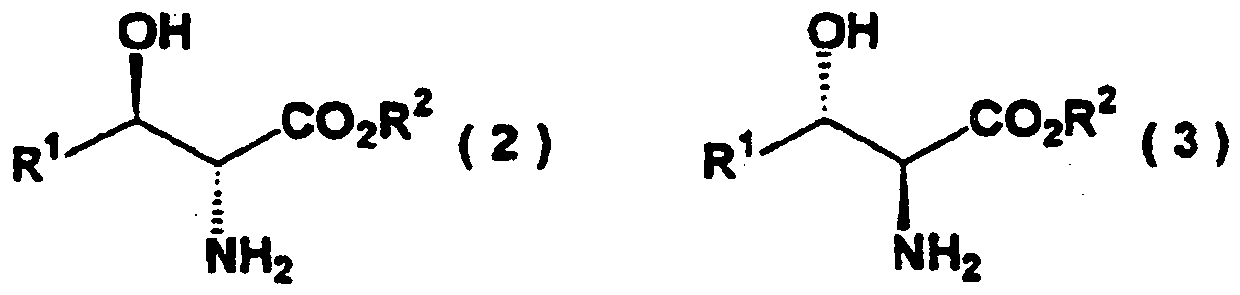
R2 eine C1-20-Alkylgruppe [die C1-20-Alkylgruppe kann beliebig mit C4-12-aromatischen Gruppe (die aromatische Gruppe kann beliebig mit Halogenatom, C1-6-Alkylgruppe, C1-6-Alkoxygruppe, C1-6-Alkoxycarbonylgruppe, C1-6-Alkylcarbonyloxygruppe oder CONR4R5 substituiert sein, worin R4 und R5 unabhängig voneinander Wasserstoffatom oder eine C1-6-Alkylgruppe sind), C1-6-Alkoxygruppe, C1-6-Alkoxycarbonylgruppe oder CONR4R5 substituiert sein, worin R4 und R5 unabhängig voneinander Wasserstoffatom oder eine C1-6-Alkylgruppe sind] oder einer C4-12-aromatischen Gruppe substituiert sein [die aromatische Gruppe kann beliebig mit Halogenatom, C1-6-Alkylgruppe, C1-6-Alkoxygruppe, C1-6-Alkoxycarbonylgruppe, C1-6-Alkylcarbonyloxygruppe oder CONR4R5 substituiert sein, worin R4 und R5 unabhängig voneinander Wasserstoffatom oder eine C1-6-Alkylgruppe sind], dadurch gekennzeichnet, dass es umfasst, dass eine α-Aminoacylessigsäureesterverbindung der Formel (1)
- Verfahren zur Herstellung eines optisch aktiven β-Hydroxy-α-aminocarbonsäurederivats gemäß Anspruch 1, worin der optisch aktive Phosphinligand ein optisch aktiver zweizähniger Phosphinligand ist.
- Verfahren zur Herstellung eines optisch aktiven β-Hydroxy-α-aminocarbonsäurederivats gemäß Anspruch 2, worin der für die katalytische asymmetrische Hydrierung verwendete Katalysator ein Komplex von Ruthenium ist, und der optisch aktive zweizähnige Phosphinligand durch die Formel (4) dargestellt wird

- Verfahren zur Herstellung eines optisch aktiven β-Hydroxy-α-aminocarbonsäurederivats gemäß Anspruch 3, worin der Komplex RuHX1(R3-BINAP)2, RuX2 2(R3-BINAP) oder Ru2Cl4(R3-BINAP)2(Et3N) ist, worin R3-BINAP der optisch aktive zweizähnige Phosphinligand der Formel (4) ist, Et eine Ethylgruppe ist, X1 und X2 unabhängig voneinander Cl, ClO4, BF4, PF6, OCOCH3, OCOCF3, OCO-t-Bu oder OSO2CF3 ist, und der Komplex weiter mit N,N-Dimethylformamid, Benzol, AlCl3, SnCl4, TiCl4 oder ZnCl2 koordiniert sein kann.
- Verfahren zur Herstellung eines optisch aktiven β-Hydroxy-α-aminocarbonsäurederivats gemäß Anspruch 4, worin der Komplex RuX2 2(R3-BINAP) ist, worin X2 und R3-BINAP die gleiche Bedeutung haben wie oben und der Komplex weiter mit N,N-Dimethylformamid, Benzol, AlCl3, SnCl4, TiCl4 oder ZnCl2 koordiniert sein kann.
- Verfahren zur Herstellung eines optisch aktiven β-Hydroxy-α-aminocarbonsäurederivats gemäß Anspruch 5, worin RuX2 2(R3-BINAP) weiterhin mit N,N-Dimethylformamid oder Benzol koordiniert ist, worin X2 Cl ist und R3-BINAP die gleiche Bedeutung wie oben hat.
- Verfahren zur Herstellung eines optisch aktiven β-Hydroxy-α-aminocarbonsäurederivats gemäß Anspruch 2, worin der für die katalytische asymmetrische Hydrierung eingesetzte Katalysator ein Komplex von Iridium ist, und der optisch aktive zweizähnige Phosphinligand R3-BINAP, worin R3-BINAP die gleiche Bedeutung hat wie oben definiert, oder eine Verbindung der Formel (5) ist

- Verfahren zur Herstellung eines optisch aktiven β-Hydroxy-α-aminocarbonsäurederivats gemäß Anspruch 7, worin ein Essigsäuresalz zum Reaktionssystem hinzugefügt wird.
- Verfahren zur Herstellung eines optisch aktiven β-Hydroxy-α-aminocarbonsäurederivats gemäß Anspruch 8, worin, wenn der Komplex hergestellt wird, eine Jodverbindung hinzugefügt wird.
- Verfahren zur Herstellung eines optisch aktiven β-Hydroxy-α-aminocarbonsäurederivats gemäß Anspruch 9, worin der optisch aktive zweizähnige Phosphinligand eine Verbindung der Formel (5) ist.
- Verfahren zur Herstellung eines optisch aktiven β-Hydroxy-α-aminocarbonsäurederivats gemäß Anspruch 10, worin, wenn der Komplex hergestellt wird, [Ir(cod)Cl]2 eingesetzt wird, worin cod 1,5-Cyclooctadien ist.
- Verfahren zur Herstellung eines optisch aktiven β-Hydroxy-α-aminocarbonsäurederivats gemäß gemäß irgendeinem der Ansprüche 1 bis 11, worin die Säure eine starke Säure ist.
Applications Claiming Priority (3)
| Application Number | Priority Date | Filing Date | Title |
|---|---|---|---|
| JP2003272637 | 2003-07-10 | ||
| JP2003426226 | 2003-12-24 | ||
| PCT/JP2004/009829 WO2005005371A1 (ja) | 2003-07-10 | 2004-07-09 | 光学活性β−ヒドロキシ−α−アミノカルボン酸誘導体の製造方法 |
Publications (3)
| Publication Number | Publication Date |
|---|---|
| EP1650185A1 EP1650185A1 (de) | 2006-04-26 |
| EP1650185A4 EP1650185A4 (de) | 2007-06-20 |
| EP1650185B1 true EP1650185B1 (de) | 2013-05-01 |
Family
ID=34067375
Family Applications (1)
| Application Number | Title | Priority Date | Filing Date |
|---|---|---|---|
| EP04747297.2A Expired - Lifetime EP1650185B1 (de) | 2003-07-10 | 2004-07-09 | Verfahren zur herstellung von optisch aktiven beta-hydroxy-alpha-aminocarbonsäurederivaten |
Country Status (5)
| Country | Link |
|---|---|
| US (1) | US7799941B2 (de) |
| EP (1) | EP1650185B1 (de) |
| JP (1) | JP3932413B2 (de) |
| CA (1) | CA2531898C (de) |
| WO (1) | WO2005005371A1 (de) |
Families Citing this family (6)
| Publication number | Priority date | Publication date | Assignee | Title |
|---|---|---|---|---|
| EP1840116B1 (de) * | 2005-01-12 | 2012-10-03 | Nissan Chemical Industries, Ltd. | Verfahren zur herstellung eines optisch aktiven beta-hydroxy-alpha-aminocarboxylsäurederivates |
| JP4621918B2 (ja) * | 2005-12-09 | 2011-02-02 | 国立大学法人 千葉大学 | 新規不斉イリジウム触媒の製造方法とこれらを用いる光学活性β−ヒドロキシ−α−アミノ酸誘導体の製造方法 |
| JP4677562B2 (ja) * | 2006-03-01 | 2011-04-27 | 国立大学法人 千葉大学 | 新規不斉ニッケル触媒の製造方法とこれらを用いる光学活性β−ヒドロキシ−α−アミノ酸誘導体の製造方法 |
| JP5261172B2 (ja) * | 2006-03-31 | 2013-08-14 | 株式会社カネカ | エリスロ又はスレオ−2−アミノ−3−ヒドロキシプロピオン酸エステルの製造方法、新規カルボニル還元酵素、その遺伝子、ベクター、形質転換体、およびそれらを利用した光学活性アルコールの製造方法 |
| JP5274256B2 (ja) * | 2006-09-26 | 2013-08-28 | 株式会社カネカ | 光学活性β−ヒドロキシ−α−アミノカルボン酸エステルの製造方法 |
| US9403760B2 (en) * | 2013-03-14 | 2016-08-02 | Avanti Polar Lipids, Inc. | Compounds |
Family Cites Families (4)
| Publication number | Priority date | Publication date | Assignee | Title |
|---|---|---|---|---|
| JPH0699367B2 (ja) | 1987-06-11 | 1994-12-07 | 高砂香料工業株式会社 | 光学活性アルコ−ルの製法 |
| JPH02172956A (ja) | 1988-12-23 | 1990-07-04 | Sumitomo Pharmaceut Co Ltd | エリスロ―3―(3,4―ジヒドロキシフェニル)セリン誘導体の新規製造法 |
| JP2976214B2 (ja) | 1992-09-01 | 1999-11-10 | 高砂香料工業株式会社 | 光学活性ジヒドロスフィンゴシン類の製造方法 |
| EP1840116B1 (de) * | 2005-01-12 | 2012-10-03 | Nissan Chemical Industries, Ltd. | Verfahren zur herstellung eines optisch aktiven beta-hydroxy-alpha-aminocarboxylsäurederivates |
-
2004
- 2004-07-09 US US10/563,763 patent/US7799941B2/en not_active Expired - Fee Related
- 2004-07-09 WO PCT/JP2004/009829 patent/WO2005005371A1/ja not_active Ceased
- 2004-07-09 JP JP2005511542A patent/JP3932413B2/ja not_active Expired - Fee Related
- 2004-07-09 EP EP04747297.2A patent/EP1650185B1/de not_active Expired - Lifetime
- 2004-07-09 CA CA2531898A patent/CA2531898C/en not_active Expired - Fee Related
Also Published As
| Publication number | Publication date |
|---|---|
| WO2005005371A1 (ja) | 2005-01-20 |
| CA2531898A1 (en) | 2005-01-20 |
| CA2531898C (en) | 2012-01-03 |
| US7799941B2 (en) | 2010-09-21 |
| EP1650185A4 (de) | 2007-06-20 |
| JP3932413B2 (ja) | 2007-06-20 |
| JPWO2005005371A1 (ja) | 2006-08-24 |
| EP1650185A1 (de) | 2006-04-26 |
| US20060167300A1 (en) | 2006-07-27 |
Similar Documents
| Publication | Publication Date | Title |
|---|---|---|
| CN103080072B (zh) | 制备可用于生产nep抑制剂的中间体的新方法 | |
| JP4503594B2 (ja) | 不斉水素化によるキラルなベータアミノ酸誘導体の製造方法 | |
| US7153809B2 (en) | P-chiral phospholanes and phosphocyclic compounds and their use in asymmetric catalytic reactions | |
| Rapi et al. | Enantioselective Michael addition of malonates to aromatic nitroalkenes catalyzed by monosaccharide-based chiral crown ethers | |
| EP1650185B1 (de) | Verfahren zur herstellung von optisch aktiven beta-hydroxy-alpha-aminocarbonsäurederivaten | |
| EP1640361B1 (de) | Asymmetrische harnstoff-verbindungen und verfahren zur herstellung von asymmetrischen verbindungen durch asymmetrische konjugat-additionsreaktion unter verwendung dieser verbindungen als katalysator | |
| CZ409898A3 (cs) | Bifosfinové deriváty a způsob výroby | |
| EP4151620A1 (de) | Verfahren zur herstellung eines chiralen 4-aryl-beta-aminosäurederivats | |
| EP1840116B1 (de) | Verfahren zur herstellung eines optisch aktiven beta-hydroxy-alpha-aminocarboxylsäurederivates | |
| JP4621918B2 (ja) | 新規不斉イリジウム触媒の製造方法とこれらを用いる光学活性β−ヒドロキシ−α−アミノ酸誘導体の製造方法 | |
| Morimoto et al. | Preparation of axially chiral biphenyl diphosphine ligands and their application in asymmetric hydrogenation | |
| Döbler et al. | Enantioselective hydrogenation using a rigid bicyclic aminophosphine phosphinite ligand | |
| JP4677562B2 (ja) | 新規不斉ニッケル触媒の製造方法とこれらを用いる光学活性β−ヒドロキシ−α−アミノ酸誘導体の製造方法 | |
| CN100567255C (zh) | 光学活性β-羟基-α-氨基羧酸衍生物的制造方法 | |
| US6437175B2 (en) | Process for racemization of n-acylamino acids by means of transition metal catalysts | |
| JP2003160549A (ja) | 光学活性β−アリールアミドの合成法 | |
| JP4788854B2 (ja) | トランス−1,2−ジアリールエタンジアミンおよびその誘導体の製造方法、ならびにトランス−1,2−ジアリールエタンジアミン誘導体 | |
| Nopper | Development of new methods for the construction of carbon-carbon bonds via metallaphotocatalysis | |
| Le Gendre et al. | Stereoselective synthesis of a new optically active phosphinoacyloxazolidinone via enantioselective hydrogenation | |
| KR100435525B1 (ko) | 방향족 케톤화합물의 비대칭 수소전이 환원방법 | |
| JP2967192B2 (ja) | ニトロンの不斉還元方法、光学活性n−ヒドロキシルアミン類の製造方法及び不斉還元触媒 | |
| JP2004099609A (ja) | 光学活性7−アミノ−5−アザスピロ[2.4]ヘプタンの製造法 | |
| JP2001163836A (ja) | (2s,3s)−2−ヒドロキシ−3−ニトロ−4−フェニル酪酸、その製造方法、およびエリトロ形2−ヒドロキシ−3−ニトロ−4−フェニル酪酸の光学分割方法 | |
| JPH01230551A (ja) | N−カルバモイル−α−アミノ酸誘導体及びその製造中間体 |
Legal Events
| Date | Code | Title | Description |
|---|---|---|---|
| PUAI | Public reference made under article 153(3) epc to a published international application that has entered the european phase |
Free format text: ORIGINAL CODE: 0009012 |
|
| 17P | Request for examination filed |
Effective date: 20060207 |
|
| AK | Designated contracting states |
Kind code of ref document: A1 Designated state(s): AT BE BG CH CY CZ DE DK EE ES FI FR GB GR HU IE IT LI LU MC NL PL PT RO SE SI SK TR |
|
| AX | Request for extension of the european patent |
Extension state: AL HR LT LV MK |
|
| A4 | Supplementary search report drawn up and despatched |
Effective date: 20070518 |
|
| 17Q | First examination report despatched |
Effective date: 20100212 |
|
| GRAP | Despatch of communication of intention to grant a patent |
Free format text: ORIGINAL CODE: EPIDOSNIGR1 |
|
| GRAS | Grant fee paid |
Free format text: ORIGINAL CODE: EPIDOSNIGR3 |
|
| GRAA | (expected) grant |
Free format text: ORIGINAL CODE: 0009210 |
|
| RIN1 | Information on inventor provided before grant (corrected) |
Inventor name: MAKINO, KAZUISHI Inventor name: HAMADA, YASUMASA |
|
| AK | Designated contracting states |
Kind code of ref document: B1 Designated state(s): AT BE BG CH CY CZ DE DK EE ES FI FR GB GR HU IE IT LI LU MC NL PL PT RO SE SI SK TR |
|
| AX | Request for extension of the european patent |
Extension state: AL HR LT LV MK |
|
| REG | Reference to a national code |
Ref country code: GB Ref legal event code: FG4D |
|
| REG | Reference to a national code |
Ref country code: CH Ref legal event code: NV Representative=s name: NOVAGRAAF INTERNATIONAL SA, CH Ref country code: CH Ref legal event code: EP Ref country code: AT Ref legal event code: REF Ref document number: 609867 Country of ref document: AT Kind code of ref document: T Effective date: 20130515 |
|
| REG | Reference to a national code |
Ref country code: IE Ref legal event code: FG4D |
|
| REG | Reference to a national code |
Ref country code: DE Ref legal event code: R096 Ref document number: 602004041976 Country of ref document: DE Effective date: 20130627 |
|
| REG | Reference to a national code |
Ref country code: AT Ref legal event code: MK05 Ref document number: 609867 Country of ref document: AT Kind code of ref document: T Effective date: 20130501 |
|
| REG | Reference to a national code |
Ref country code: NL Ref legal event code: VDEP Effective date: 20130501 |
|
| REG | Reference to a national code |
Ref country code: LT Ref legal event code: MG9D |
|
| PG25 | Lapsed in a contracting state [announced via postgrant information from national office to epo] |
Ref country code: SI Free format text: LAPSE BECAUSE OF FAILURE TO SUBMIT A TRANSLATION OF THE DESCRIPTION OR TO PAY THE FEE WITHIN THE PRESCRIBED TIME-LIMIT Effective date: 20130501 Ref country code: ES Free format text: LAPSE BECAUSE OF FAILURE TO SUBMIT A TRANSLATION OF THE DESCRIPTION OR TO PAY THE FEE WITHIN THE PRESCRIBED TIME-LIMIT Effective date: 20130812 Ref country code: FI Free format text: LAPSE BECAUSE OF FAILURE TO SUBMIT A TRANSLATION OF THE DESCRIPTION OR TO PAY THE FEE WITHIN THE PRESCRIBED TIME-LIMIT Effective date: 20130501 Ref country code: GR Free format text: LAPSE BECAUSE OF FAILURE TO SUBMIT A TRANSLATION OF THE DESCRIPTION OR TO PAY THE FEE WITHIN THE PRESCRIBED TIME-LIMIT Effective date: 20130802 Ref country code: PT Free format text: LAPSE BECAUSE OF FAILURE TO SUBMIT A TRANSLATION OF THE DESCRIPTION OR TO PAY THE FEE WITHIN THE PRESCRIBED TIME-LIMIT Effective date: 20130902 Ref country code: SE Free format text: LAPSE BECAUSE OF FAILURE TO SUBMIT A TRANSLATION OF THE DESCRIPTION OR TO PAY THE FEE WITHIN THE PRESCRIBED TIME-LIMIT Effective date: 20130501 Ref country code: AT Free format text: LAPSE BECAUSE OF FAILURE TO SUBMIT A TRANSLATION OF THE DESCRIPTION OR TO PAY THE FEE WITHIN THE PRESCRIBED TIME-LIMIT Effective date: 20130501 |
|
| PG25 | Lapsed in a contracting state [announced via postgrant information from national office to epo] |
Ref country code: CY Free format text: LAPSE BECAUSE OF FAILURE TO SUBMIT A TRANSLATION OF THE DESCRIPTION OR TO PAY THE FEE WITHIN THE PRESCRIBED TIME-LIMIT Effective date: 20130501 Ref country code: PL Free format text: LAPSE BECAUSE OF FAILURE TO SUBMIT A TRANSLATION OF THE DESCRIPTION OR TO PAY THE FEE WITHIN THE PRESCRIBED TIME-LIMIT Effective date: 20130501 Ref country code: BG Free format text: LAPSE BECAUSE OF FAILURE TO SUBMIT A TRANSLATION OF THE DESCRIPTION OR TO PAY THE FEE WITHIN THE PRESCRIBED TIME-LIMIT Effective date: 20130801 |
|
| PG25 | Lapsed in a contracting state [announced via postgrant information from national office to epo] |
Ref country code: DK Free format text: LAPSE BECAUSE OF FAILURE TO SUBMIT A TRANSLATION OF THE DESCRIPTION OR TO PAY THE FEE WITHIN THE PRESCRIBED TIME-LIMIT Effective date: 20130501 Ref country code: EE Free format text: LAPSE BECAUSE OF FAILURE TO SUBMIT A TRANSLATION OF THE DESCRIPTION OR TO PAY THE FEE WITHIN THE PRESCRIBED TIME-LIMIT Effective date: 20130501 Ref country code: CZ Free format text: LAPSE BECAUSE OF FAILURE TO SUBMIT A TRANSLATION OF THE DESCRIPTION OR TO PAY THE FEE WITHIN THE PRESCRIBED TIME-LIMIT Effective date: 20130501 Ref country code: SK Free format text: LAPSE BECAUSE OF FAILURE TO SUBMIT A TRANSLATION OF THE DESCRIPTION OR TO PAY THE FEE WITHIN THE PRESCRIBED TIME-LIMIT Effective date: 20130501 Ref country code: BE Free format text: LAPSE BECAUSE OF FAILURE TO SUBMIT A TRANSLATION OF THE DESCRIPTION OR TO PAY THE FEE WITHIN THE PRESCRIBED TIME-LIMIT Effective date: 20130501 |
|
| PG25 | Lapsed in a contracting state [announced via postgrant information from national office to epo] |
Ref country code: RO Free format text: LAPSE BECAUSE OF FAILURE TO SUBMIT A TRANSLATION OF THE DESCRIPTION OR TO PAY THE FEE WITHIN THE PRESCRIBED TIME-LIMIT Effective date: 20130501 Ref country code: MC Free format text: LAPSE BECAUSE OF FAILURE TO SUBMIT A TRANSLATION OF THE DESCRIPTION OR TO PAY THE FEE WITHIN THE PRESCRIBED TIME-LIMIT Effective date: 20130501 Ref country code: IT Free format text: LAPSE BECAUSE OF FAILURE TO SUBMIT A TRANSLATION OF THE DESCRIPTION OR TO PAY THE FEE WITHIN THE PRESCRIBED TIME-LIMIT Effective date: 20130501 Ref country code: NL Free format text: LAPSE BECAUSE OF FAILURE TO SUBMIT A TRANSLATION OF THE DESCRIPTION OR TO PAY THE FEE WITHIN THE PRESCRIBED TIME-LIMIT Effective date: 20130501 |
|
| PLBE | No opposition filed within time limit |
Free format text: ORIGINAL CODE: 0009261 |
|
| STAA | Information on the status of an ep patent application or granted ep patent |
Free format text: STATUS: NO OPPOSITION FILED WITHIN TIME LIMIT |
|
| 26N | No opposition filed |
Effective date: 20140204 |
|
| REG | Reference to a national code |
Ref country code: DE Ref legal event code: R097 Ref document number: 602004041976 Country of ref document: DE Effective date: 20140204 |
|
| PGFP | Annual fee paid to national office [announced via postgrant information from national office to epo] |
Ref country code: DE Payment date: 20140708 Year of fee payment: 11 Ref country code: IE Payment date: 20140729 Year of fee payment: 11 Ref country code: CH Payment date: 20140708 Year of fee payment: 11 |
|
| PGFP | Annual fee paid to national office [announced via postgrant information from national office to epo] |
Ref country code: GB Payment date: 20140702 Year of fee payment: 11 Ref country code: FR Payment date: 20140701 Year of fee payment: 11 |
|
| PG25 | Lapsed in a contracting state [announced via postgrant information from national office to epo] |
Ref country code: TR Free format text: LAPSE BECAUSE OF FAILURE TO SUBMIT A TRANSLATION OF THE DESCRIPTION OR TO PAY THE FEE WITHIN THE PRESCRIBED TIME-LIMIT Effective date: 20130501 |
|
| PG25 | Lapsed in a contracting state [announced via postgrant information from national office to epo] |
Ref country code: LU Free format text: LAPSE BECAUSE OF NON-PAYMENT OF DUE FEES Effective date: 20130709 Ref country code: HU Free format text: LAPSE BECAUSE OF FAILURE TO SUBMIT A TRANSLATION OF THE DESCRIPTION OR TO PAY THE FEE WITHIN THE PRESCRIBED TIME-LIMIT; INVALID AB INITIO Effective date: 20040709 |
|
| REG | Reference to a national code |
Ref country code: DE Ref legal event code: R119 Ref document number: 602004041976 Country of ref document: DE |
|
| REG | Reference to a national code |
Ref country code: CH Ref legal event code: PL |
|
| GBPC | Gb: european patent ceased through non-payment of renewal fee |
Effective date: 20150709 |
|
| REG | Reference to a national code |
Ref country code: IE Ref legal event code: MM4A |
|
| PG25 | Lapsed in a contracting state [announced via postgrant information from national office to epo] |
Ref country code: LI Free format text: LAPSE BECAUSE OF NON-PAYMENT OF DUE FEES Effective date: 20150731 Ref country code: DE Free format text: LAPSE BECAUSE OF NON-PAYMENT OF DUE FEES Effective date: 20160202 Ref country code: CH Free format text: LAPSE BECAUSE OF NON-PAYMENT OF DUE FEES Effective date: 20150731 Ref country code: GB Free format text: LAPSE BECAUSE OF NON-PAYMENT OF DUE FEES Effective date: 20150709 |
|
| REG | Reference to a national code |
Ref country code: FR Ref legal event code: ST Effective date: 20160331 |
|
| PG25 | Lapsed in a contracting state [announced via postgrant information from national office to epo] |
Ref country code: FR Free format text: LAPSE BECAUSE OF NON-PAYMENT OF DUE FEES Effective date: 20150731 |
|
| PG25 | Lapsed in a contracting state [announced via postgrant information from national office to epo] |
Ref country code: IE Free format text: LAPSE BECAUSE OF NON-PAYMENT OF DUE FEES Effective date: 20150709 |