EP1626041B1 - Neue Materialien verwendbar als elektrolytische Solubilisate - Google Patents
Neue Materialien verwendbar als elektrolytische Solubilisate Download PDFInfo
- Publication number
- EP1626041B1 EP1626041B1 EP05023466.5A EP05023466A EP1626041B1 EP 1626041 B1 EP1626041 B1 EP 1626041B1 EP 05023466 A EP05023466 A EP 05023466A EP 1626041 B1 EP1626041 B1 EP 1626041B1
- Authority
- EP
- European Patent Office
- Prior art keywords
- salt
- optionally
- electrolytic composition
- cation
- composition according
- Prior art date
- Legal status (The legal status is an assumption and is not a legal conclusion. Google has not performed a legal analysis and makes no representation as to the accuracy of the status listed.)
- Expired - Lifetime
Links
- 0 CP(*)N=P(*)(*)* Chemical compound CP(*)N=P(*)(*)* 0.000 description 1
Classifications
-
- C—CHEMISTRY; METALLURGY
- C07—ORGANIC CHEMISTRY
- C07C—ACYCLIC OR CARBOCYCLIC COMPOUNDS
- C07C211/00—Compounds containing amino groups bound to a carbon skeleton
- C07C211/62—Quaternary ammonium compounds
- C07C211/63—Quaternary ammonium compounds having quaternised nitrogen atoms bound to acyclic carbon atoms
-
- C—CHEMISTRY; METALLURGY
- C07—ORGANIC CHEMISTRY
- C07C—ACYCLIC OR CARBOCYCLIC COMPOUNDS
- C07C211/00—Compounds containing amino groups bound to a carbon skeleton
- C07C211/62—Quaternary ammonium compounds
- C07C211/64—Quaternary ammonium compounds having quaternised nitrogen atoms bound to carbon atoms of six-membered aromatic rings
-
- C—CHEMISTRY; METALLURGY
- C07—ORGANIC CHEMISTRY
- C07C—ACYCLIC OR CARBOCYCLIC COMPOUNDS
- C07C317/00—Sulfones; Sulfoxides
- C07C317/02—Sulfones; Sulfoxides having sulfone or sulfoxide groups bound to acyclic carbon atoms
- C07C317/04—Sulfones; Sulfoxides having sulfone or sulfoxide groups bound to acyclic carbon atoms of an acyclic saturated carbon skeleton
-
- C—CHEMISTRY; METALLURGY
- C07—ORGANIC CHEMISTRY
- C07C—ACYCLIC OR CARBOCYCLIC COMPOUNDS
- C07C317/00—Sulfones; Sulfoxides
- C07C317/12—Sulfones; Sulfoxides having sulfone or sulfoxide groups bound to carbon atoms of rings other than six-membered aromatic rings
-
- C—CHEMISTRY; METALLURGY
- C07—ORGANIC CHEMISTRY
- C07C—ACYCLIC OR CARBOCYCLIC COMPOUNDS
- C07C381/00—Compounds containing carbon and sulfur and having functional groups not covered by groups C07C301/00 - C07C337/00
-
- C—CHEMISTRY; METALLURGY
- C07—ORGANIC CHEMISTRY
- C07C—ACYCLIC OR CARBOCYCLIC COMPOUNDS
- C07C45/00—Preparation of compounds having >C = O groups bound only to carbon or hydrogen atoms; Preparation of chelates of such compounds
- C07C45/45—Preparation of compounds having >C = O groups bound only to carbon or hydrogen atoms; Preparation of chelates of such compounds by condensation
- C07C45/46—Friedel-Crafts reactions
-
- C—CHEMISTRY; METALLURGY
- C07—ORGANIC CHEMISTRY
- C07C—ACYCLIC OR CARBOCYCLIC COMPOUNDS
- C07C45/00—Preparation of compounds having >C = O groups bound only to carbon or hydrogen atoms; Preparation of chelates of such compounds
- C07C45/61—Preparation of compounds having >C = O groups bound only to carbon or hydrogen atoms; Preparation of chelates of such compounds by reactions not involving the formation of >C = O groups
- C07C45/67—Preparation of compounds having >C = O groups bound only to carbon or hydrogen atoms; Preparation of chelates of such compounds by reactions not involving the formation of >C = O groups by isomerisation; by change of size of the carbon skeleton
- C07C45/68—Preparation of compounds having >C = O groups bound only to carbon or hydrogen atoms; Preparation of chelates of such compounds by reactions not involving the formation of >C = O groups by isomerisation; by change of size of the carbon skeleton by increase in the number of carbon atoms
- C07C45/72—Preparation of compounds having >C = O groups bound only to carbon or hydrogen atoms; Preparation of chelates of such compounds by reactions not involving the formation of >C = O groups by isomerisation; by change of size of the carbon skeleton by increase in the number of carbon atoms by reaction of compounds containing >C = O groups with the same or other compounds containing >C = O groups
-
- C—CHEMISTRY; METALLURGY
- C07—ORGANIC CHEMISTRY
- C07D—HETEROCYCLIC COMPOUNDS
- C07D213/00—Heterocyclic compounds containing six-membered rings, not condensed with other rings, with one nitrogen atom as the only ring hetero atom and three or more double bonds between ring members or between ring members and non-ring members
- C07D213/02—Heterocyclic compounds containing six-membered rings, not condensed with other rings, with one nitrogen atom as the only ring hetero atom and three or more double bonds between ring members or between ring members and non-ring members having three double bonds between ring members or between ring members and non-ring members
- C07D213/04—Heterocyclic compounds containing six-membered rings, not condensed with other rings, with one nitrogen atom as the only ring hetero atom and three or more double bonds between ring members or between ring members and non-ring members having three double bonds between ring members or between ring members and non-ring members having no bond between the ring nitrogen atom and a non-ring member or having only hydrogen or carbon atoms directly attached to the ring nitrogen atom
- C07D213/06—Heterocyclic compounds containing six-membered rings, not condensed with other rings, with one nitrogen atom as the only ring hetero atom and three or more double bonds between ring members or between ring members and non-ring members having three double bonds between ring members or between ring members and non-ring members having no bond between the ring nitrogen atom and a non-ring member or having only hydrogen or carbon atoms directly attached to the ring nitrogen atom containing only hydrogen and carbon atoms in addition to the ring nitrogen atom
- C07D213/16—Heterocyclic compounds containing six-membered rings, not condensed with other rings, with one nitrogen atom as the only ring hetero atom and three or more double bonds between ring members or between ring members and non-ring members having three double bonds between ring members or between ring members and non-ring members having no bond between the ring nitrogen atom and a non-ring member or having only hydrogen or carbon atoms directly attached to the ring nitrogen atom containing only hydrogen and carbon atoms in addition to the ring nitrogen atom containing only one pyridine ring
- C07D213/20—Quaternary compounds thereof
-
- C—CHEMISTRY; METALLURGY
- C07—ORGANIC CHEMISTRY
- C07D—HETEROCYCLIC COMPOUNDS
- C07D213/00—Heterocyclic compounds containing six-membered rings, not condensed with other rings, with one nitrogen atom as the only ring hetero atom and three or more double bonds between ring members or between ring members and non-ring members
- C07D213/02—Heterocyclic compounds containing six-membered rings, not condensed with other rings, with one nitrogen atom as the only ring hetero atom and three or more double bonds between ring members or between ring members and non-ring members having three double bonds between ring members or between ring members and non-ring members
- C07D213/04—Heterocyclic compounds containing six-membered rings, not condensed with other rings, with one nitrogen atom as the only ring hetero atom and three or more double bonds between ring members or between ring members and non-ring members having three double bonds between ring members or between ring members and non-ring members having no bond between the ring nitrogen atom and a non-ring member or having only hydrogen or carbon atoms directly attached to the ring nitrogen atom
- C07D213/60—Heterocyclic compounds containing six-membered rings, not condensed with other rings, with one nitrogen atom as the only ring hetero atom and three or more double bonds between ring members or between ring members and non-ring members having three double bonds between ring members or between ring members and non-ring members having no bond between the ring nitrogen atom and a non-ring member or having only hydrogen or carbon atoms directly attached to the ring nitrogen atom with hetero atoms or with carbon atoms having three bonds to hetero atoms with at the most one bond to halogen, e.g. ester or nitrile radicals, directly attached to ring carbon atoms
- C07D213/72—Nitrogen atoms
- C07D213/74—Amino or imino radicals substituted by hydrocarbon or substituted hydrocarbon radicals
-
- C—CHEMISTRY; METALLURGY
- C07—ORGANIC CHEMISTRY
- C07D—HETEROCYCLIC COMPOUNDS
- C07D231/00—Heterocyclic compounds containing 1,2-diazole or hydrogenated 1,2-diazole rings
- C07D231/02—Heterocyclic compounds containing 1,2-diazole or hydrogenated 1,2-diazole rings not condensed with other rings
- C07D231/10—Heterocyclic compounds containing 1,2-diazole or hydrogenated 1,2-diazole rings not condensed with other rings having two or three double bonds between ring members or between ring members and non-ring members
- C07D231/12—Heterocyclic compounds containing 1,2-diazole or hydrogenated 1,2-diazole rings not condensed with other rings having two or three double bonds between ring members or between ring members and non-ring members with only hydrogen atoms, hydrocarbon or substituted hydrocarbon radicals, directly attached to ring carbon atoms
-
- C—CHEMISTRY; METALLURGY
- C07—ORGANIC CHEMISTRY
- C07D—HETEROCYCLIC COMPOUNDS
- C07D233/00—Heterocyclic compounds containing 1,3-diazole or hydrogenated 1,3-diazole rings, not condensed with other rings
- C07D233/54—Heterocyclic compounds containing 1,3-diazole or hydrogenated 1,3-diazole rings, not condensed with other rings having two double bonds between ring members or between ring members and non-ring members
- C07D233/56—Heterocyclic compounds containing 1,3-diazole or hydrogenated 1,3-diazole rings, not condensed with other rings having two double bonds between ring members or between ring members and non-ring members with only hydrogen atoms or radicals containing only hydrogen and carbon atoms, attached to ring carbon atoms
-
- C—CHEMISTRY; METALLURGY
- C07—ORGANIC CHEMISTRY
- C07D—HETEROCYCLIC COMPOUNDS
- C07D249/00—Heterocyclic compounds containing five-membered rings having three nitrogen atoms as the only ring hetero atoms
- C07D249/02—Heterocyclic compounds containing five-membered rings having three nitrogen atoms as the only ring hetero atoms not condensed with other rings
- C07D249/08—1,2,4-Triazoles; Hydrogenated 1,2,4-triazoles
-
- C—CHEMISTRY; METALLURGY
- C07—ORGANIC CHEMISTRY
- C07D—HETEROCYCLIC COMPOUNDS
- C07D311/00—Heterocyclic compounds containing six-membered rings having one oxygen atom as the only hetero atom, condensed with other rings
- C07D311/02—Heterocyclic compounds containing six-membered rings having one oxygen atom as the only hetero atom, condensed with other rings ortho- or peri-condensed with carbocyclic rings or ring systems
- C07D311/78—Ring systems having three or more relevant rings
- C07D311/80—Dibenzopyrans; Hydrogenated dibenzopyrans
- C07D311/82—Xanthenes
-
- C—CHEMISTRY; METALLURGY
- C07—ORGANIC CHEMISTRY
- C07D—HETEROCYCLIC COMPOUNDS
- C07D339/00—Heterocyclic compounds containing rings having two sulfur atoms as the only ring hetero atoms
- C07D339/02—Five-membered rings
- C07D339/06—Five-membered rings having the hetero atoms in positions 1 and 3, e.g. cyclic dithiocarbonates
-
- C—CHEMISTRY; METALLURGY
- C07—ORGANIC CHEMISTRY
- C07F—ACYCLIC, CARBOCYCLIC OR HETEROCYCLIC COMPOUNDS CONTAINING ELEMENTS OTHER THAN CARBON, HYDROGEN, HALOGEN, OXYGEN, NITROGEN, SULFUR, SELENIUM OR TELLURIUM
- C07F9/00—Compounds containing elements of Groups 5 or 15 of the Periodic Table
- C07F9/02—Phosphorus compounds
- C07F9/28—Phosphorus compounds with one or more P—C bonds
- C07F9/54—Quaternary phosphonium compounds
-
- H—ELECTRICITY
- H01—ELECTRIC ELEMENTS
- H01G—CAPACITORS; CAPACITORS, RECTIFIERS, DETECTORS, SWITCHING DEVICES, LIGHT-SENSITIVE OR TEMPERATURE-SENSITIVE DEVICES OF THE ELECTROLYTIC TYPE
- H01G11/00—Hybrid capacitors, i.e. capacitors having different positive and negative electrodes; Electric double-layer [EDL] capacitors; Processes for the manufacture thereof or of parts thereof
- H01G11/54—Electrolytes
- H01G11/58—Liquid electrolytes
- H01G11/60—Liquid electrolytes characterised by the solvent
-
- H—ELECTRICITY
- H01—ELECTRIC ELEMENTS
- H01G—CAPACITORS; CAPACITORS, RECTIFIERS, DETECTORS, SWITCHING DEVICES, LIGHT-SENSITIVE OR TEMPERATURE-SENSITIVE DEVICES OF THE ELECTROLYTIC TYPE
- H01G11/00—Hybrid capacitors, i.e. capacitors having different positive and negative electrodes; Electric double-layer [EDL] capacitors; Processes for the manufacture thereof or of parts thereof
- H01G11/54—Electrolytes
- H01G11/58—Liquid electrolytes
- H01G11/62—Liquid electrolytes characterised by the solute, e.g. salts, anions or cations therein
-
- H—ELECTRICITY
- H01—ELECTRIC ELEMENTS
- H01G—CAPACITORS; CAPACITORS, RECTIFIERS, DETECTORS, SWITCHING DEVICES, LIGHT-SENSITIVE OR TEMPERATURE-SENSITIVE DEVICES OF THE ELECTROLYTIC TYPE
- H01G9/00—Electrolytic capacitors, rectifiers, detectors, switching devices, light-sensitive or temperature-sensitive devices; Processes of their manufacture
- H01G9/20—Light-sensitive devices
-
- H—ELECTRICITY
- H01—ELECTRIC ELEMENTS
- H01G—CAPACITORS; CAPACITORS, RECTIFIERS, DETECTORS, SWITCHING DEVICES, LIGHT-SENSITIVE OR TEMPERATURE-SENSITIVE DEVICES OF THE ELECTROLYTIC TYPE
- H01G9/00—Electrolytic capacitors, rectifiers, detectors, switching devices, light-sensitive or temperature-sensitive devices; Processes of their manufacture
- H01G9/20—Light-sensitive devices
- H01G9/2004—Light-sensitive devices characterised by the electrolyte, e.g. comprising an organic electrolyte
-
- H—ELECTRICITY
- H01—ELECTRIC ELEMENTS
- H01M—PROCESSES OR MEANS, e.g. BATTERIES, FOR THE DIRECT CONVERSION OF CHEMICAL ENERGY INTO ELECTRICAL ENERGY
- H01M10/00—Secondary cells; Manufacture thereof
- H01M10/05—Accumulators with non-aqueous electrolyte
- H01M10/052—Li-accumulators
-
- H—ELECTRICITY
- H01—ELECTRIC ELEMENTS
- H01M—PROCESSES OR MEANS, e.g. BATTERIES, FOR THE DIRECT CONVERSION OF CHEMICAL ENERGY INTO ELECTRICAL ENERGY
- H01M10/00—Secondary cells; Manufacture thereof
- H01M10/05—Accumulators with non-aqueous electrolyte
- H01M10/056—Accumulators with non-aqueous electrolyte characterised by the materials used as electrolytes, e.g. mixed inorganic/organic electrolytes
- H01M10/0564—Accumulators with non-aqueous electrolyte characterised by the materials used as electrolytes, e.g. mixed inorganic/organic electrolytes the electrolyte being constituted of organic materials only
- H01M10/0565—Polymeric materials, e.g. gel-type or solid-type
-
- H—ELECTRICITY
- H01—ELECTRIC ELEMENTS
- H01M—PROCESSES OR MEANS, e.g. BATTERIES, FOR THE DIRECT CONVERSION OF CHEMICAL ENERGY INTO ELECTRICAL ENERGY
- H01M10/00—Secondary cells; Manufacture thereof
- H01M10/05—Accumulators with non-aqueous electrolyte
- H01M10/056—Accumulators with non-aqueous electrolyte characterised by the materials used as electrolytes, e.g. mixed inorganic/organic electrolytes
- H01M10/0564—Accumulators with non-aqueous electrolyte characterised by the materials used as electrolytes, e.g. mixed inorganic/organic electrolytes the electrolyte being constituted of organic materials only
- H01M10/0566—Liquid materials
-
- H—ELECTRICITY
- H01—ELECTRIC ELEMENTS
- H01M—PROCESSES OR MEANS, e.g. BATTERIES, FOR THE DIRECT CONVERSION OF CHEMICAL ENERGY INTO ELECTRICAL ENERGY
- H01M10/00—Secondary cells; Manufacture thereof
- H01M10/05—Accumulators with non-aqueous electrolyte
- H01M10/056—Accumulators with non-aqueous electrolyte characterised by the materials used as electrolytes, e.g. mixed inorganic/organic electrolytes
- H01M10/0564—Accumulators with non-aqueous electrolyte characterised by the materials used as electrolytes, e.g. mixed inorganic/organic electrolytes the electrolyte being constituted of organic materials only
- H01M10/0566—Liquid materials
- H01M10/0568—Liquid materials characterised by the solutes
-
- H—ELECTRICITY
- H01—ELECTRIC ELEMENTS
- H01M—PROCESSES OR MEANS, e.g. BATTERIES, FOR THE DIRECT CONVERSION OF CHEMICAL ENERGY INTO ELECTRICAL ENERGY
- H01M10/00—Secondary cells; Manufacture thereof
- H01M10/05—Accumulators with non-aqueous electrolyte
- H01M10/056—Accumulators with non-aqueous electrolyte characterised by the materials used as electrolytes, e.g. mixed inorganic/organic electrolytes
- H01M10/0564—Accumulators with non-aqueous electrolyte characterised by the materials used as electrolytes, e.g. mixed inorganic/organic electrolytes the electrolyte being constituted of organic materials only
- H01M10/0566—Liquid materials
- H01M10/0569—Liquid materials characterised by the solvents
-
- H—ELECTRICITY
- H01—ELECTRIC ELEMENTS
- H01M—PROCESSES OR MEANS, e.g. BATTERIES, FOR THE DIRECT CONVERSION OF CHEMICAL ENERGY INTO ELECTRICAL ENERGY
- H01M4/00—Electrodes
- H01M4/02—Electrodes composed of, or comprising, active material
- H01M4/36—Selection of substances as active materials, active masses, active liquids
- H01M4/60—Selection of substances as active materials, active masses, active liquids of organic compounds
- H01M4/602—Polymers
-
- H—ELECTRICITY
- H01—ELECTRIC ELEMENTS
- H01M—PROCESSES OR MEANS, e.g. BATTERIES, FOR THE DIRECT CONVERSION OF CHEMICAL ENERGY INTO ELECTRICAL ENERGY
- H01M6/00—Primary cells; Manufacture thereof
- H01M6/14—Cells with non-aqueous electrolyte
- H01M6/16—Cells with non-aqueous electrolyte with organic electrolyte
- H01M6/162—Cells with non-aqueous electrolyte with organic electrolyte characterised by the electrolyte
- H01M6/166—Cells with non-aqueous electrolyte with organic electrolyte characterised by the electrolyte by the solute
-
- H—ELECTRICITY
- H01—ELECTRIC ELEMENTS
- H01M—PROCESSES OR MEANS, e.g. BATTERIES, FOR THE DIRECT CONVERSION OF CHEMICAL ENERGY INTO ELECTRICAL ENERGY
- H01M8/00—Fuel cells; Manufacture thereof
- H01M8/10—Fuel cells with solid electrolytes
- H01M8/1016—Fuel cells with solid electrolytes characterised by the electrolyte material
- H01M8/1018—Polymeric electrolyte materials
- H01M8/1041—Polymer electrolyte composites, mixtures or blends
- H01M8/1046—Mixtures of at least one polymer and at least one additive
- H01M8/1048—Ion-conducting additives, e.g. ion-conducting particles, heteropolyacids, metal phosphate or polybenzimidazole with phosphoric acid
-
- H—ELECTRICITY
- H01—ELECTRIC ELEMENTS
- H01G—CAPACITORS; CAPACITORS, RECTIFIERS, DETECTORS, SWITCHING DEVICES, LIGHT-SENSITIVE OR TEMPERATURE-SENSITIVE DEVICES OF THE ELECTROLYTIC TYPE
- H01G11/00—Hybrid capacitors, i.e. capacitors having different positive and negative electrodes; Electric double-layer [EDL] capacitors; Processes for the manufacture thereof or of parts thereof
- H01G11/54—Electrolytes
- H01G11/56—Solid electrolytes, e.g. gels; Additives therein
-
- H—ELECTRICITY
- H01—ELECTRIC ELEMENTS
- H01M—PROCESSES OR MEANS, e.g. BATTERIES, FOR THE DIRECT CONVERSION OF CHEMICAL ENERGY INTO ELECTRICAL ENERGY
- H01M10/00—Secondary cells; Manufacture thereof
- H01M10/05—Accumulators with non-aqueous electrolyte
- H01M10/052—Li-accumulators
- H01M10/0525—Rocking-chair batteries, i.e. batteries with lithium insertion or intercalation in both electrodes; Lithium-ion batteries
-
- H—ELECTRICITY
- H01—ELECTRIC ELEMENTS
- H01M—PROCESSES OR MEANS, e.g. BATTERIES, FOR THE DIRECT CONVERSION OF CHEMICAL ENERGY INTO ELECTRICAL ENERGY
- H01M10/00—Secondary cells; Manufacture thereof
- H01M10/36—Accumulators not provided for in groups H01M10/05-H01M10/34
-
- H—ELECTRICITY
- H01—ELECTRIC ELEMENTS
- H01M—PROCESSES OR MEANS, e.g. BATTERIES, FOR THE DIRECT CONVERSION OF CHEMICAL ENERGY INTO ELECTRICAL ENERGY
- H01M2300/00—Electrolytes
- H01M2300/0017—Non-aqueous electrolytes
- H01M2300/002—Inorganic electrolyte
- H01M2300/0022—Room temperature molten salts
-
- H—ELECTRICITY
- H01—ELECTRIC ELEMENTS
- H01M—PROCESSES OR MEANS, e.g. BATTERIES, FOR THE DIRECT CONVERSION OF CHEMICAL ENERGY INTO ELECTRICAL ENERGY
- H01M2300/00—Electrolytes
- H01M2300/0017—Non-aqueous electrolytes
- H01M2300/0065—Solid electrolytes
- H01M2300/0082—Organic polymers
-
- H—ELECTRICITY
- H01—ELECTRIC ELEMENTS
- H01M—PROCESSES OR MEANS, e.g. BATTERIES, FOR THE DIRECT CONVERSION OF CHEMICAL ENERGY INTO ELECTRICAL ENERGY
- H01M4/00—Electrodes
- H01M4/02—Electrodes composed of, or comprising, active material
- H01M4/13—Electrodes for accumulators with non-aqueous electrolyte, e.g. for lithium-accumulators; Processes of manufacture thereof
-
- H—ELECTRICITY
- H01—ELECTRIC ELEMENTS
- H01M—PROCESSES OR MEANS, e.g. BATTERIES, FOR THE DIRECT CONVERSION OF CHEMICAL ENERGY INTO ELECTRICAL ENERGY
- H01M4/00—Electrodes
- H01M4/02—Electrodes composed of, or comprising, active material
- H01M4/36—Selection of substances as active materials, active masses, active liquids
- H01M4/48—Selection of substances as active materials, active masses, active liquids of inorganic oxides or hydroxides
- H01M4/50—Selection of substances as active materials, active masses, active liquids of inorganic oxides or hydroxides of manganese
- H01M4/505—Selection of substances as active materials, active masses, active liquids of inorganic oxides or hydroxides of manganese of mixed oxides or hydroxides containing manganese for inserting or intercalating light metals, e.g. LiMn2O4 or LiMn2OxFy
-
- H—ELECTRICITY
- H01—ELECTRIC ELEMENTS
- H01M—PROCESSES OR MEANS, e.g. BATTERIES, FOR THE DIRECT CONVERSION OF CHEMICAL ENERGY INTO ELECTRICAL ENERGY
- H01M4/00—Electrodes
- H01M4/02—Electrodes composed of, or comprising, active material
- H01M4/36—Selection of substances as active materials, active masses, active liquids
- H01M4/48—Selection of substances as active materials, active masses, active liquids of inorganic oxides or hydroxides
- H01M4/52—Selection of substances as active materials, active masses, active liquids of inorganic oxides or hydroxides of nickel, cobalt or iron
- H01M4/525—Selection of substances as active materials, active masses, active liquids of inorganic oxides or hydroxides of nickel, cobalt or iron of mixed oxides or hydroxides containing iron, cobalt or nickel for inserting or intercalating light metals, e.g. LiNiO2, LiCoO2 or LiCoOxFy
-
- H—ELECTRICITY
- H01—ELECTRIC ELEMENTS
- H01M—PROCESSES OR MEANS, e.g. BATTERIES, FOR THE DIRECT CONVERSION OF CHEMICAL ENERGY INTO ELECTRICAL ENERGY
- H01M4/00—Electrodes
- H01M4/02—Electrodes composed of, or comprising, active material
- H01M4/36—Selection of substances as active materials, active masses, active liquids
- H01M4/58—Selection of substances as active materials, active masses, active liquids of inorganic compounds other than oxides or hydroxides, e.g. sulfides, selenides, tellurides, halogenides or LiCoFy; of polyanionic structures, e.g. phosphates, silicates or borates
-
- H—ELECTRICITY
- H01—ELECTRIC ELEMENTS
- H01M—PROCESSES OR MEANS, e.g. BATTERIES, FOR THE DIRECT CONVERSION OF CHEMICAL ENERGY INTO ELECTRICAL ENERGY
- H01M4/00—Electrodes
- H01M4/02—Electrodes composed of, or comprising, active material
- H01M4/36—Selection of substances as active materials, active masses, active liquids
- H01M4/58—Selection of substances as active materials, active masses, active liquids of inorganic compounds other than oxides or hydroxides, e.g. sulfides, selenides, tellurides, halogenides or LiCoFy; of polyanionic structures, e.g. phosphates, silicates or borates
- H01M4/5825—Oxygenated metallic salts or polyanionic structures, e.g. borates, phosphates, silicates, olivines
-
- H—ELECTRICITY
- H01—ELECTRIC ELEMENTS
- H01M—PROCESSES OR MEANS, e.g. BATTERIES, FOR THE DIRECT CONVERSION OF CHEMICAL ENERGY INTO ELECTRICAL ENERGY
- H01M4/00—Electrodes
- H01M4/02—Electrodes composed of, or comprising, active material
- H01M4/36—Selection of substances as active materials, active masses, active liquids
- H01M4/58—Selection of substances as active materials, active masses, active liquids of inorganic compounds other than oxides or hydroxides, e.g. sulfides, selenides, tellurides, halogenides or LiCoFy; of polyanionic structures, e.g. phosphates, silicates or borates
- H01M4/583—Carbonaceous material, e.g. graphite-intercalation compounds or CFx
- H01M4/587—Carbonaceous material, e.g. graphite-intercalation compounds or CFx for inserting or intercalating light metals
-
- H—ELECTRICITY
- H01—ELECTRIC ELEMENTS
- H01M—PROCESSES OR MEANS, e.g. BATTERIES, FOR THE DIRECT CONVERSION OF CHEMICAL ENERGY INTO ELECTRICAL ENERGY
- H01M4/00—Electrodes
- H01M4/02—Electrodes composed of, or comprising, active material
- H01M4/36—Selection of substances as active materials, active masses, active liquids
- H01M4/60—Selection of substances as active materials, active masses, active liquids of organic compounds
-
- H—ELECTRICITY
- H01—ELECTRIC ELEMENTS
- H01M—PROCESSES OR MEANS, e.g. BATTERIES, FOR THE DIRECT CONVERSION OF CHEMICAL ENERGY INTO ELECTRICAL ENERGY
- H01M4/00—Electrodes
- H01M4/02—Electrodes composed of, or comprising, active material
- H01M4/62—Selection of inactive substances as ingredients for active masses, e.g. binders, fillers
- H01M4/624—Electric conductive fillers
-
- H—ELECTRICITY
- H01—ELECTRIC ELEMENTS
- H01M—PROCESSES OR MEANS, e.g. BATTERIES, FOR THE DIRECT CONVERSION OF CHEMICAL ENERGY INTO ELECTRICAL ENERGY
- H01M6/00—Primary cells; Manufacture thereof
- H01M6/14—Cells with non-aqueous electrolyte
- H01M6/16—Cells with non-aqueous electrolyte with organic electrolyte
- H01M6/162—Cells with non-aqueous electrolyte with organic electrolyte characterised by the electrolyte
- H01M6/164—Cells with non-aqueous electrolyte with organic electrolyte characterised by the electrolyte by the solvent
-
- H—ELECTRICITY
- H01—ELECTRIC ELEMENTS
- H01M—PROCESSES OR MEANS, e.g. BATTERIES, FOR THE DIRECT CONVERSION OF CHEMICAL ENERGY INTO ELECTRICAL ENERGY
- H01M6/00—Primary cells; Manufacture thereof
- H01M6/14—Cells with non-aqueous electrolyte
- H01M6/16—Cells with non-aqueous electrolyte with organic electrolyte
- H01M6/162—Cells with non-aqueous electrolyte with organic electrolyte characterised by the electrolyte
- H01M6/168—Cells with non-aqueous electrolyte with organic electrolyte characterised by the electrolyte by additives
-
- H—ELECTRICITY
- H01—ELECTRIC ELEMENTS
- H01M—PROCESSES OR MEANS, e.g. BATTERIES, FOR THE DIRECT CONVERSION OF CHEMICAL ENERGY INTO ELECTRICAL ENERGY
- H01M6/00—Primary cells; Manufacture thereof
- H01M6/14—Cells with non-aqueous electrolyte
- H01M6/18—Cells with non-aqueous electrolyte with solid electrolyte
- H01M6/181—Cells with non-aqueous electrolyte with solid electrolyte with polymeric electrolytes
-
- Y—GENERAL TAGGING OF NEW TECHNOLOGICAL DEVELOPMENTS; GENERAL TAGGING OF CROSS-SECTIONAL TECHNOLOGIES SPANNING OVER SEVERAL SECTIONS OF THE IPC; TECHNICAL SUBJECTS COVERED BY FORMER USPC CROSS-REFERENCE ART COLLECTIONS [XRACs] AND DIGESTS
- Y02—TECHNOLOGIES OR APPLICATIONS FOR MITIGATION OR ADAPTATION AGAINST CLIMATE CHANGE
- Y02E—REDUCTION OF GREENHOUSE GAS [GHG] EMISSIONS, RELATED TO ENERGY GENERATION, TRANSMISSION OR DISTRIBUTION
- Y02E10/00—Energy generation through renewable energy sources
- Y02E10/50—Photovoltaic [PV] energy
- Y02E10/542—Dye sensitized solar cells
-
- Y—GENERAL TAGGING OF NEW TECHNOLOGICAL DEVELOPMENTS; GENERAL TAGGING OF CROSS-SECTIONAL TECHNOLOGIES SPANNING OVER SEVERAL SECTIONS OF THE IPC; TECHNICAL SUBJECTS COVERED BY FORMER USPC CROSS-REFERENCE ART COLLECTIONS [XRACs] AND DIGESTS
- Y02—TECHNOLOGIES OR APPLICATIONS FOR MITIGATION OR ADAPTATION AGAINST CLIMATE CHANGE
- Y02E—REDUCTION OF GREENHOUSE GAS [GHG] EMISSIONS, RELATED TO ENERGY GENERATION, TRANSMISSION OR DISTRIBUTION
- Y02E60/00—Enabling technologies; Technologies with a potential or indirect contribution to GHG emissions mitigation
- Y02E60/10—Energy storage using batteries
-
- Y—GENERAL TAGGING OF NEW TECHNOLOGICAL DEVELOPMENTS; GENERAL TAGGING OF CROSS-SECTIONAL TECHNOLOGIES SPANNING OVER SEVERAL SECTIONS OF THE IPC; TECHNICAL SUBJECTS COVERED BY FORMER USPC CROSS-REFERENCE ART COLLECTIONS [XRACs] AND DIGESTS
- Y02—TECHNOLOGIES OR APPLICATIONS FOR MITIGATION OR ADAPTATION AGAINST CLIMATE CHANGE
- Y02E—REDUCTION OF GREENHOUSE GAS [GHG] EMISSIONS, RELATED TO ENERGY GENERATION, TRANSMISSION OR DISTRIBUTION
- Y02E60/00—Enabling technologies; Technologies with a potential or indirect contribution to GHG emissions mitigation
- Y02E60/13—Energy storage using capacitors
-
- Y—GENERAL TAGGING OF NEW TECHNOLOGICAL DEVELOPMENTS; GENERAL TAGGING OF CROSS-SECTIONAL TECHNOLOGIES SPANNING OVER SEVERAL SECTIONS OF THE IPC; TECHNICAL SUBJECTS COVERED BY FORMER USPC CROSS-REFERENCE ART COLLECTIONS [XRACs] AND DIGESTS
- Y02—TECHNOLOGIES OR APPLICATIONS FOR MITIGATION OR ADAPTATION AGAINST CLIMATE CHANGE
- Y02E—REDUCTION OF GREENHOUSE GAS [GHG] EMISSIONS, RELATED TO ENERGY GENERATION, TRANSMISSION OR DISTRIBUTION
- Y02E60/00—Enabling technologies; Technologies with a potential or indirect contribution to GHG emissions mitigation
- Y02E60/30—Hydrogen technology
- Y02E60/50—Fuel cells
Definitions
- the present invention relates to ionic compositions having a high ionic conductivity, comprising a salt in which the anionic charge is delocalized, and their uses, especially as electrolyte.
- Salt melted at room temperature such as triethyl ammonium nitrate
- This compound is not of interest other than fundamental because of the presence of a labile proton on the cation, limiting the area of redox or acid-base stability of this compound.
- Methyl-ethylimidazolium or butyl-pyridinium compounds are also known, associated with the complex ion [Cl - , xAlCl3] in which 1 ⁇ x ⁇ 2.
- These compounds due to the presence of aluminal chloride, are very powerful Lewis acids in addition to being hygroscopic and corrosive because they release hydrochloric acid in the presence of moisture.
- Their range of electrochemical stability is further limited by the anodic oxidation of chloride ions on the one hand, and the reduction of aluminum ions on the other hand.
- US 5,827,602 discloses salts having a relatively low melting point, and whose selection criterion is a volume of the anion greater than 100 ⁇ 3 , thus obtaining salts of hydrophobic character and high conductivity.
- the most representative anions are bis-trifluoromethanesulfonimide, whose volume as calculated by the Hyperchem® program is 144 ⁇ 3 or tris-trifluoromethanesulfonylmethylide, whose volume is 206 ⁇ 3 .
- the salts of various onium-type cations as defined above, and preferably the imidazolium, ammonium, sulphonium and phosphonium salts, associated with the anions of the family represented by the general formula (FX 1 O) N - (OX 2 F) as defined above allow to obtain liquid salts at temperatures equal to or lower than those obtained with larger ions. Moreover, their conductivity is, in all cases, at the same temperature, higher than that of the compounds described in US 5,827,602 . These liquid salts are hydrophobic despite the small size of the anion, between 8 and 92 ⁇ 3 and therefore easily prepared by ion exchange in water, and can be handled without special precautions.
- these salts have an oxidation stability equal to that of the anions bis (trifluoromethanesulfonimide) or tris (trifluoromethanesulfonyl) methylure, and higher than that obtained with anions of tetrafluoroborate or hexafluorophosphate type.
- electrolytic compositions of the invention are the lower cost of starting anions, their preparation not using perfluoroalkyl chemistry such as CF 3 or C 4 F 9, for example, the fluorine atoms present in the compositions electrolytics of the invention being derived from inorganic chemistry product, therefore easily accessible.
- This economic aspect is particularly important because the molten salts consist of 40 to 75% by weight of the anionic species, the rest being the cationic species.
- the density of these liquids is close to 1.5 compared to about 1 for organic solutions, which requires larger quantities of salts for all applications where a given volume or thickness, such as electrolyte films, chemical reactors etc.
- molten salts are excellent solvents or plasticizers for a large number of polymers, especially those carrying polar or ionic functions.
- Both liquid compounds and polymers plasticized by ionic mixtures behaving as solid electrolytes are applicable in electrochemistry to primary or secondary type generators, supercapacitors, electrochromic systems, antistatic coatings, or even light emitting diodes.
- the non-volatility of the molten salts of the invention, their thermal and electrochemical stability, and their increased conductivity are important parameters for the production of systems operating at low temperature and not presenting the usual risks of flammability related to the use of usual organic solvents.
- the molten salts present in the electrolytic compositions of the invention are polar medium of low volatility, and by this property, are capable of serving as a solvent making it possible to carry out a large number of reactions of organic chemistry, such as nucleophilic and electrophiles, or anionic, cationic or radical polymerizations. It is also possible to dissolve in this medium catalysts, in particular transition metal salts or rare earths optionally coordinated by ligands, to exhale the catalytic properties. Examples of such catalysts include bipyridines, porphyrins, phosphines, arsines. Organometallics such as metallocenes are also included as solutes which may have catalytic properties.
- the non-volatility of the molten salts present in the electrolytic compositions of the invention are particularly advantageous for separating the products of chemical reactions.
- the molten salt containing the catalyst and the reactive substrates being in solution in an immiscible aliphatic hydrocarbon or ether. After the reaction, a simple decantation makes it possible to separate the organic phase containing the product of the reaction and the molten salt which is purified by washing with a non-solvent such as water or a hydrocarbon, and dried by simple evacuation.
- the groups R 1 , R 3 and R 4 may carry active groups in polymerization such as double bonds or epoxides, or reactive functions in polycondensations, such as OH, NH 2 and COOH.
- active groups in polymerization such as double bonds or epoxides, or reactive functions in polycondensations, such as OH, NH 2 and COOH.
- the cations may be homopolymerized or copolymerized, for example with vinylidene fluoride, acrylate, maleimide, acrylonitrile, vinyl ether, styrene, etc.
- the epoxide groups may be polycondensed or copolymerized with other epoxides.
- These polycations are particularly useful alone or in admixture with a solvent, including a molten salt of the present invention, and / or one or more lithium salts or a mixture of lithium and potassium salts as the electrolyte in the lithium anode batteries.
- a solvent including a molten salt of the present invention, and / or one or more lithium salts or a mixture of lithium and potassium salts as the electrolyte in the lithium anode batteries.
- lithium or using a cathode inserting low-potential lithium such as titanium spinels or carbonaceous materials.
- the medium preferably contains at least one catalytic species.
- the catalytic species is at least one transition salt and / or a rare earth salt and / or an organometallic salt such as metallocenes, the metal salts being able to be coordinated with the ligands.
- the ligands are selected from the group consisting of bipyridines, porphyrins, phosphines, and arsines.
- the preferred polar polymer comprises monomer units derived from ethylene oxide, propylene oxide, epichlorohydrin, epifluorohydrin, trifluoroepoxypropane, acrylonitrile, methacrylonitrile, esters and amides of acrylic acid and methacrylic acid, vinylidene fluoride, N-methylpyrrolidone and polyelectrolytes of the polycation or polyanion type.
- examples of preferred aprotic co-solvent are the di-alkyl ethers of ethylene glycol, diethylene glycol, triethylene glycol, polyethylene glycols with a mass of between 400 and 2000; esters, in particular those of carbonic acid, linear or cyclic such as dimethylcarbonate, methyl-ethylcarbonate, diethylcarbonate, ethylene carbonate, propylene carbonate; esters such as ⁇ -butyrolactone, nitriles such as glutaronitrile, 1,2,6-tricyanohexane, amides such as dimethylformamide, N-methylpyrrolidinone, sulphonamides and sulphonamides as well as mixtures of the abovementioned compounds.
- esters in particular those of carbonic acid, linear or cyclic such as dimethylcarbonate, methyl-ethylcarbonate, diethylcarbonate, ethylene carbonate, propylene carbonate
- esters such as ⁇ -butyrolactone,
- the present electrolytic composition comprises more than one polymer, at least one of these may be crosslinked.
- the subject of the invention is also an electrochemical generator having at least one positive electrode and at least one negative electrode, characterized in that it uses an electrolytic composition of the invention.
- An electrochemical generator comprising an electrolytic composition of the invention preferentially contains a negative electrode containing either lithium metal or one of its alloys, or a carbon insertion compound, in particular petroleum coke or graphite, or an oxide with low insertion potential such as titanium spinel Li 4-x + 3y T 5-x O 12 (0 x x , y 1 1), a double nitride of a transition metal and lithium as Li 3 x Co z N (0 ⁇ z ⁇ 1) or having the structure type antifluorite as Li 3 FeN 2 or Li 7 MnN 4, or mixtures thereof.
- a negative electrode containing either lithium metal or one of its alloys, or a carbon insertion compound, in particular petroleum coke or graphite, or an oxide with low insertion potential such as titanium spinel Li 4-x + 3y T 5-x O 12 (0 x x , y 1 1), a double nitride of a transition metal and lithium as Li 3 x Co z N (0 ⁇ z ⁇ 1) or having the structure type antifluorite as
- At least one of the electrodes of the generator is mixed with the electrolytic composition to form a composite electrode.
- the electrolytic composition of the invention may further be used as an electrolyte in a supercapacitor type electrical energy storage system, optionally containing a high surface area carbon electrode, or a conjugated polymer.
- the subject of the invention is therefore a system for storing electrical energy of the supercapacitance type, characterized in that it uses an electrolytic composition of the invention.
- the conjugated polymer contains 3 degrees of oxidation, and is found in the 2 electrodes.
- An example of such a polymer is a phenyl-3-thiophene derivative.
- the electrolytic composition of the invention can be used as an electrolyte in an electrochromic light modulation system comprising at least one electrochromic material.
- the invention therefore also relates to an electrochromic light modulation system comprising at least one electrochromic material, characterized in that it uses an electrolytic composition of the invention.
- the electrochromic material is advantageously deposited on a layer of a semiconductor transparent in the visible, preferably a derivative of tin oxide or indium oxide, on a glass substrate or of a polymer.
- preferred electrochromic materials include molybdenum oxide, tungsten oxide, titanium oxide, vanadium oxide, niobium oxide, cerium oxide, tin oxide, and mixtures thereof.
- the electrochromic material may optionally be dissolved in the electrolyte.
- This ionic compound examined by DSC has a melting point of -15 ° C.
- the weight loss measured by differential thermal analysis (DTA) under argon is less than 1% up to 350 ° C.
- the conductivity as a function of temperature is given in Table 1 below: TABLE 1 Temperature (° C) -10 0 10 20 30 40 50 60 Conductivity (mScm -1 ) 5.6 8.3 11 15 20 25 31 37 ⁇ (FSI) / ⁇ TFSI (%) 2.41 2.21 2.01 1.86 1.80 1.70 1.67 1.64
- the conductivity is higher than that obtained with 1-methyl-3-ethyl imidazolium bis-trifluoromethanesulfonimide salt (EMITFSI).
- EMITFSI 1-methyl-3-ethyl imidazolium bis-trifluoromethanesulfonimide salt
- the ratio between the conductivity values ⁇ between the salt of the invention, ie, fluorosulfonimide of 1-methyl-3-ethyl imidazolium (noted FSI in the table) and bis-trifluoromethanesulfonimide of 1-methyl-3-ethyl imidazolium (noted TFSI in the table) is given in the last line of the previous table.
- the range of electrochemical stability measured by cyclic voltammetry on a nickel electrode for the cathode and glassy carbon potentials for the anode potentials is 5.2 volts (0 ⁇ 5.2 V vs. Li + / Li 0 ).
- Lithium bis-difluorophosphonylamidide Li [(POF 2 ) 2 N] is prepared according to the method of Fluck and Beuerle in Z. Anorg. Allg. Chem., 1975, 412, 65 by reaction of the lithiated derivative of hexamethyldisilazane with phosphorus oxyfluoride according to the following reaction: 2 POF 3 + Li [Si (CH 3 ) 3 ] N ⁇ 2 FSi (CH 3 ) 3 + Li [(POF 2 ) 2 N]
- molten ionic salt is prepared by ion exchange in water according to Example 1 between 10 g of EMICI and 13 g Li [(POF 2 ) 2 N] and extraction with dichloromethane.
- the molten salt has physico-chemical properties similar to those of the fluorosulfonyl salt of Example 1.
- N-methyl-N-ethylaniline is quaternized by bromopropane under reflux in acetonitrile for 48 hours.
- the salt is obtained by evaporation of the solvent and purified by washing the solid residue with ether. 5 g of the salt obtained are dissolved in 25 ml of water, and 4.6 g of potassium bis-fluorosulfonimide (K (FSO 2 ) 2 N) are added thereto.
- K (FSO 2 ) 2 N) potassium bis-fluorosulfonimide
- the molten salt methylethylpropylphenyl ammonium bis-fluorosulfonimide is extracted with 15 ml of dichloromethane, washed with three aliquots of 50 ml of water and dried with anhydrous magnesium sulfate.
- This salt exists under two optical isomers which can be separated on a chiral column or by precipitation of the camphor-sulfonate salt from the bromide
- N-Butylpyridinium bromide is prepared by the action of bromobutane on pyridine in the absence of solvent at 45 ° C.
- To 5 g of salt dissolved in 35 ml of water are added 4.6 g of lithium bis-diflurophosphonylimide Li [(POF 2 ) 2 N].
- Liquid salt is treated in a manner similar to that of the molten salts obtained in the preceding examples and is finally dried under vacuum at 60 ° C.
- the N-propyl pyridinium bis-fluorosulfonimide salt is prepared in a similar manner from the corresponding potassium salt.
- the fluorosulfonamide FSO 2 NH 2 is prepared by the action of fluorosulfonic anhydride (15 g) on ammonium carbamate (12 g) suspended in dichloromethane according to the following reaction: (FSO 2 ) 2 O + 1.5 H 2 NCO 2 (NH 4 ) ⁇ FSO 3 (NH 4 ) + 1.5 CO 2 + FSO 2 NH (NH 4 )
- the reaction mixture is filtered.
- the amide FSO 2 NH 2 is liberated by dilute hydrochloric acid and extracted with ether.
- the trimethylsilyl derivative of the sodium derivative of fluorosulfonamide is prepared by the method of Foropoulous et al. in Inorganic Chem., 1984, 23, 37 .
- a Parr® reactor are placed 80 ml of anhydrous acetonitrile and 10 g of the fluorosulfonamide derivative.
- the reactor is closed and purged under nitrogen and 5.38 g of POF 3 phosphoryl fluoride are allowed, maintaining the temperature at 45 ° C.
- the pressure falls after one hour and the reactor is cooled and opened.
- the sodium salt of the mixed imide was obtained according to the reaction NaNSi (CH 3 ) 3 SO 2 F + POF 3 ⁇ If (CH 3 ) 3 + Na [(F 2 PO) (FSO 2 ) N]
- the salt is collected by evaporation of the solvent and recrystallized from a toluene-acetonitrile mixture.
- This salt gives liquid ionic derivatives with the imidazolium of Example 3 and has a wider range of liquids than that of bis-trifluoromethanesulfonimide salts and a higher conductivity of 10 to 25%.
- This compound behaves as a monomer active in radical polymerization to form by cyclopolymerization bis (3,5-methylene) dimethylpyrrolidinium units.
- This compound gives, in addition to homopolymers, copolymers with styrene, maleic anhydride, N-maleimides, vinylidene fluoride, acrylonitrile, methacrylonitrile, methyl methacrylate, with the acrylates or methacrylates of ⁇ ethoxyoligo ethylene glycols with a mass of between 200 and 2000 daltons, optionally crosslinked with a diacrylate or methacrylate of a, ⁇ -oligo ethylene glycol.
- the molten salt of tetrakis (ethylmethylamino) phosphonium ⁇ P [N (CH 3 ) (C 2 H 5 )] ⁇ + [(FSO 2 ) 2 N] - is a liquid oily at ordinary temperature. This molten salt is particularly stable with respect to reducing or nucleophilic agents, even at high temperatures.
- Example 13 (example not forming part of the claimed invention)
- Example 14 (example not forming part of the claimed invention)
- a liquid electrolyte is obtained by dissolving lithium bis-trifluoromethanesulfonylimide (LiTFSI) at a concentration of 1 molar in the molten salt prepared according to Example 1.
- the conductivity of this mixture is 9 ⁇ 10 -3 Scm -1 at 25 ° C. and remains greater than 2 x 10 -3 Scm -1 at 0 ° C.
- the anode domain is found to be greater than V / Li ° / Li + .
- Example 15 (example not forming part of the claimed invention)
- a solid electrolyte is obtained by plastification of the polyelectrolyte of Example 13 with the lithium salt solution in the imidazolium salt of Example 14.
- the 3 components polyelectrolyte-FSI, imidazolium-FSI, LiTFSI are weighed so as to respect the following proportions: polyelectrolyte (40% by weight, LiTFSI, 1M in the imidazolium salt (60% by weight)
- the three components are dissolved in a volatile polar solvent, such as acetonitrile, the amount of solvent being adjusted so as to allow thin film spreading of the solution to give after drying a thickness of 35 microns on a polypropylene support.
- the film thus obtained is dried with a stream of dry air and then under a primary vacuum at 100 ° C. for two hours. All the successive manipulations of this film are made in glove box ( ⁇ 1 ppm O 2 and H 2 O).
- the conductivity of this electrolyte is equal to 10 -3 Scm -1 at 20 ° C; 4 x 10 -4 Scm -1 at 0 ° C; and 3x10 -3 Scm -1 at 60 ° C.
- Electrolytes of higher conductivity can be obtained by increasing the plasticizer fraction (> 60%), ie, the LiTFSI solution in the molten salt of Example 1. In a similar manner, higher moduli of elasticity are obtained. for plasticizer fractions ⁇ 50% with a decrease in conductivity.
- Example 16 (example not forming part of the claimed invention)
- a high conductivity polymer electrolyte is obtained by plasticization at 40% by weight with the ionic compound of Example 2 of a polyether-metal salt complex.
- the electrolyte can be prepared directly by co-dissolving the components weighed in stoichiometric proportions in a solvent such as acetonitrile and evaporation followed by drying under vacuum at 80 ° C.
- the homopolymer of ethylene oxide may be replaced by a copolymer of ethylene oxide and allyl glycidyl ether (5 mol%) to which 1% by weight of Irgacure 651 ® is added.
- the acetonitrile solution is spread on a polypropylene support using a template to form a film 20 microns thick after drying. Under argon sweep, the film is subjected to UV radiation produced by a Hanovia® type lamp having its maximum emission at 254 nm. The illumination corresponds to an energy of 130 m Wcm -2 .
- the polymer is crosslinked by a radical process by the unsaturated segments and then has excellent elastomer-type mechanical properties.
- Melted salt / lithium salt / polymer ternary mixtures can be obtained in a similar manner with the macromolecular material being acrylonitrile; either polyvinylidene fluoride and its copolymers with hexafluoropropene, in particular those soluble in acetone and allowing easy implementation; or else polymethyl methacrylate.
- Example 17 (example not forming part of the claimed invention)
- a polymer electrolyte is prepared by in situ polymerization of a mixture of the monomer of Example 11 (25% by weight), lithium bis-trifluoromethanesulfonimide (24%) and the molten salt of Example 1 (45%). , and 1% of the radical initiator This initiator is obtained by exchange in water from commercial chloride (Wako, Japan) and K (FSO 2 ) 2 N).
- the liquid mixture is spread using a template in the form of a film of 30 microns thick on a polypropylene support, and polymerized in a tunnel oven under a nitrogen atmosphere at 80 ° C. for 1 hour.
- the electrolyte thus obtained is an elastomer having a field of anodic stability greater than 5V and a conductivity greater than 3 ⁇ 10 -4 Scm -1 at 25 ° C.
- Example 18 (example not forming part of the claimed invention)
- a secondary electrochemical generator comprising as active material of the positive electrode of the cobalt and lithium double oxide, LiCoO 2 , and as the active material of the negative electrode lithium titanium spinel Li 4 Ti 5 O 12 .
- the electrolyte is prepared according to Example 14 in the form of a film of 25 microns.
- Each composite type electrode is prepared by spreading a suspension of the active material, carbon black (Ketjenblack®) in a cyclohexane solution of an ethylene-copropylene-diene copolymer (Aldrich, USA). The final composition corresponds to 90% by volume of the active material, 5% v / v of carbon black and 5% of copolymer.
- the negative electrode contains 16.4 mg of active material per cm 2, ie 2.9 mAhcm -2 , and the positive electrode 16.5 mg of active material per cm 2 , that is 2.7 mAhcm -2 .
- the electrodes and their current collector are cut into squares of 4 cm 2 and are placed on either side of a microporous polyethylene membrane (Celgard®) impregnated with the liquid electrolyte prepared according to Example 14.
- the battery thus assembled is characterized by slow voltammetry using a MacPile® type device (Claix France). 92% of the capacity of the positive electrode are obtained in the field of voltage 2 - 2.8 V at a scanning speed of 10 mV.mn -1 .
- the energy density in this configuration is 8Wh.kg -1 .
- Example 19 (example not forming part of the claimed invention)
- a secondary electrochemical generator comprising, as active material of the positive electrode, the lithium iron-doped manganese double phosphate, LiMn 0.9 Fe 0.1 PO 4 , and as the active material of the negative electrode the spinel of titanium and lithium Li 4 Ti 5 O 12 .
- the electrolyte is prepared according to Example 15 in the form of a 25 micron film.
- Each electrode of the composite type is prepared by spreading a suspension of 45% by volume of the active material, 5% v / v of carbon black (Ketjenblack®) and a solution in acetonitrile of the electrolyte components. according to Example 12 (50% v / v).
- the current collectors are made of aluminum 8 microns thick.
- the collector of the positive electrode is covered with a protective graphite coating (Acheson, USA). After spreading, the negative electrode has a load of 12 mg of active material per cm 2 is 2.2 mAhcm -2 , and the positive electrode 14 mg of active material per cm 2 is 2.4 mAhcm -2 .
- the electrodes and their current collectors are cut into squares of 4 cm 2 and are placed on either side of the electrolyte and the assembly is laminated at 80 ° C to ensure good contact at the interfaces.
- the battery thus assembled is characterized by slow voltammetry. 82% of the capacity of the positive electrode is obtained in the voltage range 2.6 - 3.2 V at a scanning speed of 10 mV.mn -1 .
- the energy density in this configuration is close to 100 Wh.kg -1 .
- Supercapacity is developed from activated carbon fiber electrodes of 900 m 2 g -1 (Spectracarb®), two 4 cm 2 squares are cut in the tissue of carbon and are impregnated under vacuum by the electrolyte prepared according to Example 1.
- the two symmetrical electrodes are separated by a porous polyethylene membrane (Celgard®) impregnated under vacuum with the same ionic liquid.
- the two current collectors are made of 10 ⁇ m aluminum sputtered with a protective layer of 5000 ⁇ molybdenum.
- the volume capacity for a maximum charging voltage of 2.8 V is 12 Fcm -3 , which is 3 Wh.L -1 at the 1.2 V voltage cutoff threshold.
- the imidazolium salt of Example 1 is used as solvent for yttrium bis-trifluoromethanesulfonimide in a concentration of 0.1M.
- This liquid is used as a catalyst for the Diels-Alder reaction of cyclopentadiene on methyl acrylate.
- the reactants are mixed in a stoichiometric amount, and the ionic liquid is added at a rate of 30% v / v. With stirring, the reaction is completed in 1 hour at 25 ° C.
- the products of the reaction are extracted with hexane, which is immiscible with the ionic compound.
- the ratio endo / exo is 9: 1.
- the catalyst treated at 100 ° C. under vacuum can be reused without losing its activity.
- the molten salt prepared according to Example 12 is used as a solvent for nucleophilic substitution reactions. 10 g of this salt and 3 g of potassium cyanide are placed in a glass tube in an oven, and the temperature is raised to 60 ° C. 4 g of benzyl chloride are heated at 60 ° C for 2 hours. The conversion yield of benzyl chloride to benzyl cyanide is 85%.
- the molten salt can be easily recycled by leaching with water and evaporation.
Landscapes
- Chemical & Material Sciences (AREA)
- Organic Chemistry (AREA)
- Chemical Kinetics & Catalysis (AREA)
- Engineering & Computer Science (AREA)
- Electrochemistry (AREA)
- General Chemical & Material Sciences (AREA)
- Power Engineering (AREA)
- Manufacturing & Machinery (AREA)
- Physics & Mathematics (AREA)
- Condensed Matter Physics & Semiconductors (AREA)
- General Physics & Mathematics (AREA)
- Inorganic Chemistry (AREA)
- Microelectronics & Electronic Packaging (AREA)
- Life Sciences & Earth Sciences (AREA)
- Sustainable Energy (AREA)
- Sustainable Development (AREA)
- Composite Materials (AREA)
- Health & Medical Sciences (AREA)
- Biochemistry (AREA)
- General Health & Medical Sciences (AREA)
- Molecular Biology (AREA)
- Dispersion Chemistry (AREA)
- Secondary Cells (AREA)
- Pyridine Compounds (AREA)
- Organic Low-Molecular-Weight Compounds And Preparation Thereof (AREA)
- Addition Polymer Or Copolymer, Post-Treatments, Or Chemical Modifications (AREA)
Claims (30)
- Elektrolytzusammensetzung, umfassend mindestens eine Verbindung mit niedrigem Schmelzpunkt, deren Kation vom Typ Onium ist und mindestens ein Heteroatom wie N, O, S oder P besitzt, das die positive Ladung trägt, und deren Anion insgesamt oder teilweise mindestens ein Imidion vom Typ (FX1O)N-(OX2F) einschließt, wobei X1 und X2 identisch oder unterschiedlich sind und SO oder PF umfassen, wobei die Zusammensetzung mindestens einen anderen Bestandteil enthält, der ein Metallsalz, ein polares Polymer und/oder ein aprotisches Co-Solvens umfasst, wobei die Elektrolytzusammensetzung dadurch gekennzeichnet ist, dass die Verbindung mit niedrigem Schmelzpunkt ein Kation vom Typ Onium der Formel:



 - W O, S oder N ist, und wobei N optional durch R1 substituiert ist, wenn die Wertigkeit dies erlaubt,- R1, R3, R4 identisch oder unterschiedlich sind und darstellenwobei zwei Gruppen R1, R3 oder R4 einen Ring oder einen Heterocyclus mit 4 bis 9 Atomen bilden können, wobei eine oder mehrere Gruppen R1, R3 oder R4 auf einem selben Kation Bestandteil einer Polymerkette sein können,- H,- die Alkyl-, Alkenyl-, Oxaalkyl-, Oxaalkenyl-, Azaalkyl-, Azaalkenyl-, Thiaalkyl-, Thiaalkenyl-, Dialkylazo-Radikale, wobei die Radikale linear, verzweigt oder zyklisch sein können und 1 bis 18 Kohlenstoffatome umfassen,- die zyklischen oder heterozyklischen aliphatischen Radikale mit 4 bis 26 Kohlenstoffatomen, die optional mindestens eine Seitenkette umfassen, die ein oder mehrere Heteroatome umfasst,- die Aryle, Arylalkyle, Alkylaryle und Alkenylaryle mit 5 bis 26 Kohlenstoffatomen, die optional ein oder mehrere Heteroatome im aromatischen Kern umfassen,- die Gruppen, die mehrere aromatische oder heterozyklische Kerne, kondensiert oder nicht, umfassen, die optional ein oder mehrere Stickstoff-, Sauerstoff-, Schwefel- oder Phosphoratome enthalten,- und R2 und R5 bis R9 identisch oder unterschiedlich sind und R1, R1O-, (R1)2N-, R1S- darstellen, wobei R1 wie zuvor definiert ist.
 - Elektrolytzusammensetzung nach Anspruch 1, wobei die Gruppen R1, R3 und R4 eine polymerisationsaktive Gruppe tragen können.
- Elektrolytzusammensetzung nach Anspruch 2, wobei die polymerisationsaktive Gruppe die Doppelbindungen, die Epoxyde oder die in den Polykondensationen reaktiven Funktionen umfasst.
- Elektrolytzusammensetzung nach Anspruch 1, wobei das Kation ein Ammonium-, Imidazolium-, Pyridinium- oder Phosphoniumion, nicht substituiert oder substituiert durch eine Alkyl-, Oxaalkyl- oder Dialkylamino-Gruppe, umfasst, die 1 bis 8 Kohlenstoffatome umfasst.
- Elektrolytzusammensetzung nach einem der Ansprüche 1 bis 4, die ferner mindestens ein Anion enthält, das aus Cl, Br-; I-; NO3 -; M(R10)4 -, A(R10)6 - ; R11O2 -, [R11ONZ1]-, [R11YOCZ2Z3]-, 4,5-Dicyano-1,2,3-triazol, 3,5-bis(Rf)-1,2,4-triazol, Tricyanomethan, Pentacyanocyclopentadien, Pentakis(trifluormethyl)cyclopentadien, den Derivaten der Barbitursäure und der Meldrumsäure und ihren Substitutionsprodukten ausgewählt ist, wobei- M B, Al, Ga oder Bi ist,- A P, As und Sb ist,- R10 ein Halogen ist,- R11 H, F, eine Alkyl-, Alkenyl-, Aryl-, Arylalkyl-, Alkylaryl-, Arylalkenyl-, Alkenylaryl-, Dialkylamino-, Alcoxy- oder Thioalcoxy-Gruppe darstellt, wobei jede 1 bis 18 Kohlenstoffatome hat und von einem oder mehreren Oxa-, Thia- oder Aza-Substituenten nicht substituiert oder substituiert ist, und wobei ein oder mehreren Wasserstoffatome durch ein Halogen in einem Verhältnis von 0 bis 100 % ersetzt sind und eventuell Teil einer Polymerkette sein können,- Y C, SO, S=NCN, S=C(CN)2, POR11, P(NCN)R11, P(C(CN)2R11, eine Alkyl-, Alkenyl-, Aryl-, Arylalkyl-, Alkylaryl-, Arylalkenyl-, Alkenylaryl-Gruppe, die 1 bis 18 Kohlenstoffatome besitzt und optional von einem oder mehreren Oxa-, Thia- oder Aza-Substituenten substituiert ist, eine Dialkylamino-Gruppe N(R10)2 darstellt,- Z1 bis Z3 unabhängig R11, R11YO oder CN darstellen, wobei diese Gruppe optional Bestandteil einer Polymerkette sein kann.
- Elektrolytzusammensetzung nach Anspruch 1, dadurch gekennzeichnet, dass das Kation des Metallsalzes ein Kation eines alkalischen Metalls, eines erdalkalischen Metalls, eines Übergangsmetalls und einer seltenen Erde ist.
- Elektrolytzusammensetzung nach Anspruch 6, dadurch gekennzeichnet, dass mindestens ein Metallsalz ein Lithiumsalz ist.
- Elektrolytzusammensetzung nach Anspruch 1, dadurch gekennzeichnet, dass das polare Polymer Monomereinheiten umfasst, die Derivate von Ethylenoxid, Propylenoxid, Epichlorhydrin, Epifluorhydrin, Trifluorepoxypropan, Acrylnitril, Methacrylnitril, Ester und Amide der Acryl- und Methacrylsäure, Vinylidenfluorid, N-Methylpyrolidon und Polyelektrolyte vom Typ Polykation oder Polyanion sind.
- Elektrolytzusammensetzung nach Anspruch 8, dadurch gekennzeichnet, dass mindestens eines der Polymere vernetzt ist, wenn die Zusammensetzung mehr als ein Polymer umfasst.
- Elektrolytzusammensetzung nach Anspruch 1, dadurch gekennzeichnet, dass das aprotische Co-Solvens aus den Dialkylethern des Ethylenglycols, des Diethylenglycols, des Triethylenglycols, der Polyethylenglycole mit einer Masse zwischen 400 und 2000 inklusive; den Estern, insbesondere denen der Kohlensäure, linearen oder cyclischen, wie Dimethylcarbonat, Methyl-ethylcarbonat, Ethylencarbonat, Propylencarbonat; den Estern wie -Butyrolacton, den Nitrilen wie Glutaronitril, 1,2,6-Tricyanohexan, den Amiden wie Dimethylformamid, N-Methylpyrrolidinon, den Sulfamiden und Sulfonamiden sowie den Gemischen der vorgenannten Verbindungen ausgewählt ist.
- Elektrochemischer Generator mit mindestens einer positiven Elektrode und mindestens einer negativen Elektrode, dadurch gekennzeichnet, dass er eine Elektrolytzusammensetzung nach einem der Ansprüche 1 bis 10 verwendet.
- Elektrochemischer Generator nach Anspruch 11, dadurch gekennzeichnet, dass die Elektrolytzusammensetzung mindestens ein Lithiumsalz enthält.
- Elektrochemischer Generator nach Anspruch 11 oder 12, dadurch gekennzeichnet, dass die negative Elektrode entweder metallisches Lithium oder eine seiner Legierungen oder ein Insertionsverbindung des Kohlenstoffs, insbesondere Petrol- oder Graphitkoks, oder ein Oxid mit niedrigem Insertionspotential wie die Titanspinelle Li4-x+3yTi5-xOl2 (0≤x, y≤1), oder ein Doppelnitrid eines Übergangsmetalls und von Lithium wie Li3-xCozN (0≤z≤1) oder mit der Struktur vom Typ Antifluorid wie Li3FeN2 oder Li7MnN4 oder eines ihrer Gemische enthält.
- Elektrochemischer Generator nach Anspruch 11 oder 12, dadurch gekennzeichnet, dass die positive Elektrode entweder Vanadiumoxid VOx (2≤x≤2,5) oder Lithium- und Vanadium-Mischoxid LiV3O8 oder Kobalt- und Lithium-Doppeloxid, optional teilweise substituiert, der allgemeinen Formel Li1-αCo1-x+yNixAly(0≤x+y≤1; 0≤y≤0,3, 0≤α≤1) oder ein Manganspinell, optional teilweise substituiert, der allgemeinen Formel Li1-αMn2-zMz (0≤z≤1), wobei M = Li, Mg, Al, Cr, Ni, Co, Cu, Ni, Fe, oder ein Phosphat mit doppelter Olivin- oder Nasiconstruktur wie Li1-αFe1-xMnxPO4, Li1-x+2αFe2P1-xSixO4 (0≤x, α≤1) oder ein Salz der Rhodizonsäure oder ein Polydisulfid als Derivat der Oxidation von Dimercaptoethan, 2,5-Dimercapto-1,3,4-thiadiazol, 2,5-Dimercapto-1,3,4-oxadiazol, 1,2-Dimercaptocyclobuten-3,4-dion oder ihre Gemische enthält.
- Elektrochemischer Generator nach Anspruch 11, dadurch gekennzeichnet, dass mindestens eine seiner Elektroden mit mindestens einer Elektrolytzusammensetzung nach einem der Ansprüche 1 bis 10 gemischt ist und mindestens ein Metallsalz enthält, um eine Verbundelektrode zu bilden.
- Speichersystem elektrischer Energie vom Typ Superkapazität, dadurch gekennzeichnet, dass es eine Elektrolytzusammensetzung nach einem der Ansprüche 1 bis 10 verwendet.
- Speichersystem nach Anspruch 16, dadurch gekennzeichnet, dass es in mindestens einer Elektrode Kohlenstoff mit großer spezifischer Oberfläche enthält.
- Speichersystem nach Anspruch 16 oder 17, dadurch gekennzeichnet, dass es in mindestens einer Elektrode ein konjugiertes Polymer enthält.
- Speichersystem nach Anspruch 16 oder 17, dadurch gekennzeichnet, dass es in den zwei Elektroden ein konjugiertes Polymer enthält, das drei Oxidationsgrade besitzt.
- Speichersystem nach Anspruch 17 oder 18, dadurch gekennzeichnet, dass das konjugierte Polymer ein Derivat von Phenyl-3-thiophen ist.
- Modulationssystem des Lichts vom Typ elektrochrom, umfassend mindestens ein elektrochromes Material, dadurch gekennzeichnet, dass es eine Elektrolytzusammensetzung nach einem der Ansprüche 1 bis 10 verwendet.
- Modulationssystem nach Anspruch 21, dadurch gekennzeichnet, dass das elektrochrome Material auf einer im Sichtbaren transparenten Schicht eines Halbleiters, abgeleitet von Zinnoxid oder von Indiumoxid auf einem Glas- oder einem Polymersubstrat, aufgebracht ist.
- Modulationssystem nach Anspruch 21, dadurch gekennzeichnet, dass das elektrochrome Material ein Oxid von Molybden, Wolfram, Titan, Vanadium, Niobium, Cerium, Zinn oder ihrer Gemische ist.
- Modulationssystem nach einem der Ansprüche 21 bis 23, dadurch gekennzeichnet, dass das elektrochrome Material in dem Elektrolyt gelöst ist.
- Verwendung einer lonenverbindung als Medium für chemische oder elektrochemische Reaktionen, bei denen in dem Medium lösliche Spezies zum Einsatz kommen, dadurch gekennzeichnet, dass die Ionenverbindung mindestens eine Verbindung mit niedrigem Schmelzpunkt ist, deren Kation vom Typ Onium ist und mindestens ein Heteroatom wie N, O, S oder P besitzt, das die positive Ladung trägt, und deren Anion insgesamt oder teilweise mindestens ein Imidion vom Typ (FX1O)N-(OX2F) einschließt, wobei X1 und X2 identisch oder unterschiedlich sind und SO oder PF umfassen, wobei die Verbindung mit niedrigem Schmelzpunkt ein Kation vom Typ Onium der Formel:.
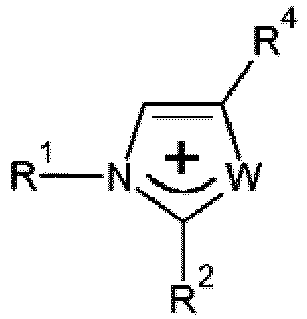



 - W O, S oder N ist, und wobei N optional durch R1 substituiert ist, wenn die Wertigkeit dies erlaubt,- R1, R2 und R4 identisch oder unterschiedlich sind und darstellenwobei zwei Gruppen R1, R2 und R4 einen Ring oder einen Heterocyclus mit 4 bis 9 Atomen bilden können, wobei eine oder mehrere Gruppen R1, R2 und R4 auf einem selben Kation Bestandteil einer Polymerkette sein können,- H,- die Alkyl-, Alkenyl-, Oxaalkyl-, Oxaalkenyl-, Azaalkyl-, Azaalkenyl-, Thiaalkyl-, Thiaalkenyl-, Dialkylazo-Radikale, wobei die Radikale linear, verzweigt oder zyklisch sein können und 1 bis 18 Kohlenstoffatome umfassen,- die zyklischen oder heterozyklischen aliphatischen Radikale mit 4 bis 26 Kohlenstoffatomen, die optional mindestens eine Seitenkette umfassen, die ein oder mehrere Heteroatome umfasst,- die Aryle, Arylalkyle, Alkylaryle und Alkenylaryle mit 5 bis 26 Kohlenstoffatomen, die optional ein oder mehrere Heteroatome im aromatischen Kern umfassen,- die Gruppen, die mehrere aromatische oder heterozyklische Kerne, kondensiert oder nicht, umfassen, die optional ein oder mehrere Stickstoff-, Sauerstoff-, Schwefel- oder Phosphoratome enthalten,- und R2 und R5 bis R9 identisch oder unterschiedlich sind und R1O-, (R1)2N-, R1S- darstellen, wobei R1 wie zuvor definiert ist.
 - Verwendung nach Anspruch 25 als Medium für die Diels-Alder-, Friedel-Craft-, Kondensations-Aldolisations-, anionische, kationische oder Radikal-Polymerisations-Reaktionen und für die nukleophilen und elektrophilen Substitutionen.
- Verwendung nach Anspruch 25 als chirales Lösungsmittel in einer chemischen Reaktion für die Bildung von Enantiomerenüberschüssen, dadurch gekennzeichnet, dass das Kation der Verbindung mit niedrigem Schmelzpunkt ein Ammonium-, Sulfonium- oder Phosphonium-Kation ist.
- Verwendung nach Anspruch 25, dadurch gekennzeichnet, dass das Medium mindestens eine katalytische Spezies enthält.
- Verwendung nach Anspruch 28, dadurch gekennzeichnet, dass die katalytische Spezies mindestens ein Übergangssalz und/oder ein Seltene-Erden-Salz und/oder ein organometallisches Salz wie die Metallocene ist, wobei die Metallsalze mit den Liganden koordiniert sein können.
- Verwendung nach Anspruch 29, dadurch gekennzeichnet, dass die Liganden aus der Gruppe ausgewählt sind, die von den Bipyridinen, Prophyrinen, Phosphinen und den Arsinen gebildet ist.
Applications Claiming Priority (3)
| Application Number | Priority Date | Filing Date | Title |
|---|---|---|---|
| CA002228801A CA2228801A1 (fr) | 1998-02-03 | 1998-02-03 | Nouveaux materiaux ioniques utiles en tant que solutes electrolytiques |
| CA002256945A CA2256945A1 (fr) | 1998-12-18 | 1998-12-18 | Nouveaux composes ioniques de bas point de fusion et leur utilisation comme solvant et dans des dispositifs electrochimiques |
| EP99903554A EP0971854B1 (de) | 1998-02-03 | 1999-02-03 | Neue als elektrolytische solubilisate geeignete werkstoffe |
Related Parent Applications (2)
| Application Number | Title | Priority Date | Filing Date |
|---|---|---|---|
| EP99903554.6 Division | 1999-02-03 | ||
| EP99903554A Division EP0971854B1 (de) | 1998-02-03 | 1999-02-03 | Neue als elektrolytische solubilisate geeignete werkstoffe |
Publications (3)
| Publication Number | Publication Date |
|---|---|
| EP1626041A2 EP1626041A2 (de) | 2006-02-15 |
| EP1626041A3 EP1626041A3 (de) | 2010-05-19 |
| EP1626041B1 true EP1626041B1 (de) | 2016-07-13 |
Family
ID=25680025
Family Applications (2)
| Application Number | Title | Priority Date | Filing Date |
|---|---|---|---|
| EP05023466.5A Expired - Lifetime EP1626041B1 (de) | 1998-02-03 | 1999-02-03 | Neue Materialien verwendbar als elektrolytische Solubilisate |
| EP99903554A Expired - Lifetime EP0971854B1 (de) | 1998-02-03 | 1999-02-03 | Neue als elektrolytische solubilisate geeignete werkstoffe |
Family Applications After (1)
| Application Number | Title | Priority Date | Filing Date |
|---|---|---|---|
| EP99903554A Expired - Lifetime EP0971854B1 (de) | 1998-02-03 | 1999-02-03 | Neue als elektrolytische solubilisate geeignete werkstoffe |
Country Status (6)
| Country | Link |
|---|---|
| US (5) | US6365301B1 (de) |
| EP (2) | EP1626041B1 (de) |
| JP (2) | JP4782903B2 (de) |
| CA (1) | CA2283670C (de) |
| DE (1) | DE69934170T2 (de) |
| WO (1) | WO1999040025A1 (de) |
Families Citing this family (141)
| Publication number | Priority date | Publication date | Assignee | Title |
|---|---|---|---|---|
| WO1999040025A1 (fr) * | 1998-02-03 | 1999-08-12 | Acep Inc. | Nouveaux materiaux utiles en tant que solutes electrolytiques |
| US6405070B1 (en) * | 1998-06-16 | 2002-06-11 | Bhaskar Banerjee | Detection of cancer using cellular autofluorescence |
| WO2001003211A1 (en) * | 1999-07-01 | 2001-01-11 | Covalent Associates, Inc. | Hydrophobic ionic salts and nonaqueous electrolytes |
| US6531241B1 (en) * | 1999-07-08 | 2003-03-11 | Covalent Associates, Inc. | Cyclic delocalized cations connected by spacer groups |
| AUPQ237199A0 (en) * | 1999-08-23 | 1999-09-16 | Rtm Research And Development Pty. Ltd. | Fast lithiumion conducting doped plastic crystals |
| FR2808268B1 (fr) * | 2000-04-26 | 2002-08-30 | Atofina | Liquides ioniques derives d'acides de lewis a base de titane, niobium, tantale, etain ou antimoine, et leurs applications |
| DE10054233A1 (de) * | 2000-05-19 | 2002-05-08 | Univ Stuttgart Lehrstuhl Und I | Kovalent vernetzte Kompositmembranen |
| DE10024575A1 (de) * | 2000-11-02 | 2001-11-22 | Univ Stuttgart | Kovalent vernetzte Polymere und Polymermembranen via Sulfinatalkylierung |
| EP1182197A1 (de) * | 2000-08-24 | 2002-02-27 | Solvent Innovation GmbH | Einstufiges Verfahren zur Darstellung ionischer Flüssigkeiten |
| DE60010472T2 (de) * | 2000-10-27 | 2005-05-19 | Centre National De La Recherche Scientifique (C.N.R.S.) | Imidazolium-Salze und die Verwendung dieser ionischen Flüssigkeiten als Lösungsmittel und als Katalysator |
| US6827921B1 (en) * | 2001-02-01 | 2004-12-07 | Nanopowder Enterprises Inc. | Nanostructured Li4Ti5O12 powders and method of making the same |
| BR0208094A (pt) | 2001-03-12 | 2004-03-02 | Univ Belfast | Compostos de bis-triflimidas metálicas e processos para sìntese de compostos de bis-triflimidas metálicas |
| JP4222466B2 (ja) * | 2001-06-14 | 2009-02-12 | 富士フイルム株式会社 | 電荷輸送材料、それを用いた光電変換素子及び光電池、並びにピリジン化合物 |
| AU2002310749A1 (en) * | 2001-06-22 | 2003-01-08 | Merck Patent Gmbh | Conducting salts comprising niobium or tantalum |
| US7256923B2 (en) * | 2001-06-25 | 2007-08-14 | University Of Washington | Switchable window based on electrochromic polymers |
| DE10145747A1 (de) | 2001-09-17 | 2003-04-03 | Solvent Innovation Gmbh | Ionische Flüssigkeiten |
| JP4836371B2 (ja) * | 2001-09-13 | 2011-12-14 | パナソニック株式会社 | 正極活物質およびこれを含む非水電解質二次電池 |
| TW529199B (en) * | 2001-11-28 | 2003-04-21 | Merck Patent Gmbh | Phosphorus-borates with low melting points |
| FR2835521B1 (fr) * | 2002-02-04 | 2004-04-09 | Inst Francais Du Petrole | Composition catalytique contenant un aluminoxane pour la dimerisation, la co-dimerisation et l'oligomerisation des olefines |
| JP4197237B2 (ja) * | 2002-03-01 | 2008-12-17 | パナソニック株式会社 | 正極活物質の製造方法 |
| US9391325B2 (en) * | 2002-03-01 | 2016-07-12 | Panasonic Corporation | Positive electrode active material, production method thereof and non-aqueous electrolyte secondary battery |
| US7422823B2 (en) | 2002-04-03 | 2008-09-09 | Valence Technology, Inc. | Alkali-iron-cobalt phosphates and related electrode active materials |
| US7482097B2 (en) * | 2002-04-03 | 2009-01-27 | Valence Technology, Inc. | Alkali-transition metal phosphates having a +3 valence non-transition element and related electrode active materials |
| US6961168B2 (en) * | 2002-06-21 | 2005-11-01 | The Regents Of The University Of California | Durable electrooptic devices comprising ionic liquids |
| US7763186B2 (en) * | 2002-06-21 | 2010-07-27 | Los Alamos National Security, Llc | Preparation and purification of ionic liquids and precursors |
| US7450292B1 (en) * | 2003-06-20 | 2008-11-11 | Los Alamos National Security, Llc | Durable electrooptic devices comprising ionic liquids |
| US6853472B2 (en) | 2002-06-21 | 2005-02-08 | The Regents Of The University Of California | Electrolytes for electrooptic devices comprising ionic liquids |
| US7808691B2 (en) * | 2002-06-25 | 2010-10-05 | University Of Washington | Green electrochromic materials |
| US6939453B2 (en) * | 2002-08-14 | 2005-09-06 | Large Scale Proteomics Corporation | Electrophoresis process using ionic liquids |
| US7750166B2 (en) * | 2002-08-16 | 2010-07-06 | University Of South Alabama | Ionic liquids containing a sulfonate anion |
| CA2502900A1 (en) | 2002-08-16 | 2004-02-26 | Roger Moulton | Lewis acid ionic liquids |
| EP1608719A2 (de) * | 2003-03-05 | 2005-12-28 | Electrochromix, Inc | Elektrochrome spiegel und andere elektrooptische vorrichtungen |
| AU2003901144A0 (en) | 2003-03-13 | 2003-03-27 | Monash University School Of Chemistry | Room temperature ionic liquid electrolytes for lithium secondary batteries |
| JP4459578B2 (ja) * | 2003-09-08 | 2010-04-28 | 株式会社フジクラ | 色素増感太陽電池 |
| JP4300954B2 (ja) * | 2003-09-26 | 2009-07-22 | 住友ベークライト株式会社 | 高分子固体電解質 |
| JP4500523B2 (ja) * | 2003-10-03 | 2010-07-14 | 株式会社トクヤマ | オニウム塩 |
| JP2005142024A (ja) * | 2003-11-06 | 2005-06-02 | Sumitomo Bakelite Co Ltd | 高分子固体電解質及び該高分子固体電解質を用いた二次電池 |
| US20050143499A1 (en) * | 2003-12-10 | 2005-06-30 | Hidetoshi Aoki | Moderately resistive rubber composition and rubber member |
| WO2005064733A1 (en) * | 2003-12-29 | 2005-07-14 | Shell Internationale Research Maatschappij B.V. | Electrochemical element for use at high temperatures |
| US7423164B2 (en) * | 2003-12-31 | 2008-09-09 | Ut-Battelle, Llc | Synthesis of ionic liquids |
| US7348102B2 (en) * | 2004-03-16 | 2008-03-25 | Toyota Motor Corporation | Corrosion protection using carbon coated electron collector for lithium-ion battery with molten salt electrolyte |
| US7468224B2 (en) * | 2004-03-16 | 2008-12-23 | Toyota Motor Engineering & Manufacturing North America, Inc. | Battery having improved positive electrode and method of manufacturing the same |
| US7521153B2 (en) * | 2004-03-16 | 2009-04-21 | Toyota Motor Engineering & Manufacturing North America, Inc. | Corrosion protection using protected electron collector |
| US7824800B1 (en) | 2004-04-08 | 2010-11-02 | Electrochemical Systems, Inc. | Lithium-ion cell with a wide operating temperature range |
| US7582380B1 (en) | 2004-04-08 | 2009-09-01 | Electrochemical Systems, Inc. | Lithium-ion cell with a wide operating temperature range |
| US20060088763A1 (en) * | 2004-05-17 | 2006-04-27 | Wen Li | Additives for increasing ion conductivity of molten salt type electrolyte in battery |
| US7960057B2 (en) * | 2004-05-17 | 2011-06-14 | Toyota Motor Engineering & Manufacturing North America, Inc. | Battery with molten salt electrolyte and phosphorus-containing cathode |
| KR101315074B1 (ko) * | 2004-05-27 | 2013-10-10 | 더치 폴리머 인스티튜트 | 중합체 전해질 및 이러한 중합체 전해질이 장착된 전기화학 디바이스 |
| FR2872633B1 (fr) * | 2004-07-02 | 2006-09-15 | Commissariat Energie Atomique | Procede de charge d'un accumulateur lithium-ion a electrode negative |
| JP2007179745A (ja) * | 2004-08-26 | 2007-07-12 | Yokohama National Univ | プロトン伝導体 |
| FR2875235B1 (fr) * | 2004-09-10 | 2006-11-24 | Inst Francais Du Petrole | Procede de separation des composes oxygenes contenus dans une charge hydrocarbonee, mettant en oeuvre un liquide ionique |
| US7641992B2 (en) * | 2004-10-29 | 2010-01-05 | Medtronic, Inc. | Medical device having lithium-ion battery |
| US8105714B2 (en) * | 2004-10-29 | 2012-01-31 | Medtronic, Inc. | Lithium-ion battery |
| US7807299B2 (en) * | 2004-10-29 | 2010-10-05 | Medtronic, Inc. | Lithium-ion battery |
| CN101048898B (zh) | 2004-10-29 | 2012-02-01 | 麦德托尼克公司 | 锂离子电池及医疗装置 |
| US9077022B2 (en) | 2004-10-29 | 2015-07-07 | Medtronic, Inc. | Lithium-ion battery |
| US7927742B2 (en) | 2004-10-29 | 2011-04-19 | Medtronic, Inc. | Negative-limited lithium-ion battery |
| US7662509B2 (en) * | 2004-10-29 | 2010-02-16 | Medtronic, Inc. | Lithium-ion battery |
| US7582387B2 (en) * | 2004-10-29 | 2009-09-01 | Medtronic, Inc. | Lithium-ion battery |
| US7879495B2 (en) * | 2004-10-29 | 2011-02-01 | Medtronic, Inc. | Medical device having lithium-ion battery |
| US20080044728A1 (en) * | 2004-10-29 | 2008-02-21 | Medtronic, Inc. | Lithium-ion battery |
| US8980453B2 (en) | 2008-04-30 | 2015-03-17 | Medtronic, Inc. | Formation process for lithium-ion batteries |
| US7682745B2 (en) * | 2004-10-29 | 2010-03-23 | Medtronic, Inc. | Medical device having lithium-ion battery |
| US9065145B2 (en) * | 2004-10-29 | 2015-06-23 | Medtronic, Inc. | Lithium-ion battery |
| GB0500029D0 (en) | 2005-01-04 | 2005-02-09 | Univ Belfast | Basic ionic liquids |
| WO2006125175A2 (en) * | 2005-05-19 | 2006-11-23 | University Of South Alabama | Boronium-ion-based ionic liquids and methods of use thereof |
| JP5159089B2 (ja) * | 2005-11-14 | 2013-03-06 | 日本合成化学工業株式会社 | 合成潤滑油 |
| WO2007055324A1 (ja) * | 2005-11-14 | 2007-05-18 | The Nippon Synthetic Chemical Industry Co., Ltd. | 合成潤滑油 |
| US7919629B2 (en) * | 2005-12-12 | 2011-04-05 | Phostech Lithium Inc. | Sulphonyl-1,2,4-triazole salts |
| WO2007074609A1 (ja) | 2005-12-26 | 2007-07-05 | Bridgestone Corporation | 電池用非水電解液及びそれを備えた非水電解液電池、並びに電気二重層キャパシタ用電解液及びそれを備えた電気二重層キャパシタ |
| JP5032773B2 (ja) * | 2006-02-03 | 2012-09-26 | 第一工業製薬株式会社 | イオン性液体を用いたリチウム二次電池 |
| US20070202416A1 (en) * | 2006-02-28 | 2007-08-30 | Kaimin Chen | Electrochemical cells having an electrolyte with swelling reducing additives |
| US20090045373A1 (en) * | 2006-03-10 | 2009-02-19 | Amer Hammami | Compounds, ionic liquids, molten salts and uses thereof |
| US7696729B2 (en) * | 2006-05-02 | 2010-04-13 | Advanced Desalination Inc. | Configurable power tank |
| JP5178062B2 (ja) * | 2006-09-05 | 2013-04-10 | 日本合成化学工業株式会社 | N−アルキル−n’−アルキルイミダゾリウム塩の製造方法 |
| US7820323B1 (en) | 2006-09-07 | 2010-10-26 | The United States Of America As Represented By The Secretary Of The Army | Metal borate synthesis process |
| US7833660B1 (en) | 2006-09-07 | 2010-11-16 | The United States Of America As Represented By The Secretary Of The Army | Fluorohaloborate salts, synthesis and use thereof |
| ATE522263T1 (de) * | 2006-09-12 | 2011-09-15 | Sulzer Chemtech Ag | Verfahren zur reinigung von ionischen flüssigkeiten |
| US7718319B2 (en) | 2006-09-25 | 2010-05-18 | Board Of Regents, The University Of Texas System | Cation-substituted spinel oxide and oxyfluoride cathodes for lithium ion batteries |
| US8178009B2 (en) * | 2006-11-07 | 2012-05-15 | Sumitomo Bakelite Co., Ltd. | Slurry for secondary battery electrode, electrode for secondary battery, process for production of electrode for secondary battery, and secondary battery |
| JP5187808B2 (ja) * | 2007-01-04 | 2013-04-24 | 日本カーリット株式会社 | 導電性付与剤及び導電性材料 |
| KR101038373B1 (ko) | 2007-05-07 | 2011-06-01 | 주식회사 엘지화학 | 리튬 이차전지용 비수 전해액 및 이를 함유한 리튬이차전지 |
| CA2691846C (en) * | 2007-06-29 | 2016-03-22 | Commonwealth Scientific And Industrial Research Organisation | Lithium energy storage device |
| EP2169756B1 (de) * | 2007-07-18 | 2015-04-29 | Dai-Ichi Kogyo Seiyaku Co., Ltd. | Lithium-sekundärbatterie |
| US20090225585A1 (en) * | 2007-12-27 | 2009-09-10 | Hawkins J Adrian | Self-Contained Charge Storage Molecules for Use in Molecular Capacitors |
| WO2009095012A1 (de) * | 2008-01-30 | 2009-08-06 | Technische Universität Dresden | Salze mit aryl-alkyl-substituierten imidazolium- und triazoliumkationen als ionische flüssigkeiten |
| US8927775B2 (en) | 2008-07-14 | 2015-01-06 | Esionic Es, Inc. | Phosphonium ionic liquids, salts, compositions, methods of making and devices formed there from |
| US8907133B2 (en) | 2008-07-14 | 2014-12-09 | Esionic Es, Inc. | Electrolyte compositions and electrochemical double layer capacitors formed there from |
| US8846246B2 (en) * | 2008-07-14 | 2014-09-30 | Esionic Es, Inc. | Phosphonium ionic liquids, compositions, methods of making and electrolytic films formed there from |
| JP5630048B2 (ja) * | 2009-03-31 | 2014-11-26 | セントラル硝子株式会社 | イミド酸化合物の製造方法 |
| JP5443118B2 (ja) * | 2009-03-31 | 2014-03-19 | 三菱マテリアル株式会社 | ビス(フルオロスルホニル)イミド塩の製造方法、ビス(フルオロスルホニル)イミド塩及びフルオロ硫酸塩の製造方法、並びにビス(フルオロスルホニル)イミド・オニウム塩の製造方法 |
| US20100279155A1 (en) * | 2009-04-30 | 2010-11-04 | Medtronic, Inc. | Lithium-ion battery with electrolyte additive |
| JP5471045B2 (ja) * | 2009-06-03 | 2014-04-16 | セントラル硝子株式会社 | イミド酸塩の製造方法 |
| WO2011159391A1 (en) * | 2010-06-15 | 2011-12-22 | Fluidic, Inc. | Metal-air cell with tuned hydrophobicity |
| KR101201805B1 (ko) | 2010-11-03 | 2012-11-15 | 삼성에스디아이 주식회사 | 리튬 이온 전지용 전해액 및 이를 포함하는 리튬 이온 전지 |
| JP5779050B2 (ja) * | 2010-11-30 | 2015-09-16 | 住友電気工業株式会社 | 溶融塩電池 |
| EP2674395B1 (de) * | 2011-02-10 | 2017-12-27 | Nippon Soda Co., Ltd. | Verfahren zur herstellung von fluorsulfonylimid-ammoniumsalz |
| KR101702656B1 (ko) * | 2011-03-03 | 2017-02-03 | 닛뽕소다 가부시키가이샤 | 플루오로술포닐이미드암모늄염의 제조 방법 |
| KR101632857B1 (ko) | 2011-03-03 | 2016-06-22 | 닛뽕소다 가부시키가이샤 | 불소 함유 술포닐이미드염의 제조 방법 |
| WO2012128964A1 (en) | 2011-03-08 | 2012-09-27 | Trinapco, Inc. | Method of making fluorosulfonylamine |
| CA2830071A1 (en) * | 2011-03-21 | 2012-09-27 | Trinapco, Inc. | Improved synthesis of tetrabutylammonium bis(fluorosulfonyl)imide and related salts |
| KR101233325B1 (ko) | 2011-04-11 | 2013-02-14 | 로베르트 보쉬 게엠베하 | 리튬 이차 전지용 전해액 및 이를 포함하는 리튬 이차 전지 |
| US8852813B2 (en) | 2011-07-22 | 2014-10-07 | Chemtura Corporation | Electrolytes comprising polycyclic aromatic amine derivatives |
| US9287580B2 (en) | 2011-07-27 | 2016-03-15 | Medtronic, Inc. | Battery with auxiliary electrode |
| JP5796417B2 (ja) * | 2011-08-31 | 2015-10-21 | セントラル硝子株式会社 | 非水電解液電池用電解液及び非水電解液電池 |
| DE102011055028A1 (de) * | 2011-11-04 | 2013-05-08 | Jacobs University Bremen Ggmbh | Elektrolyt-Zusatz für Lithium-basierte Energiespeicher |
| US20130149560A1 (en) | 2011-12-09 | 2013-06-13 | Medtronic, Inc. | Auxiliary electrode for lithium-ion battery |
| FR2985861B1 (fr) * | 2012-01-18 | 2014-01-03 | Commissariat Energie Atomique | Procede de preparation d'une membrane echangeuse de protons pour pile a combustible par coulee evaporation |
| CA2776178A1 (en) | 2012-04-05 | 2013-10-05 | Hydro-Quebec | Ionic compounds |
| JP2014022321A (ja) * | 2012-07-23 | 2014-02-03 | Kaneka Corp | 捕捉剤を含む非水電解質二次電池 |
| US9819057B2 (en) * | 2012-09-07 | 2017-11-14 | Samsung Sdi Co., Ltd. | Rechargeable lithium battery |
| KR102115384B1 (ko) | 2012-11-16 | 2020-05-26 | 트리나프코 인크. | 테트라부틸암모늄 비스(플루오로술포닐)이미드 및 관련 염의 합성 |
| US9660266B2 (en) * | 2012-11-21 | 2017-05-23 | Lg Chem, Ltd. | Lithium secondary battery |
| CN104718657B (zh) | 2012-11-21 | 2018-01-12 | 株式会社Lg 化学 | 锂二次电池 |
| WO2014088711A1 (en) * | 2012-12-05 | 2014-06-12 | Esionic Es, Inc. | Electrolyte compositions, methods of making and battery devices formed there from |
| CN105580184B (zh) * | 2013-09-25 | 2019-03-12 | 国立大学法人东京大学 | 非水电解质二次电池 |
| JP6034981B2 (ja) | 2013-11-18 | 2016-11-30 | 日本曹達株式会社 | ジスルホニルアミド塩の顆粒または粉末、およびその製造方法 |
| KR102163733B1 (ko) * | 2013-11-29 | 2020-10-12 | 삼성전자주식회사 | 리튬 전지용 고분자 전해질 및 이를 포함하는 리튬 전지 |
| WO2016081525A1 (en) | 2014-11-20 | 2016-05-26 | Coors Tek Fluorochemicals, Inc. | Concentrated electrolyte solution |
| US20160181664A1 (en) * | 2014-12-18 | 2016-06-23 | Toyo Gosei Co., Ltd. | Electrolyte for sodium ion secondary battery |
| JP6374330B2 (ja) * | 2015-02-12 | 2018-08-15 | 住友電気工業株式会社 | 非水蓄電デバイス用の電解液の製造方法 |
| AU2017240747B2 (en) | 2016-04-01 | 2021-10-21 | Sionic Energy, Inc. | Modified ionic liquids containing phosphorus |
| EP3529232A4 (de) | 2016-10-19 | 2020-06-10 | Hydro-Québec | Sulfaminsäurederivate und herstellungsverfahren dafür |
| EP3589712B1 (de) | 2017-03-02 | 2023-08-30 | Nitto Denko Corporation | Ionische zusammensetzungen und zugehörige verwendungen |
| CN110520431B (zh) * | 2017-04-10 | 2022-02-18 | 中央硝子株式会社 | 磷酰亚胺盐的制造方法、包含该盐的非水电解液的制造方法和非水二次电池的制造方法 |
| WO2018193630A1 (ja) | 2017-04-21 | 2018-10-25 | 日立化成株式会社 | 電気化学デバイス用電極及び電気化学デバイス |
| JP6973477B2 (ja) | 2017-04-21 | 2021-12-01 | 昭和電工マテリアルズ株式会社 | ポリマ電解質組成物及びポリマ二次電池 |
| EP3614469A4 (de) * | 2017-04-21 | 2021-01-13 | Hitachi Chemical Company, Ltd. | Elektrode einer elektrochemischen vorrichtung und herstellungsverfahren dafür, elektrochemische vorrichtung und polymerelektrolytzusammensetzung |
| KR102316808B1 (ko) | 2017-06-01 | 2021-10-25 | 쇼와덴코머티리얼즈가부시끼가이샤 | 전해질 조성물, 이차 전지, 및 전해질 시트의 제조 방법 |
| US11050075B1 (en) * | 2017-06-02 | 2021-06-29 | Hrl Laboratories, Llc | Hydrogen storage materials containing liquid electrolytes |
| WO2019018432A1 (en) | 2017-07-17 | 2019-01-24 | NOHMs Technologies, Inc. | ELECTROLYTES CONTAINING PHOSPHORUS |
| JP6908272B2 (ja) * | 2017-09-15 | 2021-07-21 | 国立大学法人山形大学 | イオン性化合物キャリア注入材料を用いた有機el素子 |
| WO2019104002A2 (en) | 2017-11-21 | 2019-05-31 | Nitto Denko Corporation | Basic ionic liquids compositions and elements including the same |
| WO2019104028A1 (en) | 2017-11-21 | 2019-05-31 | Nitto Denko Corporation | Adhesive compositions comprising ionic compounds |
| US11149356B2 (en) | 2017-12-19 | 2021-10-19 | Battelle Energy Alliance, Llc | Methods of forming metals using ionic liquids |
| WO2020086454A1 (en) | 2018-10-23 | 2020-04-30 | Nitto Denko Corporation | Corrosion resistant electrochemically de-bondable adhesive composition for use in high and low humidity environments |
| US11788171B2 (en) | 2020-03-19 | 2023-10-17 | Battelle Energy Alliance, Llc | Methods of recovering an elemental rare earth metal, and methods of forming a rare earth metal |
| CN112701351B (zh) * | 2020-12-29 | 2022-08-19 | 中国科学院宁波材料技术与工程研究所 | 一种非水性电解液及其制备方法以及一种锂离子电池 |
| FR3118679B1 (fr) | 2021-01-04 | 2023-10-27 | Arkema France | Liquide ionique à base de bis(fluorosulfonyl)imide |
| US12704250B2 (en) | 2022-08-16 | 2026-08-11 | Erthos IP LLC | Fire water plant i |
| FR3152645B1 (fr) | 2023-09-01 | 2025-09-26 | Arkema France | Electrolyte a faible teneur en ion sulfamate |
Family Cites Families (17)
| Publication number | Priority date | Publication date | Assignee | Title |
|---|---|---|---|---|
| GB1588511A (en) * | 1976-07-07 | 1981-04-23 | Ici Ltd | Electrochromic device |
| FR2527602A1 (fr) * | 1982-06-01 | 1983-12-02 | Anvar | Bis perhalogenoacyl- ou sulfonyl- imidures de metaux alcalins, leurs solutions solides avec des matieres plastiques et leur application a la constitution d'elements conducteurs pour des generateurs electrochimiques |
| US5256821A (en) * | 1988-10-05 | 1993-10-26 | Societe Nationale Elf Aquitaine | Method of synthesis of sulphonylimides |
| US5086351A (en) * | 1989-07-13 | 1992-02-04 | M&T Chemicals, Inc. | Electrochromic elements, materials for use in such element, processes for making such elements and such materials and use of such element in an electrochromic glass device |
| US5737114A (en) * | 1991-01-31 | 1998-04-07 | Eveready Battery Company, Inc. | Label having an incorporated electrochromic state-of-charge indicator for an electrochemical cell |
| FR2673769B1 (fr) * | 1991-03-07 | 1993-06-18 | Centre Nat Rech Scient | Materiaux polymeriques a conduction ionique. |
| JP3075766B2 (ja) | 1991-05-27 | 2000-08-14 | 株式会社東芝 | リチウム電池 |
| US5538812A (en) * | 1994-02-04 | 1996-07-23 | Moltech Corporation | Electrolyte materials containing highly dissociated metal ion salts |
| WO1995026056A1 (fr) * | 1994-03-21 | 1995-09-28 | Centre National De La Recherche Scientifique | Materiau a conduction ionique presentant de bonnes proprietes anti-corrosion |
| US5827602A (en) * | 1995-06-30 | 1998-10-27 | Covalent Associates Incorporated | Hydrophobic ionic liquids |
| JP4693010B2 (ja) * | 1995-06-30 | 2011-06-01 | コバレント アソシェーツ,インコーポレイテッド | 疎水性イオン液体 |
| DE29617151U1 (de) * | 1996-10-02 | 1998-02-05 | AEG Hausgeräte GmbH, 90429 Nürnberg | Rastvorrichtung und Stufendrehschalter für ein Haushaltsgerät mit einer solchen Rastvorrichtung |
| JP4053630B2 (ja) | 1997-09-12 | 2008-02-27 | 株式会社東芝 | 非水電解質二次電池 |
| KR100559110B1 (ko) * | 1997-12-10 | 2006-03-13 | 미네소타 마이닝 앤드 매뉴팩춰링 캄파니 | 전기화학 시스템에서의 비스(퍼플루오로알킬설포닐)이미드 계면활성제 염 |
| WO1999040025A1 (fr) * | 1998-02-03 | 1999-08-12 | Acep Inc. | Nouveaux materiaux utiles en tant que solutes electrolytiques |
| US6063522A (en) * | 1998-03-24 | 2000-05-16 | 3M Innovative Properties Company | Electrolytes containing mixed fluorochemical/hydrocarbon imide and methide salts |
| US6350545B2 (en) * | 1998-08-25 | 2002-02-26 | 3M Innovative Properties Company | Sulfonylimide compounds |
-
1999
- 1999-02-03 WO PCT/CA1999/000087 patent/WO1999040025A1/fr not_active Ceased
- 1999-02-03 JP JP53980199A patent/JP4782903B2/ja not_active Expired - Lifetime
- 1999-02-03 EP EP05023466.5A patent/EP1626041B1/de not_active Expired - Lifetime
- 1999-02-03 CA CA2283670A patent/CA2283670C/fr not_active Expired - Lifetime
- 1999-02-03 EP EP99903554A patent/EP0971854B1/de not_active Expired - Lifetime
- 1999-02-03 DE DE69934170T patent/DE69934170T2/de not_active Expired - Lifetime
- 1999-09-07 US US09/390,642 patent/US6365301B1/en not_active Expired - Lifetime
-
2001
- 2001-11-09 US US09/986,681 patent/US6841304B2/en not_active Expired - Lifetime
-
2004
- 2004-10-01 US US10/954,487 patent/US7378194B2/en not_active Expired - Fee Related
-
2008
- 2008-03-28 US US12/057,934 patent/US7901812B2/en not_active Expired - Fee Related
-
2010
- 2010-10-20 JP JP2010235848A patent/JP5603733B2/ja not_active Expired - Lifetime
-
2011
- 2011-03-07 US US13/042,296 patent/US8647780B2/en not_active Expired - Fee Related
Also Published As
| Publication number | Publication date |
|---|---|
| US7901812B2 (en) | 2011-03-08 |
| JP4782903B2 (ja) | 2011-09-28 |
| US20050084763A1 (en) | 2005-04-21 |
| DE69934170D1 (de) | 2007-01-11 |
| EP0971854B1 (de) | 2006-11-29 |
| EP1626041A2 (de) | 2006-02-15 |
| JP2001527505A (ja) | 2001-12-25 |
| US20020055045A1 (en) | 2002-05-09 |
| EP1626041A3 (de) | 2010-05-19 |
| DE69934170T2 (de) | 2007-09-27 |
| US8647780B2 (en) | 2014-02-11 |
| CA2283670C (fr) | 2011-06-07 |
| CA2283670A1 (fr) | 1999-08-12 |
| US6841304B2 (en) | 2005-01-11 |
| EP0971854A1 (de) | 2000-01-19 |
| JP2011032280A (ja) | 2011-02-17 |
| US20110160460A1 (en) | 2011-06-30 |
| US20080251754A1 (en) | 2008-10-16 |
| JP5603733B2 (ja) | 2014-10-08 |
| WO1999040025A1 (fr) | 1999-08-12 |
| US6365301B1 (en) | 2002-04-02 |
| US7378194B2 (en) | 2008-05-27 |
Similar Documents
| Publication | Publication Date | Title |
|---|---|---|
| EP0971854B1 (de) | Neue als elektrolytische solubilisate geeignete werkstoffe | |
| EP2928003B1 (de) | Pentazyklisches anionsalz und seine verwendung als elektrolyt | |
| EP0968181B1 (de) | Salze von perfluorierten sulfonen und ihre verwendung als ionisch leitfähige materialien | |
| EP0699349B1 (de) | Ionenleitendes material mit guten korrosionshemmenden eigenschaften | |
| EP0902492B1 (de) | Lösungsmittel und neue Elektrolytzusammensetzungen mit breitem Stabilitätbereich und hoher Leitfähigkeit | |
| EP0850921B1 (de) | Ionisch leitfähige Materialien, die eine von Malononitril abgeleitete ionische Verbindung enthalten und ihre Verwendungen | |
| EP1388546A2 (de) | Verwendung von ionenischen Verbindungen mit einer delokalisierten anionischen Ladung als Katalysatoren | |
| JP4258656B2 (ja) | 常温溶融塩、その製造方法及びその用途 | |
| EP0096629A1 (de) | Bis-Perhalogenacyl- oder Sulfonyl-Imide von Alkalimetallen, ihre festen Lösungen mit plastischen Materialien und ihre Anwendung zur Zusammensetzung von Leiterelementen für elektrochemische Generatoren | |
| EP3601244A1 (de) | Neuartige ionische flüssigkeiten, die sich aus der verbindung eines bestimmten kations und eines bestimmten anions ergeben | |
| WO2019008061A1 (fr) | Macromolécules de type sulfonamide utiles à titre d'électrolyte polymère à conduction d'ion unique | |
| CA2266643C (fr) | Composes ioniques ayant une charge anionique delocalisee, leur utilisation comme composants de conducteurs ioniques ou de catalyseur | |
| FR2717612A1 (fr) | Composé ionique portant un substituant fluorosulfonyle, son utilisation pour l'élaboration d'un matériau à conduction ionique. |
Legal Events
| Date | Code | Title | Description |
|---|---|---|---|
| PUAI | Public reference made under article 153(3) epc to a published international application that has entered the european phase |
Free format text: ORIGINAL CODE: 0009012 |
|
| AC | Divisional application: reference to earlier application |
Ref document number: 0971854 Country of ref document: EP Kind code of ref document: P |
|
| AK | Designated contracting states |
Kind code of ref document: A2 Designated state(s): DE FR GB IT |
|
| PUAL | Search report despatched |
Free format text: ORIGINAL CODE: 0009013 |
|
| AK | Designated contracting states |
Kind code of ref document: A3 Designated state(s): DE FR GB IT |
|
| RIC1 | Information provided on ipc code assigned before grant |
Ipc: C07C 317/04 20060101AFI20100414BHEP Ipc: C07C 317/12 20060101ALI20100414BHEP Ipc: H01M 6/16 20060101ALI20100414BHEP Ipc: C08G 61/02 20060101ALI20100414BHEP Ipc: C07D 339/06 20060101ALI20100414BHEP Ipc: C07D 311/82 20060101ALI20100414BHEP Ipc: C08F 232/04 20060101ALI20100414BHEP |
|
| 17P | Request for examination filed |
Effective date: 20101115 |
|
| AKX | Designation fees paid |
Designated state(s): DE FR GB IT |
|
| 17Q | First examination report despatched |
Effective date: 20140423 |
|
| GRAP | Despatch of communication of intention to grant a patent |
Free format text: ORIGINAL CODE: EPIDOSNIGR1 |
|
| INTG | Intention to grant announced |
Effective date: 20160215 |
|
| GRAS | Grant fee paid |
Free format text: ORIGINAL CODE: EPIDOSNIGR3 |
|
| GRAA | (expected) grant |
Free format text: ORIGINAL CODE: 0009210 |
|
| AC | Divisional application: reference to earlier application |
Ref document number: 0971854 Country of ref document: EP Kind code of ref document: P |
|
| AK | Designated contracting states |
Kind code of ref document: B1 Designated state(s): DE FR GB IT |
|
| REG | Reference to a national code |
Ref country code: GB Ref legal event code: FG4D Free format text: NOT ENGLISH |
|
| REG | Reference to a national code |
Ref country code: DE Ref legal event code: R096 Ref document number: 69945596 Country of ref document: DE |
|
| REG | Reference to a national code |
Ref country code: FR Ref legal event code: PLFP Year of fee payment: 19 |
|
| REG | Reference to a national code |
Ref country code: DE Ref legal event code: R097 Ref document number: 69945596 Country of ref document: DE |
|
| PLBE | No opposition filed within time limit |
Free format text: ORIGINAL CODE: 0009261 |
|
| STAA | Information on the status of an ep patent application or granted ep patent |
Free format text: STATUS: NO OPPOSITION FILED WITHIN TIME LIMIT |
|
| 26N | No opposition filed |
Effective date: 20170418 |
|
| REG | Reference to a national code |
Ref country code: FR Ref legal event code: PLFP Year of fee payment: 20 |
|
| PGFP | Annual fee paid to national office [announced via postgrant information from national office to epo] |
Ref country code: GB Payment date: 20180122 Year of fee payment: 20 Ref country code: DE Payment date: 20180122 Year of fee payment: 20 |
|
| PGFP | Annual fee paid to national office [announced via postgrant information from national office to epo] |
Ref country code: IT Payment date: 20180122 Year of fee payment: 20 Ref country code: FR Payment date: 20180123 Year of fee payment: 20 |
|
| REG | Reference to a national code |
Ref country code: DE Ref legal event code: R071 Ref document number: 69945596 Country of ref document: DE |
|
| REG | Reference to a national code |
Ref country code: GB Ref legal event code: PE20 Expiry date: 20190202 |
|
| PG25 | Lapsed in a contracting state [announced via postgrant information from national office to epo] |
Ref country code: GB Free format text: LAPSE BECAUSE OF EXPIRATION OF PROTECTION Effective date: 20190202 |