EP1584362A2 - Spielvorrichtung und Spielprogramm - Google Patents
Spielvorrichtung und Spielprogramm Download PDFInfo
- Publication number
- EP1584362A2 EP1584362A2 EP05006801A EP05006801A EP1584362A2 EP 1584362 A2 EP1584362 A2 EP 1584362A2 EP 05006801 A EP05006801 A EP 05006801A EP 05006801 A EP05006801 A EP 05006801A EP 1584362 A2 EP1584362 A2 EP 1584362A2
- Authority
- EP
- European Patent Office
- Prior art keywords
- character
- coordinates
- footstep
- destination
- movement control
- Prior art date
- Legal status (The legal status is an assumption and is not a legal conclusion. Google has not performed a legal analysis and makes no representation as to the accuracy of the status listed.)
- Withdrawn
Links
Images




Classifications
-
- A63F13/10—
-
- A—HUMAN NECESSITIES
- A63—SPORTS; GAMES; AMUSEMENTS
- A63F—CARD, BOARD, OR ROULETTE GAMES; INDOOR GAMES USING SMALL MOVING PLAYING BODIES; VIDEO GAMES; GAMES NOT OTHERWISE PROVIDED FOR
- A63F13/00—Video games, i.e. games using an electronically generated display having two or more dimensions
- A63F13/55—Controlling game characters or game objects based on the game progress
- A63F13/56—Computing the motion of game characters with respect to other game characters, game objects or elements of the game scene, e.g. for simulating the behaviour of a group of virtual soldiers or for path finding
-
- A—HUMAN NECESSITIES
- A63—SPORTS; GAMES; AMUSEMENTS
- A63F—CARD, BOARD, OR ROULETTE GAMES; INDOOR GAMES USING SMALL MOVING PLAYING BODIES; VIDEO GAMES; GAMES NOT OTHERWISE PROVIDED FOR
- A63F13/00—Video games, i.e. games using an electronically generated display having two or more dimensions
- A63F13/45—Controlling the progress of the video game
-
- A—HUMAN NECESSITIES
- A63—SPORTS; GAMES; AMUSEMENTS
- A63F—CARD, BOARD, OR ROULETTE GAMES; INDOOR GAMES USING SMALL MOVING PLAYING BODIES; VIDEO GAMES; GAMES NOT OTHERWISE PROVIDED FOR
- A63F13/00—Video games, i.e. games using an electronically generated display having two or more dimensions
- A63F13/80—Special adaptations for executing a specific game genre or game mode
- A63F13/822—Strategy games; Role-playing games
-
- A—HUMAN NECESSITIES
- A63—SPORTS; GAMES; AMUSEMENTS
- A63F—CARD, BOARD, OR ROULETTE GAMES; INDOOR GAMES USING SMALL MOVING PLAYING BODIES; VIDEO GAMES; GAMES NOT OTHERWISE PROVIDED FOR
- A63F2300/00—Features of games using an electronically generated display having two or more dimensions, e.g. on a television screen, showing representations related to the game
- A63F2300/60—Methods for processing data by generating or executing the game program
- A63F2300/6045—Methods for processing data by generating or executing the game program for mapping control signals received from the input arrangement into game commands
- A63F2300/6054—Methods for processing data by generating or executing the game program for mapping control signals received from the input arrangement into game commands by generating automatically game commands to assist the player, e.g. automatic braking in a driving game
-
- A—HUMAN NECESSITIES
- A63—SPORTS; GAMES; AMUSEMENTS
- A63F—CARD, BOARD, OR ROULETTE GAMES; INDOOR GAMES USING SMALL MOVING PLAYING BODIES; VIDEO GAMES; GAMES NOT OTHERWISE PROVIDED FOR
- A63F2300/00—Features of games using an electronically generated display having two or more dimensions, e.g. on a television screen, showing representations related to the game
- A63F2300/60—Methods for processing data by generating or executing the game program
- A63F2300/66—Methods for processing data by generating or executing the game program for rendering three dimensional images
- A63F2300/6623—Methods for processing data by generating or executing the game program for rendering three dimensional images for animating a group of characters
Definitions
- the present invention relates to a game apparatus, more particularly, relates to a game which moves a plurality of characters such that a character operated by a player is followed by a plurality of other characters.
- Patent document 1 discloses a game apparatus in which a main character is followed by a subordinate character.
- Patent document 2 discloses a game apparatus in which a plurality of characters move in a group.
- the game apparatus disclosed in patent document 1 includes only one subordinate character, whereby it is impossible to move a plurality of subordinate characters so as to follow a main character.
- the game apparatuses disclosed in patent documents 1 and 2 do not consider the need for a character which cannot move forward due to an obstacle (e. g. , topographic features) to detour around the obstacle.
- the processing load will be increased if an appropriate detouring route has to be determined depending on the situation (e.g., a location of the character or information on the topographic features around the character) every time an obstacle blocks the character's path.
- an object of the present invention is to provide a game apparatus that is capable of moving a plurality of characters in a natural manner while solving at least one of the above-described problems.
- the present invention has the following features to attain the object mentioned above (notes in parentheses indicate exemplary elements which can be found in the embodiments to follow, though such notes are not intended to limit the scope of the invention).
- a first aspect of the present invention is directed to a game apparatus for executing a game having a first character (leader character) and a plurality of second characters (sub characters) appearing therein.
- the game apparatus comprises an operation unit (20), first character movement control means (22, S18), destination coordinates setting means (22, S40), correlating means (FIG. 10, 78), and second character movement control means (22, S20).
- the first character movement control means controls a movement of the first character in a game space based on an operation by the operation unit, and sets first character coordinates which are coordinates of the first character in the game space.
- the destination coordinates setting means sets a plurality of destination coordinates (slot coordinates) in the game with reference to the first character coordinates set by the first character movement control means (FIG. 5).
- the correlating means correlates each of the plurality of second characters with any of the plurality of destination coordinates.
- the second character movement control means controls a movement of each of the plurality of second characters such that each second character moves toward the destination coordinates with which the second character is correlated by the correlating means, and sets second character coordinates which are coordinates of the second character in the game space (FIG. 11).
- the second character movement control means controls the second character so as to move toward the destination coordinates based on a predetermined algorithm.
- the predetermined algorithm may cause the second character to move toward the destination coordinates in a linear manner, or may cause the second character to move toward the destination coordinates in a non-linear manner.
- the predetermined algorithm may calculate a path to the destination coordinates, and causes the second character to move toward the destination coordinates along the calculated path. Alternatively, the predetermined algorithm may cause the second character to move toward the destination coordinates while detouring around an obstacle.
- the second character movement control means determines a traveling direction of each second character based on the current second character coordinates and the destination coordinates with which the second character is correlated by the correlating means.
- the game apparatus further comprises relative coordinate storage means (16, FIG. 6) for storing relative coordinates of the plurality of destination coordinates with reference to the first character coordinates.
- the destination coordinates setting means re-sets the plurality of destination coordinates in the game space based on the changed first character coordinates and the relative coordinates stored in the relative coordinate storage means.
- the game apparatus further comprises footstep coordinate storage means (22, S36) for storing the first character coordinates set by the first character movement control means as footstep coordinates; and first determination means (22, S52) for determining whether or not each second character is able to move toward the destination coordinates with which the second character is correlated by the correlating means.
- the second character movement control means moves the second character unable to move toward the destination coordinates, with which the second character is correlated by the correlating means, based on the footstep coordinates stored by the footstep coordinate storage means (FIGS. 15 and 16).
- the first determination means may detect the presence of an obstacle (fixed object, topographic object, and the like) in the traveling direction determined by the second character movement control means.
- the footstep coordinate storage means may store footstep coordinates in such a manner that new footstep coordinates are preferentially stored. In this case, a predetermined number of footstep coordinates may be stored. Alternatively, footstep coordinates in a predetermined time period may be stored.
- the second character movement control means moves the second character unable to move toward the destination coordinates, with which the second character is correlated by the correlating means, toward footstep coordinates closest to a current location of the second character, the footstep coordinates being included in the footstep coordinates stored by the footstep coordinate storage means (FIG. 15).
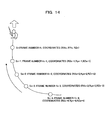
- the footstep coordinate storage means stores the footstep coordinates together with time information (frame number) (FIG. 14).
- the time information indicates a time at which the footstep coordinates are stored or a time period during which the first character is present at the footstep coordinates.
- the second character movement control means sets footstep coordinates, which are stored by the footstep coordinate storage means after the footstep coordinates at which the second character has arrived, to destination footstep coordinates, and moves the second character toward the destination footstep coordinates (FIG. 18).
- the game apparatus further comprises second determination means (22, S76) for determining whether or not the second character moving based on the footstep coordinates stored by the footstep coordinate storage means is able to move toward the destination footstep coordinates specified by the second character movement control means.
- the second character movement control means moves the second character unable to move toward the destination footstep coordinates toward footstep coordinates other than the destination footstep coordinates specified by the second character movement control means, the footstep coordinates being stored by the footstep coordinate storage means after the footstep coordinates at which the second character has arrived.
- the second character movement control means moves the second character toward the destination coordinates.
- the predetermined requirements are satisfied when the second character can move toward the corresponding destination coordinates, for example.
- the second character movement control means moves the second character toward the destination coordinates (FIG. 17).
- a tenth aspect of the present invention is directed to a computer-readable recording medium for recording a game program causing a computer (22), which is electrically connected to an operation unit (20), to execute a game having a first character and a plurality of second characters appearing therein.
- the game program causes the computer to function as: first character movement control means (22, S18), destination coordinates setting means (22, S40), correlating means (FIG. 10, 78), and second character movement control means (22, S20).
- the first character movement control means controls a movement of the first character in a game space based on an operation by the operation unit, and sets first character coordinates which are coordinates of the first character in the game space.
- the destination coordinates setting means sets a plurality of destination coordinates (slot coordinates) in the game space with reference to the first character coordinates set by the first character movement control means.
- the correlating means correlates each of the plurality of second characters with any of the plurality of destination coordinates.
- the second character movement control means controls a movement of each of the plurality of second characters such that each second character moves toward the destination coordinates with which the second character is correlated by the correlating means, and sets second character coordinates which are coordinates of the second character in the game space (FIG. 11).
- a movement operation for the first character enables autonomous movement control of the second character based on the first character coordinates.
- the second character is not always located at the destination coordinates but is autonomously controlled so as to move toward the destination coordinates, whereby each second character moves depending on the individual situation.
- a settable destination realizes such a control that a particular second character moves toward a desired place.
- each second character can arrive at the corresponding destination coordinates in the shortest distance.
- the third aspect it is possible to set destination coordinates while retaining a positional relation of a plurality of destination coordinates. Thus, it is possible to realize such a movement control that a plurality of second characters move in formation.
- the fourth aspect when the second character cannot move toward the corresponding destination coordinates (due to collision with topographic features, etc.), it is possible to automatically perform such a control to avoid such a situation.
- the second character which is unable to move toward the destination coordinates and is away therefrom can come closer again to the destination coordinates in an efficient manner.
- the seventh aspect when the second character is unable to move toward the destination footstep coordinates, it is possible to automatically perform such a control to avoid such a situation.
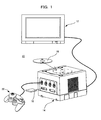
- FIG. 1 is an external view showing a structure of a game system according to one embodiment of the present invention
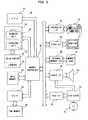
- FIG. 2 is a block diagram thereof.
- the game system 10 comprises a TV monitor 12, a game main unit 14, a DVD-ROM 16, an external memory card 18, and a controller 20.
- the DVD-ROM 16 and the external memory card 18 are removably mounted on/inserted in the game main unit 14.
- the controller 20 is connected to any one of a plurality of (in FIG. 1, four) controller port connectors provided in the game main unit 14 via a communication cable.
- the TV monitor 12 is connected to the game main unit 14 via an AV cable. Note that communication between the game main unit 14 and the controller 20 may be wireless communication.
- the DVD-ROM 16 fixedly stores a game program, game data, and the like.
- the DVD-ROM 16 is mounted on the game main unit 14 when a player plays a game.
- the game program, etc. may be stored by using an external storage medium such as a CD-ROM, an MO, a memory card, and a ROM cartridge.
- the external memory card 18 which is implemented by a rewritable storage medium such as a flash memory, etc., stores data such as saving data of the game.
- the game main unit 14 reads the program stored in the DVD-ROM 16, and performs a process in accordance with the read program.
- the controller 20 which is an input device allowing the player to perform an input concerning a game operation, has a plurality of operation switches.
- the controller 20 outputs operation data to the game main unit 14 in response to depression, for example, of the operation switch exerted by the player.
- the TV monitor 12 displays image data outputted from the game main unit 14 on a screen.
- the game main unit 14 has a CPU 22 and a memory controller 40 connected thereto.
- the memory controller 40 is connected to a graphics processing unit (GPU) 24, a main memory 34, a DSP 36, and various interfaces (I/F) 42, 44, 46, 48, and 52.
- the memory controller 40 controls data transfer between the above-described components.
- a disk drive 54 first drives the DVD-ROM 16 mounted on the game main unit 14.
- the game program stored in the DVD-ROM 16 is read into the main memory 34 via the disk I/F 52 and the memory controller 40.
- the game is started when the program on the main memory 34 is executed by the CPU 22.
- the player inputs a game operation, etc., to the controller 20 by using the operation switches.
- the controller 20 outputs the operation data to the game main unit 14.
- the operation data outputted from the controller 20 is provided to the CPU 22 via the controller I/F 42 and the memory controller 40.
- the CPU 22 performs a game process according to the inputted operation data.
- the GPU 24 and the DSP 36 are used when, for example, image data is generated in the game process. Also, a sub memory 38 is used when the DSP 36 performs a process.
- the memory for image processing purposes is used as a color buffer 30 or a Z-buffer 32, for example.
- the geometry unit 26 performs arithmetic computation for coordinates of a three-dimensional model (for example, an object composed of polygons) of an object and a graphic form placed in a game space, which is a virtual three-dimensional space.
- the geometry unit 26 performs, for example, rotation, scaling, and transformation of the three-dimensional model, and converts coordinates given in a world coordinate system to a viewpoint coordinate system or a screen coordinate system.
- the rendering unit 28 writes color data (RGB data) of each pixel into the color buffer 30, based on a predetermined texture with respect to the three-dimensional model projected onto the screen coordinates, thereby generating a game image.
- the color buffer 30 is a memory area reserved for storing the game image data (RGB data) generated by the rendering unit 28.
- the Z-buffer 32 is a memory area reserved for storing depth information from a viewpoint, which is lost when three-dimensional viewpoint coordinates are converted to two-dimensional screen coordinates.
- the GPU 24 generates image data to be displayed on the TV monitor 12 using these buffers, and appropriately outputs the image data to the TV monitor 12 via the memory controller 40 and the video I/F 44.
- audio data which is generated by the CPU 22 at the time of execution of the game program, is outputted from the memory controller 40 to the loud speaker 60 via the audio I/F 48.
- a memory for image processing purposes is additionally included in the hardware structure, but a method (UMA: Unified Memory Architecture) utilizing a portion of the main memory 34, for example, as a memory for image processing purposes may be used.
- UMA Unified Memory Architecture
- the game to be exemplified in the present embodiment allows the player to move a character appearing in the virtual game space by utilizing the controller 20.
- a leader character a character operated by the player
- sub characters a plurality of characterswhose movementiscontrolled by a computer based on a predetermined algorithm
- the plurality of sub characters are controlled so as to follow the leader character in a predetermined formation.
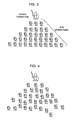
- FIG. 3 is an illustration showing an exemplary formation composed of a leader character and a plurality of sub characters following the leader character.
- the characters do not move in an orderly manner as shown in FIG. 3, but move in such a manner as shown in FIG. 4 due to a difference in traveling speed of sub characters or influences of topographic features since the movement of each sub character is controlled on an individual basis.
- the sub characters are basically halted in the formation as shown in FIG. 3.
- the above-described movement of the sub characters are realized by setting a plurality of destination points (hereinafter referred to as "slots") in the game space, correlating one sub character with one slot, and moving each sub character toward a corresponding slot.
- Each slot is set with reference to the location of the leader character. As the leader character moves, so does each slot.
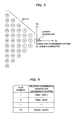
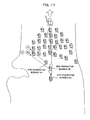
- FIG. 5 is an illustration showing a positional relation between the leader character and a plurality of slots (slots 1 to 35). As shown in FIG. 5, the slots 1 to 35 are disposed behind the leader character in the direction opposite to the orientation (traveling direction) of the leader character. In the present embodiment, coordinates of the slots 1 to 35 are defined in a character coordinate systembased on the leader character.
- FIG. 6 is a table showing the coordinates of each slot in the character coordinate system. The coordinates defined in FIG. 6 indicate not only coordinates in the character coordinate system but also relative coordinates based on the location of the leader character in a space coordinate system.
- the coordinates of each slot changes along with a move or a change in the orientation (i.e., a position) of the leader character in the game space.
- a Y coordinate value of each slot is always zero in the character coordinate system.
- the relative coordinates are defined by Xp axis and Zp axis of the character coordinate system, but it is not limited thereto.
- the relative coordinates may be defined by Xp axis, Yp axis, and Zp axis.
- the above-described relative coordinates are previously stored in the DVD-ROM 16 as game data. Note that the relative coordinates may be changed according to the player's preference or the game progress.
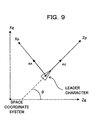
- Coordinates of each slot in the game space are determined based on the coordinates and orientation of the leader character, relative coordinates of the slot, and inequalities of the ground.
- space coordinate system space coordinate system
- Xg, Yg, and Zg three axes of the space coordinate system are Xg, Yg, and Zg, and a position matrix of the leader character is (ex, ey, ez) (where ex corresponds to a unit vector in a Xp axis direction; ey to a unit vector in a Yp axis direction; and ez to a unit vector in a Zp axis direction).
- Xp, Yp, and Zp axes in the space coordinate system correspond to XYZ axes in the character coordinate system.
- FIG. 8 is a lateral view of the game space schematically showing how coordinates of each slot are determined based on the coordinates and position of the leader character.
- Xp and Zp coordinates of each slot are set based on the above equation (1), and each slot is disposed on the surface of the corresponding ground.
- SYg1 is determined based on the topographic features.
- the coordinates of the slots 2 to 35 are calculated in a similar manner.
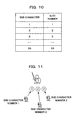
- a slot number indicating a destination point is correlated with one sub character on an individual basis.
- a slot number 1 is correlated with a sub character number 1;
- a slot number 2 is correlated with a sub character number 2;
- a slot number 3 is correlated with a sub character number 3.
- a sub character whose sub character number is 1 (hereinafter referred to as a sub character 1) moves toward the slot 1
- a sub character 2 moves toward the slot 2
- a sub character 3 moves toward the slot 3.
- a character number a slot number.
- a slot number may be arbitrarily correlated with any sub character.
- a slot number may be assigned to a sub character in the order in which a sub character joins the group of the leader character.
- a slot number may be assigned to a sub character according to a characteristic of the sub character (e. g. , a body color) such that sub characters having the same body color are situated next to each other.
- a correspondence between sub characters and slot numbers may not be fixedly set. In the present embodiment, it is possible to appropriately change a correspondence between sub characters and slots by a rearranging process, which will be described below.
- each sub character moves toward a corresponding slot.
- the sub characters move in the game space while following the leader character in a predetermined formation.
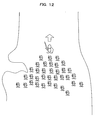
- an obstacle such as a wall may block the sub character's path as shown in FIG. 13.
- the sub characters 16, 25, and 26 try to move toward the slots 16, 25, and 26, respectively.
- the sub characters 16, 25, and 26 cannot follow the leader character in this situation.
- the present embodiment devises a solution to avoid such a troublesome situation.
- the sub character collides with an obstacle, the sub character is controlled so as to follow the footsteps of the leader character instead of moving toward the corresponding slot. As long as the sub character follows the footsteps of the leader character, the sub character can proceed without being blocked by the obstacle.
- a method for detouring around the obstacle will be specifically described.
- a current location (coordinates in the space coordinate system) of the leader character is sequentially stored as a "footstep" of the leader character at predetermined intervals.
- a footstep is stored once in a predetermined frame period (e.g., once in ten frames).
- Data stored at the same time (hereinafter referred to as "footstep data") contains a current frame number and current coordinates of the leader character.
- a new footstep is not stored in the case where the leader character is not at a predetermined distance from the newest footstep when ten frames has elapsed after the newest footstep has been stored, so as to prevent unnecessary footstep data from being stored.
- footstep data stored for a fixed time period has to be deleted from the storage area since it is impossible to store all footstep data indefinitely.
- the oldest footstep data i.e., footstep data having the smallest frame number
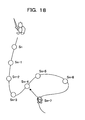
- the k-th footstep newest after Sn is referred to as a "footstep Sn-k”.
- the destination of the stranded sub character is changed to a footstep closest to the current location of the sub character.
- the sub character 16 collides with a wall
- the sub character 16 changes its destination to a footstep closest to the current location thereof (i.e., a footstep Sn-4).
- the sub character 25 changes its destination to a footstep Sn-5
- the sub character 26 changes its destination to a footstep Sn-5.
- the sub character When the sub character arrives at the destination footstep, the sub character changes its destination to a footstep newer than the footstep at which the sub character has arrived (i.e., a footstep having a newer frame number). For example, as shown in FIG. 16, when the sub character 16 arrives at the footstep Sn-4, the destination of the sub character 16 is changed to a footstep Sn-3. When the sub character 16 arrives at the footstep Sn-3, the destination of the sub character 16 is changed to a footstep Sn-2. By repeating the above process, the sub character 16 can follow the track of the leader character. The sub characters 25 and 26 follow the footsteps of the leader character in a similar manner.
- each sub character can return to its original course, and follow the leader character by moving toward the corresponding slot.
- the sub character follows the footsteps of the leader character in accordance with the order in which the footsteps are stored.
- any footstep closest to the footstep at which the sub character has arrived is selected as a next destination from newer footsteps, so that the sub character can arrive at the corresponding slot as soon as possible.
- a next destination is selected from footsteps Sn to Sn-6 (i.e., footsteps newer than the footstep Sn-7).
- a footstep closest to the footstep Sn-7 is selected as a next destination from the footsteps Sn to Sn-6.
- an obstacle may block the sub character's path while the sub character takes a shortcut in a manner as described above.
- the sub character may continue to track the footsteps of the leader character by changing its destination to a different footstep.
- the sub character may get back to the footstep Sn-7 (the newest footstep at which the sub character has arrived), so as to follow the footsteps of the leader character again in accordance with the order in which the footsteps are stored.
- a frame number of the newest footstep at which a sub character has arrived in the example as shown in FIG.
- a frame number fn-7 of the footstep Sn-7) is stored on a character-by-character basis.
- a footstep closest to the current location of the sub character, other than the current destination in the example as shown in FIG. 18, Sn-4
- the footsteps newer than the footstep at which the sub character has arrived in the example as shown in FIG. 18, footsteps Sn ⁇ Sn-6) as a next destination (in the example as shown in FIG. 18, Sn-3).
- the sub character can continue to track the footsteps of the leader character even if the sub character's path is blocked by the obstacle on the shortcut.
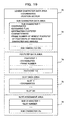
- FIG. 19 is a memory map of the main memory 34.
- a leader character data area 70 stores coordinates of the current location of the leader character (given in the space coordinate system) and a position vector of the leader character (given in the space coordinate system).
- a sub character data area 72 stores, on a sub character-by-sub character basis, coordinates of the current location of a sub character (given in the space coordinate system), a detouring flag, a destination footstep (data for specifying one piece of footstep data stored in a footstep data area), a characteristic, and a frame number of the newest footstep of the footsteps at which the sub character has arrived.
- a footstep data area 74 stores a plurality of footstep data (in FIG. 19, ten pieces of footstep data).
- Each footstep data contains coordinates (given in the space coordinate system) and a frame number.
- a slot data area 76 stores, on a slot-by- slot basis, slot coordinates (given in the space coordinate system). The above slot coordinates are determined based on the relative coordinates as shown in FIG. 6.
- a slot assignment area 78 stores, on a sub character-by-sub character basis, a correspondence between sub characters and slot numbers as shown in FIG. 10.
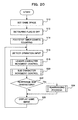
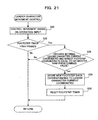
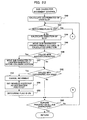
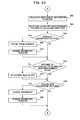
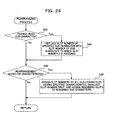
- FIGS. 20 to 24 are flowcharts showing a flow of a game process executed by the CPU 22 based on the game program.
- the CPU 22 first sets a game space (S10).
- the leader character and the sub characters are disposed in their respective initial positions.
- the detouring flags of all the sub characters are turned off (S12), and a footstep timer starts counting (S14).
- the detouring flag which is turned on when a sub character is prevented from moving toward its corresponding slot by an obstacle such as a wall, indicates whether or not the sub character is following the footsteps of the leader character so as to detour around the obstacle.
- the footstep timer is a timer for storing footstep data once every ten frames.
- the CPU 22 detects an operation input inputted from the controller 20 (S16). Then, the CPU 22 performs a movement control process for the leader character (S18).
- a movement control process for the leader character S18.
- the CPU 22 performs movement control for the leader character based on the operation input (S30). Specifically, the CPU 22 updates the coordinates and the position vector of the leader character based on the operation input. Then, the CPU 22 determines whether or not a count value of the footstep timer exceeds a predetermined frame period (e. g. , ten frames) (S32). In the case where the count value exceeds ten frames, the CPU 22 determines whether or not a distance between the current coordinates of the leader character and the coordinates of the newest footstep is equal to or greater than a predetermined value (S34). Note that the coordinates of the newest footstep is retrieved from footstep data having the greatest frame number included in the plurality of footstep data stored in the footstep data area 74 of the main memory 34.
- a predetermined frame period e. g. , ten frames
- the CPU 22 ends the leader character movement control process without storing footstep data.
- the CPU 22 stores the current coordinates of the leader character and the current frame number in the footstep data area 74 as new footstep data (S36).
- the CPU 22 If ten pieces of footstep data have already been stored in the footstep data area 74, the CPU 22 overwrites new footstep data in the area where the footstep data having the smallest frame number is stored. Then, the CPU 22 resets the footstep timer (i.e., starts re-counting) (S38), and ends the leader character movement control process.
- the footstep timer i.e., starts re-counting
- the CPU 22 first calculates coordinates of each slot (given in the space coordinate system) in a manner as described by referring to FIGS. 7 to 9, and stores the calculated coordinates in the slot data area 76 of the main memory 34. In other words, the CPU 22 calculates coordinates of each slot (given in the space coordinate system) based on the relative coordinates of each slot as shown in FIG. 6, which are stored in the DVD-ROM 16, and the current coordinates and position vector of the leader character.
- the case in which the sub character 1 is processed will be described as a typical example.
- the CPU 22 first determines whether or not the detouring flag of the sub character 1 is turned on (S42). In the case where it is turned on, the CPU 22 proceeds to step S62 of FIG. 23. On the other hand, in the case where it is turned off, the CPU 22 proceeds to step S44 of FIG. 22. A process performed in the case where the detouring flag is turned on will be described further below. Firstly, an operation performed in the case where the detouring flag is turned off will be described.
- the CPU 22 first calculates a direction of the destination slot (a slot correlated with the sub character 1 in the slot assignment area 78) seen from the current location of the sub character 1 (S44). The coordinates of the sub character 1 and the coordinates of the destination slot are used for this calculation. Next, the CPU 22 moves the sub character 1 a predetermined distance in the calculated direction (S46). More specifically, the CPU 22 shifts the current coordinates of the sub character 1 in the direction calculated at step S44 by an amount corresponding to the traveling speed of the sub character 1. Next, the CPU 22 determines whether or not the sub character 1 will collide with another character during the movement (S48). In the case where it is determined that the sub character will collide with another character during the movement, the CPU 22 sets the coordinates of the sub character 1 so as to move the sub character 1 toward a location immediately before a collision location (S50).
- the CPU 22 determines whether or not the sub character 1 having moved at step S46 will collide with topographic features (S52). In the case where it is determined that the sub character 1 will not collide with the topographic features, the CPU 22 proceeds to step S60.
- the CPU 22 cancels the movement of the sub character 1 at step S46 (S54), sets a footstep closest to the current location of the sub character 1 as a destination footstep (S56), and turns on the detouring flag of the sub character 1 (S58).
- the sub character 1 stops taking the direct route to the destination slot, and follows the footsteps of the leader character from a next frame.
- the CPU 22 proceeds to step S60.
- the detouring flag of the sub character 1 is turned on when it is determined at step S52 that the sub character 1 will collide with the topographic features.
- the detouring flag of the sub character 1 may be turned on only when the path of the sub character 1 is blocked by the topographic features for more than a predetermined time period after collision.
- a counter for counting a time period during which a sub character collides with the topographic features may be prepared for each sub character so as to compare the counter value with a predetermined value for comparison purposes.
- the detouring flag of the sub character 1 is turned on only when it is determined that the sub character 1 having moved a predetermined distance at step S64 will collide with the topographic features.
- the presence of an obstacle between the current location of the sub character 1 and the destination slot may be detected on a regular basis so as to turn on the detouring flag when the presence of an obstacle is detected (i.e., before coming close to the obstacle).
- the CPU 22 first calculates a direction of the destination footstep seen from the current location of the sub character 1 at step S62 of FIG. 23. The coordinates of the sub character 1 and the coordinates of the destination footstep are used for this calculation. Next, the CPU 22 moves the sub character 1 a predetermined distance in the calculated direction (S64). More specifically, the CPU 22 shifts the current coordinates of the sub character 1 in the direction calculated at step S62 by an amount corresponding to the traveling speed of the sub character 1.
- the CPU 22 determines whether or not the sub character 1 arrives at the destination footstep as a result of the movement at step S64 (S66). In the case where it is determined that the sub character 1 arrives at the destination footstep, the CPU 22 reads a frame number of footstep data corresponding to the destination footstep from the footstep data area 74 of the main memory 34, and stores the read frame number as "a frame number of the newest footstep of the footsteps at which the sub character has arrived" in the sub character data area 72 (S68). Then, the CPU 22 changes the destination footstep (S70).
- the CPU 22 extracts, from a plurality of footsteps stored in the footstep data area 74, a footstep whose frame number is greater than the frame number stored in the sub character data area 72 (i.e., a footstep newer than the footsteps at which the sub character 1 has arrived) and which is closest to the current location of the sub character 1, and sets the footstep thus extracted as a next destination footstep.
- the CPU 22 determines whether or not a distance between the current location of the sub character 1 and the destination slot is equal to or smaller than a predetermined value (S72). In the case where it is determined that a distance between the current location of the sub character 1 and the destination slot is equal to or smaller than a predetermined value, the CPU 22 turns off the detouring flag of the sub character 1 such that the sub character 1 heads for the destination slot in a next frame or later (S74).
- the CPU 22 determines whether or not the sub character 1 having moved at step S64 will collide with topographic features (S76). In the case where it is determined that the sub character 1 will not collide with the topographic features, the CPU 22 proceeds to step S60 of FIG. 22.
- the CPU 22 cancels the movement of the sub character 1 at step S64 (S78), and changes the destination footstep (S80). More specifically, the CPU 22 extracts, from a plurality of footsteps stored in the footstep data area 74, a footstep whose frame number is greater than the frame number stored in the sub character data area 72 (i.e., a footstep newer than the footsteps at which the sub character 1 has arrived) and which is closest to the current location of the sub character 1, and sets the footstep thus extracted as a next destination footstep. Then, the CPU 22 proceeds to step S60 of FIG. 22.
- the destination footstep is changed when it is determined at step S76 that the sub character 1 will collide with the topographic features.
- the destination footstep may be changed only when the path of the sub character 1 is blocked by the topographic features for more than a predetermined time period after collision.
- a counter for counting a time period during which a sub character collides with the topographic features may be prepared for each sub character so as to compare the counter value with a predetermined value for comparison purposes.
- the destination footstep of the sub character 1 is changed only when it is determined that the sub character 1 having moved a predetermined distance at step S64 will collide with the topographic features.
- the presence of an obstacle between the current location of the sub character 1 and the destination footstep may be detected at the time of setting of the destination footstep of the sub character 1, so as to change the destination footstep when the presence of the obstacle is detected.
- step S60 of FIG. 22 it is determined whether or not the process is performed for all the sub characters (S60). In the case where there are still sub characters to be processed, the CPU 22 goes back to step S42, and repeats the same process for each unprocessed sub character. When the process is finally performed for all the sub characters, the CPU 22 proceeds to step S22 of FIG. 20.
- the CPU 22 determines whether or not rearrangement of the sub characters is required based on an operation input inputted from the controller 20, for example. In the case where rearrangement is required, the CPU 22 performs a rearrangement process at step S24.
- a rearrangement process at step S24.
- the CPU 22 determines whether or not it is instructed to change a head sub character (i.e., a sub character corresponding to a slot number 2) to another specified sub character (S82). Specifically, the player operates a predetermined switch of the controller 20 to give such an instruction and specify a sub character the player desires to position at the head of the sub characters. In response to the instruction, the CPU 22 updates the sub character data area 72 and the slot assignment area 78 of the main memory 34 so as to replace a slot number of the sub character, to which 2 has been assigned as a slot number, with a slot number of the specified sub character (S84). Specifically, the CPU 22 sets a slot number of the sub character, to which 2 has been assigned as a slot number, to a slot number assigned to the specified sub character, and sets a slot number of the specified sub character to 2.
- a head sub character i.e., a sub character corresponding to a slot number 2
- S82 the player operates a predetermined switch of the controller 20 to give such an instruction and specify a
- the CPU 22 determines whether or not it is instructed to rearrange the sub characters according to their characteristics (S86). Specifically, the player operates a predetermined switch of the controller 20 to give such an instruction and specify a characteristic. In response to the instruction, the CPU 22 updates the sub character data area 72 and the slot assignment area 78 of the main memory 34 such that any sub character having the specified characteristic is disposed in the front portion of the formation (S88). More specifically, the CPU 22 assigns slot numbers to all the sub characters having the specified characteristic, the smallest slot number first, and assigns the remaining slots to the remaining sub characters.
- step S26 in FIG. 20 the CPU 22 displays a game image, and goes back to step S16. The process from steps S16 to S26 is repeated until the game is ended.
- the game space is a three-dimensional virtual space, but it is not limited thereto.
- the game space may be two-dimensional.
- the game program is provided from the DVD-ROM 16 to the game main unit 14, but it is not limited thereto.
- the game program may be provided from an arbitrary recording medium to the game main unit 14, or may be provided to the game main unit 14 through a fixed or wireless communication line. Alternatively, a function of the game program may be realized only by the hardware.
Landscapes
- Engineering & Computer Science (AREA)
- Multimedia (AREA)
- Theoretical Computer Science (AREA)
- Human Computer Interaction (AREA)
- Processing Or Creating Images (AREA)
- Slot Machines And Peripheral Devices (AREA)
Applications Claiming Priority (2)
| Application Number | Priority Date | Filing Date | Title |
|---|---|---|---|
| JP2004106875A JP4307310B2 (ja) | 2004-03-31 | 2004-03-31 | ゲーム装置及びゲームプログラム |
| JP2004106875 | 2004-03-31 |
Publications (2)
| Publication Number | Publication Date |
|---|---|
| EP1584362A2 true EP1584362A2 (de) | 2005-10-12 |
| EP1584362A3 EP1584362A3 (de) | 2012-01-25 |
Family
ID=34909453
Family Applications (1)
| Application Number | Title | Priority Date | Filing Date |
|---|---|---|---|
| EP05006801A Withdrawn EP1584362A3 (de) | 2004-03-31 | 2005-03-29 | Spielvorrichtung und Spielprogramm |
Country Status (3)
| Country | Link |
|---|---|
| US (1) | US7785198B2 (de) |
| EP (1) | EP1584362A3 (de) |
| JP (1) | JP4307310B2 (de) |
Cited By (1)
| Publication number | Priority date | Publication date | Assignee | Title |
|---|---|---|---|---|
| WO2017171567A1 (en) * | 2016-03-30 | 2017-10-05 | Bloober Team S.A. | The method of simultaneous playing in single-player video games |
Families Citing this family (36)
| Publication number | Priority date | Publication date | Assignee | Title |
|---|---|---|---|---|
| WO1999045844A1 (en) | 1998-03-13 | 1999-09-16 | University Of Iowa Research Foundation | A curved cross section based system and method for gastrointestinal tract unraveling |
| JP3732843B2 (ja) * | 2004-02-18 | 2006-01-11 | 株式会社スクウェア・エニックス | ビデオ・ゲーム装置のプログラムおよびビデオ・ゲーム装置 |
| JP4771821B2 (ja) * | 2006-02-02 | 2011-09-14 | 株式会社バンダイナムコゲームス | プログラム、情報記憶媒体、及び画像生成システム |
| JP4125760B2 (ja) * | 2006-03-15 | 2008-07-30 | 株式会社スクウェア・エニックス | ビデオゲーム処理装置、ビデオゲーム処理方法、およびビデオゲーム処理プログラム |
| JP4040658B2 (ja) * | 2006-03-16 | 2008-01-30 | 株式会社コナミデジタルエンタテインメント | ゲーム装置、ゲーム装置の制御方法及びプログラム |
| US8990707B2 (en) * | 2008-01-09 | 2015-03-24 | International Business Machines Corporation | System and method for group control in a metaverse application |
| JP5804618B2 (ja) * | 2009-05-28 | 2015-11-04 | 任天堂株式会社 | ゲームプログラム、ゲーム装置、ゲームシステム、およびゲーム処理方法 |
| JP5614956B2 (ja) * | 2009-08-11 | 2014-10-29 | 株式会社バンダイナムコゲームス | プログラム、画像生成システム |
| US8799788B2 (en) * | 2011-06-02 | 2014-08-05 | Disney Enterprises, Inc. | Providing a single instance of a virtual space represented in either two dimensions or three dimensions via separate client computing devices |
| JP5420051B1 (ja) * | 2012-11-14 | 2014-02-19 | 株式会社 ディー・エヌ・エー | 端末装置用プログラムおよびゲーム提供装置 |
| US8790178B1 (en) | 2012-11-15 | 2014-07-29 | Kabam, Inc. | Metric based conformance by character units to specified formations |
| JP6192366B2 (ja) | 2013-06-04 | 2017-09-06 | 任天堂株式会社 | 情報処理プログラム、情報処理装置の制御方法、情報処理装置および情報処理システム |
| JP6687994B2 (ja) | 2013-09-13 | 2020-04-28 | 任天堂株式会社 | ゲームプログラム、ゲーム装置、ゲームシステム、及びゲーム処理方法 |
| JP6677437B2 (ja) * | 2013-09-13 | 2020-04-08 | 任天堂株式会社 | ゲームプログラム、ゲーム装置、ゲームシステム、及びゲーム処理方法 |
| US9795881B2 (en) * | 2014-10-27 | 2017-10-24 | Disney Enterprises, Inc. | Controlling groups of game entities in a video game in a collective, coordinated, and/or collaborative manner using a group entity |
| JP5774182B1 (ja) * | 2014-10-28 | 2015-09-09 | グリー株式会社 | ゲームプログラム、ゲーム制御方法、およびコンピュータ |
| JP6460463B2 (ja) * | 2015-01-22 | 2019-01-30 | 株式会社セガゲームス | ゲームプログラムおよびゲーム装置 |
| KR101739840B1 (ko) * | 2015-06-10 | 2017-05-25 | (주)엔도어즈 | 게임 서비스 제공 장치 및 그 제어 방법 |
| JP2017051493A (ja) * | 2015-09-10 | 2017-03-16 | 株式会社バンダイナムコエンターテインメント | プログラム及びゲームシステム |
| JP2017012783A (ja) * | 2016-09-07 | 2017-01-19 | グリー株式会社 | ゲームプログラム、ゲーム制御方法、およびコンピュータ |
| CN109843403B (zh) * | 2016-10-31 | 2022-10-14 | 喀普康有限公司 | 游戏系统及游戏系统的控制方法 |
| JP6812803B2 (ja) * | 2017-01-12 | 2021-01-13 | ソニー株式会社 | 情報処理装置、情報処理方法、およびプログラム |
| JP2019025149A (ja) * | 2017-08-01 | 2019-02-21 | 株式会社コーエーテクモゲームス | ゲームプログラム、記録媒体、ゲーム処理方法 |
| CN108245888A (zh) * | 2018-02-09 | 2018-07-06 | 腾讯科技(深圳)有限公司 | 虚拟对象控制方法、装置及计算机设备 |
| CN108744507B (zh) * | 2018-05-18 | 2023-03-24 | 腾讯科技(深圳)有限公司 | 虚拟对象下落控制方法、装置、电子装置及存储介质 |
| JP7127777B2 (ja) * | 2018-08-27 | 2022-08-30 | 任天堂株式会社 | 情報処理プログラム、情報処理装置、情報処理システム、および情報処理方法 |
| JP7199204B2 (ja) * | 2018-11-19 | 2023-01-05 | 株式会社ソニー・インタラクティブエンタテインメント | 表示制御プログラム、表示制御装置、及び表示制御方法 |
| CN111672117B (zh) * | 2020-06-05 | 2021-07-09 | 腾讯科技(深圳)有限公司 | 虚拟对象的选择方法、装置、设备及存储介质 |
| CN112604305B (zh) | 2020-12-17 | 2022-11-18 | 腾讯科技(深圳)有限公司 | 虚拟对象的控制方法、装置、终端及存储介质 |
| US11484793B1 (en) * | 2021-09-02 | 2022-11-01 | Supercell Oy | Game control |
| CN114632326B (zh) * | 2022-03-17 | 2025-10-10 | 网易(杭州)网络有限公司 | 一种画面显示方法、装置、电子设备及可读存储介质 |
| US12248668B2 (en) * | 2022-05-11 | 2025-03-11 | Supercell Oy | Randomized movement control |
| JP7455171B2 (ja) | 2022-09-12 | 2024-03-25 | 任天堂株式会社 | ゲームプログラム、情報処理システム、および、ゲーム処理方法 |
| JP7462715B2 (ja) | 2022-09-12 | 2024-04-05 | 任天堂株式会社 | ゲームプログラム、情報処理システム、および、ゲーム処理方法 |
| JP7580436B2 (ja) * | 2022-10-05 | 2024-11-11 | 任天堂株式会社 | 情報処理プログラム、情報処理システム、および情報処理方法 |
| JP7541559B2 (ja) | 2022-10-05 | 2024-08-28 | 任天堂株式会社 | 情報処理プログラム、情報処理システム、および情報処理方法 |
Family Cites Families (18)
| Publication number | Priority date | Publication date | Assignee | Title |
|---|---|---|---|---|
| US119050A (en) * | 1871-09-19 | Improvement in sash-holders | ||
| US38739A (en) * | 1862-12-27 | 1863-06-02 | Improvement in artificial legs | |
| JP3470822B2 (ja) * | 1994-03-03 | 2003-11-25 | 株式会社セガ | 画像表示方法及びその装置 |
| JP3359981B2 (ja) * | 1994-08-18 | 2002-12-24 | 株式会社ハドソン | ロールプレイングゲームにおける集団キャラクタ表示方法 |
| JPH1080576A (ja) * | 1996-09-06 | 1998-03-31 | Hudson Soft Co Ltd | 隊列行動をするキャラクタの画像表示方法 |
| JP4223112B2 (ja) | 1998-12-04 | 2009-02-12 | 株式会社バンダイナムコゲームス | ゲーム装置及び情報記憶媒体 |
| GB2352641B (en) * | 1999-07-28 | 2003-09-24 | Big Fish Entertainment Ltd | Video game |
| JP3163496B2 (ja) * | 1999-08-20 | 2001-05-08 | 株式会社光栄 | 集団キャラクタ移動方法、記録媒体及びゲーム装置 |
| JP3505705B2 (ja) * | 1999-11-30 | 2004-03-15 | 株式会社光栄 | 記録媒体及びゲーム装置 |
| JP4355982B2 (ja) * | 2000-03-30 | 2009-11-04 | 株式会社セガ | 集団キャラクタの移動制御方法、集団キャラクタの移動制御を含む遊戯装置、遊戯成績の演算方法及び記録媒体 |
| US20020049690A1 (en) * | 2000-06-16 | 2002-04-25 | Masanori Takano | Method of expressing crowd movement in game, storage medium, and information processing apparatus |
| KR100458760B1 (ko) * | 2000-08-29 | 2004-12-03 | 가부시끼가이샤 코에이 | 집단 캐릭터 표시방법, 기록매체 및 게임장치 |
| JP3579794B2 (ja) | 2000-08-29 | 2004-10-20 | 株式会社光栄 | プログラム、記録媒体及びゲーム装置 |
| JP4480248B2 (ja) | 2000-09-19 | 2010-06-16 | 株式会社バンダイナムコゲームス | ゲームシステム及び情報記憶媒体 |
| JP3780512B2 (ja) * | 2002-07-30 | 2006-05-31 | 株式会社光栄 | プログラム、記録媒体及びゲーム装置 |
| AU2003268147A1 (en) | 2002-08-20 | 2004-03-11 | Vivendi Universal Games, Inc | Computer game with emotion-based character interraction |
| JP3779298B2 (ja) | 2003-11-28 | 2006-05-24 | 任天堂株式会社 | ゲーム装置およびゲームプログラム |
| JP4213052B2 (ja) * | 2004-01-28 | 2009-01-21 | 任天堂株式会社 | タッチパネル入力を用いたゲームシステム |
-
2004
- 2004-03-31 JP JP2004106875A patent/JP4307310B2/ja not_active Expired - Lifetime
-
2005
- 2005-03-25 US US11/089,334 patent/US7785198B2/en active Active
- 2005-03-29 EP EP05006801A patent/EP1584362A3/de not_active Withdrawn
Cited By (2)
| Publication number | Priority date | Publication date | Assignee | Title |
|---|---|---|---|---|
| WO2017171567A1 (en) * | 2016-03-30 | 2017-10-05 | Bloober Team S.A. | The method of simultaneous playing in single-player video games |
| US10500488B2 (en) | 2016-03-30 | 2019-12-10 | Bloober Team S.A. | Method of simultaneous playing in single-player video games |
Also Published As
| Publication number | Publication date |
|---|---|
| EP1584362A3 (de) | 2012-01-25 |
| JP4307310B2 (ja) | 2009-08-05 |
| US20050221880A1 (en) | 2005-10-06 |
| US7785198B2 (en) | 2010-08-31 |
| JP2005287757A (ja) | 2005-10-20 |
Similar Documents
| Publication | Publication Date | Title |
|---|---|---|
| US7785198B2 (en) | Game apparatus and game program providing lead character and sub character group movement | |
| US7677977B2 (en) | Video game processing apparatus, a method and a computer program product for processing a video game | |
| US7697015B2 (en) | Storage medium and game device storing image generating program | |
| US7588497B2 (en) | Method, an apparatus and a computer program product for generating an image | |
| JP3696216B2 (ja) | 3次元ビデオゲーム装置、3次元ビデオゲームにおける仮想カメラの制御方法、並びにプログラム及び記録媒体 | |
| US7859532B2 (en) | Generating character images based upon display conditions | |
| EP1358918A2 (de) | Spielgerät und Spielprogramm | |
| CN101534913A (zh) | 游戏装置、游戏装置的控制方法及信息存储介质 | |
| US20020021298A1 (en) | Entertainment apparatus, storage medium and object display method | |
| US6762746B2 (en) | Entertainment apparatus, storage medium and operation method of manipulating object | |
| JP2009213559A (ja) | ゲーム装置 | |
| US20010035906A1 (en) | Entertainment apparatus, storage medium and object display method | |
| JP3428562B2 (ja) | オブジェクトの動きを処理する方法および記録媒体、並びに、ゲーム装置 | |
| JP3990258B2 (ja) | 画像生成システム、プログラム及び情報記憶媒体 | |
| JP4397410B2 (ja) | 画像生成装置及び情報記憶媒体 | |
| JP3786670B1 (ja) | プログラム、情報記憶媒体、及び画像生成システム | |
| JP4003898B2 (ja) | 画像生成装置及び情報記憶媒体 | |
| JP5396006B2 (ja) | ゲームプログラム及びゲーム装置 | |
| JP2005342360A (ja) | 集団キャラクタ移動制御方法,記録媒体,シミュレーション装置及びゲーム装置 | |
| JP2001276414A (ja) | ゲーム装置、および、情報記憶媒体 | |
| JP2000153062A (ja) | ビデオゲーム装置およびビデオゲーム用情報記憶媒体 | |
| EP1002560A2 (de) | Videospielvorrichtung und Videospielspeichermedium | |
| JP4447000B2 (ja) | 画像生成システム、プログラム及び情報記憶媒体 | |
| JP5054908B2 (ja) | プログラム、情報記憶媒体、及び画像生成システム | |
| JP3653062B2 (ja) | キャラクタ移動速度制御プログラム |
Legal Events
| Date | Code | Title | Description |
|---|---|---|---|
| PUAI | Public reference made under article 153(3) epc to a published international application that has entered the european phase |
Free format text: ORIGINAL CODE: 0009012 |
|
| AK | Designated contracting states |
Kind code of ref document: A2 Designated state(s): AT BE BG CH CY CZ DE DK EE ES FI FR GB GR HU IE IS IT LI LT LU MC NL PL PT RO SE SI SK TR |
|
| AX | Request for extension of the european patent |
Extension state: AL BA HR LV MK YU |
|
| PUAL | Search report despatched |
Free format text: ORIGINAL CODE: 0009013 |
|
| AK | Designated contracting states |
Kind code of ref document: A3 Designated state(s): AT BE BG CH CY CZ DE DK EE ES FI FR GB GR HU IE IS IT LI LT LU MC NL PL PT RO SE SI SK TR |
|
| AX | Request for extension of the european patent |
Extension state: AL BA HR LV MK YU |
|
| RIC1 | Information provided on ipc code assigned before grant |
Ipc: A63F 13/10 20060101AFI20111222BHEP |
|
| RAP1 | Party data changed (applicant data changed or rights of an application transferred) |
Owner name: NINTENDO CO., LTD. |
|
| 17P | Request for examination filed |
Effective date: 20120725 |
|
| AKX | Designation fees paid |
Designated state(s): DE FR GB |
|
| STAA | Information on the status of an ep patent application or granted ep patent |
Free format text: STATUS: THE APPLICATION HAS BEEN WITHDRAWN |
|
| 18W | Application withdrawn |
Effective date: 20150708 |