EP1580222B1 - Depolymerisationsverfahren - Google Patents
Depolymerisationsverfahren Download PDFInfo
- Publication number
- EP1580222B1 EP1580222B1 EP20030810619 EP03810619A EP1580222B1 EP 1580222 B1 EP1580222 B1 EP 1580222B1 EP 20030810619 EP20030810619 EP 20030810619 EP 03810619 A EP03810619 A EP 03810619A EP 1580222 B1 EP1580222 B1 EP 1580222B1
- Authority
- EP
- European Patent Office
- Prior art keywords
- water
- decomposition
- polymer
- organic acid
- sub
- Prior art date
- Legal status (The legal status is an assumption and is not a legal conclusion. Google has not performed a legal analysis and makes no representation as to the accuracy of the status listed.)
- Expired - Lifetime
Links
- 238000000034 method Methods 0.000 title claims description 28
- 238000000354 decomposition reaction Methods 0.000 claims description 74
- XLYOFNOQVPJJNP-UHFFFAOYSA-N water Substances O XLYOFNOQVPJJNP-UHFFFAOYSA-N 0.000 claims description 60
- VTYYLEPIZMXCLO-UHFFFAOYSA-L Calcium carbonate Chemical compound [Ca+2].[O-]C([O-])=O VTYYLEPIZMXCLO-UHFFFAOYSA-L 0.000 claims description 34
- 239000000178 monomer Substances 0.000 claims description 26
- 229910000019 calcium carbonate Inorganic materials 0.000 claims description 17
- AYJRCSIUFZENHW-UHFFFAOYSA-L barium carbonate Chemical compound [Ba+2].[O-]C([O-])=O AYJRCSIUFZENHW-UHFFFAOYSA-L 0.000 claims description 14
- 229920000728 polyester Polymers 0.000 claims description 14
- 229920006037 cross link polymer Polymers 0.000 claims description 9
- AXCZMVOFGPJBDE-UHFFFAOYSA-L calcium dihydroxide Chemical compound [OH-].[OH-].[Ca+2] AXCZMVOFGPJBDE-UHFFFAOYSA-L 0.000 claims description 7
- 239000000920 calcium hydroxide Substances 0.000 claims description 7
- 229910001861 calcium hydroxide Inorganic materials 0.000 claims description 7
- ZAMOUSCENKQFHK-UHFFFAOYSA-N Chlorine atom Chemical compound [Cl] ZAMOUSCENKQFHK-UHFFFAOYSA-N 0.000 claims description 5
- 239000000460 chlorine Substances 0.000 claims description 5
- 229910052801 chlorine Inorganic materials 0.000 claims description 5
- 230000003301 hydrolyzing effect Effects 0.000 claims description 2
- 229920000642 polymer Polymers 0.000 description 50
- 150000007524 organic acids Chemical class 0.000 description 33
- LFQSCWFLJHTTHZ-UHFFFAOYSA-N Ethanol Chemical compound CCO LFQSCWFLJHTTHZ-UHFFFAOYSA-N 0.000 description 26
- 238000006243 chemical reaction Methods 0.000 description 24
- 238000011084 recovery Methods 0.000 description 20
- 230000000052 comparative effect Effects 0.000 description 19
- DNIAPMSPPWPWGF-UHFFFAOYSA-N Propylene glycol Chemical compound CC(O)CO DNIAPMSPPWPWGF-UHFFFAOYSA-N 0.000 description 18
- 229920005989 resin Polymers 0.000 description 17
- 239000011347 resin Substances 0.000 description 17
- 239000004033 plastic Substances 0.000 description 16
- 229920003023 plastic Polymers 0.000 description 16
- HEMHJVSKTPXQMS-UHFFFAOYSA-M Sodium hydroxide Chemical compound [OH-].[Na+] HEMHJVSKTPXQMS-UHFFFAOYSA-M 0.000 description 15
- KWYUFKZDYYNOTN-UHFFFAOYSA-M Potassium hydroxide Chemical compound [OH-].[K+] KWYUFKZDYYNOTN-UHFFFAOYSA-M 0.000 description 14
- 239000008346 aqueous phase Substances 0.000 description 13
- 230000007062 hydrolysis Effects 0.000 description 9
- 238000006460 hydrolysis reaction Methods 0.000 description 9
- -1 organic acid salt Chemical class 0.000 description 8
- 239000000047 product Substances 0.000 description 7
- 238000004064 recycling Methods 0.000 description 7
- 238000000197 pyrolysis Methods 0.000 description 6
- 238000004817 gas chromatography Methods 0.000 description 5
- 239000000203 mixture Substances 0.000 description 5
- 238000007086 side reaction Methods 0.000 description 5
- VEXZGXHMUGYJMC-UHFFFAOYSA-N Hydrochloric acid Chemical compound Cl VEXZGXHMUGYJMC-UHFFFAOYSA-N 0.000 description 4
- 230000015572 biosynthetic process Effects 0.000 description 4
- 150000001732 carboxylic acid derivatives Chemical class 0.000 description 4
- 239000002994 raw material Substances 0.000 description 4
- 150000003839 salts Chemical class 0.000 description 4
- 239000002699 waste material Substances 0.000 description 4
- 239000002253 acid Substances 0.000 description 3
- 150000001412 amines Chemical class 0.000 description 3
- 239000006227 byproduct Substances 0.000 description 3
- 230000003247 decreasing effect Effects 0.000 description 3
- 230000000694 effects Effects 0.000 description 3
- 239000003960 organic solvent Substances 0.000 description 3
- XKRFYHLGVUSROY-UHFFFAOYSA-N Argon Chemical group [Ar] XKRFYHLGVUSROY-UHFFFAOYSA-N 0.000 description 2
- HEDRZPFGACZZDS-UHFFFAOYSA-N Chloroform Chemical compound ClC(Cl)Cl HEDRZPFGACZZDS-UHFFFAOYSA-N 0.000 description 2
- 239000004952 Polyamide Substances 0.000 description 2
- PPBRXRYQALVLMV-UHFFFAOYSA-N Styrene Chemical compound C=CC1=CC=CC=C1 PPBRXRYQALVLMV-UHFFFAOYSA-N 0.000 description 2
- 230000003139 buffering effect Effects 0.000 description 2
- 150000001875 compounds Chemical class 0.000 description 2
- 238000001816 cooling Methods 0.000 description 2
- 230000006837 decompression Effects 0.000 description 2
- 230000007423 decrease Effects 0.000 description 2
- 238000001914 filtration Methods 0.000 description 2
- 239000000446 fuel Substances 0.000 description 2
- 239000007789 gas Substances 0.000 description 2
- 239000007788 liquid Substances 0.000 description 2
- 239000012074 organic phase Substances 0.000 description 2
- 239000013502 plastic waste Substances 0.000 description 2
- 229920002647 polyamide Polymers 0.000 description 2
- 239000000126 substance Substances 0.000 description 2
- 238000003786 synthesis reaction Methods 0.000 description 2
- 101100165177 Caenorhabditis elegans bath-15 gene Proteins 0.000 description 1
- 229920000049 Carbon (fiber) Polymers 0.000 description 1
- 229920002430 Fibre-reinforced plastic Polymers 0.000 description 1
- 239000004721 Polyphenylene oxide Substances 0.000 description 1
- 229910052786 argon Inorganic materials 0.000 description 1
- 239000004917 carbon fiber Substances 0.000 description 1
- 229920001577 copolymer Polymers 0.000 description 1
- 230000007797 corrosion Effects 0.000 description 1
- 238000005260 corrosion Methods 0.000 description 1
- 238000004132 cross linking Methods 0.000 description 1
- 239000003431 cross linking reagent Substances 0.000 description 1
- 230000001687 destabilization Effects 0.000 description 1
- 230000006866 deterioration Effects 0.000 description 1
- 238000006471 dimerization reaction Methods 0.000 description 1
- 239000000835 fiber Substances 0.000 description 1
- 239000011151 fibre-reinforced plastic Substances 0.000 description 1
- 239000000706 filtrate Substances 0.000 description 1
- 238000004508 fractional distillation Methods 0.000 description 1
- 239000003365 glass fiber Substances 0.000 description 1
- 231100001261 hazardous Toxicity 0.000 description 1
- 230000001771 impaired effect Effects 0.000 description 1
- 230000002401 inhibitory effect Effects 0.000 description 1
- 229910001853 inorganic hydroxide Inorganic materials 0.000 description 1
- 229910052809 inorganic oxide Inorganic materials 0.000 description 1
- 239000002198 insoluble material Substances 0.000 description 1
- 238000004255 ion exchange chromatography Methods 0.000 description 1
- 239000000463 material Substances 0.000 description 1
- VNWKTOKETHGBQD-UHFFFAOYSA-N methane Chemical compound C VNWKTOKETHGBQD-UHFFFAOYSA-N 0.000 description 1
- 235000019645 odor Nutrition 0.000 description 1
- 238000004806 packaging method and process Methods 0.000 description 1
- 239000003208 petroleum Substances 0.000 description 1
- 229920000570 polyether Polymers 0.000 description 1
- 239000012429 reaction media Substances 0.000 description 1
- 238000004904 shortening Methods 0.000 description 1
- 239000007787 solid Substances 0.000 description 1
- 238000003756 stirring Methods 0.000 description 1
- 229920006305 unsaturated polyester Polymers 0.000 description 1
- 229920006337 unsaturated polyester resin Polymers 0.000 description 1
Images

Classifications
-
- C—CHEMISTRY; METALLURGY
- C08—ORGANIC MACROMOLECULAR COMPOUNDS; THEIR PREPARATION OR CHEMICAL WORKING-UP; COMPOSITIONS BASED THEREON
- C08J—WORKING-UP; GENERAL PROCESSES OF COMPOUNDING; AFTER-TREATMENT NOT COVERED BY SUBCLASSES C08B, C08C, C08F, C08G or C08H
- C08J11/00—Recovery or working-up of waste materials
- C08J11/04—Recovery or working-up of waste materials of polymers
- C08J11/10—Recovery or working-up of waste materials of polymers by chemically breaking down the molecular chains of polymers or breaking of crosslinks, e.g. devulcanisation
- C08J11/14—Recovery or working-up of waste materials of polymers by chemically breaking down the molecular chains of polymers or breaking of crosslinks, e.g. devulcanisation by treatment with steam or water
-
- Y—GENERAL TAGGING OF NEW TECHNOLOGICAL DEVELOPMENTS; GENERAL TAGGING OF CROSS-SECTIONAL TECHNOLOGIES SPANNING OVER SEVERAL SECTIONS OF THE IPC; TECHNICAL SUBJECTS COVERED BY FORMER USPC CROSS-REFERENCE ART COLLECTIONS [XRACs] AND DIGESTS
- Y02—TECHNOLOGIES OR APPLICATIONS FOR MITIGATION OR ADAPTATION AGAINST CLIMATE CHANGE
- Y02P—CLIMATE CHANGE MITIGATION TECHNOLOGIES IN THE PRODUCTION OR PROCESSING OF GOODS
- Y02P20/00—Technologies relating to chemical industry
- Y02P20/50—Improvements relating to the production of bulk chemicals
- Y02P20/54—Improvements relating to the production of bulk chemicals using solvents, e.g. supercritical solvents or ionic liquids
-
- Y—GENERAL TAGGING OF NEW TECHNOLOGICAL DEVELOPMENTS; GENERAL TAGGING OF CROSS-SECTIONAL TECHNOLOGIES SPANNING OVER SEVERAL SECTIONS OF THE IPC; TECHNICAL SUBJECTS COVERED BY FORMER USPC CROSS-REFERENCE ART COLLECTIONS [XRACs] AND DIGESTS
- Y02—TECHNOLOGIES OR APPLICATIONS FOR MITIGATION OR ADAPTATION AGAINST CLIMATE CHANGE
- Y02W—CLIMATE CHANGE MITIGATION TECHNOLOGIES RELATED TO WASTEWATER TREATMENT OR WASTE MANAGEMENT
- Y02W30/00—Technologies for solid waste management
- Y02W30/50—Reuse, recycling or recovery technologies
- Y02W30/62—Plastics recycling; Rubber recycling
Definitions
- the present invention relates to a process for decomposing a polymer with sub- or supercritical water, especially a process for decomposing plastic wastes.
- JP-A-5-31000 discloses a process which comprises decomposing a plastic waste by a reaction using super- or subcritical water as a reaction media and recovering the decomposition product.
- JP-A-10-87872 discloses a process which comprises decomposing a plastic component of a fiber- reinforced plastic used in various structural materials with super- or subcritical water, and recovering the fiber such as a glass fiber or a carbon fiber for recycling.
- JP 2002-226871 suggests a method for gasifying plastics with high-temperature and high-pressure water. This method comprises the following steps:
- the object of the present invention is therefore to provide a process for decomposing a polymer, wherein a monomer or oligomer reusable as a raw material can be recovered in high yield.
- This object is achieved by a process for decomposing a polymer into a monomer or oligomer by hydrolysis with sub- or supercritical water, comprising:
- the present invention relates to a process for decomposing a polymer into a monomer or oligomer by hydrolysis with sub- or supercritical water, and which is characterized in that at least a part of the polymer is a polymer comprising a constitutional unit derived from an organic acid in the molecular structure, and the polymer being contacted with sub- or supercritical water in the presence of a water-insoluble base.
- the supercritical water refers here to a water in a state that is above the critical point (critical temperature: 374.4°C, critical pressure: 22.1 MPa).
- the subcritical water in the present invention refers to a water in a state that is not more than the critical point and near the critical point (preferably from 170 to 374°C).
- a polymer comprising a constitutional unit derived from an organic acid in the molecular structure, for example, a polyester or a polyamide, is contacted with sub- or supercritical water in the presence of a water-insoluble base, and thereby a monomer or oligomer such as an organic acid, an alcohol or an amine, which is reusable in polymer (plastic) synthesis, can be recovered in high yield (see Examples described later).
- a monomer or oligomer such as an organic acid, an alcohol or an amine, which is reusable in polymer (plastic) synthesis
- an organic acid such as a carboxylic acid obtained by hydrolysis is also decomposed or transformed into the other substance by further pyrolysis with sub- or supercritical water and the like.
- the reaction partner of the organic acid in the polymer decreases through a side reaction with the organic acid obtained by the decomposition, as well as further decomposition or conversion by sub- or supercritical water.
- a carbocation is generated from an alcohol in the presence of acid (H + ), and the alkenylation, the dimerization or the like is caused via this carbocation formation.
- hydrolysis dominates over pyrolysis by performing the decomposition of the polymer according to the present invention with a sub- or supercritical water in the presence of a water-insoluble base. As a result, the decomposition into a desired monomer or oligomer becomes dominant.
- an organic acid obtained by the decomposition is neutralized by a water-insoluble base and thus the side reaction of the organic acid with an alcohol and the like is inhibited.
- an organic acid itself may form a water-insoluble salt with a water- insoluble base to deposit in sub- or supercritical water.
- the organic acid salt may deposit in sub- or supercritical water and therefore the decomposition of the organic acid may be inhibited.
- higher polymer decomposition rate may be attained in a short time by using a water-insoluble base in the decomposition of the polymer with sub- or supercritical water (see Examples described later). This may lead to shortening of the process time.
- the polymer to be decomposed in the present invention includes a polymer which produces an organic acid by hydrolysis, namely, a polyester.
- hydrolysis may become dominant, but pyrolysis also occurs. Therefore, a polymer which can not be hydrolyzed under usual conditions, i.e. a crosslinked polymer, can be also decomposed and a monomer or oligomer can be recovered according to the present invention.
- the polymer to be decomposed in the present invention is a crosslinked polymer, namely, a crosslinked polyester (for example, obtained by crosslinking an unsaturated polyester with a crosslinking agent such as styrene).
- the object of the present invention is to recover a reusable monomer such as an organic acid and an alcohol in high yield by making hydrolysis with sub- or supercritical water superior, suppressing the side reaction due to an organic acid, inhibiting the decomposition of an organic acid itself and the like. Therefore, the polymer to be decomposed in the present invention may include a polymer having no constitutional unit derived from an organic acid, for example, a copolymer comprising a hydrolyzable constitutional unit and a nonhydrolyzable constitutional unit and/or a nonhydrolyzable polymer and the like, within the range where this purpose is not impaired. polymer (e.g. a polyether) as an organic acid-free polymer, because these polymers can produce a monomer reusable in polymer synthesis by hydrolysis.
- a polymer e.g. a polyether
- the polymer to be decomposed by the present invention is a polyester having no chlorine in the molecular structure.
- the polymer to be decomposed by the present invention comprises a chlorine-containing polymer, hydrochloric acid and the like are formed in sub- or supercritical water after the formation of chlorine. This hydrochloric acid and the like are not desired, because the recovery rate of a monomer decreases due to a side reaction with them.
- the base used in the present invention is a water- insoluble base, for example, CaCO 3 . It is not possible to recover an organic acid in high yield, when a readily water-soluble base such as KOH or NaOH is used (see Comparative Examples 2 and 3 described later). Accordingly, the water-insoluble base in the present invention refers to a base other than a readily water-soluble base (e.g. KOH or NaOH), in particular a base having a solubility of not more than 0.5 g/100 g of water at 25°C.
- the value of the solubility of a base represents here the amount (g) of the base soluble in 100 g of water at 25°C.
- the water-insoluble base in the present invention has a solubility in the range preferably of 1.0 x 10 -4 to 0.5 g/100 g of water, and more preferably of 8.0 x 10 -4 to 0.5 g/100 g of water, at 25°C.
- a solubility in the range preferably of 1.0 x 10 -4 to 0.5 g/100 g of water, and more preferably of 8.0 x 10 -4 to 0.5 g/100 g of water, at 25°C.
- the water-insoluble base in the present invention is preferably selected from the group consisting of CaCO 3 ; BaCO 3 and Ca(OH) 2 .
- the water-insoluble base include calcium carbonate (CaCO 3 : 1.4 x 10 -3 g/100 g of water), barium carbonate (BaCO 3 : 2.2 x 10 -3 g/100 g of water), calcium hydroxide (Ca(OH) 2 : 1.85 x 10 -1 g/100 g of water), and preferably CaCO 3 .
- Each of these water-insoluble bases may be used alone or in combination.
- the effect of the present invention may also be achieved by this contained water-insoluble base.
- the water-insoluble base as described above is generally weakly-basic, and therefore, may be more safely handled and the problems, such as the corrosion of an apparatus and the like, do not likely occur compared to the case where a strong base such as KOH or NaOH is used.
- the water-insoluble base is generally weakly-basic and an organic acid (e.g. a carboxylic acid), which is a decomposition product, is also generally weakly- basic. Therefore, a mixture of the water-insoluble base and an organic acid and a salt thereof may have a buffering action. This buffering action can prevent a drastic pH change in sub- or supercritical water. This may also contribute high recovery rates of a monomer or oligomer in the polymer decomposition with sub- or supercritical water according to the present invention.
- an organic acid e.g. a carboxylic acid
- the amounts of water and water-insoluble base used can be varied depending on the kind and amount of a polymer to be decomposed, and the like. However, 100 to 500 parts by weight of water are preferably used relative to 100 parts by weight of the polymer. The amount of the water insoluble base is 50 to 200 parts by weight relative to 100 parts by weight of the crosslinked polyester.
- the decomposition time of the polymer in the present invention can be varied depending on the conditions, such as the decomposition temperature and the like.
- the decomposition time of the polymer in the present invention is generally from 10 to 40 minutes. In terms of costs, it is desirable for the decomposition time to be short.
- the decomposition temperature of the polymer is preferably from 170 to 450°C, more preferably from 200 to 374°C.
- the decomposition of the polymer can be more rapidly performed by setting the decomposition temperature to not less than 170°C. Additionally, the recovery rate of a monomer or oligomer can be increased by setting the decomposition temperature to not more than 450°C, since the influence of the pyrolysis can be suppressed.
- the pressure of polymer decomposition in the present invention can be varied depending on the decomposition temperature, but is preferably from 4 to 50 MPa.
- a reusable monomer or oligomer such as an organic acid and an alcohol, for example, can be recovered as follows:
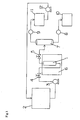
- Fig. 1 shows one example of a plant system for decomposing a polymer according to a process of the present invention.
- a polymer and a water-insoluble base are added into a decomposition reactor 1.
- Water is added into the decomposition reactor 1 from a water tank 2 by using a high-pressure pump 3.
- the amount of water to be added into the decomposition reactor 1 is not more than 50 vol. % of the capacity of the decomposition reactor 1.
- the decomposition reactor 1 is sealed by closing a valve 4 and a decompression valve 5.
- the decomposition reactor 1. is externally heated with a constant-temperature bath 6 such that the temperature in the decomposition reactor 1 increases to a given temperature in the range of 250 to 450°C.
- Water in the decomposition reactor 1 is kept in a sub- or supercritical state for a given time to decompose a polymer. After that, the pressure in the decomposition reactor 1 is decreased by controlling the decompression valve 5, and the temperature in the decomposition reactor 1 is decreased to a given temperature in the range of 100 to 200°C by adiabatic expansion or external cooling. Then, a decomposition product of the polymer is fed into a distiller 7 together with water from the decomposition reactor 1.
- the decomposition product containing a monomer or oligomer, for example, an organic acid and an alcohol in salt forms, are recovered in a recovery tank 10 from the bottom of the distiller 7 through a condenser 8.
- the organic acid salt is mainly recovered as a solid. Water is recovered in a water recovery tank 11 from the top of the distiller 7 through a condenser 9, and fed into the water tank 2 with a pump 12 for recycling.
- a cured resin of an unsaturated polyester resin (2 g; "RIGOLAC M-580" manufactured by SHOWA HIGHPOLYMER CO., LTD.), pure water (10 g) and calcium carbonate (2 g) were charged into a reaction tube 13.
- the air inside the reaction tube 13 was replaced with argon gas and the tube was sealed.
- This reaction tube 13 was immersed in a constant-temperature bath 14 at 360°0 to render the water in the reaction tube 13 in a subcritical state. While immersing the reaction tube 13 in the constant-temperature bath 14, a decomposition reaction was performed for 20 minutes. Then, the reaction tube 13 was taken out of the constant-temperature bath 14 and rapidly cooled up to a room temperature by immersing it in a cooling bath 15. Water, an organic acid salt, a dihydric alcohol, a by-product and calcium carbonate were in the content of the reaction tube 13. The undecomposed resin did not exist in the content at all. The decomposition rate was almost 100%.
- Example 2 The same procedure as in Example 1 was repeated except for using barium carbonate (2 g) as a water-insoluble base instead of calcium carbonate.
- the undecomposed resin did not exist in the content of the reaction tube 13 at all, and the decomposition rate was almost 100%.
- the results of Example 2 are shown in Table 1.
- Example 3 The same procedure as in Example 1 was repeated except for using calcium hydroxide (2 g) as a water-insoluble base instead of calcium carbonate.
- the undecomposed resin did not exist in the content of the reaction tube 13 at all, and the decomposition rate was almost 100%.
- the results of Example 3 are shown in Table 1.
- Example 4 The same procedure as in Example 1 was repeated except that the decomposition reaction was performed by immersing the reaction tube 13 in the constant-temperature bath 14 at 360°C for 5 minutes, and the content of propylene glycol was only determined as the content of dihydric alcohol in the aqueous phase by gas chromatography.
- the results of Example 4 are shown in Table 1.
- Example 5 The same procedure as in Example 1 was repeated except that the decomposition reaction was performed by immersing the reaction tube 13 in the constant-temperature bath 14 at 360°C for 2 minutes, and the content of propylene glycol was only determined as the content of dihydric alcohol in the aqueous phase by gas chromatography. The undecomposed resin existed in the content of the reaction tube 13, and the decomposition rate was calculated.
- Table 1 The results of Example 5 are shown in Table 1.
- Example 2 The same procedure as in Example 1 was repeated except not using a water-insoluble base.
- the undecomposed resin did not exist in the content of the reaction tube 13 at all, and the decomposition rate was almost 100%.
- the results of Comparative Example 1 are shown in Table 2.
- Example 2 The same procedure as in Example 1 was repeated except for using potassium hydroxide (2 g) as a water-insoluble base instead of calcium carbonate.
- the undecomposed resin did not exist in the content of the reaction tube 13 at all, and the decomposition rate was almost 100%.
- the results of Comparative Example 2 are shown in Table 2.
- Example 2 The same procedure as in Example 1 was repeated except for using sodium hydroxide (2 g) as a water-insoluble base instead of calcium carbonate.
- the undecomposed resin did not exist in the content of the reaction tube 13 at all, and the decomposition rate was almost 100%.
- the results of Comparative Example 3 are shown in Table 2.
- Comparative Example 4 The same procedure as in Comparative Example 1 was repeated except that the decomposition reaction was performed by immersing the reaction tube 13 in the constant-temperature bath 14 at 360°C for 5 minutes, and the content of propylene glycol was only determined as the content of dihydric alcohol in the aqueous phase by gas chromatography. The undecomposed resin existed in the content of the reaction tube 13, and the decomposition rate was calculated.
- Table 2 The results of Comparative Example 4 are shown in Table 2.
- Comparative Example 5 The same procedure as in Comparative Example 1 was repeated except that the decomposition reaction was performed by immersing the reaction tube 13 in the constant-temperature bath 14 at 360°C for 2 minutes, and the content of propylene glycol was only determined as the content of dihydric alcohol in the aqueous phase by gas chromatography. The undecomposed resin existed in the content of the reaction tube 13, and the decomposition rate was calculated.
- Table 2 Table 1 Ex.1 Ex.2 Ex.3 Ex.4 Ex.5 Decomposition temperature 360°C 360°C 360°C 360°C 360°C Decomposition pressure 18.7 MPa 18.7 MPa 18.7 MPa 18.7 M Pa 18.7 MPa Decomposition time 20 min. 20 min. 20 min. 5 min. 2 min.
Landscapes
- Chemical & Material Sciences (AREA)
- Life Sciences & Earth Sciences (AREA)
- Sustainable Development (AREA)
- Health & Medical Sciences (AREA)
- Chemical Kinetics & Catalysis (AREA)
- Medicinal Chemistry (AREA)
- Polymers & Plastics (AREA)
- Organic Chemistry (AREA)
- Separation, Recovery Or Treatment Of Waste Materials Containing Plastics (AREA)
- Organic Low-Molecular-Weight Compounds And Preparation Thereof (AREA)
Claims (1)
- Verfahren zur Zersetzung eines vernetzten Polymers zu einem Monomer oder Oligomer, umfassend:Hydrolysieren des vernetzten Polymers, bei dem es sich um einen vernetzten Polyester ohne Chlor handelt, mit unter- oder überkritischem Wasser, wobei das vernetzte Polymer in Gegenwart einer wasserunlöslichen Base, die aus der Gruppe ausgewählt ist, die aus CaCO3, BaCO3 und Ca(OH)2 besteht, mit unter- oder überkritischem Wasser in Kontakt gebracht wird, wobei die Menge der wasserunlöslichen Base 50 bis 200 Gewichtsteile beträgt, bezogen auf 100 Gewichtsteile des vernetzten Polyesters; undGewinnen eines Monomers oder Oligomers, das durch Zersetzung des vernetzten Polymers erhalten wurde.
Applications Claiming Priority (5)
| Application Number | Priority Date | Filing Date | Title |
|---|---|---|---|
| JP2002324398 | 2002-11-07 | ||
| JP2002324398 | 2002-11-07 | ||
| JP2003281994 | 2003-07-29 | ||
| JP2003281994 | 2003-07-29 | ||
| PCT/JP2003/014136 WO2004041917A1 (ja) | 2002-11-07 | 2003-11-06 | ポリマーの分解方法 |
Publications (3)
| Publication Number | Publication Date |
|---|---|
| EP1580222A1 EP1580222A1 (de) | 2005-09-28 |
| EP1580222A4 EP1580222A4 (de) | 2007-05-02 |
| EP1580222B1 true EP1580222B1 (de) | 2014-01-22 |
Family
ID=32314067
Family Applications (1)
| Application Number | Title | Priority Date | Filing Date |
|---|---|---|---|
| EP20030810619 Expired - Lifetime EP1580222B1 (de) | 2002-11-07 | 2003-11-06 | Depolymerisationsverfahren |
Country Status (5)
| Country | Link |
|---|---|
| US (1) | US7696378B2 (de) |
| EP (1) | EP1580222B1 (de) |
| JP (1) | JP4297112B2 (de) |
| AU (1) | AU2003277574A1 (de) |
| WO (1) | WO2004041917A1 (de) |
Families Citing this family (23)
| Publication number | Priority date | Publication date | Assignee | Title |
|---|---|---|---|---|
| JP2005054082A (ja) * | 2003-08-05 | 2005-03-03 | Matsushita Electric Works Ltd | プラスチックの分解・回収方法 |
| CN100519638C (zh) * | 2004-03-26 | 2009-07-29 | 松下电工株式会社 | 塑料的分解方法 |
| JPWO2005103131A1 (ja) * | 2004-04-23 | 2008-03-13 | 松下電工株式会社 | 熱硬化性樹脂の分解方法 |
| JP4495629B2 (ja) * | 2004-05-26 | 2010-07-07 | パナソニック電工株式会社 | プラスチックの分解・分離方法 |
| JP4495628B2 (ja) * | 2004-05-26 | 2010-07-07 | パナソニック電工株式会社 | プラスチックの分解・分離方法 |
| JP2010163620A (ja) * | 2004-05-26 | 2010-07-29 | Panasonic Electric Works Co Ltd | プラスチックの分解・分離方法 |
| KR101318495B1 (ko) * | 2004-11-09 | 2013-10-16 | 스미토모 베이클리트 컴퍼니 리미티드 | 분해 반응 장치, 재생수지 조성물 원료 제조 시스템,재생수지 조성물 원료 제조방법, 재생수지 조성물 원료 및성형체 |
| EP1837349A4 (de) * | 2004-11-25 | 2010-05-26 | Panasonic Elec Works Co Ltd | Modifiziertes styrol-maleinsäure-copolymer und verwendung davon |
| JP4770182B2 (ja) * | 2005-01-25 | 2011-09-14 | パナソニック電工株式会社 | 人造大理石の分解方法 |
| JP4754237B2 (ja) * | 2005-02-23 | 2011-08-24 | パナソニック電工株式会社 | プラスチックの分解方法 |
| JP4848506B2 (ja) * | 2005-02-23 | 2011-12-28 | パナソニック電工株式会社 | プラスチックの分解方法 |
| JP2006241380A (ja) * | 2005-03-04 | 2006-09-14 | Matsushita Electric Works Ltd | プラスチックの分解方法 |
| JP4699785B2 (ja) * | 2005-03-28 | 2011-06-15 | パナソニック電工株式会社 | プラスチックの再生方法 |
| JP4754246B2 (ja) * | 2005-03-28 | 2011-08-24 | パナソニック電工株式会社 | プラスチックの分解方法 |
| JP5508025B2 (ja) * | 2007-12-26 | 2014-05-28 | パナソニック株式会社 | 熱硬化性樹脂の分解および分解生成物の回収方法 |
| JP2009203291A (ja) * | 2008-02-26 | 2009-09-10 | Panasonic Electric Works Co Ltd | 分解装置と分解処理方法 |
| JP5148617B2 (ja) * | 2008-03-26 | 2013-02-20 | パナソニック株式会社 | 熱硬化性樹脂の分解および分解生成物の回収方法 |
| WO2015069662A1 (en) | 2013-11-06 | 2015-05-14 | The Board Of Trustees Of The Leland Stanford Junior University | Methods for modifying a hydrophobic polymer surface and devices thereof |
| JP2015172114A (ja) * | 2014-03-11 | 2015-10-01 | 日東電工株式会社 | ポリエステル系樹脂の加水分解物の製造装置 |
| JP2015172113A (ja) * | 2014-03-11 | 2015-10-01 | 日東電工株式会社 | ポリエステル系樹脂の加水分解物の製造方法 |
| KR102359898B1 (ko) * | 2017-10-23 | 2022-02-07 | 주식회사 엘지화학 | 증류 장치 및 이를 이용하는 저비점 물질의 분리 방법 |
| EP4545584A1 (de) | 2022-06-27 | 2025-04-30 | Toray Industries, Inc. | Recyceltes monomer, verfahren zur herstellung von recyceltem monomer und vorrichtung zur herstellung von recyceltem monomer |
| KR20250039380A (ko) | 2022-07-15 | 2025-03-20 | 오사카 가스 케미칼 가부시키가이샤 | 플루오렌 골격을 갖는 수지의 해중합법, 그 생성물 및 용도 |
Family Cites Families (9)
| Publication number | Priority date | Publication date | Assignee | Title |
|---|---|---|---|---|
| JP3042076B2 (ja) | 1990-09-08 | 2000-05-15 | 株式会社神戸製鋼所 | 天然又は合成高分子化合物の選択的加水分解方法 |
| US5386055A (en) * | 1993-08-11 | 1995-01-31 | The University Of Akron | Depolymerization process |
| JP3134095B2 (ja) | 1996-09-09 | 2001-02-13 | 工業技術院長 | 繊維強化プラスチックからの繊維回収再利用方法 |
| JPH10324769A (ja) | 1997-05-23 | 1998-12-08 | Toyota Central Res & Dev Lab Inc | 樹脂廃材の脱塩素処理方法 |
| JP3653946B2 (ja) | 1997-09-10 | 2005-06-02 | 株式会社日立製作所 | 廃プラスチックリサイクルシステム |
| JP3850149B2 (ja) * | 1998-08-05 | 2006-11-29 | 旭化成ケミカルズ株式会社 | 芳香族ジカルボン酸の回収方法 |
| JP2002167453A (ja) | 2000-11-29 | 2002-06-11 | Hitachi Chem Co Ltd | シートモールディングコンパウンド及びそれを用いた成形品 |
| JP2002226871A (ja) * | 2001-01-31 | 2002-08-14 | Tokyo Electric Power Co Inc:The | プラスチックのガス化方法およびガス化装置 |
| JP3718711B2 (ja) * | 2001-07-27 | 2005-11-24 | 国立大学法人島根大学 | ポリエチレンテレフタレートの処理方法 |
-
2003
- 2003-11-06 AU AU2003277574A patent/AU2003277574A1/en not_active Abandoned
- 2003-11-06 JP JP2005502154A patent/JP4297112B2/ja not_active Expired - Fee Related
- 2003-11-06 WO PCT/JP2003/014136 patent/WO2004041917A1/ja not_active Ceased
- 2003-11-06 EP EP20030810619 patent/EP1580222B1/de not_active Expired - Lifetime
- 2003-11-06 US US10/533,432 patent/US7696378B2/en not_active Expired - Fee Related
Also Published As
| Publication number | Publication date |
|---|---|
| US20060247465A1 (en) | 2006-11-02 |
| EP1580222A1 (de) | 2005-09-28 |
| JPWO2004041917A1 (ja) | 2006-03-09 |
| JP4297112B2 (ja) | 2009-07-15 |
| AU2003277574A1 (en) | 2004-06-07 |
| WO2004041917A1 (ja) | 2004-05-21 |
| EP1580222A4 (de) | 2007-05-02 |
| US7696378B2 (en) | 2010-04-13 |
Similar Documents
| Publication | Publication Date | Title |
|---|---|---|
| US7696378B2 (en) | Depolymerization process | |
| JP5883585B2 (ja) | 複合系プラスチック廃棄物の分離回収方法及びそれに用いる万能型分離回収装置 | |
| EP1731557B1 (de) | Verfahren zur zersetzung von kunststoff | |
| JP6510469B2 (ja) | エポキシ樹脂硬化物の解重合方法および組成物 | |
| EP0814143A2 (de) | Verfahren und Apparat zur Konvertierung von Kunststoffabfällen in Öl | |
| KR20040105883A (ko) | 톨루엔디이소시아네이트 제조공정에서 배출되는 고체폐기물로부터 톨루엔디아민의 회수방법 | |
| CN1321700A (zh) | 聚氨酯的分解方法 | |
| EP2258756B1 (de) | Verfahren zur zersetzung von wärmegehärtetem harz und rückgewinnung eines zersetzungsprodukts | |
| JP4806758B2 (ja) | 熱硬化性樹脂の分解・回収方法 | |
| CN101379019B (zh) | 6-羟基己酸酯的制造方法和三烷基胺的制造方法 | |
| KR100369455B1 (ko) | 증류찌꺼기의 처리방법 | |
| JP4848506B2 (ja) | プラスチックの分解方法 | |
| JPH1149889A (ja) | 廃イオン交換樹脂の処理方法 | |
| CN100336852C (zh) | 聚合物的分解方法 | |
| JP2002226871A (ja) | プラスチックのガス化方法およびガス化装置 | |
| JP4601223B2 (ja) | ポリウレタンの分解方法 | |
| JPS6079017A (ja) | ポリオレフイン粉体中に残存する未反応オレフインの回収方法 | |
| JP2001348457A (ja) | ポリウレタンの分解方法 | |
| JP4291126B2 (ja) | プラスチックの分解方法 | |
| CN116766448B (en) | Recycling device for resin composition | |
| JP4979568B2 (ja) | 熱硬化性樹脂の分解・回収方法 | |
| KR100461568B1 (ko) | 메틸아민 폐수로부터 저비점 유기물의 정제 방법 | |
| JP2001323103A (ja) | 難燃樹脂の処理方法 | |
| JP4718803B2 (ja) | 木質材料からの有機酸生成方法 | |
| Akimoto et al. | Thermal liquefaction of municipal waste plastics pretreated with supercritical alkaline alcohols |
Legal Events
| Date | Code | Title | Description |
|---|---|---|---|
| PUAI | Public reference made under article 153(3) epc to a published international application that has entered the european phase |
Free format text: ORIGINAL CODE: 0009012 |
|
| 17P | Request for examination filed |
Effective date: 20050421 |
|
| AK | Designated contracting states |
Kind code of ref document: A1 Designated state(s): AT BE BG CH CY CZ DE DK EE ES FI FR GB GR HU IE IT LI LU MC NL PT RO SE SI SK TR |
|
| AX | Request for extension of the european patent |
Extension state: AL LT LV MK |
|
| DAX | Request for extension of the european patent (deleted) | ||
| A4 | Supplementary search report drawn up and despatched |
Effective date: 20070404 |
|
| RAP1 | Party data changed (applicant data changed or rights of an application transferred) |
Owner name: PANASONIC ELECTRIC WORKS CO., LTD. |
|
| 17Q | First examination report despatched |
Effective date: 20110125 |
|
| RAP1 | Party data changed (applicant data changed or rights of an application transferred) |
Owner name: PANASONIC CORPORATION |
|
| GRAP | Despatch of communication of intention to grant a patent |
Free format text: ORIGINAL CODE: EPIDOSNIGR1 |
|
| INTG | Intention to grant announced |
Effective date: 20130816 |
|
| RIN1 | Information on inventor provided before grant (corrected) |
Inventor name: HIDAKA, MASARU Inventor name: YOSHIDA, HIROYUKI Inventor name: MAEKAWA, TETSUYA Inventor name: NAKAGAWA, TAKAHARU Inventor name: URABE, TOYOYUKI |
|
| GRAS | Grant fee paid |
Free format text: ORIGINAL CODE: EPIDOSNIGR3 |
|
| GRAA | (expected) grant |
Free format text: ORIGINAL CODE: 0009210 |
|
| AK | Designated contracting states |
Kind code of ref document: B1 Designated state(s): AT BE BG CH CY CZ DE DK EE ES FI FR GB GR HU IE IT LI LU MC NL PT RO SE SI SK TR |
|
| REG | Reference to a national code |
Ref country code: GB Ref legal event code: FG4D |
|
| REG | Reference to a national code |
Ref country code: CH Ref legal event code: EP |
|
| REG | Reference to a national code |
Ref country code: AT Ref legal event code: REF Ref document number: 650818 Country of ref document: AT Kind code of ref document: T Effective date: 20140215 |
|
| REG | Reference to a national code |
Ref country code: IE Ref legal event code: FG4D |
|
| REG | Reference to a national code |
Ref country code: DE Ref legal event code: R096 Ref document number: 60345666 Country of ref document: DE Effective date: 20140306 |
|
| REG | Reference to a national code |
Ref country code: NL Ref legal event code: VDEP Effective date: 20140122 |
|
| REG | Reference to a national code |
Ref country code: AT Ref legal event code: MK05 Ref document number: 650818 Country of ref document: AT Kind code of ref document: T Effective date: 20140122 |
|
| PG25 | Lapsed in a contracting state [announced via postgrant information from national office to epo] |
Ref country code: PT Free format text: LAPSE BECAUSE OF FAILURE TO SUBMIT A TRANSLATION OF THE DESCRIPTION OR TO PAY THE FEE WITHIN THE PRESCRIBED TIME-LIMIT Effective date: 20140522 Ref country code: NL Free format text: LAPSE BECAUSE OF FAILURE TO SUBMIT A TRANSLATION OF THE DESCRIPTION OR TO PAY THE FEE WITHIN THE PRESCRIBED TIME-LIMIT Effective date: 20140122 Ref country code: AT Free format text: LAPSE BECAUSE OF FAILURE TO SUBMIT A TRANSLATION OF THE DESCRIPTION OR TO PAY THE FEE WITHIN THE PRESCRIBED TIME-LIMIT Effective date: 20140122 Ref country code: SE Free format text: LAPSE BECAUSE OF FAILURE TO SUBMIT A TRANSLATION OF THE DESCRIPTION OR TO PAY THE FEE WITHIN THE PRESCRIBED TIME-LIMIT Effective date: 20140122 Ref country code: FI Free format text: LAPSE BECAUSE OF FAILURE TO SUBMIT A TRANSLATION OF THE DESCRIPTION OR TO PAY THE FEE WITHIN THE PRESCRIBED TIME-LIMIT Effective date: 20140122 Ref country code: ES Free format text: LAPSE BECAUSE OF FAILURE TO SUBMIT A TRANSLATION OF THE DESCRIPTION OR TO PAY THE FEE WITHIN THE PRESCRIBED TIME-LIMIT Effective date: 20140122 Ref country code: CY Free format text: LAPSE BECAUSE OF FAILURE TO SUBMIT A TRANSLATION OF THE DESCRIPTION OR TO PAY THE FEE WITHIN THE PRESCRIBED TIME-LIMIT Effective date: 20140122 |
|
| PG25 | Lapsed in a contracting state [announced via postgrant information from national office to epo] |
Ref country code: BE Free format text: LAPSE BECAUSE OF FAILURE TO SUBMIT A TRANSLATION OF THE DESCRIPTION OR TO PAY THE FEE WITHIN THE PRESCRIBED TIME-LIMIT Effective date: 20140122 |
|
| REG | Reference to a national code |
Ref country code: DE Ref legal event code: R097 Ref document number: 60345666 Country of ref document: DE |
|
| PG25 | Lapsed in a contracting state [announced via postgrant information from national office to epo] |
Ref country code: CZ Free format text: LAPSE BECAUSE OF FAILURE TO SUBMIT A TRANSLATION OF THE DESCRIPTION OR TO PAY THE FEE WITHIN THE PRESCRIBED TIME-LIMIT Effective date: 20140122 Ref country code: EE Free format text: LAPSE BECAUSE OF FAILURE TO SUBMIT A TRANSLATION OF THE DESCRIPTION OR TO PAY THE FEE WITHIN THE PRESCRIBED TIME-LIMIT Effective date: 20140122 Ref country code: RO Free format text: LAPSE BECAUSE OF FAILURE TO SUBMIT A TRANSLATION OF THE DESCRIPTION OR TO PAY THE FEE WITHIN THE PRESCRIBED TIME-LIMIT Effective date: 20140122 Ref country code: DK Free format text: LAPSE BECAUSE OF FAILURE TO SUBMIT A TRANSLATION OF THE DESCRIPTION OR TO PAY THE FEE WITHIN THE PRESCRIBED TIME-LIMIT Effective date: 20140122 |
|
| PG25 | Lapsed in a contracting state [announced via postgrant information from national office to epo] |
Ref country code: SK Free format text: LAPSE BECAUSE OF FAILURE TO SUBMIT A TRANSLATION OF THE DESCRIPTION OR TO PAY THE FEE WITHIN THE PRESCRIBED TIME-LIMIT Effective date: 20140122 |
|
| PLBE | No opposition filed within time limit |
Free format text: ORIGINAL CODE: 0009261 |
|
| STAA | Information on the status of an ep patent application or granted ep patent |
Free format text: STATUS: NO OPPOSITION FILED WITHIN TIME LIMIT |
|
| 26N | No opposition filed |
Effective date: 20141023 |
|
| PGFP | Annual fee paid to national office [announced via postgrant information from national office to epo] |
Ref country code: GB Payment date: 20141119 Year of fee payment: 12 Ref country code: DE Payment date: 20141119 Year of fee payment: 12 Ref country code: FR Payment date: 20141119 Year of fee payment: 12 |
|
| REG | Reference to a national code |
Ref country code: DE Ref legal event code: R097 Ref document number: 60345666 Country of ref document: DE Effective date: 20141023 |
|
| PG25 | Lapsed in a contracting state [announced via postgrant information from national office to epo] |
Ref country code: SI Free format text: LAPSE BECAUSE OF FAILURE TO SUBMIT A TRANSLATION OF THE DESCRIPTION OR TO PAY THE FEE WITHIN THE PRESCRIBED TIME-LIMIT Effective date: 20140122 |
|
| PG25 | Lapsed in a contracting state [announced via postgrant information from national office to epo] |
Ref country code: LU Free format text: LAPSE BECAUSE OF FAILURE TO SUBMIT A TRANSLATION OF THE DESCRIPTION OR TO PAY THE FEE WITHIN THE PRESCRIBED TIME-LIMIT Effective date: 20141106 Ref country code: MC Free format text: LAPSE BECAUSE OF FAILURE TO SUBMIT A TRANSLATION OF THE DESCRIPTION OR TO PAY THE FEE WITHIN THE PRESCRIBED TIME-LIMIT Effective date: 20140122 |
|
| REG | Reference to a national code |
Ref country code: CH Ref legal event code: PL |
|
| PG25 | Lapsed in a contracting state [announced via postgrant information from national office to epo] |
Ref country code: CH Free format text: LAPSE BECAUSE OF NON-PAYMENT OF DUE FEES Effective date: 20141130 Ref country code: LI Free format text: LAPSE BECAUSE OF NON-PAYMENT OF DUE FEES Effective date: 20141130 |
|
| REG | Reference to a national code |
Ref country code: IE Ref legal event code: MM4A |
|
| PG25 | Lapsed in a contracting state [announced via postgrant information from national office to epo] |
Ref country code: IE Free format text: LAPSE BECAUSE OF NON-PAYMENT OF DUE FEES Effective date: 20141106 |
|
| PG25 | Lapsed in a contracting state [announced via postgrant information from national office to epo] |
Ref country code: BG Free format text: LAPSE BECAUSE OF FAILURE TO SUBMIT A TRANSLATION OF THE DESCRIPTION OR TO PAY THE FEE WITHIN THE PRESCRIBED TIME-LIMIT Effective date: 20140122 |
|
| REG | Reference to a national code |
Ref country code: DE Ref legal event code: R119 Ref document number: 60345666 Country of ref document: DE |
|
| PG25 | Lapsed in a contracting state [announced via postgrant information from national office to epo] |
Ref country code: GR Free format text: LAPSE BECAUSE OF FAILURE TO SUBMIT A TRANSLATION OF THE DESCRIPTION OR TO PAY THE FEE WITHIN THE PRESCRIBED TIME-LIMIT Effective date: 20140423 Ref country code: IT Free format text: LAPSE BECAUSE OF FAILURE TO SUBMIT A TRANSLATION OF THE DESCRIPTION OR TO PAY THE FEE WITHIN THE PRESCRIBED TIME-LIMIT Effective date: 20140122 |
|
| GBPC | Gb: european patent ceased through non-payment of renewal fee |
Effective date: 20151106 |
|
| PG25 | Lapsed in a contracting state [announced via postgrant information from national office to epo] |
Ref country code: TR Free format text: LAPSE BECAUSE OF FAILURE TO SUBMIT A TRANSLATION OF THE DESCRIPTION OR TO PAY THE FEE WITHIN THE PRESCRIBED TIME-LIMIT Effective date: 20140122 Ref country code: HU Free format text: LAPSE BECAUSE OF FAILURE TO SUBMIT A TRANSLATION OF THE DESCRIPTION OR TO PAY THE FEE WITHIN THE PRESCRIBED TIME-LIMIT; INVALID AB INITIO Effective date: 20031106 |
|
| REG | Reference to a national code |
Ref country code: FR Ref legal event code: ST Effective date: 20160729 |
|
| PG25 | Lapsed in a contracting state [announced via postgrant information from national office to epo] |
Ref country code: DE Free format text: LAPSE BECAUSE OF NON-PAYMENT OF DUE FEES Effective date: 20160601 Ref country code: GB Free format text: LAPSE BECAUSE OF NON-PAYMENT OF DUE FEES Effective date: 20151106 |
|
| PG25 | Lapsed in a contracting state [announced via postgrant information from national office to epo] |
Ref country code: FR Free format text: LAPSE BECAUSE OF NON-PAYMENT OF DUE FEES Effective date: 20151130 |