EP1577851A2 - Spielautomat und Programm dafür - Google Patents
Spielautomat und Programm dafür Download PDFInfo
- Publication number
- EP1577851A2 EP1577851A2 EP05005373A EP05005373A EP1577851A2 EP 1577851 A2 EP1577851 A2 EP 1577851A2 EP 05005373 A EP05005373 A EP 05005373A EP 05005373 A EP05005373 A EP 05005373A EP 1577851 A2 EP1577851 A2 EP 1577851A2
- Authority
- EP
- European Patent Office
- Prior art keywords
- sign
- sign data
- information
- data
- correlated
- Prior art date
- Legal status (The legal status is an assumption and is not a legal conclusion. Google has not performed a legal analysis and makes no representation as to the accuracy of the status listed.)
- Withdrawn
Links
Images










Classifications
-
- G—PHYSICS
- G07—CHECKING-DEVICES
- G07F—COIN-FREED OR LIKE APPARATUS
- G07F17/00—Coin-freed apparatus for hiring articles; Coin-freed facilities or services
- G07F17/32—Coin-freed apparatus for hiring articles; Coin-freed facilities or services for games, toys, sports, or amusements
- G07F17/3202—Hardware aspects of a gaming system, e.g. components, construction, architecture thereof
- G07F17/3204—Player-machine interfaces
- G07F17/3209—Input means, e.g. buttons, touch screen
-
- B—PERFORMING OPERATIONS; TRANSPORTING
- B24—GRINDING; POLISHING
- B24B—MACHINES, DEVICES, OR PROCESSES FOR GRINDING OR POLISHING; DRESSING OR CONDITIONING OF ABRADING SURFACES; FEEDING OF GRINDING, POLISHING, OR LAPPING AGENTS
- B24B9/00—Machines or devices designed for grinding edges or bevels on work or for removing burrs; Accessories therefor
- B24B9/02—Machines or devices designed for grinding edges or bevels on work or for removing burrs; Accessories therefor characterised by a special design with respect to properties of materials specific to articles to be ground
- B24B9/06—Machines or devices designed for grinding edges or bevels on work or for removing burrs; Accessories therefor characterised by a special design with respect to properties of materials specific to articles to be ground of non-metallic inorganic material, e.g. stone, ceramics, porcelain
- B24B9/16—Machines or devices designed for grinding edges or bevels on work or for removing burrs; Accessories therefor characterised by a special design with respect to properties of materials specific to articles to be ground of non-metallic inorganic material, e.g. stone, ceramics, porcelain of diamonds; of jewels or the like; Diamond grinders' dops; Dop holders or tongs
-
- B—PERFORMING OPERATIONS; TRANSPORTING
- B23—MACHINE TOOLS; METAL-WORKING NOT OTHERWISE PROVIDED FOR
- B23Q—DETAILS, COMPONENTS, OR ACCESSORIES FOR MACHINE TOOLS, e.g. ARRANGEMENTS FOR COPYING OR CONTROLLING; MACHINE TOOLS IN GENERAL CHARACTERISED BY THE CONSTRUCTION OF PARTICULAR DETAILS OR COMPONENTS; COMBINATIONS OR ASSOCIATIONS OF METAL-WORKING MACHINES, NOT DIRECTED TO A PARTICULAR RESULT
- B23Q17/00—Arrangements for observing, indicating or measuring on machine tools
- B23Q17/12—Arrangements for observing, indicating or measuring on machine tools for indicating or measuring vibration
-
- B—PERFORMING OPERATIONS; TRANSPORTING
- B24—GRINDING; POLISHING
- B24B—MACHINES, DEVICES, OR PROCESSES FOR GRINDING OR POLISHING; DRESSING OR CONDITIONING OF ABRADING SURFACES; FEEDING OF GRINDING, POLISHING, OR LAPPING AGENTS
- B24B41/00—Component parts such as frames, beds, carriages, headstocks
- B24B41/06—Work supports, e.g. adjustable steadies
-
- B—PERFORMING OPERATIONS; TRANSPORTING
- B24—GRINDING; POLISHING
- B24B—MACHINES, DEVICES, OR PROCESSES FOR GRINDING OR POLISHING; DRESSING OR CONDITIONING OF ABRADING SURFACES; FEEDING OF GRINDING, POLISHING, OR LAPPING AGENTS
- B24B47/00—Drives or gearings; Equipment therefor
- B24B47/02—Drives or gearings; Equipment therefor for performing a reciprocating movement of carriages or work- tables
- B24B47/04—Drives or gearings; Equipment therefor for performing a reciprocating movement of carriages or work- tables by mechanical gearing only
-
- B—PERFORMING OPERATIONS; TRANSPORTING
- B24—GRINDING; POLISHING
- B24B—MACHINES, DEVICES, OR PROCESSES FOR GRINDING OR POLISHING; DRESSING OR CONDITIONING OF ABRADING SURFACES; FEEDING OF GRINDING, POLISHING, OR LAPPING AGENTS
- B24B49/00—Measuring or gauging equipment for controlling the feed movement of the grinding tool or work; Arrangements of indicating or measuring equipment, e.g. for indicating the start of the grinding operation
- B24B49/02—Measuring or gauging equipment for controlling the feed movement of the grinding tool or work; Arrangements of indicating or measuring equipment, e.g. for indicating the start of the grinding operation according to the instantaneous size and required size of the workpiece acted upon, the measuring or gauging being continuous or intermittent
- B24B49/04—Measuring or gauging equipment for controlling the feed movement of the grinding tool or work; Arrangements of indicating or measuring equipment, e.g. for indicating the start of the grinding operation according to the instantaneous size and required size of the workpiece acted upon, the measuring or gauging being continuous or intermittent involving measurement of the workpiece at the place of grinding during grinding operation
-
- G—PHYSICS
- G06—COMPUTING OR CALCULATING; COUNTING
- G06F—ELECTRIC DIGITAL DATA PROCESSING
- G06F3/00—Input arrangements for transferring data to be processed into a form capable of being handled by the computer; Output arrangements for transferring data from processing unit to output unit, e.g. interface arrangements
- G06F3/01—Input arrangements or combined input and output arrangements for interaction between user and computer
- G06F3/048—Interaction techniques based on graphical user interfaces [GUI]
- G06F3/0487—Interaction techniques based on graphical user interfaces [GUI] using specific features provided by the input device, e.g. functions controlled by the rotation of a mouse with dual sensing arrangements, or of the nature of the input device, e.g. tap gestures based on pressure sensed by a digitiser
- G06F3/0488—Interaction techniques based on graphical user interfaces [GUI] using specific features provided by the input device, e.g. functions controlled by the rotation of a mouse with dual sensing arrangements, or of the nature of the input device, e.g. tap gestures based on pressure sensed by a digitiser using a touch-screen or digitiser, e.g. input of commands through traced gestures
- G06F3/04883—Interaction techniques based on graphical user interfaces [GUI] using specific features provided by the input device, e.g. functions controlled by the rotation of a mouse with dual sensing arrangements, or of the nature of the input device, e.g. tap gestures based on pressure sensed by a digitiser using a touch-screen or digitiser, e.g. input of commands through traced gestures for inputting data by handwriting, e.g. gesture or text
-
- G—PHYSICS
- G07—CHECKING-DEVICES
- G07F—COIN-FREED OR LIKE APPARATUS
- G07F17/00—Coin-freed apparatus for hiring articles; Coin-freed facilities or services
- G07F17/32—Coin-freed apparatus for hiring articles; Coin-freed facilities or services for games, toys, sports, or amusements
-
- G—PHYSICS
- G07—CHECKING-DEVICES
- G07F—COIN-FREED OR LIKE APPARATUS
- G07F17/00—Coin-freed apparatus for hiring articles; Coin-freed facilities or services
- G07F17/32—Coin-freed apparatus for hiring articles; Coin-freed facilities or services for games, toys, sports, or amusements
- G07F17/3202—Hardware aspects of a gaming system, e.g. components, construction, architecture thereof
- G07F17/3204—Player-machine interfaces
- G07F17/3211—Display means
Definitions
- the present invention relates to a gaming machine and a program thereof.
- gaming machines such as slot machines, computer-games for home use/arcade game use
- These gaming machines generally include a usual controller (keyboard, mouse, game pad and joy stick etc) each with a plurality of buttons.
- a player of the gaming machine manipulates the buttons, associated programs thereof are executed, and an object, for instance a character displayed on a display screen of the gaming machine, is activated based on the manipulation of the player.
- the gaming machine may includes a touch panel as a kind of controller which is configured so that a player directly touches a display screen (the touch panel) and a position at which the display screen is touched is detected whereby characters or the like are maniplated depending on the detected position or various operations are performed (as disclosed, for instance, in Japanese Patent Application Laid-Open Publication Nos. 2002-939 and 2001-273460).
- a touch panel as a kind of controller which is configured so that a player directly touches a display screen (the touch panel) and a position at which the display screen is touched is detected whereby characters or the like are maniplated depending on the detected position or various operations are performed (as disclosed, for instance, in Japanese Patent Application Laid-Open Publication Nos. 2002-939 and 2001-273460).
- the present invention has been completed with the above view in mind and has an object to provide a gaming machine and a program thereof that is enabled to have amusing capabilities on input operations per se executed by a player for thereby providing improved amusement of a game.
- the gaming machine of the present invention features the provision of an input device (touch panel) available for inputting positional information, a positional information acquiring unit (CPU) that acquires positional information inputted from the input device, a sign recognizing unit (CPU) that recognizes sign information based on positional information acquired by the positional information acquiring unit, a sign data storage device (storage device and/or memory) that stores sign data correlated with a certain gaming process, a comparing and discriminating unit (CPU) that makes comparison between sign information, recognized by the sign recognizing unit, and sign data, stored in the sign data storage device and discriminates whether or not sign information and sign data are correlated, and a game processing device (CPU) executing a gaming process associated with sign data.
- the gaming machine directly drawing a magic-circle as the sign on a display screen is an input operation.
- the gaming machine is configured to collate inputted sign and preliminary stored sign data, and in cases where the inputted data and the stored sign data are collated one another based on the predetermined rule, the gaming machine executes a predetermined gaming process which is associated with the stored sign data
- the player is able to perform desired gaming process by drawing a predetermined magic-circle (sign).
- the gaming machine is enabled to have amusing capabilities on input operations per se effectuated by the player on the screen, thereby improving amusement of the game.
- a system is mainly comprised of a host computer 11, and a plurality of gaming machines 12 connected to the host computer 11 via communication lines 13 such as the Internet and a LAN network.
- FIG. 1 there is shown a system wherein eight gaming machines 12 are connected to the host computer 11.
- the number of gaming machines 12, to be connected to the host computer 11, is not particularly limited.
- a role-playing game system with such a structure, a large number of players associated one another are able to participate in play of a role-playing game (hereinafter referred to as RPG) simultaneously.
- RPG role-playing game
- examples of the character 25 may include fellow-characters that progress the RPG in association with the self-character 23.
- a predetermined magic-circle (sign) 24 such as a pentagram, star or other shape
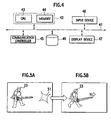
- Operations in the RPG include basic operations, shown in FIGS. 3A and 3B, and special operations shown in FIG 3C. More specifically, the basic operations include basic movement, shown in FIG 3A, and basic attack (non-magic attack) shown in FIG 3B.
- the basic movement includes tapping a point on the display screen close to the point to which the player wishes to move the self-character 23 is desired to move as shown in FIG. 3A. Then, the self-character 23 moves toward tapped direction on a route as short as possible.
- the enemy 21, displayed on the display screen is tapped as shown in FIG 3B. When this takes place, the self-character 23 moves to a position as strategic as possible against the enemy 21 to attack it with a sword or bow.
- Examples of special operations may include magic attack as shown in FIG. 3C.
- Magic attack is practiced upon drawing or tracing a predetermined magic-circle (sign) (or pentagram, stator or other shape) 33 on/vicinity of the enemy 21 displayed over the display screen.
- This allows the self-character 23 to defeat the enemy 21 using magic
- FIG.3C shows a case where fire is summoned upon drawn magic-circle (sign) 33).
- FIG.3C shows a case where fire is summoned upon drawn magic-circle (sign) 33).
- a size of drawn magic-circle (sign) a drawn or traced position on the display screen and a timing at which the magic-circle is drawn or traced on the display screen, magic effects are configured to vary.
- a concrete gaming process will be described below.
- the gaming machine 12 is mainly comprised of a processing unit 42 that allows the execution of a variety of gaming processes, a communication controller 45 that achieves communication control between the host computer 11 and the associated gaming machines 12 via the communication lines 13, a storage device (a memory device, such as a hard disc, a RAM or a storage medium read-out device) 46 that stores programs of the RPG, a display device (display means) 47 which includes the display screen of the gaming machine 12 and displays various images of the RPG on the display screen, and an input device (input means) 48 through which an input is made to perform operation.
- the display screen also serves as the input device 48.
- player may controls his self-character 23 by tapping/dragging on the display screen and/or a non-touch panel type input device, such as buttons provided with the gaming machine 12.
- the processing unit 42 includes a CPU 43 that controls the gaming processes, and a memory 44 having a volatile memory and/or nonvolatile memory that temporally or permanently retain various data.
- the CPU 43 serves as a positional information acquiring device, a sign recognizing device, a comparing and discriminating device (selection device), and a game processing device, respectively.
- the memory 44 and/or the storage device 46 serve as a sign data storage device.
- the processing unit 42 is adapted to execute a variety of gaming processes.
- Examples of the gaming processes may include a step of executing movement and attack (including magic attack), displaying a menu (which is described later), making a shortcut (which is described later), picking up items and touching milestones or the like. It is to be noted that these gaming processes are considered to be of illustrative examples and may be suitably altered depending on kinds of the RPG.
- the tap-icon 51 is laid over on the tapped-object 21, and then the self-character 23 moves in an attack distance suitable for attacking the tapped-object 21, thereby attacking the object 21 as shown in FIG. 5B.
- the menu is displayed on the display screen, as shown in FIG. 7A.
- the menu notifies double-tapped player of the selectable input operations 54 at this time.
- the selectable input operations shown upon double-tapping may include magic-circle to summon fire attack, thunder attack and needle attack.
- the shortcut (special operation set forth above) can be activated upon drawn magic-circle matches with preliminary stored sign data. For instance, as shown in FIG. 8B, drawing one of the shortcuts from a tap-start point 55 to a tap-end point 56 executes a predetermined special operation, such as magic attack. Although the same special operation can be executed by selecting from the displayed menu, however, by drawing the shortcut directly on the display screen, it is possible to quickly execute desired operation without disturbing the progress of the RPG. Meanwhile, the concrete process for the operation will be described beloow.
- the operation for picking up the items is executed by single-tapping the item 57 on the display screen (with the tap icon 51 being displayed) as shown in FIG. 9A.
- the self-character 23 moves toward the item 57 for picking up the item 57 as shown in FIG.9B. Meanwhile, by picking up the item 57, classes of the self-character 23 can be raised.
- examples of the item 57 may include a mana (a kind of currency which can be used in the RPG), arms and armors.
- the operation for touching the milestone is practiced by tapping an object that is referred to as a milestone (with the tap-icon 51 being displayed) as shown in FIG 10A.
- This operation is executed upon picking up and collecting mana dropped in a map displayed on the display screen.
- the self-character 23 approaches the milestone 58 to automatically cause the mana to be put into the milestone 58.
- This enables the self-character 23 to be classed up as shown in FIG 10B.
- a parameter of the self-character 23 is increased during the gaming process.
- the communication controller 45 transfers the gaming process in the RPG to the host computer 11, via the communication line 13, to which the gaming process is transferred from the other gaming machine 12 on which the RPG is practiced.
- the gaming processes delivered from the other gaming machine(s) 12 is (are) displayed together with the own gaming processes over the display screen, which is controlled by the display device 47. This enables a player to game the RPG together with the other associated players.
- the communication lines may include the networks such as the Internet and LAN.
- the input device (input means) 48 may include a touch panel, a mouse, a track ball, a digitizer, joystick and a motion capture.
- a contact type input means like a transparent touch panel disposed on the display screen, which allows the player to directly touch the display screen makes it possible to achieve a further simplified special operation, that is, an operation to draw a magic circle, desired by the player, by simply tracing the same with a finger of the player.
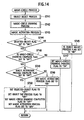
- the gaming process to be executed on the gaming machine 12 with the structure mentioned above, is described further in detail with reference to FIG. 11. Also, description is herein made of a case where the input device 48 is comprised of a touch panel.
- step (hereinafter referred to as ST) 1 a player executes a tap process. That is, the player taps on the touch panel (hereinafter merely referred to as "on the display screen") that serves as the input device 48 displayed on the display screen.
- the tap processes operations are executed for menu process ST2, object tap process ST3 and self-character move process ST4.
- the menu process, the object tap process or the self-character move process is executed respectively.
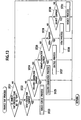
- discrimination is made whether or not the player taps the object (for instance, the milestone) (ST30). With the object is tapped, the object process is executed leveling up the characters (self-character and fellow-character) as shown in FIGs. 10A, 10B (ST31).
- the operations are described in FIG. 13 in an order wherein discriminations are made for the self-character tapping, the fellow-character tapping, the enemy-character tapping, the item tapping and the object tapping, the present invention is not limited to such an order and the order in which discriminations are made for the self-character tapping, the fellow-character tapping, the enemy-character tapping, the item tapping and the object tapping may be configured to be different from that of FIG 13. Also, the fellow-character tapping process, the enemy-character tapping process, the item tapping process and the object tapping process are herein omitted to simplify description.
- an object select process is executed for indicating an object on the display screen.
- the object select process will be described below with reference to FIG 15.
- a magic-circle drawing process is then executed for specifying a special operation, such as magic attack to be executed for the indicated object (ST42).
- a magic activation process is executed for practicing the specified magic attack correlated with drawn magic circle (ST43).
- ST44 discrimination is made whether or not a selected-object flag is set to "ON", that is, whether or not the object has been indicated. If the selected-object flag is set to "ON”, then, discrimination is made whether or not the drawing of the magic-circle has been completed (ST46). If no selected-object flag is set to "ON”, then, the selected-object flag is set to "ON” (ST45).
- the magic activation process flag is set to "ON”; the object tap process flag is set to “OFF”; the selected-object flag is set to “OFF”; the magic-circle drawing completed flag is set to “OFF”; and the magic activation process completed flag is set to "OFF” (ST50). That is, the object tap process is reset. If no magic activation process completed flag is set to "ON”, then, the magic activation process completed flag is set to "ON" (ST49).
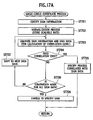
- the magic-circle process is executed upon indicating the object, drawing the magic-circle and activating the indicated magic, such as magic attack. More particularly, after an object (an object, such as an enemy), to which the magic attack is executed, has been indicated, inputted positional (tapped position) information is detected to allow sign (locus of drawn magic-circle) information to be recognized based on positional information detected within a predetermined time interval, upon which comparison is made between at least one sign data, which is preliminarily stored, and recognized sign information to make discrimination whether or not the sign information and the sign data are correlated. This allows the magic-circle drawing process to be executed. Subsequently, with sign information and sign data found to be correlated, at least one preliminarily stored gaming process, associated stored sign data, is executed. This allows the magic activation process to be executed.
- the player inputs on the input device 48 drawing a magic-circle.
- the gaming machine detects sign information based on drawn magic-circle and collates the sign information and stored sign data preliminary associated with a predetermined gaming process (magic-circle drawing process). Then, if the collation is successful, the relevant gaming process is executed (for magic activation process). For this reason, the player is able to execute the gaming process upon drawing a predetermined magic-circle that the player desires. Therefore, it becomes possible for the input operation per se, directly executed by the player on the screen, to have increased amusing capabilities with improved amusement in game.
- the magic-circle drawing process is executed.
- sign information detected based on the magic-circle, drawn by the player within a predetermined time period, and the preliminarily stored sign data are collated. That is, discrimination is made whether or not the player has completed the drawing of an acceptable magic-circle within the predetermined time period, upon which the detected sign information is certified using preliminarily stored sign data.
- the magic-circle drawing process flag is set to "ON" (ST64), starting a magic-circle drawing timer (ST65). Accordingly, the magic-circle, drawn within the predetermined time period measured by the timer, is used as detected sign information in a magic-circle certificate process that will be described later.
- the magic-circle drawing main process is practiced (ST66).
- the operation is executed to detect positional information of the magic-circle inputted by the player.
- sign information based on detected positional information is displayed over the display screen.
- the magic-circle certificate process is practiced using detected sign information (ST70).
- detected sign information and preliminarily stored sign data are collated. That is, discrimination is made whether or not the magic-circle drawn by the player is acceptable magic-circle (ST71).
- sign information based on positional information detected within the predetermined time period, is recognized and comparison is made between at least one stored sign data and detected (recognized) sign information, thereby discriminating whether or not the sign information and stored sign data are correlated.
- the first certificate process provides fundamentals of second and third certificate processes that will be described later. Also, the first certificate process is assumed that a plurality of sign data is preliminarily stored for permitting certain one gaming process to be practiced.
- Positional information at arbitrary points on the locus (sign) of the magic circle, which the player draws on the touch panel (the input means), is delivered to the CPU 43 every period (for instance, for every 0.05 seconds) and the CPU 43 temporary stores these positional information in the memory 44 that serves as a positional information acquiring device.
- Positional information is stored in terms of, for instance, an x-y coordinate value or vector data.
- the CPU 43 serving as a sign recognizing device, executes the operation for recognizing/detecting sign information based on positional information temporary stored in the memory 44 (ST701).
- the CPU 43 does not necessarily have a need to recognize all positional information, temporary stored in the memory 44 as sign information, and may take the form of a structure wherein some positional information (for instance, only positional information corresponding to proselytized points) among positional information stored in the memory 44 are extracted to allow collected one of extracted positional information to be recognized as sign information.
- normalization process refers to a conversion process of sign information, that is, a process in which in order to enable comparison between current sign data and subsequent sign data, a size and inclination (rotation) of the sign in sign information are corrected or coordinate values, contained in sign information, are converted to coordinate values that are based on an original point at an arbitrary point (for instance, a start point of the sign).
- an altered value for instance, at rates of 1.3 times and 0.6 times
- the scalable rate can be used in a magnitude of a subsequent effect or a size in a magic effect graphic display. Also, the scalable rate will be described later in connection with the fourth certificate process.
- the CPU 43 (a comparing and discriminating device) reads out stored sign data from the storage device 46 and/or the memory 44, serving as the sign data storage device, making comparison between detected (recognized) sign information and stored sign data (ST703).
- the CPU 43 serving as the comparing and discriminating device, discriminates based on such comparison whether or not detected sign information and stored sign data are correlated (ST704).
- the term "correlate” refers to a fact that a shape, indicative of detected sign information, has a correlation with a shape, indicative of stored sign data, as a whole.
- correlation-level refers to a numeric value indicative of a degree of correspondence between the shape (graphic symbol) indicative of detected sign information and the shape (graphic symbol) indicative of stored sign data.
- Various methods of calculating the correlation-level may be considered and one example of such methods may include a process in which a plurality of corresponding points are determined in the shape (graphic symbol) indicative of detected sign information and the shape (graphic symbol) indicative of sign data to allow the correlation-level to be calculated using a total sum of the plural points in distance.
- the correlation-level between the shape (graphic symbol) indicative of detected sign information and the shape (graphic symbol) indicative of stored sign data is calculated, upon which is discriminated such that if the correlation-level exceeds a threshold value (for instance, 85), then, discrimination is made that there is a correlation between these factors and, in contrast, if the correlation-level is less than the threshold value, discrimination is made that no relevant correlation exists.
- a threshold value for instance 85
- detected sign information, remaining in a mirror-image relationship, and example stored sign data 61a, 61b are treated as having the correlation.
- detected sign information, remaining in a similarity relationship, and example stored sign data 62a, 62b may be discriminated to have the correlation. Also, a process for the mirror-image relationship will be described in connection with the third certificate process.
- detected sign information and stored sign data are compared and discriminated upon practicing the normalization process (ST702). Meanwhile, the scalable rate, obtained in the normalization process, may be reflected on effects of the gaming process (see the fourth certificate process).
- a gaming process associated with sign information, is selected from at least one stored sign data that is preliminarily stored. At least one stored sign data and a plurality of gaming processes are correlated to one another. Accordingly, a unique gaming process (e.g., magic attack) is executed depending on the magic-circle, which the player has drawn. For instance, as shown in FIG.
- a magic-circle 63a is drawn in a manner, then, the operation is executed to practice magic to allow a fireball to hit a tapped enemy (target); if a magic-circle 63b is drawn, then, the operation is executed to practice magic attack to allow a lightning to hit the tapped enemy (target); and if a magic-circle 63c is drawn, then, the operation is executed to practice magic attack to allow an aculeus to hit the tapped enemy.
- Practicing such input methods provides improved gaming capabilities for the player to perform input operations directly on the screen. Also, these magic items are not limited to particular examples described above and may be possible to be carried out in appropriate alternatives.
- stored sign data may have a unique predetermined time period for each stored sign data to be inputted.
- the gaming process may be configured such that in cases where no sign is inputted within the predetermined time period, no process correlated with relevant sign data is executed (for instance, no magic attack is activated based on the magic-circle).
- stored sign data may include a unique sign quantity for each stored sign data.
- the display screen adapted to display an image of stored sign data depending on the unique predetermined time period during which sign data is inputted. This allows the unique predetermined time period and the unique sign quantity to be provided for each sign data, enabling challenge levels to be provided on magic-circle s to be drawn by the player. For instance, increased challenge levels may be allocated to the magic-circle with increased unique predetermined time period for input and the sign with increased unique sign quantity.
- the unique sign quantities may be preferably configured to differ from one another depending on a volume of and/or the number of the proselytized points of the above described sign data. Additionally, the sign quantities can be determined in proportion to a total sum of line segments defined by connecting the proselytized points.
- the drawing-levels can be set in fine degrees for the magic-circle to be drawn by the player. For instance, increased drawing-levels can be allocated to sign data along with increasing values of the volume of and/or the number of the proselytized points of the above described sign data.
- the magic activation process may be executed in a way to provide effects that vary depending on the unique predetermined time period and/or the unique sign quantity for the magic-circle to be drawn. More particularly, on the contrary, if the sign is drawn in a large size, as shown in FIG 18B, or when the number of the proselytized points (the number of angles on the magic-circle) increases, the magic activation process (gaming process) may be executed with increased effects. For instance, the fireball may be increased in size to enable an increased damage to be applied to the enemy.
- magic This enables magic to be executed depending on the difficulty level at which the magic-circle is drawn. For instance, a sign drawing with an increased difficulty level may be allocated to magic attack with an increased effect. This allows the player to draw the sign with the increased difficulty level whereby the player is enabled to execute magic with the increased effect. This results in improvement in gaming capabilities for the player to perform the input operations directly on the screen.
- magic includes, for instance, magic attack to attack tapped enemy character and cure magic to cure the self-character or tapped fellow-character.
- stored sign data is configured to have the specific point for collation and the specific point of the sign data and the specific point of the sign information are collated for comparison and discrimination, whereby finely graded collations can be performed to achieve comparison and discrimination in high precisions.
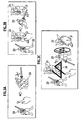
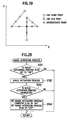
- specific points refers to, for instance, a tap-start point, a tap-end point and an intermediate-point as shown in FIG. 19. Relative coordinates on these specific points and orders of the tap-start point/intermediate point/tap-end point are preliminarily stored as sign data, and comparison and discrimination are made between stored sign data and detected sign information. As for sign information in the mirror-image relationship and the similarity relationship, a comparison object can be prepared depending on stored sign data involving the relative coordinates and the orders of the tap-start point/intermediate point/tap-end point.
- the CPU 43 specifies a process correlated with relevant sign data (ST705).
- the CPU 43 serving as a comparing and discriminating device, reads out a process code, stored in correlation with relevant sign data, from the storage device 46 and/or the memory 44, playing a role as a sign data storing device, and operates in a way to deliver the gaming process, correlated with relevant sign data, to the CPU 43 serving as a game processing device.
- the CPU 43 discriminates whether or not comparison between all sign data stored in the storage device 46 and/or the memory 44, playing a role as the sign data storing device, and sign information is completed (ST706). If comparison between all sign data and sign information is not completed (with "No” in ST706), the CPU 43 allows the operation to proceed to next non-compared sign data (ST707) whereupon comparison is made between relevant sign data and sign information (ST703) to make discrimination as to whether or not the correlation exists between two factors.
- the magic-circle drawing complete flag is set to "ON” and the magic-circle drawing process flag is set to "NO” (ST72). Then, the operation proceeds to the magic activation process.
- the CPU 43 serving as a game processing device, executes the gaming process associated with certified sign data resulting from the sign (sign information) drawn by the player, providing a display on the screen wherein specific magic (magic attack) is executed on the enemy (in magic activation). Thereafter, discrimination is made whether or not the magic activation process is completed (ST83). Upon completion of the magic activation process, the magic activation process complete flag is set to "ON” and the magic activation process flag is set to "OFF" (ST84).
- sign information based on inputted positional information, is recognized/detected and comparison is made between at least one of preliminarily stored sign data and recognized/detected sign information to discriminate whether or not the both factors are correlated whereby when the both factors are found to be correlated, the CPU 43 executes at least one gaming process that is correlated with both sign data and preliminarily stored.
- each gaming process is preliminary associated with a corresponding position/area of the display panel (touch panel), respectively.
- the area of the display screen where the gaming process can be allocated is limited. Therefore, as increasing the gaming processes, an entire area of the limited touch panel is fully allocated to respective processes, resulting in a probability with difficulties in allocating further processes.
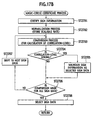
- the second certificate process which will be described below, has an object to enable a desired gaming process to be selected from processes of a large number of kinds for execution without suffering from limitation in a surface area of the display screen (an input region).
- the CPU 43 selects relevant sign data (present selected sign data) to be maintained (ST2705). For instance, the CPU 43 (a sign data selecting device) reads out a process code, stored in correlation with selected sign data, from the storage device 46 and/or the memory 44 (the sign data storing device) and operates so as to deliver the process code to the CPU 43 (the game processing device) that executes the process correlated with present selected sign data.
- the CPU 43 discriminates whether or not the comparison for all sign data stored in the storage device 46 and/or the memory 44 (the sign data storing device) is completed (ST2706).
- the magic-circle drawing complete flag is set to "ON” and the magic-circle drawing process flag is set to "OFF" (FIG.16, ST72). Then, the operation enters the magic activation process.
- the operations, subsequent to such step, are identical to those of the first certificate process described above and, so, description of the same is herein omitted.
- the first certificate process includes a case wherein stored sign data a n , composed of a plurality of sign data a 1 , a 2 , ⁇ , a n , which permits one associated certain process A to be executed, are exemplified.
- these stored sign data a 1 , a 2 , ⁇ , a n perform as an acceptable error range to execute the process A.
- the first and second certificate processes are combined to make it possible for plural inputs to be made in a sole input area, and for each of a plurality of processes X 1 , X 2 , ⁇ , X n , a plurality of store sign data, permitting the execution of respective processes, are preliminarily stored such that sign data x 1 , x 2 , ⁇ , x n are stored for the process X 1 .
- the plurality of processes is inputted in the sole input area with the resultant improvement in operability, while making it possible for the player to enable the inputting in fluctuations.
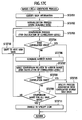
- the third certificate process has, in addition to the objects of the first and second certificate processes, an object to provide a possibility of recognizing a magic-circle that is inputted with the nondominant hand of a player.
- the CPU 43 specifies a process associated with the correlated stored sign data (ST3705). For instance, the CPU 43 (the comparing and discriminating device) reads out a process code, stored in association with such sign data, from the storage device 46 and/or the memory 44, playing a role as the sign data storing device, and operates so as to deliver the resulting process code to the CPU 43 serving as the game processing device that executes the process associated with such a process code.
- the CPU 43 generates a mirror image of the stored sign data (ST3706). Also, in place of generating the mirror image, it doesn't matter if the relevant mirror image is preliminarily stored in the sign data storing device to allow the relevant mirror image to be read out when needed.
- the CPU 43 plays a role as the comparing and discriminating device
- ST3707 sign information recognized upon the inputted positional data
- the generated/stored mirror image ST3707
- the CPU 43 specifies a process associated with such correlated sign data (ST3705).
- the CPU 43 playing a role as the comparing and discriminating device, reads out a process code, stored in association with the correlated original sign data for generating the mirror image, from the storage device 46 and/or the memory 44 (a role as the sign data storing device) and operates so as to deliver the resulting process code to the CPU 43 (the game processing device) that executes the process associated with such a process code.
- the CPU 43 discriminates whether or not the comparison between all sign data, stored in the storage device 46 and/or the memory 44 (the sign data storing device) and sign information recognized upon the inputted positional information is completed (ST3709). If the comparison between all stored sign data and the sign information is not completed (with "No” in ST3709), the CPU 43 allows the operation to proceed to next non-compared sign data (ST3710) whereupon comparison is made between subsequent sign data/mirror image and the sign information (ST3703/ST3707) to make discrimination as to whether or not there is the relevant correlation (ST3704/ST3708).
- the magic-circle drawing complete flag is set to "ON” and the magic-circle drawing process flag is set to "OFF” (ST72). Then, the operation enters the magic activation process.
- the operations, subsequent to such step, are identical to those of the first certificate process described above and, so, description of the same is herein omitted.
- the fourth certificate process may be configured such that the scalable rate and, for instance, the process code by which the process is indicated are delivered to the CPU 43 (the game processing device) upon which the CPU 43 executes the relevant process by multiplying a predetermined reference value (such as, for instance, a damage quantity and a size in magic-effect image) of the process associated with correlated sign data by the scalable rate.
- a predetermined reference value such as, for instance, a damage quantity and a size in magic-effect image
- sign information is recognized upon inputted positional information including factors, such as a shape and size of drawn magic-circle, and the comparison step is executed based on such factors, therefore, it becomes possible to indicate the process and the size of the process simultaneously in an easy manner upon execution of single input operation.
- the present invention is not limited to the various embodiments set forth above and the present invention may be implemented in a variety of alternatives.
- the embodiments described above have been described with reference to cases where the game includes the arcade game, the present invention is not limited thereto and may be possible to be similarly applied to other RPG.
- the embodiments have been described above in conjunction with the case where the input device includes the touch panel, the present invention may similarly have applications to a case where the input device includes an input device other than the touch panel.
- the gaming machine of the present invention may be of either for the arcade or for a consumer.
- the simulations of the gaming machine of the first embodiment have been treated as the data processing device, the data processing of these simulations may take the form of software.
- a ROM stores a program (that is, involving a procedure for detecting positional information that is inputted; a procedure for recognizing sign information based on inputted positional information that is detected within a predetermined time period; a procedure for making comparison between at least one preliminarily stored sign data and recognized sign information for discriminating whether or not detected/recognized sign information and stored sign data are correlated; and a procedure for executing at least one preliminarily stored gaming process that is correlated to sign data) to allow a CPU to command and operate in accordance with the program.
- a program that is, involving a procedure for detecting positional information that is inputted; a procedure for recognizing sign information based on inputted positional information that is detected within a predetermined time period; a procedure for making comparison between at least one preliminarily stored sign data and recognized sign information for discriminating
- the program is stored in computer-readable storage medium to allow the data processing program of storage medium to be stored in a RAM of a computer whereby the CPU operates in accordance with the data processing program.
- the presently filed embodiment has the same operation and effects as those of the embodiments set forth above.
- the input content may take the form of various other shapes, such as characters and numerals, which may be inputted and detected.
- the slot machine 101 has a cabinet 102 and further includes an upper LCD (first liquid crystal device) 103 located in an upper area of the cabinet 102, and a lower LCD (second liquid crystal device) 104 located in a lower area of the cabinet 102.
- the upper LCD 102 includes a commercially and widely used liquid crystal
- the lower LCD 104 takes a structure that includes a so-called transparent LCD adapted to be suitably controlled whereby a player is able to view symbols provided on reels 122 located behind the lower LCD 104.
- a control panel 105 disposed below the lower LCD 104 are a control panel 105, equipped with various control buttons, and a start lever 117 mounted on the cabinet 102 at one side thereof.
- a first game is caused to start upon which, for instance, three reels 122 (see FIG. 22) rotatably mounted inside the cabinet 102 rotate for a given time interval and then stop, respectively.
- the symbols, provided on the respective reels 122 are viewed through display windows 123, 124, 125 located in positions associated with the respective reels 122 of the lower transparent LCD 104. Also, extending across the respective display windows 123, 124, 125 is a payline L.
- paylines L may be provided so as to obliquely extend across the display windows 123, 124, 125 depending on values given on the game. Also, the amount of value, which the game may be given, may be possible to be selected by BET buttons (1-BET button 111, 2-BET button (spin button) 112, a 3-BET button 113 and 5-BET button 114).
- the operation is executed to pay the number of medals depending on each winning combination through a payout opening 115 or to allow a game value depending on the winning to be temporarily stored.
- a touch panel 130 that is fixedly secured together with the lower LCD 104 onto a front panel 120 of the cabinet 102 by means of suitable fixing segments, respectively.
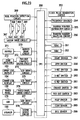
- the control system of the slot machine 101 is generally comprised of a CPU 350 as a core, to which a ROM 351 and a RAM 352 are connected, respectively.
- the ROM 351 stores game control programs, various effect programs for permitting the upper LCD 103 and the lower LCD 104 to perform various effects with a progress of the game, a drawing table for executing drawings of various winning combinations, other various programs needed for controlling the slot machine 101, and data tables.
- the RAM 352 plays a role as a storage device in which various data, calculated by the CPU 350, are temporarily stored.
- the CPU 350 executes a first game based on the various programs stored in the ROM 351, while executing a second game when a specific condition is established during the first game.
- a clock pulse generation circuit 353 which generates reference clock pulses
- a frequency divider 354 which generates random number generation circuit 355, which generates random numbers
- a random number sampling circuit 356 which uses the random numbers to sample the random number sampling circuit 356 for various drawings for symbols and the effects for each reel 122.
- a range of the random numbers corresponding to the symbols for each reel 122 is set, and the symbol are determined upon referring to a random number value, extracted from a predetermined random number range (for instance, a value ranging from "0" to "255"), for each reel 122 and a "odds drawing table" (not shown) and judging which random number range of the symbols correspond to the extracted random number.
- a predetermined random number range for instance, a value ranging from "0" to "255
- a start switch 357 disposed in the start lever 117
- a spin switch 358 disposed in the spin button (2-BET button) 112
- a 1-BET switch 359 disposed in the 1-BET button 111
- a 3-BET switch 360 disposed in the 3-BET button 113
- a 5-BET switch 361 disposed in the 5-BET button 114
- an exchange (change) switch 362 disposed in an exchange button 106
- a pay-out switch 363 disposed in a pay-out button 107
- a help switch 363 disposed in a help button 108.
- the CPU 350 controls in a way to execute various operations associated with the various buttons based on switch signals outputted from the respective switches upon depressions thereof.
- a coin sensor 365 located in the coin insertion slot 109 and a bill sensor 366 located in the bill insertion slot 110.
- the coin sensor 365 detects the coins inserted through the coin insertion slot 109 and the CPU 350 calculates the number of coins based on a coin detection signal outputted from the coin sensor 365.
- the bill sensor 366 detects the kind and amount of bills inserted through the bill insertion slot 110 and the CPU 350 calculates the number of coins equivalent to the amount of bills based on a bill detection signal outputted from the bill sensor 366.
- Three stepping motors 368 are connected to the CPU 350 via a motor drive circuit 367 by which respective reels 122 are rotatably driven, and a reel position detection circuit 369 is also connected to the CPU 43. With motor drive signals outputted from the CPU 350 to the motor drive circuit 367, the respective stepping motors 368 are rotatably driven. This allows the rotations of respective reels 122.
- the CPU 350 recognizes a rotational position of the symbol on each reel 122 depending upon the calculated value, associated with the rotational position within one-rotation range of each reel 122, and a symbol table wherein a rotational position, stored in the ROM 351, of each reel 122 and a symbol, formed on an outer periphery of each reel 122, are associated with each other.
- a hopper 371 is connected to the CPU 350 via a hopper drive circuit 370. As a drive signal is outputted from the CPU 350 to the hopper drive circuit 370, the hopper 371 pays out a predetermined number of coins from the coin payout opening 115.
- a coin detector 373 is connected to the CPU 350 via a pay-out complete signal circuit 372.
- the coin detector 373 is disposed inside the coin payout opening 115 and, when detected the predetermined number of coins being paid out from the coin payout opening 115, outputs a coin-paid-out detection signal to the pay-out complete signal circuit 372 based on which the pay-out complete signal circuit 372 outputs a pay-out complete signal to the CPU 350.
- the upper LCD 104 is connected through an LCD driver circuit 374 to the CPU 350, to which the lower LCD 104 is also connected via an LCD driver circuit 375.
- the touch panel 130 is connected to the CPU 350 through a touch panel drive circuit 376.
- LEDs 178 are connected to the CPU 350 via an LED drive circuit 377.
- a large number of LEDs 178 are arrayed on a front face of the slot machine 101 and, when performing various effects, controllably lighted by the LED drive circuit 377 in response to drive signals delivered from the CPU 350.
- a sound output circuit 379 and a speaker 180 are connected to the CPU 350 and the speaker 180 serves to generate various sound effects when performing various effects in response to output signals from the sound output circuit 379.
- the rotations of the respective reels 122 cause the symbols, drawn on respective circumferential peripheries, to be displayed in varying modes and stopping the rotation of the reels 122 cause the symbols to stop for display, thereby permitting the first game, which will be described later, to proceed.
- the BET process is automatically executed when the player inserts the coins or executed for the first time when the player depresses any of the BET buttons (111, 112, 113 and 114).
- step ST212 discrimination is made whether or not the player depresses the start switch 357 commanding to start the first game.
- the CPU 350 discriminates whether a signal, indicative of the start switch 357 being depressed by the player, is received.
- the operation proceeds to ST213 and, in contrast, if discrimination is made that no signal is received, the operation in step ST212 is executed again.
- an internal drawing process is executed (ST213).
- the CPU 350 delivers a command to the random number generation circuit 355 to generate a random number, and the random number generation circuit 355 generates the random numbers in response to the command.
- the CPU 350 stores internal drawing data, based on the resulting random numbers, in the predetermined areas of the RAM 352.
- the internal drawing data involves data indicative of combination modes of the symbols that are made possible to be stopped and displayed upon winning on a winning combination.
- the present invention may take the form of a structure wherein the random numbers are generated in software (upon executing a predetermined updating of a numeric value on a fixed or non-fixed cycles) by the CPU 350, the programs stored in the ROM 351, and the RAM 352 to allow internal drawing data to be stored in the predetermined areas of the RAM 352 depending on the resulting random numbers.
- the random number generation circuit 355 may be possible to be dispensed with.
- a reel rotating process is executed (ST215).
- the CPU 350 delivers a signal to the motor drive circuit 367 in order to rotate the reels 122.
- the LCD drive circuits 375, 376 allow various effects to be performed on the upper LCD 103 and the lower LCD 104 in suitable fashions, while controllably lighting the LEDs 178 and performing the effects with sound voices using the speaker 180.
- a reel stop process is executed (ST214). During such a process, the CPU 350 delivers a signal to the motor drive circuit 367 so as to stop rotating the reels 122.
- the second game is executed.
- the winning process is executed (ST216).
- the CPU 350 executes the winning process based on the symbols of the stopped reels 122.
- the current subroutine is completed.
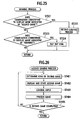
- discrimination is made whether or not a combination of the symbols on the reels 122 stopped in the first game is involved in the winning mode for "start of the second game" (ST321). That is, during such a process, the CPU 350 discriminates whether or not the combination of the symbols in ST 215 of the subroutine shown in FIG. 24 indicates a shift to the second game.
- the CPU 350 executes the second gaming process (ST322).
- the second game can be executed without using any further value and carried out under a rule different from that of the first game. Also, the second game will be described below in detail.
- the CPU 350 pays out the coins depending on the winning mode (ST324). If it is discriminated in ST323 that the combination of the symbols does not correspond to the winning mode, or if the operations in ST322 or ST324 are executed, the current subroutine is completed. Also, the CPU 350 serves as a first game control device that controls the first game based on the reels 122.
- the CPU 350 serves as a second game control device that controls the second game.
- the CPU 350 determines at least one game from a plurality of second games stored in the ROM 351 in accordance with a predetermined condition or in a random fashion, allowing the determined game to be displayed on the lower LCD 104 (ST401, ST402).
- the second game has the mode shown in FIG. 2 set forth above. That is, in the second game, the player operates tapping the self-character 23 on the touch panel 130 (input control: ST403) and executing predetermined operations, for instance, drawing the magic-circle to attack the enemy 21 (gaming process: ST404) allows the number of available coins to be determined in the second game depending on the degree of attack in success.
- predetermined operations for instance, drawing the magic-circle to attack the enemy 21
- ST404 drawing process
- ST404 drawing process
- the second game may include a play for instance, to draw predetermined letter strings and graphic symbols.
- the slot machine 101 of the second embodiment may be configured such that the second game is executed by the upper LCD 103 or the lower LCD 104 or executed over the upper LCD 103 and the lower LCD 104. Also, another alternative may be such that the second game is executed in each of the upper LCD 103 and the lower LCD 104 to be different from each other.
- the second embodiment is not limited to the slot machine and may include a pachinko gaming machine, a pachi-slot gaming machine and a pin ball, all of which are equipped with touch panels, respectively.
- the gaming machine of the second embodiment executing various operations on the touch panel in two games, by which the player is apt to be passive, allows the player to participate the game in an aggressive manner, thereby improving the amusement of the game. Further, in such an event, the plural gaming processes can be associated with limited input areas without causing a better arm to be less susceptible like the first embodiment set forth above.
- a gaming machine of the present invention detects positional information that is inputted, recognizes sign information based on detected positional information, makes comparison between at least one preliminarily stored sign data and recognized sign information to discriminate whether or not the sign information and the sign data are correlated, and executes at least one preliminarily stored game processing associated with the sign data when the sign information and the sign data are correlated.
Landscapes
- Engineering & Computer Science (AREA)
- Physics & Mathematics (AREA)
- General Physics & Mathematics (AREA)
- Mechanical Engineering (AREA)
- Theoretical Computer Science (AREA)
- General Engineering & Computer Science (AREA)
- Human Computer Interaction (AREA)
- Chemical & Material Sciences (AREA)
- Ceramic Engineering (AREA)
- Inorganic Chemistry (AREA)
- User Interface Of Digital Computer (AREA)
- Management, Administration, Business Operations System, And Electronic Commerce (AREA)
- Pinball Game Machines (AREA)
- Display Devices Of Pinball Game Machines (AREA)
Applications Claiming Priority (8)
| Application Number | Priority Date | Filing Date | Title |
|---|---|---|---|
| JP2004069468 | 2004-03-11 | ||
| JP2004069469 | 2004-03-11 | ||
| JP2004069466 | 2004-03-11 | ||
| JP2004069469A JP2005253687A (ja) | 2004-03-11 | 2004-03-11 | ゲーム機及びプログラム |
| JP2004069467A JP2005258809A (ja) | 2004-03-11 | 2004-03-11 | 情報処理装置及びプログラム |
| JP2004069467 | 2004-03-11 | ||
| JP2004069468A JP2005253686A (ja) | 2004-03-11 | 2004-03-11 | 情報処理装置及びプログラム |
| JP2004069466A JP2005258808A (ja) | 2004-03-11 | 2004-03-11 | 入力認識装置及びプログラム |
Publications (2)
| Publication Number | Publication Date |
|---|---|
| EP1577851A2 true EP1577851A2 (de) | 2005-09-21 |
| EP1577851A3 EP1577851A3 (de) | 2005-10-12 |
Family
ID=34841844
Family Applications (1)
| Application Number | Title | Priority Date | Filing Date |
|---|---|---|---|
| EP05005373A Withdrawn EP1577851A3 (de) | 2004-03-11 | 2005-03-11 | Spielautomat und Programm dafür |
Country Status (7)
| Country | Link |
|---|---|
| US (1) | US20050208993A1 (de) |
| EP (1) | EP1577851A3 (de) |
| KR (1) | KR100699376B1 (de) |
| CN (1) | CN100542642C (de) |
| AU (1) | AU2005201050A1 (de) |
| EA (1) | EA008783B1 (de) |
| SG (1) | SG115857A1 (de) |
Cited By (1)
| Publication number | Priority date | Publication date | Assignee | Title |
|---|---|---|---|---|
| CN105808106A (zh) * | 2016-03-22 | 2016-07-27 | 太仓煜和网络科技有限公司 | 基于滑动轨迹执行战斗操作的游戏设备及游戏提供方法 |
Families Citing this family (52)
| Publication number | Priority date | Publication date | Assignee | Title |
|---|---|---|---|---|
| US10201753B2 (en) * | 2004-07-16 | 2019-02-12 | Universal Entertainment Corporation | Gaming machine and program thereof |
| US7448115B2 (en) * | 2005-01-18 | 2008-11-11 | Illinois Tool Works Inc. | Modular attachment assembly |
| JP2006280731A (ja) * | 2005-04-01 | 2006-10-19 | Aruze Corp | ゲームプログラム、ゲーム装置及び記録媒体 |
| JP2006280734A (ja) * | 2005-04-01 | 2006-10-19 | Aruze Corp | ゲームプログラム、ゲーム装置及び記録媒体 |
| JP2006340744A (ja) * | 2005-06-07 | 2006-12-21 | Nintendo Co Ltd | ゲームプログラムおよびゲーム装置 |
| US8113945B2 (en) * | 2008-03-06 | 2012-02-14 | Universal Entertainment Corporation | Playing method of card game and game machine |
| US8602875B2 (en) | 2009-10-17 | 2013-12-10 | Nguyen Gaming Llc | Preserving game state data for asynchronous persistent group bonus games |
| US11990005B2 (en) | 2009-11-12 | 2024-05-21 | Aristocrat Technologies, Inc. (ATI) | Gaming system supporting data distribution to gaming devices |
| US9626826B2 (en) | 2010-06-10 | 2017-04-18 | Nguyen Gaming Llc | Location-based real-time casino data |
| US8864586B2 (en) | 2009-11-12 | 2014-10-21 | Nguyen Gaming Llc | Gaming systems including viral gaming events |
| US8597108B2 (en) * | 2009-11-16 | 2013-12-03 | Nguyen Gaming Llc | Asynchronous persistent group bonus game |
| US8696470B2 (en) | 2010-04-09 | 2014-04-15 | Nguyen Gaming Llc | Spontaneous player preferences |
| JP4944225B2 (ja) * | 2010-04-28 | 2012-05-30 | 株式会社コナミデジタルエンタテインメント | データ生成システム、それに用いられるデータ生成方法及び、コンピュータプログラム |
| CN102940966B (zh) * | 2010-04-28 | 2015-08-26 | 科乐美数码娱乐株式会社 | 游戏系统 |
| JP4827978B2 (ja) * | 2010-04-28 | 2011-11-30 | 株式会社コナミデジタルエンタテインメント | ゲームシステム及び、それに用いる制御方法 |
| JP4885290B2 (ja) * | 2010-04-28 | 2012-02-29 | 株式会社コナミデジタルエンタテインメント | ゲームシステム及び、それに用いる制御方法 |
| JP4885291B2 (ja) * | 2010-04-28 | 2012-02-29 | 株式会社コナミデジタルエンタテインメント | ゲームシステム、データ生成システム、それに用いるデータ生成方法及び、コンピュータプログラム |
| JP4890629B2 (ja) * | 2010-06-10 | 2012-03-07 | 株式会社コナミデジタルエンタテインメント | ゲームシステム、それに用いる制御方法及び、コンピュータプログラム |
| JP4827982B1 (ja) * | 2010-06-10 | 2011-11-30 | 株式会社コナミデジタルエンタテインメント | ゲームシステム、それに用いる制御方法及び、コンピュータプログラム |
| US9564018B2 (en) | 2010-11-14 | 2017-02-07 | Nguyen Gaming Llc | Temporary grant of real-time bonus feature |
| US9595161B2 (en) | 2010-11-14 | 2017-03-14 | Nguyen Gaming Llc | Social gaming |
| US12100260B2 (en) | 2010-11-14 | 2024-09-24 | Aristocrat Technologies, Inc. (ATI) | Multi-functional peripheral device |
| US9235952B2 (en) | 2010-11-14 | 2016-01-12 | Nguyen Gaming Llc | Peripheral management device for virtual game interaction |
| US8449367B2 (en) * | 2011-06-06 | 2013-05-28 | Universal Entertainment Corporation | Gaming machine capable of being played by a plurality of players and dividing the prize among them |
| US9672686B2 (en) | 2011-10-03 | 2017-06-06 | Nguyen Gaming Llc | Electronic fund transfer for mobile gaming |
| KR101381574B1 (ko) * | 2012-10-17 | 2014-09-24 | 허경석 | 무선단말기에서의 블라인드 게임 제어방법 |
| US9600976B2 (en) | 2013-03-15 | 2017-03-21 | Nguyen Gaming Llc | Adaptive mobile device gaming system |
| US12347267B2 (en) | 2013-03-15 | 2025-07-01 | Aristocrat Technologies, Inc. | Game management for mobile and remote gaming devices |
| US11030851B2 (en) | 2013-03-15 | 2021-06-08 | Nguyen Gaming Llc | Method and system for localized mobile gaming |
| US12347268B2 (en) | 2013-03-15 | 2025-07-01 | Aristocrat Technologies, Inc. | Adaptive mobile device gaming system |
| US9483901B2 (en) | 2013-03-15 | 2016-11-01 | Nguyen Gaming Llc | Gaming device docking station |
| US9814970B2 (en) | 2013-03-15 | 2017-11-14 | Nguyen Gaming Llc | Authentication of mobile servers |
| US10421010B2 (en) | 2013-03-15 | 2019-09-24 | Nguyen Gaming Llc | Determination of advertisement based on player physiology |
| JP6089866B2 (ja) | 2013-03-27 | 2017-03-08 | 富士通株式会社 | 情報処理装置、情報処理方法及び情報処理プログラム |
| GB201308784D0 (en) * | 2013-05-15 | 2013-06-26 | King Com Ltd | Mobile device game interface |
| JP5436716B1 (ja) | 2013-07-26 | 2014-03-05 | 株式会社 ディー・エヌ・エー | ゲーム用プログラム、サーバ、及び方法 |
| JP5436715B1 (ja) | 2013-07-26 | 2014-03-05 | 株式会社 ディー・エヌ・エー | ピンボールゲーム用のプログラム、サーバ、及び方法 |
| JP5873515B2 (ja) * | 2014-03-10 | 2016-03-01 | 株式会社 ディー・エヌ・エー | ゲームプログラム、及び、情報処理装置 |
| CN105530549A (zh) * | 2014-10-21 | 2016-04-27 | 深圳市天易联科技有限公司 | 远程操控游戏方法及系统 |
| US9542799B2 (en) | 2014-12-12 | 2017-01-10 | Synergy Blue, Llc | Hybrid arcade-type, wager-based gaming techniques and predetermined RNG outcome batch retrieval techniques |
| US10032337B2 (en) | 2014-12-12 | 2018-07-24 | Synergy Blue, Llc | Achievement-based payout schedule unlock techniques implemented in wager-based gaming networks |
| US10269214B2 (en) | 2014-12-12 | 2019-04-23 | Synergy Blue, Llc | Hybrid arcade/wager-based gaming aspects relating to entertainment and wagering gaming activities |
| US10255765B2 (en) | 2015-08-20 | 2019-04-09 | Synergy Blue, Llc | Gaming aspects relating to multiplayer/tournament hybrid arcade/wager-based games |
| US10255763B2 (en) | 2014-12-12 | 2019-04-09 | Synergy Blue, Llc | Interactive event outcome reveal techniques implemented in wager-based video games and non wager-based video games |
| US10909809B2 (en) | 2014-12-12 | 2021-02-02 | Synergy Blue Llc | Graphical user interface and computer processing techniques for facilitating user interaction with electronic gaming devices |
| US10311679B2 (en) | 2014-12-12 | 2019-06-04 | Synergy Blue, Llc | First person shooter, RPG and sports themed hybrid arcade-type, wager-based gaming techniques |
| RU170847U1 (ru) * | 2015-09-10 | 2017-05-11 | Иванова Елена Алексеевна | Развлекательный автомат с игровым манипулятором в виде Дрона |
| CN105435450B (zh) * | 2015-11-27 | 2019-08-20 | 深圳市望尘科技有限公司 | 一种预先生成游戏对战片段的游戏实现方法 |
| CN108334294B (zh) * | 2016-08-31 | 2021-03-23 | 阿里巴巴集团控股有限公司 | 一种操控数据处理方法及装置 |
| US11386747B2 (en) | 2017-10-23 | 2022-07-12 | Aristocrat Technologies, Inc. (ATI) | Gaming monetary instrument tracking system |
| JP6761075B2 (ja) * | 2018-12-27 | 2020-09-23 | 株式会社バンダイ | プログラム、端末、ゲームシステム及びゲーム管理装置 |
| JP7757265B2 (ja) | 2022-10-25 | 2025-10-21 | シチズン時計株式会社 | ワーク搬出入装置とワーク搬出入装置の制御方法 |
Family Cites Families (13)
| Publication number | Priority date | Publication date | Assignee | Title |
|---|---|---|---|---|
| US739287A (en) * | 1903-04-11 | 1903-09-22 | Elmer E Butcher | Wireless telegraphy. |
| US5184830A (en) * | 1989-01-10 | 1993-02-09 | Nintendo Company Limited | Compact hand-held video game system |
| JPH0816313A (ja) * | 1994-07-04 | 1996-01-19 | Sanyo Electric Co Ltd | 手書き入力方法及び装置 |
| DE69829232T2 (de) * | 1997-12-29 | 2005-07-21 | Samsung Electronics Co., Ltd., Suwon | Mobilkommunikationsendgerät mit der Anzeige überlagertem flächigem Berührungssensor |
| US6190255B1 (en) * | 1998-03-24 | 2001-02-20 | Wms Gaming Inc. | Bonus game for a gaming machine |
| US6159098A (en) * | 1998-09-02 | 2000-12-12 | Wms Gaming Inc. | Dual-award bonus game for a gaming machine |
| US20020018051A1 (en) * | 1998-09-15 | 2002-02-14 | Mona Singh | Apparatus and method for moving objects on a touchscreen display |
| US6159097A (en) * | 1999-06-30 | 2000-12-12 | Wms Gaming Inc. | Gaming machine with variable probability of obtaining bonus game payouts |
| US6716103B1 (en) * | 1999-10-07 | 2004-04-06 | Nintendo Co., Ltd. | Portable game machine |
| KR20010086807A (ko) * | 2000-03-03 | 2001-09-15 | 김현 | 가상 현실을 이용한 사격 게임 시스템 및 그 방법 |
| WO2002059868A1 (en) * | 2001-01-24 | 2002-08-01 | Interlink Electronics, Inc. | Game and home entertainment device remote control |
| US6712698B2 (en) * | 2001-09-20 | 2004-03-30 | Igt | Game service interfaces for player tracking touch screen display |
| KR20040083788A (ko) * | 2003-03-25 | 2004-10-06 | 삼성전자주식회사 | 제스쳐 커맨드를 이용하여 프로그램을 구동시킬 수 있는휴대용 단말기 및 이를 이용한 프로그램 구동 방법 |
-
2005
- 2005-03-09 AU AU2005201050A patent/AU2005201050A1/en not_active Abandoned
- 2005-03-10 US US11/076,453 patent/US20050208993A1/en not_active Abandoned
- 2005-03-10 EA EA200500334A patent/EA008783B1/ru not_active IP Right Cessation
- 2005-03-11 EP EP05005373A patent/EP1577851A3/de not_active Withdrawn
- 2005-03-11 SG SG200502899A patent/SG115857A1/en unknown
- 2005-03-11 KR KR1020050020400A patent/KR100699376B1/ko not_active Expired - Fee Related
- 2005-03-11 CN CNB2005100538000A patent/CN100542642C/zh not_active Expired - Fee Related
Cited By (2)
| Publication number | Priority date | Publication date | Assignee | Title |
|---|---|---|---|---|
| CN105808106A (zh) * | 2016-03-22 | 2016-07-27 | 太仓煜和网络科技有限公司 | 基于滑动轨迹执行战斗操作的游戏设备及游戏提供方法 |
| CN105808106B (zh) * | 2016-03-22 | 2018-12-04 | 苏州熙烁数字科技有限公司 | 基于滑动轨迹执行战斗操作的游戏设备及游戏提供方法 |
Also Published As
| Publication number | Publication date |
|---|---|
| US20050208993A1 (en) | 2005-09-22 |
| CN1666800A (zh) | 2005-09-14 |
| EA008783B1 (ru) | 2007-08-31 |
| KR100699376B1 (ko) | 2007-03-27 |
| SG115857A1 (en) | 2005-10-28 |
| KR20060043866A (ko) | 2006-05-15 |
| CN100542642C (zh) | 2009-09-23 |
| AU2005201050A1 (en) | 2005-09-29 |
| EP1577851A3 (de) | 2005-10-12 |
| EA200500334A1 (ru) | 2005-10-27 |
Similar Documents
| Publication | Publication Date | Title |
|---|---|---|
| EP1577851A2 (de) | Spielautomat und Programm dafür | |
| US10201753B2 (en) | Gaming machine and program thereof | |
| JP5791858B2 (ja) | スロットマシン | |
| US7918735B2 (en) | Gaming system and gaming machine | |
| US10319177B2 (en) | User interface with slider and popup window feature | |
| US10186111B2 (en) | Controlling wagering game system browser areas | |
| US20100190548A1 (en) | Wagering game machine with virtual input device | |
| JP5804798B2 (ja) | 遊技機および遊技システム | |
| JP5354441B2 (ja) | ゲーム機 | |
| JP2006026167A (ja) | ゲーム機及びプログラム | |
| JP5705641B2 (ja) | 遊技機 | |
| ZA200505674B (en) | Gaming machine and program thereof | |
| JP2005253686A (ja) | 情報処理装置及びプログラム | |
| JP5755051B2 (ja) | 遊技機及び遊技システム | |
| JP2013039443A (ja) | スロットマシン | |
| KR20110030524A (ko) | 움직임 감지 센서를 장착한 발판 또는 터치스크린을 이용한 상업용 아케이드 오락게임기 에서의 음악재생 게임방법 | |
| JP5612537B2 (ja) | 遊技機 | |
| JP2006149867A (ja) | ゲーム機 | |
| JP5848896B2 (ja) | 遊技機及び遊技システム | |
| JP5893104B2 (ja) | 遊技機 | |
| JP2005253687A (ja) | ゲーム機及びプログラム | |
| JP6408188B1 (ja) | 遊技機 | |
| JP6334483B2 (ja) | 遊技機 | |
| JP2006149866A (ja) | ゲーム機 | |
| JP2005258809A (ja) | 情報処理装置及びプログラム |
Legal Events
| Date | Code | Title | Description |
|---|---|---|---|
| PUAI | Public reference made under article 153(3) epc to a published international application that has entered the european phase |
Free format text: ORIGINAL CODE: 0009012 |
|
| PUAL | Search report despatched |
Free format text: ORIGINAL CODE: 0009013 |
|
| AK | Designated contracting states |
Kind code of ref document: A2 Designated state(s): AT BE BG CH CY CZ DE DK EE ES FI FR GB GR HU IE IS IT LI LT LU MC NL PL PT RO SE SI SK TR |
|
| AX | Request for extension of the european patent |
Extension state: AL BA HR LV MK YU |
|
| AK | Designated contracting states |
Kind code of ref document: A3 Designated state(s): AT BE BG CH CY CZ DE DK EE ES FI FR GB GR HU IE IS IT LI LT LU MC NL PL PT RO SE SI SK TR |
|
| AX | Request for extension of the european patent |
Extension state: AL BA HR LV MK YU |
|
| 17P | Request for examination filed |
Effective date: 20060313 |
|
| AKX | Designation fees paid |
Designated state(s): AT BE BG CH CY CZ DE DK EE ES FI FR GB GR HU IE IS IT LI LT LU MC NL PL PT RO SE SI SK TR |
|
| RAP1 | Party data changed (applicant data changed or rights of an application transferred) |
Owner name: UNIVERSAL ENTERTAINMENT CORPORATION |
|
| STAA | Information on the status of an ep patent application or granted ep patent |
Free format text: STATUS: THE APPLICATION IS DEEMED TO BE WITHDRAWN |
|
| 18D | Application deemed to be withdrawn |
Effective date: 20131001 |