EP1534249B1 - Weiche kaukapsel - Google Patents
Weiche kaukapsel Download PDFInfo
- Publication number
- EP1534249B1 EP1534249B1 EP03741881A EP03741881A EP1534249B1 EP 1534249 B1 EP1534249 B1 EP 1534249B1 EP 03741881 A EP03741881 A EP 03741881A EP 03741881 A EP03741881 A EP 03741881A EP 1534249 B1 EP1534249 B1 EP 1534249B1
- Authority
- EP
- European Patent Office
- Prior art keywords
- gelatin
- capsule
- agent
- starch
- sol
- Prior art date
- Legal status (The legal status is an assumption and is not a legal conclusion. Google has not performed a legal analysis and makes no representation as to the accuracy of the status listed.)
- Expired - Lifetime
Links
- 239000007901 soft capsule Substances 0.000 title description 3
- 108010010803 Gelatin Proteins 0.000 claims description 90
- 229920000159 gelatin Polymers 0.000 claims description 90
- 235000019322 gelatine Nutrition 0.000 claims description 90
- 235000011852 gelatine desserts Nutrition 0.000 claims description 90
- 239000008273 gelatin Substances 0.000 claims description 84
- 239000002775 capsule Substances 0.000 claims description 78
- 239000000499 gel Substances 0.000 claims description 51
- 239000003795 chemical substances by application Substances 0.000 claims description 44
- PEDCQBHIVMGVHV-UHFFFAOYSA-N glycerol group Chemical group OCC(O)CO PEDCQBHIVMGVHV-UHFFFAOYSA-N 0.000 claims description 42
- 239000007903 gelatin capsule Substances 0.000 claims description 39
- XLYOFNOQVPJJNP-UHFFFAOYSA-N water Substances O XLYOFNOQVPJJNP-UHFFFAOYSA-N 0.000 claims description 33
- 239000000203 mixture Substances 0.000 claims description 32
- 239000004014 plasticizer Substances 0.000 claims description 32
- 230000007704 transition Effects 0.000 claims description 28
- 229920002472 Starch Polymers 0.000 claims description 23
- 235000019698 starch Nutrition 0.000 claims description 23
- 239000007864 aqueous solution Substances 0.000 claims description 22
- 239000000463 material Substances 0.000 claims description 22
- 239000008107 starch Substances 0.000 claims description 22
- 241000251468 Actinopterygii Species 0.000 claims description 21
- 235000011187 glycerol Nutrition 0.000 claims description 19
- 229920002261 Corn starch Polymers 0.000 claims description 18
- 239000008120 corn starch Substances 0.000 claims description 18
- 238000012360 testing method Methods 0.000 claims description 15
- 229920000881 Modified starch Polymers 0.000 claims description 14
- 239000011248 coating agent Substances 0.000 claims description 11
- 238000000576 coating method Methods 0.000 claims description 11
- 239000000243 solution Substances 0.000 claims description 9
- 239000003086 colorant Substances 0.000 claims description 5
- 229920005862 polyol Polymers 0.000 claims description 5
- 150000003077 polyols Chemical class 0.000 claims description 5
- FBPFZTCFMRRESA-FSIIMWSLSA-N D-Glucitol Natural products OC[C@H](O)[C@H](O)[C@@H](O)[C@H](O)CO FBPFZTCFMRRESA-FSIIMWSLSA-N 0.000 claims description 4
- FBPFZTCFMRRESA-JGWLITMVSA-N D-glucitol Chemical compound OC[C@H](O)[C@@H](O)[C@H](O)[C@H](O)CO FBPFZTCFMRRESA-JGWLITMVSA-N 0.000 claims description 4
- 239000000600 sorbitol Substances 0.000 claims description 4
- 230000001464 adherent effect Effects 0.000 claims description 2
- 229920001592 potato starch Polymers 0.000 claims description 2
- 238000003756 stirring Methods 0.000 claims description 2
- 238000004519 manufacturing process Methods 0.000 description 18
- 238000003860 storage Methods 0.000 description 18
- 230000001055 chewing effect Effects 0.000 description 14
- 102000008186 Collagen Human genes 0.000 description 13
- 108010035532 Collagen Proteins 0.000 description 13
- 210000003296 saliva Anatomy 0.000 description 13
- 229920001436 collagen Polymers 0.000 description 12
- 238000009472 formulation Methods 0.000 description 12
- DNIAPMSPPWPWGF-UHFFFAOYSA-N Propylene glycol Chemical compound CC(O)CO DNIAPMSPPWPWGF-UHFFFAOYSA-N 0.000 description 11
- 239000002253 acid Substances 0.000 description 11
- 238000002474 experimental method Methods 0.000 description 10
- 238000000034 method Methods 0.000 description 8
- 239000000843 powder Substances 0.000 description 8
- 108010011485 Aspartame Proteins 0.000 description 7
- 239000000605 aspartame Substances 0.000 description 7
- 235000010357 aspartame Nutrition 0.000 description 7
- IAOZJIPTCAWIRG-QWRGUYRKSA-N aspartame Chemical compound OC(=O)C[C@H](N)C(=O)N[C@H](C(=O)OC)CC1=CC=CC=C1 IAOZJIPTCAWIRG-QWRGUYRKSA-N 0.000 description 7
- 229960003438 aspartame Drugs 0.000 description 7
- 239000001913 cellulose Substances 0.000 description 7
- 229920002678 cellulose Polymers 0.000 description 7
- 235000010980 cellulose Nutrition 0.000 description 7
- 238000004090 dissolution Methods 0.000 description 7
- 235000018102 proteins Nutrition 0.000 description 7
- 102000004169 proteins and genes Human genes 0.000 description 7
- 108090000623 proteins and genes Proteins 0.000 description 7
- 239000000126 substance Substances 0.000 description 6
- OGIDPMRJRNCKJF-UHFFFAOYSA-N titanium oxide Inorganic materials [Ti]=O OGIDPMRJRNCKJF-UHFFFAOYSA-N 0.000 description 6
- 241001465754 Metazoa Species 0.000 description 5
- 239000003814 drug Substances 0.000 description 5
- 230000008569 process Effects 0.000 description 5
- 239000000047 product Substances 0.000 description 5
- ZFOZVQLOBQUTQQ-UHFFFAOYSA-N Tributyl citrate Chemical compound CCCCOC(=O)CC(O)(C(=O)OCCCC)CC(=O)OCCCC ZFOZVQLOBQUTQQ-UHFFFAOYSA-N 0.000 description 4
- 239000000654 additive Substances 0.000 description 4
- 239000007902 hard capsule Substances 0.000 description 4
- 230000007935 neutral effect Effects 0.000 description 4
- 229920001223 polyethylene glycol Polymers 0.000 description 4
- 108090000765 processed proteins & peptides Proteins 0.000 description 4
- 241000251730 Chondrichthyes Species 0.000 description 3
- FBPFZTCFMRRESA-KVTDHHQDSA-N D-Mannitol Chemical compound OC[C@@H](O)[C@@H](O)[C@H](O)[C@H](O)CO FBPFZTCFMRRESA-KVTDHHQDSA-N 0.000 description 3
- LYCAIKOWRPUZTN-UHFFFAOYSA-N Ethylene glycol Chemical compound OCCO LYCAIKOWRPUZTN-UHFFFAOYSA-N 0.000 description 3
- 229930195725 Mannitol Natural products 0.000 description 3
- 244000061456 Solanum tuberosum Species 0.000 description 3
- 235000002595 Solanum tuberosum Nutrition 0.000 description 3
- CZMRCDWAGMRECN-UGDNZRGBSA-N Sucrose Chemical compound O[C@H]1[C@H](O)[C@@H](CO)O[C@@]1(CO)O[C@@H]1[C@H](O)[C@@H](O)[C@H](O)[C@@H](CO)O1 CZMRCDWAGMRECN-UGDNZRGBSA-N 0.000 description 3
- 229930006000 Sucrose Natural products 0.000 description 3
- TVXBFESIOXBWNM-UHFFFAOYSA-N Xylitol Natural products OCCC(O)C(O)C(O)CCO TVXBFESIOXBWNM-UHFFFAOYSA-N 0.000 description 3
- 230000015572 biosynthetic process Effects 0.000 description 3
- 210000000988 bone and bone Anatomy 0.000 description 3
- 230000008859 change Effects 0.000 description 3
- 238000011156 evaluation Methods 0.000 description 3
- 235000013373 food additive Nutrition 0.000 description 3
- 239000002778 food additive Substances 0.000 description 3
- 239000007788 liquid Substances 0.000 description 3
- 239000000594 mannitol Substances 0.000 description 3
- 235000010355 mannitol Nutrition 0.000 description 3
- HEBKCHPVOIAQTA-UHFFFAOYSA-N meso ribitol Natural products OCC(O)C(O)C(O)CO HEBKCHPVOIAQTA-UHFFFAOYSA-N 0.000 description 3
- 238000012545 processing Methods 0.000 description 3
- 239000005720 sucrose Substances 0.000 description 3
- 239000000811 xylitol Substances 0.000 description 3
- HEBKCHPVOIAQTA-SCDXWVJYSA-N xylitol Chemical compound OC[C@H](O)[C@@H](O)[C@H](O)CO HEBKCHPVOIAQTA-SCDXWVJYSA-N 0.000 description 3
- 235000010447 xylitol Nutrition 0.000 description 3
- 229960002675 xylitol Drugs 0.000 description 3
- CDOUZKKFHVEKRI-UHFFFAOYSA-N 3-bromo-n-[(prop-2-enoylamino)methyl]propanamide Chemical compound BrCCC(=O)NCNC(=O)C=C CDOUZKKFHVEKRI-UHFFFAOYSA-N 0.000 description 2
- 229920000856 Amylose Polymers 0.000 description 2
- IJGRMHOSHXDMSA-UHFFFAOYSA-N Atomic nitrogen Chemical compound N#N IJGRMHOSHXDMSA-UHFFFAOYSA-N 0.000 description 2
- 241000283690 Bos taurus Species 0.000 description 2
- LFQSCWFLJHTTHZ-UHFFFAOYSA-N Ethanol Chemical compound CCO LFQSCWFLJHTTHZ-UHFFFAOYSA-N 0.000 description 2
- 239000005715 Fructose Substances 0.000 description 2
- 229930091371 Fructose Natural products 0.000 description 2
- RFSUNEUAIZKAJO-ARQDHWQXSA-N Fructose Chemical compound OC[C@H]1O[C@](O)(CO)[C@@H](O)[C@@H]1O RFSUNEUAIZKAJO-ARQDHWQXSA-N 0.000 description 2
- DHMQDGOQFOQNFH-UHFFFAOYSA-N Glycine Chemical compound NCC(O)=O DHMQDGOQFOQNFH-UHFFFAOYSA-N 0.000 description 2
- 239000002202 Polyethylene glycol Substances 0.000 description 2
- VYPSYNLAJGMNEJ-UHFFFAOYSA-N Silicium dioxide Chemical compound O=[Si]=O VYPSYNLAJGMNEJ-UHFFFAOYSA-N 0.000 description 2
- UIIMBOGNXHQVGW-UHFFFAOYSA-M Sodium bicarbonate Chemical compound [Na+].OC([O-])=O UIIMBOGNXHQVGW-UHFFFAOYSA-M 0.000 description 2
- DOOTYTYQINUNNV-UHFFFAOYSA-N Triethyl citrate Chemical compound CCOC(=O)CC(O)(C(=O)OCC)CC(=O)OCC DOOTYTYQINUNNV-UHFFFAOYSA-N 0.000 description 2
- 235000010724 Wisteria floribunda Nutrition 0.000 description 2
- 240000008042 Zea mays Species 0.000 description 2
- 235000005824 Zea mays ssp. parviglumis Nutrition 0.000 description 2
- 235000002017 Zea mays subsp mays Nutrition 0.000 description 2
- 150000001298 alcohols Chemical class 0.000 description 2
- 239000007963 capsule composition Substances 0.000 description 2
- 238000005266 casting Methods 0.000 description 2
- 150000001875 compounds Chemical class 0.000 description 2
- 235000005822 corn Nutrition 0.000 description 2
- 235000019329 dioctyl sodium sulphosuccinate Nutrition 0.000 description 2
- 238000001035 drying Methods 0.000 description 2
- 238000010410 dusting Methods 0.000 description 2
- 238000005538 encapsulation Methods 0.000 description 2
- 239000003337 fertilizer Substances 0.000 description 2
- 235000003599 food sweetener Nutrition 0.000 description 2
- 238000001879 gelation Methods 0.000 description 2
- 239000000416 hydrocolloid Substances 0.000 description 2
- 238000007567 mass-production technique Methods 0.000 description 2
- 238000002844 melting Methods 0.000 description 2
- 230000008018 melting Effects 0.000 description 2
- 229920001206 natural gum Polymers 0.000 description 2
- 239000002994 raw material Substances 0.000 description 2
- 230000002441 reversible effect Effects 0.000 description 2
- 239000007787 solid Substances 0.000 description 2
- 230000000638 stimulation Effects 0.000 description 2
- 239000003765 sweetening agent Substances 0.000 description 2
- 239000006188 syrup Substances 0.000 description 2
- 235000020357 syrup Nutrition 0.000 description 2
- 239000001069 triethyl citrate Substances 0.000 description 2
- VMYFZRTXGLUXMZ-UHFFFAOYSA-N triethyl citrate Natural products CCOC(=O)C(O)(C(=O)OCC)C(=O)OCC VMYFZRTXGLUXMZ-UHFFFAOYSA-N 0.000 description 2
- 235000013769 triethyl citrate Nutrition 0.000 description 2
- 239000002699 waste material Substances 0.000 description 2
- 238000005303 weighing Methods 0.000 description 2
- FALRKNHUBBKYCC-UHFFFAOYSA-N 2-(chloromethyl)pyridine-3-carbonitrile Chemical compound ClCC1=NC=CC=C1C#N FALRKNHUBBKYCC-UHFFFAOYSA-N 0.000 description 1
- 229920001685 Amylomaize Polymers 0.000 description 1
- 206010002383 Angina Pectoris Diseases 0.000 description 1
- DCXYFEDJOCDNAF-UHFFFAOYSA-N Asparagine Natural products OC(=O)C(N)CC(N)=O DCXYFEDJOCDNAF-UHFFFAOYSA-N 0.000 description 1
- 229920001353 Dextrin Polymers 0.000 description 1
- 239000004375 Dextrin Substances 0.000 description 1
- 108010028690 Fish Proteins Proteins 0.000 description 1
- 239000004471 Glycine Substances 0.000 description 1
- 229920000569 Gum karaya Polymers 0.000 description 1
- DCXYFEDJOCDNAF-REOHCLBHSA-N L-asparagine Chemical compound OC(=O)[C@@H](N)CC(N)=O DCXYFEDJOCDNAF-REOHCLBHSA-N 0.000 description 1
- FFEARJCKVFRZRR-BYPYZUCNSA-N L-methionine Chemical compound CSCC[C@H](N)C(O)=O FFEARJCKVFRZRR-BYPYZUCNSA-N 0.000 description 1
- QIVBCDIJIAJPQS-VIFPVBQESA-N L-tryptophane Chemical compound C1=CC=C2C(C[C@H](N)C(O)=O)=CNC2=C1 QIVBCDIJIAJPQS-VIFPVBQESA-N 0.000 description 1
- 240000007472 Leucaena leucocephala Species 0.000 description 1
- 235000010643 Leucaena leucocephala Nutrition 0.000 description 1
- 240000003183 Manihot esculenta Species 0.000 description 1
- 235000016735 Manihot esculenta subsp esculenta Nutrition 0.000 description 1
- 235000006679 Mentha X verticillata Nutrition 0.000 description 1
- 235000002899 Mentha suaveolens Nutrition 0.000 description 1
- 235000001636 Mentha x rotundifolia Nutrition 0.000 description 1
- ONIBWKKTOPOVIA-UHFFFAOYSA-N Proline Natural products OC(=O)C1CCCN1 ONIBWKKTOPOVIA-UHFFFAOYSA-N 0.000 description 1
- 241000934878 Sterculia Species 0.000 description 1
- 241000282887 Suidae Species 0.000 description 1
- GWEVSGVZZGPLCZ-UHFFFAOYSA-N Titan oxide Chemical compound O=[Ti]=O GWEVSGVZZGPLCZ-UHFFFAOYSA-N 0.000 description 1
- 241000209140 Triticum Species 0.000 description 1
- 235000021307 Triticum Nutrition 0.000 description 1
- QIVBCDIJIAJPQS-UHFFFAOYSA-N Tryptophan Natural products C1=CC=C2C(CC(N)C(O)=O)=CNC2=C1 QIVBCDIJIAJPQS-UHFFFAOYSA-N 0.000 description 1
- 238000010521 absorption reaction Methods 0.000 description 1
- 239000004480 active ingredient Substances 0.000 description 1
- 150000001299 aldehydes Chemical class 0.000 description 1
- 239000003513 alkali Substances 0.000 description 1
- 235000001014 amino acid Nutrition 0.000 description 1
- 229940024606 amino acid Drugs 0.000 description 1
- 150000001413 amino acids Chemical class 0.000 description 1
- 238000013459 approach Methods 0.000 description 1
- 229960001230 asparagine Drugs 0.000 description 1
- 235000009582 asparagine Nutrition 0.000 description 1
- 238000003556 assay Methods 0.000 description 1
- 235000015278 beef Nutrition 0.000 description 1
- 238000009835 boiling Methods 0.000 description 1
- 150000001768 cations Chemical class 0.000 description 1
- 238000006243 chemical reaction Methods 0.000 description 1
- 235000019864 coconut oil Nutrition 0.000 description 1
- 239000003240 coconut oil Substances 0.000 description 1
- 229910052681 coesite Inorganic materials 0.000 description 1
- 239000013065 commercial product Substances 0.000 description 1
- 238000013329 compounding Methods 0.000 description 1
- 238000001816 cooling Methods 0.000 description 1
- 229910052906 cristobalite Inorganic materials 0.000 description 1
- 229910021488 crystalline silicon dioxide Inorganic materials 0.000 description 1
- 230000003247 decreasing effect Effects 0.000 description 1
- 238000004925 denaturation Methods 0.000 description 1
- 230000036425 denaturation Effects 0.000 description 1
- 230000006866 deterioration Effects 0.000 description 1
- 235000019425 dextrin Nutrition 0.000 description 1
- 239000007884 disintegrant Substances 0.000 description 1
- 230000009429 distress Effects 0.000 description 1
- 239000002552 dosage form Substances 0.000 description 1
- 229940079593 drug Drugs 0.000 description 1
- 239000003797 essential amino acid Substances 0.000 description 1
- 235000020776 essential amino acid Nutrition 0.000 description 1
- 230000001747 exhibiting effect Effects 0.000 description 1
- 235000013305 food Nutrition 0.000 description 1
- 235000012041 food component Nutrition 0.000 description 1
- 239000005417 food ingredient Substances 0.000 description 1
- 230000006870 function Effects 0.000 description 1
- 210000001035 gastrointestinal tract Anatomy 0.000 description 1
- 239000011521 glass Substances 0.000 description 1
- 239000003292 glue Substances 0.000 description 1
- ZDXPYRJPNDTMRX-UHFFFAOYSA-N glutamine Natural products OC(=O)C(N)CCC(N)=O ZDXPYRJPNDTMRX-UHFFFAOYSA-N 0.000 description 1
- 238000010438 heat treatment Methods 0.000 description 1
- 230000007062 hydrolysis Effects 0.000 description 1
- 238000006460 hydrolysis reaction Methods 0.000 description 1
- 210000000936 intestine Anatomy 0.000 description 1
- 239000000231 karaya gum Substances 0.000 description 1
- 235000010494 karaya gum Nutrition 0.000 description 1
- 229940039371 karaya gum Drugs 0.000 description 1
- 230000018984 mastication Effects 0.000 description 1
- 238000010077 mastication Methods 0.000 description 1
- 150000004667 medium chain fatty acids Chemical class 0.000 description 1
- 239000012528 membrane Substances 0.000 description 1
- 229930182817 methionine Natural products 0.000 description 1
- 239000003094 microcapsule Substances 0.000 description 1
- 229910052757 nitrogen Inorganic materials 0.000 description 1
- 239000006187 pill Substances 0.000 description 1
- 238000005498 polishing Methods 0.000 description 1
- 230000002035 prolonged effect Effects 0.000 description 1
- MILWSGRFEGYSGM-UHFFFAOYSA-N propane-1,2-diol;propane-1,2,3-triol Chemical compound CC(O)CO.OCC(O)CO MILWSGRFEGYSGM-UHFFFAOYSA-N 0.000 description 1
- 238000007670 refining Methods 0.000 description 1
- 235000019613 sensory perceptions of taste Nutrition 0.000 description 1
- 239000003352 sequestering agent Substances 0.000 description 1
- 239000000377 silicon dioxide Substances 0.000 description 1
- 229910000030 sodium bicarbonate Inorganic materials 0.000 description 1
- XHFLOLLMZOTPSM-UHFFFAOYSA-M sodium;hydrogen carbonate;hydrate Chemical compound [OH-].[Na+].OC(O)=O XHFLOLLMZOTPSM-UHFFFAOYSA-M 0.000 description 1
- 238000012430 stability testing Methods 0.000 description 1
- 229910052682 stishovite Inorganic materials 0.000 description 1
- 229940014800 succinic anhydride Drugs 0.000 description 1
- 230000000153 supplemental effect Effects 0.000 description 1
- 230000009747 swallowing Effects 0.000 description 1
- 235000019586 texture sensation Nutrition 0.000 description 1
- 210000001519 tissue Anatomy 0.000 description 1
- 229910052905 tridymite Inorganic materials 0.000 description 1
- UFTFJSFQGQCHQW-UHFFFAOYSA-N triformin Chemical compound O=COCC(OC=O)COC=O UFTFJSFQGQCHQW-UHFFFAOYSA-N 0.000 description 1
- 238000000108 ultra-filtration Methods 0.000 description 1
- 238000007738 vacuum evaporation Methods 0.000 description 1
- 229940100445 wheat starch Drugs 0.000 description 1
Images
Classifications
-
- A—HUMAN NECESSITIES
- A61—MEDICAL OR VETERINARY SCIENCE; HYGIENE
- A61K—PREPARATIONS FOR MEDICAL, DENTAL OR TOILETRY PURPOSES
- A61K9/00—Medicinal preparations characterised by special physical form
- A61K9/48—Preparations in capsules, e.g. of gelatin, of chocolate
- A61K9/4816—Wall or shell material
- A61K9/4825—Proteins, e.g. gelatin
-
- A—HUMAN NECESSITIES
- A61—MEDICAL OR VETERINARY SCIENCE; HYGIENE
- A61K—PREPARATIONS FOR MEDICAL, DENTAL OR TOILETRY PURPOSES
- A61K9/00—Medicinal preparations characterised by special physical form
- A61K9/0012—Galenical forms characterised by the site of application
- A61K9/0053—Mouth and digestive tract, i.e. intraoral and peroral administration
- A61K9/0056—Mouth soluble or dispersible forms; Suckable, eatable, chewable coherent forms; Forms rapidly disintegrating in the mouth; Lozenges; Lollipops; Bite capsules; Baked products; Baits or other oral forms for animals
-
- A—HUMAN NECESSITIES
- A61—MEDICAL OR VETERINARY SCIENCE; HYGIENE
- A61K—PREPARATIONS FOR MEDICAL, DENTAL OR TOILETRY PURPOSES
- A61K9/00—Medicinal preparations characterised by special physical form
- A61K9/48—Preparations in capsules, e.g. of gelatin, of chocolate
- A61K9/4816—Wall or shell material
-
- A—HUMAN NECESSITIES
- A61—MEDICAL OR VETERINARY SCIENCE; HYGIENE
- A61K—PREPARATIONS FOR MEDICAL, DENTAL OR TOILETRY PURPOSES
- A61K9/00—Medicinal preparations characterised by special physical form
- A61K9/48—Preparations in capsules, e.g. of gelatin, of chocolate
- A61K9/4891—Coated capsules; Multilayered drug free capsule shells
Definitions
- the instant invention relates to soft gelatin capsule agents and capsules, particularly to an agent for making soft gelatin capsules and a dusted soft fish gelatin capsule for encapsulating medication or other consumables, exhibiting excellent texture and chewability qualities, as well as excellent storage qualities.
- Gelatin is a substantially pure protein food ingredient, obtained by the thermal denaturation of collagen, which is the most common structural material and most common protein in animals. Gelatin forms thermally reversible gels with water, which gives gelatin products unique properties, such as reversible sol-gel transition states at near physiologic temperatures.
- Gelatin is an amphoteric protein with an isoionic point between 5 and 9, depending on raw material and method of manufacture.
- Type A gelatin with an isoionic point of 7 to 9, is derived from collagen with acid pretreatment.
- Type B gelatin with an isoionic point of 4.8 to 5.2, is the result of alkaline pretreatment of the collagen.
- gelatin is unique in that in contains, approximately, 16 % proline, 26 % glycine, and 18% nitrogen.
- Gelatin is not a complete protein food because the essential amino acid tryptophan is missing and the amino acid methionine is present only at a low level.
- gelatin there are a large number of processes used in the manufacture of gelatin and the raw materials from which it is derived, including demineralized bone, pigskin, cow hide and fish.
- the proteinaceous material, collagen, and hence gelatin can be derived from any edible protein containing material.
- gelatin can be most practically be derived from protein sources which would normally require refining before consumption and which would otherwise make up protein-containing waste material destined for animal feeds, agricultural fertilizers, or for other industries.
- gelatin processed form mammalian origins, that is, from beef or pigs, is not acceptable.
- the fish skin which remains after processing, especially filleting, is generally inedible as such, but can be used in the glue industry or for the manufacture of animal foodstuffs, fertilizers or other commodities of low commercial value.
- the fish collagen is acidified to about pH 4 and then heated stepwise from 50° C to boiling to denature and solubilize the collagen. Then, the denatured collagen or gelatin solution has to be defatted, filtered to high clarity, concentrated by vacuum evaporation or membrane ultra-filtration treatment to a fairly high concentration for gelation, and dried by passing dry air over the gel. Finally, the dried gelatin is ground and processed into powder. The resulting gelatin has an isoionic point of 7 to 9 based on the severity and duration of the acid processing of the collagen which causes limited hydrolysis of the asparagine and glutamine amino acid side chains. Pharmaceutical and other agents can be encapsulated in either a hard or soft gelatin shell. Hard gelatin capsules are filled with dry materials such as powders or time-release beadlets by introducing the material into one section of a capsule and capping it with a second section.
- Gelatin capsules may be classified as hard or soft, with a sub-classification, that of chewable capsules, within the soft class.
- Various plasticizing and hardening agents are added to the gelatin used to make capsules or microcapsules.
- the shell of a hard capsule is not plasticized, while a soft gelatin capsule is plasticized, often with Glycerol (glycerin), a plasticizer that is very widely used to make soft gelatin capsules.
- Glycerol glycerin
- Other plasticizers used with, or instead of, glycerol include various alcohols, propylene glycol, sucrose, and acacia.
- Sorbitol is the most widely used alcohol, but other alcohols have been explored, including various polyethylene glycols (PEGs), mannitol, ethylene glycol, and tetrafurfuryl alcohol.
- PEGs polyethylene glycols
- mannitol mannitol
- ethylene glycol ethylene glycol
- tetrafurfuryl alcohol Various starches can be used as disintegrants, to promote break-up of the capsule, and to improve adhesion of a secondary coating.
- Hard capsules may use aldehydes to cross-link and stiffen the structure of gelatin.
- hard capsules are designed to be swallowed with dissolution of the capsule and absorption of the capsule contents in the gastrointestinal tract.
- gelatins for the manufacture of hard gelatin capsules were traditionally obtained from mammalian tissues
- U.S. Pat. App. Pub. No. 2001/0024678 details the manufacture of hard capsules from fish gelatin by means of adding a setting system comprising a hydrocolloid or mixtures of hydrocolloids and cations which may contain additional sequestering agents.
- Soft gelatin capsules generally consist of a gelatin shell which is produced by casting a mixture of gelatin, plasticizer, and water into a thin sheet.
- the shell of a soft gelatin capsule is typically produced by adding, to a gelatin, a plasticizer in an amount of 30-40 wt % with respect to the gelatin, and drying the shell until the water content becomes 5-10 wt % so as to prevent the capsule from being deformed or becoming undesirably sticky.
- a portion of the gelatin is replaced with a high amylose starch to provide a dry capsule sheath.
- the soft gelatin capsule of such a formulation is relatively tough for optimal storage and handling, and is intended to dissolve after reaching the intestines so as to release its contents therein. Therefore, the capsule is not easily broken in the mouth and is not suitable for chewing.
- gelatin capsules are comestible, they are not "edible" as the term is commonly used, to denote a material that is chewable or dissolvable in the mouth without unpleasant taste or texture sensations.
- the soft gelatin based compositions commonly employed to form the shells of soft gelatin capsules often yield a gummy, unpleasant, intractable mass in the mouth.
- a gelatin shell which is chewable and edible in the sense that it is pleasant tasting and can be readily fragmented, dissolved, and swallowed would be advantageous from a number of perspectives.
- a person who is in medical distress from the sudden attack of a condition such as angina pectoris could achieve rapid release of the active ingredients of a capsule into the body with a truly chewable capsule.
- the shell of the capsule would dissolve rapidly, without leaving any intractable, insoluble residue upon which the user might choke.
- a chewable capsule can provide a convenient dosage form. Children, elderly, and other users often have difficulty swallowing pills or capsules, particularly without supplemental water to drink.
- a chewable capsule could contain, by way of example and not limitation, confectionary or breath freshening products in an easy to carry and use form.
- Another means to increase the softness and dissolution characteristics of a soft gelatin capsule is to increase the water content of the capsule, as seen in U.S. Pat. No. 4.,935,243 to Borkan, et al .
- Borkan et al. teaches a water content of 15-30 wt %.
- Higher water content is also employed in U.S. Pat. No. 2,580,683 to Krueger , which discloses capsule shells of gelatin, sugar and a minimum of about 34% water.
- a shell composition of about 45% water is also disclosed by Krueger '683. While increasing water enables a decrease in the amount of plasticizer employed, for example to approximately 25% in the '243 patent, high water content can result in capsule deformation, stickiness and storage problems.
- the art has needed a chewable soft gelatin capsule that exhibits excellent texture and taste characteristics when chewed, does not leave an insoluble residue in the mouth, and has optimum moisture content and melting characteristics, and possesses excellent storage characteristics.
- the instant invention provides a novel agent for manufacturing a soft gelatin capsule, and for capsules made with the agent.
- the capsules have excellent "mouth feel", are easily dissolvable, and produce no residue when chewed.
- the capsules also perform well under storage conditions. The utilization of fish gelatin, is hoped to increase consumer acceptance in cultures that reject the use of mammalian gelatin.
- the instant invention includes a soft gelatin capsule agent comprising a fish gelatin having a sol-gel transition temperature in a 10 wt.% aqueous solution of not more than 22° Centigrade and a sol-gel transition temperature in a 30 wt.% aqueous solution of not more than 32° Centigrade, a plasticizer, a partially pregelatinized starch, and an anti-adhesion agent.
- the most desirable sol-gel transition temperatures lay between 15° and 20° C for a 10% aqueous solution and between 25° and 30° C for a 30% aqueous solution. Sol-gel transition temperatures are determined by a water bath assay detailed below.
- the plasticizer may be a polyol, particularly a polyol selected from the group consisting of glycerin, sorbitol, or mixtures thereof.
- plasticizers may be used in gelatin capsule formation, including by way of example and not limitation; polyethylene glycol, sucrose, mannitol, corn syrup, fructose, cellulose, dioctyl-sodium sulfosuccinate, triethyl citrate, tributyl citrate, 1,2-propylenglycol, mono-, di- or triacetates of glycerol, natural gums or the like as well as mixtures thereof.
- the anti-adhesion agent typically contains at least one starch, and the at least one starch may be corn starch.
- the capsule may be formulated with varying amounts of water and colorants.
- the capsule agent comprises a mixture of 100 parts by weight of the selected gelatin, comprises between 100 and 130 parts by weight of plasticizer, and between 10 and 45 parts by weight of anti-adhesion agent.
- the mixture contains partially pregelatinized starch comprising 10 to 30 parts by weight of the mixture.
- the resulting capsule comprises a soft gelatin shell which comprises between about 36 wt.% and about 47 wt.% gelatin having a sol-gel transition temperature in a 10 wt.% aqueous solution of not more than 22° Centigrade and a sol-gel transition temperature in a 30 wt.% aqueous solution of not more than 32° Centigrade, about 47 wt.% plasticizer, and between about 4 wt.% and about 16 wt.% anti-adhesion agent; and a soft gelatin capsule fill material.
- the fill material may be selected from a near limitless array of foodstuffs, medicaments, and other substances.
- the shell is typically formulated with water, which comprises between about 8 wt.% and about 25 wt.% of the soft capsule shell.
- the capsule may further comprise a surface coating applied to the exterior of the soft gelatin shell to decrease surface stickiness.
- the surface coating typically includes at least one starch, which may be a potato or a corn starch.
- Formulations were tested by compounding mixtures, as specified in Table 1, casting the material in a sheet 0.7-1 mm thick, and then dividing the sheet into units 1 cm square.
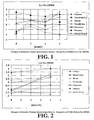
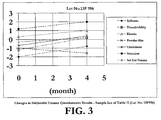
- a panel of tasters assessed the samples for seven parameters; softness, easy dissolving, elasticity, powder or granular texture, chewiness, saliva stimulation, and sol-gel nature (subjective feeling of the liquidity of the compound) on a scale wherein 0 represent neutral judgments, while negative values and positive values represented departures from a neutral value.
- Nitta S#195A Acid Gel is a mammalian derived gelatin produced from acid treated bovine bone, having a Bloom strength of 210-240.
- Miyagi RP-600 Modified Gel is a mammalian derived gelatin produced by the reaction of succinic anhydride and alkali treated bone gelation, having a Bloom strength of 180-200.
- Nitta SCP-5000 Collagen Peptide is a hydrolyte of mammalian derived gelatin produced from acid treated porcine skin.
- Miyagi RPM Shark Fish Gel is a shark derived gelatin having a Bloom strength of 110-140.
- Croda 200B Fish Gel is derived from fish and has a Bloom strength of 195-210. In the experimentation described below, the Croda 200B Fish Gel had a measured Bloom strength of 207.
- Glycerin as a plasticizer, alone and in combination with propylene glycol, and glycerin in combination with Xylitol, produced good dissolution.
- additional additives such as cellulose (Asahi Kasei Abcel RC-N Crystalline Cellulose, composed of 80% crystalline cellulose, 10% karaya gum, and 10% dextrin), SiO 2 (JFAS grade; Fuji Chemical Cycolpege 720), and NaHCO 3 (JFAS grade; Asahi Kasei) failed to produce significant improvements in performance, as reported in Table 3.
- partially pregelatinized starch which is known in the art to have good dissolution qualities
- a mixture of gelatin and glycerin improved mouth feel and produced good dissolution of the capsule agent at various water levels, as shown in Table 4.
- One particular type of partially pregelatinized starch, Asahi Kasei PCSD FW-40 partially pregelatinized starch made from wheat, performed well.
- Gelatin Plasticizer Additives Acid Gel Collagen Peptide Glycerin Cellulose Crystalline SiO2 NaHCO3 Water Nitta S#195 A Nitta SCP-5000 JFAS 99.5 Asahi Kasei Abcel RC-N81 Fuji Silisia Cylopege 720 Asahi Kasei 9 50 50 120 1.5 63 9A 70 30 120 1.5 63 70 30 120 1.5 68 11 100 120 5 63 100 120 5 73 13 100 44 1.7 63 100 120 1.7 63 100 120 1.7 73 Table 4 - (all samples 1 part TiO, 5 parts aspartame) All observed to be easy to dissolve Acid Plasticizer Partial Pregelatinized Starch No.
- Sol-gel and gel-sol transition temperatures were assayed according to the following protocols.
- gel-sol (solid to liquid) transition temperatures gelatin solutions are cast in a test tube and maintained well below physiologic transition temperatures, in this case at 10° C.
- a lead shot is placed on the surface of the firm gelatin, which due to its gel nature is capable of holding the weight of the shot.
- the test tube is placed in a water bath and gradually raised in temperature at the rate of 12° C per hour. The process is carefully observed while heating, and the gel-sol transition temperature, or melting point, is the temperature at which the gelatin liquefies sufficiently such that the shot drops to the bottom of the test tube.
- the sol-gel (liquid to solid) transition temperature is determined as follows. Gelatin solutions are placed in a test tube at temperatures well above physiologic transition temperature, in this case at 60° C. The test tube is placed in a water bath and gradually lowered in temperature at the rate of 12° C per hour. The process is carefully observed while cooling, and the sol-gel transition temperature, or setting point, is the temperature at which the gelatin hardens sufficiently such that an adherent droplet forms on a stirring rod immersed and then withdrawn from the solution.
- Gelatin formulations with acceptable characteristics were found to have a relatively narrow range of acceptable sol-gel transition temperatures. That is, optimal subjective mouth feel and mass production characteristics occurred only using fish gelatin that displayed a sol-gel transition temperature, in a 10% aqueous solution, of less than 22° C (approx. 72° F), or when in a 30% aqueous solution, of less than 32° C (Approx. 90° F).
- the most desirable sol-gel transition temperatures lay between 15° and 20° C for a 10% aqueous solution and between 25° and 30° C for a 30% aqueous solution.
- the gelatin capsule agent of Experiment 19 was viscosity adjusted to a viscosity of 9,000 mPa, plus or minus 2,000 mPa at 54° C (plus or minus 2°C) as tested on a Brookfield Type B viscometer with a No. 4 spindle at 12 rpm.
- the agent was then cast into ribbons with a thickness of 0.028-0.029 inches (0.071-0.074 cm) and formed by a standard rotary die process into capsules weighing approximately 113 mg (plus or minus 7 mg).
- the capsules were filled using standard pharmaceutical techniques with a mixture of fractionated coconut oil (medium chain fatty acid triglyceride), mint flavoring, and aspartame sweetener.
- Capsules were manufactured using a rotary die process. The capsules were then tumble dried to remove water to a level of a moisture content typically in the range of 8-25%.
- experimental lot 13F839 (Tables 7, 8, and FIG. 1 ) had a residual shell water content of 16.0%
- lot 13F840 (Table 7) had a residual shell water content of 13.4%
- lot 13F955 (Tables 7, 10, and FIG. 2 ) had a residual shell water content of 14.9%
- lot 13F956 (Tables 7, 11, and FIG. 3 ) had a residual shell water content of 14.1%.
- the capsules were transferred into either a polishing pan or an automated inline dusting system whereby the product was coated with a layer of starch, typically potato or corn starch, although tapioca starch, wheat powder, waxy corn starch powder, and partial alpha starch powder were also effective.
- starch typically potato or corn starch
- tapioca starch, wheat powder, waxy corn starch powder, and partial alpha starch powder were also effective.
- the capsules were then tumbled to produce an even coating of starch which prevented the capsules from sticking to one another.
- the capsules were transferred onto a vibratory sieve where they were vibrated to remove excess coating material. The product was then bulk packaged.
- Dusted capsules were compared with undusted controls to assess stickiness in storage under expected field conditions. Ten capsules were placed in a glass bottle and stored at 35° C for one week, followed by one day at 40° C. The capsule stickiness was observed by turning the bottle over and observing whether the capsules had adhered to each other or not. Capsules were evaluated without dusting and at levels of 0.05%, 0.1%, 0.2%, 0.5%, 1.0%, and 2.0% starch by weight of the capsules. The dusted starch percentage weights is calculated as the amount of starch that is added to a particular lot of capsules, rather than the amount of starch which actually adheres to each capsule.
- the instant invention provides a chewable soft gelatin capsule comprising a gelatin having a sol-gel transition temperature in a 10 wt.% aqueous solution of not more than 22° Centigrade and a sol-gel transition temperature in a 30 wt.% aqueous solution of not more than 32° Centigrade, a plasticizer, and an anti-adhesion agent.
- the most desirable sol-gel transition temperatures for preferred gelatin are between 15° and 20° C for a 10% by weight aqueous solution and between 25° and 30° C for a 30% by weight aqueous solution.
- the gelatin is typically a fish gelatin, although other types of gelatin having the sol-gel temperature behavior of the instant invention are also intended.
- the plasticizer may also be, by way of example and not limitation, a polyol, particularly a polyol selected from the group consisting of glycerin, sorbitol, or mixtures thereof.
- plasticizers may be used in gelatin capsule formation, including by way of example and not limitation; polyethylene glycol, sucrose, mannitol, corn syrup, fructose, cellulose, dioctyl-sodium sulfosuccinate, triethyl citrate, tributyl citrate, 1,2-propylenglycol, mono-, di- or triacetates of glycerol, natural gums or the like as well as mixtures thereof.
- the anti-adhesion agent typically contains at least one starch, and the at least one starch may be corn starch.
- the capsule may be formulated with varying amounts of water and colorants.
- the capsule agent comprises a mixture of 100 parts by weight of the selected gelatin, between 100 and 130 parts by weight of plasticizer, and between 10 and 45 parts by weight of anti-adhesion agent.
- the mixture also contains partially pregelatinized starch, typically comprising 10 to 30 parts by weight of the mixture.
- the soft gelatin capsule agent may be formulated into soft gelatin capsules by any of the means of manufacturing gelatin capsules that would be known to one skilled in the art.
- the resulting capsule comprises a soft gelatin shell which further comprises between about 36 wt.% and about 47 wt.% gelatin having a sol-gel transition temperature in a 10 wt.% aqueous solution of not more than 22° Centigrade and a sol-gel transition temperature in a 30 wt.% aqueous solution of not more than 32° Centigrade, about 47 wt.% plasticizer, and between about 4 wt.% and about 16 wt.% anti-adhesion agent; and a soft gelatin capsule fill material.
- the most desirable sol-gel transition temperatures for gelatin are between 15° and 20° C for a 10% aqueous solution and between 25° and 30° C for a 30% by weight aqueous solution.
- the soft gelatin fill material may be selected from a near limitless array of foodstuffs, medicaments, and other substances.
- the capsule maybe formulated with water, which typically comprises between about 8 wt.% and about 25 wt.% of the soft capsule shell.
- the capsule may further comprise a surface coating applied to the exterior of the soft gelatin shell to decrease surface stickiness.
- the surface coating typically includes at least one starch, which may include a potato or a corn starch.
- the soft gelatin capsules of the instant invention enable a significant advance in the state of the art.
- the preferred embodiments of the apparatus accomplish this by new and novel arrangements of elements that are configured in unique and novel ways and which demonstrate previously unavailable but preferred and desirable capabilities.
- the present invention answers a long felt need for a chewable soft gelatin capsule agent that exhibits pleasant mouth feel, good chewing characteristics, good storage characteristics, and is also susceptible to conventional mass production techniques.
- the capsules that are manufactured from this agent may be used to store a wide range of foodstuffs, medicaments, or other substances.
- the utilization, in some embodiments, of fish gelatin, is hoped to increase consumer acceptance in cultures that reject the use of gelatin produced from certain animal sources.
Landscapes
- Health & Medical Sciences (AREA)
- Chemical & Material Sciences (AREA)
- Medicinal Chemistry (AREA)
- Pharmacology & Pharmacy (AREA)
- Epidemiology (AREA)
- Life Sciences & Earth Sciences (AREA)
- Animal Behavior & Ethology (AREA)
- General Health & Medical Sciences (AREA)
- Public Health (AREA)
- Veterinary Medicine (AREA)
- Medicinal Preparation (AREA)
- General Preparation And Processing Of Foods (AREA)
- Grain Derivatives (AREA)
- Jellies, Jams, And Syrups (AREA)
- Medical Preparation Storing Or Oral Administration Devices (AREA)
Claims (16)
- Ein Weichgelatinekapsel-Wirkstoff umfassend: eine Fischgelatine mit einer Sol-Gel-Übergangstemperatur in einer wässrigen Lösung von 10 Gew.-% von nicht mehr als 22 °C und einer Sol-Gel-Übergangstemperatur in einer wässrigen Lösung von 30 Gew.-% von nicht mehr als 32 °C; einen Weichmacher; eine teilweise vorgelatinierte Stärke und einen Antiadhäsions-Wirkstoff, wobei zur Ermittlung der Sol-Gel-Übergangstemperatur eine Gelatinelösung bei einer Temperatur von 60 °C in ein Reagenzröhrchen platziert wird, die Temperatur des Reagenzröhrchens mit der Gelatinelösung um 12 °C pro Stunde gesenkt wird und die Temperatur bestimmt wird, bei der die Gelatine so ausreichend härtet, dass sich an einem in die Gelatinelösung eingetauchten und dann zurückgezogenen Rührstab ein anhaftender Tropfen der Gelatinelösung bildet.
- Der Kapselwirkstoff gemäß Anspruch 1, wobei die Sol-Gel-Übergangstemperatur für eine 10-prozentige wässrige Lösung besagter Gelatine zwischen 15 °C und 20 °C liegt und die Sol-Gel-Übergangstemperatur für eine 30-prozentige wässrige Lösung besagter Gelatine zwischen 25 °C und 30 °C liegt.
- Der Kapselwirkstoff gemäß irgendeinem der Ansprüche 1-2, wobei der Weichmacher unter einem oder mehreren Polyolen ausgewählt wird.
- Der Kapselwirkstoff gemäß irgendeinem der Ansprüche 1-2, wobei der Weichmacher unter Glycerin, Sorbitol und Mischungen davon ausgewählt wird.
- Der Kapselwirkstoff gemäß irgendeinem der Ansprüche 1-4, wobei der Antiadhäsions-Wirkstoff mindestens eine Stärke ist.
- Der Kapselwirkstoff gemäß Anspruch 5, wobei die mindestens eine Stärke Maisstärke ist.
- Der Kapselwirkstoff gemäß irgendeinem der Ansprüche 1-6, ferner Wasser umfassend.
- Der Kapselwirkstoff gemäß irgendeinem der Ansprüche 1-7, ferner einen Farbstoff umfassend.
- Der Kapselwirkstoff gemäß irgendeinem der Ansprüche 1-8, wobei die Gelatine 100 Gewichtsteile des Wirkstoffes ausmacht; der Weichmacher zwischen 100 und 130 Gewichtsteile des Wirkstoffes ausmacht; und der Antiadhäsions-Wirkstoff zwischen 10 und 45 Gewichtsteile des Wirkstoffes ausmacht.
- Ein Weichgelatinekapsel-Wirkstoff gemäß irgendeinem der Ansprüche 1-9, wobei die teilweise vorgelatinierte Stärke zwischen 10 und 30 Gewichtsteile des Wirkstoffes ausmacht.
- Eine Weichgelatinekapsel umfassend eine Weichgelatinehülle umfassend den Weichgelatinekapsel-Wirkstoff gemäß irgendeinem der Ansprüche 1-10 und ein Weichgelatinekapsel-Füllmaterial.
- Ein Weichgelatinekapsel-Wirkstoff gemäß Anspruch 11, wobei die Weichgelatinehülle zwischen 36 Gew.-% und 47 Gew.-% der besagten Gelatine, 47 Gew.-% Weichmacher und zwischen 4 Gew.-% und 16 Gew.-% Antiadhäsions-Wirkstoff umfasst.
- Die Kapsel gemäß irgendeinem der Ansprüche 11-12 mit einem Wassergehalt von zwischen 8 Gew.-% und 25 Gew.-%.
- Die Kapsel gemäß irgendeinem der Ansprüche 11-13, ferner umfassend eine auf dem Äußeren der Weichgelatinehülle aufgebrachte Oberflächenbeschichtung zur Reduzierung der Oberflächenklebrigheit, wobei die Oberflächenbeschichtung mindestens eine Stärke umfasst.
- Die Kapsel gemäß Anspruch 14, wobei die mindestens eine Stärke in der Oberflächenbeschichtung Kartoffelstärke ist.
- Die Kapsel gemäß Anspruch 14, wobei die mindestens eine Stärke in der Oberflächenbeschichtung Maisstärke ist.
Applications Claiming Priority (3)
| Application Number | Priority Date | Filing Date | Title |
|---|---|---|---|
| JP2002167041 | 2002-06-07 | ||
| JP2002167041A JP4226846B2 (ja) | 2002-06-07 | 2002-06-07 | 口腔内で崩壊可能なソフトカプセル剤 |
| PCT/US2003/017746 WO2003103639A1 (en) | 2002-06-07 | 2003-06-06 | Chewable soft capsule |
Publications (3)
| Publication Number | Publication Date |
|---|---|
| EP1534249A1 EP1534249A1 (de) | 2005-06-01 |
| EP1534249A4 EP1534249A4 (de) | 2009-02-18 |
| EP1534249B1 true EP1534249B1 (de) | 2012-09-19 |
Family
ID=29727651
Family Applications (1)
| Application Number | Title | Priority Date | Filing Date |
|---|---|---|---|
| EP03741881A Expired - Lifetime EP1534249B1 (de) | 2002-06-07 | 2003-06-06 | Weiche kaukapsel |
Country Status (8)
| Country | Link |
|---|---|
| US (1) | US20030232076A1 (de) |
| EP (1) | EP1534249B1 (de) |
| JP (1) | JP4226846B2 (de) |
| AU (1) | AU2003273932B2 (de) |
| MX (1) | MXPA05000280A (de) |
| NO (1) | NO20045551L (de) |
| WO (1) | WO2003103639A1 (de) |
| ZA (1) | ZA200410286B (de) |
Cited By (2)
| Publication number | Priority date | Publication date | Assignee | Title |
|---|---|---|---|---|
| CN103784418A (zh) * | 2012-10-26 | 2014-05-14 | 中国科学院烟台海岸带研究所 | 一种鱼皮明胶空心胶囊及其制备方法 |
| CN106561963A (zh) * | 2016-11-16 | 2017-04-19 | 上海应用技术大学 | 一种含有明胶‑辛烯基琥珀酸淀粉酯‑l‑薄荷醇微胶囊的口香糖及其制备方法 |
Families Citing this family (34)
| Publication number | Priority date | Publication date | Assignee | Title |
|---|---|---|---|---|
| US6616942B1 (en) | 1999-03-29 | 2003-09-09 | Soft Gel Technologies, Inc. | Coenzyme Q10 formulation and process methodology for soft gel capsules manufacturing |
| JP2006521366A (ja) * | 2003-03-28 | 2006-09-21 | シグモイド・バイオテクノロジーズ・リミテッド | シームレスマイクロカプセルを含む固形経口剤形 |
| WO2005032278A1 (en) | 2003-09-29 | 2005-04-14 | Soft Gel Technologies, Inc. | SOLUBILIZED CoQ-10 |
| US8124072B2 (en) | 2003-09-29 | 2012-02-28 | Soft Gel Technologies, Inc. | Solubilized CoQ-10 |
| US7169385B2 (en) | 2003-09-29 | 2007-01-30 | Ronald G. Udell | Solubilized CoQ-10 and carnitine |
| US9241902B2 (en) | 2003-12-17 | 2016-01-26 | R.P. Scherer Technologies, Llc | Chewable soft capsules containing ungelatinized starch |
| EP1586243B1 (de) * | 2004-04-15 | 2007-08-08 | MacQuarrie, Reg | Essbare Filmüberzugzusammensetzung für Lebensmittelherstellung |
| CA2581816A1 (en) * | 2004-09-27 | 2006-04-06 | Sigmoid Biotechnologies Limited | Microcapsules comprising a methylxanthine and a corticosteroid |
| US20060275361A1 (en) * | 2005-06-03 | 2006-12-07 | Cadbury Adams Usa Llc. | Rapidly dissolving gelatin compositions and products made therefrom |
| US20080020022A1 (en) * | 2006-06-05 | 2008-01-24 | Udell Ronald G | Chewable co-enzyme q-10 capsule |
| US20070292501A1 (en) * | 2006-06-05 | 2007-12-20 | Udell Ronald G | Chewable soft gelatin capsules |
| US7908992B2 (en) * | 2007-01-09 | 2011-03-22 | R.P. Scherer Technologies, Llc | System and method for dusting soft capsules |
| US8343541B2 (en) | 2007-03-15 | 2013-01-01 | Soft Gel Technologies, Inc. | Ubiquinol and alpha lipoic acid compositions |
| EP2061440A2 (de) * | 2007-04-04 | 2009-05-27 | Sigmoid Pharma Limited | Pharmazeutische tacrolimus-zusammensetzung |
| ES2963291T3 (es) | 2007-04-26 | 2024-03-26 | Sublimity Therapeutics Ltd | Fabricación de múltiples minicápsulas |
| CA2685591A1 (en) * | 2007-05-01 | 2008-11-06 | Sigmoid Pharma Limited | Pharmaceutical nimodipine compositions |
| GB0801643D0 (en) * | 2008-01-29 | 2008-03-05 | Probio Nutraceuticals As | Product |
| US20100092548A1 (en) | 2008-08-28 | 2010-04-15 | Viva Pharmaceuticals Inc. | Chewable softgel capsules |
| ES2530049T3 (es) | 2009-05-18 | 2015-02-26 | Sigmoid Pharma Limited | Composición que comprende gotas de aceite |
| BR112012002963A2 (pt) | 2009-08-12 | 2017-10-24 | Sigmoid Pharma Ltd | composições imunomoduladoras compreendendo uma matriz de polímero e uma fase oleosa |
| GB201020032D0 (en) | 2010-11-25 | 2011-01-12 | Sigmoid Pharma Ltd | Composition |
| CN102525994A (zh) * | 2010-12-10 | 2012-07-04 | 上海春芝堂生物制品有限公司 | 一种鱼明胶软胶囊及其制备方法 |
| CN102813275B (zh) | 2011-06-10 | 2015-09-30 | 杭州养生堂保健品有限公司 | 一种咀嚼型软胶囊皮和咀嚼型软胶囊 |
| WO2013002063A1 (ja) | 2011-06-30 | 2013-01-03 | テルモ株式会社 | 医療用マニピュレータ |
| US10087401B2 (en) | 2012-03-16 | 2018-10-02 | Monosol, Llc | Water soluble compositions incorporating enzymes, and method of making same |
| US9394092B2 (en) | 2012-04-16 | 2016-07-19 | Monosol, Llc | Powdered pouch and method of making same |
| GB201212010D0 (en) | 2012-07-05 | 2012-08-22 | Sigmoid Pharma Ltd | Formulations |
| GB201319791D0 (en) | 2013-11-08 | 2013-12-25 | Sigmoid Pharma Ltd | Formulations |
| EA036036B1 (ru) | 2014-11-07 | 2020-09-16 | Сигмойд Фарма Лимитед | Композиции, содержащие циклоспорин |
| ES2988519T3 (es) | 2015-04-23 | 2024-11-20 | Basf Se | Cápsula de gel que contiene esterol y solubilizante |
| CN105412044B (zh) * | 2015-12-31 | 2018-10-30 | 广东国方医药科技有限公司 | 一种含纳米SiO2的空心胶囊及其制备方法 |
| JP6942342B2 (ja) * | 2016-11-02 | 2021-09-29 | 富士カプセル株式会社 | ソフトカプセル皮膜 |
| CN113447356B (zh) * | 2021-07-12 | 2022-02-18 | 广州白云山星群(药业)股份有限公司 | 一种软胶囊囊皮机械性能测试方法及设备 |
| KR102694863B1 (ko) * | 2024-01-25 | 2024-08-13 | 콜마비앤에이치 주식회사 | 라폰티신을 포함하는 안정성이 개선된 연질 캡슐 조성물 |
Family Cites Families (18)
| Publication number | Priority date | Publication date | Assignee | Title |
|---|---|---|---|---|
| US24678A (en) * | 1859-07-05 | Cast-ikon tike fob railroad-wheels | ||
| FR959520A (de) | 1947-01-11 | 1950-03-31 | ||
| JPS5279020A (en) * | 1975-12-25 | 1977-07-02 | Tsumura Juntendo Kk | Production of starch capsule |
| DE3529694A1 (de) * | 1985-08-20 | 1987-02-26 | Scherer Gmbh R P | Gelatinekapseln und verfahren zu ihrer herstellung |
| US4935243A (en) | 1988-12-19 | 1990-06-19 | Pharmacaps, Inc. | Chewable, edible soft gelatin capsule |
| US4953243A (en) * | 1989-08-09 | 1990-09-04 | Amedco Health Care, Inc. | Electronic control with emergency CPR feature for adjustable bed |
| JPH03255024A (ja) * | 1990-03-05 | 1991-11-13 | Tokai Capsule Kk | 口中易溶軟カプセル剤 |
| ES2107527T3 (es) * | 1990-11-28 | 1997-12-01 | Scherer Corp R P | Capsulas de gelatina sustituida por almidon de alto contenido en amilosa. |
| JPH06218028A (ja) * | 1992-10-02 | 1994-08-09 | Eisai Co Ltd | 湿製錠の成型方法とその装置及び湿製錠 |
| KR100219918B1 (ko) * | 1997-07-03 | 1999-09-01 | 김윤 | 대장선택적 약물전달용 조성물 |
| JP2000044465A (ja) * | 1998-05-28 | 2000-02-15 | Fuji Capsule Kk | 軟カプセル剤 |
| US6423346B1 (en) * | 1998-08-25 | 2002-07-23 | Basf Health & Nutrition A/S | Fish gelatinous composition for use as an ingredient in tablets |
| JP2000128778A (ja) * | 1998-10-20 | 2000-05-09 | Tokai Capsule Kk | 捩じり切り開披型ソフトカプセル |
| US6258380B1 (en) * | 1999-03-05 | 2001-07-10 | Banner Pharmacaps, Inc. | Chewable soft capsule |
| JP4295387B2 (ja) * | 1999-05-18 | 2009-07-15 | ゼライス株式会社 | 分解ペプチド類の製造法 |
| US6340473B1 (en) * | 1999-07-07 | 2002-01-22 | R.P. Scherer Technologies, Inc. | Film forming compositions comprising modified starches and iota-carrageenan and methods for manufacturing soft capsules using same |
| HK1046004B (en) * | 1999-11-12 | 2013-11-08 | Fibrogen, Inc. | Recombinant gelatins |
| US6387400B1 (en) * | 2000-08-29 | 2002-05-14 | R.P. Scherer Technologies, Inc. | Process for preparing pharmaceutical compositions for use with soft gelatin formulations |
-
2002
- 2002-06-07 JP JP2002167041A patent/JP4226846B2/ja not_active Expired - Fee Related
-
2003
- 2003-06-06 AU AU2003273932A patent/AU2003273932B2/en not_active Ceased
- 2003-06-06 EP EP03741881A patent/EP1534249B1/de not_active Expired - Lifetime
- 2003-06-06 WO PCT/US2003/017746 patent/WO2003103639A1/en not_active Ceased
- 2003-06-06 US US10/456,450 patent/US20030232076A1/en not_active Abandoned
- 2003-06-06 MX MXPA05000280A patent/MXPA05000280A/es active IP Right Grant
-
2004
- 2004-12-17 NO NO20045551A patent/NO20045551L/no not_active Application Discontinuation
- 2004-12-21 ZA ZA200410286A patent/ZA200410286B/en unknown
Cited By (3)
| Publication number | Priority date | Publication date | Assignee | Title |
|---|---|---|---|---|
| CN103784418A (zh) * | 2012-10-26 | 2014-05-14 | 中国科学院烟台海岸带研究所 | 一种鱼皮明胶空心胶囊及其制备方法 |
| CN106561963A (zh) * | 2016-11-16 | 2017-04-19 | 上海应用技术大学 | 一种含有明胶‑辛烯基琥珀酸淀粉酯‑l‑薄荷醇微胶囊的口香糖及其制备方法 |
| CN106561963B (zh) * | 2016-11-16 | 2020-10-09 | 上海应用技术大学 | 一种含有明胶-辛烯基琥珀酸淀粉酯-l-薄荷醇微胶囊的口香糖及其制备方法 |
Also Published As
| Publication number | Publication date |
|---|---|
| JP2004010546A (ja) | 2004-01-15 |
| MXPA05000280A (es) | 2005-03-31 |
| ZA200410286B (en) | 2005-10-10 |
| AU2003273932B2 (en) | 2010-04-22 |
| US20030232076A1 (en) | 2003-12-18 |
| EP1534249A4 (de) | 2009-02-18 |
| AU2003273932A1 (en) | 2003-12-22 |
| JP4226846B2 (ja) | 2009-02-18 |
| WO2003103639A1 (en) | 2003-12-18 |
| EP1534249A1 (de) | 2005-06-01 |
| NO20045551L (no) | 2005-03-01 |
Similar Documents
| Publication | Publication Date | Title |
|---|---|---|
| AU2003273932B2 (en) | Chewable soft capsule | |
| CN1319462C (zh) | 被涂层的可降解的且具有长的储存期限的口香糖及其制造方法 | |
| US7662406B1 (en) | Chewable softgel capsules | |
| CA2341024C (en) | Non-gelatin substitutes for oral delivery capsules, their composition and process of manufacture | |
| HU229892B1 (en) | Fast-dispersing dosage forms containing fish gelatin | |
| JP6117079B2 (ja) | チュアブル錠用組成物及びチュアブル錠 | |
| JP2000128778A (ja) | 捩じり切り開披型ソフトカプセル | |
| EP1694311B1 (de) | Kaubare weichkapseln mit ungelatinisierter stärke | |
| EP1765299B1 (de) | Verfahren zur formulierung von schnell dispergierenden dosierformen mit mindestens einer fischgelatine, ausgewählt auf basis des molekulargewichts | |
| JP2010130935A (ja) | グミキャンディーおよびその製造方法 | |
| KR102322001B1 (ko) | 구미젤리 형태의 츄어블 연질캡슐 조성물 | |
| JP4364869B2 (ja) | 咀嚼性カプセルの製造方法 | |
| JP7680767B2 (ja) | 脱灰を防止するための個人用歯科治療製品 | |
| JP2012515719A (ja) | 新規コーティング組成物とその使用 | |
| JPH10273436A (ja) | 咀嚼用ソフトカプセル剤 | |
| JP2012228204A (ja) | 果実含有ハードグミキャンディ様構造物 | |
| JPH07163300A (ja) | チューインガムの製造法 | |
| JP4053250B2 (ja) | ソフトキャンディ様チューインガム及びチューインガムのソフトキャンディ様食感調整方法 | |
| KR20250176342A (ko) | 저작 가능한 식물성 연질캡슐의 피막 조성물 및 이로부터 제조된 연질캡슐 | |
| JPS6147156A (ja) | クロレラ錠 | |
| JP2005151827A (ja) | 食用組成物 | |
| JP2013095750A (ja) | 口腔内殺菌用ソフトカプセル | |
| WO2020029352A1 (zh) | 含有溶菌酶的再制干酪及其制备方法 | |
| JP2017212954A (ja) | 食品組成物及び食品 | |
| JPH03123445A (ja) | シアル酸徐放性食品 |
Legal Events
| Date | Code | Title | Description |
|---|---|---|---|
| PUAI | Public reference made under article 153(3) epc to a published international application that has entered the european phase |
Free format text: ORIGINAL CODE: 0009012 |
|
| 17P | Request for examination filed |
Effective date: 20050106 |
|
| AK | Designated contracting states |
Kind code of ref document: A1 Designated state(s): AT BE BG CH CY CZ DE DK EE ES FI FR GB GR HU IE IT LI LU MC NL PT RO SE SI SK TR |
|
| AX | Request for extension of the european patent |
Extension state: AL LT LV MK |
|
| RAP1 | Party data changed (applicant data changed or rights of an application transferred) |
Owner name: R.P. SCHERER TECHNOLOGIES, INC. |
|
| A4 | Supplementary search report drawn up and despatched |
Effective date: 20090119 |
|
| 17Q | First examination report despatched |
Effective date: 20090702 |
|
| RAP1 | Party data changed (applicant data changed or rights of an application transferred) |
Owner name: R.P. SCHERER TECHNOLOGIES, LLC |
|
| RAP1 | Party data changed (applicant data changed or rights of an application transferred) |
Owner name: R.P. SCHERER TECHNOLOGIES, LLC |
|
| RAP1 | Party data changed (applicant data changed or rights of an application transferred) |
Owner name: R.P. SCHERER TECHNOLOGIES, LLC |
|
| GRAP | Despatch of communication of intention to grant a patent |
Free format text: ORIGINAL CODE: EPIDOSNIGR1 |
|
| RIN1 | Information on inventor provided before grant (corrected) |
Inventor name: SUZUKI, HIDEO Inventor name: MAKINO, HIROKAZU Inventor name: MASTUSHITA, TOMOHISA Inventor name: SUMINO, YOKO |
|
| GRAS | Grant fee paid |
Free format text: ORIGINAL CODE: EPIDOSNIGR3 |
|
| GRAA | (expected) grant |
Free format text: ORIGINAL CODE: 0009210 |
|
| AK | Designated contracting states |
Kind code of ref document: B1 Designated state(s): AT BE BG CH CY CZ DE DK EE ES FI FR GB GR HU IE IT LI LU MC NL PT RO SE SI SK TR |
|
| AX | Request for extension of the european patent |
Extension state: AL LT LV MK |
|
| REG | Reference to a national code |
Ref country code: GB Ref legal event code: FG4D |
|
| REG | Reference to a national code |
Ref country code: CH Ref legal event code: EP |
|
| REG | Reference to a national code |
Ref country code: IE Ref legal event code: FG4D |
|
| REG | Reference to a national code |
Ref country code: AT Ref legal event code: REF Ref document number: 575628 Country of ref document: AT Kind code of ref document: T Effective date: 20121015 |
|
| REG | Reference to a national code |
Ref country code: DE Ref legal event code: R096 Ref document number: 60342138 Country of ref document: DE Effective date: 20121115 |
|
| PG25 | Lapsed in a contracting state [announced via postgrant information from national office to epo] |
Ref country code: CY Free format text: LAPSE BECAUSE OF FAILURE TO SUBMIT A TRANSLATION OF THE DESCRIPTION OR TO PAY THE FEE WITHIN THE PRESCRIBED TIME-LIMIT Effective date: 20120919 Ref country code: FI Free format text: LAPSE BECAUSE OF FAILURE TO SUBMIT A TRANSLATION OF THE DESCRIPTION OR TO PAY THE FEE WITHIN THE PRESCRIBED TIME-LIMIT Effective date: 20120919 |
|
| REG | Reference to a national code |
Ref country code: NL Ref legal event code: VDEP Effective date: 20120919 |
|
| REG | Reference to a national code |
Ref country code: AT Ref legal event code: MK05 Ref document number: 575628 Country of ref document: AT Kind code of ref document: T Effective date: 20120919 |
|
| REG | Reference to a national code |
Ref country code: LT Ref legal event code: MG9D Effective date: 20120919 |
|
| PG25 | Lapsed in a contracting state [announced via postgrant information from national office to epo] |
Ref country code: SE Free format text: LAPSE BECAUSE OF FAILURE TO SUBMIT A TRANSLATION OF THE DESCRIPTION OR TO PAY THE FEE WITHIN THE PRESCRIBED TIME-LIMIT Effective date: 20120919 Ref country code: SI Free format text: LAPSE BECAUSE OF FAILURE TO SUBMIT A TRANSLATION OF THE DESCRIPTION OR TO PAY THE FEE WITHIN THE PRESCRIBED TIME-LIMIT Effective date: 20120919 Ref country code: GR Free format text: LAPSE BECAUSE OF FAILURE TO SUBMIT A TRANSLATION OF THE DESCRIPTION OR TO PAY THE FEE WITHIN THE PRESCRIBED TIME-LIMIT Effective date: 20121220 |
|
| PG25 | Lapsed in a contracting state [announced via postgrant information from national office to epo] |
Ref country code: NL Free format text: LAPSE BECAUSE OF FAILURE TO SUBMIT A TRANSLATION OF THE DESCRIPTION OR TO PAY THE FEE WITHIN THE PRESCRIBED TIME-LIMIT Effective date: 20120919 Ref country code: ES Free format text: LAPSE BECAUSE OF FAILURE TO SUBMIT A TRANSLATION OF THE DESCRIPTION OR TO PAY THE FEE WITHIN THE PRESCRIBED TIME-LIMIT Effective date: 20121230 Ref country code: BE Free format text: LAPSE BECAUSE OF FAILURE TO SUBMIT A TRANSLATION OF THE DESCRIPTION OR TO PAY THE FEE WITHIN THE PRESCRIBED TIME-LIMIT Effective date: 20120919 Ref country code: CZ Free format text: LAPSE BECAUSE OF FAILURE TO SUBMIT A TRANSLATION OF THE DESCRIPTION OR TO PAY THE FEE WITHIN THE PRESCRIBED TIME-LIMIT Effective date: 20120919 Ref country code: RO Free format text: LAPSE BECAUSE OF FAILURE TO SUBMIT A TRANSLATION OF THE DESCRIPTION OR TO PAY THE FEE WITHIN THE PRESCRIBED TIME-LIMIT Effective date: 20120919 Ref country code: EE Free format text: LAPSE BECAUSE OF FAILURE TO SUBMIT A TRANSLATION OF THE DESCRIPTION OR TO PAY THE FEE WITHIN THE PRESCRIBED TIME-LIMIT Effective date: 20120919 |
|
| PG25 | Lapsed in a contracting state [announced via postgrant information from national office to epo] |
Ref country code: PT Free format text: LAPSE BECAUSE OF FAILURE TO SUBMIT A TRANSLATION OF THE DESCRIPTION OR TO PAY THE FEE WITHIN THE PRESCRIBED TIME-LIMIT Effective date: 20130121 Ref country code: SK Free format text: LAPSE BECAUSE OF FAILURE TO SUBMIT A TRANSLATION OF THE DESCRIPTION OR TO PAY THE FEE WITHIN THE PRESCRIBED TIME-LIMIT Effective date: 20120919 |
|
| RAP2 | Party data changed (patent owner data changed or rights of a patent transferred) |
Owner name: R.P. SCHERER TECHNOLOGIES, LLC |
|
| PG25 | Lapsed in a contracting state [announced via postgrant information from national office to epo] |
Ref country code: AT Free format text: LAPSE BECAUSE OF FAILURE TO SUBMIT A TRANSLATION OF THE DESCRIPTION OR TO PAY THE FEE WITHIN THE PRESCRIBED TIME-LIMIT Effective date: 20120919 |
|
| PLBE | No opposition filed within time limit |
Free format text: ORIGINAL CODE: 0009261 |
|
| STAA | Information on the status of an ep patent application or granted ep patent |
Free format text: STATUS: NO OPPOSITION FILED WITHIN TIME LIMIT |
|
| PG25 | Lapsed in a contracting state [announced via postgrant information from national office to epo] |
Ref country code: BG Free format text: LAPSE BECAUSE OF FAILURE TO SUBMIT A TRANSLATION OF THE DESCRIPTION OR TO PAY THE FEE WITHIN THE PRESCRIBED TIME-LIMIT Effective date: 20121219 Ref country code: DK Free format text: LAPSE BECAUSE OF FAILURE TO SUBMIT A TRANSLATION OF THE DESCRIPTION OR TO PAY THE FEE WITHIN THE PRESCRIBED TIME-LIMIT Effective date: 20120919 |
|
| 26N | No opposition filed |
Effective date: 20130620 |
|
| PG25 | Lapsed in a contracting state [announced via postgrant information from national office to epo] |
Ref country code: IT Free format text: LAPSE BECAUSE OF FAILURE TO SUBMIT A TRANSLATION OF THE DESCRIPTION OR TO PAY THE FEE WITHIN THE PRESCRIBED TIME-LIMIT Effective date: 20120919 |
|
| REG | Reference to a national code |
Ref country code: DE Ref legal event code: R097 Ref document number: 60342138 Country of ref document: DE Effective date: 20130620 |
|
| PG25 | Lapsed in a contracting state [announced via postgrant information from national office to epo] |
Ref country code: MC Free format text: LAPSE BECAUSE OF FAILURE TO SUBMIT A TRANSLATION OF THE DESCRIPTION OR TO PAY THE FEE WITHIN THE PRESCRIBED TIME-LIMIT Effective date: 20120919 |
|
| REG | Reference to a national code |
Ref country code: CH Ref legal event code: PL |
|
| GBPC | Gb: european patent ceased through non-payment of renewal fee |
Effective date: 20130606 |
|
| REG | Reference to a national code |
Ref country code: IE Ref legal event code: MM4A |
|
| REG | Reference to a national code |
Ref country code: FR Ref legal event code: ST Effective date: 20140228 |
|
| REG | Reference to a national code |
Ref country code: DE Ref legal event code: R119 Ref document number: 60342138 Country of ref document: DE Effective date: 20140101 |
|
| PG25 | Lapsed in a contracting state [announced via postgrant information from national office to epo] |
Ref country code: IE Free format text: LAPSE BECAUSE OF NON-PAYMENT OF DUE FEES Effective date: 20130606 Ref country code: LI Free format text: LAPSE BECAUSE OF NON-PAYMENT OF DUE FEES Effective date: 20130630 Ref country code: GB Free format text: LAPSE BECAUSE OF NON-PAYMENT OF DUE FEES Effective date: 20130606 Ref country code: CH Free format text: LAPSE BECAUSE OF NON-PAYMENT OF DUE FEES Effective date: 20130630 Ref country code: DE Free format text: LAPSE BECAUSE OF NON-PAYMENT OF DUE FEES Effective date: 20140101 |
|
| PG25 | Lapsed in a contracting state [announced via postgrant information from national office to epo] |
Ref country code: FR Free format text: LAPSE BECAUSE OF NON-PAYMENT OF DUE FEES Effective date: 20130701 |
|
| PG25 | Lapsed in a contracting state [announced via postgrant information from national office to epo] |
Ref country code: TR Free format text: LAPSE BECAUSE OF FAILURE TO SUBMIT A TRANSLATION OF THE DESCRIPTION OR TO PAY THE FEE WITHIN THE PRESCRIBED TIME-LIMIT Effective date: 20120919 |
|
| PG25 | Lapsed in a contracting state [announced via postgrant information from national office to epo] |
Ref country code: HU Free format text: LAPSE BECAUSE OF FAILURE TO SUBMIT A TRANSLATION OF THE DESCRIPTION OR TO PAY THE FEE WITHIN THE PRESCRIBED TIME-LIMIT; INVALID AB INITIO Effective date: 20030606 Ref country code: LU Free format text: LAPSE BECAUSE OF NON-PAYMENT OF DUE FEES Effective date: 20130606 |