EP1508583A1 - Phosphorhaltiges epoxidharz, phosphorhaltiges epoxidharz enthaltende zusammensetzung, herstellungsverfahren dafür und dichtungsmasse und laminat, jeweils dieses enthaltend oder damit hergestellt - Google Patents
Phosphorhaltiges epoxidharz, phosphorhaltiges epoxidharz enthaltende zusammensetzung, herstellungsverfahren dafür und dichtungsmasse und laminat, jeweils dieses enthaltend oder damit hergestellt Download PDFInfo
- Publication number
- EP1508583A1 EP1508583A1 EP02733240A EP02733240A EP1508583A1 EP 1508583 A1 EP1508583 A1 EP 1508583A1 EP 02733240 A EP02733240 A EP 02733240A EP 02733240 A EP02733240 A EP 02733240A EP 1508583 A1 EP1508583 A1 EP 1508583A1
- Authority
- EP
- European Patent Office
- Prior art keywords
- phosphorus
- epoxy resin
- resin
- containing epoxy
- epoxy
- Prior art date
- Legal status (The legal status is an assumption and is not a legal conclusion. Google has not performed a legal analysis and makes no representation as to the accuracy of the status listed.)
- Granted
Links
Classifications
-
- H—ELECTRICITY
- H10—SEMICONDUCTOR DEVICES; ELECTRIC SOLID-STATE DEVICES NOT OTHERWISE PROVIDED FOR
- H10W—GENERIC PACKAGES, INTERCONNECTIONS, CONNECTORS OR OTHER CONSTRUCTIONAL DETAILS OF DEVICES COVERED BY CLASS H10
- H10W74/00—Encapsulations, e.g. protective coatings
- H10W74/40—Encapsulations, e.g. protective coatings characterised by their materials
- H10W74/47—Encapsulations, e.g. protective coatings characterised by their materials comprising organic materials, e.g. plastics or resins
-
- C—CHEMISTRY; METALLURGY
- C08—ORGANIC MACROMOLECULAR COMPOUNDS; THEIR PREPARATION OR CHEMICAL WORKING-UP; COMPOSITIONS BASED THEREON
- C08G—MACROMOLECULAR COMPOUNDS OBTAINED OTHERWISE THAN BY REACTIONS ONLY INVOLVING UNSATURATED CARBON-TO-CARBON BONDS
- C08G59/00—Polycondensates containing more than one epoxy group per molecule; Macromolecules obtained by polymerising compounds containing more than one epoxy group per molecule using curing agents or catalysts which react with the epoxy groups
- C08G59/18—Macromolecules obtained by polymerising compounds containing more than one epoxy group per molecule using curing agents or catalysts which react with the epoxy groups ; e.g. general methods of curing
- C08G59/20—Macromolecules obtained by polymerising compounds containing more than one epoxy group per molecule using curing agents or catalysts which react with the epoxy groups ; e.g. general methods of curing characterised by the epoxy compounds used
- C08G59/22—Di-epoxy compounds
- C08G59/30—Di-epoxy compounds containing atoms other than carbon, hydrogen, oxygen and nitrogen
- C08G59/304—Di-epoxy compounds containing atoms other than carbon, hydrogen, oxygen and nitrogen containing phosphorus
-
- C—CHEMISTRY; METALLURGY
- C08—ORGANIC MACROMOLECULAR COMPOUNDS; THEIR PREPARATION OR CHEMICAL WORKING-UP; COMPOSITIONS BASED THEREON
- C08G—MACROMOLECULAR COMPOUNDS OBTAINED OTHERWISE THAN BY REACTIONS ONLY INVOLVING UNSATURATED CARBON-TO-CARBON BONDS
- C08G59/00—Polycondensates containing more than one epoxy group per molecule; Macromolecules obtained by polymerising compounds containing more than one epoxy group per molecule using curing agents or catalysts which react with the epoxy groups
- C08G59/18—Macromolecules obtained by polymerising compounds containing more than one epoxy group per molecule using curing agents or catalysts which react with the epoxy groups ; e.g. general methods of curing
- C08G59/20—Macromolecules obtained by polymerising compounds containing more than one epoxy group per molecule using curing agents or catalysts which react with the epoxy groups ; e.g. general methods of curing characterised by the epoxy compounds used
- C08G59/32—Epoxy compounds containing three or more epoxy groups
- C08G59/3254—Epoxy compounds containing three or more epoxy groups containing atoms other than carbon, hydrogen, oxygen or nitrogen
-
- H—ELECTRICITY
- H10—SEMICONDUCTOR DEVICES; ELECTRIC SOLID-STATE DEVICES NOT OTHERWISE PROVIDED FOR
- H10W—GENERIC PACKAGES, INTERCONNECTIONS, CONNECTORS OR OTHER CONSTRUCTIONAL DETAILS OF DEVICES COVERED BY CLASS H10
- H10W70/00—Package substrates; Interposers; Redistribution layers [RDL]
- H10W70/60—Insulating or insulated package substrates; Interposers; Redistribution layers
- H10W70/67—Insulating or insulated package substrates; Interposers; Redistribution layers characterised by their insulating layers or insulating parts
- H10W70/69—Insulating materials thereof
-
- H—ELECTRICITY
- H05—ELECTRIC TECHNIQUES NOT OTHERWISE PROVIDED FOR
- H05K—PRINTED CIRCUITS; CASINGS OR CONSTRUCTIONAL DETAILS OF ELECTRIC APPARATUS; MANUFACTURE OF ASSEMBLAGES OF ELECTRICAL COMPONENTS
- H05K1/00—Printed circuits
- H05K1/02—Details
- H05K1/03—Use of materials for the substrate
- H05K1/0313—Organic insulating material
- H05K1/032—Organic insulating material consisting of one material
- H05K1/0326—Organic insulating material consisting of one material containing O
-
- Y—GENERAL TAGGING OF NEW TECHNOLOGICAL DEVELOPMENTS; GENERAL TAGGING OF CROSS-SECTIONAL TECHNOLOGIES SPANNING OVER SEVERAL SECTIONS OF THE IPC; TECHNICAL SUBJECTS COVERED BY FORMER USPC CROSS-REFERENCE ART COLLECTIONS [XRACs] AND DIGESTS
- Y10—TECHNICAL SUBJECTS COVERED BY FORMER USPC
- Y10T—TECHNICAL SUBJECTS COVERED BY FORMER US CLASSIFICATION
- Y10T428/00—Stock material or miscellaneous articles
- Y10T428/31504—Composite [nonstructural laminate]
- Y10T428/31511—Of epoxy ether
Definitions
- the present invention relates to a phosphorus-containing epoxy resin, which in numerous materials such.
- B. casting compounds, Adhesives and electrically insulating paint is included, which is a high Possess flame retardance; a phosphorus-containing epoxy resin composition, which contains the resin and has a high flame retardancy; a method for Preparation of the resin; a sealant used in the manufacture of electrical Components is used and contains the composition; a molding material, containing the composition; and a laminate such.
- circuit boards As one with copper clad laminate used in printed wiring boards or electrical circuit boards (“circuit boards”) is included and the composition contains.
- Epoxy resins are known for their superior adhesion, heat resistance and Moldability used for a variety of applications such.
- a technique included in the unaudited Japanese Patent Application Publication No. 5-25369 is disclosed hydrous aluminum oxide ("hydrated alumina") used; a technique that is in Japanese Unexamined Patent Application Publication No. 58-198521, the surface-treated red phosphorus, hydrous Alumina and / or silica powder used; and a technique in the Unexamined Japanese Patent Application Publication No. 63-156860, in which modified red phosphorus is used.
- Examples of such techniques include a technique disclosed in Japanese Unexamined Patent Application Publication No. 57-195141 which uses tris (hydroxypropyl) phosphine oxide; a technique disclosed in Japanese Unexamined Patent Application Publication No. 63-95223 which uses a phosphine oxide derivative; a technique disclosed in Japanese Unexamined Patent Application Publication Nos. 11-279258 and 11-166035 which use an organic phosphorus compound; and a technique disclosed in Unexamined Japanese Patent Application Laid-Open Nos. 51-143620, 3-84025, 2-272014 and 2-269730 which use epoxy phosphate obtained by the reaction of phosphonic acid with epichlorohydrin or a polyepoxy compound having an epoxy group , was produced.
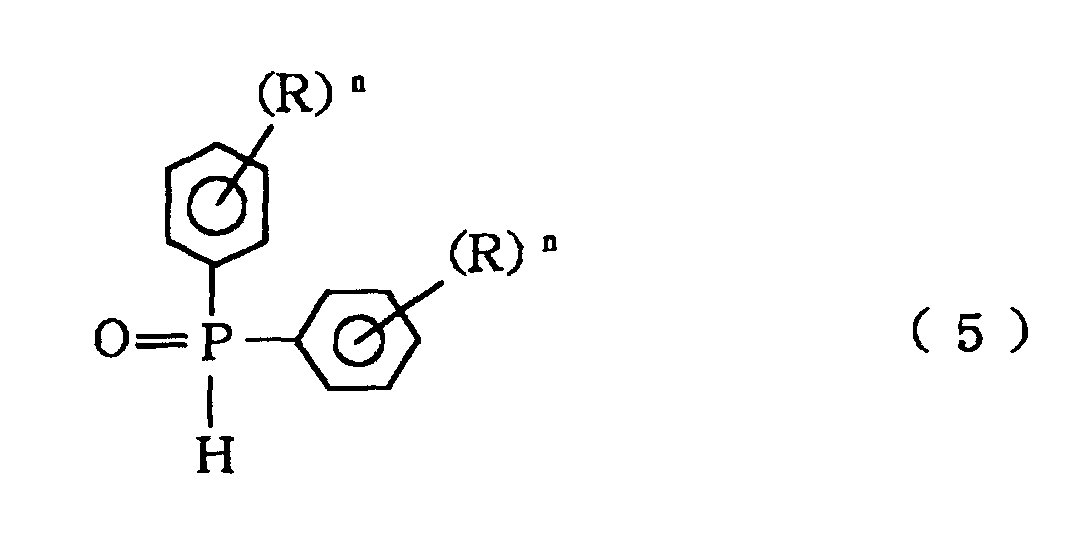
- the organic phosphorus compound is represented by the following formula: or wherein R represents an alkyl group of one to six carbon atoms and n is an integer of 0 to 4.
- a technique using a phosphorus-containing compound which functions as a reactive flame retardant is disclosed in Unexamined Japanese Patent Application Laid-Open No. 2000-80251.
- This compound is represented by the following formula (6): wherein R 'represents a group having two or more phenolic hydroxyl groups; n 'is an integer from 0 to 3; R "is a linear or branched alkyl group, a cyclohexyl group, cyclopentyl group or aryl group having one to eight carbon atoms or an alkyl- or alkoxy-substituted alkyl or aryl group having one to 18 carbon atoms and may have a ring containing a phosphorus atom, and m is 0 or
- numerous phosphorus-containing compounds that function as a reactive flame retardant are disclosed, however, only a compound having a phosphorus-oxygen (PO) bond actually exhibits flame retardancy.
- PO phosphorus-oxygen
- the techniques are reactive Use flame retardant, the following problems: the phosphorus content per Weight unit in the epoxy resin can not be sufficiently increased to the Flame retardancy, and the flame retardance can not be increased, even if sufficient amount of phosphorus is added to the epoxy resin.
- the inventors have found that the above-mentioned problems are solved and thereby the invention is completed when it is an epoxy resin is allowed to have a structural unit that is secondary to one Phosphine derivative derived by the formula (1) or (2) is shown.
- a phosphor to provide containing epoxy resin having a high flame retardancy; a process for producing the resin in an industrially advantageous manner; a Phosphorus-containing epoxy resin composition containing the resin and a high flame retardancy and high chemical resistance; one Sealing material containing the composition; a molding material that the Composition contains; and a laminate containing the resin.
- a phosphorus-containing epoxy resin having a structural unit derived from a secondary phosphine derivative represented by the following formula: or wherein R 1 represents an alkylene group which may have a substituent, R 2 represents a cycloalkylene or arylene group which may have a substituent, and X represents an oxygen or sulfur atom.
- the secondary phosphine derivative is preferably at least one of 1,4-cyclooctylenephosphine oxide and 1,5-cyclooctylenephosphine oxide.
- the phosphorus-containing epoxy resin is preferably obtained by adding to the secondary phosphine derivative is allowed, with an epoxy or Polyepoxy compound to react.
- the content of phosphorus in the resin is preferably 0.1% by weight to 10% by weight.
- a phosphorus containing epoxy resin composition containing the phosphorus containing epoxy resin and a curing agent or a polymerization initiator contains.
- a method for Preparation of the phosphorus-containing epoxy resin comprising the step contains an epoxy or polyepoxy compound, the reaction with a secondary phosphine derivative, which is represented by the above formula (1) or (2) is shown.
- a sealant which contains the phosphorus-containing epoxy resin composition.
- a molding material which contains the phosphorus-containing epoxy resin composition.
- a laminate which contains the phosphorus-containing epoxy resin composition in a sixth aspect of the present invention, a laminate which contains the phosphorus-containing epoxy resin composition.
- the phosphorus-containing epoxy resin of the present invention has a Superior flame retardancy and can with an industrially advantageous Process are produced.
- the phosphorus-containing epoxy resin composition of the present invention has superior flame retardancy and chemical resistance.
- the Composition is therefore for the production of flame retardant Sealants, molding compounds, casting compounds ("casting compounds"), adhesives and electrically insulating paint for with copper clad laminates and electrical components in printed circuit boards ("wiring boards”) or electrical circuit boards are useful.
- a phosphorus-containing epoxy resin provided by the present invention has a structural unit derived from a secondary phosphine derivative represented by the following formula: or
- R 1 represents an alkylene group which may have a substituent.
- the alkylene group has three to nine carbon atoms, and preferably four to six carbon atoms.
- Examples of the alkylene group include one Propylene group, a butylene group, a pentamethylene group, a Hexamethylene group, a heptamethylene group, an octamethylene group and a nonamethylene group.
- Examples of the substituent include one Phenyl group, an alkoxy group, a cyano group and a hydroxyl group.
- R 2 represents a cycloalkylene or arylene group which may have a substituent.
- the cycloalkylene group has four to nine carbon atoms, and preferably five to seven carbon atoms.
- Examples of the cycloalkylene group include a Cyclobutylene group, a cyclopentamethylene group, a Cyclohexamethylene group, a cycloheptamethylene group, a Cyclooctylene group and a cyclononylene group.
- Examples of the arylene group include a phenylene group and a Naphthylene.
- Examples of the substituent of the cycloalkylene or Arylene group includes a phenyl group, an alkoxy group, a cyano group and a hydroxyl group. These substituents can be a heteroatom such as Oxygen, sulfur or nitrogen.
- X represents an oxygen or sulfur atom and preferably an oxygen atom.
- Examples of the secondary phosphine derivative include 1,3-cyclopentylenephosphine oxide, 1,4-cyclooctylenephosphine oxide, 1,5-cyclooctylenephosphine oxide and 1,5-cyclooctylenephosphine sulfide.
- 1,4-cyclooctylenephosphine oxide and 1,5-cyclooctylenephosphine oxide is particularly preferred.
- the above compounds may be used alone or in Combination can be used.
- the secondary phosphine derivative can be prepared by a known method.
- An example of cycloalkylenephosphine oxides having a ring consisting of a phosphorus atom and the group represented by R 1 or R 2 can be prepared according to the following procedure: a phosphine represented by formula (7) is allowed to react with 1.5 Cyclooctadiene represented by formula (8) to react in the presence of a radical catalyst, whereby a mixture of 1,4-cyclooctylenephosphine represented by formula (9) and 1,5-cyclooctylenephosphine represented by formula (9) 10) is obtained.
- the resulting mixture is then oxidized to produce a mixture of 1,4-cyclooctylenephosphine oxide and 1,5-cyclooctylenephosphine oxide.
- the reaction of phosphine with 1,5-cyclooctadiene is disclosed in Unexamined Japanese Patent Application Laid-Open No. 55-122790, and is expressed as follows.
- the phosphorus-containing epoxy resin of the present invention has a structural unit differing from the secondary phosphine derivative as above described differently.
- the structural unit is defined as a reactive radical, which is derived from the secondary phosphine derivative.
- the reactive rest becomes chemically bound to an epoxy group of an epoxy or polyepoxy compound, by allowing the epoxy group to react with active hydrogen, which is bound directly to the phosphorus in the secondary phosphine derivative is included.
- the reactive group phosphorus is bonded directly to the alkylene group, cycloalkylene group or arylene group represented by R 1 or R 2 to form the covalent PC bond. Therefore, the reactive moiety does not degrade the electrical properties of the devices, unlike other organic phosphorus compounds which have the PO bond and are therefore decomposed to produce phosphoric acid which is washed out. Furthermore, the reactive radical provides superior benefits such as. B. chemical resistance.
- the content of phosphorus in the phosphorus is containing epoxy resin 0.1 wt .-% to 10 wt .-% and preferably 2 wt .-% to 8 wt .-%, in order to achieve a high flame retardancy. If the phosphorus content is less than 0.1% by weight, the flame retardancy is insufficient. In contrast this is the resin in terms of properties such as heat resistance and Inferior to moisture resistance if the phosphorus content exceeds 10% by weight is because the cured resin has a low crosslink density.
- the structural unit can be formed by adding an epoxy or an epoxy Polyepoxy compound is made possible with at least one secondary Phosphine derivative, which from the represented by the formula (1) secondary phosphine derivative and the secondary represented by formula (2) Phosphine derivative is selected.
- the epoxy or polyepoxy compound is a monomer, oligomer, or polymer that has at least two epoxy groups.
- the epoxy or Polyepoxy compound include a bisphenol A epoxy resin, a bisphenol F epoxy resin, a bisphenol S epoxy resin, a phenol novolac epoxy resin, a cresol novolak epoxy resin, a naphthalene epoxy resin, a biphenyl epoxy resin and N-glycidyl compounds such as. N, N'-diglycidylaniline, triglycidyl isocyanurate and N, N, N ', N'-tetraglycidyl-bis (p-aminophenyl) methane.
- the N-glycidyl compounds be by the reaction of aromatic amine with heterocyclic Obtained nitrogen base.
- the epoxy or polyepoxy compound is not on this Restricted connections and resins.
- the compounds and resins can be alone or used as a combination.
- the epoxy or polyepoxy compound used herein may be saturated or be unsaturated and may be aliphatic, cycloaliphatic, aromatic or be heterocyclic.
- the epoxy or polyepoxy compound may have a substituent such as Example, an alkyl group, aryl group or ether group, the no Side reaction caused by the main reaction or mixing operation interferes.
- a mixture of different epoxy or polyepoxy compounds can be used.
- the epoxy or polyepoxy compound may be one number average molecular weight Mn of about 9000 or less and in the Generally from about 150 to 4000.
- the epoxy or polyepoxy compound is polyglycidyl ether or polyglycidyl ester, which is derived from a polyhydric alcohol or phenol, and itself preferably a dihydric alcohol, a dihydric phenol, a Compound obtained by hydrogenating such a dihydric phenol or a novolak resin.
- the novolak resin is produced by to react a monohydric or polyhydric phenol with aldehyde.
- the monohydric or polyhydric phenol is preferably phenol or cresol and the Aldehyde is preferably formaldehyde.
- the epoxy or polyepoxy compound can be prepared and obtained by a known method For example, polyol can react with epichlorohydrin.
- dihydric phenol examples include resorcinol, hydroquinone, 2,2'-bis (4-hydroxyphenyl) propane (generally referred to as bisphenol-A), a Mixture of dihydroxydiphenylmethane isomers (generally as bisphenol F isomers 4,4'-dihydroxydiphenylcyclohexane, 4,4'-dihydroxy-3,3'-dimethyldiphenylpropane, 4,4'-dihydroxybiphenyl, 4,4'-dihydroxydibenzophenone, 1,1'-bis (4-hydroxyphenyl) ethane, 1,1'-bis (4-hydroxyphenyl) isobutane, 2,2'-bis (4-hydroxy-tert-butylphenyl) propane, Bis (2-hydroxynaphthyl) methane, 1,5-dihydroxynaphthalene, tris (4-hydroxyphenyl) methane and 1,1'-bis (4-hydroxyphenyl) ether.
- Preferred examples of the polyepoxy compound further include Polyglycidyl ethers of a polyhydric aliphatic Alcohol.
- a polyhydric alcohol examples include 1,4-butanediol, 1,6-hexanediol, polyalkylene glycol, glycerol, trimethylolpropane, neopentyl glycol, 2,2'-bis (4-hydroxycyclohexyl) propane and pentaerythrol.
- Preferred examples of the polyepoxy compound further include Polyglycidyl esters which can be obtained by adding epichlorohydrin or a similar epoxy compound with an aliphatic, cycloaliphatic or aromatic polycarboxylic acid, e.g. Oxalic acid, adipic acid, glutaric acid, Phthalic acid, isophthalic acid, terephthalic acid, tetrahydrophthalic acid, Hexahydrophthalic acid, 2,6-naphthalenedicarboxylic acid or an aliphatic one Acid can react.
- Examples of polyglycidyl esters include Diglycidyl terephthalate and diglycidyl hexahydrophthalate.
- a polymerizable olefinically unsaturated Be which has an epoxy group.
- Such a connection can be obtained by reacting the glycidyl ester of acrylic acid or Methacrylic acid with vinyl acetate or styrene in one Emulsion polymerization process react with each other.
- Examples of the epoxy or polyepoxy compound further include heterocyclic compounds such as e.g. a hydantoin epoxy resin, Triglycidyl isocyanurate, an oligomer of triglycidyl isocyanurate, triglycidyl-paminophenol, Triglycidyl-p-aminodiphenyl ether, tetraglycidyldiaminodiphenylmethane, Tetraglycidyl diaminodiphenyl ether, tetrakis (4-glycidyloxyphenyl) ethane, uracol epoxy, Uracil epoxy and an oxazolidinone-modified epoxy resin.
- heterocyclic compounds such as e.g. a hydantoin epoxy resin, Triglycidyl isocyanurate, an oligomer of triglycidyl isocyanurate, triglycidyl-paminophenol, Trig
- Examples of the epoxy or polyepoxy compound further include Compounds derived from aromatic amines such as e.g. Derive aniline. Examples such compounds include N, N'-diglycidylaniline, diaminodiphenylmethane, N, N'-dimethylaminodiphenylmethane and N, N'-dimethylaminodiphenylsulfone.
- the epoxy or polyepoxy compound include Bisglycidyl ethers derived from bisphenol-A, bisphenol-F or bisphenol-F, i. a product of the reaction of one of these bisphenols with epihalohydrin, for example epichlorohydrin; an oligomer of such an ether; Polyglycidyl ether of a phenol-formaldehyde and / or cresol-formaldehyde novolak resin; Diglycidyl ester of Phthalic acid, isophthalic acid, terephthalic acid, tetrahydrophthalic acid, Hexahydrophthalic acid or trimellitic acid; an N-glycidyl compound of a aromatic amine or a heterocyclic nitrogen base; and a diglycidylidone Polyglycidyl compound of one aliphatic, several hydroxyl groups containing alcohol such as e.g.
- N-glycidyl compound examples include N, N'-diglycidylaniline, N, N, O-triglycidyl-p-aminophenol, triglycidyl isocyanurate, N, N, N ', N'-tetraglycidyl bis (p-aminophenyl) methane, a hydantoin epoxy resin and a Arachidic epoxy resin.
- Preferred examples of the epoxy or polyepoxy compound further include Oxazolidinone-modified epoxy resins described in Angew. Makromol. Chemistry, Volume 44, 1975, pages 151-163.
- a preferred example of such resins is a product obtained by reacting bisphenol A diglycidyl ether with Diphenylmethane diisocyanate in the presence of a suitable promoter leaves.
- the amount of the secondary phosphine derivative is preferably 0.51 to 104.3 Parts by weight, based on 100 parts by weight of the epoxy or polyepoxy compound, when the derivative is 1,4-cyclooctylenephosphine oxide. According to the above Mixing ratio is the content of phosphorus in the obtained phosphorus containing epoxy resin 0.1 wt .-% to 10 wt .-%.
- the reaction temperature is generally -10 ° C to 200 ° C and preferably 70 ° C to 150 ° C.
- the reaction may be carried out in the presence of a catalyst become.
- the catalyst include tertiary amines such as e.g. benzyl methyl amine; Ammonium salts, e.g. Tetramethylammonium chloride; Phosphines, e.g. Triphenylphosphine and tris (2,6-dimethoxyphenyl) phosphine; Phosphonium salts, e.g. ethyltriphenylphosphonium; and imidazoles like e.g. 2-methylimidazole and 2-ethyl-4-methylimidazole. These connections can used alone or as a combination.
- a solvent may be used as required.
- the solvent include aliphatic hydrocarbons, e.g. hexane; aromatic hydrocarbons, e.g. Benzene, toluene and xylene; Nitriles like e.g. Acetonitrile and propionitrile; aromatic hydrocarbon halides such as e.g. Chlorobenzene; Haloalkanes such as e.g. Methylene chloride and chloroform; tetrahydrofuran; dioxane; Dialkyl ethers and glycol ethers. These compounds may be alone or as Combination can be used.
- the epoxy resin containing phosphorus as described above has Generally, an epoxy equivalent of 100 to 1000 g / equivalent, and preferably from 200 to 500 g / equivalent.
- the phosphorus-containing epoxy resin has in Generally, a phosphorus content of 0.1 wt .-% to 10 wt .-% and preferably from 2% to 8% by weight.
- the phosphorus-containing epoxy resin may be obtained by chain polymerization Use of a polymerization initiator or by a successive Polymerization be prepared using a curing agent.
- the hardened, phosphorus-containing epoxy resin has a high flame retardancy.
- a phosphorus-containing epoxy resin composition of the present invention Invention contains the phosphorus-containing epoxy resin and the curing agent or the polymerization initiator.
- the polymerization initiator is not particularly limited and everyone Polymerization initiator that polymerize the phosphorus-containing epoxy resin can, can be used.
- the polymerization initiator include Initiators for cationic polymerization, e.g. methane, Aluminum chloride, stannous chloride, a boron trifluoride-ethylamine complex and boron trifluoride etherate; Initiators for radical polymerization such as e.g. Benzoyl peroxide and azobisisobutyronitrile; and initiators for the anionic Polymerization such as potassium methylate, triethylamine and 2-dimethylaminophenol. These Compounds can be used alone or in combination.
- the curing agent is not particularly limited and any curing agent used in the One skilled in the art can be used.
- Curing agents include linear aliphatic diamines, e.g. ethylene diamine, Trimethylenediamine, tetramethylenediamine, hexamethylenediamine, the two to 20 Contain carbon atoms; Amines such as e.g.
- Phenolic novolac resins such as e.g.
- Cresol novolak resin a tert-butylphenol novolak resin, a nonylphenol novolak resin and a triazine-modified novolak resin; phenolic resole; Poly (oxystyrenes), e.g. Poly (p-oxystyrene); Phenolic resins that by copolymerization of a carbonyl compound and a phenol compound were obtained, e.g. a phenol aralkyl resin or a naphthol aralkyl resin has an aromatic ring, such as e.g. a benzene ring or a naphthalene ring, wherein the hydrogen is substituted by a hydroxy group; and acid anhydrides such as. Pyromellitic dianhydride, trimellitic anhydride and Maleic anhydride. These compounds may be alone or in combination be used.
- the amount of the polymerization initiator is generally 0.1 mol% to 10 Mol%, based on the phosphorus-containing epoxy resin and preferably 0.5 Mol% to 2 mol%.
- the amount of the polymerization initiator is preferably in Dependent on the epoxy equivalent of the resin determined.
- the catalyst examples include tertiary amino compounds, e.g. 1,8-diaza-bicyclo (5,4,0) undecene-7, Triethylenediamine and benzyldimethylamine; Imidazole compounds such as e.g. 2-methylimidazole, 2-ethyl-4-methylimidazole, 2-phenylimidazole and 2-phenyl-4-methylimidazole; organic phosphine compounds such as. Triphenylphosphine and tributylphosphine; Phosphonium salts and Ammonium salts. These compounds may be used alone or in combination become.
- tertiary amino compounds e.g. 1,8-diaza-bicyclo (5,4,0) undecene-7, Triethylenediamine and benzyldimethylamine
- Imidazole compounds such as e.g. 2-methylimidazole, 2-ethyl-4-methylimidazole, 2-phenylimidazole and 2-pheny
- an additional epoxy or Polyepoxy compound in combination with the above-described epoxy or Polyepoxy compound can be used.
- the additional epoxy or Polyepoxy compound is a monomer, oligomer or polymer, respectively have at least two epoxy groups.
- Examples of the additional epoxy or Polyepoxy compounds are the same as those of the previous epoxy or polyoxyalkylene compounds Polyepoxy compound and include a bisphenol A epoxy resin; a bisphenol F epoxy resin; a bisphenol S epoxy resin; a phenol novolac epoxy resin; a cresol novolac epoxy resin; a naphthalene epoxy resin; a biphenyl epoxy resin; and N-glycidyl compounds such as.
- the additional epoxy or Polyepoxy compound is not limited to these resins and compounds which alone or as a combination can be used.
- the mixing ratio of these epoxy or polyepoxy compounds is not particularly limited and these compounds can be mixed in such a way the phosphorus content in the phosphorus-containing epoxy resin is 0.1% by weight to 10 wt .-% and preferably 2 wt .-% to 8 wt .-% is.
- the flame-retardant phosphorus-containing epoxy resin composition of The present invention may further include a flame retardant, a Curing accelerator, an inorganic filler, a silane coupling reagent, a release agent, a coloring agent, a stress release agent and a containing surfactant.
- flame retardant examples include hydrous metal oxides, Phosphorus flame retardants and nitrogen-containing flame retardants.
- the hydrous metal oxides are compounds that due to an endothermic Reaction extinguishing properties have, or double salts, such a Connection included.
- the compounds are represented by the formula M m O n .xH 2 O wherein M is a metal, m and n are each an integer greater than or equal to 1 and determined as a function of the valency of the metal, and x represents the number of moles of water of crystallization.
- hydrous metal oxides examples include aluminum hydroxide, magnesium hydroxide, basic magnesium carbonate, calcium hydroxide, barium hydroxide, zirconium hydroxide, dawsonite, zinc stannate, zinc borate, aluminum borate, antimony pentoxide, basic zinc carbonate, cobalt oxide, zirconium oxide, tin oxide, alumina, titanium oxide, magnesium oxide, calcium silicate, borax, zinc molybdate, Zinc phosphate, magnesium phosphate, hydrotalcite, hydrocalumite, kaolin, talc, sericite, pyrophillite, bentonite, kaolinite, calcium sulfate and zinc sulfate.
- nitrogen-containing flame retardants examples include melamine derivatives such as Melamine, melamine cyanurate, methylated melamine, melam, melem, melon, Succinoguanamine, melamine sulfate, acetoguanamine sulfate, melamine sulfate, Guanyl melamine sulfate, a melamine resin, a BT resin, cyanuric acid, isocyanuric acid, an isocyanuric acid derivative, melamine isocyanurate, benzoguanamine and acetoguanamine; and guanidine compounds.
- a reaction mixture by the Condensation of a triazine compound, a phenol compound and an aldehyde can be used for the nitrogen-containing flame retardants become.
- Examples of the phosphorus flame retardants include triethyl phosphate, Tricresyl phosphate, triphenyl phosphate, cresyl phenyl phosphate, Octyl diphenyl phosphate, ethyl diethylene phosphate, butyl bis (hydroxypropylene) phosphate, Disodium ethyl phosphate, methylphosphonic acid, dimethyl methylphosphonate, Diethylmethylphosphonate, ethylphosphonic acid, propylphosphonic acid, Butylphosphonic acid, 2-methyl-propylphosphonic acid, t-butylphosphonic acid, 2,3-dimethylbutylphosphonic acid, octylphosphonic acid, phenylphosphonic acid, Dioctylphenylphosphonate, dimethylphosphinic acid, methylethylphosphinic acid, Methylpropylphosphinic acid, diethylphosphinic acid, diocty
- the above flame retardant compounds may be used alone or as Combination can be used. Derivatives of the compounds may also be used be used.
- inorganic filler examples include quartz glass powder, powder of crystalline silica, alumina, silicon nitride, aluminum nitride, boron nitride, Magnesia, titanium oxide, calcium carbonate, magnesium carbonate, talc, calcium silicate, Glass fibers, asbestos, barium sulfate and fine powder of E-glass. These materials can be used alone or as a combination.
- hardening Accelerators include tertiary amino compounds such as. B. 1,8-diazabicyclo (5,4,0) undecene-7, Triethylenediamine and benzyldimethylamine; Imidazole compounds such as e.g.
- silane coupling agent examples include epoxysilanes such as e.g. ⁇ -glycidoxypropyltrimethoxysilane and aminosilanes such as e.g. N-phenyl- ⁇ -aminopropyltrimethoxysilane.
- the mold release agent examples include aliphatic acids, e.g. Stearic acid, montanylic acid, palmitic acid, oleic acid and linoleic acid; Salts of such aliphatic acids, calcium, magnesium, aluminum or zinc contain; Amides of aliphatic acids; organophosphate; polyethylene; bisamide; Polyolefins having a carboxyl group; and natural carnauba wax. These materials may be used alone or in combination.
- aliphatic acids e.g. Stearic acid, montanylic acid, palmitic acid, oleic acid and linoleic acid
- Salts of such aliphatic acids, calcium, magnesium, aluminum or zinc contain Amides of aliphatic acids; organophosphate; polyethylene; bisamide; Polyolefins having a carboxyl group; and natural carnauba wax. These materials may be used alone or in combination.
- coloring agent examples include carbon black and titanium oxide.
- stress release agent examples include silicone gel, silicone gum and Silicone oil.
- surfactant examples include esters of polyethylene glycol and aliphatic acids, esters of sorbitan and aliphatic acids and Monoglycerides of aliphatic acids.
- the flame-retardant phosphorus-containing epoxy resin composition of present invention is a safe plastic material. Therefore, the Composition for sealants, molding compounds, Casting compounds ("casting compounds"), adhesives and electrically insulating Color can be used for electrical components and can also be used with copper plated laminates used in printed circuits ("printed wiring boards ”) or electrical circuit boards are.
- the phosphorus-containing epoxy resin composition contains the phosphorus containing epoxy resin and the curing agent or the polymerization initiator and is in an uncured, semi-cured or cured state used.
- the composition can be made into tablets, films, semi-cured Processed bodies, hardened bodies, melts, clearcoats or solutions become.
- the composition When the phosphorus-containing epoxy resin composition as a Sealant is used, is the composition preferably in a uniformly mixed or kneaded state.
- the Sealing material is manufactured according to the following procedure: the Composition is at elevated temperature with, for example, a roller, Kneader or mixer kneaded and the resulting composition is cooled, broken and then formed into tablets.
- Semiconductor devices that have a high flame retardancy, a high Moisture resistance and electrical reliability can, by the Sealing of semiconductor elements and / or lead frames in a transfer molding process using the be prepared above described sealing material.
- the molding process is not particularly limited except for the use of the Sealing material, and a common method can be used.
- the phosphorus-containing epoxy resin composition can be made into a resin clearcoat be formed by dissolving the composition in a solvent becomes.
- the solvent used is preferably aprotic. Examples of that Solvents include N, N'-dimethylformamide; Ether such. B.
- these compounds are N, N'-dimethylformamide, Methyl ethyl ketone, toluene and xylene are preferred. These compounds can be alone or used as a combination.
- the resulting resin varnish can for Production of prepregs are used.
- the manufacturing process is like follows: the resin varnish is applied to the base materials such as e.g. Paper sheets, glass fabric sheets, glass nonwoven cloths or textile towels containing a component other than glass, applied, whereby the base materials are impregnated with the clearcoat.
- the resulting base materials are at 80 ° C to 200 ° C in a Drying oven dried.
- a predetermined number of the prepregs obtained is stacked, heated and then pressed, creating a laminate.
- a metal-clad laminate for printed Circuits are manufactured.
- the clear coat for an insulating Interlayer adhesive for bonding multilayer printed Circuit boards are used together.
- the phosphorus-containing epoxy resin composition of the present invention Can be mixed with an ordinary component such as a hardener or rubber whereby a flame retardant adhesive or a flame retardant Adhesive film is produced.
- the mixture was kept at 60 ° C and allowed to stand overnight, whereby a toluene solution was obtained, which is a mixture of 1,4-cyclooctylenephosphine and 1,5-cyclooctylenephosphine.
- the solution was analyzed by gas chromatography. The analysis showed that the content of Mixture in the solution was 31.9 wt .-% and the ratio of 1,4-cyclooctylenephosphine to 1,5-cyclooctylenephosphine 38.4 to 61.6.
- the Isomer ratio was determined by the area ratio of the isomers.
- the flask were at room temperature Added 434.6 g (0.975 mol) of the solution obtained by the above reaction.
- 440 g of methanol were added to the resulting flask, which was then in an ice bath to about 5 ° C was cooled.
- 106.5 g (1.05 mol) of aqueous hydrogen peroxide were passed through the dropping funnel dripped after three hours had passed. The termination of the reaction was determined by a gas chromatography method.
- the stirring was for another eight hours and the reactor was then cooled to give a white solid was obtained.
- the solid was triturated in a mortar, yielding 141.8 g white powder were obtained.
- the white powder was a phosphorus-containing Epoxy resin (hereinafter referred to as Resin A) which is an epoxy equivalent of 311.2 g / equivalent and had a phosphorus content of 3.1% by weight.
- the White Powder was a phosphorus-containing epoxy resin (hereinafter referred to as Resin B which has an epoxy equivalent of 281.6 g / equivalent and a Phosphorus content of 3.2 wt .-% had.
- 0.024 g Triphenylphosphine which acts as a catalyst, added to the reactor while the mixture was stirred in the reactor.
- the reactor was then heated to 150 ° C heated. After 30 minutes, a transparent melt was produced in the reactor. Stirring was continued for eight more hours and the reactor became then cooled to give a white solid.
- the white solid was crushed in a mortar to obtain 76.5 g of white powder.
- the white powder was a phosphorus-containing epoxy resin (hereinafter referred to as a resin C), which has an epoxy equivalent of 293.8 g / equivalent and a Phosphorus content of 2.8 wt .-% had.
- the white powder was a phosphorus-containing epoxy resin (hereinafter referred to as resin D), which has an epoxy equivalent of 213.5 g / equivalent and a phosphorus content of 1.4 Wt .-% had.
- resin D a phosphorus-containing epoxy resin
- a reactor was charged with 50.80 g of a bisphenol A epoxy resin (Epototo YD-128, manufactured by Tohto Kasei Co., Ltd., having an epoxy equivalent of 186.6 g / Equivalent). The reactor was then heated to 80 ° C. In the The resulting reactor was 11.69 g of that prepared in Preparation Example 1 Mixture comprising 1,4-cyclooctylenephosphine oxide and 1,5-cyclooctylenephosphine oxide contained. Subsequently, 0.023 g of triphenylphosphine, as Catalyst acts to be added to the reactor while the mixture is in the reactor was stirred. The reactor was then heated to 150 ° C. After 30 minutes had a transparent melt formed in the reactor.
- the white powder was a phosphor containing epoxy resin (hereinafter referred to as Resin E), the one Epoxy equivalent of 330.8 g / equivalent and a phosphorus content of 3.6% by weight would have.
- Resin E a phosphor containing epoxy resin
- Table 1 shows the ingredients used in the above examples.
- Phosphorus-containing epoxy resin resin example epoxy resin Secondary phosphine derivatives (flame retardants) catalyst A 1 120.0 g Epototo YDCN-701 22.72 g of a mixture of 1,4-cyclooctylenephosphine oxide and 1,5-cyclooctylenephosphine oxide 0.047 g triphenylphosphine B 2 30.45 g Epototo YDPN-638 6.08 g of a mixture of 1,4-cyclooctylenephosphine oxide and 1,5-cyclooctylenephosphine oxide 0.024 g of triphenylphosphine C 3 40.02 g Epototo YDCN-701 and 25.80 g Epototo YD-128 11.42 g of a mixture of 1,4-cyclooctylenephosphine oxide and 1,5-cyclooctylenephosphine oxide 0.024
- a powdery, phosphorus-containing epoxy resin composition was passed through Mixing 5.0 g of the resin B prepared in Example 2, 0.19 g Dicyandiamide, which acts as a curing agent, and 0.05 g of 2-ethyl-4-methylimidazole, which acts as a curing accelerator produced.
- the following resin and the following compounds were completely mixed: 100.0 g of the resin B prepared in Example 2, 3.8 g of dicyandiamide, which acts as a curing agent, and 0.05 g of 2-ethyl-4-methylimidazole, referred to as Hardening accelerator acts.
- the mixture was in a Teflon TM mold with the dimensions 200 mm ⁇ 200 mm ⁇ 2 mm and then placed at 180 ° C for dried for five hours in a drying oven, creating a hardened body was obtained from a phosphorus-containing epoxy resin.
- the hardened body became test pieces with a length of 127 mm, a width of 12.7 mm and a thickness of 2 mm processed.
- One of the test pieces was made by a DSC method analyzed. The analysis showed that the test piece has a Had glass transition point of 149.6 ° C.
- a liquid, phosphorus-containing epoxy resin composition was through Mixture of 5.03 g of the resin B obtained in Example 2, 2.08 g of a Bisphenol A epoxy resin (Epototo YD-128, manufactured by Tohto Kasei Co., Ltd., with an epoxy equivalent of 186.6 g / equivalent), 0.30 g of dicyandiamide, referred to as Curing agent, and 0.04 g of 2-ethyl-4-methylimidazole, as Hardening accelerator acts, manufactured.
- the following resin and the following compounds were completely mixed: 100.6 g of the resin B prepared in Example 2, 41.6 g of a Bisphenol A epoxy resin (Epototo YD-128, manufactured by Tohto Kasei Co., Ltd., which had an epoxy equivalent of 186.6 g / equivalent), 6.0 g of dicyandiamide, the as a curing agent, and 0.04 g of 2-ethyl-4-methylimidazole, as Hardening accelerator acts.
- the mixture was in a Teflon TM mold with the dimensions 200 mm ⁇ 200 mm ⁇ 2 mm and then placed at 180 ° C for dried for five hours in a drying oven, creating a hardened body was obtained from a phosphorus-containing epoxy resin.
- the hardened body became test pieces with a length of 127 mm, a width of 12.7 mm and a thickness of 2 mm processed.
- One of the test pieces was made by a DSC method analyzed. The analysis showed that the test piece has a Had glass transition point at 146.4 ° C.
- Resin paint was prepared by dissolving the following resin and the following compounds in 72 g of a solvent mixture of N, N-dimethylformamide and methyl ethyl ketone: 70.1 g of Resin A prepared in Example 1, 2.2 g of dicyandiamide functioning as a curing agent and 0.04 g of 2- Ethyl 4-methylimidazole, which acts as a curing accelerator.
- Sheets of glass cloth (WEA 7628, manufactured by Nitto Boseki Co., Ltd., having a thickness of 0.18 mm) were impregnated with the obtained varnish resin.
- the resulting sheets were dried at 150 ° C for ten minutes in an oven with hot circulating air to produce prepregs having a resin content of 42.6% by weight.
- Eight of the obtained prepregs were stacked and the stacked prepregs were hot-pressed at 170 ° C for two hours with a force of 40 kgf / cm 2 , thereby preparing a laminate.
- the laminate was analyzed by a TMA method. The analysis showed that the laminate had a glass transition point of 167.6 ° C.
- Resin paint was prepared by dissolving the following resin and the following compounds in 83 g of a solvent mixture of N, N-dimethylformamide and methyl ethyl ketone: 50.0 g of Resin A prepared in Example 1, 30.0 g of bisphenol A epoxy resin (Epototo YD-128 Tohto Kasei Co., Ltd., which had an epoxy equivalent of 186.6 g / equivalent), 3.38 g of dicyandiamide, which acts as a curing agent, and 0.04 g of 2-ethyl-4-methylimidazole, which acts as a cure accelerator.
- a solvent mixture of N, N-dimethylformamide and methyl ethyl ketone 50.0 g of Resin A prepared in Example 1, 30.0 g of bisphenol A epoxy resin (Epototo YD-128 Tohto Kasei Co., Ltd., which had an epoxy equivalent of 186.6 g / equivalent), 3.38 g of dicyandiamide, which acts as
- Sheets of glass cloth (WEA 7628, manufactured by Nitto Boseki Co., Ltd., having a thickness of 0.18 mm) were impregnated with the obtained resin varnish.
- the resulting sheets were dried at 150 ° C for six minutes in a hot circulating air oven to produce prepregs having a resin content of 44.0% by weight.
- Eight of the obtained prepregs were piled up and the piled-up prepregs were hot-pressed at 170 ° C for two hours with a force of 40 kgf / cm 2 , whereby a laminate was prepared.
- the laminate was analyzed by a TMA method. The analysis showed that the laminate had a glass transition point of 174.8 ° C.
- Resin paint was prepared by dissolving the following resin and the following components in 83 g of a solvent mixture of N, N-dimethylformamide and methyl ethyl ketone: 49.8 g of Resin A prepared in Example 2, 10.1 g of a bisphenol A epoxy resin (Epototo YD-128, manufactured by Tohto Kasei Co., Ltd., having an epoxy equivalent of 186.6 g / equivalent), 22.4 g of a novolak phenol resin (PSM-4261, manufactured by Gun Ei Chemical Industry Co., Ltd., having a hydroxyl equivalent of 104 to 106 g / equivalent), which acts as a curing agent, and 0.04 g of 2-ethyl-4-methylimidazole, which acts as a curing accelerator.
- Sheets of glass cloth (WEA 7628, manufactured by Nitto Boseki Co., Ltd., having a thickness of 0.18 mm) were impregnated with the obtained resin varnish.
- the resulting sheets were dried at 150 ° C for seven minutes in a hot circulating air oven to produce prepregs having a resin content of 46.2% by weight.
- Eight of the obtained prepregs were stacked and the stacked prepregs were hot-pressed at 170 ° C for two hours with a force of 40 kgf / cm 2 , thereby preparing a laminate.
- the laminate was analyzed by a TMA method. The analysis showed that the laminate had a glass transition point of 161.2 ° C.
- Resin paint was prepared by dissolving the following resin and the following compounds in 93 g of a solvent mixture of N, N-dimethylformamide and methyl ethyl ketone: 70.0 g of Resin A prepared in Example 1, 23.8 g of a novolak-phenol resin (PSM-4261 manufactured by Gun Ei Chemical Industry Co., Ltd., having a hydroxyl equivalent of 104 to 106 g / equivalent), which functions as a curing agent, and 0.05 g of 2-ethyl-4-methylimidazole, which functions as a curing accelerator.
- PSM-4261 novolak-phenol resin manufactured by Gun Ei Chemical Industry Co., Ltd., having a hydroxyl equivalent of 104 to 106 g / equivalent
- 2-ethyl-4-methylimidazole which functions as a curing accelerator.
- Sheets of glass cloth (WEA 7628, manufactured by Nitto Boseki Co., Ltd., having a thickness of 0.18 mm) were impregnated with the above-obtained paint resin.
- the obtained sheets were dried at 150 ° C for seven minutes in a hot circulating air oven to prepare prepregs having a resin content of 46.7% by weight.
- Eight of the obtained prepregs were stacked and the stacked prepregs were hot-pressed at 170 ° C for two hours with a force of 40 kgf / cm 2 , whereby a laminate was prepared.
- the laminate was analyzed by a TMA method. The analysis showed that the laminate had a glass transition point of 163.5 ° C.
- Resin paint was prepared by dissolving the following resin and the following compounds in 73 g of a solvent mixture of N, N-dimethylformamide and methyl ethyl ketone: 70.3 g of Resin C prepared in Example 3, 2.6 g of dicyandiamide functioning as a curing agent, and 0.04 g of 2- Ethyl 4-methylimidazole, which acts as a curing accelerator.
- Sheets of glass cloth (WEA 7628, manufactured by Nitto Boseki Co., Ltd., having a thickness of 0.18 mm) were impregnated with the obtained resin varnish.
- the resulting sheets were dried at 150 ° C for ten minutes in a hot circulating air oven to prepare prepregs having a resin content of 40.0% by weight.
- Eight of the obtained prepregs were stacked and the stacked prepregs were hot-pressed at 170 ° C for two hours with a force of 40 kgf / cm 2 , whereby a laminate was prepared.
- the laminate was analyzed by a TMA method. The analysis showed that the laminate had a glass transition point of 135.2 ° C.
- Resin paint was prepared by dissolving the following resin and compounds in 72 g of a solvent mixture of N, N-dimethylformamide and methyl ethyl ketone: 68.1 g of Resin D prepared in Working Example 4, 3.5 g of dicyandiamide functioning as a curing agent and 0.04 g 2-ethyl-4-methylimidazole, which acts as a curing accelerator.
- Sheets of glass cloth (WEA 7628, manufactured by Nitto Boseki Co., Ltd., having a thickness of 0.18 mm) were impregnated with the obtained resin varnish. The resulting sheets were dried at 150 ° C for ten minutes in a hot circulating air oven to prepare prepregs having a resin content of 42.1% by weight.
- Resin paint was prepared by dissolving the following resin and the following compounds in 87 g of a solvent mixture of N, N-dimethylformamide and methyl ethyl ketone: 49.2 g of resin D prepared in Example 4, 31.0 g of a bisphenol A epoxy resin (Epototo YD-128, manufactured by Tohto Kasei Co., Ltd. having an epoxy equivalent of 186.6 g / equivalent), 5.2 g of dicyandiamide functioning as a curing agent and 0.04 g of 2-ethyl-4-methylimidazole functioning as a curing accelerator.
- Sheets of glass cloth (WEA 7628, manufactured by Nitto Boseki Co., Ltd., having a thickness of 0.18 mm) were impregnated with the obtained resin varnish.
- the resulting sheets were dried at 150 ° C for ten minutes in a hot circulating air oven to produce prepregs having a resin content of 42.7% by weight.
- Eight of the obtained prepregs were stacked and the stacked prepregs were hot-pressed at 170 ° C for two hours with a force of 40 kgf / cm 2 , whereby a laminate was prepared.
- the laminate was analyzed by a TMA method. The analysis showed that the laminate had a glass transition point of 152.8 ° C.
- Resin paint was prepared by dissolving the following resin and the following compounds in 68 g of a solvent mixture of N, N-dimethylformamide and methyl ethyl ketone: 34.2 g of Resin E prepared in Example 5, 30.8 g of an o-cresol novolac epoxy resin (Epototo YDCN-701, manufactured by Tohto Kasei Co., Ltd., having an epoxy equivalent of 200.2 g / equivalent), 2.7 g of dicyandiamide functioning as a curing agent and 0.05 g of 2-ethyl-4-methylimidazole functioning as a curing accelerator.
- an o-cresol novolac epoxy resin Epototo YDCN-701, manufactured by Tohto Kasei Co., Ltd., having an epoxy equivalent of 200.2 g / equivalent
- dicyandiamide functioning as a curing agent
- 2-ethyl-4-methylimidazole functioning as a curing accelerator.
- Sheets of glass cloth (WEA 7628, manufactured by Nitto Boseki Co., Ltd., having a thickness of 0.18 mm) were impregnated with the obtained resin varnish.
- the obtained sheets were dried at 150 ° C for minutes in a hot air circulating hot air oven to prepare prepregs having a resin content of 49.7% by weight.
- Eight of the obtained prepregs were stacked and the stacked prepregs were hot-pressed at 170 ° C for two hours with a force of kgf / cm 2 , thereby preparing a laminate.
- the laminate was analyzed by a TMA method. The analysis showed that the laminate had a glass transition point of 119.4 ° C.
- the following resin and compound were mixed: 300 g of bisphenol A epoxy resin (Epikote 828, made by Yuka Shell Epoxy KK, with a Epoxy equivalent of 184 to 194 g / equivalent) and 53 g of m-xylylenediamine, referred to as Curing agent acts. Moreover, to the above mixture also 10 wt .-%, based on the amount of the above mixture, added tricresyl phosphate. The The mixture obtained was cured at room temperature for three hours and then cured at 100 ° C for two hours, creating a hardened body on the base of epoxy resin was obtained.
- Bisphenol A epoxy resin Epikote 828, made by Yuka Shell Epoxy KK, with a Epoxy equivalent of 184 to 194 g / equivalent
- Curing agent acts.
- 10 wt .-% based on the amount of the above mixture, added tricresyl phosphate.
- the mixture obtained was cured at room temperature for three hours and then
- the cured bodies prepared in Embodiment Examples 7 and 9 were processed into test pieces having a length of 125 mm, a width of 13 mm and a thickness of 2 mm.
- the laminates prepared in Working Examples 10 to 17 were processed into test pieces having a length of 125 mm, a width of 13 mm and a thickness of 1.5 mm.
- To evaluate the flame resistance these test pieces were subjected to the UL-94 Vertical Flame Test, which has three ratings: 94V-0, 94V-1 and 94V-2. The test results are shown in Table 2.
- Embodiment 7 The two hardened produced in Embodiment 7 and Comparative Example 1 The bodies were tested for chemical resistance according to the JIS K 7114 method examined.
- the cured bodies each became five disc-shaped test pieces processed, which had a diameter of 50 mm and a thickness of 2 mm.
- the test pieces were immersed in sulfuric acid at 23 ° C for seven days, the had a density of 10% by weight.
- the resulting test pieces were sufficiently washed with water, at 90 ° C under reduced pressure for a Dried and then examined in terms of weight and appearance.
- test result showed that the test pieces of Embodiment 7 in Average weight reduction of 1.5% and appearance were not changed.
- weight was on the test pieces of Comparative Example 1 decreased on average by 10 percent or more and the test pieces had a whitish appearance with the test pieces under Use of the Epikote 828 resin and tricresyl phosphate as above had been prepared described.
- This difference is probably on the following circumstance: the hardened body ofticiansbeispiel 7 contains phosphorus atoms, each directly to corresponding carbon atoms are bound to form P-C bonds, which are stable, and thus has a high chemical resistance.
- the hardened body contains Comparative Example 1 Phosphorus atoms, each indirectly to corresponding Carbon atoms are bonded, with corresponding oxygen atoms interposed to form P-O-C bonds, which readily be hydrolyzed and therefore has inferior chemical resistance, because Phosphoric acid is eluted from the cured body. Therefore, at the Test pieces of Comparative Example 1 significantly reduced the weight and the Appearance became whitish.
- the following resin and the following compounds were at room temperature mixed with a mixer: 180.4 parts by weight of the embodiment 1 in prepared phosphorus-containing epoxy resin, 61.50 parts by weight of a Novolak phenolic resin (PSM-4261, manufactured by Gun Ei Chemical Industry Co., Ltd.), 2.26 parts by weight of triphenylphosphine manufactured by Hokko Chemical Industry Co., Ltd., 1.13 parts by weight of OP - wax, manufactured by Hoechst Marion Roussell, 1.13 parts by weight carbon black, manufactured by Mitsubishi Chemical Corporation, and 820.0 parts by weight quartz glass (Silstar M2430, manufactured by Nippon Chemical Industrial Co., Ltd.).
- the mixture was at 80 ° C to 85 ° C for seven minutes with a hot twin-screw roller kneaded.
- the resulting mixture was withdrawn from the roll, cooled and then broken, whereby an epoxy resin sealant was prepared.
- a flat pack of 80 pins which carries the following chip was, by a transfer molding process under Use of the sealant made: a test silicon chip with the Dimensions 6 mm ⁇ 6 mm ⁇ 0.4 mm, equipped with aluminum wires, which have a width of 10 microns and a thickness of 1 micron.
- the flat pack had external dimensions of 19 mm ⁇ 14 mm ⁇ 2.7 mm.
- the following resin and the following compounds were at room temperature mixed with a mixer: 163.3 parts by weight of the embodiment 2 prepared phosphorus-containing epoxy resin, 61.50 parts by weight of a Novolak phenolic resin (PSM-4261, manufactured by Gun Ei Chemical Industry Co., Ltd.), 2.26 parts by weight of triphenylphosphine manufactured by Hokko Chemical Industry Co., Ltd., 1.13 parts by weight of OP - wax, manufactured by Hoechst Marion Russell, 1.13 parts by weight carbon black manufactured by Mitsubishi Chemical Corporation, and 820.0 parts by weight quartz glass (Silstar M2430, manufactured by Nippon Chemical Industrial Co., Ltd.).
- the mixture was at 80 ° C to 85 ° C for Kneaded for seven minutes with a hot twin screw roll.
- the resulting Mixture was detached from the roll, cooled and then broken, creating a Epoxy resin sealant was prepared.
- a flat pack of 80 pins which carries the following chip was, by a transfer molding process under Use of the sealant made: a test silicon chip with the Dimensions 6 mm ⁇ 6 mm ⁇ 0.4 mm, equipped with aluminum wires, which have a width of 10 microns and a thickness of 1 micron.
- the flat pack had external dimensions of 19 mm ⁇ 14 mm ⁇ 2.7 mm.
Landscapes
- Chemical & Material Sciences (AREA)
- Health & Medical Sciences (AREA)
- Chemical Kinetics & Catalysis (AREA)
- Medicinal Chemistry (AREA)
- Polymers & Plastics (AREA)
- Organic Chemistry (AREA)
- Epoxy Resins (AREA)
Abstract
Description




31P NMR (121.5 MHz, CDCl3): σ 46.62 (S), 73.13 (S)
IR (KBr, cm-1): 3214 (OH - Gruppe), 3048 (Aromatische C-H - Bindung), 2915 (C-H - Bindung), 1212 (Aromatische C-O-C - Bindung)
31P NMR (121.5 MHz, CDCl3): σ 46.87 (S), 73.35 (S)
IR (KBr, cm-1): 3261 (OH - Gruppe), 3058 (Aromatische C-H - Bindung), 2920 (C-H - Bindung), 1240 (Aromatische C-O-C - Bindung)
31P NMR (121.5 MHz, CDCl3): σ 46.91 (S), 73.50 (S)
IR (KBr, cm-1): 3211 (OH - Gruppe), 3053 (Aromatische C-H - Bindung), 2921 (C-H - Bindung), 1250 (Aromatische C-O-C - Bindung)
31P NMR (121.5 MHz, CDCl3): σ 46.98 (S), 73.46 (S)
IR (KBr, cm-1): 3261 (OH - Gruppe), 3058 (Aromatische C-H - Bindung), 2920 (C-H - Bindung), 1240 (Aromatische C-O-C Bindung)
31P NMR (121.5 MHz, CDCl3): σ 46.69 (S), 73.00 (S)
IR (KBr, cm-1): 3265 (OH - Gruppe), 3056 (Aromatische C-H - Bindung), 2924 (C-H - Bindung), 1247 (Aromatische C-O-C - Bindung)
| Phosphor enthaltendes Epoxyharz | ||||
| Harz | Beispiel | Epoxyharz | Sekundäre Phosphinderivative (Flammschutzmittel) | Katalysator |
| A | 1 | 120.0 g Epototo YDCN-701 | 22.72 g einer Mischung von 1,4-Cyclooktylenphosphinoxid und 1,5-Cyclooktylenphosphinoxid | 0.047 g Triphenylphosphin |
| B | 2 | 30.45 g Epototo YDPN-638 | 6.08 g einer Mischung von 1,4-Cyclooktylenphosphinoxid und 1,5-Cyclooktylenphosphinoxid | 0.024 g Triphenylphosphin |
| C | 3 | 40.02 g Epototo YDCN-701 und 25.80 g Epototo YD-128 | 11.42 g einer Mischung aus 1,4-Cyclooktylenphosphinoxid und 1,5-Cyclooktylenphosphinoxid | 0.024 g Triphenylphosphin |
| D | 4 | 57.00 g Epototo YDPN-638 | 4.68 g einer Mischung von 1,4-Cyclooktylenphosphinoxid und 1,5-Cyclooktylenphosphinoxid | 0.024 g Triphenylphosphin |
| E | 5 | 50.80 g Epototo YD-128 | 11.69 g einer Mischung von 1,4-Cyclooktylenphosphinoxid und 1,5-Cyclooktylenphosphinoxid | 0.023 g Triphenylphosphin |
| Ergebnisse des Flammschutztestes | |||
| Beispiele | Phosphorgehalt (Gew.-%) | Glasübergangspunkt(°C) | UL-94 |
| 7 | 3.0 | 149.6 | V-0 |
| 9 | 2.1 | 146.4 | V-0 |
| 10 | 1.3 | 167.6 | V-0 |
| 11 | 0.8 | 174.8 | V-0 |
| 12 | 0.8 | 161.2 | V-0 |
| 13 | 1.0 | 163.5 | V-0 |
| 14 | 1.1 | 135.2 | V-0 |
| 15 | 0.5 | 151.0 | V-1 |
| 16 | 0.3 | 152.8 | V-1 |
| 17 | 0.9 | 119.4 | V-0 |
Claims (9)
- Ein Phosphor enthaltendes Epoxyharz, welches umfasst:odereine strukturelle Einheit, die sich ableitet von einem sekundären Phosphinderivat, das durch die folgende Formel dargestellt wird:
 worin R1 eine Alkylengruppe bedeutet, die einen Substituenten aufweisen darf, R2 eine Cycloalkylen- oder Arylengruppe bedeutet, die einen Substituenten aufweisen kann, und X ein Sauerstoff- oder Schwefelatom bedeutet.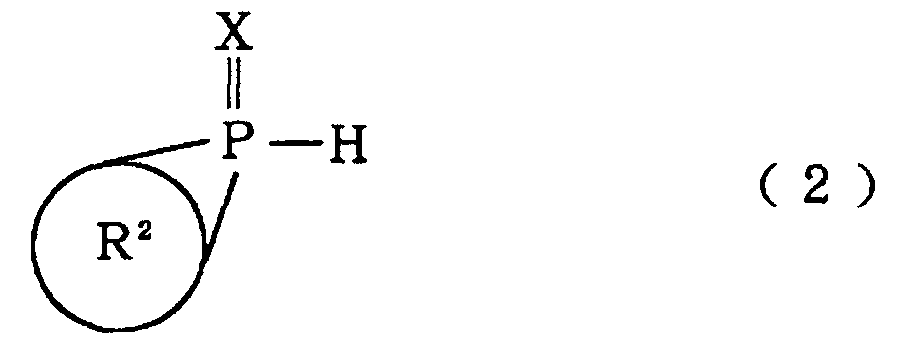
- Das Phosphor enthaltende Epoxyharz gemäß Anspruch 1, worin das sekundäre Phosphinderivat mindestens eines ist, das aus 1,4-Cyclooktylenphosphinoxid und 1,5-Cyclooktylenphosphinoxid ausgewählt ist.
- Das Phosphor enthaltende Epoxyharz gemäß Anspruch 1 oder 2, worin dem sekundären Phosphinderivat ermöglicht wird, mit einer Epoxy- oder Polyepoxyverbindung zu reagieren, wodurch das Harz erhalten wird.
- Das Phosphor enthaltende Epoxyharz nach einem der Ansprüche 1 bis 3, worin der Phosphorgehalt 0.1 Gew.-% bis 10 Gew.-% beträgt.
- Eine Phosphor enthaltende Epoxyharzzusammensetzung, enthaltend:das Phosphor enthaltende Epoxyharz nach einem der Ansprüche 1 bis 4; undein Härtungsmittel oder einen Polymerisationsinitiator.
- Ein Verfahren zur Herstellung eines Phosphor enthaltenden Epoxyharzes, umfassend:odereinen Schritt, in dem einer Epoxy- oder Polyepoxyverbindung die Reaktion mit einem sekundären Phosphin-Derivat, das durch die folgende Formel dargestellt wird, ermöglicht wird:
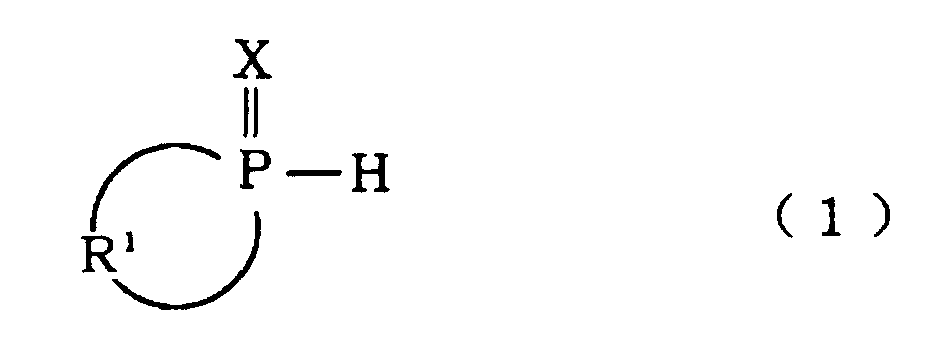 worin R1 eine Alkylengruppe bedeutet, die einen Substituenten aufweisen kann, R2 eine Cycloalkylen- oder Arylengruppe bedeutet, die einen Substituenten enthalten kann, und X ein Sauerstoff- oder Schwefelatom bedeutet.
- Ein Dichtungsmittel, das die Phosphor enthaltende Epoxyharz-Zusammensetzung nach Anspruch 5 enthält.
- Ein Formmaterial, das die Phosphor enthaltende Epoxyharz-Zusammensetzung nach Anspruch 5 enthält.
- Ein Laminat, das die Phosphor enthaltende Epoxyharz-Zusammensetzung nach Anspruch 5 enthält.
Applications Claiming Priority (1)
| Application Number | Priority Date | Filing Date | Title |
|---|---|---|---|
| PCT/JP2002/005206 WO2003099900A1 (fr) | 2002-05-29 | 2002-05-29 | Resine epoxy contenant du phosphore, composition a base de ladite resine, procede de fabrication, materiau et stratifie d'etancheification renfermant cette resine ou fabriquee a partir de cette resine |
Publications (3)
| Publication Number | Publication Date |
|---|---|
| EP1508583A1 true EP1508583A1 (de) | 2005-02-23 |
| EP1508583A4 EP1508583A4 (de) | 2006-01-18 |
| EP1508583B1 EP1508583B1 (de) | 2006-10-11 |
Family
ID=29561091
Family Applications (1)
| Application Number | Title | Priority Date | Filing Date |
|---|---|---|---|
| EP02733240A Expired - Lifetime EP1508583B1 (de) | 2002-05-29 | 2002-05-29 | Phosphorhaltiges epoxidharz, phosphorhaltiges epoxidharz enthaltende zusammensetzung, herstellungsverfahren dafür und dichtungsmasse und laminat, jeweils dieses enthaltend oder damit hergestellt |
Country Status (5)
| Country | Link |
|---|---|
| US (1) | US7271225B2 (de) |
| EP (1) | EP1508583B1 (de) |
| CN (1) | CN100384903C (de) |
| DE (1) | DE50208447D1 (de) |
| WO (1) | WO2003099900A1 (de) |
Cited By (1)
| Publication number | Priority date | Publication date | Assignee | Title |
|---|---|---|---|---|
| WO2006106892A1 (en) * | 2005-03-31 | 2006-10-12 | Showa Denko K.K. | Flame-retardant composition for solder resist and cured product thereof |
Families Citing this family (14)
| Publication number | Priority date | Publication date | Assignee | Title |
|---|---|---|---|---|
| CN100443540C (zh) * | 2006-04-29 | 2008-12-17 | 广东生益科技股份有限公司 | 一种无卤阻燃环氧树脂组合物 |
| CN101878239B (zh) * | 2007-09-28 | 2014-06-18 | 陶氏环球技术有限责任公司 | 环氧树脂配制物 |
| WO2010078689A1 (en) * | 2009-01-06 | 2010-07-15 | Dow Global Technologies Inc. | Metallic compounds in non-brominated flame retardant epoxy resins |
| KR101095136B1 (ko) * | 2009-04-23 | 2011-12-16 | 삼성전기주식회사 | 인쇄회로기판용 수지 조성물 및 이를 이용한 인쇄회로기판 |
| KR101095225B1 (ko) * | 2009-04-23 | 2011-12-20 | 삼성전기주식회사 | 인쇄회로기판용 수지 조성물 및 이를 이용한 인쇄회로기판 |
| JP5431849B2 (ja) * | 2009-09-25 | 2014-03-05 | 株式会社Adeka | 無溶剤一液型シアン酸エステル−エポキシ複合樹脂組成物 |
| EP2794735B1 (de) * | 2011-12-22 | 2019-07-17 | Hexcel Holding GmbH | Verbesserungen an oder im zusammenhang mit verstärkten verbundwerkstoffen |
| RU2487151C1 (ru) * | 2012-03-29 | 2013-07-10 | Федеральное государственное бюджетное образовательное учреждение высшего профессионального образования "Волгоградский государственный технический университет" (ВолгГТУ) | Огнезащитная композиция |
| EP2880094B1 (de) * | 2012-07-30 | 2019-10-09 | Akzo Nobel Coatings International BV | Sehr hitzebeständige zusammensetzung |
| GB201416670D0 (en) * | 2014-09-22 | 2014-11-05 | Hexcel Composites Ltd | Fast curing compositions |
| US20180029326A1 (en) * | 2015-02-17 | 2018-02-01 | Agency For Science, Technology And Research | A composite laminate and its usage |
| CN114481693A (zh) * | 2022-02-12 | 2022-05-13 | 东莞市三威新材料科技有限公司 | 基于过滤材料应用的耐水洗阻燃剂 |
| CN117069917A (zh) * | 2022-11-28 | 2023-11-17 | 青岛职业技术学院 | 一种低介电损耗、高效阻燃环氧树脂的制备方法 |
| CN115894860B (zh) * | 2022-12-16 | 2023-08-18 | 江南大学 | 一种超支化阻燃环氧树脂及其制备的环氧树脂组合物 |
Family Cites Families (19)
| Publication number | Priority date | Publication date | Assignee | Title |
|---|---|---|---|---|
| JPS51143620A (en) | 1975-06-06 | 1976-12-10 | Matsumoto Seiyaku Kogyo Kk | Process for preparation of epoxydiphosphonate |
| JPS55122790A (en) * | 1979-03-15 | 1980-09-20 | Nippon Chem Ind Co Ltd:The | Preparation of 9-phosphabicyclononane |
| US4345059A (en) | 1981-05-18 | 1982-08-17 | Fmc Corporation | Fire retardant epoxy resins containing 3-hydroxyalkylphosphine oxides |
| JPS58198521A (ja) * | 1982-05-14 | 1983-11-18 | Toshiba Chem Corp | 難燃性エポキシ樹脂組成物 |
| JPS6395223A (ja) | 1986-10-09 | 1988-04-26 | Asahi Denka Kogyo Kk | 含りんエポキシ樹脂組成物 |
| JPS63156860A (ja) | 1986-12-19 | 1988-06-29 | Nippon Chem Ind Co Ltd:The | 難燃性樹脂組成物 |
| ATE107676T1 (de) | 1989-03-03 | 1994-07-15 | Siemens Ag | Epoxidharz-formmassen. |
| ATE107677T1 (de) | 1989-03-03 | 1994-07-15 | Siemens Ag | Epoxidharzmischungen. |
| EP0412425B1 (de) | 1989-08-11 | 1996-11-13 | Siemens Aktiengesellschaft | Flammwidrige Giessharzformstoffe |
| JPH0525369A (ja) | 1991-07-24 | 1993-02-02 | Hitachi Chem Co Ltd | 難燃性エポキシ樹脂組成物 |
| DE4427456A1 (de) * | 1994-08-03 | 1996-02-08 | Siemens Ag | Phosphormodifizierte Epoxidharze, Verfahren zu ihrer Herstellung und ihre Verwendung |
| JP3613724B2 (ja) | 1997-09-09 | 2005-01-26 | 東都化成株式会社 | リン含有エポキシ樹脂組成物 |
| JP3533973B2 (ja) | 1998-01-27 | 2004-06-07 | 東都化成株式会社 | リン含有エポキシ樹脂組成物 |
| WO2000044805A1 (fr) * | 1999-01-28 | 2000-08-03 | Takeda Chemical Industries, Ltd. | Vinylesters retardateurs de flamme, resines et compositions de resines contenant lesdits vinylesters, et produits durcis obtenus a partir de ceux-ci |
| CN1257910C (zh) * | 2000-06-29 | 2006-05-31 | 日本化学工业株式会社 | 含磷对苯二酚衍生物、其制造方法、使用其的含磷环氧树脂、阻燃性环氧树脂组成物、密封材料及其积层板 |
| JP2002241466A (ja) * | 2000-12-11 | 2002-08-28 | Nippon Chem Ind Co Ltd | 含リンエポキシ樹脂、含リンエポキシ樹脂組成物、その製造方法、それを用いた封止材および積層板 |
| JP2003192768A (ja) * | 2001-12-27 | 2003-07-09 | Taiyo Ink Mfg Ltd | 難燃性エポキシ樹脂組成物とその成型物およびこれを用いた多層プリント配線板 |
| JP2003192763A (ja) * | 2001-12-27 | 2003-07-09 | Taiyo Ink Mfg Ltd | 光硬化性・熱硬化性樹脂組成物、およびこれを用いたプリント配線板 |
| JP2003327837A (ja) * | 2002-05-09 | 2003-11-19 | Nippon Chem Ind Co Ltd | 難燃性樹脂組成物、これを用いた封止材及び積層板 |
-
2002
- 2002-05-29 US US10/515,764 patent/US7271225B2/en not_active Expired - Fee Related
- 2002-05-29 CN CNB028293738A patent/CN100384903C/zh not_active Expired - Fee Related
- 2002-05-29 WO PCT/JP2002/005206 patent/WO2003099900A1/ja not_active Ceased
- 2002-05-29 DE DE50208447T patent/DE50208447D1/de not_active Expired - Fee Related
- 2002-05-29 EP EP02733240A patent/EP1508583B1/de not_active Expired - Lifetime
Cited By (1)
| Publication number | Priority date | Publication date | Assignee | Title |
|---|---|---|---|---|
| WO2006106892A1 (en) * | 2005-03-31 | 2006-10-12 | Showa Denko K.K. | Flame-retardant composition for solder resist and cured product thereof |
Also Published As
| Publication number | Publication date |
|---|---|
| EP1508583A4 (de) | 2006-01-18 |
| EP1508583B1 (de) | 2006-10-11 |
| US20050228148A1 (en) | 2005-10-13 |
| CN1639223A (zh) | 2005-07-13 |
| DE50208447D1 (de) | 2006-11-23 |
| CN100384903C (zh) | 2008-04-30 |
| US7271225B2 (en) | 2007-09-18 |
| WO2003099900A1 (fr) | 2003-12-04 |
Similar Documents
| Publication | Publication Date | Title |
|---|---|---|
| DE60023752T2 (de) | Feuerhemmende phosporenthaltende epoxidharzzusammensetzung | |
| DE60129216T2 (de) | Flammhemmende epoxyharzzusammensetzung, daraus geformter gegenstand sowie elekttronisches bauteil | |
| DE60036856T2 (de) | Phosphor enthaltende Epoxidharzzusammensetzung, Verbundfolie die diese enthält, Mehrschichtwerkstoff aus Metall, Prepreg und laminierte Platte, Mehrschichtplatte | |
| EP1508583B1 (de) | Phosphorhaltiges epoxidharz, phosphorhaltiges epoxidharz enthaltende zusammensetzung, herstellungsverfahren dafür und dichtungsmasse und laminat, jeweils dieses enthaltend oder damit hergestellt | |
| US6646064B2 (en) | Reacting epoxy resin with p-containing dihydric phenol or naphthol | |
| TWI786271B (zh) | 含磷之苯氧基樹脂、含磷之苯氧基樹脂的樹脂組成物、及硬化物 | |
| JP7211829B2 (ja) | エポキシ樹脂組成物及びその硬化物 | |
| US6720077B2 (en) | Resin composition, and use and method for preparing the same | |
| JP2000080251A (ja) | リン変性難燃性エポキシ樹脂組成物およびその製造方法およびそのリン変性難燃性エポキシ樹脂組成物を用いた成形品および積層体 | |
| JP6114989B2 (ja) | 熱硬化性樹脂組成物の硬化方法、熱硬化性樹脂組成物、これを用いたプリプレグ、金属張積層板、樹脂シート、プリント配線板及び封止材 | |
| JP2960897B2 (ja) | エポキシ樹脂、リン含有化合物および硬化剤を含有するリン変性エポキシ樹脂組成物 | |
| TWI428242B (zh) | 用於印刷電路板之阻燃性預浸漬物和層合物 | |
| KR102192792B1 (ko) | 인 함유 에폭시 수지 조성물 및 경화물 | |
| EP0799847A1 (de) | Phosphormodifizierte Epoxid-harzmischungen aus Epoxid-harzen, phosphorhaltigen Verbindungen und einem Härter | |
| TWI460199B (zh) | 難燃性含磷環氧樹脂組成物及其硬化物 | |
| EP0799848B1 (de) | Phosphormodifizierte Epoxidharze aus Epoxidharzen und phosphorhaltigen Verbindungen | |
| EP0799846B1 (de) | Phosphormodifizierte Epoxid-harzmischungen aus Expoxid-harzen, phosphorhaltigen Verbindungen und einem Härter | |
| JP4410619B2 (ja) | 電気用積層板とプリント配線板 | |
| JP2002241466A (ja) | 含リンエポキシ樹脂、含リンエポキシ樹脂組成物、その製造方法、それを用いた封止材および積層板 | |
| JP2003327837A (ja) | 難燃性樹脂組成物、これを用いた封止材及び積層板 | |
| JP2004010867A (ja) | 反応性難燃剤、その製造方法、それを用いた難燃性樹脂組成物、封止材および積層板 | |
| EP0539327A1 (de) | Mit organischen Phosphorverbindungen stabilisierte Epoxy-Novolake | |
| DE19709519A1 (de) | Phosphormodifizierte Epoxidharzmischungen aus Epoxidharzen, phosphorhaltigen Verbindungen und einem Härter | |
| HK1051702B (en) | Flame retardant phosphorus element-containing epoxy resin compositions | |
| HK1040410B (en) | Epoxy resin compositions containing phosphorus and the uses thereof |
Legal Events
| Date | Code | Title | Description |
|---|---|---|---|
| PUAI | Public reference made under article 153(3) epc to a published international application that has entered the european phase |
Free format text: ORIGINAL CODE: 0009012 |
|
| 17P | Request for examination filed |
Effective date: 20041123 |
|
| AK | Designated contracting states |
Kind code of ref document: A1 Designated state(s): AT BE CH CY DE DK ES FI FR GB GR IE IT LI LU MC NL PT SE TR |
|
| RBV | Designated contracting states (corrected) |
Designated state(s): DE |
|
| A4 | Supplementary search report drawn up and despatched |
Effective date: 20051205 |
|
| GRAP | Despatch of communication of intention to grant a patent |
Free format text: ORIGINAL CODE: EPIDOSNIGR1 |
|
| GRAS | Grant fee paid |
Free format text: ORIGINAL CODE: EPIDOSNIGR3 |
|
| GRAA | (expected) grant |
Free format text: ORIGINAL CODE: 0009210 |
|
| AK | Designated contracting states |
Kind code of ref document: B1 Designated state(s): DE |
|
| REF | Corresponds to: |
Ref document number: 50208447 Country of ref document: DE Date of ref document: 20061123 Kind code of ref document: P |
|
| PGFP | Annual fee paid to national office [announced via postgrant information from national office to epo] |
Ref country code: DE Payment date: 20070430 Year of fee payment: 6 |
|
| PLBE | No opposition filed within time limit |
Free format text: ORIGINAL CODE: 0009261 |
|
| STAA | Information on the status of an ep patent application or granted ep patent |
Free format text: STATUS: NO OPPOSITION FILED WITHIN TIME LIMIT |
|
| 26N | No opposition filed |
Effective date: 20070712 |
|
| PG25 | Lapsed in a contracting state [announced via postgrant information from national office to epo] |
Ref country code: DE Free format text: LAPSE BECAUSE OF NON-PAYMENT OF DUE FEES Effective date: 20081202 |