EP1475411A1 - Mannichbasen und Herstellungsverfahren von Mannichbasen - Google Patents
Mannichbasen und Herstellungsverfahren von Mannichbasen Download PDFInfo
- Publication number
- EP1475411A1 EP1475411A1 EP03010122A EP03010122A EP1475411A1 EP 1475411 A1 EP1475411 A1 EP 1475411A1 EP 03010122 A EP03010122 A EP 03010122A EP 03010122 A EP03010122 A EP 03010122A EP 1475411 A1 EP1475411 A1 EP 1475411A1
- Authority
- EP
- European Patent Office
- Prior art keywords
- mannich base
- bis
- formula
- polyamine
- base according
- Prior art date
- Legal status (The legal status is an assumption and is not a legal conclusion. Google has not performed a legal analysis and makes no representation as to the accuracy of the status listed.)
- Withdrawn
Links
- 238000002360 preparation method Methods 0.000 title claims abstract description 8
- RREANTFLPGEWEN-MBLPBCRHSA-N 7-[4-[[(3z)-3-[4-amino-5-[(3,4,5-trimethoxyphenyl)methyl]pyrimidin-2-yl]imino-5-fluoro-2-oxoindol-1-yl]methyl]piperazin-1-yl]-1-cyclopropyl-6-fluoro-4-oxoquinoline-3-carboxylic acid Chemical compound COC1=C(OC)C(OC)=CC(CC=2C(=NC(\N=C/3C4=CC(F)=CC=C4N(CN4CCN(CC4)C=4C(=CC=5C(=O)C(C(O)=O)=CN(C=5C=4)C4CC4)F)C\3=O)=NC=2)N)=C1 RREANTFLPGEWEN-MBLPBCRHSA-N 0.000 title abstract description 35
- WSFSSNUMVMOOMR-UHFFFAOYSA-N Formaldehyde Chemical compound O=C WSFSSNUMVMOOMR-UHFFFAOYSA-N 0.000 claims abstract description 71
- 229920000768 polyamine Polymers 0.000 claims abstract description 62
- 150000002989 phenols Chemical class 0.000 claims abstract description 24
- 239000004848 polyfunctional curative Substances 0.000 claims abstract description 16
- 239000004814 polyurethane Substances 0.000 claims abstract description 15
- 229920002635 polyurethane Polymers 0.000 claims abstract description 15
- 150000003512 tertiary amines Chemical class 0.000 claims abstract description 14
- 239000000203 mixture Substances 0.000 claims description 28
- 238000000034 method Methods 0.000 claims description 19
- 238000004519 manufacturing process Methods 0.000 claims description 14
- 239000004593 Epoxy Substances 0.000 claims description 11
- -1 3-hydroxy-5-methyl-phenyl group Chemical group 0.000 abstract description 11
- 150000002118 epoxides Chemical class 0.000 abstract 2
- 239000002585 base Substances 0.000 description 17
- RNLHGQLZWXBQNY-UHFFFAOYSA-N 3-(aminomethyl)-3,5,5-trimethylcyclohexan-1-amine Chemical compound CC1(C)CC(N)CC(C)(CN)C1 RNLHGQLZWXBQNY-UHFFFAOYSA-N 0.000 description 14
- JZUHIOJYCPIVLQ-UHFFFAOYSA-N 2-methylpentane-1,5-diamine Chemical compound NCC(C)CCCN JZUHIOJYCPIVLQ-UHFFFAOYSA-N 0.000 description 10
- VHRGRCVQAFMJIZ-UHFFFAOYSA-N cadaverine Chemical compound NCCCCCN VHRGRCVQAFMJIZ-UHFFFAOYSA-N 0.000 description 10
- 239000003822 epoxy resin Substances 0.000 description 10
- 229920000647 polyepoxide Polymers 0.000 description 10
- KIDHWZJUCRJVML-UHFFFAOYSA-N putrescine Chemical compound NCCCCN KIDHWZJUCRJVML-UHFFFAOYSA-N 0.000 description 10
- XLYOFNOQVPJJNP-UHFFFAOYSA-N water Substances O XLYOFNOQVPJJNP-UHFFFAOYSA-N 0.000 description 10
- RPNUMPOLZDHAAY-UHFFFAOYSA-N Diethylenetriamine Chemical compound NCCNCCN RPNUMPOLZDHAAY-UHFFFAOYSA-N 0.000 description 9
- VILCJCGEZXAXTO-UHFFFAOYSA-N 2,2,2-tetramine Chemical compound NCCNCCNCCN VILCJCGEZXAXTO-UHFFFAOYSA-N 0.000 description 8
- IJGRMHOSHXDMSA-UHFFFAOYSA-N Atomic nitrogen Chemical compound N#N IJGRMHOSHXDMSA-UHFFFAOYSA-N 0.000 description 8
- ISWSIDIOOBJBQZ-UHFFFAOYSA-N Phenol Chemical compound OC1=CC=CC=C1 ISWSIDIOOBJBQZ-UHFFFAOYSA-N 0.000 description 8
- 239000000126 substance Substances 0.000 description 8
- FAGUFWYHJQFNRV-UHFFFAOYSA-N tetraethylenepentamine Chemical compound NCCNCCNCCNCCN FAGUFWYHJQFNRV-UHFFFAOYSA-N 0.000 description 8
- IGSBHTZEJMPDSZ-UHFFFAOYSA-N 4-[(4-amino-3-methylcyclohexyl)methyl]-2-methylcyclohexan-1-amine Chemical compound C1CC(N)C(C)CC1CC1CC(C)C(N)CC1 IGSBHTZEJMPDSZ-UHFFFAOYSA-N 0.000 description 6
- DZIHTWJGPDVSGE-UHFFFAOYSA-N 4-[(4-aminocyclohexyl)methyl]cyclohexan-1-amine Chemical compound C1CC(N)CCC1CC1CCC(N)CC1 DZIHTWJGPDVSGE-UHFFFAOYSA-N 0.000 description 6
- CNPURSDMOWDNOQ-UHFFFAOYSA-N 4-methoxy-7h-pyrrolo[2,3-d]pyrimidin-2-amine Chemical compound COC1=NC(N)=NC2=C1C=CN2 CNPURSDMOWDNOQ-UHFFFAOYSA-N 0.000 description 6
- SSJXIUAHEKJCMH-UHFFFAOYSA-N cyclohexane-1,2-diamine Chemical compound NC1CCCCC1N SSJXIUAHEKJCMH-UHFFFAOYSA-N 0.000 description 6
- VKIRRGRTJUUZHS-UHFFFAOYSA-N cyclohexane-1,4-diamine Chemical compound NC1CCC(N)CC1 VKIRRGRTJUUZHS-UHFFFAOYSA-N 0.000 description 6
- 239000000243 solution Substances 0.000 description 6
- 229960001124 trientine Drugs 0.000 description 6
- XFNJVJPLKCPIBV-UHFFFAOYSA-N trimethylenediamine Chemical compound NCCCN XFNJVJPLKCPIBV-UHFFFAOYSA-N 0.000 description 6
- 150000001412 amines Chemical class 0.000 description 5
- OPCJOXGBLDJWRM-UHFFFAOYSA-N 1,2-diamino-2-methylpropane Chemical compound CC(C)(N)CN OPCJOXGBLDJWRM-UHFFFAOYSA-N 0.000 description 4
- GEYOCULIXLDCMW-UHFFFAOYSA-N 1,2-phenylenediamine Chemical compound NC1=CC=CC=C1N GEYOCULIXLDCMW-UHFFFAOYSA-N 0.000 description 4
- DDHUNHGZUHZNKB-UHFFFAOYSA-N 2,2-dimethylpropane-1,3-diamine Chemical compound NCC(C)(C)CN DDHUNHGZUHZNKB-UHFFFAOYSA-N 0.000 description 4
- DPQHRXRAZHNGRU-UHFFFAOYSA-N 2,4,4-trimethylhexane-1,6-diamine Chemical compound NCC(C)CC(C)(C)CCN DPQHRXRAZHNGRU-UHFFFAOYSA-N 0.000 description 4
- VOZKAJLKRJDJLL-UHFFFAOYSA-N 2,4-diaminotoluene Chemical compound CC1=CC=C(N)C=C1N VOZKAJLKRJDJLL-UHFFFAOYSA-N 0.000 description 4
- GXVUZYLYWKWJIM-UHFFFAOYSA-N 2-(2-aminoethoxy)ethanamine Chemical compound NCCOCCN GXVUZYLYWKWJIM-UHFFFAOYSA-N 0.000 description 4
- ZAXCZCOUDLENMH-UHFFFAOYSA-N 3,3,3-tetramine Chemical compound NCCCNCCCNCCCN ZAXCZCOUDLENMH-UHFFFAOYSA-N 0.000 description 4
- POTQBGGWSWSMCX-UHFFFAOYSA-N 3-[2-(3-aminopropoxy)ethoxy]propan-1-amine Chemical compound NCCCOCCOCCCN POTQBGGWSWSMCX-UHFFFAOYSA-N 0.000 description 4
- YOOSAIJKYCBPFW-UHFFFAOYSA-N 3-[4-(3-aminopropoxy)butoxy]propan-1-amine Chemical compound NCCCOCCCCOCCCN YOOSAIJKYCBPFW-UHFFFAOYSA-N 0.000 description 4
- HMJBXEZHJUYJQY-UHFFFAOYSA-N 4-(aminomethyl)octane-1,8-diamine Chemical compound NCCCCC(CN)CCCN HMJBXEZHJUYJQY-UHFFFAOYSA-N 0.000 description 4
- JHCBFGGESJQAIQ-UHFFFAOYSA-N 4-[(4-amino-3,5-dimethylcyclohexyl)methyl]-2,6-dimethylcyclohexan-1-amine Chemical compound C1C(C)C(N)C(C)CC1CC1CC(C)C(N)C(C)C1 JHCBFGGESJQAIQ-UHFFFAOYSA-N 0.000 description 4
- HCJLTNJVGXHKTN-UHFFFAOYSA-N 4-[(4-amino-3-ethylcyclohexyl)methyl]-2-ethylcyclohexan-1-amine Chemical compound C1CC(N)C(CC)CC1CC1CC(CC)C(N)CC1 HCJLTNJVGXHKTN-UHFFFAOYSA-N 0.000 description 4
- QTKDDPSHNLZGRO-UHFFFAOYSA-N 4-methylcyclohexane-1,3-diamine Chemical compound CC1CCC(N)CC1N QTKDDPSHNLZGRO-UHFFFAOYSA-N 0.000 description 4
- RTZKZFJDLAIYFH-UHFFFAOYSA-N Diethyl ether Chemical compound CCOCC RTZKZFJDLAIYFH-UHFFFAOYSA-N 0.000 description 4
- PIICEJLVQHRZGT-UHFFFAOYSA-N Ethylenediamine Chemical compound NCCN PIICEJLVQHRZGT-UHFFFAOYSA-N 0.000 description 4
- QLBRROYTTDFLDX-UHFFFAOYSA-N [3-(aminomethyl)cyclohexyl]methanamine Chemical compound NCC1CCCC(CN)C1 QLBRROYTTDFLDX-UHFFFAOYSA-N 0.000 description 4
- FDLQZKYLHJJBHD-UHFFFAOYSA-N [3-(aminomethyl)phenyl]methanamine Chemical compound NCC1=CC=CC(CN)=C1 FDLQZKYLHJJBHD-UHFFFAOYSA-N 0.000 description 4
- OXIKYYJDTWKERT-UHFFFAOYSA-N [4-(aminomethyl)cyclohexyl]methanamine Chemical compound NCC1CCC(CN)CC1 OXIKYYJDTWKERT-UHFFFAOYSA-N 0.000 description 4
- ISKQADXMHQSTHK-UHFFFAOYSA-N [4-(aminomethyl)phenyl]methanamine Chemical compound NCC1=CC=C(CN)C=C1 ISKQADXMHQSTHK-UHFFFAOYSA-N 0.000 description 4
- 125000001931 aliphatic group Chemical group 0.000 description 4
- CSFZOENQUCDFFR-UHFFFAOYSA-N bis(aminomethyl)tricyclo[5,2,1,02,6]decane Chemical compound C12CCCC2(CN)C2(CN)CC1CC2 CSFZOENQUCDFFR-UHFFFAOYSA-N 0.000 description 4
- IISBACLAFKSPIT-UHFFFAOYSA-N bisphenol A Chemical compound C=1C=C(O)C=CC=1C(C)(C)C1=CC=C(O)C=C1 IISBACLAFKSPIT-UHFFFAOYSA-N 0.000 description 4
- BELZJFWUNQWBES-UHFFFAOYSA-N caldopentamine Chemical compound NCCCNCCCNCCCNCCCN BELZJFWUNQWBES-UHFFFAOYSA-N 0.000 description 4
- 238000001816 cooling Methods 0.000 description 4
- YQLZOAVZWJBZSY-UHFFFAOYSA-N decane-1,10-diamine Chemical compound NCCCCCCCCCCN YQLZOAVZWJBZSY-UHFFFAOYSA-N 0.000 description 4
- QFTYSVGGYOXFRQ-UHFFFAOYSA-N dodecane-1,12-diamine Chemical compound NCCCCCCCCCCCCN QFTYSVGGYOXFRQ-UHFFFAOYSA-N 0.000 description 4
- LNEPOXFFQSENCJ-UHFFFAOYSA-N haloperidol Chemical compound C1CC(O)(C=2C=CC(Cl)=CC=2)CCN1CCCC(=O)C1=CC=C(F)C=C1 LNEPOXFFQSENCJ-UHFFFAOYSA-N 0.000 description 4
- PWSKHLMYTZNYKO-UHFFFAOYSA-N heptane-1,7-diamine Chemical compound NCCCCCCCN PWSKHLMYTZNYKO-UHFFFAOYSA-N 0.000 description 4
- 239000004312 hexamethylene tetramine Substances 0.000 description 4
- 235000010299 hexamethylene tetramine Nutrition 0.000 description 4
- NAQMVNRVTILPCV-UHFFFAOYSA-N hexane-1,6-diamine Chemical compound NCCCCCCN NAQMVNRVTILPCV-UHFFFAOYSA-N 0.000 description 4
- GKQPCPXONLDCMU-CCEZHUSRSA-N lacidipine Chemical compound CCOC(=O)C1=C(C)NC(C)=C(C(=O)OCC)C1C1=CC=CC=C1\C=C\C(=O)OC(C)(C)C GKQPCPXONLDCMU-CCEZHUSRSA-N 0.000 description 4
- RLSSMJSEOOYNOY-UHFFFAOYSA-N m-cresol Chemical compound CC1=CC=CC(O)=C1 RLSSMJSEOOYNOY-UHFFFAOYSA-N 0.000 description 4
- KMBPCQSCMCEPMU-UHFFFAOYSA-N n'-(3-aminopropyl)-n'-methylpropane-1,3-diamine Chemical compound NCCCN(C)CCCN KMBPCQSCMCEPMU-UHFFFAOYSA-N 0.000 description 4
- 229910052757 nitrogen Inorganic materials 0.000 description 4
- SXJVFQLYZSNZBT-UHFFFAOYSA-N nonane-1,9-diamine Chemical compound NCCCCCCCCCN SXJVFQLYZSNZBT-UHFFFAOYSA-N 0.000 description 4
- RGSFGYAAUTVSQA-UHFFFAOYSA-N pentamethylene Natural products C1CCCC1 RGSFGYAAUTVSQA-UHFFFAOYSA-N 0.000 description 4
- WTSXICLFTPPDTL-UHFFFAOYSA-N pentane-1,3-diamine Chemical compound CCC(N)CCN WTSXICLFTPPDTL-UHFFFAOYSA-N 0.000 description 4
- KLNPWTHGTVSSEU-UHFFFAOYSA-N undecane-1,11-diamine Chemical compound NCCCCCCCCCCCN KLNPWTHGTVSSEU-UHFFFAOYSA-N 0.000 description 4
- 150000001875 compounds Chemical class 0.000 description 3
- 125000002924 primary amino group Chemical group [H]N([H])* 0.000 description 3
- 238000003756 stirring Methods 0.000 description 3
- 238000010792 warming Methods 0.000 description 3
- PWGJDPKCLMLPJW-UHFFFAOYSA-N 1,8-diaminooctane Chemical compound NCCCCCCCCN PWGJDPKCLMLPJW-UHFFFAOYSA-N 0.000 description 2
- FZZMTSNZRBFGGU-UHFFFAOYSA-N 2-chloro-7-fluoroquinazolin-4-amine Chemical compound FC1=CC=C2C(N)=NC(Cl)=NC2=C1 FZZMTSNZRBFGGU-UHFFFAOYSA-N 0.000 description 2
- ANOPCGQVRXJHHD-UHFFFAOYSA-N 3-[3-(3-aminopropyl)-2,4,8,10-tetraoxaspiro[5.5]undecan-9-yl]propan-1-amine Chemical compound C1OC(CCCN)OCC21COC(CCCN)OC2 ANOPCGQVRXJHHD-UHFFFAOYSA-N 0.000 description 2
- YBRVSVVVWCFQMG-UHFFFAOYSA-N 4,4'-diaminodiphenylmethane Chemical compound C1=CC(N)=CC=C1CC1=CC=C(N)C=C1 YBRVSVVVWCFQMG-UHFFFAOYSA-N 0.000 description 2
- IMNFDUFMRHMDMM-UHFFFAOYSA-N N-Heptane Chemical compound CCCCCCC IMNFDUFMRHMDMM-UHFFFAOYSA-N 0.000 description 2
- 229930040373 Paraformaldehyde Natural products 0.000 description 2
- 125000003277 amino group Chemical group 0.000 description 2
- 150000004982 aromatic amines Chemical class 0.000 description 2
- OTBHHUPVCYLGQO-UHFFFAOYSA-N bis(3-aminopropyl)amine Chemical compound NCCCNCCCN OTBHHUPVCYLGQO-UHFFFAOYSA-N 0.000 description 2
- PXKLMJQFEQBVLD-UHFFFAOYSA-N bisphenol F Chemical compound C1=CC(O)=CC=C1CC1=CC=C(O)C=C1 PXKLMJQFEQBVLD-UHFFFAOYSA-N 0.000 description 2
- 229940106691 bisphenol a Drugs 0.000 description 2
- YCIMNLLNPGFGHC-UHFFFAOYSA-N catechol Chemical compound OC1=CC=CC=C1O YCIMNLLNPGFGHC-UHFFFAOYSA-N 0.000 description 2
- 239000003431 cross linking reagent Substances 0.000 description 2
- DIOQZVSQGTUSAI-UHFFFAOYSA-N decane Chemical compound CCCCCCCCCC DIOQZVSQGTUSAI-UHFFFAOYSA-N 0.000 description 2
- 125000001033 ether group Chemical group 0.000 description 2
- 125000002496 methyl group Chemical group [H]C([H])([H])* 0.000 description 2
- 150000008442 polyphenolic compounds Chemical class 0.000 description 2
- 239000000047 product Substances 0.000 description 2
- WQGWDDDVZFFDIG-UHFFFAOYSA-N pyrogallol Chemical compound OC1=CC=CC(O)=C1O WQGWDDDVZFFDIG-UHFFFAOYSA-N 0.000 description 2
- GHMLBKRAJCXXBS-UHFFFAOYSA-N resorcinol Chemical compound OC1=CC=CC(O)=C1 GHMLBKRAJCXXBS-UHFFFAOYSA-N 0.000 description 2
- 238000003860 storage Methods 0.000 description 2
- KJCVRFUGPWSIIH-UHFFFAOYSA-N 1-naphthol Chemical compound C1=CC=C2C(O)=CC=CC2=C1 KJCVRFUGPWSIIH-UHFFFAOYSA-N 0.000 description 1
- JOLVYUIAMRUBRK-UHFFFAOYSA-N 11',12',14',15'-Tetradehydro(Z,Z-)-3-(8-Pentadecenyl)phenol Natural products OC1=CC=CC(CCCCCCCC=CCC=CCC=C)=C1 JOLVYUIAMRUBRK-UHFFFAOYSA-N 0.000 description 1
- AHDSRXYHVZECER-UHFFFAOYSA-N 2,4,6-tris[(dimethylamino)methyl]phenol Chemical compound CN(C)CC1=CC(CN(C)C)=C(O)C(CN(C)C)=C1 AHDSRXYHVZECER-UHFFFAOYSA-N 0.000 description 1
- YLKVIMNNMLKUGJ-UHFFFAOYSA-N 3-Delta8-pentadecenylphenol Natural products CCCCCCC=CCCCCCCCC1=CC=CC(O)=C1 YLKVIMNNMLKUGJ-UHFFFAOYSA-N 0.000 description 1
- QHPQWRBYOIRBIT-UHFFFAOYSA-N 4-tert-butylphenol Chemical compound CC(C)(C)C1=CC=C(O)C=C1 QHPQWRBYOIRBIT-UHFFFAOYSA-N 0.000 description 1
- LCFVJGUPQDGYKZ-UHFFFAOYSA-N Bisphenol A diglycidyl ether Chemical compound C=1C=C(OCC2OC2)C=CC=1C(C)(C)C(C=C1)=CC=C1OCC1CO1 LCFVJGUPQDGYKZ-UHFFFAOYSA-N 0.000 description 1
- JOLVYUIAMRUBRK-UTOQUPLUSA-N Cardanol Chemical compound OC1=CC=CC(CCCCCCC\C=C/C\C=C/CC=C)=C1 JOLVYUIAMRUBRK-UTOQUPLUSA-N 0.000 description 1
- FAYVLNWNMNHXGA-UHFFFAOYSA-N Cardanoldiene Natural products CCCC=CCC=CCCCCCCCC1=CC=CC(O)=C1 FAYVLNWNMNHXGA-UHFFFAOYSA-N 0.000 description 1
- IGFHQQFPSIBGKE-UHFFFAOYSA-N Nonylphenol Natural products CCCCCCCCCC1=CC=C(O)C=C1 IGFHQQFPSIBGKE-UHFFFAOYSA-N 0.000 description 1
- ZJCCRDAZUWHFQH-UHFFFAOYSA-N Trimethylolpropane Chemical compound CCC(CO)(CO)CO ZJCCRDAZUWHFQH-UHFFFAOYSA-N 0.000 description 1
- 239000000853 adhesive Substances 0.000 description 1
- 230000001070 adhesive effect Effects 0.000 description 1
- 150000008044 alkali metal hydroxides Chemical class 0.000 description 1
- 229910001860 alkaline earth metal hydroxide Inorganic materials 0.000 description 1
- IMUDHTPIFIBORV-UHFFFAOYSA-N aminoethylpiperazine Chemical compound NCCN1CCNCC1 IMUDHTPIFIBORV-UHFFFAOYSA-N 0.000 description 1
- 230000015572 biosynthetic process Effects 0.000 description 1
- 239000006227 byproduct Substances 0.000 description 1
- PTFIPECGHSYQNR-UHFFFAOYSA-N cardanol Natural products CCCCCCCCCCCCCCCC1=CC=CC(O)=C1 PTFIPECGHSYQNR-UHFFFAOYSA-N 0.000 description 1
- 239000007795 chemical reaction product Substances 0.000 description 1
- 230000000694 effects Effects 0.000 description 1
- 125000001495 ethyl group Chemical group [H]C([H])([H])C([H])([H])* 0.000 description 1
- 239000011521 glass Substances 0.000 description 1
- 125000004435 hydrogen atom Chemical group [H]* 0.000 description 1
- 239000011261 inert gas Substances 0.000 description 1
- WSFSSNUMVMOOMR-NJFSPNSNSA-N methanone Chemical compound O=[14CH2] WSFSSNUMVMOOMR-NJFSPNSNSA-N 0.000 description 1
- SNQQPOLDUKLAAF-UHFFFAOYSA-N nonylphenol Chemical compound CCCCCCCCCC1=CC=CC=C1O SNQQPOLDUKLAAF-UHFFFAOYSA-N 0.000 description 1
- 238000010915 one-step procedure Methods 0.000 description 1
- QCDYQQDYXPDABM-UHFFFAOYSA-N phloroglucinol Chemical compound OC1=CC(O)=CC(O)=C1 QCDYQQDYXPDABM-UHFFFAOYSA-N 0.000 description 1
- 229960001553 phloroglucinol Drugs 0.000 description 1
- 229940079877 pyrogallol Drugs 0.000 description 1
- 229920005989 resin Polymers 0.000 description 1
- 239000011347 resin Substances 0.000 description 1
- 229960001755 resorcinol Drugs 0.000 description 1
- 239000007858 starting material Substances 0.000 description 1
- 230000001988 toxicity Effects 0.000 description 1
- 231100000419 toxicity Toxicity 0.000 description 1
Classifications
-
- C—CHEMISTRY; METALLURGY
- C08—ORGANIC MACROMOLECULAR COMPOUNDS; THEIR PREPARATION OR CHEMICAL WORKING-UP; COMPOSITIONS BASED THEREON
- C08G—MACROMOLECULAR COMPOUNDS OBTAINED OTHERWISE THAN BY REACTIONS ONLY INVOLVING UNSATURATED CARBON-TO-CARBON BONDS
- C08G59/00—Polycondensates containing more than one epoxy group per molecule; Macromolecules obtained by polymerising compounds containing more than one epoxy group per molecule using curing agents or catalysts which react with the epoxy groups
- C08G59/18—Macromolecules obtained by polymerising compounds containing more than one epoxy group per molecule using curing agents or catalysts which react with the epoxy groups ; e.g. general methods of curing
- C08G59/40—Macromolecules obtained by polymerising compounds containing more than one epoxy group per molecule using curing agents or catalysts which react with the epoxy groups ; e.g. general methods of curing characterised by the curing agents used
- C08G59/62—Alcohols or phenols
- C08G59/621—Phenols
- C08G59/623—Aminophenols
Definitions
- the invention relates to novel Mannich bases and new methods for the production of Mannich bases.
- Mannich bases have long been known. Phenol as the starting material has the major disadvantage that the Mannich bases produced from it still contain portions of unreacted phenol. Due to the toxicity of phenol, Mannich bases based on phenol cannot be used in many market areas. Great efforts have therefore been made to produce phenol-free Mannich bases. For example, Mannich bases based on nonylphenol or p-tert-butylphenol or cardanol were developed and commercialized. Mannich bases are mainly used as accelerators for epoxy resins or as hardeners for epoxy resins and polyurethanes. WO 00/15687 describes, for example, a Mannich base accelerator which is produced by transaminating a Mannich base with an amine.
- Mannich hardeners A major disadvantage of known Mannich hardeners is the high viscosity that arises during their production due to the formation of oligomers and by-products. Because of this, the Mannich base hardeners are usually used in a mixture of conventional polyamines. However, the addition of additional polyamines usually has a negative effect on the properties of the cured epoxy resin composition.
- the object of the present invention is to produce novel Mannich bases which can be used as hardeners in two-component epoxy resin and polyurethane compositions and are free from phenol. It was found that Mannich bases according to claim 1 show these properties and thus the problems of the prior art could be overcome. Furthermore, a two-stage manufacturing process for the production of Mannich bases was found, which leads to lower viscosity of the Mannich bases.
- the present invention relates to novel Mannich bases for the preparation of which at least one phenolic compound of the formula (I) and formaldehyde and at least one polyamine are used.
- the radical R 1 represents either H or CH 3.
- Preferred as the phenolic compound of the formula (I) is m-cresol.
- Formaldehyde can be known in the art Forms used directly or from formaldehyde-releasing compounds come. Formaldehyde in the form of para-formaldehyde or is preferred as a formalin solution. Formalin solution is particularly preferred.
- Polyamines are preferably selected from the group comprising DAMP, IPDA, 1,3- and 1,4-diaminocyclohexane, 1,2-diaminocyclohexane, 1,3- and 1,4-butanediamine, 1,3- and 1,5-pentanediamine, MPMD, 1,3-xylylenediamine, 1,3-bis (aminomethyl) cyclohexane, diethylene triamine, triethylene tetramine (3,6-diaza-octamethylene diamine), tetraethylene pentamine, pentamethylene hexamine, dipropylene triamine, tripropylene tetramine, tetrapropylene pentamine, 4,7-diazadecam 10-diamine, bis (4-aminocyclohexyl) methane, bis (4-amino-3-methylcyclohexyl) methane, 3 (4), 8 (9) bis (aminomethyl) tricyclo [5.2.1.0 2
- the polyamines are particularly preferably selected from the group comprising 1,3-xylylenediamine, 1,3-bis (aminomethyl) cyclohexane, diethylenetriamine, Triethylene tetramine (3,6-diaza-octamethylene diamine), tetraethylene pentamine, IPDA, 1,2-diaminocyclohexane, 4,7-diaza-decamethylene-1,10-diamine as well as mixtures thereof.
- Mannich bases can be obtained from phenolic compounds of the formula (I), formaldehyde, and polyamines.
- the production of Mannich bases is possible using standard one-step processes. To be favoured however, the Mannich bases according to the two-stage described below Process manufactured.
- Another aspect of the present invention is a new one two-step process for the preparation of Mannich bases.
- This Draws inventive method for producing a Mannich base is characterized in that in a first stage at least one phenolic Compound with formaldehyde in the presence of a tertiary amine for reaction is brought and in a subsequent stage with at least one Polyamine is implemented.
- Particularly suitable phenolic compounds are those which have unsubstituted positions at the o- and / or p-position relative to the phenol group.
- examples include hydroxynaphthalene, polyhydroxynaphthalene, alkylphenols, dialklyphenols, bridged phenols, such as, for example, tetrahydronaphtols.
- Polyphenolic compounds, both mononuclear and multinuclear, are also included. Examples of such polyphenolic compounds are pyrocatechol, resorcinol, pyrogallol, phloroglucin, bisphenol-A, bisphenol-F.
- Phenolic compounds which have unsubstituted positions at the o and p positions relative to the phenol group are particularly suitable. Phenolic compounds of the formula (I) are preferred where R 1 represents H or CH 3 . Particularly preferred is m-cresol, where in formula (I) R 1 represents a hydrogen atom.
- Formaldehyde can be known in the art Forms directly or from compounds that release formaldehyde Application come. Formaldehyde in the form of para-formaldehyde is preferred or as a formalin solution. Formalin solution is particularly preferred.
- tertiary amines Particularly suitable as tertiary amines are those which additionally have primary amino groups, such as 1- (2-aminoethyl) piperazine.
- primary amino groups such as 1- (2-aminoethyl) piperazine.
- N is preferred as 2.
- Mixtures of tertiary amines can also be used. Under certain circumstances, alkali metal hydroxides, alkaline earth metal hydroxides or mixtures thereof can also be used in the first stage.
- the formaldehyde advantageously becomes a mixture the phenolic component and the tertiary amine added.
- the Addition is advantageously designed in such a way that with cooling, too cooled formaldehyde slowly, for example dropwise, with stirring is added, so that only a slight increase in temperature is found becomes. Care should be taken that the temperature is not 45 ° to 50 ° C exceeds. After the end of the addition, it is advantageous to continue while The temperature was kept at about 45 ° C. for about 1 hour. Furthermore, that is Working under inert gas is recommended.
- a reaction with at least one polyamine is carried out.
- the product resulting from the first stage is advantageously added slowly, for example dropwise, to the polyamine stage with stirring.
- the polyamine should be heated to a temperature of around 80 ° C.
- the mixture is advantageously heated to a temperature of about 110 ° C. under nitrogen.
- the water of reaction is distilled off.
- the water that has not yet been expelled is preferably distilled off by applying a vacuum.
- the Mannich base can be used as a hardener or mixed immediately, preferably after cooling to room temperature. The Mannich base is stable on storage and does not significantly change its properties during storage.
- Polyamines are preferably selected from the group comprising DAMP, IPDA, 1,3- and 1,4-diaminocyclohexane, 1,2-diaminocyclohexane, 1,3- and 1,4-butanediamine, 1,3- and 1,5-pentanediamine, MPMD, 1,3-xylylenediamine, 1,3-bis (aminomethyl) cyclohexane, diethylene triamine, triethylene tetramine (3,6-diaza-octamethylene diamine), tetraethylene pentamine, pentamethylene hexamine, dipropylene triamine, tripropylene tetramine, tetrapropylene pentamine, 4,7-diazadecam 10-diamine, bis (4-aminocyclohexyl) methane, bis (4-amino-3-methylcyclohexyl) methane, 3 (4), 8 (9) bis (aminomethyl) tricyclo [5.2.1.0 2
- the polyamines are particularly preferably selected from the group comprising 1,3-xylylenediamine, 1,3-bis (aminomethyl) cyclohexane, diethylenetriamine, triethylenetetramine (3,6-diaza-octamethylenediamine), tetraethylene pentamine, IPDA, 1,2-diaminocyclohexane, 4,7-diaza-decamethylene-1,10-diamine and mixtures thereof. Mixtures of such polyamines with other polyamines or other amines are of course also possible.
- Mannich bases produced by the process according to the invention have very low viscosities.
- the ratio k ( ⁇ 1 / ⁇ 2 ) between the viscosity of the Mannich base produced by one-stage process ( ⁇ 1 ) to the viscosity of the Mannich base produced by the two-stage process according to the invention ( ⁇ 2 ) is greater than 1, preferably greater than 2.5, in particular greater than 3
- the one-step procedure relevant for the determination of ⁇ 1 is characterized by the addition of formaldehyde to a mixture of polyamine and phenolic compound.
- the viscosity of the Mannich base obtained by the process according to the invention depends strongly on the phenolic compound used and on the polyamine used. Particularly suitable Mannich bases have a viscosity at 25 ° C of less than 1000 mPas. Preferred Mannich bases have viscosities in the range between 200 and 700 mPas. It is clear to the person skilled in the art that, in this type of reaction, components which have not yet reacted may also be present in the end product to a small extent. In addition to secondary, the Mannich base produced by the process according to the invention also has primary amino groups. It was also found that this process can be used to produce Mannich bases which have no or at least a small proportion of multinuclear oligomers.
- the oligomer content is preferably less than 20% by weight, in particular less than 10% by weight, based on the weight of the Mannich base.
- Mannich bases which contain a very small proportion of unreacted phenolic compounds can also be prepared using this process. It is advantageous if the Mannich base has less than 1% by weight, in particular less than 0.5% by weight, preferably less than 0.1% by weight, of unreacted phenolic compound, based on the weight of the Mannich base.
- the Mannich bases according to the invention and the Mannich bases resulting from the method according to the invention are used, for example, as hardeners in the hardener component of two-component epoxy or polyurethane systems.
- the Mannich bases can be used here directly or as components of the hardener component.
- the Mannich bases are particularly preferably used as hardeners in two-component epoxy resin systems, in particular in two-component epoxy resin adhesives.
- the two-component epoxy or polyurethane systems hardened with these Mannich bases and the products obtained therefrom have very advantageous properties.
- the phenolic compound was placed in a glass flask and mixed with tertiary amine. The mixture was cooled to 20 ° C and then was slowly and with cooling cold formalin solution (36.5 wt .-% in Water) was added dropwise. There was a clear warming. The Internal temperature was kept between 40 ° C and 45 ° C. After The addition was ended at 40-45 ° C. for 1 hour touched.
- the polyamine given in Table 1 was in the reactor at RT under Nitrogen submitted, heated to 80 ° C and that from the first stage the resulting intermediate slowly poured in with stirring. There was one mild warming. The mixture was heated to about 110 ° C. and under nitrogen at the same time the water of reaction is distilled off under normal pressure. After 80% the theoretical amount of water of reaction was applied and until distilled off to the theoretical amount of water.
- any tertiary amine present and the phenolic compound were introduced.
- a cold formalin solution (36.5% by weight in water) was added dropwise with cooling at a temperature of 20 to 30 ° C. Significant warming occurred.
- the mixture was heated to about 110 ° C. under nitrogen and, at the same time, the water of reaction was distilled off under normal pressure. After 80% of the theoretical amount of water of reaction, vacuum was applied and the theoretical amount of water was distilled off.
- Mannich bases were used, optionally in combination with additional polyamines as hardeners with an epoxy resin component consisting of 85% bisphenol A diglydiyl ether (commercially available from Vantico as Araldite GY-250) and 15% trimethylolpropane trigylcidyl ether at 20 to 23 ° C. and 50% relative humidity mixed manually and cured for 7 days under these conditions.
- the tensile strength, the modulus of elasticity and the elongation at break were determined on test specimens which were cured at 23 ° C.
Landscapes
- Chemical & Material Sciences (AREA)
- Health & Medical Sciences (AREA)
- Chemical Kinetics & Catalysis (AREA)
- Medicinal Chemistry (AREA)
- Polymers & Plastics (AREA)
- Organic Chemistry (AREA)
- Epoxy Resins (AREA)
- Polyurethanes Or Polyureas (AREA)
- Phenolic Resins Or Amino Resins (AREA)
- Organic Low-Molecular-Weight Compounds And Preparation Thereof (AREA)
Abstract
Es sind neuartige Mannichbasen beschrieben zu deren Herstellung mindestens eine phenolische Verbindung der Formel (I) sowie Formaldehyd und mindestens ein Polyamin verwendet werden. Weiterhin wird ein zweistufiges Verfahren zur Herstellung von Mannichbasen offenbart, welches zu Mannichbasen mit niedriger Viskosität führt.
Description
Die Erfindung betrifft neuartige Mannichbasen sowie neue Verfahren
zur Herstellung von Mannichbasen.
Mannichbasen sind schon lange bekannt. Phenol als Ausgangsmaterial
hat den grossen Nachteil, dass die daraus hergestellten Mannichbasen
noch Anteile von unreagiertem Phenol enthalten. Aufgrund der Toxizität
von Phenol sind auf Phenol basierende Mannichbasen für viele Marktbereiche
nicht einsetzbar. Deshalb sind grosse Bestrebungen getätigt worden, Phenolfreie
Mannichbasen herzustellen. So wurde beispielsweise Mannichbasen auf
Basis von Nonylphenol oder p-tert.- Butylphenol oder Cardanol entwickelt und
kommerzialisiert.
Mannichbasen werden vor allem als Beschleuniger für Epoxidharze oder als Härter für Epoxidharze und Polyurethane eingesetzt. WO 00/15687 beschreibt beispielsweise einen Mannichbasen-Beschleuniger, welcher durch Transaminierung einer Mannichbase mit einem Amin hergestellt wird.
Ein grosser Nachteil bekannter Mannich-Härter ist die hohe Viskosität, die bei deren Herstellung aufgrund der Bildung von Oligomeren und Nebenprodukten entsteht. Aufgrund dessen werden die Mannichbasen-Härter üblicherweise in Abmischung von üblichen Polyaminen eingesetzt. Die Zumischung zusätzlicher Polyamine wirkt sich jedoch meist negativ auf die Eigenschaften der ausgehärteten Epoxidharz-Zusammensetzung aus.
Mannichbasen werden vor allem als Beschleuniger für Epoxidharze oder als Härter für Epoxidharze und Polyurethane eingesetzt. WO 00/15687 beschreibt beispielsweise einen Mannichbasen-Beschleuniger, welcher durch Transaminierung einer Mannichbase mit einem Amin hergestellt wird.
Ein grosser Nachteil bekannter Mannich-Härter ist die hohe Viskosität, die bei deren Herstellung aufgrund der Bildung von Oligomeren und Nebenprodukten entsteht. Aufgrund dessen werden die Mannichbasen-Härter üblicherweise in Abmischung von üblichen Polyaminen eingesetzt. Die Zumischung zusätzlicher Polyamine wirkt sich jedoch meist negativ auf die Eigenschaften der ausgehärteten Epoxidharz-Zusammensetzung aus.
Aufgabe der vorliegenden Erfindung ist es, neuartige Mannichbasen
herzustellen, welche als Härter in zweikomponentigen Epoxidharz- und
Polyurethan-Zusammensetzungen eingesetzt werden können und frei von
Phenol sind.
Es wurde gefunden, dass Mannichbasen gemäss Anspruch 1 diese Eigenschaften zeigen und damit die Probleme des Standes der Technik überwunden werden konnten. Weiterhin wurde ein zweistufiges Herstellverfahren zur Herstellung von Mannichbasen gefunden, welches zu niedrigerer Viskosität der Mannichbasen führt.
Es wurde gefunden, dass Mannichbasen gemäss Anspruch 1 diese Eigenschaften zeigen und damit die Probleme des Standes der Technik überwunden werden konnten. Weiterhin wurde ein zweistufiges Herstellverfahren zur Herstellung von Mannichbasen gefunden, welches zu niedrigerer Viskosität der Mannichbasen führt.
Die vorliegende Erfindung betrifft neuartige Mannichbasen zu deren
Herstellung mindestens eine phenolische Verbindung der Formel (I) sowie
Formaldehyd und mindestens ein Polyamin verwendet werden.

In der obigen Formel (I) stellt der Rest R1 entweder H oder CH3 dar.
Bevorzugt als phenolische Verbindung der Formel (I) ist m-Kresol.
Formaldehyd kann in dem Fachmann üblicherweise bekannten
Formen direkt oder aus formaldhydabspaltenden Verbindungen zur Anwendung
kommen. Bevorzugt ist Formaldehyd in Form als para-Formaldehyd oder
als Formalin-Lösung. Besonders bevorzugt ist Formalin-Lösung.
Unter ,Polyamin' wird eine Verbindung verstanden, welche zwei oder
mehrere primäre Aminogruppen aufweist. Solche Polyamine sind dem
Fachmann auf dem Gebiet der Epoxid- und Polyurethan-Chemie als
Vernetzungsmittel bekannt. Besonders geeignet sind:
- Aliphatische Polyamine wie
Ethylendiamin, 1,2- und 1,3-Propandiamin, 2-Methyl-1,2-propandiamin, 2,2-Dimethyl-1,3-propandiamin, 1,3- und 1,4-Butandiamin, 1,3- und 1,5-Pentandiamin, 1,5-Diamino-2-methylpentan (MPMD), 1,6-Hexandiamin, 2,2,4- und 2,4,4-Trimethylhexamethylendiamin, 1,7-Heptandiamin, 1,8-Octandiamin, 4-Aminomethyl-1,8-octandiamin, 1,9-Nonandiamin, 1,10-Decandiamin, 1,11-Undecandiamin, 1,12-Dodecandiamin, Methyl-bis-(3-aminopropyl)amin, 1,3-Diaminopentan (DAMP), 2,5-Dimethyl-1,6-hexamethylendiamin, Diethylentriamin, Triethylentetramin (3,6-Diaza-octamethylendiamin), Tetraethylenpentamin, Pentamethylenhexamin, Dipropylentriamin, Tripropylentetramin, Tetrapropylenpentamin, 4,7-Diaza-decamethylen-1,10-diamin sowie Mischungen der vorgenannten Polyamine. - cycloaliphatische Polyamine wie 1,3- und 1,4-Diaminocyclohexan, 1,2-Diaminocyclohexan(DCH), Bis-(4-aminocyclohexyl)-methan (PACM), Bis-(4-amino-3-methylcyclohexyl)-methan, Bis-(4-amino-3-ethylcyclohexyl)-methan, Bis-(4-amino-3,5-dimethylcyclohexyl)-methan, 1-Amino-3-aminomethyl-3,5,5-trimethylcyclohexan (= Isophorondiamin oder IPDA), 2- und 4-Methyl-1,3-diaminocyclohexan, 1,3- und 1,4-Bis-(aminomethyl)cyclohexan, 1,3-2,5(2,6)-Bis-(aminomethyl)-bicyclo[2.2.1 ]heptan (NBDA, hergestellt von Mitsui Chemicals), 3(4),8(9)-Bis-(aminomethyl)-tricyclo[5.2.1.02,6]decan, 3,9-Bis-(3-aminopropyl)-2,4,8,10-tetraoxaspiro[5.5]undecan, 1,3- und 1,4-Xylylendiamin, Octahydro-4,7-methano-indene-2,5-diamin, Octahydro-4,7-methano-indene-1,6-diamin, Ethergruppen-haltige aliphatische Polyamine wie Bis-(2-aminoethyl)ether, 4,7-Dioxadecan-1,10-diamin, 4,9-Dioxadodecan-1,12-diamin und höhere Oligomere davon, Polyoxyalkylen-Polyamine mit theoretisch zwei oder drei Aminogruppen, erhältlich beispielsweise unter dem Namen Jeffamine® (hergestellt von Huntsman Chemicals), sowie Mischungen der vorgenannten Polyamine.
- aromatische Amine wie Toluylendiamin, Phenylendiamin, 4,4 - methylendianilin (MDA) sowie Mischungen der vorgenannten Polyamine.
Bevorzugt sind Polyamine ausgewählt aus der Gruppe umfassend
DAMP, IPDA, 1,3- und 1,4-Diaminocyclohexan, 1,2-Diaminocyclohexan 1,3-
und 1,4-Butandiamin, 1,3- und 1,5-Pentandiamin, MPMD, 1,3-Xylylendiamin,
1,3-Bis-(aminomethyl)cyclohexan, Diethylentriamin, Triethylentetramin (3,6-Diaza-octamethylendiamin),
Tetraethylenpentamin, Pentamethylenhexamin,
Dipropylentriamin, Tripropylentetramin, Tetrapropylenpentamin, 4,7-Diazadecamethylen-1,10-diamin,
Bis-(4-aminocyclohexyl)-methan, Bis-(4-amino-3-methylcyclohexyl)-methan,
3(4),8(9)-Bis-(aminomethyl)-tricyclo[5.2.1.02,6]decan
sowie Mischungen davon.
Besonders bevorzugt sind die Polyamine ausgewählt aus der Gruppe
umfassend 1,3-Xylylendiamin, 1,3-Bis-(aminomethyl)cyclohexan, Diethylentriamin,
Triethylentetramin (3,6-Diaza-octamethylendiamin), Tetraethylenpentamin,
IPDA, 1,2-Diaminocyclohexan, 4,7-Diaza-decamethylen-1,10-diamin
sowie Mischungen davon.
Selbstverständlich sind auch Mischungen solcher Polyamine mit
anderen Polyaminen oder anderen Aminen möglich.
Die Auswahl der eingesetzten Polyamine beeinflusst stark die Eigenschaften der mit dem offenbarten Verfahren hergestellten Mannichbasen sowie der damit ausgehärteten Epoxid- oder Polyurethan-Systeme.
Die Auswahl der eingesetzten Polyamine beeinflusst stark die Eigenschaften der mit dem offenbarten Verfahren hergestellten Mannichbasen sowie der damit ausgehärteten Epoxid- oder Polyurethan-Systeme.
Mannichbasen lassen sich aus phenolischen Verbindungen der Formel
(I), Formaldehyd, und Polyaminen herstellen. Die Herstellung von Mannichbasen
ist nach üblichen einstufigen Verfahren möglich. Bevorzugt werden
jedoch die Mannichbasen nach dem im folgenden beschriebenen zweistufigen
Verfahren hergestellt.
Ein weiterer Aspekt der vorliegenden Erfindung stellt ein neues
zweistufiges Verfahren für die Herstellung von Mannichbasen dar. Dieses
erfindungsgemässe Verfahren zur Herstellung einer Mannichbase zeichnet
sich dadurch aus, dass in einer ersten Stufe mindestens eine phenolische
Verbindung mit Formaldehyd in Gegenwart eines tertiären Amins zur Reaktion
gebracht wird und in einer darauf folgenden Stufe mit mindestens einem
Polyamin umgesetzt wird.
Als phenolische Verbindungen sind insbesondere solche geeignet,
welche an o- und / oder p-Stellung zur Phenolgruppe unsubstituierte Positionen
aufweisen. Bespiele hierfür sind Hydroxynaphtaline, Polyhydroxynaphtalie,
Alkylphenole, Dialklyphenole, verbrückte Phenole, wie beispielsweise
Tetrahydronaphtole. Auch polyphenolische Verbindungen, sowohl einkernige
als auch mehrkernige, sind mitumfasst. Beispiele für solche polyphenolische
Verbindungen sind Brenzkatechin, Resorcin, Pyrogallol, Phloroglucin,
Bisphenol-A, Bisphenol-F.
Besonders geeignet sind phenolische Verbindungen, welche an o- und p-Stellung zur Phenolgruppe unsubstituierte Positionen aufweisen.
Bevorzugt sind phenolische Verbindung der Formel (I) wobei R1 hierbei H oder CH3 darstellen.
Als besonders bevorzugt gilt m-Kresol, wo in Formel (I) R1 ein Wasserstoffatom darstellt.
Besonders geeignet sind phenolische Verbindungen, welche an o- und p-Stellung zur Phenolgruppe unsubstituierte Positionen aufweisen.
Bevorzugt sind phenolische Verbindung der Formel (I)
Als besonders bevorzugt gilt m-Kresol, wo in Formel (I) R1 ein Wasserstoffatom darstellt.
Formaldehyd kann in dem Fachmann üblicherweise bekannten
Formen direkt oder aus formaldhydabspaltenden Verbindungen zur
Anwendung kommen. Bevorzugt ist Formaldehyd in Form als para-Formaldehyd
oder als Formalin-Lösung. Besonders bevorzugt ist Formalin-Lösung.
Besonders geeignet sind als tertiäre Amine solche, die zusätzlich noch
primäre Aminogruppen aufweisen, wie beispielsweise 1-(2-Aminoethyl)-piperazin.
Bevorzugt sind tertiäre Amine der Formel (II), in welchen die Reste
R2 ein C1-C6-Alkyl darstellen und n = 1, 2, oder 3 bedeuten:
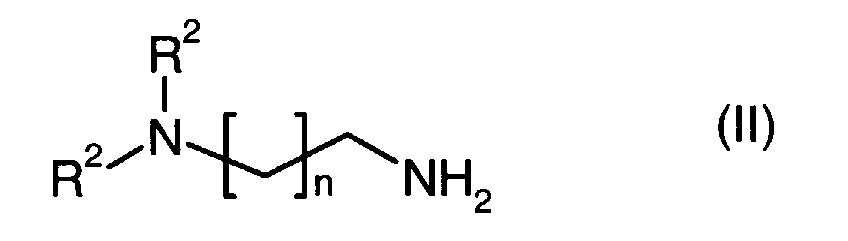
Als R2 bevorzugt gilt R2 = Methyl oder Ethyl, insbesondere R2 = Methyl.
Als n bevorzugt ist n = 2.
Es können auch Mischungen von tertiären Amine eingesetzt werden. Unter Umständen können zusätzlich in der ersten Stufe auch noch Alkalihydroxide, Erdalkalihydroxide oder Mischungen davon eingesetzt werden.
Es können auch Mischungen von tertiären Amine eingesetzt werden. Unter Umständen können zusätzlich in der ersten Stufe auch noch Alkalihydroxide, Erdalkalihydroxide oder Mischungen davon eingesetzt werden.
Vorteilhaft wird in der ersten Stufe der Formaldehyd zu einer Mischung
der phenolischen Komponente und des tertiären Amins zugegeben. Die
Zugabe ist vorteilhaft derart gestaltet, dass unter Kühlung der ebenfalls
gekühlte Formaldehyd langsam, beispielsweise tropfenweise, unter Rühren
zugegeben wird, so dass nur ein geringfügiger Temperaturanstieg festgestellt
wird. Es sollte darauf geachtet werden, dass die Temperatur 45° bis 50°C nicht
überschreitet. Nach der Beendigung der Zugabe wird vorteilhaft noch während
circa 1 Stunde die Temperatur auf etwa 45°C gehalten. Weiterhin ist das
Arbeiten unter Inertgas empfohlen.
In einer zweiten Stufe wird eine Umsetzung mit mindestens einem
Polyamin durchgeführt. Vorteilhaft wird in der zweiten Stufe langsam,
beispielsweise tropfenweise, das aus der ersten Stufe resultierende Produkt
zum Polyamin Stufe unter Rühren zugegeben. Hierbei sollte das Polyamin auf
eine Temperatur von etwa 80°C erwärmt werden. Anschliessend an die
Zugabe wird vorteilhaft unter Stickstoff auf eine Temperatur von etwa 110°C
aufgeheizt Gleichzeitig wird das Reaktionswasser abdestilliert. Das noch nicht
ausgetriebene Wasser wird vorzugsweise durch Anlegen von Vakuum abdestilliert.
Die Mannichbase kann sofort, vorzugsweise nach Abkühlung auf Raumtemperatur als Härter eingesetzt oder abgemischt werden. Die Mannichbase ist lagerstabil und ändert nicht wesentlich ihre Eigenschaften bei Lagerung.
Die Mannichbase kann sofort, vorzugsweise nach Abkühlung auf Raumtemperatur als Härter eingesetzt oder abgemischt werden. Die Mannichbase ist lagerstabil und ändert nicht wesentlich ihre Eigenschaften bei Lagerung.
Die Auswahl der eingesetzten Polyamine beeinflusst stark die
Eigenschaften der mit dem offenbarten Verfahren hergestellten Mannichbasen
sowie der damit ausgehärteten Epoxid- oder Polyurethan-Systeme.
Grundsätzlich sind alle dem Fachmann auf dem Gebiet der Epoxid- und
Polyurethan-Chemie als Vernetzungsmittel bekannten Polyamine als Polyamin
für den Einsatz im erfindungsgemässen Verfahren geeignet.
Besonders geeignete Polyamine sind:
- Aliphatische Polyamine wie
Ethylendiamin, 1,2- und 1,3-Propandiamin, 2-Methyl-1 ,2-propandiamin, 2,2-Dimethyl-1,3-propandiamin, 1,3- und 1,4-Butandiamin, 1,3- und 1,5-Pentandiamin, 1,5-Diamino-2-methylpentan (MPMD), 1,6-Hexandiamin, 2,2,4- und 2,4,4-Trimethylhexamethylendiamin, 1,7-Heptandiamin, 1,8-Octandiamin, 4-Aminomethyl-1,8-octandiamin, 1,9-Nonandiamin, 1,10-Decandiamin, 1,11-Undecandiamin, 1,12-Dodecandiamin, Methyl-bis-(3-aminopropyl)amin, 1,3-Diaminopentan (DAMP), 2,5-Dimethyl-1 ,6-hexamethylendiamin, Diethylentriamin, Triethylentetramin (3,6-Diaza-octamethylendiamin), Tetraethylenpentamin, Pentamethylenhexamin, Dipropylentriamin, Tripropylentetramin, Tetrapropylenpentamin, 4,7-Diaza-decamethylen-1,10-diamin sowie Mischungen der vorgenannten Polyamine. - cycloaliphatische Polyamine wie 1,3- und 1,4-Diaminocyclohexan, 1,2-Diaminocyclohexan(DCH), Bis-(4-aminocyclohexyl)-methan (PACM), Bis-(4-amino-3-methylcyclohexyl)-methan, Bis-(4-amino-3-ethylcyclohexyl)-methan, Bis-(4-amino-3,5-dimethylcyclohexyl)-methan, 1-Amino-3-aminomethyl-3,5,5-trimethylcyclohexan (= Isophorondiamin oder IPDA), 2- und 4-Methyl-1,3-diaminocyclohexan, 1,3- und 1,4-Bis-(aminomethyl)cyclohexan, 1,3-2,5(2,6)-Bis-(aminomethyl)-bicyclo[2.2.1 ]heptan (NBDA, hergestellt von Mitsui Chemicals), 3(4),8(9)-Bis-(aminomethyl)-tricyclo[5.2.1.02,6]decan, 3,9-Bis-(3-aminopropyl)-2,4,8,10-tetraoxaspiro[5.5]undecan, 1,3- und 1,4-Xylylendiamin, Octahydro-4,7-methano-indene-2,5-diamin, Octahydro-4,7-methano-indene-1,6-diamin, Ethergruppen-haltige aliphatische Polyamine wie Bis-(2-aminoethyl)ether, 4,7-Dioxadecan-1,10-diamin, 4,9-Dioxadodecan-1,12-diamin und höhere Oligomere davon, Polyoxyalkylen-Polyamine mit theoretisch zwei oder drei Aminogruppen, erhältlich beispielsweise unter dem Namen Jeffamine® (hergestellt von Huntsman Chemicals), sowie Mischungen der vorgenannten Polyamine.
- aromatische Amine wie Toluylendiamin, Phenylendiamin, 4,4 - methylendianilin (MDA) sowie Mischungen der vorgenannten Polyamine.
Bevorzugt sind Polyamine ausgewählt aus der Gruppe umfassend
DAMP, IPDA, 1,3- und 1,4-Diaminocyclohexan, 1,2-Diaminocyclohexan 1,3-
und 1,4-Butandiamin, 1,3- und 1,5-Pentandiamin, MPMD, 1,3-Xylylendiamin,
1,3-Bis-(aminomethyl)cyclohexan, Diethylentriamin, Triethylentetramin (3,6-Diaza-octamethylendiamin),
Tetraethylenpentamin, Pentamethylenhexamin, Dipropylentriamin,
Tripropylentetramin, Tetrapropylenpentamin, 4,7-Diazadecamethylen-1,10-diamin,
Bis-(4-aminocyclohexyl)-methan, Bis-(4-amino-3-methylcyclohexyl)-methan,
3(4),8(9)-Bis-(aminomethyl)-tricyclo[5.2.1.02,6]decan
sowie Mischungen davon.
Besonders bevorzugt sind die Polyamine ausgewählt aus der Gruppe umfassend 1,3-Xylylendiamin, 1,3-Bis-(aminomethyl)cyclohexan, Diethylentriamin, Triethylentetramin (3,6-Diaza-octamethylendiamin), Tetraethylenpentamin, IPDA, 1,2-Diaminocyclohexan, 4,7-Diaza-decamethylen-1,10-diamin sowie Mischungen davon.
Selbstverständlich sind auch Mischungen solcher Polyamine mit anderen Polyaminen oder anderen Aminen möglich.
Besonders bevorzugt sind die Polyamine ausgewählt aus der Gruppe umfassend 1,3-Xylylendiamin, 1,3-Bis-(aminomethyl)cyclohexan, Diethylentriamin, Triethylentetramin (3,6-Diaza-octamethylendiamin), Tetraethylenpentamin, IPDA, 1,2-Diaminocyclohexan, 4,7-Diaza-decamethylen-1,10-diamin sowie Mischungen davon.
Selbstverständlich sind auch Mischungen solcher Polyamine mit anderen Polyaminen oder anderen Aminen möglich.
Mittels des erfindungsgemässen Verfahren hergestellte Mannichbasen
weisen sehr niedrige Viskositäten auf. Das Verhältnis k(η1/η2) zwischen
Viskosität der Mannichbase hergestellt nach einstufigem Verfahren (η1) zu der
Viskosität der Mannichbase hergestellt nach erfindungsgemässen
zweistufigem Verfahren (η2) ist grösser 1, bevorzugt grösser 2.5, insbesondere
grösser 3.
Das zur Bestimmung von η1 relevante einstufige Verfahren zeichnet sich durch die Zugabe von Formaldehyd zu einer Mischung Polyamin und phenolischer Verbindung aus.
Das zur Bestimmung von η1 relevante einstufige Verfahren zeichnet sich durch die Zugabe von Formaldehyd zu einer Mischung Polyamin und phenolischer Verbindung aus.
Die erzielte Viskosität der Mannichbase hergestellt nach dem
erfindungsgemässen Verfahren hängt stark von der eingesetzten phenolischen
Verbindung sowie vom eingesetzten Polyamin ab.
Besonders geeignete Mannichbasen weisen eine Viskosität bei 25°C kleiner als 1000 mPas. Bevorzugte Mannichbasen weisen Viskositäten im Bereich zwischen 200 und 700 mPas auf.
Dem Fachmann ist klar, dass bei dieser Art von Umsetzung in geringem Masse auch noch nicht reagierte Bestandteile im Endprodukt vorhanden sein können.
Die nach dem erfindungsgemässen Verfahren hergestellte Mannichbase weisen nebst sekundären auch primäre Aminogruppen auf.
Weiterhin konnte gefunden werden, dass nach diesem Verfahren Mannichbasen hergestellt werden können, die keinen oder zumindest einen geringen Anteil an mehrkernigen Oligomeren aufweisen. Bevorzugt ist der Oligomerenanteil kleiner als 20 Gewichts-%, insbesondere kleiner als 10 Gewichts-% bezogen auf das Gewicht der Mannichbase.
Ebenso können mit diesem Verfahren Mannichbasen hergestellt werden, die einen sehr geringen Anteil an nicht reagierten phenolischen Verbindungen enthalten. Vorteilhaft ist, wenn die Mannichbase weniger als 1 Gewichts-%, insbesondere weniger als 0.5 Gewichts-%, bevorzugt weniger als 0.1 Gewichts-%, an nicht reagierter phenolischer Verbindung bezogen auf das Gewicht der Mannichbase aufweist.
Die erfindungsgemässen Mannichbasen sowie die aus dem erfindungsgemässen Verfahren resultierenden Mannichbasen finden beispielsweise Einsatz als Härter in der Härterkomponente von zweikomponentigen Epoxid- oder Polyurethansystemen. Die Mannichbasen können hier direkt oder als Bestandteile der Härterkomponente eingesetzt werden.
Besonders bevorzugt werden die Mannichbasen eingesetzt als Härter in zweikomponentigen Epoxidharz-Systemen, insbesondere in zweikomponentigen Epoxidharz-Klebstoffen.
Die mit diesen Mannichbasen gehärteten zweikomponentigen Epoxid- oder Polyurethansysteme und die daraus erhaltenen Produkte weisen sehr vorteilhafte Eigenschaften auf.
Besonders geeignete Mannichbasen weisen eine Viskosität bei 25°C kleiner als 1000 mPas. Bevorzugte Mannichbasen weisen Viskositäten im Bereich zwischen 200 und 700 mPas auf.
Dem Fachmann ist klar, dass bei dieser Art von Umsetzung in geringem Masse auch noch nicht reagierte Bestandteile im Endprodukt vorhanden sein können.
Die nach dem erfindungsgemässen Verfahren hergestellte Mannichbase weisen nebst sekundären auch primäre Aminogruppen auf.
Weiterhin konnte gefunden werden, dass nach diesem Verfahren Mannichbasen hergestellt werden können, die keinen oder zumindest einen geringen Anteil an mehrkernigen Oligomeren aufweisen. Bevorzugt ist der Oligomerenanteil kleiner als 20 Gewichts-%, insbesondere kleiner als 10 Gewichts-% bezogen auf das Gewicht der Mannichbase.
Ebenso können mit diesem Verfahren Mannichbasen hergestellt werden, die einen sehr geringen Anteil an nicht reagierten phenolischen Verbindungen enthalten. Vorteilhaft ist, wenn die Mannichbase weniger als 1 Gewichts-%, insbesondere weniger als 0.5 Gewichts-%, bevorzugt weniger als 0.1 Gewichts-%, an nicht reagierter phenolischer Verbindung bezogen auf das Gewicht der Mannichbase aufweist.
Die erfindungsgemässen Mannichbasen sowie die aus dem erfindungsgemässen Verfahren resultierenden Mannichbasen finden beispielsweise Einsatz als Härter in der Härterkomponente von zweikomponentigen Epoxid- oder Polyurethansystemen. Die Mannichbasen können hier direkt oder als Bestandteile der Härterkomponente eingesetzt werden.
Besonders bevorzugt werden die Mannichbasen eingesetzt als Härter in zweikomponentigen Epoxidharz-Systemen, insbesondere in zweikomponentigen Epoxidharz-Klebstoffen.
Die mit diesen Mannichbasen gehärteten zweikomponentigen Epoxid- oder Polyurethansysteme und die daraus erhaltenen Produkte weisen sehr vorteilhafte Eigenschaften auf.
Die im Folgenden genannten Beispiele dienen zur Veranschaulichung
der Erfindung.
Die phenolische Verbindung wurde in einem Glaskolben vorgelegt und
mit tertiärem Amin versetzt. Das Gemisch wurde auf 20°C gekühlt und dann
wurde langsam und unter Kühlung kalte Formalinlösung (36.5 Gew.-% in
Wasser) zugetropft. Es trat eine deutliche Wärmetönung auf. Die
Innentemperatur wurde zwischen 40°C und 45°C gehalten. Nach der
Beendigung der Zugabe wurde noch während 1 Stunden bei 40 - 45°C
gerührt.
Das in Tabelle 1 angegebene Polyamin wurde im Reaktor bei RT unter
Stickstoff vorgelegt, auf 80°C erwärmt und das aus der ersten Stufe
resultierende Zwischenprodukt unter Rühren langsam zugegossen. Es trat eine
milde Wärmetönung auf. Unter Stickstoff wurde aufgeheizt auf ca. 110°C und
gleichzeitig das Reaktionswasser unter Normaldruck abdestilliert. Nach 80%
der theoretischen Menge Reaktionswasser wurde Vakuum angelegt und bis
zur theoretischen Wassermenge abdestilliert.
Das in Tabelle 1 angegebene Polyamin, gegebenenfalls vorhandene
tertiäre Amin sowie die phenolische Verbindung wurden vorgelegt. Unter
Kühlung wurde bei einer Temperatur von 20 bis 30°C eine kalte
Formalinlösung (36.5 Gew.-% in Wasser) zugetropft. Es trat eine erhebliche
Wärmetönung auf. Unter Stickstoff wurde aufgeheizt auf ca. 110°C und
gleichzeitig das Reaktionswasser unter Normaldruck abdestilliert. Nach 80%
der theoretischen Menge Reaktionswasser wurde Vakuum angelegt und bis
zur theoretischen Wassermenge abdestilliert.

Verschiedene Mannichbase wurden, gegebenenfalls in Kombination
mit zusätzlichen Polyaminen als Härter mit einer Epoxidharz-Komponente
bestehend aus 85% Bisphenol-A-Diglydiylether (kommerziell erhältlich von
Vantico als Araldite GY-250) und 15% Trimethylolpropan-Trigylcidylether bei
20 bis 23°C und 50% relativer Luftfeuchtigkeit manuell gemischt und während
7 Tagen bei diesen Bedingungen ausgehärtet.
Die Zugfestigkeit, der E-Modul sowie die Bruchdehnung wurde an Prüfkörpern, welche bei 23°C und 50 % relativer Luftfeuchtigkeit während 7 Tagen ausgehärtet wurden, nach ISO 527 mit einer Zuggeschwindigkeit von 5 mm/min bestimmt
Die Topfzeit wurde von einer 100g- Mischung in einem isolierten zylindrischen Becher bei 23°C mittels Geltimer bestimmt.
Die Zugfestigkeit, der E-Modul sowie die Bruchdehnung wurde an Prüfkörpern, welche bei 23°C und 50 % relativer Luftfeuchtigkeit während 7 Tagen ausgehärtet wurden, nach ISO 527 mit einer Zuggeschwindigkeit von 5 mm/min bestimmt
Die Topfzeit wurde von einer 100g- Mischung in einem isolierten zylindrischen Becher bei 23°C mittels Geltimer bestimmt.
| Verwendung von Mannichbase in Epoxidharzzusammensetzungen | ||||
| Härterzusammensetzungen | H1 (g) | H2 (g) | H3 (g) | H4 (g) |
| B2 (g) | 95 | |||
| B7 | 95 | |||
| B10 | 47.5 | |||
| B12 | 47.5 | |||
| DCH | 47.5 | |||
| DETA | 47.5 | |||
| Tris-(2,4,6-dimethylaminomethyl)-phenol | 5 | 5 | 5 | 5 |
| Viskosität (mPas) | 291 | 368 | 30 | 30 |
| Ergebnisse nach Aushärtung mit Harzkomponente | ||||
| Zugfestigkeit (MPa) | 18 | 31 | 10 | 41 |
| E-Modul (MPa) | 3567 | 3581 | 3830 | 4012 |
| Bruchdehnung (%) | 0.48 | 0.88 | 0.25 | 1.05 |
| Topfzeit bei 25°C (min) | 40 | 20 | 55 | 27 |
Die Resultate aus Tabelle 2 zeigen, dass die Mannichbasen geeignet
sind als Härter für Epoxidharze.
Claims (20)
- Mannichbase, dadurch gekennzeichnet, dass zu deren Herstellung mindestens eine phenolische Verbindung der Formel (I)mit R1 = H oder CH3,

sowie Formaldehyd und mindestens ein Polyamin verwendet werden. - Mannichbase gemäss Anspruch 1, dadurch gekennzeichnet, dass zu deren Herstellung in einer ersten Stufe mindestens eine phenolische Verbindung der Formel (I) mit Formaldehyd in Gegenwart eines tertiären Amins zur Reaktion gebracht wird und in einer darauf folgenden Stufe mit mindestens einem Polyamin umgesetzt wird.
- Mannichbase gemäss Anspruch 2, dadurch gekennzeichnet, dass das tertiäre Amin die Formel (11) aufweistmit R2 = C1-C6-Alkyl und n = 1, 2, oder 3.

- Mannichbase gemäss einem der Ansprüche 2 bis 3, dadurch gekennzeichnet, dass in der ersten Stufe der Formaldehyd zu einer Mischung der phenolischen Verbindung der Formel (I) und des tertiären Amins zugegeben wird.
- Mannichbase gemäss einem der vorhergehenden Ansprüche, dadurch gekennzeichnet, dass in Formel (I) R1 = H ist.
- Mannichbase gemäss einem der Ansprüche 3 bis 5, dadurch gekennzeichnet, dass in Formel (II) R2 = CH3 ist.
- Mannichbase gemäss einem der Ansprüche 3 bis 6, dadurch gekennzeichnet, dass in Formel (II) n = 2 ist.
- Mannichbase gemäss einem der vorhergehenden Ansprüche, dadurch gekennzeichnet, dass die Viskosität bei 25°C kleiner als 1000 mPas ist, insbesondere im Bereich zwischen 200 und 700 mPas liegt.
- Verfahren zur Herstellung einer Mannichbase, dadurch gekennzeichnet, dass in einer ersten Stufe mindestens eine phenolische Verbindung mit Formaldehyd in Gegenwart eines tertiären Amins zur Reaktion gebracht wird und in einer darauf folgenden Stufe mit mindestens einem Polyamin umgesetzt wird.
- Verfahren zur Herstellung einer Mannichbase gemäss Anspruch 9, dadurch gekennzeichnet, dass in der ersten Stufe der Formaldehyd zu einer Mischung der phenolischen Verbindung und des tertiären Amins zugegeben wird.
- Verfahren zur Herstellung einer Mannichbase gemäss einem der Ansprüche 9 bis 10, dadurch gekennzeichnet, dass das tertiäre Amin die Formel (II) aufweistmit R2 = C1-C6-Alkyl und n = 1, 2, oder 3.
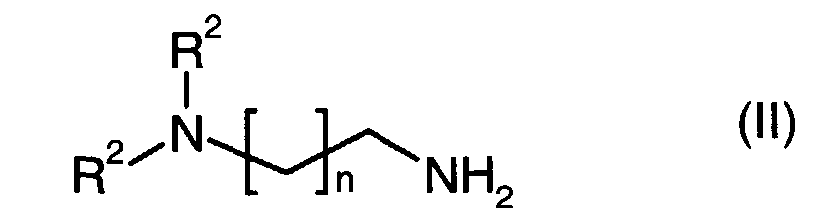
- Verfahren zur Herstellung einer Mannichbase gemäss Anspruch 11, dadurch gekennzeichnet, dass in Formel (II) R2 = CH3 ist.
- Verfahren zur Herstellung einer Mannichbase gemäss Anspruch 11 oder Anspruch 12, dadurch gekennzeichnet, dass in Formel (II) n = 2 ist.
- Verfahren zur Herstellung einer Mannichbase gemäss einem der Ansprüche 9 bis 13, dadurch gekennzeichnet, dass die phenolische Verbindung eine phenolische Verbindung der Formel (I)mit R1 = H oder CH3, ist.

- Verfahren zur Herstellung einer Mannichbase gemäss Anspruch 14, dadurch gekennzeichnet, dass in Formel (I) R1 = H ist.
- Härterkomponente für zweikomponentige Epoxid- oder Polyurethansysteme, dadurch gekennzeichnet, dass diese Härterkomponente eine Mannichbase gemäss einem der Ansprüche 1 bis 8 enthält.
- Verwendung einer Mannichbase gemäss einem der Ansprüche 1 bis 8 als Härter für Epoxid- oder Polyurethansysteme.
- Epoxid- oder Polyurethansysteme, welche mindestens eine Mannichbase gemäss einem der Ansprüche 1 bis 8 enthalten.
- Epoxid- oder Polyurethansysteme, welche mindestens eine Mannichbase enthalten, welche nach einem Verfahren gemäss einem der Ansprüche 9 bis 15 erhalten werden.
- Ausgehärtete Produkte, welche aus einem Epoxid- oder Polyurethansystem gemäss Anspruch 19 oder 20 erhalten wurden.
Priority Applications (6)
| Application Number | Priority Date | Filing Date | Title |
|---|---|---|---|
| EP03010122A EP1475411A1 (de) | 2003-05-05 | 2003-05-05 | Mannichbasen und Herstellungsverfahren von Mannichbasen |
| EP04741509A EP1622978A1 (de) | 2003-05-05 | 2004-05-04 | Mannichbasen und herstellungsverfahren von mannichbasen |
| JP2006505588A JP4414426B2 (ja) | 2003-05-05 | 2004-05-04 | マンニッヒ塩基およびマンニッヒ塩基の製造方法 |
| PCT/EP2004/050697 WO2004099311A1 (de) | 2003-05-05 | 2004-05-04 | Mannichbasen und herstellungsverfahren von mannichbasen |
| CN200480007687.6A CN1761715A (zh) | 2003-05-05 | 2004-05-04 | 曼尼希碱以及曼尼希碱的制备方法 |
| US10/552,482 US7935775B2 (en) | 2003-05-05 | 2004-05-04 | Mannich bases and processes for the preparation of mannich bases |
Applications Claiming Priority (1)
| Application Number | Priority Date | Filing Date | Title |
|---|---|---|---|
| EP03010122A EP1475411A1 (de) | 2003-05-05 | 2003-05-05 | Mannichbasen und Herstellungsverfahren von Mannichbasen |
Publications (1)
| Publication Number | Publication Date |
|---|---|
| EP1475411A1 true EP1475411A1 (de) | 2004-11-10 |
Family
ID=32981805
Family Applications (2)
| Application Number | Title | Priority Date | Filing Date |
|---|---|---|---|
| EP03010122A Withdrawn EP1475411A1 (de) | 2003-05-05 | 2003-05-05 | Mannichbasen und Herstellungsverfahren von Mannichbasen |
| EP04741509A Withdrawn EP1622978A1 (de) | 2003-05-05 | 2004-05-04 | Mannichbasen und herstellungsverfahren von mannichbasen |
Family Applications After (1)
| Application Number | Title | Priority Date | Filing Date |
|---|---|---|---|
| EP04741509A Withdrawn EP1622978A1 (de) | 2003-05-05 | 2004-05-04 | Mannichbasen und herstellungsverfahren von mannichbasen |
Country Status (5)
| Country | Link |
|---|---|
| US (1) | US7935775B2 (de) |
| EP (2) | EP1475411A1 (de) |
| JP (1) | JP4414426B2 (de) |
| CN (1) | CN1761715A (de) |
| WO (1) | WO2004099311A1 (de) |
Cited By (8)
| Publication number | Priority date | Publication date | Assignee | Title |
|---|---|---|---|---|
| BE1017785A3 (fr) * | 2006-01-20 | 2009-07-07 | Afton Chemical Corp | Detergents de mannich pour carburants hydrocarbones. |
| BE1018138A5 (fr) * | 2006-08-17 | 2010-06-01 | Afton Chemical Corp | Composes d'additifs de carburant et procede de fabrication de ces composes. |
| CN101508856B (zh) * | 2008-02-13 | 2011-04-13 | 上海涂料有限公司上海长风化工厂 | 一种用于环氧树脂涂料固化剂腰果酚醛胺及其制备方法 |
| EP2452963A1 (de) | 2010-11-11 | 2012-05-16 | Sika Technology AG | Kondensationsprodukte aus aminofunktionellen Polymeren |
| CN102660014A (zh) * | 2012-04-01 | 2012-09-12 | 耐素有限责任公司 | 一种腰果酚聚醚多元醇及其应用 |
| CN103059269A (zh) * | 2013-01-16 | 2013-04-24 | 华东理工大学 | 一种复配改性的脂肪胺固化剂 |
| EP2639252A1 (de) | 2012-03-14 | 2013-09-18 | Sika Technology AG | Neue Reaktivpolymerkatalysatoren für 2K-Epoxidharzsysteme |
| DE102015115942A1 (de) | 2014-11-20 | 2016-05-25 | Fischerwerke Gmbh & Co. Kg | Mannich-Basen, deren Herstellung und ihre Verwendung als Härter beispielsweise in Kunstharzzusammensetzungen |
Families Citing this family (13)
| Publication number | Priority date | Publication date | Assignee | Title |
|---|---|---|---|---|
| EP1717253A1 (de) * | 2005-04-29 | 2006-11-02 | Sika Technology AG | Mannichbase auf Resorcin-Basis |
| EP1829944A1 (de) * | 2006-03-01 | 2007-09-05 | Cytec Surface Specialties Austria GmbH | Wässriges kationisches Bindemittel für Haftgrundierlacke |
| US7906470B2 (en) * | 2006-09-01 | 2011-03-15 | The Lubrizol Corporation | Quaternary ammonium salt of a Mannich compound |
| CN101899141B (zh) * | 2009-05-31 | 2011-10-19 | 上海美东生物材料有限公司 | 一种自乳化型水性环氧树脂固化剂及其制备方法 |
| CN101717320B (zh) * | 2009-11-26 | 2014-06-18 | 安阳师范学院 | 一种曼尼希碱的制备方法 |
| CN102134306B (zh) * | 2011-03-04 | 2012-08-08 | 广东工业大学 | 一种腰果酚环氧地坪固化剂及其制备方法 |
| CN102953067B (zh) | 2011-08-19 | 2014-11-26 | 中国石油天然气股份有限公司 | 曼尼希碱脱钙缓蚀剂及其制备和应用 |
| CN102953066B (zh) * | 2011-08-19 | 2014-11-26 | 中国石油天然气股份有限公司 | 一种多支化的曼尼希碱缓蚀剂及其制备方法 |
| CN102516097B (zh) * | 2011-10-13 | 2014-04-02 | 江苏博特新材料有限公司 | 酚类乳化剂的制备方法、乳化沥青及其应用 |
| CN102424738B (zh) * | 2011-11-16 | 2013-08-21 | 中科院广州化灌工程有限公司 | 一种高弹性无溶剂纳米改性环氧树脂及其制备方法与应用 |
| CN110498907B (zh) * | 2019-08-20 | 2021-10-15 | 浙江万盛股份有限公司 | 一种腰果酚水性环氧固化剂的制备方法 |
| CN111763151B (zh) * | 2020-06-29 | 2021-11-30 | 浙江万盛股份有限公司 | 一种高防腐性能腰果酚改性多元胺固化剂的制备方法 |
| CN118344511A (zh) * | 2023-01-13 | 2024-07-16 | 中国石油化工股份有限公司 | 一种曼尼希碱及其制备方法、用途 |
Citations (2)
| Publication number | Priority date | Publication date | Assignee | Title |
|---|---|---|---|---|
| US4269742A (en) * | 1978-02-11 | 1981-05-26 | Schering Aktiengesellschaft | Epoxy resin hardening agents from Mannich bases and method for curing |
| WO1998015588A1 (en) * | 1996-10-04 | 1998-04-16 | Shell Internationale Research Maatschappij B.V. | Stable, one package coating compositions and process for coating |
Family Cites Families (3)
| Publication number | Priority date | Publication date | Assignee | Title |
|---|---|---|---|---|
| JPH0940759A (ja) * | 1995-07-28 | 1997-02-10 | Asahi Denka Kogyo Kk | エポキシ樹脂硬化性組成物 |
| US5688905A (en) * | 1995-09-20 | 1997-11-18 | Air Products And Chemicals, Inc. | Primary-tertiary diamines mixed with polyamines as epoxy resin hardeners |
| EP1114076B1 (de) | 1998-09-14 | 2003-03-26 | Vantico AG | Beschleuniger für härtbare systeme |
-
2003
- 2003-05-05 EP EP03010122A patent/EP1475411A1/de not_active Withdrawn
-
2004
- 2004-05-04 CN CN200480007687.6A patent/CN1761715A/zh active Pending
- 2004-05-04 US US10/552,482 patent/US7935775B2/en not_active Expired - Fee Related
- 2004-05-04 JP JP2006505588A patent/JP4414426B2/ja not_active Expired - Fee Related
- 2004-05-04 WO PCT/EP2004/050697 patent/WO2004099311A1/de not_active Ceased
- 2004-05-04 EP EP04741509A patent/EP1622978A1/de not_active Withdrawn
Patent Citations (2)
| Publication number | Priority date | Publication date | Assignee | Title |
|---|---|---|---|---|
| US4269742A (en) * | 1978-02-11 | 1981-05-26 | Schering Aktiengesellschaft | Epoxy resin hardening agents from Mannich bases and method for curing |
| WO1998015588A1 (en) * | 1996-10-04 | 1998-04-16 | Shell Internationale Research Maatschappij B.V. | Stable, one package coating compositions and process for coating |
Cited By (12)
| Publication number | Priority date | Publication date | Assignee | Title |
|---|---|---|---|---|
| BE1017785A3 (fr) * | 2006-01-20 | 2009-07-07 | Afton Chemical Corp | Detergents de mannich pour carburants hydrocarbones. |
| BE1018138A5 (fr) * | 2006-08-17 | 2010-06-01 | Afton Chemical Corp | Composes d'additifs de carburant et procede de fabrication de ces composes. |
| CN101508856B (zh) * | 2008-02-13 | 2011-04-13 | 上海涂料有限公司上海长风化工厂 | 一种用于环氧树脂涂料固化剂腰果酚醛胺及其制备方法 |
| EP2452963A1 (de) | 2010-11-11 | 2012-05-16 | Sika Technology AG | Kondensationsprodukte aus aminofunktionellen Polymeren |
| WO2012062853A1 (de) | 2010-11-11 | 2012-05-18 | Sika Technology Ag | Kondensationsprodukte aus aminofunktionellen polymeren |
| US9157015B2 (en) | 2010-11-11 | 2015-10-13 | Sika Technology Ag | Condensation products of amino-functional polymers |
| US9586889B2 (en) | 2010-11-11 | 2017-03-07 | Sika Technology Ag | Condensation products of amino-functional polymers |
| EP2639252A1 (de) | 2012-03-14 | 2013-09-18 | Sika Technology AG | Neue Reaktivpolymerkatalysatoren für 2K-Epoxidharzsysteme |
| US9163112B2 (en) | 2012-03-14 | 2015-10-20 | Sika Technology Ag | Reactive polymer catalysts for 2-component epoxy resin systems |
| CN102660014A (zh) * | 2012-04-01 | 2012-09-12 | 耐素有限责任公司 | 一种腰果酚聚醚多元醇及其应用 |
| CN103059269A (zh) * | 2013-01-16 | 2013-04-24 | 华东理工大学 | 一种复配改性的脂肪胺固化剂 |
| DE102015115942A1 (de) | 2014-11-20 | 2016-05-25 | Fischerwerke Gmbh & Co. Kg | Mannich-Basen, deren Herstellung und ihre Verwendung als Härter beispielsweise in Kunstharzzusammensetzungen |
Also Published As
| Publication number | Publication date |
|---|---|
| EP1622978A1 (de) | 2006-02-08 |
| JP4414426B2 (ja) | 2010-02-10 |
| CN1761715A (zh) | 2006-04-19 |
| US7935775B2 (en) | 2011-05-03 |
| JP2006525400A (ja) | 2006-11-09 |
| WO2004099311A1 (de) | 2004-11-18 |
| US20070093630A1 (en) | 2007-04-26 |
Similar Documents
| Publication | Publication Date | Title |
|---|---|---|
| EP1622978A1 (de) | Mannichbasen und herstellungsverfahren von mannichbasen | |
| EP1475412A1 (de) | Mannichbasenenthaltende Epoxidharzzusammensetzungen geeignet zur Anwendung bei Hohen Temperaturen | |
| DE69302289T2 (de) | Epoxydharz gehärtet durch eine Mischung von Methylen-überbrückten Poly(cyclohexyl-aromatische)Aminehärtungsmitteln | |
| EP2307359B1 (de) | Blends enthaltend epoxidharze und mischungen von aminen mit guanidin-derivaten | |
| EP2731927B1 (de) | Emissionsarmer härter für epoxidharze | |
| EP2307358B1 (de) | Mischungen von aminen mit guanidin-derivaten | |
| EP2731979B1 (de) | Härter für epoxidharze | |
| EP2997069B1 (de) | Epoxidharz-zusammensetzung für faser-matrix-halbzeuge | |
| EP1384709A1 (de) | Polyaldimine | |
| DE2609502A1 (de) | Epoxiharzhaerter, verfahren zu seiner herstellung und seine verwendung | |
| WO2013124251A2 (de) | Blends für verbundwerkstoffe | |
| DE10128889A1 (de) | Wasserverdünnbare Aminhärter für wäßrige Zweikomponenten-Epoxidharz-Systeme | |
| EP2825580A1 (de) | Neue reaktive polymerkatalysatoren für 2k epoxidharzsysteme | |
| DE2940912A1 (de) | Epoxidharz-zusammensetzung und verfahren zu ihrer herstellung | |
| DE69105541T2 (de) | Methyl-2,6-cyclohexandiamin enthaltende Epoxydharzzusammensetzungen. | |
| DE60316383T2 (de) | Aminzusammensetzung und Verfahren zu ihrer Herstellung | |
| DE10112555A1 (de) | Addukte aus Polyalkylenglykolmonoglycidylethern und Aminverbindungen | |
| DE69914779T2 (de) | Epoxy-härtungsmittel aus phenol-aldehyd das mit polyamin reagiert hat | |
| DE19848113C2 (de) | Härtungsmittel für wäßrige Epoxidharzdispersionen | |
| EP1877458A1 (de) | Mannichbase auf resorcin-basis | |
| DE2823682A1 (de) | Verfahren zur herstellung von epoxid-polyaddukten | |
| DE2951603A1 (de) | Haertbare epoxidharzmischungen | |
| DE1770539C3 (de) | Härtbare Epoxidharzmischungen | |
| DE1543307C (de) | Harten von Epoxyharzen | |
| DE1102391B (de) | Verfahren zum Haerten von Polyepoxyden |
Legal Events
| Date | Code | Title | Description |
|---|---|---|---|
| PUAI | Public reference made under article 153(3) epc to a published international application that has entered the european phase |
Free format text: ORIGINAL CODE: 0009012 |
|
| AK | Designated contracting states |
Kind code of ref document: A1 Designated state(s): AT BE BG CH CY CZ DE DK EE ES FI FR GB GR HU IE IT LI LU MC NL PT RO SE SI SK TR |
|
| AX | Request for extension of the european patent |
Extension state: AL LT LV MK |
|
| AKX | Designation fees paid | ||
| REG | Reference to a national code |
Ref country code: DE Ref legal event code: 8566 |
|
| STAA | Information on the status of an ep patent application or granted ep patent |
Free format text: STATUS: THE APPLICATION IS DEEMED TO BE WITHDRAWN |
|
| 18D | Application deemed to be withdrawn |
Effective date: 20050511 |