EP1444316B1 - Acid sanitizing and cleaning compositions containing protonated carboxylic acids - Google Patents
Acid sanitizing and cleaning compositions containing protonated carboxylic acids Download PDFInfo
- Publication number
- EP1444316B1 EP1444316B1 EP02784458A EP02784458A EP1444316B1 EP 1444316 B1 EP1444316 B1 EP 1444316B1 EP 02784458 A EP02784458 A EP 02784458A EP 02784458 A EP02784458 A EP 02784458A EP 1444316 B1 EP1444316 B1 EP 1444316B1
- Authority
- EP
- European Patent Office
- Prior art keywords
- composition
- acid
- concentrate
- concentration
- surfactant
- Prior art date
- Legal status (The legal status is an assumption and is not a legal conclusion. Google has not performed a legal analysis and makes no representation as to the accuracy of the status listed.)
- Revoked
Links
Images
Classifications
-
- C—CHEMISTRY; METALLURGY
- C11—ANIMAL OR VEGETABLE OILS, FATS, FATTY SUBSTANCES OR WAXES; FATTY ACIDS THEREFROM; DETERGENTS; CANDLES
- C11D—DETERGENT COMPOSITIONS; USE OF SINGLE SUBSTANCES AS DETERGENTS; SOAP OR SOAP-MAKING; RESIN SOAPS; RECOVERY OF GLYCEROL
- C11D3/00—Other compounding ingredients of detergent compositions covered in group C11D1/00
- C11D3/48—Medical, disinfecting agents, disinfecting, antibacterial, germicidal or antimicrobial compositions
-
- C—CHEMISTRY; METALLURGY
- C11—ANIMAL OR VEGETABLE OILS, FATS, FATTY SUBSTANCES OR WAXES; FATTY ACIDS THEREFROM; DETERGENTS; CANDLES
- C11D—DETERGENT COMPOSITIONS; USE OF SINGLE SUBSTANCES AS DETERGENTS; SOAP OR SOAP-MAKING; RESIN SOAPS; RECOVERY OF GLYCEROL
- C11D3/00—Other compounding ingredients of detergent compositions covered in group C11D1/00
- C11D3/16—Organic compounds
- C11D3/20—Organic compounds containing oxygen
- C11D3/2075—Carboxylic acids-salts thereof
- C11D3/2079—Monocarboxylic acids-salts thereof
-
- C—CHEMISTRY; METALLURGY
- C11—ANIMAL OR VEGETABLE OILS, FATS, FATTY SUBSTANCES OR WAXES; FATTY ACIDS THEREFROM; DETERGENTS; CANDLES
- C11D—DETERGENT COMPOSITIONS; USE OF SINGLE SUBSTANCES AS DETERGENTS; SOAP OR SOAP-MAKING; RESIN SOAPS; RECOVERY OF GLYCEROL
- C11D3/00—Other compounding ingredients of detergent compositions covered in group C11D1/00
- C11D3/16—Organic compounds
- C11D3/20—Organic compounds containing oxygen
- C11D3/2075—Carboxylic acids-salts thereof
- C11D3/2086—Hydroxy carboxylic acids-salts thereof
-
- C—CHEMISTRY; METALLURGY
- C11—ANIMAL OR VEGETABLE OILS, FATS, FATTY SUBSTANCES OR WAXES; FATTY ACIDS THEREFROM; DETERGENTS; CANDLES
- C11D—DETERGENT COMPOSITIONS; USE OF SINGLE SUBSTANCES AS DETERGENTS; SOAP OR SOAP-MAKING; RESIN SOAPS; RECOVERY OF GLYCEROL
- C11D7/00—Compositions of detergents based essentially on non-surface-active compounds
- C11D7/02—Inorganic compounds
- C11D7/04—Water-soluble compounds
- C11D7/08—Acids
Definitions
- the present invention relates to acid sanitizing and/or cleaning compositions comprising antimicrobially effective C 5 to C 14 carboxylic acids.
- the present invention is directed to both concentrates and to water diluted use solutions.
- Periodic cleaning and sanitizing in food, drink, pharmaceutical, cosmetic and similar processing industries; in food preparation and service businesses; in health and day care facilities; and, in hospitality establishments are a necessary practice for product quality and public health. Residuals left on equipment surfaces or contaminants found in the process or service environment can harbor and nourish growth of subsequent processed product or critical contact surfaces. Protecting the consumer against potential health hazards associated with pathogens or toxins and maintaining the quality of the product or service requires routine cleaning of residuals from surfaces and effective sanitation to reduce microbial populations.
- sanitizing is particularly of concern in food process facilities wherein the cleaning treatment is followed by an antimicrobial treatment applied upon all critical surfaces and environmental surfaces to reduce the microbial population to safe levels established by ordinance.
- a sanitized surface is, as defined by the Environmental Protection Agency (EPA), a consequence of a process or program containing both an initial cleaning and a subsequent sanitizing treatment which must be separated by a potable water rinse.
- a sanitizing treatment applied to a cleaned food contact surface must result in a reduction in population of at least 99.999% (5 log) for specified microorganisms as defined by the "Germicidal and Detergent Sanitizing Action of Disinfectants", Official Methods of Analysis of the Association of Official Analytical Chemists, paragraph 960.09 and applicable sections, 15 th Edition, 1990 (EPA Guideline 91-2).
- the antimicrobial efficacy of sanitizing treatments is significantly reduced if the surface is not absolutely free of soil and other contaminants prior to the sanitizing step.
- the presence of residual food soil and/or mineral deposits inhibit sanitizing treatments by acting as physical barriers which shield microorganisms lying within the organic or inorganic layer from the microbicide.
- chemical interactions between the microbicide and certain contaminants can disrupt the killing mechanism of the microbicide.
- US-A-5391379 discloses sanitizer concentrates comprising octanoicldecanoic acid with a weak C1 - C4 carboxylic acid (eg. citric, acetic and valeric), and a strong acid mixture of phosphoric and sulphuric acid.
- a weak C1 - C4 carboxylic acid eg. citric, acetic and valeric
- a strong acid mixture of phosphoric and sulphuric acid eg. citric, acetic and valeric
- US-A-5234719 discloses sanitizing compositions comprising octanoic/decanoic acid with citric acid and phosphoric acid.
- WO-0061715-A discloses a method of cleaning and sanitizing food processing equipment using a nitric acid and phosphoric acid mixture. WO-0061715-A does not suggest combining this mixture with organic acid components according to present claim 1.
- US-A-4822513 discloses that nitric acid and phosphoric acid and mixtures thereof can be used for disinfecting food-handling equipment.
- Antimicrobially active acids have been used in sanitizing operations.
- US 404,040 describes a sanitizing composition comprising aliphatic, short chain fatty acids, a hydrotrope or solubilizer for the fatty acids, and a hydrotrope-compatible acid
- US 5,330,769 describes fatty acid sanitizer concentrates and diluted final solutions which include individual amounts of germicidally effective fatty acid, hydrotrope, a strong acid group consisting of phosphoric acid and sulfuric acid or mixtures thereof sufficient to lower the pH of the final solutions to about 1-5, and a concentrate stabilizing weak acid component selected from the group consisting of propionic, butyric and valeric acids and mixtures thereof.
- Protonated carboxylic acids offer broad spectrum antimicrobial activity against gram-positive and gram negative bacteria, persistent biocidal activity in the presence of organic and inorganic soils and residual biocidal and inhibitory activity. They combine both acid for mineral deposit control and sanitizer for antimicrobial effect into one treatment solution.
- Fatty monocarboxylic acids having alkyl chains containing 5 or more carbon atoms are typically characterized as water insoluble and can oil out or precipitate from solution as a gelatinous flocculant. Solubility tends to decrease with decreasing water temperature and increasing ionic concentration. Furthermore, the oil or precipitate can affix to the very surfaces which the sanitizing solution is intended to sanitize, such as equipment surfaces, leading to a film formation on these surfaces over time.
- the fatty acid film deposited and left remaining on the equipment surface tends to have a higher pH than the sanitizing solution from which it came resulting in a significantly lowered biocidal efficacy, and, if mixed with food soil, may result in a film matrix which has the potential of harboring bacteria, an effect opposite to that desired.
- Organic hydrotropes or coupling agents such as low molecular weight sulfonates, may be employed to increase the solubility and miscibility of the longer chain fatty acids with water and inorganic salts both in concentrated and in diluted use solutions. Again, the solubility appears to diminish at sustained lower water temperatures with the result being phase separation.
- compositions of the present invention exhibit excellent phase stability both in concentrated form and in diluted use solutions, and in particular, they exhibit excellent phase stability in low temperature water diluted use solutions. Even more surprisingly, the stability is improved in the presence of nitric acid.
- the sanitizing and/or cleaning compositions of the present invention in both concentrated and in diluted use solutions, include an antimicrobially effective short chain fatty acid, a shorter chain weak carboxylic acid, and a strong mineral acid.
- the shorter chain weak carboxylic acid functions as a solvent.
- the shorter chain weak carboxylic acid functions as a solvent for the antimicrobial short chain fatty acid.
- the compositions also desirably contain an organic hydrotrope.
- the antimicrobially effective short chain fatty acid is a C 5 to C 14 fatty acid, and more suitably C 6 to C 10 fatty acid, or some mixture thereof, the shorter chain weak carboxylic acid is a C 1 to C 4 carboxylic acid, and the strong mineral acid is nitric, or a mixture of nitric and phosphoric acids.
- an anionic sulfonate hydrotrope is employed.
- composition may optionally include at least one anionic and/or nonionic surfactant.
- a nonionic surfactant is suitably employed to improve surface wetting, soil removal, and so forth. It may also function to improve the solubility of the fatty acids at use dilutions.
- the antimicrobailly effective effective short chain fatty acid is useful from about 3 wt-% to about 12 wt-% of the concentrate, and more suitably from about 5 wt-% to about 10 wt-% of the concentrate.
- the concentrate includes a blend of two fatty acids.
- the weak carboxylic acid is useful from about 5 wt-% to about 50 wt-% of the concentrate, and more suitably from about 10 wt-% to about 40 wt-% of the concentrate.
- the weak carboxylic acid component includes at least acetic acid.
- the weak carboxylic acid acts as a solvent for the antimicrobially active short chain fatty acid.
- the strong mineral acid is useful from about 5 wt-% to about 50 wt-% of the concentrate, and more suitably about 15 wt-% to about 40 wt-% of the concentrate.
- the strong mineral acid is nitric which is useful from about 5 wt-% to about 50 wt-% of the concentrate, and more suitably about 15 wt-% to about 40 wt-% of the concentrate.
- phosphoric acid it is useful from 5 wt-% to about 40 wt-% of the concentrate, and more suitably about 10 wt-% to about 35 wt-% of the concentrate.
- the antimicrobially active short chain fatty acid is stable in nitric acid.
- compositions may further comprise optional ingredients including urea for stabilization of nitric acid, and a surfactant component.
- the surfactant component may include one or more surfactants.
- an anionic or nonionic surfactant may be optionally added at a level of 0.1 wt-% to about 50 wt-% of the concentrate, more suitably about 0.25 wt-% to about 40 wt-% of the concentrate, even more suitably about 0.5 wt-% to about 40 wt-%, and most suitably about 1 wt-% to about 30 wt-%.
- an anionic hydrotrope is employed at a level of about 0.5 wt-% to about 50 wt-%, suitably about 1 wt-% to about 40 wt-% of the concentrate, and more suitably from about 5 wt-% to about 30 wt-% of the concentrate.
- the anionic hydrotrope includes at least one alkylsulfonate.
- compositions may be diluted with water at any ratio whatsoever, but typically the ratio is between about 1:100 parts of the concentrate to water to about 1: 1500 parts of the concentrate to water. This is referred to as a use dilution.
- a very typical use dilution is about 1 ounce of concentrate to about 6 gallons of water which is a ratio of about 1:768 parts of the concentrate to water.
- compositions of the present invention find utility as both sanitizing and disinfecting compositions as well as cleaning compositions, and are useful for both hard and soft surface sanitizing and disinfecting in farm operations, food processing operations, institutional food preparation and serving areas, health care and child care facilities as well as any other number of contact sensitive environments.
- the compositions exhibit high antimicrobial efficacy while having low toxicity, are not detrimental to the environment, and do not contaminate food stuffs.
- compositions also find utility for use as one-step cleaning/sanitizing compositions and disinfectants in which the composition cleans and sanitizes simultaneously.
- antimicrobial agents useful herein include those referred to generally in the art as acid-anionics including carboxylic acids having biocidal activity when in protonated form. These antimicrobial agents are typically classified as having low toxicity and as being environmentally friendly.
- short chain fatty acids refer to those acids generally having about 5 to 14 carbon atoms, suitably about 6 to 12 carbon atoms, more suitably from about 6 to 10 carbon atoms and most suitably about 7-10 carbon atoms.
- a blend of a C 9 fatty acid and a C 10 fatty acid or a blend of nonanoic and decanoic acids is employed.
- the short chain fatty acids are useful from about 3 wt-% to about 12 wt-% of the concentrate and suitably about 5 wt-% to about 10 wt-% of the concentrate.
- nonanoic acid is utilized from about 2 wt-% to about 10 Wt-% of the concentrate
- nonanoic acid is utilized from about 2 wt-% to about 10 wt-% of the concentrate, suitably from about 3 wt-% to about 9 wt-%, and more suitably from about 4 wt-% to about 8 wt-% of the concentrate
- decanoic acid is utilized from about 0.25 wt-% to about 5 wt-%, suitably from about 0.5 wt-% to about 4 wt-% and more suitably about 1 wt-% 3 wt-% of the concentrate.
- the present inventors have found that when employing such a blend of nonanoic and decanoic acids, the phase stability appears to be improved when employing more nonanoic acid, and less decanoic acid. It is surmised that the shorter chain of the nonanoic acid provides increased solubility in water over the decanoic acid, while the decanoic acid provides increased antimicrobial efficacy over the nonanoic acid. Blending the two has been found to be particularly advantageous.
- the carboxylic weak acid is a C 1 to C 4 carboxylic acid.
- suitable carboxylic weak acids include, but are not limited to, acetic acid, hydroxyacetic acid, propionic acid, hydroxypropionic acid, alpha-ketopropionic acid, butyric acid, succinic acid, tartaric acid, malic acid, fumaric acid, formic acid, or mixtures thereof.
- the carboxylic weak acid solvent includes acetic acid.
- the carboxylic weak acid acts as a solvent for the antimicrobially active short chain fatty acid.
- the carboxylic weak acid is useful from about 5 wt-% to about 50 wt-%, and suitably from about 10 wt-% to about 40 wt-% of the concentrate.
- the strong acid component of the compositions is utilized to lower the pH in the final solutions to a desirable level of about 1-5, and preferably from about 2.5-4.
- the strong acid is suitably either nitric acid, or a mixture of nitric and phosphoric acids.
- Nitric acid is useful from about 5 wt-% to about 50 wt-% of the concentrate, and suitably from about 15 wt-% to about 40 wt-%.
- Phosphoric acid is useful from about 0 wt-% to about 40 wt-% of the concentrate and more suitably about 5 wt-% to about 35 wt-% of the concentrate.
- the fatty carboxylic acids of the present invention have been found to be particularly stable in the presence of nitric acid due to increased solubility in the presence of nitric acid.
- Nitric acid is also advantageously used in the compositions of the present invention because it is economical, and because it offers added protection to stainless steel by maintenance of the passive surface layer.
- Stainless steel is corrosion resistant due to an oxide film layer on the surface resulting from treatment with strong oxidizing agents such as nitric acid. Surfaces with this property are referred to as passive, or have a lower degree of chemical activity.
- a small amount of urea may be optionally employed in the compositions of the present invention.
- Organic degradation can occur in the presence of nitric acid by oxidation and nitration mechanisms due to the presence and oxidizing power of nitrogen dioxide (NO 2 ) and nitrogen tetroxide (N 2 O 4 ), collectively referred to as nitrogen peroxide.
- Urea may be added to react with the nitrogen peroxide to reduce the nitrogen peroxide to nitrogen.
- Urea is useful in any amount effective to reduce the nitrogen peroxide to nitrogen, but is suitably used from about 0.05 wt-% to about 5 wt-%, and more suitably at a level of about 0.1 wt-% to about 1.0 wt-% of the concentrate.
- Surfactants may also be optionally added to the compositions of the present invention for a variety of reasons including improved surface wetting by lowering the surface tension, improved soil or biofilm penetration, improved soil or biofilm penetration, removal and suspension of organic soils, enhancement of biocidal effect, characterization of foam profile, i.e. by the addition of low foaming and high foaming surfactants, and increasing the solubility of the fatty acid antimicrobial in water by acting as a hydrotrope or coupling agent for the fatty acid antimicrobial to mention a few.
- Some surfactants or mixtures of surfactants serve one or more of these purposes better than others.
- the surfactant or mixture of surfactants selected will therefore impart different beneficial characteristics to the compositions depending on the selection made.
- the surfactants may be selected depending on the expected use, method of application, concentration, temperature, foam control, soil type, and so forth. The selection will of course also depend on the end use application of the composition.
- the surfactants useful herein include nonionic, anionic and cationic surfactants. Most suitably, the surfactants employed include water soluble or water dispersible anionic or nonionic surfactants, or some combination thereof.
- Useful anionic surfactants include, but are not limited to, those compounds having an hydrophobic group of C 6-22 such as alkyl, alkylaryl, alkenyl, acyl, long chain hydroxyakyl, alkoxylated derivatives thereof and so forth, and at least one water-solubilizing group of acid or salt form derived from sulfonic acid, sulfuric acid ester., phosphoric acid ester and carboxylic acid.
- the salt may be selected based on the specific formulation to which it is being added.
- anionic surfactants useful herein include, but are not limited to, sulfonated anionics such as alkyl sulfonates or disulfonates, alkyl aryl sulfonates, alkyl naphthalene sulfonates, alkyl diphenyl oxide disulfonates, and so forth.
- anionic surfactants more suitable for use herein include, but are not limited to, those anionic surfactants which are linear or branched C 6 -C 14 alkylbenzene sulfonates, alkyl naphthalene sulfonates, alkyl phenol sulfonates, olefin sulfonates, long chain alkene sulfonates, long chain hydroxyalkane sulfonates, alkane sulfonates and the corresponding disulfonates including 1-octane sulfonate and 1,2-octane disulfonate, alkyl sulfates, alkyl poly(ethyleneoxy) ether sulfates and aromatic poly(ethyleneoxy) sulfates such as the sulfates or condensation products of ethylene oxide and nonyl phenol, having 1 to 6 oxyethylene groups per molecule, other sulfonated surfactants, and so forth.
- anionic surfactants suitable for use herein include alkyl sulfonates such as 1-octane sulfonate commercially available from a variety of including Stepan Co. in Northfield, IL under the tradename of BIO-TERGE® PAS-8; PILOT® L-45, a C 11.5 alkylbenzene sulfonate (referred to as "LAS") from Pilot Chemical Co.; BIOSOFT® S100 and S130, non-neutralized linear alkylbenzene sulfonic acids (referred to as "HLAS"), and S40, also an LAS, all from Stepan Company; DOWFAX® anionic alkylated diphenyl oxide disulfonate (ADPODS) surfactants available from Dow Chemical Co. including C-6 (45% and 78%); C 2 -C 18 alkyl naphthalene sulfonates such as those available from PetroChemicals Co. under the tradename of PETRO® including the liquid PETRO® LBA; and
- nonionics useful herein include, but are not limited to, block copolymers of ethylene oxide and propylene oxide sequentially condensed upon initiators having difunctional or tetrafunctional reactive hydrogens and alcohol alkoxylates.
- Especially preferred surfactants for compositions of the present invention are mixtures of alkyl sulfonates and block copolymers of ethylene oxide and propylene oxide sequentially condensed onto an ethylenediamine initiator.
- a blend of surfactants may be suitably employed in the present invention to arrive at the characteristics desirable for a particular application.
- some embodiments may include a surfactant for emulsification, a surfactant for soil removal, i.e. detersive surfactants, and so forth.
- Some embodiments may include the addition of a low foaming nonionic surfactants which have been found to be beneficial because they do not generate unwanted foam, do not interfere with antimicrobial activity, further solubilize otherwise insoluble or phase unstable fatty acids, and provide improved surface wetting a solid penetration properties. Therefore, a blend of surfactants may be desirable.
- the surfactant component is generally useful from 0 wt-% to about 50 wt-% of the concentrate, suitably about 0.1 wt-% to about 50 wt-%, more suitably about 0.25 wt-% to about 45 wt-%, even more suitably about 0.5 wt-% to about 40 wt-%, and most suitably about 1 wt-% to about 30 wt-% of the concentrate.
- a coupler or hydrotrope will suitably be added to the compositions, particularly when supplied in concentrated form to solubilize the fatty acids in water.
- Those which have been found to be particularly effective for solubilizing the fatty acids of the present invention include, but are not limited to, the anionic sulfonate surfactants such as the alkali metal salts of C 6-18 alkyl sulfonates such as 1-octane sulfonate, the alkali metal aryl sulfonates, C 6-30 alkaryl sulfonates such as the sodium C 2-18 alkyl naphthalene sulfonates, sodium xylene sulfonates, sodium cumene sulfonates, alkyl benzene sulfonates, alkylated diphenyl oxide disulfonates, anionic mono and disubstituted alkyl ethoxylated phosphate esters
- the anionic hydrotrope includes 1-octane sulfonate.
- the organic hydrotrope is useful up to about 50 wt-% of the concentrate, suitably from about 0.5 wt-% to about 50 wt-%, more suitably from about 1 wt-% to about 40 wt-% , and most suitably from about 5 wt-% to about 30 wt-% of the concentrate.
- hydrotrope/couplers include, for example, DOWFAX® alkylated diphenyl oxide disulfonate surfactants; PETRO® alkyl naphthalene sulfonate surfactants; BIO-TERGE® PAS-8 octane sulfonate surfactants;and so forth.
- the proportion of the surfactant component which is made up of a hydrotrope depends upon various factors including the specific hydrotrope employed, and the specific fatty acid employed, for instance.
- the hydrotrope is generally useful from 0% to about 50 wt % of the concentrate and suitably about 1 to about 40 wt % of the concentrate, and more suitably about 5 wt-% to about 40 wt-% of the concentrate.
- ingredients may be optionally added to the compositions of the present invention to impart additional properties to the composition in amounts which do not detrimentally affect the desired properties.
- properties may include form, function, aesthetics, and so forth.
- ingredients include, but are not limited to, solvents, other surfactants, couplers, defoamers, chelating agents, dyes, fragrances, rheology modifiers, manufacturing process aids, corrosion inhibitors, preserving agents, buffers, tracers, inert fillers and solidifying agents other antimicrobials, and so forth.
- the balance of the concentrates and/or diluted use solutions is typically water.
- a concentrate may or may not comprise any water.
- the concentrates may be diluted with any amount, but are typically diluted in the range of about 1:100 to about 1:1500 parts concentrate to water which are typical of normal use dilutions.
- the compositions are typically more concentrated.
- cleaning compositions may be diluted to ratios of about 1:100 to about 1:500, more suitably about 1:100 to about 1:300.
- the dilutions are typically greater than about 1:100 up to about 1:1500.
- a standard use dilution is about 1 ounce concentrate to about 6 gallons of water (2.957 x 10 -2 liters to about 3.785 liters or about 29.57 ml to about 3785.41 ml). This ratio is approximately 1:768 parts concentrate to water.
- the compositions may also be diluted with solvents other than water. However, water is the most commonly used solvent for dilution.
- compositions of the present invention may be prepared in various forms in both ready-to-use, and in concentrated versions.
- the concentrated compositions require no dilution, but are typically formulated in one of several ways.
- the compositions are prepared as liquid concentrates intended for further dilution just prior to use, or are prepared as ready-to-use compositions requiring no second dilution. They may also be prepared as dispensable and dissolvable solid powders, tablets, blocks, or other solid forms. Solid forms are often formulated with solidifying matrix forming chemicals well known to those of ordinary skill in the art. These examples are intended for illustrative purposes only.
- One of ordinary skill in the art understands that there are numerous modifications and other forms in which such compositions are available. Such modifications or changes in form can be made without departing from the scope of the present invention.
- compositions of the present invention have been found to be particularly suitable for use in cleaning and/or sanitizing operations because of their excellent stability at use dilutions, particularly in cooler water temperatures of 40-50° F (4.4-10° C). This property is particularly advantageous in food harvesting and food and beverage processing operations located in cold climate geographical regions where water temperatures are often cooler.
- the present invention contemplates methods of using the composition for hard surface cleaning and/or sanitizing of in-place or clean-in-place (CIP)/SIP (steam-in-place) assemblies.
- CIP clean-in-place
- SIP steam-in-place
- the compositions may be introduced into a cleaning and/or sanitizing system either manually, or using an automatic metering and/or dispensing system.
- the compositions may be either pre- or post-diluted with water before or after addition to the system. This is usually accomplished at ambient temperatures.
- the composition is then circulated through the system, drained, and optionally, the system is rinsed one or more times with potable water.
- CIP or SIP systems typically utilize low foaming compositions.
- high foaming compositions may be employed where foaming is not a concern and are contemplated as being within the scope of the present invention as described above.
- high foaming sanitizers may be employed for sanitizing external surfaces of equipment, ceilings, walls, floors, and so forth
- low foaming compositions may be employed for cleaning the internal equipment systems such as piping systems, i.e. dairies, for example.
- the present invention also contemplates methods of using the compositions as one-step cleaner/sanitizers and disinfectants in which one composition can both clean and sanitize a surface simultaneously.
- the surface is characterized as a hard surface.
- Such surfaces include equipment involved in both food and beverage processing such as in dairy operations including pipelines and bulk tanks and breweries.
- the hard water was prepared as follows: Hard Water Preparation 500 ppm synthetic hard water (as CaCO 3 ) PREPARATION Solution A (mL) Solution B (mL) Total Volume (mL) Final pH Hardness Determination (ppm CaC0 3 ) 5 4 1000 7.91 500 ppm
- compositions were prepared by admixing listed chemicals in sequential order, blending thoroughly by agitation and allowing each ingredient to completely disperse or dissolve into liquid mixture before addition of the next ingredient.
- the resultant compositions were clear and homogeneously uniform upon admixture of all listed ingredients.
- the concentrates were conditioned at 40°F until visual phase instability was observed or after 4 days with no visual change in stability.
- Use dilutions were prepared similarly using 1 oz of the concentrate per 6 gallons water (0.13%).
- the use diluted compositions were also conditioned at 40°F for 4 days and observed for physical instability.
- the examples are illustrative of the stability results obtainable with compositions of the present invention. Variation was exhibited in the range, however, particularly in relation to the amount of time a composition remained at low temperatures. Stabilities varied and lesser stabilities were obtained depending on conditions, time, and composition.
- Table 1 illustrates compositions of the present invention which utilize nitric acid as the strong acid and which contain no phosphoric acid.
- Table 2 illustrates compositions of the present invention that utilize a blend of nitric acid and phosphoric acid and which contain no urea.
- Table 3 illustrates compositions of the present invention having a nitric acid/phosphoric acid blend and containing varying amounts of urea.
- Table 4 illustrate compositions of the present invention employing various surfactant blends.
- Table 4 19 20 21 22 23 24 25 Phosphoric acid, 75% 10 10 10 10 10 10 10 Nitric acid, 42 deg Be 21 21 21 21 21 21 21 Glacial acetic acid 15 15 15 15 15 15 1-octane sulfonate, sodium, 40% active 25 25 25 25 25 25 25 PLURAFAC® RA-40 1.00 - - - - - - - TETRONIC®1307 - 2.00 - - - - - TETRONIC® 1107 - - 2.00 1.00 0.50 - - TETRONIC® 908 - - - - - 0.50 0.65 Perlargonic acid (C 9 ) 7 7 7 7 7 7 7 Decanoic acid (C 10 ) 1 1 1 1 1 1 1 1 1 1 1 1 1 1 1 1 1 1 1 1 Urea 0.5 0.5 0.5 0.5 0.5 DI water 19.50 18.50 18.50 19.50 20.00 20
- Comparative Examples A-C are representative of commercially available sanitizing compositions which are standards in the industry.
- Table 5 Comparative A (wt-%) Comparative B Comparative C 30% phosphoric acid 16% soft water 11 % soft water 21.99956% citric acid, (50% active) 38% phosphoric acid, (75% active) 35% phosphoric acid (75% active) 9% citric acid, anhydrous 10% propionic acid 8% lactic acid, food grade (88% active) 30% 1-octane sulfonate, sodium (40% active) 3% perlargonic acid 34% sodium linear alkyl naphthalene sulfonate 6% octanoic acid 3% decanoic acid 9% octanoic acid 2% decanoic acid 30% 1-octane sulfonate, sodium (40% active) 3% decanoic acid q.s. isopropyl alcohol q.s. FD&C yellow #5 q.s. FD&C
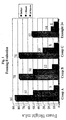
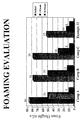
- Fig. 1 is a bar graph showing the results of the foaming evaluation. As can be seen from the graph, example 24 exhibited a lower foam height than comparatives A-C which are standards in the industry.
- Example 30 Phosphoric acid, 75% 20.0 20.0 Nitric Acid, 42 Be 21.0 21.0 Glacial Acetic Acid 15.0 15.0 1-octane sulfonate 10.0 20.0 TETRONIC® 908 0.5 1.50 Perlargonic acid 1.0 3.4 Decanoic acid 0.15 0.5 Urea 0.5 0.5 DI water 26.85 18.10
- compositions of the present invention which are useful as cleaning compositions, i.e. one-step cleaning compositions.
- Example 29 is intended for 1% dilution (1:100 concentrate to water) and example 29 is intended for 0.3% (1:333 concentrate to water) dilution.
Landscapes
- Chemical & Material Sciences (AREA)
- Oil, Petroleum & Natural Gas (AREA)
- Life Sciences & Earth Sciences (AREA)
- Engineering & Computer Science (AREA)
- Chemical Kinetics & Catalysis (AREA)
- Wood Science & Technology (AREA)
- Organic Chemistry (AREA)
- Emergency Medicine (AREA)
- Health & Medical Sciences (AREA)
- Inorganic Chemistry (AREA)
- Agricultural Chemicals And Associated Chemicals (AREA)
- Detergent Compositions (AREA)
- Acyclic And Carbocyclic Compounds In Medicinal Compositions (AREA)
- Cleaning And De-Greasing Of Metallic Materials By Chemical Methods (AREA)
Applications Claiming Priority (3)
| Application Number | Priority Date | Filing Date | Title |
|---|---|---|---|
| US10/000,138 US6472358B1 (en) | 2001-11-15 | 2001-11-15 | Acid sanitizing and cleaning compositions containing protonated carboxylic acids |
| US138 | 2001-11-15 | ||
| PCT/US2002/036513 WO2003044145A1 (en) | 2001-11-15 | 2002-11-13 | Acid sanitizing and cleaning compositions containing protonated carboxylic acids |
Publications (2)
| Publication Number | Publication Date |
|---|---|
| EP1444316A1 EP1444316A1 (en) | 2004-08-11 |
| EP1444316B1 true EP1444316B1 (en) | 2006-05-03 |
Family
ID=21690090
Family Applications (1)
| Application Number | Title | Priority Date | Filing Date |
|---|---|---|---|
| EP02784458A Revoked EP1444316B1 (en) | 2001-11-15 | 2002-11-13 | Acid sanitizing and cleaning compositions containing protonated carboxylic acids |
Country Status (13)
| Country | Link |
|---|---|
| US (1) | US6472358B1 (https=) |
| EP (1) | EP1444316B1 (https=) |
| JP (1) | JP4991090B2 (https=) |
| CN (1) | CN1250689C (https=) |
| AT (1) | ATE325180T1 (https=) |
| AU (1) | AU2002346392A1 (https=) |
| BR (1) | BR0213546A (https=) |
| CA (1) | CA2462618C (https=) |
| DE (1) | DE60211200T2 (https=) |
| MX (1) | MXPA04004610A (https=) |
| NZ (1) | NZ531951A (https=) |
| PL (1) | PL202765B1 (https=) |
| WO (1) | WO2003044145A1 (https=) |
Families Citing this family (58)
| Publication number | Priority date | Publication date | Assignee | Title |
|---|---|---|---|---|
| US6743764B1 (en) * | 1999-07-30 | 2004-06-01 | Dow Global Technologies Inc. | Low viscosity alkyl diphenyl oxide sulfonic acid blends |
| WO2004087894A2 (en) * | 2003-04-01 | 2004-10-14 | S.C.Johnson & Son, Inc. | Bacterial aggregates |
| WO2005049774A1 (ja) * | 2003-11-21 | 2005-06-02 | Johnson Diversey Inc. | Cip洗浄剤組成物およびそれを用いた洗浄方法 |
| JP2005206794A (ja) * | 2003-11-21 | 2005-08-04 | Daisan Kogyo Kk | Cip洗浄剤組成物およびそれを用いた洗浄方法 |
| EP1561801A1 (en) * | 2004-01-28 | 2005-08-10 | JohnsonDiversey Inc. | Sanitizing and cleaning composition and its use for sanitizing and/or cleaning hard surfaces |
| ES2333597T3 (es) * | 2004-03-25 | 2010-02-24 | THE PROCTER & GAMBLE COMPANY | Composicion liquida acida para limpieza de superficies duras. |
| GB2416773A (en) * | 2004-08-06 | 2006-02-08 | Reckitt Benckiser Inc | Aqueous acidic hard surface cleaning compositions and process for cleaning |
| US7494963B2 (en) * | 2004-08-11 | 2009-02-24 | Delaval Holding Ab | Non-chlorinated concentrated all-in-one acid detergent and method for using the same |
| JP2006124627A (ja) * | 2004-09-29 | 2006-05-18 | Daisan Kogyo Kk | Cip洗浄剤組成物および飲食料品の製造装置用洗浄剤組成物ならびにその使用方法 |
| US20080274242A1 (en) * | 2006-07-21 | 2008-11-06 | Ecolab Inc. | Antimicrobial compositions and methods for treating packaged food products |
| DK1906743T3 (da) | 2005-07-25 | 2012-04-10 | Ecolab Inc | Antimikrobielle sammensætninger og fremgangsmåder til behandling af emballerede fødevareprodukter |
| JP4991719B2 (ja) * | 2005-07-25 | 2012-08-01 | イーコラブ インコーポレイティド | 抗菌組成物及び包装された食品の処理方法 |
| US8445419B2 (en) | 2005-07-25 | 2013-05-21 | Ecolab Usa Inc. | Antimicrobial compositions for use on food products |
| WO2007092632A2 (en) * | 2006-02-09 | 2007-08-16 | Elevance Renawable Sciences, Inc. | Surface coating compositions and methods |
| RU2008132757A (ru) * | 2006-02-09 | 2010-03-20 | Елевансе Реневал Сайенсез, Инк. (US) | Антибактериальные составы, способы и системы |
| WO2007128345A1 (en) * | 2006-05-08 | 2007-11-15 | Ecolab Inc. | Acidic cleaner for metal surfaces |
| US7923425B2 (en) * | 2006-08-21 | 2011-04-12 | Henkel Ag & Co. Kgaa | Low-foaming, acidic low-temperature cleaner and process for cleaning surfaces |
| DK2086529T3 (en) | 2006-09-08 | 2015-05-04 | Delaval Holding Ab | ANTIMICROBIAL COMPOSITIONS AND RELATED APPLICATIONS |
| JP5001612B2 (ja) * | 2006-09-21 | 2012-08-15 | ディバーシー株式会社 | 酸性cip用洗浄剤組成物およびそれを用いた洗浄方法 |
| WO2008079941A1 (en) * | 2006-12-21 | 2008-07-03 | Johnsondiversey, Inc. | A method for washing a polycarbonate article |
| EP1935972A1 (en) * | 2006-12-21 | 2008-06-25 | JohnsonDiversey, Inc. | A method for washing a polycarbonate article |
| MX2009011938A (es) * | 2007-05-04 | 2009-11-13 | Procter & Gamble | Composiciones antimicrobianas, productos y metodos de uso. |
| CN101092592B (zh) * | 2007-07-20 | 2011-06-15 | 季建萍 | 可食用的消毒液 |
| ES2556127T3 (es) * | 2007-08-31 | 2016-01-13 | The Procter & Gamble Company | Composición limpiadora de superficies duras ácida líquida |
| CN103146505A (zh) * | 2007-11-05 | 2013-06-12 | 埃科莱布有限公司 | 原位清洁挤奶机清洁系统的固体块含酸清洁组合物 |
| CA2701213C (en) * | 2007-11-05 | 2013-12-31 | Ecolab Inc. | Solid block acid containing cleaning composition for clean-in-place milking machine cleaning system |
| CN101233852B (zh) * | 2008-03-03 | 2011-04-27 | 上海龙蟒生物科技有限公司 | 脂肪酸组合物 |
| US9376648B2 (en) | 2008-04-07 | 2016-06-28 | The Procter & Gamble Company | Foam manipulation compositions containing fine particles |
| WO2010095231A1 (ja) | 2009-02-19 | 2010-08-26 | サラヤ株式会社 | アルミニウム腐食抑制性を有する酸性酸化剤含有組成物およびその用途 |
| DE102009003078A1 (de) * | 2009-05-13 | 2010-11-25 | Habla Chemie Gmbh | Einphasiges Additiv zum Zusetzen zu einer sauren Reinigungsflüssigkeit |
| UA104899C2 (uk) * | 2009-08-06 | 2014-03-25 | Анітокс Корпорейшн | Консервант для води та корму |
| DE102009038213A1 (de) * | 2009-08-20 | 2011-09-08 | Fresenius Medical Care Deutschland Gmbh | Desinfektionsmittel, dessen Verwendung und Desinfektionsverfahren |
| US8053596B2 (en) * | 2009-11-02 | 2011-11-08 | Third Stream Bioscience, Inc. | Process for producing alxyl glyceryl sulfonates |
| RU2429287C1 (ru) * | 2010-02-19 | 2011-09-20 | Общество с ограниченной ответственностью "Технологии Третьего Тысячелетия" | Средство для очистки оборудования пищевой и перерабатывающей промышленности |
| US20120087887A1 (en) | 2010-10-07 | 2012-04-12 | Biolife, L.L.C. | Composition and Method for Arresting Blood Flow and for Forming a Persistent Microbial Barrier |
| US9084838B2 (en) * | 2011-02-04 | 2015-07-21 | Kimberly-Clark Worldwide, Inc. | Feminine care absorbent article for use in warm climates |
| KR20140097253A (ko) | 2011-11-30 | 2014-08-06 | 아니톡스 코포레이션 | 알데히드, 유기산 및 유기산 에스테르의 항미생물성 혼합물 |
| US10232047B2 (en) | 2011-12-20 | 2019-03-19 | Vyome Biosciences Private Limited | Topical oil composition for the treatment of fungal infections |
| US20140170237A1 (en) * | 2012-12-14 | 2014-06-19 | Yueh Wang | Antimicrobial compositions containing mixtures of fatty and hydroxyl carboxylic acids |
| PL3043644T3 (pl) | 2013-09-13 | 2024-01-22 | Sopura S.A. | Kompozycja przeciwdrobnoustrojowa |
| BE1021925B1 (fr) * | 2013-09-20 | 2016-01-27 | Sopura S.A. | Composition antimicrobienne. |
| EP3046867B1 (en) | 2013-09-16 | 2022-05-04 | Idea Boxx, LLC | Apparatus and method for cleaning a food processor |
| DE102014013241A1 (de) * | 2014-09-11 | 2016-03-17 | Bode Chemie Gmbh | Tuberkulozides Desinfektionsmittel |
| US11028348B2 (en) | 2014-10-09 | 2021-06-08 | ProNatural Brands, LLC | Naturally-derived antimicrobial cleaning solutions |
| US10076115B2 (en) | 2014-10-09 | 2018-09-18 | ProNatural Brands, LLC | Naturally-derived surface sanitizer and disinfectant |
| CN105251030A (zh) * | 2015-09-29 | 2016-01-20 | 武汉中博绿亚生物科技有限公司 | 一种用于宠物生活环境的可食用的祛味消毒剂及其制备方法 |
| WO2017100681A1 (en) | 2015-12-11 | 2017-06-15 | Idea Boxx, Llc | Flow balancing in food processor cleaning system |
| EP3687293A1 (en) | 2017-09-26 | 2020-08-05 | Ecolab Usa Inc. | Acidic/anionic antimicrobial and virucidal compositions and uses thereof |
| EP3723484A2 (en) | 2017-12-15 | 2020-10-21 | Diversey, Inc. | Membrane disinfectant |
| JP7365768B2 (ja) * | 2018-04-03 | 2023-10-20 | 大日本除蟲菊株式会社 | 酸性殺菌剤組成物および殺菌効力増強方法 |
| CN108641822A (zh) * | 2018-06-04 | 2018-10-12 | 武汉柏康科技股份有限公司 | 一种无磷低碳酸性cip清洁剂 |
| US11421191B1 (en) | 2018-11-15 | 2022-08-23 | Ecolab Usa Inc. | Acidic cleaner |
| CN111206253A (zh) * | 2018-11-22 | 2020-05-29 | 艺康美国股份有限公司 | 用来增强污垢去除的酸性cip/cop清洗组合物 |
| US11713436B2 (en) | 2019-06-17 | 2023-08-01 | Ecolab Usa Inc. | Textile bleaching and disinfecting using the mixture of hydrophilic and hydrophobic peroxycarboxylic acid composition |
| AU2020408331B2 (en) | 2019-12-16 | 2023-12-14 | Ecolab Usa Inc. | Anionic surfactant impact on virucidal efficacy |
| CA3163700A1 (en) * | 2020-01-07 | 2021-07-15 | Medivators Inc. | Low odor high level disinfectant |
| WO2021176446A1 (en) * | 2020-03-01 | 2021-09-10 | Save Foods Ltd. | Sterilization compositions and methods for using thereof |
| AU2022277023A1 (en) * | 2021-05-18 | 2024-01-18 | Ecochem Australia Pty Ltd | Sanitising systems and methods |
Family Cites Families (21)
| Publication number | Priority date | Publication date | Assignee | Title |
|---|---|---|---|---|
| US4002775A (en) | 1973-07-09 | 1977-01-11 | Kabara Jon J | Fatty acids and derivatives of antimicrobial agents |
| US4343798A (en) | 1981-06-23 | 1982-08-10 | The Procter & Gamble Company | Topical antimicrobial anti-inflammatory compositions |
| US4406884A (en) | 1981-06-23 | 1983-09-27 | The Procter & Gamble Company | Topical antimicrobial composition |
| US4404040A (en) * | 1981-07-01 | 1983-09-13 | Economics Laboratory, Inc. | Short chain fatty acid sanitizing composition and methods |
| GB8428564D0 (en) * | 1984-11-12 | 1984-12-19 | Diversey Corp | Cleaning/disinfecting process and composition |
| US5208257A (en) | 1986-04-21 | 1993-05-04 | Kabara Jon J | Topical antimicrobial pharmaceutical compositions and methods |
| US5308868A (en) | 1989-03-21 | 1994-05-03 | Bruce Kefford | Teat dip |
| US5143720A (en) * | 1990-11-28 | 1992-09-01 | Microcide, Inc. | Disinfecting and sanitizing compositions |
| NZ239646A (en) * | 1991-06-04 | 1994-09-27 | Ecolab Inc | Antimicrobial composition comprising octanoic acid or a derivative thereof |
| US5234719A (en) * | 1991-06-04 | 1993-08-10 | Ecolab Inc. | Food additive sanitizing compositions |
| DE69312503D1 (de) | 1992-09-22 | 1997-09-04 | Arda Technologies Co | Antimikrobielle zusammensetzung und verfahren zu ihrer herstellung |
| CA2148921C (en) * | 1992-11-09 | 1998-09-01 | Michael D. Mckinzie | Improved acid sanitizer composition |
| US5391379A (en) * | 1992-11-09 | 1995-02-21 | West Agro, Inc. | Acid sanitizer composition |
| US5436008A (en) * | 1992-12-11 | 1995-07-25 | Ecolab Inc. | Sanitizing compositions |
| AU5717396A (en) * | 1994-04-18 | 1997-11-19 | Bongard, Thomas G. | Low ph acidic compositions |
| GB9419668D0 (en) * | 1994-09-28 | 1994-11-16 | Diversey Corp | Disinfectant compositions |
| US5569461A (en) | 1995-02-07 | 1996-10-29 | Minnesota Mining And Manufacturing Company | Topical antimicrobial composition and method |
| DE19533994A1 (de) * | 1995-09-14 | 1997-03-20 | Guenter Dr Ritter | Reiniger und andere funktionale Produkte mit extrem niedriger Abwasser- und Umweltbelastung |
| BE1011314A3 (fr) * | 1997-08-05 | 1999-07-06 | Sopura Sa | Composition desinfectante. |
| WO2000061715A1 (en) * | 1999-04-14 | 2000-10-19 | Charvid Limited Liability Company | Method and composition for cleaning beverage lines |
| DE10036607A1 (de) * | 2000-07-27 | 2002-02-14 | Henkel Ecolab Gmbh & Co Ohg | Saure Zubereitungen zur Reinigung und Desinfektion von Oberflächen |
-
2001
- 2001-11-15 US US10/000,138 patent/US6472358B1/en not_active Expired - Lifetime
-
2002
- 2002-11-13 JP JP2003545770A patent/JP4991090B2/ja not_active Expired - Lifetime
- 2002-11-13 WO PCT/US2002/036513 patent/WO2003044145A1/en not_active Ceased
- 2002-11-13 AT AT02784458T patent/ATE325180T1/de not_active IP Right Cessation
- 2002-11-13 EP EP02784458A patent/EP1444316B1/en not_active Revoked
- 2002-11-13 NZ NZ531951A patent/NZ531951A/en not_active IP Right Cessation
- 2002-11-13 BR BR0213546-9A patent/BR0213546A/pt not_active Application Discontinuation
- 2002-11-13 CN CN02821344.0A patent/CN1250689C/zh not_active Expired - Lifetime
- 2002-11-13 MX MXPA04004610A patent/MXPA04004610A/es active IP Right Grant
- 2002-11-13 PL PL372174A patent/PL202765B1/pl unknown
- 2002-11-13 AU AU2002346392A patent/AU2002346392A1/en not_active Abandoned
- 2002-11-13 DE DE60211200T patent/DE60211200T2/de not_active Expired - Lifetime
- 2002-11-13 CA CA2462618A patent/CA2462618C/en not_active Expired - Lifetime
Also Published As
| Publication number | Publication date |
|---|---|
| ATE325180T1 (de) | 2006-06-15 |
| PL202765B1 (pl) | 2009-07-31 |
| JP2005511635A (ja) | 2005-04-28 |
| NZ531951A (en) | 2004-07-30 |
| DE60211200D1 (de) | 2006-06-08 |
| EP1444316A1 (en) | 2004-08-11 |
| US6472358B1 (en) | 2002-10-29 |
| CA2462618A1 (en) | 2003-05-30 |
| PL372174A1 (en) | 2005-07-11 |
| DE60211200T2 (de) | 2007-03-15 |
| AU2002346392A1 (en) | 2003-06-10 |
| CA2462618C (en) | 2010-08-03 |
| MXPA04004610A (es) | 2004-08-12 |
| CN1250689C (zh) | 2006-04-12 |
| JP4991090B2 (ja) | 2012-08-01 |
| BR0213546A (pt) | 2004-10-26 |
| WO2003044145A1 (en) | 2003-05-30 |
| CN1630704A (zh) | 2005-06-22 |
Similar Documents
| Publication | Publication Date | Title |
|---|---|---|
| EP1444316B1 (en) | Acid sanitizing and cleaning compositions containing protonated carboxylic acids | |
| EP1709145B1 (en) | Sanitizing and cleaning composition and its use for sanitizing and/or cleaning hard surfaces | |
| AU596875B2 (en) | Disinfectant compositions | |
| US5436008A (en) | Sanitizing compositions | |
| JP6943761B2 (ja) | 活性化された過酸化水素消毒剤組成物 | |
| EP2329002B1 (en) | Concentrated hydrogen peroxide disinfecting solutions | |
| WO2002059244A2 (en) | Acidic hard-surface antimicrobial cleaner | |
| AU2002246993A1 (en) | Acidic hard-surface antimicrobial cleaner | |
| DE19962342A1 (de) | Persäuren mit guter Haftung auf Oberflächen | |
| JP2001506971A (ja) | 過酸化水素消毒および滅菌組成物 | |
| GB2301111A (en) | Peroxycarboxylic acid rinsing solution | |
| US20250261636A1 (en) | Quaternary ammonium sanitizing composition | |
| EP1077250A1 (en) | Aqueous formulations | |
| AU739083B2 (en) | Disinfecting composition | |
| US7435708B2 (en) | Lubricant composition | |
| WO1997042818A1 (en) | Acid food industry sanitizer composition containing a biocidally active surfactant | |
| JP5654892B2 (ja) | トイレ用除菌洗浄剤組成物 | |
| JP3423971B2 (ja) | 低腐食性ヨウ素含有殺菌洗浄剤 | |
| MXPA06008569A (en) | Sanitizing and cleaning composition and its use for sanitizing and/or cleaning hard surfaces |
Legal Events
| Date | Code | Title | Description |
|---|---|---|---|
| PUAI | Public reference made under article 153(3) epc to a published international application that has entered the european phase |
Free format text: ORIGINAL CODE: 0009012 |
|
| 17P | Request for examination filed |
Effective date: 20040404 |
|
| AK | Designated contracting states |
Kind code of ref document: A1 Designated state(s): AT BE BG CH CY CZ DE DK EE ES FI FR GB GR IE IT LI LU MC NL PT SE SK TR |
|
| AX | Request for extension of the european patent |
Extension state: AL LT LV MK RO SI |
|
| 17Q | First examination report despatched |
Effective date: 20050428 |
|
| GRAP | Despatch of communication of intention to grant a patent |
Free format text: ORIGINAL CODE: EPIDOSNIGR1 |
|
| GRAS | Grant fee paid |
Free format text: ORIGINAL CODE: EPIDOSNIGR3 |
|
| GRAA | (expected) grant |
Free format text: ORIGINAL CODE: 0009210 |
|
| AK | Designated contracting states |
Kind code of ref document: B1 Designated state(s): AT BE BG CH CY CZ DE DK EE ES FI FR GB GR IE IT LI LU MC NL PT SE SK TR |
|
| PG25 | Lapsed in a contracting state [announced via postgrant information from national office to epo] |
Ref country code: IT Free format text: LAPSE BECAUSE OF FAILURE TO SUBMIT A TRANSLATION OF THE DESCRIPTION OR TO PAY THE FEE WITHIN THE PRESCRIBED TIME-LIMIT;WARNING: LAPSES OF ITALIAN PATENTS WITH EFFECTIVE DATE BEFORE 2007 MAY HAVE OCCURRED AT ANY TIME BEFORE 2007. THE CORRECT EFFECTIVE DATE MAY BE DIFFERENT FROM THE ONE RECORDED. Effective date: 20060503 Ref country code: CZ Free format text: LAPSE BECAUSE OF FAILURE TO SUBMIT A TRANSLATION OF THE DESCRIPTION OR TO PAY THE FEE WITHIN THE PRESCRIBED TIME-LIMIT Effective date: 20060503 Ref country code: NL Free format text: LAPSE BECAUSE OF FAILURE TO SUBMIT A TRANSLATION OF THE DESCRIPTION OR TO PAY THE FEE WITHIN THE PRESCRIBED TIME-LIMIT Effective date: 20060503 Ref country code: BE Free format text: LAPSE BECAUSE OF FAILURE TO SUBMIT A TRANSLATION OF THE DESCRIPTION OR TO PAY THE FEE WITHIN THE PRESCRIBED TIME-LIMIT Effective date: 20060503 Ref country code: FI Free format text: LAPSE BECAUSE OF FAILURE TO SUBMIT A TRANSLATION OF THE DESCRIPTION OR TO PAY THE FEE WITHIN THE PRESCRIBED TIME-LIMIT Effective date: 20060503 Ref country code: SK Free format text: LAPSE BECAUSE OF FAILURE TO SUBMIT A TRANSLATION OF THE DESCRIPTION OR TO PAY THE FEE WITHIN THE PRESCRIBED TIME-LIMIT Effective date: 20060503 Ref country code: AT Free format text: LAPSE BECAUSE OF FAILURE TO SUBMIT A TRANSLATION OF THE DESCRIPTION OR TO PAY THE FEE WITHIN THE PRESCRIBED TIME-LIMIT Effective date: 20060503 Ref country code: CH Free format text: LAPSE BECAUSE OF FAILURE TO SUBMIT A TRANSLATION OF THE DESCRIPTION OR TO PAY THE FEE WITHIN THE PRESCRIBED TIME-LIMIT Effective date: 20060503 Ref country code: LI Free format text: LAPSE BECAUSE OF FAILURE TO SUBMIT A TRANSLATION OF THE DESCRIPTION OR TO PAY THE FEE WITHIN THE PRESCRIBED TIME-LIMIT Effective date: 20060503 |
|
| REG | Reference to a national code |
Ref country code: GB Ref legal event code: FG4D |
|
| REG | Reference to a national code |
Ref country code: CH Ref legal event code: EP |
|
| REF | Corresponds to: |
Ref document number: 60211200 Country of ref document: DE Date of ref document: 20060608 Kind code of ref document: P |
|
| REG | Reference to a national code |
Ref country code: IE Ref legal event code: FG4D |
|
| PG25 | Lapsed in a contracting state [announced via postgrant information from national office to epo] |
Ref country code: DK Free format text: LAPSE BECAUSE OF FAILURE TO SUBMIT A TRANSLATION OF THE DESCRIPTION OR TO PAY THE FEE WITHIN THE PRESCRIBED TIME-LIMIT Effective date: 20060803 Ref country code: SE Free format text: LAPSE BECAUSE OF FAILURE TO SUBMIT A TRANSLATION OF THE DESCRIPTION OR TO PAY THE FEE WITHIN THE PRESCRIBED TIME-LIMIT Effective date: 20060803 |
|
| PG25 | Lapsed in a contracting state [announced via postgrant information from national office to epo] |
Ref country code: ES Free format text: LAPSE BECAUSE OF FAILURE TO SUBMIT A TRANSLATION OF THE DESCRIPTION OR TO PAY THE FEE WITHIN THE PRESCRIBED TIME-LIMIT Effective date: 20060814 |
|
| PG25 | Lapsed in a contracting state [announced via postgrant information from national office to epo] |
Ref country code: PT Free format text: LAPSE BECAUSE OF FAILURE TO SUBMIT A TRANSLATION OF THE DESCRIPTION OR TO PAY THE FEE WITHIN THE PRESCRIBED TIME-LIMIT Effective date: 20061003 |
|
| NLV1 | Nl: lapsed or annulled due to failure to fulfill the requirements of art. 29p and 29m of the patents act | ||
| PG25 | Lapsed in a contracting state [announced via postgrant information from national office to epo] |
Ref country code: IE Free format text: LAPSE BECAUSE OF NON-PAYMENT OF DUE FEES Effective date: 20061113 |
|
| REG | Reference to a national code |
Ref country code: CH Ref legal event code: PL |
|
| PG25 | Lapsed in a contracting state [announced via postgrant information from national office to epo] |
Ref country code: MC Free format text: LAPSE BECAUSE OF NON-PAYMENT OF DUE FEES Effective date: 20061130 |
|
| ET | Fr: translation filed | ||
| PLBI | Opposition filed |
Free format text: ORIGINAL CODE: 0009260 |
|
| 26 | Opposition filed |
Opponent name: JOHNSONDIVERSEY, INC. Effective date: 20070205 |
|
| PLAX | Notice of opposition and request to file observation + time limit sent |
Free format text: ORIGINAL CODE: EPIDOSNOBS2 |
|
| PLBB | Reply of patent proprietor to notice(s) of opposition received |
Free format text: ORIGINAL CODE: EPIDOSNOBS3 |
|
| PG25 | Lapsed in a contracting state [announced via postgrant information from national office to epo] |
Ref country code: GR Free format text: LAPSE BECAUSE OF FAILURE TO SUBMIT A TRANSLATION OF THE DESCRIPTION OR TO PAY THE FEE WITHIN THE PRESCRIBED TIME-LIMIT Effective date: 20060804 |
|
| PLCK | Communication despatched that opposition was rejected |
Free format text: ORIGINAL CODE: EPIDOSNREJ1 |
|
| PG25 | Lapsed in a contracting state [announced via postgrant information from national office to epo] |
Ref country code: BG Free format text: LAPSE BECAUSE OF FAILURE TO SUBMIT A TRANSLATION OF THE DESCRIPTION OR TO PAY THE FEE WITHIN THE PRESCRIBED TIME-LIMIT Effective date: 20060803 Ref country code: EE Free format text: LAPSE BECAUSE OF FAILURE TO SUBMIT A TRANSLATION OF THE DESCRIPTION OR TO PAY THE FEE WITHIN THE PRESCRIBED TIME-LIMIT Effective date: 20060503 |
|
| PG25 | Lapsed in a contracting state [announced via postgrant information from national office to epo] |
Ref country code: LU Free format text: LAPSE BECAUSE OF NON-PAYMENT OF DUE FEES Effective date: 20061113 Ref country code: TR Free format text: LAPSE BECAUSE OF FAILURE TO SUBMIT A TRANSLATION OF THE DESCRIPTION OR TO PAY THE FEE WITHIN THE PRESCRIBED TIME-LIMIT Effective date: 20060503 |
|
| APBM | Appeal reference recorded |
Free format text: ORIGINAL CODE: EPIDOSNREFNO |
|
| APBP | Date of receipt of notice of appeal recorded |
Free format text: ORIGINAL CODE: EPIDOSNNOA2O |
|
| APAH | Appeal reference modified |
Free format text: ORIGINAL CODE: EPIDOSCREFNO |
|
| APBQ | Date of receipt of statement of grounds of appeal recorded |
Free format text: ORIGINAL CODE: EPIDOSNNOA3O |
|
| PLAB | Opposition data, opponent's data or that of the opponent's representative modified |
Free format text: ORIGINAL CODE: 0009299OPPO |
|
| R26 | Opposition filed (corrected) |
Opponent name: JOHNSONDIVERSEY, INC. Effective date: 20070205 |
|
| PG25 | Lapsed in a contracting state [announced via postgrant information from national office to epo] |
Ref country code: CY Free format text: LAPSE BECAUSE OF FAILURE TO SUBMIT A TRANSLATION OF THE DESCRIPTION OR TO PAY THE FEE WITHIN THE PRESCRIBED TIME-LIMIT Effective date: 20060503 |
|
| APBU | Appeal procedure closed |
Free format text: ORIGINAL CODE: EPIDOSNNOA9O |
|
| PLAB | Opposition data, opponent's data or that of the opponent's representative modified |
Free format text: ORIGINAL CODE: 0009299OPPO |
|
| R26 | Opposition filed (corrected) |
Opponent name: JOHNSONDIVERSEY, INC. Effective date: 20070205 |
|
| PGFP | Annual fee paid to national office [announced via postgrant information from national office to epo] |
Ref country code: FR Payment date: 20101109 Year of fee payment: 9 |
|
| PGFP | Annual fee paid to national office [announced via postgrant information from national office to epo] |
Ref country code: DE Payment date: 20101130 Year of fee payment: 9 |
|
| PGFP | Annual fee paid to national office [announced via postgrant information from national office to epo] |
Ref country code: GB Payment date: 20101022 Year of fee payment: 9 |
|
| GBPC | Gb: european patent ceased through non-payment of renewal fee |
Effective date: 20111113 |
|
| REG | Reference to a national code |
Ref country code: FR Ref legal event code: ST Effective date: 20120731 |
|
| REG | Reference to a national code |
Ref country code: DE Ref legal event code: R119 Ref document number: 60211200 Country of ref document: DE Effective date: 20120601 |
|
| PG25 | Lapsed in a contracting state [announced via postgrant information from national office to epo] |
Ref country code: GB Free format text: LAPSE BECAUSE OF NON-PAYMENT OF DUE FEES Effective date: 20111113 |
|
| PG25 | Lapsed in a contracting state [announced via postgrant information from national office to epo] |
Ref country code: FR Free format text: LAPSE BECAUSE OF NON-PAYMENT OF DUE FEES Effective date: 20111130 |
|
| RDAF | Communication despatched that patent is revoked |
Free format text: ORIGINAL CODE: EPIDOSNREV1 |
|
| RDAG | Patent revoked |
Free format text: ORIGINAL CODE: 0009271 |
|
| STAA | Information on the status of an ep patent application or granted ep patent |
Free format text: STATUS: PATENT REVOKED |
|
| 27W | Patent revoked |
Effective date: 20100917 |