EP1408984B1 - Organo-phosphorverbindungen zur aktivierung von gamma/delta-t-zellen - Google Patents
Organo-phosphorverbindungen zur aktivierung von gamma/delta-t-zellen Download PDFInfo
- Publication number
- EP1408984B1 EP1408984B1 EP02776913A EP02776913A EP1408984B1 EP 1408984 B1 EP1408984 B1 EP 1408984B1 EP 02776913 A EP02776913 A EP 02776913A EP 02776913 A EP02776913 A EP 02776913A EP 1408984 B1 EP1408984 B1 EP 1408984B1
- Authority
- EP
- European Patent Office
- Prior art keywords
- substituted
- unsubstituted
- pharmaceutical
- group
- anyone
- Prior art date
- Legal status (The legal status is an assumption and is not a legal conclusion. Google has not performed a legal analysis and makes no representation as to the accuracy of the status listed.)
- Expired - Lifetime
Links
Classifications
-
- C—CHEMISTRY; METALLURGY
- C07—ORGANIC CHEMISTRY
- C07F—ACYCLIC, CARBOCYCLIC OR HETEROCYCLIC COMPOUNDS CONTAINING ELEMENTS OTHER THAN CARBON, HYDROGEN, HALOGEN, OXYGEN, NITROGEN, SULFUR, SELENIUM OR TELLURIUM
- C07F9/00—Compounds containing elements of Groups 5 or 15 of the Periodic Table
- C07F9/02—Phosphorus compounds
- C07F9/28—Phosphorus compounds with one or more P—C bonds
-
- C—CHEMISTRY; METALLURGY
- C07—ORGANIC CHEMISTRY
- C07F—ACYCLIC, CARBOCYCLIC OR HETEROCYCLIC COMPOUNDS CONTAINING ELEMENTS OTHER THAN CARBON, HYDROGEN, HALOGEN, OXYGEN, NITROGEN, SULFUR, SELENIUM OR TELLURIUM
- C07F9/00—Compounds containing elements of Groups 5 or 15 of the Periodic Table
- C07F9/02—Phosphorus compounds
- C07F9/547—Heterocyclic compounds, e.g. containing phosphorus as a ring hetero atom
- C07F9/6564—Heterocyclic compounds, e.g. containing phosphorus as a ring hetero atom having phosphorus atoms, with or without nitrogen, oxygen, sulfur, selenium or tellurium atoms, as ring hetero atoms
- C07F9/6571—Heterocyclic compounds, e.g. containing phosphorus as a ring hetero atom having phosphorus atoms, with or without nitrogen, oxygen, sulfur, selenium or tellurium atoms, as ring hetero atoms having phosphorus and oxygen atoms as the only ring hetero atoms
- C07F9/6574—Esters of oxyacids of phosphorus
- C07F9/65746—Esters of oxyacids of phosphorus the molecule containing more than one cyclic phosphorus atom
-
- A—HUMAN NECESSITIES
- A61—MEDICAL OR VETERINARY SCIENCE; HYGIENE
- A61K—PREPARATIONS FOR MEDICAL, DENTAL OR TOILETRY PURPOSES
- A61K31/00—Medicinal preparations containing organic active ingredients
- A61K31/66—Phosphorus compounds
- A61K31/661—Phosphorus acids or esters thereof not having P—C bonds, e.g. fosfosal, dichlorvos, malathion or mevinphos
-
- A—HUMAN NECESSITIES
- A61—MEDICAL OR VETERINARY SCIENCE; HYGIENE
- A61P—SPECIFIC THERAPEUTIC ACTIVITY OF CHEMICAL COMPOUNDS OR MEDICINAL PREPARATIONS
- A61P1/00—Drugs for disorders of the alimentary tract or the digestive system
-
- A—HUMAN NECESSITIES
- A61—MEDICAL OR VETERINARY SCIENCE; HYGIENE
- A61P—SPECIFIC THERAPEUTIC ACTIVITY OF CHEMICAL COMPOUNDS OR MEDICINAL PREPARATIONS
- A61P1/00—Drugs for disorders of the alimentary tract or the digestive system
- A61P1/04—Drugs for disorders of the alimentary tract or the digestive system for ulcers, gastritis or reflux esophagitis, e.g. antacids, inhibitors of acid secretion, mucosal protectants
-
- A—HUMAN NECESSITIES
- A61—MEDICAL OR VETERINARY SCIENCE; HYGIENE
- A61P—SPECIFIC THERAPEUTIC ACTIVITY OF CHEMICAL COMPOUNDS OR MEDICINAL PREPARATIONS
- A61P11/00—Drugs for disorders of the respiratory system
- A61P11/04—Drugs for disorders of the respiratory system for throat disorders
-
- A—HUMAN NECESSITIES
- A61—MEDICAL OR VETERINARY SCIENCE; HYGIENE
- A61P—SPECIFIC THERAPEUTIC ACTIVITY OF CHEMICAL COMPOUNDS OR MEDICINAL PREPARATIONS
- A61P11/00—Drugs for disorders of the respiratory system
- A61P11/06—Antiasthmatics
-
- A—HUMAN NECESSITIES
- A61—MEDICAL OR VETERINARY SCIENCE; HYGIENE
- A61P—SPECIFIC THERAPEUTIC ACTIVITY OF CHEMICAL COMPOUNDS OR MEDICINAL PREPARATIONS
- A61P19/00—Drugs for skeletal disorders
-
- A—HUMAN NECESSITIES
- A61—MEDICAL OR VETERINARY SCIENCE; HYGIENE
- A61P—SPECIFIC THERAPEUTIC ACTIVITY OF CHEMICAL COMPOUNDS OR MEDICINAL PREPARATIONS
- A61P19/00—Drugs for skeletal disorders
- A61P19/08—Drugs for skeletal disorders for bone diseases, e.g. rachitism, Paget's disease
- A61P19/10—Drugs for skeletal disorders for bone diseases, e.g. rachitism, Paget's disease for osteoporosis
-
- A—HUMAN NECESSITIES
- A61—MEDICAL OR VETERINARY SCIENCE; HYGIENE
- A61P—SPECIFIC THERAPEUTIC ACTIVITY OF CHEMICAL COMPOUNDS OR MEDICINAL PREPARATIONS
- A61P25/00—Drugs for disorders of the nervous system
-
- A—HUMAN NECESSITIES
- A61—MEDICAL OR VETERINARY SCIENCE; HYGIENE
- A61P—SPECIFIC THERAPEUTIC ACTIVITY OF CHEMICAL COMPOUNDS OR MEDICINAL PREPARATIONS
- A61P3/00—Drugs for disorders of the metabolism
- A61P3/08—Drugs for disorders of the metabolism for glucose homeostasis
- A61P3/10—Drugs for disorders of the metabolism for glucose homeostasis for hyperglycaemia, e.g. antidiabetics
-
- A—HUMAN NECESSITIES
- A61—MEDICAL OR VETERINARY SCIENCE; HYGIENE
- A61P—SPECIFIC THERAPEUTIC ACTIVITY OF CHEMICAL COMPOUNDS OR MEDICINAL PREPARATIONS
- A61P31/00—Antiinfectives, i.e. antibiotics, antiseptics, chemotherapeutics
- A61P31/04—Antibacterial agents
-
- A—HUMAN NECESSITIES
- A61—MEDICAL OR VETERINARY SCIENCE; HYGIENE
- A61P—SPECIFIC THERAPEUTIC ACTIVITY OF CHEMICAL COMPOUNDS OR MEDICINAL PREPARATIONS
- A61P31/00—Antiinfectives, i.e. antibiotics, antiseptics, chemotherapeutics
- A61P31/12—Antivirals
-
- A—HUMAN NECESSITIES
- A61—MEDICAL OR VETERINARY SCIENCE; HYGIENE
- A61P—SPECIFIC THERAPEUTIC ACTIVITY OF CHEMICAL COMPOUNDS OR MEDICINAL PREPARATIONS
- A61P33/00—Antiparasitic agents
-
- A—HUMAN NECESSITIES
- A61—MEDICAL OR VETERINARY SCIENCE; HYGIENE
- A61P—SPECIFIC THERAPEUTIC ACTIVITY OF CHEMICAL COMPOUNDS OR MEDICINAL PREPARATIONS
- A61P35/00—Antineoplastic agents
-
- A—HUMAN NECESSITIES
- A61—MEDICAL OR VETERINARY SCIENCE; HYGIENE
- A61P—SPECIFIC THERAPEUTIC ACTIVITY OF CHEMICAL COMPOUNDS OR MEDICINAL PREPARATIONS
- A61P37/00—Drugs for immunological or allergic disorders
-
- A—HUMAN NECESSITIES
- A61—MEDICAL OR VETERINARY SCIENCE; HYGIENE
- A61P—SPECIFIC THERAPEUTIC ACTIVITY OF CHEMICAL COMPOUNDS OR MEDICINAL PREPARATIONS
- A61P37/00—Drugs for immunological or allergic disorders
- A61P37/08—Antiallergic agents
-
- C—CHEMISTRY; METALLURGY
- C07—ORGANIC CHEMISTRY
- C07F—ACYCLIC, CARBOCYCLIC OR HETEROCYCLIC COMPOUNDS CONTAINING ELEMENTS OTHER THAN CARBON, HYDROGEN, HALOGEN, OXYGEN, NITROGEN, SULFUR, SELENIUM OR TELLURIUM
- C07F9/00—Compounds containing elements of Groups 5 or 15 of the Periodic Table
- C07F9/02—Phosphorus compounds
- C07F9/06—Phosphorus compounds without P—C bonds
- C07F9/08—Esters of oxyacids of phosphorus
- C07F9/09—Esters of phosphoric acids
- C07F9/098—Esters of polyphosphoric acids or anhydrides
-
- C—CHEMISTRY; METALLURGY
- C07—ORGANIC CHEMISTRY
- C07F—ACYCLIC, CARBOCYCLIC OR HETEROCYCLIC COMPOUNDS CONTAINING ELEMENTS OTHER THAN CARBON, HYDROGEN, HALOGEN, OXYGEN, NITROGEN, SULFUR, SELENIUM OR TELLURIUM
- C07F9/00—Compounds containing elements of Groups 5 or 15 of the Periodic Table
- C07F9/02—Phosphorus compounds
- C07F9/28—Phosphorus compounds with one or more P—C bonds
- C07F9/38—Phosphonic acids [RP(=O)(OH)2]; Thiophosphonic acids ; [RP(=X1)(X2H)2(X1, X2 are each independently O, S or Se)]
- C07F9/3804—Phosphonic acids [RP(=O)(OH)2]; Thiophosphonic acids ; [RP(=X1)(X2H)2(X1, X2 are each independently O, S or Se)] not used, see subgroups
- C07F9/3808—Acyclic saturated acids which can have further substituents on alkyl
- C07F9/3821—Acyclic saturated acids which can have further substituents on alkyl substituted by B, Si, P or a metal
-
- C—CHEMISTRY; METALLURGY
- C07—ORGANIC CHEMISTRY
- C07F—ACYCLIC, CARBOCYCLIC OR HETEROCYCLIC COMPOUNDS CONTAINING ELEMENTS OTHER THAN CARBON, HYDROGEN, HALOGEN, OXYGEN, NITROGEN, SULFUR, SELENIUM OR TELLURIUM
- C07F9/00—Compounds containing elements of Groups 5 or 15 of the Periodic Table
- C07F9/02—Phosphorus compounds
- C07F9/28—Phosphorus compounds with one or more P—C bonds
- C07F9/38—Phosphonic acids [RP(=O)(OH)2]; Thiophosphonic acids ; [RP(=X1)(X2H)2(X1, X2 are each independently O, S or Se)]
- C07F9/3804—Phosphonic acids [RP(=O)(OH)2]; Thiophosphonic acids ; [RP(=X1)(X2H)2(X1, X2 are each independently O, S or Se)] not used, see subgroups
- C07F9/3826—Acyclic unsaturated acids
-
- C—CHEMISTRY; METALLURGY
- C07—ORGANIC CHEMISTRY
- C07F—ACYCLIC, CARBOCYCLIC OR HETEROCYCLIC COMPOUNDS CONTAINING ELEMENTS OTHER THAN CARBON, HYDROGEN, HALOGEN, OXYGEN, NITROGEN, SULFUR, SELENIUM OR TELLURIUM
- C07F9/00—Compounds containing elements of Groups 5 or 15 of the Periodic Table
- C07F9/02—Phosphorus compounds
- C07F9/28—Phosphorus compounds with one or more P—C bonds
- C07F9/38—Phosphonic acids [RP(=O)(OH)2]; Thiophosphonic acids ; [RP(=X1)(X2H)2(X1, X2 are each independently O, S or Se)]
- C07F9/40—Esters thereof
- C07F9/4003—Esters thereof the acid moiety containing a substituent or a structure which is considered as characteristic
- C07F9/4025—Esters of poly(thio)phosphonic acids
Definitions
- human gamma / delta T cells are activated by one or more intermediates of the MEP pathway. This means that upon incubation of peripheral blood lymphocytes with extracts from organisms that possess the MEP pathway, selective proliferation and cytokine secretion of the gamma / delta T cell population occurs ( Jomaa H, Feurle J, Luhs K, Kunzmann V, Tony HP, Herderich M, Wilhelm M. FEMS Immunol Med Microbiol. 1999 Sep; 25 (4): 371-8 ). The exact chemical nature of this activating substance or substances is still unknown.
- the object of this invention is to provide substances which are able to stimulate gamma / delta T cells and thus regulate the immune system.
- R 1 is selected from the group consisting of methyl, formyl, substituted and unsubstituted hydroxymethyl radicals, and C 0 H 2 R 31 wherein R 31 is selected from the group consisting of OH, substituted and unsubstituted phosphate and substituted and unsubstituted pyrophosphate and R 31 and R 2 can not be present in the molecule at the same time
- R 33 is selected from the group consisting of hydrogen, OH, substituted and unsubstituted phosphate and substituted and unsubstituted pyrophosphate
- R 3 is selected from the group consisting of hydrogen, substituted and unsubstituted alkyl of 1 to 26 carbon atoms, substituted and unsubstituted hydroxyalkyl of 1 to 26 carbon atoms, substituted and unsubstituted aryl, substituted and
- R 5 is as defined and R 3 Z 2 and X 4, which forms a ring with C 1 as X are defined.
- 1 R 2 is selected from the group consisting of hydrogen, OH, alkoxy, phenoxy, benzyloxy, substituted and unsubstituted phosphate and substituted and unsubstituted pyrophosphate, X 1 oxygen or wherein Y 1 and Y 2 , which may be the same or different, are selected from the group comprising H, OH, halogen, an amino, a C 1-9 alkoxy and a C 1-9 alkylthio radical , or together form an oxo group, and between C 0 and C 1 or C 1 and C 2 or C 2 and C 3 may be a double bond.
- R 1 is selected from the group consisting of a methyl, a formyl radical and substituted or unsubstituted hydroxymethyl radicals
- R 2 is selected from the group consisting of hydrogen, hydroxy, alkoxy, phenoxy, benzyloxy, substituted or unsubstituted phosphate and substituted or unsubstituted pyrophosphate
- X 1 is oxygen or one
- Y 1 and Y 2 which may be the same or different, are selected from the group comprising H, OH, halogen, amino, C 1-9 alkoxy and C 1-9 alkylthio radicals, or together form an oxo group,
- R 3 is selected from the group consisting of hydrogen, substituted and unsubstituted alkyl of 1 to 26 carbon atoms, substituted and unsubstituted hydroxyalkyl of 1 to 26 carbon atoms, substituted and unsubstituted aryl, substituted and unsubstituted aralkyl, substituted and unsubstituted alkenyl of 1 to 26 Carbon atoms, substituted and unsubstituted alkynyl of 1 to 26 carbon atoms, substituted and unsubstituted cycloalkyl, substituted and unsubstituted heterocyclic radical, substituted or unsubstituted phosphate, a silyl, a nucleoside, a nucleoside mono-, di- or triphosphate, a deoxynucleoside, a cation of a organic and inorganic base, in particular a metal of the first, second or third main group of the periodic table, ammonium, substituted ammonium
- R 31 and R 2 which may not be present in the molecule at the same time, are selected from the group consisting of OH, substituted and unsubstituted phosphate and substituted and unsubstituted pyrophosphate; when R 31 is present in the molecule, between C 1 and C 2 forms a double bond, analogously forms between C 0 and C 1 is a double bond when R 2 is present in the molecule, R 33 is selected from the group consisting of hydrogen, OH, substituted and unsubstituted phosphate and substituted and unsubstituted R 34 is selected from the group consisting of hydrogen, substituted and unsubstituted alkyl of 1 to 26 carbon atoms, substituted and unsubstituted hydroxyalkyl of 1 to 26 carbon atoms, substituted and unsubstituted aryl, substituted and unsubstituted aralkyl, substituted and unsubstituted alkenyl of
- X 1 , X 32 and X 33 which may be the same or different, may be oxygen or a A group wherein Y 1 and Y 2 , which may be the same or different, are selected from the group consisting of H, OH, halogen, an amino, a C 1-9 alkoxy and a C 1-9 alkylthio radical
- R 2 is absent, R 33 is H and R 31 is OH, then the segment X 1 -PO (OR 34 ) -X 2 is not -O-PO (OH) -OPO (OH) 2 or -O-PO (ON) 2
- R 31 and R 2 which can not be present in the molecule simultaneously, are selected from the group consisting of OH, substituted and unsubstituted phosphate and substituted and unsubstituted pyrophosphate, R 31 is present in the molecule, then between C 1 and C 3 forms a double bond, analogously formed between C 0 and C 1 is a double bond, if R 2 is present in the molecule, R 34 , R 7 and R 8 , which may be the same or different are defined as above, X 1 , X 32 and X 33, which may be the same or different, are defined as in compound (III).
- R 31 or R 2 is either OH or a substituted or unsubstituted phosphate
- R 34 , R 7 and R 8 are selected from the group consisting of substituted and unsubstituted phosphate, a nucleoside, a deoxynucleoside, a nucleoside mono-, di- or triphosphate, a cation of an organic and inorganic base, in particular a metal of the first, second or third main group of the periodic table, ammonium, substituted ammonium and ammonium compounds derived from ethylenediamine or amino acids and X 1 , X 32 and X 33 , which may be the same or different, are O, CHF, CHCl, CFCl, CH 2 , CF 2 , or CCl 2 .
- Alkyl is a straight- or branched-chain alkyl radical having up to 26 carbon atoms, unless otherwise defined, such as methyl, ethyl, propyl, isopropyl, butyl, isobutyl, tert-butyl, Pentyl, hexyl and the like.
- Alkenyl includes straight or branched chain alkenyl groups of up to 26 carbon atoms, unless otherwise defined, such as, for example; Vinyl, propenyl (e.g., 1-propenyl, 2-propenyl), 1-methylpropenyl, 2-methylpropenyl, butenyl, 2-ethylpropenyl, pentenyl, hexenyl.
- Alkynyl includes straight or branched chain alkynyl groups of up to 26 carbon atoms unless otherwise defined.
- Cycloalkyl is preferably an optionally substituted C 3 -C 7 -cycloalkyl; suitable substituents include alkyl, alkoxy (eg, methoxy, ethoxy, etc.), halogen (eg, fluorine, chlorine, bromine, etc.), nitro, and the like.
- Aryl is an aromatic hydrocarbon radical, such as phenyl, naphthyl, etc., which may optionally have one or more suitable substituents, such as alkoxy (eg, methoxy, ethoxy, etc.), halogen (eg, fluoro, chloro, bromo, etc.), nitro, and the like ,
- Alkyl includes mono-, di-, triphenylalkyls such as benzyl, phenethyl, benzhydryl, trityl and the like, where the aromatic moiety may optionally have one or more suitable substituents, such as alkoxy (eg methoxy, ethoxy etc.), halogen ( eg fluorine, chlorine, bromine etc.), nitro and the like.
- Alkoxy is, unless otherwise defined, a straight or branched chain alkoxy having up to 26 carbon atoms, such as methoxy, ethoxy, etc. It may be e.g. be substituted with hydroxy, amino, halogen, oxo groups and alkoxy, such as methoxy, ethoxy.
- Haldroxymethyl is, unless otherwise defined, a radical in which the oxygen is a substituted or unsubstituted C 1 -C 9 alkyl, aryl or aralkyl radical, such as methoxymethyl, ethoxymethyl, phenoxymethyl or benzyloxymethyl, etc., or in which on the oxygen a substituted or unsubstituted phosphate or pyrophosphate, such as adenosine diphosphate, uridine diphosphate, etc., depends.
- Alkylthio is a straight or branched chain alkylthio radical having up to 9 carbon atoms, such as a thiomethyl, thioethyl, etc. It may be e.g. be substituted with hydroxy, amino, halogen, oxo groups and alkoxy, such as methoxy, ethoxy.
- sil radicals may be substituted with the alkyl radicals or cycloalkyl (C 0-26 ) alkyl radicals as defined above.
- silyke radicals which may also be linked to the skeleton via an alkyl radical.
- the alkyl and silyl groups are as defined above.
- the alkane and / or arene portion may optionally have at least one suitable substituent, such as halogen, alkoxy, hydroxy, nitro or the like.
- substituted and unsubstituted phosphate radicals or substituted and unsubstituted Pyrophosphate radicals include salt compounds of the corresponding phosphoric acid derivatives with organic or inorganic bases (eg sodium salt, potassium salt, calcium salt, aluminum salt, ammonium salt, magnesium salt, triethylamine salt, ethanolamine salt, dicyclohexylamine salt, ethylenediamine salt, N, N'-dibenzylethylenediamine salt, etc.) as well as salts with amino acids (eg arginine salt, Lysine salt, glycine salt, alanine salt, ornithine salt, etc.), and residues wherein the phosphate group is ester with substituted or unsubstituted C 1 -C 26 alkyl, substituted or unsubstituted aryl, substituted or unsubstituted aralkyl, substituted or unsubstituted cycloalkyl, or substituted or unsubstituted
- nucleoside is meant adenosine, guanosine, uridine, thymidine and cytidine
- deoxynucleoside means deoxyadenosine, deoxyguanosine, deoxythymidine, deoxycytidine and deoxyuridine.
- the invention also includes the pharmaceutical salts and esters of the salts. Furthermore, all spatial isomers of the compounds are included both as pure substances and in the form of their mixtures.
- the substances according to the invention can be obtained from bacteria, algae, plants and protozoa, even those in which the lytB gene has been deleted, and purified (Example 1). Purification may be by HPLC or other means known per se, such as electrophoresis, precipitation (e.g., barium salt) or other chromatographic methods.
- the substances according to the invention can either be synthesized chemically (Example 3) or obtained from bacteria, algae, plants and protozoa, and purified (Example 4). Purification may be by HPLC or other means known per se, such as electrophoresis, precipitation (e.g., barium salt) or other chromatographic methods.
- the substances according to the invention are intermediates of the MEP route, they can be used in a screening method for the identification of inhibitors of the GcpE and the LytB enzyme.
- This method of determining the activity of the enzymes is based on the measurement of differences in the concentration of the substrates and products of the enzymes under suitable reaction conditions.
- inhibitors By contacting suitable test substances with the enzymes during the activity determination, inhibitors can be identified by reducing the observed enzyme activity.
- the inhibitors are suitable themselves as herbicides and as active ingredients with antibacterial, antiparasitic and antiviral activity in humans and animals.
- the compounds according to the invention can also be used for the preparation of medicaments.
- the effectiveness of the compounds is based on the activation of gamma / delta T cells. Depending on the field of application, this can strengthen the immune system or induce immunological tolerance to autoantigens and allergens.
- Areas of application are the treatment of immune, autoimmune diseases and allergies in humans and animals. Examples include: allergies, multiple sclerosis, rheumatoid arthritis, Hashimoto's thyroiditis, myasthenia gravis, lupus erythematosus, diabetes mellitus, primary biliary cirrhosis, active chronic hepatitis, adrenalinitis / Addison's disease, polymyositis, dermatomyositis, autoimmune hemolytic anemia, myocardial and Inflammations of the skin, scleroderma, uveitis (phakouveitis, sympathetic opthalmia), pemphigus vulgaris, pemphigoid, pernicious anemia, autoimmune atrophic gastritis, inflammatory diseases of the intestine such as Crohn's disease and ulcerative colitis, inflammatory diseases of the lung such as asthmatic diseases and bronchitis.
- the substances according to the invention can be successfully used for the treatment of diseases caused by viruses, bacteria and parasites.
- the substances defined by claim 1 and the subclaims are suitable for the prevention and treatment of tumors caused by microorganisms.
- This group of microorganisms includes bacteria such as Helicobacter pylori (e.g., gastrointestinal tumors) and papilloma viruses (e.g., female genital tumors).
- the compounds defined by the claims are particularly well suited for the prophylaxis and treatment of one of the abovementioned diseases and of hepatitis C virus infections, benign and malignant tumors, in particular caused by papilloma viruses, and in Helicobacter eradication therapy Ulcers of the gastrointestinal tract.
- pharmaceutical formulations containing either the isolated substances of the invention or living or dead organisms containing the substances may be used alone or in combination with other drugs.
- Examples include myelin basic protein (MBP) and other extracts from nervous system tissue, type I, II or III collagen, thyroglobulin, acetylcholine receptor protein, DNA, islet extracts, human insulin, liver extracts, liver cell extracts, adrenocortical extracts, skin extracts, heart extracts, muscle extracts, Skin cell extracts, hematopoietic cell extracts, ophthalmic lens proteins, S-antigens, S-antigen mixtures, magnesian extracts, parietal cell extracts, intrinsic factor and intestinal extracts.
- MBP myelin basic protein
- Preferred application forms are oral, inhalative, intravenous, parenteral, intracisternal, intravaginal, intraperitoneal, local (powder, ointment, drops) and rectal administration and application to the skin or mucous membranes.
- the invention includes the application of an inhalant medicament containing at least one of the substances defined by claim 1 for the treatment of human diseases, in particular in allergies and respiratory diseases such as asthma and chronic bronchitis.
- compositions are: tablet, sustained-release tablet, dragees, capsules, premixes, pills, pellets, boluses, aerosols, granules, suppositories, solutions, concentrates, suspensions and emulsions, pastes, ointments, gels, creams, lotions, powders , Infusions and sprays.
- the pharmaceutical formulations may be a fraction or a multiple of a single dose.
- the dosage units may e.g. 1,2,3 or 4 single doses or 1 ⁇ 2, 1/3, or 1 ⁇ 4 of a single dose.
- a single dose preferably contains the amount of active ingredient which is administered at the time of administration and which usually corresponds to a whole, a half or a third or a quarter of a daily dose.
- Tablets, dragees, capsules, pills and granules may contain the active ingredients in addition to the usual excipients, such as (a) fillers and extenders, eg. Starches, lactose, cane sugar, glucose, mannitol and silicic acid, (b) binders, e.g. Carboxymethylcellulose, alginates, gelatin, polyvinylpyrrolidone, (c) humectants, e.g. Glycerine, (d) disintegrants, e.g. Agar agar, calcium carbonate and sodium carbonate, (e) solution retarder, e.g. Paraffin and (f) resorption accelerators, e.g. B.
- fillers and extenders eg. Starches, lactose, cane sugar, glucose, mannitol and silicic acid
- binders e.g. Carboxymethylcellulose, alginates, gelatin, polyvinylpyrrolidone
- quaternary ammonium compounds (g) wetting agents, for. Cetyl alcohol, glycerol monostearate, (h) adsorbents, e.g. Kaolin and bentonite and (i) lubricants, e.g. As talc, calcium and magnesium stearate and solid polyethylene glycols or mixtures of the substances listed under (a) to (i).
- wetting agents for. Cetyl alcohol, glycerol monostearate
- adsorbents e.g. Kaolin and bentonite
- lubricants e.g. As talc, calcium and magnesium stearate and solid polyethylene glycols or mixtures of the substances listed under (a) to (i).
- the compounds according to the invention can be incorporated into other carrier materials such as, for example, plastics (plastic chains for local therapy), collagen or bone cement.
- the tablets, dragees, capsules, pills and granules may be provided with the usual coatings and shells optionally containing opacifying agents and may also be formulated to contain the active ingredients only or preferably in a particular part optionally delay the intestinal tract, where as embedding masses z.
- opacifying agents such as sodium bicarbonate, sodium bicarbonate, sodium bicarbonate, sodium bicarbonate, sodium bicarbonate, sodium bicarbonate, sodium bicarbonate, sodium bicarbonate, sodium bicarbonate, sodium bicarbonate, sodium bicarbonate, sodium bicarbonate, sodium bicarbonate, sodium bicarbonate, sodium bicarbonate, sodium bicarbonate, sodium bicarbonate, sodium bicarbonate, sodium bicarbonate, sodium bicarbonate, sodium bicarbonate, sodium bicarbonate, sodium bicarbonate, sodium bicarbonate, sodium bicarbonate, sodium bicarbonate, sodium bicarbonate, sodium bicarbonate, sodium bicarbonate, sodium bicarbonate, sodium bicarbonate, sodium bicarbonate, sodium bicarbonate, sodium bicarbonate, sodium
- the active compounds may optionally also be present in microencapsulated form with one or more of the abovementioned excipients.
- Suppositories may contain the usual water-soluble or water-insoluble excipients in addition to the active ingredients, eg. As polyethylene glycols, fats, z. Cocoa fat and higher esters (eg C14 alcohol with C16 fatty acid) or mixtures of these substances.
- active ingredients eg. As polyethylene glycols, fats, z. Cocoa fat and higher esters (eg C14 alcohol with C16 fatty acid) or mixtures of these substances.
- Ointments, pastes, creams and gels, in addition to the active ingredient or the usual excipients may contain, for.
- Powders and sprays may contain the usual excipients in addition to the active ingredient or substances, for.
- lactose talc, silica, aluminum hydroxide, calcium silicate and polyamide powder or mixtures of these substances.
- Sprays may additionally contain the usual propellants, eg. For example, chlorofluorocarbons.
- Solutions and emulsions in addition to the active ingredients, the usual carriers such as solvents, solubilizers and emulsifiers, eg. Water, ethyl alcohol, isopropyl alcohol, ethyl carbonate, ethyl acetate, benzyl alcohol, benzyl benzoate, propylene glycol, 1,3-butylene glycol, dimethylformamide, oils, especially cottonseed oil, peanut oil, corn oil, olive oil, castor oil and sesame oil, glycerol, glycerol formal, tetrahydrofurfuryl alcohol, polyethylene glycols and fatty acid esters of sorbitan or mixtures of these substances.
- solvents eg. Water, ethyl alcohol, isopropyl alcohol, ethyl carbonate, ethyl acetate, benzyl alcohol, benzyl benzoate, propylene glycol, 1,3-butylene glycol, dimethylformamide
- the active substance (s) of the formula (I) in total amounts of about 0.01 to give about 2000 ⁇ g per 24 hours, optionally in the form of several single doses, to achieve the desired results.
- a single dose preferably contains the active ingredient (s) in amounts of from about 0.01 to about 2000 ⁇ g.
- the compounds to be used according to the invention can be added in the usual concentrations and preparations together with the feed or with feed preparations or with the drinking water.
- gamma / delta T-cell activating compounds were isolated from Corynebacterium ammoniagenes. 28 kg of cell mass were digested with a Dynax mill in 50 mM ammonium formate buffer (pH 8.0). After pre-absorption on a hydrophobic polystyrene matrix, the digest was loaded onto an anion exchanger which was eluted with a step gradient (100, 300, 500 mM ammonium formate, pH 8.0). The 300 mM eluate was passed over a C-18 matrix and the passage ultrafiltered through a 3 kDa hollow fiber filter. The filtrate was diluted with water to 30 mM ammonium formate and charged again onto an anion exchanger.
- a step gradient 100, 300, 500 mM ammonium formate, pH 8.0
- Elution was with a linear gradient of 30 to 500 mM ammonium formate. Individual fractions were tested for their ability to activate gamma / delta T cells. In part, the active compounds were then precipitated as barium salts by addition of 100 mM BaCl 2 and 80% EtOH. The precipitates were dissolved in 20 mM ammonium formate buffer (pH 8.0) and rechromatographed on an anion exchanger.
- Lymphocytes were obtained by Ficoll density gradient centrifugation from the peripheral blood of healthy donors. For each assay, 2 x 10 5 of the resulting cells were seeded in a volume of 0.2 ml of RPMI 1640 medium (Life Technologies) supplemented with 25 mM HEPES, 2 mM L-glutamine, 0.025 mg / ml gentamycin, 100 U / ml human interleukin-2 (IL-2) (all from Life Technologies) and 10% human AB serum (Bavarian Red Cross). The test fractions were added at various dilutions, using as positive control isopentenyl diphosphate (IPP) from Sigma at a final concentration of 10 ⁇ M.
- IPP isopentenyl diphosphate
- the incubation was carried out at 37 ° C and 5% CO 2 in the incubator. After 72 hours, the cells were harvested and analyzed in a flow cytometer.
- the expression of the activation marker CD25 was measured on the surface of V gamma 9 + T cells, using the monoclonal antibodies CD25-PE (B1.49.9), V gamma 9-FITC (Immu360) and CD3-PC5 (UCHT1) Company Beckman-Coulter.
- compound 1 is about 750 times, compound 2 about 400 times and compounds 3, 5, 6 about 100 times more active than IPP.
- Ic is analogous to Kunio, H. Kazushige, Chem. Pharm. Bull., 1994, 42, 4, 786-791 ,
- Compound IIa was prepared by conventional methods known to those skilled in the art, such as, for example Woodside, Z. Huang, CD Poulter, Org. Synth. 1988, 66, 211-219 described starting from compound Ib.
- Compound IIb was prepared starting from Compound Ia.
- Ia was first converted into the corresponding tosylate and then reacted, for example, with tris (tetra-n-butylammonium) hydrogenomethylene diphosphate.
- the synthesis was analogous to those in WO00 / 59916 and the publications cited therein.
- gamma / delta T-cell activating compounds were isolated from Corynebacterium ammoniagenes. 28 kg of cell mass were digested with a Dynax mill in 50 mM ammonium formate buffer (pH 8.0). After pre-absorption on a hydrophobic polystyrene matrix, the digest was loaded onto an anion exchanger which was eluted with a step gradient (100, 300, 500 mM ammonium formate, pH 8.0). The 300 mM eluate was passed over a C-18 matrix and the passage ultrafiltered through a 3 kDa hollow fiber filter. The filtrate was diluted with water to 30 mM ammonium formate and charged again onto an anion exchanger.
- a step gradient 100, 300, 500 mM ammonium formate, pH 8.0
- Elution was with a linear gradient of 30 to 500 mM ammonium formate. Individual fractions were tested for their ability to activate gamma / delta T cells. In part, the active compounds were then precipitated as barium salts by addition of 100 mM BaCl and 80% EtOH. The precipitates were dissolved in 20 mM ammonium formate buffer (pH 8.0) and rechromatographed on an anion exchanger. In this way, compounds 1 to 6 and 13 to 14 could be isolated.
- Lymphocytes were obtained by Ficoll density gradient centrifugation from the peripheral blood of healthy donors. For each assay, 2 x 10 5 of the resulting cells were seeded in a volume of 0.2 ml of RPMI 1640 medium (Life Technologies) supplemented with 25 mM HEPES, 2 mM L-glutamine, 0.025 mg / ml gentamycin, 100 U / ml human interleukin-2 (IL-2) (all from Life Technologies) and 10% human AB serum (Bavarian Red Cross). The test fractions were added at various dilutions, using as positive control isopentenyl diphosphate (IPP) from Sigma in a final concentration of 10 ⁇ M.
- IPP isopentenyl diphosphate
- the incubation was carried out at 37 ° C and 5% CO 2 in the incubator. After 72 hours, the cells were harvested and analyzed in a flow cytometer.
- the expression of the activation marker CD25 was measured on the surface of V gamma 9 + T cells, using the monoclonal antibodies CD25-PE (B1.49.9), V gamma 9-FITC (Immu360) and CD3-PC5 (UCHT1) Company Beckman-Coulter.
- compound 9 was about 10000 times, compound 15, 17 and 19 about 500 times, compound 10 about 1000 times, and compound 12 about 50 times more active than IPP.
Landscapes
- Health & Medical Sciences (AREA)
- Chemical & Material Sciences (AREA)
- Organic Chemistry (AREA)
- Life Sciences & Earth Sciences (AREA)
- General Health & Medical Sciences (AREA)
- Veterinary Medicine (AREA)
- Pharmacology & Pharmacy (AREA)
- Animal Behavior & Ethology (AREA)
- Public Health (AREA)
- Medicinal Chemistry (AREA)
- Nuclear Medicine, Radiotherapy & Molecular Imaging (AREA)
- General Chemical & Material Sciences (AREA)
- Chemical Kinetics & Catalysis (AREA)
- Biochemistry (AREA)
- Molecular Biology (AREA)
- Engineering & Computer Science (AREA)
- Bioinformatics & Cheminformatics (AREA)
- Pulmonology (AREA)
- Physical Education & Sports Medicine (AREA)
- Diabetes (AREA)
- Oncology (AREA)
- Communicable Diseases (AREA)
- Rheumatology (AREA)
- Orthopedic Medicine & Surgery (AREA)
- Epidemiology (AREA)
- Immunology (AREA)
- Obesity (AREA)
- Neurosurgery (AREA)
- Virology (AREA)
- Neurology (AREA)
- Biomedical Technology (AREA)
- Tropical Medicine & Parasitology (AREA)
- Hematology (AREA)
- Endocrinology (AREA)
- Emergency Medicine (AREA)
- Otolaryngology (AREA)
- Pharmaceuticals Containing Other Organic And Inorganic Compounds (AREA)
- Measuring Or Testing Involving Enzymes Or Micro-Organisms (AREA)
- Preparation Of Compounds By Using Micro-Organisms (AREA)
Description
- Zahlreiche Erkrankungen bei Mensch und Tier sind auf Fehlfunktionen des Immunsystems zurückzuführen. Es besteht daher ein hoher Bedarf an Substanzen, die in der Lage sind, das Immunsystem zu regulieren.
- Die Biosynthese von Isoprenoiden über den klassischen Acetat / Mevalonat-Weg (Beytia ED, Porter JW. Annu Rev Biochem. 1976;45:113-42) und einen alternativen, Mevalonatunabhängigen Biosyntheseweg, den 2 Methyl-D-erythritol-Weg (MEP-Weg, synonym DOXP-Weg) ist bekannt (Rohmer M. Nat Prod Rep. 1999 Oct;16(5):565-74). Beide Wege führen zu Isopentenylpyrophosphat (IPP), dem gemeinsamen Vorläufer aller höheren Isoprenoide. Während der Acetat / Mevalonat-Weg seit längerem bekannt und vollständig aufgeklärt ist, sind derzeit noch nicht alle biosynthetischen Reaktionsschritte des MEP-Wegs bekannt.
- Es ist bekannt, daß humane gamma / delta-T-Zellen durch ein oder mehrere Intermediate des MEP-Wegs aktiviert werden. Dies bedeutet, daß es bei Inkubation von peripheren Blutlymphozyten mit Extrakten aus Organismen, die den MEP-Weg besitzen, zu einer selektiven Prolliferation und Zytokinsekretion der gamma / delta-T-Zellpopulation kommt (Jomaa H, Feurle J, Luhs K, Kunzmann V, Tony HP, Herderich M, Wilhelm M. FEMS Immunol Med Microbiol. 1999 Sep;25(4):371-8). Die genaue chemisch Beschaffenheit dieser aktivierenden Substanz oder Substanzen ist noch unbekannt. Publizierte Daten sprechen dafür, daß 3-Pormyl-1-Butylpyrophosphat als hypothetisches Intermediat des MEP-Wegs ebenso wie Isopentenyl-Pyrophosphat eine Rolle bei der Aktivierung von gamma / delta-T-Zellen spielt (Belmant C, Espinosa E, Poupot R, Peyrat MA, Guiraud M, Poquet Y, Bonneville M, Fournie JJ. J Biol Chem. 1999 Nov 5;274(45):32079-84, Tanaka, Y, et al," National and synthetic non-peptide antigens recognized by human gamma-delta Tcells", Nature, May 1995, 375, 155-158; Belman C et al, The FASEB Journal, 2000, 14, 1669-1670; Sireci et al, Eur J. Immunol, 2001, 31, 1628-1635). Andere Derivaten als einfachen Prenylderivaten sind also bekannt (Mc Land, Rw, et al, Ann. Chem. Soc, 1987, 109, 5544-5545, Jacot L et al, Buffet in de la Société Chimique de France, Vol 127, No 6, 1990, 719-739)
- Aufgabe dieser Erfindung ist es Substanzen zur Verfügung zu stellen, die in der Lage sind gamma / delta-T-Zellen zu stimulieren und damit regulierend auf das Immunsystem einzuwirken.
- Diese Aufgabe wird durch Arzneimittel, die eine oder mehrere der in Anspruch 1 sowie den Unteransprüchen definierten Substanzen enthalten, gelöst.
- Überraschender Weise hat sich gezeigt, daß Verbindungen gemäß Formel (I) hervorragend zur Aktivierung von gamma / delta T-Zellen geeignet sind.

R33 aus der Gruppe ausgewählt ist, die aus Wasserstoff, OH, substituiertem und unsubstituiertem Phosphat und substituiertem und unsubstituiertem Pyrophosphat besteht,
R3 aus der Gruppe ausgewählt ist, die aus Wasserstoff, substituiertem und unsubstituiertem Alkyl mit 1 bis 26 Kohlenstoffatomen, substituiertem und unsubstituiertem Hydroxyalkyl mit 1 bis 26 Kohlenstoffatomen, substituiertem und unsubstituiertem Aryl, substituiertem und unsubstituiertem Aralkyl, substituiertem und unsubstituiertem Alkenyl mit 1 bis 26 Kohlenstoffatomen, substituiertem und unsubstituiertem Alkinyl mit 1 bis 26 Kohlenstoffatomen, substituiertem und unsubstituiertem Cycloalkyl, substituiertem und unsubstituiertem heterocyclischem Rest, substituiertem oder unsubstituiertem Phosphat, einem Silyl, einem Nucleosid, einem Nucleosidmono-, -di- oder -triphosphat, einem Desoxynucleosid, einem Kation einer organischen und anorganischen Base, insbesondere einem Metall der ersten, zweiten oder dritten Hauptgruppe des Periodensystems, Ammonium, substituiertem Ammonium und Ammoniumverbindungen, die sich von Ethylendiamin oder Aminosäuren ableiten, und OR34 besteht, wobei R34 wie R3 definiert ist,
X2, sofern zwischen X2 und C1 ein Cyclus gebildet wird, wie X1 definiert ist und ansonsten X2 aus der Gruppe ausgewählt ist, die aus -OR6,


- Gruppe entspricht, wobei R5 wie R3 definiert ist und Z2 und X4, das mit C1 einen Cyclus bildet, wie X1 definiert sind.
R2 aus der Gruppe ausgewählt ist, die aus Wasserstoff, OH, Alkoxy, Phenoxy, Benzyloxy, substituiertem und unsubstituiertem Phosphat und substituiertem und unsubstituiertem Pyrophosphat besteht,
X1 Sauerstoff oder
und zwischen C0 und C1 oder C1 und C2 oder C2 und C3 eine Doppelbindung vorliegen kann. - Bevorzugt sind die Verbindungen der Formel:

R2 aus der Gruppe ausgewählt ist, die aus Wasserstoff, Hydroxy-, Alkoxy-, Phenoxy-, Benzyloxy-Resten, substituiertem oder unsubstituiertem Phosphat und substituiertem oder unsubstituiertem Pyrophosphat besteht,
X1 Sauerstoff ist oder einer
- Gruppe entspricht, wobei Y1 und Y2, die gleich oder verschieden sein können, ausgewählt sind aus der Gruppe, die H, OH, Halogen, Amino, C1-9-Alkoxy- und C1-9-AlkylthioReste umfasst, oder gemeinsam eine Oxogruppe bilden,
- R3 ausgewählt ist aus der Gruppe, die aus Wasserstoff, substituiertem und unsubstituiertem Alkyl mit 1 bis 26 Kohlenstoffatomen, substituiertem und unsubstituiertem Hydroxyalkyl mit 1 bis 26 Kohlenstoffatomen, substituiertem und unsubstituiertem Aryl, substituiertem und unsubstituiertem Aralkyl, substituiertem und unsubstituiertem Alkenyl mit 1 bis 26 Kohlenstoffatomen, substituiertem und unsubstituiertem Alkinyl mit 1 bis 26 Kohlenstoffatomen, substituiertem und unsubstituiertem Cycloalkyl, substituiertem und unsubstituiertem heterocyclischem Rest, substituiertem oder unsubstituiertem Phosphat, einem Silyl, einem Nucleosid, einem Nucleosidmono-, -di- oder Triphosphat, einem Desoxynucleosid, einem Kation einer organischen und anorganischen Base, insbesondere einem Metall der ersten, zweiten oder dritten Hauptgruppe des Periodensystems, Ammonium, substituiertem Ammonium und Ammoniumverbindungen, die sich von Ethylendiamin oder Aminosäuren ableiten, besteht,
X2, sofern zwischen X2 und C1 ein Cyclus gebildet wird, wie X1 definiert ist und ansonsten X2

- Gruppe entspricht, wobei R5 wie R3 definiert ist und Z2 und X4, das mit C1 einen Cyclus bildet, wie X1 definiert sind.
- Ferner sind Verbindungen bevorzugt, die der folgenden Formel entsprechen:


X1, X32 und X33, die gleich oder verschieden sein können, können Sauerstoff oder eine
- Besonders bevorzugt sind Verbindungen gemäß Formel (IIIA)

X1, X32 und X33 die gleich oder verschieden sein können, sind definiert wie bei Verbindung (III). - In den Formeln (I) bis (IIIA) sind aus Gründen der Übersichtlichkeit Wasserstoffsubstuenten an C1, C2 und C3 nicht explizit angegeben. Es versteht sich jedoch, daß C-Atome vierbindig sind. Die fehlenden Substituenten sind folglich Wasserstoffreste.
- Bevorzugt sind ferner Verbindungen gemäß Formel (IIIA), bei denen R31 bzw. R2 entweder OH oder ein substituiertes oder unsubstituiertes Phosphat, R34, R7 und R8 ausgewählt aus der Gruppe, die aus substituiertem und unsubstituiertem Phosphat, einem Nucleosid, einem Desoxynucleosid, einem Nucleosidmono-, -di- oder triphosphat, einem Kation einer organischen und anorganischen Base, insbesondere einem Metall der ersten, zweiten oder dritten Hauptgruppe des Periodensystems, Ammonium, substituiertem Ammonium und Ammoniumverbindungen, die sich von Ethylendiamin oder Aminosäuren ableiten, besteht und X1, X32 und X33, die gleich oder verschieden sein können, gleich O, CHF, CHCl, CFCl, CH2, CF2, oder CCl2 sind.
- Bevorzugt sind weiterhin Verbindungen gemäß Formel (IIIA), bei denen die Phosphat Gruppen als Natrium-, Kalium- oder substituierte bzw. unsubstituierte Ammoniumsalze vorliegen.
- Am Besten geeignet sind nachfolgende Verbindungen:


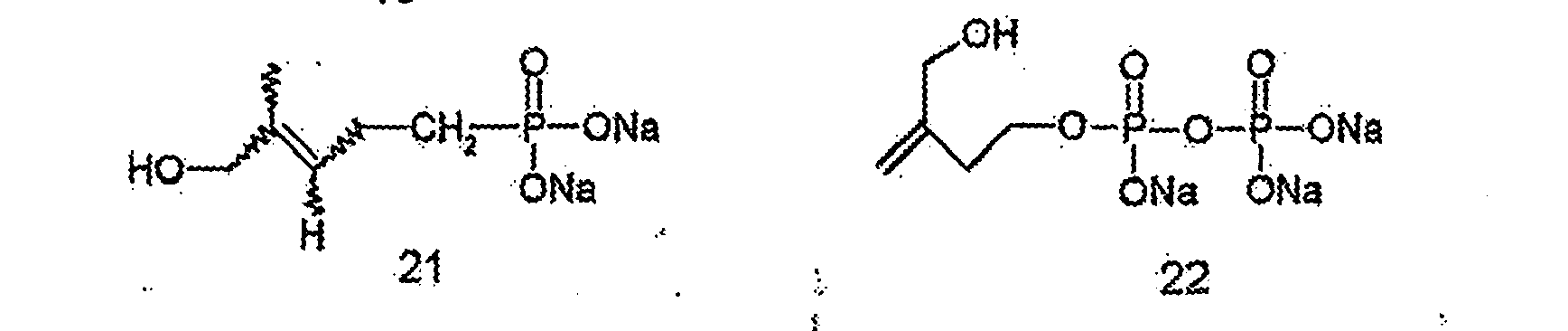
- Andere Weiterbildungen der Erfindung sind durch, die Unteransprüche definiert.
- Besonderheiten der obigen Definitionen und geeignete Beispiele dafür werden nachfolgend angegeben:
- "Alkyl" ist ein gerad- oder verzweigtkettiger Alkylrest mit bis zu 26 Kohlenstoffatomen, soweit nicht anders definiert, wie Methyl, Ethyl, Propyl, Isopropyl, Butyl, Isobutyl, tert.-Butyl, Pentyl, Hexyl und dergleichen.
- Zu "Alkenyl" gehören gerad- oder verzweigtkettige Alkenylgruppen mit bis zu 26 Kohlenstoffatomen, soweit nicht anders definiert, wie z.B. Vinyl, Propenyl (z.B. 1-Propenyl, 2-Propenyl), 1-Methylpropenyl, 2-Methylpropenyl, Butenyl, 2-Ethylpropenyl, Pentenyl, Hexenyl.
- Zu "Alkinyl" gehören gerad- oder verzweigtkettige Alkinylgruppen mit bis zu 26 Kohlenstoffatomen, soweit nicht anders definiert.
- Cycloalkyl steht vorzugsweise für ein ggfs. substituiertes C3-C7-Cycloalkyl; als mögliche Substituenten sind u.a. Alkyl, Alkoxy (z.B. Methoxy, Ethoxy etc.), Halogen (z.B. Fluor, Chlor, Brom etc.), Nitro und dergleichen geeignet.
- Aryl ist ein aromatischer Kohlenwasserstoffrest, wie Phenyl, Naphthyl usw., der ggf. einen oder mehrere geeignete Substituenten aufweisen kann, wie Alkoxy (z.B. Methoxy, Ethoxy etc.), Halogen (z.B. Fluor, Chlor, Brom etc.), Nitro und dergleichen.
- Zu "Aralkyl" gehören Mono-, Di-, Triphenylalkyle wie Benzyl, Phenethyl, Benzhydryl, Trityl und dergleichen, wobei der aromatische Teil ggf. einen oder mehrere geeignete Substituenten aufweisen kann, wie Alkoxy (z.B. Methoxy, Ethoxy etc.), Halogen (z.B. Fluor, Chlor, Brom etc.), Nitro und dergleichen.
- "Alkoxyrest" ist, soweit nicht anders definiert, ein gerad- oder verzweigtkettiger Alkoxyrest mit bis zu 26 Kohlenstoffatomen, wie ein Methoxy, Ethoxyreste, etc.. Er kann z.B. mit Hydroxy-, Amino-, Halogen-, Oxogruppen und Alkoxyresten, wie Methoxy-, Ethoxyresten, substituiert sein.
- "Hydroxymethylrest" ist, soweit nicht anders definiert, ein Rest, bei dem am Sauerstoff ein substituierter oder unsubstituierter C1-C9-Alkyl-, Aryl- oder Aralkylrest, wie z.B. Methoxymethyl, Ethoxymethyl, Phenoxymethyl oder Benzyloxymethyl usw. hängt oder bei dem am Sauerstoff ein substituierter bzw. unsubstituierter Phosphat- oder Pyrophosphatrest, wie z.B. Adenosindiphosphat, Uridindiphosphat usw., hängt.
- "Alkylthiorest" ist, soweit nicht anders definiert, ein gerad- oder verzweigtkettiger Alkylthiorest mit bis zu 9 Kohlenstoffatomen, wie ein Thiomethyl-, Thioethylreste etc. Er kann z.B. mit Hydroxy-, Amino-, Halogen-, Oxogruppen und Alkoxyresten, wie Methoxy-, Ethoxyresten, substituiert sein.
- "Silylreste" können zum Beispiel mit den wie oben definierten Alkylresten oder Cycloalkyl-(C0-26)-alkylresten substituiert sein.
- "Silyl"-(C0-26)-alkylgruppen" sind Silykeste, die auch über einen Alkylrest an das Grundgerüst gebunden sein können. Die Alkyl- und Silylgruppen sind wie oben definiert.
- Bei den obigen Estern kann der Alkan- und/oder Arenteil wahlweise zumindest einen geeigneten Substituenten aufweisen, wie Halogen, Alkoxy, Hydroxy, Nitro oder dergleichen.
- Zu substituierten und unsubstituierten Phosphatresten bzw. substituierten und unsubstituierten Pyrophosphatresten gehören Salzverbindungen der entsprechenden Phosphorsäurederivate mit organischen oder anorganischen Basen (z.B. Natriumsalz, Kaliumsalz, Calciumsalz, Aluminiumsalz, Ammoniumsalz, Magnesiumsalz, Triethylaminsalz, Ethanolaminsalz, Dicyclohexylaminsalz, Ethylendiaminsalz, N,N'-Dibenzylethylendiaminsalz etc.) sowie Salze mit Aminosäuren (z.B. Argininsalz, Lysinsalz, Glycinsalz, Alaninsalz, Ornithinsalz, etc.), sowie Reste bei denen die Phosphatgruppe Ester mit substituiertem oder unsubstituiertem C1-C26-Alkyl-, substituiertem oder unsubstituiertem Aryl, substituiertem oder unsubstituiertem Aralkyl, substituiertem oder unsubstituiertem Cycloalkyl oder substituiertem oder unsubstituiertem Heterocyclischen Rest, oder einem Nucleosid oder einem Desoxynucleosid, bildet.
- Unter "Nucleosid" sind Adenosin, Guanosin, Uridin, Thymidin und Cytidin, unter "Desoxynucleosid" sind Desoxyadenosin, Desoxyguanosin, Desoxythymidin, Desoxycytidin und Desoxyuridin zu verstehen.
- Die Erfindung beinhaltet ebenfalls die pharmazeutischen Salze und Ester der Salze. Ferner sind alle räumlichen Isomere der Verbindungen, sowohl als Reinstoffe als auch in Form ihrer Mischungen beinhaltet.
- Die erfindungsgemäßen Substanzen könne aus Bakterien, Algen, Pflanzen und Protozoen, auch solchen, bei denen das lytB-Gen deletiert worden ist, gewonnen und aufgereinigt werden (Beispiel 1). Die Aufreinigung kann mittels HPLC oder durch andere an sich bekannte Methoden wie Elektrophorese, Fällung (z.B. als Bariumsalz) oder andere chromatographische Verfahren erfolgen.
- Es sind verschiedene Anwendungen der Verbindungen möglich. So hat sich z.B. gezeigt, dass die Substanzen für Aktivitätstests der Enzyme GcpE und LytB, sowie in Testsystemen zur Messung der Aktivierung von gamma / delta-T-Zellen (siehe Beispiel 2, 5) verwendet werden können.
- Die erfindungsgemäßen Substanzen können entweder chemisch synthetisiert (Beispiel 3) oder aus Bakterien, Algen, Pflanzen und Protozoen, gewonnen und aufgereinigt werden(Beispiel 4). Die Aufreinigung kann mittels HPLC oder durch andere an sich bekannte Methoden wie Elektrophorese, Fällung (z.B. als Bariumsalz) oder andere chromatographische Verfahren erfolgen.
- Ferner können die erfindungsgemäßen Substanzen, da sie Intermediate des MEP-Wegs darstellen, in einem Screening-Verfahren zur Identifikation von Inhibitoren des GcpE- und des LytB-Enzyms eingesetzt werden. Dieses Verfahren zur Aktivitätsbestimmung der Enzyme beruht auf der Messung von Konzentrationsunterschieden der Substrate und Produkte der Enzyme unter geeigneten Reaktionsbedingungen. Durch In-Kontakt-Bringen geeigneter Testsubstanzen mit den Enzymen während der Aktivitätsbestimmung können Inhibitoren durch Verringerung der beobachteten Enzymaktivität identifiziert werden. Die Inhibitoren eignen sich als Herbizide und als Wirkstoffe mit antibakterieller, antiparasitärer und antiviraler Aktivität bei Mensch und Tier.
- Die erfindungsgemäßen Verbindungen können auch zur Herstellung von Arzneimitteln verwendet werden. Die Wirksamkeit der Verbindungen beruht dabei auf der Aktivierung von gamma / delta-T-Zellen. Abhängig vom Anwendungsbereich kann dadurch die Immunabwehr gestärkt werden oder eine immunologische Toleranz gegen Autoantigene und Allergene induziert werden.
- Anwendungsbereiche sind die Behandlung von Immun-, Autoimmunerkrankungen und Allergien bei Mensch und Tier. Beispiele hierfür sind: Allergien, Multiple Sklerose, Rheumatoide Arthritis, Hashimoto-Thyreoiditis, Myasthenia Gravis, Lupus Erythematodes, Diabetes Mellitus, primär-biliäre Zirrhose, aktive chronische Hepatitis, Adrenalinitis/Addison-Krankheit, Polymyositis, Dermatomyositis, Autoimmunhämolytische Anämie, Herzmuskel- und Herzhautentzündungen, Sklerodermie, Uveitis (Phakouveitis, sympathische Opthalmie), Pemphigus Vulgaris, Pemphigoid, Perniziöse Anämie, Autoimmune atrophische Gastritis, entzündliche Erkrankungen des Darms wie Crohn-Krankheiten und Colitis Ulcerosa, entzündliche Erkrankungen der Lunge wie Asthmatische Erkrankungen und Bronchitiden.
- Bevorzugt ist die Anwendung bei Morbus Crohn, Colitis Ulcerosa, Multipler Sklerose, Asthma, chronische Bronchitis, Allergien.
- Es zeigte sich ferner, das die erfindungsgemäßen Substanzen erfolgreich zur Behandlung von Erkrankungen, verursacht durch Viren, Bakterien und Parasiten, eingesetzt werden können.
- Insbesondere eignen sich die durch Anspruch 1 sowie die Unteransprüche definierten Substanzen zur Vorbeugung und Behandlung von Tumoren, die durch Mikroorganismen verursacht werden. Zu dieser Gruppe von Mikroorganismen gehören Bakterien, wie Helicobacter pylori (z.B. Magen- Darm-Tumore) und Papilloma-Viren (z.B. Tumoren der weiblichen Geschlechtsorgane).
- Besonders gut eignen sich die durch die durch die Ansprüche definierten Verbindungen zur Prophylaxe und zur Behandlung einer der oben aufgeführten Erkrankungen sowie von Hepatitis-C-Virus-Infektionen, gut und bösartigen Tumoren, insbesondere verursacht durch Papilloma-Vieren, und bei der Helicobacter Eradikationstherapie bei Ulcera des Magendarmtraktes.
- Zur arzneilichen Anwendung können pharmazeutische Formulierungen, die entweder die isolierten erfindungsgemäßen Substanzen oder lebende oder tote Organismen, die die Substanzen enthalten, alleine oder in Kombination mit weiteren Arzneistoffen eingesetzt werden. Bevorzugt ist die Verwendung in Kombination mit Substanzen, die vom Immunsystem als Fremd- oder Autoantigen erkannt werden.
- Beispiele hierfür sind Myelin Basisches Protein (MBP) undweitere Extrakte aus dem Gewebe des Nervensystems, Kollagen des Typs I, II oder III, Thyreoglobulin, Acetylcholinrezeptorprotein, DNS, Inselzell-Extrakte, Humaninsulin, Leberextrakte, Leberzellextrakte, Nebennierenrindenextrakte, Hautextrakte, Herzextrakte, Muskelextrakte, Hautzellextrakte, Extrakte aus Zellen der hämatopoetischen Linie, Augenlinsenproteine, S-Antigene, S-Antigengemische, Magenzellextrakte, Parietalzellextrakte, Intrinsischer Faktor und Darmextrakte.
- Bevorzugte Anwendungsformen sind die orale, inhalative, intravenöse, parentale, intracisternale, intravaginale, intraperitoneale, lokale (Puder, Salbe, Tropfen) und rektale Applikation sowie das Auftragen auf die Haut oder Schleimhäute.
- Die Erfindung beinhaltet die Applikation eines Inhalationsarzneimittels, das mindestens eine der durch Anspruch 1 definierten Substanzen enthält zur Behandlung von Erkrankungen von Menschen, insbesondere bei Allergien und Atemwegserkrankungen wie Asthma und chronischer Bronchitis.
- Als pharmazeutische Zusammensetzungen eignen sich ferner: Tablette, Retard-Tablette, Dragees, Kapseln, Premixe, Pillen, Pellets, Boli, Aerosole, Granulate, Suppositorien, Lösungen, Konzentrate, Suspensionen und Emulsionen, Pasten, Salben, Gele, Cremes, Lotionen, Puder, Infusionen und Sprays. Die pharmazeutischen Formulierungen können einen Bruchteil oder einem Vielfachen einer Einzeldosis entsprechen. Die Dosiereinheiten können z.B. 1,2,3 oder 4 Einzeldosen oder ½, 1/3, oder ¼ einer Einzeldosis enthalten. Eine Einzeldosis enthält vorzugsweise die Menge Wirkstoff, die bei der Applikation verabreicht wird und die gewöhnlich einer ganzen, einer halben oder einem Drittel oder einem Viertel einer Tagesdosis entspricht.
- Tabletten, Dragees, Kapseln, Pillen und Granulate können die Wirkstoffe neben den üblichen Trägerstoffen enthalten, wie (a) Füll- und Streckmittel, z. B. Stärken, Milchzucker, Rohr-zucker, Glukose, Mannit und Kieselsäure, (b) Bindemittel, z. B. Carboxymethylcellulose, Alginate, Gelatine, Polyvinylpyrrolidon, (c) Feuchthaltemittel, z. B. Glycerin, (d) Sprengmittel, z. B. Agar-Agar, Calciumcarbonat und Natriumcarbonat, (e) Lösungsverzögerer, z. B. Paraffin und (f) Resorptionsbeschleuniger, z. B. quartemäre Ammonium-verbindungen, (g) Netzmittel, z. B. Cetylalkohol, Glycerinmonostearat, (h) Adsorptionsmittel, z. B. Kaolin und Bentonit und (i) Gleitmittel, z. B. Talkum, Calcium- und Magnesiumstearat und feste Polyethylenglykole oder Gemische der unter (a) bis (i) aufgeführten Stoffe. Ferner können die erfindungsgemäßen Verbindungen in andere Trägermaterialien wie zum Beispiel Kunststoffe, (Kunststoffketten zur lokalen Therapie), Kollagen oder Knochenzement eingearbeitet werden.
- Die Tabletten, Dragees, Kapseln, Pillen und Granulate können mit den üblichen, gegebenen-falls Opakisierungsmittel enthaltenden Überzügen und Hüllen versehen sein und auch so zusammengesetzt sein, daß sie die Wirkstoffe nur oder bevorzugt in einem bestimmten Teil des Intestinaltraktes gegebenenfalls verzögert abgeben, wobei als Einbettungsmassen z. B. Polymersubstanzen und Wachse verwendet werden können.
- Die Wirkstoffe können gegebenenfalls mit einem oder mehreren der oben angegebenen Trägerstoffe auch in mikroverkapselter Form vorliegen.
- Suppositorien können neben den Wirkstoffen die üblichen wasserlöslichen oder wasserunlöslichen Trägerstoffe enthalten, z. B. Polyethylenglykole, Fette, z. B. Kakaofett und höhere Ester (z. B. C14-Alkohol mit C16-Fettsäure) oder Gemische dieser Stoffe.
- Salben, Pasten, Cremes und Gele können neben dem oder den Wirkstoffen die üblichen Trägerstoffe enthalten, z. B. tierische und pflanzliche Fette, Wachse, Paraffine, Stärke, Tragant, Cellulosederivate, Polyethylenglykole, Silikone, Bentonite, Kieselsäure, Talkum und Zinkoxid oder Gemische dieser Stoffe.
- Puder und Sprays können neben dem oder den Wirkstoffen die üblichen Trägerstoffe enthalten, z. B. Milchzucker, Talkum, Kieselsäure, Aluminiumhydroxid, Calciumsilikat und Polyamidpulver oder Gemische dieser Stoffe. Sprays können zusätzlich die üblichen Treibmittel, z. B. Chlorfluorkohlenwasserstoffe, enthalten.
- Lösungen und Emulsionen können neben den Wirkstoffen die üblichen Trägerstoffe wie Lösungsmittel, Lösungsvermittler und Emulgatoren, z. B. Wasser, Ethylalkohol, Isopropylalkohol, Ethylcarbonat, Ethylacetat, Benzylalkohol, Benzylbenzoat, Propylenglykol, 1,3-Butylenglykol, Dimethylformamid, Öle, insbesondere Baumwollsaatöl, Erdnußöl, Maiskeimöl, Olivenöl, Ricinusöl und Sesamöl, Glycerin, Glycerinformal, Tetrahydrofurfurylalkohol, Polyethylenglykole und Fettsäureester des Sorbitans oder Gemische dieser Stoffe enthalten.
- Die notwendigen Mengen der einzelnen Derivate zur Erzielung des gewünschten Effektes unterscheiden sich sehr stark Im allgemeinen hat es sich sowohl in der Human- als auch in der Veterinärmedizin als vorteilhaft erwiesen, den oder die Wirkstoffe der Formel (I) in Gesamtmengen von etwa 0,01 bis etwa 2000 µg je 24 Stunden, gegebenenfalls in Form mehrerer Einzelgaben, zur Erzielung der gewünschten Ergebnisse zu verabreichen. Eine Einzelgabe enthält den oder die Wirkstoffe vorzugsweise in Mengen von etwa 0,01 bis etwa 2000 µg. Es kann jedoch erforderlich sein, von den genannten Dosierungen abzuweichen, und zwar in Abhängigkeit von der Art und dem Körpergewicht des zu behandelnden Patienten, der Art und Schwere der Erkrankung, der Art der Zubereitung und der Applikation des Arzneimittels sowie dem Zeitraum bzw. Intervall, innerhalb welchem die Verabreichung erfolgt.
- So kann es in einigen Fällen ausreichend sein, mit weniger als der obengenannten Menge Wirkstoff auszukommen, während in anderen Fällen die oben angeführte Wirkstoffmenge überschritten werden muß. Die Festlegung der jeweils erforderlichen optimalen Dosierung und Applikationsart der Wirkstoffe kann durch den Fachmann aufgrund seines Fachwissens erfolgen.
- Bei der Behandlung von Tieren können die erfindungsgemäß zu verwendenden Verbindungen in den üblichen Konzentrationen und Zubereitungen zusammen mit dem Futter bzw. mit Futterzubereitungen oder mit dem Trinkwasser gegeben werden.
- Verschiedene gamma / delta-T-Zell-aktivierende Verbindungen wurden aus Corynebacterium ammoniagenes isoliert. 28 kg Zellmasse wurden mit einer Dynax-Mühle in 50 mM Ammoniumformiat-Puffer (pH 8,0) aufgeschlossen. Nach Vorabsorption an einer hydrophoben Polystyrolmatrix wurde der Aufschluß auf einen Anionenaustauscher geladen, der mit einem Stufengradienten (100, 300, 500 mM Ammoniumformiat, pH 8,0) eluiert wurde. Das 300 mM-Eluat wurde über eine C-18-Matrix geleitet und der Durchlauf über einen 3 kDa-Hohlfaserfilter ultrafiltriert. Das Filtrat wurde mit Wasser auf 30 mM Ammoniumformiat verdünnt und erneut auf einen Annionenaustauscher geladen. Die Elution erfolgte mit einem linearen Gradienten von 30 bis 500 mM Ammoniumformiat. Einzelne Fraktionen wurden auf ihre Fähigkeit gamma / delta-T-Zellen zu aktivieren getestet. Zum Teil wurden die aktiven Verbindungen anschließend als Bariumsalze durch Zugabe von 100 mM BaCl2 und 80 % EtOH gefällt. Die Präzipitate wurden in 20 mM Ammoniumformiat-Puffer (pH 8,0) gelöst und an einem Annionenaustauscher rechromatographiert.
- Auf diese Weise können die Verbindungen 1 bis 6 isoliert werden.
- Lymphozyten wurden durch Ficoll-Dichtegradienten-Zentrifugation aus dem peripheren Blut von gesunden Spendern gewonnen. Für jeden Test wurden 2 × 10⁵ der so erhaltenen Zellen in einem Volumen von 0,2 ml RPMI-1640-Medium (Life Technologies) ausgesät, das mit 25 mM HEPES, 2 mM L-Glutamin, 0,025 mg/ml Gentamycin, 100 U/ml humanes Interleukin-2 (IL-2) (alle von Life Technologies), und 10 % humanem AB-Serum (Bayerisches Rotes Kreuz) angereichert war. Die Testfraktionen wurden in verschiedenen Verdünnungen zugesetzt, als Positivkontrolle wurde Isopentenyldiphosphat (IPP) von Sigma in einer Endkonzentration von 10 uM verwendet. Die Inkubation erfolgte bei 37°C und 5 % CO2 im Brutschrank. Nach 72 Stunden wurden die Zellen geerntet und in einem Durchflußzytometer analysiert. Dabei wurde die Expression des Aktivierungsmarkers CD25 auf der Oberfläche von V gamma 9+ T-Zellen gemessen, mit Hilfe der monoklonalen Antikörper CD25-PE (B1.49.9), V gamma 9-FITC (Immu360) und CD3-PC5 (UCHT1) der Firma Beckman-Coulter.
- Dabei ergab sich, dass Verbindung 1 etwa 750mal, Verbindung 2 etwa 400mal und die Verbindungen 3, 5, 6 etwa 100mal aktiver sind als IPP.
- Die Synthese erfolgt wie in Schema 1 gezeigt:


- Verbindung Ia und Ib wurde analog den Vorschriften in: K. Sato, S. Inoue, Y. Takagi, S. Morii, Bull. Chem. Soc. Jpn., 1976, 49(11), 3351-3351 hergestellt.
- Die Herstellung von Ic erfolgt analog zu H. Kunio, H. Kazushige, Chem. Pharm. Bull., 1994, 42,4, 786-791.
- Verbindung IIa wurde nach gängigen, dem Fachmann bekannten Verfahren, wie sie z.B. bei B. Woodside, Z. Huang, C.D. Poulter, Org. Synth. 1988, 66, 211-219 beschrieben wurden, ausgehend von Verbindung Ib hergestellt.
- Verbindung IIb wurde ausgehend Verbindung Ia hergestellt. Dabei wurde zunächst Ia in das entsprechende Tosylat umgewandelt und anschließend z.B. mit Tris(tetra-n-butylammonium) hydrogenomethylen-diphosphat umgesetzt. Die Synthese wurden analog den in
WO00/59916 - Die Herstellung von Verbindung IIc wiederum erfolgte aus Verbindung Ic. Die Synthesen erfolgten wie bei R.C. McClard und T.S. Fujita, J. Am. Chem. Soc., 1987, 109, 5544-5545 beschrieben.
- Verbindung IIc konnte in geringer Ausbeute erhalten werden und wurde gleich hydrolysiert um Verbindung IIIc zu erhalten.
- Zur Herstellung von Verbindungen IIIa bis IIIc wurden 500mg der entsprechenden Vorläufer IIa und IIb in je 5ml Methanol gelöst und mit 10 Mol% Hydrierkatalysator versetzt. Anschließend wurde bei Raumtemperatur Wasserstoff eingeleitet, wobei die Aufnahme von Wasserstoff gemessen wurde. Nachdem die entsprechende Menge Wasserstoff aufgenommen worden war, wurde filtriert und das Lösungsmittel abgezogen. Man erhielt das gewünschte Produkt IIIa und IIIb in guter Reinheit. Eine weitere Reinigung kann mit chromatographischen Methoden erreicht werden. Verbindung IIIc wurde aus Verbindung IIc erhalten. Dabei wurden 200 mg von Verbindung IIc in einem ausgeheizten und mit Argon gefluteten Kolben, in absolutem Methylenchlorid (3ml) gelöst und mit 10 eq. Trimethylbromsilan bei 0°C versetzt. Nachdem 1h bei 0°C gerührt wurde, wurde noch weiter 12h bei Raumtemperatur gerührt. Wässrige Aufarbeitung lieferte schließlich das gewünschte Produkt IIIc, welches ionenchromatographisch gereinigt wurde.
- Für die Tests zur Aktivierung von gamma/delta-T-Zellen wurden entweder die isomerenreinen oder E/Z-Gemische der Verbindungen eingesetzt.
- Verschiedene gamma / delta-T-Zell-aktivierende Verbindungen wurden aus Corynebacterium ammoniagenes isoliert. 28 kg Zellmasse wurden mit einer Dynax-Mühle in 50 mM Ammoniumformiat-Puffer (pH 8,0) aufgeschlossen. Nach Vorabsorption an einer hydrophoben Polystyrolmatrix wurde der Aufschluß auf einen Anionenaustauscher geladen, der mit einem Stufengradienten (100, 300, 500 mM Ammoniumformiat, pH 8,0) eluiert wurde. Das 300 mM-Eluat wurde über eine C-18-Matrix geleitet und der Durchlauf über einen 3 kDa-Hohlfaserfilter ultrafiltriert. Das Filtrat wurde mit Wasser auf 30 mM Ammoniumformiat verdünnt und erneut auf einen Annionenaustauscher geladen. Die Elution erfolgte mit einem linearen Gradienten von 30 bis 500 mM Ammoniumformiat. Einzelne Fraktionen wurden auf ihre Fähigkeit gamma / delta-T-Zellen zu aktivieren getestet. Zum Teil wurden die aktiven Verbindungen anschließend als Bariumsalze durch Zugabe von 100 mM BaCl und 80 % EtOH gefällt. Die Präzipitate wurden in 20 mM Ammoniumformiat-Puffer (pH 8,0) gelöst und an einem Annionenaustauscher rechromatographiert. Auf diese Weise konnten die Verbindungen 1 bis 6 und 13 bis 14 isoliert werden.
- Lymphozyten wurden durch Ficoll-Dichtegradienten-Zentrifugation aus dem peripheren Blut von gesunden Spendern gewonnen. Für jeden Test wurden 2 × 10⁵ der so erhaltenen Zellen in einem Volumen von 0,2 ml RPMI-1640-Medium (Life Technologies) ausgesät, das mit 25 mM HEPES, 2 mM L-Glutamin, 0,025 mg/ml Gentamycin, 100 U/ml humanes Interleukin-2 (IL-2) (alle von Life Technologies), und 10 % humanem AB-Serum (Bayerisches Rotes Kreuz) angereichert war. Die Testfraktionen wurden in verschiedenen Verdünnungen zugesetzt, als Positivkontrolle wurde Isopentenyldiphosphat (IPP) von Sigma in einer Endkonzentration von 10 µM verwendet. Die Inkubation erfolgte bei 37°C und 5 % CO2 im Brutschrank. Nach 72 Stunden wurden die Zellen geerntet und in einem Durchflußzytometer analysiert. Dabei wurde die Expression des Aktivierungsmarkers CD25 auf der Oberfläche von V gamma 9+ T-Zellen gemessen, mit Hilfe der monoklonalen Antikörper CD25-PE (B1.49.9), V gamma 9-FITC (Immu360) und CD3-PC5 (UCHT1) der Firma Beckman-Coulter.
- Dabei ergab sich, dass Verbindung 9 etwa 10000mal, Verbindung 15, 17 und 19 etwa 500mal, Verbindung 10 etwa 1000mal und Verbindung 12 etwa 50mal aktiver sind als IPP.
Claims (41)
- Verbindungen gemäß Formel (III),


X1, X32 und X33, die gleich oder verschieden sein können, können Sauerstoff oder eine
- Verbindungen nach Anspruch 1 dadurch gekennzeichnet, dass sie der allgemeinen Formel (IIIA) entsprechen,

- Verbindungen nach Anspruch 2 bei denen R31 = OH und C1 und C2 durch eine Doppelbindung verbunden sind.
- Verbindungen gemäß Anspruch 2 bei denen R2 = OH ist und C0 und C1 durch eine Doppelbindung verbunden sind.
- Verbindungen gemäß Anspruch 1 oder 2 dadurch gekennzeichnet, dass entweder R34 oder R6 oder R7 oder R8 ein substituierter oder unsubstituierter Phosphatrest ist.
- Verbindungen gemäß Anspruch 1 oder 2 dadurch gekennzeichnet, dass entweder R31 oder R2 oder X2 ein substituierter oder unsubstituierter Phosphatrest ist.
- Verbindungen gemäß einem der Ansprüche 1 bis 4 oder 6, dadurch gekennzeichnet, dass R34, R6, R7 und R8, die gleich oder verschieden sein können, gleich Wasserstoff, einen Kation eines Metalls der 1., 2. oder 3. Hauptgruppe des Periodensystems oder substituiertes oder unsubstituiertes Ammonium sind.
- Verbindungen gemäß einem der Ansprüche 1 bis 7, dadurch gekennzeichnet, dass X1. und X32 = O sind.
- Verbindungen gemäß einem der Ansprüche 1 bis 7, dadurch gekennzeichnet, dass X1 = CYZ, X32 = O und X33 = CYZ sind, wobei Y und Z wie in Anspruch 1 definiert sind.
- Verbindungen gemäß einem der Ansprüche 1 bis 7, dadurch gekennzeichnet, dass X1 = O, X32 = CYZ und X33 = O sind, wobei Y und Z wie in Anspruch 1 definiert sind.
- Verbindungen gemäß einem der Ansprüche 1 bis 7, dadurch gekennzeichnet, dass X1, X32 und X33, die gleich oder verschieden sein können, ausgewählt sind aus der Gruppe, die aus CH2, CHF, CHCL, CFCL, CCl2 oder CF2 besteht.
- Verbindungen nach Anspruch 1, ausgewählt aus der folgenden Gruppe :


- Verbindungen nach Anspruch 12, dadurch gekennzeichnet, dass der Verbindung ist der Verbindung 15.
- Verbindungen nach einem Ansprüche 1-13, dadurch gekennzeichnet, dass diese eine antibakterielle, antiparasitäre oder antivirale Aktivität aufweisen.
- Verwendung einer der Verbindungen nach einem der Ansprüche 1-13 zur Herstellung eines Arzneimittels zur Aktivierung von gamma/delta-T-Zellen.
- Verwendung von Verbindungen nach einem der Ansprüche 1-13 als Substrate oder Produkte in einem Verfahren zur Durchführung von Enzyminhibitionstests und zum Screening von Enzyminhibitoren.
- Verwendung nach Anspruch 16, dadurch gekennzeichnet, dass es sich bei dem Enzym um das LytB-Enzym und / oder GcpE-Enzym handelt.
- Verwendung von Verbindungen nach einem der Ansprüche 1-13 zur Bestimmung der Aktivierung des LytB-Enzyms und / oder des GcpE-Enzyms.
- Arzneimittel enthaltend mindestens eine Verbindung gemäß einem der Ansprüche 1-13.
- Verwendung einer Verbindung gemäß einem der Ansprüche 1-13 zur Herstellung eines Arzneimittels zur Prophylaxe und / oder Behandlung von Erkrankungen von Mensch und Tier.
- Verwendung nach Anspruch 20 zur Herstellung eines Arzneimittels zur Behandlung von Erkrankungen verursacht durch Viren, Bakterien und Parasiten.
- Pharmazeutische Zusammensetzung, gekennzeichnet durch einen wirksamen Gehalt an zumindest einer der Verbindungen gemäß einem der Ansprüche 1-13 zusammen mit einem pharmazeutisch akzeptablen Träger.
- Pharmazeutische Zusammensetzung gemäß Anspruch 22, dadurch gekennzeichnet, dass mindestens ein weiterer pharmazeutischer Wirkstoff enthalten ist.
- Verwendung nach Anspruch 20 zur Herstellung eines Arzneimittels zur Verstärkung die Immunabwehr oder zur Induzierung eine immunologische Toleranz gegen Autoantigene und Allergene.
- Verwendung einer Verbindung gemäß Formel (III), Anspruch 1, oder (IIIA), Anspruch 2, zur Herstellung eines Arzneimittels zur Prophylaxe und/oder Behandlung von Immun-, Autoimmun-, Atemwegserkrankungen und Allergien bei Menschen.
- Verwendung einer Verbindung gemäß Formel (III), Anspruch 1, oder (IIIA), Anspruch 2, zur Herstellung eines Arzneimittels zur Prophylaxe und/oder Behandlung einer Erkrankung, ausgewählt aus der Gruppe Asthma, Morbus Crohn, Colitis Ulcerosa, Multipler Sklerose, Knochenerkrankungen, insbesondere Osteoporose, und chronischer Bronchitis, sowie rheumathoide Arthritis, Hashimoto-Thyreoiditis, Myasthenia Gravis, Lupus Erythematodes, Diabetes Mellitus, primär-biliäre Zirrhose, aktive chronische Hepatitis, Adrenalinitis/Addison-Krankheit, Polymyositis, Dermatomyositis, Autoimmunhämolytische Anämie, Herzmuskel- und Herzhautentzündungen, Sklerodermie, Uveitis (Phakouveitis, sympathische Opthalmie), Pemphigus Vulgaris, Pemphigoid, Perniziöse Anämie, autoimmune atrophische Gastritis, gut und bösartigen Tumoren, Hepatitis-C-Virus-Infektionen, und Helicobacter Eradikationstherapie bei Ulcera des Magendarmtraktes.
- Verwendung nach Anspruch 26, zur Herstellung eines Arzneimittels zur Prophylaxe und/oder Behandlung von gut und bösartigen Tumoren and Hepatitis-C-Virus-Infektionen.
- Verwendung nach Anspruch 27, dadurch gekennzeichnet, dass gut und bösartigen Tumoren sind durch Papilloma-Vieren verursacht.
- Verwendung nach Anspruch 27, zur Herstellung eines Arzneimittels zur Helicobacter Eradikationstherapie bei Ulcera des Magendarmtraktes.
- Verwendung nach Anspruch 25 oder 26, zur Herstellung eines Inhalationsarzneimittels zur Behandlung von Allergien und Atemwegserkrankungen wie asthma und chronischer Bronchitis.
- Verwendung nach einem der Ansprüche 20, 21 und 24-29 zur oralen, inhalativen, intravenösen, parentalen, intravaginalen, lokale, oder rektalen Applikation.
- Verwendung nach Anspruch 31, zur oralen Applikation.
- Verwendung nach Anspruch 31, dadurch gekennzeichnet, dass die pharmazeutischen Formulierung ist ausgewählt aus der Gruppe bestehend aus, Tablette, Retard-Tabelette, Dragees, Kapseln, Premixe, Pillen, Pellets, Boli, Aerosole, Granulate, Suppositorien, Lösungen, Konzentrate, Suspensionen und Emulsionen, Pasten, Salben, Gele, Cremes, Lotionen, Puder, Infusionen und Sprays.
- Verwendung nach Anspruch 33, dadurch gekennzeichnet, dass die pharmazeutische Formulierung ist eine Tablette.
- Verwendung nach Anspruch 33, dadurch gekennzeichnet, dass die pharmazeutische Formulierung ist ein Kapsel.
- Arzneimittel enthaltend mindestens eine Verbindung gemäß Formel (III), Anspruch 1, oder (III), Anspruch 2, und eine Substanz, die vom Immunsystem als Fremd- oder Autoantigen erkannt werden kann.
- Arzneimittel nach Anspruch 36, dadurch gekennzeichnet, dass die Substanz ist ausgewählt aus der Gruppe bestehend aus, Myelin Basisches Protein (MBP), Extrakte aus dem Gewebe des Nervensystems, Kollagen des Typs I, II oder III, Thyreoglobulin, Acetylchlin-rezeptorprotein, DNS, Inselzell-Extrakte, Humaninsulin, Leberectrakte, Leberzellextrakte, Nebennierenrindenextrakte, Hautextrakte, Herzextrakte, Muskelextrakte, Hautzellextrakte, Extrakte aus Zellen der hämatopoetischen Linie, Augenlinsenproteine, S-Antigene, S-Antigengemische, Magenzellextrakte, Parietalzellextrakte, Intrinsischer Faktor und Darmextrakte.
- Arzneimittel nach Anspruch 37, dadurch gekennzeichnet, dass die Substanz ist Myelin Basisches Protein (MBP).
- Verwendung einer Verbindung gemäß Formel (III), Anspruch 1, oder (IIIA), Anspruch 2, zur Herstellung eines Arzneimittels zur Prophylaxe und/oder Behandlung einer Erkrankung von Mensch und Tier in Gesamtmengen von etwa 0,01 bis etwa 2000 µg je 24 Stunden.
- Verwendung nach Anspruch 39, dadurch gekennzeichnet, dass eine Einzedlosis enthält die Menge Wirkstoff, die bei der Applikation verabreicht wird and die sewöhnlich einer ganzen, einer halben oder einem Drittel oder einem Viertel einer Tagesdosis entspricht.
- Verwendung einer Verbindung gemäß einem der Ansprüche 1-13 zur in vitro Aktivierung von gamma/delta-T-Zellen.
Applications Claiming Priority (5)
| Application Number | Priority Date | Filing Date | Title |
|---|---|---|---|
| DE2001134705 DE10134705A1 (de) | 2001-07-20 | 2001-07-20 | Organo-Phosphorverbindungen zur Aktivierung von gamma/delta-T-Zellen |
| DE10134705 | 2001-07-20 | ||
| DE2001135395 DE10135395A1 (de) | 2001-07-25 | 2001-07-25 | Organo-Phosphorverbindungen zur Aktivierung von gamma/delta-T-Zellen |
| DE10135395 | 2001-07-25 | ||
| PCT/EP2002/007986 WO2003009855A2 (de) | 2001-07-20 | 2002-07-18 | Organo-phosphorverbindungen zur aktivierung von gamma/delta-t-zellen |
Publications (2)
| Publication Number | Publication Date |
|---|---|
| EP1408984A2 EP1408984A2 (de) | 2004-04-21 |
| EP1408984B1 true EP1408984B1 (de) | 2008-10-22 |
Family
ID=26009714
Family Applications (1)
| Application Number | Title | Priority Date | Filing Date |
|---|---|---|---|
| EP02776913A Expired - Lifetime EP1408984B1 (de) | 2001-07-20 | 2002-07-18 | Organo-phosphorverbindungen zur aktivierung von gamma/delta-t-zellen |
Country Status (13)
| Country | Link |
|---|---|
| US (3) | US7399756B2 (de) |
| EP (1) | EP1408984B1 (de) |
| JP (1) | JP4607451B2 (de) |
| KR (1) | KR100906018B1 (de) |
| CN (1) | CN1533279A (de) |
| AT (1) | ATE411805T1 (de) |
| AU (1) | AU2002339423B2 (de) |
| CA (1) | CA2453817C (de) |
| DE (1) | DE50212935D1 (de) |
| DK (1) | DK1408984T3 (de) |
| ES (1) | ES2315411T3 (de) |
| PT (1) | PT1408984E (de) |
| WO (1) | WO2003009855A2 (de) |
Families Citing this family (35)
| Publication number | Priority date | Publication date | Assignee | Title |
|---|---|---|---|---|
| DE10201458A1 (de) * | 2001-04-11 | 2002-10-17 | Adelbert Bacher | Intermediate und Enzyme des Mevalonat-unabhängigen Isoprenoidbiosyntheseweg |
| PT1408984E (pt) * | 2001-07-20 | 2008-12-26 | Bioagency Ag | Compostos organofosforosos para activar células t gama/delta |
| FR2833266B1 (fr) * | 2001-12-11 | 2004-10-22 | Mayoly Spindler Lab | Nouveaux derives phosphonates, leur procede de preparation, leur utilisation comme modulateurs de l'activite des lymphocytes tgamma9 delta2 |
| FR2836483B1 (fr) * | 2002-02-22 | 2006-09-15 | Innate Pharma | Procedes de production de lymphocytes gamma delta t |
| GB0212666D0 (en) * | 2002-05-31 | 2002-07-10 | Secr Defence | Immunogenic sequences |
| ATE441420T1 (de) * | 2002-12-02 | 2009-09-15 | Innate Pharma | Interleukin-2 und gamma delta t zellaktivator enthaltende zusammensetzungen und deren verwendungen |
| PL1628685T3 (pl) | 2003-04-25 | 2011-05-31 | Gilead Sciences Inc | Przeciwwirusowe analogi fosfonianowe |
| CA2547008A1 (en) * | 2003-12-02 | 2005-06-16 | Innate Pharma | New class of gamma delta t cells activators and use thereof |
| US20100291118A1 (en) * | 2003-12-02 | 2010-11-18 | Innate Pharma | Class of Gamma Delta T Cells Activators and Use Thereof |
| EP1720567A2 (de) * | 2004-02-10 | 2006-11-15 | Innate Pharma | Zusammensetzung und verfahren zur behandlung von karzinomen |
| JP2007534743A (ja) | 2004-04-26 | 2007-11-29 | イネイト・ファーマ | アジュバント組成物およびその使用方法 |
| EP1778251B1 (de) | 2004-07-27 | 2011-04-13 | Gilead Sciences, Inc. | Nukleosid phosphonat konjugate als anti hiv mittel |
| WO2006067635A2 (en) * | 2004-12-20 | 2006-06-29 | Innate Pharma S.A. | USE OF Ϝδ T LYMPHOCYTE ACTIVATORS AS VACCINE ADJUVANT |
| KR20070113314A (ko) * | 2005-03-22 | 2007-11-28 | 이나뜨 파르마 | 신규 클래스의 γδ T 세포 활성화제 및 그 사용방법 |
| WO2007028985A2 (en) * | 2005-09-07 | 2007-03-15 | The Secretary Of State For Defence | Adjuvanted vaccine |
| JP2009511449A (ja) * | 2005-10-06 | 2009-03-19 | イナート・ファルマ | 有機塩基のリン酸化抗原塩およびその結晶化方法 |
| EP2040744B1 (de) | 2006-07-25 | 2016-03-09 | The Secretary of State for Defence | Francisella lebendvakzine |
| US20100029674A1 (en) | 2006-11-17 | 2010-02-04 | Innate Pharma, S.A. | Methods of Using Phosphoantigen for the Treatment of Cancer |
| EP2123285A1 (de) | 2008-05-21 | 2009-11-25 | INSERM (Institut National de la Santé et de la Recherche Médicale) | Nucleosid-Phosphorantigene zur Verwendung in der VGAMMA9VDELTA2-T-Zellen-vermittelten Therapie |
| AU2009268681B2 (en) * | 2008-07-08 | 2014-10-02 | Gilead Sciences, Inc. | Salts of HIV inhibitor compounds |
| EP2324040B1 (de) | 2008-09-10 | 2014-01-01 | Innate Pharma | Neue polymorphe form von chdmapp, verfahren zu deren herstellung und pharmazeutische zusammensetzung, die diese enthält |
| GB0901411D0 (en) * | 2009-01-29 | 2009-03-11 | Secr Defence | Treatment |
| GB0901423D0 (en) * | 2009-01-29 | 2009-03-11 | Secr Defence | Treatment |
| GB0906234D0 (en) | 2009-04-14 | 2009-05-20 | Secr Defence | Vaccine |
| WO2017011686A1 (en) * | 2015-07-14 | 2017-01-19 | University Of Iowa Research Foundation | Fluorescent prodrugs |
| EP3661937B1 (de) | 2017-08-01 | 2021-07-28 | Gilead Sciences, Inc. | Kristalline formen von ethyl ((s)-((((2r,5r)-5-(6-amino-9h-purin-9-yl)-4-fluoro-2,5-dihydrofuran-2-yl)oxy)methyl)(phenoxy)phosphoryl)-l-alaninat (gs-9131) zur behandlung von viralen infektionen |
| CN109651429A (zh) * | 2017-10-11 | 2019-04-19 | 清华大学 | 高效稳定的Vγ9Vδ2 T细胞的小分子激动剂 |
| MX391985B (es) | 2017-12-11 | 2025-03-21 | Procter & Gamble | Composiciones para el cuidado bucal que comprenden polimeros que contienen grupo fosfono-fosfato y anionico |
| WO2019118419A1 (en) | 2017-12-11 | 2019-06-20 | The Procter & Gamble Company | Compositions comprising multi-valent cations and phosphono-phosphate containing polymers |
| US11046798B2 (en) | 2017-12-11 | 2021-06-29 | The Procter & Gamble Company | Phosphono-phosphate containing compounds and polymers |
| EP3723867A1 (de) | 2017-12-11 | 2020-10-21 | The Procter & Gamble Company | Phosphono-phosphat und anionische gruppe enthaltende polymere |
| AU2018384632B2 (en) | 2017-12-11 | 2021-10-21 | The Procter & Gamble Company | Oral care compositions comprising phosphonate and anionic group containing polymers |
| US10752646B2 (en) | 2017-12-11 | 2020-08-25 | The Procter & Gamble Company | Method of making phosphono-phosphate containing compounds |
| WO2019182904A1 (en) | 2018-03-19 | 2019-09-26 | University Of Iowa Research Foundation | Phosphonamidate butyrophilin ligands |
| KR20210069665A (ko) | 2018-09-27 | 2021-06-11 | 포스포감, 인크. | 동종이계 감마/델타-t 세포의 확장 및 사용을 위한 방법 및 조성물 |
Citations (1)
| Publication number | Priority date | Publication date | Assignee | Title |
|---|---|---|---|---|
| WO2002083720A2 (en) * | 2001-04-11 | 2002-10-24 | Adelbert Bacher | Intermediates and enzymes of the non-mevalonate isoprenoid pathway |
Family Cites Families (16)
| Publication number | Priority date | Publication date | Assignee | Title |
|---|---|---|---|---|
| US5639653A (en) * | 1993-07-19 | 1997-06-17 | Albert Einstein College Of Medicine Of Yeshiva University, A Division Of Yeshiva Universtiy | Method for proliferating Vγ2Vδ2 T cells |
| FR2715660A1 (fr) | 1994-01-28 | 1995-08-04 | Centre Nat Rech Scient | Composés organo-phosphorés activateurs des lymphocytes Tgammadelta, procédé pour préparer et/ou isoler et/ou caractériser ces composés, compositions et utilisations pharmaceutiques. |
| WO1997043437A2 (en) * | 1996-05-15 | 1997-11-20 | The University Of Sheffield | Isopentenyl pyrophosphate isomerase (ipi) and/or prenyl transferase inhibitors |
| DE19828450A1 (de) | 1998-06-26 | 1999-12-30 | Hassan Jomaa | Bisphosphonsäuren und deren Derivate enthaltende Arzneimittel zur Prophylaxe und zur Behandlung von Autoimmunkrankheiten sowie von Allergien |
| FR2782721B1 (fr) * | 1998-09-01 | 2000-11-03 | Inst Nat Sante Rech Med | Nouveaux composes phosphohalohydrines, procede de fabrication et applications |
| SK3922001A3 (en) * | 1998-09-22 | 2001-09-11 | Jomaa Pharmaka Gmbh | Genes of the 1-desoxy-d-xylulose biosynthetic pathway |
| DE19854310A1 (de) | 1998-11-25 | 2000-06-29 | Hassan Jomaa | Verwendung von Phosphonoameisensäurederivaten zur therapeutischen und prophylaktischen Behandlung von Infektionen |
| US6534050B1 (en) * | 1999-01-21 | 2003-03-18 | Chugai Seiyaku Kabushiki Kaisha | 2-methyl-3-butenyl-1-pyrophosphoric acid salts and agents for treating lymphocytes |
| FR2791981B1 (fr) * | 1999-04-06 | 2001-07-20 | Inst Nat Sante Rech Med | Composes inhibant selectivement les lymphocytes tgamma9delta2, et leurs applications |
| TR200103326T2 (tr) * | 1999-05-21 | 2002-04-22 | Jomaa Pharmaka Gmbh | İsoprenoidin konsantrasyonunu değiştirmek için deoksi-D-ksiluloz fosfat biyosentetik yoluna ait genlerin kullanımı |
| AU7729000A (en) | 1999-09-30 | 2001-04-30 | National Jewish Medical And Research Center | Modulation of gammadelta t cells to regulate airway hyperresponsiveness |
| DE10027821A1 (de) | 2000-06-05 | 2001-12-06 | Adelbert Bacher | Der Mevalonat-unabhängige Isoprenoidbiosyntheseweg |
| US6841717B2 (en) | 2000-08-07 | 2005-01-11 | Monsanto Technology, L.L.C. | Methyl-D-erythritol phosphate pathway genes |
| DE10119905A1 (de) | 2001-04-23 | 2002-10-24 | Jomaa Pharmaka Gmbh | Inaktivierung von Genen des MEP-Wegs |
| PT1408984E (pt) * | 2001-07-20 | 2008-12-26 | Bioagency Ag | Compostos organofosforosos para activar células t gama/delta |
| US20050042751A1 (en) | 2001-10-31 | 2005-02-24 | Michel Goldman | Generation and use of new types of dendritic cells |
-
2002
- 2002-07-18 PT PT02776913T patent/PT1408984E/pt unknown
- 2002-07-18 US US10/484,143 patent/US7399756B2/en not_active Expired - Fee Related
- 2002-07-18 EP EP02776913A patent/EP1408984B1/de not_active Expired - Lifetime
- 2002-07-18 JP JP2003515247A patent/JP4607451B2/ja not_active Expired - Fee Related
- 2002-07-18 DE DE50212935T patent/DE50212935D1/de not_active Expired - Lifetime
- 2002-07-18 ES ES02776913T patent/ES2315411T3/es not_active Expired - Lifetime
- 2002-07-18 AT AT02776913T patent/ATE411805T1/de active
- 2002-07-18 AU AU2002339423A patent/AU2002339423B2/en not_active Ceased
- 2002-07-18 KR KR1020047000770A patent/KR100906018B1/ko not_active Expired - Fee Related
- 2002-07-18 DK DK02776913T patent/DK1408984T3/da active
- 2002-07-18 WO PCT/EP2002/007986 patent/WO2003009855A2/de not_active Ceased
- 2002-07-18 CA CA2453817A patent/CA2453817C/en not_active Expired - Fee Related
- 2002-07-18 CN CNA028145585A patent/CN1533279A/zh active Pending
-
2008
- 2008-06-11 US US12/137,241 patent/US7871992B2/en not_active Expired - Fee Related
-
2011
- 2011-01-17 US US13/007,852 patent/US20110112054A1/en not_active Abandoned
Patent Citations (1)
| Publication number | Priority date | Publication date | Assignee | Title |
|---|---|---|---|---|
| WO2002083720A2 (en) * | 2001-04-11 | 2002-10-24 | Adelbert Bacher | Intermediates and enzymes of the non-mevalonate isoprenoid pathway |
Also Published As
| Publication number | Publication date |
|---|---|
| JP4607451B2 (ja) | 2011-01-05 |
| CA2453817C (en) | 2011-09-20 |
| ES2315411T3 (es) | 2009-04-01 |
| US20080249067A1 (en) | 2008-10-09 |
| CA2453817A1 (en) | 2003-02-06 |
| US7399756B2 (en) | 2008-07-15 |
| ATE411805T1 (de) | 2008-11-15 |
| AU2002339423C1 (en) | 2003-02-17 |
| US7871992B2 (en) | 2011-01-18 |
| AU2002339423B2 (en) | 2007-03-15 |
| EP1408984A2 (de) | 2004-04-21 |
| PT1408984E (pt) | 2008-12-26 |
| JP2005508305A (ja) | 2005-03-31 |
| WO2003009855A2 (de) | 2003-02-06 |
| KR20040030814A (ko) | 2004-04-09 |
| WO2003009855A3 (de) | 2003-11-06 |
| KR100906018B1 (ko) | 2009-07-06 |
| DK1408984T3 (da) | 2009-02-09 |
| CN1533279A (zh) | 2004-09-29 |
| US20110112054A1 (en) | 2011-05-12 |
| DE50212935D1 (de) | 2008-12-04 |
| US20060030546A1 (en) | 2006-02-09 |
Similar Documents
| Publication | Publication Date | Title |
|---|---|---|
| EP1408984A2 (de) | Organo-phosphorverbindungen zur aktivierung von gamma/delta-t-zellen | |
| DE69634747T2 (de) | Aryl-Ester Phosphoramidatderivate von 2',3'-Didehydronukleoside | |
| DE3650492T2 (de) | Therapeutische Nukleoside | |
| EP0248062A1 (de) | Arzeimittel. | |
| DE3843609A1 (de) | Adenosinderivate | |
| DE69018514T2 (de) | Substituierte Aminoalkylphosphinsäure. | |
| US4424209A (en) | 3,4-Di-isobutyryloxy-N- 3-(4-isobutyryloxyphenyl)-1-methyl-n-propyl!-beta-phenethylamine cyclodextrin complexes | |
| EP1140113A2 (de) | Verwendung von bisphosphonaten zur prophylaxe und zur behandlung von infektiösen prozessen | |
| US5556843A (en) | Therapeutic use of phosphoryl-L-serine-N-acyl-sphingosine | |
| AT391320B (de) | Piperazincarbonsaeure, ihre herstellung und diese enthaltende arzneimittel | |
| DE68915555T2 (de) | Arzneimittel für Leberkrankheiten und Piperazin-Derivate. | |
| JP2024505912A (ja) | 連環を含むtyk2阻害剤化合物 | |
| DE69023045T2 (de) | Carboxamidderivate. | |
| DE10134705A1 (de) | Organo-Phosphorverbindungen zur Aktivierung von gamma/delta-T-Zellen | |
| RU2566757C2 (ru) | Арилфторфосфатные ингибиторы кишечного апикального мембранного натрий/фосфатного котранспорта | |
| EP0391850B1 (de) | Ungesättigte Aminodicarbonsäurederivate | |
| DE4003054A1 (de) | Verwendung von benzylphosphonsaeurederivaten zur behandlung von durch viren verursachte krankheiten | |
| DE10135395A1 (de) | Organo-Phosphorverbindungen zur Aktivierung von gamma/delta-T-Zellen | |
| DE60008580T2 (de) | (1s, cis)-4-(2-amino-9h-purin-9-yl)-2-cyclopenten-1-methanol analogue als antiviral | |
| JPH04264092A (ja) | シクロトリホスファゼンのn,oスピロ環状誘導体とその製法および用途 | |
| EP0313997B1 (de) | Arzneimittel, darin enthaltene phosphorhaltige 2-Isoxazoline und Isoxazole, sowie Herstellungsverfahren für diese heterocyclischen Verbindungen | |
| DE60020891T2 (de) | Arylphosphatderivate von d4t | |
| CN108864114A (zh) | 选择性a2a受体拮抗剂 | |
| DE3942318A1 (de) | 2-formylbenzylphosphonsaeure-derivate, deren herstellung und ihre verwendung zur behandlung von durch viren verursachte krankheiten | |
| AU2007202803B2 (en) | Organo-phosphorous compounds for activating gamma/delta T cells |
Legal Events
| Date | Code | Title | Description |
|---|---|---|---|
| PUAI | Public reference made under article 153(3) epc to a published international application that has entered the european phase |
Free format text: ORIGINAL CODE: 0009012 |
|
| 17P | Request for examination filed |
Effective date: 20040204 |
|
| AK | Designated contracting states |
Kind code of ref document: A2 Designated state(s): AT BE BG CH CY CZ DE DK EE ES FI FR GB GR IE IT LI LU MC NL PT SE SK TR |
|
| AX | Request for extension of the european patent |
Extension state: AL LT LV MK RO SI |
|
| 17Q | First examination report despatched |
Effective date: 20040831 |
|
| EL | Fr: translation of claims filed | ||
| 17Q | First examination report despatched |
Effective date: 20040831 |
|
| GRAP | Despatch of communication of intention to grant a patent |
Free format text: ORIGINAL CODE: EPIDOSNIGR1 |
|
| GRAS | Grant fee paid |
Free format text: ORIGINAL CODE: EPIDOSNIGR3 |
|
| GRAA | (expected) grant |
Free format text: ORIGINAL CODE: 0009210 |
|
| AK | Designated contracting states |
Kind code of ref document: B1 Designated state(s): AT BE BG CH CY CZ DE DK EE ES FI FR GB GR IE IT LI LU MC NL PT SE SK TR |
|
| REG | Reference to a national code |
Ref country code: GB Ref legal event code: FG4D Free format text: NOT ENGLISH |
|
| REG | Reference to a national code |
Ref country code: CH Ref legal event code: EP |
|
| REG | Reference to a national code |
Ref country code: IE Ref legal event code: FG4D Free format text: LANGUAGE OF EP DOCUMENT: GERMAN |
|
| REF | Corresponds to: |
Ref document number: 50212935 Country of ref document: DE Date of ref document: 20081204 Kind code of ref document: P |
|
| REG | Reference to a national code |
Ref country code: PT Ref legal event code: SC4A Free format text: AVAILABILITY OF NATIONAL TRANSLATION Effective date: 20081215 |
|
| REG | Reference to a national code |
Ref country code: CH Ref legal event code: NV Representative=s name: PATENTANWAELTE SCHAAD, BALASS, MENZL & PARTNER AG |
|
| REG | Reference to a national code |
Ref country code: SE Ref legal event code: TRGR |
|
| REG | Reference to a national code |
Ref country code: DK Ref legal event code: T3 |
|
| REG | Reference to a national code |
Ref country code: ES Ref legal event code: FG2A Ref document number: 2315411 Country of ref document: ES Kind code of ref document: T3 |
|
| PG25 | Lapsed in a contracting state [announced via postgrant information from national office to epo] |
Ref country code: BG Free format text: LAPSE BECAUSE OF FAILURE TO SUBMIT A TRANSLATION OF THE DESCRIPTION OR TO PAY THE FEE WITHIN THE PRESCRIBED TIME-LIMIT Effective date: 20090122 |
|
| PG25 | Lapsed in a contracting state [announced via postgrant information from national office to epo] |
Ref country code: EE Free format text: LAPSE BECAUSE OF FAILURE TO SUBMIT A TRANSLATION OF THE DESCRIPTION OR TO PAY THE FEE WITHIN THE PRESCRIBED TIME-LIMIT Effective date: 20081022 |
|
| PLBE | No opposition filed within time limit |
Free format text: ORIGINAL CODE: 0009261 |
|
| STAA | Information on the status of an ep patent application or granted ep patent |
Free format text: STATUS: NO OPPOSITION FILED WITHIN TIME LIMIT |
|
| PG25 | Lapsed in a contracting state [announced via postgrant information from national office to epo] |
Ref country code: CZ Free format text: LAPSE BECAUSE OF FAILURE TO SUBMIT A TRANSLATION OF THE DESCRIPTION OR TO PAY THE FEE WITHIN THE PRESCRIBED TIME-LIMIT Effective date: 20081022 |
|
| 26N | No opposition filed |
Effective date: 20090723 |
|
| PG25 | Lapsed in a contracting state [announced via postgrant information from national office to epo] |
Ref country code: SK Free format text: LAPSE BECAUSE OF FAILURE TO SUBMIT A TRANSLATION OF THE DESCRIPTION OR TO PAY THE FEE WITHIN THE PRESCRIBED TIME-LIMIT Effective date: 20081022 |
|
| PG25 | Lapsed in a contracting state [announced via postgrant information from national office to epo] |
Ref country code: GR Free format text: LAPSE BECAUSE OF FAILURE TO SUBMIT A TRANSLATION OF THE DESCRIPTION OR TO PAY THE FEE WITHIN THE PRESCRIBED TIME-LIMIT Effective date: 20090123 |
|
| PG25 | Lapsed in a contracting state [announced via postgrant information from national office to epo] |
Ref country code: CY Free format text: LAPSE BECAUSE OF FAILURE TO SUBMIT A TRANSLATION OF THE DESCRIPTION OR TO PAY THE FEE WITHIN THE PRESCRIBED TIME-LIMIT Effective date: 20081022 |
|
| PGFP | Annual fee paid to national office [announced via postgrant information from national office to epo] |
Ref country code: LU Payment date: 20140206 Year of fee payment: 12 |
|
| PGFP | Annual fee paid to national office [announced via postgrant information from national office to epo] |
Ref country code: IE Payment date: 20140116 Year of fee payment: 12 Ref country code: MC Payment date: 20140117 Year of fee payment: 12 Ref country code: SE Payment date: 20140117 Year of fee payment: 12 Ref country code: BE Payment date: 20140121 Year of fee payment: 12 Ref country code: NL Payment date: 20140130 Year of fee payment: 12 Ref country code: FI Payment date: 20140120 Year of fee payment: 12 Ref country code: DK Payment date: 20140121 Year of fee payment: 12 Ref country code: CH Payment date: 20140115 Year of fee payment: 12 Ref country code: DE Payment date: 20140128 Year of fee payment: 12 |
|
| PGFP | Annual fee paid to national office [announced via postgrant information from national office to epo] |
Ref country code: IT Payment date: 20140128 Year of fee payment: 12 Ref country code: ES Payment date: 20140120 Year of fee payment: 12 Ref country code: TR Payment date: 20140115 Year of fee payment: 12 Ref country code: AT Payment date: 20140129 Year of fee payment: 12 Ref country code: FR Payment date: 20140122 Year of fee payment: 12 |
|
| PGFP | Annual fee paid to national office [announced via postgrant information from national office to epo] |
Ref country code: GB Payment date: 20140115 Year of fee payment: 12 Ref country code: PT Payment date: 20140114 Year of fee payment: 12 |
|
| REG | Reference to a national code |
Ref country code: PT Ref legal event code: MM4A Free format text: LAPSE DUE TO NON-PAYMENT OF FEES Effective date: 20150119 |
|
| REG | Reference to a national code |
Ref country code: DE Ref legal event code: R119 Ref document number: 50212935 Country of ref document: DE |
|
| REG | Reference to a national code |
Ref country code: DK Ref legal event code: EBP Effective date: 20140731 |
|
| REG | Reference to a national code |
Ref country code: NL Ref legal event code: V1 Effective date: 20150201 |
|
| PG25 | Lapsed in a contracting state [announced via postgrant information from national office to epo] |
Ref country code: LU Free format text: LAPSE BECAUSE OF NON-PAYMENT OF DUE FEES Effective date: 20140718 |
|
| REG | Reference to a national code |
Ref country code: CH Ref legal event code: PL |
|
| REG | Reference to a national code |
Ref country code: SE Ref legal event code: EUG |
|
| REG | Reference to a national code |
Ref country code: AT Ref legal event code: MM01 Ref document number: 411805 Country of ref document: AT Kind code of ref document: T Effective date: 20140718 |
|
| GBPC | Gb: european patent ceased through non-payment of renewal fee |
Effective date: 20140718 |
|
| PG25 | Lapsed in a contracting state [announced via postgrant information from national office to epo] |
Ref country code: NL Free format text: LAPSE BECAUSE OF NON-PAYMENT OF DUE FEES Effective date: 20150201 |
|
| REG | Reference to a national code |
Ref country code: IE Ref legal event code: MM4A |
|
| REG | Reference to a national code |
Ref country code: FR Ref legal event code: ST Effective date: 20150331 |
|
| PG25 | Lapsed in a contracting state [announced via postgrant information from national office to epo] |
Ref country code: LI Free format text: LAPSE BECAUSE OF NON-PAYMENT OF DUE FEES Effective date: 20140731 Ref country code: CH Free format text: LAPSE BECAUSE OF NON-PAYMENT OF DUE FEES Effective date: 20140731 Ref country code: FI Free format text: LAPSE BECAUSE OF NON-PAYMENT OF DUE FEES Effective date: 20140718 Ref country code: PT Free format text: LAPSE BECAUSE OF NON-PAYMENT OF DUE FEES Effective date: 20150119 Ref country code: DE Free format text: LAPSE BECAUSE OF NON-PAYMENT OF DUE FEES Effective date: 20150203 Ref country code: IT Free format text: LAPSE BECAUSE OF NON-PAYMENT OF DUE FEES Effective date: 20140718 |
|
| REG | Reference to a national code |
Ref country code: DE Ref legal event code: R119 Ref document number: 50212935 Country of ref document: DE Effective date: 20150203 |
|
| PG25 | Lapsed in a contracting state [announced via postgrant information from national office to epo] |
Ref country code: GB Free format text: LAPSE BECAUSE OF NON-PAYMENT OF DUE FEES Effective date: 20140718 Ref country code: SE Free format text: LAPSE BECAUSE OF NON-PAYMENT OF DUE FEES Effective date: 20140719 Ref country code: FR Free format text: LAPSE BECAUSE OF NON-PAYMENT OF DUE FEES Effective date: 20140731 Ref country code: AT Free format text: LAPSE BECAUSE OF NON-PAYMENT OF DUE FEES Effective date: 20140718 |
|
| PG25 | Lapsed in a contracting state [announced via postgrant information from national office to epo] |
Ref country code: DK Free format text: LAPSE BECAUSE OF NON-PAYMENT OF DUE FEES Effective date: 20140731 |
|
| REG | Reference to a national code |
Ref country code: ES Ref legal event code: FD2A Effective date: 20150828 |
|
| PG25 | Lapsed in a contracting state [announced via postgrant information from national office to epo] |
Ref country code: IE Free format text: LAPSE BECAUSE OF NON-PAYMENT OF DUE FEES Effective date: 20140718 |
|
| PG25 | Lapsed in a contracting state [announced via postgrant information from national office to epo] |
Ref country code: ES Free format text: LAPSE BECAUSE OF NON-PAYMENT OF DUE FEES Effective date: 20140719 |
|
| PG25 | Lapsed in a contracting state [announced via postgrant information from national office to epo] |
Ref country code: MC Free format text: LAPSE BECAUSE OF NON-PAYMENT OF DUE FEES Effective date: 20140731 |
|
| PG25 | Lapsed in a contracting state [announced via postgrant information from national office to epo] |
Ref country code: BE Free format text: LAPSE BECAUSE OF NON-PAYMENT OF DUE FEES Effective date: 20140731 |
|
| PG25 | Lapsed in a contracting state [announced via postgrant information from national office to epo] |
Ref country code: TR Free format text: LAPSE BECAUSE OF NON-PAYMENT OF DUE FEES Effective date: 20140718 |