EP1383763B1 - Verfahren zur herstellung von 2-(-5-(4-fluorphenyl)-3-pyridylmethylaminomethyl)-chroman - Google Patents
Verfahren zur herstellung von 2-(-5-(4-fluorphenyl)-3-pyridylmethylaminomethyl)-chroman Download PDFInfo
- Publication number
- EP1383763B1 EP1383763B1 EP02727539A EP02727539A EP1383763B1 EP 1383763 B1 EP1383763 B1 EP 1383763B1 EP 02727539 A EP02727539 A EP 02727539A EP 02727539 A EP02727539 A EP 02727539A EP 1383763 B1 EP1383763 B1 EP 1383763B1
- Authority
- EP
- European Patent Office
- Prior art keywords
- fluorophenyl
- acid
- pyridylmethylaminomethyl
- aminomethylchroman
- chroman
- Prior art date
- Legal status (The legal status is an assumption and is not a legal conclusion. Google has not performed a legal analysis and makes no representation as to the accuracy of the status listed.)
- Expired - Lifetime
Links
Images


Classifications
-
- C—CHEMISTRY; METALLURGY
- C07—ORGANIC CHEMISTRY
- C07D—HETEROCYCLIC COMPOUNDS
- C07D405/00—Heterocyclic compounds containing both one or more hetero rings having oxygen atoms as the only ring hetero atoms, and one or more rings having nitrogen as the only ring hetero atom
- C07D405/02—Heterocyclic compounds containing both one or more hetero rings having oxygen atoms as the only ring hetero atoms, and one or more rings having nitrogen as the only ring hetero atom containing two hetero rings
- C07D405/12—Heterocyclic compounds containing both one or more hetero rings having oxygen atoms as the only ring hetero atoms, and one or more rings having nitrogen as the only ring hetero atom containing two hetero rings linked by a chain containing hetero atoms as chain links
-
- C—CHEMISTRY; METALLURGY
- C07—ORGANIC CHEMISTRY
- C07D—HETEROCYCLIC COMPOUNDS
- C07D311/00—Heterocyclic compounds containing six-membered rings having one oxygen atom as the only hetero atom, condensed with other rings
- C07D311/02—Heterocyclic compounds containing six-membered rings having one oxygen atom as the only hetero atom, condensed with other rings ortho- or peri-condensed with carbocyclic rings or ring systems
- C07D311/04—Benzo[b]pyrans, not hydrogenated in the carbocyclic ring
- C07D311/58—Benzo[b]pyrans, not hydrogenated in the carbocyclic ring other than with oxygen or sulphur atoms in position 2 or 4
Definitions
- the invention relates to a process for the preparation of 2- [5- (4-fluorophenyl) -3-pyridylmethylaminomethyl] chroman of the formula I, including the enantiomerically pure compounds of formula 1, and salts thereof, characterized in that 5- (4-fluorophenyl) -pyridine-3-carbaldehyde is reacted directly with 2-aminomethylchroman or its salts under reducing conditions to give the compound of formula I. and optionally converting the compound of formula I obtained by treatment with an acid into one of its salts.
- the compound 2- [5- (4-fluorophenyl) -3-pyridylmethylaminomethyl] chroman is known both as a racemate and as enantiomerically pure compounds from US Pat. No. 5,767,132. No. 5,767,132 likewise describes the preparation of the physiologically acceptable salts (column 9, lines 6 to 32) and a preparation process (examples 5 and 19).
- 2- [5- (4-fluorophenyl) -3-pyridylmethylaminomethyl] -chroman of formula I and its salts are selective dopamine D 2 receptor antagonists and 5-HT 1A receptor agonists.
- a medicament for the prophylaxis and / or treatment of sequelae following cerebral infarction for example, stroke and cerebral ischemia
- cerebral diseases for example migraine
- the treatment of anxiety, tension and depression, central nervous system-related sexual dysfunctions, sleep and feeding disorders or for the treatment of psychosis, such as schizophrenia, schizoaf Anlageniven psychosis or cyclothymia suitable.
- Anxiety conditions include panic disorder with and without agoraphobia, obsessive-compulsive disorder or obsessive-compulsive disorder, specific anxiety disorder, social anxiety disorder, acute stress disorder, posttraumatic stress disorder, generalized anxiety disorder, substance-induced anxiety disorder and anxiety disorder due to a medical disease factor.
- 2- [5- (4-fluorophenyl) -3-pyridylmethylaminomethyl] chroman of the formula I and its salts are also used to eliminate cognitive deficits, Improvement of learning and memory skills and treatment Alzheimer's disease suitable. You can also go to Treatment of side effects in hypertension treatment, in the Endocrinology and gynecology, for example, for the treatment of Acromegalia, hypogonadism, secondary amenorrhea, premenstrual Syndrome or unwanted puerperal lactation.
- the compounds can therefore be used as pharmaceutical agents in the human and veterinary medicine. Furthermore, they can be used as intermediates for the preparation of other active pharmaceutical ingredients use Find.
- Object of the present invention was therefore to provide a new and effective Synthesis variant for the compounds described above.
- the invention therefore provides a process for the preparation of 2- [5- (4-fluorophenyl) -3-pyridylmethylaminomethyl] chroman of the formula I, and its salts, characterized in that (1) 5- (4-fluorophenyl) -pyridine-3-carbaldehyde of formula II is reacted directly with 2-aminomethylchroman or its salts under reducing conditions to give the compound of the formula I and (2) the resulting compound of formula I is converted to one of its salts by treatment with an acid.
- heating for several hours in one azeotrope-forming solvent with the addition of a catalyst i. an acid, for example of p-toluenesulfonic acid, are dispensed with.
- a catalyst i. an acid, for example of p-toluenesulfonic acid.
- Typical side reactions of thermally contaminated aldehydes are for example, disproportionation to alcohol and acid or Oligomermaschine with dehydration, for example for substituted trioxane.
- the invention therefore provides the process as described above, characterized in that the reactive form of 2-aminomethylchromans is prepared in situ from a salt of 2-aminomethylchromans.
- Particularly suitable salts of 2-aminomethylchromans are 2-aminomethylchroman maleate, 2-aminomethylchroman hydrochloride, 2-aminomethyl carbonate.
- the use of 2-aminomethylchroman hydrochloride is particularly advantageous according to the invention.
- 2- [5- (4-fluorophenyl) -3-pyridylmethylaminomethyl] -chroman of the formula I contains a chiral center in the 2-position of the chroman skeleton and may therefore be present in racemic or in optically active form.
- Formula I includes both the racemate and the enantiomerically pure compounds (R) - (-) - 2- [5- (4-fluorophenyl) -3-pyridylmethylaminomethyl] -chromane and (S) - (+) - 2- [5 - (4-fluorophenyl) -3-pyridylmethylaminomethyl] -chromane.
- Racemates, as well as the racemate of 2- [5- (4-fluorophenyl) -3-pyridylmethylaminomethyl] -chroman, can be mechanically or chemically separated into the isomers by methods known per se.
- diastereomers are formed from the racemic mixture by reaction with an optically active release agent.
- Suitable release agents are, for example, optically active acids, such as the D and L forms of tartaric acid, diacetyltartaric acid, dibenzoyltartaric acid, mandelic acid, malic acid, lactic acid or amino acids or the various optically active camphorsulfonic acids such as ⁇ -camphorsulfonic acid.
- a chromatographic separation of enantiomers by means of a column filled with an optically active separating agent (for example dinitrobenzoylphenylglycine);
- Suitable eluent is, for example, a mixture of hexane / isopropanol / acetonitrile, for example in a volume ratio of 82: 15: 3 or as described, for example, in WO 97/47617.
- Diastereomer separation can also be achieved by standard purification processes such as fractional crystallization (Ref: A. Collet, SH Wilen, Enantiomers, Racemates and Resolutions, Wiley (New York) 1981).
- optically active compounds of the formula I obtained by the methods described above by reacting 2-aminomethylchroman which is already optically active [(R) -2-aminomethylchroman or (S) -2-aminomethylchroman].
- the invention likewise provides a process for the preparation of (R) - (-) - 2- [5- (4-fluorophenyl) -3-pyridylmethylaminomethyl] chroman of the formula Ia, and its salts, characterized in that (1) 5- (4-fluorophenyl) -pyridine-3-carbaldehyde of formula II is reacted directly with (R) -2-aminomethylchroman or its salts under reducing conditions to give the compound of formula Ia and (2) the resulting compound of formula la is converted to one of its salts by treatment with an acid. In an analogous manner, the (S) -enantiomer of compound I is obtained using (S) -2-aminomethylchroman.
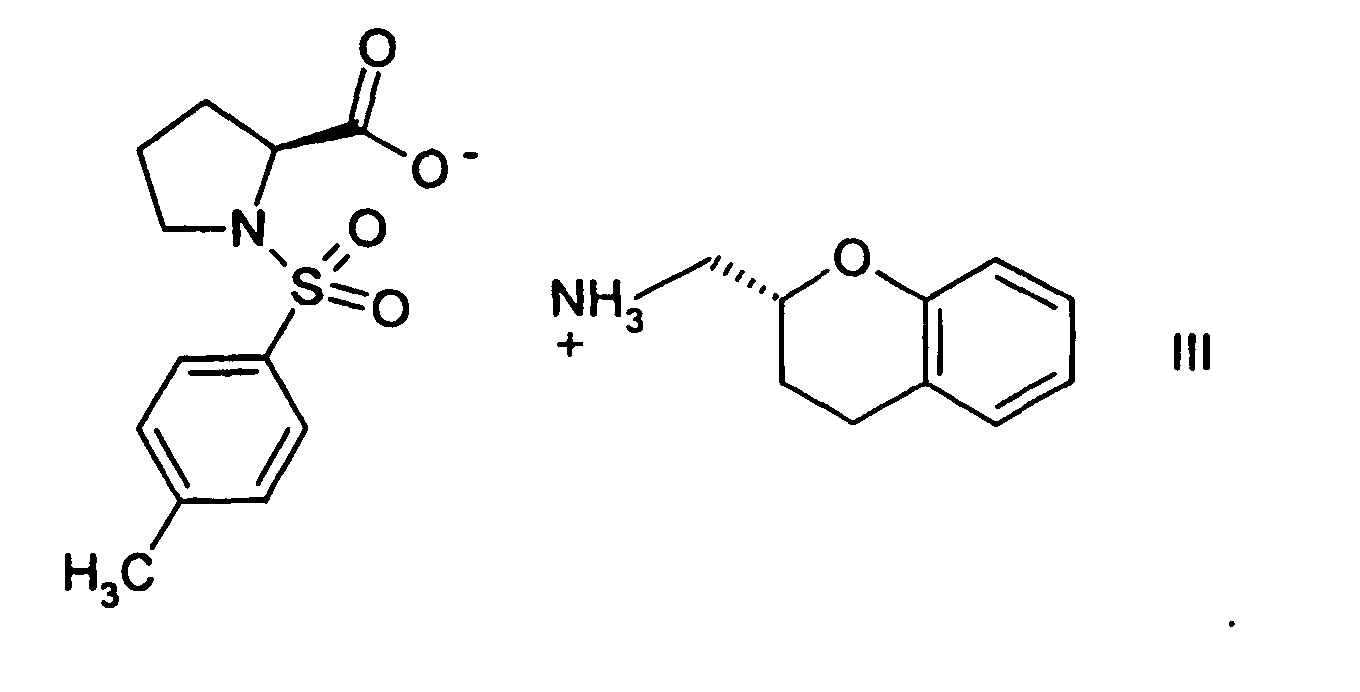
- the preparation of the (R) -2-aminomethylchromans can also be carried out by reacting racemic 2-aminomethylchroman with (S) -N-tosylproline and subsequent racemate resolution by crystallization.
- the solubilities of the two diastereomeric salts of the racemic amine with enantiomerically pure N-tosyl (S) -proline are so different that the pure (R) / (S) -diastereomer of the formula III can be obtained by normal crystallization.
- Another alternative is the preparation of the aldehyde by reduction of 3-cyano-5- (4-fluorophenyl) -pyridine. e.g. by hydrogenation or with Hydrides such as diisobutylaluminum hydride or lithium tri-tert-butoxyaluminum hydride.
- Suitable borohydrides are lithium borohydride, sodium borohydride, sodium cyanoborohydride, potassium borohydride or borohydride on polymeric support materials, for example Amberlyst A-26 BH 4 - form. Particularly preferably sodium borohydride is used, which is previously reacted with methanol to sodium trimethoxyborohydride.
- Any solvent is suitable for the reaction in the presence of borohydrides, provided that it does not interfere with the educts.
- Particularly suitable are protic solvents, for example alcohols such as ethanol or methanol or mixtures thereof.
- Suitable reaction temperatures are between 0 ° and 70 °, preferably between 10 and 50 °, particularly preferably between 20 and 35 ° C.
- the invention also provides a method as described above, characterized in that the reaction in the presence of a Borhydride takes place.
- Suitable hydrogenation catalysts are, for example, metals of the eighth Subgroup, for example Raney nickel, palladium or platinum.
- Palladium or platinum catalysts can be supported on a support material present, for example, on activated carbon, calcium carbonate, barium sulfate or strontium carbonate, in the form of their oxides, for example platinum oxide or in finely divided form.
- solvents examples include alcohols, such as methanol, ethanol or isopropanol, carboxylic acids such as acetic acid, esters such as ethyl acetate or ethers such as tetrahydrofuran (THF) or dioxane. It is also possible, solvent mixtures of the above Use solvents, possibly also solvent mixtures containing water.
- the invention therefore provides a method as described above, characterized in that the reaction in the presence of Hydrogen and a hydrogenation catalyst takes place.
- the resulting base of formula I can with an acid in the associated Acid addition salt to be converted.
- Suitable for this reaction Acids that provide physiologically acceptable salts.
- inorganic Acids are used, e.g. Sulfuric acid, hydrohalic acids such as hydrochloric or hydrobromic acid, phosphoric acids such as orthophosphoric acid, nitric acid, sulfamic acid, furthermore organic acids, in particular aliphatic, alicyclic, araliphatic, aromatic or heterocyclic mono- or polybasic carboxylic, sulfonic or sulfuric acids, such as formic acid, acetic acid, propionic acid, Pivalic acid, diethylacetic acid, malonic acid, succinic acid, Pimelic acid, fumaric acid, maleic acid, lactic acid, tartaric acid, Malic acid, benzoic acid, salicylic acid, 2-phenylpropionic acid, citric acid, Gluconic acid, ascorbic acid, nicotinic acid, is
- the salt formation takes place in ethanol by precipitation with hydrochloric acid (37%).
- the result is 2- [5- (4-fluorophenyl) -3-pyridylmethylaminomethyl] -chroman Dihydrochloride hemihydrate or (R) - (-) - 2- [5- (4-fluorophenyl) -3-pyridylmethylaminomethyl] chroman Dihydrochloride hemihydrate.
- the invention relates to the method as described above, characterized in that (R) - (-) - 2- [5- (4-fluorophenyl) -3-pyridylmethylaminomethyl] chroman dihydrochloride will be produced.
- the salt formation occurs at -5 ° C by adding the stoichiometric amount of 37% aqueous Hydrochloric acid to a 7% solution of the base in ethanol.
- the subject of the invention is in particular the method as before described, characterized in that (R) - (-) - 2- [5- (4-fluorophenyl) -3-pyridylmethylaminomethyl] -chroman Hydrochloride is produced.
Landscapes
- Chemical & Material Sciences (AREA)
- Organic Chemistry (AREA)
- Pyridine Compounds (AREA)
- Plural Heterocyclic Compounds (AREA)
- Pharmaceuticals Containing Other Organic And Inorganic Compounds (AREA)
Abstract
Description

Unter Angstzuständen sind auch die Krankheitsbilder Panikstörung mit und ohne Agoraphobie, Zwangsstörungen oder zwanghafte Persönlichkeitsstörung, Spezifische Angsstörung, Soziale Angststörung, akute Belastungsstörung, posttraumatische Belasungsstörung, generalisierte Angststörung, substanzinduzierte Angststörung und auch eine Angststörung aufgrund eines medizinischen Krankheitsfaktors zu verstehen.

(1) 5-(4-Fluorphenyl)-pyridin-3-carbaldehyd der Formel II

(2) die erhaltene Verbindung der Formel I durch Behandeln mit einer Säure in eines ihrer Salze umgewandelt wird.
Besonders geeignete Salze des 2-Aminomethyl-chromans sind 2-Aminomethyl-chroman Maleat, 2-Aminomethyl-chroman Hydrochlorid, 2-Aminomethyl-carbonat. Besonders vorteilhaft ist erfindungsgemäß die Verwendung von 2-Aminomethyl-chroman Hydrochlorid.
Racemate, wie auch das Racemat von 2-[5-(4-Fluorphenyl)-3-pyridylmethylaminomethyl]-chroman, können nach an sich bekannten Methoden mechanisch oder chemisch in die Isomeren getrennt werden. Vorzugsweise werden aus dem racemischen Gemisch durch Umsetzung mit einem optisch aktiven Trennmittel Diastereomere gebildet. Als Trennmittel eignen sich z.B. optisch aktive Säuren, wie die D- und L-Formen von Weinsäure, Diacetylweinsäure, Dibenzoylweinsäure, Mandelsäure, Äpfelsäure, Milchsäure oder Aminosäuren oder die verschiedenen optisch aktiven Camphersulfonsäuren wie β-Camphersulfonsäure.
Vorteilhaft ist auch eine chromatographische Enantiomerentrennung mit Hilfe einer mit einem optisch aktiven Trennmittel (z.B. Dinitrobenzoylphenylglycin) gefüllten Säule; als Laufmittel eignet sich z.B. ein Gemisch Hexanl/Isopropanol/Acetonitril, z.B. im Volumenverhältnis 82:15:3 oder wie beispielsweise in WO 97/47617 beschrieben.
Eine Diastereomerentrennung kann auch durch Standardreinigungsprozesse, wie z.B. fraktionierte Kristallisation erfolgen (Lit.: A. Collet, S. H. Wilen, Enantiomers, Racemates and Resolutions, Wiley (New York) 1981).
(R)- oder (S)-2-Aminomethyl-chroman kann nach bekannten Syntheseverfahren hergestellt werden.
Die Herstellung kann beispielsweise ausgehend von der kommerziell erhältlichen Chroman-2-carbonsäure durch folgende Umsetzungen erfolgen:

(1) 5-(4-Fluorphenyl)-pyridin-3-carbaldehyd der Formel II

(2) die erhaltene Verbindung der Formel la durch Behandeln mit einer Säure in eines ihrer Salze umgewandelt wird. In analoger Weise wird unter Verwendung von (S)-2-Aminomethylchroman das (S)-Enantiomer der Verbindung I erhalten.
Geeignete Reaktionstemperaturen liegen zwischen 0° und 70°, bevorzugt zwischen 10 und 50°, besonders bevorzugt zwischen 20 und 35°C.
Claims (8)
- Verfahren zur Herstellung von 2-[5-(4-Fluorphenyl)-3-pyridylmethylaminomethyl]-chroman der Formel I,und dessen Salzen, dadurch gekennzeichnet, dass

(1) 5-(4-Fluorphenyl)-pyridin-3-carbaldehyd der Formel IIdirekt mit 2-Aminomethyl-chroman oder dessen Salzen unter reduzierenden Bedingungen zu der Verbindung der Formel I umgesetzt wird und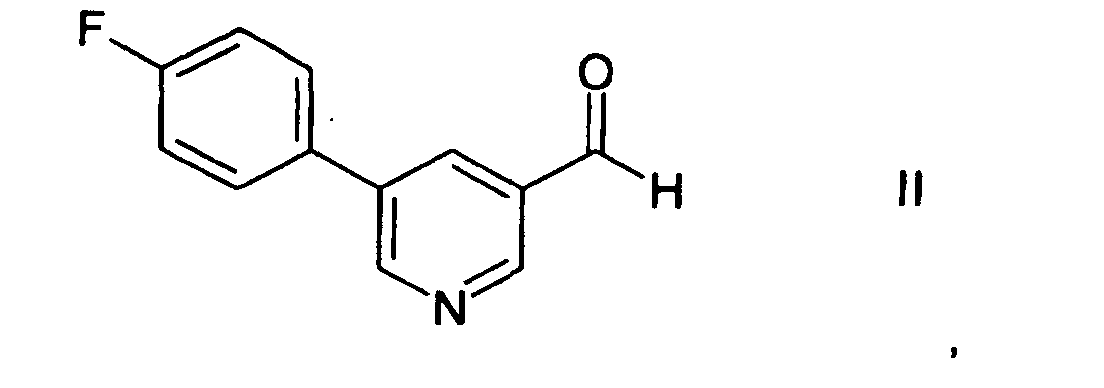
(2) die erhaltene Verbindung der Formel I durch Behandeln mit einer Säure in eines ihrer Salze umgewandelt wird. - Verfahren nach Anspruch 1, dadurch gekennzeichnet, dass die reaktive Form des 2-Aminomethyl-chromans in situ aus einem Salz des Aminomethyl-chromans hergestellt wird.
- Verfahren nach Anspruch 1 oder 2, dadurch gekennzeichnet, dass die Umsetzung in Gegenwart eines Borhydrids stattfindet.
- Verfahren nach Anspruch 1 oder 2, dadurch gekennzeichnet, dass die Umsetzung in Gegenwart von Wasserstoff und einem Hydrierkatalysator stattfindet.
- Verfahren nach einem oder mehreren der Ansprüche 1 bis 4, dadurch gekennzeichnet, dass (R)-Aminomethyl-chroman eingesetzt wird.
- Verfahren nach einem oder mehreren der Ansprüche 1 bis 5, dadurch gekennzeichnet, dass (R)-Aminomethyl-chroman, hergestellt aus dem racemischen Aminomethyl-chroman durch Racematspaltung mit (S)-N-Tosylprolin eingesetzt wird.
- Verfahren nach einem oder mehreren der Ansprüche 1 bis 6, dadurch gekennzeichnet, dass (R)-(-)-2-[5-(4-Fluorphenyl)-3-pyridylmethylaminomethyl]-chroman Hydrochlorid hergestellt wird.
- Verfahren nach einem oder mehreren der Ansprüche 1 bis 6, dadurch gekennzeichnet, dass (R)-(-)-2-[5-(4-Fluorphenyl)-3-pyridylmethylaminomethyl]-chroman Dihydrochlorid hergestellt wird.
Priority Applications (1)
| Application Number | Priority Date | Filing Date | Title |
|---|---|---|---|
| SI200230242T SI1383763T1 (sl) | 2001-04-26 | 2002-04-08 | Postopek izdelave 2-(-5-(4-fluorofenil)-3-piridilmetilaminometil)-kromana |
Applications Claiming Priority (3)
| Application Number | Priority Date | Filing Date | Title |
|---|---|---|---|
| DE10120619 | 2001-04-26 | ||
| DE10120619A DE10120619A1 (de) | 2001-04-26 | 2001-04-26 | 2-(5-(4-Fluorphenyl)-3-pyridylmethylaminomethyl-chroman |
| PCT/EP2002/003857 WO2002088117A2 (de) | 2001-04-26 | 2002-04-08 | Verfahren zur herstellung von 2-[-5-(4-fluorphenyl)-3-pyridylmethylaminomethyl]-chroman |
Publications (2)
| Publication Number | Publication Date |
|---|---|
| EP1383763A2 EP1383763A2 (de) | 2004-01-28 |
| EP1383763B1 true EP1383763B1 (de) | 2005-10-12 |
Family
ID=7682908
Family Applications (1)
| Application Number | Title | Priority Date | Filing Date |
|---|---|---|---|
| EP02727539A Expired - Lifetime EP1383763B1 (de) | 2001-04-26 | 2002-04-08 | Verfahren zur herstellung von 2-(-5-(4-fluorphenyl)-3-pyridylmethylaminomethyl)-chroman |
Country Status (23)
| Country | Link |
|---|---|
| US (1) | US7045629B2 (de) |
| EP (1) | EP1383763B1 (de) |
| JP (1) | JP2004526797A (de) |
| KR (1) | KR100839168B1 (de) |
| CN (1) | CN100430391C (de) |
| AR (1) | AR033262A1 (de) |
| AT (1) | ATE306485T1 (de) |
| AU (1) | AU2002257763B2 (de) |
| BR (1) | BR0209179A (de) |
| CA (1) | CA2445207C (de) |
| CZ (1) | CZ301615B6 (de) |
| DE (2) | DE10120619A1 (de) |
| DK (1) | DK1383763T3 (de) |
| ES (1) | ES2250647T3 (de) |
| HU (1) | HU229151B1 (de) |
| MX (1) | MXPA03009684A (de) |
| MY (1) | MY130616A (de) |
| PL (1) | PL208705B1 (de) |
| RU (1) | RU2288229C2 (de) |
| SI (1) | SI1383763T1 (de) |
| SK (1) | SK287477B6 (de) |
| WO (1) | WO2002088117A2 (de) |
| ZA (1) | ZA200309164B (de) |
Families Citing this family (6)
| Publication number | Priority date | Publication date | Assignee | Title |
|---|---|---|---|---|
| JP4896518B2 (ja) * | 2002-12-13 | 2012-03-14 | ワイエム・バイオサイエンシズ・オーストラリア・ピーティーワイ・リミテッド | ニコチンアミド系キナーゼ阻害薬 |
| CN101120002A (zh) * | 2005-02-17 | 2008-02-06 | 惠氏公司 | 环烷基稠合的吲哚、苯并噻吩、苯并呋喃和茚衍生物 |
| JP2008538576A (ja) * | 2005-04-22 | 2008-10-30 | ワイス | クロマンおよびクロメン誘導体およびその使用 |
| AU2006261314B2 (en) * | 2005-06-21 | 2012-03-22 | Merck Patent Gmbh | Solid pharmaceutical preparation containing (R)-(-)-2-[5-(4-fluorophenyl)-3-pyridylmethylaminomethyl]chroman |
| KR20080111144A (ko) * | 2006-04-18 | 2008-12-22 | 아보트 러보러터리즈 | 바닐로이드 수용체 서브타입 1(vr1)의 길항제 및 이의 용도 |
| BR112013001257A2 (pt) * | 2010-07-20 | 2016-05-17 | Glaxo Group Ltd | processo. |
Family Cites Families (6)
| Publication number | Priority date | Publication date | Assignee | Title |
|---|---|---|---|---|
| DE4135474A1 (de) * | 1991-10-28 | 1993-04-29 | Bayer Ag | 2-aminomethyl-chromane |
| FR2701479B1 (fr) | 1993-02-11 | 1995-05-12 | Pf Medicament | Nouveaux dérivés hétérocycliques de l'aminométhyl-4 pipéridine, leur préparation et leur application en thérapeutique. |
| DE69433401T2 (de) * | 1993-08-19 | 2004-09-16 | Janssen Pharmaceutica N.V. | Gefässverengende dihydrobenzopyranderivate |
| GB9318431D0 (en) * | 1993-09-06 | 1993-10-20 | Boots Co Plc | Therapeutic agents |
| PT707007E (pt) * | 1994-10-14 | 2002-06-28 | Merck Patent Gmbh | Derivados amino(tio)eter como agentes activos no snc |
| DE10005150A1 (de) | 2000-02-07 | 2001-08-09 | Merck Patent Gmbh | Verfahren zur Herstellung von 5-Arylnicotinaldehyden |
-
2001
- 2001-04-26 DE DE10120619A patent/DE10120619A1/de not_active Withdrawn
-
2002
- 2002-04-08 SI SI200230242T patent/SI1383763T1/sl unknown
- 2002-04-08 DE DE50204535T patent/DE50204535D1/de not_active Expired - Lifetime
- 2002-04-08 CZ CZ20033214A patent/CZ301615B6/cs not_active IP Right Cessation
- 2002-04-08 AU AU2002257763A patent/AU2002257763B2/en not_active Ceased
- 2002-04-08 SK SK1433-2003A patent/SK287477B6/sk not_active IP Right Cessation
- 2002-04-08 JP JP2002585416A patent/JP2004526797A/ja active Pending
- 2002-04-08 MX MXPA03009684A patent/MXPA03009684A/es active IP Right Grant
- 2002-04-08 ES ES02727539T patent/ES2250647T3/es not_active Expired - Lifetime
- 2002-04-08 CA CA002445207A patent/CA2445207C/en not_active Expired - Lifetime
- 2002-04-08 PL PL363281A patent/PL208705B1/pl not_active IP Right Cessation
- 2002-04-08 WO PCT/EP2002/003857 patent/WO2002088117A2/de not_active Ceased
- 2002-04-08 CN CNB028088689A patent/CN100430391C/zh not_active Expired - Fee Related
- 2002-04-08 DK DK02727539T patent/DK1383763T3/da active
- 2002-04-08 AT AT02727539T patent/ATE306485T1/de active
- 2002-04-08 KR KR1020037012735A patent/KR100839168B1/ko not_active Expired - Fee Related
- 2002-04-08 US US10/475,988 patent/US7045629B2/en not_active Expired - Lifetime
- 2002-04-08 EP EP02727539A patent/EP1383763B1/de not_active Expired - Lifetime
- 2002-04-08 HU HU0303969A patent/HU229151B1/hu not_active IP Right Cessation
- 2002-04-08 RU RU2003132433/04A patent/RU2288229C2/ru not_active IP Right Cessation
- 2002-04-08 BR BR0209179-8A patent/BR0209179A/pt not_active Application Discontinuation
- 2002-04-24 MY MYPI20021525A patent/MY130616A/en unknown
- 2002-04-24 AR ARP020101480A patent/AR033262A1/es unknown
-
2003
- 2003-11-25 ZA ZA200309164A patent/ZA200309164B/en unknown
Also Published As
Similar Documents
| Publication | Publication Date | Title |
|---|---|---|
| DE60302336T2 (de) | Neue pyridin- und quinolin-derivate | |
| DE60026169T2 (de) | Selektive neurokinin-antagonisten | |
| DE60004066T2 (de) | Benzofurylpiperazine: 5-ht2c serotoninrezeptor agonisten | |
| DE69423767T2 (de) | 1,4-Benzodioxan-Derivate mit Affinität für D2 Rezeptoren und Nützlichkeit in der Behandlung von Psychosen | |
| DE69103206T2 (de) | Neue Derivate des Aminopiperidins, Aminopyrrolidins und des Aminoperhydroazepins, Verfahren zur Herstellung und diese enthaltende Arzneimittel. | |
| DE602004009905T2 (de) | 6-substituierte nikotinamidderivate als opioidrezeptorantagonisten | |
| DE4140540A1 (de) | Neue azaheterocyclylmethyl-chromane | |
| DE69332559T2 (de) | 2,3,4,5-tetrahydro-1h-3-benzazepinen mit anti-psychotisch wirkung, und synthese von alfa-substituierten-arylacetamiden | |
| EP0529462A1 (de) | Benzodioxanderivate | |
| DE60103927T2 (de) | Piperazinderivate, deren Herstellung und deren Verwendung in der Behandlung von Störungen des Zentralnervensystems | |
| EP0648767A1 (de) | Piperidine und Piperazine, die Wirkungen auf das z.n.s. Zeigen | |
| DE60036924T2 (de) | 5-ht1f agonisten | |
| DE69820103T2 (de) | Substituierte chromanderivate | |
| DE60110914T2 (de) | Verbindungen und ihre verwendung als hemmer des glycintransports | |
| EP0546389B1 (de) | Piperidylmethyl substituierte Chromanderivate als Wirkstoffe zur Behandlung von Erkrankungen des Zentralnervensystems | |
| EP1383763A2 (de) | Verfahren zur herstellung von 2- -5-(4-fluorphenyl)-3-pyridylmethylaminomethyl -chromane | |
| DE60206048T2 (de) | Antidepressive (sssri) azaheterocyclylmethylderivate von 7,8-dihydro-3h-6,9-dioxa-1,3-diazacyclopenta [a] naphthalin | |
| DE10044091A1 (de) | Chromanonderivate | |
| DE69827614T2 (de) | Chinoxalindionen | |
| DE60112917T2 (de) | Neue polyzyklische indanylimidazole mit alpha2 adrenergik aktivität | |
| DE60008362T2 (de) | 3-bicycloaryl-2-aminomethyl bicycloalkane als serotoniner reuptake inhibitor | |
| DE60212153T2 (de) | Tetrahydropyranderivate und ihre verwendung als therapeutika | |
| EP0180890A2 (de) | Verfahren zur diastereoselektiven Reduktion von 3-Amino-1-benzoxepin-5(2H)-onen | |
| HK1077302B (en) | Method for producing 2-[-5-(4-fluorophenyl)-3-pyridylmethylaminomethyl]-chromane | |
| AT350059B (de) | Verfahren zur herstellung von neuen ringsubstituierten pyrazino-isochinolin- derivaten und ihren salzen und optisch aktiven formen |
Legal Events
| Date | Code | Title | Description |
|---|---|---|---|
| PUAI | Public reference made under article 153(3) epc to a published international application that has entered the european phase |
Free format text: ORIGINAL CODE: 0009012 |
|
| 17P | Request for examination filed |
Effective date: 20030906 |
|
| AK | Designated contracting states |
Kind code of ref document: A2 Designated state(s): AT BE CH CY DE DK ES FI FR GB GR IE IT LI LU MC NL PT SE TR |
|
| AX | Request for extension of the european patent |
Extension state: AL LT LV MK RO SI |
|
| 17Q | First examination report despatched |
Effective date: 20040219 |
|
| GRAP | Despatch of communication of intention to grant a patent |
Free format text: ORIGINAL CODE: EPIDOSNIGR1 |
|
| RTI1 | Title (correction) |
Free format text: METHOD FOR PRODUCING 2-(-5-(4-FLUOROPHENYL)-3-PYRIDYLMETHYLAMINOMETHYL)-CHROMANE |
|
| GRAS | Grant fee paid |
Free format text: ORIGINAL CODE: EPIDOSNIGR3 |
|
| GRAA | (expected) grant |
Free format text: ORIGINAL CODE: 0009210 |
|
| AK | Designated contracting states |
Kind code of ref document: B1 Designated state(s): AT BE CH CY DE DK ES FI FR GB GR IE IT LI LU MC NL PT SE TR |
|
| AX | Request for extension of the european patent |
Extension state: LT LV RO SI |
|
| REG | Reference to a national code |
Ref country code: GB Ref legal event code: FG4D Free format text: NOT ENGLISH |
|
| REG | Reference to a national code |
Ref country code: CH Ref legal event code: EP |
|
| REG | Reference to a national code |
Ref country code: IE Ref legal event code: FG4D Free format text: LANGUAGE OF EP DOCUMENT: GERMAN |
|
| REG | Reference to a national code |
Ref country code: SE Ref legal event code: TRGR |
|
| REG | Reference to a national code |
Ref country code: DK Ref legal event code: T3 |
|
| GBT | Gb: translation of ep patent filed (gb section 77(6)(a)/1977) |
Effective date: 20060116 |
|
| REF | Corresponds to: |
Ref document number: 50204535 Country of ref document: DE Date of ref document: 20060223 Kind code of ref document: P |
|
| REG | Reference to a national code |
Ref country code: GR Ref legal event code: EP Ref document number: 20060400090 Country of ref document: GR |
|
| REG | Reference to a national code |
Ref country code: ES Ref legal event code: FG2A Ref document number: 2250647 Country of ref document: ES Kind code of ref document: T3 |
|
| PG25 | Lapsed in a contracting state [announced via postgrant information from national office to epo] |
Ref country code: MC Free format text: LAPSE BECAUSE OF NON-PAYMENT OF DUE FEES Effective date: 20060430 |
|
| ET | Fr: translation filed | ||
| PLBE | No opposition filed within time limit |
Free format text: ORIGINAL CODE: 0009261 |
|
| STAA | Information on the status of an ep patent application or granted ep patent |
Free format text: STATUS: NO OPPOSITION FILED WITHIN TIME LIMIT |
|
| 26N | No opposition filed |
Effective date: 20060713 |
|
| PGFP | Annual fee paid to national office [announced via postgrant information from national office to epo] |
Ref country code: TR Payment date: 20110317 Year of fee payment: 10 |
|
| PGFP | Annual fee paid to national office [announced via postgrant information from national office to epo] |
Ref country code: CY Payment date: 20110323 Year of fee payment: 10 |
|
| REG | Reference to a national code |
Ref country code: LT Ref legal event code: MM9D Effective date: 20120408 |
|
| PG25 | Lapsed in a contracting state [announced via postgrant information from national office to epo] |
Ref country code: CY Free format text: LAPSE BECAUSE OF NON-PAYMENT OF DUE FEES Effective date: 20120408 |
|
| REG | Reference to a national code |
Ref country code: SI Ref legal event code: KO00 Effective date: 20130111 |
|
| PG25 | Lapsed in a contracting state [announced via postgrant information from national office to epo] |
Ref country code: TR Free format text: LAPSE BECAUSE OF NON-PAYMENT OF DUE FEES Effective date: 20120408 |
|
| REG | Reference to a national code |
Ref country code: FR Ref legal event code: PLFP Year of fee payment: 15 |
|
| REG | Reference to a national code |
Ref country code: FR Ref legal event code: PLFP Year of fee payment: 16 |
|
| REG | Reference to a national code |
Ref country code: FR Ref legal event code: PLFP Year of fee payment: 17 |
|
| PGFP | Annual fee paid to national office [announced via postgrant information from national office to epo] |
Ref country code: NL Payment date: 20200312 Year of fee payment: 19 Ref country code: GR Payment date: 20200310 Year of fee payment: 19 |
|
| PGFP | Annual fee paid to national office [announced via postgrant information from national office to epo] |
Ref country code: BE Payment date: 20200316 Year of fee payment: 19 Ref country code: LU Payment date: 20200324 Year of fee payment: 19 |
|
| PGFP | Annual fee paid to national office [announced via postgrant information from national office to epo] |
Ref country code: FR Payment date: 20200312 Year of fee payment: 19 |
|
| PGFP | Annual fee paid to national office [announced via postgrant information from national office to epo] |
Ref country code: CH Payment date: 20200420 Year of fee payment: 19 Ref country code: DK Payment date: 20200414 Year of fee payment: 19 Ref country code: PT Payment date: 20200408 Year of fee payment: 19 Ref country code: ES Payment date: 20200504 Year of fee payment: 19 Ref country code: FI Payment date: 20200409 Year of fee payment: 19 Ref country code: IE Payment date: 20200409 Year of fee payment: 19 Ref country code: DE Payment date: 20200325 Year of fee payment: 19 |
|
| PGFP | Annual fee paid to national office [announced via postgrant information from national office to epo] |
Ref country code: GB Payment date: 20200401 Year of fee payment: 19 Ref country code: SE Payment date: 20200415 Year of fee payment: 19 Ref country code: IT Payment date: 20200312 Year of fee payment: 19 |
|
| PGFP | Annual fee paid to national office [announced via postgrant information from national office to epo] |
Ref country code: AT Payment date: 20200325 Year of fee payment: 19 |
|
| REG | Reference to a national code |
Ref country code: DE Ref legal event code: R119 Ref document number: 50204535 Country of ref document: DE |
|
| REG | Reference to a national code |
Ref country code: FI Ref legal event code: MAE |
|
| REG | Reference to a national code |
Ref country code: DK Ref legal event code: EBP Effective date: 20210430 |
|
| REG | Reference to a national code |
Ref country code: SE Ref legal event code: EUG |
|
| REG | Reference to a national code |
Ref country code: NL Ref legal event code: MM Effective date: 20210501 |
|
| REG | Reference to a national code |
Ref country code: AT Ref legal event code: MM01 Ref document number: 306485 Country of ref document: AT Kind code of ref document: T Effective date: 20210408 |
|
| GBPC | Gb: european patent ceased through non-payment of renewal fee |
Effective date: 20210408 |
|
| PG25 | Lapsed in a contracting state [announced via postgrant information from national office to epo] |
Ref country code: LU Free format text: LAPSE BECAUSE OF NON-PAYMENT OF DUE FEES Effective date: 20210408 |
|
| REG | Reference to a national code |
Ref country code: BE Ref legal event code: MM Effective date: 20210430 |
|
| PG25 | Lapsed in a contracting state [announced via postgrant information from national office to epo] |
Ref country code: CH Free format text: LAPSE BECAUSE OF NON-PAYMENT OF DUE FEES Effective date: 20210430 Ref country code: AT Free format text: LAPSE BECAUSE OF NON-PAYMENT OF DUE FEES Effective date: 20210408 Ref country code: LI Free format text: LAPSE BECAUSE OF NON-PAYMENT OF DUE FEES Effective date: 20210430 Ref country code: FI Free format text: LAPSE BECAUSE OF NON-PAYMENT OF DUE FEES Effective date: 20210408 Ref country code: PT Free format text: LAPSE BECAUSE OF NON-PAYMENT OF DUE FEES Effective date: 20211008 Ref country code: FR Free format text: LAPSE BECAUSE OF NON-PAYMENT OF DUE FEES Effective date: 20210430 Ref country code: GB Free format text: LAPSE BECAUSE OF NON-PAYMENT OF DUE FEES Effective date: 20210408 Ref country code: SE Free format text: LAPSE BECAUSE OF NON-PAYMENT OF DUE FEES Effective date: 20210409 Ref country code: DE Free format text: LAPSE BECAUSE OF NON-PAYMENT OF DUE FEES Effective date: 20211103 |
|
| PG25 | Lapsed in a contracting state [announced via postgrant information from national office to epo] |
Ref country code: GR Free format text: LAPSE BECAUSE OF NON-PAYMENT OF DUE FEES Effective date: 20211108 |
|
| PG25 | Lapsed in a contracting state [announced via postgrant information from national office to epo] |
Ref country code: NL Free format text: LAPSE BECAUSE OF NON-PAYMENT OF DUE FEES Effective date: 20210501 |
|
| PG25 | Lapsed in a contracting state [announced via postgrant information from national office to epo] |
Ref country code: IE Free format text: LAPSE BECAUSE OF NON-PAYMENT OF DUE FEES Effective date: 20210408 Ref country code: DK Free format text: LAPSE BECAUSE OF NON-PAYMENT OF DUE FEES Effective date: 20210430 |
|
| REG | Reference to a national code |
Ref country code: ES Ref legal event code: FD2A Effective date: 20220630 |
|
| PG25 | Lapsed in a contracting state [announced via postgrant information from national office to epo] |
Ref country code: PT Free format text: LAPSE BECAUSE OF EXPIRATION OF PROTECTION Effective date: 20220419 Ref country code: ES Free format text: LAPSE BECAUSE OF NON-PAYMENT OF DUE FEES Effective date: 20210409 Ref country code: BE Free format text: LAPSE BECAUSE OF NON-PAYMENT OF DUE FEES Effective date: 20210430 |
|
| PG25 | Lapsed in a contracting state [announced via postgrant information from national office to epo] |
Ref country code: IT Free format text: LAPSE BECAUSE OF NON-PAYMENT OF DUE FEES Effective date: 20200408 |
|
| PG25 | Lapsed in a contracting state [announced via postgrant information from national office to epo] |
Ref country code: PT Free format text: LAPSE BECAUSE OF NON-PAYMENT OF DUE FEES Effective date: 20210408 |
|
| PG25 | Lapsed in a contracting state [announced via postgrant information from national office to epo] |
Ref country code: PT Free format text: LAPSE BECAUSE OF NON-PAYMENT OF DUE FEES Effective date: 20210408 |
|
| PG25 | Lapsed in a contracting state [announced via postgrant information from national office to epo] |
Ref country code: IT Free format text: LAPSE BECAUSE OF NON-PAYMENT OF DUE FEES Effective date: 20210408 |