EP1320522B1 - Compositions et leurs methodes d'utilisation, analogues achiraux de cc-1065 et de duocarmycines - Google Patents
Compositions et leurs methodes d'utilisation, analogues achiraux de cc-1065 et de duocarmycines Download PDFInfo
- Publication number
- EP1320522B1 EP1320522B1 EP01973146A EP01973146A EP1320522B1 EP 1320522 B1 EP1320522 B1 EP 1320522B1 EP 01973146 A EP01973146 A EP 01973146A EP 01973146 A EP01973146 A EP 01973146A EP 1320522 B1 EP1320522 B1 EP 1320522B1
- Authority
- EP
- European Patent Office
- Prior art keywords
- carboxamido
- chloroethyl
- mmol
- phenol
- indole
- Prior art date
- Legal status (The legal status is an assumption and is not a legal conclusion. Google has not performed a legal analysis and makes no representation as to the accuracy of the status listed.)
- Expired - Lifetime
Links
- 0 *C[C@](CN(C(c1cc2cc(*)c(*)c(*)c2[n]1)=O)c1c2)c1ccc2N Chemical compound *C[C@](CN(C(c1cc2cc(*)c(*)c(*)c2[n]1)=O)c1c2)c1ccc2N 0.000 description 9
Classifications
-
- C—CHEMISTRY; METALLURGY
- C07—ORGANIC CHEMISTRY
- C07D—HETEROCYCLIC COMPOUNDS
- C07D207/00—Heterocyclic compounds containing five-membered rings not condensed with other rings, with one nitrogen atom as the only ring hetero atom
- C07D207/02—Heterocyclic compounds containing five-membered rings not condensed with other rings, with one nitrogen atom as the only ring hetero atom with only hydrogen or carbon atoms directly attached to the ring nitrogen atom
- C07D207/30—Heterocyclic compounds containing five-membered rings not condensed with other rings, with one nitrogen atom as the only ring hetero atom with only hydrogen or carbon atoms directly attached to the ring nitrogen atom having two double bonds between ring members or between ring members and non-ring members
- C07D207/34—Heterocyclic compounds containing five-membered rings not condensed with other rings, with one nitrogen atom as the only ring hetero atom with only hydrogen or carbon atoms directly attached to the ring nitrogen atom having two double bonds between ring members or between ring members and non-ring members with hetero atoms or with carbon atoms having three bonds to hetero atoms with at the most one bond to halogen, e.g. ester or nitrile radicals, directly attached to ring carbon atoms
- C07D207/36—Oxygen or sulfur atoms
- C07D207/40—2,5-Pyrrolidine-diones
- C07D207/416—2,5-Pyrrolidine-diones with hetero atoms or with carbon atoms having three bonds to hetero atoms with at the most one bond to halogen, e.g. ester or nitrile radicals, directly attached to other ring carbon atoms
-
- A—HUMAN NECESSITIES
- A61—MEDICAL OR VETERINARY SCIENCE; HYGIENE
- A61P—SPECIFIC THERAPEUTIC ACTIVITY OF CHEMICAL COMPOUNDS OR MEDICINAL PREPARATIONS
- A61P35/00—Antineoplastic agents
-
- C—CHEMISTRY; METALLURGY
- C07—ORGANIC CHEMISTRY
- C07C—ACYCLIC OR CARBOCYCLIC COMPOUNDS
- C07C215/00—Compounds containing amino and hydroxy groups bound to the same carbon skeleton
- C07C215/74—Compounds containing amino and hydroxy groups bound to the same carbon skeleton having hydroxy groups and amino groups bound to carbon atoms of six-membered aromatic rings of the same carbon skeleton
- C07C215/76—Compounds containing amino and hydroxy groups bound to the same carbon skeleton having hydroxy groups and amino groups bound to carbon atoms of six-membered aromatic rings of the same carbon skeleton of the same non-condensed six-membered aromatic ring
-
- C—CHEMISTRY; METALLURGY
- C07—ORGANIC CHEMISTRY
- C07C—ACYCLIC OR CARBOCYCLIC COMPOUNDS
- C07C235/00—Carboxylic acid amides, the carbon skeleton of the acid part being further substituted by oxygen atoms
- C07C235/02—Carboxylic acid amides, the carbon skeleton of the acid part being further substituted by oxygen atoms having carbon atoms of carboxamide groups bound to acyclic carbon atoms and singly-bound oxygen atoms bound to the same carbon skeleton
- C07C235/32—Carboxylic acid amides, the carbon skeleton of the acid part being further substituted by oxygen atoms having carbon atoms of carboxamide groups bound to acyclic carbon atoms and singly-bound oxygen atoms bound to the same carbon skeleton the carbon skeleton containing six-membered aromatic rings
- C07C235/38—Carboxylic acid amides, the carbon skeleton of the acid part being further substituted by oxygen atoms having carbon atoms of carboxamide groups bound to acyclic carbon atoms and singly-bound oxygen atoms bound to the same carbon skeleton the carbon skeleton containing six-membered aromatic rings having the nitrogen atom of at least one of the carboxamide groups bound to a carbon atom of a six-membered aromatic ring
-
- C—CHEMISTRY; METALLURGY
- C07—ORGANIC CHEMISTRY
- C07C—ACYCLIC OR CARBOCYCLIC COMPOUNDS
- C07C271/00—Derivatives of carbamic acids, i.e. compounds containing any of the groups, the nitrogen atom not being part of nitro or nitroso groups
- C07C271/06—Esters of carbamic acids
- C07C271/08—Esters of carbamic acids having oxygen atoms of carbamate groups bound to acyclic carbon atoms
- C07C271/26—Esters of carbamic acids having oxygen atoms of carbamate groups bound to acyclic carbon atoms with the nitrogen atom of at least one of the carbamate groups bound to a carbon atom of a six-membered aromatic ring
- C07C271/28—Esters of carbamic acids having oxygen atoms of carbamate groups bound to acyclic carbon atoms with the nitrogen atom of at least one of the carbamate groups bound to a carbon atom of a six-membered aromatic ring to a carbon atom of a non-condensed six-membered aromatic ring
-
- C—CHEMISTRY; METALLURGY
- C07—ORGANIC CHEMISTRY
- C07C—ACYCLIC OR CARBOCYCLIC COMPOUNDS
- C07C271/00—Derivatives of carbamic acids, i.e. compounds containing any of the groups, the nitrogen atom not being part of nitro or nitroso groups
- C07C271/06—Esters of carbamic acids
- C07C271/08—Esters of carbamic acids having oxygen atoms of carbamate groups bound to acyclic carbon atoms
- C07C271/26—Esters of carbamic acids having oxygen atoms of carbamate groups bound to acyclic carbon atoms with the nitrogen atom of at least one of the carbamate groups bound to a carbon atom of a six-membered aromatic ring
- C07C271/30—Esters of carbamic acids having oxygen atoms of carbamate groups bound to acyclic carbon atoms with the nitrogen atom of at least one of the carbamate groups bound to a carbon atom of a six-membered aromatic ring to a carbon atom of a six-membered aromatic ring being part of a condensed ring system
-
- C—CHEMISTRY; METALLURGY
- C07—ORGANIC CHEMISTRY
- C07D—HETEROCYCLIC COMPOUNDS
- C07D209/00—Heterocyclic compounds containing five-membered rings, condensed with other rings, with one nitrogen atom as the only ring hetero atom
- C07D209/02—Heterocyclic compounds containing five-membered rings, condensed with other rings, with one nitrogen atom as the only ring hetero atom condensed with one carbocyclic ring
- C07D209/04—Indoles; Hydrogenated indoles
- C07D209/30—Indoles; Hydrogenated indoles with hetero atoms or with carbon atoms having three bonds to hetero atoms with at the most one bond to halogen, directly attached to carbon atoms of the hetero ring
- C07D209/42—Carbon atoms having three bonds to hetero atoms with at the most one bond to halogen, e.g. ester or nitrile radicals
-
- C—CHEMISTRY; METALLURGY
- C07—ORGANIC CHEMISTRY
- C07D—HETEROCYCLIC COMPOUNDS
- C07D213/00—Heterocyclic compounds containing six-membered rings, not condensed with other rings, with one nitrogen atom as the only ring hetero atom and three or more double bonds between ring members or between ring members and non-ring members
- C07D213/02—Heterocyclic compounds containing six-membered rings, not condensed with other rings, with one nitrogen atom as the only ring hetero atom and three or more double bonds between ring members or between ring members and non-ring members having three double bonds between ring members or between ring members and non-ring members
- C07D213/04—Heterocyclic compounds containing six-membered rings, not condensed with other rings, with one nitrogen atom as the only ring hetero atom and three or more double bonds between ring members or between ring members and non-ring members having three double bonds between ring members or between ring members and non-ring members having no bond between the ring nitrogen atom and a non-ring member or having only hydrogen or carbon atoms directly attached to the ring nitrogen atom
- C07D213/60—Heterocyclic compounds containing six-membered rings, not condensed with other rings, with one nitrogen atom as the only ring hetero atom and three or more double bonds between ring members or between ring members and non-ring members having three double bonds between ring members or between ring members and non-ring members having no bond between the ring nitrogen atom and a non-ring member or having only hydrogen or carbon atoms directly attached to the ring nitrogen atom with hetero atoms or with carbon atoms having three bonds to hetero atoms with at the most one bond to halogen, e.g. ester or nitrile radicals, directly attached to ring carbon atoms
- C07D213/62—Oxygen or sulfur atoms
- C07D213/63—One oxygen atom
- C07D213/64—One oxygen atom attached in position 2 or 6
-
- C—CHEMISTRY; METALLURGY
- C07—ORGANIC CHEMISTRY
- C07D—HETEROCYCLIC COMPOUNDS
- C07D213/00—Heterocyclic compounds containing six-membered rings, not condensed with other rings, with one nitrogen atom as the only ring hetero atom and three or more double bonds between ring members or between ring members and non-ring members
- C07D213/02—Heterocyclic compounds containing six-membered rings, not condensed with other rings, with one nitrogen atom as the only ring hetero atom and three or more double bonds between ring members or between ring members and non-ring members having three double bonds between ring members or between ring members and non-ring members
- C07D213/04—Heterocyclic compounds containing six-membered rings, not condensed with other rings, with one nitrogen atom as the only ring hetero atom and three or more double bonds between ring members or between ring members and non-ring members having three double bonds between ring members or between ring members and non-ring members having no bond between the ring nitrogen atom and a non-ring member or having only hydrogen or carbon atoms directly attached to the ring nitrogen atom
- C07D213/60—Heterocyclic compounds containing six-membered rings, not condensed with other rings, with one nitrogen atom as the only ring hetero atom and three or more double bonds between ring members or between ring members and non-ring members having three double bonds between ring members or between ring members and non-ring members having no bond between the ring nitrogen atom and a non-ring member or having only hydrogen or carbon atoms directly attached to the ring nitrogen atom with hetero atoms or with carbon atoms having three bonds to hetero atoms with at the most one bond to halogen, e.g. ester or nitrile radicals, directly attached to ring carbon atoms
- C07D213/62—Oxygen or sulfur atoms
- C07D213/69—Two or more oxygen atoms
-
- C—CHEMISTRY; METALLURGY
- C07—ORGANIC CHEMISTRY
- C07D—HETEROCYCLIC COMPOUNDS
- C07D235/00—Heterocyclic compounds containing 1,3-diazole or hydrogenated 1,3-diazole rings, condensed with other rings
- C07D235/02—Heterocyclic compounds containing 1,3-diazole or hydrogenated 1,3-diazole rings, condensed with other rings condensed with carbocyclic rings or ring systems
- C07D235/04—Benzimidazoles; Hydrogenated benzimidazoles
- C07D235/24—Benzimidazoles; Hydrogenated benzimidazoles with hetero atoms or with carbon atoms having three bonds to hetero atoms with at the most one bond to halogen, e.g. ester or nitrile radicals, directly attached in position 2
-
- C—CHEMISTRY; METALLURGY
- C07—ORGANIC CHEMISTRY
- C07D—HETEROCYCLIC COMPOUNDS
- C07D405/00—Heterocyclic compounds containing both one or more hetero rings having oxygen atoms as the only ring hetero atoms, and one or more rings having nitrogen as the only ring hetero atom
- C07D405/02—Heterocyclic compounds containing both one or more hetero rings having oxygen atoms as the only ring hetero atoms, and one or more rings having nitrogen as the only ring hetero atom containing two hetero rings
- C07D405/12—Heterocyclic compounds containing both one or more hetero rings having oxygen atoms as the only ring hetero atoms, and one or more rings having nitrogen as the only ring hetero atom containing two hetero rings linked by a chain containing hetero atoms as chain links
-
- Y—GENERAL TAGGING OF NEW TECHNOLOGICAL DEVELOPMENTS; GENERAL TAGGING OF CROSS-SECTIONAL TECHNOLOGIES SPANNING OVER SEVERAL SECTIONS OF THE IPC; TECHNICAL SUBJECTS COVERED BY FORMER USPC CROSS-REFERENCE ART COLLECTIONS [XRACs] AND DIGESTS
- Y02—TECHNOLOGIES OR APPLICATIONS FOR MITIGATION OR ADAPTATION AGAINST CLIMATE CHANGE
- Y02P—CLIMATE CHANGE MITIGATION TECHNOLOGIES IN THE PRODUCTION OR PROCESSING OF GOODS
- Y02P20/00—Technologies relating to chemical industry
- Y02P20/50—Improvements relating to the production of bulk chemicals
- Y02P20/55—Design of synthesis routes, e.g. reducing the use of auxiliary or protecting groups
Definitions
- the present invention is directed to novel achiral seco-analogues of (+)-CC1065 and the duocarmycins and pharmaceutical compositions containing the said achiral analogues.
- the achiral analogues of (+)-CC1065 and the duocarmycins are useful as anticancer agents.
- DNA minor groove binders that exert their anticancer activity by alkylating specific sequences of DNA (1a).
- Minor groove interacting agents are more attractive than intercalating agents and major groove binders because the minor groove is typically only occupied by a spine of hydration and is therefore more accessible to anticancer agents.
- covalent modifications in the minor groove are generally more cytotoxic to cells than their major groove alkylating counterparts, such as tallimustine versus L-phenylalanine mustard (1b).
- Examples of minor groove and AT sequence selective alkylating agents that have potent anticancer activity are (+)-CC-1065 (1c,d,e, 2) and the duocarmycins (2, 3).
- CC-1065 and the duocarmycins exemplified by (+)-duocarmycin SA (or DUMSA) (2) and depicted in Table 1, belong to a group of natural products that have incredibly potent cytotoxic properties (ca. IC50 values in the pM range against the growth of mouse L1210 leukemia cells in culture).
- These compounds which were isolated from the fermentation broth of Streptomyces zelensis (4) and Streptomyces sp. (5), respectively, derive their anticancer activity by reacting primarily with adenine-N3 groups in the minor groove of specific sequences of DNA.
- (+)-CC1065 shows a preference for alkylating the adenine-N3 group which is flanked by 5'-A or 5'-T residues.
- this compound exhibited a strong preference for the fourth 5'-base to be an A or T residue, a weaker preference for the fifth 5'-base to be an A or T base, and a weak preference for the 3' base preceding the alkylating site to be a purine.
- the consensus sequences 5'-PuNTT A -3' and 5'-AAAA A -3' for (+)-CC-1065 are suggested (6, 8).
- (+)-CC1065 and (+)-DUMSA generally have similar sequence selectivity, some subtle differences were observed, notably the lack of alkylation at 5'-GCAA A by CC1065 (2,3,7).
- CC1065 and the duocarmycins react with specific sequences of DNA is still a subject of intense debate (9).
- Two models for their sequence selective DNA alkylations have been proposed.
- the "noncovalent binding model” proposed by Boger's group (9) suggests that the forces stabilizing the DNA alkylation are a combination of stereoelectronically controlled covalent bond formation between the cyclopropypyrroloindolone (CPI) subunit of CC1065 and adenine-N3 of DNA, as well as stabilizing noncovalent interactions derived from the hydrophobic and van der Waals contacts of the PDE-I subunits for CC1065, and the TMI (trimethoxyindole) unit of DUMSA (9).
- CPI cyclopropypyrroloindolone
- (+)-CC1065 has potent cytotoxic properties, its usefulness as an anticancer drug is hampered by its limiting toxicity of delayed lethality in mice at therapeutic doses (4b).
- DUMSA is devoid of this toxic side effect (2a), and it is the most solvolytically stable and the most potent in this class of compounds (2,14).
- analogues of CC1065 synthesized by Upjohn scientists (1a, b, 4c) structure-activity relationships have been sharply defined (10b, 11), and the ethano bridges (see Figure 1) were found to be responsible for the undesired delayed lethality.
- CC1065 analogues such as adozelesin (15b) and DUMSA (15a,16), which lack the ethano bridges, are devoid of the delayed toxicity problem, yet they exhibit potent anticancer activity.
- Adozelesin (1b, 4c, 17, patent 1), carzelesin (18), bizelesin (19, patent 2), and KW2189 (20, patent 3) are examples of analogues of (+)-CC1065 and duocarmycins that are presently undergoing clinical trials for the treatment of cancer.
- a phase I clinical trial of adozelesin has shown a partial response on a melanoma patient (17e).
- Carzelesin is a prodrug that upon carbamate hydrolysis provides the seco-prodrug U76073, which readily cyclizes to the corresponding cyclopropane containing CPI "drug" U76074 (18).
- carzelesin has a higher in-vivo anticancer activity against L1210 leukemia than adozelesin (150 ⁇ 8% ILS, 2/6 survival versus 90 ⁇ 11%, 0/6 survival) (18). This outcome is likely to be due to the lower toxicity of carzelesin, and consequently it can be administered at a higher dose (400 ⁇ g/kg vs 100 ⁇ g/kg for adozelesin) (18).
- KW2189 a semisynthetic duocarmycin B2 derivative, which possesses improved anticancer activity, water solubility, and stability, has been selected for clinical evaluation in Japan (20). Its mechanism of activation also involves hydrolysis of the carbamate group to release a seco -prodrug, which cyclizes to produce the actual cyclopropane containing drug, or DU-86.
- indole-benzofuran (In-Bf) (4c), the indole-indole (In-In) (4c), the trimethoayindole (TMI) (3), as well as analogues of distamycin as exemplified by the dipyrrole (Py-Py) (21) noncovalent binding units given in Table 2 will be incorporated into the structures of the compounds of the invention. These DNA binding units are chosen because they have been shown to enhance the cytotoxic potency of this class of compounds, and they lack the delayed toxicity problem.
- WO 9919298 discloses cyclopropyl fused dihydroindole derivatives as DNA binding agents, which can be prepared via the cyclisation of chloromethyl substituted benzindoles.
- US-A-5,985,908 discloses some N-acylated-1-chloromethyl-1,2-dihydro-5-hydroxy-8-methoxy-3H-benz[e]indoles useful as DNA binding agents.
- US-A-6,060,608 discloses some N-acylated-l-chloromethyl-1,2-dihydro-5-hydroxy-3H-benz[e]indoles in which the acyl groups contain thiazole dimers; these compounds can be used as DNA alkylating agents.
- US-A-5,843,937 discloses N-acylated derivatives of 1-chloromethyl-1,2-dihydro-5-hydroxy-3H-benz[e]indole, acylated by substituted indolyl-2-carbonyl groups. These compounds are DNA alkylating agents which can be used for the treatment of cancer.
- the achiral analogues of CC-1065 and doucarmycins described in this invention will thus represent a significant improvement to the present state in the development of this class of minor groove binding agents for use in the treatment of diseases such as cancers.
- Synthesis of the achiral analogues described in this disclosure will not only alleviate the chemical resolution step, their interactions with DNA may be simplified, and their cytotoxic potency and anticancer activity are retained.
- 4-(2-Haloethyl)phenols have also been shown to readily eliminate HX to generate a spiro(2,5)octa-1,4-diene-3-one intermediate which ultimately alkylates DNA (28c).
- the preparation and evaluation of the biological and DNA interacting properties of a series of achiral seco analogues of the doucarmycins, CC-1065 and adozelesin are described.
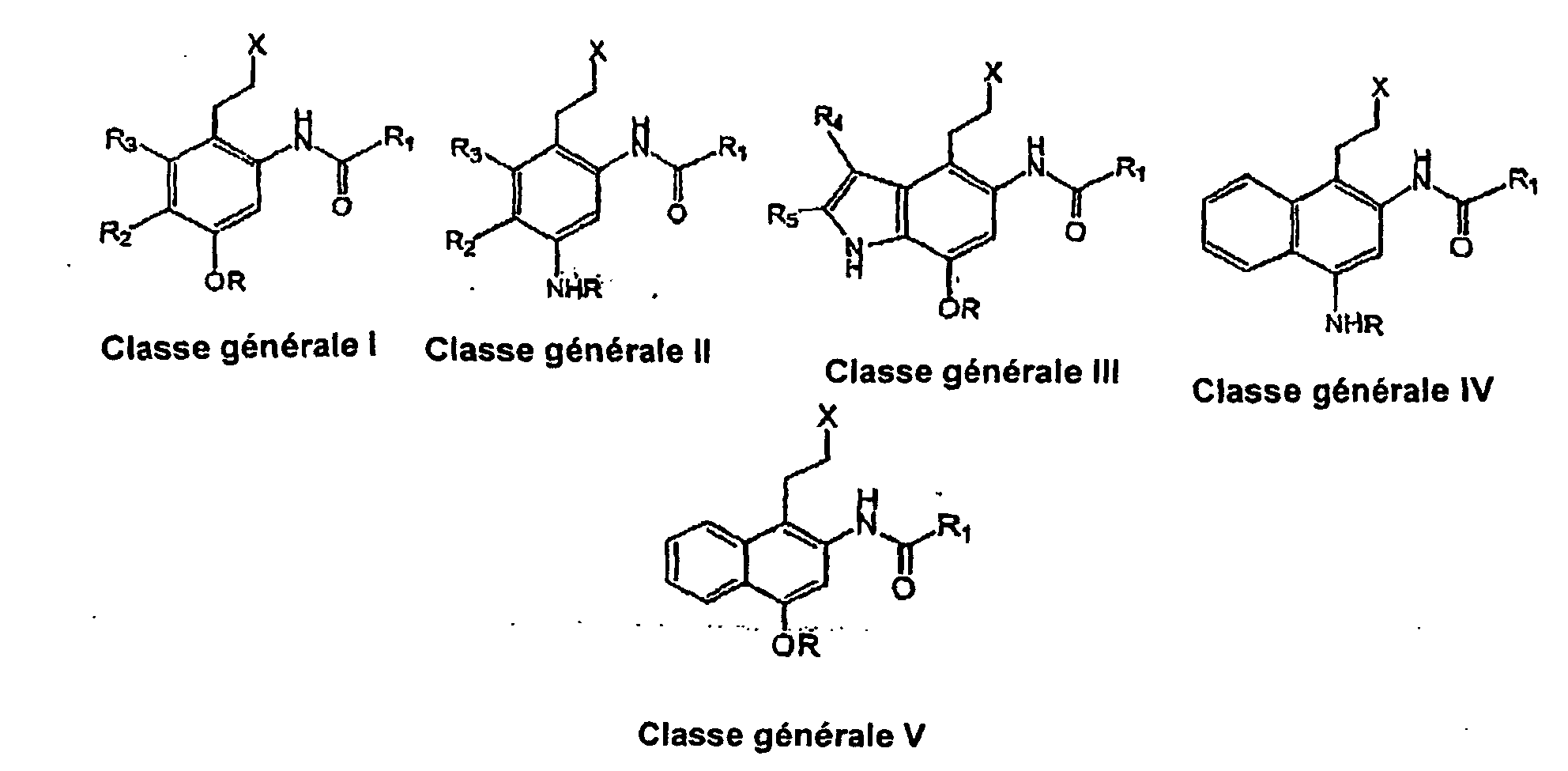
- the structures of the seco-achiral compounds of this invention are depicted as general class I, II, III and IV.
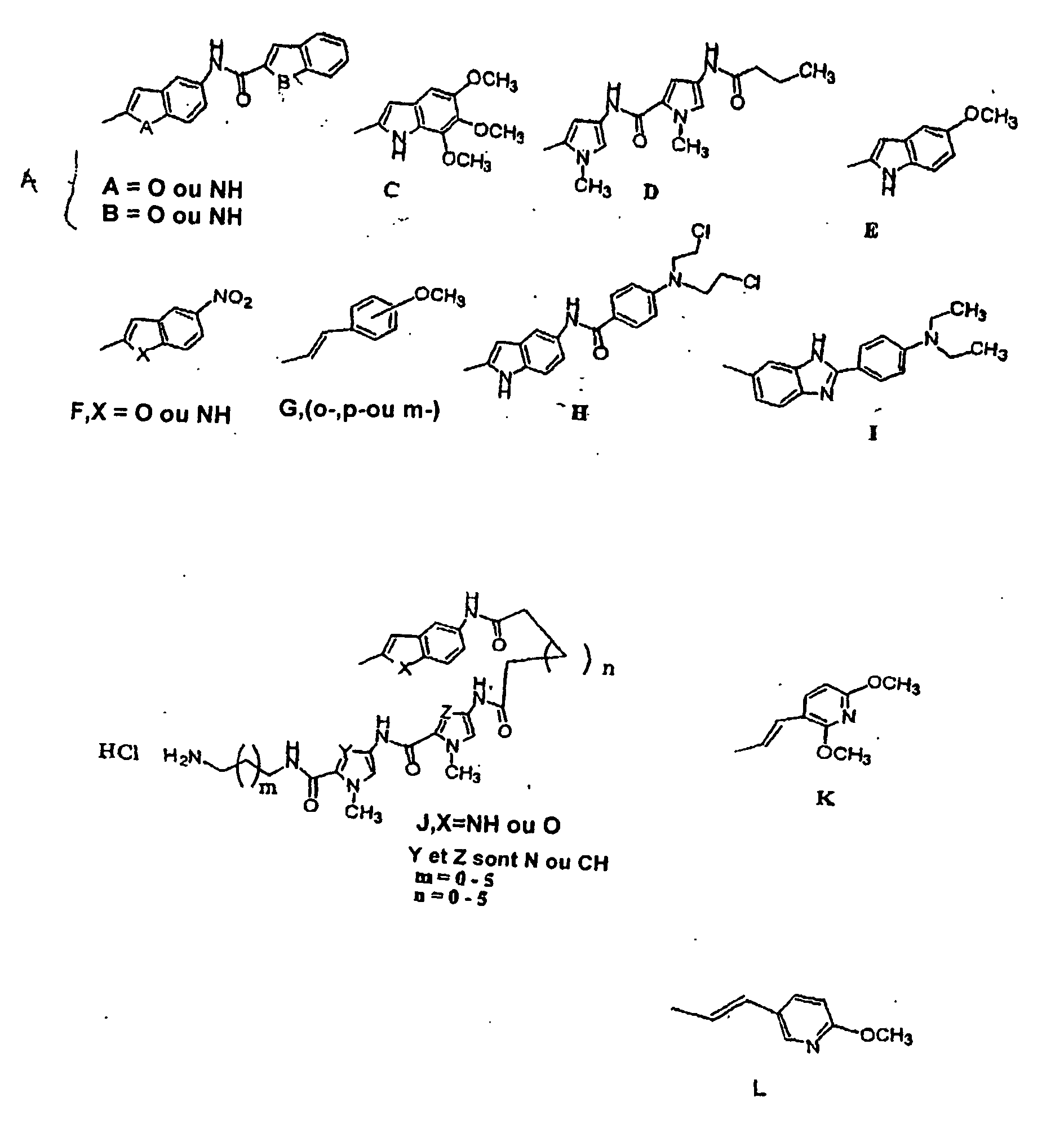
- the achiral compounds are composed of an achiral pharmacophore conjugated to a number of non-covalent DNA binding subunit, including, but not limited to, the Indole-Indole, Indole-Benzofuran, Pyrrole-Pyrrole, Trimethoxyindole, the N-mustard (H) as well as the 'hairpin' ( J ) groups as depicted in Table 4.
- the 'hairpin' subunit was designed on the basis of recent findings that 1:1 and side-by-side complexes of duocarmycin A and distamycin (33a,b) or lexitropsins (33c,d) exhibited a high degree of DNA sequence alkylation specificity.
- 'hairpin' duocarmycin-oligopeptides conjugates that are related to distamycin and lexitropsins have been shown to exhibit a predictable and high level of sequence specificity (34).
- side-by-side and hairpin oligopeptides derived from the lexitropsins have been extensively studied.
- the imidazole-imidazole pairing will recognize either a G/C or C/G within specific DNA sequences (36).
- the side-by-side imidazole-imidazole pairing was found to be even more selective for binding to mismatched T/G base pairs, providing a unique opportunity to develop molecules for targeting such mismatched DNA base pairs (37).
- the present invention relates to novel achiral analogues of the DNA minor groove alkylating agents (+)-CC1065 and the duocarmycins, depicted as general class I, II, III, IV, and V: wherein X is a good leaving group, such as a chloride, a bromide, an iodide, a mesylate, a tosylate, an acetate, a quaternary ammonium moiety, a mercaptan, an alkylsulfoxyl, or an alkylsulfonyl group, preferably either a chloride, a bromide, or an iodide group.
- X is a good leaving group, such as a chloride, a bromide, an iodide, a mesylate, a tosylate, an acetate, a quaternary ammonium moiety, a mercaptan, an alkylsulfoxyl, or an al
- R 1 is a suitable minor groove binding agent to enhance the interactions of the achiral seco-cyclopropaneindole (CI) or an achiral seco-duocarmycin with specific sequences of DNA, closer from the groups A, C, D, E, F, G, H, I, J, K and L.
- R 1 also includes t-butoxy, benzyloxy and 9-fluorenylmethyloxy.
- R 2 and R 3 can be hydrogen or short chain alkyl (C1-C5) groups, preferably both being hydrogen atoms.
- the alkyl groups may be straight chain or branched and include such groups as ethyl, propyl, butyl, pentyl and hexyl.
- R 4 and R 5 can be hydrogen atoms, short alkyl groups, trifluoromethyl moieties, and alkyloxycarbonyl groups.
- the preferred R 4 and R 5 groups are methoxycarbonyl and trifluoromethyl.
- R can be either a benzyl, a benzyloxycarbonyl, a hydrogen atom, a 4-nitrobenzyloxycarbonyl, or a N'-methylpiperazinyl-N-carbonyl group.
- Another aspect of the present invention is directed to a method for the treatment of cancer by administering the compounds of the present invention to a patient for a time and under conditions sufficient to effect inhibition of cancerous growth.
- Another aspect of the present invention is directed to a method for the rcognition and targeting of compounds described in the invention to specific DNA sequences, including sequences within the control regions of disease causing genes.
- Such agents can have application for the identification of unique sequences in the genome as well as for use as potential gene controlling properties (38).
- compositions containing the compounds of the invention in a combination with pharmaceutical carriers are provided.
- the present invention relates to novel achiral analogues of the DNA minor groove and sequence selective alkylating agents (+)-CC1065 and the duocarmycins, depicted as general class I, II, III, IV and V: wherein X is a good leaving group, such as a chloride, a bromide, an iodide, a mesylate, a tosylate, an acetate, a quaternary ammonium moiety, a mercaptan, an alkylsulfoxyl, or an alkylsulfonyl group, preferably either a chloride, a bromide, or an iodide group.
- X is a good leaving group, such as a chloride, a bromide, an iodide, a mesylate, a tosylate, an acetate, a quaternary ammonium moiety, a mercaptan, an alkylsulfoxyl, or
- R 1 is a suitable minor groove binding agent to enhance the interactions of the achiral seco-cyclopropaneindole (CI) or an achiral seco -duocarmycin with specific sequences of DNA.
- Examples of the DNA binders are given in Table 4.
- the preferred DNA binders are groups A, C, D, E, F, G, H and I.
- R 1 can also include the following: t-butoxy, benzyloxy, 9-fluorenylmethyloxy or other common protecting groups for amines.
- the synthetic approach for the proposed achiral seco -CI compounds starts from the reaction of the readily available diethyl 2-(4-benzyloxy-2-nitrophenyl)malonate (4c).
- Diethyl 2-(4-benzyloxy-2-nitrophenyl)malonate Treatment of diethyl 2-(4-benzyloxy-2-nitrophenyl)malonate with NaOH in ethanol (25 - 80°C), preferably refluxing, followed by acidification and mild heating (25 -100°C), preferably refluxing, the solution gave the desired 4-benzyloxy-2-nitrophenylacetic acid in 95% yield.
- Selective reduction of the carboxylic acid with borane at 0 - 50°C, preferably at room temperature, in THF produced 2-(4-benzyloxy-2-nitrophenyl)ethanol in 95 % yield.
- the alcohol was then chlorinated at 0 - 50°C, preferably at room temperature, with triphenylphosphine and carbon tetrachloride in CH 2 Cl 2 to give 2-(4-benzyloxy-2-nitrophenyl)ethyl chloride in 97% yield.
- the 2-(4-benzyloxy-2-nitrophenyl)ethyl bromide was obtained in 92% yield after reacting 2-(4-benzyloxy-2-nitrophenyl)ethanol with triphenylphosphine and carbon tetrabromide in acetonitrile.
- 2-(2- Amino-4-hydroxyphenyl)ethyl bromide was directly coupled at 0 - 50°C, preferably at room temperature, with 5-(benzofuran-2-carboxamido)indole-2-carboxylic acid in the presence of EDCI [1-(3-dimethylaminopropyl)-3-ethylcarbodiimide hydrochloride] and DMF to give compound 4-(2-bromoethyl)-3-[5-(5-benzofuran-2-carboxamido)indole-2-carboxamido]phenol in a low 2% yield for the two steps after purification by silica gel column chromatography.
- the resulting amine was directly coupled at 0 - 50°C, preferably at room temperature, with 5,6,7-trimethoxyindole-2-carboxylic acid in the presence of PyBOP (benzotriazol-1-yloxytripyrrolidinophosphonium hexafluorophosphate) and diisopropylethylamine to give benzyl 4-(2-chloroethyl)-3-(5,6,7-trimethoxyindole-2-carboxamino)phenyl ether in 66% yield.
- PyBOP benzotriazol-1-yloxytripyrrolidinophosphonium hexafluorophosphate
- the benzyl group was removed by catalytic hydrogenation at atmospheric pressure and at 0 - 50°C, preferably at room temperature, over 10% Pd-C to produce 4-(2-chloroethyl)-3-(5,6,7-trimethoxyindole-2-carboxamino)phenol in 50% yield.
- 2-(2-Amino-4-hydroxyphenyl)ethyl chloride was coupled with 5-nitroindole-2-carboxylic acid with EDCI at 0 - 50°C, preferably at room temperature, in DMF to give 4-(2-chloroethyl)-3-(5-nitroindole-2-carboxamido)phenol in 14% yield.
- Conversion of the diester to the acetic acid moiety was accomplished in 91 % yield by heating at 50-100°C, preferably refluxing, the diester in ethanol and aqueous 10% sodium hydroxide for 4 hours. Following acid work-up provided the acid a viscous yellow oil.
- the carboxylic acid was converted to a primary alcohol through reduction with borane/THF at at 0 - 50°C, preferably at 5°C then gradual warming to room temperature, under a nitrogen atmosphere with distilled THF as a solvent. The colorless oily alcohol was afforded in 93% yield.
- This alcohol was then converted to the corresponding primary chloride through a reaction under a nitrogen atmosphere at 0 - 50°C, preferably at room temperature, with triphenylphosphine, carbon tetrachloride and distilled dichloromethane as the solvent.
- the orangish/yellow oil chloide was produced in 81% yield.
- the nitro moiety of the chloride was reduced to an amine by hydrogenation over PtO 2 at 10-100 psi, preferably at 55 psi, and at 0-35 °C, preferably room temperature,
- the unstable amine was immediately coupled at 0 - 50°C, preferably at room temperature, to 5,6,7-trimethoxyindole carboxylic acid (TMI) in presence of tripyrrolidinophosphonium hexafluorophosphate (PyBOP) and distilled N,N-diisopropylethylamine with distilled dichloromethane as the solvent.
- TMI 5,6,7-trimethoxyindole carboxylic acid
- PyBOP tripyrrolidinophosphonium hexafluorophosphate
- a clear foamy product was produced in 36% yield.
- the Z protecting group was removed by hydrogenation over 10% Pd on carbon in THF at 0-35 °C, preferably at room temperature.
- Synthesis of the compounds of general class III begins with the reaction of 2-amino-4-chloro-5-nitrophenol at 0 - 50°C, preferably at room temperature, with benzyl bromide in the presence of potassium carbonate and tetra-N-butylammonium iodide in DMF to give 2-benzyloxy-5-chloro-4-nitroaniline in 56% yield.
- Subsequent reaction of 2-benzyloxy-5-chloro-nitroaniline (25 - 80°C), preferably reluxing, with benzoyl chloride in the presence of triethylamine provided N-(2-benzyloxy-5-chloro-4-nitrophenyl)benzamide in 85% yield.
- the amine was coupled at 0 - 50°C, preferably at room temperature, with trimethoxyindole-2-carboxylic acid in presence of PyBOP and Hunig's base gave the desired amide in 40 % yield.
- the compounds of the present invention are useful as anticancer agents.
- covalent adducts can be determined by art-recognizing methods. For example, alkylation of purine-N3 in the minor groove of DNA can be determined through the formation of thermally-induced DNA strand breaks (40), and the covalent sequence specificity of the compounds of this invention can be determined using a Taq polymerase stop assay (41).
- the compounds of this invention can be useful as anticancer agents. They show, in particular, cytostatic properties towards tumor cells so that they can be useful, e.g., to inhibit the growth of various cancers, such as, for instance, carcinomas, e.g. mammary carcinoma, lung carcinoma, bladder carcinoma, pancreatic carcinoma, colon carcinoma, ovary, colon, rectum, prostate, and endometrial cancers.
- carcinomas e.g. mammary carcinoma, lung carcinoma, bladder carcinoma, pancreatic carcinoma, colon carcinoma, ovary, colon, rectum, prostate, and endometrial cancers.
- Other cancers in which the compounds of the invention could find an application are, for instance, sarcomas, e.g. soft tissue and bone sarcomas, and hematological malignancies such as leukemias.
- the present compounds may be administered by usual routes, for example, parentally, e.g. by intravenous injection of infusion (if soluble), intramuscularly, intranasal, intradermal, subcutanneous, parenteral, enteral, and the like.
- the pharmaceutical composition may require protective coatings.
- compositions of the invention are usually prepared following conventional methods and are administered in a pharmaceutically suitable form.
- solutions for intravenous injections of infusion may contain as a carrier, for example, sterile water, or preferably, they may be in the form of sterile aqueous isotonic saline or sugar solutions.
- Suspensions or solutions for intramuscular injections may contain together with the active compound a pharmaceutically acceptable carrier, e.g. sterile water, olive oil, ethyl oleate, glycols, and if desired, a suitable amount of lidocaine hydrochloride.
- a pharmaceutically acceptable carrier e.g. sterile water, olive oil, ethyl oleate, glycols, and if desired, a suitable amount of lidocaine hydrochloride.
- the active ingredient may be mixed with conventional oleagimous or emulsifying excipients.
- the solid oral forms may contain, together with the active ingredient, diluents, e.g. lactose, dextrose, saccharose, cellulose, corn starch and potato starch; lubricants, e.g. silica, talc, stearic acid, magnesium or calcium streate, and/or polyethylene glycols; binding agents, e.g. starches, arabic gums, gelatin, methylcellulose, carboxymethylcellulose, polyvinylpyrrolidone; disaggregating agents, e.g.
- a starch alginic acid, alginates, sodium starch glycolate; effervescing mixtures; dyestuffs, sweeteners; wetting agents, e.g. lecithin, polysorbates, laurylsulfates; and, in general, non-toxic and pharmacologically inactive substances used in pharmaceutical formulations.
- Said pharmaceutical preparations may be manufactured in a known manner, for example by means of mixing, granulating, tabletting, sugar coating, or film coating.
- the dosage depends on the age, weight, and conditions of the patient and on the administration route.
- a suitable dosage for the administration to adult humans may range from about 0.1 to about 200-250 mg pro dose 1-4 times daily.
- Triphenylphosphine (1.98 g, 7.55 mmol), CCl 4 (2.18 mL, 22.62 mmol), and dry CH 2 Cl 2 (13.7 mL) were added to 2-(4-benzyloxy-2-nitrophenyl)ethanol (1.03 g, 3.77 mmol) in a round bottom flask. A red solution with pink precipitate formed, but dissolved after 30 min. The solution was allowed to stir overnight under positive pressure of nitrogen. The solution was checked by TLC (20% ethyl acetate/petroleum ether) and then concentrated using a rotoevaporator.
- the brown oily residue was purified using silica gel column chromatography and a 10% ethyl acetate, 5% CHCl 3 , and 85% petroleum ether solvent system.
- 2-(4-Benzyloxy-2-nitrophenyl)ethyl chloride was isolated as a thick yellowish oil which solidified upon standing in the refrigerator (1.06 g, 3.64 mmol, 97% yield).
- Triphenylphosphine (1.92 g, 7.33 mmol), CBr 4 (7.28 g, 21.96 mmol), and dry CH 3 CN (16.6 mL) were added to a round bottom flask containing 2-(4-benzyloxy-2-nitrophenyl)ethanol (1.00 g, 3.66 mmol).
- a red solution resulted which was allowed to stir overnight under a positive pressure of nitrogen.
- the solution was checked by TLC (20% EtOAc/hexane) and concentrated down on a rotoevaporator. The excess CBr 4 was removed by vacuum kugelrohr distillation (60 °C, 0.25 mmHg).
- p-Nitrobenzyl chloroformate (60.9 mg, 0.282 mmol) was added to a solution of N-(2-(2-bromoethyl)-4-hydroxyphenyl)-1-methyl-4-(1-methyl-4-butanamido pyrrole-2-carboxamido)pyrrole-2-carboxamide (60 mg, 0.113 mmol) and dissolved in dry CH 2 Cl 2 (6 mL). The solution had to be heated a little in order for the mixture to dissolve. Triethylamine (32 ⁇ L) was added to the solution sealed with a rubber septum while stirring in an icebath under nitrogen. The solution was allowed to stir overnight and the reaction was checked by TLC (10% MeOH/CHCl 3 ).
- the solution was stirred in the ice bath for 40 minutes then at room temperature for 20 hours. After 20 hours the reaction was not completed by TLC and more 4-nitrobenzyl chloroformate (0.087 g) was added to the mixture and stirred for three hours.
- the mixture was diluted with chloroform (50 mL) and extracted with saturated NaCl and 5% sodium bicarbonate. The aqueous wash was extracted with ethyl acetate. The organic layers were combined and dried with sodium sulfate, gravity filtered, and concentrated under reduced pressure to a yellow-brown solid.
- the product was purified on a silica gel column run in 1% methanol, 99% chloroform.
- Triethylamine (0.113 mL, 0.810 mmol) was added to 4-(2-chloroethyl)-3-[5-(5-benzofuran-2-carboxamido)indole-2-carboxamido]phenol (191.8 mg, 0.405 mmol) then dissolved in dry CH 2 Cl 2 (50 mL).
- p-Nitrophenyl chloroformate (0.204 mmol, 1.013 mL) was added to the solution. The solution was stirred under positive N 2 pressure and stirred on an ice bath for 20 minutes. The solution was stirred at room temperature for 2 hours.
- the solution was then re-chilled in an ice bath and N-methylpiperazine (0.11 mL, 1.215 mmol) was added to the solution.
- the solution was stirred at room temperature for 22 hours then refluxed for one hour.
- the solution was diluted with chloroform (50 mL) and washed with saturated NaCl.
- the organic layer was collected, dried with sodium sulfate, gravity filtered, and concentrated under reduced pressure.
- the product was purified a silica gel column in chloroform methanol gradient, starting with chloroform and 1% increment of methanol every 50 mL of solvent.
- Methyl 3,4-dinitrobenzoate (1g, 4.42 mmol) and 10% Pd/C (250 mg) were dissolved in CH 3 OH (60 mL) and allowed to stir under H 2 overnight. Next, the reaction mixture was vacuum filtered through Celite and concentrated on the rotary evaporator to afford the diamine. After coevaporating the residue twice (10 mL each) with dry CH 2 Cl 2 , it was used directly in the next step.
- Methyl 3,4-diaminobenzoate (0.73 g, 4.42 mmol), 4-(diethylamino)benzaldehyde (3.0 g, 16.9 mmol) were dissolved in nitrobenzene (30 mL) and refluxed on a 145 °C oil bath overnight. The nitrobenzene was then removed in vacuo using a Kugelrohr apparatus (60 °C, 0.1 mm Hg). The remaining oily residue was dissolved in CHCl 3 and washed with water (3 x 50 mL). The combined organic layers were dried (Na 2 SO 4 ), filtered, and concentrated.
- the product was purified using a 16:1 CH 2 Cl 2 /EtOAc silica gel column. The product was then collected and washed quickly with 10% NaOH (100 mL) and once with water (100 mL). The organic layer was collected, dried with anhydrous sodium sulfate, and concentrated down to yield benzyl 4-(2-chloroethyl)-3-(5,6,7-trimethoxyindole-2-carboxamino)phenyl ether as a light yellow foam (1.13g, 2.29 mmol, 66%).
- the organic layer was then dried with anhydrous sodium sulfate, gravity filtered and concentrated on a rotovap producing a light brown oily residue.
- the crude product was purified using a 0.5% MeOH /CHCl 3 silica gel column. A gradient solvent system was used beginning with 0.5% MeOH/CHCl 3 . The MeOH percentage was increased to 1% after 50 mL, then by 1% every additional 50 mL to yield 4-(2-chloroethyl)-3-(2-methoxycinnamoylamido)phenol as an off white foam (70.4 mg, 0.213 mmol, 25%).
- the flask was sealed with a septum and flushed with N 2 . Through the septum was added dry DMF (10 mL). The solution was allowed to stir for several minutes. The amine, dissolved in dry DMF (3 mL), was added to the reaction mixture. The clear light yellow suspension was allowed to stir at room temperature and under N 2 for three days. The solution was diluted with EtOAc (100 mL) and filtered through a Buchner funnel. The filtrate was added to a separatory funnel and washed with water (100 mL) four times. The organic layer was then dried with anhydrous sodium sulfate, gravity filtered and concentrated on a rotovap producing a light yellow solid.
- the solid was suspended in 0.5% MeOH/CHCl 3 and filtered through a Hirsch funnel producing a light tan solid (50.9 mg). The filtrate was then purified on a 0.5% MeOH/CHCl 3 silica gel column. A gradient solvent system was used, beginning with 0.5% MeOH/CHCl 3 . The MeOH percentage was increased to 1% after 50 mL, then by 1% every additional 50 mL to yield 4-(2-chloroethyl)-3-(4-methoxycinnamoylamido)phenol as a light tan/yellow solid (23.3 mg; total yield 74.2 mg, 0.22 mmol, 26%).
- the flask was sealed with a septum and Hushed with N 2 . Through the septum was added dry DMF (10 mL). The solution was allowed to stir for several minutes. The amine, dissolved in dry DMF (3 mL), was added to the reaction mixture. The clear light yellow suspension was allowed to stir at room temperature and under N 2 for three days. The solution was diluted with EtOAc (100 mL) and filtered through a Buchner funnel. The filtrate was added to a separatory funnel and washed with water (100 mL) four times. The organic layer was then dried with anhydrous sodium sulfate, gravity filtered and concentrated on a producing a light brown oily residue which solidified upon refridgeration.
- the product was suspended in 0.5% MeOH/CHCl 3 and filtered through a Hirsch funnel producing 4-(2-Chloroethyl)-3-(3-methoxycinnamoylamido)phenol as a yellow solid (54.7 mg).
- the filtrate was then dissolved in 0.5% MeOH/CHCl 3 and purified on a 0.5% MeOH/CHCl 3 silica gel column.
- the MeOH percentage was increased to 1% after 50 mL, then by 1% increments every additional 50 mL to yield 4-(2-chloroethyl)-3-(3-methoxycinnamoylamido)phenol as a light yellow solid (45.9 mg; total yield 100.6 mg, 0.303 mmol, 35%).
- the flask was sealed with a septum and flushed with N 2 . Through the septum was added dry DMF (15 mL). The solution was allowed to stir for several minutes. The amine, dissolved in dry DMF (3 mL), was added to the reaction mixture. The clear light yellow suspension was allowed to stir at room temperature and under N 2 for three days. The solution was diluted with EtOAc (100 mL) and filtered through a Buchner funnel. The filtrate was added to a separatory funnel and washed with water (100 mL) four times. The organic layer was then dried with anhydrous sodium sulfate, gravity filtered and concentrated on a rotovap producing an oil which was purified on a 0.5% MeOH/CHCl 3 silica gel column.
- the achiral 2-(4-benzyloxy-2-nitrophenyl)ethyl chloride compound (0.500 g, 1.71 mmol) was dissolved in freezer-chilled THF (30 mL) and PtO 2 (0.150 g) was added. The reaction was stirred while degassing under vacuum, followed by exposure to hydrogen gas. The degas/ hydrogen exposure cycle was repeated 3 times, at which point the reaction was allowed to continue stirring under hydrogen at 50 psi at room temperature for one hour. The amine solution was filtered over Celite, and concentrated under reduced pressure. It was then coevaporated three times with dry CH 2 Cl 2 (5 mL). A tan oil resulted and was placed under high vacuum, covered with foil for 30 minutes.
- the degas/ hydrogen exposure cycle was repeated 3 times, at which point the reaction was allowed to continue stirring under a hydrogen atmosphere at room temperature for one day. At this point a TLC analysis indicated that the reduction was not complete so the degassing procedure described above was repeated and again the reaction was allowed to stir under nitrogen atmosphere for another day. At this point TLC indicated the reaction was complete.
- the reaction was filtered over Celite. The Celite was washed with THF and this solvent was removed under vacuum.
- test tube was covered with a piece of paper and rubber band.
- the covered test tube and contents were then dried overnight in a vacuum oven (0.1 mm Hg, 40°C) to give an off white, yellowish solid N-[(N-(4-aminobutyl)-N-methylpyrrole-4-(N-methylpyrrole-2-carboxamido)-2-carboxamido)]-N-[5-(4-(2-chloroethyl)phenol-3-yl)benzofuran-2-carboxamido)]glutarodiamide hydrochloride. (0.038 g, 52% yield). M.p.
- Dissolution was aided by sonication and the suspension stirred under nitrogen at room temperature for two days with the flask covered with foil. At that time, the DMF was removed via kugelrohr apparatus (0.1 mm Hg, 60°C). The resulting oil was dissolved in CHCl 3 , washed with water (1 x 75 mL), then with brine (1 x 75 mL) and dried over sodium sulfate.
- the degas/ hydrogen exposure cycle was repeated 3 times, at which point the reaction was allowed to continue stirring under a hydrogen atmosphere at room temperature for one day. At this point a TLC analysis indicated the reaction was complete.
- the reaction was filtered over Celite. The Celite was washed with THF and this solvent was removed under vacuum. The resultant oil was purified by preparatory TLC using a solvent system of 10% MeOH/CHCl 3 .
- Dissolution was aided by sonication and the suspension stirred under nitrogen at room temperature for two days with the flask covered with foil. At that time, the DMF was removed via kugelrohr apparatus (0.1 mm Hg, 60°C). The resulting oil was dissolved in CHCl 3 , washed with water (1 x 75 mL), then with brine (1 x 75 mL) and dried over sodium sulfate.
- N-[(N-BOC-(4-aminobutyl)-N-methylpyrrole-4-(N-methylimidazole-2-carboxamido)-2-carboxamido)]-N-[5-(3-benzyloxy-2-(2-chloroethyl)phenyl)benzofuran-2-carboxamido)]glutarodiamide (0.166 g, 0.175 mmol) was dissolved in freezer chilled THF (20 mL). Two this solution was added 10% Pd/C (0.100 g). The reaction was stirred while degassing under vacuum, followed by exposure to hydrogen gas.
- the oily residue was dissolved in CHCl 3 , suction filtered to remove the excess potassium carbonate and washed with water. The filtrate was concentrated on a rotovap until a yellow solid remained.
- the crude product was first purified using a chloroform silica gel column. The product, 2-benzyloxy-5-chloro-4-nitroaniline, was collected from the first few fractions. The product was then purified on a silica gel column using 20% ethyl acetate/hexane eluent.
- dimethyl 2-(5-benzamido-4-benzyloxy-3-nitro)phenylmalonate (1.59 g, 3.41 mmol) was dissolved in methanol (40 mL) and 10% NaOH (24 mL) was added slowly producing a dark brown solution. The solution was refluxed for 3 hours to yield a yellow solution. The methanol was removed on a rotovaporator to give a yellow suspension. THF (50 mL) was added producing a clear yellow solution that was put on an ice bath and stirred for 5 minutes. 6M HCl (13 mL) was slowly added until a pH ⁇ 1 was reached. The reaction solution turned bright yellow and was refluxed for 1 hour.
- 2-(5-Amino-4-benzyloxy-2-nitro)phenylethanol (0.051 g, 0.174 mmol) was placed in a 50 mL round-bottom flask and dried in a vacuum oven (50 °C, 0.25 mm Hg). Once dried, the round-bottom flask was sealed with a septum, flushed with N 2 , and dissolved in methanol (2 mL) yielding a yellow solution. The dimethyl acetylene dicarboxylate (0.11 mL, 0.87 mmol) was then added. The septum was then replaced with a condenser and drying tube and refluxed gently overnight. The solution was then concentrated to a yellow oil under reduced pressure.
- Triphenylphosphine (0.610 g, 2.32 mmol), CCl 4 (0.67 mL, 6.96 mmol), and dry CH 2 Cl 2 (20 mL) were added to dimethyl 2-N-[2-benzyloxy-5-(2-hydroxyethyl)-4-nitroanilino]malate (0.50 g,1.16 mmol) in a round-bottom flask. The yellow solution was flushed with N 2 and stirred overnight. The solution was checked by TLC (30% ethyl acetate/petroleum ether) and then concentrated under reduced pressure.
- the compound was purified on a chloroform silica gel column in which the solvent system was increased 0.5% MeOH/chloroform every 25 mL of solvent to give dimethyl 4-(2-chloroethyl)-7-hydroxy-5-(5,6,7-trimethoxyindole-2-carboxamido)indole-2,3-dicarboxylate as an off-white solid (17.8 mg, 0.032 mmol, 20 % yield).
- 2-(3-Amino-4-benzyloxy-6-nitro)phenylethanol (0.100 g, 0.347 mmol) was placed in a 25 mL round bottom and dried in a vacuum oven (50 °C, 0.25 mm Hg). The round bottom was sealed, flushed with N 2 and dry methanol (6 mL) was added yielding a yellow solution. Methyl 4,4,4-triffuoro-2-butynoate (0.26 g,1.74 mmol) was then added. The septum was replaces with a condensor and drying tube and refluxed gently for 7 hours. The solution was then concentrated to a yellow oil under reduced pressure.
- Triphenylphosphine (2.57 g, 9.77 mmol), CCl 4 (2.83 mL, 29.3 mmol), and dry CH 2 Cl 2 (55 mL) were added to methyl 3-[2-benzyloxy-5-(2-hydroxyethyl)-4-nitroanilino]-4,4,4-trifluoro-2-butenoate (2.10 g, 4.89 mmol) in a round bottom flask.
- the yellow solution was flushed with N 2 and stirred overnight.
- the solution was checked by TLC (20 % ethyl acetate/ petroleum ether) and then concentrated under reduced pressure.
- Methyl 3-[2-benzyloxy-5-(2-chloroethyl)-4-nitroanilino]-4,4,4-trifluoro-2-butenoate (0.035 g, 0.0763 mmol) was dried under high vacuum in a round bottom flask. Palladium II acetate (0.034 g, 0.153 mmol) was added, the flask was then covered with a septum and flushed with N 2 . Dry dimethyl acetamide (20 mL) was then added via syringe under N 2 . The solution was then degassed three times under vacuum for thirty minutes and purged with N 2 . The solution was then stirred for six hours and fifteen minutes in an oil bath at 68 °C.
- the resulting solution was heated in an oil bath at 105-115 °C for 64 hours.
- the solvent was removed by distillation using a Kugelrohr apparatus (0.1 mm Hg, 60 °C) to give a viscous residue, which was dissolved with chloroform (300 mL).
- the organic layer was washed twice with water (150 mL each), then dried over sodium sulfate. Concentration of the organic layer gave an oily residue that was purified by silica gel chromatography, using a 5-10 % ethyl acetate/hexane gradient solvent system.
- Benzyl chloroformate (1.56 mL, 10.94 mmol) was added to a solution of ethyl (4-amino-2-nitronaphthalen-1-yl)acetate (1.0 g, 3.65 mmoml) and Et 3 N (0.56 mL, 4.01mmol) in dry CH 2 Cl 2 (20 mL) slowly that was at 0 °C under N 2 atmosphere. The mixture was heated to reflux for 3 days and concentrated. The residue was dissolved in AcOEt (50 mL), and washed with H 2 O (10 mL) and saturated aqueous NaCl (25 mL). The organic layer was dried (Na 2 SO 4 ) and concentrated under reduced pressure.
- BH 3 -THF complex (1.0 M sol, 0.13 mL, 0.13 mmol) was added to a solution of [4-(N-benzyloxycarbonylamino)-2-nitronaphthalen-1-yl] acetic acid (40.0 mg, 0.11 mmol) in THF (5 mL) under N 2 atmosphere and stirred overnight.
- the reaction mixture was treated with saturated aqueous NH 4 Cl (1 mL) and extracted with AcOEt (20 mL), The organic layer was washed with saturated aqueous NaCl (5 mL), dried (Na 2 SO 4 ) and concentrated under reduced pressure.
- reaction mixture was concentrated and diluted AcOEt (20 mL) and washed with 10% HCl (5 mL), saturated aqueous NaHCO 3 (5 mL), saturated aqueous NaCl (5 mL), dried (Na 2 O 4 ) and concentrated under reduced pressure.
- reaction mixture was diluted with CH 2 Cl 2 (50 mL) and washed with H 2 O (10 mL) and saturated aqueous NaCl (20 mL), and then the organic layer was dried (Na 2 SO 4 ) and concentrated under reduced pressure.
- Acetic anhydride (4.0 mL, 42.39 mmol) was added to a solution of 2-[4-amino-2-nitronaphthalen-1-yl]ethanol (3.3 g,14.21 mmol) in dry pyridine (33 mL) at room temperature and stirred for 2 hr. The mixture was diluted with AcOEt (100 mL). The organic layer was washed with H 2 O (30 mL), saturated aqueous NaHCO 3 (30 mL), saturated aqueous NaCl (30 mL), and then the organic layer was dried (Na 2 SO 4 ) and concentrated under reduced pressure.
- reaction mixture was diluted with AcOEt (50 mL) and washed with H 2 O (10 mL) and saturated aqueous NaCl (10 mL), and then the organic layer was dried (Na 2 SO 4 ) and concentrated under reduced pressure.
- reaction mixture was diluted with AcOEt (50 mL) and washed with H 2 O (10 mL) and saturated aqueous NaCl (10 mL), and then the organic layer was dried (Na 2 SO 4 ) and concentrated under reduced pressure.
- DIBAL-H (1.0 M, 3.84 mL, 3.84 mmol) was added to a solution of ethyl 2-[4-benzyloxy-2-nitronaphthalen-1-yl]acetate (0.35 g, 0.96 mmol) in THF (4 mL) slowly under N 2 atmosphere at 0 °C, and stirred for 15 min. The mixture was poured into chilled 1 N HCl (10 mL) slowly, and the mixture was extracted with AcOEt (50 mL).
- Acetic anhydride (0.35 mL, 3.71 mmol) was added to a solution of 2-[4-benzyloxy-2-nitronaphthalen-1-yl]ethanol ((0.3 g, 0.93 mmol) in dry pyridine (3 mL) at room temperature and stirred overnight. The mixture was concentrated and dissolved in AcOEt (50 mL). The organic layer was washed with 1 M HCl (10mL), saturated aqueous NaHCO 3 (10 mL) and saturated aqueous NaCl (10 mL), and then the organic layer was dried (Na 2 SO 4 ) and concentrate.
- reaction mixture was diluted AcOEt (50 mL) and washed with 10% HCl (10 mL), saturated aqueous NaHCO 3 (10 mL), saturated aqueous NaCl (10 mL), dried (Na 2 SO 4 ) and concentrated under reduced pressure.
- the cytotoxicities of the compounds of the invention against the growth of cancer cells in culture were studied, and the results are provided in Table 1.
- the cytotoxicity was determined using a MTT tetrazolium dye assay (42).
- the K562 human chronic myeloid leukemia cells were maintained in RPM1 1640 medium supplemented with 10% fetal calf serum and 2 mM glutamine at 37 °C in a humidified atmosphere containing 5% CO 2 and were incubated with a specified dose of drug for either 1 hour or continuously for 3 days at 37 °C in the dark. The incubation was terminated by centrifugation (5 minutes, 300 g) and the cells were washed once with drug-free medium.
- the cells were transferred to 96-well microtitre plates, 10 4 cells per well, 8 wells per sample. Plates were then kept in the dark at 37 °C in a humidified atmosphere containing 5% CO 2 .
- the assay is based in the ability of viable cells to reduce a yellow soluble tetrazolium salt, 3-4,5-dimethylthiazol-2,5-diphenyltetrazolium bromide (MTT, Sigma Chemical Co.) to an insoluble purple formazan precipitate.
- MTT 3-4,5-dimethylthiazol-2,5-diphenyltetrazolium bromide
- the human colon adenocarcinoma cell line, LS 174T was obtained from the European Collection of Animal Cell Cultures, CAMR, Porton Down, U.K. LS174T cells were routinely cultured in Eagle's MEM supplemented with 1% non-essential amino acids, 10% heat inactivated fetal calf serum, 2mM L-glutamine, 50 IU/ml penicillin, 50 mg/ml streptomycin at 37°C in a 5% CO 2 95% air-humidified incubator. Cells were seeded in 96-well microtiter plates at densities of 1000 cells/well.
- the optimal seeding density was determined to ensure exponential growth in control wells throughout the experimental period and to obtain a linear relationship between absorbance at 492 nm and cell number when analyzed by the sulforhodamine B (SRB) assay (43). 24 hours after seeding the cells were incubated for 1 hour or continuously for 3 days with the drugs (concentration range 0.01 to 500 ⁇ M). The cells were washed once and then incubated in drug free medium for 6 days. At the end of the incubation cell growth was determined by the SRB assay, which quantifies viable cells by measuring their total cellular protein content.
- SRB sulforhodamine B
- the IC 50 concentration of drug giving 50% survival in-vitro
- PC3 human prostate cancer cells
- MCF-7 human breast cancer cells
- the P815 and L1210 cell lines were obtained from American Type Tissue Culture Collection (ATCC). The cell lines were grown in Delbecco's Modified Eagle Medium (DMEM, Atlanta Biologicals) supplemented with 10% fetal bovine serum, Hepes Buffer (2mM, Mediatech Cellgro, 25-060-Cl), L-Glutamine (2 mM, Mediatech Cellgro), and penicillin/streptomycin (50,000 units penicillin, 50,000 mg streptomycin, Atlanta Biologicals). Cells were maintained at 37°C in a 5% humidified CO 2 atmosphere. Cultured cells were counted using a hemocytometer and resuspended in fresh DMEM at a concentration of 8 x 10 5 cells/mL.
- DMEM Delbecco's Modified Eagle Medium
- This cell suspension (100 ⁇ L) was added to 96 well flat -bottom cell culture plates. At this concentration, 80,000 cells were seeded in each well.
- Drug solutions (dissolved in DMSO and diluted in DMEM) were added to each well (5 ⁇ L/well) resulting in final concentrations ranging from 1 ⁇ 10 -4 to 1 ⁇ 10 -12 M.
- Quadruplicate wells were prepared for each drug concentration. The plates were incubated for 72 hr at 37°C in a 5% CO 2 atmosphere.
- MTT (3-(4,5-dimethylthiazol-2-yl)-2,5-diphenyl tetrazolium bromide) was dissolved in PBS (5 mg/ml).
- IC 50 The dose inhibiting the growth by 50% (IC 50 ) was extrapolated from curves generated based on the averages of the absorbance data (4 points/concentration). IC 50 values for the achiral agents ( ⁇ M) Compound P815 L1210 1 43 23 3 5.6 1.5 17 61 64 18 >100 >100 19 >100 >100 22 5.4 4.2 25 0.068 0.18 26 0.055
- the compounds of this invention were also tested against the panel of 60 human cancer cell lines at the National Cancer Institute, Bethesda, MD (44).
- the cytotoxicity studies were conducted using a 48 hour exposure, and measuring the optical density of sulforhodamine B-derived color. Dose-respose curves were generated the GI 50 (concentration of drug needed to inhibit the growth by 50%), TGI (total growth inhiition), and LC 50 (concentration needed to kell 50% of cells).
- Compounds 1, 3, 7, 9, 22 , 25 and 26 were submitted to the NCI, and the results for compounds 1, 3 , 22, 25 and 26 are depicted below.
- the Biological Testing Branch of the Developmental Therapeutics Program has adopted a preliminary in-vivo screening tool for assessing the potential anticancer activity of compounds identified by the large-scale in vitro cell screen.
- human tumor cells are cultivated in polyvinylidene fluoride (PVDF) hollow fibers, and a sample of each cell line is implanted into each of two physiologic compartments (intraperitoneal and subcutaneous) in mice.
- PVDF polyvinylidene fluoride
- Each test mouse receives a total of 6 fibers (3 intraperitoneally and 3 subcutaneously) representing 3 distinct cancer cell lines.
- Three mice are treated with potential antitumor compounds at each of 2 test doses by the intraperitoneal route using a QD x 4 treatment schedule.
- Vehicle controls consist of 6 mice receiving the compound diluent only.
- the fiber cultures are collected on the day following the last day of treatment.
- viable cell mass is determined for each of the cell lines using a formazan dye (MTT) conversion assay. From this, the %T/C can be calculated using the average optical density of the compound treated samples divided by the average optical density of the vehicle controls.
- the net increase in cell mass can be determined for each sample as a sample of fiber cultures are assessed for viable cell mass on the day of implantation into mice. Thus, the cytostatic and cytocidal capacities of the test compound can be assessed.
- MTT formazan dye
- each compound is tested against a minimum of 12 human cancer cell lines. This represents a total of 4 experiments since each experiment contains 3 cell lines. The data are reported as %T/C for each of the 2 compound doses against each of the cell lines with separate values calculated for the intraperitoneal and subcutaneous samples.
- Compounds are selected for further in vivo testing in standard subcutaneous xenograft models on the basis of several hollow fiber assay criteria. These include: (1) a % T/C of 50 or less in 10 of the 48 possible test combinations (12 cell lines X 2 sites X 2 compound doses); (2) activity at a distance (intraperitoneal drug/subcutaneous culture) in a minimum of 4 of the 24 possible combinations; and/or (3) a net cell kill of 1 or more cell lines in either implant site. To simplify evaluation, a points system has been adopted which allows rapid viewing of the activity of a given compound. For this, a value of 2 is assigned for each compound dose which results in a 50% or greater reduction in viable cell mass.
- the intraperitoneal and subcutaneous samples are scored separately so that criteria (1) and (2) can be evaluated.
- Compounds with a combined IP+SC score ⁇ 20, a SC score ⁇ 8 or a net cell kill of one or more cell lines are referred for xenograft testing.
- These criteria were statistically validated by comparing the activity outcomes of > 80 randomly selected compounds in the hollow fiber assay and in the xenograft testing. This comparison indicated that there was a very low probability of missing an active compound if the hollow fiber assay were used as the initial in vivo screening tool.
- other factors e.g. unique structure, mechanism of action may result in referral of a compound for standard xenograft testing without the compound meeting these criteria.
- adenine-N3 (or guanine-N3) alkylation adducts can be detected by thermal conversion of supercoil pBR322 DNA (Form I) to nicked open closed-circular DNA (Form II) as a result of the formation of single strand breaks.
- supercoil pBR322 DNA Form I
- nicked open closed-circular DNA Form II
- the supercoil form of pBR322 DNA is more compact than the open circular form, and as a result, moves further down the gel towards the positive electrode.
- DMA N,N-dimethylacetamide
- Tris buffer solution at pH 7.4 at 25 °C and 0.010 M was made from Tris HCl (0.661 g), Tris base (0.097 g) diluted to a 100 mL volume with distilled water. Then EDTA-Na 2 -2H 2 O (0.186 g) and KCl (3.72 g) were added to the Tris HCl solution and diluted to 500 mL volume with distilled water.
- a TBE solution was prepared from Carolina Lot # 4020602 Electrophoresis buffer 20 times TBE diluted to a volume of three liters with deionized water.
- the agarose gel was prepared from agarose low EEO (0.32 g) dissolved in TBE buffer (40 mL) and heated in a microwave oven until dissolved.
- the pBR322 DNA (100 ⁇ g/ 100 ⁇ L) from Pharmacia Biotech was in a buffer (10 mM Tris-HCl pH 7.5, and 1mM EDTA).
- the DNA was prepared from plasmid DNA isolated from E. coli HB101 by the alkaline lysate procedure and was purified by Sepharcryl S-100 chromatography followed by CsCl-ethidium bromide centrifugation.
- the alkylation samples were prepared by adding DNA (10 ⁇ L), Tris-EDTA KCl buffer (18 ⁇ L), and compound (2 ⁇ L) at 100 ⁇ M concentration to Eppendorf tubes. The samples were incubated at 40 °C for 40 h. The samples were removed then centrifuged for one minute. 10% SDS (sodium dodecylsulfate) (2 ⁇ L), 50% glycerol (5 ⁇ L), and bromophenol blue (2 ⁇ L) were added to the samples. The contents of the tubes were mixed with a Vortex mixer then centrifuged to consolidate the samples. The agarose gel was covered with TBE-buffer in the chamber. The samples were loaded onto the agarose gel and run at 40 V for three hours, or when the band were about three/fourths of the way down the gel.
- SDS sodium dodecylsulfate
- the ability of the compounds of the invention to alkyate DNA at specific sequences was studied using a Taq polymerase stop assay. The procedure employed was previously described by Ponti et al. (41). Prior to drug/DNA incubation, plasmid pBR322 DNA was linearized with an appropriate restriction enzyme to provide a stop for the Taq downstream from the primer. The oligodeoxynucleotide primers were 5'-end labelled prior to amplification using T4 polynucleotide kinase and [ ⁇ 32 P]-ATP (5000Ci/mmol, Amersham. UK). The labelled primers were purified by elution through Bio-Rad spin columns.
- the synthetic primer 5'-GCAGCAGATTACGCGCAGAA-3' binds to the complementary strand at position 3090-3109 and was used to examine the alkylation on the bottom strand.
- the primer 5'-GCATTGGTAACTGTCAGACC-3' identified as SRM, binds in the sequence 3303-3284 and was used to examine the top strand.
- Linear amplification of DNA was carried out in a total volume of 100 ⁇ L containing 0.5 ⁇ g of template DNA, 50 pmol of labelled primer, 250 ⁇ M of each dNTP, 1U "Red Hot" Taq polymerase, 20 mM (NH 4 ) 2 SO 4 .
- the results show similarity between the covalent sequence selectivity of CC-1065 and adozelesin and compounds compounds of the invention, except for the hairpin compounds (17,18 and 19).
- the hairpin compounds gave preference in alkylating different sequences of DNA. Specifically, from the Taq DNA polymerase stop assay, the hairpin compounds 17-19 did not alkylate the 5'-AAAAA sequence, the major alkylation site by most analogues of CC-1065 and duocarmycins. Instead, they showed alkylation selectivity at the 3'- A TTT-5' sequence . For compound 18, an additional and unique strong alkylation site was found at 3'-GC A ACG-5'.
Landscapes
- Chemical & Material Sciences (AREA)
- Organic Chemistry (AREA)
- Health & Medical Sciences (AREA)
- General Health & Medical Sciences (AREA)
- Veterinary Medicine (AREA)
- Medicinal Chemistry (AREA)
- Nuclear Medicine, Radiotherapy & Molecular Imaging (AREA)
- Pharmacology & Pharmacy (AREA)
- Life Sciences & Earth Sciences (AREA)
- Animal Behavior & Ethology (AREA)
- Chemical Kinetics & Catalysis (AREA)
- Public Health (AREA)
- General Chemical & Material Sciences (AREA)
- Pharmaceuticals Containing Other Organic And Inorganic Compounds (AREA)
- Indole Compounds (AREA)
- Plural Heterocyclic Compounds (AREA)
- Pyrrole Compounds (AREA)
- Acyclic And Carbocyclic Compounds In Medicinal Compositions (AREA)
- Organic Low-Molecular-Weight Compounds And Preparation Thereof (AREA)
- Polysaccharides And Polysaccharide Derivatives (AREA)
- Medicines That Contain Protein Lipid Enzymes And Other Medicines (AREA)
- Preparation Of Compounds By Using Micro-Organisms (AREA)
- Medicines Containing Material From Animals Or Micro-Organisms (AREA)
Claims (11)
- Composé de la formuleoù
 X est un radical chloro, bromo, iodo, mercapto, un fragment ammonium quaternaire ou un groupe mésylate, tosylate, acétate, alkylsulfoxyle en C1-C6 ou alkyl-sulfonyle en C1-C6 ;R1 est un agent de liaison au sillon mineur approprié choisi parmi les groupes suivants :t-butoxy, benzyloxy et 9-fluorénylméthyloxy ;
 R2 et R3 peuvent être de l'hydrogène ou un groupe alkyle en C1-C6 linéaire ou ramifié ;R4 et R5 peuvent être des atomes d'hydrogène, des groupes alkyles en C1-C6 linéaires ou ramifiés, des fragments trifluorométhyle et des groupes alkyloxycarbonyle ;R peut être un groupe benzyle, un groupe benzyloxycarbonyle, un atome d'hydrogène, un groupe 4-nitrobenzyloxycarbonyle ou un groupe N'-méthylpipérazinyl-N-carbonyle.
 - Un composé de la revendication 1, dans lequel R1 est un groupe A, C, D, E, F, G, H et I tel que défini dans la revendication 1.
- Un composé de la revendication 1, dans lequel X est un radical chloro, bromo ou iodo.
- Un composé de la revendication 1, dans lequel R2 et R3 sont tous deux de l'hydrogène.
- Un composé de la revendication 1, dans lequel R4 et R5 sont indépendamment un groupe méthoxycarbonyle ou trifluorométhyle.
- L'utilisation d'un composé des revendications 1 à 5 pour la préparation d'un médicament destiné au traitement d'un cancer sensible à une thérapie par agent alkylant.
- Un procédé pour la reconnaissance et le ciblage de séquences d'ADN sélectives par un composé de la revendication 1 comprenant la mise en contact in vitro de séquences d'ADN sélectives avec un composé de la revendication 1.
- Une composition pharmaceutique comprenant un composé de la revendication 1 et un support pharmaceutiquement acceptable pour celui-ci.
- Un composé choisi dans le groupe formé par :le N-(2-(2-chtoroéthyl)-4-hydroxyphényl)-1-méthyl-4-(1-méthyl-4-butanamidopyrrole-2-carboxamido)pyrrole-2-carboxamide ;le N-(2-(2-bromoéthyl)-4-hydroxyphényl)-1-méthyl-4-(1-méthyl-4-butanamidopyrrole-2-carboxamido)pyrrole-2-carboxamide ;le N-[2-(2-bromoéthyl)-O-(4-nitrobenzylcarbonato)phényl]-1-méthyl-4-(1-méthyl-4-butanamidopyrrole-2-carboxamido)pyrrole-2-carboxamide ;le 4-(2-chloroéthyl)-3-[[5-(4-bis(2-chloroéthyl)amino)benzamido]indole-2-carboxamido]phénol ;le 4-(2-chloroéthyl)-3-(5-nitroindole-2-carboxamido)phénol ;le 4-(2-chloroéthyl)-3-[[5-(4-bis(2-chloroéthyl)amino)benzamido]indole-2-carboxamidolphénol ;le 4-(2-chloroéthyl)-3-[[5-[5-(4-bis(2-chloroéthyl)amino)benzamido]benzofuranne-2-carboxamido]indole-2-carboxamido]phénol ;le 4-(2-chloroéthyl)-O-(4-nitrobenzylcarbonato)-3-[[5-(4-bis(2-chloroéthyl)amino)-benzamido]indole-2-carboxamido]phénol ;le 4-(2-bromoéthyl)-3-[5-(5-benzofuranne-2-carboxamido)indole-2-carboxamido]-phénol ;le 4-(2-chloroéthyl)-O-(4-nitrobenzylcarbonato)-3-[5-(5-benzofuranne-2-carboxamido)indole-2-carboxamido]phénol ;le 4-(2-chloroéthyl)-O-(N-méthylpipérazine-N'-carbamato)-3-[5-(5-benzofuranne-2-carboxamido)indole-2-carboxamido]phénol ;le 4-(2-chloroéthyl)-3-[5-(5-benzofuranne-2-carboxamido)indole-2-carboxamido]-phénol ;le 4-(chloroéthyl)-3-[2-(4-N,N-(diéthyl)aminophényl)benzimidazole-6-carboxamido]phénol ;le 4-(2-chloroéthyl)-3-(5,6,7-triméthoxyindole-2-carboxamino)phénol ;le 4-(2-chloroéthyl)-3-(5-méthoxyindole-2-carboxamino)phénol ;le 4-(2-chloroéthyl)-3-(2-méthoxycinnamoylamido)phénol ;le 4-(2-chloroéthyl)-3-(3-méthoxycinnamoylamido)phénol ;le 4-(2-chloroéthyl)-3-(4-méthoxycinnamoylamido)phénol ;le 4-(2-chloroéthyl)-3-(2,6-diméthoxy-5-pyridyl)-E-éthène-1-ylcarboxamido)-phénol ;le 4-(2-chloroéthyl)-7-hydroxy-5-(5,6,7-triméthoxyindole-2-carboxamido)indole-2,3-dicarboxylate de diméthyle ;le 4-(2-chloroéthyl)-7-hydroxy-5-[5-(benzofuranne-2-carboxamido)indole-2-carboxamido]indole-2,3-dicarboxylate de diméthyle ;le 4-(2-chloroéthyl)-7-hydroxy-2-trifluorométhyl-5-(5,6,7-triméthoxyindole-2-carboxamido)indole-3-carboxylate de méthyle ;la 4-(2-chloroéthyl)-3-(5,6,7-triméthoxyindole-2-carboxamido)aniline ;la 4-(2-chloroéthyl)-3-(5,6,7-triméthoxyindole-2-carboxamido)-1-naphtylamine ;le chlorhydrate de N-[(N-(4-aminobutyl)-N-méthylpyrrole-4-(N-méthylpyrrole-2-carboxamido)-2-carboxamido)]-N-[5-(4-(2-chloroéthyl)phénol-3-yl)benzofuranne-2-carboxamido)]glutarodiamide ;le chlorhydrate de N-[(N-(4-aminobutyl)-N-méthylpyrrole-4-(N-méthylimidazole-2-carboxamido)-2-carboxamido)]-N-[5-(4-(2-chloroéthyl)phénol-3-yl)benzofuranne-2-carboxamido)]glutarodiamide ;le chlorhydrate de N-[(N-(4-aminobutyl)-N-méthylimidazole-4-(N-méthylpyrrole-2-carboxamido)-2-carboxamido)]-N-[5-(4-(2-chloroéthyl)phénol-3-yl)benzofuranne-2-carboxamido)]glutarodiamide ;la 4-(2-chloroéthyl)-3-(3-aza-4-méthoxycinnamoylamido)-1-naphtylamine ;la 4-(2-chloroéthyl)-3-(3-aza-2,4-diméthoxycinnamoylamido)-1-naphtylamine ;la 4-(2-chloroéthyl)-3-[5-(5-benzofuranne-2-carboxamido)indole-2-carboxamido]-1-naphtylamine ;la 4-(2-chloroéthyl)-3-(5-méthoxyindole-2-carboxamido)-1-naphtylamine ;la N-(butoxycarbonyl)-4-(2-chloroéthyl)-3-nitro-1-naphtylamine ;le 4-(2-chloroéthyl)-3-(5,6,7-triméthoxyindole-2-carboxamido)-1-naphtol ;le O-benzyl-4-(2-chloroéthyl)-3-(butoxycarboxamido) phénol.
- Un composé de la revendication 9, dans lequel le composé est la 4-(2-chloroéthyl)-3-(5,6,7-triméthoxyindole-2-carboxamido)-1-naphtylamine.
- Un composé de la revendication 9, dans lequel le composé est le 4-(2-chloroéthyl)-3-(5,6,7-triméthoxyindole-2-carboxamido)phénol.
Applications Claiming Priority (3)
| Application Number | Priority Date | Filing Date | Title |
|---|---|---|---|
| US66616000A | 2000-09-19 | 2000-09-19 | |
| US666160 | 2000-09-19 | ||
| PCT/US2001/029160 WO2002030894A2 (fr) | 2000-09-19 | 2001-09-19 | Compositions et leurs methodes d'utilisation, analogues achiraux de cc-1065 et de duocarmycines |
Publications (3)
| Publication Number | Publication Date |
|---|---|
| EP1320522A2 EP1320522A2 (fr) | 2003-06-25 |
| EP1320522B1 true EP1320522B1 (fr) | 2005-11-23 |
| EP1320522B8 EP1320522B8 (fr) | 2006-02-01 |
Family
ID=24673061
Family Applications (1)
| Application Number | Title | Priority Date | Filing Date |
|---|---|---|---|
| EP01973146A Expired - Lifetime EP1320522B8 (fr) | 2000-09-19 | 2001-09-19 | Compositions et leurs methodes d'utilisation, analogues achiraux de cc-1065 et de duocarmycines |
Country Status (9)
| Country | Link |
|---|---|
| US (1) | US6660742B2 (fr) |
| EP (1) | EP1320522B8 (fr) |
| JP (1) | JP5010089B2 (fr) |
| CN (1) | CN1315805C (fr) |
| AT (1) | ATE310724T1 (fr) |
| DE (1) | DE60115265T2 (fr) |
| DK (1) | DK1320522T3 (fr) |
| ES (1) | ES2254492T3 (fr) |
| WO (1) | WO2002030894A2 (fr) |
Families Citing this family (108)
| Publication number | Priority date | Publication date | Assignee | Title |
|---|---|---|---|---|
| MY125533A (en) * | 1999-12-06 | 2006-08-30 | Bristol Myers Squibb Co | Heterocyclic dihydropyrimidine compounds |
| DK1392359T4 (da) | 2001-05-11 | 2013-06-10 | Ludwig Inst For Cancer Res Ltd | Specifikke bindingsproteiner og deres anvendelser. |
| US20100056762A1 (en) | 2001-05-11 | 2010-03-04 | Old Lloyd J | Specific binding proteins and uses thereof |
| TW200307539A (en) * | 2002-02-01 | 2003-12-16 | Bristol Myers Squibb Co | Cycloalkyl inhibitors of potassium channel function |
| GB0205176D0 (en) * | 2002-03-06 | 2002-04-17 | Astrazeneca Ab | Chemical compounds |
| TW200403058A (en) * | 2002-04-19 | 2004-03-01 | Bristol Myers Squibb Co | Heterocyclo inhibitors of potassium channel function |
| JP2006505571A (ja) * | 2002-10-15 | 2006-02-16 | リゲル ファーマシューテイカルズ、インコーポレイテッド | 置換されたインドール及びhcv阻害剤としてのその使用 |
| US7208491B2 (en) | 2003-02-07 | 2007-04-24 | Hoffmann-La Roche Inc. | N-monoacylated o-phenylenediamines |
| US7078419B2 (en) | 2003-03-10 | 2006-07-18 | Boehringer Ingelheim Pharmaceuticals, Inc. | Cytokine inhibitors |
| WO2005032594A2 (fr) * | 2003-10-03 | 2005-04-14 | The Government Of The United States Of America, As Represented By The Secretary, Department Of Health And Human Services | Construction de blocs pour agents de liaison a l'adn |
| AU2005222947B2 (en) * | 2004-03-16 | 2010-12-23 | Onconova Therapeutics Inc. | Substituted phenoxy- and phenylthio- derivatives for treating proliferative disorders |
| US7365061B2 (en) * | 2004-11-15 | 2008-04-29 | Bristol-Myers Squibb Company | 2-Amino-3-functionalized tetralin derivatives and related glycogen phosphorylase inhibitors |
| US7223786B2 (en) * | 2004-11-15 | 2007-05-29 | Bristol-Myers Squibb Company | 2-aminonaphthalene derivatives and related glycogen phosphorylase inhibitors |
| US7214704B2 (en) * | 2004-11-15 | 2007-05-08 | Bristol-Myers Squibb Company | 2-Amino-1-functionalized tetralin derivatives and related glycogen phosphorylase inhibitors |
| US7226942B2 (en) | 2004-11-15 | 2007-06-05 | Bristol-Myers Squibb Company | 2-amino-4-functionalized tetralin derivatives and related glycogen phosphorylase inhibitors |
| US8782706B2 (en) | 2005-12-29 | 2014-07-15 | United Video Properties | Systems and methods for providing channel groups in an interactive media guidance application |
| NZ574028A (en) | 2006-07-05 | 2010-10-29 | Fibrotech Therapeutics Pty Ltd | Tranilast analogues (substituted cinnamoyl anthranilate compounds) for treatment of conditions associated with firbrosis |
| GB0619325D0 (en) * | 2006-09-30 | 2006-11-08 | Univ Strathclyde | New compounds |
| PE20080888A1 (es) * | 2006-10-18 | 2008-08-26 | Novartis Ag | COMPUESTOS HETEROCICLICOS COMO INHIBIDORES DE LA ACIL-TRANSFERASA DE ACIL-CoA-DIACIL-GLICEROL 1 (DGAT1) |
| WO2008050140A2 (fr) * | 2006-10-27 | 2008-05-02 | Spirogen Limited | Composés pour le traitement d'une infection parasitaire |
| US9090693B2 (en) * | 2007-01-25 | 2015-07-28 | Dana-Farber Cancer Institute | Use of anti-EGFR antibodies in treatment of EGFR mutant mediated disease |
| JP5618549B2 (ja) * | 2007-03-15 | 2014-11-05 | ルードヴィッヒ インスティテュート フォー キャンサーリサーチ リミテッド | Egfr抗体及びsrc阻害剤を用いる治療方法及び関連製剤 |
| US9901567B2 (en) | 2007-08-01 | 2018-02-27 | Syntarga B.V. | Substituted CC-1065 analogs and their conjugates |
| JP5532486B2 (ja) | 2007-08-14 | 2014-06-25 | ルードヴィッヒ インスティテュート フォー キャンサー リサーチ | Egf受容体を標的とするモノクローナル抗体175ならびにその誘導体および用途 |
| GB0819095D0 (en) | 2008-10-17 | 2008-11-26 | Spirogen Ltd | Pyrrolobenzodiazepines |
| HUE035798T2 (en) | 2008-11-03 | 2018-05-28 | Syntarga Bv | CC-1065 analogues and conjugates |
| US20110076232A1 (en) * | 2009-09-29 | 2011-03-31 | Ludwig Institute For Cancer Research | Specific binding proteins and uses thereof |
| EP2947073B1 (fr) * | 2009-10-22 | 2019-04-03 | Fibrotech Therapeutics Pty Ltd | Analogues cycliques fusionnés d'agents antifibrotiques |
| CN103068405A (zh) | 2010-04-15 | 2013-04-24 | 西雅图基因公司 | 靶向吡咯并苯并二氮杂卓结合物 |
| MX368648B (es) | 2010-04-15 | 2019-10-09 | Seattle Genetics Inc | Pirrolobenzodiazepinas usadas para tratar enfermedades proliferativas. |
| NO3056203T3 (fr) * | 2010-04-21 | 2018-05-12 | ||
| EP2717916B1 (fr) | 2011-06-10 | 2017-03-08 | Mersana Therapeutics, Inc. | Conjugués protéine-polymère-médicament |
| US9399641B2 (en) | 2011-09-20 | 2016-07-26 | Medimmune Limited | Pyrrolobenzodiazepines as unsymmetrical dimeric PBD compounds for inclusion in targeted conjugates |
| CA2850264C (fr) | 2011-10-14 | 2019-11-05 | Medimmune Limited | Pyrrolobenzodiazepines |
| CA2850375C (fr) | 2011-10-14 | 2019-07-02 | Seattle Genetics, Inc. | Pyrrolobenzodiazepines et conjugues cibles |
| CA2850373C (fr) | 2011-10-14 | 2019-07-16 | Seattle Genetics, Inc. | Pyrrolobenzodiazepines et conjugues cibles |
| AU2012322934B2 (en) | 2011-10-14 | 2016-09-08 | Medimmune Limited | Pyrrolobenzodiazepines |
| CN102827061A (zh) * | 2012-09-19 | 2012-12-19 | 兰州大学 | 5,6,7-三甲氧基吲哚类衍生物、制备方法及用途 |
| PT2906248T (pt) | 2012-10-12 | 2019-03-04 | Medimmune Ltd | Pirrolobenzodiazepinas e conjugados das mesmas |
| BR112015008238A2 (pt) | 2012-10-12 | 2017-11-28 | Adc Therapeutics Sarl | conjugados de pirrolbenzodiazepina-anticorpo anti-cd22 |
| DK2839860T3 (da) | 2012-10-12 | 2019-06-17 | Medimmune Ltd | Pyrrolobenzodiazepiner og konjugater deraf |
| KR101995620B1 (ko) | 2012-10-12 | 2019-07-03 | 에이디씨 테라퓨틱스 에스에이 | 피롤로벤조디아제핀-항체 컨주게이트 |
| WO2014057114A1 (fr) | 2012-10-12 | 2014-04-17 | Adc Therapeutics Sàrl | Conjugués pyrrolobenzodiazepine-anticorps anti-psma |
| EP2906297B1 (fr) | 2012-10-12 | 2017-12-06 | ADC Therapeutics SA | Conjugués anticorps - pyrrolobenzodiazépine |
| EP2906249B1 (fr) | 2012-10-12 | 2018-06-27 | MedImmune Limited | Synthèse et intermédiaires de dérivés de pyrrolobenzodiazépine pour conjugaison |
| PT2906253T (pt) | 2012-10-12 | 2018-11-05 | Medimmune Ltd | Conjugados de anticorpo anti-psma de pirrolobenzodiazepina |
| DK2906298T3 (en) | 2012-10-12 | 2018-12-17 | Adc Therapeutics Sa | Pyrrolobenzodiazepine-antibody conjugates |
| WO2014093394A1 (fr) | 2012-12-10 | 2014-06-19 | Mersana Therapeutics, Inc. | Conjugués protéine-polymère-médicament |
| US9872918B2 (en) | 2012-12-12 | 2018-01-23 | Mersana Therapeutics, Inc. | Hydroxyl-polymer-drug-protein conjugates |
| AU2013366493B2 (en) | 2012-12-21 | 2017-08-24 | Medimmune Limited | Pyrrolobenzodiazepines and conjugates thereof |
| US9567340B2 (en) | 2012-12-21 | 2017-02-14 | Medimmune Limited | Unsymmetrical pyrrolobenzodiazepines-dimers for use in the treatment of proliferative and autoimmune diseases |
| MX363787B (es) | 2013-03-13 | 2019-04-03 | Medimmune Ltd | Pirrolobenzodiazepinas y conjugados de los mismos. |
| KR102066318B1 (ko) | 2013-03-13 | 2020-01-14 | 메디뮨 리미티드 | 피롤로벤조디아제핀 및 그의 컨쥬게이트 |
| WO2015052534A1 (fr) | 2013-10-11 | 2015-04-16 | Spirogen Sàrl | Conjugués anticorps-pyrrolobenzodiazépine |
| US10010624B2 (en) | 2013-10-11 | 2018-07-03 | Medimmune Limited | Pyrrolobenzodiazepine-antibody conjugates |
| GB201317981D0 (en) | 2013-10-11 | 2013-11-27 | Spirogen Sarl | Pyrrolobenzodiazepines and conjugates thereof |
| GB201317982D0 (en) | 2013-10-11 | 2013-11-27 | Spirogen Sarl | Pyrrolobenzodiazepines and conjugates thereof |
| WO2015054659A1 (fr) | 2013-10-11 | 2015-04-16 | Mersana Therapeutics, Inc. | Conjugués de médicament-protéine-polymère |
| CA2927022C (fr) | 2013-10-11 | 2018-08-21 | Asana Biosciences, Llc | Conjugues medicament-polymere-proteine |
| WO2015052535A1 (fr) | 2013-10-11 | 2015-04-16 | Spirogen Sàrl | Conjugués anticorps-pyrrolobenzodiazépine |
| TR201810856T4 (tr) | 2014-01-10 | 2018-08-27 | Synthon Biopharmaceuticals Bv | CYS'le bağlı antikor-ilaç konjugatlarını saflaştırmak için usul. |
| WO2015104373A2 (fr) | 2014-01-10 | 2015-07-16 | Synthon Biopharmaceuticals B.V. | Conjugués anticorps-médicaments à base de duocarmycine utilisables dans le cadre du traitement du cancer de l'endomètre |
| DK2948184T3 (en) | 2014-01-10 | 2016-06-27 | Synthon Biopharmaceuticals Bv | Duocarmycin-ADCs with improved in vivo antitumor activity |
| GB201416112D0 (en) | 2014-09-12 | 2014-10-29 | Medimmune Ltd | Pyrrolobenzodiazepines and conjugates thereof |
| CN107148285B (zh) | 2014-11-25 | 2022-01-04 | Adc治疗股份有限公司 | 吡咯并苯并二氮杂䓬-抗体缀合物 |
| GB201506411D0 (en) | 2015-04-15 | 2015-05-27 | Bergenbio As | Humanized anti-axl antibodies |
| GB201506402D0 (en) | 2015-04-15 | 2015-05-27 | Berkel Patricius H C Van And Howard Philip W | Site-specific antibody-drug conjugates |
| DE102016105449A1 (de) * | 2015-10-29 | 2017-05-04 | Georg-August-Universität Göttingen Stiftung Öffentlichen Rechts | Bifunktionale Prodrugs |
| GB201601431D0 (en) | 2016-01-26 | 2016-03-09 | Medimmune Ltd | Pyrrolobenzodiazepines |
| GB201602356D0 (en) | 2016-02-10 | 2016-03-23 | Medimmune Ltd | Pyrrolobenzodiazepine Conjugates |
| GB201602359D0 (en) | 2016-02-10 | 2016-03-23 | Medimmune Ltd | Pyrrolobenzodiazepine Conjugates |
| GB201607478D0 (en) | 2016-04-29 | 2016-06-15 | Medimmune Ltd | Pyrrolobenzodiazepine Conjugates |
| US11617799B2 (en) | 2016-06-27 | 2023-04-04 | Tagworks Pharmaceuticals B.V. | Cleavable tetrazine used in bio-orthogonal drug activation |
| GB201617466D0 (en) | 2016-10-14 | 2016-11-30 | Medimmune Ltd | Pyrrolobenzodiazepine conjugates |
| US11135307B2 (en) | 2016-11-23 | 2021-10-05 | Mersana Therapeutics, Inc. | Peptide-containing linkers for antibody-drug conjugates |
| EP3577103A1 (fr) | 2017-02-03 | 2019-12-11 | Certa Therapeutics Pty Ltd. | Composés anti-fibrotiques |
| GB201702031D0 (en) | 2017-02-08 | 2017-03-22 | Medlmmune Ltd | Pyrrolobenzodiazepine-antibody conjugates |
| RS61795B1 (sr) | 2017-02-08 | 2021-06-30 | Adc Therapeutics Sa | Konjugati pirolobenzodiazepin antitela |
| SMT202200490T1 (it) | 2017-04-18 | 2023-01-13 | Medimmune Ltd | Coniugati di pirrolobenzodiazepina |
| WO2018193102A1 (fr) | 2017-04-20 | 2018-10-25 | Adc Therapeutics Sa | Polythérapie avec un conjugué anticorps anti-axl-médicament |
| KR102442736B1 (ko) | 2017-06-14 | 2022-09-16 | 에이디씨 테라퓨틱스 에스에이 | 항-cd19 adc의 투여를 위한 투약량 체제 |
| US10772971B2 (en) | 2017-06-22 | 2020-09-15 | Mersana Therpeutics, Inc. | Methods of producing drug-carrying polymer scaffolds and protein-polymer-drug conjugates |
| SI3668874T1 (sl) | 2017-08-18 | 2022-04-29 | Medimmune Limited | Pirolobenzodiazepinski konjugati |
| GB201803342D0 (en) | 2018-03-01 | 2018-04-18 | Medimmune Ltd | Methods |
| GB201806022D0 (en) | 2018-04-12 | 2018-05-30 | Medimmune Ltd | Pyrrolobenzodiazepines and conjugates thereof |
| CA3099419A1 (fr) | 2018-05-04 | 2019-11-07 | Tagworks Pharmaceuticals B.V. | Tetrazines pour un rendement eleve de conjugaison de chimie click in vivo et un rendement eleve de liberation de chimie click |
| AU2019262521B2 (en) | 2018-05-04 | 2024-04-18 | Tagworks Pharmaceuticals B.V. | Compounds comprising a linker for increasing transcyclooctene stability |
| CA3117050A1 (fr) | 2018-10-29 | 2020-05-07 | Mersana Therapeutics, Inc. | Conjugues anticorps-medicament modifies par une cysteine avec des lieurs contenant des peptides |
| CN113631560B (zh) | 2019-03-15 | 2025-02-18 | 麦迪穆有限责任公司 | 氮杂环丁烷并苯并二氮杂䓬二聚体和用于治疗癌症的包含它们的缀合物 |
| WO2020256546A1 (fr) | 2019-06-17 | 2020-12-24 | Tagworks Pharmaceuticals B.V. | Composés pour libération de chimie click rapide et efficace |
| IL289094A (en) | 2019-06-17 | 2022-02-01 | Tagworks Pharmaceuticals B V | Tetrazines for increasing the speed and yield of the "click release" reaction |
| CN114302874B (zh) * | 2019-08-26 | 2025-02-25 | 国际药品株式会社 | 吲哚甲酰胺衍生物和包含吲哚甲酰胺衍生物的药物组合物 |
| EP4399283A2 (fr) | 2021-09-06 | 2024-07-17 | Veraxa Biotech GmbH | Nouveaux variants d'aminoacyl-arnt synthétase pour l'expansion de code génétique dans des eucaryotes |
| JP2024543916A (ja) | 2021-11-25 | 2024-11-26 | ヴェラクサ バイオテック ゲーエムベーハー | 遺伝暗号拡張を利用した部位特異的結合によって調製された改良された抗体ペイロード複合体(apc) |
| DK4186529T3 (da) | 2021-11-25 | 2025-08-25 | Veraxa Biotech Gmbh | Forbedrede antistof-payload-konjugater (apc) fremstillet ved stedspecifik konjugering ved hjælp af genetisk kodeudvidelse |
| KR20240119102A (ko) | 2021-12-08 | 2024-08-06 | 유럽피안 몰레큘러 바이올로지 래보러토리 | 표적화 접합체의 제조를 위한 친수성 테트라진-관능화 페이로드 |
| EP4372000B1 (fr) | 2022-02-15 | 2026-06-17 | Tagworks Pharmaceuticals B.V. | Proteine il12 masquee |
| KR20250049568A (ko) | 2022-07-15 | 2025-04-11 | 페온 테라퓨틱스 리미티드 | Cdcp1에 결합하는 항체 약물 접합체 및 이의 용도 |
| IL320221A (en) | 2022-10-12 | 2025-06-01 | Tagworks Pharmaceuticals B V | Strained bicyclo-nonanes |
| CN120569216A (zh) | 2023-01-20 | 2025-08-29 | 巴斯夫欧洲公司 | 稳定型生物聚合物组合物、其制造和用途 |
| JP2026509291A (ja) | 2023-03-10 | 2026-03-17 | タグワークス ファーマシューティカルス ビー.ブイ. | 向上されたt-リンカーを有するトランス-シクロオクテン |
| EP4750750A1 (fr) | 2023-07-27 | 2026-06-03 | Veraxa Biotech GmbH | Composés de trans-cyclooctène hydrophiles (hytco), constructions et conjugués les contenant |
| CN122206462A (zh) | 2023-09-15 | 2026-06-12 | 巴斯夫欧洲公司 | 稳定型生物聚合物组合物、其制造和用途 |
| WO2025149667A1 (fr) | 2024-01-12 | 2025-07-17 | Pheon Therapeutics Ltd | Conjugués anticorps-médicament et leurs utilisations |
| WO2025174248A1 (fr) | 2024-02-16 | 2025-08-21 | Tagworks Pharmaceuticals B.V. | Trans-cyclooctènes à libération avec "fonction ou" |
| TW202617187A (zh) | 2024-08-22 | 2026-05-01 | 荷蘭商泰格沃克斯製藥有限公司 | 反-環辛烯調配物 |
| WO2026078060A1 (fr) | 2024-10-08 | 2026-04-16 | Basf Se | Alcoxylates de tocophérol pour la stabilisation de biopolymères |
| WO2026139575A1 (fr) | 2024-12-23 | 2026-07-02 | Veraxa Biotech Gmbh | Nouvelles molécules d'immunoglobuline modifiées par glycane fonctionnalisées par tco, nouveaux composés saccharidiques fonctionnalisés par tco pour leur préparation, et nouveaux conjugués charge utile-anticorps |
Family Cites Families (5)
| Publication number | Priority date | Publication date | Assignee | Title |
|---|---|---|---|---|
| US5985908A (en) * | 1996-03-08 | 1999-11-16 | The Scripps Research Institute | MCBI analogs of CC-1065 and the duocarmycins |
| US5843937A (en) * | 1996-05-23 | 1998-12-01 | Panorama Research, Inc. | DNA-binding indole derivatives, their prodrugs and immunoconjugates as anticancer agents |
| CA2255703A1 (fr) * | 1996-05-31 | 1997-12-04 | Dale L. Boger | Analogues de cc-1065 et duocarmycines |
| JP2001519412A (ja) * | 1997-10-14 | 2001-10-23 | ザ スクリップス リサーチ インスティテュート | Cc−1065およびデュオカルマイシンのイソ−cbiおよびイソ−ci類似体 |
| JP3045706B1 (ja) * | 1998-09-14 | 2000-05-29 | 科学技術振興事業団 | Dnaの特定塩基配列をアルキル化する化合物及びその合成法 |
-
2001
- 2001-09-19 DE DE60115265T patent/DE60115265T2/de not_active Expired - Lifetime
- 2001-09-19 WO PCT/US2001/029160 patent/WO2002030894A2/fr not_active Ceased
- 2001-09-19 JP JP2002534280A patent/JP5010089B2/ja not_active Expired - Fee Related
- 2001-09-19 US US09/955,062 patent/US6660742B2/en not_active Expired - Lifetime
- 2001-09-19 CN CNB018159346A patent/CN1315805C/zh not_active Expired - Fee Related
- 2001-09-19 DK DK01973146T patent/DK1320522T3/da active
- 2001-09-19 EP EP01973146A patent/EP1320522B8/fr not_active Expired - Lifetime
- 2001-09-19 ES ES01973146T patent/ES2254492T3/es not_active Expired - Lifetime
- 2001-09-19 AT AT01973146T patent/ATE310724T1/de not_active IP Right Cessation
Also Published As
| Publication number | Publication date |
|---|---|
| JP5010089B2 (ja) | 2012-08-29 |
| EP1320522B8 (fr) | 2006-02-01 |
| US6660742B2 (en) | 2003-12-09 |
| CN1315805C (zh) | 2007-05-16 |
| EP1320522A2 (fr) | 2003-06-25 |
| ES2254492T3 (es) | 2006-06-16 |
| DE60115265D1 (de) | 2005-12-29 |
| ATE310724T1 (de) | 2005-12-15 |
| WO2002030894A3 (fr) | 2002-06-20 |
| CN1461298A (zh) | 2003-12-10 |
| DK1320522T3 (da) | 2006-04-03 |
| WO2002030894A2 (fr) | 2002-04-18 |
| US20030073731A1 (en) | 2003-04-17 |
| DE60115265T2 (de) | 2006-08-10 |
| JP2004511466A (ja) | 2004-04-15 |
Similar Documents
| Publication | Publication Date | Title |
|---|---|---|
| US6660742B2 (en) | Compositions and methods of the use thereof achiral analogues of CC-1065 and the duocarmycins | |
| JP5403709B2 (ja) | 新規なトリサイクリック誘導体またはその薬学的に許容可能な塩、それらの製造方法およびそれらを含む薬学的組成物 | |
| KR20210121080A (ko) | 헤테로시클릭 화합물 및 그의 용도 | |
| ES2212138T3 (es) | Derivados de la distamicina benzo-heterociclica, su procedimiento de preparacion y su uso como agentes antitumorales o antivirales. | |
| CA3137091A1 (fr) | Derives de n-(phenyl)-indole-3-sulfonamide et composes apparentes en tant que modulateurs de gpr17 pour le traitement de troubles du systeme nerveux central tels que la sclerose e n plaques | |
| RU2591190C2 (ru) | Новые 4-амино-n-гидроксибензамиды в качестве ингибиторов hdac для лечения рака | |
| US20170166555A1 (en) | Functionalised and substituted indoles as anti-cancer agents | |
| CN105669520B (zh) | 含有色氨酸基本骨架的邻苯二胺类选择性组蛋白去乙酰化酶抑制剂及其制备方法和应用 | |
| JP6704422B2 (ja) | キナゾリン誘導体の塩およびその製造方法 | |
| Sato et al. | A novel class of in vivo active anticancer agents: achiral seco-amino-and seco-hydroxycyclopropylbenz [e] indolone (seco-CBI) analogues of the duocarmycins and CC-1065 | |
| CN112094266A (zh) | 一种吡咯并吡啶酮类化合物、其制备方法、其组合物和用途 | |
| JP6876875B2 (ja) | Prc2介在の疾患を治療するためのトリアゾロピリミジン、トリアゾロピリジン化合物及びその組成物 | |
| KR20090097210A (ko) | 키네신 방추체 단백질 (eg-5) 억제제로서의 이미다졸 유도체 | |
| KR20110117194A (ko) | 암 치료를 위한 신규한 오르토-아미노아미드 | |
| JP2023036991A (ja) | Ehmt2阻害剤としてのアミン置換複素環化合物、その塩、及びそれらの合成方法 | |
| KR20210099622A (ko) | 거대고리 화합물 및 그의 용도 | |
| CN102066362B (zh) | 二氢吲哚酮衍生物 | |
| AU2006279991A1 (en) | Substituted imidazole compounds as KSP inhibitors | |
| EA008623B1 (ru) | Замещённые в положении 6 индолиноновые производные, их получение и их применение в качестве лекарственных средств | |
| Kupchinsky et al. | A novel class of achiral seco-analogs of CC-1065 and the duocarmycins: design, synthesis, DNA binding, and anticancer properties | |
| CN117247358A (zh) | 一种具有hdac6抑制活性的苯并二氮杂卓类化合物及其制备方法和应用 | |
| JP5330377B2 (ja) | 3,4−ジヒドロキナゾリン誘導体 | |
| JP2025507088A (ja) | キノリン化合物の新規用途 | |
| CN114539235A (zh) | 一种联苯类化合物、其制备方法和用途 | |
| CN108017639B (zh) | Ido抑制剂及其制备方法和应用 |
Legal Events
| Date | Code | Title | Description |
|---|---|---|---|
| PUAI | Public reference made under article 153(3) epc to a published international application that has entered the european phase |
Free format text: ORIGINAL CODE: 0009012 |
|
| 17P | Request for examination filed |
Effective date: 20030411 |
|
| AK | Designated contracting states |
Designated state(s): AT BE CH CY DE DK ES FI FR GB GR IE IT LI LU MC NL PT SE TR |
|
| 17Q | First examination report despatched |
Effective date: 20040219 |
|
| GRAP | Despatch of communication of intention to grant a patent |
Free format text: ORIGINAL CODE: EPIDOSNIGR1 |
|
| GRAS | Grant fee paid |
Free format text: ORIGINAL CODE: EPIDOSNIGR3 |
|
| GRAA | (expected) grant |
Free format text: ORIGINAL CODE: 0009210 |
|
| AK | Designated contracting states |
Kind code of ref document: B1 Designated state(s): AT BE CH CY DE DK ES FI FR GB GR IE IT LI LU MC NL PT SE TR |
|
| REG | Reference to a national code |
Ref country code: GB Ref legal event code: FG4D |
|
| REG | Reference to a national code |
Ref country code: CH Ref legal event code: EP |
|
| RAP2 | Party data changed (patent owner data changed or rights of a patent transferred) |
Owner name: LEE, MOSES |
|
| REF | Corresponds to: |
Ref document number: 60115265 Country of ref document: DE Date of ref document: 20051229 Kind code of ref document: P |
|
| REG | Reference to a national code |
Ref country code: IE Ref legal event code: FG4D |
|
| NLT2 | Nl: modifications (of names), taken from the european patent patent bulletin |
Owner name: LEE, MOSES Effective date: 20051228 |
|
| REG | Reference to a national code |
Ref country code: SE Ref legal event code: TRGR |
|
| REG | Reference to a national code |
Ref country code: CH Ref legal event code: NV Representative=s name: DR. JOACHIM LAUER PATENTANWALT |
|
| REG | Reference to a national code |
Ref country code: DK Ref legal event code: T3 |
|
| REG | Reference to a national code |
Ref country code: GR Ref legal event code: EP Ref document number: 20060400625 Country of ref document: GR |
|
| REG | Reference to a national code |
Ref country code: ES Ref legal event code: FG2A Ref document number: 2254492 Country of ref document: ES Kind code of ref document: T3 |
|
| ET | Fr: translation filed | ||
| PLBE | No opposition filed within time limit |
Free format text: ORIGINAL CODE: 0009261 |
|
| STAA | Information on the status of an ep patent application or granted ep patent |
Free format text: STATUS: NO OPPOSITION FILED WITHIN TIME LIMIT |
|
| REG | Reference to a national code |
Ref country code: GB Ref legal event code: 732E |
|
| 26N | No opposition filed |
Effective date: 20060824 |
|
| REG | Reference to a national code |
Ref country code: GB Ref legal event code: 732E |
|
| REG | Reference to a national code |
Ref country code: CH Ref legal event code: PUE Owner name: SPIROGEN LIMITED Free format text: LEE, MOSES HOPE COLLEGE#35 EAST 12TH STREET#HOLLAND, MI 49422 (US) -TRANSFER TO- SPIROGEN LIMITED#79 GEORGE STREET#RYDE, ISLE OF WIGHT PO33 2JF (GB) |
|
| NLS | Nl: assignments of ep-patents |
Owner name: SPIROGEN LIMITED Effective date: 20061115 |
|
| REG | Reference to a national code |
Ref country code: FR Ref legal event code: TP |
|
| REG | Reference to a national code |
Ref country code: PT Ref legal event code: PC4A Owner name: SPIROGEN LIMITED, GB Effective date: 20070419 |
|
| REG | Reference to a national code |
Ref country code: ES Ref legal event code: PC2A |
|
| BECA | Be: change of holder's address |
Owner name: *SPIROGEN LTD79 GEORGE STREET, RYDE, ISLE OF WIGHT Effective date: 20051123 |
|
| BECH | Be: change of holder |
Owner name: *SPIROGEN LTD Effective date: 20051123 |
|
| PGFP | Annual fee paid to national office [announced via postgrant information from national office to epo] |
Ref country code: LU Payment date: 20081126 Year of fee payment: 8 Ref country code: MC Payment date: 20081107 Year of fee payment: 8 Ref country code: TR Payment date: 20081105 Year of fee payment: 8 |
|
| PGFP | Annual fee paid to national office [announced via postgrant information from national office to epo] |
Ref country code: AT Payment date: 20081125 Year of fee payment: 8 Ref country code: ES Payment date: 20081110 Year of fee payment: 8 Ref country code: FI Payment date: 20081126 Year of fee payment: 8 Ref country code: PT Payment date: 20081105 Year of fee payment: 8 |
|
| PGFP | Annual fee paid to national office [announced via postgrant information from national office to epo] |
Ref country code: BE Payment date: 20081216 Year of fee payment: 8 |
|
| PGFP | Annual fee paid to national office [announced via postgrant information from national office to epo] |
Ref country code: GR Payment date: 20081106 Year of fee payment: 8 |
|
| PGFP | Annual fee paid to national office [announced via postgrant information from national office to epo] |
Ref country code: CY Payment date: 20081106 Year of fee payment: 8 |
|
| REG | Reference to a national code |
Ref country code: PT Ref legal event code: MM4A Free format text: LAPSE DUE TO NON-PAYMENT OF FEES Effective date: 20100319 |
|
| BERE | Be: lapsed |
Owner name: *SPIROGEN LTD Effective date: 20090930 |
|
| PG25 | Lapsed in a contracting state [announced via postgrant information from national office to epo] |
Ref country code: PT Free format text: LAPSE BECAUSE OF NON-PAYMENT OF DUE FEES Effective date: 20100319 Ref country code: MC Free format text: LAPSE BECAUSE OF NON-PAYMENT OF DUE FEES Effective date: 20090930 Ref country code: FI Free format text: LAPSE BECAUSE OF NON-PAYMENT OF DUE FEES Effective date: 20090919 |
|
| PG25 | Lapsed in a contracting state [announced via postgrant information from national office to epo] |
Ref country code: CY Free format text: LAPSE BECAUSE OF NON-PAYMENT OF DUE FEES Effective date: 20090919 |
|
| PG25 | Lapsed in a contracting state [announced via postgrant information from national office to epo] |
Ref country code: AT Free format text: LAPSE BECAUSE OF NON-PAYMENT OF DUE FEES Effective date: 20090919 |
|
| PG25 | Lapsed in a contracting state [announced via postgrant information from national office to epo] |
Ref country code: BE Free format text: LAPSE BECAUSE OF NON-PAYMENT OF DUE FEES Effective date: 20090930 |
|
| PG25 | Lapsed in a contracting state [announced via postgrant information from national office to epo] |
Ref country code: GR Free format text: LAPSE BECAUSE OF NON-PAYMENT OF DUE FEES Effective date: 20100406 |
|
| PG25 | Lapsed in a contracting state [announced via postgrant information from national office to epo] |
Ref country code: LU Free format text: LAPSE BECAUSE OF NON-PAYMENT OF DUE FEES Effective date: 20090919 |
|
| REG | Reference to a national code |
Ref country code: ES Ref legal event code: FD2A Effective date: 20111116 |
|
| PG25 | Lapsed in a contracting state [announced via postgrant information from national office to epo] |
Ref country code: ES Free format text: LAPSE BECAUSE OF NON-PAYMENT OF DUE FEES Effective date: 20090920 |
|
| REG | Reference to a national code |
Ref country code: CH Ref legal event code: PCAR Free format text: DR. JOACHIM LAUER C/O RENTSCH PARTNER AG;FRAUMUENSTERSTRASSE 9 POSTFACH 2441;8022 ZUERICH (CH) |
|
| PG25 | Lapsed in a contracting state [announced via postgrant information from national office to epo] |
Ref country code: TR Free format text: LAPSE BECAUSE OF NON-PAYMENT OF DUE FEES Effective date: 20090919 |
|
| REG | Reference to a national code |
Ref country code: CH Ref legal event code: PUE Owner name: SPIROGEN DEVELOPMENTS SARL, CH Free format text: FORMER OWNER: SPIROGEN LIMITED, GB Ref country code: CH Ref legal event code: PFUS Owner name: SPIROGEN SARL, CH Free format text: FORMER OWNER: SPIROGEN DEVELOPMENTS SARL, CH |
|
| REG | Reference to a national code |
Ref country code: DE Ref legal event code: R082 Ref document number: 60115265 Country of ref document: DE Representative=s name: GILLE HRABAL, DE |
|
| REG | Reference to a national code |
Ref country code: CH Ref legal event code: PUE Owner name: SPIROGEN DEVELOPMENTS SARL, CH Free format text: FORMER OWNER: SPIROGEN LIMITED, GB Ref country code: CH Ref legal event code: PFUS Owner name: SPIROGEN SARL, CH Free format text: FORMER OWNER: SPIROGEN DEVELOPMENTS SARL, CH |
|
| REG | Reference to a national code |
Ref country code: DE Ref legal event code: R081 Ref document number: 60115265 Country of ref document: DE Owner name: SPIROGEN SARL, CH Free format text: FORMER OWNER: SPIROGEN LTD., ISLE OF WIGHT, GB Effective date: 20130213 Ref country code: DE Ref legal event code: R082 Ref document number: 60115265 Country of ref document: DE Representative=s name: GILLE HRABAL, DE Effective date: 20130213 Ref country code: DE Ref legal event code: R081 Ref document number: 60115265 Country of ref document: DE Owner name: SPIROGEN SARL, CH Free format text: FORMER OWNER: SPIROGEN LTD., ISLE OF WIGHT, HAMPSHIRE, GB Effective date: 20130213 Ref country code: DE Ref legal event code: R081 Ref document number: 60115265 Country of ref document: DE Owner name: MEDIMMUNE LTD., GB Free format text: FORMER OWNER: SPIROGEN LTD., ISLE OF WIGHT, HAMPSHIRE, GB Effective date: 20130213 |
|
| REG | Reference to a national code |
Ref country code: GB Ref legal event code: 732E Free format text: REGISTERED BETWEEN 20130314 AND 20130320 |
|
| REG | Reference to a national code |
Ref country code: GB Ref legal event code: 732E Free format text: REGISTERED BETWEEN 20130321 AND 20130327 |
|
| REG | Reference to a national code |
Ref country code: FR Ref legal event code: TP Owner name: SPIROGEN SARL, CH Effective date: 20130402 |
|
| REG | Reference to a national code |
Ref country code: NL Ref legal event code: SD Effective date: 20130625 |
|
| REG | Reference to a national code |
Ref country code: FR Ref legal event code: PLFP Year of fee payment: 15 |
|
| REG | Reference to a national code |
Ref country code: GB Ref legal event code: 732E Free format text: REGISTERED BETWEEN 20150827 AND 20150902 |
|
| REG | Reference to a national code |
Ref country code: CH Ref legal event code: PUE Owner name: MEDIMMUNE LIMITED, GB Free format text: FORMER OWNER: SPIROGEN SARL, CH |
|
| REG | Reference to a national code |
Ref country code: DE Ref legal event code: R082 Ref document number: 60115265 Country of ref document: DE Representative=s name: GILLE HRABAL, DE Ref country code: DE Ref legal event code: R081 Ref document number: 60115265 Country of ref document: DE Owner name: MEDIMMUNE LTD., GB Free format text: FORMER OWNER: SPIROGEN SARL, ST-LEGIER-LA CHIESAZ, CH |
|
| REG | Reference to a national code |
Ref country code: FR Ref legal event code: CA Effective date: 20160114 Ref country code: FR Ref legal event code: TP Owner name: MEDIMMUNE LIMITED, GB Effective date: 20160114 |
|
| REG | Reference to a national code |
Ref country code: NL Ref legal event code: PD Owner name: MEDIMMUNE LLIMITED; GB Free format text: DETAILS ASSIGNMENT: VERANDERING VAN EIGENAAR(S), OVERDRACHT; FORMER OWNER NAME: SPIROGEN SARL Effective date: 20160108 |
|
| REG | Reference to a national code |
Ref country code: FR Ref legal event code: PLFP Year of fee payment: 16 |
|
| REG | Reference to a national code |
Ref country code: FR Ref legal event code: PLFP Year of fee payment: 17 |
|
| REG | Reference to a national code |
Ref country code: FR Ref legal event code: PLFP Year of fee payment: 18 |
|
| PGFP | Annual fee paid to national office [announced via postgrant information from national office to epo] |
Ref country code: DK Payment date: 20190927 Year of fee payment: 19 Ref country code: IE Payment date: 20190926 Year of fee payment: 19 Ref country code: FR Payment date: 20190925 Year of fee payment: 19 Ref country code: SE Payment date: 20190927 Year of fee payment: 19 Ref country code: NL Payment date: 20190926 Year of fee payment: 19 |
|
| PGFP | Annual fee paid to national office [announced via postgrant information from national office to epo] |
Ref country code: GB Payment date: 20190909 Year of fee payment: 19 |
|
| PGFP | Annual fee paid to national office [announced via postgrant information from national office to epo] |
Ref country code: DE Payment date: 20190927 Year of fee payment: 19 Ref country code: CH Payment date: 20190926 Year of fee payment: 19 |
|
| PGFP | Annual fee paid to national office [announced via postgrant information from national office to epo] |
Ref country code: IT Payment date: 20190927 Year of fee payment: 19 |
|
| REG | Reference to a national code |
Ref country code: DE Ref legal event code: R119 Ref document number: 60115265 Country of ref document: DE |
|
| REG | Reference to a national code |
Ref country code: DK Ref legal event code: EBP Effective date: 20200930 |
|
| REG | Reference to a national code |
Ref country code: CH Ref legal event code: PL |
|
| REG | Reference to a national code |
Ref country code: NL Ref legal event code: MM Effective date: 20201001 |
|
| GBPC | Gb: european patent ceased through non-payment of renewal fee |
Effective date: 20200919 |
|
| PG25 | Lapsed in a contracting state [announced via postgrant information from national office to epo] |
Ref country code: NL Free format text: LAPSE BECAUSE OF NON-PAYMENT OF DUE FEES Effective date: 20201001 |
|
| PG25 | Lapsed in a contracting state [announced via postgrant information from national office to epo] |
Ref country code: FR Free format text: LAPSE BECAUSE OF NON-PAYMENT OF DUE FEES Effective date: 20200930 Ref country code: DE Free format text: LAPSE BECAUSE OF NON-PAYMENT OF DUE FEES Effective date: 20210401 |
|
| PG25 | Lapsed in a contracting state [announced via postgrant information from national office to epo] |
Ref country code: CH Free format text: LAPSE BECAUSE OF NON-PAYMENT OF DUE FEES Effective date: 20200930 Ref country code: SE Free format text: LAPSE BECAUSE OF NON-PAYMENT OF DUE FEES Effective date: 20200920 Ref country code: LI Free format text: LAPSE BECAUSE OF NON-PAYMENT OF DUE FEES Effective date: 20200930 Ref country code: IE Free format text: LAPSE BECAUSE OF NON-PAYMENT OF DUE FEES Effective date: 20200919 Ref country code: GB Free format text: LAPSE BECAUSE OF NON-PAYMENT OF DUE FEES Effective date: 20200919 |
|
| REG | Reference to a national code |
Ref country code: SE Ref legal event code: EUG |
|
| PG25 | Lapsed in a contracting state [announced via postgrant information from national office to epo] |
Ref country code: DK Free format text: LAPSE BECAUSE OF NON-PAYMENT OF DUE FEES Effective date: 20200930 |
|
| PG25 | Lapsed in a contracting state [announced via postgrant information from national office to epo] |
Ref country code: IT Free format text: LAPSE BECAUSE OF NON-PAYMENT OF DUE FEES Effective date: 20200919 |