EP1302988A2 - Photovoltaik-Module mit einer thermoplastischen Schmelzklebeschicht sowie ein Verfahren zu ihrer Herstellung - Google Patents
Photovoltaik-Module mit einer thermoplastischen Schmelzklebeschicht sowie ein Verfahren zu ihrer Herstellung Download PDFInfo
- Publication number
- EP1302988A2 EP1302988A2 EP02021860A EP02021860A EP1302988A2 EP 1302988 A2 EP1302988 A2 EP 1302988A2 EP 02021860 A EP02021860 A EP 02021860A EP 02021860 A EP02021860 A EP 02021860A EP 1302988 A2 EP1302988 A2 EP 1302988A2
- Authority
- EP
- European Patent Office
- Prior art keywords
- solar
- zerewitinoff
- adhesive layer
- film
- photovoltaic module
- Prior art date
- Legal status (The legal status is an assumption and is not a legal conclusion. Google has not performed a legal analysis and makes no representation as to the accuracy of the status listed.)
- Withdrawn
Links
Images


Classifications
-
- C—CHEMISTRY; METALLURGY
- C09—DYES; PAINTS; POLISHES; NATURAL RESINS; ADHESIVES; COMPOSITIONS NOT OTHERWISE PROVIDED FOR; APPLICATIONS OF MATERIALS NOT OTHERWISE PROVIDED FOR
- C09J—ADHESIVES; NON-MECHANICAL ASPECTS OF ADHESIVE PROCESSES IN GENERAL; ADHESIVE PROCESSES NOT PROVIDED FOR ELSEWHERE; USE OF MATERIALS AS ADHESIVES
- C09J7/00—Adhesives in the form of films or foils
-
- B—PERFORMING OPERATIONS; TRANSPORTING
- B32—LAYERED PRODUCTS
- B32B—LAYERED PRODUCTS, i.e. PRODUCTS BUILT-UP OF STRATA OF FLAT OR NON-FLAT, e.g. CELLULAR OR HONEYCOMB, FORM
- B32B17/00—Layered products essentially comprising sheet glass, or glass, slag, or like fibres
- B32B17/06—Layered products essentially comprising sheet glass, or glass, slag, or like fibres comprising glass as the main or only constituent of a layer, next to another layer of a specific material
- B32B17/10—Layered products essentially comprising sheet glass, or glass, slag, or like fibres comprising glass as the main or only constituent of a layer, next to another layer of a specific material of synthetic resin
- B32B17/10005—Layered products essentially comprising sheet glass, or glass, slag, or like fibres comprising glass as the main or only constituent of a layer, next to another layer of a specific material of synthetic resin laminated safety glass or glazing
- B32B17/1055—Layered products essentially comprising sheet glass, or glass, slag, or like fibres comprising glass as the main or only constituent of a layer, next to another layer of a specific material of synthetic resin laminated safety glass or glazing characterized by the resin layer, i.e. interlayer
- B32B17/1077—Layered products essentially comprising sheet glass, or glass, slag, or like fibres comprising glass as the main or only constituent of a layer, next to another layer of a specific material of synthetic resin laminated safety glass or glazing characterized by the resin layer, i.e. interlayer containing polyurethane
-
- B—PERFORMING OPERATIONS; TRANSPORTING
- B32—LAYERED PRODUCTS
- B32B—LAYERED PRODUCTS, i.e. PRODUCTS BUILT-UP OF STRATA OF FLAT OR NON-FLAT, e.g. CELLULAR OR HONEYCOMB, FORM
- B32B17/00—Layered products essentially comprising sheet glass, or glass, slag, or like fibres
- B32B17/06—Layered products essentially comprising sheet glass, or glass, slag, or like fibres comprising glass as the main or only constituent of a layer, next to another layer of a specific material
- B32B17/10—Layered products essentially comprising sheet glass, or glass, slag, or like fibres comprising glass as the main or only constituent of a layer, next to another layer of a specific material of synthetic resin
- B32B17/10005—Layered products essentially comprising sheet glass, or glass, slag, or like fibres comprising glass as the main or only constituent of a layer, next to another layer of a specific material of synthetic resin laminated safety glass or glazing
- B32B17/10009—Layered products essentially comprising sheet glass, or glass, slag, or like fibres comprising glass as the main or only constituent of a layer, next to another layer of a specific material of synthetic resin laminated safety glass or glazing characterized by the number, the constitution or treatment of glass sheets
-
- H—ELECTRICITY
- H10—SEMICONDUCTOR DEVICES; ELECTRIC SOLID-STATE DEVICES NOT OTHERWISE PROVIDED FOR
- H10F—INORGANIC SEMICONDUCTOR DEVICES SENSITIVE TO INFRARED RADIATION, LIGHT, ELECTROMAGNETIC RADIATION OF SHORTER WAVELENGTH OR CORPUSCULAR RADIATION
- H10F19/00—Integrated devices, or assemblies of multiple devices, comprising at least one photovoltaic cell covered by group H10F10/00, e.g. photovoltaic modules
- H10F19/80—Encapsulations or containers for integrated devices, or assemblies of multiple devices, having photovoltaic cells
-
- H—ELECTRICITY
- H10—SEMICONDUCTOR DEVICES; ELECTRIC SOLID-STATE DEVICES NOT OTHERWISE PROVIDED FOR
- H10F—INORGANIC SEMICONDUCTOR DEVICES SENSITIVE TO INFRARED RADIATION, LIGHT, ELECTROMAGNETIC RADIATION OF SHORTER WAVELENGTH OR CORPUSCULAR RADIATION
- H10F19/00—Integrated devices, or assemblies of multiple devices, comprising at least one photovoltaic cell covered by group H10F10/00, e.g. photovoltaic modules
- H10F19/80—Encapsulations or containers for integrated devices, or assemblies of multiple devices, having photovoltaic cells
- H10F19/804—Materials of encapsulations
-
- Y—GENERAL TAGGING OF NEW TECHNOLOGICAL DEVELOPMENTS; GENERAL TAGGING OF CROSS-SECTIONAL TECHNOLOGIES SPANNING OVER SEVERAL SECTIONS OF THE IPC; TECHNICAL SUBJECTS COVERED BY FORMER USPC CROSS-REFERENCE ART COLLECTIONS [XRACs] AND DIGESTS
- Y02—TECHNOLOGIES OR APPLICATIONS FOR MITIGATION OR ADAPTATION AGAINST CLIMATE CHANGE
- Y02E—REDUCTION OF GREENHOUSE GAS [GHG] EMISSIONS, RELATED TO ENERGY GENERATION, TRANSMISSION OR DISTRIBUTION
- Y02E10/00—Energy generation through renewable energy sources
- Y02E10/50—Photovoltaic [PV] energy
Definitions
- the invention relates to photovoltaic modules with a special thermoplastic Adhesive layer and its manufacture.
- Photovoltaic modules or solar modules are understood to mean photovoltaic components for the direct generation of electrical current from light, in particular Sunlight. Key factors for cost-effective solar power generation are the efficiency of the solar cells used as well as the manufacturing costs and the Durability of the solar modules.
- a solar module usually consists of a composite of glass, interconnected Solar cells, an investment material and a back construction.
- the single ones Layers of the solar module have the following functions:
- the front glass serves to protect against mechanical and weather influences. It must have the highest transparency to prevent absorption losses in the optical Spectral range from 350 nm to 1150 nm and thus efficiency losses of the silicon solar cells usually used to generate electricity, if possible to keep low. Tempered, low-iron white glass (3 or 4 mm strongly) used, whose transmittance in the aforementioned spectral range at 90 up to 92%.
- the investment material (EVA (ethyl vinyl acetate) foils are mostly used) serves to glue the module assembly. EVA melts during the lamination process at about 150 ° C, this also flows into the gaps between the soldered or solar cells connected with conductive adhesives and becomes thermal networked. The formation of air bubbles, which lead to reflection losses, is caused by Avoid lamination under vacuum and mechanical pressure.
- EVA ethyl vinyl acetate
- the back of the module protects the solar cells and the investment material from moisture and oxygen. It also serves as mechanical protection against scratching, etc. when assembling the solar modules and as electrical insulation.
- the back construction can either also consist of glass, but often one Composite film.
- the variants of the composite film are essentially PVF (Polyvinyl fluoride) -PET (polyethylene terephthalate) -PVF or PVF-aluminum-PVF used.
- the so-called encapsulation materials used for solar module construction must have good barrier properties against water vapor and oxygen. Through water vapor or oxygen the solar cells themselves are not attacked, but there is corrosion the metal contacts and a chemical degradation of the EVA embedding material. A destroyed solar cell contact leads to a complete failure of the module, because normally all solar cells in a module are electrically connected in series. Degradation of the EVA is shown by yellowing of the module with a corresponding power reduction through light absorption and a visual deterioration.
- Today about 80% of all modules are with one of the described composite films encapsulated on the back, in about 15% of the solar modules glass is used for the front and back. In the latter case, come as embedding material instead of EVA, sometimes highly transparent, but only casting resins that harden slowly (several hours).
- solar modules In order to achieve competitive electricity generation costs despite the relatively high investment costs To achieve solar power, solar modules must have long operating times. Today's solar modules have a lifespan of 20 to 30 years designed. In addition to high weather stability, great demands are placed on the Temperature resistance of the modules is set, the temperature during operation cyclically between + 80 ° C with full sun exposure and temperatures below the Freezing point (at night) may fluctuate. Accordingly, solar modules subjected to extensive stability tests (standard tests according to IEC 6 12 15), to which Weather tests (UV radiation, steam heat, temperature changes), but also Hail impact tests and electrical insulation tests count.
- Modular construction accounts for a relatively high proportion of the 30% of the total costs Manufacturing costs for photovoltaic modules. This large proportion of module manufacturing is due to high material costs (hail-proof 3 to 4 mm thick front glass, composite film on the back) and due to long process times, i.e. low productivity conditionally.
- the individual layers of the Module network compiled and aligned by hand. Additionally leads the melting and the relatively slow crosslinking of the EVA hot melt adhesive and lamination of the module assembly at approx. 150 ° C and under vacuum at cycle times from about 20 to 30 minutes per module.
- thermoplastic polyurethanes TPU
- elastomers elastomers
- the solar modules are intended for use in solar cars.
- the solar cells must therefore be protected against vibration. This is achieved through extremely soft TPUs, which are significantly softer than EVA.
- the bonding is done with the help of a vacuum laminator, which, as already described above, requires long process times. From a module size of 2 m 2 , a vacuum laminator can also no longer be used because the path of the air bubbles to escape at the edge is too long, so that they can no longer escape in the usual process time and are "frozen" in the adhesive. This leads to loss of reflection.
- the thermoplastic polyurethanes described in JP-A 09-312410 soften when heated in a vacuum laminator, but they do not become sufficiently fluid that the spaces between the solar cells are filled. This gives us unusable solar modules.
- the application DE-A 3 013 037 describes a symmetrical structure of a solar module described with a PC plate on the front and back, the embedding layer (Adhesive layer) for the solar cells through a maximum modulus of elasticity characterized by 1,000 MPa, which is far too hard and the fragile solar cells tears during thermal expansion.
- EVA as a hot melt adhesive must be melted at around 150 ° C; EVA is liquid. If a module construction is very heavy, the EVA is pushed out to the side during lamination in this state and the effective adhesive layer thickness is reduced accordingly.
- the crosslinking process starts at around 150 ° C and takes between 15 and 30 minutes. Due to this long process time, EVA can only be processed discontinuously in a vacuum laminator. The processing window (time-dependent pressure and temperature curve) is very narrow for EVA.
- EVA shows yellowing under UV radiation, which is taken into account, for example, by doping with cerium as a UV absorber in the glass pane above it [FJ Pern, SH Glick, Sol. Energy Materials & Solar Cells 61 (2000), pages 153-188].
- Plastics have a much higher coefficient of thermal expansion (50 to 150 ⁇ 10 -6 K -1 ) than silicon (2 ⁇ 10 -6 K -1 ) or glass (4 * 10 -6 K -1 ). If solar cells are encapsulated with plastics and not with glass, the silicon solar cells must be mechanically decoupled from the plastic by means of a suitable, soft adhesive layer. The adhesive layer must also not be too soft to give the entire solar module assembly sufficient mechanical torsional rigidity. EVA only insufficiently solves this problem of the different expansion coefficients of silicon and plastics and the torsional rigidity.
- the object of the invention was to provide photovoltaic modules that are fast and low-cost process for their production and low weight, to provide.
- Rectangles (30 mm x 10 mm x 1 mm) were punched out of spray plates. These test panels were under constant preload - depending on the memory module, if necessary - periodically excited with very small deformations and that on the clamping acting force as a function of temperature and excitation frequency measured.
- the additional preload is used to make it more negative at the time Deformation amplitude to keep the sample sufficiently tensioned.
- the DMS measurements were carried out using the Seiko DMS Model 210 from Seiko 1 HZ in the temperature range bon -150 ° C to 200 ° C with a heating rate of 2 ° C / min carried out.
- the cover layer A preferably consists of a plate or of an or several slides.
- Layer C preferably consists of a plate or one or more Films.
- the cover layer A) is preferably a strip Foil or plate, the stripes over the so-called solar cell strings are arranged.
- the solar cells embedded in the plastic adhesive layer B) are preferably in Solar cell strings arranged.
- the solar cell strings are preferably soldered in series or with conductive adhesives connected to the highest possible voltage with the solar cells produce.
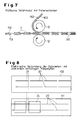
- conductive adhesives When using conductive adhesives, they are preferably so-called Glue beads (gluing, basic technology applications, manual Kunststoff training seminar Axel Springer Verlag Berlin, Heidelberg 1997) (20) positioned directly on the inside of the plastic adhesive layer (102, 111) so that during lamination directly onto the corresponding contacts of the solar cells (24) meet and have an overlap area (21), the serial connection of the solar cells (see Fig. 8). This allows soldering before Laminating is eliminated, and the electrical connection and encapsulation are carried out in one step.
- Glue beads glue, basic technology applications, manual Kunststoff training seminar Axel Springer Verlag Berlin, Heidelberg 1997)
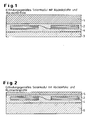
- the solar module according to the invention preferably consists of a front, transparent cover (1, 5), an adhesive layer enveloping the solar cells (4) (2) and a back (3, 6), which can be opaque or transparent (see Fig. 1 and Fig. 2).
- the cover should have the following properties: high transparency from 350 nm to 1 150 nm, high impact strength, UV and weather stability, low water vapor permeability.
- the cover (1, 5) can consist of the following materials: glass, polycarbonate, Polyester, polyvinyl chloride, fluorine-containing polymers, thermoplastic polyurethanes or any combination of these materials.
- the cover (1, 5) can be designed as a plate, film or composite film.
- the back (3, 6) should be weatherproof be a low water vapor permeability as well as a high electrical Exhibit resistance.
- the back can also be made of polyamide, ABS or another weather-resistant Plastic or one on the inside with an electrically insulating layer provided metal plate or foil.
- the back (3, 6) can be used as a plate, Foil or composite film can be designed.
- the adhesive layer (2) should have the following properties: high transparency of 350 nm to 1 150 nm, good adhesion to silicon, the aluminum back contact the solar cell, the tinned front contacts, the antireflection layer of the Solar cell and the material of the cover or the back.
- the adhesive layer can consist of one or more adhesive films on the cover and / or the back can be laminated.
- the adhesive films (2) should be soft to the tensions caused by the different thermal expansion coefficient of plastic and silicon arise to balance.
- the adhesive films (2) should have an modulus of elasticity of less than 200 MPa and more than 1 MPa, preferably less than 140 MPa and more than 10 MPa have and a melting point below the melting temperature of the solder joints of solar cells, typically 180 ° C to 220 ° C or heat resistance the electrically conductive adhesives, typically above 200 ° C.
- the adhesive film should also have a high electrical resistance, low Water absorption, high resistance to UV radiation and thermal oxidation have, be chemically inert and easy to process without crosslinking.
- the cover and the back made of plastic films or sheets.
- the total thickness of the cover and back is at least 2 mm, preferably at least 3 mm. Thereby the solar cells are adequately protected against mechanical influences.
- the gluing consists of at least one adhesive film made of a thermoplastic polyurethane with a total thickness of 300 to 1,000 ⁇ m.
- Another preferred embodiment of the invention is a solar module in which Cover and back made of foils with a thickness of less than 1 mm from the above materials exist, the composite on a suitable Metal or plastic support is fixed, which gives the whole the necessary rigidity.
- the plastic carrier is particularly preferably a glass fiber-reinforced one Plastic.
- Another preferred embodiment of the invention is a solar module in which the cover from a film with a thickness of less than 1 mm from the above mentioned materials and the back of a twin-wall sheet Plastic to increase stiffness while significantly reducing weight.
- the cover is made (103) and / or the rear side (113) made of strip-shaped foils and plates, that are exactly the size of a solar cell string. These are at a distance of a few millimeters to centimeters fixed on the adhesive film 102 or 111, so that an area between the strings only with adhesive film without cover or back exists, e.g. can serve as a film hinge (131) (see Fig. 7).
- a film hinge 131
- Such a thing Solar module is either foldable and / or rollable, making it easier, for example is transportable.
- This solar module made of light weight is particularly preferred Plastic constructed so that it is in the camping area, in the outdoor area or at other mobile applications such as cell phones, laptops etc. are used.
- Another object of the invention is a method for producing the invention Photovoltaic modules, which are characterized in that the Photovoltaic modules in a vacuum plate laminator (vacuum hot press) or in a roll laminator.
- the lamination temperature is preferably at least 20 ° C. and at most 40 ° C. above the softening temperature T Erw of the thermoplastic polyurethane used.
- a composite consisting of a cover plate or cover film is preferred and a plastic adhesive film, a solar cell string and a composite from a rear film or plate and a plastic adhesive film over one Roll laminator skillfully pressed and glued to the solar module.
- a roll laminator consists of at least two counter-rotating rollers that engage with rotate at a defined speed and one with a defined pressure Press the composite of different materials together at a defined temperature.
- the first step Laminates from a plate or film (101) and the adhesive film (102) in a roll laminator (12) (see Fig. 3).
- This roll laminator can directly located behind the extruder for extruding the films.
- the second Step in a roll laminator (12) following composites / layers one above the other introduced: composite of cover (101) with adhesive film (102); Solar strings (4); Composite from the back (112) with adhesive film (111) (see Fig. 4).
- the adhesive films are each laminated to the inside of the cover or the back or co-extruded.
- the feed rate at which the films are processed in a roll laminator is preferably 0.1 m / min to 3 m / min, particularly preferred 0.2 m / min to 1 m / min.
- the solar module manufactured as an endless solar module i.e. the cover (10), rear (11) and Solar cell strings (14) in an endless process through the roll laminator (12) are glued together (see Fig. 5).
- the soldered or glued are Solar cell strings across the lamination on the backsheets positioned. Before the strings come to the roller, they become right and left with the previous or subsequent string in a manner familiar to the person skilled in the art Way soldered (15) or connected with conductive adhesives. So any one can long module. After the module is laminated, it can be in different lengths can be divided, the width always being the string length (17) and the length corresponds to a multiple of the string width (18).
- the modules are cut with a cutter along lines (16) (see Fig. 6).
- Aliphatic and cycloaliphatic diisocyanates can be used as aliphatic diisocyanates (A) or mixtures of these diisocyanates can be used (cf. HOUBEN-WEYL "Methods of Organic Chemistry", Volume E20 “Macromolecular Substances”, Georg Thieme Verlag, Stuttgart, New York 1987, pp. 1587-1593 or Justus Liebigs Annalen der Chemie, 562, pages 75 to 136).
- aliphatic diisocyanates such as ethylene diisocyanate, 1,4-tetramethylene diisocyanate, 1,6-hexamethylene diisocyanate, 1,12-dodecane diisocyanate; cycloaliphatic diisocyanates such as isophorone diisocyanate, 1,4-cyclohexane diisocyanate, 1-methyl-2,4-cyclohexane diisocyanate and 1-methyl-2,6-cyclohexane diisocyanate as well as the corresponding isomer mixtures, 4,4'-dicyclohexylmethane diisocyanate, 2,4'-dicyclohexylmethane diisocyanate and 2,2'-dicyclohexylmethane diisocyanate as well as the corresponding mixtures of isomers.
- aliphatic diisocyanates such as ethylene diisocyanate, 1,4-tetramethylene diisocyanate, 1,6
- 1,6-hexamethylene diisocyanate, 1,4-cyclohexane diisocyanate, isophorone diisocyanate and dicyclohexylmethane diisocyanate and their isomer mixtures Preferably used 1,6-hexamethylene diisocyanate, 1,4-cyclohexane diisocyanate, isophorone diisocyanate and dicyclohexylmethane diisocyanate and their isomer mixtures.
- the diisocyanates mentioned can be used individually or in the form of mixtures among themselves. You can also join up to 15 Mol% (calculated on total diisocyanate) of a polyisocyanate used be, but at most as much polyisocyanate may be added that one more thermoplastic processable product is created.
- Zerewitinoff-active polyols (B) which are used according to the invention are those with an average of at least 1.8 to at most 3.0 zerewitinoff-active hydrogen atoms and a number average molecular weight M n from 600 to 10,000, preferably 600 to 6000.
- thiol groups or carboxyl group-containing compounds in particular two to three, preferably two, hydroxyl group-containing compounds are included, especially those with number average molecular weights M n from 600 to 10,000, particularly preferably those with a number average molecular weight M n from 600 to 6000; eg hydroxyl-containing polyesters, polyethers, polycarbonates and polyester amides.
- Suitable polyether diols can be prepared by reacting one or more alkylene oxides having 2 to 4 carbon atoms in the alkylene radical with a starter molecule which contains two active hydrogen atoms bonded.
- alkylene oxides are: ethylene oxide, 1,2-propylene oxide, epichlorohydrin and 1,2-butylene oxide and 2,3-butylene oxide. Ethylene oxide, propylene oxide and mixtures of 1,2-propylene oxide and ethylene oxide are preferably used.
- the alkylene oxides can be used individually, alternately in succession or as mixtures.
- starter molecules are: water, amino alcohols, such as N-alkyl-diethanolamines, for example N-methyl-diethanolamine, and diols such as ethylene glycol, 1,3-propylene glycol, 1,4-butanediol and 1,6-hexanediol. If appropriate, mixtures of starter molecules can also be used.
- Suitable polyetherols are also the hydroxyl-containing polymerization products of tetrahydrofuran.
- Trifunctional polyethers can also be used in proportions of 0 to 30% by weight, based on the bifunctional polyethers, but at most in such an amount that a product which can still be processed thermoplastically is produced.
- the substantially linear polyether diols preferably have number average molecular weights M n from 600 to 10,000, particularly preferably 600 to 6000. They can be used both individually and in the form of mixtures with one another.
- Suitable polyester diols can be prepared, for example, from dicarboxylic acids having 2 to 12 carbon atoms, preferably 4 to 6 carbon atoms, and polyhydric alcohols.
- suitable dicarboxylic acids are: aliphatic dicarboxylic acids such as succinic acid, glutaric acid, adipic acid, suberic acid, azelaic acid and sebacic acid, or aromatic dicarboxylic acids such as phthalic acid, isophthalic acid and terephthalic acid.
- the dicarboxylic acids can be used individually or as mixtures, for example in the form of a mixture of succinic, glutaric and adipic acids.
- polyester diols it may be advantageous to use the corresponding dicarboxylic acid derivatives, such as carboxylic acid diesters having 1 to 4 carbon atoms in the alcohol radical, carboxylic acid anhydrides or carboxylic acid chlorides, instead of the dicarboxylic acids.
- dicarboxylic acid derivatives such as carboxylic acid diesters having 1 to 4 carbon atoms in the alcohol radical, carboxylic acid anhydrides or carboxylic acid chlorides, instead of the dicarboxylic acids.
- polyhydric alcohols are glycols with 2 to 10, preferably 2 to 6, carbon atoms, for example ethylene glycol, diethylene glycol, 1,4-butanediol, 1,5-pentanediol, 1,6-hexanediol, 1,10-decanediol, 2,2- Dimethyl-1,3-propanediol, 1,3-propanediol or dipropylene glycol.
- the polyhydric alcohols can be used alone or as a mixture with one another.
- esters of carbonic acid with the diols mentioned in particular those with 4 to 6 carbon atoms, such as 1,4-butanediol or 1,6-hexanediol, condensation products of ⁇ -hydroxycarboxylic acids such as ⁇ -hydroxycaproic acid or polymerization products of lactones, for example optionally substituted ⁇ caprolactones.
- polyester diols are ethanediol polyadipates, 1,4-butanediol polyadipates, ethanediol-1,4-butanediol polyadipates, 1,6-hexanediol-neopentylglycol polyadipates, 1,6-hexanediol-1,4-butanediol polyadipates and polycaprolactones.
- the polyester diols have average molecular weights M n from 600 to 10,000, particularly preferably 600 to 6000, and can be used individually or in the form of mixtures with one another.
- Zerewitinoff-active polyols are so-called chain extenders and have on average 1.8 to 3.0 zerewitinoff-active hydrogen atoms and have one number average molecular weight from 60 to 500. This means in addition to Compounds containing amino groups, thiol groups or carboxyl groups those with two to three, preferably two hydroxyl groups.
- Aliphatic diols with 2 to 14 are preferably used as chain extenders
- Carbon atoms used e.g. Ethanediol, 1,2-propanediol, 1,3-propanediol, 1,4-butanediol, 2,3-butanediol, 1,5-pentanediol, 1,6-hexanediol, diethylene glycol and Dipropylene.
- diesters of terephthalic acid with glycols are also suitable with 2 to 4 carbon atoms, e.g.
- 1,4-di ( ⁇ -hydroxyethyl) -bisphenol A (cyclo) aliphatic diamines, such as isophoronediamine, ethylenediamine, 1,2-propylenediamine, 1,3-propylenediamine, N-methyl-propylene-1,3-diamine, N, N'-dimethylethylenediamine and aromatic diamines, such as 2,4-toluenediamine, 2,6-toluenediamine, 3,5-diethyl-2,4-toluenediamine or 3,5-diethyl-2,6-toluenediamine or primary mono-, di-, tri- or tetraalkyl-substituted 4,4'-diaminodiphenylmethanes.
- aromatic diamines such as 2,4-toluenediamine, 2,6-toluenediamine, 3,5-diethyl-2,4-toluenediamine or 3,5-diethyl-2,6-toluened
- Particularly preferred chain extenders are ethanediol, 1,4-butanediol, 1,6-hexanediol, 1,4-di ( ⁇ -hydroxyethyl) hydroquinone or 1,4-di ( ⁇ -hydroxyethyl) bisphenol A used. Mixtures of the chain extenders mentioned above can also be used be used. Smaller amounts of triplets can also be used be added.
- Compounds which are monofunctional with respect to isocyanates can contain up to 2 % By weight, based on aliphatic thermoplastic polyurethane, as so-called Chain breakers are used.
- Suitable are e.g. Monoamines such as butyl and Dibutylamine, octylamine, stearylamine, N-methylstearylamine, pyrrolidine, piperidine or cyclohexylamine, monoalcohols such as butanol, 2-ethylhexanol, octanol, Dodecanol, stearyl alcohol, the various amyl alcohols, cyclohexanol and Ethylene glycol monomethyl ether.
- Monoamines such as butyl and Dibutylamine, octylamine, stearylamine, N-methylstearylamine, pyrrolidine, piperidine or cyclohexylamine, monoalcohols such as butanol, 2-
- the relative amounts of the compounds (B) and (C) are preferably chosen so that that the ratio of the sum of the isocyanate groups in (A) to the sum of the zerewitinoffactive Hydrogen atoms in (B) and (C) is 0.85: 1 to 1.2: 1, preferred 0.95: 1 to 1.1: 1.
- thermoplastic polyurethane elastomers (TPU) used according to the invention can be used as auxiliaries and additives (D) up to a maximum of 20 wt .-%, based on the Total amount of TPU, which contains the usual auxiliaries and additives.
- auxiliaries and additives are catalysts, pigments, dyes, flame retardants, Stabilizers against aging and weather influences, plasticizers, Lubricant and mold release agent, fungistatic and bacteriostatic substances as well as fillers and their mixtures.
- Suitable catalysts are those known from the prior art and usual tertiary amines, e.g. Triethylamine, dimethylcyclohexylamine, N-methylmorpholine, N, N'-dimethylpiperazine, 2- (dimethylamino-ethoxy) ethanol, diazabicyclo [2.2.2] octane and similar and in particular organic metal compounds such as titanium acid esters, iron compounds or tin compounds such as tin diacetate, Tin dioctoate, tin dilaurate or the tin dialkyl salts of aliphatic carboxylic acids such as dibutyltin diacetate or dibutyltin dilaurate or the like.
- tertiary amines e.g. Triethylamine, dimethylcyclohexylamine, N-methylmorpholine, N, N'-dimethylpiperazine, 2- (dimethylamino-ethoxy) ethanol, di
- Catalysts are organic metal compounds, especially titanium acid esters, Iron and tin compounds.
- the total amount of catalysts in the TPU is usually about 0 to 5 wt .-%, preferably 0 to 2 wt .-%, based on the Total amount of TPU.
- lubricants such as fatty acid esters, their metal soaps, Fatty acid amides, fatty acid ester amides and silicone compounds, antiblocking agents, Inhibitors, stabilizers against hydrolysis, light, heat and discoloration, Flame retardants, dyes, pigments, inorganic and / or organic fillers and reinforcing agents.
- Reinforcing agents are in particular fibrous reinforcing materials such as. inorganic fibers manufactured according to the state of the art be and can also be applied with a size. More details About the auxiliaries and additives mentioned are the specialist literature, for example the monograph by J.H. Saunders and K.C.
- thermoplastics for example polycarbonates and acrylonitrile / butadiene / styrene terpolymers, in particular SECTION.
- elastomers such as rubber, ethylene / vinyl acetate copolymers, Styrene / butadiene copolymers as well as other TPUs can be used.
- plasticizers such as phosphates are also suitable for incorporation. Phthalates, adipates, sebacates and alkyl sulfonic acid esters.
- the TPU can be produced batchwise or continuously become.
- the TPU can be used continuously with the mixing head / belt process, for example or the so-called extruder process.
- the extruder process e.g. in a multi-screw extruder, the dosage of the components A), B) and C) simultaneously, i.e. in the oneshot process, or one after the other, i.e. by a prepolymer process.
- the prepolymer can both presented batchwise as well as continuously in a part of the extruder or in a separate, upstream prepolymer unit.
- a film was extruded from a Texin® DP7-3007 (commercial product from Bayer Corp., hardness: 58 Shore D) onto a Makrofol® film as follows: A vertical nozzle arrangement was attached to an extruder with a roller system from Reifen Reifenberger (with a chill roll). An impression roller with a rubberized surface was located in front of the casting roller of the system. The nozzle was positioned between the casting roller and the impression roller. To achieve a very slow take-off speed for this "chill-roll" system, the film composite was only pulled off by a winder.
- the Makrofol® film DE 1-1 was preheated with IR emitters before the melt was fed in.
- the Texin® was pre-dried for 6 hours at 60 ° C in a dry air dryer.
- the composite film produced in this way was then laminated onto one another in a roll laminator as a cover with the Texin® side down and as a back with the Texin® side up with solar cell strings attached in between, using rolls at 160 ° C.
- the composite films were preheated with an IR radiator for optimal bonding.
- the transport speed of the roll laminator was 0.3 m / min.
- the 15 x 15 cm 2 modules could be produced in 30 seconds.
- the solar modules were weathered in two different tests. The efficiencies before and after weathering are given in the table.
- Desmopan® 88382 (commercial product from Bayer AG, hardness: 80 Shore A) became extruded a film as follows:
- the film thus produced was then used as an adhesive film in a solar module as described in FIG. 1.
- the front of the 15 x 15 cm 2 module consisted of hardened white glass and the back of a Tedlar-PET-Tedlar composite film.
- the solar modules were produced at 150 ° C. in a vacuum laminator within 10 minutes.
- the solar modules were weathered in two different tests. The efficiencies before and after weathering are given in the table.
- Comparison modules (comparison module 1 and 2) were produced. Instead of the Texin® DP7-3007, EVA (ethyl vinyl acetate) was used as an adhesive film. The production time of the 15 x 15 cm 2 modules was 20 minutes and was carried out in a vacuum laminator. The comparison modules were also weathered (see table). module Efficiency before weathering Efficiency after weathering in a climate change test (IEC 6 12 15) Efficiency after weathering in the Damp Heat Test (IEC 6 12 15) 1 13.8% 13.7% - 2 13.3% 13.5% - 3 13.5% - 13.5% 4 15.2% 15.1% - 5 14.7% - 14.8% Comparison 1 13.2% 13.3% - Comparison 2 13.9% - 14.1%
- the measurement error when determining the efficiency is ⁇ 0.3% absolute.
- the efficiency is measured according to IEC 6 12 15.
- the solar modules according to the invention have the same efficiencies as that Comparison modules (state of the art) and have the same mechanical stability as well as weather stability. The efficiency remains even after weathering receive.
- the solar modules according to the invention could be significantly faster (factor 40 in the roll laminator and factor 2 in the vacuum laminator) Compare modules.
Landscapes
- Chemical & Material Sciences (AREA)
- Organic Chemistry (AREA)
- Laminated Bodies (AREA)
- Photovoltaic Devices (AREA)
- Adhesives Or Adhesive Processes (AREA)
- Electroluminescent Light Sources (AREA)
- Polyurethanes Or Polyureas (AREA)
Abstract
Description
Auf einem Extruder mit einer Walzenanlage der Fa. Reifenhäuser (mit einer Kühlwalze (Chill roll)) wurde eine vertikale Düsenanordnung angebracht. Vor der Gießwalze der Anlage befand sich eine Presseurwalze mit gummierter Oberfläche. Die Düse wurde zwischen Gießwalze und Presseurwalze positioniert. Zur Erreichung einer für diese "Chill-roll"-Anlage sehr langsamen Abzugsgeschwindigkeit wurde der Folien-Verbund nur durch einen Wickler abgezogen. Zur Verbesserung der Haftung der Texin®-Schmelze auf der eingesetzten Makrofol®-Folie DE 1-1 (mit einer Dicke von 375 µm (Handelsprodukt der Bayer AG)) wurde die Makrofol®-Folie vor Zulauf der Schmelze mit IR-Strahlern vorgeheizt. Das Texin® wurde 6 h bei 60°C im Trockenlufttrockner vorgetrocknet.
| Düsentemperatur | 180°C |
| Massetemperatur des Texins® | 186°C |
| Druck vor der Düse | 75 bar |
| Drehzahl des Extruders | 80 UpM |
| Temperatur an der Gießwalze | 20°C |
| Temperatur an der Kühlwalze (Chill roll) | 10°C |
| Abzugsgeschwindigkeit | 3 m/min |
| Düsentemperatur | 170°C |
| Massetemperatur des Desmopans® | 177°C |
| Druck vor der Düse | 27 bar |
| Drehzahl des Extruders | 40 UpM |
| Temperatur an der Kühlwalze (Chill roll) | 10°C |
| Abzugsgeschwindigkeit | 1,7 m/min |
| Modul | Wirkungsgrad vor Bewitterung | Wirkungsgrad nach Bewitterung im Klimawechsel Test (IEC 6 12 15) | Wirkungsgrad nach Bewitterung im Damp Heat Test (IEC 6 12 15) |
| 1 | 13,8% | 13,7% | - |
| 2 | 13,3% | 13,5% | - |
| 3 | 13,5% | - | 13,5% |
| 4 | 15,2% | 15,1% | - |
| 5 | 14,7% | - | 14,8% |
| Vergleich 1 | 13,2 % | 13,3 % | - |
| Vergleich 2 | 13,9% | - | 14,1% |
Der Wirkungsgrad wird nach IEC 6 12 15 gemessen.
Claims (10)
- Photovoltaik-Moldule mit folgendem Aufbaudadurch gekennzeichnet, dass die Kunststoffklebeschicht in B) aus einem aliphatischen thermoplastischen Polyurethan mit einer Härte von 75 Shore A bis 70 Shore D und mit einer Erweichungstempeeratur Terw von 90°C bis 150°C bei einem E'-Modul von 2 MPa (gemessen nach der DMS-Methode) besteht, welches ein Reaktionsprodukt ist aus einem aliphatischen Diisocyanat (A), mindestens einem zerewitinoff-aktiven Polyol mit im Mittel mindestens 1,8 bis höchstens 3,0 zerewitinoff-aktiven Wasserstoffatomen und mit einem zahlenmittleren Molekulargewicht von 600 bis 10000 g/mol (B) und mindestens einem zerewitinoff-aktiven Polyol mit im Mittel mindestens 1,8 bis höchstens 3,0 zerewitinoff-aktiven Wasserstoffatomen und mit einem zahlenmittleren Molekulargewicht von 60 bis 500 g/mol als Kettenverlängerer (C), wobei das Molverhältnis der NCO-Gruppen des aliphatischen Diisocyanats zu den zerewitinoff-aktiven Wasserstoffatomen aus (B) und (C) 0,85 bis 1,2, bevorzugt 0,9 bis 1,1 beträgt.A) mindestens einer vorderseitigen, der Energiequelle zugewandten, äußeren Abdeckschicht aus Glas oder einem schlagzähen, UV-stabilen, witterungsstabilen, transparenten Kunststoff mit geringer Wasserdampfdurchlässigkeit,B) mindestens einer zwischen A) und C) befindlichen Kunststoffklebeschicht, in die mindestens eine oder mehrere Solarzellen, die untereinander elektrisch verbunden sind, eingebettet sind,C) mindestens einer rückseitigen, der Energiequelle abgewandten, äußeren Schicht aus Glas oder einem witterungsstabilen Kunststoff mit niedriger Wasserdampfdurchlässigkeit,
- Photovoltaik-Modul gemäß Anspruch 1, dadurch gekennzeichnet, dass die Abdeckschicht A) aus einer Platte oder aus einer oder mehreren Folien besteht.
- Photovoltaik-Modul gemäß Anspruch 1, dadurch gekennzeichnet, dass die Schicht C) aus einer Platte oder aus einer oder mehreren Folien besteht.
- Photovoltaik-Modul gemäß Anspruch 1, dadurch gekennzeichnet, dass es sich bei der Abdeckschicht A) um eine in Streifen vorliegende Folie oder Platte handelt, wobei die Streifen über den sogenannten Solarzellenstrings angeordnet sind.
- Photovoltaik-Modul gemäß Anspruch 1, dadurch gekennzeichnet, dass die in der Kunststoffklebeschicht B) eingebetteten Solarzellen in Solarzellenstrings angeordnet sind.
- Photovoltaik-Modul gemäß Anspruch 5, dadurch gekennzeichnet, dass die Solarzellenstrings seriell hintereinander verlötet oder mit leitfähigen Klebstoffen verbunden sind.
- Photovoltaik-Modul gemäß Anspruch 5, dadurch gekennzeichnet, dass die elektrische Verbindung zwischen den Solarzellen aus leitfähigen Klebstoffen besteht, die vorzugsweise als Raupen direkt auf der Innenseite der Klebschicht (B) angebracht sind, so dass sie beim Laminieren direkt auf die entsprechenden Kontakte der Solarzellen treffen.
- Photovoltaik-Modul gemäß einem oder mehrerer der Ansprüche 1 bis 7, dadurch gekennzeichnet, dass in der Kunststoffklebeschicht (B) zwischen Abdeckschicht (A) und den Solarzellen zusätzlich eine Glasfolie mit einer Dicke von weniger als 500 µm vorhanden ist.
- Verfahren zur Herstellung der Photovoltaik-Module gemäß einem der Ansprüche 1 bis 8, dadurch gekennzeichnet, dass das Photovoltaik-Modul in einem Vakuumplattenlaminator (Vakuumheißpresse) oder in einem Rollenlaminator hergestellt wird.
- Verfahren gemäß Anspruch 9, dadurch gekennzeichnet, dass ein Verbund bestehend aus einer Abdeckplatte oder Abdeckfolie A) und einer Kunststoffklebefolie B), einem Solarzellenstring sowie ein Verbund bestehend aus einer rückseitigen Folie oder Platte und einer Kunststoffklebefolie über einen Rollenlaminator geschickt werden und dabei zum Solarmodul gepresst und verklebt werden.
Priority Applications (1)
| Application Number | Priority Date | Filing Date | Title |
|---|---|---|---|
| DE20220444U DE20220444U1 (de) | 2001-10-12 | 2002-09-30 | Photovoltaik-Module mit einer thermoplastischen Schmelzklebeschicht |
Applications Claiming Priority (2)
| Application Number | Priority Date | Filing Date | Title |
|---|---|---|---|
| DE10150515 | 2001-10-12 | ||
| DE10150515 | 2001-10-12 |
Publications (2)
| Publication Number | Publication Date |
|---|---|
| EP1302988A2 true EP1302988A2 (de) | 2003-04-16 |
| EP1302988A3 EP1302988A3 (de) | 2007-01-24 |
Family
ID=7702356
Family Applications (1)
| Application Number | Title | Priority Date | Filing Date |
|---|---|---|---|
| EP02021860A Withdrawn EP1302988A3 (de) | 2001-10-12 | 2002-09-30 | Photovoltaik-Module mit einer thermoplastischen Schmelzklebeschicht sowie ein Verfahren zu ihrer Herstellung |
Country Status (8)
| Country | Link |
|---|---|
| US (2) | US20030075210A1 (de) |
| EP (1) | EP1302988A3 (de) |
| JP (1) | JP2003188402A (de) |
| KR (1) | KR100902975B1 (de) |
| CN (1) | CN1316635C (de) |
| AU (1) | AU2002301252B2 (de) |
| CA (1) | CA2406966A1 (de) |
| MX (1) | MXPA02010070A (de) |
Cited By (32)
| Publication number | Priority date | Publication date | Assignee | Title |
|---|---|---|---|---|
| WO2007109283A3 (en) * | 2006-03-21 | 2007-12-21 | Du Pont | Encapsulants for electronic components |
| EP1909334A1 (de) | 2006-10-06 | 2008-04-09 | Schreiner Group GmbH & Co. KG | Verfahren und Folienverbund zum Kontaktieren und Abdichten eines Solarmoduls |
| EP2123420A2 (de) | 2008-05-21 | 2009-11-25 | Tesa AG | Verfahren zur Verkapselung von optoelektronischen Bauteilen |
| DE102008030652A1 (de) | 2008-06-27 | 2009-12-31 | Dracowo Forschungs- Und Entwicklungs Gmbh | Stoffe und Verfahren zur Herstellung Photovoltaik aktiver Fassadenelemente |
| WO2010004599A1 (en) | 2008-07-10 | 2010-01-14 | Enecom Italia S.R.L. | Flexible photovoltaic panel and process for manufacturing such panel |
| DE102008037814A1 (de) * | 2008-08-14 | 2010-02-25 | Bayer Materialscience Ag | Photovoltaisches Solarmodul |
| DE102008049890A1 (de) * | 2008-10-02 | 2010-04-22 | Webasto Ag | Photovoltaische Anordnung und Verfahren zur Herstellung der photovoltaischen Anordnung |
| DE102008062286A1 (de) * | 2008-12-03 | 2010-06-10 | P-D Industriegesellschaft mbH Betriebsstätte: Werk Bitterfeld-Laminate | Solarmodul |
| DE102009023901A1 (de) * | 2009-06-04 | 2010-12-16 | Fraunhofer-Gesellschaft zur Förderung der angewandten Forschung e.V. | Photovoltaisches Modul mit flächigem Zellverbinder |
| DE102009025275A1 (de) * | 2009-06-15 | 2010-12-30 | Kerafol Keramische Folien Gmbh | Solarzellenmodul |
| DE102009031600A1 (de) * | 2009-07-07 | 2011-01-13 | Fraunhofer-Gesellschaft zur Förderung der angewandten Forschung e.V. | Photovoltaikmodul und Verfahren zur Herstellung eines Photovoltaikmoduls |
| WO2011039299A2 (de) | 2009-10-01 | 2011-04-07 | Bayer Materialscience Ag | Herstellung von solarmodulen |
| DE102008020458B4 (de) * | 2008-04-23 | 2011-06-22 | Sunnyside upP GmbH, 51069 | Verfahren und Vorrichtung zum Herstellen eines Solarzellenstrings |
| EP1699090A4 (de) * | 2003-12-25 | 2011-09-07 | Sharp Kk | Verfahren und vorrichtung zur herstellung eines solarbatteriemoduls |
| DE202010005555U1 (de) | 2010-06-02 | 2011-10-05 | Kuka Systems Gmbh | Solarmodul und Fertigungseinrichtung |
| WO2011131346A2 (de) | 2010-04-21 | 2011-10-27 | Muehlbauer Ag | Verfahren und vorrichtung zur herstellung eines solarmoduls mit flexiblen dünnschicht-solarzellen und ein solarmodul mit flexiblen dünnschicht-solarzellen |
| WO2011151430A2 (de) | 2010-06-02 | 2011-12-08 | Kuka Systems Gmbh | Fertigungseinrichtung und verfahren |
| CN102275363A (zh) * | 2011-05-26 | 2011-12-14 | 宁波华丰包装有限公司 | 低收缩率太阳能电池封装用eva/pc复合胶膜 |
| CN102285175A (zh) * | 2011-05-26 | 2011-12-21 | 宁波华丰包装有限公司 | 低收缩率太阳能电池封装用层状复合eva胶膜 |
| DE102010041134A1 (de) * | 2010-09-21 | 2012-03-22 | Siemens Aktiengesellschaft | Rahmenloses Photovoltaik-Modul, Halbzeug und Herstellverfahren für ein rahmenloses Photovoltaik-Modul |
| DE102011101021A1 (de) * | 2011-05-10 | 2012-05-10 | Eisenmann Ag | Fotovoltaikmodul und Verfahren zu dessen Herstellung |
| WO2013009309A1 (en) * | 2011-07-13 | 2013-01-17 | Voelkner Harold E | A long-lasting, high power density and flexible pv crystalline cell panel |
| US8381466B2 (en) | 2008-04-04 | 2013-02-26 | Bayer Materialscience Ag | Photovoltaic solar module having a polyurethane frame |
| DE102011053030A1 (de) * | 2011-08-26 | 2013-02-28 | Bayer Materialscience Aktiengesellschaft | Solarmodul und Verfahren zu seiner Herstellung |
| WO2013037640A1 (de) * | 2011-09-15 | 2013-03-21 | Evonik Industries Ag | Verfahren zur herstellung eines laminats aus photovoltaik- zellen und pressure sensitive adhesive-folien mittels eines release-films |
| DE102011085587A1 (de) * | 2011-11-02 | 2013-05-02 | Evonik Industries Ag | Glas - Photovoltaik - Pressure sensitive Adhesive-Verbund |
| CN104882500A (zh) * | 2015-05-15 | 2015-09-02 | 苏州市亘晟涂装工程有限公司 | 太阳能电池 |
| CN109535379A (zh) * | 2018-12-14 | 2019-03-29 | 锦西化工研究院有限公司 | 一种透明聚氨酯聚合物及其制备方法 |
| WO2019068934A1 (en) * | 2017-10-06 | 2019-04-11 | Dsm Ip Assets B.V. | ELECTROCONDUCTIVE BACK SHEET COMPRISING ALUMINUM LAYER AND METALLIC LAYER |
| US10453982B2 (en) | 2015-12-24 | 2019-10-22 | Toyota Jidosha Kabushiki Kaisha | Solar battery module |
| DE102018209112A1 (de) * | 2018-06-08 | 2019-12-12 | Audi Ag | Photovoltaisch aktives Laminat |
| DE102024116275A1 (de) * | 2024-06-11 | 2025-12-11 | Reflexa-Werke Albrecht Gmbh | Lamelle einer Beschattungseinrichtung, Beschattungseinrichtung sowie Verwendung von mindestens einem Photovoltaikmodul zur Stromerzeugung auf einer Lamelle einer Beschattungseinrichtung |
Families Citing this family (200)
| Publication number | Priority date | Publication date | Assignee | Title |
|---|---|---|---|---|
| US20050230350A1 (en) | 2004-02-26 | 2005-10-20 | Applied Materials, Inc. | In-situ dry clean chamber for front end of line fabrication |
| CN100356586C (zh) * | 2004-03-23 | 2007-12-19 | 中国科学院等离子体物理研究所 | 大面积内部串联染料敏化纳米薄膜太阳电池及其制作方法 |
| CN100356587C (zh) * | 2004-03-23 | 2007-12-19 | 中国科学院等离子体物理研究所 | 大面积内部并联染料敏化纳米薄膜太阳电池及其制作方法 |
| DE102004036549B3 (de) * | 2004-07-28 | 2006-03-30 | Bayer Materialscience Ag | Lichtemittierendes, transparentes Foliensystem auf Polymerbasis und Verfahren zu seiner Herstellung |
| DE102004060799A1 (de) * | 2004-12-17 | 2006-06-29 | Bayer Materialscience Ag | Thermoplastische Polyurethane und deren Verwendung |
| CN101931016A (zh) * | 2005-01-27 | 2010-12-29 | 太阳能改造有限公司 | 半导体条带的模块子组件 |
| CN101138095B (zh) * | 2005-03-08 | 2010-10-06 | 三井-杜邦聚合化学株式会社 | 太阳能电池密封材料 |
| JP4658646B2 (ja) * | 2005-03-11 | 2011-03-23 | 三井化学株式会社 | 太陽電池モジュール用保護シートおよび太陽電池モジュール。 |
| WO2006122376A1 (en) * | 2005-05-20 | 2006-11-23 | Origin Energy Solar Pty Ltd | Flexible photovoltaic panel of elongated semiconductor strips |
| EP2056358B1 (de) * | 2005-10-21 | 2012-03-28 | Ubbink B.V. | Photovoltaikmodul mit einem Halterahmen aus Kunstoff |
| JP4667406B2 (ja) * | 2006-03-30 | 2011-04-13 | 三洋電機株式会社 | 太陽電池モジュール及びその製造方法 |
| JP4663664B2 (ja) * | 2006-03-30 | 2011-04-06 | 三洋電機株式会社 | 太陽電池モジュール |
| US7666466B2 (en) * | 2006-05-03 | 2010-02-23 | Michael Gumm | Elastomeric waterproofing and weatherproofing photovoltaic finishing method and system |
| DE102006048216A1 (de) * | 2006-10-11 | 2008-04-17 | Wacker Chemie Ag | Laminate mit thermoplastischen Polysiloxan-Harnstoff-Copolymeren |
| DE102007005845A1 (de) * | 2007-02-01 | 2008-08-07 | Kuraray Europe Gmbh | Verfahren zur Herstellung von Solarmodulen im Walzenverbundverfahren |
| JP2010538475A (ja) * | 2007-08-31 | 2010-12-09 | アプライド マテリアルズ インコーポレイテッド | 多サイズの光起電デバイスを形成するための生産ラインモジュール |
| US20110017263A1 (en) * | 2007-09-05 | 2011-01-27 | Solaria Corporation | Method and device for fabricating a solar cell using an interface pattern for a packaged design |
| CN101431115B (zh) * | 2007-11-07 | 2011-05-18 | E.I.内穆尔杜邦公司 | 太阳能电池板及其制造方法 |
| US20090145478A1 (en) * | 2007-12-07 | 2009-06-11 | Sharp Kabushiki Kaisha | Surface protective sheet for solar cell and solar cell module |
| US20090215215A1 (en) * | 2008-02-21 | 2009-08-27 | Sunlight Photonics Inc. | Method and apparatus for manufacturing multi-layered electro-optic devices |
| ES2401329T3 (es) * | 2008-03-03 | 2013-04-18 | Fraunhofer-Gesellschaft zur Förderung der angewandten Forschung e.V. | Módulo solar con elevada rigidez a la flexión |
| US20090260675A1 (en) * | 2008-04-18 | 2009-10-22 | Serkan Erdemli | Encapsulation of solar modules |
| US20090272436A1 (en) * | 2008-05-05 | 2009-11-05 | Osbert Hay Cheung | Non-glass photovoltaic module and methods for manufacture |
| DE102008028213A1 (de) * | 2008-06-06 | 2009-12-10 | Gebr. Schmid Gmbh & Co. | Verfahren zum Befestigen eines Silizium-Blocks an einem Träger dafür und entsprechende Anordnung |
| US20100065116A1 (en) * | 2008-08-13 | 2010-03-18 | Robert Stancel | Impact Resistant Thin-Glass Solar Modules |
| DE102009005712A1 (de) * | 2009-01-22 | 2010-07-29 | Bayer Materialscience Ag | Polyurethanvergussmassen |
| DE102009005711A1 (de) * | 2009-01-22 | 2010-07-29 | Bayer Materialscience Ag | Polyurethanvergussmassen |
| JP5310436B2 (ja) * | 2009-09-18 | 2013-10-09 | デクセリアルズ株式会社 | 太陽電池モジュール及びその製造方法 |
| EP2538451A4 (de) * | 2010-02-15 | 2016-07-20 | Dexerials Corp | Verfahren zur herstellung eines dünnschicht-solarzellenmoduls |
| KR101381715B1 (ko) | 2010-04-26 | 2014-04-18 | 코오롱인더스트리 주식회사 | 열접착성이 우수한 태양광모듈용 백 시트 및 이의 제조방법 |
| US9324576B2 (en) | 2010-05-27 | 2016-04-26 | Applied Materials, Inc. | Selective etch for silicon films |
| US8394650B2 (en) * | 2010-06-08 | 2013-03-12 | Amerasia International Technology, Inc. | Solar cell interconnection, module and panel method |
| WO2011160257A1 (en) * | 2010-06-24 | 2011-12-29 | Applied Materials, Inc. | Method and apparatus for bonding composite solar cell structure |
| JP5423608B2 (ja) * | 2010-07-29 | 2014-02-19 | デクセリアルズ株式会社 | 太陽電池モジュール及びその製造方法 |
| EP2611611A4 (de) * | 2010-08-31 | 2015-06-10 | Saint Gobain Performance Plast | Gemusterte schutzfolie |
| DE102010062823A1 (de) * | 2010-12-10 | 2012-06-21 | Tesa Se | Klebmasse und Verfahren zur Kapselung einer elektronischen Anordnung |
| US10283321B2 (en) | 2011-01-18 | 2019-05-07 | Applied Materials, Inc. | Semiconductor processing system and methods using capacitively coupled plasma |
| FI122809B (fi) * | 2011-02-15 | 2012-07-13 | Marimils Oy | Valolähde ja valolähdenauha |
| US8771539B2 (en) | 2011-02-22 | 2014-07-08 | Applied Materials, Inc. | Remotely-excited fluorine and water vapor etch |
| JP2012195561A (ja) * | 2011-03-01 | 2012-10-11 | Dainippon Printing Co Ltd | 太陽電池モジュール用封止材シート |
| US8999856B2 (en) | 2011-03-14 | 2015-04-07 | Applied Materials, Inc. | Methods for etch of sin films |
| US9064815B2 (en) | 2011-03-14 | 2015-06-23 | Applied Materials, Inc. | Methods for etch of metal and metal-oxide films |
| US20140167677A1 (en) * | 2011-07-13 | 2014-06-19 | Harold E. Voelkner | Long-lasting, high power density and flexible photovoltaic (pv) crystalline cell panel, a method for manufacturing the solar panel and integrated solar power generation and supply system |
| US8771536B2 (en) | 2011-08-01 | 2014-07-08 | Applied Materials, Inc. | Dry-etch for silicon-and-carbon-containing films |
| US8679982B2 (en) | 2011-08-26 | 2014-03-25 | Applied Materials, Inc. | Selective suppression of dry-etch rate of materials containing both silicon and oxygen |
| US8679983B2 (en) | 2011-09-01 | 2014-03-25 | Applied Materials, Inc. | Selective suppression of dry-etch rate of materials containing both silicon and nitrogen |
| US8927390B2 (en) | 2011-09-26 | 2015-01-06 | Applied Materials, Inc. | Intrench profile |
| US8808563B2 (en) | 2011-10-07 | 2014-08-19 | Applied Materials, Inc. | Selective etch of silicon by way of metastable hydrogen termination |
| WO2013070436A1 (en) | 2011-11-08 | 2013-05-16 | Applied Materials, Inc. | Methods of reducing substrate dislocation during gapfill processing |
| US8614842B2 (en) * | 2011-11-14 | 2013-12-24 | Prism Solar Technologies Incorporated | Volume hologram replicator for transmission type gratings |
| US20130240019A1 (en) * | 2012-03-14 | 2013-09-19 | Ppg Industries Ohio, Inc. | Coating-encapsulated photovoltaic modules and methods of making same |
| US9267739B2 (en) | 2012-07-18 | 2016-02-23 | Applied Materials, Inc. | Pedestal with multi-zone temperature control and multiple purge capabilities |
| US9373517B2 (en) | 2012-08-02 | 2016-06-21 | Applied Materials, Inc. | Semiconductor processing with DC assisted RF power for improved control |
| KR101460719B1 (ko) * | 2012-08-28 | 2014-11-13 | 엘지전자 주식회사 | 지지 프레임 및 이를 포함하는 태양광 발전 장치 |
| US9034770B2 (en) | 2012-09-17 | 2015-05-19 | Applied Materials, Inc. | Differential silicon oxide etch |
| US9023734B2 (en) | 2012-09-18 | 2015-05-05 | Applied Materials, Inc. | Radical-component oxide etch |
| US9390937B2 (en) | 2012-09-20 | 2016-07-12 | Applied Materials, Inc. | Silicon-carbon-nitride selective etch |
| US9132436B2 (en) | 2012-09-21 | 2015-09-15 | Applied Materials, Inc. | Chemical control features in wafer process equipment |
| US8765574B2 (en) | 2012-11-09 | 2014-07-01 | Applied Materials, Inc. | Dry etch process |
| US8969212B2 (en) | 2012-11-20 | 2015-03-03 | Applied Materials, Inc. | Dry-etch selectivity |
| US8980763B2 (en) | 2012-11-30 | 2015-03-17 | Applied Materials, Inc. | Dry-etch for selective tungsten removal |
| US9064816B2 (en) | 2012-11-30 | 2015-06-23 | Applied Materials, Inc. | Dry-etch for selective oxidation removal |
| US9111877B2 (en) | 2012-12-18 | 2015-08-18 | Applied Materials, Inc. | Non-local plasma oxide etch |
| US8921234B2 (en) | 2012-12-21 | 2014-12-30 | Applied Materials, Inc. | Selective titanium nitride etching |
| US10256079B2 (en) | 2013-02-08 | 2019-04-09 | Applied Materials, Inc. | Semiconductor processing systems having multiple plasma configurations |
| US9362130B2 (en) | 2013-03-01 | 2016-06-07 | Applied Materials, Inc. | Enhanced etching processes using remote plasma sources |
| US9040422B2 (en) | 2013-03-05 | 2015-05-26 | Applied Materials, Inc. | Selective titanium nitride removal |
| US8801952B1 (en) | 2013-03-07 | 2014-08-12 | Applied Materials, Inc. | Conformal oxide dry etch |
| US10170282B2 (en) | 2013-03-08 | 2019-01-01 | Applied Materials, Inc. | Insulated semiconductor faceplate designs |
| US20140271097A1 (en) | 2013-03-15 | 2014-09-18 | Applied Materials, Inc. | Processing systems and methods for halide scavenging |
| US8895449B1 (en) | 2013-05-16 | 2014-11-25 | Applied Materials, Inc. | Delicate dry clean |
| US9114438B2 (en) | 2013-05-21 | 2015-08-25 | Applied Materials, Inc. | Copper residue chamber clean |
| US9493879B2 (en) | 2013-07-12 | 2016-11-15 | Applied Materials, Inc. | Selective sputtering for pattern transfer |
| US9773648B2 (en) | 2013-08-30 | 2017-09-26 | Applied Materials, Inc. | Dual discharge modes operation for remote plasma |
| US8956980B1 (en) | 2013-09-16 | 2015-02-17 | Applied Materials, Inc. | Selective etch of silicon nitride |
| US8951429B1 (en) | 2013-10-29 | 2015-02-10 | Applied Materials, Inc. | Tungsten oxide processing |
| US9236265B2 (en) | 2013-11-04 | 2016-01-12 | Applied Materials, Inc. | Silicon germanium processing |
| US9576809B2 (en) | 2013-11-04 | 2017-02-21 | Applied Materials, Inc. | Etch suppression with germanium |
| US9520303B2 (en) | 2013-11-12 | 2016-12-13 | Applied Materials, Inc. | Aluminum selective etch |
| US9245762B2 (en) | 2013-12-02 | 2016-01-26 | Applied Materials, Inc. | Procedure for etch rate consistency |
| US9117855B2 (en) | 2013-12-04 | 2015-08-25 | Applied Materials, Inc. | Polarity control for remote plasma |
| US9263278B2 (en) | 2013-12-17 | 2016-02-16 | Applied Materials, Inc. | Dopant etch selectivity control |
| US9287095B2 (en) | 2013-12-17 | 2016-03-15 | Applied Materials, Inc. | Semiconductor system assemblies and methods of operation |
| US9190293B2 (en) | 2013-12-18 | 2015-11-17 | Applied Materials, Inc. | Even tungsten etch for high aspect ratio trenches |
| US9287134B2 (en) | 2014-01-17 | 2016-03-15 | Applied Materials, Inc. | Titanium oxide etch |
| US9293568B2 (en) | 2014-01-27 | 2016-03-22 | Applied Materials, Inc. | Method of fin patterning |
| US9396989B2 (en) | 2014-01-27 | 2016-07-19 | Applied Materials, Inc. | Air gaps between copper lines |
| US9385028B2 (en) | 2014-02-03 | 2016-07-05 | Applied Materials, Inc. | Air gap process |
| US9499898B2 (en) | 2014-03-03 | 2016-11-22 | Applied Materials, Inc. | Layered thin film heater and method of fabrication |
| US9299575B2 (en) | 2014-03-17 | 2016-03-29 | Applied Materials, Inc. | Gas-phase tungsten etch |
| US9299538B2 (en) | 2014-03-20 | 2016-03-29 | Applied Materials, Inc. | Radial waveguide systems and methods for post-match control of microwaves |
| US9299537B2 (en) | 2014-03-20 | 2016-03-29 | Applied Materials, Inc. | Radial waveguide systems and methods for post-match control of microwaves |
| US9136273B1 (en) | 2014-03-21 | 2015-09-15 | Applied Materials, Inc. | Flash gate air gap |
| US9903020B2 (en) | 2014-03-31 | 2018-02-27 | Applied Materials, Inc. | Generation of compact alumina passivation layers on aluminum plasma equipment components |
| US9269590B2 (en) | 2014-04-07 | 2016-02-23 | Applied Materials, Inc. | Spacer formation |
| US9309598B2 (en) | 2014-05-28 | 2016-04-12 | Applied Materials, Inc. | Oxide and metal removal |
| US9847289B2 (en) | 2014-05-30 | 2017-12-19 | Applied Materials, Inc. | Protective via cap for improved interconnect performance |
| US9378969B2 (en) | 2014-06-19 | 2016-06-28 | Applied Materials, Inc. | Low temperature gas-phase carbon removal |
| US9406523B2 (en) | 2014-06-19 | 2016-08-02 | Applied Materials, Inc. | Highly selective doped oxide removal method |
| WO2016005298A1 (de) * | 2014-07-11 | 2016-01-14 | Covestro Deutschland Ag | Wasserdampfdurchlässige verbundteile |
| US9425058B2 (en) | 2014-07-24 | 2016-08-23 | Applied Materials, Inc. | Simplified litho-etch-litho-etch process |
| FR3024282B1 (fr) * | 2014-07-28 | 2016-08-26 | Commissariat Energie Atomique | Module photovoltaique comportant une face avant en polymere |
| US9496167B2 (en) | 2014-07-31 | 2016-11-15 | Applied Materials, Inc. | Integrated bit-line airgap formation and gate stack post clean |
| US9378978B2 (en) | 2014-07-31 | 2016-06-28 | Applied Materials, Inc. | Integrated oxide recess and floating gate fin trimming |
| US9159606B1 (en) | 2014-07-31 | 2015-10-13 | Applied Materials, Inc. | Metal air gap |
| US9165786B1 (en) | 2014-08-05 | 2015-10-20 | Applied Materials, Inc. | Integrated oxide and nitride recess for better channel contact in 3D architectures |
| US9659753B2 (en) | 2014-08-07 | 2017-05-23 | Applied Materials, Inc. | Grooved insulator to reduce leakage current |
| US9553102B2 (en) | 2014-08-19 | 2017-01-24 | Applied Materials, Inc. | Tungsten separation |
| US9355856B2 (en) | 2014-09-12 | 2016-05-31 | Applied Materials, Inc. | V trench dry etch |
| US9368364B2 (en) | 2014-09-24 | 2016-06-14 | Applied Materials, Inc. | Silicon etch process with tunable selectivity to SiO2 and other materials |
| US9478434B2 (en) | 2014-09-24 | 2016-10-25 | Applied Materials, Inc. | Chlorine-based hardmask removal |
| US9613822B2 (en) | 2014-09-25 | 2017-04-04 | Applied Materials, Inc. | Oxide etch selectivity enhancement |
| US9355922B2 (en) | 2014-10-14 | 2016-05-31 | Applied Materials, Inc. | Systems and methods for internal surface conditioning in plasma processing equipment |
| US9966240B2 (en) | 2014-10-14 | 2018-05-08 | Applied Materials, Inc. | Systems and methods for internal surface conditioning assessment in plasma processing equipment |
| US11637002B2 (en) | 2014-11-26 | 2023-04-25 | Applied Materials, Inc. | Methods and systems to enhance process uniformity |
| US9299583B1 (en) | 2014-12-05 | 2016-03-29 | Applied Materials, Inc. | Aluminum oxide selective etch |
| US10573496B2 (en) | 2014-12-09 | 2020-02-25 | Applied Materials, Inc. | Direct outlet toroidal plasma source |
| US10224210B2 (en) | 2014-12-09 | 2019-03-05 | Applied Materials, Inc. | Plasma processing system with direct outlet toroidal plasma source |
| CN104409537A (zh) * | 2014-12-11 | 2015-03-11 | 东莞职业技术学院 | 一种树脂保护的太阳能电池板 |
| US9502258B2 (en) | 2014-12-23 | 2016-11-22 | Applied Materials, Inc. | Anisotropic gap etch |
| US9343272B1 (en) | 2015-01-08 | 2016-05-17 | Applied Materials, Inc. | Self-aligned process |
| US11257693B2 (en) | 2015-01-09 | 2022-02-22 | Applied Materials, Inc. | Methods and systems to improve pedestal temperature control |
| US9373522B1 (en) | 2015-01-22 | 2016-06-21 | Applied Mateials, Inc. | Titanium nitride removal |
| US9449846B2 (en) | 2015-01-28 | 2016-09-20 | Applied Materials, Inc. | Vertical gate separation |
| US20160225652A1 (en) | 2015-02-03 | 2016-08-04 | Applied Materials, Inc. | Low temperature chuck for plasma processing systems |
| US9728437B2 (en) | 2015-02-03 | 2017-08-08 | Applied Materials, Inc. | High temperature chuck for plasma processing systems |
| US9881805B2 (en) | 2015-03-02 | 2018-01-30 | Applied Materials, Inc. | Silicon selective removal |
| US9691645B2 (en) | 2015-08-06 | 2017-06-27 | Applied Materials, Inc. | Bolted wafer chuck thermal management systems and methods for wafer processing systems |
| US9741593B2 (en) | 2015-08-06 | 2017-08-22 | Applied Materials, Inc. | Thermal management systems and methods for wafer processing systems |
| US9349605B1 (en) | 2015-08-07 | 2016-05-24 | Applied Materials, Inc. | Oxide etch selectivity systems and methods |
| US10504700B2 (en) | 2015-08-27 | 2019-12-10 | Applied Materials, Inc. | Plasma etching systems and methods with secondary plasma injection |
| US10522371B2 (en) | 2016-05-19 | 2019-12-31 | Applied Materials, Inc. | Systems and methods for improved semiconductor etching and component protection |
| US10504754B2 (en) | 2016-05-19 | 2019-12-10 | Applied Materials, Inc. | Systems and methods for improved semiconductor etching and component protection |
| US9865484B1 (en) | 2016-06-29 | 2018-01-09 | Applied Materials, Inc. | Selective etch using material modification and RF pulsing |
| US10509186B2 (en) * | 2016-07-28 | 2019-12-17 | Massachusetts Institute Of Technology | Thermally-drawn fiber including devices |
| US10629473B2 (en) | 2016-09-09 | 2020-04-21 | Applied Materials, Inc. | Footing removal for nitride spacer |
| US10062575B2 (en) | 2016-09-09 | 2018-08-28 | Applied Materials, Inc. | Poly directional etch by oxidation |
| US9721789B1 (en) | 2016-10-04 | 2017-08-01 | Applied Materials, Inc. | Saving ion-damaged spacers |
| US10546729B2 (en) | 2016-10-04 | 2020-01-28 | Applied Materials, Inc. | Dual-channel showerhead with improved profile |
| US10062585B2 (en) | 2016-10-04 | 2018-08-28 | Applied Materials, Inc. | Oxygen compatible plasma source |
| US9934942B1 (en) | 2016-10-04 | 2018-04-03 | Applied Materials, Inc. | Chamber with flow-through source |
| US10062579B2 (en) | 2016-10-07 | 2018-08-28 | Applied Materials, Inc. | Selective SiN lateral recess |
| US9947549B1 (en) | 2016-10-10 | 2018-04-17 | Applied Materials, Inc. | Cobalt-containing material removal |
| US10163696B2 (en) | 2016-11-11 | 2018-12-25 | Applied Materials, Inc. | Selective cobalt removal for bottom up gapfill |
| US9768034B1 (en) | 2016-11-11 | 2017-09-19 | Applied Materials, Inc. | Removal methods for high aspect ratio structures |
| US10026621B2 (en) | 2016-11-14 | 2018-07-17 | Applied Materials, Inc. | SiN spacer profile patterning |
| US10242908B2 (en) | 2016-11-14 | 2019-03-26 | Applied Materials, Inc. | Airgap formation with damage-free copper |
| WO2018094276A1 (en) | 2016-11-18 | 2018-05-24 | Massachusetts Institute Of Technology | Multimaterial 3d-printing with functional fiber |
| US10566206B2 (en) | 2016-12-27 | 2020-02-18 | Applied Materials, Inc. | Systems and methods for anisotropic material breakthrough |
| US10403507B2 (en) | 2017-02-03 | 2019-09-03 | Applied Materials, Inc. | Shaped etch profile with oxidation |
| US10431429B2 (en) | 2017-02-03 | 2019-10-01 | Applied Materials, Inc. | Systems and methods for radial and azimuthal control of plasma uniformity |
| US10043684B1 (en) | 2017-02-06 | 2018-08-07 | Applied Materials, Inc. | Self-limiting atomic thermal etching systems and methods |
| US10319739B2 (en) | 2017-02-08 | 2019-06-11 | Applied Materials, Inc. | Accommodating imperfectly aligned memory holes |
| US10943834B2 (en) | 2017-03-13 | 2021-03-09 | Applied Materials, Inc. | Replacement contact process |
| US10319649B2 (en) | 2017-04-11 | 2019-06-11 | Applied Materials, Inc. | Optical emission spectroscopy (OES) for remote plasma monitoring |
| US11276590B2 (en) | 2017-05-17 | 2022-03-15 | Applied Materials, Inc. | Multi-zone semiconductor substrate supports |
| US11276559B2 (en) | 2017-05-17 | 2022-03-15 | Applied Materials, Inc. | Semiconductor processing chamber for multiple precursor flow |
| JP7176860B6 (ja) | 2017-05-17 | 2022-12-16 | アプライド マテリアルズ インコーポレイテッド | 前駆体の流れを改善する半導体処理チャンバ |
| US10049891B1 (en) | 2017-05-31 | 2018-08-14 | Applied Materials, Inc. | Selective in situ cobalt residue removal |
| US10497579B2 (en) | 2017-05-31 | 2019-12-03 | Applied Materials, Inc. | Water-free etching methods |
| US10920320B2 (en) | 2017-06-16 | 2021-02-16 | Applied Materials, Inc. | Plasma health determination in semiconductor substrate processing reactors |
| US10541246B2 (en) | 2017-06-26 | 2020-01-21 | Applied Materials, Inc. | 3D flash memory cells which discourage cross-cell electrical tunneling |
| US10727080B2 (en) | 2017-07-07 | 2020-07-28 | Applied Materials, Inc. | Tantalum-containing material removal |
| US10541184B2 (en) | 2017-07-11 | 2020-01-21 | Applied Materials, Inc. | Optical emission spectroscopic techniques for monitoring etching |
| US10354889B2 (en) | 2017-07-17 | 2019-07-16 | Applied Materials, Inc. | Non-halogen etching of silicon-containing materials |
| US10043674B1 (en) | 2017-08-04 | 2018-08-07 | Applied Materials, Inc. | Germanium etching systems and methods |
| US10170336B1 (en) | 2017-08-04 | 2019-01-01 | Applied Materials, Inc. | Methods for anisotropic control of selective silicon removal |
| US10297458B2 (en) | 2017-08-07 | 2019-05-21 | Applied Materials, Inc. | Process window widening using coated parts in plasma etch processes |
| US10128086B1 (en) | 2017-10-24 | 2018-11-13 | Applied Materials, Inc. | Silicon pretreatment for nitride removal |
| US10283324B1 (en) | 2017-10-24 | 2019-05-07 | Applied Materials, Inc. | Oxygen treatment for nitride etching |
| TWI647862B (zh) * | 2017-12-05 | 2019-01-11 | 財團法人工業技術研究院 | 封裝結構及太陽能電池模組 |
| US10256112B1 (en) | 2017-12-08 | 2019-04-09 | Applied Materials, Inc. | Selective tungsten removal |
| US10903054B2 (en) | 2017-12-19 | 2021-01-26 | Applied Materials, Inc. | Multi-zone gas distribution systems and methods |
| US11328909B2 (en) | 2017-12-22 | 2022-05-10 | Applied Materials, Inc. | Chamber conditioning and removal processes |
| US10854426B2 (en) | 2018-01-08 | 2020-12-01 | Applied Materials, Inc. | Metal recess for semiconductor structures |
| US10964512B2 (en) | 2018-02-15 | 2021-03-30 | Applied Materials, Inc. | Semiconductor processing chamber multistage mixing apparatus and methods |
| US10679870B2 (en) | 2018-02-15 | 2020-06-09 | Applied Materials, Inc. | Semiconductor processing chamber multistage mixing apparatus |
| TWI766433B (zh) | 2018-02-28 | 2022-06-01 | 美商應用材料股份有限公司 | 形成氣隙的系統及方法 |
| US10593560B2 (en) | 2018-03-01 | 2020-03-17 | Applied Materials, Inc. | Magnetic induction plasma source for semiconductor processes and equipment |
| US10319600B1 (en) | 2018-03-12 | 2019-06-11 | Applied Materials, Inc. | Thermal silicon etch |
| US10497573B2 (en) | 2018-03-13 | 2019-12-03 | Applied Materials, Inc. | Selective atomic layer etching of semiconductor materials |
| US10573527B2 (en) | 2018-04-06 | 2020-02-25 | Applied Materials, Inc. | Gas-phase selective etching systems and methods |
| US10490406B2 (en) | 2018-04-10 | 2019-11-26 | Appled Materials, Inc. | Systems and methods for material breakthrough |
| US10699879B2 (en) | 2018-04-17 | 2020-06-30 | Applied Materials, Inc. | Two piece electrode assembly with gap for plasma control |
| US10886137B2 (en) | 2018-04-30 | 2021-01-05 | Applied Materials, Inc. | Selective nitride removal |
| US10872778B2 (en) | 2018-07-06 | 2020-12-22 | Applied Materials, Inc. | Systems and methods utilizing solid-phase etchants |
| US10755941B2 (en) | 2018-07-06 | 2020-08-25 | Applied Materials, Inc. | Self-limiting selective etching systems and methods |
| US10672642B2 (en) | 2018-07-24 | 2020-06-02 | Applied Materials, Inc. | Systems and methods for pedestal configuration |
| US10892198B2 (en) | 2018-09-14 | 2021-01-12 | Applied Materials, Inc. | Systems and methods for improved performance in semiconductor processing |
| US11049755B2 (en) | 2018-09-14 | 2021-06-29 | Applied Materials, Inc. | Semiconductor substrate supports with embedded RF shield |
| US11062887B2 (en) | 2018-09-17 | 2021-07-13 | Applied Materials, Inc. | High temperature RF heater pedestals |
| US11417534B2 (en) | 2018-09-21 | 2022-08-16 | Applied Materials, Inc. | Selective material removal |
| US11682560B2 (en) | 2018-10-11 | 2023-06-20 | Applied Materials, Inc. | Systems and methods for hafnium-containing film removal |
| US11121002B2 (en) | 2018-10-24 | 2021-09-14 | Applied Materials, Inc. | Systems and methods for etching metals and metal derivatives |
| US11437242B2 (en) | 2018-11-27 | 2022-09-06 | Applied Materials, Inc. | Selective removal of silicon-containing materials |
| JP2020098902A (ja) * | 2018-12-14 | 2020-06-25 | パナソニック株式会社 | 太陽電池モジュール |
| US11721527B2 (en) | 2019-01-07 | 2023-08-08 | Applied Materials, Inc. | Processing chamber mixing systems |
| US10920319B2 (en) | 2019-01-11 | 2021-02-16 | Applied Materials, Inc. | Ceramic showerheads with conductive electrodes |
| WO2021137928A1 (en) | 2019-12-30 | 2021-07-08 | Massachusetts Institute Of Technology | Fiber and fabric computers |
| CN114103310A (zh) * | 2021-02-26 | 2022-03-01 | 法国圣戈班玻璃公司 | 夹层玻璃及其制备方法 |
Family Cites Families (26)
| Publication number | Priority date | Publication date | Assignee | Title |
|---|---|---|---|---|
| BE788868A (fr) * | 1971-09-16 | 1973-03-15 | Ppg Industries Inc | Procede de fabrication d'un verre feuillete de securite |
| US3948468A (en) * | 1971-09-27 | 1976-04-06 | Rca Corporation | Replaceable solar array panels |
| US4479207A (en) * | 1982-03-19 | 1984-10-23 | Hartman Material Handling Systems, Inc. | Load detecting system for automatic storage apparatus |
| JPH065781B2 (ja) * | 1988-03-25 | 1994-01-19 | 松下電器産業株式会社 | 太陽電池モジュール |
| JPH0291360U (de) * | 1988-12-29 | 1990-07-19 | ||
| US5242751A (en) * | 1989-04-27 | 1993-09-07 | Ppg Industries, Inc. | Paint composites |
| US5273608A (en) * | 1990-11-29 | 1993-12-28 | United Solar Systems Corporation | Method of encapsulating a photovoltaic device |
| US5501744A (en) * | 1992-01-13 | 1996-03-26 | Photon Energy, Inc. | Photovoltaic cell having a p-type polycrystalline layer with large crystals |
| JP2756082B2 (ja) * | 1994-04-28 | 1998-05-25 | キヤノン株式会社 | 太陽電池モジュールの製造方法 |
| JP3397443B2 (ja) * | 1994-04-30 | 2003-04-14 | キヤノン株式会社 | 太陽電池モジュール及びその製造方法 |
| JP3618802B2 (ja) * | 1994-11-04 | 2005-02-09 | キヤノン株式会社 | 太陽電池モジュール |
| DE19514908C1 (de) * | 1995-04-22 | 1996-04-18 | Ver Glaswerke Gmbh | Verfahren zur Herstellung eines Solarmoduls |
| JPH09286007A (ja) * | 1996-02-22 | 1997-11-04 | Nippon Polyurethane Ind Co Ltd | リグノセルロース系物質成形体の製造方法 |
| JPH09312410A (ja) * | 1996-05-23 | 1997-12-02 | Tokai Rubber Ind Ltd | 太陽電池モジュール用樹脂材料 |
| JP3825843B2 (ja) * | 1996-09-12 | 2006-09-27 | キヤノン株式会社 | 太陽電池モジュール |
| JPH10112549A (ja) * | 1996-10-08 | 1998-04-28 | Canon Inc | 太陽電池モジュール |
| US5968287A (en) * | 1997-05-16 | 1999-10-19 | United Solar Systems Corporation | Power generating building panels and methods for their manufacture |
| JPH11135820A (ja) * | 1997-08-27 | 1999-05-21 | Canon Inc | 太陽電池モジュール及び太陽電池モジュール用補強部材 |
| US5972732A (en) * | 1997-12-19 | 1999-10-26 | Sandia Corporation | Method of monolithic module assembly |
| DE19814652A1 (de) * | 1998-04-01 | 1999-10-07 | Bayer Ag | Photovoltaik-Module mit Verbundfolien |
| DE19814653A1 (de) * | 1998-04-01 | 1999-10-07 | Bayer Ag | Photovoltaik-Module mit Verbundkörpern |
| EP0969521A1 (de) * | 1998-07-03 | 2000-01-05 | ISOVOLTAÖsterreichische IsolierstoffwerkeAktiengesellschaft | Fotovoltaischer Modul sowie ein Verfahren zu dessen Herstellung |
| KR20000076592A (ko) * | 1999-02-05 | 2000-12-26 | 사토 도리 | 플렉시블 ic모듈 및 그 제조방법과 플렉시블 ic모듈을사용한 정보캐리어의 제조방법 |
| DE19924092A1 (de) * | 1999-05-26 | 2000-11-30 | Bayer Ag | Adhäsionsstabiles Verbundmaterial aus Polyurethan und einem weiteren thermoplastischen Material, ein Verfahren zu dessen Herstellung sowie dessen Verwendung in Kraftfahrzeugen |
| DE10101770A1 (de) * | 2001-01-17 | 2002-07-18 | Bayer Ag | Solarmodule mit Polyurethaneinbettung und ein Verfahren zu deren Herstellung |
| FR2832706B1 (fr) * | 2001-11-28 | 2004-07-23 | Saint Gobain | Substrat transparent muni d'une electrode |
-
2002
- 2002-09-30 AU AU2002301252A patent/AU2002301252B2/en not_active Ceased
- 2002-09-30 EP EP02021860A patent/EP1302988A3/de not_active Withdrawn
- 2002-10-08 US US10/266,212 patent/US20030075210A1/en not_active Abandoned
- 2002-10-08 CA CA002406966A patent/CA2406966A1/en not_active Abandoned
- 2002-10-11 MX MXPA02010070A patent/MXPA02010070A/es active IP Right Grant
- 2002-10-11 JP JP2002298998A patent/JP2003188402A/ja active Pending
- 2002-10-11 KR KR1020020062000A patent/KR100902975B1/ko not_active Expired - Fee Related
- 2002-10-11 CN CNB021435820A patent/CN1316635C/zh not_active Expired - Fee Related
-
2007
- 2007-01-23 US US11/656,668 patent/US20070131274A1/en not_active Abandoned
Cited By (47)
| Publication number | Priority date | Publication date | Assignee | Title |
|---|---|---|---|---|
| US8152044B2 (en) | 2003-12-25 | 2012-04-10 | Sharp Kabushiki Kaisha | Solar battery module production method and solar battery module production apparatus |
| EP1699090A4 (de) * | 2003-12-25 | 2011-09-07 | Sharp Kk | Verfahren und vorrichtung zur herstellung eines solarbatteriemoduls |
| WO2007109283A3 (en) * | 2006-03-21 | 2007-12-21 | Du Pont | Encapsulants for electronic components |
| EP1909334A1 (de) | 2006-10-06 | 2008-04-09 | Schreiner Group GmbH & Co. KG | Verfahren und Folienverbund zum Kontaktieren und Abdichten eines Solarmoduls |
| WO2008043667A1 (de) * | 2006-10-06 | 2008-04-17 | Schreiner Group Gmbh & Co. Kg | Verfahren und folienverbund zum kontaktieren und abdichten eines solarmoduls |
| US8381466B2 (en) | 2008-04-04 | 2013-02-26 | Bayer Materialscience Ag | Photovoltaic solar module having a polyurethane frame |
| DE102008020458B4 (de) * | 2008-04-23 | 2011-06-22 | Sunnyside upP GmbH, 51069 | Verfahren und Vorrichtung zum Herstellen eines Solarzellenstrings |
| EP2123420A2 (de) | 2008-05-21 | 2009-11-25 | Tesa AG | Verfahren zur Verkapselung von optoelektronischen Bauteilen |
| DE102008024551A1 (de) | 2008-05-21 | 2009-11-26 | Tesa Se | Verfahren zur Verkapselung von optoelektronischen Bauteilen |
| US7976750B2 (en) | 2008-05-21 | 2011-07-12 | Tesa Se | Method of encapsulating optoelectronic components |
| DE102008030652A1 (de) | 2008-06-27 | 2009-12-31 | Dracowo Forschungs- Und Entwicklungs Gmbh | Stoffe und Verfahren zur Herstellung Photovoltaik aktiver Fassadenelemente |
| WO2010004599A1 (en) | 2008-07-10 | 2010-01-14 | Enecom Italia S.R.L. | Flexible photovoltaic panel and process for manufacturing such panel |
| DE102008037814A1 (de) * | 2008-08-14 | 2010-02-25 | Bayer Materialscience Ag | Photovoltaisches Solarmodul |
| DE102008049890A1 (de) * | 2008-10-02 | 2010-04-22 | Webasto Ag | Photovoltaische Anordnung und Verfahren zur Herstellung der photovoltaischen Anordnung |
| DE102008062286A1 (de) * | 2008-12-03 | 2010-06-10 | P-D Industriegesellschaft mbH Betriebsstätte: Werk Bitterfeld-Laminate | Solarmodul |
| DE102009023901A1 (de) * | 2009-06-04 | 2010-12-16 | Fraunhofer-Gesellschaft zur Förderung der angewandten Forschung e.V. | Photovoltaisches Modul mit flächigem Zellverbinder |
| DE102009025275A1 (de) * | 2009-06-15 | 2010-12-30 | Kerafol Keramische Folien Gmbh | Solarzellenmodul |
| DE102009031600A1 (de) * | 2009-07-07 | 2011-01-13 | Fraunhofer-Gesellschaft zur Förderung der angewandten Forschung e.V. | Photovoltaikmodul und Verfahren zur Herstellung eines Photovoltaikmoduls |
| WO2011039299A2 (de) | 2009-10-01 | 2011-04-07 | Bayer Materialscience Ag | Herstellung von solarmodulen |
| DE102009047906A1 (de) | 2009-10-01 | 2011-04-07 | Bayer Materialscience Ag | Herstellung von Solarmodulen |
| WO2011039299A3 (de) * | 2009-10-01 | 2012-05-03 | Bayer Materialscience Ag | Herstellung von solarmodulen |
| WO2011131346A2 (de) | 2010-04-21 | 2011-10-27 | Muehlbauer Ag | Verfahren und vorrichtung zur herstellung eines solarmoduls mit flexiblen dünnschicht-solarzellen und ein solarmodul mit flexiblen dünnschicht-solarzellen |
| WO2011131345A1 (de) | 2010-04-21 | 2011-10-27 | Muehlbauer Ag | Verfahren und vorrichtung zur herstellung eines solarmoduls mit flexiblen dünnschicht-solarzellen und ein solarmodul mit flexiblen dünnschicht-solarzellen |
| DE102010015740A1 (de) | 2010-04-21 | 2011-10-27 | Mühlbauer Ag | Verfahren und Vorrichtung zur Herstellung eines Solarmoduls und ein Solarmodul mit flexiblen Dünnschicht-Solarzellen |
| WO2011151430A2 (de) | 2010-06-02 | 2011-12-08 | Kuka Systems Gmbh | Fertigungseinrichtung und verfahren |
| DE202010005555U1 (de) | 2010-06-02 | 2011-10-05 | Kuka Systems Gmbh | Solarmodul und Fertigungseinrichtung |
| US8987040B2 (en) | 2010-06-02 | 2015-03-24 | Kuka Systems Gmbh | Manufacturing means and process |
| DE102010041134A1 (de) * | 2010-09-21 | 2012-03-22 | Siemens Aktiengesellschaft | Rahmenloses Photovoltaik-Modul, Halbzeug und Herstellverfahren für ein rahmenloses Photovoltaik-Modul |
| DE102011101021A1 (de) * | 2011-05-10 | 2012-05-10 | Eisenmann Ag | Fotovoltaikmodul und Verfahren zu dessen Herstellung |
| CN102285175A (zh) * | 2011-05-26 | 2011-12-21 | 宁波华丰包装有限公司 | 低收缩率太阳能电池封装用层状复合eva胶膜 |
| CN102275363A (zh) * | 2011-05-26 | 2011-12-14 | 宁波华丰包装有限公司 | 低收缩率太阳能电池封装用eva/pc复合胶膜 |
| WO2013009309A1 (en) * | 2011-07-13 | 2013-01-17 | Voelkner Harold E | A long-lasting, high power density and flexible pv crystalline cell panel |
| WO2013016010A1 (en) * | 2011-07-13 | 2013-01-31 | Voelkner Harold E | A long-lasting, high power density and flexible photovoltaic (pv) crystalline cell panel, a method for manufacturing the solar panel and integrated solar power generation and supply system |
| US9412893B2 (en) | 2011-08-26 | 2016-08-09 | Bayer Intellectual Property Gmbh | Solar module and process for production thereof |
| DE102011053030A1 (de) * | 2011-08-26 | 2013-02-28 | Bayer Materialscience Aktiengesellschaft | Solarmodul und Verfahren zu seiner Herstellung |
| DE112012003531B4 (de) | 2011-08-26 | 2023-02-02 | Covestro Deutschland Ag | Solarmodul und Verfahren zu seiner Herstellung |
| WO2013037640A1 (de) * | 2011-09-15 | 2013-03-21 | Evonik Industries Ag | Verfahren zur herstellung eines laminats aus photovoltaik- zellen und pressure sensitive adhesive-folien mittels eines release-films |
| WO2013064339A1 (de) * | 2011-11-02 | 2013-05-10 | Evonik Industries Ag | Glas - photovoltaik - pressure sensitive adhesive-verbund |
| DE102011085587A1 (de) * | 2011-11-02 | 2013-05-02 | Evonik Industries Ag | Glas - Photovoltaik - Pressure sensitive Adhesive-Verbund |
| CN104882500A (zh) * | 2015-05-15 | 2015-09-02 | 苏州市亘晟涂装工程有限公司 | 太阳能电池 |
| US10453982B2 (en) | 2015-12-24 | 2019-10-22 | Toyota Jidosha Kabushiki Kaisha | Solar battery module |
| DE102016224575B4 (de) | 2015-12-24 | 2020-06-04 | Kabushiki Kaisha Toyota Jidoshokki | Solarmodul mit Verbindern zwischen Solarzellen, die eine Bewegung der Solarzellen ermöglichen |
| WO2019068934A1 (en) * | 2017-10-06 | 2019-04-11 | Dsm Ip Assets B.V. | ELECTROCONDUCTIVE BACK SHEET COMPRISING ALUMINUM LAYER AND METALLIC LAYER |
| DE102018209112A1 (de) * | 2018-06-08 | 2019-12-12 | Audi Ag | Photovoltaisch aktives Laminat |
| CN109535379A (zh) * | 2018-12-14 | 2019-03-29 | 锦西化工研究院有限公司 | 一种透明聚氨酯聚合物及其制备方法 |
| CN109535379B (zh) * | 2018-12-14 | 2021-09-21 | 锦西化工研究院有限公司 | 一种透明聚氨酯聚合物及其制备方法 |
| DE102024116275A1 (de) * | 2024-06-11 | 2025-12-11 | Reflexa-Werke Albrecht Gmbh | Lamelle einer Beschattungseinrichtung, Beschattungseinrichtung sowie Verwendung von mindestens einem Photovoltaikmodul zur Stromerzeugung auf einer Lamelle einer Beschattungseinrichtung |
Also Published As
| Publication number | Publication date |
|---|---|
| JP2003188402A (ja) | 2003-07-04 |
| AU2002301252B2 (en) | 2007-12-20 |
| CN1412861A (zh) | 2003-04-23 |
| EP1302988A3 (de) | 2007-01-24 |
| HK1053389A1 (en) | 2003-10-17 |
| KR100902975B1 (ko) | 2009-06-15 |
| US20070131274A1 (en) | 2007-06-14 |
| CN1316635C (zh) | 2007-05-16 |
| KR20030030967A (ko) | 2003-04-18 |
| US20030075210A1 (en) | 2003-04-24 |
| MXPA02010070A (es) | 2003-04-25 |
| CA2406966A1 (en) | 2003-04-12 |
Similar Documents
| Publication | Publication Date | Title |
|---|---|---|
| EP1302988A2 (de) | Photovoltaik-Module mit einer thermoplastischen Schmelzklebeschicht sowie ein Verfahren zu ihrer Herstellung | |
| DE2629779C3 (de) | Verfahren zur Herstellung einer zweischichtigen Folie mit Selbstheileigenschaften unter Verwendung von Polyurethanen als Splitterschutzschicht eines Sicherheitsglases | |
| WO2009149850A2 (de) | Leichtes, biegesteifes und selbsttragendes solarmodul sowie ein verfahren zu dessen herstellung | |
| EP2258547B1 (de) | Coextrudierte, biaxial orientierte Polyesterfolien mit verbesserten Hafteigenschaften, Rückseitenlaminate für Solarmodule und Solarmodule | |
| DE20220444U1 (de) | Photovoltaik-Module mit einer thermoplastischen Schmelzklebeschicht | |
| DE10101770A1 (de) | Solarmodule mit Polyurethaneinbettung und ein Verfahren zu deren Herstellung | |
| WO2011039299A2 (de) | Herstellung von solarmodulen | |
| AT502234B1 (de) | Verfahren zur herstellung witterungsbeständiger laminate für die einkapselung von solarzellensystemen | |
| EP2422976B1 (de) | Photovoltaikmodul-Mehrschichtrückfolie sowie deren Herstellung und Verwendung bei der Produktion photovoltaischer Module | |
| DE2621197C2 (de) | Gegen Kältesplitterung sicheres Verbundglas unter Verwendung von Polyvinylbutyral und Polyurethan in der Zwischenschicht | |
| DE102009009791A1 (de) | Weiße, beschichtete Polyesterfolie, Verfahren zu ihrer Herstellung und ihre Verwendung als Rückseitenabdeckung in Solarmodulen | |
| DE112012003531B4 (de) | Solarmodul und Verfahren zu seiner Herstellung | |
| DE202007019226U1 (de) | Eindringungsresistente Sicherheitsverglasungen und Solarzellenmodule | |
| EP1671989B1 (de) | Thermoplastische Polyurethane und deren Verwendung | |
| DE102006048216A1 (de) | Laminate mit thermoplastischen Polysiloxan-Harnstoff-Copolymeren | |
| DE102011009817A1 (de) | Transparente, biaxial gestreckte Polyesterfolie mit hohem Cyclohexandimethanolanteil und einem primären und sekundären Dicarbonsäureanteil sowie ein Verfahren zu ihrer Herstellung und ihre Verwendung | |
| KR20110119134A (ko) | 열접착성이 우수한 태양광모듈용 백 시트 및 이의 제조방법 | |
| EP2525414A2 (de) | Glasloses Photovoltaik-Modul und Verfahren zu seiner Herstellung | |
| DE112019006121B4 (de) | Folie für die Glaslaminierung und Verfahren zu ihrer Herstellung | |
| EP3796397A1 (de) | Photovoltaikelement | |
| EP3849798B1 (de) | Laminate aus metall und einer polymerzwischenschicht aus thermoplastischem polyurethan | |
| JP2013036036A (ja) | 熱可塑性ポリウレタン、その製造方法およびそれにより製造された光起電モジュール | |
| WO2016138990A1 (de) | Rückseitenfolie für solarmodule | |
| HK1053389B (en) | Photovoltaic modules with a thermoplastic hot-melt adhesive layer and a process for their production |
Legal Events
| Date | Code | Title | Description |
|---|---|---|---|
| PUAI | Public reference made under article 153(3) epc to a published international application that has entered the european phase |
Free format text: ORIGINAL CODE: 0009012 |
|
| AK | Designated contracting states |
Designated state(s): AT BE BG CH CY CZ DE DK EE ES FI FR GB GR IE IT LI LU MC NL PT SE SK TR |
|
| AX | Request for extension of the european patent |
Extension state: AL LT LV MK RO SI |
|
| RAP1 | Party data changed (applicant data changed or rights of an application transferred) |
Owner name: BAYER MATERIALSCIENCE AG |
|
| PUAL | Search report despatched |
Free format text: ORIGINAL CODE: 0009013 |
|
| AK | Designated contracting states |
Kind code of ref document: A3 Designated state(s): AT BE BG CH CY CZ DE DK EE ES FI FR GB GR IE IT LI LU MC NL PT SE SK TR |
|
| AX | Request for extension of the european patent |
Extension state: AL LT LV MK RO SI |
|
| 17P | Request for examination filed |
Effective date: 20070724 |
|
| AKX | Designation fees paid |
Designated state(s): DE ES FR GB IT |
|
| RIC1 | Information provided on ipc code assigned before grant |
Ipc: B32B 17/10 20060101ALI20120914BHEP Ipc: H01L 31/048 20060101AFI20120914BHEP |
|
| GRAP | Despatch of communication of intention to grant a patent |
Free format text: ORIGINAL CODE: EPIDOSNIGR1 |
|
| STAA | Information on the status of an ep patent application or granted ep patent |
Free format text: STATUS: THE APPLICATION IS DEEMED TO BE WITHDRAWN |
|
| 18D | Application deemed to be withdrawn |
Effective date: 20130518 |