EP1255293A1 - Methode und anordnung für die montage von chips - Google Patents
Methode und anordnung für die montage von chips Download PDFInfo
- Publication number
- EP1255293A1 EP1255293A1 EP00985938A EP00985938A EP1255293A1 EP 1255293 A1 EP1255293 A1 EP 1255293A1 EP 00985938 A EP00985938 A EP 00985938A EP 00985938 A EP00985938 A EP 00985938A EP 1255293 A1 EP1255293 A1 EP 1255293A1
- Authority
- EP
- European Patent Office
- Prior art keywords
- bump
- chip
- substrate
- electrode
- adhesive
- Prior art date
- Legal status (The legal status is an assumption and is not a legal conclusion. Google has not performed a legal analysis and makes no representation as to the accuracy of the status listed.)
- Withdrawn
Links
Images
Classifications
-
- H—ELECTRICITY
- H01—ELECTRIC ELEMENTS
- H01L—SEMICONDUCTOR DEVICES NOT COVERED BY CLASS H10
- H01L24/00—Arrangements for connecting or disconnecting semiconductor or solid-state bodies; Methods or apparatus related thereto
- H01L24/01—Means for bonding being attached to, or being formed on, the surface to be connected, e.g. chip-to-package, die-attach, "first-level" interconnects; Manufacturing methods related thereto
- H01L24/26—Layer connectors, e.g. plate connectors, solder or adhesive layers; Manufacturing methods related thereto
- H01L24/28—Structure, shape, material or disposition of the layer connectors prior to the connecting process
- H01L24/29—Structure, shape, material or disposition of the layer connectors prior to the connecting process of an individual layer connector
-
- H—ELECTRICITY
- H01—ELECTRIC ELEMENTS
- H01L—SEMICONDUCTOR DEVICES NOT COVERED BY CLASS H10
- H01L21/00—Processes or apparatus adapted for the manufacture or treatment of semiconductor or solid state devices or of parts thereof
- H01L21/02—Manufacture or treatment of semiconductor devices or of parts thereof
- H01L21/04—Manufacture or treatment of semiconductor devices or of parts thereof the devices having potential barriers, e.g. a PN junction, depletion layer or carrier concentration layer
- H01L21/50—Assembly of semiconductor devices using processes or apparatus not provided for in a single one of the groups H01L21/18 - H01L21/326 or H10D48/04 - H10D48/07 e.g. sealing of a cap to a base of a container
- H01L21/56—Encapsulations, e.g. encapsulation layers, coatings
- H01L21/563—Encapsulation of active face of flip-chip device, e.g. underfilling or underencapsulation of flip-chip, encapsulation preform on chip or mounting substrate
-
- H—ELECTRICITY
- H01—ELECTRIC ELEMENTS
- H01L—SEMICONDUCTOR DEVICES NOT COVERED BY CLASS H10
- H01L2224/00—Indexing scheme for arrangements for connecting or disconnecting semiconductor or solid-state bodies and methods related thereto as covered by H01L24/00
- H01L2224/01—Means for bonding being attached to, or being formed on, the surface to be connected, e.g. chip-to-package, die-attach, "first-level" interconnects; Manufacturing methods related thereto
- H01L2224/10—Bump connectors; Manufacturing methods related thereto
- H01L2224/15—Structure, shape, material or disposition of the bump connectors after the connecting process
- H01L2224/16—Structure, shape, material or disposition of the bump connectors after the connecting process of an individual bump connector
- H01L2224/161—Disposition
- H01L2224/16151—Disposition the bump connector connecting between a semiconductor or solid-state body and an item not being a semiconductor or solid-state body, e.g. chip-to-substrate, chip-to-passive
- H01L2224/16221—Disposition the bump connector connecting between a semiconductor or solid-state body and an item not being a semiconductor or solid-state body, e.g. chip-to-substrate, chip-to-passive the body and the item being stacked
- H01L2224/16225—Disposition the bump connector connecting between a semiconductor or solid-state body and an item not being a semiconductor or solid-state body, e.g. chip-to-substrate, chip-to-passive the body and the item being stacked the item being non-metallic, e.g. insulating substrate with or without metallisation
-
- H—ELECTRICITY
- H01—ELECTRIC ELEMENTS
- H01L—SEMICONDUCTOR DEVICES NOT COVERED BY CLASS H10
- H01L2224/00—Indexing scheme for arrangements for connecting or disconnecting semiconductor or solid-state bodies and methods related thereto as covered by H01L24/00
- H01L2224/01—Means for bonding being attached to, or being formed on, the surface to be connected, e.g. chip-to-package, die-attach, "first-level" interconnects; Manufacturing methods related thereto
- H01L2224/26—Layer connectors, e.g. plate connectors, solder or adhesive layers; Manufacturing methods related thereto
- H01L2224/28—Structure, shape, material or disposition of the layer connectors prior to the connecting process
- H01L2224/29—Structure, shape, material or disposition of the layer connectors prior to the connecting process of an individual layer connector
- H01L2224/29001—Core members of the layer connector
- H01L2224/29005—Structure
- H01L2224/29007—Layer connector smaller than the underlying bonding area
-
- H—ELECTRICITY
- H01—ELECTRIC ELEMENTS
- H01L—SEMICONDUCTOR DEVICES NOT COVERED BY CLASS H10
- H01L2224/00—Indexing scheme for arrangements for connecting or disconnecting semiconductor or solid-state bodies and methods related thereto as covered by H01L24/00
- H01L2224/73—Means for bonding being of different types provided for in two or more of groups H01L2224/10, H01L2224/18, H01L2224/26, H01L2224/34, H01L2224/42, H01L2224/50, H01L2224/63, H01L2224/71
- H01L2224/732—Location after the connecting process
- H01L2224/73201—Location after the connecting process on the same surface
- H01L2224/73203—Bump and layer connectors
-
- H—ELECTRICITY
- H01—ELECTRIC ELEMENTS
- H01L—SEMICONDUCTOR DEVICES NOT COVERED BY CLASS H10
- H01L2224/00—Indexing scheme for arrangements for connecting or disconnecting semiconductor or solid-state bodies and methods related thereto as covered by H01L24/00
- H01L2224/73—Means for bonding being of different types provided for in two or more of groups H01L2224/10, H01L2224/18, H01L2224/26, H01L2224/34, H01L2224/42, H01L2224/50, H01L2224/63, H01L2224/71
- H01L2224/732—Location after the connecting process
- H01L2224/73201—Location after the connecting process on the same surface
- H01L2224/73203—Bump and layer connectors
- H01L2224/73204—Bump and layer connectors the bump connector being embedded into the layer connector
-
- H—ELECTRICITY
- H01—ELECTRIC ELEMENTS
- H01L—SEMICONDUCTOR DEVICES NOT COVERED BY CLASS H10
- H01L2224/00—Indexing scheme for arrangements for connecting or disconnecting semiconductor or solid-state bodies and methods related thereto as covered by H01L24/00
- H01L2224/80—Methods for connecting semiconductor or other solid state bodies using means for bonding being attached to, or being formed on, the surface to be connected
- H01L2224/83—Methods for connecting semiconductor or other solid state bodies using means for bonding being attached to, or being formed on, the surface to be connected using a layer connector
- H01L2224/8319—Arrangement of the layer connectors prior to mounting
- H01L2224/83192—Arrangement of the layer connectors prior to mounting wherein the layer connectors are disposed only on another item or body to be connected to the semiconductor or solid-state body
-
- H—ELECTRICITY
- H01—ELECTRIC ELEMENTS
- H01L—SEMICONDUCTOR DEVICES NOT COVERED BY CLASS H10
- H01L2924/00—Indexing scheme for arrangements or methods for connecting or disconnecting semiconductor or solid-state bodies as covered by H01L24/00
- H01L2924/0001—Technical content checked by a classifier
- H01L2924/00014—Technical content checked by a classifier the subject-matter covered by the group, the symbol of which is combined with the symbol of this group, being disclosed without further technical details
-
- H—ELECTRICITY
- H01—ELECTRIC ELEMENTS
- H01L—SEMICONDUCTOR DEVICES NOT COVERED BY CLASS H10
- H01L2924/00—Indexing scheme for arrangements or methods for connecting or disconnecting semiconductor or solid-state bodies as covered by H01L24/00
- H01L2924/01—Chemical elements
- H01L2924/01004—Beryllium [Be]
-
- H—ELECTRICITY
- H01—ELECTRIC ELEMENTS
- H01L—SEMICONDUCTOR DEVICES NOT COVERED BY CLASS H10
- H01L2924/00—Indexing scheme for arrangements or methods for connecting or disconnecting semiconductor or solid-state bodies as covered by H01L24/00
- H01L2924/01—Chemical elements
- H01L2924/01005—Boron [B]
-
- H—ELECTRICITY
- H01—ELECTRIC ELEMENTS
- H01L—SEMICONDUCTOR DEVICES NOT COVERED BY CLASS H10
- H01L2924/00—Indexing scheme for arrangements or methods for connecting or disconnecting semiconductor or solid-state bodies as covered by H01L24/00
- H01L2924/01—Chemical elements
- H01L2924/01006—Carbon [C]
-
- H—ELECTRICITY
- H01—ELECTRIC ELEMENTS
- H01L—SEMICONDUCTOR DEVICES NOT COVERED BY CLASS H10
- H01L2924/00—Indexing scheme for arrangements or methods for connecting or disconnecting semiconductor or solid-state bodies as covered by H01L24/00
- H01L2924/01—Chemical elements
- H01L2924/01033—Arsenic [As]
-
- H—ELECTRICITY
- H01—ELECTRIC ELEMENTS
- H01L—SEMICONDUCTOR DEVICES NOT COVERED BY CLASS H10
- H01L2924/00—Indexing scheme for arrangements or methods for connecting or disconnecting semiconductor or solid-state bodies as covered by H01L24/00
- H01L2924/01—Chemical elements
- H01L2924/01047—Silver [Ag]
-
- H—ELECTRICITY
- H01—ELECTRIC ELEMENTS
- H01L—SEMICONDUCTOR DEVICES NOT COVERED BY CLASS H10
- H01L2924/00—Indexing scheme for arrangements or methods for connecting or disconnecting semiconductor or solid-state bodies as covered by H01L24/00
- H01L2924/01—Chemical elements
- H01L2924/0105—Tin [Sn]
-
- H—ELECTRICITY
- H01—ELECTRIC ELEMENTS
- H01L—SEMICONDUCTOR DEVICES NOT COVERED BY CLASS H10
- H01L2924/00—Indexing scheme for arrangements or methods for connecting or disconnecting semiconductor or solid-state bodies as covered by H01L24/00
- H01L2924/01—Chemical elements
- H01L2924/01075—Rhenium [Re]
-
- H—ELECTRICITY
- H01—ELECTRIC ELEMENTS
- H01L—SEMICONDUCTOR DEVICES NOT COVERED BY CLASS H10
- H01L2924/00—Indexing scheme for arrangements or methods for connecting or disconnecting semiconductor or solid-state bodies as covered by H01L24/00
- H01L2924/01—Chemical elements
- H01L2924/01079—Gold [Au]
-
- H—ELECTRICITY
- H01—ELECTRIC ELEMENTS
- H01L—SEMICONDUCTOR DEVICES NOT COVERED BY CLASS H10
- H01L2924/00—Indexing scheme for arrangements or methods for connecting or disconnecting semiconductor or solid-state bodies as covered by H01L24/00
- H01L2924/01—Chemical elements
- H01L2924/01082—Lead [Pb]
-
- H—ELECTRICITY
- H01—ELECTRIC ELEMENTS
- H01L—SEMICONDUCTOR DEVICES NOT COVERED BY CLASS H10
- H01L2924/00—Indexing scheme for arrangements or methods for connecting or disconnecting semiconductor or solid-state bodies as covered by H01L24/00
- H01L2924/013—Alloys
- H01L2924/014—Solder alloys
-
- H—ELECTRICITY
- H01—ELECTRIC ELEMENTS
- H01L—SEMICONDUCTOR DEVICES NOT COVERED BY CLASS H10
- H01L2924/00—Indexing scheme for arrangements or methods for connecting or disconnecting semiconductor or solid-state bodies as covered by H01L24/00
- H01L2924/10—Details of semiconductor or other solid state devices to be connected
- H01L2924/11—Device type
- H01L2924/14—Integrated circuits
Definitions
- the present invention relates to a method and a device for chip mounting, specifically to a method and a device for chip mounting which can properly absorb a variation in dimensions of a substrate and the like when a chip is mounted to the substrate and which can greatly shorten the mounting time.
- a method is known wherein a chip 101 formed with bumps 102 is held by a head 103 of a bonding tool by suction and the like, bumps 102 of chip 101 are pressed to electrodes 106 of a substrate 105 (a circuit board or a liquid crystal board) by approaching the chip 101 to the substrate 105 supported by a bonding stage 104, and bumps 102 and electrodes 106 are bonded to each other by heating them by a heater (not shown) provided in the head 103 of the bonding tool.
- a heater not shown
- an adhesive 107 for example, an underfill agent, a conductive paste or a conductive film, an insulating paste or an insulating film, and further, a flux for a solder bump and the like
- an adhesive 107 for example, an underfill agent, a conductive paste or a conductive film, an insulating paste or an insulating film, and further, a flux for a solder bump and the like
- a two-stage mounting method for preliminarily bonding chip 101 and substrate 105 by pressing bumps 102 to electrodes 106 of the substrate 105 and adhering via adhesive 107, and thereafter, performing a main bonding by heating and melting bumps 102 and curing the adhesive.
- This method is carried out in order to shorten the tact time of the entire chip bonding process by, for example, performing the main bonding using a multi-head system relative to one preliminary bonding device, because a time required for the main bonding is fairly longer than a time required for the preliminary bonding.
- the moving down speed of the head 103 must be reduced, and it becomes difficult to shorten the time of this chip bonding process. Furthermore, if the moving down speed of head 103 is increased, an impact occurs when bumps 102 come into contact with electrodes 106, and an inconvenience such as deformation or damage may be generated in both the chip side and the substrate side. Further, if controlled with a contact pressure, because a chip may be broken by an impact ascribed to a high speed, the speed must be reduced. From such circumstances, actually it is difficult to control the height of head 103, and it is difficult to increase the moving down speed of the head 103, ultimately, to shorten the time of the process.
- a first object of the present invention is to remarkably shorten a bonding time of a chip and a substrate by absorbing a dimensional variation of the substrate side naturally and properly and controlling the height of a head holding the chip quickly.
- a second object of the present invention in a case where a chip bonding process is divided into a preliminary bonding process and a main bonding process, is to remarkably shorten the time of the preliminary bonding process, thereby increasing the effect of the divided processes, and to remarkably shorten an actual tact time of the entire chip bonding process.
- a chip bonding method comprises the steps of forming an elastic or plastic bump on at least one of a chip and a substrate, forming an electrode on the other, providing an adhesive to the substrate beforehand, moving the chip near the substrate to press the bump against the electrode, expanding the adhesive between the chip and the substrate, controlling the height of a head holding the chip when the bump is pressed against the electrode, and allowing non-uniform pressing condition between the bump and the electrode to be absorbed by the elastic or plastic deformation of the bump.
- the method enables the chip to be mounted at a high speed in a desired condition, substantially only by control of the height of the head.
- the elastic or plastic bump is formed on at least one of the chip and the substrate. Namely, there are (A) a case where the elastic or plastic bump is formed on the chip and the electrode is formed on the substrate, (B) a case where the elastic or plastic bump is formed on the substrate and the electrode is formed on the chip, and (C) a case where the elastic or plastic bump is formed on each of the chip and the substrate. Therefore, particularly in the case of (C), the "electrode" according to the present invention means a technical concept including a bump.
- the method for providing the adhesive to the substrate beforehand can be employed any of a method for applying an adhesive agent onto the substrate by a dispenser or by printing or transfer and the like, and a method for applying an adhesive film onto the substrate.
- the adhesive provided beforehand is expanded between the chip and the substrate when the chip is approached to the substrate, and particularly, after the bump is brought into contact with the electrode, the adhesive is expanded around the bump and the electrode in contact with each other. The bonding therebetween can be achieved more surely by firstly bringing the bump into contact with the electrode.
- it is preferred to apply the adhesive agent partially onto the substrate beforehand in a case of an adhesive film, to apply the adhesive film partially onto the substrate beforehand), and particularly, to apply it between the electrodes of the substrate so as not to cover each electrode.
- the adhesive agent or the adhesive film may be applied over the entire surface of the substrate beforehand.
- the bump and the electrode cannot be brought into contact with each other in advance, for example, by forming the bump in a shape of a convex and pressing the bump to the electrode at a pressure capable of allowing the bump to be deformed elastically or plastically, it is possible to push away the adhesive agent or the adhesive film having existed on the electrode to around the bump and substantially to achieve a close contact between the bump and the electrode.
- the bonding strength and the retaining strength of the chip relative to the substrate can be increased.
- the chip is pressed so as that a fillet can be formed on the side portion of the chip by the expanded adhesive, because the chip can be bonded by the formed fillet in addition to the adhesive present between the chip and the substrate, the bonding strength and the retaining strength of the chip can be further increased.
- the bonding portion of the bump and the electrode can be surely sealed from the surrounding environment by the formed fillet, it becomes possible to increase the electrical insulation property and the like.
- solder bump As the above-described elastic or plastic bump, a solder bump or a polymer bump formed by a conductive paste and the like is preferred.
- a solder bump As long as heated at a temperature higher than a predetermined temperature, the state thereof becomes elastic or plastic by softening or melting, and therefore, it is possible to use such a bump by employing an adequate condition.
- the solder bump employed in the present invention includes, of course, a bump using a solder composed of lead and tin, and includes a bump using a solder composed of a metal except them, and includes all solders capable of being melt bonded at a metallic phase.
- the polymer bump employed in the present invention is a bump capable of retaining silver flake-like conductive materials in a contact condition, filling the gaps thereof with a polymer (a resin), and always being maintained as an electric conductive body while being deformed elastically.
- a polymer bump can be formed, for example, by using a metal mask as a stencil and screen printing a conductive paste and the like.
- a resin such as a conductive plastic can also be used as a conductive plastic.
- an elastic bump By using such a bump, non-uniform pressing condition between the bump and the electrode can be absorbed by the elastic deformation of the bump when the bump is pressed to the electrode, and at the same time, the adhesive can be expanded around the bump and the electrode in contact with each other so as to prevent the adhesive from entering into a portion between the bump and the electrode pressed to each other. Further, during the bump is pressed to the electrode, a proper pressing condition between the bump and the electrode can be maintained by the elastic force of the bump so as to prevent the adhesive from entering into a portion between the bump and the electrode.
- the variation can be absorbed and a proper pressing condition can be maintained so that the adhesive does not enter into a portion between the bump and the electrode.
- an undulation of a stage supporting the substrate is stored in memory beforehand, and the height of the head is controlled for each chip mounting position.
- the height of the head can be controlled accurately for each chip mounting position, and each bump can surely exhibit an excellent function as described above.
- the process can be divided into a preliminary bonding process and a main bonding process so that the chip and the substrate are preliminarily bonded by the pressing of the bump to the electrode and the adhesion by the adhesive expanded between the chip and the substrate, and thereafter the bump and the electrode are bonded mainly.
- the adhesive can be cured by using a heating furnace or/and an ultra-violet ray irradiation furnace.
- the position of the chip can be returned to the original position by the shrinkage of the adhesive, and in that state, the main bonding process can be carried out in a re-flow furnace.
- the chip pressing force due to the head can be released at a timing that the curing has progressed to some extent, and as compared with a case where the pressing force is continued to be added, it becomes possible to shorten the tact time and increase the productivity.
- a chip mounting device comprises a head for holding a chip formed with an elastic or plastic bump or an electrode and capable of controlling at least its height, a stage for supporting a substrate formed with an electrode or an elastic or plastic bump and applied with an adhesive beforehand, and a mechanism for escaping the head in a direction opposite to a pressing direction (in an upward direction) in a case where a reactive force more than a predetermined pressure is generated when the chip is pressed to the substrate.
- the chip mounting device can be constructed as a device comprising a preliminary bonding device portion having the above-described head for the preliminary bonding of the chip and the substrate and a main bonding device portion having bonding means by heating or/and ultra-violet ray irradiation.
- the main bonding device portion has bonding means by heating or/and ultra-violet ray irradiation more in number than those of the head in the preliminary bonding device portion.
- the height of the head is properly controlled, and the bump is deformed elastically or plastically by an adequate amount. Therefore, even if the head is moved down at a high speed and the bump is brought into contact with the electrode at a relatively high speed, because the bump elastically or plastically deforms naturally and properly, an impact does not occur, and besides, even if there is a dimensional variation in the substrate side, it can be absorbed by the elastic or plastic deformation of the bump. Namely, a desired pressing condition can be achieved quickly, and as the control therefor, substantially only the control of the height of the head holding the chip may be carried out. Therefore, the time required for achieving a desired pressing condition can be shortened remarkably, thereby increasing the productivity greatly.
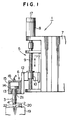
- Fig. 1 shows a chip mounting device according to an embodiment of the present invention, and shows a case where elastic or plastic bumps are formed on the chip side and electrodes are formed on the substrate side.
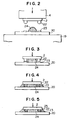
- Fig. 2 shows a state immediately before chip mounting when a chip mounting method according to the present invention is carried out using the device.
- a chip mounting device 1 has a head 4 of a bonding tool 3 which holds a chip 2 (for example, an IC chip) by suction.
- the bonding tool 3 comprises a height control device 5 for controlling a schematic height, which is moved up and down in the vertical direction, and a mechanism 6 for escaping a pressure more than a predetermined pressure, which comprises an air cylinder mechanism or a spring mechanism, and the bonding tool 3 is positionally controlled in the vertical direction.
- Height control device 5 rotates a ball screw 9 by a servo motor 8 attached to a device frame 7, and moves a ball screw slider 10 engaged with the ball screw 9 up and down guiding it along a rail 11 fixed to the device frame 7.
- Mechanism 6 for escaping a pressure more than a predetermined pressure is connected to ball screw slider 10 of height control device 5 via a bracket 12.
- This pressure escaping mechanism 6 is constructed as an air cylinder mechanism having an air cylinder tube 13 and a piston 14 inserted thereinto, and bonding tool 3 and head 4 thereof are connected to the lower side of the piston 14 which is guided only in the vertical linear direction while regulated in the rotational direction by a vertical linear bearing 21.
- a pressurizing port 15 is opened on air cylinder tube 13, and although the head 4 is pressed downward by the pressurized air supplied through the port 15, the head 4 can be escaped upward when an undesirable pressure more than a predetermined pressure (a reactive force) is applied to the head 4.
- the position in the vertical direction controlled by height control device 5 is detected by, for example, an encoder 17 equipped to servo motor 8, and a sensor 18 for detecting a condition that an undesirable pressure more than a predetermined pressure is applied is provided, for example, on the top portion of air cylinder tube 13.
- a substrate 20 for example, a circuit board or a liquid crystal board
- Bonding tool 3 is constructed so as to be regulated in the rotational direction by vertical linear bearing 21 and guided only in the vertical linear direction.
- mechanism 6 for escaping a pressure more than a predetermined pressure is constructed as an air cylinder mechanism, when a certain reactive force more than a predetermined value is applied from the side of chip 2 held by head 4 toward the upper direction, piston 14 and bonding tool 3 connected thereto can escape upward.
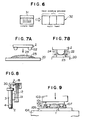
- mechanism 6 for escaping a pressure more than a predetermined pressure is constructed as an air cylinder mechanism in the above-described embodiment, as a modification is shown in Fig. 8, for example, it may be constructed as a mechanism wherein a spring 30 is provided on the upper portion of bonding tool 3 and the bonding tool 3 is regulated in the rotational direction by vertical linear bearing 21 and guided only in the vertical linear direction. when a certain reactive force more than a predetermined value is applied from the side of chip 2 held by head 4 toward the upper direction, the spring 30 can absorb the pressure more than the predetermined value.
- elastic bumps 22 are formed on chip 2.
- the bump 22 is formed, for example, as a polymer bump formed by a conductive paste.
- Electrodes 23 (for example, gold plated electrodes) are formed on substrate 20, and bumps 22 and electrodes 23 are pressed to each other at a condition where the positions of electrodes 23 and the positions of the corresponding bumps 22 of chip 2 are conformed with each other.
- an adhesive 24 is provided by application onto substrate 20 beforehand.
- Adhesive 24 is selected depending upon the bonding process, and selected from a conductive paste, an insulation paste, an underfill agent, a flux and the like.
- the adhesive 24 is applied on substrate 20 at a position between electrodes 23 so as not to cover each electrode 23 and so as to slightly protrude. However, as described later, it is possible to apply adhesive 24 substantially over the entire surface of substrate 20.
- bonding tool 3 is moved down, chip 2 is approached to substrate 20, and bumps 22 are brought into contact with electrodes 23 of the substrate as shown in Fig. 3.
- adhesive 24 having been applied is pressed between chip 2 and substrate 20 and expanded therebetween.
- bumps 22 come into contact with electrodes 23 of the substrate, and thereafter, chip 2 is further pushed down, whereby adhesive 24 is further pressed to expand up to the side portion of the chip 2, as shown in Fig. 4.
- bump 22 elastically deforms by a certain amount, and adhesive 24 is filled around the bump 22 and the electrode 23 pressed to each other.
- substantially only the height of chip 2 (the vertical position) is controlled relative to the position of substrate 20. More concretely, in this embodiment, in order to achieve the above-described state, only the height control of chip 2 by height control device 5 is carried out.
- the height of the substrate 20 supported on stage 19, particularly, the positions of the upper surfaces of electrodes 23 may also vary.
- bumps 22 are pressed to electrodes 23, because the bumps 22 elastically deform naturally and properly, such a dimensional variation can be absorbed with no problem.
- bump 22 is pressed to electrode 23 at a high speed, because the elastically deformed bump 22 can absorb an impact smoothly and naturally, the impact does not occur actually. As a result, a high-speed pressing of bump 22 and electrode 23 becomes possible, and the time required for this pressing process can be decreased remarkably.
- the adhesive when the adhesive is cured in the main bonding process, for example, using a heating furnace or/and an ultra-violet ray irradiation furnace, even if the chip has been slightly lifted between the preliminary bonding process and the main bonding process, the position of the chip can be returned to its original position by the shrinkage of the adhesive, and at such a state, the main bonding can be carried out in a reflow furnace.
- the pressing force of chip 2 by head 4 can be released at a stage that the curing has progressed to some extent, and as compared with a case where the pressing force is continued to be applied, the tact time can be further shortened and the productivity can be further increased.
- adhesive 24 is applied onto substrate 20 beforehand and it is expanded together with the pressing in this embodiment, it is not necessary to inject an adhesive into a fine gap between chip 2 and substrate 20 at a following timing, and therefore, also from this point of view, the time required for the entire pressing and bonding process can be greatly shortened and the process can be simplified.
- bump 22 is composed of an elastic bump, in addition to the above-described absorption of a variation in pressing state, the adhesive can be extended around the bump 22 and the electrode 23 in a good condition so that the adhesive does not enter between the bump 22 and the electrode 23.
- a proper pressing condition between the bump 22 and the electrode 23 can be maintained by the elastic force of the bump 22 so that the adhesive does not enter between the bump 22 and the electrode 23.
- the proper pressing condition can be maintained by the elastic restoring force of the bump 22 so that the adhesive does not enter between the bump 22 and the electrode 23.
- the adhesive 24 can be extended over the entire required area between chip 2 and substrate 20, and desired adhesion condition, adhesion strength and seal condition from the surrounding environment can be achieved.
- chip 2 is further pressed toward the side of substrate 20 from the state shown in Fig. 4.
- This further pressing can also be controlled height control device 5.
- adhesive 24 having been interposed between chip 2 and substrate 20 is further pressed and expanded up to the side portion of the chip 2, and for example, the adhesive 24 is expanded so that a fillet 25 is formed at the side portion of the chip 2 by the expanded adhesive 24.
- chip 2 can be adhered to and retained by substrate 20 more strongly.
- the pressed bonding portions between bumps 22 and electrodes 23 are sealed from the surrounding environment more completely, the reliability in electrical insulation property can also be further increased. In this condition, although bump 22 is elastically deformed more greatly, there is no problem with respect to a bump having a large allowance for elastic deformation such as a polymer bump.
- the time for the required pressing of the bump (that is, the time required for the preliminary bonding process) can be remarkably shortened
- the time for the entire bonding process can be greatly shortened by employing the dividing system into the preliminary bonding and the main bonding.
- an adhesive having a shrinking property at the time of curing is used, because it becomes possible to release the pressing of the head in a early stage at the time of the main bonding, the time for the main bonding itself can also be shortened, and the time for the entire bonding process can be further shortened.
- the device may be constructed as a chip mounting device combining a preliminary bonding device portion 31 having a single head and a main bonding device portion 32 having a plurality of heads more in number (that is, a multi-head system).
- a most efficient process can be achieved by substantially balancing the total time for preliminarily bonding a plurality of chips in order in the preliminary bonding device portion 31 and the time for mainly bonding all the preliminarily bonded chips simultaneously in the main bonding device portion 32, thereby shortening the time of the entire bonding process remarkably.
- the time for the preliminary bonding can be remarkably shortened, the number of heads in the main bonding device portion 32 can be greatly increased. Therefore, when a certain amount of chip bonding is carried out, the constitution of the entire bonding device can be easily formed as a constitution capable of shortening the time required for the entire bonding process remarkably.
- the position for application of an adhesive to be applied beforehand is set at a partial portion between electrodes on the substrate in the aforementioned embodiment, it is possible to apply the adhesive substantially over the entire surface of the substrate.
- adhesive 24 is applied on substrate 20 so as to cover electrodes 23, and in this state, chip 2 is moved down and pressed.
- Fig. 7B when bump 22 comes into contact with electrode 23, because adhesive 24 having been present on the electrode 23 is pushed toward around the contact portion, the bump 22 and the electrode 23 can be brought into close contact with each other in a good condition by setting a proper height of the bump 23 moved down.
- bump 22 is elastic, a better close contact can be achieved by pressing the bump 22 onto the electrode 23 so that the bump 22 is elastically deformed slightly.
- the formation of chip 2 is not particularly restricted, and as long as an elastic or plastic bump is formed, the present invention can be applied effectively to any type of chip.
- the formation of substrate 20 is not particularly restricted, and the present invention can be applied to any type of substrate to which a chip having the above-described bump is mounted.
- a bump and an electrode are bonded by heating at the time of a main bonding, there is a case where metal bonding cannot be carried out depending upon the material of the electrode. Even in such a case, if an elastic polymer bump is employed, because the bump and an electrode can be always brought into contact with each other without forming a gap therebetween even if an adhesive expands by heat or moisture, a good electrical connection can be maintained.
- the position for forming the elastic or plastic bump is not limited to the chip side, and it may be formed on the substrate side or may be formed on each of the chip side and the substrate side.
- the "electrode" in the present invention means a technical concept including an elastic or plastic bump.
- the chip mounting method and device only by controlling the height of a chip moved down, the chip can be quickly bonded to a substrate at a desired pressing condition without generating an impact while absorbing a dimensional variation of the substrate naturally and smoothly, the time for achieving a desired pressing condition can be shortened remarkably, and the productivity can be increased greatly.
- the present invention is suitable for a process in which a large number of chips are continuously bonded to substrates, and especially, by dividing the bonding process into a preliminary bonding process and a main bonding process, the tact time of the entire process can be remarkably shortened, and the productivity can be increased extremely.
- the present invention can be applied to any type of bonding process requiring such shortening of tact time and increase of productivity without limiting the kinds of chip and substrate.
Landscapes
- Engineering & Computer Science (AREA)
- Computer Hardware Design (AREA)
- Microelectronics & Electronic Packaging (AREA)
- Power Engineering (AREA)
- Physics & Mathematics (AREA)
- Condensed Matter Physics & Semiconductors (AREA)
- General Physics & Mathematics (AREA)
- Manufacturing & Machinery (AREA)
- Wire Bonding (AREA)
Applications Claiming Priority (3)
| Application Number | Priority Date | Filing Date | Title |
|---|---|---|---|
| JP2000006560 | 2000-01-14 | ||
| JP2000006560 | 2000-01-14 | ||
| PCT/JP2000/009307 WO2001052317A1 (en) | 2000-01-14 | 2000-12-27 | Method and device for chip mounting |
Publications (1)
| Publication Number | Publication Date |
|---|---|
| EP1255293A1 true EP1255293A1 (de) | 2002-11-06 |
Family
ID=18535072
Family Applications (1)
| Application Number | Title | Priority Date | Filing Date |
|---|---|---|---|
| EP00985938A Withdrawn EP1255293A1 (de) | 2000-01-14 | 2000-12-27 | Methode und anordnung für die montage von chips |
Country Status (4)
| Country | Link |
|---|---|
| EP (1) | EP1255293A1 (de) |
| JP (1) | JP4768188B2 (de) |
| TW (1) | TW478080B (de) |
| WO (1) | WO2001052317A1 (de) |
Families Citing this family (5)
| Publication number | Priority date | Publication date | Assignee | Title |
|---|---|---|---|---|
| CH697279B1 (de) | 2004-12-06 | 2008-07-31 | Oerlikon Assembly Equipment Ag | Verfahren für die Montage eines Halbleiterchips auf einem Substrat. |
| JP4835406B2 (ja) * | 2006-11-24 | 2011-12-14 | 富士通株式会社 | 実装構造体とその製造方法および半導体装置とその製造方法 |
| JP2011082379A (ja) * | 2009-10-08 | 2011-04-21 | Hitachi High-Technologies Corp | 本圧着装置及び本圧着方法 |
| US9082885B2 (en) | 2013-05-30 | 2015-07-14 | Samsung Electronics Co., Ltd. | Semiconductor chip bonding apparatus and method of forming semiconductor device using the same |
| KR101734881B1 (ko) * | 2015-08-20 | 2017-05-16 | 한국생산기술연구원 | 반도체칩 접합방법 및 이를 이용하여 접합된 반도체칩 |
Family Cites Families (14)
| Publication number | Priority date | Publication date | Assignee | Title |
|---|---|---|---|---|
| JPH03225934A (ja) * | 1990-01-31 | 1991-10-04 | Nec Corp | 半導体集積回路素子の接続方法 |
| JPH0494553A (ja) * | 1990-08-10 | 1992-03-26 | Nippon Steel Corp | ボンディング装置 |
| JP2841846B2 (ja) * | 1990-11-14 | 1998-12-24 | 松下電器産業株式会社 | Ic半導体素子の接合方法 |
| JP3341855B2 (ja) * | 1993-02-08 | 2002-11-05 | 東レエンジニアリング株式会社 | ワーク位置決めステージ装置及びそれにおける制御パラメータの補正更新方法並びにチップボンディング装置 |
| JP2793766B2 (ja) * | 1993-12-27 | 1998-09-03 | 株式会社ピーエフユー | 導電ペースト転写方法 |
| JP2830734B2 (ja) * | 1994-04-04 | 1998-12-02 | 松下電器産業株式会社 | 配線基板とその製造方法 |
| JP3333355B2 (ja) * | 1995-06-29 | 2002-10-15 | 株式会社東芝 | 半導体装置 |
| JP2770821B2 (ja) * | 1995-07-27 | 1998-07-02 | 日本電気株式会社 | 半導体装置の実装方法および実装構造 |
| JP2891184B2 (ja) * | 1996-06-13 | 1999-05-17 | 日本電気株式会社 | 半導体装置及びその製造方法 |
| JPH10173007A (ja) * | 1996-12-11 | 1998-06-26 | Mitsubishi Electric Corp | ベアチップ搭載装置 |
| JP3058409B2 (ja) * | 1998-01-05 | 2000-07-04 | 日本電気株式会社 | 半導体チップの実装方法および実装構造 |
| JPH11251363A (ja) * | 1998-03-03 | 1999-09-17 | Olympus Optical Co Ltd | フリップチップ実装方法及びフリップチップ実装構造 |
| JP3412499B2 (ja) * | 1998-03-17 | 2003-06-03 | 松下電器産業株式会社 | 電子部品の熱圧着装置および熱圧着方法 |
| JP3497078B2 (ja) * | 1998-03-31 | 2004-02-16 | 株式会社日立ハイテクインスツルメンツ | ダイボンダ |
-
2000
- 2000-12-27 WO PCT/JP2000/009307 patent/WO2001052317A1/ja not_active Ceased
- 2000-12-27 JP JP2001552439A patent/JP4768188B2/ja not_active Expired - Fee Related
- 2000-12-27 EP EP00985938A patent/EP1255293A1/de not_active Withdrawn
- 2000-12-28 TW TW089128116A patent/TW478080B/zh not_active IP Right Cessation
Non-Patent Citations (1)
| Title |
|---|
| See references of WO0152317A1 * |
Also Published As
| Publication number | Publication date |
|---|---|
| JP4768188B2 (ja) | 2011-09-07 |
| WO2001052317A1 (en) | 2001-07-19 |
| TW478080B (en) | 2002-03-01 |
Similar Documents
| Publication | Publication Date | Title |
|---|---|---|
| US6981317B1 (en) | Method and device for mounting electronic component on circuit board | |
| US6913945B2 (en) | Method of mounting a chip | |
| KR100745628B1 (ko) | 칩 실장 방법 | |
| EP1032946A1 (de) | Vorrichtung zur heizung und druckerhöhung eines elektronischen bauelements, sowie methode und vorrichtung zur befestigung von elektronischen bauelementen | |
| KR102403569B1 (ko) | 열압착 본더, 열압착 본더 작동 방법, 및 미세 피치의 플립 칩 조립체 상호 접속 방법 | |
| US20030009876A1 (en) | Method and device for chip mounting | |
| EP1282162A2 (de) | Verfahren und Apparat zum Herstellen von Halbleiterpackungen | |
| US6966964B2 (en) | Method and apparatus for manufacturing semiconductor device | |
| EP1255293A1 (de) | Methode und anordnung für die montage von chips | |
| JP3475776B2 (ja) | フリップチップボンディング装置及びフリップチップボンディング方法 | |
| JPWO2001052317A1 (ja) | チップ実装方法および装置 | |
| JP2006032446A (ja) | 半導体部品の実装方法および実装装置 | |
| KR100936781B1 (ko) | 플립칩 본딩장치 및 이를 이용한 플립칩 본딩방법 | |
| JP4024458B2 (ja) | 半導体装置の実装方法および半導体装置実装体の製造方法 | |
| JP2003318218A (ja) | 曲面チップ基板、その製造方法、および、バンプ形成装置 | |
| JP3893226B2 (ja) | 部品実装方法と装置 | |
| JP2004031902A (ja) | 実装方法および実装装置 | |
| JPH04338657A (ja) | チップ部品と基板との接続方法 | |
| JP2837145B2 (ja) | チップ部品と基板との接続方法および接続装置 | |
| JP4043391B2 (ja) | 電子部品の実装方法およびその実装装置 | |
| JPH0982755A (ja) | 半導体装置とその製造方法 | |
| JP3868453B2 (ja) | 部品の実装方法 | |
| JP2002134563A (ja) | 半導体製造装置及び半導体製造方法 | |
| JP2004088041A (ja) | 実装方法および実装装置 | |
| KR20010049687A (ko) | 반도체 장치의 실장 방법 및 반도체 실장 장치 |
Legal Events
| Date | Code | Title | Description |
|---|---|---|---|
| PUAI | Public reference made under article 153(3) epc to a published international application that has entered the european phase |
Free format text: ORIGINAL CODE: 0009012 |
|
| 17P | Request for examination filed |
Effective date: 20020709 |
|
| AK | Designated contracting states |
Kind code of ref document: A1 Designated state(s): AT BE CH CY DE DK ES FI FR GB GR IE IT LI LU MC NL PT SE TR |
|
| STAA | Information on the status of an ep patent application or granted ep patent |
Free format text: STATUS: THE APPLICATION HAS BEEN WITHDRAWN |
|
| 18W | Application withdrawn |
Withdrawal date: 20021031 |