EP1225215A2 - Verwendung von Übergangsmetallkomplexen mit Oxim-Liganden als Bleichkatalysatoren - Google Patents
Verwendung von Übergangsmetallkomplexen mit Oxim-Liganden als Bleichkatalysatoren Download PDFInfo
- Publication number
- EP1225215A2 EP1225215A2 EP02001237A EP02001237A EP1225215A2 EP 1225215 A2 EP1225215 A2 EP 1225215A2 EP 02001237 A EP02001237 A EP 02001237A EP 02001237 A EP02001237 A EP 02001237A EP 1225215 A2 EP1225215 A2 EP 1225215A2
- Authority
- EP
- European Patent Office
- Prior art keywords
- weight
- alkyl
- acid
- aryl
- transition metal
- Prior art date
- Legal status (The legal status is an assumption and is not a legal conclusion. Google has not performed a legal analysis and makes no representation as to the accuracy of the status listed.)
- Granted
Links
Classifications
-
- C—CHEMISTRY; METALLURGY
- C11—ANIMAL OR VEGETABLE OILS, FATS, FATTY SUBSTANCES OR WAXES; FATTY ACIDS THEREFROM; DETERGENTS; CANDLES
- C11D—DETERGENT COMPOSITIONS; USE OF SINGLE SUBSTANCES AS DETERGENTS; SOAP OR SOAP-MAKING; RESIN SOAPS; RECOVERY OF GLYCEROL
- C11D3/00—Other compounding ingredients of detergent compositions covered in group C11D1/00
- C11D3/39—Organic or inorganic per-compounds
- C11D3/3902—Organic or inorganic per-compounds combined with specific additives
- C11D3/3905—Bleach activators or bleach catalysts
- C11D3/3932—Inorganic compounds or complexes
Definitions
- the present invention relates to the use of certain Transition metal complex compounds to enhance the bleaching effect of Peroxygen compounds when bleaching colored stains both on Textiles as well as on hard surfaces, as well as washing and cleaning agents, which contain such complex compounds.
- Inorganic peroxygen compounds especially hydrogen peroxide and solid peroxygen compounds, which dissolve in water to release hydrogen peroxide, such as sodium perborate and sodium carbonate perhydrate, have long been used as oxidizing agents for disinfection and bleaching purposes.
- the oxidizing effect of these substances in dilute solutions depends strongly on the temperature; For example, with H 2 O 2 or perborate in alkaline bleaching liquors, sufficiently quick bleaching of soiled textiles can only be achieved at temperatures above about 80 ° C.
- the oxidation effect of the inorganic peroxygen compounds can be improved by adding so-called bleach activators.
- bleach activators In the past, numerous proposals have been drawn up for this, especially from the substance classes of N- or O-acyl compounds, for example multiply acylated alkylenediamines, especially tetraacetylglycoluril, N-acylated hydantoins, hydrazides, triazoles, hydrotriazines, urazoles.
- Diketopiperazines, sulfurylamides and cyanurates also carboxylic anhydrides, especially phthalic anhydride and substituted maleic anhydrides, carboxylic acid esters, especially sodium nonanoyloxy-benzenesulfonate (NOBS), sodium isononanoyloxy-benzenesulfonate (ISONOBS) and acylated sugar derivatives, such as pentaacetate.
- NOBS nonanoyloxy-benzenesulfonate
- ISONOBS sodium isononanoyloxy-benzenesulfonate
- acylated sugar derivatives such as pentaacetate.
- transition metal salts and their complex compounds as described, for example, in EP 0 392 592, EP 0 443 651, EP 0 458 397, EP 0 544 490 or EP 0 549 271.
- cobalt (II) complexes with ammonia ligands which may also have any further one, two, three and / or tidentate ligands, are used as activators for H 2 O 2 in textile washing or - bleaches described.
- WO 96/23859, WO 96/23860 and WO 96/23861 describe the use of corresponding Co (III) complexes in agents for automatically cleaning dishes.
- the present invention has the improvement of the oxidation and bleaching effect of peroxygen compounds, especially inorganic ones Peroxygen compounds, at low temperatures below 80 ° C, especially in the temperature range of approx. 15 ° C to 45 ° C.
- Transition metal complexes of ligands with oximato or dioximato structure make a significant contribution to cleaning performance compared to colored soiling, that are on textiles or on hard surfaces.
- transition metal complexes are used in detergents and cleaning agents, especially in textile washing and cleaning agents for hard surfaces, especially for dishes and in solutions for bleaching colored ones Soiling used.
- the ligand (L) represents an oximato or dioximato ligand. Examples of these are acetoxime, acetal oxime, salicyloxime or glyoxime, dimethylglyoxime, methylethylglyoxime, cyclohexanedione dioxime and other oximes or dioximes such as, for example, in A. Chakravorty, Coord. Chem. Rev.
- the oximes or dioximes can be obtained by reacting the corresponding aldehydes, ketones or diketones with hydroxylamine.
- the transition metal complexes to be used according to the invention can also carry further ligands (X), in particular of a simpler structure, in particular neutral ligands or one or more valence anion ligands.
- ligands (X) in particular of a simpler structure, in particular neutral ligands or one or more valence anion ligands.
- X optionally substituted pyridines, imidazoles, methylimidazoles, picolines, imidazolines or lutidines or similar nitrogen-containing heterocycles. These heterocycles are preferred in their unsubstituted form.
- the anion ligands ensure charge balance between the transition metal central atom and the ligand system.
- the presence of oxo ligands, peroxo ligands and imino ligands is also possible.
- These additional ligands can also act as bridges, so that multinuclear complexes are formed with at least one ligand according to general formula I.
- the primary peroxygen compounds are all alkali perborate mono or tetrahydrates and / or alkali percarbonates, with sodium being the preferred Alkali metal is considered.
- alkali metal or Ammonium peroxosulfates e.g. Potassium peroxomonosulfate (technical: Caroat® or Oxone®) can be used.
- concentration of inorganic Oxidizing agent on the overall formulation of detergents and cleaning agents is 5-90%, preferably 10-70%.
- the quantities of peroxygen compounds used are generally as follows chosen that in the solutions of washing and cleaning agents between 10 ppm and 10% active oxygen, preferably between 50 ppm and 5000 ppm Active oxygen is present. Also the amount used bleach-enhancing complex compound depends on the application. Depending on desired degree of activation, it is used in such amounts that 0.01 mmol to 25 mmol, preferably 0.1 mmol to 2 mmol complex per mol Peroxygen compound can be used, but in special cases these limits are also exceeded or undershot. In washing and Cleaning agents are preferably 0.0025 to 0.25% by weight, in particular 0.01 up to 0.5% by weight of the bleach-enhancing complex compound defined above contain.
- the washing and cleaning agents can oxidizing agents contained on an organic basis in the concentration range of 1 - 20%.
- peroxycarboxylic acids e.g. monoperoxyphthalic, Dodecanediperoxyacid or phthalimidoperoxycarboxylic acids such as PAP and related systems or the amido peracids mentioned in EP-A-170 386.
- bleaching here encompasses both the bleaching of on the Dirt present in the textile surface as well as bleaching in the Wash liquor, dirt detached from the textile surface.
- Bleaching soiling on hard surfaces applies analogously.
- the invention relates to a method for cleaning textiles as well of hard surfaces, especially dishes, using the aforementioned Complex compounds together with peroxygen compounds in aqueous, optionally further detergent or cleaning agent components containing solution, as well as detergents and cleaning agents for hard Surfaces, especially detergents for dishes, such as for the Use in mechanical processes are preferred, such Contain complex compounds.
- the use according to the invention consists essentially in having colored Soiling contaminates hard surfaces or soiled textiles to create conditions under which a peroxidic Oxidizing agent and the complex compound can react with each other
- the aim is to obtain secondary products with a stronger oxidizing effect.
- Such conditions are particularly present when the reactants are in aqueous solution meet each other. This can be done by adding the peroxygen compound separately and the complex to the aqueous solution of the detergent and cleaning agent happen.
- the method according to the invention is particularly advantageous using a detergent or cleaning agent for hard Surfaces containing the complex compound and optionally one contains peroxygen-containing oxidizing agents.
- the Peroxygen compound can also be used separately in substance or as preferred aqueous solution or suspension are added to the solution when a Peroxygen-free detergent or cleaning agent is used.
- the detergents and cleaning agents which are in the form of granules, powder or tablet Solids, as other shaped bodies, homogeneous solutions or suspensions may be present in addition to the bleach-enhancing metal complex mentioned in principle contain all known and usual ingredients in such agents.
- the agents can in particular builder substances, surface-active surfactants, Peroxygen compounds, additional peroxygen activators or organic Peracids, water-miscible organic solvents, sequestering agents, Enzymes, as well as special additives with color or fiber-protecting effect.
- Other auxiliaries such as electrolytes, pH regulators, silver corrosion inhibitors, Foam regulators as well as colors and fragrances are possible.
- a cleaning agent for hard surfaces according to the invention can also abrasive components, especially quartz flours, wood flours, Contain plastic flour, chalks and micro glass balls and their mixtures.
- Abrasives are preferably not more than 20% by weight in the cleaning agents, in particular from 5 to 15% by weight.
- the washing and cleaning agents can contain one or more surfactants, in particular anionic surfactants, nonionic surfactants and their Mixtures, but also cationic, zwitterionic and amphoteric surfactants in question come.
- surfactants are in detergents according to the invention in Quantities of preferably 1 to 50 wt .-%, in particular from 3 to 30% by weight, whereas in cleaning agents for hard surfaces normally lower proportions, i.e. quantities up to 20% by weight, in particular up to 10% by weight and preferably in the range from 0.5 to 5% by weight are included.
- cleaning agents for use in mechanical Dishwashing processes are usually low-foaming compounds used.
- Suitable anionic surfactants are, in particular, soaps and those which contain sulfate or sulfonate groups.
- Preferred surfactants of the sulfonate type are C 9 -C 13 -alkylbenzenesulfonates, olefin sulfonates, that is to say mixtures of alkene and hydroxyalkanesulfonates, and also disulfonates such as are obtained, for example, from monoolefins with a terminal or internal double bond by sulfonation with gaseous sulfur trioxide and subsequent alkaline or acidic hydrolysis of the sulfonation products is considered.
- alkanesulfonates obtained from C 12 -C 18 alkanes, for example by sulfochlorination or sulfoxidation with subsequent hydrolysis or neutralization.
- esters of alpha-sulfo fatty acids for example the alpha-sulfonated methyl esters of hydrogenated coconut, palm kernel or tallow fatty acids, which by sulfonation of the methyl esters of fatty acids of vegetable and / or animal origin with 8 to 20 carbon atoms in the fatty acid molecule and subsequent neutralization to form water-soluble mono-salts.
- Suitable anionic surfactants are sulfonated fatty acid glycerol esters, which are mono-, di- and triesters and mixtures thereof.
- alk (en) yl sulfates the alkali and in particular the sodium salts of the sulfuric acid half esters of C 12 -C 18 fatty alcohols, for example from coconut fatty alcohol, tallow fatty alcohol, lauryl, myristyl, cetyl or stearyl alcohol or the C 8 -C 20 oxo alcohols and those half esters of secondary alcohols of this chain length are preferred.
- alk (en) yl sulfates of the chain length mentioned which contain a synthetic, straight-chain alkyl radical prepared on a petrochemical basis.
- 2,3-Alkyl sulfates which are produced, for example, according to US Pat. Nos. 3,234,158 and 5,075,041, are also suitable anionic surfactants.
- EO ethylene oxide
- the preferred anionic surfactants also include the salts of alkylsulfosuccinic acid, which are also referred to as sulfosuccinates or as sulfosuccinic acid esters, and the monoesters and / or diesters of sulfosuccinic acid with alcohols, preferably fatty alcohols and especially ethoxylated fatty alcohols.
- Preferred sulfosuccinates contain C 8 -C 18 fatty alcohol residues or mixtures thereof.
- Fatty acid derivatives of amino acids for example of N-methyl taurine (tauride) and / or of N-methyl glycine (sarcosinate) are suitable as further anionic surfactants.
- Soaps for example, in particular, come as further anionic surfactants Amounts of 0.2 to 5 wt .-%, into consideration.
- Saturated ones are particularly suitable Fatty acid soaps, such as the salts of lauric acid, myristic acid, palmitic acid, Stearic acid, hydrogenated erucic acid and behenic acid and in particular from natural fatty acids, for example coconut, palm kernel or tallow fatty acids, derived soap mixtures.
- the anionic surfactants can be in the form of their sodium, Potassium or ammonium salts and as soluble salts of organic bases, such as Mono-, di- or triethanolamine.
- the anionic are preferably located Surfactants in the form of their sodium or potassium salts, especially in the form of Sodium salts.
- Anionic surfactants are in detergents according to the invention preferably in amounts of 0.5 to 10% by weight and in particular in amounts of Contain 5 to 25 wt .-%.
- the nonionic surfactants used are preferably alkoxylated, advantageously ethoxylated, in particular primary alcohols having preferably 8 to 18 carbon atoms and an average of 1 to 12 moles of ethylene oxide (EO) per mole of alcohol, in which the alcohol radical can be linear or preferably methyl-branched in the 2-position , or can contain linear and methyl-branched radicals in the mixture, as are usually present in oxo alcohol radicals.
- EO ethylene oxide
- the preferred ethoxylated alcohols include, for example, C 12 -C 14 alcohols with 3 EO or 4 EO, C 9 -C 11 alcohols with 7 EO, C 13 -C 15 alcohols with 3 EO, 5 EO, 7 EO or 8 EO, C 12 -C 18 alcohols with 3 EO, 5 EO or 7 EO and mixtures thereof, such as mixtures of C 12 -C 14 alcohol with 3 EO and C 12 -C 18 alcohol with 7 EO.
- the degrees of ethoxylation given represent statistical averages, which can be an integer or a fraction for a specific product.
- Preferred alcohol ethoxylates have a narrow homolog distribution (narrow range ethoxylates, NRE).
- fatty alcohols with more than 12 EO can also be used. Examples of these are (tallow) fatty alcohols with 14 EO, 16 EO, 20 EO, 25 EO, 30 EO or 40 EO.
- the nonionic surfactants also include alkyl glycosides of the general formula RO (G) x in which R is a primary straight-chain or methyl-branched, in particular methyl-branched aliphatic radical having 8 to 22, preferably 12 to 18, carbon atoms, and G stands for a glycose unit with 5 or 6 carbon atoms, preferably for glucose.
- the degree of oligomerization x which indicates the distribution of monoglycosides and oligoglycosides, is an arbitrary number - which, as an analytically determinable variable, can also take fractional values - between 1 and 10; x is preferably 1.2 to 1.4.
- polyhydroxy fatty acid amides of the formula (I) in the radical R 1 -CO for an aliphatic acyl radical with 6 to 22 carbon atoms
- R 2 for hydrogen, an alkyl or hydroxyalkyl radical with 1 to 4 carbon atoms
- [Z] for a linear or branched polyhydroxyalkyl radical with 3 to 10 carbon atoms and 3 to 10 hydroxyl groups.
- the polyhydroxy fatty acid amides are preferably derived from reducing sugars with 5 or 6 carbon atoms, in particular from glucose.
- the group of polyhydroxy fatty acid amides also includes compounds of the formula (II) in which R 3 is a linear or branched alkyl or alkenyl radical with 7 to 21 carbon atoms, R 4 is a linear, branched or cyclic alkylene radical or an arylene radical with 6 to 8 carbon atoms and R 5 is a linear, branched or cyclic alkyl radical or an aryl radical or Oxy-alkyl radical having 1 to 8 carbon atoms, C 1 -C 4 -alkyl or phenyl radicals being preferred, and [Z] for a linear polyhydroxyalkyl radical whose alkyl chain is substituted by at least two hydroxyl groups, or alkoxylated, preferably ethoxylated or propoxylated, derivatives of this rest stands.
- R 3 is a linear or branched alkyl or alkenyl radical with 7 to 21 carbon atoms
- R 4 is a linear, branched or cyclic alkylene
- [Z] is also preferably obtained here by reductive amination of a sugar such as glucose, fructose, maltose, lactose, galactose, mannose or xylose.
- a sugar such as glucose, fructose, maltose, lactose, galactose, mannose or xylose.
- the N-alkoxy- or N-aryloxy-substituted compounds can then be converted, for example in accordance with WO 95/07331, into the desired polyhydroxy fatty acid amides by reaction with fatty acid methyl esters in the presence of an alkoxide as catalyst.
- nonionic surfactants which either as sole nonionic surfactant or in combination with other nonionic Surfactants, especially together with alkoxylated fatty alcohols and / or Alkyl glycosides used are alkoxylated, preferably ethoxylated or ethoxylated and propoxylated fatty acid alkyl esters, preferably with 1 to 4 Carbon atoms in the alkyl chain, especially fatty acid methyl esters.
- nonionic surfactants of the amine oxide type for example N-cocoalkyl-N, N-dimethylamine oxide and N-tallow alkyl-N, N-dihydroxyethylamine oxide and the Fatty acid alkanolamides can be suitable.
- gemini surfactants can be considered as further surfactants. This includes are generally understood to mean those compounds which are two hydrophilic Have groups per molecule. These groups are usually by one so-called “spacers” separated from each other. This spacer is usually one Carbon chain that should be long enough for the hydrophilic groups to unite are at a sufficient distance so that they can act independently of one another. Such surfactants are generally characterized by an unusually low level critical micelle concentration and the ability to control the surface tension of the Greatly reduce water from. Gemini polyhydroxy fatty acid amides can also be used or poly-polyhydroxy fatty acid amides, as described in WO 95/19953, WO 95/19954 and WO 95/19955. Further Types of surfactants can have dendrimeric structures.
- a detergent according to the invention preferably contains at least one water-soluble and / or water-insoluble, organic and / or inorganic Builder.
- Particularly suitable water-soluble inorganic builder materials are alkali silicates and polymeric alkali phosphates, which can be in the form of their alkaline, neutral or acidic sodium or potassium salts. Examples of this are trisodium phosphate, tetrasodium diphosphate, disodium dihydrogen diphosphate, pentasodium triphosphate, so-called sodium hexametaphosphate and the corresponding potassium salts or mixtures of sodium and potassium salts.
- crystalline or amorphous alkali alumosilicates in amounts of up to 50% by weight, are used as water-insoluble, water-dispersible inorganic builder materials.
- the crystalline sodium aluminosilicates in detergent quality in particular zeolite A, P and optionally X, alone or in mixtures, for example in the form of a co-crystallizate from the zeolites A and X, are preferred.
- Your calcium binding capacity which according to the information in the German patent specification DE 24 12 837 can be determined, is usually in the range of 100 to 200 mg CaO per gram.
- Suitable builder substances are furthermore crystalline alkali silicates, which can be present alone or in a mixture with amorphous silicates.
- the alkali silicates which can be used as builders preferably have a molar ratio of alkali oxide to SiO 2 below 0.95, in particular from 1: 1.1 to 1:12, and can be amorphous or crystalline.
- Preferred alkali silicates are the sodium silicates, in particular the amorphous sodium silicates with a Na 2 O: SiO 2 molar ratio of from 1: 2 to 1: 2.8. Those with a molar Na 2 O: SiO 2 ratio of 1: 1.9 to 1: 2.8 can be produced by the process of European patent application EP 0 425 427.
- Crystalline sheet silicates of the general formula Na 2 Si x O 2x + 1 .YH 2 O, in which x, the so-called modulus, is a number of 1.9, are preferably used as crystalline silicates, which may be present alone or in a mixture with amorphous silicates to 4 and y is a number from 0 to 20 and are preferred values for x 2, 3 or 4.
- Crystalline layered silicates which fall under this general formula are described, for example, in European patent application EP 0 164 514.
- Preferred crystalline layered silicates are those in which x assumes the values 2 or 3 in the general formula mentioned.
- both o- and ⁇ -sodium disilicate are preferred, with ⁇ -sodium disilicate being able to be obtained, for example, by the method described in international patent application WO 91/08171.
- ⁇ -sodium silicates with a modulus between 1.9 and 3.2 can be produced according to Japanese patent applications JP 04/238 809 or JP 04/260 6 10.
- Practically anhydrous crystalline alkali silicates of the above general formula, in which x denotes a number from 1.9 to 2.1, can also be prepared from amorphous silicates, as in European patent applications EP 0 548 599, EP 0 502 325 and EP 0 425 428 described, can be used.
- a crystalline layered sodium silicate with a modulus of 2 to 3 is used, as can be produced from sand and soda by the process of European patent application EP 0 436 835.
- Crystalline sodium silicates with a modulus in the range from 1.9 to 3.5 are used in a further preferred embodiment of agents according to the invention.
- a granular compound of alkali silicate and alkali carbonate is used, as is described, for example, in international patent application WO 95/22592 or as is commercially available, for example, under the name Nabion®.
- the weight ratio of aluminosilicate to silicate, based in each case on anhydrous active substances is preferably 1:10 to 10: 1.
- the weight ratio is from amorphous alkali silicate to crystalline alkali silicate, preferably 1: 2 to 2: 1 and in particular 1: 1 to 2: 1.
- Such builder substances are preferably contained in the inventive agents in amounts of up to 60% by weight, in particular from 5 to 40% by weight.
- the water-soluble organic builder substances include polycarboxylic acids, in particular citric acid and sugar acids, aminopolycarboxylic acids, in particular methylglycinediacetic acid, nitrilotriacetic acid and Ethylenediaminetetraacetic acid and polyaspartic acid.
- Polyphosphonic acids particularly aminotris (methylenephosphonic acid), ethylenediaminetetrakis (methylenephosphonic acid) and 1-hydroxyethane-1,1-diphosphonic acid can also be used.
- polymeric (poly) carboxylic acids especially the polycarboxylates of the international patent application WO 93/161 10 or the international patent application WO 92/18542 or the European patent specification EP 0 232 202, which are accessible by oxidation of polysaccharides or dextrins, polymeric acrylic acids, methacrylic acids, Maleic acids and copolymers of these, which may also contain small amounts of polymerizable substances without carboxylic acid functionality in copolymerized form.
- the relative molecular weight of the homopolymers of unsaturated carboxylic acids is generally between 5000 and 200,000, that of the copolymers between 2000 and 200,000, preferably 50,000 to 120,000, in each case based on free acid.
- a particularly preferred acrylic acid-maleic acid copolymer has a relative molecular weight of 50,000 to 100,000.
- Commercial products are, for example, Sokalan® CP 5, CP 10 and PA 30 from BASF.
- Copolymers of acrylic acid or methacrylic acid with vinyl ethers, such as vinyl methyl ethers, vinyl esters, ethylene, propylene and styrene, in which the proportion of the acid is at least 50% by weight, are also suitable.
- Terpolymers can also be used as water-soluble organic builder substances which contain two unsaturated acids and / or their salts as monomers and vinyl alcohol and / or an esterified vinyl alcohol or a carbohydrate as the third monomer.
- the first acidic monomer or its salt is derived from a monoethylenically unsaturated C 3 -C 8 carboxylic acid and preferably from a C 3 -C 4 monocarboxylic acid, in particular from (meth) acrylic acid.
- the second acidic monomer or its salt can be a derivative of a C 4 -C 8 dicarboxylic acid, maleic acid being particularly preferred, and / or a derivative of an allylsulfonic acid which is substituted in the 2-position by an alkyl or aryl radical.
- Polymers of this type can be produced in particular by processes which are described in German patents DE 42 21 381 and DE 43 00 772, and generally have a relative molecular weight of between 1000 and 200,000. Further preferred copolymers are those which are described in German patent applications DE 43 03 320 and DE 44 17 734 and which preferably contain acrolein and acrylic acid / acrylic acid salts or vinyl acetate as monomers.
- the organic builder substances can, especially for the production of liquid Agents, in the form of aqueous solutions, preferably in the form of 30 to 50% by weight aqueous solutions are used. All acids mentioned are usually in the form of their water-soluble salts, especially their alkali salts.
- Such organic builder substances can, if desired, in amounts up to 40% by weight, in particular up to 25% by weight and preferably from 1 to 8% by weight be included. Amounts close to the above upper limit are preferably in pasty or liquid, in particular water-containing agents used.
- water-soluble builder components in cleaning agents according to the invention for hard surfaces all come in principle for mechanical Cleaning dishes typically used by builders in question, for example the above-mentioned alkali phosphates. Their quantities can range up to about 60% by weight, in particular 5 to 20% by weight, based on the total agent lie.
- Other possible water-soluble builder components are besides Polyphosphonates and phosphonate alkyl carboxylates for example organic Polymers of native or synthetic origin of the type listed above Polycarboxylates, which act as co-builders, especially in hard water regions, and naturally occurring hydroxycarboxylic acids such as mono-, Dihydroxysuccinic acid, alpha-hydroxypropionic acid and gluconic acid.
- To the preferred organic builder components include the salts of Citric acid, especially sodium citrate.
- sodium citrate come anhydrous Triatrium citrate and preferably trisodium citrate dihydrate. Trisodium citrate dihydrate can be used as a fine or coarse crystalline powder.
- the pH value set can also be that of the co-builder salts mentioned corresponding acids are present.
- bleach activators that is compounds that are under Perhydrolysis conditions Peroxocarboxylic acids are used.
- Multi-acylated alkylenediamines are preferred, in particular Tetraacetylethylenediamine (TAED), acylated glycolurils, in particular Tetraacetylglycoluril (TAGU), acylated triazine derivatives - especially 1,5-diacetyl-2,4-dioxohexahydro-1,3,5-triazine (DADHT), acylated phenyl sulfonates, in particular Nonanoyl- or Isononanoyloxybenzenesulfonat (NOBS or ISONOBS) or their Amido derivatives, e.g.
- acylated polyvalent Alcohols especially triacetin, ethylene glycol diacetate and 2,5-diacetoxy-2,5-dihydrofuran as well as acetylated sorbitol and mannitol, and acylated sugar derivatives, in particular pentaacetylglucose (PAG), pentaacetylfructose, tetraacetylxylose and octaacetyl lactose and acetylated, optionally N-alkylated, glucamine and gluconolactone.
- PAG pentaacetylglucose
- pentaacetylfructose pentaacetylfructose
- tetraacetylxylose tetraacetylxylose
- octaacetyl lactose acetylated
- proteases such as BLAP®, Optimase®, Opticlean®, Maxacal®, Maxapem®, Durazym®, Purafect® OxP, Esperase® and / or Savinase®, amylases such as Termamyl®, Amylase-LT, Maxamyl®, Duramyl®, Purafectel OxAm, cellulases such as Celluzyme®, Carezyme®, K-AC® and / or those from the international Patent applications WO 96/34108 and WO 96/34092 known cellulases and / or lipases such as Lipolase®, Lipomax®, Lumafast® and / or Lipozym®.
- proteases such as BLAP®, Optimase®, Opticlean®, Maxacal®, Maxapem®, Durazym®, Purafect® OxP, Esperase® and / or Savinase®
- amylases such as Terma
- the Enzymes used can, as for example in the international Patent applications WO 92111347 or WO 94/23005 described Carriers can be adsorbed and / or embedded in coating substances to counter them protect early inactivation. They are in washing and Detergents preferably in amounts up to 10 wt .-%, especially of 0.05 to 5 wt .-%, contain, particularly preferred against oxidative degradation stabilized enzymes, such as those from international Patent applications WO 94/02597, WO 94/02618, WO 94/18314, WO 94/23053 or WO 95/07350 are known can be used.
- Machine dishwashing detergents according to the invention preferably contain the usual alkali carriers, such as, for example, alkali silicates, alkali carbonates and / or alkali hydrogen carbonates.
- Alkali silicates can be used in amounts of up to 40% by weight, in particular 3 to 30 wt .-%, based on the total agent.
- the alkali carrier system preferably used in cleaning agents according to the invention is a mixture of carbonate and hydrogen carbonate, preferably sodium carbonate and hydrogen carbonate, which can be present in an amount of up to 50% by weight, preferably 5 to 40% by weight.
- Another object of the invention is a means for machine cleaning Dishes containing 15 to 65% by weight, in particular 20 to 60% by weight water-soluble builder component, 5 to 25 wt .-%, in particular 8 to 17% by weight.
- Oxygen-based bleaches each; based on the whole Agent, and 0.1 to 5% by weight of one or more of the cyclic groups defined above Sugar ketones.
- Such an agent is preferably lower alkaline, that is, his Weight percent solution has a pH of 8 to 11.5, especially 9 to 11 on.
- means for automatic Cleaning dishes is 20 to 60% by weight water-soluble organic builder, in particular alkali citrate, 3 to 20% by weight alkali carbonate and 3 to 40% by weight Contain alkali disilicate.
- Preferred silver corrosion inhibitors are organic sulfides such as cystine and Cysteine, di- or trihydric phenols, optionally alkyl or aryl substituted Triazoles such as benzotriazole, isocyanuric acid, titanium, zirconium, hafnium, molybdenum, Vanadium or cerium salts and / or complexes, and salts and / or complexes of metals contained in the complexes suitable according to the invention with other than ligands given in formula (I).
- organic sulfides such as cystine and Cysteine, di- or trihydric phenols
- optionally alkyl or aryl substituted Triazoles such as benzotriazole, isocyanuric acid, titanium, zirconium, hafnium, molybdenum, Vanadium or cerium salts and / or complexes, and salts and / or complexes of metals contained in the complexes suitable according to the invention with other than ligands
- the agents foam too much when used, they can still up to 6 wt .-%, preferably about 0.5 to 4 wt .-% of a foam regulating Compound, preferably from the group comprising silicones, paraffins, paraffin-alcohol combinations, hydrophobized silicas, bis fatty acid amides as well their mixtures and other other known commercially available Foam inhibitors are added.
- the foam inhibitors are preferably in particular silicone and / or paraffin-containing foam inhibitors granular, water-soluble or dispersible carrier substance bound. Mixtures of paraffins and Bistearylethylenediamide preferred.
- Other optional ingredients in the Agents according to the invention are, for example, perfume oils.
- usable organic solvents Alcohols with 1 to 4 carbon atoms, especially methanol, ethanol, isopropanol and tert-butanol, diols with 2 to 4 carbon atoms, especially ethylene glycol and Propylene glycol, as well as their mixtures and those from the above Classes of derivable ether.
- Such water-miscible solvents are preferably not in the cleaning agents according to the invention 20% by weight, in particular from 1 to 15% by weight, is present.
- Agents according to the invention systemic and environmentally compatible acids, in particular Citric acid, acetic acid, tartaric acid, malic acid, lactic acid, glycolic acid, Succinic acid, glutaric acid and / or adipic acid, but also mineral acids, especially sulfuric acid or alkali hydrogen sulfates, or bases, in particular Contain ammonium or alkali hydroxides.
- pH regulators are in the Agents according to the invention preferably do not exceed 10% by weight, in particular of 0.5 to 6 wt .-% included.
- the agents according to the invention are preferably powdered, granular or tablet-shaped preparations in a known manner, for example by mixing, granulating, roller compacting and / or by spray drying the thermally resilient components and admixing the more sensitive ones Components, in particular enzymes, bleaches and Bleaching catalyst can be expected to be produced.
- invention Agents in the form of aqueous or other conventional solvent-containing solutions are particularly beneficial by simply mixing the ingredients in Substance or solution can be placed in an automatic mixer, manufactured.
- agents according to the invention in the form of dusty, storage-stable, free-flowing powders and / or granules with high Bulk densities in the range from 800 to 1000 g / l can also take place in that in a first process step, the builder components with at least one Proportion of liquid mixture components while increasing the bulk density of this Premixed mixed and then - if necessary after a Intermediate drying - the other components of the agent, including the Bleaching catalyst, combined with the premix thus obtained.
- the procedure is preferably such that all constituents are mixed with one another in a mixer and the mixture by means of conventional tablet presses, for example eccentric presses or rotary presses, with pressures in the range from 200 ⁇ 10 5 Pa to 1500 ⁇ 10 5 Pa pressed.
- a tablet produced in this way has a weight of 1-5 g to 40 g, in particular 20 g to 30 g, with a diameter from 3-5 mm to 40 mm.
- the bleaching performance of the compounds Cat 1 and Cat 2 according to the invention was tested in comparison to the bleach activator TAED.
- 10 mg / l Cat 1 or Cat 2 were dissolved in a wash liquor, produced by dissolving 2 g / l of a bleach-free basic detergent (WMP, WFK, Krefeld).
- WMP bleach-free basic detergent
- After adding 1 g / l of sodium percarbonate (from Degussa) After adding 1 g / l of sodium percarbonate (from Degussa), the washing tests were carried out in a Linitest device (from He Hurs) at 40 ° C. The washing time was 30 min, water hardness 18 ° dH. Tea on cotton (BC-1, WFK, Krefeld) served as the bleach test fabric.
- connection Remission difference (ddR%) Cat 1 6.5 Cat 2 5.9 TAED (V1) 3.5
Landscapes
- Chemical & Material Sciences (AREA)
- Inorganic Chemistry (AREA)
- Life Sciences & Earth Sciences (AREA)
- Engineering & Computer Science (AREA)
- Chemical Kinetics & Catalysis (AREA)
- Oil, Petroleum & Natural Gas (AREA)
- Wood Science & Technology (AREA)
- Organic Chemistry (AREA)
- Detergent Compositions (AREA)
Abstract
Description
Im Bemühen um energiesparende Wasch- und Bleichverfahren gewinnen in den letzten Jahren Anwendungstemperaturen deutlich unterhalb 60°C, insbesondere unterhalb 45°C bis herunter zur Kaltwassertemperatur an Bedeutung.
Bei diesen niedrigen Temperaturen lässt die Wirkung der bisher bekannten Aktivatorverbindungen in der Regel erkennbar nach. Es hat deshalb nicht an Bestrebungen gefehlt, für diesen Temperaturbereich wirksamere Aktivatoren zu entwickeln, ohne dass bis heute ein überzeugender Erfolg zu verzeichnen gewesen wäre.
- M
- ein Metallatom aus der Gruppe Mn, Fe, Co, Ni, Mo, W,
- L
- einen Ligand der allgemeinen Formel
- R1
- C1-C22-Alkyl, C2-C22-Alkenyl oder C5-C24-Aryl,
- R2
- H, C1-C22-Alkyl, C2-C22-Alkenyl, C5-C24-Aryl oder
mit z = 0 oder 1,

- X
- einen Neutral- oder Anionliganden aus der Gruppe der Pyridine, Imidazoline, Methylimidazole, Picoline, Lutidine, Chlorid, Bromid, Nitrat, Perchlorat, Citrat, Hexafluorophosphat oder Anionen organischer Säuren mit C1-C22 Kohlenstoffatomen, n eine Zahl von 2 bis 4 und m eine Zahl von 0 bis 4 bedeuten.
Der Ligand (L) stellt einen Oximato oder Dioximato-Liganden dar. Beispiele hierfür sind Acetoxim, Acetaloxim, Salicyloxim bzw. Glyoxim, Dimethylglyoxim, Methylethylglyoxim, Cyclohexandiondioxim und andere Oxime oder Dioxime wie z.B. in A. Chakravorty, Coord. Chem. Rev. 13 (1974), 1 -46 und I.W. Pang and D.V. Stynes, Inorg. Chem., 1977 16, 590, G.N. Schrauzer and L.P. Lee, J.Am.Chem.Soc., 1970, 92,1551 beschrieben. Die Oxime bzw. Dioxime können, wie dem Fachmann bekannt, durch Umsetzung der entsprechenden Aldehyde, Ketone oder Diketone mit Hydroxylamin erhalten werden.
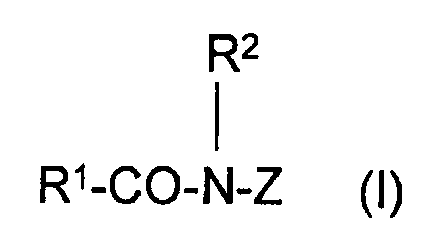
Zur Gruppe der Polyhydroxyfettsäureamide gehören auch Verbindungen der Formel (II)


DE 24 12 837 bestimmt werden kann, liegt in der Regel im Bereich von 100 bis 200 mg CaO pro Gramm. Geeignete Buildersubstanzen sind weiterhin kristalline Alkalisilikate, die allein oder im Gemisch mit amorphen Silikaten vorliegen können. Die als Gerüststoffe brauchbaren Alkalisilikate weisen vorzugsweise ein molares Verhältnis von Alkalioxid zu SiO2 unter 0,95, insbesondere von 1 : 1,1 bis 1 : 12 auf und können amorph oder kristallin vorliegen. Bevorzugte Alkalisilikate sind die Natriumsilikate, insbesondere die amorphen Natriumsilikate mit einem molaren Verhältnis Na2O : SiO2, von 1 : 2 bis 1 : 2.8. Solche mit einem molaren Verhältnis Na2O: SiO2 von 1 : 1,9 bis 1 : 2,8 können nach dem Verfahren der europäischen Patentanmeldung EP 0 425 427 hergestellt werden. Als kristalline Silikate, die allein oder im Gemisch mit amorphen Silikaten vorliegen können, werden vorzugsweise kristalline Schichtsilikate der allgemeinen Formel Na2SixO2x+1 · Y H2O eingesetzt, in der x, das sogenannte Modul, eine Zahl von 1,9 bis 4 und y eine Zahl von 0 bis 20 ist und bevorzugte Werte für x 2, 3 oder 4 sind. Kristalline Schichtsilikate, die unter diese allgemeine Formel fallen, werden beispielsweise in der europäischen Patentanmeldung EP 0 164 514 beschrieben. Bevorzugte kristalline Schichtsilikate sind solche, bei denen x in der genannten allgemeinen Formel die Werte 2 oder 3 annimmt. Insbesondere sind sowohl ö- als auch ß-Natriumdisilikate (Na2Si2O5 · y H2O) bevorzugt, wobei ß-Natriumdisilikat beispielsweise nach dem Verfahren erhalten werden kann, das in der internationalen Patentanmeldung WO 91/08171 beschrieben ist. ß-Natriumsilikate mit einem Modul zwischen 1,9 und 3,2 können gemäß den japanischen Patentanmeldungen JP 04/238 809 oder JP 04/260 6 10 hergestellt werden. Auch aus amorphen Silikaten hergestellte, praktisch wasserfreie kristalline Alkalisilikate der obengenannten allgemeinen Formel, in der x eine Zahl von 1,9 bis 2,1 bedeutet, herstellbar wie in den europäischen Patentanmeldungen EP 0 548 599, EP 0 502 325 und EP 0 425 428 beschrieben, können eingesetzt werden. In einer weiteren bevorzugten Ausführungsform derartiger Mittel wird ein kristallines Natriumschichtsilikat mit einem Modul von 2 bis 3 eingesetzt, wie es nach dem Verfahren der europäischen Patentanmeldung EP 0 436 835 aus Sand und Soda hergestellt werden kann. Kristalline Natriumsilikate mit einem Modul im Bereich von 1,9 bis 3,5, wie sie nach den Verfahren der europäischen Patentschriften EP 0 164 552 und/oder EP 0 294 753 erhältlich sind, werden in einer weiteren bevorzugten Ausführungsform erfindungsgemäßer Mittel eingesetzt. In einer bevorzugten Ausgestaltung erfindungsgemäßer Mittel setzt man ein granulares Compound aus Alkalisilikat und Alkalicarbonat ein, wie es zum Beispiel in der internationalen Patentanmeldung WO 95/22592 beschrieben ist oder wie es beispielsweise unter dem Namen Nabion® im Handel erhältlich ist. Falls als zusätzliche Buildersubstanz auch Alkalialumosilikat, insbesondere Zeolith, vorhanden ist, beträgt das Gewichtsverhältnis Alumosilikat zu Silikat, jeweils bezogen auf wasserfreie Aktivsubstanzen, vorzugsweise 1 : 10 bis 10 : 1. In Mitteln, die sowohl amorphe als auch kristalline Alkalisilikate enthalten, beträgt das Gewichtsverhältnis von amorphem Alkalisilikat zu kristallinem Alkalisilikat vorzugsweise 1 : 2 bis 2 : 1 und insbesondere 1 : 1 bis 2 : 1.
Derartige Buildersubstanzen sind in erfindungsgemäßen Mitteln vorzugsweise in Mengen bis zu 60 Gew.-%, insbesondere von 5 bis 40 Gew.-%, enthalten.
Das zweite saure Monomer beziehungsweise dessen Salz kann ein Derivat einer C4-C8-Dicarbonsäure, wobei Maleinsäure besonders bevorzugt ist, und/oder ein Derivat einer Allylsulfonsäure, die in 2-Stellung mit einem Alkyl- oder Arylrest substituiert ist, sein. Derartige Polymere lassen sich insbesondere nach Verfahren herstellen, die in den deutschen Patentschriften DE 42 21 381 und DE 43 00 772 beschrieben sind, und weisen im allgemeinen eine relative Molekülmasse zwischen 1000 und 200 000 auf. Weitere bevorzugte Copolymere sind solche, die in den deutschen Patentanmeldungen DE 43 03 320 und DE 44 17 734 beschrieben werden und als Monomere vorzugsweise Acrolein und Acrylsäure/Acrylsäuresalze beziehungsweise Vinylacetat aufweisen.
[bis(cyclohexanone oxime)bis(cyclohexanoneoximato)bis(pyridine)manganese (II)]
Liganden:
Cyclohexanon oxim, C6H10(=NOH)
Pyridin, C5H5N (py)
Anal. C 61,80; H 7,71; N 12,86,
Berech. für C34H52N6 O4Mn (M = 666,76):
C 61,51; H 7,90; N 12,66%.
Liganden:
Diphenylglyoxim, C6H5C(=NOH)-C(=NOH)C6H5 (H2dpg)
Pyridin, C5H5N (py)
Kurzformel von Cat2: Mn(Hdpg)2(py)2
Berech. für C38H32N6O4Mn (M = 691,65): C 65,99; H 4,66; N 12,15 %.
| Verbindung | Remissionsdifferenz (ddR%) |
| Cat 1 | 6,5 |
| Cat 2 | 5,9 |
| TAED (V1) | 3,5 |
| Verbindung | Remissionswerte pH-Wert | ||||
| 8 | 9 | 10 | 11 | 12 | |
| Cat 1 | 0,5 | 1,0 | 4 | 11,5 | 9 |
| Cat 2 | 0,5 | 1,0 | 3 | 10,5 | 8,5 |
Claims (8)
- Verwendung von Übergangsmetallkomplexen mit Oxim-Liganden als Bleichkatalysator für Persauerstoffverbindungen, dadurch gekennzeichnet, dass die Übergangsmetallkomplexe die Formel (1)
- M
- ein Metallatom aus der Gruppe Mn, Fe, Co, Ni, Mo, W,
- L
- einen Ligand der allgemeinen Formel
- R1
- C1-C22-Alkyl, C2-C22-Alkenyl oder C5-C24-Aryl,
- R2
- H, C1-C22-Alkyl, C2-C22-Alkenyl, C5-C24-Aryl oder
mit z = 0 oder 1,

- X
- einen Neutral- oder Anionligand aus der Gruppe Pyridine, Imidazoline, Methylimidazole, Picoline, Lutidine, Chlorid, Bromid, Nitrat, Perchlorat, Citrat, Hexafluorophosphat oder Anionen organischer Säuren mit C1-C22 Kohlenstoffatomen, n eine Zahl von 2 bis 4 und m eine Zahl von 0 bis 4 bedeuten.
- Verwendung nach Anspruch 1, dadurch gekennzeichnet, dass als Persauerstoffverbindung organische Persäuren, Wasserstoffperoxid, Perborat und Percarbonat sowie deren Gemische genommen werden.
- Verwendung nach Anspruch 1 in wässrigen Lösungen zur Textilwäsche, in wässrigen Reinigungslösungen für harte Oberflächen und zum Bleichen von farbigen Anschmutzungen.
- Verwendung nach Anspruch 1, dadurch gekennzeichnet, dass man gleichzeitig mit der Komplexverbindung der Formel 1 eine unter Perhydrolysebedingungen Peroxocarbonsäure abspaltende Verbindung einsetzt.
- Verbindungen der Formel (1)
- M
- ein Metallatom aus der Gruppe Mn, Fe, Co, Ni, Mo, W,
- L
- einen Ligand der allgemeinen Formel
- R1
- C1-C22-Alkyl, C2-C22-Alkenyl oder C5-C24-Aryl,
- R2
- H, C1-C22-Alkyl, C2-C22-Alkenyl, C5-C24-Aryl oder
mit z = 0 oder 1,

- X
- einen Neutral- oder Anionliganden aus der Gruppe der Pyridine, Imidazoline, Methylimidazole, Picoline, Lutidine, Chlorid, Bromid, Nitrat, Perchlorat, Citrat, Hexafluorophosphat oder Anionen organischer Säuren mit C1-C22 Kohlenstoffatomen, n eine Zahl von 2 bis 4 und m eine Zahl von 0 bis 4 bedeuten.
- Wasch-, Bleich- und Reinigungsmittel enthaltend einen Übergangsmetallkomplex gemäß Anspruch 1.
- Mittel nach Anspruch 6, dadurch gekennzeichnet, dass es 0,0025 Gew.-% bis 1 Gew.-%, insbesondere 0,01 Gew.-% bis 0,1 Gew.-% der Komplexverbindung enthält.
- Mittel nach Anspruch 6, dadurch gekennzeichnet, dass es zusätzlich zu der Komplexverbindung 1 Gew.-% bis 10 Gew.-% insbesondere 2 Gew.-% bis 6 Gew.-% unter Perhydrolysebedingungen Peroxycarbonsäure abspaltende Verbindung enthält.
Applications Claiming Priority (2)
| Application Number | Priority Date | Filing Date | Title |
|---|---|---|---|
| DE10102248 | 2001-01-19 | ||
| DE10102248A DE10102248A1 (de) | 2001-01-19 | 2001-01-19 | Verwendung von Übergangsmetallkomplexen mit Oxim-Liganden als Bleichkatalysatoren |
Publications (3)
| Publication Number | Publication Date |
|---|---|
| EP1225215A2 true EP1225215A2 (de) | 2002-07-24 |
| EP1225215A3 EP1225215A3 (de) | 2003-05-07 |
| EP1225215B1 EP1225215B1 (de) | 2005-09-07 |
Family
ID=7671042
Family Applications (1)
| Application Number | Title | Priority Date | Filing Date |
|---|---|---|---|
| EP02001237A Expired - Lifetime EP1225215B1 (de) | 2001-01-19 | 2002-01-17 | Verwendung von Übergangsmetallkomplexen mit Oxim-Liganden als Bleichkatalysatoren |
Country Status (5)
| Country | Link |
|---|---|
| US (1) | US6746996B2 (de) |
| EP (1) | EP1225215B1 (de) |
| JP (1) | JP2002302698A (de) |
| DE (2) | DE10102248A1 (de) |
| ES (1) | ES2249498T3 (de) |
Cited By (3)
| Publication number | Priority date | Publication date | Assignee | Title |
|---|---|---|---|---|
| EP1520910A1 (de) * | 2003-09-30 | 2005-04-06 | Clariant GmbH | Verwendung von Übergangsmetallkomplexen mit Lactamliganden als Bleichkatalysatoren |
| EP2103735A1 (de) * | 2008-03-18 | 2009-09-23 | Unilever PLC | Katalytische Substratbleichung |
| EP2623199A4 (de) * | 2010-10-01 | 2014-03-12 | Ube Industries | Oxidationskatalysator für eine kohlenwasserstoffverbindung sowie verfahren und vorrichtung zur erzeugung eines oxids aus der kohlenwasserstoffverbindung mithilfe dieses katalysators |
Families Citing this family (18)
| Publication number | Priority date | Publication date | Assignee | Title |
|---|---|---|---|---|
| DE10226522A1 (de) * | 2002-06-14 | 2003-12-24 | Degussa | Verwendung von Übergangsmetallkomplexen mit stickstoffhaltigen mehrzähnigen Liganden als Bleichkatalysator und Bleichmittelzusammensetzung |
| DE10227775A1 (de) * | 2002-06-21 | 2004-02-19 | Degussa Ag | Verwendung von Übergangsmetallkomplexen mit stickstoffhaltigen mehrzähnigen Liganden als Bleichkatalysator und Bleichmittelzusammensetzungen |
| DE10227774A1 (de) * | 2002-06-21 | 2004-01-08 | Degussa Ag | Verwendung von Übergangsmetallkomplexen mit stickstoffhaltigen mehrzähnigen Liganden als Bleichkatalysator und Bleichmittelzusammensetzung |
| DE10304131A1 (de) | 2003-02-03 | 2004-08-05 | Clariant Gmbh | Verwendung von Übergangsmetallkomplexen als Bleichkatalysatoren |
| US8262850B2 (en) | 2003-09-23 | 2012-09-11 | International Paper Company | Chemical activation and refining of southern pine kraft fibers |
| NZ562593A (en) | 2005-05-02 | 2011-05-27 | Int Paper Co | Ligno cellulosic materials and the products made therefrom, using an oxidizing agent with a transition metal catalyst |
| US9512563B2 (en) | 2009-05-28 | 2016-12-06 | Gp Cellulose Gmbh | Surface treated modified cellulose from chemical kraft fiber and methods of making and using same |
| US9512237B2 (en) | 2009-05-28 | 2016-12-06 | Gp Cellulose Gmbh | Method for inhibiting the growth of microbes with a modified cellulose fiber |
| MX382645B (es) | 2009-05-28 | 2025-03-13 | Gp Cellulose Gmbh | Celulosa modificada a partir de fibra kraft química y métodos para elaborarla y su uso. |
| US9511167B2 (en) | 2009-05-28 | 2016-12-06 | Gp Cellulose Gmbh | Modified cellulose from chemical kraft fiber and methods of making and using the same |
| WO2014100283A1 (en) | 2012-12-19 | 2014-06-26 | University Of Southern California | Photoactivated molecules for light-induced modulation of the activity of electrically excitable cells and methods of using same |
| MX364379B (es) | 2013-03-14 | 2019-04-24 | Gp Cellulose Gmbh | Un metodo para preparar una fibra kraft altamente funcional y de baja viscosidad, usando una secuencia de blanqueamiento acido, y una fibra hecha por el proceso. |
| CN105143547B (zh) | 2013-03-15 | 2018-05-01 | Gp 纤维素股份有限公司 | 具有增高羧基含量的低粘度牛皮纸纤维及其制造和使用方法 |
| DE102013010150A1 (de) * | 2013-06-15 | 2014-12-18 | Clariant International Ltd. | Bleichkatalysatorgranulate |
| DE102013019269A1 (de) * | 2013-11-15 | 2015-06-03 | Weylchem Switzerland Ag | Geschirrspülmittel sowie dessen Verwendung |
| US10232043B2 (en) | 2015-08-19 | 2019-03-19 | California Institute Of Technology | Photoactivated molecules for light-induced modulation of the activity of electrically excitable cells and methods of using the same |
| WO2018093697A1 (en) | 2016-11-16 | 2018-05-24 | Gp Cellulose Gmbh | Modified cellulose from chemical fiber and methods of making and using the same |
| CN119121674A (zh) | 2017-03-21 | 2024-12-13 | 国际纸业公司 | 气味控制纸浆组合物 |
Family Cites Families (61)
| Publication number | Priority date | Publication date | Assignee | Title |
|---|---|---|---|---|
| US3234158A (en) | 1962-08-30 | 1966-02-08 | Borden Co | Floor polish |
| DE1193019B (de) * | 1963-06-20 | 1965-05-20 | Reinluft G M B H | Verfahren zur Adsorption von Schwefeloxyden sowie gleichzeitig von einer oder mehreren reduzierenden Schwefelverbindungen aus industriellen Gasen, insbesondere Abgasen |
| AT330930B (de) | 1973-04-13 | 1976-07-26 | Henkel & Cie Gmbh | Verfahren zur herstellung von festen, schuttfahigen wasch- oder reinigungsmitteln mit einem gehalt an calcium bindenden substanzen |
| US3982892A (en) * | 1974-07-12 | 1976-09-28 | Colgate-Palmolive Company | Activated peroxy bleach composition |
| US4100203A (en) * | 1977-02-18 | 1978-07-11 | Ici Americas Inc. | Oxidative coupling of alkylphenols or 1-naphthols catalyzed by metal complexes of an oxime of a keto or aldehyde compound |
| JPS582436B2 (ja) * | 1978-10-09 | 1983-01-17 | 株式会社日立製作所 | メモリの駆動方法 |
| SU806686A1 (ru) * | 1979-03-29 | 1981-02-23 | Ордена Трудового Красного Знамениинститут Химии Ah Молдавской Ccp | Трехлигандные диоксимины никел /11/и СпОСОб иХ пОлучЕНи |
| DE3413571A1 (de) | 1984-04-11 | 1985-10-24 | Hoechst Ag, 6230 Frankfurt | Verwendung von kristallinen schichtfoermigen natriumsilikaten zur wasserenthaertung und verfahren zur wasserenthaertung |
| DE3417649A1 (de) * | 1984-05-12 | 1985-11-14 | Hoechst Ag, 6230 Frankfurt | Verfahren zur herstellung von kristallinen natriumsilikaten |
| GB8415909D0 (en) | 1984-06-21 | 1984-07-25 | Procter & Gamble Ltd | Peracid compounds |
| FR2597473B1 (fr) * | 1986-01-30 | 1988-08-12 | Roquette Freres | Procede d'oxydation de di-, tri-, oligo- et polysaccharides en acides polyhydroxycarboxyliques, catalyseur mis en oeuvre et produits ainsi obtenus. |
| US5002691A (en) * | 1986-11-06 | 1991-03-26 | The Clorox Company | Oxidant detergent containing stable bleach activator granules |
| US5087385A (en) * | 1986-11-06 | 1992-02-11 | The Clorox Company | Acyloxynitrogen peracid precursors |
| GB8629837D0 (en) | 1986-12-13 | 1987-01-21 | Interox Chemicals Ltd | Bleach activation |
| DE3719467A1 (de) | 1987-06-11 | 1988-12-29 | Hoechst Ag | Organisch substituierte ammoniumsilikate und verfahren zu ihrer herstellung |
| US4915863A (en) | 1987-08-14 | 1990-04-10 | Kao Corporation | Bleaching composition |
| JPH01240831A (ja) * | 1988-03-23 | 1989-09-26 | Tanaka Kikinzoku Kogyo Kk | 圧力インジケータ |
| GB8908416D0 (en) | 1989-04-13 | 1989-06-01 | Unilever Plc | Bleach activation |
| US5318733A (en) | 1989-08-09 | 1994-06-07 | Henkel Kommanditgesellschaft Auf Aktien | Production of compacted granules for detergents |
| CA2025073C (en) | 1989-10-25 | 1995-07-18 | Gunther Schimmel | Process for producing sodium silicates |
| CA2024966C (en) | 1989-10-25 | 1995-07-18 | Gunther Schimmel | Process for producing sodium silicates |
| YU221490A (sh) | 1989-12-02 | 1993-10-20 | Henkel Kg. | Postupak za hidrotermalnu izradu kristalnog natrijum disilikata |
| DE4000705A1 (de) | 1990-01-12 | 1991-07-18 | Hoechst Ag | Verfahren zur herstellung von kristallinen natriumsilikaten |
| GB9003741D0 (en) | 1990-02-19 | 1990-04-18 | Unilever Plc | Bleach activation |
| DE69125310T2 (de) | 1990-05-21 | 1997-07-03 | Unilever Nv | Bleichmittelaktivierung |
| US5075041A (en) * | 1990-06-28 | 1991-12-24 | Shell Oil Company | Process for the preparation of secondary alcohol sulfate-containing surfactant compositions |
| DE4041752A1 (de) | 1990-12-24 | 1992-06-25 | Henkel Kgaa | Enzymzubereitung fuer wasch- und reinigungsmittel |
| DE4107230C2 (de) | 1991-03-07 | 1995-04-06 | Hoechst Ag | Verfahren zur Herstellung von Natriumsilikaten |
| IT1245063B (it) | 1991-04-12 | 1994-09-13 | Ferruzzi Ricerca & Tec | Procedimento per l'ossidazione di carboidrati |
| EP0544490A1 (de) | 1991-11-26 | 1993-06-02 | Unilever Plc | Bleich- und Reinigungsmittelzusammensetzungen |
| CA2085642A1 (en) | 1991-12-20 | 1993-06-21 | Ronald Hage | Bleach activation |
| DE4142711A1 (de) | 1991-12-21 | 1993-06-24 | Hoechst Ag | Verfahren zur herstellung von kristallinen natriumdisilikaten |
| DE4221381C1 (de) | 1992-07-02 | 1994-02-10 | Stockhausen Chem Fab Gmbh | Pfropf-Copolymerisate von ungesättigten Monomeren und Zuckern, Verfahren zu ihrer Herstellung und ihre Verwendung |
| DE4203923A1 (de) | 1992-02-11 | 1993-08-12 | Henkel Kgaa | Verfahren zur herstellung von polycarboxylaten auf polysaccharid-basis |
| DE4216774A1 (de) | 1992-05-21 | 1993-11-25 | Henkel Kgaa | Verfahren zur kontinuierlichen Herstellung eines granularen Wasch und/oder Reinigungsmittels |
| AU682314B2 (en) | 1992-07-17 | 1997-10-02 | Genencor International, Inc. | High alkaline serine proteases |
| KR100294361B1 (ko) | 1992-07-23 | 2001-09-17 | 피아 스타르 | 돌연변이체알파-아밀라제,세정제,접시세척제,및액화제 |
| DE4300772C2 (de) | 1993-01-14 | 1997-03-27 | Stockhausen Chem Fab Gmbh | Wasserlösliche, biologisch abbaubare Copolymere auf Basis von ungesättigten Mono- und Dicarbonsäuren, Verfahren zu ihrer Herstellung und ihre Verwendung |
| DE4303320C2 (de) | 1993-02-05 | 1995-12-21 | Degussa | Waschmittelzusammensetzung mit verbessertem Schmutztragevermögen, Verfahren zu dessen Herstellung und Verwendung eines geeigneten Polycarboxylats hierfür |
| HU219675B (hu) | 1993-02-11 | 2001-06-28 | Genencor International Inc. | Oxidatívan stabil alfa-amiláz |
| DE4310506A1 (de) | 1993-03-31 | 1994-10-06 | Cognis Bio Umwelt | Enzymzubereitung für Wasch- und Reinigungsmittel |
| DK39093D0 (da) | 1993-04-01 | 1993-04-01 | Novo Nordisk As | Enzym |
| ES2121174T3 (es) | 1993-06-19 | 1998-11-16 | Ciba Geigy Ag | Inhibicion de la reabsorcion de colorantes migrantes en el licor de lavado. |
| DK100893D0 (da) | 1993-09-09 | 1993-09-09 | Novo Nordisk As | Enzym |
| WO1995007331A1 (en) | 1993-09-09 | 1995-03-16 | The Procter & Gamble Company | Liquid detergents with n-alkoxy or n-aryloxy polyhydroxy fatty acid amide surfactants |
| US5512699A (en) | 1994-01-25 | 1996-04-30 | The Procter & Gamble Company | Poly polyhydroxy fatty acid amides |
| WO1995019955A1 (en) | 1994-01-25 | 1995-07-27 | The Procter & Gamble Company | Gemini polyether fatty acid amides and their use in detergent compositions |
| US5534197A (en) | 1994-01-25 | 1996-07-09 | The Procter & Gamble Company | Gemini polyhydroxy fatty acid amides |
| DE4405511A1 (de) | 1994-02-22 | 1995-08-24 | Henkel Kgaa | Waschmittel mit amorphen silikatischen Buildersubstanzen |
| DE4416438A1 (de) | 1994-05-10 | 1995-11-16 | Basf Ag | Ein- oder mehrkernige Metall-Komplexe und ihre Verwendung als Bleich- und Oxidationskatalysatoren |
| DE4417734A1 (de) | 1994-05-20 | 1995-11-23 | Degussa | Polycarboxylate |
| DE4443177A1 (de) | 1994-12-05 | 1996-06-13 | Henkel Kgaa | Aktivatormischungen für anorganische Perverbindungen |
| JPH10513213A (ja) | 1995-02-02 | 1998-12-15 | ザ、プロクター、エンド、ギャンブル、カンパニー | コバルト触媒を含む自動皿洗い組成物 |
| EP0807160B1 (de) | 1995-02-02 | 2001-11-21 | The Procter & Gamble Company | Verfahren zur entfernung von teeflecken in geschirrspülern mit zusammensetzungen enthaltend kobalt (iii)- katalysator |
| AU711960B2 (en) | 1995-02-02 | 1999-10-28 | Procter & Gamble Company, The | Automatic dishwashing compositions comprising cobalt chelated catalysts |
| WO1996034092A2 (en) | 1995-04-28 | 1996-10-31 | Genencor International, Inc. | Detergents comprising cellulases |
| US6313081B1 (en) | 1995-04-28 | 2001-11-06 | Henkel Kommanditgesellschaft Auf Aktien (Kgaa) | Detergents comprising cellulases |
| DE19529904A1 (de) | 1995-08-15 | 1997-02-20 | Henkel Kgaa | Reinigungsmittel mit Aktivatorkomplexen für Persauerstoffverbindungen |
| JPH09132797A (ja) * | 1995-11-07 | 1997-05-20 | Mitsui Toatsu Chem Inc | 黴汚れ洗浄剤組成物 |
| DE69727711T2 (de) | 1996-11-29 | 2004-07-15 | The Clorox Co., Oakland | N-alkyl-ammonium-acetonitril-salze, methoden dazu und zusammensetzungen die diese enthalten |
| DE19704143A1 (de) * | 1997-02-04 | 1998-08-06 | Basf Ag | Aktivatoren für anorganische Perverbindungen |
-
2001
- 2001-01-19 DE DE10102248A patent/DE10102248A1/de not_active Withdrawn
-
2002
- 2002-01-17 US US10/052,123 patent/US6746996B2/en not_active Expired - Fee Related
- 2002-01-17 ES ES02001237T patent/ES2249498T3/es not_active Expired - Lifetime
- 2002-01-17 EP EP02001237A patent/EP1225215B1/de not_active Expired - Lifetime
- 2002-01-17 DE DE50204137T patent/DE50204137D1/de not_active Expired - Lifetime
- 2002-01-18 JP JP2002010607A patent/JP2002302698A/ja active Pending
Cited By (4)
| Publication number | Priority date | Publication date | Assignee | Title |
|---|---|---|---|---|
| EP1520910A1 (de) * | 2003-09-30 | 2005-04-06 | Clariant GmbH | Verwendung von Übergangsmetallkomplexen mit Lactamliganden als Bleichkatalysatoren |
| EP2103735A1 (de) * | 2008-03-18 | 2009-09-23 | Unilever PLC | Katalytische Substratbleichung |
| EP2623199A4 (de) * | 2010-10-01 | 2014-03-12 | Ube Industries | Oxidationskatalysator für eine kohlenwasserstoffverbindung sowie verfahren und vorrichtung zur erzeugung eines oxids aus der kohlenwasserstoffverbindung mithilfe dieses katalysators |
| EP2803408A1 (de) * | 2010-10-01 | 2014-11-19 | Ube Industries, Ltd. | Verfahren und Vorrichtung zur Herstellung von Oxid aus der Kohlenwasserstoffverbindung |
Also Published As
| Publication number | Publication date |
|---|---|
| EP1225215B1 (de) | 2005-09-07 |
| JP2002302698A (ja) | 2002-10-18 |
| US20020165110A1 (en) | 2002-11-07 |
| US6746996B2 (en) | 2004-06-08 |
| DE50204137D1 (de) | 2005-10-13 |
| ES2249498T3 (es) | 2006-04-01 |
| DE10102248A1 (de) | 2002-07-25 |
| EP1225215A3 (de) | 2003-05-07 |
Similar Documents
| Publication | Publication Date | Title |
|---|---|---|
| EP1557457B1 (de) | Verwendung von Übergangsmetallkomplexen als Bleichkatalysatoren in Wasch- und Reinigungsmitteln | |
| EP1445305B1 (de) | Verwendung von Übergangsmetallkomplexen als Bleichkatalysatoren | |
| EP1209221B1 (de) | Verwendung von cyclischen Zuckerketonen als Katalysatoren für Persauerstoffverbindungen | |
| EP1225215B1 (de) | Verwendung von Übergangsmetallkomplexen mit Oxim-Liganden als Bleichkatalysatoren | |
| EP0912690B1 (de) | Katalytisch wirksame aktivatorkomplexe mit n 4?-liganden für persauerstoffverbindungen | |
| EP1520910B1 (de) | Verwendung von Übergangsmetallkomplexen mit Lactamliganden als Bleichkatalysatoren | |
| EP2673349B1 (de) | Verwendung von übergangsmetallkomplexen als bleichkatalysatoren in wasch- und reinigungsmitteln | |
| DE19620411A1 (de) | Übergangsmetallamminkomplexe als Aktivatoren für Persauerstoffverbindungen | |
| EP2329000A1 (de) | Verwendung von mangan-oxalaten als bleichkatalysatoren | |
| EP1487955B1 (de) | Ammoniumnitrile und deren verwendung als hydrophobe bleichaktivatoren | |
| WO2000032731A1 (de) | Verwendung von übergangsmetallkomplexen mit stickstoffhaltigen heterocyclischen liganden zur verstärkung der bleichwirkung von persauerstoffverbindungen | |
| DE19713851B4 (de) | Verwendung von Komplexen des Molybdäns, Vanadiums oder Wolframs zur Verstärkung der Bleichwirkung | |
| DE19755493A1 (de) | Verwendung von Übergangsmetallkomplexen mit tripodalen Liganden zur Verstärkung der Bleichwirkung von Persauerstoffverbindungen | |
| EP1042444A1 (de) | Verwendung von übergangsmetallkomplexen mit dendrimer-liganden zur verstärkung der bleichwirkung von persauerstoffverbindungen | |
| DE19809713A1 (de) | Verwendung von Übergangsmetallkomplexen mit Dendrimer-Liganden zur Verstärkung der Bleichwirkung von Persauerstoffverbindungen | |
| DE19942224A1 (de) | Verwendung von Übergangsmetallkomplexverbindungen zur Verstärkung der Bleichwirkung von Persauerstoffverbindungen in sauren Systemen | |
| DE19800623A1 (de) | Verwendung von Mn-Thiosemicarbazonkomplexen zur Verstärkung der Bleichwirkung von Persauerstoffverbindungen | |
| DE102004041760A1 (de) | Diethylmethyl-Ammoniumnitrile und Wasch- und Reinigungsmittel, enthaltend diese Ammoniumnitrile | |
| DE19815744A1 (de) | Verwendung von Polyol-Metallkomplexen zur Verstärkung der Bleichwirkung von Persauerstoffverbindungen | |
| DE102005037761A1 (de) | Wasch- und Reinigungsmittel enthaltend 1,3,5-Triacetyl-2,4-dioxo-1,3,5-hexahydrotriazin als Bleichaktivator | |
| DE102005063059A1 (de) | Reinigungsmittel mit bleichkatalytisch aktiven Komplexen |
Legal Events
| Date | Code | Title | Description |
|---|---|---|---|
| PUAI | Public reference made under article 153(3) epc to a published international application that has entered the european phase |
Free format text: ORIGINAL CODE: 0009012 |
|
| AK | Designated contracting states |
Kind code of ref document: A2 Designated state(s): AT BE CH CY DE DK ES FI FR GB GR IE IT LI LU MC NL PT SE TR |
|
| AX | Request for extension of the european patent |
Free format text: AL;LT;LV;MK;RO;SI |
|
| PUAL | Search report despatched |
Free format text: ORIGINAL CODE: 0009013 |
|
| RIC1 | Information provided on ipc code assigned before grant |
Ipc: 7D 06L 3/02 B Ipc: 7D 21C 9/10 B Ipc: 7C 11D 3/39 A |
|
| AK | Designated contracting states |
Designated state(s): AT BE CH CY DE DK ES FI FR GB GR IE IT LI LU MC NL PT SE TR |
|
| AX | Request for extension of the european patent |
Extension state: AL LT LV MK RO SI |
|
| 17P | Request for examination filed |
Effective date: 20031107 |
|
| AKX | Designation fees paid |
Designated state(s): AT BE CH CY DE DK ES FI FR GB GR IE IT LI LU MC NL PT SE TR |
|
| 17Q | First examination report despatched |
Effective date: 20040907 |
|
| GRAP | Despatch of communication of intention to grant a patent |
Free format text: ORIGINAL CODE: EPIDOSNIGR1 |
|
| RBV | Designated contracting states (corrected) |
Designated state(s): BE CH DE ES FR GB IT LI |
|
| GRAS | Grant fee paid |
Free format text: ORIGINAL CODE: EPIDOSNIGR3 |
|
| GRAA | (expected) grant |
Free format text: ORIGINAL CODE: 0009210 |
|
| AK | Designated contracting states |
Kind code of ref document: B1 Designated state(s): BE CH DE ES FR GB IT LI |
|
| REG | Reference to a national code |
Ref country code: GB Ref legal event code: FG4D Free format text: NOT ENGLISH |
|
| REG | Reference to a national code |
Ref country code: CH Ref legal event code: EP |
|
| REF | Corresponds to: |
Ref document number: 50204137 Country of ref document: DE Date of ref document: 20051013 Kind code of ref document: P |
|
| GBT | Gb: translation of ep patent filed (gb section 77(6)(a)/1977) |
Effective date: 20051111 |
|
| REG | Reference to a national code |
Ref country code: CH Ref legal event code: PFA Owner name: CLARIANT PRODUKTE (DEUTSCHLAND) GMBH Free format text: CLARIANT GMBH#BRUENINGSTRASSE 50#65929 FRANKFURT AM MAIN (DE) -TRANSFER TO- CLARIANT PRODUKTE (DEUTSCHLAND) GMBH#BRUENINGSTRASSE 50#65929 FRANKFURT AM MAIN (DE) |
|
| RAP2 | Party data changed (patent owner data changed or rights of a patent transferred) |
Owner name: CLARIANT PRODUKTE (DEUTSCHLAND) GMBH |
|
| REG | Reference to a national code |
Ref country code: ES Ref legal event code: FG2A Ref document number: 2249498 Country of ref document: ES Kind code of ref document: T3 |
|
| ET | Fr: translation filed | ||
| PLBE | No opposition filed within time limit |
Free format text: ORIGINAL CODE: 0009261 |
|
| STAA | Information on the status of an ep patent application or granted ep patent |
Free format text: STATUS: NO OPPOSITION FILED WITHIN TIME LIMIT |
|
| 26N | No opposition filed |
Effective date: 20060608 |
|
| PGFP | Annual fee paid to national office [announced via postgrant information from national office to epo] |
Ref country code: CH Payment date: 20061213 Year of fee payment: 6 |
|
| PGFP | Annual fee paid to national office [announced via postgrant information from national office to epo] |
Ref country code: ES Payment date: 20061220 Year of fee payment: 6 |
|
| PGFP | Annual fee paid to national office [announced via postgrant information from national office to epo] |
Ref country code: BE Payment date: 20070105 Year of fee payment: 6 |
|
| REG | Reference to a national code |
Ref country code: FR Ref legal event code: CD |
|
| BECN | Be: change of holder's name |
Owner name: *CLARIANT PRODUKTE DEUTSCHLAND G.M.B.H. Effective date: 20050907 |
|
| BERE | Be: lapsed |
Owner name: *CLARIANT PRODUKTE DEUTSCHLAND G.M.B.H. Effective date: 20080131 |
|
| REG | Reference to a national code |
Ref country code: CH Ref legal event code: PL |
|
| PG25 | Lapsed in a contracting state [announced via postgrant information from national office to epo] |
Ref country code: CH Free format text: LAPSE BECAUSE OF NON-PAYMENT OF DUE FEES Effective date: 20080131 Ref country code: LI Free format text: LAPSE BECAUSE OF NON-PAYMENT OF DUE FEES Effective date: 20080131 |
|
| PG25 | Lapsed in a contracting state [announced via postgrant information from national office to epo] |
Ref country code: BE Free format text: LAPSE BECAUSE OF NON-PAYMENT OF DUE FEES Effective date: 20080131 |
|
| REG | Reference to a national code |
Ref country code: ES Ref legal event code: FD2A Effective date: 20080118 |
|
| PG25 | Lapsed in a contracting state [announced via postgrant information from national office to epo] |
Ref country code: ES Free format text: LAPSE BECAUSE OF NON-PAYMENT OF DUE FEES Effective date: 20080118 |
|
| PGFP | Annual fee paid to national office [announced via postgrant information from national office to epo] |
Ref country code: FR Payment date: 20120116 Year of fee payment: 11 |
|
| PGFP | Annual fee paid to national office [announced via postgrant information from national office to epo] |
Ref country code: IT Payment date: 20111221 Year of fee payment: 11 |
|
| REG | Reference to a national code |
Ref country code: FR Ref legal event code: ST Effective date: 20130930 |
|
| PG25 | Lapsed in a contracting state [announced via postgrant information from national office to epo] |
Ref country code: FR Free format text: LAPSE BECAUSE OF NON-PAYMENT OF DUE FEES Effective date: 20130131 |
|
| PG25 | Lapsed in a contracting state [announced via postgrant information from national office to epo] |
Ref country code: IT Free format text: LAPSE BECAUSE OF NON-PAYMENT OF DUE FEES Effective date: 20130117 |
|
| PGFP | Annual fee paid to national office [announced via postgrant information from national office to epo] |
Ref country code: DE Payment date: 20140122 Year of fee payment: 13 |
|
| PGFP | Annual fee paid to national office [announced via postgrant information from national office to epo] |
Ref country code: GB Payment date: 20140121 Year of fee payment: 13 |
|
| REG | Reference to a national code |
Ref country code: DE Ref legal event code: R082 Ref document number: 50204137 Country of ref document: DE Representative=s name: ACKERMANN, JOACHIM KARL WILHELM, DIPL.-CHEM. D, DE |
|
| REG | Reference to a national code |
Ref country code: DE Ref legal event code: R082 Ref document number: 50204137 Country of ref document: DE Representative=s name: ACKERMANN, JOACHIM KARL WILHELM, DIPL.-CHEM. D, DE Effective date: 20140902 Ref country code: DE Ref legal event code: R081 Ref document number: 50204137 Country of ref document: DE Owner name: WEYLCHEM WIESBADEN GMBH, DE Free format text: FORMER OWNER: CLARIANT PRODUKTE (DEUTSCHLAND) GMBH, 65929 FRANKFURT, DE Effective date: 20140902 |
|
| REG | Reference to a national code |
Ref country code: DE Ref legal event code: R119 Ref document number: 50204137 Country of ref document: DE |
|
| GBPC | Gb: european patent ceased through non-payment of renewal fee |
Effective date: 20150117 |
|
| PG25 | Lapsed in a contracting state [announced via postgrant information from national office to epo] |
Ref country code: GB Free format text: LAPSE BECAUSE OF NON-PAYMENT OF DUE FEES Effective date: 20150117 Ref country code: DE Free format text: LAPSE BECAUSE OF NON-PAYMENT OF DUE FEES Effective date: 20150801 |