EP1158347B1 - Liquid crystal device and electronic device - Google Patents
Liquid crystal device and electronic device Download PDFInfo
- Publication number
- EP1158347B1 EP1158347B1 EP01304507A EP01304507A EP1158347B1 EP 1158347 B1 EP1158347 B1 EP 1158347B1 EP 01304507 A EP01304507 A EP 01304507A EP 01304507 A EP01304507 A EP 01304507A EP 1158347 B1 EP1158347 B1 EP 1158347B1
- Authority
- EP
- European Patent Office
- Prior art keywords
- liquid crystal
- light emitting
- light
- crystal device
- flexible substrate
- Prior art date
- Legal status (The legal status is an assumption and is not a legal conclusion. Google has not performed a legal analysis and makes no representation as to the accuracy of the status listed.)
- Expired - Lifetime
Links
- 239000004973 liquid crystal related substance Substances 0.000 title claims abstract description 194
- 239000000758 substrate Substances 0.000 claims abstract description 156
- 238000005286 illumination Methods 0.000 abstract description 4
- 230000009467 reduction Effects 0.000 abstract description 4
- 239000010408 film Substances 0.000 description 44
- 229910052751 metal Inorganic materials 0.000 description 28
- 239000002184 metal Substances 0.000 description 28
- 239000011159 matrix material Substances 0.000 description 13
- 230000005684 electric field Effects 0.000 description 11
- 238000010276 construction Methods 0.000 description 9
- 230000006870 function Effects 0.000 description 8
- 239000000463 material Substances 0.000 description 6
- 238000000034 method Methods 0.000 description 5
- 239000003990 capacitor Substances 0.000 description 4
- 230000003247 decreasing effect Effects 0.000 description 4
- 238000000151 deposition Methods 0.000 description 4
- 238000009792 diffusion process Methods 0.000 description 4
- 238000003860 storage Methods 0.000 description 4
- 239000004642 Polyimide Substances 0.000 description 3
- 229910052782 aluminium Inorganic materials 0.000 description 3
- XAGFODPZIPBFFR-UHFFFAOYSA-N aluminium Chemical compound [Al] XAGFODPZIPBFFR-UHFFFAOYSA-N 0.000 description 3
- KRKNYBCHXYNGOX-UHFFFAOYSA-N citric acid Chemical compound OC(=O)CC(O)(C(O)=O)CC(O)=O KRKNYBCHXYNGOX-UHFFFAOYSA-N 0.000 description 3
- 230000010365 information processing Effects 0.000 description 3
- 239000012212 insulator Substances 0.000 description 3
- 230000003647 oxidation Effects 0.000 description 3
- 238000007254 oxidation reaction Methods 0.000 description 3
- BPUBBGLMJRNUCC-UHFFFAOYSA-N oxygen(2-);tantalum(5+) Chemical compound [O-2].[O-2].[O-2].[O-2].[O-2].[Ta+5].[Ta+5] BPUBBGLMJRNUCC-UHFFFAOYSA-N 0.000 description 3
- 239000002245 particle Substances 0.000 description 3
- 229920001721 polyimide Polymers 0.000 description 3
- 230000008569 process Effects 0.000 description 3
- 239000010409 thin film Substances 0.000 description 3
- VYZAMTAEIAYCRO-UHFFFAOYSA-N Chromium Chemical compound [Cr] VYZAMTAEIAYCRO-UHFFFAOYSA-N 0.000 description 2
- ZOKXTWBITQBERF-UHFFFAOYSA-N Molybdenum Chemical compound [Mo] ZOKXTWBITQBERF-UHFFFAOYSA-N 0.000 description 2
- 229910001362 Ta alloys Inorganic materials 0.000 description 2
- 230000005540 biological transmission Effects 0.000 description 2
- 229910052804 chromium Inorganic materials 0.000 description 2
- 239000011651 chromium Substances 0.000 description 2
- 239000011248 coating agent Substances 0.000 description 2
- 238000000576 coating method Methods 0.000 description 2
- 230000008021 deposition Effects 0.000 description 2
- 239000000428 dust Substances 0.000 description 2
- 230000005611 electricity Effects 0.000 description 2
- 239000004744 fabric Substances 0.000 description 2
- 239000011521 glass Substances 0.000 description 2
- 238000009499 grossing Methods 0.000 description 2
- 229910052750 molybdenum Inorganic materials 0.000 description 2
- 239000011733 molybdenum Substances 0.000 description 2
- 238000000059 patterning Methods 0.000 description 2
- 238000000206 photolithography Methods 0.000 description 2
- 239000004033 plastic Substances 0.000 description 2
- 239000000243 solution Substances 0.000 description 2
- 230000003068 static effect Effects 0.000 description 2
- 229910052715 tantalum Inorganic materials 0.000 description 2
- GUVRBAGPIYLISA-UHFFFAOYSA-N tantalum atom Chemical compound [Ta] GUVRBAGPIYLISA-UHFFFAOYSA-N 0.000 description 2
- WFKWXMTUELFFGS-UHFFFAOYSA-N tungsten Chemical compound [W] WFKWXMTUELFFGS-UHFFFAOYSA-N 0.000 description 2
- 229910052721 tungsten Inorganic materials 0.000 description 2
- 239000010937 tungsten Substances 0.000 description 2
- 229910052692 Dysprosium Inorganic materials 0.000 description 1
- 239000004593 Epoxy Substances 0.000 description 1
- RTAQQCXQSZGOHL-UHFFFAOYSA-N Titanium Chemical compound [Ti] RTAQQCXQSZGOHL-UHFFFAOYSA-N 0.000 description 1
- 239000000654 additive Substances 0.000 description 1
- 230000000996 additive effect Effects 0.000 description 1
- 239000000853 adhesive Substances 0.000 description 1
- 230000001070 adhesive effect Effects 0.000 description 1
- 239000007864 aqueous solution Substances 0.000 description 1
- 238000005452 bending Methods 0.000 description 1
- 230000015572 biosynthetic process Effects 0.000 description 1
- 230000008859 change Effects 0.000 description 1
- 238000006243 chemical reaction Methods 0.000 description 1
- 239000003086 colorant Substances 0.000 description 1
- 239000004020 conductor Substances 0.000 description 1
- 238000012937 correction Methods 0.000 description 1
- 230000007423 decrease Effects 0.000 description 1
- 230000007547 defect Effects 0.000 description 1
- 238000013461 design Methods 0.000 description 1
- 238000010586 diagram Methods 0.000 description 1
- KBQHZAAAGSGFKK-UHFFFAOYSA-N dysprosium atom Chemical compound [Dy] KBQHZAAAGSGFKK-UHFFFAOYSA-N 0.000 description 1
- 238000005530 etching Methods 0.000 description 1
- 238000002474 experimental method Methods 0.000 description 1
- 238000010438 heat treatment Methods 0.000 description 1
- 239000012535 impurity Substances 0.000 description 1
- 238000010348 incorporation Methods 0.000 description 1
- AMGQUBHHOARCQH-UHFFFAOYSA-N indium;oxotin Chemical compound [In].[Sn]=O AMGQUBHHOARCQH-UHFFFAOYSA-N 0.000 description 1
- 238000003780 insertion Methods 0.000 description 1
- 230000037431 insertion Effects 0.000 description 1
- 238000007689 inspection Methods 0.000 description 1
- 229910052746 lanthanum Inorganic materials 0.000 description 1
- FZLIPJUXYLNCLC-UHFFFAOYSA-N lanthanum atom Chemical compound [La] FZLIPJUXYLNCLC-UHFFFAOYSA-N 0.000 description 1
- 238000004519 manufacturing process Methods 0.000 description 1
- 239000000203 mixture Substances 0.000 description 1
- 238000012986 modification Methods 0.000 description 1
- 230000004048 modification Effects 0.000 description 1
- 230000003287 optical effect Effects 0.000 description 1
- 230000001590 oxidative effect Effects 0.000 description 1
- 230000000737 periodic effect Effects 0.000 description 1
- 229920000642 polymer Polymers 0.000 description 1
- 239000010453 quartz Substances 0.000 description 1
- 230000004043 responsiveness Effects 0.000 description 1
- 229910052702 rhenium Inorganic materials 0.000 description 1
- WUAPFZMCVAUBPE-UHFFFAOYSA-N rhenium atom Chemical compound [Re] WUAPFZMCVAUBPE-UHFFFAOYSA-N 0.000 description 1
- 238000007789 sealing Methods 0.000 description 1
- 239000003566 sealing material Substances 0.000 description 1
- VYPSYNLAJGMNEJ-UHFFFAOYSA-N silicon dioxide Inorganic materials O=[Si]=O VYPSYNLAJGMNEJ-UHFFFAOYSA-N 0.000 description 1
- 238000005476 soldering Methods 0.000 description 1
- 238000004544 sputter deposition Methods 0.000 description 1
- 239000000126 substance Substances 0.000 description 1
- 229910001936 tantalum oxide Inorganic materials 0.000 description 1
- 229910052719 titanium Inorganic materials 0.000 description 1
- 239000010936 titanium Substances 0.000 description 1
- 230000000007 visual effect Effects 0.000 description 1
- 229910052727 yttrium Inorganic materials 0.000 description 1
- VWQVUPCCIRVNHF-UHFFFAOYSA-N yttrium atom Chemical compound [Y] VWQVUPCCIRVNHF-UHFFFAOYSA-N 0.000 description 1
Images






Classifications
-
- G—PHYSICS
- G02—OPTICS
- G02F—OPTICAL DEVICES OR ARRANGEMENTS FOR THE CONTROL OF LIGHT BY MODIFICATION OF THE OPTICAL PROPERTIES OF THE MEDIA OF THE ELEMENTS INVOLVED THEREIN; NON-LINEAR OPTICS; FREQUENCY-CHANGING OF LIGHT; OPTICAL LOGIC ELEMENTS; OPTICAL ANALOGUE/DIGITAL CONVERTERS
- G02F1/00—Devices or arrangements for the control of the intensity, colour, phase, polarisation or direction of light arriving from an independent light source, e.g. switching, gating or modulating; Non-linear optics
- G02F1/01—Devices or arrangements for the control of the intensity, colour, phase, polarisation or direction of light arriving from an independent light source, e.g. switching, gating or modulating; Non-linear optics for the control of the intensity, phase, polarisation or colour
- G02F1/13—Devices or arrangements for the control of the intensity, colour, phase, polarisation or direction of light arriving from an independent light source, e.g. switching, gating or modulating; Non-linear optics for the control of the intensity, phase, polarisation or colour based on liquid crystals, e.g. single liquid crystal display cells
- G02F1/133—Constructional arrangements; Operation of liquid crystal cells; Circuit arrangements
-
- G—PHYSICS
- G02—OPTICS
- G02F—OPTICAL DEVICES OR ARRANGEMENTS FOR THE CONTROL OF LIGHT BY MODIFICATION OF THE OPTICAL PROPERTIES OF THE MEDIA OF THE ELEMENTS INVOLVED THEREIN; NON-LINEAR OPTICS; FREQUENCY-CHANGING OF LIGHT; OPTICAL LOGIC ELEMENTS; OPTICAL ANALOGUE/DIGITAL CONVERTERS
- G02F1/00—Devices or arrangements for the control of the intensity, colour, phase, polarisation or direction of light arriving from an independent light source, e.g. switching, gating or modulating; Non-linear optics
- G02F1/01—Devices or arrangements for the control of the intensity, colour, phase, polarisation or direction of light arriving from an independent light source, e.g. switching, gating or modulating; Non-linear optics for the control of the intensity, phase, polarisation or colour
- G02F1/13—Devices or arrangements for the control of the intensity, colour, phase, polarisation or direction of light arriving from an independent light source, e.g. switching, gating or modulating; Non-linear optics for the control of the intensity, phase, polarisation or colour based on liquid crystals, e.g. single liquid crystal display cells
- G02F1/133—Constructional arrangements; Operation of liquid crystal cells; Circuit arrangements
- G02F1/1333—Constructional arrangements; Manufacturing methods
- G02F1/1335—Structural association of cells with optical devices, e.g. polarisers or reflectors
- G02F1/1336—Illuminating devices
- G02F1/133615—Edge-illuminating devices, i.e. illuminating from the side
-
- G—PHYSICS
- G02—OPTICS
- G02F—OPTICAL DEVICES OR ARRANGEMENTS FOR THE CONTROL OF LIGHT BY MODIFICATION OF THE OPTICAL PROPERTIES OF THE MEDIA OF THE ELEMENTS INVOLVED THEREIN; NON-LINEAR OPTICS; FREQUENCY-CHANGING OF LIGHT; OPTICAL LOGIC ELEMENTS; OPTICAL ANALOGUE/DIGITAL CONVERTERS
- G02F1/00—Devices or arrangements for the control of the intensity, colour, phase, polarisation or direction of light arriving from an independent light source, e.g. switching, gating or modulating; Non-linear optics
- G02F1/01—Devices or arrangements for the control of the intensity, colour, phase, polarisation or direction of light arriving from an independent light source, e.g. switching, gating or modulating; Non-linear optics for the control of the intensity, phase, polarisation or colour
- G02F1/13—Devices or arrangements for the control of the intensity, colour, phase, polarisation or direction of light arriving from an independent light source, e.g. switching, gating or modulating; Non-linear optics for the control of the intensity, phase, polarisation or colour based on liquid crystals, e.g. single liquid crystal display cells
- G02F1/133—Constructional arrangements; Operation of liquid crystal cells; Circuit arrangements
- G02F1/1333—Constructional arrangements; Manufacturing methods
- G02F1/1345—Conductors connecting electrodes to cell terminals
- G02F1/13452—Conductors connecting driver circuitry and terminals of panels
-
- G—PHYSICS
- G02—OPTICS
- G02F—OPTICAL DEVICES OR ARRANGEMENTS FOR THE CONTROL OF LIGHT BY MODIFICATION OF THE OPTICAL PROPERTIES OF THE MEDIA OF THE ELEMENTS INVOLVED THEREIN; NON-LINEAR OPTICS; FREQUENCY-CHANGING OF LIGHT; OPTICAL LOGIC ELEMENTS; OPTICAL ANALOGUE/DIGITAL CONVERTERS
- G02F1/00—Devices or arrangements for the control of the intensity, colour, phase, polarisation or direction of light arriving from an independent light source, e.g. switching, gating or modulating; Non-linear optics
- G02F1/01—Devices or arrangements for the control of the intensity, colour, phase, polarisation or direction of light arriving from an independent light source, e.g. switching, gating or modulating; Non-linear optics for the control of the intensity, phase, polarisation or colour
- G02F1/13—Devices or arrangements for the control of the intensity, colour, phase, polarisation or direction of light arriving from an independent light source, e.g. switching, gating or modulating; Non-linear optics for the control of the intensity, phase, polarisation or colour based on liquid crystals, e.g. single liquid crystal display cells
- G02F1/133—Constructional arrangements; Operation of liquid crystal cells; Circuit arrangements
- G02F1/136—Liquid crystal cells structurally associated with a semi-conducting layer or substrate, e.g. cells forming part of an integrated circuit
- G02F1/1362—Active matrix addressed cells
- G02F1/1365—Active matrix addressed cells in which the switching element is a two-electrode device
Definitions
- the present invention relates to a liquid crystal device in which light transmitted through a liquid crystal is modulated by controlling the orientation of the liquid crystal to display an image.
- the present invention also relates to an electronic device using the liquid crystal device.
- the liquid crystal device generally comprises a liquid crystal sandwiched between a pair of substrates each comprising an electrode so that the orientation of the liquid crystal is controlled by applying a voltage between both electrodes to modulate light transmitted through the liquid crystal, to display an image.
- various known liquid crystal devices are distinguished into a reflective liquid crystal device having a structure in which external light is reflected by a reflector plate provided on the outer surface or the inner surface of one of substrates, a transmissive liquid crystal device having a structure in which light is supplied to the liquid crystal in a planar manner by using an illuminating device provided outside one of the substrates, and a transflective liquid crystal device which functions as a reflective type when external light is incident, and functions as a transmissive type when external light is insufficient.
- a liquid crystal device As the liquid crystal device on a system on which light is supplied to the liquid crystal by using the illuminating device, such as the transmissive liquid crystal device, or the transflective liquid crystal device, a liquid crystal device is conventionally known, in which a light emitting device such as LED (light emitting diode), or the like is used as a light emission source.
- the light emitting device is mounted on a non-flexible substrate such as a glass epoxy substrate, and the non-flexible substrate is mounted on a housing of a light guide so that the light emitting device is arranged opposite to the light receiving surface of the light guide.
- the conventional liquid crystal device having the above-described structure has the need to use a dedicated non-flexible substrate for the light emitting device and the need to form a structure for supporting the non-flexible substrate, thereby causing the problem of increasing the cost, complicating the structure and failing to achieve a small liquid crystal device.
- Japanese Patent Publication No. 2000-98415 discloses a liquid crystal display device comprising a liquid crystal panel connected to a printed wiring board via a flexible wiring board.
- the flexible wiring board is bent between the liquid crystal panel and the printed wiring board.
- a light transmission plate having a light incident end is arranged between the liquid crystal panel and the printed wiring board, so that the light incident end is positioned close to the bent part of the flexible wiring board.
- a light source capable of emitting light towards the light incident end of the light transmission plate is mounted in the bent part of the flexible wiring board.
- the present invention has been achieved in consideration of the above problem, and a first object of the present invention is to prevent deviation of the position of a light emitting device relative to a light guide to prevent the occurrence of variation in the efficiency of light incidence on the light guide even when a supporting structure for the light emitting device is simplified, thereby preventing the occurrence of variation in the light supplied to a liquid crystal.
- liquid crystal devices are possibly distinguished into an active matrix system liquid crystal device in which pixel electrodes are driven by switching elements (namely, nonlinear elements), and a passive matrix system liquid crystal device in which pixel electrodes are formed in a simple matrix arrangement without using switching elements.
- the active matrix system is thought to be advantageous from the viewpoint of good contrast and responsiveness, and ease of achievement of a high-defmition display.
- Known systems of the active matrix system liquid crystal device include a system using a three-terminal element such as a thin film transistor (TFT) as a switching element, and a system using a two-terminal element such as a thin film diode (TFD) .
- TFT thin film transistor
- TFD thin film diode
- a liquid crystal device is a transflective liquid crystal device which functions as a reflective type when external light is incident, and functions as a transmissive type when external light is insufficient.
- Fig. 1 is a liquid crystal device 1 in accordance with the embodiment.
- the liquid crystal device 1 comprises a liquid crystal panel 2 to which FPC (Flexible Printed Circuit: flexible substrate) 3a and FPC 3b are connected, and a light guide 4 mounted to the non-display side (the lower side in Fig. 1) of the liquid crystal panel 2. Furthermore, a control substrate 5 is provided on the side of the light guide 4 opposite to the liquid crystal panel 2 side.
- the control substrate 5 is used as a component of the liquid crystal device, or a component of an electronic device to which the liquid crystal device is mounted, according to circumstances.
- the FPCs 3a and 3b are used for electrically connecting the liquid crystal panel 2 and the control substrate 5.
- the liquid crystal panel 2 comprises a pair of substrates 7a and 7b which are bonded together with a sealing ring material 6.
- Liquid crystal driving ICs 8a are mounted on the surface of the portion of the first substrate 7a, which projects from the second substrate 7b, with AFC (Anisotropic Conductive Film) 9.
- Liquid crystal driving ICs 8b are mounted on the surface of the portion of the second substrate 7b, which projects from the first substrate 7a, with the AFC 9.
- the liquid crystal device of this embodiment is an active matrix system liquid crystal device using the TFDs as the switching elements, and one of the first substrate 7a and the second substrate 7b is an element substrate, the other being a counter substrate.
- the first substrate 7a is considered as the element substrate
- the second substrate 7b is considered as the counter substrate.
- pixel electrodes 66 are formed on the inner side of the first substrate 7a serving as the element substrate, and a polarizer 12a is bonded to the outer side thereof.
- data lines 52 are formed on the inner side of the second substrate 7b serving as the counter substrate, and a polarizer 12b is bonded to the outer side thereof.
- a liquid crystal L is sealed in a gap, i.e., a so-called cell gap, surrounded by the first substrate 7a, the second substrate 7b and the sealing material 6.
- various optical elements other than the above elements are provided on the first substrate 7a and the second substrate 7b according to demand.
- an alignment film is provided on the inner side of each of the substrates, for aligning the orientation of the liquid crystal L.
- Each of the alignment films is formed by, for example, coating a polyimide solution and then burning the coating.
- the polymer main chains of the polyimide are stretched in the predetermined direction by rubbing to orient the molecules of the liquid crystal L sealed in the cell gap along the stretching direction of the alignment film.
- color filters of the primary colors including R (red), G (green) and B (blue) are formed in a predetermined arrangement on the portions of the counter substrate which are opposed to the pixel electrodes formed on the element substrate, and a black matrix of Bk (black) is formed on the regions which are not opposed to the pixel electrodes.
- a smoothing film is further coated.
- a counter electrode provided on the counter substrate is formed on the smoothing layer.
- Fig. 3 schematically shows the electric construction of the liquid crystal panel 2.
- a plurality of scanning lines 51 are formed in the line direction (X direction) on the liquid crystal panel 2
- a plurality of data lines 52 are formed in the column direction (Y direction)
- a pixel 53 being formed at each of the intersections of the scanning lines 51 and the data lines 52.
- Each of the pixels 53 is formed by series connection of the liquid crystal layer 54 and the TFD (Thin Film Diode).
- the scanning lines 51 are driven by a scanning line driving circuit 57, and the data lines 52 are driven by a data line driving circuit 58.
- the scanning line driving circuit 57 is included in the liquid crystal driving ICs 8a
- the data line driving circuit 58 is included in the liquid crystal driving ICs 8b shown in Fig. 1.
- the scanning lines 51 and the TFDs 56 are formed on the inner side of the element substrate 7a shown in Fig. 2, and the pixel electrodes 66 formed on the inner side of the element substrate 7a are connected to the scanning lines 51.
- the data lines 52 are formed as stripe electrodes on the inner side of the counter substrate 7b shown in Fig. 2.
- the element substrate 7a and the counter substrate 7b are combined together so that the pixel electrodes 66 on one line have an opposed positional relation to one data line 52. Therefore, the liquid crystal layer 54 comprises the data lines 52 and the pixel electrodes 66, and the liquid crystal L held therebetween.
- the data lines 52 are made of a transparent conductive material, for example, such as ITO (Indium Tin Oxide) .
- the pixel electrodes 66 are made of a reflecting material such as Al (aluminum) .
- the TFDs 56 are connected to the scanning lines 51, and the liquid crystal layer 54 is connected to the data lines 52.
- the TFDs 56 may be connected to the data lines 52, and the liquid crystal layer 54 may be connected to the scanning lines 51.
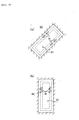
- Fig. 4 shows the construction of each pixel in the element substrate 7a. Particularly, Fig. 4(a) shows the planar structure of each pixel, and Fig. 4(b) shows the sectional structure taken along line A-A in Fig. 4(a).
- the TFD 56 comprises two TFD portions including a first TFD 56a and a second TFD 56b both of which are formed on an insulating film 61 deposited on the surface of the element substrate 7a.
- the insulating film 61 is made of, for example, tantalum oxide (Ta 2 O 5 ) having a thickness of about 50 to 200 nm.
- the TFDs 56a and 56b comprise a first metal film 62, an oxide film 63 formed on the surface of the first metal film 62 to function as an insulator, and second metal films 64a and 64b, respectively, formed on the surface of the oxide film 63 with a space therebetween.
- the oxide film 63 comprises tantalum oxide (Ta 2 O 5 ) formed by, for example, oxidizing the surface of the first metal film 62 by an anodic oxidation method. In anodic oxidation of the first metal film 62, the surfaces of the base portions of the scanning lines 51 are also oxidized to form an oxide film comprising tantalum oxide.
- the thickness of the oxide film 63 a preferred value, for example, about 10 to 35 nm, is selected according to application. This thickness is a half of the thickness in a case in which one TFD is used for one pixel.
- the chemical solution used for anodic oxidation is not limited, and for example, 0.01 to 0.1% by weight of citric acid aqueous solution can be used.
- the second metal films 64a and 64b are formed by depositing a reflecting material, for example, such as Al (aluminum) or the like by using a deposition method such as sputtering, and then pattering the deposited film by photolithography and etching processes to form a film having a thickness of about 50 to 300 nm.
- the second metal film 64a is used as each of the scanning lines 51, and the other second metal film 64b is connected to each of the pixel electrodes 66.
- the first TFD 56a has the laminated structure of second metal film 64a/oxide film 63/first metal film 62, i.e., the sandwich structure of metal/insulator/metal, in the order from the scanning line 51 side, and thus the current-voltage characteristic is non-linear in both the negative and positive directions.
- the second TFD 56b has the laminated structure of first metal film 62/oxide film 63/second metal film 64b in the order from the scanning line 51 side, and thus has the current-voltage characteristic opposite to the first TFD 56a. Therefore, the TFD 56 has a form in which two elements are connected in series in opposite directions to each other, and thus the current-voltage characteristic is symmetrized in both the negative and positive directions, as compared with a case in which one element is used.
- the first metal film 62 is made of, for example, a tantalum single material, or a tantalum alloy. Although the thickness of the first metal film 62 is appropriately selected according to the application of the TFD 56, the thickness is usually about 100 to 500 nm.
- an element in the VI to VIII group in the periodic table such as tungsten, chromium, molybdenum, rhenium, yttrium, lanthanum, or dysprosium, is added to tantalum as the main component. In this case, tungsten is preferred as the additive element, and the content is preferably, for example, 0.1 to 6% by weight.
- the base 17a which constitutes the element substrate 7a is made of, for example, quartz, glass, or plastic, together with the base 17b (refer to Fig. 2) which constitutes the counter substrate 7b.
- the element substrate base 17a is not necessarily transparent, while in this embodiment in which the device is used as both the reflective type and the transmissive type, the element substrate base 17a must be transparent.
- the reasons for providing the insulating film 61 on the surface of the element substrate 7a are the following. First, the first metal film 62 is prevented from being separated from the underlying film by heat treatment after deposition of the second metal films 64a and 64b. Second, diffusion of impurities into the first metal film 62 is prevented. Therefore, when these points are insignificant, the insulating film 61 can be omitted.
- the TFD 56 is an example of a two-terminal nonlinear element, and an element using a diode element structure, such as MSI (Metal Semi-Insulator), an element in which such elements are connected in series or parallel in opposite directions to each other, can also be used.
- MSI Metal Semi-Insulator
- the current-voltage characteristic need not be strictly symmetrized in both the negative and positive directions, only one element can be used for forming the TFD.
- the pixel electrode 66 formed by extending the second metal film 64b comprises a metal film of Al (aluminum) or the like with high reflectance.
- the pixel electrode 66 has the slit apertures 67 formed in an oblique direction as shown in Fig. 4(a).
- the liquid crystal device functions as the transmissive type, light transmitted through the apertures 67 enter the liquid crystal layer 54 (refer to Fig. 3).
- the pixel electrode 66 preferably has the fine protrusions provided for scattering reflected light.
- the liquid crystal panel 2 (refer to Fig. 1) comprises the element substrate 7a and the counter substrate 7b both of which are bonded together with a constant gap kept therebetween, and the liquid crystal L (refer to Fig. 2) sealed in the gap.
- the direction of rubbing for imparting orientation to the liquid crystal L is set to the direction shown by arrow R A in Fig. 4(a) for the element substrate 7a, and to the direction shown by an arrow R B for the counter substrate 7b.
- the rubbing direction which determines the orientation direction of the liquid crystal molecules is the direction R B to the upper left at an angle of 45 ° for the counter substrate 7b which is located at the front as both substrates are viewed in a combined state from the counter substrate side, and the rubbing direction is the direction R A to the lower left at an angle of 45° for the element substrate 7a which is located at the back. Therefore, the slit direction of the apertures 67 formed in the element substrate 7a coincides with the rubbing direction R A .
- the rubbing process is generally performed by rubbing with a puff cloth wound on a roller in a predetermined direction to easily cause undesirable occurrence in the manufacturing process, such as the occurrence of static electricity, and various dust particles.
- the rubbing direction with the puff cloth coincides with the slit direction of the apertures 67, the influence of the steps formed by the pixel electrodes 66 can be reduced to suppress the occurrence of static electricity and various dust particles.
- the second metal films 64a and 64b have the same composition as the pixel electrodes 66
- the second metal films 64a and 64b may be formed by patterning a non-reflecting metal such as chromium, titanium, or molybdenum, and then the pixel electrodes 66 may be formed by patterning a reflecting metal such as A1.
- the direction of the electric field produced by the pixel electrode 66 and the data line 52 opposed thereto is perpendicular to the substrates in the regions other than the apertures 67, and thus the strength of the electric field is also uniform.
- the electrode since the electrode is absent from the apertures 67, an electric field occurs only due to leakage from the aperture ends of the pixel electrode 66. Therefore, the strength of the electric field near each of the apertures 67 decreases away from the aperture ends, and is thus nonuniform. Conversely, this means that the strength of the electric field is substantially constant at the points at equal distances from the side end of each of the apertures 67 formed in the pixel electrode 66, i.e., the points shown by broken lines in Fig. 6(a).
- the rubbing direction of the element substrate 7a on which the pixel electrodes 66 are formed coincides with the slit direction of the apertures 67 formed in the pixel electrodes 66, the liquid crystal molecules M on the element substrate 7a side are thus oriented in parallel with the side ends of the apertures 67 with no voltage applied. Therefore, when a potential difference occurs between the pixel electrodes 66 and the data lines 52, and particularly when the potential difference is small, the electric field strength at one end of each liquid crystal molecule M is equal to that at the other end, and thus the liquid crystal molecules M located in the apertures 67 tilt like the liquid crystal molecules M located in the region where the electrodes are present, i.e., the region which contributes to display when the device functions as the reflective type. Therefore, the rotatory direction of the light transmitted through the apertures 67 is substantially equal to the light reflected by the pixel electrodes 66, thereby decreasing a difference in display quality between the transmissive type and the reflective type.
- the slit direction of the apertures preferably coincides with the rubbing direction, the difference in display quality can be possibly decreased to a level causing no practical problem as long as the angle between the slit direction and the rubbing direction is in the range of ⁇ 15°.
- the liquid crystal molecules M located in the apertures 67 are oriented in the direction crossing the side ends of the apertures 67 with no voltage applied, as shown in Fig. 6(b). Therefore, even when a potential difference occurs between the pixel electrodes 66 and the data lines 52, particularly when the potential difference is small, the electric field strength at one end of each liquid crystal molecule M is different from that at the other end, and thus the liquid crystal molecules located in the apertures do not tilt like the liquid crystal molecules M located in the region which contributes to display when the device is used as the reflective type. As a result, the rotatory direction of the light transmitted through the apertures 67 is different from the light reflected by the pixel electrodes 66, thereby causing a difference in display quality between the transmissive type and the reflective type.
- each of the apertures 67 formed in the pixel electrodes 66 are described.
- the distance between both substrates is generally several ⁇ m.
- black display is made by the influence of a leakage electric field from one end of the periphery of each electrode with the voltage applied.
- the width W of the slit apertures 67 is 3 ⁇ m or more, a dead space is formed in the pixel electrodes 66, in which the liquid crystal molecules M do not tilt according to the electric field in both the reflective type and the transmissive type. Therefore, the width W of the apertures 67 is possibly preferably 3 ⁇ m or less.
- the transmissive display and the reflective display can be balanced well when the area of the apertures 67 is set to 10 to 25 % of the area of the pixel electrodes 66.
- the area of the pixel electrodes 66 means the area of the effective display regions which are the intersections of the pixel electrodes 66 and the data lines 52, and which are not shielded by the black matrix, or the like.
- a plurality of terminals 13a are formed on the projecting portion of the first substrate 7a serving as the element substrate. These terminals are formed at the same time the pixel electrodes 66 are formed on the region of the surface of the first substrate 7a, which is opposed to the second substrate 7b serving as the counter substrate. Also, a plurality of terminals 13b is formed on the projecting portion of the second substrate 7b. These terminals are formed at the same time the data lines 52 are formed on the region of the surface of the second substrate 7b, which is opposed to the first substrate 7a.
- Each of the FPC 3a and the FPC 3b is formed by forming a metal film pattern having a desired pattern on a flexible base layer made of polyimide or another material.
- a plurality of terminals 22 is formed at a side end of the FPC 3b are conductively connected to the terminals 13b of the second substrate 7b by using a conductive adhesive element such as ACF.
- a plurality of terminals 23 formed at another side end of the FPC 3b is connected to the terminals (not shown) provided at a proper portion of the control substrate 5.
- a plurality of panel side terminals 14 are formed on the back side (the lower side shown in Fig. 1) at the liquid crystal panel side end, and a plurality of control substrate side terminals 16 are formed on the surface (the upper side shown in Fig. 1) at the side end opposite to the liquid crystal panel 2 side. Furthermore, a proper wiring pattern 18 is formed in a wide region of the surface of the FPC 3a so that one end of the wiring pattern 18 is connected directly to the control substrate side terminals 16, and the other end is connected to the panel side terminals 14 on the back side through through holes 19.
- each of the LEDs 21 comprises pins 26 as positioning means provided on both sides of the light emitting surface 24 so that the light emitting surface 24 and the pins 26 face to the direction shown by an arrow B in Fig. 1, i.e., the direction opposite to the FPC 3a.
- a diffusion plate 27 is mounted on the liquid crystal panel side surface of the light guide 4 by adhesion or the like, and a reflector plate 28 is mounted on the surface of the light guide 4, which is opposite to the liquid crystal panel side, by adhesion of the like.
- the reflector plate 28 reflects the light received by the light receiving surface 4a of the light guide to the liquid crystal panel 2.
- the diffusion plate 27 diffuses the light emitted from the light guide to the liquid crystal panel 2 with uniform planar strength.
- a number of storage recesses 29 are provided on the light receiving surface 4a of the light guide 4 corresponding to the number of the LEDs 21 mounted on the FPC 3a, and positioning recesses 31 are provided on both sides of each of the storage recesses 29.
- Each of the positioning recesses 31 is formed with a size and a positional relation which permit insertion of the pins 26 formed on the light receiving surface 24 of each LED 21 mounted on the FPC 3a without looseness.
- the light guide 4 is mounted to the non-display side of the liquid crystal panel 2 with a buffer material 32 provided therebetween and made of rubber, plastic, or the like.
- the control substrate 5 is provided on the side of the light guide 4 opposite to the side on which the reflector plate 28 is mounted.
- the control substrate 5 is mounted as a component of the liquid crystal device 1 on the non-display side surface of the light guide 4 or as a component of an electronic device using the liquid crystal device 1.
- terminals 33 are formed at a side end of the control substrate 5, for connection with an external circuit.
- the liquid crystal panel side end of the FPC 3a is bonded to the projecting portion of the first substrate 7a with the ACF 34.
- the terminals 13a of the first substrate 7a are conductively connected to the terminals 14 of the FPC 3a with the conductive particles contained in the ACF 34.
- the FPC 3a is bent along the light receiving surface 4a of the light guide 4, and in this bent state, the side end of the FPC 3a are overlapped with the side end of the control substrate 5.
- the terminals 16 on the FPC 3a are connected to the terminals 33 on the control substrate 5 by soldering or another conductive connection method.
- the light emitting surfaces 24 (refer to Fig. 7(a)) of the plurality of LEDs 21 mounted on the surface of the FPC 3a are contained in the storage recesses 29 formed on the light receiving surface 4a of the light guide 4, and the pins 26 provided on the light emitting surfaces 24 of the LEDs 21 are engaged with the positioning recesses 31.
- the LEDs 21 are mounted to the light receiving surface 4a of the light guide 4 to form the illumination device for supplying light to the liquid crystal panel 2.
- the side end at which the terminals 23 are formed is conductively connected to the control substrate side terminals formed at a proper portion of the control substrate 5.
- the light emitted from the light emitting surfaces 24 is introduced into the light guide 4, reflected by the reflector plate 28 to the liquid crystal panel 2, and then diffused by the diffusion plate 27 so that the diffused light is supplied with uniform planar strength to the liquid crystal panel 2.
- the component of the supplied light which passes through the light guide side polarizer 12a, is supplied to the liquid crystal layer, and then modulated for each pixel by the liquid crystal having orientation which is controlled for each pixel according to a change in the voltage applied between the pixel electrodes 65 and the data lines 52.
- the modulated light is passed through the display side polarizer 12b to display an image on the outside.
- the LEDs 21 are supported by the FPC 3a for achieving electrical connection between the liquid crystal panel 2 and the control substrate 5 to eliminate a dedicated substrate for supporting the LEDs 21, thereby simplifying the support structure for the LEDs 21. Therefore, cost reduction and miniaturization of the liquid crystal device can be achieved.
- Each of the LEDs 21 is always positioned at the constant position relative to the light receiving surface 4a of the light guide 4 by engagement between the pins 26 and the recesses 31, and the positions of the LEDs 21 are prevented from deviating relative to the light guide 4 during use of the liquid crystal device 1. Therefore, no variation occurs in display brightness of the liquid crystal panel 2 from product to product, and thus many liquid crystal devices 1 having uniform display performance can be stably manufactured.
- the LEDs 21 are mounted on the same surface of the FPC 3a as the liquid crystal panel side terminals 14, and the wiring pattern 18 of the FPC 3a is provided on the side opposite to the LED 21 side and connected to the terminals 14 through the through holes 19. Therefore, the wiring pattern 18 can be freely designed without being interfered with the LEDs 21.
- Fig. 8 shows a liquid crystal device in accordance with another embodiment of the present invention.
- the same members as those shown in Fig. 1 are denoted by the same reference numerals, and the description thereof is omitted.
- the construction not shown in Fig. 8 is the same as that of the embodiment shown in Fig. 1.
- This embodiment is different from the embodiment shown in Fig. 1 in that all the liquid crystal panel side terminals 14, the control substrate side terminals 16 and the wiring pattern 18 are formed on the same side of a FPC 3c used as the flexible substrate as the side on which the LEDs 21 are mounted, i.e., the lower side shown in Fig. 8. In this case, the wiring pattern 18 and the LEDs 21 cannot be arranged at the same positions, and thus the wiring pattern 18 is formed to avoid the LEDs 21.
- Fig. 9 shows the principal portion of a liquid crystal device in accordance with still another embodiment of the present invention.
- the same members as those shown in Figs. 1 and 2 are denoted by the same reference numerals, and the description thereof is omitted.
- the construction not shown in Fig. 9 is the same as that of the embodiment shown in Figs. 1 and 2.
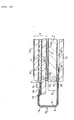
- This embodiment is different from the embodiment shown in Fig. 2 in that a light guide 4A is formed in a bent shape so that the light receiving surface 4a faces to the direction opposite to the liquid crystal panel 2, and the light emitting surfaces 24 of the LEDs 21 supported by the FPC 3a are arranged opposite to the bent light receiving surface 4a with the FPC 3a conductively connected to the terminals 33 of the control substrate 5.
- a wide space R can be formed between the light guide 4A and the FPC 3a so that the space R can be desirably used for containing, for example, a chip capacitor and other electronic parts mounted on the FPC 3a.
- Fig. 10 shows the principal portion of a liquid crystal device in accordance with a further embodiment of the present invention.
- the same members as those shown in Figs. 1 and 2 are denoted by the same reference numerals, and the description thereof is omitted.
- the construction not shown in Fig. 10 is the same as that of the embodiment shown in Figs. 1 and 2.
- This embodiment is different from the embodiment shown in Fig. 2 in that the light emitting surfaces 24 of the LEDs 21 are located at the sides of the surfaces mounted to the FPC 3a, and the FPC 3a is conductively connected to the terminals 33 of the control substrate 5 so that the light emitting side surfaces 24 are arranged opposite to the light receiving surface 4a of the light guide 4.
- a wide space R can be formed between the light guide 4 and the FPC 3a so that the space R can be desirably used for containing, for example, a chip capacitor and other electronic parts mounted on the FPC 3a.
- Fig. 7(b) shows a modified example 21A of the LED as the light emitting device.
- the LED 21A is different from the LED 21 shown in Fig. 7(a) in that the light emitting surface 24 around the light emission point F is a plane surface.
- Fig. 7(c) shows another modified example 21B of the LED as the light emitting device.
- the LED 21B is different from the LED 21 shown in Fig. 7(a) in that the light emitting surface 24 around the light emission point F is a plane surface, and triangular prism protrusions 36 are used as the positioning means in place of the pins 26.
- Fig. 11 shows an embodiment in which the liquid crystal device of the present invention is used as a display device of any one of various electronic devices.
- the electronic device shown in Fig. 11 comprises a display information output source 100, a display information processing circuit 101, a power source circuit 102, a timing generator 103, and a liquid crystal device 104.
- the liquid crystal device 104 comprises a liquid crystal panel 105 and a driving circuit 106.
- the liquid crystal device 1 shown in Fig. 1 can be used as the liquid crystal device 104, and the liquid crystal panel 2 shown in Fig. 1 can be used as the liquid crystal panel 105.
- the display information output source 100 comprises memory such as ROM (Read Only Memory), RAM (Random Access Memory), a storage unit such as any of various disks, a tuning circuit for tuning and outputting a digital image signal so that display information such as an image signal in a predetermined format is supplied to the display information processing circuit 101 based on a clock signal produced by the timing generator 103.
- memory such as ROM (Read Only Memory), RAM (Random Access Memory), a storage unit such as any of various disks, a tuning circuit for tuning and outputting a digital image signal so that display information such as an image signal in a predetermined format is supplied to the display information processing circuit 101 based on a clock signal produced by the timing generator 103.
- the display information processing circuit 101 comprises various known circuits such as a serial-parallel conversion circuit, an amplification-inversion circuit, a rotation circuit, a gamma correction circuit, a clamp circuit, etc., to process the input display information to supply the image signal to the driving circuit 106 together with the clock signal CLK.
- the driving circuit 106 is a general term for the scanning line driving circuit 57, the data line driving circuit 58, and an inspection circuit, and the like shown in Fig. 3.
- the power source circuit 102 supplies predetermined electric power to each of the components.
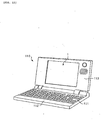
- Fig. 12 shows a mobile personal computer as an electronic device in accordance with an embodiment of the present invention.
- the personal computer 110 shown in Fig. 12 comprises a body 112 with a keyboard 111, and a liquid crystal display unit 113.
- the liquid crystal display unit 113 comprises the liquid crystal device 1 shown in Fig. 1.
- Fig. 13 shows a cell phone as an electronic device in accordance with another embodiment of the present invention.
- the cell phone 120 shown in Fig. 13 comprises a plurality of operating buttons 121, and the liquid crystal device 1.
- liquid crystal device 1 used in the embodiment shown in each of Figs. 12 and 13 is the transflective liquid crystal device, as described above with reference to Fig. 1, a display can be seen without any trouble by lighting the illumination device comprising the LEDs 21 and the light guide 4, i.e., a back light, even when the computer or cell phone is placed in a portion with insufficient external light.
- the LEDs 21 are supported by the FPC 3a for achieving electric connection between the liquid crystal panel 2 and the control substrate 5 to eliminate a dedicated substrate for supporting the LEDs 21, thereby greatly simplifying the supporting structure for the LEDs 21. Therefore, the liquid crystal 1 can be miniaturized, and incorporated into the liquid crystal display unit 113 shown in Fig. 12 to enable the formation of a narrow frame, i.e., a narrow frame region, of the liquid crystal display unit 113. In regard to the cell phone 120 shown in Fig. 13, miniaturization of the liquid crystal device 1 permits the incorporation of a large display region even when the outer size of the cell phone is decreased.
- the LEDs 21 are always positioned at the constant positions relative to the light receiving surface 4a of the light guide 4 by engagement between the pins 26 and the recesses 31, and the positions are prevented from deviating relative to the light guide 4 during use of the liquid crystal device 1, thereby removing variation in display brightness of the liquid crystal device 1 from product to product. Therefore,
- the display screens of the computer shown in Fig. 12, and the cell phone 120 shown in Fig. 13 have no variation in brightness from product to product, and thus uniform display performance can be obtained.
- the present invention is applied to an active matrix liquid crystal device of a transflective type using TFDs.
- the present invention can be applied to other various types of liquid crystal devices, such as a reflective liquid crystal device, a transmissive liquid crystal device, an active matrix liquid crystal device using switching elements other than TFDs, a passive matrix liquid crystal device not using switching elements.
- a liquid crystal device of the present invention comprises a light emitting device provided on a flexible substrate connected to one of substrates which hold a liquid crystal therebetween, and the flexible substrate is used for some electric wiring for the liquid crystal, not used as a dedicated substrate for mounting the light emitting device on a light guide. Therefore, the supporting structure for the light emitting device can be significantly simplified to achieve cost reduction and miniaturization of the liquid crystal device.
Landscapes
- Physics & Mathematics (AREA)
- Nonlinear Science (AREA)
- Mathematical Physics (AREA)
- Chemical & Material Sciences (AREA)
- Crystallography & Structural Chemistry (AREA)
- General Physics & Mathematics (AREA)
- Optics & Photonics (AREA)
- Liquid Crystal (AREA)
- Planar Illumination Modules (AREA)
- Fastening Of Light Sources Or Lamp Holders (AREA)
- Liquid Crystal Substances (AREA)
- Devices For Indicating Variable Information By Combining Individual Elements (AREA)
Applications Claiming Priority (2)
| Application Number | Priority Date | Filing Date | Title |
|---|---|---|---|
| JP2000151666A JP3642263B2 (ja) | 2000-05-23 | 2000-05-23 | 液晶装置及び電子機器 |
| JP2000151666 | 2000-05-23 |
Publications (3)
| Publication Number | Publication Date |
|---|---|
| EP1158347A2 EP1158347A2 (en) | 2001-11-28 |
| EP1158347A3 EP1158347A3 (en) | 2002-11-27 |
| EP1158347B1 true EP1158347B1 (en) | 2006-08-02 |
Family
ID=18657187
Family Applications (1)
| Application Number | Title | Priority Date | Filing Date |
|---|---|---|---|
| EP01304507A Expired - Lifetime EP1158347B1 (en) | 2000-05-23 | 2001-05-22 | Liquid crystal device and electronic device |
Country Status (8)
| Country | Link |
|---|---|
| US (1) | US6897912B2 (https=) |
| EP (1) | EP1158347B1 (https=) |
| JP (1) | JP3642263B2 (https=) |
| KR (1) | KR100441327B1 (https=) |
| CN (1) | CN1208667C (https=) |
| AT (1) | ATE335219T1 (https=) |
| DE (1) | DE60121858T2 (https=) |
| TW (1) | TWI291064B (https=) |
Families Citing this family (49)
| Publication number | Priority date | Publication date | Assignee | Title |
|---|---|---|---|---|
| US6697130B2 (en) * | 2001-01-16 | 2004-02-24 | Visteon Global Technologies, Inc. | Flexible led backlighting circuit |
| JP4689851B2 (ja) * | 2001-02-23 | 2011-05-25 | Nec液晶テクノロジー株式会社 | アクティブマトリクス型液晶表示装置 |
| EP1376212A1 (fr) * | 2002-06-21 | 2004-01-02 | Asulab S.A. | Cellule d'affichage, notamment à cristal liquide, ou cellule photovoltaique comprenant des moyens pour sa connexion à électronique de commande |
| JP2004247373A (ja) | 2003-02-12 | 2004-09-02 | Semiconductor Energy Lab Co Ltd | 半導体装置 |
| JP4217090B2 (ja) * | 2003-03-20 | 2009-01-28 | 株式会社 日立ディスプレイズ | 表示装置 |
| KR20040087464A (ko) * | 2003-04-08 | 2004-10-14 | 삼성전자주식회사 | 액정표시장치 |
| TW594176B (en) * | 2003-06-17 | 2004-06-21 | Au Optronics Corp | Circuit scheme of light emitting device and liquid crystal display |
| JP2005070569A (ja) | 2003-08-27 | 2005-03-17 | Nec Corp | 移動体通信機及びそれに用いるlcdモジュール実装方法 |
| JP4543772B2 (ja) * | 2003-09-19 | 2010-09-15 | セイコーエプソン株式会社 | 電気光学装置および電子機器 |
| JP4072493B2 (ja) * | 2003-11-14 | 2008-04-09 | Nec液晶テクノロジー株式会社 | 基板モジュール及び液晶モジュール |
| US7196693B2 (en) * | 2003-12-12 | 2007-03-27 | Compal Electronics, Inc. | Lighting keyboard and lighting module thereof |
| JP4055741B2 (ja) | 2004-05-24 | 2008-03-05 | セイコーエプソン株式会社 | 電気光学装置および電子機器 |
| JP4072519B2 (ja) * | 2004-06-18 | 2008-04-09 | シャープ株式会社 | 表示装置用照明装置 |
| JP4581726B2 (ja) * | 2004-12-28 | 2010-11-17 | ソニー株式会社 | 表示装置および携帯機器 |
| TWM272351U (en) * | 2005-01-21 | 2005-08-01 | Innolux Display Corp | Display module |
| JP4244942B2 (ja) | 2005-03-08 | 2009-03-25 | セイコーエプソン株式会社 | 液晶装置、照明装置、および電子機器 |
| US7284894B2 (en) * | 2005-05-31 | 2007-10-23 | Avago Technologies Eceliip (Singapore) Pte Ltd | Light source utilizing a flexible circuit carrier |
| JP4616105B2 (ja) * | 2005-07-20 | 2011-01-19 | 株式会社 日立ディスプレイズ | 液晶表示装置 |
| TW200712684A (en) * | 2005-09-30 | 2007-04-01 | Innolux Display Corp | Liquid crystal display module |
| CN1971345B (zh) * | 2005-11-24 | 2010-05-12 | 群康科技(深圳)有限公司 | 软性电路板和液晶显示器 |
| EP1987709B1 (en) * | 2006-02-10 | 2014-08-13 | Nokia Corporation | A display module and method for fixing |
| TWI326375B (en) * | 2006-04-21 | 2010-06-21 | Chimei Innolux Corp | Liquid crystal display device |
| CN100368895C (zh) * | 2006-05-30 | 2008-02-13 | 友达光电股份有限公司 | 使用发光二极管的背光模块 |
| KR100821042B1 (ko) * | 2006-09-22 | 2008-04-08 | 삼성에스디아이 주식회사 | 액정표시장치 및 이를 이용한 휴대용 표시기기 |
| KR100786479B1 (ko) * | 2006-09-22 | 2007-12-17 | 삼성에스디아이 주식회사 | 평판표시장치 및 이를 이용한 휴대용 표시기기 |
| KR100821043B1 (ko) * | 2006-09-22 | 2008-04-08 | 삼성에스디아이 주식회사 | 연성인쇄회로기판 |
| KR101284053B1 (ko) | 2006-10-26 | 2013-07-10 | 삼성디스플레이 주식회사 | 백라이트 어셈블리 및 이를 갖는 표시장치 |
| JP4333727B2 (ja) * | 2006-11-13 | 2009-09-16 | エプソンイメージングデバイス株式会社 | 電気光学装置、照明装置及び電子機器 |
| JP5010925B2 (ja) * | 2007-01-12 | 2012-08-29 | 株式会社ジャパンディスプレイイースト | 液晶表示モジュール |
| RU2419740C1 (ru) * | 2007-02-16 | 2011-05-27 | Шарп Кабусики Кайся | Устройство подсветки и устройство плоского дисплея, использующее его |
| TWI330415B (en) * | 2007-04-02 | 2010-09-11 | Chimei Innolux Corp | Light emitting diode and a backlight module using the same |
| CN101281942B (zh) * | 2007-04-06 | 2011-06-29 | 群康科技(深圳)有限公司 | 发光二极管和采用该发光二极管的背光模组 |
| KR100857693B1 (ko) | 2007-05-10 | 2008-09-08 | 삼성에스디아이 주식회사 | 액정 표시장치 |
| US7707974B2 (en) * | 2007-07-25 | 2010-05-04 | Radio Systems Corporation | LCD window for animal training device and method for manufacture |
| TWM329818U (en) * | 2007-10-17 | 2008-04-01 | Universal Scient Ind Co Ltd | Portable electronic device with anisotropic conductive unit |
| KR101431154B1 (ko) * | 2007-11-08 | 2014-08-18 | 삼성디스플레이 주식회사 | 표시 장치 및 이의 조립 방법 |
| RU2473940C2 (ru) * | 2008-07-08 | 2013-01-27 | Шарп Кабусики Кайся | Жидкокристаллическое дисплейное устройство |
| US9335579B2 (en) * | 2011-05-18 | 2016-05-10 | Sharp Kabushiki Kaisha | Display device |
| TWI553382B (zh) | 2011-06-24 | 2016-10-11 | Lg伊諾特股份有限公司 | 照明系統 |
| KR101307960B1 (ko) * | 2012-04-26 | 2013-09-12 | 엘지디스플레이 주식회사 | 디스플레이 장치 |
| KR101346083B1 (ko) * | 2012-04-26 | 2013-12-31 | 엘지디스플레이 주식회사 | 디스플레이 장치 |
| CN102809100A (zh) * | 2012-08-09 | 2012-12-05 | 京东方科技集团股份有限公司 | 背光源及其制备方法 |
| US9072167B2 (en) * | 2012-08-27 | 2015-06-30 | Shenzhen China Star Optoelectronics Technology Co., Ltd. | Display device |
| US8988866B2 (en) * | 2012-08-27 | 2015-03-24 | Shenzhen China Star Optoelectronics Technology Co., Ltd. | Display device |
| US9084338B2 (en) * | 2012-08-27 | 2015-07-14 | Shenzhen China Star Optoelectronics Technology Co., Ltd. | Display device |
| US8988875B2 (en) * | 2012-08-27 | 2015-03-24 | Shenzhen China Star Optoelectronics Technology Co., Ltd. | Display device |
| KR102416142B1 (ko) | 2015-08-31 | 2022-07-01 | 엘지디스플레이 주식회사 | 백커버 및 이를 이용한 투명표시장치 |
| CN108398818B (zh) * | 2017-02-06 | 2021-04-27 | 精工爱普生株式会社 | 电光装置以及电子设备 |
| CN113419370B (zh) * | 2018-06-06 | 2022-10-18 | 上海中航光电子有限公司 | 液晶显示装置 |
Family Cites Families (19)
| Publication number | Priority date | Publication date | Assignee | Title |
|---|---|---|---|---|
| US149074A (en) * | 1874-03-31 | Improvement in paint compounds | ||
| JPH01219823A (ja) | 1988-02-29 | 1989-09-01 | Seiko Epson Corp | 液晶表示装置 |
| JP2689781B2 (ja) * | 1991-08-21 | 1997-12-10 | 三菱電機株式会社 | 液晶表示器の照明構造及び組立構造 |
| JPH0581877U (ja) * | 1992-04-02 | 1993-11-05 | 三洋電機株式会社 | 面照明装置 |
| JPH0590450U (ja) | 1992-05-13 | 1993-12-10 | 富士通テン株式会社 | バックライト構造 |
| GB2296362B (en) | 1994-12-23 | 1999-03-03 | Nokia Mobile Phones Ltd | Illuminated LCD apparatus and method of manufacture |
| US5613751A (en) | 1995-06-27 | 1997-03-25 | Lumitex, Inc. | Light emitting panel assemblies |
| JP3613897B2 (ja) * | 1996-03-29 | 2005-01-26 | セイコーエプソン株式会社 | 液晶表示装置及びその使用機器 |
| JP3319279B2 (ja) * | 1996-04-23 | 2002-08-26 | セイコーエプソン株式会社 | 液晶表示装置 |
| JPH10142426A (ja) * | 1996-11-15 | 1998-05-29 | Matsushita Electric Works Ltd | 導光部材 |
| US5708428A (en) | 1996-12-10 | 1998-01-13 | Ericsson Inc. | Method and apparatus for providing backlighting for keypads and LCD panels |
| JPH10301504A (ja) * | 1997-04-24 | 1998-11-13 | Kokusai Electric Co Ltd | Lcdモジュールとその実装方法 |
| JPH11344705A (ja) | 1998-05-29 | 1999-12-14 | Kyocera Corp | Lcdのバックライト方式 |
| JP3728981B2 (ja) * | 1998-08-26 | 2005-12-21 | セイコーエプソン株式会社 | 液晶装置及び電子機器 |
| JP2000075316A (ja) | 1998-09-02 | 2000-03-14 | Matsushita Electric Ind Co Ltd | 液晶表示モジュールおよびフィルムキャリヤならびに携帯端末機器 |
| JP2000098415A (ja) * | 1998-09-28 | 2000-04-07 | Matsushita Electric Ind Co Ltd | 液晶表示装置 |
| JP2000235183A (ja) * | 1999-02-16 | 2000-08-29 | Matsushita Electric Ind Co Ltd | 照明装置およびこれを備えた携帯情報機器 |
| JP3645761B2 (ja) * | 1999-10-15 | 2005-05-11 | Necアクセステクニカ株式会社 | Lcdバックライト |
| JP4610037B2 (ja) | 2000-03-15 | 2011-01-12 | 京セラ株式会社 | 液晶表示装置 |
-
2000
- 2000-05-23 JP JP2000151666A patent/JP3642263B2/ja not_active Expired - Lifetime
-
2001
- 2001-05-03 TW TW090110645A patent/TWI291064B/zh not_active IP Right Cessation
- 2001-05-21 KR KR10-2001-0027607A patent/KR100441327B1/ko not_active Expired - Lifetime
- 2001-05-22 DE DE60121858T patent/DE60121858T2/de not_active Expired - Lifetime
- 2001-05-22 CN CNB011195010A patent/CN1208667C/zh not_active Expired - Lifetime
- 2001-05-22 US US09/863,059 patent/US6897912B2/en not_active Expired - Lifetime
- 2001-05-22 AT AT01304507T patent/ATE335219T1/de not_active IP Right Cessation
- 2001-05-22 EP EP01304507A patent/EP1158347B1/en not_active Expired - Lifetime
Also Published As
| Publication number | Publication date |
|---|---|
| KR20010107599A (ko) | 2001-12-07 |
| EP1158347A2 (en) | 2001-11-28 |
| DE60121858T2 (de) | 2007-02-08 |
| TWI291064B (en) | 2007-12-11 |
| CN1208667C (zh) | 2005-06-29 |
| JP3642263B2 (ja) | 2005-04-27 |
| JP2001330830A (ja) | 2001-11-30 |
| ATE335219T1 (de) | 2006-08-15 |
| CN1325036A (zh) | 2001-12-05 |
| US20020008805A1 (en) | 2002-01-24 |
| DE60121858D1 (de) | 2006-09-14 |
| EP1158347A3 (en) | 2002-11-27 |
| KR100441327B1 (ko) | 2004-07-23 |
| US6897912B2 (en) | 2005-05-24 |
Similar Documents
| Publication | Publication Date | Title |
|---|---|---|
| EP1158347B1 (en) | Liquid crystal device and electronic device | |
| US6883934B2 (en) | Light source device, illumination device liquid crystal device and electronic apparatus | |
| US6927818B2 (en) | Transflective liquid crystal device having light-transmitting films overlapping light reflective films and method of manufacturing such a device | |
| US6924867B2 (en) | Display device substrate, method for manufacturing the display device substrate, liquid-crystal device, and electronic equipment | |
| EP1158344A2 (en) | Liquid crystal device and method for making the same | |
| US20030223021A1 (en) | Color filter substrate, electrooptic device and electronic apparatus, and methods for manufacturing color filter substrate and electrooptic device | |
| JP3642304B2 (ja) | 液晶パネル、液晶装置及び電子機器 | |
| JP2002169487A (ja) | 電気光学装置及び電子機器 | |
| US6927831B2 (en) | Liquid crystal device and electronic apparatus having a substantially uniform substrate interval | |
| JP3744244B2 (ja) | 液晶表示装置および電子機器 | |
| JP2002169488A (ja) | 電気光学装置及び電子機器 | |
| JP2001305996A (ja) | 表示装置用基板及びその製造方法、並びに液晶装置及び電子機器 | |
| JP3780821B2 (ja) | 液晶装置 | |
| JP3855652B2 (ja) | 電気光学装置 | |
| KR100975811B1 (ko) | 액정표시장치 | |
| JP3649222B2 (ja) | 液晶装置及び電子機器 | |
| JP4396197B2 (ja) | 電気光学装置および電気機器 | |
| JP2006276584A (ja) | 電気光学装置、配線基板の実装方法及び電子機器 | |
| JP2002040478A (ja) | 能動素子及びその製造方法、液晶表示パネル及びその製造方法並びに電子機器 | |
| JP2003140171A (ja) | 電気光学装置、電子機器、および電気光学装置の製造方法 |
Legal Events
| Date | Code | Title | Description |
|---|---|---|---|
| PUAI | Public reference made under article 153(3) epc to a published international application that has entered the european phase |
Free format text: ORIGINAL CODE: 0009012 |
|
| AK | Designated contracting states |
Kind code of ref document: A2 Designated state(s): AT BE CH CY DE DK ES FI FR GB GR IE IT LI LU MC NL PT SE TR |
|
| AX | Request for extension of the european patent |
Free format text: AL;LT;LV;MK;RO;SI |
|
| PUAL | Search report despatched |
Free format text: ORIGINAL CODE: 0009013 |
|
| AK | Designated contracting states |
Kind code of ref document: A3 Designated state(s): AT BE CH CY DE DK ES FI FR GB GR IE IT LI LU MC NL PT SE TR |
|
| AX | Request for extension of the european patent |
Free format text: AL;LT;LV;MK;RO;SI |
|
| RIC1 | Information provided on ipc code assigned before grant |
Free format text: 7G 02F 1/13357A, 7G 02F 1/13 B |
|
| 17P | Request for examination filed |
Effective date: 20030422 |
|
| AKX | Designation fees paid |
Designated state(s): AT BE CH CY DE DK ES FI FR GB GR IE IT LI LU MC NL PT SE TR |
|
| 17Q | First examination report despatched |
Effective date: 20050407 |
|
| GRAP | Despatch of communication of intention to grant a patent |
Free format text: ORIGINAL CODE: EPIDOSNIGR1 |
|
| GRAS | Grant fee paid |
Free format text: ORIGINAL CODE: EPIDOSNIGR3 |
|
| GRAA | (expected) grant |
Free format text: ORIGINAL CODE: 0009210 |
|
| AK | Designated contracting states |
Kind code of ref document: B1 Designated state(s): AT BE CH CY DE DK ES FI FR GB GR IE IT LI LU MC NL PT SE TR |
|
| PG25 | Lapsed in a contracting state [announced via postgrant information from national office to epo] |
Ref country code: IT Free format text: LAPSE BECAUSE OF FAILURE TO SUBMIT A TRANSLATION OF THE DESCRIPTION OR TO PAY THE FEE WITHIN THE PRESCRIBED TIME-LIMIT;WARNING: LAPSES OF ITALIAN PATENTS WITH EFFECTIVE DATE BEFORE 2007 MAY HAVE OCCURRED AT ANY TIME BEFORE 2007. THE CORRECT EFFECTIVE DATE MAY BE DIFFERENT FROM THE ONE RECORDED. Effective date: 20060802 Ref country code: BE Free format text: LAPSE BECAUSE OF FAILURE TO SUBMIT A TRANSLATION OF THE DESCRIPTION OR TO PAY THE FEE WITHIN THE PRESCRIBED TIME-LIMIT Effective date: 20060802 Ref country code: LI Free format text: LAPSE BECAUSE OF FAILURE TO SUBMIT A TRANSLATION OF THE DESCRIPTION OR TO PAY THE FEE WITHIN THE PRESCRIBED TIME-LIMIT Effective date: 20060802 Ref country code: AT Free format text: LAPSE BECAUSE OF FAILURE TO SUBMIT A TRANSLATION OF THE DESCRIPTION OR TO PAY THE FEE WITHIN THE PRESCRIBED TIME-LIMIT Effective date: 20060802 Ref country code: FI Free format text: LAPSE BECAUSE OF FAILURE TO SUBMIT A TRANSLATION OF THE DESCRIPTION OR TO PAY THE FEE WITHIN THE PRESCRIBED TIME-LIMIT Effective date: 20060802 Ref country code: NL Free format text: LAPSE BECAUSE OF FAILURE TO SUBMIT A TRANSLATION OF THE DESCRIPTION OR TO PAY THE FEE WITHIN THE PRESCRIBED TIME-LIMIT Effective date: 20060802 Ref country code: CH Free format text: LAPSE BECAUSE OF FAILURE TO SUBMIT A TRANSLATION OF THE DESCRIPTION OR TO PAY THE FEE WITHIN THE PRESCRIBED TIME-LIMIT Effective date: 20060802 |
|
| REG | Reference to a national code |
Ref country code: GB Ref legal event code: FG4D |
|
| REG | Reference to a national code |
Ref country code: CH Ref legal event code: EP |
|
| REG | Reference to a national code |
Ref country code: IE Ref legal event code: FG4D |
|
| REF | Corresponds to: |
Ref document number: 60121858 Country of ref document: DE Date of ref document: 20060914 Kind code of ref document: P |
|
| PG25 | Lapsed in a contracting state [announced via postgrant information from national office to epo] |
Ref country code: SE Free format text: LAPSE BECAUSE OF FAILURE TO SUBMIT A TRANSLATION OF THE DESCRIPTION OR TO PAY THE FEE WITHIN THE PRESCRIBED TIME-LIMIT Effective date: 20061102 Ref country code: DK Free format text: LAPSE BECAUSE OF FAILURE TO SUBMIT A TRANSLATION OF THE DESCRIPTION OR TO PAY THE FEE WITHIN THE PRESCRIBED TIME-LIMIT Effective date: 20061102 |
|
| PG25 | Lapsed in a contracting state [announced via postgrant information from national office to epo] |
Ref country code: ES Free format text: LAPSE BECAUSE OF FAILURE TO SUBMIT A TRANSLATION OF THE DESCRIPTION OR TO PAY THE FEE WITHIN THE PRESCRIBED TIME-LIMIT Effective date: 20061113 |
|
| NLV1 | Nl: lapsed or annulled due to failure to fulfill the requirements of art. 29p and 29m of the patents act | ||
| PG25 | Lapsed in a contracting state [announced via postgrant information from national office to epo] |
Ref country code: PT Free format text: LAPSE BECAUSE OF FAILURE TO SUBMIT A TRANSLATION OF THE DESCRIPTION OR TO PAY THE FEE WITHIN THE PRESCRIBED TIME-LIMIT Effective date: 20070102 |
|
| REG | Reference to a national code |
Ref country code: CH Ref legal event code: PL |
|
| ET | Fr: translation filed | ||
| PLBE | No opposition filed within time limit |
Free format text: ORIGINAL CODE: 0009261 |
|
| STAA | Information on the status of an ep patent application or granted ep patent |
Free format text: STATUS: NO OPPOSITION FILED WITHIN TIME LIMIT |
|
| 26N | No opposition filed |
Effective date: 20070503 |
|
| PG25 | Lapsed in a contracting state [announced via postgrant information from national office to epo] |
Ref country code: MC Free format text: LAPSE BECAUSE OF NON-PAYMENT OF DUE FEES Effective date: 20070531 |
|
| PG25 | Lapsed in a contracting state [announced via postgrant information from national office to epo] |
Ref country code: GR Free format text: LAPSE BECAUSE OF FAILURE TO SUBMIT A TRANSLATION OF THE DESCRIPTION OR TO PAY THE FEE WITHIN THE PRESCRIBED TIME-LIMIT Effective date: 20061103 |
|
| PG25 | Lapsed in a contracting state [announced via postgrant information from national office to epo] |
Ref country code: IE Free format text: LAPSE BECAUSE OF NON-PAYMENT OF DUE FEES Effective date: 20070522 |
|
| PG25 | Lapsed in a contracting state [announced via postgrant information from national office to epo] |
Ref country code: CY Free format text: LAPSE BECAUSE OF FAILURE TO SUBMIT A TRANSLATION OF THE DESCRIPTION OR TO PAY THE FEE WITHIN THE PRESCRIBED TIME-LIMIT Effective date: 20060802 Ref country code: LU Free format text: LAPSE BECAUSE OF NON-PAYMENT OF DUE FEES Effective date: 20070522 |
|
| PG25 | Lapsed in a contracting state [announced via postgrant information from national office to epo] |
Ref country code: TR Free format text: LAPSE BECAUSE OF FAILURE TO SUBMIT A TRANSLATION OF THE DESCRIPTION OR TO PAY THE FEE WITHIN THE PRESCRIBED TIME-LIMIT Effective date: 20060802 |
|
| PGFP | Annual fee paid to national office [announced via postgrant information from national office to epo] |
Ref country code: DE Payment date: 20120516 Year of fee payment: 12 |
|
| PGFP | Annual fee paid to national office [announced via postgrant information from national office to epo] |
Ref country code: FR Payment date: 20120608 Year of fee payment: 12 Ref country code: GB Payment date: 20120516 Year of fee payment: 12 |
|
| GBPC | Gb: european patent ceased through non-payment of renewal fee |
Effective date: 20130522 |
|
| PG25 | Lapsed in a contracting state [announced via postgrant information from national office to epo] |
Ref country code: DE Free format text: LAPSE BECAUSE OF NON-PAYMENT OF DUE FEES Effective date: 20131203 |
|
| REG | Reference to a national code |
Ref country code: DE Ref legal event code: R119 Ref document number: 60121858 Country of ref document: DE Effective date: 20131203 |
|
| REG | Reference to a national code |
Ref country code: FR Ref legal event code: ST Effective date: 20140131 |
|
| PG25 | Lapsed in a contracting state [announced via postgrant information from national office to epo] |
Ref country code: GB Free format text: LAPSE BECAUSE OF NON-PAYMENT OF DUE FEES Effective date: 20130522 |
|
| PG25 | Lapsed in a contracting state [announced via postgrant information from national office to epo] |
Ref country code: FR Free format text: LAPSE BECAUSE OF NON-PAYMENT OF DUE FEES Effective date: 20130531 |