EP1114587A1 - Procédé de coextrusion dans des tubes concentriques - Google Patents
Procédé de coextrusion dans des tubes concentriques Download PDFInfo
- Publication number
- EP1114587A1 EP1114587A1 EP00403717A EP00403717A EP1114587A1 EP 1114587 A1 EP1114587 A1 EP 1114587A1 EP 00403717 A EP00403717 A EP 00403717A EP 00403717 A EP00403717 A EP 00403717A EP 1114587 A1 EP1114587 A1 EP 1114587A1
- Authority
- EP
- European Patent Office
- Prior art keywords
- section
- die
- envelope
- cannula
- product
- Prior art date
- Legal status (The legal status is an assumption and is not a legal conclusion. Google has not performed a legal analysis and makes no representation as to the accuracy of the status listed.)
- Granted
Links
Images


Classifications
-
- A—HUMAN NECESSITIES
- A23—FOODS OR FOODSTUFFS; TREATMENT THEREOF, NOT COVERED BY OTHER CLASSES
- A23C—DAIRY PRODUCTS, e.g. MILK, BUTTER OR CHEESE; MILK OR CHEESE SUBSTITUTES; PREPARATION THEREOF
- A23C19/00—Cheese; Cheese preparations; Making thereof
- A23C19/06—Treating cheese curd after whey separation; Products obtained thereby
- A23C19/09—Other cheese preparations; Mixtures of cheese with other foodstuffs
- A23C19/0908—Sliced cheese; Multilayered or stuffed cheese; Cheese loaves
-
- A—HUMAN NECESSITIES
- A23—FOODS OR FOODSTUFFS; TREATMENT THEREOF, NOT COVERED BY OTHER CLASSES
- A23P—SHAPING OR WORKING OF FOODSTUFFS, NOT FULLY COVERED BY A SINGLE OTHER SUBCLASS
- A23P30/00—Shaping or working of foodstuffs characterised by the process or apparatus
- A23P30/20—Extruding
- A23P30/25—Co-extrusion of different foodstuffs
Definitions
- the subject of the invention is a food product of the food specialty type. filled, a method of manufacturing such a product, and a device this process.
- VEMAG a process similar to the previous process, called commonly "VEMAG" with the difference that the device is not integrated in one same device. It is actually two pushers combined with a coextrusion. The latter is also very short, and remains of diameter greater than 20mm in general to obtain a product at production costs reasonable.
- the system is difficult to adapt to the high dry extract cheeses described in the rest of the text.
- the invention aims to obtain food specialties, especially cheese, thickets typically small with a diameter of less than 20mm, in particular from 10 to 15mm by overcoming the drawbacks of the prior art for obtaining such a type of product.
- the invention also relates to the production of such products using pastes cheese makers with a high dry extract, in particular up to 50 to 60%.
- a high dry extract in particular up to 50 to 60%.
- the invention also aims to use a wide variety of formulations possible. for the manufacture of the desired products.
- the food base is typically protein, and can be polysaccharide.
- the envelope is formed in the first section of the die by cooling, typically by circulation of water or other similar fluid.
- a variant is used for the shell material of the cheeses natural, fresh curds, unmelted cheese specialties.
- Another variant is used for the shell material of the cheeses. fondues, cheese specialties melted with or without cast iron salts.
- the envelope is formed by heating, by thermal coagulation at a temperature above 50 ° C, typically between 80 and 100 ° C.
- first and second embodiment for the filling material of composite products based on cheeses, meats, eggs, fish meat, surimi, fruit, vegetables.
- the envelope material has a dry extract of up to 60%, and typically of the order of 30 to 50%.
- the co-extrusion head is supplied by two simple pumps with feed hoppers, respectively for the feed material, and for the envelope material.
- the hoppers transfer pumps are connected to the coextruder, live on the coextrusion system.
- the pumps are connected to a system closed intermediate fitted with a heat exchanger, so as to control the temperature of the materials just before entering the coextrusion head.
- the pressure and the distribution of the material flow intended for form the envelope are regulated using a diffusion plate inserted on the product envelope channel.
- coextruded segments are assembled, optionally with a gelling agent, then they are heat treated so as to obtain a reconstituted block which can be cut.
- the product leaving the die is sliced and then packaged, in continuous or discontinuous.
- the linear flow speed of the product at the outlet of the die is typically between 5 and 10 meters / minute.
- the cannulas are concentric, the most peripheral cannula being the most short, or not concentric.
- the shortest length L1 of the cannula is at least 10 cm so that the envelope solidifies and typically from 30 to 150 cm, the difference between the length L of the die and the length Ln of the longest cannula being at least minus 10 cm and typically from 30 to 600 cm.
- the device comprises means for regulating the temperature at the level first transfer means, temperature regulation means at the level of the second transfer means, means for regulating the temperature of the first section of the die, means for regulating the temperature of the second section of the die.
- the die is typically of circular, parallelepiped, or playful section.
- the die is in cross section of identical or different shape to that of the cannula (s).
- the die has in cross section a diameter between 5 and 50 mm, and preferably 7 to 20 mm.
- the die section is between 1.2 and 5 times the section of the cannula.
- the invention relates to a food product, of the type stuffed food specialty, obtained by implementing the process described previously, the product comprising a solid envelope extending longitudinally, coating at least one filling, the product having in section transverse a dimension less than 20mm and typically between 10 and 20 mm.
- the fodder has a cheese or non-cheese composition chosen from the group including deli meats, fish based pasta or other seafood, fruits, herbs, spices and herbs.
- the product comprises at least three layers concentric, the outer shell being of cheese composition.
- the product comprises a solid envelope of composition cheese spreading longitudinally, coating at least one filling, the product having in cross section a dimension less than 20mn and typically between 10 and 20 mm, and the envelope has a dry extract between 40 and 60%, the product being thus grippable without sticking.
- the food product is presented in a variant in the form of a block reconstituted slicable obtained by assembling several products such as described above, this reconstituted product comprising a plurality of channels filled with fodder.
- a first embodiment of the invention is described.
- a coextrusion device 1 is used making it possible to manufacture from a envelope material 3 and a filling material 4 a coextruded product 5, by coextrusion in a coextrusion sector 6.
- the casing material 3 is introduced into a feed hopper 7 of a volume typically of the order of 50 liters.
- the fodder material 4 is introduced into a feed hopper 8 of a similar volume.
- the shell material is a cheese protein base type material.
- the hoppers 7 and 8 include means for dosing the output quantity of these hopper, and means of regulating the temperature of the material envelope and fodder material.
- the hoppers 7, 8 open respectively in feed tanks 7a, 8a.
- the envelope material 3 is conducted by first transfer means 9, at the outlet of the tank 7a, towards a co-extrusion head 11.
- the material of fodder 4 is driven by second transfer means 10 towards the head of co-extrusion 11.
- the first and second transfer means 9, 10 are pipes for food use. The flow in these pipes is around 50 to 100 Kg / h.
- the coextrusion head 11 includes a coextrusion chamber 12.
- the feed transfer means 10 open into the co-extrusion head at an entrance 13.
- the end part 13a of the transfer means 10 is in communication watertight with the end part 13 b of a cannula 14.
- the cannula 14 is held by means of holding means 17 in the head 11.
- the device 1 comprises between the hopper 7 and the head 11, over a portion of the transfer duct 9 for regulating means 18 of the temperature of the envelope material.
- the device 1 also comprises means 19 for regulating the temperature of the feed material, between the hopper 8 and the head 11.
- the die 6 has a first end 20 at the outlet of the head coextrusion 11, and a second end 21 where the coextruded product opens.
- the die 6 successively comprises a first section S1 of a length L1, a second section S2 of length L2.
- the length L1 is the length of the die 6 from the plane P of the end 20.
- This length L1 is the length of the die 6 which includes the part of the cannula 14 located in the die 6. Over this length L1, the fodder material F imprints the cannula 14, up to the end 22 of this cannula 14.
- the envelope material circulates in the die 6 between the internal wall 23 of the die 6 and the outer wall 24 of the cannula 14.
- Thermal means 25 are provided for modifying the temperature of the envelope material and feed material flowing in the first section. These thermal means 25 are for example a double envelope, an electrical resistance, an oil bath or other fluids.
- the product envelope is formed by solidification as this will be described in detail later.
- the temperature supplied by the thermal means 25 is T1
- the temperature of output of these thermal means is T'1.
- the sector 6 presents following the first section L1, the second section of length L2 which no longer includes a cannula 14.
- This section L2 includes second thermal means 26 similar to the first thermal means 25.
- the temperature supplied by these thermal means 26 is T2, the temperature in output of these thermal means 26 is T'2.
- the second section L2 includes a section S "3, between the thermal means 25 and the thermal means 26.
- the first section S1 includes a section S'3 of length L'3 between the head coextrusion 11 and the thermal means 25.
- Shell and fodder materials must be transferable and pumped into the coextrusion system. They can be introduced into the feed hopper thus in viscous fluid form, viscosity in front be less than values that would block the device, for example of the order from 50,000 to 100,000 centipoises, or even 1,000,000 centipoises, this with a pumping pressure of up to 20 to 50 bars.
- the coextrusion system is a hot coextrusion system.
- the coextrusion process is a cold coextrusion process.
- hot coextrusion is intended more particularly to processed cheese specialties and processed cheeses as well as unmelted cheese specialties and natural cheeses.
- the initial envelope material is at a temperature TE of the order of 90 ° C. This material is cooled at the transfer means 9, then successively at the end of the die, in the first section S1 then in the second section S2.
- This envelope material is therefore not thermocoagulable, but rather thermofluidifier.
- Cold coextrusion is intended more particularly for materials composite food based on meats, cold cuts, fish, surimi by example.
- the cold casing material at the hopper 7 is kept cold in the transfer means 9, then is heated in section L1 of the die.
- thermocoagulable such as preparations for based on meats, eggs, cheese whey, fish meat, surimi.
- the formation of the envelope and the fodder is made continuously, but shifted in time : formation of the envelope in section S1 then formation of fodder in the section S2.
- composition 5 products can use other secondary ingredients and additives intended to improve the sensory perception of the finished product, its machinability, its conservation, its external appearance in particular.
- These secondary ingredients can be food hydrocolloids (starches, modified starches, gelatins, gums, carrageenans, ...), vegetable or animal proteins (wheat proteins, soy proteins, ... egg proteins, whey, %), preservatives (sorbic acids, sorbates, nisin, nitrites, etc.), flavors and spices, animal fats or vegetable (butter, cream, MGLA, rapeseed oil, sunflower oil, butter cocoa, Among, Among these secondary ingredients can be food hydrocolloids (starches, modified starches, gelatins, gums, carrageenans, Among vegetable hydrocolloids, ., vegetable or animal proteins (wheat proteins, soy proteins, ... egg proteins, whey, 7), preservatives (sorbic acids, sorbates, nisin, nitrites, etc.), flavors and spices, animal fats or vegetable (butter, cream, MGLA, rapeseed oil, sunflower oil, butter cocoa, ...),
- the geometry of the die 6 and cannula 14 system can be very variable.
- the coextruder comprises a die 6, common with several cannulas 14 (FIG. 2).
- Thermal means 30 provide a temperature T1 over a length L'1 (substantially equal to L1), thermal means 31 provide a temperature T2 over a length L'2 (substantially equal to L2-L1), means thermals 33 provide a temperature T3 over a length L'3 (substantially equal to L3-L2), thermal means 34 provide a temperature T4 over a length L'4.
- the thickness of the walls of the cannulas is for example of the order of 1.5 mm.
- the length of the total die is L.
- L1 30cm
- L 140cm
- L1 100cm
- L 310cm
- the cannulas 27, 28, 29 are concentric and respectively include a first fodder 27a, a second fodder 28a, a third fodder 29a, the fodder 29a being at the periphery.
- the coextrusion system may further comprise a diffusion plate associated with centering devices 35, 36, 37.
- the product obtained has in cross section the shape shown in Figure 6f.
- the dies and the cannulas are of the same geometry in the same lengthwise, but in some variant embodiments it is possible to profile them.
- the downstream of the die or the cannula is then wider than upstream. This configuration increases the coextrusion effect at the orifice exit from the cannula or die.
- Such a reduction in the internal diameter of the die or cannula causes an increase in mass pressure food in motion, and therefore often an acceleration of the flows of material at the outlet.
- Cannula fixing and centering devices such as devices 35, 36, 36 of each cannula 27, 28, 29 are mounted on a metal ball joint, this which allows to center, or to center the cannula (s), and thus to obtain original forms, particularly playful.
- Diffusion plate is positioned at the kneecaps to regulate the flow of food materials constituting the envelope and forages of level n + 1. The circulating product in the central cannula does not pass through such a plate.
- FIG. 3 represents several alternative embodiments illustrating products very different shapes depending on the cannula (s) used.
- FIG. 3 schematically represents a general form of the product coextruded round (3a), square (3b), triangle (3c), square (3d) or heart, (3e), rectangle (3f), oval (3g), rounded triangle (3h), orthogonal (3i), forceps (3d), nugget (3k), pyramid (3l), tunnel (3m), tree (3n), flower (3o).
- Figures 4 to 4f represent for some of these forms the product coextruded comprising the outer shell and the inner fodder.
- the die is of square section and the internal cannula of section circular.
- Figures 5a, 5b, 5c show products obtained from different cannula / die ratios.
- the ratio of the diameter of the cannula to the diameter of the die is significantly higher for Figure 5a.
- Figures 6a to 6g show products obtained from a chain common to several cannulas. Forages are distinct from each other in Figures 6a to 6d, and merge for Figure 6e. A playful form is obtained in FIG. 6d representing a face.
- Figures 7a and 7b show products obtained using a cannula offset
- Figure 7c shows a product obtained using a cannula off center in eclipse.
- FIG. 8a illustrates bites
- FIGS. 8b and 9 represent a log-shaped product
- FIGS. 8c, 8d represent closed products pinched
- Figure 8e shows a ball product.
- the process described it is possible to obtain all of these forms of products. for small products, in particular with a diameter of less than 20 mm.
- the process also allows the production of large diameter products for example 50 to 100 mm.
- the dimensions of the product are determined by the dimensions of the die and of the cannula (s).
- composition of the co-extruded product is analogous to that cheese specialties described in document EP A 260 194.
- the shell material is obtained from basic cheeses designated F1 matured with at least 50% dry matter, especially from pressed or uncooked pressed cheeses, processed cheeses being excluded.
- the fat content on dry is, for example of the order of or greater than 25%.
- a such cheese is not subject to syneresis.
- Cheeses giving good results include cheeses from Holland (Gouda, Edam, Mimolette, Leerdarmeur), or pressed cheeses (Saint-Paulin, Emmenthal, Comté, Cheddar).
- the cheese designated F2 thus obtained by adding (direct or indirect) to basic cheese F1 used for proteins, in particular whey, before bringing the cheese to a temperature of the order of 80 ° C., makes it possible to confer to this cheese obtained a machinability allowing its mechanical treatment subsequent, especially for the coextrusion process according to the invention.
- the fodder material can be the subject of many variants of realization according to the final food product which one wishes to obtain. he may be a product based in particular on cheese or based on cold meats, or pastry, or confectionery.
- the fodder can be homogeneous, more or less solid or soft or even more or less liquid. Forage can be heterogeneous and include pieces included such as: fruit, seafood, vegetables, ham, mushrooms, cheese in particular.
- the cheese used for the envelope is young gouda which the dry extract is 59% and the dry fat rate is 51.5%.
- the cheese is reduced into small pieces.
- Whey protein in a dosage of 10% in weights are added to the cheese and the whole is mixed and brought to 8 ° C. by heating for 13 minutes to form a homogeneous mass.
- This mass is introduced into the first feed hopper 7 of the coextrusion 1.
- the filling consists of double cream fresh cheese, the dry extract is 44% and the fat content on dry 70%.
- Forage is introduced at approximately 73 ° C into the second hopper 8 of the machine.
- the transition to machine makes it possible to produce a product comprising up to 65% by weight of trim (corresponding to the general shape of Figure 2).
- Example 1 co-extruded cheese (casing) + fruit preparation (fodder).
- An envelope made of melted cheese with 53% dry extract and 53% fat on dry extract is prepared by mixing at 90 ° C in a kneader from young cheddar, butter, water, starch, cast iron salts, gelatin, carrageenan and flavorings.
- a fruit filling is prepared by mixing at 70 ° C a strawberry jam with pieces, water, starch, gelatin, sucrose, fructose and flavorings. The water content and the water activity of the feed water are adjusted to be compatible with that of processed cheese.
- Example 2 co-extruded cheese specialty (casing) + natural cheese (filling) + fruit coulis (filling).
- the envelope is made this time of a mixture at 45 ° C in a kneader of Edam, lactic curd, gelatin (excluding cast iron salts).
- the first filling consists of a double cream lactic curd with 45% dry extract and 72% fat on dry extract. It is prepared cold by mixing.
- the second filling is prepared from a frozen fruit pulp to which sugar, starch, red color, flavor and food hydrocolloids have been added. The water content and the water activity of the two fillings are adjusted to be compatible with those of the processed cheese.
- Example 3 co-extruded natural cheese + preparation of green vegetables.
- the envelope consists of a natural young gouda cheese.
- a vegetable filling is prepared from a fresh vegetable puree to which starch, vegetable fibers, salt of potato starch, sorbitol, a color and a specific flavor have been added.
- the water content and the water activity of the fodder are adjusted to be compatible with those of natural cheese.
- Example 4 co-extruded surimi + salmon mousse.
- a surimi shell is prepared cold in a cutter from fish surimi, fish pulp, shellfish extract, water, liquid egg white, potato starch, starch wheat, flavor oil.
- the filling is a salmon mousse prepared in the cold cutter also from salmon fillet, white fish oil pulp, potato starch, fresh cream, liquid egg white, salt, flavor and color.
- Example 5 co-extruded baking dough + processed cheese.
- the envelope consists of a baking dough such as a choux pastry prepared with baker's kneader.
- the filling is a processed cheese as described in Example 1 but for which the water content and the water activity have been modified to be compatible with those of the baking dough after cooking.
- the whole is passed to the oven at 240 ° C after co-extrusion.
- Example 6 co-extruded baking dough + meat preparation.
- the envelope consists of a Genoese-style baking dough prepared in the traditional way.
- the fodder is a traditional duck mousse delicatessen preparation except that the water content and the water activity of the duck mousse have been corrected so as to be compatible with that of the sponge cake after cooking.
- the products obtained are graspable.
- the produced at the end of the chain has its "finished" structure. Not being pasty, it does not adhere not, it is pleasant to the touch even for small parts such as sticks.
- the system differs markedly from the prior art for a length L1 of the shortest cannula, at least 10 cm, L1 being the length of the cannula more peripheral for the concentric cannulas inside the co-extrusion die.
- this length L1 is more often between 30 and 150 cm long, which allows optimal formation of the outer envelope.
- L2, L3, ... Ln correspond to the length of the additional cannulas in in the case of multiple co-extrusion
- the length L of the die is always greater than the length of the cannula la more peripheral (L1, L2, L3, ... Ln as appropriate).
- the difference L-Ln is at least less than 10 cm, but in more frequent cases at least 30 to 600 cm. Such a length, during which heat exchange takes place important, is necessary to cool or heat to heart the different co-extruded elements.
- the envelope and the fodder (s) are introduced into the equipment between 30 and 80 ° C. These temperatures guarantee optimal fluidity of food mixtures.
- the process is configured to have a very high hygienic guarantee.
- the envelope and the fodder (s) are at a temperature between 90 and 100 ° C.
- the feed hopper can be brought to temperatures above 100 ° C.
- thermocoagulable In the embodiments using envelopes based on surimi or meat preparations, these are essentially systems thermocoagulable, it is therefore advisable to supply the assembly at a temperature relatively low, between 2 and 50 ° C, preferably less than 15 ° C.
- Pre-cooling or pre-heating of the envelope or forages before reaching the coextrusion head are carried out in cases where the temperature differences are too great. In this case, the temperatures are reduced to more compatible ranges for the solidification process in the industry.
Landscapes
- Engineering & Computer Science (AREA)
- Life Sciences & Earth Sciences (AREA)
- Chemical & Material Sciences (AREA)
- Food Science & Technology (AREA)
- Polymers & Plastics (AREA)
- Manufacturing & Machinery (AREA)
- Dairy Products (AREA)
- Formation And Processing Of Food Products (AREA)
- Apparatuses For Bulk Treatment Of Fruits And Vegetables And Apparatuses For Preparing Feeds (AREA)
- General Preparation And Processing Of Foods (AREA)
- Meat, Egg Or Seafood Products (AREA)
Abstract
- formation, dans une première section (S1) de la filière (6), de l'enveloppe qui se solidifie par effet thermique, cette première section étant traversée longitudinalement par au moins une canule (14) de transfert du fourrage, une canule par matériau de fourrage, et débouchant dans une deuxième section (S2) de la filière (6);
- fourrage dans la deuxième section (S2) de la filière, de l'enveloppe solide formée dans la première partie de la filière avec le ou les matériaux de fourrage sortant de la ou des canules (14,27,28,29) traversant la première section ;
- récupération du produit comprenant l'enveloppe externe remplie du ou des matériaux de fourrage, à la sortie (21) de la filière.
Description
- formation, dans une première section de la filière, de l'enveloppe qui se solidifie par effet thermique, cette première section étant traversée longitudinalement par au moins une canule de transfert du fourrage, une canule par matériau de fourrage, et débouchant dans une deuxième section de la filière, le début de la deuxième section étant défini par l'extrémité de sortie de la canule de plus faible longueur ;
- fourrage dans la deuxième section de la filière, de l'enveloppe solide formée dans la première section de la filière, avec le ou les matériaux de fourrage sortant de la ou des canules traversant la première section ;
- récupération du produit comprenant l'enveloppe externe remplie du ou des matériaux de fourrage, à la sortie de la filière.
- préparation du fourrage et de l'enveloppe à une température voisine de 90°C dans les trémies d'alimentation ;
- refroidissement, à une température voisine de 80°C, du fourrage, et refroidissement, à une température voisine de 60°C, de l'enveloppe, entre les trémies d'alimentation et la tête de co-extrusion ;
- extrusion de l'enveloppe, avec refroidissement de la première section de la filière à une température voisine de 50°C, de manière à solidifier l'enveloppe ; extrusion du fourrage qui remplit l'enveloppe produite dans la première section, avec refroidissement de la deuxième section de la filière à une température voisine de 30°C, le produit sortant de la filière ayant une température voisine de 38°C.
TE = TFn = TFIL1 = TFILn = TFLFIN = TP1 = TPn = TPFIN = 2-10°C.
TE = Tfn = 30-80°C ; 80°C > TFIL 1 > TFIL n > TFILFIN = 30°C ; TP1 = TPn = TPFIN = 70 à 35°C.
TE = TFn = 90-100°C ; 80°C > TFIL 1 > TFILn > TFILFIN = 30°C ; TP1 = TPn = TPFIN = 85 à 35°C.
TE = Tfn = 2-50°C ; TFIL 1 = TFILn = TFILFIN > 80-100°C ; TP 1 = TPn = TPFIN = 60-80°C à coeur.
- préparation du fourrage à une température TFn voisine de 90°C et de l'enveloppe à une température TE voisine de 7°C dans les trémies d'alimentation ;
- refroidissement entre les trémies d'alimentation et la tête de co-extrusion, à une température voisine de 75°C pour le fourrage, et à une température voisine de 4°C pour l'enveloppe ;
- réchauffage à une température TFIL1 voisine de 45°C de la première section de la filière de manière à fluidifier l'enveloppe ;
- refroidissement à une température TFILFIN voisine de 25°C de la deuxième section de la filière, le fourrage étant introduit dans l'enveloppe à une température voisine de 50°C, le produit en sortie de filière ayant une température TP FIN voisine de 28°C.
- préparation du fourrage et de l'enveloppe à une température voisine de 4°C ;
- maintien à froid du fourrage à une température voisine de 4°C jusqu'à la tête de coextrusion, et en parallèle réchauffement de l'enveloppe à une température voisine de 50°C entre la trémie d'alimentation et la tête de coextrusion ;
- chauffage de la première section de la filière, à une température TFIL1 voisine de 98°C de manière à solidifier l'enveloppe par coagulation thermique ;
- chauffage de la deuxième section de la filière, le fourrage étant introduit dans l'enveloppe à une température TP1 voisine de 50°C ;
- des moyens d'alimentation du matériau de l'enveloppe du produit ;
- des moyens d'alimentation du matériau de fourrage du produit ;
- une chambre de coextrusion d'une tête de coextrusion prolongée par une filière de coextrusion ;
- des premiers moyens de transfert du matériau d'enveloppe jusque dans la chambre de coextrusion ;
- des seconds moyens de transfert du matériau de fourrage, jusqu'à la tête de coextrusion, sans mélange du matériau de fourrage et du matériau d'enveloppe;
- la filière de coextrusion longitudinale comprenant :
- une première section de filière, dans laquelle se déroule l'étape de formation de l'enveloppe solide, cette première section étant traversée par au moins une canule, la fin de la première section étant définie par l'extrémité de sortie de la canule de plus faible longueur, chaque canule transférant un matériau de fourrage, le matériau de l'enveloppe débouchant de la tête de coextrusion étant transféré entre la paroi interne de la filière et la paroi externe de la ou des canules ;
- une deuxième section, à partir de la sortie de la canule ou des canules, jusqu'à la sortie de la filière, deuxième section dans laquelle se produit l'enrobage du fourrage sortant de la canule par l'enveloppe solide.
- la figure 1 est une vue schématique du dispositif de co-extrusion selon un mode de réalisation de l'invention utilisant une filière comprenant une canule de fourrage ;
- la figure 2 est une vue partielle schématique en agrandissement au niveau de la filière d'un dispositif de co-extrusion selon un autre mode de réalisation de l'invention, la filière comprenant trois canules de fourrages ;
- les figures 3a à 3o représentent quelques variantes de réalisation non limitatives de la forme générale de produits alimentaires conformes à l'invention, en coupe transversale, le matériau de fourrage n'étant pas représenté ;
- les figures 4a à 4f représentent quelques variantes de réalisation non limitatives de produits alimentaires conformes à l'invention, en coupe transversale, le matériau de fourrage interne et le matériau de l'enveloppe externe étant représentés respectivement en clair et en foncé, la filière comprenant une canule de fourrage, en faisant varier la forme de la filière et de la canule
- les figures 5a à 5c représentent quelques variantes de réalisation non limitatives de produits alimentaires conformes à l'invention, en coupe transversale, obtenus avec des canules de fourrage différentes pour une même filière, les canules étant centrées
- les figures 6a à 6g représentent quelques variantes de réalisation non limitatives de produits alimentaires conformes à l'invention, en coupe transversale, la filière comprenant plusieurs canules
- les figures 7a à 7c représentent quelques variantes de réalisation non limitatives de produits alimentaires conformes à l'invention, en coupe transversale, obtenus avec des canules de fourrage différentes pour une même filière, les canules étant décentrées
- les figures 8a à 8e représentent quelques variantes de réalisation non limitatives de produits alimentaires conformes à l'invention, illustrant différentes possibilités de tranchage ou pinçage des produits
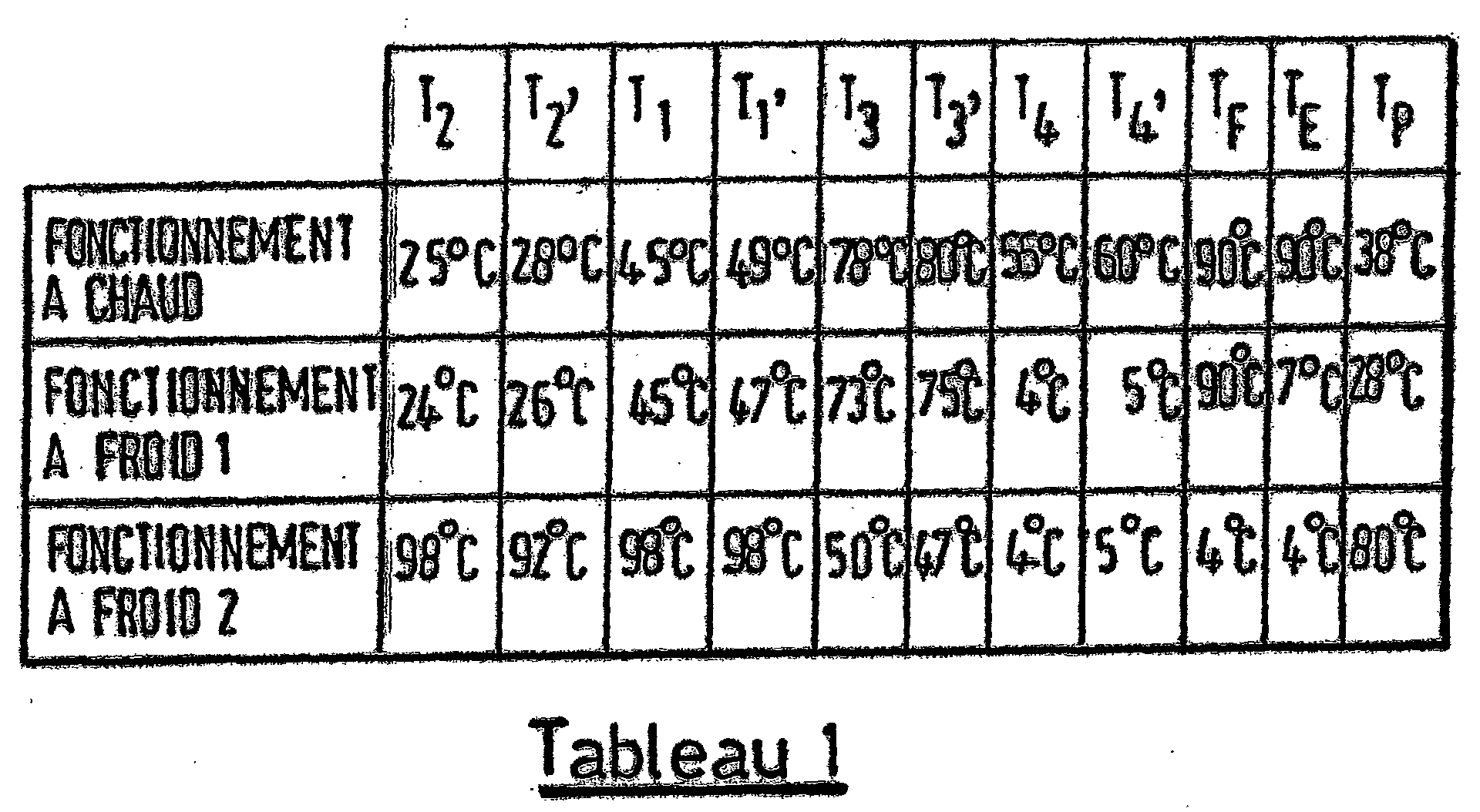
- le tableau 1 représente les températures de fonctionnement en différentes zones du dispositif de co-extrusion selon l'invention, selon un mode de réalisation du type co-extrusion à chaud et selon deux modes de réalisation du type co-extrusion à froid.
- une première partie 15, située dans la chambre 12 de la tête 11 ;
- une deuxième partie 16 à l'extérieur de la tête 11 donc dans la filière 6.
- la température Tf du fourrage dans la trémie d'alimentation 8, les températures d'entrée T3 et de sortie T'3 des moyens thermiques 19, la température t3 du matériau de fourrage sortant de cette zone et arrivant la canule 14, la température TE du matériau d'enveloppe dans la trémie d'alimentation 7, les températures d'entrée T4 et de sortie T'4 des moyens de régulation 18, la température t4 du matériau d'enveloppe en sortie des moyens de régulations 18 et arrivant à la chambre de coextrusion 12 ;
- la température d'entrée T1 et de sortie T'1 des premiers moyens thermiques 25, la température TP1 moyenne du produit juste à la sortie de la canule 14 ;
- la température d'entrée T2 et de sortie T'2 des seconds moyens de régulation thermiques 26, la température TP2 du produit dans la section L2.
- une canule centrale 27, s'étendant sur une longueur L3 et comprenant un dispositif de fixation et de centrage 35 de cette canule 27 ;
- une canule 28 entourant la canule 27 sur une longueur L2 inférieure à L3, et comprenant un dispositif de fixation et de centrage 36 de cette canule 28 ;
- une canule 29 entourant les canules 27 et 28 sur une longueur L1 inférieure à L2, et comprenant un dispositif de fixation et de centrage 37 de cette canule 29. La canule 29 est la plus courte des trois et son extrémité 29b définit la fin de la première section S1.
Une enveloppe constituée de fromage fondu à 53% d'extrait sec et 53% de matière grasse sur extrait sec est préparée par mélange à 90°C dans un pétrin à partir de cheddar jeune, de beurre, d'eau, d'amidon, de sels de fonte, de gélatine, de carraghénane et d'arômes. Un fourrage aux fruits est préparé par mélange à 70°C d'une confiture de fraises avec morceaux, d'eau, d'amidon, de gélatine, de saccharose, de fructose et d'arômes. La teneur en eau et l'activité de l'eau de l'eau du fourrage sont ajustées pour être compatibles à celles du fromage fondu.
L'enveloppe est constituée cette fois d'un mélange à 45°C dans un pétrin d'Edam, de caillé lactique, de gélatine (à l'exclusion de sels de fonte). Le premier fourrage est constitué d'un caillé lactique double crème à 45% d'extrait sec et 72% de matière grasse sur extrait sec. Il est préparé à froid par mélange. Le second fourrage est préparé à partir d'une pulpe de fruit congelée à laquelle on a additionné du sucre, de l'amidon, du colorant rouge, un arôme et des hydrocolloïdes alimentaires. La teneur en eau et l'activité de l'eau des deux fourrages sont ajustées pour être compatibles avec celles du fromage fondu.
L'enveloppe est constituée d'un fromage naturel type gouda jeune. Un fourrage de légumes est préparé à partir d'une purée de légumes fraíche à laquelle on a additionné de l'amidon, des fibres végétales, du sel de la fécule de pomme de terre, du sorbitol, un colorant et un arôme spécifique. La teneur en eau et l'activité de l'eau du fourrage sont ajustées pour être compatibles avec celles du fromage naturel.
Une enveloppe de surimi est préparée à froid dans un cutter à partir de surimi de poisson, de pulpe de poisson, d'extrait de crustacé, d'eau, de blanc d'oeuf liquide, de fécule de pomme de terre, d'amidon de blé, d'huile d'arômes. Le fourrage est une mousse de saumon préparée au cutter à froid également à partir de filet de saumon, de pulpe de poisson blanc d'huile, de fécule de pomme de terre, de crème fraíche, de blanc d'oeuf liquide, de sel, d'arôme et de colorant.
L'enveloppe est constituée d'une pâte boulangère type pâte à choux préparée au pétrin de boulanger. Le fourrage est un fromage fondu tel que décrit dans l'exemple 1 mais pour lequel la teneur en eau et l'activité de l'eau ont été modifiées pour être compatibles avec celles de la pâte boulangère après cuisson. L'ensemble est passé au four à 240°C après co-extrusion.
L'enveloppe est constituée d'une pâte boulangère type génoise préparée de manière traditionnelle. Le fourrage est une préparation charcutière de type mousse de canard traditionnelle excepté que la teneur en eau et l'activité de l'eau de la mousse de canard ont été corrigées de façon à être compatibles avec celle de la génoise après cuisson.
- pour une filière à une canule (décrite précédemment)
- L1 = 150cm avec L = 400 cm
- L1 = 30 cm avec L = 250 cm
- pour une filière à trois fourrages (décrite précédemment) :
- L1 = 30 cm, L2 = L3 = 40 cm et L = 140 cm
- L1 = 100 cm, L2 = L3 = 110 cm et L = 310 cm
- pour une filière à deux fourrages :
- L1 = 30 cm ; L2 = 60 cm et L = 4 m
- L1 = 10 cm ; L2 = 20 cm et L = 80 cm
- le produit est thermocoagulable ou non ;
- le produit provient d'un processus de fabrication à chaud ou à froid ;
- la nécessité de maintenir une hygiène à l'ensemble du processus de fabrication dont la co-extrusion.
Dans ce cas, TE = TFn = TFIL1 = TFILn = TFLFIN = TP1 = TPn = TPFIN = 2-10°C. Un système réfrigérant permet de garantir ces températures.
Dans ce cas, TE = TFn = 30-80°C ; 80°C > TFIL 1 > TFIL n > TFILFIN = 30°C ; TP1 = TPn = TPFIN = 70 à 35°C.
Dans ce cas, TE = TFn = 90-100°C ; 80°C > TFIL 1 > TFILn > TFILFIN = 30°C ; TP1 = TPn = TPFIN = 85 à 35°C.
Claims (32)
- Procédé destiné à la fabrication d'un produit alimentaire (5) comprenant une enveloppe solide enrobant au moins un fourrage, à partir d'une base alimentaire (3) destinée à former l'enveloppe du produit et d'au moins un matériau alimentaire de fourrage (4), dans un dispositif de coextrusion (1) comprenant une filière de coextrusion (6) alimentée avec la base alimentaire et le ou les matériaux de fourrage, caractérisé en ce qu'il comprend les étapes successives suivantes :formation, dans une première section (S1) de la filière (6), de l'enveloppe qui se solidifie par refroidissement, cette première section étant traversée longitudinalement par au moins une canule (14) de transfert du fourrage, une canule par matériau de fourrage, et débouchant dans une deuxième section (S2) de la filière (6), le début de la deuxième section étant défini par l'extrémité (22) de sortie de la canule de plus faible longueur (L1) ;fourrage dans la deuxième section (S2) de la filière, de l'enveloppe solide formée dans la première partie de la filière avec le ou les matériaux de fourrage sortant de la ou des canules (14,27,28,29) traversant la première section ;récupération du produit comprenant l'enveloppe externe remplie du ou des matériaux de fourrage, à la sortie (21) de la filière.
- Procédé selon la revendication 1, caractérisé en ce que l'enveloppe est formée, dans la première section de la filière, par refroidissement, typiquement par circulation d'eau ou autre fluide analogue.
- Procédé selon la revendication 2, caractérisé en ce que l'on utilise pour le matériau d'enveloppe des fromages naturels, des caillés frais, des spécialités fromagères non fondues.
- Procédé selon la revendication 2, caractérisé en ce que l'on utilise pour le matériau d'enveloppe des fromages fondus, des spécialités fromagères fondues avec ou sans sels fonte.
- Procédé selon l'une quelconque des revendications 2 à 4, caractérisé en ce qu'il comprend les étapes suivantes :préparation du fourrage et de l'enveloppe à une température voisine de 90°C dans les trémies d'alimentation (7,8) ;refroidissement, à une température voisine de 80°C, du fourrage, et refroidissement, à une température voisine de 60°C, de l'enveloppe, entre les trémies d'alimentation (7,8) et la tête de co-extrusion (11) ;extrusion de l'enveloppe, avec refroidissement de la première section de la filière à une température voisine de 50°C, de manière à solidifier l'enveloppe ;extrusion du fourrage qui remplit l'enveloppe produite dans la première section, avec refroidissement de la deuxième section (S2) de la filière à une température voisine de 30°C, le produit sortant de la filière ayant une température voisine de 38°C.
- Procédé selon la revendication 3 ou 4, caractérisé en ce que en les températures dans le dispositif de coextrusion suivent la loi :TE = TFn = TFIL1 = TFILn = TFLFIN = TP1 = TPn = TPFIN = 2-10°C, ces températures étant définies de la manière suivante :TE = température de l'enveloppe dans la trémie d'alimentation du systèmeTFn = température du fourrage n dans sa trémie d'alimentationTFIL 1 = température moyenne de la paroi de la filière correspondant à la longueur L1TFIL n = température moyenne de la paroi de la filière correspondant à la longueur Ln - (L n-1)TP1 = température moyenne du produit à la sortie de la canule 1TPn = température moyenne du produit à la sortie de la canule nTFILFIN = température moyenne de la paroi de la filière correspondant à la longueur L - LnTPFIN = température moyenne du produit à la sortie de la filière.
- Procédé selon la revendication 3 ou 4, caractérisé en ce que les températures dans le dispositif de coextrusion suivent la loi :
TE = TFn = 30-80°C ; 80°C > TFIL 1 > TFIL n > TFILFIN = 30°C ; TP1 = TPn = TPFIN = 70 à 35°C. - Procédé selon la revendication 3 ou 4, caractérisé en ce que les températures dans le dispositif de coextrusion suivent la loi :
TE = TFn = 90-100°C ; 80°C > TFIL 1 > TFILn > TFILFIN = 30°C ; TP1 = TPn = TPFIN = 85 à 35°C. - Procédé selon l'une quelconque des revendications 1 à 8, caractérisé en ce que l'on utilise pour le matériau de fourrage des produits composites à base de fromages, de viandes, d'oeufs, de chair de poissons, de surimi, de fruits, de légumes.
- Procédé selon l'une quelconque des revendications 1 à 9, caractérisé en ce que le matériau d'enveloppe a un extrait sec pouvant atteindre 60%, et typiquement de l'ordre de 30 à 50%.
- Procédé selon l'une quelconque des revendications 1 à 10, caractérisé en ce que l'on alimente la tête de co-extrusion par deux pompes simples avec trémies de gavage, respectivement pour le matériau de fourrage, et pour le matériau de l'enveloppe.
- Procédé selon la revendication 11, caractérisé en ce que l'on branche les pompes de transfert des trémies vers la tête de coextrusion (11), en direct sur le système de coextrusion.
- Procédé selon la revendication 11, caractérisé en ce que l'on branche les pompes sur un système intermédiaire fermé muni d'un échangeur de chaleur, de manière à contrôler la température des matériaux juste avant leur entrée dans la tête de coextrusion.
- Procédé selon l'une quelconque des revendications 1 à 13, caractérisé en ce que la pression et la répartition du flux de matière destinée à former l'enveloppe, sont régulées à l'aide d'une plaque de diffusion insérée sur le canal de l'enveloppe du produit.
- Procédé selon l'une quelconque des revendications 1 à 13, caractérisé en ce que l'on assemble plusieurs segments coextrudés, éventuellement avec un agent gélifiant, puis on les traite thermiquement de manière à obtenir un bloc reconstitué tranchable.
- Procédé selon l'une quelconque des revendications 1 à 15, caractérisé en ce que le produit en sortie de filière est tranché puis conditionné, en continu ou en discontinu.
- Procédé selon l'une quelconque des revendications 1 à 16, caractérisé en ce que la vitesse linéaire d'écoulement en sortie de filière est de l'ordre de 5 à 10 mètres/minute.
- Dispositif de coextrusion en mettant en oeuvre le procédé selon l'une des quelconques des revendications 1 à 17, caractérisé en ce qu'il comprend :des moyens d'alimentation (7) du matériau de l'enveloppe du produit ;des moyens d'alimentation (8) du matériau de fourrage du produit ;une chambre de coextrusion (12) débouchant d'une tête de coextrusion (11) prolongée par une filière de coextrusion (6) ;des premiers moyens de transfert (9) du matériau d'enveloppe jusque dans la chambre de coextrusion ;des seconds moyens de transfert (10) du matériau de fourrage, jusqu'à la tête de coextrusion, sans mélange du matériau de fourrage et du matériau d'enveloppe;la filière de coextrusion longitudinale comprenantune première section de filière, dans laquelle se déroule l'étape de formation de l'enveloppe solide, cette première section étant traversée par au moins une canule (14), la fin de la première section étant définie par l'extrémité de sortie (22) de la canule (29) de plus faible longueur (L1), chaque canule transférant un matériau de fourrage sortant de la tête de coextrusion, le matériau de l'enveloppe débouchant de la tête de coextrusion étant transféré entre la paroi interne (23) de la filière et la paroi externe (24) de la ou des canules ;une deuxième section, à partir de la sortie de la canule ou des canules, jusqu'à la sortie de la filière, deuxième section dans laquelle se produit l'enrobage du fourrage sortant de la canule par l'enveloppe solide.
- Dispositif selon la revendication 18 caractérisé en ce que les canules sont concentriques, la canule la plus périphérique étant la plus courte, ou non concentriques.
- Dispositif selon la revendication 18 ou 19 caractérisé en ce que la longueur L1 de la canule la plus courte est d'au moins 10 cm pour que l'enveloppe se solidifie et typiquement de 30 à 150 cm, la différence entre la longueur L de la filière et la longueur Ln de la canule la plus longue étant d'au moins 10 cm et typiquement de 30 à 600 cm.
- Dispositif selon l'une quelconque des revendications 18 à 20, caractérisé en ce qu'il comprend des moyens de régulation de la température au niveau des premiers moyens de transfert, des moyens de régulation de la température au niveau des deuxièmes moyens de transfert, des moyens de régulation de la température de la première section de la filière, des moyens de régulation de la température de la seconde section de la filière.
- Dispositif selon l'une quelconque des revendications 18 à 21 caractérisé en ce que la filière est de section circulaire, parallélépipédique, ou ludique.
- Dispositif selon l'une quelconque des revendications 18 à 22 caractérisé en ce que la filière est en section transversale de forme identique ou différente de celle de la ou des canules
- Dispositif selon l'une quelconque des revendications 18 à 23 caractérisé en ce que la filière a en section transversale un diamètre compris entre 5 et 50 mm, et de préférence 7 à 20 mm.
- Dispositif selon l'une quelconque des revendications 18 à 24 caractérisé en ce que la section de la filière est comprise entre 1,2 et 5 fois la section de la canule.
- Produit alimentaire, de type spécialité alimentaire fourrée, obtenu en mettant en oeuvre le procédé conforme à l'une quelconque des revendications 1 à 17 caractérisé en ce qu'il comprend une enveloppe solide s'étendant longitudinalement, enrobant au moins un fourrage, le produit ayant en section transversale une dimension inférieure à 20mm et typiquement comprise entre 10 et 20 mm.
- Produit selon la revendication 26, caractérisé en ce que sa section transversale est parallélépipédique, arrondie, ou de forme ludique.
- Produit selon la revendication 26 ou 27, caractérisé en ce que après tranchage sa longueur est comprise entre 1 et 10 fois sa largeur en section transversale.
- Produit selon l'une quelconque des revendications 26 à 28, caractérisé en ce que le fourrage a une composition fromagère ou non fromagère choisie dans le groupe comprenant les pâtes charcutières, les pâtes à base de poissons ou autres produits de la mer, des herbes, des épices et aromates.
- Produit selon l'une quelconque des revendications 26 à 29, caractérisé en ce qu'il comprend au moins trois couches concentriques, l'enveloppe externe étant de composition fromagère.
- Produit alimentaire fourré, comprenant une enveloppe solide de composition fromagère s'étendant longitudinalement, enrobant au moins un fourrage, le produit ayant en section transversale une dimension inférieure à 20mn et typiquement comprise entre 10 et 20 mm, caractérisé en ce que l'enveloppe a un extrait sec compris entre 40 et 60%, le produit étant ainsi préhensible sans coller.
- Produit alimentaire, caractérisé en ce qu'il se présente sous la forme d'un bloc reconstitué tranchable obtenu par assemblage de plusieurs produits selon l'une quelconque des revendications 26 à 30, ce produit reconstitué comportant une pluralité de canaux garnis de fourrage.
Applications Claiming Priority (2)
| Application Number | Priority Date | Filing Date | Title |
|---|---|---|---|
| FR0000186 | 2000-01-07 | ||
| FR0000186A FR2803491B1 (fr) | 2000-01-07 | 2000-01-07 | Procede de coextrusion avec canules de coextrusion |
Publications (2)
| Publication Number | Publication Date |
|---|---|
| EP1114587A1 true EP1114587A1 (fr) | 2001-07-11 |
| EP1114587B1 EP1114587B1 (fr) | 2006-03-08 |
Family
ID=8845697
Family Applications (1)
| Application Number | Title | Priority Date | Filing Date |
|---|---|---|---|
| EP00403717A Expired - Lifetime EP1114587B1 (fr) | 2000-01-07 | 2000-12-29 | Procédé de coextrusion dans des tubes concentriques |
Country Status (12)
| Country | Link |
|---|---|
| US (1) | US6632466B2 (fr) |
| EP (1) | EP1114587B1 (fr) |
| JP (1) | JP3706806B2 (fr) |
| AR (1) | AR026792A1 (fr) |
| AT (1) | ATE319331T1 (fr) |
| AU (1) | AU783581B2 (fr) |
| BR (1) | BRPI0100028B1 (fr) |
| CZ (1) | CZ300233B6 (fr) |
| DE (1) | DE60026485T2 (fr) |
| ES (1) | ES2258960T3 (fr) |
| FR (1) | FR2803491B1 (fr) |
| HU (1) | HU228738B1 (fr) |
Cited By (7)
| Publication number | Priority date | Publication date | Assignee | Title |
|---|---|---|---|---|
| EP1738649A1 (fr) * | 2005-06-30 | 2007-01-03 | Albert Handtmann Maschinenfabrik GmbH & Co. KG | Procédé et dispositif pour produire un chapelet de saucisses ayant un section au choix |
| EP1399029A4 (fr) * | 2001-04-12 | 2007-01-24 | Sorrento Lactalis Inc | En-cas au fromage coextrude |
| EP2016830A1 (fr) * | 2007-07-20 | 2009-01-21 | Albert Handtmann Maschinenfabrik GmbH & Co. KG | Dispositif et procédé de fabrication de saucisses |
| EP2062480A1 (fr) * | 2007-11-21 | 2009-05-27 | Nestec S.A. | Ensemble de filière de co-extrusion, procédé de fabrication d'un produit alimentaire co-extrudé et produit alimentaire co-extrudé |
| WO2010107331A1 (fr) * | 2009-03-19 | 2010-09-23 | Nutrigreen, Sa | Barre de fruit frais, procédé de production et dispositif |
| WO2016041136A1 (fr) * | 2014-09-15 | 2016-03-24 | 周鹏飞 | Fromage de jus de crabe et son procédé de préparation |
| WO2024260985A1 (fr) * | 2023-06-19 | 2024-12-26 | Gea Food Solutions Bakel B.V. | Produit de collation extrudé |
Families Citing this family (43)
| Publication number | Priority date | Publication date | Assignee | Title |
|---|---|---|---|---|
| ITRM20010566A1 (it) * | 2001-09-18 | 2003-03-18 | Refin Srl | Metodo ed apparecchiatura per il condizionamento superficiale di estrusi alimentari. |
| US7585532B2 (en) * | 2001-10-29 | 2009-09-08 | Frito-Lay North America, Inc. | Apparatus and method for improving the dimensional quality of extruded food products having complex shapes |
| US7287047B2 (en) * | 2001-11-23 | 2007-10-23 | Commvault Systems, Inc. | Selective data replication system and method |
| US6814996B2 (en) * | 2001-12-19 | 2004-11-09 | Kraft Foods Holdings, Inc. | Nutritionally superior cheese products |
| EP1447008A1 (fr) * | 2003-02-12 | 2004-08-18 | S.p.A. Egidio Galbani | Procédé de fabrication d'un produit de fromage multicouche et produit de fromage multicouche ainsi obtenu |
| US7264836B2 (en) * | 2003-03-21 | 2007-09-04 | Kraft Foods Holdings, Inc. | Production of triple coextruded baked bar goods |
| US7020968B1 (en) | 2003-09-18 | 2006-04-04 | Abdel-Dayem Bassam A | Fruit and vegetable coring machine |
| US20050064081A1 (en) * | 2003-09-19 | 2005-03-24 | Rapidx Technologies Inc. | Food product and method |
| USD509045S1 (en) * | 2004-08-19 | 2005-09-06 | The Hartz Mountain Corporation | Dog chew |
| US20060051475A1 (en) * | 2004-09-03 | 2006-03-09 | Fornaguera Joan F | Confectionery depositing apparatus and product and method of producing same |
| USD508301S1 (en) | 2004-09-22 | 2005-08-16 | Qa Products, Inc. | Extruded confection |
| USD514273S1 (en) | 2004-12-23 | 2006-02-07 | Qa Products, Inc. | Extruded confection |
| USD527162S1 (en) | 2005-06-21 | 2006-08-29 | Qa Products, Inc. | Extruded confection |
| US8377490B2 (en) | 2005-09-20 | 2013-02-19 | Kraft Foods Global Brands Llc | Method and system for making sliced cheese |
| US20070065550A1 (en) * | 2005-09-20 | 2007-03-22 | Kraft Foods Holdings, Inc. | Method and system for making shredded cheese |
| US7288684B1 (en) | 2005-12-22 | 2007-10-30 | Uop Llc | Process for the direct production of methanol from methane |
| JP4603995B2 (ja) * | 2006-03-31 | 2010-12-22 | 明治乳業株式会社 | 風味物質が添加された白カビチーズ及びその製造方法 |
| US20070231451A1 (en) * | 2006-04-04 | 2007-10-04 | 2093468 Ontario Inc. | Food product with a condiment filling portion |
| US20080268104A1 (en) * | 2006-08-17 | 2008-10-30 | Conopco Inc, D/B/A Unilever | Filled cheese product and manufacture thereof |
| US8062685B2 (en) * | 2007-04-03 | 2011-11-22 | Frito-Lay North America, Inc. | Direct expanded snack made with peanut flour and method for making |
| DE502007000946D1 (de) * | 2007-05-29 | 2009-08-06 | Handtmann Albert Maschf | Temperaturregelung des Massestroms in einer Füllmaschine |
| US20110195159A1 (en) * | 2008-10-08 | 2011-08-11 | Cargill, Incorporated | Methods and systems for making co-extruded food products |
| AU2015258293B2 (en) * | 2009-03-06 | 2016-08-11 | Bega Cheese Limited | A process and a machine for producing a filled sheet of process cheese, as well as a filled sheet of process cheese |
| ES2632738T3 (es) | 2009-03-06 | 2017-09-15 | Kraft Foods R & D, Inc. | Un proceso y una máquina para producir una lámina rellena de queso procesado, así como una lámina rellena de queso procesado |
| US8944798B2 (en) * | 2010-06-16 | 2015-02-03 | Kellogg Company | Gas assisted co-extrusion apparatus and process for forming foods |
| EP2401926A1 (fr) * | 2010-06-29 | 2012-01-04 | Nestec S.A. | Procédé pour fabriquer un produit d'aliment multicouche et produit correspondant |
| US20130216658A1 (en) * | 2010-07-19 | 2013-08-22 | Nestec S.A. | Textured, freeze-dried products and methods for making same |
| PT2772144T (pt) * | 2011-10-26 | 2017-12-20 | Nippon Suisan Kaisha Ltd | Método para produzir um alimento para animais ou um produto alimentar |
| DE102012006029B4 (de) * | 2012-03-27 | 2014-03-20 | FEMEG Produktions- und Vertriebsgesellschaft mbH | Gefrorenes Fischprodukt und Verfahren zu seiner Herstellung |
| US9877498B2 (en) * | 2013-08-08 | 2018-01-30 | General Mills, Inc. | System and method for producing an extruded protein product |
| CN106604644A (zh) * | 2014-09-19 | 2017-04-26 | 株式会社明治 | 包馅型天然奶酪及其制造方法 |
| JP6677990B2 (ja) * | 2014-09-19 | 2020-04-08 | 株式会社明治 | 風味が良い包餡型ナチュラルチーズおよびその製造方法 |
| GB2531263B (en) | 2014-10-13 | 2019-01-09 | Kraft Foods R&D Inc | Filled cheese product |
| ES2586108B1 (es) * | 2015-03-23 | 2017-07-26 | Lácteas Cobreros, S.A. | Producto alimenticio con relleno y procedimiento para su obtención |
| USD802880S1 (en) | 2016-07-15 | 2017-11-21 | Frito-Law North America, Inc. | Snack food product |
| EP3345487A1 (fr) * | 2017-01-04 | 2018-07-11 | Perfetti Van Melle S.p.A. | Procédé de préparation d'un produit de confiserie multicouche |
| KR101877785B1 (ko) * | 2018-01-19 | 2018-07-12 | 남양유업 주식회사 | 겔 타입의 이종 음식물 주입 노즐 및 이를 포함하는 겔 타입의 이종 음식물 제조 장치 |
| BE1027059A1 (nl) * | 2019-02-18 | 2020-09-10 | Natural Pack Bvba | Gecoate kaasproducten |
| CN109820222A (zh) * | 2019-03-11 | 2019-05-31 | 上海伟隆机械设备股份有限公司 | 具有冷却模块的多层夹心软质食品制备装置 |
| JP6774115B1 (ja) * | 2019-04-26 | 2020-10-21 | 有限会社佐藤修商店 | 練製食品成形型及び練製食品製造装置 |
| CN114557463A (zh) * | 2020-11-27 | 2022-05-31 | 佛山市顺德区美的电热电器制造有限公司 | 制作食物的设备、系统、方法以及存储介质 |
| CN115153075B (zh) * | 2022-07-12 | 2023-02-28 | 欧麦香(福建)食品有限公司 | 一种可进行乳酸菌添加的能量棒成型设备 |
| BE1031889B1 (nl) * | 2023-08-09 | 2025-03-10 | Oystershell Nv | Extrusiekop voor het produceren van centraal gevuld product |
Citations (9)
| Publication number | Priority date | Publication date | Assignee | Title |
|---|---|---|---|---|
| FR94872E (fr) * | 1967-05-23 | 1970-01-16 | Carre Pierre | Oeuf dur tubulaire. |
| FR2386235A7 (fr) * | 1977-04-01 | 1978-10-27 | Molkerei Zentrale Sued Gmbh Co | Bloc de fromage fondant |
| FR2516356A1 (fr) * | 1981-11-17 | 1983-05-20 | Ramond Marcel | Procede de fabrication industrielle en continu de produits et en particulier de produits alimentaires, les moyens de mise en oeuvre de ce procede et les produits en resultant |
| US4468185A (en) * | 1982-02-05 | 1984-08-28 | Robert Bosch Gmbh | Apparatus for molding a strand of caramel candy |
| DE3417196A1 (de) * | 1984-05-09 | 1985-11-14 | Etablissement Financière Meduna, Vaduz | Verfahren und vorrichtung zur herstellung extrudierter lebensmittelprodukte besonderer gestalt |
| JPS61162135A (ja) * | 1985-01-09 | 1986-07-22 | Ryozo Oota | チヨコレ−トの紐を包みこんだゼラチン,寒天等の菓子 |
| EP0260194A2 (fr) * | 1986-09-08 | 1988-03-16 | Bongrain S.A. | Procédé et installation de traitement d'un fromage, spécialité fromagère à base d'un fromage ainsi traité et produit alimentaire comportant cette spécialité fromagère |
| US5194283A (en) * | 1988-09-15 | 1993-03-16 | Nestec S.A. | Process for the manufacture of composite cheese and product thereof |
| US5792500A (en) * | 1995-02-15 | 1998-08-11 | Bongrain (Societe Anonyme) | Process for the continuous preparation of cheese or a cheese product installations for practicing the process and product obtained by the process |
Family Cites Families (2)
| Publication number | Priority date | Publication date | Assignee | Title |
|---|---|---|---|---|
| US4309450A (en) * | 1980-09-19 | 1982-01-05 | Seibert Robert W | Method for manufacturing a seafood product |
| US4888192A (en) * | 1986-03-05 | 1989-12-19 | Nabisco Brands, Inc. | Method for extrusion of baked goods |
-
2000
- 2000-01-07 FR FR0000186A patent/FR2803491B1/fr not_active Expired - Lifetime
- 2000-12-29 EP EP00403717A patent/EP1114587B1/fr not_active Expired - Lifetime
- 2000-12-29 AT AT00403717T patent/ATE319331T1/de not_active IP Right Cessation
- 2000-12-29 DE DE60026485T patent/DE60026485T2/de not_active Expired - Lifetime
- 2000-12-29 ES ES00403717T patent/ES2258960T3/es not_active Expired - Lifetime
-
2001
- 2001-01-04 CZ CZ20010055A patent/CZ300233B6/cs not_active IP Right Cessation
- 2001-01-04 AR ARP010100030A patent/AR026792A1/es active IP Right Grant
- 2001-01-05 US US09/755,472 patent/US6632466B2/en not_active Expired - Lifetime
- 2001-01-05 AU AU10052/01A patent/AU783581B2/en not_active Expired
- 2001-01-05 HU HU0100033A patent/HU228738B1/hu unknown
- 2001-01-08 BR BRPI0100028A patent/BRPI0100028B1/pt active IP Right Grant
- 2001-01-09 JP JP2001001726A patent/JP3706806B2/ja not_active Expired - Lifetime
Patent Citations (9)
| Publication number | Priority date | Publication date | Assignee | Title |
|---|---|---|---|---|
| FR94872E (fr) * | 1967-05-23 | 1970-01-16 | Carre Pierre | Oeuf dur tubulaire. |
| FR2386235A7 (fr) * | 1977-04-01 | 1978-10-27 | Molkerei Zentrale Sued Gmbh Co | Bloc de fromage fondant |
| FR2516356A1 (fr) * | 1981-11-17 | 1983-05-20 | Ramond Marcel | Procede de fabrication industrielle en continu de produits et en particulier de produits alimentaires, les moyens de mise en oeuvre de ce procede et les produits en resultant |
| US4468185A (en) * | 1982-02-05 | 1984-08-28 | Robert Bosch Gmbh | Apparatus for molding a strand of caramel candy |
| DE3417196A1 (de) * | 1984-05-09 | 1985-11-14 | Etablissement Financière Meduna, Vaduz | Verfahren und vorrichtung zur herstellung extrudierter lebensmittelprodukte besonderer gestalt |
| JPS61162135A (ja) * | 1985-01-09 | 1986-07-22 | Ryozo Oota | チヨコレ−トの紐を包みこんだゼラチン,寒天等の菓子 |
| EP0260194A2 (fr) * | 1986-09-08 | 1988-03-16 | Bongrain S.A. | Procédé et installation de traitement d'un fromage, spécialité fromagère à base d'un fromage ainsi traité et produit alimentaire comportant cette spécialité fromagère |
| US5194283A (en) * | 1988-09-15 | 1993-03-16 | Nestec S.A. | Process for the manufacture of composite cheese and product thereof |
| US5792500A (en) * | 1995-02-15 | 1998-08-11 | Bongrain (Societe Anonyme) | Process for the continuous preparation of cheese or a cheese product installations for practicing the process and product obtained by the process |
Non-Patent Citations (1)
| Title |
|---|
| PATENT ABSTRACTS OF JAPAN vol. 010, no. 366 (C - 390) 6 December 1986 (1986-12-06) * |
Cited By (9)
| Publication number | Priority date | Publication date | Assignee | Title |
|---|---|---|---|---|
| EP1399029A4 (fr) * | 2001-04-12 | 2007-01-24 | Sorrento Lactalis Inc | En-cas au fromage coextrude |
| EP1738649A1 (fr) * | 2005-06-30 | 2007-01-03 | Albert Handtmann Maschinenfabrik GmbH & Co. KG | Procédé et dispositif pour produire un chapelet de saucisses ayant un section au choix |
| EP2016830A1 (fr) * | 2007-07-20 | 2009-01-21 | Albert Handtmann Maschinenfabrik GmbH & Co. KG | Dispositif et procédé de fabrication de saucisses |
| US7591717B2 (en) | 2007-07-20 | 2009-09-22 | Albert Handtmann Maschinenf Abrik Gmbh & Co. Kg | Device and method for manufacturing sausages |
| EP2062480A1 (fr) * | 2007-11-21 | 2009-05-27 | Nestec S.A. | Ensemble de filière de co-extrusion, procédé de fabrication d'un produit alimentaire co-extrudé et produit alimentaire co-extrudé |
| WO2009065607A1 (fr) * | 2007-11-21 | 2009-05-28 | Nestec S.A. | Filière de co-extrusion, procédé de production d'un produit alimentaire co-extrudé et produit alimentaire co-extrudé |
| WO2010107331A1 (fr) * | 2009-03-19 | 2010-09-23 | Nutrigreen, Sa | Barre de fruit frais, procédé de production et dispositif |
| WO2016041136A1 (fr) * | 2014-09-15 | 2016-03-24 | 周鹏飞 | Fromage de jus de crabe et son procédé de préparation |
| WO2024260985A1 (fr) * | 2023-06-19 | 2024-12-26 | Gea Food Solutions Bakel B.V. | Produit de collation extrudé |
Also Published As
| Publication number | Publication date |
|---|---|
| FR2803491A1 (fr) | 2001-07-13 |
| JP3706806B2 (ja) | 2005-10-19 |
| CZ200155A3 (cs) | 2001-08-15 |
| BR0100028A (pt) | 2001-08-28 |
| HUP0100033A3 (en) | 2002-03-28 |
| DE60026485D1 (de) | 2006-05-04 |
| AU783581B2 (en) | 2005-11-10 |
| AR026792A1 (es) | 2003-02-26 |
| DE60026485T2 (de) | 2006-11-23 |
| JP2001231531A (ja) | 2001-08-28 |
| EP1114587B1 (fr) | 2006-03-08 |
| CZ300233B6 (cs) | 2009-03-25 |
| HU0100033D0 (en) | 2001-03-28 |
| HUP0100033A2 (hu) | 2002-02-28 |
| US6632466B2 (en) | 2003-10-14 |
| ATE319331T1 (de) | 2006-03-15 |
| FR2803491B1 (fr) | 2003-10-03 |
| HU228738B1 (en) | 2013-05-28 |
| AU1005201A (en) | 2001-07-12 |
| US20010019732A1 (en) | 2001-09-06 |
| BRPI0100028B1 (pt) | 2017-05-09 |
| PL344960A1 (en) | 2001-07-16 |
| ES2258960T3 (es) | 2006-09-16 |
Similar Documents
| Publication | Publication Date | Title |
|---|---|---|
| EP1114587B1 (fr) | Procédé de coextrusion dans des tubes concentriques | |
| EP1059040B1 (fr) | Produit alimentaire à texture fibreuse obtenue à partir de protéines de lactosérum | |
| EP1060676B1 (fr) | Produit alimentaire à texture fibreuse hétérogène susceptible d'être obtenu à partir de protéines de poisson | |
| EP2225951B1 (fr) | Procédé et machine pour la production d'une feuille garnie de fromage fondu et feuille garnie de fromage fondu | |
| EP0727138B1 (fr) | Procédé de préparation en continu d'un fromage ou d'une spécialité fromagère, installations pour la mise en oeuvre du procédé et produit obtenu par le procédé | |
| EP0713649B1 (fr) | Aliment composite et son procédé de fabrication | |
| EP2323505B1 (fr) | Procede pour la mise en forme d'un produit alimentaire par cryoextrusion mettant en oeuvre une regulation de temperature predictive | |
| EP2046145A2 (fr) | Produit alimentaire gélifié et procédé de fabrication d'un tel produit | |
| EP0880901B1 (fr) | Procédé de fabrication de produits fromagers par traitement d'un fromage de départ | |
| EP1079697A1 (fr) | Procede de fabrication de nouveaux produits fromagers par traitement d'une matiere de depart | |
| FR2818501A1 (fr) | Procede de fabrication de fromages | |
| DK1797765T3 (en) | Filled cheese product | |
| EP0823218A1 (fr) | Procédé de préparation de succedanes de poissons jeunes et extrudeuse decoupeuse pour mettre en forme de tels produits | |
| JPH0740871B2 (ja) | チーズ被覆食品の製造法 | |
| EP0888725A1 (fr) | "Procédé et dispositif de fabrication d'anneaux de matière alimentaire" | |
| AU2015258293B2 (en) | A process and a machine for producing a filled sheet of process cheese, as well as a filled sheet of process cheese | |
| PL203664B1 (pl) | Sposób wytwarzania produktu spo zywczego, wspó lwyt laczarka do wytwarzania produktu spo zywczego i produkt spo zywczy |
Legal Events
| Date | Code | Title | Description |
|---|---|---|---|
| PUAI | Public reference made under article 153(3) epc to a published international application that has entered the european phase |
Free format text: ORIGINAL CODE: 0009012 |
|
| AK | Designated contracting states |
Kind code of ref document: A1 Designated state(s): AT BE CH CY DE DK ES FI FR GB GR IE IT LI LU MC NL PT SE TR |
|
| AX | Request for extension of the european patent |
Free format text: AL;LT;LV;MK;RO;SI |
|
| 17P | Request for examination filed |
Effective date: 20010814 |
|
| AKX | Designation fees paid |
Free format text: AT BE CH CY DE DK ES FI FR GB GR IE IT LI LU MC NL PT SE TR |
|
| 17Q | First examination report despatched |
Effective date: 20031106 |
|
| GRAP | Despatch of communication of intention to grant a patent |
Free format text: ORIGINAL CODE: EPIDOSNIGR1 |
|
| GRAS | Grant fee paid |
Free format text: ORIGINAL CODE: EPIDOSNIGR3 |
|
| GRAA | (expected) grant |
Free format text: ORIGINAL CODE: 0009210 |
|
| AK | Designated contracting states |
Kind code of ref document: B1 Designated state(s): AT BE CH CY DE DK ES FI FR GB GR IE IT LI LU MC NL PT SE TR |
|
| PG25 | Lapsed in a contracting state [announced via postgrant information from national office to epo] |
Ref country code: AT Free format text: LAPSE BECAUSE OF FAILURE TO SUBMIT A TRANSLATION OF THE DESCRIPTION OR TO PAY THE FEE WITHIN THE PRESCRIBED TIME-LIMIT Effective date: 20060308 Ref country code: FI Free format text: LAPSE BECAUSE OF FAILURE TO SUBMIT A TRANSLATION OF THE DESCRIPTION OR TO PAY THE FEE WITHIN THE PRESCRIBED TIME-LIMIT Effective date: 20060308 |
|
| REG | Reference to a national code |
Ref country code: GB Ref legal event code: FG4D Free format text: NOT ENGLISH |
|
| REG | Reference to a national code |
Ref country code: CH Ref legal event code: EP |
|
| REG | Reference to a national code |
Ref country code: IE Ref legal event code: FG4D Free format text: LANGUAGE OF EP DOCUMENT: FRENCH |
|
| REF | Corresponds to: |
Ref document number: 60026485 Country of ref document: DE Date of ref document: 20060504 Kind code of ref document: P |
|
| REG | Reference to a national code |
Ref country code: CH Ref legal event code: NV Representative=s name: RIEDERER HASLER & PARTNER PATENTANWAELTE AG |
|
| PG25 | Lapsed in a contracting state [announced via postgrant information from national office to epo] |
Ref country code: SE Free format text: LAPSE BECAUSE OF FAILURE TO SUBMIT A TRANSLATION OF THE DESCRIPTION OR TO PAY THE FEE WITHIN THE PRESCRIBED TIME-LIMIT Effective date: 20060608 Ref country code: DK Free format text: LAPSE BECAUSE OF FAILURE TO SUBMIT A TRANSLATION OF THE DESCRIPTION OR TO PAY THE FEE WITHIN THE PRESCRIBED TIME-LIMIT Effective date: 20060608 |
|
| GBT | Gb: translation of ep patent filed (gb section 77(6)(a)/1977) |
Effective date: 20060622 |
|
| PG25 | Lapsed in a contracting state [announced via postgrant information from national office to epo] |
Ref country code: PT Free format text: LAPSE BECAUSE OF FAILURE TO SUBMIT A TRANSLATION OF THE DESCRIPTION OR TO PAY THE FEE WITHIN THE PRESCRIBED TIME-LIMIT Effective date: 20060808 |
|
| REG | Reference to a national code |
Ref country code: ES Ref legal event code: FG2A Ref document number: 2258960 Country of ref document: ES Kind code of ref document: T3 |
|
| PG25 | Lapsed in a contracting state [announced via postgrant information from national office to epo] |
Ref country code: MC Free format text: LAPSE BECAUSE OF NON-PAYMENT OF DUE FEES Effective date: 20061231 |
|
| PLBE | No opposition filed within time limit |
Free format text: ORIGINAL CODE: 0009261 |
|
| STAA | Information on the status of an ep patent application or granted ep patent |
Free format text: STATUS: NO OPPOSITION FILED WITHIN TIME LIMIT |
|
| 26N | No opposition filed |
Effective date: 20061211 |
|
| PG25 | Lapsed in a contracting state [announced via postgrant information from national office to epo] |
Ref country code: GR Free format text: LAPSE BECAUSE OF FAILURE TO SUBMIT A TRANSLATION OF THE DESCRIPTION OR TO PAY THE FEE WITHIN THE PRESCRIBED TIME-LIMIT Effective date: 20060609 |
|
| PG25 | Lapsed in a contracting state [announced via postgrant information from national office to epo] |
Ref country code: LU Free format text: LAPSE BECAUSE OF NON-PAYMENT OF DUE FEES Effective date: 20061229 Ref country code: TR Free format text: LAPSE BECAUSE OF FAILURE TO SUBMIT A TRANSLATION OF THE DESCRIPTION OR TO PAY THE FEE WITHIN THE PRESCRIBED TIME-LIMIT Effective date: 20060308 |
|
| PG25 | Lapsed in a contracting state [announced via postgrant information from national office to epo] |
Ref country code: CY Free format text: LAPSE BECAUSE OF FAILURE TO SUBMIT A TRANSLATION OF THE DESCRIPTION OR TO PAY THE FEE WITHIN THE PRESCRIBED TIME-LIMIT Effective date: 20060308 |
|
| REG | Reference to a national code |
Ref country code: FR Ref legal event code: PLFP Year of fee payment: 16 |
|
| REG | Reference to a national code |
Ref country code: FR Ref legal event code: PLFP Year of fee payment: 17 |
|
| REG | Reference to a national code |
Ref country code: FR Ref legal event code: PLFP Year of fee payment: 18 |
|
| PGFP | Annual fee paid to national office [announced via postgrant information from national office to epo] |
Ref country code: NL Payment date: 20191219 Year of fee payment: 20 Ref country code: IE Payment date: 20191220 Year of fee payment: 20 Ref country code: DE Payment date: 20191210 Year of fee payment: 20 |
|
| PGFP | Annual fee paid to national office [announced via postgrant information from national office to epo] |
Ref country code: BE Payment date: 20191219 Year of fee payment: 20 Ref country code: FR Payment date: 20191121 Year of fee payment: 20 Ref country code: IT Payment date: 20191230 Year of fee payment: 20 |
|
| PGFP | Annual fee paid to national office [announced via postgrant information from national office to epo] |
Ref country code: CH Payment date: 20191219 Year of fee payment: 20 |
|
| PGFP | Annual fee paid to national office [announced via postgrant information from national office to epo] |
Ref country code: ES Payment date: 20200121 Year of fee payment: 20 Ref country code: GB Payment date: 20191220 Year of fee payment: 20 |
|
| REG | Reference to a national code |
Ref country code: DE Ref legal event code: R071 Ref document number: 60026485 Country of ref document: DE |
|
| REG | Reference to a national code |
Ref country code: CH Ref legal event code: PL |
|
| REG | Reference to a national code |
Ref country code: GB Ref legal event code: PE20 Expiry date: 20201228 |
|
| PG25 | Lapsed in a contracting state [announced via postgrant information from national office to epo] |
Ref country code: GB Free format text: LAPSE BECAUSE OF EXPIRATION OF PROTECTION Effective date: 20201228 |
|
| REG | Reference to a national code |
Ref country code: IE Ref legal event code: MK9A |
|
| REG | Reference to a national code |
Ref country code: BE Ref legal event code: MK Effective date: 20201229 |
|
| PG25 | Lapsed in a contracting state [announced via postgrant information from national office to epo] |
Ref country code: IE Free format text: LAPSE BECAUSE OF EXPIRATION OF PROTECTION Effective date: 20201229 |
|
| REG | Reference to a national code |
Ref country code: NL Ref legal event code: MK Effective date: 20201228 |
|
| REG | Reference to a national code |
Ref country code: ES Ref legal event code: FD2A Effective date: 20211207 |
|
| PG25 | Lapsed in a contracting state [announced via postgrant information from national office to epo] |
Ref country code: ES Free format text: LAPSE BECAUSE OF EXPIRATION OF PROTECTION Effective date: 20201230 |