EP1104789B1 - Pigmentdispergatoren auf Basis von Diketopyrrolopyrrolverbindungen und Pigmentzubereitungen - Google Patents
Pigmentdispergatoren auf Basis von Diketopyrrolopyrrolverbindungen und Pigmentzubereitungen Download PDFInfo
- Publication number
- EP1104789B1 EP1104789B1 EP00124596A EP00124596A EP1104789B1 EP 1104789 B1 EP1104789 B1 EP 1104789B1 EP 00124596 A EP00124596 A EP 00124596A EP 00124596 A EP00124596 A EP 00124596A EP 1104789 B1 EP1104789 B1 EP 1104789B1
- Authority
- EP
- European Patent Office
- Prior art keywords
- pigment
- phenyl
- formula
- alkyl
- group
- Prior art date
- Legal status (The legal status is an assumption and is not a legal conclusion. Google has not performed a legal analysis and makes no representation as to the accuracy of the status listed.)
- Expired - Lifetime
Links
- 239000000049 pigment Substances 0.000 title claims description 360
- 239000002270 dispersing agent Substances 0.000 title claims description 111
- 239000006185 dispersion Substances 0.000 title description 5
- 150000001875 compounds Chemical class 0.000 title 1
- 238000002360 preparation method Methods 0.000 claims description 93
- -1 diketopyrrolopyrrole compound Chemical class 0.000 claims description 57
- 239000002966 varnish Substances 0.000 claims description 38
- 239000000460 chlorine Substances 0.000 claims description 26
- 239000003973 paint Substances 0.000 claims description 20
- 125000001997 phenyl group Chemical group [H]C1=C([H])C([H])=C(*)C([H])=C1[H] 0.000 claims description 20
- 150000001412 amines Chemical class 0.000 claims description 19
- 150000003254 radicals Chemical group 0.000 claims description 16
- 229910052739 hydrogen Inorganic materials 0.000 claims description 15
- 239000000203 mixture Substances 0.000 claims description 14
- 229920005989 resin Polymers 0.000 claims description 14
- 239000011347 resin Substances 0.000 claims description 14
- 229910052757 nitrogen Inorganic materials 0.000 claims description 13
- 125000001424 substituent group Chemical group 0.000 claims description 13
- 239000001257 hydrogen Substances 0.000 claims description 11
- 125000004435 hydrogen atom Chemical group [H]* 0.000 claims description 10
- 125000004433 nitrogen atom Chemical group N* 0.000 claims description 10
- XTHPWXDJESJLNJ-UHFFFAOYSA-N sulfurochloridic acid Chemical compound OS(Cl)(=O)=O XTHPWXDJESJLNJ-UHFFFAOYSA-N 0.000 claims description 10
- 125000001272 (C1-C4)-alkylene-phenyl group Chemical group 0.000 claims description 8
- 125000001797 benzyl group Chemical group [H]C1=C([H])C([H])=C(C([H])=C1[H])C([H])([H])* 0.000 claims description 8
- 229910052794 bromium Inorganic materials 0.000 claims description 8
- 125000002887 hydroxy group Chemical group [H]O* 0.000 claims description 8
- 239000000654 additive Substances 0.000 claims description 7
- 125000000217 alkyl group Chemical group 0.000 claims description 7
- 238000004519 manufacturing process Methods 0.000 claims description 7
- FYNROBRQIVCIQF-UHFFFAOYSA-N pyrrolo[3,2-b]pyrrole-5,6-dione Chemical compound C1=CN=C2C(=O)C(=O)N=C21 FYNROBRQIVCIQF-UHFFFAOYSA-N 0.000 claims description 7
- 125000000204 (C2-C4) acyl group Chemical group 0.000 claims description 6
- UFHFLCQGNIYNRP-UHFFFAOYSA-N Hydrogen Chemical compound [H][H] UFHFLCQGNIYNRP-UHFFFAOYSA-N 0.000 claims description 6
- 125000003917 carbamoyl group Chemical group [H]N([H])C(*)=O 0.000 claims description 6
- 239000000976 ink Substances 0.000 claims description 6
- 239000011368 organic material Substances 0.000 claims description 6
- 229910052760 oxygen Inorganic materials 0.000 claims description 6
- 125000004178 (C1-C4) alkyl group Chemical group 0.000 claims description 5
- 229910052801 chlorine Inorganic materials 0.000 claims description 5
- 150000007530 organic bases Chemical class 0.000 claims description 5
- 239000004094 surface-active agent Substances 0.000 claims description 5
- 125000000229 (C1-C4)alkoxy group Chemical group 0.000 claims description 4
- QGZKDVFQNNGYKY-UHFFFAOYSA-O Ammonium Chemical compound [NH4+] QGZKDVFQNNGYKY-UHFFFAOYSA-O 0.000 claims description 4
- IJGRMHOSHXDMSA-UHFFFAOYSA-N Atomic nitrogen Chemical compound N#N IJGRMHOSHXDMSA-UHFFFAOYSA-N 0.000 claims description 4
- 125000003118 aryl group Chemical group 0.000 claims description 4
- 125000005842 heteroatom Chemical group 0.000 claims description 4
- 235000019239 indanthrene blue RS Nutrition 0.000 claims description 4
- 125000000956 methoxy group Chemical group [H]C([H])([H])O* 0.000 claims description 4
- 238000002156 mixing Methods 0.000 claims description 4
- 229920003023 plastic Polymers 0.000 claims description 4
- 239000004033 plastic Substances 0.000 claims description 4
- 229920006395 saturated elastomer Polymers 0.000 claims description 4
- 229910052717 sulfur Inorganic materials 0.000 claims description 4
- 125000003837 (C1-C20) alkyl group Chemical group 0.000 claims description 3
- 125000003342 alkenyl group Chemical group 0.000 claims description 3
- 125000005529 alkyleneoxy group Chemical group 0.000 claims description 3
- 239000006229 carbon black Substances 0.000 claims description 3
- 125000003178 carboxy group Chemical group [H]OC(*)=O 0.000 claims description 3
- 125000001301 ethoxy group Chemical group [H]C([H])([H])C([H])([H])O* 0.000 claims description 3
- 229910052751 metal Inorganic materials 0.000 claims description 3
- 239000002184 metal Substances 0.000 claims description 3
- 230000000485 pigmenting effect Effects 0.000 claims description 3
- KHUFHLFHOQVFGB-UHFFFAOYSA-N 1-aminoanthracene-9,10-dione Chemical compound O=C1C2=CC=CC=C2C(=O)C2=C1C=CC=C2N KHUFHLFHOQVFGB-UHFFFAOYSA-N 0.000 claims description 2
- KSLLMGLKCVSKFF-UHFFFAOYSA-N 5,12-dihydroquinolino[2,3-b]acridine-6,7,13,14-tetrone Chemical compound N1C2=CC=CC=C2C(=O)C2=C1C(=O)C(C(=O)C1=CC=CC=C1N1)=C1C2=O KSLLMGLKCVSKFF-UHFFFAOYSA-N 0.000 claims description 2
- 125000000739 C2-C30 alkenyl group Chemical group 0.000 claims description 2
- NRCMAYZCPIVABH-UHFFFAOYSA-N Quinacridone Chemical compound N1C2=CC=CC=C2C(=O)C2=C1C=C1C(=O)C3=CC=CC=C3NC1=C2 NRCMAYZCPIVABH-UHFFFAOYSA-N 0.000 claims description 2
- 125000005037 alkyl phenyl group Chemical group 0.000 claims description 2
- PGEHNUUBUQTUJB-UHFFFAOYSA-N anthanthrone Chemical compound C1=CC=C2C(=O)C3=CC=C4C=CC=C5C(=O)C6=CC=C1C2=C6C3=C54 PGEHNUUBUQTUJB-UHFFFAOYSA-N 0.000 claims description 2
- PYKYMHQGRFAEBM-UHFFFAOYSA-N anthraquinone Natural products CCC(=O)c1c(O)c2C(=O)C3C(C=CC=C3O)C(=O)c2cc1CC(=O)OC PYKYMHQGRFAEBM-UHFFFAOYSA-N 0.000 claims description 2
- 150000004056 anthraquinones Chemical class 0.000 claims description 2
- 125000006615 aromatic heterocyclic group Chemical group 0.000 claims description 2
- QVGXLLKOCUKJST-UHFFFAOYSA-N atomic oxygen Chemical compound [O] QVGXLLKOCUKJST-UHFFFAOYSA-N 0.000 claims description 2
- 125000000751 azo group Chemical group [*]N=N[*] 0.000 claims description 2
- MYONAGGJKCJOBT-UHFFFAOYSA-N benzimidazol-2-one Chemical compound C1=CC=CC2=NC(=O)N=C21 MYONAGGJKCJOBT-UHFFFAOYSA-N 0.000 claims description 2
- 125000002837 carbocyclic group Chemical group 0.000 claims description 2
- 125000002915 carbonyl group Chemical group [*:2]C([*:1])=O 0.000 claims description 2
- 150000001768 cations Chemical class 0.000 claims description 2
- 229910052729 chemical element Inorganic materials 0.000 claims description 2
- 238000009833 condensation Methods 0.000 claims description 2
- 230000005494 condensation Effects 0.000 claims description 2
- 125000004122 cyclic group Chemical group 0.000 claims description 2
- 125000000753 cycloalkyl group Chemical group 0.000 claims description 2
- 125000004956 cyclohexylene group Chemical group 0.000 claims description 2
- PPSZHCXTGRHULJ-UHFFFAOYSA-N dioxazine Chemical compound O1ON=CC=C1 PPSZHCXTGRHULJ-UHFFFAOYSA-N 0.000 claims description 2
- 125000000623 heterocyclic group Chemical group 0.000 claims description 2
- 125000002883 imidazolyl group Chemical group 0.000 claims description 2
- UHOKSCJSTAHBSO-UHFFFAOYSA-N indanthrone blue Chemical compound C1=CC=C2C(=O)C3=CC=C4NC5=C6C(=O)C7=CC=CC=C7C(=O)C6=CC=C5NC4=C3C(=O)C2=C1 UHOKSCJSTAHBSO-UHFFFAOYSA-N 0.000 claims description 2
- 125000001041 indolyl group Chemical group 0.000 claims description 2
- PXZQEOJJUGGUIB-UHFFFAOYSA-N isoindolin-1-one Chemical compound C1=CC=C2C(=O)NCC2=C1 PXZQEOJJUGGUIB-UHFFFAOYSA-N 0.000 claims description 2
- GWVMLCQWXVFZCN-UHFFFAOYSA-N isoindoline Chemical compound C1=CC=C2CNCC2=C1 GWVMLCQWXVFZCN-UHFFFAOYSA-N 0.000 claims description 2
- BSIHWSXXPBAGTC-UHFFFAOYSA-N isoviolanthrone Chemical compound C12=CC=CC=C2C(=O)C2=CC=C3C(C4=C56)=CC=C5C5=CC=CC=C5C(=O)C6=CC=C4C4=C3C2=C1C=C4 BSIHWSXXPBAGTC-UHFFFAOYSA-N 0.000 claims description 2
- 125000002757 morpholinyl group Chemical group 0.000 claims description 2
- 239000001301 oxygen Substances 0.000 claims description 2
- DGBWPZSGHAXYGK-UHFFFAOYSA-N perinone Chemical compound C12=NC3=CC=CC=C3N2C(=O)C2=CC=C3C4=C2C1=CC=C4C(=O)N1C2=CC=CC=C2N=C13 DGBWPZSGHAXYGK-UHFFFAOYSA-N 0.000 claims description 2
- 230000000737 periodic effect Effects 0.000 claims description 2
- 125000002080 perylenyl group Chemical group C1(=CC=C2C=CC=C3C4=CC=CC5=CC=CC(C1=C23)=C45)* 0.000 claims description 2
- CSHWQDPOILHKBI-UHFFFAOYSA-N peryrene Natural products C1=CC(C2=CC=CC=3C2=C2C=CC=3)=C3C2=CC=CC3=C1 CSHWQDPOILHKBI-UHFFFAOYSA-N 0.000 claims description 2
- IEQIEDJGQAUEQZ-UHFFFAOYSA-N phthalocyanine Chemical compound N1C(N=C2C3=CC=CC=C3C(N=C3C4=CC=CC=C4C(=N4)N3)=N2)=C(C=CC=C2)C2=C1N=C1C2=CC=CC=C2C4=N1 IEQIEDJGQAUEQZ-UHFFFAOYSA-N 0.000 claims description 2
- 125000004193 piperazinyl group Chemical group 0.000 claims description 2
- 125000003386 piperidinyl group Chemical group 0.000 claims description 2
- LLBIOIRWAYBCKK-UHFFFAOYSA-N pyranthrene-8,16-dione Chemical compound C12=CC=CC=C2C(=O)C2=CC=C3C=C4C5=CC=CC=C5C(=O)C5=C4C4=C3C2=C1C=C4C=C5 LLBIOIRWAYBCKK-UHFFFAOYSA-N 0.000 claims description 2
- 125000003226 pyrazolyl group Chemical group 0.000 claims description 2
- 125000000719 pyrrolidinyl group Chemical group 0.000 claims description 2
- 125000000168 pyrrolyl group Chemical group 0.000 claims description 2
- 125000004434 sulfur atom Chemical group 0.000 claims description 2
- JOUDBUYBGJYFFP-FOCLMDBBSA-N thioindigo Chemical compound S\1C2=CC=CC=C2C(=O)C/1=C1/C(=O)C2=CC=CC=C2S1 JOUDBUYBGJYFFP-FOCLMDBBSA-N 0.000 claims description 2
- 125000005627 triarylcarbonium group Chemical group 0.000 claims description 2
- 125000004169 (C1-C6) alkyl group Chemical group 0.000 claims 3
- 125000002777 acetyl group Chemical group [H]C([H])([H])C(*)=O 0.000 claims 2
- 125000000923 (C1-C30) alkyl group Chemical group 0.000 claims 1
- 125000006528 (C2-C6) alkyl group Chemical group 0.000 claims 1
- 125000001246 bromo group Chemical group Br* 0.000 claims 1
- 125000001309 chloro group Chemical group Cl* 0.000 claims 1
- 125000004093 cyano group Chemical group *C#N 0.000 claims 1
- 125000000664 diazo group Chemical group [N-]=[N+]=[*] 0.000 claims 1
- 238000009472 formulation Methods 0.000 claims 1
- CBOIHMRHGLHBPB-UHFFFAOYSA-N hydroxymethyl Chemical compound O[CH2] CBOIHMRHGLHBPB-UHFFFAOYSA-N 0.000 claims 1
- 125000004029 hydroxymethyl group Chemical group [H]OC([H])([H])* 0.000 claims 1
- 230000007704 transition Effects 0.000 claims 1
- 238000000576 coating method Methods 0.000 description 45
- XLYOFNOQVPJJNP-UHFFFAOYSA-N water Substances O XLYOFNOQVPJJNP-UHFFFAOYSA-N 0.000 description 21
- 238000006467 substitution reaction Methods 0.000 description 17
- 238000005160 1H NMR spectroscopy Methods 0.000 description 16
- 239000002585 base Substances 0.000 description 16
- 239000011248 coating agent Substances 0.000 description 16
- 238000005259 measurement Methods 0.000 description 16
- 238000000034 method Methods 0.000 description 16
- 239000002904 solvent Substances 0.000 description 16
- 235000014113 dietary fatty acids Nutrition 0.000 description 12
- 239000000194 fatty acid Substances 0.000 description 12
- 229930195729 fatty acid Natural products 0.000 description 12
- 238000000518 rheometry Methods 0.000 description 11
- 150000004665 fatty acids Chemical class 0.000 description 10
- AZUYLZMQTIKGSC-UHFFFAOYSA-N 1-[6-[4-(5-chloro-6-methyl-1H-indazol-4-yl)-5-methyl-3-(1-methylindazol-5-yl)pyrazol-1-yl]-2-azaspiro[3.3]heptan-2-yl]prop-2-en-1-one Chemical compound ClC=1C(=C2C=NNC2=CC=1C)C=1C(=NN(C=1C)C1CC2(CN(C2)C(C=C)=O)C1)C=1C=C2C=NN(C2=CC=1)C AZUYLZMQTIKGSC-UHFFFAOYSA-N 0.000 description 9
- 230000000740 bleeding effect Effects 0.000 description 9
- 239000004814 polyurethane Substances 0.000 description 9
- 239000000843 powder Substances 0.000 description 9
- 239000004922 lacquer Substances 0.000 description 8
- 229920000151 polyglycol Polymers 0.000 description 7
- 239000010695 polyglycol Substances 0.000 description 7
- HEMHJVSKTPXQMS-UHFFFAOYSA-M Sodium hydroxide Chemical compound [OH-].[Na+] HEMHJVSKTPXQMS-UHFFFAOYSA-M 0.000 description 6
- 238000009835 boiling Methods 0.000 description 6
- 150000002191 fatty alcohols Chemical class 0.000 description 6
- FYSNRJHAOHDILO-UHFFFAOYSA-N thionyl chloride Chemical compound ClS(Cl)=O FYSNRJHAOHDILO-UHFFFAOYSA-N 0.000 description 6
- 239000003086 colorant Substances 0.000 description 5
- XCJYREBRNVKWGJ-UHFFFAOYSA-N copper(II) phthalocyanine Chemical compound [Cu+2].C12=CC=CC=C2C(N=C2[N-]C(C3=CC=CC=C32)=N2)=NC1=NC([C]1C=CC=CC1=1)=NC=1N=C1[C]3C=CC=CC3=C2[N-]1 XCJYREBRNVKWGJ-UHFFFAOYSA-N 0.000 description 5
- 229920000877 Melamine resin Polymers 0.000 description 4
- 239000003795 chemical substances by application Substances 0.000 description 4
- 230000000052 comparative effect Effects 0.000 description 4
- 150000002148 esters Chemical class 0.000 description 4
- RTZKZFJDLAIYFH-UHFFFAOYSA-N ether Substances CCOCC RTZKZFJDLAIYFH-UHFFFAOYSA-N 0.000 description 4
- 238000005189 flocculation Methods 0.000 description 4
- 230000016615 flocculation Effects 0.000 description 4
- 239000008187 granular material Substances 0.000 description 4
- 150000002431 hydrogen Chemical class 0.000 description 4
- QOHMWDJIBGVPIF-UHFFFAOYSA-N n',n'-diethylpropane-1,3-diamine Chemical compound CCN(CC)CCCN QOHMWDJIBGVPIF-UHFFFAOYSA-N 0.000 description 4
- 239000012860 organic pigment Substances 0.000 description 4
- GJVFBWCTGUSGDD-UHFFFAOYSA-L pentamethonium bromide Chemical compound [Br-].[Br-].C[N+](C)(C)CCCCC[N+](C)(C)C GJVFBWCTGUSGDD-UHFFFAOYSA-L 0.000 description 4
- 239000000047 product Substances 0.000 description 4
- 239000000126 substance Substances 0.000 description 4
- 239000000725 suspension Substances 0.000 description 4
- KEQGZUUPPQEDPF-UHFFFAOYSA-N 1,3-dichloro-5,5-dimethylimidazolidine-2,4-dione Chemical compound CC1(C)N(Cl)C(=O)N(Cl)C1=O KEQGZUUPPQEDPF-UHFFFAOYSA-N 0.000 description 3
- MSXVEPNJUHWQHW-UHFFFAOYSA-N 2-methylbutan-2-ol Chemical compound CCC(C)(C)O MSXVEPNJUHWQHW-UHFFFAOYSA-N 0.000 description 3
- 239000004925 Acrylic resin Substances 0.000 description 3
- 229920000178 Acrylic resin Polymers 0.000 description 3
- WKBOTKDWSSQWDR-UHFFFAOYSA-N Bromine atom Chemical compound [Br] WKBOTKDWSSQWDR-UHFFFAOYSA-N 0.000 description 3
- 0 CCC(CC)(C(C)(C)*)S(NC)(=O)=O Chemical compound CCC(CC)(C(C)(C)*)S(NC)(=O)=O 0.000 description 3
- 239000004972 Polyurethane varnish Substances 0.000 description 3
- 125000000129 anionic group Chemical group 0.000 description 3
- 125000000319 biphenyl-4-yl group Chemical group [H]C1=C([H])C([H])=C([H])C([H])=C1C1=C([H])C([H])=C([*])C([H])=C1[H] 0.000 description 3
- 229910052799 carbon Inorganic materials 0.000 description 3
- 125000002091 cationic group Chemical group 0.000 description 3
- 238000006243 chemical reaction Methods 0.000 description 3
- 238000009826 distribution Methods 0.000 description 3
- 239000003822 epoxy resin Substances 0.000 description 3
- 150000002170 ethers Chemical class 0.000 description 3
- 238000000227 grinding Methods 0.000 description 3
- LNEPOXFFQSENCJ-UHFFFAOYSA-N haloperidol Chemical compound C1CC(O)(C=2C=CC(Cl)=CC=2)CCN1CCCC(=O)C1=CC=C(F)C=C1 LNEPOXFFQSENCJ-UHFFFAOYSA-N 0.000 description 3
- RAXXELZNTBOGNW-UHFFFAOYSA-N imidazole Natural products C1=CNC=N1 RAXXELZNTBOGNW-UHFFFAOYSA-N 0.000 description 3
- 239000002245 particle Substances 0.000 description 3
- 229920000647 polyepoxide Polymers 0.000 description 3
- 229920000728 polyester Polymers 0.000 description 3
- 238000006116 polymerization reaction Methods 0.000 description 3
- 229920002635 polyurethane Polymers 0.000 description 3
- 239000011734 sodium Substances 0.000 description 3
- CAPCBAYULRXQAN-UHFFFAOYSA-N 1-n,1-n-diethylpentane-1,4-diamine Chemical compound CCN(CC)CCCC(C)N CAPCBAYULRXQAN-UHFFFAOYSA-N 0.000 description 2
- GIAFURWZWWWBQT-UHFFFAOYSA-N 2-(2-aminoethoxy)ethanol Chemical compound NCCOCCO GIAFURWZWWWBQT-UHFFFAOYSA-N 0.000 description 2
- HZAXFHJVJLSVMW-UHFFFAOYSA-N 2-Aminoethan-1-ol Chemical compound NCCO HZAXFHJVJLSVMW-UHFFFAOYSA-N 0.000 description 2
- ANOUKFYBOAKOIR-UHFFFAOYSA-N 3,4-dimethoxyphenylethylamine Chemical compound COC1=CC=C(CCN)C=C1OC ANOUKFYBOAKOIR-UHFFFAOYSA-N 0.000 description 2
- RNLHGQLZWXBQNY-UHFFFAOYSA-N 3-(aminomethyl)-3,5,5-trimethylcyclohexan-1-amine Chemical compound CC1(C)CC(N)CC(C)(CN)C1 RNLHGQLZWXBQNY-UHFFFAOYSA-N 0.000 description 2
- YOOSAIJKYCBPFW-UHFFFAOYSA-N 3-[4-(3-aminopropoxy)butoxy]propan-1-amine Chemical compound NCCCOCCCCOCCCN YOOSAIJKYCBPFW-UHFFFAOYSA-N 0.000 description 2
- UIKUBYKUYUSRSM-UHFFFAOYSA-N 3-morpholinopropylamine Chemical compound NCCCN1CCOCC1 UIKUBYKUYUSRSM-UHFFFAOYSA-N 0.000 description 2
- QGZKDVFQNNGYKY-UHFFFAOYSA-N Ammonia Chemical compound N QGZKDVFQNNGYKY-UHFFFAOYSA-N 0.000 description 2
- PAYRUJLWNCNPSJ-UHFFFAOYSA-N Aniline Chemical compound NC1=CC=CC=C1 PAYRUJLWNCNPSJ-UHFFFAOYSA-N 0.000 description 2
- RJSYPKWVIJGNLO-UHFFFAOYSA-N CCOClOC Chemical compound CCOClOC RJSYPKWVIJGNLO-UHFFFAOYSA-N 0.000 description 2
- ROSDSFDQCJNGOL-UHFFFAOYSA-N Dimethylamine Chemical compound CNC ROSDSFDQCJNGOL-UHFFFAOYSA-N 0.000 description 2
- QUSNBJAOOMFDIB-UHFFFAOYSA-N Ethylamine Chemical compound CCN QUSNBJAOOMFDIB-UHFFFAOYSA-N 0.000 description 2
- OAKJQQAXSVQMHS-UHFFFAOYSA-N Hydrazine Chemical compound NN OAKJQQAXSVQMHS-UHFFFAOYSA-N 0.000 description 2
- DGAQECJNVWCQMB-PUAWFVPOSA-M Ilexoside XXIX Chemical compound C[C@@H]1CC[C@@]2(CC[C@@]3(C(=CC[C@H]4[C@]3(CC[C@@H]5[C@@]4(CC[C@@H](C5(C)C)OS(=O)(=O)[O-])C)C)[C@@H]2[C@]1(C)O)C)C(=O)O[C@H]6[C@@H]([C@H]([C@@H]([C@H](O6)CO)O)O)O.[Na+] DGAQECJNVWCQMB-PUAWFVPOSA-M 0.000 description 2
- 239000004640 Melamine resin Substances 0.000 description 2
- BAVYZALUXZFZLV-UHFFFAOYSA-N Methylamine Chemical compound NC BAVYZALUXZFZLV-UHFFFAOYSA-N 0.000 description 2
- YNAVUWVOSKDBBP-UHFFFAOYSA-N Morpholine Chemical compound C1COCCN1 YNAVUWVOSKDBBP-UHFFFAOYSA-N 0.000 description 2
- OJGMBLNIHDZDGS-UHFFFAOYSA-N N-Ethylaniline Chemical compound CCNC1=CC=CC=C1 OJGMBLNIHDZDGS-UHFFFAOYSA-N 0.000 description 2
- BHHGXPLMPWCGHP-UHFFFAOYSA-N Phenethylamine Chemical compound NCCC1=CC=CC=C1 BHHGXPLMPWCGHP-UHFFFAOYSA-N 0.000 description 2
- GLUUGHFHXGJENI-UHFFFAOYSA-N Piperazine Chemical compound C1CNCCN1 GLUUGHFHXGJENI-UHFFFAOYSA-N 0.000 description 2
- NQRYJNQNLNOLGT-UHFFFAOYSA-N Piperidine Chemical compound C1CCNCC1 NQRYJNQNLNOLGT-UHFFFAOYSA-N 0.000 description 2
- 239000004698 Polyethylene Substances 0.000 description 2
- 239000004743 Polypropylene Substances 0.000 description 2
- KYQCOXFCLRTKLS-UHFFFAOYSA-N Pyrazine Chemical compound C1=CN=CC=N1 KYQCOXFCLRTKLS-UHFFFAOYSA-N 0.000 description 2
- JUJWROOIHBZHMG-UHFFFAOYSA-N Pyridine Chemical compound C1=CC=NC=C1 JUJWROOIHBZHMG-UHFFFAOYSA-N 0.000 description 2
- KAESVJOAVNADME-UHFFFAOYSA-N Pyrrole Chemical compound C=1C=CNC=1 KAESVJOAVNADME-UHFFFAOYSA-N 0.000 description 2
- SMWDFEZZVXVKRB-UHFFFAOYSA-N Quinoline Chemical compound N1=CC=CC2=CC=CC=C21 SMWDFEZZVXVKRB-UHFFFAOYSA-N 0.000 description 2
- PPBRXRYQALVLMV-UHFFFAOYSA-N Styrene Chemical compound C=CC1=CC=CC=C1 PPBRXRYQALVLMV-UHFFFAOYSA-N 0.000 description 2
- 125000000218 acetic acid group Chemical group C(C)(=O)* 0.000 description 2
- 239000002253 acid Substances 0.000 description 2
- 150000007513 acids Chemical class 0.000 description 2
- 150000001447 alkali salts Chemical class 0.000 description 2
- 229920000180 alkyd Polymers 0.000 description 2
- IMUDHTPIFIBORV-UHFFFAOYSA-N aminoethylpiperazine Chemical compound NCCN1CCNCC1 IMUDHTPIFIBORV-UHFFFAOYSA-N 0.000 description 2
- WGQKYBSKWIADBV-UHFFFAOYSA-N benzylamine Chemical compound NCC1=CC=CC=C1 WGQKYBSKWIADBV-UHFFFAOYSA-N 0.000 description 2
- 230000015572 biosynthetic process Effects 0.000 description 2
- GDTBXPJZTBHREO-UHFFFAOYSA-N bromine Substances BrBr GDTBXPJZTBHREO-UHFFFAOYSA-N 0.000 description 2
- 229920002678 cellulose Polymers 0.000 description 2
- 238000001816 cooling Methods 0.000 description 2
- JQVDAXLFBXTEQA-UHFFFAOYSA-N dibutylamine Chemical compound CCCCNCCCC JQVDAXLFBXTEQA-UHFFFAOYSA-N 0.000 description 2
- VPWFPZBFBFHIIL-UHFFFAOYSA-L disodium 4-[(4-methyl-2-sulfophenyl)diazenyl]-3-oxidonaphthalene-2-carboxylate Chemical compound [Na+].[Na+].[O-]S(=O)(=O)C1=CC(C)=CC=C1N=NC1=C(O)C(C([O-])=O)=CC2=CC=CC=C12 VPWFPZBFBFHIIL-UHFFFAOYSA-L 0.000 description 2
- 238000001035 drying Methods 0.000 description 2
- 229920001971 elastomer Polymers 0.000 description 2
- 239000005457 ice water Substances 0.000 description 2
- BMFVGAAISNGQNM-UHFFFAOYSA-N isopentylamine Chemical compound CC(C)CCN BMFVGAAISNGQNM-UHFFFAOYSA-N 0.000 description 2
- AWJUIBRHMBBTKR-UHFFFAOYSA-N isoquinoline Chemical compound C1=NC=CC2=CC=CC=C21 AWJUIBRHMBBTKR-UHFFFAOYSA-N 0.000 description 2
- 239000007788 liquid Substances 0.000 description 2
- 239000000463 material Substances 0.000 description 2
- KYCGURZGBKFEQB-UHFFFAOYSA-N n',n'-dibutylpropane-1,3-diamine Chemical compound CCCCN(CCCC)CCCN KYCGURZGBKFEQB-UHFFFAOYSA-N 0.000 description 2
- ITZPOSYADVYECJ-UHFFFAOYSA-N n'-cyclohexylpropane-1,3-diamine Chemical compound NCCCNC1CCCCC1 ITZPOSYADVYECJ-UHFFFAOYSA-N 0.000 description 2
- IPCSVZSSVZVIGE-UHFFFAOYSA-N n-hexadecanoic acid Natural products CCCCCCCCCCCCCCCC(O)=O IPCSVZSSVZVIGE-UHFFFAOYSA-N 0.000 description 2
- RNVCVTLRINQCPJ-UHFFFAOYSA-N o-toluidine Chemical compound CC1=CC=CC=C1N RNVCVTLRINQCPJ-UHFFFAOYSA-N 0.000 description 2
- RZXMPPFPUUCRFN-UHFFFAOYSA-N p-toluidine Chemical compound CC1=CC=C(N)C=C1 RZXMPPFPUUCRFN-UHFFFAOYSA-N 0.000 description 2
- ISWSIDIOOBJBQZ-UHFFFAOYSA-N phenol group Chemical group C1(=CC=CC=C1)O ISWSIDIOOBJBQZ-UHFFFAOYSA-N 0.000 description 2
- 229920001568 phenolic resin Polymers 0.000 description 2
- 229920000768 polyamine Polymers 0.000 description 2
- 239000004645 polyester resin Substances 0.000 description 2
- 229920001225 polyester resin Polymers 0.000 description 2
- 229920000573 polyethylene Polymers 0.000 description 2
- 229920001155 polypropylene Polymers 0.000 description 2
- WGYKZJWCGVVSQN-UHFFFAOYSA-N propylamine Chemical compound CCCN WGYKZJWCGVVSQN-UHFFFAOYSA-N 0.000 description 2
- 239000005060 rubber Substances 0.000 description 2
- 150000003839 salts Chemical class 0.000 description 2
- 239000000344 soap Substances 0.000 description 2
- 229910052708 sodium Inorganic materials 0.000 description 2
- 239000007787 solid Substances 0.000 description 2
- 125000000565 sulfonamide group Chemical group 0.000 description 2
- YBBRCQOCSYXUOC-UHFFFAOYSA-N sulfuryl dichloride Chemical compound ClS(Cl)(=O)=O YBBRCQOCSYXUOC-UHFFFAOYSA-N 0.000 description 2
- 238000003786 synthesis reaction Methods 0.000 description 2
- XOAAWQZATWQOTB-UHFFFAOYSA-N taurine Chemical compound NCCS(O)(=O)=O XOAAWQZATWQOTB-UHFFFAOYSA-N 0.000 description 2
- XFNJVJPLKCPIBV-UHFFFAOYSA-N trimethylenediamine Chemical compound NCCCN XFNJVJPLKCPIBV-UHFFFAOYSA-N 0.000 description 2
- NJVOHKFLBKQLIZ-UHFFFAOYSA-N (2-ethenylphenyl) prop-2-enoate Chemical compound C=CC(=O)OC1=CC=CC=C1C=C NJVOHKFLBKQLIZ-UHFFFAOYSA-N 0.000 description 1
- WRIDQFICGBMAFQ-UHFFFAOYSA-N (E)-8-Octadecenoic acid Natural products CCCCCCCCCC=CCCCCCCC(O)=O WRIDQFICGBMAFQ-UHFFFAOYSA-N 0.000 description 1
- YZLOLIUOQJTNRM-UHFFFAOYSA-N 1,1-dimethyl-2-pentylhydrazine Chemical compound CCCCCNN(C)C YZLOLIUOQJTNRM-UHFFFAOYSA-N 0.000 description 1
- IGPFDBHTWKTPFD-UHFFFAOYSA-N 1,4-diphenylpyrrolo[3,4-c]pyrrole-3,6-dione Chemical compound C=1C=CC=CC=1C1=NC(=O)C2=C1C(=O)N=C2C1=CC=CC=C1 IGPFDBHTWKTPFD-UHFFFAOYSA-N 0.000 description 1
- CBCKQZAAMUWICA-UHFFFAOYSA-N 1,4-phenylenediamine Chemical compound NC1=CC=C(N)C=C1 CBCKQZAAMUWICA-UHFFFAOYSA-N 0.000 description 1
- HJORCZCMNWLHMB-UHFFFAOYSA-N 1-(3-aminopropyl)pyrrolidin-2-one Chemical compound NCCCN1CCCC1=O HJORCZCMNWLHMB-UHFFFAOYSA-N 0.000 description 1
- BMVXCPBXGZKUPN-UHFFFAOYSA-N 1-hexanamine Chemical compound CCCCCCN BMVXCPBXGZKUPN-UHFFFAOYSA-N 0.000 description 1
- VILCJCGEZXAXTO-UHFFFAOYSA-N 2,2,2-tetramine Chemical compound NCCNCCNCCN VILCJCGEZXAXTO-UHFFFAOYSA-N 0.000 description 1
- DDHUNHGZUHZNKB-UHFFFAOYSA-N 2,2-dimethylpropane-1,3-diamine Chemical compound NCC(C)(C)CN DDHUNHGZUHZNKB-UHFFFAOYSA-N 0.000 description 1
- DCZMLYRQHBZWLZ-UHFFFAOYSA-N 2-[2-(3-aminopropoxy)ethoxy]ethanol Chemical compound NCCCOCCOCCO DCZMLYRQHBZWLZ-UHFFFAOYSA-N 0.000 description 1
- JCBPETKZIGVZRE-UHFFFAOYSA-N 2-aminobutan-1-ol Chemical compound CCC(N)CO JCBPETKZIGVZRE-UHFFFAOYSA-N 0.000 description 1
- MWGATWIBSKHFMR-UHFFFAOYSA-N 2-anilinoethanol Chemical compound OCCNC1=CC=CC=C1 MWGATWIBSKHFMR-UHFFFAOYSA-N 0.000 description 1
- IBZKBSXREAQDTO-UHFFFAOYSA-N 2-methoxy-n-(2-methoxyethyl)ethanamine Chemical compound COCCNCCOC IBZKBSXREAQDTO-UHFFFAOYSA-N 0.000 description 1
- ASUDFOJKTJLAIK-UHFFFAOYSA-N 2-methoxyethanamine Chemical compound COCCN ASUDFOJKTJLAIK-UHFFFAOYSA-N 0.000 description 1
- BSKHPKMHTQYZBB-UHFFFAOYSA-N 2-methylpyridine Chemical compound CC1=CC=CC=N1 BSKHPKMHTQYZBB-UHFFFAOYSA-N 0.000 description 1
- CJNRGSHEMCMUOE-UHFFFAOYSA-N 2-piperidin-1-ylethanamine Chemical compound NCCN1CCCCC1 CJNRGSHEMCMUOE-UHFFFAOYSA-N 0.000 description 1
- LQJBNNIYVWPHFW-UHFFFAOYSA-N 20:1omega9c fatty acid Natural products CCCCCCCCCCC=CCCCCCCCC(O)=O LQJBNNIYVWPHFW-UHFFFAOYSA-N 0.000 description 1
- RXFCIXRFAJRBSG-UHFFFAOYSA-N 3,2,3-tetramine Chemical compound NCCCNCCNCCCN RXFCIXRFAJRBSG-UHFFFAOYSA-N 0.000 description 1
- ZAXCZCOUDLENMH-UHFFFAOYSA-N 3,3,3-tetramine Chemical compound NCCCNCCCNCCCN ZAXCZCOUDLENMH-UHFFFAOYSA-N 0.000 description 1
- IFPJFPROEPHIMI-UHFFFAOYSA-N 3-(2-hydroxyethylamino)propan-1-ol Chemical compound OCCCNCCO IFPJFPROEPHIMI-UHFFFAOYSA-N 0.000 description 1
- POTQBGGWSWSMCX-UHFFFAOYSA-N 3-[2-(3-aminopropoxy)ethoxy]propan-1-amine Chemical compound NCCCOCCOCCCN POTQBGGWSWSMCX-UHFFFAOYSA-N 0.000 description 1
- JCEZOHLWDIONSP-UHFFFAOYSA-N 3-[2-[2-(3-aminopropoxy)ethoxy]ethoxy]propan-1-amine Chemical compound NCCCOCCOCCOCCCN JCEZOHLWDIONSP-UHFFFAOYSA-N 0.000 description 1
- SOYBEXQHNURCGE-UHFFFAOYSA-N 3-ethoxypropan-1-amine Chemical compound CCOCCCN SOYBEXQHNURCGE-UHFFFAOYSA-N 0.000 description 1
- JMUCXULQKPWSTJ-UHFFFAOYSA-N 3-piperidin-1-ylpropan-1-amine Chemical compound NCCCN1CCCCC1 JMUCXULQKPWSTJ-UHFFFAOYSA-N 0.000 description 1
- BTXXTMOWISPQSJ-UHFFFAOYSA-N 4,4,4-trifluorobutan-2-one Chemical compound CC(=O)CC(F)(F)F BTXXTMOWISPQSJ-UHFFFAOYSA-N 0.000 description 1
- FWTBRYBHCBCJEQ-UHFFFAOYSA-N 4-[(4-phenyldiazenylnaphthalen-1-yl)diazenyl]phenol Chemical compound C1=CC(O)=CC=C1N=NC(C1=CC=CC=C11)=CC=C1N=NC1=CC=CC=C1 FWTBRYBHCBCJEQ-UHFFFAOYSA-N 0.000 description 1
- GJNGXPDXRVXSEH-UHFFFAOYSA-N 4-chlorobenzonitrile Chemical compound ClC1=CC=C(C#N)C=C1 GJNGXPDXRVXSEH-UHFFFAOYSA-N 0.000 description 1
- LTPVSOCPYWDIFU-UHFFFAOYSA-N 4-methoxyphenylethylamine Chemical compound COC1=CC=C(CCN)C=C1 LTPVSOCPYWDIFU-UHFFFAOYSA-N 0.000 description 1
- WECUIGDEWBNQJJ-UHFFFAOYSA-N 4-phenylbutan-2-amine Chemical compound CC(N)CCC1=CC=CC=C1 WECUIGDEWBNQJJ-UHFFFAOYSA-N 0.000 description 1
- PZASAAIJIFDWSB-CKPDSHCKSA-N 8-[(1S)-1-[8-(trifluoromethyl)-7-[4-(trifluoromethyl)cyclohexyl]oxynaphthalen-2-yl]ethyl]-8-azabicyclo[3.2.1]octane-3-carboxylic acid Chemical compound FC(F)(F)C=1C2=CC([C@@H](N3C4CCC3CC(C4)C(O)=O)C)=CC=C2C=CC=1OC1CCC(C(F)(F)F)CC1 PZASAAIJIFDWSB-CKPDSHCKSA-N 0.000 description 1
- QSBYPNXLFMSGKH-UHFFFAOYSA-N 9-Heptadecensaeure Natural products CCCCCCCC=CCCCCCCCC(O)=O QSBYPNXLFMSGKH-UHFFFAOYSA-N 0.000 description 1
- BQACOLQNOUYJCE-FYZZASKESA-N Abietic acid Natural products CC(C)C1=CC2=CC[C@]3(C)[C@](C)(CCC[C@@]3(C)C(=O)O)[C@H]2CC1 BQACOLQNOUYJCE-FYZZASKESA-N 0.000 description 1
- RSWGJHLUYNHPMX-UHFFFAOYSA-N Abietic-Saeure Natural products C12CCC(C(C)C)=CC2=CCC2C1(C)CCCC2(C)C(O)=O RSWGJHLUYNHPMX-UHFFFAOYSA-N 0.000 description 1
- NIXOWILDQLNWCW-UHFFFAOYSA-M Acrylate Chemical compound [O-]C(=O)C=C NIXOWILDQLNWCW-UHFFFAOYSA-M 0.000 description 1
- GAWIXWVDTYZWAW-UHFFFAOYSA-N C[CH]O Chemical group C[CH]O GAWIXWVDTYZWAW-UHFFFAOYSA-N 0.000 description 1
- 101100116570 Caenorhabditis elegans cup-2 gene Proteins 0.000 description 1
- XBPCUCUWBYBCDP-UHFFFAOYSA-N Dicyclohexylamine Chemical compound C1CCCCC1NC1CCCCC1 XBPCUCUWBYBCDP-UHFFFAOYSA-N 0.000 description 1
- RPNUMPOLZDHAAY-UHFFFAOYSA-N Diethylenetriamine Chemical compound NCCNCCN RPNUMPOLZDHAAY-UHFFFAOYSA-N 0.000 description 1
- 101100116572 Drosophila melanogaster Der-1 gene Proteins 0.000 description 1
- LFQSCWFLJHTTHZ-UHFFFAOYSA-N Ethanol Chemical compound CCO LFQSCWFLJHTTHZ-UHFFFAOYSA-N 0.000 description 1
- 239000001856 Ethyl cellulose Substances 0.000 description 1
- ZZSNKZQZMQGXPY-UHFFFAOYSA-N Ethyl cellulose Chemical compound CCOCC1OC(OC)C(OCC)C(OCC)C1OC1C(O)C(O)C(OC)C(CO)O1 ZZSNKZQZMQGXPY-UHFFFAOYSA-N 0.000 description 1
- PIICEJLVQHRZGT-UHFFFAOYSA-N Ethylenediamine Chemical compound NCCN PIICEJLVQHRZGT-UHFFFAOYSA-N 0.000 description 1
- 239000004606 Fillers/Extenders Substances 0.000 description 1
- AVXURJPOCDRRFD-UHFFFAOYSA-N Hydroxylamine Chemical compound ON AVXURJPOCDRRFD-UHFFFAOYSA-N 0.000 description 1
- 102000006835 Lamins Human genes 0.000 description 1
- 108010047294 Lamins Proteins 0.000 description 1
- BZORFPDSXLZWJF-UHFFFAOYSA-N N,N-dimethyl-1,4-phenylenediamine Chemical compound CN(C)C1=CC=C(N)C=C1 BZORFPDSXLZWJF-UHFFFAOYSA-N 0.000 description 1
- AFBPFSWMIHJQDM-UHFFFAOYSA-N N-methyl-N-phenylamine Natural products CNC1=CC=CC=C1 AFBPFSWMIHJQDM-UHFFFAOYSA-N 0.000 description 1
- OPKOKAMJFNKNAS-UHFFFAOYSA-N N-methylethanolamine Chemical compound CNCCO OPKOKAMJFNKNAS-UHFFFAOYSA-N 0.000 description 1
- 238000005481 NMR spectroscopy Methods 0.000 description 1
- 239000000020 Nitrocellulose Substances 0.000 description 1
- ZQPPMHVWECSIRJ-UHFFFAOYSA-N Oleic acid Natural products CCCCCCCCC=CCCCCCCCC(O)=O ZQPPMHVWECSIRJ-UHFFFAOYSA-N 0.000 description 1
- 239000005642 Oleic acid Substances 0.000 description 1
- 235000021314 Palmitic acid Nutrition 0.000 description 1
- PCNDJXKNXGMECE-UHFFFAOYSA-N Phenazine Natural products C1=CC=CC2=NC3=CC=CC=C3N=C21 PCNDJXKNXGMECE-UHFFFAOYSA-N 0.000 description 1
- 239000004952 Polyamide Substances 0.000 description 1
- 239000004793 Polystyrene Substances 0.000 description 1
- WUGQZFFCHPXWKQ-UHFFFAOYSA-N Propanolamine Chemical compound NCCCO WUGQZFFCHPXWKQ-UHFFFAOYSA-N 0.000 description 1
- 229920002125 Sokalan® Polymers 0.000 description 1
- 235000021355 Stearic acid Nutrition 0.000 description 1
- 239000002174 Styrene-butadiene Substances 0.000 description 1
- KDYFGRWQOYBRFD-UHFFFAOYSA-N Succinic acid Natural products OC(=O)CCC(O)=O KDYFGRWQOYBRFD-UHFFFAOYSA-N 0.000 description 1
- XSQUKJJJFZCRTK-UHFFFAOYSA-N Urea Chemical compound NC(N)=O XSQUKJJJFZCRTK-UHFFFAOYSA-N 0.000 description 1
- 229920001807 Urea-formaldehyde Polymers 0.000 description 1
- 150000008065 acid anhydrides Chemical class 0.000 description 1
- 239000013543 active substance Substances 0.000 description 1
- 230000000996 additive effect Effects 0.000 description 1
- 229920003180 amino resin Polymers 0.000 description 1
- LHIJANUOQQMGNT-UHFFFAOYSA-N aminoethylethanolamine Chemical compound NCCNCCO LHIJANUOQQMGNT-UHFFFAOYSA-N 0.000 description 1
- 229910021529 ammonia Inorganic materials 0.000 description 1
- LFZDEAVRTJKYAF-UHFFFAOYSA-L barium(2+) 2-[(2-hydroxynaphthalen-1-yl)diazenyl]naphthalene-1-sulfonate Chemical compound [Ba+2].C1=CC=CC2=C(S([O-])(=O)=O)C(N=NC3=C4C=CC=CC4=CC=C3O)=CC=C21.C1=CC=CC2=C(S([O-])(=O)=O)C(N=NC3=C4C=CC=CC4=CC=C3O)=CC=C21 LFZDEAVRTJKYAF-UHFFFAOYSA-L 0.000 description 1
- 239000011324 bead Substances 0.000 description 1
- 239000011230 binding agent Substances 0.000 description 1
- 125000002529 biphenylenyl group Chemical group C1(=CC=CC=2C3=CC=CC=C3C12)* 0.000 description 1
- MTAZNLWOLGHBHU-UHFFFAOYSA-N butadiene-styrene rubber Chemical compound C=CC=C.C=CC1=CC=CC=C1 MTAZNLWOLGHBHU-UHFFFAOYSA-N 0.000 description 1
- HQABUPZFAYXKJW-UHFFFAOYSA-N butan-1-amine Chemical compound CCCCN HQABUPZFAYXKJW-UHFFFAOYSA-N 0.000 description 1
- 125000000484 butyl group Chemical group [H]C([*])([H])C([H])([H])C([H])([H])C([H])([H])[H] 0.000 description 1
- QHIWVLPBUQWDMQ-UHFFFAOYSA-N butyl prop-2-enoate;methyl 2-methylprop-2-enoate;prop-2-enoic acid Chemical compound OC(=O)C=C.COC(=O)C(C)=C.CCCCOC(=O)C=C QHIWVLPBUQWDMQ-UHFFFAOYSA-N 0.000 description 1
- 239000004202 carbamide Substances 0.000 description 1
- 239000005018 casein Substances 0.000 description 1
- BECPQYXYKAMYBN-UHFFFAOYSA-N casein, tech. Chemical compound NCCCCC(C(O)=O)N=C(O)C(CC(O)=O)N=C(O)C(CCC(O)=N)N=C(O)C(CC(C)C)N=C(O)C(CCC(O)=O)N=C(O)C(CC(O)=O)N=C(O)C(CCC(O)=O)N=C(O)C(C(C)O)N=C(O)C(CCC(O)=N)N=C(O)C(CCC(O)=N)N=C(O)C(CCC(O)=N)N=C(O)C(CCC(O)=O)N=C(O)C(CCC(O)=O)N=C(O)C(COP(O)(O)=O)N=C(O)C(CCC(O)=N)N=C(O)C(N)CC1=CC=CC=C1 BECPQYXYKAMYBN-UHFFFAOYSA-N 0.000 description 1
- 235000021240 caseins Nutrition 0.000 description 1
- 239000001913 cellulose Substances 0.000 description 1
- 229920006217 cellulose acetate butyrate Polymers 0.000 description 1
- 229920001727 cellulose butyrate Polymers 0.000 description 1
- 229920003086 cellulose ether Polymers 0.000 description 1
- 239000000919 ceramic Substances 0.000 description 1
- PZTQVMXMKVTIRC-UHFFFAOYSA-L chembl2028348 Chemical compound [Ca+2].[O-]S(=O)(=O)C1=CC(C)=CC=C1N=NC1=C(O)C(C([O-])=O)=CC2=CC=CC=C12 PZTQVMXMKVTIRC-UHFFFAOYSA-L 0.000 description 1
- 239000012141 concentrate Substances 0.000 description 1
- 239000004567 concrete Substances 0.000 description 1
- 239000007859 condensation product Substances 0.000 description 1
- QPJDMGCKMHUXFD-UHFFFAOYSA-N cyanogen chloride Chemical compound ClC#N QPJDMGCKMHUXFD-UHFFFAOYSA-N 0.000 description 1
- MGNCLNQXLYJVJD-UHFFFAOYSA-N cyanuric chloride Chemical compound ClC1=NC(Cl)=NC(Cl)=N1 MGNCLNQXLYJVJD-UHFFFAOYSA-N 0.000 description 1
- 230000002950 deficient Effects 0.000 description 1
- 238000011161 development Methods 0.000 description 1
- 150000001991 dicarboxylic acids Chemical class 0.000 description 1
- QGBSISYHAICWAH-UHFFFAOYSA-N dicyandiamide Chemical compound NC(N)=NC#N QGBSISYHAICWAH-UHFFFAOYSA-N 0.000 description 1
- ZBCBWPMODOFKDW-UHFFFAOYSA-N diethanolamine Chemical compound OCCNCCO ZBCBWPMODOFKDW-UHFFFAOYSA-N 0.000 description 1
- HPNMFZURTQLUMO-UHFFFAOYSA-N diethylamine Chemical compound CCNCC HPNMFZURTQLUMO-UHFFFAOYSA-N 0.000 description 1
- IUNMPGNGSSIWFP-UHFFFAOYSA-N dimethylaminopropylamine Chemical compound CN(C)CCCN IUNMPGNGSSIWFP-UHFFFAOYSA-N 0.000 description 1
- YPLYFEUBZLLLIY-UHFFFAOYSA-N dipropan-2-yl butanedioate Chemical compound CC(C)OC(=O)CCC(=O)OC(C)C YPLYFEUBZLLLIY-UHFFFAOYSA-N 0.000 description 1
- 238000009837 dry grinding Methods 0.000 description 1
- 230000000694 effects Effects 0.000 description 1
- 229920001249 ethyl cellulose Polymers 0.000 description 1
- 235000019325 ethyl cellulose Nutrition 0.000 description 1
- 125000001495 ethyl group Chemical group [H]C([H])([H])C([H])([H])* 0.000 description 1
- 238000002474 experimental method Methods 0.000 description 1
- 239000000945 filler Substances 0.000 description 1
- 239000011521 glass Substances 0.000 description 1
- 239000004920 heat-sealing lacquer Substances 0.000 description 1
- 239000012943 hotmelt Substances 0.000 description 1
- 150000002460 imidazoles Chemical class 0.000 description 1
- 150000002462 imidazolines Chemical class 0.000 description 1
- 238000001802 infusion Methods 0.000 description 1
- 239000004615 ingredient Substances 0.000 description 1
- 239000012948 isocyanate Substances 0.000 description 1
- 150000002513 isocyanates Chemical class 0.000 description 1
- 238000002955 isolation Methods 0.000 description 1
- QXJSBBXBKPUZAA-UHFFFAOYSA-N isooleic acid Natural products CCCCCCCC=CCCCCCCCCC(O)=O QXJSBBXBKPUZAA-UHFFFAOYSA-N 0.000 description 1
- JJWLVOIRVHMVIS-UHFFFAOYSA-N isopropylamine Chemical compound CC(C)N JJWLVOIRVHMVIS-UHFFFAOYSA-N 0.000 description 1
- GKQPCPXONLDCMU-CCEZHUSRSA-N lacidipine Chemical compound CCOC(=O)C1=C(C)NC(C)=C(C(=O)OCC)C1C1=CC=CC=C1\C=C\C(=O)OC(C)(C)C GKQPCPXONLDCMU-CCEZHUSRSA-N 0.000 description 1
- 210000005053 lamin Anatomy 0.000 description 1
- 150000002688 maleic acid derivatives Chemical class 0.000 description 1
- 239000000155 melt Substances 0.000 description 1
- 125000002496 methyl group Chemical group [H]C([H])([H])* 0.000 description 1
- 238000003801 milling Methods 0.000 description 1
- 238000012986 modification Methods 0.000 description 1
- 230000004048 modification Effects 0.000 description 1
- CURJNMSGPBXOGK-UHFFFAOYSA-N n',n'-di(propan-2-yl)ethane-1,2-diamine Chemical compound CC(C)N(C(C)C)CCN CURJNMSGPBXOGK-UHFFFAOYSA-N 0.000 description 1
- JILXUIANNUALRZ-UHFFFAOYSA-N n',n'-diethylbutane-1,4-diamine Chemical compound CCN(CC)CCCCN JILXUIANNUALRZ-UHFFFAOYSA-N 0.000 description 1
- UDGSVBYJWHOHNN-UHFFFAOYSA-N n',n'-diethylethane-1,2-diamine Chemical compound CCN(CC)CCN UDGSVBYJWHOHNN-UHFFFAOYSA-N 0.000 description 1
- TZBFEBDATQDIHX-UHFFFAOYSA-N n',n'-diethylhexane-1,6-diamine Chemical compound CCN(CC)CCCCCCN TZBFEBDATQDIHX-UHFFFAOYSA-N 0.000 description 1
- VSEKEMQDOIJVFY-UHFFFAOYSA-N n',n'-dimethylmethanediamine Chemical compound CN(C)CN VSEKEMQDOIJVFY-UHFFFAOYSA-N 0.000 description 1
- DTSDBGVDESRKKD-UHFFFAOYSA-N n'-(2-aminoethyl)propane-1,3-diamine Chemical compound NCCCNCCN DTSDBGVDESRKKD-UHFFFAOYSA-N 0.000 description 1
- VDQVKPUWSIBXEI-UHFFFAOYSA-N n'-(2-ethylhexyl)ethane-1,2-diamine Chemical compound CCCCC(CC)CNCCN VDQVKPUWSIBXEI-UHFFFAOYSA-N 0.000 description 1
- KMBPCQSCMCEPMU-UHFFFAOYSA-N n'-(3-aminopropyl)-n'-methylpropane-1,3-diamine Chemical compound NCCCN(C)CCCN KMBPCQSCMCEPMU-UHFFFAOYSA-N 0.000 description 1
- LSHROXHEILXKHM-UHFFFAOYSA-N n'-[2-[2-[2-(2-aminoethylamino)ethylamino]ethylamino]ethyl]ethane-1,2-diamine Chemical compound NCCNCCNCCNCCNCCN LSHROXHEILXKHM-UHFFFAOYSA-N 0.000 description 1
- QHJABUZHRJTCAR-UHFFFAOYSA-N n'-methylpropane-1,3-diamine Chemical compound CNCCCN QHJABUZHRJTCAR-UHFFFAOYSA-N 0.000 description 1
- LMTSQIZQTFBYRL-UHFFFAOYSA-N n'-octadecylethane-1,2-diamine Chemical compound CCCCCCCCCCCCCCCCCCNCCN LMTSQIZQTFBYRL-UHFFFAOYSA-N 0.000 description 1
- WQEPLUUGTLDZJY-UHFFFAOYSA-N n-Pentadecanoic acid Natural products CCCCCCCCCCCCCCC(O)=O WQEPLUUGTLDZJY-UHFFFAOYSA-N 0.000 description 1
- BXYVQNNEFZOBOZ-UHFFFAOYSA-N n-[3-(dimethylamino)propyl]-n',n'-dimethylpropane-1,3-diamine Chemical compound CN(C)CCCNCCCN(C)C BXYVQNNEFZOBOZ-UHFFFAOYSA-N 0.000 description 1
- RWIVICVCHVMHMU-UHFFFAOYSA-N n-aminoethylmorpholine Chemical compound NCCN1CCOCC1 RWIVICVCHVMHMU-UHFFFAOYSA-N 0.000 description 1
- QHCCDDQKNUYGNC-UHFFFAOYSA-N n-ethylbutan-1-amine Chemical compound CCCCNCC QHCCDDQKNUYGNC-UHFFFAOYSA-N 0.000 description 1
- AGVKXDPPPSLISR-UHFFFAOYSA-N n-ethylcyclohexanamine Chemical compound CCNC1CCCCC1 AGVKXDPPPSLISR-UHFFFAOYSA-N 0.000 description 1
- 125000005608 naphthenic acid group Chemical class 0.000 description 1
- 239000000025 natural resin Substances 0.000 description 1
- 229920001220 nitrocellulos Polymers 0.000 description 1
- QIQXTHQIDYTFRH-UHFFFAOYSA-N octadecanoic acid Chemical compound CCCCCCCCCCCCCCCCCC(O)=O QIQXTHQIDYTFRH-UHFFFAOYSA-N 0.000 description 1
- OQCDKBAXFALNLD-UHFFFAOYSA-N octadecanoic acid Natural products CCCCCCCC(C)CCCCCCCCC(O)=O OQCDKBAXFALNLD-UHFFFAOYSA-N 0.000 description 1
- 239000003921 oil Substances 0.000 description 1
- ZQPPMHVWECSIRJ-KTKRTIGZSA-N oleic acid Chemical compound CCCCCCCC\C=C/CCCCCCCC(O)=O ZQPPMHVWECSIRJ-KTKRTIGZSA-N 0.000 description 1
- 235000021313 oleic acid Nutrition 0.000 description 1
- 150000002894 organic compounds Chemical class 0.000 description 1
- 150000002918 oxazolines Chemical class 0.000 description 1
- 239000000123 paper Substances 0.000 description 1
- CLYVDMAATCIVBF-UHFFFAOYSA-N pigment red 224 Chemical compound C=12C3=CC=C(C(OC4=O)=O)C2=C4C=CC=1C1=CC=C2C(=O)OC(=O)C4=CC=C3C1=C42 CLYVDMAATCIVBF-UHFFFAOYSA-N 0.000 description 1
- DBMHTLOVZSDLFD-UHFFFAOYSA-N piperidin-1-ylmethanamine Chemical compound NCN1CCCCC1 DBMHTLOVZSDLFD-UHFFFAOYSA-N 0.000 description 1
- 229920002492 poly(sulfone) Polymers 0.000 description 1
- 239000004584 polyacrylic acid Substances 0.000 description 1
- 229920002239 polyacrylonitrile Polymers 0.000 description 1
- 229920002647 polyamide Polymers 0.000 description 1
- 229920000515 polycarbonate Polymers 0.000 description 1
- 239000004417 polycarbonate Substances 0.000 description 1
- 238000006068 polycondensation reaction Methods 0.000 description 1
- 239000004848 polyfunctional curative Substances 0.000 description 1
- 229920001522 polyglycol ester Polymers 0.000 description 1
- 229920000098 polyolefin Polymers 0.000 description 1
- 229920001296 polysiloxane Polymers 0.000 description 1
- 229920002223 polystyrene Polymers 0.000 description 1
- 229920005749 polyurethane resin Polymers 0.000 description 1
- 229920000915 polyvinyl chloride Polymers 0.000 description 1
- 239000004800 polyvinyl chloride Substances 0.000 description 1
- 239000003755 preservative agent Substances 0.000 description 1
- 125000002924 primary amino group Chemical group [H]N([H])* 0.000 description 1
- 125000001436 propyl group Chemical group [H]C([*])([H])C([H])([H])C([H])([H])[H] 0.000 description 1
- AOHJOMMDDJHIJH-UHFFFAOYSA-N propylenediamine Chemical compound CC(N)CN AOHJOMMDDJHIJH-UHFFFAOYSA-N 0.000 description 1
- 238000010298 pulverizing process Methods 0.000 description 1
- UMJSCPRVCHMLSP-UHFFFAOYSA-N pyridine Natural products COC1=CC=CN=C1 UMJSCPRVCHMLSP-UHFFFAOYSA-N 0.000 description 1
- HNJBEVLQSNELDL-UHFFFAOYSA-N pyrrolidin-2-one Chemical compound O=C1CCCN1 HNJBEVLQSNELDL-UHFFFAOYSA-N 0.000 description 1
- 150000003242 quaternary ammonium salts Chemical class 0.000 description 1
- WPPDXAHGCGPUPK-UHFFFAOYSA-N red 2 Chemical compound C1=CC=CC=C1C(C1=CC=CC=C11)=C(C=2C=3C4=CC=C5C6=CC=C7C8=C(C=9C=CC=CC=9)C9=CC=CC=C9C(C=9C=CC=CC=9)=C8C8=CC=C(C6=C87)C(C=35)=CC=2)C4=C1C1=CC=CC=C1 WPPDXAHGCGPUPK-UHFFFAOYSA-N 0.000 description 1
- 238000001226 reprecipitation Methods 0.000 description 1
- 238000011160 research Methods 0.000 description 1
- 238000005096 rolling process Methods 0.000 description 1
- BHRZNVHARXXAHW-UHFFFAOYSA-N sec-butylamine Chemical compound CCC(C)N BHRZNVHARXXAHW-UHFFFAOYSA-N 0.000 description 1
- 229920002050 silicone resin Polymers 0.000 description 1
- 238000009987 spinning Methods 0.000 description 1
- 238000001256 steam distillation Methods 0.000 description 1
- 239000008117 stearic acid Substances 0.000 description 1
- 238000003756 stirring Methods 0.000 description 1
- 239000011115 styrene butadiene Substances 0.000 description 1
- 229920003048 styrene butadiene rubber Polymers 0.000 description 1
- 125000000547 substituted alkyl group Chemical group 0.000 description 1
- 239000001384 succinic acid Substances 0.000 description 1
- 229920003002 synthetic resin Polymers 0.000 description 1
- 239000000057 synthetic resin Substances 0.000 description 1
- 229960003080 taurine Drugs 0.000 description 1
- FAGUFWYHJQFNRV-UHFFFAOYSA-N tetraethylenepentamine Chemical compound NCCNCCNCCNCCN FAGUFWYHJQFNRV-UHFFFAOYSA-N 0.000 description 1
- 239000004753 textile Substances 0.000 description 1
- 239000001993 wax Substances 0.000 description 1
- 238000001238 wet grinding Methods 0.000 description 1
- 239000002023 wood Substances 0.000 description 1
Classifications
-
- C—CHEMISTRY; METALLURGY
- C09—DYES; PAINTS; POLISHES; NATURAL RESINS; ADHESIVES; COMPOSITIONS NOT OTHERWISE PROVIDED FOR; APPLICATIONS OF MATERIALS NOT OTHERWISE PROVIDED FOR
- C09B—ORGANIC DYES OR CLOSELY-RELATED COMPOUNDS FOR PRODUCING DYES, e.g. PIGMENTS; MORDANTS; LAKES
- C09B67/00—Influencing the physical, e.g. the dyeing or printing properties of dyestuffs without chemical reactions, e.g. by treating with solvents grinding or grinding assistants, coating of pigments or dyes; Process features in the making of dyestuff preparations; Dyestuff preparations of a special physical nature, e.g. tablets, films
- C09B67/0033—Blends of pigments; Mixtured crystals; Solid solutions
- C09B67/0034—Mixtures of two or more pigments or dyes of the same type
- C09B67/0039—Mixtures of diketopyrrolopyrroles
-
- C—CHEMISTRY; METALLURGY
- C09—DYES; PAINTS; POLISHES; NATURAL RESINS; ADHESIVES; COMPOSITIONS NOT OTHERWISE PROVIDED FOR; APPLICATIONS OF MATERIALS NOT OTHERWISE PROVIDED FOR
- C09B—ORGANIC DYES OR CLOSELY-RELATED COMPOUNDS FOR PRODUCING DYES, e.g. PIGMENTS; MORDANTS; LAKES
- C09B67/00—Influencing the physical, e.g. the dyeing or printing properties of dyestuffs without chemical reactions, e.g. by treating with solvents grinding or grinding assistants, coating of pigments or dyes; Process features in the making of dyestuff preparations; Dyestuff preparations of a special physical nature, e.g. tablets, films
- C09B67/006—Preparation of organic pigments
-
- C—CHEMISTRY; METALLURGY
- C09—DYES; PAINTS; POLISHES; NATURAL RESINS; ADHESIVES; COMPOSITIONS NOT OTHERWISE PROVIDED FOR; APPLICATIONS OF MATERIALS NOT OTHERWISE PROVIDED FOR
- C09B—ORGANIC DYES OR CLOSELY-RELATED COMPOUNDS FOR PRODUCING DYES, e.g. PIGMENTS; MORDANTS; LAKES
- C09B57/00—Other synthetic dyes of known constitution
- C09B57/004—Diketopyrrolopyrrole dyes
Definitions
- the present invention relates to novel pigment dispersants and pigment preparations having improved coloristic and rheological properties and to their preparation and use for pigmenting high molecular weight materials.
- Pigment preparations are combinations of pigments and structurally pigment-analogous pigment dispersants substituted with specific effective groups.
- the pigment dispersants are added to the pigments to facilitate dispersion in the application media, especially in paints, and to improve the rheological and coloristic properties of the pigments.
- the viscosity of the highly pigmented lacquer concentrates (Millbase) is lowered and the flocculation of the pigment particles is reduced. As a result, for example, the transparency and the gloss can be increased. This is particularly desirable for metallic pigments.
- EP-A-0 321 919 describes the preparation of pigment preparations by mixing the base pigments with methyleneimidazolyl phenomenon practisen pigment derivatives.
- EP-A-0 877 058 describes the preparation of carbonamido-containing pigment dispersants and pigment preparations with these pigment dispersants.
- DE-A-3 106 906 describes the preparation of sulfonamide group-containing pigment dispersants.
- pigment dispersants based on diketopyrrolopyrrole compounds are not mentioned.
- JP H3-26767 describes sulfonamide group-containing pigment dispersants based on diketopyrrolopyrrole compounds.
- the pigment preparations prepared with them do not meet all the requirements with respect to the performance properties that are placed on pigment preparations. Thus, they show inadequate solvent and overcoat fastness, whereby their universal use is very limited.
- pigment dispersants of the formula (I) in which X is a C 2 -C 4 -alkylene radical or cyclohexylene are pigment dispersants of the formula (I) in which Z 1 has the meaning - [(CH 2 ) 3 -NH] 2 -H, - (CH 2 -CH 2 -NH) 2 H, - (CH 2 ) 3 -NH- (CH 2 ) 2 -NH- (CH 2 ) 3 -NH 2 , - (CH 2 ) 3 -N (CH 3 ) - (CH 2 ) 3 -NH 2 , - (CH 2 ) 3 -O- (CH 2 ) -O- (CH 2 ) 3 -NH 2 .
- the pigment dispersants according to the invention can be obtained by chlorosulfonation of the diketopyrrolopyrrole compound of the formula (Ia) and subsequent reaction of the sulfochloride with an amine of the formula (V) wherein Z has the meaning given above, produce.
- Suitable amines of the general formula (V) are ammonia, methylamine, ethylamine, n-propylamine, isopropylamine, n-butylamine, sec-butylamine, isopentylamine, n-hexylamine, dimethylamine, diethylamine, dibutylamine, N-ethylbutylamine, ⁇ -hydroxyethylamine, ⁇ - or ⁇ -hydroxypropylamine, N-methylethanolamine, diethanolamine, 3- (2-hydroxyethylamino) -1-propanol, N- (2-hydroxyethyl) aniline, hydroxylamine, hydrazine, N, N-dimethyl-p-phenylenediamine, dimethylaminomethylamine, diethylaminoethylamine, 2-Ethylhexylaminoethylamin, Stearylaminoethylamin, Oleylaminoethylamin, Di
- the chlorosulfonation is advantageously carried out so that chlorosulfonic acid in 4 to 25-fold excess weight, based on the diketopyrrolopyrrole, used and preferably still a 1 to 10-fold molar amount, based on the diketopyrrolopyrrole, is added to thionyl chloride.
- the Chiorsuifon ist is preferably carried out at a temperature of -10 to + 150 ° C, in particular at 0 to 100 ° C, optionally under pressure.
- the diketopyrrolopyrrole sulfochloride is conveniently precipitated in water and isolated.
- the reaction of the sulfochloride with the amine is preferably carried out at a temperature of 0 to 100 ° C, in particular at 0 to 70 ° C.
- the molar amounts of amine: sulfochloride are expediently (0.5 to 10) to 1, in particular (1 to 4): 1.
- Base pigment is understood as meaning organic pigments or mixtures of organic pigments, which may also be present as conventional pigment preparations.
- Suitable base pigments for the preparation of the pigment preparations according to the invention are, for example, perylene, perinone, quinacridone, quinacridonequinone, anthraquinone, anthanthrone, benzimidazolone, disazocondensation, azo, indanthrone, phthalocyanine, triarylcarbonium, dioxazine, aminoanthraquinone , Diketopyrrolopyrrol, thioindigo, isoindoline, isoindolinone, pyranthrone, isoviolanthrone, carbon black pigments (carbon black) or mixtures thereof.
- Preferred base pigments for the purposes of the present invention are, for example, CI Pigment Red 123 (CI No. 71145), CI Pigment Red 149 (CI No. 71137), CI
- Pigment Red 178 (C.I. No. 71,155), C.I. Pigment Red 179 (C.I. No. 71,130), C.I. Pigment Red 190 (C. I. 71 140), C.I. Pigment Red 224 (C.I. No. 71,127), C.I. Pigment Violet 29 (C.I. No. 71 129), C.I. Pigment Orange 43 (C.I. No. 71-105), C.I. Pigment Red 194 (C.I. No. 71 100), C.I. Pigment Violet 19 (C.I. No. 73 900), C.I. Pigment Red 122 (C.I. No. 73 915), C.I. Pigment Red 192, C.I.
- Pigment Red 202 (C.I. No. 73,907), C.I. Pigment Red 207, C.I. Pigment Red 209 (C.I. No. 73 905), C.I. Pigment Red 206 (C.I. No. 73 900/73 920), C.I. Pigment Orange 48 (C.I. No. 73 900/73 920), C.I. Pigment Orange 49 (C.I. No. 73 900/73 920), C.I. Pigment Orange 42, C.I. Pigment Yellow 147, C.I. Pigment Red 168 (C.I. No. 59,300), C.I. Pigment Yellow 120 (C.I. No. 11 783), C.I.
- Pigment Yellow 151 (C.I. No. 13 980), C.I. Pigment Brown 25 (C.I. No. 12 510), C.I. Pigment Violet 32 (C.I. No. 12 517), C.I. Pigment Orange 64; C.I. Pigment Brown 23 (C.I. No. 20,060), C.I. Pigment Red 166 (C.I. No. 20,730), C.I. Pigment Red 170 (C.I. No. 12,475), C.I. Pigment Orange 38 (C.I. No. 12,367), C.I. Pigment Red 188 (C.I. No. 12,467), C.I. Pigment Red 187 (C.I. No. 12,486), C.I.
- Pigment Orange 34 (C.I. No. 21,115), C.I. Pigment Orange 13 (C.I. No. 21 110), C.I. Pigment Red 9 (C.I. No. 12,460), C.I. Pigment Red 2 (C.I. No. 12 310), C.I. Pigment Red 112 (C.I. No. 12 340), C.I. Pigment Red 7 (C.I. No. 12,420), C.I. Pigment Red 210 (C.I. No. 12,477), C.I. Pigment Red 12 (C.I. No. 12,385), C.I. Pigment Blue 60 (C.I. No. 69,800), C.I. Pigment Green 7 (C.I. No. 74,260), C.I.
- Pigment Green 36 (C.I. No. 74,265); C.I. Pigment Blue 15: 1, 15: 2, 15: 3, 15: 4, 15: 6 and 15 (C.I. No. 74 160); C.I. Pigment Blue 56 (C.I. No. 42,800), C.I. Pigment Blue 61 (C.I. No. 42 765: 1), C.I. Pigment Violet 23 (C.I. No. 51,319), C.I. Pigment Violet 37 (C.I. No. 51 345), C.I. Pigment Red 177 (C.I. No. 65,300), C.I. Pigment Red 254 (C.I. No. 56 110), C.I. Pigment Red 255 (C.I. No.
- the pigment preparations according to the invention may contain, in addition to the base pigment a) and the pigment dispersant b), further customary additives such as, for example, fillers, leveling agents, surfactants, resins, defoamers, antidusting agents, extenders, colorants for shading, preservatives, drying retardants or additives for controlling the rheology ,
- Suitable surface-active agents c) are anionic or anionic, cationic or cationic or nonionic substances or mixtures thereof.
- Suitable anionic substances are, for example, fatty acid taurides, fatty acid N-methyltaurides, fatty acid isethionates, alkylphenylsulfonates, alkylnaphthalenesulfonates, alkylphenol polyglycol ether sulfates, fatty alcohol polyglycol ether sulfates; Fatty acids, eg palmitic, stearic and oleic acid; Fatty acid amide polyglycol ether sulfates; alkylsulfosuccinamates; Alkenyl succinic acid half esters, fatty alcohol polyglycol ether sulfosuccinates, alkanesulfonates, fatty acid glutamates, alkyl sulfosuccinates, fatty acid sarcosides; Soa
- cation-active substances are, for example, quaternary ammonium salts, Fettaminoxalkylate, alkoxylated polyamines, Fettaminpolyglykolether, fatty amines derived from fatty amines or fatty alcohols di- and polyamines and their alkoxylates; fatty acid-derived imidazolines, and salts of these cationic substances.
- Suitable nonionic substances are, for example, amine oxides, fatty alcohol polyglycol ethers, fatty acid polyglycol esters, betaines such as fatty acid amide N-propyl betaines, phosphoric esters of fatty alcohols or fatty alcohol polyglycol ethers, fatty acid amide ethoxylates, fatty alcohol-alkylene oxide adducts and alkylphenol polyglycol ethers.
- the pigment preparations according to the invention are generally solid systems of free-flowing, powdery nature or granules.
- the dispersing effect which can be achieved according to the invention is presumably based on a modification of the surface structure of the base pigments with the pigment dispersant according to b).
- the effectiveness of the pigment dispersant according to b) and the quality of the pigment preparations produced therewith depend on the time of addition of the pigment dispersant according to b) in the production process of the base pigment. If more than one pigment dispersant according to b) are used, they can be added simultaneously or at different times or can be mixed before addition.
- the effectiveness of the pigment dispersant according to b) may also depend on its particle size and particle shape and on the extent of the pigment surface which can be used. It may be advantageous to add the pigment dispersant according to b) to the base pigment only in the application medium envisaged.
- the respective optimum concentration of the pigment dispersant according to b) must be determined by preliminary preliminary experiments, since the improvement in the properties of the base pigments is not always accompanied linearly with the pigment dispersant amount.
- the pigment preparations of the invention may be mixtures of one or more, preferably 1 or 2, base pigments with one or more, preferably 1 or 2, of the pigment dispersants according to b).
- the invention also provides a process for the preparation of a pigment preparation according to the invention, which comprises mixing the pigment dispersant (s) according to (b) and the base pigment (s) or allowing them to interact at any point in their production process.
- the production process of an organic pigment involves its synthesis, optionally fine distribution, e.g. by milling or reprecipitation, optionally finishing, as well as the isolation as presscake or as dry granules or powder.
- the pigment dispersant according to b) can be added before or during the pigment synthesis, immediately before or during a fine distribution process or a subsequent finish. In this case, temperatures of, for example, 0 to 200 ° C occur.
- the pigment dispersant according to b) can also be added in partial portions at different times.
- the pigment dispersant according to b) is added in the course of a fine distribution process, for example, before or during a dry grinding of a crude pigment with or without additional grinding aids on a rolling or vibrating mill, or before or during a wet grinding of a crude pigment in an aqueous, aqueous-organic or organic grinding medium. for example, on a bead mill.
- the addition of the pigment dispersant according to b) has proven successful before or after a finish of the base pigment in an aqueous, aqueous-alkaline, aqueous-organic or organic medium.
- the pigment dispersant according to b) can also be added to the water-moist Pigmentpreßkuchen before drying and incorporated, wherein the pigment dispersant according to b) itself may also be present as a presscake. It is furthermore possible to carry out dry blending of powders or granules of the pigment dispersant according to b) with the powder or granules of one or more base pigments, or to achieve the mixture by grinding or pulverization of components a) and b).
- the pigment preparations according to the invention are distinguished by outstanding coloristic and rheological properties, in particular by excellent rheology, high flocculation stability, high transparency, easy dispersibility, good gloss behavior, high color strength, perfect overcoating and solvent fastness properties and very good weather fastness. They are suitable for use both in solvent-containing and in aqueous systems.
- the pigment preparations prepared according to the invention can be used for pigmenting high molecular weight organic materials of natural or synthetic origin, e.g. of plastics, resins, lacquers, paints or electrophotographic toners and developers, as well as inks and inks.
- High molecular weight organic materials which can be pigmented with said pigment preparations are, for example, cellulose ethers and esters, such as ethylcellulose, nitrocellulose, cellulose acetate or cellulose butyrate, natural resins or synthetic resins, such as polymerization resins or condensation resins, e.g.
- Aminoplasts in particular urea and melamine-formaldehyde resins, alkyd resins, acrylic resins, phenoplasts, polycarbonates, polyolefins, such as polystyrene, polyvinyl chloride, polyethylene, polypropylene, polyacrylonitrile, polyacrylic acid esters, polyamides, polyurethanes or polyesters, rubber, casein, silicone and silicone resins, individually or in mixtures.
- polyolefins such as polystyrene, polyvinyl chloride, polyethylene, polypropylene, polyacrylonitrile, polyacrylic acid esters, polyamides, polyurethanes or polyesters, rubber, casein, silicone and silicone resins, individually or in mixtures.
- the mentioned high molecular weight organic compounds are present as plastic compositions, melts or in the form of spinning solutions, paints, coatings or printing inks.
- the pigment preparations obtained according to the invention are used in an amount of 0.05 to 30% by weight, preferably 0.1 to 15% by weight.
- the pigment preparations according to the invention are also suitable as colorants in electrophotographic toners and developers, such as on or Two-component powder toners (also referred to as one- or two-component developers), magnetic toners, liquid toners, polymerization toners and special toners (Lit: LB Schein, "Electrophotography and Development Physics", Springer Series in Electrophysics 14, Springer Verlag, 2nd edition, 1992).
- electrophotographic toners and developers such as on or Two-component powder toners (also referred to as one- or two-component developers), magnetic toners, liquid toners, polymerization toners and special toners (Lit: LB Schein, "Electrophotography and Development Physics", Springer Series in Electrophysics 14, Springer Verlag, 2nd edition, 1992).
- Typical toner binders are polymerization, polyaddition and polycondensation resins, such as styrene, styrene acrylate, styrene butadiene, acrylate, polyester, phenolic epoxy resins, polysulfones, polyurethanes, individually or in combination, as well as polyethylene and polypropylene, which contain other ingredients, such as charge control agents, waxes or flow aids, or may be subsequently modified with these additives.
- resins such as styrene, styrene acrylate, styrene butadiene, acrylate, polyester, phenolic epoxy resins, polysulfones, polyurethanes, individually or in combination, as well as polyethylene and polypropylene, which contain other ingredients, such as charge control agents, waxes or flow aids, or may be subsequently modified with these additives.
- the pigment preparations according to the invention are suitable as colorants in powders and powder coatings, in particular in triboelectrically or electrokinetically sprayable powder coatings, which are used for surface coating of objects made of, for example, metal, wood, plastic, glass, ceramics, concrete, textile material, paper or rubber (JF Hughes, "Electrostatics Powder Coating” Research Studies, John Wiley & Sons, 1984).
- epoxy resins typically epoxy resins, carboxyl- and hydroxyl-containing polyester resins, polyurethane and acrylic resins are used together with conventional curing agents. Combinations of resins are also used. For example, epoxy resins are frequently used in combination with polyester resins containing carboxyl and hydroxyl groups.
- Typical hardener components are, for example, acid anhydrides, imidazoles and dicyandiamide and their derivatives, blocked isocyanates, bisacylurethanes, phenolic and melamine resins, triglycidyl isocyanurates, oxazolines and dicarboxylic acids.
- the pigment preparations according to the invention are suitable as colorants in ink-jet inks on aqueous and non-aqueous basis and in such inks, which operate according to the hot-melt method.
- pigment preparations according to the invention are also suitable as colorants for color filters for both additive and subtractive color production.
- the invention therefore also provides a pigment preparation consisting essentially of one or more organic base pigments a), one or more pigment dispersants according to b), said high molecular weight organic material, in particular lacquer, optionally surface active agents and / or other customary additives.
- the total amount of base pigment plus pigment dispersant according to b) is e.g. 0.05 to 30 wt .-%, preferably 0.1 to 15 wt .-%, based on the total weight of the pigment preparation.
- an aromatics-containing Alkydmelaminharzlack (AM) based on a medium-oil alkyd resin and a butanolveretherten melamine resin, a polyester varnish (PE) based on cellulose acetobutyrate and a melamine resin, a high-solids Acrylic resin baking varnish based on a non-aqueous dispersion (HS) and an aqueous polyurethane-based varnish (PUR) selected.
- the viscosity was assessed using the Rossmann viscospatula type 301 from Erichsen.
- Example 1a The procedure is as in Example 1a, except that 21.63 parts of N- (3-aminopropyl) morpholine are used as the amine. 42.1 parts of pigment dispersant are obtained.
- Example 1a The procedure is as in Example 1a, except that 19.38 parts of N- (2-aminoethyl) piperazine are used as the amine. This gives 39.3 parts of pigment dispersant.
- Example 1a The procedure is as in Example 1a, except that 13.22 parts of 3- (methylamino) propylamine are used as the amine. This gives 36.1 parts of pigment dispersant.
- Example 1a The procedure is as in Example 1a, except that 15.62 parts of N- (2-aminoethyl) ethanolamine are used as the amine. 37.5 parts of pigment dispersant are obtained.
- Example 1a The procedure is as in Example 1a except that the amine used is 28.5 parts of 3- (dibutylamino) -1-propylamine 98% strength. This gives 47.4 parts of pigment dispersant.
- Example 1a The procedure is as in Example 1a, except that 15.77 parts of 2- (2-aminoethoxy) ethanol are used as the amine. 40.5 parts of pigment dispersant are obtained.
- Example 1 a The procedure is as in Example 1 a, except that 13.78 parts of 2-amino-1-butanol are used as the amine. 36.6 parts of pigment dispersant are obtained.
- Example 1a The procedure is as in Example 1a, except that 21.33 parts of 1- (3-aminopropyl) -2-pyrrolidinone are used as the amine. 42.2 parts of pigment dispersant are obtained.
- Example 1a The procedure is as in Example 1a, except that 19.54 parts of diethylaminopropylamine are used as the amine. 41.3 parts of pigment dispersant are obtained.
- Example 10a 30 parts of a commercially available pigment (Cl Pigment Red 264) are mechanically mixed with 3 parts of pigment dispersant of the formula XIX, prepared according to Example 10a.
- a pigment preparation is obtained whose solvent fastness is very good and which gives transparent and strongly colored coatings in the HS varnish.
- the rheology is rated 4-5 and the viscosity is 1.8 s.
- the gloss measurement gives the value 71.
- the metallic finish is strong and brilliant. Without the addition of the pigment dispersant, the HS finishes are less colorless and substantially more opaque.
- the rheology is rated 3 and the viscosity is so high that it is not measurable with the viscospatula. Also, the gloss is not measurable by the strong flocculation.
- the metallic finish is noticeably less colorless and less brilliant.
- the paint in PE paint is transparent and strong in color.
- the gloss measurement gives the value 33.
- the metallic finish is strong in color and brilliant.
- the PE finishes are weaker in color, much more opaque and so dull that a gloss is not measurable.
- the metallic paint is much weaker in color and less brilliant.
- the paint in the AM paint is transparent and strong in color.
- the gloss measurement gives the value 89.
- the viscosity is 5.4 s.
- the AM coatings are weaker in color, much more opaque and so dull that a gloss can not be measured. The viscosity is so high that it is not measurable with the Viskospatel.
- Example 11 a (Comparative Example A, pigment dispersant of the formula XX according to JP-H3-26767, Example 1)
- the pigment dispersant of the formula XX is prepared as described in JP-H3-26767, Example 1.
- the solvent fastness of the pigment dispersant is insufficient. Compared to the solvent fastness of the pigment dispersant of the formula XIX, prepared according to Example 10a, it is significantly worse and thus clearly inferior.
- Example 11b (Comparative Example B: Pigment preparation with pigment dispersant from JP-H3-26767, Example 1)
- Example 10c With the pigment preparation prepared according to Example 10c, a coating is produced in the PE varnish. The overcoating is flawless, bleeding is not visible. With the pigment preparation prepared according to Example 11b, a coating is produced in the PE varnish. The overcoating fastness is poor, a strong bleeding is visible.
- Example 13a (Comparative Example C): Pigment dispersant of the formula (XX) according to Example 10a)
- the pigment dispersant of formula XX is prepared according to Example 10a with the only difference that instead of 25 parts of 1,4-diketo-3,6-di- (4-biphenyl) -pyrrolo [3,4-c] pyrrole 16, 4 parts of 1,4-diketo-3,6-diphenylpyrrolo [3,4-c] pyrrole can be used. 17.2 parts of pigment dispersant are obtained.
- the solvent fastness of the pigment dispersant is insufficient. Compared to the solvent fastness of the pigment dispersant of the formula XIX, prepared according to Example 10a, it is significantly worse and thus clearly inferior.
- Example 13b Comparative Example D: Pigment preparation with pigment dispersant of the formula (XX) from Example 13a)
- Example 10b With the pigment preparation prepared according to Example 10b, a coating is produced in the PE varnish.
- the coating is transparent and strong in color, the gloss measurement gives the value 33.
- the metallic finish is strong in color and brilliant.
- the overcoating is flawless, bleeding is not visible.
- Example 10b With the pigment preparation prepared according to Example 10b, a coating is prepared in the PU coating.
- the overcoating is flawless, bleeding is not visible.
- the reaction suspension is cooled to 80 ° C and poured onto 450 g of water, which was previously heated to 80 ° C, with stirring.
- the mixture is heated to boiling and stirred at boiling heat for 4 hours and 45 minutes.
- the alcohol is removed by a steam distillation.
- the pigment suspension is filtered, washed free of salt with warm water and dried at 80 ° C in a vacuum. This gives 72.2 g of pigment preparation.
- the pigment preparation gives transparent and strongly colored coatings in the HS varnish, the rheology is rated 5, the gloss measurement gives the value 67.
- Example 24a The procedure is as in Example 24a, except that 22.3 parts of 2- (diisopropylamino) ethylamine are used as the amine. 40.2 parts of pigment dispersant are obtained. From the intensities of the signals, a degree of substitution of s approx. 1.5 is calculated.
- Example 24a The procedure is as in Example 24a except that the amine used is 24.5 parts of 2-amino-5-diethylaminopentane.
- the press cake is suspended in 796 parts of water and adjusted to pH 8.7 with a little sodium hydroxide solution. Water vapor is passed through the suspension and condensed until about 870 parts of distillate have accumulated. The product is filtered, washed with water and dried at 80 ° C in a convection oven. This gives 41.6 parts of pigment dispersant.
- Example 10a The procedure is as in Example 10a except that only 7.16 parts of diethylaminopropylamine are used instead of 19.54 parts. This gives 36.7 g of pigment dispersant.
Landscapes
- Chemical & Material Sciences (AREA)
- Organic Chemistry (AREA)
- Chemical Kinetics & Catalysis (AREA)
- Inks, Pencil-Leads, Or Crayons (AREA)
- Pigments, Carbon Blacks, Or Wood Stains (AREA)
- Emulsifying, Dispersing, Foam-Producing Or Wetting Agents (AREA)
- Paints Or Removers (AREA)
- Optical Filters (AREA)
Description
- Die vorliegende Erfindung betrifft neue Pigmentdispergatoren und Pigmentzubereitungen mit verbesserten coloristischen und rheologischen Eigenschaften sowie deren Herstellung und Verwendung zum Pigmentieren von hochmolekularen Materialien.
- Pigmentzubereitungen sind Kombinationen von Pigmenten und strukturell zu Pigmenten analogen Pigmentdispergatoren, die mit spezifisch wirksamen Gruppen substituiert sind. Die Pigmentdispergatoren werden den Pigmenten zugesetzt, um die Dispergierung in den Anwendungsmedien, insbesondere in Lacken, zu erleichtern und um die rheologischen und coloristischen Eigenschaften der Pigmente zu verbessern. Die Viskosität der hochpigmentierten Lackkonzentrate (Millbase) wird erniedrigt und die Flockung der Pigmentteilchen vermindert. Dadurch kann beispielsweise die Transparenz und der Glanz erhöht werden. Dies ist insbesondere bei Metallicpigmenten erwünscht.
- Es gibt eine Vielzahl von Vorschlägen zur Verbesserung der rheologischen und coloristischen Eigenschaften von organischen Pigmenten durch Zusatz von Pigmentdispergatoren, die jedoch nicht immer zum erhofften Resultat führen.
- So beschreibt die EP-A-0 321 919 die Herstellung von Pigmentzubereitungen durch Mischen der Basispigmente mit methylenimidazolylgruppenhaltigen Pigmentderivaten. In der EP-A-0 877 058 wird die Herstellung von carbonamidgruppenhaltigen Pigmentdispergatoren und Pigmentzubereitungen mit diesen Pigmentdispergatoren beschrieben.
- Die DE-A-3 106 906 beschreibt die Herstellung von sulfonamidgruppenhaltigen Pigmentdispergatoren. Pigmentdispergatoren auf Basis von Diketopyrrolopyrrolverbindungen werden jedoch nicht erwähnt. Die JP H3-26767 beschreibt sulfonamidgruppenhaltige Pigmentdispergatoren auf Basis von Diketopyrrolopyrrolverbindungen. Die mit ihnen hergestellten Pigmentzubereitungen erfüllen jedoch nicht alle Anforderungen hinsichtlich der anwendungstechnischen Eigenschaften, die an Pigmentzubereitungen gestellt werden. So zeigen sie eine ungenügende Lösemittel- und Überlackierechtheit, wodurch ihr universeller Einsatz sehr eingeschränkt ist.
- Die US,A,5,071,483 beschreibt Pigment dispergatoren mit anmeldungsgemäßen Aminosulfonylsubstituenten. Diketo pyrrolopyrrolverbindungen mit Biphenylen seiten gruppen werden in den Druckschriften US,A,5,380,870 sowie EP,A,224,445 offenbart.
- Es bestand ein Verbesserungsbedarf und daher die Aufgabe, Pigmentzubereitungen zur Verfügung zu stellen, die die genannten Nachteile des Standes der Technik überwinden.
- Es wurde gefunden, dass die Aufgabe überraschenderweise durch Pigmentdispergatoren auf Basis spezieller Diketopyrrolopyrrolverbindungen gelöst wird.
- Gegenstand der Erfindung sind Pigmentdispergatoren der allgemeinen Formel (I),


- s
- eine Zahl von 0,1 bis 4,0 darstellt,
- n
- eine Zahl von 0 bis 2 darstellt,
- E+
- H+ oder das Äquivalent Mm+/m eines Metalikations Mm+ aus der 1. bis 5.
- Hauptgruppe oder aus der 1. oder 2. oder der 4. bis 8. Nebengruppe des Periodensystems der chemischen Elemente bezeichnet, wobei m eine der Zahlen 1, 2 oder 3 ist, wie z.B. Li1+, Na1+, K1+, Mg2+, Ca2+, Sr2+, Ba2+, Mn2+, Cu2+, Ni2+, Co2+, Zn2+, Fe2+, Al3+, Cr3+ oder Fe3+; ein Ammoniumion N+R9R10R11R12, wobei die Substituenten R9, R10, R11 und R12 unabhängig voneinander jeweils ein Wasserstoffatom, C1-C30-Alkyl, C2-C30-Alkenyl, C5-C30-Cycloalkyl, Phenyl, (C1-C8)-Alkyl-phenyl, (C1-C4)-Alkylen-phenyl, beispielsweise Benzyl, oder eine (Poly)alkylenoxy-gruppe der Formel -[CH(R80)CH(R80)-O]k-H sind, in der k eine Zahl von 1 bis 30 ist und die beiden Reste R80 unabhängig voneinander Wasserstoff, C1-C4-Alkyl oder, sofern k > 1 ist, eine Kombination davon bedeuten; und worin als R9, R10, R11, und/oder R12 ausgewiesenes Alkyl, Alkenyl, Cycloalkyl, Phenyl oder Alkylphenyl durch Amino, Hydroxy, und/oder Carboxy substituiert sein können;
oder wobei die Substituenten R9 und R10 zusammen mit dem quartären N-Atom ein fünf- bis siebengliedriges gesättigtes Ringsystem, das ggf. noch weitere Heteroatome aus der Gruppe O, S und N enthält, bilden können, z.B. vom Pyrrolidon-, Imidazolidin-, Hexamethylenimin-, Piperidin-, Piperazin- oder Morpholin-Typ;
oder wobei die Substituenten R9, R10, und R11 zusammen mit dem quartären N-Atom ein fünf- bis siebengliedriges aromatisches Ringsystem, das ggf. noch weitere Heteroatome aus der Gruppe O, S und N enthält und an dem ggf. zusätzliche Ringe ankondensiert sind, bilden können, z.B. vom Pyrrol-, Imidazol-, Pyridin-, Picolin-, Pyrazin-, Chinolin- oder Isochinolin-Typ;
oder worin E+ ein Ammoniumion der Formel (Ic) definiert,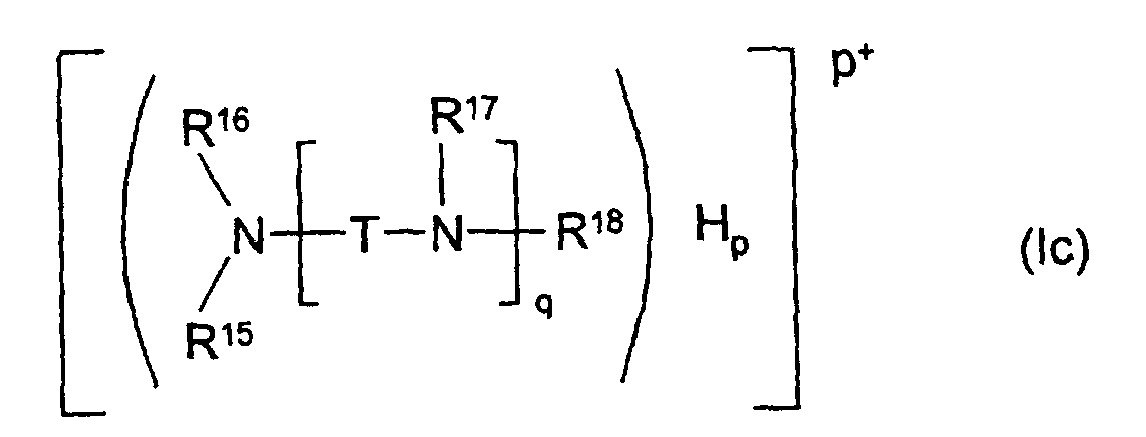
- R15, R16, R17 und R18
- unabhängig voneinander Wasserstoff oder eine (Poly)alkylenoxygruppe der Formel -[CH(R80)-CH(R80)O]k-H bedeuten, in der k eine Zahl von 1 bis 30 ist und die beiden Reste R80 unabhängig voneinander Wasserstoff, C1-C4-Alkyl oder, sofern k > 1 ist, eine Kombination davon bedeuten;
- q
- eine Zahl von 1 bis 10, vorzugsweise 1, 2, 3, 4 oder 5 ist;
- p
- eine Zahl von 1 bis 5, wobei p ≤q+1 ist;
- T
- einen verzweigten oder unverzweigten C2-C6-Alkylenrest bedeutet; oder worin T, wenn q > 1 ist, auch eine Kombination von verzweigten oder unverzweigten C2-C6-Alkylenresten sein kann;
- Z1
- ein Rest der Formel (1b) ist,
-[X-Y]qR3 (Ib)
worin - X
- einen C2-C6-Alkylenrest, einen C5-C7-Cycloalkylenrest, oder eine Kombination dieser Reste ist, wobei diese Reste durch 1 bis 4 C1-C4- Alkylreste, Hydroxyreste, (C1-C4)-Hydroxyalkylreste und/oder durch 1 bis 2 weitere
C5-C7-Cycloalkylreste substituiert sein können, oder worin X, wenn q > 1 ist, auch eine Kombination der genannten Bedeutungen sein kann; - Y
- eine -O-,
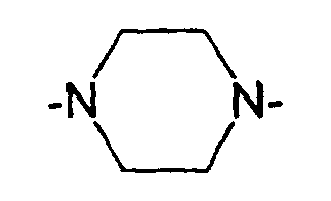
- q
- eine Zahl von 1 bis 10, vorzugsweise 1, 2, 3, 4 oder 5;
- R2 und R3
- unabhängig voneinander ein Wasserstoffatom, eine substituierte oder unsubstituierte, oder teil- oder perfluorierte, verzweigte oder unverzweigte (C1-C20)-Alkylgruppe, eine substituierte oder unsubstituierte C5-C7- Cycloalkylgruppe oder eine substituierte oder unsubstituierte, oder teil-oder perfluorierte (C2-C20)-Alkenylgruppe darstellen, wobei die Substituenten Hydroxy, Phenyl, Cyano, Chlor, Brom, Amino, C2-C4-Acyl oder C1-C4-Alkoxy sein und vorzugsweise 1 bis 4 an der Zahl sein können, oder
- R2 und R3
- zusammen mit dem N-Atom einen gesättigten, ungesättigten oder aromatischen heterocyclischen 5- bis 7-gliedrigen Ring bilden, der gegebenenfalls 1 oder 2 weitere Stickstoff-, Sauerstoff- oder Schwefelatome oder Carbonylgruppen im Ring enthält, gegebenenfalls durch 1, 2 oder 3 der Reste OH, Phenyl, CN, Cl, Br, C1-C4-Alkyl, C1-C4- Alkoxy,C2-C4-Acyl und Carbamoyl substituiert ist, und der gegebenenfalls 1 oder 2 benzoannellierte gesättigte, ungesättigte oder aromatische, carbocyclische oder heterocyclische Ringe trägt;
- Z4
- Wasserstoff, Hydroxy, Amino, Phenyl, (C1-C4)-Alkylen-phenyl, C5-C7-Cycloalkyl oder C1-C20-Alkyl ist, wobei der Phenylring, die (C1-C4)-Alkylen-phenyl-Gruppe und die Alkylgruppe durch ein oder mehrere, z.B. 1, 2, 3 oder 4, Substituenten aus der Gruppe Cl, Br, CN, NH2, OH, C6H5, mit 1,2 oder 3 C1-C4-Alkoxyresten substituiertes C6H5, Carbamoyl, C2-C4-Acyl und C1-C4-Alkoxy, z.B. Methoxy oder Ethoxy, substituiert sein können, der Phenylring und die (C1-C4)-Alkylen-phenyl-Gruppe auch durch NR2R3 substituiert sein können, wobei R2 und R3 die oben genannte Bedeutung haben, oder die Alkylgruppe perfluoriert oder teilfluoriert ist.
- Von Interesse sind Pigmentdispergatoren der Formel (I) mit s = 0,2 - 3,0 und n = 0 - 0,5. Von besonderem Interesse sind Pigmentdispergatoren der Formel (I) mit s = 0,5 - 2,5 und n=0-0,2.
- Von Interesse sind weiterhin Pigmentdispergatoren der Formel (I), worin
- R2 und R3
- unabhängig voneinander ein Wasserstoffatom, eine C1-C6-Alkylgruppe oder eine durch 1 bis 2 Substituenten aus der Gruppe Hydroxy, Acetyl, Methoxy, Ethoxy, Chlor und Brom substituierte C1-C6-Afkyfgruppe darstellen, oder
- R2 und R3
- zusammen mit dem angrenzenden N-Atom einen Imidazolyl-, Piperidinyl-, Morpholinyl-, Pipecolinyl-, Pyrrolyl-, Pyrrolidinyl-, Pyrazolyl-, Pyrrolidinonyl-, Indolyl- oder Piperazinyl-Ring bilden.
- Von Interesse sind weiterhin Pigmentdispergatoren der Formel (I), worin X ein C2-C4-Alkylenrest oder Cyclohexylen bedeutet. Von besonderem interesse sind Pigmentdispergatoren der Formel (I), worin Z1 die Bedeutung -[(CH2)3-NH]2-H, -(CH2-CH2-NH)2H,
-(CH2)3-NH-(CH2)2-NH-(CH2)3-NH2,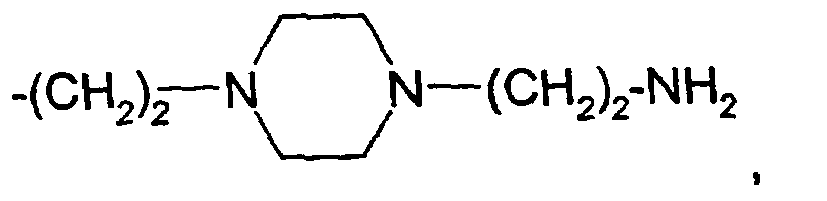


-CH2 -C(CH3)2-CH2-NH2,-(CH2)2-NH-CH3, -(CH2)2-N(CH3)2, -(CH2)2-NH-CH2-CH3, -(CH2)2-N(CH2-CH3)2, -(CH2)3-NH-CH3, -(CH2)3-N(CH3)2, -(CH2)3-NH-CH2-CH3 oder -(CH2)3-N(CH2-CH3)2 hat.
- Von Interesse sind weiterhin Pigmentdispergatoren der Formel (I), worin Z4 Wasserstoff, Amino, Phenyl, Benzyl, mit NR2R3 substituiertes Phenyl oder Benzyl, C1-C6-Alkyl, oder ein durch 1 bis 2 Substituenten aus der Gruppe Hydroxy, Acetyl, Methoxy und Ethoxy substituiertes C2-C6-Alkyl, Phenyl oder Benzyl, besonders bevorzugt Wasserstoff,

- Methyl, Ethyl, propyl, Butyl, Benzyl, Hydroxyethyl, Hydroxypropyl oder Methoxypropyl ist.
- Die erfindungsgemäßen Pigmentdispergatoren lassen sich durch Chlorsulfonierung der Diketopyrrolopyrrolverbindung der Formel (la)
und anschließender Umsetzung des Sulfochlorids mit einem Amin der Formel (V)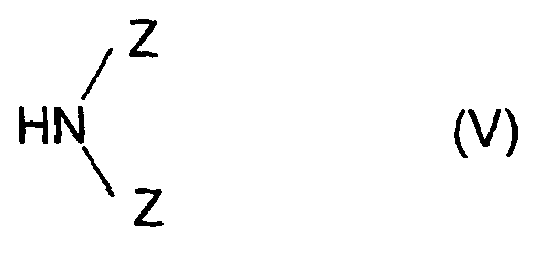
- Als Amine der allgemeinen Formel (V) können beispielsweise Ammoniak, Methylamin, Ethylamin, n-Propylamin, Isopropylamin, n-Butylamin, sek-Butylamin, Isopentylamin, n-Hexylamin, Dimethylamin, Diethylamin, Dibutylamin, N-Ethylbutylamin, β-Hydroxyethylamin, β- oder γ-Hydroxypropylamin, N-Methylethanolamin, Diethanolamin, 3-(2-Hydroxyethylamino)-1-propanol, N-(2-Hydroxyethyl)anilin, Hydroxylamin, Hydrazin, N,N-Dimethyl-p-phenylendiamin, Dimethylaminomethylamin, Diethylaminoethylamin, 2-Ethylhexylaminoethylamin, Stearylaminoethylamin, Oleylaminoethylamin, Dimethylaminoproyplamin, Diethylaminopropylamin, Dibutylaminopropylamin, Diethylaminobutylamin, Dimethylaminoamylamin, Diethylaminohexylamin, 1-Diethylamino-4-aminopentan, Piperidinomethylamin, Piperidinoethylamin, Piperidinopropylamin, Pipecolinoethylamin, Pipecolinopropylamin, Imidazolopropylamin, Morpholinoethylamin, Morpholinopropylamin, Piperazinoethylamin, 2-Methoxyethylamin, 3-Ethoxypropylamin, Di-(2-methoxyethyl)amin, Cyclohexylamin, N-Ethylcyclohexylamin, Dicyclohexylamin, Benzylamin, 2-Phenylethylamin, 4-Methoxyphenylethylamin, 1-Methyl-3-phenylpropylamin, 2-(3,4-Dimethoxyphenyl)ethylamin, Anilin, o-Toluidin, p-Toluidin, N-Ethylanilin, 3-(Cyclohexylamino)propylamin, 2-(2-Aminoethoxy)ethanol, 2-(2-(3-Aminopropoxy)ethoxy)ethanol, 3,3'-Oxybis(ethylenoxy)bis(propylamin), Ethylendiamin, 1,2-Propandiamin, 1,3-Propandiamin, 2,2-Dimethyl-1,3-propandiamin, Isophorondiamin, Diethylentriamin, Triethylentetramin, Tetraethylenpentamin, Pentaethylenhexamin, Dipropylentriamin, N,N-Bis-(3-aminopropyl)methylamin, Tripropylentetramin, 3-(2-Aminoethyl)aminopropylamin, N,N'-Bis(3-aminopropyl)ethylendiamin, Bis-(3-dimethylaminopropyl)amin, 4,7-Dioxadecan-1,10-diamin, 4,9-Dioxadodecan-1,12-diamin, 5-Amino-1,3,3-trimethylcyclohexanmethanamin oder 1,4-Bis-(3-aminopropoxy)-butan eingesetzt werden.
- Die Chlorsulfonierung wird zweckmäßigerweise so durchgeführt, dass Chlorsulfonsäure im 4 bis 25-fachen Gewichtsüberschuß, bezogen auf das Diketopyrrolopyrrol, eingesetzt und vorzugsweise noch eine 1 bis 10-fache molare Menge, bezogen auf das Diketopyrrolopyrrol, an Thionylchlorid zugegeben wird. Die Chiorsuifonierung wird vorzugsweise bei einer Temperatur von -10 bis +150°C, insbesondere bei 0 bis 100°C, ggf. unter Druck, durchgeführt. Das Diketopyrrolopyrrol-Sulfochlorid wird zweckmäßigerweise in Wasser gefällt und isoliert.
Die Umsetzung des Sulfochlorids mit dem Amin geschieht vorzugsweise bei einer Temperatur von 0 bis 100°C, insbesondere bei 0 bis 70°C. Die molaren Mengen von Amin : Sulfochlorid betragen zweckmäßigerweise (0,5 bis 10) zu 1, insbesondere (1 - 4):1. - Gegenstand der vorliegenden Erfindung ist weiterhin eine Pigmentzubereitung, gekennzeichnet durch einen Gehalt an
- a) mindestens einem organischen Basispigment und
- b) mindestens einem Pigmentdispergator der Formel (I).
- Unter Basispigment werden organische Pigmente oder Mischungen organischer Pigmente verstanden, die auch als übliche Pigmentzubereitungen vorliegen können. Geeignete Basispigmente für die Herstellung der erfindungsgemäßen Pigmentzubereitungen sind beispielsweise Perylen-, Perinon-, Chinacridon-, Chinacridonchinon-, Anthrachinon-, Anthanthron-, Benzimidazolon-, Disazokondensations-, Azo-, Indanthron-, Phthalocyanin-, Triarylcarbonium-, Dioxazin-, Aminoanthrachinon-, Diketopyrrolopyrrol-, Thioindigo-, Isoindolin-, Isoindolinon-, Pyranthron-, Isoviolanthron-, Carbon Black-Pigmente (Ruß) oder Mischungen davon.
- Bevorzugte Basispigmente im Sinne der vorliegenden Erfindung sind beispielsweise C.I. Pigment Red 123 (C.l. No. 71145), C.I. Pigment Red 149 (C.I. No. 71137), C.I.
- Pigment Red 178 (C.I. No. 71 155), C.I. Pigment Red 179 (C.I. No. 71 130), C.I. Pigment Red 190 (C.I. 71 140), C.I. Pigment Red 224 (C.I. No. 71 127), C.I. Pigment Violet 29 (C.I. No. 71 129), C.l. Pigment Orange 43 (C.I. No. 71 105), C.I. Pigment Red 194 (C.l. No. 71 100), C.I. Pigment Violet 19 (C.I. No. 73 900), C.I. Pigment Red 122 (C.l. No. 73 915), C.I. Pigment Red 192, C.I. Pigment Red 202 (C.I. No. 73 907), C.I. Pigment Red 207, C.I. Pigment Red 209 (C.I. No. 73 905), C.I. Pigment Red 206 (C.I. No. 73 900/73 920), C.I. Pigment Orange 48 (C.I. No. 73 900/73 920), C.I. Pigment Orange 49 (C.I. No. 73 900/73 920), C.I. Pigment Orange 42, C.I. Pigment Yellow 147, C.I. Pigment Red 168 (C.I. No. 59 300), C.I. Pigment Yellow 120 (C.I. No. 11 783), C.I. Pigment Yellow 151 (C.I. No. 13 980), C.I. Pigment Brown 25 (C.I. No. 12 510), C.I. Pigment Violet 32 (C.I. No. 12 517), C.I. Pigment Orange 64; C.I. Pigment Brown 23 (C.I. No. 20 060), C.I. Pigment Red 166 (C.I. No. 20 730), C.I. Pigment Red 170 (C.I. No. 12 475), C.l. Pigment Orange 38 (C.l. No. 12 367), C.I. Pigment Red 188 (C.I. No. 12 467), C.l. Pigment Red 187 (C.I. No. 12 486), C.l. Pigment Orange 34 (C.l. No. 21 115), C.l. Pigment Orange 13 (C.l. No. 21 110), C.l. Pigment Red 9 (C.I. No. 12 460), C.I. Pigment Red 2 (C.l. No. 12 310), C.I. Pigment Red 112 (C.I. No. 12 340), C.I. Pigment Red 7 (C.l. No. 12 420), C.l. Pigment Red 210 (C.I. No. 12 477), C. l. Pigment Red 12 (C.I. No. 12 385), C.I. Pigment Blue 60 (C.l. No. 69 800), C.I. Pigment Green 7 (C.l. No. 74 260),C.I. Pigment Green 36 (C.l. No. 74 265); C.I. Pigment Blue 15:1, 15:2, 15:3, 15:4, 15:6 und 15 (C.I. No. 74 160); C.I. Pigment Blue 56 (C.I. No. 42 800), C.I. Pigment Blue 61 (C.I. No. 42 765:1), C.I. Pigment Violet 23 (C.I. No. 51 319), C.I. Pigment Violet 37 (C.I. No. 51 345), C.I. Pigment Red 177 (C.I. No. 65 300), C.I. Pigment Red 254 (C.I. No. 56 110), C.I. Pigment Red 255 (C.I. No. 56 1050), C.I. Pigment Red 264, C.I. Pigment Red 270, C.I. Pigment Red 272 (C.I. No. 56 1150), C.I. Pigment Red 71, C.I. Pigment Orange 73, C.I. Pigment Red 88 (C.l. No. 73 312).
- Die erfindungsgemäßen Pigmentzubereitungen können neben dem Basispigment a) und dem Pigmentdispergator b) noch weitere übliche Zusatzstoffe enthalten, wie beispielsweise Füllstoffe, Stellmittel, oberflächenaktive Mittel, Harze, Entschäumer, Antistaubmittel, Extender, Farbmittel zum Nuancieren, Konservierungsmittel, Trocknungsverzögerungsmittel oder Additive zur Steuerung der Rheologie.
- Bevorzugte Pigmentzubereitungen im Sinne der vorliegenden Erfindung bestehen im wesentlichen aus
- a) 50 bis 99,5 Gew.-%, vorzugsweise 60 bis 98,8 Gew.-%, mindestens eines Basispigments a),
- b) 0,5 bis 20 Gew.-%, vorzugsweise 1 bis 15 Gew.-%, mindestens eines, vorzugsweise 1 oder 2, Pigmentdispergators b) der Formel (I),
- c) 0 bis 20 Gew.-%, vorzugsweise 0,1 bis 15 Gew.-% an oberflächenaktiven Mitteln und
- d) 0 bis 20 Gew.-%, vorzugsweise 0,1 bis 10 Gew.-% an weiteren üblichen Zusatzstoffen,
- Als oberflächenaktive Mittel c) kommen anionische oder anionaktive, kationische oder kationaktive oder nichtionische Substanzen oder Mischungen davon in Betracht. Als anionaktive Substanzen kommen beispielsweise Fettsäuretauride, Fettsäure-N-methyltauride, Fettsäureisethionate, Alkylphenylsulfonate, Alkylnaphthalinsulfonate, Alkylphenolpolyglykolethersulfate, Fettalkoholpolyglykolethersulfate; Fettsäuren, z.B. Palmitin-, Stearin- und Ölsäure; Fettsäureamid-polyglykolethersulfate; Alkylsulfosuccinamate; Alkenylbernsteinsäurehalbester, Fettalkoholpolyglykolethersulfosuccinate, Alkansulfonate, Fettsäureglutamate, Alkylsulfosuccinate, Fettsäuresarkoside; Seifen, z.B. Alkalisalze von Fettsäuren, Naphthensäuren und Harzsäuren, z.B. Abietinsäure, alkalilöslische Harze, z.B. kolophoniummodifizierte Maleinatharze und Kondensationsprodukte auf Basis von Cyanurchlorid, Taurin, N,N-Dialkylamino-alkylamin, wie beispielsweise N,N-Diethylaminopropylamin, und p-Phenylendiamin in Betracht; bevorzugt sind Harzseifen, d.h. Alkalisalze von Harzsäuren. Als kationaktive Substanzen kommen beispielsweise quaternäre Ammoniumsalze, Fettaminoxalkylate, oxalkylierte Polyamine, Fettaminpolyglykolether, Fettamine, von Fettaminen oder Fettalkoholen abgeleitete Di- und Polyamine und deren Oxalkylate; von Fettsäuren abgeleitete Imidazoline, und Salze dieser kationenaktiven Substanzen in Betracht.
- Als nichtionogene Substanzen kommen beispielsweise Aminoxide, Fettalkoholpolyglykolether, Fettsäurepolyglykolester, Betaine, wie Fettsäureamid-N-propyl-betaine, Phosphorsäureester von Fettalkoholen oder Fettalkoholpolyglykolethem, Fettsäureamidethoxylate, Fettalkohol-alkylenoxid-Addukte und Alkylphenolpolyglykolether in Betracht.
- Bei den erfindungsgemäßen Pigmentzubereitungen handelt es sich in der Regel um feste Systeme von rieselfähiger, pulverförmiger Beschaffenheit oder um Granulate.
- Der erfindungsgemäß erzielbare Dispergiereffekt beruht vermutlich auf einer Modifizierung der Oberflächenstruktur der Basispigmente mit dem Pigmentdispergator gemäß b). So sind in einer Reihe von Fällen die Wirksamkeit des Pigmentdispergators gemäß b) und die Qualität der damit erzeugten Pigmentzubereitungen abhängig vom Zeitpunkt der Zugabe des Pigmentdispergators gemäß b) im Herstellungsprozess des Basispigments. Werden mehr als ein Pigmentdispergator gemäß b) eingesetzt, so können sie gleichzeitig oder zu verschiedenen Zeitpunkten zugegeben werden oder können vor der Zugabe gemischt werden.
- Die Wirksamkeit des Pigmentdispergators gemäß b) kann auch von seiner Teilchengröße und Teilchenform sowie vom Umfang der belegbaren Pigmentoberfläche abhängen. Es kann vorteilhaft sein, den Pigmentdispergator gemäß b) erst im in Aussicht genommenen Anwendungsmedium dem Basispigment zuzufügen. Die jeweilige optimale Konzentration des Pigmentdispergators gemäß b) muß durch orientierende Vorversuche ermittelt werden, da die Verbesserung der Eigenschaften der Basispigmente nicht immer linear mit der Pigmentdispergatormenge einhergeht.
- Die erfindungsgemäßen Pigmentzubereitungen können Mischungen von einem oder mehreren, vorzugsweise 1 oder 2, Basispigmenten mit einem oder mehreren, vorzugsweise 1 oder 2, der Pigmentdispergatoren gemäß b) sein.
- Gegenstand der Erfindung ist auch ein Verfahren zur Herstellung einer erfindungsgemäßen Pigmentzubereitung, dadurch gekennzeichnet, daß man den oder die Pigmentdispergator(en) gemäß b) und das oder die Basispigment(e) miteinander mischt oder an einem beliebigen Zeitpunkt ihres Herstellungsprozesses aufeinander einwirken läßt.
- Der Herstellungsprozeß eines organischen Pigments umfaßt dessen Synthese, gegebenenfalls Feinverteilung, z.B. durch Mahlung oder Umfällen, gegebenenfalls Finish, sowie die Isolierung als Preßkuchen oder als trockenes Granulat oder Pulver. Beispielsweise kann der Pigmentdispergator gemäß b) vor oder während der Pigmentsynthese, unmittelbar vor oder während eines Feinverteilungsprozesses oder eines anschließenden Finish zugegeben werden. Dabei können Temperaturen von beispielsweise 0 bis 200 °C auftreten. Selbstverständlich kann der Pigmentdispergator gemäß b) auch in Teilportionen zu unterschiedlichen Zeiten zugegeben werden.
- Die Zugabe des Pigmentdispergators gemäß b) im Rahmen eines Feinverteilungsprozesses erfolgt beispielsweise vor oder während einer Trockenmahlung eines Rohpigments mit oder ohne zusätzliche Mahlhilfsmittel auf einer Roll- oder Schwingmühle, oder vor oder während einer Naßmahlung eines Rohpigments in wäßrigem, wäßrig-organischem oder organischem Mahlmedium, beispielsweise auf einer Perlmühle.
- Gleichfalls bewährt hat sich die Zugabe des Pigmentdispergators gemäß b) vor oder nach einem Finish des Basispigments in wäßrigem, wäßrig-alkalischem, wäßrig-organischem oder organischem Medium. Der Pigmentdispergator gemäß b) kann auch dem wasserfeuchten Pigmentpreßkuchen vor der Trocknung zugesetzt und eingearbeitet werden, wobei der Pigmentdispergator gemäß b) selbst ebenfalls als Preßkuchen vorliegen kann. Es ist weiterhin möglich, Trockenmischungen von Pulvern oder Granulaten des Pigmentdispergators gemäß b) mit dem Pulver oder Granulat eines oder mehrerer Basispigmente vorzunehmen, oder die Mischung durch Mahlung oder Pulverisierung der Komponente a) und b) zu erzielen.
- Die erfindungsgemäßen Pigmentzubereitungen zeichnen sich durch hervorragende coloristische und rheologische Eigenschaften aus, insbesondere durch eine hervorragende Rheologie, hohe Flockungsstabilität, hohe Transparenz, leichte Dispergierbarkeit, gutes Glanzverhalten, hohe Farbstärke, einwandfreie Überlackier- und Lösemittelechtheiten sowie sehr gute Wetterechtheit. Sie sind für den Einsatz sowohl in lösemittelhaltigen als auch in wäßrigen Systemen geeignet.
- Die erfindungsgemäß hergestellten Pigmentzubereitungen lassen sich zum Pigmentieren von hochmolekularen organischen Materialien natürlicher oder synthetischer Herkunft einsetzen, z.B. von Kunststoffen, Harzen, Lacken, Anstrichfarben oder elektrophotographischen Tonern und Entwicklern, sowie von Tinten und Druckfarben.
- Hochmolekulare organische Materialien, die mit den genannten Pigmentzubereitungen pigmentiert werden können, sind beispielsweise Celluloseether und -ester, wie Ethylcellulose, Nitrocellulose, Celluloseacetat oder Cellulosebutyrat, natürliche Harze oder Kunstharze, wie Polymerisationsharze oder Kondensationsharze, z.B. Aminoplaste, insbesondere Harnstoff- und Melaminformaldehydharze, Alkydharze, Acrylharze, Phenoplaste, Polycarbonate, Polyolefine, wie Polystyrol, Polyvinylchlorid, Polyethylen, Polypropylen, Polyacrylnitril, Polyacrylsäureester, Polyamide, Polyurethane oder Polyester, Gummi, Casein, Silikon und Silikonharze, einzeln oder in Mischungen.
- Dabei spielt es keine Rolle, ob die erwähnten hochmolekularen organischen Verbindungen als plastische Massen, Schmelzen oder in Form von Spinnlösungen, Lacken, Anstrichstoffen oder Druckfarben vorliegen. Je nach Verwendungszweck erweist es sich als vorteilhaft, die erfindungsgemäß erhaltenen Pigmentzubereitungen als Blend oder in Form von Präparationen oder Dispersionen zu benutzen. Bezogen auf das zu pigmentierende, hochmolekulare organische Material setzt man die erfindungsgemäßen Pigmentzubereitungen in einer Menge von 0,05 bis 30 Gew.-%, vorzugsweise 0,1 bis 15 Gew.-% ein.
- Die erfindungsgemäßen Pigmentzubereitungen sind auch geeignet als Farbmittel in elektrophotographischen Tonern und Entwicklern, wie z.B. Ein- oder Zweikomponentenpulvertonern (auch Ein- oder Zweikomponenten-Entwickler genannt), Magnettoner, Flüssigtoner, Polymerisationstoner sowie Spezialtoner (Lit: L.B. Schein, "Electrophotography and Development Physics"; Springer Series in Electrophysics 14, Springer Verlag, 2nd edition, 1992).
- Typische Tonerbindemittel sind Polymerisations-, Polyadditions- und Polykondensationsharze, wie Styrol-, Styrolacrylat-, Styrolbutadien-, Acrylat-, Polyester-, Phenol-Epoxidharze, Polysulfone, Polyurethane, einzeln oder in Kombination, sowie Polyethylen und Polypropylen, die noch weitere Inhaltsstoffe, wie Ladungssteuermittel, Wachse oder Fließhilfsmittel, enthalten können oder im Nachhinein mit diesen Zusätzen modifiziert werden.
- Desweiteren sind die erfindungsgemäßen Pigmentzubereitungen geeignet als Farbmittel in Pulver und Pulverlacken, insbesondere in triboelektrisch oder elektrokinetisch versprühbaren Pulverlacken, die zur Oberflächenbeschichtung von Gegenständen aus beispielsweise Metall, Holz, Kunststoff, Glas, Keramik, Beton, Textilmaterial, Papier oder Kautschuk zur Anwendung kommen (J.F. Hughes, "Electrostatics Powder Coating" Research Studies, John Wiley & Sons, 1984).
- Als Pulverlackharze werden typischerweise Epoxidharze, carboxyl- und hydroxylgruppenhaltige Polyesterharze, Polyurethan- und Acrylharze zusammen mit üblichen Härtern eingesetzt. Auch Kombinationen von Harzen finden Verwendung. So werden beispielsweise häufig Epoxidharze in Kombination mit carboxyl- und hydroxylgruppenhaltigen Polyesterharzen eingesetzt. Typische Härterkomponenten (in Abhängigkeit vom Harzsystem) sind beispielsweise Säureanhydride, Imidazole sowie Dicyandiamid und deren Abkömmlinge, verkappte Isocyanate, Bisacylurethane, Phenol- und Melaminharze, Triglycidylisocyanurate, Oxazoline und Dicarbonsäuren.
- Außerdem sind die erfindungsgemäßen Pigmentzubereitungen als Farbmittel in Ink-Jet Tinten auf wäßriger und nichtwäßriger Basis sowie in solchen Tinten, die nach dem hot-melt-Verfahren arbeiten, geeignet.
- Weiterhin sind die erfindungsgemäßen Pigmentzubereitungen auch als Farbmittel für Farbfilter sowohl für die additive wie subtraktive Farberzeugung geeignet.
- Es ist auch möglich, daß erst im Anwendungsmedium der Pigmentdispergator gemäß b) dem Basispigment, oder umgekehrt, zugegeben wird. Gegenstand der Erfindung ist daher auch eine Pigmentpräparation, bestehend im wesentlichen aus einem oder mehreren organischen Basispigmenten a), einem oder mehreren Pigmentdispergatoren gemäß b), dem besagten hochmolekularen organischen Material, insbesondere Lack, gegebenenfalls oberflächenaktiven Mittel und/oder weiteren üblichen Zusatzstoffen. Die Gesamtmenge an Basispigment plus Pigmentdispergator gemäß b) ist z.B. 0,05 bis 30 Gew.-%, vorzugsweise 0,1 bis 15 Gew.-%, bezogen auf das Gesamtgewicht der Pigmentpräparation.
- Zur Beurteilung der Eigenschaften der Pigmentzubereitungen auf dem Lacksektor wurden aus der Vielzahl der bekannten Lacke ein aromatenhaltiger Alkydmelaminharzlack (AM) auf Basis eines mittelöligen Alkydharzes und eines butanolveretherten Melaminharzes, ein Polyesterlack (PE) auf Basis von Celluloseacetobutyrat und eines Melaminharzes, ein High-Solid-Acrylharzeinbrennlack auf Basis einer nichtwäßrigen Dispersion (HS) sowie ein wäßriger Lack auf Polyurethanbasis (PUR) ausgewählt.
- Die Bestimmung der Farbstärke und des Farbtons erfolgte nach DIN 55986. Die Rheologie des Mahlguts nach der Dispergierung (Millbase-Rheologie) wurde visuell anhand der folgenden fünfstufigen Skala bewertet
- 5
- dünnflüssig
- 4
- flüssig
- 3
- dickflüssig
- 2
- leicht gestockt
- 1
- gestockt
- Nach dem Verdünnen des Mahlguts auf die Pigmentendkonzentration wurde die Viskosität mit dem Viskospatel nach Rossmann, Typ 301 der Firma Erichsen beurteilt.
- Glanzmessungen erfolgten an Folienaufgüssen unter einem Winkel von 20° nach DIN 67530 (ASTMD 523) mit dem "multigloss"-Glanzmeßgerät der Firma Byk-Mallinckrodt. Die Bestimmung der Lösemittelechtheit erfolgte nach DIN 55976. Die Bestimmung der Überlackierechtheit erfolgte nach DIN 53221.
- In den nachfolgenden Beispielen bedeuten Teile jeweils Gewichtsteile und Prozente jeweils Gewichtsprozente. "min" sind Minuten.
-

- In einem Vierhalskolben werden 250 Teile Chlorsulfonsäure vorgelegt und 25 Teile 1,4-Diketo-3,6-di-(4-biphenyl)-pyrrolo[3,4-c]pyrrol so eingetragen und gelöst, daß die Temperatur 25 °C nicht überschreitet. Dann werden innerhalb 15 min 19,64 Teile Thionylchlorid zugetropft und 15 min gerührt. Die Lösung wird innerhalb 15 min auf 1000 Teile Eiswasser, hergestellt aus 333 Teilen Eis und 667 Teilen Wasser, getropft. Das ausgefallene Sulfochlorid wird filtriert und mit 750 Teilen kaltem Wasser gewaschen. In einem Vierhalskolben werden 70 Teile Eis, 70 Teile Wasser und 15,3 Teile 3-Dimethylamino-1-propylamin vorgelegt und bei 0 bis 5°C der Sulfochloridpresskuchen eingetragen. Dann wird 1 h bei 0 bis 5°C gerührt, in 30 min auf 25°C erwärmt, 30 min bei 25°C gerührt, in 30 min auf 50 °C erwärmt, 30 min bei 50°C gerührt, in 30 min auf 70°C erwärmt und 30 min bei 70°C gerührt. Das Produkt wird filtriert, mit Wasser gewaschen und bei 80°C im Umluftschrank getrocknet.
Man erhält 39,9 Teile Pigmentdispergator.
Aus den Intensitäten der 1H-NMR-Signale errechnet sich ein Substitutionsgrad von s ca. 1,6.
1H-NMR (D2SO4): δ 7,8; 7,6; 5,9; 3,1; 2,7; 2,5; 1,8 ppm. - 30 Teile eines handelsüblichen Pigments (C.l. Pigment Red 264) werden mit 3 Teilen Pigmentdispergator der Formel X, hergestellt gemäß Beipiel 1a mechanisch gemischt.
Man erhält eine Pigmentzubereitung, die im HS-Lack transparente und farbstarke Lackierungen liefert. Die Glanzmessung ergibt den Wert 65. Die Metalliclackierung ist farbstark und brillant. -

- Man verfährt wie in Beispiel 1a, außer dass als Amin 21,63 Teile N-(3-Aminopropyl)-morpholin eingesetzt werden. Man erhält 42,1 Teile Pigmentdispergator.
1H-NMR (D2SO4): δ 7,8; 7,6; 3,9; 3,6; 3,1; 2,8; 1,8 ppm.
Aus den Intensitäten der Signale errechnet sich ein Substitutionsgrad von s ca. 1,7. - 30 Teile eines handelsüblichen Pigments (C.l. Pigment Red 264) werden mit 3 Teilen Pigmentdispergator der Formel XI, hergestellt gemäß Beipiel 2a mechanisch gemischt.
Man erhält eine Pigmentzubereitung, die im HS-Lack transparente und farbstarke Lackierungen liefert. Die Viskosität beträgt 2,6 s. Die Glanzmessung ergibt den Wert 75. Die Metalliclackierung ist farbstark und brillant. -

- Man verfährt wie in Beispiel 1a, außer dass als Amin 19,38 Teile N-(2-Aminoethyl)-piperazin eingesetzt werden. Man erhält 39,3 Teile Pigmentdispergator.
1H-NMR (D2SO4): δ 7,8; 7,6; 3,6; 3,1 ppm.
Aus den lntensitäten der Signale errechnet sich ein Substitutionsgrad von s ca. 1,0. - 30 Teile eines handelsüblichen Pigments (C.l. Pigment Red 264) werden mit 3 Teilen Pigmentdispergator der Formel XII, hergestellt gemäß Beipiel 3a mechanisch gemischt. Man erhält eine Pigmentzubereitung, die im HS-Lack transparente und farbstarke Lackierungen liefert.
-

- Man verfährt wie in Beispiel 1a, außer dass als Amin 13,22 Teile 3-(Methylamino)-propylamin eingesetzt werden. Man erhält 36,1 Teile Pigmentdispergator.
1H-NMR (D2SO4): δ 7,8; 7,6; 3,2; 2,8; 2,6; 2,4; 1,9; 1,8 ppm.
Aus den Intensitäten der Signale errechnet sich ein Substitutionsgrad von s ca. 1,2. - 30 Teile eines handelsüblichen Pigments (C.I. Pigment Red 264) werden mit 3 Teilen Pigmentdispergator der Formel XIII, hergestellt gemäß Beipiel 4a mechanisch gemischt. Man erhält eine Pigmentzubereitung, die im HS-Lack transparente und farbstarke Lackierungen liefert.
-

- Man verfährt wie in Beispiel 1a, außer dass als Amin 15,62 Teile N-(2-Aminoethyl)-ethanolamin eingesetzt werden. Man erhält 37,5 Teile Pigmentdispergator.
1H-NMR (D2SO4): δ 7,8; 7,6; 4,2; 4,1; 3,2; 3,1 ppm.
Aus den Intensitäten der Signale errechnet sich ein Substitutionsgrad von s ca. 1,2. - 30 Teile eines handelsüblichen Pigments (C.I. Pigment Red 264) werden mit 3 Teilen Pigmentdispergator der Formel XIV, hergestellt gemäß Beipiel 5a mechanisch gemischt. Man erhält eine Pigmentzubereitung, die im HS-Lack transparente und farbstarke Lackierungen liefert.
-

- Man verfährt wie in Beispiel 1a, außer dass als Amin 28,5 Teile 3-(Dibutylamino)-1-propylamin 98 %ig eingesetzt werden. Man erhält 47,4 Teile Pigmentdispergator.
1H-NMR (D2SO4): δ 7,8; 7,6; 3,1; 2,7; 2,6; 1,7; 1,2; 0,9; 0,5 ppm.
Aus den Intensitäten der Signale errechnet sich ein Substitutionsgrad von s ca. 1,9. - 30 Teile eines handelsüblichen Pigments (C.l. Pigment Red 264) werden mit 3 Teilen Pigmentdispergator der Formel XV, hergestellt gemäß Beipiel 6a mechanisch gemischt.
Man erhält eine Pigmentzubereitung, die im HS-Lack transparente und farbstarke Lackierungen liefert. Die Rheologie wird mit 4 bis 5 bewertet und die Viskosität beträgt 1,1 s. Die Glanzmessung ergibt den Wert 81. Die Metalliclackierung ist farbstark und brillant.
Ohne Zusatz des Pigmentdispergators sind die HS-Lackierungen farbschwächer und wesentlich deckender. Die Rheologie wird mit 3 bewertet und die Viskosität beträgt 16,5 s. Die Glanzmessung ergibt den Wert 52. Die Metalliclackierung ist deutlich farbschwächer und weniger brillant.
Die Lackierung im PE-Lack ist transparent und farbstark. Die Glanzmessung ergibt den Wert 82. Die Metalliclackierung ist farbstark und brillant.
Ohne Zusatz des Pigmentdispergators sind die PE-Lackierungen farbschwächer, merklich deckender und so matt, daß ein Glanz nicht meßbar ist. Die Metalliclackierung ist bedeutend farbschwächer und weniger brillant. -

- Man verfährt wie in Beispiel 1a, außer dass als Amin 15,77 Teile 2-(2-Aminoethoxy)-ethanol eingesetzt werden. Man erhält 40,5 Teile Pigmentdispergator.
1H-NMR (D2SO4): δ 7,8; 7,6; 4,1; 3,5; 3,3; 2,9 ppm.
Aus den Intensitäten der Signale errechnet sich ein Substitutionsgrad von s ca. 1,6. - 30 Teile eines handelsüblichen Pigments (C.I. Pigment Red 264) werden mit 3 Teilen Pigmentdispergator der Formel XVI, hergestellt gemäß Beipiel 7a mechanisch gemischt. Man erhält eine Pigmentzubereitung, die im HS-Lack transparente und farbstarke Lackierungen liefert.
-

- Man verfährt wie in Beispiel 1 a, außer dass als Amin 13,78 Teile 2-Amino-1-butanol eingesetzt werden. Man erhält 36,6 Teile Pigmentdispergator.
1H-NMR (D2SO4): δ 7,8; 7,6; 4,3; 4,1; 3,7; 1,5; 0,6 ppm.
Aus den Intensitäten der Signale errechnet sich ein Substitutionsgrad von s ca. 1,4. - 30 Teile eines handelsüblichen Pigments (C.l. Pigment Red 264) werden mit 3 Teilen Pigmentdispergator der Formel XVII, hergestellt gemäß Beipiel 8a mechanisch gemischt. Man erhält eine Pigmentzubereitung, die im HS-Lack transparente und farbstarke Lackierungen liefert.
-

- Man verfährt wie in Beispiel 1a, außer dass als Amin 21,33 Teile 1-(3-Aminopropyl)-2-pyrrolidinon eingesetzt werden. Man erhält 42,2 Teile Pigmentdispergator.
1H-NMR (D2SO4): δ 7,8; 7,6; 3,4; 3,2; 2,9; 2,7; 1,8; 1,7 ppm.
Aus den Intensitäten der Signale errechnet sich ein Substitutionsgrad von s ca. 1,6. - 30 Teile eines handelsüblichen Pigments (C.l. Pigment Red 264) werden mit 3 Teilen Pigmentdispergator der Formel XVIII, hergestellt gemäß Beipiel 9a mechanisch gemischt. Man erhält eine Pigmentzubereitung, die im HS-Lack transparente und farbstarke Lackierungen liefert.
-
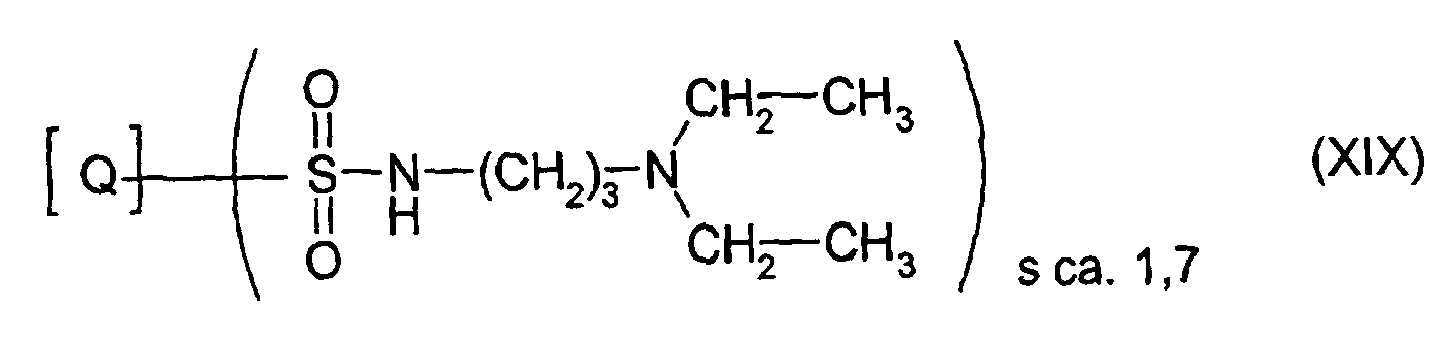
- Man verfährt wie in Beispiel 1a, außer dass als Amin 19,54 Teile Diethylaminopropylamin eingesetzt werden. Man erhält 41,3 Teile Pigmentdispergator.
1H-NMR (D2SO4): δ 7,8; 7,6; 3,1; 2,7; 1,7; 0,8 ppm.
Aus den Intensitäten der Signale errechnet sich ein Substitutionsgrad von s ca. 1,7. Die Lösemittelechtheit des Dispergators ist sehr gut. - 30 Teile eines handelsüblichen Pigments (C.l. Pigment Red 264) werden mit 3 Teilen Pigmentdispergator der Formel XIX, hergestellt gemäß Beipiel 10a mechanisch gemischt.
Man erhält eine Pigmentzubereitung, deren Lösemittelechtheit sehr gut ist und die im HS-Lack transparente und farbstarke Lackierungen liefert. Die Rheologie wird mit 4-5 bewertet und die Viskosität beträgt 1,8 s. Die Glanzmessung ergibt den Wert 71. Die Metalliclackierung ist farbstark und brillant.
Ohne Zusatz des Pigmentdispergators sind die HS-Lackierungen farbschwächer und wesentlich deckender. Die Rheologie wird mit 3 bewertet und die Viskosität ist so hoch, daß sie mit dem Viskospatel nicht meßbar ist. Auch der Glanz ist durch die starke Flockung nicht meßbar. Die Metalliclackierung ist merklich farbschwächer und weniger brillant.
Die Lackierung im PE-Lack ist transparent und farbstark. Die Glanzmessung ergibt den Wert 33. Die Metalliclackierung ist farbstark und brillant. - Ohne Zusatz des Pigmentdispergators sind die PE-Lackierungen farbschwächer, deutlich deckender und so matt, daß ein Glanz nicht meßbar ist. Die Metalliclackierung ist wesentlich farbschwächer und weniger brillant.
Die Lackierung im AM-Lack ist transparent und farbstark. Die Glanzmessung ergibt den Wert 89. Die Viskosität beträgt 5,4 s.
Ohne Zusatz des Pigmentdispergators sind die AM-Lackierungen farbschwächer, wesentlich deckender und so matt, daß ein Glanz nicht meßbar ist. Die Viskosität ist so hoch, daß sie mit dem Viskospatel nicht meßbar ist. - 28,5 Teile eines handelsüblichen Pigments (C.I. Pigment Red 264) werden mit 1,5 Teilen Pigmentdispergator der Formel XIX, hergestellt gemäß Beipiel 10a mechanisch gemischt. Die Lösemittelechtheit der Pigmentzubereitung ist sehr gut.
-

- Der Pigmentdispergator der Formel XX wird wie in JP-H3-26767, Beispiel 1, beschrieben hergestellt.
1H-NMR (D2S04): δ 8,0; 7,9; 7,8; 7,7; 3,1; 2,7; 1,7; 0,8 ppm.
Aus den Intensitäten der Signale errechnet sich ein Substitutionsgrad von s ca. 1,2. - Die Lösemittelechtheit des Pigmentdispergators ist ungenügend. lm Vergleich zur Lösemittelechtheit des Pigmentdispergators der Formel XIX, hergestellt gemäß Beispiel 10a, ist sie bedeutend schlechter und damit deutlich unterlegen.
- 28,5 Teile eines handelsüblichen Pigments (C.l. Pigment Red 264) werden mit 1,5 Teilen Pigmentdispergator der Formel XX, hergestellt gemäß Beipiel 11a mechanisch gemischt.
Die Lösemittelechtheit der Pigmentzubereitung ist ungenügend. Im Vergleich zur Lösemittelechtheit der Pigmentzubereitung, hergestellt gemäß Beispiel 10c, ist sie bedeutend schlechter und damit deutlich unterlegen. - Mit der Pigmentzubereitung, hergestellt gemäß Beispiel 10c, wird im PE-Lack eine Lackierung hergestellt. Die Überlackierechtheit ist einwandfrei, ein Ausbluten ist nicht zu erkennen.
Mit der Pigmentzubereitung, hergestellt gemäß Beispiel 11b, wird im PE-Lack eine Lackierung hergestellt. Die Überlackierechtheit ist mangelhaft, ein starkes Ausbluten ist sichtbar. - Mit der Pigmentzubereitung, hergestellt gemäß Beispiel 10c, wird im PUR-Lack eine Lackierung hergestellt. Die Überlackierechtheit ist einwandfrei, ein Ausbluten ist nicht zu erkennen.
- Mit der Pigmentzubereitung, hergestellt gemäß Beispiel 11 b, wird im PUR-Lack eine Lackierung hergestellt. Die Überlackierechtheit ist inakzeptabel, ein sehr starkes Ausbluten ist sichtbar.
- Der Pigmentdispergator der Formel XX wird hergestellt gemäß Beispiel 10a mit dem einzigen Unterschied, daß an Stelle von 25 Teilen 1,4-Diketo-3,6-di-(4-biphenyl)-pyrrolo[3,4-c]pyrrol 16,4 Teile 1,4-Diketo-3,6-diphenylpyrrolo[3,4-c]pyrrol eingesetzt werden. Man erhält 17,2 Teile Pigmentdispergator.
1H-NMR (D2SO4): δ 8,0; 7,9; 7,8; 7,7; 3,1; 2,7; 1,7; 0,8 ppm.
Aus den Intensitäten der Signale errechnet sich ein Substitutionsgrad von s ca. 0,12. Die Lösemittelechtheit des Pigmentdispergators ist ungenügend. Im Vergleich zur Lösemittelechtheit des Pigmentdispergators der Formel XIX, hergestellt gemäß Beispiel 10a, ist sie bedeutend schlechter und damit deutlich unterlegen. - 30 Teile eines handelsüblichen Pigments (C.l. Pigment Red 264) werden mit 3 Teilen Pigmentdispergator der Formel (XX), hergestellt gemäß Beipiel 13a, mechanisch gemischt.
Die Lösemittelechtheit der Pigmentzubereitung ist ungenügend. Im Vergleich zur Lösemittelechtheit der Pigmentzubereitung, hergestellt gemäß Beispiel 10b, ist sie bedeutend schlechter und damit deutlich unterlegen. - Mit der Pigmentzubereitung, hergestellt gemäß Beispiel 10b, wird im PE-Lack eine Lackierung hergestellt. Die Lackierung ist transparent und farbstark, die Glanzmessung ergibt den Wert 33. Die Metalliclackierung ist farbstark und brillant. Die Überlackierechtheit ist einwandfrei, ein Ausbluten ist nicht zu erkennen.
- Mit der Pigmentzubereitung, hergestellt gemäß Beispiel 13b, wird im PE-Lack eine Lackierung hergestellt. Sie ist, vergleichen mit obiger Lackierung, deutlich deckender, wesentlich farbschwächer, ein Glanz ist durch die starke Flockung nicht meßbar, die Metalliclackierung ist wesentlich farbschwächer und fahler. Die Überlackierechtheit ist mangelhaft, ein deutliches Ausbluten ist sichtbar.
- Mit der Pigmentzubereitung, hergestellt gemäß Beispiel 10b, wird im PUR-Lack eine Lackierung hergestellt. Die Überlackierechtheit ist einwandfrei, ein Ausbluten ist nicht zu erkennen.
- Mit der Pigmentzubereitung, hergestellt gemäß Beispiel 13b, wird im PUR-Lack eine Lackierung hergestellt. Die Überlackierechtheit ist inakzeptabel, ein sehr starkes Ausbluten ist sichtbar.
- Mit der Pigmentzubereitung, hergestellt gemäß Beispiel 10b, wird im HS-Lack eine Lackierung hergestellt. Sie ist transparent und farbstark. Die Rheologie wird mit 4 bis 5 bewertet und die Viskosität beträgt 1,8 s. Die Glanzmessung ergibt den Wert 71. Die Metalliclackierung ist farbstark und brillant. Die Überlackierechtheit ist einwandfrei.
Mit der Pigmentzubereitung, hergestellt gemäß Beispiel 13b, wird im HS-Lack eine Lackierung hergestellt. Sie ist, verglichen mit obiger Lackierung, merklich farbschwächer. Die Rheologie wird lediglich mit 3 bewertet und die Viskosität ist auf 3,0 s erhöht. Die Glanzmessung ergibt lediglich den Wert 43. Die Metalliclackierung ist wesentlich farbschwächer und fahler. Die Prüfung der Überlackierechtheit zeigt ein deutliches Ausbluten. - 20 Teile eines handelsüblichen Pigments (C.l. Pigment Red 177) werden mit 1 Teil Pigmentdispergator der Formel XV, hergestellt gemäß Beipiel 6a mechanisch gemischt.
Man erhält eine Pigmentzubereitung, die im HS-Lack Lackierungen liefert, die verglichen mit den Lackierungen des unbehandelten handelsüblichen Pigments (C.I. Pigment Red 177) transparenter, glänzender und deutlich farbstärker sind, die Volltonlackierungen des unbehandelten handelsüblichen Pigments (C.I. Pigment Red 177) zeigen einen Schleier. Die Metalliclackierungen der Pigmentpräparation sind bedeutend reiner und heller als die Metalliclackierungen des unbehandelten handelsüblichen Pigments (C.l. Pigment Red 177).
Im PE-Lack sind die Lackierungen der Pigmentzubereitung transparenter, wesentlich farbstärker und glänzender, die Metalliclackierungen sind wesentlich farbstärker und brillanter als die entsprechenden Lackierungen des unbehandelten handelsüblichen Pigments (C.I. Pigment Red 177). - 20 Teile eines handelsüblichen Pigments (C.l. Pigment Brown 25) werden mit 1 Teil Pigmentdispergator der Formel XV, hergestellt gemäß Beipiel 6a mechanisch gemischt.
Man erhält eine Pigmentzubereitung, die im HS-Lack Lackierungen liefert, die verglichen mit den Lackierungen des unbehandelten handelsüblichen Pigments (C.I. Pigment Brown 25) farbstärker sind. Die Metalliclackierungen der Pigmentpräparation sind farbstärker und brillanter. - 20 Teile eines handelsüblichen Pigments (C.l. Pigment Violet 23) werden mit 1 Teil Pigmentdispergator der Formel XV, hergestellt gemäß Beipiel 6a mechanisch gemischt.
Man erhält eine Pigmentzubereitung, die im HS-Lack Lackierungen liefert, die verglichen mit den Lackierungen des unbehandelten handelsüblichen Pigments (C.I. Pigment Violet 23) transparenter, farbstärker und wesentlich röter sind. Die Metalliclackierungen der Pigmentpräparation sind farbstärker, brillanter und wesentlich röter als die Metalliclackierungen des unbehandelten handelsüblichen Pigments (C.I. Pigment Violet 23).
Im PE-Lack sind die Lackierungen der Pigmentzubereitung transparenter, farbstärker und deutlich röter, die Metalliclackierungen sind farbstärker und röter als die entsprechenden Lackierungen des unbehandelten handelsüblichen Pigments (C.I. Pigment Violet 23). - 20 Teile eines handelsüblichen Pigments (C.l. Pigment Violet 19, β-Phase) werden mit 1 Teil Pigmentdispergator der Formel XV, hergestellt gemäß Beipiel 6a mechanisch gemischt.
Man erhält eine Pigmentzubereitung, die im PE-Lack Lackierungen liefert, die verglichen mit den Lackierungen des unbehandelten handelsüblichen Pigments (C.l. Pigment Violet 19, β-Phase) transparenter, farbstärker und reiner sind. Die Metalliclackierungen der Pigmentpräparation sind deutlich farbstärker und brillanter als die Metalliclackierungen des unbehandelten handelsüblichen Pigments (C.l. Pigment Violet 19, β-Phase). - 20 Teile eines handelsüblichen Pigments (C.l. Pigment Blue 15:1) werden mit 1 Teil Pigmentdispergator der Formel XV, hergestellt gemäß Beipiel 6a mechanisch gemischt.
Man erhält eine Pigmentzubereitung, die im HS-Lack Lackierungen liefert, die verglichen mit den Lackierungen des unbehandelten handelsüblichen Pigments (C.l. Pigment Blue 15:1) transparenter, glänzender und farbstärker sind. Die Metalliclackierungen der Pigmentpräparation sind farbstärker und brillanter als die Metalliclackierungen des unbehandelten handelsüblichen Pigments (C.l. Pigment Blue 15:1).
Im PE-Lack sind die Lackierungen der Pigmentzubereitung transparenter, die Metalliclackierungen sind wesentlich farbstärker und brillanter als die entsprechenden Lackierungen des unbehandelten handelsüblichen Pigments (C.I. Pigment Blue 15:1). - 20 Teile eines handelsüblichen Pigments (C.l. Pigment Blue 60) werden mit 1 Teil Pigmentdispergator der Formel XV, hergestellt gemäß Beipiel 6a mechanisch gemischt.
Man erhält eine Pigmentzubereitung, die im HS-Lack farbstarke und transparente Lackierungen liefert, die Metalliclackierungen sind farbstark und brillant. - 20 Teile eines handelsüblichen Pigments (C.l. Pigment Red 179) werden mit 1 Teil Pigmentdispergator der Formel XV, hergestellt gemäß Beipiel 6a mechanisch gemischt.
Man erhält eine Pigmentzubereitung, die im HS-Lack Lackierungen liefert, die verglichen mit den Lackierungen des unbehandelten handelsüblichen Pigments (C.l. Pigment Red 179) transparenter, farbstärker und glänzender sind. Die Metalliclackierungen der Pigmentpräparation sind farbstärker und brillanter. - 20 Teile eines handelsüblichen Pigments (C.I. Pigment Red 202) werden mit 1 Teil Pigmentdispergator der Formel XV, hergestellt gemäß Beipiel 6a mechanisch gemischt.
Man erhält eine Pigmentzubereitung, die im HS-Lack transparente und farbstarke Lackierungen liefert, die Metalliclackierungen sind farbstark und brillant. - 298,7 g tert.-Amylalkohol werden vorgelegt und 20,0 g Natrium zugegeben. Dann wird zum Sieden erhitzt und solange gerührt, bis alles Natrium umgesetzt ist. Nach Abkühlen auf 80°C werden 57,8 g p-Chlorbenzonitril eingetragen. Es wird auf 98-100°C erhitzt und innerhalb von 2 Stunden 62,7 g Bernsteinsäurediisopropylester zugetropft. Anschließend wird 3 Stunden und 45 Minuten bei Siedehitze gerührt. Nach Abkühlen auf 95°C werden 3 g Pigmentdispergator der Formel XV, hergestellt gemäß Beispiel 6a, zugegeben, wieder zum Sieden erhitzt und 15 Minuten bei Siedehitze gerührt. Die Reaktionssuspension wird auf 80°C abgekühlt und auf 450 g Wasser, welches vorher auf 80°C erwärmt wurde, unter Rühren gegossen. Die Mischung wird zum Sieden erhitzt und bei Siedehitze für 4 Stunden und 45 Minuten gerührt. Dann wird durch eine Wasserdampfdestillation der Alkohol entfernt. Die Pigmentsuspension wird filtriert, mit warmem Wasser salzfrei gewaschen und bei 80 °C im Vakuum getrocknet. Man erhält 72,2 g Pigmentzubereitung. Die Pigmentzubereitung liefert im HS-Lack transparente und farbstarke Lackierungen, die Rheologie wird mit 5 bewertet, die Glanzmessung ergibt den Wert 67.
-
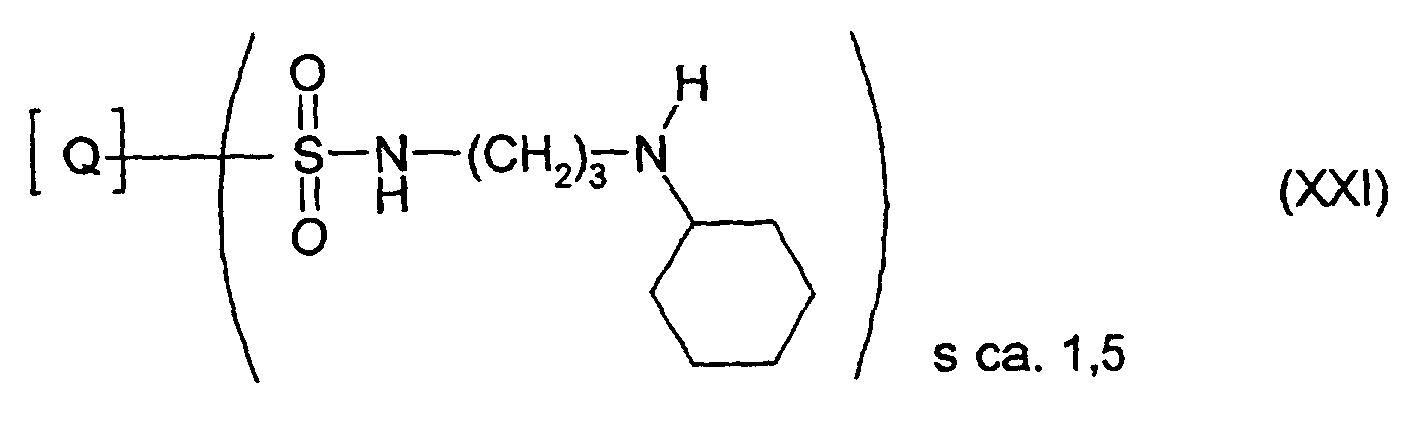
- In einem Vierhalskolben werden 250 Teile Chlorsulfonsäure vorgelegt und 25 Teile 1,4-Diketo-3,6-di-(4-biphenyl)-pyrrolo[3,4-c]pyrrol so eingetragen und gelöst, daß die Temperatur 25°C nicht überschreitet. Dann werden innerhalb 15 min 19,64 Teile Thionylchlorid zugetropft und 15 min gerührt. Die Lösung wird innerhalb 15 min auf 1000 Teile Eiswasser, hergestellt aus 333 Teilen Eis und 667 Teilen Wasser, getropft. Das ausgefallene Sulfochlorid wird filtriert und mit 750 Teilen kaltem Wasser gewaschen. In einem Vierhalskolben werden 70 Teile Eis, 70 Teile Wasser und 23,4 Teile N-Cyclohexyl-1,3-propandiamin vorgelegt und bei 0 - 5°C der Sulfochloridpresskuchen eingetragen. Dann wird 1 h bei 0 - 5°C gerührt, in 30 min auf 25°C erwärmt, 30 min bei 25°C gerührt, in 30 min auf 50 °C erwärmt, 30 min bei 50°C gerührt, in 30 min auf 70°C erwärmt und 30 min bei 70°C gerührt. Das Produkt wird filtriert und mit Wasser gewaschen. Der Presskuchen wird in 782 Teilen Wasser suspendiert und mit wenig Natronlauge wird pH 8,6 eingestellt. Es wird so lange Wasserdampf durch die Suspension geleitet und kondensiert, bis ca. 860 Teile Destillat angefallen sind. Das Produkt wird filtriert, mit Wasser gewaschen und bei 80°C im Umluftschrank getrocknet. Man erhält 43,7 Teile Pigmentdispergator.
Aus den Intensitäten der Signale errechnet sich ein Substitutionsgrad von s ca. 1,5. 1H-NMR (D2SO4): δ 7,8; 7,6; 5,5; 3,1; 2,7; 1,7; 1,6; 1,4; 1,2; 0,9; 0,7 ppm. - 20 Teile eines handelsüblichen Pigments (C.l. Pigment Red 264) werden mit 2 Teilen Pigmentdispergator der Formel XXI, hergestellt gemäß Beipiel 24a mechanisch gemischt.
Man erhält eine Pigmentzubereitung, die im HS-Lack transparente und farbstarke Lackierungen liefert. Die Viskosität beträgt 2,5 s. Die Glanzmessung ergibt den Wert 78. Die Metalliclackierung ist farbstark und brillant. -
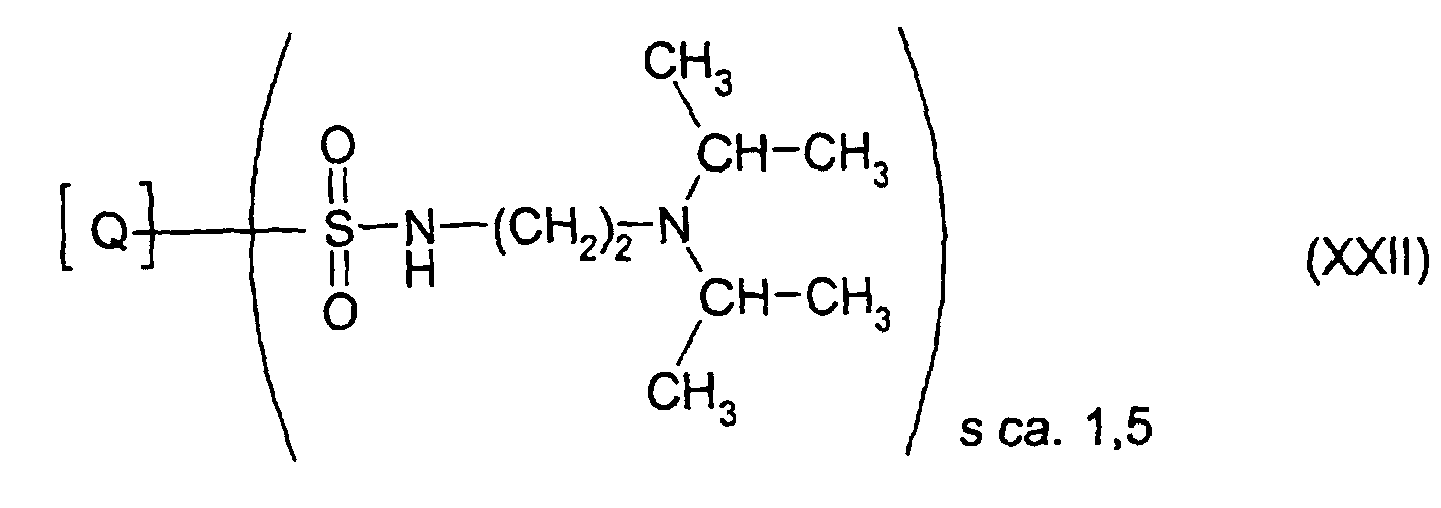
- Man verfährt wie in Beispiel 24a, außer dass als Amin 22,3 Teile 2-(Diisopropylamino)ethylamin eingesetzt werden. Man erhält 40,2 Teile Pigmentdispergator.
Aus den Intensitäten der Signale errechnet sich ein Substitutionsgrad von s ca. 1,5.
1H-NMR (D2SO4): δ 7,8;7,7; 7,6; 5,5; 3,3; 3,0; 0,9 ppm. - 20 Teile eines handelsüblichen Pigments (C.l. Pigment Red 264) werden mit 2 Teilen Pigmentdispergator der Formel XXII, hergestellt gemäß Beipiel 25a mechanisch gemischt.
Man erhält eine Pigmentzubereitung, die im HS-Lack transparente und farbstarke Lackierungen liefert. Die Viskosität beträgt 1,5 s. Die Glanzmessung ergibt den Wert 80. Die Metalliclackierung ist farbstark und brillant. -

- Man verfährt wie in Beispiel 24a, außer dass als Amin 24,5 Teile 2-Amino-5-diethylaminopentan eingesetzt werden. Der Presskuchen wird in 796 Teilen Wasser suspendiert und mit wenig Natronlauge wird pH 8,7 eingestellt. Es wird so lange Wasserdampf durch die Suspension geleitet und kondensiert, bis ca. 870 Teile Destillat angefallen sind. Das Produkt wird filtriert, mit Wasser gewaschen und bei 80°C im Umluftschrank getrocknet. Man erhält 41,6 Teile Pigmentdispergator.
- Aus den Intensitäten der Signale errechnet sich ein Substitutionsgrad von s ca. 1,7.
1H-NMR (D2SO4): δ 7,8; 7,6; 5,4; 3,7; 2,7; 2,6; 1,5; 1,3; 1,0; 0,8 ppm. - 20 Teile eines handelsüblichen Pigments (C.l. Pigment Red 264) werden mit 2 Teilen Pigmentdispergator der Formel XXlll, hergestellt gemäß Beipiel 26a mechanisch gemischt.
Man erhält eine Pigmentzubereitung, die im HS-Lack transparente und farbstarke Lackierungen liefert. Die Viskosität beträgt 1,5 s. Die Glanzmessung ergibt den Wert 78. Die Metalliclackierung ist farbstark und brillant. -

- Man verfährt wie in Beispiel 10a, außer dass anstatt von 19,54 Teilen lediglich 7,16 Teile Diethylaminopropylamin eingesetzt werden.
Man erhält 36,7 g Pigmentdispergator.
1H-NMR (D2SO4):δ 7,8; 7,6; 3,1; 2,7; 1,7; 0,8 ppm.
Aus den Intensitäten der Signale errechnet sich ein Substitutionsgrad von s ca. 0,8; daraus ergibt sich ein Substitutionsgrad von n ca. 0,9. - 40 Teile eines handelsüblichen Pigments (C.I. Pigment Red 264) werden mit 4 Teilen Pigmentdispergator der Formel XXIV, hergestellt gemäß Beipiel 27a mechanisch gemischt. Die Lösemittelechtheit der Pigmentzubereitung ist sehr gut. Man erhält eine Pigmentzubereitung, die im PUR-Lack transparente und farbstarke Lackierungen liefert.
Claims (13)
- Pigmentdispergator der allgemeinen Formel (I)

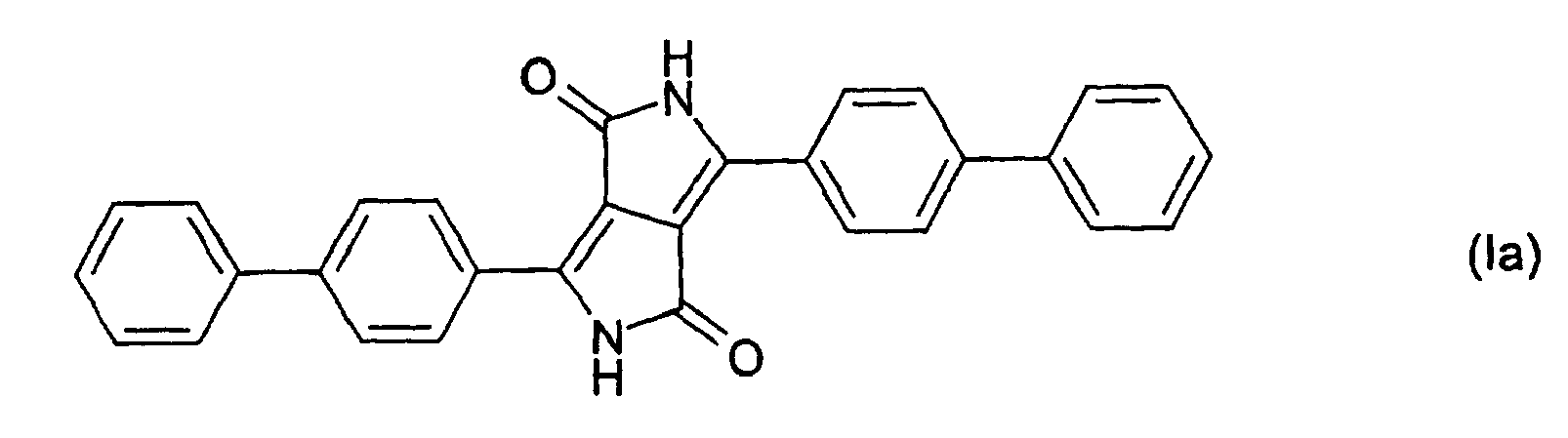 s eine Zahl von 0,1 bis 4,0 darstellt,n eine Zahl von 0 bis 2 darstellt,E+ H+ oder das Äquivalent Mm+/m eines Metallkations Mm+ aus der 1. bis 5.Hauptgruppe oder aus der 1. oder 2. oder der 4. bis 8. Nebengruppe des Periodensystems der chemischen Elemente bezeichnet, wobei m eine der Zahlen 1, 2 oder 3 ist, ein Ammoniumion N+R9R10R11R12, wobei die Substituenten R9, R10, R11 und R12 unabhängig voneinander jeweils ein Wasserstoffatom, C1-C30-Alkyl, C2-C30-Alkenyl, C5-C30-Cycloalkyl, Phenyl, (C1-C8)-Alkyl-phenyl, (C1-C4)-Alkylen-phenyl oder eine (Poly)alkylenoxygruppe der Formel -[CH(R80)-CH(R80)-O]k-H sind, in der k eine Zahl von 1 bis 30 ist und die beiden Reste R80 unabhängig voneinander Wasserstoff, C1-C4-Alkyl oder, sofern k > 1 ist, eine Kombination davon bedeuten; und worin als R9, R10, R11, und/oder R12 ausgewiesenes Alkyl, Alkenyl, Cycloalkyl, Phenyl oder Alkylphenyl durch Amino, Hydroxy, und/oder Carboxy substituiert sein können;
oder wobei die Substituenten R9 und R10 zusammen mit dem quartären N-Atom ein fünf- bis siebengliedriges gesättigtes Ringsystem, das ggf. noch weitere Heteroatome aus der Gruppe O, S und N enthält, bilden können,
oder wobei die Substituenten R9, R10, und R11 zusammen mit dem quartären N-Atom ein fünf- bis siebengliedriges aromatisches Ringsystem, das ggf. noch weitere Heteroatome aus der Gruppe O, S und N enthält und an dem ggf. zusätzliche Ringe ankondensiert sind, bilden können,
oder worin E+ ein Ammoniumion der Formel (Ic) definiert, R15, R16, R17 und R18 unabhängig voneinander Wasserstoff oder eine (Poly)alkylenoxygruppe der Formel -[CH(R80)-CH(R80)O]k-H bedeuten, in der k eine Zahl von 1 bis 30 ist und die beiden Reste R80 unabhängig voneinander für Wasserstoff, C1-C4-Alkyl oder, sofern k > 1 ist, eine Kombination davon bedeuten;q eine Zahl von 1 bis 10;p eine Zahl von 1 bis 5, wobei p ≤q+1 ist;T einen verzweigten oder unverzweigten C2-C6-Alkylenrest bedeutet; oder worin T, wenn q > 1 ist, auch eine Kombination von verzweigten oder unverzweigten C2-C6-Alkylenresten sein kann;und worin die beiden Reste Z gleich oder verschieden sind und Z die Bedeutung Z1 oder Z4 hat, worinZ1 ein Rest der Formel (Ib) ist,
-[X-Y]qR3 (Ib)
worinX einen C2-C6-Alkylenrest, einen C5-C7-Cycloalkylenrest oder eine Kombination dieser Reste ist, wobei diese Reste durch 1 bis 4 C1-C4-Alkylreste, Hydroxyreste, (C1-C4)-Hydroxyalkylreste und/oder durch 1 bis 2 weitere C5- C7-Cycloalkylreste substituiert sein können, oder worin X, wenn q > 1 ist, auch eine Kombination der genannten Bedeutungen sein kann;Y eine -O-,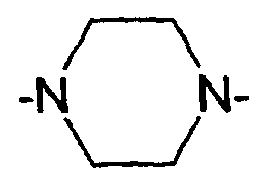
oder worin Y, wenn q > 1 ist, auch eine Kombination der genannten Bedeutungen sein kann;q eine Zahl von 1 bis 10;R2 und R3 unabhängig voneinander ein Wasserstoffatom, eine substituierte oder unsubstituierte, oder teil- oder perfluorierte, verzweigte oder unverzweigte (C1-C20)-Alkylgruppe, eine substituierte oder unsubstituierte C5-C7- Cycloalkylgruppe oder eine substituierte oder unsubstituierte, oder teil-oder perfluorierte (C2-C20)-Alkenylgruppe darstellen, wobei die Substituenten Hydroxy, Phenyl, Cyano, Chlor, Brom, Amino, C2-C4-Acyl oder C1-C4-Alkoxy sein können, oderR2 und R3 zusammen mit dem N-Atom einen gesättigten, ungesättigten oder aromatischen heterocyclischen 5- bis 7-gliedrigen Ring bilden, der gegebenenfalls 1 oder 2 weitere Stickstoff-, Sauerstoff- oder Schwefelatome oder Carbonylgruppen im Ring enthält, gegebenenfalls durch 1, 2 oder 3 der Reste OH, Phenyl, CN, Cl, Br, C1-C4-Alkyl, C1-C4- Alkoxy, C2-C4-Acyl und Carbamoyl substituiert ist, und der gegebenenfalls 1 oder 2 benzoannellierte gesättigte, ungesättigte oder aromatische, carbocyclische oder heterocyclische Ringe trägt;und worin
Z4 Wasserstoff, Hydroxy, Amino, Phenyl, (C1-C4)-Alkylen-phenyl, C5-C7- Cycloalkyl oder C1-C20-Alkyl ist, wobei der Phenylring, die (C1-C4)-Alkylen-phenyl-Gruppe und die Alkylgruppe durch ein oder mehrere Substituenten aus der Gruppe Cl, Br, CN, NH2, OH, C6H5, mit 1, 2 oder 3 C1-C4-Alkoxyresten substituiertes C6H5, Carbamoyl, C2-C4-Acyl und C1-C4-Alkoxy substituiert sein können, der Phenylring und die (C1-C4)-Alkylen-phenyl-Gruppe auch durch NR2R3 substituiert sein können, oder die Alkylgruppe perfluoriert oder teilfluoriert ist. - Pigmentdispergator nach Anspruch 1, dadurch gekennzeichnet, dass s eine Zahl von 0,2 bis 3,0, vorzugsweise von 0,5 bis 2,5; und n eine Zahl von 0 bis 0,5, vorzugsweise von 0 bis 0,2 ist.
- Pigmentdispergator nach Anspruch 1 oder 2, dadurch gekennzeichnet, dassR2 und R3 unabhängig voneinander ein Wasserstoffatom, eine C1-C6-Alkylgruppe oder eine durch 1 bis 2 Substituenten aus der Gruppe Hydroxy, Acetyl, Methoxy, Ethoxy, Chlor und Brom substituierte C1-C6-Alkylgruppe darstellen, oderR2 und R3 zusammen mit dem angrenzenden N-Atom einen Imidazolyl-, Piperidinyl-, Morpholinyl-, Pipecolinyl-, Pyrrolyl-, Pyrrolidinyl-, Pyrazolyl-, Pyrrolidinonyl-, Indolyl- oder Piperazinyl-Ring bilden.
- Pigmentdispergator nach einem oder mehreren der Ansprüche 1 bis 3, dadurch gekennzeichnet, dass Z1 die Bedeutung -[(CH2)3-NH]2-H,
-(CH2-CH2-NH)2H,
-(CH2)3-NH-(CH2)2-NH-(CH2)3-NH2,


- Pigmentdispergator nach einem oder mehreren der Ansprüche 1 bis 4, dadurch gekennzeichnet, dass Z4 die Bedeutung Wasserstoff, Amino, Phenyl, Benzyl, mit NR2R3 substituiertes Phenyl oder Benzyl, C1-C6-Alkyl , oder ein durch 1 bis 2 Substituenten aus der Gruppe Hydroxy, Acetyl, Methoxy und Ethoxy substituiertes C2-C6-Alkyl, Phenyl oder Benzyl hat.
- Pigmentdispergator nach einem oder mehreren der Ansprüche 1 bis 5, dadurch gekennzeichnet, dass X ein C2-C4-Alkylenrest oder Cyclohexylen ist.
- Verfahren zur Herstellung eines Pigmentdispergators nach einem oder mehreren der Ansprüche 1 bis 6, dadurch gekennzeichnet, dass man eine Diketopyrrolopyrrolverbindung der Formel (la)
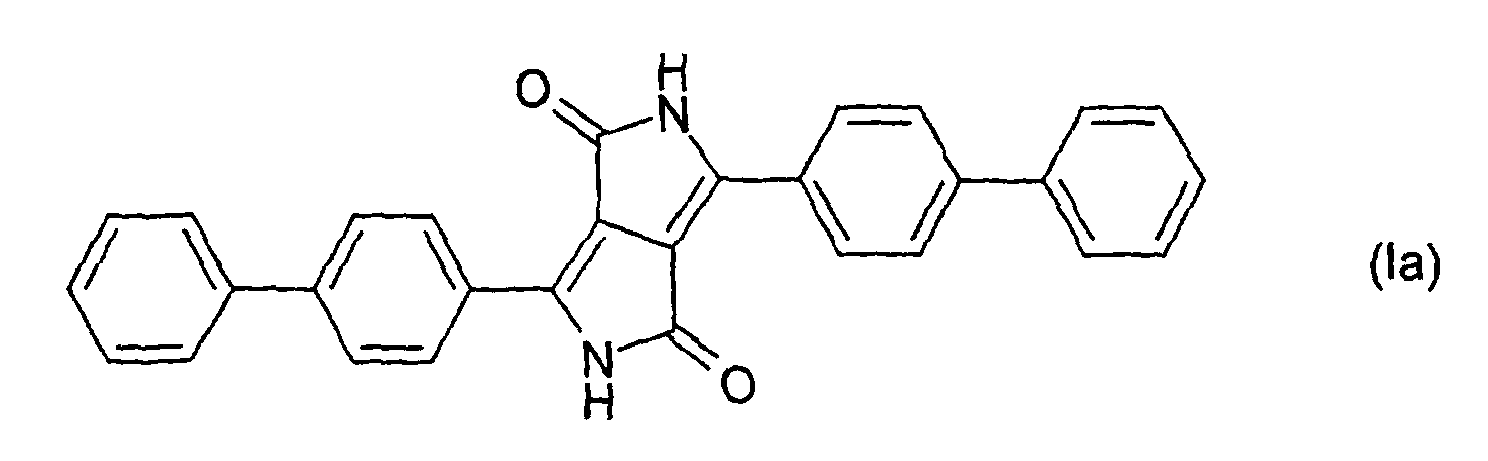

- Pigmentzubereitung, gekennzeichnet durch einen Gehalt ana) mindestens einem organischen Basispigment undb) mindestens einem Pigmentdispergator der Formel (I) gemäß einem oder mehreren der Ansprüche 1 bis 6.
- Pigmentzubereitung nach Anspruch 8, dadurch gekennzeichnet, dass das organische Basispigment a) ein Perylen-, Perinon-, Chinacridon-, Chinacridonchinon-, Anthrachinon-, Anthanthron-, Benzimidazolon-, Disazokondensations-, Azo-, Indanthron-, Phthalocyanin-, Triarylcarbonium-, Dioxazin-, Aminoanthrachinon-, Diketopyrrolopyrrol-, Thioindigo-, Isoindolin-, Isoindolinon-, Pyranthron-, lsoviolanthron-, Carbon Black-Pigment (Ruß) oder eine Mischung davon ist.
- Pigmentzubereitung nach Anspruch 8 oder 9, bestehend im wesentlichen ausa) 50 bis 99,5 Gew.-%, vorzugsweise 60 bis 98,8 Gew.-%, mindestens eines Basispigments a),b) 0,5 bis 20 Gew.-%, vorzugsweise 1 bis 15 Gew.-%, mindestens eines, vorzugsweise 1 oder 2, Pigmentdispergators b) der Formel (1),c) 0 bis 20 Gew.-%, vorzugsweise 0,1 bis 15 Gew.-% an oberflächenaktiven Mitteln undd) 0 bis 20 Gew.-%, vorzugsweise 0,1 bis 10 Gew.-% an weiteren üblichen Zusatzstoffen,wobei die Anteile der jeweiligen Komponenten auf das Gesamtgewicht der Zubereitung (100 Gew.-%) bezogen sind.
- Verfahren zur Herstellung einer Pigmentzubereitung nach einem oder mehreren der Ansprüche 8 bis 10, dadurch gekennzeichnet, dass man den oder die Pigmentdispergator(en) gemäß b) und das oder die Basispigment(e) miteinander mischt oder an einem beliebigen Zeitpunkt ihres Herstellungsprozesses aufeinander einwirken läßt.
- Verwendung einer Pigmentzubereitung nach einem oder mehreren der Ansprüche 8 bis 10 zum Pigmentieren von hochmolekularen organischen Materialien, vorzugsweise von Kunststoffen, Harzen, Lacken, Anstrichfarben oder elektrophotographischen Tonern und Entwicklern, sowie von Tinten und Druckfarben.
- Pigmentpräparation, bestehend im wesentlichen ausa) einem oder mehreren organischen Basispigmenten;b) einem oder mehreren Pigmentdispergatoren der Formel (I) gemäß einem oder mehreren der Ansprüche 1 bis 6; undc) einem hochmolekularen organischen Material.
Applications Claiming Priority (2)
| Application Number | Priority Date | Filing Date | Title |
|---|---|---|---|
| DE19958181A DE19958181A1 (de) | 1999-12-02 | 1999-12-02 | Pigmentdispergatoren auf Basis von Diketopyrrolopyrrolverbindungen und Pigmentzubereitungen |
| DE19958181 | 1999-12-02 |
Publications (3)
| Publication Number | Publication Date |
|---|---|
| EP1104789A2 EP1104789A2 (de) | 2001-06-06 |
| EP1104789A3 EP1104789A3 (de) | 2003-10-29 |
| EP1104789B1 true EP1104789B1 (de) | 2006-03-29 |
Family
ID=7931228
Family Applications (1)
| Application Number | Title | Priority Date | Filing Date |
|---|---|---|---|
| EP00124596A Expired - Lifetime EP1104789B1 (de) | 1999-12-02 | 2000-11-10 | Pigmentdispergatoren auf Basis von Diketopyrrolopyrrolverbindungen und Pigmentzubereitungen |
Country Status (7)
| Country | Link |
|---|---|
| US (4) | US20010008912A1 (de) |
| EP (1) | EP1104789B1 (de) |
| JP (1) | JP2001214085A (de) |
| KR (1) | KR100722061B1 (de) |
| CZ (1) | CZ298015B6 (de) |
| DE (2) | DE19958181A1 (de) |
| ES (1) | ES2259968T3 (de) |
Families Citing this family (31)
| Publication number | Priority date | Publication date | Assignee | Title |
|---|---|---|---|---|
| CN1481424B (zh) * | 2000-12-13 | 2010-04-28 | 西巴特殊化学品控股有限公司 | 流变性能改进剂和具有改进的流变性能的颜料组合物 |
| DE60125821T2 (de) | 2000-12-13 | 2007-10-11 | Ciba Speciality Chemicals Holding Inc. | Rheologieverbesserer und pigmentzusammensetzungen mit einer verbesserten rheologie |
| WO2003066938A2 (en) * | 2002-02-06 | 2003-08-14 | Ciba Specialty Chemicals Holding Inc. | Process for the coloration of aluminium |
| DE10235573A1 (de) * | 2002-08-03 | 2004-02-12 | Clariant Gmbh | Pigmentzubereitungen auf Basis von Diketopyrrolopyrrolpigmenten zum verzugsfreien Pigmentieren von teilkristallinen Kunststoffen |
| ES2279972T3 (es) * | 2002-10-07 | 2007-09-01 | Ciba Specialty Chemicals Holding Inc. | Revestimiento pigmentado en color, opaco. |
| US7135062B2 (en) * | 2003-06-12 | 2006-11-14 | Dainichiseika Color & Chemicals Mfg. Co., Ltd. | Hydrophilic coloring matter for recording image, aqueous coloring agent for recording image, method and device for recording image |
| EP1731576B1 (de) * | 2005-02-22 | 2010-05-12 | Dainichiseika Color & Chemicals Mfg. Co., Ltd. | Diketopyrrolopyrrole-Pigmentdispergatoren und ihre Verwendung |
| KR100694106B1 (ko) * | 2005-04-27 | 2007-03-12 | 삼성전자주식회사 | 착색제 유사 첨가제를 함유한 잉크 조성물, 이를 포함한잉크젯 프린터 카트리지 및 잉크 젯트 기록 장치 |
| DE102005050512A1 (de) * | 2005-10-21 | 2007-04-26 | Clariant Produkte (Deutschland) Gmbh | Pigmentzubereitungen auf Basis von Diketopyrrolopyrrolen |
| ATE464356T1 (de) * | 2005-11-28 | 2010-04-15 | Agfa Graphics Nv | Nichtwässrige diketopyrrolo-pyrrol pigmentdispersionen unter verwendung von dispersionssynergisten |
| DE102006007621A1 (de) * | 2006-02-18 | 2007-08-23 | Clariant International Limited | Diketopyrrolopyrrol-Pigmente mit erhöhten Echtheiten und Verfahren zu deren Herstellung |
| KR101396904B1 (ko) * | 2006-05-26 | 2014-05-19 | 토요잉크Sc홀딩스주식회사 | 안료 조성물의 제조 방법 |
| DE102007011066A1 (de) * | 2007-03-07 | 2008-09-11 | Clariant International Limited | Pigmentzubereitungen auf Basis von Diketopyrrolopyrrolen |
| DE102007011068A1 (de) | 2007-03-07 | 2008-09-11 | Clariant International Ltd. | Verfahren zur direkten Herstellung feinteiliger Diketopyrrolopyrrolpigmente |
| DE102007011067A1 (de) * | 2007-03-07 | 2008-09-11 | Clariant International Limited | Pigmentzubereitungen auf Basis von Diketopyrrolopyrrolen |
| US7901503B2 (en) * | 2007-04-24 | 2011-03-08 | Sun Chemical Corporation | Pigments for non-aqueous inks and coatings |
| AU2008288785B2 (en) * | 2007-08-23 | 2014-08-21 | Sensient Colors Inc. | Self-dispersed pigments and methods for making and using the same |
| DE102007049682A1 (de) | 2007-10-17 | 2009-04-23 | Clariant International Ltd. | Diketopyrrolopyrrol-Pigmentzusammensetzung zur Verwendung in Colorfiltern |
| TWI431071B (zh) * | 2007-10-17 | 2014-03-21 | Clariant Finance Bvi Ltd | 用於彩色濾光片中的二酮基吡咯并吡咯顏料組成物 |
| DE102008032091A1 (de) | 2008-07-08 | 2010-01-14 | Clariant International Ltd. | Diketopyrrolopyrrol-Mischpigmentzubereitung zur Verwendung in Colorfiltern |
| DE102008032090A1 (de) | 2008-07-08 | 2010-01-14 | Clariant International Ltd. | PR 254-Pigmentzubereitung zur Verwendung in Colorfiltern |
| DE102008032092A1 (de) | 2008-07-08 | 2010-01-14 | Clariant International Ltd. | Binäre Diketopyrrolopyrrol-Pigmentzusammensetzung zur Verwendung in Colorfiltern |
| KR20110135989A (ko) | 2009-04-07 | 2011-12-20 | 센션트 컬러스 엘엘씨 | 자가-분산 입자 및 그의 제조 및 사용 방법 |
| JP6543444B2 (ja) * | 2014-08-07 | 2019-07-10 | サカタインクス株式会社 | カラーフィルター用赤色着色剤組成物 |
| JP6570461B2 (ja) * | 2016-03-03 | 2019-09-04 | 大日精化工業株式会社 | 顔料分散剤、顔料組成物、及び顔料着色剤 |
| US11641439B2 (en) | 2018-10-29 | 2023-05-02 | Henry M. Pena | Real time video special effects system and method |
| US12452383B2 (en) | 2018-10-29 | 2025-10-21 | Henry M. Pena | Fast and/or slow motion compensating timer display |
| US10404923B1 (en) | 2018-10-29 | 2019-09-03 | Henry M. Pena | Real time video special effects system and method |
| US10388322B1 (en) | 2018-10-29 | 2019-08-20 | Henry M. Pena | Real time video special effects system and method |
| US11218646B2 (en) | 2018-10-29 | 2022-01-04 | Henry M. Pena | Real time video special effects system and method |
| JP6928755B1 (ja) * | 2020-03-13 | 2021-09-01 | 東洋インキScホールディングス株式会社 | 顔料分散剤、カラーフィルタ用顔料組成物、着色組成物、およびカラーフィルタ |
Family Cites Families (19)
| Publication number | Priority date | Publication date | Assignee | Title |
|---|---|---|---|---|
| US71483A (en) * | 1867-11-26 | Petek hend ricks | ||
| JPS56118462A (en) | 1980-02-25 | 1981-09-17 | Toyo Ink Mfg Co Ltd | Pigment composition |
| US4791204A (en) | 1985-11-26 | 1988-12-13 | Ciba-Geigy Corporation | 1,4-diketopyrrolo[3,4-c]pyrrole pigments |
| US4931566A (en) * | 1987-07-31 | 1990-06-05 | Ciba-Geigy Corporation | Process for the preparation of pyrrolo[3,4-c]pyrroles |
| DE3838814A1 (de) * | 1987-12-22 | 1989-07-06 | Hoechst Ag | Neue pigmente und ihre verwendung |
| DE3832064A1 (de) * | 1988-09-21 | 1990-03-29 | Hoechst Ag | Verfahren zur herstellung von pigmentzubereitungen der anthanthronreihe |
| US5261032A (en) | 1988-10-03 | 1993-11-09 | Robert Rocchetti | Method for manipulation rectilinearly defined segmnts to form image shapes |
| DE4011927A1 (de) | 1989-04-17 | 1990-10-18 | Ciba Geigy Ag | Verwendung von pyrrolo-pyrrol-verbindungen zum faerben und bedrucken von fasermaterialien |
| JP2584515B2 (ja) * | 1989-06-23 | 1997-02-26 | 東洋インキ製造株式会社 | 顔料分散剤および顔料組成物 |
| DE59206108D1 (de) * | 1991-10-23 | 1996-05-30 | Hoechst Ag | Pigmentzubereitungen |
| TW247315B (de) * | 1992-12-18 | 1995-05-11 | Ciba Geigy | |
| DE4325247A1 (de) * | 1993-07-28 | 1995-02-02 | Basf Ag | Pigmentzubereitungen mit Perylenderivaten als Dispergiermitteln |
| SE501793C2 (sv) | 1993-10-08 | 1995-05-15 | Perstorp Ab | Användning av inositoltrisfosfat för beredning av läkemedel |
| TW370546B (en) * | 1995-09-18 | 1999-09-21 | Ciba Sc Holding Ag | Solid solutions of 1,4-diketopyrrolopyrroles |
| DE19620746A1 (de) | 1996-05-23 | 1997-11-27 | Hoechst Ag | Farbige Monomere enthaltende chirale cLCPs |
| ES2178136T3 (es) | 1997-05-06 | 2002-12-16 | Ciba Sc Holding Ag | Composiciones de dicetopirrolopirroles. |
| US6057449A (en) * | 1998-06-02 | 2000-05-02 | Ciba Specialty Chemicals Corporation | Direct preparation of pyrrolo[3,4-c]pyrroles |
| DE19906494A1 (de) | 1999-02-17 | 2000-08-24 | Clariant Gmbh | Pigmentzubereitungen auf Basis von Diketopyrrolopyrrolpigmenten mit basischen Perylendispergatoren |
| DE10028104A1 (de) * | 2000-06-07 | 2001-12-13 | Clariant Gmbh | Verfahren zur Herstellung von Diketopyrrologyrrol-Pigmenten |
-
1999
- 1999-12-02 DE DE19958181A patent/DE19958181A1/de not_active Withdrawn
-
2000
- 2000-11-10 DE DE50012474T patent/DE50012474D1/de not_active Expired - Lifetime
- 2000-11-10 ES ES00124596T patent/ES2259968T3/es not_active Expired - Lifetime
- 2000-11-10 EP EP00124596A patent/EP1104789B1/de not_active Expired - Lifetime
- 2000-11-29 JP JP2000362974A patent/JP2001214085A/ja not_active Withdrawn
- 2000-11-30 CZ CZ20004460A patent/CZ298015B6/cs not_active IP Right Cessation
- 2000-12-01 US US09/727,960 patent/US20010008912A1/en not_active Abandoned
- 2000-12-01 KR KR1020000072540A patent/KR100722061B1/ko not_active Expired - Fee Related
-
2003
- 2003-02-27 US US10/375,573 patent/US7045637B2/en not_active Expired - Lifetime
- 2003-02-27 US US10/375,668 patent/US7045638B2/en not_active Expired - Lifetime
-
2004
- 2004-03-24 US US10/807,634 patent/US7102014B2/en not_active Expired - Lifetime
Also Published As
| Publication number | Publication date |
|---|---|
| DE19958181A1 (de) | 2001-06-07 |
| US7045638B2 (en) | 2006-05-16 |
| EP1104789A3 (de) | 2003-10-29 |
| DE50012474D1 (de) | 2006-05-18 |
| US20010008912A1 (en) | 2001-07-19 |
| KR100722061B1 (ko) | 2007-05-25 |
| US7045637B2 (en) | 2006-05-16 |
| EP1104789A2 (de) | 2001-06-06 |
| US20030162976A1 (en) | 2003-08-28 |
| JP2001214085A (ja) | 2001-08-07 |
| KR20010062074A (ko) | 2001-07-07 |
| CZ20004460A3 (cs) | 2001-09-12 |
| US20030162977A1 (en) | 2003-08-28 |
| US7102014B2 (en) | 2006-09-05 |
| US20040177790A1 (en) | 2004-09-16 |
| ES2259968T3 (es) | 2006-11-01 |
| CZ298015B6 (cs) | 2007-05-23 |
Similar Documents
| Publication | Publication Date | Title |
|---|---|---|
| EP1104789A2 (de) | Pigmentdispergatoren auf Basis von Diketopyrrolopyrrolverbindungen und Pigmentzubereitungen | |
| EP1362081B1 (de) | Saure pigmentdispergatoren und pigmentzubereitungen | |
| EP0937724B1 (de) | Perylenverbindungen und ihre Verwendung als Pigmentdispergatoren | |
| EP0864613B1 (de) | Pigmentzubereitungen und Verfahren zu ihrer Herstellung | |
| EP0485441B1 (de) | Neue pigmentzubereitungen auf basis von perylenverbindungen | |
| EP1572809B1 (de) | Verfahren zur herstellung von phthalocyaninpigmentzubereitungen | |
| EP0504872B1 (de) | Innere Salze von Perylenverbindungen, Verfahren zu deren Herstellung und ihre Verwendung | |
| EP1694777B1 (de) | Verwendung einer pigmentzubereitung auf basis von c.i. pigment yellow 74 | |
| EP1029899B1 (de) | Pigmentzubereitungen auf Basis von Diketopyrrolopyrrolpigmenten mit basischen Perylendispergatoren | |
| EP1024177B1 (de) | Pigmentzubereitungen mit mehreren Perylenverbindungen | |
| EP0979846B1 (de) | Verfahren zur Herstellung von N,N'-Dimethylperylen-3,4,9,10-tetracarbonsäurediimid in transparenter Pigmentform | |
| EP1130062B1 (de) | Verfahren zur Herstellung von Perylen-3,4,9,10-tetracarbonsäurediimid in transparenter Pigmentform | |
| EP1597323B1 (de) | Verfahren zur herstellung von transparenten pigmentzubereitungen auf basis von perylen-3,4,9,10-tetracarbons urediimid | |
| EP1521755B1 (de) | Neue diketopyrrolopyrrolpigmente | |
| DE19835757A1 (de) | Perylenverbindungen und Pigmentzubereitungen |
Legal Events
| Date | Code | Title | Description |
|---|---|---|---|
| PUAI | Public reference made under article 153(3) epc to a published international application that has entered the european phase |
Free format text: ORIGINAL CODE: 0009012 |
|
| AK | Designated contracting states |
Kind code of ref document: A2 Designated state(s): AT BE CH CY DE DK ES FI FR GB GR IE IT LI LU MC NL PT SE TR |
|
| AX | Request for extension of the european patent |
Free format text: AL;LT;LV;MK;RO;SI |
|
| PUAL | Search report despatched |
Free format text: ORIGINAL CODE: 0009013 |
|
| AK | Designated contracting states |
Kind code of ref document: A3 Designated state(s): AT BE CH CY DE DK ES FI FR GB GR IE IT LI LU MC NL PT SE TR |
|
| AX | Request for extension of the european patent |
Extension state: AL LT LV MK RO SI |
|
| 17P | Request for examination filed |
Effective date: 20040429 |
|
| AKX | Designation fees paid |
Designated state(s): AT BE CH CY DE DK ES FI FR GB GR IE IT LI LU MC NL PT SE TR |
|
| GRAP | Despatch of communication of intention to grant a patent |
Free format text: ORIGINAL CODE: EPIDOSNIGR1 |
|
| GRAS | Grant fee paid |
Free format text: ORIGINAL CODE: EPIDOSNIGR3 |
|
| GRAA | (expected) grant |
Free format text: ORIGINAL CODE: 0009210 |
|
| RAP1 | Party data changed (applicant data changed or rights of an application transferred) |
Owner name: CLARIANT PRODUKTE (DEUTSCHLAND) GMBH |
|
| AK | Designated contracting states |
Kind code of ref document: B1 Designated state(s): CH DE ES FR GB IT LI |
|
| PG25 | Lapsed in a contracting state [announced via postgrant information from national office to epo] |
Ref country code: IT Free format text: LAPSE BECAUSE OF FAILURE TO SUBMIT A TRANSLATION OF THE DESCRIPTION OR TO PAY THE FEE WITHIN THE PRESCRIBED TIME-LIMIT;WARNING: LAPSES OF ITALIAN PATENTS WITH EFFECTIVE DATE BEFORE 2007 MAY HAVE OCCURRED AT ANY TIME BEFORE 2007. THE CORRECT EFFECTIVE DATE MAY BE DIFFERENT FROM THE ONE RECORDED. Effective date: 20060329 |
|
| REG | Reference to a national code |
Ref country code: GB Ref legal event code: FG4D Free format text: NOT ENGLISH |
|
| REG | Reference to a national code |
Ref country code: CH Ref legal event code: EP |
|
| REF | Corresponds to: |
Ref document number: 50012474 Country of ref document: DE Date of ref document: 20060518 Kind code of ref document: P |
|
| GBT | Gb: translation of ep patent filed (gb section 77(6)(a)/1977) |
Effective date: 20060705 |
|
| REG | Reference to a national code |
Ref country code: ES Ref legal event code: FG2A Ref document number: 2259968 Country of ref document: ES Kind code of ref document: T3 |
|
| ET | Fr: translation filed | ||
| PLBE | No opposition filed within time limit |
Free format text: ORIGINAL CODE: 0009261 |
|
| STAA | Information on the status of an ep patent application or granted ep patent |
Free format text: STATUS: NO OPPOSITION FILED WITHIN TIME LIMIT |
|
| 26N | No opposition filed |
Effective date: 20070102 |
|
| PGFP | Annual fee paid to national office [announced via postgrant information from national office to epo] |
Ref country code: ES Payment date: 20081021 Year of fee payment: 9 |
|
| PGFP | Annual fee paid to national office [announced via postgrant information from national office to epo] |
Ref country code: IT Payment date: 20081027 Year of fee payment: 9 |
|
| PGFP | Annual fee paid to national office [announced via postgrant information from national office to epo] |
Ref country code: GB Payment date: 20081021 Year of fee payment: 9 |
|
| GBPC | Gb: european patent ceased through non-payment of renewal fee |
Effective date: 20091110 |
|
| PG25 | Lapsed in a contracting state [announced via postgrant information from national office to epo] |
Ref country code: GB Free format text: LAPSE BECAUSE OF NON-PAYMENT OF DUE FEES Effective date: 20091110 |
|
| PG25 | Lapsed in a contracting state [announced via postgrant information from national office to epo] |
Ref country code: IT Free format text: LAPSE BECAUSE OF NON-PAYMENT OF DUE FEES Effective date: 20091110 |
|
| REG | Reference to a national code |
Ref country code: ES Ref legal event code: FD2A Effective date: 20110404 |
|
| PG25 | Lapsed in a contracting state [announced via postgrant information from national office to epo] |
Ref country code: ES Free format text: LAPSE BECAUSE OF NON-PAYMENT OF DUE FEES Effective date: 20110322 |
|
| PG25 | Lapsed in a contracting state [announced via postgrant information from national office to epo] |
Ref country code: ES Free format text: LAPSE BECAUSE OF NON-PAYMENT OF DUE FEES Effective date: 20091111 |
|
| REG | Reference to a national code |
Ref country code: CH Ref legal event code: PCOW Free format text: NEW ADDRESS: PATENT MANAGEMENT INDUSTRIEPARK HOECHST / G 860, 65926 FRANKFURT AM MAIN (DE) |
|
| REG | Reference to a national code |
Ref country code: FR Ref legal event code: PLFP Year of fee payment: 16 |
|
| REG | Reference to a national code |
Ref country code: FR Ref legal event code: PLFP Year of fee payment: 17 |
|
| REG | Reference to a national code |
Ref country code: FR Ref legal event code: PLFP Year of fee payment: 18 |
|
| PGFP | Annual fee paid to national office [announced via postgrant information from national office to epo] |
Ref country code: FR Payment date: 20191127 Year of fee payment: 20 |
|
| PGFP | Annual fee paid to national office [announced via postgrant information from national office to epo] |
Ref country code: CH Payment date: 20191125 Year of fee payment: 20 |
|
| PGFP | Annual fee paid to national office [announced via postgrant information from national office to epo] |
Ref country code: DE Payment date: 20200130 Year of fee payment: 20 |
|
| REG | Reference to a national code |
Ref country code: DE Ref legal event code: R071 Ref document number: 50012474 Country of ref document: DE |
|
| REG | Reference to a national code |
Ref country code: CH Ref legal event code: PL |