EP1100862B1 - Zusammensetzung zur verwendung in einer geschirrspülmaschine - Google Patents
Zusammensetzung zur verwendung in einer geschirrspülmaschine Download PDFInfo
- Publication number
- EP1100862B1 EP1100862B1 EP99936595A EP99936595A EP1100862B1 EP 1100862 B1 EP1100862 B1 EP 1100862B1 EP 99936595 A EP99936595 A EP 99936595A EP 99936595 A EP99936595 A EP 99936595A EP 1100862 B1 EP1100862 B1 EP 1100862B1
- Authority
- EP
- European Patent Office
- Prior art keywords
- composition according
- particle
- composition
- tablet
- cavity
- Prior art date
- Legal status (The legal status is an assumption and is not a legal conclusion. Google has not performed a legal analysis and makes no representation as to the accuracy of the status listed.)
- Expired - Lifetime
Links
- 239000000203 mixture Substances 0.000 title claims abstract description 132
- 239000002245 particle Substances 0.000 claims abstract description 120
- 238000004140 cleaning Methods 0.000 claims abstract description 35
- 238000000034 method Methods 0.000 claims abstract description 33
- 239000000126 substance Substances 0.000 claims abstract description 30
- 150000001875 compounds Chemical class 0.000 claims abstract description 27
- 239000011248 coating agent Substances 0.000 claims abstract description 24
- 238000004851 dishwashing Methods 0.000 claims abstract description 17
- 239000011162 core material Substances 0.000 claims description 77
- 229920000642 polymer Polymers 0.000 claims description 53
- 239000003599 detergent Substances 0.000 claims description 47
- 150000002500 ions Chemical class 0.000 claims description 40
- 239000000463 material Substances 0.000 claims description 31
- XLYOFNOQVPJJNP-UHFFFAOYSA-N water Substances O XLYOFNOQVPJJNP-UHFFFAOYSA-N 0.000 claims description 28
- 239000004094 surface-active agent Substances 0.000 claims description 16
- 125000000217 alkyl group Chemical group 0.000 claims description 13
- 125000004432 carbon atom Chemical group C* 0.000 claims description 12
- 239000003205 fragrance Substances 0.000 claims description 12
- 229910052739 hydrogen Inorganic materials 0.000 claims description 12
- 239000001257 hydrogen Substances 0.000 claims description 12
- UFHFLCQGNIYNRP-UHFFFAOYSA-N Hydrogen Chemical compound [H][H] UFHFLCQGNIYNRP-UHFFFAOYSA-N 0.000 claims description 11
- 230000000694 effects Effects 0.000 claims description 11
- 239000007788 liquid Substances 0.000 claims description 10
- 238000004090 dissolution Methods 0.000 claims description 9
- 102000004190 Enzymes Human genes 0.000 claims description 8
- 108090000790 Enzymes Proteins 0.000 claims description 8
- 239000000853 adhesive Substances 0.000 claims description 7
- 230000001070 adhesive effect Effects 0.000 claims description 7
- 239000003795 chemical substances by application Substances 0.000 claims description 7
- 238000002844 melting Methods 0.000 claims description 7
- 230000008018 melting Effects 0.000 claims description 7
- 239000007787 solid Substances 0.000 claims description 7
- 230000000844 anti-bacterial effect Effects 0.000 claims description 6
- 230000003247 decreasing effect Effects 0.000 claims description 6
- 230000036961 partial effect Effects 0.000 claims description 5
- 239000007903 gelatin capsule Substances 0.000 claims description 4
- 239000012798 spherical particle Substances 0.000 claims description 4
- 229920001661 Chitosan Polymers 0.000 claims description 3
- JUJWROOIHBZHMG-UHFFFAOYSA-N Pyridine Chemical group C1=CC=NC=C1 JUJWROOIHBZHMG-UHFFFAOYSA-N 0.000 claims description 3
- BQCADISMDOOEFD-UHFFFAOYSA-N Silver Chemical compound [Ag] BQCADISMDOOEFD-UHFFFAOYSA-N 0.000 claims description 3
- 125000005647 linker group Chemical group 0.000 claims description 3
- 230000000873 masking effect Effects 0.000 claims description 3
- 239000004332 silver Substances 0.000 claims description 3
- 229910052709 silver Inorganic materials 0.000 claims description 3
- IMROMDMJAWUWLK-UHFFFAOYSA-N Ethenol Chemical class OC=C IMROMDMJAWUWLK-UHFFFAOYSA-N 0.000 claims description 2
- 150000001252 acrylic acid derivatives Chemical class 0.000 claims description 2
- 125000005250 alkyl acrylate group Chemical group 0.000 claims description 2
- 150000001412 amines Chemical class 0.000 claims description 2
- 125000003118 aryl group Chemical group 0.000 claims description 2
- -1 bleaches Substances 0.000 claims description 2
- 239000000645 desinfectant Substances 0.000 claims description 2
- 125000004435 hydrogen atom Chemical group [H]* 0.000 claims description 2
- 125000002883 imidazolyl group Chemical group 0.000 claims description 2
- 150000002466 imines Chemical class 0.000 claims description 2
- 239000011814 protection agent Substances 0.000 claims description 2
- 150000003512 tertiary amines Chemical class 0.000 claims description 2
- 125000000837 carbohydrate group Chemical group 0.000 claims 1
- 229920001525 carrageenan Polymers 0.000 claims 1
- 229940113118 carrageenan Drugs 0.000 claims 1
- 239000000679 carrageenan Substances 0.000 claims 1
- 125000000467 secondary amino group Chemical class [H]N([*:1])[*:2] 0.000 claims 1
- 238000000576 coating method Methods 0.000 abstract description 27
- 238000012216 screening Methods 0.000 description 26
- 239000010410 layer Substances 0.000 description 21
- 239000000243 solution Substances 0.000 description 13
- 229920001223 polyethylene glycol Polymers 0.000 description 11
- 238000012360 testing method Methods 0.000 description 11
- 230000004580 weight loss Effects 0.000 description 11
- 229920002451 polyvinyl alcohol Polymers 0.000 description 9
- 238000005406 washing Methods 0.000 description 9
- 239000004615 ingredient Substances 0.000 description 8
- 238000004519 manufacturing process Methods 0.000 description 8
- 239000000178 monomer Substances 0.000 description 8
- 239000011521 glass Substances 0.000 description 7
- 239000002202 Polyethylene glycol Substances 0.000 description 6
- HEMHJVSKTPXQMS-UHFFFAOYSA-M Sodium hydroxide Chemical compound [OH-].[Na+] HEMHJVSKTPXQMS-UHFFFAOYSA-M 0.000 description 6
- 238000013270 controlled release Methods 0.000 description 6
- 0 CCCC(C)(C(C)(*N*)C(CC)CC(CC)(CCC)C(CCC)(CCC)C(C)(CC(CCC)(CCC)C(C)(C)C(C)[C@]1[C@@](C)C1)*O*)C=C Chemical compound CCCC(C)(C(C)(*N*)C(CC)CC(CC)(CCC)C(CCC)(CCC)C(C)(CC(CCC)(CCC)C(C)(C)C(C)[C@]1[C@@](C)C1)*O*)C=C 0.000 description 5
- 239000004372 Polyvinyl alcohol Substances 0.000 description 5
- 239000007853 buffer solution Substances 0.000 description 5
- 230000001419 dependent effect Effects 0.000 description 5
- 238000009472 formulation Methods 0.000 description 5
- 239000002736 nonionic surfactant Substances 0.000 description 5
- 239000011253 protective coating Substances 0.000 description 5
- 230000001681 protective effect Effects 0.000 description 5
- 239000004367 Lipase Substances 0.000 description 4
- 102000004882 Lipase Human genes 0.000 description 4
- 108090001060 Lipase Proteins 0.000 description 4
- ZNOZWUKQPJXOIG-XSBHQQIPSA-L [(2r,3s,4r,5r,6s)-6-[[(1r,3s,4r,5r,8s)-3,4-dihydroxy-2,6-dioxabicyclo[3.2.1]octan-8-yl]oxy]-4-[[(1r,3r,4r,5r,8s)-8-[(2s,3r,4r,5r,6r)-3,4-dihydroxy-6-(hydroxymethyl)-5-sulfonatooxyoxan-2-yl]oxy-4-hydroxy-2,6-dioxabicyclo[3.2.1]octan-3-yl]oxy]-5-hydroxy-2-( Chemical compound O[C@@H]1[C@@H](O)[C@@H](OS([O-])(=O)=O)[C@@H](CO)O[C@H]1O[C@@H]1[C@@H]2OC[C@H]1O[C@H](O[C@H]1[C@H]([C@@H](CO)O[C@@H](O[C@@H]3[C@@H]4OC[C@H]3O[C@H](O)[C@@H]4O)[C@@H]1O)OS([O-])(=O)=O)[C@@H]2O ZNOZWUKQPJXOIG-XSBHQQIPSA-L 0.000 description 4
- 239000000654 additive Substances 0.000 description 4
- 230000007423 decrease Effects 0.000 description 4
- 238000010790 dilution Methods 0.000 description 4
- 239000012895 dilution Substances 0.000 description 4
- 235000019421 lipase Nutrition 0.000 description 4
- XSVSPKKXQGNHMD-UHFFFAOYSA-N 5-bromo-3-methyl-1,2-thiazole Chemical compound CC=1C=C(Br)SN=1 XSVSPKKXQGNHMD-UHFFFAOYSA-N 0.000 description 3
- LFQSCWFLJHTTHZ-UHFFFAOYSA-N Ethanol Chemical compound CCO LFQSCWFLJHTTHZ-UHFFFAOYSA-N 0.000 description 3
- BGRWYDHXPHLNKA-UHFFFAOYSA-N Tetraacetylethylenediamine Chemical compound CC(=O)N(C(C)=O)CCN(C(C)=O)C(C)=O BGRWYDHXPHLNKA-UHFFFAOYSA-N 0.000 description 3
- 239000002775 capsule Substances 0.000 description 3
- 230000008859 change Effects 0.000 description 3
- 238000006243 chemical reaction Methods 0.000 description 3
- 229920001577 copolymer Polymers 0.000 description 3
- 229920001983 poloxamer Polymers 0.000 description 3
- 229910052573 porcelain Inorganic materials 0.000 description 3
- 229910001414 potassium ion Inorganic materials 0.000 description 3
- 238000003825 pressing Methods 0.000 description 3
- 238000005086 pumping Methods 0.000 description 3
- 230000002829 reductive effect Effects 0.000 description 3
- 150000003839 salts Chemical class 0.000 description 3
- 235000015067 sauces Nutrition 0.000 description 3
- 239000011550 stock solution Substances 0.000 description 3
- 239000012085 test solution Substances 0.000 description 3
- DHMQDGOQFOQNFH-UHFFFAOYSA-N Glycine Chemical compound NCC(O)=O DHMQDGOQFOQNFH-UHFFFAOYSA-N 0.000 description 2
- DGAQECJNVWCQMB-PUAWFVPOSA-M Ilexoside XXIX Chemical compound C[C@@H]1CC[C@@]2(CC[C@@]3(C(=CC[C@H]4[C@]3(CC[C@@H]5[C@@]4(CC[C@@H](C5(C)C)OS(=O)(=O)[O-])C)C)[C@@H]2[C@]1(C)O)C)C(=O)O[C@H]6[C@@H]([C@H]([C@@H]([C@H](O6)CO)O)O)O.[Na+] DGAQECJNVWCQMB-PUAWFVPOSA-M 0.000 description 2
- KFZMGEQAYNKOFK-UHFFFAOYSA-N Isopropanol Chemical compound CC(C)O KFZMGEQAYNKOFK-UHFFFAOYSA-N 0.000 description 2
- 108091005804 Peptidases Proteins 0.000 description 2
- 229920002594 Polyethylene Glycol 8000 Polymers 0.000 description 2
- WCUXLLCKKVVCTQ-UHFFFAOYSA-M Potassium chloride Chemical compound [Cl-].[K+] WCUXLLCKKVVCTQ-UHFFFAOYSA-M 0.000 description 2
- 239000004365 Protease Substances 0.000 description 2
- FAPWRFPIFSIZLT-UHFFFAOYSA-M Sodium chloride Chemical compound [Na+].[Cl-] FAPWRFPIFSIZLT-UHFFFAOYSA-M 0.000 description 2
- PPBRXRYQALVLMV-UHFFFAOYSA-N Styrene Chemical compound C=CC1=CC=CC=C1 PPBRXRYQALVLMV-UHFFFAOYSA-N 0.000 description 2
- 230000008901 benefit Effects 0.000 description 2
- 239000007844 bleaching agent Substances 0.000 description 2
- 150000001642 boronic acid derivatives Chemical class 0.000 description 2
- 239000001913 cellulose Substances 0.000 description 2
- 229920002678 cellulose Polymers 0.000 description 2
- 239000012459 cleaning agent Substances 0.000 description 2
- 230000003750 conditioning effect Effects 0.000 description 2
- 230000003111 delayed effect Effects 0.000 description 2
- FLKPEMZONWLCSK-UHFFFAOYSA-N diethyl phthalate Chemical compound CCOC(=O)C1=CC=CC=C1C(=O)OCC FLKPEMZONWLCSK-UHFFFAOYSA-N 0.000 description 2
- 238000001035 drying Methods 0.000 description 2
- 239000004744 fabric Substances 0.000 description 2
- 150000002191 fatty alcohols Chemical class 0.000 description 2
- 239000013505 freshwater Substances 0.000 description 2
- 239000003292 glue Substances 0.000 description 2
- 238000011068 loading method Methods 0.000 description 2
- 238000005259 measurement Methods 0.000 description 2
- 235000013372 meat Nutrition 0.000 description 2
- 239000012803 melt mixture Substances 0.000 description 2
- 125000002496 methyl group Chemical group [H]C([H])([H])* 0.000 description 2
- 238000002156 mixing Methods 0.000 description 2
- BWHMMNNQKKPAPP-UHFFFAOYSA-L potassium carbonate Chemical compound [K+].[K+].[O-]C([O-])=O BWHMMNNQKKPAPP-UHFFFAOYSA-L 0.000 description 2
- 230000008569 process Effects 0.000 description 2
- 230000009467 reduction Effects 0.000 description 2
- 239000011734 sodium Substances 0.000 description 2
- 229910052708 sodium Inorganic materials 0.000 description 2
- 235000019832 sodium triphosphate Nutrition 0.000 description 2
- 239000002904 solvent Substances 0.000 description 2
- 238000005303 weighing Methods 0.000 description 2
- CIPXQVPZUWMSQE-UHFFFAOYSA-N 4-ethenylpyridine;styrene Chemical compound C=CC1=CC=CC=C1.C=CC1=CC=NC=C1 CIPXQVPZUWMSQE-UHFFFAOYSA-N 0.000 description 1
- NLHHRLWOUZZQLW-UHFFFAOYSA-N Acrylonitrile Chemical compound C=CC#N NLHHRLWOUZZQLW-UHFFFAOYSA-N 0.000 description 1
- ZAMOUSCENKQFHK-UHFFFAOYSA-N Chlorine atom Chemical compound [Cl] ZAMOUSCENKQFHK-UHFFFAOYSA-N 0.000 description 1
- IAYPIBMASNFSPL-UHFFFAOYSA-N Ethylene oxide Chemical compound C1CO1 IAYPIBMASNFSPL-UHFFFAOYSA-N 0.000 description 1
- 239000004471 Glycine Substances 0.000 description 1
- 229920002870 MOWIOL ® 3-98 Polymers 0.000 description 1
- BPQQTUXANYXVAA-UHFFFAOYSA-N Orthosilicate Chemical compound [O-][Si]([O-])([O-])[O-] BPQQTUXANYXVAA-UHFFFAOYSA-N 0.000 description 1
- 102000035195 Peptidases Human genes 0.000 description 1
- 229920002257 Plurafac® Polymers 0.000 description 1
- 229920002538 Polyethylene Glycol 20000 Polymers 0.000 description 1
- 229920001030 Polyethylene Glycol 4000 Polymers 0.000 description 1
- ZLMJMSJWJFRBEC-UHFFFAOYSA-N Potassium Chemical compound [K] ZLMJMSJWJFRBEC-UHFFFAOYSA-N 0.000 description 1
- NPYPAHLBTDXSSS-UHFFFAOYSA-N Potassium ion Chemical compound [K+] NPYPAHLBTDXSSS-UHFFFAOYSA-N 0.000 description 1
- GOOHAUXETOMSMM-UHFFFAOYSA-N Propylene oxide Chemical compound CC1CO1 GOOHAUXETOMSMM-UHFFFAOYSA-N 0.000 description 1
- 102100037486 Reverse transcriptase/ribonuclease H Human genes 0.000 description 1
- XEFQLINVKFYRCS-UHFFFAOYSA-N Triclosan Chemical compound OC1=CC(Cl)=CC=C1OC1=CC=C(Cl)C=C1Cl XEFQLINVKFYRCS-UHFFFAOYSA-N 0.000 description 1
- DHKHKXVYLBGOIT-UHFFFAOYSA-N acetaldehyde Diethyl Acetal Natural products CCOC(C)OCC DHKHKXVYLBGOIT-UHFFFAOYSA-N 0.000 description 1
- 150000001241 acetals Chemical class 0.000 description 1
- 239000004480 active ingredient Substances 0.000 description 1
- 239000013543 active substance Substances 0.000 description 1
- 150000001298 alcohols Chemical class 0.000 description 1
- 238000004458 analytical method Methods 0.000 description 1
- 239000002519 antifouling agent Substances 0.000 description 1
- 238000013459 approach Methods 0.000 description 1
- 239000007864 aqueous solution Substances 0.000 description 1
- 235000015278 beef Nutrition 0.000 description 1
- 229960000686 benzalkonium chloride Drugs 0.000 description 1
- QRUDEWIWKLJBPS-UHFFFAOYSA-N benzotriazole Chemical compound C1=CC=C2N[N][N]C2=C1 QRUDEWIWKLJBPS-UHFFFAOYSA-N 0.000 description 1
- 239000012964 benzotriazole Substances 0.000 description 1
- CADWTSSKOVRVJC-UHFFFAOYSA-N benzyl(dimethyl)azanium;chloride Chemical compound [Cl-].C[NH+](C)CC1=CC=CC=C1 CADWTSSKOVRVJC-UHFFFAOYSA-N 0.000 description 1
- 239000011230 binding agent Substances 0.000 description 1
- 238000004061 bleaching Methods 0.000 description 1
- 230000000740 bleeding effect Effects 0.000 description 1
- KGBXLFKZBHKPEV-UHFFFAOYSA-N boric acid Chemical compound OB(O)O KGBXLFKZBHKPEV-UHFFFAOYSA-N 0.000 description 1
- 239000004327 boric acid Substances 0.000 description 1
- 239000000872 buffer Substances 0.000 description 1
- 238000012662 bulk polymerization Methods 0.000 description 1
- 150000001720 carbohydrates Chemical group 0.000 description 1
- 150000001767 cationic compounds Chemical class 0.000 description 1
- 239000000460 chlorine Substances 0.000 description 1
- 229910052801 chlorine Inorganic materials 0.000 description 1
- 238000005253 cladding Methods 0.000 description 1
- 239000011247 coating layer Substances 0.000 description 1
- 238000010668 complexation reaction Methods 0.000 description 1
- 238000011109 contamination Methods 0.000 description 1
- 239000007771 core particle Substances 0.000 description 1
- 238000013461 design Methods 0.000 description 1
- 239000003814 drug Substances 0.000 description 1
- 238000005538 encapsulation Methods 0.000 description 1
- 238000002474 experimental method Methods 0.000 description 1
- 239000007888 film coating Substances 0.000 description 1
- 238000009501 film coating Methods 0.000 description 1
- 239000000834 fixative Substances 0.000 description 1
- 238000011010 flushing procedure Methods 0.000 description 1
- 238000005187 foaming Methods 0.000 description 1
- 150000004676 glycans Chemical class 0.000 description 1
- 238000007373 indentation Methods 0.000 description 1
- 230000000977 initiatory effect Effects 0.000 description 1
- 230000003993 interaction Effects 0.000 description 1
- 230000002366 lipolytic effect Effects 0.000 description 1
- 239000003094 microcapsule Substances 0.000 description 1
- 238000012986 modification Methods 0.000 description 1
- 230000004048 modification Effects 0.000 description 1
- 238000000465 moulding Methods 0.000 description 1
- SYSQUGFVNFXIIT-UHFFFAOYSA-N n-[4-(1,3-benzoxazol-2-yl)phenyl]-4-nitrobenzenesulfonamide Chemical class C1=CC([N+](=O)[O-])=CC=C1S(=O)(=O)NC1=CC=C(C=2OC3=CC=CC=C3N=2)C=C1 SYSQUGFVNFXIIT-UHFFFAOYSA-N 0.000 description 1
- 150000007524 organic acids Chemical class 0.000 description 1
- 230000001590 oxidative effect Effects 0.000 description 1
- 239000012188 paraffin wax Substances 0.000 description 1
- 239000002304 perfume Substances 0.000 description 1
- 239000004014 plasticizer Substances 0.000 description 1
- 229940093429 polyethylene glycol 6000 Drugs 0.000 description 1
- 229920005862 polyol Polymers 0.000 description 1
- 150000003077 polyols Chemical class 0.000 description 1
- 229920001282 polysaccharide Polymers 0.000 description 1
- 239000005017 polysaccharide Substances 0.000 description 1
- 229920002689 polyvinyl acetate Polymers 0.000 description 1
- 229920001289 polyvinyl ether Polymers 0.000 description 1
- 229920000036 polyvinylpyrrolidone Polymers 0.000 description 1
- 239000001267 polyvinylpyrrolidone Substances 0.000 description 1
- 235000013855 polyvinylpyrrolidone Nutrition 0.000 description 1
- 235000015277 pork Nutrition 0.000 description 1
- 239000011591 potassium Substances 0.000 description 1
- 229910052700 potassium Inorganic materials 0.000 description 1
- 235000015497 potassium bicarbonate Nutrition 0.000 description 1
- 239000011736 potassium bicarbonate Substances 0.000 description 1
- 229910000028 potassium bicarbonate Inorganic materials 0.000 description 1
- 229910000027 potassium carbonate Inorganic materials 0.000 description 1
- 235000011181 potassium carbonates Nutrition 0.000 description 1
- 239000001103 potassium chloride Substances 0.000 description 1
- 235000011164 potassium chloride Nutrition 0.000 description 1
- TYJJADVDDVDEDZ-UHFFFAOYSA-M potassium hydrogencarbonate Chemical compound [K+].OC([O-])=O TYJJADVDDVDEDZ-UHFFFAOYSA-M 0.000 description 1
- OTYBMLCTZGSZBG-UHFFFAOYSA-L potassium sulfate Chemical compound [K+].[K+].[O-]S([O-])(=O)=O OTYBMLCTZGSZBG-UHFFFAOYSA-L 0.000 description 1
- 229910052939 potassium sulfate Inorganic materials 0.000 description 1
- 239000001120 potassium sulphate Substances 0.000 description 1
- 235000011151 potassium sulphates Nutrition 0.000 description 1
- 238000002360 preparation method Methods 0.000 description 1
- 239000003755 preservative agent Substances 0.000 description 1
- 230000002265 prevention Effects 0.000 description 1
- 150000003222 pyridines Chemical class 0.000 description 1
- 230000036647 reaction Effects 0.000 description 1
- 230000002787 reinforcement Effects 0.000 description 1
- 238000007127 saponification reaction Methods 0.000 description 1
- 150000003335 secondary amines Chemical class 0.000 description 1
- 230000035945 sensitivity Effects 0.000 description 1
- 238000004088 simulation Methods 0.000 description 1
- 239000011780 sodium chloride Substances 0.000 description 1
- 238000010186 staining Methods 0.000 description 1
- 238000004659 sterilization and disinfection Methods 0.000 description 1
- 238000003756 stirring Methods 0.000 description 1
- 125000001424 substituent group Chemical group 0.000 description 1
- 239000007916 tablet composition Substances 0.000 description 1
- 238000010998 test method Methods 0.000 description 1
- 238000012546 transfer Methods 0.000 description 1
- KVSKGMLNBAPGKH-UHFFFAOYSA-N tribromosalicylanilide Chemical compound OC1=C(Br)C=C(Br)C=C1C(=O)NC1=CC=C(Br)C=C1 KVSKGMLNBAPGKH-UHFFFAOYSA-N 0.000 description 1
- 229960003500 triclosan Drugs 0.000 description 1
- 229920002554 vinyl polymer Polymers 0.000 description 1
- 230000000007 visual effect Effects 0.000 description 1
- 229920003169 water-soluble polymer Polymers 0.000 description 1
Images


Classifications
-
- C—CHEMISTRY; METALLURGY
- C11—ANIMAL OR VEGETABLE OILS, FATS, FATTY SUBSTANCES OR WAXES; FATTY ACIDS THEREFROM; DETERGENTS; CANDLES
- C11D—DETERGENT COMPOSITIONS; USE OF SINGLE SUBSTANCES AS DETERGENTS; SOAP OR SOAP-MAKING; RESIN SOAPS; RECOVERY OF GLYCEROL
- C11D17/00—Detergent materials or soaps characterised by their shape or physical properties
- C11D17/0047—Detergents in the form of bars or tablets
- C11D17/0065—Solid detergents containing builders
- C11D17/0073—Tablets
-
- C—CHEMISTRY; METALLURGY
- C11—ANIMAL OR VEGETABLE OILS, FATS, FATTY SUBSTANCES OR WAXES; FATTY ACIDS THEREFROM; DETERGENTS; CANDLES
- C11D—DETERGENT COMPOSITIONS; USE OF SINGLE SUBSTANCES AS DETERGENTS; SOAP OR SOAP-MAKING; RESIN SOAPS; RECOVERY OF GLYCEROL
- C11D17/00—Detergent materials or soaps characterised by their shape or physical properties
- C11D17/0047—Detergents in the form of bars or tablets
- C11D17/0065—Solid detergents containing builders
- C11D17/0073—Tablets
- C11D17/0078—Multilayered tablets
Definitions
- the present invention relates to a composition for use in a dishwasher and a method of using them.
- rinse aid In addition to the use of rinse aid, there is still a need for other substances, which could develop their activity in the rinse cycle, e.g. an antibacterial activity (e.g. cationic compounds or triclosan), silver protection agents (e.g. benzotriazole), Fragrance (fragrances, perfume), bleaching / disinfection (e.g. chlorine bleach), odor masking (e.g. polyvinylpyrrolidone), anti-scale agents and enzymes for additional ones Purposes (e.g. lipase to remove fat deposits in the dishwasher).
- an antibacterial activity e.g. cationic compounds or triclosan
- silver protection agents e.g. benzotriazole
- Fragrance fragments, perfume
- bleaching / disinfection e.g. chlorine bleach
- odor masking e.g. polyvinylpyrrolidone
- Purposes e.g. lipase to remove fat deposits in the dishwasher.
- Today's dishwasher do
- the aim of the present invention was to improve the cleaning function and the function (s) of the Substance (s) to be added to the rinse aid while the performance remains as constant as possible the results that can be achieved with a separate dosage in one product to combine or the addition of other substances as rinse aid in the rinse aid enable.
- German laid-open documents 20 65 153 and 20 07 413 are detergent moldings Known for use as a detergent, which is provided, among other things, two components to combine with different functionality.
- a structure from one Envelope shell which is composed, for example, of two shell halves made of consist of a cleaning agent, and a cavity enclosed by the shells, the Contains additives such as plasticizers, whiteners, etc. provided.
- British Patent 1,390,503 discloses a liquid detergent containing capsules which are insoluble in the composition but release their content when the composition is diluted with water. This goal is achieved in that the capsules are coated with a substance that has poor solubility in water solutions with high Has ionic strength, but becomes soluble if the ionic strength is reduced by dilution becomes. It should be noted that this technique can be applied to Include materials in the liquid detergent that are in the liquid detergent themselves are unstable or would create instability if you added them directly. It is also proposed to use this technique to release a specific one Delaying substance. The use in dishwasher detergents is addressed and is proposed for encapsulation of tribromosalicylanilide to this to stabilize. The encapsulated material is diluted within 2 minutes detergent with water, i.e. already released in the main cleaning cycle.
- U.S. Patent 4,082,678 describes a fabric conditioning product that includes a closed Containers containing a releasable agent which serves to contain one in the Container arranged inner container, which is normally water soluble or water dispersible is to make water insoluble or non-dispersible, the inner container contains a fabric conditioning agent.
- the inner container consists of a substance whose Solubility in water strongly depends on the ionic strength or on the pH of the medium is dependent, and the means used to make the inner container insoluble is one Means to control pH or ionic strength.
- the polymers described are said to have a pH of 9.5 or more are insoluble and become soluble at pH 8.5 or less. It will be different Ingredients of detergent compositions are described that are successful and benefits can be coated by the polymers described. Aim of there The invention described is substances which are only intended to develop their function in the rinse cycle, Protect until the beginning and then release as soon as possible. The Use for dishwashers is not described.
- a washing aid which by a water-soluble envelope is surrounded by mixing polyvinyl acetal dialkylaminoacetate and at least one organic acid that is solid at room temperature, is obtained.
- This protective cover is intended to be used during the washing aid Protect the main wash cycle and release it during the rinse cycle.
- the connection described reacts to the change in pH between the main wash cycle and the Rinse cycles.
- the correspondingly coated particles are powdered with conventional Detergent mixed.
- EP 0 284 191 A2 and 0 284 334 A2 is a water-soluble Polymer film for the release of washing additives in the washing cycle of washing machines known that during the normal wash over a range of typical The temperature remains intact and dissolves quickly in the rinse cycle.
- pH-sensitive coatings are good is known, but these films are usually also sensitive to temperature, so that they are not reliably stable during different wash cycle temperatures.
- Solution is suggested to be a pH dependent material (which is also undesirable) shows positive temperature-dependent dissolution behavior) to combine with a material, which shows a negative temperature-dependent solution behavior. This combination is supposed to guarantee that the coatings are at the high temperatures at the beginning of the wash cycle (especially the very high temperatures that occur with American machines) will not solve. A use for machine dishwashing liquid is not addressed.
- European patent application EP 0 481 547 A1 discloses multi-layer dishwasher detergent tablets with a core, a separating layer surrounding the core and one Outer layer for the sequential release of the ingredients of the different layers. Basically, two tasks are to be solved with this tablet, namely 1) incompatible materials can be formulated together in a single tablet and released at different times to influence each other avoid; and 2) compositions that perform their functions at different times should unfold, can be formulated in a single tablet.
- the second major disadvantage of this prior art is that for initiation the dissolution of the coating layer, the temperature and, in particular, the contact time is used with the washing solution as a triggering factor, i.e. for the material of the Wrapping temperature sensitive materials are used. Because the temperature / time course in dishwashers can vary greatly depending on the program selected it is difficult, if not impossible, to choose a material for the wrapper, that can be used for all possible programs in modern dishwashers.
- EP 0 481 547 A1 itself admits (page 7, lines 37-43) that the selection of the material of the cladding layer device and program-specific peculiarities must take into account. The practical usability of the products described is therefore clearly limited.
- PCT application WO 95/29982 discloses a delayed machine dishwasher detergent Release of a rinse aid in the form of a non-ionic surfactant, this non-ionic surfactant forms a core particle together with an inorganic builder salt, which is provided with a waxy covering to ensure the delayed release.
- This coating is a substance that at the working temperatures in the Can be found in the cleaning cycle, does not melt, but gradually becomes chemical at alkaline pHs is disintegrated that an effective amount of rinse aid at the end of the Main cleaning cycle remains and is transferred to the rinse cycle.
- the disadvantage of this is that the coating by chemical saponification at alkaline pHs is solubilized so that the time at which the rinse aid substance from the core is released, a function of both the temperature and the length of the main cleaning cycle is.
- the patent application contains no teaching on how to formulate a product with which the rinse aid in all washing programs of every appliance type is only available in the rinse cycle is released.
- the core active ingredient as rinse aid is a non-ionic Surfactant absorbed on an inorganic builder salt. This delivers inferior Rinse aid results, especially staining on glass. After all, the product is one Mixture of granular detergent and granular rinse aid particles.
- the present invention has the task in view of the described prior art to create a generic composition that for most Dishwashing programs of various types of appliances can be used in dishwashers in each of these cases the substance (s) that have their effect only in the rinse cycle should unfold, at the earliest at the beginning of the rinse cycle.
- the aim is this without extensive restriction of the selection for the cleaning agent used, the substance (s) used for the rinse aid and other ingredients in the composition to reach.
- this object is achieved with a generic composition, which is characterized by a basic composition that essentially functions unfolded in the main cleaning cycle of the dishwasher, in the form of a tablet; and at least one particle with at least one core comprising at least one substance, which unfolds its function essentially in the rinse cycle of the dishwasher, and a sheath substantially completely surrounding the core (s), the at least comprises a compound whose solubility decreases with decreasing concentration of a specific Ions in the surrounding medium increases; the at least one particle in or on the Tablet is arranged so that the surface of the particle (s) is at most partially in direct contact with the surface of the base composition surrounding it and the concentration of the specific ion in the local environment of the Particle (particles) sufficient until the tablet is essentially completely dissolved is high to a substantial dissolution of the envelope or a substantial detachment to prevent coating from the core (from the cores).
- the or all of the particles are complete in at least one cavity of the tablet surrounded by the base composition is taken up or are, which has a larger volume than the or all particles, which or in the respective Cavity is or are included.
- the particle (s) can loosen inside the cavity arranged or, in another alternative, be fixed. In case of fixation inside of the cavity, this is preferably done by an adhesive.
- the cavity is essentially arranged in the center of the tablet.
- the invention further provides that the tablet is a single, substantially spherical Has cavity in which preferably a single, substantially spherical Particle is recorded, whose outer diameter is smaller than the inner diameter of the cavity.
- the or all Particles are or are received in at least one cavity of the tablet, which is only is partially surrounded by the basic composition.
- the cavity is preferably a depression in one of the surfaces of the tablet, in which the particle (s) is (are) at least partially ingested.
- the particle (s) is (are) preferably taken up in the cavity or in the depression, that it does not protrude above the surface (s) of the tablet.
- the cavity or the depression parallel to one of the surfaces to which it opens or in which it is arranged has a substantially circular cross-sectional area.
- the invention proposes that the cavity or the depression to the surface (s) only opens so far that the (s) accommodated therein Particles do not just pass through the opening (s) of the cavity or the depression can (can).
- the particle (s) in the cavity or in the recess is loosely arranged.
- the particle (s) in the cavity or in the recess is (are) fixed, this fixing can preferably be done with an adhesive.
- the invention preferably provides that the base composition has at least one composition which is selected from the group consisting of a machine dishwashing detergent composition, a water softener composition and a wash booster composition consists.
- the invention preferably provides that the covering comprises at least one connection, that at the concentration of the specific ion at the end of the main cleaning cycle of the dishwasher is not or only slightly soluble and in the concentration of the specific Ions in the rinse aid shows such a sufficient solubility that they are in the rinse aid so largely dissolved or detached from the core (from the cores) that at least one partial leakage of the core material into the rinse aid medium is made possible.
- solubility of the compound increases with decreasing OH - - ion concentration and hence decreasing pH in the surrounding medium increases.
- the invention proposes that the connection at a pH above 10 shows little or no solubility and at a pH below 9 shows such a sufficient solubility that it rinse off so largely dissolved or detached from the core (from the cores) that at least one partial leakage of the core material into the medium of the rinse aid enables becomes.
- This compound preferably comprises a polymer, particularly preferably a pH-sensitive one Polymer comprising at least one repeat unit, the at least one basic Has function that is not part of the backbone chain of the polymer.
- the polymer comprises at least one repeating unit, which is based on a compound selected from the group consisting of vinyl alcohol derivatives, There are acrylates or alkyl acrylates which comprise said basic function.
- the polymer is a carbohydrate, which with said basic function is functionalized.
- the basic function mentioned above is preferably an amine, particularly preferably a secondary or tertiary amine.
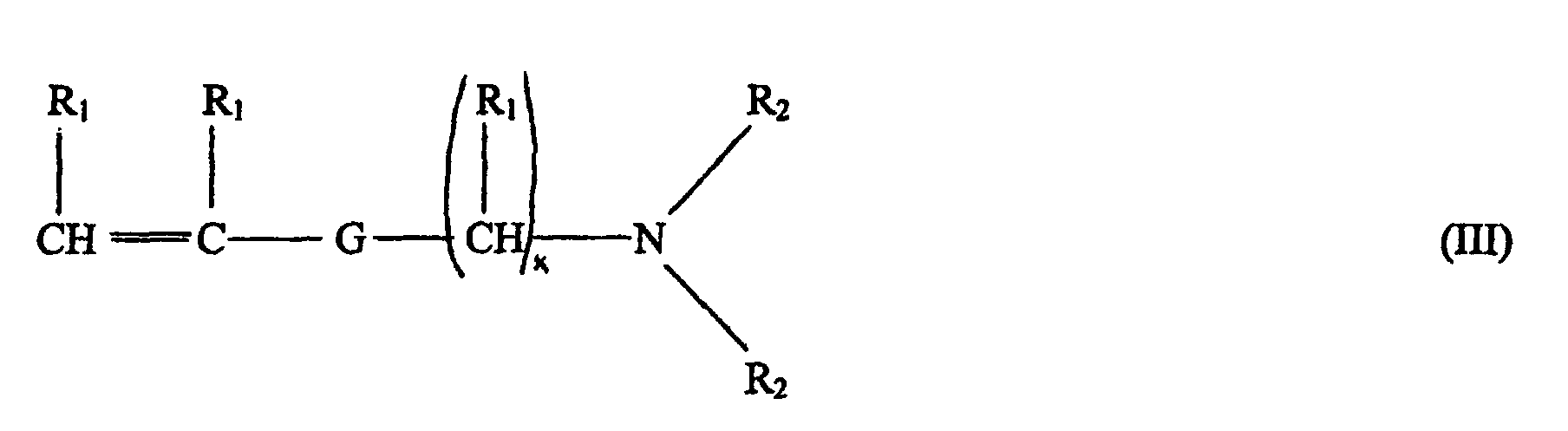
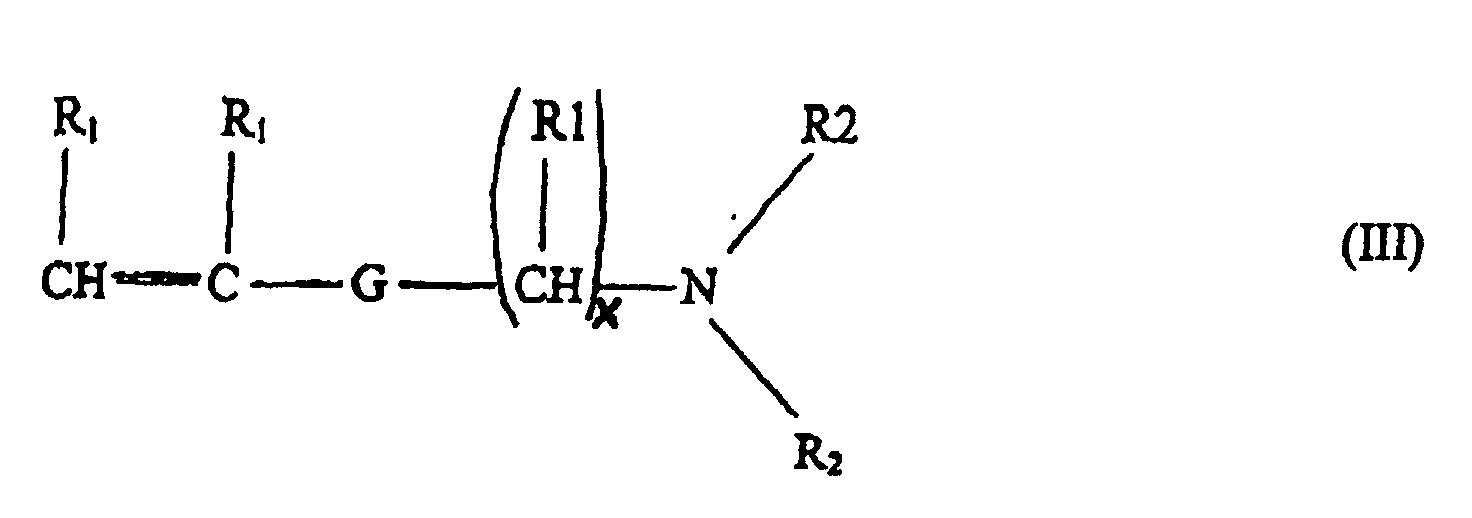
- the repeating unit is based on a compound with the following formula III: where G is a linking group which is selected from -COO-, -OCO-, -CONH-, -NHCO-, -NHCONH-, -NHCOO-, -OCONH- or -OCOO-, R 1 independently of one another hydrogen or an alkyl group with 1-3 carbon atoms, R 2 is independently hydrogen or an alkyl group with 1-5 carbon atoms and x is an integer from 1 to 6.
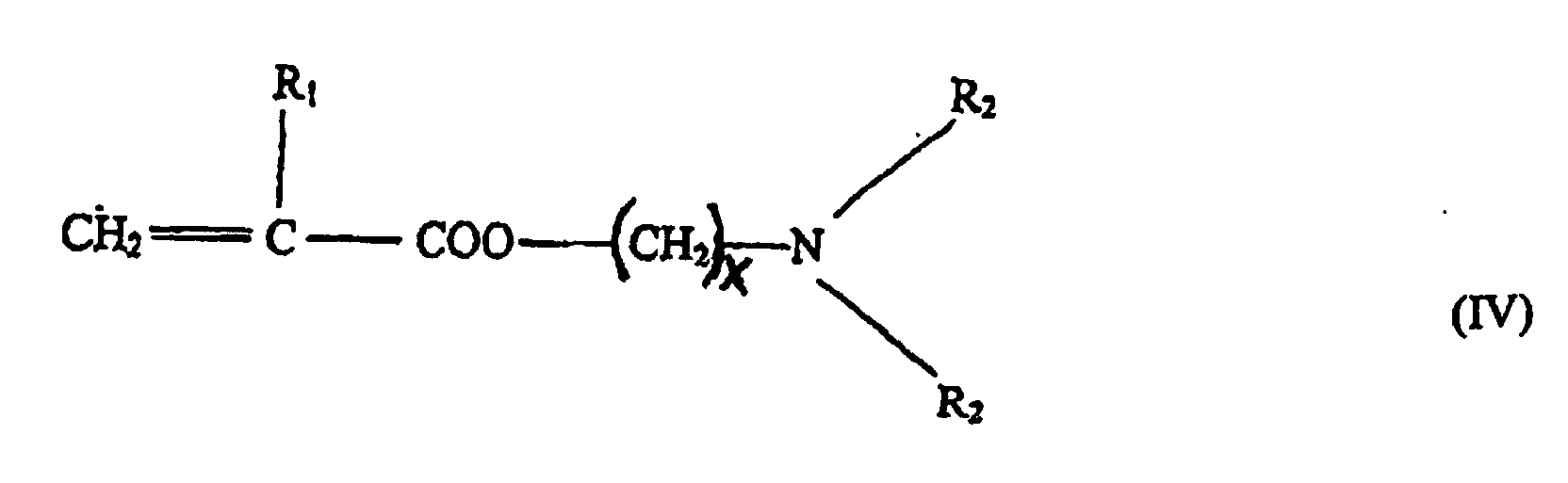
- the repeating unit is preferably based on a compound having the following formula IV: wherein R 1 is independently hydrogen or an alkyl group with 1-3 carbon atoms, R 2 is independently hydrogen or an alkyl group with 1-5 carbon atoms and x is an integer from 1 to 6.
- the basic function is a Is imine or a basic aromatic N-containing group, preferably a pyridine group or an imidazole group.
- the pH-sensitive polymer is one of Chitosan derived polymer.
- the invention proposes that the compound comprise ⁇ -carrageenan.
- the core (s) has at least one Material comprises (selected) selected from the group consisting of surfactants, antibacterial Compositions, silver preservatives, fragrances, bleaches, disinfectants, Odor masking agents, anti-fouling agents and enzymes exist.
- the core or at least some of the cores can be encapsulated Liquid, e.g. in the form of a liquid contained in a gelatin capsule.
- the core or at least some of the cores are in a solid form and preferably has a melting point of more than 35 ° C, especially preferably between 55 and 70 ° C.
- the invention further relates to a method for carrying out a dishwashing cycle in a dishwasher in which the composition according to the invention is suitable Time during the pre-rinse cycle or the main cleaning cycle in the Medium is added to the dishwasher.
- composition of the invention is characterized in that it is excellent Results in both the main wash and rinse cycle of a dishwasher supplies.
- the tablet is released during the main cleaning cycle and can be used develop the intended effect (cleaning, water softening, washing reinforcement, Etc.).
- the particle arranged in or on the tablet contains that as the core material Substance or substances that have their main function in the rinse aid the dishwasher, for example rinse aid.
- This substance (s) is (are) protected by a coating which, at the ion concentration, e.g. the pH value, and the temperature of the main cleaning cycle is stable and stable does not dissolve or detaches only insignificantly. Only when the ion concentration or the pH value decreases significantly by dilution, i.e. at the beginning of the rinse aid cycle, the Solubility of the wrapping material is reduced so much that it quickly opens up or detaches and releases the actually effective core material into the surrounding medium.
- the ion concentration e.g. the pH value
- the particles of the invention should be chosen so large that at least not to a significant extent during pumping after the main cleaning cycle and the intermediate rinsing cycle or rinsing cycles be removed from the dishwasher.
- the surface of the particle at most partly in direct contact with the surface of the base composition surrounding it the tablet is standing. This can be due to the concrete described in this application and illustrated types, but also in any other way with which the desired Purpose is achieved. Examples are the loose arrangement of a smaller particle in one larger cavity and the fixation of a smaller particle in a larger cavity in such a way that there is no or only partial contact between the particle and the Basic composition of the tablet, etc.
- This constellation offers the advantage over the prior art that in the manufacturing process, e.g. the pressing of the individual in successive steps Components, a deformation and possibly resulting damage to the Kerns (the cores) and / or the coating is reliably avoided by a reduction the protective effect of the covering of the core (s) could occur. By doing is prevented from being on the particle at any stage of the manufacturing process Pressure can also be reliably prevented from occurring at a particular point Composition of the core (s) to "bleed" out of it in the material the wrapping and the base composition. After all, it can be certain Compositions of the coating or the base composition advantageous be to avoid an intimate full-surface contact, otherwise in the boundary layers Reactions that are undesirable could occur.
- the term "local environment" as used in connection with the particle according to the invention is intended to denote the immediate environment around this particle.
- the ion concentration in this local environment of the particle is the determining factor for its stability. In the products according to the invention, the ion concentration in this local environment is determined at least until the tablet dissolves essentially completely by ions dissolving from it.
- the origin of the "specific ion” is therefore preferably - at least in the initial phase of the main cleaning cycle - a compound of the basic composition forming the tablet or is generated by it in the surrounding medium.
- the usual basic dishwashing detergents are OH - ions, the concentration of which can be expressed as pH.
- a (e.g. basic) dishwasher detergent composition is used as the basic composition
- a water softener composition or Wash booster composition is the protection of the coating of the particle by a a sufficiently high internal concentration in the local environment of the particle may only last as long guaranteed until the tablet is completely dissolved, namely in the cases that the The base composition of the tablet is unable to maintain a sufficiently high ion concentration to be made available in the medium. In these cases the high enough Ion concentration in the medium (and thus also in the local environment of the particle (s) (Particles) by dissolving the actual dishwasher detergent (or another special addition).
- ion concentration or pH profiles of the cleaning or rinsing medium in a dishwasher depending on the ingredients of the cleaning or detergent.
- the vertical dashed division indicates the duration of the following steps: pre-rinse, Main cleaning, rinsing, rinsing. It is clear that the pH during the most of the main cleaning cycle is in the range of 10.0 and 10.5. The pH decreases after the wash liquor has been pumped out at the end of the main cleaning cycle and Fresh water inflow to 9.0 during intermediate rinsing and up a value between 8.5 and 9.0 during rinsing.
- Fig. 2 shows a tablet 1, which consists of two half-tablets 2 and 3, the different or can have the same composition.
- a tablet 1 which consists of two half-tablets 2 and 3, the different or can have the same composition.
- a the usual, commercially sold 2-layer tablet in which the the two layers usually have a different composition and are different are colored.
- a single particle 6 is present in this cavity from the core 8 and the pH or ion concentration-sensitive sheath 9, whose outer diameter is slightly smaller than the inner diameter of the Cavity in the tablet.
- the particle is loosely received in the cavity, as well as in one embodiment where it passes through an adhesive in the space is fixed, it is ensured that no continuous full contact between the tablet material and the coating of the particle consists.
- This is an essential aspect of the present invention, on the one hand prevent the protective coating around the core of the particle during the manufacturing process is damaged, and on the other hand possible interactions between to minimize the tablet material and the aforementioned wrapping, both with the aim of To keep the wrapping stable until the rinse cycle.
- Fig. 3 is a second embodiment of the composition according to the invention on the Basis of a conventional 2-layer tablet 1 shown.
- the upper one exists Half tablet 3 from two parts, both of which have an adequate cavity 5 for receiving of the particle 6 as well as an opening to the side 11 of the tablet.
- the particle 6 is therefore not completely of the basic composition of the Surround tablet 1 so that it is visible inside the tablet 1 from the outside.
- the particle in cavity 5 can either be loosely received (if by appropriate selection of the size of the particle 6 on the one hand and the size of the opening of the Cavity 5 to side 11 of the tablet ensures that the particle or particles in the cavity cannot pass through the opening) or inside the cavity 5 be fixed by appropriate means, such as glue.
- a third possible embodiment results from FIG. 4.
- the basis is one Tablet 1 ', which is constructed uniformly, i.e. only from a layer 2 'with a uniform composition and color is there.
- this layer 2 ' by means of a suitable device a recess 4 'is formed.
- the particle 6 ' is introduced into this recess 4', this in this case, since the depression towards the side 11 'of the tablet 1' goes so far it is open that the particle would fall out of the recess without fixation, e.g. with an adhesive 10 'or a fixing intermediate layer or mechanically (e.g. is fixed by friction) in the recess.
- this principle is also up multilayer tablets transferable.
- the depression for example parallel to side 11 ', is essentially circular Have cross-section.
- any number of other cross sections are also conceivable, for example any polygon.
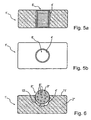
- the particle 6 'in a cavity open on both sides to be fixed in the tablet, for example in a passage through the tablet body 1 ' cylindrical hole 4 'in which a corresponding cylindrical particle 6' is fixed (Fig. 5a and b).
- FIG. 6 A further possible embodiment results from FIG. 6.
- a tablet 1 ' which is constructed uniformly is, i.e. only from a layer 2 "with a uniform composition and color.
- the particle 6 "does not only contain a core (as in FIG. 4), but also a plurality of cores 8 ", which are embedded in a casing 9".
- cores of different compositions and of different shapes in one particle 6 "to incorporate.
- a low-foaming, non-ionic surfactant is used.
- Such surfactants are for example Fatty alcohol ethoxylates, fatty alcohol ethoxylate / propoxylates, ethoxylate / propoxylate polymers, such as. the products from the Synperonic® and Brij® series from ICI, the products from the Plurafac®, Pluronic® and Lutensol® series from BASF, the products from the Genapol® range from Clariant, and the products from the Poly-tergent® range from Olin.
- surfactants are alkyl polyglycosides, glucamides and Alkylpyrrolidones.
- all other surfactants also come into consideration, which can develop the desired effectiveness as rinse aid.
- rinse aid Most of the substances known for use as rinse aid are liquids or waxy solids.
- the state of matter plays a role for use in the present invention
- the substance that acts as rinse aid does not play a decisive role.
- liquids are to be used, these can be applied before the coating is applied as surfactant-containing capsules, e.g. Gelatin capsules are submitted or by other suitable measures are converted into an encasable state.
- solids can usually be provided directly with the coating, the coating process may need to be based on the appropriate substance.
- melt mixtures have been found to be special for the purposes of the present invention proven to be advantageous, the solid surfactant particles with a melting point of more than 35 ° C, preferably between about 55 to 70 ° C.
- Bleach-containing, i.e. oxidizing dishwashing detergent compositions limit Possible uses of fragrances used in such compositions can, considerably. The controlled release of a fragrance in the rinse cycle would allow far greater flexibility in the use of fragrances.
- a rinse cycle For the controlled release of a fragrance or a fragrance composition in the A rinse cycle can be used to produce a core for a corresponding particle according to the invention by mixing a mixture of 50% by weight of molten polyethylene glycol, e.g. PEG 8000, 25% by weight fragrance or fragrance composition and 25% by weight diethyl phthalate be cooled in a mold to form, for example, a spherical particle with a weight of, for example, 0.75 g.
- molten polyethylene glycol e.g. PEG 8000
- diethyl phthalate diethyl phthalate
- a particle according to the invention with one core or several cores, which comprises an antibacterial composition into a tablet for use in a dishwasher would open up the possibility of two different at the same time
- compositions in the rinse aid namely the antibacterial Composition of the core (s) of the particle according to the invention and the rinse aid from the usual dosing device of the dishwasher.
- a corresponding core is made by a mixture cooled in a mold from 100% molten benzalkonium chloride (Barquat®MS-100) for example a spherical particle weighing e.g. Produce 0.64 g.
- proteases which are usually used in dishwashing detergent compositions, It would have been proven to degrade lipases and thus reduce their activity it is desirable to have such lipases in the core (s) of a particle according to the invention to incorporate so that the lipases would only be released in a controlled manner in the rinse cycle, what could allow optimal performance of these enzymes.
- a granular lipolytic enzyme e.g. Lipolase® 100T (Novo)
- a hard gelatin capsule with e.g. be given a rounded cylindrical shape, e.g. the way it is used for pharmaceuticals.
- the material for the covering of the particle nucleus comprises, which function essentially in the rinse aid of the dishwasher unfolds, showing a solubility selected by the concentration of a specific one Ions depends.
- the envelope in the main cleaning cycle is essentially insoluble and is solubilized and detaches from the particle when the ion concentration during the intermediate rinse cycle (rinse cycle) or rinse cycle decreases.
- the values for the ion concentration used in the screening of the polymers should depend on the formulation of the base composition of the tablet into which the coated particles should be incorporated.
- the value for the highest ion concentration should be that for the screening procedure is used to correspond to the concentration of the selected ion contained in the Wash liquor can be found after the dishwasher detergent has completely dissolved Has. Once this concentration is determined, the lower value for the ion concentration is set 20 to 200 times below this higher value become.
- the materials to be examined are dissolved in solvents in which they are easily soluble are.
- the solutions are distributed on glass plates and then at room temperature dried up until they show a constant weight.
- the glass plates are placed in a beaker with test solution at a controlled temperature given.
- the solution is then mixed with a magnetic stirrer at a controlled stirring speed touched. After about 10 minutes, the glass plates are removed from the beaker and dried to constant weight at room temperature. The results will be expressed as weight loss [%].
- the screening procedures must be based on the composition of the dishwasher detergent be adjusted, since these have the essential influence on the ion concentration or pH profile in the dishwashing cycle.
- the goal is in any case Checking the degree of solubility of the corresponding materials in different States, namely high (r) or low (r) ion concentration or pH.
- Screening method 1 was carried out using buffer solutions as the medium for the simulation of the wash liquor.
- two buffer solutions were prepared as follows: stock solution 7.507 g glycine buffer (Merck 104169) 5.850 g NaCl made up to 1000 ml with water. pH 8 buffer solution 500 ml stock solution 500 ml dist. H 2 O 1.23 g 1N NaOH pH 10 buffer solution 500 ml stock solution 500 ml dist. H 2 O 32.6 g 1N NaOH.
- Screening Procedure 2 was performed on the following detergent formulation to simulate the conditions in different stages of a dishwasher cycle. Concentrations of 4 to 5 g / l are common for detergent loading in the wash cycle. Concentrations of around 20-40 mg / l are common for the rinse aid.
- Detergent formulation ingredient Wt .-% Sodium perborate monohydrate 9.00 sodium tripolyphosphate 48,00 sodium 28,00 polyethylene glycol 4.00 polymer 1.50 TAED 3.00 enzymes 1.50 surfactant 3.50 additives 1.50 total 100.00
- Screening method 3 is used to screen for compounds whose solubility changes depending on the concentration of potassium ions. Those with such Compound identified screening methods can be used when in the main cleaning course - As shown above - a correspondingly high concentration of potassium ions is present, which is reduced accordingly by dilution in the rinse aid.
- the screening method 3 was carried out with the following formulation in order to simulate corresponding conditions.
- the polymer was prepared in the customary manner by bulk polymerization.
- the results of the screening tests were as follows:
- Polymer 1 films were made from a 10% solution in isopropanol. pH value of the buffer solution Weight loss at 30 ° C [%] Weight loss at 60 ° C [%] 10 7-8 5-8 8th 81-88 91-95
- Polymer 1 films were made from a 10% solution in a mixture of water and 1N HCl (17: 1). Concentrated detergent PH value Weight loss at 30 ° C [%] Weight loss at 60 ° C [%] 4 g / l 8-15 6-15 10.6 0.02 g / l 90-95 89-95 8.5
- the invention is of course not limited to this exemplary polymer, although there is of course already a large variation possibility with regard to the polymers mentioned in Japanese patent applications KOKAI 60-141705, 61-28440, 61-28441, 61-28596, 61-28597 and 61-28598 or can be extended to compounds of the formula IV: wherein R 1 is independently hydrogen or an alkyl group with 1-3 carbon atoms, R 2 is independently hydrogen or an alkyl group with 1-5 carbon atoms and x is an integer from 1 to 6.
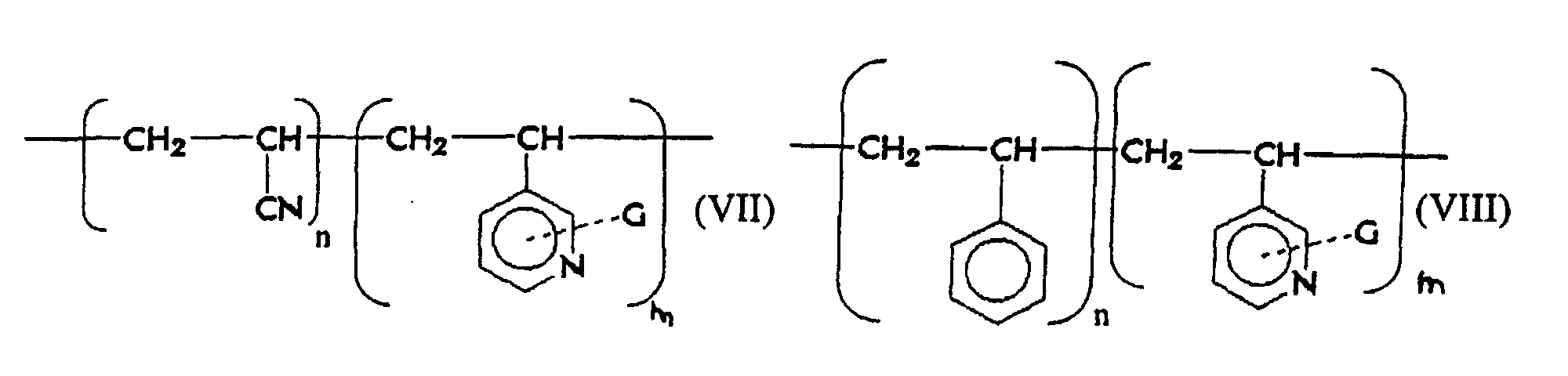
- G is a linking group which is selected from -COO-, -OCO-, -CONH-, -NHCO-, -NHCONH-, -NHCOO-, -OCONH- or -OCOO-, R 1 independently of one another hydrogen or an alkyl group with 1-5 carbon atoms and x is an integer from 1 to 6, for example polymers with a repeating unit can also be used, which are based on a compound of the formula V. for example a pH-sensitive polymer ("Polymer 2") with the repeating unit VI, which is commercially available from the company SANKYO under the brand name AEA®,
- polymers are (eg statistical) polymers derived from chitosan based on the following monomer units IX and X
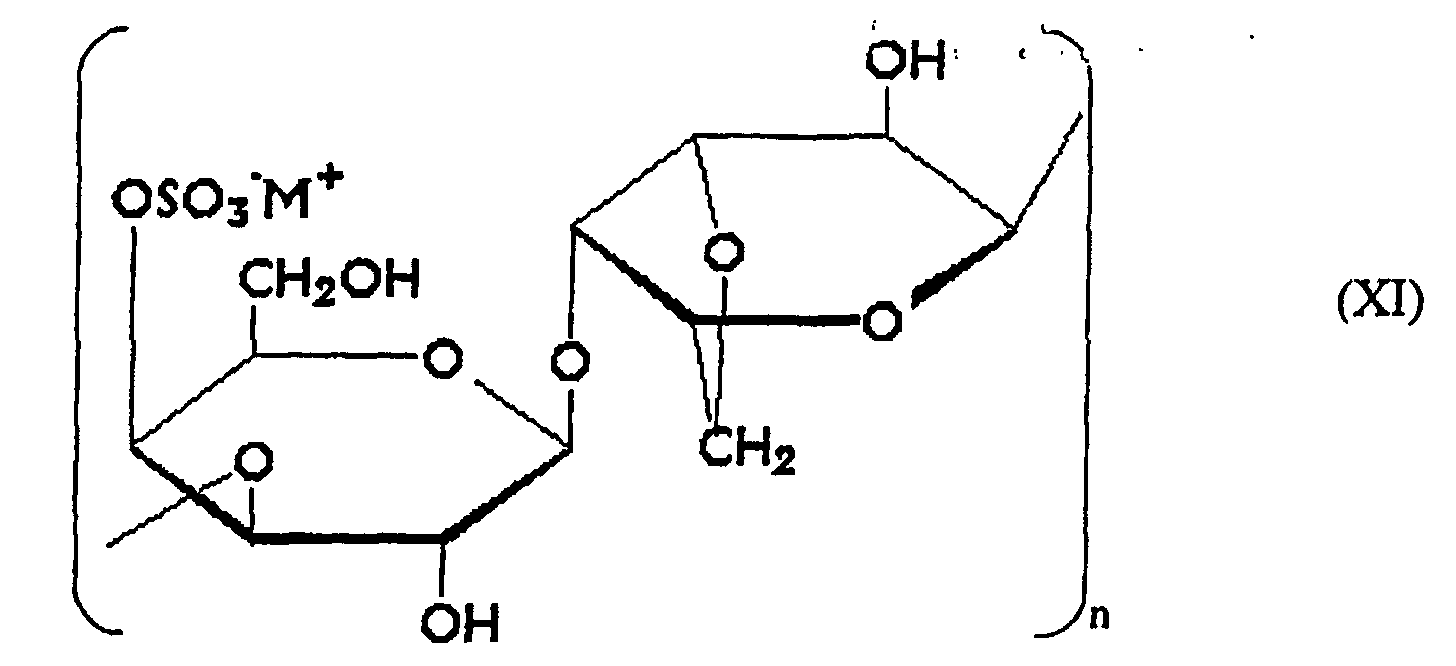
- ⁇ -carrageenan Another ion concentration-sensitive polymer is the polysaccharide ⁇ -carrageenan, which has been shown in screening method 3 (see Example 2) to be a polymer which is dependent on the potassium ion concentration in the surrounding medium in terms of its solubility.
- ⁇ -Carrageenan is represented by the following formula XI:
- Polymer 4 This polymer, designated "Polymer 4", was made according to the screening procedure described above 3 tested:
- Example 1 The different cores described in Example 1 were used as the basis for the production of particles according to the invention used. These cores were placed in one device for applying a film coating, as known from the pharmaceutical industry is (for example from Lödige, Wegtlin, GS, Manesty and Driam), individually or in pairs (Fig. 6) provided with an envelope.
- a film coating as known from the pharmaceutical industry is (for example from Lödige, Weglin, GS, Manesty and Driam), individually or in pairs (Fig. 6) provided with an envelope.
- the core (s) can Apply this cover with a protective coating.
- a protective coating preferably a 10% by weight aqueous solution of a polyvinyl alcohol, for example the polyvinyl alcohol Mowiol® 5-88 (Clariant), was used.
- the amount of protective coating applied can be determined by a person skilled in the art easily varies depending on the composition of the core (s) and be adjusted accordingly.
- the ion concentration-sensitive coating can be on the core (s) or protective coating basically be applied in any amount and thickness, as long as guaranteed is that the covering detaches or dissolves quickly enough in the rinse aid, so that the substance contained in the core (in the core) can develop its effect.
- Embodiment are 1-10 wt .-%, preferably 4-8 wt .-% of the Coating material (dry matter) sensitive to ion concentration, based on the Mass of the entire particle, applied.
- the particles according to the invention should preferably have a size such that they by pumping down after the main cleaning cycle or the intermediate rinsing cycle not, or at least not to a considerable extent, removed from the dishwasher become.
- a size of approximately 1 cm in diameter is usually sufficient for this.
- smaller or larger dimensions can be selected, as long as the functionality is guaranteed overall.
- Polymer 1 from Example 3 was used as the covering and as 10% solution of the polymer applied in 0.055 N aqueous HCl.
- a typical 2-layer dishwasher tablet that is used to hold a rinse aid particle in a cavity formed therein according to the present invention is basically by pressing the powdered ingredients in from the State of the art machines and using basically from the Operating parameters known in the art are produced.
- a possible form such a tablet is a cuboid tablet of two essentially the same thickness Layers, in the largest area of each of these layers a hemispherical recess is formed so that when the two half-tablets are put together a substantially spherical cavity is formed inside (see Fig. 2).
- the composition of the dishwasher detergent tablet is based on commercially available ones Products.
- An example of the composition is shown in Table 2 below.
- compositions are also possible, in particular those which are optimized to support the compound surrounding the core, for example in the provision of alkalinity.
- White layer Colored layer 50% 50% Sodium perborate monohydrate 18,00 sodium tripolyphosphate 48,00 48,00 sodium 24.00 32,00
- Polyethylene glycol 6000 3.00 5.00 polymer 3.00 TAED 6.00 enzymes 3.00 dye 0.02 surfactant 4.50 2.50 additives 2.50 0.50 100.00 100.00
- the rinse aid particle produced according to Examples 1a and 4 becomes hemispherical Recess of the white or colored half tablet given.
- a fixative Substance e.g. an adhesive (e.g. polyethylene glycol, polyvinyl ether, polyvinyl alcohol, Silicate, preferably melted PEG 4000) on the corresponding surface of the half tablet and possibly also applied to the rinse aid particle and the second half tablet (colored or white) pressed onto the first half tablet with rinse aid particles.
- an adhesive e.g. polyethylene glycol, polyvinyl ether, polyvinyl alcohol, Silicate, preferably melted PEG 4000
- the rinse aid particles have a medium content of surfactant or polyethylene glycol of about 0.37 g each.
- the average amount of water in the rinse aid is about 5.0 1.
- the maximum amount of surfactant plus PEG to be expected in the rinse aid should therefore be used of one tablet per dishwashing cycle is 0.148 g / l.
- this analysis method detects both the non-ionic surfactant and the polyethylene glycol used.
- test described in this example serves the composition according to the invention to test in terms of effectiveness in the rinse aid.
- the dishwashing detergent of the tablet composition corresponded to the tablet according to the invention and a commercial one Rinse aid was used.
- the dishwasher used was a BOSCH SMS 3047.
- the water hardness was about 17 to 19 ° dH.
- the set temperature was 65 ° C.
- the dishwasher was loaded with 20 glasses, 20 black porcelain plates and 20 pieces of cutlery.
- the contamination of the dishwasher load was carried out as follows:
- the stain prevention performance is expressed in percent. 100% performance means the maximum possible score of 228 points.
- the results are summarized in Table 4 below: power Detergent + 2 ml of rinse aid Detergent + 3 ml of rinse aid Tablet with rinse aid particles porcelain 66.9 75.6 96.9 Glass 25.6 26.9 49.4 cutlery 80.6 90.6 78.8 total 57.7 64.4 75.0
Landscapes
- Chemical & Material Sciences (AREA)
- Life Sciences & Earth Sciences (AREA)
- Engineering & Computer Science (AREA)
- Chemical Kinetics & Catalysis (AREA)
- Oil, Petroleum & Natural Gas (AREA)
- Wood Science & Technology (AREA)
- Organic Chemistry (AREA)
- Detergent Compositions (AREA)
Description


| Code | RA 30 [%] | PEG 8000 [%] | PEG 10000 [%] | PEG 20000 [%] | PEG 350000 [%] | Schmelzpunkt [°C] |
| C1 | 30 | 70 | 58-63 | |||
| C2 | 40 | 60 | 57-60 | |||
| A30 | 50 | 50 | 57-60 | |||
| A31 | 60 | 40 | 54-58 | |||
| A30 | 50 | 50 | 57-60 | |||
| C3 | 60 | 40 | 57-60 | |||
| C4 | 65 | 35 | 55-59 | |||
| A33 | 50 | 50 | 59-65 | |||
| C17 | 60 | 40 | 58-63 | |||
| C18 | 70 | 30 | 57-64 | |||
| A34 | 50 | 50 | 59-65 | |||
| C15 | 60 | 40 | 58-66 | |||
| C16 | 70 | 30 | 57-64 |
| Vorratslösung | 7,507 g Glycinpuffer (Merck 104169) |
| 5,850 g NaCl | |
| aufgefüllt mit Wasser auf 1000 ml. | |
| pH 8-Pufferlösung | 500 ml Vorratslösung |
| 500 ml dest. H2O | |
| 1,23 g 1 N NaOH | |
| pH 10-Pufferlösung | 500 ml Vorratslösung |
| 500 ml dest. H2O | |
| 32,6 g 1 N NaOH. |
| Reinigungsmittelformulierung: | |
| Inhaltsstoff | Gew.-% |
| Natriumperborat-Monohydrat | 9,00 |
| Natriumtripolyphosphat | 48,00 |
| Natriumcarbonat | 28,00 |
| Polyethylenglykol | 4,00 |
| Polymer | 1,50 |
| TAED | 3,00 |
| Enzyme | 1,50 |
| Tensid | 3,50 |
| Additive | 1,50 |
| Gesamt | |
| Formulierung: | |
| Inhaltsstoff | Gew.-% |
| Kaliumtripolyphosphat | 13,6 |
| Kaliumbicarbonat | 34,0 |
| Kaliumsulfat | 23,1 |
| Kaliumchlorid | 12,4 |
| Kaliumcarbonat | 9,7 |
| Borsäure | 2,0 |
| Natriumperborat-Monohydrat | 2,0 |
| TAED | 1,0 |
| Paraffin | 1,0 |
| Protease | 0,2 |

| pH-Wert der Pufferlösung | Gewichtsverlust bei 30°C [%] | Gewichtsverlust bei 60°C [%] |
| 10 | 7-8 | 5-8 |
| 8 | 81-88 | 91-95 |
| Konz. Reinigungsmittel pH-Wert | Gewichtsverlust bei 30°C [%] | Gewichtsverlust bei 60°C [%] |
| 4 g/l | 8-15 | 6-15 |
| 10,6 | ||
| 0,02 g/l | 90-95 | 89-95 |
| 8,5 |


| Konzentration Reinigungsmittel pH-Wert | Gewichtsverlust bei 30°C [%] | Gewichtsverlust bei 60°C [%] |
| 4 g/l | 2-8 | 5-7 |
| 10,6 | ||
| 0,02 g/l | 32-40 | 45-47 |
| 8,5 |
| Konzentration Reinigungsmittel pH-Wert | Gewichtsverlust bei 30°C [%] | Gewichtsverlust bei 60° [%] |
| 4 g/l | 0-6 | 5-12 |
| 10,6 | ||
| 0,02 g/l | 68-85 | 92-94 |
| 8,5 |

| Konzentration Reinigungsmittel | Gewichtsverlust bei 30°C [%] | Gewichtsverlust bei 60° [%] |
| 4 g/l | 0,5-3,0 | 11,0-12,0 |
| 0,02 g/l | 24,5-25,0 | 78,0-85,0 |
vorliegenden Erfindung. Darüberhinaus sind die für die erfindungsgemäße Umhüllung geeigneten Substanzen nicht auf polymere Verbindungen beschränkt, obgleich solche Verbindungen hier als bevorzugte Ausführungsformen beschrieben sind.
| Weiße Schicht | Gefärbte Schicht | |
| 50% | 50% | |
| Natriumperborat-Monohydrat | 18,00 | |
| Natriumtripolyphosphat | 48,00 | 48,00 |
| Natriumcarbonat | 24,00 | 32,00 |
| Polyethylenglykol 6000 | 3,00 | 5,00 |
| Polymer | 3,00 | |
| TAED | 6,00 | |
| Enzyme | 3,00 | |
| Farbstoff | 0,02 | |
| Tensid | 4,50 | 2,50 |
| Additive | 2,50 | 0,50 |
| 100,00 | 100,00 |

| Leistung | |||
| Reinigungsmittel + 2 ml Klarspülmittel | Reinigungsmittel + 3 ml Klarspülmittel | Tablette mit Klarspüler-Teilchen | |
| Porzellan | 66,9 | 75,6 | 96,9 |
| Glas | 25,6 | 26,9 | 49,4 |
| Besteck | 80,6 | 90,6 | 78,8 |
| Gesamt | 57,7 | 64,4 | 75,0 |
Claims (30)
- Zusammensetzung zur Verwendung in einer Geschirrspülmaschine, gekennzeichnet durchwobei das mindestens eine Teilchen (6;6'; 6") so in oder an der Tablette (1;1') angeordnet ist, daß die Oberfläche des (der) Teilchens (Teilchen) (6;6'; 6") höchstens teilweise in direktem Kontakt mit der Oberfläche der dieses (diese) umgebenden Basiszusammensetzung (2,3;2') steht und die Konzentration des spezifischen Ions in der lokalen Umgebung des (der) Teilchens (Teilchen) bis zur im wesentlichen vollständigen Auflösung der Tablette (1;1') ausreichend hoch ist, um eine wesentliche Auflösung der Umhüllung oder eine wesentliche Ablösung der Umhüllung vom Kern (von den Kernen) zu verhindern.eine Basiszusammensetzung (2,3;2'), die ihre Funktion im wesentlichen im Hauptreinigungsgang der Geschirrspülmaschine entfaltet, in Form einer Tablette (1;1'); undmindestens ein Teilchen (6; 6'; 6"), mitmindestens einem Kern (8; 8'; 8"), der mindestens eine Substanz umfaßt, die ihre Funktion im wesentlichen im Klarspülgang der Geschirrspülmaschine entfaltet, undeiner den (die) Kern(e) im wesentlichen vollständig umgebenden Umhüllung (9; 9'; 9"), die mindestens eine Verbindung umfaßt, deren Löslichkeit mit sinkender Konzentration eines spezifischen Ions im umgebenden Medium zunimmt;
- Zusammensetzung nach Anspruch 1, dadurch gekennzeichnet, daß das bzw. alle Teilchen (6) in mindestens einem vollständig von der Basiszusammensetzung (2,3) umgebenen Hohlraum (4,5) der Tablette (1) aufgenommen ist bzw. sind, der ein größeres Volumen aufweist als das bzw. alle Teilchen (6), das bzw. die in dem jeweiligen Hohlraum aufgenommen ist bzw. sind.
- Zusammensetzung nach Anspruch 2, dadurch gekennzeichnet, daß das (die) Teilchen (6) im Inneren des Hohlraumes (4,5) lose angeordnet oder fixiert, insbesondere durch einen Kleber fixiert ist (sind).
- Zusammensetzung nach einem der Ansprüche 2 oder 3, dadurch gekennzeichnet, daß der Hohlraum (4, 5) im wesentlichen mittig im Inneren der Tablette (1) angeordnet ist.
- Zusammensetzung nach einem der Ansprüche 2 bis 4, dadurch gekennzeichnet, daß die Tablette (1) einen einzigen, im wesentlichen kugelförmigen Hohlraum (4, 5) aufweist.
- Zusammensetzung nach Anspruch 5, dadurch gekennzeichnet, daß in dem Hohlraum (4, 5) ein einziges, im wesentlichen kugelförmiges Teilchen (6) aufgenommen ist, dessen Außendurchmesser geringer ist als der Innendurchmesser des Hohlraums.
- Zusammensetzung nach Anspruch 1, dadurch gekennzeichnet, daß das bzw. alle Teilchen (6'; 6") in mindestens einem Hohlraum (4') der Tablette (1') aufgenommen ist bzw. sind, der nur teilweise von der Basiszusammensetzung (2') umgeben ist.
- Zusammensetzung nach Anspruch 7, dadurch gekennzeichnet, daß der Hohlraum eine Vertiefung (4') in einer der Oberflächen (11') der Tablette (1') ist, in der das (die) Teilchen (6'; 6") zumindest teilweise aufgenommen ist (sind).
- Zusammensetzung nach Anspruch 7 oder 8, dadurch gekennzeichnet, daß das (die) Teilchen (6'; 6") so in dem Hohlraum oder in der Vertiefung (4') aufgenommen ist (sind), daß es (sie) nicht über die Oberfläche(n) (11') der Tablette (1') hervorsteht (hervorstehen).
- Zusammensetzung nach einem der Ansprüche 7 bis 9, dadurch gekennzeichnet, daß der Hohlraum oder die Vertiefung (4') parallel zu einer der Oberflächen (11'), zu der er sich öffnet bzw. in der sie angeordnet ist, eine im wesentlichen kreisförmige Querschnittsfläche aufweist.
- Zusammensetzung nach einem der Ansprüche 7 bis 10, dadurch gekennzeichnet, daß der Hohlraum oder die Vertiefung (4') sich zu der (den) Oberfläche(n) (11') nur so weit öffnet, daß das (die) darin aufgenommene(n) Teilchen (6'; 6") nicht durch die Öffnung(en) des Hohlraums oder der Vertiefung (4') hindurchtreten kann (können).
- Zusammensetzung nach Anspruch 11, dadurch gekennzeichnet, daß das (die) Teilchen (6'; 6") im Hohlraum oder in der Vertiefung (4') lose angeordnet oder fixiert, insbesondere mit einem Kleber (10') fixiert ist (sind).
- Zusammensetzung nach einem der vorangehenden Ansprüche, dadurch gekennzeichnet, daß die Basiszusammensetzung (2,3;2') wenigstens eine Zusammensetzung umfaßt, die ausgewählt ist aus der Gruppe, die aus einer Maschinengeschirrspülmittelzusammensetzung, einer Wasserenthärterzusammensetzung und einer Waschverstärkerzusammensetzung besteht.
- Zusammensetzung nach einem der vorangehenden Ansprüche, dadurch gekennzeichnet, daß die Umhüllung (9; 9'; 9") wenigstens eine Verbindung umfaßt, die bei der Konzentration des spezifischen Ions am Ende des Hauptreinigungsganges der Geschirrspülmaschine nicht oder nur wenig löslich ist und bei der Konzentration des spezifischen Ions im Klarspülgang eine so ausreichende Löslichkeit zeigt, daß sie im Klarspülgang so weitgehend aufgelöst oder vom Kern (von den Kernen) abgelöst wird, daß ein zumindest teilweises Austreten des Kernmaterials in das Medium des Klarspülganges ermöglicht wird.
- Zusammensetzung nach Anspruch 14, dadurch gekennzeichnet, daß die Löslichkeit der Verbindung mit sinkender OH--Innenkonzentration und damit abnehmendem pH-Wert im umgebenden Medium zunimmt.
- Zusammensetzung nach Anspruch 15, dadurch gekennzeichnet, daß die Verbindung bei einem pH-Wert oberhalb von 10 keine oder nur geringe Löslichkeit zeigt und bei einem pH-Wert unterhalb von 9 eine so ausreichende Löslichkeit zeigt, daß sie im Klarspülgang so weitgehend aufgelöst oder vom Kern (von den Kernen) abgelöst wird, daß ein zumindest teilweises Austreten des Kernmaterials in das Medium des Klarspülganges ermöglicht wird.
- Zusammensetzung nach einem der Ansprüche 14 bis 16, dadurch gekennzeichnet, daß die Verbindung ein Polymer insbesondere ein pH-empfindliches Polymer umfaßt, das wenigstens eine Wiederholungseinheit umfaßt, die mindestens eine basische Funktion aufweist, die nicht Teil der Rückgratkette des Polymers ist, umfaßt.
- Zusammensetzung nach Anspruch 17, dadurch gekennzeichnet, daß das Polymer wenigstens eine Wiederholungseinheit umfaßt, die auf einer Verbindung beruht, die ausgewählt ist aus der Gruppe, die aus Vinylalkoholderivaten, Acrylaten oder Alkylacrylaten besteht, die besagte basische Funktion umfassen.
- Zusammensetzung nach Anspruch 17, dadurch gekennzeichnet, daß das Polymer ein Kohlehydrat ist, das mit besagter basischen Funktion funktionalisiert ist.
- Zusammensetzung nach einem der Ansprüche 17 bis 19, dadurch gekennzeichnet, daß die basische Funktion ein Amin, insbesondere ein sekundäres oder tertiäres Amin ist.
- Zusammensetzung nach Anspruch 20, dadurch gekennzeichnet, daß die Wiederholungseinheit auf einer Verbindung mit der folgenden Formel III beruht:wobei G eine Verknüpfungsgruppe ist, die ausgewählt ist aus -COO-, -OCO-, -CONH-, - NHCO - , - NHCONH -, - NHCOO -, -OCONH - oder - OCOO -, R1 unabhängig voneinander Wasserstoffoder eine Alkylgruppe mit 1-3 Kohlenstoffatomen ist, R2 unabhängig voneinander Wasserstoffoder eine Alkylgruppe mit 1-5 Kohlenstoffatomen ist und x eine ganze Zahl von 1 bis 6 ist.
- Zusammensetzung nach Anspruch 21, dadurch gekennzeichnet, daß die Wiederholungseinheit auf einer Verbindung mit der folgenden Formel IV beruht:wobei R1 unabhängig voneinander Wasserstoff oder eine Alkylgruppe mit 1-3 Kohlenstoffatomen ist, R2 unabhängig voneinander Wasserstoff oder eine Alkylgruppe mit 1-5 Kohlenstoffatomen ist und x eine ganze Zahl von 1 bis 6 ist.
- Zusammensetzung nach einem der Ansprüche 17 bis 19, dadurch gekennzeichnet, daß die basische Funktion ein Imin, eine basische aromatische N-enthaltende Gruppe, eine Pyridingruppe oder eine Imidazolgruppe ist.
- Zusammensetzung nach Anspruch 19, dadurch gekennzeichnet, daß das pH-empfindliche Polymer ein von Chitosan abgeleitetes Polymer ist.
- Zusammensetzung nach Anspruch 14, dadurch gekennzeichnet, daß die Verbindung κ-Carrageenan umfaßt.
- Zusammensetzung nach einem der vorangehenden Ansprüche, dadurch gekennzeichnet, daß der (die) Kern(e) mindestens ein Material umfaßt (umfassen), das aus der Gruppe ausgewählt ist, die aus Tensiden, antibakteriellen Zusammensetzungen, Silberschutzmitteln, Duftstoffen, Bleichmitteln, Desinfektionsmitteln, Mitteln zur Geruchsmaskierung, Antibelagmitteln und Enzymen besteht.
- Zusammensetzung nach Anspruch 26, dadurch gekennzeichnet, daß der Kern (8;8') bzw. wenigstens ein Teil der Kerne (8") in Form einer eingekapselten Flüssigkeit, insbesondere in Form einer in einer Gelatinekapsel enthaltenen Flüssigkeit oder in einer festen Form vorliegt.
- Zusammensetzung nach Anspruch 27, dadurch gekennzeichnet, daß der Kern (8;8') bzw. wenigstens ein Teil der Kerne einen Schmelzpunkt von mehr als 35°C, bevorzugterweise einen Schmelzpunkt von zwischen 55 und 70°C aufweist
- Verfahren zur Durchführung eines Geschirrspülzyklus in einer Geschirrspülmaschine, dadurch gekennzeichnet, daß eine Zusammensetzung nach einem der Ansprüche 1 bis 28 zu einem geeigneten Zeitpunkt während des Vorspülganges bzw. des Hauptreinigungsganges zum in der Geschirrspülmaschine befindlichen Medium zugegeben wird.
- Verfahren nach Anspruch 29, dadurch gekennzeichnet, daß, für den Fall, daß die Basiszusammensetzung in Form der Tablette nicht in der Lage ist, nach ihrer Auflösung im Medium bis zum Ende des Hauptreinigungsganges eine Konzentration des spezifischen Ions im Medium zur Verfügung zu stellen, die ausreichend hoch ist, um eine wesentliche Auflösung der Umhüllung und eine wesentliche Ablösung der Umhüllung vom Kern zu verhindern, diese ausreichende Konzentration des spezifischen Ions durch die Zugabe einer weiteren Zusammensetzung, wie beispielsweise eine Maschinengeschirrspülmittelzusammensetzung, zum Medium des Hauptreinigungsganges zu einem geeigneten Zeitpunkt bereitgestellt wird.
Applications Claiming Priority (3)
| Application Number | Priority Date | Filing Date | Title |
|---|---|---|---|
| DE19834180A DE19834180A1 (de) | 1998-07-29 | 1998-07-29 | Zusammensetzung zur Verwendung in einer Geschirrspülmaschine |
| DE19834180 | 1998-07-29 | ||
| PCT/EP1999/005265 WO2000006684A1 (de) | 1998-07-29 | 1999-07-23 | Zusammensetzung zur verwendung in einer geschirrspülmaschine |
Publications (2)
| Publication Number | Publication Date |
|---|---|
| EP1100862A1 EP1100862A1 (de) | 2001-05-23 |
| EP1100862B1 true EP1100862B1 (de) | 2002-09-25 |
Family
ID=7875732
Family Applications (1)
| Application Number | Title | Priority Date | Filing Date |
|---|---|---|---|
| EP99936595A Expired - Lifetime EP1100862B1 (de) | 1998-07-29 | 1999-07-23 | Zusammensetzung zur verwendung in einer geschirrspülmaschine |
Country Status (8)
| Country | Link |
|---|---|
| US (1) | US6730646B1 (de) |
| EP (1) | EP1100862B1 (de) |
| AT (1) | ATE224947T1 (de) |
| AU (1) | AU5163599A (de) |
| CA (1) | CA2338711C (de) |
| DE (2) | DE19834180A1 (de) |
| ES (1) | ES2180315T3 (de) |
| WO (1) | WO2000006684A1 (de) |
Families Citing this family (89)
| Publication number | Priority date | Publication date | Assignee | Title |
|---|---|---|---|---|
| DE29823505U1 (de) | 1998-12-05 | 1999-06-17 | Henkel KGaA, 40589 Düsseldorf | Punkttablette |
| DE19936235A1 (de) | 1999-08-05 | 2001-02-15 | Benckiser Nv | Herstellungsverfahren für Formteile und Form zur Verwendung darin |
| DE19941266B4 (de) * | 1999-08-31 | 2017-07-13 | Henkel Ag & Co. Kgaa | Formkörper mit speziell geformter Kavität, Verfahren zu dessen Herstellung und Wasch- und Reinigungsverfahren unter Einsatz dieses Formkörpers |
| DE60001795T2 (de) * | 1999-12-17 | 2003-10-23 | Unilever N.V., Rotterdam | Verwendung von Geschirrspülmitteln |
| DE19963569B4 (de) * | 1999-12-29 | 2006-11-16 | Reckitt Benckiser N.V. | Zusammensetzung zur Verwendung in einer Geschirrspülmaschine |
| DE10021113A1 (de) * | 2000-05-02 | 2001-11-15 | Henkel Kgaa | Partikuläre Compounds, enthaltend nichtionische Tenside |
| US20030104969A1 (en) * | 2000-05-11 | 2003-06-05 | Caswell Debra Sue | Laundry system having unitized dosing |
| DE10023812A1 (de) * | 2000-05-15 | 2001-11-29 | Reckitt Benckiser Nv | Verfahren zur Herstellung mehrphasiger Formkörper |
| US20020137649A1 (en) * | 2000-06-12 | 2002-09-26 | Carnali Joseph Oreste | Mechanical warewashing compositions containing scale inhibiting polymers with targeted rinse cycle delivery |
| GB0015350D0 (en) † | 2000-06-23 | 2000-08-16 | Reckitt Benckiser Nv | Improvements in or relating to compositions |
| DE10032611A1 (de) * | 2000-07-07 | 2002-01-24 | Henkel Kgaa | Maschinengeschirrspülmittel mit Zusatznutzen |
| DE50107923D1 (de) | 2000-07-14 | 2005-12-08 | Henkel Kgaa | Kompartiment-hohlkörper enthaltend wasch-, reinigungs- oder spülmittelportion |
| US20030176307A1 (en) * | 2000-09-20 | 2003-09-18 | Housmekerides Chris Efstathios | Enzyme containing tablets |
| DE60116358T2 (de) * | 2000-10-25 | 2006-06-22 | Unilever N.V. | Geschirrspülmittel |
| DE10058646A1 (de) * | 2000-11-25 | 2002-02-28 | Henkel Kgaa | Waschmittel-,Spülmittel-oder Reinigungsmittel-Portion mit kontrollierter Wirkstoff-Freisetzung |
| GB0029095D0 (en) * | 2000-11-29 | 2001-01-10 | Reckitt Benckiser Nv | Improvements in or relating to packaging |
| DE10061421A1 (de) * | 2000-12-09 | 2002-06-20 | Henkel Kgaa | Verfahren zur Herstellung geklebter Formkörper |
| DE10062265A1 (de) * | 2000-12-14 | 2002-07-11 | Henkel Kgaa | Zuführbare Tablettenkerne |
| US6921743B2 (en) * | 2001-04-02 | 2005-07-26 | The Procter & Gamble Company | Automatic dishwashing compositions containing a halogen dioxide salt and methods for use with electrochemical cells and/or electrolytic devices |
| WO2002092751A2 (en) | 2001-05-14 | 2002-11-21 | The Procter & Gamble Company | Cleaning product |
| GB2377451A (en) * | 2001-07-11 | 2003-01-15 | Reckitt Benckiser Nv | Delayed release cleaning composition for automatic dishwashers |
| US7838026B2 (en) | 2001-09-28 | 2010-11-23 | Mcneil-Ppc, Inc. | Burst-release polymer composition and dosage forms comprising the same |
| US7323192B2 (en) * | 2001-09-28 | 2008-01-29 | Mcneil-Ppc, Inc. | Immediate release tablet |
| CA2447984A1 (en) | 2001-09-28 | 2003-04-03 | Mcneil-Ppc, Inc. | Dosage forms having an inner core and outer shell with different shapes |
| US6982094B2 (en) | 2001-09-28 | 2006-01-03 | Mcneil-Ppc, Inc. | Systems, methods and apparatuses for manufacturing dosage forms |
| US7122143B2 (en) | 2001-09-28 | 2006-10-17 | Mcneil-Ppc, Inc. | Methods for manufacturing dosage forms |
| US7799421B2 (en) | 2002-02-14 | 2010-09-21 | Akzo Nobel N.V. | Controlled release materials |
| US7807197B2 (en) | 2002-09-28 | 2010-10-05 | Mcneil-Ppc, Inc. | Composite dosage forms having an inlaid portion |
| CA2501204C (en) * | 2002-10-09 | 2008-04-15 | The Procter & Gamble Company | Process for making water-soluble pouches |
| MXPA05005148A (es) * | 2002-11-14 | 2005-07-22 | Procter & Gamble | Auxiliar de enjuague que contiene sal activa encapsulada para el cuidado de la cristaleria. |
| DE10338882B4 (de) * | 2003-08-23 | 2007-08-02 | Henkel Kgaa | Waschmittel mit steuerbarer Aktivstofffreisetzung |
| CA2543148A1 (en) * | 2003-10-21 | 2005-04-28 | Netech Inc. | Mucous membrane bulging humor composition comprising chitosan derivative containing saccharide chain for use in condoscopic surgery |
| GB2415200A (en) | 2004-06-19 | 2005-12-21 | Reckitt Benckiser Nv | Process for producing a detergent tablet |
| DE102004051553B4 (de) * | 2004-10-22 | 2007-09-13 | Henkel Kgaa | Wasch- oder Reinigungsmittel |
| US8673352B2 (en) | 2005-04-15 | 2014-03-18 | Mcneil-Ppc, Inc. | Modified release dosage form |
| DE102005025964A1 (de) * | 2005-06-03 | 2006-12-07 | Henkel Kgaa | Wasch- oder Reinigungsmittel |
| GB0514004D0 (en) * | 2005-07-08 | 2005-08-17 | Reckitt Benckiser Nv | Article and method |
| EP1746152A1 (de) * | 2005-07-20 | 2007-01-24 | Unilever N.V. | Wasch- oder Reinigungsmittel |
| DE102006013614A1 (de) * | 2006-03-22 | 2007-09-27 | Henkel Kgaa | Wasch- oder Reinigungsmitteldosiereinheit |
| GB0913808D0 (en) * | 2009-08-07 | 2009-09-16 | Mcbride Robert Ltd | Dosage form detergent products |
| CA2682636C (en) | 2009-11-05 | 2010-06-15 | The Procter & Gamble Company | Laundry scent additive |
| US8476219B2 (en) | 2009-11-05 | 2013-07-02 | The Procter & Gamble Company | Laundry scent additive |
| EP2392639B1 (de) | 2010-06-04 | 2018-01-24 | Dalli-Werke GmbH & Co. KG | Mischung aus einem Tensid mit einer Festverbindung zur Verbesserung der Spülleistung von automatischen Geschirrspülmitteln |
| CN104024407A (zh) | 2011-12-22 | 2014-09-03 | 丹尼斯科美国公司 | 包含脂解酶变体的组合物和方法 |
| WO2014099879A1 (en) | 2012-12-20 | 2014-06-26 | The Procter & Gamble Company | Laundry scent additive |
| WO2014099525A1 (en) | 2012-12-21 | 2014-06-26 | Danisco Us Inc. | Paenibacillus curdlanolyticus amylase, and methods of use, thereof |
| DK3354728T3 (da) | 2012-12-21 | 2020-07-27 | Danisco Us Inc | Alpha-amylase-varianter |
| EP2970931B1 (de) | 2013-03-11 | 2017-12-06 | Danisco US Inc. | Kombinatorische alpha-amylase-varianten |
| EP3696264B1 (de) | 2013-07-19 | 2023-06-28 | Danisco US Inc. | Zusammensetzungen und verfahren mit einer variante eines lipolytischen enzyms |
| EP4163305B1 (de) | 2013-12-16 | 2024-07-10 | Nutrition & Biosciences USA 4, Inc. | Verwendung von poly-alpha-1,3-glucan-ethern als viskositätsmodifikatoren |
| KR102410391B1 (ko) | 2013-12-18 | 2022-06-16 | 뉴트리션 앤드 바이오사이언시스 유에스에이 4, 인크. | 양이온성 폴리 알파-1,3-글루칸 에테르 |
| EP3105256A1 (de) | 2014-02-14 | 2016-12-21 | E. I. du Pont de Nemours and Company | Poly-alpha-1,3-1,6-glucane zur viskositätsmodifizierung |
| EP3116914B8 (de) | 2014-03-11 | 2021-04-21 | E. I. du Pont de Nemours and Company | Oxidierter poly-alpha-1,3-glucan als waschmittelbuilder |
| WO2015195777A1 (en) | 2014-06-19 | 2015-12-23 | E. I. Du Pont De Nemours And Company | Compositions containing one or more poly alpha-1,3-glucan ether compounds |
| US9714403B2 (en) | 2014-06-19 | 2017-07-25 | E I Du Pont De Nemours And Company | Compositions containing one or more poly alpha-1,3-glucan ether compounds |
| CN108064306B (zh) | 2014-12-23 | 2022-11-01 | 营养与生物科学美国4公司 | 酶促产生的纤维素 |
| CA2975289A1 (en) | 2015-04-03 | 2016-10-06 | E I Du Pont De Nemours And Company | Gelling dextran ethers |
| JP7045313B2 (ja) | 2015-11-13 | 2022-03-31 | ニュートリション・アンド・バイオサイエンシーズ・ユーエスエー・フォー,インコーポレイテッド | 洗濯ケアおよび織物ケアにおいて使用するためのグルカン繊維組成物 |
| WO2017083229A1 (en) | 2015-11-13 | 2017-05-18 | E. I. Du Pont De Nemours And Company | Glucan fiber compositions for use in laundry care and fabric care |
| WO2017083226A1 (en) | 2015-11-13 | 2017-05-18 | E. I. Du Pont De Nemours And Company | Glucan fiber compositions for use in laundry care and fabric care |
| CA3002666A1 (en) | 2015-11-26 | 2017-06-01 | Qiong Cheng | Polypeptides capable of producing glucans having alpha-1,2 branches and use of the same |
| EP3901257A1 (de) | 2015-12-09 | 2021-10-27 | Danisco US Inc. | Kombinatorische alpha-amylase-varianten |
| DE102017201095A1 (de) * | 2017-01-24 | 2018-07-26 | Henkel Ag & Co. Kgaa | Tenside in Kapseln mit optimiertem Trübungspunkt |
| CN110662836B (zh) | 2017-03-31 | 2024-04-12 | 丹尼斯科美国公司 | α-淀粉酶组合变体 |
| MX2020001606A (es) | 2017-08-18 | 2020-08-03 | Danisco Us Inc | Variantes de alfa-amilasa. |
| US11098334B2 (en) | 2017-12-14 | 2021-08-24 | Nutrition & Biosciences USA 4, Inc. | Alpha-1,3-glucan graft copolymers |
| EP3591029A1 (de) * | 2018-07-02 | 2020-01-08 | Dalli-Werke GmbH & Co. KG | Waschmitteltabletten mit konvexer struktur |
| MX2021001213A (es) | 2018-07-31 | 2021-08-24 | Danisco Us Inc | Variantes de alfa-amilasas que tienen sustituciones de aminoácidos que bajan el pka del ácido general. |
| CN113166745B (zh) | 2018-10-12 | 2025-07-18 | 丹尼斯科美国公司 | 在螯合剂存在下具有可增强稳定性的突变的α-淀粉酶 |
| EP3870616B1 (de) | 2018-10-25 | 2023-10-11 | DuPont Industrial Biosciences USA, LLC | Alpha-1,3-glucan propfcopolymere |
| WO2021013515A1 (en) | 2019-07-24 | 2021-01-28 | Unilever N.V. | Package with unit doses |
| US20220403359A1 (en) | 2019-10-24 | 2022-12-22 | Danisco Us Inc | Variant maltopentaose/maltohexaose-forming alpha-amylases |
| WO2021092228A1 (en) | 2019-11-06 | 2021-05-14 | Nutrition & Biosciences USA 4, Inc. | Highly crystalline alpha-1,3-glucan |
| WO2021158543A1 (en) | 2020-02-04 | 2021-08-12 | Nutrition & Biosciences USA 4, Inc. | Aqueous dispersions of insoluble alpha-glucan comprising alpha-1,3 glycosidic linkages |
| EP4161972A1 (de) | 2020-06-04 | 2023-04-12 | Nutrition & Biosciences USA 4, Inc. | Dextran-alpha-glucan-pfropfcopolymere und derivate davon |
| US20240150497A1 (en) | 2021-02-19 | 2024-05-09 | Nutrition & Biosciences USA 4, Inc. | Polysaccharide derivatives for detergent compositions |
| WO2022235655A1 (en) | 2021-05-04 | 2022-11-10 | Nutrition & Biosciences USA 4, Inc. | Compositions comprising insoluble alpha-glucan |
| CN117616054A (zh) | 2021-07-13 | 2024-02-27 | 营养与生物科学美国4公司 | 阳离子葡聚糖酯衍生物 |
| WO2023114988A2 (en) | 2021-12-16 | 2023-06-22 | Danisco Us Inc. | Variant maltopentaose/maltohexaose-forming alpha-amylases |
| US20250032390A1 (en) | 2021-12-16 | 2025-01-30 | Nutrition & Biosciences USA 4, Inc. | Compositions comprising cationic alpha-glucan ethers in aqueous polar organic solvents |
| JP2025523007A (ja) | 2022-07-11 | 2025-07-17 | ニュートリション・アンド・バイオサイエンシーズ・ユーエスエー・フォー,インコーポレイテッド | 両親媒性グルカンエステル誘導体 |
| JP2025534620A (ja) | 2022-10-14 | 2025-10-17 | ニュートリション・アンド・バイオサイエンシーズ・ユーエスエー・フォー,インコーポレイテッド | 水、カチオン性α-1,6-グルカンエーテル、及び有機溶媒を含む組成物 |
| EP4634242A1 (de) | 2022-12-16 | 2025-10-22 | Nutrition & Biosciences USA 4, Inc. | Veresterung von alpha-glucan mit glycosidischen alpha-1,6-bindungen |
| WO2025072417A1 (en) | 2023-09-29 | 2025-04-03 | Nutrition & Biosciences USA 4, Inc. | Polysaccharide derivatives |
| WO2025072419A1 (en) | 2023-09-29 | 2025-04-03 | Nutrition & Biosciences Usa 1, Llc | Crosslinked alpha-glucan derivatives |
| WO2025072416A1 (en) | 2023-09-29 | 2025-04-03 | Nutrition & Biosciences USA 4, Inc. | Polysaccharide derivatives |
| WO2025117349A1 (en) | 2023-11-28 | 2025-06-05 | Nutrition & Biosciences USA 4, Inc. | Esterification of alpha-glucan comprising alpha-1,6 glycosidic linkages |
| WO2025199079A1 (en) | 2024-03-20 | 2025-09-25 | Nutrition & Biosciences USA 4, Inc. | Esterification of alpha-glucan comprising alpha-1,6 glycosidic linkages |
| WO2026039397A1 (en) | 2024-08-13 | 2026-02-19 | Nutrition & Biosciences USA 4, Inc. | Alpha-glucan graft copolymer derivatives |
Family Cites Families (18)
| Publication number | Priority date | Publication date | Assignee | Title |
|---|---|---|---|---|
| DE236030C (de) | ||||
| DE2007413A1 (de) | 1969-02-18 | 1970-08-20 | Raion Yushi Kabushiki Kaisha, Tokio | Detergentformlinge |
| GB1390503A (en) | 1971-03-30 | 1975-04-16 | Unilever Ltd | Liquid detergent compositions |
| US3924422A (en) * | 1974-11-01 | 1975-12-09 | Amsted Ind Inc | Mold stopper |
| US4082678A (en) | 1976-11-10 | 1978-04-04 | The Procter & Gamble Company | Fabric conditioning articles and process |
| US4801636A (en) | 1987-03-24 | 1989-01-31 | The Clorox Company | Rinse soluble polymer film composition for wash additives |
| US4765916A (en) | 1987-03-24 | 1988-08-23 | The Clorox Company | Polymer film composition for rinse release of wash additives |
| US4972017A (en) * | 1987-03-24 | 1990-11-20 | The Clorox Company | Rinse soluble polymer film composition for wash additives |
| US6307030B1 (en) | 1988-04-15 | 2001-10-23 | The University Of North Carolina At Chapel Hill | Androgen receptor proteins, recombinant DNA molecules coding for such, and use of such compositions |
| US5133892A (en) | 1990-10-17 | 1992-07-28 | Lever Brothers Company, Division Of Conopco, Inc. | Machine dishwashing detergent tablets |
| EP0585363B1 (de) * | 1991-05-14 | 1995-04-12 | Ecolab Incorporated | Zweiteiliges chemisches konzentrat |
| US5453216A (en) | 1994-04-28 | 1995-09-26 | Creative Products Resource, Inc. | Delayed-release encapsulated warewashing composition and process of use |
| JPH09175992A (ja) * | 1995-12-26 | 1997-07-08 | Kao Corp | カプセル含有錠剤型浴用剤 |
| WO1998045392A1 (en) | 1997-04-04 | 1998-10-15 | Benckiser Consumer Products, Inc. | Sanitizing antimicrobial rinse aid |
| WO1999027069A1 (en) * | 1997-11-26 | 1999-06-03 | The Procter & Gamble Company | Detergent tablet |
| ATE218612T1 (de) | 1997-11-26 | 2002-06-15 | Procter & Gamble | Geschirrspülverfahren |
| ATE276350T1 (de) * | 1997-11-26 | 2004-10-15 | Procter & Gamble | Verfahren zur herstellung einer waschmitteltablette |
| DE19834172A1 (de) * | 1998-07-29 | 2000-02-03 | Benckiser Nv | Zusammensetzung zur Verwendung in einem Wasserreservoir |
-
1998
- 1998-07-29 DE DE19834180A patent/DE19834180A1/de not_active Withdrawn
-
1999
- 1999-07-23 WO PCT/EP1999/005265 patent/WO2000006684A1/de not_active Ceased
- 1999-07-23 DE DE59902871T patent/DE59902871D1/de not_active Expired - Lifetime
- 1999-07-23 CA CA002338711A patent/CA2338711C/en not_active Expired - Fee Related
- 1999-07-23 EP EP99936595A patent/EP1100862B1/de not_active Expired - Lifetime
- 1999-07-23 AT AT99936595T patent/ATE224947T1/de active
- 1999-07-23 AU AU51635/99A patent/AU5163599A/en not_active Abandoned
- 1999-07-23 US US09/744,727 patent/US6730646B1/en not_active Expired - Lifetime
- 1999-07-23 ES ES99936595T patent/ES2180315T3/es not_active Expired - Lifetime
Also Published As
| Publication number | Publication date |
|---|---|
| EP1100862A1 (de) | 2001-05-23 |
| ES2180315T3 (es) | 2003-02-01 |
| AU5163599A (en) | 2000-02-21 |
| DE59902871D1 (de) | 2002-10-31 |
| ATE224947T1 (de) | 2002-10-15 |
| CA2338711A1 (en) | 2000-02-10 |
| DE19834180A1 (de) | 2000-02-03 |
| WO2000006684A1 (de) | 2000-02-10 |
| US6730646B1 (en) | 2004-05-04 |
| CA2338711C (en) | 2009-10-20 |
Similar Documents
| Publication | Publication Date | Title |
|---|---|---|
| EP1100862A1 (de) | Zusammensetzung zur verwendung in einer geschirrspülmaschine | |
| EP1100864A1 (de) | Zusammensetzung zur verwendung in einer geschirrspülmaschine | |
| DE19834181B4 (de) | Zusammensetzung zur Verwendung in einer Waschmaschine | |
| WO2000006683A1 (de) | Zusammensetzung zur verwendung in einer waschmaschine | |
| EP1242573B1 (de) | Zusammensetzung zur verwendung in einer geschirrspülmaschine | |
| EP1019485A1 (de) | Zusammensetzung zur verwendung in einem wasserreservoir | |
| DE60319347T2 (de) | Waschmittelzusammensetzung zum Gebrauch in einer Textilwasch- oder Geschirrspülmaschine | |
| DE69819522T2 (de) | Waschmittelzusammensetzungen | |
| DE69731189T2 (de) | Tabletten und Verfahren zu deren Herstellung | |
| EP1179042B1 (de) | Verfahren zur herstellung einer mehrschichtigen tablette | |
| CH634224A5 (de) | Reinigungstablette fuer zahnprothesen. | |
| EP1102725A1 (de) | Zusammensetzung zur verwendung in einem wasserreservoir | |
| DE102013100195B4 (de) | Reinigertablette mit integriertem Vorreinigersystem, Herstellungsverfahren und Verwendung | |
| DE19714657C1 (de) | Wasserlöslicher, wasserenthärtender Builder | |
| EP1044257A1 (de) | Geschirrspülmittelformkörper mit soil-release-polymeren | |
| EP1781768B1 (de) | Beschichteter wasch- oder reinigungsmittelformkörper | |
| DE29823942U1 (de) | Zusammensetzung zur Verwendung in einer Waschmaschine | |
| DE60108760T2 (de) | Beschichtung von tabletten | |
| DE10136211B4 (de) | Verfahren zur Herstellung teilchenförmiger Wasch-oder Reinigungsmittel | |
| DE69901873T3 (de) | Produktionsverfahren für Waschmitteltablette | |
| DE60110552T2 (de) | Wasch- und reinigungsmittel in tablettenform | |
| DE2748464A1 (de) | Langsam sich aufloesendes, teilchenfoermiges perborat, verfahren zu seiner herstellung und dieses enthaltendes mittel | |
| DE19939992A1 (de) | Wasch- oder Reinigungsmittelformkörper mit befülltem Hohlvolumen |
Legal Events
| Date | Code | Title | Description |
|---|---|---|---|
| PUAI | Public reference made under article 153(3) epc to a published international application that has entered the european phase |
Free format text: ORIGINAL CODE: 0009012 |
|
| 17P | Request for examination filed |
Effective date: 20010228 |
|
| AK | Designated contracting states |
Kind code of ref document: A1 Designated state(s): AT BE CH CY DE DK ES FI FR GB GR IE IT LI LU MC NL PT SE |
|
| AX | Request for extension of the european patent |
Free format text: AL;LT;LV;MK;RO;SI |
|
| GRAG | Despatch of communication of intention to grant |
Free format text: ORIGINAL CODE: EPIDOS AGRA |
|
| 17Q | First examination report despatched |
Effective date: 20011218 |
|
| GRAG | Despatch of communication of intention to grant |
Free format text: ORIGINAL CODE: EPIDOS AGRA |
|
| GRAH | Despatch of communication of intention to grant a patent |
Free format text: ORIGINAL CODE: EPIDOS IGRA |
|
| GRAH | Despatch of communication of intention to grant a patent |
Free format text: ORIGINAL CODE: EPIDOS IGRA |
|
| GRAA | (expected) grant |
Free format text: ORIGINAL CODE: 0009210 |
|
| AK | Designated contracting states |
Kind code of ref document: B1 Designated state(s): AT BE CH CY DE DK ES FI FR GB GR IE IT LI LU MC NL PT SE |
|
| AX | Request for extension of the european patent |
Free format text: AL;LT;LV;MK;RO;SI |
|
| PG25 | Lapsed in a contracting state [announced via postgrant information from national office to epo] |
Ref country code: NL Free format text: LAPSE BECAUSE OF FAILURE TO SUBMIT A TRANSLATION OF THE DESCRIPTION OR TO PAY THE FEE WITHIN THE PRESCRIBED TIME-LIMIT Effective date: 20020925 Ref country code: IE Free format text: LAPSE BECAUSE OF FAILURE TO SUBMIT A TRANSLATION OF THE DESCRIPTION OR TO PAY THE FEE WITHIN THE PRESCRIBED TIME-LIMIT Effective date: 20020925 Ref country code: GR Free format text: LAPSE BECAUSE OF FAILURE TO SUBMIT A TRANSLATION OF THE DESCRIPTION OR TO PAY THE FEE WITHIN THE PRESCRIBED TIME-LIMIT Effective date: 20020925 Ref country code: FI Free format text: LAPSE BECAUSE OF FAILURE TO SUBMIT A TRANSLATION OF THE DESCRIPTION OR TO PAY THE FEE WITHIN THE PRESCRIBED TIME-LIMIT Effective date: 20020925 |
|
| REF | Corresponds to: |
Ref document number: 224947 Country of ref document: AT Date of ref document: 20021015 Kind code of ref document: T |
|
| REG | Reference to a national code |
Ref country code: GB Ref legal event code: FG4D Free format text: NOT ENGLISH |
|
| REG | Reference to a national code |
Ref country code: CH Ref legal event code: EP |
|
| REG | Reference to a national code |
Ref country code: IE Ref legal event code: FG4D Free format text: GERMAN |
|
| REF | Corresponds to: |
Ref document number: 59902871 Country of ref document: DE Date of ref document: 20021031 |
|
| PG25 | Lapsed in a contracting state [announced via postgrant information from national office to epo] |
Ref country code: SE Free format text: LAPSE BECAUSE OF FAILURE TO SUBMIT A TRANSLATION OF THE DESCRIPTION OR TO PAY THE FEE WITHIN THE PRESCRIBED TIME-LIMIT Effective date: 20021225 Ref country code: DK Free format text: LAPSE BECAUSE OF FAILURE TO SUBMIT A TRANSLATION OF THE DESCRIPTION OR TO PAY THE FEE WITHIN THE PRESCRIBED TIME-LIMIT Effective date: 20021225 |
|
| PG25 | Lapsed in a contracting state [announced via postgrant information from national office to epo] |
Ref country code: PT Free format text: LAPSE BECAUSE OF FAILURE TO SUBMIT A TRANSLATION OF THE DESCRIPTION OR TO PAY THE FEE WITHIN THE PRESCRIBED TIME-LIMIT Effective date: 20021226 |
|
| REG | Reference to a national code |
Ref country code: ES Ref legal event code: FG2A Ref document number: 2180315 Country of ref document: ES Kind code of ref document: T3 |
|
| ET | Fr: translation filed | ||
| NLV1 | Nl: lapsed or annulled due to failure to fulfill the requirements of art. 29p and 29m of the patents act | ||
| GBT | Gb: translation of ep patent filed (gb section 77(6)(a)/1977) |
Effective date: 20030227 |
|
| PLBI | Opposition filed |
Free format text: ORIGINAL CODE: 0009260 |
|
| PLBQ | Unpublished change to opponent data |
Free format text: ORIGINAL CODE: EPIDOS OPPO |
|
| PG25 | Lapsed in a contracting state [announced via postgrant information from national office to epo] |
Ref country code: LU Free format text: LAPSE BECAUSE OF NON-PAYMENT OF DUE FEES Effective date: 20030723 Ref country code: CY Free format text: LAPSE BECAUSE OF FAILURE TO SUBMIT A TRANSLATION OF THE DESCRIPTION OR TO PAY THE FEE WITHIN THE PRESCRIBED TIME-LIMIT Effective date: 20030723 |
|
| REG | Reference to a national code |
Ref country code: IE Ref legal event code: FD4D Ref document number: 1100862E Country of ref document: IE |
|
| PG25 | Lapsed in a contracting state [announced via postgrant information from national office to epo] |
Ref country code: MC Free format text: LAPSE BECAUSE OF NON-PAYMENT OF DUE FEES Effective date: 20030731 Ref country code: LI Free format text: LAPSE BECAUSE OF NON-PAYMENT OF DUE FEES Effective date: 20030731 Ref country code: CH Free format text: LAPSE BECAUSE OF NON-PAYMENT OF DUE FEES Effective date: 20030731 Ref country code: BE Free format text: LAPSE BECAUSE OF NON-PAYMENT OF DUE FEES Effective date: 20030731 |
|
| PLAX | Notice of opposition and request to file observation + time limit sent |
Free format text: ORIGINAL CODE: EPIDOSNOBS2 |
|
| 26 | Opposition filed |
Opponent name: THE PROCTER & GAMBLE COMPANY Effective date: 20030624 |
|
| PLAX | Notice of opposition and request to file observation + time limit sent |
Free format text: ORIGINAL CODE: EPIDOSNOBS2 |
|
| BERE | Be: lapsed |
Owner name: *RECKITT BENCKISER N.V. Effective date: 20030731 |
|
| PLBB | Reply of patent proprietor to notice(s) of opposition received |
Free format text: ORIGINAL CODE: EPIDOSNOBS3 |
|
| REG | Reference to a national code |
Ref country code: CH Ref legal event code: PL |
|
| PLCK | Communication despatched that opposition was rejected |
Free format text: ORIGINAL CODE: EPIDOSNREJ1 |
|
| PLBN | Opposition rejected |
Free format text: ORIGINAL CODE: 0009273 |
|
| STAA | Information on the status of an ep patent application or granted ep patent |
Free format text: STATUS: OPPOSITION REJECTED |
|
| 27O | Opposition rejected |
Effective date: 20041209 |
|
| REG | Reference to a national code |
Ref country code: FR Ref legal event code: CA |
|
| REG | Reference to a national code |
Ref country code: FR Ref legal event code: PLFP Year of fee payment: 17 |
|
| REG | Reference to a national code |
Ref country code: GB Ref legal event code: 732E Free format text: REGISTERED BETWEEN 20160114 AND 20160120 |
|
| REG | Reference to a national code |
Ref country code: ES Ref legal event code: PC2A Owner name: RECKITT BENCKISER FINISH B.V. Effective date: 20160302 |
|
| REG | Reference to a national code |
Ref country code: FR Ref legal event code: TP Owner name: RECKITT BENCKISER FINISH B.V., NL Effective date: 20160303 |
|
| REG | Reference to a national code |
Ref country code: DE Ref legal event code: R082 Ref document number: 59902871 Country of ref document: DE Representative=s name: DR. SCHOEN, NEYMEYR & PARTNER MBB, DE Ref country code: DE Ref legal event code: R081 Ref document number: 59902871 Country of ref document: DE Owner name: RECKITT BENCKISER FINISH B.V., NL Free format text: FORMER OWNER: RECKITT BENCKISER N.V., HOOFDDORP, NL |
|
| REG | Reference to a national code |
Ref country code: FR Ref legal event code: PLFP Year of fee payment: 18 |
|
| REG | Reference to a national code |
Ref country code: AT Ref legal event code: PC Ref document number: 224947 Country of ref document: AT Kind code of ref document: T Owner name: RECKITT BENCKISER FINISH B.V., NL Effective date: 20160818 |
|
| PGFP | Annual fee paid to national office [announced via postgrant information from national office to epo] |
Ref country code: GB Payment date: 20160727 Year of fee payment: 18 Ref country code: DE Payment date: 20160726 Year of fee payment: 18 Ref country code: IT Payment date: 20160722 Year of fee payment: 18 |
|
| PGFP | Annual fee paid to national office [announced via postgrant information from national office to epo] |
Ref country code: AT Payment date: 20160705 Year of fee payment: 18 |
|
| PGFP | Annual fee paid to national office [announced via postgrant information from national office to epo] |
Ref country code: ES Payment date: 20160726 Year of fee payment: 18 |
|
| REG | Reference to a national code |
Ref country code: FR Ref legal event code: PLFP Year of fee payment: 19 |
|
| PGFP | Annual fee paid to national office [announced via postgrant information from national office to epo] |
Ref country code: FR Payment date: 20170613 Year of fee payment: 19 |
|
| REG | Reference to a national code |
Ref country code: DE Ref legal event code: R119 Ref document number: 59902871 Country of ref document: DE |
|
| REG | Reference to a national code |
Ref country code: AT Ref legal event code: MM01 Ref document number: 224947 Country of ref document: AT Kind code of ref document: T Effective date: 20170723 |
|
| GBPC | Gb: european patent ceased through non-payment of renewal fee |
Effective date: 20170723 |
|
| PG25 | Lapsed in a contracting state [announced via postgrant information from national office to epo] |
Ref country code: DE Free format text: LAPSE BECAUSE OF NON-PAYMENT OF DUE FEES Effective date: 20180201 Ref country code: GB Free format text: LAPSE BECAUSE OF NON-PAYMENT OF DUE FEES Effective date: 20170723 |
|
| PG25 | Lapsed in a contracting state [announced via postgrant information from national office to epo] |
Ref country code: AT Free format text: LAPSE BECAUSE OF NON-PAYMENT OF DUE FEES Effective date: 20170723 |
|
| PG25 | Lapsed in a contracting state [announced via postgrant information from national office to epo] |
Ref country code: IT Free format text: LAPSE BECAUSE OF NON-PAYMENT OF DUE FEES Effective date: 20170723 |
|
| REG | Reference to a national code |
Ref country code: ES Ref legal event code: FD2A Effective date: 20181029 |
|
| PG25 | Lapsed in a contracting state [announced via postgrant information from national office to epo] |
Ref country code: ES Free format text: LAPSE BECAUSE OF NON-PAYMENT OF DUE FEES Effective date: 20170724 |
|
| PG25 | Lapsed in a contracting state [announced via postgrant information from national office to epo] |
Ref country code: FR Free format text: LAPSE BECAUSE OF NON-PAYMENT OF DUE FEES Effective date: 20180731 |