EP1073634B1 - Verfahren zur herstellung von enantiomerenreinem n-methyl- n- (1s)- 1-phenyl- 2-((3s)-3- hydroxypyrrolidin- 1-yl)ethyl]- 2,2- diphenylacetamid - Google Patents
Verfahren zur herstellung von enantiomerenreinem n-methyl- n- (1s)- 1-phenyl- 2-((3s)-3- hydroxypyrrolidin- 1-yl)ethyl]- 2,2- diphenylacetamid Download PDFInfo
- Publication number
- EP1073634B1 EP1073634B1 EP99923421A EP99923421A EP1073634B1 EP 1073634 B1 EP1073634 B1 EP 1073634B1 EP 99923421 A EP99923421 A EP 99923421A EP 99923421 A EP99923421 A EP 99923421A EP 1073634 B1 EP1073634 B1 EP 1073634B1
- Authority
- EP
- European Patent Office
- Prior art keywords
- acid
- formula
- phenyl
- denotes
- aryl
- Prior art date
- Legal status (The legal status is an assumption and is not a legal conclusion. Google has not performed a legal analysis and makes no representation as to the accuracy of the status listed.)
- Expired - Lifetime
Links
- 0 *C(N[C@](C(N(CC1)C[C@]1O*)=O)c1ccccc1)=O Chemical compound *C(N[C@](C(N(CC1)C[C@]1O*)=O)c1ccccc1)=O 0.000 description 3
- HEJUZZDQTLAMIH-QWHCGFSZSA-N CN[C@H](CN(CC1)C[C@H]1O)c1ccccc1 Chemical compound CN[C@H](CN(CC1)C[C@H]1O)c1ccccc1 HEJUZZDQTLAMIH-QWHCGFSZSA-N 0.000 description 1
Classifications
-
- C—CHEMISTRY; METALLURGY
- C07—ORGANIC CHEMISTRY
- C07B—GENERAL METHODS OF ORGANIC CHEMISTRY; APPARATUS THEREFOR
- C07B35/00—Reactions without formation or introduction of functional groups containing hetero atoms, involving a change in the type of bonding between two carbon atoms already directly linked
- C07B35/02—Reduction
-
- A—HUMAN NECESSITIES
- A61—MEDICAL OR VETERINARY SCIENCE; HYGIENE
- A61K—PREPARATIONS FOR MEDICAL, DENTAL OR TOILETRY PURPOSES
- A61K31/00—Medicinal preparations containing organic active ingredients
- A61K31/33—Heterocyclic compounds
- A61K31/395—Heterocyclic compounds having nitrogen as a ring hetero atom, e.g. guanethidine or rifamycins
- A61K31/40—Heterocyclic compounds having nitrogen as a ring hetero atom, e.g. guanethidine or rifamycins having five-membered rings with one nitrogen as the only ring hetero atom, e.g. sulpiride, succinimide, tolmetin, buflomedil
-
- A—HUMAN NECESSITIES
- A61—MEDICAL OR VETERINARY SCIENCE; HYGIENE
- A61P—SPECIFIC THERAPEUTIC ACTIVITY OF CHEMICAL COMPOUNDS OR MEDICINAL PREPARATIONS
- A61P1/00—Drugs for disorders of the alimentary tract or the digestive system
-
- A—HUMAN NECESSITIES
- A61—MEDICAL OR VETERINARY SCIENCE; HYGIENE
- A61P—SPECIFIC THERAPEUTIC ACTIVITY OF CHEMICAL COMPOUNDS OR MEDICINAL PREPARATIONS
- A61P29/00—Non-central analgesic, antipyretic or antiinflammatory agents, e.g. antirheumatic agents; Non-steroidal antiinflammatory drugs [NSAID]
-
- A—HUMAN NECESSITIES
- A61—MEDICAL OR VETERINARY SCIENCE; HYGIENE
- A61P—SPECIFIC THERAPEUTIC ACTIVITY OF CHEMICAL COMPOUNDS OR MEDICINAL PREPARATIONS
- A61P43/00—Drugs for specific purposes, not provided for in groups A61P1/00-A61P41/00
-
- A—HUMAN NECESSITIES
- A61—MEDICAL OR VETERINARY SCIENCE; HYGIENE
- A61P—SPECIFIC THERAPEUTIC ACTIVITY OF CHEMICAL COMPOUNDS OR MEDICINAL PREPARATIONS
- A61P7/00—Drugs for disorders of the blood or the extracellular fluid
-
- A—HUMAN NECESSITIES
- A61—MEDICAL OR VETERINARY SCIENCE; HYGIENE
- A61P—SPECIFIC THERAPEUTIC ACTIVITY OF CHEMICAL COMPOUNDS OR MEDICINAL PREPARATIONS
- A61P7/00—Drugs for disorders of the blood or the extracellular fluid
- A61P7/06—Antianaemics
-
- A—HUMAN NECESSITIES
- A61—MEDICAL OR VETERINARY SCIENCE; HYGIENE
- A61P—SPECIFIC THERAPEUTIC ACTIVITY OF CHEMICAL COMPOUNDS OR MEDICINAL PREPARATIONS
- A61P7/00—Drugs for disorders of the blood or the extracellular fluid
- A61P7/10—Antioedematous agents; Diuretics
-
- C—CHEMISTRY; METALLURGY
- C07—ORGANIC CHEMISTRY
- C07B—GENERAL METHODS OF ORGANIC CHEMISTRY; APPARATUS THEREFOR
- C07B43/00—Formation or introduction of functional groups containing nitrogen
- C07B43/06—Formation or introduction of functional groups containing nitrogen of amide groups
-
- C—CHEMISTRY; METALLURGY
- C07—ORGANIC CHEMISTRY
- C07D—HETEROCYCLIC COMPOUNDS
- C07D207/00—Heterocyclic compounds containing five-membered rings not condensed with other rings, with one nitrogen atom as the only ring hetero atom
- C07D207/02—Heterocyclic compounds containing five-membered rings not condensed with other rings, with one nitrogen atom as the only ring hetero atom with only hydrogen or carbon atoms directly attached to the ring nitrogen atom
- C07D207/04—Heterocyclic compounds containing five-membered rings not condensed with other rings, with one nitrogen atom as the only ring hetero atom with only hydrogen or carbon atoms directly attached to the ring nitrogen atom having no double bonds between ring members or between ring members and non-ring members
- C07D207/10—Heterocyclic compounds containing five-membered rings not condensed with other rings, with one nitrogen atom as the only ring hetero atom with only hydrogen or carbon atoms directly attached to the ring nitrogen atom having no double bonds between ring members or between ring members and non-ring members with hetero atoms or with carbon atoms having three bonds to hetero atoms with at the most one bond to halogen, e.g. ester or nitrile radicals, directly attached to ring carbon atoms
- C07D207/12—Oxygen or sulfur atoms
-
- Y—GENERAL TAGGING OF NEW TECHNOLOGICAL DEVELOPMENTS; GENERAL TAGGING OF CROSS-SECTIONAL TECHNOLOGIES SPANNING OVER SEVERAL SECTIONS OF THE IPC; TECHNICAL SUBJECTS COVERED BY FORMER USPC CROSS-REFERENCE ART COLLECTIONS [XRACs] AND DIGESTS
- Y02—TECHNOLOGIES OR APPLICATIONS FOR MITIGATION OR ADAPTATION AGAINST CLIMATE CHANGE
- Y02P—CLIMATE CHANGE MITIGATION TECHNOLOGIES IN THE PRODUCTION OR PROCESSING OF GOODS
- Y02P20/00—Technologies relating to chemical industry
- Y02P20/50—Improvements relating to the production of bulk chemicals
- Y02P20/55—Design of synthesis routes, e.g. reducing the use of auxiliary or protecting groups
Definitions
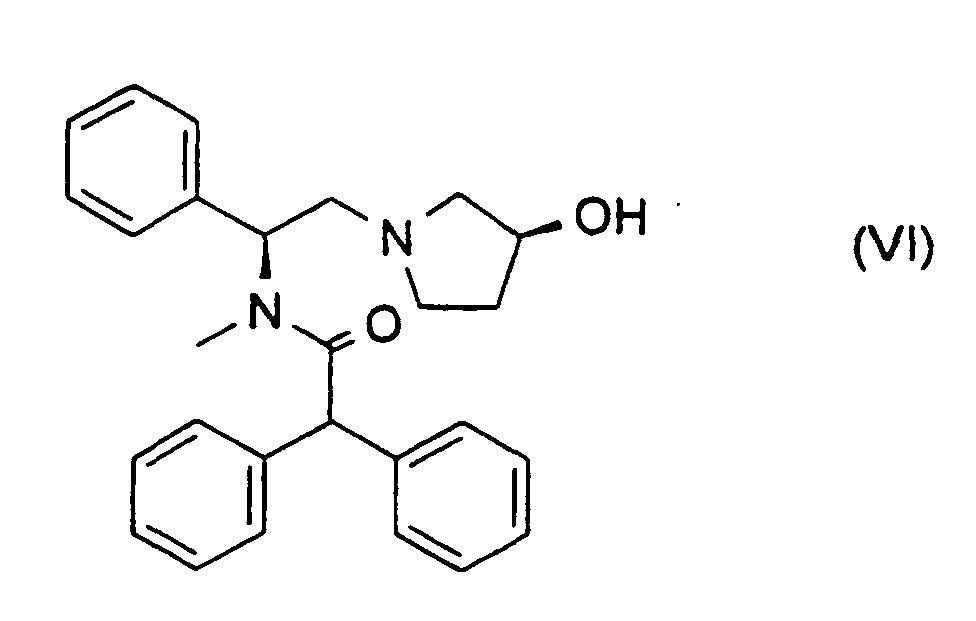
- the invention relates to a novel process for the selective preparation of N-methyl-N - [(1S) -1-phenyl-2 - ((3S) -3-hydroxypyrrolidine-1-yl) ethyl] -2,2-diphenylacetamide or N-methyl-N - [(1R) -1-phenyl-2 - ((3R) -3-hydroxypyrrolidin-1-yl) -ethyl] -2,2-diphenylacetamide.
- this compound is a particularly effective Compound that is inflammatory as a drug for treatment Bowel disease in a very special way.
- This compound can be used in this indication and effective as it simultaneously relieves the pain associated with this condition and in the acute case of a threat of inflammatory bowel disease or caused intestinal obstruction, the motor function of the intestine again normalized or restarted without any noticeable side effects cause.
- the compound may be non-inflammatory Bowel diseases such as IBS (Irritable Bowel Syndrome) are used.
- Object of the present invention was a simple way feasible and inexpensive process for preparing N-methyl-N - [(1S) -1-phenyl-2 - ((3S) -3-hydroxypyrrolidin-1-yl) -ethyl] -2,2-diphenylacetamide or when using the enantiomeric starting materials of N-methyl-N - [(1R) -1-phenyl-2 - ((3R) -3-hydroxypyrrolidin-1-yl) ethyl] -2,2-diphenylacetamide to To provide that from inexpensive, readily soluble starting materials resulting in the most enantiomerically pure product possible lead, then then isolated in a simple manner and can be cleaned.
- the object is achieved by a method according to claim 1, where either the compound N-methyl-N - [(1S) -1-phenyl-2 - ((3S) -3-hydroxypyrrolidin-1-yl) -ethane] -amine as an intermediate for the preparation of N-methyl-N - [(1S) -1-phenyl-2 - ((3S) -3-hydroxypyrrolidin-1-yl) ethyl] -2,2-diphenylacetamide or N-methyl-N - [(1R) -1-phenyl-2 - ((3R) -3-hydroxypyrrolidin-1-yl) -ethane] -amine as an intermediate for the preparation of N-methyl-N - [(1R) -1-phenyl-2 - ((3R) -3-hydroxypyrrolidin-1-yl) ethyl] -2,2-diphenylacetamide.
- Alkyl has 1 to 6, preferably 1, 2, 3 or 4 C atoms.
- Alkyl means preferably methyl, furthermore ethyl, propyl, isopropyl, butyl, isobutyl, sec-butyl or tert-butyl, and also pentyl, 1-, 2- or 3-methylbutyl, 1,1-, 1,2- or 2,2-dimethylpropyl, 1-ethylpropyl, hexyl, 1-, 2-, 3- or 4-methylpentyl, 1,1-, 1,2-, 1,3-, 2,2-, 2,3- or 3,3-dimethylbutyl, 1- or 2-ethylbutyl, 1-ethyl-1-methylpropyl, 1-ethyl-2-methylpropyl, 1,1,2- or 1,2,2-trimethyl-propyl.
- Aryl is preferably unsubstituted phenyl or on or phenyl substituted twice by Hal, OA or alkyl, ferric e.g. Biphenyl or naphthyl.
- Heteroaryl preferably means e.g. Furanyl, thiophenyl, pyridinyl, Pyrrolyl or thiazolyl.
- Si (R 3 ) 3 is preferably, for example, Si (CH 3 ) 3 .
- COR 3 is preferably, for example, acetyl or benzoyl.
- R is preferably in particular, e.g. Methoxy or ethoxy.
- R 1 is, for example, methyl, ethyl, propyl, butyl, phenyl, Si (CH 3 ) 3 or acetyl.
- R 2 is in particular, for example, H, tert-butyl, Si (CH 3 ) 3 , acetyl, benzyl or benzoyl, very particularly preferably H.
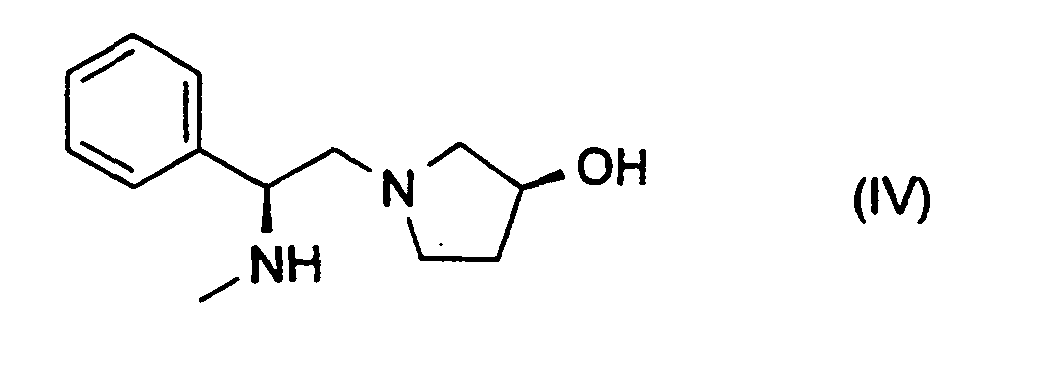
- the prepared amides of formula (III) can be in a simple manner reductive, if appropriate by removal of the protective group of Hydroxyl group of pyrrolidine in N-methyl-N - [(1S) -1-phenyl-2 - ((3S) -3-hydroxypyrrolidin-1-yl) ethan] amine or N-methyl-N - [(1R) -1-phenyl-2 - ((3R) -3-hydroxypyrrolidin-1-yl) -ethane] -amine of the formula (IV).
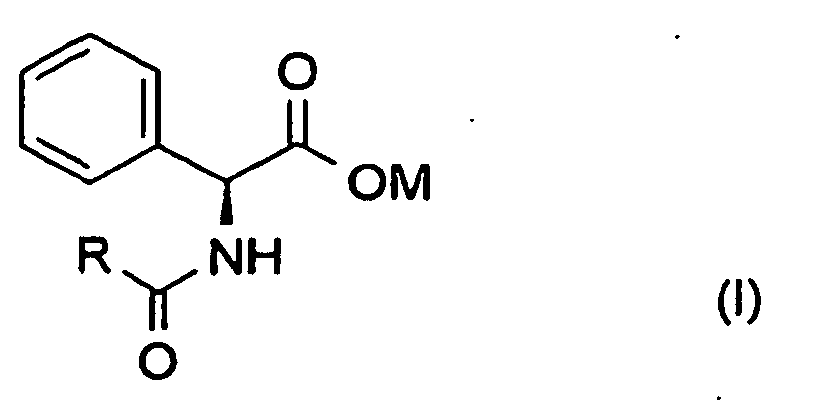
- the intermediately synthesized compounds of the formula (IV) can generally be obtained by reacting compounds of the formula (I) with those of the formula (II).
- R is OR 1 where R 1 A, aryl, heteroaryl, Si (R 3 ) 3 or COR 2 and R 2 are H, alkyl, aryl or heteroalkyl, with the preferred meanings given above possesses.
- the reaction of the compounds (I) and (II) may be in any aprotic solvents.
- Particularly suitable are polar aprotic solvents from the group of diethyl ether, petroleum ether, Acetone, nitrobenzene, dimethylformamide, dimethyl sulfoxide or others corresponding solvents.
- the starting materials in so much Solvent received a 10 to 30 percent solution is obtained.
- the reaction is in tetrahydrofuran as Stirred solvent.
- auxiliary reagent may be adjuvants that are also used as peptide coupling reagents.
- Suitable compounds are such as phosphorus oxytrichloride, phosphorus halides of valence III and V, phosgene, dicyclohexylcarbodiimide, tributylammonium salt of pyridine, phenyldichlorophosphate, 2-chloro-1,2,3-trinitrobenzene, phosphoric acid esters, chlorosulfonyl isocyanate, CH 3 SO 2 Cl- (C 2 H 5 ) 3 N, (C 6 H 5 ) 3 P-CCl 4 - (C 2 H 5 ) 3 N, N, N'-carbonyldiimidazole, N- (alkylcarbonyl) imidazoles, acid anhydrides or acid chlorides and in particular alkyl chloroformates, such as chloroformate.
- Other suitable auxiliary reagents are such as phosphorus oxyt
- a base is required. Suitable are also from the above-mentioned textbooks. Such bases For example, tertiary amines, such as. B. triethylamine. But it can also inorganic bases are added. As inorganic bases Carbonates are particularly suitable. When using the alkali hydroxides, such as NaOH or KOH is especially on a precise dosage to pay attention, otherwise it comes to unwanted side reactions. to However, it is also possible to simplify the workup of the hydroxypyrrolidine to use in excess, so that it acts as a base itself.
- the work-up of the resulting reaction product (III) can after the Filter off the accumulated precipitate by laboratory methods taken from the filtrate.
- the method of distilling off the solvent is the crude product resume in an organic solvent, the obtained Solution with water to extract several times, the solvent again distill off and the product obtained by recrystallization a suitable solvent, such as. B. from methanol to recrystallize.
- a suitable solvent such as. B. from methanol to recrystallize.
- reaction product (III) is obtained as a free base or as an acid addition salt of the acids HCl, HBr, HI, H 2 SO 4 or an organic carboxylic acid from an aqueous solvent mixture.
- the isolation after the phase separation can be carried out according to laboratory methods.
- Suitable organic carboxylic acids in particular aliphatic, alicyclic, araliphatic, aromatic or heterocyclic or polybasic carboxylic, sulfonic or sulfuric acids, e.g. formic acid, Acetic acid, propionic acid, pivalic acid, diethylacetic acid, malonic acid, Succinic acid, pimelic acid, fumaric acid, maleic acid, lactic acid, Tartaric acid, malic acid, citric acid, gluconic acid, ascorbic acid.
- sulfonic or sulfuric acids e.g. formic acid, Acetic acid, propionic acid, pivalic acid, diethylacetic acid, malonic acid, Succinic acid, pimelic acid, fumaric acid, maleic acid, lactic acid, Tartaric acid, malic acid, citric acid, gluconic acid, ascorbic acid.
- Nicotinic acid isonicotinic acid, methane or ethanesulfonic acid, Ethanedisulfonic acid, 2-hydroxyethanesulfonic acid, benzenesulfonic acid, p-toluenesulfonic acid, Naphthalene mono- and di-sulphonic acids, laurylsulphuric acid be used.
- Suitable hydride transfer reagents are those from the group of metal aluminum hydrides, preferably lithium aluminum hydride, metal alkoxy-aliminiumhydride, such as.
- Metallborhydride preferably NaBH 4 , or borane, wherein additionally the presence of a Lewis acid is required, such.
- the reduction is preferably in a polar aprotic and hydride-inert Solvent carried out. Suitable are the same as above already mentioned. Particularly suitable z. For example, diethyl ether or tetrahydrofuran.
- a compound of the formula (III) in dissolved in a suitable solvent and a solution containing the Hydride transfer reagent in equimolar amounts or in slight excess contains, added with warming.
- the reaction is the reaction mixture for several hours under Reflux conditions stirred.
- the reaction solution is subsequently prepared by methods known in the art by u. a.
- a solvent mixture consisting of a proton-providing and an aprotic solvent
- the excess hydride transfer reagent decomposes and the reaction product is released.
- Proton-delivering solvents are for.
- water or alcohols such Ethanol or methanol suitable.
- aprotic solvents are all above-mentioned polar aprotic solvent suitable, in particular Tetrahydrofuran. The latter is preferably used since it technically available as anhydrous product.
- the product work-up can after the phase separation after laboratory usual Methods are done.
- the crude product obtained can by Crystallization methods are worked up or it is for processing for example, in an organic water-immiscible Solvent and an excess of an inorganic Acid, preferably hydrochloric acid, added. That way formed salt can then be separated in crystalline form.
- (2S) -N-formyl-2-phenylglycine (obtainable from (S) - (+) - alpha-amino-phenylacetic acid and acetic anhydride / formic acid according to Huszthy, Peter: Oue, Masatoshi, Bradshaw, Jerald S .; Cheng Y. Wang, Tingmin, et al., J. Org.
Landscapes
- Chemical & Material Sciences (AREA)
- Organic Chemistry (AREA)
- Health & Medical Sciences (AREA)
- Animal Behavior & Ethology (AREA)
- Veterinary Medicine (AREA)
- Chemical Kinetics & Catalysis (AREA)
- Public Health (AREA)
- Medicinal Chemistry (AREA)
- General Health & Medical Sciences (AREA)
- Pharmacology & Pharmacy (AREA)
- Life Sciences & Earth Sciences (AREA)
- General Chemical & Material Sciences (AREA)
- Nuclear Medicine, Radiotherapy & Molecular Imaging (AREA)
- Engineering & Computer Science (AREA)
- Bioinformatics & Cheminformatics (AREA)
- Diabetes (AREA)
- Hematology (AREA)
- Epidemiology (AREA)
- Pain & Pain Management (AREA)
- Rheumatology (AREA)
- Pyrrole Compounds (AREA)
- Pharmaceuticals Containing Other Organic And Inorganic Compounds (AREA)
- Organic Low-Molecular-Weight Compounds And Preparation Thereof (AREA)
Abstract
Description

- R
- OR1 oder SR1,
- R1
- A, Aryl, Heteroaryl, Si(R3)3 oder COR3,
- R2
- H, A, Aryl, Heteroaryl sowie Si(R3)3 oder COR3,
- R3
- H, A, Aryl oder Heteroaryl,
- A
- geradkettiger oder verzweigter Alkylrest mit 1 bis 6 C-Atomen,
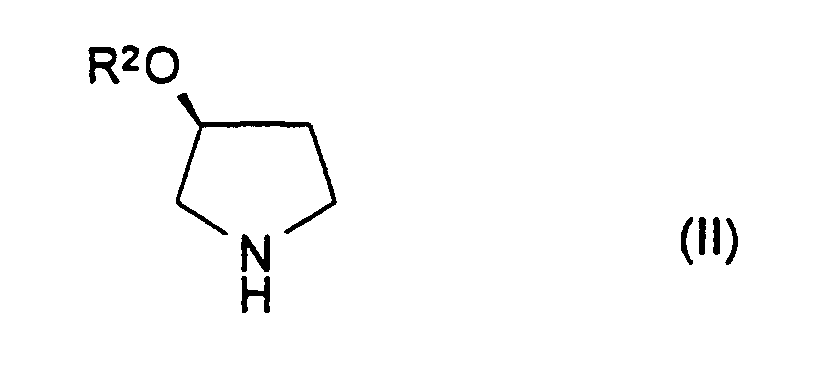
- R2
- H, A, Aryl, Heteroaryl sowie Si(R3)3 oder COR3 und
- R3
- H, A, Aryl oder Heteroaryl
mit entsprechenden (S)- oder (R)-enantiomeren Formen von N-substituierten Phenylglycinen der Formel (I)
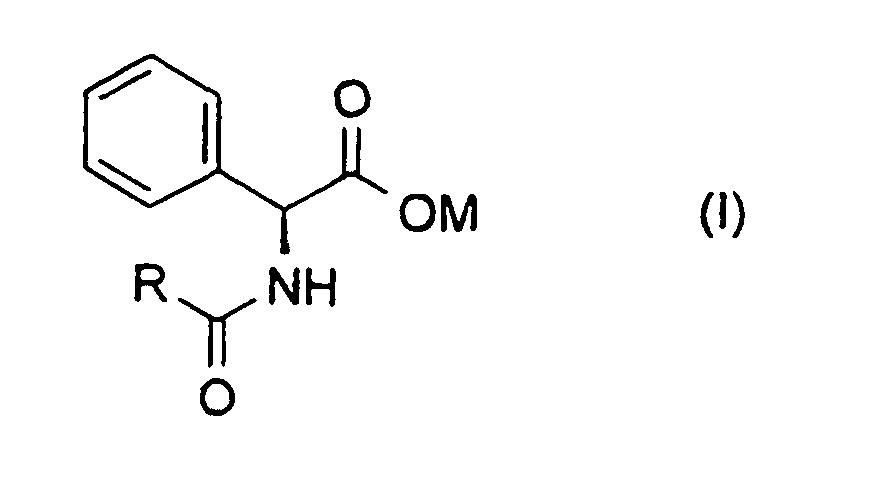
- R
- OR1 oder SR1,
- R1
- A, Aryl, Heteroaryl, Si(R3)3 oder COR3,
- R3
- H, A, Aryl oder Heteroaryl,
- M
- H oder ein Kation aus der Gruppe Alkali, Erdalkali, Ammonium oder Alkylammonium
amidisch gekuppelt werden.

- R4
- F, Cl, Br, I, OA oder O-CO-A
lassen sich aus den freien Basen der Verbindungen der Formel (IV)
und
(3S)-3-Hydroxypyrrolidin (erhältlich aus kommerziellem (S)-1-Benzyl-3-pyrrolidinol z.B. nach Bhat, Krishna L.; Flanagan, Denise M.; Joullie, Madeleine M., Synth.Commun., EN, 15 (7) [1985] 587-598 oder Naylor, Alan: Judd, Duncan B.; Scopes, David I. C.; Hayes, Ann G.; Birch, Philip J., J.Med.Chem., EN, 37 (14) [1994] 2138-2144):
1H-NMR: D6-DMSO; 3,0-3,8 (m), 4,25 (d), 5,0 (s,br), 5,7 (dd), 7,4 (ArH), 8,0 (ArH), 8,8 (CHO):
MS-FAB: (M+1)+ 221, 205;
Kristalle Fp.: 97-101°C;
[α]D 20 = +208, c=1 in Methanol.
und
(3S)-3-Hydroxypyrrolidin (erhältlich aus kommerziellem (S)-1-Benzyl-3-pyrrolidinol z.B. nach Bhat, Krishna L.; Flanagan, Denise M.; Joullie, Madeleine M., Synth.Commun., EN, 15 (7) [1985] 587-598 oder Naylor, Alan; Judd, Duncan B.; Scopes, David I. C.; Hayes, Ann G.; Birch, Philip J., J.Med.Chem., EN, 37 (14) [1994] 2138-2144):
Unter Stickstoffatmosphäre werden 14,3 g (2S)-N-Carboxy-benzyl-2-phenylglycin in 100 ml Tetrahydrofuran in der Kälte mit 5,5 ml 4-Methylmorpholin und einer Lösung aus 4,8 ml Ethylchlorformiat und 10 ml Tetrahydrofuran versetzt und dann 30 min gerührt. Dann wird eine Lösung aus 4.36 g (3S)-3-Hydroxypyrrolidin und 10 ml Tetrahydrofuran zugeben. Nach 18 Stunden Rühren wird der angefallene Niederschlag abgetrennt und das gebildete (2S)-N-Carboxybenzyl-2-phenylglycin-N,N-[(3S)-3-hydroxy-tetramethylenamid mit laborüblichen Methoden durch Aufkonzentrieren, Aufnehmen in einem organischen Solvens, Waschen
mit einer wäßrigen Phase, erneutes Aufkonzentrieren und Kristallisation aus dem Filtrat isoliert.
1H-NMR: D6-DMSO+TFA; 5,1 (s), PhCH 2R;
FAB-MS: 355 (M+1)+, 311, 196, 176;
Konsistenz: Öl;
[α]D 20 = + 108, c=1 in Methanol.
und
(3S)-3-Hydroxypyrrolidin (erhältlich aus kommerziellem (S)-1-Benzyl-3-pyrrolidinol z.B. nach Bhat, Krishna L.; Flanagan, Denise M.; Joullie, Madeleine M., Synth.Commun., EN, 15 (7) [1985] 587-598 oder Naylor, Alan; Judd, Duncan B.; Scopes, David I. C.; Hayes, Ann G.; Birch, Philip J., J.Med.Chem., EN, 37 (14) [1994] 2138-2144)
1H-NMR: D6-DMSO; 1,2 (t), 3 - 3,8 (m, br), 4,05 (q), 4,25 (s, br), 7,25-7,45 (m);
MS: 293 (M+1)+, 247, 178, 106;
Kristalle Fp.: 124-126°C;
[α]D 20 = + 137 C = 1 in Methanol.
1H-NMR: D6-DMSO; 2,1-3,1(m), 3,6(dd), 4,3(m), 7,15-7,35 (m);
MS: 220 (M+), 205, 120, 100, 91;
Aussehen: gelbliches Öl, welches chargenabh. durchkristallisiert;
[α]D 20 = + 66,8; c = 0,0938 g in 10 ml Methanol.
1H-NMR: D6-DMSO; 3,4(m), 3,8(m), 4,2(m), 4,4(m), 4,9(m), 7,5 u. 7,8 (ArH);
Schmelzpunkt: 240-242°C;
[α]D 20 = -22.4; c=1 in Wasser.
Claims (8)
- Verfahren zur wahlweisen Herstellung von N-Methyl-N-[(1S)-1-phenyl-2-((3S)-3-hydroxypyrrolidin-1-yl)ethyl]-2,2-diphenylacetamid oder N-Methyl-N-[(1R)-1-phenyl-2-((3R)-3-hydroxypyrrolidin-1-yl)ethyl]-2,2-diphenylacetamid, dadurch gekennzeichnet, daßdie gegebenenfalls mit einer anorganischen Säure aus der Gruppe HCl, HBr, HI, Schwefelsäure, Sulfaminsäure, Salpetersäure, Phosphorsäure, Orthophosphorsäure, oder mit einer organischen Säure in das zugehörige Säureadditionssalz überführt wird,a) ein N-substituiertes Phenylglycinderivat der Formel Iworin
- R
- OR1 oder SR1,
- R1
- A, Aryl, Heteroaryl, Si(R3)3 oder COR3,
- R3
- H, A, Aryl oder Heteroaryl,
- A
- geradkettiger oder verzweigter Alkylrest mit 1 bis 6 C-Atomen,
- M
- H oder ein Kation aus der Gruppe Alkali-, Erdalkali-Ammonium- oder Alkylammonium
bedeuten,
mit einer Verbindung der Formel IIworin
- R2
- H, A, Aryl, Heteroaryl, Si(R3)3 oder COR3
und - R3
- H, A, Aryl oder Heteroaryl
oder mit einem Säureadditionssalz der Verbindung der Formel (II), der Säuren HCl, HBr, HI, H2SO4, H3PO4 oder einer organischen Carbonsäure, zu einer Verbindung der Formel IIIworin R und R2 die oben gegebenen Bedeutungen haben,
umgesetzt wird,b) anschließend durch Reduktion in eine Verbindung der Formel (IV)umgesetzt wird, die gegebenenfalls in ein entsprechendes Säureadditionssalze der Säuren HCl, HBr, HI, H2SO4, H3PO4 oder in ein Salz einer organischen Carbonsäure umgewandelt wird, und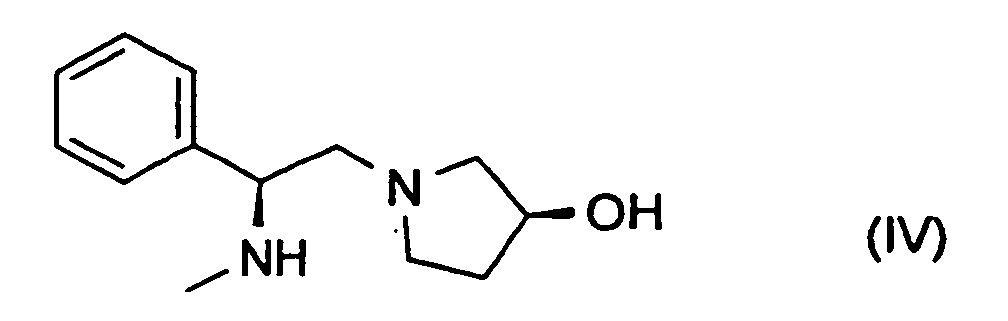 c) die so erhaltene Verbindung der Formel (IV) mit einer aktivierten Carbonsäure der Formel (V)worin
- R4
- F, Cl, Br, I, OA oder O-CO-A,
zu der Verbindung der Formel (VI)umgesetzt wird,
wobei in Stufe a) Edukte in Abhängigkeit vom als Endprodukt gewünschten Enantiomeren eingesetzt werden. - Verfahren gemäß Anspruch 1, dadurch gekennzeichnet, daß Verbindungen der Formel (I) verwendet werden, in denen R die Bedeutung OR1 mit R1 A, Aryl, Heteroaryl, Si(R3)3 oder COR3 und R3 H, A, Aryl oder Heteroalkyl besitzt.
- Verfahren gemäß der Ansprüche 1 und/oder 5, dadurch gekennzeichnet, daß die Umsetzung der Verbindungen (I) und (II) in einem aprotischen, vorzugsweise polaren aprotischen Lösungsmittel bei einer Temperatur von 0 bis 50 °C, vorzugsweise bei Temperaturen zwischen 20 und 30 °C, erfolgt.
- Verfahren gemäß einem oder mehreren der Ansprüche 1, 5 und 6, dadurch gekennzeichnet, daß die Umsetzung der Verbindungen (I) und (II) in einem Lösungsmittel aus der Gruppe Dieethylether, Petrolether, Aceton, Nitrobenzol, Dimethylformamid, Dimethylsulfoxid, Tetrahydrofuran durchgeführt wird, wobei die Edukte in dem Lösungsmittel in einer Konzentration von 10 bis 30 % vorliegen.
- Verfahren gemäß einem oder mehreren der Ansprüche 1, 5 bis 7, dadurch gekennzeichnet, daß die Umsetzung der Verbindungen (I) und (II) in Gegenwart eines Hilfsreagenzes aus der Gruppe Phosphoroxytrichlorid, Phosphorhalogenide der Wertigkeit III und V, Phosgen, Dicyclohexylcarbodiimid, Tributylammoniumsalz des Pyridins, Phenyldichlorphosphat, 2-Chlor-1,2,3-trinitrobenzol, Phosphorsäureester, Chlorsulfonylisocyanat, CH3SO2Cl-(C2H5)3N, (C6H5)3P-CCl4-(C2H5)3N, N,N'-Carbonyldiimidazol, N-(Alkylcarbonyl)-imidazole, Acetanhydrid, Essigsäurechlorid und Chlorameisensäureethylester sowie einer organischen oder anorganischen Base erfolgt.
- Verfahren gemäß einem oder mehreren der Ansprüche 1, 5 bis 8, dadurch gekennzeichnet, daß die Umsetzung der Verbindungen (I) und (II) in Gegenwart einer Base aus der Gruppe Triethylamin, Natriumcarbonat, Kaliumcarbonat, Kalziumcarbonat, NaOH, KOH erfolgt.
- Verfahren gemäß einem oder mehreren der Ansprüche 1, 5 bis 9 dadurch gekennzeichnet, daß die Reduktion der Verbindungen der Formel (III) in Gegenwart eines Hydridtransfer-Reagenzes aus der Gruppe der Metallaluminiumhydride, vorzugsweise Lithiumaluminiumhydrid, der Metall-Alkoxy-aliminiumhydride, vorzugsweise Li-Triethoxyaluminiumhydrid, der Metallborhydride, vorzugsweise NaBH4, oder Boran, sowie gegebenenfalls in Gegenwart einer Lewissäure, wie Bortrifluorid, in einem polaren aprotischen Lösungsmittel aus der Gruppe Dieethylether, Petrolether, Aceton, Nitrobenzol, Dimethylformamid, Dimethylsulfoxid, Tetrahydrofuran erfolgt.
- Verfahren gemäß den Ansprüchen 1 und/oder 10, dadurch gekennzeichnet, daß eine Verbindung der Formel (III) als Edukt in einem Lösungsmittel in einer Konzentration von 10 bis 25 % gelöst wird und das Hydrierungsprodukt durch Zugabe eines protonenliefernden Lösungsmittels im Gemisch mit einem aprotischen Lösungsmittel freigesetzt wird.
Priority Applications (3)
| Application Number | Priority Date | Filing Date | Title |
|---|---|---|---|
| SI9930848T SI1073634T1 (sl) | 1998-04-20 | 1999-04-16 | Postopek za izdelavo enantiomerno cistega n-metil-n-(1s)-1-fenil-2-((3s)-3-hidroksipirolidin-1-il)etil)-2,2-difen= ilacetamida |
| EP05016750A EP1607090B1 (de) | 1998-04-20 | 1999-04-16 | Asimadolin für die Behandlung des Irritable Bowel Syndroms |
| DK05016750.1T DK1607090T3 (da) | 1998-04-20 | 1999-04-16 | Asimadolin til behandling af irritabel tyktarm (Irritable Bowel Syndrome) |
Applications Claiming Priority (5)
| Application Number | Priority Date | Filing Date | Title |
|---|---|---|---|
| DE19817393 | 1998-04-20 | ||
| DE19817393 | 1998-04-20 | ||
| DE19827633 | 1998-06-20 | ||
| DE19827633A DE19827633A1 (de) | 1998-04-20 | 1998-06-20 | Verfahren zur Herstellung von enantiomerenreinem N-Methyl-N-[(1S)-1-phenyl-2-((3S)-3-hydroxypyrrolidin-1-yl)ethyl]-2,2-diphenylacetamid |
| PCT/EP1999/002574 WO1999054298A1 (de) | 1998-04-20 | 1999-04-16 | Verfahren zur herstellung von enantiomerenreinem n-methyl- n-[(1s)- 1-phenyl- 2-((3s)-3- hydroxypyrrolidin- 1-yl)ethyl]- 2,2- diphenylacetamid |
Publications (2)
| Publication Number | Publication Date |
|---|---|
| EP1073634A1 EP1073634A1 (de) | 2001-02-07 |
| EP1073634B1 true EP1073634B1 (de) | 2005-08-31 |
Family
ID=7865063
Family Applications (2)
| Application Number | Title | Priority Date | Filing Date |
|---|---|---|---|
| EP99923421A Expired - Lifetime EP1073634B1 (de) | 1998-04-20 | 1999-04-16 | Verfahren zur herstellung von enantiomerenreinem n-methyl- n- (1s)- 1-phenyl- 2-((3s)-3- hydroxypyrrolidin- 1-yl)ethyl]- 2,2- diphenylacetamid |
| EP05016750A Expired - Lifetime EP1607090B1 (de) | 1998-04-20 | 1999-04-16 | Asimadolin für die Behandlung des Irritable Bowel Syndroms |
Family Applications After (1)
| Application Number | Title | Priority Date | Filing Date |
|---|---|---|---|
| EP05016750A Expired - Lifetime EP1607090B1 (de) | 1998-04-20 | 1999-04-16 | Asimadolin für die Behandlung des Irritable Bowel Syndroms |
Country Status (27)
| Country | Link |
|---|---|
| US (1) | US6344566B1 (de) |
| EP (2) | EP1073634B1 (de) |
| JP (1) | JP4688292B2 (de) |
| KR (1) | KR100649175B1 (de) |
| CN (2) | CN1310884C (de) |
| AR (2) | AR019080A1 (de) |
| AT (2) | ATE527999T1 (de) |
| AU (2) | AU761721B2 (de) |
| BR (1) | BR9909731A (de) |
| CA (1) | CA2329210C (de) |
| CY (1) | CY1112314T1 (de) |
| CZ (1) | CZ301121B6 (de) |
| DE (2) | DE19827633A1 (de) |
| DK (2) | DK1607090T3 (de) |
| ES (2) | ES2251194T3 (de) |
| HU (1) | HUP0101600A3 (de) |
| MY (1) | MY120471A (de) |
| NO (1) | NO317984B1 (de) |
| PL (1) | PL206969B1 (de) |
| PT (1) | PT1607090E (de) |
| RU (1) | RU2298549C2 (de) |
| SI (2) | SI1607090T1 (de) |
| SK (2) | SK288016B6 (de) |
| TW (1) | TWI249524B (de) |
| UA (1) | UA73472C2 (de) |
| WO (1) | WO1999054298A1 (de) |
| ZA (1) | ZA200006689B (de) |
Cited By (1)
| Publication number | Priority date | Publication date | Assignee | Title |
|---|---|---|---|---|
| US8877800B2 (en) | 2007-03-30 | 2014-11-04 | Tioga Pharmaceuticals, Inc. | Kappa-opiate agonists for the treatment of diarrhea-predominant irritable bowel syndrome |
Families Citing this family (7)
| Publication number | Priority date | Publication date | Assignee | Title |
|---|---|---|---|---|
| DE10259245A1 (de) * | 2002-12-17 | 2004-07-01 | Merck Patent Gmbh | Derivate des Asimadolins mit kovalent gebundenen Säuren |
| CA2544245A1 (en) * | 2003-10-30 | 2005-05-26 | Tioga Pharmaceuticals, Inc. | Use of selective opiate receptor modulators in the treatment of neuropathy |
| US20070160559A1 (en) * | 2006-01-12 | 2007-07-12 | Roszell James A | Skin disinfectant composition and methods for using |
| CN103664727A (zh) * | 2013-12-19 | 2014-03-26 | 无锡万全医药技术有限公司 | 一种一锅法制备1-[(3s)-3-羟基吡咯烷-1-基]-(2s)-2-甲氨基-2-苯基乙烷的工艺 |
| CN103772257A (zh) * | 2013-12-31 | 2014-05-07 | 无锡万全医药技术有限公司 | 一种制备2-((3s)-3-羟基吡咯烷-1-基)-(1s)-1-苯乙基氨基甲酸酯的方法 |
| US10736871B2 (en) | 2015-04-01 | 2020-08-11 | Cedars-Sinai Medical Center | Anti-methanogenic lovastatin analogs or derivatives and uses thereof |
| CN112574068A (zh) * | 2020-11-17 | 2021-03-30 | 万华化学(宁波)有限公司 | 一种低色号高稳定性碳化二亚胺改性异氰酸酯的制备方法 |
Citations (1)
| Publication number | Priority date | Publication date | Assignee | Title |
|---|---|---|---|---|
| DE4034785A1 (de) * | 1990-11-02 | 1992-05-07 | Merck Patent Gmbh | 1-(2-arylethyl)-pyrrolidine |
Family Cites Families (7)
| Publication number | Priority date | Publication date | Assignee | Title |
|---|---|---|---|---|
| US5232978A (en) * | 1988-12-23 | 1993-08-03 | Merck Patent Gesellschaft Mit Beschrankter Haftung | 1-(2-arylethyl)-pyrrolidines |
| DE4215213A1 (de) * | 1992-05-09 | 1993-11-11 | Merck Patent Gmbh | Arylacetamide |
| DE4425071C2 (de) * | 1994-07-15 | 1996-08-29 | Degussa | Verfahren zur Herstellung optisch aktiver Pyrrolidine mit hoher Enantiomerenreinheit |
| DE19523502A1 (de) * | 1995-06-28 | 1997-01-02 | Merck Patent Gmbh | Kappa-Opiatagonisten für entzündliche Darmerkrankungen |
| DE19531464A1 (de) * | 1995-08-26 | 1997-02-27 | Merck Patent Gmbh | N-Methyl-N-[(1S-)-1-phenyl-2-((3S)-3-hydroxypyrrolidin 1-yl-)-ethyl]-2,2-diphenyl-acetamid |
| AU3384697A (en) * | 1996-07-24 | 1998-02-10 | Warner-Lambert Company | Diphenyl-cyclopropenes as selective k-agonists |
| DE19647538A1 (de) * | 1996-11-16 | 1998-05-20 | Merck Patent Gmbh | Verfahren zur Herstellung von enantiomerenreinem N-Methyl-N-[1-phenyl-2-(-3-hydroxypyrrolidin-1-yl)ethyl]-2,2-diphenylacetamid |
-
1998
- 1998-06-20 DE DE19827633A patent/DE19827633A1/de not_active Withdrawn
-
1999
- 1999-04-16 HU HU0101600A patent/HUP0101600A3/hu unknown
- 1999-04-16 UA UA2000116543A patent/UA73472C2/uk unknown
- 1999-04-16 EP EP99923421A patent/EP1073634B1/de not_active Expired - Lifetime
- 1999-04-16 ES ES99923421T patent/ES2251194T3/es not_active Expired - Lifetime
- 1999-04-16 ES ES05016750T patent/ES2375384T3/es not_active Expired - Lifetime
- 1999-04-16 EP EP05016750A patent/EP1607090B1/de not_active Expired - Lifetime
- 1999-04-16 KR KR1020007011480A patent/KR100649175B1/ko not_active Expired - Fee Related
- 1999-04-16 BR BR9909731-1A patent/BR9909731A/pt not_active Application Discontinuation
- 1999-04-16 JP JP2000544639A patent/JP4688292B2/ja not_active Expired - Fee Related
- 1999-04-16 CN CNB998052469A patent/CN1310884C/zh not_active Expired - Fee Related
- 1999-04-16 RU RU2000128663/04A patent/RU2298549C2/ru not_active IP Right Cessation
- 1999-04-16 AT AT05016750T patent/ATE527999T1/de active
- 1999-04-16 SI SI9931065T patent/SI1607090T1/sl unknown
- 1999-04-16 DK DK05016750.1T patent/DK1607090T3/da active
- 1999-04-16 AU AU40311/99A patent/AU761721B2/en not_active Ceased
- 1999-04-16 AR ARP990101758A patent/AR019080A1/es active IP Right Grant
- 1999-04-16 DK DK99923421T patent/DK1073634T3/da active
- 1999-04-16 AT AT99923421T patent/ATE303361T1/de active
- 1999-04-16 WO PCT/EP1999/002574 patent/WO1999054298A1/de not_active Ceased
- 1999-04-16 DE DE59912502T patent/DE59912502D1/de not_active Expired - Lifetime
- 1999-04-16 CN CNA2006100710951A patent/CN1846696A/zh active Pending
- 1999-04-16 SK SK5006-2008A patent/SK288016B6/sk not_active IP Right Cessation
- 1999-04-16 SK SK1557-2000A patent/SK286442B6/sk not_active IP Right Cessation
- 1999-04-16 SI SI9930848T patent/SI1073634T1/sl unknown
- 1999-04-16 PT PT05016750T patent/PT1607090E/pt unknown
- 1999-04-16 CA CA002329210A patent/CA2329210C/en not_active Expired - Fee Related
- 1999-04-16 PL PL343556A patent/PL206969B1/pl unknown
- 1999-04-16 CZ CZ20003860A patent/CZ301121B6/cs not_active IP Right Cessation
- 1999-04-19 MY MYPI99001517A patent/MY120471A/en unknown
- 1999-04-20 TW TW088106298A patent/TWI249524B/zh not_active IP Right Cessation
-
2000
- 2000-10-19 NO NO20005259A patent/NO317984B1/no not_active IP Right Cessation
- 2000-11-16 ZA ZA200006689A patent/ZA200006689B/en unknown
-
2001
- 2001-01-26 US US09/647,813 patent/US6344566B1/en not_active Expired - Lifetime
-
2003
- 2003-09-29 AU AU2003248428A patent/AU2003248428B2/en not_active Ceased
-
2008
- 2008-05-06 AR ARP080101910A patent/AR066455A2/es unknown
-
2012
- 2012-01-05 CY CY20121100015T patent/CY1112314T1/el unknown
Patent Citations (1)
| Publication number | Priority date | Publication date | Assignee | Title |
|---|---|---|---|---|
| DE4034785A1 (de) * | 1990-11-02 | 1992-05-07 | Merck Patent Gmbh | 1-(2-arylethyl)-pyrrolidine |
Non-Patent Citations (1)
| Title |
|---|
| PINNA G. ET AL: "Synthesis and kappa binding affinity of 1-(pyrrolidin-1-ylmethyl)-2-(N-methyl)-4-[(3,4-dichloro)phenyl]-1,2,3,4-tetrahydroisoquinolin-3(2H)-ones", EUROPEAN JOURNAL OF MEDICINAL CHEMISTRY, EDITIONS SCIENTIFIQUE, vol. 30, no. 6, 1995, ELSEVIER, PARIS, FR, pages 515 - 520 * |
Cited By (1)
| Publication number | Priority date | Publication date | Assignee | Title |
|---|---|---|---|---|
| US8877800B2 (en) | 2007-03-30 | 2014-11-04 | Tioga Pharmaceuticals, Inc. | Kappa-opiate agonists for the treatment of diarrhea-predominant irritable bowel syndrome |
Also Published As
Similar Documents
| Publication | Publication Date | Title |
|---|---|---|
| CH633544A5 (de) | Verfahren zur herstellung von thiazolessigsaeureverbindungen. | |
| DE4219158A1 (de) | Biphenylderivate, diese Verbindungen enthaltende Arzneimittel und Verfahren zu ihrer Herstellung | |
| DE2901170C2 (de) | ||
| DE60204334T2 (de) | Verfahren zur Herstellung von Repaglinid | |
| EP1607090B1 (de) | Asimadolin für die Behandlung des Irritable Bowel Syndroms | |
| DE2903891C2 (de) | ||
| EP0110869A1 (de) | Thienylessigsäureamidderivate und pharmazeutisch verträgliche Säureadditionssalze hiervon sowie Verfahren zu deren Herstellung | |
| EP0217018B1 (de) | Verfahren zur Herstellung von 3-Aminoacrylsäureestern | |
| DE2065312C3 (de) | Aminoäthansulfonylderivate und Verfahren zu ihrer Herstellung | |
| EP0336250B1 (de) | Verfahren zur Herstellung von 5-gliedrigen, stickstoffhaltigen Heteroaromaten | |
| EP0216324A2 (de) | 4-Alkoxy-3-pyrrolin-2-on-1-yl-essigsäurealkyl- bzw. -benzylester sowie deren Herstellung | |
| DD247217A5 (de) | Verfahren zur herstellung von 2,6,-dimethyl-4-(3'-nitrophenyl)-1,4-dihydropyridin-3,5-dicarbonsaeure-3 beta (n-benzyl-n-methylamino)-ethylester-5-methylester und dessen hydrochlorid-salz | |
| CH668424A5 (de) | 4-benzyloxy-3-pyrrolin-2-on-l-yl-acetamid, dessen herstellung und verwendung. | |
| DE602004002692T2 (de) | Verfahren zur Herstellung von Topiramate | |
| DE19647538A1 (de) | Verfahren zur Herstellung von enantiomerenreinem N-Methyl-N-[1-phenyl-2-(-3-hydroxypyrrolidin-1-yl)ethyl]-2,2-diphenylacetamid | |
| DE69406382T2 (de) | Verfahren zur Herstellung von N-Phenyl-N-(4-Piperidinyl)Amid-Derivaten | |
| DE2653251A1 (de) | Azabicyclo eckige klammer auf 3.1.o eckige klammer zu hexan-derivate, ihre herstellung und verwendung | |
| DE69514115T2 (de) | Verfahren zur herstellung von levobupivacain und analogue aus l-lysin | |
| DE2828888A1 (de) | Verfahren zur herstellung von pyridincarbonsaeureamiden | |
| CH650006A5 (en) | Process for the preparation of 5-fluorouracil derivatives | |
| AT401931B (de) | Verfahren zur herstellung von (s,s)-(n-(1- ethoxycarbonyl-3-oxo-3-phenylpropyl)-alanin)- (phenylmethyl)ester | |
| DE3877361T2 (de) | Aminosalze von alkan-1,n-dicarbonsaeure-mono-(2-sulfato-aethyl)amiden. | |
| DE2707404B2 (de) | Verfahren zur Herstellung von 5,6-Dehydropenicillinen | |
| EP0102929A2 (de) | Propylamin-Derivate, Verfahren zu ihrer Herstellung, pharmazeutische Präparate enthaltend diese Verbindungen, sowie ihre therapeutische Verwendung | |
| EP0301398A2 (de) | Verfahren zur Herstellung von N-[(4-Hydroxy-pyrrolidin-2-on-l-yl)-acetyl]-glycinamid |
Legal Events
| Date | Code | Title | Description |
|---|---|---|---|
| PUAI | Public reference made under article 153(3) epc to a published international application that has entered the european phase |
Free format text: ORIGINAL CODE: 0009012 |
|
| 17P | Request for examination filed |
Effective date: 20000913 |
|
| AK | Designated contracting states |
Kind code of ref document: A1 Designated state(s): AT BE CH CY DE DK ES FI FR GB GR IE IT LI LU NL PT SE |
|
| AX | Request for extension of the european patent |
Free format text: LT PAYMENT 20000913;LV PAYMENT 20000913;RO PAYMENT 20000913;SI PAYMENT 20000913 |
|
| 17Q | First examination report despatched |
Effective date: 20021205 |
|
| GRAP | Despatch of communication of intention to grant a patent |
Free format text: ORIGINAL CODE: EPIDOSNIGR1 |
|
| RTI1 | Title (correction) |
Free format text: METHOD FOR PRODUCING ENANTIOMERICALLY PURE N-METHYL-N- (1S)-1-PHENYL- 2-((3S)- 3-HYDROXYPYRROLIDINE- 1-YL)ETHYL)- 2,2-DI |
|
| GRAS | Grant fee paid |
Free format text: ORIGINAL CODE: EPIDOSNIGR3 |
|
| GRAA | (expected) grant |
Free format text: ORIGINAL CODE: 0009210 |
|
| AK | Designated contracting states |
Kind code of ref document: B1 Designated state(s): AT BE CH CY DE DK ES FI FR GB GR IE IT LI LU NL PT SE |
|
| AX | Request for extension of the european patent |
Extension state: LT LV RO SI |
|
| REG | Reference to a national code |
Ref country code: GB Ref legal event code: FG4D Free format text: NOT ENGLISH Ref country code: CH Ref legal event code: EP |
|
| REG | Reference to a national code |
Ref country code: IE Ref legal event code: FG4D Free format text: LANGUAGE OF EP DOCUMENT: GERMAN |
|
| REF | Corresponds to: |
Ref document number: 59912502 Country of ref document: DE Date of ref document: 20051006 Kind code of ref document: P |
|
| REG | Reference to a national code |
Ref country code: SE Ref legal event code: TRGR |
|
| GBT | Gb: translation of ep patent filed (gb section 77(6)(a)/1977) |
Effective date: 20051207 |
|
| REG | Reference to a national code |
Ref country code: DK Ref legal event code: T3 |
|
| RAP2 | Party data changed (patent owner data changed or rights of a patent transferred) |
Owner name: TIOGA PHARMACEUTICALS, INC. |
|
| REG | Reference to a national code |
Ref country code: GR Ref legal event code: EP Ref document number: 20050403675 Country of ref document: GR |
|
| REG | Reference to a national code |
Ref country code: GB Ref legal event code: 711B |
|
| NLT2 | Nl: modifications (of names), taken from the european patent patent bulletin |
Owner name: TIOGA PHARMACEUTICALS, INC. Effective date: 20060118 |
|
| REG | Reference to a national code |
Ref country code: GB Ref legal event code: 711L |
|
| REG | Reference to a national code |
Ref country code: ES Ref legal event code: FG2A Ref document number: 2251194 Country of ref document: ES Kind code of ref document: T3 |
|
| NLR4 | Nl: receipt of corrected translation in the netherlands language at the initiative of the proprietor of the patent | ||
| ET | Fr: translation filed | ||
| REG | Reference to a national code |
Ref country code: CH Ref legal event code: PUE Owner name: TIOGA PHARMACEUTICALS, INC. Free format text: MERCK PATENT GMBH#FRANKFURTER STRASSE 250#64293 DARMSTADT (DE) -TRANSFER TO- TIOGA PHARMACEUTICALS, INC.#C/O FORWARD VENTURES 9393 TOWNE CENTRE DRIVE, SUITE 200#SAN DIEGO, CA 92121 (US) |
|
| PLBE | No opposition filed within time limit |
Free format text: ORIGINAL CODE: 0009261 |
|
| STAA | Information on the status of an ep patent application or granted ep patent |
Free format text: STATUS: NO OPPOSITION FILED WITHIN TIME LIMIT |
|
| REG | Reference to a national code |
Ref country code: GB Ref legal event code: 732E |
|
| NLS | Nl: assignments of ep-patents |
Owner name: TIOGA PHARMACEUTICALS, INC. Effective date: 20060608 |
|
| 26N | No opposition filed |
Effective date: 20060601 |
|
| REG | Reference to a national code |
Ref country code: GB Ref legal event code: 711G |
|
| REG | Reference to a national code |
Ref country code: SE Ref legal event code: RPOT |
|
| BECA | Be: change of holder's address |
Owner name: *TIOGA PHARMACEUTICALS INC.C/O FORWARD VENTURES, 9 Effective date: 20050831 |
|
| BECH | Be: change of holder |
Owner name: *TIOGA PHARMACEUTICALS INC. Effective date: 20050831 |
|
| PG25 | Lapsed in a contracting state [announced via postgrant information from national office to epo] |
Ref country code: CY Free format text: LAPSE BECAUSE OF FAILURE TO SUBMIT A TRANSLATION OF THE DESCRIPTION OR TO PAY THE FEE WITHIN THE PRESCRIBED TIME-LIMIT Effective date: 20050831 |
|
| PGFP | Annual fee paid to national office [announced via postgrant information from national office to epo] |
Ref country code: ES Payment date: 20140311 Year of fee payment: 16 Ref country code: GR Payment date: 20140313 Year of fee payment: 16 |
|
| PGFP | Annual fee paid to national office [announced via postgrant information from national office to epo] |
Ref country code: LU Payment date: 20140502 Year of fee payment: 16 |
|
| PGFP | Annual fee paid to national office [announced via postgrant information from national office to epo] |
Ref country code: GB Payment date: 20140416 Year of fee payment: 16 Ref country code: IE Payment date: 20140410 Year of fee payment: 16 |
|
| PGFP | Annual fee paid to national office [announced via postgrant information from national office to epo] |
Ref country code: FI Payment date: 20140410 Year of fee payment: 16 Ref country code: CH Payment date: 20140414 Year of fee payment: 16 Ref country code: AT Payment date: 20140326 Year of fee payment: 16 Ref country code: FR Payment date: 20140409 Year of fee payment: 16 Ref country code: SE Payment date: 20140411 Year of fee payment: 16 Ref country code: IT Payment date: 20140417 Year of fee payment: 16 Ref country code: NL Payment date: 20140410 Year of fee payment: 16 Ref country code: DE Payment date: 20140430 Year of fee payment: 16 Ref country code: PT Payment date: 20140416 Year of fee payment: 16 |
|
| PGFP | Annual fee paid to national office [announced via postgrant information from national office to epo] |
Ref country code: BE Payment date: 20140414 Year of fee payment: 16 Ref country code: DK Payment date: 20140410 Year of fee payment: 16 |
|
| REG | Reference to a national code |
Ref country code: PT Ref legal event code: MM4A Free format text: LAPSE DUE TO NON-PAYMENT OF FEES Effective date: 20151016 |
|
| REG | Reference to a national code |
Ref country code: DE Ref legal event code: R119 Ref document number: 59912502 Country of ref document: DE |
|
| REG | Reference to a national code |
Ref country code: DK Ref legal event code: EBP Effective date: 20150430 |
|
| REG | Reference to a national code |
Ref country code: LT Ref legal event code: MM9D Effective date: 20150416 |
|
| PG25 | Lapsed in a contracting state [announced via postgrant information from national office to epo] |
Ref country code: LU Free format text: LAPSE BECAUSE OF NON-PAYMENT OF DUE FEES Effective date: 20150416 |
|
| REG | Reference to a national code |
Ref country code: CH Ref legal event code: PL |
|
| REG | Reference to a national code |
Ref country code: AT Ref legal event code: MM01 Ref document number: 303361 Country of ref document: AT Kind code of ref document: T Effective date: 20150416 Ref country code: SE Ref legal event code: EUG |
|
| GBPC | Gb: european patent ceased through non-payment of renewal fee |
Effective date: 20150416 |
|
| REG | Reference to a national code |
Ref country code: NL Ref legal event code: MM Effective date: 20150501 |
|
| REG | Reference to a national code |
Ref country code: IE Ref legal event code: MM4A |
|
| PG25 | Lapsed in a contracting state [announced via postgrant information from national office to epo] |
Ref country code: DE Free format text: LAPSE BECAUSE OF NON-PAYMENT OF DUE FEES Effective date: 20151103 Ref country code: CH Free format text: LAPSE BECAUSE OF NON-PAYMENT OF DUE FEES Effective date: 20150430 Ref country code: LI Free format text: LAPSE BECAUSE OF NON-PAYMENT OF DUE FEES Effective date: 20150430 Ref country code: GR Free format text: LAPSE BECAUSE OF NON-PAYMENT OF DUE FEES Effective date: 20151106 Ref country code: IT Free format text: LAPSE BECAUSE OF NON-PAYMENT OF DUE FEES Effective date: 20150416 Ref country code: FI Free format text: LAPSE BECAUSE OF NON-PAYMENT OF DUE FEES Effective date: 20150416 Ref country code: GB Free format text: LAPSE BECAUSE OF NON-PAYMENT OF DUE FEES Effective date: 20150416 |
|
| REG | Reference to a national code |
Ref country code: FR Ref legal event code: ST Effective date: 20151231 Ref country code: SI Ref legal event code: KO00 Effective date: 20151215 |
|
| REG | Reference to a national code |
Ref country code: GR Ref legal event code: ML Ref document number: 20050403675 Country of ref document: GR Effective date: 20151106 |
|
| PG25 | Lapsed in a contracting state [announced via postgrant information from national office to epo] |
Ref country code: PT Free format text: LAPSE BECAUSE OF NON-PAYMENT OF DUE FEES Effective date: 20151016 Ref country code: AT Free format text: LAPSE BECAUSE OF NON-PAYMENT OF DUE FEES Effective date: 20150416 Ref country code: FR Free format text: LAPSE BECAUSE OF NON-PAYMENT OF DUE FEES Effective date: 20150430 Ref country code: SE Free format text: LAPSE BECAUSE OF NON-PAYMENT OF DUE FEES Effective date: 20150417 |
|
| PG25 | Lapsed in a contracting state [announced via postgrant information from national office to epo] |
Ref country code: NL Free format text: LAPSE BECAUSE OF NON-PAYMENT OF DUE FEES Effective date: 20150501 |
|
| PG25 | Lapsed in a contracting state [announced via postgrant information from national office to epo] |
Ref country code: DK Free format text: LAPSE BECAUSE OF NON-PAYMENT OF DUE FEES Effective date: 20150430 Ref country code: IE Free format text: LAPSE BECAUSE OF NON-PAYMENT OF DUE FEES Effective date: 20150416 |
|
| REG | Reference to a national code |
Ref country code: ES Ref legal event code: FD2A Effective date: 20160526 |
|
| PG25 | Lapsed in a contracting state [announced via postgrant information from national office to epo] |
Ref country code: ES Free format text: LAPSE BECAUSE OF NON-PAYMENT OF DUE FEES Effective date: 20150417 |
|
| PG25 | Lapsed in a contracting state [announced via postgrant information from national office to epo] |
Ref country code: BE Free format text: LAPSE BECAUSE OF NON-PAYMENT OF DUE FEES Effective date: 20150430 |