EP1001717B1 - Thin soft tissue surgical support mesh - Google Patents
Thin soft tissue surgical support mesh Download PDFInfo
- Publication number
- EP1001717B1 EP1001717B1 EP98938300A EP98938300A EP1001717B1 EP 1001717 B1 EP1001717 B1 EP 1001717B1 EP 98938300 A EP98938300 A EP 98938300A EP 98938300 A EP98938300 A EP 98938300A EP 1001717 B1 EP1001717 B1 EP 1001717B1
- Authority
- EP
- European Patent Office
- Prior art keywords
- surgical mesh
- mesh
- filaments
- yarns
- multifilament yarns
- Prior art date
- Legal status (The legal status is an assumption and is not a legal conclusion. Google has not performed a legal analysis and makes no representation as to the accuracy of the status listed.)
- Expired - Lifetime
Links
- 210000004872 soft tissue Anatomy 0.000 title abstract description 6
- 239000011159 matrix material Substances 0.000 claims abstract description 35
- 208000015181 infectious disease Diseases 0.000 claims abstract description 32
- 230000002458 infectious effect Effects 0.000 claims abstract description 14
- 238000000034 method Methods 0.000 claims description 36
- 229920005989 resin Polymers 0.000 claims description 24
- 239000011347 resin Substances 0.000 claims description 24
- -1 polypropylene Polymers 0.000 claims description 13
- 229920000728 polyester Polymers 0.000 claims description 12
- 239000000463 material Substances 0.000 claims description 10
- 239000011148 porous material Substances 0.000 claims description 7
- 229920000139 polyethylene terephthalate Polymers 0.000 claims description 6
- 239000005020 polyethylene terephthalate Substances 0.000 claims description 6
- 229920000642 polymer Polymers 0.000 claims description 5
- 239000004743 Polypropylene Substances 0.000 claims description 4
- 229920001155 polypropylene Polymers 0.000 claims description 4
- 239000004698 Polyethylene Substances 0.000 claims description 3
- 239000003814 drug Substances 0.000 claims description 3
- 229940079593 drug Drugs 0.000 claims description 3
- QQVIHTHCMHWDBS-UHFFFAOYSA-L isophthalate(2-) Chemical compound [O-]C(=O)C1=CC=CC(C([O-])=O)=C1 QQVIHTHCMHWDBS-UHFFFAOYSA-L 0.000 claims description 3
- 229920000573 polyethylene Polymers 0.000 claims description 3
- 230000001143 conditioned effect Effects 0.000 claims description 2
- 230000003750 conditioning effect Effects 0.000 claims description 2
- 229920001577 copolymer Polymers 0.000 claims description 2
- 238000003780 insertion Methods 0.000 claims description 2
- 230000037431 insertion Effects 0.000 claims description 2
- HLXZNVUGXRDIFK-UHFFFAOYSA-N nickel titanium Chemical compound [Ti].[Ti].[Ti].[Ti].[Ti].[Ti].[Ti].[Ti].[Ti].[Ti].[Ti].[Ni].[Ni].[Ni].[Ni].[Ni].[Ni].[Ni].[Ni].[Ni].[Ni].[Ni].[Ni].[Ni].[Ni] HLXZNVUGXRDIFK-UHFFFAOYSA-N 0.000 claims description 2
- 229910001000 nickel titanium Inorganic materials 0.000 claims description 2
- 229920000193 polymethacrylate Polymers 0.000 claims description 2
- 229920002635 polyurethane Polymers 0.000 claims description 2
- 239000004814 polyurethane Substances 0.000 claims description 2
- 239000012781 shape memory material Substances 0.000 claims 2
- 229920001634 Copolyester Polymers 0.000 claims 1
- 238000010438 heat treatment Methods 0.000 claims 1
- 238000005096 rolling process Methods 0.000 claims 1
- 230000001747 exhibiting effect Effects 0.000 abstract description 4
- 238000010276 construction Methods 0.000 description 13
- 239000004744 fabric Substances 0.000 description 13
- 210000001519 tissue Anatomy 0.000 description 10
- 230000008439 repair process Effects 0.000 description 7
- 238000005538 encapsulation Methods 0.000 description 6
- 238000002844 melting Methods 0.000 description 6
- 230000008018 melting Effects 0.000 description 6
- 206010019909 Hernia Diseases 0.000 description 5
- 238000000576 coating method Methods 0.000 description 5
- 239000000835 fiber Substances 0.000 description 5
- 241000894006 Bacteria Species 0.000 description 4
- 239000011248 coating agent Substances 0.000 description 4
- 230000001105 regulatory effect Effects 0.000 description 4
- 230000004888 barrier function Effects 0.000 description 3
- 230000008901 benefit Effects 0.000 description 3
- 238000004519 manufacturing process Methods 0.000 description 3
- 210000003200 peritoneal cavity Anatomy 0.000 description 3
- 239000011800 void material Substances 0.000 description 3
- 241001631457 Cannula Species 0.000 description 2
- CURLTUGMZLYLDI-UHFFFAOYSA-N Carbon dioxide Chemical compound O=C=O CURLTUGMZLYLDI-UHFFFAOYSA-N 0.000 description 2
- 238000009954 braiding Methods 0.000 description 2
- 238000009395 breeding Methods 0.000 description 2
- 230000001488 breeding effect Effects 0.000 description 2
- 238000002695 general anesthesia Methods 0.000 description 2
- 238000002513 implantation Methods 0.000 description 2
- 238000009940 knitting Methods 0.000 description 2
- 230000036407 pain Effects 0.000 description 2
- 230000035515 penetration Effects 0.000 description 2
- 230000002787 reinforcement Effects 0.000 description 2
- 238000007789 sealing Methods 0.000 description 2
- 239000002904 solvent Substances 0.000 description 2
- 238000001356 surgical procedure Methods 0.000 description 2
- 238000009941 weaving Methods 0.000 description 2
- 208000029836 Inguinal Hernia Diseases 0.000 description 1
- 239000003242 anti bacterial agent Substances 0.000 description 1
- 230000003115 biocidal effect Effects 0.000 description 1
- 230000033228 biological regulation Effects 0.000 description 1
- 230000015572 biosynthetic process Effects 0.000 description 1
- 230000036760 body temperature Effects 0.000 description 1
- 238000003490 calendering Methods 0.000 description 1
- 229910002092 carbon dioxide Inorganic materials 0.000 description 1
- 239000001569 carbon dioxide Substances 0.000 description 1
- 239000000969 carrier Substances 0.000 description 1
- 239000002131 composite material Substances 0.000 description 1
- 230000006835 compression Effects 0.000 description 1
- 238000007906 compression Methods 0.000 description 1
- 238000007596 consolidation process Methods 0.000 description 1
- 230000001276 controlling effect Effects 0.000 description 1
- 230000007423 decrease Effects 0.000 description 1
- 238000013461 design Methods 0.000 description 1
- 210000003195 fascia Anatomy 0.000 description 1
- 210000004013 groin Anatomy 0.000 description 1
- 230000012010 growth Effects 0.000 description 1
- 230000035876 healing Effects 0.000 description 1
- 230000006872 improvement Effects 0.000 description 1
- 239000007788 liquid Substances 0.000 description 1
- 239000012907 medicinal substance Substances 0.000 description 1
- 238000012978 minimally invasive surgical procedure Methods 0.000 description 1
- 238000012986 modification Methods 0.000 description 1
- 230000004048 modification Effects 0.000 description 1
- 238000000465 moulding Methods 0.000 description 1
- 229920013716 polyethylene resin Polymers 0.000 description 1
- 239000002952 polymeric resin Substances 0.000 description 1
- 238000003825 pressing Methods 0.000 description 1
- 230000009467 reduction Effects 0.000 description 1
- 230000003014 reinforcing effect Effects 0.000 description 1
- 238000009877 rendering Methods 0.000 description 1
- 230000000717 retained effect Effects 0.000 description 1
- 239000007787 solid Substances 0.000 description 1
- 230000007480 spreading Effects 0.000 description 1
- 238000003892 spreading Methods 0.000 description 1
- 229920003002 synthetic resin Polymers 0.000 description 1
- 239000004753 textile Substances 0.000 description 1
- 229920001169 thermoplastic Polymers 0.000 description 1
- 239000004416 thermosoftening plastic Substances 0.000 description 1
- 230000017423 tissue regeneration Effects 0.000 description 1
- 238000012800 visualization Methods 0.000 description 1
- 238000003466 welding Methods 0.000 description 1
Images
Classifications
-
- A—HUMAN NECESSITIES
- A61—MEDICAL OR VETERINARY SCIENCE; HYGIENE
- A61F—FILTERS IMPLANTABLE INTO BLOOD VESSELS; PROSTHESES; DEVICES PROVIDING PATENCY TO, OR PREVENTING COLLAPSING OF, TUBULAR STRUCTURES OF THE BODY, e.g. STENTS; ORTHOPAEDIC, NURSING OR CONTRACEPTIVE DEVICES; FOMENTATION; TREATMENT OR PROTECTION OF EYES OR EARS; BANDAGES, DRESSINGS OR ABSORBENT PADS; FIRST-AID KITS
- A61F2/00—Filters implantable into blood vessels; Prostheses, i.e. artificial substitutes or replacements for parts of the body; Appliances for connecting them with the body; Devices providing patency to, or preventing collapsing of, tubular structures of the body, e.g. stents
- A61F2/0063—Implantable repair or support meshes, e.g. hernia meshes
-
- A—HUMAN NECESSITIES
- A61—MEDICAL OR VETERINARY SCIENCE; HYGIENE
- A61F—FILTERS IMPLANTABLE INTO BLOOD VESSELS; PROSTHESES; DEVICES PROVIDING PATENCY TO, OR PREVENTING COLLAPSING OF, TUBULAR STRUCTURES OF THE BODY, e.g. STENTS; ORTHOPAEDIC, NURSING OR CONTRACEPTIVE DEVICES; FOMENTATION; TREATMENT OR PROTECTION OF EYES OR EARS; BANDAGES, DRESSINGS OR ABSORBENT PADS; FIRST-AID KITS
- A61F2/00—Filters implantable into blood vessels; Prostheses, i.e. artificial substitutes or replacements for parts of the body; Appliances for connecting them with the body; Devices providing patency to, or preventing collapsing of, tubular structures of the body, e.g. stents
- A61F2/0063—Implantable repair or support meshes, e.g. hernia meshes
- A61F2002/0068—Implantable repair or support meshes, e.g. hernia meshes having a special mesh pattern
-
- A—HUMAN NECESSITIES
- A61—MEDICAL OR VETERINARY SCIENCE; HYGIENE
- A61F—FILTERS IMPLANTABLE INTO BLOOD VESSELS; PROSTHESES; DEVICES PROVIDING PATENCY TO, OR PREVENTING COLLAPSING OF, TUBULAR STRUCTURES OF THE BODY, e.g. STENTS; ORTHOPAEDIC, NURSING OR CONTRACEPTIVE DEVICES; FOMENTATION; TREATMENT OR PROTECTION OF EYES OR EARS; BANDAGES, DRESSINGS OR ABSORBENT PADS; FIRST-AID KITS
- A61F2250/00—Special features of prostheses classified in groups A61F2/00 - A61F2/26 or A61F2/82 or A61F9/00 or A61F11/00 or subgroups thereof
- A61F2250/0058—Additional features; Implant or prostheses properties not otherwise provided for
- A61F2250/0067—Means for introducing or releasing pharmaceutical products into the body
Definitions
- the present invention relates to a surgical mesh and, more particularly, to a soft and pliable multifilament surgical support mesh exhibiting improved resistance to inhabitation of bacteria and other infectious matter.
- surgical mesh may be used to support and/or reinforce a damaged or weakened portion of the body.
- the mesh must additionally be sufficiently porous to allow for growth of tissue through the graft after implantation. The healing tissue grows through porous openings in the implanted mesh, thereby assimilating the mesh and adding structural integrity to the tissue.
- Surgical mesh may be produced by knitting, weaving, braiding, or otherwise forming a plurality of yarns into a support trellis. Moreover, such mesh may be produced with monofilament or multifilament yarns made of materials such as polypropylene and polyester. Surgical mesh formed of monofilament yarn provides satisfactory reinforcement ability, but is generally stiff and has limited pliability. In contrast, surgical mesh formed of multifilament yarn is soft and pliable in comparison to mesh formed of monofilament yarn.
- mesh formed of multifilament yarn may tend to harbor infectious matter such as bacteria.
- infectious matter such as bacteria
- the small void areas or interstitial spaces between the filaments of a multifilament yarn may promote the breeding of such bacteria.
- surgeons typically prefer the monofilament design because of its improved resistance to harboring of infectious matter. As a result of this choice, surgeons must forego the advantages associated with multifilament yarns.
- U.S. Patent No. 3,054,406 discloses another example of a surgical mesh used for repair and restoration of living tissue.
- the surgical mesh described therein may be woven from either monofilament or multifilament polyethylene yarns.
- the mesh has limited pliability when formed of monofilament yarns, and may be prone to harboring of infectious matter when formed of multifilament yarns.
- U.S. Patent No. 4,452,245 discloses still another example of a surgical mesh.
- the surgical mesh described therein is formed with monofilament polypropylene yarns which are knitted into a continuous tubular shape.
- the knitted mesh is porous and exhibits infection-resistant characteristics because of its monofilament construction.
- the monofilament mesh tends to be stiff and relatively non-pliable, which detracts from the body's ability to incorporate the mesh.
- EP-A-0 692 225 discloses a surgical support mesh made from a support trellis having multi-filament yarns. The interstitial voids heated between the filaments of said yarns are enclosed within an infection-impervious matrix.
- EP-A-0 625 417 discloses a flexible composite thermoplastic filament which contains endless fibres and a process for preparing such filaments.
- GB-A-725 343 discloses methods of treating textile fabrics.
- Surgical support mesh has been extremely useful in the field of repairing soft tissue such as during a hernia repair operation.
- Groin herniorhaphy is among the oldest and most common surgical procedures performed
- the average operative result is beset by a period of discomfort with resultant disability.
- Techniques have been developed, such as laparoscopic hemiorrhaphy, with the intent to reduce morbidity and recurrence rates.
- Most trials, however, have noted only a moderate improvement in the pain and disability associated with the procedure.
- the added cost of equipment, the need for general anesthesia, and the additional operating room time required for laparoscopic herniorrhaphy indicates that this procedure is less than ideal.
- a prosthetic mesh While the placement of a prosthetic mesh in the properitoneal space is currently performed with either a laparoscopic or an open technique, it is desirable to perform the procedure through even less invasive means.
- One such means contemplated involves the use of needles to deliver the mesh into the peritoneal cavity. Delivery of mesh by means of a needle, however, has heretofore not been possible in part due to the unavailability of mesh which is thin enough to be passed through the cannula of a needle, yet of sufficient strength and flexibility to adequately serve its intended purpose.
- a soft tissue surgical mesh which can be made having a thickness that allows the mesh to be rolled or folded and thereafter inserted into the cannula of a needle for deployment in the body and which exhibits both the soft and pliable characteristics of a mesh produced from multifilament yarns and the infection resistance of a mesh produced from monofilament yarns.
- the mesh should also be non-linting, fray resistant, and ravel resistant.
- the present invention which addresses the needs of the art, provides a soft and pliable surgical mesh as claimed in claims 1 to 21.
- the mesh includes a support trellis formed of multifilament yarns encapsulated within an infection-impervious matrix whereby the interstitial voids located between the filaments of the yarns are enclosed within the matrix.
- the matrix also imparts a requisite degree of resistance to the mesh wherein the yarns will be prevented from shifting or separating.
- the mesh may be composed of fine multifilament yarns in a knitted or woven construction that would possess the desired mechanical strength and porosity for use in tissue repair or reinforcement
- the present invention also provides a method of producing a soft and pliable surgical mesh exhibiting increased resistance to inhabitation of infectious matter from a support trellis formed of multifilament yarns as claimed in claims 22 to 38.
- the method includes the step of encapsulating the multifilament yarns within an infection-impervious matrix whereby the interstitial voids located between the filaments of the yarns are enclosed within the matrix.
- the fabric is made very thin to facilitate delivery through a minimally invasive device.
- the thickness of the fabric is tailored to the specific application and delivery apparatus. Such techniques as pressing or calendaring of the yarns in the finishing-off operation using beat and/or pressure to compress the fabric to the desired thickness may also be employed.
- the present invention provides a mesh fabric that is designed to be particularly useful in minimally invasive surgical procedures for repairing and/or reinforcing tissue, such as during hernia repair. Due to its thin profile, the mesh fabric may be rolled or folded to occupy a sufficiently small volume to facilitate its introduction and delivery into the body using such devices as trocars, cannulas and the like.
- the mesh may also have an elastic memory imparted thereto so as to return to the desired configuration once removed from the delivery device. For example, the mesh may be designed to unfurl and assume a relatively planar configuration once deployed from the delivery device.
- the surgical mesh of the present invention may be used in a method of repairing a damaged portion of a patient's body.
- the mesh may further be rolled, folded or otherwise compressed in size to fit within the cannula of a laparoscopic delivery device.
- the mesh of the present invention includes a support trellis formed of multifilament yarns encapsulated within an infection-impervious matrix whereby the mesh is soft and pliable while simultaneously exhibiting a resistance to inhabitation of infectious matter.
- the mesh may be used in a method which includes the further steps of accessing the damaged portion of the body, implanting the surgical mesh in the body to reinforce the damaged portion, and allowing the mesh to assimilate into the body.
- the present invention provides a surgical support mesh which exhibits both the soft and pliable characteristics of a mesh produced from multifilament yarns and the infection resistance of a mesh produced from monofilament yarns. Moreover, the present invention provides a surgical support mesh which is non-linting, fray resistant, and ravel resistant. Further still, the mesh of the present invention may be formed with an appropriate thickness so as to be delivered into a peritoneal cavity via a laparoscopic device.
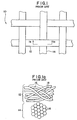
- Prior art surgical support mesh 10 may be manufactured from monofilament or multifilament yarns.
- Prior art mesh 10, as shown, includes multifilament horizontally-extending yarns 12 and multifilament vertically-extending yarns 14 woven together to form a support trellis.
- multifilament yarns such as yarns 12 and 14
- the flexibility of a filament generally increases as its diameter decreases. Because the solid cross-sectional area of the filaments of a multifilament yarn is less than the cross-sectional area of a monofilament yarn of equivalent diameter, the multifilament yarn will have a greater degree of flexibility and pliability than that of the monofilament yarn.
- each of multifilament yarns 12 and 14 is composed of a plurality of filaments 16 that are intermingled or bundled together to form the yarn.
- Interstitial spaces 18, which are pockets of air, are formed between adjacent filaments of the yarn.
- Surgical mesh is, of course, thoroughly sterilized prior to implantation. Nevertheless, surgeons typically prefer the use of monofilament-designed mesh to minimize any risk of infection. As a result, the advantages associated with multifilament-designed mesh (i.e., softness and pliability which result in better assimilation of the mesh into the body) are typically sacrificed.
- a surgical support mesh having both the softness and pliability of a multifilament-designed mesh and the infection resistance of a monofilament-designed mesh may be produced.
- a support trellis formed of multifilament yarn wherein the interstitial voids located between adjacent filaments are enclosed within an infection-impervious matrix exhibits the desired resistance to harboring of infectious matter without significant loss of flexibility.
- the matrix which completely encloses the interstitial voids between the filaments of the yarn, provides an effective barrier to the passage of infectious matter between the interior and exterior of the yarn. Accordingly, any voids remaining in the yarn after encapsulation of such yarn are enclosed (and thereby sealed) within the resultant matrix.
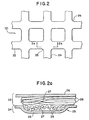
- FIG. 2 A first embodiment of the present invention is shown in Fig. 2.
- this first embodiment includes a support trellis 20 formed of multifilament yarns 22 and 24 which overlap at cross-over junctions 25.
- a support trellis 20 formed of multifilament yarns 22 and 24 which overlap at cross-over junctions 25.
- trellis is encapsulated within a matrix 26, which is preferably a flexible material that continuously surrounds the exterior of the yarns thereby enclosing interstitial voids 27 located between filaments 28 (see Fig. 2a).
- the matrix is formed from a polymeric resin.
- the resin can be applied to the yarn in such a manner as to not allow the resin to substantially penetrate into the yarn.
- the penetration of the resin can be controlled through the application procedure, e.g., quantity of resin applied and/or encapsulating time.
- the interstitial spaces are enclosed (rather than filled) within the continuous matrix.
- the resin can be allowed to penetrate into the yarn, thereby substantially filling the void space located therein.
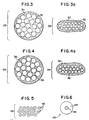
- individual yarns 29, as shown in Fig. 3 are encapsulated within matrix 30 prior to forming of the support trellis.
- Fig. 3a shows a compressed yarn 29 which provides a trellis having a reduced thickness.
- interstitial voids 32 remaining in the yarn are enclosed (and thereby sealed) within the matrix. This then prevents infectious matter from traveling between the interior and exterior of the yarn.
- the matrix provides an infection-impervious barrier between any interstitial voids remaining in the yarn after encapsulation and the exterior of such yarn, while simultaneously maintaining the desired flexibility.
- the depth of penetration of the matrix can be controlled by regulating the quantity of resin applied to the yarn and/or by regulating the coating time.
- matrix 36 penetrates into the interstitial spaces of the yarn, thereby substantially filling the bulk of air space located therein.
- the resin employed to encapsulate the trellis preferably has a melting temperature lower than the melting temperature of the individual filaments such that the resin may be applied to the trellis without damage thereto (i.e., melting of the filaments).
- the resin should exhibit a high degree of flexibility to ensure that the formed mesh retains its desired pliability.
- the resin has a Young's Modulus lower than that of the filament material. Resins formed from polyester, polypropylene, polyethylene, polyurethane, poly(meth) acrylate, or copolymers thereof are contemplated for use herein.
- a resin solution is applied to the formed trellis.
- the solvent carrying the resin is then caused to be evaporated, whereby the solute impregnates and thereby fills the voids within the yarn.
- the encapsulation of the multifilament yarns permanently encloses the interstitial spaces formed between the individual filament of the yarns.
- a continuous infection-impervious matrix is formed around the exterior of the yarn, thereby encapsulating the filaments and filling and/or sealing the interstitial spaces formed therebetween.
- the resultant surgical mesh therefore exhibits more softness and pliability than a monofilament yarn, while simultaneously providing a barrier to the passage of - infectious matter, which infectious matter is common in conventional multifilament yarns.
- the encapsulation of the yarns if done subsequent to forming of the support trellis, i.e. to the fabric per se, fuses the yarns of the trellis together at the crossover junctions 25 shown in Fig. 2. This improves the ravel resistance of the formed mesh. It also improves the linting and fraying characteristics of the mesh (i.e., the mesh is less prone to both tinting and fraying). If, however, the individual yarns are encapsulated prior to forming of the trellis, the trellis may still be heated after formation to fuse the yarn coatings together, thereby rendering such trellis ravel resistant.
- the multifilament yarns employed in the present invention may be formed of bi-component filaments 42.
- Each of these bi-component filaments includes a sheath 44 and a core 46.
- the sheath is preferably formed of a material having a melting or fusing point lower than that of the material forming the core of the filament.
- a means other than heat for example, a liquid based coating material, once the solvent is evaporated the coating remains to encapsulate the filaments and/or filling the interstitial spaces formed therebetween.
- the sheath 44 is preferably a polyethylene terephthalate/isophthalate co-polyester, while the core 46 is preferably a polyethylene terephthalate polyester.
- the core 46 is preferably a polyethylene terephthalate polyester.
- other suitable materials may be used to manufacture the bi-component filaments.
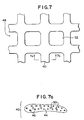
- FIG. 7 and 7a Another embodiment of the present invention is shown in Figs. 7 and 7a.
- this embodiment includes a support trellis 48 formed ofbi-component multifilament yarns, such as yarns 40. Subsequent to forming of the trellis, the trellis is heated to a predetermined temperature, i.e., the fusing temperature of the bi-component filaments.
- sheaths 44 of the bi-component filament begin to melt and flow together, thereby at least substantially filling the voids between filaments and also encapsulating cores 46 within a continuous polymeric matrix.
- the melting sheaths also enclose any voids 50 which are not filled by the flowing polymer. Because the polymer of sheath 44 is softer and more flexible than the polymer of core 46, the formed trellis exhibits the flexibility of a surgical support mesh which is closer to that formed of a conventional multifilament yarn than of a monofilament yarn.
- the bicomponent untwisted filament yarns also tend to flatten out. This flattening is emphasized even more due to transverse forces on the yarns during heat compression of the fabric. Additionally, the sheath polymer flowing into the interstitial voids between the multifilaments causes the reduction of air between the fibers, further contributing to the consolidation of the yarn bundle.
- the surgical mesh of the present invention may be formed by weaving, knitting, braiding or otherwise forming a plurality of multifilament yarns into a support trellis structure.
- the multifilament yarns may be either traditional multifilament yarns or bi-component multifilament yarns.
- the support mesh may thereafter be subjected to thermal or light energy to fuse the filaments together.
- the mesh may be placed in an oven and heated to a temperature of, for example, 180-210°C, and preferably 200-210°C such that the sheaths of the individual filaments fuse together.
- the encapsulation of the yarns provides the trellis with a "membrane-like" feel, while also eliminating the fibrous properties of a warp-knitted structure.
- the present invention allows the size of the trellis pores (e.g., pores 52 shown in Fig. 7) to be regulated.
- the pore size preferably about 50 microns or larger
- the pore size can be regulated by controlling the quantity of resin applied to the exterior of the trellis. It is believed that regulation of pore size may facilitate assimilation of the trellis into the body.
- a medicinal substance e.g., an antibiotic
- the drug may be dispersed directly throughout the encapsulating resin or, alternatively, added to a plurality of separate carriers which in turn are dispersed throughout the encapsulating resin.
- a thin mesh is formed having a thickness in the range of about 0.05 millimeters to about 0.50 millimeters.
- the thin mesh of the present invention will have a thickness of about 0.10 millimeters to about 0.20 millimeters.
- the mesh width and length dimensions can vary within those ranges conventionally used for a specific application and delivery device. For example, such ranges include dimensions of about 12 centimeters x 15 centimeters to about 14 centimeters x 16 centimeters. These ranges are generally sufficient to cover the area of repair of, for example, the myopectineal orifice of an adult. As mentioned above, such a thin surgical mesh could then be rolled or otherwise folded so as to fit within the cannula of a needle having a small diameter of, for example, 5 millimeters or less.
- the individual filaments or fibers are capable of spreading out or flattening to provide a reduced thickness and a low profile. To maximize the yarn's ability to splay it is necessary to minimize or prevent the introduction of twisting or other such orientations of the yarn which might impede its ability to adopt a low profile.
- a bicomponent yarn allows for one of the components to be a meltable resin which, when heated, subsequently can fuse together with other yarns in the fabric to weld at the interlacing points to seal the structure.
- the welding of the interlaces stabilizes the yarns in the woven structure while the sealing of the yarns eliminates the porosity with the yarn bundle and thereby reduces the risk of harboring infections.
- the treatment also imparts a resiliency to the mesh to resume a planar shape once released from the cannula.
- Multifilament yarns also can provide a lower profile to the mesh as they can flatten out.
- the flattening characteristic of multifilament yarn is maximized when the yarn is not impeded by twisting or other yarn conditioning.
- the fabric is heat set which causes the yarn to assume an elliptical cross-section, rather than the round cross-section retained by a monofilament or a highly twisted multifilament yarn.
- One embodiment of a thinly woven mesh of the present invention includes use of a 75 denier bicomponent polyester yarn having a circular diameter of, for example, about 0.09 millimeters.
- the multifilament yarns contemplated for use in the present invention can be flattened preferably about 50 percent of the original thickness. When flattened, the yarn assumes an elliptical or race-track (rectangular with rounded corners) cross-section having a minor diameter, or yarn thickness, of about 0.04 millimeters to about 0.06 millimeters, and a major diameter, or yarn width, of about 0.22 millimeters to about 0.28 millimeters.
- the rectangular pore size would be about 0.05 to 0.07 millimeters on either or both sides, or 50 to 70 microns, respectively.
- a woven construction provides a greater strength to thickness ratio than a knitted construction. It also allows the mesh to be engineered, for example, for isotropic or anisotropic properties more effectively, more predictably, and more thinly than a knitted fabric.
- the estimated burst strength of the fabric would be about 21kg/cm 2 , or 300 psi, or 2068 kPa. Such burst strengths are in the range of conventional surgical repair fabrics, including those for hernia repairs and which have a greater thickness than those contemplated by the present invention.
- the mesh may have a shape memory imparted thereto.
- the mesh could, for example, be heat conditioned for a sufficient time at a sufficient temperature while the mesh is in an unfurled configuration.
- the mesh could also include individual threads having a shape-memory imparted thereto, such as nitinol threads.
- the mesh could therefore be designed to assume an unfurled configuration when the mesh reaches body temperature subsequent to deployment. Imparting shape-memory to the mesh would allow the mesh, even after having been stored within the delivery device, e.g. the cannula of a needle, to assume an unfurled configuration once deployed into the peritoneal cavity. Designing shape-memory into the soft tissue mesh in this manner facilitates orientation in the body.
- the mesh due to the encapsulating matrix, the mesh possesses a structural stability and ravel resistance which permits pulling and aligning using laparoscopic gripping devices.
- the soft tissue meshes of the present invention may be implanted using conventional surgical or laparoscopic techniques.
- a new minimally invasive technique employing a needle delivery is used.
- the mesh is rolled, folded, or otherwise compressed to a reduced volume such that it can be contained within a needle delivery system.
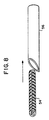
- rolled mesh 54 is shown being insertable into cannula 56.
- the mesh must have a sufficiently low volume and profile to pass through a needle cannula and be deployed into the affected area.
- the mesh has been memory heat-set to return to a relatively planar configuration once deployed. Other shapes, depending on the specific body application may of course also be used.
- thin surgical support mesh could then be delivered into the properitoneal cavity of a patient via the needle.
- a second small needle cannula could be inserted into the properitoneal cavity to insufflate the region with carbon dioxide.
- the hernia sac would be dissected free and ligated.
- Visualization during the needle herniorrhaphy would be obtained with a 2-5 millimeter laparoscope placed through one of the cannulas.
- the mesh upon being expelled from the needle over the transversalis fascia, could then be manipulated to cover the myopectineal cavity.
- the mesh could further be provided with an elastic memory causing the mesh to unfurl once ejected from the cannula.
- the mesh may then be optionally sutured or stapled over the herniated region for assimilation by the body tissue so as to provide added support to the tissue of the properitoneal cavity.
- a needle herniorrhaphy technique could therefore be performed which would obviate the need for open surgery.
- the needle herniorrhaphy technique could be performed without the need for general anesthesia and would reduce the pain and disability currently associated with open or laparoscopic techniques.
- a support trellis is woven of bi-component yarns, particularly 250 denier/16 filament/type LHCV Kanebo Bellcouple® polyester yarns.
- the Kanebo Bellcouple® yarn includes a polyethylene terephthalate polyester core and a polyethylene terephthalate/isophthalate co-polyester sheath, the sheath having a lower melting temperature than the core.
- the trellis is placed in a convection oven and heated to about 210°C, thus fusing the individual sheaths together.
- the yarns are thereby encapsulated and, further, are fused to each other at the junctions where the yarns overlap.
- the resultant mesh is thereafter sealed in a sterile package.
- a support trellis is warp-knitted of bicomponent yarns, particularly 75 denier/24 filament/type LHCV Kanebo Bellcouple® polyester yarns. Following construction of the support trellis, the trellis is placed in a convection oven and heated to about 210°C, thus fusing the individual sheaths together.
- the resultant mesh is thereafter sealed in a sterile package.
- a support trellis is woven in a plain weave of bicomponent yarns, particularly 75 denier/24 filament/type LHCV Kanebo Bellcouple® polyester yarns.
- the threadcount is 70 ends per inch by 70 picks per inch.
- the rectangular pore size is in the range of 50 to 70 micrometers on each side.
- the trellis is placed in a forced hot air convection oven and heated to about 210°C for 15 minutes, thus fusing the individual sheaths together.
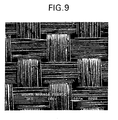
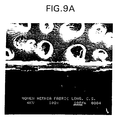
- the thickness of the construction is on the order of 0.10 millimeters or less.
- Figure 9 is a photomicrograph showing a portion of a construction according to this Example.
- Figure 9a is a photomicrograph showing a cross-sectional view of this construction.
- the resultant mesh is thereafter sealed in a sterile package.
Landscapes
- Health & Medical Sciences (AREA)
- Cardiology (AREA)
- Oral & Maxillofacial Surgery (AREA)
- Transplantation (AREA)
- Engineering & Computer Science (AREA)
- Biomedical Technology (AREA)
- Heart & Thoracic Surgery (AREA)
- Vascular Medicine (AREA)
- Life Sciences & Earth Sciences (AREA)
- Animal Behavior & Ethology (AREA)
- General Health & Medical Sciences (AREA)
- Public Health (AREA)
- Veterinary Medicine (AREA)
- Materials For Medical Uses (AREA)
- Prostheses (AREA)
- Infusion, Injection, And Reservoir Apparatuses (AREA)
Applications Claiming Priority (3)
| Application Number | Priority Date | Filing Date | Title |
|---|---|---|---|
| US905529 | 1978-05-12 | ||
| US08/905,529 US6042592A (en) | 1997-08-04 | 1997-08-04 | Thin soft tissue support mesh |
| PCT/US1998/016126 WO1999005992A1 (en) | 1997-08-04 | 1998-08-04 | Thin soft tissue surgical support mesh |
Publications (2)
| Publication Number | Publication Date |
|---|---|
| EP1001717A1 EP1001717A1 (en) | 2000-05-24 |
| EP1001717B1 true EP1001717B1 (en) | 2005-11-30 |
Family
ID=25420993
Family Applications (1)
| Application Number | Title | Priority Date | Filing Date |
|---|---|---|---|
| EP98938300A Expired - Lifetime EP1001717B1 (en) | 1997-08-04 | 1998-08-04 | Thin soft tissue surgical support mesh |
Country Status (7)
| Country | Link |
|---|---|
| US (3) | US6042592A (enExample) |
| EP (1) | EP1001717B1 (enExample) |
| JP (2) | JP5116190B2 (enExample) |
| AU (1) | AU742882B2 (enExample) |
| CA (1) | CA2299241C (enExample) |
| DE (1) | DE69832618T2 (enExample) |
| WO (1) | WO1999005992A1 (enExample) |
Cited By (10)
| Publication number | Priority date | Publication date | Assignee | Title |
|---|---|---|---|---|
| US8317808B2 (en) | 2008-02-18 | 2012-11-27 | Covidien Lp | Device and method for rolling and inserting a prosthetic patch into a body cavity |
| US8758373B2 (en) | 2008-02-18 | 2014-06-24 | Covidien Lp | Means and method for reversibly connecting a patch to a patch deployment device |
| US8808314B2 (en) | 2008-02-18 | 2014-08-19 | Covidien Lp | Device and method for deploying and attaching an implant to a biological tissue |
| US8906045B2 (en) | 2009-08-17 | 2014-12-09 | Covidien Lp | Articulating patch deployment device and method of use |
| US9034002B2 (en) | 2008-02-18 | 2015-05-19 | Covidien Lp | Lock bar spring and clip for implant deployment device |
| US9044235B2 (en) | 2008-02-18 | 2015-06-02 | Covidien Lp | Magnetic clip for implant deployment device |
| US9301826B2 (en) | 2008-02-18 | 2016-04-05 | Covidien Lp | Lock bar spring and clip for implant deployment device |
| US9393002B2 (en) | 2008-02-18 | 2016-07-19 | Covidien Lp | Clip for implant deployment device |
| US9393093B2 (en) | 2008-02-18 | 2016-07-19 | Covidien Lp | Clip for implant deployment device |
| US9999424B2 (en) | 2009-08-17 | 2018-06-19 | Covidien Lp | Means and method for reversibly connecting an implant to a deployment device |
Families Citing this family (193)
| Publication number | Priority date | Publication date | Assignee | Title |
|---|---|---|---|---|
| US6740122B1 (en) | 1998-09-11 | 2004-05-25 | C. R. Bard, Inc. | Preformed curved prosthesis that is adapted to the external iliac vessels |
| US6723133B1 (en) | 1998-09-11 | 2004-04-20 | C. R. Bard, Inc. | Performed curved prosthesis having a reduced incidence of developing wrinkles or folds |
| US6551241B1 (en) * | 1999-12-17 | 2003-04-22 | Leonard S. Schultz | Instruments and methods for performing percutaneous surgery |
| FR2791883B1 (fr) * | 1999-04-08 | 2001-08-10 | Ethicon Inc | Prothese souple notamment pour la cure des hernies par voie coelioscopique |
| FR2792824B1 (fr) * | 1999-04-27 | 2001-06-22 | Sofradim Production | Dispositif de traitement de prolapsus par suspension vaginale |
| US20060247665A1 (en) | 1999-05-28 | 2006-11-02 | Ferree Bret A | Methods and apparatus for treating disc herniation and preventing the extrusion of interbody bone graft |
| US20070038231A1 (en) | 1999-05-28 | 2007-02-15 | Ferree Bret A | Methods and apparatus for treating disc herniation and preventing the extrusion of interbody bone graft |
| US7273497B2 (en) | 1999-05-28 | 2007-09-25 | Anova Corp. | Methods for treating a defect in the annulus fibrosis |
| US6344052B1 (en) | 1999-09-27 | 2002-02-05 | World Medical Manufacturing Corporation | Tubular graft with monofilament fibers |
| FR2811218B1 (fr) | 2000-07-05 | 2003-02-28 | Patrice Suslian | Dispositif implantable destine a corriger l'incontinence urinaire |
| US7025063B2 (en) | 2000-09-07 | 2006-04-11 | Ams Research Corporation | Coated sling material |
| US6746458B1 (en) | 2000-09-07 | 2004-06-08 | William G. Cloud | Mesh material to repair hernias |
| US8167785B2 (en) | 2000-10-12 | 2012-05-01 | Coloplast A/S | Urethral support system |
| US20060205995A1 (en) | 2000-10-12 | 2006-09-14 | Gyne Ideas Limited | Apparatus and method for treating female urinary incontinence |
| GB0025068D0 (en) | 2000-10-12 | 2000-11-29 | Browning Healthcare Ltd | Apparatus and method for treating female urinary incontinence |
| CA2365376C (en) | 2000-12-21 | 2006-03-28 | Ethicon, Inc. | Use of reinforced foam implants with enhanced integrity for soft tissue repair and regeneration |
| US7235043B2 (en) | 2001-03-09 | 2007-06-26 | Boston Scientific Scimed Inc. | System for implanting an implant and method thereof |
| GB0108088D0 (en) | 2001-03-30 | 2001-05-23 | Browning Healthcare Ltd | Surgical implant |
| US6726696B1 (en) * | 2001-04-24 | 2004-04-27 | Advanced Catheter Engineering, Inc. | Patches and collars for medical applications and methods of use |
| US8961541B2 (en) | 2007-12-03 | 2015-02-24 | Cardio Vascular Technologies Inc. | Vascular closure devices, systems, and methods of use |
| US20080109030A1 (en) | 2001-04-24 | 2008-05-08 | Houser Russell A | Arteriotomy closure devices and techniques |
| US8992567B1 (en) | 2001-04-24 | 2015-03-31 | Cardiovascular Technologies Inc. | Compressible, deformable, or deflectable tissue closure devices and method of manufacture |
| WO2003015836A1 (en) * | 2001-08-16 | 2003-02-27 | Purdue Research Foundation | Material and method for promoting tissue growth |
| US7622129B1 (en) | 2002-08-05 | 2009-11-24 | Purdue Research Foundation | Nano-structured polymers for use as implants |
| US6666817B2 (en) * | 2001-10-05 | 2003-12-23 | Scimed Life Systems, Inc. | Expandable surgical implants and methods of using them |
| US6902932B2 (en) * | 2001-11-16 | 2005-06-07 | Tissue Regeneration, Inc. | Helically organized silk fibroin fiber bundles for matrices in tissue engineering |
| US20110009960A1 (en) * | 2001-11-16 | 2011-01-13 | Allergan, Inc. | Prosthetic fabric structure |
| GB2402343B (en) * | 2002-04-11 | 2006-03-15 | Gyne Ideas Ltd | Apparatus for treating female urinary incontinence |
| US20040059356A1 (en) * | 2002-07-17 | 2004-03-25 | Peter Gingras | Soft tissue implants and methods for making same |
| CA2492630C (en) | 2002-08-02 | 2009-01-13 | C.R. Bard, Inc. | Self anchoring sling and introducer system |
| US20040078090A1 (en) | 2002-10-18 | 2004-04-22 | Francois Binette | Biocompatible scaffolds with tissue fragments |
| US8142515B2 (en) * | 2002-11-04 | 2012-03-27 | Sofradim Production | Prosthesis for reinforcement of tissue structures |
| ES2268465T3 (es) * | 2002-12-11 | 2007-03-16 | Dsm Ip Assets B.V. | Malla quirugica de tejido blando. |
| US8197837B2 (en) | 2003-03-07 | 2012-06-12 | Depuy Mitek, Inc. | Method of preparation of bioabsorbable porous reinforced tissue implants and implants thereof |
| US7993412B2 (en) * | 2003-03-27 | 2011-08-09 | Purdue Research Foundation | Nanofibers as a neural biomaterial |
| GB0307082D0 (en) | 2003-03-27 | 2003-04-30 | Gyne Ideas Ltd | Drug delivery device and method |
| AU2004224308B2 (en) * | 2003-03-27 | 2009-09-17 | Purdue Research Foundation | Metallic nanoparticles as orthopedic biomaterial |
| AU2004241111B2 (en) | 2003-05-15 | 2010-05-27 | Dsm Ip Assets B.V | Manufacture and use of implantable reticulated elastomeric matrices |
| US8226715B2 (en) | 2003-06-30 | 2012-07-24 | Depuy Mitek, Inc. | Scaffold for connective tissue repair |
| US7361138B2 (en) | 2003-07-31 | 2008-04-22 | Scimed Life Systems, Inc. | Bioabsorbable casing for surgical sling assembly |
| US10583220B2 (en) | 2003-08-11 | 2020-03-10 | DePuy Synthes Products, Inc. | Method and apparatus for resurfacing an articular surface |
| US8545386B2 (en) | 2003-08-14 | 2013-10-01 | Boston Scientific Scimed, Inc. | Surgical slings |
| EP1670381B1 (en) | 2003-08-14 | 2009-09-23 | Boston Scientific Limited | Surgical slings |
| US20050038452A1 (en) * | 2003-08-14 | 2005-02-17 | Scimed Life Systems, Inc. | Medical slings |
| CA2541069C (en) | 2003-10-03 | 2012-08-14 | Michael S. H. Chu | Systems and methods for delivering a medical implant to an anatomical location in a patient |
| WO2005046746A2 (en) * | 2003-11-10 | 2005-05-26 | Angiotech International Ag | Medical implants and fibrosis-inducing agents |
| CA2546376C (en) | 2003-11-17 | 2013-04-16 | Scimed Life Systems, Inc. | Systems and methods relating to associating a medical implant with a delivery device |
| US7316822B2 (en) | 2003-11-26 | 2008-01-08 | Ethicon, Inc. | Conformable tissue repair implant capable of injection delivery |
| US7901461B2 (en) | 2003-12-05 | 2011-03-08 | Ethicon, Inc. | Viable tissue repair implants and methods of use |
| US7763077B2 (en) | 2003-12-24 | 2010-07-27 | Biomerix Corporation | Repair of spinal annular defects and annulo-nucleoplasty regeneration |
| US20050165480A1 (en) * | 2004-01-23 | 2005-07-28 | Maybelle Jordan | Endovascular treatment devices and methods |
| US11395865B2 (en) | 2004-02-09 | 2022-07-26 | DePuy Synthes Products, Inc. | Scaffolds with viable tissue |
| US8747453B2 (en) * | 2008-02-18 | 2014-06-10 | Aga Medical Corporation | Stent/stent graft for reinforcement of vascular abnormalities and associated method |
| US8398670B2 (en) | 2004-03-19 | 2013-03-19 | Aga Medical Corporation | Multi-layer braided structures for occluding vascular defects and for occluding fluid flow through portions of the vasculature of the body |
| US8313505B2 (en) | 2004-03-19 | 2012-11-20 | Aga Medical Corporation | Device for occluding vascular defects |
| US9039724B2 (en) * | 2004-03-19 | 2015-05-26 | Aga Medical Corporation | Device for occluding vascular defects |
| US8777974B2 (en) | 2004-03-19 | 2014-07-15 | Aga Medical Corporation | Multi-layer braided structures for occluding vascular defects |
| US20050234291A1 (en) * | 2004-03-30 | 2005-10-20 | Peter Gingras | Medical device |
| DE602005025637D1 (de) * | 2004-03-30 | 2011-02-10 | Proxy Biomedical Ltd | Behandeltes chirurgisches mesh aus monofilen fasern |
| US8137686B2 (en) | 2004-04-20 | 2012-03-20 | Depuy Mitek, Inc. | Nonwoven tissue scaffold |
| US8221780B2 (en) | 2004-04-20 | 2012-07-17 | Depuy Mitek, Inc. | Nonwoven tissue scaffold |
| US8439820B2 (en) | 2004-05-06 | 2013-05-14 | Boston Scientific Scimed, Inc. | Systems and methods for sling delivery and placement |
| GB0411360D0 (en) | 2004-05-21 | 2004-06-23 | Mpathy Medical Devices Ltd | Implant |
| US8628465B2 (en) * | 2004-06-14 | 2014-01-14 | Boston Scientific Scimed, Inc. | Systems, methods and devices relating to implantable supportive slings |
| US20050283040A1 (en) * | 2004-06-16 | 2005-12-22 | Secant Medical, Llc | Incontinence sling |
| US20050288797A1 (en) * | 2004-06-23 | 2005-12-29 | Warwick Mills, Inc. | Controlled absorption biograft material for autologous tissue support |
| US7481808B2 (en) * | 2004-06-30 | 2009-01-27 | Ethicon, Inc. | Flexible electrode device and surgical apparatus equipped with same |
| WO2006055052A2 (en) * | 2004-07-19 | 2006-05-26 | Michael Gertner | Methods and devices for chronic embolic protection |
| DE102004044569A1 (de) * | 2004-09-15 | 2006-03-30 | Voith Fabrics Patent Gmbh | Papiermaschinenbespannungen |
| US20060089672A1 (en) * | 2004-10-25 | 2006-04-27 | Jonathan Martinek | Yarns containing filaments made from shape memory alloys |
| WO2006046950A1 (en) | 2004-10-25 | 2006-05-04 | Scimed Life Systems, Inc | Systems and methods for sling delivery and placement |
| US8329202B2 (en) | 2004-11-12 | 2012-12-11 | Depuy Products, Inc. | System and method for attaching soft tissue to an implant |
| US8771294B2 (en) * | 2004-11-26 | 2014-07-08 | Biomerix Corporation | Aneurysm treatment devices and methods |
| US20060116713A1 (en) * | 2004-11-26 | 2006-06-01 | Ivan Sepetka | Aneurysm treatment devices and methods |
| EP1865873A4 (en) * | 2005-03-22 | 2013-01-09 | Covidien Ag | NET IMPLANT |
| US7556598B2 (en) * | 2005-04-04 | 2009-07-07 | Boston Scientific Scimed, Inc. | Dissolvable protective treatment for an implantable supportive sling |
| WO2006108145A1 (en) * | 2005-04-06 | 2006-10-12 | Boston Scientific Scimed, Inc. | Systems, devices, and methods for treating pelvic floor disorders |
| WO2007008209A1 (en) * | 2005-07-13 | 2007-01-18 | Boston Scientific Scimed Inc. | Snap fit sling anchor system and related methods |
| US7981023B2 (en) | 2005-07-25 | 2011-07-19 | Boston Scientific Scimed, Inc. | Elastic sling system and related methods |
| WO2007014241A1 (en) | 2005-07-25 | 2007-02-01 | Boston Scientific Scimed, Inc. | Pelvic floor repair system |
| US20070038290A1 (en) * | 2005-08-15 | 2007-02-15 | Bin Huang | Fiber reinforced composite stents |
| WO2007070141A1 (en) | 2005-09-12 | 2007-06-21 | Proxy Biomedical Limited | Soft tissue implants and methods for making same |
| US20080249607A1 (en) * | 2005-09-20 | 2008-10-09 | Thomas Jay Webster | Biocompatable Nanophase Materials |
| US7878970B2 (en) * | 2005-09-28 | 2011-02-01 | Boston Scientific Scimed, Inc. | Apparatus and method for suspending a uterus |
| US7513865B2 (en) | 2005-12-20 | 2009-04-07 | Boston Scientific Scimed, Inc. | Flattened tubular mesh sling and related methods |
| US9144483B2 (en) * | 2006-01-13 | 2015-09-29 | Boston Scientific Scimed, Inc. | Placing fixation devices |
| US8170686B2 (en) * | 2006-03-14 | 2012-05-01 | Boston Scientific Scimed, Inc. | Heatable sling support for an anatomical location |
| EP1998711B1 (en) * | 2006-03-16 | 2013-12-11 | Boston Scientific Limited | Apparatus for treatment of pelvic conditions |
| US7737060B2 (en) | 2006-03-31 | 2010-06-15 | Boston Scientific Scimed, Inc. | Medical devices containing multi-component fibers |
| US20090035572A1 (en) * | 2006-04-06 | 2009-02-05 | Tyco Healthcare Group Lp | Yarns containing thermoplastic elastomer copolymer and polyolefin filaments |
| US20070293878A1 (en) * | 2006-06-16 | 2007-12-20 | Butsch John L | Magnetic mesh support for tissue walls |
| GB0613653D0 (en) * | 2006-07-11 | 2006-08-16 | Mpathy Medical Devices Ltd | Tissue regeneration repair device |
| US20110021868A1 (en) * | 2006-07-11 | 2011-01-27 | James Browning | Tissue Repair Device |
| US7614258B2 (en) | 2006-10-19 | 2009-11-10 | C.R. Bard, Inc. | Prosthetic repair fabric |
| US8388679B2 (en) | 2007-01-19 | 2013-03-05 | Maquet Cardiovascular Llc | Single continuous piece prosthetic tubular aortic conduit and method for manufacturing the same |
| US20090192530A1 (en) * | 2008-01-29 | 2009-07-30 | Insightra Medical, Inc. | Fortified mesh for tissue repair |
| US8932619B2 (en) * | 2007-06-27 | 2015-01-13 | Sofradim Production | Dural repair material |
| US20090004455A1 (en) * | 2007-06-27 | 2009-01-01 | Philippe Gravagna | Reinforced composite implant |
| WO2009003726A1 (de) * | 2007-07-02 | 2009-01-08 | Loehde Eckhard | Dreidimensionales herniennetz |
| US20090099579A1 (en) | 2007-10-16 | 2009-04-16 | Tyco Healthcare Group Lp | Self-adherent implants and methods of preparation |
| US9308068B2 (en) * | 2007-12-03 | 2016-04-12 | Sofradim Production | Implant for parastomal hernia |
| US20090171141A1 (en) * | 2007-12-27 | 2009-07-02 | Chu Michael S H | Anterior Repair - Needle Path and Incision Sites |
| US8430807B2 (en) * | 2007-12-28 | 2013-04-30 | Boston Scientific Scimed, Inc. | Devices and methods for treating pelvic floor dysfunctions |
| US9282958B2 (en) * | 2007-12-28 | 2016-03-15 | Boston Scientific Scimed, Inc. | Devices and method for treating pelvic dysfunctions |
| US9078728B2 (en) * | 2007-12-28 | 2015-07-14 | Boston Scientific Scimed, Inc. | Devices and methods for delivering female pelvic floor implants |
| US9398944B2 (en) | 2008-02-18 | 2016-07-26 | Covidien Lp | Lock bar spring and clip for implant deployment device |
| EP2247245B1 (en) | 2008-02-18 | 2017-06-28 | Covidien LP | A device for deploying and attaching a patch to a biological tissue |
| US9833240B2 (en) | 2008-02-18 | 2017-12-05 | Covidien Lp | Lock bar spring and clip for implant deployment device |
| US8870743B2 (en) * | 2008-04-08 | 2014-10-28 | Boston Scientific Scimed, Inc. | Pelvic floor mesh and incontinence sling |
| WO2009156866A2 (en) * | 2008-06-27 | 2009-12-30 | Sofradim Production | Biosynthetic implant for soft tissue repair |
| WO2010033189A1 (en) * | 2008-09-16 | 2010-03-25 | VentralFix, Inc. | Method and apparatus for minimally invasive delivery, tensioned deployment and fixation of secondary material prosthetic devices in patient body tissue, including hernia repair within the patient's herniation site |
| US9820842B2 (en) | 2008-09-30 | 2017-11-21 | The Regents Of The University Of Colorado, A Body Corporate | Medical fabric with integrated shape memory polymer |
| WO2014085827A1 (en) | 2012-11-30 | 2014-06-05 | The Regents Of The University Of Colorado, A Body Corporate | Medical fabric with integrated shape memory polymer |
| WO2010040131A2 (en) * | 2008-10-03 | 2010-04-08 | Replication Medical, Inc. | Vessel protection device |
| EP2792307B1 (en) | 2008-10-20 | 2017-10-04 | Covidien LP | A device for attaching a patch to a biological tissue |
| JP5653931B2 (ja) * | 2008-12-15 | 2015-01-14 | アラーガン、インコーポレイテッドAllergan,Incorporated | 補綴デバイスおよびその製作方法 |
| US9204954B2 (en) * | 2008-12-15 | 2015-12-08 | Allergan, Inc. | Knitted scaffold with diagonal yarn |
| US20120150204A1 (en) * | 2008-12-15 | 2012-06-14 | Allergan, Inc. | Implantable silk prosthetic device and uses thereof |
| US9204953B2 (en) * | 2008-12-15 | 2015-12-08 | Allergan, Inc. | Biocompatible surgical scaffold with varying stretch |
| US9308070B2 (en) * | 2008-12-15 | 2016-04-12 | Allergan, Inc. | Pliable silk medical device |
| US9326840B2 (en) * | 2008-12-15 | 2016-05-03 | Allergan, Inc. | Prosthetic device and method of manufacturing the same |
| EP2391395A4 (en) * | 2009-02-02 | 2014-04-09 | Biomerix Corp | COMPOSITE NETWORKING DEVICE AND METHOD FOR SOFTWARE SAVING |
| US8308814B2 (en) | 2009-03-27 | 2012-11-13 | Depuy Mitek, Inc. | Methods and devices for preparing and implanting tissue scaffolds |
| US8241298B2 (en) | 2009-03-27 | 2012-08-14 | Depuy Mitek, Inc. | Methods and devices for delivering and affixing tissue scaffolds |
| JP5807970B2 (ja) | 2009-04-09 | 2015-11-10 | カーディオバスキュラー テクノロジーズ、インク. | 組織縫合装置、移送装置及びシステム、キット及びそのための方法 |
| US9125716B2 (en) * | 2009-04-17 | 2015-09-08 | Boston Scientific Scimed, Inc. | Delivery sleeve for pelvic floor implants |
| US8202301B2 (en) * | 2009-04-24 | 2012-06-19 | Warsaw Orthopedic, Inc. | Dynamic spinal rod and implantation method |
| FR2949687B1 (fr) * | 2009-09-04 | 2011-09-23 | Sofradim Production | Tissu avec picots revetus d'un materiau hydrosoluble |
| FR2949688B1 (fr) | 2009-09-04 | 2012-08-24 | Sofradim Production | Tissu avec picots revetu d'une couche microporeuse bioresorbable |
| WO2011031854A1 (en) * | 2009-09-11 | 2011-03-17 | Allergan, Inc. | Prosthetic device and method of manufacturing the same |
| US8690960B2 (en) | 2009-11-24 | 2014-04-08 | Covidien Lp | Reinforced tissue patch |
| US9398943B2 (en) * | 2009-11-30 | 2016-07-26 | Covidien Lp | Ventral hernia repair with barbed suture |
| US9510925B2 (en) * | 2010-02-02 | 2016-12-06 | Covidien Lp | Surgical meshes |
| US9757132B2 (en) * | 2010-03-24 | 2017-09-12 | Biorez, Inc. | Mechanically competent scaffold for rotator cuff and tendon augmentation |
| US20110238094A1 (en) * | 2010-03-25 | 2011-09-29 | Thomas Jonathan D | Hernia Patch |
| JP5729111B2 (ja) * | 2010-04-28 | 2015-06-03 | 東レ株式会社 | ステントグラフト用基布およびステントグラフト |
| US8911348B2 (en) | 2010-09-02 | 2014-12-16 | Boston Scientific Scimed, Inc. | Pelvic implants and methods of implanting the same |
| AU2011299119A1 (en) * | 2010-09-09 | 2013-03-21 | W. L. Gore & Associates, Inc. | Surgical mesh |
| US9403329B2 (en) | 2010-09-09 | 2016-08-02 | W. L. Gore & Associates, Inc. | Method of increasing film tear strength |
| US20130218178A1 (en) * | 2010-09-10 | 2013-08-22 | The Regents Of The University Of Colorado, A Body Corporate | Medical fabric with integrated shape memory polymer |
| FR2968533B1 (fr) * | 2010-12-08 | 2013-09-06 | Brothier Lab | Dispositif medical de renfort |
| US8696741B2 (en) | 2010-12-23 | 2014-04-15 | Maquet Cardiovascular Llc | Woven prosthesis and method for manufacturing the same |
| FR2972626B1 (fr) | 2011-03-16 | 2014-04-11 | Sofradim Production | Prothese comprenant un tricot tridimensionnel et ajoure |
| US9113991B2 (en) | 2011-05-12 | 2015-08-25 | Boston Scientific Scimed, Inc. | Anchors for bodily implants and methods for anchoring bodily implants into a patient's body |
| US9636201B2 (en) | 2011-05-12 | 2017-05-02 | Boston Scientific Scimed, Inc. | Delivery members for delivering an implant into a body of a patient |
| FR2977790B1 (fr) | 2011-07-13 | 2013-07-19 | Sofradim Production | Prothese pour hernie ombilicale |
| FR2977789B1 (fr) | 2011-07-13 | 2013-07-19 | Sofradim Production | Prothese pour hernie ombilicale |
| US9198746B2 (en) | 2011-08-30 | 2015-12-01 | Boston Scientific Scimed, Inc. | Materials and methods for securing bodily implants |
| US9168120B2 (en) | 2011-09-09 | 2015-10-27 | Boston Scientific Scimed, Inc. | Medical device and methods of delivering the medical device |
| CA2849052C (en) | 2011-09-30 | 2019-11-05 | Sofradim Production | Reversible stiffening of light weight mesh |
| FR2985170B1 (fr) | 2011-12-29 | 2014-01-24 | Sofradim Production | Prothese pour hernie inguinale |
| FR2985271B1 (fr) | 2011-12-29 | 2014-01-24 | Sofradim Production | Tricot a picots |
| USD694886S1 (en) | 2012-05-24 | 2013-12-03 | Ams Research Corporation | Implant |
| USD681813S1 (en) | 2012-05-24 | 2013-05-07 | Ams Research Corporation | Implant |
| USD680649S1 (en) | 2012-05-25 | 2013-04-23 | Ams Research Corporation | Implant |
| USD685476S1 (en) | 2012-05-25 | 2013-07-02 | Ams Research Corporation | Implant |
| FR2994185B1 (fr) | 2012-08-02 | 2015-07-31 | Sofradim Production | Procede de preparation d’une couche poreuse a base de chitosane |
| US10058409B2 (en) * | 2012-09-18 | 2018-08-28 | Arthrex, Inc. | Spacer fabric mesh for use in tissue engineering applications |
| FR2995779B1 (fr) | 2012-09-25 | 2015-09-25 | Sofradim Production | Prothese comprenant un treillis et un moyen de consolidation |
| FR2995788B1 (fr) | 2012-09-25 | 2014-09-26 | Sofradim Production | Patch hemostatique et procede de preparation |
| FR2995778B1 (fr) | 2012-09-25 | 2015-06-26 | Sofradim Production | Prothese de renfort de la paroi abdominale et procede de fabrication |
| AU2013322268B2 (en) | 2012-09-28 | 2017-08-31 | Sofradim Production | Packaging for a hernia repair device |
| CA2884764A1 (en) * | 2012-10-01 | 2014-04-10 | Ams Research Corporation | Conductive and degradable implant for pelvic tissue treatment |
| US9433489B2 (en) * | 2013-03-12 | 2016-09-06 | Soft Tissue Regeneration, Inc. | Absorbable synthetic braided matrix for breast reconstruction and hernia repair |
| US9814555B2 (en) | 2013-03-12 | 2017-11-14 | Boston Scientific Scimed, Inc. | Medical device for pelvic floor repair and method of delivering the medical device |
| US9585695B2 (en) | 2013-03-15 | 2017-03-07 | Woven Orthopedic Technologies, Llc | Surgical screw hole liner devices and related methods |
| JP6122545B2 (ja) * | 2013-03-15 | 2017-04-26 | ボストン サイエンティフィック サイムド,インコーポレイテッドBoston Scientific Scimed,Inc. | 多成分フィラメントベースの外科メッシュ |
| FR3006581B1 (fr) | 2013-06-07 | 2016-07-22 | Sofradim Production | Prothese a base d’un textile pour voie laparoscopique |
| FR3006578B1 (fr) | 2013-06-07 | 2015-05-29 | Sofradim Production | Prothese a base d’un textile pour voie laparoscopique |
| US9962251B2 (en) | 2013-10-17 | 2018-05-08 | Boston Scientific Scimed, Inc. | Devices and methods for delivering implants |
| US10028731B2 (en) | 2013-11-12 | 2018-07-24 | Genzyme Corporation | Barrier application device |
| US9642638B1 (en) | 2014-04-02 | 2017-05-09 | Vicki J. Carrier | Morcellated tissue collection pouch |
| US9907593B2 (en) | 2014-08-05 | 2018-03-06 | Woven Orthopedic Technologies, Llc | Woven retention devices, systems and methods |
| US8956394B1 (en) | 2014-08-05 | 2015-02-17 | Woven Orthopedic Technologies, Llc | Woven retention devices, systems and methods |
| US9943351B2 (en) | 2014-09-16 | 2018-04-17 | Woven Orthopedic Technologies, Llc | Woven retention devices, systems, packaging, and related methods |
| EP3000489B1 (en) | 2014-09-24 | 2017-04-05 | Sofradim Production | Method for preparing an anti-adhesion barrier film |
| EP3000433B1 (en) | 2014-09-29 | 2022-09-21 | Sofradim Production | Device for introducing a prosthesis for hernia treatment into an incision and flexible textile based prosthesis |
| EP3000432B1 (en) | 2014-09-29 | 2022-05-04 | Sofradim Production | Textile-based prosthesis for treatment of inguinal hernia |
| USD740427S1 (en) | 2014-10-17 | 2015-10-06 | Woven Orthopedic Technologies, Llc | Orthopedic woven retention device |
| EP3029189B1 (en) | 2014-12-05 | 2021-08-11 | Sofradim Production | Prosthetic porous knit, method of making same and hernia prosthesis |
| EP3059255B1 (en) | 2015-02-17 | 2020-05-13 | Sofradim Production | Method for preparing a chitosan-based matrix comprising a fiber reinforcement member |
| EP3085337B1 (en) | 2015-04-24 | 2022-09-14 | Sofradim Production | Prosthesis for supporting a breast structure |
| ES2676072T3 (es) | 2015-06-19 | 2018-07-16 | Sofradim Production | Prótesis sintética que comprende un tejido de punto y una película no porosa y método para formarla |
| WO2017024277A1 (en) | 2015-08-05 | 2017-02-09 | Woven Orthopedic Technologies, Llc | Tapping devices, systems and methods for use in bone tissue |
| EP3195830B1 (en) | 2016-01-25 | 2020-11-18 | Sofradim Production | Prosthesis for hernia repair |
| EP3312325B1 (en) | 2016-10-21 | 2021-09-22 | Sofradim Production | Method for forming a mesh having a barbed suture attached thereto and the mesh thus obtained |
| EP3551105A4 (en) | 2016-12-09 | 2020-07-29 | Woven Orthopedic Technologies, LLC | RESTRAINT DEVICES, GRIDS AND RELATED SYSTEMS AND METHODS |
| EP3398554B1 (en) | 2017-05-02 | 2025-06-25 | Sofradim Production | Prosthesis for inguinal hernia repair |
| EP3400901A1 (en) * | 2017-05-12 | 2018-11-14 | Keystone Heart Ltd. | A device for filtering embolic material in a vascular system |
| EP3653171B1 (en) | 2018-11-16 | 2024-08-21 | Sofradim Production | Implants suitable for soft tissue repair |
| US12064330B2 (en) | 2020-04-28 | 2024-08-20 | Covidien Lp | Implantable prothesis for minimally invasive hernia repair |
| US11413129B2 (en) | 2020-06-19 | 2022-08-16 | Davol Inc. | Implantable prosthesis |
| WO2025076271A1 (en) * | 2023-10-03 | 2025-04-10 | Esch Holdings, Llc | Systems, devices and methods for treatment of pelvic organ prolapse |
Family Cites Families (64)
| Publication number | Priority date | Publication date | Assignee | Title |
|---|---|---|---|---|
| US3124136A (en) * | 1964-03-10 | Method of repairing body tissue | ||
| US2671444A (en) * | 1951-12-08 | 1954-03-09 | Jr Benjamin F Pease | Nonmetallic mesh surgical insert for hernia repair |
| GB725343A (en) * | 1952-09-06 | 1955-03-02 | Wingfoot Corp | Treatment of textile fabrics |
| US3054406A (en) * | 1958-10-17 | 1962-09-18 | Phillips Petroleum Co | Surgical mesh |
| US3063454A (en) * | 1959-02-26 | 1962-11-13 | Cleanese Corp Of America | Non-woven products |
| GB1095552A (enExample) * | 1964-02-21 | |||
| US3372696A (en) * | 1965-01-22 | 1968-03-12 | Peter S. Rudie | Abdominal pad used in surgery |
| US3272204A (en) * | 1965-09-22 | 1966-09-13 | Ethicon Inc | Absorbable collagen prosthetic implant with non-absorbable reinforcing strands |
| DE1492434A1 (de) * | 1965-10-15 | 1969-12-04 | Ludwig Povel & Co Kg | Verbandstoff |
| US3416524A (en) * | 1966-12-16 | 1968-12-17 | Parke Davis & Co | Surgical dressing |
| NL6802563A (enExample) * | 1967-02-25 | 1968-08-26 | ||
| US3642565A (en) * | 1968-03-21 | 1972-02-15 | Kanegafuchi Spinning Co Ltd | Composite filaments having an elastic crimping property |
| US3526228A (en) * | 1969-03-24 | 1970-09-01 | Ethicon Inc | Collagen lamina dural prosthesis |
| US4175557A (en) * | 1975-11-24 | 1979-11-27 | International Paper Company | Polymeric sheets |
| CA1070584A (en) * | 1978-05-24 | 1980-01-29 | Her Majesty The Queen, In Right Of Canada, As Represented By The Minister Of National Defence | Elliptical diffuser drape |
| US4347847A (en) * | 1980-06-06 | 1982-09-07 | Usher Francis C | Method of hernia repair |
| US4452245A (en) * | 1980-06-06 | 1984-06-05 | Usher Francis C | Surgical mesh and method |
| DE3213673A1 (de) * | 1982-04-14 | 1983-10-27 | Karl Otto Braun Kg, 6759 Wolfstein | Wundtextil |
| US4520821A (en) * | 1982-04-30 | 1985-06-04 | The Regents Of The University Of California | Growing of long-term biological tissue correction structures in vivo |
| US4633873A (en) * | 1984-04-26 | 1987-01-06 | American Cyanamid Company | Surgical repair mesh |
| US4626253A (en) * | 1984-10-05 | 1986-12-02 | Johnson & Johnson Products, Inc. | Surgical hemostat comprising oxidized cellulose |
| US4655221A (en) | 1985-05-06 | 1987-04-07 | American Cyanamid Company | Method of using a surgical repair mesh |
| US4693720A (en) * | 1985-09-23 | 1987-09-15 | Katecho, Incorporated | Device for surgically repairing soft tissues and method for making the same |
| SE455466C (sv) * | 1986-03-10 | 1993-07-05 | Moelnlycke Ab | Foerband foer vaetskande saar |
| US4769038A (en) * | 1986-03-18 | 1988-09-06 | C. R. Bard, Inc. | Prostheses and techniques and repair of inguinal and femoral hernias |
| US4854316A (en) * | 1986-10-03 | 1989-08-08 | Davis Emsley A | Apparatus and method for repairing and preventing para-stomal hernias |
| US5019096A (en) * | 1988-02-11 | 1991-05-28 | Trustees Of Columbia University In The City Of New York | Infection-resistant compositions, medical devices and surfaces and methods for preparing and using same |
| US5201745A (en) * | 1988-03-15 | 1993-04-13 | Imedex | Visceral surgery patch |
| US4986831A (en) | 1988-04-25 | 1991-01-22 | Angeion Corporation | Medical implant |
| FR2646343B1 (fr) * | 1989-04-27 | 1991-12-20 | Gazielly Dominique | Dispositif de renfort et de soutien de la coiffe des rotateurs d'une articulation d'epaule d'individu |
| US5100422A (en) * | 1989-05-26 | 1992-03-31 | Impra, Inc. | Blood vessel patch |
| JP3366946B2 (ja) * | 1990-07-31 | 2003-01-14 | グンゼ株式会社 | 手術用縫合糸 |
| JP2890063B2 (ja) * | 1990-08-09 | 1999-05-10 | グンゼ株式会社 | 手術用縫合糸の製造法 |
| US5178630A (en) * | 1990-08-28 | 1993-01-12 | Meadox Medicals, Inc. | Ravel-resistant, self-supporting woven graft |
| US5141515A (en) * | 1990-10-11 | 1992-08-25 | Eberbach Mark A | Apparatus and methods for repairing hernias |
| US5122155A (en) * | 1990-10-11 | 1992-06-16 | Eberbach Mark A | Hernia repair apparatus and method of use |
| US5116357A (en) * | 1990-10-11 | 1992-05-26 | Eberbach Mark A | Hernia plug and introducer apparatus |
| US5254133A (en) * | 1991-04-24 | 1993-10-19 | Seid Arnold S | Surgical implantation device and related method of use |
| US5358492A (en) * | 1991-05-02 | 1994-10-25 | Feibus Miriam H | Woven surgical drain and method of making |
| CA2075080A1 (en) * | 1991-08-02 | 1993-02-03 | Ralph A. Dematteis | Method and apparatus for laparoscopic repair of hernias |
| US5234457A (en) * | 1991-10-09 | 1993-08-10 | Boston Scientific Corporation | Impregnated stent |
| US5290217A (en) * | 1991-10-10 | 1994-03-01 | Earl K. Sipes | Method and apparatus for hernia repair |
| US5292328A (en) * | 1991-10-18 | 1994-03-08 | United States Surgical Corporation | Polypropylene multifilament warp knitted mesh and its use in surgery |
| US5147374A (en) * | 1991-12-05 | 1992-09-15 | Alfredo Fernandez | Prosthetic mesh patch for hernia repair |
| US5176692A (en) * | 1991-12-09 | 1993-01-05 | Wilk Peter J | Method and surgical instrument for repairing hernia |
| CA2090000A1 (en) * | 1992-02-24 | 1993-08-25 | H. Jonathan Tovey | Articulating mesh deployment apparatus |
| US5263969A (en) * | 1992-04-17 | 1993-11-23 | Phillips Edward H | Tool for the laparoscopic introduction of a mesh prosthesis |
| WO1994027535A1 (en) * | 1992-05-20 | 1994-12-08 | C.R. Bard, Inc. | Implantable prosthesis and method and apparatus for loading and delivering an implantable prosthesis |
| US5368602A (en) * | 1993-02-11 | 1994-11-29 | De La Torre; Roger A. | Surgical mesh with semi-rigid border members |
| IT1265070B1 (it) * | 1993-05-18 | 1996-10-30 | Eniricerche Spa | Filamento composito termoplastico flessibile contenente fibre continue e procedimento per la sua preparazione |
| ES2227542T3 (es) | 1993-11-03 | 2005-04-01 | Clarion Pharmaceuticals, Inc. | Parche hemostatico. |
| FI952751L (fi) * | 1994-06-15 | 1995-12-16 | Meadox Medicals Inc | Kirurginen tukiverkko |
| DE69419265T2 (de) | 1994-07-27 | 2000-01-05 | W.L. Gore & Associates, Inc. | Höchfeste poröse folie aus ptfe |
| US5769864A (en) | 1994-09-29 | 1998-06-23 | Surgical Sense, Inc. | Hernia mesh patch |
| US5916225A (en) | 1994-09-29 | 1999-06-29 | Surgical Sense, Inc. | Hernia mesh patch |
| US5634931A (en) * | 1994-09-29 | 1997-06-03 | Surgical Sense, Inc. | Hernia mesh patches and methods of their use |
| IT1275080B (it) | 1994-11-09 | 1997-07-30 | Gabriele Valenti | Protesi dinamica in duplice strato per il trattamento chirurgico dell'ernia inguinale |
| US5549967A (en) * | 1995-05-04 | 1996-08-27 | Huyck Licensco, Inc. | Papermakers' press fabric with increased contact area |
| US5641502A (en) | 1995-06-07 | 1997-06-24 | United States Surgical Corporation | Biodegradable moldable surgical material |
| US5569273A (en) | 1995-07-13 | 1996-10-29 | C. R. Bard, Inc. | Surgical mesh fabric |
| JPH09103477A (ja) * | 1995-10-12 | 1997-04-22 | Unitika Ltd | 縫合糸 |
| WO1997022310A2 (es) * | 1995-12-15 | 1997-06-26 | Rangel Gonzalez Neftali | Hernioprotesis miopectineal y abdominal con dispositivo autodesplegante |
| US5922026A (en) | 1997-05-01 | 1999-07-13 | Origin Medsystems, Inc. | Surgical method and prosthetic strip therefor |
| US5824082A (en) | 1997-07-14 | 1998-10-20 | Brown; Roderick B. | Patch for endoscopic repair of hernias |
-
1997
- 1997-08-04 US US08/905,529 patent/US6042592A/en not_active Expired - Lifetime
-
1998
- 1998-08-04 JP JP2000504813A patent/JP5116190B2/ja not_active Expired - Fee Related
- 1998-08-04 DE DE69832618T patent/DE69832618T2/de not_active Expired - Lifetime
- 1998-08-04 AU AU86852/98A patent/AU742882B2/en not_active Ceased
- 1998-08-04 WO PCT/US1998/016126 patent/WO1999005992A1/en not_active Ceased
- 1998-08-04 CA CA002299241A patent/CA2299241C/en not_active Expired - Fee Related
- 1998-08-04 EP EP98938300A patent/EP1001717B1/en not_active Expired - Lifetime
-
1999
- 1999-11-23 US US09/447,971 patent/US6375662B1/en not_active Expired - Lifetime
-
2001
- 2001-12-18 US US10/024,440 patent/US6669706B2/en not_active Expired - Lifetime
-
2009
- 2009-08-25 JP JP2009194879A patent/JP2009273926A/ja not_active Withdrawn
Cited By (11)
| Publication number | Priority date | Publication date | Assignee | Title |
|---|---|---|---|---|
| US8317808B2 (en) | 2008-02-18 | 2012-11-27 | Covidien Lp | Device and method for rolling and inserting a prosthetic patch into a body cavity |
| US8758373B2 (en) | 2008-02-18 | 2014-06-24 | Covidien Lp | Means and method for reversibly connecting a patch to a patch deployment device |
| US8808314B2 (en) | 2008-02-18 | 2014-08-19 | Covidien Lp | Device and method for deploying and attaching an implant to a biological tissue |
| US9034002B2 (en) | 2008-02-18 | 2015-05-19 | Covidien Lp | Lock bar spring and clip for implant deployment device |
| US9044235B2 (en) | 2008-02-18 | 2015-06-02 | Covidien Lp | Magnetic clip for implant deployment device |
| US9301826B2 (en) | 2008-02-18 | 2016-04-05 | Covidien Lp | Lock bar spring and clip for implant deployment device |
| US9393002B2 (en) | 2008-02-18 | 2016-07-19 | Covidien Lp | Clip for implant deployment device |
| US9393093B2 (en) | 2008-02-18 | 2016-07-19 | Covidien Lp | Clip for implant deployment device |
| US8734473B2 (en) | 2009-02-18 | 2014-05-27 | Covidien Lp | Device and method for rolling and inserting a prosthetic patch into a body cavity |
| US8906045B2 (en) | 2009-08-17 | 2014-12-09 | Covidien Lp | Articulating patch deployment device and method of use |
| US9999424B2 (en) | 2009-08-17 | 2018-06-19 | Covidien Lp | Means and method for reversibly connecting an implant to a deployment device |
Also Published As
| Publication number | Publication date |
|---|---|
| AU8685298A (en) | 1999-02-22 |
| US6042592A (en) | 2000-03-28 |
| JP2009273926A (ja) | 2009-11-26 |
| JP5116190B2 (ja) | 2013-01-09 |
| US6669706B2 (en) | 2003-12-30 |
| EP1001717A1 (en) | 2000-05-24 |
| WO1999005992A1 (en) | 1999-02-11 |
| JP2001511390A (ja) | 2001-08-14 |
| US20020052612A1 (en) | 2002-05-02 |
| DE69832618D1 (de) | 2006-01-05 |
| US6375662B1 (en) | 2002-04-23 |
| DE69832618T2 (de) | 2006-08-17 |
| AU742882B2 (en) | 2002-01-17 |
| CA2299241C (en) | 2005-09-13 |
| CA2299241A1 (en) | 1999-02-11 |
Similar Documents
| Publication | Publication Date | Title |
|---|---|---|
| EP1001717B1 (en) | Thin soft tissue surgical support mesh | |
| CA1335527C (en) | Bioabsorbable surgical device for treating nerve defects | |
| JP3078716B2 (ja) | 植え込み式の管状人工器官 | |
| US5147399A (en) | Method of treating nerve defects through use of a bioabsorbable surgical device | |
| US6113640A (en) | Reconstructive bioabsorbable joint prosthesis | |
| AU734235B2 (en) | Bioabsorbable suture anchor | |
| EP1060714B1 (en) | Knitted surgical mesh | |
| JP2960586B2 (ja) | ほつれ防止自己保持型編織製人工血管およびその製造方法 | |
| JP2763801B2 (ja) | 外科用移植材料及びその製造方法 | |
| JP2001511390A5 (enExample) | ||
| WO1996003091A1 (en) | Surgical product and its use | |
| JP2909116B2 (ja) | 補強型生体機能材料用重合体フィルム | |
| WO2000057812A1 (en) | Knitted surgical mesh | |
| JP2001161725A (ja) | 平面状移植片、その製造方法および外科での用途 | |
| EP2819616B1 (en) | Tissue support structure | |
| EP0692225A2 (en) | Surgical support mesh | |
| US20180168791A1 (en) | Implantable areal device for supporting tissue | |
| US7582576B2 (en) | Surgical soft tissue mesh | |
| CS265167B1 (en) | Knitted smooth or wrapped vessel prosthese in warp weave | |
| US20230255740A1 (en) | Three-dimensional mesh arrangements for use in tissue engineering and surgical applications | |
| JP2008537027A (ja) | ほどくことのできる編物 |
Legal Events
| Date | Code | Title | Description |
|---|---|---|---|
| PUAI | Public reference made under article 153(3) epc to a published international application that has entered the european phase |
Free format text: ORIGINAL CODE: 0009012 |
|
| 17P | Request for examination filed |
Effective date: 20000222 |
|
| AK | Designated contracting states |
Kind code of ref document: A1 Designated state(s): DE FR GB IE NL |
|
| RAP1 | Party data changed (applicant data changed or rights of an application transferred) |
Owner name: BOSTON SCIENTIFIC LIMITED |
|
| 17Q | First examination report despatched |
Effective date: 20030610 |
|
| GRAP | Despatch of communication of intention to grant a patent |
Free format text: ORIGINAL CODE: EPIDOSNIGR1 |
|
| GRAS | Grant fee paid |
Free format text: ORIGINAL CODE: EPIDOSNIGR3 |
|
| GRAA | (expected) grant |
Free format text: ORIGINAL CODE: 0009210 |
|
| AK | Designated contracting states |
Kind code of ref document: B1 Designated state(s): DE FR GB IE NL |
|
| REG | Reference to a national code |
Ref country code: GB Ref legal event code: FG4D |
|
| REG | Reference to a national code |
Ref country code: IE Ref legal event code: FG4D |
|
| REF | Corresponds to: |
Ref document number: 69832618 Country of ref document: DE Date of ref document: 20060105 Kind code of ref document: P |
|
| ET | Fr: translation filed | ||
| PLBE | No opposition filed within time limit |
Free format text: ORIGINAL CODE: 0009261 |
|
| STAA | Information on the status of an ep patent application or granted ep patent |
Free format text: STATUS: NO OPPOSITION FILED WITHIN TIME LIMIT |
|
| 26N | No opposition filed |
Effective date: 20060831 |
|
| PGFP | Annual fee paid to national office [announced via postgrant information from national office to epo] |
Ref country code: NL Payment date: 20070710 Year of fee payment: 10 |
|
| NLV4 | Nl: lapsed or anulled due to non-payment of the annual fee |
Effective date: 20090301 |
|
| PG25 | Lapsed in a contracting state [announced via postgrant information from national office to epo] |
Ref country code: NL Free format text: LAPSE BECAUSE OF NON-PAYMENT OF DUE FEES Effective date: 20090301 |
|
| PGFP | Annual fee paid to national office [announced via postgrant information from national office to epo] |
Ref country code: FR Payment date: 20090806 Year of fee payment: 12 |
|
| PGFP | Annual fee paid to national office [announced via postgrant information from national office to epo] |
Ref country code: GB Payment date: 20090708 Year of fee payment: 12 |
|
| GBPC | Gb: european patent ceased through non-payment of renewal fee |
Effective date: 20100804 |
|
| REG | Reference to a national code |
Ref country code: FR Ref legal event code: ST Effective date: 20110502 |
|
| PG25 | Lapsed in a contracting state [announced via postgrant information from national office to epo] |
Ref country code: FR Free format text: LAPSE BECAUSE OF NON-PAYMENT OF DUE FEES Effective date: 20100831 |
|
| PG25 | Lapsed in a contracting state [announced via postgrant information from national office to epo] |
Ref country code: GB Free format text: LAPSE BECAUSE OF NON-PAYMENT OF DUE FEES Effective date: 20100804 |
|
| PGFP | Annual fee paid to national office [announced via postgrant information from national office to epo] |
Ref country code: IE Payment date: 20110725 Year of fee payment: 14 |
|
| PGFP | Annual fee paid to national office [announced via postgrant information from national office to epo] |
Ref country code: DE Payment date: 20110831 Year of fee payment: 14 |
|
| REG | Reference to a national code |
Ref country code: IE Ref legal event code: MM4A |
|
| PG25 | Lapsed in a contracting state [announced via postgrant information from national office to epo] |
Ref country code: IE Free format text: LAPSE BECAUSE OF NON-PAYMENT OF DUE FEES Effective date: 20120804 Ref country code: DE Free format text: LAPSE BECAUSE OF NON-PAYMENT OF DUE FEES Effective date: 20130301 |
|
| REG | Reference to a national code |
Ref country code: DE Ref legal event code: R119 Ref document number: 69832618 Country of ref document: DE Effective date: 20130301 |