EP0944236A1 - Verfahren zum Empfang von Faxnachrichten anstelle eines Faxgerätes eines Teilnehmers sowie Faxempfangseinrichtung, Server und Vermittlungsstelle hierzu - Google Patents
Verfahren zum Empfang von Faxnachrichten anstelle eines Faxgerätes eines Teilnehmers sowie Faxempfangseinrichtung, Server und Vermittlungsstelle hierzu Download PDFInfo
- Publication number
- EP0944236A1 EP0944236A1 EP99440046A EP99440046A EP0944236A1 EP 0944236 A1 EP0944236 A1 EP 0944236A1 EP 99440046 A EP99440046 A EP 99440046A EP 99440046 A EP99440046 A EP 99440046A EP 0944236 A1 EP0944236 A1 EP 0944236A1
- Authority
- EP
- European Patent Office
- Prior art keywords
- fax
- frcv
- receiving device
- subscriber
- message
- Prior art date
- Legal status (The legal status is an assumption and is not a legal conclusion. Google has not performed a legal analysis and makes no representation as to the accuracy of the status listed.)
- Withdrawn
Links
- 238000000034 method Methods 0.000 title claims abstract description 16
- 238000004891 communication Methods 0.000 claims description 4
- 238000013475 authorization Methods 0.000 claims description 2
- 230000005540 biological transmission Effects 0.000 description 8
- 230000006870 function Effects 0.000 description 7
- 230000011664 signaling Effects 0.000 description 4
- 230000001419 dependent effect Effects 0.000 description 2
- 238000011161 development Methods 0.000 description 2
- 230000018109 developmental process Effects 0.000 description 2
- 238000012986 modification Methods 0.000 description 2
- 230000004048 modification Effects 0.000 description 2
- 102100023817 26S proteasome complex subunit SEM1 Human genes 0.000 description 1
- 101000684297 Homo sapiens 26S proteasome complex subunit SEM1 Proteins 0.000 description 1
- 101000873438 Homo sapiens Putative protein SEM1, isoform 2 Proteins 0.000 description 1
- 230000009471 action Effects 0.000 description 1
- 238000010276 construction Methods 0.000 description 1
- 230000000694 effects Effects 0.000 description 1
- 238000005516 engineering process Methods 0.000 description 1
- 238000011156 evaluation Methods 0.000 description 1
- 238000001914 filtration Methods 0.000 description 1
- 238000009434 installation Methods 0.000 description 1
- 230000002452 interceptive effect Effects 0.000 description 1
- 238000004519 manufacturing process Methods 0.000 description 1
- 238000011022 operating instruction Methods 0.000 description 1
- 230000002093 peripheral effect Effects 0.000 description 1
- 230000008569 process Effects 0.000 description 1
Images
Classifications
-
- H—ELECTRICITY
- H04—ELECTRIC COMMUNICATION TECHNIQUE
- H04N—PICTORIAL COMMUNICATION, e.g. TELEVISION
- H04N1/00—Scanning, transmission or reproduction of documents or the like, e.g. facsimile transmission; Details thereof
- H04N1/00127—Connection or combination of a still picture apparatus with another apparatus, e.g. for storage, processing or transmission of still picture signals or of information associated with a still picture
- H04N1/00204—Connection or combination of a still picture apparatus with another apparatus, e.g. for storage, processing or transmission of still picture signals or of information associated with a still picture with a digital computer or a digital computer system, e.g. an internet server
- H04N1/00209—Transmitting or receiving image data, e.g. facsimile data, via a computer, e.g. using e-mail, a computer network, the internet, I-fax
- H04N1/00212—Attaching image data to computer messages, e.g. to e-mails
-
- H—ELECTRICITY
- H04—ELECTRIC COMMUNICATION TECHNIQUE
- H04N—PICTORIAL COMMUNICATION, e.g. TELEVISION
- H04N1/00—Scanning, transmission or reproduction of documents or the like, e.g. facsimile transmission; Details thereof
- H04N1/00127—Connection or combination of a still picture apparatus with another apparatus, e.g. for storage, processing or transmission of still picture signals or of information associated with a still picture
- H04N1/00204—Connection or combination of a still picture apparatus with another apparatus, e.g. for storage, processing or transmission of still picture signals or of information associated with a still picture with a digital computer or a digital computer system, e.g. an internet server
- H04N1/00209—Transmitting or receiving image data, e.g. facsimile data, via a computer, e.g. using e-mail, a computer network, the internet, I-fax
-
- H—ELECTRICITY
- H04—ELECTRIC COMMUNICATION TECHNIQUE
- H04N—PICTORIAL COMMUNICATION, e.g. TELEVISION
- H04N1/00—Scanning, transmission or reproduction of documents or the like, e.g. facsimile transmission; Details thereof
- H04N1/32—Circuits or arrangements for control or supervision between transmitter and receiver or between image input and image output device, e.g. between a still-image camera and its memory or between a still-image camera and a printer device
- H04N1/32358—Circuits or arrangements for control or supervision between transmitter and receiver or between image input and image output device, e.g. between a still-image camera and its memory or between a still-image camera and a printer device using picture signal storage, e.g. at transmitter
- H04N1/32363—Circuits or arrangements for control or supervision between transmitter and receiver or between image input and image output device, e.g. between a still-image camera and its memory or between a still-image camera and a printer device using picture signal storage, e.g. at transmitter at the transmitter or at the receiver
- H04N1/32379—Functions of a still picture terminal memory associated with reception
-
- H—ELECTRICITY
- H04—ELECTRIC COMMUNICATION TECHNIQUE
- H04N—PICTORIAL COMMUNICATION, e.g. TELEVISION
- H04N1/00—Scanning, transmission or reproduction of documents or the like, e.g. facsimile transmission; Details thereof
- H04N1/32—Circuits or arrangements for control or supervision between transmitter and receiver or between image input and image output device, e.g. between a still-image camera and its memory or between a still-image camera and a printer device
- H04N1/32358—Circuits or arrangements for control or supervision between transmitter and receiver or between image input and image output device, e.g. between a still-image camera and its memory or between a still-image camera and a printer device using picture signal storage, e.g. at transmitter
- H04N1/324—Circuits or arrangements for control or supervision between transmitter and receiver or between image input and image output device, e.g. between a still-image camera and its memory or between a still-image camera and a printer device using picture signal storage, e.g. at transmitter intermediate the transmitter and receiver terminals, e.g. at an exchange
- H04N1/32406—Circuits or arrangements for control or supervision between transmitter and receiver or between image input and image output device, e.g. between a still-image camera and its memory or between a still-image camera and a printer device using picture signal storage, e.g. at transmitter intermediate the transmitter and receiver terminals, e.g. at an exchange in connection with routing or relaying, e.g. using a fax-server or a store-and-forward facility
-
- H—ELECTRICITY
- H04—ELECTRIC COMMUNICATION TECHNIQUE
- H04N—PICTORIAL COMMUNICATION, e.g. TELEVISION
- H04N2201/00—Indexing scheme relating to scanning, transmission or reproduction of documents or the like, and to details thereof
- H04N2201/0008—Connection or combination of a still picture apparatus with another apparatus
- H04N2201/0015—Control of image communication with the connected apparatus, e.g. signalling capability
-
- H—ELECTRICITY
- H04—ELECTRIC COMMUNICATION TECHNIQUE
- H04N—PICTORIAL COMMUNICATION, e.g. TELEVISION
- H04N2201/00—Indexing scheme relating to scanning, transmission or reproduction of documents or the like, and to details thereof
- H04N2201/0008—Connection or combination of a still picture apparatus with another apparatus
- H04N2201/0015—Control of image communication with the connected apparatus, e.g. signalling capability
- H04N2201/002—Selecting or switching between an image communication channel and a non-image communication channel
-
- H—ELECTRICITY
- H04—ELECTRIC COMMUNICATION TECHNIQUE
- H04N—PICTORIAL COMMUNICATION, e.g. TELEVISION
- H04N2201/00—Indexing scheme relating to scanning, transmission or reproduction of documents or the like, and to details thereof
- H04N2201/0077—Types of the still picture apparatus
- H04N2201/0093—Facsimile machine
Definitions
- the present invention relates to a method for receiving Fax messages instead of a participant's fax machine, as well as a Fax receiving device according to the preamble of claim 7 therefor, a server according to the preamble of claim 9 therefor and one Exchange according to the preamble of claim 10 for this.
- Faxes are generally made for sending and sending Receiving faxes Receive suitable fax machines.
- This Fax machines essentially contain a scanner for reading sending documents, a printer to output received documents Fax messages and a modem with which fax messages can be sent via a Telephone line can be received and sent.
- a fax machine is so expensive that on the purchase of your own fax machine is dispensed with.
- the fax machine requires an additional power supply. If the fax machine To be ready to receive at any time, this power supply must be connected to the Power grid connected and consumes in the so-called standby mode even if there are no faxes or faxes be received.
- To avoid standby mode it is possible to receive an incoming a subscriber line certain fax message from a so-called To receive fax box service.
- a so-called To receive fax box service is used by some Telecommunications networks offered and is comparable to one So-called Voicebox service, which functions as a network-side Answering machine.
- Incoming fax messages for the Faxbox services are provided by a facility in a telecommunications network, generally received and stored by a server.
- the Saved faxes can then be used with a fax machine or also a personal computer with a built-in fax machine. Though In this case, the standby mode of a fax machine is avoided, nevertheless a device is required to receive a fax.
- UPT service Universal Personal Telecommunications
- Register telecommunications network to receive and send data can. For example, if the participant does not have a fax machine with them when traveling he can send faxes to the UPT subscriber number from the telecommunications network to a fax box or to the home Have the fax machine routed. However, the participant cannot on the way Receive faxes.
- a personal computer with a fax modem can also become a fax server be expanded to receive more personal computers Fax messages take over.
- a fax server is mentioned on page 46, which is located in a Mailbox function for other personnel connected to the fax server Computer receives faxes. These faxes can be queried from the fax server over the Internet.
- the Internet is only used as a transmission medium for this "Fax over Internet" between a sending and a receiving fax server.
- the sending fax server packs one received by a fax machine Fax message for sending to the receiving fax server in an on the Internet common data format, forms an Internet fax message and sends it Internet fax over the Internet to the receiving fax server.
- This fax server unpacks the fax message from the Internet fax message and sends this unpacked fax to a fax machine. So if from a fax message has been received to the fax server serving as the mailbox and this fax message from a personal computer over the Internet to be queried, the fax server packs the fax message into an im Internet standard data format and sends the packaged fax message over the Internet to a receiving server.
- This receiving server converts the Fax message back into the original fax format and sends the Fax message then to the querying personal computer on a Telephone line of a telecommunication network. In this case too receiving a fax machine, a personal computer with Fax modem or fax machine required.
- the object of the invention is to fax messages in a convenient manner then to be able to receive even if there is no fax machine to receive is available.
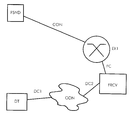
- a fax transmission facility FSND is over a connection CON connected to the exchange EX1. Of the Fax machine FSND can send faxes to the exchange EX1 be sent.
- the connection CON can not be connected to others in the figure manage illustrated facilities of a telecommunications network, e.g. about Apron facilities and other exchanges.
- the Exchange EX1 is on the connection FC with a Fax receiving device connected to FRCV.
- the fax receiving facility FRCV receives faxes instead of a subscriber's fax machine.
- the Connection FC like the connection CON, can be used in other Figure not shown lead devices of a telecommunications network. If the exchange EX1 from the fax transmitter FSND one Receives fax message for the subscriber, so she can send this fax message to forward the fax receiving facility FRCV, which instead of this fax message a fax machine of the subscriber and stores.
- the fax receiving device FRCV can work as a stand-alone device or be built into a server that can be addressed from the exchange EX1.
- a server according to the invention can perform the functions of the fax receiving device FRCV and can be connected to the exchange EX1 via the connection FC.
- the switching center EX1 may, for example a so-called SSP (S ervice S witching P oint) be an intelligent network (IN), the server a so-called SCP (S ervice C ontrol P oint), the functions of the Faxempfangs worn FRCV either alone or with the aid of a so-called intelligent peripherals can provide.
- the fax receiving device FRCV can also be integrated in the exchange EX1, so that the connection FC is an internal connection within the exchange EX1.
- an exchange according to the invention can be used, which can perform the functions of the exchange EX1 and the fax receiving device FRCV together.
- the fax receiving device FRCV can e.g. then instead of a fax machine of a subscriber will receive incoming faxes if one in the Figure not shown fax machine of a subscriber does not receive a fax message answers because the fax machine is on one for receiving Fax messages determined, also not shown
- the subscriber's fax machine subscriber line is connected, but is not switched on ready to receive.
- the term "Fax machine subscriber line" is selected for easy display and can e.g. for a local loop local loop to which the participant's fax machine is usually connected, or for a phone number of an ISDN subscriber line that one Fax machine is assigned.
- the fax machine subscriber line can e.g. of the Switch EX1 switched and operated.
- the Fax receiving device FRCV then provides an incoming Fax message determines whether the subscriber's fax machine on the Fax machine subscriber line is ready to receive, e.g. supervised or let the exchange EX1 monitor whether the call with the incoming fax message after three or five rings is accepted by the fax machine on the subscriber line.
- the subscriber can also for example a so-called UPT service (Universal Personal Telecommunications) with whom the participant is always under one identical UPT subscriber number in different places Register telecommunications network to receive and send data can. If the participant then does not have a fax machine with him when traveling deregister the fax machine from the UPT service.
- the Fax receiving device FRCV then provides an incoming Fax message by querying current UPT service parameters determines that they Fax messages directed to the UPT subscriber number instead of one Fax machine should receive. The participant can then, as later it becomes clear that the fax receiving device FRCV is also on the way Interrogate.
- UPT service Universal Personal Telecommunications
- the invention has a particularly advantageous effect if the participant does has a data terminal DT, but not a fax machine.
- the subscriber is not a subscriber connection for a fax machine required. It is then advantageous if the participant has a Fax subscriber number specially for receiving faxes is assigned.
- the exchange EX1 from the Fax transmission facility FSND to the fax subscriber number of the Receiving directed fax message, the exchange EX1 this fax message directly to the fax receiving device FRCV forward.
- the exchange EX1 gives the Fax receiving device FRCV together with the one to be stored Fax message e.g. the subscriber's fax number so that the Fax message can be assigned to the subscriber.
- the participant can make regular inquiries to the Fax receiving device FRCV determine whether the Fax receiving device FRCV has received fax messages for it, e.g. by means of a query which will be explained in the following using the shown data terminal DT.
- a query which will be explained in the following using the shown data terminal DT.
- Such notification of the participant by the Fax receiving device FRCV will be explained in more detail later.
- FIG. 1 shows a data terminal DT, which has a Connection DC1 is connected to an on-line data network ODN.
- the On-line data network for its part is via the connection DC2 with the Fax receiving device connected to FRCV.
- a typical example of that On-line data network ODN is the Internet.
- a virtual one Connection of the data network are interconnected, that represents Data network nonetheless an online connection between the two Users, even if there is sometimes a time delay.
- a data terminal DT can be used a personal computer that has a Has interface device with which access to the On-line data network ODN is possible.
- the connection DC1 to the On-line data network ODN can e.g. as a telephone connection over a Telephone network to an access computer, not shown in the figure be built up as the interface between the telephone network and the On-line data network ODN serves.
- the data terminal DT can then do data e.g. via a modem or an ISDN interface card on the Exchange connection DC1 with the on-line data network ODN.
- connection DC1 is only analog transmission allows an ISDN interface card if the connection DC1 the Transmission of digital ISDN data packets allowed. If that On-line data network ODN is the Internet, is the construction of the Connection DC1 using a personal computer and a suitable one Interface software generally known.
- the data terminal DT is a combination device that can establish the connection DC1 with the on-line data network ODN and can continue to perform the functions of a telephone. In its The data terminal DT can then function as a telephone via an in subscriber line not shown in the figure with the Switch EX1 be connected.
- the data terminal DT To start from the connection DC1 a complete connection up to to establish the fax receiving device FRCV, the data terminal DT an address of the on-line data network ODN Fax receiving device FRCV. If the on-line data network ODN the Internet, this address can e.g. a so-called URL address (Uniform Resource Locator), with which it is used on the Internet Means is possible from the data terminal DT via the On-line data network ODN a connection to an input interface, a so-called homepage, the fax receiving facility FRCV build up. The on-line data network ODN then builds the complete one Connection to the fax receiving facility FRCV including the Connection DC2 open.
- URL address Uniform Resource Locator
- the data terminal DT then sends to the Fax receiving device FRCV a request to access the fax messages, received and stored by the fax receiving device FRCV have been.
- a request e.g. a special subscriber ID of the subscriber or the fax subscriber number already mentioned which can be used to send faxes to the subscriber.
- the fax receiving device FRCV advantageously checks the access request and determines whether they have access to the received faxes of the participant.
- a personal identification number a so-called Personal Identification Number (PIN)
- PIN Personal Identification Number
- the fax receiving device FRCV allows the Access to faxes. This ensures that there is only one authorized subscriber or representative of the subscriber to the fax messages of the participant can access. But it can also be predetermined that Simply specifying the fax subscriber number is enough to get one Get access to faxes.
- the latter variant can e.g. then be selected if the fax messages have no special protection need because they are only generally known information or on other ways also contain easily accessible information.
- the fax receiving device FRCV perform a so-called "fax-on-demand" service, in which fax messages are available for any participant.
- FRCV Fax receiving device FRCV without further action by the Data terminal DT to the fax messages available for the subscriber send the data terminal DT. But greater comfort is offered if the fax messages from the data terminal DT to the Fax receiving device FRCV individually, in groups or in total can be requested. Then the fax receiving device sends FRCV saved faxes in the specifically requested manner to the Data terminal DT. The data terminal DT then receives the Faxes, stores them in a memory or gives them on one Output medium, e.g. on a screen or on a printer.
- connection can also be made by the fax receiving device FRCV are in turn dismantled, e.g. if from the data terminal DT over for a long time no further fax messages are requested, so that Connection capacity of the fax receiving device FRCV by the unused Connection to the data terminal DT is blocked unnecessarily long and therefore a time monitor in the fax receiving device FRCV Connection cleared.
- the FRCV fax receiving device can Terminate the connection with the data terminal DT even if through the Data terminal DT all in the fax receiving device FRCV for the Subscriber stored faxes have been queried.
- the fax receiving device FRCV can send fax messages from the Exchange EX1 received unmodified in the form as received by the Fax sending device FSND have been sent, i.e. the The fax transmitter FSND and the fax receiver FRCV behave like a sending or receiving fax machine with a modem Sending and receiving fax data in modulated form, e.g. from Usually used so-called group 2 fax machines are sent and can be received.
- the fax transmission facility FSND can also an Internet fax server, as used in a "Fax over Internet "is common.
- An Internet fax server sends faxes in one unmodulated binary data form in a protocol common on the Internet an Internet fax message.
- Such an Internet fax message can be found in Data packets, e.g. on an ISDN data line from which Fax transmitter FSND sent and from the Fax receiving device FRCV received and saved.
- fax messages sent by the fax transmission facility FSND can already converted by the exchange EX1 into a data format specifically for data exchange on the connection FC between the exchange EX1 and the fax receiving device FRCV set has been.
- This variant can e.g. be chosen if the Fax receiving device FRCV is integrated in the exchange EX1 and the connection FC an internal connection with a specially defined Interface within the exchange EX1 is.
- the fax receiving device FRCV in the Exchange EX1 can handle all calls to the Lead the subscriber's connection, be examined to see whether they contain an incoming fax message.
- the Fax transmission device FSND e.g. is a fax machine that is ISDN fax messages sent according to the so-called Group 4 standard
- the Exchange EX1 already from the signaling information of the incoming call with the fax message that it is the incoming call is a call with a fax message.
- Such a Call can the exchange EX1 instead of the subscriber line of Feed the participant directly to the fax receiving facility FRCV.
- the fax receiving device FRCV When polling the fax messages, the fax receiving device FRCV only send the fax messages as such to the data terminal DT, the then interpreted and output by the data terminal DT. In the opposite direction, the data terminal DT then only sends the data mentioned access code and PIN and requirements for fax messages the fax receiving facility FRCV. In this case, the data terminal DT takes care of it for user guidance with on-screen menus for querying fax messages at the fax receiving facility FRCV, if necessary for the examination on the Data terminal DT of input request commands and for the output of fax messages that are retrieved from the FRCV fax receiving facility have been. For this purpose, the data terminal DT uses one on one Storage medium of the data terminal DT permanently installed and from there retrievable software.
- the fax receiving device FRCV and Data terminal DT enriched with additional interpretation notes Exchange data. Then the fax receiving device sends FRCV additional instructions on how to set up a menu for the operator the screen of the data terminal DT or additional instructions for acoustic output of operating instructions to the data terminal DT. So will the form of the output on the data terminal DT directly from the Fax receiving device controlled FRCV and both changes as well Extensions to the output form can be made centrally by the Fax receiving device go out FRCV and are no longer dependent on one permanently installed on a storage medium of the data terminal DT Software. The data terminal DT then only has evaluation means, to send the instructions sent by the fax receiving device FRCV interpret.
- the on-line data network ODN is the Internet
- the switching center EX1 can sends to the data terminal DT
- so-called HTML documents consist of a sequence of ASCII characters (A merican S tandard C ode for I nformation I nterchange) and from the data terminal DT by means of a special evaluation program, read a so-called browser and be interpreted.
- the syntax of the HTML documents is precisely defined and allows, for example, the type of written display of screen pages or entire acoustic sequences to be described with the HTML description language.
- the data terminal DT can display control fields on input fields on a screen page, so that the operator of the data terminal DT can, for example, select which of the fax messages stored in the fax receiving device FRCV he wants to receive.
- the data terminal DT then sends the operator's selection to the fax receiving device FRCV, which then sends the selected fax messages back to the data terminal DT.
- the operator of the data terminal DT can, for example, also instruct the data format in which the received fax messages are to be sent to the data terminal DT.
- the data terminal DT can give an instruction about the desired data format to the fax receiving device FRCV, the fax receiving device FRCV converts received fax messages into the desired data format and fax messages only in this data format sends to the data terminal DT.
- the fax receiving device FRCV converts received fax messages into the desired data format and fax messages only in this data format sends to the data terminal DT.
- a fax message received by the fax receiving device FRCV in a modulated form and subsequently demodulated is passed on to the data terminal DT in a binary data format.
- the so-called "Tagged Image Format" for example, can be used as the binary data format, with which image files can be displayed.
- the data terminal DT then does not need its own modem for demodulating fax messages.
- the fax receiving device FRCV can also be instructed to interpret fax messages before sending it to the data terminal DT.
- the fax receiving device FRCV can be commissioned to determine the text contained in a fax message with the help of OCR software ( O ptical C haracter R ecognition) and to send it as an ASCII character string to the data terminal DT.
- OCR software O ptical C haracter R ecognition
- the text is then no longer only contained in image information as it was in the original fax message, but can be directly processed further as image information evaluated in terms of content, namely as an ASCII character string, for example by a word processor in the data terminal DT.
- the fax message is no longer an image, it is no longer a facsimile of the document originally sent as a fax message.
- the content of the fax message remains unchanged.
- the fax receiving device FRCV can include a fax message in the evaluated form as well as in picture format form in a description in the HTML description language. Then the data terminal DT does not need any further aids for receiving fax messages apart from the aforementioned browser for interpreting HTML descriptions, which can be used advantageously anyway for communication with the fax receiving device FRCV via the Internet.
- the language JAVA offers extended possibilities for the output of data and especially for its interactive modification.
- the fax receiving device FRCV sends an intermediate code generated from a compiled source text, a so-called JAVA applet, to the data terminal DT, which translates it into machine code with a JAVA interpreter and then executes the machine code program generated in this way, ie image sequences, acoustic sequences or query masks for selection of fax messages to be retrieved from the fax receiving device FRCV.
- the fax receiving device FRCV can call the subscriber, for example via the exchange EX1, on a subscriber's telephone set and play the notification in spoken form to the subscriber.
- the spoken notification can be generated by a speech generator.
- the Faxempfangs Rhein FRCV can the subscriber, the notification also in the way of so-called S hort M essage S ervices (SMS) if the subscriber has a terminal of a mobile telecommunications network.
- SMS S hort M essage S ervices
- the fax receiving device FRCV can send the notification to the ISDN terminal as part of a user-to-user signaling, as described by the DSS1 protocol for ISDN telecommunications networks Features "customer-specific signaling information during a connection" under the abbreviation "UUS3".
- the ISDN terminal can display this user-to-user-signaled notification to the subscriber on a display device.
- the fax receiving device FRCV can also instruct the exchange EX1 to do this To give subscribers a special dial tone as a reference to available fax messages or to play an announcement with a reference to available fax messages if the subscriber lifts the handset of his telephone terminal, not shown in the figure, which is connected to a subscriber line of the exchange EX1 Switching center EX1 can also pass on the instructions for giving a special free character or for playing the note to a further switching center, not shown in the figure, if the telephone terminal is located in the connection area of this latter switching center.
- the fax receiving device FRCV can inform the data terminal DT in a particularly simple manner that fax messages have been received for the subscriber. After the fax receiving device FRCV has received a fax message for the subscriber, it can check, for example, whether the subscriber is connected to the Internet with his data terminal DT by the fax receiving device FRCV sending a notification to the data terminal DT. As an address to this notification, the Faxempfangs coupled FRCV, an Internet address to use, for example, a URL address (U R niform esource ocator L) which is assigned to the data terminal DT.
- U R niform esource ocator L U R niform esource ocator L
- the fax receiving device FRCV can send the fax message directly to the data terminal DT. It is also possible for the fax receiving device FRCV to automatically send a received fax message to the data terminal DT without prior notification, provided that the data terminal DT already has an active connection to the on-line data network ODN, that is to say a so-called on-line session the internet is underway. If the data terminal DT is not ready to receive, the fax receiving device FRCV can, as already described, inform the subscriber of the receipt of a fax message in other ways as well. In addition, the fax receiving device FRCV can also send an email to the subscriber if the subscriber has access to an email service.
- the fax receiving device FRCV also offers an alternative possibility of retrieving a received fax message using a fax machine, not shown in the figure.
- This fax machine can establish a connection to the fax receiving device FRCV via a telecommunications network, comparable to the connection between the fax transmitting device FSND and the fax receiving device FRCV via the connection CON, the switching center EX1 and the connection FC.
- the subscriber After the fax machine by specifying an access code, such as his access authorization has proved to lying ready for the subscriber fax message via a DTMF signaling (D ual T one M ulti F requency) which Faxempfangs dressed FRCV sends the fax to the facsimile machine.
- the subscriber can also set up a connection to the fax receiving device FRCV using a telephone apparatus, also not shown in the figure.
- the fax receiving device FRCV can then interpret a ready fax message, possibly only its title, for example with the help of the OCR software mentioned and read it out to the subscriber using a speech generator.
Landscapes
- Engineering & Computer Science (AREA)
- General Engineering & Computer Science (AREA)
- Multimedia (AREA)
- Signal Processing (AREA)
- Computing Systems (AREA)
- Computer Networks & Wireless Communication (AREA)
- Facsimiles In General (AREA)
- Facsimile Transmission Control (AREA)
- Telephonic Communication Services (AREA)
- Data Exchanges In Wide-Area Networks (AREA)
Abstract
Description
- Die Figur
- zeigt eine Anordnung zur Ausführung des erfindungsgemäßen Verfahrens mit einer Faxsendeeinrichtung FSND, einer erfindungsgemäßen Faxempfangseinrichtung FRCV, einer Vermittlungsstelle EX1 und einem Datenendgerät DT.
Claims (11)
- Verfahren zum Empfang von Faxnachrichten durch eine Faxempfangseinrichtung (FRCV) in einem Telekommunikationsnetz anstelle eines Faxgerätes eines Teilnehmers, wobei bei dem Verfahren die Faxempfangseinrichtung (FRCV) erkennt, daß sie eine ankommende Faxnachricht anstelle eines Faxgerätes empfangen soll und wobei die Faxempfangseinrichtung (FRCV) die Faxnachricht empfängt und speichert, dadurch gekennzeichnet, daß bei dem Verfahren ein Datenendgerät (DT) des Teilnehmers eine Verbindung über ein On-Line-Datennetzwerk (ODN) zu der Faxempfangseinrichtung (FRCV) aufbaut, daß die Faxempfangseinrichtung (FRCV) die Faxnachricht über das On-Line-Datennetzwerk (ODN) an das Datenendgerät (DT) sendet und daß das Datenendgerät (DT) oder die Faxempfangseinrichtung (FRCV) die Verbindung über das On-Line-Datennetzwerk (ODN) zu der Faxempfangseinrichtung (FRCV) beenden.
- Verfahren nach Anspruch 1, dadurch gekennzeichnet, daß die Faxempfangseinrichtung (FRCV) im Zusammenwirken mit einer Vermittlungsstelle (EX1) erkennt, daß sie eine ankommende Faxnachricht anstelle eines Faxgerätes empfangen soll.
- Verfahren nach Anspruch 1, dadurch gekennzeichnet, daß die Faxempfangseinrichtung (FRCV) die Faxnachricht aus einem ersten Datenformat, das für die Kommunikation zwischen zwei Faxgeräten üblich ist, in ein für das Datenendgerät (DT) verständliches zweites Datenformat konvertiert und daß die Faxempfangseinrichtung (FRCV) dem Datenendgerät (DT) die Faxnachricht in dem zweiten Datenformat sendet.
- Verfahren nach Anspruch 1, dadurch gekennzeichnet, daß die Faxempfangseinrichtung (FRCV) nach dem Empfang der Faxnachricht an ein Endgerät des Teilnehmers eine Nachricht sendet, daß eine Faxnachricht gespeichert wurde.
- Verfahren nach Anspruch 1, dadurch gekennzeichnet, daß nach dem Aufbau der Verbindung über ein On-Line-Datennetzwerk (ODN) zu der Faxempfangseinrichtung (FRCV) das Datenendgerät (DT) einen Zugangswunsch des Teilnehmers zu der Faxnachricht sendet, die Faxempfangseinrichtung (FRCV) den Zugangswunsch überprüft und festgestellt, ob der Teilnehmer eine Zugangsberechtigung zu der Faxnachricht besitzt.
- Verfahren nach Anspruch 1, dadurch gekennzeichnet, daß dem Teilnehmer eine für den Empfang von Faxnachrichten bestimmte Fax-Teilnehmernummer zugeteilt wird und daß die Faxempfangseinrichtung (FRCV) eine Faxnachricht anstelle des Faxgerätes des Teilnehmers empfängt, wenn die Faxnachricht an die Fax-Teilnehmernummer gerichtet ist.
- Verfahren nach Anspruch 1, dadurch gekennzeichnet, daß die Faxempfangseinrichtung (FRCV) eine Faxnachricht anstelle des Faxgerätes des Teilnehmers empfängt, wenn die Faxnachricht an eine UPT (Universal Personal Telecommunications)-Nummer des Teilnehmers gerichtet ist.
- Faxempfangseinrichtung (FRCV) für ein Telekommunikationsnetz zum Empfang von Faxnachrichten anstelle eines Faxgerätes eines Teilnehmers, wobei die Faxempfangseinrichtung (FRCV) Mittel aufweist, um die Faxnachricht zu empfangen und wobei die Faxempfangseinrichtung (FRCV) Mittel aufweist, um die Faxnachricht zu speichern, dadurch gekennzeichnet, daß die Faxempfangseinrichtung (FRCV) eine Schnittstelle aufweist, über die ein Datenendgerät (DT) des Teilnehmers eine Verbindung über ein On-Line-Datennetzwerk (ODN) zu der Faxempfangseinrichtung (FRCV) aufbauen kann und daß die Faxempfangseinrichtung (FRCV) Mittel aufweist, um die Faxnachricht über das On-Line-Datennetzwerk (ODN) an das Datenendgerät (DT) zu senden.
- Faxempfangseinrichtung (FRCV) nach Anspruch 7, dadurch gekennzeichnet, daß die Faxempfangseinrichtung (FRCV) eine Schnittstelle aufweist, über die ein Endgerät eine Verbindung über das Telekommunikationsnetz zu der Faxempfangseinrichtung (FRCV) aufbauen kann, und daß die Faxempfangseinrichtung (FRCV) Mittel aufweist, um die Faxnachricht über das Telekommunikationsnetz an das Endgerät zu senden.
- Server für ein Telekommunikationsnetz zum Empfang von Faxnachrichten anstelle eines Faxgerätes eines Teilnehmers, wobei der Server Mittel aufweist, um die Faxnachricht zu empfangen und wobei der Server Mittel aufweist, um die Faxnachricht zu speichern, dadurch gekennzeichnet, daß der Server eine Schnittstelle aufweist, über die ein Datenendgerät (DT) des Teilnehmers eine Verbindung über ein On-Line-Datennetzwerk (ODN) zu dem Server aufbauen kann und daß der Server Mittel aufweist, um die Faxnachricht über das On-Line-Datennetzwerk (ODN) an das Datenendgerät (DT) zu senden.
- Vermittlungsstelle für ein Telekommunikationsnetz zum Empfang von Faxnachrichten anstelle eines Faxgerätes eines Teilnehmers, wobei die Vermittlungsstelle Mittel aufweist, um zu erkennen, daß sie eine ankommende Faxnachricht anstelle eines Faxgerätes empfangen soll, wobei die Vermittlungsstelle Mittel aufweist, um die Faxnachricht zu empfangen und wobei die Vermittlungsstelle Mittel aufweist, um die Faxnachricht zu speichern dadurch gekennzeichnet, daß die Vermittlungsstelle eine Schnittstelle aufweist, über die ein Datenendgerät (DT) des Teilnehmers eine Verbindung über ein On-Line-Datennetzwerk (ODN) zu der Vermittlungsstelle aufbauen kann und daß die Vermittlungsstelle Mittel aufweist, um die Faxnachricht über das On-Line-Datennetzwerk (ODN) an das Datenendgerät (DT) zu senden.
Applications Claiming Priority (2)
| Application Number | Priority Date | Filing Date | Title |
|---|---|---|---|
| DE1998111407 DE19811407A1 (de) | 1998-03-16 | 1998-03-16 | Verfahren zum Empfang von Faxnachrichten anstelle eines Faxgerätes eines Teilnehmers sowie Faxempfangseinrichtung, Server und Vermittlungsstelle hierzu |
| DE19811407 | 1998-03-16 |
Publications (1)
| Publication Number | Publication Date |
|---|---|
| EP0944236A1 true EP0944236A1 (de) | 1999-09-22 |
Family
ID=7861091
Family Applications (1)
| Application Number | Title | Priority Date | Filing Date |
|---|---|---|---|
| EP99440046A Withdrawn EP0944236A1 (de) | 1998-03-16 | 1999-03-05 | Verfahren zum Empfang von Faxnachrichten anstelle eines Faxgerätes eines Teilnehmers sowie Faxempfangseinrichtung, Server und Vermittlungsstelle hierzu |
Country Status (5)
| Country | Link |
|---|---|
| EP (1) | EP0944236A1 (de) |
| JP (1) | JPH11331476A (de) |
| CN (1) | CN1237849A (de) |
| CA (1) | CA2263637A1 (de) |
| DE (1) | DE19811407A1 (de) |
Families Citing this family (2)
| Publication number | Priority date | Publication date | Assignee | Title |
|---|---|---|---|---|
| US6898624B2 (en) * | 2001-03-19 | 2005-05-24 | Hewlett-Packard Development Company, L.P. | System and method providing an embedded web server facsimile service |
| CN103037122B (zh) * | 2012-12-11 | 2015-11-11 | 上海市共进通信技术有限公司 | 利用家庭网关设备实现传真收发控制的方法 |
Citations (4)
| Publication number | Priority date | Publication date | Assignee | Title |
|---|---|---|---|---|
| EP0615377A2 (de) * | 1993-03-10 | 1994-09-14 | Tecnomen Oy | Automatisches Faksimileübergabesystem |
| EP0785482A2 (de) * | 1996-01-22 | 1997-07-23 | Kabushiki Kaisha Toshiba | Bilderzeugungssystem |
| WO1997026753A1 (en) * | 1996-01-16 | 1997-07-24 | I-Link Worldwide, Inc. | Facsimile internet transmission system |
| EP0812100A2 (de) * | 1996-06-07 | 1997-12-10 | Murata Kikai Kabushiki Kaisha | Übertragungsverfahren und -endgerät |
Family Cites Families (6)
| Publication number | Priority date | Publication date | Assignee | Title |
|---|---|---|---|---|
| BR7707476A (pt) * | 1976-11-10 | 1978-08-01 | Int Standard Electric Corp | Sistemas de comunicacoes de dados comutados em pacotes |
| JP3367976B2 (ja) * | 1991-11-07 | 2003-01-20 | キヤノン株式会社 | データ処理装置及び方法 |
| JP3135094B2 (ja) * | 1993-03-13 | 2001-02-13 | 株式会社リコー | 統合ビジネス用ネットワークシステム |
| US5873077A (en) * | 1995-01-13 | 1999-02-16 | Ricoh Corporation | Method and apparatus for searching for and retrieving documents using a facsimile machine |
| DE19522209A1 (de) * | 1995-06-22 | 1997-01-02 | Sel Alcatel Ag | Kommunikationssystem für Abrufdienste und Empfangseinrichtung dafür |
| US5764639A (en) * | 1995-11-15 | 1998-06-09 | Staples; Leven E. | System and method for providing a remote user with a virtual presence to an office |
-
1998
- 1998-03-16 DE DE1998111407 patent/DE19811407A1/de not_active Withdrawn
-
1999
- 1999-03-05 EP EP99440046A patent/EP0944236A1/de not_active Withdrawn
- 1999-03-08 JP JP11060517A patent/JPH11331476A/ja active Pending
- 1999-03-15 CA CA 2263637 patent/CA2263637A1/en not_active Abandoned
- 1999-03-16 CN CN 99104016 patent/CN1237849A/zh active Pending
Patent Citations (4)
| Publication number | Priority date | Publication date | Assignee | Title |
|---|---|---|---|---|
| EP0615377A2 (de) * | 1993-03-10 | 1994-09-14 | Tecnomen Oy | Automatisches Faksimileübergabesystem |
| WO1997026753A1 (en) * | 1996-01-16 | 1997-07-24 | I-Link Worldwide, Inc. | Facsimile internet transmission system |
| EP0785482A2 (de) * | 1996-01-22 | 1997-07-23 | Kabushiki Kaisha Toshiba | Bilderzeugungssystem |
| EP0812100A2 (de) * | 1996-06-07 | 1997-12-10 | Murata Kikai Kabushiki Kaisha | Übertragungsverfahren und -endgerät |
Also Published As
| Publication number | Publication date |
|---|---|
| CA2263637A1 (en) | 1999-09-16 |
| JPH11331476A (ja) | 1999-11-30 |
| DE19811407A1 (de) | 1999-09-23 |
| CN1237849A (zh) | 1999-12-08 |
Similar Documents
| Publication | Publication Date | Title |
|---|---|---|
| DE69735832T2 (de) | Nachrichtenabruf über alternativen Zugang | |
| DE3900982C2 (de) | ||
| DE69031384T2 (de) | Vorrichtung zur umsetzung von text eines graphischen faksimilebildes in sprache | |
| DE69618216T2 (de) | Verfahren und vorrichtung zum bereitstellen von kommunikation für telekommunikationsendgeräte | |
| DE69836644T3 (de) | Systeme und verfahren zur verwaltung von nachrichten | |
| DE69836901T2 (de) | Verfahren zum Hinzufügen von Kontext zu Kommunikationen | |
| DE69026632T2 (de) | Faksimilebetrieb | |
| DE69838125T2 (de) | Server und verfahren zur automatischen lieferung von nachrichten zu einem telekommunikationsgerät | |
| DE60125637T2 (de) | System und Methode um den Aufenthalt oder die Verfügbarkeit eines Telefonnutzers zu erkennen und die Rufnummer im Internet zu veröffentlichen | |
| DE68928298T2 (de) | Antwortregelungssystem | |
| DE69118138T2 (de) | Verallgemeinerte Anordnung für Telekommunikationskunden-Signalisierungen | |
| DE69333681T2 (de) | Techniken zur Erzeugung von Personalcomputeranzeigen und gedruckten Transkripten aus Sprachpostnachrichten | |
| DE3415839C2 (de) | ||
| DE3903257A1 (de) | Kommunikationssystem bei telefonvermittlungsanlagen | |
| DE19542122A1 (de) | Lokales Kommunikations-Serversystem | |
| DE69729159T2 (de) | Kompatibilität zwischen einem Fernsprechdienst mit Anbieter und einem ISDN Anruferidentifikationsdienst | |
| EP0942613A2 (de) | Verfahren zur Verwaltung von Telekommunikationsdienst-Daten eines Teilnehmers sowie den zugehörigen Server und die zugehörige Vermittlungsstelle | |
| DE69533253T2 (de) | Verfahren und System zur individuellen Anpassung von Kommunikationen über ein Netzwerk | |
| DE69738516T2 (de) | Verfahren und system für verbindungsherstellung | |
| DE69732130T2 (de) | Fax-an-e-mail-kommunikationssystem mit lokaler schnittstelle | |
| DE69226628T2 (de) | Multikommunikations-Faksimilegerät | |
| DE69020526T2 (de) | Kommunikationsgerät mit tragbarer Vorrichtung zur Bezeichnung seines Kommunikationsmodus. | |
| DE19744965A1 (de) | Verfahren zum telefonischen Anfordern von Dienstleistungen | |
| EP0944236A1 (de) | Verfahren zum Empfang von Faxnachrichten anstelle eines Faxgerätes eines Teilnehmers sowie Faxempfangseinrichtung, Server und Vermittlungsstelle hierzu | |
| DE69318192T2 (de) | Videotext- und Faksimilegerät |
Legal Events
| Date | Code | Title | Description |
|---|---|---|---|
| PUAI | Public reference made under article 153(3) epc to a published international application that has entered the european phase |
Free format text: ORIGINAL CODE: 0009012 |
|
| AK | Designated contracting states |
Kind code of ref document: A1 Designated state(s): AT BE DE ES FR GB IT SE |
|
| AX | Request for extension of the european patent |
Free format text: AL;LT;LV;MK;RO;SI |
|
| 17P | Request for examination filed |
Effective date: 19991112 |
|
| AKX | Designation fees paid |
Free format text: AT BE DE ES FR GB IT SE |
|
| 17Q | First examination report despatched |
Effective date: 20001103 |
|
| RTI1 | Title (correction) |
Free format text: METHOD OF FAX MESSAGE RECEPTION OTHER THAN BY FAX MACHINE, AS WELL AS FAX RECEPTION SYSTEM HEREFOR |
|
| GRAG | Despatch of communication of intention to grant |
Free format text: ORIGINAL CODE: EPIDOS AGRA |
|
| RTI1 | Title (correction) |
Free format text: METHOD OF FAX MESSAGE RECEPTION OTHER THAN BY FAX MACHINE, AS WELL AS FAX RECEPTION SYSTEM HEREFOR |
|
| GRAG | Despatch of communication of intention to grant |
Free format text: ORIGINAL CODE: EPIDOS AGRA |
|
| GRAH | Despatch of communication of intention to grant a patent |
Free format text: ORIGINAL CODE: EPIDOS IGRA |
|
| STAA | Information on the status of an ep patent application or granted ep patent |
Free format text: STATUS: THE APPLICATION IS DEEMED TO BE WITHDRAWN |
|
| 18D | Application deemed to be withdrawn |
Effective date: 20020515 |