EP0847237B1 - Unactivated oocytes as cytoplast recipients for nuclear transfer - Google Patents
Unactivated oocytes as cytoplast recipients for nuclear transfer Download PDFInfo
- Publication number
- EP0847237B1 EP0847237B1 EP96928586A EP96928586A EP0847237B1 EP 0847237 B1 EP0847237 B1 EP 0847237B1 EP 96928586 A EP96928586 A EP 96928586A EP 96928586 A EP96928586 A EP 96928586A EP 0847237 B1 EP0847237 B1 EP 0847237B1
- Authority
- EP
- European Patent Office
- Prior art keywords
- human
- embryo
- nucleus
- human mammal
- oocytes
- Prior art date
- Legal status (The legal status is an assumption and is not a legal conclusion. Google has not performed a legal analysis and makes no representation as to the accuracy of the status listed.)
- Expired - Lifetime
Links
- 210000000287 oocyte Anatomy 0.000 title claims abstract description 82
- 238000012546 transfer Methods 0.000 title claims abstract description 37
- 210000004027 cell Anatomy 0.000 claims abstract description 55
- 238000000034 method Methods 0.000 claims abstract description 51
- 210000001161 mammalian embryo Anatomy 0.000 claims abstract description 50
- 230000004913 activation Effects 0.000 claims abstract description 48
- 230000031864 metaphase Effects 0.000 claims abstract description 16
- 210000000805 cytoplasm Anatomy 0.000 claims abstract description 11
- 241000283690 Bos taurus Species 0.000 claims description 24
- 238000000338 in vitro Methods 0.000 claims description 12
- 241000894007 species Species 0.000 claims description 10
- 241001494479 Pecora Species 0.000 claims description 8
- 230000008569 process Effects 0.000 claims description 8
- 230000003213 activating effect Effects 0.000 claims description 6
- 230000001488 breeding effect Effects 0.000 claims description 4
- 230000007910 cell fusion Effects 0.000 claims description 4
- 208000035752 Live birth Diseases 0.000 claims description 3
- 241000283984 Rodentia Species 0.000 claims description 3
- 238000009395 breeding Methods 0.000 claims description 3
- 241000283707 Capra Species 0.000 claims description 2
- 244000309464 bull Species 0.000 claims 2
- 241000283073 Equus caballus Species 0.000 claims 1
- 241000282898 Sus scrofa Species 0.000 claims 1
- 230000009261 transgenic effect Effects 0.000 abstract description 16
- 230000022131 cell cycle Effects 0.000 abstract description 13
- 241001465754 Metazoa Species 0.000 abstract description 12
- KYRVNWMVYQXFEU-UHFFFAOYSA-N Nocodazole Chemical compound C1=C2NC(NC(=O)OC)=NC2=CC=C1C(=O)C1=CC=CS1 KYRVNWMVYQXFEU-UHFFFAOYSA-N 0.000 abstract description 10
- 229950006344 nocodazole Drugs 0.000 abstract description 10
- 238000004519 manufacturing process Methods 0.000 abstract description 8
- 231100000782 microtubule inhibitor Toxicity 0.000 abstract description 8
- 230000010190 G1 phase Effects 0.000 abstract description 6
- 230000002068 genetic effect Effects 0.000 abstract description 6
- 229940122255 Microtubule inhibitor Drugs 0.000 abstract description 5
- 210000004940 nucleus Anatomy 0.000 description 46
- 210000002257 embryonic structure Anatomy 0.000 description 38
- 238000011161 development Methods 0.000 description 21
- 230000018109 developmental process Effects 0.000 description 21
- 230000035800 maturation Effects 0.000 description 20
- 210000002459 blastocyst Anatomy 0.000 description 19
- 230000004927 fusion Effects 0.000 description 16
- 238000002474 experimental method Methods 0.000 description 11
- 238000001727 in vivo Methods 0.000 description 11
- 230000015572 biosynthetic process Effects 0.000 description 10
- OYPRJOBELJOOCE-UHFFFAOYSA-N Calcium Chemical compound [Ca] OYPRJOBELJOOCE-UHFFFAOYSA-N 0.000 description 9
- 239000011575 calcium Substances 0.000 description 9
- 229910052791 calcium Inorganic materials 0.000 description 9
- 230000000694 effects Effects 0.000 description 9
- 102000029749 Microtubule Human genes 0.000 description 7
- 108091022875 Microtubule Proteins 0.000 description 7
- 230000008901 benefit Effects 0.000 description 7
- 210000004602 germ cell Anatomy 0.000 description 7
- 238000002347 injection Methods 0.000 description 7
- 239000007924 injection Substances 0.000 description 7
- 210000004688 microtubule Anatomy 0.000 description 7
- 108010077544 Chromatin Proteins 0.000 description 6
- 108020004414 DNA Proteins 0.000 description 6
- 210000003483 chromatin Anatomy 0.000 description 6
- 230000001086 cytosolic effect Effects 0.000 description 6
- 210000005260 human cell Anatomy 0.000 description 6
- 210000004508 polar body Anatomy 0.000 description 6
- 108090000623 proteins and genes Proteins 0.000 description 6
- 241000124008 Mammalia Species 0.000 description 5
- 241000283973 Oryctolagus cuniculus Species 0.000 description 5
- 210000000349 chromosome Anatomy 0.000 description 5
- 230000007159 enucleation Effects 0.000 description 5
- 230000011278 mitosis Effects 0.000 description 5
- 238000012216 screening Methods 0.000 description 5
- 230000035519 G0 Phase Effects 0.000 description 4
- 241000699666 Mus <mouse, genus> Species 0.000 description 4
- 238000013459 approach Methods 0.000 description 4
- 238000010367 cloning Methods 0.000 description 4
- 230000003325 follicular Effects 0.000 description 4
- 238000012239 gene modification Methods 0.000 description 4
- 230000005017 genetic modification Effects 0.000 description 4
- 235000013617 genetically modified food Nutrition 0.000 description 4
- 210000000633 nuclear envelope Anatomy 0.000 description 4
- 230000008672 reprogramming Effects 0.000 description 4
- 230000004044 response Effects 0.000 description 4
- 239000003381 stabilizer Substances 0.000 description 4
- 238000011282 treatment Methods 0.000 description 4
- 229920001817 Agar Polymers 0.000 description 3
- FBPFZTCFMRRESA-KVTDHHQDSA-N D-Mannitol Chemical compound OC[C@@H](O)[C@@H](O)[C@H](O)[C@H](O)CO FBPFZTCFMRRESA-KVTDHHQDSA-N 0.000 description 3
- 230000006820 DNA synthesis Effects 0.000 description 3
- 229930195725 Mannitol Natural products 0.000 description 3
- OKKJLVBELUTLKV-UHFFFAOYSA-N Methanol Chemical compound OC OKKJLVBELUTLKV-UHFFFAOYSA-N 0.000 description 3
- 241000711408 Murine respirovirus Species 0.000 description 3
- 239000004218 Orcein Substances 0.000 description 3
- 239000002202 Polyethylene glycol Substances 0.000 description 3
- 239000008272 agar Substances 0.000 description 3
- 210000001109 blastomere Anatomy 0.000 description 3
- 230000015556 catabolic process Effects 0.000 description 3
- 238000002224 dissection Methods 0.000 description 3
- 210000002950 fibroblast Anatomy 0.000 description 3
- 244000144980 herd Species 0.000 description 3
- 244000144972 livestock Species 0.000 description 3
- 239000000594 mannitol Substances 0.000 description 3
- 235000010355 mannitol Nutrition 0.000 description 3
- 230000021121 meiosis Effects 0.000 description 3
- 238000000520 microinjection Methods 0.000 description 3
- 210000003101 oviduct Anatomy 0.000 description 3
- 229920001223 polyethylene glycol Polymers 0.000 description 3
- 230000035935 pregnancy Effects 0.000 description 3
- 230000001681 protective effect Effects 0.000 description 3
- 239000000126 substance Substances 0.000 description 3
- 238000001890 transfection Methods 0.000 description 3
- JKMHFZQWWAIEOD-UHFFFAOYSA-N 2-[4-(2-hydroxyethyl)piperazin-1-yl]ethanesulfonic acid Chemical compound OCC[NH+]1CCN(CCS([O-])(=O)=O)CC1 JKMHFZQWWAIEOD-UHFFFAOYSA-N 0.000 description 2
- QTBSBXVTEAMEQO-UHFFFAOYSA-N Acetic acid Chemical compound CC(O)=O QTBSBXVTEAMEQO-UHFFFAOYSA-N 0.000 description 2
- BHPQYMZQTOCNFJ-UHFFFAOYSA-N Calcium cation Chemical compound [Ca+2] BHPQYMZQTOCNFJ-UHFFFAOYSA-N 0.000 description 2
- 241001550206 Colla Species 0.000 description 2
- LFQSCWFLJHTTHZ-UHFFFAOYSA-N Ethanol Chemical compound CCO LFQSCWFLJHTTHZ-UHFFFAOYSA-N 0.000 description 2
- 235000019687 Lamb Nutrition 0.000 description 2
- 241000699670 Mus sp. Species 0.000 description 2
- 229930012538 Paclitaxel Natural products 0.000 description 2
- UIIMBOGNXHQVGW-UHFFFAOYSA-M Sodium bicarbonate Chemical compound [Na+].OC([O-])=O UIIMBOGNXHQVGW-UHFFFAOYSA-M 0.000 description 2
- 229930006000 Sucrose Natural products 0.000 description 2
- CZMRCDWAGMRECN-UGDNZRGBSA-N Sucrose Chemical compound O[C@H]1[C@H](O)[C@@H](CO)O[C@@]1(CO)O[C@@H]1[C@H](O)[C@@H](O)[C@H](O)[C@@H](CO)O1 CZMRCDWAGMRECN-UGDNZRGBSA-N 0.000 description 2
- 241000282887 Suidae Species 0.000 description 2
- 102000004243 Tubulin Human genes 0.000 description 2
- 108090000704 Tubulin Proteins 0.000 description 2
- 239000012888 bovine serum Substances 0.000 description 2
- 229910001424 calcium ion Inorganic materials 0.000 description 2
- 230000001419 dependent effect Effects 0.000 description 2
- BFMYDTVEBKDAKJ-UHFFFAOYSA-L disodium;(2',7'-dibromo-3',6'-dioxido-3-oxospiro[2-benzofuran-1,9'-xanthene]-4'-yl)mercury;hydrate Chemical compound O.[Na+].[Na+].O1C(=O)C2=CC=CC=C2C21C1=CC(Br)=C([O-])C([Hg])=C1OC1=C2C=C(Br)C([O-])=C1 BFMYDTVEBKDAKJ-UHFFFAOYSA-L 0.000 description 2
- 238000011010 flushing procedure Methods 0.000 description 2
- 230000006872 improvement Effects 0.000 description 2
- 238000011534 incubation Methods 0.000 description 2
- 230000006698 induction Effects 0.000 description 2
- 229930027917 kanamycin Natural products 0.000 description 2
- SBUJHOSQTJFQJX-NOAMYHISSA-N kanamycin Chemical compound O[C@@H]1[C@@H](O)[C@H](O)[C@@H](CN)O[C@@H]1O[C@H]1[C@H](O)[C@@H](O[C@@H]2[C@@H]([C@@H](N)[C@H](O)[C@@H](CO)O2)O)[C@H](N)C[C@@H]1N SBUJHOSQTJFQJX-NOAMYHISSA-N 0.000 description 2
- 229960000318 kanamycin Drugs 0.000 description 2
- 229930182823 kanamycin A Natural products 0.000 description 2
- 238000012423 maintenance Methods 0.000 description 2
- 239000000463 material Substances 0.000 description 2
- 230000000394 mitotic effect Effects 0.000 description 2
- 230000004048 modification Effects 0.000 description 2
- 238000012986 modification Methods 0.000 description 2
- 230000000877 morphologic effect Effects 0.000 description 2
- 210000000472 morula Anatomy 0.000 description 2
- 238000010449 nuclear transplantation Methods 0.000 description 2
- 210000001672 ovary Anatomy 0.000 description 2
- 230000016087 ovulation Effects 0.000 description 2
- 229960001592 paclitaxel Drugs 0.000 description 2
- 150000003839 salts Chemical class 0.000 description 2
- 210000002966 serum Anatomy 0.000 description 2
- 239000000243 solution Substances 0.000 description 2
- 230000000638 stimulation Effects 0.000 description 2
- 239000005720 sucrose Substances 0.000 description 2
- 230000001360 synchronised effect Effects 0.000 description 2
- RCINICONZNJXQF-MZXODVADSA-N taxol Chemical compound O([C@@H]1[C@@]2(C[C@@H](C(C)=C(C2(C)C)[C@H](C([C@]2(C)[C@@H](O)C[C@H]3OC[C@]3([C@H]21)OC(C)=O)=O)OC(=O)C)OC(=O)[C@H](O)[C@@H](NC(=O)C=1C=CC=CC=1)C=1C=CC=CC=1)O)C(=O)C1=CC=CC=C1 RCINICONZNJXQF-MZXODVADSA-N 0.000 description 2
- 210000004340 zona pellucida Anatomy 0.000 description 2
- NNJPGOLRFBJNIW-HNNXBMFYSA-N (-)-demecolcine Chemical compound C1=C(OC)C(=O)C=C2[C@@H](NC)CCC3=CC(OC)=C(OC)C(OC)=C3C2=C1 NNJPGOLRFBJNIW-HNNXBMFYSA-N 0.000 description 1
- PRDFBSVERLRRMY-UHFFFAOYSA-N 2'-(4-ethoxyphenyl)-5-(4-methylpiperazin-1-yl)-2,5'-bibenzimidazole Chemical compound C1=CC(OCC)=CC=C1C1=NC2=CC=C(C=3NC4=CC(=CC=C4N=3)N3CCN(C)CC3)C=C2N1 PRDFBSVERLRRMY-UHFFFAOYSA-N 0.000 description 1
- 235000002198 Annona diversifolia Nutrition 0.000 description 1
- 241000030939 Bubalus bubalis Species 0.000 description 1
- 241000282832 Camelidae Species 0.000 description 1
- 206010068051 Chimerism Diseases 0.000 description 1
- 230000004543 DNA replication Effects 0.000 description 1
- NNJPGOLRFBJNIW-UHFFFAOYSA-N Demecolcine Natural products C1=C(OC)C(=O)C=C2C(NC)CCC3=CC(OC)=C(OC)C(OC)=C3C2=C1 NNJPGOLRFBJNIW-UHFFFAOYSA-N 0.000 description 1
- 241000283086 Equidae Species 0.000 description 1
- 241000289695 Eutheria Species 0.000 description 1
- 108091029865 Exogenous DNA Proteins 0.000 description 1
- 230000010337 G2 phase Effects 0.000 description 1
- 241000282838 Lama Species 0.000 description 1
- FYYHWMGAXLPEAU-UHFFFAOYSA-N Magnesium Chemical compound [Mg] FYYHWMGAXLPEAU-UHFFFAOYSA-N 0.000 description 1
- 108020005196 Mitochondrial DNA Proteins 0.000 description 1
- 241000700157 Rattus norvegicus Species 0.000 description 1
- 108020004511 Recombinant DNA Proteins 0.000 description 1
- 230000018199 S phase Effects 0.000 description 1
- 108700019146 Transgenes Proteins 0.000 description 1
- 208000034790 Twin pregnancy Diseases 0.000 description 1
- 241000251539 Vertebrata <Metazoa> Species 0.000 description 1
- 241000700605 Viruses Species 0.000 description 1
- 229960000583 acetic acid Drugs 0.000 description 1
- 230000002411 adverse Effects 0.000 description 1
- 230000032683 aging Effects 0.000 description 1
- 238000004458 analytical method Methods 0.000 description 1
- 230000003466 anti-cipated effect Effects 0.000 description 1
- 230000004888 barrier function Effects 0.000 description 1
- 230000029803 blastocyst development Effects 0.000 description 1
- ZFXVRMSLJDYJCH-UHFFFAOYSA-N calcium magnesium Chemical compound [Mg].[Ca] ZFXVRMSLJDYJCH-UHFFFAOYSA-N 0.000 description 1
- 230000008859 change Effects 0.000 description 1
- 230000010428 chromatin condensation Effects 0.000 description 1
- 239000013611 chromosomal DNA Substances 0.000 description 1
- 230000008711 chromosomal rearrangement Effects 0.000 description 1
- 238000009833 condensation Methods 0.000 description 1
- 230000005494 condensation Effects 0.000 description 1
- 210000001771 cumulus cell Anatomy 0.000 description 1
- 235000013365 dairy product Nutrition 0.000 description 1
- 230000006378 damage Effects 0.000 description 1
- 238000001152 differential interference contrast microscopy Methods 0.000 description 1
- 230000008034 disappearance Effects 0.000 description 1
- 238000004520 electroporation Methods 0.000 description 1
- 230000013020 embryo development Effects 0.000 description 1
- 238000005516 engineering process Methods 0.000 description 1
- 230000035558 fertility Effects 0.000 description 1
- 230000004720 fertilization Effects 0.000 description 1
- 244000144992 flock Species 0.000 description 1
- 230000014509 gene expression Effects 0.000 description 1
- 238000010363 gene targeting Methods 0.000 description 1
- 230000004077 genetic alteration Effects 0.000 description 1
- 231100000118 genetic alteration Toxicity 0.000 description 1
- 239000012362 glacial acetic acid Substances 0.000 description 1
- 239000011521 glass Substances 0.000 description 1
- 150000002334 glycols Chemical class 0.000 description 1
- 210000002503 granulosa cell Anatomy 0.000 description 1
- 229940088597 hormone Drugs 0.000 description 1
- 239000005556 hormone Substances 0.000 description 1
- 235000003642 hunger Nutrition 0.000 description 1
- 210000000987 immune system Anatomy 0.000 description 1
- 230000001939 inductive effect Effects 0.000 description 1
- 230000010354 integration Effects 0.000 description 1
- 230000003834 intracellular effect Effects 0.000 description 1
- 238000002955 isolation Methods 0.000 description 1
- 238000001638 lipofection Methods 0.000 description 1
- 229910052749 magnesium Inorganic materials 0.000 description 1
- 239000011777 magnesium Substances 0.000 description 1
- 235000013622 meat product Nutrition 0.000 description 1
- 230000007246 mechanism Effects 0.000 description 1
- 230000000986 microtubule polymerisation Effects 0.000 description 1
- 239000008267 milk Substances 0.000 description 1
- 235000013336 milk Nutrition 0.000 description 1
- 210000004080 milk Anatomy 0.000 description 1
- 230000003278 mimic effect Effects 0.000 description 1
- 230000027291 mitotic cell cycle Effects 0.000 description 1
- 239000000203 mixture Substances 0.000 description 1
- 235000019271 petrolatum Nutrition 0.000 description 1
- 238000002135 phase contrast microscopy Methods 0.000 description 1
- 239000004033 plastic Substances 0.000 description 1
- 229920003023 plastic Polymers 0.000 description 1
- 230000001737 promoting effect Effects 0.000 description 1
- 150000003180 prostaglandins Chemical class 0.000 description 1
- 102000004169 proteins and genes Human genes 0.000 description 1
- 230000005855 radiation Effects 0.000 description 1
- 238000011084 recovery Methods 0.000 description 1
- 230000009467 reduction Effects 0.000 description 1
- 230000010076 replication Effects 0.000 description 1
- 230000001850 reproductive effect Effects 0.000 description 1
- 238000011160 research Methods 0.000 description 1
- 230000004043 responsiveness Effects 0.000 description 1
- 229910000030 sodium bicarbonate Inorganic materials 0.000 description 1
- 210000001082 somatic cell Anatomy 0.000 description 1
- 230000002269 spontaneous effect Effects 0.000 description 1
- 230000037351 starvation Effects 0.000 description 1
- 210000000130 stem cell Anatomy 0.000 description 1
- 239000006228 supernatant Substances 0.000 description 1
- 231100000331 toxic Toxicity 0.000 description 1
- 230000002588 toxic effect Effects 0.000 description 1
- 230000009466 transformation Effects 0.000 description 1
- 230000001052 transient effect Effects 0.000 description 1
- 230000003612 virological effect Effects 0.000 description 1
Images
Classifications
-
- A—HUMAN NECESSITIES
- A01—AGRICULTURE; FORESTRY; ANIMAL HUSBANDRY; HUNTING; TRAPPING; FISHING
- A01K—ANIMAL HUSBANDRY; AVICULTURE; APICULTURE; PISCICULTURE; FISHING; REARING OR BREEDING ANIMALS, NOT OTHERWISE PROVIDED FOR; NEW BREEDS OF ANIMALS
- A01K67/00—Rearing or breeding animals, not otherwise provided for; New or modified breeds of animals
- A01K67/027—New or modified breeds of vertebrates
-
- C—CHEMISTRY; METALLURGY
- C12—BIOCHEMISTRY; BEER; SPIRITS; WINE; VINEGAR; MICROBIOLOGY; ENZYMOLOGY; MUTATION OR GENETIC ENGINEERING
- C12N—MICROORGANISMS OR ENZYMES; COMPOSITIONS THEREOF; PROPAGATING, PRESERVING, OR MAINTAINING MICROORGANISMS; MUTATION OR GENETIC ENGINEERING; CULTURE MEDIA
- C12N15/00—Mutation or genetic engineering; DNA or RNA concerning genetic engineering, vectors, e.g. plasmids, or their isolation, preparation or purification; Use of hosts therefor
- C12N15/09—Recombinant DNA-technology
- C12N15/87—Introduction of foreign genetic material using processes not otherwise provided for, e.g. co-transformation
- C12N15/873—Techniques for producing new embryos, e.g. nuclear transfer, manipulation of totipotent cells or production of chimeric embryos
- C12N15/877—Techniques for producing new mammalian cloned embryos
- C12N15/8773—Ovine embryos
-
- A—HUMAN NECESSITIES
- A61—MEDICAL OR VETERINARY SCIENCE; HYGIENE
- A61K—PREPARATIONS FOR MEDICAL, DENTAL OR TOILETRY PURPOSES
- A61K35/00—Medicinal preparations containing materials or reaction products thereof with undetermined constitution
- A61K35/12—Materials from mammals; Compositions comprising non-specified tissues or cells; Compositions comprising non-embryonic stem cells; Genetically modified cells
- A61K35/48—Reproductive organs
- A61K35/54—Ovaries; Ova; Ovules; Embryos; Foetal cells; Germ cells
-
- C—CHEMISTRY; METALLURGY
- C12—BIOCHEMISTRY; BEER; SPIRITS; WINE; VINEGAR; MICROBIOLOGY; ENZYMOLOGY; MUTATION OR GENETIC ENGINEERING
- C12N—MICROORGANISMS OR ENZYMES; COMPOSITIONS THEREOF; PROPAGATING, PRESERVING, OR MAINTAINING MICROORGANISMS; MUTATION OR GENETIC ENGINEERING; CULTURE MEDIA
- C12N15/00—Mutation or genetic engineering; DNA or RNA concerning genetic engineering, vectors, e.g. plasmids, or their isolation, preparation or purification; Use of hosts therefor
- C12N15/09—Recombinant DNA-technology
- C12N15/87—Introduction of foreign genetic material using processes not otherwise provided for, e.g. co-transformation
- C12N15/873—Techniques for producing new embryos, e.g. nuclear transfer, manipulation of totipotent cells or production of chimeric embryos
-
- C—CHEMISTRY; METALLURGY
- C12—BIOCHEMISTRY; BEER; SPIRITS; WINE; VINEGAR; MICROBIOLOGY; ENZYMOLOGY; MUTATION OR GENETIC ENGINEERING
- C12N—MICROORGANISMS OR ENZYMES; COMPOSITIONS THEREOF; PROPAGATING, PRESERVING, OR MAINTAINING MICROORGANISMS; MUTATION OR GENETIC ENGINEERING; CULTURE MEDIA
- C12N15/00—Mutation or genetic engineering; DNA or RNA concerning genetic engineering, vectors, e.g. plasmids, or their isolation, preparation or purification; Use of hosts therefor
- C12N15/09—Recombinant DNA-technology
- C12N15/87—Introduction of foreign genetic material using processes not otherwise provided for, e.g. co-transformation
- C12N15/873—Techniques for producing new embryos, e.g. nuclear transfer, manipulation of totipotent cells or production of chimeric embryos
- C12N15/877—Techniques for producing new mammalian cloned embryos
- C12N15/8771—Bovine embryos
Definitions
- This invention relates to the generation of non-human mammals including but not being limited to genetically selected and/or modified non-human mammals, and to cells useful in their generation.
- non-human mammalian embryos by the transfer of a non-human donor nucleus to a non-human enucleated oocyte or one non-human cell zygote allows the production of genetically identical individuals. This has clear advantages for both research (i.e. as biological controls) and also in commercial applications (i.e. multiplication of genetically valuable livestock, uniformity of meat products, animal management).
- Transfer of the donor nucleus into the oocyte cytoplasm is generally achieved by inducing cell fusion.
- In ungulates fusion is induced by application of a DC electrical pulse across the contact/fusion plane of the couplet.
- the same pulse which induces cell fusion also activates the recipient oocyte.
- embryo reconstruction further development is dependent on a large number of factors including the ability of the nucleus to direct development i.e. totipotency, developmental competence of the recipient cytoplast (i.e. oocyte maturation), oocyte activation, embryo culture (reviewed Campbell and Wilmut in Vth World Congress on Genetics as Applied to Livestock 20 180-187 (1994 )).
- MPF maturation/mitosis/ meiosis promoting factor
- a method of reconstituting a non-human mammal embryo comprising transferring a non-human differentiated diploid nucleus into a non-human enucleated oocyte which is arrested in the metaphase of the second meiotic division without concomitantly activating the oocyte, keeping the nucleus exposed to the cytoplasm of the non-human recipient for a period of time sufficient for the embryo to become capable of giving rise to a live birth and subsequently activating the reconstituted embryo while maintaining correct ploidy.
- the non-human reconstituted embryo is a single cell.
- the invention is applicable to all non-human animals, especially non-human mammals, particularly placental mammals, that the greatest commercially useful applicability is presently envisaged. It is with ungulates, particularly economically important ungulates such as cattle, sheep, goats, water buffalo, camels and pigs that the invention is likely to be most useful, both as a means for cloning animals and as a means for generating transgenic animals. It should also be noted that the invention is also likely to be applicable to other economically important non-human animal species such as, for example, horses, llamas or rodents, e.g. rats or mice, or rabbits.
- Non-human transgenic animals may be produced from genetically altered non-human donor cells.
- the overall procedure has a number of advantages over conventional procedures for the production of transgenic (i.e, genetically modified) non-human mammals which may be summarised as follows:
- transgenic in relation to non-human mammals, should not be taken to be limited to referring to non-human mammals containing in their germ line one or more genes from another species, although many transgenic non-human mammals will contain such a gene or genes. Rather, the term refers more broadly to any non-human mammal whose germ line has been the subject of technical intervention by recombinant DNA technology. So, for example, a non-human mammal in whose germ line an endogenous gene has been deleted, duplicated, activated or modified is a transgenic non-human mammal for the purposes of this invention as much as a non-human mammal to whose germ line an exogenous DNA sequence has been added.
- the non human donor nucleus is genetically modified.
- the non human donor nucleus may contain one or more transgenes and the genetic modification may take place prior to nuclear transfer and non human embryo reconstitution.
- micro-injection analogous to injection into the non human male of non human female pronucleus of a non human zygote, may be used as a method of genetic modification, the invention is not limited to that methodology: mass transformation or transfection techniques can also be used e.g. electroporation, viral transfection or lipofection.
- a non human diploid nucleus is transferred from a non human donor into the non human enucleated recipient oocyte.
- Donors which are diploid at the time of transfer are necessary in order to maintain the correct ploidy of the reconstituted embryo; therefore donors may be either in the G1 phase or preferably, as is the subject of our co-pending PCT patent application No. PCT/GB96/02099 filed today (claiming priority from GB 9517780.4 ), in the G0 phase of the cell cycle.
- the mitotic cell cycle has four distinct phases, G, S, G2 and M.
- the beginning event in the cell cycle, called start takes place in the G1 phase and has a unique function.
- the decision or commitment to undergo another cell cycle is made at start.
- Once a cell has passed through start it passes through the remainder of the G1 phase, which is the pre-DNA synthesis phase.
- the second stage, the S phase is when DNA synthesis takes place.
- Quiescent cells which include cells in which quiescence has been induced as well as those cells which are naturally quiescent, such as certain fully differentiated cells
- the nuclei of quiescent G0 cells like the nuclei of G1 cells, have a diploid DNA content; both of such diploid nuclei can be used in the present invention.
- non-human cells that can be used in nuclear donors: fully or partially differentiated cells or undifferentiated cells can be used as can cells which are cultured in vitro or abstracted ex vivo.
- the only limitation is that the non-human donor cells have normal DNA content and be karyotypically normal.
- a preferred source of cells is disclosed in our co-pending PCT patent application No. PCT/GB95/02095 , published as WO 96/07732 . It is believed that all such normal non-human cells contain all of the genetic information required for the production of an adult non-human mammal.
- the present invention allows this information to be provided to the developing non-human embryo by altering chromatin structure such that the genetic material can re-direct development.
- Non-human recipient cells useful in the invention are enucleated non-human oocytes which are arrested in the metaphase of the second meiotic division. In most vertebrates, oocyte maturation proceeds in vivo to this fairly late stage of the egg maturation process and then arrests. At ovulation, the arrested oocyte is released from the ovary (and, if fertilisation occurs, the oocyte is naturally stimulated to complete meiosis). In the practice of the invention, oocytes can be matured either in vitro or in vivo and are collected on appearance of the lst polar body or as soon as possible after ovulation, respectively.
- enucleation may be achieved physically, by actual removal of the non human nucleus, pro-nuclei or metaphase plate (depending on the recipient cell), or functionally, such as by the application of ultraviolet radiation or another enucleating influence.
- the non-human donor nucleus is introduced either by fusion to non-human donor cells under conditions which do not induce oocyte activation or by injection under non-activating conditions.
- the non-human donor nucleus In order to maintain the correct ploidy of the reconstructed non-human embryo, the non-human donor nucleus must be diploid (i.e. in the G0 or G1 phase of the cell cycle) at the time of fusion.
- non-human donor and non-human recipient cells have been prepared, it is necessary for the non human nucleus of the former to be transferred to the latter. Most conveniently, nuclear transfer is effected by fusion. Activation should not take place at the time of fusion.
- fusion is commonly achieved by the same electrical stimulation that is used to induce parthogenetic activation ( Willadsen Nature 320 (6) 63-65 (1986 ), Prather et al., Biol. Reprod. 37 859-866 (1987 )).
- Sendai virus induces fusion in a proportion of cases, but is not sufficiently reliable for routine application ( Willadsen Nature 320 (6) 63-65 (1986 )).
- cell-cell fusion is a preferred method of effecting nuclear transfer, it is not the only method that can be used.
- Other suitable techniques include microinjection ( Ritchie and Campbell, J. Reproduction and Fertility Abstract Series No. 15, p60 ).
- fusion of the non-human oocyte karyoplast couplet is accomplished in the absence of activation by electropulsing in 0.3M mannitol solution or 0.27M sucrose solution; alternatively the non human nucleus may be introduced by injection in a calcium free medium.
- the age of the non human oocytes at the time of fusion/injection and the absence of calcium ions from the fusion/injection medium prevent activation of the recipient oocyte.
- the fused non-human reconstructed embryo which is generally returned to the maturation medium, is maintained without being activated so that the non human donor nucleus is exposed to the recipient cytoplasm for a period of time sufficient to allow the non human reconstructed embryo to become capable, eventually, of giving rise to a live birth (preferably of a fertile offspring).
- the optimum period of time before activation varies from species to species and can readily be determined by experimentation. For cattle, a period of from 6 to 20 hours is appropriate. The time period should probably not be less than that which will allow chromosome formation, and it should not be so long either that the couplet activates spontaneously or, in extreme cases that it dies.
- any conventional or other suitable activation protocol can be used.
- Recent experiments have shown that the requirements for parthogenetic activation are more complicated than had been imagined. It had been assumed that activation is an all-or-none phenomenon and that the large number of treatments able to induce formation of a pronucleus were all causing "activation".
- exposure of rabbit oocytes to repeated electrical pulses revealed that only selection of an appropriate series of pulses and control of the Ca 2+ was able to promote development of diploidized oocytes to mid-gestation ( Ozil Development 109 117-127 (1990 )).
- the interval between pulses in the rabbit is approximately 4 minutes ( Ozil Development 109 117-127 (1990 )), and in the mouse 10 to 20 minutes ( Cutbertson & Cobbold Nature 316 541-542 (1985 )), while there are preliminary observations in the cow that the interval is approximately 20 to 30 minutes ( Robl et al., in Symposium on Cloning Mammals by Nuclear Transplantation (Seidel ed.), Colorado State University, 24-27 (1992 )). In most published experiments activation was induced with a single electrical pulse, but new observations suggest that the proportion of reconstituted embryos that develop is increased by exposure to several pulses ( Collas & Robl Biol. Reprod. 43 877-884 (1990 )). In any individual case, routine adjustments may be made to optimise the number of pulses, the field strength and duration of the pulses and the calcium concentration of the medium.
- correct ploidy must be maintained during activation. It is desirable to inhibit or stabilise microtubule polymerisation in order to prevent the production of multiple pronuclei, thereby to maintain correct ploidy.
- a microtubule inhibitor such as nocodazole at an effective concentration (such as about 5 ⁇ g/ml).
- Colchecine and colcemid are other microtubule inhibitors.
- a microtubule stabiliser such as, for example, taxol could be used.
- microtubules The molecular component of microtubules (tubulin) is in a state of dynamic equilibrium between the polymerised and non-polymerised states.
- Microtubule inhibitors such as nocodazole prevent the addition of tubulin molecules to microtubules, thereby disturbing the equilibrium and leading to microtubule depolymerisation and destruction of the spindle. It is preferred to add the microtubule inhibitor a sufficient time before activation to ensure complete, or almost complete, depolymerisation of the microtubules. Twenty to thirty minutes is likely to be sufficient in most cases.
- a microtubule stabiliser such as taxol prevents the breakdown of the spindle and may also therefore prevent the production of multiple pronuclei. Use of a microtubule stabiliser is preferably under similar conditions to those used for microtubule inhibitors.
- microtubule inhibitor or stabiliser should remain present after activation until pronuclei formation. It should be removed thereafter, and in any event before the first division takes place.
- the reconstructed non-human oocytes are placed into medium containing nocodazole non-human (5 ⁇ g/ml) and activated using conventional protocols. Incubation in nocodazole may be continued for 4-6 hours following the activation stimulus (dependent upon species and oocyte age).
- a method of preparing a non-human mammal comprising:
- Step (a) has been described in depth above.
- step (b) in the method of this aspect of the invention is to cause a non-human mammal to develop to term from the embryo. This may be done directly or indirectly. In direct development, the reconstituted non human embryo from step (a) is simply allowed to develop without further intervention beyond any that may be necessary to allow the development to take place. In indirect development, however, the non human embryo may be further manipulated before full development takes place. For example, the non human embryo may be split and the cells clonally expanded, for the purpose of improving yield.
- non-human embryos may be achieved by means of the present invention by clonal expansion of non human donors and/or if use is made of the process of serial (nuclear) transfer.
- a limitation in the presently achieved rate of non human blastocyst formation may be due to the fact that a majority of the non-human embryos do not "reprogram" (although an acceptable number do). If this is the case, then the rate may be enhanced as follows.
- Each non-human embryo that does develop itself can be used as a non-human nuclear donor at the 32-64 cell stage; alternatively, non-human inner cell mass cells can be used at the blastocyst stage.
- each developing non human embryo may be multiplied in this way by the efficiency of the nuclear transfer process.
- the degree of enhancement likely to be achieved depends upon the cell type. In sheep, it is readily possible to obtain 55% blastocyst stage embryos by transfer of a single blastomere from a 16 cell embryo to a preactivated "Universal Recipient" non human oocyte. So it is reasonable to hypothesise that each non human embryo developed from a single cell could give rise to eight at the 16 cell stage.
- the reconstituted non-human embryo may be cultured, in vivo or in vitro to blastocyst.
- the non-human embryo in order to protect the non-human embryo it should preferably be embedded in a protective medium such as agar before transfer and then dissected from the agar after recovery from the temporary non human recipient.
- a protective medium such as agar
- the function of the protective agar or other medium is twofold: first, it acts as a structural aid for the non-human embryo by holding the zona pellucida together; and secondly it acts as barrier to non-human cells of the recipient animal's immune system.
- the non-human embryo may be screened for suitability for development to term. Typically, this will be done where the non-human embryo is transgenic and screening and selection for stable integrants has been carried out. Screening for non-transgenic genetic markers may also be carried out at this stage. However, because the method of the invention allows for screening of non human donors at an earlier stage, that will generally be preferred.
- the non human blastocyst embryo is allowed to develop to term. This will generally be in vivo . If development up to blastocyst has taken place in vitro , then transfer into the final non-human recipient animal takes place at this stage. If blastocyst development has taken place in vivo, although in principle the non human blastocyst can be allowed to develop to term in the non human pre-blastocyst host, in practice the blastocyst will usually be removed from the (temporary) pre-blastocyst recipient and, after dissection from the protective medium, will be transferred to the (permanent) post-blastocyst recipient.
- non-human mammals may be bred from the non-human mammal prepared by the preceding steps.
- a non-human mammal may be used to establish a herd or flock of a non-human mammals having the desired genetic characteristic(s).
- Non-human mammals produced by transfer of non human nuclei from a source of genetically identical non human cells share the same nucleus, but are not strictly identical as they are derived from different non human oocytes. The significance of this different origin is not clear, but may affect commercial traits. Recent analyses of the mitochondrial DNA of dairy cattle in the Iowa State University Breeding Herd revealed associated with milk and reproductive performance ( Freeman & Beitz, In symposium on Cloning Mammals by Nuclear Transplantation (Seidel, G. E. Jr., ed.) 17-20, Colorado State University, Colorado (1992 )). It remains to be confirmed that similar effects are present throughout the cattle population and to consider whether it is possible or necessary in specific situations to consider the selection of non human oocytes.
- Recipient oocytes the subject of this experimental procedure are designated MAGIC ( M etaphase A rrested G 1/G0 Accept I ng C ytoplast) Recipients.
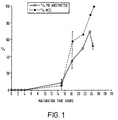
- FIG. 1 ovaries were obtained from a local abattoir and maintained at 28-32°C during transport to the laboratory. Cumulus oocyte complexes (COC's) were aspirated from follicles 3-10mm in diameter using a hypodermic needle (1.2mm internal diameter) and placed into sterile plastic universal containers. The universal containers were placed into a warmed chamber (35°C) and the follicular material allowed to settle for 10-15 minutes before pouring off three quarters of the supernatant.
- COC's Cumulus oocyte complexes
- the remaining follicular material was diluted with an equal volume of dissection medium (TCM 199 with Earles salts (Gibco), 75.0 mg/l kanamycin, 30.0mM Hepes, pH 7.4, osmolarity 280 mOsmols/Kg H 2 O) supplemented with 10% bovine serum, transferred into an 85mm petri dish and searched for COC's under a dissecting microscope.
- TCM 199 with Earles salts (Gibco) 75.0 mg/l kanamycin, 30.0mM Hepes, pH 7.4, osmolarity 280 mOsmols/Kg H 2 O
- Table la shows activation of bovine follicular oocytes matured in vitro for different periods. Oocytes were removed from the maturation medium, washed once in activation medium, placed into the activation chamber and given a single electrical pulse of 1.25kV/cm for 80 ⁇ s. Table 1a No. of oocytes (N) Hours post onset of maturation (hpm) [age (hrs)] Pronuclear formation (% activation) 73 24 24.6 99 30 84.8 55 45 92.7* *many 2 or more pronuclei
- Table 1b shows activation response of in vitro matured bovine oocytes sham enucleated at approximately 22 hours post onset of maturation (hpm). Oocytes were treated exactly as for enucleation, a small volume of cytoplasm was aspirated not containing the metaphase plate. After manipulation the oocytes were given a single DC pulse of 1.25 KV/cm and returned to the maturation medium, at 30 hpm and 42 hpm groups of oocytes were mounted, fixed and stained with aceto-orcein. The results show the number of oocytes at each time point from five individual experiments as the number of cells having pronuclei with respect to the total number of cells. Table 1b EXPERIMENT No.
- Table 2 shows pronuclear formation in enucleated oocytes fused to primary bovine fibroblasts (24 hpm) and subsequently activated (42hpm). The results represent five separate experiments. Oocytes were divided into two groups, group A were incubated in nocodazole for 1 hour prior to activation and for 6 hours following activation. Group B were not treated with nocodazole. Activated oocytes were fixed and stained with aceto-orcein 12 hours post activation. The number of pronuclei (PN) in each parthenote was then scored under phase contrast. The results are expressed as the percentage of activated oocytes containing 1 or more pronuclei. Table 2 TOTAL _1 PN 2 PN 3 PN 4 PN >4 PN GROUP A 52 100 0 0 0 0 GROUP B 33 45.2 25.8 16.1 3.2 9.7
- Table 3 shows development of bovine embryos reconstructed by nuclear transfer of serum starved (G0) bovine primary fibroblasts into enucleated unactivated MII oocytes. Embryos were reconstructed at 24 hpm and the fused couplets activated at 42 hpm. Fused couplets were incubated in nocodazole (5 ⁇ g/ml) in M2 medium for 1 hour prior to activation and 5 hours post activation. Couplets were activated with a single DC pulse of 1.25 KV/cm for 80 ⁇ sec. Table 3 EXPERIMENT NUMBER NUMBER OF BLASTOCYSTS/ TOTAL NUMBER OF FUSED COUPLETS % BLASTOCYSTS 1 1/30 3.3 2 4/31 12.9
- Table 4 shows development of ovine embryos reconstructed by transfer of an embryo derived established cell line to unactivated enucleated in vivo matured ovine oocytes.
- Oocytes were obtained from superstimulated Scottish blackface ewes, the cell line was established from the embryonic disc of a day 9 embryo obtained from a Welsh mountain ewe.
- Reconstructed embryos were cultured in the ligated oviduct of a temporary recipient ewe for 6 days, recovered and assessed for development.
- Table 5 shows induction of pregnancy following transfer of all morula/blastocyst stage reconstructed embryos to the uterine horn of synchronised final recipient blackface ewes.
- the table shows the total number of embryos from each group transferred the frequency of pregnancy in terms of ewes and embryos, in the majority of cases 2 embryos were transferred to each ewe.
- a single twin pregnancy was established which resulted in the birth of a single live lamb.
- Table 5 PASSAGE NUMBER "MAGIC" P6 4 P7 1 PH 2 P12 0 P13 3 TOTAL MOR/BL 10 TOTAL NUMBER EWES 6 PREGNANT EWES % 1 (16.7) FOETUSES/ TOTAL TRANSFERRED (%) 2/10 (20.0)
Landscapes
- Life Sciences & Earth Sciences (AREA)
- Health & Medical Sciences (AREA)
- Genetics & Genomics (AREA)
- Engineering & Computer Science (AREA)
- Zoology (AREA)
- Developmental Biology & Embryology (AREA)
- Biomedical Technology (AREA)
- Chemical & Material Sciences (AREA)
- Biotechnology (AREA)
- Wood Science & Technology (AREA)
- Bioinformatics & Cheminformatics (AREA)
- General Engineering & Computer Science (AREA)
- Organic Chemistry (AREA)
- General Health & Medical Sciences (AREA)
- Molecular Biology (AREA)
- Plant Pathology (AREA)
- Microbiology (AREA)
- Physics & Mathematics (AREA)
- Biophysics (AREA)
- Biochemistry (AREA)
- Cell Biology (AREA)
- Reproductive Health (AREA)
- Animal Behavior & Ethology (AREA)
- Environmental Sciences (AREA)
- Immunology (AREA)
- Virology (AREA)
- Medicinal Chemistry (AREA)
- Pharmacology & Pharmacy (AREA)
- Epidemiology (AREA)
- Public Health (AREA)
- Veterinary Medicine (AREA)
- Gynecology & Obstetrics (AREA)
- Animal Husbandry (AREA)
- Biodiversity & Conservation Biology (AREA)
- Micro-Organisms Or Cultivation Processes Thereof (AREA)
- Medicines Containing Material From Animals Or Micro-Organisms (AREA)
- Breeding Of Plants And Reproduction By Means Of Culturing (AREA)
- Preparation Of Compounds By Using Micro-Organisms (AREA)
- Pharmaceuticals Containing Other Organic And Inorganic Compounds (AREA)
- Polysaccharides And Polysaccharide Derivatives (AREA)
Applications Claiming Priority (3)
| Application Number | Priority Date | Filing Date | Title |
|---|---|---|---|
| GB9517779 | 1995-08-31 | ||
| GBGB9517779.6A GB9517779D0 (en) | 1995-08-31 | 1995-08-31 | Biological manipulation |
| PCT/GB1996/002098 WO1997007668A1 (en) | 1995-08-31 | 1996-08-30 | Unactivated oocytes as cytoplast recipients for nuclear transfer |
Publications (2)
| Publication Number | Publication Date |
|---|---|
| EP0847237A1 EP0847237A1 (en) | 1998-06-17 |
| EP0847237B1 true EP0847237B1 (en) | 2008-07-09 |
Family
ID=10779997
Family Applications (1)
| Application Number | Title | Priority Date | Filing Date |
|---|---|---|---|
| EP96928586A Expired - Lifetime EP0847237B1 (en) | 1995-08-31 | 1996-08-30 | Unactivated oocytes as cytoplast recipients for nuclear transfer |
Country Status (22)
| Country | Link |
|---|---|
| US (12) | US6252133B1 (enExample) |
| EP (1) | EP0847237B1 (enExample) |
| JP (3) | JP2000506721A (enExample) |
| KR (4) | KR20070041793A (enExample) |
| CN (3) | CN1772891A (enExample) |
| AT (1) | ATE400176T1 (enExample) |
| AU (1) | AU728809B2 (enExample) |
| BR (1) | BR9610013A (enExample) |
| CA (1) | CA2229657A1 (enExample) |
| CZ (1) | CZ60498A3 (enExample) |
| DE (1) | DE69637591D1 (enExample) |
| DK (1) | DK0847237T3 (enExample) |
| ES (1) | ES2309989T3 (enExample) |
| GB (1) | GB9517779D0 (enExample) |
| HU (1) | HUP9802485A3 (enExample) |
| IL (1) | IL123417A0 (enExample) |
| NO (1) | NO980846L (enExample) |
| NZ (2) | NZ316148A (enExample) |
| PL (1) | PL325336A1 (enExample) |
| SG (1) | SG75919A1 (enExample) |
| WO (1) | WO1997007668A1 (enExample) |
| ZA (1) | ZA967383B (enExample) |
Families Citing this family (194)
| Publication number | Priority date | Publication date | Assignee | Title |
|---|---|---|---|---|
| US5480772A (en) | 1993-02-03 | 1996-01-02 | Brandeis University | In vitro activation of a nucleus |
| GB9517779D0 (en) | 1995-08-31 | 1995-11-01 | Roslin Inst Edinburgh | Biological manipulation |
| US7307198B2 (en) | 1995-08-31 | 2007-12-11 | Roslin Institute | Ungulates produced by nuclear transfer of G1 cells |
| GB9517780D0 (en) * | 1995-08-31 | 1995-11-01 | Roslin Inst Edinburgh | Biological manipulation |
| US6077697A (en) | 1996-04-10 | 2000-06-20 | Chromos Molecular Systems, Inc. | Artificial chromosomes, uses thereof and methods for preparing artificial chromosomes |
| US6025155A (en) * | 1996-04-10 | 2000-02-15 | Chromos Molecular Systems, Inc. | Artificial chromosomes, uses thereof and methods for preparing artificial chromosomes |
| AU4984697A (en) | 1996-10-11 | 1998-05-11 | The Texas A & M University System | Methods for the generation of primordial germ cells and transgenic animal species |
| US5945577A (en) * | 1997-01-10 | 1999-08-31 | University Of Massachusetts As Represented By Its Amherst Campus | Cloning using donor nuclei from proliferating somatic cells |
| US20090092588A1 (en) * | 1997-01-10 | 2009-04-09 | University Of Massachusetts As Represented By Its Amherst Campus | Cloned ungulate embryos and animals, use of cells, tissues and organs thereof for transplantation therapies including parkinson's disease |
| US6235969B1 (en) * | 1997-01-10 | 2001-05-22 | University Of Massachusetts | Cloning pigs using donor nuclei from non-quiescent differentiated cells |
| US6011197A (en) | 1997-03-06 | 2000-01-04 | Infigen, Inc. | Method of cloning bovines using reprogrammed non-embryonic bovine cells |
| ES2513043T3 (es) | 1997-03-26 | 2014-10-24 | Imperial Innovations Limited | Proteína de fusión anticoagulante anclada a membrana de la célula |
| IL133786A0 (en) | 1997-07-03 | 2001-04-30 | Univ Massachusetts | Cloning using donor nuclei from non-serum starved, differentiated cells |
| US7923015B2 (en) | 1997-08-14 | 2011-04-12 | Institut Pasteur | Methods for direct visualization of active synapses |
| US7923216B2 (en) | 1997-08-14 | 2011-04-12 | Institut Pasteur | In vivo modulation of neuronal transport |
| JPH11127852A (ja) * | 1997-10-28 | 1999-05-18 | Snow Brand Milk Prod Co Ltd | 上皮細胞のg0期同調方法 |
| AU747070B2 (en) * | 1998-01-16 | 2002-05-09 | Agrobiogen Gmbh | Efficient nuclear transfer using primordial germ cells |
| US7351876B2 (en) | 1998-01-16 | 2008-04-01 | Agrobiogen Gmbh Biotechnologie | Efficient nuclear transfer with primordial gametes |
| DE59812083D1 (de) * | 1998-01-16 | 2004-11-11 | Agrobiogen Gmbh | Effizienter kerntransfer mit fetalen fibroblasten |
| US6331659B1 (en) * | 1998-01-21 | 2001-12-18 | University Of Hawaii | Cumulus cells as nuclear donors |
| EP1067834A4 (en) * | 1998-03-16 | 2002-01-23 | Garelag Pty Ltd | PORCINE CELL CORE TRANSFER |
| AUPP294898A0 (en) * | 1998-04-15 | 1998-05-07 | Monash University | Method of nuclear transfer |
| GB9808325D0 (en) * | 1998-04-20 | 1998-06-17 | Ltr Ciz Di Associazione Italia | Source of nuclei for nuclear transfer |
| US6143564A (en) * | 1998-07-07 | 2000-11-07 | University Of Hawaii | Use of the polar body chromosomes for the production of embryos and normal offspring |
| GB9820988D0 (en) * | 1998-09-25 | 1998-11-18 | Biotech & Biolog Scien Res | Screening method |
| AU6218899A (en) * | 1998-10-12 | 2000-05-01 | Geron Bio-Med Limited | Porcine oocytes with improved developmental competence |
| EP1818397A1 (en) * | 1998-11-02 | 2007-08-15 | Trustees Of Tufts College | Methods for cloning animals |
| US6781030B1 (en) | 1998-11-02 | 2004-08-24 | Trustee Of Tufts College, Ballou Hall | Methods for cloning mammals using telophase oocytes |
| AU765315B2 (en) | 1998-11-19 | 2003-09-18 | Pharming Intellectual Property Bv | Stabilisation of milk from transgenic animals |
| US6258998B1 (en) | 1998-11-24 | 2001-07-10 | Infigen, Inc. | Method of cloning porcine animals |
| US6700037B2 (en) | 1998-11-24 | 2004-03-02 | Infigen, Inc. | Method of cloning porcine animals |
| US7531715B1 (en) * | 1999-01-13 | 2009-05-12 | Ppl Therapeutics (Scotland) | Double nuclear transfer method and results thereof |
| WO2000042174A1 (en) * | 1999-01-13 | 2000-07-20 | Ppl Therapeutics (Scotland) Limited | Double nuclear transfer method and results thereof |
| AU776150B2 (en) | 1999-01-28 | 2004-08-26 | Medical College Of Georgia Research Institute, Inc. | Composition and method for (in vivo) and (in vitro) attenuation of gene expression using double stranded RNA |
| AU3382800A (en) | 1999-02-26 | 2000-09-14 | Millennium Pharmaceuticals, Inc. | Secreted proteins and uses thereof |
| US20020012660A1 (en) * | 1999-03-04 | 2002-01-31 | Alan Colman | Method of preparing a somatic cells for nuclear transfer |
| NZ514620A (en) * | 1999-03-04 | 2004-04-30 | Ppl Therapeutics Scotland Ltd | Genetic modification of somatic cells and uses thereof |
| AU5553600A (en) | 1999-06-23 | 2001-01-31 | Ppl Therapeutics (Scotland) Ltd | Fusion proteins incorporating lysozyme |
| US7291714B1 (en) | 1999-06-30 | 2007-11-06 | Millennium Pharmaceuticals, Inc. | Glycoprotein VI and uses thereof |
| WO2001000794A1 (en) * | 1999-06-30 | 2001-01-04 | Hwang, Woo-Suk | Method for producing cloned tigers by employing inter-species nuclear transplantation technique |
| KR100368435B1 (ko) * | 1999-06-30 | 2003-01-24 | 황우석 | 체세포 복제동물의 생산을 위한 세포융합방법 |
| EP1109890A4 (en) * | 1999-06-30 | 2004-12-29 | Hwang Woo Suk | PROCESS FOR OBTAINING CLONED HUMAN EMBRYOS USING INTER-SPECIES TRANSPLANTATION TECHNIQUES OF CORES |
| AU753207B2 (en) | 1999-06-30 | 2002-10-10 | Seoul National University Industry Foundation | Method for producing cloned cows |
| KR100414043B1 (ko) * | 1999-06-30 | 2004-01-13 | 황우석 | 체세포 복제동물 및 그 생산방법 |
| ES2539411T3 (es) | 1999-08-23 | 2015-06-30 | Dana-Farber Cancer Institute, Inc. | PD-1, receptor para la B7-4 y su utilización |
| WO2002064799A2 (en) | 1999-09-28 | 2002-08-22 | Transkaryotic Therapies, Inc. | Optimized messenger rna |
| EP2275559A3 (en) | 1999-09-28 | 2011-03-23 | Shire Human Genetic Therapies, Inc. | Optimized messenger RNA |
| GB9927444D0 (en) * | 1999-11-19 | 2000-01-19 | Cancer Res Campaign Tech | Inhibiting gene expression |
| US7820878B2 (en) * | 1999-11-19 | 2010-10-26 | Kyowa Hakko Kirin Co., Ltd. | Production of ungulates, preferably bovines that produce human immunoglobulins |
| KR100417566B1 (ko) * | 1999-11-19 | 2004-02-05 | 한국생명공학연구원 | 체세포 핵치환 복제수정란의 대량생산방법 |
| US7074983B2 (en) | 1999-11-19 | 2006-07-11 | Kirin Beer Kabushiki Kaisha | Transgenic bovine comprising human immunoglobulin loci and producing human immunoglobulin |
| WO2001035735A1 (en) * | 1999-11-19 | 2001-05-25 | Hematech, Llc | Production of ungulates, preferably bovines that produce human immunoglobulins |
| US7414170B2 (en) * | 1999-11-19 | 2008-08-19 | Kirin Beer Kabushiki Kaisha | Transgenic bovines capable of human antibody production |
| US7071372B2 (en) | 2000-01-04 | 2006-07-04 | University Of Connecticut | Method for cloning animals with targetted genetic alterations by transfer of long-term cultured male or female somatic cell nuclei, comprising artificially-induced genetic alterations, to enucleated recipient cells |
| US6635802B1 (en) * | 2000-01-10 | 2003-10-21 | The Texas A&M University System | Nuclear transfer using cells cultured in serum starvation media containing apoptosis inhibitors |
| DK1248640T3 (da) | 2000-01-20 | 2007-02-12 | Diabcell Pty Ltd | Xenotransplantation af svineöer og deres fremstilling |
| AU2001236919A1 (en) * | 2000-02-09 | 2001-08-20 | The Government Of The United States Of America, As Represented By The Secretary Of The Department Of Health And Human Services | Premeiotic and postmeiotic origin of teratomas: isolated teratoma stem cells for therapeutic uses |
| ATE517990T1 (de) | 2000-03-15 | 2011-08-15 | Univ Georgia | Effektive kernumprogrammierung in säugetieren |
| GB2360522A (en) | 2000-03-24 | 2001-09-26 | Geron Corp | A strategy for maintaining pregnancy |
| AU2001261650A1 (en) * | 2000-05-15 | 2001-11-26 | Geron Corporation | Ovine tissue for xenotransplantation |
| AU2001275346A1 (en) | 2000-06-05 | 2001-12-17 | General Hospital Corporation | Compositions, kits, and methods for identification and modulation of type i diabetes |
| WO2002000692A2 (en) | 2000-06-28 | 2002-01-03 | Genetics Institute, Llc. | Pd-l2 molecules: pd-1 ligands and uses therefor |
| IL154751A0 (en) | 2000-08-03 | 2003-10-31 | Humanized antibodies, recombination vectors, transgenic vectors and methods for the preparation of humanized antibodies from transgenic animals | |
| AU2001284948A1 (en) | 2000-08-15 | 2002-02-25 | Board Of Trustees Of The University Of Illinois | Animals expressing exogenous igf-i in their milk |
| US7049480B1 (en) * | 2000-09-01 | 2006-05-23 | Avigenics, Inc. | Methods of enucleating an avian oocyte or zygote using two-photon laser scanning microscopy |
| FR2814642B1 (fr) | 2000-10-03 | 2005-07-01 | Ass Pour Le Dev De La Rech En | Souris transgenique pour la recombinaison ciblee mediee par la cre-er modifiee |
| WO2002028164A2 (en) * | 2000-10-06 | 2002-04-11 | Advanced Cell Technology, Inc. | Cloning endangered and extinct species |
| JP2004526425A (ja) | 2000-11-28 | 2004-09-02 | ワイス | 前立腺癌の診断および治療に有用なfkbp核酸およびポリペプチドの発現分析 |
| NZ526617A (en) | 2000-11-28 | 2004-09-24 | Wyeth Corp | Expression analysis of KIAA nucleic acids and polypeptides useful in the diagnosis and treatment of prostate cancer |
| KR20030088022A (ko) * | 2000-11-30 | 2003-11-15 | 스템론 인크. | 단리된 동종접합 간세포, 그로부터 유래된 분화 세포 및이들을 제조 및 사용하기 위한 물질 및 방법 |
| EP1217071B1 (en) | 2000-12-22 | 2010-04-28 | Institut National De La Recherche Agronomique | Position-independent and tissue specific expression of a transgene in milk of transgenic animals |
| US20020142397A1 (en) * | 2000-12-22 | 2002-10-03 | Philippe Collas | Methods for altering cell fate |
| US7491534B2 (en) | 2000-12-22 | 2009-02-17 | Kirin Holdings Kabushiki Kaisha | Methods for altering cell fate to generate T-cells specific for an antigen of interest |
| ATE502106T1 (de) * | 2000-12-22 | 2011-04-15 | Kyowa Hakko Kirin Co Ltd | Verfahren zur klonierung von nichtmenschliche säugern unter verwendung von reprogrammiertem donorchromatin oder donorzellen |
| EP1860199B1 (en) | 2001-01-12 | 2014-03-05 | Exelixis, Inc. | Modulating insulin receptor signaling |
| WO2002074078A2 (en) | 2001-01-30 | 2002-09-26 | Rebholtz, Amy, K. | Method for embryo after impregnation of the recipient female |
| US20020132257A1 (en) | 2001-01-31 | 2002-09-19 | Tony Giordano | Use of post-transcriptional gene silencing for identifying nucleic acid sequences that modulate the function of a cell |
| JP2002262716A (ja) * | 2001-03-07 | 2002-09-17 | National Agricultural Research Organization | 株化細胞を用いて家畜個体を作出する方法 |
| US8981061B2 (en) | 2001-03-20 | 2015-03-17 | Novo Nordisk A/S | Receptor TREM (triggering receptor expressed on myeloid cells) and uses thereof |
| US7265262B2 (en) * | 2001-03-21 | 2007-09-04 | Roslin Institute (Edinburgh) | Telomerizing nuclear donor cells and improving the efficiency on nuclear transfer |
| US7126039B2 (en) * | 2001-03-21 | 2006-10-24 | Geron Corporation | Animal tissue with carbohydrate antigens compatible for human transplantation |
| EP2388590A1 (en) | 2001-04-02 | 2011-11-23 | Dana Farber Cancer Institute | PD-1, a receptor for B7-4, and uses thereof |
| KR100886095B1 (ko) | 2001-04-16 | 2009-02-27 | 와이어쓰 홀딩스 코포레이션 | 폴리펩티드 항원을 암호화하는 신규한 스트렙토코쿠스 뉴모니애 개방형 판독 프레임 및 이를 포함하는 조성물 |
| WO2002103350A1 (en) * | 2001-06-14 | 2002-12-27 | Infigen, Inc. | Methods for cloning mammals using remodeling factors |
| WO2002102830A1 (en) * | 2001-06-15 | 2002-12-27 | New Century Pharmaceuticals, Inc. | Human albumin animal models for drug evaluation, toxicology and immunogenicity studies |
| BR0211111A (pt) | 2001-07-12 | 2004-06-22 | Univ Massachusetts | Molécula de ácido nucleico isolada, vetor, célula hospedeira, transgene, precursor de rna engenheirado, animal transgênico não humano, e, método de induzir a interferência de ácido ribonucleico de um gene alvo em uma célula |
| EP1900815B1 (en) | 2001-07-12 | 2016-09-07 | University of Massachusetts | In vivo production of small interfering RNAs that mediate gene silencing |
| US20030211603A1 (en) * | 2001-08-14 | 2003-11-13 | Earp David J. | Reprogramming cells for enhanced differentiation capacity using pluripotent stem cells |
| US20030224380A1 (en) * | 2001-10-25 | 2003-12-04 | The General Hospital Corporation | Genes and polymorphisms on chromosome 10 associated with Alzheimer's disease and other neurodegenerative diseases |
| US20030170678A1 (en) * | 2001-10-25 | 2003-09-11 | Neurogenetics, Inc. | Genetic markers for Alzheimer's disease and methods using the same |
| AU2002364945A1 (en) * | 2001-10-25 | 2003-07-09 | Neurogenetics, Inc. | Genes and polymorphisms on chromosome 10 associated with alzheimer's disease and other neurodegenerative diseases |
| US7091006B2 (en) | 2001-11-09 | 2006-08-15 | Dana-Farber Cancer Institute, Inc. | PGC-1β, a novel PGC-1 homologue and uses therefor |
| WO2003046129A2 (en) * | 2001-11-09 | 2003-06-05 | Trustees Of The University Of Pennsylvania | Compositions for the derivation of germ cells from stem cells and methods of use thereof |
| WO2003060083A2 (en) * | 2002-01-15 | 2003-07-24 | Advanced Cell Technology, Inc. | Cloning b and t lymphocytes |
| US20030134422A1 (en) * | 2002-01-16 | 2003-07-17 | Sayre Chauncey Bigelow | Stem cell maturation for all tissue lines |
| US20050170506A1 (en) * | 2002-01-16 | 2005-08-04 | Primegen Biotech Llc | Therapeutic reprogramming, hybrid stem cells and maturation |
| US20050090004A1 (en) * | 2003-01-16 | 2005-04-28 | Sayre Chauncey B. | Stem cell maturation for all tissue lines |
| NZ535367A (en) * | 2002-04-01 | 2008-01-31 | Gtc Biotherapeutics Inc | A method for selecting cell lines to be used for nuclear transfer in mammalian species |
| US20030217378A1 (en) * | 2002-04-05 | 2003-11-20 | The University Of Georgia Research Foundation, Inc | Cloning using rapidly matured oocytes |
| US7612250B2 (en) | 2002-07-29 | 2009-11-03 | Trustees Of Tufts College | Nuclear transfer embryo formation method |
| EP2311980A1 (en) | 2002-08-20 | 2011-04-20 | Millennium Pharmaceuticals, Inc. | Compositions, kits, and methods for identification, assessment, prevention, and therapy of cervical cancer |
| US7122361B2 (en) | 2002-10-10 | 2006-10-17 | Wyeth | Compositions employing a novel human kinase |
| WO2004035748A2 (en) * | 2002-10-16 | 2004-04-29 | Advanced Cell Technology, Inc. | Methods using gene trapped stem cells for marking pathways of stem cell differentiation and making and isolating differentiated cells |
| CA2503491A1 (en) | 2002-10-24 | 2004-05-06 | Wyeth | Calcineurin-like human phosphoesterase |
| EP1563084A4 (en) | 2002-11-08 | 2006-03-01 | Hematech Llc | TRANSGENE UNGULATES WITH REDUCED PRION PROTEIN ACTIVITY AND USES THEREOF |
| CA2505416A1 (en) | 2002-11-21 | 2004-06-10 | Wyeth | Methods for diagnosing rcc and other solid tumors |
| WO2004050831A2 (en) | 2002-11-27 | 2004-06-17 | Wyeth | Compositions, organisms and methodologies employing a novel human kinase |
| EP2474630B1 (en) | 2002-12-20 | 2016-04-27 | Celera Corporation | Genetic polymorphisms associated with myocardial infarction, methods of detection and uses thereof |
| DE602004015064D1 (de) | 2003-01-06 | 2008-08-28 | Wyeth Corp | Zusammensetzungen und verfahren zur diagnose und behandlung von kolonkrebs |
| CA2528012C (en) | 2003-06-02 | 2015-11-24 | University Of Massachusetts | Methods and compositions for controlling efficacy of rna silencing |
| CA2527958C (en) | 2003-06-02 | 2014-04-08 | University Of Massachusetts | Methods and compositions for enhancing the efficacy and specificity of rnai |
| EP1651674B1 (en) | 2003-08-14 | 2010-09-29 | Exelixis, Inc. | Ups as modifiers of the beta catenin pathway and methods of use |
| WO2005034732A2 (en) | 2003-10-07 | 2005-04-21 | Millennium Pharmaceuticals, Inc. | Nucleic acid molecules and proteins for the identification, assessment, prevention, and therapy of ovarian cancer |
| US7951532B2 (en) | 2003-11-12 | 2011-05-31 | Children's Hospital Medical Center | Method of screening a midkine modulating agent |
| EP1711622A2 (en) | 2003-11-26 | 2006-10-18 | Applera Corporation | Genetic polymorphisms associated with cardiovascular disorders and drug response, methods of detection and uses thereof |
| US7682828B2 (en) | 2003-11-26 | 2010-03-23 | Whitehead Institute For Biomedical Research | Methods for reprogramming somatic cells |
| US7420099B2 (en) | 2004-04-22 | 2008-09-02 | Kirin Holdings Kabushiki Kaisha | Transgenic animals and uses thereof |
| WO2005111241A2 (en) | 2004-05-07 | 2005-11-24 | Applera Corporation | Genetic polymorphisms associated with liver fibrosis methods of detection and uses thereof |
| WO2006047312A2 (en) | 2004-10-22 | 2006-05-04 | Dana-Farber Cancer Institute, Inc. | COMPOSITIONS AND METHODS FOR MODULATING PGC-1β TO TREAT LIPID-RELATED DISEASES AND DISORDERS |
| GB0426146D0 (en) | 2004-11-29 | 2004-12-29 | Bioxell Spa | Therapeutic peptides and method |
| CN1274829C (zh) | 2004-12-10 | 2006-09-13 | 四川大学华西医院 | 抗eb病毒所致肿瘤多肽及其应用与制备方法 |
| EP2113572B1 (en) | 2005-03-11 | 2012-12-05 | Celera Corporation | Genetic polymorphisms associated with coronary heart disease, methods of detection and uses thereof |
| US20070011603A1 (en) * | 2005-07-06 | 2007-01-11 | Mikko Makela | Method, system, device and software product for showing tooltips for page segments and generating content for the page segments |
| AU2006292827B2 (en) | 2005-08-09 | 2013-02-14 | Revivicor, Inc. | Transgenic ungulates expressing CTLA4-IG and uses thereof |
| EP3031470A3 (en) | 2005-09-09 | 2016-08-10 | The Johns Hopkins University | Manipulation of regulatory t cell and dc function by targeting neuritin gene using antibodies, agonists and antagonists |
| CA2623106C (en) | 2005-09-19 | 2013-12-24 | Histogenics Corporation | Cell-support matrix having narrowly defined uniformly vertically and non-randomly organized porosity and pore density and a method for preparation thereof |
| US7799530B2 (en) | 2005-09-23 | 2010-09-21 | Celera Corporation | Genetic polymorphisms associated with cardiovascular disorders and drug response, methods of detection and uses thereof |
| US7695911B2 (en) | 2005-10-26 | 2010-04-13 | Celera Corporation | Genetic polymorphisms associated with Alzheimer's Disease, methods of detection and uses thereof |
| EP2064325B1 (en) | 2006-09-01 | 2011-12-07 | Therapeutic Human Polyclonals, Inc. | Enhanced expression of human or humanized immunoglobulin in non-human transgenic animals |
| EP2064345B1 (en) | 2006-09-11 | 2013-03-13 | Celera Corporation | Genetic polymorphisms associated with psoriasis, methods of detection and uses thereof |
| CA2666346C (en) | 2006-10-20 | 2016-02-23 | Celera Corporation | Genetic polymorphisms associated with venous thrombosis, methods of detection and uses thereof |
| KR101398220B1 (ko) * | 2006-10-30 | 2014-05-22 | 건국대학교 산학협력단 | 형질전환 배아 생성방법 |
| US20100205678A1 (en) * | 2007-01-05 | 2010-08-12 | Overstrom Eric W | Oocyte spindle-associated factors improve somatic cell cloning |
| MX348010B (es) | 2007-04-07 | 2017-05-23 | Whitehead Inst Biomedical Res | Reprogramacion de celulas somaticas. |
| WO2008134522A1 (en) * | 2007-04-26 | 2008-11-06 | President And Fellows Of Harvard College | Deriving embryonic stem cells |
| WO2008144580A2 (en) * | 2007-05-17 | 2008-11-27 | Oregon Health & Science University | Primate stem cells produced by somatic cell nuclear transfer |
| US20090111764A1 (en) * | 2007-10-25 | 2009-04-30 | Searete Llc, A Limited Liability Corporation Of The State Of Delaware | Mitochondrial selection |
| WO2009055656A2 (en) | 2007-10-26 | 2009-04-30 | Centocor, Inc. | Vectors, host cells, and methods of production and uses |
| US8039212B2 (en) | 2007-11-05 | 2011-10-18 | Celera Corporation | Genetic polymorphisms associated with liver fibrosis, methods of detection and uses thereof |
| US20090221620A1 (en) | 2008-02-20 | 2009-09-03 | Celera Corporation | Gentic polymorphisms associated with stroke, methods of detection and uses thereof |
| KR100915397B1 (ko) * | 2008-02-22 | 2009-09-03 | 삼성전자주식회사 | 커버부재, 현상 카트리지 및 화상형성장치의 현상유닛 |
| EP2265730B1 (en) | 2008-03-12 | 2018-06-06 | The Rockefeller University | Methods and compositions for translational profiling and molecular phenotyping |
| US8288094B2 (en) | 2008-04-09 | 2012-10-16 | Institut Pasteur | APOBEC3 mediated DNA editing |
| WO2009152529A2 (en) | 2008-06-13 | 2009-12-17 | Whitehead Institute For Biomedical Research Nine Cambridge Center | Programming and reprogramming of cells |
| EP2310525B1 (en) | 2008-07-09 | 2014-02-26 | Celera Corporation | Genetic polymorphisms associated with cardiovascular diseases, methods of detection and uses thereof |
| WO2010080985A1 (en) | 2009-01-08 | 2010-07-15 | Dana-Farber Cancer Institute, Inc. | Compositions and methods for induced brown fat differentiation |
| US8722964B2 (en) | 2009-04-23 | 2014-05-13 | Transposagen Biopharmaceuticals, Inc. | Genetically engineered or transgenic rats exhibiting a cancer phenotype due to a disruption of germline tumor suppressor genes |
| AU2010238747A1 (en) | 2009-04-24 | 2011-11-17 | Oregon Health & Science University | Methods for mitochondrial DNA replacement in oocytes |
| EP2267153A1 (en) | 2009-05-26 | 2010-12-29 | Université Claude Bernard Lyon 1 | Identification of netrin-1 receptor unc5c gene mutation in solid cancers |
| EP2449112A1 (en) | 2009-07-01 | 2012-05-09 | Transposagen Biopharmaceuticals, Inc. | Genetically modified rat models for severe combined immunodeficiency (scid) |
| US8558055B2 (en) | 2009-07-24 | 2013-10-15 | Transposagen Biopharmaceuticals, Inc. | Genetically modified rat comprising a cytokine gene disruption and exhibiting a greater susceptibility to a cytokine-mediated autoimmune and/or inflammatory disease |
| WO2011014721A2 (en) | 2009-07-30 | 2011-02-03 | Transposagen Biopharmaceuticals, Inc. | Genetically modified rat models for pharmacokinetics |
| EP2461672A2 (en) | 2009-08-05 | 2012-06-13 | Transposagen Biopharmaceuticals, Inc. | Genetically modified rat models for drug metabolism |
| WO2011022634A2 (en) | 2009-08-20 | 2011-02-24 | Transposagen Biopharmaceuticals, Inc. | Genetically modified rat models for pain |
| US9420770B2 (en) | 2009-12-01 | 2016-08-23 | Indiana University Research & Technology Corporation | Methods of modulating thrombocytopenia and modified transgenic pigs |
| AU2011207210A1 (en) | 2010-01-22 | 2012-08-16 | Dana-Farber Cancer Institute, Inc. | Compositions,kits, and methods for identification, assessment, prevention, and therapy of metabolic disorders |
| TWI518325B (zh) | 2010-02-04 | 2016-01-21 | 自治醫科大學 | 對alk抑制劑具有先抗性或後抗性癌症的識別、判斷和治療 |
| CN103119054B (zh) | 2010-03-26 | 2017-01-18 | 达特茅斯大学理事会 | Vista调节性t细胞介体蛋白、vista结合剂及其用途 |
| US20150231215A1 (en) | 2012-06-22 | 2015-08-20 | Randolph J. Noelle | VISTA Antagonist and Methods of Use |
| US10745467B2 (en) | 2010-03-26 | 2020-08-18 | The Trustees Of Dartmouth College | VISTA-Ig for treatment of autoimmune, allergic and inflammatory disorders |
| US8383793B2 (en) | 2010-04-15 | 2013-02-26 | St. Jude Children's Research Hospital | Methods and compositions for the diagnosis and treatment of cancer resistant to anaplastic lymphoma kinase (ALK) kinase inhibitors |
| US20110269735A1 (en) | 2010-04-19 | 2011-11-03 | Celera Corporation | Genetic polymorphisms associated with statin response and cardiovascular diseases, methods of detection and uses thereof |
| US9497964B2 (en) | 2010-10-22 | 2016-11-22 | Agri-Neo Inc. | Synergistic activity of peracetic acid and at least one SAR inducer for the control of pathogens in and onto growing plants |
| US20120108651A1 (en) | 2010-11-02 | 2012-05-03 | Leiden University Medical Center (LUMC) Acting on Behalf of Academic Hospital Leiden (AZL) | Genetic polymorphisms associated with venous thrombosis and statin response, methods of detection and uses thereof |
| WO2012064090A2 (ko) | 2010-11-08 | 2012-05-18 | 광주과학기술원 | 골격근-유래된 다능성 세포의 화학적 제조방법 및 이의 용도 |
| EP2675901B1 (en) | 2011-02-14 | 2018-05-30 | Revivicor, Inc. | Genetically modified pigs for xenotransplantation of vascularized xenografts and derivatives thereof |
| WO2012129198A1 (en) | 2011-03-23 | 2012-09-27 | Transposagen Biopharmaceuticals, Inc. | Genetically modified rat models for obesity and diabetes |
| MX383372B (es) | 2011-05-16 | 2025-03-13 | Univ Missouri | Animales resistentes al virus del sindrome reproductivo y respiratorio porcino. |
| CA2848368C (en) | 2011-09-13 | 2023-02-14 | Dana-Farber Cancer Institute, Inc. | Compositions and methods for brown fat induction and activity using fndc5 |
| US9550830B2 (en) | 2012-02-15 | 2017-01-24 | Novo Nordisk A/S | Antibodies that bind and block triggering receptor expressed on myeloid cells-1 (TREM-1) |
| RS57827B1 (sr) | 2012-02-15 | 2018-12-31 | Novo Nordisk As | Antitela koja vezuju protein 1 prepoznavanja peptidoglikana |
| JP6411218B2 (ja) | 2012-02-15 | 2018-10-24 | ノヴォ ノルディスク アー/エス | 骨髄細胞で発現されるトリガー受容体1(trem−1)に結合し、それを遮断する抗体 |
| US9890215B2 (en) | 2012-06-22 | 2018-02-13 | King's College London | Vista modulators for diagnosis and treatment of cancer |
| CN104619722B (zh) | 2012-06-22 | 2022-10-04 | 达特茅斯大学理事会 | 新型vista-ig构建体和vista-ig用于治疗自身免疫性、过敏性和炎性疾病的用途 |
| CA2884704C (en) | 2012-09-07 | 2023-04-04 | Randolph J. Noelle | Vista modulators for diagnosis and treatment of cancer |
| US10273301B2 (en) | 2013-12-24 | 2019-04-30 | Janssen Pharmaceutica Nv | Anti-vista antibodies and fragments |
| US11014987B2 (en) | 2013-12-24 | 2021-05-25 | Janssen Pharmaceutics Nv | Anti-vista antibodies and fragments, uses thereof, and methods of identifying same |
| WO2015108907A2 (en) | 2014-01-14 | 2015-07-23 | Dana-Farber Cancer Institute, Inc. | Compositions and methods for identification, assessment, prevention, and treatment of melanoma using pd-l1 isoforms |
| JP6997619B2 (ja) | 2014-06-11 | 2022-01-17 | キャシー・エイ・グリーン | 液性免疫の抑制または増進のための、vistaアゴニスト及びvistaアンタゴニストの使用 |
| CN106536559B (zh) | 2014-07-17 | 2021-04-27 | 诺和诺德股份有限公司 | 定点诱变trem-1抗体以降低黏度 |
| US10077420B2 (en) | 2014-12-02 | 2018-09-18 | Histogenics Corporation | Cell and tissue culture container |
| MX2017007136A (es) | 2014-12-05 | 2017-12-04 | Immunext Inc | Identificacion de vsig8 como el receptor vista putativo y su uso para producir moduladores vista/vsig8. |
| ES2841353T3 (es) | 2014-12-09 | 2021-07-08 | Regeneron Pharma | Animales no humanos que tienen un gen del grupo de diferenciación 274 humanizado |
| CA2975631C (en) | 2015-02-19 | 2024-02-20 | Agri-Neo Inc. | Composition of peracetic acid and at least one organic fungicide for the control of pathogens in and onto growing plants |
| EP3722314A1 (en) | 2015-06-24 | 2020-10-14 | Janssen Pharmaceutica NV | Anti-vista antibodies and fragments |
| HRP20240908T1 (hr) | 2015-08-06 | 2024-10-25 | The Curators Of The University Of Missouri | Svinja i stanice otporne na virus reproduktivnog i respiratornog sindroma svinja (prrsv) koje imaju modificirane cd163 gene |
| EP3368157B1 (en) | 2015-10-29 | 2022-06-29 | Dana-Farber Cancer Institute, Inc. | Methods for identification, assessment, prevention, and treatment of metabolic disorders using pm20d1 and n-lipidated amino acids |
| US10899836B2 (en) | 2016-02-12 | 2021-01-26 | Janssen Pharmaceutica Nv | Method of identifying anti-VISTA antibodies |
| PE20190115A1 (es) | 2016-04-15 | 2019-01-16 | Immunext Inc | Anticuerpos vista antihumanos y su uso |
| CR20250022A (es) | 2018-04-02 | 2025-02-25 | Bristol Myers Squibb Co | Anticuerpos anti-trem-1, ácidos nucleicos y vectores de los mismos (divisional 2020-0450) |
| US11160260B2 (en) | 2018-04-17 | 2021-11-02 | The Curators Of The University Of Missouri | Methods for protecting porcine fetuses from infection with porcine reproductive and respiratory syndrome virus (PRRSV) |
| KR20230107335A (ko) | 2020-11-20 | 2023-07-14 | 레비비코르 인코포레이션 | 이종이식을 위한 성장 호르몬 수용체 녹아웃을 갖는 다중-전이유전자 돼지 |
| CN118434281A (zh) | 2021-09-20 | 2024-08-02 | 雷维维科公司 | 用于异种移植的包含十个基因修饰的多转基因猪 |
| US12640126B2 (en) | 2021-11-12 | 2026-05-26 | Randall May International, Inc. | Tri-column airlift bass stand |
Family Cites Families (28)
| Publication number | Priority date | Publication date | Assignee | Title |
|---|---|---|---|---|
| CN1030255A (zh) * | 1987-04-14 | 1989-01-11 | 路明尼斯有限公司 | 转移基因的动物 |
| US5057420A (en) * | 1987-06-05 | 1991-10-15 | Granada Biosciences, Inc. | Bovine nuclear transplantation |
| CA2059199A1 (en) | 1992-01-10 | 1993-07-11 | Steen Willadsen | Method for producing mature reconstituted mammalian eggs by nuclear transplantation |
| GB2265909B (en) | 1992-04-01 | 1996-03-20 | Inst Of Animal Physiology And | Fusion of donor nucleus with recipient cytoplast in the absence of calcium ion |
| DE69332758D1 (de) * | 1992-09-22 | 2003-04-17 | Us Gov Health & Human Serv | Taxol zur behandlung von lymphomen und brustkrebs und zur verminderung der multi-drug resistenz gegen taxol |
| CA2092258A1 (en) | 1992-12-30 | 1994-07-01 | Steven L. Stice | Synchronized donor cells for bovine nuclear transfer |
| US5480772A (en) | 1993-02-03 | 1996-01-02 | Brandeis University | In vitro activation of a nucleus |
| US5496720A (en) | 1993-02-10 | 1996-03-05 | Susko-Parrish; Joan L. | Parthenogenic oocyte activation |
| US5523226A (en) | 1993-05-14 | 1996-06-04 | Biotechnology Research And Development Corp. | Transgenic swine compositions and methods |
| US5333948A (en) | 1993-06-22 | 1994-08-02 | Tekonsha Engineering Company | Multiple-gain electronic brake actuator with trigger point inertial sensor |
| AU7476894A (en) * | 1993-07-29 | 1995-02-28 | Government Of The United States Of America, As Represented By The Secretary Of The Department Of Health And Human Services, The | Method of treating atherosclerosis or restenosis using microtubule stabilizing agent |
| WO1995017500A1 (en) | 1993-12-23 | 1995-06-29 | Abs Global, Inc. | Embryonic stem cells as nuclear donors and nuclear transfer techniques to produce chimeric and transgenic animals |
| GB9417831D0 (en) * | 1994-09-05 | 1994-10-26 | Biotech & Biolog Scien Res | Biological manipulation |
| US7307198B2 (en) | 1995-08-31 | 2007-12-11 | Roslin Institute | Ungulates produced by nuclear transfer of G1 cells |
| GB9517780D0 (en) | 1995-08-31 | 1995-11-01 | Roslin Inst Edinburgh | Biological manipulation |
| GB9517779D0 (en) | 1995-08-31 | 1995-11-01 | Roslin Inst Edinburgh | Biological manipulation |
| US6215041B1 (en) * | 1997-01-10 | 2001-04-10 | University Of Mmassachusetts | Cloning using donor nuclei from a non-quiesecent somatic cells |
| US6235969B1 (en) * | 1997-01-10 | 2001-05-22 | University Of Massachusetts | Cloning pigs using donor nuclei from non-quiescent differentiated cells |
| US7291764B1 (en) | 1997-01-10 | 2007-11-06 | University of Massachusetts, a Public Institution of Higher Education of the Commonwealth of Massachusetts, as Represented by its Amherst Campus, Office of Vice Chancellor for Research at Amherst | Cloning pigs using non-quiescent differentiated donor cells or nuclei |
| US5945577A (en) * | 1997-01-10 | 1999-08-31 | University Of Massachusetts As Represented By Its Amherst Campus | Cloning using donor nuclei from proliferating somatic cells |
| US7361804B1 (en) * | 1997-02-19 | 2008-04-22 | Roslin Institute (Edinburgh) | Unactivated oocytes in nuclear transfer to produce ungulates |
| US6011197A (en) * | 1997-03-06 | 2000-01-04 | Infigen, Inc. | Method of cloning bovines using reprogrammed non-embryonic bovine cells |
| DE59812083D1 (de) | 1998-01-16 | 2004-11-11 | Agrobiogen Gmbh | Effizienter kerntransfer mit fetalen fibroblasten |
| JP3573964B2 (ja) * | 1998-06-17 | 2004-10-06 | 三洋電機株式会社 | アルカリ電池用水素吸蔵合金電極及びアルカリ蓄電池用水素吸蔵合金電極の製造方法 |
| AU6218899A (en) * | 1998-10-12 | 2000-05-01 | Geron Bio-Med Limited | Porcine oocytes with improved developmental competence |
| US6700037B2 (en) | 1998-11-24 | 2004-03-02 | Infigen, Inc. | Method of cloning porcine animals |
| US20050156424A1 (en) * | 2000-02-29 | 2005-07-21 | Thyssenkrupp Presta Ag | Steering column and manufacturing method thereof |
| US8302202B2 (en) * | 2005-08-03 | 2012-10-30 | International Business Machines Corporation | Transportable computing environment apparatus system and method |
-
1995
- 1995-08-31 GB GBGB9517779.6A patent/GB9517779D0/en active Pending
-
1996
- 1996-08-30 AU AU68309/96A patent/AU728809B2/en not_active Expired
- 1996-08-30 KR KR1020077007531A patent/KR20070041793A/ko not_active Withdrawn
- 1996-08-30 CN CNA2005101270278A patent/CN1772891A/zh active Pending
- 1996-08-30 CA CA002229657A patent/CA2229657A1/en not_active Abandoned
- 1996-08-30 CN CNB961978929A patent/CN1250715C/zh not_active Expired - Lifetime
- 1996-08-30 CN CN2006100037660A patent/CN1813642B/zh not_active Expired - Lifetime
- 1996-08-30 NZ NZ316148A patent/NZ316148A/xx not_active IP Right Cessation
- 1996-08-30 KR KR1020057014691A patent/KR100743006B1/ko not_active Expired - Lifetime
- 1996-08-30 ZA ZA9607383A patent/ZA967383B/xx unknown
- 1996-08-30 KR KR1019980701382A patent/KR100533477B1/ko not_active Expired - Lifetime
- 1996-08-30 EP EP96928586A patent/EP0847237B1/en not_active Expired - Lifetime
- 1996-08-30 CZ CZ98604A patent/CZ60498A3/cs unknown
- 1996-08-30 PL PL96325336A patent/PL325336A1/xx unknown
- 1996-08-30 BR BR9610013-3A patent/BR9610013A/pt not_active Application Discontinuation
- 1996-08-30 JP JP9509995A patent/JP2000506721A/ja active Pending
- 1996-08-30 SG SG1999000941A patent/SG75919A1/en unknown
- 1996-08-30 IL IL12341796A patent/IL123417A0/xx unknown
- 1996-08-30 ES ES96928586T patent/ES2309989T3/es not_active Expired - Lifetime
- 1996-08-30 AT AT96928586T patent/ATE400176T1/de not_active IP Right Cessation
- 1996-08-30 WO PCT/GB1996/002098 patent/WO1997007668A1/en not_active Ceased
- 1996-08-30 NZ NZ335407A patent/NZ335407A/en not_active IP Right Cessation
- 1996-08-30 HU HU9802485A patent/HUP9802485A3/hu unknown
- 1996-08-30 DK DK96928586T patent/DK0847237T3/da active
- 1996-08-30 DE DE69637591T patent/DE69637591D1/de not_active Expired - Lifetime
- 1996-08-30 KR KR1020067006296A patent/KR20060057638A/ko not_active Ceased
-
1997
- 1997-02-19 US US08/803,165 patent/US6252133B1/en not_active Expired - Lifetime
-
1998
- 1998-02-27 NO NO980846A patent/NO980846L/no unknown
-
2000
- 2000-08-29 US US09/650,285 patent/US6525243B1/en not_active Expired - Lifetime
-
2001
- 2001-10-11 US US09/973,701 patent/US20030037352A1/en not_active Abandoned
-
2002
- 2002-07-09 US US10/190,617 patent/US7326824B2/en not_active Expired - Fee Related
- 2002-09-05 US US10/234,854 patent/US7321075B2/en not_active Expired - Fee Related
-
2004
- 2004-08-03 US US10/909,845 patent/US7329796B2/en not_active Expired - Fee Related
- 2004-08-10 US US10/914,161 patent/US7321076B2/en not_active Expired - Fee Related
-
2005
- 2005-03-02 US US11/068,903 patent/US7432415B2/en not_active Expired - Fee Related
- 2005-11-03 US US11/265,114 patent/US7524677B2/en not_active Expired - Fee Related
- 2005-11-30 JP JP2005345998A patent/JP2006340710A/ja active Pending
-
2006
- 2006-10-06 US US11/544,038 patent/US20070028312A1/en not_active Abandoned
- 2006-10-06 US US11/543,881 patent/US7326825B2/en not_active Expired - Fee Related
-
2008
- 2008-04-22 JP JP2008111492A patent/JP2008194053A/ja active Pending
-
2009
- 2009-12-24 US US12/647,316 patent/US20100146654A1/en not_active Abandoned
Also Published As
Similar Documents
| Publication | Publication Date | Title |
|---|---|---|
| US7321076B2 (en) | Unactivated ungulate oocytes to produce a cloned ungulate by nuclear transfer | |
| AU716956B2 (en) | Quiescent cell populations for nuclear transfer | |
| US7307198B2 (en) | Ungulates produced by nuclear transfer of G1 cells | |
| US7361804B1 (en) | Unactivated oocytes in nuclear transfer to produce ungulates | |
| AU2005202808B2 (en) | Unactivated oocytes as cytoplast recipients for nuclear transfer | |
| AU2005202805B2 (en) | Unactivated oocytes as cytoplast recipients for nuclear transfer | |
| AU2003271356B2 (en) | Quiescent cell population for nuclear transfer | |
| GB2340493A (en) | Unactivated oocytes as cytoplast recipients for nuclear transfer | |
| NZ504101A (en) | A method of preparing a non-human mammal comprising reconstituting a non-human mammalian embryo | |
| MXPA98001645A (en) | Oocytes inactivated as receptors of cytopllasto for nuclear transfer | |
| AU2005246962A1 (en) | Quiescent cell population for nuclear transfer |
Legal Events
| Date | Code | Title | Description |
|---|---|---|---|
| PUAI | Public reference made under article 153(3) epc to a published international application that has entered the european phase |
Free format text: ORIGINAL CODE: 0009012 |
|
| 17P | Request for examination filed |
Effective date: 19980220 |
|
| AK | Designated contracting states |
Kind code of ref document: A1 Designated state(s): AT BE CH DE DK ES FI FR GB GR IE IT LI LU MC NL PT SE |
|
| AX | Request for extension of the european patent |
Free format text: SI PAYMENT 980220 |
|
| RAP1 | Party data changed (applicant data changed or rights of an application transferred) |
Owner name: BIOTECHNOLOGY AND BIOLOGICAL SCIENCES RESEARCH CO Owner name: THE MINISTER OF AGRICULTURE FISHERIES AND FOOD Owner name: ROSLIN INSTITUTE (EDINBURGH) |
|
| 17Q | First examination report despatched |
Effective date: 20030808 |
|
| 17Q | First examination report despatched |
Effective date: 20030808 |
|
| GRAP | Despatch of communication of intention to grant a patent |
Free format text: ORIGINAL CODE: EPIDOSNIGR1 |
|
| RAP1 | Party data changed (applicant data changed or rights of an application transferred) |
Owner name: ROSLIN INSTITUTE (EDINBURGH) |
|
| RBV | Designated contracting states (corrected) |
Designated state(s): AT BE CH DE DK ES FI FR GR IE IT LI LU MC NL PT SE |
|
| GRAS | Grant fee paid |
Free format text: ORIGINAL CODE: EPIDOSNIGR3 |
|
| GRAA | (expected) grant |
Free format text: ORIGINAL CODE: 0009210 |
|
| AK | Designated contracting states |
Kind code of ref document: B1 Designated state(s): AT BE CH DE DK ES FI FR GR IE IT LI LU MC NL PT SE |
|
| AX | Request for extension of the european patent |
Extension state: SI |
|
| REG | Reference to a national code |
Ref country code: CH Ref legal event code: EP |
|
| REF | Corresponds to: |
Ref document number: 69637591 Country of ref document: DE Date of ref document: 20080821 Kind code of ref document: P |
|
| REG | Reference to a national code |
Ref country code: IE Ref legal event code: FG4D |
|
| REG | Reference to a national code |
Ref country code: CH Ref legal event code: NV Representative=s name: KIRKER & CIE S.A. |
|
| REG | Reference to a national code |
Ref country code: DK Ref legal event code: T3 |
|
| REG | Reference to a national code |
Ref country code: ES Ref legal event code: FG2A Ref document number: 2309989 Country of ref document: ES Kind code of ref document: T3 |
|
| PG25 | Lapsed in a contracting state [announced via postgrant information from national office to epo] |
Ref country code: PT Free format text: LAPSE BECAUSE OF FAILURE TO SUBMIT A TRANSLATION OF THE DESCRIPTION OR TO PAY THE FEE WITHIN THE PRESCRIBED TIME-LIMIT Effective date: 20081209 |
|
| PG25 | Lapsed in a contracting state [announced via postgrant information from national office to epo] |
Ref country code: FI Free format text: LAPSE BECAUSE OF FAILURE TO SUBMIT A TRANSLATION OF THE DESCRIPTION OR TO PAY THE FEE WITHIN THE PRESCRIBED TIME-LIMIT Effective date: 20080709 Ref country code: AT Free format text: LAPSE BECAUSE OF FAILURE TO SUBMIT A TRANSLATION OF THE DESCRIPTION OR TO PAY THE FEE WITHIN THE PRESCRIBED TIME-LIMIT Effective date: 20080709 |
|
| PG25 | Lapsed in a contracting state [announced via postgrant information from national office to epo] |
Ref country code: MC Free format text: LAPSE BECAUSE OF NON-PAYMENT OF DUE FEES Effective date: 20080831 |
|
| PLBE | No opposition filed within time limit |
Free format text: ORIGINAL CODE: 0009261 |
|
| STAA | Information on the status of an ep patent application or granted ep patent |
Free format text: STATUS: NO OPPOSITION FILED WITHIN TIME LIMIT |
|
| 26N | No opposition filed |
Effective date: 20090414 |
|
| PG25 | Lapsed in a contracting state [announced via postgrant information from national office to epo] |
Ref country code: SE Free format text: LAPSE BECAUSE OF FAILURE TO SUBMIT A TRANSLATION OF THE DESCRIPTION OR TO PAY THE FEE WITHIN THE PRESCRIBED TIME-LIMIT Effective date: 20081009 |
|
| PG25 | Lapsed in a contracting state [announced via postgrant information from national office to epo] |
Ref country code: LU Free format text: LAPSE BECAUSE OF NON-PAYMENT OF DUE FEES Effective date: 20080830 |
|
| PG25 | Lapsed in a contracting state [announced via postgrant information from national office to epo] |
Ref country code: GR Free format text: LAPSE BECAUSE OF FAILURE TO SUBMIT A TRANSLATION OF THE DESCRIPTION OR TO PAY THE FEE WITHIN THE PRESCRIBED TIME-LIMIT Effective date: 20081010 |
|
| PGFP | Annual fee paid to national office [announced via postgrant information from national office to epo] |
Ref country code: NL Payment date: 20100810 Year of fee payment: 15 Ref country code: IE Payment date: 20100812 Year of fee payment: 15 Ref country code: CH Payment date: 20100812 Year of fee payment: 15 |
|
| PGFP | Annual fee paid to national office [announced via postgrant information from national office to epo] |
Ref country code: IT Payment date: 20100814 Year of fee payment: 15 Ref country code: FR Payment date: 20100824 Year of fee payment: 15 |
|
| PGFP | Annual fee paid to national office [announced via postgrant information from national office to epo] |
Ref country code: DK Payment date: 20100812 Year of fee payment: 15 |
|
| PGFP | Annual fee paid to national office [announced via postgrant information from national office to epo] |
Ref country code: BE Payment date: 20100818 Year of fee payment: 15 |
|
| PGFP | Annual fee paid to national office [announced via postgrant information from national office to epo] |
Ref country code: ES Payment date: 20110915 Year of fee payment: 16 |
|
| BERE | Be: lapsed |
Owner name: ROSLIN INSTITUTE (EDINBURGH) Effective date: 20110831 |
|
| REG | Reference to a national code |
Ref country code: NL Ref legal event code: V1 Effective date: 20120301 |
|
| REG | Reference to a national code |
Ref country code: CH Ref legal event code: PL |
|
| PG25 | Lapsed in a contracting state [announced via postgrant information from national office to epo] |
Ref country code: LI Free format text: LAPSE BECAUSE OF NON-PAYMENT OF DUE FEES Effective date: 20110831 Ref country code: CH Free format text: LAPSE BECAUSE OF NON-PAYMENT OF DUE FEES Effective date: 20110831 |
|
| REG | Reference to a national code |
Ref country code: DK Ref legal event code: EBP |
|
| REG | Reference to a national code |
Ref country code: FR Ref legal event code: ST Effective date: 20120430 |
|
| REG | Reference to a national code |
Ref country code: IE Ref legal event code: MM4A |
|
| PG25 | Lapsed in a contracting state [announced via postgrant information from national office to epo] |
Ref country code: BE Free format text: LAPSE BECAUSE OF NON-PAYMENT OF DUE FEES Effective date: 20110831 Ref country code: NL Free format text: LAPSE BECAUSE OF NON-PAYMENT OF DUE FEES Effective date: 20120301 Ref country code: IT Free format text: LAPSE BECAUSE OF NON-PAYMENT OF DUE FEES Effective date: 20110830 |
|
| PG25 | Lapsed in a contracting state [announced via postgrant information from national office to epo] |
Ref country code: IE Free format text: LAPSE BECAUSE OF NON-PAYMENT OF DUE FEES Effective date: 20110830 Ref country code: DK Free format text: LAPSE BECAUSE OF NON-PAYMENT OF DUE FEES Effective date: 20110831 |
|
| PG25 | Lapsed in a contracting state [announced via postgrant information from national office to epo] |
Ref country code: FR Free format text: LAPSE BECAUSE OF NON-PAYMENT OF DUE FEES Effective date: 20110831 |
|
| PGFP | Annual fee paid to national office [announced via postgrant information from national office to epo] |
Ref country code: DE Payment date: 20120822 Year of fee payment: 17 |
|
| REG | Reference to a national code |
Ref country code: ES Ref legal event code: FD2A Effective date: 20131021 |
|
| PG25 | Lapsed in a contracting state [announced via postgrant information from national office to epo] |
Ref country code: ES Free format text: LAPSE BECAUSE OF NON-PAYMENT OF DUE FEES Effective date: 20120831 |
|
| PG25 | Lapsed in a contracting state [announced via postgrant information from national office to epo] |
Ref country code: DE Free format text: LAPSE BECAUSE OF NON-PAYMENT OF DUE FEES Effective date: 20140301 |
|
| REG | Reference to a national code |
Ref country code: DE Ref legal event code: R119 Ref document number: 69637591 Country of ref document: DE Effective date: 20140301 |