EP0840332A2 - Herstellungsverfahren für Chipkomponenten und Gerät zum Herstellen von Einheitselementen für Chipkomponenten - Google Patents
Herstellungsverfahren für Chipkomponenten und Gerät zum Herstellen von Einheitselementen für Chipkomponenten Download PDFInfo
- Publication number
- EP0840332A2 EP0840332A2 EP97118837A EP97118837A EP0840332A2 EP 0840332 A2 EP0840332 A2 EP 0840332A2 EP 97118837 A EP97118837 A EP 97118837A EP 97118837 A EP97118837 A EP 97118837A EP 0840332 A2 EP0840332 A2 EP 0840332A2
- Authority
- EP
- European Patent Office
- Prior art keywords
- grinding
- manufacturing
- chip component
- armor
- unit element
- Prior art date
- Legal status (The legal status is an assumption and is not a legal conclusion. Google has not performed a legal analysis and makes no representation as to the accuracy of the status listed.)
- Granted
Links
- 238000004519 manufacturing process Methods 0.000 title claims description 44
- 239000004020 conductor Substances 0.000 claims abstract description 53
- 239000000919 ceramic Substances 0.000 claims abstract description 9
- 238000005498 polishing Methods 0.000 claims abstract description 9
- 238000000227 grinding Methods 0.000 claims description 107
- 238000000034 method Methods 0.000 claims description 28
- 239000000463 material Substances 0.000 claims description 23
- 239000011248 coating agent Substances 0.000 claims description 9
- 238000000576 coating method Methods 0.000 claims description 9
- 230000009471 action Effects 0.000 claims description 7
- 238000010586 diagram Methods 0.000 description 15
- 239000010408 film Substances 0.000 description 12
- 230000007246 mechanism Effects 0.000 description 7
- 230000008569 process Effects 0.000 description 7
- 230000005540 biological transmission Effects 0.000 description 5
- 230000036961 partial effect Effects 0.000 description 5
- 230000003578 releasing effect Effects 0.000 description 5
- PXHVJJICTQNCMI-UHFFFAOYSA-N Nickel Chemical compound [Ni] PXHVJJICTQNCMI-UHFFFAOYSA-N 0.000 description 3
- 229910045601 alloy Inorganic materials 0.000 description 3
- 239000000956 alloy Substances 0.000 description 3
- 230000015572 biosynthetic process Effects 0.000 description 3
- 239000000758 substrate Substances 0.000 description 3
- 239000010409 thin film Substances 0.000 description 3
- 229910018487 Ni—Cr Inorganic materials 0.000 description 2
- 229910003460 diamond Inorganic materials 0.000 description 2
- 239000010432 diamond Substances 0.000 description 2
- 238000009713 electroplating Methods 0.000 description 2
- 238000010304 firing Methods 0.000 description 2
- 229910052759 nickel Inorganic materials 0.000 description 2
- 230000002093 peripheral effect Effects 0.000 description 2
- 230000000717 retained effect Effects 0.000 description 2
- 230000002441 reversible effect Effects 0.000 description 2
- 239000002002 slurry Substances 0.000 description 2
- 238000004544 sputter deposition Methods 0.000 description 2
- 238000001771 vacuum deposition Methods 0.000 description 2
- XUIMIQQOPSSXEZ-UHFFFAOYSA-N Silicon Chemical compound [Si] XUIMIQQOPSSXEZ-UHFFFAOYSA-N 0.000 description 1
- 229910020816 Sn Pb Inorganic materials 0.000 description 1
- 229910020922 Sn-Pb Inorganic materials 0.000 description 1
- 229910008783 Sn—Pb Inorganic materials 0.000 description 1
- PNEYBMLMFCGWSK-UHFFFAOYSA-N aluminium oxide Inorganic materials [O-2].[O-2].[O-2].[Al+3].[Al+3] PNEYBMLMFCGWSK-UHFFFAOYSA-N 0.000 description 1
- 239000010953 base metal Substances 0.000 description 1
- 239000011230 binding agent Substances 0.000 description 1
- 229910052804 chromium Inorganic materials 0.000 description 1
- 210000000078 claw Anatomy 0.000 description 1
- 238000005520 cutting process Methods 0.000 description 1
- 230000003247 decreasing effect Effects 0.000 description 1
- 239000003822 epoxy resin Substances 0.000 description 1
- 239000011521 glass Substances 0.000 description 1
- 230000005484 gravity Effects 0.000 description 1
- 238000002844 melting Methods 0.000 description 1
- 230000008018 melting Effects 0.000 description 1
- 238000002156 mixing Methods 0.000 description 1
- 230000004048 modification Effects 0.000 description 1
- 238000012986 modification Methods 0.000 description 1
- 239000002245 particle Substances 0.000 description 1
- 229920000647 polyepoxide Polymers 0.000 description 1
- 238000003825 pressing Methods 0.000 description 1
- 230000002829 reductive effect Effects 0.000 description 1
- 238000009877 rendering Methods 0.000 description 1
- 238000005096 rolling process Methods 0.000 description 1
- 229910001925 ruthenium oxide Inorganic materials 0.000 description 1
- WOCIAKWEIIZHES-UHFFFAOYSA-N ruthenium(iv) oxide Chemical compound O=[Ru]=O WOCIAKWEIIZHES-UHFFFAOYSA-N 0.000 description 1
- 238000007790 scraping Methods 0.000 description 1
- 238000012216 screening Methods 0.000 description 1
- 229910052710 silicon Inorganic materials 0.000 description 1
- 239000010703 silicon Substances 0.000 description 1
- 239000002904 solvent Substances 0.000 description 1
- 238000009966 trimming Methods 0.000 description 1
- 238000011179 visual inspection Methods 0.000 description 1
Images







Classifications
-
- H—ELECTRICITY
- H01—ELECTRIC ELEMENTS
- H01C—RESISTORS
- H01C17/00—Apparatus or processes specially adapted for manufacturing resistors
-
- H—ELECTRICITY
- H01—ELECTRIC ELEMENTS
- H01C—RESISTORS
- H01C17/00—Apparatus or processes specially adapted for manufacturing resistors
- H01C17/006—Apparatus or processes specially adapted for manufacturing resistors adapted for manufacturing resistor chips
-
- H—ELECTRICITY
- H01—ELECTRIC ELEMENTS
- H01C—RESISTORS
- H01C17/00—Apparatus or processes specially adapted for manufacturing resistors
- H01C17/06—Apparatus or processes specially adapted for manufacturing resistors adapted for coating resistive material on a base
Definitions
- This invention relates to a method of manufacturing a chip component such as a chip resistor, and to an apparatus for manufacturing a unit element for use in the manufacture of the chip component.
- a cylindrical chip resistor is known as a typical chip component applicable to a chip component feeding apparatus for feeding one by one in a predetermined orientation a multiplicity of chip components accommodated in bulk.
- This chip resistor has a cylindrical ceramic unit element, a resistance conductor formed over the entire surface of the unit element, an armor covering the center of the resistance conductor and a pair of electrode conductors covering the ends of the resistance conductor.
- the resistance conductor is trimmed with grooves to control the resistance value, if necessary.
- This known chip resistor is no need to orient its obverse and reverse side when it is fed by the apparatus, because its having no obverse and reverse side. But it is liable to roll because of its cylindrical shape, resulting in an unstable mounting onto the substrate or the like and hence in defectiveness such as a positional offset. This inconvenience applies to other similarly shaped chip components than the chip resistor.
- a second object of the present invention is to provide a new and improved unit element manufacturing apparatus capable of efficiently manufacturing a unit element for use in the manufacture of the chip component described in the first object.
- a method of manufacturing a chip component comprises the steps of burning an unburned unit element made of ceramic having prism-shaped parts at its ends; polishing edges of the burned unit element; and forming on the polished unit element a circuit conductor, an electrode conductor and an armor.
- an apparatus for manufacturing a unit element for a chip component comprises a chuck for holding a prism-shaped base element in a predetermined orientation to rotate the base element around its central axis or an axis parallel thereto; a chuck wheel for translating the rotational axis of the chuck parallely along a predetermined arc trajectory; and a grinding tool turning at a position adjoining the arc trajectory to grind the center of the base element which is translated parallely in rotation along the arc trajectory.
- Figs. 1(a) to 1(f) shows a process for manufacturing a chip resistor in accordance with the present invention.
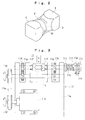
- Fig. 2 is a perspective view showing an external appearance of the chip resistor manufactured through that process.
- an unburned base element 1 made of ceramic in the shape of a prism as shown in Fig. 1(a) is prepared.
- the base element 1 is formed by extruding ceramic slurry to obtain a rod of a square in cross-section and cutting the rod into a predetermined dimension in turn.
- the ceramic slurry is prepared by mixing a binder, a solvent medium, etc., into alumina particles (70wt% or more).
- a multiplicity of base elements 1 are then introduced into a firing furnace for a provisional burning in a lump under conditions of burning temperature of 100 to 200°C and burning time of 1 to 2 hours to impart thereto a hardness suitable for polishing and grinding which will be described later.
- the base elements 1 After having been preliminarily burned, the base elements 1 are loaded into a barrel polishing machine such as a centrifugal barrel or an eccentric rotary barrel and are polished in a lump. Consequently, principally the edges of the base elements 1 are deburred and rounded. After polishing is completed, detectives are removed by screening or visual inspection to select non-detectives.
- a barrel polishing machine such as a centrifugal barrel or an eccentric rotary barrel
- the polished base elements 1 are then individually grind around their centers to create unit elements 2 each having such a shape as shown in Fig. 1(b).
- the unit element 2 includes prism parts 2a at both ends which are symmetric with respect to its center and an intermediate part 2b between the prism-shaped parts 2a which has a hourglass shape and a cross-sectional shape similarly gradually increasing from its center toward the prism-shaped parts 2a.
- the hourglass-shaped part 2b of the shown example has a circular basic cross section.
- the surface of the hourglass-shaped part 2b is continuous smoothly with the surfaces of the prism-shaped parts 2a by arc boundaries. Specific techniques for this grinding step will be detailed later in connection with a configuration of the apparatus used in that step.
- a multiplicity of unit elements 2 obtained as a result of the grinding operation are then introduced into the firing furnace for proper burning in a lump under conditions of burning temperature of 1300 to 1500°C and burning time of two hours.
- the unit elements 2 are then loaded into the barrel polishing machine such as the centrifugal barrel or the eccentric rotary barrel and are polished in a lump. Consequently, principally the edges of the unit elements 2 are deburred and rounded.
- an even thickness of Ni-Cr based or ruthenium oxide based resistance conductor 3 is formed on the entire surface of the grind unit element 2 by use of thin-film forming techniques such as sputtering or vacuum deposition, or by use of thick-film forming techniques such as paste coating. Since the edges of the unit element 2 have been rounded through the previous polishing step, it is prevented for the edge portions to have a film thickness smaller than the remaining portions.
- the resistor conductor 3 formed on the surface of the unit element 2 is then subjected to trimming for adjusting the resistance value, as shown in Fig. 1(d). More specifically, a groove 3a is formed in the resistance conductor 3 on the hourglass-shaped part 2b while bringing a resistance value detecting terminal into contact with the prism-shaped parts 2a, to perform a regulation of the resistance value.
- the groove 3a may be formed through partial grinding by a grinding blade, or alternatively may be formed through partial melting by means of a laser beam within the infrared region.
- an insulative armor 4 of epoxy resin or silicon glass is formed on the surface of the resistance conductor 3 on the hourglass-shaped part 2b by use of thick-film forming techniques such as paste coating.
- the armor 4 has also an hourglass shape similar to the hourglass-shaped part 2b and has a film thickness gradually decreasing from its center toward its ends. Specific techniques for this armoring step will be described in detail later in connection with a configuration of the apparatus used in that step.
- an even thickness of nickel or Sn-Pb alloy electrode conductor 5 is formed on the surfaces of the prism-shaped parts 2a (each including one end surface and four peripheral surfaces) by use of thin-film forming techniques such as electrolytic plating or non-electrolytic plating.
- the extremities of the electrode conductors 5 may abut against the extremities of the armor 4, or alternatively the former may be adjacent to the latter by slightly spaces. Since the edges of the unit element 2 have been rounded through the previous polishing step, the edge portions are prevented from having a film thickness smaller than the remaining portions. In this manner, the chip resistor as shown in Fig. 2 is manufactured.
- FIG. 3 there is depicted by way of example a unit element manufacturing apparatus which comprises a chuck mechanism generally designated at 11 and a grinding blade 12.
- the chuck mechanism 11 includes a frame 11a, a motor 11b firmly secured to the frame 11a, a transmission shaft 11c rotatably supported on the frame 11a, a belt 11e wound around pulleys 11d on the motor shaft and of the transmission shaft 11c, a pair of chuck shafts 11g rotatably supported on the frame 11a in such a manner that their respective chucks 11f confront each other, and gears 11h for transmitting the rotation of the transmission shaft 11c to the chuck shafts 11g, with confronting faces of the chucks 11f each provided with a circular recess for holding the ends of the base element 1.
- the right-hand chuck shaft 11g in the diagram is transversely movable and is provided with two flanges 11i and 11j.
- a coiled spring 11k, a bearing 11l and an operating ring 11m are rotatably interposed between the two flanges 11i and 11j. And also the operating ring 11m is engaged with a drive arm 11n driven by a drive source not shown.
- the grinding blade 12 on the other hand is comprised of e.g., a diamond blade and is adapted to rotate in a predetermined direction around a rotational shaft parallel to the chuck shafts 11g by a drive source not shown.
- the grinding blade 12 is capable of advancing and retreating orthogonally toward and from the center of rotation of the base element 1 clamped by the chucks 11f.
- the grinding edge of the grinding blade 12 has a rounding corresponding to the shape of the curved surface of the hourglass-shaped part 2b of the unit element 2.
- the drive arm 11n is used to displace the chuck shaft 11g on the displaceable side to the right in the diagram by the operating ring 11m, thereby bringing the chuck 11f at the end of that chuck shaft 11g away from the other chuck 11f to widen the space between the opposed chucks 11f.
- the base element 1 is inserted into the thus widened space between the opposed chucks 11f, and then the chuck shaft 11g on the displaceable side is returned to the shown position, thereby enabling the opposed chucks 11f to clamp the base element 1 therebetween coaxially with the chuck shafts 11g.
- the base element 1 clamped between the opposed chucks 11f can be rotated in a predetermined direction through the transmission of rotation of the motor 11b to the chuck shafts 11g by the pulleys 11d, the belt 11e, the transmission shaft 11c and the gears 11h.
- the grinding blade 12 is gradually advanced toward the rotational axis of the base element 1 to grind the center of the prism-shaped base element 1 into a profile corresponding to the shape of the grinding edge of the grinding blade 12, to produce the unit element 2 having a shape shown in Fig. 1(b).
- the base element 1 can be prevented from sliding on the surfaces of the chucks 11f due to the grinding resistance.
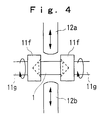
- the base element 1 may be grind by a single grinding blade 12 as mentioned above, a more precise grinding of the base element 1 could be effected by use of two different types of grinding blades with different grinding degrees of roughness, that is, a first blade 12a for rough grinding and a second blade 12b for fine grinding as shown in Fig. 4. It is natural in the case of using a plurality of grinding blades a grinding method may be employed in which maximum grinding depth differs for each blade so that the grinding depth increases stepwise.
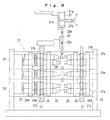
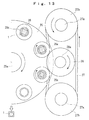
- FIG. 5 there is depicted another example of the unit element manufacturing apparatus which comprises a feeding rotor 21, a relay rotor 22 and a grinding mechanism 23.
- the feeding rotor 21 delivers the base element 1 supplied through a pipe-like chute S to the relay rotor 22 and also as shown in Fig. 6, it includes circumferentially equiangularly spaced receiving grooves 21a (eight at 45 degrees intervals in the diagram) on its periphery.
- Each receiving groove 21a has a substantially square section matching the shape of the end faces of the base element 1 so that a base element 1 supplied sideways through the chute connection point (indicated by a dotted line circle) can be inserted into a receiving groove 21a with the same posture, namely, with its end face forward.
- the feeding rotor 21 includes a curve guide 21b for defining a drop feeding position of the base element 1, and a flat guide 21c for restricting an inserting position of the base element 1 into the receiving guide 21a.
- the relay rotor 22 delivers to a chuck 26 the base element 1 fed from the feeding rotor 21 and also as shown Figs. 6 and 7, it includes circumferentially equiangularly spaced receiving grooves 22a (eight at 45 degrees intervals in the diagram) on its periphery.
- Each receiving groove 22a has a substantially semicircular section larger than the shape of the end faces of the base element 1.
- the relay rotor 22 further includes therewithin a plurality of air suction holes 22b each leading radially to the bottom of the associated receiving groove 22a so that the base element 1 dropped from the feeding rotor 21 can be inserted with the same posture as the above into a receiving groove 22a and sucked by a negative pressure generated by the air suction hole 22b.
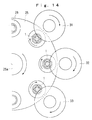
- the grinding mechanism 23 includes a frame 24, a pair of right and left chuck wheels 25, a plurality of chucks 26 provided on each of the chuck wheels 25, a couple of belts 27 for rotating the chucks 26, a grinding blade 28 comprised of e.g., a diamond blade, and a chucking control unit 29.
- the pair of chuck wheel 25 are each in the form of a disk with the same shape and are mounted to a shaft 25a secured to the frame 24.
- a rotational drive source such as a motor is connected to the end of the shaft 25a so that during the grinding process the pair of right and left chuck wheels 25 can rotate in the same direction at the same speed.
- the plurality of chucks 26 are arranged circumferentially and equiangularly (eight at 45 degrees intervals in the diagram) and to confront each other on the periphery of each of the chuck wheels 25.
- the chucks 26 on the chuck wheel 25 on the right side in Fig. 5 are attached to the chuck wheel 25 by bearings not shown to rotate around the central axes.
- the chucks 26 on the right-hand chuck wheel 25 are each provided with a pulley part 26a contacted by a belt 27.
- the chucks 26 on the left-hand chuck wheel 25 in Fig. 5 are attached to the chuck wheel 25 by bearings not shown, allowing both rotations around the central axes and transverse movement.
- the chucks 26 on the left-hand chuck wheel 25 are also each provided with a pulley 26a similar to that of the chucks 26 on the other side. Furthermore, the chucks 26 on the left-hand chuck wheels 25 are each biased to the right by a coiled spring 26b in Fig. 5.
- Each chuck 26 is in the form of a cylindrical member having at its tip a circular recess 26c as shown in Figs. 8(a) to 8(c).
- the chucks 26 on the left side in Fig. 5 are brought nearer or away to enable the two confronting chucks 26 to hold or release the base element 1 in cooperation.
- the chucks 26 arranged on the right-hand chuck wheel 25 in Fig. 5 are each provided with air suction holes 26d leading to the bottom of the recess 26c as shown in Figs. 8(a) to 8(c) so that the base element 1 can be held by a sucking force generated in the air suction hole 2b in addition to a clamping force by the both chucks relatively approaching each other.
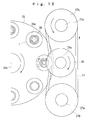
- the couple of belts 27 for rotating the chucks selectively rotate the chucks 26 arranged on the chuck wheel 25, and also as shown in Fig. 10 extend vertically adjacent to the chuck wheels 26. More specifically, the belts 27 are vertically wound with a predetermined tension around a driving pulley 27b and a driven pulley 27c which are attached to upper and lower shafts 27a mounted on the frame 24 so as to extend parallel to the shaft 25a, and simultaneously are in partial contact with the pulley parts 26a of the chucks 26 arranged on the right and left chuck wheels 25 of Fig. 5.
- a rotational drive source such as a motor is connected to the end of the shaft 27a associated with the driving pulley 27b so that during the grinding process, the couple of belts can rotate in the same direction at the same speed, causing the chucks 26 contacted by the belts 27 to rotate in the opposite direction.
- the grinding blade 28 grinds the center of the base element 1 retained by the opposed chucks 26, and as shown in Fig. 10, it is attached to the shaft 28a mounted on the frame 24 so as to extend parallel to and level with the shaft 25a.
- the grinding blade 28 is partially positioned between the opposed chucks on the two chuck wheels 25.
- a rotational driving source is connected to the end of the shaft 28a so that during the grinding process which will be described later, the grinding blade 28 can rotate in the opposite direction to that of the chucks 26 at a constant speed.
- the grinding edge of the grinding blade 28 is provided with a rounding corresponding to the profile of the hourglass-shaped part 2b of the unit element 2.
- the chucking control unit 29 imparts a base element holding action to the chucks 26 at the pre-grinding positions and to impart a base element hold releasing action to the chucks 26 at the post-grinding positions.
- the chucking control unit 29 selectively operates the end of the chucks 26 arranged on the chuck wheel 25 on the left side of Figs. 25(a) to 25(d) to thereby control the base element 1 holding action and the hold releasing action. More specifically, as shown in Figs.
- the chucking control unit 29 includes a lever 29a whose one end is engaged with the end of each chuck 26, and a cam plate 29b for pivoting the lever 29a, the cam plate 29b being provided with a raised portion 29c for drawing the chuck 26, over a predetermined angular range (in the shown example, a range short of the base element 1 hold releasing position starting from the base element 1 holding position).
- the end of each lever 29a contacted by the cam plate 29b is provided with a roller 29d for significantly reducing the contact resistance between the lever 29a and the cam plate 29b caused when the chuck wheels 25 rotate.
- the end roller 29d of the lever 29a is pressed by the raised portion 29c of the cam plate 29b, to draw to the left in the diagram the chuck 26 engaging with the other end of the lever 29b against the spring biasing force, to release the holding of the base element 1 (see Fig. 8(a)). Also, by releasing the pressing of the lever 29a against the end roller 29d, the chuck 26 engaging with the other end of the lever 29b can be removed toward the right in the diagram with the aid of the spring biasing force to hold the base element 1 (see Figs. 8(b) and 8(c)).
- the grinding operation continues while gradually increasing the grinding depth of the grinding blade 28 relative to the base element 1 until the center of rotation of the base element 1 becomes level with the center of rotation of the grinding blade 28.
- the grinding operation of the base element 1 by the grinding blade 28 is basically completed when the center of rotation of the base element 1 is coincident in height with the center of rotation of the grinding blade 28.
- the grinding of the base element 1 can be effected by use of a single grinding blade 28 as mentioned above, a plurality of grinding blades having different degrees of roughness may be arranged along a move path (arc trajectory) of the base element 1.
- a plurality of grinding blades having different degrees of roughness may be arranged along a move path (arc trajectory) of the base element 1.
- a grinding method is also possible in which the maximum grinding depth differs for each blade to stepwise increase the grinding depth.
- a type holding and releasing the base element 1 by removing one of the opposed two chucks 26 closer to or away from the other another type of chuck having a clamping feature, e.g., a chuck with claws capable of opening and closing may be employed so that the hold and release of the base element can be carried out on the chuck basis without any need to remove the chuck itself.
- a armoring apparatus which comprises a coating mechanism generally designated at 41 and a modifying roller 42.
- reference numeral 11f denotes a chuck and 11g denote a chuck shaft, which are similar to those of the Fig. 3 apparatus.
- the coating mechanism 41 includes a vessel 41a for storing therein a paste-like armoring material F capable of being hardened, a coating roller 41b whose part is immersed in the armoring material F within the vessel 41a, a blade 41c for scraping down an excess armoring material F adhered to the coating roller 41b, a drive source not shown for rotating the coating roller 41a in a predetermined direction, and another drive source not shown for advancing and retreating the entire apparatus toward and from the unit element 2 held by the chucks 11f.
- the modifying roller 42 removes an excess armoring material F adhered to the resistance conductor 3 on the hourglass-shaped part 2b to modify the adhesion shape and is adapted to rotate in a predetermined direction and to advance and retreat toward and from the unit element 2 held by the chucks 11f.
- the outer peripheral surface of the modifying roller 42 is provided with a rounding corresponding to a shape of the armor 4.
- the armoring material F can be coated on the surface of the resistance conductor 3 on the hourglass-shaped part 2b.
- more armoring material F than needed is coated thereto and hence the adhered armoring material F becomes an hourglass shaped.
- the modifying roller 42 is advanced to the armoring to scrape an excess armoring material F to modify into an hourglass shape.
- a grinding blade 43 for the modification of armor may be advanced to scrape off the excess armoring material F to modify into a hourglass shape.
- a chip resistor as shown in Fig. 2, that is, a chip resistor having an external appearance of prism shape at both ends and of hourglass shape at the center. Since in this chip resistor the electrode conductor 5 is formed on the prism-shaped parts 2a at both ends, one of the side surfaces of the electrode conductor 5 could be utilized as a mounting surface to ensure a stable component mounting onto a substrate or the like while preventing a rolling of the component itself.
- the unit element 2 having a shape shown in Fig. 1(b). Furthermore, by grinding after provisional burning of an unburned ceramic base element 1, the grinding operation is achieved easier and more proper compared with the case in which an unburned base element is grind.
- Fig. 5 ensures that while rotating the base element 1 around its central axis and translating the rotational axis in parallel along the predetermined arc trajectory, the base element 1 is ground around its center by the grinding blade 28 rotating at a position adjacent to the arc trajectory, thereby effecting a desired grinding operation with a gradual increase of grinding depth of the grinding blade 8 relative to the base element 1. Therefore, even when the base element 1 has small dimensions, the initial grinding resistance could be remarkably reduced to securely avoid the problem of occurrence of cracks or fractures, thereby achieving a highly efficient and precise manufacture of the unit element 2 having a desired shape.
- the unit elements 1 held by the chucks 6 can be sequentially fed to the grinding blade 8 side, it would be possible to eliminate time lost in the feeding and hence to significantly reducing a total time needed for the grinding operation, achieving an increased productivity.
- the thickness of the armor 4 could be so modified that the level of the surface of the armor 4 becomes lower than the level of the surface of the electrode conductor 5, while simultaneously enabling the armor 4 to be finished cleanly at a high precision.
- a unit element having a different shape from that of Fig. 1(b) can be simply obtained by altering the shape of the grinding edge or the grinding depth of the grinding blade.
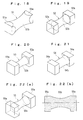
- Figs. 18 to 24 show examples of the shape which can be employed in place of the unit element 2 shown in Fig. 1(b).
- a unit element 51 shown in Fig. 18 has an hourglass-shaped part 51b intervening between prism-shaped parts 51a at both ends.
- the unit element 51 differs in shape from the unit element 2 shown in Fig. 1(b) in that its prism parts 51a are short in length.
- a unit element 52 shown in Fig. 19 has an hourglass-shaped part 52b intervening between prism-shaped parts 52a at both ends.
- the unit element 52 differs in shape from the unit element 2 shown in Fig. 1(b) in that the maximum outer diameter of the hourglass-shaped part 52b is coincident with an inscribed circle of a cross-section of the prism-shaped parts 52a.
- a unit element 53 shown in Fig. 20 has an hourglass-shaped part 53b intervening between prism-shaped parts 53a at both ends.
- the unit element 53 differs in shape from the unit element 2 shown in Fig. 1(b) in that the maximum outer diameter of the hourglass-shaped part 53b is smaller than the diameter of an inscribed circle of a cross-section of the prism-shaped parts 53a.
- a unit element 54 shown in Fig. 21 has an hourglass-shaped part 54b intervening between prism-shaped parts 54a at both ends.
- the unit element 54 differs in shape from the unit element 2 shown in Fig. 1(b) in that the hourglass-shaped part 54b has a cylindrical central portion.
- a unit element 55 shown in Figs. 22(a) and 22(b) has an hourglass-shaped part 51b intervening between prism-shaped parts 51a at both ends.
- the unit element 55 differs in shape from the unit element 2 shown in Fig. 1(b) in that the central axis of the prism-shaped parts 55a at both ends is vertically offset from the central axis of the hourglass-shaped part 55b to impart an eccentric positional relationship to the two parts.
- Fig. 22(a) is a side elevational view of the unit element 55 and Fig. 22(b) is a longitudinal section thereof.
- a unit element 56 shown in Fig. 23 has an hourglass-shaped part 56b intervening between prism-shaped parts 56a at both ends.
- the unit element 55 differs in shape from the unit element 2 shown in Fig. 1(b) in that the hourglass-shaped part 56b has an elliptical reference cross-section.
- a unit element 57 shown in Fig. 24 has an hourglass-shaped part 57b intervening between prism-shaped parts 57a at both ends.
- the unit element 57 differs in shape from the unit element 2 shown in Fig. 1(b) in that the hourglass-shaped part 57b has an elliptical reference cross-section and in that the central axis of the prism-shaped parts 57a at both ends is vertically offset from the central axis at the hourglass-shaped part 57b to impart an eccentric positional relationship to the two parts.
- FIGs. 25(a) to 25(d) there is depicted an embodiment comprising an additional step of forming an interconnection film 6 between the unit element 2 and the resistance conductor 3.
- the other steps are substantially the same as those described with reference to Fig. 1, so an explanation of the other steps is omitted and identical reference numerals are used.
- the film 6 is made of a material which is compatible with both the unit element 2 and the resistance conductor 3 (compatibility in material), for instance, a base metal such as Ni, Cr, Ni-Cr alloy or their alloys.
- the film 6 is formed over the entire surface of the unit element 2 at a thickness of the order of 1 ⁇ m by use of a thin-film forming technique such as sputtering or vacuum deposition. After the formation of the interconnection film 6, the resistance conductor 3 is formed on top of the entire surface of the film 6.
- the intervention of the film 6 made of a material compatible (compatibility in material) with both the unit element 2 and the resistance conductor 3 therebetween contributes to an increase in bonding power exerted between the unit element 2 and the resistance conductor 3. Accordingly, even though a stress is applied to the component during or after mounting thereof, the resistance conductor 3 can be securely prevented from being peeled off from the unit element 2, while ensuring the stable quality and characteristics of the component.
- Fig. 26 shows another embodiment comprising an additional step of partially forming flat areas 4a on top of the surface of the armor 4.
- the other steps are substantially the same as those described with reference to Fig. 1.
- a method of forming the flat areas 4a as shown in Fig. 26 on the surface of the armor 4 includes a method in which a pair of L-shaped templates 61 are pressed against the armoring material F prior to hardening of the coated armoring material F as shown in Figs. 27(a) and 27(b), and a method in which posterior to hardening of the coated armoring material F the surface is partially planed off by a grinding blade.
- the flat areas 4a thus partially formed on the surface of the armor 4 could facilitate the suction of the components by means of a suction nozz le or the like.
- the flat areas 4a may be formed parallel to the surfaces of the electrode conductors 5 lying on the prism-shaped parts, thereby enabling the suction posture to conform to the mounting posture.
- Fig. 28 shows still another embodiment in which the terminal edges of the armor 4 are extended as far as on the prism-shaped parts 2a of the unit element 2, with the electrode conductors 5 being so formed as to abut the terminal edges of the armor 4 or to be adjacent thereto by slightly spaces.
- extension of the terminal edges of the armor 4 as far as on the prism-shaped parts 2a would enable the boundaries between the hourglass-shaped part 2b and the prism-shaped parts 2a to be covered by the armor 4, while simultaneously rendering the shape of the side surfaces of the electrode conductors 5 a perfect rectangle.
- the end edges of the electrode conductors 5 may overlap the end edges of the armor 4 as shown in Fig. 29(a) or 29(b) so that the electrode conductors 5 can prevent the armor 4 from peeling off starting from its end edges.
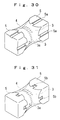
- Figs 30 and 31 shows a still further embodiment in which the surfaces of the electrode conductors 5 are formed with recesses 5a or 5b into which a part of the armor 4 infiltrates. In this case, that the electrode conductor forming step precedes the armor forming step.
- a method of forming the recesses 5a or 5b as shown in Figs. 30 and 31 in the surfaces of the electrode conductors 5 include a partial grinding of the surfaces of the electrode conductors 5 by a grinding blade after the formation of the electrode conductors 5, and a partial removal of the surfaces by the irradiation of laser beam.
- the present invention has been exemplarily applied to a chip resistor which is typical of chip components hereinabove, it is natural that the present invention is not intended to be limited to the chip resistor, but is widely applicable to other chip components, for instance, a chip jumper, a chip inductor, etc., comprised of a unit element which carries thereon a circuit conductor, electrode conductors and an armor.
Landscapes
- Engineering & Computer Science (AREA)
- Manufacturing & Machinery (AREA)
- Microelectronics & Electronic Packaging (AREA)
- Apparatuses And Processes For Manufacturing Resistors (AREA)
- Details Of Resistors (AREA)
- Non-Adjustable Resistors (AREA)
- Finish Polishing, Edge Sharpening, And Grinding By Specific Grinding Devices (AREA)
- Gyroscopes (AREA)
Applications Claiming Priority (3)
| Application Number | Priority Date | Filing Date | Title |
|---|---|---|---|
| JP29043696 | 1996-10-31 | ||
| JP29043696A JP3466394B2 (ja) | 1996-10-31 | 1996-10-31 | チップ部品及びその製造方法 |
| JP290436/96 | 1996-10-31 |
Publications (3)
| Publication Number | Publication Date |
|---|---|
| EP0840332A2 true EP0840332A2 (de) | 1998-05-06 |
| EP0840332A3 EP0840332A3 (de) | 2000-04-19 |
| EP0840332B1 EP0840332B1 (de) | 2007-01-10 |
Family
ID=17756015
Family Applications (1)
| Application Number | Title | Priority Date | Filing Date |
|---|---|---|---|
| EP97118837A Expired - Lifetime EP0840332B1 (de) | 1996-10-31 | 1997-10-29 | Herstellungsverfahren für Chipkomponenten und Gerät zum Herstellen von Einheitselementen für Chipkomponenten |
Country Status (7)
| Country | Link |
|---|---|
| US (2) | US6070787A (de) |
| EP (1) | EP0840332B1 (de) |
| JP (1) | JP3466394B2 (de) |
| KR (1) | KR100269037B1 (de) |
| CN (1) | CN1089938C (de) |
| DE (1) | DE69737224T2 (de) |
| TW (1) | TW391015B (de) |
Cited By (1)
| Publication number | Priority date | Publication date | Assignee | Title |
|---|---|---|---|---|
| GB2362759A (en) * | 1999-12-23 | 2001-11-28 | Ibm | Non Planar Surface for Semiconductor Chips |
Families Citing this family (9)
| Publication number | Priority date | Publication date | Assignee | Title |
|---|---|---|---|---|
| US6918173B2 (en) * | 2000-07-31 | 2005-07-19 | Ceratech Corporation | Method for fabricating surface mountable chip inductor |
| JP4790439B2 (ja) * | 2006-02-09 | 2011-10-12 | 富士通株式会社 | 電極、電子部品及び基板 |
| TWM450811U (zh) * | 2012-12-13 | 2013-04-11 | Viking Tech Corp | 電阻元件 |
| JP6202207B2 (ja) * | 2014-06-18 | 2017-09-27 | 株式会社村田製作所 | セラミックコアのバリ取り方法、バリ取り装置、及びセラミックコアの製造方法 |
| US9922770B2 (en) * | 2014-12-26 | 2018-03-20 | Taiyo Yuden Co., Ltd. | Through-type multilayer ceramic capacitor |
| CN107731792A (zh) * | 2016-08-10 | 2018-02-23 | 华新科技股份有限公司 | 晶圆电阻装置及其制造方法 |
| CN107508455A (zh) * | 2017-08-25 | 2017-12-22 | 惠科股份有限公司 | 缓冲电路及其显示装置 |
| JP7319811B2 (ja) * | 2019-04-01 | 2023-08-02 | Koa株式会社 | 抵抗器 |
| CN114765086A (zh) * | 2021-01-12 | 2022-07-19 | 国巨电子(中国)有限公司 | 电阻器的制造方法 |
Family Cites Families (15)
| Publication number | Priority date | Publication date | Assignee | Title |
|---|---|---|---|---|
| US3676911A (en) * | 1970-11-12 | 1972-07-18 | Frank C Austin | Holding tool |
| FR2365209A1 (fr) * | 1976-09-20 | 1978-04-14 | Cii Honeywell Bull | Procede pour le montage de micro-plaquettes de circuits integres sur un substrat et installation pour sa mise en oeuvre |
| US4313262A (en) * | 1979-12-17 | 1982-02-02 | General Electric Company | Molybdenum substrate thick film circuit |
| JPS62251081A (ja) * | 1986-04-23 | 1987-10-31 | Hitachi Ltd | 研削装置および研削砥石 |
| KR930010116B1 (ko) | 1990-10-22 | 1993-10-14 | 한국전기통신공사 | BiCMOS 소자의 제조방법 |
| US5149662A (en) * | 1991-03-27 | 1992-09-22 | Integrated System Assemblies Corporation | Methods for testing and burn-in of integrated circuit chips |
| US5233327A (en) * | 1991-07-01 | 1993-08-03 | International Business Machines Corporation | Active resistor trimming by differential annealing |
| FR2688629A1 (fr) * | 1992-03-10 | 1993-09-17 | Thomson Csf | Procede et dispositif d'encapsulation en trois dimensions de pastilles semi-conductrices. |
| JPH06290906A (ja) * | 1993-03-30 | 1994-10-18 | Taiyo Yuden Co Ltd | チップ抵抗器およびその製造方法 |
| JP3329964B2 (ja) * | 1994-03-18 | 2002-09-30 | 太陽誘電株式会社 | チップ部品及びその製造方法 |
| US5634268A (en) * | 1995-06-07 | 1997-06-03 | International Business Machines Corporation | Method for making direct chip attach circuit card |
| US6118290A (en) * | 1997-06-07 | 2000-09-12 | Tokyo Electron Limited | Prober and method for cleaning probes provided therein |
| JPH1167880A (ja) * | 1997-08-18 | 1999-03-09 | Toshiba Mach Co Ltd | ウエハ回転チャック |
| US6066546A (en) * | 1999-01-08 | 2000-05-23 | Advanced Micro Devices, Inc. | Method to minimize particulate induced clamping failures |
| JP3504543B2 (ja) * | 1999-03-03 | 2004-03-08 | 株式会社日立製作所 | 半導体素子の分離方法およびその装置並びに半導体素子の搭載方法 |
-
1996
- 1996-10-31 JP JP29043696A patent/JP3466394B2/ja not_active Expired - Fee Related
-
1997
- 1997-10-28 TW TW086116100A patent/TW391015B/zh not_active IP Right Cessation
- 1997-10-29 CN CN97122409A patent/CN1089938C/zh not_active Expired - Fee Related
- 1997-10-29 US US08/960,368 patent/US6070787A/en not_active Expired - Lifetime
- 1997-10-29 EP EP97118837A patent/EP0840332B1/de not_active Expired - Lifetime
- 1997-10-29 KR KR1019970055782A patent/KR100269037B1/ko not_active Expired - Fee Related
- 1997-10-29 DE DE69737224T patent/DE69737224T2/de not_active Expired - Fee Related
-
2000
- 2000-05-09 US US09/567,325 patent/US6409069B1/en not_active Expired - Fee Related
Cited By (3)
| Publication number | Priority date | Publication date | Assignee | Title |
|---|---|---|---|---|
| GB2362759A (en) * | 1999-12-23 | 2001-11-28 | Ibm | Non Planar Surface for Semiconductor Chips |
| US6731012B1 (en) | 1999-12-23 | 2004-05-04 | International Business Machines Corporation | Non-planar surface for semiconductor chips |
| GB2362759B (en) * | 1999-12-23 | 2004-08-25 | Ibm | Non-planar surface for semiconductor chips |
Also Published As
| Publication number | Publication date |
|---|---|
| US6070787A (en) | 2000-06-06 |
| KR100269037B1 (ko) | 2000-10-16 |
| DE69737224D1 (de) | 2007-02-22 |
| CN1186309A (zh) | 1998-07-01 |
| CN1089938C (zh) | 2002-08-28 |
| DE69737224T2 (de) | 2007-10-25 |
| KR19980033246A (ko) | 1998-07-25 |
| EP0840332A3 (de) | 2000-04-19 |
| JP3466394B2 (ja) | 2003-11-10 |
| EP0840332B1 (de) | 2007-01-10 |
| TW391015B (en) | 2000-05-21 |
| JPH10135001A (ja) | 1998-05-22 |
| US6409069B1 (en) | 2002-06-25 |
Similar Documents
| Publication | Publication Date | Title |
|---|---|---|
| EP0840332B1 (de) | Herstellungsverfahren für Chipkomponenten und Gerät zum Herstellen von Einheitselementen für Chipkomponenten | |
| JP4816815B2 (ja) | 多角柱状部材の研磨装置およびその研磨方法 | |
| CN101795797B (zh) | 切削刀片、形成切削刀片的方法及制造切削刀片的方法 | |
| JP3125980B2 (ja) | セラミック製細長円筒部品のチャック・加工方法及び装置 | |
| TWI705875B (zh) | 研削用磨石及其製造方法 | |
| US4914872A (en) | Apparatus and method for selectively contouring an airfoil root | |
| CN1741867A (zh) | 旋转式夹具 | |
| EP0642887B1 (de) | Vorrichtung zum Herstellen von geschliffenen Hohlnadeln | |
| WO2005077600A1 (ja) | 両端面ツルーイング装置、両端面ツルーイング工具及び両端面ツルーイング方法 | |
| JP3403213B2 (ja) | 溝加工方法および溝加工装置 | |
| EP1611981A1 (de) | Schneidvorrichtung für dünne metallplatte | |
| JP3418089B2 (ja) | チップ部品用磁器素子の製造方法及び製造装置 | |
| JP2004243432A (ja) | 切削加工方法、切削加工装置および金型製作方法 | |
| JP3601066B2 (ja) | 歯車ホーニング盤における内歯車形ホーニング砥石による歯車ホーニング加工方法 | |
| EP1696191A1 (de) | Verfahren zur Herstellung eines Eisherstellungzylinders für eine Schneckentyp-Eiserzeugungsmaschine | |
| JP2003145396A (ja) | 平面研削方法およびその装置 | |
| CN112658912A (zh) | 一种切片磨边一体化成型机及其工作方法 | |
| JPS5877436A (ja) | プリント基板のリ−ド線切断装置 | |
| JPH11291173A (ja) | 研削工具およびその製造方法 | |
| JPH01210313A (ja) | ウエハの切断装置 | |
| JP2002143173A (ja) | 縫合針の製造装置 | |
| CN114346764A (zh) | 用于制造研磨机的方法 | |
| KR20010011192A (ko) | 가위의 윗 곡면 연삭장치 | |
| JPS61166006A (ja) | 皮膜抵抗器の抵抗値調整方法 | |
| JP2001129751A (ja) | 摺動部材のクラウニング加工方法とこれに用いる装置 |
Legal Events
| Date | Code | Title | Description |
|---|---|---|---|
| PUAI | Public reference made under article 153(3) epc to a published international application that has entered the european phase |
Free format text: ORIGINAL CODE: 0009012 |
|
| AK | Designated contracting states |
Kind code of ref document: A2 Designated state(s): DE FR GB IT NL |
|
| AX | Request for extension of the european patent |
Free format text: AL;LT;LV;RO;SI |
|
| PUAL | Search report despatched |
Free format text: ORIGINAL CODE: 0009013 |
|
| AK | Designated contracting states |
Kind code of ref document: A3 Designated state(s): AT BE CH DE DK ES FI FR GB GR IE IT LI LU MC NL PT SE |
|
| AX | Request for extension of the european patent |
Free format text: AL;LT;LV;RO;SI |
|
| RIN1 | Information on inventor provided before grant (corrected) |
Inventor name: KAKIUCHI, IKUO Inventor name: TERAOKA, MANABU Inventor name: KURATA, SADAAKI Inventor name: TANBO, KIYOSHI Inventor name: HARADA, SHINISHI |
|
| 17P | Request for examination filed |
Effective date: 20001005 |
|
| AKX | Designation fees paid |
Free format text: DE FR GB IT NL |
|
| 17Q | First examination report despatched |
Effective date: 20040608 |
|
| GRAP | Despatch of communication of intention to grant a patent |
Free format text: ORIGINAL CODE: EPIDOSNIGR1 |
|
| GRAS | Grant fee paid |
Free format text: ORIGINAL CODE: EPIDOSNIGR3 |
|
| GRAA | (expected) grant |
Free format text: ORIGINAL CODE: 0009210 |
|
| AK | Designated contracting states |
Kind code of ref document: B1 Designated state(s): DE FR GB IT NL |
|
| REG | Reference to a national code |
Ref country code: GB Ref legal event code: FG4D |
|
| REF | Corresponds to: |
Ref document number: 69737224 Country of ref document: DE Date of ref document: 20070222 Kind code of ref document: P |
|
| ET | Fr: translation filed | ||
| PLBE | No opposition filed within time limit |
Free format text: ORIGINAL CODE: 0009261 |
|
| STAA | Information on the status of an ep patent application or granted ep patent |
Free format text: STATUS: NO OPPOSITION FILED WITHIN TIME LIMIT |
|
| 26N | No opposition filed |
Effective date: 20071011 |
|
| PG25 | Lapsed in a contracting state [announced via postgrant information from national office to epo] |
Ref country code: IT Free format text: LAPSE BECAUSE OF FAILURE TO SUBMIT A TRANSLATION OF THE DESCRIPTION OR TO PAY THE FEE WITHIN THE PRESCRIBED TIME-LIMIT Effective date: 20070110 |
|
| PGFP | Annual fee paid to national office [announced via postgrant information from national office to epo] |
Ref country code: NL Payment date: 20081021 Year of fee payment: 12 Ref country code: FR Payment date: 20080919 Year of fee payment: 12 |
|
| PGFP | Annual fee paid to national office [announced via postgrant information from national office to epo] |
Ref country code: GB Payment date: 20080916 Year of fee payment: 12 |
|
| PGFP | Annual fee paid to national office [announced via postgrant information from national office to epo] |
Ref country code: DE Payment date: 20081031 Year of fee payment: 12 |
|
| REG | Reference to a national code |
Ref country code: NL Ref legal event code: V1 Effective date: 20100501 |
|
| REG | Reference to a national code |
Ref country code: FR Ref legal event code: ST Effective date: 20100630 |
|
| PG25 | Lapsed in a contracting state [announced via postgrant information from national office to epo] |
Ref country code: NL Free format text: LAPSE BECAUSE OF NON-PAYMENT OF DUE FEES Effective date: 20100501 Ref country code: FR Free format text: LAPSE BECAUSE OF NON-PAYMENT OF DUE FEES Effective date: 20091102 Ref country code: DE Free format text: LAPSE BECAUSE OF NON-PAYMENT OF DUE FEES Effective date: 20100501 |
|
| PG25 | Lapsed in a contracting state [announced via postgrant information from national office to epo] |
Ref country code: GB Free format text: LAPSE BECAUSE OF NON-PAYMENT OF DUE FEES Effective date: 20091029 |