EP0806415A1 - Verfahren zur Herstellung von Arylamiden heteroaromatischer Carbonsäuren - Google Patents
Verfahren zur Herstellung von Arylamiden heteroaromatischer Carbonsäuren Download PDFInfo
- Publication number
- EP0806415A1 EP0806415A1 EP97106080A EP97106080A EP0806415A1 EP 0806415 A1 EP0806415 A1 EP 0806415A1 EP 97106080 A EP97106080 A EP 97106080A EP 97106080 A EP97106080 A EP 97106080A EP 0806415 A1 EP0806415 A1 EP 0806415A1
- Authority
- EP
- European Patent Office
- Prior art keywords
- nitrogen
- general formula
- formula
- alkyl
- ring
- Prior art date
- Legal status (The legal status is an assumption and is not a legal conclusion. Google has not performed a legal analysis and makes no representation as to the accuracy of the status listed.)
- Granted
Links
Classifications
-
- C—CHEMISTRY; METALLURGY
- C07—ORGANIC CHEMISTRY
- C07D—HETEROCYCLIC COMPOUNDS
- C07D213/00—Heterocyclic compounds containing six-membered rings, not condensed with other rings, with one nitrogen atom as the only ring hetero atom and three or more double bonds between ring members or between ring members and non-ring members
- C07D213/02—Heterocyclic compounds containing six-membered rings, not condensed with other rings, with one nitrogen atom as the only ring hetero atom and three or more double bonds between ring members or between ring members and non-ring members having three double bonds between ring members or between ring members and non-ring members
- C07D213/04—Heterocyclic compounds containing six-membered rings, not condensed with other rings, with one nitrogen atom as the only ring hetero atom and three or more double bonds between ring members or between ring members and non-ring members having three double bonds between ring members or between ring members and non-ring members having no bond between the ring nitrogen atom and a non-ring member or having only hydrogen or carbon atoms directly attached to the ring nitrogen atom
- C07D213/60—Heterocyclic compounds containing six-membered rings, not condensed with other rings, with one nitrogen atom as the only ring hetero atom and three or more double bonds between ring members or between ring members and non-ring members having three double bonds between ring members or between ring members and non-ring members having no bond between the ring nitrogen atom and a non-ring member or having only hydrogen or carbon atoms directly attached to the ring nitrogen atom with hetero atoms or with carbon atoms having three bonds to hetero atoms with at the most one bond to halogen, e.g. ester or nitrile radicals, directly attached to ring carbon atoms
- C07D213/62—Oxygen or sulfur atoms
- C07D213/63—One oxygen atom
-
- C—CHEMISTRY; METALLURGY
- C07—ORGANIC CHEMISTRY
- C07D—HETEROCYCLIC COMPOUNDS
- C07D213/00—Heterocyclic compounds containing six-membered rings, not condensed with other rings, with one nitrogen atom as the only ring hetero atom and three or more double bonds between ring members or between ring members and non-ring members
- C07D213/02—Heterocyclic compounds containing six-membered rings, not condensed with other rings, with one nitrogen atom as the only ring hetero atom and three or more double bonds between ring members or between ring members and non-ring members having three double bonds between ring members or between ring members and non-ring members
- C07D213/04—Heterocyclic compounds containing six-membered rings, not condensed with other rings, with one nitrogen atom as the only ring hetero atom and three or more double bonds between ring members or between ring members and non-ring members having three double bonds between ring members or between ring members and non-ring members having no bond between the ring nitrogen atom and a non-ring member or having only hydrogen or carbon atoms directly attached to the ring nitrogen atom
- C07D213/60—Heterocyclic compounds containing six-membered rings, not condensed with other rings, with one nitrogen atom as the only ring hetero atom and three or more double bonds between ring members or between ring members and non-ring members having three double bonds between ring members or between ring members and non-ring members having no bond between the ring nitrogen atom and a non-ring member or having only hydrogen or carbon atoms directly attached to the ring nitrogen atom with hetero atoms or with carbon atoms having three bonds to hetero atoms with at the most one bond to halogen, e.g. ester or nitrile radicals, directly attached to ring carbon atoms
- C07D213/78—Carbon atoms having three bonds to hetero atoms, with at the most one bond to halogen, e.g. ester or nitrile radicals
- C07D213/81—Amides; Imides
-
- C—CHEMISTRY; METALLURGY
- C07—ORGANIC CHEMISTRY
- C07D—HETEROCYCLIC COMPOUNDS
- C07D401/00—Heterocyclic compounds containing two or more hetero rings, having nitrogen atoms as the only ring hetero atoms, at least one ring being a six-membered ring with only one nitrogen atom
- C07D401/02—Heterocyclic compounds containing two or more hetero rings, having nitrogen atoms as the only ring hetero atoms, at least one ring being a six-membered ring with only one nitrogen atom containing two hetero rings
- C07D401/12—Heterocyclic compounds containing two or more hetero rings, having nitrogen atoms as the only ring hetero atoms, at least one ring being a six-membered ring with only one nitrogen atom containing two hetero rings linked by a chain containing hetero atoms as chain links
Definitions
- the object of the present invention was therefore to provide an alternative process which starts from more accessible starting materials.
- halogen compounds of the general formula wherein A 1 to A 5 have the meanings given above and X is chlorine, bromine or iodine, with carbon monoxide and a primary or secondary amine of the general formula R 6 -NH-R 7 III, wherein R 6 and R 7 have the meanings given above, in the presence of a base in good to almost quantitative yield react directly to the desired products (I), if as a catalyst a complex of palladium with a triphenylphosphine of the general formula wherein R 8 to R 10 independently of one another are C 1-4 alkyl, C 1-4 alkoxy or fluorine, is present.
- C 1-4 alkyl here and in the following is to be understood to mean all linear or branched primary, secondary or tertiary alkyl groups with up to 4 carbon atoms.
- Aromatic or heteroaromatic radicals here and in the following are to be understood in particular as mono- or polycyclic systems such as, for example, phenyl, naphthyl, biphenylyl, anthracenyl, furyl, pyrrolyl, pyrazolyl, thiophenyl, pyridyl, indolyl or quinolinyl.
- substituents for example lower alkyl groups such as methyl, halogenated alkyl groups such as trifluoromethyl, lower alkoxy groups such as methoxy, or lower alkylthio (alkanesulfanyl) or alkanesulfonyl groups such as methylthio or ethanesulfonyl.
- Substituted phenyl is to be understood in particular as groups such as ( p- ) fluorophenyl, ( p- ) methoxyphenyl, ( p- ) tolyl or ( p- ) trifluoromethylphenyl.
- the halogen compounds (II) serving as starting material are either known compounds or they can be prepared analogously to known compounds. Numerous such compounds are disclosed, for example, in US-A 4,254,125 and in EP-A 0 001 187.
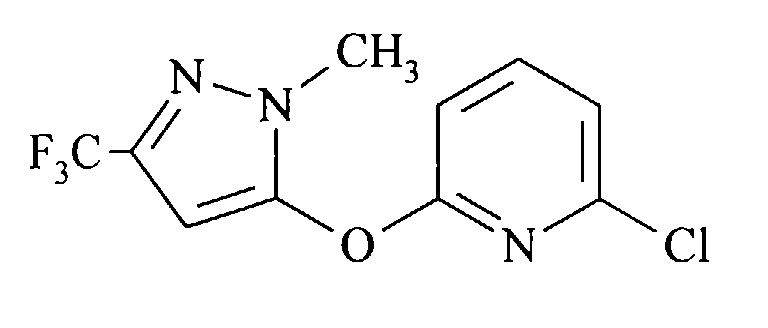
- the compound 2-chloro-6- [1-methyl-3- (trifluoromethyl) pyrazol-5-yloxy] pyridine is new and is also an object of the present invention.
- the process according to the invention is preferably suitable for the preparation of those amides (I) in which A 2 is nitrogen and forms a pyridine ring with the other ring members.
- Particularly preferred are those amides (I) in which R 1 is a group of the formula -OR, where R has the meaning given above.
- amides (I) in which A 1 is nitrogen and forms a pyridine ring with the other ring members those in which A 1 and A 5 are nitrogen and with the other ring members a pyrimidine ring form, those in which A 1 and A 4 are nitrogen and form a pyrazine ring with the other ring members, as well as those in which A 1 , A 3 and A 5 are nitrogen and form a 1,3,5-triazine ring with the other ring members.
- R 2 is a group of the formula -OR are again particularly preferred, where R has the meaning given above.
- R is an optionally substituted phenyl group.
- R 1 or R 2 is a group of the formula -OR.
- Amides in which R 6 is hydrogen and R 7 is an optionally substituted phenyl group are also preferred.
- triphenylphosphines (IV) are those in which R 8 to R 10 are the same and C 1-4 alkoxy groups.
- Triphenylphosphine in which R 8 to R 10 are methoxy groups, is very particularly preferred.
- the catalytically active palladium-phosphine complex is advantageously formed in situ by using palladium in finely divided elemental form (e.g. palladium on activated carbon), a Pd ( ) Salt (e.g. the chloride or the acetate), or a suitable Pd ( ) Complex (e.g. dichloro-bis (triphenylphosphine) palladium ( )) is reacted with the phosphine.
- Palladium is particularly preferred as the source of palladium ( )acetate.
- the palladium is preferably used in an amount of 0.02 to 0.2 mol% Pd ( ) or 0.5 to 2 mol% of Pd (0) (as Pd / C), based in each case on the halogen compound (II).
- the phosphine is advantageously used in excess (based on Pd), preferably in an amount of 0.2 to 5 mol%, also based on the halogen compound (II).
- Both relatively nonpolar solvents such as toluene or xylene and polar solvents such as acetonitrile, tetrahydrofuran or N, N -dimethylacetamide can be used as solvents.
- a relatively weak base is preferably used as the base. This need not be soluble in the solvent used.
- carbonates such as sodium carbonate or potassium carbonate or acetates such as sodium acetate are particularly suitable. Particularly good results were achieved with the latter base.
- the reaction temperature is preferably 80 to 250 ° C.
- the carbon monoxide pressure is preferably 1 to 50 bar.
- halogen compounds (II) are advantageously prepared in that a dihalide of the general formula wherein X is chlorine, bromine or iodine and A 1 to A 5 have the meanings given above, with the proviso that one of the radicals R 1 to R 5 on a carbon atom adjacent to a ring nitrogen atom is Z, Z being chlorine, bromine or iodine means and the rest of R 1 to R 5 , if present, have the meaning given in claim 1, with an aromatic or heteroaromatic hydroxy compound of the general formula R-OH VI, wherein R has the meaning given in claim 1 is implemented.
Landscapes
- Chemical & Material Sciences (AREA)
- Organic Chemistry (AREA)
- Pyridine Compounds (AREA)
- Low-Molecular Organic Synthesis Reactions Using Catalysts (AREA)
- Organic Low-Molecular-Weight Compounds And Preparation Thereof (AREA)
- Plural Heterocyclic Compounds (AREA)
- Catalysts (AREA)
- Agricultural Chemicals And Associated Chemicals (AREA)
Abstract
Description
- Die vorliegende Erfindung betrifft ein Verfahren zur Herstellung von Arylamiden heteroaromatischer Carbonsäuren durch Umsetzung von heteroaromatischen Halogenverbindungen mit Kohlenmonoxid und aromatischen Aminen in Gegenwart eines Katalysators und einer Base. Sie betrifft weiterhin ein neues Halogenpyridin als Ausgangsmaterial für die erfindungsgemässe Herstellung eines Arylamids.
Die erfindungsgemäss herstellbaren Amide besitzen die allgemeine Formel
- A1 Stickstoff oder CR1,
- A2 Stickstoff oder CR2,
- A3 Stickstoff oder CR3,
- A4 Stickstoff oder CR4,
- und A5 Stickstoff oder CR5,
mit der Massgabe dass wenigstens eines der Ringglieder A1 bis A5 Stickstoff ist und nicht zwei Stickstoffatome unmittelbar miteinander verbunden sind; - R1 bis R5, soweit vorhanden, unabhängig voneinander Wasserstoff, C1-4-Alkyl oder Aryl, wobei jedoch einer der Substituenten R1 bis R5 eine Gruppe der Formel -OR ist, in welcher
- R ein gegebenenfalls substituierter aromatischer oder heteroaromatischer Rest ist;
- R6 Wasserstoff oder C1-4-Alkyl
und R7 einen gegebenenfalls substituierten aromatischen oder heteroaromatischen Rest. - Die Synthese dieser bekannten Verbindungen geht üblicherweise von den entsprechenden Carbonsäuren oder Carbonsäurederivaten (Säurechloride, Ester, Nitrile) aus. Diese sind jedoch oft schwer zugänglich und deshalb teuer.
- Aufgabe der vorliegenden Erfindung war daher, ein alternatives Verfahren zur Verfügung zu stellen, welches von leichter zugänglichen Edukten ausgeht.
- Erfindungsgemäss wird diese Aufgabe durch das Verfahren nach Patentanspruch 1 gelöst. Es wurde gefunden, dass Halogenverbindungen der allgemeinen Formel
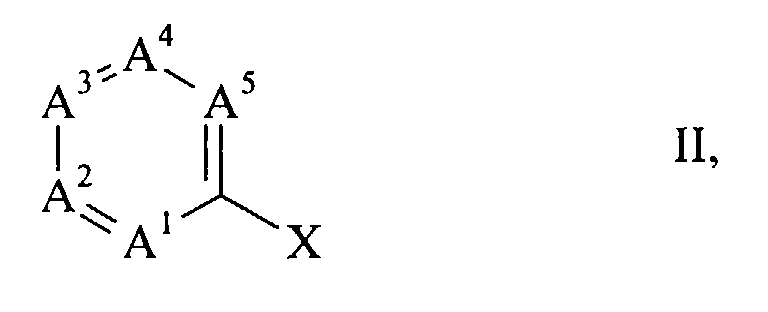
R6-NH-R7 III,
worin R6 und R7 die oben genannten Bedeutungen haben, in Gegenwart einer Base in guter bis fast quantitativer Ausbeute direkt zu den gewünschten Produkten (I) reagieren, wenn als Katalysator ein Komplex von Palladium mit einem Triphenylphosphin der allgemeinen Formel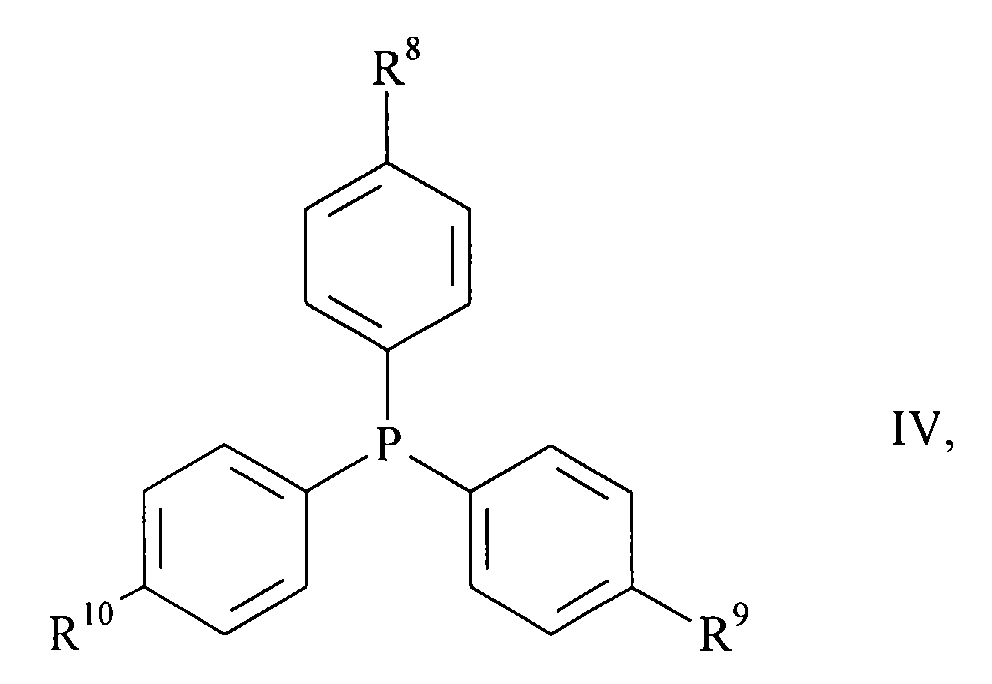
- Unter C1-4-Alkyl sind hier und im folgenden alle linearen oder verzweigten primären, sekundären oder tertiären Alkylgruppen mit bis zu 4 Kohlenstoffatomen zu verstehen. Unter aromatischen oder heteroaromatischen Resten sind hier und im folgenden insbesondere mono- oder polycyclische Systeme wie beispielsweise Phenyl, Naphthyl, Biphenylyl, Anthracenyl, Furyl, Pyrrolyl, Pyrazolyl, Thiophenyl, Pyridyl, Indolyl oder Chinolinyl zu verstehen. Diese können einen oder mehrere gleiche oder verschiedene Substituenten tragen, beispielsweise niedrige Alkylgruppen wie Methyl, halogenierte Alkylgruppen wie Trifluormethyl, niedrige Alkoxygruppen wie Methoxy, oder niedrige Alkylthio- (Alkansulfanyl-) oder Alkansulfonylgruppen wie Methylthio oder Ethansulfonyl. Unter substituiertem Phenyl sind insbesondere Gruppen wie (p-) Fluorphenyl, (p-) Methoxyphenyl, (p-) Tolyl oder (p-) Trifluormethylphenyl zu verstehen.
- Die als Ausgangsmaterial dienenden Halogenverbindungen (II) sind entweder bekannte Verbindungen oder sie können analog zu bekannten Verbindungen hergestellt werden. Zahlreiche derartige Verbindungen sind beispielsweise in US-A 4 254 125 und in EP-A 0 001 187 offenbart. Die Verbindung 2-Chlor-6-[1-methyl-3-(trifluormethyl)pyrazol-5-yloxy]pyridin ist neu und ebenfalls Gegenstand der vorliegenden Erfindung.
- Vorzugsweise eignet sich das erfindungsgemässe Verfahren zur Herstellung solcher Amide (I), in denen A2 Stickstoff ist und mit den übrigen Ringgliedern einen Pyridinring bildet.
Besonders bevorzugt sind dabei jene Amide (I), in denen R1 eine Gruppe der Formel -OR ist, wobei R die oben genannte Bedeutung hat.
Ebenfalls bevorzugt sind solche Amide (I), in denen A1 Stickstoff ist und mit den übrigen Ringgliedern einen Pyridinring bildet,
solche, in denen A1 und A5 Stickstoff sind und mit den übrigen Ringgliedern einen Pyrimidinring bilden,
solche, in denen A1 und A4 Stickstoff sind und mit den übrigen Ringgliedern einen Pyrazinring bilden,
sowie solche, in denen A1, A3 und A5 Stickstoff sind und mit den übrigen Ringgliedern einen 1,3,5-Triazinring bilden.
Unter den vier letztgenannten Klassen sind wiederum diejenigen Amide besonders bevorzugt, in welchen R2 eine Gruppe der Formel -OR ist, wobei R die oben genannte Bedeutung hat.
Unter den Amiden (I) sind ausserdem diejenigen bevorzugt, in denen R eine gegebenenfalls substituierte Phenylgruppe ist. Dies gilt insbesondere für die vorstehend genannten Amide mit Pyridin-, Pyrimidin-, Pyrazin- oder 1,3,5-Triazinring, in denen R1 oder R2 eine Gruppe der Formel -OR ist.
Ebenfalls bevorzugt sind solche Amide, in denen R6 Wasserstoff und R7 eine gegebenenfalls substituierte Phenylgruppe ist. - Als Halogenverbindungen (II) sind die Chlorverbindungen (X = Cl) bevorzugt.
- Besonders bevorzugte Triphenylphosphine (IV) sind diejenigen, in denen R8 bis R10 gleich und C1-4-Alkoxygruppen sind.
- Ganz besonders bevorzugt ist das Triphenylphosphin, in dem R8 bis R10 Methoxygruppen sind.
- Der katalytisch wirksame Palladium-Phosphin-Komplex wird vorteilhaft in situ gebildet, indem Palladium in fein verteilter elementarer Form (z. B. Palladium auf Aktivkohle), ein Pd() Salz (z. B. das Chlorid oder das Acetat), oder ein geeigneter Pd(
 )-Komplex (z. B. Dichloro-bis(triphenylphosphin)palladium()) mit dem Phosphin zur Reaktion gebracht wird. Besonders bevorzugt als Palladiumquelle ist das Palladium()acetat. Das Palladium wird vorzugsweise in einer Menge von 0,02 bis 0,2 Mol-% Pd() oder 0,5 bis 2 Mol-% Pd(0) (als Pd/C), jeweils bezogen auf die Halogenverbindung (II), eingesetzt. Das Phosphin wird vorteilhaft im Überschuss (bezogen auf Pd) eingesetzt, vorzugsweise in einer Menge von 0,2 bis 5 Mol-%, ebenfalls bezogen auf die Halogenverbindung (II). Als Lösungsmittel können sowohl relativ unpolare, wie beispielsweise Toluol oder Xylol, als auch polare wie beispielsweise Acetonitril, Tetrahydrofuran oder N,N-Dimethylacetamid eingesetzt werden.
 - Als Base wird vorzugsweise eine relativ schwache Base eingesetzt. Diese braucht in dem verwendeten Lösungsmittel nicht löslich zu sein. Gut geeignet sind beispielsweise Carbonate wie Natriumcarbonat oder Kaliumcarbonat oder Acetate wie Natriumacetat. Mit der letztgenannten Base wurden ganz besonders gute Ergebnisse erzielt.
- Die Reaktionstemperatur liegt vorzugsweise bei 80 bis 250 °C.
- Der Kohlenmonoxiddruck liegt vorzugsweise bei 1 bis 50 bar.
- Die Halogenverbindungen (II) werden vorteilhaft dadurch hergestellt, dass ein Dihalogenid der allgemeinen Formel

R-OH VI,
worin R die in Anspruch 1 genannte Bedeutung hat, umgesetzt wird. - Die folgenden Beispiele verdeutlichen die Durchführung des erfindungsgemässen Verfahrens.
- In 420 ml N,N-Dimethylacetamid wurden 17,45 g (690 mmol) Natriumhydrid (95%) suspendiert. Bei 15 °C wurden innerhalb von 2 h 106,7 g (658 mmol) 3-(Trifluormethyl)-phenol zugetropft. Die so erhaltene Phenolatlösung wurde innerhalb von 2,5 h unter Stickstoff zu einer auf 90 °C erwärmten Lösung von 162,4 g (1,097 mol) 2,6-Dichlorpyridin in 330 ml N,N-Dimethylacetamid getropft. Nach weiteren 3 h Reaktionszeit wurde das Gemisch auf Raumtemperatur abgekühlt, das ausgefallene Natriumchlorid abfiltriert und das Filtrat eingeengt. Der Rückstand wurde mit Toluol und 0,1Salzsäure aufgenommen, die organische Phase mit gesättigter Natriumchloridlösung gewaschen und eingeengt. Der ölige Rückstand (ca. 200 g) wurde im Vakuum destilliert.

- Ausbeute: 151,5 g (84%) farbloses Öl, Gehalt (GC) 99,8%
- n

- MS; m/z: 273/275; 238; 39
- 1H NMR (CDCl3): δ =
- 6,84 (d, J = 7,8 Hz, 1H); 7,07 (d, J =7,8 Hz, 1H); 7,35 (m, 1H); 7,42 (m, 1H); 7,45―7,52 (m, 2H); 7,65 (t, J = 7,8 Hz, 1H).
- 13C NMR (CDCl3): δ =
- 109,88 (CH); 118,16 (CH); 119,24 (CH); 121,67 (CH); 123,74 (CF3); 124,50 (CH); 130,24 (CH); 132,21 (CCF3); 141,77 (CH); 149,12 (C); 153,89 (C); 162,28 (C).
- Unter Stickstoff wurden 7,68 g Natriumhydrid-Dispersion (ca. 50 % in Mineralöl) mit Pentan gewaschen, dann wurden 100 ml N,N-Dimethylformamid zugegeben. Bei Raumtemperatur wurden innerhalb von 30 min 21,92 g (135 mmol) 3-(Trifluormethyl)phenol zugetropft. Die so erhaltene Phenolatlösung wurde innerhalb von 2 h unter Stickstoff zu einer auf 120 °C erhitzten Lösung von 20,1 g (136 mmol) 2,3-Dichlorpyridin in 80 ml N,N-Dimethylformamid getropft. Nach 3 h Reaktionsdauer wurde das Gemisch auf Raumtemperatur abgekühlt, das ausgefallene Natriumchlorid abfiltriert und das Filtrat eingeengt. Der Rückstand wurde mit Toluol und 0,1Salzsäure extrahiert, die organische Phase mit gesättigter Natriumchloridlösung gewaschen und eingeengt. Der ölige Rückstand wurde im Vakuum destilliert.
- Ausbeute: 24,75 g (67%) farbloses Öl, Gehalt (GC) 99,7%
- Sdp.18 mbar = 145-148 °C
- n

- MS; m/z: 273/275
- 1H NMR (CDCl3): δ =
- 6,99 (m, 1H); 7,36 (d, 1H); 7,45-7,53 (m, 3H); 7,77 (d, 1H); 8,02 (d, 1H).
- 13C NMR (CDCl3): δ =
- 118,66 (CH); 119,44 (C); 119,98 (CH); 121,75 (CH); 123,78 (CF3); 124,94 (CH); 130,13 (CH); 132,16 (CCF3); 139,65 (CH); 145,20 (CH); 153,88 (C); 158,51 (C).
- In einem Autoklaven wurden bei Raumtemperatur 10,26 g (37,5 mmol) 2-Chlor-6-[3-(trifluormethyl)phenoxy]pyridin (Gehalt 99,5%, hergestellt nach Beispiel 1), 6,25 g (56,2 mmol) 4-Fluoranilin, 4,37 g (41,3 mmol) Natriumcarbonat, 26,3 mg (37,5 µmol) Dichloro-bis(triphenylphosphin)palladium() und 0,40 g (1,125 mmol) Tris(4-methoxyphenyl)phosphin (IV, R8 = R9 = R10 = Methoxy) in 37,5 ml Xylol vorgelegt. Der Autoklav wurde mit Inertgas gespült, dann wurden 5 bar Kohlenmonoxid aufgepresst und auf 150 °C aufgeheizt. Der CO-Druck wurde auf 18 bar erhöht und das Gemisch 21 h bei 150 °C gerührt. Nach dem Abkühlen auf Raumtemperatur und der Druckentlastung wurde das Reaktionsgemisch mit je 50 ml Xylol und Wasser versetzt und filtriert. Die wässrige Phase wurde mit 25 ml Xylol extrahiert und die vereinigten organischen Phasen mit 30 ml Wasser gewaschen. In der Xylol-Phase waren mittels GC weder unumgesetztes Edukt noch Nebenprodukte nachzuweisen. Nach dem Abdestillieren des Lösungsmittels wurde das Rohprodukt (15,83 g) als gelber Feststoff erhalten.
Zur Reinigung wurde das Rohprodukt aus Methylcyclohexan umkristallisiert. - Ausbeute: 12,13 g (86%) leicht beiger Feststoff
- Schmp.: 103―104,5 °C
- MS; m/z: 376 (M+), 238
- 1H NMR (CDCl3): δ =
- 6,99―7,04 (m, 2H); 7,17 (d, J = 8,4 Hz, 1H); 7,40 (m, 1H); 7,46―7,51 (m, 2H); 7,55―7,63 (m, 3H);
7,93 (t, J = 7,8 Hz, 1H); 8,03 (d, J = 7,8 Hz, 1H); 9,24 (br. m, 1H).
- Es wurde verfahren wie in Beispiel 3 beschrieben, jedoch wurde anstelle von Dichloro-bis(triphenylphosphin)palladium() die gleiche molare Menge Palladium()acetat eingesetzt.
Der CO-Druck betrug 19 bar. Erhalten wurden 15,77 g Rohprodukt und nach Umkristallisation 11,82 g (83,8%) farbloser Feststoff. - Schmp.: 104-105 °C
- Es wurde verfahren wie in Beispiel 3 beschrieben, jedoch wurde anstelle des Tris(4-methoxyphenyl)phosphins die gleiche molare Menge Tris(4-methylphenyl)phosphin (IV, R8 = R9 = R10 = Methyl) eingesetzt. Der CO-Druck betrug 20 bar, die Reaktionsdauer 21 h. Mittels GC wurde die Zusammensetzung der gelösten Produkte in der Xylol-Phase bestimmt. Gefunden wurden 94,1% Titelverbindung und 5,9% Edukt.
- Es wurde verfahren wie in Beispiel 3 beschrieben, jedoch wurde anstelle des Tris(4-methoxyphenyl)phosphins die gleiche molare Menge Tris(4-fluorphenyl)phosphin (IV, R8 = R9 = R10 = Fluor) eingesetzt. Der CO-Druck betrug 19 bar, die Reaktionsdauer 21 h. Mittels GC wurde die Zusammensetzung der gelösten Produkte in der Xylol-Phase bestimmt. Gefunden wurden 90,8% Titelverbindung und 9,2% Edukt.
- In 25 ml N,N-Dimethylacetamid wurden 1,8 g (71 mmol) Natriumhydrid (95%) suspendiert. Bei 22 °C wurde innerhalb von 1 h eine Lösung von 12,46 g (67 mmol) 1-Methyl-5-hydroxy-3-(trifluormethyl)pyrazol (J. Heterocycl. Chem. 1990, 27, 243) in 40 ml N,N-Dimethylacetamid zugetropft. Die so erhaltene Lösung wurde innerhalb von 3 h unter Stickstoff zu einer auf 135 °C erwärmten Lösung von 18,5 g (125 mmol) 2,6-Dichlorpyridin in 37,5 ml N,N-Dimethylacetamid getropft. Nach weiteren 5 h Reaktionszeit wurde das Gemisch auf Raumtemperatur abgekühlt, das ausgefallene Natriumchlorid abfiltriert und das Filtrat eingeengt. Der Rückstand wurde mit Toluol und Wasser aufgenommen, die organische Phase mit gesättigter Natriumchloridlösung gewaschen und eingeengt. Der feste Rückstand wurde im Vakuum destilliert. Die Titelverbindung destilliert bei 175 °C unter 25 mbar. So wurden 12,5 g Rohprodukt als gelber Feststoff erhalten (96 % Reinheit, GC). Zur Reinigung wurde aus Diisopropylether umkristallisiert.
- Ausbeute: 11,55 g (62%) farblose Kristalle, Gehalt (GC) 99,9%
- Schmp.: 56-58°C
- MS; m/z: 277/279
- 1H NMR (CDCl3): δ =
- 3,80 (s, 3H); 6,40 (s, 1H); 6,96 (d, J = 8,2 Hz, 1H); 7,18 (d, J = 8,2 Hz, 1H); 7,74 (t, J = 8,2 Hz, 1H).
- Es wurde verfahren wie in Beispiel 4 beschrieben. Aus 3,47 g (12,5 mmol) 2-Chlor-6-[1-methyl-3-(trifluormethyl)pyrazol-5-yloxy]pyridin, 2,08 g (18,7 mmol) 4-Fluoranilin, 1,46 g (13,8 mmol) Natriumcarbonat, 5,6 mg (25 µmol) Palladium()acetat und 0,13 g (375 µmol) Tris(4-methoxyphenyl)phosphin in 12,5 ml Xylol wurden nach 21 h bei 150 °C unter 19 bar CO Druck (GC: vollständiger Umsatz) 4,92 g Rohprodukt als hellgelber Feststoff erhalten. Zur Reinigung wurde aus Methylcyclohexan umkristallisiert.
- Ausbeute: 3,97 g (84,4%) leicht beige Kristalle
- Schmp. 138-139 °C
- 1H NMR (CDCl3): δ =
- 3,85 (s, 3H); 6,41 (s, 1H); 7,06 (m, 2H); 7,29 (d, J = 8,1 Hz, 1H); 7,59 (m, 2H); 8,05 (t, J = 8,1 Hz, 1H); 8,14 (d, J = 8,1 Hz, 1H); 9,28 (bs, 1H).
- Es wurde analog zu Beispiel 3 verfahren, mit dem Unterschied, dass anstelle von Tris(4-methoxyphenyl)phosphin die gleiche molare Menge Triphenylphosphin eingesetzt wurde. Nach einer Reaktionsdauer von 15,5 h bei 15 bar CO-Druck wurde mittels GC die Zusammensetzung der gelösten Produkte in der Xylol-Phase bestimmt. Gefunden wurden nur 43,2% des gewünschten Produkts, aber 56,8% unumgesetztes Edukt.
- Es wurde verfahren wie in Beispiel 3 beschrieben, jedoch wurde anstelle von Tris(4-methoxyphenyl)phosphin die gleiche molare Menge Tri-n-butylphosphin eingesetzt. Nach einer Reaktionsdauer von 15 h bei 14 bar CO-Druck wurde mittels GC die Zusammensetzung der gelösten Produkte in der Xylol-Phase bestimmt. Gefunden wurden nur Spuren (0,4%) des gewünschten Produkts, aber 96,8% unumgesetztes Edukt.
- Es wurde verfahren wie in Beispiel 3 beschrieben, jedoch wurde anstelle von Tris(4-methoxyphenyl)phosphin die gleiche molare Menge Tris(3-methoxyphenyl)phosphin eingesetzt.
Nach einer Reaktionsdauer von 21 h bei 19 bar CO-Druck wurde mittels GC die Zusammensetzung der gelösten Produkte in der Xylol-Phase bestimmt. Gefunden wurden nur 53,3% des gewünschten Produkts, aber 46,7% unumgesetztes Edukt. - Es wurde verfahren wie in Beispiel 3 beschrieben, jedoch wurde anstelle von Tris(4-methoxyphenyl)phosphin die gleiche molare Menge Tris(2-methoxyphenyl)phosphin eingesetzt.
- Nach einer Reaktionsdauer von 21 h bei 19 bar CO-Druck wurde mittels GC die Zusammensetzung der Xylol-Phase bestimmt. Gefunden wurde nur unumgesetztes Edukt, aber keinerlei Produkte.
- Es wurde verfahren wie in Beispiel 3 beschrieben, jedoch wurde anstelle von Tris(4-methoxyphenyl)phosphin die gleiche molare Menge Tris(4-chlorphenyl)phosphin eingesetzt.
Nach einer Reaktionsdauer von 21 h bei 20 bar CO-Druck wurde mittels GC die Zusammensetzung der gelösten Produkte in der Xylol-Phase bestimmt. Gefunden wurden nur 26,3% des gewünschten Produkts, aber 73,7% unumgesetztes Edukt.
Zahlreiche Verbindungen dieser Struktur, insbesondere solche, bei denen einer der Substituenten R1 bis R5 eine Aryloxygruppe (-OR) in Nachbarschaft zu einem Ringstickstoffatom ist, sind wichtige Herbizide (WO-A 94/27974, EP-A 0 053 011, EP-A 0 447 004).
Claims (15)
- Verfahren zur Herstellung von Amiden der allgemeinen Formel
 A1 Stickstoff oder CR1,A2 Stickstoff oder CR2,A3 Stickstoff oder CR3,A4 Stickstoff oder CR4,und A5 Stickstoff oder CR5 ist,
mit der Massgabe, dass wenigstens eines der Ringglieder A1 bis A5 Stickstoff ist und nicht zwei Stickstoffatome unmittelbar miteinander verbunden sind,R1 bis R5, soweit vorhanden, unabhängig voneinander Wasserstoff, C1-4-Alkyl oder Aryl sind, wobei einer der Substituenten R1 bis R5 eine Gruppe der Formel -OR ist, in welcher R ein gegebenenfalls substituierter aromatischer oder heteroaromatischer Rest ist,R6 Wasserstoff oder C1-4-Alkylund R7 ein gegebenenfalls substituierter aromatischer oder heteroaromatischer Rest ist, dadurch gekennzeichnet, dass eine Halogenverbindung der allgemeinen Formel
R6-NH-R7 III,
worin R6 und R7 die oben genannten Bedeutungen haben, in Gegenwart eines Komplexes von Palladium mit einem Triphenylphosphin der allgemeinen Formel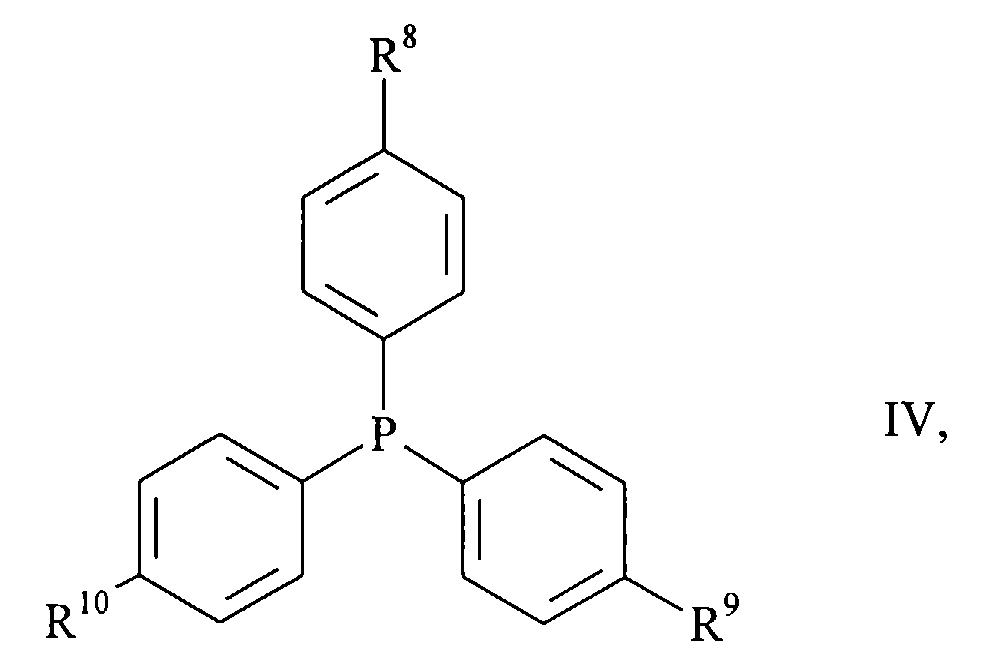
und einer Base zur Reaktion gebracht wird. - Verfahren nach Anspruch 1, dadurch gekennzeichnet, dass A2 Stickstoff und Teil eines Pyridinringes ist.
- Verfahren nach Anspruch 2, dadurch gekennzeichnet, dass R1 eine Gruppe der Formel -OR ist, wobei R die in Anspruch 1 genannte Bedeutung hat.
- Verfahren nach Anspruch 1, dadurch gekennzeichnet, dass A1 Stickstoff und Teil eines Pyridinringes ist.
- Verfahren nach Anspruch 1, dadurch gekennzeichnet, dass A1 und A5 Stickstoff und Teil eines Pyrimidinringes sind.
- Verfahren nach Anspruch 1, dadurch gekennzeichnet, dass A1 und A4 Stickstoff und Teil eines Pyrazinringes sind.
- Verfahren nach Anspruch 1, dadurch gekennzeichnet, dass A1, A3 und A5 Stickstoff sind.
- Verfahren nach Anspruch 4, 5, 6 oder 7, dadurch gekennzeichnet, dass R2 eine Gruppe der Formel -OR ist, wobei R die in Anspruch 1 genannte Bedeutung hat.
- Verfahren nach Anspruch 3 oder 8, dadurch gekennzeichnet, dass R eine gegebenenfalls substituierte Phenylgruppe ist.
- Verfahren nach einem der Ansprüche 1 bis 9, dadurch gekennzeichnet, dass R6 Wasserstoff und R7 eine gegebenenfalls substituierte Phenylgruppe ist.
- Verfahren nach einem der Ansprüche 1 bis 10, dadurch gekennzeichnet, dass X Chlor ist.
- Verfahren nach einem der Ansprüche 1 bis 11, dadurch gekennzeichnet, dass R8 bis R10 gleich und C1-4-Alkoxygruppen sind.
- Verfahren nach Anspruch 12, dadurch gekennzeichnet, dass R8 bis R10 Methoxygruppen sind.
- Verfahren zur Herstellung von Amiden der allgemeinen Formel

A1 bis A5, R6 und R7 die in Anspruch 1 genannte Bedeutung haben, dadurch gekennzeichnet, dass in einer ersten Stufe ein Dihalogenid der allgemeinen Formel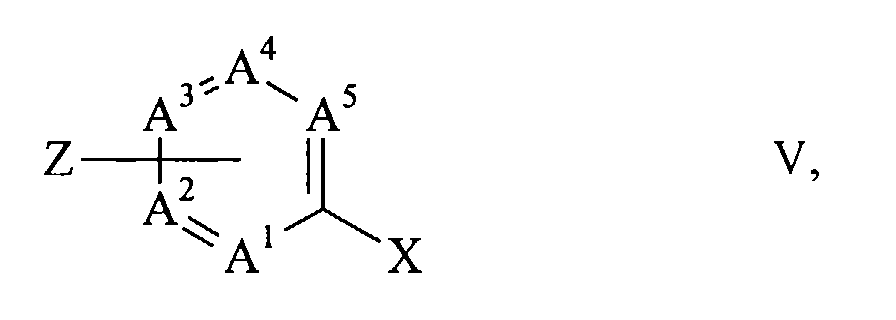
R-OH VI,
worin R die in Anspruch 1 genannte Bedeutung hat, zu einer (Hetero-) Aryloxy-Halogenverbindung der allgemeinen Formel
R6-NH-R7 III,
worin R6 und R7 die oben genannten Bedeutungen haben, in Gegenwart eines Komplexes von Palladium mit einem Triphenylphosphin der allgemeinen Formel
- 2-Chlor-6-[1-methyl-3-(trifluormethyl)pyrazol-5-yloxy]pyridin der Formel
Priority Applications (1)
| Application Number | Priority Date | Filing Date | Title |
|---|---|---|---|
| SI9730035T SI0806415T1 (en) | 1996-05-09 | 1997-04-14 | Process for the preparation of arylamides of heteroaromatic carboxylic acids |
Applications Claiming Priority (3)
| Application Number | Priority Date | Filing Date | Title |
|---|---|---|---|
| CH1178/96 | 1996-05-09 | ||
| CH117896 | 1996-05-09 | ||
| CH117896 | 1996-05-09 |
Publications (2)
| Publication Number | Publication Date |
|---|---|
| EP0806415A1 true EP0806415A1 (de) | 1997-11-12 |
| EP0806415B1 EP0806415B1 (de) | 2000-02-16 |
Family
ID=4204329
Family Applications (1)
| Application Number | Title | Priority Date | Filing Date |
|---|---|---|---|
| EP97106080A Expired - Lifetime EP0806415B1 (de) | 1996-05-09 | 1997-04-14 | Verfahren zur Herstellung von Arylamiden heteroaromatischer Carbonsäuren |
Country Status (19)
| Country | Link |
|---|---|
| US (1) | US5892032A (de) |
| EP (1) | EP0806415B1 (de) |
| JP (1) | JP4103153B2 (de) |
| KR (1) | KR100526664B1 (de) |
| CN (1) | CN1103758C (de) |
| AT (1) | ATE189815T1 (de) |
| CA (1) | CA2203592C (de) |
| CZ (1) | CZ289774B6 (de) |
| DE (1) | DE59701125D1 (de) |
| DK (1) | DK0806415T3 (de) |
| ES (1) | ES2143816T3 (de) |
| GR (1) | GR3033064T3 (de) |
| HU (1) | HU219176B (de) |
| NO (1) | NO308410B1 (de) |
| PL (1) | PL188798B1 (de) |
| PT (1) | PT806415E (de) |
| SI (1) | SI0806415T1 (de) |
| SK (1) | SK281492B6 (de) |
| TW (1) | TW444008B (de) |
Cited By (2)
| Publication number | Priority date | Publication date | Assignee | Title |
|---|---|---|---|---|
| WO2000030589A3 (en) * | 1998-11-20 | 2001-01-04 | Schering Corp | Synthesis of intermediates useful in preparing tricyclic compounds |
| US6372909B1 (en) | 1998-11-20 | 2002-04-16 | Schering Corporation | Synthesis of intermediates useful in preparing tricyclic compounds |
Families Citing this family (1)
| Publication number | Priority date | Publication date | Assignee | Title |
|---|---|---|---|---|
| ES2212005T3 (es) * | 1996-03-21 | 2004-07-16 | Lonza Ag | Procedimiento para preparar arilamidas de acidos carboxilicos heteroaromaticos. |
Citations (4)
| Publication number | Priority date | Publication date | Assignee | Title |
|---|---|---|---|---|
| EP0053011A1 (de) * | 1980-11-21 | 1982-06-02 | May & Baker Limited | Herbizide Nikotinsäureamid-Derivate |
| EP0447004A2 (de) * | 1990-03-16 | 1991-09-18 | Shell Internationale Researchmaatschappij B.V. | Herbizide Carboxamidderivate |
| EP0582825A1 (de) * | 1989-02-28 | 1994-02-16 | F. Hoffmann-La Roche Ag | Amidierung von Pyridinen |
| WO1994027974A1 (en) * | 1993-05-27 | 1994-12-08 | Shell Internationale Research Maatschappij B.V. | Herbicidal compounds |
Family Cites Families (19)
| Publication number | Priority date | Publication date | Assignee | Title |
|---|---|---|---|---|
| US4128554A (en) * | 1974-05-10 | 1978-12-05 | University Of Delaware | Process for the preparation of carboxylic acid amides from organic halides |
| NZ188244A (en) * | 1977-09-13 | 1981-04-24 | Ici Australia Ltd | 2-substituted pyrimidines compositions growth regulating processes |
| US4254125A (en) * | 1980-04-07 | 1981-03-03 | The Dow Chemical Company | 2-Chloro-3-phenoxypyrazines and 2-chloro-6-phenoxypyrazines possessing antiviral activity |
| US5159113A (en) * | 1984-12-19 | 1992-10-27 | The B. F. Goodrich Company | Process for the palladium-catalyzed amidation of vinyl chloride |
| JPH0819009B2 (ja) * | 1987-03-12 | 1996-02-28 | 日本農薬株式会社 | カルボン酸アミド類の製造法 |
| IL91083A (en) * | 1988-07-25 | 1993-04-04 | Ciba Geigy | Cyclohexanedione derivatives, their preparation and their use as herbicides |
| DE4020055A1 (de) * | 1990-01-18 | 1991-07-25 | Bayer Ag | Verfahren zur herstellung von substituierten 2-chlor-pyridinen |
| EP0461401A1 (de) * | 1990-06-15 | 1991-12-18 | American Cyanamid Company | Verfahren zur Herstellung von 2,3-Pyridindicarbonsäure-dialkylestern aus Dialkyldichloromaleinsäureestern |
| GB9025828D0 (en) * | 1990-11-28 | 1991-01-09 | Shell Int Research | Herbicidal carboxamide derivatives |
| DE4207604A1 (de) * | 1991-03-13 | 1992-09-17 | Ciba Geigy Ag | Schaedlingsbekaempfungsmittel |
| US5166352A (en) * | 1991-09-12 | 1992-11-24 | Dowelanco | Pyridinecarboxylic acid chlorides from (trichloromethyl)pyridines |
| US5288866A (en) * | 1991-12-20 | 1994-02-22 | American Cyanamid Company | 5,6-disubstituted-3-pyridylmethyl ammonium halide compounds useful for the preparation of 5- (substituted methyl)-2,3-pyridinedicarboxylic acids |
| TW371658B (en) * | 1992-03-06 | 1999-10-11 | Reilly Ind Inc | Process for producing 2-halo-nicotinic acid derivatives and precursor thereto |
| EP0564406B1 (de) * | 1992-04-02 | 1999-05-06 | Novartis AG | Ferrocenyldiphosphine als Liganden für homogene Katalysatoren |
| EP0612758B1 (de) * | 1993-02-26 | 2003-04-09 | Syngenta Participations AG | Ferrocenyldiphosphine als Liganden für homogene Katalysatoren |
| CA2539969C (en) * | 1993-06-01 | 2009-07-07 | Lonza Ltd. | Process for the preparation of carboxylic acids of nitrogen-containing aromatic heterocyclic compounds |
| EP0646590B1 (de) * | 1993-10-01 | 1999-08-25 | Novartis AG | Mit Fluoralkyl substituierte Ferrocenyldiphosphine als Liganden für homogene Katalysatoren |
| DE4410480A1 (de) * | 1994-03-25 | 1995-09-28 | Hoechst Ag | Sulfonamidocarbonylpyridin-2-carbonsäureesteramide sowie ihre Pyridin-N-oxide, Verfahren zu ihrer Herstellung und ihre Verwendung als Arzneimittel |
| US5464106A (en) * | 1994-07-06 | 1995-11-07 | Plastipak Packaging, Inc. | Multi-layer containers |
-
1997
- 1997-04-14 DE DE59701125T patent/DE59701125D1/de not_active Expired - Fee Related
- 1997-04-14 DK DK97106080T patent/DK0806415T3/da active
- 1997-04-14 ES ES97106080T patent/ES2143816T3/es not_active Expired - Lifetime
- 1997-04-14 AT AT97106080T patent/ATE189815T1/de not_active IP Right Cessation
- 1997-04-14 EP EP97106080A patent/EP0806415B1/de not_active Expired - Lifetime
- 1997-04-14 PT PT97106080T patent/PT806415E/pt unknown
- 1997-04-14 SI SI9730035T patent/SI0806415T1/xx unknown
- 1997-04-24 CA CA002203592A patent/CA2203592C/en not_active Expired - Fee Related
- 1997-04-26 TW TW086105467A patent/TW444008B/zh not_active IP Right Cessation
- 1997-05-01 JP JP11373597A patent/JP4103153B2/ja not_active Expired - Fee Related
- 1997-05-02 US US08/850,393 patent/US5892032A/en not_active Expired - Fee Related
- 1997-05-05 SK SK566-97A patent/SK281492B6/sk not_active IP Right Cessation
- 1997-05-07 NO NO972115A patent/NO308410B1/no not_active IP Right Cessation
- 1997-05-07 CZ CZ19971402A patent/CZ289774B6/cs not_active IP Right Cessation
- 1997-05-08 KR KR1019970017635A patent/KR100526664B1/ko not_active Expired - Fee Related
- 1997-05-08 PL PL97319866A patent/PL188798B1/pl not_active IP Right Cessation
- 1997-05-09 CN CN97111152A patent/CN1103758C/zh not_active Expired - Fee Related
- 1997-05-09 HU HU9700877A patent/HU219176B/hu not_active IP Right Cessation
-
2000
- 2000-03-27 GR GR20000400753T patent/GR3033064T3/el not_active IP Right Cessation
Patent Citations (4)
| Publication number | Priority date | Publication date | Assignee | Title |
|---|---|---|---|---|
| EP0053011A1 (de) * | 1980-11-21 | 1982-06-02 | May & Baker Limited | Herbizide Nikotinsäureamid-Derivate |
| EP0582825A1 (de) * | 1989-02-28 | 1994-02-16 | F. Hoffmann-La Roche Ag | Amidierung von Pyridinen |
| EP0447004A2 (de) * | 1990-03-16 | 1991-09-18 | Shell Internationale Researchmaatschappij B.V. | Herbizide Carboxamidderivate |
| WO1994027974A1 (en) * | 1993-05-27 | 1994-12-08 | Shell Internationale Research Maatschappij B.V. | Herbicidal compounds |
Non-Patent Citations (1)
| Title |
|---|
| BEN-DAVID Y ET AL: "CHELATE-ASSISTED, PD-CATALYZED EFFICIENT CARBONYLATION OF ARYL CHLORIDES", JOURNAL OF THE AMERICAN CHEMICAL SOCIETY, vol. 111, no. 23, 1989, pages 8742 - 8744, XP000670254 * |
Cited By (3)
| Publication number | Priority date | Publication date | Assignee | Title |
|---|---|---|---|---|
| WO2000030589A3 (en) * | 1998-11-20 | 2001-01-04 | Schering Corp | Synthesis of intermediates useful in preparing tricyclic compounds |
| US6372909B1 (en) | 1998-11-20 | 2002-04-16 | Schering Corporation | Synthesis of intermediates useful in preparing tricyclic compounds |
| US6495689B2 (en) | 1998-11-20 | 2002-12-17 | Schering Corporation | Synthesis of intermediates useful in preparing tricyclic compounds |
Also Published As
| Publication number | Publication date |
|---|---|
| EP0806415B1 (de) | 2000-02-16 |
| JPH1059964A (ja) | 1998-03-03 |
| GR3033064T3 (en) | 2000-08-31 |
| CZ140297A3 (en) | 1997-11-12 |
| KR970074770A (ko) | 1997-12-10 |
| KR100526664B1 (ko) | 2006-04-21 |
| CN1103758C (zh) | 2003-03-26 |
| ES2143816T3 (es) | 2000-05-16 |
| PL188798B1 (pl) | 2005-04-29 |
| JP4103153B2 (ja) | 2008-06-18 |
| NO308410B1 (no) | 2000-09-11 |
| HUP9700877A2 (hu) | 1998-03-02 |
| NO972115L (no) | 1997-11-10 |
| PT806415E (pt) | 2000-07-31 |
| TW444008B (en) | 2001-07-01 |
| SK56697A3 (en) | 1998-02-04 |
| CN1178217A (zh) | 1998-04-08 |
| SK281492B6 (sk) | 2001-04-09 |
| HU9700877D0 (en) | 1997-07-28 |
| PL319866A1 (en) | 1997-11-10 |
| US5892032A (en) | 1999-04-06 |
| CZ289774B6 (cs) | 2002-04-17 |
| HU219176B (hu) | 2001-02-28 |
| NO972115D0 (no) | 1997-05-07 |
| CA2203592C (en) | 2007-04-17 |
| ATE189815T1 (de) | 2000-03-15 |
| DK0806415T3 (da) | 2000-06-05 |
| CA2203592A1 (en) | 1997-11-09 |
| HUP9700877A3 (en) | 1998-03-30 |
| DE59701125D1 (de) | 2000-03-23 |
| SI0806415T1 (en) | 2000-04-30 |
Similar Documents
| Publication | Publication Date | Title |
|---|---|---|
| DE3874375T2 (de) | Verfahren zur herstellung von carbonsaeure-amiden oder -estern. | |
| EP1903023A1 (de) | Verfahren zur Herstellung von Arylaminen oder Arylamiden | |
| EP2008991A1 (de) | Verfahren zur Herstellung von Biarylen | |
| DE69002081T2 (de) | Verfahren zur Herstellung von aromatischen Harnstoffen. | |
| EP0385210B1 (de) | Amidierung von Pyridinen | |
| EP0864565B1 (de) | Verfahren zur Herstellung von 2,6-Pyridindicarbonsäureestern | |
| DE69901130T2 (de) | Verfahren zur Herstellung von Pyridindicarboxylatderivaten | |
| EP0806415B1 (de) | Verfahren zur Herstellung von Arylamiden heteroaromatischer Carbonsäuren | |
| EP0802189B1 (de) | Verfahren zur Herstellung von Arylamiden heteroaromatischer Carbonsäuren | |
| DE102005030400A1 (de) | Verfahren zur Herstellung von Arylaminen, Arylethern und Arylthioethern | |
| EP0646588A1 (de) | Cyclische Verbindungen des dreiwertigen Phosphors | |
| EP0553778A1 (de) | Asymmetrische Hydrierung | |
| DE69210338T2 (de) | Verfahren zur Herstellung eines Esters der Kohlensäure | |
| EP0820986B1 (de) | Verfahren zur Herstellung von Pyridincarbonsäureestern | |
| EP0798296B1 (de) | Verfahren zur Herstellung von Arylamiden Heteroaromatischer Carbonsäuren | |
| EP0820987B1 (de) | Verfahren zur Herstellung von Pyridin-2,3-dicarbonsäureestern | |
| DE102009045366A1 (de) | Polycyclische Pentafluorsulfanylbenzolverbindung und Verfahren zur Herstellung der Verbindung | |
| EP1861343B1 (de) | Verfahren zur herstellung von alkylsubstituierten aromaten und heteroaromaten durch kreuzkupplung von alkylboronsäuren mit aryl- oder heteroarylhalogeniden oder -sulfonaten unter pd-katalyse in gegenwart eines liganden | |
| DE3203538C2 (de) | ||
| EP1152005B1 (de) | Verfahren zur Herstellung von substituierten 10-Chlor-phenoxaphosphinen oder 10-Brom-phenoxaphosphinen | |
| DE60107248T2 (de) | Neues verfahren zur herstellung von pyrazolopyrimidonen | |
| DE69127238T2 (de) | Verfahren zur Herstellung von Pyrido[1,2-a]pyrimidinderivaten | |
| DE3311026C2 (de) | Verfahren zur Herstellung von α-Ketoamidoiminen | |
| DE19632643C1 (de) | Katalysierte Kopplung von Arylmagnesiumhalogeniden und Bromarylcarbonsäureverbindungen zur Herstellung von Biphenylcarbonsäuren | |
| DE69711397T2 (de) | Herstellung von einem hydrazon-beta-ketoester durch reaktion mit einem diazoester |
Legal Events
| Date | Code | Title | Description |
|---|---|---|---|
| PUAI | Public reference made under article 153(3) epc to a published international application that has entered the european phase |
Free format text: ORIGINAL CODE: 0009012 |
|
| AK | Designated contracting states |
Kind code of ref document: A1 Designated state(s): AT BE CH DE DK ES FI FR GB GR IE IT LI LU MC NL PT SE |
|
| AX | Request for extension of the european patent |
Free format text: AL PAYMENT 970513;LT PAYMENT 970513;LV PAYMENT 970513;RO PAYMENT 970513;SI PAYMENT 970513 |
|
| 17P | Request for examination filed |
Effective date: 19971203 |
|
| 17Q | First examination report despatched |
Effective date: 19980626 |
|
| GRAG | Despatch of communication of intention to grant |
Free format text: ORIGINAL CODE: EPIDOS AGRA |
|
| GRAG | Despatch of communication of intention to grant |
Free format text: ORIGINAL CODE: EPIDOS AGRA |
|
| GRAH | Despatch of communication of intention to grant a patent |
Free format text: ORIGINAL CODE: EPIDOS IGRA |
|
| GRAH | Despatch of communication of intention to grant a patent |
Free format text: ORIGINAL CODE: EPIDOS IGRA |
|
| GRAA | (expected) grant |
Free format text: ORIGINAL CODE: 0009210 |
|
| AK | Designated contracting states |
Kind code of ref document: B1 Designated state(s): AT BE CH DE DK ES FI FR GB GR IE IT LI LU MC NL PT SE |
|
| AX | Request for extension of the european patent |
Free format text: AL PAYMENT 19970513;LT PAYMENT 19970513;LV PAYMENT 19970513;RO PAYMENT 19970513;SI PAYMENT 19970513 |
|
| REF | Corresponds to: |
Ref document number: 189815 Country of ref document: AT Date of ref document: 20000315 Kind code of ref document: T |
|
| REG | Reference to a national code |
Ref country code: CH Ref legal event code: EP |
|
| GBT | Gb: translation of ep patent filed (gb section 77(6)(a)/1977) |
Effective date: 20000217 |
|
| REF | Corresponds to: |
Ref document number: 59701125 Country of ref document: DE Date of ref document: 20000323 |
|
| ITF | It: translation for a ep patent filed | ||
| REG | Reference to a national code |
Ref country code: IE Ref legal event code: FG4D Free format text: GERMAN |
|
| ET | Fr: translation filed | ||
| REG | Reference to a national code |
Ref country code: ES Ref legal event code: FG2A Ref document number: 2143816 Country of ref document: ES Kind code of ref document: T3 |
|
| REG | Reference to a national code |
Ref country code: DK Ref legal event code: T3 |
|
| REG | Reference to a national code |
Ref country code: PT Ref legal event code: SC4A Free format text: AVAILABILITY OF NATIONAL TRANSLATION Effective date: 20000504 |
|
| PLBE | No opposition filed within time limit |
Free format text: ORIGINAL CODE: 0009261 |
|
| STAA | Information on the status of an ep patent application or granted ep patent |
Free format text: STATUS: NO OPPOSITION FILED WITHIN TIME LIMIT |
|
| 26N | No opposition filed | ||
| REG | Reference to a national code |
Ref country code: CH Ref legal event code: PFA Free format text: LONZA AG,(GESCHAEFTSLEITUNG: 4002 BASEL),CH-3945 GAMPEL/WALLIS (CH) TRANSFER- LONZA AG,LONZASTRASSE,3930 VISP (CH) |
|
| REG | Reference to a national code |
Ref country code: GB Ref legal event code: IF02 |
|
| REG | Reference to a national code |
Ref country code: SI Ref legal event code: IF |
|
| PGFP | Annual fee paid to national office [announced via postgrant information from national office to epo] |
Ref country code: IE Payment date: 20090325 Year of fee payment: 13 Ref country code: DK Payment date: 20090325 Year of fee payment: 13 |
|
| PGFP | Annual fee paid to national office [announced via postgrant information from national office to epo] |
Ref country code: PT Payment date: 20090319 Year of fee payment: 13 Ref country code: FI Payment date: 20090325 Year of fee payment: 13 |
|
| PGFP | Annual fee paid to national office [announced via postgrant information from national office to epo] |
Ref country code: GB Payment date: 20090319 Year of fee payment: 13 Ref country code: CH Payment date: 20090325 Year of fee payment: 13 |
|
| PGFP | Annual fee paid to national office [announced via postgrant information from national office to epo] |
Ref country code: MC Payment date: 20090504 Year of fee payment: 13 Ref country code: ES Payment date: 20090417 Year of fee payment: 13 Ref country code: BE Payment date: 20090325 Year of fee payment: 13 |
|
| PGFP | Annual fee paid to national office [announced via postgrant information from national office to epo] |
Ref country code: SE Payment date: 20090323 Year of fee payment: 13 Ref country code: NL Payment date: 20090325 Year of fee payment: 13 Ref country code: LU Payment date: 20090401 Year of fee payment: 13 Ref country code: DE Payment date: 20090325 Year of fee payment: 13 Ref country code: AT Payment date: 20090325 Year of fee payment: 13 |
|
| PGFP | Annual fee paid to national office [announced via postgrant information from national office to epo] |
Ref country code: FR Payment date: 20090326 Year of fee payment: 13 |
|
| PGFP | Annual fee paid to national office [announced via postgrant information from national office to epo] |
Ref country code: GR Payment date: 20090430 Year of fee payment: 13 |
|
| BERE | Be: lapsed |
Owner name: *LONZA A.G. Effective date: 20100430 |
|
| REG | Reference to a national code |
Ref country code: NL Ref legal event code: V1 Effective date: 20101101 |
|
| EUG | Se: european patent has lapsed | ||
| PG25 | Lapsed in a contracting state [announced via postgrant information from national office to epo] |
Ref country code: MC Free format text: LAPSE BECAUSE OF NON-PAYMENT OF DUE FEES Effective date: 20100430 |
|
| REG | Reference to a national code |
Ref country code: CH Ref legal event code: PL |
|
| REG | Reference to a national code |
Ref country code: DK Ref legal event code: EBP |
|
| GBPC | Gb: european patent ceased through non-payment of renewal fee |
Effective date: 20100414 |
|
| REG | Reference to a national code |
Ref country code: SI Ref legal event code: KO00 Effective date: 20101126 |
|
| REG | Reference to a national code |
Ref country code: IE Ref legal event code: MM4A |
|
| REG | Reference to a national code |
Ref country code: FR Ref legal event code: ST Effective date: 20101230 |
|
| PG25 | Lapsed in a contracting state [announced via postgrant information from national office to epo] |
Ref country code: NL Free format text: LAPSE BECAUSE OF NON-PAYMENT OF DUE FEES Effective date: 20101101 Ref country code: IE Free format text: LAPSE BECAUSE OF NON-PAYMENT OF DUE FEES Effective date: 20100414 Ref country code: FI Free format text: LAPSE BECAUSE OF NON-PAYMENT OF DUE FEES Effective date: 20100414 Ref country code: AT Free format text: LAPSE BECAUSE OF NON-PAYMENT OF DUE FEES Effective date: 20100414 |
|
| PG25 | Lapsed in a contracting state [announced via postgrant information from national office to epo] |
Ref country code: PT Free format text: LAPSE BECAUSE OF NON-PAYMENT OF DUE FEES Effective date: 20101014 Ref country code: LI Free format text: LAPSE BECAUSE OF NON-PAYMENT OF DUE FEES Effective date: 20100430 Ref country code: DE Free format text: LAPSE BECAUSE OF NON-PAYMENT OF DUE FEES Effective date: 20101103 Ref country code: CH Free format text: LAPSE BECAUSE OF NON-PAYMENT OF DUE FEES Effective date: 20100430 |
|
| PG25 | Lapsed in a contracting state [announced via postgrant information from national office to epo] |
Ref country code: IT Free format text: LAPSE BECAUSE OF NON-PAYMENT OF DUE FEES Effective date: 20090414 Ref country code: GB Free format text: LAPSE BECAUSE OF NON-PAYMENT OF DUE FEES Effective date: 20100414 Ref country code: BE Free format text: LAPSE BECAUSE OF NON-PAYMENT OF DUE FEES Effective date: 20100430 Ref country code: GR Free format text: LAPSE BECAUSE OF NON-PAYMENT OF DUE FEES Effective date: 20101103 |
|
| PG25 | Lapsed in a contracting state [announced via postgrant information from national office to epo] |
Ref country code: DK Free format text: LAPSE BECAUSE OF NON-PAYMENT OF DUE FEES Effective date: 20100503 |
|
| REG | Reference to a national code |
Ref country code: ES Ref legal event code: FD2A Effective date: 20110715 |
|
| PG25 | Lapsed in a contracting state [announced via postgrant information from national office to epo] |
Ref country code: ES Free format text: LAPSE BECAUSE OF NON-PAYMENT OF DUE FEES Effective date: 20110705 |
|
| PGFP | Annual fee paid to national office [announced via postgrant information from national office to epo] |
Ref country code: IT Payment date: 20090414 Year of fee payment: 13 |
|
| PGRI | Patent reinstated in contracting state [announced from national office to epo] |
Ref country code: IT Effective date: 20110616 |
|
| PG25 | Lapsed in a contracting state [announced via postgrant information from national office to epo] |
Ref country code: ES Free format text: LAPSE BECAUSE OF NON-PAYMENT OF DUE FEES Effective date: 20100415 |
|
| PG25 | Lapsed in a contracting state [announced via postgrant information from national office to epo] |
Ref country code: FR Free format text: LAPSE BECAUSE OF NON-PAYMENT OF DUE FEES Effective date: 20100430 |
|
| PG25 | Lapsed in a contracting state [announced via postgrant information from national office to epo] |
Ref country code: SE Free format text: LAPSE BECAUSE OF NON-PAYMENT OF DUE FEES Effective date: 20100415 Ref country code: LU Free format text: LAPSE BECAUSE OF NON-PAYMENT OF DUE FEES Effective date: 20100414 |
|
| PGRI | Patent reinstated in contracting state [announced from national office to epo] |
Ref country code: IT Effective date: 20110616 |