EP0804012B1 - Multimedia-Endgerät und Verfahren zum Multimedia-Empfang - Google Patents
Multimedia-Endgerät und Verfahren zum Multimedia-Empfang Download PDFInfo
- Publication number
- EP0804012B1 EP0804012B1 EP97660047A EP97660047A EP0804012B1 EP 0804012 B1 EP0804012 B1 EP 0804012B1 EP 97660047 A EP97660047 A EP 97660047A EP 97660047 A EP97660047 A EP 97660047A EP 0804012 B1 EP0804012 B1 EP 0804012B1
- Authority
- EP
- European Patent Office
- Prior art keywords
- multimedia
- user
- telecommunications system
- multimedia information
- information
- Prior art date
- Legal status (The legal status is an assumption and is not a legal conclusion. Google has not performed a legal analysis and makes no representation as to the accuracy of the status listed.)
- Revoked
Links
- 238000000034 method Methods 0.000 title claims description 16
- 230000005540 biological transmission Effects 0.000 claims description 37
- 238000003860 storage Methods 0.000 claims description 25
- 230000006854 communication Effects 0.000 claims description 17
- 238000004891 communication Methods 0.000 claims description 17
- 230000007175 bidirectional communication Effects 0.000 claims description 15
- 230000002457 bidirectional effect Effects 0.000 claims description 10
- 230000001413 cellular effect Effects 0.000 claims description 7
- 230000004044 response Effects 0.000 claims description 2
- 239000003795 chemical substances by application Substances 0.000 description 29
- 230000006870 function Effects 0.000 description 6
- 238000009826 distribution Methods 0.000 description 4
- 230000002452 interceptive effect Effects 0.000 description 4
- 230000009471 action Effects 0.000 description 3
- 230000000694 effects Effects 0.000 description 3
- 238000010586 diagram Methods 0.000 description 2
- 230000004048 modification Effects 0.000 description 2
- 230000002093 peripheral effect Effects 0.000 description 2
- 238000011160 research Methods 0.000 description 2
- 238000012546 transfer Methods 0.000 description 2
- 230000007704 transition Effects 0.000 description 2
- 230000003466 anti-cipated effect Effects 0.000 description 1
- 238000013475 authorization Methods 0.000 description 1
- 230000008901 benefit Effects 0.000 description 1
- 238000004364 calculation method Methods 0.000 description 1
- 230000000295 complement effect Effects 0.000 description 1
- 230000005670 electromagnetic radiation Effects 0.000 description 1
- 238000005516 engineering process Methods 0.000 description 1
- 230000006872 improvement Effects 0.000 description 1
- 239000004973 liquid crystal related substance Substances 0.000 description 1
- 238000004519 manufacturing process Methods 0.000 description 1
- 238000012986 modification Methods 0.000 description 1
- 230000008569 process Effects 0.000 description 1
- 239000004065 semiconductor Substances 0.000 description 1
- 230000001360 synchronised effect Effects 0.000 description 1
- 238000011144 upstream manufacturing Methods 0.000 description 1
- 238000012795 verification Methods 0.000 description 1
Images

Classifications
-
- H—ELECTRICITY
- H04—ELECTRIC COMMUNICATION TECHNIQUE
- H04H—BROADCAST COMMUNICATION
- H04H20/00—Arrangements for broadcast or for distribution combined with broadcast
- H04H20/40—Arrangements for broadcast specially adapted for accumulation-type receivers
-
- H—ELECTRICITY
- H04—ELECTRIC COMMUNICATION TECHNIQUE
- H04H—BROADCAST COMMUNICATION
- H04H20/00—Arrangements for broadcast or for distribution combined with broadcast
- H04H20/42—Arrangements for resource management
-
- H—ELECTRICITY
- H04—ELECTRIC COMMUNICATION TECHNIQUE
- H04H—BROADCAST COMMUNICATION
- H04H60/00—Arrangements for broadcast applications with a direct linking to broadcast information or broadcast space-time; Broadcast-related systems
- H04H60/09—Arrangements for device control with a direct linkage to broadcast information or to broadcast space-time; Arrangements for control of broadcast-related services
- H04H60/14—Arrangements for conditional access to broadcast information or to broadcast-related services
- H04H60/21—Billing for the use of broadcast information or broadcast-related information
-
- H—ELECTRICITY
- H04—ELECTRIC COMMUNICATION TECHNIQUE
- H04H—BROADCAST COMMUNICATION
- H04H60/00—Arrangements for broadcast applications with a direct linking to broadcast information or broadcast space-time; Broadcast-related systems
- H04H60/09—Arrangements for device control with a direct linkage to broadcast information or to broadcast space-time; Arrangements for control of broadcast-related services
- H04H60/14—Arrangements for conditional access to broadcast information or to broadcast-related services
- H04H60/23—Arrangements for conditional access to broadcast information or to broadcast-related services using cryptography, e.g. encryption, authentication, key distribution
-
- H—ELECTRICITY
- H04—ELECTRIC COMMUNICATION TECHNIQUE
- H04H—BROADCAST COMMUNICATION
- H04H60/00—Arrangements for broadcast applications with a direct linking to broadcast information or broadcast space-time; Broadcast-related systems
- H04H60/27—Arrangements for recording or accumulating broadcast information or broadcast-related information
-
- H—ELECTRICITY
- H04—ELECTRIC COMMUNICATION TECHNIQUE
- H04H—BROADCAST COMMUNICATION
- H04H60/00—Arrangements for broadcast applications with a direct linking to broadcast information or broadcast space-time; Broadcast-related systems
- H04H60/76—Arrangements characterised by transmission systems other than for broadcast, e.g. the Internet
- H04H60/81—Arrangements characterised by transmission systems other than for broadcast, e.g. the Internet characterised by the transmission system itself
- H04H60/90—Wireless transmission systems
- H04H60/91—Mobile communication networks
-
- H—ELECTRICITY
- H04—ELECTRIC COMMUNICATION TECHNIQUE
- H04N—PICTORIAL COMMUNICATION, e.g. TELEVISION
- H04N21/00—Selective content distribution, e.g. interactive television or video on demand [VOD]
- H04N21/60—Network structure or processes for video distribution between server and client or between remote clients; Control signalling between clients, server and network components; Transmission of management data between server and client, e.g. sending from server to client commands for recording incoming content stream; Communication details between server and client
- H04N21/61—Network physical structure; Signal processing
- H04N21/6106—Network physical structure; Signal processing specially adapted to the downstream path of the transmission network
- H04N21/6131—Network physical structure; Signal processing specially adapted to the downstream path of the transmission network involving transmission via a mobile phone network
-
- H—ELECTRICITY
- H04—ELECTRIC COMMUNICATION TECHNIQUE
- H04N—PICTORIAL COMMUNICATION, e.g. TELEVISION
- H04N7/00—Television systems
- H04N7/14—Systems for two-way working
- H04N7/141—Systems for two-way working between two video terminals, e.g. videophone
- H04N7/147—Communication arrangements, e.g. identifying the communication as a video-communication, intermediate storage of the signals
-
- H—ELECTRICITY
- H04—ELECTRIC COMMUNICATION TECHNIQUE
- H04H—BROADCAST COMMUNICATION
- H04H2201/00—Aspects of broadcast communication
- H04H2201/10—Aspects of broadcast communication characterised by the type of broadcast system
- H04H2201/20—Aspects of broadcast communication characterised by the type of broadcast system digital audio broadcasting [DAB]
-
- H—ELECTRICITY
- H04—ELECTRIC COMMUNICATION TECHNIQUE
- H04H—BROADCAST COMMUNICATION
- H04H2201/00—Aspects of broadcast communication
- H04H2201/30—Aspects of broadcast communication characterised by the use of a return channel, e.g. for collecting users' opinions, for returning broadcast space/time information or for requesting data
-
- H—ELECTRICITY
- H04—ELECTRIC COMMUNICATION TECHNIQUE
- H04N—PICTORIAL COMMUNICATION, e.g. TELEVISION
- H04N7/00—Television systems
- H04N7/14—Systems for two-way working
- H04N7/141—Systems for two-way working between two video terminals, e.g. videophone
- H04N7/142—Constructional details of the terminal equipment, e.g. arrangements of the camera and the display
- H04N2007/145—Handheld terminals
Definitions
- the invention relates in general to consumer-oriented multimedia technology and in particular to a method and equipment by means of which a consumer can have access to a wide supply of multimedia and equipment that can be applied in a versatile manner to various telecommunications needs.
- Multimedia or synchronised playback of simultaneous audiovisual objects, has gained wide popularity as powerful personal computers have become more and more accessible to consumers.
- the most widely used form of multimedia is a program which is distributed on a computer mass memory medium such as CD-ROM and which, when executed on a computer, reproduces by means of a display unit and loudspeakers data in the form of images, text and sound.
- Multimedia not only performs simultaneous playback but is often also interactive in nature, ie. the user can affect the program flow through his choices.
- MHEG Multimedia Hypermedia Information Coding Experts Group
- Said objects are class objects in that they are categorised into object classes according to a certain syntax, and the objects in a given class comply with the specifications of that class.
- the object classes include e.g. links, action objects, composition objects, content objects and container objects.
- Certain objects may be temporally continuous and they are called streams.
- objects may be multiplexed so that a multiplexed object consists of two or more streams which are called component streams. These, in turn, may also be multiplexed and thus contain more streams.
- MHEG engine In order to produce a multimedia presentation using objects according to the MHEG standard a special means is needed which is capable of handling, or interpreting, objects, arranging their mutual relations in the correct manner and controlling their presentation to the user. That special means is known as the MHEG engine. Usually it is realised in the form of program code and its operation at the general level is defined in the MHEG standard.
- multimedia programs will also be broadcast through radio transmission stations, satellites and/or cable TV systems in the same way as radio and television programs today.
- Broadcasting means electrical distribution of programs from a central place of transmission to a very large group of users in a wide geographic area who can receive transmitted programs according to their choice and who can be obliged, according to the choice of the broadcaster, to pay a certain fee for the reception.
- multimedia terminals intended for consumer use have been proposed that could be applied for efficient reception of such transmissions.
- DAB Digital Audio Broadcasting
- EBU European Broadcasting Union
- ETSI European Telecommunications Standards Institute
- Document DE 44 24 380 A discloses a system comprising a radio transmitter for transmitting coded video signals to a receiver and a mobile phone used for selection of the required video transmission.
- the codes for descrambling the video transmission are supplied to the receiver via the mobile phone.
- the objects of the invention are achieved by combining a terminal of a bidirectional communications network and a terminal or computer equipment of a high-capacity unidirectional transmission network and using their combined characteristics in a manner that is dynamically changing in accordance with operating conditions and requirements.
- Equipment for selective reception of multimedia transmissions from a telecommunications system and for their presentation to a user comprising a first apparatus for receiving multimedia information from said telecommunications system and a second apparatus for delivering information to a telecommunications system, is characterised in that the first apparatus comprises means for receiving from said telecommunications system unidirectional multimedia transmissions containing multimedia information, storage means for the temporary storage of multimedia information to be presented, and an agent for controlling dynamic reception and storage of multimedia information and for delivering information related to the use of multimedia information to said telecommunications system via said second apparatus, and the second apparatus comprises means for delivering user command information related to the use of said multimedia information to said telecommunications system over a bidirectional communications system.
- the invention is also directed to an apparatus intended to be used as the first apparatus in the multimedia terminal equipment.
- the apparatus according to the invention is characterised in that it comprises means for receiving from said telecommunications system unidirectional multimedia transmissions containing multimedia information, storage means for the temporary storage of multimedia information to be presented, and an agent for controlling dynamic reception and storage of multimedia information and for delivering user command information related to the use of multimedia information to said telecommunications system over a bidirectional communications system.
- the invention is further directed to a method for the selective reception of multimedia presentations from a transmission system and for presenting said presentations to the user.
- the method according to the invention is characterised in that it comprises examining, in response to a user selection, whether the multimedia information required by the user selection and related to a certain multimedia presentation is locally stored in a first apparatus, delivering user command information related to the use of multimedia information from said first apparatus to said telecommunications system via a second apparatus over a bidirectional communications system, loading multimedia information required by the user selection and related to a certain multimedia presentation, which is not locally stored, from the telecommunications system in a unidirectional multimedia transmission and storing it locally, and removing multimedia information required by the user selection and related to a certain multimedia presentation from the local storage as it is no more needed in order to present the multimedia presentation to the user.
- This invention shows that a working multimedia receiver meeting the requirements mentioned above can be produced by combining a broadcast-type receiver with a terminal of a bidirectional communications network, which may be e.g. a two-way paging device, mobile phone in a cellular network or a conventional phone connected to a digital switching centre.
- Said broadcast-type receiver is preferably a TV receiver e.g. a DAB or MPEG receiver, or it could be a computer.
- the equipment does not store in one storage medium the whole multimedia program to be presented, unlike in known CD-ROM implementations, but the required program elements are dynamically picked from the transmission stream and presented without storing or stored locally only for the time that they are needed. Picking and presenting the elements includes their possible descrambling.
- One advantageous feature of the system is a local agent, ie. a loading and checking program which requires very little storage space and which on the user's request checks whether the available hardware resources meet the requirements and starts the dynamic loading and execution of the proper program.
- Said terminal of a bidirectional system is used for conveying selection data controlling the loading from the user to the transmission station or another part of the transmission network.
- the terminal of a birectional system also functions as a transfer medium of downstream multimedia information so that said broadcast-type receiver is only a presentation medium.
- the same terminal of a bidirectional system can be used for transferring invoicing information between the user and the service provider as well as for delivering to the user the authorisations and keys needed for the descrambling.
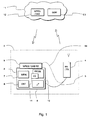
- Fig. 1 shows a multimedia terminal equipment 2 for consumer use comprising a receiver 3 of a unidirectional broadcasting system and a terminal 4 of a bidirectional communications system, the two being linked by a local communications link 5.
- the receiver 3 may be, for example, a modern TV receiver comprising a microprocessor 6 controlling its operation, storage 7 in the form of semiconductor memory and/or mass memory medium, and a cathode ray tube (CRT) or flat-panel display, such as electroluminance or liquid crystal display, as a display unit 8.
- the receiver 3 also comprises an ordinary reception part 9 to receive TV transmissions which can be conveyed to the user via cable or through electromagnetic radiation.
- the microprocessor 6 controls the operation of the receiver according to an application program 10 so that it can be said, as is customary in the art, that "the application program performs" certain operations.
- the reception part 9 may also be a versatile multireceiver comprising means for receiving analog and digital signals via cable, satellite or wireless or wired local area network (LAN) or metropolitan area network (MAN).
- the terminal 4 of a bidirectional system can also serve as a downstream transmission channel for the transmission of program components if the data transfer rate via it is sufficient. Then the reception part 9 comprises as one reception alternative direct input 9a from the terminal 4.
- the terminal 4 of a bidirectional communications system may be, for example, a mobile phone, such as a GSM phone, of a digital cellular network or a two-way paging device which can exchange simple messages between a nearby radio base station (not shown in the drawing).
- the local communications link 5 may be, for example, a wired connection (such as an RS-232 connection), an infrared link or a low-power radio link.
- a person skilled in the art is familiar with the means for establishing such a link e.g. from equipment entities constituting a digital mobile phone and portable computer.
- Fig. 1 also shows a communications network 11 which can be a very complex and varied entity comprising several separate systems interconnected through repeaters and protocol converters (not shown in the drawing).
- the communications network 11 comprises at least an element 12 producing audiovisual transmissions in the MPEG (Motion Pictures Experts Group) format and broadcast transmissions in the DAB format and a digital cellular radio system 13. It may also comprise parts of broad Internet-type networks designed for inter-computer communications, as well as parts of wired telephone networks and local cable distribution networks and wired or wireless local area networks for computers.
- the communications network 11 may comprise elements that produce and distribute other than the aforementioned MPEG- and DAB-type TV and/or radio transmissions using wide-range transmission and link stations that can be situated on the ground or in satellites.
- a multimedia program transmitted through the communications network 11 usually comprises large picture and sound files which call for temporary storage in the terminal equipment.
- the presentation of a multimedia program to the user places certain minimum requirements on the playback characteristics of the terminal equipment 2; for example, the resolution of the display 8 and the sound reproduction capabilities of the loudspeakers (not shown in the drawing) possibly connected to the system generally have to exceed a certain minimum level. It is frustrating for the user if an already-started program is interrupted or does not meet the requirements because the hardware resources are inadequate.
- the receiver 3 has in accordance with the embodiment shown in Fig. 1 an agent 14 which, hierarchically speaking, operates under an application program 10. It is preferably realised as a software process and its task is to verify that the resources of the terminal equipment are adequate for executing a given multimedia program.
- the user indicates his choice by issuing a certain command by means of a remote control device, for example.
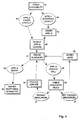
- the agent checks in block 35 which system resources the program (a multimedia program, for instance) requires. If the agent detects according to block 36 that the available system resources are insufficient, it notifies 37 the user, possibly recommending at the same time that the user should make more system resources available by terminating other simultaneously executed programs, and returns to the wait state 33.
- the agent detects according to block 38 that there are enough system resources free and available, it next checks according to block 39 whether the user has the necessary rights to use the program. A negative result 41 results in a notice 37 to the user and a return to the wait state 33. If the user rights are sufficient according to block 40, the agent checks in block 42 whether the program components required by the program in question have already been stored in the terminal equipment's memory. Fig. 4 shows how the procedure continues from state 42 on. If a suitable start program is found in the storage, as shown in block 43, which may be e.g.
- Block 49 represents in a general manner a service call which in a case like this is sent to the agent by the active multimedia program.
- the agent checks in block 50 whether there are sufficient system resources for the new service. If, according to block 51, there are not enough resources, the agent notifies 52 the user and returns to state 47 in which it was before the service call 49.
- the agent executes the service in block 54 and then returns to state 47.
- the execution of the service may call for complex action (e.g. obtaining program components via the communications network) so that block 54 may even include all the functions according to blocks 39, 40, 41, 42, 43, 44, 45 and 46 as described above.
- the agent returns to state 32 and via it to the wait state 33 as shown in Fig. 3.
- the system may also perform preselection on the basis of hardware requirements so that the start menu shows to the user only programs for the reception and playback of which the equipment is capable.
- Several multimedia programs may be simultaneously active if there are enough hardware resources.
- One agent may deal with multiple multimedia programs or each program may have an agent of its own.
- the reception part 9 is capable of receiving information from several different systems as described above, it is preferable from the user's standpoint that the most advantageous transmission system and channel are chosen each time to load a given program or program component.
- Transmission costs to the user are often proportional to the capacity of the transmission link wherefore a very fast transmission mode (such as DAB reception) should only be used for loading large and/or continuous picture and sound objects.
- the time of day may have an effect on the costs as the use of telephone connections, for example, is more expensive at daytime than in the evenings and at night. It pays to load simple objects, such as text messages, through, say, a paging service or digital cellular radio network so that the short message service (SMS) according to known specifications can be used for their transmission, if necessary.
- SMS short message service
- the terminal equipment 2 must be in possession of a descrambling key.
- the equipment includes a smart card reader the user may go to the representative of the distributor and make the necessary payment and load the necessary keys into his smart card.
- the smart card delivers the keys to a descrambling circuit in the equipment.
- a second alternative for delivering the key to the user's equipment is to send it via a bidirectional communications system to the terminal 4 and therefrom, in necessary, via a communications link 5 to the receiver 3.
- the terminal 4 includes an identification code or other information which identifies the user for the communications system.
- a known identification and code method is, for example, the method based on SIM (Subscriber Identity Module) cards in the GSM system.
- the equipment 2 tasks related to the use of the programs and calculation of the costs arising from the use and to the storage of payment information are preferably left to the agent. It can store the data in memory 7 or in the smart card if the equipment employs one.
- Preferred methods for realising the practical arrangements related to invoicing are disclosed in the Finnish patent application no. 960418 , which has the same applicant as this application.
- the invoicing may be based on a one-time payment, pay-per-load system or on time charging. In the first of these alternatives the user makes to the service provider or some other party collecting the fees a lump payment whereafter he has a limitless right to load and use a certain program.
- the user pays for each time that he connects to the network and loads a certain program from the network into his own equipment.
- the number of actual uses of a loaded and stored program has an effect on the payment only in the third alternative wherein the payment is based on the time that the program has been actively used by the user.
- the system of invoicing may also be based on the combination of the alternatives described here.
- a basis of invoicing may also be the use of the communication connection for which the payment is then likely to go to the operator providing the connection and not to the producer of the multimedia program. Of course, the operator may remunerate the producer of the multimedia program.
- Operation of the system also includes the ending of the use of a given multimedia program.
- the agent or an application closes the transmission and presentation channels reserved by the program and, if necessary, removes from storage those data that are no longer needed and informs the service provider, by means of the terminal of the bidirectional communications system, that the user has stopped using the program. That last piece of information can also be used for determining the basis of invoicing.
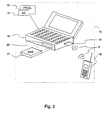
- the embodiment of Fig. 2 has the advantage that it is lighter and smaller and therefore easier to move from one place to another.
- the DAB receiver 17 could be left out of the embodiment of Fig. 2, in which case all communications between the equipment and the "outside world" would be carried out through the phone 19 (the same naturally applies to the embodiment of Fig. 1).
- the DAB system offers considerably faster transmission rates than current cordless telephone systems or cellular radio systems, it is most likely necessary to use it or some other corresponding broadcasting system if e.g. a perfect moving image or multi-channel hifi sound is to be transmitted to the user.
- An obvious modification of the invention is to use a bidirectional paging device to unlock a locking code in a hotel TV system.
- a bidirectional paging device communicates with a hotel TV and delivers to it the keys which are needed for viewing programs on the hotel TV. To get the keys the bidirectional paging device delivers the user's invoicing information via a communications system to a recipient that controls the use of the hotel TV system for the reception and playback of programs that require payment.
- the invention is clearly an improvement from the prior art because according to the invention a multimedia terminal equipment can be compiled using components which also are useful as separate devices.
- the user is able to use the mobile phone, cordless phone, TV receiver and portable computer included in the illustrative embodiments in their usual functions.
- the operation according to the invention as part of a multimedia terminal equipment only requires certain re-programming of the devices, which is a procedure known to one skilled in the art.
- most modern TV sets have a so-called service interface through which the program code controlling the operation of the TV can be modified.
- hotel TV systems the software modifications can be realised even remotely controlled within a certain cable distribution system.
Landscapes
- Engineering & Computer Science (AREA)
- Signal Processing (AREA)
- Computer Networks & Wireless Communication (AREA)
- Multimedia (AREA)
- Theoretical Computer Science (AREA)
- Business, Economics & Management (AREA)
- General Business, Economics & Management (AREA)
- Two-Way Televisions, Distribution Of Moving Picture Or The Like (AREA)
- Mobile Radio Communication Systems (AREA)
- Telephonic Communication Services (AREA)
- Stored Programmes (AREA)
- Communication Control (AREA)
Claims (12)
- System (2; 15) für selektiven Empfang von Multimediaübertragungen von einem Telekommunikationssystem (11) und für deren Präsentation gegenüber einem Benutzer, umfassend:- eine erste Vorrichtung (3; 16) zum Empfangen von Multimediainformationen von dem Telekommunikationssystem; und- eine zweite Vorrichtung (4; 19) zum Liefern von Informationen an ein Telekommunikationssystem;dadurch gekennzeichnet, dass
die erste Vorrichtung umfasst:- Mittel zum Empfangen von unidirektionalen Multimediaübertragungen von dem Telekommunikationssystem, die Multimediainformationen enthalten;- Speichermittel (7) für die temporäre Speicherung von zu präsentierenden Multimediainformationen; und- einen Agenten (14) zum Steuern des dynamischen Empfangs und der dynamischen Speicherung von Multimediainformationen und zum Liefern von Informationen, die sich auf die Verwendung von Multimediainformationen beziehen, an das Telekommunikationssystem, mittels der zweiten Vorrichtung; unddie zweite Vorrichtung umfasst:- Mittel zum Liefern von Benutzerbefehlsinformationen, die sich auf die Verwendung der Multimediainformationen beziehen, an das Telekommunikationssystem, über ein bidirektionales Kommunikationssystem. - System nach Anspruch 1, dadurch gekennzeichnet, dass die erste Vorrichtung eine Empfangsverbindung (9a) zum Empfangen von Multimediainformationen von dem Telekommunikationssystem mittels der zweiten Vorrichtung (4; 19) umfasst.
- System nach Anspruch 1 oder 2, dadurch gekennzeichnet, dass die erste Vorrichtung einen Empfänger (9; 17) zum Empfangen von Multimediainformationen in der Form einer Rundfunkübertragung umfasst.
- System nach Anspruch 1, dadurch gekennzeichnet, dass das System eingerichtet ist, um eine Downstream-Übertragung über das bidirektionale Kommunikationssystem mittels der zweiten Vorrichtung zu empfangen.
- System nach Anspruch 1, dadurch gekennzeichnet, dass das bidirektionale Kommunikationssystem ein digitales zellulares Telefonnetz umfasst.
- Vorrichtung (3; 16) für die Verwendung als eine erste Vorrichtung in einer Multimedia-Endgeräteausrüstung, umfassend Mittel (5; 9; 9a; 17) zum Empfangen von Multimediainformationen von einem Telekommunikationssystem (11), dadurch gekennzeichnet, dass sie umfasst- Mittel zum Empfangen von unidirektionalen Multimediaübertragungen von dem Telekommunikationssystem, die Multimediainformationen enthalten;- Speichermittel (7) für die temporäre Speicherung von zu präsentierenden Multimediainformationen; und- einen Agenten (14) zum Steuern des dynamischen Empfangs und der dynamischen Speicherung von Multimediainformationen und zum Liefern von Benutzerbefehlsinformationen, die sich auf die Verwendung der Multimediainformationen beziehen, an das Telekommunikationssystem, über ein bidirektionales Kommunikationssystem.
- Vorrichtung nach Anspruch 6, dadurch gekennzeichnet, dass sie eine Schnittstelle (5; 9a) zum Erzeugen einer lokalen Kommunikationsverbindung mit einem Endgerät (4; 19) eines bidirektionalen Telekommunikationssystems umfasst.
- Vorrichtung nach Anspruch 7, dadurch gekennzeichnet, dass sie eine Empfangsverbindung (9a) zum Empfangen von Multimediainformationen von dem Telekommunikationssystem mittels des Endgeräts eines bidirektionalen Telekommunikationssystems umfasst.
- Verfahren zum selektiven Empfang von Multimediapräsentationen von einem Telekommunikationssystem und für deren Präsentation gegenüber einem Benutzer, dadurch gekennzeichnet, dass es umfasst- Prüfen, in Reaktion auf eine Benutzerauswahl, ob die Multimediainformationen, die durch die Benutzerauswahl angefordert werden und sich auf eine bestimmte Multimediapräsentation beziehen, lokal in einer ersten Vorrichtung gespeichert sind;- Liefern von Benutzerbefehlsinformationen, die sich auf die Verwendung von Multimediainformationen beziehen, von der ersten Vorrichtung an das Telekommunikationssystem mittels einer zweiten Vorrichtung über ein bidirektionales Kommunikationssystem;- Laden und lokales Speichern von Multimediainformationen, die durch die Benutzerauswahl angefordert werden und sich auf eine bestimmte Multimediapräsentation beziehen, die nicht lokal gespeichert sind, von dem Telekommunikationssystem in einer unidirektionalen Multimediaübertragung; und- Entfernen von Multimediainformationen, die durch die Benutzerauswahl angefordert werden und sich auf eine bestimmte Multimediapräsentation beziehen, aus dem lokalen Speicher, wenn sie nicht mehr benötigt werden, um die Multimediapräsentation dem Benutzer zu präsentieren.
- Verfahren nach Anspruch 9, dadurch gekennzeichnet, dass es auch verschiedene Kanäle zum Laden von Multimediainformationen von einem Telekommunikationssystem vergleicht, und auf der Grundlage des Vergleichs den vorteilhaftesten Kanal für das Laden der Multimediainformationen auswählt, die durch eine Benutzerauswahl angefordert werden und sich auf eine bestimmte Multimediapräsentation beziehen.
- Verfahren nach Anspruch 10, dadurch gekennzeichnet, dass mindestens eines der folgenden Kriterien in dem Vergleich verwendet wird:- Kosten für den Benutzer;- Qualität der Verbindung;- registrierte Rechte des Benutzers in verschiedenen Telekommunikationssystemen;- absichtliche Auswahl des Benutzers.
- Verfahren nach irgendeinem der Ansprüche 9 bis 11, dadurch gekennzeichnet, dass es Informationen sammelt, die sich auf die Bezahlungsregelung beziehen, die der Verwendung der Multimediainformationen entspricht, und sie an das Telekommunikationssystem liefert.
Applications Claiming Priority (2)
| Application Number | Priority Date | Filing Date | Title |
|---|---|---|---|
| FI961750 | 1996-04-23 | ||
| FI961750A FI103450B (fi) | 1996-04-23 | 1996-04-23 | Multimediapäätelaite ja menetelmä multimediavastaanoton toteuttamiseks i |
Publications (3)
| Publication Number | Publication Date |
|---|---|
| EP0804012A2 EP0804012A2 (de) | 1997-10-29 |
| EP0804012A3 EP0804012A3 (de) | 1999-09-08 |
| EP0804012B1 true EP0804012B1 (de) | 2007-07-18 |
Family
ID=8545898
Family Applications (1)
| Application Number | Title | Priority Date | Filing Date |
|---|---|---|---|
| EP97660047A Revoked EP0804012B1 (de) | 1996-04-23 | 1997-04-22 | Multimedia-Endgerät und Verfahren zum Multimedia-Empfang |
Country Status (5)
| Country | Link |
|---|---|
| US (1) | US6172673B1 (de) |
| EP (1) | EP0804012B1 (de) |
| JP (3) | JPH1098706A (de) |
| DE (1) | DE69737920T2 (de) |
| FI (1) | FI103450B (de) |
Cited By (4)
| Publication number | Priority date | Publication date | Assignee | Title |
|---|---|---|---|---|
| US9197538B2 (en) | 2003-12-10 | 2015-11-24 | Aventail Llc | Rule-based routing to resources through a network |
| US9300670B2 (en) | 2003-12-10 | 2016-03-29 | Aventail Llc | Remote access to resources over a network |
| US9407456B2 (en) | 2003-12-10 | 2016-08-02 | Aventail Llc | Secure access to remote resources over a network |
| US9471910B2 (en) | 1999-10-25 | 2016-10-18 | Smartflash, LLC | Data storage and access systems |
Families Citing this family (113)
| Publication number | Priority date | Publication date | Assignee | Title |
|---|---|---|---|---|
| EP0820194A1 (de) * | 1996-07-19 | 1998-01-21 | Telefonaktiebolaget Lm Ericsson | Methode und Anordnung für integrierte Funktelekommunikation über ein Kabelfernsehnetzwerk |
| KR100513907B1 (ko) * | 1997-06-13 | 2005-09-13 | 코닌클리케 필립스 일렉트로닉스 엔.브이. | 복수의 상호 관련된 오브젝트들의 주기적 전송방법 |
| US7310811B1 (en) | 1997-07-15 | 2007-12-18 | At&T Corp. | Interaction modalities for multimedia delivery and presentation |
| GB9803623D0 (en) * | 1998-02-20 | 1998-04-15 | The Technology Partnership Plc | Audio information transmission |
| IL127790A (en) * | 1998-04-21 | 2003-02-12 | Ibm | System and method for selecting, accessing and viewing portions of an information stream(s) using a television companion device |
| US6928652B1 (en) * | 1998-05-29 | 2005-08-09 | Webtv Networks, Inc. | Method and apparatus for displaying HTML and video simultaneously |
| US6404747B1 (en) * | 1998-06-02 | 2002-06-11 | Avaya Technology Corp. | Integrated audio and video agent system in an automatic call distribution environment |
| US6339842B1 (en) * | 1998-06-10 | 2002-01-15 | Dennis Sunga Fernandez | Digital television with subscriber conference overlay |
| US6215483B1 (en) * | 1998-06-17 | 2001-04-10 | Webtv Networks, Inc. | Combining real-time and batch mode logical address links |
| WO2000013090A1 (en) | 1998-09-01 | 2000-03-09 | Mitsubishi Denki Kabushiki Kaisha | Information processor and method |
| DE19848492A1 (de) * | 1998-10-21 | 2000-04-27 | Bosch Gmbh Robert | Einrichtung zum verschlüsselten Senden und Empfangen von Multimediaobjekten |
| KR20000032561A (ko) * | 1998-11-16 | 2000-06-15 | 구자홍 | 휴대용 멀티미디어 파일 재생기 |
| FR2788191B1 (fr) * | 1998-12-31 | 2001-02-09 | France Telecom | Interactivite d'un dispositif radiotelephonique et d'un terminal recepteur avec un serveur de donnees |
| DE19901875A1 (de) * | 1999-01-19 | 2000-07-20 | Siemens Ag | Kommunikationsmodul für ein Fernsehgerät |
| DE19905225A1 (de) * | 1999-02-09 | 2000-08-24 | Klotz Digital Audio Communicat | Empfängermodul für Zusatzdaten des digitalen Hörfunks |
| JP2000232423A (ja) | 1999-02-09 | 2000-08-22 | Sony Corp | 通信装置、通信システムおよびその方法 |
| DE19905628A1 (de) | 1999-02-11 | 2000-08-17 | Bosch Gmbh Robert | Verfahren und Empfänger zum Empfang eines Rundfunksignal mit verschlüsselten Inhalten |
| JP3594180B2 (ja) * | 1999-02-18 | 2004-11-24 | 松下電器産業株式会社 | コンテンツ提供方法 |
| US6938270B2 (en) * | 1999-04-07 | 2005-08-30 | Microsoft Corporation | Communicating scripts in a data service channel of a video signal |
| US6526580B2 (en) * | 1999-04-16 | 2003-02-25 | Digeo, Inc. | Broadband data broadcasting service |
| DE19919362A1 (de) * | 1999-04-28 | 2000-11-02 | Siemens Ag | Kommunikationsendgerät |
| WO2000070896A1 (de) * | 1999-05-18 | 2000-11-23 | Siemens Aktiengesellschaft | Funksystem zur drahtlosen übertragung von daten zu einem kommunikationsendgerät |
| AU3256100A (en) * | 1999-05-25 | 2000-11-30 | Command Audio Corporation | Playing audio of one kind in response to user action while playing audio of another kind |
| DE60015764T2 (de) | 1999-05-28 | 2005-11-03 | Nokia Corp. | Benutzerschnittstelle und server für interaktive dienste |
| US7490067B1 (en) | 1999-06-02 | 2009-02-10 | Swisscom Mobile Ag | Method for selling and using media objects and a suitable device for carrying out said method |
| ES2275344T3 (es) | 1999-07-06 | 2007-06-01 | Swisscom Mobile Ag | Receptor de radiodifusion portatil con un modulo de identificacion. |
| DE60044489D1 (de) * | 1999-07-21 | 2010-07-15 | Ipg Electronics 503 Ltd | Ikationssystem und fernseh-empfänger |
| KR100547820B1 (ko) * | 1999-08-12 | 2006-02-01 | 삼성전자주식회사 | 디지털 오디오 데이터 기록 및 재생이 가능한 이동무선 단말기및 그 제어방법 |
| CA2382128A1 (en) * | 1999-08-27 | 2001-03-08 | Nokia Corporation | Mobile multimedia terminal for digital video broadcast |
| DE19942842A1 (de) * | 1999-09-08 | 2001-04-12 | Bosch Gmbh Robert | Verfahren zur Datenverarbeitung in einem Rundfunkempfänger |
| JP4083430B2 (ja) * | 1999-09-22 | 2008-04-30 | ソフトバンクBb株式会社 | 電子決済システム、決済装置及び端末 |
| FI112427B (fi) * | 1999-11-05 | 2003-11-28 | Nokia Corp | Menetelmä langattoman päätelaitteen ominaisuuksien määrittämiseksi multimediasanoman välityspalvelussa, multimediasanoman välityspalvelu ja multimediapäätelaite |
| US6594784B1 (en) * | 1999-11-17 | 2003-07-15 | International Business Machines Corporation | Method and system for transparent time-based selective software rejuvenation |
| US6629266B1 (en) * | 1999-11-17 | 2003-09-30 | International Business Machines Corporation | Method and system for transparent symptom-based selective software rejuvenation |
| US7945284B1 (en) * | 1999-11-23 | 2011-05-17 | Agere Systems Inc. | Cordless telephone with MP3 player capability |
| US7174562B1 (en) * | 1999-12-20 | 2007-02-06 | Microsoft Corporation | Interactive television triggers having connected content/disconnected content attribute |
| JP2001202480A (ja) * | 2000-01-24 | 2001-07-27 | Fujitsu Ltd | カード処理装置及びカード処理方法 |
| FR2804261A1 (fr) * | 2000-01-25 | 2001-07-27 | Sagem | Dispositif de reception de signaux radiophoniques et/ou televisuels affranchi des contraintes geographiques et utilisation du dispositif |
| CN1363173A (zh) * | 2000-02-28 | 2002-08-07 | 三菱电机株式会社 | 移动通信系统和移动通信方法 |
| EP1132796A1 (de) * | 2000-03-08 | 2001-09-12 | Universite Catholique De Louvain | Mobiler Kode und Verfahren zur Betriebsmittelverwaltung für mobilen Kode |
| ATE265787T1 (de) * | 2000-03-10 | 2004-05-15 | Rudolf Ritter | Verfahren, kommunikationssystem und empfangsvorrichtung für die verrechnung von zugriffskontrollierten programmen und/oder daten von broadcastsendern |
| WO2001069387A2 (en) * | 2000-03-16 | 2001-09-20 | Microsoft Corporation | Notification platform architecture |
| WO2001071590A1 (en) * | 2000-03-22 | 2001-09-27 | Zetabits Inc. | Communication system |
| MXPA02009861A (es) * | 2000-04-05 | 2004-10-14 | Ods Properties Inc | Sistemas y metodos interactivos de apuestas con alimentaciones telesivas multiples. |
| US6766524B1 (en) * | 2000-05-08 | 2004-07-20 | Webtv Networks, Inc. | System and method for encouraging viewers to watch television programs |
| FR2809507A1 (fr) * | 2000-05-24 | 2001-11-30 | Sagem | Dispositif et procede de transfert d'un fichier entre un serveur d'un reseau et un appareil permettant d'acceder a ce reseau |
| GB2364211A (en) | 2000-06-30 | 2002-01-16 | Nokia Oy Ab | A terminal comprising two receivers for receiving an encrypted first signal from a first network and a decryption second signal from a second network |
| GB2364209A (en) | 2000-06-30 | 2002-01-16 | Nokia Oy Ab | Combined digital video broadcast receiver and cellular receiver |
| GB2364479A (en) * | 2000-06-30 | 2002-01-23 | Nokia Oy Ab | System for locating a terminal |
| US20020046207A1 (en) * | 2000-06-30 | 2002-04-18 | Seiko Epson Corporation | Information distribution system, information distribution method, and computer program for implementing the method |
| WO2002003651A1 (en) * | 2000-07-03 | 2002-01-10 | Telefonaktiebolaget Lm Ericsson (Publ) | A method of controlling a display device and an electronic accessory device for controlling a display device |
| FI112307B (fi) * | 2000-08-02 | 2003-11-14 | Nokia Corp | Viestintäpalvelu |
| FI20002129A7 (fi) * | 2000-09-28 | 2002-03-29 | Nokia Corp | Menetelmä ja järjestely paikallisen laajakaistaisen datavirran langattomaksi jakamiseksi |
| DE10057637A1 (de) * | 2000-11-21 | 2002-05-23 | Bosch Gmbh Robert | Verfahren zur Datenübertragung und Funkstation dafür |
| FI110046B (fi) * | 2000-11-27 | 2002-11-15 | Lasse Artturi Halttunen | Menetelmä mobiilipuhelimen kuvan ja äänen siirtämiseksi tavalliseen analogiseen televisiovastaanottimeen matkapuhelinlisälaitteen avulla |
| JPWO2002067160A1 (ja) * | 2001-02-21 | 2004-06-24 | 株式会社鷹山 | 制御委譲システム、制御委譲方法、電子決済システム、電子決済方法、移動体通信端末装置、認証サーバ装置、通信装置、通信端末および決済サーバ装置 |
| DE10114670A1 (de) * | 2001-03-23 | 2002-10-17 | Trend Network Ag | Mobile Multimediavorrichtung |
| US6810495B2 (en) | 2001-03-30 | 2004-10-26 | International Business Machines Corporation | Method and system for software rejuvenation via flexible resource exhaustion prediction |
| US7548518B2 (en) | 2001-06-29 | 2009-06-16 | Nokia Corporation | Receiver |
| EP1298926B1 (de) * | 2001-09-10 | 2007-02-28 | Telefonaktiebolaget LM Ericsson (publ) | Vorrichtung und Verfahren zur Darstellung von Informationen |
| US7203942B2 (en) * | 2001-09-25 | 2007-04-10 | Interuniversitair Microelektronica Centrum | Method for operating a real-time multimedia terminal in a QoS manner |
| WO2003030545A1 (de) * | 2001-10-02 | 2003-04-10 | Nagra-Futuris S.A. | System und verfahren für die verbreitung von multimediendaten |
| US7187922B2 (en) * | 2001-10-12 | 2007-03-06 | Axalto Sa | Process and device for value added service access control |
| FI20012256A0 (fi) | 2001-11-20 | 2001-11-20 | Nokia Corp | Matkaviestintäverkot ja digitaaliset yleislähetyspalvelut |
| US20030137609A1 (en) * | 2001-12-31 | 2003-07-24 | Toshio Hayakawa | Multimedia system using plasma or liquid crystal display, display system of portable computer, and signal receiver for television, radio, and cellular telephone |
| US20030126620A1 (en) * | 2001-12-31 | 2003-07-03 | Toshio Hayakawa | Multimedia display system using display unit of portable computer, and signal receiver for television, radio, and wireless telephone |
| US20030232593A1 (en) * | 2002-06-13 | 2003-12-18 | Nokia Corporation | Digital data transfer through different communication paths |
| MXPA04012760A (es) | 2002-06-21 | 2005-03-23 | Thomson Licensing Sa | Disminucion continua de los requerimientos de la calidad de servicios (qos) de red de una corriente almacenada de video en un ambiente de interfuncionamiento inalambrico movil. |
| EP1398921A1 (de) * | 2002-09-10 | 2004-03-17 | Siemens Aktiengesellschaft | Anforderung von Daten über ein Mobilfunknetz und Übertragung der Daten über ein Datenübertragungsnetz |
| KR100678204B1 (ko) | 2002-09-17 | 2007-02-01 | 삼성전자주식회사 | 휴대단말기의 모드에 따른 영상 및 데이터 표시장치 및 방법 |
| US7165224B2 (en) * | 2002-10-03 | 2007-01-16 | Nokia Corporation | Image browsing and downloading in mobile networks |
| US6990352B2 (en) | 2002-10-03 | 2006-01-24 | Nokia Corporation | GPRS signaling via SMS messages |
| US7336925B2 (en) * | 2002-10-28 | 2008-02-26 | Nokia Corporation | Graphical indication of a proximately located device |
| GB0226400D0 (en) * | 2002-11-12 | 2002-12-18 | Koninkl Philips Electronics Nv | Communication system, method and terminal |
| US7925203B2 (en) * | 2003-01-22 | 2011-04-12 | Qualcomm Incorporated | System and method for controlling broadcast multimedia using plural wireless network connections |
| GB0305977D0 (en) * | 2003-03-15 | 2003-04-23 | Koninkl Philips Electronics Nv | Control of a conditional access mechanism |
| CA2526687A1 (en) * | 2003-05-22 | 2004-12-09 | Pace Micro Technology Plc | Digital cable adapter |
| US8108319B2 (en) * | 2003-08-26 | 2012-01-31 | Sony Computer Entertainment America Llc | System and method for controlling access to computer readable content using downloadable authentication |
| US7352998B2 (en) * | 2003-09-12 | 2008-04-01 | Nokia Corporation | Method and system for establishing a wireless communications link |
| US7499674B2 (en) * | 2003-09-12 | 2009-03-03 | Nokia Corporation | Method and system for repeat request in hybrid ultra wideband-bluetooth radio |
| US7702284B2 (en) * | 2003-09-12 | 2010-04-20 | Arto Palin | Method and system for processing acknowledgments in a wireless communications network |
| US7782894B2 (en) * | 2003-09-12 | 2010-08-24 | Nokia Corporation | Ultra-wideband/low power communication having a dedicated removable memory module for fast data downloads—apparatus, systems and methods |
| US7278084B2 (en) * | 2003-10-29 | 2007-10-02 | Nokia Corporation | Method and system for providing communications security |
| US7827590B2 (en) | 2003-12-10 | 2010-11-02 | Aventail Llc | Controlling access to a set of resources in a network |
| WO2005059684A2 (en) * | 2003-12-10 | 2005-06-30 | Aventail Corporation | End point control |
| US8572249B2 (en) | 2003-12-10 | 2013-10-29 | Aventail Llc | Network appliance for balancing load and platform services |
| WO2005064509A1 (en) * | 2003-12-17 | 2005-07-14 | Nokia Corporation | Data transport to mobile devices using a radio broadcast data channel |
| DE102004018162B4 (de) * | 2004-04-14 | 2009-02-12 | Siemens Ag | Mobiles Endgerät zum Empfang paketorientierter Rundfunksignale |
| US20050251823A1 (en) * | 2004-05-05 | 2005-11-10 | Nokia Corporation | Coordinated cross media service |
| US7697893B2 (en) * | 2004-06-18 | 2010-04-13 | Nokia Corporation | Techniques for ad-hoc mesh networking |
| KR100631735B1 (ko) * | 2004-07-14 | 2006-10-09 | 삼성전자주식회사 | 멀티미디어 데이터 거래 시스템 및 방법 |
| US9021529B2 (en) * | 2004-07-15 | 2015-04-28 | Microsoft Technology Licensing, Llc | Content recordation techniques |
| NL1026744C1 (nl) * | 2004-07-30 | 2006-01-31 | Brasned Entpr B V | Inrichting werkwijze en systeem voor het ontvangen en zenden van informatie met behulp van verschillende communicatienetwerken. |
| KR20060054519A (ko) * | 2004-11-16 | 2006-05-22 | 삼성전자주식회사 | 홈 네트워크에서 컨텐츠를 전송하는 장치, 시스템 및 그방법 |
| KR100641218B1 (ko) | 2004-11-19 | 2006-11-02 | 엘지전자 주식회사 | 지상파 디지털 멀티미디어 방송을 위한 수신제한 방송시스템 및 방법 |
| US7286794B2 (en) * | 2004-12-13 | 2007-10-23 | Broadcom Corporation | Method and system for joint broadcast receiving and cellular communication at mobile terminal or device without service control |
| SE532117C2 (sv) * | 2004-12-17 | 2009-10-27 | Ericsson Telefon Ab L M | Auktorisering i cellulära kommunikationssystem |
| KR100690797B1 (ko) * | 2005-01-27 | 2007-03-09 | 엘지전자 주식회사 | 수신제한 방송 시스템 및 방법 |
| EP1689106A3 (de) * | 2005-02-02 | 2007-11-14 | Micronas GmbH | Interaktives Gerät der Unterhaltungselektronik |
| CN1855095A (zh) * | 2005-04-27 | 2006-11-01 | 国际商业机器公司 | 用于播放基于smil的多媒体内容的系统、方法及引擎 |
| US20060293077A1 (en) * | 2005-06-27 | 2006-12-28 | Nokia Corporation | System, terminal, method, and computer program product for allocating memory for storage of content |
| FI20065452A0 (fi) * | 2006-06-29 | 2006-06-29 | Valtion Teknillinen | Menetelmä sisällön välittämiseen |
| EP1903696A1 (de) * | 2006-09-25 | 2008-03-26 | MAGNETI MARELLI SISTEMI ELETTRONICI S.p.A. | Navigationssystem mit einem Rundfunkempfänger und mobilen Endgerät zur Nutzung von Multimedia-Inhalten mit beschränktem Zugriff |
| WO2008037285A1 (en) * | 2006-09-29 | 2008-04-03 | Telecom Italia S.P.A | Method of transferring broadcast related information from a portable terminal to a nearby broadcast receiver |
| EP2573963A1 (de) * | 2007-05-30 | 2013-03-27 | Sezmi Corporation | Programmierung von Inhaltsbeschränkungen in einem Inhaltsausgabesystem |
| US20090064258A1 (en) * | 2007-08-27 | 2009-03-05 | At&T Knowledge Ventures, Lp | System and Method for Sending and Receiving Text Messages via a Set Top Box |
| EP2037600A3 (de) * | 2007-09-14 | 2011-01-26 | Visionee SRL | Digitaler Funkempfänger |
| WO2009085266A2 (en) | 2007-12-21 | 2009-07-09 | Sezmi Corporation | System for content delivery |
| US8719879B2 (en) | 2010-06-11 | 2014-05-06 | Kuautli Media Investment Zrt. | Method and apparatus for content delivery |
| US8732776B2 (en) | 2010-07-01 | 2014-05-20 | Kuautli Media Investment Zrt. | End of show handling |
| US9185152B2 (en) * | 2011-08-25 | 2015-11-10 | Ustream, Inc. | Bidirectional communication on live multimedia broadcasts |
| DE102012200506A1 (de) | 2012-01-13 | 2013-07-18 | M.E.N. Media Entertainment Networks GmbH | Verfahren und Vorrichtung zum Bereitstellen von kostenpflichtigen Angeboten |
| EP3319323A1 (de) * | 2016-11-03 | 2018-05-09 | Nagravision S.A. | Verfahren, empfänger, mobile anzeigevorrichtung und system zum zugriff auf medieninhalt |
Family Cites Families (14)
| Publication number | Priority date | Publication date | Assignee | Title |
|---|---|---|---|---|
| US5177604A (en) | 1986-05-14 | 1993-01-05 | Radio Telcom & Technology, Inc. | Interactive television and data transmission system |
| US5195092A (en) | 1987-08-04 | 1993-03-16 | Telaction Corporation | Interactive multimedia presentation & communication system |
| US5181107A (en) * | 1989-10-19 | 1993-01-19 | Interactive Television Systems, Inc. | Telephone access information service distribution system |
| US5220420A (en) * | 1990-09-28 | 1993-06-15 | Inteletext Systems, Inc. | Interactive home information system for distributing compressed television programming |
| US5539920A (en) * | 1994-04-28 | 1996-07-23 | Thomson Consumer Electronics, Inc. | Method and apparatus for processing an audio video interactive signal |
| DE4422015C1 (de) * | 1994-06-16 | 1995-08-03 | Bosch Gmbh Robert | Verfahren zur Übertragung digitaler Daten und digitaler Zusatzdaten und Verfahren zur Wiedergabe digitaler Daten und digitaler Zusatzdaten |
| US5642155A (en) * | 1994-09-14 | 1997-06-24 | Cheng; Alexander L. | Method and apparatus for supporting two-way telecommunications on CATV networks |
| GB2294132A (en) | 1994-10-10 | 1996-04-17 | Marconi Gec Ltd | Data communication network |
| DE69607528T2 (de) * | 1995-02-02 | 2000-10-19 | Koninklijke Philips Electronics N.V., Eindhoven | Mischen eines videomosaiks mit teletext |
| US5635980A (en) * | 1995-04-04 | 1997-06-03 | Bell Communications Research, Inc. | System and method for customer premises broadband interface with on-hook alerting |
| US5586121A (en) * | 1995-04-21 | 1996-12-17 | Hybrid Networks, Inc. | Asymmetric hybrid access system and method |
| US5625693A (en) * | 1995-07-07 | 1997-04-29 | Thomson Consumer Electronics, Inc. | Apparatus and method for authenticating transmitting applications in an interactive TV system |
| US5673430A (en) * | 1995-10-13 | 1997-09-30 | At&T | System and method for optimizing subscriber programming preferences |
| FI98423C (fi) | 1995-11-15 | 1997-06-10 | Nokia Oy Ab | Multimediaohjelma palvelukomponenttien koodaus digitaalisessa radiokanavassa |
-
1996
- 1996-04-23 FI FI961750A patent/FI103450B/fi not_active IP Right Cessation
-
1997
- 1997-04-22 DE DE69737920T patent/DE69737920T2/de not_active Revoked
- 1997-04-22 US US08/837,778 patent/US6172673B1/en not_active Expired - Lifetime
- 1997-04-22 EP EP97660047A patent/EP0804012B1/de not_active Revoked
- 1997-04-23 JP JP9106181A patent/JPH1098706A/ja not_active Withdrawn
-
2007
- 2007-12-21 JP JP2007330983A patent/JP2008154253A/ja active Pending
-
2009
- 2009-05-18 JP JP2009120377A patent/JP2009219143A/ja active Pending
Non-Patent Citations (1)
| Title |
|---|
| None * |
Cited By (5)
| Publication number | Priority date | Publication date | Assignee | Title |
|---|---|---|---|---|
| US9471910B2 (en) | 1999-10-25 | 2016-10-18 | Smartflash, LLC | Data storage and access systems |
| US9197538B2 (en) | 2003-12-10 | 2015-11-24 | Aventail Llc | Rule-based routing to resources through a network |
| US9300670B2 (en) | 2003-12-10 | 2016-03-29 | Aventail Llc | Remote access to resources over a network |
| US9397927B2 (en) | 2003-12-10 | 2016-07-19 | Aventail Llc | Rule-based routing to resources through a network |
| US9407456B2 (en) | 2003-12-10 | 2016-08-02 | Aventail Llc | Secure access to remote resources over a network |
Also Published As
| Publication number | Publication date |
|---|---|
| US6172673B1 (en) | 2001-01-09 |
| FI103450B1 (fi) | 1999-06-30 |
| JP2008154253A (ja) | 2008-07-03 |
| JPH1098706A (ja) | 1998-04-14 |
| JP2009219143A (ja) | 2009-09-24 |
| FI103450B (fi) | 1999-06-30 |
| FI961750A0 (fi) | 1996-04-23 |
| DE69737920D1 (de) | 2007-08-30 |
| FI961750L (fi) | 1997-10-24 |
| EP0804012A3 (de) | 1999-09-08 |
| DE69737920T2 (de) | 2008-04-17 |
| EP0804012A2 (de) | 1997-10-29 |
Similar Documents
| Publication | Publication Date | Title |
|---|---|---|
| US6172673B1 (en) | Multimedia terminal and method for realizing multimedia reception | |
| US5572442A (en) | System for distributing subscription and on-demand audio programming | |
| US5557541A (en) | Apparatus for distributing subscription and on-demand audio programming | |
| CN100385940C (zh) | 提供订阅的数字广播电视节目的装置、方法及系统 | |
| EP0986911B1 (de) | Vorrichtung in telekommunikationsnetzen | |
| US7054660B2 (en) | Multimedia broadcasting, broadcast services for cell phone and other users and modified SIM card and related means for enabling such broadcast reception | |
| JP3600935B2 (ja) | 情報伝送システムにおける改良点 | |
| JP3958354B2 (ja) | ケーブルテレビ配送システムのための改良型セットトップ端末 | |
| US8904452B2 (en) | Method and apparatus for providing dynamic pricing services for an interactive information distribution system | |
| KR100914954B1 (ko) | 휴대전화기 및 기타 사용자를 위한 멀티미디어 방송 서비스 및 방송 수신을 가능하게 하기 위한 수정된 에스아이엠 카드 | |
| US20050091683A1 (en) | Method and apparatus for recording and editing digital broadcast content | |
| CS286991A3 (en) | Interactive information system for home users | |
| EP1217769A1 (de) | Verfahren zur datenübertragung und mobilserver | |
| JPS61501301A (ja) | 予約放送の方法および装置 | |
| WO1997034420A1 (en) | Interactive cable network providing fax and voice mail | |
| CA2168531A1 (en) | A video-on-demand system | |
| GB2370456A (en) | Interactive television using a wireless terminal | |
| AU2002315408A1 (en) | Multimedia broadcasting services for cell phone and other users and modified sim card for enabling broadcast reception | |
| EP0914744B1 (de) | Architektur für direktübertragungssatelliten mit video-auf-anfrage und interaktiven diensten | |
| EP1249129A2 (de) | Verfahren zum bestellen von fernsehdiensten mit einem mobiltelefon | |
| US20060270457A1 (en) | Multi media broadcasting, broadcast services for cell phone and other users and modified SIM card and related means for enabling such broadcast reception | |
| KR20010098507A (ko) | 사업 관리 방법, 사업 관리 장치 및 데이터 방송 공급 방법 | |
| CA2375086C (en) | Method for ordering and transmitting media objects and a device suitable therefor | |
| MXPA03010094A (es) | PROCEDIMIENTO PARA DISTRIBUIR DOCUMENTOS AUDIOVISUALES USANDO INSTALACIONES DE DESCARGA FIJAS Y TERMINALES PORTáTILES, ASI COMO TERMINALES E INSTALACIONES PARA LA IMPLEMENTACION DEL PROCEDIMENTO. | |
| JP3445026B2 (ja) | マルチメディア通信システム |
Legal Events
| Date | Code | Title | Description |
|---|---|---|---|
| PUAI | Public reference made under article 153(3) epc to a published international application that has entered the european phase |
Free format text: ORIGINAL CODE: 0009012 |
|
| AK | Designated contracting states |
Kind code of ref document: A2 Designated state(s): DE FR GB SE |
|
| PUAL | Search report despatched |
Free format text: ORIGINAL CODE: 0009013 |
|
| AK | Designated contracting states |
Kind code of ref document: A3 Designated state(s): DE FR GB SE |
|
| RIC1 | Information provided on ipc code assigned before grant |
Free format text: 6H 04M 11/08 A, 6H 04Q 7/32 B, 6H 04L 29/06 B, 6H 04L 12/14 B |
|
| 17P | Request for examination filed |
Effective date: 20000308 |
|
| RAP1 | Party data changed (applicant data changed or rights of an application transferred) |
Owner name: NOKIA CORPORATION |
|
| 17Q | First examination report despatched |
Effective date: 20040329 |
|
| GRAP | Despatch of communication of intention to grant a patent |
Free format text: ORIGINAL CODE: EPIDOSNIGR1 |
|
| GRAS | Grant fee paid |
Free format text: ORIGINAL CODE: EPIDOSNIGR3 |
|
| GRAA | (expected) grant |
Free format text: ORIGINAL CODE: 0009210 |
|
| AK | Designated contracting states |
Kind code of ref document: B1 Designated state(s): DE FR GB SE |
|
| REG | Reference to a national code |
Ref country code: GB Ref legal event code: FG4D |
|
| REF | Corresponds to: |
Ref document number: 69737920 Country of ref document: DE Date of ref document: 20070830 Kind code of ref document: P |
|
| REG | Reference to a national code |
Ref country code: SE Ref legal event code: TRGR |
|
| ET | Fr: translation filed | ||
| PLBI | Opposition filed |
Free format text: ORIGINAL CODE: 0009260 |
|
| 26 | Opposition filed |
Opponent name: SWISSCOM MOBILE AG Effective date: 20080320 |
|
| PLAX | Notice of opposition and request to file observation + time limit sent |
Free format text: ORIGINAL CODE: EPIDOSNOBS2 |
|
| PLAF | Information modified related to communication of a notice of opposition and request to file observations + time limit |
Free format text: ORIGINAL CODE: EPIDOSCOBS2 |
|
| PLBB | Reply of patent proprietor to notice(s) of opposition received |
Free format text: ORIGINAL CODE: EPIDOSNOBS3 |
|
| PLAB | Opposition data, opponent's data or that of the opponent's representative modified |
Free format text: ORIGINAL CODE: 0009299OPPO |
|
| R26 | Opposition filed (corrected) |
Opponent name: SWISSCOM (SCHWEIZ) AG Effective date: 20080320 |
|
| RDAF | Communication despatched that patent is revoked |
Free format text: ORIGINAL CODE: EPIDOSNREV1 |
|
| PGFP | Annual fee paid to national office [announced via postgrant information from national office to epo] |
Ref country code: GB Payment date: 20100325 Year of fee payment: 14 |
|
| RDAG | Patent revoked |
Free format text: ORIGINAL CODE: 0009271 |
|
| STAA | Information on the status of an ep patent application or granted ep patent |
Free format text: STATUS: PATENT REVOKED |
|
| PGFP | Annual fee paid to national office [announced via postgrant information from national office to epo] |
Ref country code: FR Payment date: 20100521 Year of fee payment: 14 |
|
| 27W | Patent revoked |
Effective date: 20100411 |
|
| GBPR | Gb: patent revoked under art. 102 of the ep convention designating the uk as contracting state |
Effective date: 20100411 |
|
| PGFP | Annual fee paid to national office [announced via postgrant information from national office to epo] |
Ref country code: DE Payment date: 20100430 Year of fee payment: 14 |
|
| REG | Reference to a national code |
Ref country code: SE Ref legal event code: ECNC |
|
| PGFP | Annual fee paid to national office [announced via postgrant information from national office to epo] |
Ref country code: SE Payment date: 20100409 Year of fee payment: 14 |