EP0796403B1 - Funktionalisierte nanoröhre - Google Patents
Funktionalisierte nanoröhre Download PDFInfo
- Publication number
- EP0796403B1 EP0796403B1 EP19950944093 EP95944093A EP0796403B1 EP 0796403 B1 EP0796403 B1 EP 0796403B1 EP 19950944093 EP19950944093 EP 19950944093 EP 95944093 A EP95944093 A EP 95944093A EP 0796403 B1 EP0796403 B1 EP 0796403B1
- Authority
- EP
- European Patent Office
- Prior art keywords
- fibrils
- functionalized
- carbon
- fibril
- formula
- Prior art date
- Legal status (The legal status is an assumption and is not a legal conclusion. Google has not performed a legal analysis and makes no representation as to the accuracy of the status listed.)
- Expired - Lifetime
Links
- 239000002071 nanotube Substances 0.000 title claims abstract description 63
- 238000000034 method Methods 0.000 claims abstract description 57
- 125000000524 functional group Chemical group 0.000 claims abstract description 26
- OKTJSMMVPCPJKN-UHFFFAOYSA-N Carbon Chemical compound [C] OKTJSMMVPCPJKN-UHFFFAOYSA-N 0.000 claims description 79
- 229910052799 carbon Inorganic materials 0.000 claims description 65
- 239000000203 mixture Substances 0.000 claims description 37
- 125000004432 carbon atom Chemical group C* 0.000 claims description 25
- QAOWNCQODCNURD-UHFFFAOYSA-N Sulfuric acid Chemical compound OS(O)(=O)=O QAOWNCQODCNURD-UHFFFAOYSA-N 0.000 claims description 20
- 239000002253 acid Substances 0.000 claims description 20
- -1 alkali metal chlorate Chemical class 0.000 claims description 20
- 125000003118 aryl group Chemical group 0.000 claims description 19
- 125000003178 carboxy group Chemical group [H]OC(*)=O 0.000 claims description 18
- 239000003054 catalyst Substances 0.000 claims description 16
- 239000000243 solution Substances 0.000 claims description 15
- 229910002804 graphite Inorganic materials 0.000 claims description 14
- 239000010439 graphite Substances 0.000 claims description 14
- 229910052760 oxygen Inorganic materials 0.000 claims description 12
- XTEGARKTQYYJKE-UHFFFAOYSA-M chlorate Inorganic materials [O-]Cl(=O)=O XTEGARKTQYYJKE-UHFFFAOYSA-M 0.000 claims description 11
- 239000000376 reactant Substances 0.000 claims description 11
- 239000003153 chemical reaction reagent Substances 0.000 claims description 10
- 239000007800 oxidant agent Substances 0.000 claims description 10
- 150000004032 porphyrins Chemical group 0.000 claims description 10
- GRYLNZFGIOXLOG-UHFFFAOYSA-N Nitric acid Chemical compound O[N+]([O-])=O GRYLNZFGIOXLOG-UHFFFAOYSA-N 0.000 claims description 9
- DTQVDTLACAAQTR-UHFFFAOYSA-N Trifluoroacetic acid Chemical group OC(=O)C(F)(F)F DTQVDTLACAAQTR-UHFFFAOYSA-N 0.000 claims description 9
- 125000000217 alkyl group Chemical group 0.000 claims description 9
- 238000001914 filtration Methods 0.000 claims description 9
- 239000000463 material Substances 0.000 claims description 9
- 229910017604 nitric acid Inorganic materials 0.000 claims description 9
- 229910006069 SO3H Inorganic materials 0.000 claims description 8
- QVGXLLKOCUKJST-UHFFFAOYSA-N atomic oxygen Chemical group [O] QVGXLLKOCUKJST-UHFFFAOYSA-N 0.000 claims description 8
- 239000001301 oxygen Substances 0.000 claims description 8
- 239000011148 porous material Substances 0.000 claims description 8
- 239000000758 substrate Substances 0.000 claims description 8
- 102000004190 Enzymes Human genes 0.000 claims description 7
- 108090000790 Enzymes Proteins 0.000 claims description 7
- 125000003710 aryl alkyl group Chemical group 0.000 claims description 7
- 239000003431 cross linking reagent Substances 0.000 claims description 7
- 238000007254 oxidation reaction Methods 0.000 claims description 7
- IEQIEDJGQAUEQZ-UHFFFAOYSA-N phthalocyanine Chemical group N1C(N=C2C3=CC=CC=C3C(N=C3C4=CC=CC=C4C(=N4)N3)=N2)=C(C=CC=C2)C2=C1N=C1C2=CC=CC=C2C4=N1 IEQIEDJGQAUEQZ-UHFFFAOYSA-N 0.000 claims description 7
- 150000004820 halides Chemical group 0.000 claims description 6
- 229910052783 alkali metal Inorganic materials 0.000 claims description 5
- 150000001336 alkenes Chemical class 0.000 claims description 5
- 125000003277 amino group Chemical group 0.000 claims description 5
- 125000002887 hydroxy group Chemical group [H]O* 0.000 claims description 5
- 150000002678 macrocyclic compounds Chemical class 0.000 claims description 5
- 230000008569 process Effects 0.000 claims description 5
- 239000002904 solvent Substances 0.000 claims description 5
- 125000000020 sulfo group Chemical group O=S(=O)([*])O[H] 0.000 claims description 5
- MDFFNEOEWAXZRQ-UHFFFAOYSA-N aminyl Chemical group [NH2] MDFFNEOEWAXZRQ-UHFFFAOYSA-N 0.000 claims description 4
- 239000000919 ceramic Substances 0.000 claims description 4
- 229910010293 ceramic material Inorganic materials 0.000 claims description 4
- MPMSMUBQXQALQI-UHFFFAOYSA-N cobalt phthalocyanine Chemical compound [Co+2].C12=CC=CC=C2C(N=C2[N-]C(C3=CC=CC=C32)=N2)=NC1=NC([C]1C=CC=CC1=1)=NC=1N=C1[C]3C=CC=CC3=C2[N-]1 MPMSMUBQXQALQI-UHFFFAOYSA-N 0.000 claims description 4
- 239000011159 matrix material Substances 0.000 claims description 4
- 125000000963 oxybis(methylene) group Chemical group [H]C([H])(*)OC([H])([H])* 0.000 claims description 4
- 229920000768 polyamine Polymers 0.000 claims description 4
- VKJKEPKFPUWCAS-UHFFFAOYSA-M potassium chlorate Chemical compound [K+].[O-]Cl(=O)=O VKJKEPKFPUWCAS-UHFFFAOYSA-M 0.000 claims description 4
- 229910052710 silicon Inorganic materials 0.000 claims description 4
- DTQVDTLACAAQTR-UHFFFAOYSA-M Trifluoroacetate Chemical compound [O-]C(=O)C(F)(F)F DTQVDTLACAAQTR-UHFFFAOYSA-M 0.000 claims description 3
- 239000000427 antigen Substances 0.000 claims description 3
- 102000036639 antigens Human genes 0.000 claims description 3
- 108091007433 antigens Proteins 0.000 claims description 3
- 150000007942 carboxylates Chemical class 0.000 claims description 3
- 125000000753 cycloalkyl group Chemical group 0.000 claims description 3
- 125000003709 fluoroalkyl group Chemical group 0.000 claims description 3
- 125000004407 fluoroaryl group Chemical group 0.000 claims description 3
- 125000005348 fluorocycloalkyl group Chemical group 0.000 claims description 3
- 238000004519 manufacturing process Methods 0.000 claims description 3
- 125000001181 organosilyl group Chemical group [SiH3]* 0.000 claims description 3
- 229920005862 polyol Polymers 0.000 claims description 3
- 150000003077 polyols Chemical group 0.000 claims description 3
- 239000002243 precursor Substances 0.000 claims description 3
- 238000012545 processing Methods 0.000 claims description 3
- BZSXEZOLBIJVQK-UHFFFAOYSA-N 2-methylsulfonylbenzoic acid Chemical group CS(=O)(=O)C1=CC=CC=C1C(O)=O BZSXEZOLBIJVQK-UHFFFAOYSA-N 0.000 claims description 2
- 108091034117 Oligonucleotide Proteins 0.000 claims description 2
- 125000004429 atom Chemical group 0.000 claims description 2
- 239000002041 carbon nanotube Substances 0.000 claims description 2
- 229910021393 carbon nanotube Inorganic materials 0.000 claims description 2
- 150000004985 diamines Chemical class 0.000 claims description 2
- 238000001035 drying Methods 0.000 claims description 2
- 239000002532 enzyme inhibitor Substances 0.000 claims description 2
- 229940125532 enzyme inhibitor Drugs 0.000 claims description 2
- 239000002773 nucleotide Substances 0.000 claims description 2
- 125000003729 nucleotide group Chemical group 0.000 claims description 2
- JRZJOMJEPLMPRA-UHFFFAOYSA-N olefin Natural products CCCCCCCC=C JRZJOMJEPLMPRA-UHFFFAOYSA-N 0.000 claims description 2
- 125000002524 organometallic group Chemical group 0.000 claims description 2
- 108090000765 processed proteins & peptides Proteins 0.000 claims description 2
- 108090000623 proteins and genes Proteins 0.000 claims description 2
- 102000004169 proteins and genes Human genes 0.000 claims description 2
- 230000007704 transition Effects 0.000 claims description 2
- 125000005647 linker group Chemical group 0.000 claims 4
- 230000001588 bifunctional effect Effects 0.000 claims 3
- 239000002609 medium Substances 0.000 claims 3
- 239000011226 reinforced ceramic Substances 0.000 claims 3
- 239000002250 absorbent Substances 0.000 claims 1
- 230000002745 absorbent Effects 0.000 claims 1
- 150000001340 alkali metals Chemical group 0.000 claims 1
- 150000001343 alkyl silanes Chemical class 0.000 claims 1
- 239000007864 aqueous solution Substances 0.000 claims 1
- 125000004350 aryl cycloalkyl group Chemical group 0.000 claims 1
- 239000012501 chromatography medium Substances 0.000 claims 1
- 230000003635 deoxygenating effect Effects 0.000 claims 1
- 150000002009 diols Chemical group 0.000 claims 1
- NBVXSUQYWXRMNV-UHFFFAOYSA-N fluoromethane Chemical compound FC NBVXSUQYWXRMNV-UHFFFAOYSA-N 0.000 claims 1
- 229910000077 silane Inorganic materials 0.000 claims 1
- 238000001179 sorption measurement Methods 0.000 abstract description 12
- 239000000126 substance Substances 0.000 abstract description 10
- 150000001923 cyclic compounds Chemical class 0.000 abstract description 6
- 238000006467 substitution reaction Methods 0.000 abstract description 3
- XMWRBQBLMFGWIX-UHFFFAOYSA-N C60 fullerene Chemical class C12=C3C(C4=C56)=C7C8=C5C5=C9C%10=C6C6=C4C1=C1C4=C6C6=C%10C%10=C9C9=C%11C5=C8C5=C8C7=C3C3=C7C2=C1C1=C2C4=C6C4=C%10C6=C9C9=C%11C5=C5C8=C3C3=C7C1=C1C2=C4C6=C2C9=C5C3=C12 XMWRBQBLMFGWIX-UHFFFAOYSA-N 0.000 abstract description 2
- 229910003472 fullerene Inorganic materials 0.000 abstract description 2
- 238000006243 chemical reaction Methods 0.000 description 49
- XKRFYHLGVUSROY-UHFFFAOYSA-N Argon Chemical compound [Ar] XKRFYHLGVUSROY-UHFFFAOYSA-N 0.000 description 34
- HEMHJVSKTPXQMS-UHFFFAOYSA-M Sodium hydroxide Chemical compound [OH-].[Na+] HEMHJVSKTPXQMS-UHFFFAOYSA-M 0.000 description 33
- 238000002360 preparation method Methods 0.000 description 26
- XLYOFNOQVPJJNP-UHFFFAOYSA-N water Chemical compound O XLYOFNOQVPJJNP-UHFFFAOYSA-N 0.000 description 23
- YXFVVABEGXRONW-UHFFFAOYSA-N Toluene Chemical compound CC1=CC=CC=C1 YXFVVABEGXRONW-UHFFFAOYSA-N 0.000 description 18
- 229910052786 argon Inorganic materials 0.000 description 17
- 239000010410 layer Substances 0.000 description 16
- 239000002002 slurry Substances 0.000 description 16
- RYHBNJHYFVUHQT-UHFFFAOYSA-N 1,4-Dioxane Chemical compound C1COCCO1 RYHBNJHYFVUHQT-UHFFFAOYSA-N 0.000 description 14
- QTBSBXVTEAMEQO-UHFFFAOYSA-N Acetic acid Chemical compound CC(O)=O QTBSBXVTEAMEQO-UHFFFAOYSA-N 0.000 description 14
- OKKJLVBELUTLKV-UHFFFAOYSA-N Methanol Chemical compound OC OKKJLVBELUTLKV-UHFFFAOYSA-N 0.000 description 14
- 239000007789 gas Substances 0.000 description 13
- 150000001412 amines Chemical class 0.000 description 12
- 238000004448 titration Methods 0.000 description 12
- 238000004833 X-ray photoelectron spectroscopy Methods 0.000 description 11
- PVNIIMVLHYAWGP-UHFFFAOYSA-N Niacin Chemical compound OC(=O)C1=CC=CN=C1 PVNIIMVLHYAWGP-UHFFFAOYSA-N 0.000 description 10
- 239000003446 ligand Substances 0.000 description 10
- 238000011068 loading method Methods 0.000 description 10
- WFDIJRYMOXRFFG-UHFFFAOYSA-N Acetic anhydride Chemical compound CC(=O)OC(C)=O WFDIJRYMOXRFFG-UHFFFAOYSA-N 0.000 description 9
- LFQSCWFLJHTTHZ-UHFFFAOYSA-N Ethanol Chemical compound CCO LFQSCWFLJHTTHZ-UHFFFAOYSA-N 0.000 description 9
- 150000001732 carboxylic acid derivatives Chemical class 0.000 description 9
- 229910052751 metal Inorganic materials 0.000 description 9
- 239000002184 metal Substances 0.000 description 9
- SMZOUWXMTYCWNB-UHFFFAOYSA-N 2-(2-methoxy-5-methylphenyl)ethanamine Chemical compound COC1=CC=C(C)C=C1CCN SMZOUWXMTYCWNB-UHFFFAOYSA-N 0.000 description 8
- NIXOWILDQLNWCW-UHFFFAOYSA-N 2-Propenoic acid Natural products OC(=O)C=C NIXOWILDQLNWCW-UHFFFAOYSA-N 0.000 description 8
- VEXZGXHMUGYJMC-UHFFFAOYSA-N Hydrochloric acid Chemical compound Cl VEXZGXHMUGYJMC-UHFFFAOYSA-N 0.000 description 8
- IMNFDUFMRHMDMM-UHFFFAOYSA-N N-Heptane Chemical compound CCCCCCC IMNFDUFMRHMDMM-UHFFFAOYSA-N 0.000 description 8
- 238000004458 analytical method Methods 0.000 description 8
- 238000003756 stirring Methods 0.000 description 8
- NQTADLQHYWFPDB-UHFFFAOYSA-N N-Hydroxysuccinimide Chemical compound ON1C(=O)CCC1=O NQTADLQHYWFPDB-UHFFFAOYSA-N 0.000 description 7
- JUJWROOIHBZHMG-UHFFFAOYSA-N Pyridine Chemical compound C1=CC=NC=C1 JUJWROOIHBZHMG-UHFFFAOYSA-N 0.000 description 7
- PFKFTWBEEFSNDU-UHFFFAOYSA-N carbonyldiimidazole Chemical compound C1=CN=CN1C(=O)N1C=CN=C1 PFKFTWBEEFSNDU-UHFFFAOYSA-N 0.000 description 7
- XLJKHNWPARRRJB-UHFFFAOYSA-N cobalt(2+) Chemical compound [Co+2] XLJKHNWPARRRJB-UHFFFAOYSA-N 0.000 description 7
- 229920000642 polymer Polymers 0.000 description 7
- 239000012298 atmosphere Substances 0.000 description 6
- 125000005842 heteroatom Chemical group 0.000 description 6
- FPYJFEHAWHCUMM-UHFFFAOYSA-N maleic anhydride Chemical compound O=C1OC(=O)C=C1 FPYJFEHAWHCUMM-UHFFFAOYSA-N 0.000 description 6
- 229910052757 nitrogen Inorganic materials 0.000 description 6
- 230000003647 oxidation Effects 0.000 description 6
- 239000000047 product Substances 0.000 description 6
- 239000007787 solid Substances 0.000 description 6
- HGINCPLSRVDWNT-UHFFFAOYSA-N Acrolein Chemical compound C=CC=O HGINCPLSRVDWNT-UHFFFAOYSA-N 0.000 description 5
- HFBMWMNUJJDEQZ-UHFFFAOYSA-N acryloyl chloride Chemical compound ClC(=O)C=C HFBMWMNUJJDEQZ-UHFFFAOYSA-N 0.000 description 5
- 150000001408 amides Chemical class 0.000 description 5
- 150000001735 carboxylic acids Chemical class 0.000 description 5
- 239000002131 composite material Substances 0.000 description 5
- 150000001875 compounds Chemical class 0.000 description 5
- 230000007547 defect Effects 0.000 description 5
- 150000002148 esters Chemical class 0.000 description 5
- 239000002121 nanofiber Substances 0.000 description 5
- 229960003512 nicotinic acid Drugs 0.000 description 5
- 235000001968 nicotinic acid Nutrition 0.000 description 5
- 239000011664 nicotinic acid Substances 0.000 description 5
- 238000000197 pyrolysis Methods 0.000 description 5
- LMDZBCPBFSXMTL-UHFFFAOYSA-N 1-ethyl-3-(3-dimethylaminopropyl)carbodiimide Chemical compound CCN=C=NCCCN(C)C LMDZBCPBFSXMTL-UHFFFAOYSA-N 0.000 description 4
- CSCPPACGZOOCGX-UHFFFAOYSA-N Acetone Chemical compound CC(C)=O CSCPPACGZOOCGX-UHFFFAOYSA-N 0.000 description 4
- VVJKKWFAADXIJK-UHFFFAOYSA-N Allylamine Chemical compound NCC=C VVJKKWFAADXIJK-UHFFFAOYSA-N 0.000 description 4
- LSNNMFCWUKXFEE-UHFFFAOYSA-M Bisulfite Chemical compound OS([O-])=O LSNNMFCWUKXFEE-UHFFFAOYSA-M 0.000 description 4
- 229920000049 Carbon (fiber) Polymers 0.000 description 4
- UIIMBOGNXHQVGW-UHFFFAOYSA-M Sodium bicarbonate Chemical compound [Na+].OC([O-])=O UIIMBOGNXHQVGW-UHFFFAOYSA-M 0.000 description 4
- 150000001298 alcohols Chemical class 0.000 description 4
- XXROGKLTLUQVRX-UHFFFAOYSA-N allyl alcohol Chemical compound OCC=C XXROGKLTLUQVRX-UHFFFAOYSA-N 0.000 description 4
- 239000004917 carbon fiber Substances 0.000 description 4
- DCFKHNIGBAHNSS-UHFFFAOYSA-N chloro(triethyl)silane Chemical compound CC[Si](Cl)(CC)CC DCFKHNIGBAHNSS-UHFFFAOYSA-N 0.000 description 4
- HQQKMOJOCZFMSV-UHFFFAOYSA-N dilithium phthalocyanine Chemical compound [Li+].[Li+].C12=CC=CC=C2C(N=C2[N-]C(C3=CC=CC=C32)=N2)=NC1=NC([C]1C=CC=CC1=1)=NC=1N=C1[C]3C=CC=CC3=C2[N-]1 HQQKMOJOCZFMSV-UHFFFAOYSA-N 0.000 description 4
- 125000002485 formyl group Chemical group [H]C(*)=O 0.000 description 4
- 238000007306 functionalization reaction Methods 0.000 description 4
- 229910052736 halogen Inorganic materials 0.000 description 4
- 239000007791 liquid phase Substances 0.000 description 4
- 229910001416 lithium ion Inorganic materials 0.000 description 4
- 150000003141 primary amines Chemical class 0.000 description 4
- 239000010453 quartz Substances 0.000 description 4
- 230000009257 reactivity Effects 0.000 description 4
- 238000000926 separation method Methods 0.000 description 4
- VYPSYNLAJGMNEJ-UHFFFAOYSA-N silicon dioxide Inorganic materials O=[Si]=O VYPSYNLAJGMNEJ-UHFFFAOYSA-N 0.000 description 4
- RIOQSEWOXXDEQQ-UHFFFAOYSA-N triphenylphosphine Chemical compound C1=CC=CC=C1P(C=1C=CC=CC=1)C1=CC=CC=C1 RIOQSEWOXXDEQQ-UHFFFAOYSA-N 0.000 description 4
- 239000012808 vapor phase Substances 0.000 description 4
- NGNBDVOYPDDBFK-UHFFFAOYSA-N 2-[2,4-di(pentan-2-yl)phenoxy]acetyl chloride Chemical compound CCCC(C)C1=CC=C(OCC(Cl)=O)C(C(C)CCC)=C1 NGNBDVOYPDDBFK-UHFFFAOYSA-N 0.000 description 3
- RZVAJINKPMORJF-UHFFFAOYSA-N Acetaminophen Chemical compound CC(=O)NC1=CC=C(O)C=C1 RZVAJINKPMORJF-UHFFFAOYSA-N 0.000 description 3
- UHOVQNZJYSORNB-UHFFFAOYSA-N Benzene Chemical compound C1=CC=CC=C1 UHOVQNZJYSORNB-UHFFFAOYSA-N 0.000 description 3
- 239000004952 Polyamide Substances 0.000 description 3
- 208000021017 Weight Gain Diseases 0.000 description 3
- 239000002156 adsorbate Substances 0.000 description 3
- 239000000010 aprotic solvent Substances 0.000 description 3
- 239000012300 argon atmosphere Substances 0.000 description 3
- 150000001491 aromatic compounds Chemical class 0.000 description 3
- 230000015572 biosynthetic process Effects 0.000 description 3
- 230000003197 catalytic effect Effects 0.000 description 3
- 230000008859 change Effects 0.000 description 3
- 239000003795 chemical substances by application Substances 0.000 description 3
- 229920001971 elastomer Polymers 0.000 description 3
- 239000000835 fiber Substances 0.000 description 3
- 229910052731 fluorine Inorganic materials 0.000 description 3
- 229910052744 lithium Inorganic materials 0.000 description 3
- 230000007246 mechanism Effects 0.000 description 3
- 239000012528 membrane Substances 0.000 description 3
- 238000005392 polarisation enhancment during attached nucleus testing Methods 0.000 description 3
- 229910052573 porcelain Inorganic materials 0.000 description 3
- 238000010926 purge Methods 0.000 description 3
- 238000010992 reflux Methods 0.000 description 3
- 150000003457 sulfones Chemical class 0.000 description 3
- 238000005406 washing Methods 0.000 description 3
- 230000004584 weight gain Effects 0.000 description 3
- 235000019786 weight gain Nutrition 0.000 description 3
- QJXCFMJTJYCLFG-UHFFFAOYSA-N 2,3,4,5,6-pentafluorobenzaldehyde Chemical compound FC1=C(F)C(F)=C(C=O)C(F)=C1F QJXCFMJTJYCLFG-UHFFFAOYSA-N 0.000 description 2
- QGZKDVFQNNGYKY-UHFFFAOYSA-N Ammonia Chemical compound N QGZKDVFQNNGYKY-UHFFFAOYSA-N 0.000 description 2
- 239000004215 Carbon black (E152) Substances 0.000 description 2
- PIICEJLVQHRZGT-UHFFFAOYSA-N Ethylenediamine Chemical compound NCCN PIICEJLVQHRZGT-UHFFFAOYSA-N 0.000 description 2
- 229910004373 HOAc Inorganic materials 0.000 description 2
- 229910010084 LiAlH4 Inorganic materials 0.000 description 2
- MZRVEZGGRBJDDB-UHFFFAOYSA-N N-Butyllithium Chemical compound [Li]CCCC MZRVEZGGRBJDDB-UHFFFAOYSA-N 0.000 description 2
- GWEVSGVZZGPLCZ-UHFFFAOYSA-N Titan oxide Chemical compound O=[Ti]=O GWEVSGVZZGPLCZ-UHFFFAOYSA-N 0.000 description 2
- MCMNRKCIXSYSNV-UHFFFAOYSA-N Zirconium dioxide Chemical compound O=[Zr]=O MCMNRKCIXSYSNV-UHFFFAOYSA-N 0.000 description 2
- 230000004913 activation Effects 0.000 description 2
- 238000001042 affinity chromatography Methods 0.000 description 2
- 150000001299 aldehydes Chemical class 0.000 description 2
- 229910052782 aluminium Inorganic materials 0.000 description 2
- 230000009435 amidation Effects 0.000 description 2
- 238000007112 amidation reaction Methods 0.000 description 2
- 150000008064 anhydrides Chemical class 0.000 description 2
- 239000002585 base Substances 0.000 description 2
- 235000005770 birds nest Nutrition 0.000 description 2
- 239000000872 buffer Substances 0.000 description 2
- 239000004202 carbamide Substances 0.000 description 2
- 239000002134 carbon nanofiber Substances 0.000 description 2
- 125000002843 carboxylic acid group Chemical group 0.000 description 2
- 238000006555 catalytic reaction Methods 0.000 description 2
- 239000013522 chelant Substances 0.000 description 2
- 238000004587 chromatography analysis Methods 0.000 description 2
- 238000006073 displacement reaction Methods 0.000 description 2
- 238000007337 electrophilic addition reaction Methods 0.000 description 2
- LYCAIKOWRPUZTN-UHFFFAOYSA-N ethylene glycol Natural products OCCO LYCAIKOWRPUZTN-UHFFFAOYSA-N 0.000 description 2
- 238000002474 experimental method Methods 0.000 description 2
- 230000014509 gene expression Effects 0.000 description 2
- 238000005087 graphitization Methods 0.000 description 2
- 239000007970 homogeneous dispersion Substances 0.000 description 2
- 229930195733 hydrocarbon Natural products 0.000 description 2
- 239000001257 hydrogen Substances 0.000 description 2
- 229910052739 hydrogen Inorganic materials 0.000 description 2
- RAXXELZNTBOGNW-UHFFFAOYSA-N imidazole Natural products C1=CNC=N1 RAXXELZNTBOGNW-UHFFFAOYSA-N 0.000 description 2
- 239000012280 lithium aluminium hydride Substances 0.000 description 2
- 229910021645 metal ion Inorganic materials 0.000 description 2
- 238000006263 metalation reaction Methods 0.000 description 2
- 238000001000 micrograph Methods 0.000 description 2
- 238000002156 mixing Methods 0.000 description 2
- JMANVNJQNLATNU-UHFFFAOYSA-N oxalonitrile Chemical compound N#CC#N JMANVNJQNLATNU-UHFFFAOYSA-N 0.000 description 2
- 230000001590 oxidative effect Effects 0.000 description 2
- ISWSIDIOOBJBQZ-UHFFFAOYSA-N phenol group Chemical group C1(=CC=CC=C1)O ISWSIDIOOBJBQZ-UHFFFAOYSA-N 0.000 description 2
- 239000000049 pigment Substances 0.000 description 2
- 229920002492 poly(sulfone) Polymers 0.000 description 2
- 229920002239 polyacrylonitrile Polymers 0.000 description 2
- 229920002647 polyamide Polymers 0.000 description 2
- 229920000728 polyester Polymers 0.000 description 2
- 229920001223 polyethylene glycol Polymers 0.000 description 2
- 239000010970 precious metal Substances 0.000 description 2
- 238000000746 purification Methods 0.000 description 2
- UMJSCPRVCHMLSP-UHFFFAOYSA-N pyridine Natural products COC1=CC=CN=C1 UMJSCPRVCHMLSP-UHFFFAOYSA-N 0.000 description 2
- 239000002296 pyrolytic carbon Substances 0.000 description 2
- 238000011084 recovery Methods 0.000 description 2
- 239000005060 rubber Substances 0.000 description 2
- 229910000030 sodium bicarbonate Inorganic materials 0.000 description 2
- 241000894007 species Species 0.000 description 2
- 238000006277 sulfonation reaction Methods 0.000 description 2
- 235000005765 wild carrot Nutrition 0.000 description 2
- XQUPVDVFXZDTLT-UHFFFAOYSA-N 1-[4-[[4-(2,5-dioxopyrrol-1-yl)phenyl]methyl]phenyl]pyrrole-2,5-dione Chemical compound O=C1C=CC(=O)N1C(C=C1)=CC=C1CC1=CC=C(N2C(C=CC2=O)=O)C=C1 XQUPVDVFXZDTLT-UHFFFAOYSA-N 0.000 description 1
- GGDYAKVUZMZKRV-UHFFFAOYSA-N 2-fluoroethanol Chemical compound OCCF GGDYAKVUZMZKRV-UHFFFAOYSA-N 0.000 description 1
- ZCYVEMRRCGMTRW-UHFFFAOYSA-N 7553-56-2 Chemical compound [I] ZCYVEMRRCGMTRW-UHFFFAOYSA-N 0.000 description 1
- HRPVXLWXLXDGHG-UHFFFAOYSA-N Acrylamide Chemical compound NC(=O)C=C HRPVXLWXLXDGHG-UHFFFAOYSA-N 0.000 description 1
- 229930185605 Bisphenol Natural products 0.000 description 1
- 229910014033 C-OH Inorganic materials 0.000 description 1
- ZAMOUSCENKQFHK-UHFFFAOYSA-N Chlorine atom Chemical compound [Cl] ZAMOUSCENKQFHK-UHFFFAOYSA-N 0.000 description 1
- 239000005046 Chlorosilane Substances 0.000 description 1
- 241000252203 Clupea harengus Species 0.000 description 1
- RYGMFSIKBFXOCR-UHFFFAOYSA-N Copper Chemical compound [Cu] RYGMFSIKBFXOCR-UHFFFAOYSA-N 0.000 description 1
- 229920000742 Cotton Polymers 0.000 description 1
- 239000004971 Cross linker Substances 0.000 description 1
- 229910014570 C—OH Inorganic materials 0.000 description 1
- RWSOTUBLDIXVET-UHFFFAOYSA-N Dihydrogen sulfide Chemical class S RWSOTUBLDIXVET-UHFFFAOYSA-N 0.000 description 1
- 239000004593 Epoxy Substances 0.000 description 1
- WZKSXHQDXQKIQJ-UHFFFAOYSA-N F[C](F)F Chemical compound F[C](F)F WZKSXHQDXQKIQJ-UHFFFAOYSA-N 0.000 description 1
- 244000043261 Hevea brasiliensis Species 0.000 description 1
- UFHFLCQGNIYNRP-UHFFFAOYSA-N Hydrogen Chemical compound [H][H] UFHFLCQGNIYNRP-UHFFFAOYSA-N 0.000 description 1
- WHXSMMKQMYFTQS-UHFFFAOYSA-N Lithium Chemical compound [Li] WHXSMMKQMYFTQS-UHFFFAOYSA-N 0.000 description 1
- 239000002202 Polyethylene glycol Substances 0.000 description 1
- 229920002873 Polyethylenimine Polymers 0.000 description 1
- 239000011398 Portland cement Substances 0.000 description 1
- OFOBLEOULBTSOW-UHFFFAOYSA-N Propanedioic acid Natural products OC(=O)CC(O)=O OFOBLEOULBTSOW-UHFFFAOYSA-N 0.000 description 1
- 229920000297 Rayon Polymers 0.000 description 1
- 239000002262 Schiff base Substances 0.000 description 1
- 150000004753 Schiff bases Chemical class 0.000 description 1
- BOTDANWDWHJENH-UHFFFAOYSA-N Tetraethyl orthosilicate Chemical compound CCO[Si](OCC)(OCC)OCC BOTDANWDWHJENH-UHFFFAOYSA-N 0.000 description 1
- RHQDFWAXVIIEBN-UHFFFAOYSA-N Trifluoroethanol Chemical compound OCC(F)(F)F RHQDFWAXVIIEBN-UHFFFAOYSA-N 0.000 description 1
- XSQUKJJJFZCRTK-UHFFFAOYSA-N Urea Chemical compound NC(N)=O XSQUKJJJFZCRTK-UHFFFAOYSA-N 0.000 description 1
- 238000005411 Van der Waals force Methods 0.000 description 1
- INULNSAIIZKOQE-YOSAUDMPSA-N [(3r,4ar,10ar)-6-methoxy-1-methyl-3,4,4a,5,10,10a-hexahydro-2h-benzo[g]quinolin-3-yl]-[4-(4-nitrophenyl)piperazin-1-yl]methanone Chemical compound O=C([C@@H]1C[C@H]2[C@H](N(C1)C)CC=1C=CC=C(C=1C2)OC)N(CC1)CCN1C1=CC=C([N+]([O-])=O)C=C1 INULNSAIIZKOQE-YOSAUDMPSA-N 0.000 description 1
- 238000010521 absorption reaction Methods 0.000 description 1
- 150000001242 acetic acid derivatives Chemical class 0.000 description 1
- 230000002378 acidificating effect Effects 0.000 description 1
- 230000009471 action Effects 0.000 description 1
- 239000013543 active substance Substances 0.000 description 1
- 239000003463 adsorbent Substances 0.000 description 1
- 125000003158 alcohol group Chemical group 0.000 description 1
- 150000001345 alkine derivatives Chemical class 0.000 description 1
- 238000005576 amination reaction Methods 0.000 description 1
- 150000003927 aminopyridines Chemical class 0.000 description 1
- 229910021529 ammonia Inorganic materials 0.000 description 1
- 150000001448 anilines Chemical class 0.000 description 1
- 150000001454 anthracenes Chemical class 0.000 description 1
- 229940111121 antirheumatic drug quinolines Drugs 0.000 description 1
- 239000012736 aqueous medium Substances 0.000 description 1
- 230000009286 beneficial effect Effects 0.000 description 1
- 230000008901 benefit Effects 0.000 description 1
- 229910052790 beryllium Inorganic materials 0.000 description 1
- 239000011942 biocatalyst Substances 0.000 description 1
- 230000003592 biomimetic effect Effects 0.000 description 1
- IISBACLAFKSPIT-UHFFFAOYSA-N bisphenol A Chemical compound C=1C=C(O)C=CC=1C(C)(C)C1=CC=C(O)C=C1 IISBACLAFKSPIT-UHFFFAOYSA-N 0.000 description 1
- 210000000988 bone and bone Anatomy 0.000 description 1
- 150000001718 carbodiimides Chemical class 0.000 description 1
- 239000006229 carbon black Substances 0.000 description 1
- 235000019241 carbon black Nutrition 0.000 description 1
- 125000002915 carbonyl group Chemical group [*:2]C([*:1])=O 0.000 description 1
- 238000003421 catalytic decomposition reaction Methods 0.000 description 1
- 238000012512 characterization method Methods 0.000 description 1
- 125000003636 chemical group Chemical group 0.000 description 1
- 238000007385 chemical modification Methods 0.000 description 1
- 239000000460 chlorine Substances 0.000 description 1
- 229910052801 chlorine Inorganic materials 0.000 description 1
- 229920003193 cis-1,4-polybutadiene polymer Polymers 0.000 description 1
- 229910017052 cobalt Inorganic materials 0.000 description 1
- 239000010941 cobalt Substances 0.000 description 1
- GUTLYIVDDKVIGB-UHFFFAOYSA-N cobalt atom Chemical compound [Co] GUTLYIVDDKVIGB-UHFFFAOYSA-N 0.000 description 1
- 239000003086 colorant Substances 0.000 description 1
- 230000002860 competitive effect Effects 0.000 description 1
- 239000008139 complexing agent Substances 0.000 description 1
- 238000009734 composite fabrication Methods 0.000 description 1
- 238000007796 conventional method Methods 0.000 description 1
- 229910052802 copper Inorganic materials 0.000 description 1
- 239000010949 copper Substances 0.000 description 1
- 230000008878 coupling Effects 0.000 description 1
- 238000010168 coupling process Methods 0.000 description 1
- 238000005859 coupling reaction Methods 0.000 description 1
- 238000004132 cross linking Methods 0.000 description 1
- 239000013078 crystal Substances 0.000 description 1
- 238000001212 derivatisation Methods 0.000 description 1
- 238000003795 desorption Methods 0.000 description 1
- 150000001983 dialkylethers Chemical class 0.000 description 1
- 239000006185 dispersion Substances 0.000 description 1
- 229940079593 drug Drugs 0.000 description 1
- 239000003814 drug Substances 0.000 description 1
- 230000000694 effects Effects 0.000 description 1
- 239000000806 elastomer Substances 0.000 description 1
- 238000001493 electron microscopy Methods 0.000 description 1
- 238000006056 electrooxidation reaction Methods 0.000 description 1
- 239000012039 electrophile Substances 0.000 description 1
- HHFAWKCIHAUFRX-UHFFFAOYSA-N ethoxide Chemical compound CC[O-] HHFAWKCIHAUFRX-UHFFFAOYSA-N 0.000 description 1
- DNJIEGIFACGWOD-UHFFFAOYSA-N ethyl mercaptane Natural products CCS DNJIEGIFACGWOD-UHFFFAOYSA-N 0.000 description 1
- 229940093476 ethylene glycol Drugs 0.000 description 1
- 230000001747 exhibiting effect Effects 0.000 description 1
- 239000012065 filter cake Substances 0.000 description 1
- 238000009472 formulation Methods 0.000 description 1
- 239000013505 freshwater Substances 0.000 description 1
- 239000003517 fume Substances 0.000 description 1
- 238000010574 gas phase reaction Methods 0.000 description 1
- 239000011521 glass Substances 0.000 description 1
- 230000005484 gravity Effects 0.000 description 1
- 150000002367 halogens Chemical group 0.000 description 1
- 235000019514 herring Nutrition 0.000 description 1
- 150000002390 heteroarenes Chemical class 0.000 description 1
- 125000000623 heterocyclic group Chemical group 0.000 description 1
- 239000002638 heterogeneous catalyst Substances 0.000 description 1
- 150000002430 hydrocarbons Chemical class 0.000 description 1
- 150000003840 hydrochlorides Chemical class 0.000 description 1
- 125000004435 hydrogen atom Chemical class [H]* 0.000 description 1
- 238000005984 hydrogenation reaction Methods 0.000 description 1
- 150000002460 imidazoles Chemical class 0.000 description 1
- JBFYUZGYRGXSFL-UHFFFAOYSA-N imidazolide Chemical compound C1=C[N-]C=N1 JBFYUZGYRGXSFL-UHFFFAOYSA-N 0.000 description 1
- 238000005470 impregnation Methods 0.000 description 1
- 238000010348 incorporation Methods 0.000 description 1
- 239000011261 inert gas Substances 0.000 description 1
- 238000002347 injection Methods 0.000 description 1
- 239000007924 injection Substances 0.000 description 1
- 229910052809 inorganic oxide Inorganic materials 0.000 description 1
- 229920000592 inorganic polymer Polymers 0.000 description 1
- 230000003993 interaction Effects 0.000 description 1
- 239000000543 intermediate Substances 0.000 description 1
- 239000011630 iodine Substances 0.000 description 1
- 229910052740 iodine Inorganic materials 0.000 description 1
- 230000001788 irregular Effects 0.000 description 1
- 238000002955 isolation Methods 0.000 description 1
- 150000002576 ketones Chemical class 0.000 description 1
- 239000007788 liquid Substances 0.000 description 1
- 229910052749 magnesium Inorganic materials 0.000 description 1
- 238000003760 magnetic stirring Methods 0.000 description 1
- VZCYOOQTPOCHFL-UPHRSURJSA-N maleic acid Chemical compound OC(=O)\C=C/C(O)=O VZCYOOQTPOCHFL-UPHRSURJSA-N 0.000 description 1
- 239000011976 maleic acid Substances 0.000 description 1
- 238000005259 measurement Methods 0.000 description 1
- 238000001465 metallisation Methods 0.000 description 1
- 150000002739 metals Chemical class 0.000 description 1
- VNWKTOKETHGBQD-UHFFFAOYSA-N methane Chemical class C VNWKTOKETHGBQD-UHFFFAOYSA-N 0.000 description 1
- 230000004048 modification Effects 0.000 description 1
- 238000012986 modification Methods 0.000 description 1
- 229920003052 natural elastomer Polymers 0.000 description 1
- 229920001194 natural rubber Polymers 0.000 description 1
- 229910000510 noble metal Inorganic materials 0.000 description 1
- 108010089433 obelin Proteins 0.000 description 1
- 229920000620 organic polymer Polymers 0.000 description 1
- 239000002245 particle Substances 0.000 description 1
- WXZMFSXDPGVJKK-UHFFFAOYSA-N pentaerythritol Chemical compound OCC(CO)(CO)CO WXZMFSXDPGVJKK-UHFFFAOYSA-N 0.000 description 1
- 239000012071 phase Substances 0.000 description 1
- 150000002987 phenanthrenes Chemical class 0.000 description 1
- 150000002989 phenols Chemical class 0.000 description 1
- 229920003192 poly(bis maleimide) Polymers 0.000 description 1
- 229920006122 polyamide resin Polymers 0.000 description 1
- 229920000515 polycarbonate Polymers 0.000 description 1
- 239000004417 polycarbonate Substances 0.000 description 1
- 229920001225 polyester resin Polymers 0.000 description 1
- 239000004645 polyester resin Substances 0.000 description 1
- 239000004814 polyurethane Substances 0.000 description 1
- 229920002635 polyurethane Polymers 0.000 description 1
- LPNYRYFBWFDTMA-UHFFFAOYSA-N potassium tert-butoxide Chemical compound [K+].CC(C)(C)[O-] LPNYRYFBWFDTMA-UHFFFAOYSA-N 0.000 description 1
- BDERNNFJNOPAEC-UHFFFAOYSA-N propan-1-ol Chemical compound CCCO BDERNNFJNOPAEC-UHFFFAOYSA-N 0.000 description 1
- WHMDPDGBKYUEMW-UHFFFAOYSA-N pyridine-2-thiol Chemical compound SC1=CC=CC=N1 WHMDPDGBKYUEMW-UHFFFAOYSA-N 0.000 description 1
- 150000003248 quinolines Chemical class 0.000 description 1
- 238000007348 radical reaction Methods 0.000 description 1
- 150000003254 radicals Chemical class 0.000 description 1
- 229910001404 rare earth metal oxide Inorganic materials 0.000 description 1
- 239000002964 rayon Substances 0.000 description 1
- 230000002787 reinforcement Effects 0.000 description 1
- 238000011160 research Methods 0.000 description 1
- 229920005989 resin Polymers 0.000 description 1
- 239000011347 resin Substances 0.000 description 1
- 238000012552 review Methods 0.000 description 1
- 150000003839 salts Chemical class 0.000 description 1
- 238000004626 scanning electron microscopy Methods 0.000 description 1
- 210000002966 serum Anatomy 0.000 description 1
- FZHAPNGMFPVSLP-UHFFFAOYSA-N silanamine Chemical class [SiH3]N FZHAPNGMFPVSLP-UHFFFAOYSA-N 0.000 description 1
- 150000004819 silanols Chemical class 0.000 description 1
- 238000006884 silylation reaction Methods 0.000 description 1
- 239000011734 sodium Substances 0.000 description 1
- QDRKDTQENPPHOJ-UHFFFAOYSA-N sodium ethoxide Chemical compound [Na+].CC[O-] QDRKDTQENPPHOJ-UHFFFAOYSA-N 0.000 description 1
- RPACBEVZENYWOL-XFULWGLBSA-M sodium;(2r)-2-[6-(4-chlorophenoxy)hexyl]oxirane-2-carboxylate Chemical compound [Na+].C=1C=C(Cl)C=CC=1OCCCCCC[C@]1(C(=O)[O-])CO1 RPACBEVZENYWOL-XFULWGLBSA-M 0.000 description 1
- 238000001228 spectrum Methods 0.000 description 1
- 230000006641 stabilisation Effects 0.000 description 1
- 238000011105 stabilization Methods 0.000 description 1
- 229920003048 styrene butadiene rubber Polymers 0.000 description 1
- 125000001273 sulfonato group Chemical class [O-]S(*)(=O)=O 0.000 description 1
- 150000003460 sulfonic acids Chemical class 0.000 description 1
- HIFJUMGIHIZEPX-UHFFFAOYSA-N sulfuric acid;sulfur trioxide Chemical compound O=S(=O)=O.OS(O)(=O)=O HIFJUMGIHIZEPX-UHFFFAOYSA-N 0.000 description 1
- 239000006228 supernatant Substances 0.000 description 1
- 239000002344 surface layer Substances 0.000 description 1
- 238000003786 synthesis reaction Methods 0.000 description 1
- 230000002277 temperature effect Effects 0.000 description 1
- 238000004227 thermal cracking Methods 0.000 description 1
- 229920005992 thermoplastic resin Polymers 0.000 description 1
- 239000004634 thermosetting polymer Substances 0.000 description 1
- VZCYOOQTPOCHFL-UHFFFAOYSA-N trans-butenedioic acid Natural products OC(=O)C=CC(O)=O VZCYOOQTPOCHFL-UHFFFAOYSA-N 0.000 description 1
- 238000012546 transfer Methods 0.000 description 1
- 229910052723 transition metal Inorganic materials 0.000 description 1
- 150000003624 transition metals Chemical class 0.000 description 1
- MYWQGROTKMBNKN-UHFFFAOYSA-N tributoxyalumane Chemical compound [Al+3].CCCC[O-].CCCC[O-].CCCC[O-] MYWQGROTKMBNKN-UHFFFAOYSA-N 0.000 description 1
- 150000003672 ureas Chemical class 0.000 description 1
- 238000001291 vacuum drying Methods 0.000 description 1
- 239000013585 weight reducing agent Substances 0.000 description 1
- DGVVWUTYPXICAM-UHFFFAOYSA-N β‐Mercaptoethanol Chemical compound OCCS DGVVWUTYPXICAM-UHFFFAOYSA-N 0.000 description 1
Classifications
-
- H—ELECTRICITY
- H01—ELECTRIC ELEMENTS
- H01M—PROCESSES OR MEANS, e.g. BATTERIES, FOR THE DIRECT CONVERSION OF CHEMICAL ENERGY INTO ELECTRICAL ENERGY
- H01M4/00—Electrodes
- H01M4/02—Electrodes composed of, or comprising, active material
- H01M4/36—Selection of substances as active materials, active masses, active liquids
- H01M4/60—Selection of substances as active materials, active masses, active liquids of organic compounds
-
- A—HUMAN NECESSITIES
- A61—MEDICAL OR VETERINARY SCIENCE; HYGIENE
- A61K—PREPARATIONS FOR MEDICAL, DENTAL OR TOILETRY PURPOSES
- A61K33/00—Medicinal preparations containing inorganic active ingredients
- A61K33/44—Elemental carbon, e.g. charcoal, carbon black
-
- B—PERFORMING OPERATIONS; TRANSPORTING
- B82—NANOTECHNOLOGY
- B82Y—SPECIFIC USES OR APPLICATIONS OF NANOSTRUCTURES; MEASUREMENT OR ANALYSIS OF NANOSTRUCTURES; MANUFACTURE OR TREATMENT OF NANOSTRUCTURES
- B82Y30/00—Nanotechnology for materials or surface science, e.g. nanocomposites
-
- B—PERFORMING OPERATIONS; TRANSPORTING
- B82—NANOTECHNOLOGY
- B82Y—SPECIFIC USES OR APPLICATIONS OF NANOSTRUCTURES; MEASUREMENT OR ANALYSIS OF NANOSTRUCTURES; MANUFACTURE OR TREATMENT OF NANOSTRUCTURES
- B82Y40/00—Manufacture or treatment of nanostructures
-
- C—CHEMISTRY; METALLURGY
- C01—INORGANIC CHEMISTRY
- C01B—NON-METALLIC ELEMENTS; COMPOUNDS THEREOF; METALLOIDS OR COMPOUNDS THEREOF NOT COVERED BY SUBCLASS C01C
- C01B32/00—Carbon; Compounds thereof
- C01B32/15—Nano-sized carbon materials
- C01B32/152—Fullerenes
- C01B32/156—After-treatment
-
- C—CHEMISTRY; METALLURGY
- C01—INORGANIC CHEMISTRY
- C01B—NON-METALLIC ELEMENTS; COMPOUNDS THEREOF; METALLOIDS OR COMPOUNDS THEREOF NOT COVERED BY SUBCLASS C01C
- C01B32/00—Carbon; Compounds thereof
- C01B32/15—Nano-sized carbon materials
- C01B32/158—Carbon nanotubes
- C01B32/168—After-treatment
- C01B32/174—Derivatisation; Solubilisation; Dispersion in solvents
-
- C—CHEMISTRY; METALLURGY
- C07—ORGANIC CHEMISTRY
- C07H—SUGARS; DERIVATIVES THEREOF; NUCLEOSIDES; NUCLEOTIDES; NUCLEIC ACIDS
- C07H21/00—Compounds containing two or more mononucleotide units having separate phosphate or polyphosphate groups linked by saccharide radicals of nucleoside groups, e.g. nucleic acids
- C07H21/02—Compounds containing two or more mononucleotide units having separate phosphate or polyphosphate groups linked by saccharide radicals of nucleoside groups, e.g. nucleic acids with ribosyl as saccharide radical
-
- C—CHEMISTRY; METALLURGY
- C07—ORGANIC CHEMISTRY
- C07K—PEPTIDES
- C07K17/00—Carrier-bound or immobilised peptides; Preparation thereof
- C07K17/02—Peptides being immobilised on, or in, an organic carrier
- C07K17/06—Peptides being immobilised on, or in, an organic carrier attached to the carrier via a bridging agent
-
- D—TEXTILES; PAPER
- D01—NATURAL OR MAN-MADE THREADS OR FIBRES; SPINNING
- D01F—CHEMICAL FEATURES IN THE MANUFACTURE OF ARTIFICIAL FILAMENTS, THREADS, FIBRES, BRISTLES OR RIBBONS; APPARATUS SPECIALLY ADAPTED FOR THE MANUFACTURE OF CARBON FILAMENTS
- D01F11/00—Chemical after-treatment of artificial filaments or the like during manufacture
- D01F11/10—Chemical after-treatment of artificial filaments or the like during manufacture of carbon
- D01F11/14—Chemical after-treatment of artificial filaments or the like during manufacture of carbon with organic compounds, e.g. macromolecular compounds
-
- D—TEXTILES; PAPER
- D01—NATURAL OR MAN-MADE THREADS OR FIBRES; SPINNING
- D01F—CHEMICAL FEATURES IN THE MANUFACTURE OF ARTIFICIAL FILAMENTS, THREADS, FIBRES, BRISTLES OR RIBBONS; APPARATUS SPECIALLY ADAPTED FOR THE MANUFACTURE OF CARBON FILAMENTS
- D01F9/00—Artificial filaments or the like of other substances; Manufacture thereof; Apparatus specially adapted for the manufacture of carbon filaments
- D01F9/08—Artificial filaments or the like of other substances; Manufacture thereof; Apparatus specially adapted for the manufacture of carbon filaments of inorganic material
- D01F9/12—Carbon filaments; Apparatus specially adapted for the manufacture thereof
-
- G—PHYSICS
- G01—MEASURING; TESTING
- G01N—INVESTIGATING OR ANALYSING MATERIALS BY DETERMINING THEIR CHEMICAL OR PHYSICAL PROPERTIES
- G01N33/00—Investigating or analysing materials by specific methods not covered by groups G01N1/00 - G01N31/00
- G01N33/48—Biological material, e.g. blood, urine; Haemocytometers
- G01N33/50—Chemical analysis of biological material, e.g. blood, urine; Testing involving biospecific ligand binding methods; Immunological testing
- G01N33/53—Immunoassay; Biospecific binding assay; Materials therefor
- G01N33/543—Immunoassay; Biospecific binding assay; Materials therefor with an insoluble carrier for immobilising immunochemicals
- G01N33/54366—Apparatus specially adapted for solid-phase testing
- G01N33/54373—Apparatus specially adapted for solid-phase testing involving physiochemical end-point determination, e.g. wave-guides, FETS, gratings
- G01N33/5438—Electrodes
-
- G—PHYSICS
- G01—MEASURING; TESTING
- G01N—INVESTIGATING OR ANALYSING MATERIALS BY DETERMINING THEIR CHEMICAL OR PHYSICAL PROPERTIES
- G01N33/00—Investigating or analysing materials by specific methods not covered by groups G01N1/00 - G01N31/00
- G01N33/48—Biological material, e.g. blood, urine; Haemocytometers
- G01N33/50—Chemical analysis of biological material, e.g. blood, urine; Testing involving biospecific ligand binding methods; Immunological testing
- G01N33/58—Chemical analysis of biological material, e.g. blood, urine; Testing involving biospecific ligand binding methods; Immunological testing involving labelled substances
- G01N33/582—Chemical analysis of biological material, e.g. blood, urine; Testing involving biospecific ligand binding methods; Immunological testing involving labelled substances with fluorescent label
-
- A—HUMAN NECESSITIES
- A61—MEDICAL OR VETERINARY SCIENCE; HYGIENE
- A61K—PREPARATIONS FOR MEDICAL, DENTAL OR TOILETRY PURPOSES
- A61K48/00—Medicinal preparations containing genetic material which is inserted into cells of the living body to treat genetic diseases; Gene therapy
-
- C—CHEMISTRY; METALLURGY
- C01—INORGANIC CHEMISTRY
- C01B—NON-METALLIC ELEMENTS; COMPOUNDS THEREOF; METALLOIDS OR COMPOUNDS THEREOF NOT COVERED BY SUBCLASS C01C
- C01B2202/00—Structure or properties of carbon nanotubes
- C01B2202/20—Nanotubes characterized by their properties
- C01B2202/34—Length
-
- C—CHEMISTRY; METALLURGY
- C01—INORGANIC CHEMISTRY
- C01B—NON-METALLIC ELEMENTS; COMPOUNDS THEREOF; METALLOIDS OR COMPOUNDS THEREOF NOT COVERED BY SUBCLASS C01C
- C01B2202/00—Structure or properties of carbon nanotubes
- C01B2202/20—Nanotubes characterized by their properties
- C01B2202/36—Diameter
-
- G—PHYSICS
- G01—MEASURING; TESTING
- G01N—INVESTIGATING OR ANALYSING MATERIALS BY DETERMINING THEIR CHEMICAL OR PHYSICAL PROPERTIES
- G01N30/00—Investigating or analysing materials by separation into components using adsorption, absorption or similar phenomena or using ion-exchange, e.g. chromatography or field flow fractionation
- G01N30/02—Column chromatography
- G01N30/88—Integrated analysis systems specially adapted therefor, not covered by a single one of the groups G01N30/04 - G01N30/86
- G01N2030/8809—Integrated analysis systems specially adapted therefor, not covered by a single one of the groups G01N30/04 - G01N30/86 analysis specially adapted for the sample
- G01N2030/8859—Integrated analysis systems specially adapted therefor, not covered by a single one of the groups G01N30/04 - G01N30/86 analysis specially adapted for the sample inorganic compounds
- G01N2030/8863—Fullerenes
-
- G—PHYSICS
- G11—INFORMATION STORAGE
- G11C—STATIC STORES
- G11C13/00—Digital stores characterised by the use of storage elements not covered by groups G11C11/00, G11C23/00, or G11C25/00
- G11C13/02—Digital stores characterised by the use of storage elements not covered by groups G11C11/00, G11C23/00, or G11C25/00 using elements whose operation depends upon chemical change
- G11C13/025—Digital stores characterised by the use of storage elements not covered by groups G11C11/00, G11C23/00, or G11C25/00 using elements whose operation depends upon chemical change using fullerenes, e.g. C60, or nanotubes, e.g. carbon or silicon nanotubes
-
- Y—GENERAL TAGGING OF NEW TECHNOLOGICAL DEVELOPMENTS; GENERAL TAGGING OF CROSS-SECTIONAL TECHNOLOGIES SPANNING OVER SEVERAL SECTIONS OF THE IPC; TECHNICAL SUBJECTS COVERED BY FORMER USPC CROSS-REFERENCE ART COLLECTIONS [XRACs] AND DIGESTS
- Y02—TECHNOLOGIES OR APPLICATIONS FOR MITIGATION OR ADAPTATION AGAINST CLIMATE CHANGE
- Y02E—REDUCTION OF GREENHOUSE GAS [GHG] EMISSIONS, RELATED TO ENERGY GENERATION, TRANSMISSION OR DISTRIBUTION
- Y02E60/00—Enabling technologies; Technologies with a potential or indirect contribution to GHG emissions mitigation
- Y02E60/10—Energy storage using batteries
-
- Y—GENERAL TAGGING OF NEW TECHNOLOGICAL DEVELOPMENTS; GENERAL TAGGING OF CROSS-SECTIONAL TECHNOLOGIES SPANNING OVER SEVERAL SECTIONS OF THE IPC; TECHNICAL SUBJECTS COVERED BY FORMER USPC CROSS-REFERENCE ART COLLECTIONS [XRACs] AND DIGESTS
- Y10—TECHNICAL SUBJECTS COVERED BY FORMER USPC
- Y10S—TECHNICAL SUBJECTS COVERED BY FORMER USPC CROSS-REFERENCE ART COLLECTIONS [XRACs] AND DIGESTS
- Y10S530/00—Chemistry: natural resins or derivatives; peptides or proteins; lignins or reaction products thereof
- Y10S530/81—Carrier - bound or immobilized peptides or proteins and the preparation thereof, e.g. biological cell or cell fragment as carrier
- Y10S530/811—Peptides or proteins is immobilized on, or in, an inorganic carrier
-
- Y—GENERAL TAGGING OF NEW TECHNOLOGICAL DEVELOPMENTS; GENERAL TAGGING OF CROSS-SECTIONAL TECHNOLOGIES SPANNING OVER SEVERAL SECTIONS OF THE IPC; TECHNICAL SUBJECTS COVERED BY FORMER USPC CROSS-REFERENCE ART COLLECTIONS [XRACs] AND DIGESTS
- Y10—TECHNICAL SUBJECTS COVERED BY FORMER USPC
- Y10S—TECHNICAL SUBJECTS COVERED BY FORMER USPC CROSS-REFERENCE ART COLLECTIONS [XRACs] AND DIGESTS
- Y10S977/00—Nanotechnology
- Y10S977/70—Nanostructure
- Y10S977/734—Fullerenes, i.e. graphene-based structures, such as nanohorns, nanococoons, nanoscrolls or fullerene-like structures, e.g. WS2 or MoS2 chalcogenide nanotubes, planar C3N4, etc.
- Y10S977/742—Carbon nanotubes, CNTs
-
- Y—GENERAL TAGGING OF NEW TECHNOLOGICAL DEVELOPMENTS; GENERAL TAGGING OF CROSS-SECTIONAL TECHNOLOGIES SPANNING OVER SEVERAL SECTIONS OF THE IPC; TECHNICAL SUBJECTS COVERED BY FORMER USPC CROSS-REFERENCE ART COLLECTIONS [XRACs] AND DIGESTS
- Y10—TECHNICAL SUBJECTS COVERED BY FORMER USPC
- Y10S—TECHNICAL SUBJECTS COVERED BY FORMER USPC CROSS-REFERENCE ART COLLECTIONS [XRACs] AND DIGESTS
- Y10S977/00—Nanotechnology
- Y10S977/70—Nanostructure
- Y10S977/734—Fullerenes, i.e. graphene-based structures, such as nanohorns, nanococoons, nanoscrolls or fullerene-like structures, e.g. WS2 or MoS2 chalcogenide nanotubes, planar C3N4, etc.
- Y10S977/742—Carbon nanotubes, CNTs
- Y10S977/745—Carbon nanotubes, CNTs having a modified surface
- Y10S977/746—Modified with biological, organic, or hydrocarbon material
-
- Y—GENERAL TAGGING OF NEW TECHNOLOGICAL DEVELOPMENTS; GENERAL TAGGING OF CROSS-SECTIONAL TECHNOLOGIES SPANNING OVER SEVERAL SECTIONS OF THE IPC; TECHNICAL SUBJECTS COVERED BY FORMER USPC CROSS-REFERENCE ART COLLECTIONS [XRACs] AND DIGESTS
- Y10—TECHNICAL SUBJECTS COVERED BY FORMER USPC
- Y10S—TECHNICAL SUBJECTS COVERED BY FORMER USPC CROSS-REFERENCE ART COLLECTIONS [XRACs] AND DIGESTS
- Y10S977/00—Nanotechnology
- Y10S977/84—Manufacture, treatment, or detection of nanostructure
- Y10S977/842—Manufacture, treatment, or detection of nanostructure for carbon nanotubes or fullerenes
- Y10S977/847—Surface modifications, e.g. functionalization, coating
-
- Y—GENERAL TAGGING OF NEW TECHNOLOGICAL DEVELOPMENTS; GENERAL TAGGING OF CROSS-SECTIONAL TECHNOLOGIES SPANNING OVER SEVERAL SECTIONS OF THE IPC; TECHNICAL SUBJECTS COVERED BY FORMER USPC CROSS-REFERENCE ART COLLECTIONS [XRACs] AND DIGESTS
- Y10—TECHNICAL SUBJECTS COVERED BY FORMER USPC
- Y10T—TECHNICAL SUBJECTS COVERED BY FORMER US CLASSIFICATION
- Y10T428/00—Stock material or miscellaneous articles
- Y10T428/249921—Web or sheet containing structurally defined element or component
-
- Y—GENERAL TAGGING OF NEW TECHNOLOGICAL DEVELOPMENTS; GENERAL TAGGING OF CROSS-SECTIONAL TECHNOLOGIES SPANNING OVER SEVERAL SECTIONS OF THE IPC; TECHNICAL SUBJECTS COVERED BY FORMER USPC CROSS-REFERENCE ART COLLECTIONS [XRACs] AND DIGESTS
- Y10—TECHNICAL SUBJECTS COVERED BY FORMER USPC
- Y10T—TECHNICAL SUBJECTS COVERED BY FORMER US CLASSIFICATION
- Y10T428/00—Stock material or miscellaneous articles
- Y10T428/25—Web or sheet containing structurally defined element or component and including a second component containing structurally defined particles
-
- Y—GENERAL TAGGING OF NEW TECHNOLOGICAL DEVELOPMENTS; GENERAL TAGGING OF CROSS-SECTIONAL TECHNOLOGIES SPANNING OVER SEVERAL SECTIONS OF THE IPC; TECHNICAL SUBJECTS COVERED BY FORMER USPC CROSS-REFERENCE ART COLLECTIONS [XRACs] AND DIGESTS
- Y10—TECHNICAL SUBJECTS COVERED BY FORMER USPC
- Y10T—TECHNICAL SUBJECTS COVERED BY FORMER US CLASSIFICATION
- Y10T428/00—Stock material or miscellaneous articles
- Y10T428/29—Coated or structually defined flake, particle, cell, strand, strand portion, rod, filament, macroscopic fiber or mass thereof
- Y10T428/2913—Rod, strand, filament or fiber
- Y10T428/2927—Rod, strand, filament or fiber including structurally defined particulate matter
Definitions
- the invention relates broadly to graphitic nanotubes, which includes tubular fullerenes (commonly called "buckytubes") and fibrils, which are functionalized by chemical substitution or by adsorption of functional moieties. More specifically the invention relates to graphitic nanotubes which are uniformly or non-uniformly substituted with chemical moieties or upon which certain cyclic compounds are adsorbed and to complex structures comprised of such functionalized fibrils linked to one another. The invention also relates to methods of introducing functional groups onto the surface of such fibrils.
- This invention lies in the field of submicron graphitic fibrils, sometimes called vapor grown carbon fibers.
- Carbon fibrils are vermicular carbon deposits having diameters less than 1.0 ⁇ , preferably less than 0.5 ⁇ , and even more preferably less than 0.2 ⁇ . They exist in a variety of forms and have been prepared through the catalytic decomposition of various carbon-containing gases at metal surfaces. Such vermicular carbon deposits have been observed almost since the advent of electron microscopy.
- a good early survey and reference is found in Baker and Harris, Chemistry and Physics of Carbon, Walker and Thrower ed., Vol. 14, 1978, p. 83, hereby incorporated by reference. See also, Rodriguez, N., J. Mater. Research, Vol. 8, p. 3233 (1993), hereby incorporated by reference.
- Tennent U.S. Patent No. 4,663,230, hereby incorporated by reference, succeeded in growing cylindrical ordered graphite cores, uncontaminated with pyrolytic carbon.
- the Tennent invention provided access to smaller diameter fibrils, typically 35 to 700 ⁇ (0.0035 to 0.070 ⁇ ) and to an ordered, "as grown" graphitic surface. Fibrillar carbons of less perfect structure, but also without a pyrolytic carbon outer layer have also been grown.
- fibrils, buckytubes and nanofibers that are functionalized in this application are distinguishable from continuous carbon fibers commercially available as reinforcement materials.
- continuous carbon fibers which have, desirably large, but unavoidably finite aspect ratios
- continuous carbon fibers have aspect ratios (L/D) of at least 10 4 and often 10 6 or more.
- the diameter of continuous fibers is also far larger than that of fibrils, being always >1.0 ⁇ and typically 5 to 7 ⁇ .
- Continuous carbon fibers are made by the pyrolysis of organic precursor fibers, usually rayon, polyacrylonitrile (PAN) and pitch. Thus, they may include heteroatoms within their structure.
- organic precursor fibers usually rayon, polyacrylonitrile (PAN) and pitch.
- PAN polyacrylonitrile
- They may include heteroatoms within their structure.
- the graphitic nature of "as made" continuous carbon fibers varies, but they may be subjected to a subsequent graphitization step. Differences in degree of graphitization, orientation and crystallinity of graphite planes, if they are present, the potential presence of heteroatoms and even the absolute difference in substrate diameter make experience with continuous fibers poor predictors of nanofiber chemistry.
- U.S. Patent No. 4,663,230 describes carbon fibrils that are free of a continuous thermal carbon overcoat and have multiple graphitic outer- layers that are substantially parallel to the fibril axis. As such they may be characterized as having their c-axes, the axes which are perpendicular to the tangents of the curved layers of graphite, substantially perpendicular to their cylindrical axes. They generally have diameters no greater than 0.1 ⁇ and length to diameter ratios of at least 5. Desirably they are substantially free of a continuous thermal carbon overcoat, i.e., pyrolytically deposited carbon resulting from thermal cracking of the gas feed used to prepare them.
- the carbon planes of the graphitic nanofiber, in cross section take on a herring bone appearance.
- fishbone fibrils These are termed fishbone fibrils.
- Carbon nanotubes of a morphology similar to the catalytically grown fibrils described above have been grown in a high temperature carbon arc (Iijima, Nature 354 56 1991). It is now generally accepted (Weaver, Science 265 1994) that these arc-grown nanofibers have the same morphology as the earlier catalytically grown fibrils of Tennent. Arc grown carbon nanofibers are also useful in the invention.
- Fibrils have also been oxidized non-uniformly by treatment with nitric acid.
- International Application PCT/US94/10168 discloses the formation of oxidized fibrils containing a mixture of functional groups.
- Hoogenvaad, M.S., et al. Metal Catalysts supported on a Novel Carbon Support", Presented at Sixth International Conference on Scientific Basis for the Preparation of Heterogeneous Catalysts, Brussels, Belgium, September 1994
- Such pretreatment with acid is a standard step in the preparation of carbon-supported noble metal catalysts, where, given the usual sources of such carbon, it serves as much to clean the surface of undesirable materials as to functionalize it.
- compositions which broadly have the formula [C n H L ]R m where n is an integer, L is a number less than 0.1n, m is a number less than 0.5n, each of R is the same and is selected from SO 3 H, COOH, NH 2 , OH, CHO, CN, COCl, halide, COSH, SH, COOR', SR', SiR' 3 , Si(OR') y R' 3- y , Si(O-SiR' 2 )OR', R", Li, AlR' 2 , Hg-X, TlZ 2 and Mg-X, y is an integer equal to or less than 3, R' is alkyl, aryl, cycloalkyl or aralkyl, R" is fluoroalkyl, fluoroaryl, fluorocycloalkyl, fluoroaralkyl or cycloaryl, X is halide, and Z is carboxylate
- the carbon atoms, C n are surface carbons of a substantially cylindrical, graphitic nanotube of substantially constant diameter.
- the nanotubes include those having a length to diameter ratio of greater than 5 and a diameter of less than 0.5 ⁇ , preferably less than 0.1 ⁇ .
- the nanotubes can also be substantially cylindrical, graphitic nanotubes which are substantially free of pyrolytically deposited carbon, more preferably those characterized by having a projection of the graphite layers on the fibril axis which extends for a distance of at least two fibril diameters and/or those having cylindrical graphitic sheets whose c-axes are substantially perpendicular to their cylindrical axis. These compositions are uniform in that each of R is the same.
- Non-uniformly substituted nanotubes are also prepared. These include compositions of the formula [C n H L ]R m where n, L, m, R and the nanotube itself are as defined above, provided that each of R does not contain oxygen, or, if each of R is an oxygen-containing group COOH is not present.
- nanotubes having the formula [C n H L ]R m where n, L, m, R and R' have the same meaning as above and the carbon atoms are surface carbon atoms of a fishbone fibril having a length to diameter ratio greater than 5, are also included within the invention. These may be uniformly or non-uniformly substituted.
- the nanotubes are free of thermal overcoat and have diameters less than 0.5 ⁇ .
- C n are surface carbons of a substantially cylindrical, graphitic nanotube of substantially constant diameter.
- the nanotubes have a length to diameter ratio of greater than 5 and a diameter of less than 0.5 ⁇ , preferably less than 0.1 ⁇ .
- the nanotubes may be nanotubes which are substantially free of pyrolytically deposited carbon.
- the nanotubes are those in which the projection of the graphite layers on the fibril axes extends for a distance of at least two fibril diameters and/or those having cylindrical graphitic sheets whose c-axes are substantially perpendicular to their cylindrical axis.
- the surface atoms C n are reacted.
- edge or basal plane carbons of lower, interior layers of the nanotube may be exposed.
- surface carbon includes all the carbons, basal plane and edge, of the outermost layer of the nanotube, as well as carbons, both basal plane and/or edge, of lower layers that may be exposed at defect sites of the outermost layer.
- the edge carbons are reactive and must contain some heteroatom or group to satisfy carbon valency.
- the carbon atoms, C n are surface carbons of a substantially cylindrical, graphitic nanotube of substantially constant diameter.
- the nanotubes include those having a length to diameter ratio of greater than 5 and a diameter of less than 0.1 ⁇ , preferably less than 0.05 ⁇ .
- the nanotubes can also be substantially cylindrical, graphitic nanotubes which are substantially free of pyrolytically deposited carbon. More preferably they are characterized by having a projection of the graphite layers on the fibril axes which extends for a distance of at least two fibril diameters and/or they are comprised of cylindrical graphitic sheets whose c-axes are substantially perpendicular to their cylindrical axes.
- the nanotubes are free of thermal overcoat and have diameters less than 0.5 ⁇ .
- the functional nanotubes of structure [C n H L ][R'-R] m may also be functionalized to produce compositions having the formula [C n H L ][R'-A] m where n, L, m, R' and A are as defined above.
- the carbon atoms, C n are surface carbons of a substantially cylindrical, graphitic nanotube of substantially constant diameter.
- the nanotubes include those having a length to diameter ratio of greater than 5 and a diameter of less than 0.5 ⁇ , preferably less than 0.1 ⁇ .
- the nanotubes can also be substantially cylindrical, graphitic nanotubes which are substantially free of pyrolytically deposited carbon.
- the nanotubes are free of thermal overcoat and have diameters less than 0.5 ⁇ .
- compositions of the invention also include nanotubes upon which certain cyclic compounds are adsorbed.
- These include compositions of matter of the formula [C n H L ][X-R a ] m where n is an integer, L is a number less than 0.1n, m is less than 0.5n, a is zero or a number less than 10, X is a polynuclear aromatic, polyheteronuclear aromatic or metallopolyheteronuclear aromatic moiety and R is as recited above.
- the carbon atoms, C n are surface carbons of a substantially cylindrical, graphitic nanotube of substantially constant diameter.
- the nanotubes include those having a length to diameter ratio of greater than 5 and a diameter of less than 0.5 ⁇ , preferably less than 0.1 ⁇ .
- the nanotubes can also be substantially cylindrical, graphitic nanotubes which are substantially free of pyrolytically deposited carbon and more preferably those characterized by having a projection of the graphite layers on said fibril axes which extend for a distance of at least two fibril diameters and/or those having cylindrical graphitic sheets whose c-axes are substantially perpendicular to their cylindrical axes.
- the nanotubes are free of thermal overcoat and have diameters less than 0.5 ⁇ .
- Preferred cyclic compounds are planar macrocycles as described on p. 76 of Cotton and Wilkinson, Advanced Organic Chemistry. More preferred cyclic compounds for adsorption are porphyrins and phthalocyanines.
- the adsorbed cyclic compounds may be functionalized.
- Such compositions include compounds of the formula [C n H L ][X-A a ] m where m, n, L, a, X and A are as defined above and the carbons are surface carbons of a substantially cylindrical graphitic nanotube as described above.
- the carbon fibrils functionalized as described above may be incorporated in a matrix.
- the matrix is an organic polymer (e.g., a thermoset resin such as epoxy, bismaleimide, polyamide, or polyester resin; a thermoplastic resin; a reaction injection molded resin; or an elastomer such as natural rubber, styrenebutadiene rubber, or cis-1,4-polybutadiene); an inorganic polymer (e.g., a polymeric inorganic oxide such as glass), a metal (e.g., lead or copper), or a ceramic material (e.g., Portland cement).
- a thermoset resin such as epoxy, bismaleimide, polyamide, or polyester resin
- a thermoplastic resin such as polyethylene
- a reaction injection molded resin such as natural rubber, styrenebutadiene rubber, or cis-1,4-polybutadiene
- an inorganic polymer e.g., a polymeric inorganic oxide such
- the functionalized fibrils are better dispersed into polymer systems because the modified surface properties are more compatible with the polymer, or, because the modified functional groups (particularly hydroxyl or amine groups) are bonded directly to the polymer as terminal groups.
- polymer systems such as polycarbonates, polyurethanes, polyesters or polyamides/imides bond directly to the fibrils making the fibrils easier to disperse with improved adherence.
- the invention is also in methods of introducing functional groups onto the surface of carbon fibrils by contacting carbon fibrils with a strong oxidizing agent for a period of time sufficient to oxidize the surface of said fibrils and further contacting said fibrils with a reactant suitable for adding a functional group to the oxidized surface.
- the oxidizing agent is comprised of a solution of an alkali metal chlorate in a strong acid.
- the alkali metal chlorate is sodium chlorate or potassium chlorate.
- the strong acid used is sulfuric acid. Periods of time sufficient for oxidation are from about 0.5 hours to about 24 hours.
- the invention is also in methods for producing a network of carbon fibrils comprising contacting carbon fibrils with an oxidizing agent for a period of time sufficient to oxidize the surface of the carbon fibrils, contacting the surface-oxidized carbon fibrils with reactant suitable for adding a functional group to the surface of the carbon fibrils, and further contacting the surface-functionalized fibrils with a cross-linking agent effective for producing a network of carbon fibrils.
- a preferred cross-linking agent is a polyol, polyamine or polycarboxylic acid.
- Functionalized fibrils also are useful for preparing rigid networks of fibrils.
- a well-dispersed, three-dimensional network of acid-functionalized fibrils may, for example, be stabilized by cross-linking the acid groups (inter-fibril) with polyols or polyamines to form a rigid network.
- the invention also includes three-dimensional networks formed by linking functionalized fibrils of the invention.
- These complexes include at least two functionalized fibrils linked by one or more linkers comprising a direct bond or chemical moiety.
- These networks comprise porous media of remarkably uniform equivalent pore size. They are useful as adsorbents, catalyst supports and separation media.
- interstices between these fibrils are irregular in both size and shape, they can be thought of as pores and characterized by the methods used to characterize porous media.
- the size of the interstices in such networks can be controlled by the concentration and level of dispersion of fibrils, and the concentration and chain lengths of the cross-linking agents.
- Such materials can act as structured catalyst supports and may be tailored to exclude or include molecules of a certain size. Aside from conventional industrial catalysis, they have special applications as large pore supports for biocatalysts.
- the rigid networks can also serve as the backbone in biomimetic systems for molecular recognition. Such systems have been described in US Patent No. 5,110,833 and International Patent Publication No. WO93/19844.
- the appropriate choices for cross-linkers and complexing agents allow for stabilization of specific molecular frameworks.
- the uniformly functionalized fibrils of the invention can be directly prepared by sulfonation, electrophilic addition to deoxygenated fibril surfaces or metallation.
- arc grown nanofibers When arc grown nanofibers are used, they may require extensive purification prior to functionalization. Ebbesen et al. (Nature 367 519 (1994)) give a procedure for such purification.
- the carbon fibrils are processed prior to contacting them with the functionalizing agent.
- processing may include dispersing the fibrils in a solvent.
- the carbon fibrils may then be filtered and dried prior to further contact.
- Activated C-H (including aromatic C-H) bonds can be sulfonated using fuming sulfuric acid (oleum), which is a solution of conc. sulfuric acid containing up to 20% SO 3 .
- the conventional method is via liquid phase at T-80°C using oleum; however, activated C-H bonds can also be sulfonated using SO 3 in inert, aprotic solvents, or SO 3 in the vapor phase.
- the reaction is: -C-H + SO 3 ----> -C-SO 3 H
- a weighed sample of fibrils (BN or CC) in a porcelain boat was placed in the 1" tube fitted with a gas inlet; the outlet was connected to a conc. H 2 SO 4 bubbler trap.
- Argon was flushed through the reactor for 20 min to remove all air, and the sample was heated to 300°C for 1 hour to remove residual moisture. After drying, the temperature was adjusted to reaction temperature under argon.
- the SO 3 source was connected to the reactor tube and an argon stream was used to carry SO 3 vapors into the quartz tube reactor. Reaction was carried out for the desired time at the desired temperature, after which the reactor was cooled under flowing argon. The fibrils were then dried at 90°C at 5" Hg vacuum to obtain the dry weight gain. Sulfonic acid (-SO 3 H) content was determined by reaction with 0.100N NaOH and back-titration with 0.100N HCl using pH 6.0 as the end point.
- the liquid phase reaction was carried out in conc. sulfuric acid containing 20% SO 3 in a multi-neck 100 cc flask fitted with a thermometer/temperature controller and a magnetic stirrer. A fibril slurry in conc. H 2 SO 4 (50) was placed in the flask. The oleum solution (20 cc) was preheated to -60°C before addition to the reactor. After reaction, the acid slurry was poured onto cracked ice, and diluted immediately with 1 l DI water. The solids were filtered and washed exhaustively with DI water until there was no change in pH of the wash effluent. Fibrils were dried at 100°C at 5" Hg vacuum. Due to transfer losses on filtration, accurate weight gains could not be obtained.
- the surface carbons in fibrils behave like graphite, i.e., they are arranged in hexagonal sheets containing both basal plane and edge carbons. While basal plane carbons are relatively inert to chemical attack, edge carbons are reactive and must contain some heteroatom or group to satisfy carbon valency. Fibrils also have surface defect sites which are basically edge carbons and contain heteroatoms or groups.
- the most common heteroatoms attached to surface carbons of fibrils are hydrogen, the predominant gaseous component during manufacture; oxygen, due to its high reactivity and because traces of it are very difficult to avoid; and H 2 O, which is always present due to the catalyst.
- Pyrolysis at ⁇ 1000°C in a vacuum will deoxygenate the surface in a complex reaction with unknown mechanism, but with known stoichiometry.
- the products are CO and CO 2 , in a 2:1 ratio.
- the resulting fibril surface contains radicals in a C 1 -C 4 alignment which are very reactive to activated olefins.
- the surface is stable in a vacuum or in the presence of an inert gas, but retains its high reactivity until exposed to a reactive gas.
- fibrils can be pyrolized at ⁇ 1000°C in vacuum or inert atmosphere, cooled under these same conditions and reacted with an appropriate molecule at lower temperature to give a stable functional group.
- RFS + CH 2 CHCHO -------> Fibril-R' CHO (aldehydic)
- CH 2 CH-CN -------> Fibril-R'CN where R' is a hydrocarbon radical (alkyl, cycloalkyl, etc.)
- BN fibrils in a porcelain boat is placed in a horizontal 1" quartz tube fitted with a thermocouple and situated in a Lindberg tube furnace. The ends are fitted with a gas inlet/outlets.
- the tube is purged with dry, deoxygenated argon for 10 minutes, after which the temperature of the furnace is raised to 300°C and held for 30 minutes. Thereafter, under a continued flow of argon, the temperature is raised in 100°C increments to 1000°C, and held there for 16 hours. At the end of that time, the tube is cooled to room temperature (RT) under flowing argon.
- RT room temperature
- the flow of argon is then shunted to pass through a multi-neck flask containing neat purified acrylic acid at 50°C and fitted with gas inlet/outlets.
- the flow of acrylic acid/argon vapors is continued at RT for 6 hours.
- residual unreacted acrylic acid is removed, first by purging with argon, then by vacuum drying at 100°C at ⁇ 5" vacuum.
- the carboxylic acid content is determined by reaction with excess 0.100N NaOH and back-titrating with 0.100N HCl to an endpoint at pH 7.5.
- surfaces containing only carboxylic acids are available by reaction with acrylic acid or maleic anhydride; surf only acid chloride by reaction with acryloyl chloride; only aldehyde from acrolein; only hydroxyl from allyl alcohol; only amine from allyl amine, and only halide from allyl halide.
- Aromatic C-H bonds can be metallated with a variety of organometallic reagents to produce carbon-metal bonds (C-M).
- M is usually Li, Be, Mg, Al, or Tl; however, other metals can also be used.
- the simplest reaction is by direct displacement of hydrogen in activated aromatics: 1. Fibril-H + R-Li ----> Fibril-Li + RH
- the reaction may require additionally, a strong base, such as potassium t-butoxide or chelating diamines. Aprotic solvents are necessary (paraffins, benzene).
- a strong base such as potassium t-butoxide or chelating diamines. Aprotic solvents are necessary (paraffins, benzene).
- the metallated derivatives are examples of primary singly-functionalized fibrils. However, they can be reacted further to give other primary singly-functionalized fibrils. Some reactions can be carried out sequentially in the same apparatus without isolation of intermediates. 4.
- KCN -> Fibril-CN + TITFA +KTFA Fibril-CN + H 2 ----------------> Fibril-CH2-NH 2
- CC fibrils One gram of CC fibrils is placed in a porcelain boat and inserted into a 1" quartz tube reactor which is enclosed in a Lindberg tube furnace. The ends of the tube are fitted with gas inlet/outlets. Under continuous flow of H 2 , the fibrils are heated to 700°C for 2 hours to convert any surface oxygenates to C-H bonds. The reactor is then cooled to RT under flowing H 2 .
- the hydrogenated fibrils are transferred with dry, de-oxygenated heptane (with LiAlH 4 ) to a 1 liter multi-neck round bottom flask equipped with a purified argon purging system to remove all air and maintain an inert atmosphere, a condenser, a magnetic stirrer and rubber septum through which liquids can be added by a syringe. Under an argon atmosphere, a 2% solution containing 5 mmol butyllithium in heptane is added by syringe and the slurry stirred under gentle reflux for 4 hours.
- the fibrils are separated by gravity filtration in an argon atmosphere glove box and washed several times on the filter with dry, deoxygenated heptane. Fibrils are transferred to a 50 cc r.b. flask fitted with a stopcock and dried under 10 -4 torr vacuum at 50°C. The lithium concentration is determined by reaction of a sample of fibrils with excess 0.100N HCl in DI water and back-titration with 0.100N NaOH to an endpoint at pH 5.0.
- One half g of lithiated fibrils prepared in Ex. 6 are transferred with dry, deoxygenated heptane in an argon-atmosphere glove bag to a 50 cc single neck flask fitted with a stopcock and magnetic stirring bar. The flask is removed from the glove bag and stirred on a magnetic stirrer. The stopcock is then opened to the air and the slurry stirred for 24 hours. At the end of that time, the fibrils are separated by filtration and washed with aqueous MeOH, and dried at 50°C at 5" vacuum.
- the concentration of OH groups is determined by reaction with a standardized solution of acetic anhydride in dioxane (0.252 M) at 80°C to convert the OH groups to acetate esters, in so doing, releasing 1 equivalent of acetic acid/mole of anhydride reacted.
- the total acid content, free acetic acid and unreacted acetic anhydride, is determined by titration with 0.100N NaOH to an endpoint at pH 7.5.
- thallated fibrils is prepared as in Ex. 7.
- the fibrils are slurried in dioxane and 0.5 g triphenyl phosphine dissolved in dioxane is added.
- the slurry is stirred at 50°C for several minutes, followed by addition at 50°C of gaseous ammonia for 30 min.
- the fibrils are then separated by filtration, washed in dioxane, then DI water and dried at 80°C at 5" vacuum.
- the amine concentration is determined by reaction with excess acetic anhydride and back-titration of free acetic acid and unreacted anhydride with 0.100N NaOH.
- the graphitic surfaces of fibrils allow for physical adsorption of aromatic compounds.
- the attraction is through van der Waals forces. These forces are considerable between multi-ring heteronuclear aromatic compounds and the basal plane carbons of graphitic surfaces. Desorption may occur under conditions where competitive surface adsorption is possible or where the adsorbate has high solubility.
- the preferred compounds for physical adsorption on fibrils are derivatized porphyrins or phthalocyanines which are known to adsorb strongly on graphite or carbon blacks.
- Several compounds are available, e.g., a tetracarboxylic acid porphyrin, cobalt (II) phthalocyanine or dilithium phthalocyanine. The latter two can be derivatized to a carboxylic acid form.
- the loading capacity of the porphyrin or phthalocyanines can be determined by decoloration of solutions when they are added incrementally.
- the deep colors of the solutions (deep pink for the tetracarboxylic acid porphyrin in MeOH, dark blue-green for the Co(II) or the dilithium phthalocyanine in acetone or pyridine) are discharged as the molecules are removed by adsorption onto the black surface of the fibrils.
- Loading capacities were estimated by this method and the footprints of the derivatives were calculated from their approximate measurements ( ⁇ 140 sq. Angstroms). For an average surface area for fibrils of 250 m 2 /g, maximum loading will be 0.3 mmol/g.
- the tetracarboxylic acid porphyrin was analyzed by titration. The integrity of the adsorption was tested by color release in aqueous systems at ambient and elevated temperatures.
- the fibril slurries were initially mixed (Waring blender) and stirred during loading. Some of the slurries were ultra-sounded after color was no longer discharged, but with no effect.
- Runs 169-11, -12, -14 and -19-1 were washed in the same solvent to remove occluded pigment. All gave a continuous faint tint in the wash effluent, so it was difficult to determine the saturation point precisely. Runs 168-18 and -19-2 used the calculated amounts of pigment for loading and were washed only very lightly after loading.
- the tetracarboxylic acid porphyrin (from acetone) and the Co phthalocyanine (from pyridine) were loaded onto fibrils for further characterization (Runs 169-18 and -19-2, respectively).
- a number of substituted polynuclear aromatic or polyheteronuclear aromatic compounds were adsorbed on fibril surfaces.
- the number of aromatic rings should be greater than two per rings/pendant functional group.
- substituted anthracenes, phenanthrenes, etc. containing three fused rings, or polyfuntional derivatives containing four or more fused rings can be used in place of the porphyrin or phthalocayanine derivatives.
- substituted aromatic heterocycles such as the quinolines, or multiply substituted heteroaromatics containing four or more rings can be used.
- Literature on the oxidation of graphite by strong oxidants such as potassium chlorate in conc. sulfuric acid or nitric acid includes R.N. Smith, Quarterly Review 13 , 287 (1959); M.J.D. Low, Chem. Rev. 60 , 267 (1960)).
- edge carbons including defect sites
- the mechanism is complex involving radical reactions.
- the sample of CC fibrils was slurried in conc. H 2 SO 4 by mixing with a spatula and then transferred to a reactor flask fitted with gas inlet/outlets and an overhead stirrer. With stirring and under a slow flow of argon, the charge of NaClO 3 was added in portions at RT over the duration of the run. Chlorine vapors were generated during the entire course of the run and were swept out of the reactor into a aqueous NaOH trap. At the end of the run, the fibril slurry was poured over cracked ice and vacuum filtered. The filter cake was then transferred to a Soxhlet thimble and washed in a Soxhlet extractor with DI water, exchanging fresh water every several hours. Washing was continued until a sample of fibrils, when added to fresh DI water, did not change the pH of the water. The fibrils were then separated by filtration and dried at 100°C at 5" vacuum overnight.
- the carboxylic acid content was determined by reacting a sample with excess 0.100N NaOH and back-titrating with 0.100 n HCl to an endpoint at pH 7.5. The results are listed in the Table. Summary of Direct Oxidation Runs Components, g . Rec Ex. meq/g Acid, RUN # Fibrils NaClO 3 cc H 2 SO 4 Time hours Wash Ph Wgt 11A 168-30 10.0 8.68 450 24 5.7 10.0 0.78 11B 168-36 12.0 13.9 600 24 5.9 13.7 0.75
- a weighed sample of fibrils was slurried with nitric acid of the appropriate strength in a bound bottom multi-neck indented reactor flask equipped with an overhead stirrer and a water condenser. With constant stirring, the temperature was adjusted and the reaction carried out for the specified time. Brown fumes were liberated shortly after the temperature exceeded 70°C, regardless of acid strength. After the reaction, the slurry was poured onto cracked ice and diluted with DI water. The slurry was filtered and excess acid removed by washing in a Soxhlet extractor, replacing the reservoir with fresh DI water every several hours, until a slurried sample gave no change in Ph from DI water. The fibrils were dried at 100°C at 5" vacuum overnight.
- the number of secondary derivatives which can be prepared from just carboxylic acid is essentially limitless. Alcohols or amines are easily linked to acid to give stable esters or amides. If the alcohol or amine is part of a di- or poly-functional molecule, then linkage through the O- or NH- leaves the other functionalities as pendant groups.
- the reactions can be carried out using any of the methods developed for esterifying or aminating carboxylic acids with alcohols or amines.
- the methods of H.A. Staab, Angew. Chem. Internat. Edit., (1), 351 (1962) using N,N'-carbonyl diimidazole (CDI) as the acylating agent for esters or amides and of G.W. Anderson, et al., J. Amer. Chem. Soc. 86, 1839 (1964), using N-Hydroxysuccinimide (NHS) to activate carboxylic acids for amidation were used.
- CDI N,N'-carbonyl diimidazole
- NHS N-Hydroxysuccinimide
- Trialkylsilylchlorides or trialkylsilanols react immediately with acidic H according to: R-COOH + Cl-SiR' 3 ------> R-CO-SiR' 3 + HCl
- Diaza-1,1,1-bicyclooctane (DABCO) are used as catalysts.
- Suitable solvents are dioxane and toluene.
- the carboxylic acid functionalized fibrils were prepared as in Example 11.
- the carboxylic acid content was 0.75 meq/g.
- Fibrils were reacted with a stoichiometric amount of CDI in an inert atmosphere with toluene as solvent at R.T. until CO 2 evolution ceased. Thereafter, the slurry was reacted at 80 °C with a 10-fold molar excess of polyethyleneglycol (MW 600) and a small amount of NaOEt as catalyst. After two hours reaction, the fibrils were separated by filtration, washed with toluene and dried at 100 °C.
- ethylenediamine 100 ⁇ l ethylenediamine (en) was added to 10 ml 0.2 M NaHCO 3 buffer. An equivalent volume of acetic acid (HOAc) was added to maintain the pH near 8. NHS-activated oxidized fibrils (0.310 g) was added with vigorous stirring and reacted for 1 hr. An additional 300 ⁇ l of en and 300 ⁇ l HOAc was added for an additional 10 min. The solution was filtered on 0.45 micron polysulfone membrane and washed successively with NaHCO 3 buffer, 1% HCl, DI water and EtOH. The solids were dried under vacuo overnight. The HCl salt was converted back to the free amine by reaction with NaOH (177-046-1) for further analysis and reactions.
- HOAc acetic acid
- ESCA was carried out to quantify the amount of N present on the aminated fibrils (GF/NH 2 ).
- ESCA analysis of 177-046-1 showed 0.90 at% N (177-059).
- a derivative was made by the gas phase reaction with pentafluorobenzaldehyde to produce the corresponding Schiff Base linkages with available primary amine groups.
- ESCA analysis still showed the 0.91 at% N, as expected, and 1.68 at%F. This translates into a 0.34 at% of N present as reactive primary amine on the aminated fibrils (5 F per pentafluorobenzaldehyde molecule).
- a level of 0.45 at% N would be expected assuming complete reaction with the free ends of each N. The observed level indicates a very high yield from the reaction of N with NHS-activated fibril and confirms the reactivity of the available free amine groups.
- Acid functionalized fibrils prepared as in Example 11 were slurried in dioxane in an inert atmosphere. With stirring, a stoichiometric amount of chlorotriethyl silane was added and reacted for 0.5 hr, after which several drops of a 5% solution of DABCO in dioxane was added. The system was reacted for an additional hour, after which the fibrils were collected by filtration and washed in dioxane. The fibrils were dried at 100°C in 5" vacuum overnight.
- Table 5 summarizes the secondary derivative preparations.
- the products were analyzed by ESCA for C, O, N, Si and F surface contents.
- Acid functionalized fibrils prepared as in Example 11 are slurried in dioxane in an inert atmosphere. With stirring, a stoichiometric amount of chlorotriethyl silane is added and reacted for 0.5 hr, after which several drops of a 5% solution of DABCO in dioxane is added. The system is reacted for an additional hour, after which the fibrils are collected by filtration and washed in dioxane. The fibrils are dried at 100°C in 5" vacuum overnight.
- Table VI summarizes the secondary derivative preparations. Products are analyzed by ESCA. The analysis confirms the incorporation of the desired pendant groups. The products are analyzed by ESCA for C, O, N, Si and F surface contents. Summary of Secondary Derivative Preparations ESCA ANALYSIS, ATOM % REACTANT PENDANT GROUP S C N O Si F CF 3 CH 2 OH -COOCH 2 CF3 NOT ANALYZED PolyEG-600 -CO-(OC 2 H 4 O-)H NOT ANALYZED HO-C 2 H 4 -SH -COOC 2 H4SH Cl-SiEt 3 -COSiEt 3
- Aryl sulfonic acids, as prepared in Example 1 can be further reacted to yield secondary derivatives.
- Sulfonic acids can be reduced to mercaptans by LiAlH 4 or the combination of triphenyl phosphine and iodine (March, J.P., p. 1107). They can also be converted to sulfonate esters by reaction with dialkyl ethers, i.e., Fibril-- SO 3 H + R-O-R ----> Fibril-SO 2 OR + ROH
- Dilithium phthalocyanine In general, the two Li + ions are displaced from the phthalocyanine (Pc) group by most metal (particularly multi-valent) complexes. Therefore, displacement of the Li + ions with a metal ion bonded with non-labile ligands is a method of putting stable functional groups onto fibril surfaces. Nearly all transition metal complexes will displace Li + from Pc to form a stable, non-labile chelate. The point is then to couple this metal with a suitable ligand.
- Cobalt (II) complexes are particularly suited for this.
- Co ++ ion can be substituted for the two Li + ions to form a very stable chelate.
- the Co ++ ion can then be coordinated to a ligand such as nicotinic acid, which contains a pyridine ring with a pendant carboxylic acid group and which is known to bond preferentially to the pyridine group.
- a ligand such as nicotinic acid, which contains a pyridine ring with a pendant carboxylic acid group and which is known to bond preferentially to the pyridine group.
- Co(II)Pc can be electrochemically oxidized to Co(III)Pc, forming a non-labile complex with the pyridine moiety of nicotinic acid.
- the free carboxylic acid group of the nicotinic acid ligand is firmly attached to the fibril surface.
- Suitable ligands are the aminopyridines or ethylenediamine (pendant NH 2 ), mercaptopyridine (SH), or other polyfunctional ligands containing either an amino- or pyridyl- moiety on one end, and any desirable function on the other.
- the oxidized fibrils are more easily dispersed in aqueous media than unoxidized fibrils.
- Stable, porous 3-dimensional structures with meso- and macropores (pores >2 nm) are very useful as catalysts or chromatography supports. Since fibrils can be dispersed on an individualized basis, a well-dispersed sample which is stabilized by cross-links allows one to construct such a support.
- Functionalized fibrils are ideal for this application since they are easily dispersed in aqueous or polar media and the functionality provides cross-link points. Additionally, the functionality provides points to support the catalytic or chromatographic sites. The end result is a rigid, 3-dimensional structure with its total surface area accessible with functional sites on which to support the active agent.
- Typical applications for these supports in catalysis include their use as a highly porous support for metal catalysts laid down by impregnation, e.g., precious metal hydrogenation catalysts.
- the ability to anchor molecular catalysts by tether to the support via the functionality combined with the very high porosity of the structure allows one to carry out homogeneous reactions in a heterogeneous manner.
- the tethered molecular catalyst is essentially dangling in a continuous liquid phase, similar to a homogeneous reactor, in which it can make use of the advantages in selectivities and rates that go along with homogeneous reactions.
- being tethered to the solid support allows easy separation and recovery of the active, and in many cases, very expensive catalyst.
- the 3-dimensional structure of functionalized fibrils is an electrode, or part of an electrode, and the functionalization has resulted from adsorption of Co(II)Pc
- electrochemical oxidation of Co(II) to Co(III) in the presence of nicotinic acid will produce a non-labile Co(III)-pyridyl complex with a carboxylic acid as the pendent group.
- Attaching a suitable antigen, antibody, catalytic antibody, or other site-specific trapping agent will permit selective separations of molecules (affinity chromatography) which are otherwise very difficult to achieve.
- the Co(III) complex containing the target molecule can be electrochemically reduced to recover the labile CO(II) complex.
- the ligand on Co(II) containing the target molecule can then be recovered by mass action substitution of the labile Co(II) ligand, thereby effecting a separation and recovery of molecules which are otherwise very difficult or expensive to perform (e.g., chiral drugs).
- Another example of 3-dimensional structures are fibril-ceramic composites.
- nitric acid oxidized fibrils (185-01-02) was highly dispersed in 100 cc DI water using and U/S disintegrator.
- the fibril slurry was heated to 90°C and a solution of 0.04 mol aluminum tributoxide dissolved in 20 cc propanol was slowly added. Reflux was continued for 4 hr, after which the condenser was removed to drive out the alcohol. After 30 min the condenser was put back and the slurry refluxed at 100°C overnight. A black sol with uniform appearance was obtained.
- the sol was cooled to RT and after one week, a black gel with a smooth surface was formed. The gel was heated at 300°C in air for 12 hr.
- the alumina-fibril composites were examined by SEM. Micrographs of cracked surfaces showed a homogeneous dispersion of fibrils in the gel.
- nitric acid oxidized fibrils (173-83-03) were highly dispersed on 200 cc ethanol using ultrasonification.
- a solution of 0.1 mol tetraethoxysilane dissolved in 50 cc ethanol was slowly added to the slurry at RT, followed by 3 cc conc. HCL.
- the mixture was heated to 85°C and maintained at that temperature until the volume was reduced to 100 cc.
- the mixture was cooled and set aside until it formed a black solid gel. The gel was heated at 300°C in air.
- the silica-fibril composites were examined by SEM. Micrographs of cracked surfaces showed a homogeneous dispersion of fibrils in the gel.
- the invention has application in the formulation of a wide variety of functionalized nanotubes.
Landscapes
- Chemical & Material Sciences (AREA)
- Engineering & Computer Science (AREA)
- Health & Medical Sciences (AREA)
- Life Sciences & Earth Sciences (AREA)
- Organic Chemistry (AREA)
- Nanotechnology (AREA)
- Molecular Biology (AREA)
- Immunology (AREA)
- General Health & Medical Sciences (AREA)
- Biochemistry (AREA)
- Urology & Nephrology (AREA)
- Medicinal Chemistry (AREA)
- Physics & Mathematics (AREA)
- Hematology (AREA)
- General Physics & Mathematics (AREA)
- Biomedical Technology (AREA)
- Materials Engineering (AREA)
- General Chemical & Material Sciences (AREA)
- Chemical Kinetics & Catalysis (AREA)
- Inorganic Chemistry (AREA)
- Biotechnology (AREA)
- Crystallography & Structural Chemistry (AREA)
- Condensed Matter Physics & Semiconductors (AREA)
- Genetics & Genomics (AREA)
- Cell Biology (AREA)
- Pathology (AREA)
- Analytical Chemistry (AREA)
- Food Science & Technology (AREA)
- Microbiology (AREA)
- Textile Engineering (AREA)
- Composite Materials (AREA)
- Animal Behavior & Ethology (AREA)
- Manufacturing & Machinery (AREA)
- Biophysics (AREA)
- Proteomics, Peptides & Aminoacids (AREA)
- Pharmacology & Pharmacy (AREA)
- Epidemiology (AREA)
- Electrochemistry (AREA)
- Public Health (AREA)
- Veterinary Medicine (AREA)
Claims (40)
- Zusammensetzung, umfassend funktionalisierte Fibrillen (F.F) der Formelwobei(i) eines im Wesentlichen zylindrischen, graphitischen Nanoröhrchens mit einem Verhältnis von Länge zu Durchmesser von mehr als 5 und einem Durchmesser von weniger als 0,5 µm, mit der Maßgabe, dass dann, wenn B A ist (wie nachstehend definiert), der Durchmesser weniger als 0,1 µm beträgt; oder(ii) einer im Wesentlichen zylindrischen, graphitischen Fibrille, die im Wesentlichen frei von pyrolytisch abgeschiedenem Kohlenstoff ist, wobei der Vorsprung der graphitischen Schichten auf den Fibrillen im Wesentlichen frei von pyrolytisch abgeschiedenem Kohlenstoff ist, der Vorsprung der graphitischen Schichten auf den Fibrillen sich über eine Entfernung von mindestens zwei Fibrillendurchmessern erstreckt; oder(iii) einer Fischgrätenfibrille
n eine ganze Zahl ist;
L eine Zahl von weniger als 0,1 n ist;
m eine Zahl von weniger als 0,5n ist;
B R, A, R'-R, R'-A, X'-Ra oder X'-Aa ist;
a 0 oder eine ganze Zahl von weniger als 10 ist;
wenn B R ist, entweder (a) jedes R aus SO3H; COOH, NH2, OH, CHO, CN, COCl, X, COSH, SH, COOR', SR', SiR'3, Si(OR')yR'3-y, Si(O-SiR'2)OR', R", Li, AlR'2, Hg-X, TlZ2 und Mg-X ausgewählt ist, mit der Maßgabe, dass dann, wenn jedes R eine sauerstoffhaltige Gruppe ist, COOH nicht vorhanden ist, oder (b) jedes R der hier gegebenen Definition entspricht und außerdem vorausgesetzt, dass kein R Sauerstoff enthält;
wobei
y eine ganze Zahl von 3 oder weniger ist;
R' ein Alkyl, Aryl, Cycloalkyl, Aralkyl oder Cycloaryl ist;
R" eine Fluoralkyl-, Fluoraryl-, Fluorcycloalkyl- oder Fluoraralkylgruppe ist;
X ein Halogenid ist und
Z eine Carboxylat- oder Trifluoracetatgruppe ist,
wenn B A oder R'A ist, jedes A ausgewählt ist aus:
OY, NHY,-CR'2-OY, N=Y oder C=Y wobei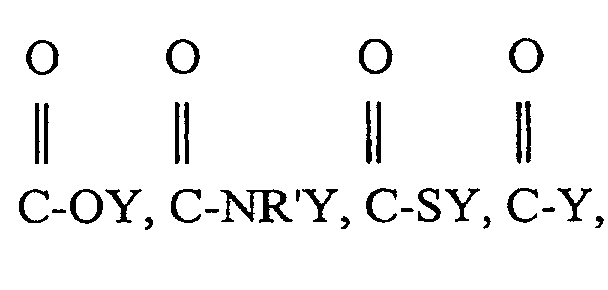
Y eine geeignete funktionelle Gruppe eines Proteins, eines Peptids, eines Enzyms, eines Antikörpers, eines Nucleotids, eines Oligonucleotids, eines Antigens oder eines Enzymsubstrats, Enzymhemmers oder eines Analogons des Übergangszustandes eines Enzymsubstrats ist oder ausgewählt ist aus R'-OH, R'NH2, R'SH, R'CHO, R'CN, R'X, R'SiR'3, R'Si(OR')yR'3-y, R'Si(O-SiR'2)OR', R'-R", R'-N-CO, (C2H4O)wH, (C3H6O)wH, (C2H4O)w-R', (C3H6O)wR' oder R';
w eine ganze Zahl von mehr als 1 und weniger als 200 darstellt;
y, R', R", X und Z der vorstehenden Definition entsprechen;
wenn B R'-R ist, R' und R der vorstehenden Definition entsprechen;
wenn B R'-A ist, R' und A der vorstehenden Definition entsprechen;
wenn B X'-Ra ist, R der vorstehenden Definition entspricht,
und X' eine polynukleare aromatische, polyheteronukleare aromatische oder metallopolyheteronukleare aromatische Einheit ist, und
wenn B X'-Aa ist, X' und A der vorstehenden Definition entsprechen. - Zusammensetzung nach Anspruch 1, in der B R ist, jedes R gleich ist und ausgewählt ist aus SO3H; COOH, NH2, OH, R'CHOH, CHO, CN, COCl, X, COSH, SH, COOR', SR', SiR'3, Si(OR')yR'3-y, Si(O-SiR'2)OR', R", Li, AlR'2, Hg-X, TlZ2 und Mg-X.
- Zusammensetzung nach Anspruch 1 oder 2, in der Cn Oberflächenkohlenstoffatome einer im Wesentlichen zylindrischen, graphitischen Fibrille darstellt, die im Wesentlichen frei von pyrolytisch abgeschiedenem Kohlenstoff ist, wobei die Fibrille zylindrische graphitische Flächengebilde umfasst, deren c-Achsen im Wesentlichen senkrecht zu ihrer zylindrischen Achse liegen und der Außendurchmesser der Fibrillen weniger als 0,1 µm beträgt.
- Zusammensetzung nach Anspruch 1, 2 oder 3, in der dann, wenn B X'-Ra oder X'-Aa ist, X' Phthalocyanin oder Porphyrin ist.
- Zusammensetzung nach einem der vorstehenden Ansprüche, in der die fünktionalisierten Fibrillen gleichmäßig mit einer fünktionellen Gruppe substituiert sind, wobei die fünktionelle Gruppe Carboxyl ist.
- Stoffzusammensetzung der Formel
- Verfahren zur Herstellung einer funktionalisierte Fibrillen umfassenden Zusammensetzung der Formel
- Verfahren zur Herstellung einer Stoffzusammensetzung der Formeldie Umsetzung einer Zusammensetzung, die funktionalisierte Fibrillen [F.F] der Formel [CnHL]Rm, [CmHL]-[R'-R]m oder [CnHL][X'-Ra]m umfasst, mit mindestens einem geeigneten Reagenz zur Herstellung einer Zusammensetzung der Formel [CnHL]B'm, wobei [CnHL]Rm, [CnHL]-[R'-R]m oder [CnHL][X'-Ra]m der Definition von Anspruch 1 oder 2 entsprechen.
- Verfahren zur Herstellung einer Stoffzusammensetzung der Formeldie Umsetzung einer Zusammensetzung, die funktionalisierte Fibrillen [F.F] der Formel [CnHL]Rm umfasst, mit mindestens einem geeigneten Reagenz zur Herstellung einer Zusammensetzung der Formel [CnHL]Am, wobei [CnHL]Rm der Definition von Anspruch 1 oder 2 entspricht.
- Verfahren nach Anspruch 8 oder 9, bei dem dann, wenn B' A ist, die Zusammensetzung der Formel [CnHL]Rm durch Umsetzen von Kohlenstoffatomen mit mindestens einem Reagenz unter zur Herstellung funktionalisierter Fibrillen der Formel [CnHL]Rm ausreichenden Bedingungen hergestellt wird.
- Verfahren nach Anspruch 8, bei dem dann, wenn B' (R'-A) ist, die Zusammensetzung mit funktionalisierten Fibrillen der Formel [CnHL] [R'-R]m durchhergestellt wird.(a) Desoxidieren der graphitischen Fibrillen unter zur Bildung desoxidierter Fibrillen ausreichenden Bedingungen und(b) Umsetzen der desoxidierten Nanoröhrchen mit mindestens einem geeigneten aktivierten Olefin unter zur Bildung funktionalisierter Fibrillen der Formel [CnHL][R'-R]m ausreichenden Bedingungen
- Verfahren nach Anspruch 8, das außerdem die Umsetzung der funktionalisierten Fibrillen der Formel [CnHL][R'-R]m mit mindestens einem geeigneten Reagenz zur Herstellung funktionalisierter Fibrillen der Formel [CnHL][R'-A]m, umfasst.
- Verfahren nach Anspruch 8, bei dem B' X'-Aa ist und die Zusammensetzung [CnHL] [X'-Ra]m durch Adsorbieren mindestens einer geeigneten makrocyclischen Verbindung auf der Oberfläche des graphitischen Nanoröhrchens unter zur Herstellung eines funktionalisierten Nanoröhrchens der Formel [CnHL]-[X'-Rz]m ausreichenden Bedingungen hergestellt wird.
- Verfahren nach Anspruch 13, bei dem die Oberflächenkohlenstoffatome solche von graphitischen Nanoröhrchen sind, die vor dem Schritt der Adsorption auf die Oberflächenkohlenstoffe in einem Medium dispergiert werden.
- Verfahren nach einem der Ansprüche 7 oder 10, bei dem die Oberflächenkohlenstoffatome solche von graphitischen Nanoröhrchen sind, die vor dem Schritt der Umsetzung der Oberflächenatome in einem Medium dispergiert werden.
- Verfahren nach Anspruch 8, 9, 10, 12 und 13, bei dem die substituierten Nanoröhrchen vor dem Schritt der Umsetzung der substituierten Nanoröhrchen mit dem Reagenz in einem Medium dispergiert werden.
- Verfahren nach Anspruch 7 oder 10, bei dem der Schritt der Umsetzung der Oberflächenkohlenstoffe die Sulfonierung der Oberflächenkohlenstoffe oder Metallisierung der Oberflächenkohlenstoffe mit einem organometallischen Reagenz umfasst.
- Verfahren nach Anspruch 9 oder 10, bei dem die Fibrille zylindrische graphitische Flächengebilde umfasst, deren c-Achsen im Wesentlichen senkrecht zu ihrer zylindrischen Achse liegen und der äußere Durchmesser der Fibrillen weniger als 0,1 µm beträgt.
- Verfahren nach Anspruch 9 oder 10, bei dem sich der Vorsprung der Graphitschichten oder der Nanoröhrchen über eine Entfernung von mindestens zwei Nanoröhrchendurchmessern erstreckt.
- Verfahren nach Anspruch 9 oder 10, bei dem die Kohlenstoffatome Cn Oberflächenatome einer Fischgrätenfibrille sind.
- Verfahren nach Anspruch 8 zur Einführung funktioneller Gruppen auf der Oberfläche von Kohlenstoffnanoröhrchen, bei dem die Kohlenstoffatome Cn Oberflächenatome eines im Wesentlichen zylindrischen, graphitischen Nanoröhrchens sind, das im Wesentlichen frei von pyrolytisch abgeschiedenem Kohlenstoff ist, wobei B' A ist und [CnHL]-B' durch folgende Schritte hergestellt wird.(a) In-Kontakt-Bringen der Kohlenstofffibrillen mit Oxidationsmitteln, einschließend eine Lösung eines Alkalimetallchlorats in einer starken Säure, für einen ausreichend langen Zeitraum, um die Oberfläche der Fibrillen zu oxidieren, und(b) In-Kontakt-Bringen der an der Oberfläche oxidierten Kohlenstofffibrillen mit Reaktanten, die sich zum Einführen einer fünktionellen Gruppe auf der Oberfläche der Kohlenstofffibrillen eignen.
- Verfahren nach Anspruch 21, bei dem die Kohlenstofffibrillen vor dem Kontakt mit Oxidationsmitteln behandelt werden.
- Verfahren nach Anspruch 22, bei dem die Behandlung das Dispergieren der Kohlenstofffibrillen in einem Lösungsmittel gefolgt von Filtrieren und Trocknen umfasst.
- Verfahren nach Anspruch 22, bei dem das Alkalimetallchlorat Natriumchlorat oder Kaliumchlorat ist, die starke Säure Schwefelsäure ist und die den auf der Oberfläche oxidierten Fibrillen eingeführte funktionelle Gruppe aus Alkylsilan oder Arylsilan, einer langkettigen Alkylgruppe oder Aralkylgruppe oder einer langkettigen Hydroxylgruppe, einer langkettigen Amingruppe oder einem Fluorkohlenstoff ausgewählt wird.
- Verfahren nach Anspruch 22, bei dem der für die Oxidation ausreichende Zeitraum zwischen 0,5 und 24 Stunden beträgt.
- Netzwerk aus funktionalisierten Fibrillen, das mindestens zwei funktionalisierte Fibrillen wie in Anspruch 1 definiert umfasst, wobei die funktionalisierten Fibrillen an fünktionellen Gruppen entweder durch eine oder mehrere Direktbindungen oder mindestens eine Linkerkomponente verbunden sind, wobei die Linkerkomponente entweder bifunktionell oder polyfünktionell ist.
- Verfahren zur Herstellung des Netzwerks von Anspruch 26, umfassend das In-Kontakt-Bringen von Kohlenstofffibrillen mit einem starken Oxidationsmittel für einen ausreichend langen Zeitraum, um die Oberfläche der Kohlenstofffibrillen zu oxidieren, und das In-Kontakt-Bringen der an der Oberfläche oxidierten Fibrillen mit einer Menge eines Vernetzungsmittels, um ein Netzwerk aus Kohlenstofffibrillen herzustellen, wobei das starke Oxidationsmittel ein Alkalimetallchlorat oder Salpetersäure und das Vernetzungsmittel ein Polyol oder Polyamin ist.
- Verfahren nach Anspruch 27, umfassend außerdem den Schritt des In-Kontakt-Bringens der an der Oberfläche oxidierten Fibrillen mit einem geeigneten Reaktanten zum Anfügen einer funktionellen Gruppe an die Oberfläche der Fibrillen vor dem Schritt des In-Kontakt-Bringens der Fibrillen mit einer Menge an Vernetzungsmittel, wobei das Vemetzungsmittel ein Diol oder Diamin ist.
- Verfahren zur Herstellung der Stoffzusammensetzung von Anspruch 28, das das Umsetzen von mindestens zwei funktionalisierten Fibrillen mit einer eine bifunktionelle oder polyfunktionelle Einheit umfassenden Linkerkomponente umfasst.
- Elektrode, die die Zusammensetzung funktionalisierter Fibrillen von Anspruch 1 umfasst, wobei die funktionalisierten Nanoröhrchen mit Phthalocyanin substituiert sind.
- Verfahren zur gleichmäßigen Substitution der Oberfläche von Kohlenstofffibrillen mit einer funktionellen Gruppe, umfassend das In-Kontakt-Bringen der Kohlenstofffibrillen mit einer effektiven Menge eines Reaktanten, der in der Lage ist, eine funktionelle Gruppe gleichmäßig auf die Oberfläche der Kohlenstofffibrillen zu substituieren, wobei der Reaktant aus funktionalisiertem Porphyrin, Phthalocyanin oder Cobaltphthalocyanin ausgewählt wird und wobei die funktionelle Gruppe Carboxyl ist.
- Verstärktes Keramikmaterial, das die Zusammensetzung von Anspruch 1 umfasst, wobei die funktionalisierten Fibrillen in einem keramischen Matrixmaterial dispergiert sind.
- Verfahren zur Herstellung des verstärkten Keramikmaterials von Anspruch 32, das das Dispergieren eines funktionalisierten Nanoröhrchens in einer wässrigen Lösung, die einen hydrolysierbaren Vorläufer eines keramischen Matrixmaterials enthält, und das Umwandeln des hydrolysierbaren Vorläufers in ein verstärktes Keramikmaterial umfasst.
- Sol/Gel-Material, das die funktionalisierten Fibrillen von Anspruch 1 umfasst.
- Poröses Material, das eine Vielzahl funktionalisierter Fibrillennetzwerke wie in Anspruch 6 oder Anspruch 26 definiert umfasst.
- Absorptionsmaterial, das das durch das Verfahren von Anspruch 33 erhaltene poröse Material umfasst.
- Katalysatorträgermaterial, das das durch das Verfahren von Anspruch 33 erhaltene poröse Material umfasst.
- Chromatographiemedienmaterial, das das durch das Verfahren von Anspruch 33 erhaltene poröse Material umfasst.
- Verfahren zur Herstellung einer Stoffzusammensetzung der Formel
L eine Zahl von weniger als 0,1n ist; m eine Zahl von weniger als 0,5n ist; a 0 oder eine ganze Zahl von weniger als 10 ist; jedes R aus SO3H; COOH, NH2, OH, CHO, CN, COCl, Halogenid, COSH, SH, COOR', SR', SiR'3, Si(OR')yR'3-y,
Si(O-SiR'2)OR', R", Li, AlR'2, Hg-X, TlZ2 und Mg-X ausgewählt ist; y eine ganze Zahl von 3 oder weniger ist; R' Alkyl, Aryl, Cycloalkyl, Aralkyl oder Cycloaryl ist; X ein Halogenid ist, X' eine polynukleare aromatische, polyheteronukleare aromatische oder metallopolyheteronukleare aromatische Komponente ist, R" ein Fluoralkyl, Fluoraryl, Fluorcycloalkyl oder Fluoraralkyl ist; und z Carboxylat oder Trifluoracetat ist,
umfassend die Schritte
Adsorbieren mindestens einer geeigneten makrocyclischen Verbindung auf der Oberfläche des graphitischen Nanoröhrchens unter zur Herstellung eines funktionalisierten Nanoröhrchens der Formel [CnHL]-[X'-Ra]m ausreichenden Bedingungen. - An der Oberfläche funktionalisierte Kohlenstofffibrille, hergestellt durch das Verfahren, das die Schritte umfasst:In-Kontakt-Bringen von Kohlenstofffibrillen mit einer effektiven Menge eines starken Oxidationsmittels für einen ausreichend langen Zeitraum, um die Oberfläche der Fibrillen zu oxidieren, sowie außerdem In-Kontakt-Bringen der Fibrillen mit einem Reaktanten, der sich zum Anfügen einer fünktionellen Gruppe an die Oberfläche der Fibrillen eignet.
Applications Claiming Priority (3)
| Application Number | Priority Date | Filing Date | Title |
|---|---|---|---|
| US08/352,400 US6203814B1 (en) | 1994-12-08 | 1994-12-08 | Method of making functionalized nanotubes |
| US352400 | 1994-12-08 | ||
| PCT/US1995/016159 WO1996018059A1 (en) | 1994-12-08 | 1995-12-08 | Functionalized fibrils |
Publications (3)
| Publication Number | Publication Date |
|---|---|
| EP0796403A1 EP0796403A1 (de) | 1997-09-24 |
| EP0796403A4 EP0796403A4 (de) | 1998-04-22 |
| EP0796403B1 true EP0796403B1 (de) | 2003-10-29 |
Family
ID=23384980
Family Applications (1)
| Application Number | Title | Priority Date | Filing Date |
|---|---|---|---|
| EP19950944093 Expired - Lifetime EP0796403B1 (de) | 1994-12-08 | 1995-12-08 | Funktionalisierte nanoröhre |
Country Status (10)
| Country | Link |
|---|---|
| US (2) | US6203814B1 (de) |
| EP (1) | EP0796403B1 (de) |
| JP (1) | JP4601086B2 (de) |
| KR (1) | KR100263027B1 (de) |
| AT (1) | ATE253193T1 (de) |
| AU (1) | AU707522B2 (de) |
| CA (1) | CA2207282C (de) |
| DE (1) | DE69532044T2 (de) |
| ES (1) | ES2210324T3 (de) |
| WO (1) | WO1996018059A1 (de) |
Cited By (1)
| Publication number | Priority date | Publication date | Assignee | Title |
|---|---|---|---|---|
| US8398234B2 (en) | 2011-05-03 | 2013-03-19 | Kimberly-Clark Worldwide, Inc. | Electro-thermal antifog optical devices |
Families Citing this family (274)
| Publication number | Priority date | Publication date | Assignee | Title |
|---|---|---|---|---|
| US5866434A (en) * | 1994-12-08 | 1999-02-02 | Meso Scale Technology | Graphitic nanotubes in luminescence assays |
| US6207369B1 (en) * | 1995-03-10 | 2001-03-27 | Meso Scale Technologies, Llc | Multi-array, multi-specific electrochemiluminescence testing |
| ATE241576T1 (de) * | 1995-03-31 | 2003-06-15 | Hyperion Catalysis Int | Carbid-nanofibrillen und verfahren zum herstellen derselben |
| US6183714B1 (en) | 1995-09-08 | 2001-02-06 | Rice University | Method of making ropes of single-wall carbon nanotubes |
| US7338915B1 (en) | 1995-09-08 | 2008-03-04 | Rice University | Ropes of single-wall carbon nanotubes and compositions thereof |
| WO1998005920A1 (en) * | 1996-08-08 | 1998-02-12 | William Marsh Rice University | Macroscopically manipulable nanoscale devices made from nanotube assemblies |
| US6344271B1 (en) * | 1998-11-06 | 2002-02-05 | Nanoenergy Corporation | Materials and products using nanostructured non-stoichiometric substances |
| US6700550B2 (en) * | 1997-01-16 | 2004-03-02 | Ambit Corporation | Optical antenna array for harmonic generation, mixing and signal amplification |
| ATE299474T1 (de) * | 1997-03-07 | 2005-07-15 | Univ Rice William M | Kohlenstofffasern ausgehend von einwandigen kohlenstoffnanoröhren |
| US6683783B1 (en) | 1997-03-07 | 2004-01-27 | William Marsh Rice University | Carbon fibers formed from single-wall carbon nanotubes |
| US20080063585A1 (en) * | 1997-03-07 | 2008-03-13 | William Marsh Rice University, A Texas University | Fullerene nanotube compositions |
| WO1999056870A1 (en) * | 1998-05-01 | 1999-11-11 | Osaka Gas Company Limited | Gas-occluding material and method for occluding gas |
| US6426134B1 (en) * | 1998-06-30 | 2002-07-30 | E. I. Du Pont De Nemours And Company | Single-wall carbon nanotube-polymer composites |
| US6346189B1 (en) * | 1998-08-14 | 2002-02-12 | The Board Of Trustees Of The Leland Stanford Junior University | Carbon nanotube structures made using catalyst islands |
| DE69941294D1 (de) | 1998-09-18 | 2009-10-01 | Univ Rice William M | Chemische derivatisierung von einwandigen kohlenstoffnanoröhren um ihre solvatation zu erleichtern und verwendung derivatisierter nanoröhren |
| US6835366B1 (en) | 1998-09-18 | 2004-12-28 | William Marsh Rice University | Chemical derivatization of single-wall carbon nanotubes to facilitate solvation thereof, and use of derivatized nanotubes |
| US6531513B2 (en) * | 1998-10-02 | 2003-03-11 | University Of Kentucky Research Foundation | Method of solubilizing carbon nanotubes in organic solutions |
| WO2000041808A1 (en) * | 1999-01-12 | 2000-07-20 | Hyperion Catalysis International, Inc. | Carbide and oxycarbide based compositions and nanorods |
| US6936565B2 (en) | 1999-01-12 | 2005-08-30 | Hyperion Catalysis International, Inc. | Modified carbide and oxycarbide containing catalysts and methods of making and using thereof |
| US6809229B2 (en) * | 1999-01-12 | 2004-10-26 | Hyperion Catalysis International, Inc. | Method of using carbide and/or oxycarbide containing compositions |
| EP1920837A3 (de) | 1999-01-12 | 2008-11-19 | Hyperion Catalysis International, Inc. | Zusammensetzungen und Nanostäbchen auf der Basis von Carbid und Oxycarbid |
| US20030073250A1 (en) * | 1999-05-21 | 2003-04-17 | Eric Henderson | Method and apparatus for solid state molecular analysis |
| US20020042081A1 (en) * | 2000-10-10 | 2002-04-11 | Eric Henderson | Evaluating binding affinities by force stratification and force panning |
| US6573369B2 (en) * | 1999-05-21 | 2003-06-03 | Bioforce Nanosciences, Inc. | Method and apparatus for solid state molecular analysis |
| US20030186311A1 (en) * | 1999-05-21 | 2003-10-02 | Bioforce Nanosciences, Inc. | Parallel analysis of molecular interactions |
| AU6078700A (en) * | 1999-07-21 | 2001-02-13 | Hyperion Catalysis International, Inc. | Methods of oxidizing multiwalled carbon nanotubes |
| JP4773019B2 (ja) | 1999-11-08 | 2011-09-14 | ユニバーシティ オブ フロリダ リサーチ ファンデーション インコーポレーティッド | 薬物の服薬遵守を監視するためのマーカー検出の方法および器具 |
| US6974706B1 (en) | 2003-01-16 | 2005-12-13 | University Of Florida Research Foundation, Inc. | Application of biosensors for diagnosis and treatment of disease |
| US20050233459A1 (en) * | 2003-11-26 | 2005-10-20 | Melker Richard J | Marker detection method and apparatus to monitor drug compliance |
| US20050037374A1 (en) * | 1999-11-08 | 2005-02-17 | Melker Richard J. | Combined nanotechnology and sensor technologies for simultaneous diagnosis and treatment |
| CA2394955C (en) * | 1999-12-07 | 2010-01-26 | William Marsh Rice University | Oriented nanofibers embedded in polymer matrix |
| US20040146918A1 (en) * | 2000-02-18 | 2004-07-29 | Weiner Michael L. | Hybrid nucleic acid assembly |
| US6897015B2 (en) * | 2000-03-07 | 2005-05-24 | Bioforce Nanosciences, Inc. | Device and method of use for detection and characterization of pathogens and biological materials |
| US6649715B1 (en) | 2000-06-27 | 2003-11-18 | Clemson University | Fluoropolymers and methods of applying fluoropolymers in molding processes |
| US6709566B2 (en) | 2000-07-25 | 2004-03-23 | The Regents Of The University Of California | Method for shaping a nanotube and a nanotube shaped thereby |
| DE10038124B4 (de) * | 2000-08-04 | 2006-05-11 | Infineon Technologies Ag | Verwendung einer mehrwandigen Nanoröhre auf einem Substrat und als elektronisches Bauelement |
| US7008769B2 (en) * | 2000-08-15 | 2006-03-07 | Bioforce Nanosciences, Inc. | Nanoscale molecular arrayer |
| WO2002039051A2 (en) * | 2000-08-23 | 2002-05-16 | Cynthia A Kuper | METHOD FOR UTILIZING SOL-GEL PROCESSING IN THE PRODUCTION OF A MACROSCOPIC TWO OR THREE DIMENSIONALLY ORDERED ARRAY OF SINGLE WALL NANOTUBES (SWNTs) |
| US6716409B2 (en) | 2000-09-18 | 2004-04-06 | President And Fellows Of The Harvard College | Fabrication of nanotube microscopy tips |
| AU2001294876A1 (en) | 2000-09-29 | 2002-04-08 | President And Fellows Of Harvard College | Direct growth of nanotubes, and their use in nanotweezers |
| US20050054942A1 (en) | 2002-01-22 | 2005-03-10 | Melker Richard J. | System and method for therapeutic drug monitoring |
| US6981947B2 (en) * | 2002-01-22 | 2006-01-03 | University Of Florida Research Foundation, Inc. | Method and apparatus for monitoring respiratory gases during anesthesia |
| US7104963B2 (en) * | 2002-01-22 | 2006-09-12 | University Of Florida Research Foundation, Inc. | Method and apparatus for monitoring intravenous (IV) drug concentration using exhaled breath |
| US7022420B1 (en) | 2000-11-27 | 2006-04-04 | The United States Of America As Represented By The Secretary Of The Army | Assembled hematin, method for forming same and method for polymerizing aromatic monomers using same |
| GB2389847B (en) * | 2001-01-29 | 2005-08-10 | Univ Rice William M | Process for derivatizing carbon nanotubes with diazonium species and compositions thereof |
| GB2411169B (en) * | 2001-01-29 | 2005-10-26 | Univ Rice William M | Process for derivatizing carbon nanotubes with diazonium species and compositions thereof |
| US7250147B2 (en) | 2001-01-29 | 2007-07-31 | Tour James M | Process for derivatizing carbon nanotubes with diazonium species |
| US7265174B2 (en) * | 2001-03-22 | 2007-09-04 | Clemson University | Halogen containing-polymer nanocomposite compositions, methods, and products employing such compositions |
| US6723299B1 (en) | 2001-05-17 | 2004-04-20 | Zyvex Corporation | System and method for manipulating nanotubes |
| EP1405067A2 (de) * | 2001-05-23 | 2004-04-07 | University Of Florida | Verfahren und vorrichtung zum nachweis illegaler substanzen |
| US7052854B2 (en) * | 2001-05-23 | 2006-05-30 | University Of Florida Research Foundation, Inc. | Application of nanotechnology and sensor technologies for ex-vivo diagnostics |
| EP1393069A1 (de) * | 2001-05-24 | 2004-03-03 | The University Of Florida | Verfahren und vorrichtung zur rauchaussetzungfeststellung |
| US20080067123A1 (en) * | 2001-06-01 | 2008-03-20 | Burrington James D | Substrates With Modified Carbon Surfaces |
| US20040184982A1 (en) * | 2001-06-12 | 2004-09-23 | Burrington James D. | Substrates with modified carbon surfaces |
| WO2002098991A1 (en) * | 2001-06-01 | 2002-12-12 | The Lubrizol Corporation | Substrates with modified carbon surfaces |
| US20020197474A1 (en) * | 2001-06-06 | 2002-12-26 | Reynolds Thomas A. | Functionalized fullerenes, their method of manufacture and uses thereof |
| US20070116422A1 (en) * | 2001-06-06 | 2007-05-24 | Reynolds Thomas A | Photoresponsive polyimide based fiber |
| WO2003084865A2 (en) * | 2001-06-14 | 2003-10-16 | Hyperion Catalysis International, Inc. | Field emission devices using modified carbon nanotubes |
| WO2003107359A1 (en) | 2002-06-14 | 2003-12-24 | Hyperion Catalysis International, Inc. | Electroconductive carbon fibril-based inks and coatings |
| JP2003017508A (ja) * | 2001-07-05 | 2003-01-17 | Nec Corp | 電界効果トランジスタ |
| US7288238B2 (en) * | 2001-07-06 | 2007-10-30 | William Marsh Rice University | Single-wall carbon nanotube alewives, process for making, and compositions thereof |
| US7125502B2 (en) * | 2001-07-06 | 2006-10-24 | William Marsh Rice University | Fibers of aligned single-wall carbon nanotubes and process for making the same |
| US6896864B2 (en) * | 2001-07-10 | 2005-05-24 | Battelle Memorial Institute | Spatial localization of dispersed single walled carbon nanotubes into useful structures |
| AU2002329606A1 (en) * | 2001-07-17 | 2003-03-03 | Bioforce Nanosciences, Inc. | Combined molecular blinding detection through force microscopy and mass spectrometry |
| US6924538B2 (en) * | 2001-07-25 | 2005-08-02 | Nantero, Inc. | Devices having vertically-disposed nanofabric articles and methods of making the same |
| US6574130B2 (en) * | 2001-07-25 | 2003-06-03 | Nantero, Inc. | Hybrid circuit having nanotube electromechanical memory |
| US6911682B2 (en) | 2001-12-28 | 2005-06-28 | Nantero, Inc. | Electromechanical three-trace junction devices |
| US6835591B2 (en) * | 2001-07-25 | 2004-12-28 | Nantero, Inc. | Methods of nanotube films and articles |
| US7566478B2 (en) * | 2001-07-25 | 2009-07-28 | Nantero, Inc. | Methods of making carbon nanotube films, layers, fabrics, ribbons, elements and articles |
| US6706402B2 (en) | 2001-07-25 | 2004-03-16 | Nantero, Inc. | Nanotube films and articles |
| US6919592B2 (en) | 2001-07-25 | 2005-07-19 | Nantero, Inc. | Electromechanical memory array using nanotube ribbons and method for making same |
| US7259410B2 (en) * | 2001-07-25 | 2007-08-21 | Nantero, Inc. | Devices having horizontally-disposed nanofabric articles and methods of making the same |
| US6643165B2 (en) | 2001-07-25 | 2003-11-04 | Nantero, Inc. | Electromechanical memory having cell selection circuitry constructed with nanotube technology |
| KR100455284B1 (ko) * | 2001-08-14 | 2004-11-12 | 삼성전자주식회사 | 탄소나노튜브를 이용한 고용량의 바이오분자 검출센서 |
| DE60229955D1 (de) * | 2001-08-29 | 2009-01-02 | Georgia Tech Res Inst | Zusammensetzungen, welche stäbchenförmige polymere und nanoröhrenförmige strukturen umfassen, sowie verfahren zur herstellung derselben |
| US6953653B2 (en) | 2001-08-30 | 2005-10-11 | Clemson University | Fluoropolymer compositions, optical devices, and methods for fabricating optical devices |
| US7042488B2 (en) | 2001-09-27 | 2006-05-09 | Fujinon Corporation | Electronic endoscope for highlighting blood vessel |
| US6875417B1 (en) | 2001-10-24 | 2005-04-05 | University Of Kentucky Research Foundation | Catalytic conversion of hydrocarbons to hydrogen and high-value carbon |
| EP1449222B1 (de) * | 2001-10-29 | 2011-08-31 | Hyperion Catalysis International, Inc. | Polymer mit funktionalisierten kohlenstoff-nanoröhren |
| EP1456124A4 (de) * | 2001-11-20 | 2009-01-28 | Univ Wm Marsh Rice | Beschichtete fullrene und daraus hergestellte verbundwerkstoffe und dielektrika |
| US20030124717A1 (en) * | 2001-11-26 | 2003-07-03 | Yuji Awano | Method of manufacturing carbon cylindrical structures and biopolymer detection device |
| US6965513B2 (en) * | 2001-12-20 | 2005-11-15 | Intel Corporation | Carbon nanotube thermal interface structures |
| US6784028B2 (en) | 2001-12-28 | 2004-08-31 | Nantero, Inc. | Methods of making electromechanical three-trace junction devices |
| US7176505B2 (en) * | 2001-12-28 | 2007-02-13 | Nantero, Inc. | Electromechanical three-trace junction devices |
| US20070167853A1 (en) * | 2002-01-22 | 2007-07-19 | Melker Richard J | System and method for monitoring health using exhaled breath |
| US20030148289A1 (en) * | 2002-02-04 | 2003-08-07 | Intel Corporation | Modified carbon nanotubes as molecular labels with application to DNA sequencing |
| US20040166152A1 (en) * | 2002-02-14 | 2004-08-26 | Andreas Hirsch | Use of buckysome or carbon nanotube for drug delivery |
| US20080193490A1 (en) * | 2002-02-14 | 2008-08-14 | Andreas Hirsch | Use of Carbon Nanotube for Drug Delivery |
| US20040022981A1 (en) * | 2002-04-01 | 2004-02-05 | Carbon Nanotechnologies, Inc. | Composite of single-wall carbon nanotubes and aromatic polyamide and process for making the same |
| US7335395B2 (en) * | 2002-04-23 | 2008-02-26 | Nantero, Inc. | Methods of using pre-formed nanotubes to make carbon nanotube films, layers, fabrics, ribbons, elements and articles |
| US6905667B1 (en) * | 2002-05-02 | 2005-06-14 | Zyvex Corporation | Polymer and method for using the polymer for noncovalently functionalizing nanotubes |
| US20040034177A1 (en) | 2002-05-02 | 2004-02-19 | Jian Chen | Polymer and method for using the polymer for solubilizing nanotubes |
| US20050239193A1 (en) * | 2002-05-30 | 2005-10-27 | Bioforce Nanosciences, Inc. | Device and method of use for detection and characterization of microorganisms and microparticles |
| WO2003106655A2 (en) * | 2002-06-18 | 2003-12-24 | The University Of Akron | Fibrous protein-immobilization systems |
| US6856016B2 (en) | 2002-07-02 | 2005-02-15 | Intel Corp | Method and apparatus using nanotubes for cooling and grounding die |
| US20040007528A1 (en) * | 2002-07-03 | 2004-01-15 | The Regents Of The University Of California | Intertwined, free-standing carbon nanotube mesh for use as separation, concentration, and/or filtration medium |
| US7290667B1 (en) | 2002-07-03 | 2007-11-06 | The Regents Of The University Of California | Microfluidic sieve using intertwined, free-standing carbon nanotube mesh as active medium |
| WO2004007364A1 (en) * | 2002-07-16 | 2004-01-22 | William Marsh Rice University | Process for functionalizing carbon nanotubes under solvent-free conditions |
| JP2005535075A (ja) * | 2002-07-30 | 2005-11-17 | ポステック・ファウンデーション | 陽極酸化工程を用いて製造された3極構造を有する電界放出素子及びその製造方法 |
| US7530257B2 (en) * | 2002-09-27 | 2009-05-12 | Honeywell International Inc. | Phased micro analyzer VIII |
| US20040240152A1 (en) * | 2003-05-30 | 2004-12-02 | Schott Joachim Hossick | Capacitor and method for producing a capacitor |
| US7079377B2 (en) * | 2002-09-30 | 2006-07-18 | Joachim Hossick Schott | Capacitor and method for producing a capacitor |
| US20060160134A1 (en) * | 2002-10-21 | 2006-07-20 | Melker Richard J | Novel application of biosensors for diagnosis and treatment of disease |
| US20050045867A1 (en) * | 2002-10-30 | 2005-03-03 | Ozkan Cengiz S. | Nanoscale heterojunctions and methods of making and using thereof |
| WO2004109837A2 (en) * | 2002-10-31 | 2004-12-16 | Carbon Nanotechnologies, Inc. | Fuel cell electrode comprising carbon nanotubes |
| EP1563545B1 (de) | 2002-11-19 | 2010-10-27 | William Marsh Rice University | Feldeffektransistor mit funktionalisierter Kohlenstoffnanoröhre und dessen Herstellungsfervahren |
| WO2004046023A2 (en) * | 2002-11-19 | 2004-06-03 | William Marsh Rice University | Fabrication of light emitting film coated fullerenes and their application for in-vivo light emission |
| US7407640B2 (en) | 2002-11-27 | 2008-08-05 | William Marsh Rice University | Functionalized carbon nanotube-polymer composites and interactions with radiation |
| WO2004050554A1 (en) * | 2002-11-27 | 2004-06-17 | The Lubrizol Corporation | Substrates with modified carbon surfaces |
| JP3921533B2 (ja) * | 2002-12-04 | 2007-05-30 | 独立行政法人物質・材料研究機構 | 温度感知素子とその製造方法ならびにナノ温度計 |
| AU2003296082A1 (en) * | 2002-12-25 | 2004-07-22 | Fuji Xerox Co., Ltd. | Liquid mixture, structure, and method for forming structure |
| KR20050100367A (ko) * | 2003-01-02 | 2005-10-18 | 바이오포스 나노사이언스, 인크. | 소용적 샘플 내의 분자 분석용 방법 및 장치 |
| US7560136B2 (en) * | 2003-01-13 | 2009-07-14 | Nantero, Inc. | Methods of using thin metal layers to make carbon nanotube films, layers, fabrics, ribbons, elements and articles |
| US6833201B2 (en) * | 2003-01-31 | 2004-12-21 | Clemson University | Nanostructured-doped compound for use in an EL element |
| AU2003304085A1 (en) * | 2003-02-07 | 2004-11-26 | Wisconsin Alumni Research Foundation | Nanocylinder-modified surfaces |
| KR100947702B1 (ko) * | 2003-02-26 | 2010-03-16 | 삼성전자주식회사 | 경화성 작용기로 표면수식된 탄소나노튜브를 이용한패턴박막 형성방법 및 고분자 복합체의 제조방법 |
| US7419601B2 (en) * | 2003-03-07 | 2008-09-02 | Seldon Technologies, Llc | Nanomesh article and method of using the same for purifying fluids |
| ATE474658T1 (de) * | 2003-03-07 | 2010-08-15 | Seldon Technologies Llc | Reinigung von flüssigkeiten mit nanomaterialien |
| US20100098877A1 (en) * | 2003-03-07 | 2010-04-22 | Cooper Christopher H | Large scale manufacturing of nanostructured material |
| JP4005048B2 (ja) * | 2003-04-09 | 2007-11-07 | 日信工業株式会社 | 炭素繊維複合材料およびその製造方法 |
| AU2003224070A1 (en) * | 2003-04-14 | 2004-11-01 | Centre National De La Recherche Scientifique | Functionalized carbon nanotubes, a process for preparing the same and their use in medicinal chemistry |
| KR100827861B1 (ko) * | 2003-05-22 | 2008-05-07 | 지벡스 퍼포먼스 머티리얼즈, 엘엘씨 | 나노복합물 및 이의 제조 방법 |
| US6842328B2 (en) * | 2003-05-30 | 2005-01-11 | Joachim Hossick Schott | Capacitor and method for producing a capacitor |
| US7256982B2 (en) * | 2003-05-30 | 2007-08-14 | Philip Michael Lessner | Electrolytic capacitor |
| JP2004351034A (ja) | 2003-05-30 | 2004-12-16 | Kenji Onoda | 高強度ゴルフボール |
| EP1641974B2 (de) * | 2003-06-16 | 2015-05-27 | William Marsh Rice University | Seitenwandfunktionalisierung von carbonnanoröhrchen mit hydroxyterminierten moleküleinheiten |
| US7169329B2 (en) * | 2003-07-07 | 2007-01-30 | The Research Foundation Of State University Of New York | Carbon nanotube adducts and methods of making the same |
| US7025840B1 (en) * | 2003-07-15 | 2006-04-11 | Lockheed Martin Corporation | Explosive/energetic fullerenes |
| JP2005041835A (ja) * | 2003-07-24 | 2005-02-17 | Fuji Xerox Co Ltd | カーボンナノチューブ構造体、その製造方法、カーボンナノチューブ転写体および溶液 |
| JP2005045188A (ja) * | 2003-07-25 | 2005-02-17 | Fuji Xerox Co Ltd | 電子素子、集積回路およびその製造方法 |
| EP1660405B1 (de) * | 2003-07-28 | 2012-11-28 | William Marsh Rice University | Seitenwandfunktionalisierung von kohlenstoffnanoröhren mit organosilanen für polymerkomposite |
| WO2005052179A2 (en) * | 2003-08-13 | 2005-06-09 | The Johns Hopkins University | Method of making carbon nanotube arrays, and thermal interfaces using same |
| JP2005072209A (ja) * | 2003-08-22 | 2005-03-17 | Fuji Xerox Co Ltd | 抵抗素子、その製造方法およびサーミスタ |
| JP2005096024A (ja) * | 2003-09-24 | 2005-04-14 | Fuji Xerox Co Ltd | ワイヤとその製造方法および該ワイヤを用いた電磁石 |
| JP4449387B2 (ja) * | 2003-09-25 | 2010-04-14 | 富士ゼロックス株式会社 | 複合材の製造方法 |
| JP4380282B2 (ja) * | 2003-09-26 | 2009-12-09 | 富士ゼロックス株式会社 | カーボンナノチューブ複合構造体の製造方法 |
| WO2005044723A2 (en) * | 2003-10-16 | 2005-05-19 | The University Of Akron | Carbon nanotubes on carbon nanofiber substrate |
| JP2005125187A (ja) * | 2003-10-22 | 2005-05-19 | Fuji Xerox Co Ltd | ガス分解器、燃料電池用電極およびその製造方法 |
| US7093351B2 (en) * | 2003-12-30 | 2006-08-22 | Lockheed Martin Corporation | System, for matching harnesses of conductors with apertures in connectors |
| US20050191757A1 (en) * | 2004-01-20 | 2005-09-01 | Melker Richard J. | Method and apparatus for detecting humans and human remains |
| KR20120056900A (ko) | 2004-03-15 | 2012-06-04 | 캐보트 코포레이션 | 개질 탄소 제품 및 이의 응용 |
| RU2402584C2 (ru) * | 2004-03-15 | 2010-10-27 | Кабот Корпорейшн | Модифицированные углеродные продукты и их применение |
| US7537682B2 (en) * | 2004-03-17 | 2009-05-26 | California Institute Of Technology | Methods for purifying carbon materials |
| JP2005272184A (ja) | 2004-03-23 | 2005-10-06 | Honda Motor Co Ltd | 親水性カーボンナノチューブの製造方法 |
| US7611628B1 (en) | 2004-05-13 | 2009-11-03 | University Of Kentucky Research Foundation | Aligned nanotubule membranes |
| DE102004026576A1 (de) * | 2004-06-01 | 2005-12-29 | Infineon Technologies Ag | Silanisierte Kohlenstoff-Nanoröhren und Verfahren zur Herstellung derselben |
| WO2005123581A1 (en) * | 2004-06-09 | 2005-12-29 | University Of Florida Research | Ultralyophobe interfaces |
| WO2006130150A2 (en) * | 2004-06-23 | 2006-12-07 | Hyperion Catalysis International, Inc. | Functionalized single walled carbon nanotubes |
| JP2006008454A (ja) * | 2004-06-25 | 2006-01-12 | Fuji Xerox Co Ltd | 炭素微粒子構造体とその製造方法、およびこれを製造するための炭素微粒子転写体と炭素微粒子構造体製造用溶液、並びに炭素微粒子構造体を用いた炭素微粒子構造体電子素子とその製造方法、そして集積回路 |
| JP2006008861A (ja) * | 2004-06-25 | 2006-01-12 | Fuji Xerox Co Ltd | 電気部品用塗料、および塗布膜の形成方法 |
| CA2577065C (en) * | 2004-07-22 | 2015-02-03 | William Marsh Rice University | Polymer/carbon-nanotube interpenetrating networks and process for making same |
| US7296576B2 (en) | 2004-08-18 | 2007-11-20 | Zyvex Performance Materials, Llc | Polymers for enhanced solubility of nanomaterials, compositions and methods therefor |
| JP2008511741A (ja) * | 2004-08-31 | 2008-04-17 | ハイピリオン カタリシス インターナショナル インコーポレイテッド | 押出しによる導電性熱硬化性樹脂 |
| US7781756B2 (en) * | 2004-09-13 | 2010-08-24 | Board Of Trustees Of The University Of Arkansas | Nanotube-porphyrin molecular structure and applications of same |
| US20060062734A1 (en) * | 2004-09-20 | 2006-03-23 | Melker Richard J | Methods and systems for preventing diversion of prescription drugs |
| CA2584433A1 (en) * | 2004-10-22 | 2006-12-21 | Hyperion Catalysis International, Inc. | Improved ozonolysis of carbon nanotubes |
| WO2006060168A2 (en) * | 2004-11-16 | 2006-06-08 | Hyperion Catalysis International, Inc. | Method for preparing supported catalysts from metal loaded carbon nanotubes |
| US7923403B2 (en) * | 2004-11-16 | 2011-04-12 | Hyperion Catalysis International, Inc. | Method for preparing catalysts supported on carbon nanotubes networks |
| WO2006065431A2 (en) * | 2004-11-17 | 2006-06-22 | Hyperion Catalysis International, Inc. | Method for preparing catalyst supports and supported catalysts from single walled carbon nanotubes |
| ATE390562T1 (de) * | 2004-11-19 | 2008-04-15 | Ebm Papst St Georgen Gmbh & Co | Anordnung mit einem luefter und einer pumpe |
| JP2006167710A (ja) * | 2004-11-22 | 2006-06-29 | Nissin Kogyo Co Ltd | 薄膜の製造方法及び薄膜が形成された基材、電子放出材料及びその製造方法並びに電子放出装置 |
| EP1830902A2 (de) * | 2004-12-30 | 2007-09-12 | Cinvention Ag | Kombination aus einem mittel, das ein signal abgibt, implantatmaterial und arzeimittel |
| CA2591942A1 (en) * | 2005-01-13 | 2006-07-20 | Cinvention Ag | Composite materials containing carbon nanoparticles |
| WO2006077256A1 (en) * | 2005-01-24 | 2006-07-27 | Cinvention Ag | Metal containing composite materials |
| FR2882047B1 (fr) * | 2005-02-17 | 2007-10-19 | Arkema Sa | Procede de traitement des nanotubes de carbone |
| US20060188723A1 (en) * | 2005-02-22 | 2006-08-24 | Eastman Kodak Company | Coating compositions containing single wall carbon nanotubes |
| EA200702019A1 (ru) * | 2005-03-18 | 2008-02-28 | Синвеншен Аг | Способ изготовления пористых спечённых металлсодержащих материалов |
| US20060257883A1 (en) * | 2005-05-10 | 2006-11-16 | Bjoraker David G | Detection and measurement of hematological parameters characterizing cellular blood components |
| AU2006265193A1 (en) * | 2005-07-01 | 2007-01-11 | Cinvention Ag | Process for the production of porous reticulated composite materials |
| WO2007003516A2 (en) * | 2005-07-01 | 2007-01-11 | Cinvention Ag | Medical devices comprising a reticulated composite material |
| US7744793B2 (en) | 2005-09-06 | 2010-06-29 | Lemaire Alexander B | Apparatus and method for growing fullerene nanotube forests, and forming nanotube films, threads and composite structures therefrom |
| US7850778B2 (en) * | 2005-09-06 | 2010-12-14 | Lemaire Charles A | Apparatus and method for growing fullerene nanotube forests, and forming nanotube films, threads and composite structures therefrom |
| KR100700624B1 (ko) * | 2005-09-08 | 2007-03-27 | 금호석유화학 주식회사 | 니오디뮴-탄소나노튜브 합성과, 이를 이용한 고 1,4-시스폴리부타디엔 제조방법 |
| CN1304656C (zh) * | 2005-09-14 | 2007-03-14 | 东华大学 | 一种高取向碳纳米管复合纤维及其制备方法 |
| EP1924631A4 (de) * | 2005-09-16 | 2012-03-07 | Hyperion Catalysis Int | Leitfähiges silikon und verfahren zu dessen herstellung |
| US20070218364A1 (en) * | 2005-10-05 | 2007-09-20 | Whitacre Jay F | Low temperature electrochemical cell |
| US7794880B2 (en) | 2005-11-16 | 2010-09-14 | California Institute Of Technology | Fluorination of multi-layered carbon nanomaterials |
| US8232007B2 (en) | 2005-10-05 | 2012-07-31 | California Institute Of Technology | Electrochemistry of carbon subfluorides |
| US7563542B2 (en) * | 2005-10-05 | 2009-07-21 | California Institute Of Technology | Subfluorinated graphite fluorides as electrode materials |
| US20100221603A1 (en) * | 2006-03-03 | 2010-09-02 | Rachid Yazami | Lithium ion fluoride battery |
| US8377586B2 (en) | 2005-10-05 | 2013-02-19 | California Institute Of Technology | Fluoride ion electrochemical cell |
| KR100668357B1 (ko) * | 2005-10-07 | 2007-01-12 | 삼성에스디아이 주식회사 | 고분자 전해질막 및 이를 이용한 연료전지 |
| JP4611956B2 (ja) * | 2005-10-07 | 2011-01-12 | 三星エスディアイ株式会社 | 固体酸、高分子電解質膜および燃料電池 |
| JP2009511727A (ja) * | 2005-10-18 | 2009-03-19 | シンベンション アーゲー | 熱硬化粒子及びその製造方法 |
| EP1957406A4 (de) * | 2005-11-16 | 2012-11-07 | Hyperion Catalysis Int | Gemischte strukturen aus einzelwand- und mehrwand-kohlenstoffnanoröhrchen |
| US20100215724A1 (en) * | 2005-11-22 | 2010-08-26 | Mcgill University | Microcapsule Nanotube Devices for Targeted Delivery of Therapeutic Molecules |
| US7658870B2 (en) * | 2005-12-20 | 2010-02-09 | University Of Hawaii | Polymer matrix composites with nano-scale reinforcements |
| US8264137B2 (en) * | 2006-01-03 | 2012-09-11 | Samsung Electronics Co., Ltd. | Curing binder material for carbon nanotube electron emission cathodes |
| WO2007093725A2 (fr) * | 2006-02-13 | 2007-08-23 | Arkema France | Dispersions aqueuses comprenant des nanotubes de carbone, leur procédé de préparation et leur utilisation. |
| US7393699B2 (en) | 2006-06-12 | 2008-07-01 | Tran Bao Q | NANO-electronics |
| US7491376B2 (en) * | 2006-06-12 | 2009-02-17 | Newcyte, Inc. | Chemical derivatization of silica coated fullerenes and use of derivatized silica coated fullerenes |
| US7771696B2 (en) * | 2006-07-27 | 2010-08-10 | University Of Dayton | Nanocomposites and functionalized carbon nanofibers |
| US8658309B2 (en) * | 2006-08-11 | 2014-02-25 | California Institute Of Technology | Dissociating agents, formulations and methods providing enhanced solubility of fluorides |
| US7914460B2 (en) * | 2006-08-15 | 2011-03-29 | University Of Florida Research Foundation, Inc. | Condensate glucose analyzer |
| JP4062346B2 (ja) | 2006-08-17 | 2008-03-19 | 富士ゼロックス株式会社 | カーボンナノチューブ膜およびその製造方法、並びにそれを用いたキャパシタ |
| KR20080033780A (ko) * | 2006-10-13 | 2008-04-17 | 삼성전자주식회사 | 다성분계 탄소나노튜브-고분자 복합체, 이를 형성하기 위한조성물 및 그 제조방법 |
| FR2909676B1 (fr) * | 2006-12-11 | 2009-03-20 | Astrium Sas Soc Par Actions Si | Procede pour ameliorer l'adherence de fibres de carbone vis-a-vis d'une matrice organique |
| US8084167B2 (en) | 2007-01-24 | 2011-12-27 | Samsung Sdi Co., Ltd. | Nanocomposite for fuel cell, method of preparing the nanocomposite, and fuel cell including the nanocomposite |
| WO2008113023A1 (en) * | 2007-03-14 | 2008-09-18 | California Institute Of Technology | High discharge rate batteries |
| CN101808819A (zh) * | 2007-09-07 | 2010-08-18 | 无机专家公司 | 作为用于锂二次电池的阳极材料的硅改性纳米纤维纸 |
| US7666915B2 (en) | 2007-09-24 | 2010-02-23 | Headwaters Technology Innovation, Llc | Highly dispersible carbon nanospheres in a polar solvent and methods for making same |
| ES2409579T3 (es) | 2007-10-02 | 2013-06-27 | Hans-Henning Reis | Disco de ánodo giratorio de rayos X y procedimiento para su fabricación |
| US7858691B2 (en) * | 2007-10-09 | 2010-12-28 | Headwaters Technology Innovation, Llc | Functionalization of carbon nanoshperes by severe oxidative treatment |
| US20100196246A1 (en) * | 2007-10-09 | 2010-08-05 | Headwaters Technology Innovation, Llc | Methods for mitigating agglomeration of carbon nanospheres using a crystallizing dispersant |
| EP2062853A1 (de) | 2007-11-23 | 2009-05-27 | Nanoledge | Polymer-Kohlenstoffnanoröhrchen-Zusammensetzungen |
| FR2924133B1 (fr) * | 2007-11-26 | 2012-12-14 | Porcher Ind | Element de renfort longitudinal a base de fibres minerales ou organiques et son procede d'obtention |
| US20090200176A1 (en) * | 2008-02-07 | 2009-08-13 | Mccutchen Co. | Radial counterflow shear electrolysis |
| US20100105024A1 (en) * | 2008-01-14 | 2010-04-29 | Transgenex Nanobiotech, Inc. | Rapid test including genetic sequence probe |
| US20090181361A1 (en) * | 2008-01-14 | 2009-07-16 | Weidong Xu | Rapid test for detecting infection |
| US8852547B2 (en) * | 2008-01-25 | 2014-10-07 | Hyperion Catalysis International, Inc. | Processes for the recovery of catalytic metal and carbon nanotubes |
| JP5515261B2 (ja) * | 2008-07-24 | 2014-06-11 | 住友化学株式会社 | 組成物およびそれを用いた有機光電変換素子 |
| EP2151830A1 (de) | 2008-08-08 | 2010-02-10 | pp-mid GmbH | Polymerformkörper mit leitfähigen Strukturen auf der Oberfläche, sowie Verfahren zu dessen Herstellung |
| DE102008061051A1 (de) | 2008-12-08 | 2010-06-10 | Pp-Mid Gmbh | Leiterplatten-Anordnung und leitfähige Klebstoffe zum Verbinden von Bauteilen mit der Leiterplatte sowie Verfahren zu deren Herstellung |
| DE102009011538A1 (de) | 2009-03-03 | 2010-09-09 | Pp-Mid Gmbh | Leiterplatten-Anordnung, sowie Verfahren zu deren Herstellung |
| CN102171770B (zh) * | 2008-08-08 | 2014-07-09 | Pp-梅德有限公司 | 聚合物成型体和电路板装备以及它们的制造方法 |
| DE102008048459A1 (de) | 2008-09-23 | 2010-03-25 | Pp-Mid Gmbh | Polymerformkörper mit leitfähigen Strukturen auf der Oberfläche, sowie Verfahren zu dessen Herstellung |
| US8414792B2 (en) * | 2008-09-09 | 2013-04-09 | Sun Chemical Corporation | Carbon nanotube dispersions |
| KR101123351B1 (ko) * | 2008-10-09 | 2012-03-23 | 주식회사 엑사이엔씨 | 고전도성 페이스트 조성물 및 이의 제조방법 |
| US20100141211A1 (en) * | 2008-11-04 | 2010-06-10 | Rachid Yazami | Hybrid electrochemical generator with a soluble anode |
| US20100124713A1 (en) | 2008-11-17 | 2010-05-20 | Xerox Corporation | Toners including carbon nanotubes dispersed in a polymer matrix |
| US20100122642A1 (en) * | 2008-11-17 | 2010-05-20 | Xerox Corporation | Inks including carbon nanotubes dispersed in a polymer matrix |
| EP2228343A1 (de) | 2009-03-13 | 2010-09-15 | Bayer MaterialScience AG | Von Wasserdampf unterstützte Ozonolyse von Kohlenstoffnanoröhrchen |
| MY160277A (en) | 2009-04-17 | 2017-02-28 | Seerstone Llc | Method of producing solid carbon by reducing carbon oxides |
| KR101038750B1 (ko) * | 2009-05-20 | 2011-06-03 | 한국에너지기술연구원 | 탄소나노튜브의 내부 채널에 금속촉매 나노입자가 담지된 탄소나노튜브 촉매 및 이의 제조방법 |
| US8702897B2 (en) * | 2009-05-26 | 2014-04-22 | Georgia Tech Research Corporation | Structures including carbon nanotubes, methods of making structures, and methods of using structures |
| US9237992B2 (en) | 2009-10-27 | 2016-01-19 | The Procter & Gamble Company | Two-step mascara product |
| US9216145B2 (en) | 2009-10-27 | 2015-12-22 | The Procter & Gamble Company | Semi-permanent cosmetic concealer |
| US10034829B2 (en) | 2010-10-27 | 2018-07-31 | Noxell Corporation | Semi-permanent mascara compositions |
| DE102009053636A1 (de) | 2009-11-18 | 2011-05-19 | Wolfgang Brode | Drehanodenteller für Röntgenröhren und Verfahren zu seiner Herstellung |
| US8753543B2 (en) * | 2009-12-07 | 2014-06-17 | Nanotek Instruments, Inc. | Chemically functionalized submicron graphitic fibrils, methods for producing same and compositions containing same |
| US9051216B1 (en) * | 2010-04-20 | 2015-06-09 | Oceanit Laboratories, Inc. | Highly durable composite and manufacturing thereof |
| US9004791B2 (en) | 2010-04-30 | 2015-04-14 | The Procter & Gamble Company | Package for multiple personal care compositions |
| KR101141104B1 (ko) * | 2010-05-11 | 2012-05-02 | 한국과학기술원 | 연료 전지의 전극에 사용되는 금속-포르피린 탄소 나노 튜브 |
| US8211535B2 (en) * | 2010-06-07 | 2012-07-03 | Xerox Corporation | Nano-fibrils in a fuser member |
| US8557956B2 (en) | 2010-06-11 | 2013-10-15 | Southwest Research Institute | Aligned polymers including bonded substrates |
| US8835126B2 (en) | 2010-06-15 | 2014-09-16 | Perkinelmer Health Sciences, Inc. | Tritiated planar carbon forms |
| WO2011158068A1 (en) * | 2010-06-18 | 2011-12-22 | Centre National De La Recherche Scientifique (Cnrs) | Non covalent molecular structure, device comprising the same and its use for detection of lectin |
| WO2011163129A2 (en) * | 2010-06-22 | 2011-12-29 | Designed Nanotubes, LLC | Modified carbon nanotubes, methods for production thereof and products obtained therefrom |
| US20120012522A1 (en) * | 2010-07-16 | 2012-01-19 | Sabyasachi Sarkar | Making and using composite material containing nanospheres and devices for water filtration and devices containg such composites |
| US8778226B2 (en) | 2010-09-30 | 2014-07-15 | Ut-Battelle, Llc | Luminescent systems based on the isolation of conjugated PI systems and edge charge compensation with polar molecules on a charged nanostructured surface |
| US20120234204A1 (en) * | 2011-03-17 | 2012-09-20 | Bayer Materialscience Ag | Vapor phase functionalization of carbon nanotubes |
| EP2514524A1 (de) * | 2011-04-21 | 2012-10-24 | Research Institute of Petroleum Industry (RIPI) | Nanokatalysator und Verfahren zur Entfernung von Schwefelverbindungen aus Kohlenwasserstoffen |
| US9173824B2 (en) | 2011-05-17 | 2015-11-03 | The Procter & Gamble Company | Mascara and applicator |
| TW201315679A (zh) * | 2011-10-07 | 2013-04-16 | Nat Univ Tsing Hua | 奈米碳管海綿的製作方法 |
| WO2013158158A1 (en) | 2012-04-16 | 2013-10-24 | Seerstone Llc | Methods for treating an offgas containing carbon oxides |
| US9221685B2 (en) | 2012-04-16 | 2015-12-29 | Seerstone Llc | Methods of capturing and sequestering carbon |
| EP2838837A4 (de) | 2012-04-16 | 2015-12-23 | Seerstone Llc | Verfahren und strukturen zur reduzierung von kohlenstoffoxiden mit eisenlosen katalysatoren |
| EP2838839B1 (de) | 2012-04-16 | 2020-08-12 | Seerstone LLC | Verfahren zur herstellung von festem kohlenstoff durch reduzierung von kohlenstoffoxiden |
| NO2749379T3 (de) | 2012-04-16 | 2018-07-28 | ||
| US9896341B2 (en) | 2012-04-23 | 2018-02-20 | Seerstone Llc | Methods of forming carbon nanotubes having a bimodal size distribution |
| US9140681B2 (en) | 2012-05-15 | 2015-09-22 | The Procter & Gamble Company | Method for quantitatively determining eyelash clumping |
| JP6284934B2 (ja) | 2012-07-12 | 2018-02-28 | シーアストーン リミテッド ライアビリティ カンパニー | カーボンナノチューブを含む固体炭素生成物およびそれを形成する方法 |
| US10815124B2 (en) | 2012-07-12 | 2020-10-27 | Seerstone Llc | Solid carbon products comprising carbon nanotubes and methods of forming same |
| JP6025979B2 (ja) | 2012-07-13 | 2016-11-16 | シーアストーン リミテッド ライアビリティ カンパニー | アンモニアおよび固体炭素生成物を形成するための方法およびシステム |
| US9779845B2 (en) | 2012-07-18 | 2017-10-03 | Seerstone Llc | Primary voltaic sources including nanofiber Schottky barrier arrays and methods of forming same |
| US20140030171A1 (en) * | 2012-07-27 | 2014-01-30 | Ripi | Nanocatalyst and Process for Removing Sulfur Compounds from Hydrocarbons |
| MX382104B (es) | 2012-11-29 | 2025-03-13 | Seerstone Llc | Reactores y métodos para producir materiales de carbono sólido. |
| US9783416B2 (en) | 2013-03-15 | 2017-10-10 | Seerstone Llc | Methods of producing hydrogen and solid carbon |
| EP3129321B1 (de) | 2013-03-15 | 2021-09-29 | Seerstone LLC | Elektroden mit nanostrukturiertem kohlenstoff |
| KR102380095B1 (ko) | 2013-03-15 | 2022-03-29 | 웰스태트 바이오커탤리시스, 엘엘씨 | 배터리용 나노섬유 전극을 제조하는 방법 |
| EP3129135A4 (de) | 2013-03-15 | 2017-10-25 | Seerstone LLC | Reaktoren, systeme und verfahren zur herstellung fester produkte |
| US9586823B2 (en) | 2013-03-15 | 2017-03-07 | Seerstone Llc | Systems for producing solid carbon by reducing carbon oxides |
| US9783421B2 (en) | 2013-03-15 | 2017-10-10 | Seerstone Llc | Carbon oxide reduction with intermetallic and carbide catalysts |
| DE102014007599B4 (de) * | 2014-05-26 | 2017-01-05 | Technische Universität Dresden | Verwendung von kohlenstoffbasierten Kristallisationskeimen zur Intensivierung der Hydration von Portlandzement |
| WO2017013459A1 (en) | 2015-07-22 | 2017-01-26 | Research Institute Of Petroleum Industry (Ripi) | A method for the synthesis of nanofluids |
| WO2018022999A1 (en) | 2016-07-28 | 2018-02-01 | Seerstone Llc. | Solid carbon products comprising compressed carbon nanotubes in a container and methods of forming same |
| US10537840B2 (en) | 2017-07-31 | 2020-01-21 | Vorsana Inc. | Radial counterflow separation filter with focused exhaust |
| CN109369157A (zh) * | 2018-11-13 | 2019-02-22 | 清华大学 | 一种具有网状孔壁氧化铝多孔陶瓷及其制备方法 |
| US11877845B1 (en) | 2019-10-30 | 2024-01-23 | Brigham Young University | Miniaturized spectrometers on transparent substrates |
| US11471078B1 (en) | 2019-10-30 | 2022-10-18 | Brigham Young University | Miniaturized spectrometers for wearable devices |
| US11630316B1 (en) | 2019-10-30 | 2023-04-18 | Brigham Young University | Miniaturized collimators |
| US11589764B1 (en) | 2019-10-30 | 2023-02-28 | Brigham Young University | Methods and devices for aligning miniaturized spectrometers and impedance sensors in wearable devices |
| DE102021209121B4 (de) | 2021-08-19 | 2023-05-04 | Fraunhofer-Gesellschaft zur Förderung der angewandten Forschung eingetragener Verein | Verfahren zur lösungsmittelfreien Herstellung einer Elektrode und bereitgestellte Elektrode |
| CN121753523A (zh) * | 2023-07-03 | 2026-03-27 | 辛格尔浮筒系船公司 | 基于电活性聚合物的器件和制造方法 |
Family Cites Families (25)
| Publication number | Priority date | Publication date | Assignee | Title |
|---|---|---|---|---|
| CA1018716A (en) * | 1972-12-22 | 1977-10-11 | Kureha Kagaku Kogyo Kabushiki Kaisha | Process for the surface treatment of carbon fibres |
| JPS59112068A (ja) | 1982-12-17 | 1984-06-28 | 三菱レイヨン株式会社 | 炭素繊維の表面処理方法 |
| JPS60151256A (ja) * | 1984-01-13 | 1985-08-09 | Nitto Electric Ind Co Ltd | 繊維強化樹脂被覆光フアイバ−の製造方法 |
| US5611964A (en) * | 1984-12-06 | 1997-03-18 | Hyperion Catalysis International | Fibril filled molding compositions |
| US4663230A (en) * | 1984-12-06 | 1987-05-05 | Hyperion Catalysis International, Inc. | Carbon fibrils, method for producing same and compositions containing same |
| US5171560A (en) * | 1984-12-06 | 1992-12-15 | Hyperion Catalysis International | Carbon fibrils, method for producing same, and encapsulated catalyst |
| US4855091A (en) * | 1985-04-15 | 1989-08-08 | The Dow Chemical Company | Method for the preparation of carbon filaments |
| DE3531019A1 (de) * | 1985-08-30 | 1987-03-05 | Basf Ag | Verfahren zur elektrochemischen beschichtung von kohlenstoff-fasern |
| JPS6279784A (ja) | 1985-09-30 | 1987-04-13 | Ibiden Co Ltd | 酵素固定化用担体 |
| CA1321863C (en) | 1986-06-06 | 1993-09-07 | Howard G. Tennent | Carbon fibrils, method for producing the same, and compositions containing same |
| KR960015658B1 (ko) | 1988-01-28 | 1996-11-20 | 하이페리온 캐탈리시스 인터내쇼날 | 탄소 미소섬유(Carbon Fibrils) |
| JPH0293032A (ja) | 1988-09-28 | 1990-04-03 | Honda Motor Co Ltd | 繊維強化軽合金複合材 |
| SE8900130L (sv) * | 1989-01-16 | 1990-07-17 | Klaus Mosbach | Konceptet att med hjaelp av molekylavtrycksmetoden framstaella konstgjorda antikroppar genom imprinting av t ex antigener samt att framstaella konstgjorda entzymer genom imprintning med transition state analoger |
| US5002651A (en) * | 1989-03-07 | 1991-03-26 | University Of Connecticut | Modified microelectrodes with renewable surface and method of making same |
| AU5727290A (en) * | 1989-05-15 | 1990-12-18 | Hyperion Catalysis International | Surface treatment of carbon microfibers |
| EP0484447A4 (en) | 1989-07-27 | 1992-10-28 | Hyperion Catalysis International, Inc. | Composites and methods for making same |
| BR9007697A (pt) | 1989-09-28 | 1992-07-21 | Hyperion Catalysis Int | Bateria |
| ZA907803B (en) * | 1989-09-28 | 1991-07-31 | Hyperion Catalysis Int | Electrochemical cells and preparing carbon fibrils |
| ES2049014T3 (es) * | 1989-12-11 | 1994-04-01 | Ciba Geigy Ag | Procedimiento de tintura del cuero. |
| GB9109751D0 (en) * | 1991-05-04 | 1991-06-26 | Johnson Matthey Plc | Improved catalyst material |
| US5372719A (en) | 1992-03-30 | 1994-12-13 | Perseptive Biosystems, Inc. | Molecular imaging |
| JPH07507961A (ja) * | 1992-05-22 | 1995-09-07 | ハイピリオン カタリシス インターナショナル インコーポレイテッド | 炭素原繊維の製造方法及びそれに用いられる触媒 |
| US5424054A (en) * | 1993-05-21 | 1995-06-13 | International Business Machines Corporation | Carbon fibers and method for their production |
| JPH07102120A (ja) | 1993-09-10 | 1995-04-18 | Hyperion Catalysis Internatl Inc | 炭素フィブリル含有ゴム組成物および空気入りタイヤ |
| WO1995010481A1 (en) * | 1993-10-13 | 1995-04-20 | E.I. Du Pont De Nemours And Company | Carbon nanotubes and nested fullerenes supporting transition metals |
-
1994
- 1994-12-08 US US08/352,400 patent/US6203814B1/en not_active Expired - Fee Related
-
1995
- 1995-12-08 AU AU45980/96A patent/AU707522B2/en not_active Ceased
- 1995-12-08 CA CA 2207282 patent/CA2207282C/en not_active Expired - Fee Related
- 1995-12-08 KR KR1019970703805A patent/KR100263027B1/ko not_active Expired - Fee Related
- 1995-12-08 WO PCT/US1995/016159 patent/WO1996018059A1/en not_active Ceased
- 1995-12-08 AT AT95944093T patent/ATE253193T1/de not_active IP Right Cessation
- 1995-12-08 JP JP51781796A patent/JP4601086B2/ja not_active Expired - Fee Related
- 1995-12-08 ES ES95944093T patent/ES2210324T3/es not_active Expired - Lifetime
- 1995-12-08 EP EP19950944093 patent/EP0796403B1/de not_active Expired - Lifetime
- 1995-12-08 DE DE1995632044 patent/DE69532044T2/de not_active Expired - Lifetime
-
2006
- 2006-04-26 US US11/412,350 patent/US7854945B2/en not_active Expired - Fee Related
Cited By (1)
| Publication number | Priority date | Publication date | Assignee | Title |
|---|---|---|---|---|
| US8398234B2 (en) | 2011-05-03 | 2013-03-19 | Kimberly-Clark Worldwide, Inc. | Electro-thermal antifog optical devices |
Also Published As
| Publication number | Publication date |
|---|---|
| EP0796403A4 (de) | 1998-04-22 |
| JPH11502494A (ja) | 1999-03-02 |
| MX9704198A (es) | 1997-09-30 |
| AU4598096A (en) | 1996-06-26 |
| US6203814B1 (en) | 2001-03-20 |
| EP0796403A1 (de) | 1997-09-24 |
| ATE253193T1 (de) | 2003-11-15 |
| ES2210324T3 (es) | 2004-07-01 |
| DE69532044T2 (de) | 2004-07-08 |
| DE69532044D1 (de) | 2003-12-04 |
| AU707522B2 (en) | 1999-07-15 |
| WO1996018059A1 (en) | 1996-06-13 |
| JP4601086B2 (ja) | 2010-12-22 |
| US7854945B2 (en) | 2010-12-21 |
| CA2207282C (en) | 2006-07-11 |
| CA2207282A1 (en) | 1996-06-13 |
| US20060193868A1 (en) | 2006-08-31 |
| KR100263027B1 (ko) | 2000-08-01 |
Similar Documents
| Publication | Publication Date | Title |
|---|---|---|
| EP0796403B1 (de) | Funktionalisierte nanoröhre | |
| WO1996018059A9 (en) | Functionalized fibrils | |
| AU724277B2 (en) | Functionalised nanotubes | |
| US20040202603A1 (en) | Functionalized nanotubes | |
| EP0907773B1 (de) | Nanofasern mit grossen oberflächen | |
| US6665169B2 (en) | Graphitic nanofibers in electrochemical capacitors | |
| WO2006130150A2 (en) | Functionalized single walled carbon nanotubes | |
| JP2003505332A (ja) | 多層カーボンナノチューブの酸化方法 | |
| KR100524369B1 (ko) | 전기화학캐패시터내사용용흑연나노섬유 | |
| CA2255025C (en) | High surface area nanofibers | |
| MXPA97004198A (en) | Fibrilas functionalizes | |
| AU6241600A (en) | Graphitic nanofibers in electrochemical capacitors |
Legal Events
| Date | Code | Title | Description |
|---|---|---|---|
| PUAI | Public reference made under article 153(3) epc to a published international application that has entered the european phase |
Free format text: ORIGINAL CODE: 0009012 |
|
| 17P | Request for examination filed |
Effective date: 19970606 |
|
| AK | Designated contracting states |
Kind code of ref document: A1 Designated state(s): AT BE CH DE DK ES FR GB GR IE IT LI LU MC NL PT SE |
|
| RIN1 | Information on inventor provided before grant (corrected) |
Inventor name: TENNENT, HOWARD Inventor name: OGATA, NAOYA, SOPHIA UNIVERSITY Inventor name: NIU, CHUNMING Inventor name: MOY, DAVID Inventor name: HOCH, ROBERT Inventor name: FISHER, ALAN |
|
| A4 | Supplementary search report drawn up and despatched |
Effective date: 19980306 |
|
| AK | Designated contracting states |
Kind code of ref document: A4 Designated state(s): AT BE CH DE DK ES FR GB GR IE IT LI LU MC NL PT SE |
|
| 17Q | First examination report despatched |
Effective date: 20010405 |
|
| GRAH | Despatch of communication of intention to grant a patent |
Free format text: ORIGINAL CODE: EPIDOS IGRA |
|
| GRAH | Despatch of communication of intention to grant a patent |
Free format text: ORIGINAL CODE: EPIDOS IGRA |
|
| GRAH | Despatch of communication of intention to grant a patent |
Free format text: ORIGINAL CODE: EPIDOS IGRA |
|
| GRAA | (expected) grant |
Free format text: ORIGINAL CODE: 0009210 |
|
| AK | Designated contracting states |
Kind code of ref document: B1 Designated state(s): AT BE CH DE DK ES FR GB GR IE IT LI LU MC NL PT SE |
|
| PG25 | Lapsed in a contracting state [announced via postgrant information from national office to epo] |
Ref country code: AT Free format text: LAPSE BECAUSE OF FAILURE TO SUBMIT A TRANSLATION OF THE DESCRIPTION OR TO PAY THE FEE WITHIN THE PRESCRIBED TIME-LIMIT Effective date: 20031029 |
|
| REG | Reference to a national code |
Ref country code: GB Ref legal event code: FG4D |
|
| REG | Reference to a national code |
Ref country code: CH Ref legal event code: EP |
|
| REG | Reference to a national code |
Ref country code: IE Ref legal event code: FG4D |
|
| REF | Corresponds to: |
Ref document number: 69532044 Country of ref document: DE Date of ref document: 20031204 Kind code of ref document: P |
|
| PG25 | Lapsed in a contracting state [announced via postgrant information from national office to epo] |
Ref country code: LU Free format text: LAPSE BECAUSE OF NON-PAYMENT OF DUE FEES Effective date: 20031208 |
|
| PG25 | Lapsed in a contracting state [announced via postgrant information from national office to epo] |
Ref country code: MC Free format text: LAPSE BECAUSE OF NON-PAYMENT OF DUE FEES Effective date: 20031231 |
|
| PG25 | Lapsed in a contracting state [announced via postgrant information from national office to epo] |
Ref country code: SE Free format text: LAPSE BECAUSE OF FAILURE TO SUBMIT A TRANSLATION OF THE DESCRIPTION OR TO PAY THE FEE WITHIN THE PRESCRIBED TIME-LIMIT Effective date: 20040129 Ref country code: GR Free format text: LAPSE BECAUSE OF FAILURE TO SUBMIT A TRANSLATION OF THE DESCRIPTION OR TO PAY THE FEE WITHIN THE PRESCRIBED TIME-LIMIT Effective date: 20040129 Ref country code: DK Free format text: LAPSE BECAUSE OF FAILURE TO SUBMIT A TRANSLATION OF THE DESCRIPTION OR TO PAY THE FEE WITHIN THE PRESCRIBED TIME-LIMIT Effective date: 20040129 |
|
| REG | Reference to a national code |
Ref country code: CH Ref legal event code: NV Representative=s name: ISLER & PEDRAZZINI AG |
|
| REG | Reference to a national code |
Ref country code: ES Ref legal event code: FG2A Ref document number: 2210324 Country of ref document: ES Kind code of ref document: T3 |
|
| ET | Fr: translation filed | ||
| PLBE | No opposition filed within time limit |
Free format text: ORIGINAL CODE: 0009261 |
|
| STAA | Information on the status of an ep patent application or granted ep patent |
Free format text: STATUS: NO OPPOSITION FILED WITHIN TIME LIMIT |
|
| 26N | No opposition filed |
Effective date: 20040730 |
|
| REG | Reference to a national code |
Ref country code: CH Ref legal event code: PCAR Free format text: ISLER & PEDRAZZINI AG;POSTFACH 1772;8027 ZUERICH (CH) |
|
| PG25 | Lapsed in a contracting state [announced via postgrant information from national office to epo] |
Ref country code: PT Free format text: LAPSE BECAUSE OF NON-PAYMENT OF DUE FEES Effective date: 20040329 |
|
| PGFP | Annual fee paid to national office [announced via postgrant information from national office to epo] |
Ref country code: IE Payment date: 20101227 Year of fee payment: 16 |
|
| PGFP | Annual fee paid to national office [announced via postgrant information from national office to epo] |
Ref country code: GB Payment date: 20101229 Year of fee payment: 16 Ref country code: IT Payment date: 20101228 Year of fee payment: 16 |
|
| PGFP | Annual fee paid to national office [announced via postgrant information from national office to epo] |
Ref country code: CH Payment date: 20111227 Year of fee payment: 17 Ref country code: FR Payment date: 20120104 Year of fee payment: 17 Ref country code: ES Payment date: 20111226 Year of fee payment: 17 |
|
| PGFP | Annual fee paid to national office [announced via postgrant information from national office to epo] |
Ref country code: BE Payment date: 20111227 Year of fee payment: 17 |
|
| PGFP | Annual fee paid to national office [announced via postgrant information from national office to epo] |
Ref country code: DE Payment date: 20111229 Year of fee payment: 17 |
|
| PGFP | Annual fee paid to national office [announced via postgrant information from national office to epo] |
Ref country code: NL Payment date: 20120103 Year of fee payment: 17 |
|
| REG | Reference to a national code |
Ref country code: IE Ref legal event code: MM4A |
|
| PG25 | Lapsed in a contracting state [announced via postgrant information from national office to epo] |
Ref country code: IE Free format text: LAPSE BECAUSE OF NON-PAYMENT OF DUE FEES Effective date: 20111208 |
|
| BERE | Be: lapsed |
Owner name: *HYPERION CATALYSIS INTERNATIONAL INC. Effective date: 20121231 |
|
| REG | Reference to a national code |
Ref country code: NL Ref legal event code: V1 Effective date: 20130701 |
|
| REG | Reference to a national code |
Ref country code: CH Ref legal event code: PL |
|
| GBPC | Gb: european patent ceased through non-payment of renewal fee |
Effective date: 20121208 |
|
| REG | Reference to a national code |
Ref country code: FR Ref legal event code: ST Effective date: 20130830 |
|
| PG25 | Lapsed in a contracting state [announced via postgrant information from national office to epo] |
Ref country code: BE Free format text: LAPSE BECAUSE OF NON-PAYMENT OF DUE FEES Effective date: 20121231 |
|
| PG25 | Lapsed in a contracting state [announced via postgrant information from national office to epo] |
Ref country code: LI Free format text: LAPSE BECAUSE OF NON-PAYMENT OF DUE FEES Effective date: 20121231 Ref country code: NL Free format text: LAPSE BECAUSE OF NON-PAYMENT OF DUE FEES Effective date: 20130701 Ref country code: CH Free format text: LAPSE BECAUSE OF NON-PAYMENT OF DUE FEES Effective date: 20121231 Ref country code: DE Free format text: LAPSE BECAUSE OF NON-PAYMENT OF DUE FEES Effective date: 20130702 |
|
| REG | Reference to a national code |
Ref country code: DE Ref legal event code: R119 Ref document number: 69532044 Country of ref document: DE Effective date: 20130702 |
|
| PG25 | Lapsed in a contracting state [announced via postgrant information from national office to epo] |
Ref country code: GB Free format text: LAPSE BECAUSE OF NON-PAYMENT OF DUE FEES Effective date: 20121208 Ref country code: FR Free format text: LAPSE BECAUSE OF NON-PAYMENT OF DUE FEES Effective date: 20130102 |
|
| PG25 | Lapsed in a contracting state [announced via postgrant information from national office to epo] |
Ref country code: IT Free format text: LAPSE BECAUSE OF NON-PAYMENT OF DUE FEES Effective date: 20121208 |
|
| REG | Reference to a national code |
Ref country code: ES Ref legal event code: FD2A Effective date: 20140307 |
|
| PG25 | Lapsed in a contracting state [announced via postgrant information from national office to epo] |
Ref country code: ES Free format text: LAPSE BECAUSE OF NON-PAYMENT OF DUE FEES Effective date: 20121209 |
|
| P01 | Opt-out of the competence of the unified patent court (upc) registered |
Effective date: 20230521 |